
PhysicsQ351–364 of 690 questions
Page 8 of 8 · English
351
PhysicsMediumMCQMHT CET · 2020
Two identical strings of length $\ell$ and $2\ell$ vibrate with fundamental frequencies $N$ Hz and $1.5N$ Hz,respectively. The ratio of tensions for the smaller length to the larger length is
A
$9$:$1$
B
$3$:$1$
C
$1$:$9$
D
$1$:$3$
Solution
(C) The fundamental frequency of a stretched string is given by $f = \frac{1}{2L} \sqrt{\frac{T}{\mu}}$,where $L$ is the length,$T$ is the tension,and $\mu$ is the mass per unit length.
Since the strings are identical,$\mu$ is the same for both.
For the first string: $N = \frac{1}{2\ell} \sqrt{\frac{T_1}{\mu}}$
For the second string: $1.5N = \frac{1}{2(2\ell)} \sqrt{\frac{T_2}{\mu}} = \frac{1}{4\ell} \sqrt{\frac{T_2}{\mu}}$
Dividing the two equations: $\frac{N}{1.5N} = \frac{\frac{1}{2\ell} \sqrt{\frac{T_1}{\mu}}}{\frac{1}{4\ell} \sqrt{\frac{T_2}{\mu}}}$
$\frac{1}{1.5} = \frac{4\ell}{2\ell} \sqrt{\frac{T_1}{T_2}}$
$\frac{1}{1.5} = 2 \sqrt{\frac{T_1}{T_2}}$
$\sqrt{\frac{T_1}{T_2}} = \frac{1}{1.5 \times 2} = \frac{1}{3}$
Squaring both sides: $\frac{T_1}{T_2} = \frac{1}{9}$.
Since the strings are identical,$\mu$ is the same for both.
For the first string: $N = \frac{1}{2\ell} \sqrt{\frac{T_1}{\mu}}$
For the second string: $1.5N = \frac{1}{2(2\ell)} \sqrt{\frac{T_2}{\mu}} = \frac{1}{4\ell} \sqrt{\frac{T_2}{\mu}}$
Dividing the two equations: $\frac{N}{1.5N} = \frac{\frac{1}{2\ell} \sqrt{\frac{T_1}{\mu}}}{\frac{1}{4\ell} \sqrt{\frac{T_2}{\mu}}}$
$\frac{1}{1.5} = \frac{4\ell}{2\ell} \sqrt{\frac{T_1}{T_2}}$
$\frac{1}{1.5} = 2 \sqrt{\frac{T_1}{T_2}}$
$\sqrt{\frac{T_1}{T_2}} = \frac{1}{1.5 \times 2} = \frac{1}{3}$
Squaring both sides: $\frac{T_1}{T_2} = \frac{1}{9}$.
0 likesView Solution
352
PhysicsMediumMCQMHT CET · 2020
When tension $T$ is applied to a sonometer wire of length $\ell$,it vibrates with the fundamental frequency $n$. Keeping the experimental setup same,when the tension is increased by $8 \ N$,the fundamental frequency becomes three times the earlier fundamental frequency $(n)$. The initial tension applied to the wire in newton was:
A
$2$
B
$0.5$
C
$1$
D
$2.5$
Solution
(C) The fundamental frequency of a sonometer wire is given by the formula: $n = \frac{1}{2\ell} \sqrt{\frac{T}{m}}$,where $T$ is the tension,$\ell$ is the length,and $m$ is the mass per unit length.
Initially,$n = \frac{1}{2\ell} \sqrt{\frac{T}{m}}$.
When the tension is increased by $8 \ N$,the new tension is $T' = T + 8$. The new frequency is $3n$.
So,$3n = \frac{1}{2\ell} \sqrt{\frac{T+8}{m}}$.
Dividing the second equation by the first equation:
$\frac{3n}{n} = \frac{\frac{1}{2\ell} \sqrt{\frac{T+8}{m}}}{\frac{1}{2\ell} \sqrt{\frac{T}{m}}}$
$3 = \sqrt{\frac{T+8}{T}}$
Squaring both sides:
$9 = \frac{T+8}{T}$
$9T = T + 8$
$8T = 8$
$T = 1 \ N$.
Initially,$n = \frac{1}{2\ell} \sqrt{\frac{T}{m}}$.
When the tension is increased by $8 \ N$,the new tension is $T' = T + 8$. The new frequency is $3n$.
So,$3n = \frac{1}{2\ell} \sqrt{\frac{T+8}{m}}$.
Dividing the second equation by the first equation:
$\frac{3n}{n} = \frac{\frac{1}{2\ell} \sqrt{\frac{T+8}{m}}}{\frac{1}{2\ell} \sqrt{\frac{T}{m}}}$
$3 = \sqrt{\frac{T+8}{T}}$
Squaring both sides:
$9 = \frac{T+8}{T}$
$9T = T + 8$
$8T = 8$
$T = 1 \ N$.
0 likesView Solution
353
PhysicsMediumMCQMHT CET · 2020
$A$ sonometer wire under suitable tension having specific gravity $\varrho$,vibrates with frequency $n$ in air. If the load is completely immersed in water,the frequency of vibration of the wire will become:
A
$n \left[ \frac{\varrho-1}{\varrho} \right]^{\frac{1}{2}}$
B
$n \left[ \frac{\varrho}{\varrho-1} \right]^{\frac{1}{2}}$
C
$n \left[ \frac{\varrho-1}{\varrho} \right]$
D
$n \left[ \frac{\varrho}{\varrho-1} \right]$
Solution
(A) The frequency of a sonometer wire is given by $n = \frac{1}{2L} \sqrt{\frac{T}{\mu}}$,where $T$ is the tension and $\mu$ is the linear mass density. Since $L$ and $\mu$ are constant,$n \propto \sqrt{T}$.
In air,the tension $T_1 = mg = V \varrho g$,where $V$ is the volume of the load and $\varrho$ is its specific gravity (density relative to water).
When the load is immersed in water,the buoyant force acts on it. The effective tension becomes $T_2 = V(\varrho - 1)g$ (since the density of water is $1 \text{ g/cm}^3$).
Taking the ratio of the frequencies: $\frac{n_2}{n_1} = \sqrt{\frac{T_2}{T_1}} = \sqrt{\frac{V(\varrho - 1)g}{V \varrho g}} = \sqrt{\frac{\varrho - 1}{\varrho}}$.
Therefore,the new frequency $n_2 = n \sqrt{\frac{\varrho - 1}{\varrho}}$.
In air,the tension $T_1 = mg = V \varrho g$,where $V$ is the volume of the load and $\varrho$ is its specific gravity (density relative to water).
When the load is immersed in water,the buoyant force acts on it. The effective tension becomes $T_2 = V(\varrho - 1)g$ (since the density of water is $1 \text{ g/cm}^3$).
Taking the ratio of the frequencies: $\frac{n_2}{n_1} = \sqrt{\frac{T_2}{T_1}} = \sqrt{\frac{V(\varrho - 1)g}{V \varrho g}} = \sqrt{\frac{\varrho - 1}{\varrho}}$.
Therefore,the new frequency $n_2 = n \sqrt{\frac{\varrho - 1}{\varrho}}$.
0 likesView Solution
354
PhysicsEasyMCQMHT CET · 2020
The fundamental frequency of a sonometer wire is $50 \ Hz$ for a given length and tension. If the length is increased by $25 \%$ while keeping the tension constant,what is the percentage change in the frequency of the second harmonic?
A
decreased by $10 \%$
B
decreased by $20 \%$
C
decreased by $5 \%$
D
decreased by $20 \%$
Solution
(B) The fundamental frequency of a sonometer wire is given by $n = \frac{1}{2L} \sqrt{\frac{T}{\mu}}$.
Since tension $T$ and mass per unit length $\mu$ are constant,$n \propto \frac{1}{L}$.
Let the initial length be $L_1 = L$ and the new length be $L_2 = L + 0.25L = 1.25L$.
The initial frequency $n_1 = 50 \ Hz$.
The new fundamental frequency $n_2$ is given by $\frac{n_2}{n_1} = \frac{L_1}{L_2} = \frac{L}{1.25L} = \frac{1}{1.25} = 0.8$.
So,$n_2 = 0.8 \times 50 \ Hz = 40 \ Hz$.
The frequency of the second harmonic is $2n$. Initially,$2n_1 = 2 \times 50 = 100 \ Hz$. Finally,$2n_2 = 2 \times 40 = 80 \ Hz$.
The change in frequency is $100 \ Hz - 80 \ Hz = 20 \ Hz$.
The percentage decrease is $\frac{20}{100} \times 100 \% = 20 \%$.
Since tension $T$ and mass per unit length $\mu$ are constant,$n \propto \frac{1}{L}$.
Let the initial length be $L_1 = L$ and the new length be $L_2 = L + 0.25L = 1.25L$.
The initial frequency $n_1 = 50 \ Hz$.
The new fundamental frequency $n_2$ is given by $\frac{n_2}{n_1} = \frac{L_1}{L_2} = \frac{L}{1.25L} = \frac{1}{1.25} = 0.8$.
So,$n_2 = 0.8 \times 50 \ Hz = 40 \ Hz$.
The frequency of the second harmonic is $2n$. Initially,$2n_1 = 2 \times 50 = 100 \ Hz$. Finally,$2n_2 = 2 \times 40 = 80 \ Hz$.
The change in frequency is $100 \ Hz - 80 \ Hz = 20 \ Hz$.
The percentage decrease is $\frac{20}{100} \times 100 \% = 20 \%$.
0 likesView Solution
355
PhysicsEasyMCQMHT CET · 2020
If we add $3 \ kg$ load to the hanger of a sonometer,the fundamental frequency becomes two times its initial value. The initial load must be (in $kg$)
A
$2$
B
$1.5$
C
$2.5$
D
$1$
Solution
(D) The fundamental frequency $n$ of a sonometer wire is given by $n = \frac{1}{2l} \sqrt{\frac{T}{\mu}}$,where $T$ is the tension and $\mu$ is the mass per unit length.
Since $l$ and $\mu$ are constant,$n \propto \sqrt{T}$.
Let the initial tension be $T$ and the final tension be $T + 3$.
Given that the frequency becomes double,$n_2 = 2n_1$.
Using the ratio: $\frac{n_1}{n_2} = \sqrt{\frac{T_1}{T_2}}$.
Substituting the values: $\frac{1}{2} = \sqrt{\frac{T}{T+3}}$.
Squaring both sides: $\frac{1}{4} = \frac{T}{T+3}$.
Cross-multiplying: $T + 3 = 4T$.
$3 = 3T$,which gives $T = 1 \ kg$.
Since $l$ and $\mu$ are constant,$n \propto \sqrt{T}$.
Let the initial tension be $T$ and the final tension be $T + 3$.
Given that the frequency becomes double,$n_2 = 2n_1$.
Using the ratio: $\frac{n_1}{n_2} = \sqrt{\frac{T_1}{T_2}}$.
Substituting the values: $\frac{1}{2} = \sqrt{\frac{T}{T+3}}$.
Squaring both sides: $\frac{1}{4} = \frac{T}{T+3}$.
Cross-multiplying: $T + 3 = 4T$.
$3 = 3T$,which gives $T = 1 \ kg$.
0 likesView Solution
356
PhysicsMediumMCQMHT CET · 2020
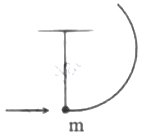
$A$ rod of length $L$ is hung from one of its ends,and a mass $m$ is attached to its free end. What tangential velocity must be imparted to $m$ so that it reaches the top of the vertical circle? ($g$ = acceleration due to gravity)
A
$4 \sqrt{gL}$
B
$2 \sqrt{gL}$
C
$5 \sqrt{gL}$
D
$3 \sqrt{gL}$
Solution
(B) For a mass attached to a rigid rod to complete a vertical circle,the minimum velocity at the bottom point is determined by the conservation of mechanical energy.
At the bottom point,the potential energy is $0$ (taking the bottom as the reference level).
At the top point,the height $h = 2L$ and the velocity $v_{top}$ can be $0$ because the rod provides support (unlike a string).
Using the law of conservation of energy:
$E_{bottom} = E_{top}$
$\frac{1}{2} mv^2 = mg(2L) + \frac{1}{2} m(v_{top})^2$
For the minimum velocity,we set $v_{top} = 0$:
$\frac{1}{2} mv^2 = 2mgL$
$v^2 = 4gL$
$v = 2 \sqrt{gL}$
At the bottom point,the potential energy is $0$ (taking the bottom as the reference level).
At the top point,the height $h = 2L$ and the velocity $v_{top}$ can be $0$ because the rod provides support (unlike a string).
Using the law of conservation of energy:
$E_{bottom} = E_{top}$
$\frac{1}{2} mv^2 = mg(2L) + \frac{1}{2} m(v_{top})^2$
For the minimum velocity,we set $v_{top} = 0$:
$\frac{1}{2} mv^2 = 2mgL$
$v^2 = 4gL$
$v = 2 \sqrt{gL}$
0 likesView Solution
357
PhysicsMediumMCQMHT CET · 2020
$A$ simple pendulum has a length of $2 \,m$ and a bob of mass $100 \,g$. It is whirled in a horizontal plane. If the string breaks under a tension of $10 \,N$, what is the angle made by the string with the vertical? $\left(g=10 \,m/s^{2}\right)$
A
$\cos^{-1}(0.4)$
B
$\cos^{-1}(0.1)$
C
$\cos^{-1}(0.05)$
D
$\cos^{-1}(0.2)$
Solution
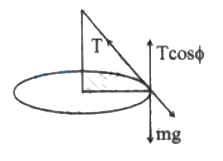
(B) For a conical pendulum (bob whirled in a horizontal plane), the forces acting on the bob are the tension $T$ in the string and the gravitational force $mg$.
Resolving the tension $T$ into vertical and horizontal components:
$1$. The vertical component $T \cos \phi$ balances the weight of the bob: $T \cos \phi = mg$.
$2$. The horizontal component $T \sin \phi$ provides the necessary centripetal force: $T \sin \phi = \frac{mv^{2}}{R}$.
Given:
Mass $m = 100 \,g = 0.1 \,kg$
Tension $T = 10 \,N$
Acceleration due to gravity $g = 10 \,m/s^{2}$
From the vertical equilibrium equation:
$\cos \phi = \frac{mg}{T}$
$\cos \phi = \frac{0.1 \,kg \times 10 \,m/s^{2}}{10 \,N}$
$\cos \phi = \frac{1}{10} = 0.1$
Therefore, the angle $\phi = \cos^{-1}(0.1)$.
Resolving the tension $T$ into vertical and horizontal components:
$1$. The vertical component $T \cos \phi$ balances the weight of the bob: $T \cos \phi = mg$.
$2$. The horizontal component $T \sin \phi$ provides the necessary centripetal force: $T \sin \phi = \frac{mv^{2}}{R}$.
Given:
Mass $m = 100 \,g = 0.1 \,kg$
Tension $T = 10 \,N$
Acceleration due to gravity $g = 10 \,m/s^{2}$
From the vertical equilibrium equation:
$\cos \phi = \frac{mg}{T}$
$\cos \phi = \frac{0.1 \,kg \times 10 \,m/s^{2}}{10 \,N}$
$\cos \phi = \frac{1}{10} = 0.1$
Therefore, the angle $\phi = \cos^{-1}(0.1)$.
0 likesView Solution
358
PhysicsMediumMCQMHT CET · 2020
Two springs of spring constants $K$ and $2K$ are stretched by the same force. If $W_{1}$ and $W_{2}$ are the energies stored in them respectively,then:
A
$W_{1} = 2W_{2}$
B
$W_{1} = \frac{W_{2}}{4}$
C
$W_{2} = 2W_{1}$
D
$W_{1} = W_{2}$
Solution
(A) The energy stored in a spring stretched by a force $F$ is given by $W = \frac{F^{2}}{2k}$,where $k$ is the spring constant.
For the first spring with constant $K$,the energy stored is $W_{1} = \frac{F^{2}}{2K}$.
For the second spring with constant $2K$,the energy stored is $W_{2} = \frac{F^{2}}{2(2K)} = \frac{F^{2}}{4K}$.
Comparing the two expressions,we see that $W_{1} = \frac{F^{2}}{2K}$ and $W_{2} = \frac{1}{2} \left( \frac{F^{2}}{2K} \right) = \frac{W_{1}}{2}$.
Therefore,$W_{1} = 2W_{2}$.
For the first spring with constant $K$,the energy stored is $W_{1} = \frac{F^{2}}{2K}$.
For the second spring with constant $2K$,the energy stored is $W_{2} = \frac{F^{2}}{2(2K)} = \frac{F^{2}}{4K}$.
Comparing the two expressions,we see that $W_{1} = \frac{F^{2}}{2K}$ and $W_{2} = \frac{1}{2} \left( \frac{F^{2}}{2K} \right) = \frac{W_{1}}{2}$.
Therefore,$W_{1} = 2W_{2}$.
0 likesView Solution
359
PhysicsEasyMCQMHT CET · 2020
The kinetic energy acquired by a body of mass $M$ in travelling a certain distance $d$,starting from rest,under the action of a constant force is:
A
inversely proportional to $\sqrt{M}$.
B
directly proportional to $M$.
C
independent of $M$.
D
directly proportional to $\sqrt{M}$.
Solution
(C) According to the Work-Energy Theorem,the work done by the net force on an object is equal to the change in its kinetic energy.
$W = \Delta K.E.$
Since the body starts from rest,the initial kinetic energy is $0$.
$W = K.E._{final} - 0 = K.E._{final}$
The work done by a constant force $F$ over a distance $d$ is given by $W = F \cdot d$.
Therefore,$K.E. = F \cdot d$.
Since the force $F$ and the distance $d$ are constants,the kinetic energy acquired is independent of the mass $M$ of the body.
$W = \Delta K.E.$
Since the body starts from rest,the initial kinetic energy is $0$.
$W = K.E._{final} - 0 = K.E._{final}$
The work done by a constant force $F$ over a distance $d$ is given by $W = F \cdot d$.
Therefore,$K.E. = F \cdot d$.
Since the force $F$ and the distance $d$ are constants,the kinetic energy acquired is independent of the mass $M$ of the body.
0 likesView Solution
360
PhysicsMediumMCQMHT CET · 2020
Two masses of $1 \ g$ and $4 \ g$ are moving with equal kinetic energy. The ratio of the magnitudes of their momenta is
A
$1: 2$
B
$1: 4$
C
$1: 1$
D
$2: 1$
Solution
(A) The kinetic energy $K$ of a body of mass $m$ and momentum $p$ is given by the relation $K = \frac{p^2}{2m}$.
Given that the kinetic energies of the two masses are equal,we have $K_1 = K_2$.
Substituting the expression for kinetic energy,we get $\frac{p_1^2}{2m_1} = \frac{p_2^2}{2m_2}$.
Rearranging the terms to find the ratio of momenta,we get $\frac{p_1^2}{p_2^2} = \frac{m_1}{m_2}$.
Taking the square root on both sides,the ratio of momenta is $\frac{p_1}{p_2} = \sqrt{\frac{m_1}{m_2}}$.
Given $m_1 = 1 \ g$ and $m_2 = 4 \ g$,we substitute these values:
$\frac{p_1}{p_2} = \sqrt{\frac{1}{4}} = \frac{1}{2}$.
Therefore,the ratio of their momenta is $1: 2$.
Given that the kinetic energies of the two masses are equal,we have $K_1 = K_2$.
Substituting the expression for kinetic energy,we get $\frac{p_1^2}{2m_1} = \frac{p_2^2}{2m_2}$.
Rearranging the terms to find the ratio of momenta,we get $\frac{p_1^2}{p_2^2} = \frac{m_1}{m_2}$.
Taking the square root on both sides,the ratio of momenta is $\frac{p_1}{p_2} = \sqrt{\frac{m_1}{m_2}}$.
Given $m_1 = 1 \ g$ and $m_2 = 4 \ g$,we substitute these values:
$\frac{p_1}{p_2} = \sqrt{\frac{1}{4}} = \frac{1}{2}$.
Therefore,the ratio of their momenta is $1: 2$.
0 likesView Solution
361
PhysicsMediumMCQMHT CET · 2020
$A$ body slides down a smooth inclined plane having angle $\theta$ and reaches the bottom with velocity $v$. If the body is a solid sphere rolling down the same plane,then its linear velocity at the bottom of the plane is
A
$\sqrt{\frac{2}{7}} v$
B
$\sqrt{\frac{3}{7}} v$
C
$\sqrt{\frac{5}{7}} v$
D
$\sqrt{\frac{9}{7}} v$
Solution
(C) For a body sliding down a smooth inclined plane,the potential energy is converted entirely into translational kinetic energy. Thus,$v = \sqrt{2gh}$.
For a sphere rolling down a rough inclined plane,the potential energy is converted into both translational and rotational kinetic energy. The velocity at the bottom is given by $v_{CM} = \sqrt{\frac{2gh}{1 + \frac{K^2}{R^2}}}$.
Substituting $v = \sqrt{2gh}$,we get $v_{CM} = \frac{v}{\sqrt{1 + \frac{K^2}{R^2}}}$.
For a solid sphere,the radius of gyration $K$ satisfies $\frac{K^2}{R^2} = \frac{2}{5}$.
Substituting this value,$v_{CM} = \frac{v}{\sqrt{1 + \frac{2}{5}}} = \frac{v}{\sqrt{\frac{7}{5}}} = \sqrt{\frac{5}{7}} v$.
For a sphere rolling down a rough inclined plane,the potential energy is converted into both translational and rotational kinetic energy. The velocity at the bottom is given by $v_{CM} = \sqrt{\frac{2gh}{1 + \frac{K^2}{R^2}}}$.
Substituting $v = \sqrt{2gh}$,we get $v_{CM} = \frac{v}{\sqrt{1 + \frac{K^2}{R^2}}}$.
For a solid sphere,the radius of gyration $K$ satisfies $\frac{K^2}{R^2} = \frac{2}{5}$.
Substituting this value,$v_{CM} = \frac{v}{\sqrt{1 + \frac{2}{5}}} = \frac{v}{\sqrt{\frac{7}{5}}} = \sqrt{\frac{5}{7}} v$.
0 likesView Solution
362
PhysicsEasyMCQMHT CET · 2020
The kinetic energy of a light body and a heavy body is the same. Which one of the following statements is $CORRECT$?
A
The light body has greater momentum.
B
$A$ body having high velocity has greater momentum.
C
Both bodies have same momentum.
D
The heavy body has greater momentum.
Solution
(D) The kinetic energy $K$ of a body of mass $m$ and momentum $p$ is given by the relation:
$K = \frac{p^2}{2m}$
Rearranging this for momentum,we get:
$p = \sqrt{2mK}$
Since the kinetic energy $K$ is the same for both bodies,the momentum $p$ is directly proportional to the square root of the mass:
$p \propto \sqrt{m}$
Because the heavy body has a larger mass $m$ compared to the light body,it will have a greater momentum $p$.
$K = \frac{p^2}{2m}$
Rearranging this for momentum,we get:
$p = \sqrt{2mK}$
Since the kinetic energy $K$ is the same for both bodies,the momentum $p$ is directly proportional to the square root of the mass:
$p \propto \sqrt{m}$
Because the heavy body has a larger mass $m$ compared to the light body,it will have a greater momentum $p$.
0 likesView Solution
363
PhysicsEasyMCQMHT CET · 2020
$A$ block of mass $m$,kept on a horizontal surface,is moved through a distance $s$ by applying a horizontal force $F$ to it. What is the work done by the normal reaction?
A
$F/s$
B
$Fs$
C
zero
D
$s/F$
Solution
(C) The work done by a force is defined as $W = \vec{F} \cdot \vec{s} = Fs \cos \theta$,where $\theta$ is the angle between the force and the displacement.
In this case,the normal reaction force $N$ acts vertically upwards,perpendicular to the horizontal surface.
The displacement $s$ of the block is along the horizontal surface.
Therefore,the angle $\theta$ between the normal reaction $N$ and the displacement $s$ is $90^\circ$.
Since $\cos 90^\circ = 0$,the work done by the normal reaction is $W = Ns \cos 90^\circ = 0$.
In this case,the normal reaction force $N$ acts vertically upwards,perpendicular to the horizontal surface.
The displacement $s$ of the block is along the horizontal surface.
Therefore,the angle $\theta$ between the normal reaction $N$ and the displacement $s$ is $90^\circ$.
Since $\cos 90^\circ = 0$,the work done by the normal reaction is $W = Ns \cos 90^\circ = 0$.
0 likesView Solution
364
PhysicsEasyMCQMHT CET · 2020
$A$ force $\vec{F} = (5 \hat{\imath} - 2 \hat{\jmath} + 3 \hat{k}) \text{ N}$ acts on a body of mass $2 \text{ kg}$ and displaces it from position $\vec{r_1} = (3 \hat{\imath} + 2 \hat{\jmath} - \hat{k}) \text{ m}$ to $\vec{r_2} = (6 \hat{\imath} - \hat{\jmath} + 4 \hat{k}) \text{ m}$. The work done is: (in $\text{ J}$)
A
$27$
B
$18$
C
$36$
D
$9$
Solution
(C) The work done $W$ by a constant force $\vec{F}$ is given by the dot product of force and displacement: $W = \vec{F} \cdot \vec{d}$.
First,calculate the displacement vector $\vec{d} = \vec{r_2} - \vec{r_1}$.
$\vec{d} = (6 - 3) \hat{\imath} + (-1 - 2) \hat{\jmath} + (4 - (-1)) \hat{k} = 3 \hat{\imath} - 3 \hat{\jmath} + 5 \hat{k} \text{ m}$.
Now,calculate the work done:
$W = (5 \hat{\imath} - 2 \hat{\jmath} + 3 \hat{k}) \cdot (3 \hat{\imath} - 3 \hat{\jmath} + 5 \hat{k})$.
$W = (5 \times 3) + (-2 \times -3) + (3 \times 5) = 15 + 6 + 15 = 36 \text{ J}$.
First,calculate the displacement vector $\vec{d} = \vec{r_2} - \vec{r_1}$.
$\vec{d} = (6 - 3) \hat{\imath} + (-1 - 2) \hat{\jmath} + (4 - (-1)) \hat{k} = 3 \hat{\imath} - 3 \hat{\jmath} + 5 \hat{k} \text{ m}$.
Now,calculate the work done:
$W = (5 \hat{\imath} - 2 \hat{\jmath} + 3 \hat{k}) \cdot (3 \hat{\imath} - 3 \hat{\jmath} + 5 \hat{k})$.
$W = (5 \times 3) + (-2 \times -3) + (3 \times 5) = 15 + 6 + 15 = 36 \text{ J}$.
0 likesView Solution
Vedclass Products
For Students
Vedclass Test Series
Mock tests in real MHT CET style covering Physics with performance analysis. 5-day free trial.
Start Free TrialFor Teachers
Exam Paper Generator
Generate Set A/B/C/D Physics papers from 7.5L+ questions in 2 minutes. 3 chapters free.
Try FreeFor Institutes
Online Exam Module
Run live MHT CET mock exams with unlimited students, 360° analytics & white-label branding.
See DemoFrequently Asked Questions
How many Physics questions are in MHT CET 2020?
There are 690 Physics questions from the MHT CET 2020 paper on Vedclass, each with a detailed step-by-step solution in English.
Are MHT CET 2020 Physics solutions available in English?
Yes. All solutions on this page are in English. You can also switch to English or Hindi using the language buttons above the questions.
Can I practice MHT CET 2020 Physics as a timed test?
Yes. Use the Vedclass Test Series to attempt a full MHT CET mock test covering Physics with time limits and instant score analysis.
Can teachers create Physics papers from MHT CET previous year questions?
Yes. The Vedclass Exam Paper Generator lets teachers mix MHT CET Physics questions and generate Set A/B/C/D papers in minutes.
For Teachers & Institutes
Build a Custom Physics Paper
Pick MHT CET 2020 Physics questions, set difficulty, and generate Set A/B/C/D in 2 minutes.