
PhysicsQ201–300 of 690 questions
Page 5 of 8 · English
201
PhysicsMediumMCQMHT CET · 2020
$A$ particle of mass $m$ is executing simple harmonic motion about its mean position. If $A$ is the amplitude and $T$ is the period of $S$.$H$.$M$.,then the total energy of the particle is
A
$\frac{4 \pi^{2} m A^{2}}{T^{2}}$
B
$\frac{8 \pi^{2} m A^{2}}{T^{2}}$
C
$\frac{2 \pi^{2} m A^{2}}{T^{2}}$
D
$\frac{\pi^{2} m A^{2}}{T^{2}}$
Solution
(C) The total energy $(E)$ of a particle executing simple harmonic motion is given by the sum of its potential energy and kinetic energy.
The formula for total energy is $E = \frac{1}{2} k A^{2}$,where $k$ is the force constant.
We know that the angular frequency $\omega = \frac{2 \pi}{T}$.
Also,the force constant $k = m \omega^{2}$.
Substituting the value of $\omega$ into the expression for $k$,we get $k = m \left( \frac{2 \pi}{T} \right)^{2} = \frac{4 \pi^{2} m}{T^{2}}$.
Now,substitute $k$ into the total energy formula: $E = \frac{1}{2} \left( \frac{4 \pi^{2} m}{T^{2}} \right) A^{2}$.
Simplifying this,we get $E = \frac{2 \pi^{2} m A^{2}}{T^{2}}$.
The formula for total energy is $E = \frac{1}{2} k A^{2}$,where $k$ is the force constant.
We know that the angular frequency $\omega = \frac{2 \pi}{T}$.
Also,the force constant $k = m \omega^{2}$.
Substituting the value of $\omega$ into the expression for $k$,we get $k = m \left( \frac{2 \pi}{T} \right)^{2} = \frac{4 \pi^{2} m}{T^{2}}$.
Now,substitute $k$ into the total energy formula: $E = \frac{1}{2} \left( \frac{4 \pi^{2} m}{T^{2}} \right) A^{2}$.
Simplifying this,we get $E = \frac{2 \pi^{2} m A^{2}}{T^{2}}$.
0 likesView Solution
202
PhysicsEasyMCQMHT CET · 2020
For a particle performing $S.H.M.$,when displacement is $x$,the potential energy and restoring force acting on it are denoted by $E$ and $F$ respectively. The relation between $x, E$ and $F$ is
A
$\frac{E}{F}+x=0$
B
$\frac{2E}{F}+x=0$
C
$\frac{E}{F}-x=0$
D
$\frac{2E}{F}-x=0$
Solution
(B) Given: Displacement $= x$,Potential Energy $(P.E.) = E$,Restoring Force $= F$.
For a particle in $S.H.M.$,the restoring force is given by $F = -kx$,where $k$ is the force constant.
The potential energy is given by $E = \frac{1}{2}kx^2$.
From the force equation,we have $k = -\frac{F}{x}$.
Substituting this value of $k$ into the potential energy equation:
$E = \frac{1}{2} \left(-\frac{F}{x}\right) x^2$
$E = -\frac{1}{2} Fx$
Multiplying by $2$:
$2E = -Fx$
Rearranging the terms:
$2E + Fx = 0$
Dividing by $F$:
$\frac{2E}{F} + x = 0$.
For a particle in $S.H.M.$,the restoring force is given by $F = -kx$,where $k$ is the force constant.
The potential energy is given by $E = \frac{1}{2}kx^2$.
From the force equation,we have $k = -\frac{F}{x}$.
Substituting this value of $k$ into the potential energy equation:
$E = \frac{1}{2} \left(-\frac{F}{x}\right) x^2$
$E = -\frac{1}{2} Fx$
Multiplying by $2$:
$2E = -Fx$
Rearranging the terms:
$2E + Fx = 0$
Dividing by $F$:
$\frac{2E}{F} + x = 0$.
0 likesView Solution
203
PhysicsEasyMCQMHT CET · 2020
$A$ simple pendulum of length $L$ has mass $m$ and it oscillates freely with amplitude $A$. At the extreme position,its potential energy is (where $g$ is the acceleration due to gravity):
A
$\frac{m g A^{2}}{2 L}$
B
$\frac{m g A^{2}}{L}$
C
$\frac{m g A}{L}$
D
$\frac{m g A}{2 L}$
Solution
(A) For a simple pendulum undergoing small oscillations,the restoring force is $F = -\frac{mg}{L} x$.
The potential energy $PE$ of a simple harmonic oscillator is given by $PE = \frac{1}{2} k x^{2}$.
Comparing the restoring force $F = -kx$ with $F = -\frac{mg}{L} x$,we get the spring constant $k = \frac{mg}{L}$.
At the extreme position,the displacement $x$ is equal to the amplitude $A$.
Substituting these values into the potential energy formula: $PE = \frac{1}{2} \left( \frac{mg}{L} \right) A^{2} = \frac{mgA^{2}}{2L}$.
The potential energy $PE$ of a simple harmonic oscillator is given by $PE = \frac{1}{2} k x^{2}$.
Comparing the restoring force $F = -kx$ with $F = -\frac{mg}{L} x$,we get the spring constant $k = \frac{mg}{L}$.
At the extreme position,the displacement $x$ is equal to the amplitude $A$.
Substituting these values into the potential energy formula: $PE = \frac{1}{2} \left( \frac{mg}{L} \right) A^{2} = \frac{mgA^{2}}{2L}$.
0 likesView Solution
204
PhysicsMediumMCQMHT CET · 2020
$A$ body performing simple harmonic motion has potential energy $P_{1}$ at displacement $x_{1}$. Its potential energy is $P_{2}$ at displacement $x_{2}$. The potential energy $P$ at displacement $(x_{1}+x_{2})$ is
A
$P_{1}+P_{2}$
B
$\sqrt{P_{1} P_{2}}$
C
$\sqrt{P_{1}^{2}+P_{2}^{2}}$
D
$P_{1}+P_{2}+2 \sqrt{P_{1} P_{2}}$
Solution
(D) The potential energy of a body in simple harmonic motion is given by $P = \frac{1}{2} k x^2$,where $k$ is the force constant.
Given $P_{1} = \frac{1}{2} k x_{1}^2$ and $P_{2} = \frac{1}{2} k x_{2}^2$.
We need to find the potential energy $P$ at displacement $(x_{1} + x_{2})$:
$P = \frac{1}{2} k (x_{1} + x_{2})^2$
$P = \frac{1}{2} k (x_{1}^2 + x_{2}^2 + 2 x_{1} x_{2})$
$P = \frac{1}{2} k x_{1}^2 + \frac{1}{2} k x_{2}^2 + 2 \left( \sqrt{\frac{1}{2} k x_{1}^2} \right) \left( \sqrt{\frac{1}{2} k x_{2}^2} \right)$
$P = P_{1} + P_{2} + 2 \sqrt{P_{1} P_{2}}$.
Given $P_{1} = \frac{1}{2} k x_{1}^2$ and $P_{2} = \frac{1}{2} k x_{2}^2$.
We need to find the potential energy $P$ at displacement $(x_{1} + x_{2})$:
$P = \frac{1}{2} k (x_{1} + x_{2})^2$
$P = \frac{1}{2} k (x_{1}^2 + x_{2}^2 + 2 x_{1} x_{2})$
$P = \frac{1}{2} k x_{1}^2 + \frac{1}{2} k x_{2}^2 + 2 \left( \sqrt{\frac{1}{2} k x_{1}^2} \right) \left( \sqrt{\frac{1}{2} k x_{2}^2} \right)$
$P = P_{1} + P_{2} + 2 \sqrt{P_{1} P_{2}}$.
0 likesView Solution
205
PhysicsEasyMCQMHT CET · 2020
If the length of an oscillating simple pendulum is made $\frac{1}{3}$ times at a place while keeping the amplitude the same,then its total energy $(E)$ will be: (in $E$)
A
$6$
B
$4$
C
$2$
D
$3$
Solution
(D) The time period of a simple pendulum is given by $T = 2 \pi \sqrt{\frac{\ell}{g}}$.
Since $\omega = \frac{2 \pi}{T}$,we have $\omega = \sqrt{\frac{g}{\ell}}$,which implies $\omega \propto \frac{1}{\sqrt{\ell}}$.
Given the new length $\ell_2 = \frac{\ell_1}{3}$,the new angular frequency $\omega_2$ is related to the initial frequency $\omega_1$ by $\frac{\omega_2}{\omega_1} = \sqrt{\frac{\ell_1}{\ell_2}} = \sqrt{\frac{\ell_1}{\ell_1/3}} = \sqrt{3}$.
The total energy of a simple harmonic oscillator is given by $E = \frac{1}{2} m \omega^2 A^2$.
Since the mass $(m)$ and amplitude $(A)$ remain constant,$E \propto \omega^2$.
Therefore,$\frac{E_2}{E_1} = \left( \frac{\omega_2}{\omega_1} \right)^2 = (\sqrt{3})^2 = 3$.
Thus,the new total energy is $E_2 = 3 E_1$.
Since $\omega = \frac{2 \pi}{T}$,we have $\omega = \sqrt{\frac{g}{\ell}}$,which implies $\omega \propto \frac{1}{\sqrt{\ell}}$.
Given the new length $\ell_2 = \frac{\ell_1}{3}$,the new angular frequency $\omega_2$ is related to the initial frequency $\omega_1$ by $\frac{\omega_2}{\omega_1} = \sqrt{\frac{\ell_1}{\ell_2}} = \sqrt{\frac{\ell_1}{\ell_1/3}} = \sqrt{3}$.
The total energy of a simple harmonic oscillator is given by $E = \frac{1}{2} m \omega^2 A^2$.
Since the mass $(m)$ and amplitude $(A)$ remain constant,$E \propto \omega^2$.
Therefore,$\frac{E_2}{E_1} = \left( \frac{\omega_2}{\omega_1} \right)^2 = (\sqrt{3})^2 = 3$.
Thus,the new total energy is $E_2 = 3 E_1$.
0 likesView Solution
206
PhysicsEasyMCQMHT CET · 2020
$A$ particle starts from the mean position and performs $S.H.M.$ with a period of $6 \ s$. At what time is its kinetic energy $50 \%$ of its total energy (in $s$)? $\left(\cos 45^{\circ} = \frac{1}{\sqrt{2}}\right)$
A
$0.75$
B
$1$
C
$0.25$
D
$0.50$
Solution
(A) Given,period $T = 6 \ s$. The kinetic energy $(K.E.)$ is given by $K.E. = \frac{1}{2} m \omega^2 (A^2 - x^2)$ and total energy $(T.E.)$ is $T.E. = \frac{1}{2} m \omega^2 A^2$.
We are given that $K.E. = 50\% \text{ of } T.E.$,so $K.E. = \frac{1}{2} T.E.$.
Substituting the expressions: $\frac{1}{2} m \omega^2 (A^2 - x^2) = \frac{1}{2} (\frac{1}{2} m \omega^2 A^2)$.
This simplifies to $A^2 - x^2 = \frac{A^2}{2}$,which gives $x^2 = \frac{A^2}{2}$ or $x = \frac{A}{\sqrt{2}}$.
Since the particle starts from the mean position,the displacement equation is $x = A \sin(\omega t)$.
Substituting $x = \frac{A}{\sqrt{2}}$,we get $\frac{A}{\sqrt{2}} = A \sin(\frac{2\pi}{T} t)$.
$\frac{1}{\sqrt{2}} = \sin(\frac{2\pi}{6} t) = \sin(\frac{\pi}{3} t)$.
Since $\sin(45^{\circ}) = \frac{1}{\sqrt{2}}$,we have $\frac{\pi}{4} = \frac{\pi}{3} t$.
Solving for $t$: $t = \frac{3}{4} = 0.75 \ s$.
We are given that $K.E. = 50\% \text{ of } T.E.$,so $K.E. = \frac{1}{2} T.E.$.
Substituting the expressions: $\frac{1}{2} m \omega^2 (A^2 - x^2) = \frac{1}{2} (\frac{1}{2} m \omega^2 A^2)$.
This simplifies to $A^2 - x^2 = \frac{A^2}{2}$,which gives $x^2 = \frac{A^2}{2}$ or $x = \frac{A}{\sqrt{2}}$.
Since the particle starts from the mean position,the displacement equation is $x = A \sin(\omega t)$.
Substituting $x = \frac{A}{\sqrt{2}}$,we get $\frac{A}{\sqrt{2}} = A \sin(\frac{2\pi}{T} t)$.
$\frac{1}{\sqrt{2}} = \sin(\frac{2\pi}{6} t) = \sin(\frac{\pi}{3} t)$.
Since $\sin(45^{\circ}) = \frac{1}{\sqrt{2}}$,we have $\frac{\pi}{4} = \frac{\pi}{3} t$.
Solving for $t$: $t = \frac{3}{4} = 0.75 \ s$.
0 likesView Solution
207
PhysicsEasyMCQMHT CET · 2020
The weight suspended from a spring oscillates up and down. The acceleration of the weight will be zero at
A
mean position.
B
highest position.
C
half of the amplitude.
D
lowest position.
Solution
(A) In simple harmonic motion,the acceleration $a$ is given by the formula $a = -\omega^2 x$,where $\omega$ is the angular frequency and $x$ is the displacement from the mean position.
At the mean position,the displacement $x = 0$.
Substituting $x = 0$ into the formula,we get $a = -\omega^2 (0) = 0$.
Therefore,the acceleration of the weight is zero at the mean position.
At the mean position,the displacement $x = 0$.
Substituting $x = 0$ into the formula,we get $a = -\omega^2 (0) = 0$.
Therefore,the acceleration of the weight is zero at the mean position.
0 likesView Solution
208
PhysicsEasyMCQMHT CET · 2020
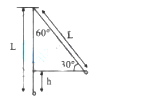
$A$ pendulum has a length of $0.4 \ m$ and a maximum speed of $4 \ m/s$. When the string makes an angle of $30^{\circ}$ with the horizontal,its speed will be: $\left[\sin \frac{\pi}{6} = \cos \frac{\pi}{3} = 0.5 \text{ and } g = 10 \ m/s^{2}\right]$
A
$2 \sqrt{2} \ m/s$
B
$\sqrt{3} \ m/s$
C
$2 \sqrt{5} \ m/s$
D
$2 \sqrt{3} \ m/s$
Solution
(D) Given: Length $L = 0.4 \ m$,maximum speed $v_{max} = 4 \ m/s$ at the lowest point.
When the string makes an angle of $30^{\circ}$ with the horizontal,it makes an angle of $\theta = 60^{\circ}$ with the vertical.
The height $h$ of the pendulum bob above the lowest point is given by $h = L - L \cos \theta = L(1 - \cos 60^{\circ})$.
$h = 0.4(1 - 0.5) = 0.4 \times 0.5 = 0.2 \ m$.
Using the law of conservation of energy between the lowest point and the point at angle $\theta$:
$\frac{1}{2} m v_{max}^{2} = \frac{1}{2} m v^{2} + mgh$
$v^{2} = v_{max}^{2} - 2gh$
$v^{2} = (4)^{2} - 2 \times 10 \times 0.2$
$v^{2} = 16 - 4 = 12$
$v = \sqrt{12} = 2 \sqrt{3} \ m/s$.
When the string makes an angle of $30^{\circ}$ with the horizontal,it makes an angle of $\theta = 60^{\circ}$ with the vertical.
The height $h$ of the pendulum bob above the lowest point is given by $h = L - L \cos \theta = L(1 - \cos 60^{\circ})$.
$h = 0.4(1 - 0.5) = 0.4 \times 0.5 = 0.2 \ m$.
Using the law of conservation of energy between the lowest point and the point at angle $\theta$:
$\frac{1}{2} m v_{max}^{2} = \frac{1}{2} m v^{2} + mgh$
$v^{2} = v_{max}^{2} - 2gh$
$v^{2} = (4)^{2} - 2 \times 10 \times 0.2$
$v^{2} = 16 - 4 = 12$
$v = \sqrt{12} = 2 \sqrt{3} \ m/s$.
0 likesView Solution
209
PhysicsEasyMCQMHT CET · 2020
The displacements of two particles executing simple harmonic motion are represented as $y_{1} = 2 \sin (10 t + \theta)$ and $y_{2} = 3 \cos 10 t$. The phase difference between the velocities of these waves is
A
$(\theta + \frac{\pi}{2})$
B
$-\theta$
C
$(\theta - \frac{\pi}{2})$
D
$\theta$
Solution
(C) Given,$y_{1} = 2 \sin (10 t + \theta)$.
The velocity $V_{1} = \frac{dy_{1}}{dt} = 2 \times 10 \cos (10 t + \theta) = 20 \cos (10 t + \theta)$.
Given,$y_{2} = 3 \cos 10 t = 3 \sin (10 t + \frac{\pi}{2})$.
The velocity $V_{2} = \frac{dy_{2}}{dt} = 3 \times 10 \cos (10 t + \frac{\pi}{2}) = 30 \cos (10 t + \frac{\pi}{2})$.
The phase of $V_{1}$ is $\phi_{1} = 10 t + \theta$.
The phase of $V_{2}$ is $\phi_{2} = 10 t + \frac{\pi}{2}$.
The phase difference $\Delta \phi = \phi_{1} - \phi_{2} = (10 t + \theta) - (10 t + \frac{\pi}{2}) = \theta - \frac{\pi}{2}$.
The velocity $V_{1} = \frac{dy_{1}}{dt} = 2 \times 10 \cos (10 t + \theta) = 20 \cos (10 t + \theta)$.
Given,$y_{2} = 3 \cos 10 t = 3 \sin (10 t + \frac{\pi}{2})$.
The velocity $V_{2} = \frac{dy_{2}}{dt} = 3 \times 10 \cos (10 t + \frac{\pi}{2}) = 30 \cos (10 t + \frac{\pi}{2})$.
The phase of $V_{1}$ is $\phi_{1} = 10 t + \theta$.
The phase of $V_{2}$ is $\phi_{2} = 10 t + \frac{\pi}{2}$.
The phase difference $\Delta \phi = \phi_{1} - \phi_{2} = (10 t + \theta) - (10 t + \frac{\pi}{2}) = \theta - \frac{\pi}{2}$.
0 likesView Solution
210
PhysicsMediumMCQMHT CET · 2020
$A$ particle performs $S.H.M.$ with amplitude $A$. Its speed is tripled at the instant when it is at a distance of $\frac{2A}{3}$ from the mean position. The new amplitude of the motion is
A
$\frac{5A}{3}$
B
$\frac{7A}{3}$
C
$\frac{2A}{3}$
D
$\frac{A}{3}$
Solution
(B) The velocity of a particle in $S.H.M.$ at displacement $x$ is given by $v = \omega \sqrt{A^2 - x^2}$.
At $x = \frac{2A}{3}$,the velocity is $v = \omega \sqrt{A^2 - (\frac{2A}{3})^2} = \omega \sqrt{A^2 - \frac{4A^2}{9}} = \omega \sqrt{\frac{5A^2}{9}} = \frac{\sqrt{5}}{3} \omega A$.
When the speed is tripled,the new velocity $v' = 3v = 3 \times \frac{\sqrt{5}}{3} \omega A = \sqrt{5} \omega A$.
The total energy of the $S.H.M.$ remains constant at any point,so $E' = K' + U$.
The new total energy is $E' = \frac{1}{2} m \omega^2 A'^2$.
The potential energy at $x = \frac{2A}{3}$ is $U = \frac{1}{2} m \omega^2 x^2 = \frac{1}{2} m \omega^2 (\frac{2A}{3})^2 = \frac{1}{2} m \omega^2 \frac{4A^2}{9}$.
The new kinetic energy is $K' = \frac{1}{2} m v'^2 = \frac{1}{2} m (\sqrt{5} \omega A)^2 = \frac{1}{2} m \omega^2 (5A^2)$.
Equating the total energy: $\frac{1}{2} m \omega^2 A'^2 = \frac{1}{2} m \omega^2 (\frac{4A^2}{9}) + \frac{1}{2} m \omega^2 (5A^2)$.
$A'^2 = \frac{4A^2}{9} + 5A^2 = A^2 (\frac{4+45}{9}) = \frac{49A^2}{9}$.
Taking the square root,$A' = \frac{7A}{3}$.
At $x = \frac{2A}{3}$,the velocity is $v = \omega \sqrt{A^2 - (\frac{2A}{3})^2} = \omega \sqrt{A^2 - \frac{4A^2}{9}} = \omega \sqrt{\frac{5A^2}{9}} = \frac{\sqrt{5}}{3} \omega A$.
When the speed is tripled,the new velocity $v' = 3v = 3 \times \frac{\sqrt{5}}{3} \omega A = \sqrt{5} \omega A$.
The total energy of the $S.H.M.$ remains constant at any point,so $E' = K' + U$.
The new total energy is $E' = \frac{1}{2} m \omega^2 A'^2$.
The potential energy at $x = \frac{2A}{3}$ is $U = \frac{1}{2} m \omega^2 x^2 = \frac{1}{2} m \omega^2 (\frac{2A}{3})^2 = \frac{1}{2} m \omega^2 \frac{4A^2}{9}$.
The new kinetic energy is $K' = \frac{1}{2} m v'^2 = \frac{1}{2} m (\sqrt{5} \omega A)^2 = \frac{1}{2} m \omega^2 (5A^2)$.
Equating the total energy: $\frac{1}{2} m \omega^2 A'^2 = \frac{1}{2} m \omega^2 (\frac{4A^2}{9}) + \frac{1}{2} m \omega^2 (5A^2)$.
$A'^2 = \frac{4A^2}{9} + 5A^2 = A^2 (\frac{4+45}{9}) = \frac{49A^2}{9}$.
Taking the square root,$A' = \frac{7A}{3}$.
0 likesView Solution
211
PhysicsEasyMCQMHT CET · 2020
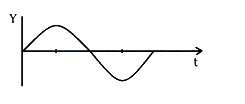
For a particle performing Simple Harmonic Motion $(S.H.M.)$,the displacement-time graph is as shown. For that particle,the force-time graph is correctly represented by which of the following graphs?
A
$(A)$
B
$(B)$
C
$(C)$
D
$(D)$
Solution
(A) For a particle performing $S.H.M.$,the displacement $x$ as a function of time $t$ is given by $x = A \sin(\omega t)$,where $A$ is the amplitude and $\omega$ is the angular frequency.
According to Hooke's Law for $S.H.M.$,the restoring force $F$ is given by $F = -kx$,where $k$ is the force constant.
Substituting the expression for $x$,we get $F = -k(A \sin(\omega t)) = -kA \sin(\omega t)$.
This equation shows that the force $F$ is proportional to the negative of the displacement $x$.
Therefore,the force-time graph will be an inverted version of the displacement-time graph. If the displacement graph starts from the origin and goes positive,the force graph must start from the origin and go negative.
According to Hooke's Law for $S.H.M.$,the restoring force $F$ is given by $F = -kx$,where $k$ is the force constant.
Substituting the expression for $x$,we get $F = -k(A \sin(\omega t)) = -kA \sin(\omega t)$.
This equation shows that the force $F$ is proportional to the negative of the displacement $x$.
Therefore,the force-time graph will be an inverted version of the displacement-time graph. If the displacement graph starts from the origin and goes positive,the force graph must start from the origin and go negative.
0 likesView Solution
212
PhysicsMediumMCQMHT CET · 2020
$A$ particle performs $S.H.M.$ from the mean position. Its amplitude is $A$ and total energy is $E$. At a particular instant,its kinetic energy is $\frac{3E}{4}$. The displacement of the particle at that instant is:
A
$A$
B
$\frac{A}{8}$
C
$\frac{A}{4}$
D
$\frac{A}{2}$
Solution
(D) The total energy of a particle in $S.H.M.$ is given by $E = \frac{1}{2} m \omega^2 A^2$.
At any displacement $x$,the potential energy is $U = \frac{1}{2} m \omega^2 x^2$.
The kinetic energy is $K = E - U = \frac{1}{2} m \omega^2 (A^2 - x^2)$.
Given that $K = \frac{3E}{4}$,the potential energy $U$ must be $E - \frac{3E}{4} = \frac{E}{4}$.
Substituting the expressions for $U$ and $E$:
$\frac{1}{2} m \omega^2 x^2 = \frac{1}{4} (\frac{1}{2} m \omega^2 A^2)$.
Simplifying,we get $x^2 = \frac{A^2}{4}$.
Taking the square root,$x = \frac{A}{2}$.
At any displacement $x$,the potential energy is $U = \frac{1}{2} m \omega^2 x^2$.
The kinetic energy is $K = E - U = \frac{1}{2} m \omega^2 (A^2 - x^2)$.
Given that $K = \frac{3E}{4}$,the potential energy $U$ must be $E - \frac{3E}{4} = \frac{E}{4}$.
Substituting the expressions for $U$ and $E$:
$\frac{1}{2} m \omega^2 x^2 = \frac{1}{4} (\frac{1}{2} m \omega^2 A^2)$.
Simplifying,we get $x^2 = \frac{A^2}{4}$.
Taking the square root,$x = \frac{A}{2}$.
0 likesView Solution
213
PhysicsDifficultMCQMHT CET · 2020
$A$ spring executes $S.H.M.$ with mass $10 \ kg$ attached to it. The force constant of the spring is $10 \ N/m$. If at any instant its velocity is $40 \ cm/s$,the displacement at that instant is (Amplitude of $S.H.M.$ $= 0.5 \ m$) (in $m$)
A
$0.3$
B
$0.2$
C
$0.4$
D
$0.45$
Solution
(A) The velocity $v$ of a particle in $S.H.M.$ is given by $v = \omega \sqrt{A^2 - x^2}$,where $\omega = \sqrt{\frac{k}{m}}$.
Given: $m = 10 \ kg$,$k = 10 \ N/m$,$A = 0.5 \ m$,and $v = 40 \ cm/s = 0.4 \ m/s$.
First,calculate the angular frequency $\omega = \sqrt{\frac{10}{10}} = 1 \ rad/s$.
Now,substitute the values into the velocity equation: $0.4 = 1 \cdot \sqrt{(0.5)^2 - x^2}$.
Squaring both sides: $0.16 = 0.25 - x^2$.
Rearranging for $x^2$: $x^2 = 0.25 - 0.16 = 0.09$.
Taking the square root: $x = 0.3 \ m$.
Given: $m = 10 \ kg$,$k = 10 \ N/m$,$A = 0.5 \ m$,and $v = 40 \ cm/s = 0.4 \ m/s$.
First,calculate the angular frequency $\omega = \sqrt{\frac{10}{10}} = 1 \ rad/s$.
Now,substitute the values into the velocity equation: $0.4 = 1 \cdot \sqrt{(0.5)^2 - x^2}$.
Squaring both sides: $0.16 = 0.25 - x^2$.
Rearranging for $x^2$: $x^2 = 0.25 - 0.16 = 0.09$.
Taking the square root: $x = 0.3 \ m$.
0 likesView Solution
214
PhysicsDifficultMCQMHT CET · 2020
$A$ horizontal spring executes $S.H.M.$ with amplitude $A_{1}$,when mass $m_{1}$ is attached to it. When it passes through the mean position,another mass $m_{2}$ is placed on it. Both masses move together with amplitude $A_{2}$. Therefore,the ratio $A_{2}: A_{1}$ is:
A
$\left[\frac{m_{1}}{m_{1}+m_{2}}\right]^{1 / 2}$
B
$\left[\frac{m_{1}+m_{2}}{m_{1}}\right]^{1 / 2}$
C
$\left[\frac{m_{1}}{m_{1}+m_{2}}\right]$
D
$\left[\frac{m_{1}+m_{2}}{m_{1}}\right]$
Solution
(A) When mass $m_{1}$ is attached to the spring,the total energy of the $S.H.M.$ is $E = \frac{1}{2} k A_{1}^{2}$.
At the mean position,the velocity $v_{1}$ of the mass $m_{1}$ is maximum,given by $v_{1} = \omega_{1} A_{1} = \sqrt{\frac{k}{m_{1}}} A_{1}$.
When mass $m_{2}$ is placed on $m_{1}$ at the mean position,the momentum of the system is conserved because there is no external horizontal force.
Initial momentum $p_{i} = m_{1} v_{1}$.
Final momentum $p_{f} = (m_{1} + m_{2}) v_{2}$,where $v_{2}$ is the new velocity at the mean position.
Since $p_{i} = p_{f}$,we have $m_{1} v_{1} = (m_{1} + m_{2}) v_{2}$.
$v_{2} = \frac{m_{1}}{m_{1} + m_{2}} v_{1}$.
The new angular frequency is $\omega_{2} = \sqrt{\frac{k}{m_{1} + m_{2}}}$.
Since $v_{2} = \omega_{2} A_{2}$,we have $A_{2} = \frac{v_{2}}{\omega_{2}} = \frac{m_{1} v_{1}}{(m_{1} + m_{2})} \sqrt{\frac{m_{1} + m_{2}}{k}}$.
Substituting $v_{1} = \sqrt{\frac{k}{m_{1}}} A_{1}$,we get $A_{2} = \frac{m_{1}}{(m_{1} + m_{2})} \sqrt{\frac{k}{m_{1}}} A_{1} \sqrt{\frac{m_{1} + m_{2}}{k}} = A_{1} \sqrt{\frac{m_{1}}{m_{1} + m_{2}}}$.
Therefore,$\frac{A_{2}}{A_{1}} = \left[\frac{m_{1}}{m_{1} + m_{2}}\right]^{1/2}$.
At the mean position,the velocity $v_{1}$ of the mass $m_{1}$ is maximum,given by $v_{1} = \omega_{1} A_{1} = \sqrt{\frac{k}{m_{1}}} A_{1}$.
When mass $m_{2}$ is placed on $m_{1}$ at the mean position,the momentum of the system is conserved because there is no external horizontal force.
Initial momentum $p_{i} = m_{1} v_{1}$.
Final momentum $p_{f} = (m_{1} + m_{2}) v_{2}$,where $v_{2}$ is the new velocity at the mean position.
Since $p_{i} = p_{f}$,we have $m_{1} v_{1} = (m_{1} + m_{2}) v_{2}$.
$v_{2} = \frac{m_{1}}{m_{1} + m_{2}} v_{1}$.
The new angular frequency is $\omega_{2} = \sqrt{\frac{k}{m_{1} + m_{2}}}$.
Since $v_{2} = \omega_{2} A_{2}$,we have $A_{2} = \frac{v_{2}}{\omega_{2}} = \frac{m_{1} v_{1}}{(m_{1} + m_{2})} \sqrt{\frac{m_{1} + m_{2}}{k}}$.
Substituting $v_{1} = \sqrt{\frac{k}{m_{1}}} A_{1}$,we get $A_{2} = \frac{m_{1}}{(m_{1} + m_{2})} \sqrt{\frac{k}{m_{1}}} A_{1} \sqrt{\frac{m_{1} + m_{2}}{k}} = A_{1} \sqrt{\frac{m_{1}}{m_{1} + m_{2}}}$.
Therefore,$\frac{A_{2}}{A_{1}} = \left[\frac{m_{1}}{m_{1} + m_{2}}\right]^{1/2}$.
0 likesView Solution
215
PhysicsMediumMCQMHT CET · 2020
$A$ simple harmonic progressive wave is represented as $Y = A \sin 2 \pi (n t - \frac{x}{\lambda}) \text{ cm}$. If the maximum particle velocity is four times the wave velocity,then the wavelength of the wave is
A
$\frac{\pi A}{4}$
B
$4 \pi A$
C
$2 \pi A$
D
$\pi A$
Solution
(D) The given wave equation is $Y = A \sin 2 \pi (n t - \frac{x}{\lambda})$.
Comparing this with the standard wave equation $Y = A \sin (\omega t - kx)$,we have $\omega = 2 \pi n$ and $k = \frac{2 \pi}{\lambda}$.
The maximum particle velocity is given by $v_{p, \text{max}} = A \omega = A (2 \pi n)$.
The wave velocity is given by $v_w = \frac{\omega}{k} = \frac{2 \pi n}{2 \pi / \lambda} = n \lambda$.
According to the problem,$v_{p, \text{max}} = 4 v_w$.
Substituting the expressions,we get $A (2 \pi n) = 4 (n \lambda)$.
Simplifying the equation,$2 \pi A n = 4 n \lambda$.
Dividing both sides by $2n$,we get $\lambda = \pi A$.
Comparing this with the standard wave equation $Y = A \sin (\omega t - kx)$,we have $\omega = 2 \pi n$ and $k = \frac{2 \pi}{\lambda}$.
The maximum particle velocity is given by $v_{p, \text{max}} = A \omega = A (2 \pi n)$.
The wave velocity is given by $v_w = \frac{\omega}{k} = \frac{2 \pi n}{2 \pi / \lambda} = n \lambda$.
According to the problem,$v_{p, \text{max}} = 4 v_w$.
Substituting the expressions,we get $A (2 \pi n) = 4 (n \lambda)$.
Simplifying the equation,$2 \pi A n = 4 n \lambda$.
Dividing both sides by $2n$,we get $\lambda = \pi A$.
0 likesView Solution
216
PhysicsEasyMCQMHT CET · 2020
$A$ particle performs simple harmonic motion with a period of $3 \ s$. The time taken by it to cover a distance equal to half the amplitude from the mean position is $\left[\sin 30^{\circ}=0.5\right]$.
A
$1/4 \ s$
B
$3/4 \ s$
C
$3/2 \ s$
D
$1/2 \ s$
Solution
(A) The equation for displacement in simple harmonic motion starting from the mean position is given by $y = A \sin(\omega t)$.
Given,the period $T = 3 \ s$,so the angular frequency $\omega = \frac{2\pi}{T} = \frac{2\pi}{3} \ rad/s$.
We need to find the time $t$ when the displacement $y = \frac{A}{2}$.
Substituting these values into the equation: $\frac{A}{2} = A \sin\left(\frac{2\pi}{3} t\right)$.
$\frac{1}{2} = \sin\left(\frac{2\pi}{3} t\right)$.
Since $\sin 30^{\circ} = 0.5$,we have $\sin\left(\frac{\pi}{6}\right) = \sin\left(\frac{2\pi}{3} t\right)$.
Equating the angles: $\frac{\pi}{6} = \frac{2\pi}{3} t$.
Solving for $t$: $t = \frac{\pi}{6} \times \frac{3}{2\pi} = \frac{3}{12} = 0.25 \ s = \frac{1}{4} \ s$.
Given,the period $T = 3 \ s$,so the angular frequency $\omega = \frac{2\pi}{T} = \frac{2\pi}{3} \ rad/s$.
We need to find the time $t$ when the displacement $y = \frac{A}{2}$.
Substituting these values into the equation: $\frac{A}{2} = A \sin\left(\frac{2\pi}{3} t\right)$.
$\frac{1}{2} = \sin\left(\frac{2\pi}{3} t\right)$.
Since $\sin 30^{\circ} = 0.5$,we have $\sin\left(\frac{\pi}{6}\right) = \sin\left(\frac{2\pi}{3} t\right)$.
Equating the angles: $\frac{\pi}{6} = \frac{2\pi}{3} t$.
Solving for $t$: $t = \frac{\pi}{6} \times \frac{3}{2\pi} = \frac{3}{12} = 0.25 \ s = \frac{1}{4} \ s$.
0 likesView Solution
217
PhysicsEasyMCQMHT CET · 2020
The damping force of an oscillator is directly proportional to the velocity. The unit of the constant of proportionality is:
A
$kg \cdot m \cdot s^{-2}$
B
$kg \cdot s^{-1}$
C
$kg \cdot m \cdot s^{-1}$
D
$kg \cdot s^{-1}$
Solution
(B) The damping force $F$ is given by the relation $F = -bv$,where $b$ is the constant of proportionality (damping constant) and $v$ is the velocity.
To find the unit of $b$,we rearrange the formula: $b = \frac{F}{v}$.
The $SI$ unit of force $F$ is Newton $(N)$,which is equivalent to $kg \cdot m \cdot s^{-2}$.
The $SI$ unit of velocity $v$ is $m \cdot s^{-1}$.
Substituting these units into the formula for $b$:
$b = \frac{kg \cdot m \cdot s^{-2}}{m \cdot s^{-1}} = kg \cdot s^{-1}$.
Therefore,the unit of the constant of proportionality is $kg \cdot s^{-1}$.
To find the unit of $b$,we rearrange the formula: $b = \frac{F}{v}$.
The $SI$ unit of force $F$ is Newton $(N)$,which is equivalent to $kg \cdot m \cdot s^{-2}$.
The $SI$ unit of velocity $v$ is $m \cdot s^{-1}$.
Substituting these units into the formula for $b$:
$b = \frac{kg \cdot m \cdot s^{-2}}{m \cdot s^{-1}} = kg \cdot s^{-1}$.
Therefore,the unit of the constant of proportionality is $kg \cdot s^{-1}$.
0 likesView Solution
218
PhysicsMediumMCQMHT CET · 2020
$A$ coin is placed on a horizontal plate. The plate performs $S.H.M.$ vertically with an angular frequency $\omega$. The amplitude $A$ of oscillations is gradually increased. The coin will lose contact with the plate for the first time when the amplitude is ($g =$ acceleration due to gravity).
A
$\frac{g}{\omega^{2}}$
B
zero
C
$\frac{\omega^{2}}{g}$
D
$\frac{A}{2}$
Solution
(A) The coin rests on the plate and moves with it. The acceleration of the plate in $S.H.M.$ is given by $a = \omega^{2} x$,where $x$ is the displacement from the mean position.
As the plate moves downward,its acceleration is directed upwards. As the plate moves upward,its acceleration is directed downwards.
The coin loses contact with the plate when the downward acceleration of the plate exceeds the acceleration due to gravity $(g)$.
At the topmost point of the oscillation,the downward acceleration is maximum,given by $a_{max} = \omega^{2} A$.
For the coin to lose contact,the condition is $a_{max} \geq g$.
Therefore,the minimum amplitude at which contact is lost is $A = \frac{g}{\omega^{2}}$.
As the plate moves downward,its acceleration is directed upwards. As the plate moves upward,its acceleration is directed downwards.
The coin loses contact with the plate when the downward acceleration of the plate exceeds the acceleration due to gravity $(g)$.
At the topmost point of the oscillation,the downward acceleration is maximum,given by $a_{max} = \omega^{2} A$.
For the coin to lose contact,the condition is $a_{max} \geq g$.
Therefore,the minimum amplitude at which contact is lost is $A = \frac{g}{\omega^{2}}$.
0 likesView Solution
219
PhysicsEasyMCQMHT CET · 2020
$A$ man of mass $M$ is standing on a platform. The platform is executing $S.H.M.$ of frequency $f$ in the vertical direction. The span of oscillation is $L$. What is the acceleration of the platform at the top of the oscillation?
A
$4 \pi^{2} f^{2} L$
B
$\frac{2 \pi^{2} f^{2} L}{M}$
C
$\frac{4 \pi^{2} f^{2} L}{M}$
D
$2 \pi^{2} f^{2} L$
Solution
(D) The span of oscillation $L$ is the total distance between the extreme positions,which is equal to $2A$,where $A$ is the amplitude of oscillation.
Therefore,$A = \frac{L}{2}$.
The angular frequency $\omega$ is given by $\omega = 2 \pi f$.
The acceleration $a$ of a particle in $S.H.M.$ is given by $a = -\omega^{2} x$.
At the top of the oscillation (extreme position),the displacement $x = A = \frac{L}{2}$.
Substituting the values,the magnitude of acceleration is $|a| = \omega^{2} A = (2 \pi f)^{2} \times \frac{L}{2}$.
$|a| = 4 \pi^{2} f^{2} \times \frac{L}{2} = 2 \pi^{2} f^{2} L$.
Thus,the correct option is $D$.
Therefore,$A = \frac{L}{2}$.
The angular frequency $\omega$ is given by $\omega = 2 \pi f$.
The acceleration $a$ of a particle in $S.H.M.$ is given by $a = -\omega^{2} x$.
At the top of the oscillation (extreme position),the displacement $x = A = \frac{L}{2}$.
Substituting the values,the magnitude of acceleration is $|a| = \omega^{2} A = (2 \pi f)^{2} \times \frac{L}{2}$.
$|a| = 4 \pi^{2} f^{2} \times \frac{L}{2} = 2 \pi^{2} f^{2} L$.
Thus,the correct option is $D$.
0 likesView Solution
220
PhysicsEasyMCQMHT CET · 2020
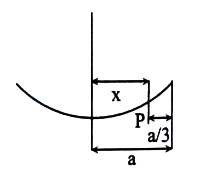
$A$ body performs linear $S$.$H$.$M$. with amplitude $a$. When it is at a distance $\frac{a}{3}$ from the extreme position,the magnitude of velocity is $\frac{1}{3}$ times the magnitude of acceleration. The period of $S$.$H$.$M$. is:
A
$\frac{3 \pi}{2 \sqrt{5}} \text{ s}$
B
$\frac{5 \pi}{3 \sqrt{5}} \text{ s}$
C
$\frac{2 \pi}{3 \sqrt{5}} \text{ s}$
D
$\frac{4 \pi}{3 \sqrt{5}} \text{ s}$
Solution
(D) Let $a$ be the amplitude of the $S$.$H$.$M$.
Given that the particle is at a distance $\frac{a}{3}$ from the extreme position,its displacement $x$ from the mean position is $x = a - \frac{a}{3} = \frac{2a}{3}$.
The magnitude of acceleration is $a_p = \omega^2 x = \omega^2 \left( \frac{2a}{3} \right)$.
The magnitude of velocity is $v_p = \omega \sqrt{a^2 - x^2} = \omega \sqrt{a^2 - \left( \frac{2a}{3} \right)^2} = \omega \sqrt{a^2 - \frac{4a^2}{9}} = \omega \sqrt{\frac{5a^2}{9}} = \frac{\omega a \sqrt{5}}{3}$.
According to the problem,$v_p = \frac{1}{3} a_p$.
Substituting the expressions for $v_p$ and $a_p$:
$\frac{\omega a \sqrt{5}}{3} = \frac{1}{3} \left( \omega^2 \frac{2a}{3} \right)$.
$\frac{\omega a \sqrt{5}}{3} = \frac{2 \omega^2 a}{9}$.
Dividing both sides by $\omega a$ (assuming $\omega, a \neq 0$):
$\frac{\sqrt{5}}{3} = \frac{2 \omega}{9}$.
$\omega = \frac{9 \sqrt{5}}{3 \times 2} = \frac{3 \sqrt{5}}{2}$.
Since the period $T = \frac{2 \pi}{\omega}$,we have:
$T = \frac{2 \pi}{\frac{3 \sqrt{5}}{2}} = \frac{4 \pi}{3 \sqrt{5}} \text{ s}$.
Given that the particle is at a distance $\frac{a}{3}$ from the extreme position,its displacement $x$ from the mean position is $x = a - \frac{a}{3} = \frac{2a}{3}$.
The magnitude of acceleration is $a_p = \omega^2 x = \omega^2 \left( \frac{2a}{3} \right)$.
The magnitude of velocity is $v_p = \omega \sqrt{a^2 - x^2} = \omega \sqrt{a^2 - \left( \frac{2a}{3} \right)^2} = \omega \sqrt{a^2 - \frac{4a^2}{9}} = \omega \sqrt{\frac{5a^2}{9}} = \frac{\omega a \sqrt{5}}{3}$.
According to the problem,$v_p = \frac{1}{3} a_p$.
Substituting the expressions for $v_p$ and $a_p$:
$\frac{\omega a \sqrt{5}}{3} = \frac{1}{3} \left( \omega^2 \frac{2a}{3} \right)$.
$\frac{\omega a \sqrt{5}}{3} = \frac{2 \omega^2 a}{9}$.
Dividing both sides by $\omega a$ (assuming $\omega, a \neq 0$):
$\frac{\sqrt{5}}{3} = \frac{2 \omega}{9}$.
$\omega = \frac{9 \sqrt{5}}{3 \times 2} = \frac{3 \sqrt{5}}{2}$.
Since the period $T = \frac{2 \pi}{\omega}$,we have:
$T = \frac{2 \pi}{\frac{3 \sqrt{5}}{2}} = \frac{4 \pi}{3 \sqrt{5}} \text{ s}$.
0 likesView Solution
221
PhysicsEasyMCQMHT CET · 2020
$A$ particle executes simple harmonic motion with amplitude $A$ and period $T$. If it is halfway between the mean position and the extreme position,then its speed at that point is:
A
$\frac{3 \pi A}{T}$
B
$\frac{\sqrt{3} \pi A}{2 T}$
C
$\frac{\pi A}{T}$
D
$\frac{\sqrt{3} \pi A}{T}$
Solution
(D) The velocity $v$ of a particle in simple harmonic motion at a displacement $x$ is given by the formula: $v = \omega \sqrt{A^2 - x^2}$.
Given that the particle is halfway between the mean position $(x = 0)$ and the extreme position $(x = A)$,the displacement is $x = \frac{A}{2}$.
The angular frequency $\omega$ is related to the period $T$ by $\omega = \frac{2 \pi}{T}$.
Substituting these values into the velocity formula:
$v = \frac{2 \pi}{T} \sqrt{A^2 - (\frac{A}{2})^2}$
$v = \frac{2 \pi}{T} \sqrt{A^2 - \frac{A^2}{4}}$
$v = \frac{2 \pi}{T} \sqrt{\frac{3 A^2}{4}}$
$v = \frac{2 \pi}{T} \times \frac{\sqrt{3} A}{2}$
$v = \frac{\sqrt{3} \pi A}{T}$
Given that the particle is halfway between the mean position $(x = 0)$ and the extreme position $(x = A)$,the displacement is $x = \frac{A}{2}$.
The angular frequency $\omega$ is related to the period $T$ by $\omega = \frac{2 \pi}{T}$.
Substituting these values into the velocity formula:
$v = \frac{2 \pi}{T} \sqrt{A^2 - (\frac{A}{2})^2}$
$v = \frac{2 \pi}{T} \sqrt{A^2 - \frac{A^2}{4}}$
$v = \frac{2 \pi}{T} \sqrt{\frac{3 A^2}{4}}$
$v = \frac{2 \pi}{T} \times \frac{\sqrt{3} A}{2}$
$v = \frac{\sqrt{3} \pi A}{T}$
0 likesView Solution
222
PhysicsEasyMCQMHT CET · 2020
$A$ mass $M$ is suspended from a spring of negligible mass. The spring is pulled a little and then released so that the mass executes $S.H.M.$ of period $T$. If the mass is increased by $m$,the time period becomes $\frac{5T}{3}$. What is the ratio $\left(\frac{M}{m}\right)$?
A
$\frac{25}{9}$
B
$\frac{16}{9}$
C
$\frac{9}{25}$
D
$\frac{9}{16}$
Solution
(D) The time period of a mass-spring system is given by $T = 2\pi \sqrt{\frac{M}{k}}$.
When the mass is increased by $m$,the new time period $T'$ is given as $T' = \frac{5T}{3}$.
Thus,$\frac{5T}{3} = 2\pi \sqrt{\frac{M+m}{k}}$.
Substituting $T = 2\pi \sqrt{\frac{M}{k}}$ into the equation:
$\frac{5}{3} \times 2\pi \sqrt{\frac{M}{k}} = 2\pi \sqrt{\frac{M+m}{k}}$.
Squaring both sides:
$\frac{25}{9} \times \frac{M}{k} = \frac{M+m}{k}$.
$\frac{25}{9}M = M + m$.
Dividing by $M$:
$\frac{25}{9} = 1 + \frac{m}{M}$.
$\frac{m}{M} = \frac{25}{9} - 1 = \frac{16}{9}$.
Therefore,the ratio $\frac{M}{m} = \frac{9}{16}$.
When the mass is increased by $m$,the new time period $T'$ is given as $T' = \frac{5T}{3}$.
Thus,$\frac{5T}{3} = 2\pi \sqrt{\frac{M+m}{k}}$.
Substituting $T = 2\pi \sqrt{\frac{M}{k}}$ into the equation:
$\frac{5}{3} \times 2\pi \sqrt{\frac{M}{k}} = 2\pi \sqrt{\frac{M+m}{k}}$.
Squaring both sides:
$\frac{25}{9} \times \frac{M}{k} = \frac{M+m}{k}$.
$\frac{25}{9}M = M + m$.
Dividing by $M$:
$\frac{25}{9} = 1 + \frac{m}{M}$.
$\frac{m}{M} = \frac{25}{9} - 1 = \frac{16}{9}$.
Therefore,the ratio $\frac{M}{m} = \frac{9}{16}$.
0 likesView Solution
223
PhysicsMediumMCQMHT CET · 2020
The period of a seconds pendulum on a planet,whose mass and radius are three times that of Earth,is
A
$3 \sqrt{2}$ seconds
B
$\sqrt{3}$ seconds
C
$2 \sqrt{3}$ seconds
D
$2 \sqrt{2}$ seconds
Solution
(C) The time period of a simple pendulum is given by $T = 2\pi \sqrt{\frac{L}{g}}$.
For a seconds pendulum on Earth,$T = 2 \text{ s}$.
The acceleration due to gravity on a planet is $g' = \frac{GM'}{R'^2}$.
Given $M' = 3M$ and $R' = 3R$,we have:
$\frac{g'}{g} = \frac{M'}{M} \cdot \frac{R^2}{R'^2} = 3 \cdot \frac{1}{3^2} = \frac{3}{9} = \frac{1}{3}$.
The time period on the planet is $T' = 2\pi \sqrt{\frac{L}{g'}}$.
Thus,$\frac{T'}{T} = \sqrt{\frac{g}{g'}} = \sqrt{3}$.
$T' = T \cdot \sqrt{3} = 2 \sqrt{3} \text{ seconds}$.
For a seconds pendulum on Earth,$T = 2 \text{ s}$.
The acceleration due to gravity on a planet is $g' = \frac{GM'}{R'^2}$.
Given $M' = 3M$ and $R' = 3R$,we have:
$\frac{g'}{g} = \frac{M'}{M} \cdot \frac{R^2}{R'^2} = 3 \cdot \frac{1}{3^2} = \frac{3}{9} = \frac{1}{3}$.
The time period on the planet is $T' = 2\pi \sqrt{\frac{L}{g'}}$.
Thus,$\frac{T'}{T} = \sqrt{\frac{g}{g'}} = \sqrt{3}$.
$T' = T \cdot \sqrt{3} = 2 \sqrt{3} \text{ seconds}$.
0 likesView Solution
224
PhysicsMediumMCQMHT CET · 2020
$A$ pendulum is oscillating with frequency $n$ on the surface of the Earth. If it is taken to a depth $d = \frac{R}{2}$ below the surface of the Earth,where $R$ is the radius of the Earth,what is the new frequency of oscillations at this depth?
A
$\frac{n}{\sqrt{2}}$
B
$n$
C
$\frac{n}{\sqrt{3}}$
D
$2n$
Solution
(A) The frequency of a simple pendulum is given by $n = \frac{1}{2\pi} \sqrt{\frac{g}{l}}$.
At the surface of the Earth,$n = \frac{1}{2\pi} \sqrt{\frac{g}{l}}$.
At a depth $d$ below the surface,the acceleration due to gravity $g'$ is given by $g' = g(1 - \frac{d}{R})$.
Given $d = \frac{R}{2}$,we have $g' = g(1 - \frac{R/2}{R}) = g(1 - \frac{1}{2}) = \frac{g}{2}$.
The new frequency $n'$ at depth $d$ is $n' = \frac{1}{2\pi} \sqrt{\frac{g'}{l}}$.
Substituting $g' = \frac{g}{2}$,we get $n' = \frac{1}{2\pi} \sqrt{\frac{g/2}{l}} = \frac{1}{\sqrt{2}} \left( \frac{1}{2\pi} \sqrt{\frac{g}{l}} \right)$.
Therefore,$n' = \frac{n}{\sqrt{2}}$.
At the surface of the Earth,$n = \frac{1}{2\pi} \sqrt{\frac{g}{l}}$.
At a depth $d$ below the surface,the acceleration due to gravity $g'$ is given by $g' = g(1 - \frac{d}{R})$.
Given $d = \frac{R}{2}$,we have $g' = g(1 - \frac{R/2}{R}) = g(1 - \frac{1}{2}) = \frac{g}{2}$.
The new frequency $n'$ at depth $d$ is $n' = \frac{1}{2\pi} \sqrt{\frac{g'}{l}}$.
Substituting $g' = \frac{g}{2}$,we get $n' = \frac{1}{2\pi} \sqrt{\frac{g/2}{l}} = \frac{1}{\sqrt{2}} \left( \frac{1}{2\pi} \sqrt{\frac{g}{l}} \right)$.
Therefore,$n' = \frac{n}{\sqrt{2}}$.
0 likesView Solution
225
PhysicsMediumMCQMHT CET · 2020
$A$ small mass $m$ is suspended at the end of a wire having negligible mass,length $L$,and cross-sectional area $A$. The frequency of oscillation for the $S.H.M.$ along the vertical line is ($Y =$ Young's modulus of the wire).
A
$\frac{1}{2 \pi}\left(\frac{YA}{mL}\right)^{\frac{1}{2}}$
B
$\frac{2 \pi YA}{mL}$
C
$\frac{YA}{2 \pi m L}$
D
$2 \pi\left(\frac{YA}{mL}\right)^{\frac{1}{2}}$
Solution
(A) When a mass $m$ is suspended from a wire,the wire acts like a spring with a spring constant $k$.
From Hooke's Law,the tension $T$ in the wire for an extension $x$ is given by $T = \frac{YA}{L} x$.
Comparing this with the spring force equation $F = kx$,we find the effective spring constant $k = \frac{YA}{L}$.
The frequency of oscillation $f$ for a mass-spring system is given by $f = \frac{1}{2 \pi} \sqrt{\frac{k}{m}}$.
Substituting the value of $k$,we get $f = \frac{1}{2 \pi} \sqrt{\frac{YA}{mL}}$.
From Hooke's Law,the tension $T$ in the wire for an extension $x$ is given by $T = \frac{YA}{L} x$.
Comparing this with the spring force equation $F = kx$,we find the effective spring constant $k = \frac{YA}{L}$.
The frequency of oscillation $f$ for a mass-spring system is given by $f = \frac{1}{2 \pi} \sqrt{\frac{k}{m}}$.
Substituting the value of $k$,we get $f = \frac{1}{2 \pi} \sqrt{\frac{YA}{mL}}$.
0 likesView Solution
226
PhysicsEasyMCQMHT CET · 2020
The ratio of frequencies of oscillations of two simple pendulums is $3: 4$,then their lengths are in the ratio
A
$16: 9$
B
$9: 16$
C
$\sqrt{3}: \sqrt{4}$
D
$\sqrt{4}: \sqrt{3}$
Solution
(A) The frequency $f$ of a simple pendulum is given by the formula $f = \frac{1}{2 \pi} \sqrt{\frac{g}{\ell}}$.
From this,we can see that $f \propto \frac{1}{\sqrt{\ell}}$,which implies $\frac{f_1}{f_2} = \sqrt{\frac{\ell_2}{\ell_1}}$.
Given the ratio of frequencies $\frac{f_1}{f_2} = \frac{3}{4}$,we substitute this into the equation:
$\frac{3}{4} = \sqrt{\frac{\ell_2}{\ell_1}}$.
Squaring both sides,we get $\frac{9}{16} = \frac{\ell_2}{\ell_1}$.
Therefore,the ratio of their lengths is $\frac{\ell_1}{\ell_2} = \frac{16}{9}$.
From this,we can see that $f \propto \frac{1}{\sqrt{\ell}}$,which implies $\frac{f_1}{f_2} = \sqrt{\frac{\ell_2}{\ell_1}}$.
Given the ratio of frequencies $\frac{f_1}{f_2} = \frac{3}{4}$,we substitute this into the equation:
$\frac{3}{4} = \sqrt{\frac{\ell_2}{\ell_1}}$.
Squaring both sides,we get $\frac{9}{16} = \frac{\ell_2}{\ell_1}$.
Therefore,the ratio of their lengths is $\frac{\ell_1}{\ell_2} = \frac{16}{9}$.
0 likesView Solution
227
PhysicsEasyMCQMHT CET · 2020
The displacement of a particle executing linear $S.H.M.$ is given by $x = 0.25 \sin(11t + 0.5) \ m$. The period of $S.H.M.$ is (take $\pi = \frac{22}{7}$):
A
$\frac{2}{7} \ s$
B
$\frac{4}{7} \ s$
C
$\frac{3}{7} \ s$
D
$\frac{1}{7} \ s$
Solution
(B) The standard equation for linear $S.H.M.$ is given by $x = A \sin(\omega t + \phi)$.
Comparing the given equation $x = 0.25 \sin(11t + 0.5)$ with the standard equation,we identify the angular frequency $\omega = 11 \ rad/s$.
The time period $T$ of $S.H.M.$ is related to angular frequency by the formula $T = \frac{2\pi}{\omega}$.
Substituting the given values $\pi = \frac{22}{7}$ and $\omega = 11$:
$T = \frac{2 \times (22/7)}{11} = \frac{2 \times 22}{11 \times 7} = \frac{44}{77} = \frac{4}{7} \ s$.
Thus,the period of $S.H.M.$ is $\frac{4}{7} \ s$.
Comparing the given equation $x = 0.25 \sin(11t + 0.5)$ with the standard equation,we identify the angular frequency $\omega = 11 \ rad/s$.
The time period $T$ of $S.H.M.$ is related to angular frequency by the formula $T = \frac{2\pi}{\omega}$.
Substituting the given values $\pi = \frac{22}{7}$ and $\omega = 11$:
$T = \frac{2 \times (22/7)}{11} = \frac{2 \times 22}{11 \times 7} = \frac{44}{77} = \frac{4}{7} \ s$.
Thus,the period of $S.H.M.$ is $\frac{4}{7} \ s$.
0 likesView Solution
228
PhysicsEasyMCQMHT CET · 2020
$A$ block of mass $m$ attached to one end of a vertical spring produces an extension $x$. If the block is pulled and released,the periodic time of oscillation is:
A
$2\pi\sqrt{\frac{2x}{g}}$
B
$2\pi\sqrt{\frac{x}{g}}$
C
$2\pi\sqrt{\frac{x}{2g}}$
D
$2\pi\sqrt{\frac{x}{4g}}$
Solution
(B) At equilibrium,the gravitational force is balanced by the spring force: $mg = kx$.
From this,the spring constant is $k = \frac{mg}{x}$.
The angular frequency of a mass-spring system is given by $\omega = \sqrt{\frac{k}{m}}$.
The time period $T$ is given by $T = \frac{2\pi}{\omega} = 2\pi\sqrt{\frac{m}{k}}$.
Substituting the value of $k$ from the equilibrium condition: $T = 2\pi\sqrt{\frac{m}{(mg/x)}} = 2\pi\sqrt{\frac{mx}{mg}}$.
Simplifying the expression,we get $T = 2\pi\sqrt{\frac{x}{g}}$.
From this,the spring constant is $k = \frac{mg}{x}$.
The angular frequency of a mass-spring system is given by $\omega = \sqrt{\frac{k}{m}}$.
The time period $T$ is given by $T = \frac{2\pi}{\omega} = 2\pi\sqrt{\frac{m}{k}}$.
Substituting the value of $k$ from the equilibrium condition: $T = 2\pi\sqrt{\frac{m}{(mg/x)}} = 2\pi\sqrt{\frac{mx}{mg}}$.
Simplifying the expression,we get $T = 2\pi\sqrt{\frac{x}{g}}$.
0 likesView Solution
229
PhysicsEasyMCQMHT CET · 2020
The equation of a simple harmonic wave is given as $y = 5 \sin \frac{\pi}{2}(100t - x)$,where $x$ and $y$ are in meters and time $t$ is in seconds. The period of the wave is: (in $s$)
A
$0.02$
B
$0.04$
C
$5$
D
$25$
Solution
(D) The standard equation of a simple harmonic wave is given by $y = A \sin(\omega t - kx)$.
Comparing the given equation $y = 5 \sin \frac{\pi}{2}(100t - x)$ with the standard form:
$y = 5 \sin(50\pi t - \frac{\pi}{2}x)$.
Here,the angular frequency $\omega = 50\pi \ rad/s$.
We know that the time period $T$ is related to angular frequency by the formula $T = \frac{2\pi}{\omega}$.
Substituting the value of $\omega$:
$T = \frac{2\pi}{50\pi} = \frac{1}{25} \ s$.
$T = 0.04 \ s$.
Therefore,the correct option is $D$.
Comparing the given equation $y = 5 \sin \frac{\pi}{2}(100t - x)$ with the standard form:
$y = 5 \sin(50\pi t - \frac{\pi}{2}x)$.
Here,the angular frequency $\omega = 50\pi \ rad/s$.
We know that the time period $T$ is related to angular frequency by the formula $T = \frac{2\pi}{\omega}$.
Substituting the value of $\omega$:
$T = \frac{2\pi}{50\pi} = \frac{1}{25} \ s$.
$T = 0.04 \ s$.
Therefore,the correct option is $D$.
0 likesView Solution
230
PhysicsMediumMCQMHT CET · 2020
$A$ pendulum performs $S.H.M.$ with period $\sqrt{3} \ s$ in a stationary lift. If the lift moves up with acceleration $\frac{g}{3}$,the period of the pendulum is $[g=$ acceleration due to gravity $]$. (in $s$)
A
$2.00$
B
$1.5$
C
$2.5$
D
$1.75$
Solution
(B) The time period of a simple pendulum in a stationary lift is given by $T = 2\pi \sqrt{\frac{\ell}{g}} = \sqrt{3} \ s$.
When the lift moves upward with an acceleration $a = \frac{g}{3}$,the effective acceleration due to gravity becomes $g_{eff} = g + a = g + \frac{g}{3} = \frac{4g}{3}$.
The new time period $T^{\prime}$ is given by $T^{\prime} = 2\pi \sqrt{\frac{\ell}{g_{eff}}} = 2\pi \sqrt{\frac{\ell}{4g/3}}$.
Dividing $T^{\prime}$ by $T$,we get $\frac{T^{\prime}}{T} = \sqrt{\frac{g}{4g/3}} = \sqrt{\frac{3}{4}} = \frac{\sqrt{3}}{2}$.
Substituting the value of $T = \sqrt{3} \ s$,we get $T^{\prime} = \sqrt{3} \times \frac{\sqrt{3}}{2} = \frac{3}{2} = 1.5 \ s$.
When the lift moves upward with an acceleration $a = \frac{g}{3}$,the effective acceleration due to gravity becomes $g_{eff} = g + a = g + \frac{g}{3} = \frac{4g}{3}$.
The new time period $T^{\prime}$ is given by $T^{\prime} = 2\pi \sqrt{\frac{\ell}{g_{eff}}} = 2\pi \sqrt{\frac{\ell}{4g/3}}$.
Dividing $T^{\prime}$ by $T$,we get $\frac{T^{\prime}}{T} = \sqrt{\frac{g}{4g/3}} = \sqrt{\frac{3}{4}} = \frac{\sqrt{3}}{2}$.
Substituting the value of $T = \sqrt{3} \ s$,we get $T^{\prime} = \sqrt{3} \times \frac{\sqrt{3}}{2} = \frac{3}{2} = 1.5 \ s$.
0 likesView Solution
231
PhysicsEasyMCQMHT CET · 2020
$A$ rotating body has angular momentum $L$. If its frequency is doubled and its kinetic energy is halved,what will be its new angular momentum?
A
$\frac{L}{4}$
B
$\frac{L}{2}$
C
$2L$
D
$4L$
Solution
(A) The angular momentum $L$ of a rotating body is given by $L = I\omega$,where $I$ is the moment of inertia and $\omega$ is the angular velocity.
Kinetic energy $K$ is given by $K = \frac{1}{2}I\omega^2$.
We can express $L$ in terms of $K$ and $\omega$ as $L = \frac{2K}{\omega}$.
Given that the frequency $f$ is doubled,the angular velocity $\omega = 2\pi f$ is also doubled. Let the initial state be $(L_1, K_1, \omega_1)$ and the final state be $(L_2, K_2, \omega_2)$.
We have $K_2 = \frac{K_1}{2}$ and $\omega_2 = 2\omega_1$.
Using the relation $\frac{L_2}{L_1} = \frac{K_2}{K_1} \times \frac{\omega_1}{\omega_2}$,we get:
$\frac{L_2}{L} = \frac{K_1/2}{K_1} \times \frac{\omega_1}{2\omega_1} = \frac{1}{2} \times \frac{1}{2} = \frac{1}{4}$.
Therefore,$L_2 = \frac{L}{4}$.
Kinetic energy $K$ is given by $K = \frac{1}{2}I\omega^2$.
We can express $L$ in terms of $K$ and $\omega$ as $L = \frac{2K}{\omega}$.
Given that the frequency $f$ is doubled,the angular velocity $\omega = 2\pi f$ is also doubled. Let the initial state be $(L_1, K_1, \omega_1)$ and the final state be $(L_2, K_2, \omega_2)$.
We have $K_2 = \frac{K_1}{2}$ and $\omega_2 = 2\omega_1$.
Using the relation $\frac{L_2}{L_1} = \frac{K_2}{K_1} \times \frac{\omega_1}{\omega_2}$,we get:
$\frac{L_2}{L} = \frac{K_1/2}{K_1} \times \frac{\omega_1}{2\omega_1} = \frac{1}{2} \times \frac{1}{2} = \frac{1}{4}$.
Therefore,$L_2 = \frac{L}{4}$.
0 likesView Solution
232
PhysicsEasyMCQMHT CET · 2020
Earth revolves around the sun in a circular orbit of radius $R$. The angular momentum of the revolving earth is directly proportional to
A
$R^{2}$
B
$R^{3}$
C
$\sqrt{R}$
D
$R$
Solution
(C) The angular momentum $L$ of a particle in circular motion is given by $L = mvr$,where $m$ is the mass of the earth,$v$ is its orbital velocity,and $r$ is the radius of the orbit $R$.
For a planet revolving around the sun,the centripetal force is provided by the gravitational force:
$\frac{mv^2}{R} = \frac{GMm}{R^2}$
Solving for $v$,we get $v = \sqrt{\frac{GM}{R}}$.
Substituting this into the expression for angular momentum:
$L = m \times \sqrt{\frac{GM}{R}} \times R$
$L = m \sqrt{GM} \times \frac{R}{\sqrt{R}}$
$L = m \sqrt{GM} \times \sqrt{R}$
Since $m$,$G$,and $M$ are constants,we find that $L \propto \sqrt{R}$.
For a planet revolving around the sun,the centripetal force is provided by the gravitational force:
$\frac{mv^2}{R} = \frac{GMm}{R^2}$
Solving for $v$,we get $v = \sqrt{\frac{GM}{R}}$.
Substituting this into the expression for angular momentum:
$L = m \times \sqrt{\frac{GM}{R}} \times R$
$L = m \sqrt{GM} \times \frac{R}{\sqrt{R}}$
$L = m \sqrt{GM} \times \sqrt{R}$
Since $m$,$G$,and $M$ are constants,we find that $L \propto \sqrt{R}$.
0 likesView Solution
233
PhysicsEasyMCQMHT CET · 2020
$A$ satellite of mass $m$,revolving around the Earth of radius $r$,has kinetic energy $E$. Its angular momentum is:
A
$(mEr^{2})^{\frac{1}{2}}$
B
$(mEr^{2})$
C
$(2mEr^{2})^{\frac{1}{2}}$
D
$(2mEr^{2})$
Solution
(C) The kinetic energy of the satellite is given by $E = \frac{1}{2}mv^{2}$.
From this,we can express the velocity $v$ as $v = \sqrt{\frac{2E}{m}}$.
The angular momentum $L$ of a particle moving in a circular orbit of radius $r$ is defined as $L = mvr$.
Substituting the expression for $v$ into the formula for $L$:
$L = m \cdot \sqrt{\frac{2E}{m}} \cdot r$
$L = \sqrt{m^{2} \cdot \frac{2E}{m} \cdot r^{2}}$
$L = \sqrt{2mEr^{2}}$
$L = (2mEr^{2})^{\frac{1}{2}}$.
From this,we can express the velocity $v$ as $v = \sqrt{\frac{2E}{m}}$.
The angular momentum $L$ of a particle moving in a circular orbit of radius $r$ is defined as $L = mvr$.
Substituting the expression for $v$ into the formula for $L$:
$L = m \cdot \sqrt{\frac{2E}{m}} \cdot r$
$L = \sqrt{m^{2} \cdot \frac{2E}{m} \cdot r^{2}}$
$L = \sqrt{2mEr^{2}}$
$L = (2mEr^{2})^{\frac{1}{2}}$.
0 likesView Solution
234
PhysicsMediumMCQMHT CET · 2020
$A$ constant torque of $200 \, N-m$ turns a flywheel, which is at rest, about an axis through its centre and perpendicular to its plane. If its moment of inertia is $50 \, kg-m^{2}$, then in $4 \, s$, what will be the change in its angular momentum?
A
$800 \, kg-m^{2}/s$
B
$200 \, kg-m^{2}/s$
C
$40 \, kg-m^{2}/s$
D
$20 \, kg-m^{2}/s$
Solution
(A) The relationship between torque $(\tau)$ and the change in angular momentum $(\Delta L)$ is given by the angular impulse-momentum theorem: $\Delta L = \int \tau dt$.
Since the torque is constant, the change in angular momentum is simply the product of torque and time: $\Delta L = \tau \times \Delta t$.
Given:
Torque $(\tau)$ = $200 \, N-m$
Time $(\Delta t)$ = $4 \, s$
Calculation:
$\Delta L = 200 \, N-m \times 4 \, s = 800 \, kg-m^{2}/s$.
Therefore, the change in angular momentum is $800 \, kg-m^{2}/s$.
Since the torque is constant, the change in angular momentum is simply the product of torque and time: $\Delta L = \tau \times \Delta t$.
Given:
Torque $(\tau)$ = $200 \, N-m$
Time $(\Delta t)$ = $4 \, s$
Calculation:
$\Delta L = 200 \, N-m \times 4 \, s = 800 \, kg-m^{2}/s$.
Therefore, the change in angular momentum is $800 \, kg-m^{2}/s$.
0 likesView Solution
235
PhysicsMediumMCQMHT CET · 2020
$A$ particle executes uniform circular motion with angular momentum $L$. Its rotational kinetic energy becomes half,when the angular frequency is doubled. Its new angular momentum is
A
$2 L$
B
$\frac{L}{2}$
C
$4 L$
D
$\frac{L}{4}$
Solution
(D) The rotational kinetic energy is given by $K = \frac{1}{2} I \omega^2$ and angular momentum is $L = I \omega$.
Given that the angular frequency is doubled,$\omega' = 2\omega$.
The new rotational kinetic energy is $K' = \frac{K}{2}$.
Substituting the expressions: $\frac{1}{2} I' \omega'^2 = \frac{1}{2} (\frac{1}{2} I \omega^2)$.
$\frac{1}{2} I' (2\omega)^2 = \frac{1}{4} I \omega^2$.
$2 I' \omega^2 = \frac{1}{4} I \omega^2 \implies I' = \frac{I}{8}$.
The new angular momentum $L' = I' \omega' = (\frac{I}{8}) (2\omega) = \frac{I \omega}{4} = \frac{L}{4}$.
Given that the angular frequency is doubled,$\omega' = 2\omega$.
The new rotational kinetic energy is $K' = \frac{K}{2}$.
Substituting the expressions: $\frac{1}{2} I' \omega'^2 = \frac{1}{2} (\frac{1}{2} I \omega^2)$.
$\frac{1}{2} I' (2\omega)^2 = \frac{1}{4} I \omega^2$.
$2 I' \omega^2 = \frac{1}{4} I \omega^2 \implies I' = \frac{I}{8}$.
The new angular momentum $L' = I' \omega' = (\frac{I}{8}) (2\omega) = \frac{I \omega}{4} = \frac{L}{4}$.
0 likesView Solution
236
PhysicsMediumMCQMHT CET · 2020
$A$ satellite of mass $m$ is revolving around the Earth of mass $M$ in an orbit of radius $r$ with constant angular velocity $\omega$. The angular momentum of the satellite is ($G$ = gravitational constant).
A
$m(GMr)$
B
$m(GMr)^{1/2}$
C
$(GMmr)^{1/2}$
D
$\left(\frac{GMr}{m}\right)^{2}$
Solution
(B) The orbital velocity $v$ of a satellite revolving around the Earth at a distance $r$ is given by $v = \sqrt{\frac{GM}{r}}$.
Angular momentum $L$ is defined as $L = mvr$.
Substituting the value of $v$ into the equation for $L$:
$L = m \left(\sqrt{\frac{GM}{r}}\right) r$
$L = m \sqrt{GM} \cdot \sqrt{r}$
$L = m \sqrt{GMr}$
$L = m(GMr)^{1/2}$.
Angular momentum $L$ is defined as $L = mvr$.
Substituting the value of $v$ into the equation for $L$:
$L = m \left(\sqrt{\frac{GM}{r}}\right) r$
$L = m \sqrt{GM} \cdot \sqrt{r}$
$L = m \sqrt{GMr}$
$L = m(GMr)^{1/2}$.
0 likesView Solution
237
PhysicsMediumMCQMHT CET · 2020
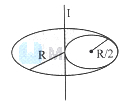
From a disc of mass $M$ and radius $R$,a circular hole of diameter $R$ is cut whose rim passes through the centre. The moment of inertia of the remaining part of the disc about a perpendicular axis passing through the centre is
A
$\frac{13 MR^2}{32}$
B
$\frac{11 MR^2}{32}$
C
$\frac{9 MR^2}{32}$
D
$\frac{7 MR^2}{32}$
Solution
(A) The moment of inertia of the remaining part of the disc $(I_r)$ is given by the principle of superposition:
$I_r = I_{\text{disc}} - I_{\text{hole}}$
where $I_{\text{disc}}$ is the moment of inertia of the original disc about the central axis,and $I_{\text{hole}}$ is the moment of inertia of the removed circular part about the same axis.
$1$. Moment of inertia of the original disc:
$I_{\text{disc}} = \frac{1}{2} MR^2$
$2$. Properties of the removed hole:
Radius of the hole $r = \frac{R}{2}$.
Since the surface mass density $\sigma = \frac{M}{\pi R^2}$ is uniform,the mass of the hole $M_h$ is:
$M_h = \sigma \cdot \pi r^2 = \left(\frac{M}{\pi R^2}\right) \cdot \pi \left(\frac{R}{2}\right)^2 = \frac{M}{4}$.
$3$. Moment of inertia of the hole about the central axis of the original disc:
Using the parallel axis theorem,$I_{\text{hole}} = I_{\text{cm}} + M_h d^2$,where $I_{\text{cm}} = \frac{1}{2} M_h r^2$ and $d = \frac{R}{2}$ is the distance between the center of the hole and the center of the original disc.
$I_{\text{hole}} = \frac{1}{2} \left(\frac{M}{4}\right) \left(\frac{R}{2}\right)^2 + \left(\frac{M}{4}\right) \left(\frac{R}{2}\right)^2$
$I_{\text{hole}} = \frac{MR^2}{32} + \frac{MR^2}{16} = \frac{MR^2 + 2MR^2}{32} = \frac{3MR^2}{32}$.
$4$. Moment of inertia of the remaining part:
$I_r = \frac{1}{2} MR^2 - \frac{3MR^2}{32} = \frac{16MR^2 - 3MR^2}{32} = \frac{13MR^2}{32}$.
$I_r = I_{\text{disc}} - I_{\text{hole}}$
where $I_{\text{disc}}$ is the moment of inertia of the original disc about the central axis,and $I_{\text{hole}}$ is the moment of inertia of the removed circular part about the same axis.
$1$. Moment of inertia of the original disc:
$I_{\text{disc}} = \frac{1}{2} MR^2$
$2$. Properties of the removed hole:
Radius of the hole $r = \frac{R}{2}$.
Since the surface mass density $\sigma = \frac{M}{\pi R^2}$ is uniform,the mass of the hole $M_h$ is:
$M_h = \sigma \cdot \pi r^2 = \left(\frac{M}{\pi R^2}\right) \cdot \pi \left(\frac{R}{2}\right)^2 = \frac{M}{4}$.
$3$. Moment of inertia of the hole about the central axis of the original disc:
Using the parallel axis theorem,$I_{\text{hole}} = I_{\text{cm}} + M_h d^2$,where $I_{\text{cm}} = \frac{1}{2} M_h r^2$ and $d = \frac{R}{2}$ is the distance between the center of the hole and the center of the original disc.
$I_{\text{hole}} = \frac{1}{2} \left(\frac{M}{4}\right) \left(\frac{R}{2}\right)^2 + \left(\frac{M}{4}\right) \left(\frac{R}{2}\right)^2$
$I_{\text{hole}} = \frac{MR^2}{32} + \frac{MR^2}{16} = \frac{MR^2 + 2MR^2}{32} = \frac{3MR^2}{32}$.
$4$. Moment of inertia of the remaining part:
$I_r = \frac{1}{2} MR^2 - \frac{3MR^2}{32} = \frac{16MR^2 - 3MR^2}{32} = \frac{13MR^2}{32}$.
0 likesView Solution
238
PhysicsEasyMCQMHT CET · 2020
Two rings of radius $R$ and $nR$ made of the same material have a ratio of moment of inertia about an axis passing through their centers and perpendicular to their planes as $1:8$. The value of $n$ is (mass per unit length $= \lambda$).
A
$2$
B
$4$
C
$1$
D
$3$
Solution
(A) The moment of inertia of a ring of mass $M$ and radius $R$ about an axis passing through its center and perpendicular to its plane is $I = MR^2$.
Given mass per unit length is $\lambda$. The mass of the first ring is $M_1 = \lambda(2\pi R)$ and its radius is $R_1 = R$.
So,$I_1 = M_1 R_1^2 = (2\pi R \lambda) R^2 = 2\pi \lambda R^3$.
The mass of the second ring is $M_2 = \lambda(2\pi nR)$ and its radius is $R_2 = nR$.
So,$I_2 = M_2 R_2^2 = (2\pi nR \lambda) (nR)^2 = 2\pi \lambda n^3 R^3$.
The ratio is given as $\frac{I_1}{I_2} = \frac{1}{8}$.
Substituting the expressions: $\frac{2\pi \lambda R^3}{2\pi \lambda n^3 R^3} = \frac{1}{n^3} = \frac{1}{8}$.
Therefore,$n^3 = 8$,which gives $n = 2$.
Given mass per unit length is $\lambda$. The mass of the first ring is $M_1 = \lambda(2\pi R)$ and its radius is $R_1 = R$.
So,$I_1 = M_1 R_1^2 = (2\pi R \lambda) R^2 = 2\pi \lambda R^3$.
The mass of the second ring is $M_2 = \lambda(2\pi nR)$ and its radius is $R_2 = nR$.
So,$I_2 = M_2 R_2^2 = (2\pi nR \lambda) (nR)^2 = 2\pi \lambda n^3 R^3$.
The ratio is given as $\frac{I_1}{I_2} = \frac{1}{8}$.
Substituting the expressions: $\frac{2\pi \lambda R^3}{2\pi \lambda n^3 R^3} = \frac{1}{n^3} = \frac{1}{8}$.
Therefore,$n^3 = 8$,which gives $n = 2$.
0 likesView Solution
239
PhysicsEasyMCQMHT CET · 2020
Moment of inertia of a solid sphere about its diameter is $I$. It is then casted into $27$ small spheres of same diameter. The moment of inertia of each new sphere is
A
$\frac{I}{243}$
B
$\frac{I}{122}$
C
$\frac{I}{31}$
D
$\frac{I}{62}$
Solution
(A) The moment of inertia of a solid sphere of mass $M$ and radius $R$ about its diameter is given by $I = \frac{2}{5}MR^2$.
Since the volume remains constant,the volume of the large sphere equals the sum of the volumes of the $27$ small spheres: $\frac{4}{3}\pi R^3 = 27 \times \frac{4}{3}\pi r^3$,where $r$ is the radius of each small sphere.
This simplifies to $R^3 = 27r^3$,so $R = 3r$ or $r = R/3$.
The mass of each small sphere $m$ is $M/27$ because the density is uniform.
The moment of inertia of each small sphere $I'$ is $\frac{2}{5}mr^2$.
Substituting $m = M/27$ and $r = R/3$:
$I' = \frac{2}{5} \times (M/27) \times (R/3)^2 = \frac{2}{5} \times \frac{M}{27} \times \frac{R^2}{9} = \frac{2}{5}MR^2 \times \frac{1}{27 \times 9} = I \times \frac{1}{243} = \frac{I}{243}$.
Since the volume remains constant,the volume of the large sphere equals the sum of the volumes of the $27$ small spheres: $\frac{4}{3}\pi R^3 = 27 \times \frac{4}{3}\pi r^3$,where $r$ is the radius of each small sphere.
This simplifies to $R^3 = 27r^3$,so $R = 3r$ or $r = R/3$.
The mass of each small sphere $m$ is $M/27$ because the density is uniform.
The moment of inertia of each small sphere $I'$ is $\frac{2}{5}mr^2$.
Substituting $m = M/27$ and $r = R/3$:
$I' = \frac{2}{5} \times (M/27) \times (R/3)^2 = \frac{2}{5} \times \frac{M}{27} \times \frac{R^2}{9} = \frac{2}{5}MR^2 \times \frac{1}{27 \times 9} = I \times \frac{1}{243} = \frac{I}{243}$.
0 likesView Solution
240
PhysicsMediumMCQMHT CET · 2020
$A$ ring and a disc have the same mass and the same radius. The ratio of the moment of inertia of a ring about a tangent in its plane to that of the disc about its diameter is: (in $: 1$)
A
$6$
B
$4$
C
$2$
D
$8$
Solution
(A) Let the mass of both the ring and the disc be $M$ and the radius be $R$.
For a ring,the moment of inertia about its center of mass is $I_{cm} = MR^2$. By the parallel axis theorem,the moment of inertia about a tangent in its plane is $I = I_{cm} + MR^2 = MR^2 + MR^2 = \frac{3}{2}MR^2$ is incorrect; the correct formula for a tangent in the plane is $I = I_{cm} + MR^2 = MR^2 + MR^2 = 2MR^2$ is also incorrect. Let's re-evaluate: The moment of inertia of a ring about its diameter is $\frac{1}{2}MR^2$. By the parallel axis theorem,the moment of inertia about a tangent in its plane is $I = I_{diameter} + MR^2 = \frac{1}{2}MR^2 + MR^2 = \frac{3}{2}MR^2$.
For a disc,the moment of inertia about its diameter is $I' = \frac{1}{4}MR^2$.
The ratio is $\frac{I}{I'} = \frac{\frac{3}{2}MR^2}{\frac{1}{4}MR^2} = \frac{3}{2} \times 4 = 6$.
Thus,the ratio is $6: 1$.
For a ring,the moment of inertia about its center of mass is $I_{cm} = MR^2$. By the parallel axis theorem,the moment of inertia about a tangent in its plane is $I = I_{cm} + MR^2 = MR^2 + MR^2 = \frac{3}{2}MR^2$ is incorrect; the correct formula for a tangent in the plane is $I = I_{cm} + MR^2 = MR^2 + MR^2 = 2MR^2$ is also incorrect. Let's re-evaluate: The moment of inertia of a ring about its diameter is $\frac{1}{2}MR^2$. By the parallel axis theorem,the moment of inertia about a tangent in its plane is $I = I_{diameter} + MR^2 = \frac{1}{2}MR^2 + MR^2 = \frac{3}{2}MR^2$.
For a disc,the moment of inertia about its diameter is $I' = \frac{1}{4}MR^2$.
The ratio is $\frac{I}{I'} = \frac{\frac{3}{2}MR^2}{\frac{1}{4}MR^2} = \frac{3}{2} \times 4 = 6$.
Thus,the ratio is $6: 1$.
0 likesView Solution
241
PhysicsMediumMCQMHT CET · 2020
From a uniform circular thin disc of mass $9 M$ and radius $R$,a small disc of radius $\frac{R}{3}$ is removed. The centre of the small disc is at a distance $\frac{2 R}{3}$ from the centre of the original disc. The moment of inertia of the remaining disc about an axis perpendicular to the plane of the disc and passing through the centre of the original disc of radius $R$ is
A
$4 MR^{2}$
B
$3 MR^{2}$
C
$\frac{MR^{2}}{2}$
D
$MR^{2}$
Solution
(A) The mass of the original disc is $M_{total} = 9M$ and its radius is $R$. The moment of inertia of the complete disc about an axis passing through its centre and perpendicular to its plane is $I_{1} = \frac{1}{2} M_{total} R^{2} = \frac{1}{2} (9M) R^{2} = \frac{9 MR^{2}}{2}$.
Since the mass is proportional to the area,the mass of the removed disc $m$ is given by $m = M_{total} \times \frac{\pi (R/3)^{2}}{\pi R^{2}} = 9M \times \frac{1}{9} = M$.
The moment of inertia of the removed disc about the same axis is calculated using the parallel axis theorem: $I^{\prime} = I_{cm} + m d^{2}$,where $I_{cm} = \frac{1}{2} m (R/3)^{2}$ and $d = \frac{2R}{3}$.
$I^{\prime} = \frac{1}{2} M (R/3)^{2} + M (2R/3)^{2} = \frac{MR^{2}}{18} + \frac{4MR^{2}}{9} = \frac{MR^{2} + 8MR^{2}}{18} = \frac{9MR^{2}}{18} = \frac{MR^{2}}{2}$.
The moment of inertia of the remaining disc is $I_{remaining} = I_{1} - I^{\prime} = \frac{9 MR^{2}}{2} - \frac{MR^{2}}{2} = \frac{8 MR^{2}}{2} = 4 MR^{2}$.
Since the mass is proportional to the area,the mass of the removed disc $m$ is given by $m = M_{total} \times \frac{\pi (R/3)^{2}}{\pi R^{2}} = 9M \times \frac{1}{9} = M$.
The moment of inertia of the removed disc about the same axis is calculated using the parallel axis theorem: $I^{\prime} = I_{cm} + m d^{2}$,where $I_{cm} = \frac{1}{2} m (R/3)^{2}$ and $d = \frac{2R}{3}$.
$I^{\prime} = \frac{1}{2} M (R/3)^{2} + M (2R/3)^{2} = \frac{MR^{2}}{18} + \frac{4MR^{2}}{9} = \frac{MR^{2} + 8MR^{2}}{18} = \frac{9MR^{2}}{18} = \frac{MR^{2}}{2}$.
The moment of inertia of the remaining disc is $I_{remaining} = I_{1} - I^{\prime} = \frac{9 MR^{2}}{2} - \frac{MR^{2}}{2} = \frac{8 MR^{2}}{2} = 4 MR^{2}$.
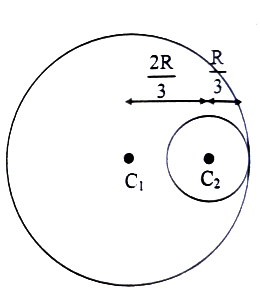
0 likesView Solution
242
PhysicsMediumMCQMHT CET · 2020
Let $M$ and $L$ be the mass and length of a thin uniform rod,respectively. In the $1^{\text{st}}$ case,the axis of rotation passes through the center and is perpendicular to its length. In the $2^{\text{nd}}$ case,the axis of rotation passes through one end and is perpendicular to its length. The ratio of the radius of gyration in the first case to the second case is:
A
$1: 2$
B
$1: 4$
C
$2: 1$
D
$1: \sqrt{3}$
Solution
(A) The moment of inertia of a thin uniform rod of mass $M$ and length $L$ about an axis passing through its center and perpendicular to its length is $I_1 = \frac{ML^2}{12}$.
By definition,$I_1 = MK_1^2$,where $K_1$ is the radius of gyration.
So,$MK_1^2 = \frac{ML^2}{12} \implies K_1 = \frac{L}{\sqrt{12}} = \frac{L}{2\sqrt{3}}$.
The moment of inertia about an axis passing through one end and perpendicular to its length is $I_2 = \frac{ML^2}{3}$.
By definition,$I_2 = MK_2^2$,where $K_2$ is the radius of gyration.
So,$MK_2^2 = \frac{ML^2}{3} \implies K_2 = \frac{L}{\sqrt{3}}$.
The ratio of the radius of gyration in the first case to the second case is $\frac{K_1}{K_2} = \frac{L / (2\sqrt{3})}{L / \sqrt{3}} = \frac{1}{2}$.
Thus,the ratio is $1:2$.
By definition,$I_1 = MK_1^2$,where $K_1$ is the radius of gyration.
So,$MK_1^2 = \frac{ML^2}{12} \implies K_1 = \frac{L}{\sqrt{12}} = \frac{L}{2\sqrt{3}}$.
The moment of inertia about an axis passing through one end and perpendicular to its length is $I_2 = \frac{ML^2}{3}$.
By definition,$I_2 = MK_2^2$,where $K_2$ is the radius of gyration.
So,$MK_2^2 = \frac{ML^2}{3} \implies K_2 = \frac{L}{\sqrt{3}}$.
The ratio of the radius of gyration in the first case to the second case is $\frac{K_1}{K_2} = \frac{L / (2\sqrt{3})}{L / \sqrt{3}} = \frac{1}{2}$.
Thus,the ratio is $1:2$.
0 likesView Solution
243
PhysicsEasyMCQMHT CET · 2020
The moment of inertia of a thin uniform rod about a perpendicular axis passing through one of its ends is $I$. Now,the rod is bent into a ring and its moment of inertia about its diameter is $I_{1}$. Then $\frac{I}{I_{1}}$ is:
A
$\frac{8 \pi^{2}}{3}$
B
$\frac{11 \pi^{2}}{3}$
C
$\frac{4 \pi^{2}}{3}$
D
$\frac{\pi^{2}}{3}$
Solution
(A) Let $M$ be the mass of the rod and $L$ be its length. The moment of inertia of the rod about an axis passing through one end and perpendicular to its length is $I = \frac{ML^2}{3}$.
When the rod is bent into a ring of radius $r$,the circumference of the ring is equal to the length of the rod: $2\pi r = L$,which implies $r = \frac{L}{2\pi}$.
The moment of inertia of a ring about its diameter is given by $I_{1} = \frac{Mr^2}{2}$.
Substituting the value of $r$: $I_{1} = \frac{M}{2} \left( \frac{L}{2\pi} \right)^2 = \frac{M}{2} \cdot \frac{L^2}{4\pi^2} = \frac{ML^2}{8\pi^2}$.
Now,calculating the ratio $\frac{I}{I_{1}}$:
$\frac{I}{I_{1}} = \frac{ML^2/3}{ML^2/8\pi^2} = \frac{ML^2}{3} \cdot \frac{8\pi^2}{ML^2} = \frac{8\pi^2}{3}$.
When the rod is bent into a ring of radius $r$,the circumference of the ring is equal to the length of the rod: $2\pi r = L$,which implies $r = \frac{L}{2\pi}$.
The moment of inertia of a ring about its diameter is given by $I_{1} = \frac{Mr^2}{2}$.
Substituting the value of $r$: $I_{1} = \frac{M}{2} \left( \frac{L}{2\pi} \right)^2 = \frac{M}{2} \cdot \frac{L^2}{4\pi^2} = \frac{ML^2}{8\pi^2}$.
Now,calculating the ratio $\frac{I}{I_{1}}$:
$\frac{I}{I_{1}} = \frac{ML^2/3}{ML^2/8\pi^2} = \frac{ML^2}{3} \cdot \frac{8\pi^2}{ML^2} = \frac{8\pi^2}{3}$.
0 likesView Solution
244
PhysicsMediumMCQMHT CET · 2020
$A$ solid sphere of mass $M$ and radius $R$ has a moment of inertia $I$ about its diameter. It is recast into a disc of thickness $t$ whose moment of inertia about an axis passing through its edge and perpendicular to its plane remains $I$. The radius of the disc will be:
A
$R/\sqrt{19}$
B
$R/\sqrt{15}$
C
$2R/\sqrt{15}$
D
$2R/\sqrt{19}$
Solution
(C) The moment of inertia of a solid sphere about its diameter is given by $I = \frac{2}{5}MR^2$.
When the sphere is recast into a disc of mass $M$ and radius $r$,the moment of inertia of the disc about an axis passing through its edge and perpendicular to its plane is given by the parallel axis theorem: $I_{edge} = I_{cm} + Mr^2 = \frac{1}{2}Mr^2 + Mr^2 = \frac{3}{2}Mr^2$.
Since the moment of inertia remains the same,we equate the two expressions:
$\frac{3}{2}Mr^2 = \frac{2}{5}MR^2$.
Dividing both sides by $M$ and solving for $r$:
$r^2 = \frac{2}{5} \times \frac{2}{3} R^2 = \frac{4}{15} R^2$.
Taking the square root of both sides:
$r = \frac{2R}{\sqrt{15}}$.
When the sphere is recast into a disc of mass $M$ and radius $r$,the moment of inertia of the disc about an axis passing through its edge and perpendicular to its plane is given by the parallel axis theorem: $I_{edge} = I_{cm} + Mr^2 = \frac{1}{2}Mr^2 + Mr^2 = \frac{3}{2}Mr^2$.
Since the moment of inertia remains the same,we equate the two expressions:
$\frac{3}{2}Mr^2 = \frac{2}{5}MR^2$.
Dividing both sides by $M$ and solving for $r$:
$r^2 = \frac{2}{5} \times \frac{2}{3} R^2 = \frac{4}{15} R^2$.
Taking the square root of both sides:
$r = \frac{2R}{\sqrt{15}}$.
0 likesView Solution
245
PhysicsEasyMCQMHT CET · 2020
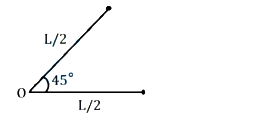
$A$ thin uniform rod of length $L$ and mass $M$ is bent at the middle point $O$ at an angle of $45^{\circ}$ as shown in the figure. The moment of inertia of the system about an axis passing through $O$ and perpendicular to the plane of the bent rod is:
A
$\frac{ML^{2}}{12}$
B
$\frac{ML^{2}}{24}$
C
$\frac{ML^{2}}{3}$
D
$\frac{ML^{2}}{6}$
Solution
(A) The rod is bent at the middle point $O$ into two segments,each of length $l = \frac{L}{2}$ and mass $m = \frac{M}{2}$.
Each segment acts as a rod of length $l$ rotating about one of its ends.
The moment of inertia of a uniform rod of mass $m$ and length $l$ about an axis passing through one of its ends and perpendicular to its length is given by $I = \frac{ml^2}{3}$.
For each segment,$m = \frac{M}{2}$ and $l = \frac{L}{2}$.
Therefore,the moment of inertia of one segment about point $O$ is:
$I_1 = \frac{(\frac{M}{2})(\frac{L}{2})^2}{3} = \frac{(\frac{M}{2})(\frac{L^2}{4})}{3} = \frac{ML^2}{24}$.
Since the system consists of two such segments,the total moment of inertia $I$ about the axis passing through $O$ and perpendicular to the plane is:
$I = I_1 + I_1 = 2 \times \frac{ML^2}{24} = \frac{ML^2}{12}$.
Each segment acts as a rod of length $l$ rotating about one of its ends.
The moment of inertia of a uniform rod of mass $m$ and length $l$ about an axis passing through one of its ends and perpendicular to its length is given by $I = \frac{ml^2}{3}$.
For each segment,$m = \frac{M}{2}$ and $l = \frac{L}{2}$.
Therefore,the moment of inertia of one segment about point $O$ is:
$I_1 = \frac{(\frac{M}{2})(\frac{L}{2})^2}{3} = \frac{(\frac{M}{2})(\frac{L^2}{4})}{3} = \frac{ML^2}{24}$.
Since the system consists of two such segments,the total moment of inertia $I$ about the axis passing through $O$ and perpendicular to the plane is:
$I = I_1 + I_1 = 2 \times \frac{ML^2}{24} = \frac{ML^2}{12}$.
0 likesView Solution
246
PhysicsMediumMCQMHT CET · 2020
Two rings of same mass $M$ and radius $R$ are placed such that their centers coincide and their planes are perpendicular to each other. The moment of inertia of the system about an axis passing through the center and perpendicular to any one ring is
A
$\frac{3 MR^{2}}{2}$
B
$\frac{MR^{2}}{2}$
C
$\frac{2 MR^{2}}{3}$
D
$MR^{2}$
Solution
(A) Let the two rings be $Ring_1$ and $Ring_2$.
For $Ring_1$,the axis passing through its center and perpendicular to its plane is the central axis. Its moment of inertia is $I_1 = MR^2$.
For $Ring_2$,the axis passing through the common center and perpendicular to $Ring_1$ lies in the plane of $Ring_2$. This axis is a diameter of $Ring_2$. Its moment of inertia is $I_2 = \frac{MR^2}{2}$.
The total moment of inertia of the system about this axis is $I = I_1 + I_2 = MR^2 + \frac{MR^2}{2} = \frac{3 MR^2}{2}$.
For $Ring_1$,the axis passing through its center and perpendicular to its plane is the central axis. Its moment of inertia is $I_1 = MR^2$.
For $Ring_2$,the axis passing through the common center and perpendicular to $Ring_1$ lies in the plane of $Ring_2$. This axis is a diameter of $Ring_2$. Its moment of inertia is $I_2 = \frac{MR^2}{2}$.
The total moment of inertia of the system about this axis is $I = I_1 + I_2 = MR^2 + \frac{MR^2}{2} = \frac{3 MR^2}{2}$.
0 likesView Solution
247
PhysicsDifficultMCQMHT CET · 2020
$A$ thin,uniform metal rod of mass $M$ and length $L$ is swinging about a horizontal axis passing through its end. Its maximum angular velocity is $\omega$. Its centre of mass rises to a maximum height of $(g = \text{acceleration due to gravity})$
A
$\frac{L^{2} \omega^{2}}{6 g}$
B
$\frac{L^{2} \omega^{2}}{g}$
C
$\frac{L^{2} \omega^{2}}{2 g}$
D
$\frac{L^{2} \omega^{2}}{3 g}$
Solution
(A) The rod swings about a horizontal axis passing through its end. By the principle of conservation of energy,the maximum rotational kinetic energy at the lowest point is equal to the maximum gravitational potential energy gained by the centre of mass at the highest point.
$1$. The rotational kinetic energy is given by $K = \frac{1}{2} I \omega^{2}$.
$2$. The moment of inertia of a rod of mass $M$ and length $L$ about an axis passing through its end is $I = \frac{ML^{2}}{3}$.
$3$. The potential energy gained by the centre of mass is $U = Mgh$,where $h$ is the maximum height reached by the centre of mass.
$4$. Equating kinetic energy and potential energy: $Mgh = \frac{1}{2} I \omega^{2}$.
$5$. Substituting the value of $I$: $Mgh = \frac{1}{2} \left( \frac{ML^{2}}{3} \right) \omega^{2}$.
$6$. Simplifying the equation: $Mgh = \frac{ML^{2} \omega^{2}}{6}$.
$7$. Solving for $h$: $h = \frac{L^{2} \omega^{2}}{6g}$.
$1$. The rotational kinetic energy is given by $K = \frac{1}{2} I \omega^{2}$.
$2$. The moment of inertia of a rod of mass $M$ and length $L$ about an axis passing through its end is $I = \frac{ML^{2}}{3}$.
$3$. The potential energy gained by the centre of mass is $U = Mgh$,where $h$ is the maximum height reached by the centre of mass.
$4$. Equating kinetic energy and potential energy: $Mgh = \frac{1}{2} I \omega^{2}$.
$5$. Substituting the value of $I$: $Mgh = \frac{1}{2} \left( \frac{ML^{2}}{3} \right) \omega^{2}$.
$6$. Simplifying the equation: $Mgh = \frac{ML^{2} \omega^{2}}{6}$.
$7$. Solving for $h$: $h = \frac{L^{2} \omega^{2}}{6g}$.
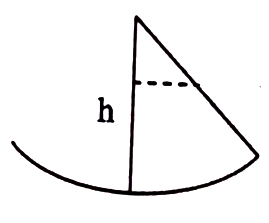
0 likesView Solution
248
PhysicsEasyMCQMHT CET · 2020
$A$ thin uniform rod has mass $M$ and length $L$. The moment of inertia about an axis perpendicular to it and passing through the point at a distance $\frac{L}{3}$ from one of its ends,will be
A
$\frac{ML^{2}}{12}$
B
$\frac{7}{8} ML^{2}$
C
$\frac{ML^{2}}{9}$
D
$\frac{ML^{2}}{3}$
Solution
(C) To find the moment of inertia about an axis passing through a point at a distance $\frac{L}{3}$ from one end,we use the parallel axis theorem: $I = I_{cm} + Mh^2$.
Here,$I_{cm}$ is the moment of inertia about the center of mass,which is $\frac{ML^2}{12}$.
The distance $h$ between the center of mass (at $\frac{L}{2}$ from the end) and the given axis (at $\frac{L}{3}$ from the end) is $h = |\frac{L}{2} - \frac{L}{3}| = \frac{L}{6}$.
Substituting these values into the theorem:
$I = \frac{ML^2}{12} + M(\frac{L}{6})^2$
$I = \frac{ML^2}{12} + \frac{ML^2}{36}$
$I = \frac{3ML^2 + ML^2}{36} = \frac{4ML^2}{36} = \frac{ML^2}{9}$.
Here,$I_{cm}$ is the moment of inertia about the center of mass,which is $\frac{ML^2}{12}$.
The distance $h$ between the center of mass (at $\frac{L}{2}$ from the end) and the given axis (at $\frac{L}{3}$ from the end) is $h = |\frac{L}{2} - \frac{L}{3}| = \frac{L}{6}$.
Substituting these values into the theorem:
$I = \frac{ML^2}{12} + M(\frac{L}{6})^2$
$I = \frac{ML^2}{12} + \frac{ML^2}{36}$
$I = \frac{3ML^2 + ML^2}{36} = \frac{4ML^2}{36} = \frac{ML^2}{9}$.
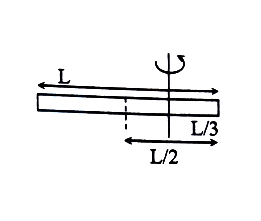
0 likesView Solution
249
PhysicsEasyMCQMHT CET · 2020
The ratio of radii of gyration of a ring to a disc (both circular) of same radii and mass,about a tangential axis perpendicular to the plane is
A
$\frac{2}{\sqrt{3}}$
B
$\frac{\sqrt{2}}{1}$
C
$\frac{\sqrt{3}}{\sqrt{2}}$
D
$\frac{2}{\sqrt{5}}$
Solution
(A) The moment of inertia of a body is given by $I = Mk^2$,where $k$ is the radius of gyration.
For a ring of mass $M$ and radius $R$ about a tangential axis perpendicular to its plane,using the parallel axis theorem: $I_{\text{ring}} = I_{\text{cm}} + MR^2 = MR^2 + MR^2 = 2MR^2$.
Thus,$Mk_{\text{ring}}^2 = 2MR^2 \implies k_{\text{ring}} = \sqrt{2}R$.
For a disc of mass $M$ and radius $R$ about a tangential axis perpendicular to its plane,using the parallel axis theorem: $I_{\text{disc}} = I_{\text{cm}} + MR^2 = \frac{1}{2}MR^2 + MR^2 = \frac{3}{2}MR^2$.
Thus,$Mk_{\text{disc}}^2 = \frac{3}{2}MR^2 \implies k_{\text{disc}} = \sqrt{\frac{3}{2}}R$.
The ratio of the radii of gyration is $\frac{k_{\text{ring}}}{k_{\text{disc}}} = \frac{\sqrt{2}R}{\sqrt{3/2}R} = \frac{\sqrt{2}}{\sqrt{3}/\sqrt{2}} = \frac{2}{\sqrt{3}}$.
For a ring of mass $M$ and radius $R$ about a tangential axis perpendicular to its plane,using the parallel axis theorem: $I_{\text{ring}} = I_{\text{cm}} + MR^2 = MR^2 + MR^2 = 2MR^2$.
Thus,$Mk_{\text{ring}}^2 = 2MR^2 \implies k_{\text{ring}} = \sqrt{2}R$.
For a disc of mass $M$ and radius $R$ about a tangential axis perpendicular to its plane,using the parallel axis theorem: $I_{\text{disc}} = I_{\text{cm}} + MR^2 = \frac{1}{2}MR^2 + MR^2 = \frac{3}{2}MR^2$.
Thus,$Mk_{\text{disc}}^2 = \frac{3}{2}MR^2 \implies k_{\text{disc}} = \sqrt{\frac{3}{2}}R$.
The ratio of the radii of gyration is $\frac{k_{\text{ring}}}{k_{\text{disc}}} = \frac{\sqrt{2}R}{\sqrt{3/2}R} = \frac{\sqrt{2}}{\sqrt{3}/\sqrt{2}} = \frac{2}{\sqrt{3}}$.
0 likesView Solution
250
PhysicsMediumMCQMHT CET · 2020
$A$ thin metal rod of mass $M$ and length $L$ is cut into $4$ equal parts by cutting it perpendicular to its length. If the moment of inertia of the rod about an axis passing through its centre and perpendicular to its axis is $I$,then what is the moment of inertia of each part about a similar axis?
A
$\frac{I}{16}$
B
$\frac{I}{32}$
C
$\frac{I}{128}$
D
$\frac{I}{64}$
Solution
(D) The moment of inertia of a rod of mass $M$ and length $L$ about an axis passing through its center and perpendicular to its length is given by $I = \frac{ML^2}{12}$.
When the rod is cut into $4$ equal parts,each part has a mass $M' = \frac{M}{4}$ and a length $L' = \frac{L}{4}$.
The moment of inertia $I'$ of each small part about an axis passing through its own center and perpendicular to its length is $I' = \frac{M'(L')^2}{12}$.
Substituting the values of $M'$ and $L'$: $I' = \frac{(\frac{M}{4}) \cdot (\frac{L}{4})^2}{12} = \frac{M \cdot \frac{L^2}{16}}{4 \cdot 12} = \frac{ML^2}{12 \cdot 64}$.
Since $I = \frac{ML^2}{12}$,we get $I' = \frac{I}{64}$.
When the rod is cut into $4$ equal parts,each part has a mass $M' = \frac{M}{4}$ and a length $L' = \frac{L}{4}$.
The moment of inertia $I'$ of each small part about an axis passing through its own center and perpendicular to its length is $I' = \frac{M'(L')^2}{12}$.
Substituting the values of $M'$ and $L'$: $I' = \frac{(\frac{M}{4}) \cdot (\frac{L}{4})^2}{12} = \frac{M \cdot \frac{L^2}{16}}{4 \cdot 12} = \frac{ML^2}{12 \cdot 64}$.
Since $I = \frac{ML^2}{12}$,we get $I' = \frac{I}{64}$.
0 likesView Solution
251
PhysicsMediumMCQMHT CET · 2020
An alternating electric field of frequency '$v$' is applied across the dees of a cyclotron which is used to accelerate protons of mass '$m$'. The radius of the dees is '$R$'. The operating magnetic field used in the cyclotron is '$B$'. The kinetic energy of the proton beam is given by
A
$2 m \pi^{2} v^{2} R^{2}$
B
$2 m \pi v^{2} R^{2}$
C
$m \pi^{2} v^{2} R^{2}$
D
$m \pi v^{2} R^{2}$
Solution
(A) The resonance condition for a cyclotron is that the frequency of the oscillator '$v$' must be equal to the cyclotron frequency: $v = \frac{eB}{2 \pi m}$.
From this,we can express the magnetic field as $B = \frac{2 \pi m v}{e}$.
The radius of the path of the proton in the cyclotron is given by $R = \frac{mv}{eB}$,where '$v_{p}$' is the velocity of the proton.
Rearranging for velocity: $v_{p} = \frac{eBR}{m}$.
Substituting the expression for '$B$': $v_{p} = \frac{e}{m} \times \left( \frac{2 \pi m v}{e} \right) \times R = 2 \pi v R$.
The kinetic energy $(K.E.)$ of the proton is given by $K.E. = \frac{1}{2} m v_{p}^{2}$.
Substituting '$v_{p}$': $K.E. = \frac{1}{2} m (2 \pi v R)^{2} = \frac{1}{2} m (4 \pi^{2} v^{2} R^{2}) = 2 m \pi^{2} v^{2} R^{2}$.
From this,we can express the magnetic field as $B = \frac{2 \pi m v}{e}$.
The radius of the path of the proton in the cyclotron is given by $R = \frac{mv}{eB}$,where '$v_{p}$' is the velocity of the proton.
Rearranging for velocity: $v_{p} = \frac{eBR}{m}$.
Substituting the expression for '$B$': $v_{p} = \frac{e}{m} \times \left( \frac{2 \pi m v}{e} \right) \times R = 2 \pi v R$.
The kinetic energy $(K.E.)$ of the proton is given by $K.E. = \frac{1}{2} m v_{p}^{2}$.
Substituting '$v_{p}$': $K.E. = \frac{1}{2} m (2 \pi v R)^{2} = \frac{1}{2} m (4 \pi^{2} v^{2} R^{2}) = 2 m \pi^{2} v^{2} R^{2}$.
0 likesView Solution
252
PhysicsEasyMCQMHT CET · 2020
If the angle of dip at places $A$ and $B$ are $30^{\circ}$ and $45^{\circ}$ respectively,the ratio of the horizontal component of the Earth's magnetic field at $A$ to that at $B$ will be.
$[\sin 45^{\circ}=\cos 45^{\circ}=\frac{1}{\sqrt{2}}, \quad \sin 30^{\circ}=\frac{1}{2}, \quad \cos 30^{\circ}=\frac{\sqrt{3}}{2}]$
$[\sin 45^{\circ}=\cos 45^{\circ}=\frac{1}{\sqrt{2}}, \quad \sin 30^{\circ}=\frac{1}{2}, \quad \cos 30^{\circ}=\frac{\sqrt{3}}{2}]$
A
$\sqrt{2}: 1$
B
$1: \sqrt{2}$
C
$\sqrt{2}: \sqrt{3}$
D
$\sqrt{3}: \sqrt{2}$
Solution
(D) The horizontal component of the Earth's magnetic field is given by the formula $H = B_e \cos \delta$,where $B_e$ is the total magnetic field of the Earth and $\delta$ is the angle of dip.
At place $A$,the angle of dip $\delta_A = 30^{\circ}$. Therefore,the horizontal component $H_A = B_e \cos 30^{\circ}$.
At place $B$,the angle of dip $\delta_B = 45^{\circ}$. Therefore,the horizontal component $H_B = B_e \cos 45^{\circ}$.
The ratio of the horizontal component at $A$ to that at $B$ is given by:
$\frac{H_A}{H_B} = \frac{B_e \cos 30^{\circ}}{B_e \cos 45^{\circ}} = \frac{\cos 30^{\circ}}{\cos 45^{\circ}}$
Substituting the values: $\frac{H_A}{H_B} = \frac{\sqrt{3}/2}{1/\sqrt{2}} = \frac{\sqrt{3}}{2} \times \sqrt{2} = \frac{\sqrt{3}}{\sqrt{2}}$.
Thus,the ratio is $\sqrt{3}: \sqrt{2}$.
At place $A$,the angle of dip $\delta_A = 30^{\circ}$. Therefore,the horizontal component $H_A = B_e \cos 30^{\circ}$.
At place $B$,the angle of dip $\delta_B = 45^{\circ}$. Therefore,the horizontal component $H_B = B_e \cos 45^{\circ}$.
The ratio of the horizontal component at $A$ to that at $B$ is given by:
$\frac{H_A}{H_B} = \frac{B_e \cos 30^{\circ}}{B_e \cos 45^{\circ}} = \frac{\cos 30^{\circ}}{\cos 45^{\circ}}$
Substituting the values: $\frac{H_A}{H_B} = \frac{\sqrt{3}/2}{1/\sqrt{2}} = \frac{\sqrt{3}}{2} \times \sqrt{2} = \frac{\sqrt{3}}{\sqrt{2}}$.
Thus,the ratio is $\sqrt{3}: \sqrt{2}$.
0 likesView Solution
253
PhysicsMediumMCQMHT CET · 2020
$A$ torque of $1.732 \times 10^{-5} \text{ Nm}$ is required to hold a magnet at $90^{\circ}$ with the horizontal component of the Earth's magnetic field. The torque required to hold it at $60^{\circ}$ will be $\left[\sin 90^{\circ}=1, \sin 60^{\circ}=\frac{\sqrt{3}}{2}\right] [\sqrt{3} = 1.732]$
A
$1.5 \times 10^{-5} \text{ Nm}$
B
$1 \times 10^{-5} \text{ Nm}$
C
$1.732 \times 10^{-5} \text{ Nm}$
D
$0.5 \times 10^{-5} \text{ Nm}$
Solution
(A) The torque $\tau$ acting on a magnetic dipole in a magnetic field is given by $\tau = MB \sin \theta$.
Given,$\tau_1 = 1.732 \times 10^{-5} \text{ Nm}$ at $\theta_1 = 90^{\circ}$.
So,$\tau_1 = MB \sin 90^{\circ} = MB(1) = MB$.
Therefore,$MB = 1.732 \times 10^{-5} \text{ Nm}$.
Now,for $\theta_2 = 60^{\circ}$,the torque $\tau_2$ is:
$\tau_2 = MB \sin 60^{\circ} = (1.732 \times 10^{-5}) \times \frac{\sqrt{3}}{2}$.
Since $\sqrt{3} = 1.732$,we have:
$\tau_2 = 1.732 \times 10^{-5} \times \frac{1.732}{2} = 1.732 \times 10^{-5} \times 0.866 = 1.4999 \times 10^{-5} \approx 1.5 \times 10^{-5} \text{ Nm}$.
Given,$\tau_1 = 1.732 \times 10^{-5} \text{ Nm}$ at $\theta_1 = 90^{\circ}$.
So,$\tau_1 = MB \sin 90^{\circ} = MB(1) = MB$.
Therefore,$MB = 1.732 \times 10^{-5} \text{ Nm}$.
Now,for $\theta_2 = 60^{\circ}$,the torque $\tau_2$ is:
$\tau_2 = MB \sin 60^{\circ} = (1.732 \times 10^{-5}) \times \frac{\sqrt{3}}{2}$.
Since $\sqrt{3} = 1.732$,we have:
$\tau_2 = 1.732 \times 10^{-5} \times \frac{1.732}{2} = 1.732 \times 10^{-5} \times 0.866 = 1.4999 \times 10^{-5} \approx 1.5 \times 10^{-5} \text{ Nm}$.
0 likesView Solution
254
PhysicsEasyMCQMHT CET · 2020
Above the Curie temperature,the susceptibility of a ferromagnetic substance varies
A
directly as the absolute temperature.
B
inversely as the absolute temperature.
C
inversely as the square root of absolute temperature.
D
directly as the square root of absolute temperature.
Solution
(B) According to the Curie-Weiss Law,for a ferromagnetic material,the magnetic susceptibility $\chi$ above the Curie temperature $T_C$ is given by the relation: $\chi = \frac{C}{T - T_C}$,where $C$ is the Curie constant and $T$ is the absolute temperature.
For $T > T_C$,the susceptibility is inversely proportional to the difference between the absolute temperature and the Curie temperature. In many simplified contexts,it is stated that the susceptibility varies inversely as the absolute temperature $(T)$ as the material behaves paramagnetically.
For $T > T_C$,the susceptibility is inversely proportional to the difference between the absolute temperature and the Curie temperature. In many simplified contexts,it is stated that the susceptibility varies inversely as the absolute temperature $(T)$ as the material behaves paramagnetically.
0 likesView Solution
255
PhysicsEasyMCQMHT CET · 2020
The materials having negative magnetic susceptibility are
A
paramagnetic.
B
diamagnetic.
C
ferromagnetic.
D
both paramagnetic and ferromagnetic.
Solution
(B) Magnetic susceptibility $(\chi)$ is a measure of how much a material will become magnetized in an applied magnetic field.
For diamagnetic materials, the magnetic susceptibility $(\chi)$ is small and negative $(-1 \le \chi < 0)$.
For paramagnetic materials, the magnetic susceptibility $(\chi)$ is small and positive $(\chi > 0)$.
For ferromagnetic materials, the magnetic susceptibility $(\chi)$ is large and positive $(\chi \gg 0)$.
Therefore, materials with negative magnetic susceptibility are diamagnetic.
For diamagnetic materials, the magnetic susceptibility $(\chi)$ is small and negative $(-1 \le \chi < 0)$.
For paramagnetic materials, the magnetic susceptibility $(\chi)$ is small and positive $(\chi > 0)$.
For ferromagnetic materials, the magnetic susceptibility $(\chi)$ is large and positive $(\chi \gg 0)$.
Therefore, materials with negative magnetic susceptibility are diamagnetic.
0 likesView Solution
256
PhysicsEasyMCQMHT CET · 2020
$A$ thin,lightweight rod of a diamagnetic substance,such as silver,is suspended in a uniform external magnetic field. It will align itself with its length:
A
perpendicular to the magnetic field.
B
inclined at an angle $120^{\circ}$ to the magnetic field.
C
inclined at an angle $45^{\circ}$ to the magnetic field.
D
parallel to the magnetic field.
Solution
(A) diamagnetic material is weakly repelled by a magnetic field.
When a thin rod of a diamagnetic substance is placed in a uniform external magnetic field,it experiences a torque that tends to align the rod in a position of minimum potential energy.
For a diamagnetic rod,the potential energy is minimum when the rod is oriented perpendicular to the direction of the external magnetic field.
Therefore,the rod will align itself perpendicular to the magnetic field to minimize its magnetic potential energy.
When a thin rod of a diamagnetic substance is placed in a uniform external magnetic field,it experiences a torque that tends to align the rod in a position of minimum potential energy.
For a diamagnetic rod,the potential energy is minimum when the rod is oriented perpendicular to the direction of the external magnetic field.
Therefore,the rod will align itself perpendicular to the magnetic field to minimize its magnetic potential energy.
0 likesView Solution
257
PhysicsEasyMCQMHT CET · 2020
$A$ domain in a ferromagnetic substance is in the form of a cube of side $1 \mu m$. If it contains $8 \times 10^{10}$ atoms and each atomic dipole has a dipole moment of $9 \times 10^{-24} \ A \cdot m^{2}$,then the magnetisation of the domain is
A
$7.2 \times 10^{9} \ A/m$
B
$7.2 \times 10^{5} \ A/m$
C
$7.2 \times 10^{12} \ A/m$
D
$7.2 \times 10^{3} \ A/m$
Solution
(B) The volume of the cube is $V = L^3 = (1 \mu m)^3 = (10^{-6} \ m)^3 = 10^{-18} \ m^3$.
The total magnetic moment $M_{total}$ is the product of the number of atoms and the dipole moment per atom:
$M_{total} = (8 \times 10^{10}) \times (9 \times 10^{-24} \ A \cdot m^2) = 72 \times 10^{-14} \ A \cdot m^2 = 7.2 \times 10^{-13} \ A \cdot m^2$.
The magnetisation $I$ (or $M$) is defined as the magnetic moment per unit volume:
$I = \frac{M_{total}}{V} = \frac{7.2 \times 10^{-13} \ A \cdot m^2}{10^{-18} \ m^3} = 7.2 \times 10^5 \ A/m$.
The total magnetic moment $M_{total}$ is the product of the number of atoms and the dipole moment per atom:
$M_{total} = (8 \times 10^{10}) \times (9 \times 10^{-24} \ A \cdot m^2) = 72 \times 10^{-14} \ A \cdot m^2 = 7.2 \times 10^{-13} \ A \cdot m^2$.
The magnetisation $I$ (or $M$) is defined as the magnetic moment per unit volume:
$I = \frac{M_{total}}{V} = \frac{7.2 \times 10^{-13} \ A \cdot m^2}{10^{-18} \ m^3} = 7.2 \times 10^5 \ A/m$.
0 likesView Solution
258
PhysicsEasyMCQMHT CET · 2020
For a paramagnetic substance, the magnetic susceptibility is
A
small and negative
B
large and negative
C
small and positive
D
large and positive
Solution
(C) The magnetic susceptibility $(\chi)$ of a substance is a measure of how easily it can be magnetized when placed in an external magnetic field.
For paramagnetic substances, the atoms or molecules possess a permanent magnetic dipole moment.
When placed in an external magnetic field, these dipoles align weakly in the direction of the field.
Consequently, paramagnetic substances exhibit a small and positive magnetic susceptibility ($0 < \chi < \epsilon$, where $\epsilon$ is a small positive value).
Therefore, the correct option is $C$.
For paramagnetic substances, the atoms or molecules possess a permanent magnetic dipole moment.
When placed in an external magnetic field, these dipoles align weakly in the direction of the field.
Consequently, paramagnetic substances exhibit a small and positive magnetic susceptibility ($0 < \chi < \epsilon$, where $\epsilon$ is a small positive value).
Therefore, the correct option is $C$.
0 likesView Solution
259
PhysicsEasyMCQMHT CET · 2020
The magnetic property of a magnetic substance is associated with
A
spin motion of the nucleus.
B
orbital and spin motion of electrons.
C
only orbital motion of electrons.
D
only spin motion of electrons.
Solution
(B) The magnetic properties of materials arise from the magnetic moments associated with the electrons in the atoms.
These magnetic moments are primarily due to two types of motions of the electrons:
$1$. The orbital motion of the electron around the nucleus,which creates an orbital magnetic moment.
$2$. The intrinsic spin motion of the electron about its own axis,which creates a spin magnetic moment.
Therefore,the net magnetic moment of an atom is the vector sum of the orbital and spin magnetic moments of all its electrons.
These magnetic moments are primarily due to two types of motions of the electrons:
$1$. The orbital motion of the electron around the nucleus,which creates an orbital magnetic moment.
$2$. The intrinsic spin motion of the electron about its own axis,which creates a spin magnetic moment.
Therefore,the net magnetic moment of an atom is the vector sum of the orbital and spin magnetic moments of all its electrons.
0 likesView Solution
260
PhysicsEasyMCQMHT CET · 2020
The susceptibility of tungsten is $6.8 \times 10^{-5}$ at temperature $300 \ K$. The susceptibility at temperature $400 \ K$ is
A
$5.1 \times 10^{-5}$
B
$6.8 \times 10^{-5}$
C
$3.4 \times 10^{-5}$
D
$4.8 \times 10^{-5}$
Solution
(A) Tungsten is a paramagnetic material. According to Curie's Law,the magnetic susceptibility $\chi$ of a paramagnetic material is inversely proportional to its absolute temperature $T$,i.e.,$\chi \propto \frac{1}{T}$.
Therefore,$\chi_1 T_1 = \chi_2 T_2$.
Given: $\chi_1 = 6.8 \times 10^{-5}$,$T_1 = 300 \ K$,$T_2 = 400 \ K$.
Substituting the values: $(6.8 \times 10^{-5}) \times 300 = \chi_2 \times 400$.
$\chi_2 = \frac{6.8 \times 10^{-5} \times 300}{400} = 6.8 \times 10^{-5} \times 0.75 = 5.1 \times 10^{-5}$.
Therefore,$\chi_1 T_1 = \chi_2 T_2$.
Given: $\chi_1 = 6.8 \times 10^{-5}$,$T_1 = 300 \ K$,$T_2 = 400 \ K$.
Substituting the values: $(6.8 \times 10^{-5}) \times 300 = \chi_2 \times 400$.
$\chi_2 = \frac{6.8 \times 10^{-5} \times 300}{400} = 6.8 \times 10^{-5} \times 0.75 = 5.1 \times 10^{-5}$.
0 likesView Solution
261
PhysicsEasyMCQMHT CET · 2020
$A$ bar magnet $AB$ is cut into two equal parts as shown in the figure. One part is kept over the other so that the pole $C_{2}$ is above $C_{1}$. If $M$ is the magnetic moment of the original magnet,the magnetic moment of the combination so formed is
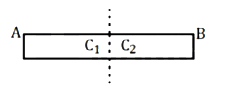
A
$M$
B
$\frac{M}{2}$
C
Zero
D
$2M$
Solution
(C) The magnetic moment of a bar magnet is given by $M = m \times 2l$,where $m$ is the pole strength and $2l$ is the length of the magnet.
When the magnet is cut into two equal parts perpendicular to its length,the length of each part becomes $l$ and the pole strength remains $m$.
Thus,the magnetic moment of each part is $M' = m \times l = \frac{M}{2}$.
Let the original magnet have poles $A$ (say North) and $B$ (South). After cutting,the first part has poles $A$ and $C_1$,and the second part has poles $C_2$ and $B$.
When the second part is placed over the first such that $C_2$ is above $C_1$,the poles $C_1$ and $C_2$ will have opposite polarities. If $C_1$ is South,then $C_2$ will be North.
In this configuration,the magnetic moments of the two parts are in opposite directions.
The net magnetic moment of the combination is $M_{net} = M' - M' = 0$.
When the magnet is cut into two equal parts perpendicular to its length,the length of each part becomes $l$ and the pole strength remains $m$.
Thus,the magnetic moment of each part is $M' = m \times l = \frac{M}{2}$.
Let the original magnet have poles $A$ (say North) and $B$ (South). After cutting,the first part has poles $A$ and $C_1$,and the second part has poles $C_2$ and $B$.
When the second part is placed over the first such that $C_2$ is above $C_1$,the poles $C_1$ and $C_2$ will have opposite polarities. If $C_1$ is South,then $C_2$ will be North.
In this configuration,the magnetic moments of the two parts are in opposite directions.
The net magnetic moment of the combination is $M_{net} = M' - M' = 0$.
0 likesView Solution
262
PhysicsEasyMCQMHT CET · 2020
Inside a bar magnet,the magnetic lines of force
A
are from $S$-pole to $N$-pole of the magnet.
B
do not exist.
C
depend upon the area of cross-section of the bar magnet.
D
are from $N$-pole to $S$-pole of the magnet.
Solution
(A) Magnetic field lines are continuous closed loops. Outside a bar magnet,the magnetic field lines emerge from the $N$-pole and enter the $S$-pole. Inside the bar magnet,to complete the closed loop,the magnetic field lines travel from the $S$-pole to the $N$-pole. Therefore,the correct option is $A$.
0 likesView Solution
263
PhysicsEasyMCQMHT CET · 2020
Magnetization of the sample is defined as:
A
net magnetic dipole moment per unit volume.
B
volume of the sample per unit magnetic dipole moment.
C
ratio of magnetic dipole moment and pole strength.
D
ratio of pole strength to magnetic dipole moment.
Solution
(A) Magnetization $(M)$ is defined as the net magnetic dipole moment $(m_{net})$ per unit volume $(V)$ of the material.
Mathematically,it is expressed as: $M = \frac{m_{net}}{V}$.
It represents the degree to which a substance is magnetized when placed in a magnetic field.
Mathematically,it is expressed as: $M = \frac{m_{net}}{V}$.
It represents the degree to which a substance is magnetized when placed in a magnetic field.
0 likesView Solution
264
PhysicsMediumMCQMHT CET · 2020
$A$ bar magnet having length $5 \ cm$ and area of cross-section $4 \ cm^{2}$ has a magnetic moment of $2 \ Am^{2}$. If the magnetic susceptibility is $5 \times 10^{-6}$,the magnetic intensity will be:
A
$0.2 \times 10^{10} \ A/m$
B
$0.5 \times 10^{10} \ A/m$
C
$5 \times 10^{10} \ A/m$
D
$2 \times 10^{10} \ A/m$
Solution
(D) The volume of the magnet $V = \text{length} \times \text{area} = 5 \ cm \times 4 \ cm^{2} = 20 \ cm^{3}$.
Converting to $SI$ units: $V = 20 \times 10^{-6} \ m^{3} = 2 \times 10^{-5} \ m^{3}$.
The magnetization $M$ is defined as the magnetic moment per unit volume: $M = \frac{m}{V} = \frac{2 \ Am^{2}}{2 \times 10^{-5} \ m^{3}} = 10^{5} \ A/m$.
The relation between magnetization $M$,magnetic intensity $H$,and magnetic susceptibility $\chi$ is $M = \chi H$.
Therefore,$H = \frac{M}{\chi} = \frac{10^{5}}{5 \times 10^{-6}} = 0.2 \times 10^{11} \ A/m = 2 \times 10^{10} \ A/m$.
Converting to $SI$ units: $V = 20 \times 10^{-6} \ m^{3} = 2 \times 10^{-5} \ m^{3}$.
The magnetization $M$ is defined as the magnetic moment per unit volume: $M = \frac{m}{V} = \frac{2 \ Am^{2}}{2 \times 10^{-5} \ m^{3}} = 10^{5} \ A/m$.
The relation between magnetization $M$,magnetic intensity $H$,and magnetic susceptibility $\chi$ is $M = \chi H$.
Therefore,$H = \frac{M}{\chi} = \frac{10^{5}}{5 \times 10^{-6}} = 0.2 \times 10^{11} \ A/m = 2 \times 10^{10} \ A/m$.
0 likesView Solution
265
PhysicsEasyMCQMHT CET · 2020
The relative permeability of iron is $5500$. What will be its magnetic susceptibility?
A
$5500 \times 10^{-3}$
B
$5500 \times 10^{3}$
C
$5499$
D
$5501$
Solution
(C) The relationship between relative permeability $\mu_r$ and magnetic susceptibility $\chi$ is given by the formula: $\mu_r = 1 + \chi$.
Given that the relative permeability $\mu_r = 5500$.
Therefore,the magnetic susceptibility $\chi = \mu_r - 1$.
Substituting the value: $\chi = 5500 - 1 = 5499$.
Thus,the magnetic susceptibility of iron is $5499$.
Given that the relative permeability $\mu_r = 5500$.
Therefore,the magnetic susceptibility $\chi = \mu_r - 1$.
Substituting the value: $\chi = 5500 - 1 = 5499$.
Thus,the magnetic susceptibility of iron is $5499$.
0 likesView Solution
266
PhysicsEasyMCQMHT CET · 2020
The magnetic moment produced in a sample of $2 \text{ g}$ is $8 \times 10^{-7} \text{ A} \cdot \text{m}^2$. If its density is $4 \text{ g/cm}^3$, then the magnetization of the sample is: (in $\text{ A/m}$)
A
$1.2$
B
$1.8$
C
$1.4$
D
$1.6$
Solution
(D) The volume $V$ of the sample is given by the ratio of mass to density: $V = \frac{\text{mass}}{\text{density}} = \frac{2 \text{ g}}{4 \text{ g/cm}^3} = 0.5 \text{ cm}^3$.
Converting the volume to $SI$ units: $V = 0.5 \times 10^{-6} \text{ m}^3$.
Magnetization $M$ is defined as the magnetic moment $m$ per unit volume $V$: $M = \frac{m}{V}$.
Substituting the given values: $M = \frac{8 \times 10^{-7} \text{ A} \cdot \text{m}^2}{0.5 \times 10^{-6} \text{ m}^3} = 1.6 \text{ A/m}$.
Converting the volume to $SI$ units: $V = 0.5 \times 10^{-6} \text{ m}^3$.
Magnetization $M$ is defined as the magnetic moment $m$ per unit volume $V$: $M = \frac{m}{V}$.
Substituting the given values: $M = \frac{8 \times 10^{-7} \text{ A} \cdot \text{m}^2}{0.5 \times 10^{-6} \text{ m}^3} = 1.6 \text{ A/m}$.
0 likesView Solution
267
PhysicsMediumMCQMHT CET · 2020
The magnetic field due to a short bar magnet at an axial point at a distance '$r$' from its centre is '$B$'. If this axis is moved towards the equator of the magnet along a circular path of radius '$r$',then the magnetic field '$B$' will
A
not change.
B
go on increasing.
C
increase from zero to infinity.
D
go on decreasing.
Solution
(D) The magnetic field of a short bar magnet at an axial point at distance '$r$' is given by $B_{axial} = \frac{\mu_0}{4\pi} \frac{2M}{r^3}$.
At the equatorial point at the same distance '$r$',the magnetic field is given by $B_{equatorial} = \frac{\mu_0}{4\pi} \frac{M}{r^3}$.
As the point moves from the axial position to the equatorial position along a circular path of radius '$r$',the angle $\theta$ with the magnetic moment vector changes from $0^\circ$ to $90^\circ$.
The general formula for the magnetic field at any point $(r, \theta)$ is $B = \frac{\mu_0}{4\pi} \frac{M}{r^3} \sqrt{1 + 3\cos^2\theta}$.
As $\theta$ increases from $0^\circ$ to $90^\circ$,$\cos^2\theta$ decreases from $1$ to $0$,and therefore the magnitude of the magnetic field '$B$' will go on decreasing.
At the equatorial point at the same distance '$r$',the magnetic field is given by $B_{equatorial} = \frac{\mu_0}{4\pi} \frac{M}{r^3}$.
As the point moves from the axial position to the equatorial position along a circular path of radius '$r$',the angle $\theta$ with the magnetic moment vector changes from $0^\circ$ to $90^\circ$.
The general formula for the magnetic field at any point $(r, \theta)$ is $B = \frac{\mu_0}{4\pi} \frac{M}{r^3} \sqrt{1 + 3\cos^2\theta}$.
As $\theta$ increases from $0^\circ$ to $90^\circ$,$\cos^2\theta$ decreases from $1$ to $0$,and therefore the magnitude of the magnetic field '$B$' will go on decreasing.
0 likesView Solution
268
PhysicsMediumMCQMHT CET · 2020
The magnitude of magnetic fields at a distance $r$ from the centre of a short bar magnet,in longitudinal position to transverse position,is in the ratio:
A
$4:1$
B
$2:1$
C
$1:4$
D
$1:2$
Solution
(B) For a short bar magnet of magnetic moment $M$,the magnetic field at a distance $r$ on the axial (longitudinal) line is given by $B_{axial} = \frac{\mu_{0}}{4\pi} \frac{2M}{r^{3}}$.
For the same distance $r$ on the equatorial (transverse) line,the magnetic field is given by $B_{equatorial} = \frac{\mu_{0}}{4\pi} \frac{M}{r^{3}}$.
Taking the ratio of the magnetic field in the longitudinal position to the transverse position:
$\frac{B_{axial}}{B_{equatorial}} = \frac{\frac{\mu_{0}}{4\pi} \frac{2M}{r^{3}}}{\frac{\mu_{0}}{4\pi} \frac{M}{r^{3}}} = \frac{2}{1}$.
Therefore,the ratio is $2:1$.
For the same distance $r$ on the equatorial (transverse) line,the magnetic field is given by $B_{equatorial} = \frac{\mu_{0}}{4\pi} \frac{M}{r^{3}}$.
Taking the ratio of the magnetic field in the longitudinal position to the transverse position:
$\frac{B_{axial}}{B_{equatorial}} = \frac{\frac{\mu_{0}}{4\pi} \frac{2M}{r^{3}}}{\frac{\mu_{0}}{4\pi} \frac{M}{r^{3}}} = \frac{2}{1}$.
Therefore,the ratio is $2:1$.
0 likesView Solution
269
PhysicsEasyMCQMHT CET · 2020
The relation between total magnetic field $(B)$,magnetic intensity $(H)$,permeability of free space $(\mu_{0})$,and magnetic susceptibility $(\chi)$ is:
A
$\frac{B}{H} = \mu_{0}(1+\chi)$
B
$\frac{H}{B} = \mu_{0}(1-\chi)$
C
$\frac{B}{H} = \mu_{0}(1-\chi)$
D
$\frac{H}{B} = \mu_{0}(1+\chi)$
Solution
(A) The total magnetic field $(B)$ inside a material is given by the sum of the magnetic field due to external current $(B_{0} = \mu_{0}H)$ and the magnetic field due to magnetization $(B_{m} = \mu_{0}M)$.
Thus,$B = \mu_{0}(H + M)$.
We know that magnetization $(M)$ is related to magnetic intensity $(H)$ by the susceptibility $(\chi)$ as $M = \chi H$.
Substituting this into the equation for $B$:
$B = \mu_{0}(H + \chi H) = \mu_{0}H(1 + \chi)$.
Rearranging the terms to find the ratio $\frac{B}{H}$:
$\frac{B}{H} = \mu_{0}(1 + \chi)$.
Thus,$B = \mu_{0}(H + M)$.
We know that magnetization $(M)$ is related to magnetic intensity $(H)$ by the susceptibility $(\chi)$ as $M = \chi H$.
Substituting this into the equation for $B$:
$B = \mu_{0}(H + \chi H) = \mu_{0}H(1 + \chi)$.
Rearranging the terms to find the ratio $\frac{B}{H}$:
$\frac{B}{H} = \mu_{0}(1 + \chi)$.
0 likesView Solution
270
PhysicsEasyMCQMHT CET · 2020
An iron rod is placed parallel to a magnetic field of intensity $2000 \text{ A/m}$. The magnetic flux through the rod is $6 \times 10^{-4} \text{ Wb}$ and its cross-sectional area is $3 \text{ cm}^2$. The magnetic permeability of the rod in $\text{Wb/(A} \cdot \text{m)}$ is:
A
$10^{-1}$
B
$10^{-4}$
C
$10^{-3}$
D
$10^{-2}$
Solution
(C) The magnetic permeability $\mu$ is defined as the ratio of magnetic induction $B$ to the magnetic field intensity $H$,given by $\mu = \frac{B}{H}$.
Since magnetic flux $\phi = B \cdot A$,we have $B = \frac{\phi}{A}$.
Substituting this into the permeability formula: $\mu = \frac{\phi}{A \cdot H}$.
Given values:
$\phi = 6 \times 10^{-4} \text{ Wb}$
$A = 3 \text{ cm}^2 = 3 \times 10^{-4} \text{ m}^2$
$H = 2000 \text{ A/m} = 2 \times 10^3 \text{ A/m}$
Calculating $\mu$:
$\mu = \frac{6 \times 10^{-4}}{(3 \times 10^{-4}) \times (2 \times 10^3)} = \frac{6 \times 10^{-4}}{6 \times 10^{-1}} = 10^{-3} \text{ Wb/(A} \cdot \text{m)}$.
Since magnetic flux $\phi = B \cdot A$,we have $B = \frac{\phi}{A}$.
Substituting this into the permeability formula: $\mu = \frac{\phi}{A \cdot H}$.
Given values:
$\phi = 6 \times 10^{-4} \text{ Wb}$
$A = 3 \text{ cm}^2 = 3 \times 10^{-4} \text{ m}^2$
$H = 2000 \text{ A/m} = 2 \times 10^3 \text{ A/m}$
Calculating $\mu$:
$\mu = \frac{6 \times 10^{-4}}{(3 \times 10^{-4}) \times (2 \times 10^3)} = \frac{6 \times 10^{-4}}{6 \times 10^{-1}} = 10^{-3} \text{ Wb/(A} \cdot \text{m)}$.
0 likesView Solution
271
PhysicsEasyMCQMHT CET · 2020
The magnetic susceptibility of a paramagnetic material at $-73^{\circ} C$ is $0.0075$. Its value at $-173^{\circ} C$ will be
A
$0.0075$
B
$0.0045$
C
$0.0150$
D
$0.0030$
Solution
(C) According to Curie's Law,the magnetic susceptibility $\chi$ of a paramagnetic material is inversely proportional to its absolute temperature $T$,i.e.,$\chi \propto \frac{1}{T}$.
Therefore,$\frac{\chi_1}{\chi_2} = \frac{T_2}{T_1}$.
Given:
$T_1 = -73^{\circ} C = 273 - 73 = 200 \ K$
$T_2 = -173^{\circ} C = 273 - 173 = 100 \ K$
$\chi_1 = 0.0075$
Substituting the values:
$\chi_2 = \chi_1 \times \frac{T_1}{T_2} = 0.0075 \times \frac{200}{100} = 0.0075 \times 2 = 0.0150$.
Thus,the correct option is $C$.
Therefore,$\frac{\chi_1}{\chi_2} = \frac{T_2}{T_1}$.
Given:
$T_1 = -73^{\circ} C = 273 - 73 = 200 \ K$
$T_2 = -173^{\circ} C = 273 - 173 = 100 \ K$
$\chi_1 = 0.0075$
Substituting the values:
$\chi_2 = \chi_1 \times \frac{T_1}{T_2} = 0.0075 \times \frac{200}{100} = 0.0075 \times 2 = 0.0150$.
Thus,the correct option is $C$.
0 likesView Solution
272
PhysicsEasyMCQMHT CET · 2020
$A$ sphere of gold when brought towards a powerful magnet experiences:
A
attractive force.
B
repulsive force.
C
zero force.
D
nuclear force.
Solution
(B) Gold is a diamagnetic substance.
Diamagnetic substances are weakly repelled by a magnetic field.
Therefore,when a sphere of gold is brought towards a powerful magnet,it experiences a weak repulsive force.
Thus,the correct option is $B$.
Diamagnetic substances are weakly repelled by a magnetic field.
Therefore,when a sphere of gold is brought towards a powerful magnet,it experiences a weak repulsive force.
Thus,the correct option is $B$.
0 likesView Solution
273
PhysicsMediumMCQMHT CET · 2020
$A$ bar magnet is held perpendicular to a uniform magnetic field. The couple acting on the magnet is to be halved by rotating it. Through what angle should it be rotated?
A
$\sin ^{-1}(0.8660)$
B
$\sin ^{-1}(0.7071)$
C
$\sin ^{-1}(1)$
D
$\sin ^{-1}(0.5)$
Solution
(D) The torque (couple) acting on a bar magnet in a uniform magnetic field is given by $T = MB \sin \theta$,where $M$ is the magnetic moment,$B$ is the magnetic field,and $\theta$ is the angle between the magnet and the field.
Initially,the magnet is perpendicular to the field,so $\theta = \frac{\pi}{2} = 90^{\circ}$.
The initial torque is $T = MB \sin(90^{\circ}) = MB$.
We want the new torque $T'$ to be half of the initial torque,so $T' = \frac{T}{2} = \frac{MB}{2}$.
Let the new angle be $\theta'$. Then $T' = MB \sin \theta' = \frac{MB}{2}$.
Dividing both sides by $MB$,we get $\sin \theta' = \frac{1}{2} = 0.5$.
Therefore,the angle $\theta'$ is $\sin^{-1}(0.5) = 30^{\circ}$.
Initially,the magnet is perpendicular to the field,so $\theta = \frac{\pi}{2} = 90^{\circ}$.
The initial torque is $T = MB \sin(90^{\circ}) = MB$.
We want the new torque $T'$ to be half of the initial torque,so $T' = \frac{T}{2} = \frac{MB}{2}$.
Let the new angle be $\theta'$. Then $T' = MB \sin \theta' = \frac{MB}{2}$.
Dividing both sides by $MB$,we get $\sin \theta' = \frac{1}{2} = 0.5$.
Therefore,the angle $\theta'$ is $\sin^{-1}(0.5) = 30^{\circ}$.
0 likesView Solution
274
PhysicsEasyMCQMHT CET · 2020
The variation of intensity of magnetisation $(I)$ and the applied magnetic field intensity $(H)$ for three magnetic materials $X$,$Y$ and $Z$ are shown in the graph as $OX$,$OY$ and $OZ$ respectively. The materials $X$,$Y$ and $Z$ respectively are:
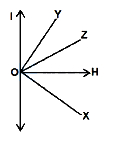
A
paramagnetic,diamagnetic,ferromagnetic
B
diamagnetic,paramagnetic,ferromagnetic
C
ferromagnetic,diamagnetic,paramagnetic
D
diamagnetic,ferromagnetic,paramagnetic
Solution
(D) The intensity of magnetisation $(I)$ is related to the magnetic field intensity $(H)$ by the relation $I = \chi H$,where $\chi$ is the magnetic susceptibility.
For diamagnetic materials,$\chi$ is small and negative,so $I$ is negative for positive $H$. This corresponds to line $OX$.
For paramagnetic materials,$\chi$ is small and positive,so $I$ is positive and small for a given $H$. This corresponds to line $OZ$.
For ferromagnetic materials,$\chi$ is large and positive,so $I$ is positive and large for a given $H$. This corresponds to line $OY$.
Therefore,$X$ is diamagnetic,$Y$ is ferromagnetic,and $Z$ is paramagnetic.
For diamagnetic materials,$\chi$ is small and negative,so $I$ is negative for positive $H$. This corresponds to line $OX$.
For paramagnetic materials,$\chi$ is small and positive,so $I$ is positive and small for a given $H$. This corresponds to line $OZ$.
For ferromagnetic materials,$\chi$ is large and positive,so $I$ is positive and large for a given $H$. This corresponds to line $OY$.
Therefore,$X$ is diamagnetic,$Y$ is ferromagnetic,and $Z$ is paramagnetic.
0 likesView Solution
275
PhysicsEasyMCQMHT CET · 2020
The susceptibility of a magnetic material is positive and small. The material is
A
diamagnetic and ferromagnetic.
B
paramagnetic.
C
ferromagnetic.
D
diamagnetic.
Solution
(B) The magnetic susceptibility $\chi$ of a material defines its magnetic behavior.
For diamagnetic materials, $\chi$ is negative and small $(-1 \le \chi < 0)$.
For paramagnetic materials, $\chi$ is positive and small $(\chi > 0)$.
For ferromagnetic materials, $\chi$ is positive and very large $(\chi \gg 1)$.
Since the given material has a positive and small susceptibility, it is classified as paramagnetic.
For diamagnetic materials, $\chi$ is negative and small $(-1 \le \chi < 0)$.
For paramagnetic materials, $\chi$ is positive and small $(\chi > 0)$.
For ferromagnetic materials, $\chi$ is positive and very large $(\chi \gg 1)$.
Since the given material has a positive and small susceptibility, it is classified as paramagnetic.
0 likesView Solution
276
PhysicsDifficultMCQMHT CET · 2020
$A$ metal sphere of radius $1 \ m$ is charged with $10^{-2} \ C$ in air. Its bulk modulus is $10^{11} / 4 \pi^{2} \ N/m^2$. The volume strain in the sphere is $(\epsilon_{0} = \text{permittivity of free space})$
A
$\frac{10^{-1}}{6 \epsilon_{0}}$
B
$\frac{10^{-14}}{8 \epsilon_{0}}$
C
$\frac{10^{-15}}{8 \epsilon_{0}}$
D
$\frac{10^{-12}}{4 \epsilon_{0}}$
Solution
(C) The electrostatic pressure (stress) on the surface of a charged conductor is given by $P = \frac{\sigma^{2}}{2 \epsilon_{0}}$.
Here,the surface charge density $\sigma = \frac{q}{4 \pi r^{2}} = \frac{10^{-2}}{4 \pi (1)^{2}} = \frac{10^{-2}}{4 \pi} \ C/m^{2}$.
Substituting $\sigma$ into the pressure formula: $P = \frac{1}{2 \epsilon_{0}} \left( \frac{10^{-2}}{4 \pi} \right)^{2} = \frac{10^{-4}}{32 \pi^{2} \epsilon_{0}}$.
Volume strain is defined as $\text{strain} = \frac{\text{stress}}{B}$,where $B$ is the bulk modulus.
Given $B = \frac{10^{11}}{4 \pi^{2}}$.
Therefore,$\text{strain} = \frac{10^{-4}}{32 \pi^{2} \epsilon_{0}} \times \frac{4 \pi^{2}}{10^{11}} = \frac{10^{-4}}{8 \epsilon_{0} \times 10^{11}} = \frac{10^{-15}}{8 \epsilon_{0}}$.
Here,the surface charge density $\sigma = \frac{q}{4 \pi r^{2}} = \frac{10^{-2}}{4 \pi (1)^{2}} = \frac{10^{-2}}{4 \pi} \ C/m^{2}$.
Substituting $\sigma$ into the pressure formula: $P = \frac{1}{2 \epsilon_{0}} \left( \frac{10^{-2}}{4 \pi} \right)^{2} = \frac{10^{-4}}{32 \pi^{2} \epsilon_{0}}$.
Volume strain is defined as $\text{strain} = \frac{\text{stress}}{B}$,where $B$ is the bulk modulus.
Given $B = \frac{10^{11}}{4 \pi^{2}}$.
Therefore,$\text{strain} = \frac{10^{-4}}{32 \pi^{2} \epsilon_{0}} \times \frac{4 \pi^{2}}{10^{11}} = \frac{10^{-4}}{8 \epsilon_{0} \times 10^{11}} = \frac{10^{-15}}{8 \epsilon_{0}}$.
0 likesView Solution
277
PhysicsEasyMCQMHT CET · 2020
$A$ copper wire of length $L$ and diameter $D$ is to be reshaped into another wire so as to have minimum resistance. For this,we should:
A
increase $L$ and decrease $D$.
B
decrease $L$ and increase $D$.
C
decrease both $L$ and $D$.
D
increase both $L$ and $D$.
Solution
(B) The resistance $R$ of a wire is given by the formula $R = \rho \frac{L}{A}$,where $\rho$ is the resistivity,$L$ is the length,and $A$ is the cross-sectional area.
Since the wire is reshaped,its volume $V = A \times L$ remains constant.
We can express the area $A$ in terms of diameter $D$ as $A = \pi \left(\frac{D}{2}\right)^2 = \frac{\pi D^2}{4}$.
Substituting $A$ into the resistance formula: $R = \rho \frac{L}{\pi D^2 / 4} = \frac{4 \rho L}{\pi D^2}$.
Since the volume $V = A \times L = \frac{\pi D^2 L}{4}$ is constant,we have $L = \frac{4V}{\pi D^2}$.
Substituting this into the resistance formula: $R = \frac{4 \rho}{\pi D^2} \times \left(\frac{4V}{\pi D^2}\right) = \frac{16 \rho V}{\pi^2 D^4}$.
To minimize $R$,we need to maximize $D$. Since volume is constant,increasing $D$ will result in a decrease in $L$. Therefore,we should decrease $L$ and increase $D$.
Since the wire is reshaped,its volume $V = A \times L$ remains constant.
We can express the area $A$ in terms of diameter $D$ as $A = \pi \left(\frac{D}{2}\right)^2 = \frac{\pi D^2}{4}$.
Substituting $A$ into the resistance formula: $R = \rho \frac{L}{\pi D^2 / 4} = \frac{4 \rho L}{\pi D^2}$.
Since the volume $V = A \times L = \frac{\pi D^2 L}{4}$ is constant,we have $L = \frac{4V}{\pi D^2}$.
Substituting this into the resistance formula: $R = \frac{4 \rho}{\pi D^2} \times \left(\frac{4V}{\pi D^2}\right) = \frac{16 \rho V}{\pi^2 D^4}$.
To minimize $R$,we need to maximize $D$. Since volume is constant,increasing $D$ will result in a decrease in $L$. Therefore,we should decrease $L$ and increase $D$.
0 likesView Solution
278
PhysicsMediumMCQMHT CET · 2020
Two different radioactive elements with half-lives $T_1$ and $T_2$ have undecayed atoms $N_1$ and $N_2$ respectively present at a given instant. The ratio of their activities at that instant is
A
$\frac{N_1 T_1}{N_2 T_2}$
B
$\frac{N_2 T_2}{N_1 T_1}$
C
$\frac{N_1 T_2}{N_2 T_1}$
D
$\frac{N_1 N_2}{T_1 T_2}$
Solution
(C) The activity $A$ of a radioactive sample is given by the formula $A = \lambda N$,where $\lambda$ is the decay constant and $N$ is the number of undecayed atoms.
The decay constant $\lambda$ is related to the half-life $T$ by the relation $\lambda = \frac{\ln 2}{T}$.
For the two radioactive elements,the activities are:
$A_1 = \lambda_1 N_1 = \frac{\ln 2}{T_1} N_1$
$A_2 = \lambda_2 N_2 = \frac{\ln 2}{T_2} N_2$
The ratio of their activities is:
$\frac{A_1}{A_2} = \frac{(\frac{\ln 2}{T_1}) N_1}{(\frac{\ln 2}{T_2}) N_2}$
Simplifying the expression:
$\frac{A_1}{A_2} = \frac{N_1}{T_1} \times \frac{T_2}{N_2} = \frac{N_1 T_2}{N_2 T_1}$
The decay constant $\lambda$ is related to the half-life $T$ by the relation $\lambda = \frac{\ln 2}{T}$.
For the two radioactive elements,the activities are:
$A_1 = \lambda_1 N_1 = \frac{\ln 2}{T_1} N_1$
$A_2 = \lambda_2 N_2 = \frac{\ln 2}{T_2} N_2$
The ratio of their activities is:
$\frac{A_1}{A_2} = \frac{(\frac{\ln 2}{T_1}) N_1}{(\frac{\ln 2}{T_2}) N_2}$
Simplifying the expression:
$\frac{A_1}{A_2} = \frac{N_1}{T_1} \times \frac{T_2}{N_2} = \frac{N_1 T_2}{N_2 T_1}$
0 likesView Solution
279
PhysicsEasyMCQMHT CET · 2020
The variation of decay rate with the number of active nuclei is correctly shown in which graph?
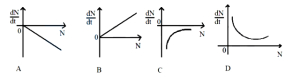
A
$A$
B
$B$
C
$C$
D
$D$
Solution
(C) According to the law of radioactive decay,the rate of decay is given by the expression:
$-\frac{dN}{dt} = \lambda N$
where $\lambda$ is the decay constant and $N$ is the number of active nuclei present at time $t$.
This can be rewritten as:
$\frac{dN}{dt} = -\lambda N$
This equation represents a linear relationship between the decay rate $(R = -\frac{dN}{dt})$ and the number of active nuclei $(N)$,where the slope is negative $(-\lambda)$.
Comparing this to the equation of a straight line passing through the origin,$y = mx$,where $y = \frac{dN}{dt}$ and $x = N$,the slope $m = -\lambda$.
Therefore,the graph of $\frac{dN}{dt}$ versus $N$ is a straight line passing through the origin with a negative slope.
Looking at the provided options,graph $A$ represents a straight line passing through the origin with a negative slope.
Thus,the correct option is $A$.
$-\frac{dN}{dt} = \lambda N$
where $\lambda$ is the decay constant and $N$ is the number of active nuclei present at time $t$.
This can be rewritten as:
$\frac{dN}{dt} = -\lambda N$
This equation represents a linear relationship between the decay rate $(R = -\frac{dN}{dt})$ and the number of active nuclei $(N)$,where the slope is negative $(-\lambda)$.
Comparing this to the equation of a straight line passing through the origin,$y = mx$,where $y = \frac{dN}{dt}$ and $x = N$,the slope $m = -\lambda$.
Therefore,the graph of $\frac{dN}{dt}$ versus $N$ is a straight line passing through the origin with a negative slope.
Looking at the provided options,graph $A$ represents a straight line passing through the origin with a negative slope.
Thus,the correct option is $A$.
0 likesView Solution
280
PhysicsEasyMCQMHT CET · 2020
If $T$ is the half-life of a radioactive substance,then its instantaneous rate of change of activity is proportional to
A
$\sqrt{T}$
B
$T$
C
$T^{2}$
D
$T^{-2}$
Solution
(D) The activity $A$ of a radioactive substance at any time $t$ is given by $A = A_0 e^{-\lambda t}$,where $\lambda$ is the decay constant.
The decay constant $\lambda$ is related to the half-life $T$ by the relation $\lambda = \frac{\ln 2}{T}$.
The rate of change of activity is given by $\frac{dA}{dt} = \frac{d}{dt}(A_0 e^{-\lambda t}) = -\lambda A_0 e^{-\lambda t} = -\lambda A$.
The magnitude of the rate of change of activity is $|\frac{dA}{dt}| = \lambda A$.
Since $\lambda = \frac{\ln 2}{T}$,we have $|\frac{dA}{dt}| = \frac{\ln 2}{T} A$.
Thus,the rate of change of activity is proportional to $T^{-1}$. However,looking at the instantaneous rate of change of activity $\frac{dA}{dt} = -\lambda^2 N_0 e^{-\lambda t}$,where $N = N_0 e^{-\lambda t}$.
Since $A = \lambda N$,then $\frac{dA}{dt} = -\lambda A = -\lambda (\lambda N) = -\lambda^2 N$.
Substituting $\lambda = \frac{\ln 2}{T}$,we get $\frac{dA}{dt} \propto \lambda^2 \propto (\frac{1}{T})^2 = T^{-2}$.
Therefore,the rate of change of activity is proportional to $T^{-2}$.
The decay constant $\lambda$ is related to the half-life $T$ by the relation $\lambda = \frac{\ln 2}{T}$.
The rate of change of activity is given by $\frac{dA}{dt} = \frac{d}{dt}(A_0 e^{-\lambda t}) = -\lambda A_0 e^{-\lambda t} = -\lambda A$.
The magnitude of the rate of change of activity is $|\frac{dA}{dt}| = \lambda A$.
Since $\lambda = \frac{\ln 2}{T}$,we have $|\frac{dA}{dt}| = \frac{\ln 2}{T} A$.
Thus,the rate of change of activity is proportional to $T^{-1}$. However,looking at the instantaneous rate of change of activity $\frac{dA}{dt} = -\lambda^2 N_0 e^{-\lambda t}$,where $N = N_0 e^{-\lambda t}$.
Since $A = \lambda N$,then $\frac{dA}{dt} = -\lambda A = -\lambda (\lambda N) = -\lambda^2 N$.
Substituting $\lambda = \frac{\ln 2}{T}$,we get $\frac{dA}{dt} \propto \lambda^2 \propto (\frac{1}{T})^2 = T^{-2}$.
Therefore,the rate of change of activity is proportional to $T^{-2}$.
0 likesView Solution
281
PhysicsMediumMCQMHT CET · 2020
$A$ radioactive nucleus emits $4 \alpha$ particles and $7 \beta$ particles in succession. The ratio of the number of neutrons to that of protons in the final nucleus is $[A = \text{mass number}, Z = \text{atomic number}]$
A
$\frac{A-Z-13}{Z-1}$
B
$\frac{A-Z-15}{Z-1}$
C
$\frac{A-Z-11}{Z-2}$
D
$\frac{A-Z-13}{Z-2}$
Solution
(B) Let the initial nucleus be $^A_Z X$.
Emission of one $\alpha$ particle $(^4_2 He)$ decreases the mass number by $4$ and atomic number by $2$.
Emission of $4 \alpha$ particles results in a change: $A' = A - (4 \times 4) = A - 16$ and $Z' = Z - (4 \times 2) = Z - 8$.
Emission of one $\beta$ particle $(^0_{-1} e)$ increases the atomic number by $1$ and leaves the mass number unchanged.
Emission of $7 \beta$ particles results in: $A_{final} = A - 16$ and $Z_{final} = Z - 8 + 7 = Z - 1$.
The number of protons in the final nucleus is $P = Z_{final} = Z - 1$.
The number of neutrons is $N = A_{final} - Z_{final} = (A - 16) - (Z - 1) = A - Z - 15$.
The ratio of neutrons to protons is $\frac{N}{P} = \frac{A - Z - 15}{Z - 1}$.
Emission of one $\alpha$ particle $(^4_2 He)$ decreases the mass number by $4$ and atomic number by $2$.
Emission of $4 \alpha$ particles results in a change: $A' = A - (4 \times 4) = A - 16$ and $Z' = Z - (4 \times 2) = Z - 8$.
Emission of one $\beta$ particle $(^0_{-1} e)$ increases the atomic number by $1$ and leaves the mass number unchanged.
Emission of $7 \beta$ particles results in: $A_{final} = A - 16$ and $Z_{final} = Z - 8 + 7 = Z - 1$.
The number of protons in the final nucleus is $P = Z_{final} = Z - 1$.
The number of neutrons is $N = A_{final} - Z_{final} = (A - 16) - (Z - 1) = A - Z - 15$.
The ratio of neutrons to protons is $\frac{N}{P} = \frac{A - Z - 15}{Z - 1}$.
0 likesView Solution
282
PhysicsMediumMCQMHT CET · 2020
An $\alpha$ particle of energy $10 \ eV$ is moving in a circular path in a uniform magnetic field. The energy of a proton moving in the same path and the same magnetic field will be [mass of $\alpha$ particle $= 4 \times$ mass of proton]. (in $eV$)
A
$4$
B
$8$
C
$16$
D
$10$
Solution
(D) The radius of a charged particle moving in a uniform magnetic field is given by $r = \frac{mv}{qB} = \frac{\sqrt{2mK}}{qB}$,where $K$ is the kinetic energy.
Since the path $(r)$ and the magnetic field $(B)$ are the same for both particles,we have $\frac{\sqrt{2m_{\alpha}K_{\alpha}}}{q_{\alpha}B} = \frac{\sqrt{2m_{p}K_{p}}}{q_{p}B}$.
Squaring both sides and rearranging,we get $\frac{2m_{\alpha}K_{\alpha}}{q_{\alpha}^2} = \frac{2m_{p}K_{p}}{q_{p}^2}$,which implies $K_{p} = K_{\alpha} \cdot \left(\frac{m_{\alpha}}{m_{p}}\right) \cdot \left(\frac{q_{p}}{q_{\alpha}}\right)^2$.
Given $m_{\alpha} = 4m_{p}$ and $q_{\alpha} = 2q_{p}$,we substitute these values:
$K_{p} = 10 \ eV \cdot \left(\frac{4m_{p}}{m_{p}}\right) \cdot \left(\frac{q_{p}}{2q_{p}}\right)^2 = 10 \ eV \cdot 4 \cdot \frac{1}{4} = 10 \ eV$.
Since the path $(r)$ and the magnetic field $(B)$ are the same for both particles,we have $\frac{\sqrt{2m_{\alpha}K_{\alpha}}}{q_{\alpha}B} = \frac{\sqrt{2m_{p}K_{p}}}{q_{p}B}$.
Squaring both sides and rearranging,we get $\frac{2m_{\alpha}K_{\alpha}}{q_{\alpha}^2} = \frac{2m_{p}K_{p}}{q_{p}^2}$,which implies $K_{p} = K_{\alpha} \cdot \left(\frac{m_{\alpha}}{m_{p}}\right) \cdot \left(\frac{q_{p}}{q_{\alpha}}\right)^2$.
Given $m_{\alpha} = 4m_{p}$ and $q_{\alpha} = 2q_{p}$,we substitute these values:
$K_{p} = 10 \ eV \cdot \left(\frac{4m_{p}}{m_{p}}\right) \cdot \left(\frac{q_{p}}{2q_{p}}\right)^2 = 10 \ eV \cdot 4 \cdot \frac{1}{4} = 10 \ eV$.
0 likesView Solution
283
PhysicsMediumMCQMHT CET · 2020
$A$ biconvex lens $(R_{1}=R_{2}=20 \ cm)$ has a focal length equal to the focal length of a concave mirror. The radius of curvature of the concave mirror is (Refractive Index of glass lens $= 1.5$) (in $cm$)
A
$-40$
B
$-20$
C
$40$
D
$20$
Solution
(A) For a biconvex lens,the lens maker's formula is given by: $\frac{1}{f} = (n-1) \left( \frac{1}{R_{1}} - \frac{1}{R_{2}} \right)$.
Given $n = 1.5$,$R_{1} = 20 \ cm$,and $R_{2} = -20 \ cm$.
Substituting these values: $\frac{1}{f} = (1.5 - 1) \left( \frac{1}{20} - \frac{1}{-20} \right) = 0.5 \left( \frac{1}{20} + \frac{1}{20} \right) = 0.5 \left( \frac{2}{20} \right) = 0.5 \times 0.1 = 0.05$.
Thus,$f = \frac{1}{0.05} = 20 \ cm$.
The focal length of the concave mirror is equal to the focal length of the lens,so $f_{mirror} = 20 \ cm$.
For a concave mirror,the focal length is negative,so $f = -20 \ cm$.
The radius of curvature $R$ is given by $R = 2f = 2(-20 \ cm) = -40 \ cm$.
Given $n = 1.5$,$R_{1} = 20 \ cm$,and $R_{2} = -20 \ cm$.
Substituting these values: $\frac{1}{f} = (1.5 - 1) \left( \frac{1}{20} - \frac{1}{-20} \right) = 0.5 \left( \frac{1}{20} + \frac{1}{20} \right) = 0.5 \left( \frac{2}{20} \right) = 0.5 \times 0.1 = 0.05$.
Thus,$f = \frac{1}{0.05} = 20 \ cm$.
The focal length of the concave mirror is equal to the focal length of the lens,so $f_{mirror} = 20 \ cm$.
For a concave mirror,the focal length is negative,so $f = -20 \ cm$.
The radius of curvature $R$ is given by $R = 2f = 2(-20 \ cm) = -40 \ cm$.
0 likesView Solution
284
PhysicsMediumMCQMHT CET · 2020
The figure shows an equiconvex lens of focal length $f$. If the lens is cut along $AB$,the focal length of each half will be
A
$2 f$
B
$f$
C
$3 f$
D
$4 f$
Solution
(A) According to the Lens Maker's Formula,the focal length $f$ of a lens is given by $\frac{1}{f} = (\mu - 1) \left( \frac{1}{R_1} - \frac{1}{R_2} \right)$.
For an equiconvex lens,$R_1 = R$ and $R_2 = -R$,so $\frac{1}{f} = (\mu - 1) \left( \frac{1}{R} + \frac{1}{R} \right) = \frac{2(\mu - 1)}{R}$.
When the lens is cut along the axis $AB$ (perpendicular to the principal axis),the radius of curvature of the surfaces remains the same for each half.
For each half,the lens becomes a plano-convex lens where one surface has radius $R$ and the other is flat (infinite radius,$R' = \infty$).
Applying the formula for one half: $\frac{1}{f'} = (\mu - 1) \left( \frac{1}{R} - \frac{1}{\infty} \right) = \frac{\mu - 1}{R}$.
Comparing this with the original focal length,we see that $\frac{1}{f'} = \frac{1}{2} \times \frac{2(\mu - 1)}{R} = \frac{1}{2} \times \frac{1}{f}$.
Therefore,$f' = 2f$.
For an equiconvex lens,$R_1 = R$ and $R_2 = -R$,so $\frac{1}{f} = (\mu - 1) \left( \frac{1}{R} + \frac{1}{R} \right) = \frac{2(\mu - 1)}{R}$.
When the lens is cut along the axis $AB$ (perpendicular to the principal axis),the radius of curvature of the surfaces remains the same for each half.
For each half,the lens becomes a plano-convex lens where one surface has radius $R$ and the other is flat (infinite radius,$R' = \infty$).
Applying the formula for one half: $\frac{1}{f'} = (\mu - 1) \left( \frac{1}{R} - \frac{1}{\infty} \right) = \frac{\mu - 1}{R}$.
Comparing this with the original focal length,we see that $\frac{1}{f'} = \frac{1}{2} \times \frac{2(\mu - 1)}{R} = \frac{1}{2} \times \frac{1}{f}$.
Therefore,$f' = 2f$.
0 likesView Solution
285
PhysicsEasyMCQMHT CET · 2020
For a ray of light,the critical angle is minimum,when it travels from
A
glass to air
B
air to glass
C
glass to water
D
water to glass
Solution
(A) The critical angle $c$ for total internal reflection $(TIR)$ when light travels from a medium of refractive index $n_1$ to a medium of lower refractive index $n_2$ is given by $\sin c = \frac{n_2}{n_1}$,where $n_1 > n_2$.
The smaller the ratio $\frac{n_2}{n_1}$,the smaller $\sin c$,and hence the smaller the critical angle $c$.
From the options,the valid scenarios for $TIR$ are only those in which the first medium has a higher index than the second.
For glass to air $(n_{\text{glass}} \approx 1.5, n_{\text{air}} \approx 1.0)$: $\sin c = \frac{1.0}{1.5} = \frac{2}{3} \approx 0.667$,which gives $c \approx 41.8^{\circ}$.
For glass to water $(n_{\text{glass}} \approx 1.5, n_{\text{water}} \approx 1.33)$: $\sin c = \frac{1.33}{1.5} \approx 0.887$,which gives $c \approx 62.5^{\circ}$.
Clearly,the critical angle is smaller for glass-to-air.
Hence,the critical angle is minimum when light travels from glass to air.
The smaller the ratio $\frac{n_2}{n_1}$,the smaller $\sin c$,and hence the smaller the critical angle $c$.
From the options,the valid scenarios for $TIR$ are only those in which the first medium has a higher index than the second.
For glass to air $(n_{\text{glass}} \approx 1.5, n_{\text{air}} \approx 1.0)$: $\sin c = \frac{1.0}{1.5} = \frac{2}{3} \approx 0.667$,which gives $c \approx 41.8^{\circ}$.
For glass to water $(n_{\text{glass}} \approx 1.5, n_{\text{water}} \approx 1.33)$: $\sin c = \frac{1.33}{1.5} \approx 0.887$,which gives $c \approx 62.5^{\circ}$.
Clearly,the critical angle is smaller for glass-to-air.
Hence,the critical angle is minimum when light travels from glass to air.
0 likesView Solution
286
PhysicsEasyMCQMHT CET · 2020
The refractive index of glass is $\frac{3}{2}$ and that of water is $\frac{4}{3}$. The critical angle for a ray of light going from glass to water is
A
$\sin ^{-1}\left(\frac{4}{7}\right)$
B
$\sin ^{-1}\left(\frac{5}{8}\right)$
C
$\sin ^{-1}\left(\frac{2}{3}\right)$
D
$\sin ^{-1}\left(\frac{8}{9}\right)$
Solution
(D) The refractive index of glass is $\mu_g = \frac{3}{2}$ and the refractive index of water is $\mu_w = \frac{4}{3}$.
When light travels from a denser medium (glass) to a rarer medium (water),the critical angle $C$ is given by the formula $\sin C = \frac{\mu_w}{\mu_g}$.
Substituting the given values:
$\sin C = \frac{4/3}{3/2} = \frac{4}{3} \times \frac{2}{3} = \frac{8}{9}$.
Therefore,the critical angle $C = \sin^{-1}\left(\frac{8}{9}\right)$.
When light travels from a denser medium (glass) to a rarer medium (water),the critical angle $C$ is given by the formula $\sin C = \frac{\mu_w}{\mu_g}$.
Substituting the given values:
$\sin C = \frac{4/3}{3/2} = \frac{4}{3} \times \frac{2}{3} = \frac{8}{9}$.
Therefore,the critical angle $C = \sin^{-1}\left(\frac{8}{9}\right)$.
0 likesView Solution
287
PhysicsMediumMCQMHT CET · 2020
Light travels from an optically denser medium $A$ into the optically rarer medium $B$ with speeds $1.8 \times 10^{8} \ m/s$ and $2.7 \times 10^{8} \ m/s$ respectively. The critical angle between them is ($\mu_{A}$ and $\mu_{B}$ are the refractive indices of media $A$ and $B$ respectively).
A
$\sin ^{-1}\left(\frac{2}{3}\right)$
B
$\sin ^{-1}\left(\frac{3}{4}\right)$
C
$\tan ^{-1}\left(\frac{2}{3}\right)$
D
$\tan ^{-1}\left(\frac{3}{4}\right)$
Solution
(A) The refractive index of a medium is inversely proportional to the speed of light in that medium,given by $\mu = \frac{c}{v}$.
Given speeds are $v_{A} = 1.8 \times 10^{8} \ m/s$ and $v_{B} = 2.7 \times 10^{8} \ m/s$.
The relative refractive index of medium $A$ with respect to medium $B$ is ${}_{B}\mu_{A} = \frac{\mu_{A}}{\mu_{B}} = \frac{v_{B}}{v_{A}}$.
Substituting the values: ${}_{B}\mu_{A} = \frac{2.7 \times 10^{8}}{1.8 \times 10^{8}} = \frac{27}{18} = \frac{3}{2}$.
The formula for the critical angle $C$ is $\sin C = \frac{1}{{}_{B}\mu_{A}}$.
Therefore,$\sin C = \frac{1}{3/2} = \frac{2}{3}$.
Thus,the critical angle is $C = \sin^{-1}\left(\frac{2}{3}\right)$.
Given speeds are $v_{A} = 1.8 \times 10^{8} \ m/s$ and $v_{B} = 2.7 \times 10^{8} \ m/s$.
The relative refractive index of medium $A$ with respect to medium $B$ is ${}_{B}\mu_{A} = \frac{\mu_{A}}{\mu_{B}} = \frac{v_{B}}{v_{A}}$.
Substituting the values: ${}_{B}\mu_{A} = \frac{2.7 \times 10^{8}}{1.8 \times 10^{8}} = \frac{27}{18} = \frac{3}{2}$.
The formula for the critical angle $C$ is $\sin C = \frac{1}{{}_{B}\mu_{A}}$.
Therefore,$\sin C = \frac{1}{3/2} = \frac{2}{3}$.
Thus,the critical angle is $C = \sin^{-1}\left(\frac{2}{3}\right)$.
0 likesView Solution
288
PhysicsEasyMCQMHT CET · 2020
$A$ convex lens of focal length $f$ produces a real image $n$ times the size of the object. The image distance is
A
$f(n+1)$
B
$f(n-1)$
C
$\frac{f}{n+1}$
D
$\frac{f}{n-1}$
Solution
(A) The image is real and hence inverted.
Therefore,the magnification $m = \frac{v}{u} = -n$,which implies $u = -\frac{v}{n}$.
Using the lens formula,$\frac{1}{v} - \frac{1}{u} = \frac{1}{f}$.
Substituting the value of $u$,we get $\frac{1}{v} - (-\frac{n}{v}) = \frac{1}{f}$.
This simplifies to $\frac{1+n}{v} = \frac{1}{f}$.
Therefore,the image distance $v = f(n+1)$.
Therefore,the magnification $m = \frac{v}{u} = -n$,which implies $u = -\frac{v}{n}$.
Using the lens formula,$\frac{1}{v} - \frac{1}{u} = \frac{1}{f}$.
Substituting the value of $u$,we get $\frac{1}{v} - (-\frac{n}{v}) = \frac{1}{f}$.
This simplifies to $\frac{1+n}{v} = \frac{1}{f}$.
Therefore,the image distance $v = f(n+1)$.
0 likesView Solution
289
PhysicsEasyMCQMHT CET · 2020
In the case of spherical mirrors,the images formed on the side of the object and images formed on the opposite side are respectively
A
virtual and real.
B
virtual and virtual.
C
real and real.
D
real and virtual.
Solution
(D) For a spherical mirror,the sign convention states that the direction of incident light is taken as positive.
When an image is formed on the same side as the object,the image distance $v$ is negative,which corresponds to a real image.
When an image is formed on the opposite side of the object (behind the mirror),the image distance $v$ is positive,which corresponds to a virtual image.
Therefore,images formed on the side of the object are real,and images formed on the opposite side are virtual.
When an image is formed on the same side as the object,the image distance $v$ is negative,which corresponds to a real image.
When an image is formed on the opposite side of the object (behind the mirror),the image distance $v$ is positive,which corresponds to a virtual image.
Therefore,images formed on the side of the object are real,and images formed on the opposite side are virtual.
0 likesView Solution
290
PhysicsEasyMCQMHT CET · 2020
The magnifying power of a refracting type of astronomical telescope is $m$. If the focal length of the eyepiece is doubled,then the magnifying power will become:
A
$m$
B
$2m$
C
$\frac{m}{2}$
D
$\frac{m}{4}$
Solution
(C) The magnifying power $(m)$ of an astronomical telescope in normal adjustment is given by the formula: $m = \frac{f_o}{f_e}$,where $f_o$ is the focal length of the objective lens and $f_e$ is the focal length of the eyepiece.
If the focal length of the eyepiece is doubled,the new focal length becomes $f_e' = 2f_e$.
The new magnifying power $(m')$ will be: $m' = \frac{f_o}{f_e'} = \frac{f_o}{2f_e} = \frac{1}{2} \left( \frac{f_o}{f_e} \right) = \frac{m}{2}$.
Therefore,the magnifying power becomes half of the original value.
If the focal length of the eyepiece is doubled,the new focal length becomes $f_e' = 2f_e$.
The new magnifying power $(m')$ will be: $m' = \frac{f_o}{f_e'} = \frac{f_o}{2f_e} = \frac{1}{2} \left( \frac{f_o}{f_e} \right) = \frac{m}{2}$.
Therefore,the magnifying power becomes half of the original value.
0 likesView Solution
291
PhysicsEasyMCQMHT CET · 2020
What is the magnifying power of a simple microscope of focal length $5 \ cm$,if the image is formed at the distance of distinct vision?
A
$4$
B
$7$
C
$6$
D
$5$
Solution
(C) The magnifying power $(M)$ of a simple microscope when the image is formed at the near point (distance of distinct vision,$D = 25 \ cm$) is given by the formula:
$M = 1 + \frac{D}{f}$
Given,focal length $f = 5 \ cm$ and $D = 25 \ cm$.
Substituting the values:
$M = 1 + \frac{25}{5}$
$M = 1 + 5 = 6$
Therefore,the magnifying power is $6$.
$M = 1 + \frac{D}{f}$
Given,focal length $f = 5 \ cm$ and $D = 25 \ cm$.
Substituting the values:
$M = 1 + \frac{25}{5}$
$M = 1 + 5 = 6$
Therefore,the magnifying power is $6$.
0 likesView Solution
292
PhysicsEasyMCQMHT CET · 2020
$A$ simple microscope is used to see an object first in blue light and then in red light. Due to the change from blue to red light, what is the effect on its magnifying power?
A
Magnifying power increases.
B
Magnifying power decreases.
C
Magnifying power is independent of the colour of light.
D
Magnifying power remains constant.
Solution
(B) The magnifying power $(M)$ of a simple microscope is given by the formula: $M = 1 + \frac{D}{f}$, where $D$ is the least distance of distinct vision and $f$ is the focal length of the lens.
According to Cauchy's formula, the refractive index $(\mu)$ of a material depends on the wavelength $(\lambda)$ as $\mu \propto \frac{1}{\lambda^2}$. Since the wavelength of red light $(\lambda_r)$ is greater than the wavelength of blue light $(\lambda_b)$, the refractive index for red light is less than that for blue light $(\mu_r < \mu_b)$.
From the lens maker's formula, $\frac{1}{f} = (\mu - 1) \left( \frac{1}{R_1} - \frac{1}{R_2} \right)$, we see that $f \propto \frac{1}{\mu - 1}$. Since $\mu_r < \mu_b$, it follows that $f_r > f_b$.
As the magnifying power $M = 1 + \frac{D}{f}$, an increase in focal length $(f)$ leads to a decrease in the magnifying power. Therefore, when changing from blue light to red light, the magnifying power decreases.
According to Cauchy's formula, the refractive index $(\mu)$ of a material depends on the wavelength $(\lambda)$ as $\mu \propto \frac{1}{\lambda^2}$. Since the wavelength of red light $(\lambda_r)$ is greater than the wavelength of blue light $(\lambda_b)$, the refractive index for red light is less than that for blue light $(\mu_r < \mu_b)$.
From the lens maker's formula, $\frac{1}{f} = (\mu - 1) \left( \frac{1}{R_1} - \frac{1}{R_2} \right)$, we see that $f \propto \frac{1}{\mu - 1}$. Since $\mu_r < \mu_b$, it follows that $f_r > f_b$.
As the magnifying power $M = 1 + \frac{D}{f}$, an increase in focal length $(f)$ leads to a decrease in the magnifying power. Therefore, when changing from blue light to red light, the magnifying power decreases.
0 likesView Solution
293
PhysicsMediumMCQMHT CET · 2020
According to Abbe,in the formula for the resolving power of a microscope,the numerical aperture is represented by:
A
$\frac{2 \mu \sin \alpha}{\lambda}$
B
$\frac{2 \sin \alpha}{\mu \lambda}$
C
$\mu \sin \alpha$
D
$\frac{\lambda}{2 \mu \sin \alpha}$
Solution
(C) The numerical aperture $(NA)$ of a microscope objective is defined by the formula $NA = \mu \sin \alpha$,where $\mu$ is the refractive index of the medium between the object and the objective lens,and $\alpha$ is the semi-vertical angle of the cone of light entering the objective lens from the object. Therefore,the correct representation is $\mu \sin \alpha$.
0 likesView Solution
294
PhysicsEasyMCQMHT CET · 2020
The magnifying power of a telescope is high if its objective and eyepiece have respectively
A
large and small focal length.
B
small focal lengths.
C
large focal lengths.
D
small and large focal length.
Solution
(A) The magnifying power $(M)$ of an astronomical telescope is given by the formula $M = \frac{f_o}{f_e}$,where $f_o$ is the focal length of the objective lens and $f_e$ is the focal length of the eyepiece lens.
To obtain a high magnifying power,the numerator $(f_o)$ must be large and the denominator $(f_e)$ must be small.
Therefore,the objective should have a large focal length and the eyepiece should have a small focal length.
To obtain a high magnifying power,the numerator $(f_o)$ must be large and the denominator $(f_e)$ must be small.
Therefore,the objective should have a large focal length and the eyepiece should have a small focal length.
0 likesView Solution
295
PhysicsMediumMCQMHT CET · 2020
There are four convex lenses $L_{1}, L_{2}, L_{3}$ and $L_{4}$ with focal lengths $2 \ cm, 4 \ cm, 6 \ cm$ and $8 \ cm$ respectively. Two of these lenses form a telescope of length $10 \ cm$ and magnifying power $4$. The objective and eye lenses are respectively:
A
$L_{1}, L_{2}$
B
$L_{1}, L_{4}$
C
$L_{4}, L_{1}$
D
$L_{2}, L_{3}$
Solution
(C) For a telescope,the length $L$ is given by $L = f_{o} + f_{e} = 10 \ cm$.
The magnifying power $M$ is given by $M = \frac{f_{o}}{f_{e}} = 4$.
From the second equation,$f_{o} = 4f_{e}$.
Substituting this into the first equation: $4f_{e} + f_{e} = 10 \ cm$,which gives $5f_{e} = 10 \ cm$,so $f_{e} = 2 \ cm$.
Then,$f_{o} = 4 \times 2 \ cm = 8 \ cm$.
Thus,the objective lens has a focal length of $8 \ cm$ $(L_{4})$ and the eye lens has a focal length of $2 \ cm$ $(L_{1})$.
Therefore,the objective and eye lenses are $L_{4}$ and $L_{1}$ respectively.
The magnifying power $M$ is given by $M = \frac{f_{o}}{f_{e}} = 4$.
From the second equation,$f_{o} = 4f_{e}$.
Substituting this into the first equation: $4f_{e} + f_{e} = 10 \ cm$,which gives $5f_{e} = 10 \ cm$,so $f_{e} = 2 \ cm$.
Then,$f_{o} = 4 \times 2 \ cm = 8 \ cm$.
Thus,the objective lens has a focal length of $8 \ cm$ $(L_{4})$ and the eye lens has a focal length of $2 \ cm$ $(L_{1})$.
Therefore,the objective and eye lenses are $L_{4}$ and $L_{1}$ respectively.
0 likesView Solution
296
PhysicsEasyMCQMHT CET · 2020
When the wavelengths of light used in optical instruments $A$ and $B$ are $4500 \, \text{Å}$ and $6000 \, \text{Å}$ respectively, the ratio of the resolving power of $A$ to $B$ will be:
A
$16:9$
B
$7:1$
C
$9:16$
D
$4:3$
Solution
(D) The resolving power $(RP)$ of an optical instrument is inversely proportional to the wavelength $(\lambda)$ of the light used, i.e., $RP \propto \frac{1}{\lambda}$.
Given: $\lambda_A = 4500 \, \text{Å}$ and $\lambda_B = 6000 \, \text{Å}$.
The ratio of the resolving power of $A$ to $B$ is given by:
$\frac{RP_A}{RP_B} = \frac{\lambda_B}{\lambda_A} = \frac{6000 \, \text{Å}}{4500 \, \text{Å}} = \frac{60}{45} = \frac{4}{3}$.
Therefore, the ratio is $4:3$.
Given: $\lambda_A = 4500 \, \text{Å}$ and $\lambda_B = 6000 \, \text{Å}$.
The ratio of the resolving power of $A$ to $B$ is given by:
$\frac{RP_A}{RP_B} = \frac{\lambda_B}{\lambda_A} = \frac{6000 \, \text{Å}}{4500 \, \text{Å}} = \frac{60}{45} = \frac{4}{3}$.
Therefore, the ratio is $4:3$.
0 likesView Solution
297
PhysicsEasyMCQMHT CET · 2020
An object is clearly seen through an astronomical telescope of length $50 \ cm$. The focal lengths of its objective and eyepiece,respectively,can be
A
$5 \ cm$ and $45 \ cm$
B
$45 \ cm$ and $-5 \ cm$
C
$-45 \ cm$ and $-5 \ cm$
D
$45 \ cm$ and $5 \ cm$
Solution
(D) For an astronomical telescope in normal adjustment,the length of the tube $L$ is given by the sum of the focal lengths of the objective lens $(f_o)$ and the eyepiece $(f_e)$:
$L = f_o + f_e$.
Given $L = 50 \ cm$,we have $f_o + f_e = 50 \ cm$.
For an astronomical telescope,both the objective and the eyepiece are convex lenses,meaning their focal lengths are positive.
Additionally,for high magnification,the objective focal length $f_o$ is typically much larger than the eyepiece focal length $f_e$.
Comparing the options,$f_o = 45 \ cm$ and $f_e = 5 \ cm$ satisfies $f_o + f_e = 50 \ cm$ and both are positive.
$L = f_o + f_e$.
Given $L = 50 \ cm$,we have $f_o + f_e = 50 \ cm$.
For an astronomical telescope,both the objective and the eyepiece are convex lenses,meaning their focal lengths are positive.
Additionally,for high magnification,the objective focal length $f_o$ is typically much larger than the eyepiece focal length $f_e$.
Comparing the options,$f_o = 45 \ cm$ and $f_e = 5 \ cm$ satisfies $f_o + f_e = 50 \ cm$ and both are positive.
0 likesView Solution
298
PhysicsEasyMCQMHT CET · 2020
By increasing the aperture of the objective lens,how do the wavelength of light,the focal length of the objective lens,and the resolving power of an astronomical telescope change,respectively?
A
is not affected,is not affected,increases.
B
increases,decreases,is not affected.
C
decreases,increases,is not affected.
D
is not affected,decreases,increases.
Solution
(A) The resolving power $(RP)$ of an astronomical telescope is given by the formula: $RP = \frac{a}{1.22 \lambda}$,where $a$ is the aperture (diameter) of the objective lens and $\lambda$ is the wavelength of light.
$1$. The wavelength of light $(\lambda)$ depends on the source and is independent of the aperture of the objective lens. Thus,it is not affected.
$2$. The focal length $(f)$ of the objective lens is a property determined by its curvature and refractive index,which does not change by simply increasing the aperture (diameter). Thus,it is not affected.
$3$. From the formula $RP \propto a$,we see that the resolving power is directly proportional to the aperture $a$. Therefore,increasing the aperture increases the resolving power.
Hence,the correct sequence is: is not affected,is not affected,increases.
$1$. The wavelength of light $(\lambda)$ depends on the source and is independent of the aperture of the objective lens. Thus,it is not affected.
$2$. The focal length $(f)$ of the objective lens is a property determined by its curvature and refractive index,which does not change by simply increasing the aperture (diameter). Thus,it is not affected.
$3$. From the formula $RP \propto a$,we see that the resolving power is directly proportional to the aperture $a$. Therefore,increasing the aperture increases the resolving power.
Hence,the correct sequence is: is not affected,is not affected,increases.
0 likesView Solution
299
PhysicsEasyMCQMHT CET · 2020
To obtain a magnified image at the distance of distinct vision $(D)$ using a simple microscope,the object should be placed:
A
between the principal focus and optical centre of the lens.
B
at the principal focus.
C
slightly beyond the principal focus.
D
at the distance of distinct vision.
Solution
(A) simple microscope consists of a convex lens of short focal length $(f)$.
To obtain a magnified,virtual,and erect image,the object must be placed between the optical centre $(O)$ and the principal focus $(F)$ of the convex lens.
When the image is formed at the distance of distinct vision $(D)$,the magnification is given by $m = 1 + D/f$.
Therefore,the correct position for the object is between the principal focus and the optical centre.
To obtain a magnified,virtual,and erect image,the object must be placed between the optical centre $(O)$ and the principal focus $(F)$ of the convex lens.
When the image is formed at the distance of distinct vision $(D)$,the magnification is given by $m = 1 + D/f$.
Therefore,the correct position for the object is between the principal focus and the optical centre.
0 likesView Solution
300
PhysicsMediumMCQMHT CET · 2020
$A$ thin prism $P_{1}$ with angle $4^{\circ}$ and made from glass of refractive index $1.54$ is combined with another thin prism $P_{2}$ made from glass of refractive index $1.72$ to produce dispersion without deviation. The angle of prism for $P_{2}$ is (in $^{\circ}$)
A
$4$
B
$5.33$
C
$2.6$
D
$3$
Solution
(D) For a thin prism,the angle of deviation is given by $\delta = A(n - 1)$.
For dispersion without deviation,the net deviation must be zero,which means the deviation produced by the first prism must be equal to the deviation produced by the second prism in the opposite direction.
Therefore,$\delta_{1} = \delta_{2}$.
Substituting the formula,we get $A_{1}(n_{1} - 1) = A_{2}(n_{2} - 1)$.
Given $A_{1} = 4^{\circ}$,$n_{1} = 1.54$,and $n_{2} = 1.72$.
$4(1.54 - 1) = A_{2}(1.72 - 1)$.
$4 \times 0.54 = A_{2} \times 0.72$.
$A_{2} = \frac{4 \times 0.54}{0.72} = \frac{2.16}{0.72} = 3^{\circ}$.
For dispersion without deviation,the net deviation must be zero,which means the deviation produced by the first prism must be equal to the deviation produced by the second prism in the opposite direction.
Therefore,$\delta_{1} = \delta_{2}$.
Substituting the formula,we get $A_{1}(n_{1} - 1) = A_{2}(n_{2} - 1)$.
Given $A_{1} = 4^{\circ}$,$n_{1} = 1.54$,and $n_{2} = 1.72$.
$4(1.54 - 1) = A_{2}(1.72 - 1)$.
$4 \times 0.54 = A_{2} \times 0.72$.
$A_{2} = \frac{4 \times 0.54}{0.72} = \frac{2.16}{0.72} = 3^{\circ}$.
0 likesView Solution
Vedclass Products
For Students
Vedclass Test Series
Mock tests in real MHT CET style covering Physics with performance analysis. 5-day free trial.
Start Free TrialFor Teachers
Exam Paper Generator
Generate Set A/B/C/D Physics papers from 7.5L+ questions in 2 minutes. 3 chapters free.
Try FreeFor Institutes
Online Exam Module
Run live MHT CET mock exams with unlimited students, 360° analytics & white-label branding.
See DemoFrequently Asked Questions
How many Physics questions are in MHT CET 2020?
There are 690 Physics questions from the MHT CET 2020 paper on Vedclass, each with a detailed step-by-step solution in English.
Are MHT CET 2020 Physics solutions available in English?
Yes. All solutions on this page are in English. You can also switch to English or Hindi using the language buttons above the questions.
Can I practice MHT CET 2020 Physics as a timed test?
Yes. Use the Vedclass Test Series to attempt a full MHT CET mock test covering Physics with time limits and instant score analysis.
Can teachers create Physics papers from MHT CET previous year questions?
Yes. The Vedclass Exam Paper Generator lets teachers mix MHT CET Physics questions and generate Set A/B/C/D papers in minutes.
For Teachers & Institutes
Build a Custom Physics Paper
Pick MHT CET 2020 Physics questions, set difficulty, and generate Set A/B/C/D in 2 minutes.