
PhysicsQ1–49 of 49 questions
Page 1 of 1 · English
1
PhysicsMediumMCQMHT CET · 2017
The depth $d$ at which the value of acceleration due to gravity becomes $\frac{1}{n}$ times the value at the earth's surface is $(R = \text{radius of the earth})$
A
$d=R\left(\frac{n}{n-1}\right)$
B
$d=R\left(\frac{n-1}{2n}\right)$
C
$d=R\left(\frac{n-1}{n}\right)$
D
$d=R^2\left(\frac{n-1}{n}\right)$
Solution
(C) The acceleration due to gravity at a depth $d$ below the surface of the earth is given by the formula:
$g' = g\left(1 - \frac{d}{R}\right)$
Given that the acceleration due to gravity at depth $d$ is $\frac{1}{n}$ times the value at the surface,we have:
$g' = \frac{g}{n}$
Substituting this into the formula:
$\frac{g}{n} = g\left(1 - \frac{d}{R}\right)$
Dividing both sides by $g$:
$\frac{1}{n} = 1 - \frac{d}{R}$
Rearranging the terms to solve for $d$:
$\frac{d}{R} = 1 - \frac{1}{n}$
$\frac{d}{R} = \frac{n-1}{n}$
$d = R\left(\frac{n-1}{n}\right)$
$g' = g\left(1 - \frac{d}{R}\right)$
Given that the acceleration due to gravity at depth $d$ is $\frac{1}{n}$ times the value at the surface,we have:
$g' = \frac{g}{n}$
Substituting this into the formula:
$\frac{g}{n} = g\left(1 - \frac{d}{R}\right)$
Dividing both sides by $g$:
$\frac{1}{n} = 1 - \frac{d}{R}$
Rearranging the terms to solve for $d$:
$\frac{d}{R} = 1 - \frac{1}{n}$
$\frac{d}{R} = \frac{n-1}{n}$
$d = R\left(\frac{n-1}{n}\right)$
0 likesView Solution
2
PhysicsMediumMCQMHT CET · 2017
The ratio of the binding energy of a satellite at rest on the earth's surface to the binding energy of a satellite of the same mass revolving around the earth at a height $h$ above the earth's surface is ($R=$ radius of the earth).
A
$\frac{2(R+h)}{R}$
B
$\frac{R+h}{2 R}$
C
$\frac{R+h}{R}$
D
$\frac{R}{R+h}$
Solution
(C) The binding energy of a satellite at rest on the earth's surface is given by $E_1 = \frac{GMm}{2R}$.
The binding energy of a satellite of mass $m$ revolving in a circular orbit at a height $h$ above the earth's surface is $E_2 = \frac{GMm}{2(R+h)}$.
Taking the ratio of the two energies:
$\frac{E_1}{E_2} = \frac{\frac{GMm}{2R}}{\frac{GMm}{2(R+h)}} = \frac{R+h}{R}$.
The binding energy of a satellite of mass $m$ revolving in a circular orbit at a height $h$ above the earth's surface is $E_2 = \frac{GMm}{2(R+h)}$.
Taking the ratio of the two energies:
$\frac{E_1}{E_2} = \frac{\frac{GMm}{2R}}{\frac{GMm}{2(R+h)}} = \frac{R+h}{R}$.
0 likesView Solution
3
PhysicsMediumMCQMHT CET · 2017
For a rigid diatomic molecule,the universal gas constant $R = n C_P$,where $C_P$ is the molar specific heat at constant pressure and $n$ is a number. Hence,$n$ is equal to
A
$0.2257$
B
$0.4$
C
$0.2857$
D
$0.3557$
Solution
(C) For a rigid diatomic molecule,the degrees of freedom $f = 5$.
The molar specific heat at constant volume is $C_V = \frac{f}{2} R = \frac{5}{2} R$.
The molar specific heat at constant pressure is $C_P = C_V + R = \frac{5}{2} R + R = \frac{7}{2} R$.
We are given the relation $R = n C_P$.
Substituting the value of $C_P$,we get $R = n (\frac{7}{2} R)$.
Dividing both sides by $R$,we get $1 = n (\frac{7}{2})$.
Therefore,$n = \frac{2}{7} \approx 0.2857$.
The molar specific heat at constant volume is $C_V = \frac{f}{2} R = \frac{5}{2} R$.
The molar specific heat at constant pressure is $C_P = C_V + R = \frac{5}{2} R + R = \frac{7}{2} R$.
We are given the relation $R = n C_P$.
Substituting the value of $C_P$,we get $R = n (\frac{7}{2} R)$.
Dividing both sides by $R$,we get $1 = n (\frac{7}{2})$.
Therefore,$n = \frac{2}{7} \approx 0.2857$.
0 likesView Solution
4
PhysicsMediumMCQMHT CET · 2017
An elevator of mass $m$ is connected to a rope which pulls the elevator up with a maximum acceleration equal to $a$. If the maximum bearable tension in the rope is $T$,then for a safe journey the minimum diameter of the rope is $[g=$ acceleration due to gravity$]$
A
$[\frac{2 m(g+a)}{\pi T}]^{1/2}$
B
$[\frac{4 m(g+a)}{\pi T}]^{1/2}$
C
$[\frac{m(g+a)}{\pi T}]^{1/2}$
D
$[\frac{m(g+a)}{2 \pi T}]^{1/2}$
Solution
(B) The force equation for the elevator moving upward with acceleration $a$ is given by $T_{actual} = m(g+a)$.
For a safe journey,the maximum tension $T$ that the rope can bear must be at least equal to the actual tension,so $T = m(g+a)$.
The stress in the rope is defined as $\sigma = \frac{T}{A}$,where $A$ is the cross-sectional area of the rope.
Assuming the rope is cylindrical with diameter $d$,the area $A = \pi r^2 = \pi (d/2)^2 = \frac{\pi d^2}{4}$.
Substituting this into the tension equation: $T = \frac{m(g+a)}{\pi d^2 / 4} = \frac{4 m(g+a)}{\pi d^2}$.
Rearranging for $d^2$,we get $d^2 = \frac{4 m(g+a)}{\pi T}$.
Taking the square root of both sides,the minimum diameter is $d = [\frac{4 m(g+a)}{\pi T}]^{1/2}$.
For a safe journey,the maximum tension $T$ that the rope can bear must be at least equal to the actual tension,so $T = m(g+a)$.
The stress in the rope is defined as $\sigma = \frac{T}{A}$,where $A$ is the cross-sectional area of the rope.
Assuming the rope is cylindrical with diameter $d$,the area $A = \pi r^2 = \pi (d/2)^2 = \frac{\pi d^2}{4}$.
Substituting this into the tension equation: $T = \frac{m(g+a)}{\pi d^2 / 4} = \frac{4 m(g+a)}{\pi d^2}$.
Rearranging for $d^2$,we get $d^2 = \frac{4 m(g+a)}{\pi T}$.
Taking the square root of both sides,the minimum diameter is $d = [\frac{4 m(g+a)}{\pi T}]^{1/2}$.
0 likesView Solution
5
PhysicsMediumMCQMHT CET · 2017
When one end of a capillary tube is dipped in water,the height of water column is $h$. The upward force of $105 \text{ dyne}$ due to surface tension is balanced by the force due to the weight of water column. The inner circumference of the capillary tube is (Surface tension of water $= 7 \times 10^{-2} \text{ N/m}$) (in $\text{ cm}$)
A
$1.5$
B
$2$
C
$2.5$
D
$3$
Solution
(A) The upward force due to surface tension $(F)$ is given by the formula: $F = T \cdot L$,where $T$ is the surface tension and $L$ is the inner circumference of the capillary tube.
Given: $F = 105 \text{ dyne} = 105 \times 10^{-5} \text{ N} = 1.05 \times 10^{-3} \text{ N}$.
Surface tension $T = 7 \times 10^{-2} \text{ N/m}$.
We need to find the circumference $L$.
Using the formula $L = F / T$:
$L = (1.05 \times 10^{-3} \text{ N}) / (7 \times 10^{-2} \text{ N/m})$
$L = 0.15 \times 10^{-1} \text{ m} = 0.015 \text{ m}$.
Converting to centimeters: $L = 0.015 \times 100 \text{ cm} = 1.5 \text{ cm}$.
Thus,the inner circumference of the capillary tube is $1.5 \text{ cm}$.
Given: $F = 105 \text{ dyne} = 105 \times 10^{-5} \text{ N} = 1.05 \times 10^{-3} \text{ N}$.
Surface tension $T = 7 \times 10^{-2} \text{ N/m}$.
We need to find the circumference $L$.
Using the formula $L = F / T$:
$L = (1.05 \times 10^{-3} \text{ N}) / (7 \times 10^{-2} \text{ N/m})$
$L = 0.15 \times 10^{-1} \text{ m} = 0.015 \text{ m}$.
Converting to centimeters: $L = 0.015 \times 100 \text{ cm} = 1.5 \text{ cm}$.
Thus,the inner circumference of the capillary tube is $1.5 \text{ cm}$.
0 likesView Solution
6
PhysicsMediumMCQMHT CET · 2017
$A$ big water drop is formed by the combination of $n$ small water droplets of equal radii. The ratio of the surface energy of $n$ droplets to the surface energy of the big drop is
A
$\sqrt{n}: 1$
B
$\sqrt[3]{n}: 1$
C
$n: 1$
D
$n^2: 1$
Solution
(B) Let $R$ be the radius of the bigger drop and $r$ be the radius of a single small water drop.
Since the volume remains conserved,the volume of the big drop equals the sum of the volumes of $n$ small drops:
$\frac{4}{3} \pi R^3 = n \times \frac{4}{3} \pi r^3$
$R^3 = n r^3 \Rightarrow R = n^{1/3} r$
Surface energy of $n$ small drops is $E_n = n \times (4 \pi r^2 T)$,where $T$ is the surface tension.
Surface energy of the big drop is $E = 4 \pi R^2 T$.
The ratio of the surface energy of $n$ droplets to the surface energy of the big drop is:
$\frac{E_n}{E} = \frac{n \times 4 \pi r^2 T}{4 \pi R^2 T} = \frac{n r^2}{R^2}$
Substituting $R = n^{1/3} r$:
$\frac{E_n}{E} = \frac{n r^2}{(n^{1/3} r)^2} = \frac{n r^2}{n^{2/3} r^2} = n^{1 - 2/3} = n^{1/3} = \sqrt[3]{n}$
Thus,the ratio is $\sqrt[3]{n}: 1$.
Since the volume remains conserved,the volume of the big drop equals the sum of the volumes of $n$ small drops:
$\frac{4}{3} \pi R^3 = n \times \frac{4}{3} \pi r^3$
$R^3 = n r^3 \Rightarrow R = n^{1/3} r$
Surface energy of $n$ small drops is $E_n = n \times (4 \pi r^2 T)$,where $T$ is the surface tension.
Surface energy of the big drop is $E = 4 \pi R^2 T$.
The ratio of the surface energy of $n$ droplets to the surface energy of the big drop is:
$\frac{E_n}{E} = \frac{n \times 4 \pi r^2 T}{4 \pi R^2 T} = \frac{n r^2}{R^2}$
Substituting $R = n^{1/3} r$:
$\frac{E_n}{E} = \frac{n r^2}{(n^{1/3} r)^2} = \frac{n r^2}{n^{2/3} r^2} = n^{1 - 2/3} = n^{1/3} = \sqrt[3]{n}$
Thus,the ratio is $\sqrt[3]{n}: 1$.
0 likesView Solution
7
PhysicsMediumMCQMHT CET · 2017
$A$ metal rod of length $L$ and cross-sectional area $A$ is heated through $T^{\circ} C$. What is the force required to prevent the expansion of the rod lengthwise? $[Y=$ Young's modulus of the material of rod,$\alpha=$ coefficient of linear expansion $]$
A
$\frac{Y A \alpha T}{(1-\alpha T)}$
B
$\frac{Y A \alpha T}{(1+\alpha T)}$
C
$\frac{(1-\alpha T)}{Y A \alpha T}$
D
$\frac{(1+\alpha T)}{Y A \alpha T}$
Solution
(B) The thermal expansion of the rod if it were free to expand is given by $\Delta L = \alpha L T$.
To prevent this expansion,a compressive force $F$ must be applied.
The stress produced is $\sigma = \frac{F}{A}$.
The strain produced is $\epsilon = \frac{\Delta L}{L_{new}}$,where $L_{new} = L(1 + \alpha T)$.
Using Young's modulus $Y = \frac{\text{Stress}}{\text{Strain}} = \frac{F/A}{\Delta L / L(1 + \alpha T)}$.
Rearranging for $F$,we get $F = \frac{Y A \Delta L}{L(1 + \alpha T)}$.
Substituting $\Delta L = \alpha L T$,we get $F = \frac{Y A (\alpha L T)}{L(1 + \alpha T)}$.
Therefore,$F = \frac{Y A \alpha T}{1 + \alpha T}$.
To prevent this expansion,a compressive force $F$ must be applied.
The stress produced is $\sigma = \frac{F}{A}$.
The strain produced is $\epsilon = \frac{\Delta L}{L_{new}}$,where $L_{new} = L(1 + \alpha T)$.
Using Young's modulus $Y = \frac{\text{Stress}}{\text{Strain}} = \frac{F/A}{\Delta L / L(1 + \alpha T)}$.
Rearranging for $F$,we get $F = \frac{Y A \Delta L}{L(1 + \alpha T)}$.
Substituting $\Delta L = \alpha L T$,we get $F = \frac{Y A (\alpha L T)}{L(1 + \alpha T)}$.
Therefore,$F = \frac{Y A \alpha T}{1 + \alpha T}$.
0 likesView Solution
8
PhysicsEasyMCQMHT CET · 2017
$A$ mass attached to one end of a string crosses the topmost point on a vertical circle with critical speed. Its centripetal acceleration when the string becomes horizontal will be ($g =$ gravitational acceleration).
A
$g$
B
$3g$
C
$4g$
D
$6g$
Solution
(B) The critical velocity at the topmost point is $v = \sqrt{rg}$.
Using the principle of conservation of energy,the velocity $v'$ when the string becomes horizontal is given by $v'^2 = v^2 + 2g(r)$,where $r$ is the radius of the circle.
Substituting $v^2 = rg$,we get $v'^2 = rg + 2rg = 3rg$.
The centripetal acceleration $a_c$ is given by the formula $a_c = \frac{v'^2}{r}$.
Substituting the value of $v'^2$,we get $a_c = \frac{3rg}{r} = 3g$.
Using the principle of conservation of energy,the velocity $v'$ when the string becomes horizontal is given by $v'^2 = v^2 + 2g(r)$,where $r$ is the radius of the circle.
Substituting $v^2 = rg$,we get $v'^2 = rg + 2rg = 3rg$.
The centripetal acceleration $a_c$ is given by the formula $a_c = \frac{v'^2}{r}$.
Substituting the value of $v'^2$,we get $a_c = \frac{3rg}{r} = 3g$.
0 likesView Solution
9
PhysicsEasyMCQMHT CET · 2017
$A$ particle is performing $S.H.M.$ starting from the extreme position. The graphical representation shows that between displacement and acceleration,there is a phase difference of:
A
$\pi \ rad$
B
$\frac{\pi}{2} \ rad$
C
$\frac{\pi}{4} \ rad$
D
$0 \ rad$
Solution
(A) In $S.H.M.$,the displacement of a particle is given by $x(t) = A \cos(\omega t + \phi)$.
Since the particle starts from the extreme position,at $t = 0$,$x = A$,which implies $\phi = 0$. Thus,$x(t) = A \cos(\omega t)$.
The acceleration $a(t)$ is given by the second derivative of displacement: $a(t) = \frac{d^2x}{dt^2} = -\omega^2 A \cos(\omega t)$.
We can rewrite the acceleration as $a(t) = \omega^2 A \cos(\omega t + \pi)$.
Comparing the phase of displacement $(\omega t)$ and acceleration $(\omega t + \pi)$,the phase difference is $\pi \ rad$.
Since the particle starts from the extreme position,at $t = 0$,$x = A$,which implies $\phi = 0$. Thus,$x(t) = A \cos(\omega t)$.
The acceleration $a(t)$ is given by the second derivative of displacement: $a(t) = \frac{d^2x}{dt^2} = -\omega^2 A \cos(\omega t)$.
We can rewrite the acceleration as $a(t) = \omega^2 A \cos(\omega t + \pi)$.
Comparing the phase of displacement $(\omega t)$ and acceleration $(\omega t + \pi)$,the phase difference is $\pi \ rad$.
0 likesView Solution
10
PhysicsMediumMCQMHT CET · 2017
$A$ particle performs linear $S.H.M.$ At a particular instant,velocity of the particle is $u$ and acceleration is $\alpha$ while at another instant,velocity is $v$ and acceleration is $\beta$ $(0 < \alpha < \beta)$. The distance between the two positions is
A
$\frac{u^2 - v^2}{\alpha + \beta}$
B
$\frac{u^2 + v^2}{\alpha + \beta}$
C
$\frac{u^2 - v^2}{\alpha - \beta}$
D
$\frac{u^2 + v^2}{\alpha - \beta}$
Solution
(A) Let the positions of the particle be $x_1$ and $x_2$ at the two instants.
In $S.H.M.$,acceleration $a = -\omega^2 x$. Considering magnitudes,$\alpha = \omega^2 |x_1|$ and $\beta = \omega^2 |x_2|$.
Thus,$|x_1| = \frac{\alpha}{\omega^2}$ and $|x_2| = \frac{\beta}{\omega^2}$.
The velocity in $S.H.M.$ is given by $v^2 = \omega^2(A^2 - x^2)$.
For the first instant: $u^2 = \omega^2 A^2 - \omega^2 x_1^2$ . . . $(i)$
For the second instant: $v^2 = \omega^2 A^2 - \omega^2 x_2^2$ . . . $(ii)$
Subtracting $(ii)$ from $(i)$: $u^2 - v^2 = \omega^2(x_2^2 - x_1^2) = \omega^2(x_2 - x_1)(x_2 + x_1)$.
Since $\alpha = \omega^2 x_1$ and $\beta = \omega^2 x_2$,we have $\alpha + \beta = \omega^2(x_1 + x_2)$.
Substituting this into the equation: $u^2 - v^2 = \omega^2(x_2 - x_1) \cdot \frac{\alpha + \beta}{\omega^2}$.
Therefore,the distance between the two positions is $|x_2 - x_1| = \frac{u^2 - v^2}{\alpha + \beta}$.
In $S.H.M.$,acceleration $a = -\omega^2 x$. Considering magnitudes,$\alpha = \omega^2 |x_1|$ and $\beta = \omega^2 |x_2|$.
Thus,$|x_1| = \frac{\alpha}{\omega^2}$ and $|x_2| = \frac{\beta}{\omega^2}$.
The velocity in $S.H.M.$ is given by $v^2 = \omega^2(A^2 - x^2)$.
For the first instant: $u^2 = \omega^2 A^2 - \omega^2 x_1^2$ . . . $(i)$
For the second instant: $v^2 = \omega^2 A^2 - \omega^2 x_2^2$ . . . $(ii)$
Subtracting $(ii)$ from $(i)$: $u^2 - v^2 = \omega^2(x_2^2 - x_1^2) = \omega^2(x_2 - x_1)(x_2 + x_1)$.
Since $\alpha = \omega^2 x_1$ and $\beta = \omega^2 x_2$,we have $\alpha + \beta = \omega^2(x_1 + x_2)$.
Substituting this into the equation: $u^2 - v^2 = \omega^2(x_2 - x_1) \cdot \frac{\alpha + \beta}{\omega^2}$.
Therefore,the distance between the two positions is $|x_2 - x_1| = \frac{u^2 - v^2}{\alpha + \beta}$.
0 likesView Solution
11
PhysicsMediumMCQMHT CET · 2017
$A$ simple pendulum of length $L$ has mass $M$ and it oscillates freely with amplitude $A$. At the extreme position,its potential energy is $(g =$ acceleration due to gravity$)$
A
$\frac{M g A^2}{2 L}$
B
$\frac{M g A}{2 L}$
C
$\frac{M g A^2}{L}$
D
$\frac{2 M g A^2}{L}$
Solution
(A) The potential energy of a simple harmonic oscillator is given by the formula $U = \frac{1}{2} k A^2$,where $k$ is the force constant and $A$ is the amplitude.
For a simple pendulum,the restoring force is $F = -Mg \sin \theta \approx -Mg \theta$ for small angles.
Since $\theta = \frac{x}{L}$,the force is $F = -\frac{Mg}{L} x$.
Comparing this with $F = -kx$,we get the force constant $k = \frac{Mg}{L}$.
Substituting $k$ into the potential energy formula: $U = \frac{1}{2} (\frac{Mg}{L}) A^2 = \frac{MgA^2}{2L}$.
For a simple pendulum,the restoring force is $F = -Mg \sin \theta \approx -Mg \theta$ for small angles.
Since $\theta = \frac{x}{L}$,the force is $F = -\frac{Mg}{L} x$.
Comparing this with $F = -kx$,we get the force constant $k = \frac{Mg}{L}$.
Substituting $k$ into the potential energy formula: $U = \frac{1}{2} (\frac{Mg}{L}) A^2 = \frac{MgA^2}{2L}$.
0 likesView Solution
12
PhysicsMediumMCQMHT CET · 2017
$A$ particle performing $S.H.M.$ starts from the equilibrium position and its time period is $16 \ s$. After $2 \ s$,its velocity is $\pi \ m \ s^{-1}$. The amplitude of oscillation is (Given: $\cos 45^{\circ} = \frac{1}{\sqrt{2}}$).
A
$2 \sqrt{2} \ m$
B
$4 \sqrt{2} \ m$
C
$6 \sqrt{2} \ m$
D
$8 \sqrt{2} \ m$
Solution
(D) The displacement of a particle performing $S.H.M.$ starting from the equilibrium position is given by $x = A \sin(\omega t)$.
The velocity of the particle is $v = \frac{dx}{dt} = A \omega \cos(\omega t)$.
Given: $v = \pi \ m \ s^{-1}$,$T = 16 \ s$,and $t = 2 \ s$.
The angular frequency is $\omega = \frac{2\pi}{T} = \frac{2\pi}{16} = \frac{\pi}{8} \ rad \ s^{-1}$.
Substituting the values into the velocity equation:
$\pi = A \times \frac{\pi}{8} \times \cos\left(\frac{\pi}{8} \times 2\right)$
$\pi = A \times \frac{\pi}{8} \times \cos\left(\frac{\pi}{4}\right)$
$1 = \frac{A}{8} \times \frac{1}{\sqrt{2}}$
$A = 8\sqrt{2} \ m$.
The velocity of the particle is $v = \frac{dx}{dt} = A \omega \cos(\omega t)$.
Given: $v = \pi \ m \ s^{-1}$,$T = 16 \ s$,and $t = 2 \ s$.
The angular frequency is $\omega = \frac{2\pi}{T} = \frac{2\pi}{16} = \frac{\pi}{8} \ rad \ s^{-1}$.
Substituting the values into the velocity equation:
$\pi = A \times \frac{\pi}{8} \times \cos\left(\frac{\pi}{8} \times 2\right)$
$\pi = A \times \frac{\pi}{8} \times \cos\left(\frac{\pi}{4}\right)$
$1 = \frac{A}{8} \times \frac{1}{\sqrt{2}}$
$A = 8\sqrt{2} \ m$.
0 likesView Solution
13
PhysicsEasyMCQMHT CET · 2017
$A$ simple wave motion is represented by $y=5(\sin 4 \pi t+\sqrt{3} \cos 4 \pi t)$. Its amplitude is
A
$5$ units
B
$5 \sqrt{3}$ units
C
$10 \sqrt{3}$ units
D
$10$ units
Solution
(D) The given equation is $y=5(\sin 4 \pi t+\sqrt{3} \cos 4 \pi t)$.
Multiplying by $5$,we get $y=5 \sin 4 \pi t+5 \sqrt{3} \cos 4 \pi t$.
This is in the form $y=A_1 \sin \omega t+A_2 \cos \omega t$,where $A_1=5$ and $A_2=5 \sqrt{3}$.
The resultant amplitude $A$ is given by $A=\sqrt{A_1^2+A_2^2}$.
Substituting the values,$A=\sqrt{(5)^2+(5 \sqrt{3})^2}$.
$A=\sqrt{25+75} = \sqrt{100}$.
Thus,$A=10$ units.
Multiplying by $5$,we get $y=5 \sin 4 \pi t+5 \sqrt{3} \cos 4 \pi t$.
This is in the form $y=A_1 \sin \omega t+A_2 \cos \omega t$,where $A_1=5$ and $A_2=5 \sqrt{3}$.
The resultant amplitude $A$ is given by $A=\sqrt{A_1^2+A_2^2}$.
Substituting the values,$A=\sqrt{(5)^2+(5 \sqrt{3})^2}$.
$A=\sqrt{25+75} = \sqrt{100}$.
Thus,$A=10$ units.
0 likesView Solution
14
PhysicsMediumMCQMHT CET · 2017
$A$ disc of moment of inertia $I_1$ is rotating in a horizontal plane about an axis passing through its center and perpendicular to its plane with a constant angular speed $\omega_1$. Another disc of moment of inertia $I_2$ having zero angular speed is placed coaxially on the rotating disc. Now,both the discs are rotating with a constant angular speed $\omega_2$. The energy lost by the initial rotating disc is
A
$\frac{1}{2}\left[\frac{I_1+I_2}{I_1 I_2}\right] \omega_1^2$
B
$\frac{1}{2}\left[\frac{I_1 I_2}{I_1-I_2}\right] \omega_1^2$
C
$\frac{1}{2}\left[\frac{I_1-I_2}{I_1 I_2}\right] \omega_1^2$
D
$\frac{1}{2}\left[\frac{I_1 I_2}{I_1+I_2}\right] \omega_1^2$
Solution
(D) According to the principle of conservation of angular momentum,since no external torque acts on the system,the initial angular momentum equals the final angular momentum:
$I_1 \omega_1 = (I_1 + I_2) \omega_2$
$\omega_2 = \frac{I_1 \omega_1}{I_1 + I_2}$
The initial rotational kinetic energy is $E_1 = \frac{1}{2} I_1 \omega_1^2$.
The final rotational kinetic energy is $E_2 = \frac{1}{2} (I_1 + I_2) \omega_2^2$.
Substituting $\omega_2$ into the expression for $E_2$:
$E_2 = \frac{1}{2} (I_1 + I_2) \left( \frac{I_1 \omega_1}{I_1 + I_2} \right)^2 = \frac{1}{2} \frac{I_1^2 \omega_1^2}{I_1 + I_2}$.
The energy lost is $\Delta E = E_1 - E_2 = \frac{1}{2} I_1 \omega_1^2 - \frac{1}{2} \frac{I_1^2 \omega_1^2}{I_1 + I_2}$.
$\Delta E = \frac{1}{2} I_1 \omega_1^2 \left( 1 - \frac{I_1}{I_1 + I_2} \right) = \frac{1}{2} I_1 \omega_1^2 \left( \frac{I_1 + I_2 - I_1}{I_1 + I_2} \right)$.
$\Delta E = \frac{1}{2} \left[ \frac{I_1 I_2}{I_1 + I_2} \right] \omega_1^2$.
$I_1 \omega_1 = (I_1 + I_2) \omega_2$
$\omega_2 = \frac{I_1 \omega_1}{I_1 + I_2}$
The initial rotational kinetic energy is $E_1 = \frac{1}{2} I_1 \omega_1^2$.
The final rotational kinetic energy is $E_2 = \frac{1}{2} (I_1 + I_2) \omega_2^2$.
Substituting $\omega_2$ into the expression for $E_2$:
$E_2 = \frac{1}{2} (I_1 + I_2) \left( \frac{I_1 \omega_1}{I_1 + I_2} \right)^2 = \frac{1}{2} \frac{I_1^2 \omega_1^2}{I_1 + I_2}$.
The energy lost is $\Delta E = E_1 - E_2 = \frac{1}{2} I_1 \omega_1^2 - \frac{1}{2} \frac{I_1^2 \omega_1^2}{I_1 + I_2}$.
$\Delta E = \frac{1}{2} I_1 \omega_1^2 \left( 1 - \frac{I_1}{I_1 + I_2} \right) = \frac{1}{2} I_1 \omega_1^2 \left( \frac{I_1 + I_2 - I_1}{I_1 + I_2} \right)$.
$\Delta E = \frac{1}{2} \left[ \frac{I_1 I_2}{I_1 + I_2} \right] \omega_1^2$.
0 likesView Solution
15
PhysicsMediumMCQMHT CET · 2017
$A$ wheel of moment of inertia $2 \ kg \ m^2$ is rotating about an axis passing through its centre and perpendicular to its plane at a speed of $60 \ rad \ s^{-1}$. Due to friction, it comes to rest in $5$ minutes. The angular momentum of the wheel three minutes before it stops rotating is:
A
$24 \ kg \ m^2/s$
B
$48 \ kg \ m^2/s$
C
$72 \ kg \ m^2/s$
D
$96 \ kg \ m^2/s$
Solution
(C) Given: Moment of inertia $I = 2 \ kg \ m^2$, initial angular velocity $\omega_0 = 60 \ rad \ s^{-1}$, and time to stop $t_{total} = 5 \ min = 300 \ s$.
Since the wheel comes to rest, final angular velocity $\omega_f = 0$.
The angular acceleration $\alpha$ is given by $\alpha = \frac{\omega_f - \omega_0}{t_{total}} = \frac{0 - 60}{300} = -0.2 \ rad \ s^{-2}$.
We need the angular momentum $3 \ minutes$ before it stops. This corresponds to the time $t = 5 - 3 = 2 \ minutes$ from the start.
$t = 2 \ min = 120 \ s$.
The angular velocity at $t = 120 \ s$ is $\omega = \omega_0 + \alpha t = 60 + (-0.2)(120) = 60 - 24 = 36 \ rad \ s^{-1}$.
The angular momentum $L$ is $L = I\omega = 2 \times 36 = 72 \ kg \ m^2 \ s^{-1}$.
Since the wheel comes to rest, final angular velocity $\omega_f = 0$.
The angular acceleration $\alpha$ is given by $\alpha = \frac{\omega_f - \omega_0}{t_{total}} = \frac{0 - 60}{300} = -0.2 \ rad \ s^{-2}$.
We need the angular momentum $3 \ minutes$ before it stops. This corresponds to the time $t = 5 - 3 = 2 \ minutes$ from the start.
$t = 2 \ min = 120 \ s$.
The angular velocity at $t = 120 \ s$ is $\omega = \omega_0 + \alpha t = 60 + (-0.2)(120) = 60 - 24 = 36 \ rad \ s^{-1}$.
The angular momentum $L$ is $L = I\omega = 2 \times 36 = 72 \ kg \ m^2 \ s^{-1}$.
0 likesView Solution
16
PhysicsDifficultMCQMHT CET · 2017
$A$ ceiling fan rotates about its own axis with some angular velocity. When the fan is switched off,the angular velocity becomes $\left(\frac{1}{4}\right)^{th}$ of the original in time $t$ and $n$ revolutions are made in that time. The number of revolutions made by the fan during the time interval between switch off and rest is (Angular retardation is uniform):
A
$\frac{4 n}{15}$
B
$\frac{8 n}{15}$
C
$\frac{16 n}{15}$
D
$\frac{32 n}{15}$
Solution
(C) Let the initial angular velocity be $\omega_0$ and uniform angular retardation be $\alpha$.
Using the equation of rotational motion $\omega^2 = \omega_0^2 - 2\alpha\theta$,where $\theta = 2\pi n$.
At time $t$,$\omega = \frac{\omega_0}{4}$.
So,$(\frac{\omega_0}{4})^2 = \omega_0^2 - 2\alpha(2\pi n) \implies \frac{\omega_0^2}{16} = \omega_0^2 - 4\pi n\alpha$.
$4\pi n\alpha = \omega_0^2(1 - \frac{1}{16}) = \frac{15\omega_0^2}{16}$.
Thus,$2\alpha = \frac{15\omega_0^2}{32\pi n}$.
Now,for the fan to come to rest,final angular velocity $\omega_f = 0$.
Let $n'$ be the total revolutions from switch off to rest.
$0^2 = \omega_0^2 - 2\alpha(2\pi n')$.
$2\alpha(2\pi n') = \omega_0^2$.
Substituting $2\alpha$: $(\frac{15\omega_0^2}{32\pi n})(2\pi n') = \omega_0^2$.
$\frac{15n'}{16n} = 1 \implies n' = \frac{16n}{15}$.
Using the equation of rotational motion $\omega^2 = \omega_0^2 - 2\alpha\theta$,where $\theta = 2\pi n$.
At time $t$,$\omega = \frac{\omega_0}{4}$.
So,$(\frac{\omega_0}{4})^2 = \omega_0^2 - 2\alpha(2\pi n) \implies \frac{\omega_0^2}{16} = \omega_0^2 - 4\pi n\alpha$.
$4\pi n\alpha = \omega_0^2(1 - \frac{1}{16}) = \frac{15\omega_0^2}{16}$.
Thus,$2\alpha = \frac{15\omega_0^2}{32\pi n}$.
Now,for the fan to come to rest,final angular velocity $\omega_f = 0$.
Let $n'$ be the total revolutions from switch off to rest.
$0^2 = \omega_0^2 - 2\alpha(2\pi n')$.
$2\alpha(2\pi n') = \omega_0^2$.
Substituting $2\alpha$: $(\frac{15\omega_0^2}{32\pi n})(2\pi n') = \omega_0^2$.
$\frac{15n'}{16n} = 1 \implies n' = \frac{16n}{15}$.
0 likesView Solution
17
PhysicsEasyMCQMHT CET · 2017
$A$ flywheel at rest is to reach an angular velocity of $24 \ rad \ s^{-1}$ in $8 \ s$ with constant angular acceleration. The total angle turned through during this interval is (in $rad$)
A
$24$
B
$48$
C
$72$
D
$96$
Solution
(D) Given: Initial angular velocity $\omega_0 = 0 \ rad \ s^{-1}$,final angular velocity $\omega = 24 \ rad \ s^{-1}$,and time $t = 8 \ s$.
First,calculate the constant angular acceleration $\alpha$ using the formula $\alpha = \frac{\omega - \omega_0}{t}$.
$\alpha = \frac{24 - 0}{8} = 3 \ rad \ s^{-2}$.
Now,calculate the total angle $\theta$ turned through using the kinematic equation $\theta = \omega_0 t + \frac{1}{2} \alpha t^2$.
$\theta = 0 \times 8 + \frac{1}{2} \times 3 \times (8)^2$.
$\theta = \frac{1}{2} \times 3 \times 64 = 3 \times 32 = 96 \ rad$.
First,calculate the constant angular acceleration $\alpha$ using the formula $\alpha = \frac{\omega - \omega_0}{t}$.
$\alpha = \frac{24 - 0}{8} = 3 \ rad \ s^{-2}$.
Now,calculate the total angle $\theta$ turned through using the kinematic equation $\theta = \omega_0 t + \frac{1}{2} \alpha t^2$.
$\theta = 0 \times 8 + \frac{1}{2} \times 3 \times (8)^2$.
$\theta = \frac{1}{2} \times 3 \times 64 = 3 \times 32 = 96 \ rad$.
0 likesView Solution
18
PhysicsMediumMCQMHT CET · 2017
$A$ solid sphere of mass $2 \ kg$ is rolling on a frictionless horizontal surface with velocity $6 \ m \ s^{-1}$. It collides with the free end of an ideal spring whose other end is fixed. The maximum compression produced in the spring will be (Force constant of the spring $= 36 \ N \ m^{-1}$). (in $m$)
A
$1.4$
B
$2.8$
C
$0.7$
D
$1.0$
Solution
(C) The total kinetic energy of a rolling solid sphere is the sum of its translational and rotational kinetic energies.
$KE_{total} = \frac{1}{2} m V^2 + \frac{1}{2} I \omega^2$
For a solid sphere,the moment of inertia $I = \frac{2}{5} m r^2$ and the rolling condition is $V = r \omega$.
$KE_{total} = \frac{1}{2} m V^2 + \frac{1}{2} (\frac{2}{5} m r^2) (\frac{V}{r})^2 = \frac{1}{2} m V^2 + \frac{1}{5} m V^2 = \frac{7}{10} m V^2$.
When the sphere compresses the spring by a maximum distance $x$,all its kinetic energy is converted into the potential energy of the spring $(U = \frac{1}{2} k x^2)$.
$\frac{1}{2} k x^2 = \frac{7}{10} m V^2$
$x^2 = \frac{14}{10} \frac{m V^2}{k} = \frac{1.4 \times 2 \times 6^2}{36} = \frac{1.4 \times 2 \times 36}{36} = 2.8$.
$x = \sqrt{2.8} \approx 1.67 \ m$.
Note: Given the options provided,there appears to be a discrepancy in the calculation or the provided options. Based on the standard physics approach,the result is $\sqrt{2.8} \ m$.
$KE_{total} = \frac{1}{2} m V^2 + \frac{1}{2} I \omega^2$
For a solid sphere,the moment of inertia $I = \frac{2}{5} m r^2$ and the rolling condition is $V = r \omega$.
$KE_{total} = \frac{1}{2} m V^2 + \frac{1}{2} (\frac{2}{5} m r^2) (\frac{V}{r})^2 = \frac{1}{2} m V^2 + \frac{1}{5} m V^2 = \frac{7}{10} m V^2$.
When the sphere compresses the spring by a maximum distance $x$,all its kinetic energy is converted into the potential energy of the spring $(U = \frac{1}{2} k x^2)$.
$\frac{1}{2} k x^2 = \frac{7}{10} m V^2$
$x^2 = \frac{14}{10} \frac{m V^2}{k} = \frac{1.4 \times 2 \times 6^2}{36} = \frac{1.4 \times 2 \times 36}{36} = 2.8$.
$x = \sqrt{2.8} \approx 1.67 \ m$.
Note: Given the options provided,there appears to be a discrepancy in the calculation or the provided options. Based on the standard physics approach,the result is $\sqrt{2.8} \ m$.
0 likesView Solution
19
PhysicsEasyMCQMHT CET · 2017
Two spherical black bodies have radii $r_1$ and $r_2$. Their surface temperatures are $T_1$ and $T_2$. If they radiate the same power,then $\frac{r_2}{r_1}$ is:
A
$\frac{T_2}{T_1}$
B
$\frac{T_1}{T_2}$
C
$\left(\frac{T_2}{T_1}\right)^2$
D
$\left(\frac{T_1}{T_2}\right)^2$
Solution
(D) According to the Stefan-Boltzmann law,the power $P$ radiated by a black body of surface area $A$ and temperature $T$ is given by $P = \sigma A T^4$.
For a spherical body,the surface area $A = 4 \pi r^2$.
Thus,the power radiated is $P = \sigma (4 \pi r^2) T^4$.
Given that both bodies radiate the same power,we have $P_1 = P_2$.
Therefore,$\sigma (4 \pi r_1^2) T_1^4 = \sigma (4 \pi r_2^2) T_2^4$.
Simplifying the equation,we get $r_1^2 T_1^4 = r_2^2 T_2^4$.
Rearranging to find the ratio $\frac{r_2}{r_1}$,we get $\frac{r_2^2}{r_1^2} = \frac{T_1^4}{T_2^4}$.
Taking the square root of both sides,we get $\frac{r_2}{r_1} = \frac{T_1^2}{T_2^2} = \left(\frac{T_1}{T_2}\right)^2$.
For a spherical body,the surface area $A = 4 \pi r^2$.
Thus,the power radiated is $P = \sigma (4 \pi r^2) T^4$.
Given that both bodies radiate the same power,we have $P_1 = P_2$.
Therefore,$\sigma (4 \pi r_1^2) T_1^4 = \sigma (4 \pi r_2^2) T_2^4$.
Simplifying the equation,we get $r_1^2 T_1^4 = r_2^2 T_2^4$.
Rearranging to find the ratio $\frac{r_2}{r_1}$,we get $\frac{r_2^2}{r_1^2} = \frac{T_1^4}{T_2^4}$.
Taking the square root of both sides,we get $\frac{r_2}{r_1} = \frac{T_1^2}{T_2^2} = \left(\frac{T_1}{T_2}\right)^2$.
0 likesView Solution
20
PhysicsEasyMCQMHT CET · 2017
An ideal gas has pressure $P$,volume $V$ and absolute temperature $T$. If $m$ is the mass of each molecule and $K$ is the Boltzmann constant,then the density of the gas is:
A
$\frac{P m}{K T}$
B
$\frac{K T}{P m}$
C
$\frac{K m}{P T}$
D
$\frac{P K}{T m}$
Solution
(A) The ideal gas equation is given by $P V = n R T$.
Since $n = \frac{m_{total}}{M}$,where $m_{total}$ is the total mass and $M$ is the molar mass,we have $P V = \frac{m_{total}}{M} R T$.
Rearranging for density $\rho = \frac{m_{total}}{V}$,we get $P = \frac{\rho R T}{M}$.
We know that $R = N_A K$,where $N_A$ is Avogadro's number and $K$ is the Boltzmann constant.
Substituting $R$ and noting that the molar mass $M = N_A m$ (where $m$ is the mass of one molecule),we get:
$P = \frac{\rho (N_A K) T}{N_A m} = \frac{\rho K T}{m}$.
Solving for density $\rho$,we get $\rho = \frac{P m}{K T}$.
Since $n = \frac{m_{total}}{M}$,where $m_{total}$ is the total mass and $M$ is the molar mass,we have $P V = \frac{m_{total}}{M} R T$.
Rearranging for density $\rho = \frac{m_{total}}{V}$,we get $P = \frac{\rho R T}{M}$.
We know that $R = N_A K$,where $N_A$ is Avogadro's number and $K$ is the Boltzmann constant.
Substituting $R$ and noting that the molar mass $M = N_A m$ (where $m$ is the mass of one molecule),we get:
$P = \frac{\rho (N_A K) T}{N_A m} = \frac{\rho K T}{m}$.
Solving for density $\rho$,we get $\rho = \frac{P m}{K T}$.
0 likesView Solution
21
PhysicsMediumMCQMHT CET · 2017
The observer is moving with velocity $v_0$ towards the stationary source of sound and then after crossing moves away from the source with velocity $v_0$. Assume that the medium through which the sound waves travel is at rest. If $v$ is the velocity of sound and $n$ is the frequency emitted by the source,then the difference between apparent frequencies heard by the observer is:
A
$\frac{2 n v_0}{v}$
B
$\frac{n v_0}{v}$
C
$\frac{v}{2 n v_0}$
D
$\frac{v}{n v_0}$
Solution
(A) According to the Doppler effect,when the observer moves towards a stationary source with velocity $v_0$,the apparent frequency $n^{\prime}$ is given by $n^{\prime} = n \left( \frac{v + v_0}{v} \right)$.
When the observer moves away from the stationary source with velocity $v_0$,the apparent frequency $n^{\prime \prime}$ is given by $n^{\prime \prime} = n \left( \frac{v - v_0}{v} \right)$.
The difference between the apparent frequencies is $\Delta n = n^{\prime} - n^{\prime \prime}$.
Substituting the values: $\Delta n = n \left( \frac{v + v_0}{v} \right) - n \left( \frac{v - v_0}{v} \right)$.
$\Delta n = \frac{n}{v} (v + v_0 - v + v_0) = \frac{n}{v} (2 v_0) = \frac{2 n v_0}{v}$.
When the observer moves away from the stationary source with velocity $v_0$,the apparent frequency $n^{\prime \prime}$ is given by $n^{\prime \prime} = n \left( \frac{v - v_0}{v} \right)$.
The difference between the apparent frequencies is $\Delta n = n^{\prime} - n^{\prime \prime}$.
Substituting the values: $\Delta n = n \left( \frac{v + v_0}{v} \right) - n \left( \frac{v - v_0}{v} \right)$.
$\Delta n = \frac{n}{v} (v + v_0 - v + v_0) = \frac{n}{v} (2 v_0) = \frac{2 n v_0}{v}$.
0 likesView Solution
22
PhysicsMediumMCQMHT CET · 2017
If two waves of the same frequency and amplitude on superposition produce a resultant disturbance of the same amplitude,the waves differ in phase by
A
$\pi$
B
Zero
C
$\pi /3$
D
$2\pi /3$
Solution
(D) Let the equations of the two waves be $y_1 = a \sin(\omega t - kx)$ and $y_2 = a \sin(\omega t - kx + \phi)$.
When they superpose,the resultant wave is $y = y_1 + y_2$.
Using the trigonometric identity $\sin A + \sin B = 2 \sin(\frac{A+B}{2}) \cos(\frac{A-B}{2})$,we get:
$y = 2a \cos(\frac{\phi}{2}) \sin(\omega t - kx + \frac{\phi}{2})$.
The resultant amplitude is $A_R = |2a \cos(\frac{\phi}{2})|$.
Given that the resultant amplitude is equal to the individual amplitude $a$,we have:
$a = |2a \cos(\frac{\phi}{2})| \implies \cos(\frac{\phi}{2}) = \pm \frac{1}{2}$.
Considering the magnitude,$\cos(\frac{\phi}{2}) = \frac{1}{2}$.
Since $\cos(\frac{\pi}{3}) = \frac{1}{2}$,we have $\frac{\phi}{2} = \frac{\pi}{3}$.
Therefore,the phase difference is $\phi = \frac{2\pi}{3}$.
When they superpose,the resultant wave is $y = y_1 + y_2$.
Using the trigonometric identity $\sin A + \sin B = 2 \sin(\frac{A+B}{2}) \cos(\frac{A-B}{2})$,we get:
$y = 2a \cos(\frac{\phi}{2}) \sin(\omega t - kx + \frac{\phi}{2})$.
The resultant amplitude is $A_R = |2a \cos(\frac{\phi}{2})|$.
Given that the resultant amplitude is equal to the individual amplitude $a$,we have:
$a = |2a \cos(\frac{\phi}{2})| \implies \cos(\frac{\phi}{2}) = \pm \frac{1}{2}$.
Considering the magnitude,$\cos(\frac{\phi}{2}) = \frac{1}{2}$.
Since $\cos(\frac{\pi}{3}) = \frac{1}{2}$,we have $\frac{\phi}{2} = \frac{\pi}{3}$.
Therefore,the phase difference is $\phi = \frac{2\pi}{3}$.
0 likesView Solution
23
PhysicsMediumMCQMHT CET · 2017
The fundamental frequency of an air column in a pipe closed at one end is $100 \ Hz$. If the same pipe is open at both the ends,the frequencies produced in $Hz$ are
A
$100, 200, 300, 400, .....$
B
$100, 300, 500, 700, .....$
C
$200, 300, 400, 500, .....$
D
$200, 400, 600, 800, .....$
Solution
(D) For a pipe closed at one end,the fundamental frequency is given by $n_1 = \frac{V}{4L} = 100 \ Hz$.
When the same pipe is open at both ends,the new fundamental frequency $n'_1$ is given by $n'_1 = \frac{V}{2L}$.
Comparing the two expressions,we get $n'_1 = 2 \times \frac{V}{4L} = 2 \times 100 \ Hz = 200 \ Hz$.
In an open pipe,all harmonics (integer multiples of the fundamental frequency) are produced.
Therefore,the frequencies produced are $200 \ Hz, 400 \ Hz, 600 \ Hz, 800 \ Hz, .....$.
When the same pipe is open at both ends,the new fundamental frequency $n'_1$ is given by $n'_1 = \frac{V}{2L}$.
Comparing the two expressions,we get $n'_1 = 2 \times \frac{V}{4L} = 2 \times 100 \ Hz = 200 \ Hz$.
In an open pipe,all harmonics (integer multiples of the fundamental frequency) are produced.
Therefore,the frequencies produced are $200 \ Hz, 400 \ Hz, 600 \ Hz, 800 \ Hz, .....$.
0 likesView Solution
24
PhysicsEasyMCQMHT CET · 2017
In a sonometer experiment,a string of length $L$ under tension vibrates in its second overtone between two bridges. The amplitude of vibration is maximum at:
A
$\frac{L}{6}, \frac{L}{2}, \frac{5L}{6}$
B
$\frac{L}{8}, \frac{L}{4}, \frac{L}{2}$
C
$\frac{L}{2}, \frac{L}{4}, \frac{L}{6}$
D
$\frac{L}{3}, \frac{2L}{3}, \frac{5L}{6}$
Solution
(A) In the second overtone of a string fixed at both ends,the string vibrates in $3$ loops (segments).
For a string of length $L$ vibrating in $n$ loops,the positions of the antinodes (where amplitude is maximum) are given by $x = \frac{(2k-1)L}{2n}$,where $k = 1, 2, ..., n$.
Here,$n = 3$ (second overtone corresponds to the $3^{rd}$ harmonic).
For $k = 1$: $x_1 = \frac{(2(1)-1)L}{2(3)} = \frac{L}{6}$.
For $k = 2$: $x_2 = \frac{(2(2)-1)L}{2(3)} = \frac{3L}{6} = \frac{L}{2}$.
For $k = 3$: $x_3 = \frac{(2(3)-1)L}{2(3)} = \frac{5L}{6}$.
Thus,the amplitude is maximum at $\frac{L}{6}, \frac{L}{2}, \text{ and } \frac{5L}{6}$.
For a string of length $L$ vibrating in $n$ loops,the positions of the antinodes (where amplitude is maximum) are given by $x = \frac{(2k-1)L}{2n}$,where $k = 1, 2, ..., n$.
Here,$n = 3$ (second overtone corresponds to the $3^{rd}$ harmonic).
For $k = 1$: $x_1 = \frac{(2(1)-1)L}{2(3)} = \frac{L}{6}$.
For $k = 2$: $x_2 = \frac{(2(2)-1)L}{2(3)} = \frac{3L}{6} = \frac{L}{2}$.
For $k = 3$: $x_3 = \frac{(2(3)-1)L}{2(3)} = \frac{5L}{6}$.
Thus,the amplitude is maximum at $\frac{L}{6}, \frac{L}{2}, \text{ and } \frac{5L}{6}$.
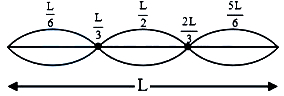
0 likesView Solution
25
PhysicsMediumMCQMHT CET · 2017
Two uniform wires of the same material are vibrating under the same tension. If the first overtone of the first wire is equal to the second overtone of the second wire and the radius of the first wire is twice the radius of the second wire,then the ratio of the lengths of the first wire to the second wire is:
A
$1/3$
B
$1/4$
C
$1/5$
D
$1/6$
Solution
(A) The fundamental frequency of a stretched wire is given by $f = \frac{1}{2L} \sqrt{\frac{T}{\mu}}$,where $\mu = \pi r^2 \rho$.
Thus,$f = \frac{1}{2Lr} \sqrt{\frac{T}{\pi \rho}}$.
The first overtone of the first wire is $f_1 = 2f_1 = \frac{2}{2L_1 r_1} \sqrt{\frac{T}{\pi \rho}} = \frac{1}{L_1 r_1} \sqrt{\frac{T}{\pi \rho}}$.
The second overtone of the second wire is $f_2 = 3f_2 = \frac{3}{2L_2 r_2} \sqrt{\frac{T}{\pi \rho}}$.
Given $f_1 = f_2$,we have $\frac{1}{L_1 r_1} = \frac{3}{2L_2 r_2}$.
Rearranging for the ratio of lengths: $\frac{L_1}{L_2} = \frac{2r_2}{3r_1}$.
Since $r_1 = 2r_2$,we substitute: $\frac{L_1}{L_2} = \frac{2r_2}{3(2r_2)} = \frac{2}{6} = \frac{1}{3}$.
Thus,$f = \frac{1}{2Lr} \sqrt{\frac{T}{\pi \rho}}$.
The first overtone of the first wire is $f_1 = 2f_1 = \frac{2}{2L_1 r_1} \sqrt{\frac{T}{\pi \rho}} = \frac{1}{L_1 r_1} \sqrt{\frac{T}{\pi \rho}}$.
The second overtone of the second wire is $f_2 = 3f_2 = \frac{3}{2L_2 r_2} \sqrt{\frac{T}{\pi \rho}}$.
Given $f_1 = f_2$,we have $\frac{1}{L_1 r_1} = \frac{3}{2L_2 r_2}$.
Rearranging for the ratio of lengths: $\frac{L_1}{L_2} = \frac{2r_2}{3r_1}$.
Since $r_1 = 2r_2$,we substitute: $\frac{L_1}{L_2} = \frac{2r_2}{3(2r_2)} = \frac{2}{6} = \frac{1}{3}$.
0 likesView Solution
26
PhysicsMediumMCQMHT CET · 2017
In a series $LCR$ circuit,$R = 18 \ \Omega$ and the impedance $Z = 33 \ \Omega$. An $RMS$ voltage of $220 \ V$ is applied across the circuit. The true power consumed in the $AC$ circuit is: (in $W$)
A
$220$
B
$400$
C
$600$
D
$800$
Solution
(D) The true power consumed in an $AC$ circuit is given by the formula: $P = V_{\text{rms}} \cdot I_{\text{rms}} \cdot \cos \phi$.
Since $I_{\text{rms}} = \frac{V_{\text{rms}}}{Z}$ and the power factor $\cos \phi = \frac{R}{Z}$,we can write:
$P = V_{\text{rms}} \cdot \left( \frac{V_{\text{rms}}}{Z} \right) \cdot \left( \frac{R}{Z} \right) = \frac{V_{\text{rms}}^2 \cdot R}{Z^2}$.
Given $V_{\text{rms}} = 220 \ V$,$R = 18 \ \Omega$,and $Z = 33 \ \Omega$:
$P = \frac{220 \times 220 \times 18}{33 \times 33}$.
Simplifying the expression:
$P = \left( \frac{220}{33} \right) \times \left( \frac{220}{33} \right) \times 18 = \left( \frac{20}{3} \right) \times \left( \frac{20}{3} \right) \times 18$.
$P = \frac{400}{9} \times 18 = 400 \times 2 = 800 \ W$.
Since $I_{\text{rms}} = \frac{V_{\text{rms}}}{Z}$ and the power factor $\cos \phi = \frac{R}{Z}$,we can write:
$P = V_{\text{rms}} \cdot \left( \frac{V_{\text{rms}}}{Z} \right) \cdot \left( \frac{R}{Z} \right) = \frac{V_{\text{rms}}^2 \cdot R}{Z^2}$.
Given $V_{\text{rms}} = 220 \ V$,$R = 18 \ \Omega$,and $Z = 33 \ \Omega$:
$P = \frac{220 \times 220 \times 18}{33 \times 33}$.
Simplifying the expression:
$P = \left( \frac{220}{33} \right) \times \left( \frac{220}{33} \right) \times 18 = \left( \frac{20}{3} \right) \times \left( \frac{20}{3} \right) \times 18$.
$P = \frac{400}{9} \times 18 = 400 \times 2 = 800 \ W$.
0 likesView Solution
27
PhysicsMediumMCQMHT CET · 2017
Out of the following graphs,which graph shows the correct relation (graphical representation) for an $LC$ parallel resonant circuit?
A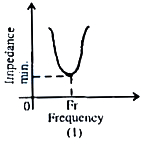
B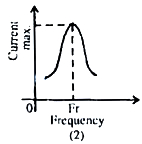
C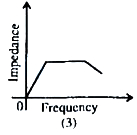
D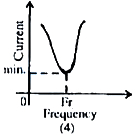
Solution
(D) In an $LC$ parallel resonant circuit,the impedance is maximum at the resonant frequency $f_r$,and the current is minimum at the resonant frequency $f_r$.
Graph $(4)$ shows that the current is minimum at the resonant frequency $f_r$,which is the correct characteristic for an $LC$ parallel resonant circuit.
Graph $(4)$ shows that the current is minimum at the resonant frequency $f_r$,which is the correct characteristic for an $LC$ parallel resonant circuit.
0 likesView Solution
28
PhysicsMediumMCQMHT CET · 2017
The frequencies for the series limit of the Balmer and Paschen series are $f_1$ and $f_3$,respectively. If the frequency of the first line of the Balmer series is $f_2$,then the relation between $f_1, f_2$,and $f_3$ is:
A
$f_1-f_2=f_3$
B
$f_1+f_3=f_2$
C
$f_1+f_2=f_3$
D
$f_2-f_3=2 f_1$
Solution
(A) The frequency of a spectral line is given by $f = Rc \left( \frac{1}{n_1^2} - \frac{1}{n_2^2} \right)$.
For the series limit of the Balmer series $(n_1=2, n_2=\infty)$: $f_1 = Rc \left( \frac{1}{2^2} - 0 \right) = \frac{Rc}{4}$.
For the series limit of the Paschen series $(n_1=3, n_2=\infty)$: $f_3 = Rc \left( \frac{1}{3^2} - 0 \right) = \frac{Rc}{9}$.
For the first line of the Balmer series $(n_1=2, n_2=3)$: $f_2 = Rc \left( \frac{1}{2^2} - \frac{1}{3^2} \right) = Rc \left( \frac{1}{4} - \frac{1}{9} \right)$.
Substituting the expressions for $f_1$ and $f_3$ into the equation for $f_2$:
$f_2 = \frac{Rc}{4} - \frac{Rc}{9} = f_1 - f_3$.
Rearranging the terms,we get $f_1 - f_2 = f_3$.
For the series limit of the Balmer series $(n_1=2, n_2=\infty)$: $f_1 = Rc \left( \frac{1}{2^2} - 0 \right) = \frac{Rc}{4}$.
For the series limit of the Paschen series $(n_1=3, n_2=\infty)$: $f_3 = Rc \left( \frac{1}{3^2} - 0 \right) = \frac{Rc}{9}$.
For the first line of the Balmer series $(n_1=2, n_2=3)$: $f_2 = Rc \left( \frac{1}{2^2} - \frac{1}{3^2} \right) = Rc \left( \frac{1}{4} - \frac{1}{9} \right)$.
Substituting the expressions for $f_1$ and $f_3$ into the equation for $f_2$:
$f_2 = \frac{Rc}{4} - \frac{Rc}{9} = f_1 - f_3$.
Rearranging the terms,we get $f_1 - f_2 = f_3$.
0 likesView Solution
29
PhysicsMediumMCQMHT CET · 2017
The magnetic moment of an electron due to its orbital motion is proportional to $(n =$ principal quantum number$)$
A
$1/n^2$
B
$1/n$
C
$n^2$
D
$n$
Solution
(D) The magnetic moment $M_0$ of an electron due to its orbital motion is given by the formula: $M_0 = \frac{e}{2m_e} L_0$,where $e$ is the charge of the electron,$m_e$ is the mass of the electron,and $L_0$ is the orbital angular momentum.
According to Bohr's quantization condition,the orbital angular momentum $L_0$ is given by $L_0 = \frac{nh}{2\pi}$,where $n$ is the principal quantum number and $h$ is Planck's constant.
Substituting this into the magnetic moment expression,we get $M_0 = \frac{e}{2m_e} \times \frac{nh}{2\pi}$.
Since $e$,$m_e$,$h$,and $\pi$ are constants,it follows that $M_0 \propto n$.
According to Bohr's quantization condition,the orbital angular momentum $L_0$ is given by $L_0 = \frac{nh}{2\pi}$,where $n$ is the principal quantum number and $h$ is Planck's constant.
Substituting this into the magnetic moment expression,we get $M_0 = \frac{e}{2m_e} \times \frac{nh}{2\pi}$.
Since $e$,$m_e$,$h$,and $\pi$ are constants,it follows that $M_0 \propto n$.
0 likesView Solution
30
PhysicsEasyMCQMHT CET · 2017
$A$ parallel plate air capacitor has capacity $C$ farad,potential $V$ volt,and energy $E$ joule. When the gap between the plates is completely filled with a dielectric material of dielectric constant $K > 1$,what happens to the potential $V$ and energy $E$?
A
Both $V$ and $E$ increase
B
Both $V$ and $E$ decrease
C
$V$ decreases,$E$ increases
D
$V$ increases,$E$ decreases
Solution
(B) When a dielectric is inserted into a capacitor while it remains connected to a battery,the potential difference $V$ remains constant. However,if the capacitor is disconnected from the battery,the charge $Q$ remains constant.
Assuming the capacitor is disconnected from the battery:
$1$. The new capacitance becomes $C' = KC$,where $K > 1$.
$2$. Since the charge $Q$ is constant,the new potential $V' = Q/C' = Q/(KC) = V/K$. Since $K > 1$,$V' < V$,so the potential decreases.
$3$. The new energy $E' = Q^2 / (2C') = Q^2 / (2KC) = E/K$. Since $K > 1$,$E' < E$,so the energy decreases.
Therefore,both $V$ and $E$ decrease.
Assuming the capacitor is disconnected from the battery:
$1$. The new capacitance becomes $C' = KC$,where $K > 1$.
$2$. Since the charge $Q$ is constant,the new potential $V' = Q/C' = Q/(KC) = V/K$. Since $K > 1$,$V' < V$,so the potential decreases.
$3$. The new energy $E' = Q^2 / (2C') = Q^2 / (2KC) = E/K$. Since $K > 1$,$E' < E$,so the energy decreases.
Therefore,both $V$ and $E$ decrease.
0 likesView Solution
31
PhysicsDifficultMCQMHT CET · 2017
Two parallel plate air capacitors of the same capacity $C$ are connected in series to a battery of emf $E$. Then one of the capacitors is completely filled with a dielectric material of constant $K$. The change in the effective capacitance of the series combination is
A
$\frac{C}{2}\left[\frac{K-1}{K+1}\right]$
B
$\frac{C}{4}\left[\frac{K-1}{K+1}\right]$
C
$\frac{C}{2}\left[\frac{K+1}{K-1}\right]$
D
$\frac{C}{2}\left[\frac{K-1}{K+1}\right]^2$
Solution
(A) Initially,two capacitors of capacity $C$ are in series. The equivalent capacitance $C_1$ is given by $\frac{1}{C_1} = \frac{1}{C} + \frac{1}{C} = \frac{2}{C}$,so $C_1 = \frac{C}{2}$.
After filling one capacitor with a dielectric of constant $K$,its new capacity becomes $KC$. The new equivalent capacitance $C_2$ is given by $\frac{1}{C_2} = \frac{1}{C} + \frac{1}{KC} = \frac{1}{C} \left(1 + \frac{1}{K}\right) = \frac{K+1}{KC}$.
Thus,$C_2 = \frac{KC}{K+1}$.
The change in effective capacitance $\Delta C = C_2 - C_1 = \frac{KC}{K+1} - \frac{C}{2}$.
$\Delta C = C \left[ \frac{K}{K+1} - \frac{1}{2} \right] = C \left[ \frac{2K - (K+1)}{2(K+1)} \right] = \frac{C}{2} \left[ \frac{K-1}{K+1} \right]$.
After filling one capacitor with a dielectric of constant $K$,its new capacity becomes $KC$. The new equivalent capacitance $C_2$ is given by $\frac{1}{C_2} = \frac{1}{C} + \frac{1}{KC} = \frac{1}{C} \left(1 + \frac{1}{K}\right) = \frac{K+1}{KC}$.
Thus,$C_2 = \frac{KC}{K+1}$.
The change in effective capacitance $\Delta C = C_2 - C_1 = \frac{KC}{K+1} - \frac{C}{2}$.
$\Delta C = C \left[ \frac{K}{K+1} - \frac{1}{2} \right] = C \left[ \frac{2K - (K+1)}{2(K+1)} \right] = \frac{C}{2} \left[ \frac{K-1}{K+1} \right]$.
0 likesView Solution
32
PhysicsMediumMCQMHT CET · 2017
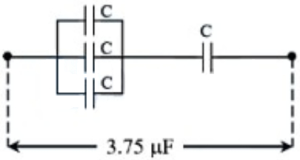
When three capacitors of equal capacities are connected in parallel and one of the same capacitor is connected in series with this combination,the resultant capacity is $3.75 \mu F$. The capacity of each capacitor is: (in $\mu F$)
A
$5$
B
$6$
C
$7$
D
$8$
Solution
(A) Let the capacity of each capacitor be $C$.
When three capacitors of capacity $C$ are connected in parallel,their equivalent capacity is $C_p = C + C + C = 3C$.
Now,this combination is connected in series with another capacitor of capacity $C$.
The resultant equivalent capacity $C_{eq}$ is given by the series formula:
$\frac{1}{C_{eq}} = \frac{1}{C_p} + \frac{1}{C} = \frac{1}{3C} + \frac{1}{C} = \frac{1 + 3}{3C} = \frac{4}{3C}$.
Therefore,$C_{eq} = \frac{3C}{4}$.
Given $C_{eq} = 3.75 \mu F$,we have:
$3.75 = \frac{3C}{4}$
$C = \frac{3.75 \times 4}{3} = 1.25 \times 4 = 5.00 \mu F$.
Thus,the capacity of each capacitor is $5 \mu F$.
When three capacitors of capacity $C$ are connected in parallel,their equivalent capacity is $C_p = C + C + C = 3C$.
Now,this combination is connected in series with another capacitor of capacity $C$.
The resultant equivalent capacity $C_{eq}$ is given by the series formula:
$\frac{1}{C_{eq}} = \frac{1}{C_p} + \frac{1}{C} = \frac{1}{3C} + \frac{1}{C} = \frac{1 + 3}{3C} = \frac{4}{3C}$.
Therefore,$C_{eq} = \frac{3C}{4}$.
Given $C_{eq} = 3.75 \mu F$,we have:
$3.75 = \frac{3C}{4}$
$C = \frac{3.75 \times 4}{3} = 1.25 \times 4 = 5.00 \mu F$.
Thus,the capacity of each capacitor is $5 \mu F$.
0 likesView Solution
33
PhysicsEasyMCQMHT CET · 2017
In a communication system,the process of superimposing a low-frequency signal on a high-frequency wave is known as:
A
Repeater
B
Attenuation
C
Modulation
D
Demodulation
Solution
(C) The process of superimposing a low-frequency message signal (baseband signal) onto a high-frequency carrier wave is called $Modulation$. This is necessary because low-frequency signals cannot travel long distances efficiently,and high-frequency waves act as carriers to transmit information over large distances.
0 likesView Solution
34
PhysicsMediumMCQMHT CET · 2017
The resistivity of a potentiometer wire is $40 \times 10^{-8} \Omega \text{ m}$ and its area of cross-section is $8 \times 10^{-6} \text{ m}^2$. If $0.2 \text{ A}$ current is flowing through the wire, the potential gradient of the wire is:
A
$0.1 \text{ V m}^{-1}$
B
$10^{-2} \text{ V m}^{-1}$
C
$10^{-3} \text{ V m}^{-1}$
D
$10^{-4} \text{ V m}^{-1}$
Solution
(B) The resistance $R$ of a wire is given by $R = \frac{\rho l}{A}$, where $\rho$ is resistivity, $l$ is length, and $A$ is the area of cross-section.
Potential gradient is defined as the potential drop per unit length, given by $x = \frac{V}{l}$.
Using Ohm's law, $V = IR$, so $x = \frac{IR}{l} = I \left( \frac{R}{l} \right)$.
From the resistance formula, $\frac{R}{l} = \frac{\rho}{A}$.
Substituting the given values: $\frac{R}{l} = \frac{40 \times 10^{-8} \Omega \text{ m}}{8 \times 10^{-6} \text{ m}^2} = 5 \times 10^{-2} \Omega \text{ m}^{-1}$.
Now, calculating the potential gradient: $x = I \times \left( \frac{R}{l} \right) = 0.2 \text{ A} \times 5 \times 10^{-2} \Omega \text{ m}^{-1} = 10^{-2} \text{ V m}^{-1}$.
Potential gradient is defined as the potential drop per unit length, given by $x = \frac{V}{l}$.
Using Ohm's law, $V = IR$, so $x = \frac{IR}{l} = I \left( \frac{R}{l} \right)$.
From the resistance formula, $\frac{R}{l} = \frac{\rho}{A}$.
Substituting the given values: $\frac{R}{l} = \frac{40 \times 10^{-8} \Omega \text{ m}}{8 \times 10^{-6} \text{ m}^2} = 5 \times 10^{-2} \Omega \text{ m}^{-1}$.
Now, calculating the potential gradient: $x = I \times \left( \frac{R}{l} \right) = 0.2 \text{ A} \times 5 \times 10^{-2} \Omega \text{ m}^{-1} = 10^{-2} \text{ V m}^{-1}$.
0 likesView Solution
35
PhysicsEasyMCQMHT CET · 2017
The sensitivity of a moving coil galvanometer is $s$. If a shunt of $\frac{1}{8}$ of the resistance of the galvanometer is connected to the moving coil galvanometer,what will its new sensitivity be?
A
$\frac{s}{3}$
B
$\frac{s}{6}$
C
$\frac{s}{9}$
D
$\frac{s}{12}$
Solution
(C) Let the resistance of the galvanometer be $G$ and the shunt resistance be $S$. Given $S = \frac{G}{8}$.
The current sensitivity of a galvanometer is defined as the deflection per unit current. When a shunt $S$ is connected in parallel,the total current $I$ is divided such that the current through the galvanometer $I_g$ is given by $I_g = I \left( \frac{S}{S+G} \right)$.
The new sensitivity $s^{\prime}$ is the ratio of deflection $\theta$ to the total current $I$. Since $\theta = k I_g$ (where $k$ is a constant),we have $s^{\prime} = \frac{\theta}{I} = k \frac{I_g}{I} = k \left( \frac{S}{S+G} \right)$.
The original sensitivity $s = k$. Therefore,$s^{\prime} = s \left( \frac{S}{S+G} \right)$.
Substituting $S = \frac{G}{8}$:
$s^{\prime} = s \left( \frac{G/8}{G/8 + G} \right) = s \left( \frac{G/8}{9G/8} \right) = \frac{s}{9}$.
The current sensitivity of a galvanometer is defined as the deflection per unit current. When a shunt $S$ is connected in parallel,the total current $I$ is divided such that the current through the galvanometer $I_g$ is given by $I_g = I \left( \frac{S}{S+G} \right)$.
The new sensitivity $s^{\prime}$ is the ratio of deflection $\theta$ to the total current $I$. Since $\theta = k I_g$ (where $k$ is a constant),we have $s^{\prime} = \frac{\theta}{I} = k \frac{I_g}{I} = k \left( \frac{S}{S+G} \right)$.
The original sensitivity $s = k$. Therefore,$s^{\prime} = s \left( \frac{S}{S+G} \right)$.
Substituting $S = \frac{G}{8}$:
$s^{\prime} = s \left( \frac{G/8}{G/8 + G} \right) = s \left( \frac{G/8}{9G/8} \right) = \frac{s}{9}$.
0 likesView Solution
36
PhysicsEasyMCQMHT CET · 2017
According to the de-Broglie hypothesis,the wavelength associated with a moving electron of mass $m$ is $\lambda_e$. Using the mass-energy relation and Planck's quantum theory,the wavelength associated with a photon is $\lambda_p$. If the energy $(E)$ of the electron and the photon is the same,then the relation between $\lambda_e$ and $\lambda_p$ is:
A
$\lambda_p \propto \lambda_e$
B
$\lambda_p \propto \lambda_e^2$
C
$\lambda_p \propto \sqrt{\lambda_e}$
D
$\lambda_p \propto \frac{1}{\lambda_e}$
Solution
(B) For a photon,the energy is given by $E = \frac{hc}{\lambda_p}$.
Therefore,$\lambda_p = \frac{hc}{E} \dots (i)$.
For a non-relativistic electron,the de-Broglie wavelength is $\lambda_e = \frac{h}{p}$.
Since $E = \frac{p^2}{2m}$,we have $p = \sqrt{2mE}$.
Thus,$\lambda_e = \frac{h}{\sqrt{2mE}}$,which implies $E = \frac{h^2}{2m\lambda_e^2}$.
Substituting $E$ into equation $(i)$:
$\lambda_p = \frac{hc}{(h^2 / 2m\lambda_e^2)} = \frac{2mc}{h} \lambda_e^2$.
Therefore,$\lambda_p \propto \lambda_e^2$.
Therefore,$\lambda_p = \frac{hc}{E} \dots (i)$.
For a non-relativistic electron,the de-Broglie wavelength is $\lambda_e = \frac{h}{p}$.
Since $E = \frac{p^2}{2m}$,we have $p = \sqrt{2mE}$.
Thus,$\lambda_e = \frac{h}{\sqrt{2mE}}$,which implies $E = \frac{h^2}{2m\lambda_e^2}$.
Substituting $E$ into equation $(i)$:
$\lambda_p = \frac{hc}{(h^2 / 2m\lambda_e^2)} = \frac{2mc}{h} \lambda_e^2$.
Therefore,$\lambda_p \propto \lambda_e^2$.
0 likesView Solution
37
PhysicsMediumMCQMHT CET · 2017
On a photosensitive material,when the frequency of incident radiation is increased by $30 \%$,the kinetic energy of emitted photoelectrons increases from $0.4 \ eV$ to $0.9 \ eV$. The work function of the surface is (in $eV$)
A
$1$
B
$1.267$
C
$1.4$
D
$1.8$
Solution
(B) According to Einstein's photoelectric equation: $K_{max} = h\nu - W_0$,where $W_0$ is the work function.
Initially: $0.4 = h\nu - W_0 \implies h\nu = 0.4 + W_0$ ... $(i)$
When frequency is increased by $30 \%$,the new frequency $\nu' = 1.3\nu$. The new kinetic energy is $0.9 \ eV$.
So,$0.9 = 1.3h\nu - W_0$ ... (ii)
Substitute $(i)$ into (ii): $0.9 = 1.3(0.4 + W_0) - W_0$
$0.9 = 0.52 + 1.3W_0 - W_0$
$0.9 - 0.52 = 0.3W_0$
$0.38 = 0.3W_0$
$W_0 = \frac{0.38}{0.3} = 1.267 \ eV$.
Initially: $0.4 = h\nu - W_0 \implies h\nu = 0.4 + W_0$ ... $(i)$
When frequency is increased by $30 \%$,the new frequency $\nu' = 1.3\nu$. The new kinetic energy is $0.9 \ eV$.
So,$0.9 = 1.3h\nu - W_0$ ... (ii)
Substitute $(i)$ into (ii): $0.9 = 1.3(0.4 + W_0) - W_0$
$0.9 = 0.52 + 1.3W_0 - W_0$
$0.9 - 0.52 = 0.3W_0$
$0.38 = 0.3W_0$
$W_0 = \frac{0.38}{0.3} = 1.267 \ eV$.
0 likesView Solution
38
PhysicsMediumMCQMHT CET · 2017
An electron in a hydrogen atom jumps from the second Bohr orbit to the ground state,and the energy difference of the two states is radiated in the form of photons. These photons are then allowed to fall on a metal surface having a work function equal to $4.2 \ eV$. Calculate the stopping potential. [Energy of electron in $n^{\text{th}}$ orbit $= -\frac{13.6}{n^2} \ eV$] (in $V$)
A
$2$
B
$4$
C
$6$
D
$8$
Solution
(C) The energy of an electron in the $n^{\text{th}}$ orbit is given by $E_n = -\frac{13.6}{n^2} \ eV$.
For the ground state $(n=1)$,$E_1 = -13.6 \ eV$.
For the second orbit $(n=2)$,$E_2 = -\frac{13.6}{2^2} = -3.4 \ eV$.
The energy of the emitted photon is the difference between these two states: $E = E_2 - E_1 = -3.4 - (-13.6) = 10.2 \ eV$.
According to Einstein's photoelectric equation,$h\nu = \phi_0 + eV_s$,where $h\nu$ is the photon energy,$\phi_0$ is the work function,and $V_s$ is the stopping potential.
Given $\phi_0 = 4.2 \ eV$ and $h\nu = 10.2 \ eV$,we have $10.2 \ eV = 4.2 \ eV + eV_s$.
$eV_s = 10.2 \ eV - 4.2 \ eV = 6 \ eV$.
Therefore,the stopping potential $V_s = 6 \ V$.
For the ground state $(n=1)$,$E_1 = -13.6 \ eV$.
For the second orbit $(n=2)$,$E_2 = -\frac{13.6}{2^2} = -3.4 \ eV$.
The energy of the emitted photon is the difference between these two states: $E = E_2 - E_1 = -3.4 - (-13.6) = 10.2 \ eV$.
According to Einstein's photoelectric equation,$h\nu = \phi_0 + eV_s$,where $h\nu$ is the photon energy,$\phi_0$ is the work function,and $V_s$ is the stopping potential.
Given $\phi_0 = 4.2 \ eV$ and $h\nu = 10.2 \ eV$,we have $10.2 \ eV = 4.2 \ eV + eV_s$.
$eV_s = 10.2 \ eV - 4.2 \ eV = 6 \ eV$.
Therefore,the stopping potential $V_s = 6 \ V$.
0 likesView Solution
39
PhysicsMediumMCQMHT CET · 2017
The magnetic flux near the axis and inside the air core solenoid of length $60 \, cm$ carrying current '$I$' is $1.57 \times 10^{-6} \, Wb$. Its magnetic moment will be $[\mu_0 = 4 \pi \times 10^{-7} \, SI \, unit$ and cross-sectional area is very small as compared to the length of the solenoid.] (in $Am^2$)
A
$1$
B
$0.25$
C
$0.5$
D
$0.75$
Solution
(D) The magnetic field inside a long solenoid is given by $B = \frac{\mu_0 NI}{L}$.
Since magnetic flux $\phi = B \cdot A$, we have $B = \frac{\phi}{A}$.
Equating the two expressions for $B$: $\frac{\phi}{A} = \frac{\mu_0 NI}{L}$.
Rearranging to find the magnetic moment $M = NIA$: $NIA = \frac{\phi L}{\mu_0}$.
Given $\phi = 1.57 \times 10^{-6} \, Wb$, $L = 0.6 \, m$, and $\mu_0 = 4 \pi \times 10^{-7} \, T \cdot m/A$.
Substituting the values: $M = \frac{1.57 \times 10^{-6} \times 0.6}{4 \pi \times 10^{-7}}$.
Using $\pi \approx 3.14$, $4 \pi \approx 12.56$.
$M = \frac{1.57 \times 10^{-6} \times 0.6}{12.56 \times 10^{-7}} = \frac{0.942 \times 10^{-6}}{12.56 \times 10^{-7}} = \frac{9.42}{12.56} \approx 0.75 \, Am^2$.
Since magnetic flux $\phi = B \cdot A$, we have $B = \frac{\phi}{A}$.
Equating the two expressions for $B$: $\frac{\phi}{A} = \frac{\mu_0 NI}{L}$.
Rearranging to find the magnetic moment $M = NIA$: $NIA = \frac{\phi L}{\mu_0}$.
Given $\phi = 1.57 \times 10^{-6} \, Wb$, $L = 0.6 \, m$, and $\mu_0 = 4 \pi \times 10^{-7} \, T \cdot m/A$.
Substituting the values: $M = \frac{1.57 \times 10^{-6} \times 0.6}{4 \pi \times 10^{-7}}$.
Using $\pi \approx 3.14$, $4 \pi \approx 12.56$.
$M = \frac{1.57 \times 10^{-6} \times 0.6}{12.56 \times 10^{-7}} = \frac{0.942 \times 10^{-6}}{12.56 \times 10^{-7}} = \frac{9.42}{12.56} \approx 0.75 \, Am^2$.
0 likesView Solution
40
PhysicsEasyMCQMHT CET · 2017
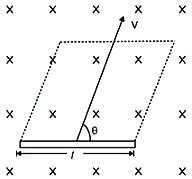
$A$ straight conductor of length $0.4 \ m$ is moving with a speed of $7 \ ms^{-1}$ perpendicular to a magnetic field of intensity $0.9 \ Wb \ m^{-2}$. The induced emf across the conductor will be (in $V$)
A
$7.25$
B
$5.52$
C
$1.25$
D
$2.52$
Solution
(D) The motional electromotive force (emf) induced in a straight conductor of length $l$ moving with velocity $v$ in a uniform magnetic field $B$ is given by the formula:
$e = Bvl \sin \theta$
where $\theta$ is the angle between the velocity vector and the length of the conductor.
Given:
Length of the conductor,$l = 0.4 \ m$
Speed of the conductor,$v = 7 \ ms^{-1}$
Magnetic field intensity,$B = 0.9 \ Wb \ m^{-2}$
Since the conductor is moving perpendicular to the magnetic field,the effective length is perpendicular to the velocity,so $\theta = 90^\circ$ and $\sin 90^\circ = 1$.
Therefore,the induced emf is:
$e = Bvl = 0.9 \times 7 \times 0.4$
$e = 2.52 \ V$
$e = Bvl \sin \theta$
where $\theta$ is the angle between the velocity vector and the length of the conductor.
Given:
Length of the conductor,$l = 0.4 \ m$
Speed of the conductor,$v = 7 \ ms^{-1}$
Magnetic field intensity,$B = 0.9 \ Wb \ m^{-2}$
Since the conductor is moving perpendicular to the magnetic field,the effective length is perpendicular to the velocity,so $\theta = 90^\circ$ and $\sin 90^\circ = 1$.
Therefore,the induced emf is:
$e = Bvl = 0.9 \times 7 \times 0.4$
$e = 2.52 \ V$
0 likesView Solution
41
PhysicsMediumMCQMHT CET · 2017
$A$ magnetic dipole is placed in a uniform magnetic field of intensity $B$,oriented along the direction of the field. If the magnetic dipole moment is $M$,then the maximum work an external agent can perform in rotating the dipole will be
A
$\frac{1}{2} MB$
B
$4MB$
C
$2MB$
D
$MB$
Solution
(C) The potential energy of a magnetic dipole in a magnetic field is given by $U = -M B \cos \theta$.
Initially,the dipole is oriented along the field,so $\theta_1 = 0^\circ$. The initial potential energy is $U_i = -M B \cos(0^\circ) = -M B$.
To perform maximum work,the dipole must be rotated to the position of maximum potential energy,which is $\theta_2 = 180^\circ$. The final potential energy is $U_f = -M B \cos(180^\circ) = M B$.
The work done by an external agent is $W = U_f - U_i = M B - (-M B) = 2 M B$.
Initially,the dipole is oriented along the field,so $\theta_1 = 0^\circ$. The initial potential energy is $U_i = -M B \cos(0^\circ) = -M B$.
To perform maximum work,the dipole must be rotated to the position of maximum potential energy,which is $\theta_2 = 180^\circ$. The final potential energy is $U_f = -M B \cos(180^\circ) = M B$.
The work done by an external agent is $W = U_f - U_i = M B - (-M B) = 2 M B$.
0 likesView Solution
42
PhysicsMediumMCQMHT CET · 2017
$A$ radioactive element has a rate of disintegration $10,000$ disintegrations per minute at a particular instant. After four minutes it becomes $2500$ disintegrations per minute. The decay constant per minute is (in $log _e 2$)
A
$0.2$
B
$0.5$
C
$0.6$
D
$0.8$
Solution
(B) The rate of disintegration $R$ is given by $R = R_0 e^{-\lambda t}$.
Given $R_0 = 10,000$ disintegrations per minute,$R = 2500$ disintegrations per minute,and $t = 4$ minutes.
Substituting these values into the equation:
$\frac{2500}{10000} = e^{-\lambda \times 4}$
$\frac{1}{4} = e^{-4 \lambda}$
Taking the natural logarithm on both sides:
$\ln(\frac{1}{4}) = -4 \lambda$
$-\ln(4) = -4 \lambda$
$\ln(2^2) = 4 \lambda$
$2 \ln(2) = 4 \lambda$
$\lambda = \frac{2}{4} \ln(2)$
$\lambda = 0.5 \log _e 2$ per minute.
Given $R_0 = 10,000$ disintegrations per minute,$R = 2500$ disintegrations per minute,and $t = 4$ minutes.
Substituting these values into the equation:
$\frac{2500}{10000} = e^{-\lambda \times 4}$
$\frac{1}{4} = e^{-4 \lambda}$
Taking the natural logarithm on both sides:
$\ln(\frac{1}{4}) = -4 \lambda$
$-\ln(4) = -4 \lambda$
$\ln(2^2) = 4 \lambda$
$2 \ln(2) = 4 \lambda$
$\lambda = \frac{2}{4} \ln(2)$
$\lambda = 0.5 \log _e 2$ per minute.
0 likesView Solution
43
PhysicsMediumMCQMHT CET · 2017
When the same monochromatic ray of light travels through a glass slab and through water,the number of waves in a glass slab of thickness $6 \ cm$ is the same as in a water column of height $7 \ cm$. If the refractive index of glass is $1.5$,then the refractive index of water is:
A
$1.258$
B
$1.269$
C
$1.286$
D
$1.31$
Solution
(C) The number of waves $N$ in a medium of thickness $t$ is given by $N = \frac{t}{\lambda_m}$,where $\lambda_m = \frac{\lambda_0}{\mu}$ is the wavelength in the medium and $\lambda_0$ is the wavelength in vacuum.
Thus,$N = \frac{t \cdot \mu}{\lambda_0}$.
Given that the number of waves in the glass slab is equal to the number of waves in the water column:
$\frac{t_g \cdot \mu_g}{\lambda_0} = \frac{t_w \cdot \mu_w}{\lambda_0}$
$\therefore \mu_g \cdot t_g = \mu_w \cdot t_w$
Substituting the given values: $\mu_g = 1.5$,$t_g = 6 \ cm$,and $t_w = 7 \ cm$:
$1.5 \times 6 = \mu_w \times 7$
$9 = 7 \cdot \mu_w$
$\mu_w = \frac{9}{7} \approx 1.286$.
Thus,$N = \frac{t \cdot \mu}{\lambda_0}$.
Given that the number of waves in the glass slab is equal to the number of waves in the water column:
$\frac{t_g \cdot \mu_g}{\lambda_0} = \frac{t_w \cdot \mu_w}{\lambda_0}$
$\therefore \mu_g \cdot t_g = \mu_w \cdot t_w$
Substituting the given values: $\mu_g = 1.5$,$t_g = 6 \ cm$,and $t_w = 7 \ cm$:
$1.5 \times 6 = \mu_w \times 7$
$9 = 7 \cdot \mu_w$
$\mu_w = \frac{9}{7} \approx 1.286$.
0 likesView Solution
44
PhysicsMediumMCQMHT CET · 2017
For a transistor,$\alpha_{dc}$ and $\beta_{dc}$ are the current ratios. Then the value of $\frac{\beta_{dc}-\alpha_{dc}}{\alpha_{dc} \cdot \beta_{dc}}$ is
A
$1$
B
$1.5$
C
$2$
D
$2.5$
Solution
(A) We know the relationship between the current gain parameters $\alpha_{dc}$ and $\beta_{dc}$ is given by $\beta_{dc} = \frac{\alpha_{dc}}{1 - \alpha_{dc}}$.
Rearranging this equation,we get $1 - \alpha_{dc} = \frac{\alpha_{dc}}{\beta_{dc}}$.
Now,we need to evaluate the expression $\frac{\beta_{dc} - \alpha_{dc}}{\alpha_{dc} \cdot \beta_{dc}}$.
This can be written as $\frac{\beta_{dc}}{\alpha_{dc} \cdot \beta_{dc}} - \frac{\alpha_{dc}}{\alpha_{dc} \cdot \beta_{dc}} = \frac{1}{\alpha_{dc}} - \frac{1}{\beta_{dc}}$.
Substituting $\frac{1}{\alpha_{dc}} = \frac{1 + \beta_{dc}}{\beta_{dc}}$ is not necessary here; instead,use $\frac{1}{\alpha_{dc}} - \frac{1}{\beta_{dc}} = \frac{\beta_{dc} - \alpha_{dc}}{\alpha_{dc} \cdot \beta_{dc}}$.
From the relation $\beta_{dc} = \frac{\alpha_{dc}}{1 - \alpha_{dc}}$,we have $\frac{1}{\beta_{dc}} = \frac{1 - \alpha_{dc}}{\alpha_{dc}} = \frac{1}{\alpha_{dc}} - 1$.
Therefore,$\frac{1}{\alpha_{dc}} - \frac{1}{\beta_{dc}} = 1$.
Thus,the value of the expression is $1$.
Rearranging this equation,we get $1 - \alpha_{dc} = \frac{\alpha_{dc}}{\beta_{dc}}$.
Now,we need to evaluate the expression $\frac{\beta_{dc} - \alpha_{dc}}{\alpha_{dc} \cdot \beta_{dc}}$.
This can be written as $\frac{\beta_{dc}}{\alpha_{dc} \cdot \beta_{dc}} - \frac{\alpha_{dc}}{\alpha_{dc} \cdot \beta_{dc}} = \frac{1}{\alpha_{dc}} - \frac{1}{\beta_{dc}}$.
Substituting $\frac{1}{\alpha_{dc}} = \frac{1 + \beta_{dc}}{\beta_{dc}}$ is not necessary here; instead,use $\frac{1}{\alpha_{dc}} - \frac{1}{\beta_{dc}} = \frac{\beta_{dc} - \alpha_{dc}}{\alpha_{dc} \cdot \beta_{dc}}$.
From the relation $\beta_{dc} = \frac{\alpha_{dc}}{1 - \alpha_{dc}}$,we have $\frac{1}{\beta_{dc}} = \frac{1 - \alpha_{dc}}{\alpha_{dc}} = \frac{1}{\alpha_{dc}} - 1$.
Therefore,$\frac{1}{\alpha_{dc}} - \frac{1}{\beta_{dc}} = 1$.
Thus,the value of the expression is $1$.
0 likesView Solution
45
PhysicsEasyMCQMHT CET · 2017
$A$ photodiode is a device
A
which is always operated in reverse bias
B
which is always operated in forward bias
C
in which photo current is independent of intensity of incident radiation
D
which may be operated in forward or reverse bias
Solution
(A) photodiode is a semiconductor $p-n$ junction device that is specifically designed to operate under reverse bias conditions. When light of energy greater than the bandgap energy falls on the junction,it generates electron-hole pairs. The reverse bias electric field sweeps these charge carriers across the junction,creating a photocurrent that is proportional to the intensity of the incident light.
0 likesView Solution
46
PhysicsEasyMCQMHT CET · 2017
The polarising angle for a transparent medium is $\theta$,and $v$ is the speed of light in that medium. Then the relation between $\theta$ and $v$ is (where $c$ is the velocity of light in air).
A
$\theta=\tan ^{-1}\left(\frac{v}{c}\right)$
B
$\theta=\cot ^{-1}\left(\frac{v}{c}\right)$
C
$\theta=\sin ^{-1}\left(\frac{v}{c}\right)$
D
$\theta=\cos ^{-1}\left(\frac{v}{c}\right)$
Solution
(B) According to Brewster's Law,the refractive index $\mu$ of a medium is related to the polarising angle $\theta$ by the equation $\mu = \tan \theta$.
By definition,the refractive index $\mu$ is the ratio of the speed of light in air $(c)$ to the speed of light in the medium $(v)$,so $\mu = \frac{c}{v}$.
Equating the two expressions for $\mu$,we get $\tan \theta = \frac{c}{v}$.
Taking the reciprocal of both sides,we have $\cot \theta = \frac{1}{\tan \theta} = \frac{v}{c}$.
Therefore,the relation is $\theta = \cot ^{-1}\left(\frac{v}{c}\right)$.
By definition,the refractive index $\mu$ is the ratio of the speed of light in air $(c)$ to the speed of light in the medium $(v)$,so $\mu = \frac{c}{v}$.
Equating the two expressions for $\mu$,we get $\tan \theta = \frac{c}{v}$.
Taking the reciprocal of both sides,we have $\cot \theta = \frac{1}{\tan \theta} = \frac{v}{c}$.
Therefore,the relation is $\theta = \cot ^{-1}\left(\frac{v}{c}\right)$.
0 likesView Solution
47
PhysicsEasyMCQMHT CET · 2017
In Young's double-slit experiment,in an interference pattern,the second minimum is observed exactly in front of one slit. The distance between the slits is $d$ and the distance between the slits and the screen is $D$. The wavelength of the light source used is:
A
$d^2 / 2D$
B
$d^2 / 2D$
C
$d^2 / 3D$
D
$d^2 / 4D$
Solution
(C) The position of the slits is at $y = \pm d/2$. The second minimum occurs at $y = d/2$.
For a minimum in Young's double-slit experiment,the path difference is given by $\Delta x = (n - 1/2)\lambda$,where $n = 2$ for the second minimum.
Thus,$\Delta x = (2 - 1/2)\lambda = (3/2)\lambda$.
Also,the path difference is given by $\Delta x = d \sin \theta \approx d \tan \theta = d(y/D)$.
Substituting $y = d/2$,we get $\Delta x = d(d/2D) = d^2 / 2D$.
Equating the two expressions for path difference: $(3/2)\lambda = d^2 / 2D$.
Solving for $\lambda$,we get $\lambda = (d^2 / 2D) \times (2/3) = d^2 / 3D$.
For a minimum in Young's double-slit experiment,the path difference is given by $\Delta x = (n - 1/2)\lambda$,where $n = 2$ for the second minimum.
Thus,$\Delta x = (2 - 1/2)\lambda = (3/2)\lambda$.
Also,the path difference is given by $\Delta x = d \sin \theta \approx d \tan \theta = d(y/D)$.
Substituting $y = d/2$,we get $\Delta x = d(d/2D) = d^2 / 2D$.
Equating the two expressions for path difference: $(3/2)\lambda = d^2 / 2D$.
Solving for $\lambda$,we get $\lambda = (d^2 / 2D) \times (2/3) = d^2 / 3D$.
0 likesView Solution
48
PhysicsEasyMCQMHT CET · 2017
The distance between two coherent sources is $1 \ mm$. The screen is placed at a distance of $1 \ m$ from the sources. If the distance of the third bright fringe is $1.2 \ mm$ from the central fringe, the wavelength of light used is:
A
$4000 \ \mathring{A}$
B
$5000 \ \mathring{A}$
C
$6000 \ \mathring{A}$
D
$7200 \ \mathring{A}$
Solution
(A) The position of the $n^{th}$ bright fringe (maxima) is given by the formula:
$y_n = \frac{n D \lambda}{d}$
Rearranging the formula to solve for wavelength $\lambda$:
$\lambda = \frac{y_n d}{n D}$
Given values:
$n = 3$
$y_n = 1.2 \ mm = 1.2 \times 10^{-3} \ m$
$D = 1 \ m$
$d = 1 \ mm = 1 \times 10^{-3} \ m$
Substituting these values into the formula:
$\lambda = \frac{(1.2 \times 10^{-3} \ m) \times (1 \times 10^{-3} \ m)}{3 \times 1 \ m}$
$\lambda = \frac{1.2 \times 10^{-6}}{3} \ m$
$\lambda = 0.4 \times 10^{-6} \ m = 4 \times 10^{-7} \ m$
Converting to $\mathring{A}$s $(\mathring{A})$, where $1 \ \mathring{A} = 10^{-10} \ m$:
$\lambda = 4000 \times 10^{-10} \ m = 4000 \ \mathring{A}$
$y_n = \frac{n D \lambda}{d}$
Rearranging the formula to solve for wavelength $\lambda$:
$\lambda = \frac{y_n d}{n D}$
Given values:
$n = 3$
$y_n = 1.2 \ mm = 1.2 \times 10^{-3} \ m$
$D = 1 \ m$
$d = 1 \ mm = 1 \times 10^{-3} \ m$
Substituting these values into the formula:
$\lambda = \frac{(1.2 \times 10^{-3} \ m) \times (1 \times 10^{-3} \ m)}{3 \times 1 \ m}$
$\lambda = \frac{1.2 \times 10^{-6}}{3} \ m$
$\lambda = 0.4 \times 10^{-6} \ m = 4 \times 10^{-7} \ m$
Converting to $\mathring{A}$s $(\mathring{A})$, where $1 \ \mathring{A} = 10^{-10} \ m$:
$\lambda = 4000 \times 10^{-10} \ m = 4000 \ \mathring{A}$
0 likesView Solution
49
PhysicsEasyMCQMHT CET · 2017
Two identical light waves having phase difference $\phi$ propagate in the same direction. When they superpose,the intensity of the resultant wave is proportional to
A
$\cos ^2 \phi$
B
$\cos ^2 \frac{\phi}{2}$
C
$\cos ^2 \frac{\phi}{3}$
D
$\cos ^2 \frac{\phi}{4}$
Solution
(B) Let the intensity of each individual wave be $I$.
When two identical waves with phase difference $\phi$ superpose,the resultant intensity $I_R$ is given by the formula:
$I_R = I_1 + I_2 + 2\sqrt{I_1 I_2} \cos \phi$
Since the waves are identical,$I_1 = I_2 = I$.
Substituting these values:
$I_R = I + I + 2\sqrt{I \cdot I} \cos \phi$
$I_R = 2I + 2I \cos \phi$
$I_R = 2I(1 + \cos \phi)$
Using the trigonometric identity $1 + \cos \phi = 2 \cos^2 \frac{\phi}{2}$:
$I_R = 2I(2 \cos^2 \frac{\phi}{2}) = 4I \cos^2 \frac{\phi}{2}$
Therefore,the resultant intensity is proportional to $\cos^2 \frac{\phi}{2}$.
When two identical waves with phase difference $\phi$ superpose,the resultant intensity $I_R$ is given by the formula:
$I_R = I_1 + I_2 + 2\sqrt{I_1 I_2} \cos \phi$
Since the waves are identical,$I_1 = I_2 = I$.
Substituting these values:
$I_R = I + I + 2\sqrt{I \cdot I} \cos \phi$
$I_R = 2I + 2I \cos \phi$
$I_R = 2I(1 + \cos \phi)$
Using the trigonometric identity $1 + \cos \phi = 2 \cos^2 \frac{\phi}{2}$:
$I_R = 2I(2 \cos^2 \frac{\phi}{2}) = 4I \cos^2 \frac{\phi}{2}$
Therefore,the resultant intensity is proportional to $\cos^2 \frac{\phi}{2}$.
0 likesView Solution
Vedclass Products
For Students
Vedclass Test Series
Mock tests in real MHT CET style covering Physics with performance analysis. 5-day free trial.
Start Free TrialFor Teachers
Exam Paper Generator
Generate Set A/B/C/D Physics papers from 7.5L+ questions in 2 minutes. 3 chapters free.
Try FreeFor Institutes
Online Exam Module
Run live MHT CET mock exams with unlimited students, 360° analytics & white-label branding.
See DemoFrequently Asked Questions
How many Physics questions are in MHT CET 2017?
There are 49 Physics questions from the MHT CET 2017 paper on Vedclass, each with a detailed step-by-step solution in English.
Are MHT CET 2017 Physics solutions available in English?
Yes. All solutions on this page are in English. You can also switch to English or Hindi using the language buttons above the questions.
Can I practice MHT CET 2017 Physics as a timed test?
Yes. Use the Vedclass Test Series to attempt a full MHT CET mock test covering Physics with time limits and instant score analysis.
Can teachers create Physics papers from MHT CET previous year questions?
Yes. The Vedclass Exam Paper Generator lets teachers mix MHT CET Physics questions and generate Set A/B/C/D papers in minutes.
For Teachers & Institutes
Build a Custom Physics Paper
Pick MHT CET 2017 Physics questions, set difficulty, and generate Set A/B/C/D in 2 minutes.