
PhysicsQ101–200 of 690 questions
Page 3 of 8 · English
101
PhysicsMediumMCQMHT CET · 2020
$A$ bucket containing water is revolved in a vertical circle of radius $r$. To prevent the water from falling down,the minimum frequency of revolution required is ($g =$ acceleration due to gravity).
A
$2 \pi \sqrt{\frac{r}{g}}$
B
$\frac{1}{2 \pi} \sqrt{\frac{r}{g}}$
C
$\frac{1}{2 \pi} \sqrt{\frac{g}{r}}$
D
$2 \pi \sqrt{\frac{g}{r}}$
Solution
(C) For the water not to fall from the bucket at the highest point of the vertical circle,the centripetal force must be at least equal to the gravitational force acting on the water.
At the highest point,the condition for the water to remain in the bucket is $m \omega^2 r \geq mg$.
The minimum angular velocity $\omega$ is given by $m \omega^2 r = mg$,which simplifies to $\omega = \sqrt{\frac{g}{r}}$.
Since the angular frequency $\omega$ is related to the frequency $f$ by the formula $\omega = 2 \pi f$,we can write $2 \pi f = \sqrt{\frac{g}{r}}$.
Therefore,the minimum frequency of revolution is $f = \frac{1}{2 \pi} \sqrt{\frac{g}{r}}$.
At the highest point,the condition for the water to remain in the bucket is $m \omega^2 r \geq mg$.
The minimum angular velocity $\omega$ is given by $m \omega^2 r = mg$,which simplifies to $\omega = \sqrt{\frac{g}{r}}$.
Since the angular frequency $\omega$ is related to the frequency $f$ by the formula $\omega = 2 \pi f$,we can write $2 \pi f = \sqrt{\frac{g}{r}}$.
Therefore,the minimum frequency of revolution is $f = \frac{1}{2 \pi} \sqrt{\frac{g}{r}}$.
0 likesView Solution
102
PhysicsDifficultMCQMHT CET · 2020
$A$ liquid kept in a cylindrical vessel is rotated about a vertical axis passing through the center of the circular base. The difference in the heights of the liquid at the center of the vessel and its edge is ($R=$ radius of vessel,$\omega=$ angular velocity of rotation,$g=$ acceleration due to gravity).
A
$\frac{R^{2} \omega^{2}}{g}$
B
$\frac{R \omega}{g}$
C
$\frac{R \omega}{2 g}$
D
$\frac{R^{2} \omega^{2}}{2 g}$
Solution
(D) When a cylindrical vessel containing liquid is rotated at an angular speed $\omega$ about its vertical axis,the liquid particles at a distance $r$ from the axis rotate with a linear velocity $v = r\omega$.
Applying Bernoulli's principle in the rotating frame of reference,the effective pressure at a point at distance $r$ from the axis is given by $P(r) = P_0 + \frac{1}{2}\rho r^2 \omega^2$,where $P_0$ is the pressure at the center $(r=0)$.
At the edge of the vessel,$r = R$,so the pressure is $P_R = P_0 + \frac{1}{2}\rho R^2 \omega^2$.
The difference in pressure between the edge and the center is $\Delta P = P_R - P_0 = \frac{1}{2}\rho R^2 \omega^2$.
This pressure difference is balanced by the hydrostatic pressure difference due to the height difference $h$ of the liquid column,given by $\Delta P = \rho g h$.
Equating the two expressions: $\rho g h = \frac{1}{2}\rho R^2 \omega^2$.
Solving for $h$,we get $h = \frac{R^2 \omega^2}{2g}$.
Applying Bernoulli's principle in the rotating frame of reference,the effective pressure at a point at distance $r$ from the axis is given by $P(r) = P_0 + \frac{1}{2}\rho r^2 \omega^2$,where $P_0$ is the pressure at the center $(r=0)$.
At the edge of the vessel,$r = R$,so the pressure is $P_R = P_0 + \frac{1}{2}\rho R^2 \omega^2$.
The difference in pressure between the edge and the center is $\Delta P = P_R - P_0 = \frac{1}{2}\rho R^2 \omega^2$.
This pressure difference is balanced by the hydrostatic pressure difference due to the height difference $h$ of the liquid column,given by $\Delta P = \rho g h$.
Equating the two expressions: $\rho g h = \frac{1}{2}\rho R^2 \omega^2$.
Solving for $h$,we get $h = \frac{R^2 \omega^2}{2g}$.
0 likesView Solution
103
PhysicsEasyMCQMHT CET · 2020
The compressibility of water is $5 \times 10^{-10} \ m^2/N$. $A$ pressure of $15 \times 10^6 \ Pa$ is applied on $100 \ ml$ volume of water. The change in the volume of water is:
A
$0.75 \ ml$ increase.
B
$1.50 \ ml$ increase.
C
$0.75 \ ml$ decrease.
D
Zero.
Solution
(C) Compressibility $\beta$ is defined as the reciprocal of the Bulk Modulus $K$,i.e.,$\beta = \frac{1}{K}$.
Given:
Compressibility $\beta = 5 \times 10^{-10} \ m^2/N$
Change in pressure $\Delta P = 15 \times 10^6 \ Pa$
Initial volume $V = 100 \ ml$
The formula for volumetric strain is $\frac{\Delta V}{V} = -\beta \Delta P$.
Substituting the values:
$\frac{\Delta V}{100 \ ml} = -(5 \times 10^{-10} \ m^2/N) \times (15 \times 10^6 \ Pa)$
$\frac{\Delta V}{100 \ ml} = -75 \times 10^{-4} = -0.0075$
$\Delta V = -0.0075 \times 100 \ ml = -0.75 \ ml$.
The negative sign indicates a decrease in volume.
Therefore,the change in volume is a $0.75 \ ml$ decrease.
Given:
Compressibility $\beta = 5 \times 10^{-10} \ m^2/N$
Change in pressure $\Delta P = 15 \times 10^6 \ Pa$
Initial volume $V = 100 \ ml$
The formula for volumetric strain is $\frac{\Delta V}{V} = -\beta \Delta P$.
Substituting the values:
$\frac{\Delta V}{100 \ ml} = -(5 \times 10^{-10} \ m^2/N) \times (15 \times 10^6 \ Pa)$
$\frac{\Delta V}{100 \ ml} = -75 \times 10^{-4} = -0.0075$
$\Delta V = -0.0075 \times 100 \ ml = -0.75 \ ml$.
The negative sign indicates a decrease in volume.
Therefore,the change in volume is a $0.75 \ ml$ decrease.
0 likesView Solution
104
PhysicsEasyMCQMHT CET · 2020
What would be the absolute pressure at a depth of $1 \,km$ below the ocean surface? [Given: density of water $\rho = 10^{3} \,kg/m^{3}$,$g = 10 \,m/s^{2}$,$1 \,atm = 1.01 \times 10^{5} \,N/m^{2}$]
A
$1.011 \times 10^{7} \,N/m^{2}$
B
$1.011 \times 10^{7} \,dyne/cm^{2}$
C
$1.011 \times 10^{6} \,dyne/cm^{2}$
D
$1.011 \times 10^{6} \,N/m^{2}$
Solution
(A) The absolute pressure $P$ at a depth $h$ is given by the formula: $P = P_{atm} + \rho gh$.
Given values are: $h = 1 \,km = 1000 \,m$,$\rho = 10^{3} \,kg/m^{3}$,$g = 10 \,m/s^{2}$,and $P_{atm} = 1.01 \times 10^{5} \,N/m^{2}$.
Calculating the gauge pressure (pressure due to water column): $P_{gauge} = \rho gh = 10^{3} \times 10 \times 1000 = 10^{7} \,N/m^{2}$.
Now,adding the atmospheric pressure: $P = 1.01 \times 10^{5} + 10^{7} = 0.0101 \times 10^{7} + 10^{7} = 1.0101 \times 10^{7} \,N/m^{2}$.
Rounding to the appropriate significant figures,we get $P \approx 1.011 \times 10^{7} \,N/m^{2}$.
Given values are: $h = 1 \,km = 1000 \,m$,$\rho = 10^{3} \,kg/m^{3}$,$g = 10 \,m/s^{2}$,and $P_{atm} = 1.01 \times 10^{5} \,N/m^{2}$.
Calculating the gauge pressure (pressure due to water column): $P_{gauge} = \rho gh = 10^{3} \times 10 \times 1000 = 10^{7} \,N/m^{2}$.
Now,adding the atmospheric pressure: $P = 1.01 \times 10^{5} + 10^{7} = 0.0101 \times 10^{7} + 10^{7} = 1.0101 \times 10^{7} \,N/m^{2}$.
Rounding to the appropriate significant figures,we get $P \approx 1.011 \times 10^{7} \,N/m^{2}$.
0 likesView Solution
105
PhysicsEasyMCQMHT CET · 2020
$A$ wire of length $10 \text{ cm}$ is gently placed horizontally on the surface of water having surface tension of $75 \times 10^{-3} \text{ N/m}$. What force is required to just pull up the wire from the water surface?
A
$15 \times 10^{-2} \text{ N}$
B
$7.5 \times 10^{-2} \text{ N}$
C
$1.5 \times 10^{-2} \text{ N}$
D
$75 \times 10^{-2} \text{ N}$
Solution
(C) The force required to pull a wire of length $L$ from the surface of a liquid with surface tension $T$ is given by the formula $F = 2TL$.
The factor of $2$ is used because the water surface is in contact with both sides of the wire.
Given: $L = 10 \text{ cm} = 0.1 \text{ m}$ and $T = 75 \times 10^{-3} \text{ N/m}$.
Substituting the values: $F = 2 \times (75 \times 10^{-3} \text{ N/m}) \times (0.1 \text{ m})$.
$F = 2 \times 75 \times 10^{-4} \text{ N} = 150 \times 10^{-4} \text{ N} = 1.5 \times 10^{-2} \text{ N}$.
The factor of $2$ is used because the water surface is in contact with both sides of the wire.
Given: $L = 10 \text{ cm} = 0.1 \text{ m}$ and $T = 75 \times 10^{-3} \text{ N/m}$.
Substituting the values: $F = 2 \times (75 \times 10^{-3} \text{ N/m}) \times (0.1 \text{ m})$.
$F = 2 \times 75 \times 10^{-4} \text{ N} = 150 \times 10^{-4} \text{ N} = 1.5 \times 10^{-2} \text{ N}$.
0 likesView Solution
106
PhysicsMediumMCQMHT CET · 2020
Two small drops of mercury,each of radius $R$,coalesce to form a single large drop. The ratio of the total surface energies before and after the change is:
A
$2^{1/3} : 1$
B
$2^{2/3} : 1$
C
$2 : 1$
D
$1 : 2^{1/3}$
Solution
(A) Let the radius of the large drop be $R'$. Since the volume remains constant,the volume of the large drop equals the sum of the volumes of the two small drops:
$\frac{4}{3} \pi R'^3 = 2 \times \frac{4}{3} \pi R^3$
$R'^3 = 2 R^3 \implies R' = 2^{1/3} R$
Total surface energy before $(E_i)$ = $2 \times (4 \pi R^2 T)$,where $T$ is the surface tension.
Total surface energy after $(E_f)$ = $4 \pi R'^2 T$.
The ratio of surface energies is $\frac{E_i}{E_f} = \frac{2 \times 4 \pi R^2 T}{4 \pi R'^2 T} = \frac{2 R^2}{R'^2}$.
Substituting $R' = 2^{1/3} R$:
Ratio = $\frac{2 R^2}{(2^{1/3} R)^2} = \frac{2 R^2}{2^{2/3} R^2} = 2^{1 - 2/3} = 2^{1/3}$.
Thus,the ratio is $2^{1/3} : 1$.
$\frac{4}{3} \pi R'^3 = 2 \times \frac{4}{3} \pi R^3$
$R'^3 = 2 R^3 \implies R' = 2^{1/3} R$
Total surface energy before $(E_i)$ = $2 \times (4 \pi R^2 T)$,where $T$ is the surface tension.
Total surface energy after $(E_f)$ = $4 \pi R'^2 T$.
The ratio of surface energies is $\frac{E_i}{E_f} = \frac{2 \times 4 \pi R^2 T}{4 \pi R'^2 T} = \frac{2 R^2}{R'^2}$.
Substituting $R' = 2^{1/3} R$:
Ratio = $\frac{2 R^2}{(2^{1/3} R)^2} = \frac{2 R^2}{2^{2/3} R^2} = 2^{1 - 2/3} = 2^{1/3}$.
Thus,the ratio is $2^{1/3} : 1$.
0 likesView Solution
107
PhysicsMediumMCQMHT CET · 2020
Under isothermal conditions,two soap bubbles of radii $r_{1}$ and $r_{2}$ coalesce to form a single larger bubble. The radius of the larger bubble is
A
$(r_{1}-r_{2})^{1/2}$
B
$(r_{1}+r_{2})^{1/2}$
C
$(r_{1}^{2}+r_{2}^{2})^{1/2}$
D
$(r_{1}^{2}-r_{2}^{2})^{1/2}$
Solution
(C) Under isothermal conditions,the temperature and surface tension $T$ remain constant. When two soap bubbles coalesce to form a larger bubble,the total surface area changes,but the total number of moles of air inside remains constant. Since the process is isothermal,the pressure $P$ inside a soap bubble of radius $r$ is given by $P = P_{0} + 4T/r$. The total number of moles $n$ is given by $PV = nRT$. For a soap bubble,the excess pressure is $4T/r$,so the total pressure is $P_{atm} + 4T/r$. The volume is $V = (4/3)\pi r^{3}$.
Assuming the external pressure $P_{atm}$ is negligible or the process is governed by the conservation of surface energy in the context of bubble coalescence,the surface energy is $U = 2 \times (4\pi r^{2}T) = 8\pi r^{2}T$ (since a soap bubble has two surfaces).
Equating the initial and final surface energies: $8\pi r^{2}T = 8\pi r_{1}^{2}T + 8\pi r_{2}^{2}T$.
Dividing by $8\pi T$,we get $r^{2} = r_{1}^{2} + r_{2}^{2}$.
Therefore,the radius of the larger bubble is $r = (r_{1}^{2} + r_{2}^{2})^{1/2}$.
Assuming the external pressure $P_{atm}$ is negligible or the process is governed by the conservation of surface energy in the context of bubble coalescence,the surface energy is $U = 2 \times (4\pi r^{2}T) = 8\pi r^{2}T$ (since a soap bubble has two surfaces).
Equating the initial and final surface energies: $8\pi r^{2}T = 8\pi r_{1}^{2}T + 8\pi r_{2}^{2}T$.
Dividing by $8\pi T$,we get $r^{2} = r_{1}^{2} + r_{2}^{2}$.
Therefore,the radius of the larger bubble is $r = (r_{1}^{2} + r_{2}^{2})^{1/2}$.
0 likesView Solution
108
PhysicsEasyMCQMHT CET · 2020
When a mercury drop of radius $R$ breaks into $n$ droplets of equal size,the radius $r$ of each droplet is
A
$r=\frac{R}{\sqrt{n}}$
B
$r=\frac{R}{n}$
C
$r=\frac{R}{n^{\frac{1}{3}}}$
D
$r=R n^{\frac{1}{3}}$
Solution
(C) The total volume of the mercury remains constant during the process of breaking the drop.
Volume of the large drop = $n \times$ Volume of one small droplet.
$\frac{4}{3} \pi R^{3} = n \times \frac{4}{3} \pi r^{3}$
By canceling $\frac{4}{3} \pi$ from both sides,we get:
$R^{3} = n r^{3}$
Taking the cube root on both sides:
$R = n^{\frac{1}{3}} r$
Therefore,the radius of each small droplet is:
$r = \frac{R}{n^{\frac{1}{3}}}$
Volume of the large drop = $n \times$ Volume of one small droplet.
$\frac{4}{3} \pi R^{3} = n \times \frac{4}{3} \pi r^{3}$
By canceling $\frac{4}{3} \pi$ from both sides,we get:
$R^{3} = n r^{3}$
Taking the cube root on both sides:
$R = n^{\frac{1}{3}} r$
Therefore,the radius of each small droplet is:
$r = \frac{R}{n^{\frac{1}{3}}}$
0 likesView Solution
109
PhysicsEasyMCQMHT CET · 2020
Water rises to a height of $15 \,mm$ in a capillary tube having cross-sectional area $A$. If the cross-sectional area of the tube is made $A / 3$, then the water will rise to a height of:
A
$15 \sqrt{3} \times 10^{-3} \,m$
B
$20 \sqrt{3} \times 10^{-3} \,m$
C
$5 \sqrt{3} \times 10^{-3} \,m$
D
$10 \sqrt{3} \times 10^{-3} \,m$
Solution
(A) The height $h$ to which a liquid rises in a capillary tube is given by the formula $h = \frac{2T \cos \theta}{r \rho g}$, where $r$ is the radius of the tube.
This implies $h \propto \frac{1}{r}$.
Since the cross-sectional area $A = \pi r^2$, we have $r = \sqrt{\frac{A}{\pi}}$, which means $r \propto \sqrt{A}$.
Substituting this into the proportionality, we get $h \propto \frac{1}{\sqrt{A}}$.
Given $h_1 = 15 \,mm = 15 \times 10^{-3} \,m$ for area $A_1 = A$.
For the new area $A_2 = A / 3$, we have the ratio $\frac{A_1}{A_2} = 3$.
Using the relation $\frac{h_2}{h_1} = \sqrt{\frac{A_1}{A_2}}$, we get $\frac{h_2}{h_1} = \sqrt{3}$.
Therefore, $h_2 = h_1 \times \sqrt{3} = 15 \times 10^{-3} \times \sqrt{3} \,m = 15 \sqrt{3} \times 10^{-3} \,m$.
This implies $h \propto \frac{1}{r}$.
Since the cross-sectional area $A = \pi r^2$, we have $r = \sqrt{\frac{A}{\pi}}$, which means $r \propto \sqrt{A}$.
Substituting this into the proportionality, we get $h \propto \frac{1}{\sqrt{A}}$.
Given $h_1 = 15 \,mm = 15 \times 10^{-3} \,m$ for area $A_1 = A$.
For the new area $A_2 = A / 3$, we have the ratio $\frac{A_1}{A_2} = 3$.
Using the relation $\frac{h_2}{h_1} = \sqrt{\frac{A_1}{A_2}}$, we get $\frac{h_2}{h_1} = \sqrt{3}$.
Therefore, $h_2 = h_1 \times \sqrt{3} = 15 \times 10^{-3} \times \sqrt{3} \,m = 15 \sqrt{3} \times 10^{-3} \,m$.
0 likesView Solution
110
PhysicsEasyMCQMHT CET · 2020
Water rises up to a height '$h$' in a capillary tube on the surface of the earth. The value of '$h$' increases if the capillary tube apparatus is kept:
A
in a lift going upward with acceleration.
B
on the sun.
C
on the poles.
D
in a lift going downward with acceleration '$a$' where '$a < g$' (acceleration due to gravity).
Solution
(D) The height of the liquid column in a capillary tube is given by the formula: $h = \frac{2 T \cos \theta}{r \rho g}$.
From this expression,it is clear that $h \propto \frac{1}{g}$.
When a lift moves downward with an acceleration '$a$',the effective acceleration due to gravity becomes $g_{eff} = g - a$.
Since $a < g$,the effective gravity $g_{eff}$ is less than the actual gravity $g$.
As $g_{eff} < g$,the value of '$h$' increases because '$h$' is inversely proportional to the acceleration due to gravity.
From this expression,it is clear that $h \propto \frac{1}{g}$.
When a lift moves downward with an acceleration '$a$',the effective acceleration due to gravity becomes $g_{eff} = g - a$.
Since $a < g$,the effective gravity $g_{eff}$ is less than the actual gravity $g$.
As $g_{eff} < g$,the value of '$h$' increases because '$h$' is inversely proportional to the acceleration due to gravity.
0 likesView Solution
111
PhysicsMediumMCQMHT CET · 2020
Small drops of liquid of the same radius coalesce to form a big drop. The ratio of the total surface energies after and before the change is:
A
$2^{3}: 1$
B
$2^{-\frac{1}{3}}: 1$
C
$2^{-\frac{2}{3}}: 1$
D
$2^{\frac{2}{3}}: 1$
Solution
(B) Let $n$ be the number of small drops of radius $r$ that coalesce to form a big drop of radius $R$. Here,$n = 2$.
By conservation of volume: $n \times (\frac{4}{3} \pi r^3) = \frac{4}{3} \pi R^3$.
Substituting $n = 2$: $2r^3 = R^3$,which gives $R = 2^{1/3} r$.
The surface energy $E$ is given by $E = T \times A$,where $T$ is surface tension and $A$ is surface area.
Initial surface energy $E_1 = n \times (4 \pi r^2 T) = 2 \times 4 \pi r^2 T = 8 \pi r^2 T$.
Final surface energy $E_2 = 4 \pi R^2 T = 4 \pi (2^{1/3} r)^2 T = 4 \pi (2^{2/3} r^2) T = 4 \times 2^{2/3} \pi r^2 T$.
The ratio of total surface energies after and before the change is $\frac{E_2}{E_1} = \frac{4 \times 2^{2/3} \pi r^2 T}{8 \pi r^2 T} = \frac{2^{2/3}}{2} = 2^{2/3 - 1} = 2^{-1/3}$.
Thus,the ratio is $2^{-1/3} : 1$.
By conservation of volume: $n \times (\frac{4}{3} \pi r^3) = \frac{4}{3} \pi R^3$.
Substituting $n = 2$: $2r^3 = R^3$,which gives $R = 2^{1/3} r$.
The surface energy $E$ is given by $E = T \times A$,where $T$ is surface tension and $A$ is surface area.
Initial surface energy $E_1 = n \times (4 \pi r^2 T) = 2 \times 4 \pi r^2 T = 8 \pi r^2 T$.
Final surface energy $E_2 = 4 \pi R^2 T = 4 \pi (2^{1/3} r)^2 T = 4 \pi (2^{2/3} r^2) T = 4 \times 2^{2/3} \pi r^2 T$.
The ratio of total surface energies after and before the change is $\frac{E_2}{E_1} = \frac{4 \times 2^{2/3} \pi r^2 T}{8 \pi r^2 T} = \frac{2^{2/3}}{2} = 2^{2/3 - 1} = 2^{-1/3}$.
Thus,the ratio is $2^{-1/3} : 1$.
0 likesView Solution
112
PhysicsEasyMCQMHT CET · 2020
The excess pressure inside a spherical drop of water is three times that of another drop of water. The ratio of their surface area is
A
$3: 1$
B
$6: 1$
C
$1: 9$
D
$1: 3$
Solution
(C) The excess pressure $p$ inside a spherical drop of radius $r$ is given by $p = \frac{2T}{r}$,where $T$ is the surface tension.
Given that the excess pressure of the first drop is three times that of the second drop,we have $p_1 = 3p_2$.
Substituting the formula for excess pressure: $\frac{2T}{r_1} = 3 \times \frac{2T}{r_2}$.
This simplifies to $\frac{1}{r_1} = \frac{3}{r_2}$,which implies $r_2 = 3r_1$ or $\frac{r_1}{r_2} = \frac{1}{3}$.
The surface area $A$ of a spherical drop is given by $A = 4\pi r^2$.
The ratio of their surface areas is $\frac{A_1}{A_2} = \frac{4\pi r_1^2}{4\pi r_2^2} = \left(\frac{r_1}{r_2}\right)^2$.
Substituting the ratio of radii: $\frac{A_1}{A_2} = \left(\frac{1}{3}\right)^2 = \frac{1}{9}$.
Given that the excess pressure of the first drop is three times that of the second drop,we have $p_1 = 3p_2$.
Substituting the formula for excess pressure: $\frac{2T}{r_1} = 3 \times \frac{2T}{r_2}$.
This simplifies to $\frac{1}{r_1} = \frac{3}{r_2}$,which implies $r_2 = 3r_1$ or $\frac{r_1}{r_2} = \frac{1}{3}$.
The surface area $A$ of a spherical drop is given by $A = 4\pi r^2$.
The ratio of their surface areas is $\frac{A_1}{A_2} = \frac{4\pi r_1^2}{4\pi r_2^2} = \left(\frac{r_1}{r_2}\right)^2$.
Substituting the ratio of radii: $\frac{A_1}{A_2} = \left(\frac{1}{3}\right)^2 = \frac{1}{9}$.
0 likesView Solution
113
PhysicsEasyMCQMHT CET · 2020
The excess pressure inside the first soap bubble of radius $R_{1}$ is two times that inside the second soap bubble of radius $R_{2}$. The ratio of the volumes of the first bubble to that of the second bubble is:
A
$1: 4$
B
$1: 1$
C
$1: 2$
D
$1: 8$
Solution
(D) The excess pressure $P$ inside a soap bubble of radius $R$ is given by $P = \frac{4T}{R}$,where $T$ is the surface tension of the soap solution.
Given that the excess pressure in the first bubble $(P_{1})$ is twice that of the second bubble $(P_{2})$,we have $P_{1} = 2P_{2}$.
Substituting the formula for excess pressure: $\frac{4T}{R_{1}} = 2 \times \frac{4T}{R_{2}}$.
Simplifying this,we get $\frac{1}{R_{1}} = \frac{2}{R_{2}}$,which implies $\frac{R_{2}}{R_{1}} = 2$ or $R_{2} = 2R_{1}$.
The volume $V$ of a spherical bubble is given by $V = \frac{4}{3} \pi R^{3}$.
The ratio of the volumes is $\frac{V_{1}}{V_{2}} = \frac{\frac{4}{3} \pi R_{1}^{3}}{\frac{4}{3} \pi R_{2}^{3}} = \left( \frac{R_{1}}{R_{2}} \right)^{3}$.
Since $\frac{R_{1}}{R_{2}} = \frac{1}{2}$,the ratio of volumes is $\left( \frac{1}{2} \right)^{3} = \frac{1}{8}$.
Given that the excess pressure in the first bubble $(P_{1})$ is twice that of the second bubble $(P_{2})$,we have $P_{1} = 2P_{2}$.
Substituting the formula for excess pressure: $\frac{4T}{R_{1}} = 2 \times \frac{4T}{R_{2}}$.
Simplifying this,we get $\frac{1}{R_{1}} = \frac{2}{R_{2}}$,which implies $\frac{R_{2}}{R_{1}} = 2$ or $R_{2} = 2R_{1}$.
The volume $V$ of a spherical bubble is given by $V = \frac{4}{3} \pi R^{3}$.
The ratio of the volumes is $\frac{V_{1}}{V_{2}} = \frac{\frac{4}{3} \pi R_{1}^{3}}{\frac{4}{3} \pi R_{2}^{3}} = \left( \frac{R_{1}}{R_{2}} \right)^{3}$.
Since $\frac{R_{1}}{R_{2}} = \frac{1}{2}$,the ratio of volumes is $\left( \frac{1}{2} \right)^{3} = \frac{1}{8}$.
0 likesView Solution
114
PhysicsEasyMCQMHT CET · 2020
One thousand small water drops of equal radii combine to form a big drop. The ratio of final surface energy to the total initial surface energy is
A
$1:1000$
B
$1:1$
C
$1:10$
D
$1:100$
Solution
(C) Let $r$ be the radius of each small drop and $R$ be the radius of the big drop.
Since the volume remains constant,the volume of $1000$ small drops equals the volume of the big drop: $1000 \times (\frac{4}{3} \pi r^3) = \frac{4}{3} \pi R^3$.
This simplifies to $R^3 = 1000 r^3$,so $R = 10r$.
The initial surface energy $U_i$ of $1000$ small drops is $U_i = 1000 \times (4 \pi r^2 T)$,where $T$ is the surface tension.
The final surface energy $U_f$ of the big drop is $U_f = 4 \pi R^2 T$.
Substituting $R = 10r$,we get $U_f = 4 \pi (10r)^2 T = 400 \pi r^2 T$.
The ratio of final surface energy to initial surface energy is $\frac{U_f}{U_i} = \frac{400 \pi r^2 T}{1000 \times 4 \pi r^2 T} = \frac{400}{4000} = \frac{1}{10}$.
Since the volume remains constant,the volume of $1000$ small drops equals the volume of the big drop: $1000 \times (\frac{4}{3} \pi r^3) = \frac{4}{3} \pi R^3$.
This simplifies to $R^3 = 1000 r^3$,so $R = 10r$.
The initial surface energy $U_i$ of $1000$ small drops is $U_i = 1000 \times (4 \pi r^2 T)$,where $T$ is the surface tension.
The final surface energy $U_f$ of the big drop is $U_f = 4 \pi R^2 T$.
Substituting $R = 10r$,we get $U_f = 4 \pi (10r)^2 T = 400 \pi r^2 T$.
The ratio of final surface energy to initial surface energy is $\frac{U_f}{U_i} = \frac{400 \pi r^2 T}{1000 \times 4 \pi r^2 T} = \frac{400}{4000} = \frac{1}{10}$.
0 likesView Solution
115
PhysicsEasyMCQMHT CET · 2020
$A$ capillary tube is vertically immersed in water,and water rises up to a height $h_{1}$. When the whole arrangement is taken to a depth $d$ in a mine,the water level rises up to a height $h_{2}$. The ratio $h_{1} / h_{2}$ is ($R =$ radius of earth).
A
$\left(1+\frac{2d}{R}\right)$
B
$\left(1-\frac{d}{R}\right)$
C
$\left(1+\frac{d}{R}\right)$
D
$\left(1-\frac{2d}{R}\right)$
Solution
(B) The height of the liquid column in a capillary tube is given by $h = \frac{2T \cos \theta}{r \rho g}$.
From this expression,we can see that $h \propto \frac{1}{g}$.
Therefore,the ratio of the heights is $\frac{h_{1}}{h_{2}} = \frac{g_{2}}{g_{1}}$.
At a depth $d$ below the surface of the Earth,the acceleration due to gravity is given by $g_{2} = g_{1} \left(1 - \frac{d}{R}\right)$,where $g_{1}$ is the acceleration due to gravity at the surface.
Substituting this into the ratio,we get $\frac{h_{1}}{h_{2}} = \frac{g_{1}(1 - d/R)}{g_{1}} = 1 - \frac{d}{R}$.
From this expression,we can see that $h \propto \frac{1}{g}$.
Therefore,the ratio of the heights is $\frac{h_{1}}{h_{2}} = \frac{g_{2}}{g_{1}}$.
At a depth $d$ below the surface of the Earth,the acceleration due to gravity is given by $g_{2} = g_{1} \left(1 - \frac{d}{R}\right)$,where $g_{1}$ is the acceleration due to gravity at the surface.
Substituting this into the ratio,we get $\frac{h_{1}}{h_{2}} = \frac{g_{1}(1 - d/R)}{g_{1}} = 1 - \frac{d}{R}$.
0 likesView Solution
116
PhysicsMediumMCQMHT CET · 2020
Let $R_{1}$ and $R_{2}$ be the radii of two mercury drops. $A$ big mercury drop is formed from them under isothermal conditions. The radius of the resultant drop is
A
$R=\sqrt{R_{1}^{2}-R_{2}^{2}}$
B
$R=\frac{R_{1}+R_{2}}{2}$
C
$R=\sqrt{R_{1}^{2}+R_{2}^{2}}$
D
$R=\left(R_{1}^{3}+R_{2}^{3}\right)^{\frac{1}{3}}$
Solution
(D) When two mercury drops merge to form a single larger drop,the total volume of the mercury remains conserved.
Let $R$ be the radius of the resultant big drop.
The volume of the first drop is $V_{1} = \frac{4}{3} \pi R_{1}^{3}$.
The volume of the second drop is $V_{2} = \frac{4}{3} \pi R_{2}^{3}$.
The volume of the resultant drop is $V = \frac{4}{3} \pi R^{3}$.
Since the total volume is conserved,$V = V_{1} + V_{2}$.
$\frac{4}{3} \pi R^{3} = \frac{4}{3} \pi R_{1}^{3} + \frac{4}{3} \pi R_{2}^{3}$.
Canceling $\frac{4}{3} \pi$ from both sides,we get $R^{3} = R_{1}^{3} + R_{2}^{3}$.
Therefore,$R = (R_{1}^{3} + R_{2}^{3})^{\frac{1}{3}}$.
Let $R$ be the radius of the resultant big drop.
The volume of the first drop is $V_{1} = \frac{4}{3} \pi R_{1}^{3}$.
The volume of the second drop is $V_{2} = \frac{4}{3} \pi R_{2}^{3}$.
The volume of the resultant drop is $V = \frac{4}{3} \pi R^{3}$.
Since the total volume is conserved,$V = V_{1} + V_{2}$.
$\frac{4}{3} \pi R^{3} = \frac{4}{3} \pi R_{1}^{3} + \frac{4}{3} \pi R_{2}^{3}$.
Canceling $\frac{4}{3} \pi$ from both sides,we get $R^{3} = R_{1}^{3} + R_{2}^{3}$.
Therefore,$R = (R_{1}^{3} + R_{2}^{3})^{\frac{1}{3}}$.
0 likesView Solution
117
PhysicsEasyMCQMHT CET · 2020
In a sphere of influence,the liquid molecule at its centre is
A
attracted by other molecules in the sphere of influence.
B
repelled by other molecules lying outside the sphere of influence.
C
attracted by other molecules lying outside the sphere of influence.
D
repelled by other molecules in the sphere of influence.
Solution
(A) sphere of influence is defined as a sphere with a radius equal to the molecular range,centered at a specific molecule.
Within this sphere,the central molecule experiences attractive intermolecular forces from all other molecules present inside the sphere.
Since the sphere is centered on the molecule,the distribution of surrounding molecules is symmetric,resulting in a net force of zero on the central molecule.
However,the interaction itself is an attractive force exerted by the other molecules located within this sphere of influence.
Within this sphere,the central molecule experiences attractive intermolecular forces from all other molecules present inside the sphere.
Since the sphere is centered on the molecule,the distribution of surrounding molecules is symmetric,resulting in a net force of zero on the central molecule.
However,the interaction itself is an attractive force exerted by the other molecules located within this sphere of influence.
0 likesView Solution
118
PhysicsMediumMCQMHT CET · 2020
Water rises to a height of $2.2 \text{ cm}$ in a glass capillary tube. The height to which the same water rises in another capillary having $\frac{1}{4}$ of the cross-sectional area is: (in $\text{ cm}$)
A
$16.4$
B
$4.4$
C
$8.4$
D
$2.2$
Solution
(B) The height $h$ to which a liquid rises in a capillary tube is given by the formula $h = \frac{2T \cos \theta}{r \rho g}$, where $r$ is the radius of the tube.
Since $h \propto \frac{1}{r}$, and the area of cross-section $A = \pi r^2$, we have $r = \sqrt{\frac{A}{\pi}}$, which implies $r \propto \sqrt{A}$.
Therefore, $h \propto \frac{1}{\sqrt{A}}$, or $h_1 \sqrt{A_1} = h_2 \sqrt{A_2}$.
Given $h_1 = 2.2 \text{ cm}$ and $A_2 = \frac{1}{4} A_1$, we have $\sqrt{A_2} = \frac{1}{2} \sqrt{A_1}$.
Substituting these values: $2.2 \times \sqrt{A_1} = h_2 \times \frac{1}{2} \sqrt{A_1}$.
Solving for $h_2$: $h_2 = 2.2 \times 2 = 4.4 \text{ cm}$.
Since $h \propto \frac{1}{r}$, and the area of cross-section $A = \pi r^2$, we have $r = \sqrt{\frac{A}{\pi}}$, which implies $r \propto \sqrt{A}$.
Therefore, $h \propto \frac{1}{\sqrt{A}}$, or $h_1 \sqrt{A_1} = h_2 \sqrt{A_2}$.
Given $h_1 = 2.2 \text{ cm}$ and $A_2 = \frac{1}{4} A_1$, we have $\sqrt{A_2} = \frac{1}{2} \sqrt{A_1}$.
Substituting these values: $2.2 \times \sqrt{A_1} = h_2 \times \frac{1}{2} \sqrt{A_1}$.
Solving for $h_2$: $h_2 = 2.2 \times 2 = 4.4 \text{ cm}$.
0 likesView Solution
119
PhysicsMediumMCQMHT CET · 2020
Water rises to a height of $3 \,cm$ in a capillary tube. If the cross-sectional area of the capillary tube is reduced to $1/9$th of its initial area, then the water will rise to a height of: (in $\,cm$)
A
$9$
B
$6$
C
$7$
D
$8$
Solution
(A) The height $h$ to which a liquid rises in a capillary tube is given by the formula $h = \frac{2T \cos \theta}{r \rho g}$, where $T$ is surface tension, $\theta$ is the contact angle, $r$ is the radius of the tube, $\rho$ is the density, and $g$ is acceleration due to gravity.
From this, we see that $h \propto \frac{1}{r}$.
The cross-sectional area $A$ is given by $A = \pi r^2$, which implies $r \propto \sqrt{A}$.
Substituting this into the height relation, we get $h \propto \frac{1}{\sqrt{A}}$, or $h_1 \sqrt{A_1} = h_2 \sqrt{A_2}$.
Given $h_1 = 3 \,cm$ and $A_2 = \frac{1}{9} A_1$, we have $\sqrt{A_2} = \frac{1}{3} \sqrt{A_1}$.
Substituting these values: $3 \times \sqrt{A_1} = h_2 \times \frac{1}{3} \sqrt{A_1}$.
Solving for $h_2$: $h_2 = 3 \times 3 = 9 \,cm$.
From this, we see that $h \propto \frac{1}{r}$.
The cross-sectional area $A$ is given by $A = \pi r^2$, which implies $r \propto \sqrt{A}$.
Substituting this into the height relation, we get $h \propto \frac{1}{\sqrt{A}}$, or $h_1 \sqrt{A_1} = h_2 \sqrt{A_2}$.
Given $h_1 = 3 \,cm$ and $A_2 = \frac{1}{9} A_1$, we have $\sqrt{A_2} = \frac{1}{3} \sqrt{A_1}$.
Substituting these values: $3 \times \sqrt{A_1} = h_2 \times \frac{1}{3} \sqrt{A_1}$.
Solving for $h_2$: $h_2 = 3 \times 3 = 9 \,cm$.
0 likesView Solution
120
PhysicsEasyMCQMHT CET · 2020
Due to surface tension, the excess pressure inside a smaller drop is $9$ units. If $27$ smaller drops combine, then the excess pressure inside the bigger drop is:
A
$2$ units
B
$1$ unit
C
$3$ units
D
$4$ units
Solution
(C) The excess pressure inside a liquid drop of radius $r$ is given by $\Delta P = \frac{2T}{r} = 9$ units. (Note: For a liquid drop, the formula is $\frac{2T}{r}$, though the problem uses $9$ as a constant value for the expression).
Let the radius of the smaller drop be $r$ and the radius of the bigger drop be $R$.
When $27$ smaller drops combine to form a bigger drop, the volume remains conserved:
$27 \times (\frac{4}{3} \pi r^3) = \frac{4}{3} \pi R^3$
$27 r^3 = R^3$
Taking the cube root on both sides, we get $R = 3r$.
The excess pressure inside the bigger drop is $\Delta P' = \frac{2T}{R} = \frac{2T}{3r}$.
Since $\frac{2T}{r} = 9$, we substitute this value:
$\Delta P' = \frac{9}{3} = 3$ units.
Let the radius of the smaller drop be $r$ and the radius of the bigger drop be $R$.
When $27$ smaller drops combine to form a bigger drop, the volume remains conserved:
$27 \times (\frac{4}{3} \pi r^3) = \frac{4}{3} \pi R^3$
$27 r^3 = R^3$
Taking the cube root on both sides, we get $R = 3r$.
The excess pressure inside the bigger drop is $\Delta P' = \frac{2T}{R} = \frac{2T}{3r}$.
Since $\frac{2T}{r} = 9$, we substitute this value:
$\Delta P' = \frac{9}{3} = 3$ units.
0 likesView Solution
121
PhysicsMediumMCQMHT CET · 2020
Two small drops of mercury each of radius $r$ coalesce to form a single large drop of radius $R$. The ratio of the total surface energies before and after the change is
A
$2^{1/3} : 1$
B
$2^{2/3} : 1$
C
$1 : 2^{1/3}$
D
$1 : 2^{2/3}$
Solution
(A) Let the radius of each small drop be $r$ and the radius of the large drop be $R$. Since the volume of mercury remains constant,the volume of the large drop equals the sum of the volumes of the two small drops:
$\frac{4}{3} \pi R^3 = 2 \times \left( \frac{4}{3} \pi r^3 \right)$
$R^3 = 2r^3 \implies R = 2^{1/3} r$
The initial total surface energy $E_i$ of the two small drops is:
$E_i = 2 \times (4 \pi r^2 T) = 8 \pi r^2 T$
The final surface energy $E_f$ of the single large drop is:
$E_f = 4 \pi R^2 T = 4 \pi (2^{1/3} r)^2 T = 4 \pi (2^{2/3} r^2) T = 4 \times 2^{2/3} \pi r^2 T$
The ratio of the total surface energies before and after the change is:
$\frac{E_i}{E_f} = \frac{8 \pi r^2 T}{4 \times 2^{2/3} \pi r^2 T} = \frac{2}{2^{2/3}} = 2^{1 - 2/3} = 2^{1/3} = 2^{1/3} : 1$
$\frac{4}{3} \pi R^3 = 2 \times \left( \frac{4}{3} \pi r^3 \right)$
$R^3 = 2r^3 \implies R = 2^{1/3} r$
The initial total surface energy $E_i$ of the two small drops is:
$E_i = 2 \times (4 \pi r^2 T) = 8 \pi r^2 T$
The final surface energy $E_f$ of the single large drop is:
$E_f = 4 \pi R^2 T = 4 \pi (2^{1/3} r)^2 T = 4 \pi (2^{2/3} r^2) T = 4 \times 2^{2/3} \pi r^2 T$
The ratio of the total surface energies before and after the change is:
$\frac{E_i}{E_f} = \frac{8 \pi r^2 T}{4 \times 2^{2/3} \pi r^2 T} = \frac{2}{2^{2/3}} = 2^{1 - 2/3} = 2^{1/3} = 2^{1/3} : 1$
0 likesView Solution
122
PhysicsMediumMCQMHT CET · 2020
Water rises in a capillary tube of radius $r$ up to a height $h$. The mass of water in the capillary is $m$. What will be the mass of water that rises in a capillary tube of radius $\frac{r}{4}$?
A
$\frac{m}{4}$
B
$\frac{4}{m}$
C
$4m$
D
$m$
Solution
(A) The height of water in a capillary tube is given by $h = \frac{2T \cos \theta}{r \rho g}$.
Since $T, \theta, \rho,$ and $g$ are constant,$h \propto \frac{1}{r}$,which implies $hr = \text{constant}$.
For a capillary of radius $r_1 = r$,the height is $h_1 = h$. For a capillary of radius $r_2 = \frac{r}{4}$,the new height $h_2$ is given by $h_1 r_1 = h_2 r_2$.
$h \times r = h_2 \times \frac{r}{4} \implies h_2 = 4h$.
The mass of water in a capillary is given by $m = \text{Volume} \times \text{density} = (\pi r^2 h) \rho$.
For the new capillary,the mass $m'$ is $m' = \pi (r_2)^2 h_2 \rho$.
Substituting $r_2 = \frac{r}{4}$ and $h_2 = 4h$:
$m' = \pi \left(\frac{r}{4}\right)^2 (4h) \rho = \pi \left(\frac{r^2}{16}\right) (4h) \rho = \frac{1}{4} (\pi r^2 h \rho) = \frac{m}{4}$.
Since $T, \theta, \rho,$ and $g$ are constant,$h \propto \frac{1}{r}$,which implies $hr = \text{constant}$.
For a capillary of radius $r_1 = r$,the height is $h_1 = h$. For a capillary of radius $r_2 = \frac{r}{4}$,the new height $h_2$ is given by $h_1 r_1 = h_2 r_2$.
$h \times r = h_2 \times \frac{r}{4} \implies h_2 = 4h$.
The mass of water in a capillary is given by $m = \text{Volume} \times \text{density} = (\pi r^2 h) \rho$.
For the new capillary,the mass $m'$ is $m' = \pi (r_2)^2 h_2 \rho$.
Substituting $r_2 = \frac{r}{4}$ and $h_2 = 4h$:
$m' = \pi \left(\frac{r}{4}\right)^2 (4h) \rho = \pi \left(\frac{r^2}{16}\right) (4h) \rho = \frac{1}{4} (\pi r^2 h \rho) = \frac{m}{4}$.
0 likesView Solution
123
PhysicsEasyMCQMHT CET · 2020
$A$ square frame of each side $L$ is dipped in a soap solution and taken out. The force acting on the film formed is ($T =$ surface tension of soap solution). (in $TL$)
A
$2$
B
$8$
C
$12$
D
$16$
Solution
(B) soap film has two surfaces: one on the front and one on the back.
When a square frame of side $L$ is dipped in a soap solution, a film is formed across the frame.
The total length of the boundary of the frame is $P = 4L$.
Since the film has two surfaces, the total length of the film in contact with the frame is $2 \times 4L = 8L$.
The force $F$ due to surface tension $T$ is given by $F = T \times (\text{total length})$.
Therefore, $F = T \times 8L = 8TL$.
When a square frame of side $L$ is dipped in a soap solution, a film is formed across the frame.
The total length of the boundary of the frame is $P = 4L$.
Since the film has two surfaces, the total length of the film in contact with the frame is $2 \times 4L = 8L$.
The force $F$ due to surface tension $T$ is given by $F = T \times (\text{total length})$.
Therefore, $F = T \times 8L = 8TL$.
0 likesView Solution
124
PhysicsMediumMCQMHT CET · 2020
The work done in blowing a soap bubble of radius $R$ is $W$. The work done in blowing a bubble of radius $2R$ of the same soap solution is:
A
$W/4$
B
$2W$
C
$4W$
D
$8W$
Solution
(C) soap bubble has two surfaces (inner and outer). The work done $W$ in blowing a soap bubble of radius $R$ is given by the formula: $W = \text{Surface Tension} \times \text{Change in Surface Area} \times 2$.
$W = T \times (4 \pi R^2) \times 2 = 8 \pi R^2 T$.
For a bubble of radius $2R$, the work done $W'$ is:
$W' = T \times (4 \pi (2R)^2) \times 2 = 8 \pi (4R^2) T = 32 \pi R^2 T$.
Comparing $W'$ with $W$:
$W' = 4 \times (8 \pi R^2 T) = 4W$.
$W = T \times (4 \pi R^2) \times 2 = 8 \pi R^2 T$.
For a bubble of radius $2R$, the work done $W'$ is:
$W' = T \times (4 \pi (2R)^2) \times 2 = 8 \pi (4R^2) T = 32 \pi R^2 T$.
Comparing $W'$ with $W$:
$W' = 4 \times (8 \pi R^2 T) = 4W$.
0 likesView Solution
125
PhysicsEasyMCQMHT CET · 2020
$A$ water film is formed between two straight parallel wires,each of length $10 \text{ cm}$,kept at a separation of $0.5 \text{ cm}$. Now,the separation between them is increased by $1 \text{ mm}$ without breaking the water film. The work done for this is (surface tension of water $= 7.2 \times 10^{-2} \text{ N/m}$)
A
$7.22 \times 10^{-6} \text{ J}$
B
$5.76 \times 10^{-5} \text{ J}$
C
$1.44 \times 10^{-5} \text{ J}$
D
$2.88 \times 10^{-5} \text{ J}$
Solution
(C) The length of the wires is $l = 10 \text{ cm} = 0.1 \text{ m}$.
The increase in separation is $\Delta x = 1 \text{ mm} = 10^{-3} \text{ m}$.
$A$ water film has two surfaces,so the change in area $\Delta A$ is given by $2 \times (l \times \Delta x)$.
$\Delta A = 2 \times (0.1 \text{ m} \times 10^{-3} \text{ m}) = 2 \times 10^{-4} \text{ m}^2$.
The work done $W$ is given by $W = T \times \Delta A$,where $T$ is the surface tension.
$W = (7.2 \times 10^{-2} \text{ N/m}) \times (2 \times 10^{-4} \text{ m}^2) = 14.4 \times 10^{-6} \text{ J} = 1.44 \times 10^{-5} \text{ J}$.
The increase in separation is $\Delta x = 1 \text{ mm} = 10^{-3} \text{ m}$.
$A$ water film has two surfaces,so the change in area $\Delta A$ is given by $2 \times (l \times \Delta x)$.
$\Delta A = 2 \times (0.1 \text{ m} \times 10^{-3} \text{ m}) = 2 \times 10^{-4} \text{ m}^2$.
The work done $W$ is given by $W = T \times \Delta A$,where $T$ is the surface tension.
$W = (7.2 \times 10^{-2} \text{ N/m}) \times (2 \times 10^{-4} \text{ m}^2) = 14.4 \times 10^{-6} \text{ J} = 1.44 \times 10^{-5} \text{ J}$.
0 likesView Solution
126
PhysicsEasyMCQMHT CET · 2020
Soap solution is used for cleaning dirty clothes because
A
surface tension of solution is decreased.
B
viscosity of solution is increased.
C
temperature of solution is decreased.
D
surface tension of solution is increased.
Solution
(A) Soap acts as a surfactant,which reduces the surface tension of water.
By lowering the surface tension,the soap solution can penetrate more easily into the fibers of the clothes.
This allows the solution to surround and lift the dirt and oil particles away from the fabric,making the cleaning process effective.
Therefore,the correct reason is that the surface tension of the solution is decreased.
By lowering the surface tension,the soap solution can penetrate more easily into the fibers of the clothes.
This allows the solution to surround and lift the dirt and oil particles away from the fabric,making the cleaning process effective.
Therefore,the correct reason is that the surface tension of the solution is decreased.
0 likesView Solution
127
PhysicsEasyMCQMHT CET · 2020
If the surface tension of a soap solution is $3 \times 10^{-2} \,N/m$, then the work done in forming a soap film of $20 \,cm \times 5 \,cm$ will be
A
$6 \times 10^{-3} \,J$
B
$6 \times 10^{-4} \,J$
C
$6 \times 10^{-2} \,J$
D
$6 \,J$
Solution
(B) The surface tension $T = 3 \times 10^{-2} \,N/m$.
The area of the film $A = 20 \,cm \times 5 \,cm = 100 \,cm^2 = 100 \times 10^{-4} \,m^2 = 10^{-2} \,m^2$.
A soap film has two surfaces, so the total increase in surface area is $2A$.
The work done $W$ is given by $W = T \times (2A)$.
Substituting the values: $W = 3 \times 10^{-2} \times 2 \times 10^{-2} = 6 \times 10^{-4} \,J$.
The area of the film $A = 20 \,cm \times 5 \,cm = 100 \,cm^2 = 100 \times 10^{-4} \,m^2 = 10^{-2} \,m^2$.
A soap film has two surfaces, so the total increase in surface area is $2A$.
The work done $W$ is given by $W = T \times (2A)$.
Substituting the values: $W = 3 \times 10^{-2} \times 2 \times 10^{-2} = 6 \times 10^{-4} \,J$.
0 likesView Solution
128
PhysicsEasyMCQMHT CET · 2020
Water rises up to a height $h$ in a capillary tube on the surface of the earth. The value of $h$ will increase if the experimental setup is kept in:
A
a lift going upward with a certain acceleration.
B
a lift going down with acceleration.
C
an accelerating train.
D
a satellite rotating close to the earth.
Solution
(D) The height $h$ to which a liquid rises in a capillary tube is given by the formula: $h = \frac{2T \cos \theta}{r \rho g}$.
From this relation,we can see that $h \propto \frac{1}{g}$.
For a lift going down with an acceleration $a$,the effective acceleration due to gravity is $g' = g - a$. Since $g' < g$,the height $h$ will increase.
However,in a satellite orbiting the earth,the effective gravity $g'$ becomes $0$ (weightlessness). As $g' \to 0$,$h \to \infty$. Thus,the height $h$ increases significantly in a satellite compared to the other options where $g$ is only partially reduced.
From this relation,we can see that $h \propto \frac{1}{g}$.
For a lift going down with an acceleration $a$,the effective acceleration due to gravity is $g' = g - a$. Since $g' < g$,the height $h$ will increase.
However,in a satellite orbiting the earth,the effective gravity $g'$ becomes $0$ (weightlessness). As $g' \to 0$,$h \to \infty$. Thus,the height $h$ increases significantly in a satellite compared to the other options where $g$ is only partially reduced.
0 likesView Solution
129
PhysicsMediumMCQMHT CET · 2020
If $T$ is the surface tension of a soap solution, then the work done in blowing a soap bubble from diameter $D$ to diameter $2D$ is (in $\pi TD^{2}$)
A
$2$
B
$4$
C
$8$
D
$6$
Solution
(D) soap bubble has two surfaces (inner and outer). The work done $W$ in changing the surface area is given by $W = T \times \Delta A \times 2$.
Initial diameter $D_1 = D$, so initial radius $r_1 = D/2$. Initial surface area $A_1 = 4 \pi r_1^2 = 4 \pi (D/2)^2 = \pi D^2$.
Final diameter $D_2 = 2D$, so final radius $r_2 = D$. Final surface area $A_2 = 4 \pi r_2^2 = 4 \pi D^2$.
Change in area $\Delta A = A_2 - A_1 = 4 \pi D^2 - \pi D^2 = 3 \pi D^2$.
Since the bubble has two surfaces, the total change in area is $2 \times \Delta A = 2 \times 3 \pi D^2 = 6 \pi D^2$.
Therefore, the work done $W = T \times 6 \pi D^2 = 6 \pi TD^2$.
Initial diameter $D_1 = D$, so initial radius $r_1 = D/2$. Initial surface area $A_1 = 4 \pi r_1^2 = 4 \pi (D/2)^2 = \pi D^2$.
Final diameter $D_2 = 2D$, so final radius $r_2 = D$. Final surface area $A_2 = 4 \pi r_2^2 = 4 \pi D^2$.
Change in area $\Delta A = A_2 - A_1 = 4 \pi D^2 - \pi D^2 = 3 \pi D^2$.
Since the bubble has two surfaces, the total change in area is $2 \times \Delta A = 2 \times 3 \pi D^2 = 6 \pi D^2$.
Therefore, the work done $W = T \times 6 \pi D^2 = 6 \pi TD^2$.
0 likesView Solution
130
PhysicsEasyMCQMHT CET · 2020
When a capillary tube is immersed in water vertically,water rises to a height $h$ inside the tube. If the radius of another capillary tube is $\frac{1}{3}$ that of the previous,the height to which water will rise in this tube is:
A
$h$
B
$h \sqrt{3}$
C
$\frac{h}{3}$
D
$3h$
Solution
(D) The height $h$ to which a liquid rises in a capillary tube is given by the formula: $h = \frac{2T \cos \theta}{r \rho g}$.
Since $T$,$\theta$,$\rho$,and $g$ are constants for the given liquid and tube material,we have the relation $h \propto \frac{1}{r}$,which implies $h_{1} r_{1} = h_{2} r_{2}$.
Given $h_{1} = h$,$r_{1} = r$,and $r_{2} = \frac{r}{3}$.
Substituting these values into the equation: $h \cdot r = h_{2} \cdot \frac{r}{3}$.
Solving for $h_{2}$: $h_{2} = 3h$.
Since $T$,$\theta$,$\rho$,and $g$ are constants for the given liquid and tube material,we have the relation $h \propto \frac{1}{r}$,which implies $h_{1} r_{1} = h_{2} r_{2}$.
Given $h_{1} = h$,$r_{1} = r$,and $r_{2} = \frac{r}{3}$.
Substituting these values into the equation: $h \cdot r = h_{2} \cdot \frac{r}{3}$.
Solving for $h_{2}$: $h_{2} = 3h$.
0 likesView Solution
131
PhysicsMediumMCQMHT CET · 2020
Three liquids have the same surface tension and densities $\varrho_{1}, \varrho_{2}$,and $\varrho_{3}$ $(\varrho_{1} > \varrho_{2} > \varrho_{3})$. In three identical capillaries,the rise of liquid is the same. The corresponding angles of contact $\theta_{1}, \theta_{2}$,and $\theta_{3}$ are related as:
A
$\theta_{1} > \theta_{2} > \theta_{3}$
B
$\theta_{1} < \theta_{2} > \theta_{3}$
C
$\theta_{1} > \theta_{2} < \theta_{3}$
D
$\theta_{1} < \theta_{2} < \theta_{3}$
Solution
(D) The rise of a liquid in a capillary tube is given by the formula: $h = \frac{2 T \cos \theta}{r \rho g}$.
Rearranging for the angle of contact,we get: $\cos \theta = \frac{h r \rho g}{2 T}$.
Here,$h$ (rise),$r$ (radius),and $T$ (surface tension) are constants for all three liquids.
Thus,$\cos \theta \propto \rho$.
Given the densities are $\varrho_{1} > \varrho_{2} > \varrho_{3}$,it follows that $\cos \theta_{1} > \cos \theta_{2} > \cos \theta_{3}$.
Since the cosine function is a decreasing function for angles between $0$ and $\frac{\pi}{2}$,a larger cosine value corresponds to a smaller angle.
Therefore,$\theta_{1} < \theta_{2} < \theta_{3}$.
Rearranging for the angle of contact,we get: $\cos \theta = \frac{h r \rho g}{2 T}$.
Here,$h$ (rise),$r$ (radius),and $T$ (surface tension) are constants for all three liquids.
Thus,$\cos \theta \propto \rho$.
Given the densities are $\varrho_{1} > \varrho_{2} > \varrho_{3}$,it follows that $\cos \theta_{1} > \cos \theta_{2} > \cos \theta_{3}$.
Since the cosine function is a decreasing function for angles between $0$ and $\frac{\pi}{2}$,a larger cosine value corresponds to a smaller angle.
Therefore,$\theta_{1} < \theta_{2} < \theta_{3}$.
0 likesView Solution
132
PhysicsEasyMCQMHT CET · 2020
Two rain drops falling through air have radii in the ratio $1: 2$. They will have terminal velocity in the ratio
A
$1: 2$
B
$4: 1$
C
$1: 4$
D
$2: 1$
Solution
(C) The terminal velocity $v_{t}$ of a spherical body falling through a viscous medium is given by Stokes' Law as $v_{t} = \frac{2r^{2}(\rho - \sigma)g}{9\eta}$.
Since the density of the drop $\rho$,density of air $\sigma$,acceleration due to gravity $g$,and coefficient of viscosity $\eta$ are constant for both drops,we have $v_{t} \propto r^{2}$.
Given the ratio of radii is $\frac{r_{1}}{r_{2}} = \frac{1}{2}$.
Therefore,the ratio of their terminal velocities is $\frac{v_{t1}}{v_{t2}} = \left(\frac{r_{1}}{r_{2}}\right)^{2} = \left(\frac{1}{2}\right)^{2} = \frac{1}{4}$.
Thus,the ratio is $1: 4$.
Since the density of the drop $\rho$,density of air $\sigma$,acceleration due to gravity $g$,and coefficient of viscosity $\eta$ are constant for both drops,we have $v_{t} \propto r^{2}$.
Given the ratio of radii is $\frac{r_{1}}{r_{2}} = \frac{1}{2}$.
Therefore,the ratio of their terminal velocities is $\frac{v_{t1}}{v_{t2}} = \left(\frac{r_{1}}{r_{2}}\right)^{2} = \left(\frac{1}{2}\right)^{2} = \frac{1}{4}$.
Thus,the ratio is $1: 4$.
0 likesView Solution
133
PhysicsEasyMCQMHT CET · 2020
$A$ metal sphere of mass $m$ and density $\sigma_{1}$ falls with terminal velocity through a container containing liquid. The density of the liquid is $\sigma_{2}$. The viscous force acting on the sphere is
A
$mg(1 - \frac{\sigma_{2}}{\sigma_{1}})$
B
$mg(1 - \frac{\sigma_{1}}{\sigma_{2}})$
C
$mg(1 + \frac{\sigma_{1}}{\sigma_{2}})$
D
$mg(1 + \frac{\sigma_{2}}{\sigma_{1}})$
Solution
(A) When a sphere falls with terminal velocity,the net force acting on it is zero.
The forces acting on the sphere are:
$1$. Weight $(W = mg)$ acting downwards.
$2$. Buoyant force $(F_{B})$ acting upwards.
$3$. Viscous force $(F_{v})$ acting upwards.
At terminal velocity: $W = F_{B} + F_{v}$.
Therefore,$F_{v} = W - F_{B}$.
The weight of the sphere is $W = V \sigma_{1} g$,where $V$ is the volume of the sphere.
Since $m = V \sigma_{1}$,we have $V = \frac{m}{\sigma_{1}}$.
The buoyant force is $F_{B} = V \sigma_{2} g = (\frac{m}{\sigma_{1}}) \sigma_{2} g = mg(\frac{\sigma_{2}}{\sigma_{1}})$.
Substituting these into the equation for viscous force:
$F_{v} = mg - mg(\frac{\sigma_{2}}{\sigma_{1}}) = mg(1 - \frac{\sigma_{2}}{\sigma_{1}})$.
The forces acting on the sphere are:
$1$. Weight $(W = mg)$ acting downwards.
$2$. Buoyant force $(F_{B})$ acting upwards.
$3$. Viscous force $(F_{v})$ acting upwards.
At terminal velocity: $W = F_{B} + F_{v}$.
Therefore,$F_{v} = W - F_{B}$.
The weight of the sphere is $W = V \sigma_{1} g$,where $V$ is the volume of the sphere.
Since $m = V \sigma_{1}$,we have $V = \frac{m}{\sigma_{1}}$.
The buoyant force is $F_{B} = V \sigma_{2} g = (\frac{m}{\sigma_{1}}) \sigma_{2} g = mg(\frac{\sigma_{2}}{\sigma_{1}})$.
Substituting these into the equation for viscous force:
$F_{v} = mg - mg(\frac{\sigma_{2}}{\sigma_{1}}) = mg(1 - \frac{\sigma_{2}}{\sigma_{1}})$.
0 likesView Solution
134
PhysicsMediumMCQMHT CET · 2020
$A$ small metal sphere of mass $M$ and density $d_{1}$,when dropped in a jar filled with liquid,moves with terminal velocity after some time. The viscous force acting on the sphere is ($d_{2} =$ density of liquid,$g =$ gravitational acceleration).
A
$Mg(1 - \frac{d_{2}}{d_{1}})$
B
$Mg(\frac{d_{2}}{d_{1}})$
C
$Mg(1 - \frac{d_{1}}{d_{2}})$
D
$Mg - (\frac{d_{1}}{d_{2}})$
Solution
(A) When a sphere moves with terminal velocity,the net force acting on it is zero.
The forces acting on the sphere are: weight $(W)$ acting downwards,buoyant force $(F_{B})$ acting upwards,and viscous force $(F_{v})$ acting upwards.
$W = F_{B} + F_{v}$
$F_{v} = W - F_{B}$
Weight $W = Mg = V d_{1} g$,where $V$ is the volume of the sphere.
Buoyant force $F_{B} = V d_{2} g$.
Substituting these into the equation:
$F_{v} = V d_{1} g - V d_{2} g = V d_{1} g (1 - \frac{d_{2}}{d_{1}})$.
Since $M = V d_{1}$,we get:
$F_{v} = Mg (1 - \frac{d_{2}}{d_{1}})$.
The forces acting on the sphere are: weight $(W)$ acting downwards,buoyant force $(F_{B})$ acting upwards,and viscous force $(F_{v})$ acting upwards.
$W = F_{B} + F_{v}$
$F_{v} = W - F_{B}$
Weight $W = Mg = V d_{1} g$,where $V$ is the volume of the sphere.
Buoyant force $F_{B} = V d_{2} g$.
Substituting these into the equation:
$F_{v} = V d_{1} g - V d_{2} g = V d_{1} g (1 - \frac{d_{2}}{d_{1}})$.
Since $M = V d_{1}$,we get:
$F_{v} = Mg (1 - \frac{d_{2}}{d_{1}})$.
0 likesView Solution
135
PhysicsEasyMCQMHT CET · 2020
$A$ metal sphere of radius $R$ and density $\varrho_{1}$ moves with terminal velocity $v_{1}$ through a liquid of density $\sigma$. Another sphere of the same radius but of density $\varrho_{2}$ moves through the same liquid. Its terminal velocity will be:
A
$\left[\frac{\varrho_{1}-\sigma}{\varrho_{2}-\sigma}\right] v_{1}$
B
$\left[\frac{\varrho_{2}+\sigma}{\varrho_{1}+\sigma}\right] v_{1}$
C
$\left[\frac{\varrho_{1}+\varrho_{2}}{\sigma}\right] v_{1}$
D
$\left[\frac{\varrho_{2}-\sigma}{\varrho_{1}-\sigma}\right] v_{1}$
Solution
(D) The terminal velocity $v$ of a sphere of radius $R$ and density $\rho$ falling through a liquid of density $\sigma$ and viscosity $\eta$ is given by Stokes' Law: $6 \pi \eta R v = \frac{4}{3} \pi R^{3} g (\rho - \sigma)$.
Thus,$v \propto (\rho - \sigma)$.
For the first sphere: $v_{1} \propto (\varrho_{1} - \sigma)$.
For the second sphere: $v_{2} \propto (\varrho_{2} - \sigma)$.
Taking the ratio: $\frac{v_{2}}{v_{1}} = \frac{\varrho_{2} - \sigma}{\varrho_{1} - \sigma}$.
Therefore,$v_{2} = \left[\frac{\varrho_{2} - \sigma}{\varrho_{1} - \sigma}\right] v_{1}$.
Thus,$v \propto (\rho - \sigma)$.
For the first sphere: $v_{1} \propto (\varrho_{1} - \sigma)$.
For the second sphere: $v_{2} \propto (\varrho_{2} - \sigma)$.
Taking the ratio: $\frac{v_{2}}{v_{1}} = \frac{\varrho_{2} - \sigma}{\varrho_{1} - \sigma}$.
Therefore,$v_{2} = \left[\frac{\varrho_{2} - \sigma}{\varrho_{1} - \sigma}\right] v_{1}$.
0 likesView Solution
136
PhysicsMediumMCQMHT CET · 2020
The density and bulk modulus of a metal bar are $\rho$ and $K$ respectively. When pressure $P$ is applied from all sides to that metal bar,the increase in its density is
A
$\frac{\rho P}{K}$
B
$\frac{\rho P}{K-P}$
C
$\frac{K-P}{\rho}$
D
$\frac{K+P}{\rho}$
Solution
(A) The density $\rho$ is given by $\rho = M / V$,where $M$ is mass and $V$ is volume.
Differentiating both sides,we get $\frac{d\rho}{\rho} = -\frac{dV}{V}$.
The bulk modulus $K$ is defined as $K = -\frac{P}{dV/V}$,which implies $-\frac{dV}{V} = \frac{P}{K}$.
Substituting this into the density relation,we get $\frac{d\rho}{\rho} = \frac{P}{K}$.
Therefore,the increase in density is $d\rho = \frac{\rho P}{K}$.
Differentiating both sides,we get $\frac{d\rho}{\rho} = -\frac{dV}{V}$.
The bulk modulus $K$ is defined as $K = -\frac{P}{dV/V}$,which implies $-\frac{dV}{V} = \frac{P}{K}$.
Substituting this into the density relation,we get $\frac{d\rho}{\rho} = \frac{P}{K}$.
Therefore,the increase in density is $d\rho = \frac{\rho P}{K}$.
0 likesView Solution
137
PhysicsMediumMCQMHT CET · 2020
$A$ rubber ball is taken into the deep sea such that its volume decreases by $x \%$. The bulk modulus of rubber is $K$ and the density of sea water is $\rho$. The depth $h$ to which the rubber ball is taken is proportional to $(g = \text{acceleration due to gravity})$:
A
$\frac{Kx}{\rho g}$
B
$\frac{\rho g}{Kx}$
C
$\frac{K}{x \rho g}$
D
$\frac{x \rho g}{K}$
Solution
(A) The bulk modulus $K$ is defined as $K = -\frac{\Delta p}{\Delta V / V}$.
Given that the volume decreases by $x \%$,we have $\frac{\Delta V}{V} = \frac{x}{100}$.
The change in pressure $\Delta p$ at a depth $h$ in the sea is given by $\Delta p = \rho g h$.
Substituting these into the bulk modulus formula: $K = \frac{\rho g h}{x / 100}$.
Rearranging for depth $h$: $h = \frac{K \cdot x}{100 \cdot \rho \cdot g}$.
Since $100$ is a constant,the depth $h$ is proportional to $\frac{Kx}{\rho g}$.
Given that the volume decreases by $x \%$,we have $\frac{\Delta V}{V} = \frac{x}{100}$.
The change in pressure $\Delta p$ at a depth $h$ in the sea is given by $\Delta p = \rho g h$.
Substituting these into the bulk modulus formula: $K = \frac{\rho g h}{x / 100}$.
Rearranging for depth $h$: $h = \frac{K \cdot x}{100 \cdot \rho \cdot g}$.
Since $100$ is a constant,the depth $h$ is proportional to $\frac{Kx}{\rho g}$.
0 likesView Solution
138
PhysicsMediumMCQMHT CET · 2020
The density of a metal at normal pressure $P$ is $\varrho$. When it is subjected to an excess pressure $p$,the density becomes $\varrho^{\prime}$. If $K$ is the bulk modulus of the metal,then the ratio $\frac{\varrho^{\prime}}{\varrho}$ is
A
$1+\frac{K}{P}$
B
$1+\frac{P}{K}$
C
$\frac{1}{1-\frac{K}{P}}$
D
$\frac{1}{1-\frac{P}{K}}$
Solution
(D) The bulk modulus $K$ is defined as $K = -V \frac{dp}{dV}$.
For a small change in pressure $p$,we have $K = -V \frac{p}{\Delta V}$,which gives $\Delta V = -\frac{pV}{K}$.
The new volume $V^{\prime}$ is $V^{\prime} = V + \Delta V = V - \frac{pV}{K} = V(1 - \frac{p}{K})$.
Since density $\varrho = \frac{m}{V}$,the new density is $\varrho^{\prime} = \frac{m}{V^{\prime}} = \frac{m}{V(1 - \frac{p}{K})}$.
Substituting $\varrho = \frac{m}{V}$,we get $\varrho^{\prime} = \frac{\varrho}{1 - \frac{p}{K}}$.
Therefore,the ratio $\frac{\varrho^{\prime}}{\varrho} = \frac{1}{1 - \frac{p}{K}}$.
For a small change in pressure $p$,we have $K = -V \frac{p}{\Delta V}$,which gives $\Delta V = -\frac{pV}{K}$.
The new volume $V^{\prime}$ is $V^{\prime} = V + \Delta V = V - \frac{pV}{K} = V(1 - \frac{p}{K})$.
Since density $\varrho = \frac{m}{V}$,the new density is $\varrho^{\prime} = \frac{m}{V^{\prime}} = \frac{m}{V(1 - \frac{p}{K})}$.
Substituting $\varrho = \frac{m}{V}$,we get $\varrho^{\prime} = \frac{\varrho}{1 - \frac{p}{K}}$.
Therefore,the ratio $\frac{\varrho^{\prime}}{\varrho} = \frac{1}{1 - \frac{p}{K}}$.
0 likesView Solution
139
PhysicsEasyMCQMHT CET · 2020
The compressibility of water is $6 \times 10^{-10} \,m^{2}/N$. If one litre of water is subjected to a pressure of $4 \times 10^{7} \,N/m^{2}$, then the decrease in its volume in millilitre will be
A
$10$
B
$20$
C
$24$
D
$15$
Solution
(C) The compressibility $K$ is defined as the reciprocal of the Bulk modulus $B$, given by $K = \frac{1}{B} = -\frac{\Delta V}{P V}$.
Here, the negative sign indicates that an increase in pressure leads to a decrease in volume.
Given:
Compressibility $K = 6 \times 10^{-10} \,m^{2}/N$
Initial volume $V = 1 \,L = 10^{-3} \,m^{3}$
Pressure change $P = 4 \times 10^{7} \,N/m^{2}$
The decrease in volume $\Delta V$ is given by:
$\Delta V = K \cdot P \cdot V$
$\Delta V = (6 \times 10^{-10} \,m^{2}/N) \times (4 \times 10^{7} \,N/m^{2}) \times (10^{-3} \,m^{3})$
$\Delta V = 24 \times 10^{-6} \,m^{3}$
Since $1 \,m^{3} = 10^{3} \,L = 10^{6} \,mL$, we convert the volume change to millilitres:
$\Delta V = 24 \times 10^{-6} \times 10^{6} \,mL = 24 \,mL$.
Here, the negative sign indicates that an increase in pressure leads to a decrease in volume.
Given:
Compressibility $K = 6 \times 10^{-10} \,m^{2}/N$
Initial volume $V = 1 \,L = 10^{-3} \,m^{3}$
Pressure change $P = 4 \times 10^{7} \,N/m^{2}$
The decrease in volume $\Delta V$ is given by:
$\Delta V = K \cdot P \cdot V$
$\Delta V = (6 \times 10^{-10} \,m^{2}/N) \times (4 \times 10^{7} \,N/m^{2}) \times (10^{-3} \,m^{3})$
$\Delta V = 24 \times 10^{-6} \,m^{3}$
Since $1 \,m^{3} = 10^{3} \,L = 10^{6} \,mL$, we convert the volume change to millilitres:
$\Delta V = 24 \times 10^{-6} \times 10^{6} \,mL = 24 \,mL$.
0 likesView Solution
140
PhysicsMediumMCQMHT CET · 2020
Two wires $A$ and $B$ having same length and material are stretched by the same force. Their diameters are in the ratio $1: 3$. The ratio of energy density of wire $A$ to that of wire $B$ when stretched,is (in $: 1$)
A
$27$
B
$9$
C
$81$
D
$3$
Solution
(C) The energy density (strain energy per unit volume) $U$ is given by $U = \frac{1}{2} \times \text{Stress} \times \text{Strain}$.
From Hooke's law,$\text{Stress} = Y \times \text{Strain}$,so $U = \frac{(\text{Stress})^2}{2Y}$.
Since $\text{Stress} = \frac{F}{A} = \frac{F}{\pi d^2 / 4}$,we have $\text{Stress} \propto \frac{1}{d^2}$.
Therefore,$U \propto \frac{1}{d^4}$.
Given the ratio of diameters $\frac{d_A}{d_B} = \frac{1}{3}$,the ratio of energy densities is $\frac{U_A}{U_B} = \left(\frac{d_B}{d_A}\right)^4$.
Substituting the values,$\frac{U_A}{U_B} = \left(\frac{3}{1}\right)^4 = 81:1$.
From Hooke's law,$\text{Stress} = Y \times \text{Strain}$,so $U = \frac{(\text{Stress})^2}{2Y}$.
Since $\text{Stress} = \frac{F}{A} = \frac{F}{\pi d^2 / 4}$,we have $\text{Stress} \propto \frac{1}{d^2}$.
Therefore,$U \propto \frac{1}{d^4}$.
Given the ratio of diameters $\frac{d_A}{d_B} = \frac{1}{3}$,the ratio of energy densities is $\frac{U_A}{U_B} = \left(\frac{d_B}{d_A}\right)^4$.
Substituting the values,$\frac{U_A}{U_B} = \left(\frac{3}{1}\right)^4 = 81:1$.
0 likesView Solution
141
PhysicsEasyMCQMHT CET · 2020
$A$ force $F$ of the same magnitude is applied tangentially on the upper and lower faces of a cube in opposite directions. The side of the cube is $L$. The upper face of the cube shifts parallel to itself by a distance $x_{1}$. If another cube of the same material but with side $2L$ is subjected to the same condition,then the displacement of the top layer is:
A
$x_{1}/6$
B
$x_{1}/2$
C
$x_{1}/8$
D
$x_{1}/4$
Solution
(B) The shear modulus $\eta$ is defined as $\eta = \frac{\text{Shear Stress}}{\text{Shear Strain}} = \frac{F/A}{\Delta x/L}$,where $A$ is the area of the face,$\Delta x$ is the displacement,and $L$ is the side length.
For the first cube: $\eta = \frac{F/L^2}{x_{1}/L} = \frac{F}{L x_{1}}$.
Thus,$x_{1} = \frac{F}{\eta L}$.
For the second cube of side $2L$: The area $A' = (2L)^2 = 4L^2$. The shear modulus $\eta$ remains the same as the material is the same.
Let the new displacement be $x_{2}$. Then $\eta = \frac{F/A'}{x_{2}/(2L)} = \frac{F/(4L^2)}{x_{2}/(2L)} = \frac{F}{2L x_{2}}$.
Equating the two expressions for $\eta$: $\frac{F}{L x_{1}} = \frac{F}{2L x_{2}}$.
Solving for $x_{2}$: $x_{2} = \frac{x_{1}}{2}$.
For the first cube: $\eta = \frac{F/L^2}{x_{1}/L} = \frac{F}{L x_{1}}$.
Thus,$x_{1} = \frac{F}{\eta L}$.
For the second cube of side $2L$: The area $A' = (2L)^2 = 4L^2$. The shear modulus $\eta$ remains the same as the material is the same.
Let the new displacement be $x_{2}$. Then $\eta = \frac{F/A'}{x_{2}/(2L)} = \frac{F/(4L^2)}{x_{2}/(2L)} = \frac{F}{2L x_{2}}$.
Equating the two expressions for $\eta$: $\frac{F}{L x_{1}} = \frac{F}{2L x_{2}}$.
Solving for $x_{2}$: $x_{2} = \frac{x_{1}}{2}$.
0 likesView Solution
142
PhysicsEasyMCQMHT CET · 2020
An elastic material with Young's modulus $Y$ is subjected to a tensile stress $S$. The elastic energy stored per unit volume of the material will be
A
$\frac{S^2}{2Y}$
B
$\frac{S}{2Y}$
C
$\frac{YS}{2}$
D
$\frac{S^2}{Y}$
Solution
(A) The elastic potential energy stored per unit volume $(u)$ in a material subjected to stress $(S)$ and having Young's modulus $(Y)$ is given by the formula:
$u = \frac{1}{2} \times \text{stress} \times \text{strain}$
Since Young's modulus $Y = \frac{\text{stress}}{\text{strain}}$,we have $\text{strain} = \frac{S}{Y}$.
Substituting the value of strain into the energy density formula:
$u = \frac{1}{2} \times S \times \left( \frac{S}{Y} \right)$
$u = \frac{S^2}{2Y}$
Therefore,the correct option is $A$.
$u = \frac{1}{2} \times \text{stress} \times \text{strain}$
Since Young's modulus $Y = \frac{\text{stress}}{\text{strain}}$,we have $\text{strain} = \frac{S}{Y}$.
Substituting the value of strain into the energy density formula:
$u = \frac{1}{2} \times S \times \left( \frac{S}{Y} \right)$
$u = \frac{S^2}{2Y}$
Therefore,the correct option is $A$.
0 likesView Solution
143
PhysicsMediumMCQMHT CET · 2020
$A$ wire of Young's modulus $1.6 \times 10^{12} \,N/m^{2}$ is stretched by a force so as to produce a strain of $2 \times 10^{-4}$. The energy density of the wire is
A
$3.2 \times 10^{4} \,J/m^{3}$
B
$3.2 \times 10^{8} \,J/m^{3}$
C
$1.6 \times 10^{3} \,J/m^{3}$
D
$6.4 \times 10^{3} \,J/m^{3}$
Solution
(A) The energy density $(u)$ of a stretched wire is given by the formula: $u = \frac{1}{2} \times Y \times (\text{strain})^{2}$.
Given:
Young's modulus $(Y)$ = $1.6 \times 10^{12} \,N/m^{2}$.
Strain = $2 \times 10^{-4}$.
Substituting the values into the formula:
$u = \frac{1}{2} \times (1.6 \times 10^{12}) \times (2 \times 10^{-4})^{2}$.
$u = 0.5 \times 1.6 \times 10^{12} \times 4 \times 10^{-8}$.
$u = 0.8 \times 4 \times 10^{12-8}$.
$u = 3.2 \times 10^{4} \,J/m^{3}$.
Given:
Young's modulus $(Y)$ = $1.6 \times 10^{12} \,N/m^{2}$.
Strain = $2 \times 10^{-4}$.
Substituting the values into the formula:
$u = \frac{1}{2} \times (1.6 \times 10^{12}) \times (2 \times 10^{-4})^{2}$.
$u = 0.5 \times 1.6 \times 10^{12} \times 4 \times 10^{-8}$.
$u = 0.8 \times 4 \times 10^{12-8}$.
$u = 3.2 \times 10^{4} \,J/m^{3}$.
0 likesView Solution
144
PhysicsMediumMCQMHT CET · 2020
$A$ constant force is applied to a metal wire of length $L$. The volume of the wire remains constant. The extension produced is proportional to:
A
$L^{2}$
B
$L^{3}$
C
$L$
D
$L^{-2}$
Solution
(A) Let the length of the wire be $L$,the cross-sectional area be $A$,and the volume be $V$. Since the volume is constant,$V = A \times L$,which implies $A = \frac{V}{L}$.
According to Young's modulus formula,$Y = \frac{F \times L}{A \times \Delta L}$,where $\Delta L$ is the extension.
Rearranging for $\Delta L$,we get $\Delta L = \frac{F \times L}{Y \times A}$.
Substituting $A = \frac{V}{L}$ into the equation,we get $\Delta L = \frac{F \times L}{Y \times (V/L)} = \frac{F \times L^{2}}{Y \times V}$.
Since $F$,$Y$,and $V$ are constants,the extension $\Delta L$ is proportional to $L^{2}$.
According to Young's modulus formula,$Y = \frac{F \times L}{A \times \Delta L}$,where $\Delta L$ is the extension.
Rearranging for $\Delta L$,we get $\Delta L = \frac{F \times L}{Y \times A}$.
Substituting $A = \frac{V}{L}$ into the equation,we get $\Delta L = \frac{F \times L}{Y \times (V/L)} = \frac{F \times L^{2}}{Y \times V}$.
Since $F$,$Y$,and $V$ are constants,the extension $\Delta L$ is proportional to $L^{2}$.
0 likesView Solution
145
PhysicsMediumMCQMHT CET · 2020
One end of a thick horizontal copper wire of length '$2L$' and radius '$2R$' is welded to an end of another thin horizontal copper wire of length '$L$' and radius '$R$'. When they are stretched by applying the same force at the two ends,the ratio of the elongation in the thick wire to that in the thin wire is:
A
$1: 2$
B
$4: 1$
C
$1: 8$
D
$1: 1$
Solution
(A) The elongation $\Delta l$ in a wire is given by the formula: $\Delta l = \frac{F \cdot l}{Y \cdot A}$,where $F$ is the applied force,$l$ is the length,$Y$ is Young's modulus,and $A$ is the cross-sectional area.
Since the wires are made of the same material,$Y$ is the same for both. The area $A = \pi r^2$.
For the thick wire $(1)$: $l_1 = 2L$,$r_1 = 2R$,$A_1 = \pi (2R)^2 = 4\pi R^2$.
For the thin wire $(2)$: $l_2 = L$,$r_2 = R$,$A_2 = \pi R^2$.
Since the same force $F$ is applied to both wires connected in series,the tension in both wires is the same.
Therefore,the ratio of elongations is:
$\frac{\Delta l_1}{\Delta l_2} = \frac{F \cdot l_1 / (Y \cdot A_1)}{F \cdot l_2 / (Y \cdot A_2)} = \frac{l_1}{l_2} \cdot \frac{A_2}{A_1}$
Substituting the values:
$\frac{\Delta l_1}{\Delta l_2} = \frac{2L}{L} \cdot \frac{\pi R^2}{4\pi R^2} = 2 \cdot \frac{1}{4} = \frac{1}{2}$.
Wait,let's re-evaluate: $\frac{2}{1} \times \frac{1}{4} = \frac{2}{4} = \frac{1}{2}$.
Thus,the ratio of elongation in the thick wire to that in the thin wire is $1:2$.
Since the wires are made of the same material,$Y$ is the same for both. The area $A = \pi r^2$.
For the thick wire $(1)$: $l_1 = 2L$,$r_1 = 2R$,$A_1 = \pi (2R)^2 = 4\pi R^2$.
For the thin wire $(2)$: $l_2 = L$,$r_2 = R$,$A_2 = \pi R^2$.
Since the same force $F$ is applied to both wires connected in series,the tension in both wires is the same.
Therefore,the ratio of elongations is:
$\frac{\Delta l_1}{\Delta l_2} = \frac{F \cdot l_1 / (Y \cdot A_1)}{F \cdot l_2 / (Y \cdot A_2)} = \frac{l_1}{l_2} \cdot \frac{A_2}{A_1}$
Substituting the values:
$\frac{\Delta l_1}{\Delta l_2} = \frac{2L}{L} \cdot \frac{\pi R^2}{4\pi R^2} = 2 \cdot \frac{1}{4} = \frac{1}{2}$.
Wait,let's re-evaluate: $\frac{2}{1} \times \frac{1}{4} = \frac{2}{4} = \frac{1}{2}$.
Thus,the ratio of elongation in the thick wire to that in the thin wire is $1:2$.

0 likesView Solution
146
PhysicsEasyMCQMHT CET · 2020
$A$ force of $10 \,N$ is required to break a wire of radius $1 \,mm$. The force required to break the wire of the same material, but radius $3 \,mm$ will be
A
$\frac{10}{9} \,N$
B
$\frac{10}{3} \,N$
C
$90 \,N$
D
$30 \,N$
Solution
(C) The breaking force $F$ of a wire is proportional to its cross-sectional area $A$.
Since $A = \pi r^2$, the breaking force is given by $F = \text{Breaking Stress} \times \pi r^2$.
For wires of the same material, the breaking stress is constant.
Therefore, $F \propto r^2$.
Given $F_1 = 10 \,N$ for $r_1 = 1 \,mm$ and $r_2 = 3 \,mm$.
Using the ratio: $\frac{F_2}{F_1} = \frac{r_2^2}{r_1^2}$.
Substituting the values: $\frac{F_2}{10} = \frac{3^2}{1^2} = 9$.
Thus, $F_2 = 10 \times 9 = 90 \,N$.
Since $A = \pi r^2$, the breaking force is given by $F = \text{Breaking Stress} \times \pi r^2$.
For wires of the same material, the breaking stress is constant.
Therefore, $F \propto r^2$.
Given $F_1 = 10 \,N$ for $r_1 = 1 \,mm$ and $r_2 = 3 \,mm$.
Using the ratio: $\frac{F_2}{F_1} = \frac{r_2^2}{r_1^2}$.
Substituting the values: $\frac{F_2}{10} = \frac{3^2}{1^2} = 9$.
Thus, $F_2 = 10 \times 9 = 90 \,N$.
0 likesView Solution
147
PhysicsEasyMCQMHT CET · 2020
Two wires of the same length and material are stretched by the same force. If their masses are in the ratio $3:4$,then the ratio of their elongations is
A
$4:3$
B
$3:4$
C
$9:16$
D
$16:9$
Solution
(A) The elongation $\Delta L$ of a wire is given by the formula $\Delta L = \frac{FL}{AY}$,where $F$ is the force,$L$ is the length,$A$ is the cross-sectional area,and $Y$ is the Young's modulus.
Since $F$,$L$,and $Y$ are the same for both wires,$\Delta L \propto \frac{1}{A}$.
The mass $m$ of a wire is given by $m = \rho AL$,where $\rho$ is the density. Since $\rho$ and $L$ are the same,$m \propto A$.
Therefore,$\Delta L \propto \frac{1}{m}$.
Given the ratio of masses $\frac{m_1}{m_2} = \frac{3}{4}$,the ratio of elongations is $\frac{\Delta L_1}{\Delta L_2} = \frac{m_2}{m_1} = \frac{4}{3}$.
Since $F$,$L$,and $Y$ are the same for both wires,$\Delta L \propto \frac{1}{A}$.
The mass $m$ of a wire is given by $m = \rho AL$,where $\rho$ is the density. Since $\rho$ and $L$ are the same,$m \propto A$.
Therefore,$\Delta L \propto \frac{1}{m}$.
Given the ratio of masses $\frac{m_1}{m_2} = \frac{3}{4}$,the ratio of elongations is $\frac{\Delta L_1}{\Delta L_2} = \frac{m_2}{m_1} = \frac{4}{3}$.
0 likesView Solution
148
PhysicsDifficultMCQMHT CET · 2020
$A$ transverse wave is travelling with velocity $V$ through a metal wire of length $L$ and density $\rho$. The tensile stress in the wire is
A
$V \rho^{2}$
B
$\frac{V^{2}}{\rho}$
C
$\frac{\rho}{V^{2}}$
D
$V^{2} \rho$
Solution
(D) The velocity of a transverse wave in a stretched string is given by $V = \sqrt{\frac{T}{\mu}}$,where $T$ is the tension and $\mu$ is the mass per unit length (linear mass density).
$\mu = \frac{M}{L} = \frac{A \cdot L \cdot \rho}{L} = A \cdot \rho$,where $A$ is the cross-sectional area and $\rho$ is the material density.
Substituting $\mu$ into the velocity equation: $V = \sqrt{\frac{T}{A \cdot \rho}}$.
Squaring both sides: $V^{2} = \frac{T}{A \cdot \rho}$.
Rearranging to find the tensile stress (which is defined as $\text{Stress} = \frac{T}{A}$): $\frac{T}{A} = V^{2} \cdot \rho$.
Therefore,the tensile stress in the wire is $V^{2} \rho$.
$\mu = \frac{M}{L} = \frac{A \cdot L \cdot \rho}{L} = A \cdot \rho$,where $A$ is the cross-sectional area and $\rho$ is the material density.
Substituting $\mu$ into the velocity equation: $V = \sqrt{\frac{T}{A \cdot \rho}}$.
Squaring both sides: $V^{2} = \frac{T}{A \cdot \rho}$.
Rearranging to find the tensile stress (which is defined as $\text{Stress} = \frac{T}{A}$): $\frac{T}{A} = V^{2} \cdot \rho$.
Therefore,the tensile stress in the wire is $V^{2} \rho$.
0 likesView Solution
149
PhysicsMediumMCQMHT CET · 2020
$A$ lift is tied with thick iron ropes having mass $M$. The maximum acceleration of the lift is $a \ m/s^2$ and the maximum safe stress is $s \ N/m^2$. The minimum diameter of the rope is $(g = \text{acceleration due to gravity})$
A
$\left[\frac{2 M(g+a)}{\pi s}\right]^{\frac{1}{2}}$
B
$\left[\frac{2 M(g-a)}{\pi s}\right]^{\frac{1}{2}}$
C
$\left[\frac{4 M(g+a)}{\pi s}\right]^{\frac{1}{2}}$
D
$\left[\frac{4 M(g-a)}{\pi s}\right]^{\frac{1}{2}}$
Solution
(C) The total force acting on the rope when the lift accelerates upwards is $F = M(g+a)$.
Stress is defined as force per unit area,so $s = \frac{F}{A} = \frac{M(g+a)}{\pi r^2}$,where $r$ is the radius of the rope.
Rearranging for $r^2$,we get $r^2 = \frac{M(g+a)}{\pi s}$.
Since the diameter $D = 2r$,we have $r = \frac{D}{2}$.
Substituting this into the equation: $(\frac{D}{2})^2 = \frac{M(g+a)}{\pi s} \implies \frac{D^2}{4} = \frac{M(g+a)}{\pi s}$.
Solving for $D$,we get $D^2 = \frac{4 M(g+a)}{\pi s}$,which gives $D = \left[\frac{4 M(g+a)}{\pi s}\right]^{\frac{1}{2}}$.
Stress is defined as force per unit area,so $s = \frac{F}{A} = \frac{M(g+a)}{\pi r^2}$,where $r$ is the radius of the rope.
Rearranging for $r^2$,we get $r^2 = \frac{M(g+a)}{\pi s}$.
Since the diameter $D = 2r$,we have $r = \frac{D}{2}$.
Substituting this into the equation: $(\frac{D}{2})^2 = \frac{M(g+a)}{\pi s} \implies \frac{D^2}{4} = \frac{M(g+a)}{\pi s}$.
Solving for $D$,we get $D^2 = \frac{4 M(g+a)}{\pi s}$,which gives $D = \left[\frac{4 M(g+a)}{\pi s}\right]^{\frac{1}{2}}$.
0 likesView Solution
150
PhysicsMediumMCQMHT CET · 2020
$A$ wire of length $L$ and radius $r$ is loaded with a weight $Mg$. If $Y$ and $\sigma$ denote the Young's modulus and Poisson's ratio of the material of the wire respectively,then the decrease in the radius of the wire $(\Delta r)$ is given by:
A
$\frac{MgY}{\pi r \sigma}$
B
$\frac{Mg \sigma}{\pi rY}$
C
$\frac{\sigma \pi r}{MgY}$
D
$\frac{Mgr}{\sigma \pi Y}$
Solution
(B) The longitudinal strain is given by $\epsilon_L = \frac{\Delta L}{L} = \frac{F}{AY} = \frac{Mg}{\pi r^2 Y}$.
Poisson's ratio $\sigma$ is defined as the ratio of lateral strain to longitudinal strain: $\sigma = -\frac{\epsilon_D}{\epsilon_L} = -\frac{\Delta r / r}{\Delta L / L}$.
Therefore,the lateral strain is $\frac{\Delta r}{r} = -\sigma \epsilon_L$.
The magnitude of the decrease in radius is $\Delta r = r \sigma \epsilon_L$.
Substituting the value of $\epsilon_L$: $\Delta r = r \sigma \left( \frac{Mg}{\pi r^2 Y} \right) = \frac{Mg \sigma}{\pi r Y}$.
Poisson's ratio $\sigma$ is defined as the ratio of lateral strain to longitudinal strain: $\sigma = -\frac{\epsilon_D}{\epsilon_L} = -\frac{\Delta r / r}{\Delta L / L}$.
Therefore,the lateral strain is $\frac{\Delta r}{r} = -\sigma \epsilon_L$.
The magnitude of the decrease in radius is $\Delta r = r \sigma \epsilon_L$.
Substituting the value of $\epsilon_L$: $\Delta r = r \sigma \left( \frac{Mg}{\pi r^2 Y} \right) = \frac{Mg \sigma}{\pi r Y}$.
0 likesView Solution
151
PhysicsMediumMCQMHT CET · 2020
Two students $X$ and $Y$ perform a potentiometer experiment separately and the null point was obtained as shown in the diagram. During the experiment:
$(i)$ $X$ increases the value of $R$ (resistance).
(ii) $Y$ decreases the value of $S$ (resistance) without any other change.
The position of the null point obtained by students $X$ and $Y$ respectively:
$(i)$ $X$ increases the value of $R$ (resistance).
(ii) $Y$ decreases the value of $S$ (resistance) without any other change.
The position of the null point obtained by students $X$ and $Y$ respectively:
A
would shift towards $A$ by both $X$ and $Y$
B
would shift towards point $A$,would shift towards point $B$
C
would shift towards $B$ by both $X$ and $Y$
D
would shift towards point $B$,would shift towards point $A$
Solution
(D) The potential drop across the potentiometer wire $AB$ is given by $V_{AB} = E \cdot \frac{R_{AB}}{R + R_{AB} + r}$,where $E$ is the $EMF$ of the driver cell,$R$ is the external resistance,$R_{AB}$ is the resistance of the wire,and $r$ is the internal resistance of the driver cell.
$(i)$ When student $X$ increases $R$,the total resistance of the primary circuit increases,so the current $I = \frac{E}{R + R_{AB} + r}$ decreases. Consequently,the potential gradient $k = \frac{V_{AB}}{L}$ decreases. Since the balancing condition is $E_1 = k \cdot l$,where $l$ is the balancing length,if $k$ decreases,$l$ must increase to maintain the same $E_1$. Thus,the null point shifts towards $B$.
(ii) When student $Y$ decreases $S$,the terminal potential difference across the cell $E_1$ is $V = E_1 - I_1 r_1$,where $I_1 = \frac{E_1}{S + r_1}$. Decreasing $S$ increases the current $I_1$ drawn from the cell $E_1$,which increases the voltage drop $I_1 r_1$ across the internal resistance $r_1$. Therefore,the terminal voltage $V$ across the cell $E_1$ decreases. Since $V = k \cdot l$,a decrease in $V$ requires a smaller balancing length $l$. Thus,the null point shifts towards $A$.
$(i)$ When student $X$ increases $R$,the total resistance of the primary circuit increases,so the current $I = \frac{E}{R + R_{AB} + r}$ decreases. Consequently,the potential gradient $k = \frac{V_{AB}}{L}$ decreases. Since the balancing condition is $E_1 = k \cdot l$,where $l$ is the balancing length,if $k$ decreases,$l$ must increase to maintain the same $E_1$. Thus,the null point shifts towards $B$.
(ii) When student $Y$ decreases $S$,the terminal potential difference across the cell $E_1$ is $V = E_1 - I_1 r_1$,where $I_1 = \frac{E_1}{S + r_1}$. Decreasing $S$ increases the current $I_1$ drawn from the cell $E_1$,which increases the voltage drop $I_1 r_1$ across the internal resistance $r_1$. Therefore,the terminal voltage $V$ across the cell $E_1$ decreases. Since $V = k \cdot l$,a decrease in $V$ requires a smaller balancing length $l$. Thus,the null point shifts towards $A$.
0 likesView Solution
152
PhysicsMediumMCQMHT CET · 2020
The deflection in a moving coil galvanometer of resistance $45 \Omega$ falls from $30$ divisions to $3$ divisions. The length of the shunt wire required to convert the galvanometer into an ammeter is [specific resistance of the material of the shunt wire $= 5 \times 10^{-7} \Omega m$ and area of cross-section of the wire $= 4 \times 10^{-7} m^2$]. (in $m$)
A
$4$
B
$6$
C
$8$
D
$2$
Solution
(A) Given: Resistance of galvanometer $G = 45 \Omega$,specific resistance $\rho = 5 \times 10^{-7} \Omega m$,area $A = 4 \times 10^{-7} m^2$.
When the deflection falls from $30$ divisions to $3$ divisions,the current through the galvanometer $I_g$ becomes $I_g = \frac{3}{30} I = \frac{1}{10} I$.
The shunt resistance $S$ is given by the formula $S = \frac{I_g G}{I - I_g}$.
Substituting the values: $S = \frac{(\frac{1}{10} I) \times 45}{I - \frac{1}{10} I} = \frac{4.5 I}{0.9 I} = 5 \Omega$.
Since $S = \frac{\rho L}{A}$,we have $L = \frac{S A}{\rho}$.
$L = \frac{5 \times 4 \times 10^{-7}}{5 \times 10^{-7}} = 4 \ m$.
When the deflection falls from $30$ divisions to $3$ divisions,the current through the galvanometer $I_g$ becomes $I_g = \frac{3}{30} I = \frac{1}{10} I$.
The shunt resistance $S$ is given by the formula $S = \frac{I_g G}{I - I_g}$.
Substituting the values: $S = \frac{(\frac{1}{10} I) \times 45}{I - \frac{1}{10} I} = \frac{4.5 I}{0.9 I} = 5 \Omega$.
Since $S = \frac{\rho L}{A}$,we have $L = \frac{S A}{\rho}$.
$L = \frac{5 \times 4 \times 10^{-7}}{5 \times 10^{-7}} = 4 \ m$.
0 likesView Solution
153
PhysicsEasyMCQMHT CET · 2020
What will be the resistance of the shunt when $5 \%$ of the main current is passed through a galvanometer of resistance $G$?
A
$\frac{G}{20}$
B
$\frac{G}{21}$
C
$\frac{G}{5}$
D
$\frac{G}{19}$
Solution
(D) Let the total current be $I$.
Given that the current passing through the galvanometer is $I_{G} = 5\% \text{ of } I = 0.05 I$.
The current passing through the shunt resistance $S$ is $I_{S} = I - I_{G} = I - 0.05 I = 0.95 I$.
Since the galvanometer and the shunt are in parallel,the potential difference across them is equal:
$I_{S} S = I_{G} G$
Substituting the values:
$(0.95 I) S = (0.05 I) G$
$S = \frac{0.05 I}{0.95 I} G$
$S = \frac{5}{95} G = \frac{1}{19} G$
Therefore,the resistance of the shunt is $\frac{G}{19}$.
Given that the current passing through the galvanometer is $I_{G} = 5\% \text{ of } I = 0.05 I$.
The current passing through the shunt resistance $S$ is $I_{S} = I - I_{G} = I - 0.05 I = 0.95 I$.
Since the galvanometer and the shunt are in parallel,the potential difference across them is equal:
$I_{S} S = I_{G} G$
Substituting the values:
$(0.95 I) S = (0.05 I) G$
$S = \frac{0.05 I}{0.95 I} G$
$S = \frac{5}{95} G = \frac{1}{19} G$
Therefore,the resistance of the shunt is $\frac{G}{19}$.
0 likesView Solution
154
PhysicsEasyMCQMHT CET · 2020
Kirchhoff's current law $(KCL)$ and voltage law $(KVL)$ respectively are based on the law of conservation of:
A
charge,energy.
B
charge,momentum.
C
energy,charge.
D
momentum,charge.
Solution
(A) Kirchhoff's current law $(KCL)$ is based on the law of conservation of charge,which states that the total current entering a junction must equal the total current leaving it,as charge cannot be created or destroyed at a junction.
Kirchhoff's voltage law $(KVL)$ is based on the law of conservation of energy,which states that the algebraic sum of potential changes in any closed loop of a circuit is zero,reflecting that the work done in moving a charge around a closed loop is zero.
Kirchhoff's voltage law $(KVL)$ is based on the law of conservation of energy,which states that the algebraic sum of potential changes in any closed loop of a circuit is zero,reflecting that the work done in moving a charge around a closed loop is zero.
0 likesView Solution
155
PhysicsEasyMCQMHT CET · 2020
The value of current $I$ in the given current distribution is (in $A$)
A
$0.7$
B
$0.4$
C
$0.6$
D
$0.5$
Solution
(A) According to Kirchhoff's Current Law $(KCL)$,the sum of currents entering a junction is equal to the sum of currents leaving the junction.
From the given figure,the currents entering the junction are $I$,$0.2 \ A$,and $0.4 \ A$.
The currents leaving the junction are $0.5 \ A$ and $0.8 \ A$.
Applying $KCL$: $I + 0.2 + 0.4 = 0.5 + 0.8$
$I + 0.6 = 1.3$
$I = 1.3 - 0.6 = 0.7 \ A$
From the given figure,the currents entering the junction are $I$,$0.2 \ A$,and $0.4 \ A$.
The currents leaving the junction are $0.5 \ A$ and $0.8 \ A$.
Applying $KCL$: $I + 0.2 + 0.4 = 0.5 + 0.8$
$I + 0.6 = 1.3$
$I = 1.3 - 0.6 = 0.7 \ A$
0 likesView Solution
156
PhysicsEasyMCQMHT CET · 2020
The value of current $I$ in the given current distribution is: (in $A$)
A
$2.2$
B
$1.5$
C
$1.9$
D
$0.2$
Solution
(B) According to Kirchhoff's Current Law $(KCL)$,the sum of currents entering a junction equals the sum of currents leaving it.
$1$. At the first junction: The total current entering is $1.2 \ A + 1.0 \ A = 2.2 \ A$. This current flows to the next junction.
$2$. At the second junction: The current $2.2 \ A$ enters,and $0.2 \ A$ and $0.1 \ A$ leave. The remaining current flowing forward is $2.2 \ A - (0.2 \ A + 0.1 \ A) = 2.2 \ A - 0.3 \ A = 1.9 \ A$.
$3$. At the third junction: The current $1.9 \ A$ enters,and $0.4 \ A$ leaves along one branch. The remaining current $I$ must leave along the other branch. Therefore,$I = 1.9 \ A - 0.4 \ A = 1.5 \ A$.
$1$. At the first junction: The total current entering is $1.2 \ A + 1.0 \ A = 2.2 \ A$. This current flows to the next junction.
$2$. At the second junction: The current $2.2 \ A$ enters,and $0.2 \ A$ and $0.1 \ A$ leave. The remaining current flowing forward is $2.2 \ A - (0.2 \ A + 0.1 \ A) = 2.2 \ A - 0.3 \ A = 1.9 \ A$.
$3$. At the third junction: The current $1.9 \ A$ enters,and $0.4 \ A$ leaves along one branch. The remaining current $I$ must leave along the other branch. Therefore,$I = 1.9 \ A - 0.4 \ A = 1.5 \ A$.
0 likesView Solution
157
PhysicsEasyMCQMHT CET · 2020
In a meter bridge experiment,to minimize an error due to contact resistance,
A
use a non-uniform meter bridge wire.
B
repeat the experiment by interchanging the resistances in the gaps.
C
increase the current flowing through the meter bridge wire.
D
change the value of the known resistance in the gap.
Solution
(B) In a meter bridge experiment,contact resistance at the ends of the wire introduces an error in the measurement. To minimize this error,the experiment is performed twice by interchanging the positions of the known resistance $(R)$ and the unknown resistance $(S)$. By taking the average of the two values obtained,the effect of end errors and contact resistance is significantly reduced.
0 likesView Solution
158
PhysicsMediumMCQMHT CET · 2020
Two wires '$A$' and '$B$' of equal lengths are connected in the left and right gaps of a meter bridge,respectively. The null point is obtained at $40 \ cm$ from the left end. If the diameters of the wires '$A$' and '$B$' are in the ratio $3:1$,what is the ratio of the specific resistance (resistivity) of '$A$' to that of '$B$' (in $: $)?
A
$3$
B
$1$
C
$6$
D
$9$
Solution
(C) In a meter bridge,the condition for the null point is given by $\frac{R_A}{R_B} = \frac{l_1}{l_2}$,where $l_1 = 40 \ cm$ and $l_2 = 100 - 40 = 60 \ cm$.
Thus,$\frac{R_A}{R_B} = \frac{40}{60} = \frac{2}{3}$.
The resistance of a wire is given by $R = \frac{\rho L}{A} = \frac{\rho L}{\pi r^2}$.
Since the lengths $L$ are equal,$\frac{R_A}{R_B} = \frac{\rho_A}{\rho_B} \times \frac{r_B^2}{r_A^2}$.
Given the ratio of diameters $d_A : d_B = 3:1$,the ratio of radii is also $r_A : r_B = 3:1$,so $\frac{r_A}{r_B} = 3$.
Substituting the values: $\frac{2}{3} = \frac{\rho_A}{\rho_B} \times (\frac{1}{3})^2$.
$\frac{2}{3} = \frac{\rho_A}{\rho_B} \times \frac{1}{9}$.
Therefore,$\frac{\rho_A}{\rho_B} = \frac{2}{3} \times 9 = 6:1$.
Thus,$\frac{R_A}{R_B} = \frac{40}{60} = \frac{2}{3}$.
The resistance of a wire is given by $R = \frac{\rho L}{A} = \frac{\rho L}{\pi r^2}$.
Since the lengths $L$ are equal,$\frac{R_A}{R_B} = \frac{\rho_A}{\rho_B} \times \frac{r_B^2}{r_A^2}$.
Given the ratio of diameters $d_A : d_B = 3:1$,the ratio of radii is also $r_A : r_B = 3:1$,so $\frac{r_A}{r_B} = 3$.
Substituting the values: $\frac{2}{3} = \frac{\rho_A}{\rho_B} \times (\frac{1}{3})^2$.
$\frac{2}{3} = \frac{\rho_A}{\rho_B} \times \frac{1}{9}$.
Therefore,$\frac{\rho_A}{\rho_B} = \frac{2}{3} \times 9 = 6:1$.
0 likesView Solution
159
PhysicsMediumMCQMHT CET · 2020
The unknown resistances are connected in two gaps of a metre bridge. The null point is at $20 \ cm$ from the zero end. $A$ resistance of $15 \ \Omega$ is connected in series with the smaller of the two. The null point shifts to $40 \ cm$. The smaller resistance is (in $Omega$)
A
$9$
B
$7$
C
$3$
D
$5$
Solution
(A) Let the two resistances be $r_1$ and $r_2$. In a metre bridge,the balance condition is $\frac{r_1}{r_2} = \frac{l}{100-l}$.
Given $l = 20 \ cm$,so $\frac{r_1}{r_2} = \frac{20}{80} = \frac{1}{4}$,which implies $r_2 = 4r_1$. Thus,$r_1$ is the smaller resistance.
When $15 \ \Omega$ is connected in series with $r_1$,the new balance length is $40 \ cm$.
The new condition is $\frac{r_1 + 15}{r_2} = \frac{40}{60} = \frac{2}{3}$.
Substituting $r_2 = 4r_1$ into the equation: $\frac{r_1 + 15}{4r_1} = \frac{2}{3}$.
Cross-multiplying gives $3(r_1 + 15) = 2(4r_1) \Rightarrow 3r_1 + 45 = 8r_1$.
$5r_1 = 45 \Rightarrow r_1 = 9 \ \Omega$.
Given $l = 20 \ cm$,so $\frac{r_1}{r_2} = \frac{20}{80} = \frac{1}{4}$,which implies $r_2 = 4r_1$. Thus,$r_1$ is the smaller resistance.
When $15 \ \Omega$ is connected in series with $r_1$,the new balance length is $40 \ cm$.
The new condition is $\frac{r_1 + 15}{r_2} = \frac{40}{60} = \frac{2}{3}$.
Substituting $r_2 = 4r_1$ into the equation: $\frac{r_1 + 15}{4r_1} = \frac{2}{3}$.
Cross-multiplying gives $3(r_1 + 15) = 2(4r_1) \Rightarrow 3r_1 + 45 = 8r_1$.
$5r_1 = 45 \Rightarrow r_1 = 9 \ \Omega$.
0 likesView Solution
160
PhysicsMediumMCQMHT CET · 2020
Two wires $A$ and $B$ of equal lengths are connected in the left and right gaps of a metre bridge. The null point is obtained at $40 \ cm$ from the left end. If the diameters of the wires $A$ and $B$ are in the ratio $3:1$,what is the ratio of the specific resistance (resistivity) of $A$ to that of $B$ (in $:$)?
A
$8$
B
$6$
C
$4$
D
$3$
Solution
(B) In a metre bridge,the ratio of resistances is given by $\frac{R_A}{R_B} = \frac{l_1}{100-l_1}$.
Given $l_1 = 40 \ cm$,so $\frac{R_A}{R_B} = \frac{40}{60} = \frac{2}{3}$.
The resistance $R$ is given by $R = \rho \frac{L}{A} = \rho \frac{L}{\pi r^2}$.
Since lengths $L_A = L_B$,we have $\frac{R_A}{R_B} = \frac{\rho_A}{\rho_B} \times \frac{r_B^2}{r_A^2}$.
Given the ratio of diameters $d_A:d_B = 3:1$,the ratio of radii $r_A:r_B = 3:1$.
Substituting the values: $\frac{2}{3} = \frac{\rho_A}{\rho_B} \times (\frac{1}{3})^2$.
$\frac{2}{3} = \frac{\rho_A}{\rho_B} \times \frac{1}{9}$.
Therefore,$\frac{\rho_A}{\rho_B} = \frac{2}{3} \times 9 = 6:1$.
Given $l_1 = 40 \ cm$,so $\frac{R_A}{R_B} = \frac{40}{60} = \frac{2}{3}$.
The resistance $R$ is given by $R = \rho \frac{L}{A} = \rho \frac{L}{\pi r^2}$.
Since lengths $L_A = L_B$,we have $\frac{R_A}{R_B} = \frac{\rho_A}{\rho_B} \times \frac{r_B^2}{r_A^2}$.
Given the ratio of diameters $d_A:d_B = 3:1$,the ratio of radii $r_A:r_B = 3:1$.
Substituting the values: $\frac{2}{3} = \frac{\rho_A}{\rho_B} \times (\frac{1}{3})^2$.
$\frac{2}{3} = \frac{\rho_A}{\rho_B} \times \frac{1}{9}$.
Therefore,$\frac{\rho_A}{\rho_B} = \frac{2}{3} \times 9 = 6:1$.
0 likesView Solution
161
PhysicsMediumMCQMHT CET · 2020
In a meter-bridge experiment,a resistance of $18 \Omega$ is connected in the left gap and an unknown resistance $R$ is connected in the right gap. The null point is obtained at $\ell_{1}$ from the left end. If the unknown resistance is replaced by $(\frac{R}{3}) \Omega$,the null point is obtained at $1.5 \ell_{1}$. The unknown resistance $R$ is: (in $Omega$)
A
$9$
B
$36$
C
$18$
D
$27$
Solution
(C) In a meter-bridge,the balance condition is given by $\frac{P}{Q} = \frac{\ell}{100-\ell}$.
For the first case: $\frac{18}{\ell_{1}} = \frac{R}{100-\ell_{1}}$ ... $(1)$
For the second case: $\frac{18}{1.5 \ell_{1}} = \frac{R/3}{100-1.5 \ell_{1}}$ ... $(2)$
From equation $(1)$,we have $\frac{R}{18} = \frac{100-\ell_{1}}{\ell_{1}} = \frac{100}{\ell_{1}} - 1$.
From equation $(2)$,$\frac{R/3}{18} = \frac{100-1.5 \ell_{1}}{1.5 \ell_{1}} = \frac{100}{1.5 \ell_{1}} - 1$.
Dividing equation $(1)$ by equation $(2)$: $\frac{18/\ell_{1}}{18/(1.5 \ell_{1})} = \frac{R/(100-\ell_{1})}{(R/3)/(100-1.5 \ell_{1})}$
$1.5 = 3 \times \frac{100-1.5 \ell_{1}}{100-\ell_{1}}$
$0.5 = \frac{100-1.5 \ell_{1}}{100-\ell_{1}}$
$50 - 0.5 \ell_{1} = 100 - 1.5 \ell_{1}$
$1.0 \ell_{1} = 50 \implies \ell_{1} = 50 \text{ cm}$.
Substituting $\ell_{1} = 50$ in equation $(1)$: $\frac{18}{50} = \frac{R}{100-50} \implies \frac{18}{50} = \frac{R}{50} \implies R = 18 \Omega$.
For the first case: $\frac{18}{\ell_{1}} = \frac{R}{100-\ell_{1}}$ ... $(1)$
For the second case: $\frac{18}{1.5 \ell_{1}} = \frac{R/3}{100-1.5 \ell_{1}}$ ... $(2)$
From equation $(1)$,we have $\frac{R}{18} = \frac{100-\ell_{1}}{\ell_{1}} = \frac{100}{\ell_{1}} - 1$.
From equation $(2)$,$\frac{R/3}{18} = \frac{100-1.5 \ell_{1}}{1.5 \ell_{1}} = \frac{100}{1.5 \ell_{1}} - 1$.
Dividing equation $(1)$ by equation $(2)$: $\frac{18/\ell_{1}}{18/(1.5 \ell_{1})} = \frac{R/(100-\ell_{1})}{(R/3)/(100-1.5 \ell_{1})}$
$1.5 = 3 \times \frac{100-1.5 \ell_{1}}{100-\ell_{1}}$
$0.5 = \frac{100-1.5 \ell_{1}}{100-\ell_{1}}$
$50 - 0.5 \ell_{1} = 100 - 1.5 \ell_{1}$
$1.0 \ell_{1} = 50 \implies \ell_{1} = 50 \text{ cm}$.
Substituting $\ell_{1} = 50$ in equation $(1)$: $\frac{18}{50} = \frac{R}{100-50} \implies \frac{18}{50} = \frac{R}{50} \implies R = 18 \Omega$.
0 likesView Solution
162
PhysicsEasyMCQMHT CET · 2020
The current drawn from the battery in the given network is (Internal resistance of battery is neglected) (in $A$)
A
$2.4$
B
$0.6$
C
$3.6$
D
$1.2$
Solution
(A) The given circuit can be redrawn as a Wheatstone bridge. The resistors are arranged such that the bridge is balanced because the ratio of resistances in the arms is $\frac{3}{3} = \frac{2}{2} = 1$.
In a balanced Wheatstone bridge,no current flows through the central $5 \ \Omega$ resistor.
Thus,the circuit simplifies to two parallel branches,each consisting of two resistors in series.
The upper branch has a resistance of $3 \ \Omega + 2 \ \Omega = 5 \ \Omega$.
The lower branch has a resistance of $3 \ \Omega + 2 \ \Omega = 5 \ \Omega$.
The equivalent resistance $R_{eq}$ of these two parallel branches is given by $\frac{1}{R_{eq}} = \frac{1}{5} + \frac{1}{5} = \frac{2}{5}$,which gives $R_{eq} = 2.5 \ \Omega$.
The current $I$ drawn from the battery is $I = \frac{V}{R_{eq}} = \frac{6 \ V}{2.5 \ \Omega} = 2.4 \ A$.
In a balanced Wheatstone bridge,no current flows through the central $5 \ \Omega$ resistor.
Thus,the circuit simplifies to two parallel branches,each consisting of two resistors in series.
The upper branch has a resistance of $3 \ \Omega + 2 \ \Omega = 5 \ \Omega$.
The lower branch has a resistance of $3 \ \Omega + 2 \ \Omega = 5 \ \Omega$.
The equivalent resistance $R_{eq}$ of these two parallel branches is given by $\frac{1}{R_{eq}} = \frac{1}{5} + \frac{1}{5} = \frac{2}{5}$,which gives $R_{eq} = 2.5 \ \Omega$.
The current $I$ drawn from the battery is $I = \frac{V}{R_{eq}} = \frac{6 \ V}{2.5 \ \Omega} = 2.4 \ A$.
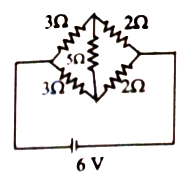
0 likesView Solution
163
PhysicsMediumMCQMHT CET · 2020
If the kinetic energy of a particle is increased to $16$ times its previous value,the percentage change in the de-Broglie wavelength of the particle is
A
$75$
B
$25$
C
$50$
D
$5$
Solution
(A) The kinetic energy $K$ is related to momentum $p$ by the equation $K = \frac{p^2}{2m}$.
Therefore,$p = \sqrt{2mK}$.
The de-Broglie wavelength $\lambda$ is given by $\lambda = \frac{h}{p} = \frac{h}{\sqrt{2mK}}$.
This implies $\lambda \propto \frac{1}{\sqrt{K}}$.
Let the initial kinetic energy be $K_1$ and the final kinetic energy be $K_2 = 16K_1$.
Then,$\frac{\lambda_2}{\lambda_1} = \sqrt{\frac{K_1}{K_2}} = \sqrt{\frac{K_1}{16K_1}} = \sqrt{\frac{1}{16}} = \frac{1}{4}$.
So,$\lambda_2 = 0.25 \lambda_1$.
The percentage change in wavelength is $\frac{\lambda_1 - \lambda_2}{\lambda_1} \times 100\% = \frac{\lambda_1 - 0.25 \lambda_1}{\lambda_1} \times 100\% = 0.75 \times 100\% = 75\%$.
Therefore,$p = \sqrt{2mK}$.
The de-Broglie wavelength $\lambda$ is given by $\lambda = \frac{h}{p} = \frac{h}{\sqrt{2mK}}$.
This implies $\lambda \propto \frac{1}{\sqrt{K}}$.
Let the initial kinetic energy be $K_1$ and the final kinetic energy be $K_2 = 16K_1$.
Then,$\frac{\lambda_2}{\lambda_1} = \sqrt{\frac{K_1}{K_2}} = \sqrt{\frac{K_1}{16K_1}} = \sqrt{\frac{1}{16}} = \frac{1}{4}$.
So,$\lambda_2 = 0.25 \lambda_1$.
The percentage change in wavelength is $\frac{\lambda_1 - \lambda_2}{\lambda_1} \times 100\% = \frac{\lambda_1 - 0.25 \lambda_1}{\lambda_1} \times 100\% = 0.75 \times 100\% = 75\%$.
0 likesView Solution
164
PhysicsMediumMCQMHT CET · 2020
Photons of wavelength $\lambda$ are incident on the cathode of a photocell. Electrons are emitted from the cathode surface. The de-Broglie wavelength of the emitted electrons is (work function is negligible).
($c =$ velocity of light,$h =$ Planck's constant,$m =$ mass of electron)
($c =$ velocity of light,$h =$ Planck's constant,$m =$ mass of electron)
A
$\sqrt{\frac{mc}{2h\lambda}}$
B
$\sqrt{\frac{h\lambda}{2mc}}$
C
$\sqrt{\frac{2h\lambda}{mc}}$
D
$\sqrt{\frac{mh}{\lambda c}}$
Solution
(B) Given that the work function is negligible,the kinetic energy of the emitted electron is equal to the energy of the incident photon.
$\frac{1}{2}mv^2 = \frac{hc}{\lambda}$
Multiplying both sides by $2m$,we get $m^2v^2 = \frac{2mhc}{\lambda}$.
Taking the square root,the momentum $p = mv = \sqrt{\frac{2mhc}{\lambda}}$.
The de-Broglie wavelength $\lambda_e$ is given by $\lambda_e = \frac{h}{p}$.
Substituting the value of $p$:
$\lambda_e = \frac{h}{\sqrt{\frac{2mhc}{\lambda}}} = \sqrt{\frac{h^2 \lambda}{2mhc}} = \sqrt{\frac{h\lambda}{2mc}}$.
$\frac{1}{2}mv^2 = \frac{hc}{\lambda}$
Multiplying both sides by $2m$,we get $m^2v^2 = \frac{2mhc}{\lambda}$.
Taking the square root,the momentum $p = mv = \sqrt{\frac{2mhc}{\lambda}}$.
The de-Broglie wavelength $\lambda_e$ is given by $\lambda_e = \frac{h}{p}$.
Substituting the value of $p$:
$\lambda_e = \frac{h}{\sqrt{\frac{2mhc}{\lambda}}} = \sqrt{\frac{h^2 \lambda}{2mhc}} = \sqrt{\frac{h\lambda}{2mc}}$.
0 likesView Solution
165
PhysicsEasyMCQMHT CET · 2020
If the potential difference used to accelerate electrons is doubled,by what factor does the de-Broglie wavelength associated with the electrons change?
A
Wavelength is decreased to $1/3$ times.
B
Wavelength is increased to $1/2$ times.
C
Wavelength is increased to $1/\sqrt{2}$ times.
D
Wavelength is decreased to $1/\sqrt{2}$ times.
Solution
(D) The de Broglie wavelength $\lambda$ of an electron accelerated through a potential difference $V$ is given by the formula: $\lambda = \frac{h}{\sqrt{2meV}}$.
From this relation,we can see that $\lambda \propto \frac{1}{\sqrt{V}}$.
Let the initial potential difference be $V_1 = V$ and the initial wavelength be $\lambda_1$.
When the potential difference is doubled,the new potential difference is $V_2 = 2V$.
The new wavelength $\lambda_2$ is given by $\lambda_2 = \frac{h}{\sqrt{2me(2V)}} = \frac{1}{\sqrt{2}} \times \frac{h}{\sqrt{2meV}}$.
Therefore,$\lambda_2 = \frac{1}{\sqrt{2}} \lambda_1$.
Thus,the de-Broglie wavelength changes by a factor of $1/\sqrt{2}$.
From this relation,we can see that $\lambda \propto \frac{1}{\sqrt{V}}$.
Let the initial potential difference be $V_1 = V$ and the initial wavelength be $\lambda_1$.
When the potential difference is doubled,the new potential difference is $V_2 = 2V$.
The new wavelength $\lambda_2$ is given by $\lambda_2 = \frac{h}{\sqrt{2me(2V)}} = \frac{1}{\sqrt{2}} \times \frac{h}{\sqrt{2meV}}$.
Therefore,$\lambda_2 = \frac{1}{\sqrt{2}} \lambda_1$.
Thus,the de-Broglie wavelength changes by a factor of $1/\sqrt{2}$.
0 likesView Solution
166
PhysicsEasyMCQMHT CET · 2020
An electron and a proton are accelerated through the same potential difference. The ratio of the de-Broglie wavelength $\lambda_{p}$ to $\lambda_{e}$ is $[m_{e} = \text{mass of electron}, m_{p} = \text{mass of proton}]$
A
$\left(\frac{m_{p}}{m_{e}}\right)^{\frac{1}{2}}$
B
$\left(\frac{m_{e}}{m_{p}}\right)^{\frac{1}{2}}$
C
$\left(\frac{m_{e}}{m_{p}}\right)$
D
$\left(\frac{m_{p}}{m_{e}}\right)$
Solution
(B) Both the electron and the proton are accelerated through the same potential difference $V$,so they acquire the same kinetic energy $K = eV$.
The momentum $P$ of a particle is related to its kinetic energy $K$ by the formula $P = \sqrt{2mK}$.
For the electron,the momentum is $P_{e} = \sqrt{2m_{e}K}$.
For the proton,the momentum is $P_{p} = \sqrt{2m_{p}K}$.
The de-Broglie wavelength is given by $\lambda = \frac{h}{P}$.
Therefore,the ratio of the wavelengths is $\frac{\lambda_{p}}{\lambda_{e}} = \frac{h/P_{p}}{h/P_{e}} = \frac{P_{e}}{P_{p}}$.
Substituting the expressions for momentum: $\frac{\lambda_{p}}{\lambda_{e}} = \frac{\sqrt{2m_{e}K}}{\sqrt{2m_{p}K}} = \sqrt{\frac{m_{e}}{m_{p}}} = \left(\frac{m_{e}}{m_{p}}\right)^{\frac{1}{2}}$.
The momentum $P$ of a particle is related to its kinetic energy $K$ by the formula $P = \sqrt{2mK}$.
For the electron,the momentum is $P_{e} = \sqrt{2m_{e}K}$.
For the proton,the momentum is $P_{p} = \sqrt{2m_{p}K}$.
The de-Broglie wavelength is given by $\lambda = \frac{h}{P}$.
Therefore,the ratio of the wavelengths is $\frac{\lambda_{p}}{\lambda_{e}} = \frac{h/P_{p}}{h/P_{e}} = \frac{P_{e}}{P_{p}}$.
Substituting the expressions for momentum: $\frac{\lambda_{p}}{\lambda_{e}} = \frac{\sqrt{2m_{e}K}}{\sqrt{2m_{p}K}} = \sqrt{\frac{m_{e}}{m_{p}}} = \left(\frac{m_{e}}{m_{p}}\right)^{\frac{1}{2}}$.
0 likesView Solution
167
PhysicsMediumMCQMHT CET · 2020
How much energy is imparted to an electron so that its de-Broglie wavelength reduces from $10^{-10} \ m$ to $0.5 \times 10^{-10} \ m$? (Let $E$ be the initial energy of the electron).
A
$3 E$
B
$4 E$
C
$2 E$
D
$E$
Solution
(A) The de-Broglie wavelength $\lambda$ of an electron with energy $E$ is given by $\lambda = \frac{h}{\sqrt{2mE}}$.
From this relation,we can see that $\lambda \propto \frac{1}{\sqrt{E}}$,which implies $\frac{\lambda_1}{\lambda_2} = \sqrt{\frac{E_2}{E_1}}$.
Given $\lambda_1 = 10^{-10} \ m$ and $\lambda_2 = 0.5 \times 10^{-10} \ m$,we have $\frac{\lambda_1}{\lambda_2} = \frac{10^{-10}}{0.5 \times 10^{-10}} = 2$.
Substituting this into the ratio equation: $2 = \sqrt{\frac{E_2}{E_1}}$.
Squaring both sides,we get $4 = \frac{E_2}{E_1}$,so $E_2 = 4E_1 = 4E$.
The energy imparted to the electron is $\Delta E = E_2 - E_1 = 4E - E = 3E$.
From this relation,we can see that $\lambda \propto \frac{1}{\sqrt{E}}$,which implies $\frac{\lambda_1}{\lambda_2} = \sqrt{\frac{E_2}{E_1}}$.
Given $\lambda_1 = 10^{-10} \ m$ and $\lambda_2 = 0.5 \times 10^{-10} \ m$,we have $\frac{\lambda_1}{\lambda_2} = \frac{10^{-10}}{0.5 \times 10^{-10}} = 2$.
Substituting this into the ratio equation: $2 = \sqrt{\frac{E_2}{E_1}}$.
Squaring both sides,we get $4 = \frac{E_2}{E_1}$,so $E_2 = 4E_1 = 4E$.
The energy imparted to the electron is $\Delta E = E_2 - E_1 = 4E - E = 3E$.
0 likesView Solution
168
PhysicsEasyMCQMHT CET · 2020
When a photon enters glass from air,which one of the following quantities does $\underline{\text{NOT}}$ change?
A
Velocity
B
Energy
C
Momentum
D
Wavelength
Solution
(B) The energy of a photon is given by $E = h\nu$,where $h$ is Planck's constant and $\nu$ is the frequency of the photon.
When a photon travels from one medium to another (e.g.,from air to glass),its frequency $\nu$ remains constant because it is determined by the source of the light.
Since $E = h\nu$ and $h$ is a constant,the energy $E$ of the photon does not change.
However,the velocity $v$ of the photon changes as it enters a denser medium,and since $v = \nu \lambda$,the wavelength $\lambda$ also changes.
Momentum $p$ is given by $p = E/c$ (in vacuum) or $p = h/\lambda$,which changes as the wavelength changes.
Therefore,the energy is the quantity that does not change.
When a photon travels from one medium to another (e.g.,from air to glass),its frequency $\nu$ remains constant because it is determined by the source of the light.
Since $E = h\nu$ and $h$ is a constant,the energy $E$ of the photon does not change.
However,the velocity $v$ of the photon changes as it enters a denser medium,and since $v = \nu \lambda$,the wavelength $\lambda$ also changes.
Momentum $p$ is given by $p = E/c$ (in vacuum) or $p = h/\lambda$,which changes as the wavelength changes.
Therefore,the energy is the quantity that does not change.
0 likesView Solution
169
PhysicsEasyMCQMHT CET · 2020
When light of wavelength $\lambda$ is incident on a photosensitive surface,photons of power $P$ are emitted. The number of photons $n$ emitted in time $t$ is: [$h$ = Planck's constant,$c$ = velocity of light in vacuum]
A
$\frac{hc}{P \lambda t}$
B
$\frac{P \lambda}{htc}$
C
$\frac{P \lambda t}{hc}$
D
$\frac{hP}{\lambda tc}$
Solution
(C) The energy of a single photon is given by $E = \frac{hc}{\lambda}$.
If $n$ photons are emitted in time $t$,the total energy emitted is $E_{total} = n \times \frac{hc}{\lambda}$.
Power $P$ is defined as the total energy emitted per unit time,so $P = \frac{E_{total}}{t} = \frac{nhc}{\lambda t}$.
Rearranging the formula to solve for $n$,we get $n = \frac{P \lambda t}{hc}$.
If $n$ photons are emitted in time $t$,the total energy emitted is $E_{total} = n \times \frac{hc}{\lambda}$.
Power $P$ is defined as the total energy emitted per unit time,so $P = \frac{E_{total}}{t} = \frac{nhc}{\lambda t}$.
Rearranging the formula to solve for $n$,we get $n = \frac{P \lambda t}{hc}$.
0 likesView Solution
170
PhysicsEasyMCQMHT CET · 2020
If the intensity of incident radiation in a photocell is increased, the stopping potential
A
first increases and then decreases.
B
remains unchanged.
C
decreases.
D
increases.
Solution
(B) The stopping potential $(V_0)$ is determined by the maximum kinetic energy of the emitted photoelectrons, which depends on the frequency of the incident radiation, not its intensity.
According to Einstein's photoelectric equation: $K_{max} = h\nu - \Phi_0 = eV_0$.
Since the intensity of light only affects the number of photons incident per unit area per unit time (and thus the number of photoelectrons emitted), it does not change the maximum kinetic energy of the individual electrons.
Therefore, the stopping potential remains unchanged when the intensity is increased.
According to Einstein's photoelectric equation: $K_{max} = h\nu - \Phi_0 = eV_0$.
Since the intensity of light only affects the number of photons incident per unit area per unit time (and thus the number of photoelectrons emitted), it does not change the maximum kinetic energy of the individual electrons.
Therefore, the stopping potential remains unchanged when the intensity is increased.
0 likesView Solution
171
PhysicsEasyMCQMHT CET · 2020
The maximum velocity of the photoelectron emitted by the metal surface is $v$. The charge and mass of the photoelectron are denoted by $e$ and $m$ respectively. The stopping potential in volts is:
A
$\frac{v^{2}}{(m/e)}$
B
$\frac{v^{2}}{(e/m)}$
C
$\frac{v^{2}}{2(m/e)}$
D
$\frac{v^{2}}{2(e/m)}$
Solution
(D) The kinetic energy of the emitted photoelectron is given by $K_{max} = \frac{1}{2}mv^2$.
At the stopping potential $V_s$,the work done by the retarding electric field is equal to the maximum kinetic energy of the photoelectron.
Therefore,$eV_s = \frac{1}{2}mv^2$.
Solving for the stopping potential $V_s$:
$V_s = \frac{mv^2}{2e}$.
This can be rewritten as $V_s = \frac{v^2}{2(e/m)}$.
At the stopping potential $V_s$,the work done by the retarding electric field is equal to the maximum kinetic energy of the photoelectron.
Therefore,$eV_s = \frac{1}{2}mv^2$.
Solving for the stopping potential $V_s$:
$V_s = \frac{mv^2}{2e}$.
This can be rewritten as $V_s = \frac{v^2}{2(e/m)}$.
0 likesView Solution
172
PhysicsEasyMCQMHT CET · 2020
If the frequency of incident light falling on a metallic surface is doubled, what happens to the maximum kinetic energy of the emitted photoelectrons?
A
increases to slightly more than double.
B
remains the same.
C
becomes twice.
D
decreases to slightly more than double.
Solution
(A) According to Einstein's photoelectric equation, the maximum kinetic energy $K_{max}$ of emitted photoelectrons is given by $K_{max} = h\nu - \phi$, where $h$ is Planck's constant, $\nu$ is the frequency of incident light, and $\phi$ is the work function of the metal.
Initially, $K_{max1} = h\nu - \phi$.
When the frequency is doubled, the new frequency is $\nu' = 2\nu$.
The new maximum kinetic energy is $K_{max2} = h(2\nu) - \phi = 2h\nu - \phi$.
Since $K_{max2} = 2(h\nu - \phi/2)$, and $\phi > 0$, it follows that $K_{max2} > 2(h\nu - \phi) = 2K_{max1}$.
Therefore, the maximum kinetic energy increases to slightly more than double the initial value.
Initially, $K_{max1} = h\nu - \phi$.
When the frequency is doubled, the new frequency is $\nu' = 2\nu$.
The new maximum kinetic energy is $K_{max2} = h(2\nu) - \phi = 2h\nu - \phi$.
Since $K_{max2} = 2(h\nu - \phi/2)$, and $\phi > 0$, it follows that $K_{max2} > 2(h\nu - \phi) = 2K_{max1}$.
Therefore, the maximum kinetic energy increases to slightly more than double the initial value.
0 likesView Solution
173
PhysicsMediumMCQMHT CET · 2020
Threshold frequency for a metal is $15 \times 10^{14} \,Hz$. The light of wavelength $6000 \text{ Å}$ falls on the metal surface. Which one of the following statements is correct? [velocity of light, $c = 3 \times 10^{8} \,m/s$]
A
photoelectrons are emitted with velocity $c$.
B
photoelectrons come out with velocity $3 \times 10^{6} \,m/s$.
C
photoelectrons come out with zero velocity.
D
photoelectrons will not be emitted.
Solution
(D) The threshold frequency is given as $\nu_{0} = 15 \times 10^{14} \,Hz$.
The threshold wavelength $\lambda_{0}$ is calculated as $\lambda_{0} = \frac{c}{\nu_{0}} = \frac{3 \times 10^{8}}{15 \times 10^{14}} = 0.2 \times 10^{-6} \,m = 2000 \text{ Å}$.
The wavelength of incident light is $\lambda = 6000 \text{ Å}$.
For photoelectric emission to occur, the incident wavelength must be less than or equal to the threshold wavelength $(\lambda \leq \lambda_{0})$.
Since $\lambda = 6000 \text{ Å} > \lambda_{0} = 2000 \text{ Å}$, the energy of the incident photons is less than the work function of the metal.
Therefore, photoelectrons will not be emitted.
The threshold wavelength $\lambda_{0}$ is calculated as $\lambda_{0} = \frac{c}{\nu_{0}} = \frac{3 \times 10^{8}}{15 \times 10^{14}} = 0.2 \times 10^{-6} \,m = 2000 \text{ Å}$.
The wavelength of incident light is $\lambda = 6000 \text{ Å}$.
For photoelectric emission to occur, the incident wavelength must be less than or equal to the threshold wavelength $(\lambda \leq \lambda_{0})$.
Since $\lambda = 6000 \text{ Å} > \lambda_{0} = 2000 \text{ Å}$, the energy of the incident photons is less than the work function of the metal.
Therefore, photoelectrons will not be emitted.
0 likesView Solution
174
PhysicsEasyMCQMHT CET · 2020
When the work function of a metal increases,the maximum kinetic energy of the emitted photoelectrons:
A
first decreases and then increases.
B
increases.
C
remains same.
D
decreases.
Solution
(D) According to Einstein's photoelectric equation,the maximum kinetic energy $(K.E.)_{\max}$ of emitted photoelectrons is given by:
$(K.E.)_{\max} = h\nu - \phi_0$
Where:
$h\nu$ is the energy of the incident photon.
$\phi_0$ is the work function of the metal.
From the equation,it is clear that $(K.E.)_{\max}$ is inversely proportional to the work function $\phi_0$ for a constant incident frequency $\nu$.
Therefore,if the work function $\phi_0$ increases,the maximum kinetic energy $(K.E.)_{\max}$ decreases.
$(K.E.)_{\max} = h\nu - \phi_0$
Where:
$h\nu$ is the energy of the incident photon.
$\phi_0$ is the work function of the metal.
From the equation,it is clear that $(K.E.)_{\max}$ is inversely proportional to the work function $\phi_0$ for a constant incident frequency $\nu$.
Therefore,if the work function $\phi_0$ increases,the maximum kinetic energy $(K.E.)_{\max}$ decreases.
0 likesView Solution
175
PhysicsDifficultMCQMHT CET · 2020
$A$ metal surface having work function '$W_{0}$' emits photoelectrons when photons of energy '$E$' are incident on it. The electron enters a uniform magnetic field '$B$' in a perpendicular direction and moves in a circular path of radius '$r$'. Then '$r$' is equal to (where '$m$' and '$e$' are the mass and charge of the electron,respectively).
A
$\frac{\sqrt{m(E-W_{0})}}{eB}$
B
$\frac{m(E-W_{0})}{eB}$
C
$\frac{\sqrt{2m(E-W_{0})}}{eB}$
D
$\frac{2m(E-W_{0})}{eB}$
Solution
(C) According to Einstein's photoelectric equation,the maximum kinetic energy '$K$' of the emitted photoelectron is given by: $K = E - W_{0}$.
Since $K = \frac{P^{2}}{2m}$,the momentum '$P$' of the electron is $P = \sqrt{2mK} = \sqrt{2m(E - W_{0})}$.
When a charged particle moves in a uniform magnetic field '$B$' perpendicular to its velocity,it follows a circular path of radius '$r = \frac{P}{eB}$.
Substituting the value of '$P$',we get: $r = \frac{\sqrt{2m(E - W_{0})}}{eB}$.
Since $K = \frac{P^{2}}{2m}$,the momentum '$P$' of the electron is $P = \sqrt{2mK} = \sqrt{2m(E - W_{0})}$.
When a charged particle moves in a uniform magnetic field '$B$' perpendicular to its velocity,it follows a circular path of radius '$r = \frac{P}{eB}$.
Substituting the value of '$P$',we get: $r = \frac{\sqrt{2m(E - W_{0})}}{eB}$.
0 likesView Solution
176
PhysicsEasyMCQMHT CET · 2020
Using Einstein's photoelectric equation,the graph between the maximum kinetic energy $(E_k)$ of emitted photoelectrons and the frequency $(
u)$ of incident radiation is shown correctly in which figure?
u)$ of incident radiation is shown correctly in which figure?
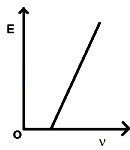
A
Figure $A$
B
Figure $B$
C
Figure $C$
D
Figure $D$
Solution
(B) According to Einstein's photoelectric equation,the maximum kinetic energy $(E_k)$ of emitted photoelectrons is given by:
$E_k = h\nu - \Phi$
Where $h$ is Planck's constant,$\nu$ is the frequency of incident radiation,and $\Phi$ is the work function of the metal.
This equation is of the form $y = mx + c$,where $y = E_k$,$x = \nu$,$m = h$ (slope),and $c = -\Phi$ (y-intercept).
Since the y-intercept is negative $(-\Phi)$,the graph is a straight line that does not pass through the origin. It starts from the x-axis at a threshold frequency $\nu_0$ (where $E_k = 0$,so $h\nu_0 = \Phi$) and has a positive slope $h$. The provided image shows a straight line with a positive x-intercept,which correctly represents this relationship.
$E_k = h\nu - \Phi$
Where $h$ is Planck's constant,$\nu$ is the frequency of incident radiation,and $\Phi$ is the work function of the metal.
This equation is of the form $y = mx + c$,where $y = E_k$,$x = \nu$,$m = h$ (slope),and $c = -\Phi$ (y-intercept).
Since the y-intercept is negative $(-\Phi)$,the graph is a straight line that does not pass through the origin. It starts from the x-axis at a threshold frequency $\nu_0$ (where $E_k = 0$,so $h\nu_0 = \Phi$) and has a positive slope $h$. The provided image shows a straight line with a positive x-intercept,which correctly represents this relationship.
0 likesView Solution
177
PhysicsEasyMCQMHT CET · 2020
Which of the following graphs shows the correct variation of maximum kinetic energy $(E)$ of photoelectrons with the intensity of incident radiation $(I)$?
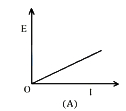
A
Graph $(A)$
B
Graph $(B)$
C
Graph $(C)$
D
Graph $(D)$
Solution
(A) According to Einstein's photoelectric equation,the maximum kinetic energy $(K_{max})$ of emitted photoelectrons is given by $K_{max} = h\nu - \Phi$,where $h$ is Planck's constant,$\nu$ is the frequency of incident radiation,and $\Phi$ is the work function of the metal surface.
This equation shows that the maximum kinetic energy depends only on the frequency of the incident radiation and the work function of the metal. It is independent of the intensity $(I)$ of the incident radiation.
Therefore,the graph showing the variation of maximum kinetic energy $(E)$ with intensity $(I)$ should be a horizontal line parallel to the intensity axis. Assuming graph $(D)$ represents this constant behavior,the correct option is $(D)$.
This equation shows that the maximum kinetic energy depends only on the frequency of the incident radiation and the work function of the metal. It is independent of the intensity $(I)$ of the incident radiation.
Therefore,the graph showing the variation of maximum kinetic energy $(E)$ with intensity $(I)$ should be a horizontal line parallel to the intensity axis. Assuming graph $(D)$ represents this constant behavior,the correct option is $(D)$.
0 likesView Solution
178
PhysicsMediumMCQMHT CET · 2020
In the experiment of the photoelectric effect,the stopping potential for a given metal is $V_{0}$ volts when radiation of wavelength $\lambda_{0}$ is used. If radiation of wavelength $2\lambda_{0}$ is used for the same metal,then the stopping potential (in volts) will be: [$e=$ charge on electron,$c=$ speed of light,$h=$ Planck's constant.]
A
$V_{0} + \frac{hc}{2e\lambda_{0}}$
B
$V_{0} - \frac{hc}{2e\lambda_{0}}$
C
$\frac{V_{0}}{2}$
D
$2V_{0}$
Solution
(B) According to Einstein's photoelectric equation: $K_{max} = \frac{hc}{\lambda} - \phi$,where $\phi$ is the work function.
Since $K_{max} = eV_{s}$,where $V_{s}$ is the stopping potential,we have $eV_{s} = \frac{hc}{\lambda} - \phi$.
For the first case: $eV_{0} = \frac{hc}{\lambda_{0}} - \phi$ --- $(1)$
For the second case with wavelength $2\lambda_{0}$: $eV_{s}' = \frac{hc}{2\lambda_{0}} - \phi$ --- $(2)$
Subtracting equation $(2)$ from equation $(1)$:
$eV_{0} - eV_{s}' = \left(\frac{hc}{\lambda_{0}} - \phi\right) - \left(\frac{hc}{2\lambda_{0}} - \phi\right)$
$e(V_{0} - V_{s}') = \frac{hc}{\lambda_{0}} - \frac{hc}{2\lambda_{0}} = \frac{hc}{2\lambda_{0}}$
$V_{0} - V_{s}' = \frac{hc}{2e\lambda_{0}}$
$V_{s}' = V_{0} - \frac{hc}{2e\lambda_{0}}$
Note: If $\frac{hc}{2\lambda_{0}} < \phi$,the stopping potential will be $0$ as no photoelectric emission occurs.
Since $K_{max} = eV_{s}$,where $V_{s}$ is the stopping potential,we have $eV_{s} = \frac{hc}{\lambda} - \phi$.
For the first case: $eV_{0} = \frac{hc}{\lambda_{0}} - \phi$ --- $(1)$
For the second case with wavelength $2\lambda_{0}$: $eV_{s}' = \frac{hc}{2\lambda_{0}} - \phi$ --- $(2)$
Subtracting equation $(2)$ from equation $(1)$:
$eV_{0} - eV_{s}' = \left(\frac{hc}{\lambda_{0}} - \phi\right) - \left(\frac{hc}{2\lambda_{0}} - \phi\right)$
$e(V_{0} - V_{s}') = \frac{hc}{\lambda_{0}} - \frac{hc}{2\lambda_{0}} = \frac{hc}{2\lambda_{0}}$
$V_{0} - V_{s}' = \frac{hc}{2e\lambda_{0}}$
$V_{s}' = V_{0} - \frac{hc}{2e\lambda_{0}}$
Note: If $\frac{hc}{2\lambda_{0}} < \phi$,the stopping potential will be $0$ as no photoelectric emission occurs.
0 likesView Solution
179
PhysicsEasyMCQMHT CET · 2020
If the frequency of incident radiation is kept constant and the experiment is repeated by using incident light of different intensities,then the stopping potential $(V_{s})$
A
increases with increase in intensity.
B
decreases with increase in intensity.
C
depends upon current.
D
remains same.
Solution
(D) According to Einstein's photoelectric equation,the maximum kinetic energy $(K_{max})$ of emitted photoelectrons is given by $K_{max} = h\nu - \Phi$,where $h$ is Planck's constant,$\nu$ is the frequency of incident radiation,and $\Phi$ is the work function of the metal.
Since the stopping potential $(V_{s})$ is related to the maximum kinetic energy by the relation $eV_{s} = K_{max}$,we have $eV_{s} = h\nu - \Phi$.
This equation shows that the stopping potential $(V_{s})$ depends only on the frequency $(\nu)$ of the incident radiation and the work function $(\Phi)$ of the metal surface.
Intensity of light affects the number of photons incident per unit area per unit time,which in turn affects the number of photoelectrons emitted (photoelectric current),but it does not affect the maximum kinetic energy of the individual photoelectrons.
Therefore,if the frequency $(\nu)$ is kept constant,the stopping potential $(V_{s})$ remains the same regardless of changes in the intensity of the incident light.
Since the stopping potential $(V_{s})$ is related to the maximum kinetic energy by the relation $eV_{s} = K_{max}$,we have $eV_{s} = h\nu - \Phi$.
This equation shows that the stopping potential $(V_{s})$ depends only on the frequency $(\nu)$ of the incident radiation and the work function $(\Phi)$ of the metal surface.
Intensity of light affects the number of photons incident per unit area per unit time,which in turn affects the number of photoelectrons emitted (photoelectric current),but it does not affect the maximum kinetic energy of the individual photoelectrons.
Therefore,if the frequency $(\nu)$ is kept constant,the stopping potential $(V_{s})$ remains the same regardless of changes in the intensity of the incident light.
0 likesView Solution
180
PhysicsMediumMCQMHT CET · 2020
Light of incident frequency $2$ times the threshold frequency is incident on a photosensitive material. If the incident frequency is made $\left(\frac{1}{3}\right)^{\text{rd}}$ and intensity is doubled,then the photoelectric current will
A
decrease.
B
increase.
C
be halved.
D
be zero.
Solution
(D) The threshold frequency of the material is $\nu_0$. The initial incident frequency is $\nu_1 = 2\nu_0$. Since $\nu_1 > \nu_0$,photoelectric emission occurs.
When the incident frequency is changed to $\nu_2 = \frac{1}{3} \nu_1 = \frac{1}{3} (2\nu_0) = \frac{2}{3} \nu_0$.
For photoelectric emission to occur,the incident frequency must be greater than or equal to the threshold frequency $(\nu \ge \nu_0)$.
Since $\nu_2 = \frac{2}{3} \nu_0 < \nu_0$,the incident frequency is now less than the threshold frequency.
Therefore,no photoelectric emission will take place regardless of the increase in intensity.
Thus,the photoelectric current will be zero.
When the incident frequency is changed to $\nu_2 = \frac{1}{3} \nu_1 = \frac{1}{3} (2\nu_0) = \frac{2}{3} \nu_0$.
For photoelectric emission to occur,the incident frequency must be greater than or equal to the threshold frequency $(\nu \ge \nu_0)$.
Since $\nu_2 = \frac{2}{3} \nu_0 < \nu_0$,the incident frequency is now less than the threshold frequency.
Therefore,no photoelectric emission will take place regardless of the increase in intensity.
Thus,the photoelectric current will be zero.
0 likesView Solution
181
PhysicsEasyMCQMHT CET · 2020
When a photosensitive surface is irradiated by light of wavelengths $\lambda_{1}$ and $\lambda_{2}$,the kinetic energies of the emitted photoelectrons are $E_{1}$ and $E_{2}$ respectively. The work function of the photosensitive surface is
A
$\frac{\lambda_{2} E_{2}-\lambda_{1} E_{1}}{\lambda_{1}-\lambda_{2}}$
B
$\frac{\lambda_{1} E_{1}-\lambda_{2} E_{2}}{\lambda_{2}-\lambda_{1}}$
C
$\frac{\lambda_{1} E_{1}+\lambda_{2} E_{2}}{\lambda_{1}+\lambda_{2}}$
D
$\frac{\lambda_{2} E_{1}-\lambda_{1} E_{2}}{\lambda_{1}-\lambda_{2}}$
Solution
(B) According to Einstein's photoelectric equation,the maximum kinetic energy $K_{max}$ is given by $K_{max} = \frac{hc}{\lambda} - \phi$,where $\phi$ is the work function.
For wavelength $\lambda_{1}$,$E_{1} = \frac{hc}{\lambda_{1}} - \phi$ --- $(i)$
For wavelength $\lambda_{2}$,$E_{2} = \frac{hc}{\lambda_{2}} - \phi$ --- (ii)
From $(i)$,$hc = \lambda_{1}(E_{1} + \phi)$.
From (ii),$hc = \lambda_{2}(E_{2} + \phi)$.
Equating the two expressions for $hc$:
$\lambda_{1}(E_{1} + \phi) = \lambda_{2}(E_{2} + \phi)$
$\lambda_{1}E_{1} + \lambda_{1}\phi = \lambda_{2}E_{2} + \lambda_{2}\phi$
$\phi(\lambda_{1} - \lambda_{2}) = \lambda_{2}E_{2} - \lambda_{1}E_{1}$
$\phi = \frac{\lambda_{2}E_{2} - \lambda_{1}E_{1}}{\lambda_{1} - \lambda_{2}}$
Multiplying numerator and denominator by $-1$ gives $\phi = \frac{\lambda_{1}E_{1} - \lambda_{2}E_{2}}{\lambda_{2} - \lambda_{1}}$.
For wavelength $\lambda_{1}$,$E_{1} = \frac{hc}{\lambda_{1}} - \phi$ --- $(i)$
For wavelength $\lambda_{2}$,$E_{2} = \frac{hc}{\lambda_{2}} - \phi$ --- (ii)
From $(i)$,$hc = \lambda_{1}(E_{1} + \phi)$.
From (ii),$hc = \lambda_{2}(E_{2} + \phi)$.
Equating the two expressions for $hc$:
$\lambda_{1}(E_{1} + \phi) = \lambda_{2}(E_{2} + \phi)$
$\lambda_{1}E_{1} + \lambda_{1}\phi = \lambda_{2}E_{2} + \lambda_{2}\phi$
$\phi(\lambda_{1} - \lambda_{2}) = \lambda_{2}E_{2} - \lambda_{1}E_{1}$
$\phi = \frac{\lambda_{2}E_{2} - \lambda_{1}E_{1}}{\lambda_{1} - \lambda_{2}}$
Multiplying numerator and denominator by $-1$ gives $\phi = \frac{\lambda_{1}E_{1} - \lambda_{2}E_{2}}{\lambda_{2} - \lambda_{1}}$.
0 likesView Solution
182
PhysicsEasyMCQMHT CET · 2020
The maximum velocity of the photoelectron emitted by the metal surface is $V$. The charge and mass of the photoelectron are denoted by $e$ and $m$ respectively. The stopping potential in volts is:
A
$\frac{V^{2}}{(m/e)}$
B
$\frac{V^{2}}{2(e/m)}$
C
$\frac{V^{2}}{(e/m)}$
D
$\frac{V^{2}}{2(m/e)}$
Solution
(B) The kinetic energy of the emitted photoelectron is given by $K_{max} = \frac{1}{2} mv^{2}$.
At the stopping potential $V_{s}$,the work done by the retarding potential is equal to the maximum kinetic energy,so $eV_{s} = \frac{1}{2} mv^{2}$.
Rearranging for $V_{s}$,we get $V_{s} = \frac{1}{2} \frac{m}{e} v^{2}$.
Since $\frac{m}{e} = \frac{1}{(e/m)}$,we can write $V_{s} = \frac{v^{2}}{2(e/m)}$.
At the stopping potential $V_{s}$,the work done by the retarding potential is equal to the maximum kinetic energy,so $eV_{s} = \frac{1}{2} mv^{2}$.
Rearranging for $V_{s}$,we get $V_{s} = \frac{1}{2} \frac{m}{e} v^{2}$.
Since $\frac{m}{e} = \frac{1}{(e/m)}$,we can write $V_{s} = \frac{v^{2}}{2(e/m)}$.
0 likesView Solution
183
PhysicsEasyMCQMHT CET · 2020
The energy of the incident photon on a metal surface is $3W$ and then $5W$,where $W$ is the work function of that metal. The ratio of the maximum velocities of the emitted photoelectrons is:
A
$1: \sqrt{2}$
B
$1: 1$
C
$1: 2$
D
$1: 4$
Solution
(A) According to Einstein's photoelectric equation,the maximum kinetic energy $K_{max}$ of an emitted photoelectron is given by $K_{max} = E - W$,where $E$ is the energy of the incident photon and $W$ is the work function.
For the first case,$E_1 = 3W$. Thus,$K_1 = \frac{1}{2}mv_1^2 = 3W - W = 2W$.
For the second case,$E_2 = 5W$. Thus,$K_2 = \frac{1}{2}mv_2^2 = 5W - W = 4W$.
Taking the ratio of the two equations:
$\frac{\frac{1}{2}mv_1^2}{\frac{1}{2}mv_2^2} = \frac{2W}{4W} = \frac{1}{2}$.
Therefore,$\frac{v_1^2}{v_2^2} = \frac{1}{2}$,which implies $\frac{v_1}{v_2} = \frac{1}{\sqrt{2}}$.
The ratio of velocities is $1: \sqrt{2}$.
For the first case,$E_1 = 3W$. Thus,$K_1 = \frac{1}{2}mv_1^2 = 3W - W = 2W$.
For the second case,$E_2 = 5W$. Thus,$K_2 = \frac{1}{2}mv_2^2 = 5W - W = 4W$.
Taking the ratio of the two equations:
$\frac{\frac{1}{2}mv_1^2}{\frac{1}{2}mv_2^2} = \frac{2W}{4W} = \frac{1}{2}$.
Therefore,$\frac{v_1^2}{v_2^2} = \frac{1}{2}$,which implies $\frac{v_1}{v_2} = \frac{1}{\sqrt{2}}$.
The ratio of velocities is $1: \sqrt{2}$.
0 likesView Solution
184
PhysicsEasyMCQMHT CET · 2020
The graph of maximum kinetic energy $(K.E._{max})$ against the frequency $(
u)$ of incident light is as shown in the figure. The slope of the graph and the intercept on the $X$-axis respectively are:
u)$ of incident light is as shown in the figure. The slope of the graph and the intercept on the $X$-axis respectively are:
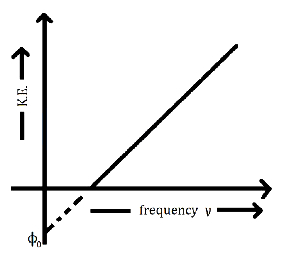
A
Planck's constant,threshold frequency
B
Work function,maximum kinetic energy
C
Maximum kinetic energy,threshold frequency
D
Planck's constant,work function
Solution
(A) According to Einstein's photoelectric equation,the maximum kinetic energy $(K.E._{max})$ of emitted photoelectrons is given by:
$K.E._{max} = h\nu - \phi_0$
Comparing this with the equation of a straight line $y = mx + c$,where $y = K.E._{max}$ and $x = \nu$:
$1$. The slope $(m)$ of the graph is equal to Planck's constant $(h)$.
$2$. The $X$-axis intercept occurs when $K.E._{max} = 0$,which gives $0 = h\nu_0 - \phi_0$,or $\nu_0 = \phi_0 / h$. This intercept represents the threshold frequency $(\nu_0)$.
Therefore,the slope is Planck's constant and the $X$-axis intercept is the threshold frequency.
$K.E._{max} = h\nu - \phi_0$
Comparing this with the equation of a straight line $y = mx + c$,where $y = K.E._{max}$ and $x = \nu$:
$1$. The slope $(m)$ of the graph is equal to Planck's constant $(h)$.
$2$. The $X$-axis intercept occurs when $K.E._{max} = 0$,which gives $0 = h\nu_0 - \phi_0$,or $\nu_0 = \phi_0 / h$. This intercept represents the threshold frequency $(\nu_0)$.
Therefore,the slope is Planck's constant and the $X$-axis intercept is the threshold frequency.
0 likesView Solution
185
PhysicsEasyMCQMHT CET · 2020
Light of wavelength $\lambda$ is incident on the surface of a metal having work function $\phi$, causing the emission of electrons. What is the maximum velocity of the emitted electrons? (Given: $c = \text{velocity of light}$, $h = \text{Planck's constant}$, $m = \text{mass of electron}$)
A
$\left[\frac{2(hc - \phi)}{m\lambda}\right]$
B
$\left[\frac{2(hc - \lambda\phi)}{m\lambda}\right]^{1/2}$
C
$\left[\frac{2(hc - \phi)}{m}\right]^{1/2}$
D
$\left[\frac{2(h\nu - \phi)\lambda}{mc}\right]$
Solution
(B) According to Einstein's photoelectric equation, the maximum kinetic energy $K_{\max}$ of emitted electrons is given by:
$K_{\max} = \frac{hc}{\lambda} - \phi$
Since $K_{\max} = \frac{1}{2}mv^2$, we have:
$\frac{1}{2}mv^2 = \frac{hc}{\lambda} - \phi$
$\frac{1}{2}mv^2 = \frac{hc - \lambda\phi}{\lambda}$
$v^2 = \frac{2(hc - \lambda\phi)}{m\lambda}$
$v = \left[\frac{2(hc - \lambda\phi)}{m\lambda}\right]^{1/2}$
Thus, the correct option is $B$.
$K_{\max} = \frac{hc}{\lambda} - \phi$
Since $K_{\max} = \frac{1}{2}mv^2$, we have:
$\frac{1}{2}mv^2 = \frac{hc}{\lambda} - \phi$
$\frac{1}{2}mv^2 = \frac{hc - \lambda\phi}{\lambda}$
$v^2 = \frac{2(hc - \lambda\phi)}{m\lambda}$
$v = \left[\frac{2(hc - \lambda\phi)}{m\lambda}\right]^{1/2}$
Thus, the correct option is $B$.
0 likesView Solution
186
PhysicsMediumMCQMHT CET · 2020
The threshold wavelengths for photoelectric emission from two metals $A$ and $B$ are $400 \ nm$ and $800 \ nm$ respectively. The ratio of their work functions,$\phi_{A} : \phi_{B}$ is:
A
$1/2$
B
$4$
C
$1/4$
D
$2$
Solution
(D) The work function $\phi$ of a metal is related to the threshold wavelength $\lambda_{0}$ by the formula $\phi = \frac{hc}{\lambda_{0}}$.
Given that $\lambda_{A} = 400 \ nm$ and $\lambda_{B} = 800 \ nm$.
Therefore,the work functions are $\phi_{A} = \frac{hc}{\lambda_{A}}$ and $\phi_{B} = \frac{hc}{\lambda_{B}}$.
The ratio $\frac{\phi_{A}}{\phi_{B}} = \frac{hc/\lambda_{A}}{hc/\lambda_{B}} = \frac{\lambda_{B}}{\lambda_{A}}$.
Substituting the values,we get $\frac{\phi_{A}}{\phi_{B}} = \frac{800 \ nm}{400 \ nm} = 2$.
Thus,the ratio $\phi_{A} : \phi_{B}$ is $2$.
Given that $\lambda_{A} = 400 \ nm$ and $\lambda_{B} = 800 \ nm$.
Therefore,the work functions are $\phi_{A} = \frac{hc}{\lambda_{A}}$ and $\phi_{B} = \frac{hc}{\lambda_{B}}$.
The ratio $\frac{\phi_{A}}{\phi_{B}} = \frac{hc/\lambda_{A}}{hc/\lambda_{B}} = \frac{\lambda_{B}}{\lambda_{A}}$.
Substituting the values,we get $\frac{\phi_{A}}{\phi_{B}} = \frac{800 \ nm}{400 \ nm} = 2$.
Thus,the ratio $\phi_{A} : \phi_{B}$ is $2$.
0 likesView Solution
187
PhysicsEasyMCQMHT CET · 2020
The variation of stopping potential for metals $A$,$B$,$C$ and $D$ with the frequency of incident radiation is shown in the figure. For which metal is the stopping potential higher for a given frequency of incident radiation $(v)$ if the threshold frequency is lower $(
u_o)$?
u_o)$?
A
$C$
B
$D$
C
$A$
D
$B$
Solution
(C) According to Einstein's photoelectric equation,the stopping potential $V_s$ is given by:
$eV_s = h\nu - \phi_o = h\nu - h\nu_o$
$V_s = \frac{h}{e}(\nu - \nu_o)$
Where $h$ is Planck's constant,$e$ is the charge of an electron,$\nu$ is the frequency of incident radiation,and $\nu_o$ is the threshold frequency.
For a fixed incident frequency $\nu$,the stopping potential $V_s$ is inversely proportional to the threshold frequency $\nu_o$.
From the graph,the threshold frequencies follow the order: $\nu_o(A) < \nu_o(B) < \nu_o(C) < \nu_o(D)$.
Since metal $A$ has the lowest threshold frequency,it will have the highest stopping potential for any given incident frequency $\nu$ (where $\nu > \nu_o(D)$).
Therefore,the correct option is $C$.
$eV_s = h\nu - \phi_o = h\nu - h\nu_o$
$V_s = \frac{h}{e}(\nu - \nu_o)$
Where $h$ is Planck's constant,$e$ is the charge of an electron,$\nu$ is the frequency of incident radiation,and $\nu_o$ is the threshold frequency.
For a fixed incident frequency $\nu$,the stopping potential $V_s$ is inversely proportional to the threshold frequency $\nu_o$.
From the graph,the threshold frequencies follow the order: $\nu_o(A) < \nu_o(B) < \nu_o(C) < \nu_o(D)$.
Since metal $A$ has the lowest threshold frequency,it will have the highest stopping potential for any given incident frequency $\nu$ (where $\nu > \nu_o(D)$).
Therefore,the correct option is $C$.
0 likesView Solution
188
PhysicsEasyMCQMHT CET · 2020
The graph of stopping potential $(V_{s})$ against frequency $(\nu)$ of incident radiation is plotted for two different metals '$P$' and '$Q$' as shown in the graph. If $\phi_{P}$ and $\phi_{Q}$ are the work functions of metals '$P$' and '$Q$' respectively,then which of the following is correct?
A
$\phi_{P} = \phi_{Q}$
B
$\nu_{0} < \nu_{0}^{\prime}$
C
$\phi_{P} < \phi_{Q}$
D
$\phi_{P} > \phi_{Q}$
Solution
(C) According to Einstein's photoelectric equation,the stopping potential $V_{s}$ is given by:
$eV_{s} = h\nu - \phi$
$V_{s} = \frac{h}{e}\nu - \frac{\phi}{e}$
Comparing this with the equation of a straight line $y = mx + c$,the x-intercept (where $V_{s} = 0$) is the threshold frequency $\nu_{0}$,where $\nu_{0} = \frac{\phi}{h}$ or $\phi = h\nu_{0}$.
From the given graph,the threshold frequency for metal '$P$' is $\nu_{0}$ and for metal '$Q$' is $\nu_{0}^{\prime}$.
Since $\nu_{0} < \nu_{0}^{\prime}$,it follows that $h\nu_{0} < h\nu_{0}^{\prime}$.
Therefore,the work function $\phi_{P} < \phi_{Q}$.
$eV_{s} = h\nu - \phi$
$V_{s} = \frac{h}{e}\nu - \frac{\phi}{e}$
Comparing this with the equation of a straight line $y = mx + c$,the x-intercept (where $V_{s} = 0$) is the threshold frequency $\nu_{0}$,where $\nu_{0} = \frac{\phi}{h}$ or $\phi = h\nu_{0}$.
From the given graph,the threshold frequency for metal '$P$' is $\nu_{0}$ and for metal '$Q$' is $\nu_{0}^{\prime}$.
Since $\nu_{0} < \nu_{0}^{\prime}$,it follows that $h\nu_{0} < h\nu_{0}^{\prime}$.
Therefore,the work function $\phi_{P} < \phi_{Q}$.
0 likesView Solution
189
PhysicsMediumMCQMHT CET · 2020
If the maximum kinetic energy of emitted electrons in the photoelectric effect is $3.2 \times 10^{-19} \text{ J}$ and the work function for the metal is $6.63 \times 10^{-19} \text{ J}$,then the stopping potential and threshold wavelength respectively are:
[Planck's constant $h = 6.63 \times 10^{-34} \text{ J} \cdot \text{s}$]
[Velocity of light $c = 3 \times 10^{8} \text{ m/s}$]
[Charge on electron $e = 1.6 \times 10^{-19} \text{ C}$]
[Planck's constant $h = 6.63 \times 10^{-34} \text{ J} \cdot \text{s}$]
[Velocity of light $c = 3 \times 10^{8} \text{ m/s}$]
[Charge on electron $e = 1.6 \times 10^{-19} \text{ C}$]
A
$3 \text{ V}, 4000 \text{ Å}$
B
$4 \text{ V}, 6000 \text{ Å}$
C
$1 \text{ V}, 1000 \text{ Å}$
D
$2 \text{ V}, 3000 \text{ Å}$
Solution
(D) $1$. The stopping potential $V_s$ is related to the maximum kinetic energy $(K.E.)_{\max}$ by the equation: $(K.E.)_{\max} = e V_s$.
Given $(K.E.)_{\max} = 3.2 \times 10^{-19} \text{ J}$ and $e = 1.6 \times 10^{-19} \text{ C}$.
$V_s = \frac{(K.E.)_{\max}}{e} = \frac{3.2 \times 10^{-19}}{1.6 \times 10^{-19}} = 2 \text{ V}$.
$2$. The threshold wavelength $\lambda_0$ is related to the work function $\Phi$ by the equation: $\Phi = \frac{hc}{\lambda_0}$.
Given $\Phi = 6.63 \times 10^{-19} \text{ J}$,$h = 6.63 \times 10^{-34} \text{ J} \cdot \text{s}$,and $c = 3 \times 10^{8} \text{ m/s}$.
$\lambda_0 = \frac{hc}{\Phi} = \frac{6.63 \times 10^{-34} \times 3 \times 10^{8}}{6.63 \times 10^{-19}} = 3 \times 10^{-7} \text{ m} = 3000 \times 10^{-10} \text{ m} = 3000 \text{ Å}$.
Thus,the stopping potential is $2 \text{ V}$ and the threshold wavelength is $3000 \text{ Å}$. The correct option is $(D)$.
Given $(K.E.)_{\max} = 3.2 \times 10^{-19} \text{ J}$ and $e = 1.6 \times 10^{-19} \text{ C}$.
$V_s = \frac{(K.E.)_{\max}}{e} = \frac{3.2 \times 10^{-19}}{1.6 \times 10^{-19}} = 2 \text{ V}$.
$2$. The threshold wavelength $\lambda_0$ is related to the work function $\Phi$ by the equation: $\Phi = \frac{hc}{\lambda_0}$.
Given $\Phi = 6.63 \times 10^{-19} \text{ J}$,$h = 6.63 \times 10^{-34} \text{ J} \cdot \text{s}$,and $c = 3 \times 10^{8} \text{ m/s}$.
$\lambda_0 = \frac{hc}{\Phi} = \frac{6.63 \times 10^{-34} \times 3 \times 10^{8}}{6.63 \times 10^{-19}} = 3 \times 10^{-7} \text{ m} = 3000 \times 10^{-10} \text{ m} = 3000 \text{ Å}$.
Thus,the stopping potential is $2 \text{ V}$ and the threshold wavelength is $3000 \text{ Å}$. The correct option is $(D)$.
0 likesView Solution
190
PhysicsEasyMCQMHT CET · 2020
Which one of the following four graphs showing lines $P, Q, R$ and $S$ between maximum kinetic energy $(E)$ and intensity of incident light $(I)$ is correct?
A
$S$
B
$R$
C
$Q$
D
$P$
Solution
(D) According to Einstein's photoelectric equation,the maximum kinetic energy $(E_k)$ of emitted photoelectrons is given by $E_k = h\nu - \phi$,where $h$ is Planck's constant,$\nu$ is the frequency of incident light,and $\phi$ is the work function of the metal surface.
This equation shows that the maximum kinetic energy depends only on the frequency of the incident light and the nature of the material (work function).
It does not depend on the intensity $(I)$ of the incident light.
Therefore,the graph between maximum kinetic energy $(E)$ and intensity $(I)$ should be a horizontal line parallel to the intensity axis.
Looking at the given graph,line $P$ represents a constant value of $E$ regardless of the intensity $I$.
Thus,line $P$ is the correct representation.
This equation shows that the maximum kinetic energy depends only on the frequency of the incident light and the nature of the material (work function).
It does not depend on the intensity $(I)$ of the incident light.
Therefore,the graph between maximum kinetic energy $(E)$ and intensity $(I)$ should be a horizontal line parallel to the intensity axis.
Looking at the given graph,line $P$ represents a constant value of $E$ regardless of the intensity $I$.
Thus,line $P$ is the correct representation.
0 likesView Solution
191
PhysicsEasyMCQMHT CET · 2020
$A$ photon of wavelength $3315 \ \text{Å}$ falls on a photocathode and an electron of energy $3 \times 10^{-19} \ \text{J}$ is ejected. The threshold wavelength of the photon is [Planck's constant $(h)$ $= 6.63 \times 10^{-34} \ \text{J-s}$, velocity of light $(c)$ $= 3 \times 10^{8} \ \text{m/s}$]. (in $\text{Å}$)
A
$6630$
B
$3315$
C
$5000$
D
$1130$
Solution
(A) The energy of the incident photon is given by $E = \frac{hc}{\lambda}$.
Substituting the values: $E = \frac{6.63 \times 10^{-34} \times 3 \times 10^{8}}{3315 \times 10^{-10}} = 6 \times 10^{-19} \ \text{J}$.
According to Einstein's photoelectric equation, $E = \phi_{0} + K_{\text{max}}$, where $\phi_{0}$ is the work function and $K_{\text{max}}$ is the kinetic energy of the ejected electron.
$\phi_{0} = E - K_{\text{max}} = 6 \times 10^{-19} - 3 \times 10^{-19} = 3 \times 10^{-19} \ \text{J}$.
The threshold wavelength $\lambda_{0}$ is given by $\lambda_{0} = \frac{hc}{\phi_{0}}$.
$\lambda_{0} = \frac{6.63 \times 10^{-34} \times 3 \times 10^{8}}{3 \times 10^{-19}} = 6.63 \times 10^{-7} \ \text{m} = 6630 \ \text{Å}$.
Substituting the values: $E = \frac{6.63 \times 10^{-34} \times 3 \times 10^{8}}{3315 \times 10^{-10}} = 6 \times 10^{-19} \ \text{J}$.
According to Einstein's photoelectric equation, $E = \phi_{0} + K_{\text{max}}$, where $\phi_{0}$ is the work function and $K_{\text{max}}$ is the kinetic energy of the ejected electron.
$\phi_{0} = E - K_{\text{max}} = 6 \times 10^{-19} - 3 \times 10^{-19} = 3 \times 10^{-19} \ \text{J}$.
The threshold wavelength $\lambda_{0}$ is given by $\lambda_{0} = \frac{hc}{\phi_{0}}$.
$\lambda_{0} = \frac{6.63 \times 10^{-34} \times 3 \times 10^{8}}{3 \times 10^{-19}} = 6.63 \times 10^{-7} \ \text{m} = 6630 \ \text{Å}$.
0 likesView Solution
192
PhysicsEasyMCQMHT CET · 2020
Two incident radiations having energies two times and ten times of the work function of a metal surface,produce photoelectric effect. The ratio of maximum velocities of emitted photoelectrons respectively is
A
$3: 2$
B
$1: 3$
C
$2: 3$
D
$1: 2$
Solution
(B) According to Einstein's photoelectric equation,the maximum kinetic energy $K_{max}$ is given by $K_{max} = E - \phi_{0}$,where $E$ is the incident energy and $\phi_{0}$ is the work function.
For the first radiation,$E_{1} = 2\phi_{0}$,so $K_{1} = \frac{1}{2}mv_{1}^{2} = 2\phi_{0} - \phi_{0} = \phi_{0}$.
For the second radiation,$E_{2} = 10\phi_{0}$,so $K_{2} = \frac{1}{2}mv_{2}^{2} = 10\phi_{0} - \phi_{0} = 9\phi_{0}$.
Taking the ratio of the two equations: $\frac{\frac{1}{2}mv_{1}^{2}}{\frac{1}{2}mv_{2}^{2}} = \frac{\phi_{0}}{9\phi_{0}}$.
This simplifies to $\frac{v_{1}^{2}}{v_{2}^{2}} = \frac{1}{9}$.
Taking the square root on both sides,we get $\frac{v_{1}}{v_{2}} = \frac{1}{3}$.
For the first radiation,$E_{1} = 2\phi_{0}$,so $K_{1} = \frac{1}{2}mv_{1}^{2} = 2\phi_{0} - \phi_{0} = \phi_{0}$.
For the second radiation,$E_{2} = 10\phi_{0}$,so $K_{2} = \frac{1}{2}mv_{2}^{2} = 10\phi_{0} - \phi_{0} = 9\phi_{0}$.
Taking the ratio of the two equations: $\frac{\frac{1}{2}mv_{1}^{2}}{\frac{1}{2}mv_{2}^{2}} = \frac{\phi_{0}}{9\phi_{0}}$.
This simplifies to $\frac{v_{1}^{2}}{v_{2}^{2}} = \frac{1}{9}$.
Taking the square root on both sides,we get $\frac{v_{1}}{v_{2}} = \frac{1}{3}$.
0 likesView Solution
193
PhysicsEasyMCQMHT CET · 2020
Photoelectrons are emitted from a photosensitive surface for light of wavelengths $\lambda_{1} = 360 \ nm$ and $\lambda_{2} = 600 \ nm$. What is the ratio of the work functions for the lights of wavelengths $\lambda_{1}$ and $\lambda_{2}$?
A
$6:1$
B
$1:6$
C
$5:3$
D
$3:5$
Solution
(C) The work function $\phi$ of a photosensitive surface is a characteristic property of the material itself and does not depend on the wavelength of the incident light.
Since the same photosensitive surface is used for both wavelengths,the work function remains constant.
Therefore,the ratio of the work functions for the two cases is $\phi_{1} : \phi_{2} = 1 : 1$.
However,if the question implies the ratio of the energy of the incident photons,it would be $\frac{E_{1}}{E_{2}} = \frac{hc/\lambda_{1}}{hc/\lambda_{2}} = \frac{\lambda_{2}}{\lambda_{1}} = \frac{600}{360} = \frac{5}{3}$.
Given the standard interpretation of such problems in physics textbooks,the ratio of the work functions for the same material is always $1:1$. Since $1:1$ is not an option,the question likely asks for the ratio of the energy of the incident photons,which is $5:3$.
Since the same photosensitive surface is used for both wavelengths,the work function remains constant.
Therefore,the ratio of the work functions for the two cases is $\phi_{1} : \phi_{2} = 1 : 1$.
However,if the question implies the ratio of the energy of the incident photons,it would be $\frac{E_{1}}{E_{2}} = \frac{hc/\lambda_{1}}{hc/\lambda_{2}} = \frac{\lambda_{2}}{\lambda_{1}} = \frac{600}{360} = \frac{5}{3}$.
Given the standard interpretation of such problems in physics textbooks,the ratio of the work functions for the same material is always $1:1$. Since $1:1$ is not an option,the question likely asks for the ratio of the energy of the incident photons,which is $5:3$.
0 likesView Solution
194
PhysicsEasyMCQMHT CET · 2020
Metal rings $P$ and $Q$ are lying in the same plane where current $I$ is increasing steadily. The induced current in the metal rings is shown correctly in which figure?
A
B
C
D
Solution
(D) According to the right-hand thumb rule,the magnetic field produced by the current $I$ in the wire is directed outward for the region above the wire (where ring $P$ is located) and inward for the region below the wire (where ring $Q$ is located).
Since the current $I$ is increasing steadily,the magnetic flux through both rings is increasing.
For ring $P$,the magnetic field is outward and increasing. According to Lenz's law,the induced current will create a magnetic field in the inward direction to oppose this increase. Therefore,the induced current in ring $P$ must be clockwise.
For ring $Q$,the magnetic field is inward and increasing. According to Lenz's law,the induced current will create a magnetic field in the outward direction to oppose this increase. Therefore,the induced current in ring $Q$ must be anticlockwise.
Comparing this with the given options,Figure $D$ shows the correct directions for the induced currents.
Since the current $I$ is increasing steadily,the magnetic flux through both rings is increasing.
For ring $P$,the magnetic field is outward and increasing. According to Lenz's law,the induced current will create a magnetic field in the inward direction to oppose this increase. Therefore,the induced current in ring $P$ must be clockwise.
For ring $Q$,the magnetic field is inward and increasing. According to Lenz's law,the induced current will create a magnetic field in the outward direction to oppose this increase. Therefore,the induced current in ring $Q$ must be anticlockwise.
Comparing this with the given options,Figure $D$ shows the correct directions for the induced currents.
0 likesView Solution
195
PhysicsMediumMCQMHT CET · 2020
$A$ coil of $n$ turns and resistance $R \ \Omega$ is connected in series with a resistance $R/2$. The combination is moved for time $t$ seconds through a magnetic flux change from $\Phi_1$ to $\Phi_2$. The induced current in the circuit is:
A
$\frac{n(\Phi_1-\Phi_2)}{3Rt}$
B
$\frac{2n(\Phi_1-\Phi_2)}{3Rt}$
C
$\frac{2n(\Phi_1-\Phi_2)}{Rt}$
D
$\frac{n(\Phi_1-\Phi_2)}{Rt}$
Solution
(B) According to Faraday's law of electromagnetic induction,the induced electromotive force $(e)$ in a coil of $n$ turns is given by $e = -n \frac{d\Phi}{dt}$.
For a finite change in flux $\Delta\Phi = \Phi_2 - \Phi_1$ over time $t$,the average induced emf is $|e| = n \frac{|\Phi_2 - \Phi_1|}{t} = n \frac{|\Phi_1 - \Phi_2|}{t}$.
The total resistance of the circuit is $R_{total} = R + \frac{R}{2} = \frac{3R}{2}$.
Using Ohm's law,the induced current $I$ is given by $I = \frac{|e|}{R_{total}}$.
Substituting the values,$I = \frac{n|\Phi_1 - \Phi_2| / t}{3R / 2} = \frac{2n|\Phi_1 - \Phi_2|}{3Rt}$.
Thus,the correct option is $B$.
For a finite change in flux $\Delta\Phi = \Phi_2 - \Phi_1$ over time $t$,the average induced emf is $|e| = n \frac{|\Phi_2 - \Phi_1|}{t} = n \frac{|\Phi_1 - \Phi_2|}{t}$.
The total resistance of the circuit is $R_{total} = R + \frac{R}{2} = \frac{3R}{2}$.
Using Ohm's law,the induced current $I$ is given by $I = \frac{|e|}{R_{total}}$.
Substituting the values,$I = \frac{n|\Phi_1 - \Phi_2| / t}{3R / 2} = \frac{2n|\Phi_1 - \Phi_2|}{3Rt}$.
Thus,the correct option is $B$.
0 likesView Solution
196
PhysicsEasyMCQMHT CET · 2020
The area of a coil is $A$. The coil is placed in a magnetic field which changes from $B_{0}$ to $4 B_{0}$ in time $t$. The magnitude of the induced e.m.f. in the coil will be:
A
$\frac{3 AB_{0}}{t}$
B
$\frac{4 AB_{0}}{t}$
C
$\frac{3 B_{0}}{At}$
D
$\frac{4 B_{0}}{At}$
Solution
(A) According to Faraday's law of electromagnetic induction,the induced e.m.f. $e$ is given by $e = -\frac{d\phi}{dt}$.
Since the magnetic flux $\phi = B \cdot A$,the change in flux $\Delta\phi = A \cdot \Delta B$.
The change in magnetic field is $\Delta B = 4 B_{0} - B_{0} = 3 B_{0}$.
The time interval is given as $t$.
Therefore,the magnitude of the induced e.m.f. is $|e| = \frac{\Delta\phi}{\Delta t} = \frac{A \cdot (3 B_{0})}{t} = \frac{3 AB_{0}}{t}$.
Since the magnetic flux $\phi = B \cdot A$,the change in flux $\Delta\phi = A \cdot \Delta B$.
The change in magnetic field is $\Delta B = 4 B_{0} - B_{0} = 3 B_{0}$.
The time interval is given as $t$.
Therefore,the magnitude of the induced e.m.f. is $|e| = \frac{\Delta\phi}{\Delta t} = \frac{A \cdot (3 B_{0})}{t} = \frac{3 AB_{0}}{t}$.
0 likesView Solution
197
PhysicsDifficultMCQMHT CET · 2020
$A$ circular arc of radius $r$ carrying current $I$ subtends an angle $\frac{\pi}{16}$ at its centre. The radius of the metal wire is uniform. The magnetic induction at the centre of the circular arc is [where $\mu_0$ is the permeability of free space].
A
$\frac{\mu_0 I}{32 r}$
B
$\frac{\mu_0 I}{16 r}$
C
$\frac{\mu_0 I}{64 r}$
D
$\frac{\mu_0 I}{8 r}$
Solution
(C) The magnetic field $B$ at the centre of a circular arc carrying current $I$ is given by the formula: $B = \frac{\mu_0 I}{2r} \left( \frac{\theta}{2\pi} \right)$.
Given that the angle subtended at the centre is $\theta = \frac{\pi}{16}$.
Substituting the value of $\theta$ into the formula:
$B = \frac{\mu_0 I}{2r} \left( \frac{\pi/16}{2\pi} \right)$.
Simplifying the expression inside the parentheses:
$\frac{\pi/16}{2\pi} = \frac{\pi}{16 \times 2\pi} = \frac{1}{32}$.
Now,substitute this back into the equation for $B$:
$B = \frac{\mu_0 I}{2r} \times \frac{1}{32} = \frac{\mu_0 I}{64r}$.
Given that the angle subtended at the centre is $\theta = \frac{\pi}{16}$.
Substituting the value of $\theta$ into the formula:
$B = \frac{\mu_0 I}{2r} \left( \frac{\pi/16}{2\pi} \right)$.
Simplifying the expression inside the parentheses:
$\frac{\pi/16}{2\pi} = \frac{\pi}{16 \times 2\pi} = \frac{1}{32}$.
Now,substitute this back into the equation for $B$:
$B = \frac{\mu_0 I}{2r} \times \frac{1}{32} = \frac{\mu_0 I}{64r}$.
0 likesView Solution
198
PhysicsEasyMCQMHT CET · 2020
$A$ graph of magnetic flux ( $\phi$ ) versus current $(I)$ is shown for four inductors $A, B, C, D$. The smaller value of self-inductance is for inductor:
A
$A$
B
$B$
C
$C$
D
$D$
Solution
(A) The magnetic flux $\phi$ linked with an inductor is given by $\phi = LI$,where $L$ is the self-inductance of the inductor.
Comparing this equation with the equation of a straight line $y = mx$,where $y = \phi$ and $x = I$,we get the slope $m = L$.
Since the slope of the graph represents the self-inductance $L$,the inductor with the smallest slope will have the smallest value of self-inductance.
Looking at the graph,the line $D$ makes the smallest angle with the current axis ($I$-axis),meaning it has the lowest slope.
Therefore,inductor $D$ has the smallest self-inductance.
Comparing this equation with the equation of a straight line $y = mx$,where $y = \phi$ and $x = I$,we get the slope $m = L$.
Since the slope of the graph represents the self-inductance $L$,the inductor with the smallest slope will have the smallest value of self-inductance.
Looking at the graph,the line $D$ makes the smallest angle with the current axis ($I$-axis),meaning it has the lowest slope.
Therefore,inductor $D$ has the smallest self-inductance.
0 likesView Solution
199
PhysicsEasyMCQMHT CET · 2020
$A$ graph of magnetic flux $(\phi)$ versus current $(I)$ is plotted for four inductors $A, B, C, D$. Which inductor has the largest value of self-inductance?
A
$A$
B
$B$
C
$C$
D
$D$
Solution
(A) The relationship between magnetic flux $(\phi)$ and current $(I)$ for an inductor is given by $\phi = LI$,where $L$ is the self-inductance.
Comparing this equation with the equation of a straight line passing through the origin,$y = mx$,we get $L = \phi / I$.
This implies that the self-inductance $L$ is equal to the slope of the $\phi$ versus $I$ graph.
Since the line $A$ has the steepest slope among the four lines,it indicates the largest value of self-inductance.
Comparing this equation with the equation of a straight line passing through the origin,$y = mx$,we get $L = \phi / I$.
This implies that the self-inductance $L$ is equal to the slope of the $\phi$ versus $I$ graph.
Since the line $A$ has the steepest slope among the four lines,it indicates the largest value of self-inductance.
0 likesView Solution
200
PhysicsMediumMCQMHT CET · 2020
Two coaxial coils $A$ and $B$ of radii $R_{1}$ and $R_{2}$ are placed in the same plane $(R_{2} > R_{1})$. If a current is passed through coil $B$,the coefficient of mutual inductance between the coils is proportional to:
A
$\frac{1}{R_{1} R_{2}}$
B
$\frac{R_{2}^{2}}{R_{1}}$
C
$R_{1} R_{2}$
D
$\frac{R_{1}^{2}}{R_{2}}$
Solution
(D) The magnetic field $B$ at the center of the smaller coil $A$ due to the current $i$ in the larger coil $B$ is approximately uniform over the area of coil $A$.
The magnetic field produced by coil $B$ at its center is $B = \frac{\mu_{0} i}{2 R_{2}}$.
The magnetic flux $\phi$ linked with the smaller coil $A$ is $\phi = B \times A_{1} = \left( \frac{\mu_{0} i}{2 R_{2}} \right) (\pi R_{1}^{2})$.
By definition,the mutual inductance $M$ is given by $M = \frac{\phi}{i} = \frac{\mu_{0} \pi R_{1}^{2}}{2 R_{2}}$.
Therefore,$M \propto \frac{R_{1}^{2}}{R_{2}}$.
The magnetic field produced by coil $B$ at its center is $B = \frac{\mu_{0} i}{2 R_{2}}$.
The magnetic flux $\phi$ linked with the smaller coil $A$ is $\phi = B \times A_{1} = \left( \frac{\mu_{0} i}{2 R_{2}} \right) (\pi R_{1}^{2})$.
By definition,the mutual inductance $M$ is given by $M = \frac{\phi}{i} = \frac{\mu_{0} \pi R_{1}^{2}}{2 R_{2}}$.
Therefore,$M \propto \frac{R_{1}^{2}}{R_{2}}$.
0 likesView Solution
Vedclass Products
For Students
Vedclass Test Series
Mock tests in real MHT CET style covering Physics with performance analysis. 5-day free trial.
Start Free TrialFor Teachers
Exam Paper Generator
Generate Set A/B/C/D Physics papers from 7.5L+ questions in 2 minutes. 3 chapters free.
Try FreeFor Institutes
Online Exam Module
Run live MHT CET mock exams with unlimited students, 360° analytics & white-label branding.
See DemoFrequently Asked Questions
How many Physics questions are in MHT CET 2020?
There are 690 Physics questions from the MHT CET 2020 paper on Vedclass, each with a detailed step-by-step solution in English.
Are MHT CET 2020 Physics solutions available in English?
Yes. All solutions on this page are in English. You can also switch to English or Hindi using the language buttons above the questions.
Can I practice MHT CET 2020 Physics as a timed test?
Yes. Use the Vedclass Test Series to attempt a full MHT CET mock test covering Physics with time limits and instant score analysis.
Can teachers create Physics papers from MHT CET previous year questions?
Yes. The Vedclass Exam Paper Generator lets teachers mix MHT CET Physics questions and generate Set A/B/C/D papers in minutes.
For Teachers & Institutes
Build a Custom Physics Paper
Pick MHT CET 2020 Physics questions, set difficulty, and generate Set A/B/C/D in 2 minutes.