
PhysicsQ51–150 of 690 questions
Page 2 of 8 · English
51
PhysicsEasyMCQMHT CET · 2020
The root mean square velocity of molecules of a gas is $200 \,m/s$. What will be the root mean square velocity of the molecules, if the molecular weight is doubled and the absolute temperature is halved?
A
$50 \,m/s$
B
$100 \,m/s$
C
$200 \,m/s$
D
$\frac{100}{\sqrt{2}} \,m/s$
Solution
(B) The formula for the root mean square ($R.M.S.$) velocity of gas molecules is given by $C = \sqrt{\frac{3RT}{M}}$.
From this relation, we can see that $C \propto \sqrt{\frac{T}{M}}$.
Let the initial velocity be $C = 200 \,m/s$ at temperature $T$ and molecular weight $M$.
Given the new conditions: $T' = \frac{T}{2}$ and $M' = 2M$.
The new $R.M.S.$ velocity $C'$ is given by the ratio:
$\frac{C'}{C} = \sqrt{\frac{T'}{T} \times \frac{M}{M'}} = \sqrt{\frac{T/2}{T} \times \frac{M}{2M}} = \sqrt{\frac{1}{2} \times \frac{1}{2}} = \sqrt{\frac{1}{4}} = \frac{1}{2}$.
Therefore, $C' = \frac{C}{2} = \frac{200}{2} = 100 \,m/s$.
From this relation, we can see that $C \propto \sqrt{\frac{T}{M}}$.
Let the initial velocity be $C = 200 \,m/s$ at temperature $T$ and molecular weight $M$.
Given the new conditions: $T' = \frac{T}{2}$ and $M' = 2M$.
The new $R.M.S.$ velocity $C'$ is given by the ratio:
$\frac{C'}{C} = \sqrt{\frac{T'}{T} \times \frac{M}{M'}} = \sqrt{\frac{T/2}{T} \times \frac{M}{2M}} = \sqrt{\frac{1}{2} \times \frac{1}{2}} = \sqrt{\frac{1}{4}} = \frac{1}{2}$.
Therefore, $C' = \frac{C}{2} = \frac{200}{2} = 100 \,m/s$.
0 likesView Solution
52
PhysicsMediumMCQMHT CET · 2020
$A$ block of mass $4 \text{ kg}$ is placed on a horizontal surface having coefficients of static and kinetic friction as $0.5$ and $0.4$ respectively. If a force of $4 \text{ N}$ is applied parallel to the horizontal surface, then the force of friction acting on the body will be $\left[g = 10 \text{ m/s}^2\right]$ (in $\text{ N}$)
A
$16$
B
$20$
C
$8$
D
$4$
Solution
(D) Given: Mass $m = 4 \text{ kg}$, coefficient of static friction $\mu_s = 0.5$, coefficient of kinetic friction $\mu_k = 0.4$, applied force $F = 4 \text{ N}$, and acceleration due to gravity $g = 10 \text{ m/s}^2$.
First, calculate the maximum static friction (limiting friction) $f_{s, \text{max}} = \mu_s N$, where $N = mg = 4 \times 10 = 40 \text{ N}$.
$f_{s, \text{max}} = 0.5 \times 40 = 20 \text{ N}$.
Since the applied force $F = 4 \text{ N}$ is less than the limiting friction $f_{s, \text{max}} = 20 \text{ N}$, the block will remain at rest.
According to the laws of static friction, if the applied force is less than the limiting friction, the static friction force $f_s$ is equal to the applied force $F$.
Therefore, $f_s = F = 4 \text{ N}$.
First, calculate the maximum static friction (limiting friction) $f_{s, \text{max}} = \mu_s N$, where $N = mg = 4 \times 10 = 40 \text{ N}$.
$f_{s, \text{max}} = 0.5 \times 40 = 20 \text{ N}$.
Since the applied force $F = 4 \text{ N}$ is less than the limiting friction $f_{s, \text{max}} = 20 \text{ N}$, the block will remain at rest.
According to the laws of static friction, if the applied force is less than the limiting friction, the static friction force $f_s$ is equal to the applied force $F$.
Therefore, $f_s = F = 4 \text{ N}$.
0 likesView Solution
53
PhysicsMediumMCQMHT CET · 2020
$A$ block of mass $m$ is moving on a rough horizontal surface. The coefficient of kinetic friction between the block and the surface is $\mu_{k}$. The net force exerted by the surface on the block is (where $g$ is the acceleration due to gravity).
A
$mg(1+\mu_{k}^{2})^{1/2}$
B
$[mg(1+\mu_{k})]^{1/2}$
C
$mg(1+\mu_{k}^{2})$
D
$mg(1+\mu_{k})^{1/2}$
Solution
(A) The surface exerts two forces on the block: the normal force $(N)$ acting vertically upwards and the kinetic frictional force $(f_{k})$ acting horizontally opposite to the direction of motion.
$1$. The normal force is $N = mg$.
$2$. The kinetic frictional force is $f_{k} = \mu_{k} N = \mu_{k} mg$.
$3$. The net force $(F_{net})$ exerted by the surface is the vector sum of the normal force and the frictional force:
$F_{net} = \sqrt{N^{2} + f_{k}^{2}}$
$F_{net} = \sqrt{(mg)^{2} + (\mu_{k} mg)^{2}}$
$F_{net} = \sqrt{(mg)^{2} (1 + \mu_{k}^{2})}$
$F_{net} = mg \sqrt{1 + \mu_{k}^{2}}$
$F_{net} = mg(1 + \mu_{k}^{2})^{1/2}$
Therefore,option $A$ is correct.
$1$. The normal force is $N = mg$.
$2$. The kinetic frictional force is $f_{k} = \mu_{k} N = \mu_{k} mg$.
$3$. The net force $(F_{net})$ exerted by the surface is the vector sum of the normal force and the frictional force:
$F_{net} = \sqrt{N^{2} + f_{k}^{2}}$
$F_{net} = \sqrt{(mg)^{2} + (\mu_{k} mg)^{2}}$
$F_{net} = \sqrt{(mg)^{2} (1 + \mu_{k}^{2})}$
$F_{net} = mg \sqrt{1 + \mu_{k}^{2}}$
$F_{net} = mg(1 + \mu_{k}^{2})^{1/2}$
Therefore,option $A$ is correct.
0 likesView Solution
54
PhysicsMediumMCQMHT CET · 2020
$A$ block of mass $M$ is moving on a rough horizontal surface with momentum $P$. The coefficient of friction between the block and the surface is $\mu$. The distance covered by the block before it stops is $[g = \text{acceleration due to gravity}]$.
A
$\frac{2 \mu Mg}{P}$
B
$\frac{P}{2 \mu Mg}$
C
$\frac{P^{2}}{2 \mu M^{2} g}$
D
$\frac{2 \mu M^{2} g}{P^{2}}$
Solution
(C) The initial momentum of the block is $P = Mu$,where $u$ is the initial velocity. Thus,$u = \frac{P}{M}$.
Since the surface is rough,the frictional force $f = \mu N = \mu Mg$ acts on the block.
The retardation (deceleration) $a$ is given by $a = \frac{f}{M} = \frac{\mu Mg}{M} = \mu g$.
Using the kinematic equation $v^{2} = u^{2} - 2as$,where $v = 0$ (final velocity when it stops):
$0 = u^{2} - 2as$
$2as = u^{2}$
$s = \frac{u^{2}}{2a}$
Substituting $u = \frac{P}{M}$ and $a = \mu g$:
$s = \frac{(\frac{P}{M})^{2}}{2 \mu g} = \frac{P^{2}}{M^{2} \cdot 2 \mu g} = \frac{P^{2}}{2 \mu M^{2} g}$.
Since the surface is rough,the frictional force $f = \mu N = \mu Mg$ acts on the block.
The retardation (deceleration) $a$ is given by $a = \frac{f}{M} = \frac{\mu Mg}{M} = \mu g$.
Using the kinematic equation $v^{2} = u^{2} - 2as$,where $v = 0$ (final velocity when it stops):
$0 = u^{2} - 2as$
$2as = u^{2}$
$s = \frac{u^{2}}{2a}$
Substituting $u = \frac{P}{M}$ and $a = \mu g$:
$s = \frac{(\frac{P}{M})^{2}}{2 \mu g} = \frac{P^{2}}{M^{2} \cdot 2 \mu g} = \frac{P^{2}}{2 \mu M^{2} g}$.
0 likesView Solution
55
PhysicsMediumMCQMHT CET · 2020
$A$ motorcyclist rides in a horizontal circle about a central vertical axis inside a cylindrical chamber of radius $r$. If the coefficient of friction between the tyres and the inner surface of the chamber is $\mu$,what is the minimum speed of the motorcyclist to prevent him from skidding? ($g$ = acceleration due to gravity)
A
$\sqrt{\frac{\mu g}{r}}$
B
$\sqrt{\frac{r \mu}{g}}$
C
$\sqrt{\frac{g}{r \mu}}$
D
$\sqrt{\frac{r g}{\mu}}$
Solution
(D) For a motorcyclist moving in a horizontal circle inside a cylindrical wall,the forces acting on the motorcyclist are:
$1$. The weight $(mg)$ acting downwards.
$2$. The normal force $(N)$ acting horizontally towards the center,which provides the necessary centripetal force: $N = \frac{mv^2}{r}$.
$3$. The frictional force $(f)$ acting upwards,which balances the weight to prevent skidding: $f = mg$.
For the motorcyclist not to skid,the frictional force must be less than or equal to the limiting friction: $f \le \mu N$.
Substituting the values: $mg \le \mu \left(\frac{mv^2}{r}\right)$.
$g \le \frac{\mu v^2}{r}$.
$v^2 \ge \frac{rg}{\mu}$.
Therefore,the minimum speed is $v_{min} = \sqrt{\frac{rg}{\mu}}$.
$1$. The weight $(mg)$ acting downwards.
$2$. The normal force $(N)$ acting horizontally towards the center,which provides the necessary centripetal force: $N = \frac{mv^2}{r}$.
$3$. The frictional force $(f)$ acting upwards,which balances the weight to prevent skidding: $f = mg$.
For the motorcyclist not to skid,the frictional force must be less than or equal to the limiting friction: $f \le \mu N$.
Substituting the values: $mg \le \mu \left(\frac{mv^2}{r}\right)$.
$g \le \frac{\mu v^2}{r}$.
$v^2 \ge \frac{rg}{\mu}$.
Therefore,the minimum speed is $v_{min} = \sqrt{\frac{rg}{\mu}}$.
0 likesView Solution
56
PhysicsDifficultMCQMHT CET · 2020
$A$ child starts running from rest along a circular track of radius $r$ with constant tangential acceleration $a$. After time $t$,the child feels that the shoes have started slipping on the ground. What is the coefficient of friction $\mu$ between the shoes and the ground? $[g = \text{acceleration due to gravity}]$
A
$\frac{[a^{2} t^{2}+a^{4} r^{4}]}{r g}$
B
$\frac{[a^{4} t^{4}+a^{2} r^{2}]}{r g}$
C
$\frac{[a^{4} t^{4}+a^{2} r^{2}]^{1/2}}{g r}$
D
$\frac{[a^{4} t^{4}+a^{2} r^{2}]^{1/2}}{r g}$
Solution
(C) The child starts from rest with constant tangential acceleration $a$. After time $t$,the tangential velocity is $v = at$.
The radial (centripetal) acceleration is $a_r = \frac{v^2}{r} = \frac{(at)^2}{r} = \frac{a^2 t^2}{r}$.
The total acceleration $a_{net}$ experienced by the child is the vector sum of tangential and radial accelerations: $a_{net} = \sqrt{a_t^2 + a_r^2} = \sqrt{a^2 + \left(\frac{a^2 t^2}{r}\right)^2} = \sqrt{a^2 + \frac{a^4 t^4}{r^2}}$.
Slipping starts when the required frictional force equals the limiting friction,i.e.,$F_{net} = m a_{net} = \mu m g$.
Thus,$\mu g = \sqrt{a^2 + \frac{a^4 t^4}{r^2}} = \sqrt{\frac{a^2 r^2 + a^4 t^4}{r^2}} = \frac{1}{r} \sqrt{a^2 r^2 + a^4 t^4}$.
Therefore,$\mu = \frac{[a^4 t^4 + a^2 r^2]^{1/2}}{r g}$.
The radial (centripetal) acceleration is $a_r = \frac{v^2}{r} = \frac{(at)^2}{r} = \frac{a^2 t^2}{r}$.
The total acceleration $a_{net}$ experienced by the child is the vector sum of tangential and radial accelerations: $a_{net} = \sqrt{a_t^2 + a_r^2} = \sqrt{a^2 + \left(\frac{a^2 t^2}{r}\right)^2} = \sqrt{a^2 + \frac{a^4 t^4}{r^2}}$.
Slipping starts when the required frictional force equals the limiting friction,i.e.,$F_{net} = m a_{net} = \mu m g$.
Thus,$\mu g = \sqrt{a^2 + \frac{a^4 t^4}{r^2}} = \sqrt{\frac{a^2 r^2 + a^4 t^4}{r^2}} = \frac{1}{r} \sqrt{a^2 r^2 + a^4 t^4}$.
Therefore,$\mu = \frac{[a^4 t^4 + a^2 r^2]^{1/2}}{r g}$.
0 likesView Solution
57
PhysicsEasyMCQMHT CET · 2020
$A$ body is moving along a horizontal surface with a velocity of $4 \,m/s$. If the coefficient of kinetic friction is $0.2$, the distance travelled by the body before coming to rest is $(g = 10 \,m/s^2)$. (in $\,m$)
A
$8$
B
$16$
C
$4$
D
$6$
Solution
(C) Given: Initial velocity $u = 4 \,m/s$, final velocity $v = 0 \,m/s$, coefficient of kinetic friction $\mu = 0.2$, and acceleration due to gravity $g = 10 \,m/s^2$.
The frictional force $f$ acting on the body is $f = \mu N = \mu mg$.
According to Newton's second law, the retardation $a$ is given by $a = -f/m = -\mu g$.
Substituting the values: $a = -(0.2) \times 10 = -2 \,m/s^2$.
Using the kinematic equation $v^2 = u^2 + 2as$:
$0^2 = (4)^2 + 2(-2)s$
$0 = 16 - 4s$
$4s = 16$
$s = 4 \,m$.
Therefore, the distance travelled by the body before coming to rest is $4 \,m$.
The frictional force $f$ acting on the body is $f = \mu N = \mu mg$.
According to Newton's second law, the retardation $a$ is given by $a = -f/m = -\mu g$.
Substituting the values: $a = -(0.2) \times 10 = -2 \,m/s^2$.
Using the kinematic equation $v^2 = u^2 + 2as$:
$0^2 = (4)^2 + 2(-2)s$
$0 = 16 - 4s$
$4s = 16$
$s = 4 \,m$.
Therefore, the distance travelled by the body before coming to rest is $4 \,m$.
0 likesView Solution
58
PhysicsEasyMCQMHT CET · 2020
$A$ Diwali cracker releases $25 \text{ g}$ of gas per second with a speed of $400 \text{ m/s}$ after an explosion. The force exerted by the gas on the cracker is:
A
$100 \text{ dyne}$
B
$16 \text{ newton}$
C
$10 \text{ newton}$
D
$10,000 \text{ dyne}$
Solution
(C) The force exerted by the gas on the cracker is equal to the rate of change of momentum of the gas.
Given:
Mass rate of gas,$\frac{dm}{dt} = 25 \text{ g/s} = 25 \times 10^{-3} \text{ kg/s}$.
Velocity of gas,$v = 400 \text{ m/s}$.
The force $F$ is given by the formula:
$F = v \times \frac{dm}{dt}$
$F = 400 \text{ m/s} \times 25 \times 10^{-3} \text{ kg/s}$
$F = 400 \times 0.025 \text{ N}$
$F = 10 \text{ N}$.
Given:
Mass rate of gas,$\frac{dm}{dt} = 25 \text{ g/s} = 25 \times 10^{-3} \text{ kg/s}$.
Velocity of gas,$v = 400 \text{ m/s}$.
The force $F$ is given by the formula:
$F = v \times \frac{dm}{dt}$
$F = 400 \text{ m/s} \times 25 \times 10^{-3} \text{ kg/s}$
$F = 400 \times 0.025 \text{ N}$
$F = 10 \text{ N}$.
0 likesView Solution
59
PhysicsEasyMCQMHT CET · 2020
$A$ body initially at rest is acted upon by a constant force $F$ for time $t$. The kinetic energy at time $t$ is
A
$\frac{F^{2} t^{2}}{m}$
B
$\left(\frac{Ft}{m}\right)^{2}$
C
$\frac{Ft}{2m}$
D
$\frac{F^{2} t^{2}}{2m}$
Solution
(D) Given that the body is initially at rest,the initial velocity $u = 0$.
According to Newton's second law,the acceleration $a = \frac{F}{m}$.
Using the first equation of motion,the velocity $v$ at time $t$ is $v = u + at = 0 + \left(\frac{F}{m}\right)t = \frac{Ft}{m}$.
The kinetic energy $K$ is given by the formula $K = \frac{1}{2}mv^{2}$.
Substituting the value of $v$,we get $K = \frac{1}{2}m\left(\frac{Ft}{m}\right)^{2}$.
$K = \frac{1}{2}m \frac{F^{2}t^{2}}{m^{2}} = \frac{F^{2}t^{2}}{2m}$.
According to Newton's second law,the acceleration $a = \frac{F}{m}$.
Using the first equation of motion,the velocity $v$ at time $t$ is $v = u + at = 0 + \left(\frac{F}{m}\right)t = \frac{Ft}{m}$.
The kinetic energy $K$ is given by the formula $K = \frac{1}{2}mv^{2}$.
Substituting the value of $v$,we get $K = \frac{1}{2}m\left(\frac{Ft}{m}\right)^{2}$.
$K = \frac{1}{2}m \frac{F^{2}t^{2}}{m^{2}} = \frac{F^{2}t^{2}}{2m}$.
0 likesView Solution
60
PhysicsMediumMCQMHT CET · 2020
$A$ heavy mass is attached at one end of a thin wire and whirled in a vertical circle. The chances of breaking the wire are maximum when:
A
the wire is horizontal.
B
the mass is at the lowest point of the circle.
C
the wire makes an angle of $60^{\circ}$ with the horizontal.
D
the mass is at the highest point of the circle.
Solution
(B) In a vertical circular motion,the tension $T$ in the string at any point is given by $T = \frac{mv^2}{r} + mg cos \theta$,where $\theta$ is the angle with the downward vertical.
At the lowest point,$\theta = 0^{\circ}$,so $\cos 0^{\circ} = 1$. The tension is $T_{low} = \frac{mv^2}{r} + mg$.
At the highest point,$\theta = 180^{\circ}$,so $\cos 180^{\circ} = -1$. The tension is $T_{high} = \frac{mv^2}{r} - mg$.
Since the tension is maximum at the lowest point of the circle,the probability of the wire breaking is maximum at this position.
Therefore,option $B$ is correct.
At the lowest point,$\theta = 0^{\circ}$,so $\cos 0^{\circ} = 1$. The tension is $T_{low} = \frac{mv^2}{r} + mg$.
At the highest point,$\theta = 180^{\circ}$,so $\cos 180^{\circ} = -1$. The tension is $T_{high} = \frac{mv^2}{r} - mg$.
Since the tension is maximum at the lowest point of the circle,the probability of the wire breaking is maximum at this position.
Therefore,option $B$ is correct.
0 likesView Solution
61
PhysicsEasyMCQMHT CET · 2020
$A$ ball of mass $m$ is attached to the free end of an inextensible string of length $\ell$. Let $T$ be the tension in the string. The ball is moving in a horizontal circular path about the vertical axis. The angular velocity of the ball at any particular instant will be
A
$\sqrt{\frac{T}{m \ell}}$
B
$\sqrt{\frac{T \ell}{m}}$
C
$\sqrt{\frac{m \ell}{T}}$
D
$\sqrt{\frac{Tm}{\ell}}$
Solution
(A) In a horizontal circular motion,the tension $T$ in the string provides the necessary centripetal force required for the circular motion of the ball.
For a ball of mass $m$ moving in a horizontal circle of radius $r$ with angular velocity $\omega$,the centripetal force is given by $F_c = m r \omega^2$.
Here,the length of the string $\ell$ acts as the radius of the circular path $(r = \ell)$.
Therefore,the tension $T$ is equal to the centripetal force:
$T = m \ell \omega^2$
Rearranging the formula to solve for $\omega$:
$\omega^2 = \frac{T}{m \ell}$
$\omega = \sqrt{\frac{T}{m \ell}}$
For a ball of mass $m$ moving in a horizontal circle of radius $r$ with angular velocity $\omega$,the centripetal force is given by $F_c = m r \omega^2$.
Here,the length of the string $\ell$ acts as the radius of the circular path $(r = \ell)$.
Therefore,the tension $T$ is equal to the centripetal force:
$T = m \ell \omega^2$
Rearranging the formula to solve for $\omega$:
$\omega^2 = \frac{T}{m \ell}$
$\omega = \sqrt{\frac{T}{m \ell}}$
0 likesView Solution
62
PhysicsEasyMCQMHT CET · 2020
$A$ train has to negotiate a curve of radius $r \ m$. The distance between the rails is $\ell \ m$ and the outer rail is raised above the inner rail by a distance of $h \ m$. If the angle of banking is small,the safety speed limit on this banked track is:
A
$\sqrt{rg \left(\frac{h}{\ell}\right)}$
B
$rg \frac{h}{\ell}$
C
$\frac{(\frac{h}{\ell})^2}{rg}$
D
$(rg \frac{h}{\ell})^2$
Solution
(A) For a banked track,the angle of banking $\theta$ is given by $\tan \theta = \frac{v^2}{rg}$.
From the geometry of the track,$\sin \theta = \frac{h}{\ell}$.
Since the angle of banking $\theta$ is small,we can approximate $\tan \theta \approx \sin \theta$.
Therefore,$\frac{v^2}{rg} = \frac{h}{\ell}$.
Solving for $v$,we get $v^2 = rg \left(\frac{h}{\ell}\right)$.
Thus,the safety speed limit is $v = \sqrt{rg \left(\frac{h}{\ell}\right)}$.
From the geometry of the track,$\sin \theta = \frac{h}{\ell}$.
Since the angle of banking $\theta$ is small,we can approximate $\tan \theta \approx \sin \theta$.
Therefore,$\frac{v^2}{rg} = \frac{h}{\ell}$.
Solving for $v$,we get $v^2 = rg \left(\frac{h}{\ell}\right)$.
Thus,the safety speed limit is $v = \sqrt{rg \left(\frac{h}{\ell}\right)}$.
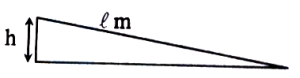
0 likesView Solution
63
PhysicsEasyMCQMHT CET · 2020
In non-uniform circular motion,the ratio of tangential to radial acceleration is ($r=$ radius,$\alpha=$ angular acceleration,$V=$ linear velocity).
A
$\frac{r \alpha}{V}$
B
$\frac{V^{2}}{r \alpha}$
C
$\frac{r^{2} \alpha}{V^{2}}$
D
$\frac{r \alpha^{2}}{V^{2}}$
Solution
(C) Tangential acceleration is given by $a_t = \alpha r$.
Radial (centripetal) acceleration is given by $a_r = \frac{V^2}{r}$.
The ratio of tangential acceleration to radial acceleration is $\frac{a_t}{a_r} = \frac{\alpha r}{V^2 / r}$.
Simplifying this expression,we get $\frac{a_t}{a_r} = \frac{\alpha r^2}{V^2}$.
Radial (centripetal) acceleration is given by $a_r = \frac{V^2}{r}$.
The ratio of tangential acceleration to radial acceleration is $\frac{a_t}{a_r} = \frac{\alpha r}{V^2 / r}$.
Simplifying this expression,we get $\frac{a_t}{a_r} = \frac{\alpha r^2}{V^2}$.
0 likesView Solution
64
PhysicsDifficultMCQMHT CET · 2020
When a mass '$m$' is suspended from a spring of length '$\ell$',the length of the spring becomes '$L$'. The mass is pulled down by a distance '$d$' and released. If the equation of motion of the mass is $\frac{d^{2} x}{d t^{2}}+P^{2} x=0$,then $P$ is equal to ($g=$ acceleration due to gravity).
A
$\frac{L-\ell}{g}$
B
$\frac{g}{L-\ell}$
C
$\sqrt{\frac{g}{L-\ell}}$
D
$\sqrt{\frac{L-\ell}{g}}$
Solution
(C) Let the spring constant be $k$. When the mass $m$ is suspended,the extension in the spring is $x_0 = L - \ell$.
At equilibrium,the spring force balances the weight: $k(L - \ell) = mg$,which implies $k/m = g / (L - \ell)$.
The equation of motion for a mass-spring system is $\frac{d^2x}{dt^2} + \omega^2 x = 0$,where $\omega^2 = k/m$.
Comparing this with the given equation $\frac{d^2x}{dt^2} + P^2 x = 0$,we get $P^2 = \omega^2 = k/m$.
Substituting the value of $k/m$,we get $P^2 = \frac{g}{L - \ell}$.
Therefore,$P = \sqrt{\frac{g}{L - \ell}}$.
At equilibrium,the spring force balances the weight: $k(L - \ell) = mg$,which implies $k/m = g / (L - \ell)$.
The equation of motion for a mass-spring system is $\frac{d^2x}{dt^2} + \omega^2 x = 0$,where $\omega^2 = k/m$.
Comparing this with the given equation $\frac{d^2x}{dt^2} + P^2 x = 0$,we get $P^2 = \omega^2 = k/m$.
Substituting the value of $k/m$,we get $P^2 = \frac{g}{L - \ell}$.
Therefore,$P = \sqrt{\frac{g}{L - \ell}}$.
0 likesView Solution
65
PhysicsEasyMCQMHT CET · 2020
The resultant of two vectors $\overrightarrow{P}$ and $\overrightarrow{Q}$ has a magnitude $R_{1}$. If the direction of $\overrightarrow{Q}$ is reversed,the resultant has a magnitude $R_{2}$. The value of $(R_{1}^{2} + R_{2}^{2})$ is:
A
$(P^{2} + Q^{2})$
B
$2(P^{2} + Q^{2})$
C
$2(P^{2} - Q^{2})$
D
$(P^{2} - Q^{2})$
Solution
(B) Let $\theta$ be the angle between vectors $\overrightarrow{P}$ and $\overrightarrow{Q}$.
According to the law of vector addition,the magnitude of the resultant $R_{1}$ is given by:
$R_{1}^{2} = P^{2} + Q^{2} + 2PQ \cos \theta$ --- $(1)$
When the direction of $\overrightarrow{Q}$ is reversed,the new vector is $-\overrightarrow{Q}$. The angle between $\overrightarrow{P}$ and $-\overrightarrow{Q}$ becomes $(\pi - \theta)$.
The magnitude of the new resultant $R_{2}$ is given by:
$R_{2}^{2} = P^{2} + Q^{2} + 2PQ \cos(\pi - \theta)$
Since $\cos(\pi - \theta) = -\cos \theta$,we have:
$R_{2}^{2} = P^{2} + Q^{2} - 2PQ \cos \theta$ --- $(2)$
Adding equation $(1)$ and equation $(2)$:
$R_{1}^{2} + R_{2}^{2} = (P^{2} + Q^{2} + 2PQ \cos \theta) + (P^{2} + Q^{2} - 2PQ \cos \theta)$
$R_{1}^{2} + R_{2}^{2} = 2(P^{2} + Q^{2})$
According to the law of vector addition,the magnitude of the resultant $R_{1}$ is given by:
$R_{1}^{2} = P^{2} + Q^{2} + 2PQ \cos \theta$ --- $(1)$
When the direction of $\overrightarrow{Q}$ is reversed,the new vector is $-\overrightarrow{Q}$. The angle between $\overrightarrow{P}$ and $-\overrightarrow{Q}$ becomes $(\pi - \theta)$.
The magnitude of the new resultant $R_{2}$ is given by:
$R_{2}^{2} = P^{2} + Q^{2} + 2PQ \cos(\pi - \theta)$
Since $\cos(\pi - \theta) = -\cos \theta$,we have:
$R_{2}^{2} = P^{2} + Q^{2} - 2PQ \cos \theta$ --- $(2)$
Adding equation $(1)$ and equation $(2)$:
$R_{1}^{2} + R_{2}^{2} = (P^{2} + Q^{2} + 2PQ \cos \theta) + (P^{2} + Q^{2} - 2PQ \cos \theta)$
$R_{1}^{2} + R_{2}^{2} = 2(P^{2} + Q^{2})$
0 likesView Solution
66
PhysicsMediumMCQMHT CET · 2020
If three vectors have equal magnitude,i.e.,$A = B = C$,then the angle between $\vec{A}$ and $\vec{C}$ is $\alpha$. If $\vec{A} + \vec{B} + \vec{C} = 0$,then the angle between $\vec{A}$ and $\vec{C}$ is $\beta$. Find the ratio $\frac{\alpha}{\beta}$.
A
$2/3$
B
$2/1$
C
$1/2$
D
$3/2$
Solution
(C) Given that the three vectors have equal magnitude,$A = B = C$.
In the first case,the angle between $\vec{A}$ and $\vec{C}$ is given as $\alpha$. Since no specific condition is provided for the first case,we assume the vectors are arranged such that they form an equilateral triangle in the second case.
In the second case,$\vec{A} + \vec{B} + \vec{C} = 0$. This implies that the three vectors form a closed equilateral triangle when placed head-to-tail.
The internal angles of an equilateral triangle are $60^{\circ}$.
However,the angle between two vectors $\vec{A}$ and $\vec{C}$ is defined as the angle between their tails.
If $\vec{A} + \vec{B} + \vec{C} = 0$,then $\vec{A} + \vec{C} = -\vec{B}$.
Taking the magnitude squared: $|\vec{A} + \vec{C}|^2 = |-\vec{B}|^2$.
$A^2 + C^2 + 2AC \cos(\beta) = B^2$.
Since $A = B = C$,we have $A^2 + A^2 + 2A^2 \cos(\beta) = A^2$.
$2A^2 + 2A^2 \cos(\beta) = A^2$.
$2A^2 \cos(\beta) = -A^2$.
$\cos(\beta) = -1/2$.
Therefore,$\beta = 120^{\circ}$.
Assuming the initial condition $\alpha$ refers to the angle between vectors when they are parallel or in a standard reference,typically $\alpha = 60^{\circ}$ for such geometric problems.
Thus,$\frac{\alpha}{\beta} = \frac{60^{\circ}}{120^{\circ}} = \frac{1}{2}$.
In the first case,the angle between $\vec{A}$ and $\vec{C}$ is given as $\alpha$. Since no specific condition is provided for the first case,we assume the vectors are arranged such that they form an equilateral triangle in the second case.
In the second case,$\vec{A} + \vec{B} + \vec{C} = 0$. This implies that the three vectors form a closed equilateral triangle when placed head-to-tail.
The internal angles of an equilateral triangle are $60^{\circ}$.
However,the angle between two vectors $\vec{A}$ and $\vec{C}$ is defined as the angle between their tails.
If $\vec{A} + \vec{B} + \vec{C} = 0$,then $\vec{A} + \vec{C} = -\vec{B}$.
Taking the magnitude squared: $|\vec{A} + \vec{C}|^2 = |-\vec{B}|^2$.
$A^2 + C^2 + 2AC \cos(\beta) = B^2$.
Since $A = B = C$,we have $A^2 + A^2 + 2A^2 \cos(\beta) = A^2$.
$2A^2 + 2A^2 \cos(\beta) = A^2$.
$2A^2 \cos(\beta) = -A^2$.
$\cos(\beta) = -1/2$.
Therefore,$\beta = 120^{\circ}$.
Assuming the initial condition $\alpha$ refers to the angle between vectors when they are parallel or in a standard reference,typically $\alpha = 60^{\circ}$ for such geometric problems.
Thus,$\frac{\alpha}{\beta} = \frac{60^{\circ}}{120^{\circ}} = \frac{1}{2}$.
0 likesView Solution
67
PhysicsMediumMCQMHT CET · 2020
If $\overrightarrow{A}=3 \hat{\imath}-2 \hat{\jmath}+\hat{k}$,$\overrightarrow{B}=\hat{\imath}-3 \hat{\jmath}+5 \hat{k}$ and $\overrightarrow{C}=2 \hat{\imath}+\hat{\jmath}-4 \hat{k}$ form a right-angled triangle,then which of the following is satisfied?
A
$\overrightarrow{B}=\overrightarrow{A}+\overrightarrow{C}, B^{2}=A^{2}+C^{2}$
B
$\overrightarrow{A}=\overrightarrow{B}+\overrightarrow{C}, B^{2}=A^{2}-C^{2}$
C
$\overrightarrow{C}=\overrightarrow{A}+\overrightarrow{B}, C^{2}=A^{2}+B^{2}$
D
$\overrightarrow{A}=\overrightarrow{B}+\overrightarrow{C}, B^{2}=A^{2}+C^{2}$
Solution
(D) Given vectors are $\vec{A}=3 \hat{\imath}-2 \hat{\jmath}+\hat{k}$,$\vec{B}=\hat{\imath}-3 \hat{\jmath}+5 \hat{k}$,and $\vec{C}=2 \hat{\imath}+\hat{\jmath}-4 \hat{k}$.
First,check the vector addition relation:
$\vec{B}+\vec{C} = (\hat{\imath}-3 \hat{\jmath}+5 \hat{k}) + (2 \hat{\imath}+\hat{\jmath}-4 \hat{k}) = 3 \hat{\imath}-2 \hat{\jmath}+\hat{k} = \vec{A}$.
Thus,$\vec{A}=\vec{B}+\vec{C}$ is satisfied.
Now,calculate the squares of the magnitudes:
$A^2 = |\vec{A}|^2 = 3^2 + (-2)^2 + 1^2 = 9 + 4 + 1 = 14$.
$B^2 = |\vec{B}|^2 = 1^2 + (-3)^2 + 5^2 = 1 + 9 + 25 = 35$.
$C^2 = |\vec{C}|^2 = 2^2 + 1^2 + (-4)^2 = 4 + 1 + 16 = 21$.
Observing the values,$B^2 = 35$ and $A^2 + C^2 = 14 + 21 = 35$.
Therefore,$B^2 = A^2 + C^2$ is satisfied.
Hence,the correct option is $\vec{A}=\vec{B}+\vec{C}$ and $B^2=A^2+C^2$.
First,check the vector addition relation:
$\vec{B}+\vec{C} = (\hat{\imath}-3 \hat{\jmath}+5 \hat{k}) + (2 \hat{\imath}+\hat{\jmath}-4 \hat{k}) = 3 \hat{\imath}-2 \hat{\jmath}+\hat{k} = \vec{A}$.
Thus,$\vec{A}=\vec{B}+\vec{C}$ is satisfied.
Now,calculate the squares of the magnitudes:
$A^2 = |\vec{A}|^2 = 3^2 + (-2)^2 + 1^2 = 9 + 4 + 1 = 14$.
$B^2 = |\vec{B}|^2 = 1^2 + (-3)^2 + 5^2 = 1 + 9 + 25 = 35$.
$C^2 = |\vec{C}|^2 = 2^2 + 1^2 + (-4)^2 = 4 + 1 + 16 = 21$.
Observing the values,$B^2 = 35$ and $A^2 + C^2 = 14 + 21 = 35$.
Therefore,$B^2 = A^2 + C^2$ is satisfied.
Hence,the correct option is $\vec{A}=\vec{B}+\vec{C}$ and $B^2=A^2+C^2$.
0 likesView Solution
68
PhysicsEasyMCQMHT CET · 2020
The sum of the magnitudes of two vectors $\vec{A}$ and $\vec{B}$ is $8$,and the magnitude of their resultant is $4$. If the resultant vector is perpendicular to one of the vectors,then the magnitudes of the two vectors $\vec{A}$ and $\vec{B}$ are:
A
$3, 5$
B
$2, 6$
C
$4, 4$
D
$1, 7$
Solution
(A) Let the magnitudes of the vectors be $A$ and $B$. Given $A + B = 8$,so $B = 8 - A$.
Let the resultant vector be $\vec{R} = \vec{A} + \vec{B}$,with magnitude $R = 4$.
Since $\vec{R}$ is perpendicular to $\vec{A}$,the angle between $\vec{A}$ and $\vec{R}$ is $90^{\circ}$.
Using the triangle law of vector addition,we have the relation $B^2 = A^2 + R^2$.
Substituting $B = 8 - A$ and $R = 4$:
$(8 - A)^2 = A^2 + 4^2$
$64 - 16A + A^2 = A^2 + 16$
$64 - 16 = 16A$
$48 = 16A$
$A = 3$.
Then $B = 8 - 3 = 5$.
Thus,the magnitudes are $3$ and $5$.
Let the resultant vector be $\vec{R} = \vec{A} + \vec{B}$,with magnitude $R = 4$.
Since $\vec{R}$ is perpendicular to $\vec{A}$,the angle between $\vec{A}$ and $\vec{R}$ is $90^{\circ}$.
Using the triangle law of vector addition,we have the relation $B^2 = A^2 + R^2$.
Substituting $B = 8 - A$ and $R = 4$:
$(8 - A)^2 = A^2 + 4^2$
$64 - 16A + A^2 = A^2 + 16$
$64 - 16 = 16A$
$48 = 16A$
$A = 3$.
Then $B = 8 - 3 = 5$.
Thus,the magnitudes are $3$ and $5$.
0 likesView Solution
69
PhysicsEasyMCQMHT CET · 2020
Let the two forces have equal magnitude $A$. If the magnitude of the resultant is $\frac{2A}{3}$,then the angle between those two forces is:
A
$\cos^{-1}\left(+\frac{7}{9}\right)$
B
$\cos^{-1}\left(-\frac{7}{9}\right)$
C
$\cos^{-1}\left(-\frac{5}{9}\right)$
D
$\cos^{-1}\left(+\frac{5}{9}\right)$
Solution
(B) The magnitude of the resultant $R$ of two vectors of equal magnitude $A$ with an angle $\theta$ between them is given by the formula: $R = \sqrt{A^2 + A^2 + 2A^2 \cos \theta}$.
Given $R = \frac{2A}{3}$,we substitute this into the equation:
$\frac{2A}{3} = \sqrt{2A^2 + 2A^2 \cos \theta}$.
Squaring both sides:
$\frac{4A^2}{9} = 2A^2(1 + \cos \theta)$.
Dividing both sides by $2A^2$:
$\frac{2}{9} = 1 + \cos \theta$.
Solving for $\cos \theta$:
$\cos \theta = \frac{2}{9} - 1 = \frac{2-9}{9} = -\frac{7}{9}$.
Therefore,the angle $\theta = \cos^{-1}\left(-\frac{7}{9}\right)$.
Given $R = \frac{2A}{3}$,we substitute this into the equation:
$\frac{2A}{3} = \sqrt{2A^2 + 2A^2 \cos \theta}$.
Squaring both sides:
$\frac{4A^2}{9} = 2A^2(1 + \cos \theta)$.
Dividing both sides by $2A^2$:
$\frac{2}{9} = 1 + \cos \theta$.
Solving for $\cos \theta$:
$\cos \theta = \frac{2}{9} - 1 = \frac{2-9}{9} = -\frac{7}{9}$.
Therefore,the angle $\theta = \cos^{-1}\left(-\frac{7}{9}\right)$.
0 likesView Solution
70
PhysicsEasyMCQMHT CET · 2020
$A$ vector $\overrightarrow{A}$ when added to the sum of the vectors $(\hat{\imath}-2 \hat{\jmath}+2 \hat{k})$ and $(-2 \hat{\imath}+\hat{\jmath}-\hat{k})$ gives a unit vector along the $y$-axis. The magnitude of the vector $\overrightarrow{A}$ is
A
$\sqrt{3}$
B
$\sqrt{6}$
C
$\sqrt{8}$
D
$\sqrt{10}$
Solution
(B) Let the given vectors be $\vec{B} = (\hat{\imath}-2 \hat{\jmath}+2 \hat{k})$ and $\vec{C} = (-2 \hat{\imath}+\hat{\jmath}-\hat{k})$.
The sum of these vectors is $\vec{B} + \vec{C} = (1-2)\hat{\imath} + (-2+1)\hat{\jmath} + (2-1)\hat{k} = -\hat{\imath} - \hat{\jmath} + \hat{k}$.
According to the problem,$\vec{A} + (\vec{B} + \vec{C}) = \hat{\jmath}$ (unit vector along the $y$-axis).
Substituting the sum: $\vec{A} + (-\hat{\imath} - \hat{\jmath} + \hat{k}) = \hat{\jmath}$.
Solving for $\vec{A}$: $\vec{A} = \hat{\jmath} - (-\hat{\imath} - \hat{\jmath} + \hat{k}) = \hat{\jmath} + \hat{\imath} + \hat{\jmath} - \hat{k} = \hat{\imath} + 2\hat{\jmath} - \hat{k}$.
The magnitude of $\vec{A}$ is $|\vec{A}| = \sqrt{(1)^2 + (2)^2 + (-1)^2} = \sqrt{1 + 4 + 1} = \sqrt{6}$.
The sum of these vectors is $\vec{B} + \vec{C} = (1-2)\hat{\imath} + (-2+1)\hat{\jmath} + (2-1)\hat{k} = -\hat{\imath} - \hat{\jmath} + \hat{k}$.
According to the problem,$\vec{A} + (\vec{B} + \vec{C}) = \hat{\jmath}$ (unit vector along the $y$-axis).
Substituting the sum: $\vec{A} + (-\hat{\imath} - \hat{\jmath} + \hat{k}) = \hat{\jmath}$.
Solving for $\vec{A}$: $\vec{A} = \hat{\jmath} - (-\hat{\imath} - \hat{\jmath} + \hat{k}) = \hat{\jmath} + \hat{\imath} + \hat{\jmath} - \hat{k} = \hat{\imath} + 2\hat{\jmath} - \hat{k}$.
The magnitude of $\vec{A}$ is $|\vec{A}| = \sqrt{(1)^2 + (2)^2 + (-1)^2} = \sqrt{1 + 4 + 1} = \sqrt{6}$.
0 likesView Solution
71
PhysicsEasyMCQMHT CET · 2020
The angle between two forces of equal magnitude $R$,if the magnitude of their resultant is $\frac{R}{2}$,is:
A
$\cos ^{-1}\left(-\frac{7}{8}\right)$
B
$\cos ^{-1}\left(-\frac{5}{7}\right)$
C
$\cos ^{-1}\left(-\frac{3}{7}\right)$
D
$\cos ^{-1}\left(-\frac{3}{4}\right)$
Solution
(A) Let the two forces be $\vec{F_1}$ and $\vec{F_2}$ such that $|\vec{F_1}| = |\vec{F_2}| = R$. The magnitude of the resultant $\vec{R_{res}}$ is given by the formula: $|\vec{R_{res}}| = \sqrt{R^2 + R^2 + 2R^2 \cos \theta}$.
Given that $|\vec{R_{res}}| = \frac{R}{2}$,we square both sides: $\left(\frac{R}{2}\right)^2 = R^2 + R^2 + 2R^2 \cos \theta$.
$\frac{R^2}{4} = 2R^2 + 2R^2 \cos \theta$.
Dividing by $R^2$: $\frac{1}{4} = 2 + 2 \cos \theta$.
$\frac{1}{4} - 2 = 2 \cos \theta$.
$-\frac{7}{4} = 2 \cos \theta$.
$\cos \theta = -\frac{7}{8}$.
Therefore,$\theta = \cos ^{-1}\left(-\frac{7}{8}\right)$.
Given that $|\vec{R_{res}}| = \frac{R}{2}$,we square both sides: $\left(\frac{R}{2}\right)^2 = R^2 + R^2 + 2R^2 \cos \theta$.
$\frac{R^2}{4} = 2R^2 + 2R^2 \cos \theta$.
Dividing by $R^2$: $\frac{1}{4} = 2 + 2 \cos \theta$.
$\frac{1}{4} - 2 = 2 \cos \theta$.
$-\frac{7}{4} = 2 \cos \theta$.
$\cos \theta = -\frac{7}{8}$.
Therefore,$\theta = \cos ^{-1}\left(-\frac{7}{8}\right)$.
0 likesView Solution
72
PhysicsDifficultMCQMHT CET · 2020
Two unit vectors $\hat{a}_{1}$ and $\hat{a}_{2}$ are inclined to each other at an angle $\theta$. If $|\hat{a}_{1}-\hat{a}_{2}|=\sqrt{3}$,then the value of $(\hat{a}_{1}-\hat{a}_{2}) \cdot (2\hat{a}_{1}-\hat{a}_{2})$ is:
A
$1/2$
B
$2$
C
$1$
D
$4.5$
Solution
(D) Given that $\hat{a}_{1}$ and $\hat{a}_{2}$ are unit vectors,so $|\hat{a}_{1}| = 1$ and $|\hat{a}_{2}| = 1$.
Given $|\hat{a}_{1}-\hat{a}_{2}| = \sqrt{3}$.
Squaring both sides,we get $|\hat{a}_{1}-\hat{a}_{2}|^2 = 3$.
$(\hat{a}_{1}-\hat{a}_{2}) \cdot (\hat{a}_{1}-\hat{a}_{2}) = 3 \implies |\hat{a}_{1}|^2 + |\hat{a}_{2}|^2 - 2(\hat{a}_{1} \cdot \hat{a}_{2}) = 3$.
$1 + 1 - 2(\hat{a}_{1} \cdot \hat{a}_{2}) = 3 \implies 2 - 2(\hat{a}_{1} \cdot \hat{a}_{2}) = 3 \implies \hat{a}_{1} \cdot \hat{a}_{2} = -1/2$.
Now,we need to evaluate $(\hat{a}_{1}-\hat{a}_{2}) \cdot (2\hat{a}_{1}-\hat{a}_{2})$.
$= 2(\hat{a}_{1} \cdot \hat{a}_{1}) - (\hat{a}_{1} \cdot \hat{a}_{2}) - 2(\hat{a}_{2} \cdot \hat{a}_{1}) + (\hat{a}_{2} \cdot \hat{a}_{2})$.
$= 2(1) - 3(\hat{a}_{1} \cdot \hat{a}_{2}) + 1$.
$= 3 - 3(-1/2) = 3 + 3/2 = 9/2 = 4.5$.
Given $|\hat{a}_{1}-\hat{a}_{2}| = \sqrt{3}$.
Squaring both sides,we get $|\hat{a}_{1}-\hat{a}_{2}|^2 = 3$.
$(\hat{a}_{1}-\hat{a}_{2}) \cdot (\hat{a}_{1}-\hat{a}_{2}) = 3 \implies |\hat{a}_{1}|^2 + |\hat{a}_{2}|^2 - 2(\hat{a}_{1} \cdot \hat{a}_{2}) = 3$.
$1 + 1 - 2(\hat{a}_{1} \cdot \hat{a}_{2}) = 3 \implies 2 - 2(\hat{a}_{1} \cdot \hat{a}_{2}) = 3 \implies \hat{a}_{1} \cdot \hat{a}_{2} = -1/2$.
Now,we need to evaluate $(\hat{a}_{1}-\hat{a}_{2}) \cdot (2\hat{a}_{1}-\hat{a}_{2})$.
$= 2(\hat{a}_{1} \cdot \hat{a}_{1}) - (\hat{a}_{1} \cdot \hat{a}_{2}) - 2(\hat{a}_{2} \cdot \hat{a}_{1}) + (\hat{a}_{2} \cdot \hat{a}_{2})$.
$= 2(1) - 3(\hat{a}_{1} \cdot \hat{a}_{2}) + 1$.
$= 3 - 3(-1/2) = 3 + 3/2 = 9/2 = 4.5$.
0 likesView Solution
73
PhysicsEasyMCQMHT CET · 2020
The angle made by a vector $\vec{B} = 3 \hat{i} + 2 \hat{j} + 4 \hat{k}$ with the $y$-axis is:
A
$\cos^{-1}\left(\frac{5}{\sqrt{23}}\right)$
B
$\cos^{-1}\left(\frac{4}{\sqrt{11}}\right)$
C
$\cos^{-1}\left(\frac{3}{\sqrt{17}}\right)$
D
$\cos^{-1}\left(\frac{2}{\sqrt{29}}\right)$
Solution
(D) Given vector $\vec{B} = 3 \hat{i} + 2 \hat{j} + 4 \hat{k}$.
The unit vector along the $y$-axis is $\hat{j} = 0 \hat{i} + 1 \hat{j} + 0 \hat{k}$.
The angle $\theta$ between a vector $\vec{B}$ and the $y$-axis is given by the formula $\cos \theta = \frac{\vec{B} \cdot \hat{j}}{|\vec{B}| |\hat{j}|}$.
First,calculate the magnitude of $\vec{B}$: $|\vec{B}| = \sqrt{3^2 + 2^2 + 4^2} = \sqrt{9 + 4 + 16} = \sqrt{29}$.
The magnitude of $\hat{j}$ is $1$.
The dot product $\vec{B} \cdot \hat{j} = (3 \hat{i} + 2 \hat{j} + 4 \hat{k}) \cdot (0 \hat{i} + 1 \hat{j} + 0 \hat{k}) = 2$.
Therefore,$\cos \theta = \frac{2}{\sqrt{29} \times 1} = \frac{2}{\sqrt{29}}$.
Thus,$\theta = \cos^{-1}\left(\frac{2}{\sqrt{29}}\right)$.
The unit vector along the $y$-axis is $\hat{j} = 0 \hat{i} + 1 \hat{j} + 0 \hat{k}$.
The angle $\theta$ between a vector $\vec{B}$ and the $y$-axis is given by the formula $\cos \theta = \frac{\vec{B} \cdot \hat{j}}{|\vec{B}| |\hat{j}|}$.
First,calculate the magnitude of $\vec{B}$: $|\vec{B}| = \sqrt{3^2 + 2^2 + 4^2} = \sqrt{9 + 4 + 16} = \sqrt{29}$.
The magnitude of $\hat{j}$ is $1$.
The dot product $\vec{B} \cdot \hat{j} = (3 \hat{i} + 2 \hat{j} + 4 \hat{k}) \cdot (0 \hat{i} + 1 \hat{j} + 0 \hat{k}) = 2$.
Therefore,$\cos \theta = \frac{2}{\sqrt{29} \times 1} = \frac{2}{\sqrt{29}}$.
Thus,$\theta = \cos^{-1}\left(\frac{2}{\sqrt{29}}\right)$.
0 likesView Solution
74
PhysicsMediumMCQMHT CET · 2020
For any two vectors $\vec{A}$ and $\vec{B}$,if $\vec{A} \cdot \vec{B} = |\vec{A} \times \vec{B}|$,the magnitude of $(\vec{A} + \vec{B})$ is: $(\tan \frac{\pi}{4} = 1, \cos \frac{\pi}{4} = \frac{1}{\sqrt{2}})$
A
$\sqrt{A^{2} + B^{2} + \sqrt{2} AB}$
B
$\sqrt{A^{2} + B^{2} + \frac{AB}{\sqrt{2}}}$
C
$A + B$
D
$\sqrt{A^{2} + B^{2}}$
Solution
(A) Given the condition $\vec{A} \cdot \vec{B} = |\vec{A} \times \vec{B}|$.
Using the definitions of dot and cross products,we have $AB \cos \theta = AB \sin \theta$.
Dividing both sides by $AB$ (assuming $A, B \neq 0$),we get $\cos \theta = \sin \theta$,which implies $\tan \theta = 1$.
Thus,$\theta = 45^{\circ}$ or $\frac{\pi}{4}$ radians.
The magnitude of the resultant vector $\vec{R} = \vec{A} + \vec{B}$ is given by $|\vec{R}| = \sqrt{A^{2} + B^{2} + 2AB \cos \theta}$.
Substituting $\theta = 45^{\circ}$,we get $|\vec{R}| = \sqrt{A^{2} + B^{2} + 2AB \cos 45^{\circ}}$.
Since $\cos 45^{\circ} = \frac{1}{\sqrt{2}}$,the expression becomes $|\vec{R}| = \sqrt{A^{2} + B^{2} + 2AB \times \frac{1}{\sqrt{2}}}$.
Simplifying,we get $|\vec{R}| = \sqrt{A^{2} + B^{2} + \sqrt{2} AB}$.
Using the definitions of dot and cross products,we have $AB \cos \theta = AB \sin \theta$.
Dividing both sides by $AB$ (assuming $A, B \neq 0$),we get $\cos \theta = \sin \theta$,which implies $\tan \theta = 1$.
Thus,$\theta = 45^{\circ}$ or $\frac{\pi}{4}$ radians.
The magnitude of the resultant vector $\vec{R} = \vec{A} + \vec{B}$ is given by $|\vec{R}| = \sqrt{A^{2} + B^{2} + 2AB \cos \theta}$.
Substituting $\theta = 45^{\circ}$,we get $|\vec{R}| = \sqrt{A^{2} + B^{2} + 2AB \cos 45^{\circ}}$.
Since $\cos 45^{\circ} = \frac{1}{\sqrt{2}}$,the expression becomes $|\vec{R}| = \sqrt{A^{2} + B^{2} + 2AB \times \frac{1}{\sqrt{2}}}$.
Simplifying,we get $|\vec{R}| = \sqrt{A^{2} + B^{2} + \sqrt{2} AB}$.
0 likesView Solution
75
PhysicsEasyMCQMHT CET · 2020
If a vector $A=2i+2j+3k$ and $B=3i+6j+nk$ are perpendicular to each other,then the value of $n$ is
A
$0.5$
B
$-0.5$
C
$1$
D
$-6$
Solution
(D) If two vectors are perpendicular,their dot product must be equal to zero.
Given vectors are $A = 2i + 2j + 3k$ and $B = 3i + 6j + nk$.
The dot product $A \cdot B = (2)(3) + (2)(6) + (3)(n) = 0$.
Calculating the terms: $6 + 12 + 3n = 0$.
$18 + 3n = 0$.
$3n = -18$.
$n = -6$.
Therefore,the value of $n$ is $-6$.
Given vectors are $A = 2i + 2j + 3k$ and $B = 3i + 6j + nk$.
The dot product $A \cdot B = (2)(3) + (2)(6) + (3)(n) = 0$.
Calculating the terms: $6 + 12 + 3n = 0$.
$18 + 3n = 0$.
$3n = -18$.
$n = -6$.
Therefore,the value of $n$ is $-6$.
0 likesView Solution
76
PhysicsEasyMCQMHT CET · 2020
If $\overrightarrow{A} = a_{1} \hat{\imath} + a_{2} \hat{\jmath}$ and $\overrightarrow{B} = b_{1} \hat{\imath} + b_{2} \hat{\jmath}$ are perpendicular to each other,then:
A
$\frac{b_{2}}{a_{1}} = -\frac{a_{2}}{b_{1}}$
B
$\frac{a_{1}}{b_{2}} = +\frac{a_{2}}{b_{1}}$
C
$\frac{b_{2}}{a_{1}} = +\frac{a_{2}}{b_{1}}$
D
$\frac{a_{1}}{b_{2}} = -\frac{a_{2}}{b_{1}}$
Solution
(D) Two vectors $\overrightarrow{A}$ and $\overrightarrow{B}$ are perpendicular if their dot product is zero,i.e.,$\overrightarrow{A} \cdot \overrightarrow{B} = 0$.
Given $\overrightarrow{A} = a_{1} \hat{\imath} + a_{2} \hat{\jmath}$ and $\overrightarrow{B} = b_{1} \hat{\imath} + b_{2} \hat{\jmath}$.
Calculating the dot product: $(a_{1} \hat{\imath} + a_{2} \hat{\jmath}) \cdot (b_{1} \hat{\imath} + b_{2} \hat{\jmath}) = a_{1}b_{1} + a_{2}b_{2} = 0$.
This implies $a_{1}b_{1} = -a_{2}b_{2}$.
Rearranging the terms to match the options: $\frac{b_{2}}{a_{1}} = -\frac{b_{1}}{a_{2}}$ is not correct,but looking at $a_{1}b_{1} = -a_{2}b_{2}$,we can write $\frac{b_{2}}{a_{1}} = -\frac{b_{1}}{a_{2}}$ or $\frac{b_{2}}{a_{1}} = -\frac{a_{2}}{b_{1}}$ is incorrect. Let's re-examine: $a_{1}b_{1} + a_{2}b_{2} = 0 \implies a_{1}b_{1} = -a_{2}b_{2}$. Dividing by $a_{1}b_{1}$,we get $1 = -\frac{a_{2}b_{2}}{a_{1}b_{1}}$. Rearranging gives $\frac{b_{2}}{a_{1}} = -\frac{b_{1}}{a_{2}}$. Wait,checking option $A$: $\frac{b_{2}}{a_{1}} = -\frac{a_{2}}{b_{1}}$ is equivalent to $b_{1}b_{2} = -a_{1}a_{2}$,which is not the condition. The condition is $a_{1}b_{1} + a_{2}b_{2} = 0$. Thus,$a_{1}b_{1} = -a_{2}b_{2}$. This can be written as $\frac{b_{2}}{a_{1}} = -\frac{b_{1}}{a_{2}}$. None of the options perfectly match this standard form,but if we rearrange $a_{1}b_{1} = -a_{2}b_{2}$ as $\frac{b_{2}}{a_{1}} = -\frac{b_{1}}{a_{2}}$,there might be a typo in the options. However,if we look at $\frac{a_{1}}{b_{2}} = -\frac{a_{2}}{b_{1}}$,this implies $a_{1}b_{1} = -a_{2}b_{2}$,which is exactly the condition for perpendicularity. Therefore,option $D$ is correct.
Given $\overrightarrow{A} = a_{1} \hat{\imath} + a_{2} \hat{\jmath}$ and $\overrightarrow{B} = b_{1} \hat{\imath} + b_{2} \hat{\jmath}$.
Calculating the dot product: $(a_{1} \hat{\imath} + a_{2} \hat{\jmath}) \cdot (b_{1} \hat{\imath} + b_{2} \hat{\jmath}) = a_{1}b_{1} + a_{2}b_{2} = 0$.
This implies $a_{1}b_{1} = -a_{2}b_{2}$.
Rearranging the terms to match the options: $\frac{b_{2}}{a_{1}} = -\frac{b_{1}}{a_{2}}$ is not correct,but looking at $a_{1}b_{1} = -a_{2}b_{2}$,we can write $\frac{b_{2}}{a_{1}} = -\frac{b_{1}}{a_{2}}$ or $\frac{b_{2}}{a_{1}} = -\frac{a_{2}}{b_{1}}$ is incorrect. Let's re-examine: $a_{1}b_{1} + a_{2}b_{2} = 0 \implies a_{1}b_{1} = -a_{2}b_{2}$. Dividing by $a_{1}b_{1}$,we get $1 = -\frac{a_{2}b_{2}}{a_{1}b_{1}}$. Rearranging gives $\frac{b_{2}}{a_{1}} = -\frac{b_{1}}{a_{2}}$. Wait,checking option $A$: $\frac{b_{2}}{a_{1}} = -\frac{a_{2}}{b_{1}}$ is equivalent to $b_{1}b_{2} = -a_{1}a_{2}$,which is not the condition. The condition is $a_{1}b_{1} + a_{2}b_{2} = 0$. Thus,$a_{1}b_{1} = -a_{2}b_{2}$. This can be written as $\frac{b_{2}}{a_{1}} = -\frac{b_{1}}{a_{2}}$. None of the options perfectly match this standard form,but if we rearrange $a_{1}b_{1} = -a_{2}b_{2}$ as $\frac{b_{2}}{a_{1}} = -\frac{b_{1}}{a_{2}}$,there might be a typo in the options. However,if we look at $\frac{a_{1}}{b_{2}} = -\frac{a_{2}}{b_{1}}$,this implies $a_{1}b_{1} = -a_{2}b_{2}$,which is exactly the condition for perpendicularity. Therefore,option $D$ is correct.
0 likesView Solution
77
PhysicsEasyMCQMHT CET · 2020
Two vectors of the same magnitude have a resultant equal to either of the two vectors. The angle between the two vectors is: (in $^{\circ}$)
A
$120$
B
$90$
C
$60$
D
$180$
Solution
(A) Let the magnitude of each vector be $A$. The resultant $R$ is also equal to $A$.
Using the formula for the resultant of two vectors: $R = \sqrt{A^2 + A^2 + 2AA \cos \theta}$.
Given $R = A$,we have $A = \sqrt{2A^2 + 2A^2 \cos \theta}$.
Squaring both sides: $A^2 = 2A^2 + 2A^2 \cos \theta$.
Dividing by $A^2$: $1 = 2 + 2 \cos \theta$.
$2 \cos \theta = 1 - 2 = -1$.
$\cos \theta = -1/2$.
Therefore,$\theta = \cos^{-1}(-0.5) = 120^{\circ}$.
Using the formula for the resultant of two vectors: $R = \sqrt{A^2 + A^2 + 2AA \cos \theta}$.
Given $R = A$,we have $A = \sqrt{2A^2 + 2A^2 \cos \theta}$.
Squaring both sides: $A^2 = 2A^2 + 2A^2 \cos \theta$.
Dividing by $A^2$: $1 = 2 + 2 \cos \theta$.
$2 \cos \theta = 1 - 2 = -1$.
$\cos \theta = -1/2$.
Therefore,$\theta = \cos^{-1}(-0.5) = 120^{\circ}$.
0 likesView Solution
78
PhysicsEasyMCQMHT CET · 2020
$A$ body of mass $2 \ kg$ is acted upon by two forces each of magnitude $1 \ N$ and inclined at $60^{\circ}$ with each other. The acceleration of the body in $m/s^2$ is $[\cos 60^{\circ}=0.5]$
A
$\sqrt{0.35}$
B
$\sqrt{0.65}$
C
$\sqrt{0.75}$
D
$\sqrt{0.20}$
Solution
(C) To find the resultant force,we use the parallelogram law of vector addition:
$F_{\text{net}} = \sqrt{F_1^2 + F_2^2 + 2 F_1 F_2 \cos \theta}$
Given: $F_1 = 1 \ N$,$F_2 = 1 \ N$,and $\theta = 60^{\circ}$.
Substituting the values:
$F_{\text{net}} = \sqrt{1^2 + 1^2 + 2(1)(1) \cos 60^{\circ}}$
$F_{\text{net}} = \sqrt{1 + 1 + 2(0.5)} = \sqrt{1 + 1 + 1} = \sqrt{3} \ N$.
Using Newton's second law,$F = ma$:
$a = \frac{F_{\text{net}}}{m} = \frac{\sqrt{3}}{2} \ m/s^2$.
Calculating the value:
$a = \frac{1.732}{2} = 0.866 \ m/s^2$.
Comparing with the options,$\sqrt{0.75} \approx 0.866$.
Therefore,the correct option is $\sqrt{0.75}$.
$F_{\text{net}} = \sqrt{F_1^2 + F_2^2 + 2 F_1 F_2 \cos \theta}$
Given: $F_1 = 1 \ N$,$F_2 = 1 \ N$,and $\theta = 60^{\circ}$.
Substituting the values:
$F_{\text{net}} = \sqrt{1^2 + 1^2 + 2(1)(1) \cos 60^{\circ}}$
$F_{\text{net}} = \sqrt{1 + 1 + 2(0.5)} = \sqrt{1 + 1 + 1} = \sqrt{3} \ N$.
Using Newton's second law,$F = ma$:
$a = \frac{F_{\text{net}}}{m} = \frac{\sqrt{3}}{2} \ m/s^2$.
Calculating the value:
$a = \frac{1.732}{2} = 0.866 \ m/s^2$.
Comparing with the options,$\sqrt{0.75} \approx 0.866$.
Therefore,the correct option is $\sqrt{0.75}$.
0 likesView Solution
79
PhysicsMediumMCQMHT CET · 2020
The resultant of two vectors $\vec{A}$ and $\vec{B}$ is $\vec{C}$. If the magnitude of $\vec{B}$ is doubled,the new resultant vector becomes perpendicular to $\vec{A}$. Then the magnitude of $\vec{C}$ is
A
$3B$
B
$2B$
C
$B$
D
$4B$
Solution
(C) Let the vectors be $\vec{A}$ and $\vec{B}$. The resultant is $\vec{C} = \vec{A} + \vec{B}$.
Taking the dot product of $\vec{C}$ with itself,we get $C^2 = A^2 + B^2 + 2\vec{A} \cdot \vec{B}$.
When the magnitude of $\vec{B}$ is doubled,the new resultant is $\vec{C}' = \vec{A} + 2\vec{B}$.
It is given that $\vec{C}'$ is perpendicular to $\vec{A}$,so $\vec{A} \cdot \vec{C}' = 0$.
$\vec{A} \cdot (\vec{A} + 2\vec{B}) = 0 \implies A^2 + 2\vec{A} \cdot \vec{B} = 0$.
This implies $2\vec{A} \cdot \vec{B} = -A^2$.
Substituting this into the expression for $C^2$:
$C^2 = A^2 + B^2 - A^2 = B^2$.
Therefore,the magnitude of $\vec{C}$ is $B$.
Taking the dot product of $\vec{C}$ with itself,we get $C^2 = A^2 + B^2 + 2\vec{A} \cdot \vec{B}$.
When the magnitude of $\vec{B}$ is doubled,the new resultant is $\vec{C}' = \vec{A} + 2\vec{B}$.
It is given that $\vec{C}'$ is perpendicular to $\vec{A}$,so $\vec{A} \cdot \vec{C}' = 0$.
$\vec{A} \cdot (\vec{A} + 2\vec{B}) = 0 \implies A^2 + 2\vec{A} \cdot \vec{B} = 0$.
This implies $2\vec{A} \cdot \vec{B} = -A^2$.
Substituting this into the expression for $C^2$:
$C^2 = A^2 + B^2 - A^2 = B^2$.
Therefore,the magnitude of $\vec{C}$ is $B$.
0 likesView Solution
80
PhysicsMediumMCQMHT CET · 2020
The $x$ and $y$ components of vector $\vec{P}$ have magnitudes $1$ and $3$,and the $x$ and $y$ components of the resultant of $\vec{P}$ and $\vec{Q}$ have magnitudes $5$ and $6$ respectively. What is the magnitude of $\vec{Q}$?
A
$4$
B
$5$
C
$3$
D
$2$
Solution
(B) Given that the components of vector $\vec{P}$ are $P_x = 1$ and $P_y = 3$. Thus,$\vec{P} = 1\hat{i} + 3\hat{j}$.
Let the resultant vector be $\vec{R} = \vec{P} + \vec{Q}$. The components of $\vec{R}$ are given as $R_x = 5$ and $R_y = 6$. Thus,$\vec{R} = 5\hat{i} + 6\hat{j}$.
We know that $\vec{Q} = \vec{R} - \vec{P}$.
Substituting the values: $\vec{Q} = (5\hat{i} + 6\hat{j}) - (1\hat{i} + 3\hat{j}) = (5-1)\hat{i} + (6-3)\hat{j} = 4\hat{i} + 3\hat{j}$.
The magnitude of $\vec{Q}$ is $|\vec{Q}| = \sqrt{Q_x^2 + Q_y^2} = \sqrt{4^2 + 3^2} = \sqrt{16 + 9} = \sqrt{25} = 5$.
Therefore,the correct option is $B$.
Let the resultant vector be $\vec{R} = \vec{P} + \vec{Q}$. The components of $\vec{R}$ are given as $R_x = 5$ and $R_y = 6$. Thus,$\vec{R} = 5\hat{i} + 6\hat{j}$.
We know that $\vec{Q} = \vec{R} - \vec{P}$.
Substituting the values: $\vec{Q} = (5\hat{i} + 6\hat{j}) - (1\hat{i} + 3\hat{j}) = (5-1)\hat{i} + (6-3)\hat{j} = 4\hat{i} + 3\hat{j}$.
The magnitude of $\vec{Q}$ is $|\vec{Q}| = \sqrt{Q_x^2 + Q_y^2} = \sqrt{4^2 + 3^2} = \sqrt{16 + 9} = \sqrt{25} = 5$.
Therefore,the correct option is $B$.
0 likesView Solution
81
PhysicsMediumMCQMHT CET · 2020
The resultant of two vectors $\vec{P}$ and $\vec{Q}$ is $\vec{R}$. When the direction of $\vec{Q}$ is reversed,the resultant is given by $\vec{S}$. Which one of the following is true for vectors $\vec{R}$ and $\vec{S}$?
A
$R^2 - S^2 = (P^2 + Q^2)$
B
$R^2 - S^2 = 2(\vec{P} \cdot \vec{Q})$
C
$R^2 + S^2 = 4(\vec{P} \cdot \vec{Q})$
D
$R^2 + S^2 = 2(P^2 + Q^2)$
Solution
(D) Let $\theta$ be the angle between vectors $\vec{P}$ and $\vec{Q}$.
By the law of vector addition,the resultant $\vec{R} = \vec{P} + \vec{Q}$.
The magnitude squared is $R^2 = P^2 + Q^2 + 2PQ \cos \theta$ ... $(1)$
When the direction of $\vec{Q}$ is reversed,the new vector is $-\vec{Q}$. The new resultant is $\vec{S} = \vec{P} - \vec{Q}$.
The magnitude squared is $S^2 = P^2 + Q^2 - 2PQ \cos \theta$ ... $(2)$
Adding equations $(1)$ and $(2)$:
$R^2 + S^2 = (P^2 + Q^2 + 2PQ \cos \theta) + (P^2 + Q^2 - 2PQ \cos \theta)$
$R^2 + S^2 = 2(P^2 + Q^2)$
Therefore,option $D$ is correct.
By the law of vector addition,the resultant $\vec{R} = \vec{P} + \vec{Q}$.
The magnitude squared is $R^2 = P^2 + Q^2 + 2PQ \cos \theta$ ... $(1)$
When the direction of $\vec{Q}$ is reversed,the new vector is $-\vec{Q}$. The new resultant is $\vec{S} = \vec{P} - \vec{Q}$.
The magnitude squared is $S^2 = P^2 + Q^2 - 2PQ \cos \theta$ ... $(2)$
Adding equations $(1)$ and $(2)$:
$R^2 + S^2 = (P^2 + Q^2 + 2PQ \cos \theta) + (P^2 + Q^2 - 2PQ \cos \theta)$
$R^2 + S^2 = 2(P^2 + Q^2)$
Therefore,option $D$ is correct.
0 likesView Solution
82
PhysicsEasyMCQMHT CET · 2020
The angle subtended by the vector $\vec{A} = 4 \hat{i} + 3 \hat{j} + 12 \hat{k}$ with the $x$-axis is
A
$\sin^{-1}(\frac{4}{13})$
B
$\cos^{-1}(\frac{3}{13})$
C
$\cos^{-1}(\frac{4}{13})$
D
$\sin^{-1}(\frac{3}{13})$
Solution
(C) The vector is given by $\vec{A} = 4 \hat{i} + 3 \hat{j} + 12 \hat{k}$.
The magnitude of the vector $\vec{A}$ is $|\vec{A}| = \sqrt{4^2 + 3^2 + 12^2} = \sqrt{16 + 9 + 144} = \sqrt{169} = 13$.
The unit vector along the $x$-axis is $\hat{i} = 1 \hat{i} + 0 \hat{j} + 0 \hat{k}$.
The angle $\theta$ between the vector $\vec{A}$ and the $x$-axis is given by the dot product formula: $\cos \theta = \frac{\vec{A} \cdot \hat{i}}{|\vec{A}| |\hat{i}|}$.
Calculating the dot product: $\vec{A} \cdot \hat{i} = (4 \times 1) + (3 \times 0) + (12 \times 0) = 4$.
Substituting the values: $\cos \theta = \frac{4}{13 \times 1} = \frac{4}{13}$.
Therefore,$\theta = \cos^{-1}(\frac{4}{13})$.
The magnitude of the vector $\vec{A}$ is $|\vec{A}| = \sqrt{4^2 + 3^2 + 12^2} = \sqrt{16 + 9 + 144} = \sqrt{169} = 13$.
The unit vector along the $x$-axis is $\hat{i} = 1 \hat{i} + 0 \hat{j} + 0 \hat{k}$.
The angle $\theta$ between the vector $\vec{A}$ and the $x$-axis is given by the dot product formula: $\cos \theta = \frac{\vec{A} \cdot \hat{i}}{|\vec{A}| |\hat{i}|}$.
Calculating the dot product: $\vec{A} \cdot \hat{i} = (4 \times 1) + (3 \times 0) + (12 \times 0) = 4$.
Substituting the values: $\cos \theta = \frac{4}{13 \times 1} = \frac{4}{13}$.
Therefore,$\theta = \cos^{-1}(\frac{4}{13})$.
0 likesView Solution
83
PhysicsEasyMCQMHT CET · 2020
What is the angle between the resultant of $\overrightarrow{A} + \overrightarrow{B}$ and $\overrightarrow{A} \times \overrightarrow{B}$?
A
$\pi \text{ rad}$
B
$0^{\circ}$
C
$\frac{\pi}{2} \text{ rad}$
D
$\frac{\pi}{4} \text{ rad}$
Solution
(C) Let $\overrightarrow{A}$ and $\overrightarrow{B}$ be two vectors in a plane. The sum $\overrightarrow{A} + \overrightarrow{B}$ is a vector that lies in the same plane as $\overrightarrow{A}$ and $\overrightarrow{B}$.
By the definition of the cross product,$\overrightarrow{A} \times \overrightarrow{B}$ is a vector that is perpendicular to the plane containing both $\overrightarrow{A}$ and $\overrightarrow{B}$.
Since the vector $(\overrightarrow{A} + \overrightarrow{B})$ lies in the plane and the vector $(\overrightarrow{A} \times \overrightarrow{B})$ is perpendicular to the plane,the angle between them is $90^{\circ}$ or $\frac{\pi}{2} \text{ rad}$.
Mathematically,the dot product of these two vectors is:
$(\overrightarrow{A} + \overrightarrow{B}) \cdot (\overrightarrow{A} \times \overrightarrow{B}) = \overrightarrow{A} \cdot (\overrightarrow{A} \times \overrightarrow{B}) + \overrightarrow{B} \cdot (\overrightarrow{A} \times \overrightarrow{B})$
Using the property of the scalar triple product,$\overrightarrow{A} \cdot (\overrightarrow{A} \times \overrightarrow{B}) = 0$ and $\overrightarrow{B} \cdot (\overrightarrow{A} \times \overrightarrow{B}) = 0$.
Therefore,$(\overrightarrow{A} + \overrightarrow{B}) \cdot (\overrightarrow{A} \times \overrightarrow{B}) = 0$,which confirms that the vectors are orthogonal,and the angle between them is $90^{\circ}$.
By the definition of the cross product,$\overrightarrow{A} \times \overrightarrow{B}$ is a vector that is perpendicular to the plane containing both $\overrightarrow{A}$ and $\overrightarrow{B}$.
Since the vector $(\overrightarrow{A} + \overrightarrow{B})$ lies in the plane and the vector $(\overrightarrow{A} \times \overrightarrow{B})$ is perpendicular to the plane,the angle between them is $90^{\circ}$ or $\frac{\pi}{2} \text{ rad}$.
Mathematically,the dot product of these two vectors is:
$(\overrightarrow{A} + \overrightarrow{B}) \cdot (\overrightarrow{A} \times \overrightarrow{B}) = \overrightarrow{A} \cdot (\overrightarrow{A} \times \overrightarrow{B}) + \overrightarrow{B} \cdot (\overrightarrow{A} \times \overrightarrow{B})$
Using the property of the scalar triple product,$\overrightarrow{A} \cdot (\overrightarrow{A} \times \overrightarrow{B}) = 0$ and $\overrightarrow{B} \cdot (\overrightarrow{A} \times \overrightarrow{B}) = 0$.
Therefore,$(\overrightarrow{A} + \overrightarrow{B}) \cdot (\overrightarrow{A} \times \overrightarrow{B}) = 0$,which confirms that the vectors are orthogonal,and the angle between them is $90^{\circ}$.
0 likesView Solution
84
PhysicsEasyMCQMHT CET · 2020
The magnitude of the sum of the two vectors $\vec{A}$ and $\vec{B}$ is equal to the magnitude of the difference of the two vectors $\vec{A}$ and $\vec{B}$. The angle between $\vec{A}$ and $\vec{B}$ is: (in $^{\circ}$)
A
$30$
B
$45$
C
$90$
D
$180$
Solution
(C) Let the two vectors be $\vec{A}$ and $\vec{B}$ with magnitudes $A$ and $B$ respectively.
The magnitude of their sum is given by:
$|\vec{A}+\vec{B}| = \sqrt{A^{2}+B^{2}+2AB \cos \theta}$,where $\theta$ is the angle between the vectors.
The magnitude of their difference is given by:
$|\vec{A}-\vec{B}| = \sqrt{A^{2}+B^{2}-2AB \cos \theta}$.
Given that $|\vec{A}+\vec{B}| = |\vec{A}-\vec{B}|$,we square both sides:
$A^{2}+B^{2}+2AB \cos \theta = A^{2}+B^{2}-2AB \cos \theta$.
Subtracting $A^{2}+B^{2}$ from both sides,we get:
$2AB \cos \theta = -2AB \cos \theta$.
$4AB \cos \theta = 0$.
Since $A$ and $B$ are magnitudes of vectors,$A \neq 0$ and $B \neq 0$,therefore $\cos \theta = 0$.
This implies $\theta = 90^{\circ}$.
The magnitude of their sum is given by:
$|\vec{A}+\vec{B}| = \sqrt{A^{2}+B^{2}+2AB \cos \theta}$,where $\theta$ is the angle between the vectors.
The magnitude of their difference is given by:
$|\vec{A}-\vec{B}| = \sqrt{A^{2}+B^{2}-2AB \cos \theta}$.
Given that $|\vec{A}+\vec{B}| = |\vec{A}-\vec{B}|$,we square both sides:
$A^{2}+B^{2}+2AB \cos \theta = A^{2}+B^{2}-2AB \cos \theta$.
Subtracting $A^{2}+B^{2}$ from both sides,we get:
$2AB \cos \theta = -2AB \cos \theta$.
$4AB \cos \theta = 0$.
Since $A$ and $B$ are magnitudes of vectors,$A \neq 0$ and $B \neq 0$,therefore $\cos \theta = 0$.
This implies $\theta = 90^{\circ}$.
0 likesView Solution
85
PhysicsEasyMCQMHT CET · 2020
$A$ mass $2 \sqrt{3} \,kg$ is acted upon by two forces which are inclined to each other at $60^{\circ}$ and each of magnitude $1 \,N$. The acceleration of that mass in $SI$ system is $\left[\sin 30^{\circ}=\cos 60^{\circ}=0.5\right]$ (in $\,m / s^{2}$)
A
$0.7$
B
$0.3$
C
$0.9$
D
$0.5$
Solution
(D) The resultant force $F_{net}$ acting on the mass is given by the vector addition formula: $F_{net} = \sqrt{F_{1}^{2} + F_{2}^{2} + 2 F_{1} F_{2} \cos \theta}$.
Given $F_{1} = 1 \,N$, $F_{2} = 1 \,N$, and $\theta = 60^{\circ}$.
$F_{net} = \sqrt{1^{2} + 1^{2} + 2(1)(1) \cos 60^{\circ}}$.
Since $\cos 60^{\circ} = 0.5$, we have $F_{net} = \sqrt{1 + 1 + 2(0.5)} = \sqrt{1 + 1 + 1} = \sqrt{3} \,N$.
Using Newton's second law, $F = ma$, the acceleration $a$ is given by $a = F_{net} / m$.
Given mass $m = 2 \sqrt{3} \,kg$.
$a = \frac{\sqrt{3}}{2 \sqrt{3}} = 0.5 \,m / s^{2}$.
Given $F_{1} = 1 \,N$, $F_{2} = 1 \,N$, and $\theta = 60^{\circ}$.
$F_{net} = \sqrt{1^{2} + 1^{2} + 2(1)(1) \cos 60^{\circ}}$.
Since $\cos 60^{\circ} = 0.5$, we have $F_{net} = \sqrt{1 + 1 + 2(0.5)} = \sqrt{1 + 1 + 1} = \sqrt{3} \,N$.
Using Newton's second law, $F = ma$, the acceleration $a$ is given by $a = F_{net} / m$.
Given mass $m = 2 \sqrt{3} \,kg$.
$a = \frac{\sqrt{3}}{2 \sqrt{3}} = 0.5 \,m / s^{2}$.
0 likesView Solution
86
PhysicsEasyMCQMHT CET · 2020
$A$ vector $\vec{A}$ having magnitude $6$ units is added to vector $\vec{B}$,which is along the $x$-axis. The resultant of $\vec{A}$ and $\vec{B}$ is along the $y$-axis. If the magnitude of the resultant of $\vec{A}$ and $\vec{B}$ is three times that of $\vec{B}$,then the magnitude of $\vec{B}$ is:
A
$\sqrt{1.8}$
B
$\sqrt{2.4}$
C
$\sqrt{3.6}$
D
$\sqrt{1.2}$
Solution
(C) Let $\vec{B} = B\hat{i}$ and $\vec{A} = A_x\hat{i} + A_y\hat{j}$. Given $|\vec{A}| = 6$,so $A_x^2 + A_y^2 = 36$.
Since the resultant $\vec{R} = \vec{A} + \vec{B} = (A_x + B)\hat{i} + A_y\hat{j}$ is along the $y$-axis,the $x$-component must be zero: $A_x + B = 0$,so $A_x = -B$.
Substituting $A_x = -B$ into the magnitude equation: $(-B)^2 + A_y^2 = 36$,which gives $A_y^2 = 36 - B^2$.
The resultant vector is $\vec{R} = A_y\hat{j}$,so its magnitude is $|\vec{R}| = |A_y| = \sqrt{36 - B^2}$.
Given $|\vec{R}| = 3B$,we have $\sqrt{36 - B^2} = 3B$.
Squaring both sides: $36 - B^2 = 9B^2$,which simplifies to $10B^2 = 36$.
Thus,$B^2 = 3.6$,so $B = \sqrt{3.6}$ units.
Since the resultant $\vec{R} = \vec{A} + \vec{B} = (A_x + B)\hat{i} + A_y\hat{j}$ is along the $y$-axis,the $x$-component must be zero: $A_x + B = 0$,so $A_x = -B$.
Substituting $A_x = -B$ into the magnitude equation: $(-B)^2 + A_y^2 = 36$,which gives $A_y^2 = 36 - B^2$.
The resultant vector is $\vec{R} = A_y\hat{j}$,so its magnitude is $|\vec{R}| = |A_y| = \sqrt{36 - B^2}$.
Given $|\vec{R}| = 3B$,we have $\sqrt{36 - B^2} = 3B$.
Squaring both sides: $36 - B^2 = 9B^2$,which simplifies to $10B^2 = 36$.
Thus,$B^2 = 3.6$,so $B = \sqrt{3.6}$ units.
0 likesView Solution
87
PhysicsEasyMCQMHT CET · 2020
The errors in the measurement of mass and length of a cube are $1.5 \%$ and $2.5 \%$ respectively. The percentage error in the measurement of the density of the cube is: (in $\%$)
A
$3$
B
$1.5$
C
$6$
D
$9$
Solution
(D) Density $\rho$ is given by the formula $\rho = \frac{m}{V} = \frac{m}{l^3}$.
Using the rules of propagation of errors,the relative error in density is given by:
$\frac{\Delta \rho}{\rho} = \frac{\Delta m}{m} + 3 \frac{\Delta l}{l}$.
To find the percentage error,multiply by $100$:
$\frac{\Delta \rho}{\rho} \times 100 = \left( \frac{\Delta m}{m} \times 100 \right) + 3 \times \left( \frac{\Delta l}{l} \times 100 \right)$.
Given $\frac{\Delta m}{m} \times 100 = 1.5 \%$ and $\frac{\Delta l}{l} \times 100 = 2.5 \%$.
Substituting the values:
$\text{Percentage error} = 1.5 \% + 3 \times (2.5 \%)$
$= 1.5 \% + 7.5 \% = 9 \%$.
Using the rules of propagation of errors,the relative error in density is given by:
$\frac{\Delta \rho}{\rho} = \frac{\Delta m}{m} + 3 \frac{\Delta l}{l}$.
To find the percentage error,multiply by $100$:
$\frac{\Delta \rho}{\rho} \times 100 = \left( \frac{\Delta m}{m} \times 100 \right) + 3 \times \left( \frac{\Delta l}{l} \times 100 \right)$.
Given $\frac{\Delta m}{m} \times 100 = 1.5 \%$ and $\frac{\Delta l}{l} \times 100 = 2.5 \%$.
Substituting the values:
$\text{Percentage error} = 1.5 \% + 3 \times (2.5 \%)$
$= 1.5 \% + 7.5 \% = 9 \%$.
0 likesView Solution
88
PhysicsEasyMCQMHT CET · 2020
The maximum error in the measurement of mass and length is $4 \%$ and $3 \%$ respectively. The error in the measurement of density of a cube will be (in $\%$)
A
$9$
B
$15$
C
$13$
D
$6$
Solution
(C) Density $(\rho)$ is defined as the ratio of mass $(M)$ to volume $(V)$. For a cube of side length $(L)$,the volume is $V = L^3$.
Therefore,$\rho = \frac{M}{L^3}$.
The relative error in density is given by the formula: $\frac{\Delta \rho}{\rho} = \frac{\Delta M}{M} + 3 \frac{\Delta L}{L}$.
Given that the percentage error in mass $\frac{\Delta M}{M} \times 100 = 4 \%$ and the percentage error in length $\frac{\Delta L}{L} \times 100 = 3 \%$.
Substituting these values into the error equation:
$\frac{\Delta \rho}{\rho} \times 100 = 4 \% + 3 \times (3 \%) = 4 \% + 9 \% = 13 \%$.
Thus,the maximum error in the measurement of density is $13 \%$.
Therefore,$\rho = \frac{M}{L^3}$.
The relative error in density is given by the formula: $\frac{\Delta \rho}{\rho} = \frac{\Delta M}{M} + 3 \frac{\Delta L}{L}$.
Given that the percentage error in mass $\frac{\Delta M}{M} \times 100 = 4 \%$ and the percentage error in length $\frac{\Delta L}{L} \times 100 = 3 \%$.
Substituting these values into the error equation:
$\frac{\Delta \rho}{\rho} \times 100 = 4 \% + 3 \times (3 \%) = 4 \% + 9 \% = 13 \%$.
Thus,the maximum error in the measurement of density is $13 \%$.
0 likesView Solution
89
PhysicsEasyMCQMHT CET · 2020
The percentage errors in measurements of mass and speed of a body are $2 \%$ and $3 \%$ respectively. What is the percentage error in kinetic energy of the body (in $\%$)?
A
$9$
B
$5$
C
$8$
D
$0$
Solution
(C) The kinetic energy $(KE)$ of a body is given by the formula: $KE = \frac{1}{2}mv^2$.
Using the rules of error propagation for multiplication and powers,the relative error in $KE$ is given by:
$\frac{\Delta KE}{KE} = \frac{\Delta m}{m} + 2 \frac{\Delta v}{v}$.
To find the percentage error,we multiply by $100$:
$\frac{\Delta KE}{KE} \times 100 = \left( \frac{\Delta m}{m} \times 100 \right) + 2 \left( \frac{\Delta v}{v} \times 100 \right)$.
Given that the percentage error in mass $\frac{\Delta m}{m} \times 100 = 2 \%$ and the percentage error in speed $\frac{\Delta v}{v} \times 100 = 3 \%$,we substitute these values:
Percentage error in $KE = 2 \% + 2(3 \%) = 2 \% + 6 \% = 8 \%$.
Using the rules of error propagation for multiplication and powers,the relative error in $KE$ is given by:
$\frac{\Delta KE}{KE} = \frac{\Delta m}{m} + 2 \frac{\Delta v}{v}$.
To find the percentage error,we multiply by $100$:
$\frac{\Delta KE}{KE} \times 100 = \left( \frac{\Delta m}{m} \times 100 \right) + 2 \left( \frac{\Delta v}{v} \times 100 \right)$.
Given that the percentage error in mass $\frac{\Delta m}{m} \times 100 = 2 \%$ and the percentage error in speed $\frac{\Delta v}{v} \times 100 = 3 \%$,we substitute these values:
Percentage error in $KE = 2 \% + 2(3 \%) = 2 \% + 6 \% = 8 \%$.
0 likesView Solution
90
PhysicsEasyMCQMHT CET · 2020
If a unit vector is represented as $\overrightarrow{u} = 0.4 \hat{i} + 0.7 \hat{j} + c \hat{k}$,then the value of '$c$' is
A
$\sqrt{0.11}$
B
$\sqrt{0.25}$
C
$\sqrt{0.65}$
D
$\sqrt{0.35}$
Solution
(D) unit vector has a magnitude of $1$.
Given $\overrightarrow{u} = 0.4 \hat{i} + 0.7 \hat{j} + c \hat{k}$.
The magnitude is given by $|\overrightarrow{u}| = \sqrt{(0.4)^2 + (0.7)^2 + c^2} = 1$.
Squaring both sides,we get $0.16 + 0.49 + c^2 = 1$.
$0.65 + c^2 = 1$.
$c^2 = 1 - 0.65 = 0.35$.
Therefore,$c = \sqrt{0.35}$.
Given $\overrightarrow{u} = 0.4 \hat{i} + 0.7 \hat{j} + c \hat{k}$.
The magnitude is given by $|\overrightarrow{u}| = \sqrt{(0.4)^2 + (0.7)^2 + c^2} = 1$.
Squaring both sides,we get $0.16 + 0.49 + c^2 = 1$.
$0.65 + c^2 = 1$.
$c^2 = 1 - 0.65 = 0.35$.
Therefore,$c = \sqrt{0.35}$.
0 likesView Solution
91
PhysicsMediumMCQMHT CET · 2020
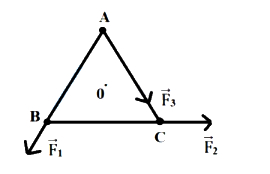
The figure shows three forces $\overrightarrow{F}_{1}, \overrightarrow{F}_{2}$ and $\overrightarrow{F}_{3}$ acting along the sides of an equilateral triangle. If the total torque acting at point $O$ (the center of the triangle) is zero,then the magnitude of $\overrightarrow{F}_{3}$ is:
A
$\frac{F_{1}-F_{2}}{2}$
B
$F_{1}-F_{2}$
C
$F_{1}+F_{2}$
D
$\frac{F_{1}}{F_{2}}$
Solution
(C) Let the perpendicular distance from the center $O$ to each side of the equilateral triangle be $r$.
The torque $\tau$ due to a force $F$ is given by $\tau = F \cdot r$,where $r$ is the perpendicular distance from the axis of rotation to the line of action of the force.
Looking at the directions of the forces in the figure,the forces $\overrightarrow{F}_{1}$ and $\overrightarrow{F}_{2}$ create a torque in the same rotational sense (e.g.,clockwise) about point $O$,while $\overrightarrow{F}_{3}$ creates a torque in the opposite sense (e.g.,counter-clockwise).
For the total torque about point $O$ to be zero,the sum of the torques must be zero:
$\tau_{1} + \tau_{2} - \tau_{3} = 0$
$rF_{1} + rF_{2} - rF_{3} = 0$
Dividing by $r$ (since $r \neq 0$):
$F_{1} + F_{2} - F_{3} = 0$
$F_{3} = F_{1} + F_{2}$
The torque $\tau$ due to a force $F$ is given by $\tau = F \cdot r$,where $r$ is the perpendicular distance from the axis of rotation to the line of action of the force.
Looking at the directions of the forces in the figure,the forces $\overrightarrow{F}_{1}$ and $\overrightarrow{F}_{2}$ create a torque in the same rotational sense (e.g.,clockwise) about point $O$,while $\overrightarrow{F}_{3}$ creates a torque in the opposite sense (e.g.,counter-clockwise).
For the total torque about point $O$ to be zero,the sum of the torques must be zero:
$\tau_{1} + \tau_{2} - \tau_{3} = 0$
$rF_{1} + rF_{2} - rF_{3} = 0$
Dividing by $r$ (since $r \neq 0$):
$F_{1} + F_{2} - F_{3} = 0$
$F_{3} = F_{1} + F_{2}$
0 likesView Solution
92
PhysicsMediumMCQMHT CET · 2020
The unit vector $(a \hat{\imath} + b \hat{\jmath})$ is perpendicular to $(\hat{\imath} + \hat{\jmath})$. The value of $b$ is
A
$+\frac{1}{\sqrt{2}}$
B
$+\frac{1}{\sqrt{3}}$
C
$+\frac{1}{2}$
D
$-\frac{1}{\sqrt{2}}$
Solution
(D) Let the unit vector be $\hat{n} = a \hat{\imath} + b \hat{\jmath}$ and the given vector be $\vec{r} = \hat{\imath} + \hat{\jmath}$.
Since $\hat{n}$ is perpendicular to $\vec{r}$,their dot product must be zero: $\hat{n} \cdot \vec{r} = 0$.
$(a \hat{\imath} + b \hat{\jmath}) \cdot (\hat{\imath} + \hat{\jmath}) = a + b = 0$,which implies $b = -a$.
Since $\hat{n}$ is a unit vector,its magnitude is $1$: $\sqrt{a^2 + b^2} = 1$.
Substituting $b = -a$,we get $\sqrt{a^2 + (-a)^2} = 1$,which simplifies to $\sqrt{2a^2} = 1$,or $|a|\sqrt{2} = 1$.
Thus,$a = \pm \frac{1}{\sqrt{2}}$.
If $a = \frac{1}{\sqrt{2}}$,then $b = -\frac{1}{\sqrt{2}}$.
If $a = -\frac{1}{\sqrt{2}}$,then $b = \frac{1}{\sqrt{2}}$.
Comparing with the given options,the value $b = -\frac{1}{\sqrt{2}}$ is present as option $D$.
Since $\hat{n}$ is perpendicular to $\vec{r}$,their dot product must be zero: $\hat{n} \cdot \vec{r} = 0$.
$(a \hat{\imath} + b \hat{\jmath}) \cdot (\hat{\imath} + \hat{\jmath}) = a + b = 0$,which implies $b = -a$.
Since $\hat{n}$ is a unit vector,its magnitude is $1$: $\sqrt{a^2 + b^2} = 1$.
Substituting $b = -a$,we get $\sqrt{a^2 + (-a)^2} = 1$,which simplifies to $\sqrt{2a^2} = 1$,or $|a|\sqrt{2} = 1$.
Thus,$a = \pm \frac{1}{\sqrt{2}}$.
If $a = \frac{1}{\sqrt{2}}$,then $b = -\frac{1}{\sqrt{2}}$.
If $a = -\frac{1}{\sqrt{2}}$,then $b = \frac{1}{\sqrt{2}}$.
Comparing with the given options,the value $b = -\frac{1}{\sqrt{2}}$ is present as option $D$.
0 likesView Solution
93
PhysicsEasyMCQMHT CET · 2020
Three vectors $\vec{A}, \vec{B}$ and $\vec{C}$ are such that $\vec{A} \cdot \vec{B} = 0$ and $\vec{A} \cdot \vec{C} = 0$. Then $\vec{A}$ is parallel to:
A
$\vec{B} \cdot \vec{C}$
B
$\vec{B} \times \vec{C}$
C
$\vec{C}$
D
$\vec{B}$
Solution
(B) Given that $\vec{A} \cdot \vec{B} = 0$,this implies that vector $\vec{A}$ is perpendicular to vector $\vec{B}$.
Given that $\vec{A} \cdot \vec{C} = 0$,this implies that vector $\vec{A}$ is perpendicular to vector $\vec{C}$.
Since vector $\vec{A}$ is perpendicular to both $\vec{B}$ and $\vec{C}$,it must be parallel to the direction of the cross product of $\vec{B}$ and $\vec{C}$.
The cross product $\vec{B} \times \vec{C}$ results in a vector that is perpendicular to the plane containing both $\vec{B}$ and $\vec{C}$.
Therefore,$\vec{A}$ is parallel to $\vec{B} \times \vec{C}$.
Given that $\vec{A} \cdot \vec{C} = 0$,this implies that vector $\vec{A}$ is perpendicular to vector $\vec{C}$.
Since vector $\vec{A}$ is perpendicular to both $\vec{B}$ and $\vec{C}$,it must be parallel to the direction of the cross product of $\vec{B}$ and $\vec{C}$.
The cross product $\vec{B} \times \vec{C}$ results in a vector that is perpendicular to the plane containing both $\vec{B}$ and $\vec{C}$.
Therefore,$\vec{A}$ is parallel to $\vec{B} \times \vec{C}$.
0 likesView Solution
94
PhysicsEasyMCQMHT CET · 2020
$\vec{A}$ and $\vec{B}$ are two non-zero vectors inclined at an angle $\theta$. $\hat{a}$ and $\hat{b}$ are unit vectors along $\vec{A}$ and $\vec{B}$ respectively. The component of $\vec{A}$ in the direction of $\vec{B}$ is
A
$\frac{\vec{A} \cdot \vec{B}}{B}$
B
$\frac{\vec{A} \times \vec{B}}{A}$
C
$\hat{a} \cdot \vec{B}$
D
$\vec{A} \cdot \hat{b}$
Solution
(D) The component of a vector $\vec{A}$ along the direction of another vector $\vec{B}$ is given by the projection of $\vec{A}$ onto the unit vector in the direction of $\vec{B}$.
Let $\hat{b}$ be the unit vector along $\vec{B}$.
The component of $\vec{A}$ in the direction of $\vec{B}$ is defined as $\vec{A} \cdot \hat{b}$.
Since $\hat{b} = \frac{\vec{B}}{|B|}$,this can also be written as $\frac{\vec{A} \cdot \vec{B}}{|B|}$.
Let $\hat{b}$ be the unit vector along $\vec{B}$.
The component of $\vec{A}$ in the direction of $\vec{B}$ is defined as $\vec{A} \cdot \hat{b}$.
Since $\hat{b} = \frac{\vec{B}}{|B|}$,this can also be written as $\frac{\vec{A} \cdot \vec{B}}{|B|}$.
0 likesView Solution
95
PhysicsEasyMCQMHT CET · 2020
Let $\vec{P} = P \sin \theta \hat{i} - P \cos \theta \hat{j}$ be any vector. Another vector $\vec{Q}$ which is perpendicular to $\vec{P}$ is
A
$(Q \sin \theta \hat{i} + Q \cos \theta \hat{j})$
B
$(Q \cos \theta \hat{i} + Q \sin \theta \hat{j})$
C
$(Q \cos \theta \hat{i} - Q \sin \theta \hat{j})$
D
$(P \sin \theta \hat{i} + P \cos \theta \hat{j})$
Solution
(B) Given vector $\vec{P} = P \sin \theta \hat{i} - P \cos \theta \hat{j}$.
Two vectors are perpendicular if their dot product is zero,i.e.,$\vec{P} \cdot \vec{Q} = 0$.
Let us check option $B$: $\vec{Q} = Q \cos \theta \hat{i} + Q \sin \theta \hat{j}$.
$\vec{P} \cdot \vec{Q} = (P \sin \theta \hat{i} - P \cos \theta \hat{j}) \cdot (Q \cos \theta \hat{i} + Q \sin \theta \hat{j})$
$= (P \sin \theta)(Q \cos \theta) + (-P \cos \theta)(Q \sin \theta)$
$= PQ \sin \theta \cos \theta - PQ \sin \theta \cos \theta = 0$.
Since the dot product is $0$,the vectors are perpendicular.
Two vectors are perpendicular if their dot product is zero,i.e.,$\vec{P} \cdot \vec{Q} = 0$.
Let us check option $B$: $\vec{Q} = Q \cos \theta \hat{i} + Q \sin \theta \hat{j}$.
$\vec{P} \cdot \vec{Q} = (P \sin \theta \hat{i} - P \cos \theta \hat{j}) \cdot (Q \cos \theta \hat{i} + Q \sin \theta \hat{j})$
$= (P \sin \theta)(Q \cos \theta) + (-P \cos \theta)(Q \sin \theta)$
$= PQ \sin \theta \cos \theta - PQ \sin \theta \cos \theta = 0$.
Since the dot product is $0$,the vectors are perpendicular.
0 likesView Solution
96
PhysicsMediumMCQMHT CET · 2020
$A$ large vessel completely filled with water has two holes '$A$' and '$B$' at depths '$h$' and '$4h$' from the top. Hole '$A$' is a square of side '$L$' and hole '$B$' is a circle of radius '$R$'. If the same quantity of water is flowing per second from both holes,then the side of the square hole is:
A
$2 \pi R$
B
$\sqrt{2 \pi R}$
C
$\sqrt{2 \pi} \cdot R$
D
$\frac{R}{2}$
Solution
(C) According to Torricelli's law,the velocity of efflux is given by $v = \sqrt{2gh}$.
For hole '$A$' at depth '$h$',the velocity is $V_A = \sqrt{2gh}$.
For hole '$B$' at depth '$4h$',the velocity is $V_B = \sqrt{2g(4h)} = 2\sqrt{2gh} = 2V_A$.
The volume flow rate $(Q)$ is given by $Q = A \cdot v$,where '$A$' is the area of the hole.
Given that the flow rate is the same for both holes: $Q_A = Q_B$.
$A_A \cdot V_A = A_B \cdot V_B$.
Since hole '$A$' is a square of side '$L$',$A_A = L^2$.
Since hole '$B$' is a circle of radius '$R$',$A_B = \pi R^2$.
Substituting the values: $L^2 \cdot V_A = (\pi R^2) \cdot (2V_A)$.
$L^2 = 2\pi R^2$.
$L = \sqrt{2\pi} \cdot R$.
For hole '$A$' at depth '$h$',the velocity is $V_A = \sqrt{2gh}$.
For hole '$B$' at depth '$4h$',the velocity is $V_B = \sqrt{2g(4h)} = 2\sqrt{2gh} = 2V_A$.
The volume flow rate $(Q)$ is given by $Q = A \cdot v$,where '$A$' is the area of the hole.
Given that the flow rate is the same for both holes: $Q_A = Q_B$.
$A_A \cdot V_A = A_B \cdot V_B$.
Since hole '$A$' is a square of side '$L$',$A_A = L^2$.
Since hole '$B$' is a circle of radius '$R$',$A_B = \pi R^2$.
Substituting the values: $L^2 \cdot V_A = (\pi R^2) \cdot (2V_A)$.
$L^2 = 2\pi R^2$.
$L = \sqrt{2\pi} \cdot R$.
0 likesView Solution
97
PhysicsMediumMCQMHT CET · 2020
$A$ large open tank containing water has two holes in its wall. $A$ square hole of side $a$ is made at a depth $y$ and a circular hole of radius $r$ is made at a depth $16y$ from the surface of the water. If an equal amount of water comes out through both the holes per second,then the relation between $r$ and $a$ will be:
A
$r=\frac{2 a}{\pi}$
B
$r=\frac{a}{2 \sqrt{\pi}}$
C
$r=\frac{a}{2 \pi}$
D
$r=\frac{2 a}{\sqrt{\pi}}$
Solution
(B) According to Torricelli's law,the velocity of efflux is $v = \sqrt{2gh}$.
Let $A_1$ be the area of the square hole and $A_2$ be the area of the circular hole.
$A_1 = a^2$ and $A_2 = \pi r^2$.
The volume flow rate $Q$ is given by $Q = A \cdot v$.
Given that the volume flow rate is equal for both holes:
$A_1 \sqrt{2gy} = A_2 \sqrt{2g(16y)}$
$a^2 \sqrt{y} = (\pi r^2) \sqrt{16y}$
$a^2 \sqrt{y} = \pi r^2 (4 \sqrt{y})$
$a^2 = 4 \pi r^2$
$r^2 = \frac{a^2}{4 \pi}$
$r = \sqrt{\frac{a^2}{4 \pi}} = \frac{a}{2 \sqrt{\pi}}$
Let $A_1$ be the area of the square hole and $A_2$ be the area of the circular hole.
$A_1 = a^2$ and $A_2 = \pi r^2$.
The volume flow rate $Q$ is given by $Q = A \cdot v$.
Given that the volume flow rate is equal for both holes:
$A_1 \sqrt{2gy} = A_2 \sqrt{2g(16y)}$
$a^2 \sqrt{y} = (\pi r^2) \sqrt{16y}$
$a^2 \sqrt{y} = \pi r^2 (4 \sqrt{y})$
$a^2 = 4 \pi r^2$
$r^2 = \frac{a^2}{4 \pi}$
$r = \sqrt{\frac{a^2}{4 \pi}} = \frac{a}{2 \sqrt{\pi}}$
0 likesView Solution
98
PhysicsEasyMCQMHT CET · 2020
Water flows through a horizontal pipe at a speed $V$. The internal diameter of the pipe is $d$. If the water is emerging from a nozzle at a speed $V_{1}$,then the diameter of the nozzle is
A
$\frac{V}{V_{1}}$
B
$d \sqrt{\frac{V_{1}}{V}}$
C
$d \sqrt{\frac{V}{V_{1}}}$
D
$\frac{d V_{1}}{V}$
Solution
(C) According to the equation of continuity for an incompressible fluid,the product of the cross-sectional area and the velocity of flow remains constant at any point along the pipe: $A_1 V_1 = A_2 V_2$.
Here,$A_1$ is the area of the pipe,$V$ is the velocity in the pipe,$A_2$ is the area of the nozzle,and $V_1$ is the velocity at the nozzle.
Since the area $A = \pi (d/2)^2$,we have $A \propto d^2$.
Substituting this into the continuity equation: $d^2 V = d_2^2 V_1$.
Solving for the nozzle diameter $d_2$: $d_2^2 = d^2 \frac{V}{V_1}$.
Taking the square root on both sides: $d_2 = d \sqrt{\frac{V}{V_1}}$.
Here,$A_1$ is the area of the pipe,$V$ is the velocity in the pipe,$A_2$ is the area of the nozzle,and $V_1$ is the velocity at the nozzle.
Since the area $A = \pi (d/2)^2$,we have $A \propto d^2$.
Substituting this into the continuity equation: $d^2 V = d_2^2 V_1$.
Solving for the nozzle diameter $d_2$: $d_2^2 = d^2 \frac{V}{V_1}$.
Taking the square root on both sides: $d_2 = d \sqrt{\frac{V}{V_1}}$.
0 likesView Solution
99
PhysicsEasyMCQMHT CET · 2020
Water is flowing through a horizontal pipe of non-uniform cross-section. In the region of the narrowest part inside the pipe,the water will have
A
maximum velocity and minimum pressure.
B
both the pressure and velocity maximum.
C
both the pressure and velocity minimum.
D
maximum pressure and minimum velocity.
Solution
(A) According to the equation of continuity,$A_{1}V_{1} = A_{2}V_{2}$.
Since the flow rate is constant,if the cross-sectional area $A$ decreases,the velocity $V$ must increase.
According to Bernoulli's principle for a horizontal pipe,$P + \frac{1}{2}\rho V^{2} = \text{constant}$.
This implies that as the velocity $V$ increases,the pressure $P$ must decrease.
Therefore,in the narrowest part of the pipe,the velocity is maximum and the pressure is minimum.
Since the flow rate is constant,if the cross-sectional area $A$ decreases,the velocity $V$ must increase.
According to Bernoulli's principle for a horizontal pipe,$P + \frac{1}{2}\rho V^{2} = \text{constant}$.
This implies that as the velocity $V$ increases,the pressure $P$ must decrease.
Therefore,in the narrowest part of the pipe,the velocity is maximum and the pressure is minimum.
0 likesView Solution
100
PhysicsMediumMCQMHT CET · 2020
$A$ closed pipe containing liquid showed a pressure $P_{1}$ by gauge. When the valve is opened,the pressure was reduced to $P_{2}$. The speed of water flowing out of the pipe is $[\rho = \text{density of water}]$
A
$\left[\frac{2(P_{1}+P_{2})}{\rho}\right]^{1/2}$
B
$\left[\frac{2(P_{1}-P_{2})}{\rho}\right]^{1/2}$
C
$\left[\frac{\rho}{2(P_{1}-P_{2})}\right]^{1/2}$
D
$\left[\frac{\rho}{2(P_{1}+P_{2})}\right]^{1/2}$
Solution
(B) According to Bernoulli's principle for a fluid in motion,the sum of pressure energy,kinetic energy,and potential energy per unit volume remains constant.
For the fluid inside the pipe,the initial pressure is $P_{1}$ when the velocity is zero.
When the valve is opened,the pressure drops to $P_{2}$ and the fluid gains a velocity $v$.
Applying Bernoulli's equation between the inside of the pipe and the outlet:
$P_{1} + 0 = P_{2} + \frac{1}{2} \rho v^{2}$
Rearranging the terms to solve for $v$:
$P_{1} - P_{2} = \frac{1}{2} \rho v^{2}$
$v^{2} = \frac{2(P_{1} - P_{2})}{\rho}$
$v = \sqrt{\frac{2(P_{1} - P_{2})}{\rho}}$
Thus,the correct option is $B$.
For the fluid inside the pipe,the initial pressure is $P_{1}$ when the velocity is zero.
When the valve is opened,the pressure drops to $P_{2}$ and the fluid gains a velocity $v$.
Applying Bernoulli's equation between the inside of the pipe and the outlet:
$P_{1} + 0 = P_{2} + \frac{1}{2} \rho v^{2}$
Rearranging the terms to solve for $v$:
$P_{1} - P_{2} = \frac{1}{2} \rho v^{2}$
$v^{2} = \frac{2(P_{1} - P_{2})}{\rho}$
$v = \sqrt{\frac{2(P_{1} - P_{2})}{\rho}}$
Thus,the correct option is $B$.
0 likesView Solution
101
PhysicsMediumMCQMHT CET · 2020
Seven capacitors,each of capacitance $2 \mu F$,are to be connected to obtain an equivalent capacitance of $\left(\frac{10}{11}\right) \mu F$. Which of the following combinations is possible?
A
$3$ in parallel and $4$ in series
B
$2$ in parallel and $5$ in series
C
$5$ in parallel and $2$ in series
D
$4$ in parallel and $3$ in series
Solution
(C) Let $n$ capacitors be connected in parallel,each of capacitance $C = 2 \mu F$. The equivalent capacitance of this parallel group is $C_p = nC = 2n \mu F$.
Let $m$ such parallel groups be connected in series. The total number of capacitors is $N = n \times m = 7$.
The equivalent capacitance of $m$ such groups in series is given by $\frac{1}{C_{eq}} = \frac{1}{C_p} + \frac{1}{C_p} + ... (m \text{ times}) = \frac{m}{C_p}$.
Thus,$C_{eq} = \frac{C_p}{m} = \frac{2n}{m}$.
Given $C_{eq} = \frac{10}{11} \mu F$,we have $\frac{2n}{m} = \frac{10}{11}$,which simplifies to $\frac{n}{m} = \frac{5}{11}$.
This implies $11n = 5m$. Since $n \times m = 7$,this does not yield integer solutions for $n$ and $m$ directly. Let us re-evaluate the combination: If we have $n$ parallel branches each containing $m$ capacitors in series,the equivalent capacitance is $C_{eq} = \frac{n}{m} C$.
Substituting $C = 2 \mu F$ and $C_{eq} = \frac{10}{11} \mu F$,we get $\frac{10}{11} = \frac{n}{m} \times 2$,so $\frac{n}{m} = \frac{5}{11}$.
Given $n+m$ is not necessarily $7$,but the total capacitors $n \times m = 7$ is not correct. The total capacitors $N = n \times m = 7$ is not possible for these ratios. Checking option $C$: $5$ in parallel and $2$ in series would mean $n=5, m=2$,$C_{eq} = \frac{5}{2} \times 2 = 5 \mu F$. Checking option $D$: $4$ in parallel and $3$ in series would mean $n=4, m=3$,$C_{eq} = \frac{4}{3} \times 2 = 2.66 \mu F$.
Wait,if we have $n$ capacitors in series and $m$ such rows in parallel,$C_{eq} = \frac{m}{n} C = \frac{m}{n} \times 2 = \frac{10}{11} \implies \frac{m}{n} = \frac{5}{11}$. Total capacitors $m \times n = 7$ is not possible.
Re-reading: If $5$ capacitors are in series and $2$ are in parallel,$C_{eq} = \frac{2}{5} \times 2 = 0.8 \mu F$. If $2$ capacitors are in series and $5$ are in parallel,$C_{eq} = \frac{5}{2} \times 2 = 5 \mu F$.
Actually,for $C_{eq} = \frac{10}{11} \mu F$ with $C=2 \mu F$,we need $\frac{m}{n} = \frac{5}{11}$. This is not possible with $7$ capacitors. However,if the question implies a mixed grouping,the closest match is $5$ in series and $2$ in parallel.
Let $m$ such parallel groups be connected in series. The total number of capacitors is $N = n \times m = 7$.
The equivalent capacitance of $m$ such groups in series is given by $\frac{1}{C_{eq}} = \frac{1}{C_p} + \frac{1}{C_p} + ... (m \text{ times}) = \frac{m}{C_p}$.
Thus,$C_{eq} = \frac{C_p}{m} = \frac{2n}{m}$.
Given $C_{eq} = \frac{10}{11} \mu F$,we have $\frac{2n}{m} = \frac{10}{11}$,which simplifies to $\frac{n}{m} = \frac{5}{11}$.
This implies $11n = 5m$. Since $n \times m = 7$,this does not yield integer solutions for $n$ and $m$ directly. Let us re-evaluate the combination: If we have $n$ parallel branches each containing $m$ capacitors in series,the equivalent capacitance is $C_{eq} = \frac{n}{m} C$.
Substituting $C = 2 \mu F$ and $C_{eq} = \frac{10}{11} \mu F$,we get $\frac{10}{11} = \frac{n}{m} \times 2$,so $\frac{n}{m} = \frac{5}{11}$.
Given $n+m$ is not necessarily $7$,but the total capacitors $n \times m = 7$ is not correct. The total capacitors $N = n \times m = 7$ is not possible for these ratios. Checking option $C$: $5$ in parallel and $2$ in series would mean $n=5, m=2$,$C_{eq} = \frac{5}{2} \times 2 = 5 \mu F$. Checking option $D$: $4$ in parallel and $3$ in series would mean $n=4, m=3$,$C_{eq} = \frac{4}{3} \times 2 = 2.66 \mu F$.
Wait,if we have $n$ capacitors in series and $m$ such rows in parallel,$C_{eq} = \frac{m}{n} C = \frac{m}{n} \times 2 = \frac{10}{11} \implies \frac{m}{n} = \frac{5}{11}$. Total capacitors $m \times n = 7$ is not possible.
Re-reading: If $5$ capacitors are in series and $2$ are in parallel,$C_{eq} = \frac{2}{5} \times 2 = 0.8 \mu F$. If $2$ capacitors are in series and $5$ are in parallel,$C_{eq} = \frac{5}{2} \times 2 = 5 \mu F$.
Actually,for $C_{eq} = \frac{10}{11} \mu F$ with $C=2 \mu F$,we need $\frac{m}{n} = \frac{5}{11}$. This is not possible with $7$ capacitors. However,if the question implies a mixed grouping,the closest match is $5$ in series and $2$ in parallel.
0 likesView Solution
102
PhysicsEasyMCQMHT CET · 2020
$A$ network of $4$ capacitors is connected to a battery as shown. The ratio of the charges on capacitors $C_{2}$ and $C_{4}$ is
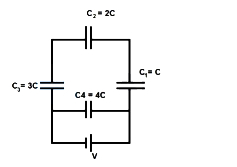
A
$\frac{3}{13}$
B
$\frac{3}{19}$
C
$\frac{3}{17}$
D
$\frac{3}{22}$
Solution
(D) From the circuit diagram,capacitors $C_{1}$,$C_{2}$,and $C_{3}$ are in series with each other,and this combination is in parallel with capacitor $C_{4}$.
Given: $C_{1} = C$,$C_{2} = 2C$,$C_{3} = 3C$,and $C_{4} = 4C$.
The equivalent capacitance of the series combination of $C_{1}$,$C_{2}$,and $C_{3}$ is given by:
$\frac{1}{C_{eq}} = \frac{1}{C_{1}} + \frac{1}{C_{2}} + \frac{1}{C_{3}} = \frac{1}{C} + \frac{1}{2C} + \frac{1}{3C} = \frac{6+3+2}{6C} = \frac{11}{6C}$
$\Rightarrow C_{eq} = \frac{6}{11}C$
The charge on the series combination (which is the same for each capacitor $C_{1}$,$C_{2}$,and $C_{3}$) is:
$Q_{series} = C_{eq} V = \frac{6}{11}CV$
Since $C_{2}$ is in this series branch,the charge on $C_{2}$ is $Q_{2} = \frac{6}{11}CV$.
The charge on capacitor $C_{4}$ (which is in parallel with the battery) is:
$Q_{4} = C_{4} V = (4C)V = 4CV$
The ratio of the charges on $C_{2}$ and $C_{4}$ is:
$\frac{Q_{2}}{Q_{4}} = \frac{\frac{6}{11}CV}{4CV} = \frac{6}{11 \times 4} = \frac{6}{44} = \frac{3}{22}$
Given: $C_{1} = C$,$C_{2} = 2C$,$C_{3} = 3C$,and $C_{4} = 4C$.
The equivalent capacitance of the series combination of $C_{1}$,$C_{2}$,and $C_{3}$ is given by:
$\frac{1}{C_{eq}} = \frac{1}{C_{1}} + \frac{1}{C_{2}} + \frac{1}{C_{3}} = \frac{1}{C} + \frac{1}{2C} + \frac{1}{3C} = \frac{6+3+2}{6C} = \frac{11}{6C}$
$\Rightarrow C_{eq} = \frac{6}{11}C$
The charge on the series combination (which is the same for each capacitor $C_{1}$,$C_{2}$,and $C_{3}$) is:
$Q_{series} = C_{eq} V = \frac{6}{11}CV$
Since $C_{2}$ is in this series branch,the charge on $C_{2}$ is $Q_{2} = \frac{6}{11}CV$.
The charge on capacitor $C_{4}$ (which is in parallel with the battery) is:
$Q_{4} = C_{4} V = (4C)V = 4CV$
The ratio of the charges on $C_{2}$ and $C_{4}$ is:
$\frac{Q_{2}}{Q_{4}} = \frac{\frac{6}{11}CV}{4CV} = \frac{6}{11 \times 4} = \frac{6}{44} = \frac{3}{22}$
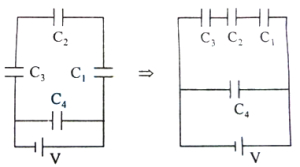
0 likesView Solution
103
PhysicsMediumMCQMHT CET · 2020
Two condensers of capacities $C$ and $2C$ are connected in parallel and then in series with a $3^{\text{rd}}$ condenser of capacity $3C$. The combination is charged to $V$ volts. The charge on the condenser of capacity $C$ is:
A
$\frac{CV}{3}$
B
$\frac{CV}{2}$
C
$2CV$
D
$CV$
Solution
(B) $1$. First, find the equivalent capacitance of the parallel combination of $C$ and $2C$. Since they are in parallel, $C_p = C + 2C = 3C$.
$2$. Now, this combination $(C_p = 3C)$ is in series with the third capacitor of capacity $3C$.
$3$. The total equivalent capacitance $C_{eq}$ of the series combination is given by $\frac{1}{C_{eq}} = \frac{1}{3C} + \frac{1}{3C} = \frac{2}{3C}$, so $C_{eq} = \frac{3C}{2}$.
$4$. The total charge $Q$ supplied by the source is $Q = C_{eq} \times V = \frac{3CV}{2}$.
$5$. In a series circuit, the charge on each branch is the same. Thus, the charge on the $3C$ capacitor is $\frac{3CV}{2}$, and the charge on the parallel combination $(C_p = 3C)$ is also $\frac{3CV}{2}$.
$6$. For the parallel combination, the voltage across both capacitors ($C$ and $2C$) is the same. Let this voltage be $V'$. $V' = \frac{Q_{parallel}}{C_p} = \frac{3CV/2}{3C} = \frac{V}{2}$.
$7$. The charge on the capacitor of capacity $C$ is $q = C \times V' = C \times \frac{V}{2} = \frac{CV}{2}$.
$2$. Now, this combination $(C_p = 3C)$ is in series with the third capacitor of capacity $3C$.
$3$. The total equivalent capacitance $C_{eq}$ of the series combination is given by $\frac{1}{C_{eq}} = \frac{1}{3C} + \frac{1}{3C} = \frac{2}{3C}$, so $C_{eq} = \frac{3C}{2}$.
$4$. The total charge $Q$ supplied by the source is $Q = C_{eq} \times V = \frac{3CV}{2}$.
$5$. In a series circuit, the charge on each branch is the same. Thus, the charge on the $3C$ capacitor is $\frac{3CV}{2}$, and the charge on the parallel combination $(C_p = 3C)$ is also $\frac{3CV}{2}$.
$6$. For the parallel combination, the voltage across both capacitors ($C$ and $2C$) is the same. Let this voltage be $V'$. $V' = \frac{Q_{parallel}}{C_p} = \frac{3CV/2}{3C} = \frac{V}{2}$.
$7$. The charge on the capacitor of capacity $C$ is $q = C \times V' = C \times \frac{V}{2} = \frac{CV}{2}$.
0 likesView Solution
104
PhysicsMediumMCQMHT CET · 2020
Five capacitors each of capacity $C$ are connected as shown in the figure. If their resultant capacity is $2 \mu F$,then the capacity of each capacitor is: (in $\mu F$)
A
$2.5$
B
$2$
C
$10$
D
$5$
Solution
(C) Given,resultant capacity,$C_{eq} = 2 \mu F$.
From the figure,all five capacitors are connected in series.
The equivalent capacity of capacitors in series is given by:
$\frac{1}{C_{eq}} = \frac{1}{C} + \frac{1}{C} + \frac{1}{C} + \frac{1}{C} + \frac{1}{C}$
$\frac{1}{C_{eq}} = \frac{5}{C}$
Substituting the value of $C_{eq}$:
$\frac{1}{2 \mu F} = \frac{5}{C}$
$C = 5 \times 2 \mu F = 10 \mu F$
Therefore,the capacity of each capacitor is $10 \mu F$.
From the figure,all five capacitors are connected in series.
The equivalent capacity of capacitors in series is given by:
$\frac{1}{C_{eq}} = \frac{1}{C} + \frac{1}{C} + \frac{1}{C} + \frac{1}{C} + \frac{1}{C}$
$\frac{1}{C_{eq}} = \frac{5}{C}$
Substituting the value of $C_{eq}$:
$\frac{1}{2 \mu F} = \frac{5}{C}$
$C = 5 \times 2 \mu F = 10 \mu F$
Therefore,the capacity of each capacitor is $10 \mu F$.
0 likesView Solution
105
PhysicsMediumMCQMHT CET · 2020
Two capacitors of capacities $2 \mu F$ and $4 \mu F$ are connected in parallel. $A$ third capacitor of $6 \mu F$ capacity is connected in series with this combination. $A$ battery of $12 \text{ V}$ is connected across this combination. The charge on the $2 \mu F$ capacitor is: (in $\mu C$)
A
$12$
B
$16$
C
$14$
D
$11$
Solution
(A) Let $C_1 = 2 \mu F$,$C_2 = 4 \mu F$,and $C_3 = 6 \mu F$.
$C_1$ and $C_2$ are in parallel,so their equivalent capacitance is $C_p = C_1 + C_2 = 2 + 4 = 6 \mu F$.
Now,$C_p$ and $C_3$ are in series. The equivalent capacitance of the whole circuit is $C_{eq} = \frac{C_p \times C_3}{C_p + C_3} = \frac{6 \times 6}{6 + 6} = 3 \mu F$.
The total charge supplied by the battery is $Q = C_{eq} \times V = 3 \mu F \times 12 \text{ V} = 36 \mu C$.
Since $C_p$ and $C_3$ are in series,the charge on the parallel combination $(C_p)$ is also $36 \mu C$.
This charge $Q$ is divided between $C_1$ and $C_2$ in proportion to their capacitances:
$Q_1 = Q \times \left( \frac{C_1}{C_1 + C_2} \right) = 36 \mu C \times \left( \frac{2}{2 + 4} \right) = 36 \times \frac{2}{6} = 12 \mu C$.
Thus,the charge on the $2 \mu F$ capacitor is $12 \mu C$.
$C_1$ and $C_2$ are in parallel,so their equivalent capacitance is $C_p = C_1 + C_2 = 2 + 4 = 6 \mu F$.
Now,$C_p$ and $C_3$ are in series. The equivalent capacitance of the whole circuit is $C_{eq} = \frac{C_p \times C_3}{C_p + C_3} = \frac{6 \times 6}{6 + 6} = 3 \mu F$.
The total charge supplied by the battery is $Q = C_{eq} \times V = 3 \mu F \times 12 \text{ V} = 36 \mu C$.
Since $C_p$ and $C_3$ are in series,the charge on the parallel combination $(C_p)$ is also $36 \mu C$.
This charge $Q$ is divided between $C_1$ and $C_2$ in proportion to their capacitances:
$Q_1 = Q \times \left( \frac{C_1}{C_1 + C_2} \right) = 36 \mu C \times \left( \frac{2}{2 + 4} \right) = 36 \times \frac{2}{6} = 12 \mu C$.
Thus,the charge on the $2 \mu F$ capacitor is $12 \mu C$.
0 likesView Solution
106
PhysicsEasyMCQMHT CET · 2020
What is the equivalent capacitance between the points $P$ and $Q$ in the combination of capacitors shown in the figure (in $\mu F$)?
A
$1$
B
$9$
C
$2$
D
$7$
Solution
(A) The circuit consists of a $3 \mu F$ capacitor in series with a parallel combination of two $1.5 \mu F$ capacitors,which is then in series with another $3 \mu F$ capacitor.
$1$. First,calculate the equivalent capacitance of the two $1.5 \mu F$ capacitors in parallel: $C_p = 1.5 \mu F + 1.5 \mu F = 3 \mu F$.
$2$. Now,the circuit simplifies to three capacitors of $3 \mu F$ each,connected in series.
$3$. The equivalent capacitance $C_{eq}$ for capacitors in series is given by: $\frac{1}{C_{eq}} = \frac{1}{C_1} + \frac{1}{C_2} + \frac{1}{C_3}$.
$4$. Substituting the values: $\frac{1}{C_{eq}} = \frac{1}{3} + \frac{1}{3} + \frac{1}{3} = \frac{3}{3} = 1 \mu F^{-1}$.
$5$. Therefore,$C_{eq} = 1 \mu F$.
$1$. First,calculate the equivalent capacitance of the two $1.5 \mu F$ capacitors in parallel: $C_p = 1.5 \mu F + 1.5 \mu F = 3 \mu F$.
$2$. Now,the circuit simplifies to three capacitors of $3 \mu F$ each,connected in series.
$3$. The equivalent capacitance $C_{eq}$ for capacitors in series is given by: $\frac{1}{C_{eq}} = \frac{1}{C_1} + \frac{1}{C_2} + \frac{1}{C_3}$.
$4$. Substituting the values: $\frac{1}{C_{eq}} = \frac{1}{3} + \frac{1}{3} + \frac{1}{3} = \frac{3}{3} = 1 \mu F^{-1}$.
$5$. Therefore,$C_{eq} = 1 \mu F$.
0 likesView Solution
107
PhysicsEasyMCQMHT CET · 2020
In a communication system,what is used to extend the range of a communication?
A
Transducer
B
Attenuation
C
Repeater
D
Modulation
Solution
(C) repeater is a combination of a receiver and a transmitter.
It receives the signal from the transmitter,amplifies it,and retransmits it to the destination.
This process compensates for the signal loss (attenuation) that occurs over long distances,thereby extending the range of the communication system.
It receives the signal from the transmitter,amplifies it,and retransmits it to the destination.
This process compensates for the signal loss (attenuation) that occurs over long distances,thereby extending the range of the communication system.
0 likesView Solution
108
PhysicsEasyMCQMHT CET · 2020
The digital signals are used for transmission in communication systems. They are
A
only of discrete stepwise values.
B
sound and picture signals in television.
C
continuous variations of current or voltage.
D
fundamental sine waves.
Solution
(A) Digital signals are signals that represent data as a sequence of discrete values at any given time. Unlike analog signals,which are continuous,digital signals consist of discrete stepwise values,typically represented by binary digits ($0$ and $1$). Therefore,they are characterized by discrete stepwise values.
0 likesView Solution
109
PhysicsEasyMCQMHT CET · 2020
In a communication system,for the given block diagram of a receiver,the boxes '$X$' and '$Y$' respectively represent:
A
Detector and amplifier
B
$IF$ stage and amplifier
C
$IF$ stage and detector
D
Amplifier and $IF$ stage
Solution
(B) In a standard superheterodyne receiver block diagram,the signal from the receiving antenna first passes through an amplifier (often an $RF$ amplifier) to boost the weak signal.
Then,it goes to the Intermediate Frequency $(IF)$ stage,where the frequency is converted to a lower,fixed intermediate frequency.
After the $IF$ stage,the signal passes through a detector (demodulator) to extract the original message signal.
Finally,the signal is passed through an audio amplifier to increase its power for the output device.
Looking at the provided diagram:
- The first box '$Y$' represents an amplifier ($RF$ amplifier).
- The second box '$X$' represents the $IF$ stage.
- The third box is the detector.
- The fourth box '$Y$' represents an amplifier (audio amplifier).
Therefore,'$X$' represents the $IF$ stage and '$Y$' represents an amplifier.
Then,it goes to the Intermediate Frequency $(IF)$ stage,where the frequency is converted to a lower,fixed intermediate frequency.
After the $IF$ stage,the signal passes through a detector (demodulator) to extract the original message signal.
Finally,the signal is passed through an audio amplifier to increase its power for the output device.
Looking at the provided diagram:
- The first box '$Y$' represents an amplifier ($RF$ amplifier).
- The second box '$X$' represents the $IF$ stage.
- The third box is the detector.
- The fourth box '$Y$' represents an amplifier (audio amplifier).
Therefore,'$X$' represents the $IF$ stage and '$Y$' represents an amplifier.
0 likesView Solution
110
PhysicsEasyMCQMHT CET · 2020
In a communication system,a repeater is used to extend the range of transmission. It is a combination of:
A
modulator and power amplifier.
B
receiver and transmitter.
C
$IF$ stage and amplifier.
D
rectifier and detector.
Solution
(B) repeater is a device that receives a signal,amplifies it,and then retransmits it to extend the range of communication. Therefore,it essentially consists of a receiver to pick up the signal and a transmitter to send it further. Thus,it is a combination of a receiver and a transmitter.
0 likesView Solution
111
PhysicsEasyMCQMHT CET · 2020
$A$ signal of frequency $3 \text{ kHz}$ is amplitude modulated on a carrier wave of frequency $2.5 \text{ MHz}$. The upper and lower sideband frequencies in the resultant signal are
A
$2500 \text{ kHz}, 2503 \text{ kHz}$
B
$2503 \text{ kHz}, 2497 \text{ kHz}$
C
$2.5 \text{ MHz}, 3 \text{ kHz}$
D
$5.5 \text{ MHz}, 0.5 \text{ MHz}$
Solution
(B) Given:
Frequency of the modulating signal,$f_m = 3 \text{ kHz} = 0.003 \text{ MHz}$.
Frequency of the carrier wave,$f_c = 2.5 \text{ MHz} = 2500 \text{ kHz}$.
The upper sideband frequency $(f_{USB})$ is given by $f_c + f_m = 2500 \text{ kHz} + 3 \text{ kHz} = 2503 \text{ kHz}$.
The lower sideband frequency $(f_{LSB})$ is given by $f_c - f_m = 2500 \text{ kHz} - 3 \text{ kHz} = 2497 \text{ kHz}$.
Thus,the sideband frequencies are $2503 \text{ kHz}$ and $2497 \text{ kHz}$.
Frequency of the modulating signal,$f_m = 3 \text{ kHz} = 0.003 \text{ MHz}$.
Frequency of the carrier wave,$f_c = 2.5 \text{ MHz} = 2500 \text{ kHz}$.
The upper sideband frequency $(f_{USB})$ is given by $f_c + f_m = 2500 \text{ kHz} + 3 \text{ kHz} = 2503 \text{ kHz}$.
The lower sideband frequency $(f_{LSB})$ is given by $f_c - f_m = 2500 \text{ kHz} - 3 \text{ kHz} = 2497 \text{ kHz}$.
Thus,the sideband frequencies are $2503 \text{ kHz}$ and $2497 \text{ kHz}$.
0 likesView Solution
112
PhysicsEasyMCQMHT CET · 2020
In a communication system,the range for line-of-sight propagation on Earth is $d$ for an antenna height of $h$. If $h$ is doubled,then the new range is:
A
$\frac{d}{\sqrt{2}}$
B
$\frac{\sqrt{2}}{d}$
C
$\frac{d}{2}$
D
$\sqrt{2} d$
Solution
(D) The range $d$ for line-of-sight propagation is given by the formula $d = \sqrt{2Rh}$,where $R$ is the radius of the Earth and $h$ is the height of the antenna.
From this formula,we can see that $d \propto \sqrt{h}$.
Let the initial range be $d_1 = \sqrt{2Rh}$ and the initial height be $h_1 = h$.
Let the new height be $h_2 = 2h$.
The new range $d_2$ is given by $d_2 = \sqrt{2Rh_2} = \sqrt{2R(2h)}$.
$d_2 = \sqrt{2} \times \sqrt{2Rh} = \sqrt{2} d_1$.
Therefore,if the height is doubled,the new range becomes $\sqrt{2} d$.
From this formula,we can see that $d \propto \sqrt{h}$.
Let the initial range be $d_1 = \sqrt{2Rh}$ and the initial height be $h_1 = h$.
Let the new height be $h_2 = 2h$.
The new range $d_2$ is given by $d_2 = \sqrt{2Rh_2} = \sqrt{2R(2h)}$.
$d_2 = \sqrt{2} \times \sqrt{2Rh} = \sqrt{2} d_1$.
Therefore,if the height is doubled,the new range becomes $\sqrt{2} d$.
0 likesView Solution
113
PhysicsEasyMCQMHT CET · 2020
In amplitude modulation,
A
both amplitude and frequency do not change according to information signal.
B
amplitude remains constant but frequency changes according to information signal.
C
both amplitude and frequency change according to information signal.
D
amplitude of carrier wave changes according to information signal.
Solution
(D) In amplitude modulation,the amplitude of the carrier wave is varied in accordance with the instantaneous value of the modulating signal (information signal),while the frequency and phase of the carrier wave remain constant.
0 likesView Solution
114
PhysicsEasyMCQMHT CET · 2020
$A$ carrier wave of peak voltage $16 \text{ V}$ is used to transmit a signal. If the modulation index is $75 \%$, the peak voltage of the modulating signal is (in $\text{ V}$)
A
$6$
B
$24$
C
$18$
D
$12$
Solution
(D) The modulation index $(m_a)$ is defined as the ratio of the peak voltage of the modulating signal $(V_m)$ to the peak voltage of the carrier wave $(V_c)$.
Formula: $m_a = \frac{V_m}{V_c}$
Given:
Peak voltage of carrier wave $(V_c)$ = $16 \text{ V}$
Modulation index $(m_a)$ = $75 \% = 0.75$
Calculation:
$V_m = m_a \times V_c$
$V_m = 0.75 \times 16 \text{ V}$
$V_m = 12 \text{ V}$
Therefore, the peak voltage of the modulating signal is $12 \text{ V}$.
Formula: $m_a = \frac{V_m}{V_c}$
Given:
Peak voltage of carrier wave $(V_c)$ = $16 \text{ V}$
Modulation index $(m_a)$ = $75 \% = 0.75$
Calculation:
$V_m = m_a \times V_c$
$V_m = 0.75 \times 16 \text{ V}$
$V_m = 12 \text{ V}$
Therefore, the peak voltage of the modulating signal is $12 \text{ V}$.
0 likesView Solution
115
PhysicsEasyMCQMHT CET · 2020
Modulation is a process of superposing
A
low frequency radio signal on low frequency audio waves.
B
high frequency audio signal on low frequency radio waves.
C
low frequency audio signal on high frequency radio waves.
D
high frequency radio signal on low frequency audio signal.
Solution
(C) Low frequency audio signals cannot be transmitted directly over long distances because they require antennas of impractical size and suffer from high attenuation. To overcome this,the low frequency audio signal (baseband signal) is superposed on a high frequency wave,known as the carrier wave. This process is called modulation.
0 likesView Solution
116
PhysicsEasyMCQMHT CET · 2020
Identify the '$INCORRECT$' statement from the following.
A
Modulation index $\mu$ is kept greater than one to avoid distortion.
B
The receiving antenna is followed by an amplifier,an intermediate frequency $(IF)$ stage,and a detector.
C
$AM$ detection is carried out using a rectifier and an envelope detector.
D
The modulated signal is followed by a power amplifier and then fed to an antenna.
Solution
(A) In amplitude modulation,the modulation index $\mu$ is defined as the ratio of the amplitude of the modulating signal to the amplitude of the carrier wave. If $\mu > 1$,it leads to over-modulation,which causes severe distortion in the signal. Therefore,to avoid distortion,the modulation index $\mu$ is always kept less than or equal to $1$ (i.e.,$\mu \le 1$). Thus,the statement that $\mu$ is kept greater than one is incorrect.
0 likesView Solution
117
PhysicsEasyMCQMHT CET · 2020
According to the theoretical study of radiation from a linear antenna,the power radiated is proportional to $[\lambda = \text{wavelength}]$
A
$\lambda^{-2}$
B
$\lambda^{-1}$
C
$\lambda^{2}$
D
$\lambda$
Solution
(A) For a linear antenna of length $l$ (where $l \ll \lambda$),the power radiated $P$ is given by the relation $P \propto \frac{1}{\lambda^2}$.
This implies that the power radiated is inversely proportional to the square of the wavelength.
Therefore,as the wavelength $\lambda$ increases,the power radiated decreases.
Thus,the correct proportionality is $\lambda^{-2}$.
This implies that the power radiated is inversely proportional to the square of the wavelength.
Therefore,as the wavelength $\lambda$ increases,the power radiated decreases.
Thus,the correct proportionality is $\lambda^{-2}$.
0 likesView Solution
118
PhysicsEasyMCQMHT CET · 2020
In the process of space communication,the use of a modem is necessary. In which one of the following modes does a modem act as a modulator and a demodulator respectively?
A
Transmitting and receiving.
B
Both receiving.
C
Both transmitting.
D
Receiving and transmitting.
Solution
(A) modem stands for Modulator-Demodulator.
In the process of space communication,at the transmitting end,the modem acts as a modulator to convert digital signals into analog signals for transmission.
At the receiving end,the modem acts as a demodulator to convert the received analog signals back into digital signals.
Therefore,the modem acts as a modulator during transmission and as a demodulator during reception.
In the process of space communication,at the transmitting end,the modem acts as a modulator to convert digital signals into analog signals for transmission.
At the receiving end,the modem acts as a demodulator to convert the received analog signals back into digital signals.
Therefore,the modem acts as a modulator during transmission and as a demodulator during reception.
0 likesView Solution
119
PhysicsEasyMCQMHT CET · 2020
Using Kirchhoff's law,find the current flowing through the given circuit. (in $A$)
A
$7.5$
B
$5$
C
$10$
D
$3$
Solution
(B) In the given circuit,the two cells are connected in series but with opposing polarities.
Applying Kirchhoff's voltage law $(KVL)$ to the loop,we start from the $200 \ V$ cell and move in the direction of the current:
$200 - I(38) - 10 = 0$
$190 - 38I = 0$
$38I = 190$
$I = \frac{190}{38} = 5 \ A$
Therefore,the current flowing through the circuit is $5 \ A$.
Applying Kirchhoff's voltage law $(KVL)$ to the loop,we start from the $200 \ V$ cell and move in the direction of the current:
$200 - I(38) - 10 = 0$
$190 - 38I = 0$
$38I = 190$
$I = \frac{190}{38} = 5 \ A$
Therefore,the current flowing through the circuit is $5 \ A$.
0 likesView Solution
120
PhysicsMediumMCQMHT CET · 2020
In the circuit shown,the potential difference across the $4.5 \mu F$ capacitor is
A
$\frac{8}{3}$ volt
B
$8$ volt
C
$6$ volt
D
$4$ volt
Solution
(B) The $3 \mu F$ and $6 \mu F$ capacitors are connected in parallel. Their equivalent capacitance is $C_p = 3 \mu F + 6 \mu F = 9 \mu F$.
This $C_p$ is in series with the $4.5 \mu F$ capacitor. The equivalent capacitance of the circuit is $C_{eq} = \frac{4.5 \times 9}{4.5 + 9} = \frac{40.5}{13.5} = 3 \mu F$.
The total charge supplied by the $12 \text{ V}$ battery is $Q = C_{eq} V = 3 \mu F \times 12 \text{ V} = 36 \mu C$.
Since the $4.5 \mu F$ capacitor is in series with the combination,the charge on it is equal to the total charge $Q = 36 \mu C$.
The potential difference across the $4.5 \mu F$ capacitor is $V_{4.5} = \frac{Q}{C} = \frac{36 \mu C}{4.5 \mu F} = 8 \text{ V}$.
This $C_p$ is in series with the $4.5 \mu F$ capacitor. The equivalent capacitance of the circuit is $C_{eq} = \frac{4.5 \times 9}{4.5 + 9} = \frac{40.5}{13.5} = 3 \mu F$.
The total charge supplied by the $12 \text{ V}$ battery is $Q = C_{eq} V = 3 \mu F \times 12 \text{ V} = 36 \mu C$.
Since the $4.5 \mu F$ capacitor is in series with the combination,the charge on it is equal to the total charge $Q = 36 \mu C$.
The potential difference across the $4.5 \mu F$ capacitor is $V_{4.5} = \frac{Q}{C} = \frac{36 \mu C}{4.5 \mu F} = 8 \text{ V}$.
0 likesView Solution
121
PhysicsEasyMCQMHT CET · 2020
$A$ $10 \ m$ long wire of resistance $20 \ \Omega$ is connected in series with a battery of e.m.f. $3 \ V$ and a resistance of $10 \ \Omega$. The potential gradient along the wire in $V/m$ is
A
$0.02$
B
$1.2$
C
$0.10$
D
$0.20$
Solution
(D) The total resistance of the circuit is $R_{total} = R_{wire} + R_{series} = 20 \ \Omega + 10 \ \Omega = 30 \ \Omega$.
The current flowing through the circuit is $I = \frac{E}{R_{total}} = \frac{3 \ V}{30 \ \Omega} = 0.1 \ A$.
The potential difference across the wire is $V_{wire} = I \times R_{wire} = 0.1 \ A \times 20 \ \Omega = 2 \ V$.
The potential gradient along the wire is defined as the potential drop per unit length: $\text{Potential gradient} = \frac{V_{wire}}{L} = \frac{2 \ V}{10 \ m} = 0.2 \ V/m$.
The current flowing through the circuit is $I = \frac{E}{R_{total}} = \frac{3 \ V}{30 \ \Omega} = 0.1 \ A$.
The potential difference across the wire is $V_{wire} = I \times R_{wire} = 0.1 \ A \times 20 \ \Omega = 2 \ V$.
The potential gradient along the wire is defined as the potential drop per unit length: $\text{Potential gradient} = \frac{V_{wire}}{L} = \frac{2 \ V}{10 \ m} = 0.2 \ V/m$.
0 likesView Solution
122
PhysicsMediumMCQMHT CET · 2020
In the following network,$I_{1} = -0.4 \text{ A}$,$I_{4} = 1 \text{ A}$ and $I_{5} = 0.4 \text{ A}$. The values of $I_{2}$,$I_{3}$ and $I_{6}$ respectively are:
A
$0.4 \text{ A}, -0.6 \text{ A}, 1.4 \text{ A}$
B
$-0.6 \text{ A}, 1.4 \text{ A}, 0.4 \text{ A}$
C
$1.4 \text{ A}, 0.4 \text{ A}, -0.6 \text{ A}$
D
$1.4 \text{ A}, -0.6 \text{ A}, 0.4 \text{ A}$
Solution
(D) Applying Kirchhoff's Current Law $(KCL)$ at the junctions:
At the right junction: $I_{1} + I_{2} = I_{4}$
Given $I_{1} = -0.4 \text{ A}$ and $I_{4} = 1 \text{ A}$,we have:
$-0.4 + I_{2} = 1 \implies I_{2} = 1.4 \text{ A}$
At the bottom-left junction: $I_{5} = I_{3} + I_{4}$
Given $I_{5} = 0.4 \text{ A}$ and $I_{4} = 1 \text{ A}$,we have:
$0.4 = I_{3} + 1 \implies I_{3} = -0.6 \text{ A}$
At the top-left junction: $I_{6} = I_{5} + I_{3}$ (Wait,looking at the diagram,$I_{6}$ is the current entering the top-right junction from the left branch,so $I_{6} = I_{5}$ is not correct. Let's re-evaluate the circuit).
Actually,applying $KCL$ at the top-right junction: $I_{6} = I_{1} + I_{2} + I_{3}$.
Substituting the values: $I_{6} = -0.4 + 1.4 + (-0.6) = 0.4 \text{ A}$.
Thus,$I_{2} = 1.4 \text{ A}$,$I_{3} = -0.6 \text{ A}$,and $I_{6} = 0.4 \text{ A}$.
At the right junction: $I_{1} + I_{2} = I_{4}$
Given $I_{1} = -0.4 \text{ A}$ and $I_{4} = 1 \text{ A}$,we have:
$-0.4 + I_{2} = 1 \implies I_{2} = 1.4 \text{ A}$
At the bottom-left junction: $I_{5} = I_{3} + I_{4}$
Given $I_{5} = 0.4 \text{ A}$ and $I_{4} = 1 \text{ A}$,we have:
$0.4 = I_{3} + 1 \implies I_{3} = -0.6 \text{ A}$
At the top-left junction: $I_{6} = I_{5} + I_{3}$ (Wait,looking at the diagram,$I_{6}$ is the current entering the top-right junction from the left branch,so $I_{6} = I_{5}$ is not correct. Let's re-evaluate the circuit).
Actually,applying $KCL$ at the top-right junction: $I_{6} = I_{1} + I_{2} + I_{3}$.
Substituting the values: $I_{6} = -0.4 + 1.4 + (-0.6) = 0.4 \text{ A}$.
Thus,$I_{2} = 1.4 \text{ A}$,$I_{3} = -0.6 \text{ A}$,and $I_{6} = 0.4 \text{ A}$.
0 likesView Solution
123
PhysicsEasyMCQMHT CET · 2020
In an atom,an electron of charge $(-e)$ performs uniform circular motion ($U$.$C$.$M$.) around a stationary positively charged nucleus with a period of revolution $T$. If $r$ is the radius of the orbit of the electron and $v$ is the orbital velocity,then the circulating current $I$ is proportional to:
A
$e^{1} r^{-1} v^{1}$
B
$e^{1} r^{1} v^{-1}$
C
$e^{1} v^{1} r^{-1}$
D
$v^{1} r^{1} e^{-1}$
Solution
(C) The current $I$ is defined as the rate of flow of charge,given by $I = \frac{q}{T}$,where $q$ is the charge and $T$ is the time period of revolution.
For an electron moving in a circular orbit of radius $r$ with orbital velocity $v$,the distance covered in one revolution is the circumference $2 \pi r$.
Thus,the time period $T$ is given by $T = \frac{2 \pi r}{v}$.
Substituting this into the expression for current:
$I = \frac{e}{T} = \frac{e}{(2 \pi r / v)} = \frac{ev}{2 \pi r}$.
Since $2 \pi$ is a constant,we have $I \propto e^{1} v^{1} r^{-1}$.
Therefore,the correct option is $C$.
For an electron moving in a circular orbit of radius $r$ with orbital velocity $v$,the distance covered in one revolution is the circumference $2 \pi r$.
Thus,the time period $T$ is given by $T = \frac{2 \pi r}{v}$.
Substituting this into the expression for current:
$I = \frac{e}{T} = \frac{e}{(2 \pi r / v)} = \frac{ev}{2 \pi r}$.
Since $2 \pi$ is a constant,we have $I \propto e^{1} v^{1} r^{-1}$.
Therefore,the correct option is $C$.
0 likesView Solution
124
PhysicsMediumMCQMHT CET · 2020
$A$ galvanometer has resistance '$G$' and range '$V_g$'. How much resistance is required to read voltage up to '$V$' volt?
A
$G\left(\frac{V}{V_g}-1\right)$
B
$G\left(\frac{V+V_g}{V}\right)$
C
$G\left(\frac{V-V_g}{V}\right)$
D
$GV_g$
Solution
(A) The galvanometer has a resistance $G$ and a full-scale deflection voltage $V_g$. The full-scale current $I_g$ is given by $I_g = \frac{V_g}{G}$.
To convert the galvanometer into a voltmeter of range $V$,a series resistance $R$ must be connected in series with the galvanometer.
The total resistance of the circuit becomes $R + G$.
According to Ohm's law,for the new range $V$,the current $I_g$ remains the same:
$V = I_g(R + G)$
Substituting $I_g = \frac{V_g}{G}$ into the equation:
$V = \left(\frac{V_g}{G}\right)(R + G)$
$\frac{V}{V_g} = \frac{R+G}{G}$
$\frac{V}{V_g} = \frac{R}{G} + 1$
$\frac{R}{G} = \frac{V}{V_g} - 1$
$R = G\left(\frac{V}{V_g} - 1\right)$
To convert the galvanometer into a voltmeter of range $V$,a series resistance $R$ must be connected in series with the galvanometer.
The total resistance of the circuit becomes $R + G$.
According to Ohm's law,for the new range $V$,the current $I_g$ remains the same:
$V = I_g(R + G)$
Substituting $I_g = \frac{V_g}{G}$ into the equation:
$V = \left(\frac{V_g}{G}\right)(R + G)$
$\frac{V}{V_g} = \frac{R+G}{G}$
$\frac{V}{V_g} = \frac{R}{G} + 1$
$\frac{R}{G} = \frac{V}{V_g} - 1$
$R = G\left(\frac{V}{V_g} - 1\right)$
0 likesView Solution
125
PhysicsEasyMCQMHT CET · 2020
The deflection in a moving coil galvanometer is reduced to half when it is shunted with a $X \ \Omega$ coil. The relation between $X$ and the resistance of the galvanometer $G$ is:
A
$2X = G$
B
$4X = G$
C
$X = 2G$
D
$X = G$
Solution
(D) Let the initial current through the galvanometer be $I$. The deflection is proportional to the current,so the new current through the galvanometer is $I' = I/2$.
By the principle of current division in a parallel circuit,the total current $I_{total}$ is divided between the galvanometer $G$ and the shunt $X$.
Since $I_G = I/2$,the remaining current must flow through the shunt: $I_X = I_{total} - I_G = I - I/2 = I/2$.
Since the galvanometer and shunt are in parallel,the potential difference across them is equal: $I_G \cdot G = I_X \cdot X$.
Substituting the values: $(I/2) \cdot G = (I/2) \cdot X$.
Therefore,$G = X$ or $X = G$.
By the principle of current division in a parallel circuit,the total current $I_{total}$ is divided between the galvanometer $G$ and the shunt $X$.
Since $I_G = I/2$,the remaining current must flow through the shunt: $I_X = I_{total} - I_G = I - I/2 = I/2$.
Since the galvanometer and shunt are in parallel,the potential difference across them is equal: $I_G \cdot G = I_X \cdot X$.
Substituting the values: $(I/2) \cdot G = (I/2) \cdot X$.
Therefore,$G = X$ or $X = G$.
0 likesView Solution
126
PhysicsEasyMCQMHT CET · 2020
$A$ stray magnetic field does $\underline{\text{NOT}}$ affect the deflection of a moving coil galvanometer because
A
magnetic field inside the galvanometer is zero.
B
magnetic field is equal to the earth's magnetic field.
C
magnetic field inside the galvanometer is very strong.
D
magnetic field inside the galvanometer is very weak.
Solution
(C) In a moving coil galvanometer,a strong radial magnetic field is produced by using concave-shaped pole pieces of a permanent magnet. This internal magnetic field is significantly stronger than any external stray magnetic field. Due to this high intensity,the effect of external stray magnetic fields becomes negligible,ensuring that the deflection of the coil depends only on the current flowing through it.
0 likesView Solution
127
PhysicsEasyMCQMHT CET · 2020
Sensitivity of a given potentiometer can be decreased by
A
increasing the current through the wire.
B
decreasing the current through the wire.
C
decreasing the potential gradient along the wire.
D
increasing the potential gradient along the wire.
Solution
(D) The sensitivity of a potentiometer is defined as the smallest potential difference that can be measured by it.
Sensitivity is inversely proportional to the potential gradient $(k = V/L)$.
$A$ smaller potential gradient means a higher sensitivity.
Therefore, to decrease the sensitivity, we must increase the potential gradient along the wire.
Since the potential gradient $k = I \cdot R/L$, increasing the current $(I)$ through the wire increases the potential gradient, thereby decreasing the sensitivity.
Sensitivity is inversely proportional to the potential gradient $(k = V/L)$.
$A$ smaller potential gradient means a higher sensitivity.
Therefore, to decrease the sensitivity, we must increase the potential gradient along the wire.
Since the potential gradient $k = I \cdot R/L$, increasing the current $(I)$ through the wire increases the potential gradient, thereby decreasing the sensitivity.
0 likesView Solution
128
PhysicsDifficultMCQMHT CET · 2020
$A$ galvanometer of resistance $100 \Omega$ requires $10 \mu A$ current for full-scale deflection. If a shunt resistance of $1 \Omega$ is connected in parallel to convert it into an ammeter, what is the minimum current required to obtain full-scale deflection (in $\text{ mA}$)?
A
$101$
B
$1.01$
C
$11.0$
D
$10.1$
Solution
(B) Given: Resistance of galvanometer $G = 100 \Omega$, Shunt resistance $S = 1 \Omega$, Full-scale deflection current $I_g = 10 \mu A = 10 \times 10^{-6} A$.
To convert a galvanometer into an ammeter, the shunt resistance $S$ is connected in parallel.
The total current $I$ required for full-scale deflection is given by the formula: $I = I_g \left( \frac{G+S}{S} \right)$.
Substituting the values: $I = 10 \mu A \left( \frac{100 + 1}{1} \right)$.
$I = 10 \mu A \times 101 = 1010 \mu A$.
Converting to milliamperes: $I = 1.01 \text{ mA}$.
To convert a galvanometer into an ammeter, the shunt resistance $S$ is connected in parallel.
The total current $I$ required for full-scale deflection is given by the formula: $I = I_g \left( \frac{G+S}{S} \right)$.
Substituting the values: $I = 10 \mu A \left( \frac{100 + 1}{1} \right)$.
$I = 10 \mu A \times 101 = 1010 \mu A$.
Converting to milliamperes: $I = 1.01 \text{ mA}$.
0 likesView Solution
129
PhysicsMediumMCQMHT CET · 2020
The length of a potentiometer wire is $L$. $A$ cell of e.m.f. $E$ is balanced at a length $\frac{L}{5}$ from the positive end of the wire. If the length of the wire is increased by $\frac{L}{2}$,at what distance will the same cell give a balance point?
A
$\frac{5 L}{12}$
B
$\frac{2 L}{15}$
C
$\frac{4 L}{15}$
D
$\frac{3 L}{10}$
Solution
(D) Let the potential difference across the wire be $V$. The potential gradient $k$ is given by $k = \frac{V}{L_{total}}$.
For the first case,the balancing length $l_1 = \frac{L}{5}$. The e.m.f. $E$ is given by $E = k_1 l_1 = \frac{V}{L} \cdot \frac{L}{5} = \frac{V}{5}$.
When the length of the wire is increased by $\frac{L}{2}$,the new total length becomes $L' = L + \frac{L}{2} = \frac{3L}{2}$.
The new potential gradient is $k_2 = \frac{V}{L'} = \frac{V}{3L/2} = \frac{2V}{3L}$.
Let the new balancing length be $l_2$. Then $E = k_2 l_2$.
Equating the two expressions for $E$: $\frac{V}{5} = \frac{2V}{3L} \cdot l_2$.
Solving for $l_2$: $l_2 = \frac{V}{5} \cdot \frac{3L}{2V} = \frac{3L}{10}$.
For the first case,the balancing length $l_1 = \frac{L}{5}$. The e.m.f. $E$ is given by $E = k_1 l_1 = \frac{V}{L} \cdot \frac{L}{5} = \frac{V}{5}$.
When the length of the wire is increased by $\frac{L}{2}$,the new total length becomes $L' = L + \frac{L}{2} = \frac{3L}{2}$.
The new potential gradient is $k_2 = \frac{V}{L'} = \frac{V}{3L/2} = \frac{2V}{3L}$.
Let the new balancing length be $l_2$. Then $E = k_2 l_2$.
Equating the two expressions for $E$: $\frac{V}{5} = \frac{2V}{3L} \cdot l_2$.
Solving for $l_2$: $l_2 = \frac{V}{5} \cdot \frac{3L}{2V} = \frac{3L}{10}$.
0 likesView Solution
130
PhysicsMediumMCQMHT CET · 2020
In a potentiometer experiment,the balancing length with a cell $E_{1}$ of unknown e.m.f. is $\ell_{1} \ cm$. By shunting the cell with a resistance $R \ \Omega$,the balancing length becomes $\frac{\ell_{1}}{2} \ cm$. The internal resistance $(r)$ of the cell is:
A
$r=0$
B
$r=\frac{R}{2}$
C
$r=2 R$
D
$r=R$
Solution
(D) In a potentiometer,the balancing length $\ell$ is directly proportional to the terminal potential difference $V$ across the cell.
For an open circuit,the balancing length $\ell_{1}$ corresponds to the e.m.f. $E$ of the cell: $E \propto \ell_{1}$.
When the cell is shunted with an external resistance $R$,the terminal potential difference $V$ is given by $V = E - Ir$,where $I = \frac{E}{R+r}$.
Thus,$V = E - \left(\frac{E}{R+r}\right)r = E\left(1 - \frac{r}{R+r}\right) = E\left(\frac{R}{R+r}\right)$.
The new balancing length $\ell_{2}$ corresponds to the terminal potential difference $V$: $V \propto \ell_{2}$.
Given $\ell_{2} = \frac{\ell_{1}}{2}$,we have $\frac{V}{E} = \frac{\ell_{2}}{\ell_{1}} = \frac{1}{2}$.
Substituting the expression for $V/E$: $\frac{R}{R+r} = \frac{1}{2}$.
Solving for $r$: $2R = R + r$,which gives $r = R$.
For an open circuit,the balancing length $\ell_{1}$ corresponds to the e.m.f. $E$ of the cell: $E \propto \ell_{1}$.
When the cell is shunted with an external resistance $R$,the terminal potential difference $V$ is given by $V = E - Ir$,where $I = \frac{E}{R+r}$.
Thus,$V = E - \left(\frac{E}{R+r}\right)r = E\left(1 - \frac{r}{R+r}\right) = E\left(\frac{R}{R+r}\right)$.
The new balancing length $\ell_{2}$ corresponds to the terminal potential difference $V$: $V \propto \ell_{2}$.
Given $\ell_{2} = \frac{\ell_{1}}{2}$,we have $\frac{V}{E} = \frac{\ell_{2}}{\ell_{1}} = \frac{1}{2}$.
Substituting the expression for $V/E$: $\frac{R}{R+r} = \frac{1}{2}$.
Solving for $r$: $2R = R + r$,which gives $r = R$.
0 likesView Solution
131
PhysicsMediumMCQMHT CET · 2020
If only $2 \%$ of the total current passes through an ammeter having a coil of resistance $R$,then the resistance of the shunt of the ammeter is:
A
$49 R$
B
$\frac{R}{50}$
C
$\frac{R}{49}$
D
$50 R$
Solution
(C) Let $I$ be the total current and $I_g$ be the current passing through the galvanometer (ammeter coil).
Given that $I_g = 2 \% \text{ of } I = \frac{2}{100} I = \frac{1}{50} I$.
The formula for current division in a shunt circuit is $\frac{I_g}{I} = \frac{S}{S+R}$,where $S$ is the shunt resistance and $R$ is the coil resistance.
Substituting the values: $\frac{1}{50} = \frac{S}{S+R}$.
Cross-multiplying gives: $S + R = 50S$.
Rearranging the terms: $R = 50S - S = 49S$.
Therefore,the shunt resistance is $S = \frac{R}{49}$.
Given that $I_g = 2 \% \text{ of } I = \frac{2}{100} I = \frac{1}{50} I$.
The formula for current division in a shunt circuit is $\frac{I_g}{I} = \frac{S}{S+R}$,where $S$ is the shunt resistance and $R$ is the coil resistance.
Substituting the values: $\frac{1}{50} = \frac{S}{S+R}$.
Cross-multiplying gives: $S + R = 50S$.
Rearranging the terms: $R = 50S - S = 49S$.
Therefore,the shunt resistance is $S = \frac{R}{49}$.
0 likesView Solution
132
PhysicsEasyMCQMHT CET · 2020
In the experiment to determine the internal resistance $(r)$ of a cell $(E_1)$ using a potentiometer,the resistance drawn from the resistance box is $R$. The potential difference across the balancing length of the wire is equal to the terminal potential difference $(V)$ of the cell. The value of the internal resistance $(r)$ of the cell is:
A
$R\left(\frac{E_1}{V}+1\right)$
B
$R\left(\frac{V}{E_1}-1\right)$
C
$R\left(\frac{V}{E_1}+1\right)$
D
$R\left(\frac{E_1}{V}-1\right)$
Solution
(D) In a potentiometer experiment to find the internal resistance $(r)$ of a cell,the cell $E_1$ is connected in series with a resistance box $R$.
When the circuit is open,the balancing length $l_1$ is proportional to the $EMF$ $(E_1)$: $E_1 = k l_1$.
When the circuit is closed (resistance $R$ is connected),the balancing length $l_2$ is proportional to the terminal potential difference $(V)$: $V = k l_2$.
The internal resistance is given by the formula: $r = R \left( \frac{E_1}{V} - 1 \right)$.
Here,$E_1$ is the $EMF$ of the cell,$V$ is the terminal potential difference,and $R$ is the external resistance.
When the circuit is open,the balancing length $l_1$ is proportional to the $EMF$ $(E_1)$: $E_1 = k l_1$.
When the circuit is closed (resistance $R$ is connected),the balancing length $l_2$ is proportional to the terminal potential difference $(V)$: $V = k l_2$.
The internal resistance is given by the formula: $r = R \left( \frac{E_1}{V} - 1 \right)$.
Here,$E_1$ is the $EMF$ of the cell,$V$ is the terminal potential difference,and $R$ is the external resistance.
0 likesView Solution
133
PhysicsEasyMCQMHT CET · 2020
If the number of turns in the coil of a galvanometer is decreased,then the resistance of the galvanometer:
A
may increase or decrease.
B
increases.
C
remains the same.
D
decreases.
Solution
(D) The resistance $R$ of a wire is given by the formula $R = \rho \frac{L}{A}$,where $\rho$ is the resistivity,$L$ is the length of the wire,and $A$ is the cross-sectional area.
Since the coil of a galvanometer is made of a wire of a certain length,the total length $L$ is directly proportional to the number of turns $N$ $(L \propto N)$.
If the number of turns $N$ is decreased,the total length $L$ of the wire used in the coil decreases.
Since $R \propto L$,a decrease in the length $L$ leads to a decrease in the resistance $R$ of the galvanometer.
Since the coil of a galvanometer is made of a wire of a certain length,the total length $L$ is directly proportional to the number of turns $N$ $(L \propto N)$.
If the number of turns $N$ is decreased,the total length $L$ of the wire used in the coil decreases.
Since $R \propto L$,a decrease in the length $L$ leads to a decrease in the resistance $R$ of the galvanometer.
0 likesView Solution
134
PhysicsMediumMCQMHT CET · 2020
In a potentiometer experiment,cells of e.m.f. $E_{1}$ and $E_{2}$ are connected in series $(E_{1} > E_{2})$,and the balancing length is $64 \ cm$. If the polarity of $E_{2}$ is reversed,the balancing length becomes $32 \ cm$. The ratio $\frac{E_{1}}{E_{2}}$ is:
A
$1: 2$
B
$2: 1$
C
$1: 3$
D
$3: 1$
Solution
(D) Let $k$ be the potential gradient of the potentiometer wire.
When the cells are connected in series with the same polarity,the total e.m.f. is $(E_{1} + E_{2})$. The balancing condition is $(E_{1} + E_{2}) = k \ell_{1}$,where $\ell_{1} = 64 \ cm$.
When the polarity of $E_{2}$ is reversed,the total e.m.f. is $(E_{1} - E_{2})$. The balancing condition is $(E_{1} - E_{2}) = k \ell_{2}$,where $\ell_{2} = 32 \ cm$.
Dividing the two equations: $\frac{E_{1} + E_{2}}{E_{1} - E_{2}} = \frac{64}{32} = 2$.
$E_{1} + E_{2} = 2(E_{1} - E_{2})$.
$E_{1} + E_{2} = 2E_{1} - 2E_{2}$.
$3E_{2} = E_{1}$.
Therefore,$\frac{E_{1}}{E_{2}} = 3: 1$.
When the cells are connected in series with the same polarity,the total e.m.f. is $(E_{1} + E_{2})$. The balancing condition is $(E_{1} + E_{2}) = k \ell_{1}$,where $\ell_{1} = 64 \ cm$.
When the polarity of $E_{2}$ is reversed,the total e.m.f. is $(E_{1} - E_{2})$. The balancing condition is $(E_{1} - E_{2}) = k \ell_{2}$,where $\ell_{2} = 32 \ cm$.
Dividing the two equations: $\frac{E_{1} + E_{2}}{E_{1} - E_{2}} = \frac{64}{32} = 2$.
$E_{1} + E_{2} = 2(E_{1} - E_{2})$.
$E_{1} + E_{2} = 2E_{1} - 2E_{2}$.
$3E_{2} = E_{1}$.
Therefore,$\frac{E_{1}}{E_{2}} = 3: 1$.
0 likesView Solution
135
PhysicsMediumMCQMHT CET · 2020
When a resistance of $200 \Omega$ is connected in series with a galvanometer of resistance $G$,its range is $V$. To triple its range,a resistance of $2000 \Omega$ is connected in series. The value of $G$ is (in $Omega$)
A
$700$
B
$900$
C
$400$
D
$600$
Solution
(A) Let $I_g$ be the full-scale deflection current of the galvanometer.
For the first case,the total resistance is $(200 + G)$,so the voltage range is $V = I_g(200 + G)$.
For the second case,the range is tripled,so $V' = 3V = I_g(2000 + G)$.
Dividing the two equations: $\frac{3V}{V} = \frac{I_g(2000 + G)}{I_g(200 + G)}$.
$3 = \frac{2000 + G}{200 + G}$.
$3(200 + G) = 2000 + G$.
$600 + 3G = 2000 + G$.
$2G = 1400$.
$G = 700 \Omega$.
For the first case,the total resistance is $(200 + G)$,so the voltage range is $V = I_g(200 + G)$.
For the second case,the range is tripled,so $V' = 3V = I_g(2000 + G)$.
Dividing the two equations: $\frac{3V}{V} = \frac{I_g(2000 + G)}{I_g(200 + G)}$.
$3 = \frac{2000 + G}{200 + G}$.
$3(200 + G) = 2000 + G$.
$600 + 3G = 2000 + G$.
$2G = 1400$.
$G = 700 \Omega$.
0 likesView Solution
136
PhysicsEasyMCQMHT CET · 2020
The scale of a galvanometer is divided into $100$ equal divisions. It has a current sensitivity of $10 \text{ div./mA}$ and a voltage sensitivity of $4 \text{ div./mV}$. The resistance of the galvanometer is: (in $Omega$)
A
$5$
B
$2.5$
C
$10$
D
$7.5$
Solution
(B) Given:
Current sensitivity,$S_I = \frac{d\theta}{dI} = 10 \text{ div./mA} = 10 \times 10^3 \text{ div./A}$.
Voltage sensitivity,$S_V = \frac{d\theta}{dV} = 4 \text{ div./mV} = 4 \times 10^3 \text{ div./V}$.
We know that $V = IR$,so $dV = dI \times R$,which implies $R = \frac{dV}{dI}$.
Also,$S_V = \frac{d\theta}{dV} = \frac{d\theta}{dI \cdot R} = \frac{S_I}{R}$.
Therefore,$R = \frac{S_I}{S_V} = \frac{10 \text{ div./mA}}{4 \text{ div./mV}} = \frac{10 \times 10^{-3} \text{ A}^{-1}}{4 \times 10^{-3} \text{ V}^{-1}} = \frac{10}{4} \Omega = 2.5 \Omega$.
Current sensitivity,$S_I = \frac{d\theta}{dI} = 10 \text{ div./mA} = 10 \times 10^3 \text{ div./A}$.
Voltage sensitivity,$S_V = \frac{d\theta}{dV} = 4 \text{ div./mV} = 4 \times 10^3 \text{ div./V}$.
We know that $V = IR$,so $dV = dI \times R$,which implies $R = \frac{dV}{dI}$.
Also,$S_V = \frac{d\theta}{dV} = \frac{d\theta}{dI \cdot R} = \frac{S_I}{R}$.
Therefore,$R = \frac{S_I}{S_V} = \frac{10 \text{ div./mA}}{4 \text{ div./mV}} = \frac{10 \times 10^{-3} \text{ A}^{-1}}{4 \times 10^{-3} \text{ V}^{-1}} = \frac{10}{4} \Omega = 2.5 \Omega$.
0 likesView Solution
137
PhysicsMediumMCQMHT CET · 2020
$A$ potentiometer wire has length $4 \, m$ and resistance $5 \, \Omega$. It is connected in series with $495 \, \Omega$ resistance and a cell of e.m.f. $4 \, V$. The potential gradient along the wire is (in $V/m$)
A
$0.03$
B
$0.01$
C
$0.02$
D
$0.04$
Solution
(B) Total resistance $R_{total} = 495 \, \Omega + 5 \, \Omega = 500 \, \Omega$.
Current $I$ flowing through the circuit is given by $I = \frac{V}{R_{total}} = \frac{4 \, V}{500 \, \Omega} = 8 \times 10^{-3} \, A$.
The potential difference $V_{wire}$ across the potentiometer wire is $V_{wire} = I \times R_{wire} = 8 \times 10^{-3} \, A \times 5 \, \Omega = 40 \times 10^{-3} \, V$.
The potential gradient $k$ is defined as the potential drop per unit length: $k = \frac{V_{wire}}{L} = \frac{40 \times 10^{-3} \, V}{4 \, m} = 10 \times 10^{-3} \, V/m = 0.01 \, V/m$.
Current $I$ flowing through the circuit is given by $I = \frac{V}{R_{total}} = \frac{4 \, V}{500 \, \Omega} = 8 \times 10^{-3} \, A$.
The potential difference $V_{wire}$ across the potentiometer wire is $V_{wire} = I \times R_{wire} = 8 \times 10^{-3} \, A \times 5 \, \Omega = 40 \times 10^{-3} \, V$.
The potential gradient $k$ is defined as the potential drop per unit length: $k = \frac{V_{wire}}{L} = \frac{40 \times 10^{-3} \, V}{4 \, m} = 10 \times 10^{-3} \, V/m = 0.01 \, V/m$.
0 likesView Solution
138
PhysicsEasyMCQMHT CET · 2020
The sensitivity of a moving coil galvanometer is inversely proportional to
A
current it measures.
B
number of turns in the coil.
C
magnetic induction of the horse shoe magnet.
D
torsional constant of the phosphor bronze suspension wire.
Solution
(D) The torque acting on the coil of a moving coil galvanometer is given by $\tau = nABi \sin \theta$. For small angles,$\sin \theta \approx \theta$. The restoring torque is $\tau_r = C \theta$,where $C$ is the torsional constant of the suspension wire.
Equating the torques: $C \theta = nABi$.
The current sensitivity $S_i$ is defined as the deflection per unit current: $S_i = \frac{\theta}{i} = \frac{nAB}{C}$.
From this expression,it is clear that the sensitivity $S_i$ is inversely proportional to the torsional constant $C$ of the suspension wire.
Equating the torques: $C \theta = nABi$.
The current sensitivity $S_i$ is defined as the deflection per unit current: $S_i = \frac{\theta}{i} = \frac{nAB}{C}$.
From this expression,it is clear that the sensitivity $S_i$ is inversely proportional to the torsional constant $C$ of the suspension wire.
0 likesView Solution
139
PhysicsEasyMCQMHT CET · 2020
The length of a potentiometer wire is $4 \,m$ and is connected in series with an accumulator. The e.m.f. of a cell balances against $1.5 \,m$ length of the wire. If the length of the potentiometer wire is doubled,then the new balancing length of the wire will be: (in $\,m$)
A
$4.5$
B
$1.5$
C
$0.75$
D
$3$
Solution
(D) The potential gradient $k$ of a potentiometer wire is given by $k = V/L$,where $V$ is the potential difference across the wire and $L$ is the total length of the wire.
When the length of the wire is doubled $(L' = 2L)$,the potential gradient becomes $k' = V/(2L) = k/2$.
The balancing condition for an unknown e.m.f. $E$ is $E = k \cdot l$,where $l$ is the balancing length.
Since $E$ remains constant,$k \cdot l = k' \cdot l'$.
Substituting $k' = k/2$,we get $k \cdot l = (k/2) \cdot l'$,which simplifies to $l' = 2l$.
Given the initial balancing length $l = 1.5 \,m$,the new balancing length is $l' = 2 \times 1.5 \,m = 3 \,m$.
When the length of the wire is doubled $(L' = 2L)$,the potential gradient becomes $k' = V/(2L) = k/2$.
The balancing condition for an unknown e.m.f. $E$ is $E = k \cdot l$,where $l$ is the balancing length.
Since $E$ remains constant,$k \cdot l = k' \cdot l'$.
Substituting $k' = k/2$,we get $k \cdot l = (k/2) \cdot l'$,which simplifies to $l' = 2l$.
Given the initial balancing length $l = 1.5 \,m$,the new balancing length is $l' = 2 \times 1.5 \,m = 3 \,m$.
0 likesView Solution
140
PhysicsMediumMCQMHT CET · 2020
$A$ potentiometer is used to measure the potential difference between $A$ and $B$,and the null point is obtained at $0.9 \ m$. Now,the potential difference between $A$ and $C$ is measured,and the null point is obtained at $0.3 \ m$. Find the ratio $\frac{E_{2}}{E_{1}}$,given that $E_{1} > E_{2}$.
A
$3: 1$
B
$3: 2$
C
$2: 3$
D
$1: 3$
Solution
(C) The potential difference between $A$ and $B$ is $V_{AB} = E_{1}$. The null point length is $L_{AB} = 0.9 \ m$.
Since $V \propto L$,we have $E_{1} = k \times 0.9$,where $k$ is the potential gradient.
The potential difference between $A$ and $C$ is $V_{AC} = E_{1} - E_{2}$. The null point length is $L_{AC} = 0.3 \ m$.
Thus,$E_{1} - E_{2} = k \times 0.3$.
Dividing the two equations: $\frac{E_{1}}{E_{1} - E_{2}} = \frac{0.9}{0.3} = 3$.
$E_{1} = 3(E_{1} - E_{2})$
$E_{1} = 3E_{1} - 3E_{2}$
$3E_{2} = 2E_{1}$
$\frac{E_{2}}{E_{1}} = \frac{2}{3}$.
Since $V \propto L$,we have $E_{1} = k \times 0.9$,where $k$ is the potential gradient.
The potential difference between $A$ and $C$ is $V_{AC} = E_{1} - E_{2}$. The null point length is $L_{AC} = 0.3 \ m$.
Thus,$E_{1} - E_{2} = k \times 0.3$.
Dividing the two equations: $\frac{E_{1}}{E_{1} - E_{2}} = \frac{0.9}{0.3} = 3$.
$E_{1} = 3(E_{1} - E_{2})$
$E_{1} = 3E_{1} - 3E_{2}$
$3E_{2} = 2E_{1}$
$\frac{E_{2}}{E_{1}} = \frac{2}{3}$.
0 likesView Solution
141
PhysicsEasyMCQMHT CET · 2020
Two galvanometers $G_{1}$ and $G_{2}$ require $2 \ mA$ and $3 \ mA$ respectively to produce the same deflection. Then:
A
$G_{1}$ and $G_{2}$ are equally sensitive.
B
$G_{1}$ is more sensitive than $G_{2}$.
C
$G_{1}$ is less sensitive than $G_{2}$.
D
Sensitivity of $G_{2}$ is $\frac{3}{2}$ times that of $G_{1}$.
Solution
(B) The sensitivity of a galvanometer is defined as the deflection produced per unit current,i.e.,$S = \frac{\theta}{I}$.
Given that both galvanometers produce the same deflection $\theta$,the sensitivity is inversely proportional to the current required: $S \propto \frac{1}{I}$.
For $G_{1}$,$I_{1} = 2 \ mA$,so $S_{1} = \frac{\theta}{2 \ mA}$.
For $G_{2}$,$I_{2} = 3 \ mA$,so $S_{2} = \frac{\theta}{3 \ mA}$.
Comparing the two,since $I_{1} < I_{2}$,it follows that $S_{1} > S_{2}$.
Therefore,$G_{1}$ is more sensitive than $G_{2}$.
Given that both galvanometers produce the same deflection $\theta$,the sensitivity is inversely proportional to the current required: $S \propto \frac{1}{I}$.
For $G_{1}$,$I_{1} = 2 \ mA$,so $S_{1} = \frac{\theta}{2 \ mA}$.
For $G_{2}$,$I_{2} = 3 \ mA$,so $S_{2} = \frac{\theta}{3 \ mA}$.
Comparing the two,since $I_{1} < I_{2}$,it follows that $S_{1} > S_{2}$.
Therefore,$G_{1}$ is more sensitive than $G_{2}$.
0 likesView Solution
142
PhysicsMediumMCQMHT CET · 2020
An ammeter of resistance $20 \Omega$ gives full scale deflection when $1 \text{ mA}$ current flows through it. What is the maximum current that can be measured by connecting $4$ resistors each of $16 \Omega$ in parallel with the meter (in $\text{ mA}$)?
A
$6$
B
$8$
C
$4$
D
$2$
Solution
(A) The resistance of the ammeter is $G = 20 \Omega$ and the full-scale deflection current is $i_g = 1 \text{ mA} = 10^{-3} \text{ A}$.
Four resistors of $16 \Omega$ each are connected in parallel. The equivalent shunt resistance $S$ is given by $\frac{1}{S} = \frac{1}{16} + \frac{1}{16} + \frac{1}{16} + \frac{1}{16} = \frac{4}{16} = \frac{1}{4} \Omega^{-1}$.
Thus,$S = 4 \Omega$.
For an ammeter,the shunt resistance $S$ is connected in parallel to the galvanometer $G$. The current $i$ to be measured is divided into $i_g$ through the galvanometer and $i_s$ through the shunt.
The voltage across the parallel combination is $i_s S = i_g G$.
$(i - i_g) S = i_g G$.
$(i - 10^{-3}) \times 4 = 10^{-3} \times 20$.
$i - 10^{-3} = \frac{20 \times 10^{-3}}{4} = 5 \times 10^{-3}$.
$i = 5 \times 10^{-3} + 1 \times 10^{-3} = 6 \times 10^{-3} \text{ A} = 6 \text{ mA}$.
Four resistors of $16 \Omega$ each are connected in parallel. The equivalent shunt resistance $S$ is given by $\frac{1}{S} = \frac{1}{16} + \frac{1}{16} + \frac{1}{16} + \frac{1}{16} = \frac{4}{16} = \frac{1}{4} \Omega^{-1}$.
Thus,$S = 4 \Omega$.
For an ammeter,the shunt resistance $S$ is connected in parallel to the galvanometer $G$. The current $i$ to be measured is divided into $i_g$ through the galvanometer and $i_s$ through the shunt.
The voltage across the parallel combination is $i_s S = i_g G$.
$(i - i_g) S = i_g G$.
$(i - 10^{-3}) \times 4 = 10^{-3} \times 20$.
$i - 10^{-3} = \frac{20 \times 10^{-3}}{4} = 5 \times 10^{-3}$.
$i = 5 \times 10^{-3} + 1 \times 10^{-3} = 6 \times 10^{-3} \text{ A} = 6 \text{ mA}$.
0 likesView Solution
143
PhysicsEasyMCQMHT CET · 2020
$A$ potentiometer wire is $4 \,m$ long and a potential difference of $3 \,V$ is maintained between its ends. The e.m.f. of the cell which balances against a length of $100 \,cm$ of the potentiometer wire is: (in $\,V$)
A
$0.50$
B
$0.60$
C
$0.75$
D
$1.00$
Solution
(C) The potential gradient $k$ of the potentiometer wire is given by the ratio of the total potential difference $V$ to the total length $L$ of the wire.
$k = \frac{V}{L} = \frac{3 \,V}{4 \,m} = 0.75 \,V/m$.
We are given that the cell balances at a length $l = 100 \,cm = 1 \,m$.
The e.m.f. $E$ of the cell is equal to the potential drop across the balancing length $l$, which is given by $E = k \times l$.
Substituting the values, we get $E = 0.75 \,V/m \times 1 \,m = 0.75 \,V$.
$k = \frac{V}{L} = \frac{3 \,V}{4 \,m} = 0.75 \,V/m$.
We are given that the cell balances at a length $l = 100 \,cm = 1 \,m$.
The e.m.f. $E$ of the cell is equal to the potential drop across the balancing length $l$, which is given by $E = k \times l$.
Substituting the values, we get $E = 0.75 \,V/m \times 1 \,m = 0.75 \,V$.
0 likesView Solution
144
PhysicsEasyMCQMHT CET · 2020
In the conversion of a moving coil galvanometer into an ammeter of a required range,what is the resistance of the ammeter so formed? [$S$ = shunt resistance and $G$ = resistance of the galvanometer]
A
$\frac{S+G}{SG}$
B
$\frac{SG}{S-G}$
C
$\frac{SG}{S+G}$
D
$\frac{S-G}{SG}$
Solution
(C) To convert a moving coil galvanometer into an ammeter,a small resistance called a shunt $(S)$ is connected in parallel with the galvanometer $(G)$.
The equivalent resistance $(R)$ of the ammeter is the parallel combination of $G$ and $S$.
The formula for parallel resistance is:
$\frac{1}{R} = \frac{1}{G} + \frac{1}{S}$
Taking the common denominator:
$\frac{1}{R} = \frac{S + G}{GS}$
Therefore,the resistance of the ammeter is:
$R = \frac{GS}{G + S}$
Comparing this with the given options,the correct expression is $\frac{SG}{S+G}$,which corresponds to option $(C)$.
The equivalent resistance $(R)$ of the ammeter is the parallel combination of $G$ and $S$.
The formula for parallel resistance is:
$\frac{1}{R} = \frac{1}{G} + \frac{1}{S}$
Taking the common denominator:
$\frac{1}{R} = \frac{S + G}{GS}$
Therefore,the resistance of the ammeter is:
$R = \frac{GS}{G + S}$
Comparing this with the given options,the correct expression is $\frac{SG}{S+G}$,which corresponds to option $(C)$.
0 likesView Solution
145
PhysicsEasyMCQMHT CET · 2020
Which of the following instruments is '$NOT$' a direct reading instrument?
A
Voltmeter
B
Ammeter
C
Electronic balance
D
Potentiometer
Solution
(D) direct reading instrument provides the value of the measured quantity directly on a scale or display without requiring any manual calculation or balancing process.
$A$,$B$,and $C$ are direct reading instruments because they show the result immediately.
$A$ potentiometer is a null-type instrument. It requires a balancing process (finding the null point) to measure potential difference or $EMF$,and the final value is calculated based on the balancing length.
Therefore,the potentiometer is not a direct reading instrument.
Correct option is $D$.
$A$,$B$,and $C$ are direct reading instruments because they show the result immediately.
$A$ potentiometer is a null-type instrument. It requires a balancing process (finding the null point) to measure potential difference or $EMF$,and the final value is calculated based on the balancing length.
Therefore,the potentiometer is not a direct reading instrument.
Correct option is $D$.
0 likesView Solution
146
PhysicsMediumMCQMHT CET · 2020
$A$ potentiometer wire of length $100 \ cm$ and resistance $3 \ \Omega$ is connected in series with a resistance of $8 \ \Omega$ and an accumulator of $4 \ V$ whose internal resistance is $1 \ \Omega$. $A$ cell of e.m.f. $E$ is balanced by $50 \ cm$ length of the wire. The e.m.f. of the cell is: (in $V$)
A
$1.00$
B
$0.75$
C
$0.50$
D
$0.25$
Solution
(C) The total resistance of the circuit is $R_{total} = R_{wire} + R_{series} + r_{internal} = 3 \ \Omega + 8 \ \Omega + 1 \ \Omega = 12 \ \Omega$.
The current flowing through the potentiometer wire is $I = \frac{V}{R_{total}} = \frac{4 \ V}{12 \ \Omega} = \frac{1}{3} \ A$.
The potential difference across the potentiometer wire is $V_{wire} = I \times R_{wire} = \frac{1}{3} \ A \times 3 \ \Omega = 1 \ V$.
The potential gradient $K$ of the wire is $K = \frac{V_{wire}}{L} = \frac{1 \ V}{100 \ cm} = 0.01 \ V/cm$.
The e.m.f. $E$ of the cell balanced at length $\ell = 50 \ cm$ is $E = K \times \ell = 0.01 \ V/cm \times 50 \ cm = 0.50 \ V$.
The current flowing through the potentiometer wire is $I = \frac{V}{R_{total}} = \frac{4 \ V}{12 \ \Omega} = \frac{1}{3} \ A$.
The potential difference across the potentiometer wire is $V_{wire} = I \times R_{wire} = \frac{1}{3} \ A \times 3 \ \Omega = 1 \ V$.
The potential gradient $K$ of the wire is $K = \frac{V_{wire}}{L} = \frac{1 \ V}{100 \ cm} = 0.01 \ V/cm$.
The e.m.f. $E$ of the cell balanced at length $\ell = 50 \ cm$ is $E = K \times \ell = 0.01 \ V/cm \times 50 \ cm = 0.50 \ V$.
0 likesView Solution
147
PhysicsMediumMCQMHT CET · 2020
Moving coil galvanometers $M_{1}$ and $M_{2}$ have resistance,number of turns,area of coil,and magnetic field as follows:
$R_{1}=10 \Omega, R_{2}=14 \Omega, N_{1}=30, N_{2}=42$
$A_{1}=3.6 \times 10^{-3} \ m^{2}, A_{2}=1.8 \times 10^{-2} \ m^{2}, B_{1}=0.25 \ T, B_{2}=0.50 \ T$
(Spring constants are same for both galvanometers).
The ratio of $(i)$ current sensitivity and (ii) voltage sensitivity for galvanometer ($M_{2}$ to $M_{1}$) is respectively:
$R_{1}=10 \Omega, R_{2}=14 \Omega, N_{1}=30, N_{2}=42$
$A_{1}=3.6 \times 10^{-3} \ m^{2}, A_{2}=1.8 \times 10^{-2} \ m^{2}, B_{1}=0.25 \ T, B_{2}=0.50 \ T$
(Spring constants are same for both galvanometers).
The ratio of $(i)$ current sensitivity and (ii) voltage sensitivity for galvanometer ($M_{2}$ to $M_{1}$) is respectively:
A
$1: 1, 1.4: 1$
B
$1: 1.4, 1: 1$
C
$4: 1, 1: 1$
D
$1.4: 1, 1: 1$
Solution
(D) Current sensitivity $I_{s} = \frac{NBA}{k}$.
Voltage sensitivity $V_{s} = \frac{I_{s}}{R} = \frac{NBA}{kR}$.
Given $k_{1} = k_{2} = k$.
Ratio of current sensitivity $\frac{I_{s2}}{I_{s1}} = \frac{N_{2}B_{2}A_{2}}{N_{1}B_{1}A_{1}} = \frac{42 \times 0.50 \times 1.8 \times 10^{-2}}{30 \times 0.25 \times 3.6 \times 10^{-3}} = \frac{21 \times 1.8 \times 10^{-2}}{7.5 \times 3.6 \times 10^{-3}} = \frac{37.8 \times 10^{-2}}{27 \times 10^{-3}} = 1.4$.
Ratio of voltage sensitivity $\frac{V_{s2}}{V_{s1}} = \frac{I_{s2}}{I_{s1}} \times \frac{R_{1}}{R_{2}} = 1.4 \times \frac{10}{14} = 1.4 \times \frac{1}{1.4} = 1$.
Thus,the ratio is $1.4: 1$ and $1: 1$.
Voltage sensitivity $V_{s} = \frac{I_{s}}{R} = \frac{NBA}{kR}$.
Given $k_{1} = k_{2} = k$.
Ratio of current sensitivity $\frac{I_{s2}}{I_{s1}} = \frac{N_{2}B_{2}A_{2}}{N_{1}B_{1}A_{1}} = \frac{42 \times 0.50 \times 1.8 \times 10^{-2}}{30 \times 0.25 \times 3.6 \times 10^{-3}} = \frac{21 \times 1.8 \times 10^{-2}}{7.5 \times 3.6 \times 10^{-3}} = \frac{37.8 \times 10^{-2}}{27 \times 10^{-3}} = 1.4$.
Ratio of voltage sensitivity $\frac{V_{s2}}{V_{s1}} = \frac{I_{s2}}{I_{s1}} \times \frac{R_{1}}{R_{2}} = 1.4 \times \frac{10}{14} = 1.4 \times \frac{1}{1.4} = 1$.
Thus,the ratio is $1.4: 1$ and $1: 1$.
0 likesView Solution
148
PhysicsMediumMCQMHT CET · 2020
Two cells having unknown e.m.f.s $E_{1}$ and $E_{2}$ $(E_{1} > E_{2})$ are connected in a potentiometer circuit so as to assist each other. The null point is obtained at $490 \ cm$ from the higher potential end. When cell $E_{2}$ is connected so as to oppose cell $E_{1}$,the null point is obtained at $90 \ cm$ from the same end. The ratio of the e.m.f.s of the two cells $(\frac{E_{1}}{E_{2}})$ is:
A
$0.689$
B
$0.182$
C
$5.33$
D
$1.45$
Solution
(D) In a potentiometer circuit,when two cells are connected to assist each other,the balancing length $\ell_{1}$ is proportional to $(E_{1} + E_{2})$. Thus,$E_{1} + E_{2} = k \ell_{1}$,where $k$ is the potential gradient.
When they are connected to oppose each other,the balancing length $\ell_{2}$ is proportional to $(E_{1} - E_{2})$. Thus,$E_{1} - E_{2} = k \ell_{2}$.
Dividing the two equations,we get: $\frac{E_{1} + E_{2}}{E_{1} - E_{2}} = \frac{\ell_{1}}{\ell_{2}}$.
Using the given values $\ell_{1} = 490 \ cm$ and $\ell_{2} = 90 \ cm$:
$\frac{E_{1} + E_{2}}{E_{1} - E_{2}} = \frac{490}{90} = \frac{49}{9}$.
Applying componendo and dividendo:
$\frac{E_{1}}{E_{2}} = \frac{49 + 9}{49 - 9} = \frac{58}{40} = 1.45$.
When they are connected to oppose each other,the balancing length $\ell_{2}$ is proportional to $(E_{1} - E_{2})$. Thus,$E_{1} - E_{2} = k \ell_{2}$.
Dividing the two equations,we get: $\frac{E_{1} + E_{2}}{E_{1} - E_{2}} = \frac{\ell_{1}}{\ell_{2}}$.
Using the given values $\ell_{1} = 490 \ cm$ and $\ell_{2} = 90 \ cm$:
$\frac{E_{1} + E_{2}}{E_{1} - E_{2}} = \frac{490}{90} = \frac{49}{9}$.
Applying componendo and dividendo:
$\frac{E_{1}}{E_{2}} = \frac{49 + 9}{49 - 9} = \frac{58}{40} = 1.45$.
0 likesView Solution
149
PhysicsEasyMCQMHT CET · 2020
Two galvanometers $A$ and $B$ require currents of $4 \ mA$ and $7 \ mA$,respectively,to produce the same deflection of $20$ divisions. If $S_{A}$ and $S_{B}$ are their sensitivities,respectively,then:
A
$S_{A} > S_{B}$
B
$S_{A} = S_{B} = \frac{4}{7}$
C
$S_{B} = \frac{7}{4} = S_{A}$
D
$S_{A} < S_{B}$
Solution
(A) The sensitivity $S$ of a galvanometer is defined as the deflection per unit current,given by $S = \frac{\theta}{I}$.
Given that both galvanometers produce the same deflection $\theta = 20$ divisions.
For galvanometer $A$,$S_{A} = \frac{\theta}{I_{A}} = \frac{20}{4 \ mA} = 5 \ \text{div/mA}$.
For galvanometer $B$,$S_{B} = \frac{\theta}{I_{B}} = \frac{20}{7 \ mA} \approx 2.86 \ \text{div/mA}$.
Comparing the two,$S_{A} > S_{B}$.
Alternatively,since $S \propto \frac{1}{I}$ for a constant deflection,$\frac{S_{A}}{S_{B}} = \frac{I_{B}}{I_{A}} = \frac{7}{4} = 1.75$.
Thus,$S_{A} = 1.75 S_{B}$,which implies $S_{A} > S_{B}$.
Given that both galvanometers produce the same deflection $\theta = 20$ divisions.
For galvanometer $A$,$S_{A} = \frac{\theta}{I_{A}} = \frac{20}{4 \ mA} = 5 \ \text{div/mA}$.
For galvanometer $B$,$S_{B} = \frac{\theta}{I_{B}} = \frac{20}{7 \ mA} \approx 2.86 \ \text{div/mA}$.
Comparing the two,$S_{A} > S_{B}$.
Alternatively,since $S \propto \frac{1}{I}$ for a constant deflection,$\frac{S_{A}}{S_{B}} = \frac{I_{B}}{I_{A}} = \frac{7}{4} = 1.75$.
Thus,$S_{A} = 1.75 S_{B}$,which implies $S_{A} > S_{B}$.
0 likesView Solution
150
PhysicsEasyMCQMHT CET · 2020
$A$ milliammeter of resistance $40 \Omega$ has a range $0-30 \text{ mA}$. What will be the resistance used in series to convert it into a voltmeter of range $0-15 \text{ V}$ (in $Omega$)?
A
$460$
B
$920$
C
$560$
D
$640$
Solution
(A) To convert a milliammeter into a voltmeter,a high resistance $R$ must be connected in series with the milliammeter.
Given:
Resistance of milliammeter,$G = 40 \Omega$
Full-scale deflection current,$I_g = 30 \text{ mA} = 30 \times 10^{-3} \text{ A} = 0.03 \text{ A}$
Required voltage range,$V = 15 \text{ V}$
The formula for the series resistance $R$ is:
$R = \frac{V}{I_g} - G$
Substituting the values:
$R = \frac{15}{30 \times 10^{-3}} - 40$
$R = \frac{15}{0.03} - 40$
$R = 500 - 40$
$R = 460 \Omega$
Therefore,a resistance of $460 \Omega$ should be connected in series.
Given:
Resistance of milliammeter,$G = 40 \Omega$
Full-scale deflection current,$I_g = 30 \text{ mA} = 30 \times 10^{-3} \text{ A} = 0.03 \text{ A}$
Required voltage range,$V = 15 \text{ V}$
The formula for the series resistance $R$ is:
$R = \frac{V}{I_g} - G$
Substituting the values:
$R = \frac{15}{30 \times 10^{-3}} - 40$
$R = \frac{15}{0.03} - 40$
$R = 500 - 40$
$R = 460 \Omega$
Therefore,a resistance of $460 \Omega$ should be connected in series.
0 likesView Solution
Vedclass Products
For Students
Vedclass Test Series
Mock tests in real MHT CET style covering Physics with performance analysis. 5-day free trial.
Start Free TrialFor Teachers
Exam Paper Generator
Generate Set A/B/C/D Physics papers from 7.5L+ questions in 2 minutes. 3 chapters free.
Try FreeFor Institutes
Online Exam Module
Run live MHT CET mock exams with unlimited students, 360° analytics & white-label branding.
See DemoFrequently Asked Questions
How many Physics questions are in MHT CET 2020?
There are 690 Physics questions from the MHT CET 2020 paper on Vedclass, each with a detailed step-by-step solution in English.
Are MHT CET 2020 Physics solutions available in English?
Yes. All solutions on this page are in English. You can also switch to English or Hindi using the language buttons above the questions.
Can I practice MHT CET 2020 Physics as a timed test?
Yes. Use the Vedclass Test Series to attempt a full MHT CET mock test covering Physics with time limits and instant score analysis.
Can teachers create Physics papers from MHT CET previous year questions?
Yes. The Vedclass Exam Paper Generator lets teachers mix MHT CET Physics questions and generate Set A/B/C/D papers in minutes.
For Teachers & Institutes
Build a Custom Physics Paper
Pick MHT CET 2020 Physics questions, set difficulty, and generate Set A/B/C/D in 2 minutes.