
અ Gujarati
Properties of definite integration Questions in Gujarati
Class 12 Mathematics · 7-2.Definite Integral · Properties of definite integration
722+
Questions
Gujarati
Language
100%
With Solutions
Showing 50 of 722 questions in Gujarati
351
DifficultMCQ
ધારો કે $f: R \rightarrow R$ એ $f(x)=\frac{4^x}{4^x+2}$ દ્વારા વ્યાખ્યાયિત વિધેય છે અને $M=\int_{f(a)}^{f(1-a)} x \sin^4(x(1-x)) dx,$ $N=\int_{f(a)}^{f(1-a)} \sin^4(x(1-x)) dx;$ $a \neq \frac{1}{2}.$ જો $\alpha M=\beta N,$ $\alpha, \beta \in N$ હોય,તો $\alpha^2+\beta^2$ ની ન્યૂનતમ કિંમત $.....$ છે.
A
$4$
B
$5$
C
$6$
D
$7$
Solution
(B) પ્રથમ,નોંધો કે $f(x) + f(1-x) = \frac{4^x}{4^x+2} + \frac{4^{1-x}}{4^{1-x}+2} = \frac{4^x}{4^x+2} + \frac{4/4^x}{4/4^x+2} = \frac{4^x}{4^x+2} + \frac{4}{4+2 \cdot 4^x} = \frac{4^x}{4^x+2} + \frac{2}{2+4^x} = \frac{4^x+2}{4^x+2} = 1.$
ધારો કે $M = \int_{f(a)}^{f(1-a)} x \sin^4(x(1-x)) dx.$ ગુણધર્મ $\int_A^B g(x) dx = \int_A^B g(A+B-x) dx$ નો ઉપયોગ કરતા,અને $A+B = f(a) + f(1-a) = 1$ હોવાથી,આપણને મળે છે:
$M = \int_{f(a)}^{f(1-a)} (1-x) \sin^4((1-x)(1-(1-x))) dx = \int_{f(a)}^{f(1-a)} (1-x) \sin^4((1-x)x) dx.$
આમ,$M = \int_{f(a)}^{f(1-a)} \sin^4(x(1-x)) dx - \int_{f(a)}^{f(1-a)} x \sin^4(x(1-x)) dx.$
આનો અર્થ એ થાય કે $M = N - M,$ જેનું સાદું રૂપ $2M = N$ થાય છે.
આપેલ છે કે $\alpha M = \beta N,$ તેથી $\alpha M = \beta (2M),$ એટલે કે $\alpha = 2\beta.$
કારણ કે $\alpha, \beta \in N,$ સૌથી નાની કિંમતો $\beta = 1$ અને $\alpha = 2$ છે.
તેથી $\alpha^2 + \beta^2 = 2^2 + 1^2 = 4 + 1 = 5$ થાય.
ધારો કે $M = \int_{f(a)}^{f(1-a)} x \sin^4(x(1-x)) dx.$ ગુણધર્મ $\int_A^B g(x) dx = \int_A^B g(A+B-x) dx$ નો ઉપયોગ કરતા,અને $A+B = f(a) + f(1-a) = 1$ હોવાથી,આપણને મળે છે:
$M = \int_{f(a)}^{f(1-a)} (1-x) \sin^4((1-x)(1-(1-x))) dx = \int_{f(a)}^{f(1-a)} (1-x) \sin^4((1-x)x) dx.$
આમ,$M = \int_{f(a)}^{f(1-a)} \sin^4(x(1-x)) dx - \int_{f(a)}^{f(1-a)} x \sin^4(x(1-x)) dx.$
આનો અર્થ એ થાય કે $M = N - M,$ જેનું સાદું રૂપ $2M = N$ થાય છે.
આપેલ છે કે $\alpha M = \beta N,$ તેથી $\alpha M = \beta (2M),$ એટલે કે $\alpha = 2\beta.$
કારણ કે $\alpha, \beta \in N,$ સૌથી નાની કિંમતો $\beta = 1$ અને $\alpha = 2$ છે.
તેથી $\alpha^2 + \beta^2 = 2^2 + 1^2 = 4 + 1 = 5$ થાય.
0 likes
View Solution352
DifficultMCQ
$\left|\frac{120}{\pi^3} \int_0^\pi \frac{x^2 \sin x \cos x}{\sin^4 x + \cos^4 x} dx\right|$ ની કિંમત શોધો.
A
$15$
B
$16$
C
$17$
D
$18$
Solution
(A) ધારો કે $I = \int_0^\pi \frac{x^2 \sin x \cos x}{\sin^4 x + \cos^4 x} dx$.
ગુણધર્મ $\int_0^a f(x) dx = \int_0^a f(a-x) dx$ નો ઉપયોગ કરતા,$I = \int_0^\pi \frac{(\pi-x)^2 \sin(\pi-x) \cos(\pi-x)}{\sin^4(\pi-x) + \cos^4(\pi-x)} dx = -\int_0^\pi \frac{(\pi^2 - 2\pi x + x^2) \sin x \cos x}{\sin^4 x + \cos^4 x} dx$.
બંને સમીકરણોનો સરવાળો કરતા: $2I = \int_0^\pi \frac{(2\pi x - \pi^2) \sin x \cos x}{\sin^4 x + \cos^4 x} dx$.
આને ઉકેલતા,$I = -\frac{\pi^2}{2} \int_0^{\pi/2} \frac{\sin t \cos t}{\sin^4 t + \cos^4 t} dt$.
$u = \sin^2 t$ આદેશ લેતા,સંકલન $-\frac{\pi^3}{8}$ મળે છે.
માનાંક લેતા,$\left| -\frac{\pi^3}{8} \right| = \frac{\pi^3}{8}$.
અંતિમ જવાબ: $\frac{120}{\pi^3} \cdot \frac{\pi^3}{8} = 15$.
ગુણધર્મ $\int_0^a f(x) dx = \int_0^a f(a-x) dx$ નો ઉપયોગ કરતા,$I = \int_0^\pi \frac{(\pi-x)^2 \sin(\pi-x) \cos(\pi-x)}{\sin^4(\pi-x) + \cos^4(\pi-x)} dx = -\int_0^\pi \frac{(\pi^2 - 2\pi x + x^2) \sin x \cos x}{\sin^4 x + \cos^4 x} dx$.
બંને સમીકરણોનો સરવાળો કરતા: $2I = \int_0^\pi \frac{(2\pi x - \pi^2) \sin x \cos x}{\sin^4 x + \cos^4 x} dx$.
આને ઉકેલતા,$I = -\frac{\pi^2}{2} \int_0^{\pi/2} \frac{\sin t \cos t}{\sin^4 t + \cos^4 t} dt$.
$u = \sin^2 t$ આદેશ લેતા,સંકલન $-\frac{\pi^3}{8}$ મળે છે.
માનાંક લેતા,$\left| -\frac{\pi^3}{8} \right| = \frac{\pi^3}{8}$.
અંતિમ જવાબ: $\frac{120}{\pi^3} \cdot \frac{\pi^3}{8} = 15$.
0 likes
View Solution353
DifficultMCQ
સંકલન $\int_0^{\frac{\pi}{4}} \frac{x \, dx}{\sin^4(2x) + \cos^4(2x)}$ નું મૂલ્ય કેટલું થાય?
A
$\frac{\sqrt{2} \pi^2}{8}$
B
$\frac{\sqrt{2} \pi^2}{16}$
C
$\frac{\sqrt{2} \pi^2}{32}$
D
$\frac{\sqrt{2} \pi^2}{64}$
Solution
(C) ધારો કે $I = \int_0^{\frac{\pi}{4}} \frac{x \, dx}{\sin^4(2x) + \cos^4(2x)}$.
$2x = t$ લેતા,$dx = \frac{1}{2} dt$. જ્યારે $x=0, t=0$ અને જ્યારે $x=\frac{\pi}{4}, t=\frac{\pi}{2}$.
$I = \int_0^{\frac{\pi}{2}} \frac{(t/2) \cdot (1/2) dt}{\sin^4 t + \cos^4 t} = \frac{1}{4} \int_0^{\frac{\pi}{2}} \frac{t \, dt}{\sin^4 t + \cos^4 t}$.
ગુણધર્મ $\int_0^a f(t) dt = \int_0^a f(a-t) dt$ નો ઉપયોગ કરતા:
$I = \frac{1}{4} \int_0^{\frac{\pi}{2}} \frac{(\frac{\pi}{2} - t) dt}{\cos^4 t + \sin^4 t} = \frac{\pi}{8} \int_0^{\frac{\pi}{2}} \frac{dt}{\sin^4 t + \cos^4 t} - I$.
તેથી,$2I = \frac{\pi}{8} \int_0^{\frac{\pi}{2}} \frac{dt}{\sin^4 t + \cos^4 t}$.
અંશ અને છેદને $\cos^4 t$ વડે ભાગતા:
$2I = \frac{\pi}{8} \int_0^{\frac{\pi}{2}} \frac{\sec^4 t \, dt}{\tan^4 t + 1} = \frac{\pi}{8} \int_0^{\frac{\pi}{2}} \frac{(1 + \tan^2 t) \sec^2 t \, dt}{\tan^4 t + 1}$.
$\tan t = y$ લેતા,$\sec^2 t \, dt = dy$:
$2I = \frac{\pi}{8} \int_0^{\infty} \frac{1 + y^2}{y^4 + 1} dy = \frac{\pi}{8} \int_0^{\infty} \frac{1 + 1/y^2}{y^2 + 1/y^2} dy$.
$y - 1/y = p$ લેતા,$(1 + 1/y^2) dy = dp$. સીમાઓ $-\infty$ થી $\infty$ બદલાય છે:
$2I = \frac{\pi}{8} \int_{-\infty}^{\infty} \frac{dp}{p^2 + 2} = \frac{\pi}{8} \left[ \frac{1}{\sqrt{2}} \tan^{-1} \left( \frac{p}{\sqrt{2}} \right) \right]_{-\infty}^{\infty} = \frac{\pi}{8\sqrt{2}} (\frac{\pi}{2} - (-\frac{\pi}{2})) = \frac{\pi^2}{8\sqrt{2}}$.
તેથી,$I = \frac{\pi^2}{16\sqrt{2}} = \frac{\sqrt{2}\pi^2}{32}$.
$2x = t$ લેતા,$dx = \frac{1}{2} dt$. જ્યારે $x=0, t=0$ અને જ્યારે $x=\frac{\pi}{4}, t=\frac{\pi}{2}$.
$I = \int_0^{\frac{\pi}{2}} \frac{(t/2) \cdot (1/2) dt}{\sin^4 t + \cos^4 t} = \frac{1}{4} \int_0^{\frac{\pi}{2}} \frac{t \, dt}{\sin^4 t + \cos^4 t}$.
ગુણધર્મ $\int_0^a f(t) dt = \int_0^a f(a-t) dt$ નો ઉપયોગ કરતા:
$I = \frac{1}{4} \int_0^{\frac{\pi}{2}} \frac{(\frac{\pi}{2} - t) dt}{\cos^4 t + \sin^4 t} = \frac{\pi}{8} \int_0^{\frac{\pi}{2}} \frac{dt}{\sin^4 t + \cos^4 t} - I$.
તેથી,$2I = \frac{\pi}{8} \int_0^{\frac{\pi}{2}} \frac{dt}{\sin^4 t + \cos^4 t}$.
અંશ અને છેદને $\cos^4 t$ વડે ભાગતા:
$2I = \frac{\pi}{8} \int_0^{\frac{\pi}{2}} \frac{\sec^4 t \, dt}{\tan^4 t + 1} = \frac{\pi}{8} \int_0^{\frac{\pi}{2}} \frac{(1 + \tan^2 t) \sec^2 t \, dt}{\tan^4 t + 1}$.
$\tan t = y$ લેતા,$\sec^2 t \, dt = dy$:
$2I = \frac{\pi}{8} \int_0^{\infty} \frac{1 + y^2}{y^4 + 1} dy = \frac{\pi}{8} \int_0^{\infty} \frac{1 + 1/y^2}{y^2 + 1/y^2} dy$.
$y - 1/y = p$ લેતા,$(1 + 1/y^2) dy = dp$. સીમાઓ $-\infty$ થી $\infty$ બદલાય છે:
$2I = \frac{\pi}{8} \int_{-\infty}^{\infty} \frac{dp}{p^2 + 2} = \frac{\pi}{8} \left[ \frac{1}{\sqrt{2}} \tan^{-1} \left( \frac{p}{\sqrt{2}} \right) \right]_{-\infty}^{\infty} = \frac{\pi}{8\sqrt{2}} (\frac{\pi}{2} - (-\frac{\pi}{2})) = \frac{\pi^2}{8\sqrt{2}}$.
તેથી,$I = \frac{\pi^2}{16\sqrt{2}} = \frac{\sqrt{2}\pi^2}{32}$.
0 likes
View Solution354
DifficultMCQ
જો $\int_{-\pi / 2}^{\pi / 2} \frac{8 \sqrt{2} \cos x \, dx}{(1+e^{\sin x})(1+\sin ^4 x)} = \alpha \pi + \beta \log _e(3+2 \sqrt{2})$,જ્યાં $\alpha, \beta$ પૂર્ણાંકો છે,તો $\alpha^2+\beta^2$ ની કિંમત શોધો.
A
$4$
B
$3$
C
$2$
D
$8$
Solution
(D) ધારો કે $I = \int_{-\frac{\pi}{2}}^{\frac{\pi}{2}} \frac{8 \sqrt{2} \cos x}{(1+e^{\sin x})(1+\sin ^4 x)} \, dx$ $(1)$
ગુણધર્મ $\int_a^b f(x) \, dx = \int_a^b f(a+b-x) \, dx$ નો ઉપયોગ કરતા:
$I = \int_{-\frac{\pi}{2}}^{\frac{\pi}{2}} \frac{8 \sqrt{2} \cos x \cdot e^{\sin x}}{(1+e^{\sin x})(1+\sin ^4 x)} \, dx$ $(2)$
$(1)$ અને $(2)$ નો સરવાળો કરતા:
$2I = \int_{-\frac{\pi}{2}}^{\frac{\pi}{2}} \frac{8 \sqrt{2} \cos x}{1+\sin ^4 x} \, dx = 2 \int_{0}^{\frac{\pi}{2}} \frac{8 \sqrt{2} \cos x}{1+\sin ^4 x} \, dx$
$I = \int_{0}^{1} \frac{8 \sqrt{2}}{1+t^4} \, dt$ (જ્યાં $\sin x = t$)
આ સંકલન ઉકેલતા આપણને મળે છે $I = 2\pi + 2 \ln (3+2\sqrt{2})$
તેથી,$\alpha = 2$ અને $\beta = 2$.
પરિણામે,$\alpha^2 + \beta^2 = 2^2 + 2^2 = 8$.
ગુણધર્મ $\int_a^b f(x) \, dx = \int_a^b f(a+b-x) \, dx$ નો ઉપયોગ કરતા:
$I = \int_{-\frac{\pi}{2}}^{\frac{\pi}{2}} \frac{8 \sqrt{2} \cos x \cdot e^{\sin x}}{(1+e^{\sin x})(1+\sin ^4 x)} \, dx$ $(2)$
$(1)$ અને $(2)$ નો સરવાળો કરતા:
$2I = \int_{-\frac{\pi}{2}}^{\frac{\pi}{2}} \frac{8 \sqrt{2} \cos x}{1+\sin ^4 x} \, dx = 2 \int_{0}^{\frac{\pi}{2}} \frac{8 \sqrt{2} \cos x}{1+\sin ^4 x} \, dx$
$I = \int_{0}^{1} \frac{8 \sqrt{2}}{1+t^4} \, dt$ (જ્યાં $\sin x = t$)
આ સંકલન ઉકેલતા આપણને મળે છે $I = 2\pi + 2 \ln (3+2\sqrt{2})$
તેથી,$\alpha = 2$ અને $\beta = 2$.
પરિણામે,$\alpha^2 + \beta^2 = 2^2 + 2^2 = 8$.
0 likes
View Solution355
MediumMCQ
$\int_0^1 (2x^3 - 3x^2 - x + 1)^{\frac{1}{3}} dx$ નું મૂલ્ય કેટલું થાય?
A
$0$
B
$1$
C
$2$
D
$-1$
Solution
(A) ધારો કે $I = \int_0^1 (2x^3 - 3x^2 - x + 1)^{\frac{1}{3}} dx$.
ગુણધર્મ $\int_0^a f(x) dx = \int_0^a f(a-x) dx$ નો ઉપયોગ કરતા.
ધારો કે $f(x) = (2x^3 - 3x^2 - x + 1)^{\frac{1}{3}}$.
તેથી $f(1-x) = (2(1-x)^3 - 3(1-x)^2 - (1-x) + 1)^{\frac{1}{3}}$.
પદોનું વિસ્તરણ કરતા: $f(1-x) = (2(1 - 3x + 3x^2 - x^3) - 3(1 - 2x + x^2) - 1 + x + 1)^{\frac{1}{3}}$.
$f(1-x) = (2 - 6x + 6x^2 - 2x^3 - 3 + 6x - 3x^2 - 1 + x + 1)^{\frac{1}{3}}$.
$f(1-x) = (-2x^3 + 3x^2 + x - 1)^{\frac{1}{3}} = -(2x^3 - 3x^2 - x + 1)^{\frac{1}{3}} = -f(x)$.
કારણ કે $f(1-x) = -f(x)$,તેથી સંકલન $I = \int_0^1 f(x) dx$ માટે $I = -I$ થાય છે,જેનો અર્થ છે કે $2I = 0$,તેથી $I = 0$.
ગુણધર્મ $\int_0^a f(x) dx = \int_0^a f(a-x) dx$ નો ઉપયોગ કરતા.
ધારો કે $f(x) = (2x^3 - 3x^2 - x + 1)^{\frac{1}{3}}$.
તેથી $f(1-x) = (2(1-x)^3 - 3(1-x)^2 - (1-x) + 1)^{\frac{1}{3}}$.
પદોનું વિસ્તરણ કરતા: $f(1-x) = (2(1 - 3x + 3x^2 - x^3) - 3(1 - 2x + x^2) - 1 + x + 1)^{\frac{1}{3}}$.
$f(1-x) = (2 - 6x + 6x^2 - 2x^3 - 3 + 6x - 3x^2 - 1 + x + 1)^{\frac{1}{3}}$.
$f(1-x) = (-2x^3 + 3x^2 + x - 1)^{\frac{1}{3}} = -(2x^3 - 3x^2 - x + 1)^{\frac{1}{3}} = -f(x)$.
કારણ કે $f(1-x) = -f(x)$,તેથી સંકલન $I = \int_0^1 f(x) dx$ માટે $I = -I$ થાય છે,જેનો અર્થ છે કે $2I = 0$,તેથી $I = 0$.
0 likes
View Solution356
DifficultMCQ
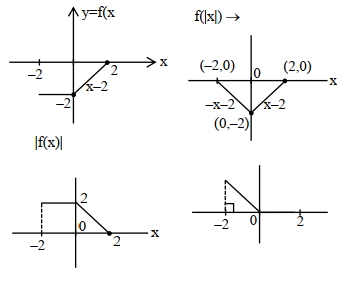
ધારો કે $f(x) = \begin{cases} -2, & -2 \leq x \leq 0 \\ x-2, & 0 < x \leq 2 \end{cases}$ અને $h(x) = f(|x|) + |f(x)|$ છે. તો $\int_{-2}^2 h(x) dx$ ની કિંમત શોધો:
A
$2$
B
$4$
C
$1$
D
$6$
Solution
(A) આપેલ છે કે $f(x) = \begin{cases} -2, & -2 \leq x \leq 0 \\ x-2, & 0 < x \leq 2 \end{cases}$.
આપણે $h(x) = f(|x|) + |f(x)|$ શોધવાનું છે.
$x \in [0, 2]$ માટે,$f(|x|) = f(x) = x-2$ અને $|f(x)| = |x-2| = 2-x$. તેથી,$h(x) = (x-2) + (2-x) = 0$.
$x \in [-2, 0)$ માટે,$f(|x|) = |x|-2 = -x-2$.
$|f(x)| = \begin{cases} |-2| = 2, & -2 \leq x \leq 0 \\ |x-2| = 2-x, & 0 < x \leq 2 \end{cases}$.
તેથી,$h(x) = f(|x|) + |f(x)| = \begin{cases} (-x-2) + 2 = -x, & -2 \leq x < 0 \\ (x-2) + (2-x) = 0, & 0 \leq x \leq 2 \end{cases}$.
હવે,$\int_{-2}^2 h(x) dx = \int_{-2}^0 (-x) dx + \int_0^2 0 dx = \left[ -\frac{x^2}{2} \right]_{-2}^0 = 0 - (-\frac{(-2)^2}{2}) = 0 - (-2) = 2$.
આપણે $h(x) = f(|x|) + |f(x)|$ શોધવાનું છે.
$x \in [0, 2]$ માટે,$f(|x|) = f(x) = x-2$ અને $|f(x)| = |x-2| = 2-x$. તેથી,$h(x) = (x-2) + (2-x) = 0$.
$x \in [-2, 0)$ માટે,$f(|x|) = |x|-2 = -x-2$.
$|f(x)| = \begin{cases} |-2| = 2, & -2 \leq x \leq 0 \\ |x-2| = 2-x, & 0 < x \leq 2 \end{cases}$.
તેથી,$h(x) = f(|x|) + |f(x)| = \begin{cases} (-x-2) + 2 = -x, & -2 \leq x < 0 \\ (x-2) + (2-x) = 0, & 0 \leq x \leq 2 \end{cases}$.
હવે,$\int_{-2}^2 h(x) dx = \int_{-2}^0 (-x) dx + \int_0^2 0 dx = \left[ -\frac{x^2}{2} \right]_{-2}^0 = 0 - (-\frac{(-2)^2}{2}) = 0 - (-2) = 2$.
0 likes
View Solution357
DifficultMCQ
જો $\int_0^{\frac{\pi}{4}} \frac{\sin^2 x}{1+\sin x \cos x} dx = \frac{1}{a} \log_e\left(\frac{a}{3}\right) + \frac{\pi}{b \sqrt{3}}$,જ્યાં $a, b \in N$,તો $a+b$ ની કિંમત .................... છે.
A
$6$
B
$8$
C
$4$
D
$1$
Solution
(B) ધારો કે $I = \int_0^{\frac{\pi}{4}} \frac{\sin^2 x}{1+\sin x \cos x} dx$. અંશ અને છેદને $2$ વડે ગુણતા $I = \int_0^{\frac{\pi}{4}} \frac{2\sin^2 x}{2+2\sin x \cos x} dx = \int_0^{\frac{\pi}{4}} \frac{1-\cos 2x}{2+\sin 2x} dx$.
આને $I = \int_0^{\frac{\pi}{4}} \frac{1}{2+\sin 2x} dx - \int_0^{\frac{\pi}{4}} \frac{\cos 2x}{2+\sin 2x} dx = I_1 - I_2$ તરીકે લખી શકાય.
$I_1 = \int_0^{\frac{\pi}{4}} \frac{\sec^2 x}{2\tan^2 x + 2\tan x + 2} dx$. ધારો કે $t = \tan x$,$dt = \sec^2 x dx$. સીમાઓ $0$ થી $1$ બદલાય છે.
$I_1 = \frac{1}{2} \int_0^1 \frac{dt}{t^2+t+1} = \frac{1}{2} \int_0^1 \frac{dt}{(t+1/2)^2 + 3/4} = \frac{1}{2} \cdot \frac{2}{\sqrt{3}} [\tan^{-1}(\frac{2t+1}{\sqrt{3}})]_0^1 = \frac{1}{\sqrt{3}} (\frac{\pi}{3} - \frac{\pi}{6}) = \frac{\pi}{6\sqrt{3}}$.
$I_2 = \int_0^{\frac{\pi}{4}} \frac{\cos 2x}{2+\sin 2x} dx$. ધારો કે $u = 2+\sin 2x$,$du = 2\cos 2x dx$.
$I_2 = \frac{1}{2} \int_2^3 \frac{du}{u} = \frac{1}{2} \ln(\frac{3}{2}) = \frac{1}{2} \ln(3) - \frac{1}{2} \ln(2)$.
સરખામણી કરતા $I = I_1 - I_2 = \frac{\pi}{6\sqrt{3}} - \frac{1}{2} \ln(3) + \frac{1}{2} \ln(2) = \frac{\pi}{6\sqrt{3}} + \frac{1}{2} \ln(2/3)$.
આપેલ સ્વરૂપ $\frac{1}{a} \ln(a/3) + \frac{\pi}{b\sqrt{3}}$ છે. $a=2, b=6$ લેતા,આપણને $\frac{1}{2} \ln(2/3) + \frac{\pi}{6\sqrt{3}}$ મળે છે.
આમ $a=2, b=6$,તેથી $a+b = 8$.
આને $I = \int_0^{\frac{\pi}{4}} \frac{1}{2+\sin 2x} dx - \int_0^{\frac{\pi}{4}} \frac{\cos 2x}{2+\sin 2x} dx = I_1 - I_2$ તરીકે લખી શકાય.
$I_1 = \int_0^{\frac{\pi}{4}} \frac{\sec^2 x}{2\tan^2 x + 2\tan x + 2} dx$. ધારો કે $t = \tan x$,$dt = \sec^2 x dx$. સીમાઓ $0$ થી $1$ બદલાય છે.
$I_1 = \frac{1}{2} \int_0^1 \frac{dt}{t^2+t+1} = \frac{1}{2} \int_0^1 \frac{dt}{(t+1/2)^2 + 3/4} = \frac{1}{2} \cdot \frac{2}{\sqrt{3}} [\tan^{-1}(\frac{2t+1}{\sqrt{3}})]_0^1 = \frac{1}{\sqrt{3}} (\frac{\pi}{3} - \frac{\pi}{6}) = \frac{\pi}{6\sqrt{3}}$.
$I_2 = \int_0^{\frac{\pi}{4}} \frac{\cos 2x}{2+\sin 2x} dx$. ધારો કે $u = 2+\sin 2x$,$du = 2\cos 2x dx$.
$I_2 = \frac{1}{2} \int_2^3 \frac{du}{u} = \frac{1}{2} \ln(\frac{3}{2}) = \frac{1}{2} \ln(3) - \frac{1}{2} \ln(2)$.
સરખામણી કરતા $I = I_1 - I_2 = \frac{\pi}{6\sqrt{3}} - \frac{1}{2} \ln(3) + \frac{1}{2} \ln(2) = \frac{\pi}{6\sqrt{3}} + \frac{1}{2} \ln(2/3)$.
આપેલ સ્વરૂપ $\frac{1}{a} \ln(a/3) + \frac{\pi}{b\sqrt{3}}$ છે. $a=2, b=6$ લેતા,આપણને $\frac{1}{2} \ln(2/3) + \frac{\pi}{6\sqrt{3}}$ મળે છે.
આમ $a=2, b=6$,તેથી $a+b = 8$.
0 likes
View Solution358
DifficultMCQ
જો સંકલન $\int_{-1}^1 \frac{\cos \alpha x}{1+3^x} d x$ નું મૂલ્ય $\frac{2}{\pi}$ હોય,તો $\alpha$ નું એક મૂલ્ય શોધો.
A
$\frac{\pi}{6}$
B
$\frac{\pi}{2}$
C
$\frac{\pi}{3}$
D
$\frac{\pi}{4}$
Solution
(B) ધારો કે $I = \int_{-1}^{1} \frac{\cos \alpha x}{1+3^x} dx$ $(1)$
ગુણધર્મ $\int_{a}^{b} f(x) dx = \int_{a}^{b} f(a+b-x) dx$ નો ઉપયોગ કરતા:
$I = \int_{-1}^{1} \frac{\cos \alpha (-x)}{1+3^{-x}} dx = \int_{-1}^{1} \frac{\cos \alpha x}{1+\frac{1}{3^x}} dx = \int_{-1}^{1} \frac{3^x \cos \alpha x}{3^x+1} dx$ $(2)$
$(1)$ અને $(2)$ નો સરવાળો કરતા:
$2I = \int_{-1}^{1} \frac{\cos \alpha x}{1+3^x} dx + \int_{-1}^{1} \frac{3^x \cos \alpha x}{1+3^x} dx$
$2I = \int_{-1}^{1} \frac{(1+3^x) \cos \alpha x}{1+3^x} dx = \int_{-1}^{1} \cos \alpha x dx$
$\cos \alpha x$ એ યુગ્મ વિધેય હોવાથી:
$2I = 2 \int_{0}^{1} \cos \alpha x dx = 2 \left[ \frac{\sin \alpha x}{\alpha} \right]_{0}^{1} = \frac{2 \sin \alpha}{\alpha}$
$I = \frac{\sin \alpha}{\alpha}$
આપેલ છે કે $I = \frac{2}{\pi}$,તેથી $\frac{\sin \alpha}{\alpha} = \frac{2}{\pi}$.
નિરીક્ષણ દ્વારા,$\alpha = \frac{\pi}{2}$ સમીકરણનું સમાધાન કરે છે કારણ કે $\frac{\sin(\pi/2)}{\pi/2} = \frac{1}{\pi/2} = \frac{2}{\pi}$.
ગુણધર્મ $\int_{a}^{b} f(x) dx = \int_{a}^{b} f(a+b-x) dx$ નો ઉપયોગ કરતા:
$I = \int_{-1}^{1} \frac{\cos \alpha (-x)}{1+3^{-x}} dx = \int_{-1}^{1} \frac{\cos \alpha x}{1+\frac{1}{3^x}} dx = \int_{-1}^{1} \frac{3^x \cos \alpha x}{3^x+1} dx$ $(2)$
$(1)$ અને $(2)$ નો સરવાળો કરતા:
$2I = \int_{-1}^{1} \frac{\cos \alpha x}{1+3^x} dx + \int_{-1}^{1} \frac{3^x \cos \alpha x}{1+3^x} dx$
$2I = \int_{-1}^{1} \frac{(1+3^x) \cos \alpha x}{1+3^x} dx = \int_{-1}^{1} \cos \alpha x dx$
$\cos \alpha x$ એ યુગ્મ વિધેય હોવાથી:
$2I = 2 \int_{0}^{1} \cos \alpha x dx = 2 \left[ \frac{\sin \alpha x}{\alpha} \right]_{0}^{1} = \frac{2 \sin \alpha}{\alpha}$
$I = \frac{\sin \alpha}{\alpha}$
આપેલ છે કે $I = \frac{2}{\pi}$,તેથી $\frac{\sin \alpha}{\alpha} = \frac{2}{\pi}$.
નિરીક્ષણ દ્વારા,$\alpha = \frac{\pi}{2}$ સમીકરણનું સમાધાન કરે છે કારણ કે $\frac{\sin(\pi/2)}{\pi/2} = \frac{1}{\pi/2} = \frac{2}{\pi}$.
0 likes
View Solution359
DifficultMCQ
$\int_{-\pi}^\pi \frac{2 y(1+\sin y)}{1+\cos ^2 y} d y$ નું મૂલ્ય શોધો:
A
$\pi^2$
B
$\frac{\pi^2}{2}$
C
$\frac{\pi}{2}$
D
$2 \pi^2$
Solution
(A) ધારો કે $I = \int_{-\pi}^\pi \frac{2 y(1+\sin y)}{1+\cos ^2 y} d y$.
સંકલનને બે ભાગમાં વિભાજિત કરો:
$I = \int_{-\pi}^\pi \frac{2 y}{1+\cos ^2 y} d y + \int_{-\pi}^\pi \frac{2 y \sin y}{1+\cos ^2 y} d y$.
પ્રથમ ભાગ $\int_{-\pi}^\pi \frac{2 y}{1+\cos ^2 y} d y = 0$ છે કારણ કે વિધેય અયુગ્મ છે.
બીજા ભાગ માટે,$y \sin y$ એ યુગ્મ વિધેય હોવાથી:
$I = 2 \int_0^\pi \frac{2 y \sin y}{1+\cos ^2 y} d y = 4 \int_0^\pi \frac{y \sin y}{1+\cos ^2 y} d y$.
ગુણધર્મ $\int_0^a f(y) dy = \int_0^a f(a-y) dy$ નો ઉપયોગ કરતા:
$I = 4 \int_0^\pi \frac{(\pi-y) \sin y}{1+\cos ^2 y} d y = 4\pi \int_0^\pi \frac{\sin y}{1+\cos ^2 y} d y - 4 \int_0^\pi \frac{y \sin y}{1+\cos ^2 y} d y$.
$I = 4\pi \int_0^\pi \frac{\sin y}{1+\cos ^2 y} d y - I
\implies 2I = 4\pi \int_0^\pi \frac{\sin y}{1+\cos ^2 y} d y
\implies I = 2\pi \int_0^\pi \frac{\sin y}{1+\cos ^2 y} d y$.
ધારો કે $t = \cos y$,તો $dt = -\sin y dy$. જ્યારે $y=0, t=1$; જ્યારે $y=\pi, t=-1$.
$I = 2\pi \int_1^{-1} \frac{-dt}{1+t^2} = 2\pi \int_{-1}^1 \frac{dt}{1+t^2} = 2\pi [\tan^{-1} t]_{-1}^1$.
$I = 2\pi [\tan^{-1}(1) - \tan^{-1}(-1)] = 2\pi [\frac{\pi}{4} - (-\frac{\pi}{4})] = 2\pi [\frac{\pi}{2}] = \pi^2$.
સંકલનને બે ભાગમાં વિભાજિત કરો:
$I = \int_{-\pi}^\pi \frac{2 y}{1+\cos ^2 y} d y + \int_{-\pi}^\pi \frac{2 y \sin y}{1+\cos ^2 y} d y$.
પ્રથમ ભાગ $\int_{-\pi}^\pi \frac{2 y}{1+\cos ^2 y} d y = 0$ છે કારણ કે વિધેય અયુગ્મ છે.
બીજા ભાગ માટે,$y \sin y$ એ યુગ્મ વિધેય હોવાથી:
$I = 2 \int_0^\pi \frac{2 y \sin y}{1+\cos ^2 y} d y = 4 \int_0^\pi \frac{y \sin y}{1+\cos ^2 y} d y$.
ગુણધર્મ $\int_0^a f(y) dy = \int_0^a f(a-y) dy$ નો ઉપયોગ કરતા:
$I = 4 \int_0^\pi \frac{(\pi-y) \sin y}{1+\cos ^2 y} d y = 4\pi \int_0^\pi \frac{\sin y}{1+\cos ^2 y} d y - 4 \int_0^\pi \frac{y \sin y}{1+\cos ^2 y} d y$.
$I = 4\pi \int_0^\pi \frac{\sin y}{1+\cos ^2 y} d y - I
\implies 2I = 4\pi \int_0^\pi \frac{\sin y}{1+\cos ^2 y} d y
\implies I = 2\pi \int_0^\pi \frac{\sin y}{1+\cos ^2 y} d y$.
ધારો કે $t = \cos y$,તો $dt = -\sin y dy$. જ્યારે $y=0, t=1$; જ્યારે $y=\pi, t=-1$.
$I = 2\pi \int_1^{-1} \frac{-dt}{1+t^2} = 2\pi \int_{-1}^1 \frac{dt}{1+t^2} = 2\pi [\tan^{-1} t]_{-1}^1$.
$I = 2\pi [\tan^{-1}(1) - \tan^{-1}(-1)] = 2\pi [\frac{\pi}{4} - (-\frac{\pi}{4})] = 2\pi [\frac{\pi}{2}] = \pi^2$.
0 likes
View Solution360
DifficultMCQ
જો $f(t) = \int_0^\pi \frac{2x \, dx}{1 - \cos^2 t \sin^2 x}$,જ્યાં $0 < t < \pi$,તો $\int_0^{\frac{\pi}{2}} \frac{\pi^2 \, dt}{f(t)}$ નું મૂલ્ય .......... થાય.
A
$3$
B
$9$
C
$1$
D
$7$
Solution
(C) આપેલ છે $f(t) = \int_0^\pi \frac{2x \, dx}{1 - \cos^2 t \sin^2 x}$.
ગુણધર્મ $\int_0^a g(x) \, dx = \int_0^a g(a-x) \, dx$ નો ઉપયોગ કરતા:
$f(t) = \int_0^\pi \frac{2(\pi - x) \, dx}{1 - \cos^2 t \sin^2 x}$.
$f(t)$ માટેના બંને પદોનો સરવાળો કરતા:
$2f(t) = \int_0^\pi \frac{2x + 2\pi - 2x}{1 - \cos^2 t \sin^2 x} \, dx = \int_0^\pi \frac{2\pi \, dx}{1 - \cos^2 t \sin^2 x}$.
તેથી,$f(t) = \pi \int_0^\pi \frac{dx}{1 - \cos^2 t \sin^2 x}$.
વિધેય $x = \frac{\pi}{2}$ ની આસપાસ સંમિત હોવાથી,$f(t) = 2\pi \int_0^{\frac{\pi}{2}} \frac{dx}{1 - \cos^2 t \sin^2 x}$.
અંશ અને છેદને $\cos^2 x$ વડે ભાગતા:
$f(t) = 2\pi \int_0^{\frac{\pi}{2}} \frac{\sec^2 x \, dx}{\sec^2 x - \cos^2 t \tan^2 x} = 2\pi \int_0^{\frac{\pi}{2}} \frac{\sec^2 x \, dx}{1 + \tan^2 x - \cos^2 t \tan^2 x} = 2\pi \int_0^{\frac{\pi}{2}} \frac{\sec^2 x \, dx}{1 + \sin^2 t \tan^2 x}$.
ધારો કે $\tan x = z$,તો $\sec^2 x \, dx = dz$. જ્યારે $x \to 0, z \to 0$ અને જ્યારે $x \to \frac{\pi}{2}, z \to \infty$:
$f(t) = 2\pi \int_0^{\infty} \frac{dz}{1 + (\sin t \cdot z)^2} = 2\pi \left[ \frac{1}{\sin t} \tan^{-1}(\sin t \cdot z) \right]_0^{\infty} = 2\pi \cdot \frac{1}{\sin t} \cdot \frac{\pi}{2} = \frac{\pi^2}{\sin t}$.
હવે,સંકલન $\int_0^{\frac{\pi}{2}} \frac{\pi^2}{f(t)} \, dt = \int_0^{\frac{\pi}{2}} \frac{\pi^2}{\pi^2 / \sin t} \, dt = \int_0^{\frac{\pi}{2}} \sin t \, dt$.
$= [-\cos t]_0^{\frac{\pi}{2}} = -(0 - 1) = 1$.
ગુણધર્મ $\int_0^a g(x) \, dx = \int_0^a g(a-x) \, dx$ નો ઉપયોગ કરતા:
$f(t) = \int_0^\pi \frac{2(\pi - x) \, dx}{1 - \cos^2 t \sin^2 x}$.
$f(t)$ માટેના બંને પદોનો સરવાળો કરતા:
$2f(t) = \int_0^\pi \frac{2x + 2\pi - 2x}{1 - \cos^2 t \sin^2 x} \, dx = \int_0^\pi \frac{2\pi \, dx}{1 - \cos^2 t \sin^2 x}$.
તેથી,$f(t) = \pi \int_0^\pi \frac{dx}{1 - \cos^2 t \sin^2 x}$.
વિધેય $x = \frac{\pi}{2}$ ની આસપાસ સંમિત હોવાથી,$f(t) = 2\pi \int_0^{\frac{\pi}{2}} \frac{dx}{1 - \cos^2 t \sin^2 x}$.
અંશ અને છેદને $\cos^2 x$ વડે ભાગતા:
$f(t) = 2\pi \int_0^{\frac{\pi}{2}} \frac{\sec^2 x \, dx}{\sec^2 x - \cos^2 t \tan^2 x} = 2\pi \int_0^{\frac{\pi}{2}} \frac{\sec^2 x \, dx}{1 + \tan^2 x - \cos^2 t \tan^2 x} = 2\pi \int_0^{\frac{\pi}{2}} \frac{\sec^2 x \, dx}{1 + \sin^2 t \tan^2 x}$.
ધારો કે $\tan x = z$,તો $\sec^2 x \, dx = dz$. જ્યારે $x \to 0, z \to 0$ અને જ્યારે $x \to \frac{\pi}{2}, z \to \infty$:
$f(t) = 2\pi \int_0^{\infty} \frac{dz}{1 + (\sin t \cdot z)^2} = 2\pi \left[ \frac{1}{\sin t} \tan^{-1}(\sin t \cdot z) \right]_0^{\infty} = 2\pi \cdot \frac{1}{\sin t} \cdot \frac{\pi}{2} = \frac{\pi^2}{\sin t}$.
હવે,સંકલન $\int_0^{\frac{\pi}{2}} \frac{\pi^2}{f(t)} \, dt = \int_0^{\frac{\pi}{2}} \frac{\pi^2}{\pi^2 / \sin t} \, dt = \int_0^{\frac{\pi}{2}} \sin t \, dt$.
$= [-\cos t]_0^{\frac{\pi}{2}} = -(0 - 1) = 1$.
0 likes
View Solution361
MediumMCQ
$\int_{-\frac{\pi}{2}}^{\frac{\pi}{2}} \frac{x^2 \cos x}{1+e^x} d x$ નું મૂલ્ય કેટલું થાય?
A
$\frac{\pi^2}{4}-2$
B
$\frac{\pi^2}{4}+2$
C
$\pi^2-e^{\frac{\pi}{2}}$
D
$\pi^2+e^{\frac{\pi}{2}}$
Solution
(A) ધારો કે $I = \int_{-\frac{\pi}{2}}^{\frac{\pi}{2}} \frac{x^2 \cos x}{1+e^x} dx$ ... $(i)$
ગુણધર્મ $\int_{a}^{b} f(x) dx = \int_{a}^{b} f(a+b-x) dx$ નો ઉપયોગ કરતા,અહીં $a+b = 0$ છે.
$I = \int_{-\frac{\pi}{2}}^{\frac{\pi}{2}} \frac{(-x)^2 \cos(-x)}{1+e^{-x}} dx = \int_{-\frac{\pi}{2}}^{\frac{\pi}{2}} \frac{x^2 \cos x}{1+e^{-x}} dx = \int_{-\frac{\pi}{2}}^{\frac{\pi}{2}} \frac{x^2 \cos x \cdot e^x}{e^x+1} dx$ ... (ii)
$(i)$ અને (ii) નો સરવાળો કરતા:
$2I = \int_{-\frac{\pi}{2}}^{\frac{\pi}{2}} \frac{x^2 \cos x (1+e^x)}{1+e^x} dx = \int_{-\frac{\pi}{2}}^{\frac{\pi}{2}} x^2 \cos x dx$
$x^2 \cos x$ એ યુગ્મ વિધેય હોવાથી,$2I = 2 \int_{0}^{\frac{\pi}{2}} x^2 \cos x dx$ થાય.
તેથી $I = \int_{0}^{\frac{\pi}{2}} x^2 \cos x dx$.
ખંડશઃ સંકલનનો ઉપયોગ કરતા:
$I = [x^2 \sin x]_{0}^{\frac{\pi}{2}} - \int_{0}^{\frac{\pi}{2}} 2x \sin x dx$
$I = (\frac{\pi^2}{4} - 0) - 2 [x(-\cos x) - \int 1(-\cos x) dx]_{0}^{\frac{\pi}{2}}$
$I = \frac{\pi^2}{4} - 2 [-x \cos x + \sin x]_{0}^{\frac{\pi}{2}}$
$I = \frac{\pi^2}{4} - 2 [1 - 0] = \frac{\pi^2}{4} - 2$.
ગુણધર્મ $\int_{a}^{b} f(x) dx = \int_{a}^{b} f(a+b-x) dx$ નો ઉપયોગ કરતા,અહીં $a+b = 0$ છે.
$I = \int_{-\frac{\pi}{2}}^{\frac{\pi}{2}} \frac{(-x)^2 \cos(-x)}{1+e^{-x}} dx = \int_{-\frac{\pi}{2}}^{\frac{\pi}{2}} \frac{x^2 \cos x}{1+e^{-x}} dx = \int_{-\frac{\pi}{2}}^{\frac{\pi}{2}} \frac{x^2 \cos x \cdot e^x}{e^x+1} dx$ ... (ii)
$(i)$ અને (ii) નો સરવાળો કરતા:
$2I = \int_{-\frac{\pi}{2}}^{\frac{\pi}{2}} \frac{x^2 \cos x (1+e^x)}{1+e^x} dx = \int_{-\frac{\pi}{2}}^{\frac{\pi}{2}} x^2 \cos x dx$
$x^2 \cos x$ એ યુગ્મ વિધેય હોવાથી,$2I = 2 \int_{0}^{\frac{\pi}{2}} x^2 \cos x dx$ થાય.
તેથી $I = \int_{0}^{\frac{\pi}{2}} x^2 \cos x dx$.
ખંડશઃ સંકલનનો ઉપયોગ કરતા:
$I = [x^2 \sin x]_{0}^{\frac{\pi}{2}} - \int_{0}^{\frac{\pi}{2}} 2x \sin x dx$
$I = (\frac{\pi^2}{4} - 0) - 2 [x(-\cos x) - \int 1(-\cos x) dx]_{0}^{\frac{\pi}{2}}$
$I = \frac{\pi^2}{4} - 2 [-x \cos x + \sin x]_{0}^{\frac{\pi}{2}}$
$I = \frac{\pi^2}{4} - 2 [1 - 0] = \frac{\pi^2}{4} - 2$.
0 likes
View Solution362
DifficultMCQ
જો $I_n = \int_{-\pi}^{\pi} \frac{\sin(nx)}{(1+\pi^x) \sin x} dx$,$n=0, 1, 2, \ldots$,હોય,તો
$(A)$ $I_n = I_{n+2}$
$(B)$ $\sum_{m=1}^{10} I_{2m+1} = 10\pi$
$(C)$ $\sum_{m=1}^{10} I_{2m} = 0$
$(D)$ $I_n = I_{n+1}$
$(A)$ $I_n = I_{n+2}$
$(B)$ $\sum_{m=1}^{10} I_{2m+1} = 10\pi$
$(C)$ $\sum_{m=1}^{10} I_{2m} = 0$
$(D)$ $I_n = I_{n+1}$
A
$(A, B, C)$
B
$(A, B, D)$
C
$(A, C, D)$
D
$(B, C, D)$
Solution
(A) આપેલ છે $I_n = \int_{-\pi}^{\pi} \frac{\sin(nx)}{(1+\pi^x) \sin x} dx \quad \ldots (i)$
ગુણધર્મ $\int_a^b f(x) dx = \int_a^b f(a+b-x) dx$ નો ઉપયોગ કરતા,
$I_n = \int_{-\pi}^{\pi} \frac{\pi^x \sin(nx)}{(1+\pi^x) \sin x} dx \quad \ldots (ii)$
$(i)$ અને $(ii)$ નો સરવાળો કરતા:
$2I_n = \int_{-\pi}^{\pi} \frac{\sin(nx)}{\sin x} dx = 2 \int_0^{\pi} \frac{\sin(nx)}{\sin x} dx$ (કારણ કે વિધેય યુગ્મ છે).
આમ,$I_n = \int_0^{\pi} \frac{\sin(nx)}{\sin x} dx$.
હવે,$I_{n+2} - I_n = \int_0^{\pi} \frac{\sin((n+2)x) - \sin(nx)}{\sin x} dx = \int_0^{\pi} \frac{2 \cos((n+1)x) \sin x}{\sin x} dx = 2 \int_0^{\pi} \cos((n+1)x) dx = 0$.
તેથી,$I_{n+2} = I_n$.
$n=1$ માટે,$I_1 = \int_0^{\pi} \frac{\sin x}{\sin x} dx = \pi$.
$n=2$ માટે,$I_2 = \int_0^{\pi} \frac{\sin(2x)}{\sin x} dx = \int_0^{\pi} 2 \cos x dx = 0$.
$I_{n+2} = I_n$ હોવાથી,બધા એકી પદો $I_{2m+1} = \pi$ અને બધા બેકી પદો $I_{2m} = 0$ થાય.
તેથી,$\sum_{m=1}^{10} I_{2m+1} = 10\pi$ અને $\sum_{m=1}^{10} I_{2m} = 0$.
આમ,વિકલ્પો $(A)$,$(B)$,અને $(C)$ સાચા છે.
ગુણધર્મ $\int_a^b f(x) dx = \int_a^b f(a+b-x) dx$ નો ઉપયોગ કરતા,
$I_n = \int_{-\pi}^{\pi} \frac{\pi^x \sin(nx)}{(1+\pi^x) \sin x} dx \quad \ldots (ii)$
$(i)$ અને $(ii)$ નો સરવાળો કરતા:
$2I_n = \int_{-\pi}^{\pi} \frac{\sin(nx)}{\sin x} dx = 2 \int_0^{\pi} \frac{\sin(nx)}{\sin x} dx$ (કારણ કે વિધેય યુગ્મ છે).
આમ,$I_n = \int_0^{\pi} \frac{\sin(nx)}{\sin x} dx$.
હવે,$I_{n+2} - I_n = \int_0^{\pi} \frac{\sin((n+2)x) - \sin(nx)}{\sin x} dx = \int_0^{\pi} \frac{2 \cos((n+1)x) \sin x}{\sin x} dx = 2 \int_0^{\pi} \cos((n+1)x) dx = 0$.
તેથી,$I_{n+2} = I_n$.
$n=1$ માટે,$I_1 = \int_0^{\pi} \frac{\sin x}{\sin x} dx = \pi$.
$n=2$ માટે,$I_2 = \int_0^{\pi} \frac{\sin(2x)}{\sin x} dx = \int_0^{\pi} 2 \cos x dx = 0$.
$I_{n+2} = I_n$ હોવાથી,બધા એકી પદો $I_{2m+1} = \pi$ અને બધા બેકી પદો $I_{2m} = 0$ થાય.
તેથી,$\sum_{m=1}^{10} I_{2m+1} = 10\pi$ અને $\sum_{m=1}^{10} I_{2m} = 0$.
આમ,વિકલ્પો $(A)$,$(B)$,અને $(C)$ સાચા છે.
0 likes
View Solution363
AdvancedMCQ
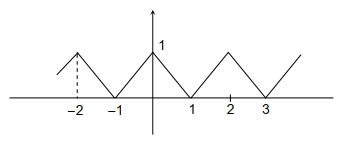
કોઈપણ વાસ્તવિક સંખ્યા $x$ માટે,ધારો કે $[x]$ એ $x$ થી નાની અથવા તેના જેટલી મહત્તમ પૂર્ણાંક સંખ્યા દર્શાવે છે. ધારો કે $f$ એ અંતરાલ $[-10, 10]$ પર વ્યાખ્યાયિત વાસ્તવિક મૂલ્ય ધરાવતું વિધેય છે,જે નીચે મુજબ છે:
$f(x) = \begin{cases} x - [x] & \text{જો } [x] \text{ એકી હોય} \\ 1 + [x] - x & \text{જો } [x] \text{ બેકી હોય} \end{cases}$
તો $\frac{\pi^2}{10} \int_{-10}^{10} f(x) \cos(\pi x) \, dx$ નું મૂલ્ય શોધો.
$f(x) = \begin{cases} x - [x] & \text{જો } [x] \text{ એકી હોય} \\ 1 + [x] - x & \text{જો } [x] \text{ બેકી હોય} \end{cases}$
તો $\frac{\pi^2}{10} \int_{-10}^{10} f(x) \cos(\pi x) \, dx$ નું મૂલ્ય શોધો.
A
$4$
B
$5$
C
$6$
D
$8$
Solution
(A) વિધેય $f(x)$ નીચે મુજબ વ્યાખ્યાયિત છે:
$f(x) = x - [x]$ જો $[x]$ એકી હોય,અને $f(x) = 1 + [x] - x$ જો $[x]$ બેકી હોય.
$x \in [0, 1)$ માટે,$[x] = 0$ (બેકી),તેથી $f(x) = 1 + 0 - x = 1 - x$.
$x \in [1, 2)$ માટે,$[x] = 1$ (એકી),તેથી $f(x) = x - 1$.
આ વિધેય $T = 2$ આવર્તકાળ સાથેનું આવર્તી વિધેય છે.
ધારો કે $I = \int_{-10}^{10} f(x) \cos(\pi x) \, dx$.
$f(x)$ એ યુગ્મ વિધેય છે $(f(-x) = f(x))$ અને $\cos(\pi x)$ પણ યુગ્મ વિધેય છે,તેથી તેમનો ગુણાકાર યુગ્મ વિધેય થાય.
$I = 2 \int_{0}^{10} f(x) \cos(\pi x) \, dx = 2 \times 5 \int_{0}^{2} f(x) \cos(\pi x) \, dx = 10 \left[ \int_{0}^{1} (1-x) \cos(\pi x) \, dx + \int_{1}^{2} (x-1) \cos(\pi x) \, dx \right]$.
ધારો કે $I_1 = \int_{0}^{1} (1-x) \cos(\pi x) \, dx$. ખંડશઃ સંકલનનો ઉપયોગ કરતા:
$I_1 = \left[ (1-x) \frac{\sin(\pi x)}{\pi} \right]_0^1 - \int_{0}^{1} (-1) \frac{\sin(\pi x)}{\pi} \, dx = 0 + \left[ -\frac{\cos(\pi x)}{\pi^2} \right]_0^1 = -\frac{1}{\pi^2} (-1 - 1) = \frac{2}{\pi^2}$.
ધારો કે $I_2 = \int_{1}^{2} (x-1) \cos(\pi x) \, dx$. ધારો કે $t = x-1$,તો $dt = dx$:
$I_2 = \int_{0}^{1} t \cos(\pi(t+1)) \, dt = \int_{0}^{1} t \cos(\pi t + \pi) \, dt = -\int_{0}^{1} t \cos(\pi t) \, dt$.
$\int t \cos(\pi t) \, dt = \frac{t \sin(\pi t)}{\pi} + \frac{\cos(\pi t)}{\pi^2}$ નો ઉપયોગ કરતા:
$I_2 = -\left[ \frac{t \sin(\pi t)}{\pi} + \frac{\cos(\pi t)}{\pi^2} \right]_0^1 = -\left( 0 + \frac{-1}{\pi^2} - (0 + \frac{1}{\pi^2}) \right) = \frac{2}{\pi^2}$.
આમ,$I = 10 \left( \frac{2}{\pi^2} + \frac{2}{\pi^2} \right) = \frac{40}{\pi^2}$.
છેલ્લે,$\frac{\pi^2}{10} I = \frac{\pi^2}{10} \times \frac{40}{\pi^2} = 4$.
$f(x) = x - [x]$ જો $[x]$ એકી હોય,અને $f(x) = 1 + [x] - x$ જો $[x]$ બેકી હોય.
$x \in [0, 1)$ માટે,$[x] = 0$ (બેકી),તેથી $f(x) = 1 + 0 - x = 1 - x$.
$x \in [1, 2)$ માટે,$[x] = 1$ (એકી),તેથી $f(x) = x - 1$.
આ વિધેય $T = 2$ આવર્તકાળ સાથેનું આવર્તી વિધેય છે.
ધારો કે $I = \int_{-10}^{10} f(x) \cos(\pi x) \, dx$.
$f(x)$ એ યુગ્મ વિધેય છે $(f(-x) = f(x))$ અને $\cos(\pi x)$ પણ યુગ્મ વિધેય છે,તેથી તેમનો ગુણાકાર યુગ્મ વિધેય થાય.
$I = 2 \int_{0}^{10} f(x) \cos(\pi x) \, dx = 2 \times 5 \int_{0}^{2} f(x) \cos(\pi x) \, dx = 10 \left[ \int_{0}^{1} (1-x) \cos(\pi x) \, dx + \int_{1}^{2} (x-1) \cos(\pi x) \, dx \right]$.
ધારો કે $I_1 = \int_{0}^{1} (1-x) \cos(\pi x) \, dx$. ખંડશઃ સંકલનનો ઉપયોગ કરતા:
$I_1 = \left[ (1-x) \frac{\sin(\pi x)}{\pi} \right]_0^1 - \int_{0}^{1} (-1) \frac{\sin(\pi x)}{\pi} \, dx = 0 + \left[ -\frac{\cos(\pi x)}{\pi^2} \right]_0^1 = -\frac{1}{\pi^2} (-1 - 1) = \frac{2}{\pi^2}$.
ધારો કે $I_2 = \int_{1}^{2} (x-1) \cos(\pi x) \, dx$. ધારો કે $t = x-1$,તો $dt = dx$:
$I_2 = \int_{0}^{1} t \cos(\pi(t+1)) \, dt = \int_{0}^{1} t \cos(\pi t + \pi) \, dt = -\int_{0}^{1} t \cos(\pi t) \, dt$.
$\int t \cos(\pi t) \, dt = \frac{t \sin(\pi t)}{\pi} + \frac{\cos(\pi t)}{\pi^2}$ નો ઉપયોગ કરતા:
$I_2 = -\left[ \frac{t \sin(\pi t)}{\pi} + \frac{\cos(\pi t)}{\pi^2} \right]_0^1 = -\left( 0 + \frac{-1}{\pi^2} - (0 + \frac{1}{\pi^2}) \right) = \frac{2}{\pi^2}$.
આમ,$I = 10 \left( \frac{2}{\pi^2} + \frac{2}{\pi^2} \right) = \frac{40}{\pi^2}$.
છેલ્લે,$\frac{\pi^2}{10} I = \frac{\pi^2}{10} \times \frac{40}{\pi^2} = 4$.
0 likes
View Solution364
AdvancedMCQ
$\int_{\sqrt{\ln 2}}^{\sqrt{\ln 3}} \frac{x \sin x^2}{\sin x^2 + \sin (\ln 6 - x^2)} dx$ નું મૂલ્ય શોધો.
A
$\frac{1}{4} \ln \frac{3}{2}$
B
$\frac{1}{2} \ln \frac{3}{2}$
C
$\ln \frac{3}{2}$
D
$\frac{1}{6} \ln \frac{3}{2}$
Solution
(A) ધારો કે $I = \int_{\sqrt{\ln 2}}^{\sqrt{\ln 3}} \frac{x \sin x^2}{\sin x^2 + \sin (\ln 6 - x^2)} dx$.
$x^2 = t$ લેતા,$2x dx = dt$ અથવા $x dx = \frac{1}{2} dt$ મળે.
જ્યારે $x = \sqrt{\ln 2}$,ત્યારે $t = \ln 2$. જ્યારે $x = \sqrt{\ln 3}$,ત્યારે $t = \ln 3$.
આથી સંકલન $I = \frac{1}{2} \int_{\ln 2}^{\ln 3} \frac{\sin t}{\sin t + \sin (\ln 6 - t)} dt$ બને છે.
ગુણધર્મ $\int_{a}^{b} f(t) dt = \int_{a}^{b} f(a+b-t) dt$ નો ઉપયોગ કરતા,$I = \frac{1}{2} \int_{\ln 2}^{\ln 3} \frac{\sin (\ln 2 + \ln 3 - t)}{\sin (\ln 2 + \ln 3 - t) + \sin (\ln 6 - (\ln 2 + \ln 3 - t))} dt$ મળે.
$\ln 2 + \ln 3 = \ln 6$ હોવાથી,આ $I = \frac{1}{2} \int_{\ln 2}^{\ln 3} \frac{\sin (\ln 6 - t)}{\sin (\ln 6 - t) + \sin t} dt$ માં પરિણમે છે.
બંને સમીકરણોનો સરવાળો કરતા:
$2I = \frac{1}{2} \int_{\ln 2}^{\ln 3} \frac{\sin t + \sin (\ln 6 - t)}{\sin t + \sin (\ln 6 - t)} dt = \frac{1}{2} \int_{\ln 2}^{\ln 3} 1 dt$.
$2I = \frac{1}{2} [t]_{\ln 2}^{\ln 3} = \frac{1}{2} (\ln 3 - \ln 2) = \frac{1}{2} \ln \frac{3}{2}$.
તેથી,$I = \frac{1}{4} \ln \frac{3}{2}$.
$x^2 = t$ લેતા,$2x dx = dt$ અથવા $x dx = \frac{1}{2} dt$ મળે.
જ્યારે $x = \sqrt{\ln 2}$,ત્યારે $t = \ln 2$. જ્યારે $x = \sqrt{\ln 3}$,ત્યારે $t = \ln 3$.
આથી સંકલન $I = \frac{1}{2} \int_{\ln 2}^{\ln 3} \frac{\sin t}{\sin t + \sin (\ln 6 - t)} dt$ બને છે.
ગુણધર્મ $\int_{a}^{b} f(t) dt = \int_{a}^{b} f(a+b-t) dt$ નો ઉપયોગ કરતા,$I = \frac{1}{2} \int_{\ln 2}^{\ln 3} \frac{\sin (\ln 2 + \ln 3 - t)}{\sin (\ln 2 + \ln 3 - t) + \sin (\ln 6 - (\ln 2 + \ln 3 - t))} dt$ મળે.
$\ln 2 + \ln 3 = \ln 6$ હોવાથી,આ $I = \frac{1}{2} \int_{\ln 2}^{\ln 3} \frac{\sin (\ln 6 - t)}{\sin (\ln 6 - t) + \sin t} dt$ માં પરિણમે છે.
બંને સમીકરણોનો સરવાળો કરતા:
$2I = \frac{1}{2} \int_{\ln 2}^{\ln 3} \frac{\sin t + \sin (\ln 6 - t)}{\sin t + \sin (\ln 6 - t)} dt = \frac{1}{2} \int_{\ln 2}^{\ln 3} 1 dt$.
$2I = \frac{1}{2} [t]_{\ln 2}^{\ln 3} = \frac{1}{2} (\ln 3 - \ln 2) = \frac{1}{2} \ln \frac{3}{2}$.
તેથી,$I = \frac{1}{4} \ln \frac{3}{2}$.
0 likes
View Solution365
DifficultMCQ
ધારો કે $f:[-1, 2] \rightarrow [0, \infty)$ એક સતત વિધેય છે જેથી તમામ $x \in [-1, 2]$ માટે $f(x) = f(1-x)$ થાય. ધારો કે $R_1 = \int_{-1}^2 x f(x) dx$ અને $R_2$ એ $y = f(x)$,$x = -1$,$x = 2$ અને $x$-અક્ષ દ્વારા ઘેરાયેલા પ્રદેશનું ક્ષેત્રફળ છે. તો
A
$R_1 = 2 R_2$
B
$R_1 = 3 R_2$
C
$2 R_1 = R_2$
D
$3 R_1 = R_2$
Solution
(C) આપેલ છે કે $R_1 = \int_{-1}^2 x f(x) dx$.
ગુણધર્મ $\int_a^b g(x) dx = \int_a^b g(a+b-x) dx$ નો ઉપયોગ કરતા,આપણને મળે છે:
$R_1 = \int_{-1}^2 ((-1) + 2 - x) f((-1) + 2 - x) dx$
$R_1 = \int_{-1}^2 (1 - x) f(1 - x) dx$.
કારણ કે $f(x) = f(1 - x)$,આપણે આ કિંમત સંકલનમાં મૂકીએ:
$R_1 = \int_{-1}^2 (1 - x) f(x) dx = \int_{-1}^2 f(x) dx - \int_{-1}^2 x f(x) dx$.
$R_1 = \int_{-1}^2 f(x) dx - R_1$.
$2 R_1 = \int_{-1}^2 f(x) dx$.
કારણ કે $R_2$ એ $y = f(x)$ દ્વારા $x = -1$ થી $x = 2$ સુધી ઘેરાયેલું ક્ષેત્રફળ છે,$R_2 = \int_{-1}^2 f(x) dx$.
તેથી,$2 R_1 = R_2$.
ગુણધર્મ $\int_a^b g(x) dx = \int_a^b g(a+b-x) dx$ નો ઉપયોગ કરતા,આપણને મળે છે:
$R_1 = \int_{-1}^2 ((-1) + 2 - x) f((-1) + 2 - x) dx$
$R_1 = \int_{-1}^2 (1 - x) f(1 - x) dx$.
કારણ કે $f(x) = f(1 - x)$,આપણે આ કિંમત સંકલનમાં મૂકીએ:
$R_1 = \int_{-1}^2 (1 - x) f(x) dx = \int_{-1}^2 f(x) dx - \int_{-1}^2 x f(x) dx$.
$R_1 = \int_{-1}^2 f(x) dx - R_1$.
$2 R_1 = \int_{-1}^2 f(x) dx$.
કારણ કે $R_2$ એ $y = f(x)$ દ્વારા $x = -1$ થી $x = 2$ સુધી ઘેરાયેલું ક્ષેત્રફળ છે,$R_2 = \int_{-1}^2 f(x) dx$.
તેથી,$2 R_1 = R_2$.
0 likes
View Solution366
EasyMCQ
જો $I = \frac{2}{\pi} \int_{-\pi / 4}^{\pi / 4} \frac{dx}{(1 + e^{\sin x})(2 - \cos 2x)}$ હોય,તો $27 I^2$ ની કિંમત . . . . . . . . થાય.
A
$3$
B
$4$
C
$7$
D
$8$
Solution
(B) ધારો કે $I = \frac{2}{\pi} \int_{-\pi / 4}^{\pi / 4} \frac{dx}{(1 + e^{\sin x})(2 - \cos 2x)}$.
ગુણધર્મ $\int_a^b f(x) dx = \int_a^b f(a+b-x) dx$ નો ઉપયોગ કરતા:
$I = \frac{2}{\pi} \int_{-\pi / 4}^{\pi / 4} \frac{dx}{(1 + e^{-\sin x})(2 - \cos 2x)}$.
$I$ માટેના બંને પદોનો સરવાળો કરતા:
$2I = \frac{2}{\pi} \int_{-\pi / 4}^{\pi / 4} \frac{1}{2 - \cos 2x} \left( \frac{1}{1 + e^{\sin x}} + \frac{e^{\sin x}}{1 + e^{\sin x}} \right) dx = \frac{2}{\pi} \int_{-\pi / 4}^{\pi / 4} \frac{dx}{2 - \cos 2x}$.
વિધેય યુગ્મ હોવાથી,$I = \frac{2}{\pi} \int_0^{\pi / 4} \frac{dx}{2 - \cos 2x} = \frac{2}{\pi} \int_0^{\pi / 4} \frac{\sec^2 x dx}{2(1 + \tan^2 x) - (1 - \tan^2 x)} = \frac{2}{\pi} \int_0^{\pi / 4} \frac{\sec^2 x dx}{1 + 3 \tan^2 x}$.
ધારો કે $u = \sqrt{3} \tan x$,તો $du = \sqrt{3} \sec^2 x dx$.
$I = \frac{2}{\pi \sqrt{3}} \int_0^{\sqrt{3}} \frac{du}{1 + u^2} = \frac{2}{\pi \sqrt{3}} [\tan^{-1} u]_0^{\sqrt{3}} = \frac{2}{\pi \sqrt{3}} \cdot \frac{\pi}{3} = \frac{2}{3\sqrt{3}}$.
તેથી,$27 I^2 = 27 \cdot \frac{4}{27} = 4$.
ગુણધર્મ $\int_a^b f(x) dx = \int_a^b f(a+b-x) dx$ નો ઉપયોગ કરતા:
$I = \frac{2}{\pi} \int_{-\pi / 4}^{\pi / 4} \frac{dx}{(1 + e^{-\sin x})(2 - \cos 2x)}$.
$I$ માટેના બંને પદોનો સરવાળો કરતા:
$2I = \frac{2}{\pi} \int_{-\pi / 4}^{\pi / 4} \frac{1}{2 - \cos 2x} \left( \frac{1}{1 + e^{\sin x}} + \frac{e^{\sin x}}{1 + e^{\sin x}} \right) dx = \frac{2}{\pi} \int_{-\pi / 4}^{\pi / 4} \frac{dx}{2 - \cos 2x}$.
વિધેય યુગ્મ હોવાથી,$I = \frac{2}{\pi} \int_0^{\pi / 4} \frac{dx}{2 - \cos 2x} = \frac{2}{\pi} \int_0^{\pi / 4} \frac{\sec^2 x dx}{2(1 + \tan^2 x) - (1 - \tan^2 x)} = \frac{2}{\pi} \int_0^{\pi / 4} \frac{\sec^2 x dx}{1 + 3 \tan^2 x}$.
ધારો કે $u = \sqrt{3} \tan x$,તો $du = \sqrt{3} \sec^2 x dx$.
$I = \frac{2}{\pi \sqrt{3}} \int_0^{\sqrt{3}} \frac{du}{1 + u^2} = \frac{2}{\pi \sqrt{3}} [\tan^{-1} u]_0^{\sqrt{3}} = \frac{2}{\pi \sqrt{3}} \cdot \frac{\pi}{3} = \frac{2}{3\sqrt{3}}$.
તેથી,$27 I^2 = 27 \cdot \frac{4}{27} = 4$.
0 likes
View Solution367
AdvancedMCQ
સંકલન $\int_0^{\pi / 2} \frac{3 \sqrt{\cos \theta}}{(\sqrt{\cos \theta}+\sqrt{\sin \theta})^5} d \theta$ ની કિંમત શોધો.
A
$0.20$
B
$0.30$
C
$0.40$
D
$0.50$
Solution
(D) ધારો કે $I = \int_0^{\pi / 2} \frac{3 \sqrt{\cos \theta}}{(\sqrt{\cos \theta}+\sqrt{\sin \theta})^5} d \theta$.
ગુણધર્મ $\int_0^a f(x) dx = \int_0^a f(a-x) dx$ નો ઉપયોગ કરતા:
$I = \int_0^{\pi / 2} \frac{3 \sqrt{\sin \theta}}{(\sqrt{\sin \theta}+\sqrt{\cos \theta})^5} d \theta$.
બંને સમીકરણોનો સરવાળો કરતા:
$2I = \int_0^{\pi / 2} \frac{3(\sqrt{\cos \theta} + \sqrt{\sin \theta})}{(\sqrt{\cos \theta}+\sqrt{\sin \theta})^5} d \theta = \int_0^{\pi / 2} \frac{3}{(\sqrt{\cos \theta}+\sqrt{\sin \theta})^4} d \theta$.
અંશ અને છેદને $\cos^2 \theta$ વડે ભાગતા:
$2I = 3 \int_0^{\pi / 2} \frac{\sec^2 \theta}{(1+\sqrt{\tan \theta})^4} d \theta$.
ધારો કે $1+\sqrt{\tan \theta} = t$,તેથી $\frac{1}{2\sqrt{\tan \theta}} \cdot \sec^2 \theta d \theta = dt$,એટલે કે $\sec^2 \theta d \theta = 2(t-1) dt$.
આ કિંમતો મૂકતા:
$2I = 3 \int_1^{\infty} \frac{2(t-1)}{t^4} dt = 6 \int_1^{\infty} (t^{-3} - t^{-4}) dt$.
$2I = 6 \left[ \frac{t^{-2}}{-2} - \frac{t^{-3}}{-3} \right]_1^{\infty} = 6 \left[ 0 - (-\frac{1}{2} + \frac{1}{3}) \right] = 6 \left( \frac{1}{6} \right) = 1$.
આમ,$I = 0.50$.
ગુણધર્મ $\int_0^a f(x) dx = \int_0^a f(a-x) dx$ નો ઉપયોગ કરતા:
$I = \int_0^{\pi / 2} \frac{3 \sqrt{\sin \theta}}{(\sqrt{\sin \theta}+\sqrt{\cos \theta})^5} d \theta$.
બંને સમીકરણોનો સરવાળો કરતા:
$2I = \int_0^{\pi / 2} \frac{3(\sqrt{\cos \theta} + \sqrt{\sin \theta})}{(\sqrt{\cos \theta}+\sqrt{\sin \theta})^5} d \theta = \int_0^{\pi / 2} \frac{3}{(\sqrt{\cos \theta}+\sqrt{\sin \theta})^4} d \theta$.
અંશ અને છેદને $\cos^2 \theta$ વડે ભાગતા:
$2I = 3 \int_0^{\pi / 2} \frac{\sec^2 \theta}{(1+\sqrt{\tan \theta})^4} d \theta$.
ધારો કે $1+\sqrt{\tan \theta} = t$,તેથી $\frac{1}{2\sqrt{\tan \theta}} \cdot \sec^2 \theta d \theta = dt$,એટલે કે $\sec^2 \theta d \theta = 2(t-1) dt$.
આ કિંમતો મૂકતા:
$2I = 3 \int_1^{\infty} \frac{2(t-1)}{t^4} dt = 6 \int_1^{\infty} (t^{-3} - t^{-4}) dt$.
$2I = 6 \left[ \frac{t^{-2}}{-2} - \frac{t^{-3}}{-3} \right]_1^{\infty} = 6 \left[ 0 - (-\frac{1}{2} + \frac{1}{3}) \right] = 6 \left( \frac{1}{6} \right) = 1$.
આમ,$I = 0.50$.
0 likes
View Solution368
MediumMCQ
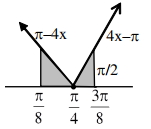
ધારો કે $g_i: \left[\frac{\pi}{8}, \frac{3\pi}{8}\right] \rightarrow \mathbb{R}, i=1, 2$,અને $f: \left[\frac{\pi}{8}, \frac{3\pi}{8}\right] \rightarrow \mathbb{R}$ એવા વિધેયો છે કે જેથી $g_1(x)=1, g_2(x)=|4x-\pi|$ અને $f(x)=\sin^2 x$,દરેક $x \in \left[\frac{\pi}{8}, \frac{3\pi}{8}\right]$ માટે.
$S_i = \int_{\frac{\pi}{8}}^{\frac{3\pi}{8}} f(x) \cdot g_i(x) dx, i=1, 2$ વ્યાખ્યાયિત કરો.
$(1)$ $\frac{16S_1}{\pi}$ નું મૂલ્ય.
$(2)$ $\frac{48S_2}{\pi^2}$ નું મૂલ્ય.
$S_i = \int_{\frac{\pi}{8}}^{\frac{3\pi}{8}} f(x) \cdot g_i(x) dx, i=1, 2$ વ્યાખ્યાયિત કરો.
$(1)$ $\frac{16S_1}{\pi}$ નું મૂલ્ય.
$(2)$ $\frac{48S_2}{\pi^2}$ નું મૂલ્ય.
A
$2, 1.20$
B
$2, 1.30$
C
$2, 1.50$
D
$2, 1.80$
Solution
(C) $S_1$ માટે,આપણી પાસે $S_1 = \int_{\pi/8}^{3\pi/8} \sin^2 x dx$ છે. ગુણધર્મ $\int_a^b f(x) dx = \int_a^b f(a+b-x) dx$ નો ઉપયોગ કરતા,આપણને $S_1 = \int_{\pi/8}^{3\pi/8} \sin^2(\frac{\pi}{8} + \frac{3\pi}{8} - x) dx = \int_{\pi/8}^{3\pi/8} \cos^2 x dx$ મળે છે.
આ બંનેનો સરવાળો કરતા,$2S_1 = \int_{\pi/8}^{3\pi/8} (\sin^2 x + \cos^2 x) dx = \int_{\pi/8}^{3\pi/8} 1 dx = \frac{3\pi}{8} - \frac{\pi}{8} = \frac{\pi}{4}$.
આમ,$S_1 = \frac{\pi}{8}$,તેથી $\frac{16S_1}{\pi} = \frac{16}{\pi} \cdot \frac{\pi}{8} = 2$.
$S_2$ માટે,$S_2 = \int_{\pi/8}^{3\pi/8} \sin^2 x |4x - \pi| dx$. સમાન ગુણધર્મનો ઉપયોગ કરતા,$S_2 = \int_{\pi/8}^{3\pi/8} \sin^2(\frac{\pi}{2}-x) |4(\frac{\pi}{2}-x) - \pi| dx = \int_{\pi/8}^{3\pi/8} \cos^2 x |\pi - 4x| dx = \int_{\pi/8}^{3\pi/8} \cos^2 x |4x - \pi| dx$.
આ બંનેનો સરવાળો કરતા,$2S_2 = \int_{\pi/8}^{3\pi/8} |4x - \pi| (\sin^2 x + \cos^2 x) dx = \int_{\pi/8}^{3\pi/8} |4x - \pi| dx$.
આ સંકલન બે ત્રિકોણના ક્ષેત્રફળને દર્શાવે છે જેનો પાયો $\frac{\pi}{8}$ અને વેધ $\frac{\pi}{2}$ છે,તેથી $2S_2 = 2 \cdot (\frac{1}{2} \cdot \frac{\pi}{8} \cdot \frac{\pi}{2}) = \frac{\pi^2}{16}$.
આમ,$S_2 = \frac{\pi^2}{32}$,તેથી $\frac{48S_2}{\pi^2} = \frac{48}{\pi^2} \cdot \frac{\pi^2}{32} = \frac{48}{32} = 1.5$.
આ બંનેનો સરવાળો કરતા,$2S_1 = \int_{\pi/8}^{3\pi/8} (\sin^2 x + \cos^2 x) dx = \int_{\pi/8}^{3\pi/8} 1 dx = \frac{3\pi}{8} - \frac{\pi}{8} = \frac{\pi}{4}$.
આમ,$S_1 = \frac{\pi}{8}$,તેથી $\frac{16S_1}{\pi} = \frac{16}{\pi} \cdot \frac{\pi}{8} = 2$.
$S_2$ માટે,$S_2 = \int_{\pi/8}^{3\pi/8} \sin^2 x |4x - \pi| dx$. સમાન ગુણધર્મનો ઉપયોગ કરતા,$S_2 = \int_{\pi/8}^{3\pi/8} \sin^2(\frac{\pi}{2}-x) |4(\frac{\pi}{2}-x) - \pi| dx = \int_{\pi/8}^{3\pi/8} \cos^2 x |\pi - 4x| dx = \int_{\pi/8}^{3\pi/8} \cos^2 x |4x - \pi| dx$.
આ બંનેનો સરવાળો કરતા,$2S_2 = \int_{\pi/8}^{3\pi/8} |4x - \pi| (\sin^2 x + \cos^2 x) dx = \int_{\pi/8}^{3\pi/8} |4x - \pi| dx$.
આ સંકલન બે ત્રિકોણના ક્ષેત્રફળને દર્શાવે છે જેનો પાયો $\frac{\pi}{8}$ અને વેધ $\frac{\pi}{2}$ છે,તેથી $2S_2 = 2 \cdot (\frac{1}{2} \cdot \frac{\pi}{8} \cdot \frac{\pi}{2}) = \frac{\pi^2}{16}$.
આમ,$S_2 = \frac{\pi^2}{32}$,તેથી $\frac{48S_2}{\pi^2} = \frac{48}{\pi^2} \cdot \frac{\pi^2}{32} = \frac{48}{32} = 1.5$.
0 likes
View Solution369
AdvancedMCQ
સંકલન $\int_{-\pi / 2}^{\pi / 2}\left(x^2+\ln \frac{\pi+x}{\pi-x}\right) \cos x \, dx$ નું મૂલ્ય શોધો.
A
$0$
B
$\frac{\pi^2}{2}-4$
C
$\frac{\pi^2}{2}+4$
D
$\frac{\pi^2}{2}$
Solution
(B) ધારો કે $I = \int_{-\pi / 2}^{\pi / 2} \left(x^2 + \ln \frac{\pi+x}{\pi-x}\right) \cos x \, dx$.
આપણે તેને બે સંકલનમાં વિભાજિત કરી શકીએ: $I = \int_{-\pi / 2}^{\pi / 2} x^2 \cos x \, dx + \int_{-\pi / 2}^{\pi / 2} \ln \left(\frac{\pi+x}{\pi-x}\right) \cos x \, dx$.
ધારો કે $f(x) = \ln \left(\frac{\pi+x}{\pi-x}\right) \cos x$. અહીં $\ln \left(\frac{\pi+x}{\pi-x}\right)$ એ અયુગ્મ વિધેય છે અને $\cos x$ એ યુગ્મ વિધેય છે,તેથી તેમનો ગુણાકાર અયુગ્મ વિધેય થાય. આમ,$\int_{-\pi / 2}^{\pi / 2} f(x) \, dx = 0$.
હવે,$I = \int_{-\pi / 2}^{\pi / 2} x^2 \cos x \, dx$. $x^2 \cos x$ એ યુગ્મ વિધેય હોવાથી,$I = 2 \int_0^{\pi / 2} x^2 \cos x \, dx$.
ખંડશઃ સંકલનનો ઉપયોગ કરતા: $\int x^2 \cos x \, dx = x^2 \sin x - \int 2x \sin x \, dx = x^2 \sin x - 2 \left( -x \cos x + \int \cos x \, dx \right) = x^2 \sin x + 2x \cos x - 2 \sin x$.
$0$ થી $\pi / 2$ સુધીની સીમાઓ મૂકતા: $2 \left[ (x^2 \sin x + 2x \cos x - 2 \sin x) \right]_0^{\pi / 2} = 2 \left[ ((\pi/2)^2 \cdot 1 + 0 - 2(1)) - (0 + 0 - 0) \right] = 2 \left( \frac{\pi^2}{4} - 2 \right) = \frac{\pi^2}{2} - 4$.
આપણે તેને બે સંકલનમાં વિભાજિત કરી શકીએ: $I = \int_{-\pi / 2}^{\pi / 2} x^2 \cos x \, dx + \int_{-\pi / 2}^{\pi / 2} \ln \left(\frac{\pi+x}{\pi-x}\right) \cos x \, dx$.
ધારો કે $f(x) = \ln \left(\frac{\pi+x}{\pi-x}\right) \cos x$. અહીં $\ln \left(\frac{\pi+x}{\pi-x}\right)$ એ અયુગ્મ વિધેય છે અને $\cos x$ એ યુગ્મ વિધેય છે,તેથી તેમનો ગુણાકાર અયુગ્મ વિધેય થાય. આમ,$\int_{-\pi / 2}^{\pi / 2} f(x) \, dx = 0$.
હવે,$I = \int_{-\pi / 2}^{\pi / 2} x^2 \cos x \, dx$. $x^2 \cos x$ એ યુગ્મ વિધેય હોવાથી,$I = 2 \int_0^{\pi / 2} x^2 \cos x \, dx$.
ખંડશઃ સંકલનનો ઉપયોગ કરતા: $\int x^2 \cos x \, dx = x^2 \sin x - \int 2x \sin x \, dx = x^2 \sin x - 2 \left( -x \cos x + \int \cos x \, dx \right) = x^2 \sin x + 2x \cos x - 2 \sin x$.
$0$ થી $\pi / 2$ સુધીની સીમાઓ મૂકતા: $2 \left[ (x^2 \sin x + 2x \cos x - 2 \sin x) \right]_0^{\pi / 2} = 2 \left[ ((\pi/2)^2 \cdot 1 + 0 - 2(1)) - (0 + 0 - 0) \right] = 2 \left( \frac{\pi^2}{4} - 2 \right) = \frac{\pi^2}{2} - 4$.
0 likes
View Solution370
DifficultMCQ
$a$ અને $L$ ના મૂલ્યો સાથેનો વિકલ્પ(ઓ) જે નીચેના સમીકરણને સંતોષે છે તે છે: $\frac{\int_0^{4 \pi} e^t(\sin^6 at + \cos^4 at) dt}{\int_0^{\pi} e^t(\sin^6 at + \cos^4 at) dt} = L$.
A
$(A, C)$
B
$(A, B)$
C
$(B, D)$
D
$(B, C)$
Solution
(A) ધારો કે $f(t) = e^t(\sin^6 at + \cos^4 at)$. આપણે જોઈએ છીએ કે $a=2$ અને $a=4$ માટે,વિધેય $f(t)$ એ $f(t+\pi) = e^{t+\pi}(\sin^6 a(t+\pi) + \cos^4 a(t+\pi)) = e^{\pi} e^t(\sin^6 at + \cos^4 at) = e^{\pi} f(t)$ સંતોષે છે,કારણ કે બેકી પૂર્ણાંક $a$ માટે $\sin(a(t+\pi)) = \sin(at)$ અને $\cos(a(t+\pi)) = \cos(at)$ થાય છે.
ધારો કે $I_k = \int_{(k-1)\pi}^{k\pi} f(t) dt$. તો $I_{k+1} = \int_{k\pi}^{(k+1)\pi} f(t) dt$. $t = u + \pi$ આદેશ લેતા,આપણને $I_{k+1} = \int_{(k-1)\pi}^{k\pi} f(u+\pi) du = e^{\pi} \int_{(k-1)\pi}^{k\pi} f(u) du = e^{\pi} I_k$ મળે છે.
આમ,$I_1 = A$,$I_2 = e^{\pi} A$,$I_3 = e^{2\pi} A$,અને $I_4 = e^{3\pi} A$,જ્યાં $A = \int_0^{\pi} f(t) dt$ છે.
અંશ $\int_0^{4\pi} f(t) dt = I_1 + I_2 + I_3 + I_4 = A(1 + e^{\pi} + e^{2\pi} + e^{3\pi}) = A \frac{e^{4\pi}-1}{e^{\pi}-1}$ છે.
તેથી,$L = \frac{A \frac{e^{4\pi}-1}{e^{\pi}-1}}{A} = \frac{e^{4\pi}-1}{e^{\pi}-1}$.
આ $a=2$ અને $a=4$ બંને માટે સાચું છે. તેથી,વિકલ્પો $(A)$ અને $(C)$ સાચા છે.
ધારો કે $I_k = \int_{(k-1)\pi}^{k\pi} f(t) dt$. તો $I_{k+1} = \int_{k\pi}^{(k+1)\pi} f(t) dt$. $t = u + \pi$ આદેશ લેતા,આપણને $I_{k+1} = \int_{(k-1)\pi}^{k\pi} f(u+\pi) du = e^{\pi} \int_{(k-1)\pi}^{k\pi} f(u) du = e^{\pi} I_k$ મળે છે.
આમ,$I_1 = A$,$I_2 = e^{\pi} A$,$I_3 = e^{2\pi} A$,અને $I_4 = e^{3\pi} A$,જ્યાં $A = \int_0^{\pi} f(t) dt$ છે.
અંશ $\int_0^{4\pi} f(t) dt = I_1 + I_2 + I_3 + I_4 = A(1 + e^{\pi} + e^{2\pi} + e^{3\pi}) = A \frac{e^{4\pi}-1}{e^{\pi}-1}$ છે.
તેથી,$L = \frac{A \frac{e^{4\pi}-1}{e^{\pi}-1}}{A} = \frac{e^{4\pi}-1}{e^{\pi}-1}$.
આ $a=2$ અને $a=4$ બંને માટે સાચું છે. તેથી,વિકલ્પો $(A)$ અને $(C)$ સાચા છે.
0 likes
View Solution371
AdvancedMCQ
ધારો કે $f(x) = 7 \tan^8 x + 7 \tan^6 x - 3 \tan^4 x - 3 \tan^2 x$ એ દરેક $x \in \left(-\frac{\pi}{2}, \frac{\pi}{2}\right)$ માટે છે. તો સાચું/સાચા પદ/પદો કયા છે?
$(A) \int_0^{\pi/4} x f(x) dx = \frac{1}{12}$
$(B) \int_0^{\pi/4} f(x) dx = 0$
$(C) \int_0^{\pi/4} x f(x) dx = \frac{1}{6}$
$(D) \int_0^{\pi/4} f(x) dx = 1$
$(A) \int_0^{\pi/4} x f(x) dx = \frac{1}{12}$
$(B) \int_0^{\pi/4} f(x) dx = 0$
$(C) \int_0^{\pi/4} x f(x) dx = \frac{1}{6}$
$(D) \int_0^{\pi/4} f(x) dx = 1$
A
$(A, B)$
B
$(B, D)$
C
$(B, C)$
D
$(A, C)$
Solution
(A) આપેલ છે કે $f(x) = 7 \tan^6 x (\tan^2 x + 1) - 3 \tan^2 x (\tan^2 x + 1) = (7 \tan^6 x - 3 \tan^2 x) \sec^2 x$.
પ્રથમ,$\int_0^{\pi/4} f(x) dx$ ની ગણતરી કરો:
$\int_0^{\pi/4} (7 \tan^6 x - 3 \tan^2 x) \sec^2 x dx$. ધારો કે $u = \tan x$,તો $du = \sec^2 x dx$. જ્યારે $x=0, u=0$; જ્યારે $x=\pi/4, u=1$.
$= \int_0^1 (7u^6 - 3u^2) du = [u^7 - u^3]_0^1 = (1 - 1) - (0 - 0) = 0$. આમ,$(B)$ સાચું છે.
આગળ,ખંડશઃ સંકલનનો ઉપયોગ કરીને $\int_0^{\pi/4} x f(x) dx$ ની ગણતરી કરો:
ધારો કે $I = \int_0^{\pi/4} x f(x) dx$. ધારો કે $g(x) = \int f(x) dx = \tan^7 x - \tan^3 x$.
ખંડશઃ સંકલનનો ઉપયોગ કરતા: $\int_0^{\pi/4} x f(x) dx = [x g(x)]_0^{\pi/4} - \int_0^{\pi/4} g(x) dx$.
$[x(\tan^7 x - \tan^3 x)]_0^{\pi/4} = \frac{\pi}{4}(1 - 1) - 0 = 0$.
તેથી,$I = - \int_0^{\pi/4} (\tan^7 x - \tan^3 x) dx = \int_0^{\pi/4} (\tan^3 x - \tan^7 x) dx$.
$= \int_0^{\pi/4} \tan^3 x (1 - \tan^4 x) dx = \int_0^{\pi/4} \tan^3 x (1 - \tan^2 x)(1 + \tan^2 x) dx$.
$= \int_0^{\pi/4} (\tan^3 x - \tan^5 x) \sec^2 x dx$. ધારો કે $u = \tan x$,$du = \sec^2 x dx$.
$= \int_0^1 (u^3 - u^5) du = [\frac{u^4}{4} - \frac{u^6}{6}]_0^1 = \frac{1}{4} - \frac{1}{6} = \frac{3-2}{12} = \frac{1}{12}$. આમ,$(A)$ સાચું છે.
પ્રથમ,$\int_0^{\pi/4} f(x) dx$ ની ગણતરી કરો:
$\int_0^{\pi/4} (7 \tan^6 x - 3 \tan^2 x) \sec^2 x dx$. ધારો કે $u = \tan x$,તો $du = \sec^2 x dx$. જ્યારે $x=0, u=0$; જ્યારે $x=\pi/4, u=1$.
$= \int_0^1 (7u^6 - 3u^2) du = [u^7 - u^3]_0^1 = (1 - 1) - (0 - 0) = 0$. આમ,$(B)$ સાચું છે.
આગળ,ખંડશઃ સંકલનનો ઉપયોગ કરીને $\int_0^{\pi/4} x f(x) dx$ ની ગણતરી કરો:
ધારો કે $I = \int_0^{\pi/4} x f(x) dx$. ધારો કે $g(x) = \int f(x) dx = \tan^7 x - \tan^3 x$.
ખંડશઃ સંકલનનો ઉપયોગ કરતા: $\int_0^{\pi/4} x f(x) dx = [x g(x)]_0^{\pi/4} - \int_0^{\pi/4} g(x) dx$.
$[x(\tan^7 x - \tan^3 x)]_0^{\pi/4} = \frac{\pi}{4}(1 - 1) - 0 = 0$.
તેથી,$I = - \int_0^{\pi/4} (\tan^7 x - \tan^3 x) dx = \int_0^{\pi/4} (\tan^3 x - \tan^7 x) dx$.
$= \int_0^{\pi/4} \tan^3 x (1 - \tan^4 x) dx = \int_0^{\pi/4} \tan^3 x (1 - \tan^2 x)(1 + \tan^2 x) dx$.
$= \int_0^{\pi/4} (\tan^3 x - \tan^5 x) \sec^2 x dx$. ધારો કે $u = \tan x$,$du = \sec^2 x dx$.
$= \int_0^1 (u^3 - u^5) du = [\frac{u^4}{4} - \frac{u^6}{6}]_0^1 = \frac{1}{4} - \frac{1}{6} = \frac{3-2}{12} = \frac{1}{12}$. આમ,$(A)$ સાચું છે.
0 likes
View Solution372
AdvancedMCQ
ધારો કે $f: [0, \frac{\pi}{2}] \rightarrow [0, 1]$ એ $f(x) = \sin^2 x$ દ્વારા વ્યાખ્યાયિત વિધેય છે અને ધારો કે $g: [0, \frac{\pi}{2}] \rightarrow [0, \infty)$ એ $g(x) = \sqrt{\frac{\pi x}{2} - x^2}$ દ્વારા વ્યાખ્યાયિત વિધેય છે.
(આ ફકરા પર આધારિત બે પ્રશ્નો છે. નીચે આપેલા પ્રશ્નો તે બે છે.)
$(1)$ $2 \int_0^{\frac{\pi}{2}} f(x) g(x) dx - \int_0^{\frac{\pi}{2}} g(x) dx$ નું મૂલ્ય શોધો.
$(2)$ $\frac{16}{\pi^3} \int_0^{\frac{\pi}{2}} f(x) g(x) dx$ નું મૂલ્ય શોધો.
(આ ફકરા પર આધારિત બે પ્રશ્નો છે. નીચે આપેલા પ્રશ્નો તે બે છે.)
$(1)$ $2 \int_0^{\frac{\pi}{2}} f(x) g(x) dx - \int_0^{\frac{\pi}{2}} g(x) dx$ નું મૂલ્ય શોધો.
$(2)$ $\frac{16}{\pi^3} \int_0^{\frac{\pi}{2}} f(x) g(x) dx$ નું મૂલ્ય શોધો.
A
$0, 0.20$
B
$0, 0.25$
C
$0, 0.30$
D
$0, 0.35$
Solution
(B) $(1)$ ધારો કે $I = 2 \int_0^{\frac{\pi}{2}} \sin^2 x \sqrt{\frac{\pi x}{2} - x^2} dx - \int_0^{\frac{\pi}{2}} \sqrt{\frac{\pi x}{2} - x^2} dx$.
ધારો કે $I_1 = \int_0^{\frac{\pi}{2}} \sin^2 x \sqrt{(\frac{\pi}{4})^2 - (x - \frac{\pi}{4})^2} dx$.
ગુણધર્મ $\int_0^a h(x) dx = \int_0^a h(a-x) dx$ નો ઉપયોગ કરતા:
$I_1 = \int_0^{\frac{\pi}{2}} \cos^2 x \sqrt{(\frac{\pi}{4})^2 - (x - \frac{\pi}{4})^2} dx$.
બંને સમીકરણોનો સરવાળો કરતા:
$2I_1 = \int_0^{\frac{\pi}{2}} (\sin^2 x + \cos^2 x) \sqrt{(\frac{\pi}{4})^2 - (x - \frac{\pi}{4})^2} dx = \int_0^{\frac{\pi}{2}} g(x) dx$.
આમ,$I = 2I_1 - \int_0^{\frac{\pi}{2}} g(x) dx = 0$.
$(2)$ ઉપર મુજબ,$I_1 = \frac{1}{2} \int_0^{\frac{\pi}{2}} g(x) dx = \frac{\pi^3}{64}$.
તેથી,$\frac{16}{\pi^3} I_1 = \frac{16}{\pi^3} \cdot \frac{\pi^3}{64} = 0.25$.
ધારો કે $I_1 = \int_0^{\frac{\pi}{2}} \sin^2 x \sqrt{(\frac{\pi}{4})^2 - (x - \frac{\pi}{4})^2} dx$.
ગુણધર્મ $\int_0^a h(x) dx = \int_0^a h(a-x) dx$ નો ઉપયોગ કરતા:
$I_1 = \int_0^{\frac{\pi}{2}} \cos^2 x \sqrt{(\frac{\pi}{4})^2 - (x - \frac{\pi}{4})^2} dx$.
બંને સમીકરણોનો સરવાળો કરતા:
$2I_1 = \int_0^{\frac{\pi}{2}} (\sin^2 x + \cos^2 x) \sqrt{(\frac{\pi}{4})^2 - (x - \frac{\pi}{4})^2} dx = \int_0^{\frac{\pi}{2}} g(x) dx$.
આમ,$I = 2I_1 - \int_0^{\frac{\pi}{2}} g(x) dx = 0$.
$(2)$ ઉપર મુજબ,$I_1 = \frac{1}{2} \int_0^{\frac{\pi}{2}} g(x) dx = \frac{\pi^3}{64}$.
તેથી,$\frac{16}{\pi^3} I_1 = \frac{16}{\pi^3} \cdot \frac{\pi^3}{64} = 0.25$.
0 likes
View Solution373
DifficultMCQ
$\int_{e^2}^{e^4} \frac{1}{x} \left( \frac{e^{((\ln x)^2+1)^{-1}}}{e^{((\ln x)^2+1)^{-1}} + e^{((6-\ln x)^2+1)^{-1}}} \right) dx$ નું મૂલ્ય શોધો.
A
$\ln 2$
B
$2$
C
$1$
D
$e^2$
Solution
(C) ધારો કે $I = \int_{e^2}^{e^4} \frac{1}{x} \left( \frac{e^{((\ln x)^2+1)^{-1}}}{e^{((\ln x)^2+1)^{-1}} + e^{((6-\ln x)^2+1)^{-1}}} \right) dx$.
$\ln x = t$ આદેશ લેતા,$\frac{1}{x} dx = dt$ મળે.
જ્યારે $x = e^2$,ત્યારે $t = 2$ અને જ્યારે $x = e^4$,ત્યારે $t = 4$.
તેથી,$I = \int_{2}^{4} \frac{e^{(t^2+1)^{-1}}}{e^{(t^2+1)^{-1}} + e^{((6-t)^2+1)^{-1}}} dt$.
ગુણધર્મ $\int_{a}^{b} f(t) dt = \int_{a}^{b} f(a+b-t) dt$ નો ઉપયોગ કરતા:
$I = \int_{2}^{4} \frac{e^{((6-t)^2+1)^{-1}}}{e^{((6-t)^2+1)^{-1}} + e^{(t^2+1)^{-1}}} dt$.
બંને સમીકરણોનો સરવાળો કરતા:
$2I = \int_{2}^{4} \frac{e^{(t^2+1)^{-1}} + e^{((6-t)^2+1)^{-1}}}{e^{(t^2+1)^{-1}} + e^{((6-t)^2+1)^{-1}}} dt = \int_{2}^{4} 1 dt = [t]_{2}^{4} = 4 - 2 = 2$.
આમ,$I = 1$.
$\ln x = t$ આદેશ લેતા,$\frac{1}{x} dx = dt$ મળે.
જ્યારે $x = e^2$,ત્યારે $t = 2$ અને જ્યારે $x = e^4$,ત્યારે $t = 4$.
તેથી,$I = \int_{2}^{4} \frac{e^{(t^2+1)^{-1}}}{e^{(t^2+1)^{-1}} + e^{((6-t)^2+1)^{-1}}} dt$.
ગુણધર્મ $\int_{a}^{b} f(t) dt = \int_{a}^{b} f(a+b-t) dt$ નો ઉપયોગ કરતા:
$I = \int_{2}^{4} \frac{e^{((6-t)^2+1)^{-1}}}{e^{((6-t)^2+1)^{-1}} + e^{(t^2+1)^{-1}}} dt$.
બંને સમીકરણોનો સરવાળો કરતા:
$2I = \int_{2}^{4} \frac{e^{(t^2+1)^{-1}} + e^{((6-t)^2+1)^{-1}}}{e^{(t^2+1)^{-1}} + e^{((6-t)^2+1)^{-1}}} dt = \int_{2}^{4} 1 dt = [t]_{2}^{4} = 4 - 2 = 2$.
આમ,$I = 1$.
0 likes
View Solution374
DifficultMCQ
જો $I=\int_0^{\frac{\pi}{2}} \frac{\sin ^{\frac{3}{2}} x}{\sin ^{\frac{3}{2}} x+\cos ^{\frac{3}{2}} x} d x$ હોય,તો $\int_0^{\frac{\pi}{2}} \frac{x \sin x \cos x}{\sin ^4 x+\cos ^4 x} d x$ ની કિંમત શોધો:
A
$\frac{\pi^2}{16}$
B
$\frac{\pi^2}{4}$
C
$\frac{\pi^2}{8}$
D
$\frac{\pi^2}{12}$
Solution
(A) ધારો કે $I_2 = \int_0^{\frac{\pi}{2}} \frac{x \sin x \cos x}{\sin ^4 x+\cos ^4 x} dx$.
ગુણધર્મ $\int_0^a f(x) dx = \int_0^a f(a-x) dx$ નો ઉપયોગ કરતા:
$I_2 = \int_0^{\frac{\pi}{2}} \frac{(\frac{\pi}{2}-x) \sin(\frac{\pi}{2}-x) \cos(\frac{\pi}{2}-x)}{\sin ^4(\frac{\pi}{2}-x)+\cos ^4(\frac{\pi}{2}-x)} dx = \int_0^{\frac{\pi}{2}} \frac{(\frac{\pi}{2}-x) \cos x \sin x}{\cos ^4 x+\sin ^4 x} dx$.
$I_2$ માટેના બંને પદોનો સરવાળો કરતા:
$2I_2 = \int_0^{\frac{\pi}{2}} \frac{\frac{\pi}{2} \sin x \cos x}{\sin ^4 x+\cos ^4 x} dx = \frac{\pi}{2} \int_0^{\frac{\pi}{2}} \frac{\sin x \cos x}{\sin ^4 x+\cos ^4 x} dx$.
અંશ અને છેદને $\cos^4 x$ વડે ભાગતા:
$I_2 = \frac{\pi}{4} \int_0^{\frac{\pi}{2}} \frac{\tan x \sec^2 x}{\tan^4 x + 1} dx$.
ધારો કે $t = \tan^2 x$,તેથી $dt = 2 \tan x \sec^2 x dx$,એટલે કે $\tan x \sec^2 x dx = \frac{dt}{2}$.
જ્યારે $x \to 0, t \to 0$ અને જ્યારે $x \to \frac{\pi}{2}, t \to \infty$.
$I_2 = \frac{\pi}{4} \int_0^{\infty} \frac{dt/2}{t^2+1} = \frac{\pi}{8} [\tan^{-1} t]_0^{\infty} = \frac{\pi}{8} \cdot \frac{\pi}{2} = \frac{\pi^2}{16}$.
ગુણધર્મ $\int_0^a f(x) dx = \int_0^a f(a-x) dx$ નો ઉપયોગ કરતા:
$I_2 = \int_0^{\frac{\pi}{2}} \frac{(\frac{\pi}{2}-x) \sin(\frac{\pi}{2}-x) \cos(\frac{\pi}{2}-x)}{\sin ^4(\frac{\pi}{2}-x)+\cos ^4(\frac{\pi}{2}-x)} dx = \int_0^{\frac{\pi}{2}} \frac{(\frac{\pi}{2}-x) \cos x \sin x}{\cos ^4 x+\sin ^4 x} dx$.
$I_2$ માટેના બંને પદોનો સરવાળો કરતા:
$2I_2 = \int_0^{\frac{\pi}{2}} \frac{\frac{\pi}{2} \sin x \cos x}{\sin ^4 x+\cos ^4 x} dx = \frac{\pi}{2} \int_0^{\frac{\pi}{2}} \frac{\sin x \cos x}{\sin ^4 x+\cos ^4 x} dx$.
અંશ અને છેદને $\cos^4 x$ વડે ભાગતા:
$I_2 = \frac{\pi}{4} \int_0^{\frac{\pi}{2}} \frac{\tan x \sec^2 x}{\tan^4 x + 1} dx$.
ધારો કે $t = \tan^2 x$,તેથી $dt = 2 \tan x \sec^2 x dx$,એટલે કે $\tan x \sec^2 x dx = \frac{dt}{2}$.
જ્યારે $x \to 0, t \to 0$ અને જ્યારે $x \to \frac{\pi}{2}, t \to \infty$.
$I_2 = \frac{\pi}{4} \int_0^{\infty} \frac{dt/2}{t^2+1} = \frac{\pi}{8} [\tan^{-1} t]_0^{\infty} = \frac{\pi}{8} \cdot \frac{\pi}{2} = \frac{\pi^2}{16}$.
0 likes
View Solution375
DifficultMCQ
જો $\int_{-\frac{\pi}{2}}^{\frac{\pi}{2}} \frac{96 x^2 \cos^2 x}{1+e^x} dx = \pi(\alpha \pi^2 + \beta)$,જ્યાં $\alpha, \beta \in \mathbb{Z}$,તો $(\alpha + \beta)^2$ ની કિંમત શોધો:
A
$144$
B
$196$
C
$100$
D
$64$
Solution
(C) ધારો કે $I = \int_{-\frac{\pi}{2}}^{\frac{\pi}{2}} \frac{96 x^2 \cos^2 x}{1+e^x} dx$.
ગુણધર્મ $\int_a^b f(x) dx = \int_a^b f(a+b-x) dx$ નો ઉપયોગ કરતા,$I = \int_{-\frac{\pi}{2}}^{\frac{\pi}{2}} \frac{96 x^2 \cos^2 x}{1+e^{-x}} dx$.
બંને સમીકરણોનો સરવાળો કરતા: $2I = \int_{-\frac{\pi}{2}}^{\frac{\pi}{2}} 96 x^2 \cos^2 x \left( \frac{1}{1+e^x} + \frac{1}{1+e^{-x}} \right) dx = \int_{-\frac{\pi}{2}}^{\frac{\pi}{2}} 96 x^2 \cos^2 x dx$.
$x^2 \cos^2 x$ એ યુગ્મ વિધેય હોવાથી,$I = \int_0^{\frac{\pi}{2}} 96 x^2 \cos^2 x dx = 48 \int_0^{\frac{\pi}{2}} x^2 (1 + \cos 2x) dx$.
$I = 48 \left[ \frac{x^3}{3} \right]_0^{\frac{\pi}{2}} + 48 \int_0^{\frac{\pi}{2}} x^2 \cos 2x dx$.
$I = 48 \left( \frac{\pi^3}{24} \right) + 48 \left[ x^2 \frac{\sin 2x}{2} - \int 2x \frac{\sin 2x}{2} dx \right]_0^{\frac{\pi}{2}}$.
$I = 2\pi^3 + 48 \left[ 0 - \int_0^{\frac{\pi}{2}} x \sin 2x dx \right] = 2\pi^3 - 48 \left[ x \left( -\frac{\cos 2x}{2} \right) - \int -\frac{\cos 2x}{2} dx \right]_0^{\frac{\pi}{2}}$.
$I = 2\pi^3 - 48 \left[ -\frac{x \cos 2x}{2} + \frac{\sin 2x}{4} \right]_0^{\frac{\pi}{2}} = 2\pi^3 - 48 \left[ -\frac{\pi}{2} \cdot \frac{(-1)}{2} - 0 \right] = 2\pi^3 - 12\pi = \pi(2\pi^2 - 12)$.
$\pi(\alpha \pi^2 + \beta)$ સાથે સરખાવતા,$\alpha = 2, \beta = -12$ મળે છે.
તેથી,$(\alpha + \beta)^2 = (2 - 12)^2 = (-10)^2 = 100$.
ગુણધર્મ $\int_a^b f(x) dx = \int_a^b f(a+b-x) dx$ નો ઉપયોગ કરતા,$I = \int_{-\frac{\pi}{2}}^{\frac{\pi}{2}} \frac{96 x^2 \cos^2 x}{1+e^{-x}} dx$.
બંને સમીકરણોનો સરવાળો કરતા: $2I = \int_{-\frac{\pi}{2}}^{\frac{\pi}{2}} 96 x^2 \cos^2 x \left( \frac{1}{1+e^x} + \frac{1}{1+e^{-x}} \right) dx = \int_{-\frac{\pi}{2}}^{\frac{\pi}{2}} 96 x^2 \cos^2 x dx$.
$x^2 \cos^2 x$ એ યુગ્મ વિધેય હોવાથી,$I = \int_0^{\frac{\pi}{2}} 96 x^2 \cos^2 x dx = 48 \int_0^{\frac{\pi}{2}} x^2 (1 + \cos 2x) dx$.
$I = 48 \left[ \frac{x^3}{3} \right]_0^{\frac{\pi}{2}} + 48 \int_0^{\frac{\pi}{2}} x^2 \cos 2x dx$.
$I = 48 \left( \frac{\pi^3}{24} \right) + 48 \left[ x^2 \frac{\sin 2x}{2} - \int 2x \frac{\sin 2x}{2} dx \right]_0^{\frac{\pi}{2}}$.
$I = 2\pi^3 + 48 \left[ 0 - \int_0^{\frac{\pi}{2}} x \sin 2x dx \right] = 2\pi^3 - 48 \left[ x \left( -\frac{\cos 2x}{2} \right) - \int -\frac{\cos 2x}{2} dx \right]_0^{\frac{\pi}{2}}$.
$I = 2\pi^3 - 48 \left[ -\frac{x \cos 2x}{2} + \frac{\sin 2x}{4} \right]_0^{\frac{\pi}{2}} = 2\pi^3 - 48 \left[ -\frac{\pi}{2} \cdot \frac{(-1)}{2} - 0 \right] = 2\pi^3 - 12\pi = \pi(2\pi^2 - 12)$.
$\pi(\alpha \pi^2 + \beta)$ સાથે સરખાવતા,$\alpha = 2, \beta = -12$ મળે છે.
તેથી,$(\alpha + \beta)^2 = (2 - 12)^2 = (-10)^2 = 100$.
0 likes
View Solution376
DifficultMCQ
ધારો કે $(a, b)$ એ વક્ર $x^2=2y$ અને રેખા $y-2x-6=0$ નું બીજા ચરણમાં છેદબિંદુ છે. તો સંકલન $I=\int_a^b \frac{9x^2}{1+5^x} dx$ ની કિંમત શોધો:
A
$24$
B
$27$
C
$18$
D
$21$
Solution
(A) આપેલ વક્ર $x^2=2y$ અને રેખા $y=2x+6$ છે. રેખાના સમીકરણમાંથી $y$ ની કિંમત વક્રના સમીકરણમાં મૂકતા:
$x^2=2(2x+6) \Rightarrow x^2=4x+12$
$x^2-4x-12=0 \Rightarrow (x-6)(x+2)=0$
તેથી,$x=6$ અથવા $x=-2$.
$x=6$ માટે,$y=2(6)+6=18$. $x=-2$ માટે,$y=2(-2)+6=2$.
છેદબિંદુઓ $(6, 18)$ અને $(-2, 2)$ છે.
બિંદુ $(a, b)$ બીજા ચરણમાં હોવાથી,$a=-2$ અને $b=2$ મળે.
આપણે $I=\int_{-2}^2 \frac{9x^2}{1+5^x} dx$ ની કિંમત શોધવાની છે.
ગુણધર્મ $\int_{-k}^k f(x) dx = \int_0^k (f(x)+f(-x)) dx$ નો ઉપયોગ કરતા:
$I = \int_{-2}^2 \frac{9x^2}{1+5^x} dx$.
અહીં $\frac{9x^2}{1+5^x} + \frac{9(-x)^2}{1+5^{-x}} = \frac{9x^2}{1+5^x} + \frac{9x^2 \cdot 5^x}{5^x+1} = \frac{9x^2(1+5^x)}{1+5^x} = 9x^2$.
તેથી,$I = \int_0^2 9x^2 dx = [3x^3]_0^2 = 3(8) - 3(0) = 24$.
$x^2=2(2x+6) \Rightarrow x^2=4x+12$
$x^2-4x-12=0 \Rightarrow (x-6)(x+2)=0$
તેથી,$x=6$ અથવા $x=-2$.
$x=6$ માટે,$y=2(6)+6=18$. $x=-2$ માટે,$y=2(-2)+6=2$.
છેદબિંદુઓ $(6, 18)$ અને $(-2, 2)$ છે.
બિંદુ $(a, b)$ બીજા ચરણમાં હોવાથી,$a=-2$ અને $b=2$ મળે.
આપણે $I=\int_{-2}^2 \frac{9x^2}{1+5^x} dx$ ની કિંમત શોધવાની છે.
ગુણધર્મ $\int_{-k}^k f(x) dx = \int_0^k (f(x)+f(-x)) dx$ નો ઉપયોગ કરતા:
$I = \int_{-2}^2 \frac{9x^2}{1+5^x} dx$.
અહીં $\frac{9x^2}{1+5^x} + \frac{9(-x)^2}{1+5^{-x}} = \frac{9x^2}{1+5^x} + \frac{9x^2 \cdot 5^x}{5^x+1} = \frac{9x^2(1+5^x)}{1+5^x} = 9x^2$.
તેથી,$I = \int_0^2 9x^2 dx = [3x^3]_0^2 = 3(8) - 3(0) = 24$.
0 likes
View Solution377
MediumMCQ
સંકલન $\int_0^\pi \frac{8 x \, dx}{4 \cos^2 x + \sin^2 x}$ ની કિંમત શોધો.
A
$2 \pi^2$
B
$4 \pi^2$
C
$\pi^2$
D
$\frac{3 \pi^2}{2}$
Solution
(A) ધારો કે $I = \int_0^\pi \frac{8 x \, dx}{4 \cos^2 x + \sin^2 x}$.
ગુણધર્મ $\int_0^a f(x) \, dx = \int_0^a f(a-x) \, dx$ નો ઉપયોગ કરતા:
$I = \int_0^\pi \frac{8(\pi - x) \, dx}{4 \cos^2(\pi - x) + \sin^2(\pi - x)} = \int_0^\pi \frac{8(\pi - x) \, dx}{4 \cos^2 x + \sin^2 x}$.
બંને સમીકરણોનો સરવાળો કરતા:
$2I = \int_0^\pi \frac{8x + 8\pi - 8x}{4 \cos^2 x + \sin^2 x} \, dx = 8\pi \int_0^\pi \frac{dx}{4 \cos^2 x + \sin^2 x}$.
વિધેય $\pi/2$ ની સાપેક્ષ સંમિત હોવાથી,$2I = 8\pi \times 2 \int_0^{\pi/2} \frac{dx}{4 \cos^2 x + \sin^2 x}$.
અંશ અને છેદને $\cos^2 x$ વડે ભાગતા:
$I = 8\pi \int_0^{\pi/2} \frac{\sec^2 x \, dx}{4 + \tan^2 x}$.
ધારો કે $t = \tan x$,તેથી $dt = \sec^2 x \, dx$. જ્યારે $x \to 0, t \to 0$ અને જ્યારે $x \to \pi/2, t \to \infty$.
$I = 8\pi \int_0^\infty \frac{dt}{4 + t^2} = 8\pi \left[ \frac{1}{2} \tan^{-1}\left(\frac{t}{2}\right) \right]_0^\infty$.
$I = 4\pi \left( \frac{\pi}{2} - 0 \right) = 2\pi^2$.
ગુણધર્મ $\int_0^a f(x) \, dx = \int_0^a f(a-x) \, dx$ નો ઉપયોગ કરતા:
$I = \int_0^\pi \frac{8(\pi - x) \, dx}{4 \cos^2(\pi - x) + \sin^2(\pi - x)} = \int_0^\pi \frac{8(\pi - x) \, dx}{4 \cos^2 x + \sin^2 x}$.
બંને સમીકરણોનો સરવાળો કરતા:
$2I = \int_0^\pi \frac{8x + 8\pi - 8x}{4 \cos^2 x + \sin^2 x} \, dx = 8\pi \int_0^\pi \frac{dx}{4 \cos^2 x + \sin^2 x}$.
વિધેય $\pi/2$ ની સાપેક્ષ સંમિત હોવાથી,$2I = 8\pi \times 2 \int_0^{\pi/2} \frac{dx}{4 \cos^2 x + \sin^2 x}$.
અંશ અને છેદને $\cos^2 x$ વડે ભાગતા:
$I = 8\pi \int_0^{\pi/2} \frac{\sec^2 x \, dx}{4 + \tan^2 x}$.
ધારો કે $t = \tan x$,તેથી $dt = \sec^2 x \, dx$. જ્યારે $x \to 0, t \to 0$ અને જ્યારે $x \to \pi/2, t \to \infty$.
$I = 8\pi \int_0^\infty \frac{dt}{4 + t^2} = 8\pi \left[ \frac{1}{2} \tan^{-1}\left(\frac{t}{2}\right) \right]_0^\infty$.
$I = 4\pi \left( \frac{\pi}{2} - 0 \right) = 2\pi^2$.
0 likes
View Solution378
DifficultMCQ
$\int_{-1}^1 \frac{(1+\sqrt{|x|-x}) e^x+(\sqrt{|x|-x}) e^{-x}}{e^x+e^{-x}} d x$ નું મૂલ્ય કેટલું થાય?
A
$3-\frac{2 \sqrt{2}}{3}$
B
$2+\frac{2 \sqrt{2}}{3}$
C
$1-\frac{2 \sqrt{2}}{3}$
D
$1+\frac{2 \sqrt{2}}{3}$
Solution
(D) ધારો કે $I = \int_{-1}^1 \frac{(1+\sqrt{|x|-x}) e^x+(\sqrt{|x|-x}) e^{-x}}{e^x+e^{-x}} dx$.
ગુણધર્મ $\int_a^b f(x) dx = \int_a^b f(a+b-x) dx$ નો ઉપયોગ કરીને,$x$ ને $-x$ વડે બદલતા:
$I = \int_{-1}^1 \frac{(1+\sqrt{|-x|-(-x)}) e^{-x}+(\sqrt{|-x|-(-x)}) e^{-(-x)}}{e^{-x}+e^{-(-x)}} dx$
$I = \int_{-1}^1 \frac{(1+\sqrt{|x|+x}) e^{-x}+(\sqrt{|x|+x}) e^x}{e^{-x}+e^x} dx$.
$I$ માટેના બંને પદોનો સરવાળો કરતા:
$2I = \int_{-1}^1 \frac{(1+\sqrt{|x|-x}) e^x + (\sqrt{|x|-x}) e^{-x} + (1+\sqrt{|x|+x}) e^{-x} + (\sqrt{|x|+x}) e^x}{e^x+e^{-x}} dx$
$2I = \int_{-1}^1 \frac{(1+\sqrt{|x|-x}+\sqrt{|x|+x})(e^x+e^{-x})}{e^x+e^{-x}} dx$
$2I = \int_{-1}^1 (1+\sqrt{|x|-x}+\sqrt{|x|+x}) dx$.
વિધેય યુગ્મ હોવાથી,$2I = 2 \int_0^1 (1+\sqrt{x-x}+\sqrt{x+x}) dx = 2 \int_0^1 (1+0+\sqrt{2x}) dx$.
$I = \int_0^1 (1+\sqrt{2}x^{1/2}) dx = [x + \sqrt{2} \cdot \frac{2}{3} x^{3/2}]_0^1$
$I = 1 + \frac{2\sqrt{2}}{3}$.
ગુણધર્મ $\int_a^b f(x) dx = \int_a^b f(a+b-x) dx$ નો ઉપયોગ કરીને,$x$ ને $-x$ વડે બદલતા:
$I = \int_{-1}^1 \frac{(1+\sqrt{|-x|-(-x)}) e^{-x}+(\sqrt{|-x|-(-x)}) e^{-(-x)}}{e^{-x}+e^{-(-x)}} dx$
$I = \int_{-1}^1 \frac{(1+\sqrt{|x|+x}) e^{-x}+(\sqrt{|x|+x}) e^x}{e^{-x}+e^x} dx$.
$I$ માટેના બંને પદોનો સરવાળો કરતા:
$2I = \int_{-1}^1 \frac{(1+\sqrt{|x|-x}) e^x + (\sqrt{|x|-x}) e^{-x} + (1+\sqrt{|x|+x}) e^{-x} + (\sqrt{|x|+x}) e^x}{e^x+e^{-x}} dx$
$2I = \int_{-1}^1 \frac{(1+\sqrt{|x|-x}+\sqrt{|x|+x})(e^x+e^{-x})}{e^x+e^{-x}} dx$
$2I = \int_{-1}^1 (1+\sqrt{|x|-x}+\sqrt{|x|+x}) dx$.
વિધેય યુગ્મ હોવાથી,$2I = 2 \int_0^1 (1+\sqrt{x-x}+\sqrt{x+x}) dx = 2 \int_0^1 (1+0+\sqrt{2x}) dx$.
$I = \int_0^1 (1+\sqrt{2}x^{1/2}) dx = [x + \sqrt{2} \cdot \frac{2}{3} x^{3/2}]_0^1$
$I = 1 + \frac{2\sqrt{2}}{3}$.
0 likes
View Solution379
MediumMCQ
સંકલન $\int_0^\pi \frac{(x+3) \sin x}{1+3 \cos ^2 x} d x$ ની કિંમત શોધો:
A
$\frac{\pi}{\sqrt{3}}(\pi+1)$
B
$\frac{\pi}{\sqrt{3}}(\pi+2)$
C
$\frac{\pi}{3 \sqrt{3}}(\pi+6)$
D
$\frac{\pi}{2 \sqrt{3}}(\pi+4)$
Solution
(C) ધારો કે $I = \int_0^\pi \frac{(x+3) \sin x}{1+3 \cos^2 x} dx$.
ગુણધર્મ $\int_0^a f(x) dx = \int_0^a f(a-x) dx$ નો ઉપયોગ કરતા:
$I = \int_0^\pi \frac{(\pi-x+3) \sin(\pi-x)}{1+3 \cos^2(\pi-x)} dx = \int_0^\pi \frac{(\pi-x+3) \sin x}{1+3 \cos^2 x} dx$.
$I$ માટેના બંને પદોનો સરવાળો કરતા:
$2I = \int_0^\pi \frac{(x+3+\pi-x+3) \sin x}{1+3 \cos^2 x} dx = \int_0^\pi \frac{(\pi+6) \sin x}{1+3 \cos^2 x} dx$.
ગુણધર્મ $\int_0^{2a} f(x) dx = 2 \int_0^a f(x) dx$ નો ઉપયોગ કરતા:
$2I = 2(\pi+6) \int_0^{\pi/2} \frac{\sin x}{1+3 \cos^2 x} dx$.
$I = (\pi+6) \int_0^{\pi/2} \frac{\sin x}{1+3 \cos^2 x} dx$.
ધારો કે $\sqrt{3} \cos x = t$,તેથી $-\sqrt{3} \sin x dx = dt$,એટલે કે $\sin x dx = -\frac{dt}{\sqrt{3}}$.
જ્યારે $x=0, t=\sqrt{3}$ અને જ્યારે $x=\pi/2, t=0$.
$I = (\pi+6) \int_{\sqrt{3}}^0 \frac{-dt/\sqrt{3}}{1+t^2} = \frac{\pi+6}{\sqrt{3}} \int_0^{\sqrt{3}} \frac{dt}{1+t^2}$.
$I = \frac{\pi+6}{\sqrt{3}} [\tan^{-1} t]_0^{\sqrt{3}} = \frac{\pi+6}{\sqrt{3}} (\tan^{-1} \sqrt{3} - \tan^{-1} 0) = \frac{\pi+6}{\sqrt{3}} \cdot \frac{\pi}{3} = \frac{\pi(\pi+6)}{3\sqrt{3}}$.
ગુણધર્મ $\int_0^a f(x) dx = \int_0^a f(a-x) dx$ નો ઉપયોગ કરતા:
$I = \int_0^\pi \frac{(\pi-x+3) \sin(\pi-x)}{1+3 \cos^2(\pi-x)} dx = \int_0^\pi \frac{(\pi-x+3) \sin x}{1+3 \cos^2 x} dx$.
$I$ માટેના બંને પદોનો સરવાળો કરતા:
$2I = \int_0^\pi \frac{(x+3+\pi-x+3) \sin x}{1+3 \cos^2 x} dx = \int_0^\pi \frac{(\pi+6) \sin x}{1+3 \cos^2 x} dx$.
ગુણધર્મ $\int_0^{2a} f(x) dx = 2 \int_0^a f(x) dx$ નો ઉપયોગ કરતા:
$2I = 2(\pi+6) \int_0^{\pi/2} \frac{\sin x}{1+3 \cos^2 x} dx$.
$I = (\pi+6) \int_0^{\pi/2} \frac{\sin x}{1+3 \cos^2 x} dx$.
ધારો કે $\sqrt{3} \cos x = t$,તેથી $-\sqrt{3} \sin x dx = dt$,એટલે કે $\sin x dx = -\frac{dt}{\sqrt{3}}$.
જ્યારે $x=0, t=\sqrt{3}$ અને જ્યારે $x=\pi/2, t=0$.
$I = (\pi+6) \int_{\sqrt{3}}^0 \frac{-dt/\sqrt{3}}{1+t^2} = \frac{\pi+6}{\sqrt{3}} \int_0^{\sqrt{3}} \frac{dt}{1+t^2}$.
$I = \frac{\pi+6}{\sqrt{3}} [\tan^{-1} t]_0^{\sqrt{3}} = \frac{\pi+6}{\sqrt{3}} (\tan^{-1} \sqrt{3} - \tan^{-1} 0) = \frac{\pi+6}{\sqrt{3}} \cdot \frac{\pi}{3} = \frac{\pi(\pi+6)}{3\sqrt{3}}$.
0 likes
View Solution380
DifficultMCQ
ધારો કે $f(x)$ એ એક ધન વિધેય છે,$I_1 = \int_{-\frac{1}{2}}^1 2x f(2x(1-2x)) dx$,અને $I_2 = \int_{-1}^2 f(x(1-x)) dx$. તો $\frac{I_2}{I_1}$ ની કિંમત કેટલી થાય?
A
$9$
B
$6$
C
$12$
D
$4$
Solution
(D) આપેલ છે $I_1 = \int_{-\frac{1}{2}}^1 2x f(2x(1-2x)) dx$. ધારો કે $2x = t$,તેથી $2dx = dt$,એટલે કે $dx = \frac{1}{2} dt$. જ્યારે $x = -\frac{1}{2}$,ત્યારે $t = -1$. જ્યારે $x = 1$,ત્યારે $t = 2$. આ કિંમતો મૂકતા,$I_1 = \int_{-1}^2 t f(t(1-t)) \frac{1}{2} dt = \frac{1}{2} \int_{-1}^2 t f(t(1-t)) dt$. તેથી,$2I_1 = \int_{-1}^2 t f(t(1-t)) dt$.
ગુણધર્મ $\int_a^b g(t) dt = \int_a^b g(a+b-t) dt$ નો ઉપયોગ કરતા,આપણને મળે $2I_1 = \int_{-1}^2 (1-t) f((1-t)(1-(1-t))) dt = \int_{-1}^2 (1-t) f((1-t)t) dt$.
આનું વિસ્તરણ કરતા,$2I_1 = \int_{-1}^2 f(t(1-t)) dt - \int_{-1}^2 t f(t(1-t)) dt$.
$I_2 = \int_{-1}^2 f(t(1-t)) dt$ અને $2I_1 = \int_{-1}^2 t f(t(1-t)) dt$ મૂકતા,આપણને મળે $2I_1 = I_2 - 2I_1$.
તેથી,$4I_1 = I_2$,જેનો અર્થ છે કે $\frac{I_2}{I_1} = 4$.
ગુણધર્મ $\int_a^b g(t) dt = \int_a^b g(a+b-t) dt$ નો ઉપયોગ કરતા,આપણને મળે $2I_1 = \int_{-1}^2 (1-t) f((1-t)(1-(1-t))) dt = \int_{-1}^2 (1-t) f((1-t)t) dt$.
આનું વિસ્તરણ કરતા,$2I_1 = \int_{-1}^2 f(t(1-t)) dt - \int_{-1}^2 t f(t(1-t)) dt$.
$I_2 = \int_{-1}^2 f(t(1-t)) dt$ અને $2I_1 = \int_{-1}^2 t f(t(1-t)) dt$ મૂકતા,આપણને મળે $2I_1 = I_2 - 2I_1$.
તેથી,$4I_1 = I_2$,જેનો અર્થ છે કે $\frac{I_2}{I_1} = 4$.
0 likes
View Solution381
AdvancedMCQ
જો $\alpha=\int_{\frac{1}{2}}^2 \frac{\tan ^{-1} x}{2 x^2-3 x+2} d x$ હોય,તો $\sqrt{7} \tan \left(\frac{2 \alpha \sqrt{7}}{\pi}\right)$ ની કિંમત $....$ છે. (અહીં,પ્રતિ-ત્રિકોણમિતીય વિધેય $\tan ^{-1} x$ એ $\left(-\frac{\pi}{2}, \frac{\pi}{2}\right)$ માં કિંમતો ધારણ કરે છે.)
A
$21$
B
$22$
C
$23$
D
$24$
Solution
(A) ધારો કે $\alpha=\int_{\frac{1}{2}}^2 \frac{\tan ^{-1} x}{2 x^2-3 x+2} d x \quad ...(i)$
ગુણધર્મ $\int_a^b f(x) dx = \int_a^b f(a+b-x) dx$ નો ઉપયોગ કરતા,અથવા $x = \frac{1}{t}$ આદેશ લેતા,$dx = -\frac{1}{t^2} dt$ મળે.
જ્યારે $x = \frac{1}{2}, t = 2$ અને જ્યારે $x = 2, t = \frac{1}{2}$.
$\alpha = \int_2^{\frac{1}{2}} \frac{\tan ^{-1}(1/t)}{2/t^2 - 3/t + 2} \left(-\frac{1}{t^2}\right) dt = \int_{\frac{1}{2}}^2 \frac{\cot ^{-1} x}{2x^2 - 3x + 2} dx \quad ...(ii)$
$(i)$ અને $(ii)$ નો સરવાળો કરતા:
$2\alpha = \int_{\frac{1}{2}}^2 \frac{\tan ^{-1} x + \cot ^{-1} x}{2x^2 - 3x + 2} dx = \int_{\frac{1}{2}}^2 \frac{\pi/2}{2x^2 - 3x + 2} dx$
$2\alpha = \frac{\pi}{4} \int_{\frac{1}{2}}^2 \frac{dx}{x^2 - \frac{3}{2}x + 1} = \frac{\pi}{4} \int_{\frac{1}{2}}^2 \frac{dx}{(x - 3/4)^2 + 7/16}$
$2\alpha = \frac{\pi}{4} \cdot \frac{4}{\sqrt{7}} \left[ \tan^{-1} \left( \frac{x - 3/4}{\sqrt{7}/4} \right) \right]_{\frac{1}{2}}^2 = \frac{\pi}{\sqrt{7}} \left[ \tan^{-1} \left( \frac{4x - 3}{\sqrt{7}} \right) \right]_{\frac{1}{2}}^2$
$2\alpha = \frac{\pi}{\sqrt{7}} \left[ \tan^{-1} \left( \frac{5}{\sqrt{7}} \right) - \tan^{-1} \left( \frac{-1}{\sqrt{7}} \right) \right] = \frac{\pi}{\sqrt{7}} \tan^{-1} \left( \frac{5/\sqrt{7} + 1/\sqrt{7}}{1 - (5/\sqrt{7})(-1/\sqrt{7})} \right)$
$2\alpha = \frac{\pi}{\sqrt{7}} \tan^{-1} (3\sqrt{7})$
આમ,$\sqrt{7} \tan \left( \frac{2\alpha\sqrt{7}}{\pi} \right) = \sqrt{7} \tan \left( \tan^{-1}(3\sqrt{7}) \right) = \sqrt{7} \cdot 3\sqrt{7} = 21$.
ગુણધર્મ $\int_a^b f(x) dx = \int_a^b f(a+b-x) dx$ નો ઉપયોગ કરતા,અથવા $x = \frac{1}{t}$ આદેશ લેતા,$dx = -\frac{1}{t^2} dt$ મળે.
જ્યારે $x = \frac{1}{2}, t = 2$ અને જ્યારે $x = 2, t = \frac{1}{2}$.
$\alpha = \int_2^{\frac{1}{2}} \frac{\tan ^{-1}(1/t)}{2/t^2 - 3/t + 2} \left(-\frac{1}{t^2}\right) dt = \int_{\frac{1}{2}}^2 \frac{\cot ^{-1} x}{2x^2 - 3x + 2} dx \quad ...(ii)$
$(i)$ અને $(ii)$ નો સરવાળો કરતા:
$2\alpha = \int_{\frac{1}{2}}^2 \frac{\tan ^{-1} x + \cot ^{-1} x}{2x^2 - 3x + 2} dx = \int_{\frac{1}{2}}^2 \frac{\pi/2}{2x^2 - 3x + 2} dx$
$2\alpha = \frac{\pi}{4} \int_{\frac{1}{2}}^2 \frac{dx}{x^2 - \frac{3}{2}x + 1} = \frac{\pi}{4} \int_{\frac{1}{2}}^2 \frac{dx}{(x - 3/4)^2 + 7/16}$
$2\alpha = \frac{\pi}{4} \cdot \frac{4}{\sqrt{7}} \left[ \tan^{-1} \left( \frac{x - 3/4}{\sqrt{7}/4} \right) \right]_{\frac{1}{2}}^2 = \frac{\pi}{\sqrt{7}} \left[ \tan^{-1} \left( \frac{4x - 3}{\sqrt{7}} \right) \right]_{\frac{1}{2}}^2$
$2\alpha = \frac{\pi}{\sqrt{7}} \left[ \tan^{-1} \left( \frac{5}{\sqrt{7}} \right) - \tan^{-1} \left( \frac{-1}{\sqrt{7}} \right) \right] = \frac{\pi}{\sqrt{7}} \tan^{-1} \left( \frac{5/\sqrt{7} + 1/\sqrt{7}}{1 - (5/\sqrt{7})(-1/\sqrt{7})} \right)$
$2\alpha = \frac{\pi}{\sqrt{7}} \tan^{-1} (3\sqrt{7})$
આમ,$\sqrt{7} \tan \left( \frac{2\alpha\sqrt{7}}{\pi} \right) = \sqrt{7} \tan \left( \tan^{-1}(3\sqrt{7}) \right) = \sqrt{7} \cdot 3\sqrt{7} = 21$.
0 likes
View Solution382
MediumMCQ
ધારો કે $f:[-1, 2] \rightarrow [0, \infty)$ એક સતત વિધેય છે જેથી દરેક $x \in [-1, 2]$ માટે $f(x) = f(1-x)$ થાય. જો $R_1 = \int_{-1}^2 x f(x) dx$ હોય અને $R_2$ એ $y = f(x)$,$x = -1$,$x = 2$ અને $X$-અક્ષ દ્વારા આવૃત પ્રદેશનું ક્ષેત્રફળ હોય,તો $R_2$ શું છે?
A
$\frac{1}{2} R_1$
B
$2 R_1$
C
$3 R_1$
D
$\frac{1}{3} R_1$
Solution
(B) આપેલ છે કે $f(x) = f(1-x)$ અને $R_1 = \int_{-1}^2 x f(x) dx$.
ગુણધર્મ $\int_{a}^b g(x) dx = \int_{a}^b g(a+b-x) dx$ નો ઉપયોગ કરતા,જ્યાં $a = -1$ અને $b = 2$,આપણને $a+b = 1$ મળે છે.
તેથી,$R_1 = \int_{-1}^2 (1-x) f(1-x) dx$.
કારણ કે $f(1-x) = f(x)$,આપણને $R_1 = \int_{-1}^2 (1-x) f(x) dx$ મળે છે.
$R_1 = \int_{-1}^2 f(x) dx - \int_{-1}^2 x f(x) dx$.
$R_1 = \int_{-1}^2 f(x) dx - R_1$.
$2 R_1 = \int_{-1}^2 f(x) dx$.
કારણ કે $R_2$ એ $y = f(x)$ દ્વારા $x = -1$ થી $x = 2$ સુધીનું આવૃત ક્ષેત્રફળ છે,તેથી $R_2 = \int_{-1}^2 f(x) dx$.
તેથી,$R_2 = 2 R_1$.
ગુણધર્મ $\int_{a}^b g(x) dx = \int_{a}^b g(a+b-x) dx$ નો ઉપયોગ કરતા,જ્યાં $a = -1$ અને $b = 2$,આપણને $a+b = 1$ મળે છે.
તેથી,$R_1 = \int_{-1}^2 (1-x) f(1-x) dx$.
કારણ કે $f(1-x) = f(x)$,આપણને $R_1 = \int_{-1}^2 (1-x) f(x) dx$ મળે છે.
$R_1 = \int_{-1}^2 f(x) dx - \int_{-1}^2 x f(x) dx$.
$R_1 = \int_{-1}^2 f(x) dx - R_1$.
$2 R_1 = \int_{-1}^2 f(x) dx$.
કારણ કે $R_2$ એ $y = f(x)$ દ્વારા $x = -1$ થી $x = 2$ સુધીનું આવૃત ક્ષેત્રફળ છે,તેથી $R_2 = \int_{-1}^2 f(x) dx$.
તેથી,$R_2 = 2 R_1$.
0 likes
View Solution383
MediumMCQ
સંકલન $\int_{-\frac{\pi}{2}}^{\frac{\pi}{2}} \left(x^2 + \log \frac{\pi-x}{\pi+x}\right) \cos x \, dx$ ની કિંમત શોધો.
A
$0$
B
$\frac{\pi^2}{2} - 4$
C
$\frac{\pi^2}{2}$
D
$\frac{\pi^2}{2} + 4$
Solution
(B) ધારો કે $I = \int_{-\frac{\pi}{2}}^{\frac{\pi}{2}} \left[x^2 + \log \left(\frac{\pi-x}{\pi+x}\right)\right] \cos x \, dx$.
આપણે સંકલનને $I = I_1 + I_2$ તરીકે વિભાજિત કરી શકીએ છીએ,જ્યાં $I_1 = \int_{-\frac{\pi}{2}}^{\frac{\pi}{2}} x^2 \cos x \, dx$ અને $I_2 = \int_{-\frac{\pi}{2}}^{\frac{\pi}{2}} \log \left(\frac{\pi-x}{\pi+x}\right) \cos x \, dx$ છે.
કારણ કે $f(x) = \log \left(\frac{\pi-x}{\pi+x}\right) \cos x$ એ અયુગ્મ વિધેય છે કારણ કે $f(-x) = \log \left(\frac{\pi+x}{\pi-x}\right) \cos(-x) = -\log \left(\frac{\pi-x}{\pi+x}\right) \cos x = -f(x)$,તેથી $I_2 = 0$ થાય.
હવે,$I_1 = \int_{-\frac{\pi}{2}}^{\frac{\pi}{2}} x^2 \cos x \, dx = 2 \int_{0}^{\frac{\pi}{2}} x^2 \cos x \, dx$ (કારણ કે $x^2 \cos x$ એ યુગ્મ વિધેય છે).
ખંડશઃ સંકલનનો ઉપયોગ કરતા: $\int x^2 \cos x \, dx = x^2 \sin x - \int 2x \sin x \, dx = x^2 \sin x - 2 \left[x(-\cos x) - \int 1(-\cos x) \, dx\right] = x^2 \sin x + 2x \cos x - 2 \sin x$.
$0$ થી $\frac{\pi}{2}$ સુધીની સીમાઓ મૂકતા: $2 \left[x^2 \sin x + 2x \cos x - 2 \sin x\right]_{0}^{\frac{\pi}{2}} = 2 \left[\left(\frac{\pi^2}{4} \cdot 1 + 2 \cdot \frac{\pi}{2} \cdot 0 - 2 \cdot 1\right) - (0 + 0 - 0)\right] = 2 \left(\frac{\pi^2}{4} - 2\right) = \frac{\pi^2}{2} - 4$.
આમ,$I = \frac{\pi^2}{2} - 4$.
આપણે સંકલનને $I = I_1 + I_2$ તરીકે વિભાજિત કરી શકીએ છીએ,જ્યાં $I_1 = \int_{-\frac{\pi}{2}}^{\frac{\pi}{2}} x^2 \cos x \, dx$ અને $I_2 = \int_{-\frac{\pi}{2}}^{\frac{\pi}{2}} \log \left(\frac{\pi-x}{\pi+x}\right) \cos x \, dx$ છે.
કારણ કે $f(x) = \log \left(\frac{\pi-x}{\pi+x}\right) \cos x$ એ અયુગ્મ વિધેય છે કારણ કે $f(-x) = \log \left(\frac{\pi+x}{\pi-x}\right) \cos(-x) = -\log \left(\frac{\pi-x}{\pi+x}\right) \cos x = -f(x)$,તેથી $I_2 = 0$ થાય.
હવે,$I_1 = \int_{-\frac{\pi}{2}}^{\frac{\pi}{2}} x^2 \cos x \, dx = 2 \int_{0}^{\frac{\pi}{2}} x^2 \cos x \, dx$ (કારણ કે $x^2 \cos x$ એ યુગ્મ વિધેય છે).
ખંડશઃ સંકલનનો ઉપયોગ કરતા: $\int x^2 \cos x \, dx = x^2 \sin x - \int 2x \sin x \, dx = x^2 \sin x - 2 \left[x(-\cos x) - \int 1(-\cos x) \, dx\right] = x^2 \sin x + 2x \cos x - 2 \sin x$.
$0$ થી $\frac{\pi}{2}$ સુધીની સીમાઓ મૂકતા: $2 \left[x^2 \sin x + 2x \cos x - 2 \sin x\right]_{0}^{\frac{\pi}{2}} = 2 \left[\left(\frac{\pi^2}{4} \cdot 1 + 2 \cdot \frac{\pi}{2} \cdot 0 - 2 \cdot 1\right) - (0 + 0 - 0)\right] = 2 \left(\frac{\pi^2}{4} - 2\right) = \frac{\pi^2}{2} - 4$.
આમ,$I = \frac{\pi^2}{2} - 4$.
0 likes
View Solution384
MediumMCQ
$\int_{0}^{\frac{\pi}{2}} \log \left[\sqrt{\frac{1-\cos 2x}{1+\cos 2x}}\right] dx =$
A
$1$
B
$\frac{\pi}{4}$
C
$0$
D
$\frac{\pi}{8}$
Solution
(C) ધારો કે $I = \int_{0}^{\frac{\pi}{2}} \log \left[\sqrt{\frac{1-\cos 2x}{1+\cos 2x}}\right] dx$.
ત્રિકોણમિતીય નિત્યસમ $1-\cos 2x = 2\sin^2 x$ અને $1+\cos 2x = 2\cos^2 x$ નો ઉપયોગ કરતા:
$I = \int_{0}^{\frac{\pi}{2}} \log \sqrt{\frac{2\sin^2 x}{2\cos^2 x}} dx = \int_{0}^{\frac{\pi}{2}} \log \left(\frac{\sin x}{\cos x}\right) dx = \int_{0}^{\frac{\pi}{2}} \log (\tan x) dx$ ... $(1)$
ગુણધર્મ $\int_{0}^{a} f(x) dx = \int_{0}^{a} f(a-x) dx$ નો ઉપયોગ કરતા:
$I = \int_{0}^{\frac{\pi}{2}} \log \left(\tan \left(\frac{\pi}{2}-x\right)\right) dx = \int_{0}^{\frac{\pi}{2}} \log (\cot x) dx$ ... $(2)$
સમીકરણ $(1)$ અને $(2)$ નો સરવાળો કરતા:
$2I = \int_{0}^{\frac{\pi}{2}} [\log (\tan x) + \log (\cot x)] dx = \int_{0}^{\frac{\pi}{2}} \log (\tan x \cdot \cot x) dx$
કારણ કે $\tan x \cdot \cot x = 1$,તેથી:
$2I = \int_{0}^{\frac{\pi}{2}} \log (1) dx = \int_{0}^{\frac{\pi}{2}} 0 dx = 0$
આમ,$I = 0$.
ત્રિકોણમિતીય નિત્યસમ $1-\cos 2x = 2\sin^2 x$ અને $1+\cos 2x = 2\cos^2 x$ નો ઉપયોગ કરતા:
$I = \int_{0}^{\frac{\pi}{2}} \log \sqrt{\frac{2\sin^2 x}{2\cos^2 x}} dx = \int_{0}^{\frac{\pi}{2}} \log \left(\frac{\sin x}{\cos x}\right) dx = \int_{0}^{\frac{\pi}{2}} \log (\tan x) dx$ ... $(1)$
ગુણધર્મ $\int_{0}^{a} f(x) dx = \int_{0}^{a} f(a-x) dx$ નો ઉપયોગ કરતા:
$I = \int_{0}^{\frac{\pi}{2}} \log \left(\tan \left(\frac{\pi}{2}-x\right)\right) dx = \int_{0}^{\frac{\pi}{2}} \log (\cot x) dx$ ... $(2)$
સમીકરણ $(1)$ અને $(2)$ નો સરવાળો કરતા:
$2I = \int_{0}^{\frac{\pi}{2}} [\log (\tan x) + \log (\cot x)] dx = \int_{0}^{\frac{\pi}{2}} \log (\tan x \cdot \cot x) dx$
કારણ કે $\tan x \cdot \cot x = 1$,તેથી:
$2I = \int_{0}^{\frac{\pi}{2}} \log (1) dx = \int_{0}^{\frac{\pi}{2}} 0 dx = 0$
આમ,$I = 0$.
0 likes
View Solution385
MediumMCQ
સંકલન $\int_{-2}^0 (x^3 + 3x^2 + 3x + 5 + (x + 1) \cos(x + 1)) \, dx$ ની કિંમત શોધો.
A
$0$
B
$6$
C
$4$
D
$8$
Solution
(D) ધારો કે $I = \int_{-2}^0 (x^3 + 3x^2 + 3x + 5 + (x + 1) \cos(x + 1)) \, dx$.
આપણે પદાવલિને આ રીતે લખી શકીએ:
$I = \int_{-2}^0 ((x + 1)^3 + 4 + (x + 1) \cos(x + 1)) \, dx$.
$t = x + 1$ આદેશ લેતા,$dt = dx$ મળે.
જ્યારે $x = -2$,ત્યારે $t = -1$ અને જ્યારે $x = 0$,ત્યારે $t = 1$.
તેથી,$I = \int_{-1}^1 (t^3 + 4 + t \cos t) \, dt$.
આપણે જાણીએ છીએ કે $t^3$ અને $t \cos t$ એ અયુગ્મ વિધેયો છે,અને સંમિત અંતરાલ $[-a, a]$ પર અયુગ્મ વિધેયનું સંકલન $0$ થાય છે.
તેથી,$I = \int_{-1}^1 t^3 \, dt + \int_{-1}^1 4 \, dt + \int_{-1}^1 t \cos t \, dt$.
$I = 0 + \int_{-1}^1 4 \, dt + 0$.
$I = 4 [t]_{-1}^1 = 4(1 - (-1)) = 4(2) = 8$.
સાચો જવાબ $8$ છે.
આપણે પદાવલિને આ રીતે લખી શકીએ:
$I = \int_{-2}^0 ((x + 1)^3 + 4 + (x + 1) \cos(x + 1)) \, dx$.
$t = x + 1$ આદેશ લેતા,$dt = dx$ મળે.
જ્યારે $x = -2$,ત્યારે $t = -1$ અને જ્યારે $x = 0$,ત્યારે $t = 1$.
તેથી,$I = \int_{-1}^1 (t^3 + 4 + t \cos t) \, dt$.
આપણે જાણીએ છીએ કે $t^3$ અને $t \cos t$ એ અયુગ્મ વિધેયો છે,અને સંમિત અંતરાલ $[-a, a]$ પર અયુગ્મ વિધેયનું સંકલન $0$ થાય છે.
તેથી,$I = \int_{-1}^1 t^3 \, dt + \int_{-1}^1 4 \, dt + \int_{-1}^1 t \cos t \, dt$.
$I = 0 + \int_{-1}^1 4 \, dt + 0$.
$I = 4 [t]_{-1}^1 = 4(1 - (-1)) = 4(2) = 8$.
સાચો જવાબ $8$ છે.
0 likes
View Solution386
MediumMCQ
$\int_0^\pi \frac{x \tan x}{\sec x+\cos x} \,d x=$
A
$\frac{\pi}{8}$
B
$-\frac{\pi^2}{8}$
C
$\frac{\pi^2}{4}$
D
$-\frac{\pi^2}{4}$
Solution
(C) $\text{ધારો કે } I = \int_0^\pi \frac{x \tan x}{\sec x + \cos x} \,dx$ $\quad \dots (i)$
$\text{ગુણધર્મ } \int_0^a f(x) \,dx = \int_0^a f(a-x) \,dx \text{ નો ઉપયોગ કરતા:}$
$I = \int_0^\pi \frac{(\pi - x) \tan(\pi - x)}{\sec(\pi - x) + \cos(\pi - x)} \,dx$
$\text{કારણ કે } \tan(\pi - x) = -\tan x, \sec(\pi - x) = -\sec x, \text{અને } \cos(\pi - x) = -\cos x:$
$I = \int_0^\pi \frac{(\pi - x)(-\tan x)}{-(\sec x + \cos x)} \,dx = \int_0^\pi \frac{(\pi - x) \tan x}{\sec x + \cos x} \,dx$ $\quad \dots (ii)$
$(i) \text{ અને } (ii) \text{ નો સરવાળો કરતા:}$
$2I = \int_0^\pi \frac{\pi \tan x}{\sec x + \cos x} \,dx = \pi \int_0^\pi \frac{\sin x / \cos x}{1/\cos x + \cos x} \,dx = \pi \int_0^\pi \frac{\sin x}{1 + \cos^2 x} \,dx$
$\text{ધારો કે } t = \cos x, \text{તો } dt = -\sin x \,dx. \text{ જ્યારે } x=0, t=1; \text{જ્યારે } x=\pi, t=-1.$
$2I = \pi \int_1^{-1} \frac{-dt}{1 + t^2} = \pi \int_{-1}^1 \frac{dt}{1 + t^2} = \pi [\tan^{-1} t]_{-1}^1$
$2I = \pi (\tan^{-1}(1) - \tan^{-1}(-1)) = \pi (\frac{\pi}{4} - (-\frac{\pi}{4})) = \pi (\frac{\pi}{2}) = \frac{\pi^2}{2}$
$\text{તેથી, } I = \frac{\pi^2}{4}$.
$\text{ગુણધર્મ } \int_0^a f(x) \,dx = \int_0^a f(a-x) \,dx \text{ નો ઉપયોગ કરતા:}$
$I = \int_0^\pi \frac{(\pi - x) \tan(\pi - x)}{\sec(\pi - x) + \cos(\pi - x)} \,dx$
$\text{કારણ કે } \tan(\pi - x) = -\tan x, \sec(\pi - x) = -\sec x, \text{અને } \cos(\pi - x) = -\cos x:$
$I = \int_0^\pi \frac{(\pi - x)(-\tan x)}{-(\sec x + \cos x)} \,dx = \int_0^\pi \frac{(\pi - x) \tan x}{\sec x + \cos x} \,dx$ $\quad \dots (ii)$
$(i) \text{ અને } (ii) \text{ નો સરવાળો કરતા:}$
$2I = \int_0^\pi \frac{\pi \tan x}{\sec x + \cos x} \,dx = \pi \int_0^\pi \frac{\sin x / \cos x}{1/\cos x + \cos x} \,dx = \pi \int_0^\pi \frac{\sin x}{1 + \cos^2 x} \,dx$
$\text{ધારો કે } t = \cos x, \text{તો } dt = -\sin x \,dx. \text{ જ્યારે } x=0, t=1; \text{જ્યારે } x=\pi, t=-1.$
$2I = \pi \int_1^{-1} \frac{-dt}{1 + t^2} = \pi \int_{-1}^1 \frac{dt}{1 + t^2} = \pi [\tan^{-1} t]_{-1}^1$
$2I = \pi (\tan^{-1}(1) - \tan^{-1}(-1)) = \pi (\frac{\pi}{4} - (-\frac{\pi}{4})) = \pi (\frac{\pi}{2}) = \frac{\pi^2}{2}$
$\text{તેથી, } I = \frac{\pi^2}{4}$.
0 likes
View Solution387
MediumMCQ
જો $\int_0^{\frac{\pi}{2}} \log \cos x \, dx = \frac{\pi}{2} \log \left(\frac{1}{2}\right)$ હોય,તો $\int_0^{\frac{\pi}{2}} \log \sec x \, dx = $
A
$\frac{\pi}{2} \log \left(\frac{1}{2}\right)$
B
$1 - \frac{\pi}{2} \log \left(\frac{1}{2}\right)$
C
$1 + \frac{\pi}{2} \log \left(\frac{1}{2}\right)$
D
$\frac{\pi}{2} \log 2$
Solution
(D) આપણને આપેલ છે કે $\int_0^{\frac{\pi}{2}} \log \cos x \, dx = \frac{\pi}{2} \log \left(\frac{1}{2}\right)$.
આપણે $I = \int_0^{\frac{\pi}{2}} \log \sec x \, dx$ ની કિંમત શોધવાની છે.
કારણ કે $\sec x = \frac{1}{\cos x}$,તેથી $\log \sec x = \log \left(\frac{1}{\cos x}\right) = \log 1 - \log \cos x = -\log \cos x$ થાય.
તેથી,$I = \int_0^{\frac{\pi}{2}} -\log \cos x \, dx$.
$I = -\int_0^{\frac{\pi}{2}} \log \cos x \, dx$.
આપેલ કિંમત મૂકતા,$I = -\left[\frac{\pi}{2} \log \left(\frac{1}{2}\right)\right]$.
કારણ કે $\log \left(\frac{1}{2}\right) = \log (2^{-1}) = -\log 2$,તેથી $I = -\left[\frac{\pi}{2} (-\log 2)\right] = \frac{\pi}{2} \log 2$ મળે.
આપણે $I = \int_0^{\frac{\pi}{2}} \log \sec x \, dx$ ની કિંમત શોધવાની છે.
કારણ કે $\sec x = \frac{1}{\cos x}$,તેથી $\log \sec x = \log \left(\frac{1}{\cos x}\right) = \log 1 - \log \cos x = -\log \cos x$ થાય.
તેથી,$I = \int_0^{\frac{\pi}{2}} -\log \cos x \, dx$.
$I = -\int_0^{\frac{\pi}{2}} \log \cos x \, dx$.
આપેલ કિંમત મૂકતા,$I = -\left[\frac{\pi}{2} \log \left(\frac{1}{2}\right)\right]$.
કારણ કે $\log \left(\frac{1}{2}\right) = \log (2^{-1}) = -\log 2$,તેથી $I = -\left[\frac{\pi}{2} (-\log 2)\right] = \frac{\pi}{2} \log 2$ મળે.
0 likes
View Solution388
EasyMCQ
$\int_0^{\frac{\pi}{2}} \left( \frac{\sqrt[n]{\sec x}}{\sqrt[n]{\sec x} + \sqrt[n]{\operatorname{cosec} x}} \right) dx = $
A
$\frac{\pi}{2}$
B
$\frac{\pi}{3}$
C
$\frac{\pi}{4}$
D
$\frac{\pi}{6}$
Solution
(C) ધારો કે $I = \int_0^{\frac{\pi}{2}} \frac{(\sec x)^{1/n}}{(\sec x)^{1/n} + (\operatorname{cosec} x)^{1/n}} dx \dots (i)$
ગુણધર્મ $\int_0^a f(x) dx = \int_0^a f(a-x) dx$ નો ઉપયોગ કરતા:
$I = \int_0^{\frac{\pi}{2}} \frac{(\sec(\frac{\pi}{2}-x))^{1/n}}{(\sec(\frac{\pi}{2}-x))^{1/n} + (\operatorname{cosec}(\frac{\pi}{2}-x))^{1/n}} dx$
$I = \int_0^{\frac{\pi}{2}} \frac{(\operatorname{cosec} x)^{1/n}}{(\operatorname{cosec} x)^{1/n} + (\sec x)^{1/n}} dx \dots (ii)$
$(i)$ અને $(ii)$ નો સરવાળો કરતા:
$2I = \int_0^{\frac{\pi}{2}} \frac{(\sec x)^{1/n} + (\operatorname{cosec} x)^{1/n}}{(\sec x)^{1/n} + (\operatorname{cosec} x)^{1/n}} dx$
$2I = \int_0^{\frac{\pi}{2}} 1 dx$
$2I = [x]_0^{\frac{\pi}{2}} = \frac{\pi}{2}$
$I = \frac{\pi}{4}$
ગુણધર્મ $\int_0^a f(x) dx = \int_0^a f(a-x) dx$ નો ઉપયોગ કરતા:
$I = \int_0^{\frac{\pi}{2}} \frac{(\sec(\frac{\pi}{2}-x))^{1/n}}{(\sec(\frac{\pi}{2}-x))^{1/n} + (\operatorname{cosec}(\frac{\pi}{2}-x))^{1/n}} dx$
$I = \int_0^{\frac{\pi}{2}} \frac{(\operatorname{cosec} x)^{1/n}}{(\operatorname{cosec} x)^{1/n} + (\sec x)^{1/n}} dx \dots (ii)$
$(i)$ અને $(ii)$ નો સરવાળો કરતા:
$2I = \int_0^{\frac{\pi}{2}} \frac{(\sec x)^{1/n} + (\operatorname{cosec} x)^{1/n}}{(\sec x)^{1/n} + (\operatorname{cosec} x)^{1/n}} dx$
$2I = \int_0^{\frac{\pi}{2}} 1 dx$
$2I = [x]_0^{\frac{\pi}{2}} = \frac{\pi}{2}$
$I = \frac{\pi}{4}$
0 likes
View Solution389
EasyMCQ
$\int_{-\frac{\pi}{2}}^{\frac{\pi}{2}} \log \left(\frac{2-\sin x}{2+\sin x}\right) d x=$
A
$1$
B
$3$
C
$2$
D
$0$
Solution
(D) ધારો કે $I = \int_{-\frac{\pi}{2}}^{\frac{\pi}{2}} \log \left(\frac{2-\sin x}{2+\sin x}\right) d x$.
વિધેય $f(x) = \log \left(\frac{2-\sin x}{2+\sin x}\right)$ ધ્યાનમાં લો.
હવે,$f(-x)$ ની કિંમત શોધીને વિધેય યુગ્મ છે કે અયુગ્મ તે તપાસો:
$f(-x) = \log \left(\frac{2-\sin(-x)}{2+\sin(-x)}\right) = \log \left(\frac{2+\sin x}{2-\sin x}\right)$.
કારણ કે $\log \left(\frac{a}{b}\right) = -\log \left(\frac{b}{a}\right)$,તેથી:
$f(-x) = -\log \left(\frac{2-\sin x}{2+\sin x}\right) = -f(x)$.
અહીં $f(-x) = -f(x)$ હોવાથી,વિધેય $f(x)$ એ અયુગ્મ વિધેય છે.
નિશ્ચિત સંકલનના ગુણધર્મ મુજબ,જો $f(x)$ અયુગ્મ વિધેય હોય,તો $\int_{-a}^{a} f(x) d x = 0$ થાય.
તેથી,$I = 0$.
વિધેય $f(x) = \log \left(\frac{2-\sin x}{2+\sin x}\right)$ ધ્યાનમાં લો.
હવે,$f(-x)$ ની કિંમત શોધીને વિધેય યુગ્મ છે કે અયુગ્મ તે તપાસો:
$f(-x) = \log \left(\frac{2-\sin(-x)}{2+\sin(-x)}\right) = \log \left(\frac{2+\sin x}{2-\sin x}\right)$.
કારણ કે $\log \left(\frac{a}{b}\right) = -\log \left(\frac{b}{a}\right)$,તેથી:
$f(-x) = -\log \left(\frac{2-\sin x}{2+\sin x}\right) = -f(x)$.
અહીં $f(-x) = -f(x)$ હોવાથી,વિધેય $f(x)$ એ અયુગ્મ વિધેય છે.
નિશ્ચિત સંકલનના ગુણધર્મ મુજબ,જો $f(x)$ અયુગ્મ વિધેય હોય,તો $\int_{-a}^{a} f(x) d x = 0$ થાય.
તેથી,$I = 0$.
0 likes
View Solution390
EasyMCQ
$\int_{-3}^3 \sin ^7 x \cos ^{16} x \,dx$ નું મૂલ્ય શું છે?
A
$1$
B
$2$
C
$0$
D
$-1$
Solution
(C) ધારો કે $f(x) = \sin^7 x \cos^{16} x$.
આપણે $f(-x)$ ની ગણતરી કરીને વિધેય યુગ્મ છે કે અયુગ્મ તે તપાસીએ.
$f(-x) = \sin^7(-x) \cos^{16}(-x)$.
આપણે જાણીએ છીએ કે $\sin(-x) = -\sin x$ અને $\cos(-x) = \cos x$,તેથી:
$f(-x) = (-\sin x)^7 (\cos x)^{16} = -\sin^7 x \cos^{16} x = -f(x)$.
જેથી $f(-x) = -f(x)$ હોવાથી,વિધેય $f(x)$ એ અયુગ્મ વિધેય છે.
નિશ્ચિત સંકલનના ગુણધર્મ મુજબ,જો $f(x)$ અયુગ્મ વિધેય હોય,તો $\int_{-a}^a f(x) \,dx = 0$ થાય.
તેથી,$\int_{-3}^3 \sin^7 x \cos^{16} x \,dx = 0$.
આપણે $f(-x)$ ની ગણતરી કરીને વિધેય યુગ્મ છે કે અયુગ્મ તે તપાસીએ.
$f(-x) = \sin^7(-x) \cos^{16}(-x)$.
આપણે જાણીએ છીએ કે $\sin(-x) = -\sin x$ અને $\cos(-x) = \cos x$,તેથી:
$f(-x) = (-\sin x)^7 (\cos x)^{16} = -\sin^7 x \cos^{16} x = -f(x)$.
જેથી $f(-x) = -f(x)$ હોવાથી,વિધેય $f(x)$ એ અયુગ્મ વિધેય છે.
નિશ્ચિત સંકલનના ગુણધર્મ મુજબ,જો $f(x)$ અયુગ્મ વિધેય હોય,તો $\int_{-a}^a f(x) \,dx = 0$ થાય.
તેથી,$\int_{-3}^3 \sin^7 x \cos^{16} x \,dx = 0$.
0 likes
View Solution391
EasyMCQ
$\int_{-1}^1 \left(\sqrt{1+x+x^2} - \sqrt{1-x+x^2}\right) dx$ નું મૂલ્ય શોધો.
A
$-1$
B
$0$
C
$1$
D
$2$
Solution
(B) ધારો કે $I = \int_{-1}^1 \left(\sqrt{1+x+x^2} - \sqrt{1-x+x^2}\right) dx$.
ગુણધર્મ $\int_a^b f(x) dx = \int_a^b f(a+b-x) dx$ નો ઉપયોગ કરતા,અહીં $a+b = -1+1 = 0$ છે.
તેથી,$I = \int_{-1}^1 \left(\sqrt{1+(-x)+(-x)^2} - \sqrt{1-(-x)+(-x)^2}\right) dx$.
$I = \int_{-1}^1 \left(\sqrt{1-x+x^2} - \sqrt{1+x+x^2}\right) dx$.
$I = - \int_{-1}^1 \left(\sqrt{1+x+x^2} - \sqrt{1-x+x^2}\right) dx$.
$I = -I$.
$2I = 0$,જેનો અર્થ છે કે $I = 0$.
ગુણધર્મ $\int_a^b f(x) dx = \int_a^b f(a+b-x) dx$ નો ઉપયોગ કરતા,અહીં $a+b = -1+1 = 0$ છે.
તેથી,$I = \int_{-1}^1 \left(\sqrt{1+(-x)+(-x)^2} - \sqrt{1-(-x)+(-x)^2}\right) dx$.
$I = \int_{-1}^1 \left(\sqrt{1-x+x^2} - \sqrt{1+x+x^2}\right) dx$.
$I = - \int_{-1}^1 \left(\sqrt{1+x+x^2} - \sqrt{1-x+x^2}\right) dx$.
$I = -I$.
$2I = 0$,જેનો અર્થ છે કે $I = 0$.
0 likes
View Solution392
EasyMCQ
$\int_0^{\frac{\pi}{2}} \frac{dx}{1+(\cot x)^{101}} = $
A
$\frac{\pi}{2}$
B
$\frac{\pi}{4}$
C
$\frac{\pi}{8}$
D
$\pi$
Solution
(B) ધારો કે $I = \int_0^{\frac{\pi}{2}} \frac{dx}{1+(\cot x)^{101}}$.
ગુણધર્મ $\int_0^a f(x) dx = \int_0^a f(a-x) dx$ નો ઉપયોગ કરતા,આપણને મળે છે:
$I = \int_0^{\frac{\pi}{2}} \frac{dx}{1+(\cot(\frac{\pi}{2}-x))^{101}}$
કારણ કે $\cot(\frac{\pi}{2}-x) = \tan x$,તેથી:
$I = \int_0^{\frac{\pi}{2}} \frac{dx}{1+(\tan x)^{101}} = \int_0^{\frac{\pi}{2}} \frac{dx}{1+\frac{1}{(\cot x)^{101}}} = \int_0^{\frac{\pi}{2}} \frac{(\cot x)^{101}}{1+(\cot x)^{101}} dx$.
$I$ માટેના બંને પદોનો સરવાળો કરતા:
$2I = \int_0^{\frac{\pi}{2}} \frac{1+(\cot x)^{101}}{1+(\cot x)^{101}} dx = \int_0^{\frac{\pi}{2}} 1 dx = [x]_0^{\frac{\pi}{2}} = \frac{\pi}{2}$.
તેથી,$I = \frac{\pi}{4}$.
ગુણધર્મ $\int_0^a f(x) dx = \int_0^a f(a-x) dx$ નો ઉપયોગ કરતા,આપણને મળે છે:
$I = \int_0^{\frac{\pi}{2}} \frac{dx}{1+(\cot(\frac{\pi}{2}-x))^{101}}$
કારણ કે $\cot(\frac{\pi}{2}-x) = \tan x$,તેથી:
$I = \int_0^{\frac{\pi}{2}} \frac{dx}{1+(\tan x)^{101}} = \int_0^{\frac{\pi}{2}} \frac{dx}{1+\frac{1}{(\cot x)^{101}}} = \int_0^{\frac{\pi}{2}} \frac{(\cot x)^{101}}{1+(\cot x)^{101}} dx$.
$I$ માટેના બંને પદોનો સરવાળો કરતા:
$2I = \int_0^{\frac{\pi}{2}} \frac{1+(\cot x)^{101}}{1+(\cot x)^{101}} dx = \int_0^{\frac{\pi}{2}} 1 dx = [x]_0^{\frac{\pi}{2}} = \frac{\pi}{2}$.
તેથી,$I = \frac{\pi}{4}$.
0 likes
View Solution393
MediumMCQ
$\int_2^4 \frac{\log x^2}{\log x^2+\log (36-12x+x^2)} dx$ ની કિંમત શોધો.
A
$1$
B
$2$
C
$4$
D
$6$
Solution
(A) ધારો કે $I = \int_2^4 \frac{\log x^2}{\log x^2 + \log (36-12x+x^2)} dx$.
અહીં $36-12x+x^2 = (6-x)^2$ છે.
તેથી,$I = \int_2^4 \frac{\log x^2}{\log x^2 + \log (6-x)^2} dx$.
ગુણધર્મ $\int_a^b f(x) dx = \int_a^b f(a+b-x) dx$ નો ઉપયોગ કરતા,જ્યાં $a+b = 2+4 = 6$.
$x$ ને $6-x$ વડે બદલતા:
$I = \int_2^4 \frac{\log (6-x)^2}{\log (6-x)^2 + \log (6-(6-x))^2} dx = \int_2^4 \frac{\log (6-x)^2}{\log (6-x)^2 + \log x^2} dx$.
$I$ ના બંને સમીકરણોનો સરવાળો કરતા:
$2I = \int_2^4 \frac{\log x^2 + \log (6-x)^2}{\log x^2 + \log (6-x)^2} dx = \int_2^4 1 dx$.
$2I = [x]_2^4 = 4-2 = 2$.
તેથી,$I = 1$.
અહીં $36-12x+x^2 = (6-x)^2$ છે.
તેથી,$I = \int_2^4 \frac{\log x^2}{\log x^2 + \log (6-x)^2} dx$.
ગુણધર્મ $\int_a^b f(x) dx = \int_a^b f(a+b-x) dx$ નો ઉપયોગ કરતા,જ્યાં $a+b = 2+4 = 6$.
$x$ ને $6-x$ વડે બદલતા:
$I = \int_2^4 \frac{\log (6-x)^2}{\log (6-x)^2 + \log (6-(6-x))^2} dx = \int_2^4 \frac{\log (6-x)^2}{\log (6-x)^2 + \log x^2} dx$.
$I$ ના બંને સમીકરણોનો સરવાળો કરતા:
$2I = \int_2^4 \frac{\log x^2 + \log (6-x)^2}{\log x^2 + \log (6-x)^2} dx = \int_2^4 1 dx$.
$2I = [x]_2^4 = 4-2 = 2$.
તેથી,$I = 1$.
0 likes
View Solution394
MediumMCQ
$\int_{-1}^3 \left(\tan^{-1}\left(\frac{x}{x^2+1}\right) + \tan^{-1}\left(\frac{x^2+1}{x}\right)\right) dx =$
A
$\frac{\pi}{2}$
B
$\pi$
C
$\frac{2\pi}{3}$
D
$2\pi$
Solution
(B) ધારો કે $I = \int_{-1}^3 \left(\tan^{-1}\left(\frac{x}{x^2+1}\right) + \tan^{-1}\left(\frac{x^2+1}{x}\right)\right) dx$.
ગુણધર્મ $\tan^{-1}(u) + \tan^{-1}(1/u) = \frac{\pi}{2}$ નો ઉપયોગ કરતા,જ્યારે $u > 0$ હોય ત્યારે સંકલનનું મૂલ્ય $\frac{\pi}{2}$ થાય છે.
જોકે,$x < 0$ માટે,$u = x/(x^2+1) < 0$ થાય છે.
$u < 0$ માટે $\tan^{-1}(u) + \tan^{-1}(1/u) = -\frac{\pi}{2}$ હોવાથી,સંકલન નીચે મુજબ થશે:
$I = \int_{-1}^0 (-\frac{\pi}{2}) dx + \int_0^3 (\frac{\pi}{2}) dx$.
$I = -\frac{\pi}{2} [x]_{-1}^0 + \frac{\pi}{2} [x]_0^3$.
$I = -\frac{\pi}{2} (0 - (-1)) + \frac{\pi}{2} (3 - 0)$.
$I = -\frac{\pi}{2} (1) + \frac{\pi}{2} (3) = -\frac{\pi}{2} + \frac{3\pi}{2} = \frac{2\pi}{2} = \pi$.
ગુણધર્મ $\tan^{-1}(u) + \tan^{-1}(1/u) = \frac{\pi}{2}$ નો ઉપયોગ કરતા,જ્યારે $u > 0$ હોય ત્યારે સંકલનનું મૂલ્ય $\frac{\pi}{2}$ થાય છે.
જોકે,$x < 0$ માટે,$u = x/(x^2+1) < 0$ થાય છે.
$u < 0$ માટે $\tan^{-1}(u) + \tan^{-1}(1/u) = -\frac{\pi}{2}$ હોવાથી,સંકલન નીચે મુજબ થશે:
$I = \int_{-1}^0 (-\frac{\pi}{2}) dx + \int_0^3 (\frac{\pi}{2}) dx$.
$I = -\frac{\pi}{2} [x]_{-1}^0 + \frac{\pi}{2} [x]_0^3$.
$I = -\frac{\pi}{2} (0 - (-1)) + \frac{\pi}{2} (3 - 0)$.
$I = -\frac{\pi}{2} (1) + \frac{\pi}{2} (3) = -\frac{\pi}{2} + \frac{3\pi}{2} = \frac{2\pi}{2} = \pi$.
0 likes
View Solution395
MediumMCQ
$\int_{\frac{\pi}{3}}^{\frac{2 \pi}{3}} \frac{x}{1+\sin x} \,d x=$
A
$\pi(\sqrt{3}-2)$
B
$\pi(2-\sqrt{3})$
C
$\pi(\sqrt{3}+2)$
D
$\frac{\pi}{2}(2-\sqrt{3})$
Solution
(B)
ધારો કે $I = \int_{\frac{\pi}{3}}^{\frac{2\pi}{3}} \frac{x}{1+\sin x} dx$.
ગુણધર્મ $\int_a^b f(x)\,dx = \int_a^b f(a+b-x)\,dx$ નો ઉપયોગ કરતા, જ્યાં
$a+b = \frac{\pi}{3} + \frac{2\pi}{3} = \pi$:
$I = \int_{\frac{\pi}{3}}^{\frac{2\pi}{3}} \frac{\pi - x}{1+\sin(\pi - x)} dx
= \int_{\frac{\pi}{3}}^{\frac{2\pi}{3}} \frac{\pi - x}{1+\sin x} dx$
$I$ ના બંને રૂપો ઉમેરતા:
$2I = \int_{\frac{\pi}{3}}^{\frac{2\pi}{3}} \frac{x + (\pi - x)}{1+\sin x} dx$
$2I = \pi \int_{\frac{\pi}{3}}^{\frac{2\pi}{3}} \frac{1}{1+\sin x} dx$
અંશ અને છેદને $(1-\sin x)$ વડે ગુણતા:
$2I = \pi \int_{\frac{\pi}{3}}^{\frac{2\pi}{3}} \frac{1-\sin x}{\cos^2 x} dx$
$2I = \pi \int_{\frac{\pi}{3}}^{\frac{2\pi}{3}} (\sec^2 x - \sec x \tan x)\,dx$
સંકલન કરતા:
$2I = \pi [\tan x - \sec x]_{\frac{\pi}{3}}^{\frac{2\pi}{3}}$
સીમાઓ મૂક્તા:
$2I = \pi \Big[(-\sqrt{3} - (-2)) - (\sqrt{3} - 2)\Big]$
$2I = \pi [2 - \sqrt{3} - \sqrt{3} + 2] = \pi [4 - 2\sqrt{3}]$
$I = \pi (2 - \sqrt{3})$
ધારો કે $I = \int_{\frac{\pi}{3}}^{\frac{2\pi}{3}} \frac{x}{1+\sin x} dx$.
ગુણધર્મ $\int_a^b f(x)\,dx = \int_a^b f(a+b-x)\,dx$ નો ઉપયોગ કરતા, જ્યાં
$a+b = \frac{\pi}{3} + \frac{2\pi}{3} = \pi$:
$I = \int_{\frac{\pi}{3}}^{\frac{2\pi}{3}} \frac{\pi - x}{1+\sin(\pi - x)} dx
= \int_{\frac{\pi}{3}}^{\frac{2\pi}{3}} \frac{\pi - x}{1+\sin x} dx$
$I$ ના બંને રૂપો ઉમેરતા:
$2I = \int_{\frac{\pi}{3}}^{\frac{2\pi}{3}} \frac{x + (\pi - x)}{1+\sin x} dx$
$2I = \pi \int_{\frac{\pi}{3}}^{\frac{2\pi}{3}} \frac{1}{1+\sin x} dx$
અંશ અને છેદને $(1-\sin x)$ વડે ગુણતા:
$2I = \pi \int_{\frac{\pi}{3}}^{\frac{2\pi}{3}} \frac{1-\sin x}{\cos^2 x} dx$
$2I = \pi \int_{\frac{\pi}{3}}^{\frac{2\pi}{3}} (\sec^2 x - \sec x \tan x)\,dx$
સંકલન કરતા:
$2I = \pi [\tan x - \sec x]_{\frac{\pi}{3}}^{\frac{2\pi}{3}}$
સીમાઓ મૂક્તા:
$2I = \pi \Big[(-\sqrt{3} - (-2)) - (\sqrt{3} - 2)\Big]$
$2I = \pi [2 - \sqrt{3} - \sqrt{3} + 2] = \pi [4 - 2\sqrt{3}]$
$I = \pi (2 - \sqrt{3})$
0 likes
View Solution396
MediumMCQ
$\int_{3}^{5} \frac{\sqrt{x}}{\sqrt{8-x}+\sqrt{x}} \, dx =$
A
$0$
B
$1$
C
$2$
D
$3$
Solution
(B) ધારો કે $I = \int_{3}^{5} \frac{\sqrt{x}}{\sqrt{8-x}+\sqrt{x}} \, dx$
ગુણધર્મ $\int_{a}^{b} f(x) \, dx = \int_{a}^{b} f(a+b-x) \, dx$ નો ઉપયોગ કરતા,આપણને મળે છે:
$I = \int_{3}^{5} \frac{\sqrt{3+5-x}}{\sqrt{8-(3+5-x)}+\sqrt{3+5-x}} \, dx$
$I = \int_{3}^{5} \frac{\sqrt{8-x}}{\sqrt{x}+\sqrt{8-x}} \, dx$
$I$ માટેના બંને પદોનો સરવાળો કરતા:
$2I = \int_{3}^{5} \frac{\sqrt{x}+\sqrt{8-x}}{\sqrt{x}+\sqrt{8-x}} \, dx$
$2I = \int_{3}^{5} 1 \, dx$
$2I = [x]_{3}^{5} = 5 - 3 = 2$
$I = 1$
ગુણધર્મ $\int_{a}^{b} f(x) \, dx = \int_{a}^{b} f(a+b-x) \, dx$ નો ઉપયોગ કરતા,આપણને મળે છે:
$I = \int_{3}^{5} \frac{\sqrt{3+5-x}}{\sqrt{8-(3+5-x)}+\sqrt{3+5-x}} \, dx$
$I = \int_{3}^{5} \frac{\sqrt{8-x}}{\sqrt{x}+\sqrt{8-x}} \, dx$
$I$ માટેના બંને પદોનો સરવાળો કરતા:
$2I = \int_{3}^{5} \frac{\sqrt{x}+\sqrt{8-x}}{\sqrt{x}+\sqrt{8-x}} \, dx$
$2I = \int_{3}^{5} 1 \, dx$
$2I = [x]_{3}^{5} = 5 - 3 = 2$
$I = 1$
0 likes
View Solution397
MediumMCQ
$\int_0^1 \tan^{-1}(1-x+x^2) dx$ નું મૂલ્ય શોધો.
A
$\frac{\pi}{2}-\log 2$
B
$\frac{\pi}{2}+\log 2$
C
$\log 2$
D
$0$
Solution
(A) ધારો કે $I = \int_0^1 \tan^{-1}(1-x+x^2) dx$.
ગુણધર્મ $\int_0^a f(x) dx = \int_0^a f(a-x) dx$ નો ઉપયોગ કરતા:
$I = \int_0^1 \tan^{-1}(1-(1-x)+(1-x)^2) dx$
$I = \int_0^1 \tan^{-1}(x^2-x+1) dx$.
આપણે જાણીએ છીએ કે $\tan^{-1}(1-x+x^2) = \tan^{-1}(x) + \tan^{-1}(1-x)$.
બંને બાજુ સંકલન કરતા:
$I = \int_0^1 \tan^{-1}(x) dx + \int_0^1 \tan^{-1}(1-x) dx$.
કારણ કે $\int_0^1 \tan^{-1}(x) dx = \int_0^1 \tan^{-1}(1-x) dx$,તેથી:
$I = 2 \int_0^1 \tan^{-1}(x) dx$.
ખંડશઃ સંકલનનો ઉપયોગ કરતા: $\int \tan^{-1}(x) dx = x \tan^{-1}(x) - \frac{1}{2} \log(1+x^2)$.
$0$ થી $1$ ની સીમાઓ મૂકતા:
$I = 2 [x \tan^{-1}(x) - \frac{1}{2} \log(1+x^2)]_0^1$
$I = 2 [ (1 \cdot \frac{\pi}{4} - \frac{1}{2} \log 2) - 0 ] = \frac{\pi}{2} - \log 2$.
ગુણધર્મ $\int_0^a f(x) dx = \int_0^a f(a-x) dx$ નો ઉપયોગ કરતા:
$I = \int_0^1 \tan^{-1}(1-(1-x)+(1-x)^2) dx$
$I = \int_0^1 \tan^{-1}(x^2-x+1) dx$.
આપણે જાણીએ છીએ કે $\tan^{-1}(1-x+x^2) = \tan^{-1}(x) + \tan^{-1}(1-x)$.
બંને બાજુ સંકલન કરતા:
$I = \int_0^1 \tan^{-1}(x) dx + \int_0^1 \tan^{-1}(1-x) dx$.
કારણ કે $\int_0^1 \tan^{-1}(x) dx = \int_0^1 \tan^{-1}(1-x) dx$,તેથી:
$I = 2 \int_0^1 \tan^{-1}(x) dx$.
ખંડશઃ સંકલનનો ઉપયોગ કરતા: $\int \tan^{-1}(x) dx = x \tan^{-1}(x) - \frac{1}{2} \log(1+x^2)$.
$0$ થી $1$ ની સીમાઓ મૂકતા:
$I = 2 [x \tan^{-1}(x) - \frac{1}{2} \log(1+x^2)]_0^1$
$I = 2 [ (1 \cdot \frac{\pi}{4} - \frac{1}{2} \log 2) - 0 ] = \frac{\pi}{2} - \log 2$.
0 likes
View Solution398
MediumMCQ
$\int_0^1 \log \left(\frac{1}{x}-1\right) d x=$
A
$1/2$
B
$1$
C
$2$
D
$0$
Solution
(D) ધારો કે $I = \int_0^1 \log \left(\frac{1-x}{x}\right) dx$.
ગુણધર્મ $\int_0^a f(x) dx = \int_0^a f(a-x) dx$ નો ઉપયોગ કરતા,આપણને મળે છે:
$I = \int_0^1 \log \left(\frac{1-(1-x)}{1-x}\right) dx = \int_0^1 \log \left(\frac{x}{1-x}\right) dx$.
$I = \int_0^1 \log \left(\left(\frac{1-x}{x}\right)^{-1}\right) dx = -\int_0^1 \log \left(\frac{1-x}{x}\right) dx$.
$I = -I$.
$2I = 0$,જેનો અર્થ છે કે $I = 0$.
ગુણધર્મ $\int_0^a f(x) dx = \int_0^a f(a-x) dx$ નો ઉપયોગ કરતા,આપણને મળે છે:
$I = \int_0^1 \log \left(\frac{1-(1-x)}{1-x}\right) dx = \int_0^1 \log \left(\frac{x}{1-x}\right) dx$.
$I = \int_0^1 \log \left(\left(\frac{1-x}{x}\right)^{-1}\right) dx = -\int_0^1 \log \left(\frac{1-x}{x}\right) dx$.
$I = -I$.
$2I = 0$,જેનો અર્થ છે કે $I = 0$.
0 likes
View Solution399
MediumMCQ
$\int_{-\frac{\pi}{2}}^{\frac{\pi}{2}} \left(x^2 + \log \left(\frac{\pi-x}{\pi+x}\right) \cdot \cos x\right) dx =$
A
$0$
B
$\frac{\pi^3}{48}$
C
$\frac{\pi^3}{12}$
D
$\frac{\pi^3}{24}$
Solution
(C) ધારો કે $I = \int_{-\frac{\pi}{2}}^{\frac{\pi}{2}} \left(x^2 + \log \left(\frac{\pi-x}{\pi+x}\right) \cdot \cos x\right) dx$.
સંકલનને બે ભાગમાં વિભાજિત કરો: $I = \int_{-\frac{\pi}{2}}^{\frac{\pi}{2}} x^2 dx + \int_{-\frac{\pi}{2}}^{\frac{\pi}{2}} \log \left(\frac{\pi-x}{\pi+x}\right) \cdot \cos x dx$.
ધારો કે $f(x) = \log \left(\frac{\pi-x}{\pi+x}\right) \cdot \cos x$.
તો $f(-x) = \log \left(\frac{\pi-(-x)}{\pi+(-x)}\right) \cdot \cos(-x) = \log \left(\frac{\pi+x}{\pi-x}\right) \cdot \cos x = \log \left(\left(\frac{\pi-x}{\pi+x}\right)^{-1}\right) \cdot \cos x = -\log \left(\frac{\pi-x}{\pi+x}\right) \cdot \cos x = -f(x)$.
જેથી $f(x)$ એ અયુગ્મ વિધેય છે,તેથી $\int_{-\frac{\pi}{2}}^{\frac{\pi}{2}} f(x) dx = 0$.
આમ,$I = \int_{-\frac{\pi}{2}}^{\frac{\pi}{2}} x^2 dx = 2 \int_{0}^{\frac{\pi}{2}} x^2 dx = 2 \left[ \frac{x^3}{3} \right]_{0}^{\frac{\pi}{2}} = 2 \cdot \frac{(\pi/2)^3}{3} = 2 \cdot \frac{\pi^3}{8 \cdot 3} = \frac{\pi^3}{12}$.
સંકલનને બે ભાગમાં વિભાજિત કરો: $I = \int_{-\frac{\pi}{2}}^{\frac{\pi}{2}} x^2 dx + \int_{-\frac{\pi}{2}}^{\frac{\pi}{2}} \log \left(\frac{\pi-x}{\pi+x}\right) \cdot \cos x dx$.
ધારો કે $f(x) = \log \left(\frac{\pi-x}{\pi+x}\right) \cdot \cos x$.
તો $f(-x) = \log \left(\frac{\pi-(-x)}{\pi+(-x)}\right) \cdot \cos(-x) = \log \left(\frac{\pi+x}{\pi-x}\right) \cdot \cos x = \log \left(\left(\frac{\pi-x}{\pi+x}\right)^{-1}\right) \cdot \cos x = -\log \left(\frac{\pi-x}{\pi+x}\right) \cdot \cos x = -f(x)$.
જેથી $f(x)$ એ અયુગ્મ વિધેય છે,તેથી $\int_{-\frac{\pi}{2}}^{\frac{\pi}{2}} f(x) dx = 0$.
આમ,$I = \int_{-\frac{\pi}{2}}^{\frac{\pi}{2}} x^2 dx = 2 \int_{0}^{\frac{\pi}{2}} x^2 dx = 2 \left[ \frac{x^3}{3} \right]_{0}^{\frac{\pi}{2}} = 2 \cdot \frac{(\pi/2)^3}{3} = 2 \cdot \frac{\pi^3}{8 \cdot 3} = \frac{\pi^3}{12}$.
0 likes
View Solution400
MediumMCQ
$\int_1^3 \frac{\log x^2}{\log \left(16 x^2-8 x^3+x^4\right)} d x=\ldots$
A
$1$
B
$3$
C
$\log 2$
D
$\frac{1}{2}$
Solution
(A) ધારો કે $I = \int_1^3 \frac{\log x^2}{\log \left(16 x^2-8 x^3+x^4\right)} dx$.
નોંધો કે $16x^2 - 8x^3 + x^4 = x^2(16 - 8x + x^2) = x^2(4-x)^2$.
તેથી,છેદ $\log(x^2(4-x)^2) = \log x^2 + \log(4-x)^2$ થાય છે.
આમ,$I = \int_1^3 \frac{\log x^2}{\log x^2 + \log(4-x)^2} dx$.
ગુણધર્મ $\int_a^b f(x) dx = \int_a^b f(a+b-x) dx$ નો ઉપયોગ કરતા,અહીં $a+b = 1+3 = 4$ છે.
$x$ ને $(4-x)$ વડે બદલતા,આપણને $I = \int_1^3 \frac{\log(4-x)^2}{\log(4-x)^2 + \log x^2} dx$ મળે છે.
$I$ માટેના બંને પદોનો સરવાળો કરતા:
$2I = \int_1^3 \frac{\log x^2 + \log(4-x)^2}{\log x^2 + \log(4-x)^2} dx = \int_1^3 1 dx = [x]_1^3 = 3-1 = 2$.
તેથી,$I = 1$.
નોંધો કે $16x^2 - 8x^3 + x^4 = x^2(16 - 8x + x^2) = x^2(4-x)^2$.
તેથી,છેદ $\log(x^2(4-x)^2) = \log x^2 + \log(4-x)^2$ થાય છે.
આમ,$I = \int_1^3 \frac{\log x^2}{\log x^2 + \log(4-x)^2} dx$.
ગુણધર્મ $\int_a^b f(x) dx = \int_a^b f(a+b-x) dx$ નો ઉપયોગ કરતા,અહીં $a+b = 1+3 = 4$ છે.
$x$ ને $(4-x)$ વડે બદલતા,આપણને $I = \int_1^3 \frac{\log(4-x)^2}{\log(4-x)^2 + \log x^2} dx$ મળે છે.
$I$ માટેના બંને પદોનો સરવાળો કરતા:
$2I = \int_1^3 \frac{\log x^2 + \log(4-x)^2}{\log x^2 + \log(4-x)^2} dx = \int_1^3 1 dx = [x]_1^3 = 3-1 = 2$.
તેથી,$I = 1$.
0 likes
View Solution7-2.Definite Integral — Properties of definite integration · Frequently Asked Questions
1Are these 7-2.Definite Integral questions useful for JEE and NEET?
Yes. All questions in this section are mapped to JEE Main and NEET exam patterns. Previous year questions from JEE Main, NEET, GUJCET and state-level exams are included with full solutions.
2Can I switch to Hindi or Gujarati for these questions?
Yes. Use the language tabs in the hero section or the sidebar to view the same questions and solutions in English, Hindi or Gujarati.
3How do I generate a question paper from this subtopic?
Use the Vedclass Exam Paper Generator — select the chapter and subtopic, set difficulty, and generate Sets A, B, C, D automatically. First 3 chapters of every subject are free.
Vedclass Products
For Students
Vedclass Test Series
Mock tests in real JEE/NEET style with performance analysis. 5-day free trial.
Start Free TrialFor Teachers
Exam Paper Generator
Generate Set A/B/C/D papers from this chapter in 2 minutes. 3 chapters free.
Try FreeFor Institutes
Online Exam Module
Live online exams with unlimited students, 360° analytics & white-label branding.
See DemoFor Teachers & Institutes
Generate a 7-2.Definite Integral Exam Paper in 2 Minutes
Select subtopic & difficulty — Sets A, B, C, D auto-generated with No Repeat logic.
First 3 chapters of every subject are free — no payment required.