
ChemistryQ251–350 of 726 questions
Page 6 of 9 · English
251
ChemistryMediumMCQJEE Main · 2023
Given below are two statements :
Statement-$I$: Methane and steam passed over a heated $Ni$ catalyst produces hydrogen gas.
Statement-$II$: Sodium nitrite reacts with $NH_4Cl$ to give $H_2O$,$N_2$ and $NaCl$.
In the light of the above statements,choose the most appropriate answer from the options given below :
Statement-$I$: Methane and steam passed over a heated $Ni$ catalyst produces hydrogen gas.
Statement-$II$: Sodium nitrite reacts with $NH_4Cl$ to give $H_2O$,$N_2$ and $NaCl$.
In the light of the above statements,choose the most appropriate answer from the options given below :
A
Both the statements $I$ and $II$ are correct
B
Both the statements $I$ and $II$ are incorrect
C
Statement $I$ is incorrect but Statement $II$ is correct
D
Statement $I$ is correct but Statement $II$ is incorrect
Solution
(A) Statement-$I$ is correct: The reaction of methane with steam over a heated $Ni$ catalyst is known as steam reforming of hydrocarbons,which produces syngas $(CO + H_2)$. The reaction is: $CH_{4(g)} + H_2O_{(g)} \xrightarrow[1270 \ K]{Ni} CO_{(g)} + 3H_{2(g)}$.
Statement-$II$ is correct: Sodium nitrite reacts with ammonium chloride to produce nitrogen gas,sodium chloride,and water. The reaction is: $NaNO_{2(aq)} + NH_4Cl_{(aq)} \rightarrow N_{2(g)} + NaCl_{(aq)} + 2H_2O_{(\ell)}$.
Statement-$II$ is correct: Sodium nitrite reacts with ammonium chloride to produce nitrogen gas,sodium chloride,and water. The reaction is: $NaNO_{2(aq)} + NH_4Cl_{(aq)} \rightarrow N_{2(g)} + NaCl_{(aq)} + 2H_2O_{(\ell)}$.
0 likesView Solution
252
ChemistryDifficultMCQJEE Main · 2023
Given below are two statements :
Statement $I$ : If $BOD$ is $4\,ppm$ and dissolved oxygen is $8\,ppm$,then it is a good quality water.
Statement $II$ : If the concentration of zinc and nitrate salts are $5\,ppm$ each,then it can be a good quality water.
In the light of the above statements,choose the most appropriate answer from the options given below :
Statement $I$ : If $BOD$ is $4\,ppm$ and dissolved oxygen is $8\,ppm$,then it is a good quality water.
Statement $II$ : If the concentration of zinc and nitrate salts are $5\,ppm$ each,then it can be a good quality water.
In the light of the above statements,choose the most appropriate answer from the options given below :
A
Both the statements $I$ and $II$ are incorrect
B
Statement $I$ is incorrect but Statement $II$ is correct
C
Both the statements $I$ and $II$ are correct
D
Statement $I$ is correct but Statement $II$ is incorrect
Solution
(C) Clean water would have a $BOD$ value of less than $5\,ppm$. Since $4\,ppm < 5\,ppm$,Statement $I$ is correct.
The maximum permissible limit of $Zn$ in drinking water is $5.0\,ppm$,but the maximum permissible limit of $NO_3^-$ is $50\,ppm$.
Since the concentration of nitrate is given as $5\,ppm$ (which is well within the limit of $50\,ppm$) and zinc is $5\,ppm$ (which is at the limit),Statement $II$ is also correct.
The maximum permissible limit of $Zn$ in drinking water is $5.0\,ppm$,but the maximum permissible limit of $NO_3^-$ is $50\,ppm$.
Since the concentration of nitrate is given as $5\,ppm$ (which is well within the limit of $50\,ppm$) and zinc is $5\,ppm$ (which is at the limit),Statement $II$ is also correct.
0 likesView Solution
253
ChemistryDifficultMCQJEE Main · 2023
Arrange the following compounds in increasing order of the rate of aromatic electrophilic substitution reaction:
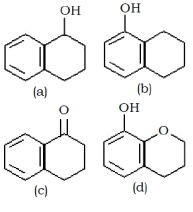
A
$d, b, c, a$
B
$b, c, a, d$
C
$c, a, b, d$
D
$d, b, a, c$
Solution
(C) The rate of aromatic electrophilic substitution $(EAS)$ depends on the electron density of the benzene ring. Substituents that increase electron density via $+R$ or $+H$ effects activate the ring,while those that decrease it via $-R$ or $-I$ effects deactivate the ring.
$(a)$ The $-CH_2-$ group shows a $+H$ effect (hyperconjugation),which slightly activates the ring.
$(b)$ The $-OH$ group shows a strong $+R$ effect,and the $-CH_2-$ group shows a $+H$ effect. This is more activated than $(a)$.
$(c)$ The carbonyl group $(-C=O)$ shows a $-R$ effect,which strongly deactivates the ring.
$(d)$ Both the $-OH$ group and the oxygen atom in the ring $(-O-)$ show $+R$ effects,making this the most activated ring.
Comparing the effects: $(c)$ is the least reactive (deactivated),$(a)$ is next,$(b)$ is more reactive than $(a)$,and $(d)$ is the most reactive.
Therefore,the increasing order of reactivity is $c < a < b < d$.
$(a)$ The $-CH_2-$ group shows a $+H$ effect (hyperconjugation),which slightly activates the ring.
$(b)$ The $-OH$ group shows a strong $+R$ effect,and the $-CH_2-$ group shows a $+H$ effect. This is more activated than $(a)$.
$(c)$ The carbonyl group $(-C=O)$ shows a $-R$ effect,which strongly deactivates the ring.
$(d)$ Both the $-OH$ group and the oxygen atom in the ring $(-O-)$ show $+R$ effects,making this the most activated ring.
Comparing the effects: $(c)$ is the least reactive (deactivated),$(a)$ is next,$(b)$ is more reactive than $(a)$,and $(d)$ is the most reactive.
Therefore,the increasing order of reactivity is $c < a < b < d$.
0 likesView Solution
254
ChemistryMediumMCQJEE Main · 2023
$A$ mixture of $1 \ mol$ of $H_2O$ and $1 \ mol$ of $CO$ is taken in a $10 \ L$ container and heated to $725 \ K$. At equilibrium,$40\%$ of water reacts with carbon monoxide according to the equation:
$CO_{(g)} + H_2O_{(g)} \rightleftharpoons CO_{2(g)} + H_{2(g)}$
The equilibrium constant $K_C \times 10^2$ for the reaction is $.......$ (Nearest integer).
$CO_{(g)} + H_2O_{(g)} \rightleftharpoons CO_{2(g)} + H_{2(g)}$
The equilibrium constant $K_C \times 10^2$ for the reaction is $.......$ (Nearest integer).
A
$41$
B
$42$
C
$43$
D
$44$
Solution
(D) The balanced chemical equation is:
$CO_{(g)} + H_2O_{(g)} \rightleftharpoons CO_{2(g)} + H_{2(g)}$
Initial moles:
$CO = 1 \ mol$,$H_2O = 1 \ mol$,$CO_2 = 0 \ mol$,$H_2 = 0 \ mol$
At equilibrium:
$CO = (1 - x) \ mol$,$H_2O = (1 - x) \ mol$,$CO_2 = x \ mol$,$H_2 = x \ mol$
Given that $40\%$ of water reacts,$x = 0.4 \ mol$.
Therefore,at equilibrium:
$[CO] = \frac{1 - 0.4}{10} = 0.06 \ M$
$[H_2O] = \frac{1 - 0.4}{10} = 0.06 \ M$
$[CO_2] = \frac{0.4}{10} = 0.04 \ M$
$[H_2] = \frac{0.4}{10} = 0.04 \ M$
The equilibrium constant $K_C$ is given by:
$K_C = \frac{[CO_2][H_2]}{[CO][H_2O]} = \frac{0.04 \times 0.04}{0.06 \times 0.06} = \frac{0.0016}{0.0036} = \frac{16}{36} = \frac{4}{9} \approx 0.444$
Thus,$K_C \times 10^2 = 0.444 \times 100 = 44.4 \approx 44$.
$CO_{(g)} + H_2O_{(g)} \rightleftharpoons CO_{2(g)} + H_{2(g)}$
Initial moles:
$CO = 1 \ mol$,$H_2O = 1 \ mol$,$CO_2 = 0 \ mol$,$H_2 = 0 \ mol$
At equilibrium:
$CO = (1 - x) \ mol$,$H_2O = (1 - x) \ mol$,$CO_2 = x \ mol$,$H_2 = x \ mol$
Given that $40\%$ of water reacts,$x = 0.4 \ mol$.
Therefore,at equilibrium:
$[CO] = \frac{1 - 0.4}{10} = 0.06 \ M$
$[H_2O] = \frac{1 - 0.4}{10} = 0.06 \ M$
$[CO_2] = \frac{0.4}{10} = 0.04 \ M$
$[H_2] = \frac{0.4}{10} = 0.04 \ M$
The equilibrium constant $K_C$ is given by:
$K_C = \frac{[CO_2][H_2]}{[CO][H_2O]} = \frac{0.04 \times 0.04}{0.06 \times 0.06} = \frac{0.0016}{0.0036} = \frac{16}{36} = \frac{4}{9} \approx 0.444$
Thus,$K_C \times 10^2 = 0.444 \times 100 = 44.4 \approx 44$.
0 likesView Solution
255
ChemistryDifficultMCQJEE Main · 2023
The number of hyperconjugation structures involved to stabilize the carbocation formed in the above reaction is $.............$.
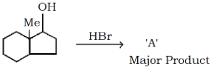
A
$6$
B
$5$
C
$4$
D
$7$
Solution
(D) $1$. The reaction of the given alcohol with $HBr$ proceeds via the formation of a carbocation intermediate.
$2$. Initially,the $OH$ group is protonated to form a good leaving group $(-OH_2^+)$,which then leaves to form a secondary carbocation.
$3$. This secondary carbocation undergoes a methyl shift to form a more stable tertiary carbocation.
$4$. Subsequently,a hydride shift occurs to form an even more stable tertiary carbocation at the bridgehead position.
$5$. The final stable carbocation has $7$ alpha-hydrogens ($3$ from the $CH_3$ group and $4$ from the adjacent ring carbons).
$6$. The number of hyperconjugation structures is equal to the number of alpha-hydrogens,which is $7$.
$2$. Initially,the $OH$ group is protonated to form a good leaving group $(-OH_2^+)$,which then leaves to form a secondary carbocation.
$3$. This secondary carbocation undergoes a methyl shift to form a more stable tertiary carbocation.
$4$. Subsequently,a hydride shift occurs to form an even more stable tertiary carbocation at the bridgehead position.
$5$. The final stable carbocation has $7$ alpha-hydrogens ($3$ from the $CH_3$ group and $4$ from the adjacent ring carbons).
$6$. The number of hyperconjugation structures is equal to the number of alpha-hydrogens,which is $7$.
1 likesView Solution
256
ChemistryMediumMCQJEE Main · 2023
Which hydride among the following is less stable?
A
$BeH_2$
B
$NH_3$
C
$HF$
D
$LiH$
Solution
(A) $BeH_2$ is an electron-deficient (hypovalent) hydride with a polymeric structure,making it less stable compared to the other given hydrides which have complete octets or are more ionic in nature.
0 likesView Solution
257
ChemistryMediumMCQJEE Main · 2023
Which one of the following pairs is an example of polar molecular solids?
A
$SO_{2(s)}, NH_{3(s)}$
B
$SO_{2(s)}, CO_{2(s)}$
C
$HCl_{(s)}, AlN_{(s)}$
D
$MgO_{(s)}, SO_{2(s)}$
Solution
(A) Polar molecular solids consist of molecules held together by dipole-dipole interactions.
$SO_2$ has a bent geometry and a net dipole moment,making it polar.
$NH_3$ has a trigonal pyramidal geometry and a net dipole moment,making it polar.
Therefore,the pair $SO_{2(s)}$ and $NH_{3(s)}$ represents polar molecular solids.
$SO_2$ has a bent geometry and a net dipole moment,making it polar.
$NH_3$ has a trigonal pyramidal geometry and a net dipole moment,making it polar.
Therefore,the pair $SO_{2(s)}$ and $NH_{3(s)}$ represents polar molecular solids.
1 likesView Solution
258
ChemistryMediumMCQJEE Main · 2023
One mole of $P_4$ reacts with $8$ moles of $SOCl_2$ to give $4$ moles of $A$,$x$ moles of $SO_2$ and $2$ moles of $B$. $A$,$B$ and $x$ respectively are
A
$PCl_3$,$S_2Cl_2$ and $4$
B
$POCl_3$,$S_2Cl_2$ and $4$
C
$PCl_3$,$S_2Cl_2$ and $2$
D
$POCl_3$,$S_2Cl_2$ and $2$
Solution
(A) The balanced chemical equation for the reaction is:
$P_4 + 8SOCl_2 \rightarrow 4PCl_3 + 2S_2Cl_2 + 4SO_2$
Comparing this with the given reaction:
$P_4 + 8SOCl_2 \rightarrow 4A + xSO_2 + 2B$
We can identify:
$A = PCl_3$
$B = S_2Cl_2$
$x = 4$
Therefore,the correct values are $PCl_3$,$S_2Cl_2$ and $4$.
$P_4 + 8SOCl_2 \rightarrow 4PCl_3 + 2S_2Cl_2 + 4SO_2$
Comparing this with the given reaction:
$P_4 + 8SOCl_2 \rightarrow 4A + xSO_2 + 2B$
We can identify:
$A = PCl_3$
$B = S_2Cl_2$
$x = 4$
Therefore,the correct values are $PCl_3$,$S_2Cl_2$ and $4$.
0 likesView Solution
259
ChemistryMediumMCQJEE Main · 2023
Which of the following alkali metals has the least melting point?
A
$Rb$
B
$K$
C
$Na$
D
$Cs$
Solution
(D) In the alkali metal group $(Group \ 1)$,the melting point decreases as we move down the group due to the decrease in the strength of metallic bonding as the atomic size increases.
The order of melting points is $Li > Na > K > Rb > Cs$.
Therefore,$Cs$ (Cesium) has the lowest melting point.
The order of melting points is $Li > Na > K > Rb > Cs$.
Therefore,$Cs$ (Cesium) has the lowest melting point.
0 likesView Solution
260
ChemistryEasyMCQJEE Main · 2023
$4.5 \text{ moles}$ each of hydrogen and iodine is heated in a sealed $10 \text{ litre}$ vessel. At equilibrium,$3 \text{ moles}$ of $HI$ were found. The equilibrium constant for $H_{2(g)} + I_{2(g)} \rightleftharpoons 2HI_{(g)}$ is .......
A
$1$
B
$2$
C
$3$
D
$4$
Solution
(A) The chemical equation is: $H_{2(g)} + I_{2(g)} \rightleftharpoons 2HI_{(g)}$
Initial moles: $H_2 = 4.5$,$I_2 = 4.5$,$HI = 0$
At equilibrium,$3 \text{ moles}$ of $HI$ are formed. Since $2 \text{ moles}$ of $HI$ are produced from $1 \text{ mole}$ of $H_2$ and $1 \text{ mole}$ of $I_2$,the amount of $H_2$ and $I_2$ consumed is $3/2 = 1.5 \text{ moles}$.
Equilibrium moles: $H_2 = 4.5 - 1.5 = 3$,$I_2 = 4.5 - 1.5 = 3$,$HI = 3$
Volume of vessel = $10 \text{ L}$.
Equilibrium concentrations: $[H_2] = 3/10$,$[I_2] = 3/10$,$[HI] = 3/10$
$K_c = \frac{[HI]^2}{[H_2][I_2]} = \frac{(3/10)^2}{(3/10)(3/10)} = \frac{9/100}{9/100} = 1$
Initial moles: $H_2 = 4.5$,$I_2 = 4.5$,$HI = 0$
At equilibrium,$3 \text{ moles}$ of $HI$ are formed. Since $2 \text{ moles}$ of $HI$ are produced from $1 \text{ mole}$ of $H_2$ and $1 \text{ mole}$ of $I_2$,the amount of $H_2$ and $I_2$ consumed is $3/2 = 1.5 \text{ moles}$.
Equilibrium moles: $H_2 = 4.5 - 1.5 = 3$,$I_2 = 4.5 - 1.5 = 3$,$HI = 3$
Volume of vessel = $10 \text{ L}$.
Equilibrium concentrations: $[H_2] = 3/10$,$[I_2] = 3/10$,$[HI] = 3/10$
$K_c = \frac{[HI]^2}{[H_2][I_2]} = \frac{(3/10)^2}{(3/10)(3/10)} = \frac{9/100}{9/100} = 1$
0 likesView Solution
261
ChemistryDifficultMCQJEE Main · 2023
The number of correct statements from the following:
$A.$ For $1s$ orbital,the probability density is maximum at the nucleus.
$B.$ For $2s$ orbital,the probability density first increases to maximum and then decreases sharply to zero.
$C.$ Boundary surface diagrams of the orbitals enclose a region of $100\%$ probability of finding the electron.
$D.$ $p$ and $d$-orbitals have $1$ and $2$ angular nodes respectively.
$E.$ Probability density of $p$-orbital is zero at the nucleus.
$A.$ For $1s$ orbital,the probability density is maximum at the nucleus.
$B.$ For $2s$ orbital,the probability density first increases to maximum and then decreases sharply to zero.
$C.$ Boundary surface diagrams of the orbitals enclose a region of $100\%$ probability of finding the electron.
$D.$ $p$ and $d$-orbitals have $1$ and $2$ angular nodes respectively.
$E.$ Probability density of $p$-orbital is zero at the nucleus.
A
$3$
B
$4$
C
$2$
D
$5$
Solution
(A) Let us evaluate each statement:
$A.$ Correct. For $1s$ orbital,the probability density $\psi^2$ is maximum at the nucleus $(r=0)$.
$B.$ Incorrect. For $2s$ orbital,the probability density $\psi^2$ is maximum at the nucleus,decreases to zero at the radial node,and then increases to a smaller maximum before decreasing again.
$C.$ Incorrect. Boundary surface diagrams enclose a region of $90\%$ probability of finding the electron,not $100\%$.
$D.$ Correct. The number of angular nodes is given by the azimuthal quantum number $l$. For $p$-orbitals $(l=1)$,there is $1$ angular node. For $d$-orbitals $(l=2)$,there are $2$ angular nodes.
$E.$ Correct. $p$-orbitals have a nodal plane passing through the nucleus,so the probability density is zero at the nucleus.
Thus,statements $A, D,$ and $E$ are correct. The total number of correct statements is $3$.
$A.$ Correct. For $1s$ orbital,the probability density $\psi^2$ is maximum at the nucleus $(r=0)$.
$B.$ Incorrect. For $2s$ orbital,the probability density $\psi^2$ is maximum at the nucleus,decreases to zero at the radial node,and then increases to a smaller maximum before decreasing again.
$C.$ Incorrect. Boundary surface diagrams enclose a region of $90\%$ probability of finding the electron,not $100\%$.
$D.$ Correct. The number of angular nodes is given by the azimuthal quantum number $l$. For $p$-orbitals $(l=1)$,there is $1$ angular node. For $d$-orbitals $(l=2)$,there are $2$ angular nodes.
$E.$ Correct. $p$-orbitals have a nodal plane passing through the nucleus,so the probability density is zero at the nucleus.
Thus,statements $A, D,$ and $E$ are correct. The total number of correct statements is $3$.
0 likesView Solution
262
ChemistryMediumMCQJEE Main · 2023
$Mg(NO_3)_2 \cdot XH_2O$ and $Ba(NO_3)_2 \cdot YH_2O$ represent the formulas of the crystalline forms of nitrate salts. The sum of $X$ and $Y$ is $.........$.
A
$6$
B
$5$
C
$4$
D
$3$
Solution
(A) $Mg(NO_3)_2$ crystallizes as a hexahydrate,$Mg(NO_3)_2 \cdot 6H_2O$,so $X = 6$.
$Ba(NO_3)_2$ crystallizes as an anhydrous salt,so $Y = 0$.
Therefore,the sum $X + Y = 6 + 0 = 6$.
$Ba(NO_3)_2$ crystallizes as an anhydrous salt,so $Y = 0$.
Therefore,the sum $X + Y = 6 + 0 = 6$.
0 likesView Solution
263
ChemistryMediumMCQJEE Main · 2023
The total number of intensive properties from the following is $........$.
Volume,Molar heat capacity,Molarity,$E^{\theta}_{cell}$,Gibbs free energy change,Molar mass,Mole
Volume,Molar heat capacity,Molarity,$E^{\theta}_{cell}$,Gibbs free energy change,Molar mass,Mole
A
$4$
B
$8$
C
$2$
D
$6$
Solution
(A) Intensive properties are those that do not depend on the quantity or size of matter present in the system.
$1$. Volume: Extensive (depends on amount).
$2$. Molar heat capacity: Intensive (defined per mole).
$3$. Molarity: Intensive (concentration is independent of amount).
$4$. $E^{\theta}_{cell}$: Intensive (potential is independent of amount).
$5$. Gibbs free energy change $(\Delta G)$: Extensive (depends on amount).
$6$. Molar mass: Intensive (property of the substance itself).
$7$. Mole: Extensive (measure of amount).
Therefore,the intensive properties are: Molar heat capacity,Molarity,$E^{\theta}_{cell}$,and Molar mass.
The total count is $4$.
$1$. Volume: Extensive (depends on amount).
$2$. Molar heat capacity: Intensive (defined per mole).
$3$. Molarity: Intensive (concentration is independent of amount).
$4$. $E^{\theta}_{cell}$: Intensive (potential is independent of amount).
$5$. Gibbs free energy change $(\Delta G)$: Extensive (depends on amount).
$6$. Molar mass: Intensive (property of the substance itself).
$7$. Mole: Extensive (measure of amount).
Therefore,the intensive properties are: Molar heat capacity,Molarity,$E^{\theta}_{cell}$,and Molar mass.
The total count is $4$.
0 likesView Solution
264
ChemistryMediumMCQJEE Main · 2023
The maximum number of lone pairs of electrons on the central atom from the following species is $........$. $ClO_3^-$,$XeF_4$,$SF_4$ and $I_3^-$
A
$3$
B
$6$
C
$9$
D
$5$
Solution
(A) To find the number of lone pairs on the central atom,we determine the hybridization and geometry for each species:
$1$. For $ClO_3^-$: The central atom $Cl$ has $7$ valence electrons. It forms $3$ double bonds with $O$ atoms and has $1$ negative charge. The number of lone pairs = $(7 + 1 - 6)/2 = 1$ lone pair.
$2$. For $XeF_4$: The central atom $Xe$ has $8$ valence electrons. It forms $4$ single bonds with $F$ atoms. The number of lone pairs = $(8 - 4)/2 = 2$ lone pairs.
$3$. For $SF_4$: The central atom $S$ has $6$ valence electrons. It forms $4$ single bonds with $F$ atoms. The number of lone pairs = $(6 - 4)/2 = 1$ lone pair.
$4$. For $I_3^-$: The central atom $I$ has $7$ valence electrons. It forms $2$ single bonds with $I$ atoms and has $1$ negative charge. The number of lone pairs = $(7 + 1 - 2)/2 = 3$ lone pairs.
Comparing the number of lone pairs: $ClO_3^-$ $(1)$,$XeF_4$ $(2)$,$SF_4$ $(1)$,$I_3^-$ $(3)$.
The maximum number of lone pairs is $3$.
$1$. For $ClO_3^-$: The central atom $Cl$ has $7$ valence electrons. It forms $3$ double bonds with $O$ atoms and has $1$ negative charge. The number of lone pairs = $(7 + 1 - 6)/2 = 1$ lone pair.
$2$. For $XeF_4$: The central atom $Xe$ has $8$ valence electrons. It forms $4$ single bonds with $F$ atoms. The number of lone pairs = $(8 - 4)/2 = 2$ lone pairs.
$3$. For $SF_4$: The central atom $S$ has $6$ valence electrons. It forms $4$ single bonds with $F$ atoms. The number of lone pairs = $(6 - 4)/2 = 1$ lone pair.
$4$. For $I_3^-$: The central atom $I$ has $7$ valence electrons. It forms $2$ single bonds with $I$ atoms and has $1$ negative charge. The number of lone pairs = $(7 + 1 - 2)/2 = 3$ lone pairs.
Comparing the number of lone pairs: $ClO_3^-$ $(1)$,$XeF_4$ $(2)$,$SF_4$ $(1)$,$I_3^-$ $(3)$.
The maximum number of lone pairs is $3$.
0 likesView Solution
265
ChemistryMediumMCQJEE Main · 2023
The volume of hydrogen liberated at $STP$ by treating $2.4 \ g$ of magnesium with excess of hydrochloric acid is $x \times 10^{-2} \ L$. Find the value of $x$. Given: Molar volume of gas is $22.4 \ L$ at $STP$. Molar mass of magnesium is $24 \ g \ mol^{-1}$.
A
$224$
B
$223$
C
$222$
D
$225$
Solution
(A) The balanced chemical equation is: $Mg(s) + 2HCl(aq) \rightarrow MgCl_2(aq) + H_2(g) \uparrow$
Calculate the moles of magnesium $(Mg)$:
$n(Mg) = \frac{\text{mass}}{\text{molar mass}} = \frac{2.4 \ g}{24 \ g \ mol^{-1}} = 0.1 \ mol$
From the stoichiometry of the reaction,$1 \ mol$ of $Mg$ produces $1 \ mol$ of $H_2$ gas.
Therefore,$0.1 \ mol$ of $Mg$ produces $0.1 \ mol$ of $H_2$ gas.
Calculate the volume of $H_2$ at $STP$:
$V = n \times \text{molar volume} = 0.1 \ mol \times 22.4 \ L \ mol^{-1} = 2.24 \ L$
Convert $2.24 \ L$ to the form $x \times 10^{-2} \ L$:
$2.24 \ L = 224 \times 10^{-2} \ L$
Thus,the value of $x$ is $224$.
Calculate the moles of magnesium $(Mg)$:
$n(Mg) = \frac{\text{mass}}{\text{molar mass}} = \frac{2.4 \ g}{24 \ g \ mol^{-1}} = 0.1 \ mol$
From the stoichiometry of the reaction,$1 \ mol$ of $Mg$ produces $1 \ mol$ of $H_2$ gas.
Therefore,$0.1 \ mol$ of $Mg$ produces $0.1 \ mol$ of $H_2$ gas.
Calculate the volume of $H_2$ at $STP$:
$V = n \times \text{molar volume} = 0.1 \ mol \times 22.4 \ L \ mol^{-1} = 2.24 \ L$
Convert $2.24 \ L$ to the form $x \times 10^{-2} \ L$:
$2.24 \ L = 224 \times 10^{-2} \ L$
Thus,the value of $x$ is $224$.
0 likesView Solution
266
ChemistryMediumMCQJEE Main · 2023
The density of alkali metals is in the order:
A
$Na < K < Cs < Rb$
B
$K < Na < Rb < Cs$
C
$K < Cs < Na < Rb$
D
$Na < Rb < K < Cs$
Solution
(B) In general,moving down the group,the atomic mass increases more significantly than the atomic volume,leading to an increase in density for Group $I$ metals.
However,there is an anomaly at $K$ due to the presence of an empty $3d$ subshell,which causes a larger increase in atomic volume compared to the increase in mass.
The correct order of density for alkali metals is $Li < K < Na < Rb < Cs$.
However,there is an anomaly at $K$ due to the presence of an empty $3d$ subshell,which causes a larger increase in atomic volume compared to the increase in mass.
The correct order of density for alkali metals is $Li < K < Na < Rb < Cs$.
0 likesView Solution
267
ChemistryDifficultMCQJEE Main · 2023
$A$ metal chloride contains $55.0 \%$ of chlorine by weight. $100 \ mL$ of vapours of the metal chloride at $STP$ weigh $0.57 \ g$. The molecular formula of the metal chloride is $...$. (Given: Atomic mass of chlorine is $35.5 \ u$)
A
$MCl_2$
B
$MCl_4$
C
$MCl_3$
D
$MCl$
Solution
(A) $1$. Calculate the molar mass of the metal chloride using the ideal gas law at $STP$ ($22400 \ mL$ per mole):
$Molar \ mass = \frac{Mass \times 22400}{Volume} = \frac{0.57 \ g \times 22400 \ mL/mol}{100 \ mL} = 127.68 \ g/mol$.
$2$. Calculate the mass of chlorine in one mole of the compound:
$Mass \ of \ Cl = 127.68 \times 0.55 = 70.224 \ g$.
$3$. Determine the number of chlorine atoms per molecule:
$Number \ of \ Cl \ atoms = \frac{70.224}{35.5} \approx 2$.
$4$. Therefore,the molecular formula is $MCl_2$.
$Molar \ mass = \frac{Mass \times 22400}{Volume} = \frac{0.57 \ g \times 22400 \ mL/mol}{100 \ mL} = 127.68 \ g/mol$.
$2$. Calculate the mass of chlorine in one mole of the compound:
$Mass \ of \ Cl = 127.68 \times 0.55 = 70.224 \ g$.
$3$. Determine the number of chlorine atoms per molecule:
$Number \ of \ Cl \ atoms = \frac{70.224}{35.5} \approx 2$.
$4$. Therefore,the molecular formula is $MCl_2$.
0 likesView Solution
268
ChemistryMediumMCQJEE Main · 2023
Match List-$I$ with List-$II$.
Choose the correct answer from the options given below:
| List-$I$ | List-$II$ |
|---|---|
| $A$. Nitrogen oxides in air | $I$. Eutrophication |
| $B$. Methane in air | $II$. $pH$ of rain water becomes $5.6$ |
| $C$. Carbon dioxide | $III$. Global warming |
| $D$. Phosphate fertilisers in water | $IV$. Acid rain |
Choose the correct answer from the options given below:
A
$A-IV, B-III, C-II, D-I$
B
$A-II, B-III, C-I, D-IV$
C
$A-I, B-II, C-III, D-IV$
D
$A-IV, B-II, C-III, D-I$
Solution
(A) . Nitrogen oxides $(NO_x)$ react with water and oxygen to form nitric acid,leading to acid rain: $4 NO_{2(g)} + O_{2(g)} + 2 H_2O_{(\ell)} \rightarrow 4 HNO_{3(aq)}$. Thus,$A-IV$.
$B$. Methane $(CH_4)$ is a potent greenhouse gas contributing to global warming. Thus,$B-III$.
$C$. Carbon dioxide $(CO_2)$ dissolves in rain water to form carbonic acid,which lowers the $pH$ to approximately $5.6$: $H_2O_{(\ell)} + CO_{2(g)} \rightleftharpoons H_2CO_{3(aq)} \rightleftharpoons H^+_{(aq)} + HCO_{3(aq)}^-$. Thus,$C-II$.
$D$. Phosphate fertilizers runoff into water bodies,causing nutrient enrichment and leading to Eutrophication. Thus,$D-I$.
$B$. Methane $(CH_4)$ is a potent greenhouse gas contributing to global warming. Thus,$B-III$.
$C$. Carbon dioxide $(CO_2)$ dissolves in rain water to form carbonic acid,which lowers the $pH$ to approximately $5.6$: $H_2O_{(\ell)} + CO_{2(g)} \rightleftharpoons H_2CO_{3(aq)} \rightleftharpoons H^+_{(aq)} + HCO_{3(aq)}^-$. Thus,$C-II$.
$D$. Phosphate fertilizers runoff into water bodies,causing nutrient enrichment and leading to Eutrophication. Thus,$D-I$.
0 likesView Solution
269
ChemistryMediumMCQJEE Main · 2023
$2-$hexene $\xrightarrow[(i) O_3]{(ii) H_2O}$ Products
The two products formed in the above reaction are -
The two products formed in the above reaction are -
A
Butanoic acid and acetic acid
B
Butanal and acetic acid
C
Butanal and acetaldehyde
D
Butanoic acid and acetaldehyde
Solution
(A) The reaction of $2-$hexene $(CH_3-CH=CH-CH_2-CH_2-CH_3)$ with $O_3$ followed by $H_2O$ is an oxidative ozonolysis.
In oxidative ozonolysis,the double bond is cleaved,and the resulting aldehydes are further oxidized to carboxylic acids.
$CH_3-CH=CH-CH_2-CH_2-CH_3 \xrightarrow[(i) O_3]{(ii) H_2O} CH_3COOH + CH_3CH_2CH_2COOH$
The products formed are acetic acid $(CH_3COOH)$ and butanoic acid $(CH_3CH_2CH_2COOH)$.
In oxidative ozonolysis,the double bond is cleaved,and the resulting aldehydes are further oxidized to carboxylic acids.
$CH_3-CH=CH-CH_2-CH_2-CH_3 \xrightarrow[(i) O_3]{(ii) H_2O} CH_3COOH + CH_3CH_2CH_2COOH$
The products formed are acetic acid $(CH_3COOH)$ and butanoic acid $(CH_3CH_2CH_2COOH)$.
0 likesView Solution
270
ChemistryDifficultMCQJEE Main · 2023
Correct statements for the given reaction are :
$A$. Compound '$B$' is aromatic
$B$. The completion of above reaction is very slow
$C$. '$A$' shows tautomerism
$D$. The bond lengths $C-C$ in compound $B$ are found to be same
Choose the correct answer from the options given below :
$A$. Compound '$B$' is aromatic
$B$. The completion of above reaction is very slow
$C$. '$A$' shows tautomerism
$D$. The bond lengths $C-C$ in compound $B$ are found to be same
Choose the correct answer from the options given below :
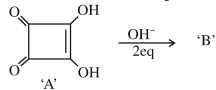
A
$A, B$ and $D$ only
B
$A, B$ and $C$ only
C
$B, C$ and $D$ only
D
$A, C$ and $D$ only
Solution
(D) The reaction involves the deprotonation of squaric acid $(A)$ by $2$ equivalents of $OH^-$ to form the squarate dianion $(B)$.
$1$. Compound '$B$' (squarate dianion) is aromatic because it is cyclic,planar,fully conjugated,and contains $6 \pi$ electrons ($4n+2$ rule,where $n=1$). Thus,statement $A$ is correct.
$2$. The reaction is an acid-base reaction involving the removal of acidic protons from squaric acid. Acid-base reactions are typically very fast,not slow. Thus,statement $B$ is incorrect.
$3$. Compound '$A$' (squaric acid) contains an enol group adjacent to a carbonyl group,which allows it to exhibit keto-enol tautomerism. Thus,statement $C$ is correct.
$4$. Due to resonance in the squarate dianion $(B)$,the negative charge is delocalized over the entire ring,making all $C-C$ bond lengths equal. Thus,statement $D$ is correct.
Therefore,statements $A, C,$ and $D$ are correct.
$1$. Compound '$B$' (squarate dianion) is aromatic because it is cyclic,planar,fully conjugated,and contains $6 \pi$ electrons ($4n+2$ rule,where $n=1$). Thus,statement $A$ is correct.
$2$. The reaction is an acid-base reaction involving the removal of acidic protons from squaric acid. Acid-base reactions are typically very fast,not slow. Thus,statement $B$ is incorrect.
$3$. Compound '$A$' (squaric acid) contains an enol group adjacent to a carbonyl group,which allows it to exhibit keto-enol tautomerism. Thus,statement $C$ is correct.
$4$. Due to resonance in the squarate dianion $(B)$,the negative charge is delocalized over the entire ring,making all $C-C$ bond lengths equal. Thus,statement $D$ is correct.
Therefore,statements $A, C,$ and $D$ are correct.
0 likesView Solution
271
ChemistryMediumMCQJEE Main · 2023
The bond order and magnetic property of acetylide ion are same as that of $........$.
A
$NO^{+}$
B
$O_2^{+}$
C
$O_2^{-}$
D
$N_2^{+}$
Solution
(A) The acetylide ion is $C_2^{2-}$.
Total number of electrons in $C_2^{2-} = (6 \times 2) + 2 = 14 \ e^-$.
According to Molecular Orbital Theory,the electronic configuration of $C_2^{2-}$ is $\sigma 1s^2, \sigma^* 1s^2, \sigma 2s^2, \sigma^* 2s^2, \pi 2p_x^2 = \pi 2p_y^2, \sigma 2p_z^2$.
Bond order $= \frac{1}{2} (N_b - N_a) = \frac{1}{2} (10 - 4) = 3$.
Since all electrons are paired,it is diamagnetic.
Now,check $NO^{+}$: Total electrons $= 7 + 8 - 1 = 14 \ e^-$.
$NO^{+}$ also has a bond order of $3$ and is diamagnetic.
Therefore,the properties match $NO^{+}$.
Total number of electrons in $C_2^{2-} = (6 \times 2) + 2 = 14 \ e^-$.
According to Molecular Orbital Theory,the electronic configuration of $C_2^{2-}$ is $\sigma 1s^2, \sigma^* 1s^2, \sigma 2s^2, \sigma^* 2s^2, \pi 2p_x^2 = \pi 2p_y^2, \sigma 2p_z^2$.
Bond order $= \frac{1}{2} (N_b - N_a) = \frac{1}{2} (10 - 4) = 3$.
Since all electrons are paired,it is diamagnetic.
Now,check $NO^{+}$: Total electrons $= 7 + 8 - 1 = 14 \ e^-$.
$NO^{+}$ also has a bond order of $3$ and is diamagnetic.
Therefore,the properties match $NO^{+}$.
0 likesView Solution
272
ChemistryMediumMCQJEE Main · 2023
In the given reaction cycle,$X$,$Y$ and $Z$ respectively are:
$CaCl_2 + Na_2CO_3 \rightarrow X + Y$
$X \xrightarrow{Z} CaCl_2$
$CaCl_2 + Na_2CO_3 \rightarrow X + Y$
$X \xrightarrow{Z} CaCl_2$
A
$CaO, NaCl, CO_2$
B
$CaCO_3, NaCl, KCl$
C
$CaCO_3, NaCl, HCl$
D
$CaO, NaCl, NaCl$
Solution
(C) The reaction between $CaCl_2$ and $Na_2CO_3$ is a double displacement reaction:
$CaCl_2 + Na_2CO_3 \rightarrow CaCO_3(s) + 2NaCl(aq)$
Comparing this with the given reaction $CaCl_2 + Na_2CO_3 \rightarrow X + Y$,we identify $X$ as $CaCO_3$ and $Y$ as $NaCl$.
To convert $CaCO_3$ back to $CaCl_2$,it is reacted with hydrochloric acid $(HCl)$:
$CaCO_3 + 2HCl \rightarrow CaCl_2 + H_2O + CO_2$
Thus,$Z$ is $HCl$.
Therefore,$X = CaCO_3$,$Y = NaCl$,and $Z = HCl$.
$CaCl_2 + Na_2CO_3 \rightarrow CaCO_3(s) + 2NaCl(aq)$
Comparing this with the given reaction $CaCl_2 + Na_2CO_3 \rightarrow X + Y$,we identify $X$ as $CaCO_3$ and $Y$ as $NaCl$.
To convert $CaCO_3$ back to $CaCl_2$,it is reacted with hydrochloric acid $(HCl)$:
$CaCO_3 + 2HCl \rightarrow CaCl_2 + H_2O + CO_2$
Thus,$Z$ is $HCl$.
Therefore,$X = CaCO_3$,$Y = NaCl$,and $Z = HCl$.
0 likesView Solution
273
ChemistryMediumMCQJEE Main · 2023
Given below are two statements:
Statement $I$: Boron is extremely hard,indicating its high lattice energy.
Statement $II$: Boron has the highest melting and boiling point compared to its other group members.
In the light of the above statements,choose the most appropriate answer from the options given below:
Statement $I$: Boron is extremely hard,indicating its high lattice energy.
Statement $II$: Boron has the highest melting and boiling point compared to its other group members.
In the light of the above statements,choose the most appropriate answer from the options given below:
A
Statement $I$ is incorrect but Statement $II$ is correct.
B
Both Statement $I$ and Statement $II$ are correct.
C
Statement $I$ is correct but Statement $II$ is incorrect.
D
Both Statement $I$ and Statement $II$ are incorrect.
Solution
(B) Boron is non-metallic in nature. It is an extremely hard,black-colored solid that exists in many allotropic forms.
Due to its very strong crystalline lattice,boron has an unusually high melting point and boiling point compared to other members of Group $13$.
Thus,both statements are correct.
Due to its very strong crystalline lattice,boron has an unusually high melting point and boiling point compared to other members of Group $13$.
| Element | $B$ | $Al$ | $Ga$ | $In$ | $Tl$ |
| Melting point $(K)$ | $2453$ | $933$ | $303$ | $430$ | $576$ |
| Boiling point $(K)$ | $3923$ | $2740$ | $2676$ | $2353$ | $1730$ |
Thus,both statements are correct.
0 likesView Solution
274
ChemistryMediumMCQJEE Main · 2023
Match List-$I$ with List-$II$
Choose the correct answer from the options given below:
| List-$I$ Type of Hydride | List-$II$ Example |
| $A$. Electron deficient hydride | $I$. $MgH_2$ |
| $B$. Electron rich hydride | $II$. $HF$ |
| $C$. Electron precise hydride | $III$. $B_2H_6$ |
| $D$. Saline hydride | $IV$. $CH_4$ |
Choose the correct answer from the options given below:
A
$A-III, B-II, C-IV, D-I$
B
$A-II, B-III, C-IV, D-I$
C
$A-II, B-III, C-I, D-IV$
D
$A-III, B-II, C-I, D-IV$
Solution
(A) $B_2H_6$ is an electron-deficient hydride because it has fewer electrons than required for normal covalent bonding.
$HF$ is an electron-rich hydride because it has lone pairs of electrons on the central atom.
$CH_4$ is an electron-precise hydride because it has the exact number of electrons required for covalent bonding.
$MgH_2$ is a saline (ionic) hydride formed by the reaction of $Mg$ with $H_2$.
Therefore,the correct matching is $A-III, B-II, C-IV, D-I$.
$HF$ is an electron-rich hydride because it has lone pairs of electrons on the central atom.
$CH_4$ is an electron-precise hydride because it has the exact number of electrons required for covalent bonding.
$MgH_2$ is a saline (ionic) hydride formed by the reaction of $Mg$ with $H_2$.
Therefore,the correct matching is $A-III, B-II, C-IV, D-I$.
0 likesView Solution
275
ChemistryMediumMCQJEE Main · 2023
One mole of an ideal gas at $350 \, K$ is in a $2.0 \, L$ vessel with thermally conducting walls,which are in contact with the surroundings. It undergoes isothermal expansion from $2.0 \, L$ to $3.0 \, L$ against a constant external pressure of $4 \, atm$. The change in entropy of the surroundings $(\Delta S_{surr})$ is $...... \, J \, K^{-1}$ (Nearest integer). Given: $R = 8.314 \, J \, K^{-1} \, mol^{-1}$.
A
$1$
B
$2$
C
$-1$
D
$-2$
Solution
(C) For an isothermal process,the heat exchanged with the surroundings is $q = -w = P_{ext} \Delta V$.
Given $P_{ext} = 4 \, atm$ and $\Delta V = (3.0 \, L - 2.0 \, L) = 1.0 \, L$.
$q = 4 \, atm \times 1.0 \, L = 4 \, L \, atm$.
Using the conversion $1 \, L \, atm = 101.3 \, J$,we get $q = 4 \times 101.3 = 405.2 \, J$.
The entropy change of the surroundings is given by $\Delta S_{surr} = -\frac{q_{sys}}{T}$.
Since the process is isothermal and the system absorbs heat from the surroundings,$q_{surr} = -q_{sys} = -405.2 \, J$.
$\Delta S_{surr} = \frac{q_{surr}}{T} = \frac{-405.2 \, J}{350 \, K} \approx -1.158 \, J \, K^{-1}$.
The nearest integer is $-1$.
Given $P_{ext} = 4 \, atm$ and $\Delta V = (3.0 \, L - 2.0 \, L) = 1.0 \, L$.
$q = 4 \, atm \times 1.0 \, L = 4 \, L \, atm$.
Using the conversion $1 \, L \, atm = 101.3 \, J$,we get $q = 4 \times 101.3 = 405.2 \, J$.
The entropy change of the surroundings is given by $\Delta S_{surr} = -\frac{q_{sys}}{T}$.
Since the process is isothermal and the system absorbs heat from the surroundings,$q_{surr} = -q_{sys} = -405.2 \, J$.
$\Delta S_{surr} = \frac{q_{surr}}{T} = \frac{-405.2 \, J}{350 \, K} \approx -1.158 \, J \, K^{-1}$.
The nearest integer is $-1$.
0 likesView Solution
276
ChemistryMediumMCQJEE Main · 2023
An analyst wants to convert $1 \ L$ of $HCl$ solution with $pH = 1$ to a solution of $HCl$ with $pH = 2$. The volume of water needed to do this dilution is $...... \ mL$. (Nearest Integer)
A
$8000$
B
$9000$
C
$7000$
D
$6000$
Solution
(B) For $pH = 1$,the concentration of $HCl$ is $[H^+]_1 = 10^{-pH} = 10^{-1} \ M = 0.1 \ M$.
For $pH = 2$,the concentration of $HCl$ is $[H^+]_2 = 10^{-pH} = 10^{-2} \ M = 0.01 \ M$.
Using the dilution formula $M_1 \times V_1 = M_2 \times V_2$:
$0.1 \ M \times 1 \ L = 0.01 \ M \times V_2$.
$V_2 = \frac{0.1}{0.01} \ L = 10 \ L$.
The volume of water to be added is $V_{added} = V_2 - V_1 = 10 \ L - 1 \ L = 9 \ L$.
Since $1 \ L = 1000 \ mL$,the volume of water added is $9 \times 1000 \ mL = 9000 \ mL$.
For $pH = 2$,the concentration of $HCl$ is $[H^+]_2 = 10^{-pH} = 10^{-2} \ M = 0.01 \ M$.
Using the dilution formula $M_1 \times V_1 = M_2 \times V_2$:
$0.1 \ M \times 1 \ L = 0.01 \ M \times V_2$.
$V_2 = \frac{0.1}{0.01} \ L = 10 \ L$.
The volume of water to be added is $V_{added} = V_2 - V_1 = 10 \ L - 1 \ L = 9 \ L$.
Since $1 \ L = 1000 \ mL$,the volume of water added is $9 \times 1000 \ mL = 9000 \ mL$.
0 likesView Solution
277
ChemistryMediumMCQJEE Main · 2023
Three organic compounds $A$,$B$ and $C$ were allowed to run in thin layer chromatography using hexane and gave the following result (see figure). The $R_f$ value of the most polar compound is $............\, \times 10^{-2}$
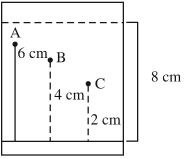
A
$24$
B
$25$
C
$23$
D
$22$
Solution
(B) In thin layer chromatography $(TLC)$,the stationary phase is polar (silica gel) and the mobile phase is non-polar (hexane).
Compounds that are more polar interact more strongly with the stationary phase and travel a shorter distance,resulting in a lower $R_f$ value.
Compounds that are less polar travel a longer distance,resulting in a higher $R_f$ value.
From the figure,the distances traveled by compounds $A$,$B$,and $C$ are $6 \ cm$,$4 \ cm$,and $2 \ cm$ respectively,with the solvent front at $8 \ cm$.
The compound that travels the shortest distance is the most polar.
Thus,compound $C$ is the most polar.
The $R_f$ value for compound $C$ is calculated as:
$R_f = \frac{\text{Distance traveled by compound } C}{\text{Distance traveled by solvent}} = \frac{2 \ cm}{8 \ cm} = 0.25$
Converting this to the required format:
$0.25 = 25 \times 10^{-2}$
Compounds that are more polar interact more strongly with the stationary phase and travel a shorter distance,resulting in a lower $R_f$ value.
Compounds that are less polar travel a longer distance,resulting in a higher $R_f$ value.
From the figure,the distances traveled by compounds $A$,$B$,and $C$ are $6 \ cm$,$4 \ cm$,and $2 \ cm$ respectively,with the solvent front at $8 \ cm$.
The compound that travels the shortest distance is the most polar.
Thus,compound $C$ is the most polar.
The $R_f$ value for compound $C$ is calculated as:
$R_f = \frac{\text{Distance traveled by compound } C}{\text{Distance traveled by solvent}} = \frac{2 \ cm}{8 \ cm} = 0.25$
Converting this to the required format:
$0.25 = 25 \times 10^{-2}$
0 likesView Solution
278
ChemistryMediumMCQJEE Main · 2023
At $600 \ K$,the root mean square (rms) speed of gas $X$ (molar mass $= 40 \ g \ mol^{-1}$) is equal to the most probable speed of gas $Y$ at $90 \ K$. The molar mass of the gas $Y$ is $....... \ g \ mol^{-1}$. (Nearest integer)
A
$2$
B
$4$
C
$6$
D
$8$
Solution
(B) The root mean square speed is given by $U_{rms} = \sqrt{\frac{3RT}{M_X}}$.
The most probable speed is given by $U_{mp} = \sqrt{\frac{2RT}{M_Y}}$.
Given that $(U_{rms})_{X, 600} = (U_{mp})_{Y, 90}$,we have:
$\sqrt{\frac{3 \times R \times 600}{40}} = \sqrt{\frac{2 \times R \times 90}{M_Y}}$.
Squaring both sides:
$\frac{3 \times 600}{40} = \frac{2 \times 90}{M_Y}$.
$\frac{1800}{40} = \frac{180}{M_Y}$.
$45 = \frac{180}{M_Y}$.
$M_Y = \frac{180}{45} = 4 \ g \ mol^{-1}$.
The most probable speed is given by $U_{mp} = \sqrt{\frac{2RT}{M_Y}}$.
Given that $(U_{rms})_{X, 600} = (U_{mp})_{Y, 90}$,we have:
$\sqrt{\frac{3 \times R \times 600}{40}} = \sqrt{\frac{2 \times R \times 90}{M_Y}}$.
Squaring both sides:
$\frac{3 \times 600}{40} = \frac{2 \times 90}{M_Y}$.
$\frac{1800}{40} = \frac{180}{M_Y}$.
$45 = \frac{180}{M_Y}$.
$M_Y = \frac{180}{45} = 4 \ g \ mol^{-1}$.
0 likesView Solution
279
ChemistryMediumMCQJEE Main · 2023
Values of work function $(W_0)$ for a few metals are given below:
The number of metals which will show photoelectric effect when light of wavelength $400 \ nm$ falls on it is $........$.
Given: $h = 6.6 \times 10^{-34} \ J \ s$,$c = 3 \times 10^8 \ m \ s^{-1}$,$e = 1.6 \times 10^{-19} \ C$
| Metal | $Li$ | $Na$ | $K$ | $Mg$ | $Cu$ | $Ag$ |
| $W_0 / eV$ | $2.42$ | $2.3$ | $2.25$ | $3.7$ | $4.8$ | $4.3$ |
The number of metals which will show photoelectric effect when light of wavelength $400 \ nm$ falls on it is $........$.
Given: $h = 6.6 \times 10^{-34} \ J \ s$,$c = 3 \times 10^8 \ m \ s^{-1}$,$e = 1.6 \times 10^{-19} \ C$
A
$2$
B
$3$
C
$4$
D
$5$
Solution
(B) The energy of the incident photon is given by $E = \frac{hc}{\lambda}$.
Substituting the values: $E = \frac{6.6 \times 10^{-34} \ J \ s \times 3 \times 10^8 \ m \ s^{-1}}{400 \times 10^{-9} \ m} = 4.95 \times 10^{-19} \ J$.
Converting this energy into electron volts $(eV)$: $E = \frac{4.95 \times 10^{-19} \ J}{1.6 \times 10^{-19} \ J/eV} \approx 3.1 \ eV$.
Photoelectric effect occurs when the energy of the incident photon is greater than the work function $(W_0)$ of the metal $(E > W_0)$.
Comparing $3.1 \ eV$ with the given work functions:
$Li (2.42 \ eV) < 3.1 \ eV$ (Yes)
$Na (2.3 \ eV) < 3.1 \ eV$ (Yes)
$K (2.25 \ eV) < 3.1 \ eV$ (Yes)
$Mg (3.7 \ eV) > 3.1 \ eV$ (No)
$Cu (4.8 \ eV) > 3.1 \ eV$ (No)
$Ag (4.3 \ eV) > 3.1 \ eV$ (No)
Thus,$3$ metals $(Li, Na, K)$ will show the photoelectric effect.
Substituting the values: $E = \frac{6.6 \times 10^{-34} \ J \ s \times 3 \times 10^8 \ m \ s^{-1}}{400 \times 10^{-9} \ m} = 4.95 \times 10^{-19} \ J$.
Converting this energy into electron volts $(eV)$: $E = \frac{4.95 \times 10^{-19} \ J}{1.6 \times 10^{-19} \ J/eV} \approx 3.1 \ eV$.
Photoelectric effect occurs when the energy of the incident photon is greater than the work function $(W_0)$ of the metal $(E > W_0)$.
Comparing $3.1 \ eV$ with the given work functions:
$Li (2.42 \ eV) < 3.1 \ eV$ (Yes)
$Na (2.3 \ eV) < 3.1 \ eV$ (Yes)
$K (2.25 \ eV) < 3.1 \ eV$ (Yes)
$Mg (3.7 \ eV) > 3.1 \ eV$ (No)
$Cu (4.8 \ eV) > 3.1 \ eV$ (No)
$Ag (4.3 \ eV) > 3.1 \ eV$ (No)
Thus,$3$ metals $(Li, Na, K)$ will show the photoelectric effect.
0 likesView Solution
280
ChemistryMediumMCQJEE Main · 2023
Given below are two statements:
Statement-$I$: Permutit process is more efficient compared to the synthetic resin method for the softening of water.
Statement-$II$: Synthetic resin method results in the formation of soluble sodium salts.
In the light of the above statements,choose the most appropriate answer from the options given below:
Statement-$I$: Permutit process is more efficient compared to the synthetic resin method for the softening of water.
Statement-$II$: Synthetic resin method results in the formation of soluble sodium salts.
In the light of the above statements,choose the most appropriate answer from the options given below:
A
Both the Statements $I$ and $II$ are correct
B
Statement $I$ is correct but Statement $II$ is incorrect
C
Statement $I$ is incorrect but Statement $II$ is correct
D
Both the Statements $I$ and $II$ are incorrect
Solution
(D) Statement-$I$ is incorrect because the synthetic ion-exchange resin method is more efficient than the Permutit (zeolite) process for water softening.
Statement-$II$ is incorrect because the synthetic resin method removes all cations and anions,resulting in demineralized water,whereas the Permutit process involves the exchange of $Ca^{2+}$ and $Mg^{2+}$ ions with $Na^+$ ions,which leads to the formation of soluble sodium salts in the treated water.
Therefore,both statements are incorrect.
Statement-$II$ is incorrect because the synthetic resin method removes all cations and anions,resulting in demineralized water,whereas the Permutit process involves the exchange of $Ca^{2+}$ and $Mg^{2+}$ ions with $Na^+$ ions,which leads to the formation of soluble sodium salts in the treated water.
Therefore,both statements are incorrect.
0 likesView Solution
281
ChemistryMediumMCQJEE Main · 2023
In which of the following processes,the bond order increases and paramagnetic character changes to diamagnetic one?
A
$O_2 \rightarrow O_2^{2-}$
B
$NO \rightarrow NO^{+}$
C
$N_2 \rightarrow N_2^{+}$
D
$O_2 \rightarrow O_2^{+}$
Solution
(B) The electronic configuration of $NO$ ($15$ electrons) is $\sigma 1s^2, \sigma^* 1s^2, \sigma 2s^2, \sigma^* 2s^2, \sigma 2p_z^2, \pi 2p_x^2 = \pi 2p_y^2, \pi^* 2p_x^1$. It has one unpaired electron,so it is paramagnetic. Bond order $= (10-5)/2 = 2.5$.
After losing one electron,$NO^{+}$ ($14$ electrons) has the configuration $\sigma 1s^2, \sigma^* 1s^2, \sigma 2s^2, \sigma^* 2s^2, \sigma 2p_z^2, \pi 2p_x^2 = \pi 2p_y^2$. It has no unpaired electrons,so it is diamagnetic. Bond order $= (10-4)/2 = 3$.
Thus,in the process $NO \rightarrow NO^{+}$,the bond order increases from $2.5$ to $3$ and the character changes from paramagnetic to diamagnetic.
After losing one electron,$NO^{+}$ ($14$ electrons) has the configuration $\sigma 1s^2, \sigma^* 1s^2, \sigma 2s^2, \sigma^* 2s^2, \sigma 2p_z^2, \pi 2p_x^2 = \pi 2p_y^2$. It has no unpaired electrons,so it is diamagnetic. Bond order $= (10-4)/2 = 3$.
Thus,in the process $NO \rightarrow NO^{+}$,the bond order increases from $2.5$ to $3$ and the character changes from paramagnetic to diamagnetic.
0 likesView Solution
282
ChemistryMediumMCQJEE Main · 2023
The incorrect statement from the following for borazine is:
A
It has electronic delocalization.
B
It contains banana bonds.
C
It can react with water.
D
It is a cyclic compound.
Solution
(B) Borazine $(B_{3}N_{3}H_{6})$ is an inorganic benzene analog.
It exhibits electronic delocalization due to the overlap of $p$-orbitals of $B$ and $N$ atoms.
It is a cyclic compound.
It reacts with water to form boric acid,ammonia,and hydrogen gas:
$B_{3}N_{3}H_{6} + 9H_{2}O \rightarrow 3NH_{3} + 3H_{3}BO_{3} + 3H_{2}$.
Banana bonds are characteristic of diborane $(B_{2}H_{6})$,not borazine.
Therefore,the statement that it contains banana bonds is incorrect.
It exhibits electronic delocalization due to the overlap of $p$-orbitals of $B$ and $N$ atoms.
It is a cyclic compound.
It reacts with water to form boric acid,ammonia,and hydrogen gas:
$B_{3}N_{3}H_{6} + 9H_{2}O \rightarrow 3NH_{3} + 3H_{3}BO_{3} + 3H_{2}$.
Banana bonds are characteristic of diborane $(B_{2}H_{6})$,not borazine.
Therefore,the statement that it contains banana bonds is incorrect.
0 likesView Solution
283
ChemistryDifficultMCQJEE Main · 2023
Among the following compounds,the one which shows the highest dipole moment is
A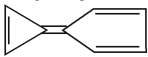
B
C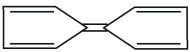
D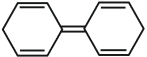
Solution
(A) The compound in option $A$ shows the highest dipole moment.
This is because the molecule undergoes charge separation where the three-membered ring acquires a positive charge ($2 \pi$ electrons,$H$ückel's rule $4n+2$ with $n=0$,aromatic) and the five-membered ring acquires a negative charge ($6 \pi$ electrons,$H$ückel's rule $4n+2$ with $n=1$,aromatic).
Since both rings become aromatic upon charge separation,the resonance contributor with separated charges is highly stable,leading to a very large dipole moment.
This is because the molecule undergoes charge separation where the three-membered ring acquires a positive charge ($2 \pi$ electrons,$H$ückel's rule $4n+2$ with $n=0$,aromatic) and the five-membered ring acquires a negative charge ($6 \pi$ electrons,$H$ückel's rule $4n+2$ with $n=1$,aromatic).
Since both rings become aromatic upon charge separation,the resonance contributor with separated charges is highly stable,leading to a very large dipole moment.
0 likesView Solution
284
ChemistryDifficultMCQJEE Main · 2023
In the above reaction,the left-hand side and right-hand side rings are named as '$A$' and '$B$' respectively. They undergo ring expansion. The correct statement for this process is:
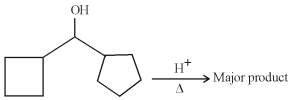
A
Finally both rings will become six-membered each.
B
Finally both rings will become five-membered each.
C
Only '$A$' will become $6$-membered.
D
Ring expansion can go up to seven-membered rings.
Solution
(A) $1$. The reaction starts with the protonation of the alcohol group,followed by the loss of water to form a carbocation at the central carbon.
$2$. The carbocation undergoes a ring expansion (or rearrangement) involving the adjacent rings to form a more stable system.
$3$. Specifically,the $4$-membered ring $(A)$ expands to a $6$-membered ring,and the $5$-membered ring $(B)$ also expands to a $6$-membered ring through a series of rearrangements and shifts.
$4$. The final product is a bicyclic system where both rings are $6$-membered (decalin derivative).
$5$. Therefore,both rings expand to become $6$-membered.
$2$. The carbocation undergoes a ring expansion (or rearrangement) involving the adjacent rings to form a more stable system.
$3$. Specifically,the $4$-membered ring $(A)$ expands to a $6$-membered ring,and the $5$-membered ring $(B)$ also expands to a $6$-membered ring through a series of rearrangements and shifts.
$4$. The final product is a bicyclic system where both rings are $6$-membered (decalin derivative).
$5$. Therefore,both rings expand to become $6$-membered.
0 likesView Solution
285
ChemistryMediumMCQJEE Main · 2023
The radical which mainly causes ozone depletion in the presence of $UV$ radiations is:
A
$CH_3^{\bullet}$
B
$NO^{\bullet}$
C
$Cl^{\bullet}$
D
$\dot{O}H$
Solution
(C) Chlorofluorocarbons $(CFCs)$ are the main cause of ozone depletion.
In the presence of $UV$ radiation,$CFCs$ release chlorine radicals $(Cl^{\bullet})$.
$CF_2Cl_{2(g)} \stackrel{UV}{\longrightarrow} \dot{Cl}_{(g)} + \dot{C}F_2Cl_{(g)}$
These chlorine radicals react with ozone $(O_3)$ to form chlorine monoxide $(ClO)$ and oxygen $(O_2)$:
$\dot{Cl}_{(g)} + O_{3(g)} \longrightarrow ClO_{(g)} + O_{2(g)}$
Then,$ClO$ reacts with atomic oxygen to regenerate the chlorine radical:
$Cl\dot{O}_{(g)} + O_{(g)} \longrightarrow \dot{Cl}_{(g)} + O_{2(g)}$
Thus,$Cl^{\bullet}$ is the radical that mainly causes ozone depletion.
In the presence of $UV$ radiation,$CFCs$ release chlorine radicals $(Cl^{\bullet})$.
$CF_2Cl_{2(g)} \stackrel{UV}{\longrightarrow} \dot{Cl}_{(g)} + \dot{C}F_2Cl_{(g)}$
These chlorine radicals react with ozone $(O_3)$ to form chlorine monoxide $(ClO)$ and oxygen $(O_2)$:
$\dot{Cl}_{(g)} + O_{3(g)} \longrightarrow ClO_{(g)} + O_{2(g)}$
Then,$ClO$ reacts with atomic oxygen to regenerate the chlorine radical:
$Cl\dot{O}_{(g)} + O_{(g)} \longrightarrow \dot{Cl}_{(g)} + O_{2(g)}$
Thus,$Cl^{\bullet}$ is the radical that mainly causes ozone depletion.
0 likesView Solution
286
ChemistryMediumMCQJEE Main · 2023
In the following reaction '$X$' is
$CH_3(CH_2)_4CH_3 \xrightarrow[HCl, \Delta]{\text{Anhy. } AlCl_3} X$
$CH_3(CH_2)_4CH_3 \xrightarrow[HCl, \Delta]{\text{Anhy. } AlCl_3} X$
A
$CH_3CH_2CH_2CH_2CH_2CH_3$ ($n$-hexane)
B
$CH_3CH_2CH_2CH_2CH_2Cl$
C
$CH_3CH(CH_3)CH_2CH_2CH_3$ ($2$-methylpentane)
D
$CH_3CH_2CH(CH_3)CH_2CH_3$ ($3$-methylpentane)
Solution
(C) $n$-alkanes on heating in the presence of anhydrous $AlCl_3$ and hydrogen chloride gas undergo isomerisation to form branched-chain alkanes.
The reaction is as follows:
$CH_3(CH_2)_4CH_3 \xrightarrow[HCl, \Delta]{\text{Anhy. } AlCl_3} CH_3CH(CH_3)CH_2CH_2CH_3$ ($2$-methylpentane) + $CH_3CH_2CH(CH_3)CH_2CH_3$ ($3$-methylpentane).
The major product formed from $n$-hexane is $2$-methylpentane.
The reaction is as follows:
$CH_3(CH_2)_4CH_3 \xrightarrow[HCl, \Delta]{\text{Anhy. } AlCl_3} CH_3CH(CH_3)CH_2CH_2CH_3$ ($2$-methylpentane) + $CH_3CH_2CH(CH_3)CH_2CH_3$ ($3$-methylpentane).
The major product formed from $n$-hexane is $2$-methylpentane.
0 likesView Solution
287
ChemistryMediumMCQJEE Main · 2023
$Be(OH)_2$ reacts with $Sr(OH)_2$ to yield an ionic salt. Choose the incorrect option related to this reaction from the following:
A
$Be$ is tetrahedrally coordinated in the ionic salt.
B
The reaction is an example of acid-base neutralization reaction.
C
Both $Sr$ and $Be$ elements are present in the ionic salt.
D
The element $Be$ is present in the cationic part of the ionic salt.
Solution
(D) $Be(OH)_2$ is amphoteric in nature,while $Sr(OH)_2$ is basic in nature.
These two undergo an acid-base neutralization reaction to form the salt $Sr[Be(OH)_4]$.
In this salt,$Sr^{2+}$ is the cation and $[Be(OH)_4]^{2-}$ is the complex anion.
Therefore,$Be$ is present in the anionic part of the salt,not the cationic part.
Thus,option $D$ is the incorrect statement.
These two undergo an acid-base neutralization reaction to form the salt $Sr[Be(OH)_4]$.
In this salt,$Sr^{2+}$ is the cation and $[Be(OH)_4]^{2-}$ is the complex anion.
Therefore,$Be$ is present in the anionic part of the salt,not the cationic part.
Thus,option $D$ is the incorrect statement.
0 likesView Solution
288
ChemistryMediumMCQJEE Main · 2023
Which of the following statements are not correct?
$A.$ The electron gain enthalpy of $F$ is more negative than that of $Cl$.
$B.$ Ionization enthalpy decreases in a group of the periodic table.
$C.$ The electronegativity of an atom depends upon the atoms bonded to it.
$D.$ $Al_2O_3$ and $NO$ are examples of amphoteric oxides.
Choose the most appropriate answer from the options given below:
$A.$ The electron gain enthalpy of $F$ is more negative than that of $Cl$.
$B.$ Ionization enthalpy decreases in a group of the periodic table.
$C.$ The electronegativity of an atom depends upon the atoms bonded to it.
$D.$ $Al_2O_3$ and $NO$ are examples of amphoteric oxides.
Choose the most appropriate answer from the options given below:
A
$A, B, C$ and $D$
B
$A, C$ and $D$ Only
C
$B$ and $D$ Only
D
$A, B$ and $D$ Only
Solution
(B) Statement $A$ is incorrect because the electron gain enthalpy of $Cl$ is more negative than that of $F$ due to the small size and interelectronic repulsion in $F$.
Statement $B$ is correct because ionization enthalpy generally decreases down a group due to an increase in atomic size and shielding effect.
Statement $C$ is incorrect because electronegativity is a property of an atom in a molecule and it depends on the hybridization and the nature of the atoms bonded to it.
Statement $D$ is incorrect because $Al_2O_3$ is amphoteric,but $NO$ is a neutral oxide.
Therefore,statements $A, C,$ and $D$ are incorrect.
Statement $B$ is correct because ionization enthalpy generally decreases down a group due to an increase in atomic size and shielding effect.
Statement $C$ is incorrect because electronegativity is a property of an atom in a molecule and it depends on the hybridization and the nature of the atoms bonded to it.
Statement $D$ is incorrect because $Al_2O_3$ is amphoteric,but $NO$ is a neutral oxide.
Therefore,statements $A, C,$ and $D$ are incorrect.
0 likesView Solution
289
ChemistryMediumMCQJEE Main · 2023
The energy of an electron in the first Bohr orbit of hydrogen atom is $-2.18 \times 10^{-18} \ J$. Its energy in the third Bohr orbit is $........$.
A
$1/27$ of this value
B
One third of this value
C
Three times of this value
D
$1/9$ th of this value
Solution
(D) The energy of an electron in the $n^{th}$ orbit is given by the formula $E_n = -2.18 \times 10^{-18} \times \frac{Z^2}{n^2} \ J$.
For a hydrogen atom,$Z = 1$.
Therefore,$E_n \propto \frac{1}{n^2}$.
For the first orbit $(n_1 = 1)$,$E_1 = -2.18 \times 10^{-18} \ J$.
For the third orbit $(n_3 = 3)$,$E_3 = E_1 \times \frac{n_1^2}{n_3^2} = E_1 \times \frac{1^2}{3^2} = \frac{E_1}{9}$.
Thus,the energy in the third Bohr orbit is $1/9$ of the energy in the first Bohr orbit.
For a hydrogen atom,$Z = 1$.
Therefore,$E_n \propto \frac{1}{n^2}$.
For the first orbit $(n_1 = 1)$,$E_1 = -2.18 \times 10^{-18} \ J$.
For the third orbit $(n_3 = 3)$,$E_3 = E_1 \times \frac{n_1^2}{n_3^2} = E_1 \times \frac{1^2}{3^2} = \frac{E_1}{9}$.
Thus,the energy in the third Bohr orbit is $1/9$ of the energy in the first Bohr orbit.
0 likesView Solution
290
ChemistryDifficultMCQJEE Main · 2023
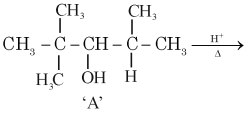
For the given reaction,the total number of possible products formed by the tertiary carbocation of $A$ is $.........$.
A
$4$
B
$3$
C
$5$
D
$1$
Solution
(C) The dehydration of alcohol $A$ ($3,4,4$-trimethylpentan-$2$-ol) in the presence of $H^+$ and heat proceeds via the formation of a carbocation.
First,the secondary carbocation is formed,which undergoes a $1,2$-hydride shift to form a more stable tertiary carbocation.
This tertiary carbocation can further rearrange via a $1,2$-methyl shift to form another tertiary carbocation.
From these tertiary carbocations,elimination reactions occur to form alkenes.
$1$. From the first tertiary carbocation,two alkenes are formed: $2,3,3$-trimethylpent-$1$-ene and $2,3,3$-trimethylpent-$2$-ene.
$2$. From the second tertiary carbocation,two more alkenes are formed: $3,4,4$-trimethylpent-$1$-ene (which is chiral,giving a pair of enantiomers) and $3,4,4$-trimethylpent-$2$-ene.
Counting the distinct products,including the enantiomeric pair,the total number of possible products is $5$.
First,the secondary carbocation is formed,which undergoes a $1,2$-hydride shift to form a more stable tertiary carbocation.
This tertiary carbocation can further rearrange via a $1,2$-methyl shift to form another tertiary carbocation.
From these tertiary carbocations,elimination reactions occur to form alkenes.
$1$. From the first tertiary carbocation,two alkenes are formed: $2,3,3$-trimethylpent-$1$-ene and $2,3,3$-trimethylpent-$2$-ene.
$2$. From the second tertiary carbocation,two more alkenes are formed: $3,4,4$-trimethylpent-$1$-ene (which is chiral,giving a pair of enantiomers) and $3,4,4$-trimethylpent-$2$-ene.
Counting the distinct products,including the enantiomeric pair,the total number of possible products is $5$.
0 likesView Solution
291
ChemistryDifficultMCQJEE Main · 2023
$25.0 \ mL$ of $0.050 \ M \ Ba(NO_3)_2$ is mixed with $25.0 \ mL$ of $0.020 \ M \ NaF$. The $K_{sp}$ of $BaF_2$ is $0.5 \times 10^{-6}$ at $298 \ K$. The ratio of $[Ba^{2+}][F^{-}]^2$ to $K_{sp}$ is $.......$. (Nearest integer)
A
$2$
B
$3$
C
$5$
D
$4$
Solution
(C) Step $1$: Calculate the final concentrations of ions after mixing.
Total volume $= 25.0 \ mL + 25.0 \ mL = 50.0 \ mL$.
$[Ba^{2+}] = \frac{25.0 \times 0.050}{50.0} = 0.025 \ M$.
$[F^{-}] = \frac{25.0 \times 0.020}{50.0} = 0.010 \ M$.
Step $2$: Calculate the ionic product $Q = [Ba^{2+}][F^{-}]^2$.
$Q = (0.025) \times (0.010)^2 = 0.025 \times 10^{-4} = 2.5 \times 10^{-6}$.
Step $3$: Calculate the ratio $\frac{Q}{K_{sp}}$.
Given $K_{sp} = 0.5 \times 10^{-6} = 5 \times 10^{-7}$.
Ratio $= \frac{2.5 \times 10^{-6}}{0.5 \times 10^{-6}} = \frac{2.5}{0.5} = 5$.
Total volume $= 25.0 \ mL + 25.0 \ mL = 50.0 \ mL$.
$[Ba^{2+}] = \frac{25.0 \times 0.050}{50.0} = 0.025 \ M$.
$[F^{-}] = \frac{25.0 \times 0.020}{50.0} = 0.010 \ M$.
Step $2$: Calculate the ionic product $Q = [Ba^{2+}][F^{-}]^2$.
$Q = (0.025) \times (0.010)^2 = 0.025 \times 10^{-4} = 2.5 \times 10^{-6}$.
Step $3$: Calculate the ratio $\frac{Q}{K_{sp}}$.
Given $K_{sp} = 0.5 \times 10^{-6} = 5 \times 10^{-7}$.
Ratio $= \frac{2.5 \times 10^{-6}}{0.5 \times 10^{-6}} = \frac{2.5}{0.5} = 5$.
0 likesView Solution
292
ChemistryDifficultMCQJEE Main · 2023
$A_2 + B_2 \rightarrow 2AB$; $\Delta H_{r}^0 = -400\,kJ\,mol^{-1}$. $AB$,$A_2$ and $B_2$ are diatomic molecules. If the bond enthalpies of $A_2$,$B_2$ and $AB$ are in the ratio $1:0.5:1$,then the bond enthalpy of $A_2$ is $......\,kJ\,mol^{-1}$ (Nearest integer).
A
$600$
B
$200$
C
$800$
D
$500$
Solution
(C) The reaction is: $A_2 + B_2 \rightarrow 2AB$; $\Delta H_{r}^0 = -400\,kJ\,mol^{-1}$.
The formula for enthalpy of reaction in terms of bond enthalpies is:
$\Delta H_{r}^0 = \sum BE_{reactants} - \sum BE_{products}$
Substituting the values:
$-400 = [BE(A_2) + BE(B_2)] - [2 \times BE(AB)]$
Given the ratio of bond enthalpies $BE(A_2) : BE(B_2) : BE(AB) = 1 : 0.5 : 1$.
Let $BE(A_2) = x$,then $BE(B_2) = 0.5x$ and $BE(AB) = x$.
Substituting these into the equation:
$-400 = x + 0.5x - 2(x)$
$-400 = 1.5x - 2x$
$-400 = -0.5x$
$x = \frac{400}{0.5} = 800\,kJ\,mol^{-1}$.
Thus,the bond enthalpy of $A_2$ is $800\,kJ\,mol^{-1}$.
The formula for enthalpy of reaction in terms of bond enthalpies is:
$\Delta H_{r}^0 = \sum BE_{reactants} - \sum BE_{products}$
Substituting the values:
$-400 = [BE(A_2) + BE(B_2)] - [2 \times BE(AB)]$
Given the ratio of bond enthalpies $BE(A_2) : BE(B_2) : BE(AB) = 1 : 0.5 : 1$.
Let $BE(A_2) = x$,then $BE(B_2) = 0.5x$ and $BE(AB) = x$.
Substituting these into the equation:
$-400 = x + 0.5x - 2(x)$
$-400 = 1.5x - 2x$
$-400 = -0.5x$
$x = \frac{400}{0.5} = 800\,kJ\,mol^{-1}$.
Thus,the bond enthalpy of $A_2$ is $800\,kJ\,mol^{-1}$.
0 likesView Solution
293
ChemistryDifficultMCQJEE Main · 2023
An organic compound gives $0.220 \ g$ of $CO_2$ and $0.126 \ g$ of $H_2O$ on complete combustion. If the $\%$ of carbon is $24$,then the $\%$ of hydrogen is $...... \times 10^{-1}$. $(Nearest \ integer)$
A
$51$
B
$52$
C
$56$
D
$53$
Solution
(C) Moles of $CO_2 = \frac{0.220}{44} = 0.005 \ mol$.
Moles of $C = 0.005 \ mol$.
Mass of $C = 0.005 \times 12 = 0.06 \ g$.
Given $\%$ of $C = 24$,so $\frac{0.06}{W} \times 100 = 24$,where $W$ is the mass of the organic compound.
$W = \frac{6}{24} = 0.25 \ g$.
Moles of $H_2O = \frac{0.126}{18} = 0.007 \ mol$.
Moles of $H = 2 \times 0.007 = 0.014 \ mol$.
Mass of $H = 0.014 \times 1 = 0.014 \ g$.
$\%$ of $H = \frac{0.014}{0.25} \times 100 = 5.6$.
$5.6 = 56 \times 10^{-1}$.
Moles of $C = 0.005 \ mol$.
Mass of $C = 0.005 \times 12 = 0.06 \ g$.
Given $\%$ of $C = 24$,so $\frac{0.06}{W} \times 100 = 24$,where $W$ is the mass of the organic compound.
$W = \frac{6}{24} = 0.25 \ g$.
Moles of $H_2O = \frac{0.126}{18} = 0.007 \ mol$.
Moles of $H = 2 \times 0.007 = 0.014 \ mol$.
Mass of $H = 0.014 \times 1 = 0.014 \ g$.
$\%$ of $H = \frac{0.014}{0.25} \times 100 = 5.6$.
$5.6 = 56 \times 10^{-1}$.
0 likesView Solution
294
ChemistryMediumMCQJEE Main · 2023
$A$ certain quantity of real gas occupies a volume of $0.15 \ dm^3$ at $100 \ atm$ and $500 \ K$ when its compressibility factor is $1.07$. Its volume at $300 \ atm$ and $300 \ K$ (when its compressibility factor is $1.4$) is $........ \times 10^{-4} \ dm^3$ (Nearest integer).
A
$391$
B
$393$
C
$392$
D
$394$
Solution
(B) The compressibility factor $Z$ is defined as $Z = \frac{PV}{nRT}$,which implies $n = \frac{PV}{ZRT}$.
Since the amount of gas $n$ remains constant,we have $\frac{P_1 V_1}{Z_1 T_1} = \frac{P_2 V_2}{Z_2 T_2}$.
Given values: $P_1 = 100 \ atm$,$V_1 = 0.15 \ dm^3$,$T_1 = 500 \ K$,$Z_1 = 1.07$.
$P_2 = 300 \ atm$,$T_2 = 300 \ K$,$Z_2 = 1.4$.
Substituting these values into the equation:
$\frac{100 \times 0.15}{1.07 \times 500} = \frac{300 \times V_2}{1.4 \times 300}$
$V_2 = \frac{100 \times 0.15 \times 1.4 \times 300}{1.07 \times 500 \times 300}$
$V_2 = \frac{15 \times 1.4}{1.07 \times 500} = \frac{21}{535} \approx 0.03925 \ dm^3$.
Converting to $10^{-4} \ dm^3$ units: $0.03925 \times 10^4 \times 10^{-4} = 392.5 \times 10^{-4} \ dm^3$.
Rounding to the nearest integer,we get $393 \times 10^{-4} \ dm^3$.
Since the amount of gas $n$ remains constant,we have $\frac{P_1 V_1}{Z_1 T_1} = \frac{P_2 V_2}{Z_2 T_2}$.
Given values: $P_1 = 100 \ atm$,$V_1 = 0.15 \ dm^3$,$T_1 = 500 \ K$,$Z_1 = 1.07$.
$P_2 = 300 \ atm$,$T_2 = 300 \ K$,$Z_2 = 1.4$.
Substituting these values into the equation:
$\frac{100 \times 0.15}{1.07 \times 500} = \frac{300 \times V_2}{1.4 \times 300}$
$V_2 = \frac{100 \times 0.15 \times 1.4 \times 300}{1.07 \times 500 \times 300}$
$V_2 = \frac{15 \times 1.4}{1.07 \times 500} = \frac{21}{535} \approx 0.03925 \ dm^3$.
Converting to $10^{-4} \ dm^3$ units: $0.03925 \times 10^4 \times 10^{-4} = 392.5 \times 10^{-4} \ dm^3$.
Rounding to the nearest integer,we get $393 \times 10^{-4} \ dm^3$.
0 likesView Solution
295
ChemistryMediumMCQJEE Main · 2023
Which of the following is the better method for the preparation of $BeF_2$?
A
$(NH_4)_2BeF_4 \xrightarrow{\Delta} BeF_2 + 2NH_4F$
B
$BeH_2 + F_2 \xrightarrow{\Delta} BeF_2 + H_2$
C
$Be + F_2 \xrightarrow{\Delta} BeF_2$
D
$BeO + C + F_2 \xrightarrow{\Delta} BeF_2 + CO$
Solution
(A) According to the $NCERT$ chemistry textbook for $s$-block elements,the thermal decomposition of ammonium tetrafluoroberyllate is the preferred method for the preparation of pure $BeF_2$.
The reaction is given as:
$(NH_4)_2BeF_4 \xrightarrow{\Delta} BeF_2 + 2NH_4F$
The reaction is given as:
$(NH_4)_2BeF_4 \xrightarrow{\Delta} BeF_2 + 2NH_4F$
0 likesView Solution
296
ChemistryMediumMCQJEE Main · 2023
Given below are two statements,one is labelled as Assertion $A$ and the other is labelled as Reason $R$.
Assertion $A:$ Isotopes of hydrogen have almost same chemical properties,but difference in their rates of reaction.
Reason $R:$ Isotopes of hydrogen have different enthalpy of bond dissociation.
In the light of the above statements,choose the most appropriate answer from the options given below:
Assertion $A:$ Isotopes of hydrogen have almost same chemical properties,but difference in their rates of reaction.
Reason $R:$ Isotopes of hydrogen have different enthalpy of bond dissociation.
In the light of the above statements,choose the most appropriate answer from the options given below:
A
Both $A$ and $R$ are correct but $R$ is $NOT$ the correct explanation of $A$
B
Both $A$ and $R$ are correct and $R$ is the correct explanation of $A$
C
$A$ is not correct but $R$ is correct
D
$A$ is correct but $R$ is not correct
Solution
(B) Isotopes of hydrogen (protium,deuterium,and tritium) have the same electronic configuration,which leads to almost identical chemical properties.
However,they differ in their rates of reaction because of the difference in their bond dissociation enthalpies,which arises due to the difference in their isotopic masses.
Therefore,both $A$ and $R$ are correct,and $R$ is the correct explanation of $A$.
However,they differ in their rates of reaction because of the difference in their bond dissociation enthalpies,which arises due to the difference in their isotopic masses.
Therefore,both $A$ and $R$ are correct,and $R$ is the correct explanation of $A$.
0 likesView Solution
297
ChemistryMediumMCQJEE Main · 2023
Given below are two statements:
Statement $I$: Tropolone is an aromatic compound and has $8 \pi$ electrons.
Statement $II$: $\pi$ electrons of $ > C = O $ group in tropolone is involved in aromaticity.
In the light of the above statements,choose the correct answer from the options given below:
Statement $I$: Tropolone is an aromatic compound and has $8 \pi$ electrons.
Statement $II$: $\pi$ electrons of $ > C = O $ group in tropolone is involved in aromaticity.
In the light of the above statements,choose the correct answer from the options given below:
A
Both Statement $I$ and Statement $II$ are true
B
Statement $I$ is true but Statement $II$ is false
C
Statement $I$ is false but Statement $II$ is true
D
Both Statement $I$ and Statement $II$ are false
Solution
(D) Statement $I$ is false: Tropolone is an aromatic compound,but it follows $H$ückel's rule ($4n+2$ $\pi$ electrons). It has $6$ $\pi$ electrons in the seven-membered ring,which makes it aromatic. It does not have $8$ $\pi$ electrons involved in the aromatic system.
Statement $II$ is false: The $\pi$ electrons of the $ > C = O $ group are not involved in the aromaticity of the ring. The aromaticity arises from the $6$ $\pi$ electrons present within the seven-membered ring system (as shown in the resonance structure where the oxygen atom carries a negative charge and the ring carbon carries a positive charge).
Therefore,both statements are false.
Statement $II$ is false: The $\pi$ electrons of the $ > C = O $ group are not involved in the aromaticity of the ring. The aromaticity arises from the $6$ $\pi$ electrons present within the seven-membered ring system (as shown in the resonance structure where the oxygen atom carries a negative charge and the ring carbon carries a positive charge).
Therefore,both statements are false.
0 likesView Solution
298
ChemistryMediumMCQJEE Main · 2023
The major product for the following reaction is:

A
$HO-CH_2-CH_2-S-CH_2-CH_2-CN$
B
$HS-CH_2-CH_2-O-CH_2-CH_2-CN$
C
$CH_2=CH-C(=NH)-S-CH_2-CH_2-OH$
D
$CH_2=CH-C(=NH)-O-CH_2-CH_2-SH$
Solution
(A) The reaction involves the nucleophilic addition of $HS-CH_2-CH_2-OH$ to acrylonitrile $(CH_2=CH-CN)$.
Thiols $(R-SH)$ are better nucleophiles than alcohols $(R-OH)$ because sulfur is larger,more polarizable,and less electronegative than oxygen.
Therefore,the sulfur atom of $HS-CH_2-CH_2-OH$ attacks the $\beta$-carbon of the electron-deficient double bond in acrylonitrile via a Michael addition mechanism.
The reaction proceeds as follows: $CH_2=CH-CN + HS-CH_2-CH_2-OH \rightarrow HO-CH_2-CH_2-S-CH_2-CH_2-CN$.
Thus,the major product is $HO-CH_2-CH_2-S-CH_2-CH_2-CN$.
Thiols $(R-SH)$ are better nucleophiles than alcohols $(R-OH)$ because sulfur is larger,more polarizable,and less electronegative than oxygen.
Therefore,the sulfur atom of $HS-CH_2-CH_2-OH$ attacks the $\beta$-carbon of the electron-deficient double bond in acrylonitrile via a Michael addition mechanism.
The reaction proceeds as follows: $CH_2=CH-CN + HS-CH_2-CH_2-OH \rightarrow HO-CH_2-CH_2-S-CH_2-CH_2-CN$.
Thus,the major product is $HO-CH_2-CH_2-S-CH_2-CH_2-CN$.
0 likesView Solution
299
ChemistryMediumMCQJEE Main · 2023
Which of the following are the greenhouse gases?
$A.$ Water vapour; $B.$ Ozone; $C.$ $I_2$; $D.$ Molecular hydrogen
Choose the most appropriate answer from the options given.
$A.$ Water vapour; $B.$ Ozone; $C.$ $I_2$; $D.$ Molecular hydrogen
Choose the most appropriate answer from the options given.
A
$B$ and $C$ only
B
$C$ and $D$ only
C
$A$ and $D$ only
D
$A$ and $B$ only
Solution
(D) Greenhouse gases are gases that trap heat in the atmosphere.
Common greenhouse gases include $CO_2$,$CH_4$,water vapour $(H_2O)$,nitrous oxide $(N_2O)$,chlorofluorocarbons $(CFCs)$,and ozone $(O_3)$.
Among the given options,$A$ (Water vapour) and $B$ (Ozone) are greenhouse gases.
Therefore,the correct option is $D$.
Common greenhouse gases include $CO_2$,$CH_4$,water vapour $(H_2O)$,nitrous oxide $(N_2O)$,chlorofluorocarbons $(CFCs)$,and ozone $(O_3)$.
Among the given options,$A$ (Water vapour) and $B$ (Ozone) are greenhouse gases.
Therefore,the correct option is $D$.
0 likesView Solution
300
ChemistryMediumMCQJEE Main · 2023
Given below are two statements:
Statement $I:$ $SO_2$ and $H_2O$ both possess $V$-shaped structure.
Statement $II:$ The bond angle of $SO_2$ is less than that of $H_2O$.
In the light of the above statements,choose the most appropriate answer from the options given below:
Statement $I:$ $SO_2$ and $H_2O$ both possess $V$-shaped structure.
Statement $II:$ The bond angle of $SO_2$ is less than that of $H_2O$.
In the light of the above statements,choose the most appropriate answer from the options given below:
A
Both Statement $I$ and Statement $II$ are correct
B
Statement $I$ is correct but Statement $II$ is incorrect
C
Both Statement $I$ and Statement $II$ are incorrect
D
Statement $I$ is incorrect but Statement $II$ is correct
Solution
(B) Statement $I$ is correct: Both $SO_2$ and $H_2O$ have a bent or $V$-shaped molecular geometry.
Statement $II$ is incorrect: The bond angle in $SO_2$ is approximately $119.5^{\circ}$ ($sp^2$ hybridization),whereas the bond angle in $H_2O$ is approximately $104.5^{\circ}$ ($sp^3$ hybridization).
Therefore,the bond angle of $SO_2$ is greater than that of $H_2O$ due to the presence of double bonds and different hybridization states.
Thus,Statement $I$ is correct but Statement $II$ is incorrect.
Statement $II$ is incorrect: The bond angle in $SO_2$ is approximately $119.5^{\circ}$ ($sp^2$ hybridization),whereas the bond angle in $H_2O$ is approximately $104.5^{\circ}$ ($sp^3$ hybridization).
Therefore,the bond angle of $SO_2$ is greater than that of $H_2O$ due to the presence of double bonds and different hybridization states.
Thus,Statement $I$ is correct but Statement $II$ is incorrect.
0 likesView Solution
301
ChemistryMediumMCQJEE Main · 2023
In chromyl chloride,the number of $d$-electrons present on chromium is same as in (Given atomic number of $Ti = 22, V = 23, Cr = 24, Mn = 25, Fe = 26$)
A
$Ti(III)$
B
$Fe(III)$
C
$V(IV)$
D
$Mn(VII)$
Solution
(D) The formula for chromyl chloride is $CrO_2Cl_2$.
In $CrO_2Cl_2$,the oxidation state of $Cr$ is calculated as: $x + 2(-2) + 2(-1) = 0$,which gives $x = +6$.
The electronic configuration of $Cr$ $(Z=24)$ is $[Ar] 3d^5 4s^1$. Thus,$Cr(VI)$ is $[Ar] 3d^0$.
Now,let us check the $d$-electron count for the options:
$Ti(III)$ $(Z=22)$: $[Ar] 3d^1$
$Fe(III)$ $(Z=26)$: $[Ar] 3d^5$
$V(IV)$ $(Z=23)$: $[Ar] 3d^1$
$Mn(VII)$ $(Z=25)$: $[Ar] 3d^0$
Since $Cr(VI)$ and $Mn(VII)$ both have $0$ $d$-electrons,the correct option is $D$.
In $CrO_2Cl_2$,the oxidation state of $Cr$ is calculated as: $x + 2(-2) + 2(-1) = 0$,which gives $x = +6$.
The electronic configuration of $Cr$ $(Z=24)$ is $[Ar] 3d^5 4s^1$. Thus,$Cr(VI)$ is $[Ar] 3d^0$.
Now,let us check the $d$-electron count for the options:
$Ti(III)$ $(Z=22)$: $[Ar] 3d^1$
$Fe(III)$ $(Z=26)$: $[Ar] 3d^5$
$V(IV)$ $(Z=23)$: $[Ar] 3d^1$
$Mn(VII)$ $(Z=25)$: $[Ar] 3d^0$
Since $Cr(VI)$ and $Mn(VII)$ both have $0$ $d$-electrons,the correct option is $D$.
0 likesView Solution
302
ChemistryMediumMCQJEE Main · 2023
The correct order of spin-only magnetic moments for the following complex ions is:
A
$[Fe(CN)_6]^{3-} < [CoF_6]^{3-} < [MnBr_4]^{2-} < [Mn(CN)_6]^{3-}$
B
$[Fe(CN)_6]^{3-} < [Mn(CN)_6]^{3-} < [CoF_6]^{3-} < [MnBr_4]^{2-}$
C
$[MnBr_4]^{2-} < [CoF_6]^{3-} < [Fe(CN)_6]^{3-} < [Mn(CN)_6]^{3-}$
D
$[CoF_6]^{3-} < [MnBr_4]^{2-} < [Fe(CN)_6]^{3-} < [Mn(CN)_6]^{3-}$
Solution
(B) The spin-only magnetic moment is given by $\mu = \sqrt{n(n+2)} \ B.M.$,where $n$ is the number of unpaired electrons.
$1$. $[Fe(CN)_6]^{3-}$: $Fe^{3+}$ is $d^5$. $CN^-$ is a strong field ligand,so $n = 1$. $\mu = \sqrt{1(3)} = 1.73 \ B.M.$
$2$. $[Mn(CN)_6]^{3-}$: $Mn^{3+}$ is $d^4$. $CN^-$ is a strong field ligand,so $n = 2$. $\mu = \sqrt{2(4)} = 2.83 \ B.M.$
$3$. $[CoF_6]^{3-}$: $Co^{3+}$ is $d^6$. $F^-$ is a weak field ligand,so $n = 4$. $\mu = \sqrt{4(6)} = 4.90 \ B.M.$
$4$. $[MnBr_4]^{2-}$: $Mn^{2+}$ is $d^5$. $Br^-$ is a weak field ligand,so $n = 5$. $\mu = \sqrt{5(7)} = 5.92 \ B.M.$
The correct order is $[Fe(CN)_6]^{3-} < [Mn(CN)_6]^{3-} < [CoF_6]^{3-} < [MnBr_4]^{2-}$.
$1$. $[Fe(CN)_6]^{3-}$: $Fe^{3+}$ is $d^5$. $CN^-$ is a strong field ligand,so $n = 1$. $\mu = \sqrt{1(3)} = 1.73 \ B.M.$
$2$. $[Mn(CN)_6]^{3-}$: $Mn^{3+}$ is $d^4$. $CN^-$ is a strong field ligand,so $n = 2$. $\mu = \sqrt{2(4)} = 2.83 \ B.M.$
$3$. $[CoF_6]^{3-}$: $Co^{3+}$ is $d^6$. $F^-$ is a weak field ligand,so $n = 4$. $\mu = \sqrt{4(6)} = 4.90 \ B.M.$
$4$. $[MnBr_4]^{2-}$: $Mn^{2+}$ is $d^5$. $Br^-$ is a weak field ligand,so $n = 5$. $\mu = \sqrt{5(7)} = 5.92 \ B.M.$
The correct order is $[Fe(CN)_6]^{3-} < [Mn(CN)_6]^{3-} < [CoF_6]^{3-} < [MnBr_4]^{2-}$.
0 likesView Solution
303
ChemistryMediumMCQJEE Main · 2023
Which halogen is known to cause the reaction given below:
$2 Cu^{2+} + 4 X^{-} \rightarrow Cu_2 X_{2(s)} + X_2$
$2 Cu^{2+} + 4 X^{-} \rightarrow Cu_2 X_{2(s)} + X_2$
A
Only Iodine
B
Only Bromine
C
All halogens
D
Only Chlorine
Solution
(A) The reaction $2 Cu^{2+} + 4 X^{-} \rightarrow Cu_2 X_{2(s)} + X_2$ represents the reduction of $Cu^{2+}$ to $Cu^+$ by halide ions.
This reaction occurs specifically with iodide ions $(I^-)$ because $CuI_2$ is unstable and decomposes to form $Cu_2I_2$ and $I_2$.
Chlorine and bromine are not strong enough reducing agents to reduce $Cu^{2+}$ to $Cu^+$ under these conditions.
Therefore,the correct answer is $I^-$ (Iodine).
This reaction occurs specifically with iodide ions $(I^-)$ because $CuI_2$ is unstable and decomposes to form $Cu_2I_2$ and $I_2$.
Chlorine and bromine are not strong enough reducing agents to reduce $Cu^{2+}$ to $Cu^+$ under these conditions.
Therefore,the correct answer is $I^-$ (Iodine).
0 likesView Solution
304
ChemistryMediumMCQJEE Main · 2023
Match List-$I$ with List-$II$:
Benzenediazonium chloride $(C_6H_5N_2^+Cl^-)$ is reacted with reagents in List-$I$ to form products in List-$II$.
| List-$I$ (Reagent) | List-$II$ (Product) |
| :--- | :--- |
| $A$. Aniline $(C_6H_5NH_2)$ | $I$. Fluorobenzene $(C_6H_5F)$ |
| $B$. $HBF_4, \Delta$ | $II$. Benzonitrile $(C_6H_5CN)$ |
| $C$. $Cu, HCl$ | $III$. $p$-Aminoazobenzene $(C_6H_5-N=N-C_6H_4-NH_2)$ |
| $D$. $CuCN/KCN$ | $IV$. Chlorobenzene $(C_6H_5Cl)$ |
Choose the correct answer from the options given below:
Benzenediazonium chloride $(C_6H_5N_2^+Cl^-)$ is reacted with reagents in List-$I$ to form products in List-$II$.
| List-$I$ (Reagent) | List-$II$ (Product) |
| :--- | :--- |
| $A$. Aniline $(C_6H_5NH_2)$ | $I$. Fluorobenzene $(C_6H_5F)$ |
| $B$. $HBF_4, \Delta$ | $II$. Benzonitrile $(C_6H_5CN)$ |
| $C$. $Cu, HCl$ | $III$. $p$-Aminoazobenzene $(C_6H_5-N=N-C_6H_4-NH_2)$ |
| $D$. $CuCN/KCN$ | $IV$. Chlorobenzene $(C_6H_5Cl)$ |
Choose the correct answer from the options given below:
A
$A-IV, B-III, C-II, D-I$
B
$A-I, B-III, C-IV, D-II$
C
$A-III, B-I, C-II, D-IV$
D
$A-III, B-I, C-IV, D-II$
Solution
(D) The reactions of benzenediazonium chloride $(C_6H_5N_2^ Cl^-)$ are as follows:
$A$. Reaction with aniline $(C_6H_5NH_2)$ leads to coupling reaction to form $p$-aminoazobenzene (Product $III$).
$B$. Reaction with $HBF_4$ followed by heating $(\Delta)$ is the Balz-Schiemann reaction,which forms fluorobenzene (Product $I$).
$C$. Reaction with $Cu/HCl$ is the Gattermann reaction,which forms chlorobenzene (Product $IV$).
$D$. Reaction with $CuCN/KCN$ is the Sandmeyer reaction,which forms benzonitrile (Product $II$).
Thus,the correct matching is $A-III, B-I, C-IV, D-II$.
$A$. Reaction with aniline $(C_6H_5NH_2)$ leads to coupling reaction to form $p$-aminoazobenzene (Product $III$).
$B$. Reaction with $HBF_4$ followed by heating $(\Delta)$ is the Balz-Schiemann reaction,which forms fluorobenzene (Product $I$).
$C$. Reaction with $Cu/HCl$ is the Gattermann reaction,which forms chlorobenzene (Product $IV$).
$D$. Reaction with $CuCN/KCN$ is the Sandmeyer reaction,which forms benzonitrile (Product $II$).
Thus,the correct matching is $A-III, B-I, C-IV, D-II$.
0 likesView Solution
305
ChemistryDifficultMCQJEE Main · 2023
The number of given statement/s which is/are correct is $.....$.
$(A)$ The stronger the temperature dependence of the rate constant,the higher is the activation energy.
$(B)$ If a reaction has zero activation energy,its rate is independent of temperature.
$(C)$ The stronger the temperature dependence of the rate constant,the smaller is the activation energy.
$(D)$ If there is no correlation between the temperature and the rate constant then it means that the reaction has negative activation energy.
$(A)$ The stronger the temperature dependence of the rate constant,the higher is the activation energy.
$(B)$ If a reaction has zero activation energy,its rate is independent of temperature.
$(C)$ The stronger the temperature dependence of the rate constant,the smaller is the activation energy.
$(D)$ If there is no correlation between the temperature and the rate constant then it means that the reaction has negative activation energy.
A
$1$
B
$2$
C
$3$
D
$4$
Solution
(B) According to the Arrhenius equation,$k = A \cdot e^{-E_a / RT}$.
Taking the natural logarithm on both sides: $\ln k = \ln A - \frac{E_a}{RT}$.
Taking the base-$10$ logarithm: $\log k = \log A - \frac{E_a}{2.303 R} \cdot \frac{1}{T}$.
Evaluating the statements:
$(A)$ Correct: $A$ higher $E_a$ leads to a steeper slope $(-\frac{E_a}{2.303 R})$ in the $\log k$ vs $\frac{1}{T}$ plot,meaning the rate constant $k$ changes more rapidly with temperature.
$(B)$ Correct: If $E_a = 0$,then $k = A \cdot e^0 = A$,which is constant and independent of temperature.
$(C)$ Incorrect: This is the opposite of statement $(A)$.
$(D)$ Incorrect: If there is no correlation between temperature and rate constant,it implies $E_a = 0$,not a negative activation energy.
Thus,there are $2$ correct statements ($A$ and $B$).
Taking the natural logarithm on both sides: $\ln k = \ln A - \frac{E_a}{RT}$.
Taking the base-$10$ logarithm: $\log k = \log A - \frac{E_a}{2.303 R} \cdot \frac{1}{T}$.
Evaluating the statements:
$(A)$ Correct: $A$ higher $E_a$ leads to a steeper slope $(-\frac{E_a}{2.303 R})$ in the $\log k$ vs $\frac{1}{T}$ plot,meaning the rate constant $k$ changes more rapidly with temperature.
$(B)$ Correct: If $E_a = 0$,then $k = A \cdot e^0 = A$,which is constant and independent of temperature.
$(C)$ Incorrect: This is the opposite of statement $(A)$.
$(D)$ Incorrect: If there is no correlation between temperature and rate constant,it implies $E_a = 0$,not a negative activation energy.
Thus,there are $2$ correct statements ($A$ and $B$).
0 likesView Solution
306
ChemistryMediumMCQJEE Main · 2023
The vapour pressure vs. temperature curve for a solution-solvent system is shown below. The boiling point of the solvent is $........\,^{\circ} C$.
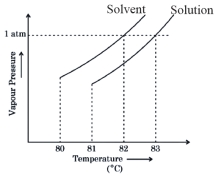
A
$81$
B
$82$
C
$83$
D
$84$
Solution
(B) The boiling point of a liquid is the temperature at which its vapour pressure becomes equal to the external atmospheric pressure $(1 \ atm)$.
Looking at the provided graph,the curve for the solvent intersects the $1 \ atm$ line at a temperature of $82^{\circ} C$.
Therefore,the boiling point of the solvent is $82^{\circ} C$.
Looking at the provided graph,the curve for the solvent intersects the $1 \ atm$ line at a temperature of $82^{\circ} C$.
Therefore,the boiling point of the solvent is $82^{\circ} C$.
0 likesView Solution
307
ChemistryMediumMCQJEE Main · 2023
$XeF_4$ reacts with $SbF_5$ to form $[XeF_m]^{n+}[SbF_y]^{z-}$. Calculate $m + n + y + z = .......$.
A
$10$
B
$11$
C
$12$
D
$13$
Solution
(B) The reaction between $XeF_4$ and $SbF_5$ is a fluoride ion transfer reaction where $XeF_4$ acts as a fluoride donor and $SbF_5$ acts as a fluoride acceptor.
The balanced chemical equation is: $XeF_4 + SbF_5 \rightarrow [XeF_3]^+[SbF_6]^-$.
Comparing this with the general form $[XeF_m]^{n+}[SbF_y]^{z-}$,we get:
$m = 3$
$n = 1$
$y = 6$
$z = 1$
Therefore,$m + n + y + z = 3 + 1 + 6 + 1 = 11$.
The balanced chemical equation is: $XeF_4 + SbF_5 \rightarrow [XeF_3]^+[SbF_6]^-$.
Comparing this with the general form $[XeF_m]^{n+}[SbF_y]^{z-}$,we get:
$m = 3$
$n = 1$
$y = 6$
$z = 1$
Therefore,$m + n + y + z = 3 + 1 + 6 + 1 = 11$.
0 likesView Solution
308
ChemistryMediumMCQJEE Main · 2023
The product $(P)$ formed from the following multistep reaction is :-
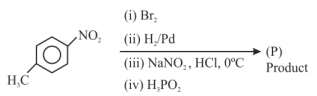
A
$2-$bromo$-1-$methylbenzene
B
$3-$bromo$-1-$methylbenzene
C
$4-$bromo$-1-$methylbenzene
D
$2-$bromo$-4-$methylphenol
Solution
(A) Step $1$: Electrophilic aromatic substitution of $p$-nitrotoluene with $Br_2$ gives $2$-bromo-$4$-nitrotoluene.
Step $2$: Reduction of the nitro group using $H_2/Pd$ yields $2$-bromo-$4$-methylaniline.
Step $3$: Diazotization using $NaNO_2/HCl$ at $0^{\circ}C$ converts the amino group into a diazonium salt,forming $2$-bromo-$4$-methylbenzenediazonium chloride.
Step $4$: Reduction of the diazonium salt with $H_3PO_2$ replaces the $-N_2^+Cl^-$ group with a hydrogen atom,resulting in $2$-bromo-$1$-methylbenzene (also known as $o$-bromotoluene).
Step $2$: Reduction of the nitro group using $H_2/Pd$ yields $2$-bromo-$4$-methylaniline.
Step $3$: Diazotization using $NaNO_2/HCl$ at $0^{\circ}C$ converts the amino group into a diazonium salt,forming $2$-bromo-$4$-methylbenzenediazonium chloride.
Step $4$: Reduction of the diazonium salt with $H_3PO_2$ replaces the $-N_2^+Cl^-$ group with a hydrogen atom,resulting in $2$-bromo-$1$-methylbenzene (also known as $o$-bromotoluene).
0 likesView Solution
309
ChemistryMediumMCQJEE Main · 2023
The correct reaction profile diagram for a positive catalyst reaction.
A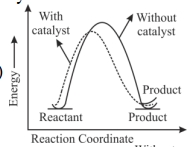
B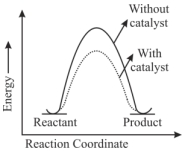
C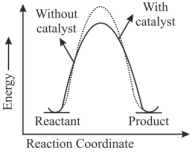
D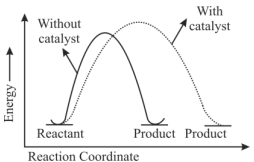
Solution
(B) positive catalyst increases the rate of reaction by providing an alternative pathway with lower activation energy $(E_a)$.
$(i)$ The energy of reactants and products remains the same,so $\Delta H$ does not change.
$(ii)$ The activation energy $(E_a)$ decreases,which is represented by a lower peak in the energy profile diagram.
Therefore,the diagram where the path with the catalyst has a lower peak than the path without the catalyst is the correct one,which corresponds to option $B$.
$(i)$ The energy of reactants and products remains the same,so $\Delta H$ does not change.
$(ii)$ The activation energy $(E_a)$ decreases,which is represented by a lower peak in the energy profile diagram.
Therefore,the diagram where the path with the catalyst has a lower peak than the path without the catalyst is the correct one,which corresponds to option $B$.
0 likesView Solution
310
ChemistryMediumMCQJEE Main · 2023
The statement/s which are true about antagonists from the following is/are :-
$A.$ They bind to the receptor site.
$B.$ Get transferred inside the cell for their action.
$C.$ Inhibit the natural communication of the body.
$D.$ Mimic the natural messenger.
Choose the correct answer from the options given below :-
$A.$ They bind to the receptor site.
$B.$ Get transferred inside the cell for their action.
$C.$ Inhibit the natural communication of the body.
$D.$ Mimic the natural messenger.
Choose the correct answer from the options given below :-
A
$B$ only
B
$A, C$ and $D$
C
$A$ and $B$
D
$A$ and $C$
Solution
(D) Antagonists are drugs that bind to the receptor site and inhibit its natural function.
They do not mimic the natural messenger (which is the function of agonists).
They do not necessarily get transferred inside the cell for their action.
Therefore,statements $A$ and $C$ are correct.
They do not mimic the natural messenger (which is the function of agonists).
They do not necessarily get transferred inside the cell for their action.
Therefore,statements $A$ and $C$ are correct.
0 likesView Solution
311
ChemistryMediumMCQJEE Main · 2023
Match List-$I$ with List-$II$ :-
Choose the correct answer from the options given below :-
| List-$I$ (Coordination compounds) | List-$II$ (Number of unpaired electrons) |
| $A$. $[Cr(CN)_6]^{3-}$ | $I$. $0$ |
| $B$. $[Fe(H_2O)_6]^{2+}$ | $II$. $3$ |
| $C$. $[Co(NH_3)_6]^{3+}$ | $III$. $2$ |
| $D$. $[Ni(NH_3)_6]^{2+}$ | $IV$. $4$ |
Choose the correct answer from the options given below :-
A
$A-II, B-IV, C-I, D-III$
B
$A-IV, B-III, C-II, D-I$
C
$A-III, B-IV, C-I, D-II$
D
$A-II, B-I, C-IV, D-III$
Solution
(A) For option $(A)$: $[Cr(CN)_6]^{3-}$,$Cr^{3+}$ is $3d^3$. Since $CN^-$ is a strong field ligand,the electrons remain in $t_{2g}$ orbitals. Number of unpaired electrons $= 3$.
For option $(B)$: $[Fe(H_2O)_6]^{2+}$,$Fe^{2+}$ is $3d^6$. Since $H_2O$ is a weak field ligand,the configuration is $t_{2g}^4 e_g^2$. Number of unpaired electrons $= 4$.
For option $(C)$: $[Co(NH_3)_6]^{3+}$,$Co^{3+}$ is $3d^6$. Since $NH_3$ is a strong field ligand,all electrons are paired. Number of unpaired electrons $= 0$.
For option $(D)$: $[Ni(NH_3)_6]^{2+}$,$Ni^{2+}$ is $3d^8$. The configuration is $t_{2g}^6 e_g^2$. Number of unpaired electrons $= 2$.
Thus,the correct matching is $A-II, B-IV, C-I, D-III$.
For option $(B)$: $[Fe(H_2O)_6]^{2+}$,$Fe^{2+}$ is $3d^6$. Since $H_2O$ is a weak field ligand,the configuration is $t_{2g}^4 e_g^2$. Number of unpaired electrons $= 4$.
For option $(C)$: $[Co(NH_3)_6]^{3+}$,$Co^{3+}$ is $3d^6$. Since $NH_3$ is a strong field ligand,all electrons are paired. Number of unpaired electrons $= 0$.
For option $(D)$: $[Ni(NH_3)_6]^{2+}$,$Ni^{2+}$ is $3d^8$. The configuration is $t_{2g}^6 e_g^2$. Number of unpaired electrons $= 2$.
Thus,the correct matching is $A-II, B-IV, C-I, D-III$.
0 likesView Solution
312
ChemistryMediumMCQJEE Main · 2023
In the Hall-Heroult process,which of the following is used for reducing $Al_2O_3$?
A
Graphite
B
Magnesium
C
$Na_3AlF_6$
D
$CaF_2$
Solution
(A) In the Hall-Heroult process,the electrolytic reduction of $Al_2O_3$ is carried out in a steel vessel lined with carbon.
Graphite rods act as the anode and the carbon lining acts as the cathode.
During the process,$Al_2O_3$ is reduced to $Al$ at the cathode,while the graphite anode is consumed as it reacts with oxygen to form $CO$ and $CO_2$.
Graphite rods act as the anode and the carbon lining acts as the cathode.
During the process,$Al_2O_3$ is reduced to $Al$ at the cathode,while the graphite anode is consumed as it reacts with oxygen to form $CO$ and $CO_2$.
0 likesView Solution
313
ChemistryMediumMCQJEE Main · 2023
Match List-$I$ with List-$II$.
| List-$I$ (Natural amino acid) | List-$II$ (Code) |
|---|---|
| $A$. Glutamic acid | $I$. $Q$ |
| $B$. Glutamine | $II$. $W$ |
| $C$. Tyrosine | $III$. $E$ |
| $D$. Tryptophan | $IV$. $Y$ |
A
$A-II, B-I, C-IV, D-III$
B
$A-IV, B-III, C-I, D-II$
C
$A-III, B-I, C-IV, D-II$
D
$A-III, B-IV, C-I, D-II$
Solution
(C) The single-letter codes for amino acids are as follows:
$A$. Glutamic acid is represented by $E$ $(III)$.
$B$. Glutamine is represented by $Q$ $(I)$.
$C$. Tyrosine is represented by $Y$ $(IV)$.
$D$. Tryptophan is represented by $W$ $(II)$.
Therefore,the correct matching is $A-III, B-I, C-IV, D-II$.
$A$. Glutamic acid is represented by $E$ $(III)$.
$B$. Glutamine is represented by $Q$ $(I)$.
$C$. Tyrosine is represented by $Y$ $(IV)$.
$D$. Tryptophan is represented by $W$ $(II)$.
Therefore,the correct matching is $A-III, B-I, C-IV, D-II$.
0 likesView Solution
314
ChemistryMediumMCQJEE Main · 2023
The descending order of acidity for the following carboxylic acids is:
$A.$ $CH_3COOH$
$B.$ $F_3C-COOH$
$C.$ $ClCH_2-COOH$
$D.$ $FCH_2-COOH$
$E.$ $BrCH_2-COOH$
Choose the correct answer from the options given below:
$A.$ $CH_3COOH$
$B.$ $F_3C-COOH$
$C.$ $ClCH_2-COOH$
$D.$ $FCH_2-COOH$
$E.$ $BrCH_2-COOH$
Choose the correct answer from the options given below:
A
$D > B > A > E > C$
B
$E > D > B > A > C$
C
$B > C > D > E > A$
D
$B > D > C > E > A$
Solution
(D) The acidity of carboxylic acids is determined by the stability of the carboxylate anion formed after the loss of a proton. Electron-withdrawing groups ($-I$ effect) increase acidity by stabilizing the negative charge,while electron-donating groups ($+I$ effect) decrease acidity.
$1$. $B$ $(F_3C-COOH)$: Contains three highly electronegative fluorine atoms,exerting a strong $-I$ effect,making it the most acidic.
$2$. $D$ $(FCH_2-COOH)$: Contains one fluorine atom,which has a stronger $-I$ effect than chlorine or bromine.
$3$. $C$ $(ClCH_2-COOH)$: Contains a chlorine atom,which has a weaker $-I$ effect than fluorine but stronger than bromine.
$4$. $E$ $(BrCH_2-COOH)$: Contains a bromine atom,which has the weakest $-I$ effect among the halogens listed.
$5$. $A$ $(CH_3COOH)$: Contains a methyl group,which exerts a $+I$ effect,destabilizing the carboxylate anion and making it the least acidic.
Thus,the descending order of acidity is $B > D > C > E > A$.
$1$. $B$ $(F_3C-COOH)$: Contains three highly electronegative fluorine atoms,exerting a strong $-I$ effect,making it the most acidic.
$2$. $D$ $(FCH_2-COOH)$: Contains one fluorine atom,which has a stronger $-I$ effect than chlorine or bromine.
$3$. $C$ $(ClCH_2-COOH)$: Contains a chlorine atom,which has a weaker $-I$ effect than fluorine but stronger than bromine.
$4$. $E$ $(BrCH_2-COOH)$: Contains a bromine atom,which has the weakest $-I$ effect among the halogens listed.
$5$. $A$ $(CH_3COOH)$: Contains a methyl group,which exerts a $+I$ effect,destabilizing the carboxylate anion and making it the least acidic.
Thus,the descending order of acidity is $B > D > C > E > A$.
0 likesView Solution
315
ChemistryDifficultMCQJEE Main · 2023
The correct order of reactivity of the following haloarenes towards nucleophilic substitution with aqueous $NaOH$ is:
Choose the correct answer from the options given below:
Choose the correct answer from the options given below:
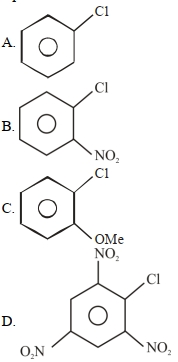
A
$A > B > D > C$
B
$C > A > D > B$
C
$D > C > B > A$
D
$D > B > A > C$
Solution
(D) The reactivity of haloarenes towards nucleophilic substitution increases with the presence of electron-withdrawing groups ($-M$ or $-I$ effect) on the benzene ring,as they stabilize the carbanion intermediate formed during the reaction.
Conversely,electron-donating groups ($+M$ or $+I$ effect) decrease the reactivity.
Analyzing the compounds:
$D$: Contains three $-NO_2$ groups (strong $-M$ effect),making it the most reactive.
$B$: Contains one $-NO_2$ group ($-M$ effect),making it more reactive than $A$.
$A$: Chlorobenzene,the reference compound.
$C$: Contains an $-OMe$ group ($+M$ effect),which destabilizes the intermediate,making it the least reactive.
Therefore,the correct order of reactivity is $D > B > A > C$.
Conversely,electron-donating groups ($+M$ or $+I$ effect) decrease the reactivity.
Analyzing the compounds:
$D$: Contains three $-NO_2$ groups (strong $-M$ effect),making it the most reactive.
$B$: Contains one $-NO_2$ group ($-M$ effect),making it more reactive than $A$.
$A$: Chlorobenzene,the reference compound.
$C$: Contains an $-OMe$ group ($+M$ effect),which destabilizes the intermediate,making it the least reactive.
Therefore,the correct order of reactivity is $D > B > A > C$.
0 likesView Solution
316
ChemistryMediumMCQJEE Main · 2023
$A$ compound '$X$' when treated with phthalic anhydride in the presence of concentrated $H_2SO_4$ yields '$Y$'. '$Y$' is used as an acid/base indicator. '$X$' and '$Y$' are respectively:
A
Carbolic acid,Phenolphthalein
B
Anisole,methyl orange
C
Salicylaldehyde,Phenolphthalein
D
Toluidine,Phenolphthalein
Solution
(A) The reaction of phenol (also known as carbolic acid) with phthalic anhydride in the presence of concentrated $H_2SO_4$ is a condensation reaction.
Two molecules of phenol react with one molecule of phthalic anhydride to form phenolphthalein,which is a well-known acid-base indicator.
Therefore,'$X$' is phenol (carbolic acid) and '$Y$' is phenolphthalein.
Two molecules of phenol react with one molecule of phthalic anhydride to form phenolphthalein,which is a well-known acid-base indicator.
Therefore,'$X$' is phenol (carbolic acid) and '$Y$' is phenolphthalein.
0 likesView Solution
317
ChemistryMediumMCQJEE Main · 2023
Coagulating value of electrolytes $AlCl_3$ and $NaCl$ for $As_2S_3$ are $0.09$ and $50.04$ respectively. The coagulating power of $AlCl_3$ is $x$ times the coagulating power of $NaCl$. The value of $x$ is $.......$.
A
$556$
B
$555$
C
$557$
D
$558$
Solution
(A) The coagulating power of an electrolyte is inversely proportional to its coagulating value.
$\text{Coagulating Power} (C.P.) = \frac{1}{\text{Coagulating Value} (C.V.)}$
Given:
$(C.V.)_{AlCl_3} = 0.09$
$(C.V.)_{NaCl} = 50.04$
Ratio of coagulating powers:
$\frac{(C.P.)_{AlCl_3}}{(C.P.)_{NaCl}} = \frac{(C.V.)_{NaCl}}{(C.V.)_{AlCl_3}}$
$\frac{(C.P.)_{AlCl_3}}{(C.P.)_{NaCl}} = \frac{50.04}{0.09} = 556$
Therefore,the coagulating power of $AlCl_3$ is $556$ times the coagulating power of $NaCl$. Thus,$x = 556$.
$\text{Coagulating Power} (C.P.) = \frac{1}{\text{Coagulating Value} (C.V.)}$
Given:
$(C.V.)_{AlCl_3} = 0.09$
$(C.V.)_{NaCl} = 50.04$
Ratio of coagulating powers:
$\frac{(C.P.)_{AlCl_3}}{(C.P.)_{NaCl}} = \frac{(C.V.)_{NaCl}}{(C.V.)_{AlCl_3}}$
$\frac{(C.P.)_{AlCl_3}}{(C.P.)_{NaCl}} = \frac{50.04}{0.09} = 556$
Therefore,the coagulating power of $AlCl_3$ is $556$ times the coagulating power of $NaCl$. Thus,$x = 556$.
0 likesView Solution
318
ChemistryMediumMCQJEE Main · 2023
If the boiling points of two solvents $X$ and $Y$ (having same molecular weights) are in the ratio $2 : 1$ and their enthalpies of vaporization are in the ratio $1 : 2$,then the boiling point elevation constant of $X$ is $\underline{ m }$ times the boiling point elevation constant of $Y$. The value of $m$ is $.....$. (Nearest integer)
A
$8$
B
$6$
C
$4$
D
$2$
Solution
(A) The boiling point elevation constant $K_B$ is given by the formula: $K_B = \frac{R \cdot T_B^2 \cdot M}{1000 \cdot \Delta H_{vap}}$.
Since the molecular weights $M$ are the same and $R$ is a constant,we have $K_B \propto \frac{T_B^2}{\Delta H_{vap}}$.
Given $\frac{(T_B)_X}{(T_B)_Y} = \frac{2}{1}$ and $\frac{(\Delta H)_X}{(\Delta H)_Y} = \frac{1}{2}$.
Therefore,$\frac{(K_B)_X}{(K_B)_Y} = \left( \frac{(T_B)_X}{(T_B)_Y} \right)^2 \times \frac{(\Delta H)_Y}{(\Delta H)_X}$.
Substituting the values: $\frac{(K_B)_X}{(K_B)_Y} = (2)^2 \times \left( \frac{2}{1} \right) = 4 \times 2 = 8$.
Thus,$m = 8$.
Since the molecular weights $M$ are the same and $R$ is a constant,we have $K_B \propto \frac{T_B^2}{\Delta H_{vap}}$.
Given $\frac{(T_B)_X}{(T_B)_Y} = \frac{2}{1}$ and $\frac{(\Delta H)_X}{(\Delta H)_Y} = \frac{1}{2}$.
Therefore,$\frac{(K_B)_X}{(K_B)_Y} = \left( \frac{(T_B)_X}{(T_B)_Y} \right)^2 \times \frac{(\Delta H)_Y}{(\Delta H)_X}$.
Substituting the values: $\frac{(K_B)_X}{(K_B)_Y} = (2)^2 \times \left( \frac{2}{1} \right) = 4 \times 2 = 8$.
Thus,$m = 8$.
1 likesView Solution
319
ChemistryMediumMCQJEE Main · 2023
The sum of the oxidation states of the metals in $Fe(CO)_5$,$VO^{2+}$,and $WO_3$ is $.........$.
A
$10$
B
$8$
C
$6$
D
$4$
Solution
(A) $1$. In $Fe(CO)_5$,the oxidation state of $Fe$ is $0$ because $CO$ is a neutral ligand.
$2$. In $VO^{2+}$,let the oxidation state of $V$ be $x$. Then $x + (-2) = +2$,so $x = +4$.
$3$. In $WO_3$,let the oxidation state of $W$ be $y$. Then $y + 3(-2) = 0$,so $y = +6$.
$4$. The sum of the oxidation states $= 0 + 4 + 6 = 10$.
$2$. In $VO^{2+}$,let the oxidation state of $V$ be $x$. Then $x + (-2) = +2$,so $x = +4$.
$3$. In $WO_3$,let the oxidation state of $W$ be $y$. Then $y + 3(-2) = 0$,so $y = +6$.
$4$. The sum of the oxidation states $= 0 + 4 + 6 = 10$.
0 likesView Solution
320
ChemistryMediumMCQJEE Main · 2023
The observed magnetic moment of the complex $[Mn(NCS)_6]^{x-}$ is $6.06 \ BM$. The numerical value of $x$ is $.......$.
A
$4$
B
$6$
C
$8$
D
$10$
Solution
(A) The magnetic moment $\mu = \sqrt{n(n+2)} \ BM$.
Given $\mu = 6.06 \ BM$,which corresponds to $n = 5$ unpaired electrons.
For $Mn$ $(Z=25)$,the electronic configuration is $[Ar] 3d^5 4s^2$.
To have $5$ unpaired electrons in the complex,$Mn$ must be in the $+2$ oxidation state $(Mn^{2+})$,which has the configuration $[Ar] 3d^5$.
Let the oxidation state of $Mn$ be $y$. The charge on the complex is given by $y + 6 \times (-1) = -x$.
Since $y = +2$,we have $2 - 6 = -x$,which gives $-4 = -x$,so $x = 4$.
Given $\mu = 6.06 \ BM$,which corresponds to $n = 5$ unpaired electrons.
For $Mn$ $(Z=25)$,the electronic configuration is $[Ar] 3d^5 4s^2$.
To have $5$ unpaired electrons in the complex,$Mn$ must be in the $+2$ oxidation state $(Mn^{2+})$,which has the configuration $[Ar] 3d^5$.
Let the oxidation state of $Mn$ be $y$. The charge on the complex is given by $y + 6 \times (-1) = -x$.
Since $y = +2$,we have $2 - 6 = -x$,which gives $-4 = -x$,so $x = 4$.
0 likesView Solution
321
ChemistryDifficultMCQJEE Main · 2023
The number of incorrect statements from the following is:
$A.$ The electrical work that a reaction can perform at constant pressure and temperature is equal to the reaction Gibbs energy.
$B.$ $E_{cell}^0$ is dependent on the pressure.
$C.$ $\frac{dE_{cell}^0}{dT} = \frac{\Delta_{r}S^0}{nF}$.
$D.$ $A$ cell is operating reversibly if the cell potential is exactly balanced by an opposing source of potential difference.
$A.$ The electrical work that a reaction can perform at constant pressure and temperature is equal to the reaction Gibbs energy.
$B.$ $E_{cell}^0$ is dependent on the pressure.
$C.$ $\frac{dE_{cell}^0}{dT} = \frac{\Delta_{r}S^0}{nF}$.
$D.$ $A$ cell is operating reversibly if the cell potential is exactly balanced by an opposing source of potential difference.
A
$1$
B
$2$
C
$3$
D
$4$
Solution
(B) Statement $A$ is incorrect. The electrical work that a reaction can perform at constant pressure and temperature is equal to the decrease in Gibbs energy,i.e.,$W_{elec} = -\Delta_{r}G$. The statement says it is equal to $\Delta_{r}G$,which is incorrect.
Statement $B$ is incorrect. $E_{cell}^0$ is the standard cell potential,which is defined at standard conditions ($1 \ bar$ pressure,$1 \ M$ concentration,$298 \ K$). It is a constant value for a given reaction and does not depend on the actual pressure of the system.
Statement $C$ is correct. From the relation $\Delta_{r}G^0 = -nFE_{cell}^0$ and $\Delta_{r}G^0 = \Delta_{r}H^0 - T\Delta_{r}S^0$,we derive $\left(\frac{\partial \Delta_{r}G^0}{\partial T}\right)_P = -\Delta_{r}S^0$. Substituting $\Delta_{r}G^0$,we get $-nF \frac{dE_{cell}^0}{dT} = -\Delta_{r}S^0$,which simplifies to $\frac{dE_{cell}^0}{dT} = \frac{\Delta_{r}S^0}{nF}$.
Statement $D$ is correct. $A$ cell operates reversibly when the external opposing potential is equal to the cell potential,resulting in zero net current flow.
Thus,there are $2$ incorrect statements ($A$ and $B$).
Statement $B$ is incorrect. $E_{cell}^0$ is the standard cell potential,which is defined at standard conditions ($1 \ bar$ pressure,$1 \ M$ concentration,$298 \ K$). It is a constant value for a given reaction and does not depend on the actual pressure of the system.
Statement $C$ is correct. From the relation $\Delta_{r}G^0 = -nFE_{cell}^0$ and $\Delta_{r}G^0 = \Delta_{r}H^0 - T\Delta_{r}S^0$,we derive $\left(\frac{\partial \Delta_{r}G^0}{\partial T}\right)_P = -\Delta_{r}S^0$. Substituting $\Delta_{r}G^0$,we get $-nF \frac{dE_{cell}^0}{dT} = -\Delta_{r}S^0$,which simplifies to $\frac{dE_{cell}^0}{dT} = \frac{\Delta_{r}S^0}{nF}$.
Statement $D$ is correct. $A$ cell operates reversibly when the external opposing potential is equal to the cell potential,resulting in zero net current flow.
Thus,there are $2$ incorrect statements ($A$ and $B$).
0 likesView Solution
322
ChemistryDifficultMCQJEE Main · 2023
Prolonged heating is avoided during the preparation of ferrous ammonium sulphate to:
A
prevent oxidation
B
prevent reduction
C
prevent hydrolysis
D
prevent breaking
Solution
(A) Prolonged heating is avoided during the preparation of ferrous ammonium sulphate because it causes the oxidation of $Fe^{2+}$ ions to $Fe^{3+}$ ions,which would contaminate the product.
0 likesView Solution
323
ChemistryMediumMCQJEE Main · 2023
Isomeric amines with molecular formula $C_8H_{11}N$ give the following tests:
Isomer $(P) \Rightarrow$ Can be prepared by Gabriel phthalimide synthesis.
Isomer $(Q) \Rightarrow$ Reacts with Hinsberg's reagent to give a solid insoluble in $NaOH$.
Isomer $(R) \Rightarrow$ Reacts with $HONO$ followed by $\beta$-naphthol in $NaOH$ to give a red dye.
Isomers $(P), (Q)$ and $(R)$ respectively are:
Isomer $(P) \Rightarrow$ Can be prepared by Gabriel phthalimide synthesis.
Isomer $(Q) \Rightarrow$ Reacts with Hinsberg's reagent to give a solid insoluble in $NaOH$.
Isomer $(R) \Rightarrow$ Reacts with $HONO$ followed by $\beta$-naphthol in $NaOH$ to give a red dye.
Isomers $(P), (Q)$ and $(R)$ respectively are:
A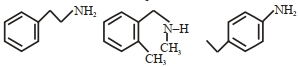
B
C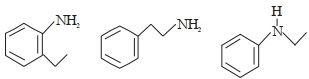
D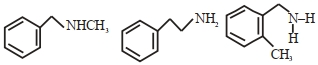
Solution
(D) $(P)$ Gabriel phthalimide synthesis is used for the preparation of aliphatic primary amines. Among the given options,$2$-phenylethanamine $(C_6H_5CH_2CH_2NH_2)$ is an aliphatic primary amine.
$(Q)$ $2^{\circ}$-amines react with Hinsberg's reagent (benzenesulfonyl chloride) to form a sulfonamide that is insoluble in $NaOH$ because it lacks an acidic hydrogen on the nitrogen atom. $N$-ethylaniline $(C_6H_5NHC_2H_5)$ is a $2^{\circ}$-amine.
$(R)$ Aromatic primary amines react with nitrous acid $(HONO)$ at low temperature $(273-278 \ K)$ to form diazonium salts,which undergo coupling reactions with $\beta$-naphthol in alkaline medium to form a red azo dye. $o$-ethylaniline is an aromatic primary amine.
Therefore,the correct sequence is $(P) = 2$-phenylethanamine,$(Q) = N$-ethylaniline,$(R) = o$-ethylaniline. This corresponds to option $D$.
$(Q)$ $2^{\circ}$-amines react with Hinsberg's reagent (benzenesulfonyl chloride) to form a sulfonamide that is insoluble in $NaOH$ because it lacks an acidic hydrogen on the nitrogen atom. $N$-ethylaniline $(C_6H_5NHC_2H_5)$ is a $2^{\circ}$-amine.
$(R)$ Aromatic primary amines react with nitrous acid $(HONO)$ at low temperature $(273-278 \ K)$ to form diazonium salts,which undergo coupling reactions with $\beta$-naphthol in alkaline medium to form a red azo dye. $o$-ethylaniline is an aromatic primary amine.
Therefore,the correct sequence is $(P) = 2$-phenylethanamine,$(Q) = N$-ethylaniline,$(R) = o$-ethylaniline. This corresponds to option $D$.
0 likesView Solution
324
ChemistryMediumMCQJEE Main · 2023
Given below are two statements
Statement $I$: Aqueous solution of $K_2Cr_2O_7$ is preferred as a primary standard in volumetric analysis over $Na_2Cr_2O_7$ aqueous solution.
Statement $II$: $K_2Cr_2O_7$ has a higher solubility in water than $Na_2Cr_2O_7$.
In the light of the above statements,choose the correct answer from the options given below:
Statement $I$: Aqueous solution of $K_2Cr_2O_7$ is preferred as a primary standard in volumetric analysis over $Na_2Cr_2O_7$ aqueous solution.
Statement $II$: $K_2Cr_2O_7$ has a higher solubility in water than $Na_2Cr_2O_7$.
In the light of the above statements,choose the correct answer from the options given below:
A
Both Statement $I$ and Statement $II$ are true
B
Both Statement $I$ and Statement $II$ are false
C
Statement $I$ is true but Statement $II$ is false
D
Statement $I$ is false but Statement $II$ is true
Solution
(C) $K_2Cr_2O_7$ is preferred as a primary standard because it is non-deliquescent and can be obtained in a highly pure state.
$Na_2Cr_2O_7$ is deliquescent (absorbs moisture from the air),which makes it difficult to weigh accurately for preparing standard solutions.
$Na_2Cr_2O_7$ is much more soluble in water than $K_2Cr_2O_7$.
Therefore,Statement $I$ is true and Statement $II$ is false.
$Na_2Cr_2O_7$ is deliquescent (absorbs moisture from the air),which makes it difficult to weigh accurately for preparing standard solutions.
$Na_2Cr_2O_7$ is much more soluble in water than $K_2Cr_2O_7$.
Therefore,Statement $I$ is true and Statement $II$ is false.
0 likesView Solution
325
ChemistryMediumMCQJEE Main · 2023
The one that does not stabilize $2^{\circ}$ and $3^{\circ}$ structures of proteins is
A
$H$-bonding
B
$-S-S-$ linkage
C
$-O-O-$ linkage
D
van der Waals forces
Solution
(C) The $2^{\circ}$ and $3^{\circ}$ structures of proteins are stabilized by various interactions including hydrogen bonding,disulphide linkages $(-S-S-)$,van der Waals forces,and electrostatic forces of attraction.
An $-O-O-$ linkage (peroxide linkage) is not a standard interaction involved in the stabilization of protein structures.
An $-O-O-$ linkage (peroxide linkage) is not a standard interaction involved in the stabilization of protein structures.
0 likesView Solution
326
ChemistryDifficultMCQJEE Main · 2023
Which of the following statements are correct?
$A$. The $M^{3+}/M^{2+}$ reduction potential for iron is greater than manganese.
$B$. The higher oxidation states of first row $d$-block elements get stabilized by oxide ion.
$C$. Aqueous solution of $Cr^{2+}$ can liberate hydrogen from dilute acid.
$D$. Magnetic moment of $V^{2+}$ is observed between $4.4-5.2 \ BM$.
Choose the correct answer from the options given below:
$A$. The $M^{3+}/M^{2+}$ reduction potential for iron is greater than manganese.
$B$. The higher oxidation states of first row $d$-block elements get stabilized by oxide ion.
$C$. Aqueous solution of $Cr^{2+}$ can liberate hydrogen from dilute acid.
$D$. Magnetic moment of $V^{2+}$ is observed between $4.4-5.2 \ BM$.
Choose the correct answer from the options given below:
A
$B, C$ only
B
$A, B, D$ only
C
$C, D$ only
D
$A, B$ only
Solution
(A) . The $M^{3+}/M^{2+}$ reduction potential for $Mn$ $(+1.57 \ V)$ is greater than $Fe$ $(+0.77 \ V)$. Thus,statement $A$ is incorrect.
$B$. Higher oxidation states of $d$-block elements are stabilized by electronegative elements like oxygen and fluorine. Thus,statement $B$ is correct.
$C$. $Cr^{2+}$ is a strong reducing agent $(E^0_{Cr^{3+}/Cr^{2+}} = -0.41 \ V)$,so it can reduce $H^{+}$ to $H_2$. Thus,statement $C$ is correct.
$D$. $V^{2+}$ has $3$ unpaired electrons ($d^3$ configuration). The magnetic moment is $\mu = \sqrt{n(n+2)} = \sqrt{3(5)} = \sqrt{15} \approx 3.87 \ BM$. Thus,statement $D$ is incorrect.
Therefore,statements $B$ and $C$ are correct.
$B$. Higher oxidation states of $d$-block elements are stabilized by electronegative elements like oxygen and fluorine. Thus,statement $B$ is correct.
$C$. $Cr^{2+}$ is a strong reducing agent $(E^0_{Cr^{3+}/Cr^{2+}} = -0.41 \ V)$,so it can reduce $H^{+}$ to $H_2$. Thus,statement $C$ is correct.
$D$. $V^{2+}$ has $3$ unpaired electrons ($d^3$ configuration). The magnetic moment is $\mu = \sqrt{n(n+2)} = \sqrt{3(5)} = \sqrt{15} \approx 3.87 \ BM$. Thus,statement $D$ is incorrect.
Therefore,statements $B$ and $C$ are correct.
0 likesView Solution
327
ChemistryMediumMCQJEE Main · 2023
Which of the following is used as a stabilizer during the concentration of sulphide ores?
A
Pine oils
B
Xanthates
C
Fatty acids
D
Cresols
Solution
(D) In the froth flotation process,stabilizers are added to stabilize the froth. $Cresols$ or $Aniline$ are commonly used as stabilizers.
0 likesView Solution
328
ChemistryMediumMCQJEE Main · 2023
The octahedral diamagnetic low spin complex among the following is
A
$[NiCl_4]^{2-}$
B
$[CoCl_6]^{3-}$
C
$[CoF_6]^{3-}$
D
$[Co(NH_3)_6]^{3+}$
Solution
(D) $(A) [NiCl_4]^{2-}$: $Ni^{2+} = [Ar] 3d^8$. $Cl^-$ is a weak field ligand,so it is paramagnetic,high spin,and tetrahedral.
$(B) [CoCl_6]^{3-}$: $Co^{3+} = [Ar] 3d^6$. $Cl^-$ is a weak field ligand,so it is paramagnetic,high spin,and octahedral.
$(C) [CoF_6]^{3-}$: $Co^{3+} = [Ar] 3d^6$. $F^-$ is a weak field ligand,so it is paramagnetic,high spin,and octahedral.
$(D) [Co(NH_3)_6]^{3+}$: $Co^{3+} = [Ar] 3d^6$. $NH_3$ is a strong field ligand,which causes pairing of electrons in $3d$ orbitals. Thus,it is diamagnetic,low spin,and octahedral.
$(B) [CoCl_6]^{3-}$: $Co^{3+} = [Ar] 3d^6$. $Cl^-$ is a weak field ligand,so it is paramagnetic,high spin,and octahedral.
$(C) [CoF_6]^{3-}$: $Co^{3+} = [Ar] 3d^6$. $F^-$ is a weak field ligand,so it is paramagnetic,high spin,and octahedral.
$(D) [Co(NH_3)_6]^{3+}$: $Co^{3+} = [Ar] 3d^6$. $NH_3$ is a strong field ligand,which causes pairing of electrons in $3d$ orbitals. Thus,it is diamagnetic,low spin,and octahedral.
0 likesView Solution
329
ChemistryMediumMCQJEE Main · 2023
Match List-$I$ with List-$II$:
Choose the correct answer from the options given below:
| List-$I$ Polymer | List-$II$ Type/Class |
|---|---|
| $A$. Nylon-$2$-Nylon-$6$ | $I$. Thermosetting Polymer |
| $B$. Buna-$N$ | $II$. Biodegradable polymer |
| $C$. Urea-formaldehyde | $III$. Synthetic rubber |
| $D$. Dacron | $IV$. Polyester |
Choose the correct answer from the options given below:
A
$A-IV, B-I, C-III, D-II$
B
$A-IV, B-III, C-I, D-II$
C
$A-II, B-I, C-IV, D-III$
D
$A-II, B-III, C-I, D-IV$
Solution
(D) . Nylon-$2$-nylon-$6$: Biodegradable polyamide polymer $(II)$
$B$. Buna-$N$: Copolymer of $1,3$-butadiene and acrylonitrile,which is a synthetic rubber $(III)$
$C$. Urea-formaldehyde: $A$ cross-linked thermosetting polymer $(I)$
$D$. Dacron: $A$ polyester polymer formed from ethylene glycol and terephthalic acid $(IV)$
Therefore,the correct matching is $A-II, B-III, C-I, D-IV$.
$B$. Buna-$N$: Copolymer of $1,3$-butadiene and acrylonitrile,which is a synthetic rubber $(III)$
$C$. Urea-formaldehyde: $A$ cross-linked thermosetting polymer $(I)$
$D$. Dacron: $A$ polyester polymer formed from ethylene glycol and terephthalic acid $(IV)$
Therefore,the correct matching is $A-II, B-III, C-I, D-IV$.
0 likesView Solution
330
ChemistryMediumMCQJEE Main · 2023
The enthalpy change for the adsorption process and micelle formation respectively are
A
$\Delta H_{\text{ads}} < 0$ and $\Delta H_{\text{mic}} > 0$
B
$\Delta H_{\text{ads}} < 0$ and $\Delta H_{\text{mic}} < 0$
C
$\Delta H_{\text{ads}} > 0$ and $\Delta H_{\text{mic}} < 0$
D
$\Delta H_{\text{ads}} > 0$ and $\Delta H_{\text{mic}} > 0$
Solution
(A) Adsorption is a spontaneous process accompanied by a decrease in surface energy,which releases heat,making it an exothermic process $(\Delta H_{\text{ads}} < 0)$.
Micelle formation is a spontaneous process driven by the increase in entropy of the system,but the process itself is endothermic $(\Delta H_{\text{mic}} > 0)$.
Micelle formation is a spontaneous process driven by the increase in entropy of the system,but the process itself is endothermic $(\Delta H_{\text{mic}} > 0)$.
0 likesView Solution
331
ChemistryEasyMCQJEE Main · 2023
The suitable reaction condition for the preparation of Methyl phenyl ether is:
A
$Ph^{-}Br, MeO^{-} Na^{+}$
B
$PhO^{-} Na^{+}, MeOH$
C
$PhO^{-} Na^{+}, MeBr$
D
Benzene,$MeBr$
Solution
(C) The preparation of ethers via the Williamson ether synthesis involves the reaction of an alkoxide or phenoxide ion with a primary alkyl halide.
For the synthesis of Methyl phenyl ether $(Ph-O-Me)$,the phenoxide ion $(PhO^{-} Na^{+})$ acts as a nucleophile and attacks the methyl halide $(MeBr)$ via an $S_N2$ mechanism.
The reaction is: $PhO^{-} Na^{+} + Me-Br \xrightarrow{S_N2} Ph-O-Me + NaBr$.
Thus,the correct condition is $PhO^{-} Na^{+}$ and $MeBr$.
For the synthesis of Methyl phenyl ether $(Ph-O-Me)$,the phenoxide ion $(PhO^{-} Na^{+})$ acts as a nucleophile and attacks the methyl halide $(MeBr)$ via an $S_N2$ mechanism.
The reaction is: $PhO^{-} Na^{+} + Me-Br \xrightarrow{S_N2} Ph-O-Me + NaBr$.
Thus,the correct condition is $PhO^{-} Na^{+}$ and $MeBr$.
0 likesView Solution
332
ChemistryDifficultMCQJEE Main · 2023
Identify the correct order of reactivity for the following pairs towards the respective mechanism:
$(A)$ $S_{N}2$: Isobutyl bromide > tert-Butyl bromide
$(B)$ $S_{N}1$: Benzyl bromide > $2-$Phenylethyl bromide
$(C)$ Electrophilic substitution: Chlorobenzene > $1-$Chloro$-4-$nitrobenzene
$(D)$ Nucleophilic substitution: Bromobenzene < $1-$Bromo$-4-$nitrobenzene
Choose the correct answer from the options given below:
$(A)$ $S_{N}2$: Isobutyl bromide > tert-Butyl bromide
$(B)$ $S_{N}1$: Benzyl bromide > $2-$Phenylethyl bromide
$(C)$ Electrophilic substitution: Chlorobenzene > $1-$Chloro$-4-$nitrobenzene
$(D)$ Nucleophilic substitution: Bromobenzene < $1-$Bromo$-4-$nitrobenzene
Choose the correct answer from the options given below:
A
$A$,$B$ and $D$ only
B
$A$,$B$,$C$ and $D$
C
$A$,$C$ and $D$ only
D
$B$,$C$ and $D$ only
Solution
(B) All the given orders are correct:
$(A)$ $S_{N}2$ reaction rate decreases with increase in steric hindrance. Primary alkyl halide (isobutyl bromide) is more reactive than tertiary alkyl halide (tert-butyl bromide).
$(B)$ $S_{N}1$ reaction rate depends on the stability of the carbocation. Benzyl carbocation is resonance stabilized,whereas the carbocation from $2-$phenylethyl bromide is less stable.
$(C)$ Electrophilic aromatic substitution $(EAS)$ rate decreases with a decrease in electron density on the ring. The $-NO_2$ group is strongly electron-withdrawing,reducing the electron density of the ring in $1-$chloro$-4-$nitrobenzene compared to chlorobenzene.
$(D)$ Nucleophilic aromatic substitution rate increases with the presence of electron-withdrawing groups at ortho and para positions. The $-NO_2$ group at the para position activates the ring towards nucleophilic substitution.
$(A)$ $S_{N}2$ reaction rate decreases with increase in steric hindrance. Primary alkyl halide (isobutyl bromide) is more reactive than tertiary alkyl halide (tert-butyl bromide).
$(B)$ $S_{N}1$ reaction rate depends on the stability of the carbocation. Benzyl carbocation is resonance stabilized,whereas the carbocation from $2-$phenylethyl bromide is less stable.
$(C)$ Electrophilic aromatic substitution $(EAS)$ rate decreases with a decrease in electron density on the ring. The $-NO_2$ group is strongly electron-withdrawing,reducing the electron density of the ring in $1-$chloro$-4-$nitrobenzene compared to chlorobenzene.
$(D)$ Nucleophilic aromatic substitution rate increases with the presence of electron-withdrawing groups at ortho and para positions. The $-NO_2$ group at the para position activates the ring towards nucleophilic substitution.
0 likesView Solution
333
ChemistryMediumMCQJEE Main · 2023
$A$ molecule undergoes two independent first order reactions whose respective half-lives are $12 \ min$ and $3 \ min$. If both the reactions are occurring simultaneously,the time taken for the $50 \%$ consumption of the reactant is $.......... \ min$ (Nearest integer).
A
$4$
B
$2$
C
$6$
D
$8$
Solution
(B) For parallel first-order reactions,the effective rate constant $k_{eff}$ is the sum of individual rate constants: $k_{eff} = k_1 + k_2$.
Since $k = \frac{\ln 2}{t_{1/2}}$,we have $\frac{\ln 2}{t_{eff}} = \frac{\ln 2}{t_1} + \frac{\ln 2}{t_2}$.
This simplifies to $\frac{1}{t_{eff}} = \frac{1}{t_1} + \frac{1}{t_2}$.
Given $t_1 = 12 \ min$ and $t_2 = 3 \ min$,we calculate $\frac{1}{t_{eff}} = \frac{1}{12} + \frac{1}{3} = \frac{1+4}{12} = \frac{5}{12}$.
Thus,$t_{eff} = \frac{12}{5} \ min = 2.4 \ min$.
The nearest integer is $2 \ min$.
Since $k = \frac{\ln 2}{t_{1/2}}$,we have $\frac{\ln 2}{t_{eff}} = \frac{\ln 2}{t_1} + \frac{\ln 2}{t_2}$.
This simplifies to $\frac{1}{t_{eff}} = \frac{1}{t_1} + \frac{1}{t_2}$.
Given $t_1 = 12 \ min$ and $t_2 = 3 \ min$,we calculate $\frac{1}{t_{eff}} = \frac{1}{12} + \frac{1}{3} = \frac{1+4}{12} = \frac{5}{12}$.
Thus,$t_{eff} = \frac{12}{5} \ min = 2.4 \ min$.
The nearest integer is $2 \ min$.
0 likesView Solution
334
ChemistryDifficultMCQJEE Main · 2023
$FeO_4^{2-}$ $\xrightarrow{2.2 \ V} Fe^{3+}$ $\xrightarrow{0.70 \ V} Fe^{2+}$ $\xrightarrow{-0.45 \ V} Fe^0$
$E_{FeO_4^{2-} / Fe^{2+}}^{\theta}$ is $x \times 10^{-3} \ V$. The value of $x$ is $.........$.
$E_{FeO_4^{2-} / Fe^{2+}}^{\theta}$ is $x \times 10^{-3} \ V$. The value of $x$ is $.........$.
A
$1824$
B
$1825$
C
$1823$
D
$1822$
Solution
(B) The reaction $FeO_4^{2-} \rightarrow Fe^{2+}$ involves a change in oxidation state from $+6$ to $+2$,so $n = 4$.
Using the relation $\Delta G^{\theta} = -nFE^{\theta}$,for the overall reaction:
$n_{total} E_{total} = n_1 E_1 + n_2 E_2$
Here,$n_1 = 3$ $(FeO_4^{2-} \rightarrow Fe^{3+})$,$E_1 = 2.2 \ V$,$n_2 = 1$ $(Fe^{3+} \rightarrow Fe^{2+})$,$E_2 = 0.70 \ V$,and $n_{total} = 4$.
$4 \times E_{FeO_4^{2-} / Fe^{2+}}^{\theta} = (3 \times 2.2) + (1 \times 0.70)$
$4 \times E_{FeO_4^{2-} / Fe^{2+}}^{\theta} = 6.6 + 0.70 = 7.3 \ V$
$E_{FeO_4^{2-} / Fe^{2+}}^{\theta} = \frac{7.3}{4} = 1.825 \ V$
$1.825 \ V = 1825 \times 10^{-3} \ V$
Therefore,$x = 1825$.
Using the relation $\Delta G^{\theta} = -nFE^{\theta}$,for the overall reaction:
$n_{total} E_{total} = n_1 E_1 + n_2 E_2$
Here,$n_1 = 3$ $(FeO_4^{2-} \rightarrow Fe^{3+})$,$E_1 = 2.2 \ V$,$n_2 = 1$ $(Fe^{3+} \rightarrow Fe^{2+})$,$E_2 = 0.70 \ V$,and $n_{total} = 4$.
$4 \times E_{FeO_4^{2-} / Fe^{2+}}^{\theta} = (3 \times 2.2) + (1 \times 0.70)$
$4 \times E_{FeO_4^{2-} / Fe^{2+}}^{\theta} = 6.6 + 0.70 = 7.3 \ V$
$E_{FeO_4^{2-} / Fe^{2+}}^{\theta} = \frac{7.3}{4} = 1.825 \ V$
$1.825 \ V = 1825 \times 10^{-3} \ V$
Therefore,$x = 1825$.
0 likesView Solution
335
ChemistryMediumMCQJEE Main · 2023
If the degree of dissociation of an aqueous solution of a weak monobasic acid is determined to be $0.3$,then the observed freezing point depression will be $.....\%$ higher than the expected/theoretical freezing point depression. (Nearest integer)
A
$31$
B
$30$
C
$32$
D
$33$
Solution
(B) For a weak monobasic acid $HA$,the dissociation is $HA \rightleftharpoons H^+ + A^-$.
The van't Hoff factor $i = 1 + \alpha$,where $\alpha = 0.3$.
So,$i = 1 + 0.3 = 1.3$.
The observed freezing point depression is $(\Delta T_f)_{obs} = i \times K_f \times m$.
The theoretical freezing point depression is $(\Delta T_f)_{cal} = K_f \times m$.
The percentage increase in freezing point depression is given by $\frac{(\Delta T_f)_{obs} - (\Delta T_f)_{cal}}{(\Delta T_f)_{cal}} \times 100$.
Substituting the values: $\frac{i \times K_f \times m - K_f \times m}{K_f \times m} \times 100 = (i - 1) \times 100$.
Percentage increase $= (1.3 - 1) \times 100 = 0.3 \times 100 = 30\%$.
The van't Hoff factor $i = 1 + \alpha$,where $\alpha = 0.3$.
So,$i = 1 + 0.3 = 1.3$.
The observed freezing point depression is $(\Delta T_f)_{obs} = i \times K_f \times m$.
The theoretical freezing point depression is $(\Delta T_f)_{cal} = K_f \times m$.
The percentage increase in freezing point depression is given by $\frac{(\Delta T_f)_{obs} - (\Delta T_f)_{cal}}{(\Delta T_f)_{cal}} \times 100$.
Substituting the values: $\frac{i \times K_f \times m - K_f \times m}{K_f \times m} \times 100 = (i - 1) \times 100$.
Percentage increase $= (1.3 - 1) \times 100 = 0.3 \times 100 = 30\%$.
0 likesView Solution
336
ChemistryMediumMCQJEE Main · 2023
In potassium ferrocyanide,there are $..........$ pairs of electrons in the $t_{2g}$ set of orbitals.
A
$4$
B
$3$
C
$2$
D
$1$
Solution
(B) The chemical formula for potassium ferrocyanide is $K_4[Fe(CN)_6]$.
In this complex,the iron is in the $+2$ oxidation state: $Fe^{+2} = [Ar] 3d^6$.
The ligand $CN^-$ is a strong field ligand $(SFL)$,which causes pairing of electrons in the $d$-orbitals.
According to Crystal Field Theory for an octahedral complex,the $d$-orbitals split into $t_{2g}$ and $e_g$ sets.
For $d^6$ configuration with a strong field ligand,all $6$ electrons occupy the $t_{2g}$ orbitals: $t_{2g}^6 e_g^0$.
Since there are $6$ electrons in the $t_{2g}$ set,they form $6/2 = 3$ pairs of electrons.
In this complex,the iron is in the $+2$ oxidation state: $Fe^{+2} = [Ar] 3d^6$.
The ligand $CN^-$ is a strong field ligand $(SFL)$,which causes pairing of electrons in the $d$-orbitals.
According to Crystal Field Theory for an octahedral complex,the $d$-orbitals split into $t_{2g}$ and $e_g$ sets.
For $d^6$ configuration with a strong field ligand,all $6$ electrons occupy the $t_{2g}$ orbitals: $t_{2g}^6 e_g^0$.
Since there are $6$ electrons in the $t_{2g}$ set,they form $6/2 = 3$ pairs of electrons.
0 likesView Solution
337
ChemistryMediumMCQJEE Main · 2023
Which of the following is an incorrect method for the preparation of alcohols?
A
Ozonolysis of alkene.
B
Reaction of ketone with $RMgBr$ followed by hydrolysis.
C
Hydroboration-oxidation of alkene.
D
Reaction of alkyl halide with aqueous $NaOH$.
Solution
(A) Ozonolysis of an alkene typically results in the formation of aldehydes,ketones,or carboxylic acids,depending on the structure of the alkene,not alcohols. Therefore,it is not a method for preparing alcohols.
0 likesView Solution
338
ChemistryMediumMCQJEE Main · 2023
Buna-$S$ can be represented as:
A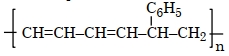
$[-CH_2-CH=CH-CH_2-CH(C_6H_5)-CH_2-]_n$
B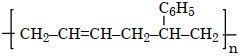
$[-CH_2-CH=CH-CH_2-CH_2-CH(C_6H_5)-]_n$
C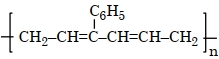
$[-CH_2-CH(C_6H_5)-CH_2-CH_2-CH=CH-]_n$
D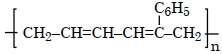
$[-CH_2-CH=CH-CH_2-CH(C_6H_5)-CH_2-CH_2-]_n$
Solution
(A) Buna-$S$ is a copolymer formed by the polymerization of $1,3$-butadiene $(CH_2=CH-CH=CH_2)$ and styrene $(C_6H_5-CH=CH_2)$.
During the polymerization process,the double bonds rearrange to form a chain structure.
The correct repeating unit for Buna-$S$ is represented as $[-CH_2-CH=CH-CH_2-CH(C_6H_5)-CH_2-]_n$.
During the polymerization process,the double bonds rearrange to form a chain structure.
The correct repeating unit for Buna-$S$ is represented as $[-CH_2-CH=CH-CH_2-CH(C_6H_5)-CH_2-]_n$.
0 likesView Solution
339
ChemistryMediumMCQJEE Main · 2023
In the reaction given below:
The product '$X$' is:
The product '$X$' is:
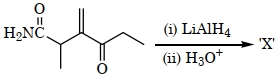
A
$A$ structure showing a primary amine and a secondary alcohol group.
B
$A$ structure showing a primary amine and two hydroxyl groups.
C
$A$ structure showing a primary amine and two hydroxyl groups at different positions.
D
$A$ structure showing a primary amine and a secondary alcohol group with a different carbon skeleton.
Solution
(A) $LiAlH_4$ is a strong reducing agent that reduces amides to amines and ketones to secondary alcohols.
In the given substrate,the amide group $(-CONH_2)$ is reduced to a primary amine $(-CH_2NH_2)$ and the ketone group $(>C=O)$ is reduced to a secondary alcohol $(-CH(OH)-)$.
The alkene double bond $(C=C)$ remains unaffected by $LiAlH_4$.
Therefore,the product '$X$' is the molecule containing both a primary amine and a secondary alcohol group,with the alkene intact.
In the given substrate,the amide group $(-CONH_2)$ is reduced to a primary amine $(-CH_2NH_2)$ and the ketone group $(>C=O)$ is reduced to a secondary alcohol $(-CH(OH)-)$.
The alkene double bond $(C=C)$ remains unaffected by $LiAlH_4$.
Therefore,the product '$X$' is the molecule containing both a primary amine and a secondary alcohol group,with the alkene intact.
0 likesView Solution
340
ChemistryMediumMCQJEE Main · 2023
Ferric chloride is applied to stop bleeding because:
A
$Cl^{-}$ ions cause coagulation of blood.
B
Blood absorbs $FeCl_3$ and forms a complex.
C
$Fe^{3+}$ ions coagulate blood which is a negatively charged sol.
D
$FeCl_3$ reacts with the constituents of blood which is a positively charged sol.
Solution
(C) Blood is a colloidal system which is negatively charged.
According to the Hardy-Schulze rule,the coagulating power of an ion is directly proportional to its valency.
$Fe^{3+}$ ions,being highly positively charged,effectively neutralize the negative charge on the blood colloids,leading to coagulation and stopping the bleeding.
According to the Hardy-Schulze rule,the coagulating power of an ion is directly proportional to its valency.
$Fe^{3+}$ ions,being highly positively charged,effectively neutralize the negative charge on the blood colloids,leading to coagulation and stopping the bleeding.
0 likesView Solution
341
ChemistryMediumMCQJEE Main · 2023
The reaction used for the preparation of soap from fat is:
A
reduction reaction
B
alkaline hydrolysis reaction
C
an addition reaction
D
an oxidation reaction
Solution
(B) The process of making soap from fats or oils is known as $Saponification$.
It involves the alkaline hydrolysis of triglycerides (fats) using a strong base like $NaOH$ or $KOH$ to produce glycerol and the salt of a fatty acid (soap).
It involves the alkaline hydrolysis of triglycerides (fats) using a strong base like $NaOH$ or $KOH$ to produce glycerol and the salt of a fatty acid (soap).
0 likesView Solution
342
ChemistryMediumMCQJEE Main · 2023
The correct relationship between unit cell edge length '$a$' and radius of sphere '$r$' for face-centred and body-centred cubic structures respectively are:
A
$r = 2 \sqrt{2} a$ and $\sqrt{3} r = 4 a$
B
$r = 2 \sqrt{2} a$ and $4 r = \sqrt{3} a$
C
$2 \sqrt{2} r = a$ and $4 r = \sqrt{3} a$
D
$2 \sqrt{2} r = a$ and $\sqrt{3} r = 4 a$
Solution
(C) For Face-Centred Cubic $(FCC)$ structure:
In $FCC$,the atoms touch along the face diagonal.
The face diagonal is $a \sqrt{2} = 4 r$.
Therefore,$a = 2 \sqrt{2} r$ or $r = \frac{a}{2 \sqrt{2}}$.
For Body-Centred Cubic $(BCC)$ structure:
In $BCC$,the atoms touch along the body diagonal.
The body diagonal is $a \sqrt{3} = 4 r$.
Therefore,$r = \frac{\sqrt{3} a}{4}$ or $4 r = \sqrt{3} a$.
Comparing these with the given options,the correct relationships are $2 \sqrt{2} r = a$ and $4 r = \sqrt{3} a$.
In $FCC$,the atoms touch along the face diagonal.
The face diagonal is $a \sqrt{2} = 4 r$.
Therefore,$a = 2 \sqrt{2} r$ or $r = \frac{a}{2 \sqrt{2}}$.
For Body-Centred Cubic $(BCC)$ structure:
In $BCC$,the atoms touch along the body diagonal.
The body diagonal is $a \sqrt{3} = 4 r$.
Therefore,$r = \frac{\sqrt{3} a}{4}$ or $4 r = \sqrt{3} a$.
Comparing these with the given options,the correct relationships are $2 \sqrt{2} r = a$ and $4 r = \sqrt{3} a$.
0 likesView Solution
343
ChemistryMediumMCQJEE Main · 2023
The correct order of the number of unpaired electrons in the given complexes is
$A$. $[Fe(CN)_6]^{3-}$; $B$. $[FeF_6]^{3-}$; $C$. $[CoF_6]^{3-}$; $D$. $[Cr(oxalate)_3]^{3-}$; $E$. $[Ni(CO)_4]$
Choose the correct answer from the options given below:
$A$. $[Fe(CN)_6]^{3-}$; $B$. $[FeF_6]^{3-}$; $C$. $[CoF_6]^{3-}$; $D$. $[Cr(oxalate)_3]^{3-}$; $E$. $[Ni(CO)_4]$
Choose the correct answer from the options given below:
A
$A < E < D < C < B$
B
$E < A < D < C < B$
C
$E < A < B < D < C$
D
$A < E < C < B < D$
Solution
(B) . $[Fe(CN)_6]^{3-}$: $Fe^{3+}$ is $d^5$. $CN^-$ is a strong field ligand,so pairing occurs. $n = 1$.
$B$. $[FeF_6]^{3-}$: $Fe^{3+}$ is $d^5$. $F^-$ is a weak field ligand,so no pairing. $n = 5$.
$C$. $[CoF_6]^{3-}$: $Co^{3+}$ is $d^6$. $F^-$ is a weak field ligand,so no pairing. $n = 4$.
$D$. $[Cr(oxalate)_3]^{3-}$: $Cr^{3+}$ is $d^3$. $n = 3$.
$E$. $[Ni(CO)_4]$: $Ni^0$ is $d^{10}$. $CO$ is a strong field ligand,all electrons paired. $n = 0$.
The number of unpaired electrons are: $A=1, B=5, C=4, D=3, E=0$.
Ordering them: $E(0) < A(1) < D(3) < C(4) < B(5)$.
Thus,the correct order is $E < A < D < C < B$.
$B$. $[FeF_6]^{3-}$: $Fe^{3+}$ is $d^5$. $F^-$ is a weak field ligand,so no pairing. $n = 5$.
$C$. $[CoF_6]^{3-}$: $Co^{3+}$ is $d^6$. $F^-$ is a weak field ligand,so no pairing. $n = 4$.
$D$. $[Cr(oxalate)_3]^{3-}$: $Cr^{3+}$ is $d^3$. $n = 3$.
$E$. $[Ni(CO)_4]$: $Ni^0$ is $d^{10}$. $CO$ is a strong field ligand,all electrons paired. $n = 0$.
The number of unpaired electrons are: $A=1, B=5, C=4, D=3, E=0$.
Ordering them: $E(0) < A(1) < D(3) < C(4) < B(5)$.
Thus,the correct order is $E < A < D < C < B$.
0 likesView Solution
344
ChemistryMediumMCQJEE Main · 2023
The correct order for acidity of the following hydroxyl compounds is:
$A. CH_3OH$
$B. (CH_3)_3COH$
$C. C_6H_5OH$
$D. p-CH_3OC_6H_4OH$
$E. p-O_2NC_6H_4OH$
Choose the correct answer from the options given below:
$A. CH_3OH$
$B. (CH_3)_3COH$
$C. C_6H_5OH$
$D. p-CH_3OC_6H_4OH$
$E. p-O_2NC_6H_4OH$
Choose the correct answer from the options given below:
A
$E > C > D > A > B$
B
$D > E > C > A > B$
C
$C > E > D > B > A$
D
$E > D > C > B > A$
Solution
(A) The acidity of hydroxyl compounds depends on the stability of the conjugate base formed after the loss of a proton $(H^+)$.
$1$. $E$ ($p$-nitrophenol) is the most acidic because the $-NO_2$ group is a strong electron-withdrawing group ($-I$ and $-M$ effect),which stabilizes the phenoxide ion significantly.
$2$. $C$ (phenol) is more acidic than aliphatic alcohols due to resonance stabilization of the phenoxide ion.
$3$. $D$ ($p$-methoxyphenol) is less acidic than phenol because the $-OCH_3$ group exerts a $+M$ effect,which destabilizes the phenoxide ion.
$4$. Between $A$ $(CH_3OH)$ and $B$ $((CH_3)_3COH)$,$A$ is more acidic because the three methyl groups in $B$ exert a strong $+I$ effect,which destabilizes the alkoxide ion.
Thus,the correct order of acidity is $E > C > D > A > B$.
$1$. $E$ ($p$-nitrophenol) is the most acidic because the $-NO_2$ group is a strong electron-withdrawing group ($-I$ and $-M$ effect),which stabilizes the phenoxide ion significantly.
$2$. $C$ (phenol) is more acidic than aliphatic alcohols due to resonance stabilization of the phenoxide ion.
$3$. $D$ ($p$-methoxyphenol) is less acidic than phenol because the $-OCH_3$ group exerts a $+M$ effect,which destabilizes the phenoxide ion.
$4$. Between $A$ $(CH_3OH)$ and $B$ $((CH_3)_3COH)$,$A$ is more acidic because the three methyl groups in $B$ exert a strong $+I$ effect,which destabilizes the alkoxide ion.
Thus,the correct order of acidity is $E > C > D > A > B$.
0 likesView Solution
345
ChemistryMediumMCQJEE Main · 2023
The major product '$P$' formed in the given reaction is:

A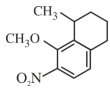
B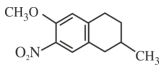
C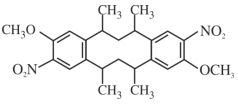
D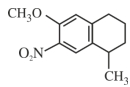
Solution
(D) The reaction is an intramolecular Friedel-Crafts alkylation.
$1$. The Lewis acid $AlCl_3$ reacts with the alkyl chloride to form a carbocation intermediate at the secondary carbon.
$2$. The benzene ring is substituted with a $-OCH_3$ group (activating,ortho/para directing) and a $-NO_2$ group (deactivating,meta directing).
$3$. The $-OCH_3$ group is a stronger directing group than the $-NO_2$ group.
$4$. The ortho position relative to the $-OCH_3$ group is sterically hindered,so the cyclization occurs at the para position relative to the $-OCH_3$ group (which is ortho to the $-NO_2$ group).
$5$. The resulting product is a substituted tetralin derivative as shown in option $D$.
$1$. The Lewis acid $AlCl_3$ reacts with the alkyl chloride to form a carbocation intermediate at the secondary carbon.
$2$. The benzene ring is substituted with a $-OCH_3$ group (activating,ortho/para directing) and a $-NO_2$ group (deactivating,meta directing).
$3$. The $-OCH_3$ group is a stronger directing group than the $-NO_2$ group.
$4$. The ortho position relative to the $-OCH_3$ group is sterically hindered,so the cyclization occurs at the para position relative to the $-OCH_3$ group (which is ortho to the $-NO_2$ group).
$5$. The resulting product is a substituted tetralin derivative as shown in option $D$.
0 likesView Solution
346
ChemistryDifficultMCQJEE Main · 2023
Match List-$I$ with List-$II$:
| List-$I$ (Complex) | List-$II$ ($CFSE$ in $\Delta_0$) |
| $A$. $[Ti(H_2O)_6]^{2+}$ | $I$. $-1.2$ |
| $B$. $[V(H_2O)_6]^{2+}$ | $II$. $-0.8$ |
| $C$. $[Mn(H_2O)_6]^{3+}$ | $III$. $-0.6$ |
| $D$. $[Fe(H_2O)_6]^{3+}$ | $IV$. $0$ |
A
$A-II, B-I, C-III, D-IV$
B
$A-IV, B-I, C-II, D-III$
C
$A-IV, B-I, C-III, D-II$
D
$A-II, B-IV, C-III, D-I$
Solution
(A) The Crystal Field Stabilization Energy $(CFSE)$ is calculated using the formula: $CFSE = [-0.4 \times (n_{t2g}) + 0.6 \times (n_{eg})] \Delta_0$.
$(A)$ $[Ti(H_2O)_6]^{2+}$: $Ti^{2+}$ is $3d^2$. $t_{2g}^2 e_g^0$. $CFSE = [-0.4 \times 2 + 0.6 \times 0] = -0.8 \Delta_0$ $(II)$.
$(B)$ $[V(H_2O)_6]^{2+}$: $V^{2+}$ is $3d^3$. $t_{2g}^3 e_g^0$. $CFSE = [-0.4 \times 3 + 0.6 \times 0] = -1.2 \Delta_0$ $(I)$.
$(C)$ $[Mn(H_2O)_6]^{3+}$: $Mn^{3+}$ is $3d^4$. $t_{2g}^3 e_g^1$. $CFSE = [-0.4 \times 3 + 0.6 \times 1] = -0.6 \Delta_0$ $(III)$.
$(D)$ $[Fe(H_2O)_6]^{3+}$: $Fe^{3+}$ is $3d^5$. $t_{2g}^3 e_g^2$. $CFSE = [-0.4 \times 3 + 0.6 \times 2] = 0 \Delta_0$ $(IV)$.
Thus,the correct match is $A-II, B-I, C-III, D-IV$.
$(A)$ $[Ti(H_2O)_6]^{2+}$: $Ti^{2+}$ is $3d^2$. $t_{2g}^2 e_g^0$. $CFSE = [-0.4 \times 2 + 0.6 \times 0] = -0.8 \Delta_0$ $(II)$.
$(B)$ $[V(H_2O)_6]^{2+}$: $V^{2+}$ is $3d^3$. $t_{2g}^3 e_g^0$. $CFSE = [-0.4 \times 3 + 0.6 \times 0] = -1.2 \Delta_0$ $(I)$.
$(C)$ $[Mn(H_2O)_6]^{3+}$: $Mn^{3+}$ is $3d^4$. $t_{2g}^3 e_g^1$. $CFSE = [-0.4 \times 3 + 0.6 \times 1] = -0.6 \Delta_0$ $(III)$.
$(D)$ $[Fe(H_2O)_6]^{3+}$: $Fe^{3+}$ is $3d^5$. $t_{2g}^3 e_g^2$. $CFSE = [-0.4 \times 3 + 0.6 \times 2] = 0 \Delta_0$ $(IV)$.
Thus,the correct match is $A-II, B-I, C-III, D-IV$.
0 likesView Solution
347
ChemistryMediumMCQJEE Main · 2023
The Gibbs energy vs $T$ plot for the formation of oxides is given below:
For the given diagram,the correct statement is-
For the given diagram,the correct statement is-
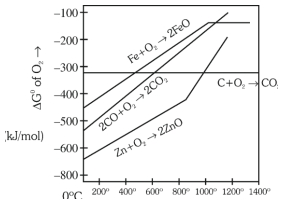
A
At $600^{\circ} C$,$C$ can reduce $ZnO$
B
At $600^{\circ} C$,$C$ can reduce $FeO$
C
At $600^{\circ} C$,$CO$ cannot reduce $FeO$
D
At $600^{\circ} C$,$CO$ can reduce $ZnO$
Solution
(B) In an Ellingham diagram,a metal oxide can be reduced by a reducing agent if the line for the formation of the reducing agent's oxide lies below the line for the formation of the metal oxide at that temperature.
At $600^{\circ} C$:
$1$. The line for $2C + O_2 \rightarrow 2CO$ is below the line for $2Fe + O_2 \rightarrow 2FeO$. Thus,$C$ can reduce $FeO$.
$2$. The line for $2C + O_2 \rightarrow 2CO$ is above the line for $2Zn + O_2 \rightarrow 2ZnO$. Thus,$C$ cannot reduce $ZnO$.
$3$. The line for $2CO + O_2 \rightarrow 2CO_2$ is below the line for $2Fe + O_2 \rightarrow 2FeO$. Thus,$CO$ can reduce $FeO$.
$4$. The line for $2CO + O_2 \rightarrow 2CO_2$ is above the line for $2Zn + O_2 \rightarrow 2ZnO$. Thus,$CO$ cannot reduce $ZnO$.
Therefore,the correct statement is that at $600^{\circ} C$,$C$ can reduce $FeO$.
At $600^{\circ} C$:
$1$. The line for $2C + O_2 \rightarrow 2CO$ is below the line for $2Fe + O_2 \rightarrow 2FeO$. Thus,$C$ can reduce $FeO$.
$2$. The line for $2C + O_2 \rightarrow 2CO$ is above the line for $2Zn + O_2 \rightarrow 2ZnO$. Thus,$C$ cannot reduce $ZnO$.
$3$. The line for $2CO + O_2 \rightarrow 2CO_2$ is below the line for $2Fe + O_2 \rightarrow 2FeO$. Thus,$CO$ can reduce $FeO$.
$4$. The line for $2CO + O_2 \rightarrow 2CO_2$ is above the line for $2Zn + O_2 \rightarrow 2ZnO$. Thus,$CO$ cannot reduce $ZnO$.
Therefore,the correct statement is that at $600^{\circ} C$,$C$ can reduce $FeO$.
0 likesView Solution
348
ChemistryMediumMCQJEE Main · 2023
The difference in the oxidation state of $Xe$ between the oxidized product of $Xe$ formed on complete hydrolysis of $XeF_4$ and $XeF_4$ is
A
$4$
B
$6$
C
$2$
D
$8$
Solution
(C) The complete hydrolysis of $XeF_4$ is given by the reaction: $6 XeF_4 + 12 H_2O \longrightarrow 2 XeO_3 + 4 Xe + 24 HF + 3 O_2$.
In $XeO_3$,the oxidation state of $Xe$ is $+6$.
In $XeF_4$,the oxidation state of $Xe$ is $+4$.
The difference in the oxidation state of $Xe$ between the oxidized product $(XeO_3)$ and $XeF_4$ is $|6 - 4| = 2$.
In $XeO_3$,the oxidation state of $Xe$ is $+6$.
In $XeF_4$,the oxidation state of $Xe$ is $+4$.
The difference in the oxidation state of $Xe$ between the oxidized product $(XeO_3)$ and $XeF_4$ is $|6 - 4| = 2$.
0 likesView Solution
349
ChemistryMediumMCQJEE Main · 2023
An aqueous solution of volume $300 \, cm^3$ contains $0.63 \, g$ of protein. The osmotic pressure of the solution at $300 \, K$ is $1.29 \, mbar$. The molar mass of the protein is $......... \, g \, mol^{-1}$. Given : $R = 0.083 \, L \, bar \, K^{-1} \, mol^{-1}$
A
$40536$
B
$40537$
C
$40535$
D
$40538$
Solution
(C) The osmotic pressure formula is $\pi = CRT = \frac{n}{V} RT = \frac{\omega}{M \times V} RT$.
Rearranging for molar mass $M$: $M = \frac{\omega RT}{\pi V}$.
Given values: $\omega = 0.63 \, g$,$R = 0.083 \, L \, bar \, K^{-1} \, mol^{-1}$,$T = 300 \, K$,$V = 300 \, cm^3 = 0.3 \, L$,and $\pi = 1.29 \, mbar = 1.29 \times 10^{-3} \, bar$.
Substituting the values: $M = \frac{0.63 \times 0.083 \times 300}{1.29 \times 10^{-3} \times 0.3}$.
$M = \frac{15.687}{0.000387} \approx 40534.88 \, g \, mol^{-1}$,which rounds to $40535 \, g \, mol^{-1}$.
Rearranging for molar mass $M$: $M = \frac{\omega RT}{\pi V}$.
Given values: $\omega = 0.63 \, g$,$R = 0.083 \, L \, bar \, K^{-1} \, mol^{-1}$,$T = 300 \, K$,$V = 300 \, cm^3 = 0.3 \, L$,and $\pi = 1.29 \, mbar = 1.29 \times 10^{-3} \, bar$.
Substituting the values: $M = \frac{0.63 \times 0.083 \times 300}{1.29 \times 10^{-3} \times 0.3}$.
$M = \frac{15.687}{0.000387} \approx 40534.88 \, g \, mol^{-1}$,which rounds to $40535 \, g \, mol^{-1}$.
0 likesView Solution
350
ChemistryMediumMCQJEE Main · 2023
For a metal ion,the calculated magnetic moment is $4.90 \ BM$. This metal ion has $........$ number of unpaired electrons.
A
$6$
B
$8$
C
$4$
D
$5$
Solution
(C) The magnetic moment $\mu$ is related to the number of unpaired electrons $n$ by the formula: $\mu = \sqrt{n(n+2)} \ BM$.
Given $\mu = 4.90 \ BM$,we have $4.90 = \sqrt{n(n+2)}$.
Squaring both sides,we get $24.01 = n(n+2)$,which is approximately $n^2 + 2n - 24 = 0$.
Solving this quadratic equation,$(n+6)(n-4) = 0$.
Since $n$ must be positive,$n = 4$.
Thus,the metal ion has $4$ unpaired electrons.
Given $\mu = 4.90 \ BM$,we have $4.90 = \sqrt{n(n+2)}$.
Squaring both sides,we get $24.01 = n(n+2)$,which is approximately $n^2 + 2n - 24 = 0$.
Solving this quadratic equation,$(n+6)(n-4) = 0$.
Since $n$ must be positive,$n = 4$.
Thus,the metal ion has $4$ unpaired electrons.
0 likesView Solution
Vedclass Products
For Students
Vedclass Test Series
Mock tests in real JEE Main style covering Chemistry with performance analysis. 5-day free trial.
Start Free TrialFor Teachers
Exam Paper Generator
Generate Set A/B/C/D Chemistry papers from 7.5L+ questions in 2 minutes. 3 chapters free.
Try FreeFor Institutes
Online Exam Module
Run live JEE Main mock exams with unlimited students, 360° analytics & white-label branding.
See DemoFrequently Asked Questions
How many Chemistry questions are in JEE Main 2023?
There are 726 Chemistry questions from the JEE Main 2023 paper on Vedclass, each with a detailed step-by-step solution in English.
Are JEE Main 2023 Chemistry solutions available in English?
Yes. All solutions on this page are in English. You can also switch to English or Hindi using the language buttons above the questions.
Can I practice JEE Main 2023 Chemistry as a timed test?
Yes. Use the Vedclass Test Series to attempt a full JEE Main mock test covering Chemistry with time limits and instant score analysis.
Can teachers create Chemistry papers from JEE Main previous year questions?
Yes. The Vedclass Exam Paper Generator lets teachers mix JEE Main Chemistry questions and generate Set A/B/C/D papers in minutes.
For Teachers & Institutes
Build a Custom Chemistry Paper
Pick JEE Main 2023 Chemistry questions, set difficulty, and generate Set A/B/C/D in 2 minutes.