
ChemistryQ1–100 of 606 questions
Page 1 of 7 · English
1
ChemistryMCQJEE Main · 2024
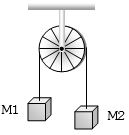
$A$ light string passing over a smooth light pulley connects two blocks of masses $m_1$ and $m_2$ (vertically). If the acceleration of the system is $\frac{g}{8}$,then the ratio of the masses is
A
$8:1$
B
$9:7$
C
$4:3$
D
$5:3$
Solution
(B) The acceleration $a$ of an Atwood machine with masses $m_1$ and $m_2$ is given by the formula:
$a = \left( \frac{m_1 - m_2}{m_1 + m_2} \right) g$
Given that the acceleration $a = \frac{g}{8}$,we substitute this into the equation:
$\frac{g}{8} = \left( \frac{m_1 - m_2}{m_1 + m_2} \right) g$
Dividing both sides by $g$:
$\frac{1}{8} = \frac{m_1 - m_2}{m_1 + m_2}$
Cross-multiplying gives:
$m_1 + m_2 = 8(m_1 - m_2)$
$m_1 + m_2 = 8m_1 - 8m_2$
Rearranging the terms to group the masses:
$9m_2 = 7m_1$
Therefore,the ratio of the masses is:
$\frac{m_1}{m_2} = \frac{9}{7}$
$a = \left( \frac{m_1 - m_2}{m_1 + m_2} \right) g$
Given that the acceleration $a = \frac{g}{8}$,we substitute this into the equation:
$\frac{g}{8} = \left( \frac{m_1 - m_2}{m_1 + m_2} \right) g$
Dividing both sides by $g$:
$\frac{1}{8} = \frac{m_1 - m_2}{m_1 + m_2}$
Cross-multiplying gives:
$m_1 + m_2 = 8(m_1 - m_2)$
$m_1 + m_2 = 8m_1 - 8m_2$
Rearranging the terms to group the masses:
$9m_2 = 7m_1$
Therefore,the ratio of the masses is:
$\frac{m_1}{m_2} = \frac{9}{7}$
1 likesView Solution
2
ChemistryMCQJEE Main · 2024
Identify the mixture that shows positive deviation from Raoult's law.
A
$CHCl_3 + (CH_3)_2CO$
B
$(CH_3)_2CO + C_6H_5NH_2$
C
$CHCl_3 + C_6H_6$
D
$(CH_3)_2CO + CS_2$
Solution
(D) mixture shows positive deviation from Raoult's law when the solute-solvent intermolecular interactions are weaker than the solute-solute and solvent-solvent interactions.
In the mixture of $(CH_3)_2CO$ (acetone) and $CS_2$ (carbon disulfide),the dipole-dipole interactions between acetone molecules and the dispersion forces between $CS_2$ molecules are stronger than the interactions between acetone and $CS_2$ molecules.
Consequently,the vapor pressure of the solution is higher than that predicted by Raoult's law.
Therefore,$(CH_3)_2CO + CS_2$ exhibits positive deviation.
In the mixture of $(CH_3)_2CO$ (acetone) and $CS_2$ (carbon disulfide),the dipole-dipole interactions between acetone molecules and the dispersion forces between $CS_2$ molecules are stronger than the interactions between acetone and $CS_2$ molecules.
Consequently,the vapor pressure of the solution is higher than that predicted by Raoult's law.
Therefore,$(CH_3)_2CO + CS_2$ exhibits positive deviation.
0 likesView Solution
3
ChemistryMCQJEE Main · 2024
$A$ light string passing over a smooth light pulley connects two blocks of masses $m_1$ and $m_2$ (vertically). If the acceleration of the system is $\frac{g}{8}$,then the ratio of masses $m_2 : m_1$ is:
A
$8 : 1$
B
$9 : 7$
C
$4 : 3$
D
$5 : 3$
Solution
(B) The acceleration $a$ of a system of two masses $m_1$ and $m_2$ connected by a string over a pulley is given by the formula: $a = \left( \frac{m_2 - m_1}{m_1 + m_2} \right) g$,assuming $m_2 > m_1$.
Given that the acceleration $a = \frac{g}{8}$,we substitute this into the equation:
$\frac{g}{8} = \left( \frac{m_2 - m_1}{m_1 + m_2} \right) g$
Canceling $g$ from both sides:
$\frac{1}{8} = \frac{m_2 - m_1}{m_1 + m_2}$
Cross-multiplying gives:
$m_1 + m_2 = 8(m_2 - m_1)$
$m_1 + m_2 = 8m_2 - 8m_1$
Rearranging the terms to group $m_1$ and $m_2$:
$m_1 + 8m_1 = 8m_2 - m_2$
$9m_1 = 7m_2$
Therefore,the ratio of the masses is:
$\frac{m_2}{m_1} = \frac{9}{7}$
Given that the acceleration $a = \frac{g}{8}$,we substitute this into the equation:
$\frac{g}{8} = \left( \frac{m_2 - m_1}{m_1 + m_2} \right) g$
Canceling $g$ from both sides:
$\frac{1}{8} = \frac{m_2 - m_1}{m_1 + m_2}$
Cross-multiplying gives:
$m_1 + m_2 = 8(m_2 - m_1)$
$m_1 + m_2 = 8m_2 - 8m_1$
Rearranging the terms to group $m_1$ and $m_2$:
$m_1 + 8m_1 = 8m_2 - m_2$
$9m_1 = 7m_2$
Therefore,the ratio of the masses is:
$\frac{m_2}{m_1} = \frac{9}{7}$
0 likesView Solution
4
ChemistryMCQJEE Main · 2024
Which of the following is the correct structure of $L$-glucose?
A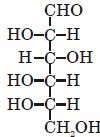
B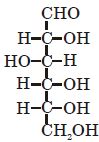
C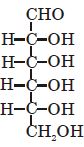
D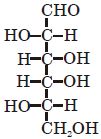
Solution
(A) -glucose is the naturally occurring isomer where the $-OH$ group on the chiral carbon furthest from the aldehyde group (i.e.,$C-5$) is on the right side in the Fischer projection.
$L$-glucose is the enantiomer of $D$-glucose.
To obtain the structure of $L$-glucose,we must invert the configuration at every chiral center $(C-2, C-3, C-4, C-5)$ of $D$-glucose.
In $D$-glucose,the $-OH$ groups are at: $C-2$ (right),$C-3$ (left),$C-4$ (right),$C-5$ (right).
Therefore,in $L$-glucose,the $-OH$ groups must be at: $C-2$ (left),$C-3$ (right),$C-4$ (left),$C-5$ (left).
This corresponds to the structure where the $-OH$ group on $C-5$ is on the left,which is the definition of the $L$-configuration.
$L$-glucose is the enantiomer of $D$-glucose.
To obtain the structure of $L$-glucose,we must invert the configuration at every chiral center $(C-2, C-3, C-4, C-5)$ of $D$-glucose.
In $D$-glucose,the $-OH$ groups are at: $C-2$ (right),$C-3$ (left),$C-4$ (right),$C-5$ (right).
Therefore,in $L$-glucose,the $-OH$ groups must be at: $C-2$ (left),$C-3$ (right),$C-4$ (left),$C-5$ (left).
This corresponds to the structure where the $-OH$ group on $C-5$ is on the left,which is the definition of the $L$-configuration.
0 likesView Solution
5
ChemistryMCQJEE Main · 2024
$A$ light string passing over a smooth light pulley connects two blocks of masses $m_1$ and $m_2$ (vertically). If the acceleration of the system is $(\frac{g}{8})$,then the ratio of masses $m_2 : m_1$ is:
A
$8 : 1$
B
$9 : 7$
C
$4 : 3$
D
$5 : 3$
Solution
(B) For an Atwood machine with masses $m_1$ and $m_2$ (where $m_2 > m_1$),the acceleration $a$ is given by the formula:
$a = \left(\frac{m_2 - m_1}{m_1 + m_2}\right) g$
Given that the acceleration $a = \frac{g}{8}$,we substitute this into the equation:
$\frac{g}{8} = \left(\frac{m_2 - m_1}{m_1 + m_2}\right) g$
$\frac{1}{8} = \frac{m_2 - m_1}{m_1 + m_2}$
Cross-multiplying gives:
$m_1 + m_2 = 8(m_2 - m_1)$
$m_1 + m_2 = 8m_2 - 8m_1$
Rearranging the terms to group $m_1$ and $m_2$:
$m_1 + 8m_1 = 8m_2 - m_2$
$9m_1 = 7m_2$
Therefore,the ratio of the masses is:
$\frac{m_2}{m_1} = \frac{9}{7}$
$a = \left(\frac{m_2 - m_1}{m_1 + m_2}\right) g$
Given that the acceleration $a = \frac{g}{8}$,we substitute this into the equation:
$\frac{g}{8} = \left(\frac{m_2 - m_1}{m_1 + m_2}\right) g$
$\frac{1}{8} = \frac{m_2 - m_1}{m_1 + m_2}$
Cross-multiplying gives:
$m_1 + m_2 = 8(m_2 - m_1)$
$m_1 + m_2 = 8m_2 - 8m_1$
Rearranging the terms to group $m_1$ and $m_2$:
$m_1 + 8m_1 = 8m_2 - m_2$
$9m_1 = 7m_2$
Therefore,the ratio of the masses is:
$\frac{m_2}{m_1} = \frac{9}{7}$
0 likesView Solution
6
ChemistryMCQJEE Main · 2024
Which of the following electronic configurations would be associated with the highest magnetic moment?
A
$[Ar] \, 3d^8$
B
$[Ar] \, 3d^3$
C
$[Ar] \, 3d^6$
D
$[Ar] \, 3d^7$
Solution
(C) The magnetic moment $(mu)$ is calculated using the formula $\mu = \sqrt{n(n+2)} \, BM$,where $n$ is the number of unpaired electrons.
For $[Ar] \, 3d^8$,$n = 2$ (unpaired electrons).
For $[Ar] \, 3d^3$,$n = 3$ (unpaired electrons).
For $[Ar] \, 3d^6$,$n = 4$ (unpaired electrons).
For $[Ar] \, 3d^7$,$n = 3$ (unpaired electrons).
Since $[Ar] \, 3d^6$ has the maximum number of unpaired electrons $(n=4)$,it will have the highest magnetic moment.
For $[Ar] \, 3d^8$,$n = 2$ (unpaired electrons).
For $[Ar] \, 3d^3$,$n = 3$ (unpaired electrons).
For $[Ar] \, 3d^6$,$n = 4$ (unpaired electrons).
For $[Ar] \, 3d^7$,$n = 3$ (unpaired electrons).
Since $[Ar] \, 3d^6$ has the maximum number of unpaired electrons $(n=4)$,it will have the highest magnetic moment.
0 likesView Solution
7
ChemistryDifficultMCQJEE Main · 2024
Highest enol content will be shown by :
A
Cyclohexane$-1,2-$dione
B
Cyclohexane$-1,3,5-$trione
C
Cyclohexane$-1,4-$dione
D
Cyclohexane$-1,2,3-$trione
Solution
(B) The enol content is determined by the stability of the resulting enol form.
In the case of $Cyclohexane-1,3,5-trione$ (option $B$),the enolization leads to the formation of $benzene-1,3,5-triol$ (phloroglucinol).
This product is highly stable due to aromaticity.
Since aromatic compounds are significantly more stable than non-aromatic compounds,the equilibrium strongly favors the enol form in this case,resulting in the highest enol content among the given options.
In the case of $Cyclohexane-1,3,5-trione$ (option $B$),the enolization leads to the formation of $benzene-1,3,5-triol$ (phloroglucinol).
This product is highly stable due to aromaticity.
Since aromatic compounds are significantly more stable than non-aromatic compounds,the equilibrium strongly favors the enol form in this case,resulting in the highest enol content among the given options.
0 likesView Solution
8
ChemistryDifficultMCQJEE Main · 2024
Choose the polar molecule from the following:
A
$CCl_4$
B
$CO_2$
C
$CH_2=CH_2$
D
$CHCl_3$
Solution
(D) molecule is polar if it has a net dipole moment,i.e.,$\mu \neq 0$.
$1$. $CCl_4$ has a tetrahedral geometry where the bond dipoles of four $C-Cl$ bonds cancel each other out,making it non-polar $(\mu = 0)$.
$2$. $CO_2$ is a linear molecule where the two $C=O$ bond dipoles are equal and opposite,canceling each other out,making it non-polar $(\mu = 0)$.
$3$. $CH_2=CH_2$ (ethene) is a planar molecule with a symmetric distribution of charge,making it non-polar $(\mu = 0)$.
$4$. $CHCl_3$ (chloroform) has a tetrahedral geometry,but due to the presence of three $Cl$ atoms and one $H$ atom,the bond dipoles do not cancel each other out. Thus,it has a net dipole moment $(\mu \neq 0)$ and is a polar molecule.
$1$. $CCl_4$ has a tetrahedral geometry where the bond dipoles of four $C-Cl$ bonds cancel each other out,making it non-polar $(\mu = 0)$.
$2$. $CO_2$ is a linear molecule where the two $C=O$ bond dipoles are equal and opposite,canceling each other out,making it non-polar $(\mu = 0)$.
$3$. $CH_2=CH_2$ (ethene) is a planar molecule with a symmetric distribution of charge,making it non-polar $(\mu = 0)$.
$4$. $CHCl_3$ (chloroform) has a tetrahedral geometry,but due to the presence of three $Cl$ atoms and one $H$ atom,the bond dipoles do not cancel each other out. Thus,it has a net dipole moment $(\mu \neq 0)$ and is a polar molecule.
0 likesView Solution
9
ChemistryDifficultMCQJEE Main · 2024
Given below are two statements:
Statement $I$ : The $4f$ and $5f$-series of elements are placed separately in the Periodic table to preserve the principle of classification.
Statement $II$ : $S$-block elements can be found in pure form in nature.
In the light of the above statements,choose the most appropriate answer from the options given below :
Statement $I$ : The $4f$ and $5f$-series of elements are placed separately in the Periodic table to preserve the principle of classification.
Statement $II$ : $S$-block elements can be found in pure form in nature.
In the light of the above statements,choose the most appropriate answer from the options given below :
A
Statement $I$ is false but Statement $II$ is true
B
Both Statement $I$ and Statement $II$ are true
C
Statement $I$ is true but Statement $II$ is false
D
Both Statement $I$ and Statement $II$ are false
Solution
(C) Statement $I$ is true because placing the $4f$ (lanthanoids) and $5f$ (actinoids) series separately prevents the periodic table from becoming unnecessarily wide and maintains the classification based on electronic configuration.
Statement $II$ is false because $S$-block elements (alkali and alkaline earth metals) are highly reactive due to their low ionization enthalpies and are therefore found in nature only in combined states (as ores,salts,etc.),not in their pure elemental form.
Statement $II$ is false because $S$-block elements (alkali and alkaline earth metals) are highly reactive due to their low ionization enthalpies and are therefore found in nature only in combined states (as ores,salts,etc.),not in their pure elemental form.
0 likesView Solution
10
ChemistryDifficultMCQJEE Main · 2024
Below are two statements,one labeled as Assertion $(A)$ and the other as Reason $(R):$
Assertion $(A)$: Among group $13$ elements,boron's melting point is unusually high $(2453 \ K)$.
Reason $(R):$ Solid boron has a strong crystalline lattice.
In the context of the above statements,choose the correct answer from the following options:
Assertion $(A)$: Among group $13$ elements,boron's melting point is unusually high $(2453 \ K)$.
Reason $(R):$ Solid boron has a strong crystalline lattice.
In the context of the above statements,choose the correct answer from the following options:
A
Both $A$ and $R$ are true,but $R$ is not the correct explanation of $A.$
B
Both $A$ and $R$ are true,but $R$ is the correct explanation of $A.$
C
$A$ is true,but $R$ is false.
D
$A$ is false,but $R$ is true.
Solution
(B) Boron exists as a giant covalent polymer in its solid state,which results in a very strong crystalline lattice structure.
Due to this strong lattice,a large amount of energy is required to break the bonds,leading to an unusually high melting point $(2453 \ K)$ compared to other group $13$ elements.
Therefore,both Assertion $(A)$ and Reason $(R)$ are true,and $(R)$ is the correct explanation of $(A)$.
Due to this strong lattice,a large amount of energy is required to break the bonds,leading to an unusually high melting point $(2453 \ K)$ compared to other group $13$ elements.
Therefore,both Assertion $(A)$ and Reason $(R)$ are true,and $(R)$ is the correct explanation of $(A)$.
0 likesView Solution
11
ChemistryDifficultMCQJEE Main · 2024
Cyclohexene is . . . . . . type of an organic compound.
A
Benzenoid aromatic
B
Benzenoid non-aromatic
C
Acyclic
D
Alicyclic
Solution
(D) Cyclohexene is a cyclic compound that does not contain a benzene ring and does not exhibit aromaticity. \\ Such cyclic compounds that resemble aliphatic compounds in their properties are classified as alicyclic compounds. \\ Therefore,cyclohexene is an alicyclic compound.
0 likesView Solution
12
ChemistryDifficultMCQJEE Main · 2024
Given below are two statements :
Statement $I$ : Aqueous solution of ammonium carbonate is basic.
Statement $II$ : Acidic/basic nature of salt solution of a salt of weak acid and weak base depends on $K_a$ and $K_b$ value of acid and the base forming it.
In the light of the above statements,choose the most appropriate answer from the options given below :
Statement $I$ : Aqueous solution of ammonium carbonate is basic.
Statement $II$ : Acidic/basic nature of salt solution of a salt of weak acid and weak base depends on $K_a$ and $K_b$ value of acid and the base forming it.
In the light of the above statements,choose the most appropriate answer from the options given below :
A
Both Statement $I$ and Statement $II$ are correct
B
Statement $I$ is correct but Statement $II$ is incorrect
C
Both Statement $I$ and Statement $II$ are incorrect
D
Statement $I$ is incorrect but Statement $II$ is correct
Solution
(A) Ammonium carbonate $(NH_4)_2CO_3$ is a salt of a weak base $(NH_4OH)$ and a weak acid $(H_2CO_3)$.
The $pH$ of a salt solution formed from a weak acid and a weak base is given by the formula: $pH = 7 + \frac{1}{2}(pK_a - pK_b)$.
For $(NH_4)_2CO_3$,the $pK_a$ of $H_2CO_3$ is approximately $6.35$ and the $pK_b$ of $NH_4OH$ is approximately $4.75$. Since $pK_b < pK_a$,the solution is slightly basic.
Thus,both Statement $I$ and Statement $II$ are correct.
The $pH$ of a salt solution formed from a weak acid and a weak base is given by the formula: $pH = 7 + \frac{1}{2}(pK_a - pK_b)$.
For $(NH_4)_2CO_3$,the $pK_a$ of $H_2CO_3$ is approximately $6.35$ and the $pK_b$ of $NH_4OH$ is approximately $4.75$. Since $pK_b < pK_a$,the solution is slightly basic.
Thus,both Statement $I$ and Statement $II$ are correct.
0 likesView Solution
13
ChemistryDifficultMCQJEE Main · 2024
$IUPAC$ name of the following compound $(P)$ is:
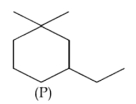
A
$1-$Ethyl$-5,5-$dimethylcyclohexane
B
$3-$Ethyl$-1,1-$dimethylcyclohexane
C
$1-$Ethyl$-3,3-$dimethylcyclohexane
D
$1,1-$Dimethyl$-3-$ethylcyclohexane
Solution
(B) $1$. Identify the parent chain: The parent chain is a cyclohexane ring.
$2$. Number the ring: Start numbering to give the lowest possible locants to the substituents. If we start at the carbon with the two methyl groups as $1$,the ethyl group is at position $3$.
$3$. Alphabetical order: Ethyl comes before methyl. Thus,the name is $3-$ethyl$-1,1-$dimethylcyclohexane.
$2$. Number the ring: Start numbering to give the lowest possible locants to the substituents. If we start at the carbon with the two methyl groups as $1$,the ethyl group is at position $3$.
$3$. Alphabetical order: Ethyl comes before methyl. Thus,the name is $3-$ethyl$-1,1-$dimethylcyclohexane.
0 likesView Solution
14
ChemistryDifficultMCQJEE Main · 2024
Mass of methane required to produce $22 \ g$ of $CO_2$ after complete combustion is . . . . . . $g.$ (Given Molar mass in $g \ mol^{-1}$: $C=12.0, H=1.0, O=16.0$)
A
$5$
B
$9$
C
$8$
D
$12$
Solution
(C) The balanced chemical equation for the combustion of methane is:
$CH_4 + 2O_2 \rightarrow CO_2 + 2H_2O$
Calculate the molar mass of $CO_2$:
$M(CO_2) = 12.0 + 2 \times 16.0 = 44.0 \ g \ mol^{-1}$
Moles of $CO_2$ produced = $\frac{\text{Given mass}}{\text{Molar mass}} = \frac{22 \ g}{44 \ g \ mol^{-1}} = 0.5 \ mol$
From the stoichiometry of the reaction,$1 \ mol$ of $CH_4$ produces $1 \ mol$ of $CO_2$.
Therefore,$0.5 \ mol$ of $CO_2$ requires $0.5 \ mol$ of $CH_4$.
Calculate the molar mass of $CH_4$:
$M(CH_4) = 12.0 + 4 \times 1.0 = 16.0 \ g \ mol^{-1}$
Mass of $CH_4$ required = $\text{Moles} \times \text{Molar mass} = 0.5 \ mol \times 16.0 \ g \ mol^{-1} = 8 \ g$.
$CH_4 + 2O_2 \rightarrow CO_2 + 2H_2O$
Calculate the molar mass of $CO_2$:
$M(CO_2) = 12.0 + 2 \times 16.0 = 44.0 \ g \ mol^{-1}$
Moles of $CO_2$ produced = $\frac{\text{Given mass}}{\text{Molar mass}} = \frac{22 \ g}{44 \ g \ mol^{-1}} = 0.5 \ mol$
From the stoichiometry of the reaction,$1 \ mol$ of $CH_4$ produces $1 \ mol$ of $CO_2$.
Therefore,$0.5 \ mol$ of $CO_2$ requires $0.5 \ mol$ of $CH_4$.
Calculate the molar mass of $CH_4$:
$M(CH_4) = 12.0 + 4 \times 1.0 = 16.0 \ g \ mol^{-1}$
Mass of $CH_4$ required = $\text{Moles} \times \text{Molar mass} = 0.5 \ mol \times 16.0 \ g \ mol^{-1} = 8 \ g$.
0 likesView Solution
15
ChemistryDifficultMCQJEE Main · 2024
If $3 \ mol$ of an ideal gas at $300 \ K$ expand isothermally from $30 \ dm^3$ to $45 \ dm^3$ against a constant opposing pressure of $80 \ kPa$,then the amount of heat transferred is . . . . . . $J$.
A
$1100$
B
$3200$
C
$4700$
D
$1200$
Solution
(D) For an isothermal process of an ideal gas,the change in internal energy $\Delta U = 0$.
According to the first law of thermodynamics,$\Delta U = Q + W$,which implies $Q = -W$.
The work done against a constant external pressure is given by $W = -P_{ext} \Delta V$.
Given $P_{ext} = 80 \ kPa = 80 \times 10^3 \ Pa$ and $\Delta V = (45 - 30) \ dm^3 = 15 \ dm^3 = 15 \times 10^{-3} \ m^3$.
$W = -80 \times 10^3 \ Pa \times 15 \times 10^{-3} \ m^3 = -1200 \ J$.
Since $Q = -W$,$Q = -(-1200 \ J) = 1200 \ J$.
According to the first law of thermodynamics,$\Delta U = Q + W$,which implies $Q = -W$.
The work done against a constant external pressure is given by $W = -P_{ext} \Delta V$.
Given $P_{ext} = 80 \ kPa = 80 \times 10^3 \ Pa$ and $\Delta V = (45 - 30) \ dm^3 = 15 \ dm^3 = 15 \times 10^{-3} \ m^3$.
$W = -80 \times 10^3 \ Pa \times 15 \times 10^{-3} \ m^3 = -1200 \ J$.
Since $Q = -W$,$Q = -(-1200 \ J) = 1200 \ J$.
0 likesView Solution
16
ChemistryDifficultMCQJEE Main · 2024
$3-$Methylhex$-2-$ene on reaction with $HBr$ in the presence of peroxide forms an addition product $(A)$. The number of possible stereoisomers for '$A$' is $....$.
A
$4$
B
$6$
C
$8$
D
$12$
Solution
(A) The reaction of $3-$methylhex$-2-$ene with $HBr$ in the presence of peroxide follows the anti-Markovnikov addition mechanism.
The product $(A)$ formed is $2-$bromo$-3-$methylhexane.
The structure of $2-$bromo$-3-$methylhexane is $CH_3-CH(Br)-CH(CH_3)-CH_2-CH_2-CH_3$.
This molecule contains $2$ chiral centers at $C-2$ and $C-3$.
Since the two chiral centers are not equivalent (the groups attached to them are different),the number of stereoisomers is given by $2^n$,where $n$ is the number of chiral centers.
Number of stereoisomers $= 2^2 = 4$.
The product $(A)$ formed is $2-$bromo$-3-$methylhexane.
The structure of $2-$bromo$-3-$methylhexane is $CH_3-CH(Br)-CH(CH_3)-CH_2-CH_2-CH_3$.
This molecule contains $2$ chiral centers at $C-2$ and $C-3$.
Since the two chiral centers are not equivalent (the groups attached to them are different),the number of stereoisomers is given by $2^n$,where $n$ is the number of chiral centers.
Number of stereoisomers $= 2^2 = 4$.
0 likesView Solution
17
ChemistryDifficultMCQJEE Main · 2024
Among the given organic compounds,the total number of aromatic compounds is $....$.
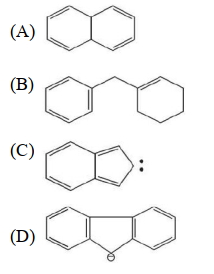
A
$1$
B
$2$
C
$3$
D
$4$
Solution
(B) To determine if a compound is aromatic,it must be cyclic,planar,fully conjugated,and follow $H$ückel's rule ($4n+2$ $\pi$ electrons).
$(A)$ Decalin derivative: Not fully conjugated,non-aromatic.
$(B)$ Benzylcyclohexene: The benzene ring is aromatic,but the whole molecule is not considered a single aromatic system due to the $sp^3$ carbon bridge. However,in the context of identifying aromatic components,the benzene ring is aromatic.
$(C)$ Indene anion (indenyl anion): The cyclopentadienyl ring is conjugated with the benzene ring,and the lone pair on the $sp^3$ carbon becomes part of the $10$ $\pi$ electron system $(n=2)$,making it aromatic.
$(D)$ Fluorenyl anion: It has $14$ $\pi$ electrons $(n=3)$,is planar,and fully conjugated,making it aromatic.
Thus,compounds $(C)$ and $(D)$ are aromatic. The total number is $2$.
$(A)$ Decalin derivative: Not fully conjugated,non-aromatic.
$(B)$ Benzylcyclohexene: The benzene ring is aromatic,but the whole molecule is not considered a single aromatic system due to the $sp^3$ carbon bridge. However,in the context of identifying aromatic components,the benzene ring is aromatic.
$(C)$ Indene anion (indenyl anion): The cyclopentadienyl ring is conjugated with the benzene ring,and the lone pair on the $sp^3$ carbon becomes part of the $10$ $\pi$ electron system $(n=2)$,making it aromatic.
$(D)$ Fluorenyl anion: It has $14$ $\pi$ electrons $(n=3)$,is planar,and fully conjugated,making it aromatic.
Thus,compounds $(C)$ and $(D)$ are aromatic. The total number is $2$.
0 likesView Solution
18
ChemistryDifficultMCQJEE Main · 2024
Among the following,the total number of meta-directing functional groups is $ . . . . . . $ (Integer based).
$-OCH_3, -NO_2, -CN, -CH_3, -NHCOCH_3, -COR, -OH, -COOH, -Cl$
$-OCH_3, -NO_2, -CN, -CH_3, -NHCOCH_3, -COR, -OH, -COOH, -Cl$
A
$3$
B
$4$
C
$5$
D
$6$
Solution
(B) Meta-directing groups are those that withdraw electron density from the benzene ring through the inductive effect or resonance,making the ring less reactive towards electrophilic substitution and directing the incoming electrophile to the meta position.
From the given list:
$1$. $-NO_2$ (Nitro group): Meta-directing
$2$. $-CN$ (Cyano group): Meta-directing
$3$. $-COR$ (Acyl group): Meta-directing
$4$. $-COOH$ (Carboxyl group): Meta-directing
The groups $-OCH_3$,$-CH_3$,$-NHCOCH_3$,$-OH$,and $-Cl$ are ortho/para-directing.
Thus,the total number of meta-directing groups is $4$.
From the given list:
$1$. $-NO_2$ (Nitro group): Meta-directing
$2$. $-CN$ (Cyano group): Meta-directing
$3$. $-COR$ (Acyl group): Meta-directing
$4$. $-COOH$ (Carboxyl group): Meta-directing
The groups $-OCH_3$,$-CH_3$,$-NHCOCH_3$,$-OH$,and $-Cl$ are ortho/para-directing.
Thus,the total number of meta-directing groups is $4$.
0 likesView Solution
19
ChemistryDifficultMCQJEE Main · 2024
The number of electrons present in all the completely filled subshells having $n=4$ and $s=+\frac{1}{2}$ is . . . . . . . (Where $n=$ principal quantum number and $s=$ spin quantum number)
A
$14$
B
$35$
C
$18$
D
$16$
Solution
(D) For $n=4$,the subshells are $4s, 4p, 4d,$ and $4f$.
The maximum number of electrons in these subshells are $2, 6, 10,$ and $14$ respectively.
Since all subshells are completely filled,the total number of electrons is $2 + 6 + 10 + 14 = 32$.
In any completely filled subshell,exactly half of the electrons have $s=+\frac{1}{2}$ and the other half have $s=-\frac{1}{2}$.
Therefore,the number of electrons with $s=+\frac{1}{2}$ is $\frac{32}{2} = 16$.
Thus,the correct answer is $16$.
The maximum number of electrons in these subshells are $2, 6, 10,$ and $14$ respectively.
Since all subshells are completely filled,the total number of electrons is $2 + 6 + 10 + 14 = 32$.
In any completely filled subshell,exactly half of the electrons have $s=+\frac{1}{2}$ and the other half have $s=-\frac{1}{2}$.
Therefore,the number of electrons with $s=+\frac{1}{2}$ is $\frac{32}{2} = 16$.
| Subshell | $4s, 4p, 4d, 4f$ |
| Total $e^-$ | $2+6+10+14=32$ |
| Total $e^-$ with $s=+\frac{1}{2}$ | $1+3+5+7=16$ |
Thus,the correct answer is $16$.
0 likesView Solution
20
ChemistryDifficultMCQJEE Main · 2024
Sum of bond order of $CO$ and $NO^{+}$ is $ . . . . . . $.
A
$6$
B
$7$
C
$5$
D
$96$
Solution
(A) The bond order of $CO$ is $3$ because it has a triple bond $(C \equiv O)$.
The bond order of $NO^{+}$ is $3$ because it is isoelectronic with $CO$ and has a triple bond $(N \equiv O^{+})$.
The sum of the bond orders is $3 + 3 = 6$.
The bond order of $NO^{+}$ is $3$ because it is isoelectronic with $CO$ and has a triple bond $(N \equiv O^{+})$.
The sum of the bond orders is $3 + 3 = 6$.
0 likesView Solution
21
ChemistryDifficultMCQJEE Main · 2024
From the given list,the number of compounds with $+4$ oxidation state of Sulphur is $ . . . . . . $.
$SO_3, H_2SO_3, SOCl_2, SF_4, BaSO_4, H_2S_2O_7$
$SO_3, H_2SO_3, SOCl_2, SF_4, BaSO_4, H_2S_2O_7$
A
$2$
B
$3$
C
$4$
D
$1$
Solution
(B) To find the oxidation state of Sulphur $(S)$ in each compound:
$1$. $SO_3$: $x + 3(-2) = 0 \implies x = +6$
$2$. $H_2SO_3$: $2(+1) + x + 3(-2) = 0 \implies x = +4$
$3$. $SOCl_2$: $x + (-2) + 2(-1) = 0 \implies x = +4$
$4$. $SF_4$: $x + 4(-1) = 0 \implies x = +4$
$5$. $BaSO_4$: $(+2) + x + 4(-2) = 0 \implies x = +6$
$6$. $H_2S_2O_7$: $2(+1) + 2x + 7(-2) = 0 \implies 2x = +12 \implies x = +6$
The compounds with $+4$ oxidation state are $H_2SO_3, SOCl_2$,and $SF_4$.
Therefore,the total number of such compounds is $3$.
$1$. $SO_3$: $x + 3(-2) = 0 \implies x = +6$
$2$. $H_2SO_3$: $2(+1) + x + 3(-2) = 0 \implies x = +4$
$3$. $SOCl_2$: $x + (-2) + 2(-1) = 0 \implies x = +4$
$4$. $SF_4$: $x + 4(-1) = 0 \implies x = +4$
$5$. $BaSO_4$: $(+2) + x + 4(-2) = 0 \implies x = +6$
$6$. $H_2S_2O_7$: $2(+1) + 2x + 7(-2) = 0 \implies 2x = +12 \implies x = +6$
The compounds with $+4$ oxidation state are $H_2SO_3, SOCl_2$,and $SF_4$.
Therefore,the total number of such compounds is $3$.
0 likesView Solution
22
ChemistryDifficultMCQJEE Main · 2024
The order of relative stability of the contributing structures is:
$I: CH_2=CH-CHO$
$II: ^+CH_2-CH=CH-O^-$
$III: ^-CH_2-CH=CH-O^+$
Choose the correct answer from the options given below:
$I: CH_2=CH-CHO$
$II: ^+CH_2-CH=CH-O^-$
$III: ^-CH_2-CH=CH-O^+$
Choose the correct answer from the options given below:
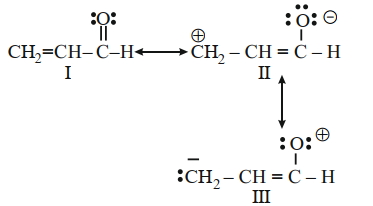
A
$I > II > III$
B
$II > I > III$
C
$I = II = III$
D
$III > II > I$
Solution
(A) The stability of resonating structures is determined by the following rules:
$1$. Neutral structures are more stable than charged structures. Structure $I$ is neutral,while $II$ and $III$ are charged. Thus,$I$ is the most stable.
$2$. Between charged structures,the structure with the negative charge on the more electronegative atom (Oxygen) and the positive charge on the less electronegative atom (Carbon) is more stable. In structure $II$,the negative charge is on the oxygen atom,whereas in structure $III$,the positive charge is on the oxygen atom.
$3$. Therefore,the stability order is $I > II > III$.
$1$. Neutral structures are more stable than charged structures. Structure $I$ is neutral,while $II$ and $III$ are charged. Thus,$I$ is the most stable.
$2$. Between charged structures,the structure with the negative charge on the more electronegative atom (Oxygen) and the positive charge on the less electronegative atom (Carbon) is more stable. In structure $II$,the negative charge is on the oxygen atom,whereas in structure $III$,the positive charge is on the oxygen atom.
$3$. Therefore,the stability order is $I > II > III$.
0 likesView Solution
23
ChemistryDifficultMCQJEE Main · 2024
The technique used for purification of steam volatile water immiscible substances is:
A
Fractional distillation
B
Fractional distillation under reduced pressure
C
Distillation
D
Steam distillation
Solution
(D) Steam distillation is the technique used for the purification of substances that are steam volatile and immiscible with water.
In this process,the substance is heated by passing steam through it,which carries the volatile component along with it,leaving behind non-volatile impurities.
In this process,the substance is heated by passing steam through it,which carries the volatile component along with it,leaving behind non-volatile impurities.
0 likesView Solution
24
ChemistryDifficultMCQJEE Main · 2024
The bond line formula of $HO-CH(CN)_2$ is:
A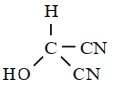
B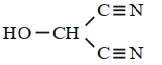
C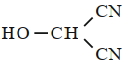
D
Solution
(D) The chemical formula is $HO-CH(CN)_2$.
In this molecule,the central carbon atom is bonded to one hydrogen atom $(H)$,one hydroxyl group $(-OH)$,and two cyano groups $(-CN)$.
The bond line formula represents the central carbon as a vertex where the bonds to $-OH$ and two $-CN$ groups originate.
Option $D$ correctly represents this connectivity in a simplified bond line notation.
In this molecule,the central carbon atom is bonded to one hydrogen atom $(H)$,one hydroxyl group $(-OH)$,and two cyano groups $(-CN)$.
The bond line formula represents the central carbon as a vertex where the bonds to $-OH$ and two $-CN$ groups originate.
Option $D$ correctly represents this connectivity in a simplified bond line notation.
0 likesView Solution
25
ChemistryDifficultMCQJEE Main · 2024
Which of the following cannot function as an oxidising agent?
A
$N^{3-}$
B
$SO_4^{2-}$
C
$BrO_3^{-}$
D
$MnO_4^{-}$
Solution
(A) An oxidizing agent is a substance that gains electrons and undergoes reduction,meaning its oxidation state must decrease.
In the $N^{3-}$ ion,nitrogen is in its lowest possible oxidation state $(-3)$.
Since it cannot lose more electrons to be reduced further,it cannot function as an oxidizing agent.
In contrast,$S$ in $SO_4^{2-}$,$Br$ in $BrO_3^{-}$,and $Mn$ in $MnO_4^{-}$ are in high oxidation states and can be reduced.
In the $N^{3-}$ ion,nitrogen is in its lowest possible oxidation state $(-3)$.
Since it cannot lose more electrons to be reduced further,it cannot function as an oxidizing agent.
In contrast,$S$ in $SO_4^{2-}$,$Br$ in $BrO_3^{-}$,and $Mn$ in $MnO_4^{-}$ are in high oxidation states and can be reduced.
0 likesView Solution
26
ChemistryDifficultMCQJEE Main · 2024
The incorrect statement regarding conformations of ethane is:
A
Ethane has infinite number of conformations
B
The dihedral angle in staggered conformation is $60^{\circ}$
C
Eclipsed conformation is the most stable conformation.
D
The conformations of ethane are interconvertible to one-another.
Solution
(C) The eclipsed conformation of ethane has maximum torsional strain due to the proximity of $C-H$ bonds on adjacent carbon atoms,making it the least stable conformation. The staggered conformation is the most stable.
0 likesView Solution
27
ChemistryDifficultMCQJEE Main · 2024
Total number of ions from the following with noble gas configuration is . . . . . . .
$Sr^{2+} (Z=38), Cs^{+} (Z=55), La^{2+} (Z=57), Pb^{2+} (Z=82), Yb^{2+} (Z=70) \text{ and } Fe^{2+} (Z=26)$
$Sr^{2+} (Z=38), Cs^{+} (Z=55), La^{2+} (Z=57), Pb^{2+} (Z=82), Yb^{2+} (Z=70) \text{ and } Fe^{2+} (Z=26)$
A
$2$
B
$3$
C
$4$
D
$5$
Solution
(A) noble gas configuration corresponds to a filled valence shell,typically represented as $ns^2 np^6$ (or the configuration of $He, Ne, Ar, Kr, Xe, Rn$).
$1. Sr^{2+} (Z=38)$: Electronic configuration is $[Kr] 5s^0$,which is the noble gas configuration of $Kr$.
$2. Cs^{+} (Z=55)$: Electronic configuration is $[Xe] 6s^0$,which is the noble gas configuration of $Xe$.
$3. La^{2+} (Z=57)$: Electronic configuration is $[Xe] 5d^1$,which is not a noble gas configuration.
$4. Pb^{2+} (Z=82)$: Electronic configuration is $[Xe] 4f^{14} 5d^{10} 6s^2$,which is not a noble gas configuration.
$5. Yb^{2+} (Z=70)$: Electronic configuration is $[Xe] 4f^{14}$,which is not a noble gas configuration.
$6. Fe^{2+} (Z=26)$: Electronic configuration is $[Ar] 3d^6$,which is not a noble gas configuration.
Thus,only $Sr^{2+}$ and $Cs^{+}$ have noble gas configurations. The total number of such ions is $2$.
$1. Sr^{2+} (Z=38)$: Electronic configuration is $[Kr] 5s^0$,which is the noble gas configuration of $Kr$.
$2. Cs^{+} (Z=55)$: Electronic configuration is $[Xe] 6s^0$,which is the noble gas configuration of $Xe$.
$3. La^{2+} (Z=57)$: Electronic configuration is $[Xe] 5d^1$,which is not a noble gas configuration.
$4. Pb^{2+} (Z=82)$: Electronic configuration is $[Xe] 4f^{14} 5d^{10} 6s^2$,which is not a noble gas configuration.
$5. Yb^{2+} (Z=70)$: Electronic configuration is $[Xe] 4f^{14}$,which is not a noble gas configuration.
$6. Fe^{2+} (Z=26)$: Electronic configuration is $[Ar] 3d^6$,which is not a noble gas configuration.
Thus,only $Sr^{2+}$ and $Cs^{+}$ have noble gas configurations. The total number of such ions is $2$.
0 likesView Solution
28
ChemistryDifficultMCQJEE Main · 2024
The number of non-polar molecules from the following is . . . . . . $HF, H_2O, SO_2, H_2, CO_2, CH_4, NH_3, HCl, CHCl_3, BF_3$
A
$8$
B
$4$
C
$9$
D
$2$
Solution
(B) molecule is non-polar if its net dipole moment is zero.
$1$. $H_2$: Homonuclear diatomic molecule,dipole moment = $0$.
$2$. $CO_2$: Linear geometry,dipole moments of $C=O$ bonds cancel each other,net dipole moment = $0$.
$3$. $CH_4$: Tetrahedral geometry,bond dipoles cancel each other,net dipole moment = $0$.
$4$. $BF_3$: Trigonal planar geometry,bond dipoles cancel each other,net dipole moment = $0$.
Other molecules like $HF, H_2O, SO_2, NH_3, HCl,$ and $CHCl_3$ have a net dipole moment greater than zero.
Therefore,the non-polar molecules are $H_2, CO_2, CH_4,$ and $BF_3$.
The total count is $4$.
$1$. $H_2$: Homonuclear diatomic molecule,dipole moment = $0$.
$2$. $CO_2$: Linear geometry,dipole moments of $C=O$ bonds cancel each other,net dipole moment = $0$.
$3$. $CH_4$: Tetrahedral geometry,bond dipoles cancel each other,net dipole moment = $0$.
$4$. $BF_3$: Trigonal planar geometry,bond dipoles cancel each other,net dipole moment = $0$.
Other molecules like $HF, H_2O, SO_2, NH_3, HCl,$ and $CHCl_3$ have a net dipole moment greater than zero.
Therefore,the non-polar molecules are $H_2, CO_2, CH_4,$ and $BF_3$.
The total count is $4$.
0 likesView Solution
29
ChemistryDifficultMCQJEE Main · 2024
For a certain thermochemical reaction $M \rightarrow N$ at $T = 400 \ K$,$\Delta H^{\ominus} = 77.2 \ kJ \ mol^{-1}$ and $\Delta S = 122 \ J \ K^{-1} \ mol^{-1}$,the value of $\log K$ is $ . . . . . . \times 10^{-1}$.
A
$37$
B
$38$
C
$39$
D
$40$
Solution
(A) Given: $\Delta H^{\ominus} = 77.2 \ kJ \ mol^{-1} = 77200 \ J \ mol^{-1}$,$T = 400 \ K$,$\Delta S = 122 \ J \ K^{-1} \ mol^{-1}$,$R = 8.314 \ J \ K^{-1} \ mol^{-1}$.
Using the relation $\Delta G^{\ominus} = \Delta H^{\ominus} - T \Delta S$:
$\Delta G^{\ominus} = 77200 - (400 \times 122) = 77200 - 48800 = 28400 \ J \ mol^{-1}$.
Using the relation $\Delta G^{\ominus} = -2.303 \ RT \log K$:
$28400 = -2.303 \times 8.314 \times 400 \times \log K$.
$28400 = -7657.6 \times \log K$.
$\log K = -28400 / 7657.6 \approx -3.708$.
Since $\log K = -3.708 = -37.08 \times 10^{-1}$,the value is approximately $-37$.
Using the relation $\Delta G^{\ominus} = \Delta H^{\ominus} - T \Delta S$:
$\Delta G^{\ominus} = 77200 - (400 \times 122) = 77200 - 48800 = 28400 \ J \ mol^{-1}$.
Using the relation $\Delta G^{\ominus} = -2.303 \ RT \log K$:
$28400 = -2.303 \times 8.314 \times 400 \times \log K$.
$28400 = -7657.6 \times \log K$.
$\log K = -28400 / 7657.6 \approx -3.708$.
Since $\log K = -3.708 = -37.08 \times 10^{-1}$,the value is approximately $-37$.
0 likesView Solution
30
ChemistryMediumMCQJEE Main · 2024
Volume of $3 \ M \ NaOH$ (formula weight $40 \ g \ mol^{-1}$) which can be prepared from $84 \ g$ of $NaOH$ is $ . . . . . . \times 10^{-1} \ dm^3$.
A
$8$
B
$7$
C
$9$
D
$10$
Solution
(B) The molarity $M$ is defined as the number of moles of solute per liter of solution.
$M = \frac{n_{NaOH}}{V_{sol} \text{ (in } L)}$
First,calculate the number of moles of $NaOH$:
$n_{NaOH} = \frac{\text{mass}}{\text{molar mass}} = \frac{84 \ g}{40 \ g \ mol^{-1}} = 2.1 \ mol$
Now,use the molarity formula to find the volume $V$:
$3 \ M = \frac{2.1 \ mol}{V \text{ (in } L)}$
$V = \frac{2.1}{3} \ L = 0.7 \ L$
Since $1 \ L = 1 \ dm^3$,$V = 0.7 \ dm^3 = 7 \times 10^{-1} \ dm^3$.
Thus,the value is $7$.
$M = \frac{n_{NaOH}}{V_{sol} \text{ (in } L)}$
First,calculate the number of moles of $NaOH$:
$n_{NaOH} = \frac{\text{mass}}{\text{molar mass}} = \frac{84 \ g}{40 \ g \ mol^{-1}} = 2.1 \ mol$
Now,use the molarity formula to find the volume $V$:
$3 \ M = \frac{2.1 \ mol}{V \text{ (in } L)}$
$V = \frac{2.1}{3} \ L = 0.7 \ L$
Since $1 \ L = 1 \ dm^3$,$V = 0.7 \ dm^3 = 7 \times 10^{-1} \ dm^3$.
Thus,the value is $7$.
0 likesView Solution
31
ChemistryDifficultMCQJEE Main · 2024
$1$ mole of $PbS$ is oxidised by "$X$" moles of $O_3$ to get "$Y$" moles of $O_2$. $X + Y = $ . . . . . . .
A
$4$
B
$3$
C
$8$
D
$7$
Solution
(C) The balanced chemical equation for the oxidation of $PbS$ by $O_3$ is:
$PbS + 4 O_3 \rightarrow PbSO_4 + 4 O_2$
From the balanced equation,we can see that $1$ mole of $PbS$ reacts with $4$ moles of $O_3$ to produce $4$ moles of $O_2$.
Therefore,$X = 4$ and $Y = 4$.
The value of $X + Y = 4 + 4 = 8$.
$PbS + 4 O_3 \rightarrow PbSO_4 + 4 O_2$
From the balanced equation,we can see that $1$ mole of $PbS$ reacts with $4$ moles of $O_3$ to produce $4$ moles of $O_2$.
Therefore,$X = 4$ and $Y = 4$.
The value of $X + Y = 4 + 4 = 8$.
0 likesView Solution
32
ChemistryDifficultMCQJEE Main · 2024
$9.3 \ g$ of aniline is subjected to reaction with excess of acetic anhydride to prepare acetanilide. The mass of acetanilide produced if the reaction is $100 \%$ completed is $x \times 10^{-1} \ g$. Find the value of $x$. (Given molar mass in $g \ mol^{-1}: N: 14, O: 16, C: 12, H: 1$)
A
$135$
B
$136$
C
$132$
D
$147$
Solution
(A) The chemical reaction is: $C_6H_5NH_2 + (CH_3CO)_2O \rightarrow C_6H_5NHCOCH_3 + CH_3COOH$
Molar mass of aniline $(C_6H_5NH_2)$ = $(6 \times 12) + (7 \times 1) + 14 = 93 \ g \ mol^{-1}$.
Molar mass of acetanilide $(C_6H_5NHCOCH_3)$ = $(8 \times 12) + (9 \times 1) + 14 + 16 = 135 \ g \ mol^{-1}$.
Number of moles of aniline = $\frac{9.3 \ g}{93 \ g \ mol^{-1}} = 0.1 \ mol$.
Since the reaction is $100 \%$ complete,$0.1 \ mol$ of aniline will produce $0.1 \ mol$ of acetanilide.
Mass of acetanilide = $0.1 \ mol \times 135 \ g \ mol^{-1} = 13.5 \ g$.
Given that the mass is $x \times 10^{-1} \ g$,we have $13.5 = x \times 10^{-1}$,which implies $x = 135$.
Molar mass of aniline $(C_6H_5NH_2)$ = $(6 \times 12) + (7 \times 1) + 14 = 93 \ g \ mol^{-1}$.
Molar mass of acetanilide $(C_6H_5NHCOCH_3)$ = $(8 \times 12) + (9 \times 1) + 14 + 16 = 135 \ g \ mol^{-1}$.
Number of moles of aniline = $\frac{9.3 \ g}{93 \ g \ mol^{-1}} = 0.1 \ mol$.
Since the reaction is $100 \%$ complete,$0.1 \ mol$ of aniline will produce $0.1 \ mol$ of acetanilide.
Mass of acetanilide = $0.1 \ mol \times 135 \ g \ mol^{-1} = 13.5 \ g$.
Given that the mass is $x \times 10^{-1} \ g$,we have $13.5 = x \times 10^{-1}$,which implies $x = 135$.
0 likesView Solution
33
ChemistryDifficultMCQJEE Main · 2024
Identify the total number of compounds containing at least one chiral carbon atom from the following list:
$1$. $2-$methylcyclohexanone
$2$. Cyclopentane$-1,3-$dione
$3$. $CH_3-CH_2-CH(NO_2)-COOH$
$4$. $CH_3-CH(I)-CH_2-NO_2$
$5$. $CH_3-CH_2-CH(OH)-CH_2OH$
$6$. $CH_3-CH_2-CH(I)-C_2H_5$
$1$. $2-$methylcyclohexanone
$2$. Cyclopentane$-1,3-$dione
$3$. $CH_3-CH_2-CH(NO_2)-COOH$
$4$. $CH_3-CH(I)-CH_2-NO_2$
$5$. $CH_3-CH_2-CH(OH)-CH_2OH$
$6$. $CH_3-CH_2-CH(I)-C_2H_5$
A
$3$
B
$4$
C
$5$
D
$6$
Solution
(B) chiral carbon atom is a carbon atom bonded to four different groups.
$1$. $2-$methylcyclohexanone: The carbon at position $2$ is bonded to $-H$,$-CH_3$,$-C=O$ (part of ring),and $-CH_2$ (part of ring). It is chiral.
$2$. Cyclopentane$-1,3-$dione: All carbons are achiral due to symmetry.
$3$. $CH_3-CH_2-CH(NO_2)-COOH$: The central carbon is bonded to $-H$,$-NO_2$,$-COOH$,and $-CH_2CH_3$. It is chiral.
$4$. $CH_3-CH(I)-CH_2-NO_2$: The carbon bonded to $I$ is attached to $-H$,$-CH_3$,$-I$,and $-CH_2NO_2$. It is chiral.
$5$. $CH_3-CH_2-CH(OH)-CH_2OH$: The carbon bonded to $OH$ is attached to $-H$,$-OH$,$-CH_2CH_3$,and $-CH_2OH$. It is chiral.
$6$. $CH_3-CH_2-CH(I)-C_2H_5$: The carbon bonded to $I$ is attached to $-H$,$-I$,$-CH_2CH_3$,and $-CH_2CH_3$. Since two groups are identical $(-C_2H_5)$,it is achiral.
Thus,compounds $1, 3, 4,$ and $5$ contain at least one chiral carbon atom. The total number is $4$.
$1$. $2-$methylcyclohexanone: The carbon at position $2$ is bonded to $-H$,$-CH_3$,$-C=O$ (part of ring),and $-CH_2$ (part of ring). It is chiral.
$2$. Cyclopentane$-1,3-$dione: All carbons are achiral due to symmetry.
$3$. $CH_3-CH_2-CH(NO_2)-COOH$: The central carbon is bonded to $-H$,$-NO_2$,$-COOH$,and $-CH_2CH_3$. It is chiral.
$4$. $CH_3-CH(I)-CH_2-NO_2$: The carbon bonded to $I$ is attached to $-H$,$-CH_3$,$-I$,and $-CH_2NO_2$. It is chiral.
$5$. $CH_3-CH_2-CH(OH)-CH_2OH$: The carbon bonded to $OH$ is attached to $-H$,$-OH$,$-CH_2CH_3$,and $-CH_2OH$. It is chiral.
$6$. $CH_3-CH_2-CH(I)-C_2H_5$: The carbon bonded to $I$ is attached to $-H$,$-I$,$-CH_2CH_3$,and $-CH_2CH_3$. Since two groups are identical $(-C_2H_5)$,it is achiral.
Thus,compounds $1, 3, 4,$ and $5$ contain at least one chiral carbon atom. The total number is $4$.
0 likesView Solution
34
ChemistryDifficultMCQJEE Main · 2024
Given below are two statements: one is labelled as Assertion $A$ and the other is labelled as Reason $R$:
Assertion $A:$ The first ionisation enthalpy decreases across a period.
Reason $R:$ The increasing nuclear charge outweighs the shielding across the period.
In the light of the above statements,choose the most appropriate from the options given below:
Assertion $A:$ The first ionisation enthalpy decreases across a period.
Reason $R:$ The increasing nuclear charge outweighs the shielding across the period.
In the light of the above statements,choose the most appropriate from the options given below:
A
Both $A$ and $R$ are true and $R$ is the correct explanation of $A$.
B
$A$ is true but $R$ is false.
C
$A$ is false but $R$ is true.
D
Both $A$ and $R$ are true but $R$ is $NOT$ the correct explanation of $A$.
Solution
(C) The first ionisation enthalpy generally increases across a period from left to right because the atomic radius decreases and the effective nuclear charge increases.
Therefore,Assertion $A$ is false.
Reason $R$ states that the increasing nuclear charge outweighs the shielding effect across the period,which is a correct statement explaining why ionisation energy increases.
Thus,$A$ is false but $R$ is true.
Therefore,Assertion $A$ is false.
Reason $R$ states that the increasing nuclear charge outweighs the shielding effect across the period,which is a correct statement explaining why ionisation energy increases.
Thus,$A$ is false but $R$ is true.
0 likesView Solution
35
ChemistryDifficultMCQJEE Main · 2024
In the chromyl chloride test for the confirmation of $Cl^{-}$ ion,a yellow solution is obtained. Acidification of the solution and the addition of amyl alcohol and $10\% H_2O_2$ turns the organic layer blue,indicating the formation of chromium pentoxide. The oxidation state of chromium in that compound is:
A
$+6$
B
$+5$
C
$+10$
D
$+3$
Solution
(A) In the chromyl chloride test,$Cl^{-}$ reacts to form chromyl chloride $(CrO_2Cl_2)$,which dissolves in a basic medium to form a yellow solution containing chromate ions $(CrO_4^{2-})$.
When this yellow solution is acidified and treated with $10\% H_2O_2$ in the presence of amyl alcohol,it forms a blue-colored peroxo compound,chromium pentoxide $(CrO_5)$.
The structure of $CrO_5$ (butterfly structure) contains one double-bonded oxygen atom (oxidation state $-2$) and four peroxo oxygen atoms (each with oxidation state $-1$).
Let the oxidation state of $Cr$ be $x$.
$x + 1(-2) + 4(-1) = 0$
$x - 2 - 4 = 0$
$x = +6$
Thus,the oxidation state of chromium in $CrO_5$ is $+6$.
When this yellow solution is acidified and treated with $10\% H_2O_2$ in the presence of amyl alcohol,it forms a blue-colored peroxo compound,chromium pentoxide $(CrO_5)$.
The structure of $CrO_5$ (butterfly structure) contains one double-bonded oxygen atom (oxidation state $-2$) and four peroxo oxygen atoms (each with oxidation state $-1$).
Let the oxidation state of $Cr$ be $x$.
$x + 1(-2) + 4(-1) = 0$
$x - 2 - 4 = 0$
$x = +6$
Thus,the oxidation state of chromium in $CrO_5$ is $+6$.
0 likesView Solution
36
ChemistryDifficultMCQJEE Main · 2024
The difference in energy between the actual structure and the lowest energy resonance structure for the given compound is
A
electromeric energy
B
resonance energy
C
ionization energy
D
hyperconjugation energy
Solution
(B) The difference in energy between the actual structure and the lowest energy resonance structure for the given compound is known as resonance energy.
0 likesView Solution
37
ChemistryDifficultMCQJEE Main · 2024
Given below are two statements :
Statement $I$ : The electronegativity of group $14$ elements from $Si$ to $Pb$ gradually decreases.
Statement $II$ : Group $14$ contains non-metallic,metallic,as well as metalloid elements.
In the light of the above statements,choose the most appropriate from the options given below :
Statement $I$ : The electronegativity of group $14$ elements from $Si$ to $Pb$ gradually decreases.
Statement $II$ : Group $14$ contains non-metallic,metallic,as well as metalloid elements.
In the light of the above statements,choose the most appropriate from the options given below :
A
Statement $I$ is false but Statement $II$ is true
B
Statement $I$ is true but Statement $II$ is false
C
Both Statement $I$ and Statement $II$ are true
D
Both Statement $I$ and Statement $II$ are false
Solution
(A) The electronegativity values for group $14$ elements are as follows:
$C = 2.5$,$Si = 1.8$,$Ge = 1.8$,$Sn = 1.8$,$Pb = 1.9$.
From $Si$ to $Pb$,the electronegativity values do not decrease gradually; they remain almost constant ($1.8$ to $1.9$). Thus,Statement $I$ is false.
Group $14$ includes Carbon (non-metal),Silicon and Germanium (metalloids),and Tin and Lead (metals). Thus,Statement $II$ is true.
$C = 2.5$,$Si = 1.8$,$Ge = 1.8$,$Sn = 1.8$,$Pb = 1.9$.
From $Si$ to $Pb$,the electronegativity values do not decrease gradually; they remain almost constant ($1.8$ to $1.9$). Thus,Statement $I$ is false.
Group $14$ includes Carbon (non-metal),Silicon and Germanium (metalloids),and Tin and Lead (metals). Thus,Statement $II$ is true.
0 likesView Solution
38
ChemistryDifficultMCQJEE Main · 2024
The correct set of four quantum numbers for the valence electron of rubidium atom $(Z=37)$ is:
A
$n=5, l=0, m=0, s=+\frac{1}{2}$
B
$n=5, l=0, m=1, s=+\frac{1}{2}$
C
$n=5, l=1, m=0, s=+\frac{1}{2}$
D
$n=5, l=1, m=1, s=+\frac{1}{2}$
Solution
(A) The atomic number of rubidium $(Rb)$ is $37$.
The electronic configuration of $Rb$ is $[Kr] 5s^1$.
The valence electron is in the $5s$ orbital.
For the $5s$ orbital:
Principal quantum number $(n) = 5$.
Azimuthal quantum number $(l) = 0$ (for $s$-orbital).
Magnetic quantum number $(m) = 0$.
Spin quantum number $(s) = +\frac{1}{2}$ or $-\frac{1}{2}$.
Thus,the correct set is $(n=5, l=0, m=0, s=+\frac{1}{2})$.
The electronic configuration of $Rb$ is $[Kr] 5s^1$.
The valence electron is in the $5s$ orbital.
For the $5s$ orbital:
Principal quantum number $(n) = 5$.
Azimuthal quantum number $(l) = 0$ (for $s$-orbital).
Magnetic quantum number $(m) = 0$.
Spin quantum number $(s) = +\frac{1}{2}$ or $-\frac{1}{2}$.
Thus,the correct set is $(n=5, l=0, m=0, s=+\frac{1}{2})$.
0 likesView Solution
39
ChemistryDifficultMCQJEE Main · 2024
The arenium ion which is not involved in the bromination of aniline is:
A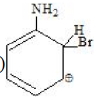
B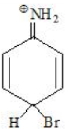
C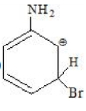
D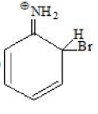
Solution
(C) The $-NH_2$ group is an ortho/para directing group due to its strong $+M$ effect. During the electrophilic aromatic substitution (bromination) of aniline,the electrophile $(Br^+)$ attacks the ortho or para positions of the benzene ring to form stable arenium ions (sigma complexes).
The meta position is not activated by the $-NH_2$ group,and the arenium ion formed by the attack of an electrophile at the meta position is significantly less stable because the positive charge cannot be delocalized onto the nitrogen atom.
Among the given options,the structure representing the meta-substituted arenium ion is not involved in the major pathway of the reaction. Based on the provided options,the structure that does not represent a valid resonance-stabilized arenium ion intermediate for ortho/para substitution is the one corresponding to the meta attack.
The meta position is not activated by the $-NH_2$ group,and the arenium ion formed by the attack of an electrophile at the meta position is significantly less stable because the positive charge cannot be delocalized onto the nitrogen atom.
Among the given options,the structure representing the meta-substituted arenium ion is not involved in the major pathway of the reaction. Based on the provided options,the structure that does not represent a valid resonance-stabilized arenium ion intermediate for ortho/para substitution is the one corresponding to the meta attack.
0 likesView Solution
40
ChemistryDifficultMCQJEE Main · 2024
Appearance of blood red colour,on treatment of the sodium fusion extract of an organic compound with $FeSO_4$ in presence of concentrated $H_2SO_4$ indicates the presence of element/s
A
$Br$
B
$N$
C
$N$ and $S$
D
$S$
Solution
(C) The sodium fusion extract contains $NaCN$ and $Na_2S$ if both nitrogen and sulphur are present in the organic compound.
These react to form sodium thiocyanate: $Na^{+} + CN^{-} + S^{2-} \rightarrow NaSCN$.
In the presence of $Fe^{3+}$ ions (formed by the oxidation of $Fe^{2+}$ by concentrated $H_2SO_4$),the thiocyanate ion forms a blood-red complex: $Fe^{3+} + SCN^{-} \rightarrow [Fe(SCN)]^{2+}$.
Thus,the appearance of a blood-red colour confirms the presence of both $N$ and $S$.
These react to form sodium thiocyanate: $Na^{+} + CN^{-} + S^{2-} \rightarrow NaSCN$.
In the presence of $Fe^{3+}$ ions (formed by the oxidation of $Fe^{2+}$ by concentrated $H_2SO_4$),the thiocyanate ion forms a blood-red complex: $Fe^{3+} + SCN^{-} \rightarrow [Fe(SCN)]^{2+}$.
Thus,the appearance of a blood-red colour confirms the presence of both $N$ and $S$.
0 likesView Solution
41
ChemistryDifficultMCQJEE Main · 2024
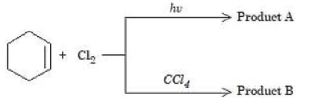
Identify product $A$ and product $B$ for the following reaction:
A
$A$: $1,2-$dichlorocyclohexane,$B$: $1,4-$dichlorocyclohex$-2-$ene
B
$A$: $1,4-$dichlorocyclohex$-2-$ene,$B$: $1,4-$dichlorocyclohex$-2-$ene
C
$A$: $1,2-$dichlorocyclohexane,$B$: $1,2-$dichlorocyclohexane
D
$A$: $1,4-$dichlorocyclohex$-2-$ene,$B$: $1,2-$dichlorocyclohexane
Solution
(D) $1$. In the presence of $h\nu$ (ultraviolet light),$Cl_2$ undergoes homolytic cleavage to form chlorine free radicals. These radicals perform allylic substitution on cyclohexene to form $1,4-\text{dichlorocyclohex-2-ene}$ as product $A$.
$2$. In the presence of $CCl_4$ (an inert solvent),$Cl_2$ undergoes electrophilic addition across the double bond of cyclohexene to form $1,2-\text{dichlorocyclohexane}$ as product $B$.
$2$. In the presence of $CCl_4$ (an inert solvent),$Cl_2$ undergoes electrophilic addition across the double bond of cyclohexene to form $1,2-\text{dichlorocyclohexane}$ as product $B$.
0 likesView Solution
42
ChemistryDifficultMCQJEE Main · 2024
Identify the incorrect pair from the following:
A
Fluorspar $- BF_3$
B
Cryolite $- Na_3AlF_6$
C
Fluoroapatite $- 3Ca_3(PO_4)_2 \cdot CaF_2$
D
Carnallite $- KCl \cdot MgCl_2 \cdot 6H_2O$
Solution
(A) The chemical formula for Fluorspar is $CaF_2$,not $BF_3$.
Therefore,the pair Fluorspar $- BF_3$ is incorrect.
Therefore,the pair Fluorspar $- BF_3$ is incorrect.
0 likesView Solution
43
ChemistryDifficultMCQJEE Main · 2024
The interaction between $\pi$ bond and lone pair of electrons present on an adjacent atom is responsible for
A
Hyperconjugation
B
Inductive effect
C
Electromeric effect
D
Resonance effect
Solution
(D) The interaction between a $\pi$ bond and a lone pair of electrons on an adjacent atom is a classic example of conjugation,which leads to the delocalization of electrons.
This phenomenon is known as the resonance effect (or mesomeric effect).
This phenomenon is known as the resonance effect (or mesomeric effect).
0 likesView Solution
44
ChemistryDifficultMCQJEE Main · 2024
Which of the following is not correct?
A
$\Delta G$ is negative for a spontaneous reaction
B
$\Delta G$ is positive for a spontaneous reaction
C
$\Delta G$ is zero for a reversible reaction
D
$\Delta G$ is positive for a non-spontaneous reaction
Solution
(B) For a spontaneous reaction,$\Delta G < 0$ (negative).
For a non-spontaneous reaction,$\Delta G > 0$ (positive).
For a reversible reaction at equilibrium,$\Delta G = 0$.
Therefore,the statement '$\Delta G$ is positive for a spontaneous reaction' is incorrect.
For a non-spontaneous reaction,$\Delta G > 0$ (positive).
For a reversible reaction at equilibrium,$\Delta G = 0$.
Therefore,the statement '$\Delta G$ is positive for a spontaneous reaction' is incorrect.
0 likesView Solution
45
ChemistryDifficultMCQJEE Main · 2024
Chlorine undergoes disproportionation in alkaline medium as shown below:
$a Cl_{2(g)} + b OH^{-}_{(aq)} \rightarrow c ClO^{-}_{(aq)} + d Cl^{-}_{(aq)} + e H_2O_{(l)}$
The values of $a, b, c$ and $d$ in a balanced redox reaction are respectively:
$a Cl_{2(g)} + b OH^{-}_{(aq)} \rightarrow c ClO^{-}_{(aq)} + d Cl^{-}_{(aq)} + e H_2O_{(l)}$
The values of $a, b, c$ and $d$ in a balanced redox reaction are respectively:
A
$1, 2, 1$ and $1$
B
$2, 2, 1$ and $3$
C
$3, 4, 4$ and $2$
D
$2, 4, 1$ and $3$
Solution
(A) The given reaction is a disproportionation reaction of chlorine in an alkaline medium:
$Cl_2 + 2OH^- \rightarrow Cl^- + ClO^- + H_2O$
Step $1$: Assign oxidation states.
$Cl_2$ $(0)$ $\rightarrow Cl^-$ $(-1)$ and $ClO^-$ $(+1)$.
Step $2$: Write half-reactions.
Reduction: $Cl_2 + 2e^- \rightarrow 2Cl^-$
Oxidation: $Cl_2 + 4OH^- \rightarrow 2ClO^- + 2H_2O + 2e^-$
Step $3$: Add the half-reactions.
$2Cl_2 + 4OH^- \rightarrow 2Cl^- + 2ClO^- + 2H_2O$
Step $4$: Simplify by dividing by $2$.
$Cl_2 + 2OH^- \rightarrow Cl^- + ClO^- + H_2O$
Comparing with $a Cl_2 + b OH^- \rightarrow c ClO^- + d Cl^- + e H_2O$,we get $a=1, b=2, c=1, d=1$.
$Cl_2 + 2OH^- \rightarrow Cl^- + ClO^- + H_2O$
Step $1$: Assign oxidation states.
$Cl_2$ $(0)$ $\rightarrow Cl^-$ $(-1)$ and $ClO^-$ $(+1)$.
Step $2$: Write half-reactions.
Reduction: $Cl_2 + 2e^- \rightarrow 2Cl^-$
Oxidation: $Cl_2 + 4OH^- \rightarrow 2ClO^- + 2H_2O + 2e^-$
Step $3$: Add the half-reactions.
$2Cl_2 + 4OH^- \rightarrow 2Cl^- + 2ClO^- + 2H_2O$
Step $4$: Simplify by dividing by $2$.
$Cl_2 + 2OH^- \rightarrow Cl^- + ClO^- + H_2O$
Comparing with $a Cl_2 + b OH^- \rightarrow c ClO^- + d Cl^- + e H_2O$,we get $a=1, b=2, c=1, d=1$.
0 likesView Solution
46
ChemistryDifficultMCQJEE Main · 2024
In alkaline medium,$MnO_4^{-}$ oxidises $I^{-}$ to:
A
$IO_4^{-}$
B
$IO^{-}$
C
$I_2$
D
$IO_3^{-}$
Solution
(D) In an alkaline medium,the permanganate ion $(MnO_4^{-})$ acts as an oxidizing agent and oxidizes the iodide ion $(I^{-})$ to the iodate ion $(IO_3^{-})$.
The balanced chemical equation for this reaction is:
$2 MnO_4^{-} + H_2O + I^{-} \xrightarrow{\text{alkaline medium}} 2 MnO_2 + 2 OH^{-} + IO_3^{-}$
The balanced chemical equation for this reaction is:
$2 MnO_4^{-} + H_2O + I^{-} \xrightarrow{\text{alkaline medium}} 2 MnO_2 + 2 OH^{-} + IO_3^{-}$
0 likesView Solution
47
ChemistryDifficultMCQJEE Main · 2024
Number of compounds with one lone pair of electrons on the central atom amongst the following is . . . . . . $O_3, H_2O, SF_4, ClF_3, NH_3, BrF_5, XeF_4$
A
$4$
B
$3$
C
$2$
D
$1$
Solution
(A) To determine the number of lone pairs on the central atom,we calculate the number of lone pairs using the formula: $\text{Lone pair} = \frac{V - B}{2}$,where $V$ is the number of valence electrons of the central atom and $B$ is the number of bonding electrons (shared with surrounding atoms).
$1$. $O_3$: Central $O$ has $1$ lone pair.
$2$. $H_2O$: Central $O$ has $2$ lone pairs.
$3$. $SF_4$: Central $S$ has $1$ lone pair.
$4$. $ClF_3$: Central $Cl$ has $2$ lone pairs.
$5$. $NH_3$: Central $N$ has $1$ lone pair.
$6$. $BrF_5$: Central $Br$ has $1$ lone pair.
$7$. $XeF_4$: Central $Xe$ has $2$ lone pairs.
The compounds with exactly one lone pair on the central atom are $O_3$,$SF_4$,$NH_3$,and $BrF_5$.
Thus,the total count is $4$.
$1$. $O_3$: Central $O$ has $1$ lone pair.
$2$. $H_2O$: Central $O$ has $2$ lone pairs.
$3$. $SF_4$: Central $S$ has $1$ lone pair.
$4$. $ClF_3$: Central $Cl$ has $2$ lone pairs.
$5$. $NH_3$: Central $N$ has $1$ lone pair.
$6$. $BrF_5$: Central $Br$ has $1$ lone pair.
$7$. $XeF_4$: Central $Xe$ has $2$ lone pairs.
The compounds with exactly one lone pair on the central atom are $O_3$,$SF_4$,$NH_3$,and $BrF_5$.
Thus,the total count is $4$.
0 likesView Solution
48
ChemistryDifficultMCQJEE Main · 2024
For the reaction $N_2O_{4(g)} \rightleftharpoons 2NO_{2(g)}$,$K_p = 0.492 \ atm$ at $300 \ K$. $K_c$ for the reaction at same temperature is . . . . . . $\times 10^{-2}$. (Given: $R = 0.082 \ L \ atm \ mol^{-1} \ K^{-1}$)
A
$1$
B
$4$
C
$3$
D
$2$
Solution
(D) The relationship between $K_p$ and $K_c$ is given by the formula: $K_p = K_c(RT)^{\Delta n_g}$.
For the reaction $N_2O_{4(g)} \rightleftharpoons 2NO_{2(g)}$,the change in the number of moles of gaseous species is $\Delta n_g = 2 - 1 = 1$.
Given $K_p = 0.492 \ atm$,$R = 0.082 \ L \ atm \ mol^{-1} \ K^{-1}$,and $T = 300 \ K$.
Substituting the values: $0.492 = K_c \times (0.082 \times 300)^1$.
$K_c = \frac{0.492}{24.6} = 0.02 = 2 \times 10^{-2}$.
For the reaction $N_2O_{4(g)} \rightleftharpoons 2NO_{2(g)}$,the change in the number of moles of gaseous species is $\Delta n_g = 2 - 1 = 1$.
Given $K_p = 0.492 \ atm$,$R = 0.082 \ L \ atm \ mol^{-1} \ K^{-1}$,and $T = 300 \ K$.
Substituting the values: $0.492 = K_c \times (0.082 \times 300)^1$.
$K_c = \frac{0.492}{24.6} = 0.02 = 2 \times 10^{-2}$.
0 likesView Solution
49
ChemistryMediumMCQJEE Main · 2024
$A$ solution of $H_2SO_4$ is $31.4 \%$ $H_2SO_4$ by mass and has a density of $1.25 \ g \ mL^{-1}$. The molarity of the $H_2SO_4$ solution is . . . . . . $M$ (nearest integer) [Given molar mass of $H_2SO_4 = 98 \ g \ mol^{-1}$]
A
$4$
B
$3$
C
$2$
D
$1$
Solution
(A) The mass percentage of $H_2SO_4$ is $31.4 \%$,which means $31.4 \ g$ of $H_2SO_4$ is present in $100 \ g$ of the solution.
The volume of $100 \ g$ of the solution is calculated using density $(d = 1.25 \ g \ mL^{-1})$:
$V = \frac{\text{mass}}{\text{density}} = \frac{100 \ g}{1.25 \ g \ mL^{-1}} = 80 \ mL$.
The number of moles of $H_2SO_4$ is:
$n = \frac{\text{mass}}{\text{molar mass}} = \frac{31.4 \ g}{98 \ g \ mol^{-1}} \approx 0.3204 \ mol$.
Molarity $(M)$ is defined as moles of solute per liter of solution:
$M = \frac{n}{V(L)} = \frac{0.3204 \ mol}{0.080 \ L} = 4.005 \ M$.
Rounding to the nearest integer,the molarity is $4 \ M$.
The volume of $100 \ g$ of the solution is calculated using density $(d = 1.25 \ g \ mL^{-1})$:
$V = \frac{\text{mass}}{\text{density}} = \frac{100 \ g}{1.25 \ g \ mL^{-1}} = 80 \ mL$.
The number of moles of $H_2SO_4$ is:
$n = \frac{\text{mass}}{\text{molar mass}} = \frac{31.4 \ g}{98 \ g \ mol^{-1}} \approx 0.3204 \ mol$.
Molarity $(M)$ is defined as moles of solute per liter of solution:
$M = \frac{n}{V(L)} = \frac{0.3204 \ mol}{0.080 \ L} = 4.005 \ M$.
Rounding to the nearest integer,the molarity is $4 \ M$.
0 likesView Solution
50
ChemistryDifficultMCQJEE Main · 2024
Number of compounds among the following which contain sulphur as a heteroatom is:
Furan,Thiophene,Pyridine,Pyrrole,Cysteine,Tyrosine
Furan,Thiophene,Pyridine,Pyrrole,Cysteine,Tyrosine
A
$1$
B
$2$
C
$3$
D
$4$
Solution
(B) heteroatom is any atom other than carbon or hydrogen in an organic molecule.
$1$. Furan: Contains oxygen as a heteroatom.
$2$. Thiophene: Contains sulphur as a heteroatom.
$3$. Pyridine: Contains nitrogen as a heteroatom.
$4$. Pyrrole: Contains nitrogen as a heteroatom.
$5$. Cysteine: Contains sulphur as a heteroatom.
$6$. Tyrosine: Does not contain sulphur.
The compounds containing sulphur as a heteroatom are Thiophene and Cysteine.
Therefore,the total number of such compounds is $2$.
$1$. Furan: Contains oxygen as a heteroatom.
$2$. Thiophene: Contains sulphur as a heteroatom.
$3$. Pyridine: Contains nitrogen as a heteroatom.
$4$. Pyrrole: Contains nitrogen as a heteroatom.
$5$. Cysteine: Contains sulphur as a heteroatom.
$6$. Tyrosine: Does not contain sulphur.
The compounds containing sulphur as a heteroatom are Thiophene and Cysteine.
Therefore,the total number of such compounds is $2$.
0 likesView Solution
51
ChemistryDifficultMCQJEE Main · 2024
Two nucleotides are joined together by a linkage known as:
A
Phosphodiester linkage
B
Glycosidic linkage
C
Disulphide linkage
D
Peptide linkage
Solution
(A) Nucleotides are the building blocks of nucleic acids like $DNA$ and $RNA$.
Two nucleotides are joined together by a $3'-5'$ phosphodiester linkage.
This linkage is formed between the $5'$ carbon atom of one sugar molecule and the $3'$ carbon atom of the adjacent sugar molecule through a phosphate group.
Two nucleotides are joined together by a $3'-5'$ phosphodiester linkage.
This linkage is formed between the $5'$ carbon atom of one sugar molecule and the $3'$ carbon atom of the adjacent sugar molecule through a phosphate group.
0 likesView Solution
52
ChemistryDifficultMCQJEE Main · 2024
The element that does not show a variable oxidation state is:
A
Bromine
B
Iodine
C
Chlorine
D
Fluorine
Solution
(D) Fluorine is the most electronegative element in the periodic table and has no $d$-orbitals in its valence shell. Due to its high electronegativity and lack of $d$-orbitals,it only exhibits an oxidation state of $-1$ in its compounds. Other halogens like $Cl$,$Br$,and $I$ exhibit variable oxidation states (e.g.,$-1, +1, +3, +5, +7$) due to the presence of vacant $d$-orbitals.
0 likesView Solution
53
ChemistryDifficultMCQJEE Main · 2024
Which of the following is the strongest Bronsted base?
A
Aniline
B
Diphenylamine
C
Pyrrole
D
Pyrrolidine
Solution
(D) Bronsted base is a substance that can accept a proton $(H^+)$. The strength of a base depends on the availability of the lone pair of electrons on the nitrogen atom.
$1$. In $A$ (Aniline),the lone pair on nitrogen is delocalized into the benzene ring due to resonance,making it less available for protonation.
$2$. In $B$ (Diphenylamine),the lone pair is delocalized into two benzene rings,making it even less basic than aniline.
$3$. In $C$ (Pyrrole),the lone pair on nitrogen is involved in the aromatic sextet (it is part of the $6\pi$ electron system),so it is not available for protonation.
$4$. In $D$ (Pyrrolidine),the nitrogen atom is $sp^3$ hybridized and the lone pair is localized (not involved in resonance). This makes the lone pair readily available for donation to a proton,making it the strongest base among the given options.
$1$. In $A$ (Aniline),the lone pair on nitrogen is delocalized into the benzene ring due to resonance,making it less available for protonation.
$2$. In $B$ (Diphenylamine),the lone pair is delocalized into two benzene rings,making it even less basic than aniline.
$3$. In $C$ (Pyrrole),the lone pair on nitrogen is involved in the aromatic sextet (it is part of the $6\pi$ electron system),so it is not available for protonation.
$4$. In $D$ (Pyrrolidine),the nitrogen atom is $sp^3$ hybridized and the lone pair is localized (not involved in resonance). This makes the lone pair readily available for donation to a proton,making it the strongest base among the given options.
0 likesView Solution
54
ChemistryDifficultMCQJEE Main · 2024
Which of the following electronic configurations would be associated with the highest magnetic moment?
A
$[Ar] 3d^7$
B
$[Ar] 3d^8$
C
$[Ar] 3d^3$
D
$[Ar] 3d^6$
Solution
(D) The magnetic moment $(\mu)$ is calculated using the formula $\mu = \sqrt{n(n+2)} \ BM$,where $n$ is the number of unpaired electrons.
Comparing the values:
For $3d^7$: $\mu = \sqrt{3(3+2)} = \sqrt{15} \ BM \approx 3.87 \ BM$
For $3d^8$: $\mu = \sqrt{2(2+2)} = \sqrt{8} \ BM \approx 2.83 \ BM$
For $3d^3$: $\mu = \sqrt{3(3+2)} = \sqrt{15} \ BM \approx 3.87 \ BM$
For $3d^6$: $\mu = \sqrt{4(4+2)} = \sqrt{24} \ BM \approx 4.90 \ BM$
Thus,the configuration $3d^6$ has the highest number of unpaired electrons $(n=4)$ and consequently the highest magnetic moment.
| $3d$ configuration | Unpaired electrons $(n)$ |
| $3d^7$ | $3$ |
| $3d^8$ | $2$ |
| $3d^3$ | $3$ |
| $3d^6$ | $4$ |
Comparing the values:
For $3d^7$: $\mu = \sqrt{3(3+2)} = \sqrt{15} \ BM \approx 3.87 \ BM$
For $3d^8$: $\mu = \sqrt{2(2+2)} = \sqrt{8} \ BM \approx 2.83 \ BM$
For $3d^3$: $\mu = \sqrt{3(3+2)} = \sqrt{15} \ BM \approx 3.87 \ BM$
For $3d^6$: $\mu = \sqrt{4(4+2)} = \sqrt{24} \ BM \approx 4.90 \ BM$
Thus,the configuration $3d^6$ has the highest number of unpaired electrons $(n=4)$ and consequently the highest magnetic moment.
0 likesView Solution
55
ChemistryDifficultMCQJEE Main · 2024
Which of the following has highly acidic hydrogen?
A
Pentane$-2,3-$dione
B
Hexane$-2,5-$dione
C
Hexan$-3-$one
D
Heptane$-2,4-$dione
Solution
(D) The acidity of hydrogen atoms in carbonyl compounds depends on the stability of the resulting conjugate base (enolate ion).
In $Heptane-2,4-dione$ $(CH_3-CO-CH_2-CO-CH_2-CH_3)$,the central methylene $(-CH_2-)$ group is flanked by two carbonyl groups.
The conjugate base formed by removing a proton from this central methylene group is highly stabilized by resonance with both adjacent carbonyl groups.
This makes the hydrogen atoms of this active methylene group significantly more acidic than those in the other given options,where the resonance stabilization is less effective or absent.
In $Heptane-2,4-dione$ $(CH_3-CO-CH_2-CO-CH_2-CH_3)$,the central methylene $(-CH_2-)$ group is flanked by two carbonyl groups.
The conjugate base formed by removing a proton from this central methylene group is highly stabilized by resonance with both adjacent carbonyl groups.
This makes the hydrogen atoms of this active methylene group significantly more acidic than those in the other given options,where the resonance stabilization is less effective or absent.
0 likesView Solution
56
ChemistryDifficultMCQJEE Main · 2024
$A$ solution of two miscible liquids showing negative deviation from Raoult's law will have :
A
increased vapour pressure,increased boiling point
B
increased vapour pressure,decreased boiling point
C
decreased vapour pressure,decreased boiling point
D
decreased vapour pressure,increased boiling point
Solution
(D) For a solution showing negative deviation from Raoult's law,the intermolecular forces between the components are stronger than those in the pure components.
This leads to a decrease in the tendency of molecules to escape into the vapour phase,resulting in a lower total vapour pressure: $P_{T} < P_{A}^{0} X_{A} + P_{B}^{0} X_{B}$.
Since the vapour pressure is decreased,the solution requires more heat to reach the atmospheric pressure,which leads to an increase in the boiling point.
Therefore,the correct characteristics are decreased vapour pressure and increased boiling point.
This leads to a decrease in the tendency of molecules to escape into the vapour phase,resulting in a lower total vapour pressure: $P_{T} < P_{A}^{0} X_{A} + P_{B}^{0} X_{B}$.
Since the vapour pressure is decreased,the solution requires more heat to reach the atmospheric pressure,which leads to an increase in the boiling point.
Therefore,the correct characteristics are decreased vapour pressure and increased boiling point.
0 likesView Solution
57
ChemistryDifficultMCQJEE Main · 2024
Consider the following complex ions $P = [FeF_6]^{3-}$,$Q = [V(H_2O)_6]^{2+}$,$R = [Fe(H_2O)_6]^{2+}$. The correct order of the complex ions,according to their spin-only magnetic moment values (in $B.M.$) is:
A
$R < Q < P$
B
$R < P < Q$
C
$Q < R < P$
D
$Q < P < R$
Solution
(C) $[FeF_6]^{3-}$: $Fe^{3+}$ is $[Ar] 3d^5$. $F^-$ is a weak field ligand,so the number of unpaired electrons is $5$. $\mu = \sqrt{5(5+2)} = \sqrt{35} \ B.M.$
$[V(H_2O)_6]^{2+}$: $V^{2+}$ is $3d^3$. The number of unpaired electrons is $3$. $\mu = \sqrt{3(3+2)} = \sqrt{15} \ B.M.$
$[Fe(H_2O)_6]^{2+}$: $Fe^{2+}$ is $3d^6$. $H_2O$ is a weak field ligand,so the number of unpaired electrons is $4$. $\mu = \sqrt{4(4+2)} = \sqrt{24} \ B.M.$
Comparing the values: $\sqrt{15} < \sqrt{24} < \sqrt{35}$.
Therefore,the correct order is $Q < R < P$.
$[V(H_2O)_6]^{2+}$: $V^{2+}$ is $3d^3$. The number of unpaired electrons is $3$. $\mu = \sqrt{3(3+2)} = \sqrt{15} \ B.M.$
$[Fe(H_2O)_6]^{2+}$: $Fe^{2+}$ is $3d^6$. $H_2O$ is a weak field ligand,so the number of unpaired electrons is $4$. $\mu = \sqrt{4(4+2)} = \sqrt{24} \ B.M.$
Comparing the values: $\sqrt{15} < \sqrt{24} < \sqrt{35}$.
Therefore,the correct order is $Q < R < P$.
0 likesView Solution
58
ChemistryDifficultMCQJEE Main · 2024
Given below are two statements:
Statement $I$: $p$-nitrophenol is more acidic than $m$-nitrophenol and $o$-nitrophenol.
Statement $II$: Ethanol will give immediate turbidity with Lucas reagent.
In the light of the above statements,choose the correct answer from the options given below:
Statement $I$: $p$-nitrophenol is more acidic than $m$-nitrophenol and $o$-nitrophenol.
Statement $II$: Ethanol will give immediate turbidity with Lucas reagent.
In the light of the above statements,choose the correct answer from the options given below:
A
Statement $I$ is true but Statement $II$ is false
B
Both Statement $I$ and Statement $II$ are true
C
Both Statement $I$ and Statement $II$ are false
D
Statement $I$ is false but Statement $II$ is true
Solution
(A) Statement $I$: The acidic strength order of nitrophenols is $p$-nitrophenol $>$ $o$-nitrophenol $>$ $m$-nitrophenol. $p$-nitrophenol is the most acidic due to the strong $-I$ and $-M$ effects of the nitro group at the para position,which stabilizes the phenoxide ion significantly. $o$-nitrophenol is less acidic than $p$-nitrophenol due to intramolecular hydrogen bonding,and $m$-nitrophenol is the least acidic as it only exhibits the $-I$ effect.
Statement $II$: Lucas reagent $(conc. HCl + ZnCl_2)$ is used to distinguish between primary,secondary,and tertiary alcohols. Tertiary alcohols give immediate turbidity,secondary alcohols give turbidity in $5-10$ minutes,and primary alcohols (like ethanol) do not give turbidity at room temperature; they only react upon heating.
Therefore,Statement $I$ is true and Statement $II$ is false.
Statement $II$: Lucas reagent $(conc. HCl + ZnCl_2)$ is used to distinguish between primary,secondary,and tertiary alcohols. Tertiary alcohols give immediate turbidity,secondary alcohols give turbidity in $5-10$ minutes,and primary alcohols (like ethanol) do not give turbidity at room temperature; they only react upon heating.
Therefore,Statement $I$ is true and Statement $II$ is false.
0 likesView Solution
59
ChemistryDifficultMCQJEE Main · 2024
The ascending order of acidity of the $-OH$ group in the following compounds is:
$A$. $Bu-OH$
$B$. $p$-nitrophenol
$C$. $p$-methoxyphenol
$D$. Phenol
$E$. $2,4$-dinitrophenol
Choose the correct answer from the options given below:
$A$. $Bu-OH$
$B$. $p$-nitrophenol
$C$. $p$-methoxyphenol
$D$. Phenol
$E$. $2,4$-dinitrophenol
Choose the correct answer from the options given below:
A
$A < C < D < B < E$
B
$C < A < D < B < E$
C
$C < D < B < A < E$
D
$A < C < D < B < E$
Solution
(A) The acidity of phenols depends on the stability of the phenoxide ion formed after the loss of a proton. Electron-withdrawing groups $(-EWG)$ increase acidity by stabilizing the negative charge,while electron-donating groups $(-EDG)$ decrease acidity by destabilizing it.
$1$. $E$ ($2,4$-dinitrophenol): Has two $-NO_2$ groups (strong $-M$ and $-I$ effect),making it the most acidic.
$2$. $B$ ($p$-nitrophenol): Has one $-NO_2$ group ($-M$ and $-I$ effect),making it more acidic than phenol.
$3$. $D$ (Phenol): The reference compound.
$4$. $C$ ($p$-methoxyphenol): The $-OCH_3$ group has a $+M$ effect,which destabilizes the phenoxide ion,making it less acidic than phenol.
$5$. $A$ $(Bu-OH)$: Aliphatic alcohols are significantly less acidic than phenols because the alkoxide ion is not resonance-stabilized.
Thus,the order of acidity is: $A < C < D < B < E$.
$1$. $E$ ($2,4$-dinitrophenol): Has two $-NO_2$ groups (strong $-M$ and $-I$ effect),making it the most acidic.
$2$. $B$ ($p$-nitrophenol): Has one $-NO_2$ group ($-M$ and $-I$ effect),making it more acidic than phenol.
$3$. $D$ (Phenol): The reference compound.
$4$. $C$ ($p$-methoxyphenol): The $-OCH_3$ group has a $+M$ effect,which destabilizes the phenoxide ion,making it less acidic than phenol.
$5$. $A$ $(Bu-OH)$: Aliphatic alcohols are significantly less acidic than phenols because the alkoxide ion is not resonance-stabilized.
Thus,the order of acidity is: $A < C < D < B < E$.
0 likesView Solution
60
ChemistryDifficultMCQJEE Main · 2024
The yellow compound $PbCrO_4$ dissolves upon treatment with a hot $NaOH$ solution. The lead-containing product formed is a:
A
Tetraanionic complex with coordination number $six$
B
Neutral complex with coordination number $four$
C
Dianionic complex with coordination number $six$
D
Dianionic complex with coordination number $four$
Solution
(D) The reaction of lead$(II)$ chromate with hot excess sodium hydroxide is given by:
$PbCrO_4(s) + 4NaOH(aq) \rightarrow Na_2[Pb(OH)_4](aq) + Na_2CrO_4(aq)$
In the product $[Pb(OH)_4]^{2-}$,the lead ion is coordinated to $four$ hydroxide ligands.
This is a dianionic complex (charge $-2$) with a coordination number of $four$.
$PbCrO_4(s) + 4NaOH(aq) \rightarrow Na_2[Pb(OH)_4](aq) + Na_2CrO_4(aq)$
In the product $[Pb(OH)_4]^{2-}$,the lead ion is coordinated to $four$ hydroxide ligands.
This is a dianionic complex (charge $-2$) with a coordination number of $four$.
0 likesView Solution
61
ChemistryDifficultMCQJEE Main · 2024
$NaCl$ reacts with conc. $H_2SO_4$ and $K_2Cr_2O_7$ to give reddish fumes $(B)$,which react with $NaOH$ to give yellow solution $(C)$. $(B)$ and $(C)$ respectively are:
A
$CrO_2Cl_2, Na_2CrO_4$
B
$Na_2Cr_2O_4, CrO_2Cl_2$
C
$CrO_2Cl_2, KHSO_4$
D
$CrO_2Cl_2, Na_2Cr_2O_7$
Solution
(A) $4NaCl + K_2Cr_2O_7 + 6H_2SO_4 \rightarrow 2CrO_2Cl_2 \ [(B) \text{Reddish brown fumes}] + 2KHSO_4 + 4NaHSO_4 + 3H_2O$
$CrO_2Cl_2 + 4NaOH \rightarrow Na_2CrO_4 \ [(C) \text{Yellow solution}] + 2NaCl + 2H_2O$
Therefore,$(B)$ is $CrO_2Cl_2$ and $(C)$ is $Na_2Cr_4$.
$CrO_2Cl_2 + 4NaOH \rightarrow Na_2CrO_4 \ [(C) \text{Yellow solution}] + 2NaCl + 2H_2O$
Therefore,$(B)$ is $CrO_2Cl_2$ and $(C)$ is $Na_2Cr_4$.
0 likesView Solution
62
ChemistryDifficultMCQJEE Main · 2024
The correct statement regarding nucleophilic substitution reaction in a chiral alkyl halide is:
A
Retention occurs in $S_{N}1$ reaction and inversion occurs in $S_{N}2$ reaction.
B
Racemisation occurs in $S_{N}1$ reaction and retention occurs in $S_{N}2$ reaction.
C
Racemisation occurs in both $S_{N}1$ and $S_{N}2$ reactions.
D
Racemisation occurs in $S_{N}1$ reaction and inversion occurs in $S_{N}2$ reaction.
Solution
(D) In an $S_{N}1$ reaction,the carbocation intermediate formed is planar,allowing the nucleophile to attack from either side,which leads to the formation of a racemic mixture (racemisation).
In an $S_{N}2$ reaction,the nucleophile attacks from the side opposite to the leaving group,resulting in the inversion of configuration (Walden inversion).
In an $S_{N}2$ reaction,the nucleophile attacks from the side opposite to the leaving group,resulting in the inversion of configuration (Walden inversion).
0 likesView Solution
63
ChemistryDifficultMCQJEE Main · 2024
The electronic configuration for Neodymium is: (Atomic Number for Neodymium $60$)
A
$[Xe] 4f^4 6s^2$
B
$[Xe] 5f^4 7s^2$
C
$[Xe] 4f^6 6s^2$
D
$[Xe] 4f^1 5d^1 6s^2$
Solution
(A) The atomic number of Neodymium $(Nd)$ is $60$.
The nearest noble gas is Xenon $(Xe)$ with atomic number $54$.
The remaining $6$ electrons are filled in the $4f$ and $6s$ orbitals.
According to the Aufbau principle and experimental observations for lanthanoids,the configuration is $[Xe] 4f^4 6s^2$.
The nearest noble gas is Xenon $(Xe)$ with atomic number $54$.
The remaining $6$ electrons are filled in the $4f$ and $6s$ orbitals.
According to the Aufbau principle and experimental observations for lanthanoids,the configuration is $[Xe] 4f^4 6s^2$.
0 likesView Solution
64
ChemistryDifficultMCQJEE Main · 2024
The mass of silver (Molar mass of $Ag: 108 \ g \ mol^{-1}$) displaced by a quantity of electricity which displaces $5600 \ mL$ of $O_2$ at $S.T.P.$ will be . . . . . . $g$.
A
$108$
B
$159$
C
$189$
D
$148$
Solution
(A) According to Faraday's law of electrolysis,the number of equivalents of substances deposited or liberated by the same quantity of electricity are equal.
$Eq. \text{ of } Ag = Eq. \text{ of } O_2$
For $O_2$ gas,the reaction is: $2H_2O \rightarrow O_2 + 4H^+ + 4e^-$.
The $n$-factor for $O_2$ is $4$.
Number of moles of $O_2 = \frac{5600 \ mL}{22400 \ mL \ mol^{-1}} = 0.25 \ mol$ (using $S.T.P.$ molar volume as $22.4 \ L \ mol^{-1}$).
$Eq. \text{ of } O_2 = \text{moles} \times n\text{-factor} = 0.25 \times 4 = 1$.
For $Ag^+ + e^- \rightarrow Ag$,the $n$-factor is $1$.
$Eq. \text{ of } Ag = \frac{\text{mass}}{\text{molar mass}} \times n\text{-factor} = \frac{x}{108} \times 1$.
Equating the two: $\frac{x}{108} = 1$.
$x = 108 \ g$.
$Eq. \text{ of } Ag = Eq. \text{ of } O_2$
For $O_2$ gas,the reaction is: $2H_2O \rightarrow O_2 + 4H^+ + 4e^-$.
The $n$-factor for $O_2$ is $4$.
Number of moles of $O_2 = \frac{5600 \ mL}{22400 \ mL \ mol^{-1}} = 0.25 \ mol$ (using $S.T.P.$ molar volume as $22.4 \ L \ mol^{-1}$).
$Eq. \text{ of } O_2 = \text{moles} \times n\text{-factor} = 0.25 \times 4 = 1$.
For $Ag^+ + e^- \rightarrow Ag$,the $n$-factor is $1$.
$Eq. \text{ of } Ag = \frac{\text{mass}}{\text{molar mass}} \times n\text{-factor} = \frac{x}{108} \times 1$.
Equating the two: $\frac{x}{108} = 1$.
$x = 108 \ g$.
0 likesView Solution
65
ChemistryDifficultMCQJEE Main · 2024
Consider the following data for the given reaction $2 HI_{(g)} \rightarrow H_{2_{(g)}} + I_{2_{(g)}}$. The order of the reaction is:
| Experiment | $1$ | $2$ | $3$ |
|---|---|---|---|
| $[HI] \ (mol \ L^{-1})$ | $0.005$ | $0.01$ | $0.02$ |
| Rate $(mol \ L^{-1} \ s^{-1})$ | $7.5 \times 10^{-4}$ | $3.0 \times 10^{-3}$ | $1.2 \times 10^{-2}$ |
A
$1$
B
$2$
C
$3$
D
$4$
Solution
(B) The rate law for the reaction is given by $R = k[HI]^n$.
Using data from Experiment $1$ and Experiment $2$:
$\frac{R_2}{R_1} = \frac{k[HI]_2^n}{k[HI]_1^n}$
$\frac{3.0 \times 10^{-3}}{7.5 \times 10^{-4}} = \left(\frac{0.01}{0.005}\right)^n$
$4 = (2)^n$
Since $2^2 = 4$,we get $n = 2$.
Thus,the order of the reaction is $2$.
Using data from Experiment $1$ and Experiment $2$:
$\frac{R_2}{R_1} = \frac{k[HI]_2^n}{k[HI]_1^n}$
$\frac{3.0 \times 10^{-3}}{7.5 \times 10^{-4}} = \left(\frac{0.01}{0.005}\right)^n$
$4 = (2)^n$
Since $2^2 = 4$,we get $n = 2$.
Thus,the order of the reaction is $2$.
0 likesView Solution
66
ChemistryDifficultMCQJEE Main · 2024
Which among the following halide$(s)$ will not show $S_{N}1$ reaction:
$(A)$ $H_2C=CH-CH_2Cl$
$(B)$ $CH_3-CH=CHCl$
$(C)$ $C_6H_5CH_2Cl$
$(D)$ $(CH_3)_2CHCl$
Choose the $most\ appropriate$ answer from the options given below:
$(A)$ $H_2C=CH-CH_2Cl$
$(B)$ $CH_3-CH=CHCl$
$(C)$ $C_6H_5CH_2Cl$
$(D)$ $(CH_3)_2CHCl$
Choose the $most\ appropriate$ answer from the options given below:
A
$(A)$,$(B)$ and $(D)$ only
B
$(A)$ and $(B)$ only
C
$(B)$ and $(C)$ only
D
$(B)$ only
Solution
(D) $S_{N}1$ reaction proceeds via the formation of a carbocation intermediate. The stability of the carbocation determines the reactivity.
$(A)$ $H_2C=CH-CH_2Cl$ forms an allyl carbocation $(H_2C=CH-CH_2^+)$,which is resonance stabilized,so it shows $S_{N}1$ reaction.
$(B)$ $CH_3-CH=CHCl$ is a vinylic halide. The carbocation formed $(CH_3-CH=CH^+)$ is highly unstable due to the positive charge on an $sp$-hybridized carbon atom,so it does not show $S_{N}1$ reaction.
$(C)$ $C_6H_5CH_2Cl$ (benzyl chloride) forms a benzyl carbocation $(C_6H_5CH_2^+)$,which is highly resonance stabilized,so it shows $S_{N}1$ reaction.
$(D)$ $(CH_3)_2CHCl$ (isopropyl chloride) forms a secondary carbocation $((CH_3)_2CH^+)$,which is relatively stable due to inductive effect and hyperconjugation,so it shows $S_{N}1$ reaction.
Therefore,only $(B)$ will not show $S_{N}1$ reaction.
$(A)$ $H_2C=CH-CH_2Cl$ forms an allyl carbocation $(H_2C=CH-CH_2^+)$,which is resonance stabilized,so it shows $S_{N}1$ reaction.
$(B)$ $CH_3-CH=CHCl$ is a vinylic halide. The carbocation formed $(CH_3-CH=CH^+)$ is highly unstable due to the positive charge on an $sp$-hybridized carbon atom,so it does not show $S_{N}1$ reaction.
$(C)$ $C_6H_5CH_2Cl$ (benzyl chloride) forms a benzyl carbocation $(C_6H_5CH_2^+)$,which is highly resonance stabilized,so it shows $S_{N}1$ reaction.
$(D)$ $(CH_3)_2CHCl$ (isopropyl chloride) forms a secondary carbocation $((CH_3)_2CH^+)$,which is relatively stable due to inductive effect and hyperconjugation,so it shows $S_{N}1$ reaction.
Therefore,only $(B)$ will not show $S_{N}1$ reaction.
0 likesView Solution
67
ChemistryDifficultMCQJEE Main · 2024
Which of the following statements is not correct about the rusting of iron?
A
Coating of iron surface by tin prevents rusting,even if the tin coating is peeling off.
B
When $pH$ lies above $9$ or $10$,the rusting of iron does not take place.
C
Dissolved acidic oxides like $SO_2$ and $NO_2$ in water act as catalysts in the process of rusting.
D
Rusting of iron is envisaged as the setting up of an electrochemical cell on the surface of the iron object.
Solution
(A) The correct answer is $A$. Rusting of iron is an electrochemical process. Iron is more reactive than tin. If the tin coating is peeled off,the iron is exposed to the atmosphere and acts as an anode,while the remaining tin acts as a cathode. This leads to the formation of a galvanic cell,which accelerates the corrosion of iron rather than preventing it. Therefore,the statement in option $A$ is incorrect.
0 likesView Solution
68
ChemistryDifficultMCQJEE Main · 2024
Given below are two statements:
Statement $I$: In the Lanthanoids,the formation of $Ce^{+4}$ is favoured by its noble gas configuration.
Statement $II$: $Ce^{+4}$ is a strong oxidant reverting to the common $+3$ state.
In the light of the above statements,choose the most appropriate answer from the options given below:
Statement $I$: In the Lanthanoids,the formation of $Ce^{+4}$ is favoured by its noble gas configuration.
Statement $II$: $Ce^{+4}$ is a strong oxidant reverting to the common $+3$ state.
In the light of the above statements,choose the most appropriate answer from the options given below:
A
Statement $I$ is false but Statement $II$ is true
B
Both Statement $I$ and Statement $II$ are true
C
Statement $I$ is true but Statement $II$ is false
D
Both Statement $I$ and Statement $II$ are false
Solution
(B) Statement $I$ is true: The electronic configuration of $Ce$ $(Z=58)$ is $[Xe] 4f^1 5d^1 6s^2$. Upon losing four electrons,$Ce^{+4}$ attains the stable noble gas configuration of $[Xe]$.
Statement $II$ is true: $Ce^{+4}$ has a high reduction potential $(E^{\circ} = +1.74 \ V)$ for the reaction $Ce^{+4} + e^- \rightarrow Ce^{+3}$. Due to this,it readily gains an electron to revert to the more stable $+3$ oxidation state,making it a strong oxidizing agent.
Statement $II$ is true: $Ce^{+4}$ has a high reduction potential $(E^{\circ} = +1.74 \ V)$ for the reaction $Ce^{+4} + e^- \rightarrow Ce^{+3}$. Due to this,it readily gains an electron to revert to the more stable $+3$ oxidation state,making it a strong oxidizing agent.
0 likesView Solution
69
ChemistryDifficultMCQJEE Main · 2024
Choose the correct option containing all elements with $d^{10}$ electronic configuration in their ground state from the following:
A
$^{27}Co, ^{28}Ni, ^{26}Fe, ^{24}Cr$
B
$^{29}Cu, ^{30}Zn, ^{48}Cd, ^{47}Ag$
C
$^{46}Pd, ^{28}Ni, ^{26}Fe, ^{24}Cr$
D
$^{28}Ni, ^{24}Cr, ^{26}Fe, ^{29}Cu$
Solution
(B) The electronic configurations of the given elements are:
$Cu (Z=29): [Ar] 3d^{10} 4s^1$
$Zn (Z=30): [Ar] 3d^{10} 4s^2$
$Cd (Z=48): [Kr] 4d^{10} 5s^2$
$Ag (Z=47): [Kr] 4d^{10} 5s^1$
All these elements have a completely filled $d$-orbital ($d^{10}$ configuration) in their ground state.
Therefore,option $B$ is correct.
$Cu (Z=29): [Ar] 3d^{10} 4s^1$
$Zn (Z=30): [Ar] 3d^{10} 4s^2$
$Cd (Z=48): [Kr] 4d^{10} 5s^2$
$Ag (Z=47): [Kr] 4d^{10} 5s^1$
All these elements have a completely filled $d$-orbital ($d^{10}$ configuration) in their ground state.
Therefore,option $B$ is correct.
0 likesView Solution
70
ChemistryDifficultMCQJEE Main · 2024
The phenolic group can be identified by a positive:
A
Phthalein dye test
B
Lucas test
C
Tollen's test
D
Carbylamine test
Solution
(A) The Phthalein dye test is used for the identification of phenols. When a phenol is heated with phthalic anhydride in the presence of concentrated $H_2SO_4$,a phthalein dye is formed.
$1$. Carbylamine test: Used for the identification of primary amines.
$2$. Lucas test: Used for the differentiation between $1^{\circ}$,$2^{\circ}$,and $3^{\circ}$ alcohols.
$3$. Tollen's test: Used for the identification of aldehydes.
$1$. Carbylamine test: Used for the identification of primary amines.
$2$. Lucas test: Used for the differentiation between $1^{\circ}$,$2^{\circ}$,and $3^{\circ}$ alcohols.
$3$. Tollen's test: Used for the identification of aldehydes.
0 likesView Solution
71
ChemistryDifficultMCQJEE Main · 2024
The molecular formula of the second homologue in the homologous series of mono carboxylic acids is . . . . . . .
A
$C_3H_6O_2$
B
$C_2H_4O_2$
C
$CH_2O$
D
$C_2H_2O_2$
Solution
(B) The general formula for mono carboxylic acids is $C_nH_{2n}O_2$ (where $n \geq 1$).
The first member $(n=1)$ is methanoic acid $(HCOOH)$,which is $CH_2O_2$.
The second member $(n=2)$ is ethanoic acid $(CH_3COOH)$,which has the molecular formula $C_2H_4O_2$.
Therefore,the second homologue is $C_2H_4O_2$.
The first member $(n=1)$ is methanoic acid $(HCOOH)$,which is $CH_2O_2$.
The second member $(n=2)$ is ethanoic acid $(CH_3COOH)$,which has the molecular formula $C_2H_4O_2$.
Therefore,the second homologue is $C_2H_4O_2$.
0 likesView Solution
72
ChemistryDifficultMCQJEE Main · 2024
The final product $A$,formed in the following reaction sequence is:
$Ph-CH=CH_2$ $\xrightarrow[\text{(iii) } HBr, \text{ (iv) } Mg, \text{ ether, then } HCHO / H_3O^{+}]{\text{(i) } BH_3, \text{ (ii) } H_2O_2, OH^{-}} A$
$Ph-CH=CH_2$ $\xrightarrow[\text{(iii) } HBr, \text{ (iv) } Mg, \text{ ether, then } HCHO / H_3O^{+}]{\text{(i) } BH_3, \text{ (ii) } H_2O_2, OH^{-}} A$
A
$Ph-CH_2-CH_2-CH_3$
B
$Ph-CH(CH_3)_2$
C
$Ph-CH(CH_3)-CH_2OH$
D
$Ph-CH_2-CH_2-CH_2-OH$
Solution
(D) Step $1$: Hydroboration-oxidation of styrene $(Ph-CH=CH_2)$ gives anti-Markovnikov addition of water,resulting in $Ph-CH_2-CH_2-OH$.
Step $2$: Reaction with $HBr$ converts the alcohol to an alkyl bromide: $Ph-CH_2-CH_2-OH + HBr \rightarrow Ph-CH_2-CH_2-Br + H_2O$.
Step $3$: Formation of Grignard reagent and reaction with formaldehyde $(HCHO)$ followed by hydrolysis:
$Ph-CH_2-CH_2-Br + Mg \xrightarrow{\text{ether}} Ph-CH_2-CH_2-MgBr$
$Ph-CH_2-CH_2-MgBr + HCHO \rightarrow Ph-CH_2-CH_2-CH_2-OMgBr$
$Ph-CH_2-CH_2-CH_2-OMgBr \xrightarrow{H_3O^{+}} Ph-CH_2-CH_2-CH_2-OH$.
Thus,the final product $A$ is $Ph-CH_2-CH_2-CH_2-OH$.
Step $2$: Reaction with $HBr$ converts the alcohol to an alkyl bromide: $Ph-CH_2-CH_2-OH + HBr \rightarrow Ph-CH_2-CH_2-Br + H_2O$.
Step $3$: Formation of Grignard reagent and reaction with formaldehyde $(HCHO)$ followed by hydrolysis:
$Ph-CH_2-CH_2-Br + Mg \xrightarrow{\text{ether}} Ph-CH_2-CH_2-MgBr$
$Ph-CH_2-CH_2-MgBr + HCHO \rightarrow Ph-CH_2-CH_2-CH_2-OMgBr$
$Ph-CH_2-CH_2-CH_2-OMgBr \xrightarrow{H_3O^{+}} Ph-CH_2-CH_2-CH_2-OH$.
Thus,the final product $A$ is $Ph-CH_2-CH_2-CH_2-OH$.
0 likesView Solution
73
ChemistryDifficultMCQJEE Main · 2024
Match List-$I$ with List-$II$. Choose the correct answer from the options given below:
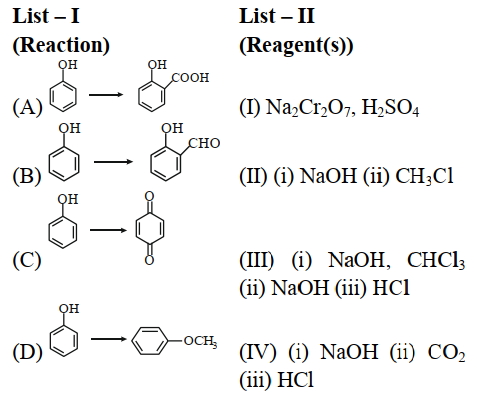
A
$A-IV, B-III, C-I, D-II$
B
$A-II, B-III, C-I, D-IV$
C
$A-II, B-I, C-III, D-IV$
D
$A-IV, B-III, C-II, D-I$
Solution
(A) $A \rightarrow$ Kolbe-Schmidt reaction: Phenol reacts with $NaOH$ followed by $CO_2$ and $HCl$ to form salicylic acid. Matches with $IV$.
$B \rightarrow$ Reimer-Tiemann reaction: Phenol reacts with $CHCl_3$ and $NaOH$ followed by $HCl$ to form salicylaldehyde. Matches with $III$.
$C \rightarrow$ Oxidation of phenol: Phenol is oxidized by $Na_2Cr_2O_7$ and $H_2SO_4$ to $p$-benzoquinone. Matches with $I$.
$D \rightarrow$ Williamson ether synthesis: Phenol reacts with $NaOH$ to form sodium phenoxide,which then reacts with $CH_3Cl$ to form anisole $(PhOCH_3)$. Matches with $II$.
Therefore,the correct matching is $A-IV, B-III, C-I, D-II$.
$B \rightarrow$ Reimer-Tiemann reaction: Phenol reacts with $CHCl_3$ and $NaOH$ followed by $HCl$ to form salicylaldehyde. Matches with $III$.
$C \rightarrow$ Oxidation of phenol: Phenol is oxidized by $Na_2Cr_2O_7$ and $H_2SO_4$ to $p$-benzoquinone. Matches with $I$.
$D \rightarrow$ Williamson ether synthesis: Phenol reacts with $NaOH$ to form sodium phenoxide,which then reacts with $CH_3Cl$ to form anisole $(PhOCH_3)$. Matches with $II$.
Therefore,the correct matching is $A-IV, B-III, C-I, D-II$.
0 likesView Solution
74
ChemistryDifficultMCQJEE Main · 2024
The major product formed in the following reaction is a mixture of:
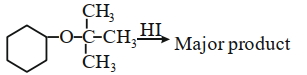
A
Cyclohexyl iodide and $(CH_3)_3Cl$
B
Cyclohexyl iodide and $(CH_3)_3COH$
C
Cyclohexanol and $(CH_3)_3COH$
D
Cyclohexanol and $2-$iodo$-2-$methylpropane
Solution
(D) The reaction of an ether with $HI$ proceeds via the protonation of the ether oxygen atom,followed by the cleavage of the $C-O$ bond.
In the given ether,cyclohexyl tert-butyl ether,the cleavage occurs such that the more stable carbocation is formed.
The tert-butyl group forms a stable tertiary carbocation $(CH_3)_3C^+$,which is then attacked by the iodide ion $(I^-)$ to form tert-butyl iodide,$(CH_3)_3CI$.
The cyclohexyl group remains as the alcohol,cyclohexanol $(C_6H_{11}OH)$.
Thus,the major products are cyclohexanol and $2-$iodo$-2-$methylpropane (tert-butyl iodide).
In the given ether,cyclohexyl tert-butyl ether,the cleavage occurs such that the more stable carbocation is formed.
The tert-butyl group forms a stable tertiary carbocation $(CH_3)_3C^+$,which is then attacked by the iodide ion $(I^-)$ to form tert-butyl iodide,$(CH_3)_3CI$.
The cyclohexyl group remains as the alcohol,cyclohexanol $(C_6H_{11}OH)$.
Thus,the major products are cyclohexanol and $2-$iodo$-2-$methylpropane (tert-butyl iodide).
0 likesView Solution
75
ChemistryDifficultMCQJEE Main · 2024
Given below are two statements:
Statement $I$: Oxygen being the first member of group $16$ exhibits only $-2$ oxidation state.
Statement $II$: Down the group $16$ stability of $+4$ oxidation state decreases and $+6$ oxidation state increases.
In the light of the above statements,choose the most appropriate answer from the options given below:
Statement $I$: Oxygen being the first member of group $16$ exhibits only $-2$ oxidation state.
Statement $II$: Down the group $16$ stability of $+4$ oxidation state decreases and $+6$ oxidation state increases.
In the light of the above statements,choose the most appropriate answer from the options given below:
A
Statement $I$ is correct but Statement $II$ is incorrect
B
Both Statement $I$ and Statement $II$ are correct
C
Both Statement $I$ and Statement $II$ are incorrect
D
Statement $I$ is incorrect but Statement $II$ is correct
Solution
(C) Statement-$I$: Oxygen exhibits oxidation states ranging from $-2$ to $+2$ (e.g.,in $OF_2$,it is $+2$). Thus,Statement-$I$ is incorrect.
Statement-$II$: Due to the inert pair effect,as we move down group $16$,the stability of the $+6$ oxidation state decreases,while the stability of the $+4$ oxidation state increases. Thus,Statement-$II$ is incorrect.
Therefore,both statements are incorrect.
Statement-$II$: Due to the inert pair effect,as we move down group $16$,the stability of the $+6$ oxidation state decreases,while the stability of the $+4$ oxidation state increases. Thus,Statement-$II$ is incorrect.
Therefore,both statements are incorrect.
0 likesView Solution
76
ChemistryDifficultMCQJEE Main · 2024
Identify from the following species in which $d^2 sp^3$ hybridization is shown by the central atom:
A
$[Co(NH_3)_6]^{3+}$
B
$BrF_5$
C
$[PtCl_4]^{2-}$
D
$SF_6$
Solution
(A) $[Co(NH_3)_6]^{3+}$: The central metal ion $Co^{3+}$ has a $d^6$ configuration. In the presence of strong field ligand $NH_3$,electrons pair up,providing two vacant $3d$ orbitals for $d^2 sp^3$ hybridization.
$BrF_5$: The central atom $Br$ undergoes $sp^3 d^2$ hybridization.
$[PtCl_4]^{2-}$: The central metal ion $Pt^{2+}$ undergoes $dsp^2$ hybridization.
$SF_6$: The central atom $S$ undergoes $sp^3 d^2$ hybridization.
$BrF_5$: The central atom $Br$ undergoes $sp^3 d^2$ hybridization.
$[PtCl_4]^{2-}$: The central metal ion $Pt^{2+}$ undergoes $dsp^2$ hybridization.
$SF_6$: The central atom $S$ undergoes $sp^3 d^2$ hybridization.
0 likesView Solution
77
ChemistryDifficultMCQJEE Main · 2024
Identify $B$ formed in the reaction: $Cl-(CH_2)_4-Cl$ $\xrightarrow{\text{excess } NH_3} A$ $\xrightarrow{NaOH} B + H_2O + NaCl$
A
$Cl-(CH_2)_4-NH_2$
B
$H_2N-(CH_2)_4-NH_2$
C
$Cl^{-}H_3N^{+}-(CH_2)_4-NH_3^{+}Cl^{-}$
D
$CH_3-CH_2-CH_2-CH_2-NH_2$
Solution
(B) When $1,4$-dichlorobutane reacts with excess ammonia,it undergoes nucleophilic substitution to form the ammonium salt $A$ $([H_3N^{+}-(CH_2)_4-NH_3^{+}] 2Cl^{-})$.
Treatment of this salt with a strong base like $NaOH$ releases the free diamine $B$ $(H_2N-(CH_2)_4-NH_2)$,along with water and sodium chloride.
The reaction is:
$Cl-(CH_2)_4-Cl + 2NH_3 \rightarrow [H_3N^{+}-(CH_2)_4-NH_3^{+}] 2Cl^{-} (A)$
$[H_3N^{+}-(CH_2)_4-NH_3^{+}] 2Cl^{-} + 2NaOH \rightarrow H_2N-(CH_2)_4-NH_2 (B) + 2H_2O + 2NaCl$
Treatment of this salt with a strong base like $NaOH$ releases the free diamine $B$ $(H_2N-(CH_2)_4-NH_2)$,along with water and sodium chloride.
The reaction is:
$Cl-(CH_2)_4-Cl + 2NH_3 \rightarrow [H_3N^{+}-(CH_2)_4-NH_3^{+}] 2Cl^{-} (A)$
$[H_3N^{+}-(CH_2)_4-NH_3^{+}] 2Cl^{-} + 2NaOH \rightarrow H_2N-(CH_2)_4-NH_2 (B) + 2H_2O + 2NaCl$
0 likesView Solution
78
ChemistryMediumMCQJEE Main · 2024
The quantity which changes with temperature is:
A
Molarity
B
Mass percentage
C
Molality
D
Mole fraction
Solution
(A) $Molarity = \frac{\text{Moles of solute}}{\text{Volume of solution (L)}}$
Since the volume of a solution is temperature-dependent,the molarity of the solution changes with a change in temperature.
Other concentration terms like molality,mass percentage,and mole fraction involve mass,which is independent of temperature.
Since the volume of a solution is temperature-dependent,the molarity of the solution changes with a change in temperature.
Other concentration terms like molality,mass percentage,and mole fraction involve mass,which is independent of temperature.
0 likesView Solution
79
ChemistryDifficultMCQJEE Main · 2024
Which structure of protein remains intact after coagulation of egg white on boiling?
A
$Primary$
B
$Tertiary$
C
$Secondary$
D
$Quaternary$
Solution
(A) Boiling an egg causes denaturation of its protein.
During denaturation,the $Secondary$,$Tertiary$,and $Quaternary$ structures of the protein are disrupted due to the breaking of hydrogen bonds and other non-covalent interactions.
However,the $Primary$ structure,which consists of the specific sequence of amino acids held together by peptide bonds,remains intact.
During denaturation,the $Secondary$,$Tertiary$,and $Quaternary$ structures of the protein are disrupted due to the breaking of hydrogen bonds and other non-covalent interactions.
However,the $Primary$ structure,which consists of the specific sequence of amino acids held together by peptide bonds,remains intact.
0 likesView Solution
80
ChemistryDifficultMCQJEE Main · 2024
Identify the incorrect pair from the following:
A
Photography - $AgBr$
B
Polythene preparation - $TiCl_4, Al(CH_3)_3$
C
Haber process - Iron
D
Wacker process - $PtCl_2$
Solution
(D) In the Wacker process,the catalyst used is $PdCl_2$ (palladium$(II)$ chloride) along with a copper$(II)$ chloride co-catalyst.
Therefore,the pair $Wacker \ process - PtCl_2$ is incorrect.
Therefore,the pair $Wacker \ process - PtCl_2$ is incorrect.
0 likesView Solution
81
ChemistryDifficultMCQJEE Main · 2024
Time required for completion of $99.9 \%$ of a First order reaction is . . . . . . times of half life $(t_{1/2})$ of the reaction.
A
$15$
B
$17$
C
$10$
D
$5$
Solution
(C) For a first order reaction,the time $t$ is given by $t = \frac{2.303}{k} \log \left( \frac{a}{a-x} \right)$.
For $99.9 \%$ completion,$x = 0.999a$,so $a-x = 0.001a = \frac{a}{1000}$.
Thus,$t_{99.9 \%} = \frac{2.303}{k} \log \left( \frac{a}{a/1000} \right) = \frac{2.303}{k} \log(10^3) = \frac{2.303 \times 3}{k}$.
The half-life is $t_{1/2} = \frac{0.693}{k} = \frac{2.303 \times 0.301}{k}$.
Taking the ratio: $\frac{t_{99.9 \%}}{t_{1/2}} = \frac{2.303 \times 3 / k}{2.303 \times 0.301 / k} \approx \frac{3}{0.3} = 10$.
For $99.9 \%$ completion,$x = 0.999a$,so $a-x = 0.001a = \frac{a}{1000}$.
Thus,$t_{99.9 \%} = \frac{2.303}{k} \log \left( \frac{a}{a/1000} \right) = \frac{2.303}{k} \log(10^3) = \frac{2.303 \times 3}{k}$.
The half-life is $t_{1/2} = \frac{0.693}{k} = \frac{2.303 \times 0.301}{k}$.
Taking the ratio: $\frac{t_{99.9 \%}}{t_{1/2}} = \frac{2.303 \times 3 / k}{2.303 \times 0.301 / k} \approx \frac{3}{0.3} = 10$.
0 likesView Solution
82
ChemistryDifficultMCQJEE Main · 2024
The spin-only magnetic moment value of the square planar complex $[Pt(NH_3)_2 Cl(NH_2 CH_3)] Cl$ is $B.M.$ (Nearest integer). (Given atomic number for $Pt = 78$)
A
$1$
B
$2$
C
$3$
D
$0$
Solution
(D) The complex is $[Pt(NH_3)_2 Cl(NH_2 CH_3)] Cl$.
In this complex,the oxidation state of $Pt$ is $+2$.
$Pt$ $(Z=78)$ has an electronic configuration of $[Xe] 4f^{14} 5d^9 6s^1$. Thus,$Pt^{2+}$ has a $5d^8$ configuration.
Since the complex is square planar,it undergoes $dsp^2$ hybridization.
In a $5d^8$ square planar complex,the electrons pair up in the $5d$ orbitals,leaving no unpaired electrons.
Therefore,the number of unpaired electrons $(n)$ is $0$.
The spin-only magnetic moment is given by $\mu = \sqrt{n(n+2)} \ B.M.$
Substituting $n=0$,we get $\mu = \sqrt{0(0+2)} = 0 \ B.M.$
In this complex,the oxidation state of $Pt$ is $+2$.
$Pt$ $(Z=78)$ has an electronic configuration of $[Xe] 4f^{14} 5d^9 6s^1$. Thus,$Pt^{2+}$ has a $5d^8$ configuration.
Since the complex is square planar,it undergoes $dsp^2$ hybridization.
In a $5d^8$ square planar complex,the electrons pair up in the $5d$ orbitals,leaving no unpaired electrons.
Therefore,the number of unpaired electrons $(n)$ is $0$.
The spin-only magnetic moment is given by $\mu = \sqrt{n(n+2)} \ B.M.$
Substituting $n=0$,we get $\mu = \sqrt{0(0+2)} = 0 \ B.M.$
0 likesView Solution
83
ChemistryDifficultMCQJEE Main · 2024
The hydrogen electrode is dipped in a solution of $pH=3$ at $25^{\circ} C$. The potential of the electrode will be . . . . . . $\times 10^{-2} \ V$. $\left(\frac{2.303 RT}{F}=0.059 \ V\right)$
A
$30$
B
$75$
C
$45$
D
$-17.7$
Solution
(D) The half-cell reaction for the hydrogen electrode is: $2 H^{+}_{(aq)} + 2 e^{-} \rightarrow H_{2(g)}$.
Using the Nernst equation: $E = E^{\circ} - \frac{0.059}{n} \log \frac{1}{[H^{+}]}$.
For the standard hydrogen electrode,$E^{\circ} = 0 \ V$ and $n = 1$ (for the reduction of $H^{+}$ to $\frac{1}{2} H_2$).
$E = 0 - 0.059 \times \log \frac{1}{[H^{+}]}$.
Since $pH = -\log[H^{+}]$,we have $\log \frac{1}{[H^{+}]} = pH$.
Therefore,$E = -0.059 \times pH$.
Given $pH = 3$,$E = -0.059 \times 3 = -0.177 \ V$.
Converting to the required format: $-0.177 \ V = -17.7 \times 10^{-2} \ V$.
Using the Nernst equation: $E = E^{\circ} - \frac{0.059}{n} \log \frac{1}{[H^{+}]}$.
For the standard hydrogen electrode,$E^{\circ} = 0 \ V$ and $n = 1$ (for the reduction of $H^{+}$ to $\frac{1}{2} H_2$).
$E = 0 - 0.059 \times \log \frac{1}{[H^{+}]}$.
Since $pH = -\log[H^{+}]$,we have $\log \frac{1}{[H^{+}]} = pH$.
Therefore,$E = -0.059 \times pH$.
Given $pH = 3$,$E = -0.059 \times 3 = -0.177 \ V$.
Converting to the required format: $-0.177 \ V = -17.7 \times 10^{-2} \ V$.
0 likesView Solution
84
ChemistryDifficultMCQJEE Main · 2024
Match List-$I$ with List-$II$:
Choose the correct answer from the options given below:
| $LIST-I$ (Substances) | $LIST-II$ (Element Present) |
| $A$. Ziegler catalyst | $I$. Rhodium |
| $B$. Blood pigment | $II$. Cobalt |
| $C$. Wilkinson catalyst | $III$. Iron |
| $D$. Vitamin $B_{12}$ | $IV$. Titanium |
Choose the correct answer from the options given below:
A
$A-II, B-IV, C-I, D-III$
B
$A-II, B-III, C-IV, D-I$
C
$A-III, B-II, C-IV, D-I$
D
$A-IV, B-III, C-I, D-II$
Solution
(D) . Ziegler catalyst is $TiCl_4 + (C_2H_5)_3Al$,which contains Titanium $(IV)$.
$B$. Blood pigment (Hemoglobin) contains Iron $(III)$.
$C$. Wilkinson catalyst is $[RhCl(PPh_3)_3]$,which contains Rhodium $(I)$.
$D$. Vitamin $B_{12}$ (Cyanocobalamin) contains Cobalt $(II)$.
Therefore,the correct matching is $A-IV, B-III, C-I, D-II$.
$B$. Blood pigment (Hemoglobin) contains Iron $(III)$.
$C$. Wilkinson catalyst is $[RhCl(PPh_3)_3]$,which contains Rhodium $(I)$.
$D$. Vitamin $B_{12}$ (Cyanocobalamin) contains Cobalt $(II)$.
Therefore,the correct matching is $A-IV, B-III, C-I, D-II$.
0 likesView Solution
85
ChemistryDifficultMCQJEE Main · 2024
The major product $(P)$ in the following reaction is:
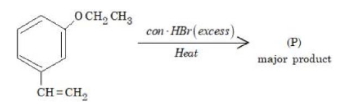
A
$3-$($2$-bromoethyl)phenol
B
$1-$bromo$-3-$($2$-bromoethyl)benzene
C
$1-$bromo$-3-$($1$-bromoethyl)benzene
D
$3-$($1$-bromoethyl)phenol
Solution
(D) The reaction involves two steps with excess $HBr$:
$1$. Electrophilic addition of $HBr$ to the vinyl group $(-CH=CH_2)$ follows Markovnikov's rule,forming a stable benzylic carbocation intermediate,which then reacts with $Br^-$ to give a $1$-bromoethyl group.
$2$. Cleavage of the ether linkage $(-OCH_2CH_3)$ occurs via protonation of the oxygen followed by nucleophilic attack of $Br^-$ on the less hindered ethyl group,resulting in the formation of phenol and ethyl bromide.
Thus,the major product is $3-(1\text{-bromoethyl})phenol$.
$1$. Electrophilic addition of $HBr$ to the vinyl group $(-CH=CH_2)$ follows Markovnikov's rule,forming a stable benzylic carbocation intermediate,which then reacts with $Br^-$ to give a $1$-bromoethyl group.
$2$. Cleavage of the ether linkage $(-OCH_2CH_3)$ occurs via protonation of the oxygen followed by nucleophilic attack of $Br^-$ on the less hindered ethyl group,resulting in the formation of phenol and ethyl bromide.
Thus,the major product is $3-(1\text{-bromoethyl})phenol$.
0 likesView Solution
86
ChemistryDifficultMCQJEE Main · 2024
Given below are two statements: one is labelled as Assertion $A$ and the other is labelled as Reason $R$:
Assertion $A$: Aryl halides cannot be prepared by the replacement of the hydroxyl group of phenol by a halogen atom.
Reason $R$: Phenols react with halogen acids violently.
In the light of the above statements,choose the most appropriate from the options given below:
Assertion $A$: Aryl halides cannot be prepared by the replacement of the hydroxyl group of phenol by a halogen atom.
Reason $R$: Phenols react with halogen acids violently.
In the light of the above statements,choose the most appropriate from the options given below:
A
Both $A$ and $R$ are true but $R$ is $NOT$ the correct explanation of $A$.
B
$A$ is false but $R$ is true.
C
$A$ is true but $R$ is false.
D
Both $A$ and $R$ are true and $R$ is the correct explanation of $A$.
Solution
(C) Assertion $(A)$ is true. The $C-O$ bond in phenol has partial double bond character due to resonance,making it very strong and difficult to break by nucleophilic substitution with halogen acids.
Reason $(R)$ is false. Phenols do not react with halogen acids under normal conditions because the $C-O$ bond is strong and the formation of a phenyl carbocation is highly unfavorable.
Therefore,$A$ is true but $R$ is false.
Reason $(R)$ is false. Phenols do not react with halogen acids under normal conditions because the $C-O$ bond is strong and the formation of a phenyl carbocation is highly unfavorable.
Therefore,$A$ is true but $R$ is false.
0 likesView Solution
87
ChemistryDifficultMCQJEE Main · 2024
$KMnO_4$ decomposes on heating at $513 \ K$ to form $O_2$ along with
A
$MnO_2 \& K_2O_2$
B
$K_2MnO_4 \& Mn$
C
$Mn \& KO_2$
D
$K_2MnO_4 \& MnO_2$
Solution
(D) The thermal decomposition of potassium permanganate $(KMnO_4)$ at $513 \ K$ is given by the following reaction:
$2KMnO_4 \xrightarrow{\Delta} K_2MnO_4 + MnO_2 + O_2$
Thus,$KMnO_4$ decomposes to form potassium manganate $(K_2MnO_4)$,manganese dioxide $(MnO_2)$,and oxygen gas $(O_2)$.
$2KMnO_4 \xrightarrow{\Delta} K_2MnO_4 + MnO_2 + O_2$
Thus,$KMnO_4$ decomposes to form potassium manganate $(K_2MnO_4)$,manganese dioxide $(MnO_2)$,and oxygen gas $(O_2)$.
0 likesView Solution
88
ChemistryDifficultMCQJEE Main · 2024
In which one of the following metal carbonyls,$CO$ forms a bridge between metal atoms?
A
$[Co_2(CO)_8]$
B
$[Mn_2(CO)_{10}]$
C
$[Os_3(CO)_{12}]$
D
$[Ru_3(CO)_{12}]$
Solution
(A) In the structure of $[Co_2(CO)_8]$,there are two bridging $CO$ ligands between the two cobalt atoms,along with a $Co-Co$ bond.
In $[Mn_2(CO)_{10}]$,$[Os_3(CO)_{12}]$,and $[Ru_3(CO)_{12}]$,all $CO$ ligands are terminal,and there are no bridging $CO$ groups.
Therefore,the correct option is $A$.
In $[Mn_2(CO)_{10}]$,$[Os_3(CO)_{12}]$,and $[Ru_3(CO)_{12}]$,all $CO$ ligands are terminal,and there are no bridging $CO$ groups.
Therefore,the correct option is $A$.
0 likesView Solution
89
ChemistryDifficultMCQJEE Main · 2024
Type of amino acids obtained by hydrolysis of proteins is :
A
$\beta$
B
$\alpha$
C
$\delta$
D
$\gamma$
Solution
(B) Proteins are natural polymers composed of $\alpha$-amino acids which are connected by peptide linkages.
Hence,proteins upon acidic hydrolysis produce $\alpha$-amino acids.
Hence,proteins upon acidic hydrolysis produce $\alpha$-amino acids.
0 likesView Solution
90
ChemistryDifficultMCQJEE Main · 2024
The final product $A$ formed in the following multistep reaction sequence is:
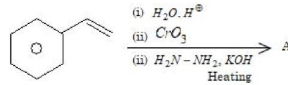
A
Ethylbenzene
B
Acetophenone hydrazone
C
Phenylacetic acid
D
Hydrazone derivative
Solution
(A) Step $1$: Hydration of styrene $(C_6H_5CH=CH_2)$ with $H_2O, H^+$ follows Markovnikov's rule to yield $1$-phenylethanol $(C_6H_5CH(OH)CH_3)$.
Step $2$: Oxidation of $1$-phenylethanol with $CrO_3$ yields acetophenone $(C_6H_5COCH_3)$.
Step $3$: Wolff-Kishner reduction of acetophenone using $H_2N-NH_2, KOH$ and heating reduces the carbonyl group to a methylene group,yielding ethylbenzene $(C_6H_5CH_2CH_3)$ as the final product $A$.
Step $2$: Oxidation of $1$-phenylethanol with $CrO_3$ yields acetophenone $(C_6H_5COCH_3)$.
Step $3$: Wolff-Kishner reduction of acetophenone using $H_2N-NH_2, KOH$ and heating reduces the carbonyl group to a methylene group,yielding ethylbenzene $(C_6H_5CH_2CH_3)$ as the final product $A$.
0 likesView Solution
91
ChemistryDifficultMCQJEE Main · 2024
The mass of zinc produced by the electrolysis of zinc sulphate solution with a steady current of $0.015 \ A$ for $15$ minutes is . . . . . . $ \times 10^{-4} \ g$. (Atomic mass of zinc $= 65.4 \ amu$)
A
$47$
B
$46$
C
$49$
D
$41$
Solution
(B) The reduction reaction at the cathode is: $Zn^{2+} + 2e^{-} \longrightarrow Zn(s)$.
According to Faraday's law of electrolysis,the mass $W$ deposited is given by $W = \frac{M \times I \times t}{n \times F}$,where $M = 65.4 \ g/mol$,$I = 0.015 \ A$,$t = 15 \times 60 \ s = 900 \ s$,$n = 2$,and $F = 96500 \ C/mol$.
$W = \frac{65.4 \times 0.015 \times 900}{2 \times 96500} \ g$.
$W = \frac{882.9}{193000} \ g \approx 0.0045746 \ g$.
$W \approx 45.75 \times 10^{-4} \ g$.
Rounding to the nearest integer,the value is $46$.
According to Faraday's law of electrolysis,the mass $W$ deposited is given by $W = \frac{M \times I \times t}{n \times F}$,where $M = 65.4 \ g/mol$,$I = 0.015 \ A$,$t = 15 \times 60 \ s = 900 \ s$,$n = 2$,and $F = 96500 \ C/mol$.
$W = \frac{65.4 \times 0.015 \times 900}{2 \times 96500} \ g$.
$W = \frac{882.9}{193000} \ g \approx 0.0045746 \ g$.
$W \approx 45.75 \times 10^{-4} \ g$.
Rounding to the nearest integer,the value is $46$.
0 likesView Solution
92
ChemistryDifficultMCQJEE Main · 2024
For a reaction taking place in three steps at the same temperature,the overall rate constant is $K = \frac{K_1 K_2}{K_3}$. If $E_{a1}$,$E_{a2}$,and $E_{a3}$ are $40 \ kJ/mol$,$50 \ kJ/mol$,and $60 \ kJ/mol$ respectively,the overall activation energy $E_a$ is . . . . . . $kJ/mol$.
A
$20$
B
$10$
C
$30$
D
$45$
Solution
(C) The overall rate constant is given by $K = \frac{K_1 K_2}{K_3}$.
Substituting the Arrhenius equation $K = A \cdot e^{-E_a / RT}$ for each step:
$A \cdot e^{-E_a / RT} = \frac{(A_1 e^{-E_{a1} / RT}) \cdot (A_2 e^{-E_{a2} / RT})}{(A_3 e^{-E_{a3} / RT})}$
$A \cdot e^{-E_a / RT} = \frac{A_1 A_2}{A_3} \cdot e^{-(E_{a1} + E_{a2} - E_{a3}) / RT}$
Comparing the exponents,we get $E_a = E_{a1} + E_{a2} - E_{a3}$.
Substituting the given values: $E_a = 40 + 50 - 60 = 30 \ kJ/mol$.
Substituting the Arrhenius equation $K = A \cdot e^{-E_a / RT}$ for each step:
$A \cdot e^{-E_a / RT} = \frac{(A_1 e^{-E_{a1} / RT}) \cdot (A_2 e^{-E_{a2} / RT})}{(A_3 e^{-E_{a3} / RT})}$
$A \cdot e^{-E_a / RT} = \frac{A_1 A_2}{A_3} \cdot e^{-(E_{a1} + E_{a2} - E_{a3}) / RT}$
Comparing the exponents,we get $E_a = E_{a1} + E_{a2} - E_{a3}$.
Substituting the given values: $E_a = 40 + 50 - 60 = 30 \ kJ/mol$.
0 likesView Solution
93
ChemistryDifficultMCQJEE Main · 2024
The osmotic pressure of a dilute solution is $7 \times 10^5 \ Pa$ at $273 \ K$. Osmotic pressure of the same solution at $283 \ K$ is . . . . . . . $\times 10^4 \ Nm^{-2}$.
A
$36$
B
$73$
C
$45$
D
$15$
Solution
(B) The osmotic pressure $\pi$ is given by the formula $\pi = CRT$.
Since the concentration $C$ and gas constant $R$ are constant for the same solution,we have $\frac{\pi_1}{T_1} = \frac{\pi_2}{T_2}$.
Given $\pi_1 = 7 \times 10^5 \ Pa$,$T_1 = 273 \ K$,and $T_2 = 283 \ K$.
Substituting the values: $\pi_2 = \frac{\pi_1 \times T_2}{T_1} = \frac{7 \times 10^5 \times 283}{273} \ Pa$.
$\pi_2 = 7.256 \times 10^5 \ Pa = 72.56 \times 10^4 \ Nm^{-2}$.
Rounding to the nearest integer,we get $73 \times 10^4 \ Nm^{-2}$.
Since the concentration $C$ and gas constant $R$ are constant for the same solution,we have $\frac{\pi_1}{T_1} = \frac{\pi_2}{T_2}$.
Given $\pi_1 = 7 \times 10^5 \ Pa$,$T_1 = 273 \ K$,and $T_2 = 283 \ K$.
Substituting the values: $\pi_2 = \frac{\pi_1 \times T_2}{T_1} = \frac{7 \times 10^5 \times 283}{273} \ Pa$.
$\pi_2 = 7.256 \times 10^5 \ Pa = 72.56 \times 10^4 \ Nm^{-2}$.
Rounding to the nearest integer,we get $73 \times 10^4 \ Nm^{-2}$.
0 likesView Solution
94
ChemistryDifficultMCQJEE Main · 2024
From the compounds given below,the number of compounds which give a positive Fehling's test is:
Benzaldehyde,Acetaldehyde,Acetone,Acetophenone,Methanal,$4$-nitrobenzaldehyde,cyclohexane carbaldehyde.
Benzaldehyde,Acetaldehyde,Acetone,Acetophenone,Methanal,$4$-nitrobenzaldehyde,cyclohexane carbaldehyde.
A
$3$
B
$4$
C
$10$
D
$6$
Solution
(A) Fehling's test is given by aliphatic aldehydes only.
$1$. Benzaldehyde: Aromatic aldehyde (Negative)
$2$. Acetaldehyde $(CH_3CHO)$: Aliphatic aldehyde (Positive)
$3$. Acetone: Ketone (Negative)
$4$. Acetophenone: Aromatic ketone (Negative)
$5$. Methanal $(HCHO)$: Aliphatic aldehyde (Positive)
$6$. $4$-nitrobenzaldehyde: Aromatic aldehyde (Negative)
$7$. Cyclohexanecarbaldehyde: Aliphatic aldehyde (Positive)
Thus,the compounds that give a positive Fehling's test are Acetaldehyde,Methanal,and Cyclohexanecarbaldehyde.
The total number of such compounds is $3$.
$1$. Benzaldehyde: Aromatic aldehyde (Negative)
$2$. Acetaldehyde $(CH_3CHO)$: Aliphatic aldehyde (Positive)
$3$. Acetone: Ketone (Negative)
$4$. Acetophenone: Aromatic ketone (Negative)
$5$. Methanal $(HCHO)$: Aliphatic aldehyde (Positive)
$6$. $4$-nitrobenzaldehyde: Aromatic aldehyde (Negative)
$7$. Cyclohexanecarbaldehyde: Aliphatic aldehyde (Positive)
Thus,the compounds that give a positive Fehling's test are Acetaldehyde,Methanal,and Cyclohexanecarbaldehyde.
The total number of such compounds is $3$.
0 likesView Solution
95
ChemistryDifficultMCQJEE Main · 2024
Match List-$I$ with List-$II$.
Choose the correct answer from the options given below:
| List-$I$ (Biopolymer) | List-$II$ (Monomer) |
|---|---|
| $A$. Starch | $I$. nucleotide |
| $B$. Cellulose | $II$. $\alpha$-glucose |
| $C$. Nucleic acid | $III$. $\beta$-glucose |
| $D$. Protein | $IV$. $\alpha$-amino acid |
Choose the correct answer from the options given below:
A
$A-II, B-I, C-III, D-IV$
B
$A-IV, B-II, C-I, D-III$
C
$A-I, B-III, C-IV, D-II$
D
$A-II, B-III, C-I, D-IV$
Solution
(D) The correct matching is as follows:
$A$. Starch is a polymer of $\alpha$-glucose $(II)$.
$B$. Cellulose is a polymer of $\beta$-glucose $(III)$.
$C$. Nucleic acid is a polymer of nucleotides $(I)$.
$D$. Protein is a polymer of $\alpha$-amino acids $(IV)$.
Therefore,the correct sequence is $A-II, B-III, C-I, D-IV$.
$A$. Starch is a polymer of $\alpha$-glucose $(II)$.
$B$. Cellulose is a polymer of $\beta$-glucose $(III)$.
$C$. Nucleic acid is a polymer of nucleotides $(I)$.
$D$. Protein is a polymer of $\alpha$-amino acids $(IV)$.
Therefore,the correct sequence is $A-II, B-III, C-I, D-IV$.
0 likesView Solution
96
ChemistryDifficultMCQJEE Main · 2024
Match List-$I$ with List-$II$:
Choose the correct answer from the options given below:
| List-$I$ (Compound) | List-$II$ ($pK_a$ value) |
| $A$. Ethanol | $I$. $10.0$ |
| $B$. Phenol | $II$. $15.9$ |
| $C$. $m$-Nitrophenol | $III$. $7.1$ |
| $D$. $p$-Nitrophenol | $IV$. $8.3$ |
Choose the correct answer from the options given below:
A
$A-II, B-I, C-IV, D-III$
B
$A-IV, B-I, C-II, D-III$
C
$A-III, B-IV, C-I, D-II$
D
$A-I, B-II, C-III, D-IV$
Solution
(A) The $pK_a$ values for the given compounds are as follows:
$A$. Ethanol: $15.9$
$B$. Phenol: $10.0$
$C$. $m$-Nitrophenol: $8.3$
$D$. $p$-Nitrophenol: $7.1$
Therefore,the correct matching is $A-II, B-I, C-IV, D-III$.
$A$. Ethanol: $15.9$
$B$. Phenol: $10.0$
$C$. $m$-Nitrophenol: $8.3$
$D$. $p$-Nitrophenol: $7.1$
Therefore,the correct matching is $A-II, B-I, C-IV, D-III$.
0 likesView Solution
97
ChemistryDifficultMCQJEE Main · 2024
The correct $IUPAC$ name of $K_2MnO_4$ is
A
Potassium tetraoxopermanganate $(VI)$
B
Potassium tetraoxidomanganate $(VI)$
C
Dipotassium tetraoxidomanganate $(VII)$
D
Potassium tetraoxidomanganese $(VI)$
Solution
(B) In $K_2MnO_4$,let the oxidation state of $Mn$ be $x$.
$2(+1) + x + 4(-2) = 0$
$2 + x - 8 = 0$
$x = +6$
The oxidation state of $Mn$ is $+6$.
According to $IUPAC$ nomenclature for coordination compounds and oxoanions,the name is Potassium tetraoxidomanganate $(VI)$.
$2(+1) + x + 4(-2) = 0$
$2 + x - 8 = 0$
$x = +6$
The oxidation state of $Mn$ is $+6$.
According to $IUPAC$ nomenclature for coordination compounds and oxoanions,the name is Potassium tetraoxidomanganate $(VI)$.
0 likesView Solution
98
ChemistryDifficultMCQJEE Main · 2024
$A$ reagent which gives a brilliant red precipitate with $Ni^{2+}$ ions in a basic medium is
A
sodium nitroprusside
B
neutral $FeCl_3$
C
meta-dinitrobenzene
D
dimethyl glyoxime
Solution
(D) The reagent used for the detection of $Ni^{2+}$ ions is dimethyl glyoxime $(dmg)$.
In the presence of an ammonium hydroxide $(NH_4OH)$ basic medium,$Ni^{2+}$ reacts with $dmg$ to form a complex,$Ni(dmg)_2$,which appears as a brilliant red precipitate.
The chemical reaction is: $Ni^{2+} + 2C_4H_8N_2O_2 \rightarrow [Ni(C_4H_7N_2O_2)_2] + 2H^+$.
Thus,the correct option is $D$.
In the presence of an ammonium hydroxide $(NH_4OH)$ basic medium,$Ni^{2+}$ reacts with $dmg$ to form a complex,$Ni(dmg)_2$,which appears as a brilliant red precipitate.
The chemical reaction is: $Ni^{2+} + 2C_4H_8N_2O_2 \rightarrow [Ni(C_4H_7N_2O_2)_2] + 2H^+$.
Thus,the correct option is $D$.
0 likesView Solution
99
ChemistryDifficultMCQJEE Main · 2024
When phenol is treated with chloroform in the presence of sodium hydroxide,followed by hydrolysis in the presence of an acid,the product formed is:
A
Salicylic acid
B
Benzene-$1,2$-diol
C
Benzene-$1,3$-diol
D
$2$-Hydroxybenzaldehyde
Solution
(D) The reaction described is the Reimer-Tiemann reaction.
In this reaction,phenol reacts with chloroform $(CHCl_3)$ in the presence of an aqueous base like sodium hydroxide $(NaOH)$ to form an intermediate,which upon acidic hydrolysis yields $2$-hydroxybenzaldehyde (also known as salicylaldehyde) as the major product.
The chemical equation is:
$C_6H_5OH + CHCl_3 + 3NaOH \rightarrow C_6H_4(OH)(CHO) + 3NaCl + 2H_2O$
In this reaction,phenol reacts with chloroform $(CHCl_3)$ in the presence of an aqueous base like sodium hydroxide $(NaOH)$ to form an intermediate,which upon acidic hydrolysis yields $2$-hydroxybenzaldehyde (also known as salicylaldehyde) as the major product.
The chemical equation is:
$C_6H_5OH + CHCl_3 + 3NaOH \rightarrow C_6H_4(OH)(CHO) + 3NaCl + 2H_2O$
0 likesView Solution
100
ChemistryDifficultMCQJEE Main · 2024
On passing a gas,$X$,through Nessler's reagent,a brown precipitate is obtained. The gas $X$ is
A
$H_2S$
B
$CO_2$
C
$NH_3$
D
$Cl_2$
Solution
(C) Nessler's reagent is an alkaline solution of potassium tetraiodomercurate$(II)$,$K_2[HgI_4]$.
When ammonia gas $(NH_3)$ is passed through Nessler's reagent,it forms a brown precipitate of iodide of Millon's base,$HgO \cdot Hg(NH_2)I$.
The chemical equation is:
$2 K_2[HgI_4] + NH_3 + 3 KOH \rightarrow HgO \cdot Hg(NH_2)I + 7 KI + 2 H_2O$
Thus,the gas $X$ is $NH_3$.
When ammonia gas $(NH_3)$ is passed through Nessler's reagent,it forms a brown precipitate of iodide of Millon's base,$HgO \cdot Hg(NH_2)I$.
The chemical equation is:
$2 K_2[HgI_4] + NH_3 + 3 KOH \rightarrow HgO \cdot Hg(NH_2)I + 7 KI + 2 H_2O$
Thus,the gas $X$ is $NH_3$.
0 likesView Solution
Vedclass Products
For Students
Vedclass Test Series
Mock tests in real JEE Main style covering Chemistry with performance analysis. 5-day free trial.
Start Free TrialFor Teachers
Exam Paper Generator
Generate Set A/B/C/D Chemistry papers from 7.5L+ questions in 2 minutes. 3 chapters free.
Try FreeFor Institutes
Online Exam Module
Run live JEE Main mock exams with unlimited students, 360° analytics & white-label branding.
See DemoFrequently Asked Questions
How many Chemistry questions are in JEE Main 2024?
There are 606 Chemistry questions from the JEE Main 2024 paper on Vedclass, each with a detailed step-by-step solution in English.
Are JEE Main 2024 Chemistry solutions available in English?
Yes. All solutions on this page are in English. You can also switch to English or Hindi using the language buttons above the questions.
Can I practice JEE Main 2024 Chemistry as a timed test?
Yes. Use the Vedclass Test Series to attempt a full JEE Main mock test covering Chemistry with time limits and instant score analysis.
Can teachers create Chemistry papers from JEE Main previous year questions?
Yes. The Vedclass Exam Paper Generator lets teachers mix JEE Main Chemistry questions and generate Set A/B/C/D papers in minutes.
For Teachers & Institutes
Build a Custom Chemistry Paper
Pick JEE Main 2024 Chemistry questions, set difficulty, and generate Set A/B/C/D in 2 minutes.