
ChemistryQ151–250 of 726 questions
Page 4 of 9 · English
151
ChemistryMediumMCQJEE Main · 2023
Which of the following processes consumes $CO_2$ and is therefore least responsible for global warming?
A
Manufacturing of cement
B
Steel manufacturing
C
Electricity generation in thermal power plants
D
Industrial production of urea
Solution
(D) In the industrial production of urea,ammonia $(NH_3)$ and carbon dioxide $(CO_2)$ are used as raw materials. The reaction is: $2NH_3 + CO_2 \rightarrow NH_2CONH_2 + H_2O$. Since $CO_2$ is consumed in this process,it is considered the least responsible for global warming among the given options.
0 likesView Solution
152
ChemistryMediumMCQJEE Main · 2023
The starting material for convenient preparation of deuterated hydrogen peroxide $(D_2O_2)$ in the laboratory is:
A
$K_2S_2O_8$
B
$2-\text{ethylanthraquinol}$
C
$BaO_2$
D
$BaO$
Solution
(A) The laboratory preparation of deuterated hydrogen peroxide $(D_2O_2)$ is conveniently carried out by the reaction of potassium persulfate $(K_2S_2O_8)$ with heavy water $(D_2O)$.
The chemical equation is: $K_2S_2O_{8(s)} + 2D_2O_{(l)} \rightarrow 2KDSO_{4(aq)} + D_2O_2$.
The chemical equation is: $K_2S_2O_{8(s)} + 2D_2O_{(l)} \rightarrow 2KDSO_{4(aq)} + D_2O_2$.
0 likesView Solution
153
ChemistryMediumMCQJEE Main · 2023
Which one of the following sets of ions represents a collection of isoelectronic species? (Given: Atomic Number: $F: 9, Cl: 17, Na: 11, Mg: 12, Al: 13, K: 19, Ca: 20, Sc: 21$)
A
$Cl^{+}, Na^{+}, Mg^{2+}, Ca^{2+}$
B
$Ba^{2+}, Sr^{2+}, K^{+}, Ca^{2+}$
C
$N^{3-}, O^{2-}, F^{-}, S^{2-}$
D
$K^{+}, Cl^{-}, Ca^{2+}, Sc^{3+}$
Solution
(D) Isoelectronic species are those that have the same number of electrons.
Number of electrons in:
$K^{+} = 19 - 1 = 18$
$Cl^{-} = 17 + 1 = 18$
$Ca^{2+} = 20 - 2 = 18$
$Sc^{3+} = 21 - 3 = 18$
Since all these ions have $18$ electrons,they represent a collection of isoelectronic species.
Number of electrons in:
$K^{+} = 19 - 1 = 18$
$Cl^{-} = 17 + 1 = 18$
$Ca^{2+} = 20 - 2 = 18$
$Sc^{3+} = 21 - 3 = 18$
Since all these ions have $18$ electrons,they represent a collection of isoelectronic species.
0 likesView Solution
154
ChemistryMediumMCQJEE Main · 2023
The effect of the addition of helium gas to the following reaction in an equilibrium state is:
$PCl_{5(g)} \rightleftharpoons PCl_{3(g)} + Cl_{2(g)}$
$PCl_{5(g)} \rightleftharpoons PCl_{3(g)} + Cl_{2(g)}$
A
The equilibrium will shift in the forward direction and more of $Cl_2$ and $PCl_3$ gases will be produced.
B
The equilibrium will go backward due to suppression of dissociation of $PCl_5$.
C
Helium will deactivate $PCl_5$ and the reaction will stop.
D
Addition of helium will not affect the equilibrium.
Solution
(D) For the reaction: $PCl_{5(g)} \rightleftharpoons PCl_{3(g)} + Cl_{2(g)}$
$1$. At constant pressure: The addition of an inert gas like helium increases the volume of the system. According to Le Chatelier's principle,the equilibrium shifts towards the side with a greater number of moles of gas,which is the forward direction. Thus,more $PCl_3$ and $Cl_2$ are produced.
$2$. At constant volume: The addition of an inert gas does not change the partial pressures or concentrations of the reacting species. Therefore,the equilibrium remains unaffected.
Since the condition (constant pressure or constant volume) is not specified,in standard textbook problems,if not mentioned,it is often assumed to be at constant volume,or the question is considered ambiguous. However,based on the options provided,if the pressure is constant,$A$ is correct; if the volume is constant,$D$ is correct. In many competitive contexts,if the condition is not specified,the addition of an inert gas at constant volume is the standard assumption,leading to $D$.
$1$. At constant pressure: The addition of an inert gas like helium increases the volume of the system. According to Le Chatelier's principle,the equilibrium shifts towards the side with a greater number of moles of gas,which is the forward direction. Thus,more $PCl_3$ and $Cl_2$ are produced.
$2$. At constant volume: The addition of an inert gas does not change the partial pressures or concentrations of the reacting species. Therefore,the equilibrium remains unaffected.
Since the condition (constant pressure or constant volume) is not specified,in standard textbook problems,if not mentioned,it is often assumed to be at constant volume,or the question is considered ambiguous. However,based on the options provided,if the pressure is constant,$A$ is correct; if the volume is constant,$D$ is correct. In many competitive contexts,if the condition is not specified,the addition of an inert gas at constant volume is the standard assumption,leading to $D$.
0 likesView Solution
155
ChemistryMediumMCQJEE Main · 2023
For electron gain enthalpies of the elements denoted as $\Delta_{eg} H$,the incorrect option is :
A
$\Delta_{eg} H (Cl) < \Delta_{eg} H (F)$
B
$\Delta_{eg} H (Se) < \Delta_{eg} H (S)$
C
$\Delta_{eg} H (I) < \Delta_{eg} H (At)$
D
$\Delta_{eg} H (Te) < \Delta_{eg} H (Po)$
Solution
(B) The electron gain enthalpy $(\Delta_{eg} H)$ becomes less negative as we move down a group due to an increase in atomic size.
$1$. For $Cl$ and $F$: $\Delta_{eg} H (Cl) = -349 \ kJ/mol$ and $\Delta_{eg} H (F) = -328 \ kJ/mol$. Since $-349 < -328$,the statement $\Delta_{eg} H (Cl) < \Delta_{eg} H (F)$ is correct.
$2$. For $Se$ and $S$: $\Delta_{eg} H (Se) = -195 \ kJ/mol$ and $\Delta_{eg} H (S) = -200 \ kJ/mol$. Since $-195 > -200$,the statement $\Delta_{eg} H (Se) < \Delta_{eg} H (S)$ is incorrect.
$3$. For $I$ and $At$: $\Delta_{eg} H (I) = -295 \ kJ/mol$ and $\Delta_{eg} H (At) = -270 \ kJ/mol$. Since $-295 < -270$,the statement $\Delta_{eg} H (I) < \Delta_{eg} H (At)$ is correct.
$4$. For $Te$ and $Po$: $\Delta_{eg} H (Te) = -190 \ kJ/mol$ and $\Delta_{eg} H (Po) = -183 \ kJ/mol$. Since $-190 < -183$,the statement $\Delta_{eg} H (Te) < \Delta_{eg} H (Po)$ is correct.
$1$. For $Cl$ and $F$: $\Delta_{eg} H (Cl) = -349 \ kJ/mol$ and $\Delta_{eg} H (F) = -328 \ kJ/mol$. Since $-349 < -328$,the statement $\Delta_{eg} H (Cl) < \Delta_{eg} H (F)$ is correct.
$2$. For $Se$ and $S$: $\Delta_{eg} H (Se) = -195 \ kJ/mol$ and $\Delta_{eg} H (S) = -200 \ kJ/mol$. Since $-195 > -200$,the statement $\Delta_{eg} H (Se) < \Delta_{eg} H (S)$ is incorrect.
$3$. For $I$ and $At$: $\Delta_{eg} H (I) = -295 \ kJ/mol$ and $\Delta_{eg} H (At) = -270 \ kJ/mol$. Since $-295 < -270$,the statement $\Delta_{eg} H (I) < \Delta_{eg} H (At)$ is correct.
$4$. For $Te$ and $Po$: $\Delta_{eg} H (Te) = -190 \ kJ/mol$ and $\Delta_{eg} H (Po) = -183 \ kJ/mol$. Since $-190 < -183$,the statement $\Delta_{eg} H (Te) < \Delta_{eg} H (Po)$ is correct.
0 likesView Solution
156
ChemistryMediumMCQJEE Main · 2023
$O-O$ bond length in $H_2O_2$ is $\underline{X}$ than the $O-O$ bond length in $F_2O_2$. The $O-H$ bond length in $H_2O_2$ is $Y$ than that of the $O-F$ bond in $F_2O_2$. Choose the correct option for $\underline{X}$ and $\underline{Y}$ from the given below.
A
$X$-shorter,$Y$-shorter
B
$X$-shorter,$Y$-longer
C
$X$-longer,$Y$-longer
D
$X$-longer,$Y$-shorter
Solution
(D) The $O-O$ bond length in $H_2O_2$ is $1.48 \ \mathring{A}$,while in $F_2O_2$ it is $1.22 \ \mathring{A}$. Thus,the $O-O$ bond in $H_2O_2$ is longer $(X = \text{longer})$.
The $O-H$ bond length in $H_2O_2$ is approximately $0.95 \ \mathring{A}$,whereas the $O-F$ bond length in $F_2O_2$ is approximately $1.41 \ \mathring{A}$. Thus,the $O-H$ bond is shorter $(Y = \text{shorter})$.
Therefore,the correct option is $D$.
The $O-H$ bond length in $H_2O_2$ is approximately $0.95 \ \mathring{A}$,whereas the $O-F$ bond length in $F_2O_2$ is approximately $1.41 \ \mathring{A}$. Thus,the $O-H$ bond is shorter $(Y = \text{shorter})$.
Therefore,the correct option is $D$.
0 likesView Solution
157
ChemistryDifficultMCQJEE Main · 2023
$0.3 \ g$ of ethane undergoes combustion at $27^{\circ} C$ in a bomb calorimeter. The temperature of the calorimeter system (including the water) is found to rise by $0.5^{\circ} C$. The heat evolved during combustion of ethane at constant pressure is $....... kJ \ mol^{-1}$. (Nearest integer) [Given: The heat capacity of the calorimeter system is $20 \ kJ \ K^{-1}$,$R = 8.3 \ J \ K^{-1} \ mol^{-1}$. Assume ideal gas behaviour. Atomic mass of $C$ and $H$ are $12$ and $1 \ g \ mol^{-1}$ respectively]
A
$1005$
B
$1006$
C
$1004$
D
$1003$
Solution
(B) $1$. Bomb calorimeter measures heat at constant volume,so the heat released is $\Delta U$.
$2$. Moles of ethane $(C_2H_6)$ = $\frac{0.3 \ g}{30 \ g \ mol^{-1}} = 0.01 \ mol$.
$3$. Heat released for $0.01 \ mol$ = $C \times \Delta T = 20 \ kJ \ K^{-1} \times 0.5 \ K = 10 \ kJ$.
$4$. Heat released for $1 \ mol$ $(\Delta U)$ = $\frac{10 \ kJ}{0.01 \ mol} = -1000 \ kJ \ mol^{-1}$.
$5$. Combustion reaction: $C_2H_6(g) + 3.5 O_2(g) \rightarrow 2CO_2(g) + 3H_2O(l)$.
$6$. Change in gaseous moles $(\Delta n_g)$ = $2 - (1 + 3.5) = -2.5$.
$7$. Relation between $\Delta H$ and $\Delta U$: $\Delta H = \Delta U + \Delta n_g RT$.
$8$. $\Delta H = -1000 \ kJ \ mol^{-1} + (-2.5 \times 8.3 \times 10^{-3} \ kJ \ K^{-1} \ mol^{-1} \times 300 \ K)$.
$9$. $\Delta H = -1000 - 6.225 = -1006.225 \ kJ \ mol^{-1}$.
$10$. The heat evolved is $1006 \ kJ \ mol^{-1}$ (nearest integer).
$2$. Moles of ethane $(C_2H_6)$ = $\frac{0.3 \ g}{30 \ g \ mol^{-1}} = 0.01 \ mol$.
$3$. Heat released for $0.01 \ mol$ = $C \times \Delta T = 20 \ kJ \ K^{-1} \times 0.5 \ K = 10 \ kJ$.
$4$. Heat released for $1 \ mol$ $(\Delta U)$ = $\frac{10 \ kJ}{0.01 \ mol} = -1000 \ kJ \ mol^{-1}$.
$5$. Combustion reaction: $C_2H_6(g) + 3.5 O_2(g) \rightarrow 2CO_2(g) + 3H_2O(l)$.
$6$. Change in gaseous moles $(\Delta n_g)$ = $2 - (1 + 3.5) = -2.5$.
$7$. Relation between $\Delta H$ and $\Delta U$: $\Delta H = \Delta U + \Delta n_g RT$.
$8$. $\Delta H = -1000 \ kJ \ mol^{-1} + (-2.5 \times 8.3 \times 10^{-3} \ kJ \ K^{-1} \ mol^{-1} \times 300 \ K)$.
$9$. $\Delta H = -1000 - 6.225 = -1006.225 \ kJ \ mol^{-1}$.
$10$. The heat evolved is $1006 \ kJ \ mol^{-1}$ (nearest integer).
2 likesView Solution
158
ChemistryMediumMCQJEE Main · 2023
$1 \times 10^{-5} \ S \ M$ $AgNO_3$ is added to $1 \ L$ of a saturated solution of $AgBr$. The conductivity of this solution at $298 \ K$ is $......... \times 10^{-8} \ S \ m^{-1}$.
Given: $K_{sp}(AgBr) = 4.9 \times 10^{-13}$ at $298 \ K$,$\lambda^0_{Ag^{+}} = 6 \times 10^{-3} \ S \ m^2 \ mol^{-1}$,$\lambda^0_{Br^{-}} = 8 \times 10^{-3} \ S \ m^2 \ mol^{-1}$,$\lambda^0_{NO_3^-} = 7 \times 10^{-3} \ S \ m^2 \ mol^{-1}$.
Given: $K_{sp}(AgBr) = 4.9 \times 10^{-13}$ at $298 \ K$,$\lambda^0_{Ag^{+}} = 6 \times 10^{-3} \ S \ m^2 \ mol^{-1}$,$\lambda^0_{Br^{-}} = 8 \times 10^{-3} \ S \ m^2 \ mol^{-1}$,$\lambda^0_{NO_3^-} = 7 \times 10^{-3} \ S \ m^2 \ mol^{-1}$.
A
$12$
B
$14$
C
$13$
D
$15$
Solution
(C) The concentration of $Ag^{+}$ ions from $AgNO_3$ is $[Ag^{+}] = 10^{-5} \ M$.
The concentration of $NO_3^{-}$ ions is $[NO_3^{-}] = 10^{-5} \ M$.
Due to the common ion effect,the concentration of $Br^{-}$ ions is determined by the solubility product constant: $[Br^{-}] = \frac{K_{sp}}{[Ag^{+}]} = \frac{4.9 \times 10^{-13}}{10^{-5}} = 4.9 \times 10^{-8} \ M$.
The conductivity $\kappa$ is given by $\kappa = \sum C_i \lambda_i$.
For $Ag^{+}$: $\kappa_{Ag^{+}} = 10^{-5} \times 6 \times 10^{-3} = 6 \times 10^{-8} \ S \ m^{-1}$.
For $Br^{-}$: $\kappa_{Br^{-}} = 4.9 \times 10^{-8} \times 8 \times 10^{-3} = 39.2 \times 10^{-11} \ S \ m^{-1} = 0.392 \times 10^{-8} \ S \ m^{-1}$.
For $NO_3^{-}$: $\kappa_{NO_3^{-}} = 10^{-5} \times 7 \times 10^{-3} = 7 \times 10^{-8} \ S \ m^{-1}$.
Total conductivity $\kappa = (6 + 0.392 + 7) \times 10^{-8} \ S \ m^{-1} = 13.392 \times 10^{-8} \ S \ m^{-1}$.
Rounding to the nearest integer,we get $13 \times 10^{-8} \ S \ m^{-1}$.
The concentration of $NO_3^{-}$ ions is $[NO_3^{-}] = 10^{-5} \ M$.
Due to the common ion effect,the concentration of $Br^{-}$ ions is determined by the solubility product constant: $[Br^{-}] = \frac{K_{sp}}{[Ag^{+}]} = \frac{4.9 \times 10^{-13}}{10^{-5}} = 4.9 \times 10^{-8} \ M$.
The conductivity $\kappa$ is given by $\kappa = \sum C_i \lambda_i$.
For $Ag^{+}$: $\kappa_{Ag^{+}} = 10^{-5} \times 6 \times 10^{-3} = 6 \times 10^{-8} \ S \ m^{-1}$.
For $Br^{-}$: $\kappa_{Br^{-}} = 4.9 \times 10^{-8} \times 8 \times 10^{-3} = 39.2 \times 10^{-11} \ S \ m^{-1} = 0.392 \times 10^{-8} \ S \ m^{-1}$.
For $NO_3^{-}$: $\kappa_{NO_3^{-}} = 10^{-5} \times 7 \times 10^{-3} = 7 \times 10^{-8} \ S \ m^{-1}$.
Total conductivity $\kappa = (6 + 0.392 + 7) \times 10^{-8} \ S \ m^{-1} = 13.392 \times 10^{-8} \ S \ m^{-1}$.
Rounding to the nearest integer,we get $13 \times 10^{-8} \ S \ m^{-1}$.
0 likesView Solution
159
ChemistryMCQJEE Main · 2023
The coefficient of $x^5$ in the expansion of $\left(2 x^3-\frac{1}{3 x^2}\right)^5$ is
A
$8$
B
$9$
C
$\frac{80}{9}$
D
$\frac{26}{3}$
Solution
(C) The general term in the expansion of $\left(2 x^3-\frac{1}{3 x^2}\right)^5$ is given by $T_{r+1} = { }^5 C_r \left(2 x^3\right)^{5-r} \left(-\frac{1}{3 x^2}\right)^r$.
Simplifying the expression,we get $T_{r+1} = { }^5 C_r \cdot 2^{5-r} \cdot x^{3(5-r)} \cdot (-1)^r \cdot 3^{-r} \cdot x^{-2r} = { }^5 C_r \cdot \frac{2^{5-r}}{(-3)^r} \cdot x^{15-5r}$.
To find the coefficient of $x^5$,we set the exponent of $x$ equal to $5$:
$15 - 5r = 5$
$5r = 10$
$r = 2$.
Substituting $r = 2$ into the expression for the coefficient:
Coefficient $= { }^5 C_2 \cdot \frac{2^{5-2}}{(-3)^2} = 10 \cdot \frac{2^3}{9} = 10 \cdot \frac{8}{9} = \frac{80}{9}$.
Simplifying the expression,we get $T_{r+1} = { }^5 C_r \cdot 2^{5-r} \cdot x^{3(5-r)} \cdot (-1)^r \cdot 3^{-r} \cdot x^{-2r} = { }^5 C_r \cdot \frac{2^{5-r}}{(-3)^r} \cdot x^{15-5r}$.
To find the coefficient of $x^5$,we set the exponent of $x$ equal to $5$:
$15 - 5r = 5$
$5r = 10$
$r = 2$.
Substituting $r = 2$ into the expression for the coefficient:
Coefficient $= { }^5 C_2 \cdot \frac{2^{5-2}}{(-3)^2} = 10 \cdot \frac{2^3}{9} = 10 \cdot \frac{8}{9} = \frac{80}{9}$.
0 likesView Solution
160
ChemistryEasyMCQJEE Main · 2023
Match List-$I$ with List-$II$.
Choose the correct answer from the options given below:
| List-$I$ Element detected | List-$II$ Reagent used/Product formed |
| $A$. Nitrogen | $I$. $Na_2[Fe(CN)_5NO]$ |
| $B$. Sulphur | $II$. $AgNO_3$ |
| $C$. Phosphorus | $III$. $Fe_4[Fe(CN)_6]_3$ |
| $D$. Halogen | $IV$. $(NH_4)_2MoO_4$ |
Choose the correct answer from the options given below:
A
$A-II, B-IV, C-I, D-III$
B
$A-IV, B-II, C-I, D-III$
C
$A-II, B-I, C-IV, D-III$
D
$A-III, B-I, C-IV, D-II$
Solution
(D) The correct matches are:
$A$. Nitrogen: Detected by forming Prussian blue,$Fe_4[Fe(CN)_6]_3$ $(III)$.
$B$. Sulphur: Detected by Sodium nitroprusside,$Na_2[Fe(CN)_5NO]$ $(I)$.
$C$. Phosphorus: Detected by ammonium molybdate,$(NH_4)_2MoO_4$ $(IV)$.
$D$. Halogen: Detected by $AgNO_3$ $(II)$.
Therefore,the correct sequence is $A-III, B-I, C-IV, D-II$.
$A$. Nitrogen: Detected by forming Prussian blue,$Fe_4[Fe(CN)_6]_3$ $(III)$.
$B$. Sulphur: Detected by Sodium nitroprusside,$Na_2[Fe(CN)_5NO]$ $(I)$.
$C$. Phosphorus: Detected by ammonium molybdate,$(NH_4)_2MoO_4$ $(IV)$.
$D$. Halogen: Detected by $AgNO_3$ $(II)$.
Therefore,the correct sequence is $A-III, B-I, C-IV, D-II$.
0 likesView Solution
161
ChemistryEasyMCQJEE Main · 2023
The difference between electron gain enthalpies will be maximum between:
A
$Ne$ and $F$
B
$Ne$ and $Cl$
C
$Ar$ and $Cl$
D
$Ar$ and $F$
Solution
(B) The electron gain enthalpy $(\Delta H_{eg})$ is the energy change when an electron is added to a neutral gaseous atom.
$Cl$ has the most negative (exothermic) electron gain enthalpy among all elements due to its high effective nuclear charge and small size.
$Ne$ is a noble gas with a stable octet configuration,making the addition of an electron highly unfavorable,resulting in a large positive (endothermic) electron gain enthalpy.
Therefore,the difference between the most positive value $(Ne)$ and the most negative value $(Cl)$ results in the maximum difference.
$Cl$ has the most negative (exothermic) electron gain enthalpy among all elements due to its high effective nuclear charge and small size.
$Ne$ is a noble gas with a stable octet configuration,making the addition of an electron highly unfavorable,resulting in a large positive (endothermic) electron gain enthalpy.
Therefore,the difference between the most positive value $(Ne)$ and the most negative value $(Cl)$ results in the maximum difference.
0 likesView Solution
162
ChemistryMediumMCQJEE Main · 2023
The possibility of photochemical smog formation is more at
A
The places with healthy vegetation
B
Himalayan villages in winter
C
Marshy lands
D
Industrial areas
Solution
(D) Photochemical smog occurs in warm,dry,and sunny climates.
It is formed by the action of sunlight on unsaturated hydrocarbons and nitrogen oxides $(NO_x)$ emitted by automobiles and factories.
Therefore,industrial areas with high vehicular traffic and industrial emissions are the most prone to photochemical smog formation.
It is formed by the action of sunlight on unsaturated hydrocarbons and nitrogen oxides $(NO_x)$ emitted by automobiles and factories.
Therefore,industrial areas with high vehicular traffic and industrial emissions are the most prone to photochemical smog formation.
0 likesView Solution
163
ChemistryEasyMCQJEE Main · 2023
The setting time of cement is increased by adding which of the following?
A
Clay
B
Silica
C
Limestone
D
Gypsum
Solution
(D) The setting time of cement is increased by adding $Gypsum$ $(CaSO_4 \cdot 2H_2O)$. It acts as a retarder,which slows down the hydration process of tricalcium aluminate $(C_3A)$,thereby preventing the cement from setting too quickly.
0 likesView Solution
164
ChemistryDifficultMCQJEE Main · 2023
Given below are two statements: one is labelled as Assertion $(A)$ and the other is labelled as Reason $(R)$.
Assertion $(A)$: Loss of electron from hydrogen atom results in a nucleus of $\sim 1.5 \times 10^{-3} \ pm$ size.
Reason $(R)$: Proton $(H^+)$ always exists in combined form.
In the light of the above statements,choose the most appropriate answer from the options given below:
Assertion $(A)$: Loss of electron from hydrogen atom results in a nucleus of $\sim 1.5 \times 10^{-3} \ pm$ size.
Reason $(R)$: Proton $(H^+)$ always exists in combined form.
In the light of the above statements,choose the most appropriate answer from the options given below:
A
Both $A$ and $R$ are correct and $R$ is the correct explanation of $A$.
B
$A$ is correct but $R$ is not correct.
C
$A$ is not correct but $R$ is correct.
D
Both $A$ and $R$ are correct but $R$ is $NOT$ the correct explanation of $A$.
Solution
(D) The Assertion $(A)$ is correct because the hydrogen atom consists of one proton and one electron. When the electron is lost,only the nucleus (a proton) remains,which has a size of approximately $1.5 \times 10^{-3} \ pm$.
The Reason $(R)$ is also correct because a proton $(H^+)$ is highly reactive and cannot exist independently in the gas phase or aqueous solution; it always associates with other molecules or ions (e.g.,$H_3O^+$).
However,the Reason $(R)$ does not explain why the size of the proton is $1.5 \times 10^{-3} \ pm$. Therefore,both statements are correct,but $R$ is not the correct explanation of $A$.
The Reason $(R)$ is also correct because a proton $(H^+)$ is highly reactive and cannot exist independently in the gas phase or aqueous solution; it always associates with other molecules or ions (e.g.,$H_3O^+$).
However,the Reason $(R)$ does not explain why the size of the proton is $1.5 \times 10^{-3} \ pm$. Therefore,both statements are correct,but $R$ is not the correct explanation of $A$.
0 likesView Solution
165
ChemistryMediumMCQJEE Main · 2023
Which of the following options are correct for the reaction
$2[Au(CN)_2]_{(aq)}^{-} + Zn_{(s)} \rightarrow 2Au_{(s)} + [Zn(CN)_4]_{(aq)}^{2-}$
$A.$ Redox reaction
$B.$ Displacement reaction
$C.$ Decomposition reaction
$D.$ Combination reaction
Choose the correct answer from the options given below:
$2[Au(CN)_2]_{(aq)}^{-} + Zn_{(s)} \rightarrow 2Au_{(s)} + [Zn(CN)_4]_{(aq)}^{2-}$
$A.$ Redox reaction
$B.$ Displacement reaction
$C.$ Decomposition reaction
$D.$ Combination reaction
Choose the correct answer from the options given below:
A
$A$ and $B$ only
B
$A$ only
C
$C$ and $D$ only
D
$A$ and $D$ only
Solution
(A) The given reaction is $2[Au(CN)_2]_{(aq)}^{-} + Zn_{(s)} \rightarrow 2Au_{(s)} + [Zn(CN)_4]_{(aq)}^{2-}$.
Assigning oxidation states: $2[\stackrel{+1}{Au}(CN)_2]_{(aq)}^{-} + \stackrel{0}{Zn}_{(s)}$ $\rightarrow 2\stackrel{0}{Au}_{(s)} + [\stackrel{+2}{Zn}(CN)_4]_{(aq)}^{2-}$.
Here,$Zn$ is oxidized from $0$ to $+2$ and $Au$ is reduced from $+1$ to $0$. Since both oxidation and reduction occur,it is a redox reaction.
$Zn$ displaces $Au$ from the complex,making it a displacement reaction.
Therefore,both $A$ and $B$ are correct.
Assigning oxidation states: $2[\stackrel{+1}{Au}(CN)_2]_{(aq)}^{-} + \stackrel{0}{Zn}_{(s)}$ $\rightarrow 2\stackrel{0}{Au}_{(s)} + [\stackrel{+2}{Zn}(CN)_4]_{(aq)}^{2-}$.
Here,$Zn$ is oxidized from $0$ to $+2$ and $Au$ is reduced from $+1$ to $0$. Since both oxidation and reduction occur,it is a redox reaction.
$Zn$ displaces $Au$ from the complex,making it a displacement reaction.
Therefore,both $A$ and $B$ are correct.
0 likesView Solution
166
ChemistryMediumMCQJEE Main · 2023
For a concentrated solution of a weak electrolyte ($K_{eq} = $ equilibrium constant) $A_2B_3$ of concentration '$c$',the degree of dissociation '$\alpha$' is
A
$\left(\frac{K_{eq}}{108 c^4}\right)^{\frac{1}{5}}$
B
$\left(\frac{K_{eq}}{6 c^5}\right)^{\frac{1}{5}}$
C
$\left(\frac{K_{eq}}{5 c^4}\right)^{\frac{1}{5}}$
D
$\left(\frac{K_{eq}}{25 c^2}\right)^{\frac{1}{5}}$
Solution
(A) The dissociation reaction is: $A_2B_3 (aq.) \rightleftharpoons 2 A^{3+} (aq.) + 3 B^{2-} (aq.)$
At equilibrium,the concentrations are: $[A_2B_3] = c(1 - \alpha)$,$[A^{3+}] = 2c\alpha$,and $[B^{2-}] = 3c\alpha$.
The equilibrium constant expression is: $K_{eq} = \frac{[A^{3+}]^2 [B^{2-}]^3}{[A_2B_3]} = \frac{(2c\alpha)^2 (3c\alpha)^3}{c(1 - \alpha)}$.
For a weak electrolyte,$\alpha \ll 1$,so $(1 - \alpha) \approx 1$.
Thus,$K_{eq} = \frac{(4c^2\alpha^2)(27c^3\alpha^3)}{c} = 108c^4\alpha^5$.
Solving for $\alpha$: $\alpha^5 = \frac{K_{eq}}{108c^4} \implies \alpha = \left(\frac{K_{eq}}{108 c^4}\right)^{\frac{1}{5}}$.
At equilibrium,the concentrations are: $[A_2B_3] = c(1 - \alpha)$,$[A^{3+}] = 2c\alpha$,and $[B^{2-}] = 3c\alpha$.
The equilibrium constant expression is: $K_{eq} = \frac{[A^{3+}]^2 [B^{2-}]^3}{[A_2B_3]} = \frac{(2c\alpha)^2 (3c\alpha)^3}{c(1 - \alpha)}$.
For a weak electrolyte,$\alpha \ll 1$,so $(1 - \alpha) \approx 1$.
Thus,$K_{eq} = \frac{(4c^2\alpha^2)(27c^3\alpha^3)}{c} = 108c^4\alpha^5$.
Solving for $\alpha$: $\alpha^5 = \frac{K_{eq}}{108c^4} \implies \alpha = \left(\frac{K_{eq}}{108 c^4}\right)^{\frac{1}{5}}$.
0 likesView Solution
167
ChemistryMediumMCQJEE Main · 2023
The wavelength of an electron of kinetic energy $4.50 \times 10^{-29} \ J$ is $... \times 10^{-5} \ m$. (Nearest integer) Given: mass of electron is $9 \times 10^{-31} \ kg$,$h = 6.6 \times 10^{-34} \ J \ s$.
A
$6$
B
$5$
C
$4$
D
$7$
Solution
(D) The de Broglie wavelength is given by the formula $\lambda = \frac{h}{p} = \frac{h}{\sqrt{2mKE}}$.
Substituting the given values:
$\lambda = \frac{6.6 \times 10^{-34}}{\sqrt{2 \times (9 \times 10^{-31} \ kg) \times (4.50 \times 10^{-29} \ J)}}$
$\lambda = \frac{6.6 \times 10^{-34}}{\sqrt{81 \times 10^{-60}}}$
$\lambda = \frac{6.6 \times 10^{-34}}{9 \times 10^{-30}}$
$\lambda = 0.733 \times 10^{-4} \ m = 7.33 \times 10^{-5} \ m$.
The nearest integer is $7$.
Substituting the given values:
$\lambda = \frac{6.6 \times 10^{-34}}{\sqrt{2 \times (9 \times 10^{-31} \ kg) \times (4.50 \times 10^{-29} \ J)}}$
$\lambda = \frac{6.6 \times 10^{-34}}{\sqrt{81 \times 10^{-60}}}$
$\lambda = \frac{6.6 \times 10^{-34}}{9 \times 10^{-30}}$
$\lambda = 0.733 \times 10^{-4} \ m = 7.33 \times 10^{-5} \ m$.
The nearest integer is $7$.
0 likesView Solution
168
ChemistryDifficultMCQJEE Main · 2023
Number of bromo derivatives obtained on treating ethane with excess of $Br_2$ in diffused sunlight is $..........$.
A
$6$
B
$3$
C
$12$
D
$9$
Solution
(D) When ethane $(CH_3-CH_3)$ reacts with excess $Br_2$ in the presence of diffused sunlight,free radical substitution occurs,replacing hydrogen atoms with bromine atoms.
$1$. Monobromoethane: $CH_3CH_2Br$ ($1$ isomer)
$2$. Dibromoethane: $CH_2BrCH_2Br$ and $CH_3CHBr_2$ ($2$ isomers)
$3$. Tribromoethane: $CH_2BrCHBr_2$ and $CH_3CBr_3$ ($2$ isomers)
$4$. Tetrabromoethane: $CHBr_2CHBr_2$ and $CH_2BrCBr_3$ ($2$ isomers)
$5$. Pentabromoethane: $CHBr_2CBr_3$ ($1$ isomer)
$6$. Hexabromoethane: $CBr_3CBr_3$ ($1$ isomer)
Total number of bromo derivatives = $1 + 2 + 2 + 2 + 1 + 1 = 9$.
$1$. Monobromoethane: $CH_3CH_2Br$ ($1$ isomer)
$2$. Dibromoethane: $CH_2BrCH_2Br$ and $CH_3CHBr_2$ ($2$ isomers)
$3$. Tribromoethane: $CH_2BrCHBr_2$ and $CH_3CBr_3$ ($2$ isomers)
$4$. Tetrabromoethane: $CHBr_2CHBr_2$ and $CH_2BrCBr_3$ ($2$ isomers)
$5$. Pentabromoethane: $CHBr_2CBr_3$ ($1$ isomer)
$6$. Hexabromoethane: $CBr_3CBr_3$ ($1$ isomer)
Total number of bromo derivatives = $1 + 2 + 2 + 2 + 1 + 1 = 9$.
0 likesView Solution
169
ChemistryMediumMCQJEE Main · 2023
Consider the graph of $Gibbs$ free energy $G$ vs. Extent of reaction. The number of statement$(s)$ from the following which are true with respect to points $(a)$,$(b)$,and $(c)$ is $.................$
$A$. Reaction is spontaneous at $(a)$ and $(b)$
$B$. Reaction is at equilibrium at point $(b)$ and non-spontaneous at point $(c)$
$C$. Reaction is spontaneous at $(a)$ and non-spontaneous at $(c)$
$D$. Reaction is non-spontaneous at $(a)$ and $(b)$
$A$. Reaction is spontaneous at $(a)$ and $(b)$
$B$. Reaction is at equilibrium at point $(b)$ and non-spontaneous at point $(c)$
$C$. Reaction is spontaneous at $(a)$ and non-spontaneous at $(c)$
$D$. Reaction is non-spontaneous at $(a)$ and $(b)$
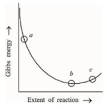
A
$6$
B
$4$
C
$8$
D
$2$
Solution
(D) For a spontaneous process,the slope of the $G$ vs. extent of reaction graph is negative,i.e.,$dG/d\xi < 0$.
For a process at equilibrium,the slope is zero,i.e.,$dG/d\xi = 0$.
For a non-spontaneous process,the slope is positive,i.e.,$dG/d\xi > 0$.
At point $(a)$,the slope is negative,so the reaction is spontaneous.
At point $(b)$,the slope is zero,so the reaction is at equilibrium.
At point $(c)$,the slope is positive,so the reaction is non-spontaneous.
Evaluating the statements:
$A$. Reaction is spontaneous at $(a)$ and $(b)$: False (at $(b)$ it is at equilibrium).
$B$. Reaction is at equilibrium at point $(b)$ and non-spontaneous at point $(c)$: True.
$C$. Reaction is spontaneous at $(a)$ and non-spontaneous at $(c)$: True.
$D$. Reaction is non-spontaneous at $(a)$ and $(b)$: False.
Therefore,there are $2$ true statements ($B$ and $C$).
For a process at equilibrium,the slope is zero,i.e.,$dG/d\xi = 0$.
For a non-spontaneous process,the slope is positive,i.e.,$dG/d\xi > 0$.
At point $(a)$,the slope is negative,so the reaction is spontaneous.
At point $(b)$,the slope is zero,so the reaction is at equilibrium.
At point $(c)$,the slope is positive,so the reaction is non-spontaneous.
Evaluating the statements:
$A$. Reaction is spontaneous at $(a)$ and $(b)$: False (at $(b)$ it is at equilibrium).
$B$. Reaction is at equilibrium at point $(b)$ and non-spontaneous at point $(c)$: True.
$C$. Reaction is spontaneous at $(a)$ and non-spontaneous at $(c)$: True.
$D$. Reaction is non-spontaneous at $(a)$ and $(b)$: False.
Therefore,there are $2$ true statements ($B$ and $C$).
0 likesView Solution
170
ChemistryMediumMCQJEE Main · 2023
The value of $\log \ K$ for the reaction $A \rightleftharpoons B$ at $298 \ K$ is (Nearest integer).
Given: $\Delta H^{\circ} = -54.07 \ kJ \ mol^{-1}$
$\Delta S^{\circ} = 10 \ J \ K^{-1} \ mol^{-1}$
(Take $2.303 \times 8.314 \times 298 = 5705$)
Given: $\Delta H^{\circ} = -54.07 \ kJ \ mol^{-1}$
$\Delta S^{\circ} = 10 \ J \ K^{-1} \ mol^{-1}$
(Take $2.303 \times 8.314 \times 298 = 5705$)
A
$11$
B
$12$
C
$14$
D
$10$
Solution
(D) The relationship between Gibbs free energy change and the equilibrium constant is given by $\Delta G^{\circ} = -RT \ln K = -2.303 \ RT \log K$.
First,calculate $\Delta G^{\circ}$ using $\Delta G^{\circ} = \Delta H^{\circ} - T \Delta S^{\circ}$.
Given $\Delta H^{\circ} = -54.07 \ kJ \ mol^{-1} = -54070 \ J \ mol^{-1}$,$T = 298 \ K$,and $\Delta S^{\circ} = 10 \ J \ K^{-1} \ mol^{-1}$.
$\Delta G^{\circ} = -54070 - (298 \times 10) = -54070 - 2980 = -57050 \ J \ mol^{-1}$.
Now,substitute into the equilibrium equation:
$-57050 = -2.303 \times 8.314 \times 298 \times \log K$.
Using the given value $2.303 \times 8.314 \times 298 = 5705$:
$-57050 = -5705 \times \log K$.
$\log K = \frac{57050}{5705} = 10$.
First,calculate $\Delta G^{\circ}$ using $\Delta G^{\circ} = \Delta H^{\circ} - T \Delta S^{\circ}$.
Given $\Delta H^{\circ} = -54.07 \ kJ \ mol^{-1} = -54070 \ J \ mol^{-1}$,$T = 298 \ K$,and $\Delta S^{\circ} = 10 \ J \ K^{-1} \ mol^{-1}$.
$\Delta G^{\circ} = -54070 - (298 \times 10) = -54070 - 2980 = -57050 \ J \ mol^{-1}$.
Now,substitute into the equilibrium equation:
$-57050 = -2.303 \times 8.314 \times 298 \times \log K$.
Using the given value $2.303 \times 8.314 \times 298 = 5705$:
$-57050 = -5705 \times \log K$.
$\log K = \frac{57050}{5705} = 10$.
0 likesView Solution
171
ChemistryMediumMCQJEE Main · 2023
The number of species from the following which have a square pyramidal structure is $PF_{5}$,$BrF_{4}^{-}$,$IF_{5}$,$BrF_{5}$,$XeOF_{4}$,$ICl_{4}^{-}$.
A
$5$
B
$6$
C
$4$
D
$3$
Solution
(D) To determine the number of species with a square pyramidal structure,we analyze the hybridization and geometry of each:
$1$. $PF_{5}$: $sp^{3}d$ hybridization,trigonal bipyramidal geometry.
$2$. $BrF_{4}^{-}$: $sp^{3}d^{2}$ hybridization with $2$ lone pairs,square planar geometry.
$3$. $IF_{5}$: $sp^{3}d^{2}$ hybridization with $1$ lone pair,square pyramidal geometry.
$4$. $BrF_{5}$: $sp^{3}d^{2}$ hybridization with $1$ lone pair,square pyramidal geometry.
$5$. $XeOF_{4}$: $sp^{3}d^{2}$ hybridization with $1$ lone pair,square pyramidal geometry.
$6$. $ICl_{4}^{-}$: $sp^{3}d^{2}$ hybridization with $2$ lone pairs,square planar geometry.
The species with a square pyramidal structure are $IF_{5}$,$BrF_{5}$,and $XeOF_{4}$.
Therefore,the total number of such species is $3$.
$1$. $PF_{5}$: $sp^{3}d$ hybridization,trigonal bipyramidal geometry.
$2$. $BrF_{4}^{-}$: $sp^{3}d^{2}$ hybridization with $2$ lone pairs,square planar geometry.
$3$. $IF_{5}$: $sp^{3}d^{2}$ hybridization with $1$ lone pair,square pyramidal geometry.
$4$. $BrF_{5}$: $sp^{3}d^{2}$ hybridization with $1$ lone pair,square pyramidal geometry.
$5$. $XeOF_{4}$: $sp^{3}d^{2}$ hybridization with $1$ lone pair,square pyramidal geometry.
$6$. $ICl_{4}^{-}$: $sp^{3}d^{2}$ hybridization with $2$ lone pairs,square planar geometry.
The species with a square pyramidal structure are $IF_{5}$,$BrF_{5}$,and $XeOF_{4}$.
Therefore,the total number of such species is $3$.
0 likesView Solution
172
ChemistryMediumMCQJEE Main · 2023
If $5$ moles of $BaCl_2$ is mixed with $2$ moles of $Na_3PO_4$,the maximum number of moles of $Ba_3(PO_4)_2$ formed is $..........$ (Nearest integer)
A
$2$
B
$3$
C
$4$
D
$1$
Solution
(D) The balanced chemical equation for the reaction is:
$3 BaCl_2 + 2 Na_3PO_4 \rightarrow Ba_3(PO_4)_2 + 6 NaCl$
From the stoichiometry of the reaction:
$3$ moles of $BaCl_2$ react with $2$ moles of $Na_3PO_4$ to produce $1$ mole of $Ba_3(PO_4)_2$.
Given:
$5$ moles of $BaCl_2$ and $2$ moles of $Na_3PO_4$.
To find the limiting reagent:
For $2$ moles of $Na_3PO_4$,we require $(3/2) \times 2 = 3$ moles of $BaCl_2$.
Since we have $5$ moles of $BaCl_2$ (which is more than $3$ moles),$BaCl_2$ is in excess and $Na_3PO_4$ is the limiting reagent.
Calculation of product:
$2$ moles of $Na_3PO_4$ produce $1$ mole of $Ba_3(PO_4)_2$.
Therefore,the maximum number of moles of $Ba_3(PO_4)_2$ formed is $1$.
$3 BaCl_2 + 2 Na_3PO_4 \rightarrow Ba_3(PO_4)_2 + 6 NaCl$
From the stoichiometry of the reaction:
$3$ moles of $BaCl_2$ react with $2$ moles of $Na_3PO_4$ to produce $1$ mole of $Ba_3(PO_4)_2$.
Given:
$5$ moles of $BaCl_2$ and $2$ moles of $Na_3PO_4$.
To find the limiting reagent:
For $2$ moles of $Na_3PO_4$,we require $(3/2) \times 2 = 3$ moles of $BaCl_2$.
Since we have $5$ moles of $BaCl_2$ (which is more than $3$ moles),$BaCl_2$ is in excess and $Na_3PO_4$ is the limiting reagent.
Calculation of product:
$2$ moles of $Na_3PO_4$ produce $1$ mole of $Ba_3(PO_4)_2$.
Therefore,the maximum number of moles of $Ba_3(PO_4)_2$ formed is $1$.
1 likesView Solution
173
ChemistryMediumMCQJEE Main · 2023
The ion having the highest hydration enthalpy among the given alkaline earth metal ions is:
A
$Be^{2+}$
B
$Ba^{2+}$
C
$Sr^{2+}$
D
$Ca^{2+}$
Solution
(A) Hydration enthalpy is inversely proportional to the ionic size: $\text{Hydration Enthalpy} \propto \frac{1}{\text{size}}$.
As we move down the group,the ionic size increases,which causes the hydration enthalpy to decrease.
The order of hydration enthalpy for alkaline earth metal ions is: $Be^{2+} > Mg^{2+} > Ca^{2+} > Sr^{2+} > Ba^{2+}$.
Therefore,$Be^{2+}$ has the highest hydration enthalpy.
As we move down the group,the ionic size increases,which causes the hydration enthalpy to decrease.
The order of hydration enthalpy for alkaline earth metal ions is: $Be^{2+} > Mg^{2+} > Ca^{2+} > Sr^{2+} > Ba^{2+}$.
Therefore,$Be^{2+}$ has the highest hydration enthalpy.
0 likesView Solution
174
ChemistryMediumMCQJEE Main · 2023
Structure of $BeCl_2$ in solid state,vapour phase and at very high temperature respectively are :-
A
Dimeric,Polymeric,Monomeric
B
Polymeric,Dimeric,Monomeric
C
Monomeric,Dimeric,Polymeric
D
Polymeric,Monomeric,Dimeric
Solution
(B) In the solid state,$BeCl_2$ exists as a chain polymer.
In the vapour phase,it exists as a chloro-bridged dimer $(Be_2Cl_4)$.
At very high temperatures (above $1200 \ K$),it exists as a linear monomeric molecule $(BeCl_2)$.
In the vapour phase,it exists as a chloro-bridged dimer $(Be_2Cl_4)$.
At very high temperatures (above $1200 \ K$),it exists as a linear monomeric molecule $(BeCl_2)$.
0 likesView Solution
175
ChemistryMediumMCQJEE Main · 2023
Group-$13$ elements react with $O_2$ to form oxides of the type $M_2O_3$ ($M =$ element). Which among the following is the most basic oxide?
A
$Al_2O_3$
B
$Ga_2O_3$
C
$Tl_2O_3$
D
$B_2O_3$
Solution
(C) The basic character of oxides of Group-$13$ elements increases down the group as the metallic or electropositive character of the elements increases.
The trend in the nature of oxides is as follows:
$B_2O_3$ (acidic) < $Al_2O_3$ (amphoteric) < $Ga_2O_3$ (amphoteric) < $In_2O_3$ (basic) < $Tl_2O_3$ (most basic).
Therefore,$Tl_2O_3$ is the most basic oxide.
The trend in the nature of oxides is as follows:
$B_2O_3$ (acidic) < $Al_2O_3$ (amphoteric) < $Ga_2O_3$ (amphoteric) < $In_2O_3$ (basic) < $Tl_2O_3$ (most basic).
Therefore,$Tl_2O_3$ is the most basic oxide.
0 likesView Solution
176
ChemistryMCQJEE Main · 2023
During the reaction of permanganate with thiosulphate,the change in oxidation state of manganese occurs by a value of $3$. Identify which of the below media will favour the reaction.
A
aqueous acidic
B
aqueous neutral
C
both aqueous acidic and neutral
D
both aqueous acidic and faintly alkaline
Solution
(B) In a neutral or weakly alkaline medium,the oxidation state of $Mn$ in $MnO_4^-$ (where $Mn$ is $+7$) changes to $MnO_2$ (where $Mn$ is $+4$).
This represents a change in oxidation state of $7 - 4 = 3$ units.
Therefore,the reaction is favoured in neutral or faintly alkaline media.
This represents a change in oxidation state of $7 - 4 = 3$ units.
Therefore,the reaction is favoured in neutral or faintly alkaline media.
0 likesView Solution
177
ChemistryDifficultMCQJEE Main · 2023
From the figure of column chromatography given below,identify the incorrect statements.
$A.$ Compound '$c$' is more polar than '$a$' and '$b$'
$B.$ Compound '$a$' is least polar
$C.$ Compound '$b$' comes out of the column before '$c$' and after '$a$'
$D.$ Compound '$a$' spends more time in the column
Choose the correct answer from the options given below :-
$A.$ Compound '$c$' is more polar than '$a$' and '$b$'
$B.$ Compound '$a$' is least polar
$C.$ Compound '$b$' comes out of the column before '$c$' and after '$a$'
$D.$ Compound '$a$' spends more time in the column
Choose the correct answer from the options given below :-
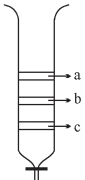
A
$A, B$ and $C$ only
B
$B, C$ and $D$ only
C
$A, B$ and $D$ only
D
$B$ and $D$ only
Solution
(A) In column chromatography,the stationary phase is typically polar (e.g.,silica gel).
The compound that is least polar moves faster and elutes first,while the most polar compound moves slower and elutes last.
Based on the figure,compound '$a$' is at the top,'$b$' is in the middle,and '$c$' is at the bottom (closest to the exit).
Therefore,the order of elution is '$c$' (first),then '$b$',then '$a$' (last).
This implies that '$c$' is the least polar and '$a$' is the most polar.
Let's evaluate the statements:
$A.$ '$c$' is more polar than '$a$' and '$b$': Incorrect,'$c$' is the least polar.
$B.$ '$a$' is least polar: Incorrect,'$a$' is the most polar.
$C.$ '$b$' comes out of the column before '$c$' and after '$a$': Incorrect,'$c$' comes out first,then '$b$',then '$a$.'
$D.$ '$a$' spends more time in the column: Correct,as it is the most polar and interacts most strongly with the stationary phase.
The incorrect statements are $A, B,$ and $C$.
The compound that is least polar moves faster and elutes first,while the most polar compound moves slower and elutes last.
Based on the figure,compound '$a$' is at the top,'$b$' is in the middle,and '$c$' is at the bottom (closest to the exit).
Therefore,the order of elution is '$c$' (first),then '$b$',then '$a$' (last).
This implies that '$c$' is the least polar and '$a$' is the most polar.
Let's evaluate the statements:
$A.$ '$c$' is more polar than '$a$' and '$b$': Incorrect,'$c$' is the least polar.
$B.$ '$a$' is least polar: Incorrect,'$a$' is the most polar.
$C.$ '$b$' comes out of the column before '$c$' and after '$a$': Incorrect,'$c$' comes out first,then '$b$',then '$a$.'
$D.$ '$a$' spends more time in the column: Correct,as it is the most polar and interacts most strongly with the stationary phase.
The incorrect statements are $A, B,$ and $C$.
0 likesView Solution
178
ChemistryMCQJEE Main · 2023
Given below are two statements:-
Statement-$I$: Morphine is a narcotic analgesic. It helps in relieving pain without producing sleep.
Statement-$II$: Morphine and its derivatives are obtained from opium poppy.
In the light of the above statements,choose the correct answer from the options given below.
Statement-$I$: Morphine is a narcotic analgesic. It helps in relieving pain without producing sleep.
Statement-$II$: Morphine and its derivatives are obtained from opium poppy.
In the light of the above statements,choose the correct answer from the options given below.
A
Statement $I$ is true but Statement $II$ is false
B
Both Statement $I$ and Statement $II$ are false
C
Both Statement $I$ and Statement $II$ are true
D
Statement $I$ is false but Statement $II$ is true
Solution
(D) Statement-$I$: Morphine is a narcotic analgesic that relieves pain and produces sleep. The claim that it relieves pain 'without producing sleep' is incorrect.
Statement-$II$: Morphine and its derivatives (like codeine and heroin) are indeed obtained from the opium poppy plant $(Papaver \text{ } somniferum)$. This statement is correct.
Therefore,Statement-$I$ is false and Statement-$II$ is true.
Statement-$II$: Morphine and its derivatives (like codeine and heroin) are indeed obtained from the opium poppy plant $(Papaver \text{ } somniferum)$. This statement is correct.
Therefore,Statement-$I$ is false and Statement-$II$ is true.
0 likesView Solution
179
ChemistryMediumMCQJEE Main · 2023
The volume of $0.02 \, M$ aqueous $HBr$ required to neutralize $10.0 \, mL$ of $0.01 \, M$ aqueous $Ba(OH)_2$ is $....... \, mL$ (Assume complete neutralization).
A
$2.5$
B
$5$
C
$10$
D
$7.5$
Solution
(C) The neutralization reaction is: $Ba(OH)_2 + 2HBr \rightarrow BaBr_2 + 2H_2O$.
Using the law of equivalence,$n_{eq}(HBr) = n_{eq}(Ba(OH)_2)$.
Since $n_{eq} = M \times V \times n_{factor}$,where $n_{factor}$ for $HBr$ is $1$ and for $Ba(OH)_2$ is $2$:
$0.02 \times V_1 \times 1 = 0.01 \times 10 \times 2$.
$0.02 \times V_1 = 0.2$.
$V_1 = \frac{0.2}{0.02} = 10 \, mL$.
Using the law of equivalence,$n_{eq}(HBr) = n_{eq}(Ba(OH)_2)$.
Since $n_{eq} = M \times V \times n_{factor}$,where $n_{factor}$ for $HBr$ is $1$ and for $Ba(OH)_2$ is $2$:
$0.02 \times V_1 \times 1 = 0.01 \times 10 \times 2$.
$0.02 \times V_1 = 0.2$.
$V_1 = \frac{0.2}{0.02} = 10 \, mL$.
0 likesView Solution
180
ChemistryMCQJEE Main · 2023
The group of chemicals used as pesticides is
A
$Sodium \ chlorate, DDT, PAN$
B
$Aldrin, Sodium \ chlorate, Sodium \ arsinite$
C
$DDT, Aldrin$
D
$Dieldrin, Sodium \ arsinite, Tetrachloroethene$
Solution
(C) Pesticides are chemical substances used to kill or control pests.
$DDT$ (Dichlorodiphenyltrichloroethane) and Aldrin are well-known organochlorine compounds used as pesticides.
Therefore,the group consisting of $DDT$ and Aldrin represents pesticides.
$DDT$ (Dichlorodiphenyltrichloroethane) and Aldrin are well-known organochlorine compounds used as pesticides.
Therefore,the group consisting of $DDT$ and Aldrin represents pesticides.
0 likesView Solution
181
ChemistryMediumMCQJEE Main · 2023
Which one of the following elements will remain as liquid inside pure boiling water?
A
$Cs$
B
$Ga$
C
$Li$
D
$Br$
Solution
(B) $Li$ and $Cs$ are highly reactive metals that react vigorously with water.
$Br_2$ has a boiling point of $58^{\circ}C$,so it will change into a vapour state in boiling water $(100^{\circ}C)$.
$Ga$ has a melting point of $29^{\circ}C$ and a boiling point of $2400^{\circ}C$. Therefore,it remains in the liquid state within the temperature range of boiling water $(100^{\circ}C)$.
$Br_2$ has a boiling point of $58^{\circ}C$,so it will change into a vapour state in boiling water $(100^{\circ}C)$.
$Ga$ has a melting point of $29^{\circ}C$ and a boiling point of $2400^{\circ}C$. Therefore,it remains in the liquid state within the temperature range of boiling water $(100^{\circ}C)$.
0 likesView Solution
182
ChemistryMediumMCQJEE Main · 2023
If the radius of the first orbit of hydrogen atom is $a_0$, then de Broglie's wavelength of electron in $3^{rd}$ orbit is (in $\pi a_0$)
A
$2$
B
$6$
C
$9$
D
$3$
Solution
(B) The radius of the $n^{th}$ orbit of a hydrogen atom is given by $r_n = a_0 n^2$.
For the $3^{rd}$ orbit $(n = 3)$, the radius is $r_3 = a_0 \times 3^2 = 9 a_0$.
According to Bohr's postulate, the circumference of the orbit is an integral multiple of the de Broglie wavelength: $2 \pi r_n = n \lambda$.
Substituting the values for the $3^{rd}$ orbit: $2 \pi (9 a_0) = 3 \lambda$.
Solving for $\lambda$: $\lambda = \frac{18 \pi a_0}{3} = 6 \pi a_0$.
For the $3^{rd}$ orbit $(n = 3)$, the radius is $r_3 = a_0 \times 3^2 = 9 a_0$.
According to Bohr's postulate, the circumference of the orbit is an integral multiple of the de Broglie wavelength: $2 \pi r_n = n \lambda$.
Substituting the values for the $3^{rd}$ orbit: $2 \pi (9 a_0) = 3 \lambda$.
Solving for $\lambda$: $\lambda = \frac{18 \pi a_0}{3} = 6 \pi a_0$.
0 likesView Solution
183
ChemistryMediumMCQJEE Main · 2023
In an ice crystal,each water molecule is hydrogen bonded to $.......$ neighbouring molecules.
A
$2$
B
$6$
C
$4$
D
$8$
Solution
(C) In an ice crystal,the structure is highly ordered and three-dimensional.
Each water molecule is hydrogen bonded to $4$ neighbouring water molecules in a tetrahedral arrangement.
Each water molecule is hydrogen bonded to $4$ neighbouring water molecules in a tetrahedral arrangement.
0 likesView Solution
184
ChemistryMediumMCQJEE Main · 2023
The equilibrium composition for the reaction $PCl_3 + Cl_2 \rightleftharpoons PCl_5$ at $298 \, K$ is given below.
$[PCl_3]_{eq} = 0.2 \, mol \, L^{-1}$
$[Cl_2]_{eq} = 0.1 \, mol \, L^{-1}$
$[PCl_5]_{eq} = 0.40 \, mol \, L^{-1}$
If $0.2 \, mol$ of $Cl_2$ is added at the same temperature,the equilibrium concentration of $PCl_5$ is $.... \times 10^{-2} \, mol \, L^{-1}$. Given: $K_c$ for the reaction at $298 \, K$ is $20$.
$[PCl_3]_{eq} = 0.2 \, mol \, L^{-1}$
$[Cl_2]_{eq} = 0.1 \, mol \, L^{-1}$
$[PCl_5]_{eq} = 0.40 \, mol \, L^{-1}$
If $0.2 \, mol$ of $Cl_2$ is added at the same temperature,the equilibrium concentration of $PCl_5$ is $.... \times 10^{-2} \, mol \, L^{-1}$. Given: $K_c$ for the reaction at $298 \, K$ is $20$.
A
$49$
B
$50$
C
$48$
D
$51$
Solution
(A) The initial equilibrium constant is $K_c = \frac{[PCl_5]}{[PCl_3][Cl_2]} = \frac{0.40}{0.2 \times 0.1} = 20$.
When $0.2 \, mol$ of $Cl_2$ is added to $1 \, L$ volume,the new concentration of $Cl_2$ becomes $0.1 + 0.2 = 0.3 \, M$.
Let $x$ be the amount of $PCl_3$ and $Cl_2$ consumed to reach the new equilibrium.
The new equilibrium concentrations are: $[PCl_3] = 0.2 - x$,$[Cl_2] = 0.3 - x$,and $[PCl_5] = 0.4 + x$.
Substituting into the $K_c$ expression: $\frac{0.4 + x}{(0.2 - x)(0.3 - x)} = 20$.
$0.4 + x = 20(0.06 - 0.5x + x^2) = 1.2 - 10x + 20x^2$.
$20x^2 - 11x + 0.8 = 0$.
Using the quadratic formula $x = \frac{-b \pm \sqrt{b^2 - 4ac}}{2a}$,we get $x \approx 0.086$.
Thus,$[PCl_5]_{eq} = 0.4 + 0.086 = 0.486 \, M = 48.6 \times 10^{-2} \, mol \, L^{-1}$.
Rounding to the nearest integer,the value is $49$.
When $0.2 \, mol$ of $Cl_2$ is added to $1 \, L$ volume,the new concentration of $Cl_2$ becomes $0.1 + 0.2 = 0.3 \, M$.
Let $x$ be the amount of $PCl_3$ and $Cl_2$ consumed to reach the new equilibrium.
The new equilibrium concentrations are: $[PCl_3] = 0.2 - x$,$[Cl_2] = 0.3 - x$,and $[PCl_5] = 0.4 + x$.
Substituting into the $K_c$ expression: $\frac{0.4 + x}{(0.2 - x)(0.3 - x)} = 20$.
$0.4 + x = 20(0.06 - 0.5x + x^2) = 1.2 - 10x + 20x^2$.
$20x^2 - 11x + 0.8 = 0$.
Using the quadratic formula $x = \frac{-b \pm \sqrt{b^2 - 4ac}}{2a}$,we get $x \approx 0.086$.
Thus,$[PCl_5]_{eq} = 0.4 + 0.086 = 0.486 \, M = 48.6 \times 10^{-2} \, mol \, L^{-1}$.
Rounding to the nearest integer,the value is $49$.
0 likesView Solution
185
ChemistryMediumMCQJEE Main · 2023
Consider the following data:
Heat of combustion of $H_{2(g)} = -241.8 \ kJ \ mol^{-1}$
Heat of combustion of $C_{(s)} = -393.5 \ kJ \ mol^{-1}$
Heat of combustion of $C_2H_5OH_{(l)} = -1234.7 \ kJ \ mol^{-1}$
The heat of formation of $C_2H_5OH_{(l)}$ is $(-)$ $...... \ kJ \ mol^{-1}$ (Nearest integer).
Heat of combustion of $H_{2(g)} = -241.8 \ kJ \ mol^{-1}$
Heat of combustion of $C_{(s)} = -393.5 \ kJ \ mol^{-1}$
Heat of combustion of $C_2H_5OH_{(l)} = -1234.7 \ kJ \ mol^{-1}$
The heat of formation of $C_2H_5OH_{(l)}$ is $(-)$ $...... \ kJ \ mol^{-1}$ (Nearest integer).
A
$277$
B
$276$
C
$278$
D
$275$
Solution
(C) The formation reaction is: $2C_{(s)} + 3H_{2(g)} + \frac{1}{2}O_{2(g)} \rightarrow C_2H_5OH_{(l)}$
The heat of formation is calculated as: $(\Delta H_f)_{C_2H_5OH_{(l)}} = [2 \times \Delta H_c(C_{(s)}) + 3 \times \Delta H_c(H_{2(g)})] - \Delta H_c(C_2H_5OH_{(l)})$
Substituting the values: $= [2 \times (-393.5) + 3 \times (-241.8)] - (-1234.7)$
$= [-787.0 - 725.4] + 1234.7$
$= -1512.4 + 1234.7 = -277.7 \ kJ \ mol^{-1}$
The nearest integer value is $-278 \ kJ \ mol^{-1}$.
The heat of formation is calculated as: $(\Delta H_f)_{C_2H_5OH_{(l)}} = [2 \times \Delta H_c(C_{(s)}) + 3 \times \Delta H_c(H_{2(g)})] - \Delta H_c(C_2H_5OH_{(l)})$
Substituting the values: $= [2 \times (-393.5) + 3 \times (-241.8)] - (-1234.7)$
$= [-787.0 - 725.4] + 1234.7$
$= -1512.4 + 1234.7 = -277.7 \ kJ \ mol^{-1}$
The nearest integer value is $-278 \ kJ \ mol^{-1}$.
0 likesView Solution
186
ChemistryEasyMCQJEE Main · 2023
$2 IO_3^- + x I^- + 12 H^+ \rightarrow 6 I_2 + 6 H_2 O$. What is the value of $x$?
A
$12$
B
$2$
C
$6$
D
$10$
Solution
(D) To balance the chemical equation,the number of atoms of each element must be equal on both sides.
For Iodine $(I)$:
Reactant side: $2$ (from $2 IO_3^-$) $+ x$ (from $x I^-$) $= 2 + x$
Product side: $6 \times 2 = 12$ (from $6 I_2$)
Equating the two sides:
$2 + x = 12$
$x = 12 - 2$
$x = 10$
Thus,the balanced equation is $2 IO_3^- + 10 I^- + 12 H^+ \rightarrow 6 I_2 + 6 H_2 O$.
For Iodine $(I)$:
Reactant side: $2$ (from $2 IO_3^-$) $+ x$ (from $x I^-$) $= 2 + x$
Product side: $6 \times 2 = 12$ (from $6 I_2$)
Equating the two sides:
$2 + x = 12$
$x = 12 - 2$
$x = 10$
Thus,the balanced equation is $2 IO_3^- + 10 I^- + 12 H^+ \rightarrow 6 I_2 + 6 H_2 O$.
0 likesView Solution
187
ChemistryEasyMCQJEE Main · 2023
The water gas on reacting with cobalt as a catalyst forms
A
Ethanol
B
Methanoic acid
C
Methanal
D
Methanol
Solution
(D) Water gas is a mixture of $CO$ and $H_2$. When water gas reacts with $H_2$ in the presence of a cobalt catalyst,it produces methanol.
$CO + 2H_2 \xrightarrow{Co} CH_3OH$
$CO + 2H_2 \xrightarrow{Co} CH_3OH$
0 likesView Solution
188
ChemistryEasyMCQJEE Main · 2023
What is the purpose of adding gypsum $(CaSO_4 \cdot 2H_2O)$ to cement?
A
To facilitate the hydration of cement
B
To speed up the process of setting
C
To slow down the process of setting
D
To give a hard mass
Solution
(C) When water is added to cement,it sets very quickly,which makes it difficult to work with. Adding a small amount of gypsum $(CaSO_4 \cdot 2H_2O)$ to the cement clinker during the grinding process helps to retard or slow down the initial setting time of the cement,allowing sufficient time for mixing,placing,and finishing the concrete.
0 likesView Solution
189
ChemistryDifficultMCQJEE Main · 2023
Match List-$I$ with List-$II$ :
| List-$I$ (Species) | List-$II$ (Maximum allowed concentration in ppm in drinking water) |
| $A$. $F^{-}$ | $I$. $< 50 \, ppm$ |
| $B$. $SO_{4}^{2-}$ | $II$. $< 5 \, ppm$ |
| $C$. $NO_{3}^{-}$ | $III$. $< 2 \, ppm$ |
| $D$. $Zn$ | $IV$. $< 500 \, ppm$ |
A
$A-II, B-I, C-III, D-IV$
B
$A-IV, B-III, C-II, D-I$
C
$A-I, B-II, C-III, D-IV$
D
$A-III, B-IV, C-I, D-II$
Solution
(D) According to the standards for drinking water:
$A$. $F^{-}$: The maximum concentration is $< 2 \, ppm$ $(III)$.
$B$. $SO_{4}^{2-}$: The maximum concentration is $< 500 \, ppm$ $(IV)$.
$C$. $NO_{3}^{-}$: The maximum concentration is $< 50 \, ppm$ $(I)$.
$D$. $Zn$: The maximum concentration is $< 5 \, ppm$ $(II)$.
Therefore,the correct matching is $A-III, B-IV, C-I, D-II$.
$A$. $F^{-}$: The maximum concentration is $< 2 \, ppm$ $(III)$.
$B$. $SO_{4}^{2-}$: The maximum concentration is $< 500 \, ppm$ $(IV)$.
$C$. $NO_{3}^{-}$: The maximum concentration is $< 50 \, ppm$ $(I)$.
$D$. $Zn$: The maximum concentration is $< 5 \, ppm$ $(II)$.
Therefore,the correct matching is $A-III, B-IV, C-I, D-II$.
0 likesView Solution
190
ChemistryMediumMCQJEE Main · 2023
The correct order of electronegativity for the given elements is:
A
$C > P > At > Br$
B
$Br > P > At > C$
C
$P > Br > C > At$
D
$Br > C > At > P$
Solution
(D) The electronegativity $(E.N.)$ values on the Pauling scale for the given elements are as follows:
Based on these values,the correct order of electronegativity is $Br > C > At > P$. Therefore,the correct option is $D$.
| Element | $E.N.$ Value |
|---|---|
| $Br$ | $3.0$ |
| $C$ | $2.5$ |
| $At$ | $2.2$ |
| $P$ | $2.1$ |
0 likesView Solution
191
ChemistryMediumMCQJEE Main · 2023
Given below are two statements:
Statement $I$: Lithium and Magnesium do not form superoxide.
Statement $II$: The ionic radius of $Li^{+}$ is larger than the ionic radius of $Mg^{2+}$.
In the light of the above statements,choose the most appropriate answer from the options given below:
Statement $I$: Lithium and Magnesium do not form superoxide.
Statement $II$: The ionic radius of $Li^{+}$ is larger than the ionic radius of $Mg^{2+}$.
In the light of the above statements,choose the most appropriate answer from the options given below:
A
Statement $I$ is incorrect but Statement $II$ is correct.
B
Statement $I$ is correct but Statement $II$ is incorrect.
C
Both Statement $I$ and Statement $II$ are correct.
D
Both Statement $I$ and Statement $II$ are incorrect.
Solution
(C) Statement $I$ is correct: Lithium $(Li)$ and Magnesium $(Mg)$ have high charge density and small ionic sizes,which prevents the formation of larger superoxide ions. They typically form normal oxides ($Li_2O$ and $MgO$).
Statement $II$ is correct: The ionic radius of $Li^{+}$ is $76 \ pm$ $(0.76 \ \mathring{A})$ and the ionic radius of $Mg^{2+}$ is $72 \ pm$ $(0.72 \ \mathring{A})$. Since $76 \ pm$ > $72 \ pm$,the ionic radius of $Li^{+}$ is indeed larger than that of $Mg^{2+}$.
Therefore,both statements are correct.
Statement $II$ is correct: The ionic radius of $Li^{+}$ is $76 \ pm$ $(0.76 \ \mathring{A})$ and the ionic radius of $Mg^{2+}$ is $72 \ pm$ $(0.72 \ \mathring{A})$. Since $76 \ pm$ > $72 \ pm$,the ionic radius of $Li^{+}$ is indeed larger than that of $Mg^{2+}$.
Therefore,both statements are correct.
0 likesView Solution
192
ChemistryMediumMCQJEE Main · 2023
Molar mass of the hydrocarbon $(X)$ which on ozonolysis consumes one mole of $O_3$ per mole of $(X)$ and gives one mole each of ethanal and propanone is $...... g\ mol^{-1}$ (Molar mass of $C: 12\ g\ mol^{-1}, H: 1\ g\ mol^{-1}$)
A
$71$
B
$70$
C
$69$
D
$68$
Solution
(B) The ozonolysis of an alkene involves the cleavage of the $C=C$ double bond to form carbonyl compounds.
Ethanal is $CH_3CHO$ and propanone is $(CH_3)_2CO$.
By joining these two fragments at the carbonyl carbons,we get the structure of the alkene $(X)$:
$CH_3-CH=C(CH_3)_2$.
The chemical formula of this hydrocarbon is $C_5H_{10}$.
The molar mass of $C_5H_{10} = (5 \times 12) + (10 \times 1) = 60 + 10 = 70 \ g\ mol^{-1}$.
Ethanal is $CH_3CHO$ and propanone is $(CH_3)_2CO$.
By joining these two fragments at the carbonyl carbons,we get the structure of the alkene $(X)$:
$CH_3-CH=C(CH_3)_2$.
The chemical formula of this hydrocarbon is $C_5H_{10}$.
The molar mass of $C_5H_{10} = (5 \times 12) + (10 \times 1) = 60 + 10 = 70 \ g\ mol^{-1}$.
0 likesView Solution
193
ChemistryMediumMCQJEE Main · 2023
The number of the following factors which affect the percent covalent character of the ionic bond is $............$.
$(a)$ Polarising power of cation
$(b)$ Extent of distortion of anion
$(c)$ Polarisability of the anion
$(d)$ Polarising power of anion
$(a)$ Polarising power of cation
$(b)$ Extent of distortion of anion
$(c)$ Polarisability of the anion
$(d)$ Polarising power of anion
A
$4$
B
$3$
C
$2$
D
$1$
Solution
(B) According to Fajan's rule,the covalent character in an ionic bond is determined by the following factors:
$1$. Polarising power of the cation $(a)$.
$2$. Polarisability of the anion $(c)$.
$3$. The extent of distortion of the anion $(b)$,which is a direct consequence of the first two factors.
Factor $(d)$,the polarising power of the anion,is generally negligible as anions are typically large and have low charge density compared to cations.
Therefore,there are $3$ factors ($a$,$b$,and $c$) that affect the covalent character.
$1$. Polarising power of the cation $(a)$.
$2$. Polarisability of the anion $(c)$.
$3$. The extent of distortion of the anion $(b)$,which is a direct consequence of the first two factors.
Factor $(d)$,the polarising power of the anion,is generally negligible as anions are typically large and have low charge density compared to cations.
Therefore,there are $3$ factors ($a$,$b$,and $c$) that affect the covalent character.
0 likesView Solution
194
ChemistryMediumMCQJEE Main · 2023
When a $60 \, W$ electric heater is immersed in a gas for $100 \, s$ in a constant volume container with adiabatic walls,the temperature of the gas rises by $5^{\circ} \, C$. The heat capacity of the given gas is $......... \, J \, K^{-1}$ (Nearest integer).
A
$1100$
B
$1200$
C
$1000$
D
$1600$
Solution
(B) Power of the heater $P = 60 \, W = 60 \, J \, s^{-1}$.
Total energy supplied $Q = P \times t = 60 \, J \, s^{-1} \times 100 \, s = 6000 \, J$.
Since the container is adiabatic and of constant volume,the heat supplied is equal to the heat absorbed by the gas.
$Q = C \times \Delta T$,where $C$ is the heat capacity and $\Delta T$ is the change in temperature.
$6000 \, J = C \times 5 \, K$.
$C = \frac{6000}{5} = 1200 \, J \, K^{-1}$.
Total energy supplied $Q = P \times t = 60 \, J \, s^{-1} \times 100 \, s = 6000 \, J$.
Since the container is adiabatic and of constant volume,the heat supplied is equal to the heat absorbed by the gas.
$Q = C \times \Delta T$,where $C$ is the heat capacity and $\Delta T$ is the change in temperature.
$6000 \, J = C \times 5 \, K$.
$C = \frac{6000}{5} = 1200 \, J \, K^{-1}$.
0 likesView Solution
195
ChemistryMediumMCQJEE Main · 2023
$0.5 \ g$ of an organic compound $(X)$ with $60 \%$ carbon will produce $........ \times 10^{-1} \ g$ of $CO_2$ on complete combustion.
A
$10$
B
$11$
C
$12$
D
$13$
Solution
(B) The percentage of carbon in an organic compound is given by the formula:
$\% \text{Carbon} = \frac{12}{44} \times \frac{\text{mass of } CO_2 \text{ formed}}{\text{mass of compound taken}} \times 100$
Given,$\% \text{Carbon} = 60$,$\text{mass of compound} = 0.5 \ g$.
Substituting the values:
$60 = \frac{12}{44} \times \frac{\text{mass of } CO_2}{0.5} \times 100$
$\text{mass of } CO_2 = \frac{60 \times 44 \times 0.5}{12 \times 100} \ g$
$\text{mass of } CO_2 = \frac{1320}{1200} \ g = 1.1 \ g$
Expressing $1.1 \ g$ in the form $........ \times 10^{-1} \ g$:
$1.1 \ g = 11 \times 10^{-1} \ g$
Thus,the missing value is $11$.
$\% \text{Carbon} = \frac{12}{44} \times \frac{\text{mass of } CO_2 \text{ formed}}{\text{mass of compound taken}} \times 100$
Given,$\% \text{Carbon} = 60$,$\text{mass of compound} = 0.5 \ g$.
Substituting the values:
$60 = \frac{12}{44} \times \frac{\text{mass of } CO_2}{0.5} \times 100$
$\text{mass of } CO_2 = \frac{60 \times 44 \times 0.5}{12 \times 100} \ g$
$\text{mass of } CO_2 = \frac{1320}{1200} \ g = 1.1 \ g$
Expressing $1.1 \ g$ in the form $........ \times 10^{-1} \ g$:
$1.1 \ g = 11 \times 10^{-1} \ g$
Thus,the missing value is $11$.
0 likesView Solution
196
ChemistryDifficultMCQJEE Main · 2023
The titration curve of a weak acid vs. a strong base with phenolphthalein as an indicator is shown below. The $K_{In} = 4 \times 10^{-10}$. Given: $\log 2 = 0.3$. The number of the following statements which is/are correct about phenolphthalein is $.....$.
$A$. It can be used as an indicator for the titration of a weak acid with a weak base.
$B$. It begins to change colour at $pH = 8.4$.
$C$. It is a weak organic base.
$D$. It is colourless in an acidic medium.
$A$. It can be used as an indicator for the titration of a weak acid with a weak base.
$B$. It begins to change colour at $pH = 8.4$.
$C$. It is a weak organic base.
$D$. It is colourless in an acidic medium.
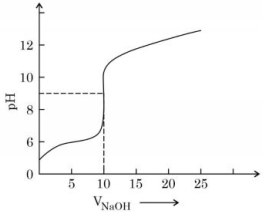
A
$1$
B
$2$
C
$3$
D
$4$
Solution
(B) $pK_{In} = -\log(4 \times 10^{-10}) = -(\log 4 + \log 10^{-10}) = -(0.6 - 10) = 9.4$.
The indicator range is given by $pK_{In} \pm 1$,which is $8.4$ to $10.4$.
Statement $A$: Incorrect. Phenolphthalein is not suitable for weak acid-weak base titrations because the pH change is not sharp enough.
Statement $B$: Correct. The colour change range starts at $pH = pK_{In} - 1 = 9.4 - 1 = 8.4$.
Statement $C$: Incorrect. Phenolphthalein is a weak organic acid $(HIn)$.
Statement $D$: Correct. In an acidic medium,the equilibrium $HIn \rightleftharpoons H^+ + In^-$ shifts to the left,keeping it in the unionized $HIn$ form,which is colourless.
Therefore,statements $B$ and $D$ are correct. The total number of correct statements is $2$.
The indicator range is given by $pK_{In} \pm 1$,which is $8.4$ to $10.4$.
Statement $A$: Incorrect. Phenolphthalein is not suitable for weak acid-weak base titrations because the pH change is not sharp enough.
Statement $B$: Correct. The colour change range starts at $pH = pK_{In} - 1 = 9.4 - 1 = 8.4$.
Statement $C$: Incorrect. Phenolphthalein is a weak organic acid $(HIn)$.
Statement $D$: Correct. In an acidic medium,the equilibrium $HIn \rightleftharpoons H^+ + In^-$ shifts to the left,keeping it in the unionized $HIn$ form,which is colourless.
Therefore,statements $B$ and $D$ are correct. The total number of correct statements is $2$.
0 likesView Solution
197
ChemistryMediumMCQJEE Main · 2023
Three bulbs are filled with $CH_4$,$CO_2$,and $Ne$ as shown in the picture. The bulbs are connected through pipes of zero volume. When the stopcocks are opened and the temperature is kept constant throughout,the pressure of the system is found to be $...... \ atm$. (Nearest integer)
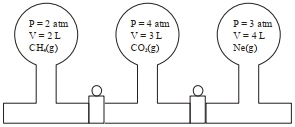
A
$2$
B
$3$
C
$4$
D
$1$
Solution
(B) Using the ideal gas equation $PV = nRT$,since $T$ is constant,$n = \frac{PV}{RT}$.
For $CH_4$: $n_1 = \frac{2 \times 2}{RT} = \frac{4}{RT}$.
For $CO_2$: $n_2 = \frac{4 \times 3}{RT} = \frac{12}{RT}$.
For $Ne$: $n_3 = \frac{3 \times 4}{RT} = \frac{12}{RT}$.
Total moles $n_T = n_1 + n_2 + n_3 = \frac{4 + 12 + 12}{RT} = \frac{28}{RT}$.
Total volume $V_T = 2 + 3 + 4 = 9 \ L$.
Final pressure $P_T = \frac{n_T RT}{V_T} = \frac{28}{RT} \times \frac{RT}{9} = \frac{28}{9} \approx 3.11 \ atm$.
The nearest integer is $3$.
For $CH_4$: $n_1 = \frac{2 \times 2}{RT} = \frac{4}{RT}$.
For $CO_2$: $n_2 = \frac{4 \times 3}{RT} = \frac{12}{RT}$.
For $Ne$: $n_3 = \frac{3 \times 4}{RT} = \frac{12}{RT}$.
Total moles $n_T = n_1 + n_2 + n_3 = \frac{4 + 12 + 12}{RT} = \frac{28}{RT}$.
Total volume $V_T = 2 + 3 + 4 = 9 \ L$.
Final pressure $P_T = \frac{n_T RT}{V_T} = \frac{28}{RT} \times \frac{RT}{9} = \frac{28}{9} \approx 3.11 \ atm$.
The nearest integer is $3$.
0 likesView Solution
198
ChemistryMediumMCQJEE Main · 2023
The number of the following statements which is/are incorrect is:
$A$. Line emission spectra are used to study the electronic structure.
$B$. The emission spectra of atoms in the gas phase show a continuous spread of wavelength from red to violet.
$C$. An absorption spectrum is like the photographic negative of an emission spectrum.
$D$. The element helium was discovered in the sun by spectroscopic method.
$A$. Line emission spectra are used to study the electronic structure.
$B$. The emission spectra of atoms in the gas phase show a continuous spread of wavelength from red to violet.
$C$. An absorption spectrum is like the photographic negative of an emission spectrum.
$D$. The element helium was discovered in the sun by spectroscopic method.
A
$2$
B
$1$
C
$3$
D
$0$
Solution
(B) Statement $A$ is correct: Line emission spectra provide information about the electronic structure of atoms.
Statement $B$ is incorrect: Atoms in the gas phase emit line spectra (discrete wavelengths),not a continuous spectrum.
Statement $C$ is correct: An absorption spectrum consists of dark lines in a continuous spectrum,which corresponds to the bright lines in an emission spectrum,acting like a photographic negative.
Statement $D$ is correct: Helium was indeed discovered in the sun's spectrum during a solar eclipse.
Therefore,only $1$ statement (Statement $B$) is incorrect.
Statement $B$ is incorrect: Atoms in the gas phase emit line spectra (discrete wavelengths),not a continuous spectrum.
Statement $C$ is correct: An absorption spectrum consists of dark lines in a continuous spectrum,which corresponds to the bright lines in an emission spectrum,acting like a photographic negative.
Statement $D$ is correct: Helium was indeed discovered in the sun's spectrum during a solar eclipse.
Therefore,only $1$ statement (Statement $B$) is incorrect.
0 likesView Solution
199
ChemistryDifficultMCQJEE Main · 2023
Which of the following have the same number of significant figures?
$(A)$ $0.00253$
$(B)$ $1.0003$
$(C)$ $15.0$
$(D)$ $163$
Choose the correct answer from the options given below:
$(A)$ $0.00253$
$(B)$ $1.0003$
$(C)$ $15.0$
$(D)$ $163$
Choose the correct answer from the options given below:
A
$A, C$ and $D$ only
B
$C$ and $D$ only
C
$A, B$ and $C$ only
D
$B$ and $C$ only
Solution
(A) To determine the number of significant figures,we follow these rules:
$1$. All non-zero digits are significant.
$2$. Zeros between non-zero digits are significant.
$3$. Leading zeros are not significant.
$4$. Trailing zeros in a number with a decimal point are significant.
Analysis of the given values:
- $0.00253$: The leading zeros are not significant. The significant figures are $2, 5, 3$. Total $= 3$.
- $1.0003$: Zeros between non-zero digits are significant. Total $= 5$.
- $15.0$: Trailing zeros in a decimal number are significant. Total $= 3$.
- $163$: All digits are non-zero. Total $= 3$.
Thus,$A, C,$ and $D$ have $3$ significant figures each.
Therefore,the correct option is $A$.
$1$. All non-zero digits are significant.
$2$. Zeros between non-zero digits are significant.
$3$. Leading zeros are not significant.
$4$. Trailing zeros in a number with a decimal point are significant.
Analysis of the given values:
- $0.00253$: The leading zeros are not significant. The significant figures are $2, 5, 3$. Total $= 3$.
- $1.0003$: Zeros between non-zero digits are significant. Total $= 5$.
- $15.0$: Trailing zeros in a decimal number are significant. Total $= 3$.
- $163$: All digits are non-zero. Total $= 3$.
Thus,$A, C,$ and $D$ have $3$ significant figures each.
Therefore,the correct option is $A$.
0 likesView Solution
200
ChemistryMediumMCQJEE Main · 2023
Which of these reactions is not a part of the breakdown of ozone in the stratosphere?
A
$Cl\dot{O}_{(g)} + O_{(g)} \longrightarrow \dot{Cl}_{(g)} + O_{2(g)}$
B
$\dot{Cl}_{(g)} + O_{3(g)} \longrightarrow Cl\dot{O}_{(g)} + O_{2(g)}$
C
$2Cl\dot{O} \longrightarrow ClO_{2(g)} + Cl_{(g)}$
D
$CF_2Cl_{2(g)} \stackrel{uv}{\longrightarrow} \dot{Cl}_{(g)} + \dot{C}F_2Cl_{(g)}$
Solution
(C) The breakdown of ozone in the stratosphere by chlorofluorocarbons $(CFCs)$ involves the following steps:
$1$. Photodissociation of $CFCs$: $CF_2Cl_{2(g)} \stackrel{uv}{\longrightarrow} \dot{Cl}_{(g)} + \dot{C}F_2Cl_{(g)}$
$2$. Reaction of chlorine radical with ozone: $\dot{Cl}_{(g)} + O_{3(g)} \longrightarrow Cl\dot{O}_{(g)} + O_{2(g)}$
$3$. Reaction of chlorine monoxide radical with atomic oxygen: $Cl\dot{O}_{(g)} + O_{(g)} \longrightarrow \dot{Cl}_{(g)} + O_{2(g)}$
The reaction $2Cl\dot{O} \longrightarrow ClO_{2(g)} + Cl_{(g)}$ is not a standard step in the catalytic cycle of ozone depletion by chlorine radicals.
$1$. Photodissociation of $CFCs$: $CF_2Cl_{2(g)} \stackrel{uv}{\longrightarrow} \dot{Cl}_{(g)} + \dot{C}F_2Cl_{(g)}$
$2$. Reaction of chlorine radical with ozone: $\dot{Cl}_{(g)} + O_{3(g)} \longrightarrow Cl\dot{O}_{(g)} + O_{2(g)}$
$3$. Reaction of chlorine monoxide radical with atomic oxygen: $Cl\dot{O}_{(g)} + O_{(g)} \longrightarrow \dot{Cl}_{(g)} + O_{2(g)}$
The reaction $2Cl\dot{O} \longrightarrow ClO_{2(g)} + Cl_{(g)}$ is not a standard step in the catalytic cycle of ozone depletion by chlorine radicals.
0 likesView Solution
201
ChemistryMediumMCQJEE Main · 2023
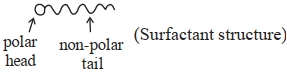
When surfactants are added to a non-polar solvent,how will the micelle structure look?
A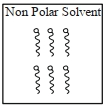
B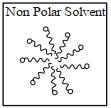
C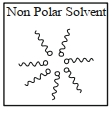
D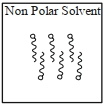
Solution
(A) In a non-polar solvent,the surfactant molecules form reverse micelles. The polar heads,which are hydrophilic,aggregate in the center to minimize contact with the non-polar solvent,while the non-polar tails,which are lipophilic,extend outwards into the non-polar solvent. This structure is represented by option $A$.
0 likesView Solution
202
ChemistryDifficultMCQJEE Main · 2023
An organic compound $A$ with empirical formula $C_6H_6O$ gives a sooty flame on burning. Its reaction with bromine solution in a low polarity solvent results in a high yield of $B$. $B$ is:
A
$4-$Bromophenol
B
$3-$Bromo$-2,3-$dihydrofuran derivative
C
$2,3-$Dibromo$-4-$ethyltetrahydrofuran derivative
D
$2-$Bromophenol
Solution
(A) The empirical formula $C_6H_6O$ corresponds to phenol $(C_6H_5OH)$.
Phenol is an aromatic compound,which burns with a sooty flame.
When phenol reacts with bromine $(Br_2)$ in a low polarity solvent like $CS_2$ or $CHCl_3$ at low temperature,the electrophilic substitution occurs primarily at the para-position due to steric hindrance at the ortho-position.
Thus,the major product $B$ is $4$-bromophenol.
Phenol is an aromatic compound,which burns with a sooty flame.
When phenol reacts with bromine $(Br_2)$ in a low polarity solvent like $CS_2$ or $CHCl_3$ at low temperature,the electrophilic substitution occurs primarily at the para-position due to steric hindrance at the ortho-position.
Thus,the major product $B$ is $4$-bromophenol.
0 likesView Solution
203
ChemistryMediumMCQJEE Main · 2023
Which one of the following statements is correct for the electrolysis of brine solution?
A
$Cl_2$ is formed at the cathode
B
$O_2$ is formed at the cathode
C
$H_2$ is formed at the anode
D
$OH^{-}$ is formed at the cathode
Solution
(D) The electrolysis of brine ($NaCl$ solution) involves the following reactions:
$NaCl_{(aq)} \longrightarrow Na^{+}_{(aq)} + Cl^{-}_{(aq)}$
At the anode: $2Cl^{-}_{(aq)} \longrightarrow Cl_{2_{(g)}} + 2e^-$
At the cathode: $2H_2O_{(\ell)} + 2e^- \longrightarrow H_{2_{(g)}} + 2OH^{-}_{(aq)}$
As a result,$H_2$ gas is evolved at the cathode,and $OH^{-}$ ions are produced in the solution near the cathode,leading to the formation of $NaOH$.
$NaCl_{(aq)} \longrightarrow Na^{+}_{(aq)} + Cl^{-}_{(aq)}$
At the anode: $2Cl^{-}_{(aq)} \longrightarrow Cl_{2_{(g)}} + 2e^-$
At the cathode: $2H_2O_{(\ell)} + 2e^- \longrightarrow H_{2_{(g)}} + 2OH^{-}_{(aq)}$
As a result,$H_2$ gas is evolved at the cathode,and $OH^{-}$ ions are produced in the solution near the cathode,leading to the formation of $NaOH$.
0 likesView Solution
204
ChemistryMediumMCQJEE Main · 2023
The logarithm of the equilibrium constant for the reaction $Pd^{2+}{(aq)} + 4Cl^{-}{(aq)} \rightleftharpoons PdCl_4^{2-}{(aq)}$ is (Nearest integer).
Given: $\frac{2.303 RT}{F} = 0.06 \ V$
$Pd^{2+}{(aq)} + 2e^{-} \rightleftharpoons Pd_{(s)} \quad E^{\circ} = 0.83 \ V$
$PdCl_4^{2-}{(aq)} + 2e^{-} \rightleftharpoons Pd_{(s)} + 4Cl^{-}{(aq)} \quad E^{\circ} = 0.65 \ V$
Given: $\frac{2.303 RT}{F} = 0.06 \ V$
$Pd^{2+}{(aq)} + 2e^{-} \rightleftharpoons Pd_{(s)} \quad E^{\circ} = 0.83 \ V$
$PdCl_4^{2-}{(aq)} + 2e^{-} \rightleftharpoons Pd_{(s)} + 4Cl^{-}{(aq)} \quad E^{\circ} = 0.65 \ V$
A
$3$
B
$4$
C
$12$
D
$6$
Solution
(D) The cell reaction is the sum of the reduction of $Pd^{2+}$ and the oxidation of $Pd_{(s)}$ to $PdCl_4^{2-}$.
$Pd^{2+}{(aq)} + 2e^{-} \rightleftharpoons Pd_{(s)} \quad E^{\circ}_{red} = 0.83 \ V$
$Pd_{(s)} + 4Cl^{-}{(aq)} \rightleftharpoons PdCl_4^{2-}{(aq)} + 2e^{-} \quad E^{\circ}_{ox} = -0.65 \ V$
Adding these,the net cell reaction is $Pd^{2+}{(aq)} + 4Cl^{-}{(aq)} \rightleftharpoons PdCl_4^{2-}{(aq)}$ with $E^{\circ}_{cell} = 0.83 - 0.65 = 0.18 \ V$.
The relationship between equilibrium constant $K$ and standard cell potential is $\log K = \frac{n E^{\circ}_{cell}}{0.0591} \approx \frac{n E^{\circ}_{cell}}{0.06}$.
Here,$n = 2$ (number of electrons transferred).
$\log K = \frac{2 \times 0.18}{0.06} = \frac{0.36}{0.06} = 6$.
Thus,the logarithm of the equilibrium constant is $6$.
$Pd^{2+}{(aq)} + 2e^{-} \rightleftharpoons Pd_{(s)} \quad E^{\circ}_{red} = 0.83 \ V$
$Pd_{(s)} + 4Cl^{-}{(aq)} \rightleftharpoons PdCl_4^{2-}{(aq)} + 2e^{-} \quad E^{\circ}_{ox} = -0.65 \ V$
Adding these,the net cell reaction is $Pd^{2+}{(aq)} + 4Cl^{-}{(aq)} \rightleftharpoons PdCl_4^{2-}{(aq)}$ with $E^{\circ}_{cell} = 0.83 - 0.65 = 0.18 \ V$.
The relationship between equilibrium constant $K$ and standard cell potential is $\log K = \frac{n E^{\circ}_{cell}}{0.0591} \approx \frac{n E^{\circ}_{cell}}{0.06}$.
Here,$n = 2$ (number of electrons transferred).
$\log K = \frac{2 \times 0.18}{0.06} = \frac{0.36}{0.06} = 6$.
Thus,the logarithm of the equilibrium constant is $6$.
0 likesView Solution
205
ChemistryMediumMCQJEE Main · 2023
$A \rightarrow B$
The rate constants of the above reaction at $200 \, K$ and $300 \, K$ are $0.03 \, min^{-1}$ and $0.05 \, min^{-1}$ respectively. The activation energy for the reaction is $.... \, J$ (Nearest integer).
(Given: $\ln 10 = 2.3$,$R = 8.3 \, J \, K^{-1} \, mol^{-1}$,$\log 5 = 0.70$,$\log 3 = 0.48$,$\log 2 = 0.30$)
The rate constants of the above reaction at $200 \, K$ and $300 \, K$ are $0.03 \, min^{-1}$ and $0.05 \, min^{-1}$ respectively. The activation energy for the reaction is $.... \, J$ (Nearest integer).
(Given: $\ln 10 = 2.3$,$R = 8.3 \, J \, K^{-1} \, mol^{-1}$,$\log 5 = 0.70$,$\log 3 = 0.48$,$\log 2 = 0.30$)
A
$2510$
B
$2530$
C
$2540$
D
$2520$
Solution
(D) Using the Arrhenius equation: $\log \frac{K_2}{K_1} = \frac{E_a}{2.303 R} \left( \frac{T_2 - T_1}{T_1 T_2} \right)$
Given: $K_1 = 0.03 \, min^{-1}$ at $T_1 = 200 \, K$,$K_2 = 0.05 \, min^{-1}$ at $T_2 = 300 \, K$,$R = 8.3 \, J \, K^{-1} \, mol^{-1}$,$\ln 10 = 2.3$
$\log \frac{0.05}{0.03} = \frac{E_a}{2.3 \times 8.3} \left( \frac{300 - 200}{200 \times 300} \right)$
$\log \left( \frac{5}{3} \right) = \frac{E_a}{19.09} \times \frac{100}{60000}$
$\log 5 - \log 3 = \frac{E_a}{19.09} \times \frac{1}{600}$
$0.70 - 0.48 = \frac{E_a}{11454}$
$0.22 = \frac{E_a}{11454}$
$E_a = 0.22 \times 11454 = 2519.88 \, J \approx 2520 \, J$
Given: $K_1 = 0.03 \, min^{-1}$ at $T_1 = 200 \, K$,$K_2 = 0.05 \, min^{-1}$ at $T_2 = 300 \, K$,$R = 8.3 \, J \, K^{-1} \, mol^{-1}$,$\ln 10 = 2.3$
$\log \frac{0.05}{0.03} = \frac{E_a}{2.3 \times 8.3} \left( \frac{300 - 200}{200 \times 300} \right)$
$\log \left( \frac{5}{3} \right) = \frac{E_a}{19.09} \times \frac{100}{60000}$
$\log 5 - \log 3 = \frac{E_a}{19.09} \times \frac{1}{600}$
$0.70 - 0.48 = \frac{E_a}{11454}$
$0.22 = \frac{E_a}{11454}$
$E_a = 0.22 \times 11454 = 2519.88 \, J \approx 2520 \, J$
0 likesView Solution
206
ChemistryMediumMCQJEE Main · 2023
At $27^{\circ}C$,a solution containing $2.5 \ g$ of solute in $250.0 \ mL$ of solution exerts an osmotic pressure of $400 \ Pa$. The molar mass of the solute is $.............. \ g \ mol^{-1}$ (Nearest integer) (Given: $R = 0.083 \ L \ bar \ K^{-1} \ mol^{-1}$)
A
$62240$
B
$62258$
C
$62240$
D
$62250$
Solution
(D) The osmotic pressure formula is $\pi = CRT$,where $C = \frac{n}{V}$.
Given: $\pi = 400 \ Pa = 400 \times 10^{-5} \ bar = 0.004 \ bar$.
$V = 250 \ mL = 0.25 \ L$.
$T = 27 + 273 = 300 \ K$.
$R = 0.083 \ L \ bar \ K^{-1} \ mol^{-1}$.
$n = \frac{mass}{Molar \ mass} = \frac{2.5}{M_o}$.
Substituting the values: $0.004 = \frac{2.5 / M_o}{0.25} \times 0.083 \times 300$.
$0.004 = \frac{10}{M_o} \times 24.9$.
$M_o = \frac{249}{0.004} = 62250 \ g \ mol^{-1}$.
Given: $\pi = 400 \ Pa = 400 \times 10^{-5} \ bar = 0.004 \ bar$.
$V = 250 \ mL = 0.25 \ L$.
$T = 27 + 273 = 300 \ K$.
$R = 0.083 \ L \ bar \ K^{-1} \ mol^{-1}$.
$n = \frac{mass}{Molar \ mass} = \frac{2.5}{M_o}$.
Substituting the values: $0.004 = \frac{2.5 / M_o}{0.25} \times 0.083 \times 300$.
$0.004 = \frac{10}{M_o} \times 24.9$.
$M_o = \frac{249}{0.004} = 62250 \ g \ mol^{-1}$.
1 likesView Solution
207
ChemistryDifficultMCQJEE Main · 2023
How many of the transformations given below would result in aromatic amines?
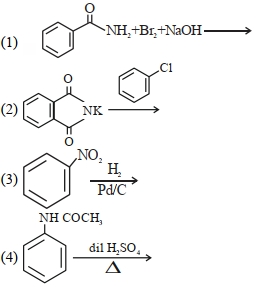
A
$1$
B
$2$
C
$3$
D
$4$
Solution
(C) Let us analyze each reaction:
$1$. Benzamide reacts with $Br_2$ and $NaOH$ (Hofmann bromamide degradation) to form aniline,which is an aromatic amine.
$2$. Potassium phthalimide does not react with chlorobenzene because aryl halides are poor substrates for $S_N2$ reactions due to the partial double bond character of the $C-Cl$ bond.
$3$. Nitrobenzene undergoes catalytic hydrogenation with $H_2/Pd-C$ to form aniline,which is an aromatic amine.
$4$. Acetanilide undergoes acid-catalyzed hydrolysis with $dil. H_2SO_4$ and heat to form aniline and acetic acid. Aniline is an aromatic amine.
Thus,reactions $1$,$3$,and $4$ result in the formation of aromatic amines. The total count is $3$.
$1$. Benzamide reacts with $Br_2$ and $NaOH$ (Hofmann bromamide degradation) to form aniline,which is an aromatic amine.
$2$. Potassium phthalimide does not react with chlorobenzene because aryl halides are poor substrates for $S_N2$ reactions due to the partial double bond character of the $C-Cl$ bond.
$3$. Nitrobenzene undergoes catalytic hydrogenation with $H_2/Pd-C$ to form aniline,which is an aromatic amine.
$4$. Acetanilide undergoes acid-catalyzed hydrolysis with $dil. H_2SO_4$ and heat to form aniline and acetic acid. Aniline is an aromatic amine.
Thus,reactions $1$,$3$,and $4$ result in the formation of aromatic amines. The total count is $3$.
0 likesView Solution
208
ChemistryEasyMCQJEE Main · 2023
In the following halogenated organic compounds,the one with the maximum number of chlorine atoms in its structure is:
A
Chloral
B
Gammaxene
C
Chloropicrin
D
Freon $-12$
Solution
(B) To determine the number of chlorine atoms in each compound:
$1$. Chloral $(CCl_3CHO)$: Contains $3$ chlorine atoms.
$2$. Gammaxene (Benzene hexachloride,$C_6H_6Cl_6$): Contains $6$ chlorine atoms.
$3$. Chloropicrin $(CCl_3NO_2)$: Contains $3$ chlorine atoms.
$4$. Freon $-12$ $(CCl_2F_2)$: Contains $2$ chlorine atoms.
Comparing these,Gammaxene has the maximum number of chlorine atoms $(6)$.
Therefore,the correct option is $B$.
$1$. Chloral $(CCl_3CHO)$: Contains $3$ chlorine atoms.
$2$. Gammaxene (Benzene hexachloride,$C_6H_6Cl_6$): Contains $6$ chlorine atoms.
$3$. Chloropicrin $(CCl_3NO_2)$: Contains $3$ chlorine atoms.
$4$. Freon $-12$ $(CCl_2F_2)$: Contains $2$ chlorine atoms.
Comparing these,Gammaxene has the maximum number of chlorine atoms $(6)$.
Therefore,the correct option is $B$.
0 likesView Solution
209
ChemistryMediumMCQJEE Main · 2023
Which of the following compounds are not used as disinfectants?
$A$. Chloroxylenol $B$. Bithional $C$. Veronal $D$. Prontosil $E$. Terpineol
Choose the correct answer from the options given below:
$A$. Chloroxylenol $B$. Bithional $C$. Veronal $D$. Prontosil $E$. Terpineol
Choose the correct answer from the options given below:
A
$A, B, E$
B
$A, B$
C
$B, D, E$
D
$C, D$
Solution
(D) Chloroxylenol,Bithional,and Terpineol are used as disinfectants or antiseptics.
Veronal is a barbiturate derivative used as a tranquilizer (neurological medicine).
Prontosil is an antibacterial drug (antibiotic).
Therefore,$C$ and $D$ are not used as disinfectants.
Veronal is a barbiturate derivative used as a tranquilizer (neurological medicine).
Prontosil is an antibacterial drug (antibiotic).
Therefore,$C$ and $D$ are not used as disinfectants.
0 likesView Solution
210
ChemistryDifficultMCQJEE Main · 2023
Cyclohexylamine when treated with nitrous acid yields $(P)$. On treating $(P)$ with $PCC$ results in $(Q)$. When $(Q)$ is heated with dilute $NaOH$,we get $(R)$. The final product $(R)$ is:
A
B
C
D
Solution
(B) $1$. Cyclohexylamine $(C_6H_{11}NH_2)$ reacts with nitrous acid $(HNO_2)$ to form cyclohexanol $(P)$ $(C_6H_{11}OH)$.
$2$. Cyclohexanol $(P)$ on oxidation with $PCC$ (Pyridinium chlorochromate) gives cyclohexanone $(Q)$ $(C_6H_{10}O)$.
$3$. Cyclohexanone $(Q)$ undergoes an aldol condensation reaction when heated with dilute $NaOH$ to form the final product $(R)$. The reaction involves the formation of a $\beta$-hydroxy ketone which then undergoes dehydration to form an $\alpha,\beta$-unsaturated ketone. The product $(R)$ is $2$-cyclohexylidenecyclohexanone.
$2$. Cyclohexanol $(P)$ on oxidation with $PCC$ (Pyridinium chlorochromate) gives cyclohexanone $(Q)$ $(C_6H_{10}O)$.
$3$. Cyclohexanone $(Q)$ undergoes an aldol condensation reaction when heated with dilute $NaOH$ to form the final product $(R)$. The reaction involves the formation of a $\beta$-hydroxy ketone which then undergoes dehydration to form an $\alpha,\beta$-unsaturated ketone. The product $(R)$ is $2$-cyclohexylidenecyclohexanone.
0 likesView Solution
211
ChemistryMediumMCQJEE Main · 2023
Given below are two statements :
Statement $I$: Upon heating a borax bead dipped in cupric sulphate in a luminous flame,the colour of the bead becomes green.
Statement $II$: The green colour observed is due to the formation of copper$(I)$ metaborate.
In the light of the above statements,choose the most appropriate answer from the options given below :
Statement $I$: Upon heating a borax bead dipped in cupric sulphate in a luminous flame,the colour of the bead becomes green.
Statement $II$: The green colour observed is due to the formation of copper$(I)$ metaborate.
In the light of the above statements,choose the most appropriate answer from the options given below :
A
Both Statement $I$ and Statement $II$ are true
B
Statement $I$ is true but Statement $II$ is false
C
Both Statement $I$ and Statement $II$ are false
D
Statement $I$ is false but Statement $II$ is true
Solution
(C) In the Borax Bead Test,cupric sulphate $(CuSO_4)$ reacts with boric anhydride $(B_2O_3)$ to form cupric metaborate $(Cu(BO_2)_2)$,which is blue in an oxidizing flame.
In a luminous (reducing) flame,the cupric metaborate $(Cu(BO_2)_2)$ is reduced to cuprous metaborate $(CuBO_2)$,which is colourless,or to metallic copper $(Cu)$,which appears red and opaque.
Statement $I$ is false because the bead does not become green in a luminous flame; it becomes colourless or red.
Statement $II$ is false because the formation of copper$(I)$ metaborate $(CuBO_2)$ results in a colourless bead,not a green one.
Therefore,both statements are false.
In a luminous (reducing) flame,the cupric metaborate $(Cu(BO_2)_2)$ is reduced to cuprous metaborate $(CuBO_2)$,which is colourless,or to metallic copper $(Cu)$,which appears red and opaque.
Statement $I$ is false because the bead does not become green in a luminous flame; it becomes colourless or red.
Statement $II$ is false because the formation of copper$(I)$ metaborate $(CuBO_2)$ results in a colourless bead,not a green one.
Therefore,both statements are false.
0 likesView Solution
212
ChemistryDifficultMCQJEE Main · 2023
Evaluate the following statements for their correctness.
$(A)$ The elevation in boiling point temperature of water will be same for $0.1 \ M \ NaCl$ and $0.1 \ M$ urea.
$(B)$ Azeotropic mixtures boil without change in their composition.
$(C)$ Osmosis always takes place from hypertonic to hypotonic solution.
$(D)$ The density of $32 \% \ H_2SO_4$ solution having molarity $4.09 \ M$ is approximately $1.26 \ g \ mL^{-1}$.
$(E)$ $A$ negatively charged sol is obtained when $KI$ solution is added to silver nitrate solution.
Choose the correct answer from the options given below:
$(A)$ The elevation in boiling point temperature of water will be same for $0.1 \ M \ NaCl$ and $0.1 \ M$ urea.
$(B)$ Azeotropic mixtures boil without change in their composition.
$(C)$ Osmosis always takes place from hypertonic to hypotonic solution.
$(D)$ The density of $32 \% \ H_2SO_4$ solution having molarity $4.09 \ M$ is approximately $1.26 \ g \ mL^{-1}$.
$(E)$ $A$ negatively charged sol is obtained when $KI$ solution is added to silver nitrate solution.
Choose the correct answer from the options given below:
A
$B, D$ and $E$ only
B
$A, B$ and $D$ only
C
$A$ and $C$ only
D
$B$ and $D$ only
Solution
(D) Incorrect. $\Delta T_b = i \times K_b \times m$. For $NaCl$,$i=2$,and for urea,$i=1$. Thus,elevation is not the same.
$(B)$ Correct. Azeotropic mixtures boil at a constant temperature and have the same composition in both liquid and vapour phases.
$(C)$ Incorrect. Osmosis always takes place from a hypotonic solution (lower concentration) to a hypertonic solution (higher concentration) through a semi-permeable membrane.
$(D)$ Correct. Molarity $M = \frac{\% \times 10 \times d}{M_{solute}} = \frac{32 \times 10 \times 1.26}{98} \approx 4.11 \ M$,which is approximately $4.09 \ M$.
$(E)$ Incorrect. When $KI$ is added to $AgNO_3$ (excess $AgNO_3$),$AgI$ adsorbs $Ag^+$ ions to form a positively charged sol $(AgI/Ag^+)$.
Therefore,only statements $(B)$ and $(D)$ are correct.
$(B)$ Correct. Azeotropic mixtures boil at a constant temperature and have the same composition in both liquid and vapour phases.
$(C)$ Incorrect. Osmosis always takes place from a hypotonic solution (lower concentration) to a hypertonic solution (higher concentration) through a semi-permeable membrane.
$(D)$ Correct. Molarity $M = \frac{\% \times 10 \times d}{M_{solute}} = \frac{32 \times 10 \times 1.26}{98} \approx 4.11 \ M$,which is approximately $4.09 \ M$.
$(E)$ Incorrect. When $KI$ is added to $AgNO_3$ (excess $AgNO_3$),$AgI$ adsorbs $Ag^+$ ions to form a positively charged sol $(AgI/Ag^+)$.
Therefore,only statements $(B)$ and $(D)$ are correct.
0 likesView Solution
213
ChemistryAdvancedMCQJEE Main · 2023
Compound $A$,$C_5H_{10}O_5$,gives a tetraacetate with $Ac_2O$ and oxidation of $A$ with $Br_2-H_2O$ gives an acid,$C_5H_{10}O_6$. Reduction of $A$ with $HI$ gives isopentane. The possible structure of $A$ is:
A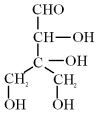
B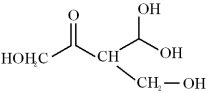
C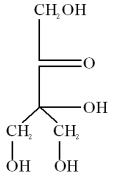
D
Solution
(A) $(i)$ Formation of a tetraacetate with $Ac_2O$ indicates that compound $A$ contains four $-OH$ groups.
$(ii)$ Oxidation of $A$ with $Br_2-H_2O$ yields an acid $C_5H_{10}O_6$,which confirms the presence of an aldehyde group $(-CHO)$ in $A$,as $Br_2-H_2O$ specifically oxidizes aldoses to aldonic acids.
$(iii)$ Reduction of $A$ with $HI$ gives isopentane $(2-methylbutane)$,which indicates the carbon skeleton is branched (isopentane structure).
$(iv)$ Combining these facts,the structure must be a branched pentose. The structure in option $A$ represents $2,3,4-trihydroxy-2-(hydroxymethyl)butanal$,which fits the molecular formula $C_5H_{10}O_5$ and the branched skeleton.
$(ii)$ Oxidation of $A$ with $Br_2-H_2O$ yields an acid $C_5H_{10}O_6$,which confirms the presence of an aldehyde group $(-CHO)$ in $A$,as $Br_2-H_2O$ specifically oxidizes aldoses to aldonic acids.
$(iii)$ Reduction of $A$ with $HI$ gives isopentane $(2-methylbutane)$,which indicates the carbon skeleton is branched (isopentane structure).
$(iv)$ Combining these facts,the structure must be a branched pentose. The structure in option $A$ represents $2,3,4-trihydroxy-2-(hydroxymethyl)butanal$,which fits the molecular formula $C_5H_{10}O_5$ and the branched skeleton.
0 likesView Solution
214
ChemistryMediumMCQJEE Main · 2023
Match List-$I$ with List-$II$.
Choose the correct answer from the options given below:
| List-$I$ | List-$II$ |
|---|---|
| $A$. Physisorption | $I$. Single layer adsorption |
| $B$. Chemisorption | $II$. $20-40 \, kJ \, mol^{-1}$ |
| $C$. $N_{2(g)} + 3H_{2(g)} \xrightarrow{Fe(s)} 2NH_{3(g)}$ | $III$. Chromatography |
| $D$. Analytical Application of Adsorption | $IV$. Heterogeneous catalysis |
Choose the correct answer from the options given below:
A
$A-II, B-I, C-IV, D-III$
B
$A-III, B-IV, C-I, D-II$
C
$A-IV, B-II, C-III, D-I$
D
$A-II, B-I, C-IV, D-III$
Solution
(A) . Physisorption involves weak van der Waals forces with low enthalpy of adsorption $(20-40 \, kJ \, mol^{-1})$.
$B$. Chemisorption involves strong chemical bonds and is typically unimolecular (single layer).
$C$. The reaction $N_{2(g)} + 3H_{2(g)} \xrightarrow{Fe(s)} 2NH_{3(g)}$ is an example of heterogeneous catalysis where the catalyst $(Fe)$ is in a solid phase and reactants are in a gaseous phase.
$D$. Chromatography is a common analytical application based on the principle of differential adsorption.
Therefore,the correct matching is: $A-II, B-I, C-IV, D-III$.
$B$. Chemisorption involves strong chemical bonds and is typically unimolecular (single layer).
$C$. The reaction $N_{2(g)} + 3H_{2(g)} \xrightarrow{Fe(s)} 2NH_{3(g)}$ is an example of heterogeneous catalysis where the catalyst $(Fe)$ is in a solid phase and reactants are in a gaseous phase.
$D$. Chromatography is a common analytical application based on the principle of differential adsorption.
Therefore,the correct matching is: $A-II, B-I, C-IV, D-III$.
0 likesView Solution
215
ChemistryDifficultMCQJEE Main · 2023
Given below are two statements: one is labelled as Assertion $(A)$ and the other is labelled as Reason $(R)$.
Assertion $(A)$: The first ionization enthalpy of $3d$ series elements is more than that of group $2$ metals.
Reason $(R)$: In $3d$ series of elements,successive filling of $d$-orbitals takes place.
In the light of the above statements,choose the correct answer from the options given below:
Assertion $(A)$: The first ionization enthalpy of $3d$ series elements is more than that of group $2$ metals.
Reason $(R)$: In $3d$ series of elements,successive filling of $d$-orbitals takes place.
In the light of the above statements,choose the correct answer from the options given below:
A
Both $(A)$ and $(R)$ are true and $(R)$ is the correct explanation of $(A)$.
B
Both $(A)$ and $(R)$ are true but $(R)$ is not the correct explanation of $(A)$.
C
$(A)$ is false but $(R)$ is true.
D
$(A)$ is true but $(R)$ is false.
Solution
(C) The first ionization enthalpy of $3d$ series elements is generally comparable to or lower than that of group $2$ metals (alkaline earth metals) for the early members of the series. For example,the first ionization energy of $Mg$ is $737 \ kJ/mol$,while for $Sc$ it is $631 \ kJ/mol$ and for $Ti$ it is $656 \ kJ/mol$. Thus,Assertion $(A)$ is false.
Reason $(R)$ states that in the $3d$ series of elements,successive filling of $d$-orbitals takes place. This is a correct statement as the electronic configuration of $3d$ series elements involves the filling of the $3d$ subshell.
Therefore,$(A)$ is false but $(R)$ is true.
Reason $(R)$ states that in the $3d$ series of elements,successive filling of $d$-orbitals takes place. This is a correct statement as the electronic configuration of $3d$ series elements involves the filling of the $3d$ subshell.
Therefore,$(A)$ is false but $(R)$ is true.
0 likesView Solution
216
ChemistryDifficultMCQJEE Main · 2023
An organic compound $[A]$ $(C_4H_{11}N)$ shows optical activity and gives $N_2$ gas on treatment with $HNO_2$. The compound $[A]$ reacts with $PhSO_2Cl$ producing a compound which is soluble in $KOH$. The structure of $A$ is:
A
Butan$-1-$amine
B
$N$,$N$-dimethylethanamine
C
$N$-methylethanamine
D
Butan$-2-$amine
Solution
(D) $1$. The molecular formula $C_4H_{11}N$ corresponds to a saturated amine.
$2$. The reaction with $HNO_2$ to release $N_2$ gas indicates that the compound is a primary aliphatic amine $(R-NH_2)$.
$3$. The reaction with $PhSO_2Cl$ (Hinsberg reagent) produces a sulfonamide that is soluble in $KOH$. This confirms that the amine is a primary amine,as the resulting sulfonamide contains an acidic hydrogen on the nitrogen atom.
$4$. The compound must be optically active. Among the primary amines with the formula $C_4H_{11}N$,butan$-2-$amine $(CH_3CH_2CH(NH_2)CH_3)$ contains a chiral carbon atom and is therefore optically active.
$5$. Butan$-1-$amine is achiral.
$2$. The reaction with $HNO_2$ to release $N_2$ gas indicates that the compound is a primary aliphatic amine $(R-NH_2)$.
$3$. The reaction with $PhSO_2Cl$ (Hinsberg reagent) produces a sulfonamide that is soluble in $KOH$. This confirms that the amine is a primary amine,as the resulting sulfonamide contains an acidic hydrogen on the nitrogen atom.
$4$. The compound must be optically active. Among the primary amines with the formula $C_4H_{11}N$,butan$-2-$amine $(CH_3CH_2CH(NH_2)CH_3)$ contains a chiral carbon atom and is therefore optically active.
$5$. Butan$-1-$amine is achiral.
0 likesView Solution
217
ChemistryMediumMCQJEE Main · 2023
Which one of the following statements is incorrect?
A
Boron and Indium can be purified by zone refining method.
B
Van-Arkel method is used to purify tungsten.
C
Cast iron is obtained by melting pig iron with scrap iron and coke using hot air blast.
D
The malleable iron is prepared from cast iron by oxidising impurities in a reverberatory furnace.
Solution
(B) The Van-Arkel method is primarily used for the purification of metals like $Ti$,$Zr$,$Hf$,and $B$. It is not used for tungsten $(W)$. Therefore,the statement in option $B$ is incorrect.
0 likesView Solution
218
ChemistryMediumMCQJEE Main · 2023
Which of the following elements have half-filled $f$-orbitals in their ground state?
(Given: atomic number $Sm = 62$; $Eu = 63$; $Tb = 65$; $Gd = 64$; $Pm = 61$)
$A.$ $Sm$ $B.$ $Eu$ $C.$ $Tb$ $D.$ $Gd$ $E.$ $Pm$
Choose the correct answer from the options given below:
(Given: atomic number $Sm = 62$; $Eu = 63$; $Tb = 65$; $Gd = 64$; $Pm = 61$)
$A.$ $Sm$ $B.$ $Eu$ $C.$ $Tb$ $D.$ $Gd$ $E.$ $Pm$
Choose the correct answer from the options given below:
A
$B$ and $D$ only
B
$A$ and $E$ only
C
$A$ and $B$ only
D
$C$ and $D$ only
Solution
(A) The electronic configurations of the given lanthanoids in their ground state are as follows:
$1.$ ${}_{62}Sm: [Xe] 4f^6 6s^2$
$2.$ ${}_{63}Eu: [Xe] 4f^7 6s^2$
$3.$ ${}_{64}Gd: [Xe] 4f^7 5d^1 6s^2$
$4.$ ${}_{65}Tb: [Xe] 4f^9 6s^2$
$5.$ ${}_{61}Pm: [Xe] 4f^5 6s^2$
$A$ half-filled $f$-orbital contains $7$ electrons $(f^7)$.
From the configurations above,$Eu$ $(4f^7 6s^2)$ and $Gd$ $(4f^7 5d^1 6s^2)$ both possess a half-filled $4f$ subshell.
Therefore,the correct elements are $B$ $(Eu)$ and $D$ $(Gd)$.
$1.$ ${}_{62}Sm: [Xe] 4f^6 6s^2$
$2.$ ${}_{63}Eu: [Xe] 4f^7 6s^2$
$3.$ ${}_{64}Gd: [Xe] 4f^7 5d^1 6s^2$
$4.$ ${}_{65}Tb: [Xe] 4f^9 6s^2$
$5.$ ${}_{61}Pm: [Xe] 4f^5 6s^2$
$A$ half-filled $f$-orbital contains $7$ electrons $(f^7)$.
From the configurations above,$Eu$ $(4f^7 6s^2)$ and $Gd$ $(4f^7 5d^1 6s^2)$ both possess a half-filled $4f$ subshell.
Therefore,the correct elements are $B$ $(Eu)$ and $D$ $(Gd)$.
0 likesView Solution
219
ChemistryDifficultMCQJEE Main · 2023
If the $CFSE$ of $[Ti(H_2O)_6]^{3+}$ is $-96.0 \ kJ / mol$,this complex will absorb maximum at wavelength $........nm$. (nearest integer)
Assume Planck's constant $(h) = 6.4 \times 10^{-34} \ Js$,Speed of light $(c) = 3.0 \times 10^8 \ m / s$ and Avogadro's constant $(N_A) = 6 \times 10^{23} / mol$.
Assume Planck's constant $(h) = 6.4 \times 10^{-34} \ Js$,Speed of light $(c) = 3.0 \times 10^8 \ m / s$ and Avogadro's constant $(N_A) = 6 \times 10^{23} / mol$.
A
$481$
B
$482$
C
$480$
D
$483$
Solution
(C) For $[Ti(H_2O)_6]^{3+}$,the central metal ion is $Ti^{3+}$,which has a $3d^1$ electronic configuration.
The $CFSE$ for a $d^1$ octahedral complex is given by $CFSE = -0.4 \times \Delta_0$.
Given $CFSE = -96.0 \ kJ / mol = -96000 \ J / mol$.
Therefore,$\Delta_0 = \frac{96000}{0.4} = 240000 \ J / mol$.
To find the wavelength $(\lambda)$ in $nm$,we use the relation $\Delta_0 = \frac{N_A \times h \times c}{\lambda}$.
$\lambda = \frac{N_A \times h \times c}{\Delta_0} = \frac{6 \times 10^{23} \times 6.4 \times 10^{-34} \times 3.0 \times 10^8}{240000}$.
$\lambda = \frac{115.2 \times 10^{-3}}{240000} = 0.48 \times 10^{-6} \ m = 480 \ nm$.
The $CFSE$ for a $d^1$ octahedral complex is given by $CFSE = -0.4 \times \Delta_0$.
Given $CFSE = -96.0 \ kJ / mol = -96000 \ J / mol$.
Therefore,$\Delta_0 = \frac{96000}{0.4} = 240000 \ J / mol$.
To find the wavelength $(\lambda)$ in $nm$,we use the relation $\Delta_0 = \frac{N_A \times h \times c}{\lambda}$.
$\lambda = \frac{N_A \times h \times c}{\Delta_0} = \frac{6 \times 10^{23} \times 6.4 \times 10^{-34} \times 3.0 \times 10^8}{240000}$.
$\lambda = \frac{115.2 \times 10^{-3}}{240000} = 0.48 \times 10^{-6} \ m = 480 \ nm$.
0 likesView Solution
220
ChemistryMediumMCQJEE Main · 2023
The resistivity of a $0.8 \ M$ solution of an electrolyte is $5 \times 10^{-3} \ \Omega \ cm$. Its molar conductivity is $..... \times 10^4 \ \Omega^{-1} \ cm^2 \ mol^{-1}$. (Nearest integer)
A
$24$
B
$23$
C
$25$
D
$22$
Solution
(C) The formula for molar conductivity is $\Lambda_{m} = \frac{\kappa \times 1000}{M}$.
Given that conductivity $\kappa = \frac{1}{\rho}$,where $\rho = 5 \times 10^{-3} \ \Omega \ cm$.
Substituting the values: $\Lambda_{m} = \frac{1}{5 \times 10^{-3}} \times \frac{1000}{0.8}$.
$\Lambda_{m} = 200 \times 1250 = 250,000 \ \Omega^{-1} \ cm^2 \ mol^{-1}$.
Expressing in the required form: $250,000 = 25 \times 10^4 \ \Omega^{-1} \ cm^2 \ mol^{-1}$.
Thus,the nearest integer is $25$.
Given that conductivity $\kappa = \frac{1}{\rho}$,where $\rho = 5 \times 10^{-3} \ \Omega \ cm$.
Substituting the values: $\Lambda_{m} = \frac{1}{5 \times 10^{-3}} \times \frac{1000}{0.8}$.
$\Lambda_{m} = 200 \times 1250 = 250,000 \ \Omega^{-1} \ cm^2 \ mol^{-1}$.
Expressing in the required form: $250,000 = 25 \times 10^4 \ \Omega^{-1} \ cm^2 \ mol^{-1}$.
Thus,the nearest integer is $25$.
0 likesView Solution
221
ChemistryDifficultMCQJEE Main · 2023
The number of molecules which give the haloform test among the following molecules is $.......$.
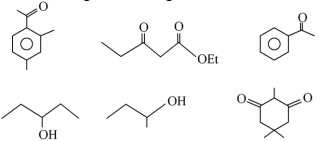
A
$2$
B
$1$
C
$3$
D
$4$
Solution
(D) The haloform test is given by compounds containing the $CH_3CO-$ group or the $CH_3CH(OH)-$ group.
Let us analyze the given molecules:
$1$. $2,4$-dimethylacetophenone: Contains $CH_3CO-$ group attached to an aromatic ring. It gives a positive haloform test.
$2$. Ethyl acetoacetate: Contains $CH_3CO-$ group. It gives a positive haloform test.
$3$. Acetophenone: Contains $CH_3CO-$ group attached to a phenyl ring. It gives a positive haloform test.
$4$. Pentan-$3$-ol: Does not contain $CH_3CH(OH)-$ group. It does not give the haloform test.
$5$. Butan-$2$-ol: Contains $CH_3CH(OH)-$ group. It gives a positive haloform test.
$6$. $3,3,5,5$-tetramethylcyclohexanone: Does not contain the required group. It does not give the haloform test.
Thus,there are $4$ molecules that give a positive haloform test.
Let us analyze the given molecules:
$1$. $2,4$-dimethylacetophenone: Contains $CH_3CO-$ group attached to an aromatic ring. It gives a positive haloform test.
$2$. Ethyl acetoacetate: Contains $CH_3CO-$ group. It gives a positive haloform test.
$3$. Acetophenone: Contains $CH_3CO-$ group attached to a phenyl ring. It gives a positive haloform test.
$4$. Pentan-$3$-ol: Does not contain $CH_3CH(OH)-$ group. It does not give the haloform test.
$5$. Butan-$2$-ol: Contains $CH_3CH(OH)-$ group. It gives a positive haloform test.
$6$. $3,3,5,5$-tetramethylcyclohexanone: Does not contain the required group. It does not give the haloform test.
Thus,there are $4$ molecules that give a positive haloform test.
0 likesView Solution
222
ChemistryDifficultMCQJEE Main · 2023
The rate constant for a first order reaction is $20 \, min^{-1}$. The time required for the initial concentration of the reactant to reduce to its $\frac{1}{32}$ level is $........ \times 10^{-2} \, min$. (Nearest integer) (Given: $\ln 10 = 2.303, \log 2 = 0.3010$)
A
$16$
B
$15$
C
$17$
D
$14$
Solution
(C) For a first order reaction,the rate constant $k$ is given by $k = \frac{2.303}{t} \log \frac{[A]_0}{[A]_t}$.
Given $[A]_t = \frac{[A]_0}{32}$ and $k = 20 \, min^{-1}$.
Substituting the values: $20 = \frac{2.303}{t} \log \frac{[A]_0}{[A]_0 / 32} = \frac{2.303}{t} \log 32$.
Since $32 = 2^5$,$\log 32 = 5 \log 2 = 5 \times 0.3010 = 1.505$.
$t = \frac{2.303 \times 1.505}{20} = \frac{3.466}{20} = 0.1733 \, min$.
Converting to $10^{-2} \, min$: $0.1733 \, min = 17.33 \times 10^{-2} \, min$.
The nearest integer is $17$.
Given $[A]_t = \frac{[A]_0}{32}$ and $k = 20 \, min^{-1}$.
Substituting the values: $20 = \frac{2.303}{t} \log \frac{[A]_0}{[A]_0 / 32} = \frac{2.303}{t} \log 32$.
Since $32 = 2^5$,$\log 32 = 5 \log 2 = 5 \times 0.3010 = 1.505$.
$t = \frac{2.303 \times 1.505}{20} = \frac{3.466}{20} = 0.1733 \, min$.
Converting to $10^{-2} \, min$: $0.1733 \, min = 17.33 \times 10^{-2} \, min$.
The nearest integer is $17$.
0 likesView Solution
223
ChemistryDifficultMCQJEE Main · 2023
Which of the following represents the lattice structure of $A_{0.95} O$ containing $A^{2+}$,$A^{3+}$,and $O^{2-}$ ions?
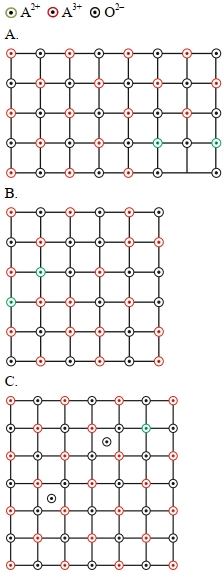
A
$B$ and $C$ only
B
$B$ only
C
$A$ and $B$ only
D
$A$ only
Solution
(D) In the metal deficiency defect of $A_{0.95} O$,the total charge must be neutral. Let the number of $A^{3+}$ ions be $x$. Then the number of $A^{2+}$ ions is $(0.95 - x)$.
Equating the total positive charge to the total negative charge (which is $2$ for $O^{2-}$):
$3x + 2(0.95 - x) = 2$
$3x + 1.9 - 2x = 2$
$x = 0.1$
So,there are $0.1$ $A^{3+}$ ions and $0.85$ $A^{2+}$ ions for every $O^{2-}$ ion.
This defect involves the replacement of $A^{2+}$ ions by $A^{3+}$ ions,creating cation vacancies to maintain electrical neutrality. Structure $C$ correctly shows the presence of $A^{2+}$,$A^{3+}$,and a vacant cation site (represented by an empty circle with a dot).
Equating the total positive charge to the total negative charge (which is $2$ for $O^{2-}$):
$3x + 2(0.95 - x) = 2$
$3x + 1.9 - 2x = 2$
$x = 0.1$
So,there are $0.1$ $A^{3+}$ ions and $0.85$ $A^{2+}$ ions for every $O^{2-}$ ion.
This defect involves the replacement of $A^{2+}$ ions by $A^{3+}$ ions,creating cation vacancies to maintain electrical neutrality. Structure $C$ correctly shows the presence of $A^{2+}$,$A^{3+}$,and a vacant cation site (represented by an empty circle with a dot).
0 likesView Solution
224
ChemistryDifficultMCQJEE Main · 2023
The correct representation in $6-$membered pyranose form for the following sugar $[X]$ is
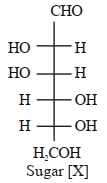
A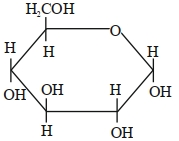
B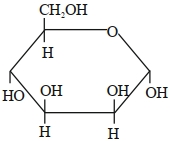
C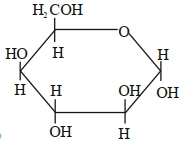
D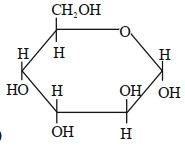
Solution
(A) The given Fischer projection of sugar $[X]$ is $D-$mannose. In $D-$mannose,the $-OH$ groups at $C-2$,$C-3$,$C-4$ and $C-5$ are on the left,left,right and right respectively in the Fischer projection. When converting to the Haworth structure,groups on the left side of the Fischer projection are placed above the ring,and groups on the right side are placed below the ring. For $\alpha -D-$mannopyranose,the $-OH$ group at the anomeric carbon $(C-1)$ is below the ring. Thus,the correct Haworth structure corresponds to option $A$.
0 likesView Solution
225
ChemistryMediumMCQJEE Main · 2023
The highest oxidation state of $Mn$ is exhibited in $Mn_2O_7$. The correct statements about $Mn_2O_7$ are:
$(A)$ $Mn$ is tetrahedrally surrounded by oxygen atoms.
$(B)$ $Mn$ is octahedrally surrounded by oxygen atoms.
$(C)$ Contains $Mn-O-Mn$ bridge.
$(D)$ Contains $Mn-Mn$ bond.
Choose the correct answer from the options given below:
$(A)$ $Mn$ is tetrahedrally surrounded by oxygen atoms.
$(B)$ $Mn$ is octahedrally surrounded by oxygen atoms.
$(C)$ Contains $Mn-O-Mn$ bridge.
$(D)$ Contains $Mn-Mn$ bond.
Choose the correct answer from the options given below:
A
$A$ and $C$ only
B
$A$ and $D$ only
C
$B$ and $D$ only
D
$B$ and $C$ only
Solution
(A) The structure of $Mn_2O_7$ consists of two $MnO_4$ tetrahedra sharing a common oxygen atom at one corner.
Thus,each $Mn$ atom is tetrahedrally surrounded by four oxygen atoms (statement $A$ is correct).
The structure contains an $Mn-O-Mn$ bridge (statement $C$ is correct).
There is no direct $Mn-Mn$ bond in $Mn_2O_7$ (statement $D$ is incorrect).
Therefore,statements $A$ and $C$ are correct.
Thus,each $Mn$ atom is tetrahedrally surrounded by four oxygen atoms (statement $A$ is correct).
The structure contains an $Mn-O-Mn$ bridge (statement $C$ is correct).
There is no direct $Mn-Mn$ bond in $Mn_2O_7$ (statement $D$ is incorrect).
Therefore,statements $A$ and $C$ are correct.
0 likesView Solution
226
ChemistryDifficultMCQJEE Main · 2023
The decreasing order of dehydration of the following alcohols is:

A
$a > d > b > c$
B
$b > d > c > a$
C
$b > a > d > c$
D
$d > b > c > a$
Solution
(B) The rate of dehydration of alcohols is directly proportional to the stability of the carbocation formed as an intermediate.
$(a)$ Phenol: The carbocation formed would be highly unstable due to the $sp^2$ hybridized carbon atom.
$(b)$ Cyclohexa$-2,4-$dien$-1-$ol: Forms a resonance-stabilized carbocation (aromatic character can be achieved).
$(c)$ Cyclohex$-2-$en$-1-$ol: Forms a resonance-stabilized allylic carbocation.
$(d)$ Cyclohexanol: Forms a secondary carbocation.
Comparing the stability: $(b) > (c) > (d) > (a)$.
Therefore,the decreasing order of dehydration is $b > c > d > a$.
$(a)$ Phenol: The carbocation formed would be highly unstable due to the $sp^2$ hybridized carbon atom.
$(b)$ Cyclohexa$-2,4-$dien$-1-$ol: Forms a resonance-stabilized carbocation (aromatic character can be achieved).
$(c)$ Cyclohex$-2-$en$-1-$ol: Forms a resonance-stabilized allylic carbocation.
$(d)$ Cyclohexanol: Forms a secondary carbocation.
Comparing the stability: $(b) > (c) > (d) > (a)$.
Therefore,the decreasing order of dehydration is $b > c > d > a$.
0 likesView Solution
227
ChemistryDifficultMCQJEE Main · 2023
Given below are two statements: One is labelled as Assertion $A$ and the other is labelled as Reason $R$.
Assertion $A:$ Amongst $He$,$Ne$,$Ar$ and $Kr$; $1 \ g$ of activated charcoal adsorbs more of $Kr$.
Reason $R$: The critical volume $V_c \left( cm^3 \ mol^{-1} \right)$ and critical pressure $P_c \left( atm \right)$ is highest for Krypton but the compressibility factor at critical point $Z_c$ is lowest for Krypton.
In the light of the above statements,choose the correct answer from the options given below.
Assertion $A:$ Amongst $He$,$Ne$,$Ar$ and $Kr$; $1 \ g$ of activated charcoal adsorbs more of $Kr$.
Reason $R$: The critical volume $V_c \left( cm^3 \ mol^{-1} \right)$ and critical pressure $P_c \left( atm \right)$ is highest for Krypton but the compressibility factor at critical point $Z_c$ is lowest for Krypton.
In the light of the above statements,choose the correct answer from the options given below.
A
$A$ is true but $R$ is false
B
$A$ is false but $R$ is true
C
Both $A$ and $R$ are true but $R$ is $NOT$ the correct explanation of $A$
D
Both $A$ and $R$ are true and $R$ is the correct explanation of $A$
Solution
(A) Assertion $A$ is true: The extent of adsorption of gases on activated charcoal increases with an increase in the magnitude of van der Waals forces of attraction. Since $Kr$ has the largest atomic size among the given noble gases,it has the strongest van der Waals forces,leading to maximum adsorption.
Reason $R$ is false: The critical temperature $T_c$ is the primary factor determining the ease of liquefaction and adsorption. While $V_c$ and $P_c$ values vary,the statement regarding $Z_c$ is incorrect because for all real gases following the van der Waals equation,the compressibility factor at the critical point $Z_c = \frac{P_c V_c}{R T_c}$ is a constant value of $\frac{3}{8} = 0.375$.
Reason $R$ is false: The critical temperature $T_c$ is the primary factor determining the ease of liquefaction and adsorption. While $V_c$ and $P_c$ values vary,the statement regarding $Z_c$ is incorrect because for all real gases following the van der Waals equation,the compressibility factor at the critical point $Z_c = \frac{P_c V_c}{R T_c}$ is a constant value of $\frac{3}{8} = 0.375$.
0 likesView Solution
228
ChemistryDifficultMCQJEE Main · 2023
In the following reaction,'$A$' is
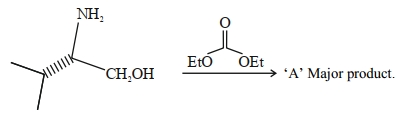
A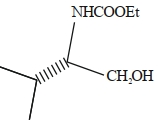
B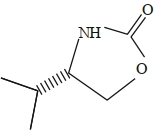
C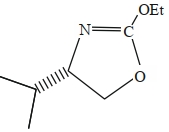
D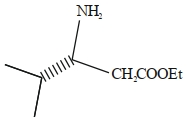
Solution
(B) The reaction involves the nucleophilic attack of the $-NH_2$ group on the electrophilic carbonyl carbon of diethyl carbonate,followed by the loss of an ethanol molecule to form a carbamate intermediate.
Subsequently,the lone pair of the oxygen atom from the $-CH_2OH$ group attacks the carbonyl carbon of the carbamate,leading to the elimination of another molecule of ethanol and the formation of a cyclic five-membered oxazolidin$-2-$one derivative.
Subsequently,the lone pair of the oxygen atom from the $-CH_2OH$ group attacks the carbonyl carbon of the carbamate,leading to the elimination of another molecule of ethanol and the formation of a cyclic five-membered oxazolidin$-2-$one derivative.
0 likesView Solution
229
ChemistryMediumMCQJEE Main · 2023
Identify the incorrect option from the following:
A
$CH_3CH_2CH_2Br + KOH(aq) \rightarrow CH_3CH_2CH_2OH + KBr$
B
$(CH_3)_3CCH_2Br + KOH(alc) \rightarrow (CH_3)_3CCH_2OH + KBr$
C
$C_6H_5Cl + CH_3COCl \xrightarrow{anhyd. AlCl_3} C_6H_4(Cl)COCH_3 + HCl$
D
$C_6H_5Cl \xrightarrow[(ii) HCl]{(i) NaOH, 623 K, 300 atm} C_6H_5OH$
Solution
(B) In option $B$,the reaction involves a primary alkyl halide $(CH_3)_3CCH_2Br$ with alcoholic $KOH$. Alcoholic $KOH$ acts as a strong base and promotes an elimination reaction ($E2$ mechanism) to form an alkene. However,the reaction shown is a substitution reaction,which is incorrect for alcoholic $KOH$. Aqueous $KOH$ would be required for substitution to form an alcohol.
0 likesView Solution
230
ChemistryMediumMCQJEE Main · 2023
$A$ solution of $FeCl_3$ when treated with $K_4[Fe(CN)_6]$ gives a Prussian blue precipitate due to the formation of:
A
$K[Fe_2(CN)_6]$
B
$Fe[Fe(CN)_6]$
C
$Fe_3[Fe(CN)_6]_2$
D
$Fe_4[Fe(CN)_6]_3$
Solution
(D) The reaction between $FeCl_3$ and $K_4[Fe(CN)_6]$ is a standard test for $Fe^{3+}$ ions.
When $Fe^{3+}$ ions react with potassium ferrocyanide,$K_4[Fe(CN)_6]$,they form a deep blue complex known as Prussian blue.
The chemical reaction is: $4Fe^{3+} + 3[Fe(CN)_6]^{4-} \rightarrow Fe_4[Fe(CN)_6]_3$.
The resulting compound is ferric ferrocyanide,$Fe_4[Fe(CN)_6]_3$,which is responsible for the Prussian blue color.
When $Fe^{3+}$ ions react with potassium ferrocyanide,$K_4[Fe(CN)_6]$,they form a deep blue complex known as Prussian blue.
The chemical reaction is: $4Fe^{3+} + 3[Fe(CN)_6]^{4-} \rightarrow Fe_4[Fe(CN)_6]_3$.
The resulting compound is ferric ferrocyanide,$Fe_4[Fe(CN)_6]_3$,which is responsible for the Prussian blue color.
0 likesView Solution
231
ChemistryMediumMCQJEE Main · 2023
Which of the following are examples of double salts?
$A$. $FeSO_4 \cdot (NH_4)_2SO_4 \cdot 6H_2O$
$B$. $CuSO_4 \cdot 4NH_3 \cdot H_2O$
$C$. $K_2SO_4 \cdot Al_2(SO_4)_3 \cdot 24H_2O$
$D$. $Fe(CN)_2 \cdot 4KCN$
Choose the correct answer.
$A$. $FeSO_4 \cdot (NH_4)_2SO_4 \cdot 6H_2O$
$B$. $CuSO_4 \cdot 4NH_3 \cdot H_2O$
$C$. $K_2SO_4 \cdot Al_2(SO_4)_3 \cdot 24H_2O$
$D$. $Fe(CN)_2 \cdot 4KCN$
Choose the correct answer.
A
$A$ and $C$ only
B
$A$ and $B$ only
C
$A, B$ and $D$ only
D
$B$ and $D$ only
Solution
(A) Double salts are addition compounds that dissociate into their constituent ions completely when dissolved in water.
$FeSO_4 \cdot (NH_4)_2SO_4 \cdot 6H_2O$ (Mohr's salt) and $K_2SO_4 \cdot Al_2(SO_4)_3 \cdot 24H_2O$ (Potash alum) are examples of double salts.
$CuSO_4 \cdot 4NH_3 \cdot H_2O$ and $Fe(CN)_2 \cdot 4KCN$ (which is $K_4[Fe(CN)_6]$) are coordination compounds (complex salts) that do not dissociate completely into their constituent ions in solution.
Therefore,$A$ and $C$ are double salts.
$FeSO_4 \cdot (NH_4)_2SO_4 \cdot 6H_2O$ (Mohr's salt) and $K_2SO_4 \cdot Al_2(SO_4)_3 \cdot 24H_2O$ (Potash alum) are examples of double salts.
$CuSO_4 \cdot 4NH_3 \cdot H_2O$ and $Fe(CN)_2 \cdot 4KCN$ (which is $K_4[Fe(CN)_6]$) are coordination compounds (complex salts) that do not dissociate completely into their constituent ions in solution.
Therefore,$A$ and $C$ are double salts.
0 likesView Solution
232
ChemistryDifficultMCQJEE Main · 2023
Which of the following complexes will show the largest splitting of $d$-orbitals?
A
$[Fe(C_2O_4)_3]^{3-}$
B
$[FeF_6]^{3-}$
C
$[Fe(CN)_6]^{3-}$
D
$[Fe(NH_3)_6]^{3+}$
Solution
(C) The magnitude of crystal field splitting $(\Delta_o)$ depends on the strength of the ligand.
According to the spectrochemical series,the strength of ligands is $F^- < C_2O_4^{2-} < NH_3 < CN^-$.
Since $CN^-$ is the strongest field ligand among the given options,it causes the maximum splitting of $d$-orbitals.
According to the spectrochemical series,the strength of ligands is $F^- < C_2O_4^{2-} < NH_3 < CN^-$.
Since $CN^-$ is the strongest field ligand among the given options,it causes the maximum splitting of $d$-orbitals.
0 likesView Solution
233
ChemistryDifficultMCQJEE Main · 2023
Given below are two statements: one is labelled as Assertion $A$ and the other is labelled as Reason $R$.
Assertion $A:$ In an Ellingham diagram,the oxidation of carbon to carbon monoxide shows a negative slope with respect to temperature.
Reason $R:$ $CO$ tends to get decomposed at higher temperature.
In the light of the above statements,choose the correct answer from the options given below:
Assertion $A:$ In an Ellingham diagram,the oxidation of carbon to carbon monoxide shows a negative slope with respect to temperature.
Reason $R:$ $CO$ tends to get decomposed at higher temperature.
In the light of the above statements,choose the correct answer from the options given below:
A
Both $A$ and $R$ are correct and $R$ is the correct explanation of $A$
B
$A$ is not correct but $R$ is correct
C
Both $A$ and $R$ are correct but $R$ is $NOT$ the correct explanation of $A$
D
$A$ is correct but $R$ is not correct
Solution
(D) The reaction for the oxidation of carbon is $2C(s) + O_2(g) \rightarrow 2CO(g)$.
The entropy change $\Delta_{r}S^{\circ}$ is positive because the number of moles of gaseous products is greater than the number of moles of gaseous reactants.
According to the Gibbs-Helmholtz equation,$\Delta_{r}G^{\circ} = \Delta_{r}H^{\circ} - T\Delta_{r}S^{\circ}$. Since $\Delta_{r}S^{\circ} > 0$,the slope of the line in the Ellingham diagram (which is $-\Delta_{r}S^{\circ}$) is negative.
Therefore,Assertion $A$ is correct.
Carbon monoxide $(CO)$ is a very stable compound at high temperatures,and its tendency to decompose decreases as temperature increases. Thus,Reason $R$ is incorrect.
The entropy change $\Delta_{r}S^{\circ}$ is positive because the number of moles of gaseous products is greater than the number of moles of gaseous reactants.
According to the Gibbs-Helmholtz equation,$\Delta_{r}G^{\circ} = \Delta_{r}H^{\circ} - T\Delta_{r}S^{\circ}$. Since $\Delta_{r}S^{\circ} > 0$,the slope of the line in the Ellingham diagram (which is $-\Delta_{r}S^{\circ}$) is negative.
Therefore,Assertion $A$ is correct.
Carbon monoxide $(CO)$ is a very stable compound at high temperatures,and its tendency to decompose decreases as temperature increases. Thus,Reason $R$ is incorrect.
0 likesView Solution
234
ChemistryMediumMCQJEE Main · 2023
Match List-$I$ and List-$II$
Choose the correct answer from the options given below:
| List-$I$ | List-$II$ |
| $A$. Molisch's Test | $I$. Peptide |
| $B$. Biuret Test | $II$. Carbohydrate |
| $C$. Carbylamine Test | $III$. Primary amine |
| $D$. Schiff's Test | $IV$. Aldehyde |
A
$A-I, B-II, C-III, D-IV$
B
$A-III, B-IV, C-I, D-II$
C
$A-II, B-I, C-III, D-IV$
D
$A-III, B-IV, C-II, D-I$
Solution
(C) . Molisch's Test is a general test for carbohydrates $(II)$.
$B$. Biuret Test is used to detect the presence of peptide bonds in proteins $(I)$.
$C$. Carbylamine Test is a chemical test for the detection of primary amines $(III)$.
$D$. Schiff's Test is used for the detection of aldehydes $(IV)$.
Therefore,the correct matching is $A-II, B-I, C-III, D-IV$.
$B$. Biuret Test is used to detect the presence of peptide bonds in proteins $(I)$.
$C$. Carbylamine Test is a chemical test for the detection of primary amines $(III)$.
$D$. Schiff's Test is used for the detection of aldehydes $(IV)$.
Therefore,the correct matching is $A-II, B-I, C-III, D-IV$.
0 likesView Solution
235
ChemistryMediumMCQJEE Main · 2023
The density of $3 \ M$ solution of $NaCl$ is $1.0 \ g \ mL^{-1}$. Molality of the solution is $...... \times 10^{-2} \ m$. (Nearest integer). Given: Molar mass of $Na$ and $Cl$ is $23$ and $35.5 \ g \ mol^{-1}$ respectively.
A
$364$
B
$361$
C
$362$
D
$363$
Solution
(A) The molarity $(M)$ is $3 \ M$ and density $(d)$ is $1.0 \ g \ mL^{-1}$.
The molar mass of $NaCl$ is $23 + 35.5 = 58.5 \ g \ mol^{-1}$.
The formula for molality $(m)$ is $m = \frac{1000 \times M}{1000 \times d - M \times M_{solute}}$.
Substituting the values: $m = \frac{1000 \times 3}{1000 \times 1 - 3 \times 58.5} = \frac{3000}{1000 - 175.5} = \frac{3000}{824.5} \approx 3.6385 \ m$.
Expressing in $10^{-2} \ m$: $3.6385 \times 10^2 \times 10^{-2} \approx 364 \times 10^{-2} \ m$.
The nearest integer is $364$.
The molar mass of $NaCl$ is $23 + 35.5 = 58.5 \ g \ mol^{-1}$.
The formula for molality $(m)$ is $m = \frac{1000 \times M}{1000 \times d - M \times M_{solute}}$.
Substituting the values: $m = \frac{1000 \times 3}{1000 \times 1 - 3 \times 58.5} = \frac{3000}{1000 - 175.5} = \frac{3000}{824.5} \approx 3.6385 \ m$.
Expressing in $10^{-2} \ m$: $3.6385 \times 10^2 \times 10^{-2} \approx 364 \times 10^{-2} \ m$.
The nearest integer is $364$.
0 likesView Solution
236
ChemistryMediumMCQJEE Main · 2023
At what $pH$,given half cell $MnO_4^{-} (0.1 \ M) \mid Mn^{2+} (0.001 \ M)$ will have electrode potential of $1.282 \ V$? (Nearest Integer) Given $E_{MnO_4^{-} / Mn^{2+}}^{o} = 1.54 \ V, \frac{2.303 RT}{F} = 0.059 \ V$
A
$3$
B
$2$
C
$1$
D
$6$
Solution
(A) The reduction half-reaction is: $MnO_4^{-} + 8H^{+} + 5e^{-} \rightleftharpoons Mn^{2+} + 4H_2O$
Using the Nernst equation: $E = E^{\circ} - \frac{0.059}{5} \log \frac{[Mn^{2+}]}{[MnO_4^{-}] [H^{+}]^8}$
Substituting the given values: $1.282 = 1.54 - \frac{0.059}{5} \log \frac{10^{-3}}{10^{-1} \times [H^{+}]^8}$
$1.282 - 1.54 = -\frac{0.059}{5} \log \frac{10^{-2}}{[H^{+}]^8}$
$-0.258 = -\frac{0.059}{5} \log \frac{10^{-2}}{[H^{+}]^8}$
$\frac{0.258 \times 5}{0.059} = \log (10^{-2}) - \log ([H^{+}]^8)$
$21.86 = -2 + 8 \ pH$
$8 \ pH = 23.86$
$pH = 2.98 \approx 3$
Using the Nernst equation: $E = E^{\circ} - \frac{0.059}{5} \log \frac{[Mn^{2+}]}{[MnO_4^{-}] [H^{+}]^8}$
Substituting the given values: $1.282 = 1.54 - \frac{0.059}{5} \log \frac{10^{-3}}{10^{-1} \times [H^{+}]^8}$
$1.282 - 1.54 = -\frac{0.059}{5} \log \frac{10^{-2}}{[H^{+}]^8}$
$-0.258 = -\frac{0.059}{5} \log \frac{10^{-2}}{[H^{+}]^8}$
$\frac{0.258 \times 5}{0.059} = \log (10^{-2}) - \log ([H^{+}]^8)$
$21.86 = -2 + 8 \ pH$
$8 \ pH = 23.86$
$pH = 2.98 \approx 3$
0 likesView Solution
237
ChemistryDifficultMCQJEE Main · 2023
Number of isomeric compounds with molecular formula $C_9H_{10}O$ which $(i)$ do not dissolve in $NaOH$ $(ii)$ do not dissolve in $HCl$ $(iii)$ do not give orange precipitate with $2,4-DNP$ $(iv)$ on hydrogenation give identical compound with molecular formula $C_9H_{12}O$ is $...........$
A
$2$
B
$3$
C
$4$
D
$5$
Solution
(A) The molecular formula $C_9H_{10}O$ has a degree of unsaturation of $6$.
Given conditions:
$(i)$ Does not dissolve in $NaOH$ (not a phenol).
$(ii)$ Does not dissolve in $HCl$ (not an amine).
$(iii)$ Does not give orange precipitate with $2,4-DNP$ (no carbonyl group,i.e.,no aldehyde or ketone).
$(iv)$ On hydrogenation,it gives an identical compound $C_9H_{12}O$.
Since it is not a carbonyl compound and not a phenol,it is likely an ether.
The structure $Ph-CH=CH-O-CH_3$ (methyl styryl ether) satisfies these conditions.
It exists as $cis$ and $trans$ isomers.
Both isomers on hydrogenation yield $Ph-CH_2-CH_2-O-CH_3$ $(C_9H_{12}O)$.
Thus,there are $2$ such isomers.
Given conditions:
$(i)$ Does not dissolve in $NaOH$ (not a phenol).
$(ii)$ Does not dissolve in $HCl$ (not an amine).
$(iii)$ Does not give orange precipitate with $2,4-DNP$ (no carbonyl group,i.e.,no aldehyde or ketone).
$(iv)$ On hydrogenation,it gives an identical compound $C_9H_{12}O$.
Since it is not a carbonyl compound and not a phenol,it is likely an ether.
The structure $Ph-CH=CH-O-CH_3$ (methyl styryl ether) satisfies these conditions.
It exists as $cis$ and $trans$ isomers.
Both isomers on hydrogenation yield $Ph-CH_2-CH_2-O-CH_3$ $(C_9H_{12}O)$.
Thus,there are $2$ such isomers.
0 likesView Solution
238
ChemistryDifficultMCQJEE Main · 2023
$25 \ mL$ of an aqueous solution of $KCl$ was found to require $20 \ mL$ of $1 \ M \ AgNO_3$ solution when titrated using $K_2CrO_4$ as an indicator. What is the depression in freezing point of $KCl$ solution of the given concentration? (Nearest integer). Given: $K_f = 2.0 \ K \ kg \ mol^{-1}$. Assume: $(1)$ $100 \%$ ionization and $(2)$ density of the aqueous solution as $1 \ g \ mL^{-1}$.
A
$3$
B
$1$
C
$2$
D
$4$
Solution
(A) The reaction is: $KCl + AgNO_3 \rightarrow AgCl + KNO_3$.
At the equivalence point,the millimoles of $KCl$ equal the millimoles of $AgNO_3$:
$n(KCl) = 20 \ mL \times 1 \ M = 20 \ mmol = 0.02 \ mol$.
Mass of the solution $= 25 \ mL \times 1 \ g \ mL^{-1} = 25 \ g$.
Mass of $KCl$ solute $= 0.02 \ mol \times 74.5 \ g \ mol^{-1} = 1.49 \ g$.
Mass of solvent $= 25 \ g - 1.49 \ g = 23.51 \ g = 0.02351 \ kg$.
Molality $(m) = \frac{0.02 \ mol}{0.02351 \ kg} \approx 0.8507 \ mol \ kg^{-1}$.
Since $KCl$ undergoes $100 \%$ ionization,the van't Hoff factor $i = 2$.
Depression in freezing point $\Delta T_f = i \times K_f \times m = 2 \times 2.0 \times 0.8507 = 3.4028 \ K$.
The nearest integer is $3$.
At the equivalence point,the millimoles of $KCl$ equal the millimoles of $AgNO_3$:
$n(KCl) = 20 \ mL \times 1 \ M = 20 \ mmol = 0.02 \ mol$.
Mass of the solution $= 25 \ mL \times 1 \ g \ mL^{-1} = 25 \ g$.
Mass of $KCl$ solute $= 0.02 \ mol \times 74.5 \ g \ mol^{-1} = 1.49 \ g$.
Mass of solvent $= 25 \ g - 1.49 \ g = 23.51 \ g = 0.02351 \ kg$.
Molality $(m) = \frac{0.02 \ mol}{0.02351 \ kg} \approx 0.8507 \ mol \ kg^{-1}$.
Since $KCl$ undergoes $100 \%$ ionization,the van't Hoff factor $i = 2$.
Depression in freezing point $\Delta T_f = i \times K_f \times m = 2 \times 2.0 \times 0.8507 = 3.4028 \ K$.
The nearest integer is $3$.
0 likesView Solution
239
ChemistryDifficultMCQJEE Main · 2023
In the given reaction,reagents '$X$' and '$Y$' respectively are:
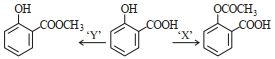
A
$(CH_3CO)_2O / H^{+}$ and $CH_3OH / H^{+}, \Delta$
B
$(CH_3CO)_2O / H^{+}$ and $(CH_3CO)_2O / H^{+}$
C
$CH_3OH / H^{+}, \Delta$ and $CH_3OH / H^{+}, \Delta$
D
$CH_3OH / H^{+}, \Delta$ and $(CH_3CO)_2O / H^{+}$
Solution
(A) The starting material is salicylic acid ($2$-hydroxybenzoic acid).
$1$. Reaction with '$X$' leads to the acetylation of the phenolic $-OH$ group to form aspirin (acetylsalicylic acid). The reagent used for acetylation is acetic anhydride $((CH_3CO)_2O)$ in the presence of an acid catalyst $(H^+)$.
$2$. Reaction with '$Y$' leads to the esterification of the carboxylic acid $-COOH$ group to form methyl salicylate. The reagent used for esterification is methanol $(CH_3OH)$ in the presence of an acid catalyst $(H^+)$ and heat $(\Delta)$.
Therefore,'$X$' is $(CH_3CO)_2O / H^{+}$ and '$Y$' is $CH_3OH / H^{+}, \Delta$.
$1$. Reaction with '$X$' leads to the acetylation of the phenolic $-OH$ group to form aspirin (acetylsalicylic acid). The reagent used for acetylation is acetic anhydride $((CH_3CO)_2O)$ in the presence of an acid catalyst $(H^+)$.
$2$. Reaction with '$Y$' leads to the esterification of the carboxylic acid $-COOH$ group to form methyl salicylate. The reagent used for esterification is methanol $(CH_3OH)$ in the presence of an acid catalyst $(H^+)$ and heat $(\Delta)$.
Therefore,'$X$' is $(CH_3CO)_2O / H^{+}$ and '$Y$' is $CH_3OH / H^{+}, \Delta$.
0 likesView Solution
240
ChemistryDifficultMCQJEE Main · 2023
All structures given below are of vitamin $C$. The most stable of them is:
A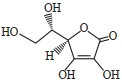
B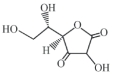
C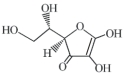
D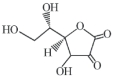
Solution
(A) Vitamin $C$ (ascorbic acid) is most stable in the form where the enediol group is present,which allows for resonance stabilization and intramolecular hydrogen bonding.
Structure $A$ represents the naturally occurring form of $L$-ascorbic acid,which is stabilized by intramolecular $H$-bonding between the carbonyl oxygen and the hydroxyl hydrogen.
Structure $A$ represents the naturally occurring form of $L$-ascorbic acid,which is stabilized by intramolecular $H$-bonding between the carbonyl oxygen and the hydroxyl hydrogen.
0 likesView Solution
241
ChemistryDifficultMCQJEE Main · 2023
The graph which represents the following reaction is :
$(C_6H_5)_3C-Cl \xrightarrow{OH^{-} / \text{Pyridine}} (C_6H_5)_3C-OH$
$(C_6H_5)_3C-Cl \xrightarrow{OH^{-} / \text{Pyridine}} (C_6H_5)_3C-OH$
A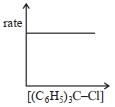
B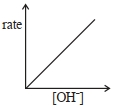
C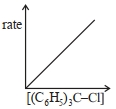
D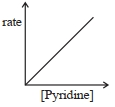
Solution
(C) The given reaction is a nucleophilic substitution reaction of a tertiary alkyl halide,$(C_6H_5)_3C-Cl$,which proceeds via an $SN_1$ mechanism.
In an $SN_1$ reaction,the rate-determining step is the formation of the carbocation,which depends only on the concentration of the alkyl halide.
The rate law for this reaction is: $\text{Rate} = k[(C_6H_5)_3C-Cl]$.
Since the rate is directly proportional to the concentration of the alkyl halide,the graph of rate versus $[(C_6H_5)_3C-Cl]$ should be a straight line passing through the origin,as shown in option $C$.
In an $SN_1$ reaction,the rate-determining step is the formation of the carbocation,which depends only on the concentration of the alkyl halide.
The rate law for this reaction is: $\text{Rate} = k[(C_6H_5)_3C-Cl]$.
Since the rate is directly proportional to the concentration of the alkyl halide,the graph of rate versus $[(C_6H_5)_3C-Cl]$ should be a straight line passing through the origin,as shown in option $C$.
0 likesView Solution
242
ChemistryMediumMCQJEE Main · 2023
The complex cation which has two isomers is:
A
$[Co(H_2O)_6]^{3+}$
B
$[Co(NH_3)_5Cl]^{2+}$
C
$[Co(NH_3)_5NO_2]^{2+}$
D
$[Co(NH_3)_5Cl]^{+}$
Solution
(C) The complex cation $[Co(NH_3)_5NO_2]^{2+}$ exhibits linkage isomerism.
This occurs because the $NO_2^-$ ligand is an ambidentate ligand,which can coordinate to the central metal atom through either the nitrogen atom (nitro isomer) or the oxygen atom (nitrito isomer).
This occurs because the $NO_2^-$ ligand is an ambidentate ligand,which can coordinate to the central metal atom through either the nitrogen atom (nitro isomer) or the oxygen atom (nitrito isomer).
0 likesView Solution
243
ChemistryDifficultMCQJEE Main · 2023
Which element is not present in Nessler's reagent?
A
Mercury
B
Potassium
C
Iodine
D
Oxygen
Solution
(D) The chemical formula for Nessler's reagent is $K_2[HgI_4]$.
It consists of potassium $(K)$,mercury $(Hg)$,and iodine $(I)$.
Therefore,oxygen $(O)$ is not present in Nessler's reagent.
It consists of potassium $(K)$,mercury $(Hg)$,and iodine $(I)$.
Therefore,oxygen $(O)$ is not present in Nessler's reagent.
0 likesView Solution
244
ChemistryDifficultMCQJEE Main · 2023
Given below are two statements: one is labelled as Assertion $(A)$ and the other is labelled as Reason $(R)$.
Assertion $(A)$: $\alpha$-halocarboxylic acid on reaction with dil. $NH_3$ gives good yield of $\alpha$-amino carboxylic acid whereas the yield of amines is very low when prepared from alkyl halides.
Reason $(R)$: Amino acids exist in zwitter ion form in aqueous medium.
In the light of the above statements,choose the correct answer from the options given below:
Assertion $(A)$: $\alpha$-halocarboxylic acid on reaction with dil. $NH_3$ gives good yield of $\alpha$-amino carboxylic acid whereas the yield of amines is very low when prepared from alkyl halides.
Reason $(R)$: Amino acids exist in zwitter ion form in aqueous medium.
In the light of the above statements,choose the correct answer from the options given below:
A
Both $(A)$ and $(R)$ are correct and $(R)$ is the correct explanation of $(A)$.
B
Both $(A)$ and $(R)$ are correct but $(R)$ is not the correct explanation of $(A)$.
C
$(A)$ is correct but $(R)$ is not correct.
D
$(A)$ is not correct but $(R)$ is correct.
Solution
(B) Assertion $(A)$ is correct. The reaction of $\alpha$-halocarboxylic acids with aqueous $NH_3$ is a standard method for preparing $\alpha$-amino acids because the reaction is controlled and the product is stable. In contrast,the reaction of alkyl halides with $NH_3$ (ammonolysis) often leads to a mixture of primary,secondary,and tertiary amines,resulting in a low yield of the primary amine.
Reason $(R)$ is correct. Amino acids do exist as zwitter ions in aqueous medium due to the internal acid-base reaction between the $-COOH$ and $-NH_2$ groups.
However,the zwitter ion nature of amino acids is not the reason why $\alpha$-halocarboxylic acids give a better yield of amino acids compared to alkyl halides. The yield difference is due to the nature of the substitution reaction and the stability of the products formed.
Therefore,both $(A)$ and $(R)$ are correct,but $(R)$ is not the correct explanation of $(A)$.
Reason $(R)$ is correct. Amino acids do exist as zwitter ions in aqueous medium due to the internal acid-base reaction between the $-COOH$ and $-NH_2$ groups.
However,the zwitter ion nature of amino acids is not the reason why $\alpha$-halocarboxylic acids give a better yield of amino acids compared to alkyl halides. The yield difference is due to the nature of the substitution reaction and the stability of the products formed.
Therefore,both $(A)$ and $(R)$ are correct,but $(R)$ is not the correct explanation of $(A)$.
0 likesView Solution
245
ChemistryDifficultMCQJEE Main · 2023
The structures of major products $A$, $B$, and $C$ in the following reaction sequence are:
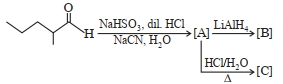
A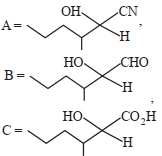
B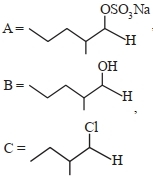
C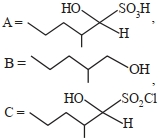
D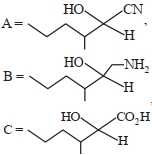
Solution
(D) $1$. The reaction of the aldehyde with $NaCN$ and $H_2O$ (cyanohydrin formation) yields the cyanohydrin product $[A]$. The structure of $[A]$ is a $2$-hydroxy-$3$-methylhexanenitrile derivative.
$2$. The reduction of the nitrile group $(-CN)$ in $[A]$ using $LiAlH_4$ produces a primary amine $(-CH_2NH_2)$. Thus, $[B]$ is the corresponding amino-alcohol.
$3$. The acid-catalyzed hydrolysis of the nitrile group $(-CN)$ in $[A]$ using $HCl/H_2O$ and heat $(\Delta)$ converts it into a carboxylic acid group $(-COOH)$. Thus, $[C]$ is the corresponding hydroxy-acid.
$4$. Comparing these structures with the given options, option $D$ correctly represents the structures of $[A]$, $[B]$, and $[C]$.
$2$. The reduction of the nitrile group $(-CN)$ in $[A]$ using $LiAlH_4$ produces a primary amine $(-CH_2NH_2)$. Thus, $[B]$ is the corresponding amino-alcohol.
$3$. The acid-catalyzed hydrolysis of the nitrile group $(-CN)$ in $[A]$ using $HCl/H_2O$ and heat $(\Delta)$ converts it into a carboxylic acid group $(-COOH)$. Thus, $[C]$ is the corresponding hydroxy-acid.
$4$. Comparing these structures with the given options, option $D$ correctly represents the structures of $[A]$, $[B]$, and $[C]$.
0 likesView Solution
246
ChemistryMediumMCQJEE Main · 2023
Given below are two statements: one is labelled as Assertion $(A)$ and the other is labelled as Reason $(R)$.
Assertion $(A):$ $Cu^{2+}$ in water is more stable than $Cu^{+}$.
Reason $(R):$ Enthalpy of hydration for $Cu^{2+}$ is much less than that of $Cu^{+}$.
In the light of the above statements,choose the correct answer from the options given below:
Assertion $(A):$ $Cu^{2+}$ in water is more stable than $Cu^{+}$.
Reason $(R):$ Enthalpy of hydration for $Cu^{2+}$ is much less than that of $Cu^{+}$.
In the light of the above statements,choose the correct answer from the options given below:
A
Both $(A)$ and $(R)$ are correct and $(R)$ is the correct explanation of $(A)$.
B
$(A)$ is correct but $(R)$ is not correct.
C
$(A)$ is not correct but $(R)$ is correct.
D
Both $(A)$ and $(R)$ are correct but $(R)$ is not the correct explanation of $(A)$.
Solution
(B) The stability of $Cu^{2+}(aq)$ in aqueous solution is higher than that of $Cu^{+}(aq)$.
This is because the enthalpy of hydration $(\Delta_{hyd}H)$ for $Cu^{2+}$ is much more negative (higher magnitude) than that of $Cu^{+}$.
This large negative hydration energy of $Cu^{2+}$ more than compensates for the energy required for the second ionization enthalpy of $Cu$,making $Cu^{2+}$ more stable in water.
Therefore,Assertion $(A)$ is correct,but Reason $(R)$ is incorrect because the enthalpy of hydration for $Cu^{2+}$ is much more negative (greater in magnitude) than that of $Cu^{+}$,not less.
This is because the enthalpy of hydration $(\Delta_{hyd}H)$ for $Cu^{2+}$ is much more negative (higher magnitude) than that of $Cu^{+}$.
This large negative hydration energy of $Cu^{2+}$ more than compensates for the energy required for the second ionization enthalpy of $Cu$,making $Cu^{2+}$ more stable in water.
Therefore,Assertion $(A)$ is correct,but Reason $(R)$ is incorrect because the enthalpy of hydration for $Cu^{2+}$ is much more negative (greater in magnitude) than that of $Cu^{+}$,not less.
0 likesView Solution
247
ChemistryDifficultMCQJEE Main · 2023
In the figure,a straight line is given for the Freundlich Adsorption isotherm equation $(y = mx + c)$,where the equation is $y = 0.3x + 0.7033$. The values of $\frac{1}{n}$ and $\log K$ are respectively:
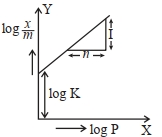
A
$0.3$ and $\log 2.505$
B
$0.3$ and $0.7033$
C
$3$ and $2.505$
D
$3$ and $0.7033$
Solution
(B) The Freundlich adsorption isotherm is given by the equation: $\frac{x}{m} = K \cdot P^{1/n}$.
Taking logarithm on both sides,we get: $\log(\frac{x}{m}) = \log K + \frac{1}{n} \log P$.
Comparing this with the equation of a straight line $y = mx + c$,where $y = \log(\frac{x}{m})$,$x = \log P$,the slope $m = \frac{1}{n}$,and the intercept $c = \log K$.
Given the equation $y = 0.3x + 0.7033$,we have:
Slope $(m)$ = $\frac{1}{n} = 0.3$.
Intercept $(c)$ = $\log K = 0.7033$.
Thus,the values of $\frac{1}{n}$ and $\log K$ are $0.3$ and $0.7033$ respectively.
Taking logarithm on both sides,we get: $\log(\frac{x}{m}) = \log K + \frac{1}{n} \log P$.
Comparing this with the equation of a straight line $y = mx + c$,where $y = \log(\frac{x}{m})$,$x = \log P$,the slope $m = \frac{1}{n}$,and the intercept $c = \log K$.
Given the equation $y = 0.3x + 0.7033$,we have:
Slope $(m)$ = $\frac{1}{n} = 0.3$.
Intercept $(c)$ = $\log K = 0.7033$.
Thus,the values of $\frac{1}{n}$ and $\log K$ are $0.3$ and $0.7033$ respectively.
0 likesView Solution
248
ChemistryDifficultMCQJEE Main · 2023
Below are two statements. One is labeled as Assertion $(A)$ and the other as Reason $(R).$
Assertion $(A):$ When using an aqueous solution of $KOH$ in a volumetric analysis,its concentration should be checked before use.
Reason $(R):$ $KOH$ solution absorbs atmospheric $CO_2$ when it gets old.
In the context of the above statements,choose the correct answer from the options given below:
Assertion $(A):$ When using an aqueous solution of $KOH$ in a volumetric analysis,its concentration should be checked before use.
Reason $(R):$ $KOH$ solution absorbs atmospheric $CO_2$ when it gets old.
In the context of the above statements,choose the correct answer from the options given below:
A
$A$ is false,but $R$ is true.
B
Both $A$ and $R$ are true,but $R$ is not the correct explanation of $A.$
C
Both $A$ and $R$ are true,and $R$ is the correct explanation of $A.$
D
$A$ is true,but $R$ is false.
Solution
(C) $KOH$ is a strong base that reacts with atmospheric $CO_2$ to form potassium carbonate $(K_2CO_3)$.
$2KOH + CO_2 \rightarrow K_2CO_3 + H_2O$
Due to this reaction,the concentration of the $KOH$ solution decreases over time when exposed to air.
Therefore,it is necessary to standardize or check the concentration of $KOH$ solution before using it in volumetric analysis to ensure accuracy.
Thus,both Assertion $(A)$ and Reason $(R)$ are true,and $(R)$ is the correct explanation of $(A).$
$2KOH + CO_2 \rightarrow K_2CO_3 + H_2O$
Due to this reaction,the concentration of the $KOH$ solution decreases over time when exposed to air.
Therefore,it is necessary to standardize or check the concentration of $KOH$ solution before using it in volumetric analysis to ensure accuracy.
Thus,both Assertion $(A)$ and Reason $(R)$ are true,and $(R)$ is the correct explanation of $(A).$
0 likesView Solution
249
ChemistryMediumMCQJEE Main · 2023
Among the following compounds,the number of those present in copper matte is $......$
$A.$ $CuCO_3$
$B.$ $Cu_2S$
$C.$ $Cu_2O$
$D.$ $FeO$
$A.$ $CuCO_3$
$B.$ $Cu_2S$
$C.$ $Cu_2O$
$D.$ $FeO$
A
$2$
B
$3$
C
$4$
D
$1$
Solution
(D) Copper matte is a mixture of $Cu_2S$ and $FeS$.
Among the given options,only $Cu_2S$ is present in copper matte.
Therefore,the number of compounds present in copper matte from the given list is $1$.
Among the given options,only $Cu_2S$ is present in copper matte.
Therefore,the number of compounds present in copper matte from the given list is $1$.
0 likesView Solution
250
ChemistryMediumMCQJEE Main · 2023
Among the following,the number of tranquilizer/s is/are $.......$.
$A.$ Chlordiazepoxide
$B.$ Veronal
$C.$ Valium
$D.$ Salvarsan
$A.$ Chlordiazepoxide
$B.$ Veronal
$C.$ Valium
$D.$ Salvarsan
A
$2$
B
$3$
C
$1$
D
$4$
Solution
(B) Tranquilizers are a class of chemical compounds used for the treatment of stress,and mild or even severe mental diseases.
$1.$ Chlordiazepoxide is a well-known tranquilizer.
$2.$ Veronal is a derivative of barbituric acid and acts as a tranquilizer.
$3.$ Valium (Diazepam) is a widely used tranquilizer.
$4.$ Salvarsan is an antibiotic used for the treatment of syphilis.
Therefore,there are $3$ tranquilizers among the given options.
$1.$ Chlordiazepoxide is a well-known tranquilizer.
$2.$ Veronal is a derivative of barbituric acid and acts as a tranquilizer.
$3.$ Valium (Diazepam) is a widely used tranquilizer.
$4.$ Salvarsan is an antibiotic used for the treatment of syphilis.
Therefore,there are $3$ tranquilizers among the given options.
0 likesView Solution
Vedclass Products
For Students
Vedclass Test Series
Mock tests in real JEE Main style covering Chemistry with performance analysis. 5-day free trial.
Start Free TrialFor Teachers
Exam Paper Generator
Generate Set A/B/C/D Chemistry papers from 7.5L+ questions in 2 minutes. 3 chapters free.
Try FreeFor Institutes
Online Exam Module
Run live JEE Main mock exams with unlimited students, 360° analytics & white-label branding.
See DemoFrequently Asked Questions
How many Chemistry questions are in JEE Main 2023?
There are 726 Chemistry questions from the JEE Main 2023 paper on Vedclass, each with a detailed step-by-step solution in English.
Are JEE Main 2023 Chemistry solutions available in English?
Yes. All solutions on this page are in English. You can also switch to English or Hindi using the language buttons above the questions.
Can I practice JEE Main 2023 Chemistry as a timed test?
Yes. Use the Vedclass Test Series to attempt a full JEE Main mock test covering Chemistry with time limits and instant score analysis.
Can teachers create Chemistry papers from JEE Main previous year questions?
Yes. The Vedclass Exam Paper Generator lets teachers mix JEE Main Chemistry questions and generate Set A/B/C/D papers in minutes.
For Teachers & Institutes
Build a Custom Chemistry Paper
Pick JEE Main 2023 Chemistry questions, set difficulty, and generate Set A/B/C/D in 2 minutes.