
ChemistryQ301–374 of 726 questions
Page 7 of 9 · English
301
ChemistryMediumMCQJEE Main · 2023
What happens when methane undergoes combustion in systems $A$ and $B$ respectively?
| System $A$ | System $B$ |
|---|---|
| Temperature rise | Temperature remains same |
A
| System $A$ | System $B$ |
|---|---|
| Adiabatic system | Diathermic system |
B
| System $A$ | System $B$ |
|---|---|
| Diathermic system | Adiabatic system |
C
| System $A$ | System $B$ |
|---|---|
| Isothermal system | Adiabatic system |
D
| System $A$ | System $B$ |
|---|---|
| Isolated system | Closed system |
Solution
(A) The combustion of methane $(CH_4 + 2O_2 \rightarrow CO_2 + 2H_2O)$ is an exothermic process.
In System $A$,the temperature rises because the system is adiabatic,meaning no heat can escape to the surroundings.
In System $B$,the temperature remains constant because the system is diathermic,allowing heat to be exchanged with the surroundings to maintain thermal equilibrium.
Therefore,System $A$ is an adiabatic system and System $B$ is a diathermic system.
In System $A$,the temperature rises because the system is adiabatic,meaning no heat can escape to the surroundings.
In System $B$,the temperature remains constant because the system is diathermic,allowing heat to be exchanged with the surroundings to maintain thermal equilibrium.
Therefore,System $A$ is an adiabatic system and System $B$ is a diathermic system.
0 likesView Solution
302
ChemistryDifficultMCQJEE Main · 2023
Given below are two statements,one is labelled as Assertion $A$ and the other is labelled as Reason $R$.
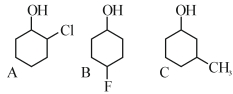
Assertion $A$ : Order of acidic nature of the following compounds is $A > B > C$.
(Image shows: $A$ is $2$-chlorocyclohexanol,$B$ is $4$-fluorocyclohexanol,$C$ is $3$-methylcyclohexanol)
Reason $R$ : Fluoro is a stronger electron withdrawing group than Chloro group.
In the light of the above statements,choose the correct answer from the options given below:
Assertion $A$ : Order of acidic nature of the following compounds is $A > B > C$.
(Image shows: $A$ is $2$-chlorocyclohexanol,$B$ is $4$-fluorocyclohexanol,$C$ is $3$-methylcyclohexanol)
Reason $R$ : Fluoro is a stronger electron withdrawing group than Chloro group.
In the light of the above statements,choose the correct answer from the options given below:
A
$A$ is false but $R$ is true
B
Both $A$ and $R$ are correct and $R$ is the correct explanation of $A$
C
Both $A$ and $R$ are correct but $R$ is $NOT$ the correct explanation of $A$
D
$A$ is true but $R$ is false
Solution
(C) Acidic strength is directly proportional to the $-I$ effect and inversely proportional to the $+I$ effect.
$F$ and $Cl$ exert $-I$ effect,while the methyl group exerts $+I$ effect. Thus,$C$ is the least acidic.
Inductive effect is distance-dependent. In compound $A$,the $-I$ group $(Cl)$ is at the $\alpha$-position relative to the $-OH$ group,whereas in compound $B$,the $-I$ group $(F)$ is at the $\delta$-position.
Due to the closer proximity of the electron-withdrawing group in $A$,it exerts a stronger $-I$ effect on the acidic proton than the more distant group in $B$,despite $F$ being inherently more electronegative than $Cl$.
Therefore,the order of acidity is $A > B > C$. Assertion $A$ is true.
Reason $R$ is also true because $F$ is indeed a stronger electron-withdrawing group than $Cl$ due to higher electronegativity.
However,the reason for $A > B$ is the distance dependence of the inductive effect,not the inherent strength of the electron-withdrawing group. Thus,$R$ is not the correct explanation for $A$.
$F$ and $Cl$ exert $-I$ effect,while the methyl group exerts $+I$ effect. Thus,$C$ is the least acidic.
Inductive effect is distance-dependent. In compound $A$,the $-I$ group $(Cl)$ is at the $\alpha$-position relative to the $-OH$ group,whereas in compound $B$,the $-I$ group $(F)$ is at the $\delta$-position.
Due to the closer proximity of the electron-withdrawing group in $A$,it exerts a stronger $-I$ effect on the acidic proton than the more distant group in $B$,despite $F$ being inherently more electronegative than $Cl$.
Therefore,the order of acidity is $A > B > C$. Assertion $A$ is true.
Reason $R$ is also true because $F$ is indeed a stronger electron-withdrawing group than $Cl$ due to higher electronegativity.
However,the reason for $A > B$ is the distance dependence of the inductive effect,not the inherent strength of the electron-withdrawing group. Thus,$R$ is not the correct explanation for $A$.
0 likesView Solution
303
ChemistryMediumMCQJEE Main · 2023
Identify the correct order of standard enthalpy of formation of sodium halides.
A
$NaI < NaBr < NaCl < NaF$
B
$NaF < NaCl < NaBr < NaI$
C
$NaCl < NaF < NaBr < NaI$
D
$NaI < NaBr < NaF < NaCl$
Solution
(B) The standard enthalpy of formation $(\Delta_{f}H^0)$ for ionic compounds like sodium halides is primarily determined by the lattice energy and the hydration/sublimation energies.
As the size of the halide ion increases from $F^-$ to $I^-$,the lattice energy decreases (becomes less negative).
Consequently,the overall enthalpy of formation becomes less negative (i.e.,increases algebraically) in the order $NaF < NaCl < NaBr < NaI$.
Therefore,the correct order of $\Delta_{f}H^0$ values is $NaF < NaCl < NaBr < NaI$.
As the size of the halide ion increases from $F^-$ to $I^-$,the lattice energy decreases (becomes less negative).
Consequently,the overall enthalpy of formation becomes less negative (i.e.,increases algebraically) in the order $NaF < NaCl < NaBr < NaI$.
Therefore,the correct order of $\Delta_{f}H^0$ values is $NaF < NaCl < NaBr < NaI$.
0 likesView Solution
304
ChemistryMediumMCQJEE Main · 2023
The covalency and oxidation state respectively of boron in $[BF_4]^-$ are
A
$4$ and $3$
B
$4$ and $4$
C
$3$ and $4$
D
$3$ and $5$
Solution
(A) In the $[BF_4]^-$ ion,Boron forms $4$ covalent bonds with $4$ fluorine atoms. Therefore,the covalency of Boron is $4$.
To find the oxidation state of Boron $(x)$:
$x + 4 \times (-1) = -1$
$x - 4 = -1$
$x = +3$
Thus,the covalency is $4$ and the oxidation state is $+3$.
To find the oxidation state of Boron $(x)$:
$x + 4 \times (-1) = -1$
$x - 4 = -1$
$x = +3$
Thus,the covalency is $4$ and the oxidation state is $+3$.
0 likesView Solution
305
ChemistryMediumMCQJEE Main · 2023
$0.400 \ g$ of an organic compound $(X)$ gave $0.376 \ g$ of $AgBr$ in Carius method for estimation of bromine. The $\%$ of bromine in the compound $(X)$ is $.........$. (Given: Molar mass $AgBr = 188 \ g \ mol^{-1}$,$Br = 80 \ g \ mol^{-1}$)
A
$20$
B
$30$
C
$50$
D
$40$
Solution
(D) In the Carius method,the mass of $Br$ is calculated from the mass of $AgBr$ formed.
Mole of $AgBr = \frac{0.376 \ g}{188 \ g \ mol^{-1}} = 0.002 \ mol$.
Since $1 \ mol$ of $AgBr$ contains $1 \ mol$ of $Br$,the mole of $Br = 0.002 \ mol$.
Mass of $Br = 0.002 \ mol \times 80 \ g \ mol^{-1} = 0.16 \ g$.
Percentage of $Br = \frac{\text{Mass of } Br}{\text{Mass of compound}} \times 100 = \frac{0.16 \ g}{0.400 \ g} \times 100 = 40 \%$.
Mole of $AgBr = \frac{0.376 \ g}{188 \ g \ mol^{-1}} = 0.002 \ mol$.
Since $1 \ mol$ of $AgBr$ contains $1 \ mol$ of $Br$,the mole of $Br = 0.002 \ mol$.
Mass of $Br = 0.002 \ mol \times 80 \ g \ mol^{-1} = 0.16 \ g$.
Percentage of $Br = \frac{\text{Mass of } Br}{\text{Mass of compound}} \times 100 = \frac{0.16 \ g}{0.400 \ g} \times 100 = 40 \%$.
0 likesView Solution
306
ChemistryMediumMCQJEE Main · 2023
$1 \ g$ of a carbonate $(M_2CO_3)$ on treatment with excess $HCl$ produces $0.01 \ mol$ of $CO_2$. The molar mass of $M_2CO_3$ is $.......... \ g \ mol^{-1}$. (Nearest integer)
A
$200$
B
$300$
C
$50$
D
$100$
Solution
(D) The balanced chemical equation for the reaction is:
$M_2CO_3 + 2HCl \rightarrow 2MCl + H_2O + CO_2$
From the stoichiometry of the reaction,$1 \ mol$ of $M_2CO_3$ produces $1 \ mol$ of $CO_2$.
Given that $0.01 \ mol$ of $CO_2$ is produced,the moles of $M_2CO_3$ reacted must be $0.01 \ mol$.
We know that $\text{moles} = \frac{\text{mass}}{\text{molar mass}}$.
Therefore,$0.01 \ mol = \frac{1 \ g}{\text{molar mass of } M_2CO_3}$.
$\text{Molar mass of } M_2CO_3 = \frac{1 \ g}{0.01 \ mol} = 100 \ g \ mol^{-1}$.
$M_2CO_3 + 2HCl \rightarrow 2MCl + H_2O + CO_2$
From the stoichiometry of the reaction,$1 \ mol$ of $M_2CO_3$ produces $1 \ mol$ of $CO_2$.
Given that $0.01 \ mol$ of $CO_2$ is produced,the moles of $M_2CO_3$ reacted must be $0.01 \ mol$.
We know that $\text{moles} = \frac{\text{mass}}{\text{molar mass}}$.
Therefore,$0.01 \ mol = \frac{1 \ g}{\text{molar mass of } M_2CO_3}$.
$\text{Molar mass of } M_2CO_3 = \frac{1 \ g}{0.01 \ mol} = 100 \ g \ mol^{-1}$.
0 likesView Solution
307
ChemistryMediumMCQJEE Main · 2023
See the following chemical reaction:
$Cr_2O_7^{2-} + XH^{+} + 6Fe^{2+} \rightarrow YCr^{3+} + 6Fe^{3+} + ZH_2O$
The sum of $X$,$Y$ and $Z$ is $.......$.
$Cr_2O_7^{2-} + XH^{+} + 6Fe^{2+} \rightarrow YCr^{3+} + 6Fe^{3+} + ZH_2O$
The sum of $X$,$Y$ and $Z$ is $.......$.
A
$22$
B
$21$
C
$20$
D
$23$
Solution
(D) The balanced chemical equation is:
$Cr_2O_7^{2-} + 14H^{+} + 6Fe^{2+} \rightarrow 2Cr^{3+} + 6Fe^{3+} + 7H_2O$
Comparing this with the given equation:
$X = 14$
$Y = 2$
$Z = 7$
Therefore,the sum $(X + Y + Z) = 14 + 2 + 7 = 23$.
$Cr_2O_7^{2-} + 14H^{+} + 6Fe^{2+} \rightarrow 2Cr^{3+} + 6Fe^{3+} + 7H_2O$
Comparing this with the given equation:
$X = 14$
$Y = 2$
$Z = 7$
Therefore,the sum $(X + Y + Z) = 14 + 2 + 7 = 23$.
0 likesView Solution
308
ChemistryMediumMCQJEE Main · 2023
If the formula of Borax is $Na_2B_4O_x(OH)_y \cdot zH_2O$,then $x+y+z = ...........$.
A
$16$
B
$15$
C
$14$
D
$17$
Solution
(D) The chemical formula of Borax is $Na_2[B_4O_5(OH)_4] \cdot 8H_2O$.
Comparing this with the given formula $Na_2B_4O_x(OH)_y \cdot zH_2O$,we get $x = 5$,$y = 4$,and $z = 8$.
Therefore,$x + y + z = 5 + 4 + 8 = 17$.
Comparing this with the given formula $Na_2B_4O_x(OH)_y \cdot zH_2O$,we get $x = 5$,$y = 4$,and $z = 8$.
Therefore,$x + y + z = 5 + 4 + 8 = 17$.
0 likesView Solution
309
ChemistryMediumMCQJEE Main · 2023
$20 \ mL$ of $0.1 \ M$ $NaOH$ is added to $50 \ mL$ of $0.1 \ M$ acetic acid solution. The $pH$ of the resulting solution is $....... \times 10^{-2}$ (Nearest integer).
Given: $pKa$ $(CH_3COOH)$ $= 4.76$,$\log 2 = 0.30$,$\log 3 = 0.48$.
Given: $pKa$ $(CH_3COOH)$ $= 4.76$,$\log 2 = 0.30$,$\log 3 = 0.48$.
A
$487$
B
$430$
C
$438$
D
$458$
Solution
(D) The reaction is: $CH_3COOH + NaOH \rightarrow CH_3COONa + H_2O$.
Initial moles of $CH_3COOH = 50 \ mL \times 0.1 \ M = 5 \ mmol$.
Initial moles of $NaOH = 20 \ mL \times 0.1 \ M = 2 \ mmol$.
After reaction,moles of $CH_3COONa$ (salt) $= 2 \ mmol$ and remaining moles of $CH_3COOH$ (acid) $= 5 - 2 = 3 \ mmol$.
Using the Henderson-Hasselbalch equation: $pH = pKa + \log_{10} (\frac{[salt]}{[acid]})$
$pH = 4.76 + \log_{10} (\frac{2}{3})$
$pH = 4.76 + (\log 2 - \log 3) = 4.76 + (0.30 - 0.48) = 4.76 - 0.18 = 4.58$.
Thus,$pH = 4.58 = 458 \times 10^{-2}$.
Initial moles of $CH_3COOH = 50 \ mL \times 0.1 \ M = 5 \ mmol$.
Initial moles of $NaOH = 20 \ mL \times 0.1 \ M = 2 \ mmol$.
After reaction,moles of $CH_3COONa$ (salt) $= 2 \ mmol$ and remaining moles of $CH_3COOH$ (acid) $= 5 - 2 = 3 \ mmol$.
Using the Henderson-Hasselbalch equation: $pH = pKa + \log_{10} (\frac{[salt]}{[acid]})$
$pH = 4.76 + \log_{10} (\frac{2}{3})$
$pH = 4.76 + (\log 2 - \log 3) = 4.76 + (0.30 - 0.48) = 4.76 - 0.18 = 4.58$.
Thus,$pH = 4.58 = 458 \times 10^{-2}$.
0 likesView Solution
310
ChemistryEasyMCQJEE Main · 2023
The orbital angular momentum of an electron in $3s$ orbital is $\frac{xh}{2\pi}$. The value of $x$ is . . . . . . .
A
$1$
B
$2$
C
$3$
D
$0$
Solution
(D) The orbital angular momentum is calculated using the formula $L = \sqrt{l(l+1)} \frac{h}{2\pi}$.
For any $s$ orbital,including $3s$,the azimuthal quantum number $l$ is $0$.
Substituting $l = 0$ into the formula: $L = \sqrt{0(0+1)} \frac{h}{2\pi} = 0$.
Comparing this with $\frac{xh}{2\pi}$,we get $x = 0$.
For any $s$ orbital,including $3s$,the azimuthal quantum number $l$ is $0$.
Substituting $l = 0$ into the formula: $L = \sqrt{0(0+1)} \frac{h}{2\pi} = 0$.
Comparing this with $\frac{xh}{2\pi}$,we get $x = 0$.
0 likesView Solution
311
ChemistryMediumMCQJEE Main · 2023
The possibility of photochemical smog formation will be minimum at
A
Kolkata in October
B
Mumbai in May
C
New-Delhi in August (Summer)
D
Srinagar,Jammu and Kashmir in January
Solution
(D) Photochemical smog is formed by the action of sunlight on nitrogen oxides and hydrocarbons. It requires a warm,dry,and sunny climate to occur. Srinagar in January experiences cold,winter conditions,which are unfavorable for the formation of photochemical smog. Therefore,the possibility of its formation is minimum at Srinagar in January.
0 likesView Solution
312
ChemistryMediumMCQJEE Main · 2023
Consider the following statements:
$A$. $NF_3$ molecule has a trigonal planar structure.
$B$. Bond length of $N_2$ is shorter than $O_2$.
$C$. Isoelectronic molecules or ions have identical bond order.
$D$. Dipole moment of $H_2S$ is higher than that of water molecule.
Choose the correct answer from the options below:
$A$. $NF_3$ molecule has a trigonal planar structure.
$B$. Bond length of $N_2$ is shorter than $O_2$.
$C$. Isoelectronic molecules or ions have identical bond order.
$D$. Dipole moment of $H_2S$ is higher than that of water molecule.
Choose the correct answer from the options below:
A
$A$ and $D$ are correct
B
$C$ and $D$ are correct
C
$A$ and $B$ are correct
D
$B$ and $C$ are correct
Solution
(D) . $NF_3$ has a trigonal pyramidal shape due to the presence of one lone pair on the $N$ atom.
$B$. The bond order of $N_2$ is $3$ and $O_2$ is $2$. Higher bond order implies shorter bond length,so $N_2$ has a shorter bond length than $O_2$. Statement $B$ is correct.
$C$. Isoelectronic species (e.g.,$N_2$ and $CO$) have identical bond orders. Statement $C$ is correct.
$D$. The dipole moment of $H_2O$ $(1.85 \ D)$ is higher than that of $H_2S$ $(0.95 \ D)$ due to the higher electronegativity of oxygen compared to sulfur. Statement $D$ is incorrect.
Therefore,statements $B$ and $C$ are correct.
$B$. The bond order of $N_2$ is $3$ and $O_2$ is $2$. Higher bond order implies shorter bond length,so $N_2$ has a shorter bond length than $O_2$. Statement $B$ is correct.
$C$. Isoelectronic species (e.g.,$N_2$ and $CO$) have identical bond orders. Statement $C$ is correct.
$D$. The dipole moment of $H_2O$ $(1.85 \ D)$ is higher than that of $H_2S$ $(0.95 \ D)$ due to the higher electronegativity of oxygen compared to sulfur. Statement $D$ is incorrect.
Therefore,statements $B$ and $C$ are correct.
0 likesView Solution
313
ChemistryMediumMCQJEE Main · 2023
Given below are two statements:
Statement $I:$ According to Bohr's model of hydrogen atom,the angular momentum of an electron in a given stationary state is quantised.
Statement $II:$ The concept of electron in Bohr's orbit,violates the Heisenberg uncertainty principle.
In the light of the above statements,choose the most appropriate answer from the options given below:
Statement $I:$ According to Bohr's model of hydrogen atom,the angular momentum of an electron in a given stationary state is quantised.
Statement $II:$ The concept of electron in Bohr's orbit,violates the Heisenberg uncertainty principle.
In the light of the above statements,choose the most appropriate answer from the options given below:
A
Both Statement $I$ and Statement $II$ are correct.
B
Statement $I$ is correct but Statement $II$ is incorrect.
C
Statement $I$ is incorrect but Statement $II$ is correct.
D
Both Statement $I$ and Statement $II$ are incorrect.
Solution
(A) Statement $I$ is correct because according to Bohr's postulate,the angular momentum of an electron in a stationary orbit is an integral multiple of $\frac{h}{2\pi}$,i.e.,$mvr = \frac{nh}{2\pi}$.
Statement $II$ is correct because Bohr's model assumes electrons move in well-defined circular orbits with fixed velocity and position,which directly contradicts the Heisenberg uncertainty principle,which states that it is impossible to determine simultaneously the exact position and momentum of a subatomic particle.
Statement $II$ is correct because Bohr's model assumes electrons move in well-defined circular orbits with fixed velocity and position,which directly contradicts the Heisenberg uncertainty principle,which states that it is impossible to determine simultaneously the exact position and momentum of a subatomic particle.
0 likesView Solution
314
ChemistryMediumMCQJEE Main · 2023
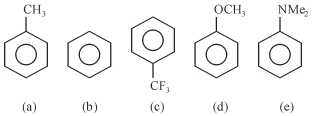
The decreasing order of reactivity towards electrophilic substitution for the following compounds is:
A
$c > b > a > d > e$
B
$e > d > a > b > c$
C
$a > d > e > b > c$
D
$d > a > e > c > b$
Solution
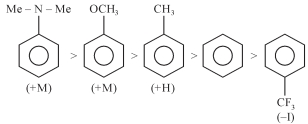
(B) The reactivity of benzene derivatives towards electrophilic substitution depends on the electron density of the benzene ring. Substituents that increase electron density (electron-donating groups) activate the ring,while those that decrease electron density (electron-withdrawing groups) deactivate the ring.
$1$. $-NMe_2$ (in $e$) has a strong $+M$ effect,making it the most reactive.
$2$. $-OCH_3$ (in $d$) also has a $+M$ effect,but it is weaker than $-NMe_2$ due to the higher electronegativity of oxygen.
$3$. $-CH_3$ (in $a$) shows a $+H$ (hyperconjugation) effect,which is weaker than the $+M$ effect.
$4$. Benzene $(b)$ has no substituent.
$5$. $-CF_3$ (in $c$) is a strong electron-withdrawing group due to the $-I$ effect,making it the least reactive.
Therefore,the decreasing order of reactivity is: $e > d > a > b > c$.
$1$. $-NMe_2$ (in $e$) has a strong $+M$ effect,making it the most reactive.
$2$. $-OCH_3$ (in $d$) also has a $+M$ effect,but it is weaker than $-NMe_2$ due to the higher electronegativity of oxygen.
$3$. $-CH_3$ (in $a$) shows a $+H$ (hyperconjugation) effect,which is weaker than the $+M$ effect.
$4$. Benzene $(b)$ has no substituent.
$5$. $-CF_3$ (in $c$) is a strong electron-withdrawing group due to the $-I$ effect,making it the least reactive.
Therefore,the decreasing order of reactivity is: $e > d > a > b > c$.
0 likesView Solution
315
ChemistryMediumMCQJEE Main · 2023
Which of the following statement$(s)$ is/are correct?
$ (A) $ The $pH$ of $1 \times 10^{-8} \ M \ HCl$ solution is $8$.
$ (B) $ The conjugate base of $H_2PO_4^{-}$ is $HPO_4^{2-}$.
$ (C) $ $K_w$ increases with increase in temperature.
$ (D) $ When a solution of weak monoprotic acid is titrated against a strong base at half neutralisation point,$pH = pK_a$.
Choose the correct answer from the option given below.
$ (A) $ The $pH$ of $1 \times 10^{-8} \ M \ HCl$ solution is $8$.
$ (B) $ The conjugate base of $H_2PO_4^{-}$ is $HPO_4^{2-}$.
$ (C) $ $K_w$ increases with increase in temperature.
$ (D) $ When a solution of weak monoprotic acid is titrated against a strong base at half neutralisation point,$pH = pK_a$.
Choose the correct answer from the option given below.
A
$ (B), (C), (D) $
B
$ (A), (D) $
C
$ (A), (B), (C) $
D
$ (B), (C) $
Solution
(A) $ (A) $ The $pH$ of $1 \times 10^{-8} \ M \ HCl$ is not $8$ because the contribution of $H^+$ ions from water cannot be neglected. The $pH$ is approximately $6.98$.
$ (B) $ The conjugate base of $H_2PO_4^{-}$ is obtained by removing one $H^+$ ion,which gives $HPO_4^{2-}$. This is correct.
$ (C) $ The auto-ionization of water is an endothermic process,so $K_w$ increases with an increase in temperature. This is correct.
$ (D) $ According to the Henderson-Hasselbalch equation,$pH = pK_a + \log \frac{[Salt]}{[Acid]}$. At the half-neutralization point,$[Salt] = [Acid]$,so $pH = pK_a$. This is correct.
$ (B) $ The conjugate base of $H_2PO_4^{-}$ is obtained by removing one $H^+$ ion,which gives $HPO_4^{2-}$. This is correct.
$ (C) $ The auto-ionization of water is an endothermic process,so $K_w$ increases with an increase in temperature. This is correct.
$ (D) $ According to the Henderson-Hasselbalch equation,$pH = pK_a + \log \frac{[Salt]}{[Acid]}$. At the half-neutralization point,$[Salt] = [Acid]$,so $pH = pK_a$. This is correct.
0 likesView Solution
316
ChemistryMediumMCQJEE Main · 2023
Given below are two statements: One is labelled as Assertion $A$ and the other is labelled as Reason $R$ :
Assertion $(A)$ : $BeCl_2$ and $MgCl_2$ produce characteristic flame.
Reason $(R)$ : The excitation energy is high in $BeCl_2$ and $MgCl_2$.
In the light of the above statements,choose the correct answer from the option given below :
Assertion $(A)$ : $BeCl_2$ and $MgCl_2$ produce characteristic flame.
Reason $(R)$ : The excitation energy is high in $BeCl_2$ and $MgCl_2$.
In the light of the above statements,choose the correct answer from the option given below :
A
Both $(A)$ and $(R)$ are true but $(R)$ is $NOT$ the correct explanation of $(A)$
B
$(A)$ is false but $(R)$ is true
C
Both $(A)$ and $(R)$ are true and $(R)$ is the correct explanation of $(A)$
D
$(A)$ is true but $(R)$ is false.
Solution
(B) The electrons in $Be$ and $Mg$ are strongly bound to the nucleus due to their small size and high ionization enthalpy.
Consequently,the energy required to excite these electrons to higher energy levels is very high,which cannot be provided by the heat of a Bunsen flame.
Therefore,$Be$ and $Mg$ do not impart any characteristic color to the flame.
Assertion $(A)$ is false because $BeCl_2$ and $MgCl_2$ do not produce a characteristic flame.
Reason $(R)$ is true because the excitation energy for $Be$ and $Mg$ is indeed very high.
Consequently,the energy required to excite these electrons to higher energy levels is very high,which cannot be provided by the heat of a Bunsen flame.
Therefore,$Be$ and $Mg$ do not impart any characteristic color to the flame.
Assertion $(A)$ is false because $BeCl_2$ and $MgCl_2$ do not produce a characteristic flame.
Reason $(R)$ is true because the excitation energy for $Be$ and $Mg$ is indeed very high.
0 likesView Solution
317
ChemistryMediumMCQJEE Main · 2023
During the water-gas shift reaction:
A
$Carbon$ $monoxide$ is oxidized to $carbon$ $dioxide$.
B
$Carbon$ is oxidized to $carbon$ $monoxide$.
C
$Carbon$ $dioxide$ is reduced to $carbon$ $monoxide$.
D
Water is evaporated in the presence of a catalyst.
Solution
(A) The water-gas shift reaction is represented by the equation: $CO(g) + H_2O(g) \xrightarrow{\text{Iron chromate}} CO_2(g) + H_2(g)$.
In this reaction,the oxidation state of carbon in $CO$ is $+2$,and in $CO_2$ it is $+4$.
Since the oxidation state of carbon increases from $+2$ to $+4$,$CO$ is oxidized to $CO_2$.
In this reaction,the oxidation state of carbon in $CO$ is $+2$,and in $CO_2$ it is $+4$.
Since the oxidation state of carbon increases from $+2$ to $+4$,$CO$ is oxidized to $CO_2$.
0 likesView Solution
318
ChemistryDifficultMCQJEE Main · 2023
For a good quality cement,the ratio of silica to alumina is found to be
A
$2.5 - 4.0$
B
$4.5$
C
$2.0$
D
$1.5$
Solution
(A) For good quality cement,the ratio of silica $(SiO_2)$ to alumina $(Al_2O_3)$ should be between $2.5$ and $4.0$.
0 likesView Solution
319
ChemistryDifficultMCQJEE Main · 2023
Which of the following statements is correct for paper chromatography?
A
Water present in the mobile phase gets absorbed by the paper which then forms the stationary phase.
B
Water present in the pores of the paper forms the stationary phase.
C
Paper sheet forms the stationary phase.
D
Paper and water present in its pores together form the stationary phase.
Solution
(B) In paper chromatography,a special quality paper known as chromatography paper is used.
This paper contains water trapped in its pores,which acts as the stationary phase.
This paper contains water trapped in its pores,which acts as the stationary phase.
0 likesView Solution
320
ChemistryDifficultMCQJEE Main · 2023
The total change in the oxidation state of manganese involved in the reaction of $KMnO_4$ and potassium iodide in the acidic medium is $..........$.
A
$5$
B
$4$
C
$3$
D
$2$
Solution
(A) In an acidic medium,$KMnO_4$ acts as an oxidizing agent and is reduced to $Mn^{2+}$.
The reaction is: $2KMnO_4 + 10KI + 8H_2SO_4 \rightarrow 6K_2SO_4 + 2MnSO_4 + 5I_2 + 8H_2O$.
The oxidation state of $Mn$ in $KMnO_4$ is $+7$.
The oxidation state of $Mn$ in $MnSO_4$ is $+2$.
The change in oxidation state is $|(+2) - (+7)| = 5$.
The reaction is: $2KMnO_4 + 10KI + 8H_2SO_4 \rightarrow 6K_2SO_4 + 2MnSO_4 + 5I_2 + 8H_2O$.
The oxidation state of $Mn$ in $KMnO_4$ is $+7$.
The oxidation state of $Mn$ in $MnSO_4$ is $+2$.
The change in oxidation state is $|(+2) - (+7)| = 5$.
0 likesView Solution
321
ChemistryMediumMCQJEE Main · 2023
In Chromyl chloride,the oxidation state of chromium is $+6$.
A
$6$
B
$5$
C
$4$
D
$3$
Solution
(A) The chemical formula for Chromyl chloride is $CrO_2Cl_2$.
Let the oxidation state of $Cr$ be $x$.
$x + 2(-2) + 2(-1) = 0$
$x - 4 - 2 = 0$
$x = +6$
Therefore,the oxidation state of chromium in $CrO_2Cl_2$ is $+6$.
Let the oxidation state of $Cr$ be $x$.
$x + 2(-2) + 2(-1) = 0$
$x - 4 - 2 = 0$
$x = +6$
Therefore,the oxidation state of chromium in $CrO_2Cl_2$ is $+6$.
0 likesView Solution
322
ChemistryMediumMCQJEE Main · 2023
The total number of isoelectronic species from the given set is $.......$
$O^{2-}, F^{-}, Al, Mg^{2+}, Na^{+}, O^{+}, Mg, Al^{3+}, F$
$O^{2-}, F^{-}, Al, Mg^{2+}, Na^{+}, O^{+}, Mg, Al^{3+}, F$
A
$5$
B
$4$
C
$3$
D
$2$
Solution
(A) Isoelectronic species are those that have the same number of electrons.
$O^{2-} = 8 + 2 = 10 \text{ electrons}$
$F^{-} = 9 + 1 = 10 \text{ electrons}$
$Mg^{2+} = 12 - 2 = 10 \text{ electrons}$
$Na^{+} = 11 - 1 = 10 \text{ electrons}$
$Al^{3+} = 13 - 3 = 10 \text{ electrons}$
Other species:
$Al = 13 \text{ electrons}$
$O^{+} = 7 \text{ electrons}$
$Mg = 12 \text{ electrons}$
$F = 9 \text{ electrons}$
The isoelectronic species are $O^{2-}, F^{-}, Mg^{2+}, Na^{+}, \text{ and } Al^{3+}$.
Total count = $5$.
$O^{2-} = 8 + 2 = 10 \text{ electrons}$
$F^{-} = 9 + 1 = 10 \text{ electrons}$
$Mg^{2+} = 12 - 2 = 10 \text{ electrons}$
$Na^{+} = 11 - 1 = 10 \text{ electrons}$
$Al^{3+} = 13 - 3 = 10 \text{ electrons}$
Other species:
$Al = 13 \text{ electrons}$
$O^{+} = 7 \text{ electrons}$
$Mg = 12 \text{ electrons}$
$F = 9 \text{ electrons}$
The isoelectronic species are $O^{2-}, F^{-}, Mg^{2+}, Na^{+}, \text{ and } Al^{3+}$.
Total count = $5$.
0 likesView Solution
323
ChemistryMediumMCQJEE Main · 2023
$30.4 \, kJ$ of heat is required to melt one mole of sodium chloride and the entropy change at the melting point is $28.4 \, J \, K^{-1} \, mol^{-1}$ at $1 \, atm$. The melting point of sodium chloride is $........... \, K$ (Nearest Integer).
A
$1070$
B
$1060$
C
$1050$
D
$1040$
Solution
(A) The relationship between enthalpy change of fusion $(\Delta H_{fus})$,entropy change of fusion $(\Delta S_{fus})$,and melting point $(T_{mp})$ is given by the formula: $\Delta S_{fus} = \frac{\Delta H_{fus}}{T_{mp}}$.
Given: $\Delta H_{fus} = 30.4 \, kJ \, mol^{-1} = 30400 \, J \, mol^{-1}$ and $\Delta S_{fus} = 28.4 \, J \, K^{-1} \, mol^{-1}$.
Substituting the values into the equation: $28.4 = \frac{30400}{T_{mp}}$.
Solving for $T_{mp}$: $T_{mp} = \frac{30400}{28.4} \approx 1070.42 \, K$.
Rounding to the nearest integer,the melting point is $1070 \, K$.
Given: $\Delta H_{fus} = 30.4 \, kJ \, mol^{-1} = 30400 \, J \, mol^{-1}$ and $\Delta S_{fus} = 28.4 \, J \, K^{-1} \, mol^{-1}$.
Substituting the values into the equation: $28.4 = \frac{30400}{T_{mp}}$.
Solving for $T_{mp}$: $T_{mp} = \frac{30400}{28.4} \approx 1070.42 \, K$.
Rounding to the nearest integer,the melting point is $1070 \, K$.
0 likesView Solution
324
ChemistryMCQJEE Main · 2023
Every planet revolves around the sun in an elliptical orbit. Consider the following statements:
$A.$ The gravitational force acting on a planet is inversely proportional to the square of the distance from the sun.
$B.$ The gravitational force acting on a planet is inversely proportional to the product of the masses of the planet and the sun.
$C.$ The centripetal force acting on the planet is directed away from the sun.
$D.$ The square of the time period of revolution of a planet around the sun is directly proportional to the cube of the semi-major axis of the elliptical orbit.
Choose the correct statements from the options given above:
$A.$ The gravitational force acting on a planet is inversely proportional to the square of the distance from the sun.
$B.$ The gravitational force acting on a planet is inversely proportional to the product of the masses of the planet and the sun.
$C.$ The centripetal force acting on the planet is directed away from the sun.
$D.$ The square of the time period of revolution of a planet around the sun is directly proportional to the cube of the semi-major axis of the elliptical orbit.
Choose the correct statements from the options given above:
A
$A$ and $D$ only
B
$C$ and $D$ only
C
$C$ and $B$ only
D
$A$ and $C$ only
Solution
(A) According to Newton's law of universal gravitation,the force between the sun and a planet is given by $F = \frac{G M m}{r^2}$.
From this formula,we can conclude that $F \propto \frac{1}{r^2}$,which confirms statement $A$ is correct.
Statement $B$ is incorrect because the gravitational force is directly proportional to the product of the masses $(F \propto M m)$,not inversely proportional.
Statement $C$ is incorrect because the centripetal force is provided by the gravitational force,which is directed towards the sun,not away from it.
Statement $D$ represents Kepler's third law of planetary motion,which states that $T^2 \propto a^3$,where $T$ is the time period and $a$ is the semi-major axis. Thus,statement $D$ is correct.
Therefore,statements $A$ and $D$ are correct.
From this formula,we can conclude that $F \propto \frac{1}{r^2}$,which confirms statement $A$ is correct.
Statement $B$ is incorrect because the gravitational force is directly proportional to the product of the masses $(F \propto M m)$,not inversely proportional.
Statement $C$ is incorrect because the centripetal force is provided by the gravitational force,which is directed towards the sun,not away from it.
Statement $D$ represents Kepler's third law of planetary motion,which states that $T^2 \propto a^3$,where $T$ is the time period and $a$ is the semi-major axis. Thus,statement $D$ is correct.
Therefore,statements $A$ and $D$ are correct.
0 likesView Solution
325
ChemistryMediumMCQJEE Main · 2023
The specific conductance of $0.0025 \ M$ acetic acid is $5 \times 10^{-5} \ S \ cm^{-1}$ at a certain temperature. The dissociation constant of acetic acid is $...... \times 10^{-7}$. (Nearest integer) Consider limiting molar conductivity of $CH_3COOH$ as $400 \ S \ cm^2 \ mol^{-1}$.
A
$65$
B
$64$
C
$66$
D
$63$
Solution
(D) The molar conductivity $\wedge_m$ is calculated as: $\wedge_m = \frac{k \times 1000}{C}$
Given $k = 5 \times 10^{-5} \ S \ cm^{-1}$ and $C = 0.0025 \ M$.
$\wedge_m = \frac{5 \times 10^{-5} \times 1000}{0.0025} = \frac{0.05}{0.0025} = 20 \ S \ cm^2 \ mol^{-1}$.
The degree of dissociation $\alpha$ is given by $\alpha = \frac{\wedge_m}{\wedge_m^\circ} = \frac{20}{400} = 0.05$.
The dissociation constant $K_a$ is given by $K_a = \frac{C \alpha^2}{1 - \alpha}$.
Since $\alpha$ is very small,$1 - \alpha \approx 1$,so $K_a \approx C \alpha^2 = 0.0025 \times (0.05)^2 = 0.0025 \times 0.0025 = 6.25 \times 10^{-6} = 62.5 \times 10^{-7}$.
Rounding to the nearest integer,we get $63 \times 10^{-7}$.
Given $k = 5 \times 10^{-5} \ S \ cm^{-1}$ and $C = 0.0025 \ M$.
$\wedge_m = \frac{5 \times 10^{-5} \times 1000}{0.0025} = \frac{0.05}{0.0025} = 20 \ S \ cm^2 \ mol^{-1}$.
The degree of dissociation $\alpha$ is given by $\alpha = \frac{\wedge_m}{\wedge_m^\circ} = \frac{20}{400} = 0.05$.
The dissociation constant $K_a$ is given by $K_a = \frac{C \alpha^2}{1 - \alpha}$.
Since $\alpha$ is very small,$1 - \alpha \approx 1$,so $K_a \approx C \alpha^2 = 0.0025 \times (0.05)^2 = 0.0025 \times 0.0025 = 6.25 \times 10^{-6} = 62.5 \times 10^{-7}$.
Rounding to the nearest integer,we get $63 \times 10^{-7}$.
0 likesView Solution
326
ChemistryDifficultMCQJEE Main · 2023
The number of incorrect statement/s from the following is:
$A$. The successive half-lives of zero-order reactions decrease with time.
$B$. $A$ substance appearing as a reactant in the chemical equation may not affect the rate of reaction.
$C$. Order and molecularity of a chemical reaction can be a fractional number.
$D$. The rate constant units of zero and second-order reactions are $mol \ L^{-1} s^{-1}$ and $mol^{-1} L s^{-1}$ respectively.
$A$. The successive half-lives of zero-order reactions decrease with time.
$B$. $A$ substance appearing as a reactant in the chemical equation may not affect the rate of reaction.
$C$. Order and molecularity of a chemical reaction can be a fractional number.
$D$. The rate constant units of zero and second-order reactions are $mol \ L^{-1} s^{-1}$ and $mol^{-1} L s^{-1}$ respectively.
A
$2$
B
$3$
C
$1$
D
$4$
Solution
(C) . For a zero-order reaction,$t_{1/2} = \frac{[A]_0}{2K}$. As the concentration decreases,the half-life decreases. (Correct statement)
$B$. If the order with respect to a reactant is zero,it will not affect the rate of reaction. (Correct statement)
$C$. Order can be fractional,but molecularity is always a whole number and cannot be fractional. (Incorrect statement)
$D$. For a zero-order reaction,the unit is $mol \ L^{-1} s^{-1}$,and for a second-order reaction,the unit is $mol^{-1} L s^{-1}$. (Correct statement)
Thus,only statement $C$ is incorrect. The number of incorrect statements is $1$.
$B$. If the order with respect to a reactant is zero,it will not affect the rate of reaction. (Correct statement)
$C$. Order can be fractional,but molecularity is always a whole number and cannot be fractional. (Incorrect statement)
$D$. For a zero-order reaction,the unit is $mol \ L^{-1} s^{-1}$,and for a second-order reaction,the unit is $mol^{-1} L s^{-1}$. (Correct statement)
Thus,only statement $C$ is incorrect. The number of incorrect statements is $1$.
0 likesView Solution
327
ChemistryDifficultMCQJEE Main · 2023
$L$-isomer of tetrose $X$ $(C_4H_8O_4)$ gives positive Schiff's test and has two chiral carbons. On acetylation,$X$ yields triacetate. $X$ also undergoes the following reactions:
$X$ $\xrightarrow{HNO_3} A$ $\xrightarrow{NaBH_4} \underset{\text{Chiral compound}}{B}$
$X$ is $.......$.
$X$ $\xrightarrow{HNO_3} A$ $\xrightarrow{NaBH_4} \underset{\text{Chiral compound}}{B}$
$X$ is $.......$.
A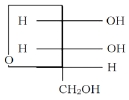
B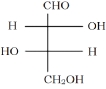
C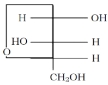
D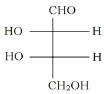
Solution
(B) $1$. $X$ is a tetrose $(C_4H_8O_4)$ with two chiral carbons and a $-CHO$ group (positive Schiff's test).
$2$. Acetylation yields a triacetate,confirming three $-OH$ groups.
$3$. The $L$-isomer of a tetrose with two chiral centers and the given reactivity corresponds to $L$-threose.
$4$. Oxidation of $L$-threose with $HNO_3$ gives $L$-tartaric acid $(A)$.
$5$. Reduction of $L$-tartaric acid with $NaBH_4$ gives a chiral compound $(B)$.
$6$. Based on the Fischer projection for $L$-threose,the correct structure is represented in option $B$.
$2$. Acetylation yields a triacetate,confirming three $-OH$ groups.
$3$. The $L$-isomer of a tetrose with two chiral centers and the given reactivity corresponds to $L$-threose.
$4$. Oxidation of $L$-threose with $HNO_3$ gives $L$-tartaric acid $(A)$.
$5$. Reduction of $L$-tartaric acid with $NaBH_4$ gives a chiral compound $(B)$.
$6$. Based on the Fischer projection for $L$-threose,the correct structure is represented in option $B$.
0 likesView Solution
328
ChemistryMediumMCQJEE Main · 2023
The polymer $X$ consists of linear molecules and is closely packed. It is prepared in the presence of triethylaluminium and titanium tetrachloride under low pressure. The polymer $X$ is -
A
Polyacrylonitrile
B
Low density polythene
C
Polytetrafluoroethane
D
High density polythene
Solution
(D) Ethene undergoes addition polymerisation to form high density polythene in the presence of a catalyst such as triethylaluminium $(Al(C_2H_5)_3)$ and titanium tetrachloride $(TiCl_4)$,which is known as the Ziegler-Natta catalyst.
This process occurs at a temperature of $333 \ K$ to $343 \ K$ and under a pressure of $6-7 \ \text{atm}$.
High density polythene consists of linear molecules and is closely packed,which results in high density and high melting point.
This process occurs at a temperature of $333 \ K$ to $343 \ K$ and under a pressure of $6-7 \ \text{atm}$.
High density polythene consists of linear molecules and is closely packed,which results in high density and high melting point.
0 likesView Solution
329
ChemistryMediumMCQJEE Main · 2023
When a solution of a mixture having two inorganic salts was treated with freshly prepared ferrous sulphate in an acidic medium,a dark brown ring was formed,whereas on treatment with neutral $FeCl_3$,it gave a deep red colour which disappeared on boiling and a brown-red precipitate was formed. The mixture contains:
A
$CH_3COO^{-}$ and $NO_3^{-}$
B
$C_2O_4^{2-}$ and $NO_3^{-}$
C
$SO_3^{2-}$ and $CH_3COO^{-}$
D
$SO_3^{2-}$ and $C_2O_4^{2-}$
Solution
(A) $1$. The formation of a dark brown ring with freshly prepared ferrous sulphate in an acidic medium is the characteristic test for the nitrate ion $(NO_3^{-})$,known as the Brown Ring Test: $2NO_3^{-} + 4H_2SO_4 + 6Fe^{2+} \rightarrow 6Fe^{3+} + 2NO + 4SO_4^{2-} + 4H_2O$ followed by $[Fe(H_2O)_6]^{2+} + NO \rightarrow [Fe(H_2O)_5(NO)]^{2+} + H_2O$ (brown ring).
$2$. The formation of a deep red colour with neutral $FeCl_3$ is the characteristic test for the acetate ion $(CH_3COO^{-})$,which forms ferric acetate: $CH_3COO^{-} + FeCl_3 \rightarrow [Fe_3(OH)_2(CH_3COO)_6]^+$. This red colour disappears on boiling,resulting in a brown-red precipitate of basic ferric acetate: $[Fe_3(OH)_2(CH_3COO)_6]^+ + 4H_2O \rightarrow 3Fe(OH)_2(CH_3COO) \downarrow + 3CH_3COOH + H^+$.
$3$. Therefore,the mixture contains $CH_3COO^{-}$ and $NO_3^{-}$.
$2$. The formation of a deep red colour with neutral $FeCl_3$ is the characteristic test for the acetate ion $(CH_3COO^{-})$,which forms ferric acetate: $CH_3COO^{-} + FeCl_3 \rightarrow [Fe_3(OH)_2(CH_3COO)_6]^+$. This red colour disappears on boiling,resulting in a brown-red precipitate of basic ferric acetate: $[Fe_3(OH)_2(CH_3COO)_6]^+ + 4H_2O \rightarrow 3Fe(OH)_2(CH_3COO) \downarrow + 3CH_3COOH + H^+$.
$3$. Therefore,the mixture contains $CH_3COO^{-}$ and $NO_3^{-}$.
0 likesView Solution
330
ChemistryDifficultMCQJEE Main · 2023
$A$ and $B$ in the following reaction are:
A
$A = R-CO-(CH_2)_4-COOH$,$B = R-(CH_2)_5-COOH$
B
$A = R-CH(OH)-(CH_2)_4-COOH$,$B = R-(CH_2)_6-COOH$
C
$A = R-CO-(CH_2)_4-CHO$,$B = R-(CH_2)_5-CHO$
D
$A = R-CH_2-(CH_2)_4-COOH$,$B = R-CO-(CH_2)_4-COOH$
Solution
(A) The reaction of $2$-substituted cyclohexanone with $KMnO_4$ involves oxidative cleavage of the ring.
$KMnO_4$ acts as a strong oxidizing agent that cleaves the $C-C$ bond adjacent to the carbonyl group,resulting in the formation of a keto-acid,$R-CO-(CH_2)_4-COOH$ (which is $A$).
Subsequently,the Wolff-Kishner reduction,using $NH_2NH_2$ and $KOH$ followed by $H_3O^+$,reduces the carbonyl group $(C=O)$ to a methylene group $(-CH_2-)$.
Therefore,the final product $B$ is $R-CH_2-(CH_2)_4-COOH$,which is $R-(CH_2)_5-COOH$.
$KMnO_4$ acts as a strong oxidizing agent that cleaves the $C-C$ bond adjacent to the carbonyl group,resulting in the formation of a keto-acid,$R-CO-(CH_2)_4-COOH$ (which is $A$).
Subsequently,the Wolff-Kishner reduction,using $NH_2NH_2$ and $KOH$ followed by $H_3O^+$,reduces the carbonyl group $(C=O)$ to a methylene group $(-CH_2-)$.
Therefore,the final product $B$ is $R-CH_2-(CH_2)_4-COOH$,which is $R-(CH_2)_5-COOH$.
0 likesView Solution
331
ChemistryMediumMCQJEE Main · 2023
The set which does not have any ambidentate ligand$(s)$ is:
A
$C_2O_4^{2-}$,ethylene diamine,$H_2O$
B
$EDTA^{4-}, NCS^{-}, C_2O_4^{2-}$
C
$NO_2^{-}, C_2O_4^{2-}, EDTA^{4-}$
D
$C_2O_4^{2-}, NO_2^{-}, NCS^{-}$
Solution
(A) An ambidentate ligand is a ligand that can coordinate to a metal atom through more than one donor atom (e.g.,$NO_2^-$ can coordinate through $N$ or $O$,and $NCS^-$ can coordinate through $N$ or $S$).
Analyzing the options:
$A$: $C_2O_4^{2-}$ (oxalate) is a didentate ligand,ethylene diamine $(en)$ is a didentate ligand,and $H_2O$ is a monodentate ligand. None of these are ambidentate.
$B$: $NCS^-$ is an ambidentate ligand.
$C$: $NO_2^-$ is an ambidentate ligand.
$D$: $NO_2^-$ and $NCS^-$ are ambidentate ligands.
Therefore,the set that does not contain any ambidentate ligand is $A$.
Analyzing the options:
$A$: $C_2O_4^{2-}$ (oxalate) is a didentate ligand,ethylene diamine $(en)$ is a didentate ligand,and $H_2O$ is a monodentate ligand. None of these are ambidentate.
$B$: $NCS^-$ is an ambidentate ligand.
$C$: $NO_2^-$ is an ambidentate ligand.
$D$: $NO_2^-$ and $NCS^-$ are ambidentate ligands.
Therefore,the set that does not contain any ambidentate ligand is $A$.
0 likesView Solution
332
ChemistryMediumMCQJEE Main · 2023
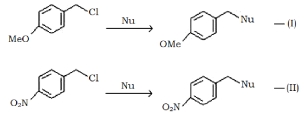
Where $Nu =$ Nucleophile. Find out the correct statement from the options given below for the above $2$ reactions.
A
Reaction $(I)$ is of $2^{nd}$ order and reaction $(II)$ is of $1^{st}$ order
B
Reaction $(I)$ and $(II)$ both are of $2^{nd}$ order
C
Reaction $(I)$ is of $1^{st}$ order and reaction $(II)$ is of $2^{nd}$ order
D
Reactions $(I)$ and $(II)$ both are of $1^{st}$ order
Solution
(C) In reaction $(I)$,the substrate has an electron-donating group $(-OMe)$ at the para position,which stabilizes the carbocation intermediate. This facilitates the $S_N1$ mechanism,which is a $1^{st}$ order reaction.
In reaction $(II)$,the substrate has an electron-withdrawing group $(-NO_2)$ at the para position,which destabilizes the carbocation intermediate,making the $S_N1$ pathway unfavorable. Instead,it proceeds via the $S_N2$ mechanism,which is a $2^{nd}$ order reaction.
Therefore,reaction $(I)$ is of $1^{st}$ order and reaction $(II)$ is of $2^{nd}$ order.
In reaction $(II)$,the substrate has an electron-withdrawing group $(-NO_2)$ at the para position,which destabilizes the carbocation intermediate,making the $S_N1$ pathway unfavorable. Instead,it proceeds via the $S_N2$ mechanism,which is a $2^{nd}$ order reaction.
Therefore,reaction $(I)$ is of $1^{st}$ order and reaction $(II)$ is of $2^{nd}$ order.
0 likesView Solution
333
ChemistryMediumMCQJEE Main · 2023
In the extraction process of copper,the product obtained after carrying out the reactions
$(i) 2 Cu_2S + 3 O_2 \rightarrow 2 Cu_2O + 2 SO_2$
$(ii) 2 Cu_2O + Cu_2S \rightarrow 6 Cu + SO_2$ is called
$(i) 2 Cu_2S + 3 O_2 \rightarrow 2 Cu_2O + 2 SO_2$
$(ii) 2 Cu_2O + Cu_2S \rightarrow 6 Cu + SO_2$ is called
A
Blister copper
B
Copper scrap
C
Reduced copper
D
Copper matte
Solution
(A) The reactions given are:
$(i) 2 Cu_2S + 3 O_2 \rightarrow 2 Cu_2O + 2 SO_2$
$(ii) 2 Cu_2O + Cu_2S \rightarrow 6 Cu + SO_2$
These reactions represent the self-reduction process in the extraction of copper.
Due to the evolution of $SO_2$ gas during the solidification of the molten copper,the surface of the metal develops bubbles or blisters.
Therefore,the copper obtained is referred to as blister copper.
$(i) 2 Cu_2S + 3 O_2 \rightarrow 2 Cu_2O + 2 SO_2$
$(ii) 2 Cu_2O + Cu_2S \rightarrow 6 Cu + SO_2$
These reactions represent the self-reduction process in the extraction of copper.
Due to the evolution of $SO_2$ gas during the solidification of the molten copper,the surface of the metal develops bubbles or blisters.
Therefore,the copper obtained is referred to as blister copper.
0 likesView Solution
334
ChemistryMediumMCQJEE Main · 2023
Which of the following complexes has the possibility to exist as a meridional isomer?
A
$[Co(NH_3)_3(NO_2)_3]$
B
$[Co(en)_3]$
C
$[Co(en)_2Cl_2]$
D
$[Pt(NH_3)_2Cl_2]$
Solution
(A) Complexes of the type $[MA_3B_3]$ exhibit facial (fac) and meridional (mer) isomerism.
In the given options,$[Co(NH_3)_3(NO_2)_3]$ is of the type $[MA_3B_3]$,where $M = Co$,$A = NH_3$,and $B = NO_2$.
Therefore,it can exist as both facial and meridional isomers.
In the given options,$[Co(NH_3)_3(NO_2)_3]$ is of the type $[MA_3B_3]$,where $M = Co$,$A = NH_3$,and $B = NO_2$.
Therefore,it can exist as both facial and meridional isomers.
0 likesView Solution
335
ChemistryDifficultMCQJEE Main · 2023
The complex that dissolves in water is
A
$Fe_4[Fe(CN)_6]_3$
B
$[Fe_3(OH)_2(OAc)_6]Cl$
C
$K_3[Co(NO_2)_6]$
D
$(NH_4)_3[As(Mo_3O_{10})_4]$
Solution
(B) $Fe_4[Fe(CN)_6]_3$ (Prussian Blue) is insoluble in water.
$K_3[Co(NO_2)_6]$ is very poorly soluble in water.
$(NH_4)_3[As(Mo_3O_{10})_4]$ (Ammonium arsenomolybdate) is insoluble in water.
$[Fe_3(OH)_2(OAc)_6]Cl$ is a basic iron$(III)$ acetate complex which is soluble in water.
$K_3[Co(NO_2)_6]$ is very poorly soluble in water.
$(NH_4)_3[As(Mo_3O_{10})_4]$ (Ammonium arsenomolybdate) is insoluble in water.
$[Fe_3(OH)_2(OAc)_6]Cl$ is a basic iron$(III)$ acetate complex which is soluble in water.
0 likesView Solution
336
ChemistryDifficultMCQJEE Main · 2023
$o$-Phenylenediamine $\stackrel{HNO_2}{\longrightarrow}$ '$X$'
A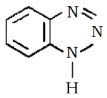
B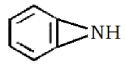
C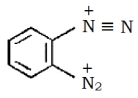
D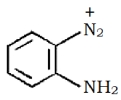
Solution
(A) When $o$-phenylenediamine reacts with nitrous acid $(HNO_2)$,one of the amino groups is converted into a diazonium salt group $(-N_2^+)$.
Due to the proximity of the other amino group $(-NH_2)$ at the ortho position,an intramolecular nucleophilic attack occurs.
The lone pair on the nitrogen of the $-NH_2$ group attacks the diazonium nitrogen,leading to the formation of a cyclic compound known as benzotriazole.
The reaction proceeds as follows:
$o$-Phenylenediamine $\xrightarrow{HNO_2}$ $o$-amino-benzenediazonium ion $\xrightarrow{-H_2O, -H^+}$ Benzotriazole.
Due to the proximity of the other amino group $(-NH_2)$ at the ortho position,an intramolecular nucleophilic attack occurs.
The lone pair on the nitrogen of the $-NH_2$ group attacks the diazonium nitrogen,leading to the formation of a cyclic compound known as benzotriazole.
The reaction proceeds as follows:
$o$-Phenylenediamine $\xrightarrow{HNO_2}$ $o$-amino-benzenediazonium ion $\xrightarrow{-H_2O, -H^+}$ Benzotriazole.
0 likesView Solution
337
ChemistryMediumMCQJEE Main · 2023
The ratio of spin-only magnetic moment values $\mu_{eff}[Cr(CN)_6]^{3-} / \mu_{eff}[Cr(H_2O)_6]^{3+}$ is $.........$.
A
$2$
B
$3$
C
$4$
D
$1$
Solution
(D) For $[Cr(CN)_6]^{3-}$,the oxidation state of $Cr$ is $+3$. The electronic configuration is $3d^3$. Since $CN^-$ is a strong field ligand,the configuration is $t_{2g}^3 e_g^0$. The number of unpaired electrons $n = 3$.
$\mu_1 = \sqrt{n(n+2)} = \sqrt{3(3+2)} = \sqrt{15} \ BM$.
For $[Cr(H_2O)_6]^{3+}$,the oxidation state of $Cr$ is $+3$. The electronic configuration is $3d^3$. Since $H_2O$ is a weak field ligand,the configuration is $t_{2g}^3 e_g^0$. The number of unpaired electrons $n = 3$.
$\mu_2 = \sqrt{n(n+2)} = \sqrt{3(3+2)} = \sqrt{15} \ BM$.
The ratio $\frac{\mu_1}{\mu_2} = \frac{\sqrt{15}}{\sqrt{15}} = 1$.
$\mu_1 = \sqrt{n(n+2)} = \sqrt{3(3+2)} = \sqrt{15} \ BM$.
For $[Cr(H_2O)_6]^{3+}$,the oxidation state of $Cr$ is $+3$. The electronic configuration is $3d^3$. Since $H_2O$ is a weak field ligand,the configuration is $t_{2g}^3 e_g^0$. The number of unpaired electrons $n = 3$.
$\mu_2 = \sqrt{n(n+2)} = \sqrt{3(3+2)} = \sqrt{15} \ BM$.
The ratio $\frac{\mu_1}{\mu_2} = \frac{\sqrt{15}}{\sqrt{15}} = 1$.
0 likesView Solution
338
ChemistryMediumMCQJEE Main · 2023
An atomic substance $A$ of molar mass $12 \ g \ mol^{-1}$ has a cubic crystal structure with an edge length of $300 \ pm$. The number of atoms present in one unit cell of $A$ is $.....$ (Nearest integer). Given the density of $A$ is $3.0 \ g \ cm^{-3}$ and $N_{A} = 6.02 \times 10^{23} \ mol^{-1}$.
A
$3$
B
$2$
C
$1$
D
$4$
Solution
(D) The density formula for a cubic unit cell is given by $d = \frac{Z \times M}{N_{A} \times a^3}$.
Given values:
$d = 3.0 \ g \ cm^{-3}$
$M = 12 \ g \ mol^{-1}$
$a = 300 \ pm = 300 \times 10^{-10} \ cm = 3 \times 10^{-8} \ cm$
$N_{A} = 6.02 \times 10^{23} \ mol^{-1}$
Rearranging for $Z$:
$Z = \frac{d \times N_{A} \times a^3}{M}$
Substituting the values:
$Z = \frac{3.0 \times 6.02 \times 10^{23} \times (3 \times 10^{-8})^3}{12}$
$Z = \frac{3.0 \times 6.02 \times 10^{23} \times 27 \times 10^{-24}}{12}$
$Z = \frac{3.0 \times 6.02 \times 27 \times 10^{-1}}{12}$
$Z = \frac{487.62 \times 0.1}{12} = \frac{48.762}{12} \approx 4.06$
The nearest integer is $4$.
Given values:
$d = 3.0 \ g \ cm^{-3}$
$M = 12 \ g \ mol^{-1}$
$a = 300 \ pm = 300 \times 10^{-10} \ cm = 3 \times 10^{-8} \ cm$
$N_{A} = 6.02 \times 10^{23} \ mol^{-1}$
Rearranging for $Z$:
$Z = \frac{d \times N_{A} \times a^3}{M}$
Substituting the values:
$Z = \frac{3.0 \times 6.02 \times 10^{23} \times (3 \times 10^{-8})^3}{12}$
$Z = \frac{3.0 \times 6.02 \times 10^{23} \times 27 \times 10^{-24}}{12}$
$Z = \frac{3.0 \times 6.02 \times 27 \times 10^{-1}}{12}$
$Z = \frac{487.62 \times 0.1}{12} = \frac{48.762}{12} \approx 4.06$
The nearest integer is $4$.
0 likesView Solution
339
ChemistryMediumMCQJEE Main · 2023
The ratio $x / y$ on completion of the above reaction is $.........$.

A
$4$
B
$6$
C
$8$
D
$2$
Solution
(D) The reactant is $4$-hydroxybutanal,which contains both an aldehyde group $(-CHO)$ and a hydroxyl group $(-OH)$.
$1$ mole of $MeMgBr$ reacts with the acidic hydroxyl group $(-OH)$ to form an alkoxide,releasing methane gas.
Another $1$ mole of $MeMgBr$ performs a nucleophilic attack on the carbonyl carbon of the aldehyde group.
Thus,for $y = 1$ mole of the reactant,$x = 2$ moles of $MeMgBr$ are required.
The ratio $x / y = 2 / 1 = 2$.
$1$ mole of $MeMgBr$ reacts with the acidic hydroxyl group $(-OH)$ to form an alkoxide,releasing methane gas.
Another $1$ mole of $MeMgBr$ performs a nucleophilic attack on the carbonyl carbon of the aldehyde group.
Thus,for $y = 1$ mole of the reactant,$x = 2$ moles of $MeMgBr$ are required.
The ratio $x / y = 2 / 1 = 2$.
0 likesView Solution
340
ChemistryMediumMCQJEE Main · 2023
Solid fuel used in rockets is a mixture of $Fe_2O_3$ and $Al$ (in ratio $1:2$ by moles). The heat evolved $(kJ)$ per gram of the mixture is $............$. (Nearest integer)
Given: $\Delta H_{f}^{\ominus}(Al_2O_3) = -1700 \ kJ \ mol^{-1}$
$\Delta H_{f}^{\ominus}(Fe_2O_3) = -840 \ kJ \ mol^{-1}$
Molar mass of $Fe$,$Al$ and $O$ are $56$,$27$ and $16 \ g \ mol^{-1}$ respectively.
Given: $\Delta H_{f}^{\ominus}(Al_2O_3) = -1700 \ kJ \ mol^{-1}$
$\Delta H_{f}^{\ominus}(Fe_2O_3) = -840 \ kJ \ mol^{-1}$
Molar mass of $Fe$,$Al$ and $O$ are $56$,$27$ and $16 \ g \ mol^{-1}$ respectively.
A
$3$
B
$2$
C
$5$
D
$4$
Solution
(D) The balanced chemical equation for the reaction is: $Fe_2O_3 + 2Al \rightarrow Al_2O_3 + 2Fe$
The enthalpy change of the reaction is calculated as: $\Delta H_{rxn}^{\ominus} = [\Delta H_{f}^{\ominus}(Al_2O_3) + 2\Delta H_{f}^{\ominus}(Fe)] - [\Delta H_{f}^{\ominus}(Fe_2O_3) + 2\Delta H_{f}^{\ominus}(Al)]$
Since $\Delta H_{f}^{\ominus}$ for elements in their standard state is $0$,we have: $\Delta H_{rxn}^{\ominus} = [-1700 + 0] - [-840 + 0] = -860 \ kJ \ mol^{-1}$
The molar mass of the mixture (for $1 \ mol$ of $Fe_2O_3$ and $2 \ mol$ of $Al$) is: $M_{mixture} = (1 \times 160) + (2 \times 27) = 160 + 54 = 214 \ g$
Heat evolved per gram of the mixture is: $\frac{860 \ kJ}{214 \ g} \approx 4.018 \ kJ \ g^{-1}$
Rounding to the nearest integer,we get $4$.
The enthalpy change of the reaction is calculated as: $\Delta H_{rxn}^{\ominus} = [\Delta H_{f}^{\ominus}(Al_2O_3) + 2\Delta H_{f}^{\ominus}(Fe)] - [\Delta H_{f}^{\ominus}(Fe_2O_3) + 2\Delta H_{f}^{\ominus}(Al)]$
Since $\Delta H_{f}^{\ominus}$ for elements in their standard state is $0$,we have: $\Delta H_{rxn}^{\ominus} = [-1700 + 0] - [-840 + 0] = -860 \ kJ \ mol^{-1}$
The molar mass of the mixture (for $1 \ mol$ of $Fe_2O_3$ and $2 \ mol$ of $Al$) is: $M_{mixture} = (1 \times 160) + (2 \times 27) = 160 + 54 = 214 \ g$
Heat evolved per gram of the mixture is: $\frac{860 \ kJ}{214 \ g} \approx 4.018 \ kJ \ g^{-1}$
Rounding to the nearest integer,we get $4$.
0 likesView Solution
341
ChemistryDifficultMCQJEE Main · 2023
$A$ solution of sugar is obtained by mixing $200 \ g$ of its $25 \%$ solution and $500 \ g$ of its $40 \%$ solution (both by mass). The mass percentage of the resulting sugar solution is $..........$. (Nearest integer)
A
$35$
B
$34$
C
$33$
D
$36$
Solution
(D) Mass of sugar in the first solution $= 200 \ g \times 0.25 = 50 \ g$.
Mass of sugar in the second solution $= 500 \ g \times 0.40 = 200 \ g$.
Total mass of sugar $= 50 \ g + 200 \ g = 250 \ g$.
Total mass of the resulting solution $= 200 \ g + 500 \ g = 700 \ g$.
Mass percentage of the resulting sugar solution $= (\frac{250 \ g}{700 \ g}) \times 100 \approx 35.71 \%$.
Rounding to the nearest integer,we get $36 \%$.
Mass of sugar in the second solution $= 500 \ g \times 0.40 = 200 \ g$.
Total mass of sugar $= 50 \ g + 200 \ g = 250 \ g$.
Total mass of the resulting solution $= 200 \ g + 500 \ g = 700 \ g$.
Mass percentage of the resulting sugar solution $= (\frac{250 \ g}{700 \ g}) \times 100 \approx 35.71 \%$.
Rounding to the nearest integer,we get $36 \%$.
0 likesView Solution
342
ChemistryDifficultMCQJEE Main · 2023
$KClO_3 + 6FeSO_4 + 3H_2SO_4 \rightarrow KCl + 3Fe_2(SO_4)_3 + 3H_2O$. The above reaction was studied at $300 \ K$ by monitoring the concentration of $FeSO_4$,where the initial concentration was $10 \ M$ and after half an hour it became $8.8 \ M$. The rate of production of $Fe_2(SO_4)_3$ is $........ \times 10^{-6} \ mol \ L^{-1} \ s^{-1}$.
A
$332$
B
$331$
C
$336$
D
$333$
Solution
(D) The balanced chemical equation is: $KClO_3 + 6FeSO_4 + 3H_2SO_4 \rightarrow KCl + 3Fe_2(SO_4)_3 + 3H_2O$.
The rate of reaction $(ROR)$ is given by: $ROR = -\frac{1}{6} \frac{\Delta[FeSO_4]}{\Delta t} = \frac{1}{3} \frac{\Delta[Fe_2(SO_4)_3]}{\Delta t}$.
Therefore,the rate of production of $Fe_2(SO_4)_3$ is: $\frac{\Delta[Fe_2(SO_4)_3]}{\Delta t} = -\frac{3}{6} \frac{\Delta[FeSO_4]}{\Delta t} = -\frac{1}{2} \frac{\Delta[FeSO_4]}{\Delta t}$.
Given $\Delta[FeSO_4] = 8.8 \ M - 10 \ M = -1.2 \ M$ and $\Delta t = 30 \ \text{min} = 1800 \ s$.
Rate of production $= -\frac{1}{2} \times \frac{-1.2 \ M}{1800 \ s} = \frac{0.6}{1800} \ M \ s^{-1} = 0.000333 \ M \ s^{-1}$.
Converting to the required units: $0.000333 \times 10^6 \times 10^{-6} \ mol \ L^{-1} \ s^{-1} = 333 \times 10^{-6} \ mol \ L^{-1} \ s^{-1}$.
The rate of reaction $(ROR)$ is given by: $ROR = -\frac{1}{6} \frac{\Delta[FeSO_4]}{\Delta t} = \frac{1}{3} \frac{\Delta[Fe_2(SO_4)_3]}{\Delta t}$.
Therefore,the rate of production of $Fe_2(SO_4)_3$ is: $\frac{\Delta[Fe_2(SO_4)_3]}{\Delta t} = -\frac{3}{6} \frac{\Delta[FeSO_4]}{\Delta t} = -\frac{1}{2} \frac{\Delta[FeSO_4]}{\Delta t}$.
Given $\Delta[FeSO_4] = 8.8 \ M - 10 \ M = -1.2 \ M$ and $\Delta t = 30 \ \text{min} = 1800 \ s$.
Rate of production $= -\frac{1}{2} \times \frac{-1.2 \ M}{1800 \ s} = \frac{0.6}{1800} \ M \ s^{-1} = 0.000333 \ M \ s^{-1}$.
Converting to the required units: $0.000333 \times 10^6 \times 10^{-6} \ mol \ L^{-1} \ s^{-1} = 333 \times 10^{-6} \ mol \ L^{-1} \ s^{-1}$.
0 likesView Solution
343
ChemistryMediumMCQJEE Main · 2023
$0.004 \ M \ K_2SO_4$ solution is isotonic with $0.01 \ M$ glucose solution. The percentage dissociation of $K_2SO_4$ is $........$ (Nearest integer).
A
$71$
B
$73$
C
$74$
D
$75$
Solution
(D) For isotonic solutions, the osmotic pressure $(\pi)$ is equal: $\pi_{K_2SO_4} = \pi_{\text{glucose}}$.
Since $\pi = iCRT$, we have $i_{K_2SO_4} \times 0.004 \times RT = 1 \times 0.01 \times RT$.
Solving for the van't Hoff factor $(i)$: $i = \frac{0.01}{0.004} = 2.5$.
For the dissociation of $K_2SO_4$ $(K_2SO_4 \rightarrow 2K^+ + SO_4^{2-})$, the number of ions produced $(n)$ is $3$.
The degree of dissociation $(\alpha)$ is given by the formula: $i = 1 + (n - 1)\alpha$.
Substituting the values: $2.5 = 1 + (3 - 1)\alpha$.
$1.5 = 2\alpha$, which gives $\alpha = 0.75$.
The percentage dissociation is $\alpha \times 100 = 75\%$.
Since $\pi = iCRT$, we have $i_{K_2SO_4} \times 0.004 \times RT = 1 \times 0.01 \times RT$.
Solving for the van't Hoff factor $(i)$: $i = \frac{0.01}{0.004} = 2.5$.
For the dissociation of $K_2SO_4$ $(K_2SO_4 \rightarrow 2K^+ + SO_4^{2-})$, the number of ions produced $(n)$ is $3$.
The degree of dissociation $(\alpha)$ is given by the formula: $i = 1 + (n - 1)\alpha$.
Substituting the values: $2.5 = 1 + (3 - 1)\alpha$.
$1.5 = 2\alpha$, which gives $\alpha = 0.75$.
The percentage dissociation is $\alpha \times 100 = 75\%$.
0 likesView Solution
344
ChemistryMediumMCQJEE Main · 2023
In an electrochemical reaction of lead,at standard temperature,if $E^0_{(Pb^{2+}/Pb)} = m \ V$ and $E^0_{(Pb^{4+}/Pb)} = n \ V$,then the value of $E^0_{(Pb^{2+}/Pb^{4+})}$ is given by $m - x n$. The value of $x$ is $...........$. (Nearest integer)
A
$4$
B
$6$
C
$8$
D
$2$
Solution
(D) The standard Gibbs free energy change $\Delta G^0$ is related to the standard electrode potential $E^0$ by the equation $\Delta G^0 = -nFE^0$.
For the reaction $Pb^{2+} + 2e^{-} \rightarrow Pb$,$\Delta G^0_1 = -2Fm$.
For the reaction $Pb^{4+} + 4e^{-} \rightarrow Pb$,$\Delta G^0_2 = -4Fn$.
We want the potential for $Pb^{2+} \rightarrow Pb^{4+} + 2e^{-}$,which is the reverse of the second reaction added to the first.
$\Delta G^0_3 = \Delta G^0_1 - \Delta G^0_2 = -2Fm - (-4Fn) = -2Fm + 4Fn$.
Since $\Delta G^0_3 = -2FE^0_{(Pb^{2+}/Pb^{4+})}$,we have $-2FE^0_{(Pb^{2+}/Pb^{4+})} = -2Fm + 4Fn$.
Dividing by $-2F$,we get $E^0_{(Pb^{2+}/Pb^{4+})} = m - 2n$.
Comparing this with $m - xn$,we find $x = 2$.
For the reaction $Pb^{2+} + 2e^{-} \rightarrow Pb$,$\Delta G^0_1 = -2Fm$.
For the reaction $Pb^{4+} + 4e^{-} \rightarrow Pb$,$\Delta G^0_2 = -4Fn$.
We want the potential for $Pb^{2+} \rightarrow Pb^{4+} + 2e^{-}$,which is the reverse of the second reaction added to the first.
$\Delta G^0_3 = \Delta G^0_1 - \Delta G^0_2 = -2Fm - (-4Fn) = -2Fm + 4Fn$.
Since $\Delta G^0_3 = -2FE^0_{(Pb^{2+}/Pb^{4+})}$,we have $-2FE^0_{(Pb^{2+}/Pb^{4+})} = -2Fm + 4Fn$.
Dividing by $-2F$,we get $E^0_{(Pb^{2+}/Pb^{4+})} = m - 2n$.
Comparing this with $m - xn$,we find $x = 2$.
0 likesView Solution
345
ChemistryMediumMCQJEE Main · 2023
Given below are two statements,one is labelled as Assertion $A$ and the other is labelled as Reason $R$.
Assertion $A$: $3$-chloro-$2$-methylpentan-$3$-one can be subjected to Wolff-Kishner reduction to give $3$-chloro-$2$-methylpentane.
Reason $R$: Wolff-Kishner reduction is used to convert $C=O$ into $CH_2$.
Assertion $A$: $3$-chloro-$2$-methylpentan-$3$-one can be subjected to Wolff-Kishner reduction to give $3$-chloro-$2$-methylpentane.
Reason $R$: Wolff-Kishner reduction is used to convert $C=O$ into $CH_2$.
A
Both $A$ and $R$ are true but $R$ is $NOT$ the correct explanation of $A$.
B
$A$ is true but $R$ is false.
C
$A$ is false but $R$ is true.
D
Both $A$ and $R$ are true and $R$ is the correct explanation of $A$.
Solution
(C) Assertion $A$ is false. Wolff-Kishner reduction involves the use of a strong base (like $KOH$ or $EtO^-K^+$) at high temperatures. The substrate $3$-chloro-$2$-methylpentan-$3$-one contains a chlorine atom at the $\alpha$-position relative to the carbonyl group. In the presence of a strong base,this compound undergoes dehydrohalogenation (elimination of $HCl$) to form an $\alpha,\beta$-unsaturated ketone rather than the desired reduction product.
Reason $R$ is true. Wolff-Kishner reduction is indeed a standard method used to reduce carbonyl groups $(C=O)$ to methylene groups $(CH_2)$.
Reason $R$ is true. Wolff-Kishner reduction is indeed a standard method used to reduce carbonyl groups $(C=O)$ to methylene groups $(CH_2)$.
0 likesView Solution
346
ChemistryMediumMCQJEE Main · 2023
The major product formed in the following reaction is:

A
$C_6H_5-CH(OH)-CH(CH_3)-C_2H_5$
B
$C_6H_5-CH=C(CH_3)-C_2H_5$
C
$C_6H_5-C(CH_3)=CH-C_2H_5$
D
$A$ cyclic ether structure
Solution
(B) The given reaction involves the treatment of a $\beta$-hydroxy aldehyde with Clemmensen reduction conditions $(Zn(Hg)/HCl, \Delta)$.
$1$. Under these acidic conditions,the aldehyde group $(-CHO)$ is reduced to a methyl group $(-CH_3)$.
$2$. Simultaneously,the $\beta$-hydroxy group $(-OH)$ undergoes dehydration due to the acidic medium and heat,leading to the formation of a stable conjugated alkene.
$3$. The reaction proceeds through the reduction of the aldehyde to a hydrocarbon chain,followed by the elimination of water to form the most stable alkene,which is $C_6H_5-CH=C(CH_3)-C_2H_5$.
$1$. Under these acidic conditions,the aldehyde group $(-CHO)$ is reduced to a methyl group $(-CH_3)$.
$2$. Simultaneously,the $\beta$-hydroxy group $(-OH)$ undergoes dehydration due to the acidic medium and heat,leading to the formation of a stable conjugated alkene.
$3$. The reaction proceeds through the reduction of the aldehyde to a hydrocarbon chain,followed by the elimination of water to form the most stable alkene,which is $C_6H_5-CH=C(CH_3)-C_2H_5$.
0 likesView Solution
347
ChemistryEasyMCQJEE Main · 2023
Which of the following compounds is an example of Freon?
A
$CCl_2F_2$
B
$C_2HF_3$
C
$C_2H_2F_2$
D
$C_2F_4$
Solution
(A) Freons are chlorofluorocarbons of methane and ethane.
Among the given options,$CCl_2F_2$ (dichlorodifluoromethane) is a well-known Freon,specifically known as Freon-$12$.
Therefore,the correct option is $A$.
Among the given options,$CCl_2F_2$ (dichlorodifluoromethane) is a well-known Freon,specifically known as Freon-$12$.
Therefore,the correct option is $A$.
0 likesView Solution
348
ChemistryMediumMCQJEE Main · 2023
For a chemical reaction $A + B \rightarrow \text{Product}$,the order is $1$ with respect to $A$ and $B$.
What is the value of $x$ and $y$?
| Rate $(mol \ L^{-1} \ s^{-1})$ | $[A]$ $(mol \ L^{-1})$ | $[B]$ $(mol \ L^{-1})$ |
|---|---|---|
| $0.10$ | $20$ | $0.5$ |
| $0.40$ | $x$ | $0.5$ |
| $0.80$ | $40$ | $y$ |
What is the value of $x$ and $y$?
A
$80$ and $2$
B
$40$ and $4$
C
$160$ and $4$
D
$80$ and $4$
Solution
(A) The rate law for the reaction is given by $r = k[A]^1[B]^1$.
For the first experiment: $0.10 = k(20)(0.5)$ $\Rightarrow 0.10 = 10k$ $\Rightarrow k = 0.01 \ L \ mol^{-1} \ s^{-1}$.
For the second experiment: $0.40 = k(x)(0.5)$. Substituting $k = 0.01$: $0.40 = 0.01(x)(0.5)$ $\Rightarrow 0.40 = 0.005x$ $\Rightarrow x = 80 \ mol \ L^{-1}$.
For the third experiment: $0.80 = k(40)(y)$. Substituting $k = 0.01$: $0.80 = 0.01(40)(y)$ $\Rightarrow 0.80 = 0.4y$ $\Rightarrow y = 2 \ mol \ L^{-1}$.
Therefore,the values are $x = 80$ and $y = 2$.
For the first experiment: $0.10 = k(20)(0.5)$ $\Rightarrow 0.10 = 10k$ $\Rightarrow k = 0.01 \ L \ mol^{-1} \ s^{-1}$.
For the second experiment: $0.40 = k(x)(0.5)$. Substituting $k = 0.01$: $0.40 = 0.01(x)(0.5)$ $\Rightarrow 0.40 = 0.005x$ $\Rightarrow x = 80 \ mol \ L^{-1}$.
For the third experiment: $0.80 = k(40)(y)$. Substituting $k = 0.01$: $0.80 = 0.01(40)(y)$ $\Rightarrow 0.80 = 0.4y$ $\Rightarrow y = 2 \ mol \ L^{-1}$.
Therefore,the values are $x = 80$ and $y = 2$.
0 likesView Solution
349
ChemistryMediumMCQJEE Main · 2023
Given below are two statements,one is labelled as Assertion $A$ and the other is labelled as Reason $R$.
Assertion $A$: $[CoCl(NH_3)_5]^{2+}$ absorbs at a lower wavelength of light with respect to $[Co(NH_3)_5(H_2O)]^{3+}$.
Reason $R$: It is because the wavelength of the light absorbed depends on the oxidation state of the metal ion.
In the light of the above statements,choose the correct answer from the options given below:
Assertion $A$: $[CoCl(NH_3)_5]^{2+}$ absorbs at a lower wavelength of light with respect to $[Co(NH_3)_5(H_2O)]^{3+}$.
Reason $R$: It is because the wavelength of the light absorbed depends on the oxidation state of the metal ion.
In the light of the above statements,choose the correct answer from the options given below:
A
$A$ is false but $R$ is true.
B
$A$ is true but $R$ is false.
C
Both $A$ and $R$ are true and $R$ is the correct explanation of $A$.
D
Both $A$ and $R$ are true and $R$ is $NOT$ the correct explanation of $A$.
Solution
(A) The wavelength of absorbed light $(\lambda)$ is inversely proportional to the crystal field splitting energy $(\Delta_o)$,i.e.,$\lambda \propto \frac{1}{\Delta_o}$.
In $[Co(NH_3)_5(H_2O)]^{3+}$,the ligands are $NH_3$ and $H_2O$. In $[CoCl(NH_3)_5]^{2+}$,the ligands are $NH_3$ and $Cl^-$.
According to the spectrochemical series,$H_2O$ is a stronger field ligand than $Cl^-$. Therefore,the crystal field splitting energy $(\Delta_o)$ for $[Co(NH_3)_5(H_2O)]^{3+}$ is greater than that for $[CoCl(NH_3)_5]^{2+}$.
Since $\Delta_o$ is higher for $[Co(NH_3)_5(H_2O)]^{3+}$,it absorbs at a lower wavelength. Thus,Assertion $A$ is false.
The wavelength of absorbed light depends on the nature of the ligand (spectrochemical series),not just the oxidation state of the metal ion. Thus,Reason $R$ is also false.
In $[Co(NH_3)_5(H_2O)]^{3+}$,the ligands are $NH_3$ and $H_2O$. In $[CoCl(NH_3)_5]^{2+}$,the ligands are $NH_3$ and $Cl^-$.
According to the spectrochemical series,$H_2O$ is a stronger field ligand than $Cl^-$. Therefore,the crystal field splitting energy $(\Delta_o)$ for $[Co(NH_3)_5(H_2O)]^{3+}$ is greater than that for $[CoCl(NH_3)_5]^{2+}$.
Since $\Delta_o$ is higher for $[Co(NH_3)_5(H_2O)]^{3+}$,it absorbs at a lower wavelength. Thus,Assertion $A$ is false.
The wavelength of absorbed light depends on the nature of the ligand (spectrochemical series),not just the oxidation state of the metal ion. Thus,Reason $R$ is also false.
0 likesView Solution
350
ChemistryMediumMCQJEE Main · 2023
Given below are two statements,one is labelled as Assertion $A$ and the other is labelled as Reason $R$.
Assertion $A$: $A$ solution of the product obtained by heating a mole of glycine with a mole of chlorine in the presence of red phosphorus generates a chiral carbon atom.
Reason $R$: $A$ molecule with $2$ chiral carbons is always optically active.
In the light of the above statements,choose the correct answer from the options given below:
Assertion $A$: $A$ solution of the product obtained by heating a mole of glycine with a mole of chlorine in the presence of red phosphorus generates a chiral carbon atom.
Reason $R$: $A$ molecule with $2$ chiral carbons is always optically active.
In the light of the above statements,choose the correct answer from the options given below:
A
$A$ is false but $R$ is true.
B
$A$ is true but $R$ is false.
C
Both $A$ and $R$ are true and $R$ is the correct explanation of $A$.
D
Both $A$ and $R$ are true and $R$ is $NOT$ the correct explanation of $A$.
Solution
(B) Assertion $A$: The reaction of glycine $(H_2N-CH_2-COOH)$ with $Cl_2$ in the presence of red phosphorus is the Hell-Volhard-Zelinsky $(HVZ)$ reaction. This reaction replaces an $\alpha$-hydrogen with a chlorine atom,resulting in $H_2N-CH(Cl)-COOH$ ($2$-chloro$-2-$aminoacetic acid). The central carbon atom is bonded to four different groups $(-H, -NH_2, -Cl, -COOH)$,making it a chiral carbon atom. Thus,Assertion $A$ is true.
Reason $R$: $A$ molecule with $2$ chiral carbons is not always optically active. For example,meso compounds contain chiral centers but are optically inactive due to an internal plane of symmetry. Thus,Reason $R$ is false.
Therefore,$A$ is true but $R$ is false.
Reason $R$: $A$ molecule with $2$ chiral carbons is not always optically active. For example,meso compounds contain chiral centers but are optically inactive due to an internal plane of symmetry. Thus,Reason $R$ is false.
Therefore,$A$ is true but $R$ is false.
0 likesView Solution
351
ChemistryDifficultMCQJEE Main · 2023
Product $[X]$ formed in the above reaction is :
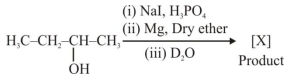
A
$H_3C-CH_2-CH(D)-CH_3$
B
$H_3C-CH_2-CH_2-CH_2-D$
C
$H_3C-CH_2-CH=CH_2$
D
$H_3C-CH=CH-CH_3$
Solution
(A) The reaction proceeds in three steps:
$1$. Reaction of butan$-2-$ol with $NaI$ and $H_3PO_4$ replaces the $-OH$ group with $-I$ to form $2-$iodobutane $(CH_3-CH_2-CH(I)-CH_3)$.
$2$. Reaction of $2-$iodobutane with $Mg$ in dry ether forms the Grignard reagent,sec-butylmagnesium iodide $(CH_3-CH_2-CH(MgI)-CH_3)$.
$3$. The Grignard reagent reacts with $D_2O$ (deuterium oxide) to replace the $-MgI$ group with a deuterium atom,resulting in $2-$deuteriobutane $(CH_3-CH_2-CH(D)-CH_3)$.
$1$. Reaction of butan$-2-$ol with $NaI$ and $H_3PO_4$ replaces the $-OH$ group with $-I$ to form $2-$iodobutane $(CH_3-CH_2-CH(I)-CH_3)$.
$2$. Reaction of $2-$iodobutane with $Mg$ in dry ether forms the Grignard reagent,sec-butylmagnesium iodide $(CH_3-CH_2-CH(MgI)-CH_3)$.
$3$. The Grignard reagent reacts with $D_2O$ (deuterium oxide) to replace the $-MgI$ group with a deuterium atom,resulting in $2-$deuteriobutane $(CH_3-CH_2-CH(D)-CH_3)$.
1 likesView Solution
352
ChemistryDifficultMCQJEE Main · 2023
Given below are two statements:
Statement $I:$ Ethene at $333$ to $343 \ K$ and $6-7 \ atm$ pressure in the presence of $AlEt_3$ and $TiCl_4$ undergoes addition polymerization to give $LDP$.
Statement $II:$ Caprolactam at $533-543 \ K$ in $H_2O$ through step growth polymerizes to give Nylon-$6$.
In the light of the above Statements,choose the correct answer from the options given below:
Statement $I:$ Ethene at $333$ to $343 \ K$ and $6-7 \ atm$ pressure in the presence of $AlEt_3$ and $TiCl_4$ undergoes addition polymerization to give $LDP$.
Statement $II:$ Caprolactam at $533-543 \ K$ in $H_2O$ through step growth polymerizes to give Nylon-$6$.
In the light of the above Statements,choose the correct answer from the options given below:
A
Both Statement $I$ and Statement $II$ are true.
B
Statement $I$ is false but Statement $II$ is true.
C
Statement $I$ is true but Statement $II$ is false.
D
Both Statement $I$ and Statement $II$ are false.
Solution
(B) Statement $I$ is false. The reaction of ethene in the presence of $AlEt_3$ and $TiCl_4$ (Ziegler-Natta catalyst) produces High Density Polyethene $(HDPE)$,not Low Density Polyethene $(LDP)$.
Statement $II$ is true. Caprolactam,when heated with water at $533-543 \ K$,undergoes ring-opening polymerization (a type of step-growth polymerization) to form Nylon-$6$.
Statement $II$ is true. Caprolactam,when heated with water at $533-543 \ K$,undergoes ring-opening polymerization (a type of step-growth polymerization) to form Nylon-$6$.
0 likesView Solution
353
ChemistryMediumMCQJEE Main · 2023
Compound '$B$' is
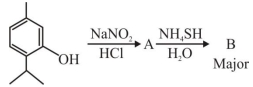
A
The starting material (thymol)
B
$4-$amino$-2-$isopropyl$-5-$methylphenol
C
$2-$isopropyl$-5-$methylbenzenethiol
D
$4-$mercapto$-2-$isopropyl$-5-$methylphenol
Solution
(B) The reaction sequence is as follows:
$1$. The starting material is $2$-isopropyl-$5$-methylphenol (thymol).
$2$. Treatment with $NaNO_2/HCl$ performs electrophilic aromatic substitution (nitrosation) at the para-position relative to the $-OH$ group,forming $A$ (a nitroso compound).
$3$. Treatment of the nitroso compound with $NH_4SH$ (ammonium hydrosulfide) reduces the $-NO$ group to an $-NH_2$ group,yielding $B$ as $4$-amino-$2$-isopropyl-$5$-methylphenol.
$1$. The starting material is $2$-isopropyl-$5$-methylphenol (thymol).
$2$. Treatment with $NaNO_2/HCl$ performs electrophilic aromatic substitution (nitrosation) at the para-position relative to the $-OH$ group,forming $A$ (a nitroso compound).
$3$. Treatment of the nitroso compound with $NH_4SH$ (ammonium hydrosulfide) reduces the $-NO$ group to an $-NH_2$ group,yielding $B$ as $4$-amino-$2$-isopropyl-$5$-methylphenol.
0 likesView Solution
354
ChemistryMediumMCQJEE Main · 2023
Which of the following compounds will not produce a precipitate on reaction with $AgNO_3$?
A
$1-$Bromocyclohexene
B
Benzyl bromide
C
$3-$Bromocyclopropene
D
$3-$Phenyl$-3-$bromoprop$-1-$ene
Solution
(A) The reaction with $AgNO_3$ involves the formation of a carbocation intermediate. Compounds that form stable carbocations react readily to produce a precipitate of $AgBr$.
$A$. $1$-Bromocyclohexene: The bromine atom is attached to an $sp^2$ hybridized carbon atom of a double bond (vinylic halide). The resulting vinylic carbocation is highly unstable due to the high electronegativity of the $sp^2$ carbon and the inability to stabilize the positive charge through resonance. Therefore,it does not react with $AgNO_3$ to form a precipitate.
$B$. Benzyl bromide: Forms a resonance-stabilized benzyl carbocation,which reacts readily.
$C$. $3$-Bromocyclopropene: Forms a cyclopropenyl cation,which is aromatic ($2\pi$ electrons) and highly stable.
$D$. $3$-Phenyl-$3$-bromoprop-$1$-ene: Forms a resonance-stabilized carbocation (allylic and benzylic stabilization).
Thus,$1$-Bromocyclohexene is the correct answer.
$A$. $1$-Bromocyclohexene: The bromine atom is attached to an $sp^2$ hybridized carbon atom of a double bond (vinylic halide). The resulting vinylic carbocation is highly unstable due to the high electronegativity of the $sp^2$ carbon and the inability to stabilize the positive charge through resonance. Therefore,it does not react with $AgNO_3$ to form a precipitate.
$B$. Benzyl bromide: Forms a resonance-stabilized benzyl carbocation,which reacts readily.
$C$. $3$-Bromocyclopropene: Forms a cyclopropenyl cation,which is aromatic ($2\pi$ electrons) and highly stable.
$D$. $3$-Phenyl-$3$-bromoprop-$1$-ene: Forms a resonance-stabilized carbocation (allylic and benzylic stabilization).
Thus,$1$-Bromocyclohexene is the correct answer.
0 likesView Solution
355
ChemistryMediumMCQJEE Main · 2023
$A$ solution is prepared by adding $2 \ g$ of $X$ to $1 \ mole$ of water. Mass percent of $X$ in the solution is $............. \ \%$
A
$20$
B
$5$
C
$2$
D
$10$
Solution
(D) Mass of solute $(X) = 2 \ g$
Mass of solvent $(H_2O) = 1 \ mole = 18 \ g$
Total mass of solution = Mass of solute + Mass of solvent = $2 \ g + 18 \ g = 20 \ g$
Mass percent of $X = \frac{\text{Mass of solute}}{\text{Total mass of solution}} \times 100$
Mass percent of $X = \frac{2 \ g}{20 \ g} \times 100 = 10 \ \%$
Mass of solvent $(H_2O) = 1 \ mole = 18 \ g$
Total mass of solution = Mass of solute + Mass of solvent = $2 \ g + 18 \ g = 20 \ g$
Mass percent of $X = \frac{\text{Mass of solute}}{\text{Total mass of solution}} \times 100$
Mass percent of $X = \frac{2 \ g}{20 \ g} \times 100 = 10 \ \%$
0 likesView Solution
356
ChemistryMediumMCQJEE Main · 2023
Given below are two statements:
Statement-$I$ : In the metallurgy process,sulphide ore is converted to oxide before reduction.
Statement-$II$ : Oxide ores in general are easier to reduce.
In the light of the above statements,choose the most appropriate answer from the options given below :
Statement-$I$ : In the metallurgy process,sulphide ore is converted to oxide before reduction.
Statement-$II$ : Oxide ores in general are easier to reduce.
In the light of the above statements,choose the most appropriate answer from the options given below :
A
Both Statement $I$ and Statement $II$ are correct.
B
Statement $I$ is correct but Statement $II$ is incorrect.
C
Both Statement $I$ and Statement $II$ are incorrect.
D
Statement $I$ is incorrect but Statement $II$ is correct.
Solution
(A) In metallurgy,sulphide ores are first converted into oxides by roasting because it is thermodynamically easier to reduce metal oxides than metal sulphides.
$2 ZnS + 3 O_2 \rightarrow 2 ZnO + 2 SO_2$
Metal oxides are easier to reduce using carbon because the formation of $CO_2$ is more favorable and $CO_2$ is a stable gas,whereas the reduction of sulphides with carbon is difficult and often leads to the formation of $CS_2$,which is less stable and harder to remove.
Therefore,both Statement-$I$ and Statement-$II$ are correct.
$2 ZnS + 3 O_2 \rightarrow 2 ZnO + 2 SO_2$
Metal oxides are easier to reduce using carbon because the formation of $CO_2$ is more favorable and $CO_2$ is a stable gas,whereas the reduction of sulphides with carbon is difficult and often leads to the formation of $CS_2$,which is less stable and harder to remove.
Therefore,both Statement-$I$ and Statement-$II$ are correct.
0 likesView Solution
357
ChemistryMediumMCQJEE Main · 2023
What weight of glucose must be dissolved in $100 \ g$ of water to lower the vapour pressure by $0.20 \ mm \ Hg$ (in $g$)? (Assume dilute solution is being formed) Given: Vapour pressure of pure water is $54.2 \ mm \ Hg$ at room temperature. Molar mass of glucose is $180 \ g \ mol^{-1}$
A
$4.69$
B
$3.59$
C
$2.59$
D
$3.69$
Solution
(D) For a dilute solution,the relative lowering of vapour pressure is given by: $\frac{P^0 - P_s}{P^0} = \frac{n}{N}$
Where $P^0 - P_s = 0.20 \ mm \ Hg$,$P^0 = 54.2 \ mm \ Hg$,$n$ is the moles of glucose,and $N$ is the moles of water.
$N = \frac{100 \ g}{18 \ g \ mol^{-1}} = 5.55 \ mol$.
Substituting the values: $\frac{0.20}{54.2} = \frac{w / 180}{100 / 18}$.
$\frac{0.20}{54.2} = \frac{w \times 18}{180 \times 100}$.
$w = \frac{0.20 \times 180 \times 100}{54.2 \times 18} = \frac{3600}{975.6} \approx 3.69 \ g$.
Where $P^0 - P_s = 0.20 \ mm \ Hg$,$P^0 = 54.2 \ mm \ Hg$,$n$ is the moles of glucose,and $N$ is the moles of water.
$N = \frac{100 \ g}{18 \ g \ mol^{-1}} = 5.55 \ mol$.
Substituting the values: $\frac{0.20}{54.2} = \frac{w / 180}{100 / 18}$.
$\frac{0.20}{54.2} = \frac{w \times 18}{180 \times 100}$.
$w = \frac{0.20 \times 180 \times 100}{54.2 \times 18} = \frac{3600}{975.6} \approx 3.69 \ g$.
0 likesView Solution
358
ChemistryMediumMCQJEE Main · 2023
The magnetic moment is measured in Bohr Magneton $(BM)$. Spin only magnetic moment of $Fe$ in $[Fe(H_2O)_6]^{3+}$ and $[Fe(CN)_6]^{3-}$ complexes respectively is:
A
$6.92 \ BM$ in both
B
$4.89 \ BM$ and $6.92 \ BM$
C
$3.87 \ BM$ and $1.732 \ BM$
D
$5.92 \ BM$ and $1.732 \ BM$
Solution
(D) For $[Fe(H_2O)_6]^{3+}$:
$Fe^{3+}$ has $d^5$ configuration. $H_2O$ is a weak field ligand,so no pairing occurs.
Number of unpaired electrons $(n)$ = $5$.
$\mu = \sqrt{n(n+2)} = \sqrt{5(5+2)} = \sqrt{35} \approx 5.92 \ BM$.
For $[Fe(CN)_6]^{3-}$:
$Fe^{3+}$ has $d^5$ configuration. $CN^-$ is a strong field ligand,so pairing occurs.
Number of unpaired electrons $(n)$ = $1$.
$\mu = \sqrt{1(1+2)} = \sqrt{3} \approx 1.732 \ BM$.
Thus,the magnetic moments are $5.92 \ BM$ and $1.732 \ BM$ respectively.
$Fe^{3+}$ has $d^5$ configuration. $H_2O$ is a weak field ligand,so no pairing occurs.
Number of unpaired electrons $(n)$ = $5$.
$\mu = \sqrt{n(n+2)} = \sqrt{5(5+2)} = \sqrt{35} \approx 5.92 \ BM$.
For $[Fe(CN)_6]^{3-}$:
$Fe^{3+}$ has $d^5$ configuration. $CN^-$ is a strong field ligand,so pairing occurs.
Number of unpaired electrons $(n)$ = $1$.
$\mu = \sqrt{1(1+2)} = \sqrt{3} \approx 1.732 \ BM$.
Thus,the magnetic moments are $5.92 \ BM$ and $1.732 \ BM$ respectively.
0 likesView Solution
359
ChemistryDifficultMCQJEE Main · 2023
Match List-$I$ with List-$II$.
Choose the correct answer from the options given below:
| List-$I$ (Complex) | List-$II$ (Colour) |
| $A$. $Mg(NH_4)PO_4$ | $I$. Brown |
| $B$. $K_3[Co(NO_2)_6]$ | $II$. White |
| $C$. $MnO(OH)_2$ | $III$. Yellow |
| $D$. $Fe_4[Fe(CN)_6]_3$ | $IV$. Blue |
Choose the correct answer from the options given below:
A
$A-II, B-III, C-I, D-IV$
B
$A-III, B-IV, C-II, D-I$
C
$A-II, B-IV, C-I, D-III$
D
$A-II, B-III, C-IV, D-I$
Solution
(A) $Mg(NH_4)PO_4$ is a white precipitate formed during the test for magnesium ions.
$K_3[Co(NO_2)_6]$ (Potassium cobaltinitrite) is a yellow precipitate.
$MnO(OH)_2$ (or $MnO_2 \cdot H_2O$) is a brown precipitate.
$Fe_4[Fe(CN)_6]_3$ (Ferric ferrocyanide) is known as Prussian blue.
Therefore,the correct matching is $A-II, B-III, C-I, D-IV$.
$K_3[Co(NO_2)_6]$ (Potassium cobaltinitrite) is a yellow precipitate.
$MnO(OH)_2$ (or $MnO_2 \cdot H_2O$) is a brown precipitate.
$Fe_4[Fe(CN)_6]_3$ (Ferric ferrocyanide) is known as Prussian blue.
Therefore,the correct matching is $A-II, B-III, C-I, D-IV$.
0 likesView Solution
360
ChemistryMediumMCQJEE Main · 2023
If $Ni^{2+}$ is replaced by $Pt^{2+}$ in the complex $[NiCl_2Br_2]^{2-}$,which of the following properties are expected to change?
$A.$ Geometry
$B.$ Geometrical isomerism
$C.$ Optical isomerism
$D.$ Magnetic properties
$A.$ Geometry
$B.$ Geometrical isomerism
$C.$ Optical isomerism
$D.$ Magnetic properties
A
$A, B$ and $C$
B
$A, B$ and $D$
C
$A$ and $D$
D
$B$ and $C$
Solution
(B) The complex $[NiCl_2Br_2]^{2-}$ involves a $3d$ metal ion with weak field ligands,resulting in a tetrahedral geometry,which is paramagnetic and does not exhibit geometrical isomerism.
The complex $[PtCl_2Br_2]^{2-}$ involves a $5d$ metal ion,which forces pairing of electrons,resulting in a square planar geometry,which is diamagnetic and exhibits geometrical isomerism (cis and trans forms).
Therefore,the properties that change are:
$1.$ Geometry (Tetrahedral to Square Planar)
$2.$ Geometrical isomerism (Absent to Present)
$3.$ Magnetic properties (Paramagnetic to Diamagnetic)
Thus,$A, B,$ and $D$ are expected to change.
The complex $[PtCl_2Br_2]^{2-}$ involves a $5d$ metal ion,which forces pairing of electrons,resulting in a square planar geometry,which is diamagnetic and exhibits geometrical isomerism (cis and trans forms).
Therefore,the properties that change are:
$1.$ Geometry (Tetrahedral to Square Planar)
$2.$ Geometrical isomerism (Absent to Present)
$3.$ Magnetic properties (Paramagnetic to Diamagnetic)
Thus,$A, B,$ and $D$ are expected to change.
0 likesView Solution
361
ChemistryDifficultMCQJEE Main · 2023
Number of compounds from the following which will not produce orange red precipitate with Benedict's solution is $..............$. Glucose,maltose,sucrose,ribose,$2$-deoxyribose,amylose,lactose.
A
$2$
B
$4$
C
$3$
D
$5$
Solution
(A) Benedict's solution is used to detect reducing sugars. Reducing sugars contain a free aldehyde or ketone group that can reduce $Cu^{2+}$ ions to $Cu^+$ ions,forming a red/orange precipitate of $Cu_2O$.
Among the given compounds:
$1$. Glucose: Reducing sugar (gives test).
$2$. Maltose: Reducing sugar (gives test).
$3$. Sucrose: Non-reducing sugar (does not give test).
$4$. Ribose: Reducing sugar (gives test).
$5$. $2$-deoxyribose: Reducing sugar (gives test).
$6$. Amylose: Non-reducing polysaccharide (does not give test).
$7$. Lactose: Reducing sugar (gives test).
Therefore,only $2$ compounds (Sucrose and Amylose) will not produce an orange-red precipitate with Benedict's solution.
Among the given compounds:
$1$. Glucose: Reducing sugar (gives test).
$2$. Maltose: Reducing sugar (gives test).
$3$. Sucrose: Non-reducing sugar (does not give test).
$4$. Ribose: Reducing sugar (gives test).
$5$. $2$-deoxyribose: Reducing sugar (gives test).
$6$. Amylose: Non-reducing polysaccharide (does not give test).
$7$. Lactose: Reducing sugar (gives test).
Therefore,only $2$ compounds (Sucrose and Amylose) will not produce an orange-red precipitate with Benedict's solution.
0 likesView Solution
362
ChemistryMediumMCQJEE Main · 2023
The number of correct statements about modern adsorption theory of heterogeneous catalysis from the following is ..........
$A.$ The catalyst is diffused over the surface of reactants.
$B.$ Reactants are adsorbed on the surface of the catalyst.
$C.$ Occurrence of chemical reaction on the catalyst's surface through formation of an intermediate.
$D.$ It is a combination of intermediate compound formation theory and the old adsorption theory.
$E.$ It explains the action of the catalyst as well as those of catalytic promoters and poisons.
$A.$ The catalyst is diffused over the surface of reactants.
$B.$ Reactants are adsorbed on the surface of the catalyst.
$C.$ Occurrence of chemical reaction on the catalyst's surface through formation of an intermediate.
$D.$ It is a combination of intermediate compound formation theory and the old adsorption theory.
$E.$ It explains the action of the catalyst as well as those of catalytic promoters and poisons.
A
$3$
B
$4$
C
$5$
D
$1$
Solution
(B) The modern adsorption theory of heterogeneous catalysis involves the following steps:
$1.$ Diffusion of reactants to the surface of the catalyst.
$2.$ Adsorption of reactant molecules on the surface of the catalyst.
$3.$ Occurrence of a chemical reaction on the catalyst's surface through the formation of an intermediate.
$4.$ Desorption of reaction products from the catalyst surface.
$5.$ Diffusion of reaction products away from the catalyst surface.
Evaluating the given statements:
$A.$ Incorrect: Reactants diffuse to the catalyst surface,not the other way around.
$B.$ Correct: Reactants are adsorbed on the catalyst surface.
$C.$ Correct: The reaction occurs via an intermediate on the surface.
$D.$ Correct: It combines the intermediate compound formation theory and the adsorption theory.
$E.$ Correct: It explains the action of catalysts,promoters,and poisons.
Thus,statements $B, C, D,$ and $E$ are correct. The total number of correct statements is $4$.
$1.$ Diffusion of reactants to the surface of the catalyst.
$2.$ Adsorption of reactant molecules on the surface of the catalyst.
$3.$ Occurrence of a chemical reaction on the catalyst's surface through the formation of an intermediate.
$4.$ Desorption of reaction products from the catalyst surface.
$5.$ Diffusion of reaction products away from the catalyst surface.
Evaluating the given statements:
$A.$ Incorrect: Reactants diffuse to the catalyst surface,not the other way around.
$B.$ Correct: Reactants are adsorbed on the catalyst surface.
$C.$ Correct: The reaction occurs via an intermediate on the surface.
$D.$ Correct: It combines the intermediate compound formation theory and the adsorption theory.
$E.$ Correct: It explains the action of catalysts,promoters,and poisons.
Thus,statements $B, C, D,$ and $E$ are correct. The total number of correct statements is $4$.
0 likesView Solution
363
ChemistryMediumMCQJEE Main · 2023
The number of possible isomeric products formed when $3$-chloro-$1$-butene reacts with $HCl$ through carbocation formation is $.............$.
A
$4$
B
$2$
C
$1$
D
$5$
Solution
(A) The reaction of $3$-chloro-$1$-butene with $HCl$ proceeds via the formation of a carbocation intermediate.
First,the $H^+$ ion from $HCl$ adds to the double bond to form a carbocation.
This carbocation can undergo a $1,2$-hydride shift to form a more stable carbocation.
$1$. The initial carbocation reacts with $Cl^-$ to form $2,3$-dichlorobutane. This product has two chiral centers,leading to $3$ stereoisomers ($d, l$ and $meso$ forms).
$2$. The rearranged carbocation reacts with $Cl^-$ to form $2,2$-dichlorobutane,which is an achiral product ($1$ isomer).
Total number of possible isomeric products $= 3 + 1 = 4$.
First,the $H^+$ ion from $HCl$ adds to the double bond to form a carbocation.
This carbocation can undergo a $1,2$-hydride shift to form a more stable carbocation.
$1$. The initial carbocation reacts with $Cl^-$ to form $2,3$-dichlorobutane. This product has two chiral centers,leading to $3$ stereoisomers ($d, l$ and $meso$ forms).
$2$. The rearranged carbocation reacts with $Cl^-$ to form $2,2$-dichlorobutane,which is an achiral product ($1$ isomer).
Total number of possible isomeric products $= 3 + 1 = 4$.
0 likesView Solution
364
ChemistryDifficultMCQJEE Main · 2023
The number of correct statements from the following is :
$A.$ $E_{cell}$ is an intensive parameter.
$B.$ $A$ negative $E^{\Theta}$ means that the redox couple is a stronger reducing agent than the $H^{+}/H_2$ couple.
$C.$ The amount of electricity required for oxidation or reduction depends on the stoichiometry of the electrode reaction.
$D.$ The amount of chemical reaction which occurs at any electrode during electrolysis by a current is proportional to the quantity of electricity passed through the electrolyte.
$A.$ $E_{cell}$ is an intensive parameter.
$B.$ $A$ negative $E^{\Theta}$ means that the redox couple is a stronger reducing agent than the $H^{+}/H_2$ couple.
$C.$ The amount of electricity required for oxidation or reduction depends on the stoichiometry of the electrode reaction.
$D.$ The amount of chemical reaction which occurs at any electrode during electrolysis by a current is proportional to the quantity of electricity passed through the electrolyte.
A
$4$
B
$3$
C
$2$
D
$1$
Solution
(A) $A.$ $E_{cell}$ is an intensive property because it does not depend on the amount of matter present in the system.
$B.$ $A$ negative $E^{\Theta}$ value indicates that the species is a better reducing agent than $H_2$ gas.
$C.$ According to Faraday's laws,the amount of electricity required is determined by the number of moles of electrons involved in the balanced half-reaction,which is defined by the stoichiometry.
$D.$ This is the definition of Faraday's first law of electrolysis,which states that the mass of substance deposited or liberated is directly proportional to the quantity of electricity passed.
Therefore,all four statements are correct.
$B.$ $A$ negative $E^{\Theta}$ value indicates that the species is a better reducing agent than $H_2$ gas.
$C.$ According to Faraday's laws,the amount of electricity required is determined by the number of moles of electrons involved in the balanced half-reaction,which is defined by the stoichiometry.
$D.$ This is the definition of Faraday's first law of electrolysis,which states that the mass of substance deposited or liberated is directly proportional to the quantity of electricity passed.
Therefore,all four statements are correct.
0 likesView Solution
365
ChemistryDifficultMCQJEE Main · 2023
Identify the major product '$A$' formed in the following reaction:
$CH_3COCH_2CH(CH_3)CH_2Br \xrightarrow[(ii) H_2O]{(i) Mg} 'A'$
$CH_3COCH_2CH(CH_3)CH_2Br \xrightarrow[(ii) H_2O]{(i) Mg} 'A'$
A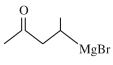
B
C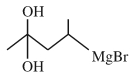
D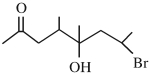
Solution
(B) The reaction involves the formation of a Grignard reagent from the alkyl bromide part of the molecule: $CH_3COCH_2CH(CH_3)CH_2Br + Mg \rightarrow CH_3COCH_2CH(CH_3)CH_2MgBr$.
This Grignard reagent acts as a nucleophile and attacks the carbonyl group of another molecule of the same reactant (intermolecular reaction).
The nucleophilic carbon of the Grignard reagent attacks the electrophilic carbonyl carbon of another molecule.
After hydrolysis with $H_2O$,the final product '$A$' is formed,which is a dimer containing both a ketone and an alcohol group.
This Grignard reagent acts as a nucleophile and attacks the carbonyl group of another molecule of the same reactant (intermolecular reaction).
The nucleophilic carbon of the Grignard reagent attacks the electrophilic carbonyl carbon of another molecule.
After hydrolysis with $H_2O$,the final product '$A$' is formed,which is a dimer containing both a ketone and an alcohol group.
0 likesView Solution
366
ChemistryMediumMCQJEE Main · 2023
Four gases $A$,$B$,$C$,and $D$ have critical temperatures $5.3 \ K$,$33.2 \ K$,$126.0 \ K$,and $154.3 \ K$ respectively. For their adsorption on a fixed amount of charcoal,the correct order is:
A
$C > B > D > A$
B
$C > D > B > A$
C
$D > C > A > B$
D
$D > C > B > A$
Solution
(D) The extent of adsorption of a gas on a solid adsorbent like charcoal is directly proportional to its critical temperature $(T_c)$.
Higher critical temperature implies that the gas is more easily liquefiable and has stronger van der Waals forces of attraction.
Given critical temperatures are:
$A = 5.3 \ K$
$B = 33.2 \ K$
$C = 126.0 \ K$
$D = 154.3 \ K$
Therefore,the order of adsorption is $D > C > B > A$.
Higher critical temperature implies that the gas is more easily liquefiable and has stronger van der Waals forces of attraction.
Given critical temperatures are:
$A = 5.3 \ K$
$B = 33.2 \ K$
$C = 126.0 \ K$
$D = 154.3 \ K$
Therefore,the order of adsorption is $D > C > B > A$.
0 likesView Solution
367
ChemistryDifficultMCQJEE Main · 2023
Given below are two statements: one is labelled as Assertion $A$ and the other is labelled as Reason $R$.
Assertion $A$: $5f$ electrons can participate in bonding to a far greater extent than $4f$ electrons.
Reason $R$: $5f$ orbitals are not as buried as $4f$ orbitals.
In the light of the above statements,choose the correct answer from the options given below:
Assertion $A$: $5f$ electrons can participate in bonding to a far greater extent than $4f$ electrons.
Reason $R$: $5f$ orbitals are not as buried as $4f$ orbitals.
In the light of the above statements,choose the correct answer from the options given below:
A
Both $A$ and $R$ are true but $R$ is $NOT$ the correct explanation of $A$.
B
Both $A$ and $R$ are true and $R$ is the correct explanation of $A$.
C
$A$ is false but $R$ is true.
D
$A$ is true but $R$ is false.
Solution
(B) The $4f$ orbitals are deeply buried within the atom,shielded by outer shells,which limits their participation in chemical bonding.
In contrast,the $5f$ orbitals are less buried and extend further from the nucleus compared to $4f$ orbitals.
Because the $5f$ electrons experience less nuclear attraction and are more accessible,they can participate in bonding to a far greater extent than $4f$ electrons.
Therefore,both Assertion $A$ and Reason $R$ are true,and $R$ is the correct explanation of $A$.
In contrast,the $5f$ orbitals are less buried and extend further from the nucleus compared to $4f$ orbitals.
Because the $5f$ electrons experience less nuclear attraction and are more accessible,they can participate in bonding to a far greater extent than $4f$ electrons.
Therefore,both Assertion $A$ and Reason $R$ are true,and $R$ is the correct explanation of $A$.
0 likesView Solution
368
ChemistryDifficultMCQJEE Main · 2023
The incorrect statement regarding the reaction given below is:
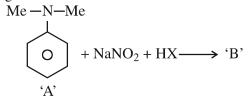
A
The electrophile involved in the reaction is $NO^{+}$
B
$'B'$ is $N$-nitroso ammonium compound
C
The reaction occurs at low temperature
D
The product $'B'$ formed in the above reaction is $p$-nitroso compound at low temperature
Solution
(B) The reaction of $N,N$-dimethylaniline with $NaNO_2$ and $HX$ (nitrous acid) at low temperature $(0-5^{\circ}C)$ is an electrophilic aromatic substitution reaction.
$1$. The electrophile generated is the nitrosonium ion,$NO^{+}$.
$2$. Since the $-N(CH_3)_2$ group is a strong ortho/para directing group,the electrophile $NO^{+}$ attacks the para position to form $p$-nitroso-$N,N$-dimethylaniline.
$3$. Option $A$ is correct as $NO^{+}$ is the electrophile.
$4$. Option $B$ is incorrect because the product is $p$-nitroso-$N,N$-dimethylaniline,not an $N$-nitroso ammonium compound (which would form with secondary amines).
$5$. Option $C$ is correct as the reaction is performed at low temperatures to stabilize the nitrous acid and prevent side reactions.
$6$. Option $D$ is correct as the major product is the $p$-nitroso derivative.
$1$. The electrophile generated is the nitrosonium ion,$NO^{+}$.
$2$. Since the $-N(CH_3)_2$ group is a strong ortho/para directing group,the electrophile $NO^{+}$ attacks the para position to form $p$-nitroso-$N,N$-dimethylaniline.
$3$. Option $A$ is correct as $NO^{+}$ is the electrophile.
$4$. Option $B$ is incorrect because the product is $p$-nitroso-$N,N$-dimethylaniline,not an $N$-nitroso ammonium compound (which would form with secondary amines).
$5$. Option $C$ is correct as the reaction is performed at low temperatures to stabilize the nitrous acid and prevent side reactions.
$6$. Option $D$ is correct as the major product is the $p$-nitroso derivative.
0 likesView Solution
369
ChemistryMediumMCQJEE Main · 2023
Match List-$I$ with List-$II$:
Choose the correct answer from the options given below:
| List-$I$ (Complex) | List-$II$ ($CFSE$ in $\Delta_0$) |
|---|---|
| $A$. $[Cu(NH_3)_6]^{2+}$ | $I$. $-0.6$ |
| $B$. $[Ti(H_2O)_6]^{3+}$ | $II$. $-2.0$ |
| $C$. $[Fe(CN)_6]^{3-}$ | $III$. $-1.2$ |
| $D$. $[NiF_6]^{4-}$ | $IV$. $-0.4$ |
Choose the correct answer from the options given below:
A
$A-I, B-IV, C-II, D-III$
B
$A-II, B-III, C-I, D-IV$
C
$A-I, B-II, C-IV, D-III$
D
$A-III, B-IV, C-I, D-II$
Solution
(A) The $CFSE$ is calculated using the formula: $CFSE = (-0.4 n_{t_{2g}} + 0.6 n_{e_g}) \Delta_0$.
$A$. $[Cu(NH_3)_6]^{2+}$: $Cu^{2+}$ is $d^9$ $(t_{2g}^6 e_g^3)$. $CFSE = (-0.4 \times 6 + 0.6 \times 3) = -2.4 + 1.8 = -0.6 \Delta_0$. (Matches $I$)
$B$. $[Ti(H_2O)_6]^{3+}$: $Ti^{3+}$ is $d^1$ $(t_{2g}^1 e_g^0)$. $CFSE = (-0.4 \times 1 + 0.6 \times 0) = -0.4 \Delta_0$. (Matches $IV$)
$C$. $[Fe(CN)_6]^{3-}$: $Fe^{3+}$ is $d^5$ (strong field,$t_{2g}^5 e_g^0$). $CFSE = (-0.4 \times 5 + 0.6 \times 0) = -2.0 \Delta_0$. (Matches $II$)
$D$. $[NiF_6]^{4-}$: $Ni^{2+}$ is $d^8$ $(t_{2g}^6 e_g^2)$. $CFSE = (-0.4 \times 6 + 0.6 \times 2) = -2.4 + 1.2 = -1.2 \Delta_0$. (Matches $III$)
Therefore,the correct matching is $A-I, B-IV, C-II, D-III$.
$A$. $[Cu(NH_3)_6]^{2+}$: $Cu^{2+}$ is $d^9$ $(t_{2g}^6 e_g^3)$. $CFSE = (-0.4 \times 6 + 0.6 \times 3) = -2.4 + 1.8 = -0.6 \Delta_0$. (Matches $I$)
$B$. $[Ti(H_2O)_6]^{3+}$: $Ti^{3+}$ is $d^1$ $(t_{2g}^1 e_g^0)$. $CFSE = (-0.4 \times 1 + 0.6 \times 0) = -0.4 \Delta_0$. (Matches $IV$)
$C$. $[Fe(CN)_6]^{3-}$: $Fe^{3+}$ is $d^5$ (strong field,$t_{2g}^5 e_g^0$). $CFSE = (-0.4 \times 5 + 0.6 \times 0) = -2.0 \Delta_0$. (Matches $II$)
$D$. $[NiF_6]^{4-}$: $Ni^{2+}$ is $d^8$ $(t_{2g}^6 e_g^2)$. $CFSE = (-0.4 \times 6 + 0.6 \times 2) = -2.4 + 1.2 = -1.2 \Delta_0$. (Matches $III$)
Therefore,the correct matching is $A-I, B-IV, C-II, D-III$.
0 likesView Solution
370
ChemistryMediumMCQJEE Main · 2023
Match List-$I$ with List-$II$.
Choose the correct answer from the options given below:
| List-$I$ | List-$II$ |
|---|---|
| $A$. $2$-Chloro-$1,3$-butadiene | $I$. Biodegradable polymer |
| $B$. Nylon-$2$-nylon-$6$ | $II$. Synthetic Rubber |
| $C$. Polyacrylonitrile | $III$. Polyester |
| $D$. Dacron | $IV$. Addition Polymer |
Choose the correct answer from the options given below:
A
$A-IV, B-I, C-III, D-II$
B
$A-IV, B-III, C-I, D-II$
C
$A-II, B-IV, C-I, D-III$
D
$A-II, B-I, C-IV, D-III$
Solution
(D) . $2$-Chloro-$1,3$-butadiene is the monomer of Neoprene,which is a synthetic rubber $(A-II)$.
$B$. Nylon-$2$-nylon-$6$ is a copolymer of glycine and amino caproic acid,which is a biodegradable polymer $(B-I)$.
$C$. Polyacrylonitrile is formed by the polymerization of acrylonitrile,which is an addition polymer $(C-IV)$.
$D$. Dacron (also known as Terylene) is a polyester formed by the condensation of ethylene glycol and terephthalic acid $(D-III)$.
Therefore,the correct matching is $A-II, B-I, C-IV, D-III$.
$B$. Nylon-$2$-nylon-$6$ is a copolymer of glycine and amino caproic acid,which is a biodegradable polymer $(B-I)$.
$C$. Polyacrylonitrile is formed by the polymerization of acrylonitrile,which is an addition polymer $(C-IV)$.
$D$. Dacron (also known as Terylene) is a polyester formed by the condensation of ethylene glycol and terephthalic acid $(D-III)$.
Therefore,the correct matching is $A-II, B-I, C-IV, D-III$.
0 likesView Solution
371
ChemistryMediumMCQJEE Main · 2023
Given below are two statements:
Statement $I$: $SbCl_5$ is more covalent than $SbCl_3$.
Statement $II$: The higher oxides of halogens tend to be more stable than the lower ones.
In the light of the above statements,choose the most appropriate answer from the options given below:
Statement $I$: $SbCl_5$ is more covalent than $SbCl_3$.
Statement $II$: The higher oxides of halogens tend to be more stable than the lower ones.
In the light of the above statements,choose the most appropriate answer from the options given below:
A
Both Statement $I$ and Statement $II$ are correct.
B
Both Statement $I$ and Statement $II$ are incorrect.
C
Statement $I$ is correct but Statement $II$ is incorrect.
D
Statement $I$ is incorrect but Statement $II$ is correct.
Solution
(C) Statement $I$ is correct: According to Fajan's rule,the cation with higher charge $(Sb^{+5})$ has greater polarising power than the one with lower charge $(Sb^{+3})$,making $SbCl_5$ more covalent than $SbCl_3$.
Statement $II$ is incorrect: Generally,the lower oxides of halogens are more stable than the higher oxides. Higher oxides of halogens are often unstable and tend to decompose or explode.
Statement $II$ is incorrect: Generally,the lower oxides of halogens are more stable than the higher oxides. Higher oxides of halogens are often unstable and tend to decompose or explode.
0 likesView Solution
372
ChemistryMediumMCQJEE Main · 2023
Given below are two statements: one is labelled as Assertion $A$ and the other is labelled as Reason $R$.
Assertion $A$: In the Ellingham diagram,a sharp change in slope of the line is observed for $Mg \rightarrow MgO$ at $\sim 1120^{\circ} C$.
Reason $R$: There is a large change of entropy associated with the change of state.
In the light of the above statements,choose the correct answer from the options given below.
Assertion $A$: In the Ellingham diagram,a sharp change in slope of the line is observed for $Mg \rightarrow MgO$ at $\sim 1120^{\circ} C$.
Reason $R$: There is a large change of entropy associated with the change of state.
In the light of the above statements,choose the correct answer from the options given below.
A
Both $A$ and $R$ are true but $R$ is $NOT$ the correct explanation of $A$.
B
Both $A$ and $R$ are true and $R$ is the correct explanation of $A$.
C
$A$ is false but $R$ is true.
D
$A$ is true but $R$ is false.
Solution
(B) The Ellingham diagram plots $\Delta G^{\circ}$ versus $T$. The slope of the line is $-\Delta S$.
At the melting point of the metal $(Mg)$,the metal changes from solid to liquid state $(Mg_{(s)} \rightarrow Mg_{(l)})$.
This phase change involves a significant change in entropy $(\Delta S)$.
Since the entropy of the liquid state is higher than that of the solid state,the value of $\Delta S$ for the reaction $2Mg_{(l)} + O_2(g) \rightarrow 2MgO_{(s)}$ becomes more negative than for $2Mg_{(s)} + O_2(g) \rightarrow 2MgO_{(s)}$.
Consequently,the slope $(-\Delta S)$ increases sharply at the melting point $(\sim 1120^{\circ} C)$.
Thus,both Assertion $A$ and Reason $R$ are true,and $R$ is the correct explanation of $A$.
At the melting point of the metal $(Mg)$,the metal changes from solid to liquid state $(Mg_{(s)} \rightarrow Mg_{(l)})$.
This phase change involves a significant change in entropy $(\Delta S)$.
Since the entropy of the liquid state is higher than that of the solid state,the value of $\Delta S$ for the reaction $2Mg_{(l)} + O_2(g) \rightarrow 2MgO_{(s)}$ becomes more negative than for $2Mg_{(s)} + O_2(g) \rightarrow 2MgO_{(s)}$.
Consequently,the slope $(-\Delta S)$ increases sharply at the melting point $(\sim 1120^{\circ} C)$.
Thus,both Assertion $A$ and Reason $R$ are true,and $R$ is the correct explanation of $A$.
0 likesView Solution
373
ChemistryMediumMCQJEE Main · 2023
For lead storage battery,pick the correct statements:
$A.$ During charging of battery,$PbSO_4$ on anode is converted into $Pb$.
$B.$ During charging of battery,$PbSO_4$ on cathode is converted into $PbO_2$.
$C.$ Lead storage battery consists of a grid of lead packed with $PbO_2$ as cathode.
$D.$ Lead storage battery has $\sim 38\%$ solution of sulphuric acid as an electrolyte.
Choose the correct answer from the options given below:
$A.$ During charging of battery,$PbSO_4$ on anode is converted into $Pb$.
$B.$ During charging of battery,$PbSO_4$ on cathode is converted into $PbO_2$.
$C.$ Lead storage battery consists of a grid of lead packed with $PbO_2$ as cathode.
$D.$ Lead storage battery has $\sim 38\%$ solution of sulphuric acid as an electrolyte.
Choose the correct answer from the options given below:
A
$B, D$ only
B
$B, C, D$ only
C
$A, B, D$ only
D
$B, C$ only
Solution
(A, B, C, D ARE ALL CORRECT (NOTE: THE PROVIDED OPTIONS DO NOT CONTAIN THE CORRECT COMBINATION A, B, C, D; HOWEVER, BASED ON THE QUESTION, ALL STATEMENTS ARE FACTUALLY CORRECT.)) In a lead storage battery,the anode is made of lead $(Pb)$ and the cathode is a grid of lead packed with lead dioxide $(PbO_2)$.
$A$ $\sim 38\%$ solution of sulphuric acid $(H_2SO_4)$ is used as the electrolyte.
During the charging process,the discharge reactions are reversed:
$1$. At the anode: $PbSO_{4(s)} + 2e^- \rightarrow Pb_{(s)} + SO_{4(aq)}^{2-}$
$2$. At the cathode: $PbSO_{4(s)} + 2H_2O_{(l)} \rightarrow PbO_{2(s)} + SO_{4(aq)}^{2-} + 4H_{(aq)}^+ + 2e^-$
Thus,statements $A$,$B$,$C$,and $D$ are all correct.
$A$ $\sim 38\%$ solution of sulphuric acid $(H_2SO_4)$ is used as the electrolyte.
During the charging process,the discharge reactions are reversed:
$1$. At the anode: $PbSO_{4(s)} + 2e^- \rightarrow Pb_{(s)} + SO_{4(aq)}^{2-}$
$2$. At the cathode: $PbSO_{4(s)} + 2H_2O_{(l)} \rightarrow PbO_{2(s)} + SO_{4(aq)}^{2-} + 4H_{(aq)}^+ + 2e^-$
Thus,statements $A$,$B$,$C$,and $D$ are all correct.
0 likesView Solution
374
ChemistryDifficultMCQJEE Main · 2023
$A$ in the above reaction is:
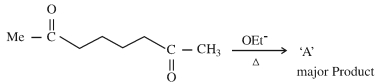
A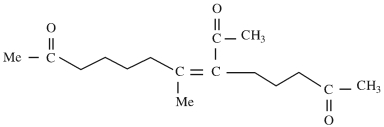
B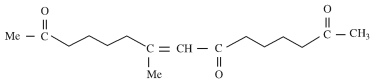
C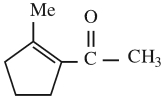
D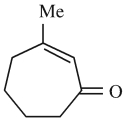
Solution
(C) The reaction is an intramolecular aldol condensation of heptane$-2,6-$dione.
$1$. The base $OEt^-$ abstracts an $\alpha$-hydrogen from one of the terminal methyl groups to form an enolate.
$2$. The enolate carbon attacks the other carbonyl carbon,forming a five-membered ring (intramolecular aldol addition).
$3$. This results in a $\beta$-hydroxy ketone intermediate.
$4$. Upon heating $(\Delta)$,the intermediate undergoes dehydration (elimination of water) to form the stable $\alpha,\beta$-unsaturated ketone,which is $3$-methylcyclopent-$2$-en-$1$-one derivative.
$1$. The base $OEt^-$ abstracts an $\alpha$-hydrogen from one of the terminal methyl groups to form an enolate.
$2$. The enolate carbon attacks the other carbonyl carbon,forming a five-membered ring (intramolecular aldol addition).
$3$. This results in a $\beta$-hydroxy ketone intermediate.
$4$. Upon heating $(\Delta)$,the intermediate undergoes dehydration (elimination of water) to form the stable $\alpha,\beta$-unsaturated ketone,which is $3$-methylcyclopent-$2$-en-$1$-one derivative.
0 likesView Solution
Vedclass Products
For Students
Vedclass Test Series
Mock tests in real JEE Main style covering Chemistry with performance analysis. 5-day free trial.
Start Free TrialFor Teachers
Exam Paper Generator
Generate Set A/B/C/D Chemistry papers from 7.5L+ questions in 2 minutes. 3 chapters free.
Try FreeFor Institutes
Online Exam Module
Run live JEE Main mock exams with unlimited students, 360° analytics & white-label branding.
See DemoFrequently Asked Questions
How many Chemistry questions are in JEE Main 2023?
There are 726 Chemistry questions from the JEE Main 2023 paper on Vedclass, each with a detailed step-by-step solution in English.
Are JEE Main 2023 Chemistry solutions available in English?
Yes. All solutions on this page are in English. You can also switch to English or Hindi using the language buttons above the questions.
Can I practice JEE Main 2023 Chemistry as a timed test?
Yes. Use the Vedclass Test Series to attempt a full JEE Main mock test covering Chemistry with time limits and instant score analysis.
Can teachers create Chemistry papers from JEE Main previous year questions?
Yes. The Vedclass Exam Paper Generator lets teachers mix JEE Main Chemistry questions and generate Set A/B/C/D papers in minutes.
For Teachers & Institutes
Build a Custom Chemistry Paper
Pick JEE Main 2023 Chemistry questions, set difficulty, and generate Set A/B/C/D in 2 minutes.