
Medium
Explore More
Similar Questions
For a reaction,the activation energy $E_{a} = 0$ and the rate constant at $200 \ K$ is $1.6 \times 10^{6} \ s^{-1}$. The rate constant at $400 \ K$ will be (given $R = 8.314 \ J \ K^{-1} \ mol^{-1}$):
DifficultNEET 2019
View SolutionThe slope of the Arrhenius plot $(\ln k \, vs \, \frac{1}{T})$ of a first-order reaction is $-5 \times 10^{3} \, K$. The value of $E_{a}$ of the reaction is: (in $kJ \, mol^{-1}$)
$[\text{Given } R = 8.314 \, J \, K^{-1} \, mol^{-1}]$
$[\text{Given } R = 8.314 \, J \, K^{-1} \, mol^{-1}]$
MediumNEET 2021
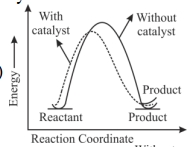
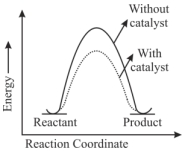
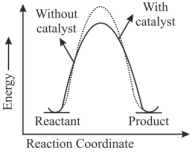
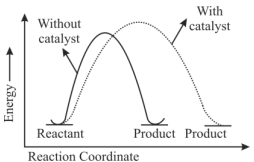
View SolutionSelect the correct statement.
Difficult
View Solution$A$ graph plotted between $\log \,K$ vs $\frac{1}{T}$ for calculating activation energy is shown by:
Medium
View SolutionThe reaction between $H_{2(g)}$ and $O_{2(g)}$ is highly feasible,yet allowing the gases to stand at room temperature in the same vessel does not lead to the formation of water. Explain.
Easy
View SolutionVedclass Products
For Students
Vedclass Test Series
Mock tests in real JEE/NEET style with performance analysis. 5-day free trial.
Start Free TrialFor Teachers
Exam Paper Generator
Generate Set A/B/C/D exam papers from 7.5L+ questions in 2 minutes. 3 chapters free.
Try FreeFor Institutes
Online Exam Module
Live online exams with unlimited students, 360° analytics & white-label branding.
See Demo