
ChemistryQ1–100 of 798 questions
Page 1 of 9 · English
1
ChemistryMCQJEE Main · 2021
$A$ satellite is launched into a circular orbit of radius $R$ around the Earth,while a second satellite is launched into an orbit of radius $1.02 R$. The percentage difference in the time periods of the two satellites is ......... $\%$
A
$0.7$
B
$1$
C
$1.5$
D
$3$
Solution
(D) According to Kepler's Third Law of Planetary Motion,the square of the time period $T$ is proportional to the cube of the orbital radius $R$,i.e.,$T^2 \propto R^3$ or $T \propto R^{3/2}$.
Taking the logarithmic derivative,we get $\frac{dT}{T} = \frac{3}{2} \frac{dR}{R}$.
The percentage change in radius is $\frac{dR}{R} \times 100 = \frac{1.02R - R}{R} \times 100 = 0.02 \times 100 = 2\%$.
Therefore,the percentage change in the time period is $\frac{dT}{T} \times 100 = \frac{3}{2} \times (\frac{dR}{R} \times 100) = \frac{3}{2} \times 2\% = 3\%$.
Thus,the percentage difference in the time periods is $3\%$.
Taking the logarithmic derivative,we get $\frac{dT}{T} = \frac{3}{2} \frac{dR}{R}$.
The percentage change in radius is $\frac{dR}{R} \times 100 = \frac{1.02R - R}{R} \times 100 = 0.02 \times 100 = 2\%$.
Therefore,the percentage change in the time period is $\frac{dT}{T} \times 100 = \frac{3}{2} \times (\frac{dR}{R} \times 100) = \frac{3}{2} \times 2\% = 3\%$.
Thus,the percentage difference in the time periods is $3\%$.
1 likesView Solution
2
ChemistryMCQJEE Main · 2021
Magnetic fields at two points on the axis of a circular coil at a distance of $0.05\,m$ and $0.2\,m$ from the centre are in the ratio $8 : 1$. The radius of the coil is.....$m$
A
$1$
B
$0.1$
C
$0.15$
D
$0.2$
Solution
(B) The magnetic field on the axis of a circular coil of radius $R$ at a distance $x$ from the center is given by $B = \frac{\mu_0 N i R^2}{2(R^2 + x^2)^{3/2}}$.
Since $B \propto (R^2 + x^2)^{-3/2}$,we have the ratio $\frac{B_1}{B_2} = \left( \frac{R^2 + x_2^2}{R^2 + x_1^2} \right)^{3/2}$.
Given $\frac{B_1}{B_2} = 8$,$x_1 = 0.05\,m$,and $x_2 = 0.2\,m$,we substitute these values:
$8 = \left( \frac{R^2 + (0.2)^2}{R^2 + (0.05)^2} \right)^{3/2}$.
Taking the power of $2/3$ on both sides:
$8^{2/3} = \frac{R^2 + 0.04}{R^2 + 0.0025} \Rightarrow 4 = \frac{R^2 + 0.04}{R^2 + 0.0025}$.
$4(R^2 + 0.0025) = R^2 + 0.04 \Rightarrow 4R^2 + 0.01 = R^2 + 0.04$.
$3R^2 = 0.03 \Rightarrow R^2 = 0.01 \Rightarrow R = 0.1\,m$.
Since $B \propto (R^2 + x^2)^{-3/2}$,we have the ratio $\frac{B_1}{B_2} = \left( \frac{R^2 + x_2^2}{R^2 + x_1^2} \right)^{3/2}$.
Given $\frac{B_1}{B_2} = 8$,$x_1 = 0.05\,m$,and $x_2 = 0.2\,m$,we substitute these values:
$8 = \left( \frac{R^2 + (0.2)^2}{R^2 + (0.05)^2} \right)^{3/2}$.
Taking the power of $2/3$ on both sides:
$8^{2/3} = \frac{R^2 + 0.04}{R^2 + 0.0025} \Rightarrow 4 = \frac{R^2 + 0.04}{R^2 + 0.0025}$.
$4(R^2 + 0.0025) = R^2 + 0.04 \Rightarrow 4R^2 + 0.01 = R^2 + 0.04$.
$3R^2 = 0.03 \Rightarrow R^2 = 0.01 \Rightarrow R = 0.1\,m$.
0 likesView Solution
3
ChemistryMCQJEE Main · 2021
An ideal gas is expanding such that $PT^2 = \text{constant}$. The coefficient of volume expansion of the gas is: (in $/T$)
A
$1$
B
$2$
C
$3$
D
$4$
Solution
(C) For an ideal gas, the equation of state is $PV = \mu RT$, which implies $P = \frac{\mu RT}{V}$.
Given the process equation $PT^2 = k$ (where $k$ is a constant).
Substituting $P$ in the process equation: $\left(\frac{\mu RT}{V}\right)T^2 = k$.
This simplifies to $\mu RT^3 = kV$.
Differentiating both sides with respect to $T$: $\mu R(3T^2 dT) = k dV$.
Dividing the differential equation by the original equation $\mu RT^3 = kV$:
$\frac{3\mu RT^2 dT}{\mu RT^3} = \frac{kdV}{kV}$.
This yields $\frac{3dT}{T} = \frac{dV}{V}$.
The coefficient of volume expansion $\gamma$ is defined as $\gamma = \frac{1}{V} \frac{dV}{dT}$.
From the derived relation, $\frac{1}{V} \frac{dV}{dT} = \frac{3}{T}$.
Therefore, $\gamma = 3/T$.
Given the process equation $PT^2 = k$ (where $k$ is a constant).
Substituting $P$ in the process equation: $\left(\frac{\mu RT}{V}\right)T^2 = k$.
This simplifies to $\mu RT^3 = kV$.
Differentiating both sides with respect to $T$: $\mu R(3T^2 dT) = k dV$.
Dividing the differential equation by the original equation $\mu RT^3 = kV$:
$\frac{3\mu RT^2 dT}{\mu RT^3} = \frac{kdV}{kV}$.
This yields $\frac{3dT}{T} = \frac{dV}{V}$.
The coefficient of volume expansion $\gamma$ is defined as $\gamma = \frac{1}{V} \frac{dV}{dT}$.
From the derived relation, $\frac{1}{V} \frac{dV}{dT} = \frac{3}{T}$.
Therefore, $\gamma = 3/T$.
0 likesView Solution
4
ChemistryMCQJEE Main · 2021
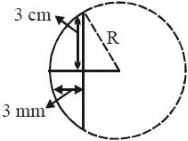
The diameter of a plano-convex lens is $6 \ cm$ and its thickness at the center is $3 \ mm$. If the speed of light in the material of the lens is $2 \times 10^8 \ m/s$,the focal length of the lens is.......$cm$.
A
$15$
B
$20$
C
$30$
D
$10$
Solution
(C) Given: Diameter of lens $= 6 \ cm$,so radius $a = 3 \ cm$. Thickness $t = 3 \ mm = 0.3 \ cm$. Speed of light in lens $v = 2 \times 10^8 \ m/s$. Speed of light in vacuum $c = 3 \times 10^8 \ m/s$.
Refractive index $\mu = \frac{c}{v} = \frac{3 \times 10^8}{2 \times 10^8} = 1.5$.
For a spherical surface of radius $R$,the relationship between radius of aperture $a$,thickness $t$,and radius of curvature $R$ is given by $R^2 = a^2 + (R - t)^2$.
$R^2 = a^2 + R^2 - 2Rt + t^2 \implies 2Rt = a^2 + t^2$.
$R = \frac{a^2 + t^2}{2t} = \frac{3^2 + (0.3)^2}{2 \times 0.3} = \frac{9 + 0.09}{0.6} = \frac{9.09}{0.6} = 15.15 \ cm$.
Using the lens maker's formula for a plano-convex lens: $\frac{1}{f} = (\mu - 1) \left( \frac{1}{R} \right)$.
$\frac{1}{f} = (1.5 - 1) \left( \frac{1}{15.15} \right) = 0.5 \times \frac{1}{15.15} = \frac{1}{30.3}$.
Thus,$f \approx 30 \ cm$.
Refractive index $\mu = \frac{c}{v} = \frac{3 \times 10^8}{2 \times 10^8} = 1.5$.
For a spherical surface of radius $R$,the relationship between radius of aperture $a$,thickness $t$,and radius of curvature $R$ is given by $R^2 = a^2 + (R - t)^2$.
$R^2 = a^2 + R^2 - 2Rt + t^2 \implies 2Rt = a^2 + t^2$.
$R = \frac{a^2 + t^2}{2t} = \frac{3^2 + (0.3)^2}{2 \times 0.3} = \frac{9 + 0.09}{0.6} = \frac{9.09}{0.6} = 15.15 \ cm$.
Using the lens maker's formula for a plano-convex lens: $\frac{1}{f} = (\mu - 1) \left( \frac{1}{R} \right)$.
$\frac{1}{f} = (1.5 - 1) \left( \frac{1}{15.15} \right) = 0.5 \times \frac{1}{15.15} = \frac{1}{30.3}$.
Thus,$f \approx 30 \ cm$.
0 likesView Solution
5
ChemistryMCQJEE Main · 2021
An ideal gas is expanding such that $PT^2 = \text{constant}$. The coefficient of volume expansion of the gas is (in $/T$)
A
$1$
B
$2$
C
$3$
D
$4$
Solution
(C) Given the process equation: $PT^2 = K$ (where $K$ is a constant).
Using the ideal gas law $PV = \mu RT$,we can express pressure as $P = \frac{\mu RT}{V}$.
Substituting this into the process equation: $\left(\frac{\mu RT}{V}\right) T^2 = K$.
This simplifies to $\frac{\mu R T^3}{V} = K$,or $T^3 = \left(\frac{K}{\mu R}\right) V$.
Let $C = \frac{K}{\mu R}$,so $T^3 = CV$.
Differentiating both sides with respect to $T$: $3T^2 dT = C dV$.
Thus,$\frac{dV}{dT} = \frac{3T^2}{C} = \frac{3T^2}{(T^3/V)} = \frac{3V}{T}$.
The coefficient of volume expansion $\gamma$ is defined as $\gamma = \frac{1}{V} \frac{dV}{dT}$.
Substituting the expression for $\frac{dV}{dT}$: $\gamma = \frac{1}{V} \left(\frac{3V}{T}\right) = \frac{3}{T}$.
Using the ideal gas law $PV = \mu RT$,we can express pressure as $P = \frac{\mu RT}{V}$.
Substituting this into the process equation: $\left(\frac{\mu RT}{V}\right) T^2 = K$.
This simplifies to $\frac{\mu R T^3}{V} = K$,or $T^3 = \left(\frac{K}{\mu R}\right) V$.
Let $C = \frac{K}{\mu R}$,so $T^3 = CV$.
Differentiating both sides with respect to $T$: $3T^2 dT = C dV$.
Thus,$\frac{dV}{dT} = \frac{3T^2}{C} = \frac{3T^2}{(T^3/V)} = \frac{3V}{T}$.
The coefficient of volume expansion $\gamma$ is defined as $\gamma = \frac{1}{V} \frac{dV}{dT}$.
Substituting the expression for $\frac{dV}{dT}$: $\gamma = \frac{1}{V} \left(\frac{3V}{T}\right) = \frac{3}{T}$.
0 likesView Solution
6
ChemistryMCQJEE Main · 2021
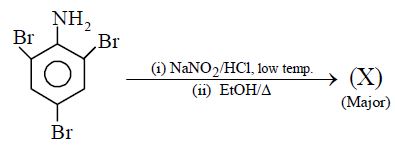
The structure of $X$ is
A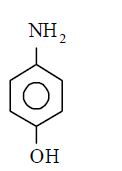
B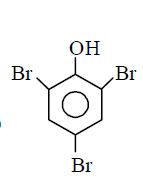
C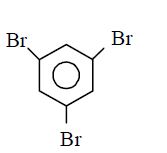
D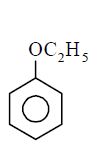
Solution
(D) The reaction sequence involves the diazotization of $2,4,6$-tribromoaniline using $NaNO_2/HCl$ at low temperature to form the corresponding diazonium salt.
Subsequent treatment with ethanol $(EtOH)$ and heating results in the reduction of the diazonium group,replacing it with a hydrogen atom.
Thus,the $-NH_2$ group is removed,yielding $1,3,5$-tribromobenzene as the major product $X$.
Subsequent treatment with ethanol $(EtOH)$ and heating results in the reduction of the diazonium group,replacing it with a hydrogen atom.
Thus,the $-NH_2$ group is removed,yielding $1,3,5$-tribromobenzene as the major product $X$.
0 likesView Solution
7
ChemistryMCQJEE Main · 2021
$A$ bimetallic strip consists of metals $A$ and $B$. It is mounted rigidly at the base as shown. The metal $A$ has a higher coefficient of expansion than that of metal $B$. When the bimetallic strip is placed in a cold bath,it will:
A
bend towards the right
B
bend towards the left
C
not bend but shrink
D
neither bend nor shrink
Solution
(B) The coefficient of linear expansion for metal $A$ is $\alpha_A$ and for metal $B$ is $\alpha_B$. Given that $\alpha_A > \alpha_B$.
When the temperature decreases (placed in a cold bath),both metals undergo contraction.
The change in length is given by $\Delta L = L_0 \alpha \Delta T$.
Since $\alpha_A > \alpha_B$,the contraction in metal $A$ is greater than the contraction in metal $B$.
Because metal $A$ is on the left side and contracts more than metal $B$ on the right,the strip will bend towards the left.
When the temperature decreases (placed in a cold bath),both metals undergo contraction.
The change in length is given by $\Delta L = L_0 \alpha \Delta T$.
Since $\alpha_A > \alpha_B$,the contraction in metal $A$ is greater than the contraction in metal $B$.
Because metal $A$ is on the left side and contracts more than metal $B$ on the right,the strip will bend towards the left.
0 likesView Solution
8
ChemistryMCQJEE Main · 2021
$A$ bimetallic strip consists of metals $A$ and $B$. It is mounted rigidly at the base as shown. The metal $A$ has a higher coefficient of expansion compared to that of metal $B$. When the bimetallic strip is placed in a cold bath,it will:
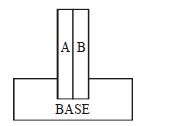
A
bend towards the right
B
bend towards the left
C
not bend but shrink
D
neither bend nor shrink
Solution
(B) The coefficient of linear expansion is denoted by $\alpha$. Given that $\alpha_A > \alpha_B$.
When the temperature decreases (placed in a cold bath),the change in length is given by $\Delta L = L_0 \alpha \Delta T$,where $\Delta T$ is negative.
Since $\alpha_A > \alpha_B$,the magnitude of contraction in metal $A$ is greater than that in metal $B$ $(|\Delta L_A| > |\Delta L_B|)$.
Because metal $A$ is on the left and it contracts more than metal $B$,the strip will bend towards the left side (the side of the metal that contracts more).
When the temperature decreases (placed in a cold bath),the change in length is given by $\Delta L = L_0 \alpha \Delta T$,where $\Delta T$ is negative.
Since $\alpha_A > \alpha_B$,the magnitude of contraction in metal $A$ is greater than that in metal $B$ $(|\Delta L_A| > |\Delta L_B|)$.
Because metal $A$ is on the left and it contracts more than metal $B$,the strip will bend towards the left side (the side of the metal that contracts more).
0 likesView Solution
9
ChemistryMCQJEE Main · 2021
The major product of the following reaction is
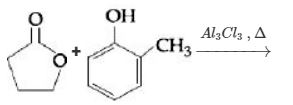
A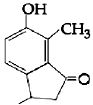
B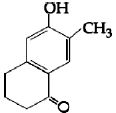
C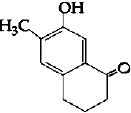
D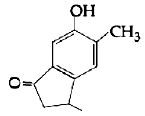
Solution
(C) The reaction involves the Friedel-Crafts acylation of $o$-cresol with $\gamma$-butyrolactone in the presence of a Lewis acid catalyst,$AlCl_3$.
$1$. The $AlCl_3$ coordinates with the carbonyl oxygen of the lactone,activating it for nucleophilic attack.
$2$. The electron-rich aromatic ring of $o$-cresol attacks the activated carbonyl carbon,leading to the ring-opening of the lactone.
$3$. This forms an intermediate ketone with a hydroxypropyl side chain.
$4$. Under the reaction conditions (heating,$\Delta$),this intermediate undergoes intramolecular cyclization (Friedel-Crafts alkylation) to form a bicyclic ketone.
$5$. The regioselectivity is governed by the directing effects of the $-OH$ and $-CH_3$ groups on the aromatic ring,leading to the formation of the product shown in option $C$.
$1$. The $AlCl_3$ coordinates with the carbonyl oxygen of the lactone,activating it for nucleophilic attack.
$2$. The electron-rich aromatic ring of $o$-cresol attacks the activated carbonyl carbon,leading to the ring-opening of the lactone.
$3$. This forms an intermediate ketone with a hydroxypropyl side chain.
$4$. Under the reaction conditions (heating,$\Delta$),this intermediate undergoes intramolecular cyclization (Friedel-Crafts alkylation) to form a bicyclic ketone.
$5$. The regioselectivity is governed by the directing effects of the $-OH$ and $-CH_3$ groups on the aromatic ring,leading to the formation of the product shown in option $C$.
0 likesView Solution
10
ChemistryMCQJEE Main · 2021
The major product of the following reaction is

A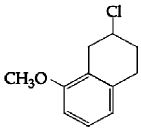
B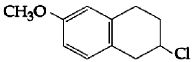
C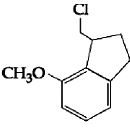
D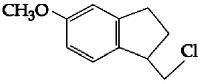
Solution
(C) The reaction proceeds in two steps:
$1$. Electrophilic addition of $Cl_2$ across the double bond in the presence of $CCl_4$ yields a vicinal dichloride: $CH_3O-C_6H_4-CH_2-CH_2-CHCl-CH_2Cl$.
$2$. In the presence of anhydrous $AlCl_3$ (a Lewis acid),one of the chlorine atoms is abstracted to form a carbocation. The electron-rich benzene ring (activated by the $-OCH_3$ group) then undergoes intramolecular Friedel-Crafts alkylation.
$3$. The cyclization occurs such that the more stable carbocation intermediate leads to the formation of a six-membered ring,resulting in $6-methoxy-2-chlorotetralin$ (or a related isomer depending on the specific cyclization pathway). Based on the provided options,the product is $C$.
$1$. Electrophilic addition of $Cl_2$ across the double bond in the presence of $CCl_4$ yields a vicinal dichloride: $CH_3O-C_6H_4-CH_2-CH_2-CHCl-CH_2Cl$.
$2$. In the presence of anhydrous $AlCl_3$ (a Lewis acid),one of the chlorine atoms is abstracted to form a carbocation. The electron-rich benzene ring (activated by the $-OCH_3$ group) then undergoes intramolecular Friedel-Crafts alkylation.
$3$. The cyclization occurs such that the more stable carbocation intermediate leads to the formation of a six-membered ring,resulting in $6-methoxy-2-chlorotetralin$ (or a related isomer depending on the specific cyclization pathway). Based on the provided options,the product is $C$.
0 likesView Solution
11
ChemistryMCQJEE Main · 2021
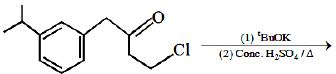
The major product of the following reaction is:
A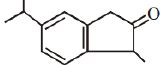
B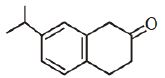
C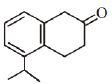
D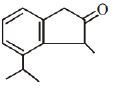
Solution
(C) The reaction proceeds in two steps:
$1$. Treatment with $t-BuOK$ (a strong base) causes an intramolecular elimination reaction (specifically an $E2$ mechanism) to form an $\alpha,\beta$-unsaturated ketone. The base abstracts an $\alpha$-hydrogen,and the resulting enolate displaces the chloride ion to form a vinyl ketone derivative.
$2$. Treatment with concentrated $H_2SO_4$ and heat induces a Friedel-Crafts type cyclization. The acid protonates the carbonyl oxygen,increasing the electrophilicity of the $\beta$-carbon,which then undergoes an intramolecular electrophilic aromatic substitution (cyclization) onto the benzene ring.
Given the structure,the cyclization occurs at the ortho position relative to the alkyl chain,leading to the formation of a six-membered ring fused to the benzene ring,resulting in $7$-isopropyl-$3,4$-dihydronaphthalen-$2(1H)$-one (or a related isomer depending on the specific substitution pattern). Based on the provided options,the product is represented by option $C$.
$1$. Treatment with $t-BuOK$ (a strong base) causes an intramolecular elimination reaction (specifically an $E2$ mechanism) to form an $\alpha,\beta$-unsaturated ketone. The base abstracts an $\alpha$-hydrogen,and the resulting enolate displaces the chloride ion to form a vinyl ketone derivative.
$2$. Treatment with concentrated $H_2SO_4$ and heat induces a Friedel-Crafts type cyclization. The acid protonates the carbonyl oxygen,increasing the electrophilicity of the $\beta$-carbon,which then undergoes an intramolecular electrophilic aromatic substitution (cyclization) onto the benzene ring.
Given the structure,the cyclization occurs at the ortho position relative to the alkyl chain,leading to the formation of a six-membered ring fused to the benzene ring,resulting in $7$-isopropyl-$3,4$-dihydronaphthalen-$2(1H)$-one (or a related isomer depending on the specific substitution pattern). Based on the provided options,the product is represented by option $C$.
0 likesView Solution
12
ChemistryMCQJEE Main · 2021
The major product of the following reaction is
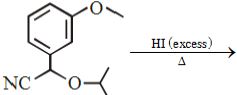
A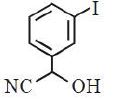
B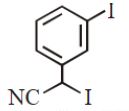
C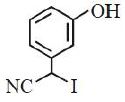
D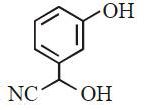
Solution
(C) The reaction involves the cleavage of ethers with excess $HI$.
$1$. The oxygen atoms are protonated by $H^+$.
$2$. The methoxy group attached to the benzene ring is cleaved to form a phenol and $CH_3I$.
$3$. The other ether linkage is cleaved by $I^-$ via an $S_N1$ or $S_N2$ mechanism (depending on the stability of the carbocation) to form an alcohol and an alkyl iodide.
$4$. In this specific case,the benzylic position is stabilized by the cyano group,allowing the formation of the iodo product at that position.
$5$. The final product is $3$-hydroxyphenyl-cyano-iodomethane.
$1$. The oxygen atoms are protonated by $H^+$.
$2$. The methoxy group attached to the benzene ring is cleaved to form a phenol and $CH_3I$.
$3$. The other ether linkage is cleaved by $I^-$ via an $S_N1$ or $S_N2$ mechanism (depending on the stability of the carbocation) to form an alcohol and an alkyl iodide.
$4$. In this specific case,the benzylic position is stabilized by the cyano group,allowing the formation of the iodo product at that position.
$5$. The final product is $3$-hydroxyphenyl-cyano-iodomethane.
0 likesView Solution
13
ChemistryMCQJEE Main · 2021
The major product of the following reaction is
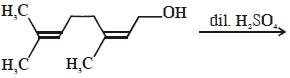
A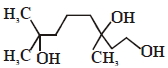
B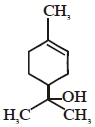
C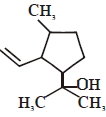
D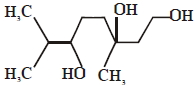
Solution
(C) The reaction involves the acid-catalyzed hydration of the double bond in the presence of $dil. \ H_2SO_4$.
Specifically,this is an intramolecular cyclization reaction of geraniol (or a related terpene alcohol).
The protonation of the double bond leads to the formation of a carbocation,which then undergoes intramolecular nucleophilic attack by the other double bond to form a six-membered ring.
Finally,the addition of water to the resulting carbocation followed by deprotonation yields $\alpha$-terpineol as the major product.
The structure of $\alpha$-terpineol is given in option $C$.
Specifically,this is an intramolecular cyclization reaction of geraniol (or a related terpene alcohol).
The protonation of the double bond leads to the formation of a carbocation,which then undergoes intramolecular nucleophilic attack by the other double bond to form a six-membered ring.
Finally,the addition of water to the resulting carbocation followed by deprotonation yields $\alpha$-terpineol as the major product.
The structure of $\alpha$-terpineol is given in option $C$.
0 likesView Solution
14
ChemistryMCQJEE Main · 2021
Consider three observations $a, b$ and $c$ such that $b = a + c$. If the standard deviation of $a + 2, b + 2, c + 2$ is $d$,then which of the following is true?
A
$b^{2} = 3(a^{2} + c^{2}) + 9d^{2}$
B
$b^{2} = a^{2} + c^{2} + 3d^{2}$
C
$b^{2} = 3(a^{2} + c^{2} + d^{2})$
D
$b^{2} = 3(a^{2} + c^{2}) - 9d^{2}$
Solution
(D) Given observations are $a, b, c$ with $b = a + c$.
The mean $\bar{x} = \frac{a + b + c}{3}$.
Substituting $a + c = b$,we get $\bar{x} = \frac{b + b}{3} = \frac{2b}{3}$.
The standard deviation of $a + 2, b + 2, c + 2$ is the same as the standard deviation of $a, b, c$,which is $d$.
Thus,$d^{2} = \frac{a^{2} + b^{2} + c^{2}}{3} - (\bar{x})^{2}$.
Substituting $\bar{x} = \frac{2b}{3}$,we have $d^{2} = \frac{a^{2} + b^{2} + c^{2}}{3} - \frac{4b^{2}}{9}$.
Multiplying by $9$,we get $9d^{2} = 3(a^{2} + b^{2} + c^{2}) - 4b^{2}$.
$9d^{2} = 3(a^{2} + c^{2}) + 3b^{2} - 4b^{2}$.
$9d^{2} = 3(a^{2} + c^{2}) - b^{2}$.
Therefore,$b^{2} = 3(a^{2} + c^{2}) - 9d^{2}$.
The mean $\bar{x} = \frac{a + b + c}{3}$.
Substituting $a + c = b$,we get $\bar{x} = \frac{b + b}{3} = \frac{2b}{3}$.
The standard deviation of $a + 2, b + 2, c + 2$ is the same as the standard deviation of $a, b, c$,which is $d$.
Thus,$d^{2} = \frac{a^{2} + b^{2} + c^{2}}{3} - (\bar{x})^{2}$.
Substituting $\bar{x} = \frac{2b}{3}$,we have $d^{2} = \frac{a^{2} + b^{2} + c^{2}}{3} - \frac{4b^{2}}{9}$.
Multiplying by $9$,we get $9d^{2} = 3(a^{2} + b^{2} + c^{2}) - 4b^{2}$.
$9d^{2} = 3(a^{2} + c^{2}) + 3b^{2} - 4b^{2}$.
$9d^{2} = 3(a^{2} + c^{2}) - b^{2}$.
Therefore,$b^{2} = 3(a^{2} + c^{2}) - 9d^{2}$.
0 likesView Solution
15
ChemistryMCQJEE Main · 2021
Two coherent light sources having intensity in the ratio $2x$ produce an interference pattern. The ratio $\frac{I_{\max} - I_{\min}}{I_{\max} + I_{\min}}$ will be
A
$\frac{2 \sqrt{2x}}{x + 1}$
B
$\frac{\sqrt{2x}}{2x + 1}$
C
$\frac{\sqrt{2x}}{x + 1}$
D
$\frac{2 \sqrt{2x}}{2x + 1}$
Solution
(D) Given that the ratio of intensities of two coherent sources is $\frac{I_1}{I_2} = 2x$.
We know that $I_{\max} = (\sqrt{I_1} + \sqrt{I_2})^2$ and $I_{\min} = (\sqrt{I_1} - \sqrt{I_2})^2$.
Substituting these into the expression $\frac{I_{\max} - I_{\min}}{I_{\max} + I_{\min}}$:
Numerator: $I_{\max} - I_{\min} = (I_1 + I_2 + 2\sqrt{I_1I_2}) - (I_1 + I_2 - 2\sqrt{I_1I_2}) = 4\sqrt{I_1I_2}$.
Denominator: $I_{\max} + I_{\min} = (I_1 + I_2 + 2\sqrt{I_1I_2}) + (I_1 + I_2 - 2\sqrt{I_1I_2}) = 2(I_1 + I_2)$.
Thus,the ratio is $\frac{4\sqrt{I_1I_2}}{2(I_1 + I_2)} = \frac{2\sqrt{I_1I_2}}{I_1 + I_2}$.
Dividing the numerator and denominator by $I_2$,we get $\frac{2\sqrt{I_1/I_2}}{I_1/I_2 + 1}$.
Substituting $\frac{I_1}{I_2} = 2x$,we get $\frac{2\sqrt{2x}}{2x + 1}$.
We know that $I_{\max} = (\sqrt{I_1} + \sqrt{I_2})^2$ and $I_{\min} = (\sqrt{I_1} - \sqrt{I_2})^2$.
Substituting these into the expression $\frac{I_{\max} - I_{\min}}{I_{\max} + I_{\min}}$:
Numerator: $I_{\max} - I_{\min} = (I_1 + I_2 + 2\sqrt{I_1I_2}) - (I_1 + I_2 - 2\sqrt{I_1I_2}) = 4\sqrt{I_1I_2}$.
Denominator: $I_{\max} + I_{\min} = (I_1 + I_2 + 2\sqrt{I_1I_2}) + (I_1 + I_2 - 2\sqrt{I_1I_2}) = 2(I_1 + I_2)$.
Thus,the ratio is $\frac{4\sqrt{I_1I_2}}{2(I_1 + I_2)} = \frac{2\sqrt{I_1I_2}}{I_1 + I_2}$.
Dividing the numerator and denominator by $I_2$,we get $\frac{2\sqrt{I_1/I_2}}{I_1/I_2 + 1}$.
Substituting $\frac{I_1}{I_2} = 2x$,we get $\frac{2\sqrt{2x}}{2x + 1}$.
0 likesView Solution
16
ChemistryMCQJEE Main · 2021
If $\int \frac{\cos x-\sin x}{\sqrt{8-\sin 2 x}} d x=a \sin ^{-1}\left(\frac{\sin x+\cos x}{b}\right)+c$ where $c$ is a constant of integration,then the ordered pair $(a, b)$ is equal to
A
$(-1, 3)$
B
$(3, 1)$
C
$(1, 3)$
D
$(1, -3)$
Solution
(C) Given integral: $I = \int \frac{\cos x-\sin x}{\sqrt{8-\sin 2 x}} d x$
We know that $\sin 2x = 1 - (1 - \sin 2x) = 1 - (\sin^2 x + \cos^2 x - 2\sin x \cos x) = 1 - (\sin x - \cos x)^2$. However,it is more convenient to write $\sin 2x = (\sin x + \cos x)^2 - 1$.
Substituting this into the denominator:
$8 - \sin 2x = 8 - ((\sin x + \cos x)^2 - 1) = 8 - (\sin x + \cos x)^2 + 1 = 9 - (\sin x + \cos x)^2$.
Let $t = \sin x + \cos x$. Then $dt = (\cos x - \sin x) dx$.
The integral becomes:
$I = \int \frac{dt}{\sqrt{9 - t^2}} = \sin^{-1}\left(\frac{t}{3}\right) + c$.
Substituting $t$ back:
$I = \sin^{-1}\left(\frac{\sin x + \cos x}{3}\right) + c$.
Comparing this with $a \sin^{-1}\left(\frac{\sin x + \cos x}{b}\right) + c$,we get $a = 1$ and $b = 3$.
Thus,the ordered pair $(a, b)$ is $(1, 3)$.
We know that $\sin 2x = 1 - (1 - \sin 2x) = 1 - (\sin^2 x + \cos^2 x - 2\sin x \cos x) = 1 - (\sin x - \cos x)^2$. However,it is more convenient to write $\sin 2x = (\sin x + \cos x)^2 - 1$.
Substituting this into the denominator:
$8 - \sin 2x = 8 - ((\sin x + \cos x)^2 - 1) = 8 - (\sin x + \cos x)^2 + 1 = 9 - (\sin x + \cos x)^2$.
Let $t = \sin x + \cos x$. Then $dt = (\cos x - \sin x) dx$.
The integral becomes:
$I = \int \frac{dt}{\sqrt{9 - t^2}} = \sin^{-1}\left(\frac{t}{3}\right) + c$.
Substituting $t$ back:
$I = \sin^{-1}\left(\frac{\sin x + \cos x}{3}\right) + c$.
Comparing this with $a \sin^{-1}\left(\frac{\sin x + \cos x}{b}\right) + c$,we get $a = 1$ and $b = 3$.
Thus,the ordered pair $(a, b)$ is $(1, 3)$.
0 likesView Solution
17
ChemistryMCQJEE Main · 2021
Let $a, b \in R$. If the mirror image of the point $P(a, 6, 9)$ with respect to the line $\frac{x-3}{7} = \frac{y-2}{5} = \frac{z-1}{-9}$ is $(20, b, -a-9)$,then $|a+b|$ is equal to:
A
$88$
B
$86$
C
$84$
D
$90$
Solution
(A) Let the point be $P(a, 6, 9)$ and its image be $Q(20, b, -a-9)$.
Let the line be $L: \frac{x-3}{7} = \frac{y-2}{5} = \frac{z-1}{-9} = k$.
The midpoint $M$ of $PQ$ is $\left( \frac{a+20}{2}, \frac{6+b}{2}, \frac{9-a-9}{2} \right) = \left( \frac{a+20}{2}, \frac{6+b}{2}, -\frac{a}{2} \right)$.
Since $M$ lies on the line $L$,we have $\frac{\frac{a+20}{2}-3}{7} = \frac{\frac{6+b}{2}-2}{5} = \frac{-\frac{a}{2}-1}{-9} = k$.
Simplifying,we get $\frac{a+14}{14} = \frac{b+2}{10} = \frac{a+2}{18} = k$.
From $\frac{a+14}{14} = \frac{a+2}{18}$,we get $18(a+14) = 14(a+2) \Rightarrow 18a + 252 = 14a + 28 \Rightarrow 4a = -224 \Rightarrow a = -56$.
Substituting $a = -56$ into $\frac{a+14}{14} = k$,we get $k = \frac{-56+14}{14} = \frac{-42}{14} = -3$.
Now,$\frac{b+2}{10} = -3 \Rightarrow b+2 = -30 \Rightarrow b = -32$.
Thus,$|a+b| = |-56 - 32| = |-88| = 88$.
Let the line be $L: \frac{x-3}{7} = \frac{y-2}{5} = \frac{z-1}{-9} = k$.
The midpoint $M$ of $PQ$ is $\left( \frac{a+20}{2}, \frac{6+b}{2}, \frac{9-a-9}{2} \right) = \left( \frac{a+20}{2}, \frac{6+b}{2}, -\frac{a}{2} \right)$.
Since $M$ lies on the line $L$,we have $\frac{\frac{a+20}{2}-3}{7} = \frac{\frac{6+b}{2}-2}{5} = \frac{-\frac{a}{2}-1}{-9} = k$.
Simplifying,we get $\frac{a+14}{14} = \frac{b+2}{10} = \frac{a+2}{18} = k$.
From $\frac{a+14}{14} = \frac{a+2}{18}$,we get $18(a+14) = 14(a+2) \Rightarrow 18a + 252 = 14a + 28 \Rightarrow 4a = -224 \Rightarrow a = -56$.
Substituting $a = -56$ into $\frac{a+14}{14} = k$,we get $k = \frac{-56+14}{14} = \frac{-42}{14} = -3$.
Now,$\frac{b+2}{10} = -3 \Rightarrow b+2 = -30 \Rightarrow b = -32$.
Thus,$|a+b| = |-56 - 32| = |-88| = 88$.
0 likesView Solution
18
ChemistryMediumMCQJEE Main · 2021
Given below are two statements:
Statement $I$: Both $CaCl_2 \cdot 6H_2O$ and $MgCl_2 \cdot 8H_2O$ undergo dehydration on heating.
Statement $II$: $BeO$ is amphoteric whereas the oxides of other elements in the same group are acidic.
In the light of the above statements,choose the correct answer from the options given below:
Statement $I$: Both $CaCl_2 \cdot 6H_2O$ and $MgCl_2 \cdot 8H_2O$ undergo dehydration on heating.
Statement $II$: $BeO$ is amphoteric whereas the oxides of other elements in the same group are acidic.
In the light of the above statements,choose the correct answer from the options given below:
A
Statement $I$ is false but statement $II$ is true
B
Both statement $I$ and statement $II$ are false
C
Both statement $I$ and statement $II$ are true
D
Statement $I$ is true but statement $II$ is false
Solution
(B) Statement $I$ is false because while $CaCl_2 \cdot 6H_2O$ can be dehydrated to anhydrous $CaCl_2$ by heating,$MgCl_2 \cdot 8H_2O$ (or $6H_2O$) undergoes hydrolysis upon heating to form $MgO$ and $HCl$ due to the high polarizing power of $Mg^{2+}$.
Statement $II$ is false because $BeO$ is indeed amphoteric,but the oxides of other elements in Group $2$ $(MgO, CaO, SrO, BaO)$ are basic,not acidic.
Statement $II$ is false because $BeO$ is indeed amphoteric,but the oxides of other elements in Group $2$ $(MgO, CaO, SrO, BaO)$ are basic,not acidic.
0 likesView Solution
19
ChemistryMediumMCQJEE Main · 2021
Among the following,the aromatic compounds are:
$(A)$ Heptafulvene
$(B)$ Benzene
$(C)$ Cyclopentadienyl anion
$(D)$ Cyclopentadienyl cation
Choose the correct answer from the following options:
$(A)$ Heptafulvene
$(B)$ Benzene
$(C)$ Cyclopentadienyl anion
$(D)$ Cyclopentadienyl cation
Choose the correct answer from the following options:
A
$A$ and $B$ only
B
$B$ and $C$ only
C
$B$,$C$ and $D$ only
D
$A$,$B$ and $C$ only
Solution
(B) To determine aromaticity,we use $H$ückel's rule ($4n+2$ $\pi$ electrons,planar,cyclic,conjugated):
$A$. Heptafulvene: It is non-aromatic because it is not fully conjugated in a way that satisfies the $4n+2$ rule for the entire ring system.
$B$. Benzene: It is aromatic ($6$ $\pi$ electrons,$n=1$,planar,cyclic,fully conjugated).
$C$. Cyclopentadienyl anion: It is aromatic ($6$ $\pi$ electrons,$n=1$,planar,cyclic,fully conjugated).
$D$. Cyclopentadienyl cation: It is anti-aromatic ($4$ $\pi$ electrons,$n=1$,planar,cyclic,fully conjugated).
Therefore,compounds $B$ and $C$ are aromatic.
$A$. Heptafulvene: It is non-aromatic because it is not fully conjugated in a way that satisfies the $4n+2$ rule for the entire ring system.
$B$. Benzene: It is aromatic ($6$ $\pi$ electrons,$n=1$,planar,cyclic,fully conjugated).
$C$. Cyclopentadienyl anion: It is aromatic ($6$ $\pi$ electrons,$n=1$,planar,cyclic,fully conjugated).
$D$. Cyclopentadienyl cation: It is anti-aromatic ($4$ $\pi$ electrons,$n=1$,planar,cyclic,fully conjugated).
Therefore,compounds $B$ and $C$ are aromatic.
0 likesView Solution
20
ChemistryMediumMCQJEE Main · 2021
Which of the following is Lindlar catalyst?
A
$Zinc$ chloride and $HCl$
B
Cold dilute solution of $KMnO_4$
C
$Sodium$ and liquid $NH_3$
D
Partially deactivated palladised charcoal
Solution
(D) Partially deactivated palladised charcoal $(H_2 / Pd / CaCO_3)$ is known as Lindlar catalyst.
It is used for the partial hydrogenation of alkynes to cis-alkenes.
It is used for the partial hydrogenation of alkynes to cis-alkenes.
0 likesView Solution
21
ChemistryMediumMCQJEE Main · 2021
Given below are two statements:
Statement $I$: $H_{2}O_{2}$ can act as both an oxidising and a reducing agent in a basic medium.
Statement $II$: In the hydrogen economy,the energy is transmitted in the form of dihydrogen.
In the light of the above statements,choose the correct answer from the options given below:
Statement $I$: $H_{2}O_{2}$ can act as both an oxidising and a reducing agent in a basic medium.
Statement $II$: In the hydrogen economy,the energy is transmitted in the form of dihydrogen.
In the light of the above statements,choose the correct answer from the options given below:
A
Both statement $I$ and statement $II$ are false.
B
Both statement $I$ and statement $II$ are true.
C
Statement $I$ is true but statement $II$ is false.
D
Statement $I$ is false but statement $II$ is true.
Solution
(B) Statement $I$ is true: $H_{2}O_{2}$ acts as an oxidising agent in basic medium,e.g.,$2Fe^{2+} + H_{2}O_{2} \rightarrow 2Fe^{3+} + 2OH^{-}$. It also acts as a reducing agent in basic medium,e.g.,$2MnO_{4}^{-} + 3H_{2}O_{2} \rightarrow 2MnO_{2} + 3O_{2} + 2H_{2}O + 2OH^{-}$.
Statement $II$ is true: The basic principle of the hydrogen economy is the transportation and storage of energy in the form of liquid or gaseous dihydrogen. Energy is transmitted as dihydrogen rather than as electric power.
Statement $II$ is true: The basic principle of the hydrogen economy is the transportation and storage of energy in the form of liquid or gaseous dihydrogen. Energy is transmitted as dihydrogen rather than as electric power.
0 likesView Solution
22
ChemistryEasyMCQJEE Main · 2021
The type of pollution that increases during the daytime and in the presence of $O_{3}$ is
A
Reducing smog
B
Oxidising smog
C
Global warming
D
Acid rain
Solution
(B) In the presence of ozone $(O_{3})$,oxidising smog increases during the daytime.
Automobiles and factories produce the main components of photochemical smog (oxidising smog) due to the action of sunlight on unsaturated hydrocarbons and nitrogen oxides.
Ozone is a strong oxidising agent and reacts with unburnt hydrocarbons in polluted air to produce various chemicals,thereby increasing the intensity of oxidising smog.
Automobiles and factories produce the main components of photochemical smog (oxidising smog) due to the action of sunlight on unsaturated hydrocarbons and nitrogen oxides.
Ozone is a strong oxidising agent and reacts with unburnt hydrocarbons in polluted air to produce various chemicals,thereby increasing the intensity of oxidising smog.
0 likesView Solution
23
ChemistryDifficultMCQJEE Main · 2021
Assertion $A$: Enol form of acetone $[CH_{3}COCH_{3}]$ exists in $< 0.1 \%$ quantity. However,the enol form of acetylacetone $[CH_{3}COCH_{2}COCH_{3}]$ exists in approximately $15 \%$ quantity.
Reason $R$: Enol form of acetylacetone is stabilized by intramolecular hydrogen bonding,which is not possible in the enol form of acetone. Choose the correct statement:
Reason $R$: Enol form of acetylacetone is stabilized by intramolecular hydrogen bonding,which is not possible in the enol form of acetone. Choose the correct statement:
A
$A$ is false but $R$ is true
B
Both $A$ and $R$ are true and $R$ is the correct explanation of $A$
C
Both $A$ and $R$ are true but $R$ is not the correct explanation of $A$
D
$A$ is true but $R$ is false
Solution
(B) The keto-enol tautomerism in acetone $[CH_{3}COCH_{3}]$ results in a very small amount of enol form $(< 0.1 \%)$ because the enol form is less stable than the keto form.
In acetylacetone $[CH_{3}COCH_{2}COCH_{3}]$,the enol form is significantly more stable due to the formation of a six-membered ring stabilized by intramolecular hydrogen bonding.
Therefore,both the assertion $A$ and the reason $R$ are true,and $R$ provides the correct explanation for $A$.
In acetylacetone $[CH_{3}COCH_{2}COCH_{3}]$,the enol form is significantly more stable due to the formation of a six-membered ring stabilized by intramolecular hydrogen bonding.
Therefore,both the assertion $A$ and the reason $R$ are true,and $R$ provides the correct explanation for $A$.
0 likesView Solution
24
ChemistryMediumMCQJEE Main · 2021
Given below are two statements: one is labelled as Assertion $A$ and the other is labelled as Reason $R$ :
Assertion $A$ : The $H-O-H$ bond angle in water molecule is $104.5^{\circ}$.
Reason $R$ : The lone pair $-$ lone pair repulsion of electrons is higher than the bond pair $-$ bond pair repulsion.
Assertion $A$ : The $H-O-H$ bond angle in water molecule is $104.5^{\circ}$.
Reason $R$ : The lone pair $-$ lone pair repulsion of electrons is higher than the bond pair $-$ bond pair repulsion.
A
$A$ is false but $R$ is true
B
Both $A$ and $R$ are true,but $R$ is not the correct explanation of $A$
C
$A$ is true but $R$ is false
D
Both $A$ and $R$ are true,and $R$ is the correct explanation of $A$
Solution
(D) The hybridization of oxygen in the water molecule $(H_2O)$ is $sp^3$.
According to $VSEPR$ theory,the electron geometry of the water molecule is tetrahedral,and the bond angle should ideally be $109^{\circ} 28^{\prime}$.
However,the water molecule contains two lone pairs on the oxygen atom.
According to $VSEPR$ theory,the order of repulsion is: lone pair $-$ lone pair $>$ lone pair $-$ bond pair $>$ bond pair $-$ bond pair.
Due to the strong lone pair $-$ lone pair repulsion,the bond pairs are pushed closer together,which decreases the $H-O-H$ bond angle from the ideal tetrahedral angle to $104.5^{\circ}$.
Therefore,both Assertion $A$ and Reason $R$ are true,and $R$ is the correct explanation of $A$.
According to $VSEPR$ theory,the electron geometry of the water molecule is tetrahedral,and the bond angle should ideally be $109^{\circ} 28^{\prime}$.
However,the water molecule contains two lone pairs on the oxygen atom.
According to $VSEPR$ theory,the order of repulsion is: lone pair $-$ lone pair $>$ lone pair $-$ bond pair $>$ bond pair $-$ bond pair.
Due to the strong lone pair $-$ lone pair repulsion,the bond pairs are pushed closer together,which decreases the $H-O-H$ bond angle from the ideal tetrahedral angle to $104.5^{\circ}$.
Therefore,both Assertion $A$ and Reason $R$ are true,and $R$ is the correct explanation of $A$.
0 likesView Solution
25
ChemistryMediumMCQJEE Main · 2021
In chromatography technique,the purification of a compound is independent of:
A
Mobility or flow of solvent system
B
Solubility of the compound
C
Length of the column or $TLC$ plate
D
Physical state of the pure compound
Solution
(D) In chromatography technique,the separation and purification of a compound depend on the differential distribution of the substance between the stationary phase and the mobile phase. This process relies on factors such as the solubility of the compound in the solvent,the mobility of the solvent system,and the length of the column or $TLC$ plate. However,the purification process is independent of the physical state (solid,liquid,or gas) of the pure compound itself.
1 likesView Solution
26
ChemistryMediumMCQJEE Main · 2021
For the reaction $A_{(g)} \rightleftharpoons B_{(g)}$ at $495 \ K$,$\Delta_{r}G^{\circ} = -9.478 \ kJ \ mol^{-1}$. If we start the reaction in a closed container at $495 \ K$ with $22 \ mmol$ of $A$,the amount of $B$ in the equilibrium mixture is $x \ mmol$. Find $x$ (Round off to the nearest integer). $[R = 8.314 \ J \ mol^{-1} \ K^{-1}; \ln 10 = 2.303]$
A
$25$
B
$30$
C
$20$
D
$35$
Solution
(C) The relationship between standard Gibbs free energy change and the equilibrium constant is given by $\Delta G^{\circ} = -RT \ln K_{eq}$.
Given $\Delta G^{\circ} = -9.478 \ kJ \ mol^{-1} = -9478 \ J \ mol^{-1}$.
Substituting the values: $-9478 = -8.314 \times 495 \times \ln K_{eq}$.
$\ln K_{eq} = \frac{9478}{8.314 \times 495} \approx 2.303$.
Since $\ln 10 = 2.303$,we have $K_{eq} = 10$.
For the reaction $A_{(g)} \rightleftharpoons B_{(g)}$:
At $t = 0$,moles of $A = 22$,moles of $B = 0$.
At equilibrium,moles of $A = 22 - x$,moles of $B = x$.
$K_{eq} = \frac{[B]}{[A]} = \frac{x}{22 - x} = 10$.
$x = 220 - 10x \implies 11x = 220 \implies x = 20$.
The amount of $B$ at equilibrium is $20 \ mmol$.
Given $\Delta G^{\circ} = -9.478 \ kJ \ mol^{-1} = -9478 \ J \ mol^{-1}$.
Substituting the values: $-9478 = -8.314 \times 495 \times \ln K_{eq}$.
$\ln K_{eq} = \frac{9478}{8.314 \times 495} \approx 2.303$.
Since $\ln 10 = 2.303$,we have $K_{eq} = 10$.
For the reaction $A_{(g)} \rightleftharpoons B_{(g)}$:
At $t = 0$,moles of $A = 22$,moles of $B = 0$.
At equilibrium,moles of $A = 22 - x$,moles of $B = x$.
$K_{eq} = \frac{[B]}{[A]} = \frac{x}{22 - x} = 10$.
$x = 220 - 10x \implies 11x = 220 \implies x = 20$.
The amount of $B$ at equilibrium is $20 \ mmol$.
0 likesView Solution
27
ChemistryMediumMCQJEE Main · 2021
Complete combustion of $750 \ g$ of an organic compound provides $420 \ g$ of $CO_2$ and $210 \ g$ of $H_2O$. The percentage composition of carbon and hydrogen in the organic compound is $15.3$ and ............. respectively. (Round off to the Nearest Integer)
A
$1$
B
$6$
C
$3$
D
$8$
Solution
(C) Mass of carbon in $420 \ g$ of $CO_2 = \frac{12}{44} \times 420 = 114.545 \ g$.
Percentage of carbon $= \frac{114.545}{750} \times 100 = 15.27 \% \approx 15.3 \%$.
Mass of hydrogen in $210 \ g$ of $H_2O = \frac{2}{18} \times 210 = 23.33 \ g$.
Percentage of hydrogen $= \frac{23.33}{750} \times 100 = 3.11 \%$.
Rounding to the nearest integer,the percentage of hydrogen is $3 \%$.
Percentage of carbon $= \frac{114.545}{750} \times 100 = 15.27 \% \approx 15.3 \%$.
Mass of hydrogen in $210 \ g$ of $H_2O = \frac{2}{18} \times 210 = 23.33 \ g$.
Percentage of hydrogen $= \frac{23.33}{750} \times 100 = 3.11 \%$.
Rounding to the nearest integer,the percentage of hydrogen is $3 \%$.
0 likesView Solution
28
ChemistryMediumMCQJEE Main · 2021
$2 MnO_{4}^{-} + b C_{2}O_{4}^{2-} + c H^{+} \rightarrow x Mn^{2+} + y CO_{2} + z H_{2}O$
If the above equation is balanced with integer coefficients,the value of $c$ is ...........
(Round off to the Nearest Integer).
If the above equation is balanced with integer coefficients,the value of $c$ is ...........
(Round off to the Nearest Integer).
A
$22$
B
$10$
C
$14$
D
$16$
Solution
(D) The given redox reaction is: $2 MnO_{4}^{-} + b C_{2}O_{4}^{2-} + c H^{+} \rightarrow x Mn^{2+} + y CO_{2} + z H_{2}O$
Step $1$: Write the reduction half-reaction:
$MnO_{4}^{-} + 8 H^{+} + 5 e^{-} \rightarrow Mn^{2+} + 4 H_{2}O$
Step $2$: Write the oxidation half-reaction:
$C_{2}O_{4}^{2-} \rightarrow 2 CO_{2} + 2 e^{-}$
Step $3$: Equalize the number of electrons by multiplying the reduction half-reaction by $2$ and the oxidation half-reaction by $5$:
$2 MnO_{4}^{-} + 16 H^{+} + 10 e^{-} \rightarrow 2 Mn^{2+} + 8 H_{2}O$
$5 C_{2}O_{4}^{2-} \rightarrow 10 CO_{2} + 10 e^{-}$
Step $4$: Add the two half-reactions:
$2 MnO_{4}^{-} + 5 C_{2}O_{4}^{2-} + 16 H^{+} \rightarrow 2 Mn^{2+} + 10 CO_{2} + 8 H_{2}O$
Comparing this with the given equation,the coefficient $c$ corresponding to $H^{+}$ is $16$.
Step $1$: Write the reduction half-reaction:
$MnO_{4}^{-} + 8 H^{+} + 5 e^{-} \rightarrow Mn^{2+} + 4 H_{2}O$
Step $2$: Write the oxidation half-reaction:
$C_{2}O_{4}^{2-} \rightarrow 2 CO_{2} + 2 e^{-}$
Step $3$: Equalize the number of electrons by multiplying the reduction half-reaction by $2$ and the oxidation half-reaction by $5$:
$2 MnO_{4}^{-} + 16 H^{+} + 10 e^{-} \rightarrow 2 Mn^{2+} + 8 H_{2}O$
$5 C_{2}O_{4}^{2-} \rightarrow 10 CO_{2} + 10 e^{-}$
Step $4$: Add the two half-reactions:
$2 MnO_{4}^{-} + 5 C_{2}O_{4}^{2-} + 16 H^{+} \rightarrow 2 Mn^{2+} + 10 CO_{2} + 8 H_{2}O$
Comparing this with the given equation,the coefficient $c$ corresponding to $H^{+}$ is $16$.
0 likesView Solution
29
ChemistryDifficultMCQJEE Main · 2021
When light of wavelength $248 \, nm$ falls on a metal of threshold energy $3.0 \, eV$,the de-Broglie wavelength of emitted electrons is ............. $\mathring{A}$ (Round off to the Nearest Integer). [Use : $\sqrt{3}=1.73, h =6.63 \times 10^{-34} \, Js, m_e =9.1 \times 10^{-31} \, kg, c =3.0 \times 10^{8} \, ms^{-1}, 1 \, eV =1.6 \times 10^{-19} \, J$]
A
$7$
B
$9$
C
$12$
D
$18$
Solution
(B) Energy incident $E = \frac{hc}{\lambda} = \frac{6.63 \times 10^{-34} \times 3.0 \times 10^{8}}{248 \times 10^{-9}} \, J$
Converting to $eV$: $E = \frac{6.63 \times 10^{-34} \times 3.0 \times 10^{8}}{248 \times 10^{-9} \times 1.6 \times 10^{-19}} \approx 5.0 \, eV$
Using Einstein's photoelectric equation: $E = \phi + K.E.$
$5.0 \, eV = 3.0 \, eV + K.E. \implies K.E. = 2.0 \, eV$
$K.E. = 2.0 \times 1.6 \times 10^{-19} \, J = 3.2 \times 10^{-19} \, J$
De-Broglie wavelength $\lambda = \frac{h}{\sqrt{2mK.E.}}$
$\lambda = \frac{6.63 \times 10^{-34}}{\sqrt{2 \times 9.1 \times 10^{-31} \times 3.2 \times 10^{-19}}}$
$\lambda = \frac{6.63 \times 10^{-34}}{\sqrt{58.24 \times 10^{-50}}} = \frac{6.63 \times 10^{-34}}{7.63 \times 10^{-25}} \approx 0.868 \times 10^{-9} \, m$
$\lambda \approx 8.68 \times 10^{-10} \, m = 8.68 \, \mathring{A}$
Rounding to the nearest integer,we get $9 \, \mathring{A}$.
Converting to $eV$: $E = \frac{6.63 \times 10^{-34} \times 3.0 \times 10^{8}}{248 \times 10^{-9} \times 1.6 \times 10^{-19}} \approx 5.0 \, eV$
Using Einstein's photoelectric equation: $E = \phi + K.E.$
$5.0 \, eV = 3.0 \, eV + K.E. \implies K.E. = 2.0 \, eV$
$K.E. = 2.0 \times 1.6 \times 10^{-19} \, J = 3.2 \times 10^{-19} \, J$
De-Broglie wavelength $\lambda = \frac{h}{\sqrt{2mK.E.}}$
$\lambda = \frac{6.63 \times 10^{-34}}{\sqrt{2 \times 9.1 \times 10^{-31} \times 3.2 \times 10^{-19}}}$
$\lambda = \frac{6.63 \times 10^{-34}}{\sqrt{58.24 \times 10^{-50}}} = \frac{6.63 \times 10^{-34}}{7.63 \times 10^{-25}} \approx 0.868 \times 10^{-9} \, m$
$\lambda \approx 8.68 \times 10^{-10} \, m = 8.68 \, \mathring{A}$
Rounding to the nearest integer,we get $9 \, \mathring{A}$.
0 likesView Solution
30
ChemistryMediumMCQJEE Main · 2021
Two salts $A_2X$ and $MX$ have the same value of solubility product of $4.0 \times 10^{-12}$. The ratio of their molar solubilities i.e. $\frac{S(A_2X)}{S(MX)} = \dots$ (Round off to the Nearest Integer).
A
$40$
B
$50$
C
$45$
D
$55$
Solution
(B) For $A_2X$: The dissociation is $A_2X \rightleftharpoons 2A^+ + X^{2-}$.
$K_{sp} = [2S_1]^2 [S_1] = 4S_1^3$.
$4.0 \times 10^{-12} = 4S_1^3$ $\Rightarrow S_1^3 = 10^{-12}$ $\Rightarrow S_1 = 10^{-4} \text{ mol L}^{-1}$.
For $MX$: The dissociation is $MX \rightleftharpoons M^{2+} + X^{2-}$.
$K_{sp} = S_2^2$.
$4.0 \times 10^{-12} = S_2^2 \Rightarrow S_2 = 2.0 \times 10^{-6} \text{ mol L}^{-1}$.
Ratio $\frac{S(A_2X)}{S(MX)} = \frac{10^{-4}}{2.0 \times 10^{-6}} = \frac{100}{2} = 50$.
$K_{sp} = [2S_1]^2 [S_1] = 4S_1^3$.
$4.0 \times 10^{-12} = 4S_1^3$ $\Rightarrow S_1^3 = 10^{-12}$ $\Rightarrow S_1 = 10^{-4} \text{ mol L}^{-1}$.
For $MX$: The dissociation is $MX \rightleftharpoons M^{2+} + X^{2-}$.
$K_{sp} = S_2^2$.
$4.0 \times 10^{-12} = S_2^2 \Rightarrow S_2 = 2.0 \times 10^{-6} \text{ mol L}^{-1}$.
Ratio $\frac{S(A_2X)}{S(MX)} = \frac{10^{-4}}{2.0 \times 10^{-6}} = \frac{100}{2} = 50$.
0 likesView Solution
31
ChemistryMediumMCQJEE Main · 2021
Which of the following is an aromatic compound?
A
B
C
D
Solution
(A) For a compound to be aromatic,it must follow $H$ückel's rule: it must be cyclic,planar,fully conjugated,and contain $(4n + 2) \pi$ electrons.
$A$. The cyclopentadienyl anion $(C_5H_5^-)$ has $6 \pi$ electrons (two from each of the two double bonds and two from the lone pair on the negatively charged carbon). It is cyclic,planar,and fully conjugated. Thus,it is aromatic.
$B$. Cyclopentadiene is not fully conjugated because it contains an $sp^3$ hybridized carbon atom.
$C$. The cyclopentadienyl dianion has $8 \pi$ electrons,which follows the $4n$ rule,making it anti-aromatic.
$D$. The cyclopentadienyl cation has $4 \pi$ electrons,which follows the $4n$ rule,making it anti-aromatic.
Therefore,the cyclopentadienyl anion is the aromatic compound.
$A$. The cyclopentadienyl anion $(C_5H_5^-)$ has $6 \pi$ electrons (two from each of the two double bonds and two from the lone pair on the negatively charged carbon). It is cyclic,planar,and fully conjugated. Thus,it is aromatic.
$B$. Cyclopentadiene is not fully conjugated because it contains an $sp^3$ hybridized carbon atom.
$C$. The cyclopentadienyl dianion has $8 \pi$ electrons,which follows the $4n$ rule,making it anti-aromatic.
$D$. The cyclopentadienyl cation has $4 \pi$ electrons,which follows the $4n$ rule,making it anti-aromatic.
Therefore,the cyclopentadienyl anion is the aromatic compound.
0 likesView Solution
32
ChemistryMediumMCQJEE Main · 2021
$A$ central atom in a molecule has two lone pairs of electrons and forms three single bonds. The shape of this molecule is
A
see-saw
B
planar triangular
C
$T$-shaped
D
trigonal pyramidal
Solution
(C) The total number of electron pairs around the central atom is the sum of the number of bond pairs and lone pairs.
Total electron pairs = $3$ (bond pairs) + $2$ (lone pairs) = $5$.
According to $VSEPR$ theory,a total of $5$ electron pairs corresponds to $sp^3d$ hybridization with a trigonal bipyramidal electron geometry.
When there are $3$ bond pairs and $2$ lone pairs,the lone pairs occupy the equatorial positions to minimize repulsion.
This results in a $T$-shaped molecular geometry.
Total electron pairs = $3$ (bond pairs) + $2$ (lone pairs) = $5$.
According to $VSEPR$ theory,a total of $5$ electron pairs corresponds to $sp^3d$ hybridization with a trigonal bipyramidal electron geometry.
When there are $3$ bond pairs and $2$ lone pairs,the lone pairs occupy the equatorial positions to minimize repulsion.
This results in a $T$-shaped molecular geometry.
0 likesView Solution
33
ChemistryMediumMCQJEE Main · 2021
The absolute value of the electron gain enthalpy of halogens satisfies which of the following orders?
A
$I > Br > Cl > F$
B
$Cl > Br > F > I$
C
$Cl > F > Br > I$
D
$F > Cl > Br > I$
Solution
(C) The electron gain enthalpy is the energy released when an electron is added to a neutral gaseous atom.
For halogens,the expected trend based on size is $F > Cl > Br > I$.
However,due to the very small size of the fluorine atom,the inter-electronic repulsions are high,which makes the incoming electron experience less attraction compared to chlorine.
Therefore,the absolute value of electron gain enthalpy for chlorine is higher than that of fluorine.
The correct order of the absolute value of electron gain enthalpy is $Cl > F > Br > I$.
For halogens,the expected trend based on size is $F > Cl > Br > I$.
However,due to the very small size of the fluorine atom,the inter-electronic repulsions are high,which makes the incoming electron experience less attraction compared to chlorine.
Therefore,the absolute value of electron gain enthalpy for chlorine is higher than that of fluorine.
The correct order of the absolute value of electron gain enthalpy is $Cl > F > Br > I$.
0 likesView Solution
34
ChemistryMediumMCQJEE Main · 2021
Which of the following compounds $CANNOT$ act as a Lewis base?
A
$NF_{3}$
B
$PCl_{5}$
C
$SF_{4}$
D
$ClF_{3}$
Solution
(B) Lewis base is a chemical species that has the capability to donate an electron pair.
In $NF_{3}$,the central atom $N$ has one lone pair.
In $SF_{4}$,the central atom $S$ has one lone pair.
In $ClF_{3}$,the central atom $Cl$ has two lone pairs.
Therefore,$NF_{3}$,$SF_{4}$,and $ClF_{3}$ can act as Lewis bases.
In $PCl_{5}$,the central atom $P$ is in its maximum oxidation state $(+5)$ and has no lone pairs available for donation. Thus,it cannot act as a Lewis base.
In $NF_{3}$,the central atom $N$ has one lone pair.
In $SF_{4}$,the central atom $S$ has one lone pair.
In $ClF_{3}$,the central atom $Cl$ has two lone pairs.
Therefore,$NF_{3}$,$SF_{4}$,and $ClF_{3}$ can act as Lewis bases.
In $PCl_{5}$,the central atom $P$ is in its maximum oxidation state $(+5)$ and has no lone pairs available for donation. Thus,it cannot act as a Lewis base.
0 likesView Solution
35
ChemistryMediumMCQJEE Main · 2021
Reducing smog is a mixture of
A
Smoke,fog and $O_3$
B
Smoke,fog and $SO_2$
C
Smoke,fog and $CH_2=CH-CHO$
D
Smoke,fog and $N_2O_3$
Solution
(B) Reducing smog,also known as classical smog,occurs in cool,humid climates. It is a mixture of smoke,fog,and sulfur dioxide $(SO_2)$.
0 likesView Solution
36
ChemistryDifficultMCQJEE Main · 2021
Predict the major product $A$ for the following reaction:
$1\text{-methyl-1-vinylcyclohexane} + HBr \xrightarrow{CCl_4} A$
$1\text{-methyl-1-vinylcyclohexane} + HBr \xrightarrow{CCl_4} A$
A
$1-$($1$-bromoethyl)$-1-$methylcyclohexane
B
$1-$bromo$-1-$isopropylcyclohexane
C
$1-$bromo$-1-$methyl$-2-$methylcyclohexane
D
$1-$bromo$-2-$methyl$-1-$ethylcyclohexane
Solution
(B) The reaction of $1\text{-methyl-1-vinylcyclohexane}$ with $HBr$ proceeds via an electrophilic addition mechanism.
$1$. Protonation of the double bond occurs to form the most stable carbocation. Initially,a secondary carbocation is formed at the terminal carbon of the vinyl group.
$2$. This secondary carbocation undergoes a $1,2\text{-methyl shift}$ from the cyclohexane ring to the adjacent carbon to form a more stable tertiary carbocation at the ring position.
$3$. Finally,the bromide ion $(Br^-)$ attacks this tertiary carbocation to form the major product,which is $1\text{-bromo-1-isopropylcyclohexane}$.
$1$. Protonation of the double bond occurs to form the most stable carbocation. Initially,a secondary carbocation is formed at the terminal carbon of the vinyl group.
$2$. This secondary carbocation undergoes a $1,2\text{-methyl shift}$ from the cyclohexane ring to the adjacent carbon to form a more stable tertiary carbocation at the ring position.
$3$. Finally,the bromide ion $(Br^-)$ attacks this tertiary carbocation to form the major product,which is $1\text{-bromo-1-isopropylcyclohexane}$.
0 likesView Solution
37
ChemistryMediumMCQJEE Main · 2021
The $INCORRECT$ statement$(s)$ about heavy water is (are):
$(A)$ Used as a moderator in nuclear reactor.
$(B)$ Obtained as a by-product in fertilizer industry.
$(C)$ Used for the study of reaction mechanism.
$(D)$ Has a higher dielectric constant than water.
Choose the correct answer from the options given below:
$(A)$ Used as a moderator in nuclear reactor.
$(B)$ Obtained as a by-product in fertilizer industry.
$(C)$ Used for the study of reaction mechanism.
$(D)$ Has a higher dielectric constant than water.
Choose the correct answer from the options given below:
A
$(B)$ only
B
$(C)$ only
C
$(D)$ only
D
$(B)$ and $(D)$ only
Solution
(C) Heavy water $(D_2O)$ is used as a moderator in nuclear reactors to slow down fast neutrons.
It is obtained as a by-product in the fertilizer industry during the production of hydrogen.
It is used in the study of reaction mechanisms by using $D$ as a tracer.
The dielectric constant of ordinary water $(H_2O)$ is $78.39$,while that of heavy water $(D_2O)$ is $78.06$ at $298 \ K$.
Therefore,the statement that heavy water has a higher dielectric constant than water is $INCORRECT$.
It is obtained as a by-product in the fertilizer industry during the production of hydrogen.
It is used in the study of reaction mechanisms by using $D$ as a tracer.
The dielectric constant of ordinary water $(H_2O)$ is $78.39$,while that of heavy water $(D_2O)$ is $78.06$ at $298 \ K$.
Therefore,the statement that heavy water has a higher dielectric constant than water is $INCORRECT$.
0 likesView Solution
38
ChemistryAdvancedMCQJEE Main · 2021
The correct order of conductivity of ions in water is
A
$Na^{+} > K^{+} > Rb^{+} > Cs^{+}$
B
$Cs^{+} > Rb^{+} > K^{+} > Na^{+}$
C
$K^{+} > Na^{+} > Cs^{+} > Rb^{+}$
D
$Rb^{+} > Na^{+} > K^{+} > Li^{+}$
Solution
(B) The conductivity of ions in an aqueous solution depends on their hydrated ionic size.
As the size of the gaseous ion decreases,the extent of hydration increases,which leads to a larger hydrated ionic radius.
Larger hydrated ions experience greater resistance (viscous drag) while moving through the solvent,resulting in lower ionic mobility and lower conductivity.
The order of gaseous ionic size is: $Cs^{+} > Rb^{+} > K^{+} > Na^{+}$.
Consequently,the order of hydrated ionic size is: $Cs^{+} < Rb^{+} < K^{+} < Na^{+}$.
Therefore,the order of ionic conductivity in water is: $Cs^{+} > Rb^{+} > K^{+} > Na^{+}$.
As the size of the gaseous ion decreases,the extent of hydration increases,which leads to a larger hydrated ionic radius.
Larger hydrated ions experience greater resistance (viscous drag) while moving through the solvent,resulting in lower ionic mobility and lower conductivity.
The order of gaseous ionic size is: $Cs^{+} > Rb^{+} > K^{+} > Na^{+}$.
Consequently,the order of hydrated ionic size is: $Cs^{+} < Rb^{+} < K^{+} < Na^{+}$.
Therefore,the order of ionic conductivity in water is: $Cs^{+} > Rb^{+} > K^{+} > Na^{+}$.
0 likesView Solution
39
ChemistryMediumMCQJEE Main · 2021
Given below are two statements:
Statement-$I$: Retardation factor $(R_f)$ can be measured in $meter/centimeter$.
Statement-$II$: $R_f$ value of a compound remains constant in all solvents.
Choose the most appropriate answer from the options given below:
Statement-$I$: Retardation factor $(R_f)$ can be measured in $meter/centimeter$.
Statement-$II$: $R_f$ value of a compound remains constant in all solvents.
Choose the most appropriate answer from the options given below:
A
Statement-$I$ is true but statement-$II$ is false.
B
Both statement-$I$ and statement-$II$ are true.
C
Both statement-$I$ and statement-$II$ are false.
D
Statement-$I$ is false but statement-$II$ is true.
Solution
(C) $R_f$ (Retardation factor) is defined as the ratio of the distance travelled by the substance to the distance travelled by the solvent front from the reference line.
$R_f = \frac{\text{Distance travelled by the substance from reference line (cm)}}{\text{Distance travelled by the solvent from reference line (cm)}}$
Since $R_f$ is a ratio of two identical units (length),it is a dimensionless quantity. Thus,Statement-$I$ is false.
The $R_f$ value of a compound depends on the nature of the solvent and the stationary phase used. Therefore,it is not constant for all solvents. Thus,Statement-$II$ is false.
$R_f = \frac{\text{Distance travelled by the substance from reference line (cm)}}{\text{Distance travelled by the solvent from reference line (cm)}}$
Since $R_f$ is a ratio of two identical units (length),it is a dimensionless quantity. Thus,Statement-$I$ is false.
The $R_f$ value of a compound depends on the nature of the solvent and the stationary phase used. Therefore,it is not constant for all solvents. Thus,Statement-$II$ is false.
0 likesView Solution
40
ChemistryMediumMCQJEE Main · 2021
The reaction of white phosphorus on boiling with alkali in an inert atmosphere results in the formation of product '$A$'. The reaction of $1 \ mol$ of '$A$' with an excess of $AgNO_3$ in an aqueous medium gives ............... $mol(s)$ of $Ag$. (Round off to the Nearest Integer).
A
$8$
B
$10$
C
$4$
D
$6$
Solution
(C) The reaction of white phosphorus $(P_4)$ with alkali $(NaOH)$ is a disproportionation reaction:
$P_4 + 3 OH^{-} + 3 H_2O \rightarrow PH_3 + 3 H_2PO_2^{-}$
Here,the product '$A$' is the hypophosphite ion $(H_2PO_2^{-})$.
The reaction of $1 \ mol$ of $H_2PO_2^{-}$ with excess $AgNO_3$ is a redox reaction:
$H_2PO_2^{-} + 4 Ag^{+} + 2 H_2O \rightarrow 4 Ag + H_3PO_4 + 3 H^{+}$
From the stoichiometry of the balanced equation,$1 \ mol$ of $H_2PO_2^{-}$ reacts to produce $4 \ mol$ of $Ag$.
$P_4 + 3 OH^{-} + 3 H_2O \rightarrow PH_3 + 3 H_2PO_2^{-}$
Here,the product '$A$' is the hypophosphite ion $(H_2PO_2^{-})$.
The reaction of $1 \ mol$ of $H_2PO_2^{-}$ with excess $AgNO_3$ is a redox reaction:
$H_2PO_2^{-} + 4 Ag^{+} + 2 H_2O \rightarrow 4 Ag + H_3PO_4 + 3 H^{+}$
From the stoichiometry of the balanced equation,$1 \ mol$ of $H_2PO_2^{-}$ reacts to produce $4 \ mol$ of $Ag$.
0 likesView Solution
41
ChemistryDifficultMCQJEE Main · 2021
$0.01 \ mol$ of a weak acid $HA$ $(K_{a} = 2.0 \times 10^{-6})$ is dissolved in $1.0 \ L$ of $0.1 \ M$ $HCl$ solution. The degree of dissociation of $HA$ is ............. $\times 10^{-5}$ (Round off to the Nearest Integer). [Neglect volume change on adding $HA$. Assume degree of dissociation $<< 1$]
A
$6$
B
$3$
C
$2$
D
$7$
Solution
(C) The dissociation equilibrium of the weak acid $HA$ is given by: $HA \rightleftharpoons H^{+} + A^{-}$.
Initial concentrations: $[HA] = 0.01 \ M$,$[H^{+}] = 0.1 \ M$ (from $HCl$),$[A^{-}] = 0$.
At equilibrium,let the concentration of $A^{-}$ be $x \ M$. Then $[HA] = (0.01 - x) \approx 0.01 \ M$ and $[H^{+}] = (0.1 + x) \approx 0.1 \ M$ (since $\alpha << 1$).
The acid dissociation constant expression is $K_{a} = \frac{[H^{+}][A^{-}]}{[HA]}$.
Substituting the values: $2.0 \times 10^{-6} = \frac{0.1 \times x}{0.01}$.
Solving for $x$: $x = \frac{2.0 \times 10^{-6} \times 0.01}{0.1} = 2.0 \times 10^{-7} \ M$.
The degree of dissociation $\alpha = \frac{x}{C} = \frac{2.0 \times 10^{-7}}{0.01} = 2.0 \times 10^{-5}$.
Thus,the value is $2 \times 10^{-5}$.
Initial concentrations: $[HA] = 0.01 \ M$,$[H^{+}] = 0.1 \ M$ (from $HCl$),$[A^{-}] = 0$.
At equilibrium,let the concentration of $A^{-}$ be $x \ M$. Then $[HA] = (0.01 - x) \approx 0.01 \ M$ and $[H^{+}] = (0.1 + x) \approx 0.1 \ M$ (since $\alpha << 1$).
The acid dissociation constant expression is $K_{a} = \frac{[H^{+}][A^{-}]}{[HA]}$.
Substituting the values: $2.0 \times 10^{-6} = \frac{0.1 \times x}{0.01}$.
Solving for $x$: $x = \frac{2.0 \times 10^{-6} \times 0.01}{0.1} = 2.0 \times 10^{-7} \ M$.
The degree of dissociation $\alpha = \frac{x}{C} = \frac{2.0 \times 10^{-7}}{0.01} = 2.0 \times 10^{-5}$.
Thus,the value is $2 \times 10^{-5}$.
0 likesView Solution
42
ChemistryMediumMCQJEE Main · 2021
$A$ certain orbital has $n = 4$ and $m_{L} = -3$. The number of radial nodes in this orbital is .......... (Round off to the Nearest Integer).
A
$1$
B
$0$
C
$3$
D
$5$
Solution
(B) For a given orbital,the magnetic quantum number $m_{\ell}$ ranges from $-\ell$ to $+\ell$.
Given $m_{\ell} = -3$,the azimuthal quantum number $\ell$ must be at least $3$.
Since $n = 4$ and $\ell = 3$,this corresponds to a $4f$ orbital.
The formula for the number of radial nodes is $n - \ell - 1$.
Substituting the values: $4 - 3 - 1 = 0$.
Given $m_{\ell} = -3$,the azimuthal quantum number $\ell$ must be at least $3$.
Since $n = 4$ and $\ell = 3$,this corresponds to a $4f$ orbital.
The formula for the number of radial nodes is $n - \ell - 1$.
Substituting the values: $4 - 3 - 1 = 0$.
0 likesView Solution
43
ChemistryMediumMCQJEE Main · 2021
In the above reaction,$3.9 \ g$ of benzene on nitration gives $4.92 \ g$ of nitrobenzene. The percentage yield of nitrobenzene in the above reaction is............. $\%$. (Round off to the Nearest Integer).
(Given atomic mass: $C : 12.0 \ u$,$H : 1.0 \ u$,$O : 16.0 \ u$,$N : 14.0 \ u$)
(Given atomic mass: $C : 12.0 \ u$,$H : 1.0 \ u$,$O : 16.0 \ u$,$N : 14.0 \ u$)
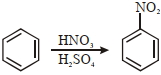
A
$20$
B
$80$
C
$75$
D
$50$
Solution
(B) The chemical reaction for the nitration of benzene is: $C_6H_6 + HNO_3 \xrightarrow{H_2SO_4} C_6H_5NO_2 + H_2O$
Molar mass of benzene $(C_6H_6)$ $= 6 \times 12 + 6 \times 1 = 78 \ g/mol$.
Molar mass of nitrobenzene $(C_6H_5NO_2)$ $= 6 \times 12 + 5 \times 1 + 14 + 2 \times 16 = 123 \ g/mol$.
According to the stoichiometry,$1 \ mole$ of benzene produces $1 \ mole$ of nitrobenzene.
So,$78 \ g$ of benzene should theoretically produce $123 \ g$ of nitrobenzene.
Therefore,$3.9 \ g$ of benzene should produce: $\frac{123}{78} \times 3.9 = 6.15 \ g$ of nitrobenzene.
The actual amount of nitrobenzene formed is $4.92 \ g$.
Percentage yield $= \frac{\text{Actual yield}}{\text{Theoretical yield}} \times 100 = \frac{4.92}{6.15} \times 100 = 80 \%$.
Molar mass of benzene $(C_6H_6)$ $= 6 \times 12 + 6 \times 1 = 78 \ g/mol$.
Molar mass of nitrobenzene $(C_6H_5NO_2)$ $= 6 \times 12 + 5 \times 1 + 14 + 2 \times 16 = 123 \ g/mol$.
According to the stoichiometry,$1 \ mole$ of benzene produces $1 \ mole$ of nitrobenzene.
So,$78 \ g$ of benzene should theoretically produce $123 \ g$ of nitrobenzene.
Therefore,$3.9 \ g$ of benzene should produce: $\frac{123}{78} \times 3.9 = 6.15 \ g$ of nitrobenzene.
The actual amount of nitrobenzene formed is $4.92 \ g$.
Percentage yield $= \frac{\text{Actual yield}}{\text{Theoretical yield}} \times 100 = \frac{4.92}{6.15} \times 100 = 80 \%$.
0 likesView Solution
44
ChemistryMediumMCQJEE Main · 2021
The standard enthalpies of formation of $Al_{2}O_{3}$ and $CaO$ are $-1675 \ kJ \ mol^{-1}$ and $-635 \ kJ \ mol^{-1}$ respectively.
For the reaction $3 CaO + 2 Al \rightarrow 3 Ca + Al_{2}O_{3}$,the standard reaction enthalpy $\Delta_{r}H^{\circ}$ is .......... $kJ$.
(Round off to the Nearest Integer).
For the reaction $3 CaO + 2 Al \rightarrow 3 Ca + Al_{2}O_{3}$,the standard reaction enthalpy $\Delta_{r}H^{\circ}$ is .......... $kJ$.
(Round off to the Nearest Integer).
A
$220$
B
$240$
C
$230$
D
$250$
Solution
(C) The given reaction is: $3 CaO + 2 Al \rightarrow Al_{2}O_{3} + 3 Ca$
The standard enthalpy of reaction is calculated using the formula: $\Delta_{r}H^{\circ} = \Sigma \Delta_{f}H^{\circ}(\text{products}) - \Sigma \Delta_{f}H^{\circ}(\text{reactants})$
Since the standard enthalpy of formation for elements in their standard state ($Ca$ and $Al$) is $0 \ kJ \ mol^{-1}$,we have:
$\Delta_{r}H^{\circ} = [1 \times \Delta_{f}H^{\circ}(Al_{2}O_{3}) + 3 \times \Delta_{f}H^{\circ}(Ca)] - [3 \times \Delta_{f}H^{\circ}(CaO) + 2 \times \Delta_{f}H^{\circ}(Al)]$
$\Delta_{r}H^{\circ} = [1 \times (-1675) + 3 \times 0] - [3 \times (-635) + 2 \times 0]$
$\Delta_{r}H^{\circ} = -1675 + 1905 = +230 \ kJ \ mol^{-1}$
The standard enthalpy of reaction is calculated using the formula: $\Delta_{r}H^{\circ} = \Sigma \Delta_{f}H^{\circ}(\text{products}) - \Sigma \Delta_{f}H^{\circ}(\text{reactants})$
Since the standard enthalpy of formation for elements in their standard state ($Ca$ and $Al$) is $0 \ kJ \ mol^{-1}$,we have:
$\Delta_{r}H^{\circ} = [1 \times \Delta_{f}H^{\circ}(Al_{2}O_{3}) + 3 \times \Delta_{f}H^{\circ}(Ca)] - [3 \times \Delta_{f}H^{\circ}(CaO) + 2 \times \Delta_{f}H^{\circ}(Al)]$
$\Delta_{r}H^{\circ} = [1 \times (-1675) + 3 \times 0] - [3 \times (-635) + 2 \times 0]$
$\Delta_{r}H^{\circ} = -1675 + 1905 = +230 \ kJ \ mol^{-1}$
0 likesView Solution
45
ChemistryDifficultMCQJEE Main · 2021
$15 \ mL$ of aqueous solution of $Fe^{2+}$ in acidic medium completely reacted with $20 \ mL$ of $0.03 \ M$ aqueous $Cr_{2}O_{7}^{2-}$. The molarity of the $Fe^{2+}$ solution is ........... $\times 10^{-2} \ M$ (Round off to the Nearest Integer).
A
$32$
B
$20$
C
$24$
D
$42$
Solution
(C) The balanced redox reaction in acidic medium is: $6Fe^{2+} + Cr_{2}O_{7}^{2-} + 14H^+ \rightarrow 6Fe^{3+} + 2Cr^{3+} + 7H_{2}O$.
According to the law of equivalence,the number of equivalents of $Fe^{2+}$ equals the number of equivalents of $Cr_{2}O_{7}^{2-}$.
$n_{eq} (Fe^{2+}) = n_{eq} (Cr_{2}O_{7}^{2-})$.
$(Molarity \times Volume \times n-factor)_{Fe^{2+}} = (Molarity \times Volume \times n-factor)_{Cr_{2}O_{7}^{2-}}$.
For $Fe^{2+} \rightarrow Fe^{3+}$,the $n-factor = 1$.
For $Cr_{2}O_{7}^{2-} \rightarrow 2Cr^{3+}$,the $n-factor = 6$.
$\left(\frac{15 \times M_{Fe^{2+}}}{1000}\right) \times 1 = \left(\frac{20 \times 0.03}{1000}\right) \times 6$.
$15 \times M_{Fe^{2+}} = 20 \times 0.03 \times 6$.
$15 \times M_{Fe^{2+}} = 3.6$.
$M_{Fe^{2+}} = \frac{3.6}{15} = 0.24 \ M$.
$0.24 \ M = 24 \times 10^{-2} \ M$.
Thus,the value is $24$.
According to the law of equivalence,the number of equivalents of $Fe^{2+}$ equals the number of equivalents of $Cr_{2}O_{7}^{2-}$.
$n_{eq} (Fe^{2+}) = n_{eq} (Cr_{2}O_{7}^{2-})$.
$(Molarity \times Volume \times n-factor)_{Fe^{2+}} = (Molarity \times Volume \times n-factor)_{Cr_{2}O_{7}^{2-}}$.
For $Fe^{2+} \rightarrow Fe^{3+}$,the $n-factor = 1$.
For $Cr_{2}O_{7}^{2-} \rightarrow 2Cr^{3+}$,the $n-factor = 6$.
$\left(\frac{15 \times M_{Fe^{2+}}}{1000}\right) \times 1 = \left(\frac{20 \times 0.03}{1000}\right) \times 6$.
$15 \times M_{Fe^{2+}} = 20 \times 0.03 \times 6$.
$15 \times M_{Fe^{2+}} = 3.6$.
$M_{Fe^{2+}} = \frac{3.6}{15} = 0.24 \ M$.
$0.24 \ M = 24 \times 10^{-2} \ M$.
Thus,the value is $24$.
0 likesView Solution
46
ChemistryMediumMCQJEE Main · 2021
The pressure exerted by a non-reactive gaseous mixture of $6.4 \ g$ of methane and $8.8 \ g$ of carbon dioxide in a $10 \ L$ vessel at $27^{\circ} C$ is .............$kPa$.
(Round off to the Nearest Integer).
[Assume gases are ideal,$R = 8.314 \ J \ mol^{-1} K^{-1}$
Atomic masses $: C = 12.0 \ u, H = 1.0 \ u, O = 16.0 \ u]$
(Round off to the Nearest Integer).
[Assume gases are ideal,$R = 8.314 \ J \ mol^{-1} K^{-1}$
Atomic masses $: C = 12.0 \ u, H = 1.0 \ u, O = 16.0 \ u]$
A
$125$
B
$130$
C
$145$
D
$150$
Solution
(D) First,calculate the number of moles of each gas:
$n_{CH_4} = \frac{6.4 \ g}{16 \ g \ mol^{-1}} = 0.4 \ mol$
$n_{CO_2} = \frac{8.8 \ g}{44 \ g \ mol^{-1}} = 0.2 \ mol$
Total moles,$n = 0.4 + 0.2 = 0.6 \ mol$
Convert volume to $m^3$:
$V = 10 \ L = 10 \times 10^{-3} \ m^3 = 0.01 \ m^3$
Convert temperature to Kelvin:
$T = 27 + 273 = 300 \ K$
Using the ideal gas equation $PV = nRT$:
$P = \frac{nRT}{V} = \frac{0.6 \ mol \times 8.314 \ J \ mol^{-1} K^{-1} \times 300 \ K}{0.01 \ m^3}$
$P = 149652 \ Pa = 149.652 \ kPa$
Rounding to the nearest integer,we get $150 \ kPa$.
$n_{CH_4} = \frac{6.4 \ g}{16 \ g \ mol^{-1}} = 0.4 \ mol$
$n_{CO_2} = \frac{8.8 \ g}{44 \ g \ mol^{-1}} = 0.2 \ mol$
Total moles,$n = 0.4 + 0.2 = 0.6 \ mol$
Convert volume to $m^3$:
$V = 10 \ L = 10 \times 10^{-3} \ m^3 = 0.01 \ m^3$
Convert temperature to Kelvin:
$T = 27 + 273 = 300 \ K$
Using the ideal gas equation $PV = nRT$:
$P = \frac{nRT}{V} = \frac{0.6 \ mol \times 8.314 \ J \ mol^{-1} K^{-1} \times 300 \ K}{0.01 \ m^3}$
$P = 149652 \ Pa = 149.652 \ kPa$
Rounding to the nearest integer,we get $150 \ kPa$.
0 likesView Solution
47
ChemistryMediumMCQJEE Main · 2021
The ionic radius of $Na^{+}$ ions is $1.02 \ \mathring{A}$. The ionic radii (in $\mathring{A}$) of $Mg^{2+}$ and $Al^{3+}$,respectively,are
A
$1.05$ and $0.99$
B
$0.72$ and $0.54$
C
$0.85$ and $0.99$
D
$0.68$ and $0.72$
Solution
(B) The ions $Na^{+}$,$Mg^{2+}$,and $Al^{3+}$ are isoelectronic species,all having $10$ electrons.
For isoelectronic species,the ionic radius decreases as the nuclear charge (atomic number) increases.
The atomic numbers are $Na$ $(Z=11)$,$Mg$ $(Z=12)$,and $Al$ $(Z=13)$.
Since the nuclear charge increases from $Na^{+}$ to $Al^{3+}$,the ionic radius decreases in the order $Na^{+} > Mg^{2+} > Al^{3+}$.
Given the radius of $Na^{+}$ is $1.02 \ \mathring{A}$,the values for $Mg^{2+}$ and $Al^{3+}$ must be smaller than $1.02 \ \mathring{A}$ and follow the decreasing trend.
Among the options,$0.72 \ \mathring{A}$ and $0.54 \ \mathring{A}$ fit this trend correctly.
For isoelectronic species,the ionic radius decreases as the nuclear charge (atomic number) increases.
The atomic numbers are $Na$ $(Z=11)$,$Mg$ $(Z=12)$,and $Al$ $(Z=13)$.
Since the nuclear charge increases from $Na^{+}$ to $Al^{3+}$,the ionic radius decreases in the order $Na^{+} > Mg^{2+} > Al^{3+}$.
Given the radius of $Na^{+}$ is $1.02 \ \mathring{A}$,the values for $Mg^{2+}$ and $Al^{3+}$ must be smaller than $1.02 \ \mathring{A}$ and follow the decreasing trend.
Among the options,$0.72 \ \mathring{A}$ and $0.54 \ \mathring{A}$ fit this trend correctly.
0 likesView Solution
48
ChemistryDifficultMCQJEE Main · 2021
The statements that are $TRUE$:
$A$. Methane leads to both global warming and photochemical smog.
$B$. Methane is generated from paddy fields.
$C$. Methane is a stronger global warming gas than $CO_2$.
$D$. Methane is a part of reducing smog.
Choose the most appropriate answer from the options given below:
$A$. Methane leads to both global warming and photochemical smog.
$B$. Methane is generated from paddy fields.
$C$. Methane is a stronger global warming gas than $CO_2$.
$D$. Methane is a part of reducing smog.
Choose the most appropriate answer from the options given below:
A
$A, B, C$ only
B
$A$ and $B$ only
C
$B, C, D$ only
D
$A, B, D$ only
Solution
(A) Methane $(CH_4)$ contributes to global warming and is involved in the formation of photochemical smog.
Paddy fields are a significant source of methane emission due to anaerobic decomposition.
Methane has a higher global warming potential compared to $CO_2$,making it a stronger greenhouse gas.
Methane is not a component of reducing smog (which typically consists of $SO_2$ and particulate matter).
Therefore,statements $A, B,$ and $C$ are correct.
Paddy fields are a significant source of methane emission due to anaerobic decomposition.
Methane has a higher global warming potential compared to $CO_2$,making it a stronger greenhouse gas.
Methane is not a component of reducing smog (which typically consists of $SO_2$ and particulate matter).
Therefore,statements $A, B,$ and $C$ are correct.
0 likesView Solution
49
ChemistryMediumMCQJEE Main · 2021
Match List-$I$ with List-$II$.
Choose the most appropriate answer from the options given below:
| List-$I$ | List-$II$ |
|---|---|
| $a$. $Ca(OCl)_2$ | $i$. Antacid |
| $b$. $CaSO_4 \cdot \frac{1}{2} H_2O$ | $ii$. Cement |
| $c$. $CaO$ | $iii$. Bleach |
| $d$. $CaCO_3$ | $iv$. Plaster of Paris |
Choose the most appropriate answer from the options given below:
A
$a-i, b-iv, c-iii, d-ii$
B
$a-iii, b-ii, c-iv, d-i$
C
$a-iii, b-iv, c-ii, d-i$
D
$a-iii, b-ii, c-i, d-iv$
Solution
(C) $Ca(OCl)_2$ is used as a bleaching agent $(iii)$.
$CaSO_4 \cdot \frac{1}{2} H_2O$ is known as Plaster of Paris $(iv)$.
$CaO$ is a major component in the manufacturing of cement $(ii)$.
$CaCO_3$ is used as an antacid $(i)$.
Therefore,the correct matching is $a-iii, b-iv, c-ii, d-i$.
$CaSO_4 \cdot \frac{1}{2} H_2O$ is known as Plaster of Paris $(iv)$.
$CaO$ is a major component in the manufacturing of cement $(ii)$.
$CaCO_3$ is used as an antacid $(i)$.
Therefore,the correct matching is $a-iii, b-iv, c-ii, d-i$.
0 likesView Solution
50
ChemistryMediumMCQJEE Main · 2021
The compound with the molecular formula $C_3H_6O$ can show:
A
Positional isomerism
B
Both positional isomerism and metamerism
C
Metamerism
D
Functional group isomerism
Solution
(D) The molecular formula $C_3H_6O$ represents compounds such as propanal $(CH_3CH_2CHO)$ and propanone $(CH_3COCH_3)$.
Since these compounds have the same molecular formula but different functional groups (aldehyde and ketone),they exhibit functional group isomerism.
Since these compounds have the same molecular formula but different functional groups (aldehyde and ketone),they exhibit functional group isomerism.
0 likesView Solution
51
ChemistryDifficultMCQJEE Main · 2021
The major product of the following reaction is:
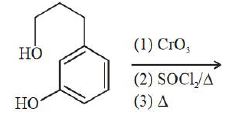
A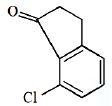
B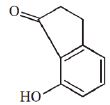
C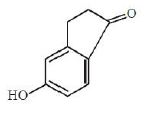
D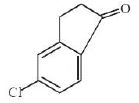
Solution
(C) Step $1$: Oxidation of the primary alcohol group with $CrO_3$ yields a carboxylic acid group. The phenolic $-OH$ group remains unaffected under these conditions.
Step $2$: Treatment with $SOCl_2/\Delta$ converts the carboxylic acid into an acid chloride $(-COCl)$.
Step $3$: Heating $(\Delta)$ induces a Friedel-Crafts acylation reaction. The acid chloride group undergoes intramolecular cyclization with the ortho-position of the phenol ring to form a cyclic ketone (indanone derivative).
The final product is a $5$-hydroxy-indanone derivative.
Step $2$: Treatment with $SOCl_2/\Delta$ converts the carboxylic acid into an acid chloride $(-COCl)$.
Step $3$: Heating $(\Delta)$ induces a Friedel-Crafts acylation reaction. The acid chloride group undergoes intramolecular cyclization with the ortho-position of the phenol ring to form a cyclic ketone (indanone derivative).
The final product is a $5$-hydroxy-indanone derivative.
0 likesView Solution
52
ChemistryDifficultMCQJEE Main · 2021
Given below are two statements: one is labelled as Assertion $A$ and the other is labelled as Reason $R$:
Assertion $A$: Size of $Bk^{3+}$ ion is less than $Np^{3+}$ ion.
Reason $R$: The above is a consequence of the lanthanoid contraction.
In the light of the above statements,choose the correct answer from the options given below:
Assertion $A$: Size of $Bk^{3+}$ ion is less than $Np^{3+}$ ion.
Reason $R$: The above is a consequence of the lanthanoid contraction.
In the light of the above statements,choose the correct answer from the options given below:
A
$A$ is false but $R$ is true
B
Both $A$ and $R$ are true but $R$ is not the correct explanation of $A$
C
Both $A$ and $R$ are true and $R$ is the correct explanation of $A$
D
$A$ is true but $R$ is false
Solution
(D) In the actinide series,the ionic radius decreases from left to right due to actinoid contraction,which is similar to lanthanoid contraction.
Since $Bk$ (atomic number $97$) comes after $Np$ (atomic number $93$) in the actinide series,the size of the $Bk^{3+}$ ion is smaller than that of the $Np^{3+}$ ion.
Therefore,Assertion $A$ is true.
However,the decrease in size in the actinide series is due to actinoid contraction,not lanthanoid contraction. Thus,Reason $R$ is false.
Since $Bk$ (atomic number $97$) comes after $Np$ (atomic number $93$) in the actinide series,the size of the $Bk^{3+}$ ion is smaller than that of the $Np^{3+}$ ion.
Therefore,Assertion $A$ is true.
However,the decrease in size in the actinide series is due to actinoid contraction,not lanthanoid contraction. Thus,Reason $R$ is false.
0 likesView Solution
53
ChemistryMediumMCQJEE Main · 2021
Which among the following pairs of Vitamins is stored in our body relatively for longer duration?
A
Thiamine and Vitamin $A$
B
Vitamin $A$ and Vitamin $D$
C
Thiamine and Ascorbic acid
D
Ascorbic acid and Vitamin $D$
Solution
(B) Vitamins are classified into two groups: water-soluble and fat-soluble.
Water-soluble vitamins (like Vitamin $B$ complex and Vitamin $C$) are excreted in urine and cannot be stored in the body for long,except for Vitamin $B_{12}$.
Fat-soluble vitamins (like Vitamin $A$,$D$,$E$,and $K$) are stored in the liver and adipose tissues.
Therefore,the pair of Vitamin $A$ and Vitamin $D$ is stored in our body for a longer duration.
Water-soluble vitamins (like Vitamin $B$ complex and Vitamin $C$) are excreted in urine and cannot be stored in the body for long,except for Vitamin $B_{12}$.
Fat-soluble vitamins (like Vitamin $A$,$D$,$E$,and $K$) are stored in the liver and adipose tissues.
Therefore,the pair of Vitamin $A$ and Vitamin $D$ is stored in our body for a longer duration.
0 likesView Solution
54
ChemistryDifficultMCQJEE Main · 2021
The product $P$ in the above reaction is
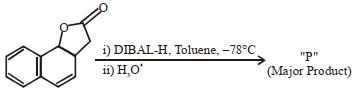
A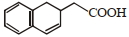
B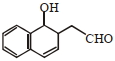
C
D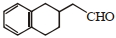
Solution
(C) $DIBAL-H$ (Diisobutylaluminum hydride) is a selective reducing agent that reduces esters to aldehydes at low temperatures $(-78^{\circ}C)$.
In the given reaction,$DIBAL-H$ reduces the cyclic ester (lactone) to a lactol,which then opens to form a hydroxy-aldehyde.
$DIBAL-H$ does not reduce the carbon-carbon double bond $(C=C)$ present in the molecule.
Therefore,the reaction converts the lactone group into a hydroxy-aldehyde group while keeping the rest of the structure intact,which matches option $C$.
In the given reaction,$DIBAL-H$ reduces the cyclic ester (lactone) to a lactol,which then opens to form a hydroxy-aldehyde.
$DIBAL-H$ does not reduce the carbon-carbon double bond $(C=C)$ present in the molecule.
Therefore,the reaction converts the lactone group into a hydroxy-aldehyde group while keeping the rest of the structure intact,which matches option $C$.
0 likesView Solution
55
ChemistryMediumMCQJEE Main · 2021
Match List-$I$ with List-$II$.
Choose the correct answer from the options given below:
| List-$I$ (Industrial process) | List-$II$ (Application) |
| $(a)$ Haber's process | $(i)$ $HNO_{3}$ synthesis |
| $(b)$ Ostwald's process | $(ii)$ Aluminium extraction |
| $(c)$ Contact process | $(iii)$ $NH_{3}$ synthesis |
| $(d)$ Hall-Heroult process | $(iv)$ $H_{2}SO_{4}$ synthesis |
Choose the correct answer from the options given below:
A
$(a-ii, b-iii, c-iv, d-i)$
B
$(a-iii, b-iv, c-i, d-ii)$
C
$(a-iii, b-i, c-iv, d-ii)$
D
$(a-iv, b-i, c-ii, d-iii)$
Solution
(C) Haber's process is used for $NH_{3}$ synthesis.
$(b)$ Ostwald's process is used for $HNO_{3}$ synthesis.
$(c)$ Contact process is used for $H_{2}SO_{4}$ synthesis.
$(d)$ Hall-Heroult process is used for Aluminium extraction.
$(b)$ Ostwald's process is used for $HNO_{3}$ synthesis.
$(c)$ Contact process is used for $H_{2}SO_{4}$ synthesis.
$(d)$ Hall-Heroult process is used for Aluminium extraction.
0 likesView Solution
56
ChemistryDifficultMCQJEE Main · 2021
In the above chemical reaction,intermediate $X$ and reagent/condition $A$ are:
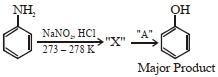
A
$X = \text{Benzene diazonium chloride}; A = H_2O/NaOH$
B
$X = \text{Nitrobenzene}; A = H_2O/\Delta$
C
$X = \text{Benzene diazonium chloride}; A = H_2O/\Delta$
D
$X = \text{Nitrobenzene}; A = H_2O/NaOH$
Solution
(C) The reaction of aniline with $NaNO_2$ and $HCl$ at $273-278 \ K$ is a diazotization reaction,which produces benzene diazonium chloride as the intermediate $X$.
Benzene diazonium chloride $(C_6H_5N_2^+Cl^-)$ is then hydrolyzed by heating with water $(H_2O/\Delta)$ to form phenol as the major product.
Therefore,$X$ is benzene diazonium chloride and $A$ is $H_2O/\Delta$.
Benzene diazonium chloride $(C_6H_5N_2^+Cl^-)$ is then hydrolyzed by heating with water $(H_2O/\Delta)$ to form phenol as the major product.
Therefore,$X$ is benzene diazonium chloride and $A$ is $H_2O/\Delta$.
0 likesView Solution
57
ChemistryMediumMCQJEE Main · 2021
Given below are two statements:
Statement $I :$ The $E^{\circ}$ value of $Ce^{4+} / Ce^{3+}$ is $+1.74 \, V$.
Statement $II :$ $Ce$ is more stable in $Ce^{4+}$ state than $Ce^{3+}$ state.
In the light of the above statements,choose the most appropriate answer from the options given below:
Statement $I :$ The $E^{\circ}$ value of $Ce^{4+} / Ce^{3+}$ is $+1.74 \, V$.
Statement $II :$ $Ce$ is more stable in $Ce^{4+}$ state than $Ce^{3+}$ state.
In the light of the above statements,choose the most appropriate answer from the options given below:
A
Both statement $I$ and statement $II$ are correct.
B
Statement $I$ is incorrect but statement $II$ is correct.
C
Both statement $I$ and statement $II$ are incorrect.
D
Statement $I$ is correct but statement $II$ is incorrect.
Solution
(D) The $E^{\circ}$ value for $Ce^{4+} / Ce^{3+}$ is $+1.74 \, V$. This high positive value indicates that $Ce^{4+}$ has a strong tendency to gain an electron to form $Ce^{3+}$.
The most stable oxidation state of lanthanide series elements is $+3$. Therefore,$Ce^{3+}$ is more stable than $Ce^{4+}$.
Thus,Statement $I$ is correct and Statement $II$ is incorrect.
The most stable oxidation state of lanthanide series elements is $+3$. Therefore,$Ce^{3+}$ is more stable than $Ce^{4+}$.
Thus,Statement $I$ is correct and Statement $II$ is incorrect.
0 likesView Solution
58
ChemistryEasyMCQJEE Main · 2021
The functions of antihistamine are
A
Antiallergic and Analgesic
B
Antacid and antiallergic
C
Analgesic and antacid
D
Antiallergic and antidepressant
Solution
(B) Antihistamines act as both antacids and antiallergic agents.
They interfere with the natural action of histamine by competing with histamine for binding sites of receptors where histamine exerts its effect.
For example,drugs like cimetidine are designed to prevent the interaction of histamine with the receptors present in the stomach wall,thereby acting as an antacid.
They interfere with the natural action of histamine by competing with histamine for binding sites of receptors where histamine exerts its effect.
For example,drugs like cimetidine are designed to prevent the interaction of histamine with the receptors present in the stomach wall,thereby acting as an antacid.
0 likesView Solution
59
ChemistryDifficultMCQJEE Main · 2021
The products $A$ and $B$ formed in the above reactions are
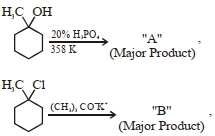
A
$A$ = $1-$methylcyclohexene,$B$ = methylenecyclohexane
B
$A$ = methylenecyclohexane,$B$ = $1-$methylcyclohexene
C
$A$ = $1-$methylcyclohexene,$B$ = $1-$methylcyclohexene
D
$A$ = methylenecyclohexane,$B$ = methylenecyclohexane
Solution
(A) In the first reaction,$1$-methylcyclohexanol undergoes acid-catalyzed dehydration using $20\% \ H_3PO_4$ at $358 \ K$. This follows an $E_1$ mechanism,where the more stable,highly substituted alkene (Saytzeff product) is formed as the major product,which is $1-$methylcyclohexene.
In the second reaction,$1$-chlorocyclohexane reacts with potassium tert-butoxide $(CH_3)_3COK$,which is a bulky base. This reaction proceeds via an $E_2$ mechanism. Due to the steric hindrance of the bulky base,it abstracts a proton from the less hindered position,leading to the formation of the less substituted alkene (Hofmann product) as the major product,which is methylenecyclohexane.
In the second reaction,$1$-chlorocyclohexane reacts with potassium tert-butoxide $(CH_3)_3COK$,which is a bulky base. This reaction proceeds via an $E_2$ mechanism. Due to the steric hindrance of the bulky base,it abstracts a proton from the less hindered position,leading to the formation of the less substituted alkene (Hofmann product) as the major product,which is methylenecyclohexane.
0 likesView Solution
60
ChemistryDifficultMCQJEE Main · 2021
Which of the following reactions does not involve the Hoffmann Bromamide degradation?
A
$C_6H_5CH_2CONH_2 \xrightarrow{Br_2, NaOH} C_6H_5CH_2NH_2$
B
$C_6H_5CN \xrightarrow[ii) Br_2, NaOH]{i) KOH, H_2O} C_6H_5NH_2$
C
$C_6H_5CH_2COCH_3 \xrightarrow[iii) LiAlH_4, H_2O]{i) Br_2, NaOH/H^+, ii) NH_3/\Delta} C_6H_5CH_2CH_2NH_2$
D
$C_6H_5COCl \xrightarrow[ii) Br_2, NaOH]{i) NH_3, NaOH} C_6H_5NH_2$
Solution
(C) The Hoffmann Bromamide degradation reaction involves the conversion of an amide $(RCONH_2)$ to a primary amine $(RNH_2)$ using $Br_2$ and $NaOH$ (or $KOH$).
$A$. $C_6H_5CH_2CONH_2 + Br_2 + 4NaOH \rightarrow C_6H_5CH_2NH_2 + Na_2CO_3 + 2NaBr + 2H_2O$. This is a Hoffmann Bromamide degradation.
$B$. $C_6H_5CN$ $\xrightarrow{KOH, H_2O} C_6H_5CONH_2$ $\xrightarrow{Br_2, NaOH} C_6H_5NH_2$. This involves Hoffmann Bromamide degradation in the second step.
$C$. $C_6H_5CH_2COCH_3$ $\xrightarrow{Br_2, NaOH} C_6H_5CH_2COOH$ $\xrightarrow{NH_3, \Delta} C_6H_5CH_2CONH_2$ $\xrightarrow{LiAlH_4} C_6H_5CH_2CH_2NH_2$. The first step is a haloform reaction,and the final step is a reduction. This reaction does not involve Hoffmann Bromamide degradation.
$D$. $C_6H_5COCl$ $\xrightarrow{NH_3} C_6H_5CONH_2$ $\xrightarrow{Br_2, NaOH} C_6H_5NH_2$. This involves Hoffmann Bromamide degradation in the second step.
$A$. $C_6H_5CH_2CONH_2 + Br_2 + 4NaOH \rightarrow C_6H_5CH_2NH_2 + Na_2CO_3 + 2NaBr + 2H_2O$. This is a Hoffmann Bromamide degradation.
$B$. $C_6H_5CN$ $\xrightarrow{KOH, H_2O} C_6H_5CONH_2$ $\xrightarrow{Br_2, NaOH} C_6H_5NH_2$. This involves Hoffmann Bromamide degradation in the second step.
$C$. $C_6H_5CH_2COCH_3$ $\xrightarrow{Br_2, NaOH} C_6H_5CH_2COOH$ $\xrightarrow{NH_3, \Delta} C_6H_5CH_2CONH_2$ $\xrightarrow{LiAlH_4} C_6H_5CH_2CH_2NH_2$. The first step is a haloform reaction,and the final step is a reduction. This reaction does not involve Hoffmann Bromamide degradation.
$D$. $C_6H_5COCl$ $\xrightarrow{NH_3} C_6H_5CONH_2$ $\xrightarrow{Br_2, NaOH} C_6H_5NH_2$. This involves Hoffmann Bromamide degradation in the second step.
0 likesView Solution
61
ChemistryMediumMCQJEE Main · 2021
The process that involves the removal of sulphur from the ores is
A
Smelting
B
Roasting
C
Leaching
D
Refining
Solution
(B) In the roasting process,metal sulphide $(MS)$ ores are converted into metal oxides,and sulphur is removed in the form of $SO_{2}$ gas.
$2 MS + 3 O_{2} \xrightarrow{\Delta} 2 MO + 2 SO_{2} \uparrow$
$2 MS + 3 O_{2} \xrightarrow{\Delta} 2 MO + 2 SO_{2} \uparrow$
0 likesView Solution
62
ChemistryMediumMCQJEE Main · 2021
Match List-$I$ with List-$II$
Choose the correct answer from the options given below:
| List-$I$ Name of oxo acid | List-$II$ Oxidation state of $P$ |
| $(a)$ Hypophosphorous acid | $(i) +5$ |
| $(b)$ Orthophosphoric acid | $(ii) +4$ |
| $(c)$ Hypophosphoric acid | $(iii) +3$ |
| $(d)$ Orthophosphorous acid | $(iv) +2$ |
| $(v) +1$ |
Choose the correct answer from the options given below:
A
$(a)-(v), (b)-(i), (c)-(ii), (d)-(iii)$
B
$(a)-(iv), (b)-(i), (c)-(ii), (d)-(iii)$
C
$(a)-(iv), (b)-(v), (c)-(ii), (d)-(iii)$
D
$(a)-(v), (b)-(iv), (c)-(ii), (d)-(iii)$
Solution
(A) Hypophosphorous acid $(H_{3}PO_{2})$: $3(+1) + x + 2(-2) = 0 \Rightarrow x = +1$.
$(b)$ Orthophosphoric acid $(H_{3}PO_{4})$: $3(+1) + x + 4(-2) = 0 \Rightarrow x = +5$.
$(c)$ Hypophosphoric acid $(H_{4}P_{2}O_{6})$: $4(+1) + 2x + 6(-2) = 0$ $\Rightarrow 2x = 8$ $\Rightarrow x = +4$.
$(d)$ Orthophosphorous acid $(H_{3}PO_{3})$: $3(+1) + x + 3(-2) = 0 \Rightarrow x = +3$.
Thus,the correct match is $(a)-(v), (b)-(i), (c)-(ii), (d)-(iii)$.
$(b)$ Orthophosphoric acid $(H_{3}PO_{4})$: $3(+1) + x + 4(-2) = 0 \Rightarrow x = +5$.
$(c)$ Hypophosphoric acid $(H_{4}P_{2}O_{6})$: $4(+1) + 2x + 6(-2) = 0$ $\Rightarrow 2x = 8$ $\Rightarrow x = +4$.
$(d)$ Orthophosphorous acid $(H_{3}PO_{3})$: $3(+1) + x + 3(-2) = 0 \Rightarrow x = +3$.
Thus,the correct match is $(a)-(v), (b)-(i), (c)-(ii), (d)-(iii)$.
0 likesView Solution
63
ChemistryMediumMCQJEE Main · 2021
$A$ group $15$ element,which is a metal and forms a hydride with the strongest reducing power among group $15$ hydrides. The element is:
A
$Sb$
B
$P$
C
$As$
D
$Bi$
Solution
(D) In group $15$ $(N, P, As, Sb, Bi)$,the metallic character increases down the group.
$Bi$ is the most metallic element in this group.
The reducing power of hydrides $(MH_3)$ increases down the group from $NH_3$ to $BiH_3$ because the $M-H$ bond dissociation enthalpy decreases as the size of the central atom increases.
Therefore,$BiH_3$ is the strongest reducing agent among the group $15$ hydrides,and the element is $Bi$.
$Bi$ is the most metallic element in this group.
The reducing power of hydrides $(MH_3)$ increases down the group from $NH_3$ to $BiH_3$ because the $M-H$ bond dissociation enthalpy decreases as the size of the central atom increases.
Therefore,$BiH_3$ is the strongest reducing agent among the group $15$ hydrides,and the element is $Bi$.
0 likesView Solution
64
ChemistryMediumMCQJEE Main · 2021
$AB_2$ is $10\%$ dissociated in water to $A^{2+}$ and $B^{-}$. The boiling point of a $10.0 \text{ molal}$ aqueous solution of $AB_2$ is . . . . . . $^\circ C$. (Round off to the Nearest Integer). [Given: Molal elevation constant of water $K_b = 0.5 \text{ K kg mol}^{-1}$,boiling point of pure water $= 100^\circ C$]
A
$201$
B
$105$
C
$102$
D
$106$
Solution
(D) For the dissociation reaction: $AB_2 \rightleftharpoons A^{2+} + 2B^-$,the number of ions produced per formula unit is $n = 3$.
Given the degree of dissociation $\alpha = 10\% = 0.1$.
The van't Hoff factor $i$ is calculated as $i = 1 + (n-1)\alpha = 1 + (3-1)0.1 = 1 + 0.2 = 1.2$.
The elevation in boiling point is given by $\Delta T_b = i \cdot K_b \cdot m$.
Substituting the values: $\Delta T_b = 1.2 \times 0.5 \text{ K kg mol}^{-1} \times 10.0 \text{ mol kg}^{-1} = 6 \text{ K}$ (or $6^\circ C$).
The boiling point of the solution is $T_b = T_b^\circ + \Delta T_b = 100^\circ C + 6^\circ C = 106^\circ C$.
Given the degree of dissociation $\alpha = 10\% = 0.1$.
The van't Hoff factor $i$ is calculated as $i = 1 + (n-1)\alpha = 1 + (3-1)0.1 = 1 + 0.2 = 1.2$.
The elevation in boiling point is given by $\Delta T_b = i \cdot K_b \cdot m$.
Substituting the values: $\Delta T_b = 1.2 \times 0.5 \text{ K kg mol}^{-1} \times 10.0 \text{ mol kg}^{-1} = 6 \text{ K}$ (or $6^\circ C$).
The boiling point of the solution is $T_b = T_b^\circ + \Delta T_b = 100^\circ C + 6^\circ C = 106^\circ C$.
0 likesView Solution
65
ChemistryMediumMCQJEE Main · 2021
The equivalents of ethylene diamine $(en)$ required to replace the neutral ligands from the coordination sphere of the trans-complex of $CoCl_{3} \cdot 4NH_{3}$ is ............ (Round off to the Nearest Integer).
A
$1$
B
$5$
C
$2$
D
$6$
Solution
(C) The complex $trans-CoCl_{3} \cdot 4NH_{3}$ can be written as $trans-[Co(NH_{3})_{4}Cl_{2}]Cl$.
In this complex,there are $4$ neutral $NH_{3}$ ligands in the coordination sphere.
Ethylene diamine $(en)$ is a bidentate ligand,meaning one molecule of $en$ occupies two coordination sites.
To replace $4$ monodentate $NH_{3}$ ligands,we require $2$ molecules of the bidentate ligand $en$ ($2 \times 2 = 4$ coordination sites).
Therefore,the number of equivalents of ethylene diamine required is $2$.
In this complex,there are $4$ neutral $NH_{3}$ ligands in the coordination sphere.
Ethylene diamine $(en)$ is a bidentate ligand,meaning one molecule of $en$ occupies two coordination sites.
To replace $4$ monodentate $NH_{3}$ ligands,we require $2$ molecules of the bidentate ligand $en$ ($2 \times 2 = 4$ coordination sites).
Therefore,the number of equivalents of ethylene diamine required is $2$.
0 likesView Solution
66
ChemistryMediumMCQJEE Main · 2021
$A$ $6.50$ molal solution of $KOH$ $(aq.)$ has a density of $1.89 \ g \ cm^{-3}$. The molarity of the solution is .......... $mol \ dm^{-3}$.
(Round off to the Nearest Integer).
[Atomic masses: $K = 39.0 \ u, O = 16.0 \ u, H = 1.0 \ u$]
(Round off to the Nearest Integer).
[Atomic masses: $K = 39.0 \ u, O = 16.0 \ u, H = 1.0 \ u$]
A
$3$
B
$4$
C
$9$
D
$7$
Solution
(C) Molality $(m)$ is defined as the number of moles of solute per $1000 \ g$ of solvent.
Given $6.50$ molal $KOH$ solution means $6.50 \ moles$ of $KOH$ are present in $1000 \ g$ of water.
Molar mass of $KOH = 39.0 + 16.0 + 1.0 = 56.0 \ g \ mol^{-1}$.
Mass of solute $(KOH)$ $= 6.50 \ mol \times 56.0 \ g \ mol^{-1} = 364.0 \ g$.
Total mass of solution $= \text{Mass of solvent} + \text{Mass of solute} = 1000 \ g + 364.0 \ g = 1364.0 \ g$.
Density of solution $= 1.89 \ g \ cm^{-3}$.
Volume of solution $= \frac{\text{Mass}}{\text{Density}} = \frac{1364.0 \ g}{1.89 \ g \ cm^{-3}} \approx 721.69 \ cm^3 = 0.72169 \ L$.
Molarity $(M)$ $= \frac{\text{moles of solute}}{\text{Volume of solution in } L} = \frac{6.50 \ mol}{0.72169 \ L} \approx 9.006 \ mol \ L^{-1}$.
Rounding to the nearest integer,the molarity is $9 \ mol \ dm^{-3}$.
Given $6.50$ molal $KOH$ solution means $6.50 \ moles$ of $KOH$ are present in $1000 \ g$ of water.
Molar mass of $KOH = 39.0 + 16.0 + 1.0 = 56.0 \ g \ mol^{-1}$.
Mass of solute $(KOH)$ $= 6.50 \ mol \times 56.0 \ g \ mol^{-1} = 364.0 \ g$.
Total mass of solution $= \text{Mass of solvent} + \text{Mass of solute} = 1000 \ g + 364.0 \ g = 1364.0 \ g$.
Density of solution $= 1.89 \ g \ cm^{-3}$.
Volume of solution $= \frac{\text{Mass}}{\text{Density}} = \frac{1364.0 \ g}{1.89 \ g \ cm^{-3}} \approx 721.69 \ cm^3 = 0.72169 \ L$.
Molarity $(M)$ $= \frac{\text{moles of solute}}{\text{Volume of solution in } L} = \frac{6.50 \ mol}{0.72169 \ L} \approx 9.006 \ mol \ L^{-1}$.
Rounding to the nearest integer,the molarity is $9 \ mol \ dm^{-3}$.
0 likesView Solution
67
ChemistryMediumMCQJEE Main · 2021
$A$ certain element crystallises in a $bcc$ lattice of unit cell edge length $27 \mathring{A}$. If the same element under the same conditions crystallises in the $fcc$ lattice,the edge length of the unit cell in $\mathring{A}$ will be .........
(Round off to the Nearest Integer).
[Assume each lattice point has a single atom]
[Assume $\sqrt{3}=1.73, \sqrt{2}=1.41$]
(Round off to the Nearest Integer).
[Assume each lattice point has a single atom]
[Assume $\sqrt{3}=1.73, \sqrt{2}=1.41$]
A
$33$
B
$22$
C
$11$
D
$44$
Solution
(A) For $bcc$ lattice,the relation between edge length $a_1$ and atomic radius $r$ is $\sqrt{3} a_1 = 4 r$,so $r = \frac{\sqrt{3}}{4} a_1$.
Given $a_1 = 27 \mathring{A}$,$r = \frac{\sqrt{3}}{4} \times 27$.
For $fcc$ lattice,the relation between edge length $a_2$ and atomic radius $r$ is $\sqrt{2} a_2 = 4 r$,so $a_2 = \frac{4 r}{\sqrt{2}} = 2 \sqrt{2} r$.
Substituting the value of $r$: $a_2 = 2 \sqrt{2} \times \frac{\sqrt{3}}{4} \times 27 = \frac{\sqrt{6}}{2} \times 27$.
Using $\sqrt{6} = \sqrt{2} \times \sqrt{3} = 1.41 \times 1.73 = 2.4393$.
$a_2 = \frac{2.4393}{2} \times 27 = 1.21965 \times 27 = 32.93$.
Rounding off to the nearest integer,we get $33 \mathring{A}$.
Given $a_1 = 27 \mathring{A}$,$r = \frac{\sqrt{3}}{4} \times 27$.
For $fcc$ lattice,the relation between edge length $a_2$ and atomic radius $r$ is $\sqrt{2} a_2 = 4 r$,so $a_2 = \frac{4 r}{\sqrt{2}} = 2 \sqrt{2} r$.
Substituting the value of $r$: $a_2 = 2 \sqrt{2} \times \frac{\sqrt{3}}{4} \times 27 = \frac{\sqrt{6}}{2} \times 27$.
Using $\sqrt{6} = \sqrt{2} \times \sqrt{3} = 1.41 \times 1.73 = 2.4393$.
$a_2 = \frac{2.4393}{2} \times 27 = 1.21965 \times 27 = 32.93$.
Rounding off to the nearest integer,we get $33 \mathring{A}$.
0 likesView Solution
68
ChemistryDifficultMCQJEE Main · 2021
The decomposition of formic acid on a gold surface follows first-order kinetics. If the rate constant at $300 \ K$ is $1.0 \times 10^{-3} \ s^{-1}$ and the activation energy $E_a = 11.488 \ kJ \ mol^{-1}$,the rate constant at $200 \ K$ is ............ $\times 10^{-5} \ s^{-1}$.
(Round off to the Nearest Integer).
(Given: $R = 8.314 \ J \ mol^{-1} K^{-1}$)
(Round off to the Nearest Integer).
(Given: $R = 8.314 \ J \ mol^{-1} K^{-1}$)
A
$10$
B
$8$
C
$14$
D
$16$
Solution
(A) Given:
$T_1 = 300 \ K, K_1 = 1.0 \times 10^{-3} \ s^{-1}$
$T_2 = 200 \ K, K_2 = ?$
$E_a = 11.488 \ kJ \ mol^{-1} = 11488 \ J \ mol^{-1}$
$R = 8.314 \ J \ mol^{-1} K^{-1}$
Using the Arrhenius equation:
$\ln \left(\frac{K_1}{K_2}\right) = \frac{E_a}{R} \left(\frac{1}{T_2} - \frac{1}{T_1}\right)$
$\ln \left(\frac{1.0 \times 10^{-3}}{K_2}\right) = \frac{11488}{8.314} \left(\frac{1}{200} - \frac{1}{300}\right)$
$\ln \left(\frac{1.0 \times 10^{-3}}{K_2}\right) = \frac{11488}{8.314} \left(\frac{300 - 200}{60000}\right) = \frac{11488}{8.314} \times \frac{100}{60000} = \frac{11488}{8.314 \times 600} \approx \frac{11488}{4988.4} \approx 2.303$
$\frac{1.0 \times 10^{-3}}{K_2} = e^{2.303} \approx 10$
$K_2 = \frac{1.0 \times 10^{-3}}{10} = 1.0 \times 10^{-4} = 10 \times 10^{-5} \ s^{-1}$
Thus,the value is $10$.
$T_1 = 300 \ K, K_1 = 1.0 \times 10^{-3} \ s^{-1}$
$T_2 = 200 \ K, K_2 = ?$
$E_a = 11.488 \ kJ \ mol^{-1} = 11488 \ J \ mol^{-1}$
$R = 8.314 \ J \ mol^{-1} K^{-1}$
Using the Arrhenius equation:
$\ln \left(\frac{K_1}{K_2}\right) = \frac{E_a}{R} \left(\frac{1}{T_2} - \frac{1}{T_1}\right)$
$\ln \left(\frac{1.0 \times 10^{-3}}{K_2}\right) = \frac{11488}{8.314} \left(\frac{1}{200} - \frac{1}{300}\right)$
$\ln \left(\frac{1.0 \times 10^{-3}}{K_2}\right) = \frac{11488}{8.314} \left(\frac{300 - 200}{60000}\right) = \frac{11488}{8.314} \times \frac{100}{60000} = \frac{11488}{8.314 \times 600} \approx \frac{11488}{4988.4} \approx 2.303$
$\frac{1.0 \times 10^{-3}}{K_2} = e^{2.303} \approx 10$
$K_2 = \frac{1.0 \times 10^{-3}}{10} = 1.0 \times 10^{-4} = 10 \times 10^{-5} \ s^{-1}$
Thus,the value is $10$.
0 likesView Solution
69
ChemistryMediumMCQJEE Main · 2021
With respect to drug-enzyme interaction,identify the wrong statement.
A
Non-competitive inhibitor binds to the allosteric site.
B
Allosteric inhibitor changes the enzyme's active site.
C
Allosteric inhibitor competes with the enzyme's active site.
D
Competitive inhibitor binds to the enzyme's active site.
Solution
(C) Some drugs do not bind to the enzyme's active site. Instead,they bind to a different site on the enzyme called the allosteric site.
This binding of an inhibitor at the allosteric site changes the shape of the active site in such a way that the substrate cannot recognize or bind to it.
Such an inhibitor is known as a non-competitive inhibitor.
Therefore,the statement that an allosteric inhibitor competes with the enzyme's active site is incorrect,as it binds to a different site.
This binding of an inhibitor at the allosteric site changes the shape of the active site in such a way that the substrate cannot recognize or bind to it.
Such an inhibitor is known as a non-competitive inhibitor.
Therefore,the statement that an allosteric inhibitor competes with the enzyme's active site is incorrect,as it binds to a different site.
0 likesView Solution
70
ChemistryMediumMCQJEE Main · 2021
The product $A$ in the above reaction is

A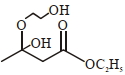
B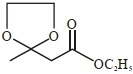
C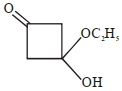
D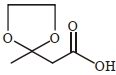
Solution
(B) The reaction of a ketone with ethylene glycol in the presence of an acid catalyst $(H^+)$ is a standard method for the protection of the carbonyl group as a cyclic acetal.
In the given molecule,ethyl acetoacetate,there are two carbonyl groups: a ketone and an ester.
Ketones are more reactive towards nucleophilic addition than esters.
Therefore,the ethylene glycol selectively reacts with the ketone group to form a cyclic acetal,while the ester group remains unaffected.
The product $A$ is the cyclic acetal of ethyl acetoacetate.
In the given molecule,ethyl acetoacetate,there are two carbonyl groups: a ketone and an ester.
Ketones are more reactive towards nucleophilic addition than esters.
Therefore,the ethylene glycol selectively reacts with the ketone group to form a cyclic acetal,while the ester group remains unaffected.
The product $A$ is the cyclic acetal of ethyl acetoacetate.
0 likesView Solution
71
ChemistryDifficultMCQJEE Main · 2021
Given below are two statements:
Statement $I :$ Potassium permanganate on heating at $573 \ K$ forms potassium manganate.
Statement $II :$ Both potassium permanganate and potassium manganate are tetrahedral and paramagnetic in nature.
In the light of the above statements,choose the most appropriate answer from the options given below.
Statement $I :$ Potassium permanganate on heating at $573 \ K$ forms potassium manganate.
Statement $II :$ Both potassium permanganate and potassium manganate are tetrahedral and paramagnetic in nature.
In the light of the above statements,choose the most appropriate answer from the options given below.
A
Statement $I$ is true but statement $II$ is false
B
Both statement $I$ and statement $II$ are true
C
Statement $I$ is false but statement $II$ is true
D
Both statement $I$ and statement $II$ are false
Solution
(A) The thermal decomposition of potassium permanganate $(KMnO_4)$ at $573 \ K$ is given by the reaction:
$2 KMnO_4 \xrightarrow{573 \ K} K_2MnO_4 + MnO_2 + O_2$
Thus,Statement-$I$ is true.
Regarding Statement-$II$:
- The permanganate ion $(MnO_4^-)$ has $Mn$ in the $+7$ oxidation state ($d^0$ configuration),making it diamagnetic.
- The manganate ion $(MnO_4^{2-})$ has $Mn$ in the $+6$ oxidation state ($d^1$ configuration),making it paramagnetic.
Both ions are tetrahedral,but they are not both paramagnetic.
Thus,Statement-$II$ is false.
$2 KMnO_4 \xrightarrow{573 \ K} K_2MnO_4 + MnO_2 + O_2$
Thus,Statement-$I$ is true.
Regarding Statement-$II$:
- The permanganate ion $(MnO_4^-)$ has $Mn$ in the $+7$ oxidation state ($d^0$ configuration),making it diamagnetic.
- The manganate ion $(MnO_4^{2-})$ has $Mn$ in the $+6$ oxidation state ($d^1$ configuration),making it paramagnetic.
Both ions are tetrahedral,but they are not both paramagnetic.
Thus,Statement-$II$ is false.
0 likesView Solution
72
ChemistryDifficultMCQJEE Main · 2021
Which of the following is the correct structure of tyrosine?
A
$HO-C_6H_4-CH_2-CH(NH_2)-COOH$
B
$HO-C_6H_4-CH_2-CH_2-NH_2$
C
$CH_3-CH_2-CH(NH_2)-COOH$
D
$HO-C_6H_4-CH(NH_2)-COOH$
Solution
(A) Tyrosine is an $\alpha$-amino acid with the general formula $R-CH(NH_2)-COOH$.
In tyrosine,the side chain $R$ is a $p$-hydroxybenzyl group,which is $-CH_2-C_6H_4-OH$.
Combining these,the structure is $HO-C_6H_4-CH_2-CH(NH_2)-COOH$.
Comparing this with the given options,option $A$ represents the correct structure.
In tyrosine,the side chain $R$ is a $p$-hydroxybenzyl group,which is $-CH_2-C_6H_4-OH$.
Combining these,the structure is $HO-C_6H_4-CH_2-CH(NH_2)-COOH$.
Comparing this with the given options,option $A$ represents the correct structure.
0 likesView Solution
73
ChemistryMediumMCQJEE Main · 2021
The above reaction requires which of the following reaction conditions?
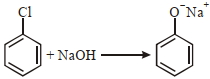
A
$573 \ K, Cu, 300 \ atm$
B
$623 \ K, Cu, 300 \ atm$
C
$573 \ K, 300 \ atm$
D
$623 \ K, 300 \ atm$
Solution
(D) The reaction shown is the conversion of chlorobenzene to sodium phenoxide,which is the first step of the Dow process.
This nucleophilic substitution reaction of chlorobenzene with aqueous $NaOH$ requires harsh conditions due to the partial double bond character of the $C-Cl$ bond.
The required conditions are a temperature of $623 \ K$ and a pressure of $300 \ atm$.
This nucleophilic substitution reaction of chlorobenzene with aqueous $NaOH$ requires harsh conditions due to the partial double bond character of the $C-Cl$ bond.
The required conditions are a temperature of $623 \ K$ and a pressure of $300 \ atm$.
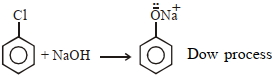
0 likesView Solution
74
ChemistryMediumMCQJEE Main · 2021
Hoffmann bromamide degradation of benzamide gives product $A$,which upon heating with $CHCl_{3}$ and $NaOH$ gives product $B$. The structures of $A$ and $B$ are
A
$A = \text{p-bromoaniline}, B = \text{p-bromophenyl isocyanide}$
B
$A = \text{aniline}, B = \text{phenyl isocyanide}$
C
$A = \text{aniline}, B = \text{o-formylaniline}$
D
$A = \text{benzamide}, B = \text{o-formylbenzamide}$
Solution
(B) Step $1$: Hoffmann bromamide degradation of benzamide $(C_6H_5CONH_2)$ involves the reaction with $Br_2$ and $NaOH$ to form aniline $(C_6H_5NH_2)$ as product $A$.
Step $2$: Aniline $(C_6H_5NH_2)$ is a primary amine. When heated with $CHCl_3$ and $NaOH$ (or $KOH$),it undergoes the carbylamine reaction to form phenyl isocyanide $(C_6H_5NC)$ as product $B$.
Thus,$A$ is aniline and $B$ is phenyl isocyanide.
Step $2$: Aniline $(C_6H_5NH_2)$ is a primary amine. When heated with $CHCl_3$ and $NaOH$ (or $KOH$),it undergoes the carbylamine reaction to form phenyl isocyanide $(C_6H_5NC)$ as product $B$.
Thus,$A$ is aniline and $B$ is phenyl isocyanide.
0 likesView Solution
75
ChemistryMediumMCQJEE Main · 2021
Mesityl oxide is a common name of
A
$2,4-$Dimethylpentan$-3-$one
B
$3-$Methylcyclohexanecarbaldehyde
C
$2-$Methylcyclohexanone
D
$4-$Methylpent$-3-$en$-2-$one
Solution
(D) Mesityl oxide is an $\alpha, \beta-$unsaturated ketone formed by the aldol condensation of acetone.
Its chemical structure is $(CH_3)_2C=CHCOCH_3$.
According to $IUPAC$ nomenclature,the longest carbon chain containing the ketone group has $5$ carbons.
The double bond is at position $3$ and the ketone group is at position $2$.
There is a methyl group at position $4$.
Therefore,the $IUPAC$ name is $4-$Methylpent$-3-$en$-2-$one.
Its chemical structure is $(CH_3)_2C=CHCOCH_3$.
According to $IUPAC$ nomenclature,the longest carbon chain containing the ketone group has $5$ carbons.
The double bond is at position $3$ and the ketone group is at position $2$.
There is a methyl group at position $4$.
Therefore,the $IUPAC$ name is $4-$Methylpent$-3-$en$-2-$one.
0 likesView Solution
76
ChemistryMediumMCQJEE Main · 2021
Which of the following reactions is an example of ammonolysis?
A
$C_{6}H_{5}COCl + C_{6}H_{5}NH_{2} \longrightarrow C_{6}H_{5}CONHC_{6}H_{5} + HCl$
B
$C_{6}H_{5}CH_{2}CN \stackrel{[H]}{\longrightarrow} C_{6}H_{5}CH_{2}CH_{2}NH_{2}$
C
$C_{6}H_{5}NH_{2} + HCl \longrightarrow C_{6}H_{5}NH_{3}^{+}Cl^{-}$
D
$C_{6}H_{5}CH_{2}Cl + NH_{3} \longrightarrow C_{6}H_{5}CH_{2}NH_{2} + HCl$
Solution
(D) The process of cleavage of the $C-X$ bond by an ammonia molecule is known as ammonolysis.
In this reaction,the nucleophilic ammonia molecule attacks the alkyl halide,resulting in the substitution of the halogen atom by the amino group.
The reaction $C_{6}H_{5}CH_{2}Cl + NH_{3} \longrightarrow C_{6}H_{5}CH_{2}NH_{2} + HCl$ represents the nucleophilic substitution of a benzyl chloride by ammonia,which is a classic example of ammonolysis.
In this reaction,the nucleophilic ammonia molecule attacks the alkyl halide,resulting in the substitution of the halogen atom by the amino group.
The reaction $C_{6}H_{5}CH_{2}Cl + NH_{3} \longrightarrow C_{6}H_{5}CH_{2}NH_{2} + HCl$ represents the nucleophilic substitution of a benzyl chloride by ammonia,which is a classic example of ammonolysis.
0 likesView Solution
77
ChemistryMediumMCQJEE Main · 2021
$A$ colloidal system consisting of a gas dispersed in a solid is called a/an:
A
solid sol
B
gel
C
aerosol
D
foam
Solution
(A) colloidal system where a gas is dispersed in a solid medium is known as a $solid \ sol$. Examples include pumice stone and rubber foam.
0 likesView Solution
78
ChemistryDifficultMCQJEE Main · 2021
What is the spin-only magnetic moment value $(BM)$ of a divalent metal ion with atomic number $25$ in its aqueous solution?
A
$5.92$
B
$5.0$
C
$0$
D
$5.26$
Solution
(A) The electronic configuration of a divalent metal ion with atomic number $25$ $(Mn^{2 })$ is $[Ar] 3d^5 4s^0$.
The number of unpaired electrons $(n)$ is $5$.
The spin-only magnetic moment $(\mu)$ is calculated using the formula:
$\mu = \sqrt{n(n 2)} \ BM$
Substituting $n = 5$:
$\mu = \sqrt{5(5 2)} = \sqrt{35} \ BM \approx 5.92 \ BM$.
The number of unpaired electrons $(n)$ is $5$.
The spin-only magnetic moment $(\mu)$ is calculated using the formula:
$\mu = \sqrt{n(n 2)} \ BM$
Substituting $n = 5$:
$\mu = \sqrt{5(5 2)} = \sqrt{35} \ BM \approx 5.92 \ BM$.
0 likesView Solution
79
ChemistryDifficultMCQJEE Main · 2021
The point of intersection and sudden increase in the slope,in the diagram given below,respectively,indicates
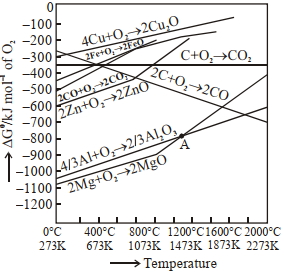
A
$ \Delta G = 0 $ and melting or boiling point of the metal oxide
B
$ \Delta G > 0 $ and decomposition of the metal oxide
C
$ \Delta G < 0 $ and decomposition of the metal oxide
D
$ \Delta G = 0 $ and reduction of the metal oxide
Solution
(A) In an Ellingham diagram,the point of intersection of two lines indicates that the $ \Delta G $ values for the two reactions are equal,meaning $ \Delta G = 0 $ for the overall coupled reaction.
$A$ sudden change in the slope of a line in the Ellingham diagram indicates a phase change (melting or boiling) of the metal or the metal oxide.
$A$ sudden change in the slope of a line in the Ellingham diagram indicates a phase change (melting or boiling) of the metal or the metal oxide.
0 likesView Solution
80
ChemistryDifficultMCQJEE Main · 2021
The mole fraction of a solute in a $100$ molal aqueous solution is $.......... \times 10^{-2}$ (Round off to the nearest integer). [Given: Atomic masses: $H = 1.0 \ u$,$O = 16.0 \ u$]
A
$64$
B
$52$
C
$44$
D
$62$
Solution
(A) $100$ molal aqueous solution means there are $100$ moles of solute in $1 \ kg$ $(1000 \ g)$ of water.
The number of moles of water $(n_{\text{solvent}})$ $= \frac{1000 \ g}{18 \ g/mol} = 55.56 \ mol$.
The mole fraction of solute $(x_{\text{solute}})$ $= \frac{n_{\text{solute}}}{n_{\text{solute}} + n_{\text{solvent}}}$.
$x_{\text{solute}} = \frac{100}{100 + 55.56} = \frac{100}{155.56} \approx 0.6428$.
$0.6428 = 64.28 \times 10^{-2}$.
Rounding off to the nearest integer,we get $64 \times 10^{-2}$.
The number of moles of water $(n_{\text{solvent}})$ $= \frac{1000 \ g}{18 \ g/mol} = 55.56 \ mol$.
The mole fraction of solute $(x_{\text{solute}})$ $= \frac{n_{\text{solute}}}{n_{\text{solute}} + n_{\text{solvent}}}$.
$x_{\text{solute}} = \frac{100}{100 + 55.56} = \frac{100}{155.56} \approx 0.6428$.
$0.6428 = 64.28 \times 10^{-2}$.
Rounding off to the nearest integer,we get $64 \times 10^{-2}$.
0 likesView Solution
81
ChemistryMediumMCQJEE Main · 2021
For a certain first order reaction,$32 \%$ of the reactant is left after $570 \ s$. The rate constant of this reaction is ........... $\times 10^{-3} \ s^{-1}$. (Round off to the Nearest Integer).
$[$Given: $\log_{10} 2 = 0.301, \ln 10 = 2.303]$
$[$Given: $\log_{10} 2 = 0.301, \ln 10 = 2.303]$
A
$2$
B
$4$
C
$6$
D
$8$
Solution
(A) For a $1^{st}$ order reaction,the rate constant $K$ is given by:
$K = \frac{2.303}{t} \log_{10} \left( \frac{[A]_0}{[A]_t} \right)$
Given $t = 570 \ s$ and $[A]_t = 32 \%$ of $[A]_0$,so $\frac{[A]_0}{[A]_t} = \frac{100}{32} = 3.125$.
$K = \frac{2.303}{570} \log_{10} (3.125)$
Since $\log_{10} (3.125) = \log_{10} (100/32) = \log_{10} 100 - \log_{10} 32 = 2 - 5 \log_{10} 2 = 2 - 5(0.301) = 2 - 1.505 = 0.495$.
$K = \frac{2.303 \times 0.495}{570} \approx \frac{1.14}{570} = 0.002 \ s^{-1} = 2 \times 10^{-3} \ s^{-1}$.
Rounding to the nearest integer,the value is $2$.
$K = \frac{2.303}{t} \log_{10} \left( \frac{[A]_0}{[A]_t} \right)$
Given $t = 570 \ s$ and $[A]_t = 32 \%$ of $[A]_0$,so $\frac{[A]_0}{[A]_t} = \frac{100}{32} = 3.125$.
$K = \frac{2.303}{570} \log_{10} (3.125)$
Since $\log_{10} (3.125) = \log_{10} (100/32) = \log_{10} 100 - \log_{10} 32 = 2 - 5 \log_{10} 2 = 2 - 5(0.301) = 2 - 1.505 = 0.495$.
$K = \frac{2.303 \times 0.495}{570} \approx \frac{1.14}{570} = 0.002 \ s^{-1} = 2 \times 10^{-3} \ s^{-1}$.
Rounding to the nearest integer,the value is $2$.
0 likesView Solution
82
ChemistryMediumMCQJEE Main · 2021
The oxygen dissolved in water exerts a partial pressure of $20 \ kPa$ in the vapour above water. The molar solubility of oxygen in water is ............ $\times 10^{-5} \ mol \ dm^{-3}$ (Round off to the Nearest Integer). [Given: Henry's law constant $K_H = 8.0 \times 10^{4} \ kPa$ for $O_2$,Density of water $= 1.0 \ kg \ dm^{-3}$]
A
$20$
B
$15$
C
$30$
D
$25$
Solution
(D) According to Henry's Law,$P = K_H \cdot x$,where $x$ is the mole fraction of $O_2$ in water.
$20 \ kPa = (8.0 \times 10^{4} \ kPa) \cdot x$
$x = \frac{20}{8.0 \times 10^{4}} = 2.5 \times 10^{-4}$.
Since $x = \frac{n_{O_2}}{n_{O_2} + n_{H_2O}} \approx \frac{n_{O_2}}{n_{H_2O}}$ (as $n_{O_2} \ll n_{H_2O}$).
For $1 \ dm^{3}$ of water,mass $= 1000 \ g$,so $n_{H_2O} = \frac{1000}{18} = 55.55 \ mol$.
$n_{O_2} = x \cdot n_{H_2O} = (2.5 \times 10^{-4}) \times 55.55 = 1.38875 \times 10^{-2} \ mol$.
This is the molar solubility in $mol \ dm^{-3}$,which is $1388.75 \times 10^{-5} \ mol \ dm^{-3}$.
Rounding to the nearest integer,we get $1389$.
$20 \ kPa = (8.0 \times 10^{4} \ kPa) \cdot x$
$x = \frac{20}{8.0 \times 10^{4}} = 2.5 \times 10^{-4}$.
Since $x = \frac{n_{O_2}}{n_{O_2} + n_{H_2O}} \approx \frac{n_{O_2}}{n_{H_2O}}$ (as $n_{O_2} \ll n_{H_2O}$).
For $1 \ dm^{3}$ of water,mass $= 1000 \ g$,so $n_{H_2O} = \frac{1000}{18} = 55.55 \ mol$.
$n_{O_2} = x \cdot n_{H_2O} = (2.5 \times 10^{-4}) \times 55.55 = 1.38875 \times 10^{-2} \ mol$.
This is the molar solubility in $mol \ dm^{-3}$,which is $1388.75 \times 10^{-5} \ mol \ dm^{-3}$.
Rounding to the nearest integer,we get $1389$.
0 likesView Solution
83
ChemistryMediumMCQJEE Main · 2021
Considering the above reaction,$X$ and $Y$ respectively are
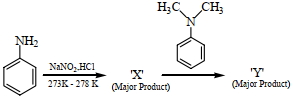
A
Benzenediazonium chloride and $p$-(dimethylamino)azobenzene
B
Benzenediazonium chloride and $o$-(dimethylamino)azobenzene
C
Chlorobenzene and $p$-(dimethylamino)azobenzene
D
Chlorobenzene and $o$-(dimethylamino)azobenzene
Solution
(A) The reaction of aniline with $NaNO_2$ and $HCl$ at $273-278 \ K$ is a diazotization reaction,which produces benzenediazonium chloride as the major product $(X)$.
Benzenediazonium chloride then undergoes an electrophilic aromatic substitution reaction (coupling reaction) with $N,N$-dimethylaniline. Since the $-N(CH_3)_2$ group is a strong activating group and is ortho/para-directing,the coupling occurs primarily at the para-position due to steric hindrance at the ortho-position.
Therefore,the major product $(Y)$ is $p$-(dimethylamino)azobenzene.
Benzenediazonium chloride then undergoes an electrophilic aromatic substitution reaction (coupling reaction) with $N,N$-dimethylaniline. Since the $-N(CH_3)_2$ group is a strong activating group and is ortho/para-directing,the coupling occurs primarily at the para-position due to steric hindrance at the ortho-position.
Therefore,the major product $(Y)$ is $p$-(dimethylamino)azobenzene.
0 likesView Solution
84
ChemistryDifficultMCQJEE Main · 2021
Reaction of Grignard reagent,$C_{2}H_{5}MgBr$ with $C_{8}H_{8}O$ followed by hydrolysis gives compound $A$ which reacts instantly with Lucas reagent to give compound $B$,$C_{10}H_{13}Cl$. The compound $B$ is
A
$1-$chloro$-1-$phenylbutane
B
$1-$chloro$-2-$phenylbutane
C
$2-$chloro$-2-$phenylbutane
D
$2-$chloro$-3-$phenylbutane
Solution
(C) $1$. The molecular formula of the reactant is $C_{8}H_{8}O$. Given the reaction with $C_{2}H_{5}MgBr$ (Grignard reagent) and subsequent hydrolysis,it is likely an aldehyde or ketone. Acetophenone $(C_{6}H_{5}COCH_{3})$ fits the formula $C_{8}H_{8}O$.
$2$. Reaction: $C_{6}H_{5}COCH_{3} + C_{2}H_{5}MgBr \rightarrow C_{6}H_{5}C(OH)(CH_{3})(C_{2}H_{5})$. This product $A$ is $2$-phenylbutan-$2$-ol.
$3$. Compound $A$ is a tertiary alcohol. Tertiary alcohols react instantly with Lucas reagent $(conc. \ HCl + ZnCl_{2})$ to form alkyl chlorides.
$4$. The reaction of $2$-phenylbutan-$2$-ol with $HCl$ replaces the $-OH$ group with $-Cl$ to form $2$-chloro-$2$-phenylbutane $(C_{10}H_{13}Cl)$.
$5$. Comparing this with the given options,the structure corresponding to $2$-chloro-$2$-phenylbutane is option $C$.
$2$. Reaction: $C_{6}H_{5}COCH_{3} + C_{2}H_{5}MgBr \rightarrow C_{6}H_{5}C(OH)(CH_{3})(C_{2}H_{5})$. This product $A$ is $2$-phenylbutan-$2$-ol.
$3$. Compound $A$ is a tertiary alcohol. Tertiary alcohols react instantly with Lucas reagent $(conc. \ HCl + ZnCl_{2})$ to form alkyl chlorides.
$4$. The reaction of $2$-phenylbutan-$2$-ol with $HCl$ replaces the $-OH$ group with $-Cl$ to form $2$-chloro-$2$-phenylbutane $(C_{10}H_{13}Cl)$.
$5$. Comparing this with the given options,the structure corresponding to $2$-chloro-$2$-phenylbutane is option $C$.
0 likesView Solution
85
ChemistryMediumMCQJEE Main · 2021
$A$ reagent consisting of $1$-naphthylamine and sulphanilic acid in acetic acid is used for the detection of:
A
$N_{2}O$
B
$NO_{3}^{-}$
C
$NO$
D
$NO_{2}^{-}$
Solution
(D) The reagent consisting of $1$-naphthylamine and sulphanilic acid in acetic acid is known as the Griess reagent.
It is specifically used for the detection of nitrite ions $(NO_{2}^{-})$.
The test involves the diazotization of sulphanilic acid by nitrous acid $(HNO_{2})$,which is formed from $NO_{2}^{-}$ in the presence of acetic acid.
The resulting diazonium salt then couples with $1$-naphthylamine to form a red-colored azo dye,indicating the presence of $NO_{2}^{-}$.
It is specifically used for the detection of nitrite ions $(NO_{2}^{-})$.
The test involves the diazotization of sulphanilic acid by nitrous acid $(HNO_{2})$,which is formed from $NO_{2}^{-}$ in the presence of acetic acid.
The resulting diazonium salt then couples with $1$-naphthylamine to form a red-colored azo dye,indicating the presence of $NO_{2}^{-}$.
0 likesView Solution
86
ChemistryMediumMCQJEE Main · 2021
$A$ non-reducing sugar $A$ hydrolyses to give two reducing monosaccharides. Sugar $A$ is
A
Fructose
B
Galactose
C
Glucose
D
Sucrose
Solution
(D) Sucrose is a non-reducing sugar because its glycosidic linkage involves the anomeric carbons of both glucose and fructose units.
Upon hydrolysis,it yields two reducing monosaccharides: glucose and fructose.
The reaction is:
$Sucrose + H_2O \rightarrow Glucose + Fructose$
Since both products contain a free hemiacetal or hemiketal group,they are reducing sugars.
Upon hydrolysis,it yields two reducing monosaccharides: glucose and fructose.
The reaction is:
$Sucrose + H_2O \rightarrow Glucose + Fructose$
Since both products contain a free hemiacetal or hemiketal group,they are reducing sugars.
0 likesView Solution
87
ChemistryMediumMCQJEE Main · 2021
Match the List-$I$ with List-$II$.
| List-$I$ (Class of Drug) | List-$II$ (Example) |
|---|---|
| $a$. Antacid | $i$. Novestrol |
| $b$. Artificial sweetener | $ii$. Cimetidine |
| $c$. Antifertility | $iii$. Valium |
| $d$. Tranquilizers | $iv$. Alitame |
A
$a-ii, b-iv, c-i, d-iii$
B
$a-iv, b-i, c-ii, d-iii$
C
$a-iv, b-iii, c-i, d-ii$
D
$a-ii, b-iv, c-iii, d-i$
Solution
(A) . Antacid: $ii$. Cimetidine
$b$. Artificial sweetener: $iv$. Alitame
$c$. Antifertility: $i$. Novestrol
$d$. Tranquilizers: $iii$. Valium
Therefore,the correct matching is $a-ii, b-iv, c-i, d-iii$.
$b$. Artificial sweetener: $iv$. Alitame
$c$. Antifertility: $i$. Novestrol
$d$. Tranquilizers: $iii$. Valium
Therefore,the correct matching is $a-ii, b-iv, c-i, d-iii$.
0 likesView Solution
88
ChemistryMediumMCQJEE Main · 2021
Consider the chemical reaction shown below and identify product $A$.
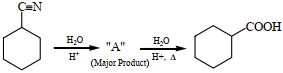
A
Cyclohexylmethanamine
B
Nitromethylcyclohexane
C
Cyclohexanecarboxamide
D
Cyclohexanecarbaldehyde oxime
Solution
(C) The reaction of a nitrile (cyclohexanecarbonitrile) with water in the presence of an acid $(H^+)$ leads to partial hydrolysis,which produces an amide as the major product $A$.
The reaction is as follows:
$R-CN + H_2O \xrightarrow{H^+} R-CONH_2$ (Partial Hydrolysis)
In this case,the nitrile group attached to the cyclohexane ring is converted to an amide group $(-CONH_2)$.
Therefore,product $A$ is cyclohexanecarboxamide.
The reaction is as follows:
$R-CN + H_2O \xrightarrow{H^+} R-CONH_2$ (Partial Hydrolysis)
In this case,the nitrile group attached to the cyclohexane ring is converted to an amide group $(-CONH_2)$.
Therefore,product $A$ is cyclohexanecarboxamide.
0 likesView Solution
89
ChemistryMediumMCQJEE Main · 2021
Match List-$I$ with List-$II$.
Choose the most appropriate answer from the options given below:
| List-$I$ | List-$II$ |
|---|---|
| $(a)$ Chlorophyll | $(i)$ Ruthenium |
| $(b)$ Vitamin-$B_{12}$ | $(ii)$ Platinum |
| $(c)$ Anticancer drug | $(iii)$ Cobalt |
| $(d)$ Grubbs catalyst | $(iv)$ Magnesium |
Choose the most appropriate answer from the options given below:
A
$a-iii, b-ii, c-iv, d-i$
B
$a-iv, b-iii, c-ii, d-i$
C
$a-iv, b-iii, c-i, d-ii$
D
$a-iv, b-ii, c-iii, d-i$
Solution
(B) Chlorophyll is a coordination compound of magnesium $(a-iv)$.
Vitamin $B_{12}$ (cyanocobalamin) is a coordination compound of cobalt $(b-iii)$.
Cisplatin is used as an anti-cancer drug and is a coordination compound of platinum $(c-ii)$.
Grubbs catalyst is a complex of ruthenium $(d-i)$.
Therefore,the correct matching is $a-iv, b-iii, c-ii, d-i$.
Vitamin $B_{12}$ (cyanocobalamin) is a coordination compound of cobalt $(b-iii)$.
Cisplatin is used as an anti-cancer drug and is a coordination compound of platinum $(c-ii)$.
Grubbs catalyst is a complex of ruthenium $(d-i)$.
Therefore,the correct matching is $a-iv, b-iii, c-ii, d-i$.
0 likesView Solution
90
ChemistryMediumMCQJEE Main · 2021
Match List-$I$ with List-$II$.
Choose the most appropriate match.
| List-$I$ (Chemicals) | List-$II$ (Use / Preparation / Constituent) |
|---|---|
| $(a)$ Alcoholic potassium hydroxide | $(i)$ Electrodes in batteries |
| $(b)$ $Pd / BaSO_4$ | $(ii)$ Obtained by addition reaction |
| $(c)$ $BHC$ (Benzene hexachloride) | $(iii)$ Used for $\beta$-elimination reaction |
| $(d)$ Polyacetylene | $(iv)$ Lindlar's catalyst |
Choose the most appropriate match.
A
$a-ii, b-i, c-iv, d-iii$
B
$a-iii, b-iv, c-ii, d-i$
C
$a-iii, b-i, c-iv, d-ii$
D
$a-ii, b-iv, c-i, d-iii$
Solution
(B) Alcoholic potassium hydroxide is used for $\beta$-elimination reactions.
$(b)$ $Pd / BaSO_4$ is known as Lindlar's catalyst.
$(c)$ $BHC$ (Benzene hexachloride) is obtained by the addition reaction of chlorine to benzene.
$(d)$ Polyacetylene is a conducting polymer used as electrodes in batteries.
Therefore,the correct match is $a-iii, b-iv, c-ii, d-i$.
$(b)$ $Pd / BaSO_4$ is known as Lindlar's catalyst.
$(c)$ $BHC$ (Benzene hexachloride) is obtained by the addition reaction of chlorine to benzene.
$(d)$ Polyacetylene is a conducting polymer used as electrodes in batteries.
Therefore,the correct match is $a-iii, b-iv, c-ii, d-i$.
0 likesView Solution
91
ChemistryDifficultMCQJEE Main · 2021
The correct structures of trans-$[NiBr_{2}(PPh_{3})_{2}]$ and meridional-$[Co(NH_{3})_{3}(NO_{2})_{3}]$,respectively,are
A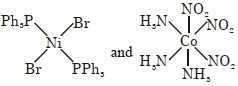
B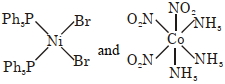
C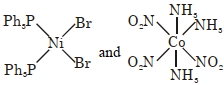
D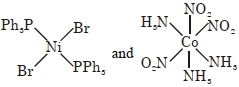
Solution
(A) $1$. For the square planar complex $trans-[NiBr_{2}(PPh_{3})_{2}]$,the two identical ligands ($Br$ or $PPh_{3}$) must be positioned opposite to each other (at $180^{\circ}$ angle). In the structure shown in option $A$,the $Br$ atoms are trans to each other,and the $PPh_{3}$ groups are trans to each other.
$2$. For the octahedral complex $meridional-[Co(NH_{3})_{3}(NO_{2})_{3}]$,the three identical ligands must lie on the same plane (meridian). In the structure shown in option $A$,the three $NH_{3}$ ligands are in a meridional arrangement,and the three $NO_{2}$ ligands are also in a meridional arrangement.
$3$. Therefore,the structure in option $A$ correctly represents both the trans-isomer of the nickel complex and the meridional-isomer of the cobalt complex.
$2$. For the octahedral complex $meridional-[Co(NH_{3})_{3}(NO_{2})_{3}]$,the three identical ligands must lie on the same plane (meridian). In the structure shown in option $A$,the three $NH_{3}$ ligands are in a meridional arrangement,and the three $NO_{2}$ ligands are also in a meridional arrangement.
$3$. Therefore,the structure in option $A$ correctly represents both the trans-isomer of the nickel complex and the meridional-isomer of the cobalt complex.
0 likesView Solution
92
ChemistryMediumMCQJEE Main · 2021
Considering the above chemical reaction,identify the product $X$.
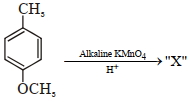
A
$4-$methoxybenzaldehyde
B
$4-$methoxybenzyl alcohol
C
$4-$methoxybenzoic acid
D
$4-$methylphenol
Solution
(C) The reaction involves the oxidation of an alkyl group attached to a benzene ring using alkaline $KMnO_4$ followed by acidification $(H^+)$.
Alkaline $KMnO_4$ is a strong oxidizing agent that oxidizes the alkyl side chain (specifically,a methyl group attached to the benzene ring) to a carboxylic acid group $(-COOH)$.
In the given reactant,$1$-methoxy-$4$-methylbenzene,the methyl group $(-CH_3)$ at the para position is oxidized to a carboxylic acid group $(-COOH)$,while the methoxy group $(-OCH_3)$ remains unaffected.
Therefore,the product $X$ is $4$-methoxybenzoic acid.
Alkaline $KMnO_4$ is a strong oxidizing agent that oxidizes the alkyl side chain (specifically,a methyl group attached to the benzene ring) to a carboxylic acid group $(-COOH)$.
In the given reactant,$1$-methoxy-$4$-methylbenzene,the methyl group $(-CH_3)$ at the para position is oxidized to a carboxylic acid group $(-COOH)$,while the methoxy group $(-OCH_3)$ remains unaffected.
Therefore,the product $X$ is $4$-methoxybenzoic acid.
0 likesView Solution
93
ChemistryMediumMCQJEE Main · 2021
Match List-$I$ with List-$II$.
Choose the most appropriate answer from the options given below:
| List-$I$ (Process) | List-$II$ (Catalyst) |
|---|---|
| $a$. Deacon's process | $i$. $ZSM-5$ |
| $b$. Contact process | $ii$. $CuCl_2$ |
| $c$. Cracking of hydrocarbons | $iii$. $Ni$ |
| $d$. Hydrogenation of vegetable oils | $iv$. $V_2O_5$ |
Choose the most appropriate answer from the options given below:
A
$a-ii, b-iv, c-i, d-iii$
B
$a-i, b-iii, c-ii, d-iv$
C
$a-iii, b-i, c-iv, d-ii$
D
$a-iv, b-ii, c-i, d-iii$
Solution
(A) The correct matches are as follows:
$a$. Deacon's process uses $CuCl_2$ as a catalyst.
$b$. Contact process for the manufacture of $H_2SO_4$ uses $V_2O_5$ as a catalyst.
$c$. Cracking of hydrocarbons uses $ZSM-5$ as a catalyst.
$d$. Hydrogenation of vegetable oils uses $Ni$ as a catalyst.
Thus,the correct sequence is $a-ii, b-iv, c-i, d-iii$.
$a$. Deacon's process uses $CuCl_2$ as a catalyst.
$b$. Contact process for the manufacture of $H_2SO_4$ uses $V_2O_5$ as a catalyst.
$c$. Cracking of hydrocarbons uses $ZSM-5$ as a catalyst.
$d$. Hydrogenation of vegetable oils uses $Ni$ as a catalyst.
Thus,the correct sequence is $a-ii, b-iv, c-i, d-iii$.
0 likesView Solution
94
ChemistryDifficultMCQJEE Main · 2021
In a binary compound,atoms of element $A$ form a $hcp$ structure and those of element $M$ occupy $2/3$ of the tetrahedral voids of the $hcp$ structure. The formula of the binary compound is
A
$M_2 A_3$
B
$M_4 A_3$
C
$M_4 A$
D
$MA_3$
Solution
(B) In an $hcp$ structure,the number of atoms of element $A$ is $N = 6$.
The number of tetrahedral voids is $2N = 2 \times 6 = 12$.
Element $M$ occupies $2/3$ of the tetrahedral voids,so the number of $M$ atoms is $\frac{2}{3} \times 12 = 8$.
The ratio of $M:A$ is $8:6$,which simplifies to $4:3$.
Therefore,the formula of the compound is $M_4 A_3$.
The number of tetrahedral voids is $2N = 2 \times 6 = 12$.
Element $M$ occupies $2/3$ of the tetrahedral voids,so the number of $M$ atoms is $\frac{2}{3} \times 12 = 8$.
The ratio of $M:A$ is $8:6$,which simplifies to $4:3$.
Therefore,the formula of the compound is $M_4 A_3$.
0 likesView Solution
95
ChemistryMediumMCQJEE Main · 2021
The chemical that is added to reduce the melting point of the reaction mixture during the extraction of aluminium is
A
Cryolite
B
Bauxite
C
Calamine
D
Kaolinite
Solution
(A) During the extraction of aluminium by the Hall-$H$éroult process,pure $Al_2O_3$ has a very high melting point.
To reduce the melting point of the reaction mixture and to increase its electrical conductivity,$Na_3AlF_6$ (Cryolite) is added.
To reduce the melting point of the reaction mixture and to increase its electrical conductivity,$Na_3AlF_6$ (Cryolite) is added.
0 likesView Solution
96
ChemistryMediumMCQJEE Main · 2021
$2 \ NO_{(g)} + Cl_{2(g)} \rightleftharpoons 2 \ NOCl_{(g)}$
This reaction was studied at $-10^{\circ} C$ and the following data was obtained:
$[NO]_{0}$ and $[Cl_{2}]_{0}$ are the initial concentrations and $r_{0}$ is the initial reaction rate.
The overall order of the reaction is ..........
(Round off to the Nearest Integer).
This reaction was studied at $-10^{\circ} C$ and the following data was obtained:
| $Run$ | $[NO]_{0}$ | $[Cl_{2}]_{0}$ | $r_{0}$ |
| $1$ | $0.10$ | $0.10$ | $0.18$ |
| $2$ | $0.10$ | $0.20$ | $0.35$ |
| $3$ | $0.20$ | $0.20$ | $1.40$ |
$[NO]_{0}$ and $[Cl_{2}]_{0}$ are the initial concentrations and $r_{0}$ is the initial reaction rate.
The overall order of the reaction is ..........
(Round off to the Nearest Integer).
A
$1$
B
$2$
C
$3$
D
$4$
Solution
(C) The rate law is given by $r = k [NO]^{m} [Cl_{2}]^{n}$.
From the data:
$0.18 = k (0.1)^{m} (0.1)^{n} \quad \dots (1)$
$0.35 = k (0.1)^{m} (0.2)^{n} \quad \dots (2)$
$1.40 = k (0.2)^{m} (0.2)^{n} \quad \dots (3)$
Dividing equation $(2)$ by $(1)$:
$\frac{0.35}{0.18} \approx 2 = (\frac{0.2}{0.1})^{n} = 2^{n} \implies n = 1$.
Dividing equation $(3)$ by $(2)$:
$\frac{1.40}{0.35} = 4 = (\frac{0.2}{0.1})^{m} = 2^{m} \implies m = 2$.
The overall order of the reaction is $m + n = 2 + 1 = 3$.
From the data:
$0.18 = k (0.1)^{m} (0.1)^{n} \quad \dots (1)$
$0.35 = k (0.1)^{m} (0.2)^{n} \quad \dots (2)$
$1.40 = k (0.2)^{m} (0.2)^{n} \quad \dots (3)$
Dividing equation $(2)$ by $(1)$:
$\frac{0.35}{0.18} \approx 2 = (\frac{0.2}{0.1})^{n} = 2^{n} \implies n = 1$.
Dividing equation $(3)$ by $(2)$:
$\frac{1.40}{0.35} = 4 = (\frac{0.2}{0.1})^{m} = 2^{m} \implies m = 2$.
The overall order of the reaction is $m + n = 2 + 1 = 3$.
0 likesView Solution
97
ChemistryMediumMCQJEE Main · 2021
$A$ reaction of $0.1 \ mol$ of Benzylamine with bromomethane gave $23 \ g$ of Benzyl trimethyl ammonium bromide. The number of moles of bromomethane consumed in this reaction are $n \times 10^{-1},$ when $n = \dots$ (Round off to the Nearest Integer).
(Given : Atomic masses: $C : 12.0 \ u, H : 1.0 \ u, N : 14.0 \ u, Br : 80.0 \ u$)
(Given : Atomic masses: $C : 12.0 \ u, H : 1.0 \ u, N : 14.0 \ u, Br : 80.0 \ u$)
A
$1$
B
$3$
C
$7$
D
$9$
Solution
(B) The reaction of Benzylamine $(Ph-CH_2-NH_2)$ with bromomethane $(CH_3Br)$ is an exhaustive methylation reaction.
Benzylamine reacts with $3$ moles of bromomethane to form Benzyl trimethyl ammonium bromide $(Ph-CH_2-N(CH_3)_3^+Br^-)$.
The molar mass of Benzyl trimethyl ammonium bromide $(C_{10}H_{16}NBr)$ is calculated as:
$M = (10 \times 12) + (16 \times 1) + (14 \times 1) + (80 \times 1) = 120 + 16 + 14 + 80 = 230 \ g/mol$.
Given mass of product = $23 \ g$.
Number of moles of product = $\frac{23 \ g}{230 \ g/mol} = 0.1 \ mol$.
Since $1 \ mol$ of Benzylamine reacts with $3 \ mol$ of bromomethane to produce $1 \ mol$ of Benzyl trimethyl ammonium bromide,$0.1 \ mol$ of Benzylamine will react with $0.1 \times 3 = 0.3 \ mol$ of bromomethane.
Given that the number of moles of bromomethane consumed is $n \times 10^{-1} = 0.3$.
Therefore,$n = 3$.
Benzylamine reacts with $3$ moles of bromomethane to form Benzyl trimethyl ammonium bromide $(Ph-CH_2-N(CH_3)_3^+Br^-)$.
The molar mass of Benzyl trimethyl ammonium bromide $(C_{10}H_{16}NBr)$ is calculated as:
$M = (10 \times 12) + (16 \times 1) + (14 \times 1) + (80 \times 1) = 120 + 16 + 14 + 80 = 230 \ g/mol$.
Given mass of product = $23 \ g$.
Number of moles of product = $\frac{23 \ g}{230 \ g/mol} = 0.1 \ mol$.
Since $1 \ mol$ of Benzylamine reacts with $3 \ mol$ of bromomethane to produce $1 \ mol$ of Benzyl trimethyl ammonium bromide,$0.1 \ mol$ of Benzylamine will react with $0.1 \times 3 = 0.3 \ mol$ of bromomethane.
Given that the number of moles of bromomethane consumed is $n \times 10^{-1} = 0.3$.
Therefore,$n = 3$.
0 likesView Solution
98
ChemistryMediumMCQJEE Main · 2021
The total number of unpaired electrons present in the complex $K_3[Cr(C_2O_4)_3]$ is ..........
A
$3$
B
$9$
C
$7$
D
$2$
Solution
(A) In the complex $K_3[Cr(C_2O_4)_3]$,the oxalate ion $(C_2O_4^{2-})$ has a charge of $-2$.
Let the oxidation state of $Cr$ be $x$.
$3(+1) + x + 3(-2) = 0$
$3 + x - 6 = 0$
$x = +3$.
The atomic number of $Cr$ is $24$,and its electronic configuration is $[Ar] 3d^5 4s^1$.
For $Cr^{3+}$,the configuration is $[Ar] 3d^3$.
Thus,there are $3$ unpaired electrons in the $3d$ orbitals.
Let the oxidation state of $Cr$ be $x$.
$3(+1) + x + 3(-2) = 0$
$3 + x - 6 = 0$
$x = +3$.
The atomic number of $Cr$ is $24$,and its electronic configuration is $[Ar] 3d^5 4s^1$.
For $Cr^{3+}$,the configuration is $[Ar] 3d^3$.
Thus,there are $3$ unpaired electrons in the $3d$ orbitals.
0 likesView Solution
99
ChemistryMediumMCQJEE Main · 2021
$2$ molal solution of a weak acid $HA$ has a freezing point of $-3.885^{\circ} C$. The degree of dissociation of this acid is ........ $\times 10^{-3}$. (Round off to the Nearest Integer).
[Given: Molal depression constant of water = $1.85 \ K \ kg \ mol^{-1}$,Freezing point of pure water = $0^{\circ} C$]
[Given: Molal depression constant of water = $1.85 \ K \ kg \ mol^{-1}$,Freezing point of pure water = $0^{\circ} C$]
A
$50$
B
$60$
C
$55$
D
$65$
Solution
(A) The freezing point depression is given by $\Delta T_f = T_f^{\circ} - T_f = 0^{\circ} C - (-3.885^{\circ} C) = 3.885 \ K$.
For a weak acid $HA$ undergoing dissociation,$HA \rightleftharpoons H^+ + A^-$,the van't Hoff factor $i = 1 + \alpha$.
Using the formula $\Delta T_f = i \times K_f \times m$:
$3.885 = (1 + \alpha) \times 1.85 \times 2$.
$3.885 = (1 + \alpha) \times 3.7$.
$1 + \alpha = \frac{3.885}{3.7} = 1.05$.
$\alpha = 1.05 - 1 = 0.05$.
Expressing $\alpha$ in terms of $10^{-3}$:
$\alpha = 0.05 = 50 \times 10^{-3}$.
Thus,the value is $50$.
For a weak acid $HA$ undergoing dissociation,$HA \rightleftharpoons H^+ + A^-$,the van't Hoff factor $i = 1 + \alpha$.
Using the formula $\Delta T_f = i \times K_f \times m$:
$3.885 = (1 + \alpha) \times 1.85 \times 2$.
$3.885 = (1 + \alpha) \times 3.7$.
$1 + \alpha = \frac{3.885}{3.7} = 1.05$.
$\alpha = 1.05 - 1 = 0.05$.
Expressing $\alpha$ in terms of $10^{-3}$:
$\alpha = 0.05 = 50 \times 10^{-3}$.
Thus,the value is $50$.
0 likesView Solution
100
ChemistryMediumMCQJEE Main · 2021
For the reaction $2 Fe^{3+}_{(aq)} + 2 I^{-}_{(aq)} \rightarrow 2 Fe^{2+}_{(aq)} + I_{2(s)}$,the magnitude of the standard molar free energy change,$\Delta_{r} G_{m}^{\circ} = -$ ........... $kJ$ (Round off to the Nearest Integer). $\left[ E_{Fe^{2+} / Fe_{(s)}}^{\circ} = -0.440 \ V; \ E_{Fe^{3+} / Fe_{(s)}}^{\circ} = -0.036 \ V; \ E_{I_{2} / 2I^{-}}^{\circ} = 0.539 \ V; \ F = 96500 \ C \ mol^{-1} \right]$
A
$49$
B
$36$
C
$55$
D
$45$
Solution
(D) The reaction is $2 Fe^{3+} + 2 I^{-} \rightarrow 2 Fe^{2+} + I_{2}$.
First,calculate $E^{\circ}_{Fe^{3+}/Fe^{2+}}$ using the given Latimer diagram data:
$n_1 E_1^{\circ} + n_2 E_2^{\circ} = n_3 E_3^{\circ}$
$1 \times E^{\circ}_{Fe^{3+}/Fe^{2+}} + 2 \times E^{\circ}_{Fe^{2+}/Fe} = 3 \times E^{\circ}_{Fe^{3+}/Fe}$
$E^{\circ}_{Fe^{3+}/Fe^{2+}} + 2(-0.440) = 3(-0.036)$
$E^{\circ}_{Fe^{3+}/Fe^{2+}} = -0.108 + 0.880 = 0.772 \ V$.
Now,calculate the cell potential $E^{\circ}_{cell}$:
$E^{\circ}_{cell} = E^{\circ}_{cathode} - E^{\circ}_{anode} = E^{\circ}_{Fe^{3+}/Fe^{2+}} - E^{\circ}_{I_{2}/2I^{-}}$
$E^{\circ}_{cell} = 0.772 - 0.539 = 0.233 \ V$.
The standard Gibbs free energy change is $\Delta_{r} G^{\circ} = -n F E^{\circ}_{cell}$.
Here,$n = 2$ (moles of electrons transferred).
$\Delta_{r} G^{\circ} = -2 \times 96500 \times 0.233 = -44969 \ J \ mol^{-1} = -44.969 \ kJ \ mol^{-1}$.
The magnitude is approximately $45 \ kJ \ mol^{-1}$.
First,calculate $E^{\circ}_{Fe^{3+}/Fe^{2+}}$ using the given Latimer diagram data:
$n_1 E_1^{\circ} + n_2 E_2^{\circ} = n_3 E_3^{\circ}$
$1 \times E^{\circ}_{Fe^{3+}/Fe^{2+}} + 2 \times E^{\circ}_{Fe^{2+}/Fe} = 3 \times E^{\circ}_{Fe^{3+}/Fe}$
$E^{\circ}_{Fe^{3+}/Fe^{2+}} + 2(-0.440) = 3(-0.036)$
$E^{\circ}_{Fe^{3+}/Fe^{2+}} = -0.108 + 0.880 = 0.772 \ V$.
Now,calculate the cell potential $E^{\circ}_{cell}$:
$E^{\circ}_{cell} = E^{\circ}_{cathode} - E^{\circ}_{anode} = E^{\circ}_{Fe^{3+}/Fe^{2+}} - E^{\circ}_{I_{2}/2I^{-}}$
$E^{\circ}_{cell} = 0.772 - 0.539 = 0.233 \ V$.
The standard Gibbs free energy change is $\Delta_{r} G^{\circ} = -n F E^{\circ}_{cell}$.
Here,$n = 2$ (moles of electrons transferred).
$\Delta_{r} G^{\circ} = -2 \times 96500 \times 0.233 = -44969 \ J \ mol^{-1} = -44.969 \ kJ \ mol^{-1}$.
The magnitude is approximately $45 \ kJ \ mol^{-1}$.
0 likesView Solution
Vedclass Products
For Students
Vedclass Test Series
Mock tests in real JEE Main style covering Chemistry with performance analysis. 5-day free trial.
Start Free TrialFor Teachers
Exam Paper Generator
Generate Set A/B/C/D Chemistry papers from 7.5L+ questions in 2 minutes. 3 chapters free.
Try FreeFor Institutes
Online Exam Module
Run live JEE Main mock exams with unlimited students, 360° analytics & white-label branding.
See DemoFrequently Asked Questions
How many Chemistry questions are in JEE Main 2021?
There are 798 Chemistry questions from the JEE Main 2021 paper on Vedclass, each with a detailed step-by-step solution in English.
Are JEE Main 2021 Chemistry solutions available in English?
Yes. All solutions on this page are in English. You can also switch to English or Hindi using the language buttons above the questions.
Can I practice JEE Main 2021 Chemistry as a timed test?
Yes. Use the Vedclass Test Series to attempt a full JEE Main mock test covering Chemistry with time limits and instant score analysis.
Can teachers create Chemistry papers from JEE Main previous year questions?
Yes. The Vedclass Exam Paper Generator lets teachers mix JEE Main Chemistry questions and generate Set A/B/C/D papers in minutes.
For Teachers & Institutes
Build a Custom Chemistry Paper
Pick JEE Main 2021 Chemistry questions, set difficulty, and generate Set A/B/C/D in 2 minutes.