
ChemistryQ201–300 of 726 questions
Page 5 of 9 · English
201
ChemistryMediumMCQJEE Main · 2023
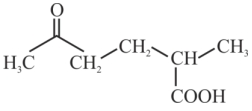
The correct $IUPAC$ nomenclature for the following compound is
A
$5-$Oxohexanoic acid
B
$2-$Methyl$-5-$oxohexanoic acid
C
$2-$Formyl$-5-$methylhexan$-6-$oic acid
D
$5-$Methyl$-2-$oxohexan$-6-$oic acid
Solution
(B) $1$. Identify the principal functional group: The carboxylic acid group $(-COOH)$ has higher priority than the ketone group $(C=O)$. Thus,the parent chain is named as an alkanoic acid.
$2$. Number the chain: Start numbering from the carbon of the $-COOH$ group as $C-1$. The chain is numbered as follows: $C-1$ $(-COOH)$,$C-2$ $(-CH(CH_3)-)$,$C-3$ $(-CH_2-)$,$C-4$ $(-CH_2-)$,$C-5$ $(C=O)$,$C-6$ $(-CH_3)$.
$3$. Identify substituents and functional groups: There is a methyl group at position $2$ and a ketone group at position $5$. The ketone group is named as an 'oxo' substituent.
$4$. Assemble the name: $2-$Methyl$-5-$oxohexanoic acid.
$2$. Number the chain: Start numbering from the carbon of the $-COOH$ group as $C-1$. The chain is numbered as follows: $C-1$ $(-COOH)$,$C-2$ $(-CH(CH_3)-)$,$C-3$ $(-CH_2-)$,$C-4$ $(-CH_2-)$,$C-5$ $(C=O)$,$C-6$ $(-CH_3)$.
$3$. Identify substituents and functional groups: There is a methyl group at position $2$ and a ketone group at position $5$. The ketone group is named as an 'oxo' substituent.
$4$. Assemble the name: $2-$Methyl$-5-$oxohexanoic acid.
0 likesView Solution
202
ChemistryMediumMCQJEE Main · 2023
Arrange the following gases in increasing order of van der Waals constant '$a$':
$A$. $Ar$; $B$. $CH_4$; $C$. $H_2O$; $D$. $C_6H_6$
Choose the correct option from the following:
$A$. $Ar$; $B$. $CH_4$; $C$. $H_2O$; $D$. $C_6H_6$
Choose the correct option from the following:
A
$A < B < C < D$
B
$C < D < B < A$
C
$A < B < D < C$
D
$D < C < B < A$
Solution
(A) The van der Waals constant '$a$' represents the magnitude of intermolecular forces of attraction in a gas.
It is directly proportional to the molecular size and surface area of the gas molecules.
The values for '$a$' (in $\text{bar L}^2 \text{mol}^{-2}$) are:
$(i)$ $Ar = 1.34$
$(ii)$ $CH_4 = 2.25$
$(iii)$ $H_2O = 5.46$
$(iv)$ $C_6H_6 = 18.57$
Comparing these values,the increasing order is $Ar < CH_4 < H_2O < C_6H_6$,which corresponds to $A < B < C < D$.
It is directly proportional to the molecular size and surface area of the gas molecules.
The values for '$a$' (in $\text{bar L}^2 \text{mol}^{-2}$) are:
$(i)$ $Ar = 1.34$
$(ii)$ $CH_4 = 2.25$
$(iii)$ $H_2O = 5.46$
$(iv)$ $C_6H_6 = 18.57$
Comparing these values,the increasing order is $Ar < CH_4 < H_2O < C_6H_6$,which corresponds to $A < B < C < D$.
0 likesView Solution
203
ChemistryMediumMCQJEE Main · 2023
Given below are two statements :-
Statement $I$ :- Methyl orange is a weak acid.
Statement $II$ :- The benzenoid form of methyl orange is more intense/deeply coloured than the quinonoid form.
In the light of the above statements,choose the most appropriate answer from the options given below :-
Statement $I$ :- Methyl orange is a weak acid.
Statement $II$ :- The benzenoid form of methyl orange is more intense/deeply coloured than the quinonoid form.
In the light of the above statements,choose the most appropriate answer from the options given below :-
A
Statement $I$ is correct but Statement $II$ is incorrect.
B
Statement $I$ is incorrect but Statement $II$ is correct.
C
Both Statement $I$ and Statement $II$ are incorrect.
D
Both Statement $I$ and Statement $II$ are correct.
Solution
(C) Methyl orange is a weak base,not a weak acid. Therefore,Statement $I$ is $FALSE$.
The quinonoid form of methyl orange is red and is more intensely coloured than the benzenoid form,which is yellow. Therefore,Statement $II$ is $FALSE$.
Thus,both statements are incorrect.
The quinonoid form of methyl orange is red and is more intensely coloured than the benzenoid form,which is yellow. Therefore,Statement $II$ is $FALSE$.
Thus,both statements are incorrect.
0 likesView Solution
204
ChemistryMediumMCQJEE Main · 2023
Given below are two statements :-
Statement $I$ :- In redox titration,the indicators used are sensitive to change in $pH$ of the solution.
Statement $II$ :- In acid-base titration,the indicators used are sensitive to change in oxidation potential.
In the light of the above statements,choose the most appropriate answer from the options given below.
Statement $I$ :- In redox titration,the indicators used are sensitive to change in $pH$ of the solution.
Statement $II$ :- In acid-base titration,the indicators used are sensitive to change in oxidation potential.
In the light of the above statements,choose the most appropriate answer from the options given below.
A
Both statement $I$ and statement $II$ are correct.
B
Statement $I$ is incorrect but Statement $II$ is correct.
C
Statement $I$ is correct but Statement $II$ is incorrect.
D
Both statement $I$ and statement $II$ are incorrect.
Solution
(D) In redox titration,indicators are sensitive to changes in oxidation potential.
In acid-base titration,indicators are sensitive to changes in the $pH$ of the solution.
Statement $I$ is incorrect because redox indicators respond to potential changes,not $pH$.
Statement $II$ is incorrect because acid-base indicators respond to $pH$ changes,not oxidation potential.
Therefore,both statements are incorrect.
In acid-base titration,indicators are sensitive to changes in the $pH$ of the solution.
Statement $I$ is incorrect because redox indicators respond to potential changes,not $pH$.
Statement $II$ is incorrect because acid-base indicators respond to $pH$ changes,not oxidation potential.
Therefore,both statements are incorrect.
0 likesView Solution
205
ChemistryMediumMCQJEE Main · 2023
Which of the following can reduce the decomposition of $H_2O_2$ on exposure to light?
A
Alkali
B
Urea
C
Dust
D
Glass containers
Solution
(B) $H_2O_2$ is an unstable compound that decomposes into water and oxygen.
To prevent this decomposition,it is stored in wax-lined glass or plastic bottles in dark places.
$Urea$ is added to $H_2O_2$ as a stabilizer to inhibit its decomposition.
To prevent this decomposition,it is stored in wax-lined glass or plastic bottles in dark places.
$Urea$ is added to $H_2O_2$ as a stabilizer to inhibit its decomposition.
0 likesView Solution
206
ChemistryDifficultMCQJEE Main · 2023
Major product '$P$' formed in the following reaction is:-

A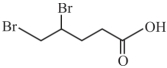
B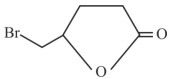
C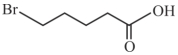
D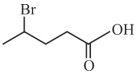
Solution
(B) The reaction involves the electrophilic addition of $Br_2$ to the alkene group of pent$-4-$enoic acid.
$1$. $Br_2$ reacts with the double bond to form a cyclic bromonium ion intermediate.
$2$. The base $NaHCO_3$ deprotonates the carboxylic acid group to form a carboxylate anion $(R-COO^-)$.
$3$. This carboxylate anion acts as an internal nucleophile and attacks the more substituted carbon of the bromonium ion,leading to an intramolecular cyclization (halolactonization).
$4$. This results in the formation of a five-membered lactone ring with a bromomethyl group attached,which is the major product $P$.
$1$. $Br_2$ reacts with the double bond to form a cyclic bromonium ion intermediate.
$2$. The base $NaHCO_3$ deprotonates the carboxylic acid group to form a carboxylate anion $(R-COO^-)$.
$3$. This carboxylate anion acts as an internal nucleophile and attacks the more substituted carbon of the bromonium ion,leading to an intramolecular cyclization (halolactonization).
$4$. This results in the formation of a five-membered lactone ring with a bromomethyl group attached,which is the major product $P$.
0 likesView Solution
207
ChemistryMediumMCQJEE Main · 2023
Given below are two statements: One is labelled as Assertion $A$ and the other is labelled as Reason $R$.
Assertion $A$ :- Sodium is about $30$ times as abundant as potassium in the oceans.
Reason $R$ :- Potassium is bigger in size than sodium.
In the light of the above statements,choose the correct answer from the options given below:
Assertion $A$ :- Sodium is about $30$ times as abundant as potassium in the oceans.
Reason $R$ :- Potassium is bigger in size than sodium.
In the light of the above statements,choose the correct answer from the options given below:
A
Both $A$ and $R$ are true and $R$ is the correct explanation of $A$.
B
$A$ is true but $R$ is false.
C
$A$ is false but $R$ is true.
D
Both $A$ and $R$ are true but $R$ is $NOT$ the correct explanation of $A$.
Solution
(D) Assertion $A$ is true because sodium is significantly more abundant in seawater compared to potassium.
Reason $R$ is also true because potassium $(K^+)$ has a larger ionic radius than sodium $(Na^+)$ due to the presence of an additional shell.
However,the reason for the higher abundance of sodium in the ocean is not simply the size of the potassium ion,but rather the geochemical behavior of these elements. Potassium is more readily incorporated into silicate minerals (like feldspars) and clay minerals due to its size and charge,making it less likely to remain in solution in seawater compared to sodium. Therefore,$R$ is not the correct explanation for $A$.
Reason $R$ is also true because potassium $(K^+)$ has a larger ionic radius than sodium $(Na^+)$ due to the presence of an additional shell.
However,the reason for the higher abundance of sodium in the ocean is not simply the size of the potassium ion,but rather the geochemical behavior of these elements. Potassium is more readily incorporated into silicate minerals (like feldspars) and clay minerals due to its size and charge,making it less likely to remain in solution in seawater compared to sodium. Therefore,$R$ is not the correct explanation for $A$.
0 likesView Solution
208
ChemistryMediumMCQJEE Main · 2023
Henry Moseley studied the characteristic $X$-ray spectra of elements. The graph which represents his observation correctly is: (Given $\nu =$ frequency of $X$-ray emitted; $Z =$ atomic number)
A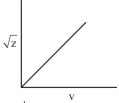
B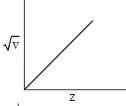
C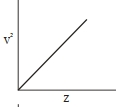
D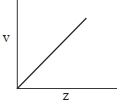
Solution
(B) Henry Moseley's law states that the square root of the frequency of the characteristic $X$-ray emitted by an element is directly proportional to its atomic number $(Z)$.
Mathematically,this is expressed as $\sqrt{\nu} = a(Z - b)$,where $a$ and $b$ are constants.
Therefore,a plot of $\sqrt{\nu}$ versus $Z$ yields a straight line.
Thus,the correct graph is $\sqrt{\nu}$ vs $Z$.
Mathematically,this is expressed as $\sqrt{\nu} = a(Z - b)$,where $a$ and $b$ are constants.
Therefore,a plot of $\sqrt{\nu}$ versus $Z$ yields a straight line.
Thus,the correct graph is $\sqrt{\nu}$ vs $Z$.
1 likesView Solution
209
ChemistryDifficultMCQJEE Main · 2023
For a good quality cement,the ratio of lime to the total of the oxides of $Si$,$Al$ and $Fe$ should be as close as to :
A
$4$
B
$2$
C
$3$
D
$1$
Solution
(B) The quality of Portland cement is determined by the ratio of lime $(CaO)$ to the total of the acidic oxides ($SiO_2$,$Al_2O_3$,and $Fe_2O_3$).
This ratio is given by the formula: $\frac{\% CaO}{\% SiO_2 + \% Al_2O_3 + \% Fe_2O_3} \approx 2.0$.
For a good quality cement,this ratio should be between $1.9$ and $2.1$,which is closest to $2$.
Therefore,option $(B)$ is correct.
This ratio is given by the formula: $\frac{\% CaO}{\% SiO_2 + \% Al_2O_3 + \% Fe_2O_3} \approx 2.0$.
For a good quality cement,this ratio should be between $1.9$ and $2.1$,which is closest to $2$.
Therefore,option $(B)$ is correct.
0 likesView Solution
210
ChemistryMediumMCQJEE Main · 2023
The solubility product of $BaSO_4$ is $1 \times 10^{-10}$ at $298 \ K$. The solubility of $BaSO_4$ in $0.1 \ M \ K_2SO_4 \ (aq)$ solution is $......... \times 10^{-9} \ g \ L^{-1}$ (nearest integer). Given: Molar mass of $BaSO_4$ is $233 \ g \ mol^{-1}$.
A
$233$
B
$232$
C
$231$
D
$234$
Solution
(A) $K_2SO_4 \rightarrow 2K^+ + SO_4^{2-}$
$0.1 \ M \quad \quad \quad 0.2 \ M \quad 0.1 \ M$
For $BaSO_4 \rightleftharpoons Ba^{2+} + SO_4^{2-}$:
$K_{sp} = [Ba^{2+}][SO_4^{2-}]$
$1 \times 10^{-10} = S \times (S + 0.1)$
Since $S$ is very small,$S + 0.1 \approx 0.1$.
$1 \times 10^{-10} = S \times 0.1$
$S = 10^{-9} \ mol \ L^{-1}$
Solubility in $g \ L^{-1} = S \times \text{Molar mass} = 10^{-9} \times 233 \ g \ L^{-1} = 233 \times 10^{-9} \ g \ L^{-1}$.
Thus,the value is $233$.
$0.1 \ M \quad \quad \quad 0.2 \ M \quad 0.1 \ M$
For $BaSO_4 \rightleftharpoons Ba^{2+} + SO_4^{2-}$:
$K_{sp} = [Ba^{2+}][SO_4^{2-}]$
$1 \times 10^{-10} = S \times (S + 0.1)$
Since $S$ is very small,$S + 0.1 \approx 0.1$.
$1 \times 10^{-10} = S \times 0.1$
$S = 10^{-9} \ mol \ L^{-1}$
Solubility in $g \ L^{-1} = S \times \text{Molar mass} = 10^{-9} \times 233 \ g \ L^{-1} = 233 \times 10^{-9} \ g \ L^{-1}$.
Thus,the value is $233$.
0 likesView Solution
211
ChemistryMediumMCQJEE Main · 2023
The number of atomic orbitals from the following having $5$ radial nodes is $.......$. $7s, 7p, 6s, 8p, 8d$
A
$3$
B
$2$
C
$1$
D
$4$
Solution
(A) The number of radial nodes is calculated using the formula: $\text{Radial nodes} = n - \ell - 1$.
For $7s$: $n=7, \ell=0 \Rightarrow 7 - 0 - 1 = 6$.
For $7p$: $n=7, \ell=1 \Rightarrow 7 - 1 - 1 = 5$.
For $6s$: $n=6, \ell=0 \Rightarrow 6 - 0 - 1 = 5$.
For $8p$: $n=8, \ell=1 \Rightarrow 8 - 1 - 1 = 6$.
For $8d$: $n=8, \ell=2 \Rightarrow 8 - 2 - 1 = 5$.
The orbitals with $5$ radial nodes are $7p, 6s,$ and $8d$.
Therefore,the total number of such orbitals is $3$.
For $7s$: $n=7, \ell=0 \Rightarrow 7 - 0 - 1 = 6$.
For $7p$: $n=7, \ell=1 \Rightarrow 7 - 1 - 1 = 5$.
For $6s$: $n=6, \ell=0 \Rightarrow 6 - 0 - 1 = 5$.
For $8p$: $n=8, \ell=1 \Rightarrow 8 - 1 - 1 = 6$.
For $8d$: $n=8, \ell=2 \Rightarrow 8 - 2 - 1 = 5$.
The orbitals with $5$ radial nodes are $7p, 6s,$ and $8d$.
Therefore,the total number of such orbitals is $3$.
1 likesView Solution
212
ChemistryMediumMCQJEE Main · 2023
For the complete combustion of ethene,$C_2H_{4(g)} + 3O_{2(g)} \rightarrow 2CO_{2(g)} + 2H_2O_{(l)}$,the amount of heat produced as measured in a bomb calorimeter is $1406 \ kJ \ mol^{-1}$ at $300 \ K$. The minimum value of $T \Delta S$ needed to reach equilibrium is $(-)....... \ kJ$. (Nearest integer) Given: $R = 8.3 \ J \ K^{-1} \ mol^{-1}$
A
$1411$
B
$1412$
C
$1413$
D
$1414$
Solution
(A) The combustion reaction is: $C_2H_{4(g)} + 3O_{2(g)} \rightarrow 2CO_{2(g)} + 2H_2O_{(l)}$.
Given that the heat measured in a bomb calorimeter is the change in internal energy,$\Delta U = -1406 \ kJ \ mol^{-1}$.
The change in the number of gaseous moles is $\Delta n_g = (2) - (1 + 3) = -2$.
The relation between enthalpy change and internal energy change is $\Delta H = \Delta U + \Delta n_g RT$.
Substituting the values: $\Delta H = -1406 \ kJ \ mol^{-1} + (-2 \times 8.3 \times 10^{-3} \ kJ \ K^{-1} \ mol^{-1} \times 300 \ K)$.
$\Delta H = -1406 - 4.98 = -1410.98 \ kJ \ mol^{-1}$.
At equilibrium,$\Delta G = 0$,which implies $\Delta H - T \Delta S = 0$,or $T \Delta S = \Delta H$.
Therefore,$T \Delta S = -1410.98 \ kJ \ mol^{-1} \approx -1411 \ kJ \ mol^{-1}$.
Given that the heat measured in a bomb calorimeter is the change in internal energy,$\Delta U = -1406 \ kJ \ mol^{-1}$.
The change in the number of gaseous moles is $\Delta n_g = (2) - (1 + 3) = -2$.
The relation between enthalpy change and internal energy change is $\Delta H = \Delta U + \Delta n_g RT$.
Substituting the values: $\Delta H = -1406 \ kJ \ mol^{-1} + (-2 \times 8.3 \times 10^{-3} \ kJ \ K^{-1} \ mol^{-1} \times 300 \ K)$.
$\Delta H = -1406 - 4.98 = -1410.98 \ kJ \ mol^{-1}$.
At equilibrium,$\Delta G = 0$,which implies $\Delta H - T \Delta S = 0$,or $T \Delta S = \Delta H$.
Therefore,$T \Delta S = -1410.98 \ kJ \ mol^{-1} \approx -1411 \ kJ \ mol^{-1}$.
0 likesView Solution
213
ChemistryMediumMCQJEE Main · 2023
The number of species from the following carrying a single lone pair on the central atom Xenon is $.....$: $XeF_5^{+}, XeO_3, XeO_2F_2, XeF_5^{-}, XeO_3F_2, XeOF_4, XeF_4$
A
$4$
B
$3$
C
$2$
D
$1$
Solution
(A) To determine the number of lone pairs on the central atom $Xe$,we use the formula: $\text{Lone pairs} = \frac{1}{2} (V - M - C + A)$,where $V$ is the number of valence electrons of $Xe$ $(8)$,$M$ is the number of monovalent atoms,$C$ is the cationic charge,and $A$ is the anionic charge.
$1$. $XeF_5^{+}$: $\frac{1}{2} (8 - 5 - 1 + 0) = 1$ lone pair.
$2$. $XeO_3$: $\frac{1}{2} (8 - 0 - 0 + 0) = 4$ electron pairs,$3$ are bonding,so $1$ lone pair.
$3$. $XeO_2F_2$: $\frac{1}{2} (8 - 2 - 0 + 0) = 3$ bonding pairs,$1$ lone pair.
$4$. $XeF_5^{-}$: $\frac{1}{2} (8 - 5 - 0 + 1) = 2$ lone pairs.
$5$. $XeO_3F_2$: $\frac{1}{2} (8 - 2 - 0 + 0) = 5$ bonding pairs,$0$ lone pairs.
$6$. $XeOF_4$: $\frac{1}{2} (8 - 4 - 0 + 0) = 5$ bonding pairs,$1$ lone pair.
$7$. $XeF_4$: $\frac{1}{2} (8 - 4 - 0 + 0) = 4$ bonding pairs,$2$ lone pairs.
The species with a single lone pair are $XeF_5^{+}$,$XeO_3$,$XeO_2F_2$,and $XeOF_4$. Thus,the total count is $4$.
$1$. $XeF_5^{+}$: $\frac{1}{2} (8 - 5 - 1 + 0) = 1$ lone pair.
$2$. $XeO_3$: $\frac{1}{2} (8 - 0 - 0 + 0) = 4$ electron pairs,$3$ are bonding,so $1$ lone pair.
$3$. $XeO_2F_2$: $\frac{1}{2} (8 - 2 - 0 + 0) = 3$ bonding pairs,$1$ lone pair.
$4$. $XeF_5^{-}$: $\frac{1}{2} (8 - 5 - 0 + 1) = 2$ lone pairs.
$5$. $XeO_3F_2$: $\frac{1}{2} (8 - 2 - 0 + 0) = 5$ bonding pairs,$0$ lone pairs.
$6$. $XeOF_4$: $\frac{1}{2} (8 - 4 - 0 + 0) = 5$ bonding pairs,$1$ lone pair.
$7$. $XeF_4$: $\frac{1}{2} (8 - 4 - 0 + 0) = 4$ bonding pairs,$2$ lone pairs.
The species with a single lone pair are $XeF_5^{+}$,$XeO_3$,$XeO_2F_2$,and $XeOF_4$. Thus,the total count is $4$.
0 likesView Solution
214
ChemistryMediumMCQJEE Main · 2023
The ratio of $\sigma$ and $\pi$ bonds present in pyrophosphoric acid $(H_4P_2O_7)$ is $......$.
A
$6$
B
$8$
C
$5$
D
$4$
Solution
(A) The chemical formula of pyrophosphoric acid is $H_4P_2O_7$.
Its structure consists of two $P$ atoms linked by an oxygen bridge $(P-O-P)$.
Each $P$ atom is double-bonded to an oxygen atom $(P=O)$ and bonded to two hydroxyl groups $(-OH)$.
Counting the bonds:
- Total $\sigma$ bonds: There are $4$ $P-OH$ bonds,$2$ $P=O$ bonds (each has $1$ $\sigma$),$1$ $P-O-P$ bridge (which has $2$ $\sigma$ bonds),and $4$ $O-H$ bonds. Total $\sigma$ bonds = $4 + 2 + 2 + 4 = 12$.
- Total $\pi$ bonds: There are $2$ $P=O$ bonds,each containing $1$ $\pi$ bond. Total $\pi$ bonds = $2$.
- The ratio of $\sigma$ to $\pi$ bonds = $\frac{12}{2} = 6$.
Therefore,the correct option is $A$.
Its structure consists of two $P$ atoms linked by an oxygen bridge $(P-O-P)$.
Each $P$ atom is double-bonded to an oxygen atom $(P=O)$ and bonded to two hydroxyl groups $(-OH)$.
Counting the bonds:
- Total $\sigma$ bonds: There are $4$ $P-OH$ bonds,$2$ $P=O$ bonds (each has $1$ $\sigma$),$1$ $P-O-P$ bridge (which has $2$ $\sigma$ bonds),and $4$ $O-H$ bonds. Total $\sigma$ bonds = $4 + 2 + 2 + 4 = 12$.
- Total $\pi$ bonds: There are $2$ $P=O$ bonds,each containing $1$ $\pi$ bond. Total $\pi$ bonds = $2$.
- The ratio of $\sigma$ to $\pi$ bonds = $\frac{12}{2} = 6$.
Therefore,the correct option is $A$.
0 likesView Solution
215
ChemistryMediumMCQJEE Main · 2023
Using column chromatography,a mixture of two compounds '$A$' and '$B$' was separated. '$A$' eluted first,this indicates '$B$' has
A
low $R_f$,weaker adsorption
B
high $R_f$,stronger adsorption
C
high $R_f$,weaker adsorption
D
low $R_f$,stronger adsorption
Solution
(D) In column chromatography,the compound that elutes first has a weaker interaction with the stationary phase and a higher $R_f$ value.
Conversely,the compound that elutes later has a stronger interaction (adsorption) with the stationary phase and a lower $R_f$ value.
Since '$A$' eluted first,'$B$' must have eluted later.
Therefore,'$B$' has a lower $R_f$ value and stronger adsorption to the stationary phase.
$R_f = \frac{\text{distance covered by substance}}{\text{distance covered by solvent}}$
Conversely,the compound that elutes later has a stronger interaction (adsorption) with the stationary phase and a lower $R_f$ value.
Since '$A$' eluted first,'$B$' must have eluted later.
Therefore,'$B$' has a lower $R_f$ value and stronger adsorption to the stationary phase.
$R_f = \frac{\text{distance covered by substance}}{\text{distance covered by solvent}}$
0 likesView Solution
216
ChemistryMediumMCQJEE Main · 2023
Lime reacts exothermally with water to give '$A$' which has low solubility in water. Aqueous solution of '$A$' is often used for the test of $CO_{2}$,a test in which insoluble $B$ is formed. If $B$ is further reacted with $CO_{2}$ then a soluble compound is formed. '$A$' is
A
Quick lime
B
Slaked lime
C
Lime water
D
White lime
Solution
(B) The reaction of quick lime $(CaO)$ with water is exothermic and produces slaked lime $(Ca(OH)_{2})$,which is '$A$'.
$CaO + H_{2}O \rightarrow Ca(OH)_{2}$
When $CO_{2}$ is passed through an aqueous solution of '$A$' $(Ca(OH)_{2})$,it forms a white precipitate of calcium carbonate $(CaCO_{3})$,which is '$B$'.
$Ca(OH)_{2} + CO_{2} \rightarrow CaCO_{3} + H_{2}O$
Further reaction of $CaCO_{3}$ with $CO_{2}$ and water leads to the formation of soluble calcium bicarbonate $(Ca(HCO_{3})_{2})$.
$CaCO_{3} + H_{2}O + CO_{2} \rightarrow Ca(HCO_{3})_{2}$
Therefore,'$A$' is slaked lime.
$CaO + H_{2}O \rightarrow Ca(OH)_{2}$
When $CO_{2}$ is passed through an aqueous solution of '$A$' $(Ca(OH)_{2})$,it forms a white precipitate of calcium carbonate $(CaCO_{3})$,which is '$B$'.
$Ca(OH)_{2} + CO_{2} \rightarrow CaCO_{3} + H_{2}O$
Further reaction of $CaCO_{3}$ with $CO_{2}$ and water leads to the formation of soluble calcium bicarbonate $(Ca(HCO_{3})_{2})$.
$CaCO_{3} + H_{2}O + CO_{2} \rightarrow Ca(HCO_{3})_{2}$
Therefore,'$A$' is slaked lime.
0 likesView Solution
217
ChemistryMediumMCQJEE Main · 2023
The pair from the following pairs having both compounds with net non-zero dipole moment is
A
Benzene,anisidine
B
$1,4-$Dichlorobenzene,$1,3-$Dichlorobenzene
C
$CH_2Cl_2, CHCl_3$
D
cis-butene,trans-butene
Solution
(C) molecule has a non-zero dipole moment if it is polar.
$(1)$ Benzene is non-polar $(\mu = 0)$,while anisidine is polar $(\mu \neq 0)$.
$(2)$ $1,4-$Dichlorobenzene is non-polar due to symmetry $(\mu = 0)$,while $1,3-$Dichlorobenzene is polar $(\mu \neq 0)$.
$(3)$ $CH_2Cl_2$ has a non-zero dipole moment $(\mu \neq 0)$ because the bond dipoles do not cancel out. Similarly,$CHCl_3$ has a non-zero dipole moment $(\mu \neq 0)$. Thus,both compounds in this pair are polar.
$(4)$ cis-butene is polar $(\mu \neq 0)$,while trans-butene is non-polar $(\mu = 0)$.
Therefore,the correct pair is $CH_2Cl_2, CHCl_3$.
$(1)$ Benzene is non-polar $(\mu = 0)$,while anisidine is polar $(\mu \neq 0)$.
$(2)$ $1,4-$Dichlorobenzene is non-polar due to symmetry $(\mu = 0)$,while $1,3-$Dichlorobenzene is polar $(\mu \neq 0)$.
$(3)$ $CH_2Cl_2$ has a non-zero dipole moment $(\mu \neq 0)$ because the bond dipoles do not cancel out. Similarly,$CHCl_3$ has a non-zero dipole moment $(\mu \neq 0)$. Thus,both compounds in this pair are polar.
$(4)$ cis-butene is polar $(\mu \neq 0)$,while trans-butene is non-polar $(\mu = 0)$.
Therefore,the correct pair is $CH_2Cl_2, CHCl_3$.
0 likesView Solution
218
ChemistryMediumMCQJEE Main · 2023
Match List-$I$ with List-$II$
Choose the correct answer from the options given below:
| List-$I$ Industry | List-$II$ Waste Generated |
| $A$. Steel plants | $I$. Gypsum |
| $B$. Thermal power plants | $II$. Fly ash |
| $C$. Fertilizer industries | $III$. Slag |
| $D$. Paper mills | $IV$. Bio-degradable Wastes |
Choose the correct answer from the options given below:
A
$A-III, B-II, C-I, D-IV$
B
$A-II, B-III, C-IV, D-I$
C
$A-IV, B-I, C-II, D-III$
D
$A-III, B-IV, C-I, D-II$
Solution
(A) The correct matches are as follows:
$A$. Steel plants produce slag as a byproduct $(A-III)$.
$B$. Thermal power plants generate fly ash $(B-II)$.
$C$. Fertilizer industries produce gypsum as a waste product $(C-I)$.
$D$. Paper mills produce bio-degradable wastes $(D-IV)$.
Therefore,the correct sequence is $A-III, B-II, C-I, D-IV$.
$A$. Steel plants produce slag as a byproduct $(A-III)$.
$B$. Thermal power plants generate fly ash $(B-II)$.
$C$. Fertilizer industries produce gypsum as a waste product $(C-I)$.
$D$. Paper mills produce bio-degradable wastes $(D-IV)$.
Therefore,the correct sequence is $A-III, B-II, C-I, D-IV$.
0 likesView Solution
219
ChemistryMediumMCQJEE Main · 2023
Given below are two reactions involved in the commercial production of dihydrogen $(H_2)$. The two reactions are carried out at temperatures $T_1$ and $T_2$ respectively:
$C_{(s)} + H_2O_{(g)} \xrightarrow{T_1} CO_{(g)} + H_{2(g)}$
$CO_{(g)} + H_2O_{(g)} \xrightarrow{T_2} CO_{2(g)} + H_{2(g)}$
The temperatures $T_1$ and $T_2$ are correctly related as:
$C_{(s)} + H_2O_{(g)} \xrightarrow{T_1} CO_{(g)} + H_{2(g)}$
$CO_{(g)} + H_2O_{(g)} \xrightarrow{T_2} CO_{2(g)} + H_{2(g)}$
The temperatures $T_1$ and $T_2$ are correctly related as:
A
$T_1 > T_2$
B
$T_1 = T_2$
C
$T_1 = 100 \ K, T_2 = 1270 \ K$
D
$T_1 < T_2$
Solution
(A) The first reaction is the water-gas shift reaction (or coal gasification),which requires a high temperature of approximately $1270 \ K$ to proceed.
The second reaction is the water-gas shift reaction,which is carried out at a lower temperature of approximately $673 \ K$ in the presence of an iron chromate catalyst to increase the yield of $H_2$.
Thus,$T_1 \approx 1270 \ K$ and $T_2 \approx 673 \ K$.
Therefore,$T_1 > T_2$.
The second reaction is the water-gas shift reaction,which is carried out at a lower temperature of approximately $673 \ K$ in the presence of an iron chromate catalyst to increase the yield of $H_2$.
Thus,$T_1 \approx 1270 \ K$ and $T_2 \approx 673 \ K$.
Therefore,$T_1 > T_2$.
0 likesView Solution
220
ChemistryMediumMCQJEE Main · 2023
Given:
$(A) \ 2 \ CO_{(g)} + O_{2(g)} \rightarrow 2 \ CO_{2(g)} \quad \Delta H_1^\theta = -x \ kJ \ mol^{-1}$
$(B) \ C \ (\text{graphite}) + O_{2(g)} \rightarrow CO_{2(g)} \quad \Delta H_2^\theta = -y \ kJ \ mol^{-1}$
The $\Delta H^\theta$ for the reaction $C \ (\text{graphite}) + \frac{1}{2} O_{2(g)} \rightarrow CO_{(g)}$ is:
$(A) \ 2 \ CO_{(g)} + O_{2(g)} \rightarrow 2 \ CO_{2(g)} \quad \Delta H_1^\theta = -x \ kJ \ mol^{-1}$
$(B) \ C \ (\text{graphite}) + O_{2(g)} \rightarrow CO_{2(g)} \quad \Delta H_2^\theta = -y \ kJ \ mol^{-1}$
The $\Delta H^\theta$ for the reaction $C \ (\text{graphite}) + \frac{1}{2} O_{2(g)} \rightarrow CO_{(g)}$ is:
A
$\frac{x-2y}{2}$
B
$\frac{x+2y}{2}$
C
$\frac{2x-y}{2}$
D
$2y-x$
Solution
(A) Target equation:
$C \ (\text{graphite}) + \frac{1}{2} O_{2(g)} \rightarrow CO_{(g)} \quad \Delta H = ? \dots (i)$
From given equations:
$(ii) \ C \ (\text{graphite}) + O_{2(g)} \rightarrow CO_{2(g)} \quad \Delta H_2 = -y \ kJ \ mol^{-1}$
$(iii) \ CO_{2(g)} \rightarrow CO_{(g)} + \frac{1}{2} O_{2(g)} \quad \Delta H_3 = \frac{x}{2} \ kJ \ mol^{-1}$ (Reverse of equation $(A)$ divided by $2$)
Adding equations $(ii)$ and $(iii)$:
$C \ (\text{graphite}) + O_{2(g)} + CO_{2(g)} \rightarrow CO_{2(g)} + CO_{(g)} + \frac{1}{2} O_{2(g)}$
$C \ (\text{graphite}) + \frac{1}{2} O_{2(g)} \rightarrow CO_{(g)}$
$\Delta H = \Delta H_2 + \Delta H_3 = -y + \frac{x}{2} = \frac{x-2y}{2} \ kJ \ mol^{-1}$
$C \ (\text{graphite}) + \frac{1}{2} O_{2(g)} \rightarrow CO_{(g)} \quad \Delta H = ? \dots (i)$
From given equations:
$(ii) \ C \ (\text{graphite}) + O_{2(g)} \rightarrow CO_{2(g)} \quad \Delta H_2 = -y \ kJ \ mol^{-1}$
$(iii) \ CO_{2(g)} \rightarrow CO_{(g)} + \frac{1}{2} O_{2(g)} \quad \Delta H_3 = \frac{x}{2} \ kJ \ mol^{-1}$ (Reverse of equation $(A)$ divided by $2$)
Adding equations $(ii)$ and $(iii)$:
$C \ (\text{graphite}) + O_{2(g)} + CO_{2(g)} \rightarrow CO_{2(g)} + CO_{(g)} + \frac{1}{2} O_{2(g)}$
$C \ (\text{graphite}) + \frac{1}{2} O_{2(g)} \rightarrow CO_{(g)}$
$\Delta H = \Delta H_2 + \Delta H_3 = -y + \frac{x}{2} = \frac{x-2y}{2} \ kJ \ mol^{-1}$
0 likesView Solution
221
ChemistryMediumMCQJEE Main · 2023
The compound which does not exist is
A
$NaO_2$
B
$(NH_4)_2BeF_4$
C
$BeH_2$
D
$PbEt_4$
Solution
(A) Sodium forms a stable superoxide $NaO_2$ when heated in excess of oxygen.
$(NH_4)_2BeF_4$ is a known complex compound.
$BeH_2$ is a polymeric hydride.
$PbEt_4$ (Tetraethyllead) is a well-known organometallic compound.
However,the question as stated is technically flawed because all listed compounds exist. If we consider the stability of alkali metal superoxides,$NaO_2$ is stable,but $LiO_2$ is not. Given the options,there might be a typo in the question source. Assuming the question intended to ask for a non-existent compound,none of these fit perfectly,but $NaO_2$ is often discussed in the context of stability compared to other alkali superoxides.
$(NH_4)_2BeF_4$ is a known complex compound.
$BeH_2$ is a polymeric hydride.
$PbEt_4$ (Tetraethyllead) is a well-known organometallic compound.
However,the question as stated is technically flawed because all listed compounds exist. If we consider the stability of alkali metal superoxides,$NaO_2$ is stable,but $LiO_2$ is not. Given the options,there might be a typo in the question source. Assuming the question intended to ask for a non-existent compound,none of these fit perfectly,but $NaO_2$ is often discussed in the context of stability compared to other alkali superoxides.
0 likesView Solution
222
ChemistryDifficultMCQJEE Main · 2023
The number of molecules and moles in $2.8375 \ L$ of $O_2$ at $STP$ are respectively
A
$7.527 \times 10^{22}$ and $0.250 \ mol$
B
$1.505 \times 10^{23}$ and $0.250 \ mol$
C
$7.527 \times 10^{23}$ and $0.125 \ mol$
D
$7.527 \times 10^{22}$ and $0.125 \ mol$
Solution
(D) At $STP$,the molar volume of an ideal gas is $22.7 \ L \ mol^{-1}$.
Number of moles of $O_2 = \frac{\text{Volume at } STP}{22.7 \ L \ mol^{-1}} = \frac{2.8375 \ L}{22.7 \ L \ mol^{-1}} = 0.125 \ mol$.
Number of molecules $= \text{Number of moles} \times N_A = 0.125 \times 6.022 \times 10^{23} \ mol^{-1} = 7.5275 \times 10^{22}$ molecules.
Therefore,the values are $7.527 \times 10^{22}$ molecules and $0.125 \ mol$.
Number of moles of $O_2 = \frac{\text{Volume at } STP}{22.7 \ L \ mol^{-1}} = \frac{2.8375 \ L}{22.7 \ L \ mol^{-1}} = 0.125 \ mol$.
Number of molecules $= \text{Number of moles} \times N_A = 0.125 \times 6.022 \times 10^{23} \ mol^{-1} = 7.5275 \times 10^{22}$ molecules.
Therefore,the values are $7.527 \times 10^{22}$ molecules and $0.125 \ mol$.
0 likesView Solution
223
ChemistryMediumMCQJEE Main · 2023
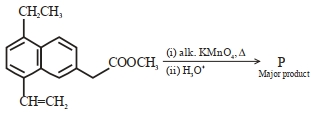
The major product '$P$' formed in the given reaction is
A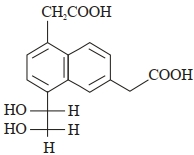
B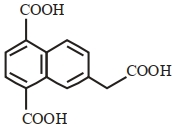
C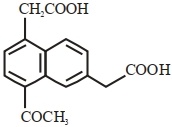
D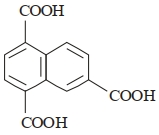
Solution
(C) The reaction involves the oxidation of side chains on a naphthalene ring using alkaline $KMnO_4$ followed by acidic workup.
$1$. The ethyl group $(-CH_2CH_3)$ at the benzylic position has $\alpha$-hydrogens,so it is oxidized to a carboxylic acid group $(-COOH)$.
$2$. The vinyl group $(-CH=CH_2)$ is also oxidized to a carboxylic acid group $(-COOH)$ by strong oxidizing agents like alkaline $KMnO_4$.
$3$. The ester group $(-COOCH_3)$ is hydrolyzed under alkaline conditions to a carboxylate salt,which upon acidic workup $(H_3O^+)$ becomes a carboxylic acid group $(-COOH)$.
$4$. Therefore,all three side chains are converted into carboxylic acid groups,resulting in the product shown in option $C$.
$1$. The ethyl group $(-CH_2CH_3)$ at the benzylic position has $\alpha$-hydrogens,so it is oxidized to a carboxylic acid group $(-COOH)$.
$2$. The vinyl group $(-CH=CH_2)$ is also oxidized to a carboxylic acid group $(-COOH)$ by strong oxidizing agents like alkaline $KMnO_4$.
$3$. The ester group $(-COOCH_3)$ is hydrolyzed under alkaline conditions to a carboxylate salt,which upon acidic workup $(H_3O^+)$ becomes a carboxylic acid group $(-COOH)$.
$4$. Therefore,all three side chains are converted into carboxylic acid groups,resulting in the product shown in option $C$.
0 likesView Solution
224
ChemistryMediumMCQJEE Main · 2023
The number of correct statement$(s)$ involving equilibria in physical processes from the following is:
$A$. Equilibrium is possible only in a closed system at a given temperature.
$B$. Both the opposing processes occur at the same rate.
$C$. When equilibrium is attained at a given temperature,the value of all its parameters becomes constant.
$D$. For dissolution of solids in liquids,the solubility is constant at a given temperature.
$A$. Equilibrium is possible only in a closed system at a given temperature.
$B$. Both the opposing processes occur at the same rate.
$C$. When equilibrium is attained at a given temperature,the value of all its parameters becomes constant.
$D$. For dissolution of solids in liquids,the solubility is constant at a given temperature.
A
$2$
B
$3$
C
$4$
D
$1$
Solution
(C) . Equilibrium in physical processes requires a closed system to prevent the escape of matter,so it is correct.
$B$. At equilibrium,the rate of the forward process equals the rate of the backward process $(r_f = r_b)$,so it is correct.
$C$. At equilibrium,measurable properties like pressure,concentration,or density become constant at a given temperature,so it is correct.
$D$. For a saturated solution of a solid in a liquid,the concentration (solubility) remains constant at a fixed temperature,so it is correct.
Therefore,all $4$ statements are correct.
$B$. At equilibrium,the rate of the forward process equals the rate of the backward process $(r_f = r_b)$,so it is correct.
$C$. At equilibrium,measurable properties like pressure,concentration,or density become constant at a given temperature,so it is correct.
$D$. For a saturated solution of a solid in a liquid,the concentration (solubility) remains constant at a fixed temperature,so it is correct.
Therefore,all $4$ statements are correct.
0 likesView Solution
225
ChemistryMediumMCQJEE Main · 2023
The number of bent-shaped molecule/s from the following is $.....$. $N_3^{-}$,$NO_2^{-}$,$I_3^{-}$,$O_3$,$SO_2$
A
$2$
B
$3$
C
$1$
D
$5$
Solution
(B) To determine the shape,we look at the hybridization and lone pairs on the central atom:
$N_3^{-}$: $sp$ hybridized,linear geometry.
$NO_2^{-}$: $sp^2$ hybridized with one lone pair,bent shape.
$I_3^{-}$: $sp^3d$ hybridized with three lone pairs on the central $I$ atom,linear geometry.
$O_3$: $sp^2$ hybridized with one lone pair,bent shape.
$SO_2$: $sp^2$ hybridized with one lone pair,bent shape.
Thus,the bent-shaped molecules are $NO_2^{-}$,$O_3$,and $SO_2$.
The total number of bent-shaped molecules is $3$.
$N_3^{-}$: $sp$ hybridized,linear geometry.
$NO_2^{-}$: $sp^2$ hybridized with one lone pair,bent shape.
$I_3^{-}$: $sp^3d$ hybridized with three lone pairs on the central $I$ atom,linear geometry.
$O_3$: $sp^2$ hybridized with one lone pair,bent shape.
$SO_2$: $sp^2$ hybridized with one lone pair,bent shape.
Thus,the bent-shaped molecules are $NO_2^{-}$,$O_3$,and $SO_2$.
The total number of bent-shaped molecules is $3$.
0 likesView Solution
226
ChemistryDifficultMCQJEE Main · 2023
The number of incorrect statement/s about the black body from the following is $........$.
$(A)$ Emit or absorb energy in the form of electromagnetic radiation
$(B)$ Frequency distribution of the emitted radiation depends on temperature
$(C)$ At a given temperature,intensity vs frequency curve passes through a maximum value
$(D)$ The maximum of the intensity vs frequency curve is at a higher frequency at higher temperature compared to that at lower temperature
$(A)$ Emit or absorb energy in the form of electromagnetic radiation
$(B)$ Frequency distribution of the emitted radiation depends on temperature
$(C)$ At a given temperature,intensity vs frequency curve passes through a maximum value
$(D)$ The maximum of the intensity vs frequency curve is at a higher frequency at higher temperature compared to that at lower temperature
A
$1$
B
$0$
C
$2$
D
$3$
Solution
(B) black body is an ideal body that can emit and absorb all frequencies of electromagnetic radiation. Thus,statement $(A)$ is correct.
The frequency distribution of the emitted radiation from a black body depends solely on its temperature. Thus,statement $(B)$ is correct.
For a black body at a given temperature,the intensity of emitted radiation varies with frequency,showing a characteristic curve that passes through a maximum value. Thus,statement $(C)$ is correct.
According to Wien's displacement law,as the temperature of a black body increases,the peak of the intensity distribution curve shifts towards higher frequencies (or shorter wavelengths). Thus,statement $(D)$ is correct.
Since all statements $(A)$,$(B)$,$(C)$,and $(D)$ are correct,the number of incorrect statements is $0$.
The frequency distribution of the emitted radiation from a black body depends solely on its temperature. Thus,statement $(B)$ is correct.
For a black body at a given temperature,the intensity of emitted radiation varies with frequency,showing a characteristic curve that passes through a maximum value. Thus,statement $(C)$ is correct.
According to Wien's displacement law,as the temperature of a black body increases,the peak of the intensity distribution curve shifts towards higher frequencies (or shorter wavelengths). Thus,statement $(D)$ is correct.
Since all statements $(A)$,$(B)$,$(C)$,and $(D)$ are correct,the number of incorrect statements is $0$.
0 likesView Solution
227
ChemistryDifficultMCQJEE Main · 2023
In the following reactions,the total number of oxygen atoms in $X$ and $Y$ is $........$.
$Na_2O + H_2O \rightarrow 2 X$
$Cl_2O_7 + H_2O \rightarrow 2 Y$
$Na_2O + H_2O \rightarrow 2 X$
$Cl_2O_7 + H_2O \rightarrow 2 Y$
A
$4$
B
$5$
C
$3$
D
$2$
Solution
(B) The balanced chemical equations are:
$Na_2O + H_2O \rightarrow 2 NaOH$
Here,$X = NaOH$. The number of oxygen atoms in one molecule of $X$ is $1$.
$Cl_2O_7 + H_2O \rightarrow 2 HClO_4$
Here,$Y = HClO_4$. The number of oxygen atoms in one molecule of $Y$ is $4$.
The total number of oxygen atoms in $X$ and $Y$ is $1 + 4 = 5$.
$Na_2O + H_2O \rightarrow 2 NaOH$
Here,$X = NaOH$. The number of oxygen atoms in one molecule of $X$ is $1$.
$Cl_2O_7 + H_2O \rightarrow 2 HClO_4$
Here,$Y = HClO_4$. The number of oxygen atoms in one molecule of $Y$ is $4$.
The total number of oxygen atoms in $X$ and $Y$ is $1 + 4 = 5$.
0 likesView Solution
228
ChemistryMediumMCQJEE Main · 2023
At constant temperature,a gas is at a pressure of $940.3 \, mm \, Hg$. The pressure at which its volume decreases by $40 \%$ is $......... \, mm \, Hg$. (Nearest Integer)
A
$1566$
B
$1567$
C
$1568$
D
$1569$
Solution
(B) According to Boyle's Law,at constant temperature,$P_1 V_1 = P_2 V_2$.
Let the initial volume $V_1 = 100 \, units$.
Since the volume decreases by $40 \%$,the final volume $V_2 = 100 - 40 = 60 \, units$.
Given $P_1 = 940.3 \, mm \, Hg$.
Substituting the values: $940.3 \times 100 = P_2 \times 60$.
$P_2 = \frac{94030}{60} = 1567.16 \, mm \, Hg$.
The nearest integer is $1567 \, mm \, Hg$.
Let the initial volume $V_1 = 100 \, units$.
Since the volume decreases by $40 \%$,the final volume $V_2 = 100 - 40 = 60 \, units$.
Given $P_1 = 940.3 \, mm \, Hg$.
Substituting the values: $940.3 \times 100 = P_2 \times 60$.
$P_2 = \frac{94030}{60} = 1567.16 \, mm \, Hg$.
The nearest integer is $1567 \, mm \, Hg$.
0 likesView Solution
229
ChemistryMediumMCQJEE Main · 2023
The sum of lone pairs present on the central atom of the interhalogen $IF_5$ and $IF_7$ is $.........$.
A
$2$
B
$1$
C
$3$
D
$4$
Solution
(B) In $IF_5$,the central iodine atom has $7$ valence electrons. It forms $5$ single bonds with fluorine atoms,leaving $2$ electrons,which form $1$ lone pair.
In $IF_7$,the central iodine atom has $7$ valence electrons. It forms $7$ single bonds with fluorine atoms,leaving $0$ electrons,which means $0$ lone pairs.
The sum of lone pairs is $1 + 0 = 1$.
In $IF_7$,the central iodine atom has $7$ valence electrons. It forms $7$ single bonds with fluorine atoms,leaving $0$ electrons,which means $0$ lone pairs.
The sum of lone pairs is $1 + 0 = 1$.
0 likesView Solution
230
ChemistryMediumMCQJEE Main · 2023
Given below are two statements: one is labelled as Assertion $A$ and the other is labelled as Reason $R$.
Assertion $A:$ The energy required to form $Mg^{2+}$ from $Mg$ is much higher than that required to produce $Mg^{+}$.
Reason $R:$ $Mg^{2+}$ is a small ion and carries more charge than $Mg^{+}$.
In the light of the above statements,choose the correct answer from the options given below:
Assertion $A:$ The energy required to form $Mg^{2+}$ from $Mg$ is much higher than that required to produce $Mg^{+}$.
Reason $R:$ $Mg^{2+}$ is a small ion and carries more charge than $Mg^{+}$.
In the light of the above statements,choose the correct answer from the options given below:
A
Both $A$ and $R$ are true but $R$ is $NOT$ the correct explanation of $A$.
B
$A$ is true but $R$ is false.
C
$A$ is false but $R$ is true.
D
Both $A$ and $R$ are true and $R$ is the correct explanation of $A$.
Solution
(D) The first ionization energy $(IE_1)$ is the energy required to remove the first electron from a neutral atom $(Mg \rightarrow Mg^+ + e^-)$.
The second ionization energy $(IE_2)$ is the energy required to remove the second electron from the unipositive ion $(Mg^+ \rightarrow Mg^{2+} + e^-)$.
Since $Mg^{2+}$ is a smaller ion with a higher positive charge compared to $Mg^+$,the electrostatic attraction between the nucleus and the remaining electrons is much stronger,making it significantly harder to remove the second electron.
Therefore,$IE_2 > IE_1$,which means the energy required to form $Mg^{2+}$ from $Mg$ (total energy = $IE_1 + IE_2$) is higher than that required to produce $Mg^+$ $(IE_1)$.
Both $A$ and $R$ are true and $R$ is the correct explanation of $A$.
The second ionization energy $(IE_2)$ is the energy required to remove the second electron from the unipositive ion $(Mg^+ \rightarrow Mg^{2+} + e^-)$.
Since $Mg^{2+}$ is a smaller ion with a higher positive charge compared to $Mg^+$,the electrostatic attraction between the nucleus and the remaining electrons is much stronger,making it significantly harder to remove the second electron.
Therefore,$IE_2 > IE_1$,which means the energy required to form $Mg^{2+}$ from $Mg$ (total energy = $IE_1 + IE_2$) is higher than that required to produce $Mg^+$ $(IE_1)$.
Both $A$ and $R$ are true and $R$ is the correct explanation of $A$.
0 likesView Solution
231
ChemistryDifficultMCQJEE Main · 2023
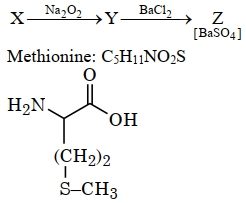
In a Carius tube,an organic compound '$X$' is treated with sodium peroxide to form a mineral acid '$Y$'. The solution of $BaCl_2$ is added to '$Y$' to form a precipitate '$Z$'. '$Z$' is used for the quantitative estimation of an extra element. '$X$' could be:
A
Cytosine
B
Chloroxylenol
C
$A$ nucleotide
D
Methionine
Solution
(D) The Carius method is used for the quantitative estimation of halogens,sulfur,and phosphorus in organic compounds.
In the given process,the formation of a precipitate '$Z$' with $BaCl_2$ indicates the presence of sulfate ions $(SO_4^{2-})$,which means '$Z$' is $BaSO_4$.
This confirms that the organic compound '$X$' contains sulfur.
Among the given options,Methionine $(C_5H_{11}NO_2S)$ is an amino acid that contains a sulfur atom.
Therefore,'$X$' is Methionine.
In the given process,the formation of a precipitate '$Z$' with $BaCl_2$ indicates the presence of sulfate ions $(SO_4^{2-})$,which means '$Z$' is $BaSO_4$.
This confirms that the organic compound '$X$' contains sulfur.
Among the given options,Methionine $(C_5H_{11}NO_2S)$ is an amino acid that contains a sulfur atom.
Therefore,'$X$' is Methionine.
0 likesView Solution
232
ChemistryDifficultMCQJEE Main · 2023
Given below are two statements: one is labelled as Assertion $A$ and the other is labelled as Reason $R$.
Assertion $A:$ $3.1500 \ g$ of hydrated oxalic acid dissolved in water to make $250.0 \ mL$ solution will result in $0.1 \ M$ oxalic acid solution.
Reason $R:$ Molar mass of hydrated oxalic acid is $126 \ g \ mol^{-1}$.
In the light of the above statements,choose the correct answer from the options given below:
Assertion $A:$ $3.1500 \ g$ of hydrated oxalic acid dissolved in water to make $250.0 \ mL$ solution will result in $0.1 \ M$ oxalic acid solution.
Reason $R:$ Molar mass of hydrated oxalic acid is $126 \ g \ mol^{-1}$.
In the light of the above statements,choose the correct answer from the options given below:
A
Both $A$ and $R$ are true but $R$ is $NOT$ the correct explanation of $A$.
B
$A$ is false but $R$ is true.
C
$A$ is true but $R$ is false.
D
Both $A$ and $R$ are true and $R$ is the correct explanation of $A$.
Solution
(D) The molar mass of hydrated oxalic acid $(H_2C_2O_4 \cdot 2H_2O)$ is calculated as: $(2 \times 1) + (2 \times 12) + (4 \times 16) + 2 \times (2 \times 1 + 16) = 2 + 24 + 64 + 36 = 126 \ g \ mol^{-1}$. Thus,Reason $R$ is true.
To calculate the molarity $(M)$ of the solution:
$M = \frac{\text{mass of solute (g)}}{\text{molar mass (g mol}^{-1})} \times \frac{1000}{\text{volume of solution (mL)}}$
$M = \frac{3.1500}{126} \times \frac{1000}{250.0}$
$M = 0.025 \times 4 = 0.1 \ M$.
Since the calculated molarity is $0.1 \ M$,Assertion $A$ is true.
The molar mass is used to calculate the number of moles,which is essential for determining the molarity. Therefore,$R$ is the correct explanation of $A$.
To calculate the molarity $(M)$ of the solution:
$M = \frac{\text{mass of solute (g)}}{\text{molar mass (g mol}^{-1})} \times \frac{1000}{\text{volume of solution (mL)}}$
$M = \frac{3.1500}{126} \times \frac{1000}{250.0}$
$M = 0.025 \times 4 = 0.1 \ M$.
Since the calculated molarity is $0.1 \ M$,Assertion $A$ is true.
The molar mass is used to calculate the number of moles,which is essential for determining the molarity. Therefore,$R$ is the correct explanation of $A$.
0 likesView Solution
233
ChemistryMediumMCQJEE Main · 2023
The decreasing order of hydride affinity for the following carbocations is:
$A: CH_2=CH-C^+(CH_3)_2$
$B: (C_6H_5)_3C^+$
$C: (CH_3)_3C^+$
$D: (Cyclopropyl)_3C^+$
Choose the correct answer from the options given below:
$A: CH_2=CH-C^+(CH_3)_2$
$B: (C_6H_5)_3C^+$
$C: (CH_3)_3C^+$
$D: (Cyclopropyl)_3C^+$
Choose the correct answer from the options given below:
A
$A, C, B, D$
B
$C, A, B, D$
C
$C, A, D, B$
D
$A, C, D, B$
Solution
(C) Hydride affinity is inversely proportional to the stability of the carbocation.
Stability order of the given carbocations:
$B$ (Triphenylmethyl cation) is the most stable due to extensive resonance with three phenyl rings.
$D$ (Tricyclopropylmethyl cation) is highly stable due to cyclopropyl conjugation (bent bonds).
$A$ (Allylic carbocation) is stabilized by resonance with the double bond.
$C$ ($tert$-Butyl cation) is stabilized only by inductive effect and hyperconjugation.
Stability order: $B > D > A > C$
Since hydride affinity is inversely proportional to stability,the decreasing order of hydride affinity is: $C > A > D > B$.
Stability order of the given carbocations:
$B$ (Triphenylmethyl cation) is the most stable due to extensive resonance with three phenyl rings.
$D$ (Tricyclopropylmethyl cation) is highly stable due to cyclopropyl conjugation (bent bonds).
$A$ (Allylic carbocation) is stabilized by resonance with the double bond.
$C$ ($tert$-Butyl cation) is stabilized only by inductive effect and hyperconjugation.
Stability order: $B > D > A > C$
Since hydride affinity is inversely proportional to stability,the decreasing order of hydride affinity is: $C > A > D > B$.
0 likesView Solution
234
ChemistryMediumMCQJEE Main · 2023
Number of water molecules in washing soda and soda ash respectively are:
A
$10$ and $1$
B
$1$ and $10$
C
$1$ and $0$
D
$10$ and $0$
Solution
(D) Washing soda is the decahydrate form of sodium carbonate,represented as $Na_2CO_3 \cdot 10H_2O$,which contains $10$ molecules of water of crystallization.
Soda ash is the anhydrous form of sodium carbonate,represented as $Na_2CO_3$,which contains $0$ molecules of water of crystallization.
Therefore,the number of water molecules in washing soda and soda ash are $10$ and $0$ respectively.
Soda ash is the anhydrous form of sodium carbonate,represented as $Na_2CO_3$,which contains $0$ molecules of water of crystallization.
Therefore,the number of water molecules in washing soda and soda ash are $10$ and $0$ respectively.
0 likesView Solution
235
ChemistryMediumMCQJEE Main · 2023
The delicate balance of $CO_2$ and $O_2$ is $NOT$ disturbed by:
A
Burning of Coal
B
Deforestation
C
Burning of petroleum
D
Respiration
Solution
(D) Respiration is a natural biological process that is part of the carbon cycle,where organisms consume $O_2$ and release $CO_2$ in a balanced manner.
Conversely,the burning of coal,deforestation,and the burning of petroleum are anthropogenic activities that significantly increase $CO_2$ levels and disrupt the natural atmospheric balance.
Conversely,the burning of coal,deforestation,and the burning of petroleum are anthropogenic activities that significantly increase $CO_2$ levels and disrupt the natural atmospheric balance.
0 likesView Solution
236
ChemistryMediumMCQJEE Main · 2023
Given below are two statements: one is labelled as Assertion $A$ and the other is labelled as Reason $R$.
Assertion $A$: Physical properties of isotopes of hydrogen are different.
Reason $R$: Mass difference between isotopes of hydrogen is very large.
In the light of the above statements,choose the correct answer from the options given below:
Assertion $A$: Physical properties of isotopes of hydrogen are different.
Reason $R$: Mass difference between isotopes of hydrogen is very large.
In the light of the above statements,choose the correct answer from the options given below:
A
$A$ is false but $R$ is true.
B
Both $A$ and $R$ are true and $R$ is $NOT$ the correct explanation of $A$.
C
$A$ is true but $R$ is false.
D
Both $A$ and $R$ are true and $R$ is the correct explanation of $A$.
Solution
(D) The isotopes of hydrogen are protium $(^1H)$,deuterium $(^2H)$,and tritium $(^3H)$.
Assertion $A$ is true because the physical properties (such as boiling point,melting point,density) of these isotopes differ significantly due to the large relative mass difference between them.
Reason $R$ is also true because the mass of deuterium is approximately double that of protium,and tritium is triple,which is a very large percentage difference compared to isotopes of other elements.
Therefore,the mass difference is the direct cause of the difference in physical properties,making $R$ the correct explanation of $A$.
Assertion $A$ is true because the physical properties (such as boiling point,melting point,density) of these isotopes differ significantly due to the large relative mass difference between them.
Reason $R$ is also true because the mass of deuterium is approximately double that of protium,and tritium is triple,which is a very large percentage difference compared to isotopes of other elements.
Therefore,the mass difference is the direct cause of the difference in physical properties,making $R$ the correct explanation of $A$.
0 likesView Solution
237
ChemistryDifficultMCQJEE Main · 2023
Match List-$I$ with List-$II$.
Choose the correct answer from the options given below:
| List-$I$ | List-$II$ |
| $A$. $16 \ g \ CH_{4(g)}$ | $I$. Weighs $28 \ g$ |
| $B$. $1 \ g \ H_{2(g)}$ | $II$. $60.2 \times 10^{23}$ electrons |
| $C$. $1 \ mole \ N_{2(g)}$ | $III$. Weighs $32 \ g$ |
| $D$. $0.5 \ mol \ SO_{2(g)}$ | $IV$. Occupies $11.2 \ L$ volume at $STP$ |
Choose the correct answer from the options given below:
A
$A-II, B-IV, C-I, D-III$
B
$A-II, B-III, C-IV, D-I$
C
$A-II, B-IV, C-III, D-I$
D
$A-I, B-III, C-II, D-IV$
Solution
(A) . $16 \ g \ CH_{4} = 1 \ mol \ CH_{4}$. Total electrons in $1 \ molecule \ CH_{4} = 6 + 4 = 10$. Total electrons in $1 \ mol = 10 \times 6.02 \times 10^{23} = 60.2 \times 10^{23}$. Thus,$A-II$.
$B$. $1 \ g \ H_{2} = 0.5 \ mol \ H_{2}$. Volume at $STP$ = $0.5 \times 22.4 \ L = 11.2 \ L$. Thus,$B-IV$.
$C$. $1 \ mol \ N_{2} = 1 \times 28 \ g = 28 \ g$. Thus,$C-I$.
$D$. $0.5 \ mol \ SO_{2} = 0.5 \times 64 \ g = 32 \ g$. Thus,$D-III$.
Therefore,the correct match is $A-II, B-IV, C-I, D-III$.
$B$. $1 \ g \ H_{2} = 0.5 \ mol \ H_{2}$. Volume at $STP$ = $0.5 \times 22.4 \ L = 11.2 \ L$. Thus,$B-IV$.
$C$. $1 \ mol \ N_{2} = 1 \times 28 \ g = 28 \ g$. Thus,$C-I$.
$D$. $0.5 \ mol \ SO_{2} = 0.5 \times 64 \ g = 32 \ g$. Thus,$D-III$.
Therefore,the correct match is $A-II, B-IV, C-I, D-III$.
0 likesView Solution
238
ChemistryMediumMCQJEE Main · 2023
The correct order of metallic character is:
A
$Be > Ca > K$
B
$Ca > K > Be$
C
$K > Ca > Be$
D
$K > Be > Ca$
Solution
(C) Metallic character increases down a group and decreases across a period from left to right.
$K$ (Potassium) is in Group $1$ and Period $4$.
$Ca$ (Calcium) is in Group $2$ and Period $4$.
$Be$ (Beryllium) is in Group $2$ and Period $2$.
Comparing these,$K$ is the most metallic as it is in Group $1$. Between $Ca$ and $Be$,$Ca$ is more metallic because it is below $Be$ in Group $2$.
Therefore,the correct order is $K > Ca > Be$.
$K$ (Potassium) is in Group $1$ and Period $4$.
$Ca$ (Calcium) is in Group $2$ and Period $4$.
$Be$ (Beryllium) is in Group $2$ and Period $2$.
Comparing these,$K$ is the most metallic as it is in Group $1$. Between $Ca$ and $Be$,$Ca$ is more metallic because it is below $Be$ in Group $2$.
Therefore,the correct order is $K > Ca > Be$.
0 likesView Solution
239
ChemistryMediumMCQJEE Main · 2023
$A_{(g)} \rightleftharpoons 2B_{(g)} + C_{(g)}$
For the given reaction,if the initial pressure is $450 \ mm \ Hg$ and the total pressure at time $t$ is $720 \ mm \ Hg$ at a constant temperature $T$ and constant volume $V$. The fraction of $A_{(g)}$ decomposed under these conditions is $x \times 10^{-1}$. The value of $x$ is $......$. (nearest integer)
For the given reaction,if the initial pressure is $450 \ mm \ Hg$ and the total pressure at time $t$ is $720 \ mm \ Hg$ at a constant temperature $T$ and constant volume $V$. The fraction of $A_{(g)}$ decomposed under these conditions is $x \times 10^{-1}$. The value of $x$ is $......$. (nearest integer)
A
$2$
B
$4$
C
$3$
D
$5$
Solution
(C) The reaction is $A_{(g)} \rightleftharpoons 2B_{(g)} + C_{(g)}$.
Let the initial pressure of $A$ be $P_0 = 450 \ mm \ Hg$.
Let the pressure of $A$ that decomposes at time $t$ be $p$.
At $t=0$: $P_A = 450, P_B = 0, P_C = 0$. Total pressure $P_i = 450 \ mm \ Hg$.
At time $t$: $P_A = 450 - p, P_B = 2p, P_C = p$.
Total pressure $P_t = (450 - p) + 2p + p = 450 + 2p$.
Given $P_t = 720 \ mm \ Hg$,so $450 + 2p = 720$.
$2p = 270 \implies p = 135 \ mm \ Hg$.
The fraction of $A$ decomposed is $\alpha = \frac{p}{P_0} = \frac{135}{450} = 0.3$.
Given $\alpha = x \times 10^{-1} = 0.3$,therefore $x = 3$.
Let the initial pressure of $A$ be $P_0 = 450 \ mm \ Hg$.
Let the pressure of $A$ that decomposes at time $t$ be $p$.
At $t=0$: $P_A = 450, P_B = 0, P_C = 0$. Total pressure $P_i = 450 \ mm \ Hg$.
At time $t$: $P_A = 450 - p, P_B = 2p, P_C = p$.
Total pressure $P_t = (450 - p) + 2p + p = 450 + 2p$.
Given $P_t = 720 \ mm \ Hg$,so $450 + 2p = 720$.
$2p = 270 \implies p = 135 \ mm \ Hg$.
The fraction of $A$ decomposed is $\alpha = \frac{p}{P_0} = \frac{135}{450} = 0.3$.
Given $\alpha = x \times 10^{-1} = 0.3$,therefore $x = 3$.
0 likesView Solution
240
ChemistryEasyMCQJEE Main · 2023
In alkaline medium,the reduction of permanganate anion involves a gain of $........$ electrons.
A
$4$
B
$5$
C
$3$
D
$7$
Solution
(C) In faintly alkaline or neutral medium,the permanganate ion $(MnO_4^-)$ is reduced to manganese dioxide $(MnO_2)$.
The balanced half-reaction is:
$MnO_4^- + 2H_2O + 3e^- \longrightarrow MnO_2 + 4OH^-$
From the equation,it is clear that the number of electrons gained is $3$.
The balanced half-reaction is:
$MnO_4^- + 2H_2O + 3e^- \longrightarrow MnO_2 + 4OH^-$
From the equation,it is clear that the number of electrons gained is $3$.
0 likesView Solution
241
ChemistryDifficultMCQJEE Main · 2023
The number of endothermic process/es from the following is:
$A. I_{2(g)} \rightarrow 2I_{(g)}$
$B. HCl_{(g)} \rightarrow H_{(g)} + Cl_{(g)}$
$C. H_2O_{(l)} \rightarrow H_2O_{(g)}$
$D. C_{(s)} + O_{2(g)} \rightarrow CO_{2(g)}$
$E. \text{Dissolution of ammonium chloride in water}$
$A. I_{2(g)} \rightarrow 2I_{(g)}$
$B. HCl_{(g)} \rightarrow H_{(g)} + Cl_{(g)}$
$C. H_2O_{(l)} \rightarrow H_2O_{(g)}$
$D. C_{(s)} + O_{2(g)} \rightarrow CO_{2(g)}$
$E. \text{Dissolution of ammonium chloride in water}$
A
$3$
B
$2$
C
$4$
D
$1$
Solution
(C) $A. I_{2(g)} \rightarrow 2I_{(g)}$: Endothermic (Bond dissociation/Atomisation).
$B. HCl_{(g)} \rightarrow H_{(g)} + Cl_{(g)}$: Endothermic (Bond dissociation/Atomisation).
$C. H_2O_{(l)} \rightarrow H_2O_{(g)}$: Endothermic (Vaporisation).
$D. C_{(s)} + O_{2(g)} \rightarrow CO_{2(g)}$: Exothermic (Combustion).
$E. \text{Dissolution of } NH_4Cl \text{ in water}$: Endothermic (Dissolution).
Therefore,processes $A, B, C,$ and $E$ are endothermic. The total number of endothermic processes is $4$.
$B. HCl_{(g)} \rightarrow H_{(g)} + Cl_{(g)}$: Endothermic (Bond dissociation/Atomisation).
$C. H_2O_{(l)} \rightarrow H_2O_{(g)}$: Endothermic (Vaporisation).
$D. C_{(s)} + O_{2(g)} \rightarrow CO_{2(g)}$: Exothermic (Combustion).
$E. \text{Dissolution of } NH_4Cl \text{ in water}$: Endothermic (Dissolution).
Therefore,processes $A, B, C,$ and $E$ are endothermic. The total number of endothermic processes is $4$.
0 likesView Solution
242
ChemistryMediumMCQJEE Main · 2023
The number of molecules from the following which contain only two lone pairs of electrons is $........$.
$H_2O, N_2, CO, XeF_4, NH_3, NO, CO_2, F_2$
$H_2O, N_2, CO, XeF_4, NH_3, NO, CO_2, F_2$
A
$3$
B
$2$
C
$4$
D
$1$
Solution
(C) Let us determine the number of lone pairs for each molecule:
$1$. $H_2O$: Oxygen has $2$ lone pairs.
$2$. $N_2$: Each Nitrogen atom has $1$ lone pair,total $2$ lone pairs.
$3$. $CO$: Carbon has $1$ lone pair and Oxygen has $1$ lone pair,total $2$ lone pairs.
$4$. $XeF_4$: Xenon has $2$ lone pairs.
$5$. $NH_3$: Nitrogen has $1$ lone pair.
$6$. $NO$: Nitrogen has $1$ lone pair and Oxygen has $2$ lone pairs (total $3$ lone pairs).
$7$. $CO_2$: Carbon has $0$ lone pairs,each Oxygen has $2$ lone pairs (total $4$ lone pairs).
$8$. $F_2$: Each Fluorine has $3$ lone pairs (total $6$ lone pairs).
Thus,the molecules with exactly $2$ lone pairs are $H_2O, N_2, CO,$ and $XeF_4$.
The total count is $4$.
$1$. $H_2O$: Oxygen has $2$ lone pairs.
$2$. $N_2$: Each Nitrogen atom has $1$ lone pair,total $2$ lone pairs.
$3$. $CO$: Carbon has $1$ lone pair and Oxygen has $1$ lone pair,total $2$ lone pairs.
$4$. $XeF_4$: Xenon has $2$ lone pairs.
$5$. $NH_3$: Nitrogen has $1$ lone pair.
$6$. $NO$: Nitrogen has $1$ lone pair and Oxygen has $2$ lone pairs (total $3$ lone pairs).
$7$. $CO_2$: Carbon has $0$ lone pairs,each Oxygen has $2$ lone pairs (total $4$ lone pairs).
$8$. $F_2$: Each Fluorine has $3$ lone pairs (total $6$ lone pairs).
Thus,the molecules with exactly $2$ lone pairs are $H_2O, N_2, CO,$ and $XeF_4$.
The total count is $4$.
0 likesView Solution
243
ChemistryMediumMCQJEE Main · 2023
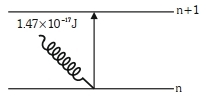
The electron in the $n^{th}$ orbit of $Li^{2+}$ is excited to $(n+1)$ orbit using the radiation of energy $1.47 \times 10^{-17} \ J$. The value of $n$ is $....$. Given $R_H = 2.18 \times 10^{-18} \ J$.
A
$2$
B
$3$
C
$1$
D
$4$
Solution
(C) The energy difference for the transition is given by the formula: $\Delta E = R_H Z^2 \left( \frac{1}{n_1^2} - \frac{1}{n_2^2} \right)$.
For $Li^{2+}$,the atomic number $Z = 3$.
Substituting the values: $1.47 \times 10^{-17} = 2.18 \times 10^{-18} \times 3^2 \left( \frac{1}{n^2} - \frac{1}{(n+1)^2} \right)$.
$1.47 \times 10^{-17} = 1.962 \times 10^{-17} \left( \frac{(n+1)^2 - n^2}{n^2(n+1)^2} \right)$.
$\frac{1.47}{1.962} \approx 0.75 = \frac{3}{4} = \frac{2n+1}{n^2(n+1)^2}$.
For $n = 1$: $\frac{2(1)+1}{1^2(2^2)} = \frac{3}{4}$.
Thus,$n = 1$.
For $Li^{2+}$,the atomic number $Z = 3$.
Substituting the values: $1.47 \times 10^{-17} = 2.18 \times 10^{-18} \times 3^2 \left( \frac{1}{n^2} - \frac{1}{(n+1)^2} \right)$.
$1.47 \times 10^{-17} = 1.962 \times 10^{-17} \left( \frac{(n+1)^2 - n^2}{n^2(n+1)^2} \right)$.
$\frac{1.47}{1.962} \approx 0.75 = \frac{3}{4} = \frac{2n+1}{n^2(n+1)^2}$.
For $n = 1$: $\frac{2(1)+1}{1^2(2^2)} = \frac{3}{4}$.
Thus,$n = 1$.
0 likesView Solution
244
ChemistryMediumMCQJEE Main · 2023
Given below are two statements: one is labelled as Assertion $A$ and the other is labelled as Reason $R$:
Assertion $A$: In the photoelectric effect,the electrons are ejected from the metal surface as soon as the beam of light of frequency greater than threshold frequency strikes the surface.
Reason $R$: When the photon of any energy strikes an electron in the atom,transfer of energy from the photon to the electron takes place.
In the light of the above statements,choose the most appropriate answer from the options given below:
Assertion $A$: In the photoelectric effect,the electrons are ejected from the metal surface as soon as the beam of light of frequency greater than threshold frequency strikes the surface.
Reason $R$: When the photon of any energy strikes an electron in the atom,transfer of energy from the photon to the electron takes place.
In the light of the above statements,choose the most appropriate answer from the options given below:
A
Both $A$ and $R$ are correct but $R$ is $NOT$ the correct explanation of $A$
B
$A$ is correct but $R$ is not correct
C
Both $A$ and $R$ are correct and $R$ is the correct explanation of $A$
D
$A$ is not correct but $R$ is correct
Solution
(B) Assertion $A$ is correct because the photoelectric effect is an instantaneous process that occurs only when the incident light frequency $v$ is greater than the threshold frequency $v_0$.
Reason $R$ is incorrect because a photon of any energy cannot cause the ejection of an electron. The energy of the incident photon must be at least equal to the work function of the metal to eject an electron. Furthermore,the transfer of energy from a photon to an electron is an 'all-or-nothing' process,not a general transfer for 'any' energy.
Reason $R$ is incorrect because a photon of any energy cannot cause the ejection of an electron. The energy of the incident photon must be at least equal to the work function of the metal to eject an electron. Furthermore,the transfer of energy from a photon to an electron is an 'all-or-nothing' process,not a general transfer for 'any' energy.
0 likesView Solution
245
ChemistryMediumMCQJEE Main · 2023
$25 \ mL$ of silver nitrate solution $(1 \ M)$ is added dropwise to $25 \ mL$ of potassium iodide $(1.05 \ M)$ solution. The ion$(s)$ present in very small quantity in the solution is/are $........$.
A
$NO_3^{-}$ only
B
$K^{+}$ only
C
$Ag^{+}$ and $I^{-}$ both
D
$I^{-}$ only
Solution
(C) The reaction is: $AgNO_3 + KI \rightarrow AgI(s) + KNO_3$.
Initial moles of $AgNO_3 = 25 \ mL \times 1 \ M = 25 \ mmol$.
Initial moles of $KI = 25 \ mL \times 1.05 \ M = 26.25 \ mmol$.
Since $AgNO_3$ is the limiting reagent,all $Ag^{+}$ ions react with $I^{-}$ to form $AgI$ precipitate.
After the reaction,$25 \ mmol$ of $AgI$ is formed,$25 \ mmol$ of $K^{+}$ and $NO_3^{-}$ remain as spectator ions,and $1.25 \ mmol$ of $I^{-}$ remains in excess.
$AgI$ is a sparingly soluble salt,so it exists in equilibrium: $AgI(s) \rightleftharpoons Ag^{+}(aq) + I^{-}(aq)$.
Due to the common ion effect from the excess $I^{-}$,the concentration of $Ag^{+}$ becomes extremely small.
Since $I^{-}$ is present in excess $(1.25 \ mmol)$,the ion present in the smallest quantity is $Ag^{+}$.
Initial moles of $AgNO_3 = 25 \ mL \times 1 \ M = 25 \ mmol$.
Initial moles of $KI = 25 \ mL \times 1.05 \ M = 26.25 \ mmol$.
Since $AgNO_3$ is the limiting reagent,all $Ag^{+}$ ions react with $I^{-}$ to form $AgI$ precipitate.
After the reaction,$25 \ mmol$ of $AgI$ is formed,$25 \ mmol$ of $K^{+}$ and $NO_3^{-}$ remain as spectator ions,and $1.25 \ mmol$ of $I^{-}$ remains in excess.
$AgI$ is a sparingly soluble salt,so it exists in equilibrium: $AgI(s) \rightleftharpoons Ag^{+}(aq) + I^{-}(aq)$.
Due to the common ion effect from the excess $I^{-}$,the concentration of $Ag^{+}$ becomes extremely small.
Since $I^{-}$ is present in excess $(1.25 \ mmol)$,the ion present in the smallest quantity is $Ag^{+}$.
0 likesView Solution
246
ChemistryMediumMCQJEE Main · 2023
For elements $B$,$C$,$N$,$Li$,$Be$,$O$ and $F$,the correct order of first ionization enthalpy is:
A
$Li < Be < B < C < N < O < F$
B
$B > Li > Be > C > N > O > F$
C
$Li < B < Be < C < O < N < F$
D
$Li < Be < B < C < O < N < F$
Solution
(C) The first ionization enthalpy $(I.E._1)$ generally increases across a period from left to right due to an increase in effective nuclear charge.
However,there are exceptions due to stable electronic configurations (fully filled or half-filled orbitals).
For the given elements in the second period,the order is:
$Li (520 \ kJ/mol) < B (801 \ kJ/mol) < Be (899 \ kJ/mol) < C (1086 \ kJ/mol) < O (1314 \ kJ/mol) < N (1402 \ kJ/mol) < F (1681 \ kJ/mol)$.
$Be$ has a higher $I.E._1$ than $B$ due to its stable $2s^2$ configuration.
$N$ has a higher $I.E._1$ than $O$ due to its stable half-filled $2p^3$ configuration.
Therefore,the correct order is $Li < B < Be < C < O < N < F$.
However,there are exceptions due to stable electronic configurations (fully filled or half-filled orbitals).
For the given elements in the second period,the order is:
$Li (520 \ kJ/mol) < B (801 \ kJ/mol) < Be (899 \ kJ/mol) < C (1086 \ kJ/mol) < O (1314 \ kJ/mol) < N (1402 \ kJ/mol) < F (1681 \ kJ/mol)$.
$Be$ has a higher $I.E._1$ than $B$ due to its stable $2s^2$ configuration.
$N$ has a higher $I.E._1$ than $O$ due to its stable half-filled $2p^3$ configuration.
Therefore,the correct order is $Li < B < Be < C < O < N < F$.
0 likesView Solution
247
ChemistryMediumMCQJEE Main · 2023
Match List-$I$ with List-$II$ :
Choose the correct answer from the options given below :
| List-$I$ | List-$II$ |
|---|---|
| $A$. $H_3O^+$ | $I$. Tetrahedral |
| $B$. Acetylide anion | $II$. Linear |
| $C$. $NH_4^+$ | $III$. Pyramidal |
| $D$. $ClO_2^-$ | $IV$. Bent |
Choose the correct answer from the options given below :
A
$A-III, B-II, C-I, D-IV$
B
$A-III, B-I, C-II, D-IV$
C
$A-III, B-IV, C-I, D-II$
D
$A-III, B-IV, C-II, D-I$
Solution
(A) To determine the shape of the given species,we use the $VSEPR$ theory:
$1$. $H_3O^+$: Oxygen has $6$ valence electrons. It forms $3$ bonds with $H$ and has $1$ lone pair. Total electron pairs = $4$ ($sp^3$ hybridization). Due to $1$ lone pair,the shape is Pyramidal $(III)$.
$2$. Acetylide anion $(C_2^{2-})$: The structure is $[C \equiv C]^{2-}$. The carbon atoms are $sp$ hybridized,resulting in a Linear $(II)$ shape.
$3$. $NH_4^+$: Nitrogen has $5$ valence electrons. It forms $4$ bonds with $H$ and has $0$ lone pairs. Total electron pairs = $4$ ($sp^3$ hybridization). The shape is Tetrahedral $(I)$.
$4$. $ClO_2^-$: Chlorine has $7$ valence electrons. It forms $2$ bonds with $O$ and has $2$ lone pairs. Total electron pairs = $4$ ($sp^3$ hybridization). Due to $2$ lone pairs,the shape is Bent $(IV)$.
Matching the results: $A-III, B-II, C-I, D-IV$.
$1$. $H_3O^+$: Oxygen has $6$ valence electrons. It forms $3$ bonds with $H$ and has $1$ lone pair. Total electron pairs = $4$ ($sp^3$ hybridization). Due to $1$ lone pair,the shape is Pyramidal $(III)$.
$2$. Acetylide anion $(C_2^{2-})$: The structure is $[C \equiv C]^{2-}$. The carbon atoms are $sp$ hybridized,resulting in a Linear $(II)$ shape.
$3$. $NH_4^+$: Nitrogen has $5$ valence electrons. It forms $4$ bonds with $H$ and has $0$ lone pairs. Total electron pairs = $4$ ($sp^3$ hybridization). The shape is Tetrahedral $(I)$.
$4$. $ClO_2^-$: Chlorine has $7$ valence electrons. It forms $2$ bonds with $O$ and has $2$ lone pairs. Total electron pairs = $4$ ($sp^3$ hybridization). Due to $2$ lone pairs,the shape is Bent $(IV)$.
Matching the results: $A-III, B-II, C-I, D-IV$.
0 likesView Solution
248
ChemistryMediumMCQJEE Main · 2023
For the compound having the formula $GaAlCl_4$,the correct option from the following is:
A
$Ga$ is more electronegative than $Al$ and is present as a cationic part of the salt $GaAlCl_4$.
B
The oxidation state of $Ga$ in the salt $GaAlCl_4$ is $+3$.
C
$Cl$ forms a bond with both $Al$ and $Ga$ in $GaAlCl_4$.
D
$Ga$ is coordinated with $Cl$ in $GaAlCl_4$.
Solution
(A) The compound $GaAlCl_4$ is an ionic salt consisting of $Ga^+$ and $[AlCl_4]^-$ ions.
In this structure,$Ga$ exists as a $Ga^+$ cation,meaning its oxidation state is $+1$,not $+3$.
The $[AlCl_4]^-$ anion consists of an $Al$ atom coordinated to four $Cl$ atoms.
Since $Ga$ is the cationic part of the salt,it is not coordinated to $Cl$ in the same way $Al$ is within the anion.
Therefore,$Ga$ is present as a cationic part of the salt $GaAlCl_4$.
In this structure,$Ga$ exists as a $Ga^+$ cation,meaning its oxidation state is $+1$,not $+3$.
The $[AlCl_4]^-$ anion consists of an $Al$ atom coordinated to four $Cl$ atoms.
Since $Ga$ is the cationic part of the salt,it is not coordinated to $Cl$ in the same way $Al$ is within the anion.
Therefore,$Ga$ is present as a cationic part of the salt $GaAlCl_4$.
0 likesView Solution
249
ChemistryMediumMCQJEE Main · 2023
Match List-$I$ with List-$II$ :
Choose the correct answer from the options given below :
| List-$I$ | List-$II$ |
| $A$. $K$ | $I$. Thermonuclear reactions |
| $B$. $KCl$ | $II$. Fertilizer |
| $C$. $KOH$ | $III$. Sodium potassium pump |
| $D$. $Li$ | $IV$. Absorbent of $CO_2$ |
Choose the correct answer from the options given below :
A
$A-III, B-II, C-IV, D-I$
B
$A-IV, B-I, C-III, D-II$
C
$A-IV, B-III, C-I, D-II$
D
$A-III, B-IV, C-II, D-I$
Solution
(A) . $K$ is involved in the $Na^{+}/K^{+}$ pump (Sodium-Potassium pump) in biological systems. $(A-III)$
$B$. $KCl$ is widely used as a fertilizer in agriculture. $(B-II)$
$C$. $KOH$ is a strong base and is used as an absorbent for $CO_2$ gas. $(C-IV)$
$D$. $Li$ is used in thermonuclear reactions (specifically $Li-6$ isotope). $(D-I)$
Therefore,the correct matching is $A-III, B-II, C-IV, D-I$.
$B$. $KCl$ is widely used as a fertilizer in agriculture. $(B-II)$
$C$. $KOH$ is a strong base and is used as an absorbent for $CO_2$ gas. $(C-IV)$
$D$. $Li$ is used in thermonuclear reactions (specifically $Li-6$ isotope). $(D-I)$
Therefore,the correct matching is $A-III, B-II, C-IV, D-I$.
0 likesView Solution
250
ChemistryMediumMCQJEE Main · 2023
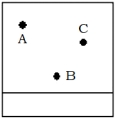
Thin layer chromatography of a mixture shows the following observation:
The correct order of elution in the silica gel column chromatography is
The correct order of elution in the silica gel column chromatography is
A
$A, C, B$
B
$B, C, A$
C
$C, A, B$
D
$B, A, C$
Solution
(A) In thin layer chromatography $(TLC)$,the component that travels the furthest has the highest $R_f$ value,indicating it is the least adsorbed on the stationary phase (silica gel) and has the highest affinity for the mobile phase.
In column chromatography,the component with the highest affinity for the mobile phase elutes first.
Based on the provided $TLC$ plate,the order of distance traveled is $A > C > B$.
Therefore,the order of elution (from first to last) is $A, C, B$.
In column chromatography,the component with the highest affinity for the mobile phase elutes first.
Based on the provided $TLC$ plate,the order of distance traveled is $A > C > B$.
Therefore,the order of elution (from first to last) is $A, C, B$.
0 likesView Solution
251
ChemistryMediumMCQJEE Main · 2023
$A \rightarrow B$
The above reaction is of zero order. The half-life of this reaction is $50 \ min$. The time taken for the concentration of $A$ to reduce to one-fourth of its initial value is $........... \ min$ (Nearest integer).
The above reaction is of zero order. The half-life of this reaction is $50 \ min$. The time taken for the concentration of $A$ to reduce to one-fourth of its initial value is $........... \ min$ (Nearest integer).
A
$74$
B
$75$
C
$72$
D
$73$
Solution
(B) For a zero-order reaction,the half-life is given by $t_{1/2} = \frac{[A]_0}{2k}$.
Given $t_{1/2} = 50 \ min$,we have $50 = \frac{[A]_0}{2k}$,which implies $k = \frac{[A]_0}{100}$.
The integrated rate law for a zero-order reaction is $[A]_t = [A]_0 - kt$.
We want to find the time $t$ when $[A]_t = \frac{1}{4}[A]_0$.
Substituting the values: $\frac{1}{4}[A]_0 = [A]_0 - (\frac{[A]_0}{100})t$.
Dividing by $[A]_0$: $\frac{1}{4} = 1 - \frac{t}{100}$.
Rearranging: $\frac{t}{100} = 1 - \frac{1}{4} = \frac{3}{4}$.
$t = \frac{3}{4} \times 100 = 75 \ min$.
Given $t_{1/2} = 50 \ min$,we have $50 = \frac{[A]_0}{2k}$,which implies $k = \frac{[A]_0}{100}$.
The integrated rate law for a zero-order reaction is $[A]_t = [A]_0 - kt$.
We want to find the time $t$ when $[A]_t = \frac{1}{4}[A]_0$.
Substituting the values: $\frac{1}{4}[A]_0 = [A]_0 - (\frac{[A]_0}{100})t$.
Dividing by $[A]_0$: $\frac{1}{4} = 1 - \frac{t}{100}$.
Rearranging: $\frac{t}{100} = 1 - \frac{1}{4} = \frac{3}{4}$.
$t = \frac{3}{4} \times 100 = 75 \ min$.
0 likesView Solution
252
ChemistryMediumMCQJEE Main · 2023
$20\%$ of acetic acid is dissociated when its $5\ g$ is added to $500\ mL$ of water. The depression in freezing point of such water is $..... \times 10^{-3} \ { }^{\circ}C$. Atomic mass of $C$,$H$,and $O$ are $12$,$1$,and $16 \ \text{a.m.u.}$ respectively.
[Given: Molal depression constant and density of water are $1.86 \ K \ kg \ mol^{-1}$ and $1 \ g \ cm^{-3}$ respectively.]
[Given: Molal depression constant and density of water are $1.86 \ K \ kg \ mol^{-1}$ and $1 \ g \ cm^{-3}$ respectively.]
A
$371$
B
$372$
C
$373$
D
$375$
Solution
(B) $1$. Calculate the molar mass of acetic acid $(CH_3COOH)$: $12 + 3(1) + 12 + 16 + 16 + 1 = 60 \ g \ mol^{-1}$.
$2$. Calculate the van't Hoff factor $(i)$ for $20\%$ dissociation $(\alpha = 0.2)$: $i = 1 + \alpha(n-1) = 1 + 0.2(2-1) = 1.2$.
$3$. Calculate the molality $(m)$ of the solution: $m = \frac{\text{moles of solute}}{\text{mass of solvent in kg}} = \frac{5/60}{0.5} = \frac{1}{6} \times 2 = 0.333 \ mol \ kg^{-1}$.
$4$. Calculate the depression in freezing point $(\Delta T_f)$: $\Delta T_f = i \times K_f \times m = 1.2 \times 1.86 \times \frac{5 \times 1000}{60 \times 500} = 1.2 \times 1.86 \times 0.1666 = 0.372 \ { }^{\circ}C$.
$5$. Express in the required format: $0.372 \ { }^{\circ}C = 372 \times 10^{-3} \ { }^{\circ}C$.
$2$. Calculate the van't Hoff factor $(i)$ for $20\%$ dissociation $(\alpha = 0.2)$: $i = 1 + \alpha(n-1) = 1 + 0.2(2-1) = 1.2$.
$3$. Calculate the molality $(m)$ of the solution: $m = \frac{\text{moles of solute}}{\text{mass of solvent in kg}} = \frac{5/60}{0.5} = \frac{1}{6} \times 2 = 0.333 \ mol \ kg^{-1}$.
$4$. Calculate the depression in freezing point $(\Delta T_f)$: $\Delta T_f = i \times K_f \times m = 1.2 \times 1.86 \times \frac{5 \times 1000}{60 \times 500} = 1.2 \times 1.86 \times 0.1666 = 0.372 \ { }^{\circ}C$.
$5$. Express in the required format: $0.372 \ { }^{\circ}C = 372 \times 10^{-3} \ { }^{\circ}C$.
0 likesView Solution
253
ChemistryDifficultMCQJEE Main · 2023
The molality of a $10\%\ (v/v)$ solution of di-bromine in $CCl_4$ (carbon tetrachloride) is $x$. $x = ...... \times 10^{-2}\ m$. (Nearest integer)
[Given : molar mass of $Br_2 = 160\ g\ mol^{-1}$
atomic mass of $C = 12\ g\ mol^{-1}$
atomic mass of $Cl = 35.5\ g\ mol^{-1}$
density of dibromine $= 3.2\ g\ cm^{-3}$
density of $CCl_4 = 1.6\ g\ cm^{-3}$]
[Given : molar mass of $Br_2 = 160\ g\ mol^{-1}$
atomic mass of $C = 12\ g\ mol^{-1}$
atomic mass of $Cl = 35.5\ g\ mol^{-1}$
density of dibromine $= 3.2\ g\ cm^{-3}$
density of $CCl_4 = 1.6\ g\ cm^{-3}$]
A
$138$
B
$139$
C
$137$
D
$136$
Solution
(B) $10\%\ (v/v)$ solution means $10\ mL$ of solute $(Br_2)$ is present in $100\ mL$ of total solution.
Therefore,the volume of solvent $(CCl_4)$ $= 100\ mL - 10\ mL = 90\ mL$.
Mass of solute $(Br_2)$ $= \text{Volume} \times \text{Density} = 10\ mL \times 3.2\ g\ cm^{-3} = 32\ g$.
Mass of solvent $(CCl_4)$ $= \text{Volume} \times \text{Density} = 90\ mL \times 1.6\ g\ cm^{-3} = 144\ g = 0.144\ kg$.
Moles of solute $(Br_2)$ $= \frac{32\ g}{160\ g\ mol^{-1}} = 0.2\ mol$.
Molality $(m)$ $= \frac{\text{moles of solute}}{\text{mass of solvent in kg}} = \frac{0.2}{0.144} \approx 1.3888\ m$.
Expressing as $x \times 10^{-2}\ m$,we get $138.88 \times 10^{-2}\ m$.
Rounding to the nearest integer,$x = 139$.
Therefore,the volume of solvent $(CCl_4)$ $= 100\ mL - 10\ mL = 90\ mL$.
Mass of solute $(Br_2)$ $= \text{Volume} \times \text{Density} = 10\ mL \times 3.2\ g\ cm^{-3} = 32\ g$.
Mass of solvent $(CCl_4)$ $= \text{Volume} \times \text{Density} = 90\ mL \times 1.6\ g\ cm^{-3} = 144\ g = 0.144\ kg$.
Moles of solute $(Br_2)$ $= \frac{32\ g}{160\ g\ mol^{-1}} = 0.2\ mol$.
Molality $(m)$ $= \frac{\text{moles of solute}}{\text{mass of solvent in kg}} = \frac{0.2}{0.144} \approx 1.3888\ m$.
Expressing as $x \times 10^{-2}\ m$,we get $138.88 \times 10^{-2}\ m$.
Rounding to the nearest integer,$x = 139$.
0 likesView Solution
254
ChemistryDifficultMCQJEE Main · 2023
Testosterone,which is a steroidal hormone,has the following structure. The total number of asymmetric carbon atoms in testosterone is $..........$
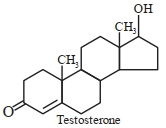
A
$5$
B
$6$
C
$4$
D
$3$
Solution
(B) An asymmetric carbon atom (chiral center) is a carbon atom that is bonded to four different groups.
In the structure of testosterone,we identify the chiral centers by checking each carbon atom.
By examining the steroid backbone,we find that there are $6$ asymmetric carbon atoms.
These are the carbons at positions $8, 9, 10, 13, 14,$ and $17$ of the steroid nucleus.
Therefore,the total number of asymmetric carbon atoms is $6$.
In the structure of testosterone,we identify the chiral centers by checking each carbon atom.
By examining the steroid backbone,we find that there are $6$ asymmetric carbon atoms.
These are the carbons at positions $8, 9, 10, 13, 14,$ and $17$ of the steroid nucleus.
Therefore,the total number of asymmetric carbon atoms is $6$.
0 likesView Solution
255
ChemistryMediumMCQJEE Main · 2023
The spin-only magnetic moment of $[Mn(H_2O)_6]^{2+}$ complex is $........ \ B.M.$ (Nearest integer) (Given: Atomic number of $Mn$ is $25$)
A
$3$
B
$6$
C
$9$
D
$12$
Solution
(B) The electronic configuration of $Mn$ $(Z=25)$ is $[Ar] 3d^5 4s^2$.
In the complex $[Mn(H_2O)_6]^{2+}$,$Mn$ is in the $+2$ oxidation state,so its configuration is $3d^5$.
Since $H_2O$ is a weak field ligand,the electrons remain unpaired in the $d$-orbitals,resulting in $n=5$ unpaired electrons.
The spin-only magnetic moment is calculated using the formula $\mu = \sqrt{n(n+2)} \ B.M.$.
Substituting $n=5$,we get $\mu = \sqrt{5(5+2)} = \sqrt{35} \approx 5.91 \ B.M.$.
The nearest integer value is $6$.
In the complex $[Mn(H_2O)_6]^{2+}$,$Mn$ is in the $+2$ oxidation state,so its configuration is $3d^5$.
Since $H_2O$ is a weak field ligand,the electrons remain unpaired in the $d$-orbitals,resulting in $n=5$ unpaired electrons.
The spin-only magnetic moment is calculated using the formula $\mu = \sqrt{n(n+2)} \ B.M.$.
Substituting $n=5$,we get $\mu = \sqrt{5(5+2)} = \sqrt{35} \approx 5.91 \ B.M.$.
The nearest integer value is $6$.
0 likesView Solution
256
ChemistryDifficultMCQJEE Main · 2023
$A$ metal $M$ crystallizes into two lattices: face-centered cubic $(fcc)$ and body-centered cubic $(bcc)$ with unit cell edge lengths of $2.0 \ \mathring{A}$ and $2.5 \ \mathring{A}$ respectively. The ratio of densities of the $fcc$ lattice to the $bcc$ lattice for the metal $M$ is $...........$ (Nearest integer).
A
$2$
B
$4$
C
$6$
D
$8$
Solution
(D) The density $d$ of a unit cell is given by the formula: $d = \frac{Z \times M}{N_{A} \times a^3}$,where $Z$ is the number of atoms per unit cell,$M$ is the molar mass,$N_{A}$ is Avogadro's number,and $a$ is the edge length.
For $fcc$,$Z = 4$ and $a = 2.0 \ \mathring{A}$.
For $bcc$,$Z = 2$ and $a = 2.5 \ \mathring{A}$.
The ratio of densities is: $\frac{d_{fcc}}{d_{bcc}} = \frac{4 \times M / (N_{A} \times 2.0^3)}{2 \times M / (N_{A} \times 2.5^3)}$.
$\frac{d_{fcc}}{d_{bcc}} = \frac{4}{8} \times \frac{15.625}{1} = 0.5 \times 15.625 = 7.8125$.
The nearest integer is $8$.
For $fcc$,$Z = 4$ and $a = 2.0 \ \mathring{A}$.
For $bcc$,$Z = 2$ and $a = 2.5 \ \mathring{A}$.
The ratio of densities is: $\frac{d_{fcc}}{d_{bcc}} = \frac{4 \times M / (N_{A} \times 2.0^3)}{2 \times M / (N_{A} \times 2.5^3)}$.
$\frac{d_{fcc}}{d_{bcc}} = \frac{4}{8} \times \frac{15.625}{1} = 0.5 \times 15.625 = 7.8125$.
The nearest integer is $8$.
0 likesView Solution
257
ChemistryMediumMCQJEE Main · 2023
$A$ compound is formed by two elements $X$ and $Y$. The element $Y$ forms a cubic close-packed $(CCP)$ arrangement and the atoms of element $X$ occupy one-third of the tetrahedral voids. What is the formula of the compound?
A
$X_2Y_3$
B
$X_3Y$
C
$X_3Y_2$
D
$XY_3$
Solution
(A) Let the number of atoms of element $Y$ in the $CCP$ arrangement be $n = 4$.
Since the number of tetrahedral voids is twice the number of atoms in the $CCP$ arrangement,the number of tetrahedral voids $= 2 \times 4 = 8$.
Element $X$ occupies $1/3$ of the tetrahedral voids,so the number of $X$ atoms $= 1/3 \times 8 = 8/3$.
The ratio of $X:Y = 8/3 : 4 = 8:12 = 2:3$.
Therefore,the formula of the compound is $X_2Y_3$.
Since the number of tetrahedral voids is twice the number of atoms in the $CCP$ arrangement,the number of tetrahedral voids $= 2 \times 4 = 8$.
Element $X$ occupies $1/3$ of the tetrahedral voids,so the number of $X$ atoms $= 1/3 \times 8 = 8/3$.
The ratio of $X:Y = 8/3 : 4 = 8:12 = 2:3$.
Therefore,the formula of the compound is $X_2Y_3$.
0 likesView Solution
258
ChemistryMediumMCQJEE Main · 2023
The standard electrode potential of $M^{+} / M$ in aqueous solution does not depend on
A
Ionisation of a solid metal atom
B
Sublimation of a solid metal
C
Ionisation of a gaseous metal atom
D
Hydration of a gaseous metal ion
Solution
(A) The standard electrode potential $(E^{\circ})$ for the process $M^{+}(aq) + e^{-} \rightarrow M(s)$ is determined by the Born-Haber cycle involving the following steps:
$1$. Sublimation of solid metal: $M(s) \rightarrow M(g)$ (Enthalpy of sublimation,$\Delta H_{sub}$)
$2$. Ionisation of gaseous metal atom: $M(g) \rightarrow M^{+}(g) + e^{-}$ (Ionisation enthalpy,$\Delta H_{IE}$)
$3$. Hydration of gaseous metal ion: $M^{+}(g) + aq \rightarrow M^{+}(aq)$ (Hydration enthalpy,$\Delta H_{hyd}$)
Since the process involves the reduction of $M^{+}$ to $M(s)$,the ionisation of a solid metal atom directly is not a step in the cycle; rather,it is the ionisation of a gaseous metal atom that is considered.
$1$. Sublimation of solid metal: $M(s) \rightarrow M(g)$ (Enthalpy of sublimation,$\Delta H_{sub}$)
$2$. Ionisation of gaseous metal atom: $M(g) \rightarrow M^{+}(g) + e^{-}$ (Ionisation enthalpy,$\Delta H_{IE}$)
$3$. Hydration of gaseous metal ion: $M^{+}(g) + aq \rightarrow M^{+}(aq)$ (Hydration enthalpy,$\Delta H_{hyd}$)
Since the process involves the reduction of $M^{+}$ to $M(s)$,the ionisation of a solid metal atom directly is not a step in the cycle; rather,it is the ionisation of a gaseous metal atom that is considered.
0 likesView Solution
259
ChemistryEasyMCQJEE Main · 2023
The polymer used in Orlon is:
A
Polyacrylonitrile
B
Polyethene
C
Polycarbonate
D
Polyamide
Solution
(A) Orlon is a synthetic fiber made from the polymer polyacrylonitrile.
It is formed by the addition polymerization of acrylonitrile monomer $(CH_2=CH-CN)$.
The reaction is as follows:
$n CH_2=CH-CN \xrightarrow{\text{Polymerisation}} [-CH_2-CH(CN)-]_n$
Thus,the polymer used in Orlon is polyacrylonitrile.
It is formed by the addition polymerization of acrylonitrile monomer $(CH_2=CH-CN)$.
The reaction is as follows:
$n CH_2=CH-CN \xrightarrow{\text{Polymerisation}} [-CH_2-CH(CN)-]_n$
Thus,the polymer used in Orlon is polyacrylonitrile.
0 likesView Solution
260
ChemistryEasyMCQJEE Main · 2023
Match List-$I$ with List-$II$:
Choose the correct answer from the options given below:
| List-$I$ (Enzymatic reaction) | List-$II$ (Enzyme) |
|---|---|
| $A$. Sucrose $\rightarrow$ Glucose and Fructose | $I$. Zymase |
| $B$. Glucose $\rightarrow$ Ethyl alcohol and $CO_2$ | $II$. Pepsin |
| $C$. Starch $\rightarrow$ Maltose | $III$. Invertase |
| $D$. Proteins $\rightarrow$ Amino acids | $IV$. Diastase |
Choose the correct answer from the options given below:
A
$A-III, B-I, C-II, D-IV$
B
$A-I, B-IV, C-III, D-II$
C
$A-III, B-I, C-IV, D-II$
D
$A-I, B-II, C-IV, D-III$
Solution
(C) The correct matches are as follows:
$A$. Sucrose $\rightarrow$ Glucose and Fructose is catalyzed by Invertase $(III)$.
$B$. Glucose $\rightarrow$ Ethyl alcohol and $CO_2$ is catalyzed by Zymase $(I)$.
$C$. Starch $\rightarrow$ Maltose is catalyzed by Diastase $(IV)$.
$D$. Proteins $\rightarrow$ Amino acids is catalyzed by Pepsin $(II)$.
Therefore,the correct sequence is $A-III, B-I, C-IV, D-II$.
$A$. Sucrose $\rightarrow$ Glucose and Fructose is catalyzed by Invertase $(III)$.
$B$. Glucose $\rightarrow$ Ethyl alcohol and $CO_2$ is catalyzed by Zymase $(I)$.
$C$. Starch $\rightarrow$ Maltose is catalyzed by Diastase $(IV)$.
$D$. Proteins $\rightarrow$ Amino acids is catalyzed by Pepsin $(II)$.
Therefore,the correct sequence is $A-III, B-I, C-IV, D-II$.
0 likesView Solution
261
ChemistryDifficultMCQJEE Main · 2023
Compound $P$ is neutral. $Q$ gives effervescence with $NaHCO_3$ while $R$ reacts with Hinsberg's reagent to give a solid soluble in $NaOH$. Compound $P$ is:
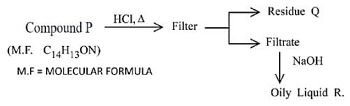
A
$N$-methylbenzamide
B
$N$-phenyl$-4-$methylbenzamide
C
$N$-phenylbenzamide
D
$3$-(methylamino)benzophenone
Solution
(B) Compound $P$ has the molecular formula $C_{14}H_{13}ON$.
Upon hydrolysis with $HCl$ and $\Delta$,it yields a carboxylic acid $(Q)$ and an amine $(R)$.
$Q$ gives effervescence with $NaHCO_3$,indicating it is a carboxylic acid.
$R$ reacts with Hinsberg's reagent $(PhSO_2Cl)$ to form a product that is soluble in $NaOH$,which confirms that $R$ is a primary amine ($1^{\circ}$ amine).
Based on the molecular formula $C_{14}H_{13}ON$,the compound $P$ is $N$-phenyl$-4-$methylbenzamide $(CH_3-C_6H_4-CONH-C_6H_5)$.
Hydrolysis of $N$-phenyl$-4-$methylbenzamide gives $4-$methylbenzoic acid $(Q)$ and aniline $(R)$.
Aniline $(R)$ reacts with Hinsberg's reagent to form $N$-phenylbenzenesulfonamide,which is soluble in $NaOH$ due to the acidic hydrogen on the nitrogen atom.
Upon hydrolysis with $HCl$ and $\Delta$,it yields a carboxylic acid $(Q)$ and an amine $(R)$.
$Q$ gives effervescence with $NaHCO_3$,indicating it is a carboxylic acid.
$R$ reacts with Hinsberg's reagent $(PhSO_2Cl)$ to form a product that is soluble in $NaOH$,which confirms that $R$ is a primary amine ($1^{\circ}$ amine).
Based on the molecular formula $C_{14}H_{13}ON$,the compound $P$ is $N$-phenyl$-4-$methylbenzamide $(CH_3-C_6H_4-CONH-C_6H_5)$.
Hydrolysis of $N$-phenyl$-4-$methylbenzamide gives $4-$methylbenzoic acid $(Q)$ and aniline $(R)$.
Aniline $(R)$ reacts with Hinsberg's reagent to form $N$-phenylbenzenesulfonamide,which is soluble in $NaOH$ due to the acidic hydrogen on the nitrogen atom.
0 likesView Solution
262
ChemistryMediumMCQJEE Main · 2023
Match List-$I$ with List-$II$.
Choose the correct answer from the options given below:
| List-$I$ (Name of reaction) | List-$II$ (Reagent used) |
| $A$. Hell-Volhard-Zelinsky reaction | $I$. $NaOH + I_2$ |
| $B$. Iodoform reaction | $II$. $(i) CrO_2Cl_2, CS_2; (ii) H_2O$ |
| $C$. Etard reaction | $III$. $(i) Br_2 / \text{red phosphorus}; (ii) H_2O$ |
| $D$. Gatterman-Koch reaction | $IV$. $CO, HCl, \text{anhyd. } AlCl_3$ |
Choose the correct answer from the options given below:
A
$A-III, B-II, C-I, D-IV$
B
$A-III, B-I, C-IV, D-II$
C
$A-I, B-II, C-III, D-IV$
D
$A-III, B-I, C-II, D-IV$
Solution
(D) The correct matches are:
$A$. Hell-Volhard-Zelinsky reaction: $(i) Br_2 / \text{red phosphorus}; (ii) H_2O$ $(III)$
$B$. Iodoform reaction: $NaOH + I_2$ $(I)$
$C$. Etard reaction: $(i) CrO_2Cl_2, CS_2; (ii) H_2O$ $(II)$
$D$. Gatterman-Koch reaction: $CO, HCl, \text{anhyd. } AlCl_3$ $(IV)$
Therefore,the correct sequence is $A-III, B-I, C-II, D-IV$.
$A$. Hell-Volhard-Zelinsky reaction: $(i) Br_2 / \text{red phosphorus}; (ii) H_2O$ $(III)$
$B$. Iodoform reaction: $NaOH + I_2$ $(I)$
$C$. Etard reaction: $(i) CrO_2Cl_2, CS_2; (ii) H_2O$ $(II)$
$D$. Gatterman-Koch reaction: $CO, HCl, \text{anhyd. } AlCl_3$ $(IV)$
Therefore,the correct sequence is $A-III, B-I, C-II, D-IV$.
0 likesView Solution
263
ChemistryMediumMCQJEE Main · 2023
The major products $A$ and $B$ from the following reactions are:
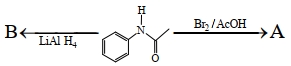
A
$A = \text{2,4,6-tribromoacetanilide}, B = \text{N-ethylaniline}$
B
$A = \text{4-bromoacetanilide}, B = \text{N-ethylaniline}$
C
$A = \text{2,4,6-tribromoacetanilide}, B = \text{aniline}$
D
$A = \text{4-bromoacetanilide}, B = \text{aniline}$
Solution
(B) The starting material is acetanilide.
$1$. Reaction with $Br_2/AcOH$: The $-NHCOCH_3$ group is strongly activating and ortho/para-directing. Due to the steric hindrance of the bulky acetamido group,the para-substitution is favored,yielding $4$-bromoacetanilide as the major product $A$.
$2$. Reaction with $LiAlH_4$: $LiAlH_4$ is a strong reducing agent that reduces the amide group $(-NHCOCH_3)$ to an amine group $(-NHCH_2CH_3)$. Thus,acetanilide is reduced to $N$-ethylaniline,which is the major product $B$.
$1$. Reaction with $Br_2/AcOH$: The $-NHCOCH_3$ group is strongly activating and ortho/para-directing. Due to the steric hindrance of the bulky acetamido group,the para-substitution is favored,yielding $4$-bromoacetanilide as the major product $A$.
$2$. Reaction with $LiAlH_4$: $LiAlH_4$ is a strong reducing agent that reduces the amide group $(-NHCOCH_3)$ to an amine group $(-NHCH_2CH_3)$. Thus,acetanilide is reduced to $N$-ethylaniline,which is the major product $B$.
0 likesView Solution
264
ChemistryMediumMCQJEE Main · 2023
Given below are two statements,one is labelled as Assertion $A$ and the other is labelled as Reason $R$.
Assertion $A:$ The spin only magnetic moment value for $[Fe(CN)_6]^{3-}$ is $1.74 \ BM$,whereas for $[Fe(H_2O)_6]^{3+}$ is $5.92 \ BM$.
Reason $R:$ In both complexes,$Fe$ is present in $+3$ oxidation state.
In the light of the above statements,choose the correct answer from the options given below:
Assertion $A:$ The spin only magnetic moment value for $[Fe(CN)_6]^{3-}$ is $1.74 \ BM$,whereas for $[Fe(H_2O)_6]^{3+}$ is $5.92 \ BM$.
Reason $R:$ In both complexes,$Fe$ is present in $+3$ oxidation state.
In the light of the above statements,choose the correct answer from the options given below:
A
Both $A$ and $R$ are true but $R$ is $NOT$ the correct explanation of $A$.
B
$A$ is false but $R$ is true.
C
$A$ is true but $R$ is false.
D
Both $A$ and $R$ are true and $R$ is the correct explanation of $A$.
Solution
(A) For $[Fe(CN)_6]^{3-}$,$Fe$ is in $+3$ oxidation state $(3d^5)$. $CN^-$ is a strong field ligand,causing pairing of electrons. Number of unpaired electrons $(n)$ $= 1$.
$\mu = \sqrt{n(n+2)} = \sqrt{1(1+2)} = \sqrt{3} \approx 1.74 \ BM$.
For $[Fe(H_2O)_6]^{3+}$,$Fe$ is in $+3$ oxidation state $(3d^5)$. $H_2O$ is a weak field ligand,no pairing occurs. Number of unpaired electrons $(n)$ $= 5$.
$\mu = \sqrt{5(5+2)} = \sqrt{35} \approx 5.92 \ BM$.
Both Assertion $A$ and Reason $R$ are true. However,the difference in magnetic moments is due to the nature of the ligands (strong field vs weak field),not just the oxidation state of $Fe$. Thus,$R$ is not the correct explanation of $A$.
$\mu = \sqrt{n(n+2)} = \sqrt{1(1+2)} = \sqrt{3} \approx 1.74 \ BM$.
For $[Fe(H_2O)_6]^{3+}$,$Fe$ is in $+3$ oxidation state $(3d^5)$. $H_2O$ is a weak field ligand,no pairing occurs. Number of unpaired electrons $(n)$ $= 5$.
$\mu = \sqrt{5(5+2)} = \sqrt{35} \approx 5.92 \ BM$.
Both Assertion $A$ and Reason $R$ are true. However,the difference in magnetic moments is due to the nature of the ligands (strong field vs weak field),not just the oxidation state of $Fe$. Thus,$R$ is not the correct explanation of $A$.
0 likesView Solution
265
ChemistryEasyMCQJEE Main · 2023
Match List-$I$ with List-$II$
Choose the correct answer from the options given below:
| List-$I$ (Vitamin) | List-$II$ (Deficiency disease) |
| $A$. Vitamin $A$ | $I$. Beri-Beri |
| $B$. Thiamine | $II$. Cheilosis |
| $C$. Ascorbic acid | $III$. Xeropthalmia |
| $D$. Riboflavin | $IV$. Scurvy |
Choose the correct answer from the options given below:
A
$A-IV, B-II, C-III, D-I$
B
$A-III, B-II, C-IV, D-I$
C
$A-IV, B-I, C-III, D-II$
D
$A-III, B-I, C-IV, D-II$
Solution
(D) The correct matches are as follows:
$A$. Vitamin $A$ leads to $III$. Xeropthalmia.
$B$. Thiamine (Vitamin $B_1$) leads to $I$. Beri-Beri.
$C$. Ascorbic acid (Vitamin $C$) leads to $IV$. Scurvy.
$D$. Riboflavin (Vitamin $B_2$) leads to $II$. Cheilosis.
Therefore,the correct sequence is $A-III, B-I, C-IV, D-II$.
$A$. Vitamin $A$ leads to $III$. Xeropthalmia.
$B$. Thiamine (Vitamin $B_1$) leads to $I$. Beri-Beri.
$C$. Ascorbic acid (Vitamin $C$) leads to $IV$. Scurvy.
$D$. Riboflavin (Vitamin $B_2$) leads to $II$. Cheilosis.
Therefore,the correct sequence is $A-III, B-I, C-IV, D-II$.
0 likesView Solution
266
ChemistryMediumMCQJEE Main · 2023
Match List $I$ with List $II$:
Choose the correct answer from the options given below:
| List $I$ Oxide | List $II$ Type of Bond |
| $A. N_2O_4$ | $I. 1 N-O$ bond |
| $B. NO_2$ | $II. 1 N-O-N$ bond |
| $C. N_2O_5$ | $III. 1 N-N$ bond |
| $D. N_2O$ | $IV. 1 N=N / N\equiv N$ bond |
Choose the correct answer from the options given below:
A
$A-II, B-IV, C-III, D-I$
B
$A-II, B-I, C-III, D-IV$
C
$A-III, B-I, C-IV, D-II$
D
$A-III, B-I, C-II, D-IV$
Solution
(D) The structures of the nitrogen oxides are as follows:
$A. N_2O_4$: Contains an $N-N$ bond. Thus,$A-III$.
$B. NO_2$: Contains an $N-O$ bond (in its resonance hybrid structure). Thus,$B-I$.
$C. N_2O_5$: Contains an $N-O-N$ bond. Thus,$C-II$.
$D. N_2O$: Contains an $N=N$ or $N\equiv N$ bond. Thus,$D-IV$.
Therefore,the correct matching is $A-III, B-I, C-II, D-IV$.
$A. N_2O_4$: Contains an $N-N$ bond. Thus,$A-III$.
$B. NO_2$: Contains an $N-O$ bond (in its resonance hybrid structure). Thus,$B-I$.
$C. N_2O_5$: Contains an $N-O-N$ bond. Thus,$C-II$.
$D. N_2O$: Contains an $N=N$ or $N\equiv N$ bond. Thus,$D-IV$.
Therefore,the correct matching is $A-III, B-I, C-II, D-IV$.
0 likesView Solution
267
ChemistryMediumMCQJEE Main · 2023
Strong reducing and oxidizing agents among the following,respectively,are
A
$Ce^{4+}$ and $Eu^{2+}$
B
$Ce^{4+}$ and $Tb^{4+}$
C
$Ce^{3+}$ and $Ce^{4+}$
D
$Eu^{2+}$ and $Ce^{4+}$
Solution
(D) In the lanthanoid series,$Eu^{2+}$ (europium$(II)$) is a strong reducing agent because it tends to lose an electron to achieve the stable $f^7$ configuration $(Eu^{3+})$.
$Ce^{4+}$ (cerium$(IV)$) is a strong oxidizing agent because it tends to gain an electron to achieve the stable $f^0$ configuration $(Ce^{3+})$.
Therefore,the correct pair is $Eu^{2+}$ and $Ce^{4+}$.
$Ce^{4+}$ (cerium$(IV)$) is a strong oxidizing agent because it tends to gain an electron to achieve the stable $f^0$ configuration $(Ce^{3+})$.
Therefore,the correct pair is $Eu^{2+}$ and $Ce^{4+}$.
0 likesView Solution
268
ChemistryMediumMCQJEE Main · 2023
The major product formed in the following reaction is
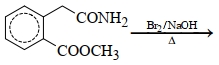
A
B
C
D
Solution
(D) The reaction is a Hofmann bromamide degradation,which converts an amide $(-CONH_2)$ into a primary amine $(-NH_2)$.
In the given molecule,the $-CONH_2$ group is converted to $-NH_2$ by the action of $Br_2/NaOH$.
The resulting intermediate is an amino ester,which undergoes intramolecular cyclization (nucleophilic acyl substitution) to form a cyclic amide,known as a lactam.
The final product is $isoindolin-1-one$.
In the given molecule,the $-CONH_2$ group is converted to $-NH_2$ by the action of $Br_2/NaOH$.
The resulting intermediate is an amino ester,which undergoes intramolecular cyclization (nucleophilic acyl substitution) to form a cyclic amide,known as a lactam.
The final product is $isoindolin-1-one$.
0 likesView Solution
269
ChemistryDifficultMCQJEE Main · 2023
For the reaction:
$RCH_2Br + I^{-} \stackrel{\text{Acetone}}{\longrightarrow} RCH_2I + Br^{-}$
The correct statement is:
$RCH_2Br + I^{-} \stackrel{\text{Acetone}}{\longrightarrow} RCH_2I + Br^{-}$
The correct statement is:
A
The transition state formed in the above reaction is less polar than the localised anion.
B
The reaction can occur in acetic acid also.
C
The solvent used in the reaction solvates the ions formed in the rate-determining step.
D
$Br^{-}$ can act as a competing nucleophile.
Solution
(A) This is the $Finkelstein$ reaction,which proceeds via an $S_N2$ mechanism.
In the $S_N2$ transition state,the negative charge is dispersed over the incoming nucleophile $(I^-)$ and the leaving group $(Br^-)$. Therefore,the transition state is less polar than the localized anion $(I^-)$,which facilitates the reaction in a polar aprotic solvent like acetone.
Acetic acid is a polar protic solvent,which solvates the nucleophile $(I^-)$ through hydrogen bonding,thereby decreasing its nucleophilicity and hindering the $S_N2$ reaction.
Acetone is a polar aprotic solvent; it does not solvate the anion effectively,keeping the nucleophile reactive.
$NaBr$ is insoluble in acetone and precipitates out,which drives the reaction forward according to $Le$ $Chatelier's$ principle,preventing $Br^-$ from acting as a competing nucleophile.
Thus,the correct statement is that the transition state is less polar than the localized anion.
In the $S_N2$ transition state,the negative charge is dispersed over the incoming nucleophile $(I^-)$ and the leaving group $(Br^-)$. Therefore,the transition state is less polar than the localized anion $(I^-)$,which facilitates the reaction in a polar aprotic solvent like acetone.
Acetic acid is a polar protic solvent,which solvates the nucleophile $(I^-)$ through hydrogen bonding,thereby decreasing its nucleophilicity and hindering the $S_N2$ reaction.
Acetone is a polar aprotic solvent; it does not solvate the anion effectively,keeping the nucleophile reactive.
$NaBr$ is insoluble in acetone and precipitates out,which drives the reaction forward according to $Le$ $Chatelier's$ principle,preventing $Br^-$ from acting as a competing nucleophile.
Thus,the correct statement is that the transition state is less polar than the localized anion.
0 likesView Solution
270
ChemistryMediumMCQJEE Main · 2023
Mass of Urea $(NH_2CONH_2)$ required to be dissolved in $1000 \ g$ of water to reduce the vapour pressure of water by $25 \ \%$ is $...... \ g$. (Nearest integer) Given: Molar mass of $N, C, O$ and $H$ are $14, 12, 16$ and $1 \ g \ mol^{-1}$ respectively.
A
$1112$
B
$1113$
C
$1114$
D
$1111$
Solution
(D) The relative lowering of vapour pressure is given by the formula: $\frac{P^0 - P_s}{P^0} = \frac{n_2}{n_1 + n_2} \approx \frac{n_2}{n_1}$ for dilute solutions.
Given that the vapour pressure is reduced by $25 \ \%$,the final vapour pressure $P_s = 0.75 P^0$.
Thus,$\frac{P^0 - 0.75 P^0}{P^0} = \frac{n_2}{n_1} = 0.25$.
Here,$n_2 = \frac{x}{60}$ (moles of urea) and $n_1 = \frac{1000}{18} \approx 55.56$ (moles of water).
$\frac{x/60}{1000/18} = 0.25 \Rightarrow \frac{x}{60} = 0.25 \times 55.56 = 13.89$.
$x = 13.89 \times 60 = 833.4 \ g$.
Wait,re-evaluating the formula: $\frac{P^0 - P_s}{P_s} = \frac{n_2}{n_1} = \frac{0.25 P^0}{0.75 P^0} = \frac{1}{3}$.
$\frac{x/60}{1000/18} = \frac{1}{3} \Rightarrow \frac{x}{60} = \frac{1}{3} \times 55.56 = 18.52$.
$x = 18.52 \times 60 = 1111.2 \ g$.
Rounding to the nearest integer,we get $1111 \ g$.
Given that the vapour pressure is reduced by $25 \ \%$,the final vapour pressure $P_s = 0.75 P^0$.
Thus,$\frac{P^0 - 0.75 P^0}{P^0} = \frac{n_2}{n_1} = 0.25$.
Here,$n_2 = \frac{x}{60}$ (moles of urea) and $n_1 = \frac{1000}{18} \approx 55.56$ (moles of water).
$\frac{x/60}{1000/18} = 0.25 \Rightarrow \frac{x}{60} = 0.25 \times 55.56 = 13.89$.
$x = 13.89 \times 60 = 833.4 \ g$.
Wait,re-evaluating the formula: $\frac{P^0 - P_s}{P_s} = \frac{n_2}{n_1} = \frac{0.25 P^0}{0.75 P^0} = \frac{1}{3}$.
$\frac{x/60}{1000/18} = \frac{1}{3} \Rightarrow \frac{x}{60} = \frac{1}{3} \times 55.56 = 18.52$.
$x = 18.52 \times 60 = 1111.2 \ g$.
Rounding to the nearest integer,we get $1111 \ g$.
0 likesView Solution
271
ChemistryMediumMCQJEE Main · 2023
Number of ambidentate ligands in a representative metal complex $[M(en)(SCN)_4]$ is $[en = \text{ethylenediamine}]$
A
$1$
B
$2$
C
$4$
D
$6$
Solution
(C) An ambidentate ligand is a ligand that can coordinate to the central metal atom through two different donor atoms.
In the complex $[M(en)(SCN)_4]$,the ligand $en$ (ethylenediamine) is a bidentate chelating ligand,which coordinates through two nitrogen atoms.
The ligand $SCN^-$ (thiocyanate) is an ambidentate ligand because it can coordinate through either the sulfur atom $(S-CN^-)$ or the nitrogen atom $(N-CS^-)$.
There are $4$ $SCN^-$ ligands present in the complex.
Therefore,the number of ambidentate ligands in the complex is $4$.
In the complex $[M(en)(SCN)_4]$,the ligand $en$ (ethylenediamine) is a bidentate chelating ligand,which coordinates through two nitrogen atoms.
The ligand $SCN^-$ (thiocyanate) is an ambidentate ligand because it can coordinate through either the sulfur atom $(S-CN^-)$ or the nitrogen atom $(N-CS^-)$.
There are $4$ $SCN^-$ ligands present in the complex.
Therefore,the number of ambidentate ligands in the complex is $4$.
0 likesView Solution
272
ChemistryMediumMCQJEE Main · 2023
For the adsorption of hydrogen on platinum,the activation energy is $30 \ kJ \ mol^{-1}$ and for the adsorption of hydrogen on nickel,the activation energy is $41.4 \ kJ \ mol^{-1}$. The logarithm of the ratio of the rates of chemisorption on equal areas of the metals at $300 \ K$ is $........$ (Nearest integer). Given: $\ln 10 = 2.3$,$R = 8.3 \ J \ K^{-1} \ mol^{-1}$.
A
$4$
B
$6$
C
$8$
D
$2$
Solution
(D) The rate of chemisorption follows the Arrhenius equation: $k = Ae^{-\frac{E_a}{RT}}$.
Let $k_1$ be the rate on platinum and $k_2$ be the rate on nickel.
$\frac{k_2}{k_1} = \frac{Ae^{-\frac{(E_a)_2}{RT}}}{Ae^{-\frac{(E_a)_1}{RT}}} = e^{\frac{(E_a)_1 - (E_a)_2}{RT}}$.
Taking the logarithm to the base $10$:
$\log_{10} \left( \frac{k_2}{k_1} \right) = \frac{(E_a)_1 - (E_a)_2}{2.303 RT}$.
Given $(E_a)_1 = 30 \ kJ \ mol^{-1} = 30000 \ J \ mol^{-1}$,$(E_a)_2 = 41.4 \ kJ \ mol^{-1} = 41400 \ J \ mol^{-1}$,$R = 8.3 \ J \ K^{-1} \ mol^{-1}$,$T = 300 \ K$,and $\ln 10 \approx 2.3$.
$\log_{10} \left( \frac{k_2}{k_1} \right) = \frac{30000 - 41400}{2.3 \times 8.3 \times 300} = \frac{-11400}{5727} \approx -1.99$.
Since the question asks for the logarithm of the ratio of rates (usually implying the magnitude or the ratio of $k_1/k_2$ to get a positive value),the nearest integer is $2$.
Let $k_1$ be the rate on platinum and $k_2$ be the rate on nickel.
$\frac{k_2}{k_1} = \frac{Ae^{-\frac{(E_a)_2}{RT}}}{Ae^{-\frac{(E_a)_1}{RT}}} = e^{\frac{(E_a)_1 - (E_a)_2}{RT}}$.
Taking the logarithm to the base $10$:
$\log_{10} \left( \frac{k_2}{k_1} \right) = \frac{(E_a)_1 - (E_a)_2}{2.303 RT}$.
Given $(E_a)_1 = 30 \ kJ \ mol^{-1} = 30000 \ J \ mol^{-1}$,$(E_a)_2 = 41.4 \ kJ \ mol^{-1} = 41400 \ J \ mol^{-1}$,$R = 8.3 \ J \ K^{-1} \ mol^{-1}$,$T = 300 \ K$,and $\ln 10 \approx 2.3$.
$\log_{10} \left( \frac{k_2}{k_1} \right) = \frac{30000 - 41400}{2.3 \times 8.3 \times 300} = \frac{-11400}{5727} \approx -1.99$.
Since the question asks for the logarithm of the ratio of rates (usually implying the magnitude or the ratio of $k_1/k_2$ to get a positive value),the nearest integer is $2$.
0 likesView Solution
273
ChemistryMediumMCQJEE Main · 2023
In ammonium phosphomolybdate,the oxidation state of $Mo$ is $..........$.
A
$8$
B
$4$
C
$10$
D
$6$
Solution
(D) The chemical formula of ammonium phosphomolybdate is $(NH_4)_3[P(Mo_{12}O_{40})]$.
In this complex,the phosphate ion is $PO_4^{3-}$ and the molybdate unit is $MoO_3$.
Let the oxidation state of $Mo$ be $x$.
In $MoO_3$,the oxidation state of oxygen is $-2$.
$x + 3(-2) = 0$
$x - 6 = 0$
$x = +6$.
Thus,the oxidation state of $Mo$ is $+6$.
In this complex,the phosphate ion is $PO_4^{3-}$ and the molybdate unit is $MoO_3$.
Let the oxidation state of $Mo$ be $x$.
In $MoO_3$,the oxidation state of oxygen is $-2$.
$x + 3(-2) = 0$
$x - 6 = 0$
$x = +6$.
Thus,the oxidation state of $Mo$ is $+6$.
0 likesView Solution
274
ChemistryMediumMCQJEE Main · 2023
The $IUPAC$ name of $K_3[Co(C_2O_4)_3]$ is :-
A
Potassium trioxalatocobaltate$(III)$
B
Potassium tris(oxalato)cobalt$(III)$
C
Potassium tris(oxalato)cobaltate$(III)$
D
Potassium trioxalatocobalt$(III)$
Solution
(C) $1$. Identify the cation: $K^+$ is Potassium.
$2$. Identify the ligand: $C_2O_4^{2-}$ is oxalate,and there are $3$ of them,so it is tris(oxalato).
$3$. Identify the central metal atom: Since the complex ion $[Co(C_2O_4)_3]^{3-}$ is anionic,the metal $Co$ is named as cobaltate.
$4$. Determine the oxidation state of $Co$: $x + 3(-2) = -3$,so $x = +3$.
$5$. Combine the parts: Potassium tris(oxalato)cobaltate$(III)$.
$2$. Identify the ligand: $C_2O_4^{2-}$ is oxalate,and there are $3$ of them,so it is tris(oxalato).
$3$. Identify the central metal atom: Since the complex ion $[Co(C_2O_4)_3]^{3-}$ is anionic,the metal $Co$ is named as cobaltate.
$4$. Determine the oxidation state of $Co$: $x + 3(-2) = -3$,so $x = +3$.
$5$. Combine the parts: Potassium tris(oxalato)cobaltate$(III)$.
0 likesView Solution
275
ChemistryMediumMCQJEE Main · 2023
Match List-$I$ with List-$II$
Choose the correct answer from the options given below :-
| List-$I$ Natural Amino acid | List-$II$ One Letter Code |
| $A$. Arginine | $I$. $D$ |
| $B$. Aspartic acid | $II$. $N$ |
| $C$. Asparagine | $III$. $A$ |
| $D$. Alanine | $IV$. $R$ |
Choose the correct answer from the options given below :-
A
$A-IV, B-I, C-III, D-II$
B
$A-I, B-III, C-IV, D-II$
C
$A-III, B-I, C-II, D-IV$
D
$A-IV, B-I, C-II, D-III$
Solution
(D) The one-letter codes for the given amino acids are as follows:
$A$. Arginine is represented by $R$.
$B$. Aspartic acid is represented by $D$.
$C$. Asparagine is represented by $N$.
$D$. Alanine is represented by $A$.
Therefore,the correct matching is $A-IV, B-I, C-II, D-III$.
$A$. Arginine is represented by $R$.
$B$. Aspartic acid is represented by $D$.
$C$. Asparagine is represented by $N$.
$D$. Alanine is represented by $A$.
Therefore,the correct matching is $A-IV, B-I, C-II, D-III$.
0 likesView Solution
276
ChemistryMediumMCQJEE Main · 2023
The element not present in Nessler's reagent is:
A
$Hg$
B
$I$
C
$K$
D
$N$
Solution
(D) The chemical formula for Nessler's reagent is $K_2[HgI_4]$.
It consists of potassium $(K)$,mercury $(Hg)$,and iodine $(I)$.
Therefore,nitrogen $(N)$ is the element not present in Nessler's reagent.
It consists of potassium $(K)$,mercury $(Hg)$,and iodine $(I)$.
Therefore,nitrogen $(N)$ is the element not present in Nessler's reagent.
0 likesView Solution
277
ChemistryMediumMCQJEE Main · 2023
The strongest acid among the following is:
A
$3-$Nitrophenol
B
$3-$Chlorophenol
C
$3-$Methylphenol
D
Phenol
Solution
(A) The acidity of substituted phenols depends on the electronic effects of the substituents. Electron-withdrawing groups $(EWG)$ increase acidity by stabilizing the phenoxide ion,while electron-donating groups $(EDG)$ decrease acidity.
$1$. $-NO_2$ is a strong electron-withdrawing group ($-I$ and $-M$ effect).
$2$. $-Cl$ is an electron-withdrawing group ($-I$ effect).
$3$. $-CH_3$ is an electron-donating group ($+I$ and hyperconjugation).
Comparing the substituents,the $-NO_2$ group has the strongest electron-withdrawing effect,making $3-$nitrophenol the most acidic among the given options.
$1$. $-NO_2$ is a strong electron-withdrawing group ($-I$ and $-M$ effect).
$2$. $-Cl$ is an electron-withdrawing group ($-I$ effect).
$3$. $-CH_3$ is an electron-donating group ($+I$ and hyperconjugation).
Comparing the substituents,the $-NO_2$ group has the strongest electron-withdrawing effect,making $3-$nitrophenol the most acidic among the given options.
0 likesView Solution
278
ChemistryDifficultMCQJEE Main · 2023
Consider the following reaction that proceeds from $A$ to $B$ in three steps as shown in the energy profile diagram. Choose the correct values for the following parameters:
$1$. Number of intermediates
$2$. Number of activated complexes
$3$. Rate determining step
$1$. Number of intermediates
$2$. Number of activated complexes
$3$. Rate determining step
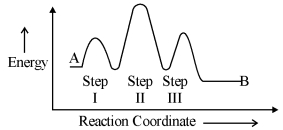
A
$3, 2, II$
B
$2, 3, II$
C
$2, 3, I$
D
$2, 3, III$
Solution
(B) $1$. Intermediates are the local minima in the energy profile diagram between the reactant and product. Here,$P$ and $Q$ are the intermediates. So,the number of intermediates is $2$.
$2$. Activated complexes correspond to the peaks (maxima) in the energy profile diagram. There are $3$ peaks,so the number of activated complexes is $3$.
$3$. The rate-determining step $(RDS)$ is the step with the highest activation energy $(E_a)$. Comparing the peaks,step $II$ has the highest activation energy. Therefore,step $II$ is the $RDS$.
Thus,the correct values are: Number of intermediates $= 2$,Number of activated complexes $= 3$,$RDS = II$.
$2$. Activated complexes correspond to the peaks (maxima) in the energy profile diagram. There are $3$ peaks,so the number of activated complexes is $3$.
$3$. The rate-determining step $(RDS)$ is the step with the highest activation energy $(E_a)$. Comparing the peaks,step $II$ has the highest activation energy. Therefore,step $II$ is the $RDS$.
Thus,the correct values are: Number of intermediates $= 2$,Number of activated complexes $= 3$,$RDS = II$.
0 likesView Solution
279
ChemistryDifficultMCQJEE Main · 2023
Given below are two statements: one is labelled as "Assertion $A$" and the other is labelled as "Reason $R$".
Assertion $A$: In the complexes $Ni(CO)_4$ and $Fe(CO)_5$,the metals have zero oxidation state.
Reason $R$: Low oxidation states are found when a complex has ligands capable of $\pi$-donor character in addition to the $\sigma$-bonding.
In the light of the above statements,choose the most appropriate answer from the options given below.
Assertion $A$: In the complexes $Ni(CO)_4$ and $Fe(CO)_5$,the metals have zero oxidation state.
Reason $R$: Low oxidation states are found when a complex has ligands capable of $\pi$-donor character in addition to the $\sigma$-bonding.
In the light of the above statements,choose the most appropriate answer from the options given below.
A
$A$ is correct but $R$ is not correct
B
$A$ is not correct but $R$ is correct
C
Both $A$ and $R$ are correct but $R$ is $NOT$ the correct explanation of $A$
D
Both $A$ and $R$ are correct and $R$ is the correct explanation of $A$
Solution
(A) In $Ni(CO)_4$,the oxidation state of $Ni$ is $x + 4(0) = 0$,so $x = 0$.
In $Fe(CO)_5$,the oxidation state of $Fe$ is $x + 5(0) = 0$,so $x = 0$. Thus,Assertion $A$ is correct.
Low oxidation states of metals in metal carbonyls are stabilized by synergic bonding,which involves $\sigma$-donation from the ligand to the metal and $\pi$-back-donation from the metal to the ligand. The ligand must be a $\pi$-acceptor,not a $\pi$-donor. Therefore,Reason $R$ is incorrect.
In $Fe(CO)_5$,the oxidation state of $Fe$ is $x + 5(0) = 0$,so $x = 0$. Thus,Assertion $A$ is correct.
Low oxidation states of metals in metal carbonyls are stabilized by synergic bonding,which involves $\sigma$-donation from the ligand to the metal and $\pi$-back-donation from the metal to the ligand. The ligand must be a $\pi$-acceptor,not a $\pi$-donor. Therefore,Reason $R$ is incorrect.
0 likesView Solution
280
ChemistryDifficultMCQJEE Main · 2023
Find out the major product from the following reaction:
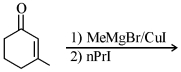
A
$3,3-$dimethyl$-2-$propylcyclohexanone
B
$2-$propyl$-5,5-$dimethylcyclohexanone
C
$1-$propyl$-3,3-$dimethylcyclohexane
D
$1-$hydroxy$-1-$methyl$-3-$methylcyclohex$-2-$ene
Solution
(A) The reaction involves a conjugate addition ($1,4$-addition) of an organocopper reagent (Gilman reagent,formed in situ from $MeMgBr$ and $CuI$) to the $\alpha,\beta$-unsaturated ketone.
$1$. The $Me^-$ group attacks the $\beta$-carbon of the $3$-methylcyclohex$-2-$en$-1-$one,resulting in the formation of an enolate intermediate.
$2$. This enolate is then alkylated by $n$-propyl iodide $(nPrI)$ at the $\alpha$-position.
$3$. The final product is $2$-propyl-$3,3$-dimethylcyclohexanone.
$1$. The $Me^-$ group attacks the $\beta$-carbon of the $3$-methylcyclohex$-2-$en$-1-$one,resulting in the formation of an enolate intermediate.
$2$. This enolate is then alkylated by $n$-propyl iodide $(nPrI)$ at the $\alpha$-position.
$3$. The final product is $2$-propyl-$3,3$-dimethylcyclohexanone.
0 likesView Solution
281
ChemistryMediumMCQJEE Main · 2023
Formation of which complex,among the following,is not a confirmatory test of $Pb^{2+}$ ions?
A
lead chromate
B
lead iodide
C
lead nitrate
D
lead sulphate
Solution
(C) The formation of $PbCrO_4$ (yellow precipitate),$PbI_2$ (yellow precipitate),and $PbSO_4$ (white precipitate) are standard confirmatory tests for $Pb^{2+}$ ions.
$Pb(NO_3)_2$ is a highly soluble,colourless compound in water and does not form a precipitate,therefore it cannot be used as a confirmatory test for $Pb^{2+}$ ions.
$Pb(NO_3)_2$ is a highly soluble,colourless compound in water and does not form a precipitate,therefore it cannot be used as a confirmatory test for $Pb^{2+}$ ions.
0 likesView Solution
282
ChemistryMediumMCQJEE Main · 2023
The product,which is not obtained during the electrolysis of brine solution,is
A
$NaOH$
B
$Cl_2$
C
$H_2$
D
$HCl$
Solution
(D) Brine is an aqueous solution of $NaCl$.
$NaCl_{(aq)} \rightarrow Na^+_{(aq)} + Cl^-_{(aq)}$
At the cathode,water is reduced in preference to $Na^+$ ions:
$2H_2O_{(l)} + 2e^- \rightarrow H_{2(g)} + 2OH^-_{(aq)}$
At the anode,chloride ions are oxidized:
$2Cl^-_{(aq)} \rightarrow Cl_{2(g)} + 2e^-$
The remaining ions in the solution are $Na^+$ and $OH^-$,which combine to form $NaOH_{(aq)}$.
Therefore,$H_2$,$Cl_2$,and $NaOH$ are produced,while $HCl$ is not formed during the electrolysis of brine.
$NaCl_{(aq)} \rightarrow Na^+_{(aq)} + Cl^-_{(aq)}$
At the cathode,water is reduced in preference to $Na^+$ ions:
$2H_2O_{(l)} + 2e^- \rightarrow H_{2(g)} + 2OH^-_{(aq)}$
At the anode,chloride ions are oxidized:
$2Cl^-_{(aq)} \rightarrow Cl_{2(g)} + 2e^-$
The remaining ions in the solution are $Na^+$ and $OH^-$,which combine to form $NaOH_{(aq)}$.
Therefore,$H_2$,$Cl_2$,and $NaOH$ are produced,while $HCl$ is not formed during the electrolysis of brine.
0 likesView Solution
283
ChemistryMediumMCQJEE Main · 2023
In the following reaction,'$B$' is
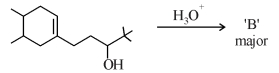
A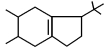
B
C
D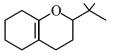
Solution
(B) The reaction proceeds via the following steps:
$1$. Protonation of the alcohol group: The $-OH$ group is protonated by $H_3O^+$ to form a good leaving group $(-OH_2^+)$.
$2$. Formation of carbocation: Loss of water molecule generates a secondary carbocation.
$3$. Rearrangement: $A$ $1,2-CH_3^-$ shift occurs to form a more stable tertiary carbocation.
$4$. Cyclization: The double bond attacks the carbocation to form a new ring.
$5$. Deprotonation: Loss of a proton $(H^+)$ from the adjacent carbon leads to the formation of the final stable alkene product,which corresponds to the structure in option $B$.
$1$. Protonation of the alcohol group: The $-OH$ group is protonated by $H_3O^+$ to form a good leaving group $(-OH_2^+)$.
$2$. Formation of carbocation: Loss of water molecule generates a secondary carbocation.
$3$. Rearrangement: $A$ $1,2-CH_3^-$ shift occurs to form a more stable tertiary carbocation.
$4$. Cyclization: The double bond attacks the carbocation to form a new ring.
$5$. Deprotonation: Loss of a proton $(H^+)$ from the adjacent carbon leads to the formation of the final stable alkene product,which corresponds to the structure in option $B$.
0 likesView Solution
284
ChemistryDifficultMCQJEE Main · 2023
Consider the following pairs of solutions which will be isotonic at the same temperature. The number of pairs of solutions that are isotonic is/are..........
$A.$ $1 \ M$ aq. $NaCl$ and $2 \ M$ aq. Urea
$B.$ $1 \ M$ aq. $CaCl_2$ and $1.5 \ M$ aq. $KCl$
$C.$ $1.5 \ M$ aq. $AlCl_3$ and $2 \ M$ aq. $Na_2SO_4$
$D.$ $2.5 \ M$ aq. $KCl$ and $1 \ M$ aq. $Al_2(SO_4)_3$
$A.$ $1 \ M$ aq. $NaCl$ and $2 \ M$ aq. Urea
$B.$ $1 \ M$ aq. $CaCl_2$ and $1.5 \ M$ aq. $KCl$
$C.$ $1.5 \ M$ aq. $AlCl_3$ and $2 \ M$ aq. $Na_2SO_4$
$D.$ $2.5 \ M$ aq. $KCl$ and $1 \ M$ aq. $Al_2(SO_4)_3$
A
$1$
B
$2$
C
$3$
D
$4$
Solution
(D) Two solutions are isotonic if they have the same osmotic pressure $(\pi = iCRT)$.
For $A$: $NaCl$ $(i=2)$,$C=1 \ M \implies \pi \propto 2 \times 1 = 2$. Urea $(i=1)$,$C=2 \ M \implies \pi \propto 1 \times 2 = 2$. (Isotonic)
For $B$: $CaCl_2$ $(i=3)$,$C=1 \ M \implies \pi \propto 3 \times 1 = 3$. $KCl$ $(i=2)$,$C=1.5 \ M \implies \pi \propto 2 \times 1.5 = 3$. (Isotonic)
For $C$: $AlCl_3$ $(i=4)$,$C=1.5 \ M \implies \pi \propto 4 \times 1.5 = 6$. $Na_2SO_4$ $(i=3)$,$C=2 \ M \implies \pi \propto 3 \times 2 = 6$. (Isotonic)
For $D$: $KCl$ $(i=2)$,$C=2.5 \ M \implies \pi \propto 2 \times 2.5 = 5$. $Al_2(SO_4)_3$ $(i=5)$,$C=1 \ M \implies \pi \propto 5 \times 1 = 5$. (Isotonic)
All $4$ pairs are isotonic.
For $A$: $NaCl$ $(i=2)$,$C=1 \ M \implies \pi \propto 2 \times 1 = 2$. Urea $(i=1)$,$C=2 \ M \implies \pi \propto 1 \times 2 = 2$. (Isotonic)
For $B$: $CaCl_2$ $(i=3)$,$C=1 \ M \implies \pi \propto 3 \times 1 = 3$. $KCl$ $(i=2)$,$C=1.5 \ M \implies \pi \propto 2 \times 1.5 = 3$. (Isotonic)
For $C$: $AlCl_3$ $(i=4)$,$C=1.5 \ M \implies \pi \propto 4 \times 1.5 = 6$. $Na_2SO_4$ $(i=3)$,$C=2 \ M \implies \pi \propto 3 \times 2 = 6$. (Isotonic)
For $D$: $KCl$ $(i=2)$,$C=2.5 \ M \implies \pi \propto 2 \times 2.5 = 5$. $Al_2(SO_4)_3$ $(i=5)$,$C=1 \ M \implies \pi \propto 5 \times 1 = 5$. (Isotonic)
All $4$ pairs are isotonic.
0 likesView Solution
285
ChemistryDifficultMCQJEE Main · 2023
The standard reduction potential at $298 \ K$ for the following half cells are given below :-
$NO_3^{-} + 4H^{+} + 3e^{-} \rightarrow NO_{(g)} + 2H_2O \quad E^0 = 0.97 \ V$
The number of metal$(s)$ which will be oxidized by $NO_3^{-}$ in aqueous solution is $....$.
$NO_3^{-} + 4H^{+} + 3e^{-} \rightarrow NO_{(g)} + 2H_2O \quad E^0 = 0.97 \ V$
| $V^{2+}_{(aq)} + 2e^{-} \rightarrow V_{(s)}$ | $E^0 = -1.19 \ V$ |
| $Fe^{3+}_{(aq)} + 3e^{-} \rightarrow Fe_{(s)}$ | $E^0 = -0.04 \ V$ |
| $Ag^{+}_{(aq)} + e^{-} \rightarrow Ag_{(s)}$ | $E^0 = 0.80 \ V$ |
| $Au^{3+}_{(aq)} + 3e^{-} \rightarrow Au_{(s)}$ | $E^0 = 1.40 \ V$ |
The number of metal$(s)$ which will be oxidized by $NO_3^{-}$ in aqueous solution is $....$.
A
$1$
B
$2$
C
$3$
D
$4$
Solution
(C) metal will be oxidized by $NO_3^{-}$ if the standard reduction potential $(SRP)$ of the metal is lower than the $SRP$ of the $NO_3^{-}$ half-cell $(E^0 = 0.97 \ V)$.
Comparing the given values:
$1$. $V_{(s)} \rightarrow V^{2+} + 2e^{-}$ $(E^0 = -1.19 \ V < 0.97 \ V)$: Oxidized.
$2$. $Fe_{(s)} \rightarrow Fe^{3+} + 3e^{-}$ $(E^0 = -0.04 \ V < 0.97 \ V)$: Oxidized.
$3$. $Ag_{(s)} \rightarrow Ag^{+} + e^{-}$ $(E^0 = 0.80 \ V < 0.97 \ V)$: Oxidized.
$4$. $Au_{(s)} \rightarrow Au^{3+} + 3e^{-}$ $(E^0 = 1.40 \ V > 0.97 \ V)$: Not oxidized.
Therefore,$3$ metals $(V, Fe, Ag)$ will be oxidized by $NO_3^{-}$.
Comparing the given values:
$1$. $V_{(s)} \rightarrow V^{2+} + 2e^{-}$ $(E^0 = -1.19 \ V < 0.97 \ V)$: Oxidized.
$2$. $Fe_{(s)} \rightarrow Fe^{3+} + 3e^{-}$ $(E^0 = -0.04 \ V < 0.97 \ V)$: Oxidized.
$3$. $Ag_{(s)} \rightarrow Ag^{+} + e^{-}$ $(E^0 = 0.80 \ V < 0.97 \ V)$: Oxidized.
$4$. $Au_{(s)} \rightarrow Au^{3+} + 3e^{-}$ $(E^0 = 1.40 \ V > 0.97 \ V)$: Not oxidized.
Therefore,$3$ metals $(V, Fe, Ag)$ will be oxidized by $NO_3^{-}$.
0 likesView Solution
286
ChemistryDifficultMCQJEE Main · 2023
The number of colloidal systems from the following,which will have 'liquid' as the dispersion medium,is $.........$.
Gem stones,paints,smoke,cheese,milk,hair cream,insecticide sprays,froth,soap lather.
Gem stones,paints,smoke,cheese,milk,hair cream,insecticide sprays,froth,soap lather.
A
$4$
B
$6$
C
$5$
D
$9$
Solution
(C) colloidal system with a liquid dispersion medium is known as an emulsion (if the dispersed phase is liquid) or a sol (if the dispersed phase is solid).
Let us classify the given systems:
$1$. Gem stones: Solid sol (Solid in Solid)
$2$. Paints: Sol (Solid in Liquid)
$3$. Smoke: Aerosol (Solid in Gas)
$4$. Cheese: Gel (Liquid in Solid)
$5$. Milk: Emulsion (Liquid in Liquid)
$6$. Hair cream: Emulsion (Liquid in Liquid)
$7$. Insecticide sprays: Aerosol (Liquid in Gas)
$8$. Froth: Foam (Gas in Liquid)
$9$. Soap lather: Foam (Gas in Liquid)
The systems with liquid as the dispersion medium are: Paints,Milk,Hair cream,Froth,and Soap lather.
Total count = $5$.
Let us classify the given systems:
$1$. Gem stones: Solid sol (Solid in Solid)
$2$. Paints: Sol (Solid in Liquid)
$3$. Smoke: Aerosol (Solid in Gas)
$4$. Cheese: Gel (Liquid in Solid)
$5$. Milk: Emulsion (Liquid in Liquid)
$6$. Hair cream: Emulsion (Liquid in Liquid)
$7$. Insecticide sprays: Aerosol (Liquid in Gas)
$8$. Froth: Foam (Gas in Liquid)
$9$. Soap lather: Foam (Gas in Liquid)
The systems with liquid as the dispersion medium are: Paints,Milk,Hair cream,Froth,and Soap lather.
Total count = $5$.
0 likesView Solution
287
ChemistryDifficultMCQJEE Main · 2023
The number of species having a square planar shape from the following is $........$.
$XeF_4$,$SF_4$,$SiF_4$,$BF_4^{-}$,$BrF_4^{-}$,$[Cu(NH_3)_4]^{2+}$,$[FeCl_4]^{2-}$,$[PtCl_4]^{2-}$
$XeF_4$,$SF_4$,$SiF_4$,$BF_4^{-}$,$BrF_4^{-}$,$[Cu(NH_3)_4]^{2+}$,$[FeCl_4]^{2-}$,$[PtCl_4]^{2-}$
A
$1$
B
$2$
C
$4$
D
$3$
Solution
(C) To determine the shape,we look at the hybridization and lone pairs of the central atom:
$1$. $XeF_4$: $sp^3d^2$ hybridization with $2$ lone pairs,resulting in a square planar geometry.
$2$. $SF_4$: $sp^3d$ hybridization with $1$ lone pair,resulting in a see-saw geometry.
$3$. $SiF_4$: $sp^3$ hybridization with $0$ lone pairs,resulting in a tetrahedral geometry.
$4$. $BF_4^{-}$: $sp^3$ hybridization with $0$ lone pairs,resulting in a tetrahedral geometry.
$5$. $BrF_4^{-}$: $sp^3d^2$ hybridization with $2$ lone pairs,resulting in a square planar geometry.
$6$. $[Cu(NH_3)_4]^{2+}$: $dsp^2$ hybridization,resulting in a square planar geometry.
$7$. $[FeCl_4]^{2-}$: $sp^3$ hybridization,resulting in a tetrahedral geometry.
$8$. $[PtCl_4]^{2-}$: $dsp^2$ hybridization,resulting in a square planar geometry.
Thus,the species with a square planar shape are $XeF_4$,$BrF_4^{-}$,$[Cu(NH_3)_4]^{2+}$,and $[PtCl_4]^{2-}$.
The total count is $4$.
$1$. $XeF_4$: $sp^3d^2$ hybridization with $2$ lone pairs,resulting in a square planar geometry.
$2$. $SF_4$: $sp^3d$ hybridization with $1$ lone pair,resulting in a see-saw geometry.
$3$. $SiF_4$: $sp^3$ hybridization with $0$ lone pairs,resulting in a tetrahedral geometry.
$4$. $BF_4^{-}$: $sp^3$ hybridization with $0$ lone pairs,resulting in a tetrahedral geometry.
$5$. $BrF_4^{-}$: $sp^3d^2$ hybridization with $2$ lone pairs,resulting in a square planar geometry.
$6$. $[Cu(NH_3)_4]^{2+}$: $dsp^2$ hybridization,resulting in a square planar geometry.
$7$. $[FeCl_4]^{2-}$: $sp^3$ hybridization,resulting in a tetrahedral geometry.
$8$. $[PtCl_4]^{2-}$: $dsp^2$ hybridization,resulting in a square planar geometry.
Thus,the species with a square planar shape are $XeF_4$,$BrF_4^{-}$,$[Cu(NH_3)_4]^{2+}$,and $[PtCl_4]^{2-}$.
The total count is $4$.
0 likesView Solution
288
ChemistryDifficultMCQJEE Main · 2023
Among the following,the number of compounds which will give positive iodoform reaction is:
$(a)$ $1-$Phenylbutan$-2-$one
$(b)$ $2-$Methylbutan$-2-$ol
$(c)$ $3-$Methylbutan$-2-$ol
$(d)$ $1-$Phenylethanol
$(e)$ $3,3-$dimethylbutan$-2-$one
$(f)$ $1-$Phenylpropan$-2-$ol
$(a)$ $1-$Phenylbutan$-2-$one
$(b)$ $2-$Methylbutan$-2-$ol
$(c)$ $3-$Methylbutan$-2-$ol
$(d)$ $1-$Phenylethanol
$(e)$ $3,3-$dimethylbutan$-2-$one
$(f)$ $1-$Phenylpropan$-2-$ol
A
$6$
B
$8$
C
$4$
D
$10$
Solution
(C) Compounds that give a positive iodoform test must contain either a methyl ketone group $(CH_3CO-)$ or a methyl carbinol group $(CH_3CH(OH)-)$.
$(a)$ $1-$Phenylbutan$-2-$one: Structure is $Ph-CH_2-CO-CH_2-CH_3$. It does not contain a $CH_3CO-$ group. (Negative)
$(b)$ $2-$Methylbutan$-2-$ol: Structure is $CH_3-C(OH)(CH_3)-CH_2-CH_3$. It does not contain a $CH_3CH(OH)-$ group. (Negative)
$(c)$ $3-$Methylbutan$-2-$ol: Structure is $CH_3-CH(OH)-CH(CH_3)_2$. It contains a $CH_3CH(OH)-$ group. (Positive)
$(d)$ $1-$Phenylethanol: Structure is $Ph-CH(OH)-CH_3$. It contains a $CH_3CH(OH)-$ group. (Positive)
$(e)$ $3,3-$dimethylbutan$-2-$one: Structure is $CH_3-CO-C(CH_3)_3$. It contains a $CH_3CO-$ group. (Positive)
$(f)$ $1-$Phenylpropan$-2-$ol: Structure is $Ph-CH_2-CH(OH)-CH_3$. It contains a $CH_3CH(OH)-$ group. (Positive)
Thus,the compounds $(c)$,$(d)$,$(e)$,and $(f)$ give a positive iodoform reaction. The total number of such compounds is $4$.
$(a)$ $1-$Phenylbutan$-2-$one: Structure is $Ph-CH_2-CO-CH_2-CH_3$. It does not contain a $CH_3CO-$ group. (Negative)
$(b)$ $2-$Methylbutan$-2-$ol: Structure is $CH_3-C(OH)(CH_3)-CH_2-CH_3$. It does not contain a $CH_3CH(OH)-$ group. (Negative)
$(c)$ $3-$Methylbutan$-2-$ol: Structure is $CH_3-CH(OH)-CH(CH_3)_2$. It contains a $CH_3CH(OH)-$ group. (Positive)
$(d)$ $1-$Phenylethanol: Structure is $Ph-CH(OH)-CH_3$. It contains a $CH_3CH(OH)-$ group. (Positive)
$(e)$ $3,3-$dimethylbutan$-2-$one: Structure is $CH_3-CO-C(CH_3)_3$. It contains a $CH_3CO-$ group. (Positive)
$(f)$ $1-$Phenylpropan$-2-$ol: Structure is $Ph-CH_2-CH(OH)-CH_3$. It contains a $CH_3CH(OH)-$ group. (Positive)
Thus,the compounds $(c)$,$(d)$,$(e)$,and $(f)$ give a positive iodoform reaction. The total number of such compounds is $4$.
0 likesView Solution
289
ChemistryMediumMCQJEE Main · 2023
Number of isomeric aromatic amines with molecular formula $C_8H_{11}N$,which can be synthesized by Gabriel Phthalimide synthesis is $.........$.
A
$5$
B
$4$
C
$3$
D
$9$
Solution
(A) Gabriel Phthalimide synthesis is used for the preparation of primary aliphatic amines. It involves the reaction of potassium phthalimide with an alkyl halide followed by alkaline hydrolysis.
It cannot be used for the preparation of aromatic amines because aryl halides do not undergo nucleophilic substitution with the anion formed by phthalimide.
Therefore,only those amines with the formula $C_8H_{11}N$ that have the $-NH_2$ group attached to an aliphatic carbon (i.e.,primary aliphatic amines) can be synthesized by this method.
The isomers of $C_8H_{11}N$ that are primary aliphatic amines are:
$1$. $C_6H_5-CH_2-CH_2-NH_2$ ($2$-phenylethanamine)
$2$. $C_6H_5-CH(CH_3)-NH_2$ ($1$-phenylethanamine)
$3$. $o-CH_3-C_6H_4-CH_2-NH_2$ ($2$-methylbenzylamine)
$4$. $m-CH_3-C_6H_4-CH_2-NH_2$ ($3$-methylbenzylamine)
$5$. $p-CH_3-C_6H_4-CH_2-NH_2$ ($4$-methylbenzylamine)
There are $5$ such isomers that can be synthesized by this method.
It cannot be used for the preparation of aromatic amines because aryl halides do not undergo nucleophilic substitution with the anion formed by phthalimide.
Therefore,only those amines with the formula $C_8H_{11}N$ that have the $-NH_2$ group attached to an aliphatic carbon (i.e.,primary aliphatic amines) can be synthesized by this method.
The isomers of $C_8H_{11}N$ that are primary aliphatic amines are:
$1$. $C_6H_5-CH_2-CH_2-NH_2$ ($2$-phenylethanamine)
$2$. $C_6H_5-CH(CH_3)-NH_2$ ($1$-phenylethanamine)
$3$. $o-CH_3-C_6H_4-CH_2-NH_2$ ($2$-methylbenzylamine)
$4$. $m-CH_3-C_6H_4-CH_2-NH_2$ ($3$-methylbenzylamine)
$5$. $p-CH_3-C_6H_4-CH_2-NH_2$ ($4$-methylbenzylamine)
There are $5$ such isomers that can be synthesized by this method.
0 likesView Solution
290
ChemistryDifficultMCQJEE Main · 2023
Number of crystal systems from the following where body-centered unit cell can be found,is $.........$ Cubic,tetragonal,orthorhombic,hexagonal,rhombohedral,monoclinic,triclinic.
A
$5$
B
$7$
C
$3$
D
$9$
Solution
(C) There are $7$ crystal systems in total.
Among these,the body-centered unit cell is found in $3$ crystal systems:
$1$. Cubic
$2$. Tetragonal
$3$. Orthorhombic
Therefore,the total number is $3$.
Among these,the body-centered unit cell is found in $3$ crystal systems:
$1$. Cubic
$2$. Tetragonal
$3$. Orthorhombic
Therefore,the total number is $3$.
0 likesView Solution
291
ChemistryEasyMCQJEE Main · 2023
Which of the following metals can be extracted through alkali leaching technique?
A
$Cu$
B
$Sn$
C
$Pb$
D
$Au$
Solution
(D) The alkali leaching process is commonly used for the extraction of $Al$ (from bauxite ore) and $Au$ or $Ag$ (from their respective ores).
In the case of gold $(Au)$,the ore is treated with a dilute solution of sodium cyanide $(NaCN)$ in the presence of air $(O_2)$,which acts as a source of oxygen.
The chemical reaction is: $4Au(s) + 8CN^-(aq) + 2H_2O(aq) + O_2(g) \rightarrow 4[Au(CN)_2]^-(aq) + 4OH^-(aq)$.
Thus,$Au$ is extracted using this leaching technique.
In the case of gold $(Au)$,the ore is treated with a dilute solution of sodium cyanide $(NaCN)$ in the presence of air $(O_2)$,which acts as a source of oxygen.
The chemical reaction is: $4Au(s) + 8CN^-(aq) + 2H_2O(aq) + O_2(g) \rightarrow 4[Au(CN)_2]^-(aq) + 4OH^-(aq)$.
Thus,$Au$ is extracted using this leaching technique.
0 likesView Solution
292
ChemistryMediumMCQJEE Main · 2023
Match List-$I$ with List-$II$.
Choose the correct answer from the options given below:
| List-$I$ | List-$II$ |
|---|---|
| $A$. Saccharin | $I$. High potency sweetener |
| $B$. Aspartame | $II$. First artificial sweetening agent |
| $C$. Alitame | $III$. Stable at cooking temperature |
| $D$. Sucralose | $IV$. Unstable at cooking temperature |
Choose the correct answer from the options given below:
A
$A-II, B-III, C-IV, D-I$
B
$A-II, B-IV, C-III, D-I$
C
$A-IV, B-III, C-I, D-II$
D
$A-II, B-IV, C-I, D-III$
Solution
(D) . Saccharin is the first artificial sweetening agent $(II)$.
$B$. Aspartame is unstable at cooking temperature $(IV)$.
$C$. Alitame is a high potency sweetener $(I)$.
$D$. Sucralose is stable at cooking temperature $(III)$.
Therefore,the correct matching is $A-II, B-IV, C-I, D-III$.
$B$. Aspartame is unstable at cooking temperature $(IV)$.
$C$. Alitame is a high potency sweetener $(I)$.
$D$. Sucralose is stable at cooking temperature $(III)$.
Therefore,the correct matching is $A-II, B-IV, C-I, D-III$.
0 likesView Solution
293
ChemistryMediumMCQJEE Main · 2023
Which of the following represent the Freundlich adsorption isotherms?
Choose the correct answer from the options given below:
Choose the correct answer from the options given below:
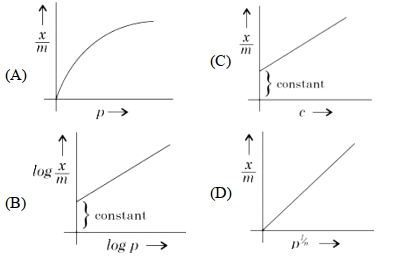
A
$B, C, D$ only
B
$A, B, D$ only
C
$A, B$ only
D
$A, C, D$ only
Solution
(B) The Freundlich adsorption isotherm is given by the equation $\frac{x}{m} = k p^{1/n}$.
Graph $(A)$ represents the plot of $\frac{x}{m}$ versus $p$,which is a characteristic curve of the Freundlich isotherm.
Taking the logarithm on both sides,we get $\log \frac{x}{m} = \log k + \frac{1}{n} \log p$. This is a linear equation of the form $y = mx + c$,where the slope is $\frac{1}{n}$ and the intercept is $\log k$. Graph $(B)$ represents this linear relationship.
Graph $(D)$ represents the plot of $\frac{x}{m}$ versus $p^{1/n}$,which is also a linear relationship derived from the equation $\frac{x}{m} = k p^{1/n}$ (where $y = kx$).
Graph $(C)$ is not a standard representation of the Freundlich adsorption isotherm as it plots $\frac{x}{m}$ against concentration $c$ with an intercept,which does not match the standard form.
Therefore,graphs $(A), (B),$ and $(D)$ represent the Freundlich adsorption isotherms.
Graph $(A)$ represents the plot of $\frac{x}{m}$ versus $p$,which is a characteristic curve of the Freundlich isotherm.
Taking the logarithm on both sides,we get $\log \frac{x}{m} = \log k + \frac{1}{n} \log p$. This is a linear equation of the form $y = mx + c$,where the slope is $\frac{1}{n}$ and the intercept is $\log k$. Graph $(B)$ represents this linear relationship.
Graph $(D)$ represents the plot of $\frac{x}{m}$ versus $p^{1/n}$,which is also a linear relationship derived from the equation $\frac{x}{m} = k p^{1/n}$ (where $y = kx$).
Graph $(C)$ is not a standard representation of the Freundlich adsorption isotherm as it plots $\frac{x}{m}$ against concentration $c$ with an intercept,which does not match the standard form.
Therefore,graphs $(A), (B),$ and $(D)$ represent the Freundlich adsorption isotherms.
0 likesView Solution
294
ChemistryMediumMCQJEE Main · 2023
Choose the halogen which is most reactive towards $SN1$ reaction in the given compounds $(A, B, C, D)$:
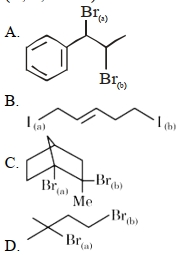
A
$A-Br_{(b)}$; $B-I_{(b)}$; $C-Br_{(b)}$; $D-Br_{(b)}$
B
$A-Br_{(a)}$; $B-I_{(a)}$; $C-Br_{(b)}$; $D-Br_{(a)}$
C
$A-Br_{(b)}$; $B-I_{(a)}$; $C-Br_{(a)}$; $D-Br_{(a)}$
D
$A-Br_{(a)}$; $B-I_{(b)}$; $C-Br_{(a)}$; $D-Br_{(b)}$
Solution
(B) The rate of $SN1$ reaction depends on the stability of the carbocation formed after the departure of the leaving group.
$1$. In compound $A$,$Br_{(a)}$ forms a benzylic carbocation,which is highly stabilized by resonance.
$2$. In compound $B$,$I_{(a)}$ forms an allylic carbocation,which is also resonance stabilized but less than the benzylic one.
$3$. In compound $C$,$Br_{(a)}$ forms a tertiary carbocation.
$4$. In compound $D$,$Br_{(a)}$ forms a tertiary carbocation.
Comparing the stability,the benzylic carbocation formed by $Br_{(a)}$ in compound $A$ is the most stable. Therefore,$A-Br_{(a)}$ is the most reactive towards $SN1$ reaction.
$1$. In compound $A$,$Br_{(a)}$ forms a benzylic carbocation,which is highly stabilized by resonance.
$2$. In compound $B$,$I_{(a)}$ forms an allylic carbocation,which is also resonance stabilized but less than the benzylic one.
$3$. In compound $C$,$Br_{(a)}$ forms a tertiary carbocation.
$4$. In compound $D$,$Br_{(a)}$ forms a tertiary carbocation.
Comparing the stability,the benzylic carbocation formed by $Br_{(a)}$ in compound $A$ is the most stable. Therefore,$A-Br_{(a)}$ is the most reactive towards $SN1$ reaction.
0 likesView Solution
295
ChemistryMediumMCQJEE Main · 2023
Sulphur $(S)$ containing amino acids from the following are:
$(a)$ isoleucine
$(b)$ cysteine
$(c)$ lysine
$(d)$ methionine
$(e)$ glutamic acid
$(a)$ isoleucine
$(b)$ cysteine
$(c)$ lysine
$(d)$ methionine
$(e)$ glutamic acid
A
$a, d$
B
$b, d$
C
$b, c, e$
D
$a, b, c$
Solution
(B) The amino acids that contain sulphur in their side chains are cysteine and methionine.
$1$. Cysteine: Contains a thiol $(-SH)$ group.
$2$. Methionine: Contains a thioether $(-S-CH_3)$ group.
Therefore,the correct options are $(b)$ and $(d)$.
$1$. Cysteine: Contains a thiol $(-SH)$ group.
$2$. Methionine: Contains a thioether $(-S-CH_3)$ group.
Therefore,the correct options are $(b)$ and $(d)$.
0 likesView Solution
296
ChemistryMediumMCQJEE Main · 2023
The major product formed in the following reaction is:
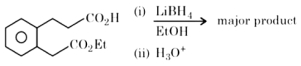
A
The structure containing two alcohol groups attached to the benzene ring.
B
The structure containing an alcohol group and an ester group attached to the benzene ring.
C
The structure containing a carboxylic acid group and an alcohol group attached to the benzene ring.
D
The structure containing two carboxylic acid groups attached to the benzene ring.
Solution
(C) $LiBH_4$ is a selective reducing agent that reduces esters to primary alcohols but does not reduce carboxylic acids. In the given molecule,the ester group $(-CO_2Et)$ is reduced to a primary alcohol $(-CH_2OH)$,while the carboxylic acid group $(-CO_2H)$ remains unaffected. Thus,the major product is the one where the ester is converted to an alcohol and the acid remains as it is.
0 likesView Solution
297
ChemistryMediumMCQJEE Main · 2023
Which of the following complexes is octahedral,diamagnetic,and the most stable?
A
$Na_3[CoCl_6]$
B
$[Ni(NH_3)_6]Cl_2$
C
$K_3[Co(CN)_6]$
D
$[Co(H_2O)_6]Cl_2$
Solution
(C) The complex $K_3[Co(CN)_6]$ contains the central metal ion $Co^{3+}$.
The electronic configuration of $Co^{3+}$ is $[Ar] 3d^6$.
$CN^-$ is a strong field ligand,which causes pairing of electrons in the $d$-orbitals,resulting in a low-spin $t_{2g}^6 e_g^0$ configuration.
Since all electrons are paired,the magnetic moment $\mu_s = 0$,making it diamagnetic.
Due to the strong field nature of $CN^-$ and the formation of a low-spin complex,it is the most stable among the given options.
The electronic configuration of $Co^{3+}$ is $[Ar] 3d^6$.
$CN^-$ is a strong field ligand,which causes pairing of electrons in the $d$-orbitals,resulting in a low-spin $t_{2g}^6 e_g^0$ configuration.
Since all electrons are paired,the magnetic moment $\mu_s = 0$,making it diamagnetic.
Due to the strong field nature of $CN^-$ and the formation of a low-spin complex,it is the most stable among the given options.
0 likesView Solution
298
ChemistryMediumMCQJEE Main · 2023
The reaction $\frac{1}{2} H_{2(g)} + AgCl_{(s)} \rightleftharpoons H^{+}_{(aq)} + Cl^{-}_{(aq)} + Ag_{(s)}$ occurs in which of the given galvanic cell?
A
$Pt \mid H_{2(g)} \mid KCl_{(aq)} \mid AgCl_{(s)} \mid Ag_{(s)}$
B
$Pt \mid H_{2(g)} \mid HCl_{(aq)} \mid AgCl_{(s)} \mid Ag_{(s)}$
C
$Ag_{(s)} \mid AgCl_{(s)} \mid KCl_{(aq)} \mid AgCl_{(s)} \mid Ag_{(s)}$
D
$Pt \mid H_{2(g)} \mid HCl_{(aq)} \mid AgNO_{3(aq)} \mid Ag_{(s)}$
Solution
(B) The given cell reaction is: $\frac{1}{2} H_{2(g)} + AgCl_{(s)} \rightleftharpoons H^{+}_{(aq)} + Cl^{-}_{(aq)} + Ag_{(s)}$.
At the anode,oxidation occurs: $\frac{1}{2} H_{2(g)} \rightarrow H^{+}_{(aq)} + e^-$.
At the cathode,reduction occurs: $AgCl_{(s)} + e^- \rightarrow Ag_{(s)} + Cl^{-}_{(aq)}$.
Combining these,we get the overall reaction. This corresponds to a cell with a hydrogen electrode $(Pt \mid H_2)$ and a silver-silver chloride electrode $(AgCl \mid Ag)$ in an $HCl$ solution.
Therefore,the correct cell representation is $Pt \mid H_{2(g)} \mid HCl_{(aq)} \mid AgCl_{(s)} \mid Ag_{(s)}$.
At the anode,oxidation occurs: $\frac{1}{2} H_{2(g)} \rightarrow H^{+}_{(aq)} + e^-$.
At the cathode,reduction occurs: $AgCl_{(s)} + e^- \rightarrow Ag_{(s)} + Cl^{-}_{(aq)}$.
Combining these,we get the overall reaction. This corresponds to a cell with a hydrogen electrode $(Pt \mid H_2)$ and a silver-silver chloride electrode $(AgCl \mid Ag)$ in an $HCl$ solution.
Therefore,the correct cell representation is $Pt \mid H_{2(g)} \mid HCl_{(aq)} \mid AgCl_{(s)} \mid Ag_{(s)}$.
0 likesView Solution
299
ChemistryDifficultMCQJEE Main · 2023
Match List-$I$ with List-$II$:
Choose the correct answer from the options given below:
| List-$I$ (Reagents used) | List-$II$ (Compound with functional group detected) |
|---|---|
| $A.$ Alkaline solution of copper sulphate and sodium citrate | $I.$ $C_6H_5CH(OH)CH_3$ |
| $B.$ Neutral $FeCl_3$ solution | $II.$ $CH_3CH(NH_2)CH_3$ |
| $C.$ Alkaline chloroform solution | $III.$ $C_6H_5CH_2CHO$ |
| $D.$ Potassium iodide and sodium hypochlorite | $IV.$ $m-C_2H_5C_6H_4OH$ |
Choose the correct answer from the options given below:
A
$A-II, B-IV, C-III, D-I$
B
$A-IV, B-I, C-II, D-III$
C
$A-III, B-IV, C-I, D-II$
D
$A-III, B-IV, C-II, D-I$
Solution
(D) $A.$ Alkaline solution of copper sulphate and sodium citrate is known as Benedict's solution,which is used to test aliphatic aldehydes. Thus,it tests compound $(III)$.
$B.$ Neutral $FeCl_3$ solution is used to test phenolic compounds. Thus,it tests compound $(IV)$.
$C.$ Alkaline chloroform solution (carbylamine test) is used to test primary amines. Thus,it tests compound $(II)$.
$D.$ Potassium iodide and sodium hypochlorite generate $I_2$ in situ,which is used for the iodoform test. This test is positive for compounds containing the $CH_3CO-$ or $CH_3CH(OH)-$ group. Thus,it tests compound $(I)$.
$B.$ Neutral $FeCl_3$ solution is used to test phenolic compounds. Thus,it tests compound $(IV)$.
$C.$ Alkaline chloroform solution (carbylamine test) is used to test primary amines. Thus,it tests compound $(II)$.
$D.$ Potassium iodide and sodium hypochlorite generate $I_2$ in situ,which is used for the iodoform test. This test is positive for compounds containing the $CH_3CO-$ or $CH_3CH(OH)-$ group. Thus,it tests compound $(I)$.
0 likesView Solution
300
ChemistryMediumMCQJEE Main · 2023
Given below are two statements: One is labelled as Assertion $A$ and the other is labelled as Reason $R$.
Assertion $A:$ Butan$-1-$ol has higher boiling point than ethoxyethane.
Reason $R:$ Extensive hydrogen bonding leads to stronger association of molecules.
In the light of the above statements,choose the correct answer from the options given below:
Assertion $A:$ Butan$-1-$ol has higher boiling point than ethoxyethane.
Reason $R:$ Extensive hydrogen bonding leads to stronger association of molecules.
In the light of the above statements,choose the correct answer from the options given below:
A
Both $A$ and $R$ are true and $R$ is the correct explanation of $A$
B
$A$ is true but $R$ is false
C
Both $A$ and $R$ are true but $R$ is not the correct explanation of $A$
D
$A$ is false but $R$ is true
Solution
(A) Butan$-1-$ol $(CH_3CH_2CH_2CH_2OH)$ contains an $-OH$ group,which allows it to undergo extensive intermolecular hydrogen bonding.
Ethoxyethane $(CH_3CH_2-O-CH_2CH_3)$ lacks a hydrogen atom attached to an electronegative atom like $O, N,$ or $F$,and therefore cannot form hydrogen bonds.
Stronger intermolecular forces (hydrogen bonding) in butan$-1-$ol lead to greater molecular association,resulting in a higher boiling point compared to ethoxyethane.
Therefore,both Assertion $(A)$ and Reason $(R)$ are true,and $(R)$ is the correct explanation of $(A)$.
Ethoxyethane $(CH_3CH_2-O-CH_2CH_3)$ lacks a hydrogen atom attached to an electronegative atom like $O, N,$ or $F$,and therefore cannot form hydrogen bonds.
Stronger intermolecular forces (hydrogen bonding) in butan$-1-$ol lead to greater molecular association,resulting in a higher boiling point compared to ethoxyethane.
Therefore,both Assertion $(A)$ and Reason $(R)$ are true,and $(R)$ is the correct explanation of $(A)$.
0 likesView Solution
Vedclass Products
For Students
Vedclass Test Series
Mock tests in real JEE Main style covering Chemistry with performance analysis. 5-day free trial.
Start Free TrialFor Teachers
Exam Paper Generator
Generate Set A/B/C/D Chemistry papers from 7.5L+ questions in 2 minutes. 3 chapters free.
Try FreeFor Institutes
Online Exam Module
Run live JEE Main mock exams with unlimited students, 360° analytics & white-label branding.
See DemoFrequently Asked Questions
How many Chemistry questions are in JEE Main 2023?
There are 726 Chemistry questions from the JEE Main 2023 paper on Vedclass, each with a detailed step-by-step solution in English.
Are JEE Main 2023 Chemistry solutions available in English?
Yes. All solutions on this page are in English. You can also switch to English or Hindi using the language buttons above the questions.
Can I practice JEE Main 2023 Chemistry as a timed test?
Yes. Use the Vedclass Test Series to attempt a full JEE Main mock test covering Chemistry with time limits and instant score analysis.
Can teachers create Chemistry papers from JEE Main previous year questions?
Yes. The Vedclass Exam Paper Generator lets teachers mix JEE Main Chemistry questions and generate Set A/B/C/D papers in minutes.
For Teachers & Institutes
Build a Custom Chemistry Paper
Pick JEE Main 2023 Chemistry questions, set difficulty, and generate Set A/B/C/D in 2 minutes.