
ChemistryQ351–400 of 726 questions
Page 8 of 9 · English
351
ChemistryMediumMCQJEE Main · 2023
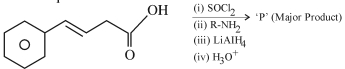
The major product $P$ formed in the following sequence of reactions is
A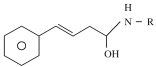
B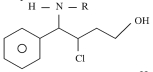
C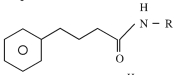
D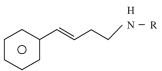
Solution
(D) The reaction sequence is as follows:
$1$. Treatment of the carboxylic acid with $SOCl_2$ converts it into an acid chloride: $Ph-CH=CH-CH_2-COOH \xrightarrow{SOCl_2} Ph-CH=CH-CH_2-COCl$.
$2$. Reaction with $R-NH_2$ (amine) converts the acid chloride into an amide: $Ph-CH=CH-CH_2-COCl \xrightarrow{R-NH_2} Ph-CH=CH-CH_2-CONHR$.
$3$. Reduction with $LiAlH_4$ followed by $H_3O^+$ reduces the amide group $(-CONHR)$ to an amine group $(-CH_2NHR)$: $Ph-CH=CH-CH_2-CONHR \xrightarrow{LiAlH_4, H_3O^+} Ph-CH=CH-CH_2-CH_2NHR$.
Thus,the final product is $Ph-CH=CH-CH_2-CH_2NHR$.
$1$. Treatment of the carboxylic acid with $SOCl_2$ converts it into an acid chloride: $Ph-CH=CH-CH_2-COOH \xrightarrow{SOCl_2} Ph-CH=CH-CH_2-COCl$.
$2$. Reaction with $R-NH_2$ (amine) converts the acid chloride into an amide: $Ph-CH=CH-CH_2-COCl \xrightarrow{R-NH_2} Ph-CH=CH-CH_2-CONHR$.
$3$. Reduction with $LiAlH_4$ followed by $H_3O^+$ reduces the amide group $(-CONHR)$ to an amine group $(-CH_2NHR)$: $Ph-CH=CH-CH_2-CONHR \xrightarrow{LiAlH_4, H_3O^+} Ph-CH=CH-CH_2-CH_2NHR$.
Thus,the final product is $Ph-CH=CH-CH_2-CH_2NHR$.
0 likesView Solution
352
ChemistryDifficultMCQJEE Main · 2023
The mass of $NH_3$ produced when $131.8 \ kg$ of cyclohexanecarbaldehyde undergoes Tollen's test is $..... \ kg$. (Nearest Integer) Molar Mass of $C = 12 \ g/mol$,$N = 14 \ g/mol$,$O = 16 \ g/mol$.
A
$61$
B
$60$
C
$62$
D
$63$
Solution
(B) The chemical reaction for the oxidation of cyclohexanecarbaldehyde with Tollen's reagent is:
$C_6H_{11}CHO + 2[Ag(NH_3)_2]OH \rightarrow C_6H_{11}COONH_4 + 2Ag + 3NH_3 + H_2O$
Molar mass of cyclohexanecarbaldehyde $(C_7H_{12}O)$ = $(7 \times 12) + (12 \times 1) + 16 = 84 + 12 + 16 = 112 \ g/mol$.
From the stoichiometry,$1 \ mol$ of cyclohexanecarbaldehyde produces $3 \ mol$ of $NH_3$.
Moles of cyclohexanecarbaldehyde = $\frac{131.8 \times 10^3 \ g}{112 \ g/mol} \approx 1176.78 \ mol$.
Moles of $NH_3$ produced = $3 \times 1176.78 = 3530.34 \ mol$.
Mass of $NH_3$ = $3530.34 \ mol \times 17 \ g/mol = 60015.78 \ g \approx 60 \ kg$.
$C_6H_{11}CHO + 2[Ag(NH_3)_2]OH \rightarrow C_6H_{11}COONH_4 + 2Ag + 3NH_3 + H_2O$
Molar mass of cyclohexanecarbaldehyde $(C_7H_{12}O)$ = $(7 \times 12) + (12 \times 1) + 16 = 84 + 12 + 16 = 112 \ g/mol$.
From the stoichiometry,$1 \ mol$ of cyclohexanecarbaldehyde produces $3 \ mol$ of $NH_3$.
Moles of cyclohexanecarbaldehyde = $\frac{131.8 \times 10^3 \ g}{112 \ g/mol} \approx 1176.78 \ mol$.
Moles of $NH_3$ produced = $3 \times 1176.78 = 3530.34 \ mol$.
Mass of $NH_3$ = $3530.34 \ mol \times 17 \ g/mol = 60015.78 \ g \approx 60 \ kg$.
1 likesView Solution
353
ChemistryDifficultMCQJEE Main · 2023
In an oligopeptide named Alanyl-glycyl-phenyl-alanyl-isoleucine,the number of $sp^2$ hybridised carbons is $...........$.
A
$11$
B
$10$
C
$12$
D
$13$
Solution
(B) The oligopeptide structure contains $4$ carbonyl groups $(C=O)$,each contributing $1$ $sp^2$ hybridized carbon. Total carbons from carbonyl groups = $4 \times 1 = 4$.
Additionally,the phenyl ring (side chain of phenylalanine) contains $6$ $sp^2$ hybridized carbons.
Total number of $sp^2$ hybridized carbons = $4 + 6 = 10$.
Additionally,the phenyl ring (side chain of phenylalanine) contains $6$ $sp^2$ hybridized carbons.
Total number of $sp^2$ hybridized carbons = $4 + 6 = 10$.
0 likesView Solution
354
ChemistryMediumMCQJEE Main · 2023
$80$ mole percent of $MgCl_2$ is dissociated in aqueous solution. The vapour pressure of $1.0$ molal aqueous solution of $MgCl_2$ at $38^{\circ} C$ is $.........$ $mm$ $Hg$. (Nearest integer)
Given : Vapour pressure of water at $38^{\circ} C$ is $50$ $mm$ $Hg$.
Given : Vapour pressure of water at $38^{\circ} C$ is $50$ $mm$ $Hg$.
A
$47$
B
$48$
C
$46$
D
$45$
Solution
(B) $MgCl_2 \rightarrow Mg^{2+} + 2Cl^-$
Initial moles: $1$,$0$,$0$
At equilibrium: $1-\alpha$,$\alpha$,$2\alpha$
Total particles $i = 1 + 2\alpha$. Given $\alpha = 0.8$,so $i = 1 + 2(0.8) = 2.6$.
For a $1.0$ molal solution,$n_2 = 1$ mole of solute in $1000 \ g$ of water ($n_1 = 1000/18 = 55.55$ moles).
Using Raoult's Law: $\frac{p^{\circ} - p_s}{p^{\circ}} = \frac{i \times n_2}{n_1 + i \times n_2} \approx \frac{i \times n_2}{n_1}$.
$\frac{50 - p_s}{50} = \frac{2.6 \times 1}{55.55} = 0.0468$.
$50 - p_s = 2.34 \implies p_s = 47.66 \ mm \ Hg$.
Rounding to the nearest integer,$p_s \approx 48 \ mm \ Hg$.
Initial moles: $1$,$0$,$0$
At equilibrium: $1-\alpha$,$\alpha$,$2\alpha$
Total particles $i = 1 + 2\alpha$. Given $\alpha = 0.8$,so $i = 1 + 2(0.8) = 2.6$.
For a $1.0$ molal solution,$n_2 = 1$ mole of solute in $1000 \ g$ of water ($n_1 = 1000/18 = 55.55$ moles).
Using Raoult's Law: $\frac{p^{\circ} - p_s}{p^{\circ}} = \frac{i \times n_2}{n_1 + i \times n_2} \approx \frac{i \times n_2}{n_1}$.
$\frac{50 - p_s}{50} = \frac{2.6 \times 1}{55.55} = 0.0468$.
$50 - p_s = 2.34 \implies p_s = 47.66 \ mm \ Hg$.
Rounding to the nearest integer,$p_s \approx 48 \ mm \ Hg$.
0 likesView Solution
355
ChemistryAdvancedMCQJEE Main · 2023
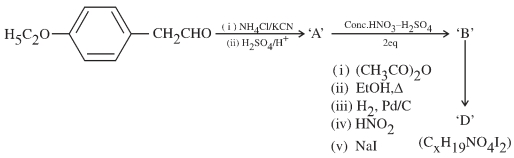
The value of $x$ in compound '$D$' is $.........$.
A
$14$
B
$15$
C
$13$
D
$12$
Solution
(B) The starting material is $4$-ethoxyphenylacetaldehyde.
$1$. Strecker synthesis: Reaction with $NH_4Cl/KCN$ followed by hydrolysis gives $4$-ethoxyphenylalanine ('$A$').
$2$. Nitration: Treatment with $Conc. HNO_3-H_2SO_4$ $(2 \ eq)$ introduces two nitro groups at the ortho positions relative to the ethoxy group,yielding $3,5$-dinitro-$4$-ethoxyphenylalanine ('$B$').
$3$. Acetylation: Reaction with $(CH_3CO)_2O$ protects the amino group as an acetamide.
$4$. Esterification: Reaction with $EtOH/\Delta$ converts the carboxylic acid to an ethyl ester.
$5$. Reduction: $H_2, Pd/C$ reduces the two nitro groups to amino groups.
$6$. Diazotization: $HNO_2$ converts the amino groups to diazonium salts.
$7$. Sandmeyer-like reaction: $NaI$ replaces the diazonium groups with iodine atoms.
The final product '$D$' is $3,5$-diiodo-$4$-ethoxyphenylalanine ethyl ester derivative.
The molecular formula is $C_{15}H_{19}NO_4I_2$.
Comparing this with $C_xH_{19}NO_4I_2$,we find $x = 15$.
$1$. Strecker synthesis: Reaction with $NH_4Cl/KCN$ followed by hydrolysis gives $4$-ethoxyphenylalanine ('$A$').
$2$. Nitration: Treatment with $Conc. HNO_3-H_2SO_4$ $(2 \ eq)$ introduces two nitro groups at the ortho positions relative to the ethoxy group,yielding $3,5$-dinitro-$4$-ethoxyphenylalanine ('$B$').
$3$. Acetylation: Reaction with $(CH_3CO)_2O$ protects the amino group as an acetamide.
$4$. Esterification: Reaction with $EtOH/\Delta$ converts the carboxylic acid to an ethyl ester.
$5$. Reduction: $H_2, Pd/C$ reduces the two nitro groups to amino groups.
$6$. Diazotization: $HNO_2$ converts the amino groups to diazonium salts.
$7$. Sandmeyer-like reaction: $NaI$ replaces the diazonium groups with iodine atoms.
The final product '$D$' is $3,5$-diiodo-$4$-ethoxyphenylalanine ethyl ester derivative.
The molecular formula is $C_{15}H_{19}NO_4I_2$.
Comparing this with $C_xH_{19}NO_4I_2$,we find $x = 15$.
0 likesView Solution
356
ChemistryMediumMCQJEE Main · 2023
The reaction $2 \ NO + Br_2 \rightarrow 2 \ NOBr$ takes place through the mechanism given below:
$NO + Br_2 \Leftrightarrow NOBr_2$ (fast)
$NOBr_2 + NO \rightarrow 2 \ NOBr$ (slow)
The overall order of the reaction is $.....$.
$NO + Br_2 \Leftrightarrow NOBr_2$ (fast)
$NOBr_2 + NO \rightarrow 2 \ NOBr$ (slow)
The overall order of the reaction is $.....$.
A
$4$
B
$3$
C
$5$
D
$6$
Solution
(B) The rate-determining step $(RDS)$ is the slow step: $NOBr_2 + NO \rightarrow 2 \ NOBr$.
The rate law is given by: $r = k [NOBr_2] [NO]$ ---- $(i)$
From the fast equilibrium step: $K_{eq} = \frac{[NOBr_2]}{[NO] [Br_2]}$,which implies $[NOBr_2] = K_{eq} [NO] [Br_2]$ ---- $(ii)$
Substituting $(ii)$ into $(i)$:
$r = k \cdot K_{eq} [NO] [Br_2] [NO]$
$r = k' [NO]^2 [Br_2]^1$
The overall order of the reaction is the sum of the powers of the concentration terms in the rate law: $2 + 1 = 3$.
The rate law is given by: $r = k [NOBr_2] [NO]$ ---- $(i)$
From the fast equilibrium step: $K_{eq} = \frac{[NOBr_2]}{[NO] [Br_2]}$,which implies $[NOBr_2] = K_{eq} [NO] [Br_2]$ ---- $(ii)$
Substituting $(ii)$ into $(i)$:
$r = k \cdot K_{eq} [NO] [Br_2] [NO]$
$r = k' [NO]^2 [Br_2]^1$
The overall order of the reaction is the sum of the powers of the concentration terms in the rate law: $2 + 1 = 3$.
0 likesView Solution
357
ChemistryDifficultMCQJEE Main · 2023
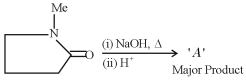
In the reaction given below,identify the major product '$A$':
A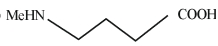
B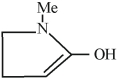
C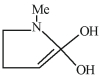
D
Solution
(A) The given reactant is $N$-methylpyrrolidin$-2-$one,which is a cyclic amide (lactam).
Treatment with $NaOH$ and $\Delta$ (heating) causes the hydrolysis of the amide bond.
The hydroxide ion $(OH^-)$ attacks the carbonyl carbon,leading to the ring-opening of the lactam.
This results in the formation of the carboxylate salt of the corresponding amino acid,$CH_3NH(CH_2)_3COO^-Na^+$.
Subsequent acidification with $H^+$ protonates the carboxylate group to form the carboxylic acid,$CH_3NH(CH_2)_3COOH$.
Treatment with $NaOH$ and $\Delta$ (heating) causes the hydrolysis of the amide bond.
The hydroxide ion $(OH^-)$ attacks the carbonyl carbon,leading to the ring-opening of the lactam.
This results in the formation of the carboxylate salt of the corresponding amino acid,$CH_3NH(CH_2)_3COO^-Na^+$.
Subsequent acidification with $H^+$ protonates the carboxylate group to form the carboxylic acid,$CH_3NH(CH_2)_3COOH$.
0 likesView Solution
358
ChemistryMediumMCQJEE Main · 2023
The mismatched combinations are
$A.$ Chlorophyll $- Co$
$B.$ Water hardness $- EDTA$
$C.$ Photography $- [Ag(CN)_2]^-$
$D.$ Wilkinson catalyst $- [(Ph_3P)_3RhCl]$
$E.$ Chelating ligand $- D^{-}$\text{Penicillamine}
Choose the correct answer from the options given below:
$A.$ Chlorophyll $- Co$
$B.$ Water hardness $- EDTA$
$C.$ Photography $- [Ag(CN)_2]^-$
$D.$ Wilkinson catalyst $- [(Ph_3P)_3RhCl]$
$E.$ Chelating ligand $- D^{-}$\text{Penicillamine}
Choose the correct answer from the options given below:
A
$A$ and $C$ Only
B
$A$ and $E$ Only
C
$D$ and $E$ Only
D
$A, C$ and $E$ Only
Solution
(A) $A.$ Chlorophyll contains $Mg^{2+}$ ion,not $Co$. Thus,this is mismatched.
$B.$ $EDTA$ is used to estimate water hardness by forming a stable complex with $Ca^{2+}$ and $Mg^{2+}$ ions. This is a correct match.
$C.$ In black and white photography,the developed film is fixed by washing with hypo solution $(Na_2S_2O_3)$,which dissolves undecomposed $AgBr$ to form the complex ion $[Ag(S_2O_3)_2]^{3-}$,not $[Ag(CN)_2]^-$. Thus,this is mismatched.
$D.$ Wilkinson catalyst is $[(Ph_3P)_3RhCl]$. This is a correct match.
$E.$ $D^{-}$\text{Penicillamine} is a chelating ligand used to treat Wilson's disease by chelating excess copper. This is a correct match.
Therefore,the mismatched combinations are $A$ and $C$.
$B.$ $EDTA$ is used to estimate water hardness by forming a stable complex with $Ca^{2+}$ and $Mg^{2+}$ ions. This is a correct match.
$C.$ In black and white photography,the developed film is fixed by washing with hypo solution $(Na_2S_2O_3)$,which dissolves undecomposed $AgBr$ to form the complex ion $[Ag(S_2O_3)_2]^{3-}$,not $[Ag(CN)_2]^-$. Thus,this is mismatched.
$D.$ Wilkinson catalyst is $[(Ph_3P)_3RhCl]$. This is a correct match.
$E.$ $D^{-}$\text{Penicillamine} is a chelating ligand used to treat Wilson's disease by chelating excess copper. This is a correct match.
Therefore,the mismatched combinations are $A$ and $C$.
0 likesView Solution
359
ChemistryMediumMCQJEE Main · 2023
Match the following:
Choose the correct answer from the options given below:
| Column-$A$ | Column-$B$ |
| $a.$ Nylon-$6$ | $I.$ Natural Rubber |
| $b.$ Vulcanized Rubber | $II.$ Cross Linked |
| $c.$ cis-$1,4$-polyisoprene | $III.$ Caprolactam |
| $d.$ Polychloroprene | $IV.$ Neoprene |
Choose the correct answer from the options given below:
A
$a$ $\rightarrow IV, b$ $\rightarrow III, c$ $\rightarrow II, d$ $\rightarrow I$
B
$a$ $\rightarrow III, b$ $\rightarrow IV, c$ $\rightarrow I, d$ $\rightarrow II$
C
$a$ $\rightarrow II, b$ $\rightarrow III, c$ $\rightarrow IV, d$ $\rightarrow I$
D
$a$ $\rightarrow III, b$ $\rightarrow II, c$ $\rightarrow I, d$ $\rightarrow IV$
Solution
(D) $a.$ Nylon-$6$ is prepared from the monomer Caprolactam $(III)$.
$b.$ Vulcanized rubber is a cross-linked polymer formed by heating rubber with sulphur $(II)$.
$c.$ cis-$1,4$-polyisoprene is the chemical name for Natural Rubber $(I)$.
$d.$ Polychloroprene is commonly known as Neoprene $(IV)$.
Therefore,the correct matching is $a$ $\rightarrow III, b$ $\rightarrow II, c$ $\rightarrow I, d$ $\rightarrow IV$.
$b.$ Vulcanized rubber is a cross-linked polymer formed by heating rubber with sulphur $(II)$.
$c.$ cis-$1,4$-polyisoprene is the chemical name for Natural Rubber $(I)$.
$d.$ Polychloroprene is commonly known as Neoprene $(IV)$.
Therefore,the correct matching is $a$ $\rightarrow III, b$ $\rightarrow II, c$ $\rightarrow I, d$ $\rightarrow IV$.
0 likesView Solution
360
ChemistryDifficultMCQJEE Main · 2023
$2-$Methylpropyl bromide reacts with $C_2H_5O^-$ to give $A$,whereas on reaction with $C_2H_5OH$ it gives $B$. The mechanism followed in these reactions and the products $A$ and $B$ respectively are:
A
$S_N2$,$A =$ isobutyl ethyl ether; $S_N1$,$B =$ tert-butyl ethyl ether
B
$S_N1$,$A =$ tert-butyl ethyl ether; $S_N1$,$B = 2-$butyl ethyl ether
C
$S_N1$,$A =$ tert-butyl ethyl ether; $S_N2$,$B =$ isobutyl ethyl ether
D
$S_N2$,$A = 2-$butyl ethyl ether; $S_N2$,$B =$ isobutyl ethyl ether
Solution
(A) Reaction with $C_2H_5O^-$: $C_2H_5O^-$ is a strong nucleophile. $2-$Methylpropyl bromide is a primary alkyl halide. Therefore,it undergoes an $S_N2$ reaction to form isobutyl ethyl ether $(A)$.
Reaction with $C_2H_5OH$: $C_2H_5OH$ is a weak nucleophile. The reaction proceeds via an $S_N1$ mechanism. The primary carbocation formed initially undergoes a $1,2-H$ shift to form a more stable tertiary carbocation,which then reacts with the nucleophile to form tert-butyl ethyl ether $(B)$.
Reaction with $C_2H_5OH$: $C_2H_5OH$ is a weak nucleophile. The reaction proceeds via an $S_N1$ mechanism. The primary carbocation formed initially undergoes a $1,2-H$ shift to form a more stable tertiary carbocation,which then reacts with the nucleophile to form tert-butyl ethyl ether $(B)$.
0 likesView Solution
361
ChemistryDifficultMCQJEE Main · 2023
$D-(+)-\text{Glyceraldehyde} \xrightarrow[(ii) H_2O/H^{+}]{(i) HCN, (iii) HNO_3}$
The products formed in the above reaction are
The products formed in the above reaction are
A
Two optically active products
B
One optically active and one meso product
C
One optically inactive and one meso product.
D
Two optically inactive products
Solution
(B) The reaction of $D-(+)-\text{Glyceraldehyde}$ with $HCN$ followed by hydrolysis and oxidation with $HNO_3$ is a Kiliani-Fischer synthesis sequence.
$1$. The addition of $HCN$ to the aldehyde group of $D-(+)-\text{Glyceraldehyde}$ creates a new chiral center,resulting in two diastereomeric cyanohydrins.
$2$. Hydrolysis of these cyanohydrins converts the $-CN$ group into a $-COOH$ group,forming two diastereomeric aldonic acids.
$3$. Oxidation with $HNO_3$ further oxidizes the terminal $-CH_2OH$ group to a $-COOH$ group,resulting in two dicarboxylic acids (aldaric acids).
$4$. One of the resulting products is $meso-\text{tartaric acid}$ (or a derivative),which is optically inactive due to an internal plane of symmetry.
$5$. The other product is an optically active isomer (e.g.,$L-(+)-\text{tartaric acid}$ derivative).
Thus,the final products are one optically inactive $(meso)$ product and one optically active product.
$1$. The addition of $HCN$ to the aldehyde group of $D-(+)-\text{Glyceraldehyde}$ creates a new chiral center,resulting in two diastereomeric cyanohydrins.
$2$. Hydrolysis of these cyanohydrins converts the $-CN$ group into a $-COOH$ group,forming two diastereomeric aldonic acids.
$3$. Oxidation with $HNO_3$ further oxidizes the terminal $-CH_2OH$ group to a $-COOH$ group,resulting in two dicarboxylic acids (aldaric acids).
$4$. One of the resulting products is $meso-\text{tartaric acid}$ (or a derivative),which is optically inactive due to an internal plane of symmetry.
$5$. The other product is an optically active isomer (e.g.,$L-(+)-\text{tartaric acid}$ derivative).
Thus,the final products are one optically inactive $(meso)$ product and one optically active product.
0 likesView Solution
362
ChemistryEasyMCQJEE Main · 2023
Which one of the following is most likely a mismatch?
A
Zinc - Liquation
B
Titanium - van Arkel method
C
Nickel - Mond process
D
Copper - Electrolysis
Solution
(A) The refining of metals depends on their properties.
$Zinc$ is refined by the distillation method because it has a low boiling point.
$Liquation$ is used for metals with low melting points like $Tin$ $(Sn)$.
$Titanium$ is refined by the $van \ Arkel$ method.
$Nickel$ is refined by the $Mond$ process.
$Copper$ is refined by $Electrolysis$.
Therefore,the mismatch is $Zinc - Liquation$.
$Zinc$ is refined by the distillation method because it has a low boiling point.
$Liquation$ is used for metals with low melting points like $Tin$ $(Sn)$.
$Titanium$ is refined by the $van \ Arkel$ method.
$Nickel$ is refined by the $Mond$ process.
$Copper$ is refined by $Electrolysis$.
Therefore,the mismatch is $Zinc - Liquation$.
0 likesView Solution
363
ChemistryMediumMCQJEE Main · 2023
$ClF_5$ at room temperature is a:
A
Colourless gas with trigonal bipyramidal geometry.
B
Colourless gas with square pyramidal geometry.
C
Colourless liquid with square pyramidal geometry.
D
Colourless liquid with trigonal bipyramidal geometry.
Solution
(C) The central atom $Cl$ in $ClF_5$ has $7$ valence electrons. It forms $5$ bonds with $F$ atoms and has $1$ lone pair of electrons.
Total electron pairs = $5 + 1 = 6$,which corresponds to $sp^3d^2$ hybridization.
The geometry is octahedral,but due to the presence of one lone pair,the shape is square pyramidal.
$ClF_5$ exists as a colourless liquid at room temperature.
Total electron pairs = $5 + 1 = 6$,which corresponds to $sp^3d^2$ hybridization.
The geometry is octahedral,but due to the presence of one lone pair,the shape is square pyramidal.
$ClF_5$ exists as a colourless liquid at room temperature.
0 likesView Solution
364
ChemistryMediumMCQJEE Main · 2023
In the reaction given below,identify the major product '$B$'.
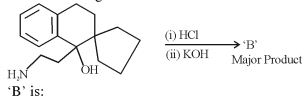
A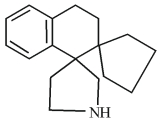
B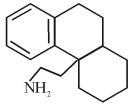
C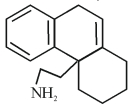
D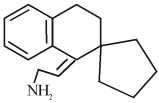
Solution
(C) The reaction proceeds as follows:
$1$. The alcohol group is protonated by $HCl$ and leaves as $H_2O$,forming a tertiary carbocation.
$2$. This carbocation undergoes a ring expansion (Wagner-Meerwein rearrangement) because the five-membered ring expands to a six-membered ring to form a more stable carbocation.
$3$. Finally,treatment with $KOH$ causes dehydrohalogenation (elimination of $H^+$) to form the most stable alkene,which is the major product '$B$'.
$4$. The final structure corresponds to the product shown in option $C$.
$1$. The alcohol group is protonated by $HCl$ and leaves as $H_2O$,forming a tertiary carbocation.
$2$. This carbocation undergoes a ring expansion (Wagner-Meerwein rearrangement) because the five-membered ring expands to a six-membered ring to form a more stable carbocation.
$3$. Finally,treatment with $KOH$ causes dehydrohalogenation (elimination of $H^+$) to form the most stable alkene,which is the major product '$B$'.
$4$. The final structure corresponds to the product shown in option $C$.
0 likesView Solution
365
ChemistryMediumMCQJEE Main · 2023
What happens when a lyophilic sol is added to a lyophobic sol?
A
Lyophilic sol is dispersed in lyophobic sol.
B
Film of lyophobic sol is formed over lyophilic sol.
C
Lyophobic sol is coagulated.
D
Film of lyophilic sol is formed over lyophobic sol.
Solution
(D) Lyophilic sols act as protective colloids for lyophobic sols. When a lyophilic sol is added to a lyophobic sol,the lyophilic particles form a protective film or layer around the lyophobic particles,thereby preventing their coagulation by electrolytes.
0 likesView Solution
366
ChemistryMediumMCQJEE Main · 2023
The pair of lanthanides in which both elements have high third-ionization energy is:
A
$Eu, Gd$
B
$Eu, Yb$
C
$Lu, Yb$
D
$Dy, Gd$
Solution
(B) The third ionization energy $(IE_3)$ is high for elements that have stable electronic configurations in their $+2$ oxidation state,as removing the third electron disrupts this stability.
$Eu$ $(Z=63)$ has the configuration $[Xe] 4f^7 6s^2$. Its $Eu^{2+}$ ion is $[Xe] 4f^7$,which is a stable half-filled configuration.
$Yb$ $(Z=70)$ has the configuration $[Xe] 4f^{14} 6s^2$. Its $Yb^{2+}$ ion is $[Xe] 4f^{14}$,which is a stable fully-filled configuration.
Therefore,both $Eu$ and $Yb$ exhibit high third-ionization energy.
$Eu$ $(Z=63)$ has the configuration $[Xe] 4f^7 6s^2$. Its $Eu^{2+}$ ion is $[Xe] 4f^7$,which is a stable half-filled configuration.
$Yb$ $(Z=70)$ has the configuration $[Xe] 4f^{14} 6s^2$. Its $Yb^{2+}$ ion is $[Xe] 4f^{14}$,which is a stable fully-filled configuration.
Therefore,both $Eu$ and $Yb$ exhibit high third-ionization energy.
0 likesView Solution
367
ChemistryMediumMCQJEE Main · 2023
$A$ solution of $12 \ g$ of non-electrolyte $(A)$ prepared by dissolving it in $1000 \ mL$ of water exerts the same osmotic pressure as that of a $0.05 \ M$ glucose solution at the same temperature. The empirical formula of $A$ is $CH_2O$. The molecular mass of $A$ is $.......... \ g \ mol^{-1}$. (Nearest integer)
A
$241$
B
$242$
C
$240$
D
$243$
Solution
(C) For two solutions at the same temperature,if osmotic pressure $\pi_1 = \pi_2$,then their molar concentrations must be equal $(C_1 = C_2)$.
Given,$C_2 = 0.05 \ M$ (glucose).
For solution $A$,mass $w = 12 \ g$ and volume $V = 1000 \ mL = 1 \ L$.
Concentration $C_1 = \frac{n}{V} = \frac{w / M_A}{1 \ L} = \frac{12}{M_A} \ M$.
Equating the concentrations: $\frac{12}{M_A} = 0.05$.
$M_A = \frac{12}{0.05} = 240 \ g \ mol^{-1}$.
Thus,the molecular mass of $A$ is $240 \ g \ mol^{-1}$.
Given,$C_2 = 0.05 \ M$ (glucose).
For solution $A$,mass $w = 12 \ g$ and volume $V = 1000 \ mL = 1 \ L$.
Concentration $C_1 = \frac{n}{V} = \frac{w / M_A}{1 \ L} = \frac{12}{M_A} \ M$.
Equating the concentrations: $\frac{12}{M_A} = 0.05$.
$M_A = \frac{12}{0.05} = 240 \ g \ mol^{-1}$.
Thus,the molecular mass of $A$ is $240 \ g \ mol^{-1}$.
0 likesView Solution
368
ChemistryDifficultMCQJEE Main · 2023
$20 \, mL$ of calcium hydroxide was consumed when it was reacted with $10 \, mL$ of an unknown solution of $H_2SO_4$. Also,$20 \, mL$ of a standard solution of $0.5 \, M$ $HCl$ containing $2$ drops of phenolphthalein was titrated with calcium hydroxide. The mixture showed a pink color when the burette displayed the value of $35.5 \, mL$,whereas the burette showed $25.5 \, mL$ initially. The concentration of $H_2SO_4$ is $..........M$ (Nearest integer).
A
$2$
B
$3$
C
$1$
D
$4$
Solution
(C) Step $1$: Determine the concentration of $Ca(OH)_2$ using the titration with $HCl$.
Reaction: $Ca(OH)_2 + 2HCl \rightarrow CaCl_2 + 2H_2O$
Volume of $Ca(OH)_2$ used = $35.5 \, mL - 25.5 \, mL = 10 \, mL$.
Volume of $HCl = 20 \, mL$,Molarity of $HCl = 0.5 \, M$.
Millimoles of $HCl = 20 \times 0.5 = 10 \, mmol$.
From the stoichiometry,$1 \, mol$ of $Ca(OH)_2$ reacts with $2 \, mol$ of $HCl$.
Millimoles of $Ca(OH)_2 = \frac{10}{2} = 5 \, mmol$.
$M_{Ca(OH)_2} = \frac{5 \, mmol}{10 \, mL} = 0.5 \, M$.
Step $2$: Determine the concentration of $H_2SO_4$.
Reaction: $Ca(OH)_2 + H_2SO_4 \rightarrow CaSO_4 + 2H_2O$
Volume of $Ca(OH)_2 = 20 \, mL$,Molarity = $0.5 \, M$.
Millimoles of $Ca(OH)_2 = 20 \times 0.5 = 10 \, mmol$.
From the stoichiometry,$1 \, mol$ of $Ca(OH)_2$ reacts with $1 \, mol$ of $H_2SO_4$.
Millimoles of $H_2SO_4 = 10 \, mmol$.
Volume of $H_2SO_4 = 10 \, mL$.
$M_{H_2SO_4} = \frac{10 \, mmol}{10 \, mL} = 1 \, M$.
Reaction: $Ca(OH)_2 + 2HCl \rightarrow CaCl_2 + 2H_2O$
Volume of $Ca(OH)_2$ used = $35.5 \, mL - 25.5 \, mL = 10 \, mL$.
Volume of $HCl = 20 \, mL$,Molarity of $HCl = 0.5 \, M$.
Millimoles of $HCl = 20 \times 0.5 = 10 \, mmol$.
From the stoichiometry,$1 \, mol$ of $Ca(OH)_2$ reacts with $2 \, mol$ of $HCl$.
Millimoles of $Ca(OH)_2 = \frac{10}{2} = 5 \, mmol$.
$M_{Ca(OH)_2} = \frac{5 \, mmol}{10 \, mL} = 0.5 \, M$.
Step $2$: Determine the concentration of $H_2SO_4$.
Reaction: $Ca(OH)_2 + H_2SO_4 \rightarrow CaSO_4 + 2H_2O$
Volume of $Ca(OH)_2 = 20 \, mL$,Molarity = $0.5 \, M$.
Millimoles of $Ca(OH)_2 = 20 \times 0.5 = 10 \, mmol$.
From the stoichiometry,$1 \, mol$ of $Ca(OH)_2$ reacts with $1 \, mol$ of $H_2SO_4$.
Millimoles of $H_2SO_4 = 10 \, mmol$.
Volume of $H_2SO_4 = 10 \, mL$.
$M_{H_2SO_4} = \frac{10 \, mmol}{10 \, mL} = 1 \, M$.
0 likesView Solution
369
ChemistryMediumMCQJEE Main · 2023
$t_{87.5}$ is the time required for the reaction to undergo $87.5 \%$ completion and $t_{50}$ is the time required for the reaction to undergo $50 \%$ completion. The relation between $t_{87.5}$ and $t_{50}$ for a first order reaction is $t_{87.5} = x \times t_{50}$. The value of $x$ is $......$. (Nearest integer)
A
$4$
B
$2$
C
$3$
D
$1$
Solution
(C) For a first order reaction,the time taken for $50 \%$ completion is the half-life,$t_{50} = t_{1/2}$.
At $87.5 \%$ completion,the remaining amount of reactant is $A_t = A_0 - 0.875 A_0 = 0.125 A_0 = \frac{A_0}{8}$.
Using the half-life concept:
$A_0$ $\xrightarrow{t_{1/2}} \frac{A_0}{2}$ $\xrightarrow{t_{1/2}} \frac{A_0}{4}$ $\xrightarrow{t_{1/2}} \frac{A_0}{8}$.
This shows that $t_{87.5} = 3 \times t_{1/2}$.
Since $t_{50} = t_{1/2}$,we have $t_{87.5} = 3 \times t_{50}$.
Therefore,$x = 3$.
At $87.5 \%$ completion,the remaining amount of reactant is $A_t = A_0 - 0.875 A_0 = 0.125 A_0 = \frac{A_0}{8}$.
Using the half-life concept:
$A_0$ $\xrightarrow{t_{1/2}} \frac{A_0}{2}$ $\xrightarrow{t_{1/2}} \frac{A_0}{4}$ $\xrightarrow{t_{1/2}} \frac{A_0}{8}$.
This shows that $t_{87.5} = 3 \times t_{1/2}$.
Since $t_{50} = t_{1/2}$,we have $t_{87.5} = 3 \times t_{50}$.
Therefore,$x = 3$.
0 likesView Solution
370
ChemistryDifficultMCQJEE Main · 2023
$KMnO_4$ is titrated with ferrous ammonium sulphate hexahydrate in the presence of dilute $H_2SO_4$. The number of water molecules produced for $2$ molecules of $KMnO_4$ is $..........$.
A
$67$
B
$65$
C
$68$
D
$66$
Solution
(C) The balanced redox reaction is given by:
$10[FeSO_4 \cdot (NH_4)_2SO_4 \cdot 6H_2O] + 2KMnO_4 + 8H_2SO_4$ $\rightarrow 5Fe_2(SO_4)_3 + 2MnSO_4 + 10(NH_4)_2SO_4 + K_2SO_4 + 68H_2O$
In this reaction,for every $2$ molecules of $KMnO_4$ consumed,$68$ molecules of water are produced.
$10[FeSO_4 \cdot (NH_4)_2SO_4 \cdot 6H_2O] + 2KMnO_4 + 8H_2SO_4$ $\rightarrow 5Fe_2(SO_4)_3 + 2MnSO_4 + 10(NH_4)_2SO_4 + K_2SO_4 + 68H_2O$
In this reaction,for every $2$ molecules of $KMnO_4$ consumed,$68$ molecules of water are produced.
0 likesView Solution
371
ChemistryMediumMCQJEE Main · 2023
$A$ metal surface of $100 \, cm^2$ area has to be coated with a nickel layer of thickness $0.001 \, mm$. $A$ current of $2 \, A$ was passed through a solution of $Ni(NO_3)_2$ for '$x$' seconds to coat the desired layer. The value of $x$ is $.........$. (Nearest integer)
($\rho_{Ni}$ (density of Nickel) is $10 \, g \cdot cm^{-3}$,Molar mass of Nickel is $60 \, g \cdot mol^{-1}$,$F = 96500 \, C \cdot mol^{-1}$)
($\rho_{Ni}$ (density of Nickel) is $10 \, g \cdot cm^{-3}$,Molar mass of Nickel is $60 \, g \cdot mol^{-1}$,$F = 96500 \, C \cdot mol^{-1}$)
A
$160$
B
$162$
C
$161$
D
$163$
Solution
(C) Step $1$: Calculate the volume of the nickel layer.
Volume = Area $\times$ thickness = $100 \, cm^2 \times 0.0001 \, cm = 0.01 \, cm^3$.
Step $2$: Calculate the mass of nickel required.
Mass = Density $\times$ Volume = $10 \, g \cdot cm^{-3} \times 0.01 \, cm^3 = 0.1 \, g$.
Step $3$: Use Faraday's law of electrolysis: $W = \frac{M \times I \times t}{n \times F}$.
Here,$W = 0.1 \, g$,$M = 60 \, g \cdot mol^{-1}$,$I = 2 \, A$,$n = 2$ (for $Ni^{2+} + 2e^- \rightarrow Ni$),$F = 96500 \, C \cdot mol^{-1}$.
Step $4$: Solve for $t$ (which is $x$):
$0.1 = \frac{60 \times 2 \times x}{2 \times 96500}$.
$0.1 = \frac{60 \times x}{96500}$.
$x = \frac{0.1 \times 96500}{60} = \frac{9650}{60} \approx 160.83 \, s$.
Rounding to the nearest integer,$x = 161$.
Volume = Area $\times$ thickness = $100 \, cm^2 \times 0.0001 \, cm = 0.01 \, cm^3$.
Step $2$: Calculate the mass of nickel required.
Mass = Density $\times$ Volume = $10 \, g \cdot cm^{-3} \times 0.01 \, cm^3 = 0.1 \, g$.
Step $3$: Use Faraday's law of electrolysis: $W = \frac{M \times I \times t}{n \times F}$.
Here,$W = 0.1 \, g$,$M = 60 \, g \cdot mol^{-1}$,$I = 2 \, A$,$n = 2$ (for $Ni^{2+} + 2e^- \rightarrow Ni$),$F = 96500 \, C \cdot mol^{-1}$.
Step $4$: Solve for $t$ (which is $x$):
$0.1 = \frac{60 \times 2 \times x}{2 \times 96500}$.
$0.1 = \frac{60 \times x}{96500}$.
$x = \frac{0.1 \times 96500}{60} = \frac{9650}{60} \approx 160.83 \, s$.
Rounding to the nearest integer,$x = 161$.
0 likesView Solution
372
ChemistryDifficultMCQJEE Main · 2023
In the wet tests for detection of various cations by precipitation,$Ba^{2+}$ cations are detected by obtaining a precipitate of
A
$Ba(ox)$ : Barium oxalate
B
$BaCO_3$
C
$Ba(OAc)_2$
D
$BaSO_4$
Solution
(B) In qualitative analysis,$(NH_4)_2CO_3$ is used as the group reagent for the $5^{th}$ group cations,which include $Ba^{2+}$,$Ca^{2+}$,and $Sr^{2+}$.
The chemical reaction for the precipitation of $Ba^{2+}$ is:
$Ba^{2+} + (NH_4)_2CO_3 \rightarrow BaCO_3 \downarrow + 2NH_4^{+}$
Thus,$Ba^{2+}$ is detected by obtaining a white precipitate of barium carbonate $(BaCO_3)$.
The chemical reaction for the precipitation of $Ba^{2+}$ is:
$Ba^{2+} + (NH_4)_2CO_3 \rightarrow BaCO_3 \downarrow + 2NH_4^{+}$
Thus,$Ba^{2+}$ is detected by obtaining a white precipitate of barium carbonate $(BaCO_3)$.
0 likesView Solution
373
ChemistryDifficultMCQJEE Main · 2023
The naturally occurring amino acid that contains only one basic functional group in its chemical structure is
A
arginine
B
lysine
C
asparagine
D
histidine
Solution
(C) The general structure of an amino acid contains one $-NH_2$ group and one $-COOH$ group.
$Arginine$,$Lysine$,and $Histidine$ are basic amino acids because they contain an additional basic functional group in their side chains.
$Asparagine$ $(Asn)$ has the side chain $-CH_2CONH_2$. The amide group $(-CONH_2)$ is neutral,not basic. Thus,$Asparagine$ contains only one basic amino group $(-NH_2)$ attached to the $\alpha$-carbon,making it the correct choice among the given options.
$Arginine$,$Lysine$,and $Histidine$ are basic amino acids because they contain an additional basic functional group in their side chains.
$Asparagine$ $(Asn)$ has the side chain $-CH_2CONH_2$. The amide group $(-CONH_2)$ is neutral,not basic. Thus,$Asparagine$ contains only one basic amino group $(-NH_2)$ attached to the $\alpha$-carbon,making it the correct choice among the given options.
0 likesView Solution
374
ChemistryMediumMCQJEE Main · 2023
Given below are two statements related to Ellingham diagram:
Statement-$I$ : Ellingham diagrams can be constructed for formation of oxides,sulfides and halides of metals.
Statement-$II$ : It consists of plots of $\Delta_f H^0$ vs $T$ for formation of oxides of elements.
In the light of the above statements,choose the most appropriate answer from the options given below:
Statement-$I$ : Ellingham diagrams can be constructed for formation of oxides,sulfides and halides of metals.
Statement-$II$ : It consists of plots of $\Delta_f H^0$ vs $T$ for formation of oxides of elements.
In the light of the above statements,choose the most appropriate answer from the options given below:
A
Both Statement $I$ and Statement $II$ are incorrect
B
Statement $I$ is incorrect but Statement $II$ is correct
C
Both Statement $I$ and Statement $II$ are correct
D
Statement $I$ is correct but Statement $II$ is incorrect
Solution
(D) Statement $I$ is correct,as Ellingham diagrams are graphical representations of the change in Gibbs free energy $(\Delta G^0)$ with temperature $(T)$ for the formation of oxides,sulfides,and halides of metals.
Statement $II$ is incorrect because Ellingham diagrams consist of plots of $\Delta G^0$ vs $T$,not $\Delta_f H^0$ vs $T$.
Statement $II$ is incorrect because Ellingham diagrams consist of plots of $\Delta G^0$ vs $T$,not $\Delta_f H^0$ vs $T$.
0 likesView Solution
375
ChemistryMediumMCQJEE Main · 2023
Given below are two statements,one is labelled as Assertion $A$ and the other is labelled as Reason $R$.
Assertion $A$ : The diameter of colloidal particles in solution should not be much smaller than the wavelength of light to show Tyndall effect.
Reason $R$ : The light scatters in all directions when the size of particles is large enough.
In the light of the above statements,choose the correct answer from the options given below:
Assertion $A$ : The diameter of colloidal particles in solution should not be much smaller than the wavelength of light to show Tyndall effect.
Reason $R$ : The light scatters in all directions when the size of particles is large enough.
In the light of the above statements,choose the correct answer from the options given below:
A
$A$ is true but $R$ is false
B
$A$ is false but $R$ is true
C
Both $A$ and $R$ are correct and $R$ is the correct explanation of $A$
D
Both $A$ and $R$ are correct but $R$ is $NOT$ the correct explanation of $A$
Solution
(C) The Tyndall effect is observed when the diameter of the dispersed particles is not much smaller than the wavelength of the light used.
When the particle size is large enough (comparable to the wavelength of light),the light hits the particles and scatters in all directions,making the path of the light visible.
Therefore,both Assertion $A$ and Reason $R$ are correct,and $R$ provides the correct explanation for $A$.
When the particle size is large enough (comparable to the wavelength of light),the light hits the particles and scatters in all directions,making the path of the light visible.
Therefore,both Assertion $A$ and Reason $R$ are correct,and $R$ provides the correct explanation for $A$.
0 likesView Solution
376
ChemistryDifficultMCQJEE Main · 2023
The total number of stereoisomers for the complex $[Cr(ox)_2ClBr]^{3-}$ (where $ox$ = oxalate) is:
A
$2$
B
$3$
C
$1$
D
$4$
Solution
(B) The complex $[Cr(ox)_2ClBr]^{3-}$ is of the type $[M(AA)_2a_2]$ where $AA$ is a bidentate ligand (oxalate) and $a$ represents monodentate ligands ($Cl^-$ and $Br^-$).
$1$. Geometrical Isomerism: There are two geometrical isomers:
- $trans$-isomer: The two monodentate ligands ($Cl$ and $Br$) are at $180^{\circ}$ to each other. This isomer has a plane of symmetry and is optically inactive.
- $cis$-isomer: The two monodentate ligands ($Cl$ and $Br$) are at $90^{\circ}$ to each other. This isomer lacks a plane of symmetry and is chiral.
$2$. Optical Isomerism: The $cis$-isomer exists as a pair of enantiomers ($d$ and $l$ forms).
Total stereoisomers = $1$ $(trans)$ + $2$ ($cis$-$d$ and $cis$-$l$) = $3$.
$1$. Geometrical Isomerism: There are two geometrical isomers:
- $trans$-isomer: The two monodentate ligands ($Cl$ and $Br$) are at $180^{\circ}$ to each other. This isomer has a plane of symmetry and is optically inactive.
- $cis$-isomer: The two monodentate ligands ($Cl$ and $Br$) are at $90^{\circ}$ to each other. This isomer lacks a plane of symmetry and is chiral.
$2$. Optical Isomerism: The $cis$-isomer exists as a pair of enantiomers ($d$ and $l$ forms).
Total stereoisomers = $1$ $(trans)$ + $2$ ($cis$-$d$ and $cis$-$l$) = $3$.
0 likesView Solution
377
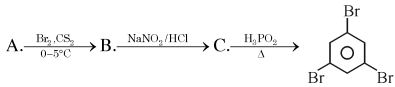
ChemistryMediumMCQJEE Main · 2023
Compound $A$ from the following reaction sequence is:
A
Benzoic Acid
B
Phenol
C
Salicylic Acid
D
Aniline
Solution
(D) The reaction sequence is as follows:
$1$. $A$ is $Aniline$ $(C_6H_5NH_2)$.
$2$. When $Aniline$ reacts with $Br_2$ in water (or $Br_2/CS_2$ at low temperature),it undergoes electrophilic substitution to form $2,4,6-tribromoaniline$ (Compound $B$).
$3$. $2,4,6-tribromoaniline$ reacts with $NaNO_2/HCl$ at $0-5^{\circ}C$ to form the diazonium salt,$2,4,6-tribromobenzenediazonium$ chloride (Compound $C$).
$4$. Finally,reduction of the diazonium salt with $H_3PO_2$ and water removes the $-N_2^+Cl^-$ group,yielding $1,3,5-tribromobenzene$.
Thus,compound $A$ is $Aniline$.
$1$. $A$ is $Aniline$ $(C_6H_5NH_2)$.
$2$. When $Aniline$ reacts with $Br_2$ in water (or $Br_2/CS_2$ at low temperature),it undergoes electrophilic substitution to form $2,4,6-tribromoaniline$ (Compound $B$).
$3$. $2,4,6-tribromoaniline$ reacts with $NaNO_2/HCl$ at $0-5^{\circ}C$ to form the diazonium salt,$2,4,6-tribromobenzenediazonium$ chloride (Compound $C$).
$4$. Finally,reduction of the diazonium salt with $H_3PO_2$ and water removes the $-N_2^+Cl^-$ group,yielding $1,3,5-tribromobenzene$.
Thus,compound $A$ is $Aniline$.
0 likesView Solution
378
ChemistryMediumMCQJEE Main · 2023
Match List-$I$ with List-$II$.
Choose the correct answer from the options given below:
| List-$I$ | List-$II$ |
|---|---|
| $A$. Weak intermolecular forces of attraction | $I$. Hexamethylenediamine $+$ adipic acid |
| $B$. Hydrogen bonding | $II$. $AlEt_3 + TiCl_4$ |
| $C$. Heavily branched polymer | $III$. $2-$chloro$-1,3-$butadiene |
| $D$. High density polymer | $IV$. Phenol $+$ formaldehyde |
Choose the correct answer from the options given below:
A
$A-III, B-I, C-IV, D-II$
B
$A-III, B-I, C-II, D-IV$
C
$A-I, B-IV, C-III, D-II$
D
$A-IV, B-I, C-III, D-II$
Solution
(A) - $A$. Weak intermolecular forces of attraction: $2-$chloro$-1,3-$butadiene (chloroprene) is the monomer of Neoprene,which is an elastomer (rubber) characterized by weak intermolecular forces.
- $B$. Hydrogen bonding: Hexamethylenediamine reacting with adipic acid forms Nylon-$6,6$,which exhibits strong hydrogen bonding due to the presence of amide groups.
- $C$. Heavily branched polymer: Phenol and formaldehyde react to form Bakelite,which is a heavily branched (cross-linked) thermosetting polymer.
- $D$. High density polymer: $AlEt_3 + TiCl_4$ is the Ziegler-Natta catalyst used to prepare high-density polyethylene $(HDPE)$.
Therefore,the correct matching is $A-III, B-I, C-IV, D-II$.
- $B$. Hydrogen bonding: Hexamethylenediamine reacting with adipic acid forms Nylon-$6,6$,which exhibits strong hydrogen bonding due to the presence of amide groups.
- $C$. Heavily branched polymer: Phenol and formaldehyde react to form Bakelite,which is a heavily branched (cross-linked) thermosetting polymer.
- $D$. High density polymer: $AlEt_3 + TiCl_4$ is the Ziegler-Natta catalyst used to prepare high-density polyethylene $(HDPE)$.
Therefore,the correct matching is $A-III, B-I, C-IV, D-II$.
0 likesView Solution
379
ChemistryMediumMCQJEE Main · 2023
The correct group of halide ions which can be oxidised by oxygen in acidic medium is
A
$Br^{-}$ only
B
$Cl^{-}, Br^{-}$ and $I^{-}$ only
C
$Br^{-}$ and $I^{-}$ only
D
$I^{-}$ only
Solution
(D) Among the halide ions,only $I^{-}$ can be oxidized to $I_2$ by oxygen in an acidic medium because it has the highest standard oxidation potential.
The balanced chemical equation is:
$4I^{-}_{(aq)} + 4H^{+}_{(aq)} + O_{2(g)} \rightarrow 2I_{2(s)} + 2H_2O_{(l)}$
The balanced chemical equation is:
$4I^{-}_{(aq)} + 4H^{+}_{(aq)} + O_{2(g)} \rightarrow 2I_{2(s)} + 2H_2O_{(l)}$
0 likesView Solution
380
ChemistryMediumMCQJEE Main · 2023
Match List-$I$ with List-$II$.
$1$-Bromopropane is reacted with reagents in List-$I$ to give products in List-$II$.
$1$-Bromopropane is reacted with reagents in List-$I$ to give products in List-$II$.
| List-$I$ (Reagent) | List-$II$ (Product) |
|---|---|
| $A$. $KOH$ (alc) | $I$. Nitrile |
| $B$. $KCN$ (alc) | $II$. Ester |
| $C$. $AgNO_2$ | $III$. Alkene |
| $D$. $CH_3COOAg$ | $IV$. Nitroalkane |
A
$A-IV, B-III, C-II, D-I$
B
$A-III, B-I, C-IV, D-II$
C
$A-I, B-II, C-III, D-IV$
D
$A-I, B-III, C-IV, D-II$
Solution
(B) $1$. $CH_3-CH_2-CH_2-Br + KOH \text{ (alc)} \rightarrow CH_3-CH=CH_2$ (Alkene,$III$)
$2$. $CH_3-CH_2-CH_2-Br + KCN \text{ (alc)} \rightarrow CH_3-CH_2-CH_2-CN$ (Nitrile,$I$)
$3$. $CH_3-CH_2-CH_2-Br + AgNO_2 \rightarrow CH_3-CH_2-CH_2-NO_2 + AgBr$ (Nitroalkane,$IV$)
$4$. $CH_3-CH_2-CH_2-Br + CH_3COOAg \rightarrow CH_3COOCH_2-CH_2-CH_3 + AgBr$ (Ester,$II$)
Therefore,the correct matching is $A-III, B-I, C-IV, D-II$.
$2$. $CH_3-CH_2-CH_2-Br + KCN \text{ (alc)} \rightarrow CH_3-CH_2-CH_2-CN$ (Nitrile,$I$)
$3$. $CH_3-CH_2-CH_2-Br + AgNO_2 \rightarrow CH_3-CH_2-CH_2-NO_2 + AgBr$ (Nitroalkane,$IV$)
$4$. $CH_3-CH_2-CH_2-Br + CH_3COOAg \rightarrow CH_3COOCH_2-CH_2-CH_3 + AgBr$ (Ester,$II$)
Therefore,the correct matching is $A-III, B-I, C-IV, D-II$.
0 likesView Solution
381
ChemistryMediumMCQJEE Main · 2023
Which of the following complexes will exhibit maximum attraction to an applied magnetic field?
A
$[Zn(H_2O)_6]^{2+}$
B
$[Co(H_2O)_6]^{2+}$
C
$[Co(en)_3]^{3+}$
D
$[Ni(H_2O)_6]^{2+}$
Solution
(B) The complex with the maximum number of unpaired electrons will exhibit the maximum attraction to an applied magnetic field (paramagnetism).
$1$. $[Zn(H_2O)_6]^{2+}$: $Zn^{2+}$ is a $d^{10}$ system,which has $0$ unpaired electrons.
$2$. $[Co(H_2O)_6]^{2+}$: $Co^{2+}$ is a $d^7$ system. In an octahedral field with a weak field ligand $(H_2O)$,the configuration is $t_{2g}^5 e_g^2$,resulting in $3$ unpaired electrons.
$3$. $[Co(en)_3]^{3+}$: $Co^{3+}$ is a $d^6$ system. Since $en$ is a strong field ligand,the configuration is $t_{2g}^6 e_g^0$,resulting in $0$ unpaired electrons.
$4$. $[Ni(H_2O)_6]^{2+}$: $Ni^{2+}$ is a $d^8$ system,which has $2$ unpaired electrons.
Since $[Co(H_2O)_6]^{2+}$ has the highest number of unpaired electrons $(3)$,it will exhibit the maximum attraction.
$1$. $[Zn(H_2O)_6]^{2+}$: $Zn^{2+}$ is a $d^{10}$ system,which has $0$ unpaired electrons.
$2$. $[Co(H_2O)_6]^{2+}$: $Co^{2+}$ is a $d^7$ system. In an octahedral field with a weak field ligand $(H_2O)$,the configuration is $t_{2g}^5 e_g^2$,resulting in $3$ unpaired electrons.
$3$. $[Co(en)_3]^{3+}$: $Co^{3+}$ is a $d^6$ system. Since $en$ is a strong field ligand,the configuration is $t_{2g}^6 e_g^0$,resulting in $0$ unpaired electrons.
$4$. $[Ni(H_2O)_6]^{2+}$: $Ni^{2+}$ is a $d^8$ system,which has $2$ unpaired electrons.
Since $[Co(H_2O)_6]^{2+}$ has the highest number of unpaired electrons $(3)$,it will exhibit the maximum attraction.
0 likesView Solution
382
ChemistryDifficultMCQJEE Main · 2023
At $298 \, K$,the standard reduction potential for $Cu^{2+}/Cu$ electrode is $0.34 \, V$.
Given: $K_{sp} \text{ of } Cu(OH)_2 = 1 \times 10^{-20}$
Take $\frac{2.303 RT}{F} = 0.059 \, V$
The reduction potential at $pH = 14$ for the above couple is $(-)x \times 10^{-2} \, V$. The value of $x$ is $........$.
Given: $K_{sp} \text{ of } Cu(OH)_2 = 1 \times 10^{-20}$
Take $\frac{2.303 RT}{F} = 0.059 \, V$
The reduction potential at $pH = 14$ for the above couple is $(-)x \times 10^{-2} \, V$. The value of $x$ is $........$.
A
$24$
B
$23$
C
$22$
D
$25$
Solution
(D) The dissolution equilibrium is $Cu(OH)_{2(s)} \rightleftharpoons Cu^{2+}_{(aq)} + 2OH^{-}_{(aq)}$.
$K_{sp} = [Cu^{2+}][OH^{-}]^2 = 1 \times 10^{-20}$.
At $pH = 14$,$pOH = 14 - 14 = 0$,so $[OH^{-}] = 10^0 = 1 \, M$.
$[Cu^{2+}] = \frac{K_{sp}}{[OH^{-}]^2} = \frac{10^{-20}}{1^2} = 10^{-20} \, M$.
Using the Nernst equation for $Cu^{2+} + 2e^{-} \rightarrow Cu_{(s)}$:
$E = E^{\circ} - \frac{0.059}{2} \log_{10} \frac{1}{[Cu^{2+}]}$.
$E = 0.34 - \frac{0.059}{2} \log_{10} \frac{1}{10^{-20}}$.
$E = 0.34 - \frac{0.059}{2} \times 20 = 0.34 - 0.59 = -0.25 \, V$.
Given $E = -x \times 10^{-2} \, V$,we have $-0.25 = -x \times 10^{-2}$,so $x = 25$.
$K_{sp} = [Cu^{2+}][OH^{-}]^2 = 1 \times 10^{-20}$.
At $pH = 14$,$pOH = 14 - 14 = 0$,so $[OH^{-}] = 10^0 = 1 \, M$.
$[Cu^{2+}] = \frac{K_{sp}}{[OH^{-}]^2} = \frac{10^{-20}}{1^2} = 10^{-20} \, M$.
Using the Nernst equation for $Cu^{2+} + 2e^{-} \rightarrow Cu_{(s)}$:
$E = E^{\circ} - \frac{0.059}{2} \log_{10} \frac{1}{[Cu^{2+}]}$.
$E = 0.34 - \frac{0.059}{2} \log_{10} \frac{1}{10^{-20}}$.
$E = 0.34 - \frac{0.059}{2} \times 20 = 0.34 - 0.59 = -0.25 \, V$.
Given $E = -x \times 10^{-2} \, V$,we have $-0.25 = -x \times 10^{-2}$,so $x = 25$.
0 likesView Solution
383
ChemistryMediumMCQJEE Main · 2023
$A ( g ) \rightarrow 2 B ( g ) + C ( g )$ is a first order reaction. The initial pressure of the system was found to be $800 \ mm \ Hg$ which increased to $1600 \ mm \ Hg$ after $10 \ min$. The total pressure of the system after $30 \ min$ will be . . . . . . $mm \ Hg$. (Nearest integer)
A
$2100$
B
$2000$
C
$2300$
D
$2200$
Solution
(D) For the reaction $A ( g ) \rightarrow 2 B ( g ) + C ( g )$,let the initial pressure of $A$ be $P_0 = 800 \ mm \ Hg$.
At $t = 10 \ min$,the total pressure $P_t = P_0 - x + 2x + x = P_0 + 2x = 1600 \ mm \ Hg$.
Substituting $P_0 = 800$,we get $800 + 2x = 1600$,so $2x = 800$,which means $x = 400 \ mm \ Hg$.
The pressure of $A$ remaining at $t = 10 \ min$ is $P_0 - x = 800 - 400 = 400 \ mm \ Hg$.
Since the initial pressure was $800 \ mm \ Hg$ and it became $400 \ mm \ Hg$ in $10 \ min$,the half-life $t_{1/2} = 10 \ min$.
After $30 \ min$ $(3 \times t_{1/2})$,the pressure of $A$ remaining is $P_A = P_0 \times (1/2)^3 = 800 \times (1/8) = 100 \ mm \ Hg$.
The amount of $A$ reacted is $800 - 100 = 700 \ mm \ Hg$.
According to stoichiometry,$A \rightarrow 2B + C$,the pressure of $B$ produced is $2 \times 700 = 1400 \ mm \ Hg$ and $C$ produced is $700 \ mm \ Hg$.
The total pressure at $t = 30 \ min$ is $P_A + P_B + P_C = 100 + 1400 + 700 = 2200 \ mm \ Hg$.
At $t = 10 \ min$,the total pressure $P_t = P_0 - x + 2x + x = P_0 + 2x = 1600 \ mm \ Hg$.
Substituting $P_0 = 800$,we get $800 + 2x = 1600$,so $2x = 800$,which means $x = 400 \ mm \ Hg$.
The pressure of $A$ remaining at $t = 10 \ min$ is $P_0 - x = 800 - 400 = 400 \ mm \ Hg$.
Since the initial pressure was $800 \ mm \ Hg$ and it became $400 \ mm \ Hg$ in $10 \ min$,the half-life $t_{1/2} = 10 \ min$.
After $30 \ min$ $(3 \times t_{1/2})$,the pressure of $A$ remaining is $P_A = P_0 \times (1/2)^3 = 800 \times (1/8) = 100 \ mm \ Hg$.
The amount of $A$ reacted is $800 - 100 = 700 \ mm \ Hg$.
According to stoichiometry,$A \rightarrow 2B + C$,the pressure of $B$ produced is $2 \times 700 = 1400 \ mm \ Hg$ and $C$ produced is $700 \ mm \ Hg$.
The total pressure at $t = 30 \ min$ is $P_A + P_B + P_C = 100 + 1400 + 700 = 2200 \ mm \ Hg$.
0 likesView Solution
384
ChemistryMediumMCQJEE Main · 2023
Sodium metal crystallizes in a body-centered cubic $(BCC)$ lattice with a unit cell edge length of $4 \ \mathring{A}$. The radius of the sodium atom is $..... \times 10^{-1} \ \mathring{A}$ (Nearest integer).
A
$14$
B
$15$
C
$16$
D
$17$
Solution
(D) For a body-centered cubic $(BCC)$ lattice,the relationship between the edge length $(a)$ and the atomic radius $(r)$ is given by: $\sqrt{3} \ a = 4 \ r$.
Given $a = 4 \ \mathring{A}$,we substitute the value into the equation:
$\sqrt{3} \times 4 = 4 \ r$.
$r = \sqrt{3} \ \mathring{A} \approx 1.732 \ \mathring{A}$.
To express this in the form $..... \times 10^{-1} \ \mathring{A}$,we multiply by $10/10$:
$r = 17.32 \times 10^{-1} \ \mathring{A}$.
Rounding to the nearest integer,we get $17 \times 10^{-1} \ \mathring{A}$.
Given $a = 4 \ \mathring{A}$,we substitute the value into the equation:
$\sqrt{3} \times 4 = 4 \ r$.
$r = \sqrt{3} \ \mathring{A} \approx 1.732 \ \mathring{A}$.
To express this in the form $..... \times 10^{-1} \ \mathring{A}$,we multiply by $10/10$:
$r = 17.32 \times 10^{-1} \ \mathring{A}$.
Rounding to the nearest integer,we get $17 \times 10^{-1} \ \mathring{A}$.
0 likesView Solution
385
ChemistryDifficultMCQJEE Main · 2023
Sea water contains $29.25\%$ $NaCl$ and $19\%$ $MgCl_2$ by weight of solution. The normal boiling point of the sea water is $..........{}^{\circ}C$ (Nearest integer).
Assume $100\%$ ionization for both $NaCl$ and $MgCl_2$.
Given: $K_b(H_2O) = 0.52 \, K \, kg \, mol^{-1}$.
Molar mass of $NaCl$ and $MgCl_2$ is $58.5$ and $95 \, g \, mol^{-1}$ respectively.
Assume $100\%$ ionization for both $NaCl$ and $MgCl_2$.
Given: $K_b(H_2O) = 0.52 \, K \, kg \, mol^{-1}$.
Molar mass of $NaCl$ and $MgCl_2$ is $58.5$ and $95 \, g \, mol^{-1}$ respectively.
A
$115$
B
$114$
C
$113$
D
$116$
Solution
(D) Mass of solution = $100 \, g$.
Mass of $NaCl = 29.25 \, g$,Mass of $MgCl_2 = 19 \, g$.
Mass of solvent $(H_2O)$ = $100 - (29.25 + 19) = 51.75 \, g = 0.05175 \, kg$.
For $NaCl$ $(i=2)$: Moles = $29.25 / 58.5 = 0.5 \, mol$.
For $MgCl_2$ $(i=3)$: Moles = $19 / 95 = 0.2 \, mol$.
Total moles of ions = $(i_{NaCl} \times n_{NaCl}) + (i_{MgCl_2} \times n_{MgCl_2}) = (2 \times 0.5) + (3 \times 0.2) = 1.0 + 0.6 = 1.6 \, mol$.
$\Delta T_b = i \times K_b \times m = K_b \times (n_{total_ions} / \text{mass of solvent in kg}) = 0.52 \times (1.6 / 0.05175) \approx 16.07 \, ^{\circ}C$.
Boiling point of solution = $100 + 16.07 = 116.07 \, ^{\circ}C$.
Nearest integer is $116$.
Mass of $NaCl = 29.25 \, g$,Mass of $MgCl_2 = 19 \, g$.
Mass of solvent $(H_2O)$ = $100 - (29.25 + 19) = 51.75 \, g = 0.05175 \, kg$.
For $NaCl$ $(i=2)$: Moles = $29.25 / 58.5 = 0.5 \, mol$.
For $MgCl_2$ $(i=3)$: Moles = $19 / 95 = 0.2 \, mol$.
Total moles of ions = $(i_{NaCl} \times n_{NaCl}) + (i_{MgCl_2} \times n_{MgCl_2}) = (2 \times 0.5) + (3 \times 0.2) = 1.0 + 0.6 = 1.6 \, mol$.
$\Delta T_b = i \times K_b \times m = K_b \times (n_{total_ions} / \text{mass of solvent in kg}) = 0.52 \times (1.6 / 0.05175) \approx 16.07 \, ^{\circ}C$.
Boiling point of solution = $100 + 16.07 = 116.07 \, ^{\circ}C$.
Nearest integer is $116$.
0 likesView Solution
386
ChemistryMediumMCQJEE Main · 2023
Match List-$I$ with List-$II$:
Choose the correct answer from the options given below:
| List-$I$ (Monomer) | List-$II$ (Polymer) |
| $A$. Tetrafluoroethene | $I$. Orlon |
| $B$. Acrylonitrile | $II$. Natural rubber |
| $C$. Caprolactam | $III$. Teflon |
| $D$. Isoprene | $IV$. Nylon-$6$ |
Choose the correct answer from the options given below:
A
$A-III, B-I, C-IV, D-II$
B
$A-III, B-IV, C-II, D-I$
C
$A-IV, B-I, C-II, D-III$
D
$A-II, B-III, C-IV, D-I$
Solution
(A) The correct matches are as follows:
$A$. Tetrafluoroethene is the monomer of Teflon $(III)$.
$B$. Acrylonitrile is the monomer of Orlon $(I)$.
$C$. Caprolactam is the monomer of Nylon-$6$ $(IV)$.
$D$. Isoprene ($2$-methyl-$1,3$-butadiene) is the monomer of Natural rubber $(II)$.
Therefore,the correct matching is $A-III, B-I, C-IV, D-II$.
$A$. Tetrafluoroethene is the monomer of Teflon $(III)$.
$B$. Acrylonitrile is the monomer of Orlon $(I)$.
$C$. Caprolactam is the monomer of Nylon-$6$ $(IV)$.
$D$. Isoprene ($2$-methyl-$1,3$-butadiene) is the monomer of Natural rubber $(II)$.
Therefore,the correct matching is $A-III, B-I, C-IV, D-II$.
0 likesView Solution
387
ChemistryMediumMCQJEE Main · 2023
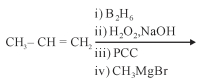
The product formed in the following multistep reaction is:
A
$CH_3-CH_2-CH_2-CH_2-OH$
B
$CH_3-CH_2-CH(OH)-CH_3$
C
$CH_3-CH_2-CO-OCH_3$
D
$(CH_3)_3C-OH$
Solution
(B) Step $1$: Hydroboration-oxidation of propene $(CH_3-CH=CH_2)$ with $B_2H_6$ followed by $H_2O_2, NaOH$ gives propan$-1-$ol $(CH_3-CH_2-CH_2-OH)$.
Step $2$: Oxidation of propan$-1-$ol with $PCC$ (Pyridinium chlorochromate) gives propanal $(CH_3-CH_2-CHO)$.
Step $3$: Reaction of propanal with methylmagnesium bromide $(CH_3MgBr)$ followed by acidic workup gives butan$-2-$ol $(CH_3-CH_2-CH(OH)-CH_3)$.
Step $2$: Oxidation of propan$-1-$ol with $PCC$ (Pyridinium chlorochromate) gives propanal $(CH_3-CH_2-CHO)$.
Step $3$: Reaction of propanal with methylmagnesium bromide $(CH_3MgBr)$ followed by acidic workup gives butan$-2-$ol $(CH_3-CH_2-CH(OH)-CH_3)$.
0 likesView Solution
388
ChemistryMediumMCQJEE Main · 2023
Which one of the following is not an example of calcination?
A
$Fe_2O_3 \cdot xH_2O \xrightarrow{\Delta} Fe_2O_3 + xH_2O$
B
$CaCO_3 \xrightarrow{\Delta} CaO + CO_2$
C
$CaCO_3 \cdot MgCO_3 \xrightarrow{\Delta} CaO + MgO + 2CO_2$
D
$2PbS + 3O_2 \xrightarrow{\Delta} 2PbO + 2SO_2$
Solution
(D) Calcination is the process of heating an ore in the absence or limited supply of air to remove moisture and volatile impurities.
Option $A$ is the dehydration of limonite (calcination).
Option $B$ is the calcination of limestone.
Option $C$ is the calcination of dolomite.
Option $D$ $(2PbS + 3O_2 \xrightarrow{\Delta} 2PbO + 2SO_2)$ involves the reaction of sulfide ore with oxygen,which is the definition of roasting.
Option $A$ is the dehydration of limonite (calcination).
Option $B$ is the calcination of limestone.
Option $C$ is the calcination of dolomite.
Option $D$ $(2PbS + 3O_2 \xrightarrow{\Delta} 2PbO + 2SO_2)$ involves the reaction of sulfide ore with oxygen,which is the definition of roasting.
0 likesView Solution
389
ChemistryMediumMCQJEE Main · 2023
Consider the following sequence of reactions:
$C_6H_5NH_2$ $\xrightarrow{NaNO_2, 0-5^{\circ}C} 'A'$ $\xrightarrow{N,N-\text{Dimethylaniline}} 'B'$
The product $B$ is
$C_6H_5NH_2$ $\xrightarrow{NaNO_2, 0-5^{\circ}C} 'A'$ $\xrightarrow{N,N-\text{Dimethylaniline}} 'B'$
The product $B$ is
A
$4-$(Dimethylamino)phenylhydrazine
B
$N,N$-Dimethyl$-4-$(phenylazo)aniline
C
$1,2-$Diphenyl-$N$,$N$-dimethylhydrazine
D
$4-$Amino-$N$,$N$-dimethyl$-1,2-$diphenylhydrazine
Solution
(B) Step $1$: Aniline $(C_6H_5NH_2)$ reacts with $NaNO_2$ in the presence of $HCl$ at $0-5^{\circ}C$ to form benzenediazonium chloride $(C_6H_5N_2^+Cl^-)$,which is product '$A$'.
Step $2$: Benzenediazonium chloride undergoes a diazo coupling reaction with $N,N$-dimethylaniline in a weakly acidic medium. The diazonium group $( -N=N- )$ attacks the para-position of the $N,N$-dimethylaniline ring to form $N,N$-dimethyl$-4-$(phenylazo)aniline,which is product '$B$'.
The reaction is: $C_6H_5N_2^+Cl^- + C_6H_5N(CH_3)_2 \rightarrow C_6H_5-N=N-C_6H_4-N(CH_3)_2 + HCl$.
Step $2$: Benzenediazonium chloride undergoes a diazo coupling reaction with $N,N$-dimethylaniline in a weakly acidic medium. The diazonium group $( -N=N- )$ attacks the para-position of the $N,N$-dimethylaniline ring to form $N,N$-dimethyl$-4-$(phenylazo)aniline,which is product '$B$'.
The reaction is: $C_6H_5N_2^+Cl^- + C_6H_5N(CH_3)_2 \rightarrow C_6H_5-N=N-C_6H_4-N(CH_3)_2 + HCl$.
0 likesView Solution
390
ChemistryMediumMCQJEE Main · 2023
The number of $P-O-P$ bonds in $H_4P_2O_7$,$(HPO_3)_3$ and $P_4O_{10}$ are respectively.
A
$1, 3, 6$
B
$0, 3, 6$
C
$0, 3, 4$
D
$1, 2, 4$
Solution
(A) $1$. In pyrophosphoric acid $(H_4P_2O_7)$,there is $1$ $P-O-P$ bond.
$2$. In cyclotrimetaphosphoric acid $((HPO_3)_3)$,there are $3$ $P-O-P$ bonds in the cyclic structure.
$3$. In phosphorus pentoxide $(P_4O_{10})$,there are $6$ $P-O-P$ bonds.
Therefore,the number of $P-O-P$ bonds are $1, 3, 6$ respectively.
$2$. In cyclotrimetaphosphoric acid $((HPO_3)_3)$,there are $3$ $P-O-P$ bonds in the cyclic structure.
$3$. In phosphorus pentoxide $(P_4O_{10})$,there are $6$ $P-O-P$ bonds.
Therefore,the number of $P-O-P$ bonds are $1, 3, 6$ respectively.
0 likesView Solution
391
ChemistryDifficultMCQJEE Main · 2023
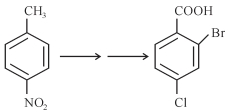
In the above conversion,the correct sequence of reagents to be added is:
A
$(i) Fe / H^{+}, (ii) HONO, (iii) CuCl, (iv) KMnO_4, (v) Br_2$
B
$(i) KMnO_4, (ii) Br_2 / Fe, (iii) Fe / H^{+}, (iv) Cl_2$
C
$(i) Br_2 / Fe, (ii) Fe / H^{+}, (iii) HONO, (iv) CuCl, (v) KMnO_4$
D
$(i) Br_2 / Fe, (ii) Fe / H^{+}, (iii) KMnO_4, (iv) Cl_2$
Solution
(C) The conversion of $p$-nitrotoluene to $3$-bromo-$4$-chlorobenzoic acid involves the following steps:
$1$. Electrophilic aromatic substitution: Bromination of $p$-nitrotoluene using $Br_2 / Fe$ introduces a bromine atom at the ortho position relative to the methyl group.
$2$. Reduction: The nitro group $(-NO_2)$ is reduced to an amino group $(-NH_2)$ using $Fe / H^+$.
$3$. Diazotization: The amino group is converted to a diazonium salt $(-N_2^+Cl^-)$ using $HONO$ (nitrous acid) at $0-5 \ ^\circ C$.
$4$. Sandmeyer reaction: The diazonium group is replaced by a chlorine atom using $CuCl$.
$5$. Oxidation: The methyl group $(-CH_3)$ is oxidized to a carboxylic acid group $(-COOH)$ using $KMnO_4$.
Thus,the correct sequence is $(i) Br_2 / Fe, (ii) Fe / H^{+}, (iii) HONO, (iv) CuCl, (v) KMnO_4$.
$1$. Electrophilic aromatic substitution: Bromination of $p$-nitrotoluene using $Br_2 / Fe$ introduces a bromine atom at the ortho position relative to the methyl group.
$2$. Reduction: The nitro group $(-NO_2)$ is reduced to an amino group $(-NH_2)$ using $Fe / H^+$.
$3$. Diazotization: The amino group is converted to a diazonium salt $(-N_2^+Cl^-)$ using $HONO$ (nitrous acid) at $0-5 \ ^\circ C$.
$4$. Sandmeyer reaction: The diazonium group is replaced by a chlorine atom using $CuCl$.
$5$. Oxidation: The methyl group $(-CH_3)$ is oxidized to a carboxylic acid group $(-COOH)$ using $KMnO_4$.
Thus,the correct sequence is $(i) Br_2 / Fe, (ii) Fe / H^{+}, (iii) HONO, (iv) CuCl, (v) KMnO_4$.
0 likesView Solution
392
ChemistryMediumMCQJEE Main · 2023
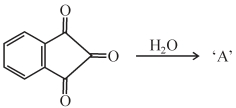
The major product '$A$' formed in the above reaction is:
A
$1,2-$dihydroxy$-3-$indanone
B
$2,2-$dihydroxy$-1,3-$indanedione
C
$1,3-$dihydroxy$-2-$indanone
D
$2,2-$dihydroxy$-1,3-$indanedione (with intramolecular hydrogen bonding)
Solution
(D) The starting material is ninhydrin ($1,2,3$-indantrione). When it reacts with water $(H_2O)$,the central carbonyl group,which is highly electrophilic due to the electron-withdrawing effect of the two adjacent carbonyl groups,undergoes nucleophilic addition by water to form a gem-diol. This gem-diol is stabilized by intramolecular hydrogen bonding between the hydroxyl groups and the adjacent carbonyl oxygen atoms. The product is $2,2$-dihydroxy-$1,3$-indanedione.
0 likesView Solution
393
ChemistryEasyMCQJEE Main · 2023
Which is not true for arginine?
A
It is a crystalline solid.
B
It is associated with more than one $pK_a$ values.
C
It has a fairly high melting point.
D
It has high solubility in benzene.
Solution
(D) Arginine is an amino acid that exists as a zwitterion in its solid state.
Due to the presence of ionic charges,it exhibits a high melting point and is a crystalline solid.
It is highly soluble in polar solvents like water but has low solubility in non-polar solvents like benzene.
Therefore,the statement that it has high solubility in benzene is incorrect.
Due to the presence of ionic charges,it exhibits a high melting point and is a crystalline solid.
It is highly soluble in polar solvents like water but has low solubility in non-polar solvents like benzene.
Therefore,the statement that it has high solubility in benzene is incorrect.
0 likesView Solution
394
ChemistryMediumMCQJEE Main · 2023
The major product formed in the Friedel-Crafts acylation of chlorobenzene is $p-$chloroacetophenone. Identify the correct structure of the major product.
A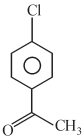
B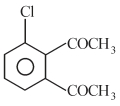
C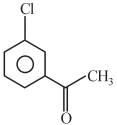
D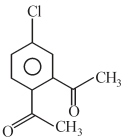
Solution
(A) Chlorine is an ortho/para directing group due to the resonance effect.
In electrophilic aromatic substitution reactions,the para-isomer is generally the major product due to less steric hindrance compared to the ortho-isomer.
Therefore,the major product of the Friedel-Crafts acylation of chlorobenzene is $p-$chloroacetophenone,which corresponds to the structure shown in option $A$.
In electrophilic aromatic substitution reactions,the para-isomer is generally the major product due to less steric hindrance compared to the ortho-isomer.
Therefore,the major product of the Friedel-Crafts acylation of chlorobenzene is $p-$chloroacetophenone,which corresponds to the structure shown in option $A$.
0 likesView Solution
395
ChemistryMediumMCQJEE Main · 2023
The complex with the highest magnitude of crystal field splitting energy $\left(\Delta_0\right)$ is
A
$[Cr(OH_2)_6]^{3+}$
B
$[Ti(OH_2)_6]^{3+}$
C
$[Fe(OH_2)_6]^{3+}$
D
$[Mn(OH_2)_6]^{3+}$
Solution
(A) The magnitude of crystal field splitting energy $\left(\Delta_0\right)$ depends on the oxidation state of the metal ion and the nature of the metal ion itself.
For a given ligand and oxidation state,$\Delta_0$ generally increases with the effective nuclear charge and the size of the $d$-orbitals.
Among the given $3d$ series metal ions in the $+3$ oxidation state,$Cr^{3+}$ has a $d^3$ configuration.
In octahedral complexes,$Cr^{3+}$ exhibits a high crystal field splitting energy due to the stability of the $t_{2g}^3$ configuration.
Comparing the given complexes,$[Cr(OH_2)_6]^{3+}$ has the highest $\Delta_0$ value among the choices provided.
For a given ligand and oxidation state,$\Delta_0$ generally increases with the effective nuclear charge and the size of the $d$-orbitals.
Among the given $3d$ series metal ions in the $+3$ oxidation state,$Cr^{3+}$ has a $d^3$ configuration.
In octahedral complexes,$Cr^{3+}$ exhibits a high crystal field splitting energy due to the stability of the $t_{2g}^3$ configuration.
Comparing the given complexes,$[Cr(OH_2)_6]^{3+}$ has the highest $\Delta_0$ value among the choices provided.
0 likesView Solution
396
ChemistryMediumMCQJEE Main · 2023
Which of the following expressions is correct in the case of a $CsCl$ unit cell (edge length '$a$')?
A
$r_{Cs^{+}} + r_{Cl^{-}} = \frac{a}{\sqrt{2}}$
B
$r_{Cs^{+}} + r_{Cl^{-}} = a$
C
$r_{Cs^{+}} + r_{Cl^{-}} = \frac{\sqrt{3}}{2} a$
D
$r_{Cs^{+}} + r_{Cl^{-}} = \frac{a}{2}$
Solution
(C) In a $CsCl$ crystal structure,the $Cs^{+}$ ion is located at the body center,and $Cl^{-}$ ions are located at the corners of the cube.
The body diagonal of the cube is given by $\sqrt{3} a$.
Since the $Cs^{+}$ ion at the center touches the $Cl^{-}$ ions at the corners along the body diagonal,the length of the body diagonal is equal to $2(r_{Cs^{+}} + r_{Cl^{-}})$.
Therefore,$2(r_{Cs^{+}} + r_{Cl^{-}}) = \sqrt{3} a$.
This simplifies to $r_{Cs^{+}} + r_{Cl^{-}} = \frac{\sqrt{3}}{2} a$.
The body diagonal of the cube is given by $\sqrt{3} a$.
Since the $Cs^{+}$ ion at the center touches the $Cl^{-}$ ions at the corners along the body diagonal,the length of the body diagonal is equal to $2(r_{Cs^{+}} + r_{Cl^{-}})$.
Therefore,$2(r_{Cs^{+}} + r_{Cl^{-}}) = \sqrt{3} a$.
This simplifies to $r_{Cs^{+}} + r_{Cl^{-}} = \frac{\sqrt{3}}{2} a$.
0 likesView Solution
397
ChemistryDifficultMCQJEE Main · 2023
The homoleptic and octahedral complex of $Co^{2+}$ and $H_2O$ has $.......$ unpaired electron$(s)$ in the $t_{2g}$ set of orbitals.
A
$1$
B
$2$
C
$3$
D
$4$
Solution
(A) The complex is $[Co(H_2O)_6]^{2+}$.
$Co^{2+}$ has a $3d^7$ electronic configuration.
In an octahedral field,$H_2O$ is a weak field ligand,so the electrons fill the orbitals as $t_{2g}^5 e_g^2$.
The $t_{2g}$ orbitals are filled as $(t_{2g})^2 (t_{2g})^2 (t_{2g})^1$,which results in $1$ unpaired electron in the $t_{2g}$ set.
$Co^{2+}$ has a $3d^7$ electronic configuration.
In an octahedral field,$H_2O$ is a weak field ligand,so the electrons fill the orbitals as $t_{2g}^5 e_g^2$.
The $t_{2g}$ orbitals are filled as $(t_{2g})^2 (t_{2g})^2 (t_{2g})^1$,which results in $1$ unpaired electron in the $t_{2g}$ set.
0 likesView Solution
398
ChemistryDifficultMCQJEE Main · 2023
The volume (in $mL$) of $0.1 \, M \, AgNO_3$ required for complete precipitation of chloride ions present in $20 \, mL$ of $0.01 \, M$ solution of $[Cr(H_2O)_5Cl]Cl_2$ as silver chloride is $..........$.
A
$4$
B
$3$
C
$2$
D
$1$
Solution
(A) The complex $[Cr(H_2O)_5Cl]Cl_2$ dissociates in water as: $[Cr(H_2O)_5Cl]Cl_2 \rightarrow [Cr(H_2O)_5Cl]^{2+} + 2Cl^-$.
Each mole of the complex provides $2$ moles of ionizable chloride ions $(Cl^-)$.
Number of millimoles of the complex $= Molarity \times Volume (mL) = 0.01 \, M \times 20 \, mL = 0.2 \, mmol$.
Since $1$ mole of complex gives $2$ moles of $Cl^-$,$0.2 \, mmol$ of complex gives $0.4 \, mmol$ of $Cl^-$.
The precipitation reaction is: $Ag^+ + Cl^- \rightarrow AgCl(s)$.
Thus,$0.4 \, mmol$ of $AgNO_3$ is required to precipitate $0.4 \, mmol$ of $Cl^-$.
Using $Molarity = \frac{millimoles}{Volume (mL)}$,we get $0.1 = \frac{0.4}{V}$.
$V = \frac{0.4}{0.1} = 4 \, mL$.
Each mole of the complex provides $2$ moles of ionizable chloride ions $(Cl^-)$.
Number of millimoles of the complex $= Molarity \times Volume (mL) = 0.01 \, M \times 20 \, mL = 0.2 \, mmol$.
Since $1$ mole of complex gives $2$ moles of $Cl^-$,$0.2 \, mmol$ of complex gives $0.4 \, mmol$ of $Cl^-$.
The precipitation reaction is: $Ag^+ + Cl^- \rightarrow AgCl(s)$.
Thus,$0.4 \, mmol$ of $AgNO_3$ is required to precipitate $0.4 \, mmol$ of $Cl^-$.
Using $Molarity = \frac{millimoles}{Volume (mL)}$,we get $0.1 = \frac{0.4}{V}$.
$V = \frac{0.4}{0.1} = 4 \, mL$.
0 likesView Solution
399
ChemistryMediumMCQJEE Main · 2023
The vapour pressure of $30 \%$ $(w/v)$ aqueous solution of glucose is $...... \ mm \ Hg$ at $25^{\circ} \ C$. [Given : The density of $30 \%$ $(w/v)$ aqueous solution of glucose is $1.2 \ g \ cm^{-3}$ and vapour pressure of pure water is $24 \ mm \ Hg$.] (Molar mass of glucose is $180 \ g \ mol^{-1}$.)
A
$23$
B
$22$
C
$21$
D
$24$
Solution
(A) The relative lowering of vapour pressure is given by $\frac{P^{\circ} - P_{s}}{P_{s}} = \frac{n_{solute}}{n_{solvent}}$.
Given: $30 \% \ (w/v)$ solution means $30 \ g$ of glucose in $100 \ mL$ of solution.
Mass of solution $= \text{density} \times \text{volume} = 1.2 \ g \ cm^{-3} \times 100 \ mL = 120 \ g$.
Mass of solvent (water) $= 120 \ g - 30 \ g = 90 \ g$.
Moles of glucose $(n_{solute})$ $= \frac{30 \ g}{180 \ g \ mol^{-1}} = \frac{1}{6} \ mol \approx 0.1667 \ mol$.
Moles of water $(n_{solvent})$ $= \frac{90 \ g}{18 \ g \ mol^{-1}} = 5 \ mol$.
Using the formula $\frac{24 - P_{s}}{P_{s}} = \frac{0.1667}{5} = 0.03334$.
$24 - P_{s} = 0.03334 \ P_{s} \implies 24 = 1.03334 \ P_{s}$.
$P_{s} = \frac{24}{1.03334} \approx 23.22 \ mm \ Hg$. The closest integer value is $23 \ mm \ Hg$.
Given: $30 \% \ (w/v)$ solution means $30 \ g$ of glucose in $100 \ mL$ of solution.
Mass of solution $= \text{density} \times \text{volume} = 1.2 \ g \ cm^{-3} \times 100 \ mL = 120 \ g$.
Mass of solvent (water) $= 120 \ g - 30 \ g = 90 \ g$.
Moles of glucose $(n_{solute})$ $= \frac{30 \ g}{180 \ g \ mol^{-1}} = \frac{1}{6} \ mol \approx 0.1667 \ mol$.
Moles of water $(n_{solvent})$ $= \frac{90 \ g}{18 \ g \ mol^{-1}} = 5 \ mol$.
Using the formula $\frac{24 - P_{s}}{P_{s}} = \frac{0.1667}{5} = 0.03334$.
$24 - P_{s} = 0.03334 \ P_{s} \implies 24 = 1.03334 \ P_{s}$.
$P_{s} = \frac{24}{1.03334} \approx 23.22 \ mm \ Hg$. The closest integer value is $23 \ mm \ Hg$.
0 likesView Solution
400
ChemistryMediumMCQJEE Main · 2023
$20 \ mL$ of $0.5 \ M \ NaCl$ is required to coagulate $200 \ mL$ of $As_2S_3$ sol in $2$ hours. The coagulating value of $NaCl$ is $...........$.
A
$50$
B
$40$
C
$30$
D
$20$
Solution
(A) The coagulating value is defined as the minimum concentration of an electrolyte in millimoles per liter $(mmol/L)$ required to cause coagulation of a sol in $2$ hours.
Given:
Volume of $NaCl$ solution = $20 \ mL$
Molarity of $NaCl$ solution = $0.5 \ M$
Volume of $As_2S_3$ sol = $200 \ mL$
Number of millimoles of $NaCl$ = $Molarity \times Volume \ (in \ mL) = 0.5 \times 20 = 10 \ mmol$.
These $10 \ mmol$ of $NaCl$ are required for $200 \ mL$ of sol.
For $1000 \ mL$ $(1 \ L)$ of sol,the required millimoles = $(10 / 200) \times 1000 = 50 \ mmol/L$.
Therefore,the coagulating value of $NaCl$ is $50$.
Given:
Volume of $NaCl$ solution = $20 \ mL$
Molarity of $NaCl$ solution = $0.5 \ M$
Volume of $As_2S_3$ sol = $200 \ mL$
Number of millimoles of $NaCl$ = $Molarity \times Volume \ (in \ mL) = 0.5 \times 20 = 10 \ mmol$.
These $10 \ mmol$ of $NaCl$ are required for $200 \ mL$ of sol.
For $1000 \ mL$ $(1 \ L)$ of sol,the required millimoles = $(10 / 200) \times 1000 = 50 \ mmol/L$.
Therefore,the coagulating value of $NaCl$ is $50$.
0 likesView Solution
Vedclass Products
For Students
Vedclass Test Series
Mock tests in real JEE Main style covering Chemistry with performance analysis. 5-day free trial.
Start Free TrialFor Teachers
Exam Paper Generator
Generate Set A/B/C/D Chemistry papers from 7.5L+ questions in 2 minutes. 3 chapters free.
Try FreeFor Institutes
Online Exam Module
Run live JEE Main mock exams with unlimited students, 360° analytics & white-label branding.
See DemoFrequently Asked Questions
How many Chemistry questions are in JEE Main 2023?
There are 726 Chemistry questions from the JEE Main 2023 paper on Vedclass, each with a detailed step-by-step solution in English.
Are JEE Main 2023 Chemistry solutions available in English?
Yes. All solutions on this page are in English. You can also switch to English or Hindi using the language buttons above the questions.
Can I practice JEE Main 2023 Chemistry as a timed test?
Yes. Use the Vedclass Test Series to attempt a full JEE Main mock test covering Chemistry with time limits and instant score analysis.
Can teachers create Chemistry papers from JEE Main previous year questions?
Yes. The Vedclass Exam Paper Generator lets teachers mix JEE Main Chemistry questions and generate Set A/B/C/D papers in minutes.
For Teachers & Institutes
Build a Custom Chemistry Paper
Pick JEE Main 2023 Chemistry questions, set difficulty, and generate Set A/B/C/D in 2 minutes.