
ChemistryQ1–100 of 521 questions
Page 1 of 6 · English
1
ChemistryMCQJEE Main · 2019
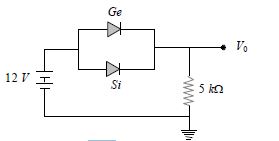
$Ge$ and $Si$ diodes conduct at $0.3 \ V$ and $0.7 \ V$ respectively. In the following figure,if the $Ge$ and $Si$ diode connections are reversed,the value of $V_0$ changes by .....$V$.
A
$0.2$
B
$0.4$
C
$0.6$
D
$0.8$
Solution
(B) Case $1$: Initially,both diodes are forward biased. The circuit will conduct through the diode with the lower threshold voltage,which is the $Ge$ diode $(0.3 \ V)$.
The voltage across the resistor $V_0 = 12 \ V - 0.3 \ V = 11.7 \ V$.
Case $2$: When the connections are reversed,both diodes become reverse biased. In a standard idealization for such problems,reversing the diodes means they are now connected in a way that they would conduct if the battery polarity were reversed,or effectively,they are now blocking the current in the current configuration. However,interpreting the question as the diodes being swapped or the circuit being reconfigured such that the $Si$ diode now dictates the drop:
If the diodes are reversed,the current path is blocked. Assuming the question implies the diodes are replaced by their counterparts or the circuit is modified such that the $Si$ diode $(0.7 \ V)$ is now the one conducting:
The new output voltage $V_0' = 12 \ V - 0.7 \ V = 11.3 \ V$.
The change in $V_0 = |11.7 \ V - 11.3 \ V| = 0.4 \ V$.
The voltage across the resistor $V_0 = 12 \ V - 0.3 \ V = 11.7 \ V$.
Case $2$: When the connections are reversed,both diodes become reverse biased. In a standard idealization for such problems,reversing the diodes means they are now connected in a way that they would conduct if the battery polarity were reversed,or effectively,they are now blocking the current in the current configuration. However,interpreting the question as the diodes being swapped or the circuit being reconfigured such that the $Si$ diode now dictates the drop:
If the diodes are reversed,the current path is blocked. Assuming the question implies the diodes are replaced by their counterparts or the circuit is modified such that the $Si$ diode $(0.7 \ V)$ is now the one conducting:
The new output voltage $V_0' = 12 \ V - 0.7 \ V = 11.3 \ V$.
The change in $V_0 = |11.7 \ V - 11.3 \ V| = 0.4 \ V$.
0 likesView Solution
2
ChemistryMCQJEE Main · 2019
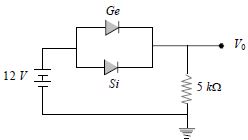
$Ge$ and $Si$ diodes conduct at $0.3 \, V$ and $0.7 \, V$ respectively. In the following figure,if the $Ge$ diode connection is reversed,the value of $V_0$ changes by how many volts?
A
$0.2$
B
$0.4$
C
$0.6$
D
$0.8$
Solution
(B) In the given circuit,the $Ge$ and $Si$ diodes are connected in parallel. Since the $Ge$ diode has a lower threshold voltage $(0.3 \, V)$ compared to the $Si$ diode $(0.7 \, V)$,the $Ge$ diode will conduct first.
Case $1$: Original connection.
The $Ge$ diode conducts,so the voltage drop across the parallel combination is $V_{drop} = 0.3 \, V$.
The current in the circuit is $i = \frac{12 \, V - 0.3 \, V}{5 \, k\Omega} = \frac{11.7 \, V}{5 \, k\Omega} = 2.34 \, mA$.
The output voltage is $V_0 = i \times R = 2.34 \, mA \times 5 \, k\Omega = 11.7 \, V$.
Case $2$: $Ge$ diode connection is reversed.
Now,the $Ge$ diode is reverse-biased and will not conduct. The $Si$ diode is forward-biased and will conduct. The voltage drop across the combination is now $V_{drop} = 0.7 \, V$.
The current in the circuit is $i' = \frac{12 \, V - 0.7 \, V}{5 \, k\Omega} = \frac{11.3 \, V}{5 \, k\Omega} = 2.26 \, mA$.
The output voltage is $V_0' = i' \times R = 2.26 \, mA \times 5 \, k\Omega = 11.3 \, V$.
The change in the value of $V_0$ is $\Delta V_0 = |11.7 \, V - 11.3 \, V| = 0.4 \, V$.
Case $1$: Original connection.
The $Ge$ diode conducts,so the voltage drop across the parallel combination is $V_{drop} = 0.3 \, V$.
The current in the circuit is $i = \frac{12 \, V - 0.3 \, V}{5 \, k\Omega} = \frac{11.7 \, V}{5 \, k\Omega} = 2.34 \, mA$.
The output voltage is $V_0 = i \times R = 2.34 \, mA \times 5 \, k\Omega = 11.7 \, V$.
Case $2$: $Ge$ diode connection is reversed.
Now,the $Ge$ diode is reverse-biased and will not conduct. The $Si$ diode is forward-biased and will conduct. The voltage drop across the combination is now $V_{drop} = 0.7 \, V$.
The current in the circuit is $i' = \frac{12 \, V - 0.7 \, V}{5 \, k\Omega} = \frac{11.3 \, V}{5 \, k\Omega} = 2.26 \, mA$.
The output voltage is $V_0' = i' \times R = 2.26 \, mA \times 5 \, k\Omega = 11.3 \, V$.
The change in the value of $V_0$ is $\Delta V_0 = |11.7 \, V - 11.3 \, V| = 0.4 \, V$.
0 likesView Solution
3
ChemistryMCQJEE Main · 2019
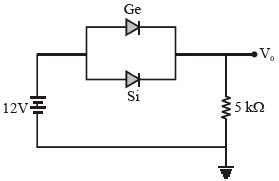
$Ge$ and $Si$ diodes conduct at $0.3\,V$ and $0.7\,V$ respectively. In the following figure,if the $Ge$ diode connection is reversed,the value of $V_0$ changes by.....$V$.
A
$0.2$
B
$0.4$
C
$0.6$
D
$0.8$
Solution
(B) In the given circuit,the $Ge$ and $Si$ diodes are in parallel. The diode with the lower threshold voltage will conduct first. Since $Ge$ has a threshold voltage of $0.3\,V$ and $Si$ has $0.7\,V$,the $Ge$ diode conducts.
Case $1$: Initial connection.
The voltage drop across the circuit is determined by the $Ge$ diode,$V_{drop} = 0.3\,V$.
The current $i = \frac{12\,V - 0.3\,V}{5\,k\Omega} = \frac{11.7\,V}{5\,k\Omega} = 2.34\,mA$.
The output voltage $V_{o1} = i \times R = 2.34\,mA \times 5\,k\Omega = 11.7\,V$.
Case $2$: $Ge$ diode connection is reversed.
Now,the $Ge$ diode is reverse-biased and does not conduct. The $Si$ diode is forward-biased and conducts with a threshold voltage of $0.7\,V$.
The current $i = \frac{12\,V - 0.7\,V}{5\,k\Omega} = \frac{11.3\,V}{5\,k\Omega} = 2.26\,mA$.
The output voltage $V_{o2} = i \times R = 2.26\,mA \times 5\,k\Omega = 11.3\,V$.
The change in the value of $V_0$ is $\Delta V_0 = |V_{o1} - V_{o2}| = |11.7\,V - 11.3\,V| = 0.4\,V$.
Case $1$: Initial connection.
The voltage drop across the circuit is determined by the $Ge$ diode,$V_{drop} = 0.3\,V$.
The current $i = \frac{12\,V - 0.3\,V}{5\,k\Omega} = \frac{11.7\,V}{5\,k\Omega} = 2.34\,mA$.
The output voltage $V_{o1} = i \times R = 2.34\,mA \times 5\,k\Omega = 11.7\,V$.
Case $2$: $Ge$ diode connection is reversed.
Now,the $Ge$ diode is reverse-biased and does not conduct. The $Si$ diode is forward-biased and conducts with a threshold voltage of $0.7\,V$.
The current $i = \frac{12\,V - 0.7\,V}{5\,k\Omega} = \frac{11.3\,V}{5\,k\Omega} = 2.26\,mA$.
The output voltage $V_{o2} = i \times R = 2.26\,mA \times 5\,k\Omega = 11.3\,V$.
The change in the value of $V_0$ is $\Delta V_0 = |V_{o1} - V_{o2}| = |11.7\,V - 11.3\,V| = 0.4\,V$.
0 likesView Solution
4
ChemistryMCQJEE Main · 2019
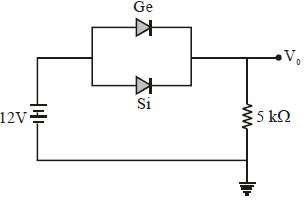
$Ge$ and $Si$ diodes conduct at $0.3\,V$ and $0.7\,V$ respectively. In the following figure,if the $Ge$ diode connection is reversed,the value of $V_0$ changes by......$V$.
A
$0.2$
B
$0.4$
C
$0.6$
D
$0.8$
Solution
(B) In the given circuit,the $Ge$ and $Si$ diodes are connected in parallel. Since they are in parallel,the diode with the lower threshold voltage will conduct first.
Case $1$: Initially,both diodes are connected such that they are forward-biased. The $Ge$ diode has a threshold voltage of $0.3\,V$ and the $Si$ diode has $0.7\,V$. The circuit will be dominated by the $Ge$ diode,so the voltage drop across the parallel combination is $V_{drop} = 0.3\,V$.
The output voltage $V_0$ is the voltage across the $5\,k\Omega$ resistor:
$V_0 = V_{source} - V_{drop} = 12\,V - 0.3\,V = 11.7\,V$.
Case $2$: If the $Ge$ diode connection is reversed,it becomes reverse-biased and does not conduct. Now,only the $Si$ diode is forward-biased.
The voltage drop across the circuit is now determined by the $Si$ diode,which is $V_{drop} = 0.7\,V$.
The new output voltage $V_0'$ is:
$V_0' = V_{source} - V_{drop} = 12\,V - 0.7\,V = 11.3\,V$.
The change in the value of $V_0$ is:
$\Delta V_0 = |V_0 - V_0'| = |11.7\,V - 11.3\,V| = 0.4\,V$.
Case $1$: Initially,both diodes are connected such that they are forward-biased. The $Ge$ diode has a threshold voltage of $0.3\,V$ and the $Si$ diode has $0.7\,V$. The circuit will be dominated by the $Ge$ diode,so the voltage drop across the parallel combination is $V_{drop} = 0.3\,V$.
The output voltage $V_0$ is the voltage across the $5\,k\Omega$ resistor:
$V_0 = V_{source} - V_{drop} = 12\,V - 0.3\,V = 11.7\,V$.
Case $2$: If the $Ge$ diode connection is reversed,it becomes reverse-biased and does not conduct. Now,only the $Si$ diode is forward-biased.
The voltage drop across the circuit is now determined by the $Si$ diode,which is $V_{drop} = 0.7\,V$.
The new output voltage $V_0'$ is:
$V_0' = V_{source} - V_{drop} = 12\,V - 0.7\,V = 11.3\,V$.
The change in the value of $V_0$ is:
$\Delta V_0 = |V_0 - V_0'| = |11.7\,V - 11.3\,V| = 0.4\,V$.
0 likesView Solution
5
ChemistryMCQJEE Main · 2019
The major product of the following reaction is:
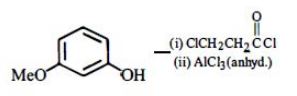
A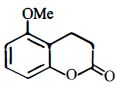
B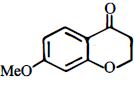
C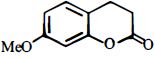
D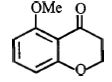
Solution
(D) The reaction proceeds in two steps:
$1$. The phenolic $-OH$ group reacts with $ClCH_2CH_2COCl$ to form an ester intermediate,$m-MeO-C_6H_4-O-CO-CH_2CH_2Cl$.
$2$. In the presence of anhydrous $AlCl_3$,an intramolecular Friedel-Crafts acylation occurs. The acyl group attacks the ortho position relative to the $-OH$ group (which is now part of the ester linkage) to form a cyclic compound. The methoxy group $(-OMe)$ is an ortho-para directing group,and the cyclization occurs to form the most stable bicyclic structure,which is the coumarin derivative shown in option $D$.
$1$. The phenolic $-OH$ group reacts with $ClCH_2CH_2COCl$ to form an ester intermediate,$m-MeO-C_6H_4-O-CO-CH_2CH_2Cl$.
$2$. In the presence of anhydrous $AlCl_3$,an intramolecular Friedel-Crafts acylation occurs. The acyl group attacks the ortho position relative to the $-OH$ group (which is now part of the ester linkage) to form a cyclic compound. The methoxy group $(-OMe)$ is an ortho-para directing group,and the cyclization occurs to form the most stable bicyclic structure,which is the coumarin derivative shown in option $D$.
0 likesView Solution
6
ChemistryDifficultMCQJEE Main · 2019
In reaction $A + 2B \rightleftharpoons 2C + D$,the initial concentration of $B$ was $1.5$ times that of $[A]$,but at equilibrium,the concentrations of $A$ and $B$ became equal. The equilibrium constant for the reaction is:
A
$8$
B
$4$
C
$12$
D
$6$
Solution
(B) The reaction is $A + 2B \rightleftharpoons 2C + D$.
Let the initial concentration of $A$ be $a$. Then the initial concentration of $B$ is $1.5a$.
At equilibrium,let $x$ be the amount of $A$ reacted. The concentrations at equilibrium are:
$[A] = a - x$
$[B] = 1.5a - 2x$
$[C] = 2x$
$[D] = x$
Given that at equilibrium $[A] = [B]$,we have $a - x = 1.5a - 2x$,which simplifies to $x = 0.5a$ or $a = 2x$.
Substituting $a = 2x$ into the equilibrium concentrations:
$[A] = 2x - x = x$
$[B] = 1.5(2x) - 2x = 3x - 2x = x$
$[C] = 2x$
$[D] = x$
The equilibrium constant $K_C$ is given by:
$K_C = \frac{[C]^2 [D]}{[A] [B]^2} = \frac{(2x)^2 (x)}{(x) (x)^2} = \frac{4x^2 \cdot x}{x \cdot x^2} = \frac{4x^3}{x^3} = 4$.
Let the initial concentration of $A$ be $a$. Then the initial concentration of $B$ is $1.5a$.
At equilibrium,let $x$ be the amount of $A$ reacted. The concentrations at equilibrium are:
$[A] = a - x$
$[B] = 1.5a - 2x$
$[C] = 2x$
$[D] = x$
Given that at equilibrium $[A] = [B]$,we have $a - x = 1.5a - 2x$,which simplifies to $x = 0.5a$ or $a = 2x$.
Substituting $a = 2x$ into the equilibrium concentrations:
$[A] = 2x - x = x$
$[B] = 1.5(2x) - 2x = 3x - 2x = x$
$[C] = 2x$
$[D] = x$
The equilibrium constant $K_C$ is given by:
$K_C = \frac{[C]^2 [D]}{[A] [B]^2} = \frac{(2x)^2 (x)}{(x) (x)^2} = \frac{4x^2 \cdot x}{x \cdot x^2} = \frac{4x^3}{x^3} = 4$.
0 likesView Solution
7
ChemistryMediumMCQJEE Main · 2019
$0.5 \, mol$ of gas $A$ and $x \, mol$ of gas $B$ exert a pressure of $200 \, Pa$ in a container of volume $10 \, m^3$ at $1000 \, K$. Given $R$ is the gas constant in $J \, K^{-1} \, mol^{-1}$,$x$ is
A
$\frac{2R}{4 + R}$
B
$\frac{2R}{4 - R}$
C
$\frac{4 + R}{2R}$
D
$\frac{4 - R}{2R}$
Solution
(D) Using the ideal gas equation: $PV = nRT$
Given: $P = 200 \, Pa$,$V = 10 \, m^3$,$T = 1000 \, K$,$n = (0.5 + x) \, mol$.
Substituting the values: $200 \times 10 = (0.5 + x) \times R \times 1000$
$2000 = (0.5 + x) \times 1000R$
$2 = (0.5 + x)R$
$\frac{2}{R} = 0.5 + x$
$x = \frac{2}{R} - 0.5$
$x = \frac{2 - 0.5R}{R} = \frac{4 - R}{2R}$
Given: $P = 200 \, Pa$,$V = 10 \, m^3$,$T = 1000 \, K$,$n = (0.5 + x) \, mol$.
Substituting the values: $200 \times 10 = (0.5 + x) \times R \times 1000$
$2000 = (0.5 + x) \times 1000R$
$2 = (0.5 + x)R$
$\frac{2}{R} = 0.5 + x$
$x = \frac{2}{R} - 0.5$
$x = \frac{2 - 0.5R}{R} = \frac{4 - R}{2R}$
0 likesView Solution
8
ChemistryDifficultMCQJEE Main · 2019
Correct statements among $(i)$ to $(iv)$ regarding silicones are:
$(i)$ they are polymers with hydrophobic character
$(ii)$ they are biocompatible
$(iii)$ in general,they have high thermal stability and low dielectric strength
$(iv)$ usually they are resistant to oxidation and used as greases.
$(i)$ they are polymers with hydrophobic character
$(ii)$ they are biocompatible
$(iii)$ in general,they have high thermal stability and low dielectric strength
$(iv)$ usually they are resistant to oxidation and used as greases.
A
$(i), (ii), (iii)$ and $(iv)$
B
$(i), (ii)$ and $(iii)$
C
$(i)$ and $(ii)$ only
D
$(i), (ii)$ and $(iv)$
Solution
(D) Silicones are organosilicon polymers with the general formula $(R_2SiO)_n$.
$(i)$ They possess organic groups (alkyl/aryl) which make them hydrophobic. This is correct.
$(ii)$ Silicones are biocompatible and are used in medical implants. This is correct.
$(iii)$ Silicones have high thermal stability and high dielectric strength,not low. This is incorrect.
$(iv)$ They are resistant to oxidation and are used as greases and lubricants. This is correct.
Therefore,statements $(i), (ii),$ and $(iv)$ are correct.
$(i)$ They possess organic groups (alkyl/aryl) which make them hydrophobic. This is correct.
$(ii)$ Silicones are biocompatible and are used in medical implants. This is correct.
$(iii)$ Silicones have high thermal stability and high dielectric strength,not low. This is incorrect.
$(iv)$ They are resistant to oxidation and are used as greases and lubricants. This is correct.
Therefore,statements $(i), (ii),$ and $(iv)$ are correct.
0 likesView Solution
9
ChemistryDifficultMCQJEE Main · 2019
The major product of the following reaction is:
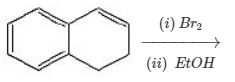
A
$1-$ethoxy$-2-$bromo$-1,2,3,4-$tetrahydronaphthalene
B
$1,2-$dihydronaphthalene
C
$2-$ethoxy$-1-$bromo$-1,2,3,4-$tetrahydronaphthalene
D
$1,2-$diethoxy$-1,2,3,4-$tetrahydronaphthalene
Solution
(A) The reaction of $1,2$-dihydronaphthalene with $Br_2$ proceeds via the formation of a cyclic bromonium ion intermediate.
In the presence of a nucleophilic solvent like ethanol $(EtOH)$,the solvent attacks the more substituted carbon of the bromonium ion to form the major product.
The benzylic position is more stable for the development of partial positive charge,leading to the formation of $1$-ethoxy-$2$-bromo-$1,2,3,4$-tetrahydronaphthalene as the major product.
In the presence of a nucleophilic solvent like ethanol $(EtOH)$,the solvent attacks the more substituted carbon of the bromonium ion to form the major product.
The benzylic position is more stable for the development of partial positive charge,leading to the formation of $1$-ethoxy-$2$-bromo-$1,2,3,4$-tetrahydronaphthalene as the major product.
0 likesView Solution
10
ChemistryMediumMCQJEE Main · 2019
In general,the properties that decrease and increase down a group in the periodic table respectively are
A
atomic radius and electronegativity
B
electron gain enthalpy and electronegativity
C
electronegativity and atomic radius
D
electronegativity and electron gain enthalpy
Solution
(C) On moving down a group in the periodic table,the effective nuclear charge decreases due to the addition of new shells,which leads to a decrease in electronegativity.
Conversely,the atomic radius increases as one moves down a group because the number of shells increases.
Conversely,the atomic radius increases as one moves down a group because the number of shells increases.
0 likesView Solution
11
ChemistryDifficultMCQJEE Main · 2019
$A$ water sample has $ppm$ level concentration of the following metals: $Fe = 0.2$,$Mn = 0.05$,$Cu = 3.0$,$Zn = 5.0$. The metal that makes the water sample unsuitable for drinking is
A
$Cu$
B
$Mn$
C
$Fe$
D
$Zn$
Solution
(B) According to the $WHO$ and $BIS$ standards for drinking water,the permissible limits for these metals are as follows:
$Fe$: $0.2 \ ppm$
$Mn$: $0.05 \ ppm$
$Cu$: $3.0 \ ppm$
$Zn$: $5.0 \ ppm$
In the given sample,the concentration of $Mn$ is $0.05 \ ppm$. While this is at the threshold,$Mn$ is highly sensitive; even slight variations above this limit cause staining and taste issues,making it the most critical metal among the choices that renders water unsuitable for drinking if concentrations exceed the limit.
$Fe$: $0.2 \ ppm$
$Mn$: $0.05 \ ppm$
$Cu$: $3.0 \ ppm$
$Zn$: $5.0 \ ppm$
In the given sample,the concentration of $Mn$ is $0.05 \ ppm$. While this is at the threshold,$Mn$ is highly sensitive; even slight variations above this limit cause staining and taste issues,making it the most critical metal among the choices that renders water unsuitable for drinking if concentrations exceed the limit.
0 likesView Solution
12
ChemistryMediumMCQJEE Main · 2019
The alkaline earth metal nitrate that does not crystallise with water molecules is
A
$Mg(NO_3)_2$
B
$Sr(NO_3)_2$
C
$Ca(NO_3)_2$
D
$Ba(NO_3)_2$
Solution
(D) The hydration energy decreases as the size of the alkaline earth metal cation increases down the group.
$Mg^{2+}$,$Ca^{2+}$,and $Sr^{2+}$ ions have smaller sizes and higher charge density,allowing them to form hydrated salts like $Mg(NO_3)_2 \cdot 6H_2O$,$Ca(NO_3)_2 \cdot 4H_2O$,and $Sr(NO_3)_2 \cdot 4H_2O$.
Due to the relatively large size of the $Ba^{2+}$ ion,its hydration energy is insufficient to hold water molecules in the crystal lattice,so $Ba(NO_3)_2$ crystallizes as an anhydrous salt.
$Mg^{2+}$,$Ca^{2+}$,and $Sr^{2+}$ ions have smaller sizes and higher charge density,allowing them to form hydrated salts like $Mg(NO_3)_2 \cdot 6H_2O$,$Ca(NO_3)_2 \cdot 4H_2O$,and $Sr(NO_3)_2 \cdot 4H_2O$.
Due to the relatively large size of the $Ba^{2+}$ ion,its hydration energy is insufficient to hold water molecules in the crystal lattice,so $Ba(NO_3)_2$ crystallizes as an anhydrous salt.
0 likesView Solution
13
ChemistryDifficultMCQJEE Main · 2019
$20 \ mL$ of $0.1 \ M \ H_2SO_4$ is added to $30 \ mL$ of $0.2 \ M \ NH_4OH$ solution. The $pH$ of the resultant mixture is [$pK_b$ of $NH_4OH = 4.7$].
A
$5.2$
B
$9$
C
$5$
D
$9.4$
Solution
(D) Step $1$: Calculate millimoles $(m.mol)$ of reactants.
$m.mol$ of $H_2SO_4 = 20 \ mL \times 0.1 \ M = 2 \ m.mol$.
$m.mol$ of $NH_4OH = 30 \ mL \times 0.2 \ M = 6 \ m.mol$.
Step $2$: Write the balanced chemical equation.
$H_2SO_4 + 2NH_4OH \to (NH_4)_2SO_4 + 2H_2O$.
Step $3$: Determine the composition of the final mixture.
Initial: $H_2SO_4 = 2 \ m.mol$,$NH_4OH = 6 \ m.mol$.
After reaction: $H_2SO_4$ is the limiting reagent. $NH_4OH$ remaining $= 6 - (2 \times 2) = 2 \ m.mol$. $(NH_4)_2SO_4$ formed $= 2 \ m.mol$.
Step $4$: Calculate $pOH$ using the Henderson-Hasselbalch equation for a basic buffer.
$pOH = pK_b + \log \frac{[Salt]}{[Base]} = 4.7 + \log \frac{2}{2} = 4.7 + 0 = 4.7$.
Step $5$: Calculate $pH$.
$pH = 14 - pOH = 14 - 4.7 = 9.3 \approx 9.4$.
$m.mol$ of $H_2SO_4 = 20 \ mL \times 0.1 \ M = 2 \ m.mol$.
$m.mol$ of $NH_4OH = 30 \ mL \times 0.2 \ M = 6 \ m.mol$.
Step $2$: Write the balanced chemical equation.
$H_2SO_4 + 2NH_4OH \to (NH_4)_2SO_4 + 2H_2O$.
Step $3$: Determine the composition of the final mixture.
Initial: $H_2SO_4 = 2 \ m.mol$,$NH_4OH = 6 \ m.mol$.
After reaction: $H_2SO_4$ is the limiting reagent. $NH_4OH$ remaining $= 6 - (2 \times 2) = 2 \ m.mol$. $(NH_4)_2SO_4$ formed $= 2 \ m.mol$.
Step $4$: Calculate $pOH$ using the Henderson-Hasselbalch equation for a basic buffer.
$pOH = pK_b + \log \frac{[Salt]}{[Base]} = 4.7 + \log \frac{2}{2} = 4.7 + 0 = 4.7$.
Step $5$: Calculate $pH$.
$pH = 14 - pOH = 14 - 4.7 = 9.3 \approx 9.4$.
0 likesView Solution
14
ChemistryMediumMCQJEE Main · 2019
Which amongst the following is the strongest acid?
A
$CHBr_3$
B
$CHI_3$
C
$CH(CN)_3$
D
$CHCl_3$
Solution
(C) The acidity of a compound depends on the stability of its conjugate base.
For $CH(CN)_3$,the conjugate base is $C^{-}(CN)_3$.
The negative charge on the carbon atom in $C^{-}(CN)_3$ is stabilized by the strong electron-withdrawing effect of three $-CN$ groups through resonance and inductive effects.
This extensive delocalization makes the conjugate base $C^{-}(CN)_3$ much more stable compared to the conjugate bases of the other haloforms $(CX_3^-)$.
Therefore,$CH(CN)_3$ is the strongest acid among the given options.
For $CH(CN)_3$,the conjugate base is $C^{-}(CN)_3$.
The negative charge on the carbon atom in $C^{-}(CN)_3$ is stabilized by the strong electron-withdrawing effect of three $-CN$ groups through resonance and inductive effects.
This extensive delocalization makes the conjugate base $C^{-}(CN)_3$ much more stable compared to the conjugate bases of the other haloforms $(CX_3^-)$.
Therefore,$CH(CN)_3$ is the strongest acid among the given options.
0 likesView Solution
15
ChemistryAdvancedMCQJEE Main · 2019
For an emission line of atomic hydrogen from $n_i = 8$ to $n_f = n$,the plot of wave number $(\bar{\nu})$ against $(\frac{1}{n^2})$ will be (The Rydberg constant,$R_H$ is in wave number unit).
A
Linear with intercept $-R_H$
B
Non linear
C
Linear with slope $R_H$
D
Linear with slope $-R_H$
Solution
(C) For an emission line,$n_f < n_i$.
The Rydberg formula for the wave number is $\bar{\nu} = R_H Z^2 \left[ \frac{1}{n_f^2} - \frac{1}{n_i^2} \right]$.
For atomic hydrogen,$Z = 1$,$n_i = 8$,and $n_f = n$.
Substituting these values: $\bar{\nu} = R_H \left[ \frac{1}{n^2} - \frac{1}{8^2} \right] = R_H \left( \frac{1}{n^2} \right) - \frac{R_H}{64}$.
Comparing this with the equation of a straight line $y = mx + c$,where $y = \bar{\nu}$ and $x = \frac{1}{n^2}$:
The slope $m = R_H$ and the intercept $c = -\frac{R_H}{64}$.
Thus,the plot is linear with a slope of $R_H$.
The Rydberg formula for the wave number is $\bar{\nu} = R_H Z^2 \left[ \frac{1}{n_f^2} - \frac{1}{n_i^2} \right]$.
For atomic hydrogen,$Z = 1$,$n_i = 8$,and $n_f = n$.
Substituting these values: $\bar{\nu} = R_H \left[ \frac{1}{n^2} - \frac{1}{8^2} \right] = R_H \left( \frac{1}{n^2} \right) - \frac{R_H}{64}$.
Comparing this with the equation of a straight line $y = mx + c$,where $y = \bar{\nu}$ and $x = \frac{1}{n^2}$:
The slope $m = R_H$ and the intercept $c = -\frac{R_H}{64}$.
Thus,the plot is linear with a slope of $R_H$.
0 likesView Solution
16
ChemistryEasyMCQJEE Main · 2019
The isotopes of hydrogen are
A
tritium and protium only
B
protium and deuterium only
C
protium,deuterium and tritium
D
deuterium and tritium only
Solution
(C) Hydrogen has three naturally occurring isotopes:
$1$. Protium $({}_1^1H)$
$2$. Deuterium (${}_1^2H$ or $D$)
$3$. Tritium (${}_1^3H$ or $T$)
Therefore,the isotopes of hydrogen are protium,deuterium,and tritium.
$1$. Protium $({}_1^1H)$
$2$. Deuterium (${}_1^2H$ or $D$)
$3$. Tritium (${}_1^3H$ or $T$)
Therefore,the isotopes of hydrogen are protium,deuterium,and tritium.
0 likesView Solution
17
ChemistryMediumMCQJEE Main · 2019
According to molecular orbital theory,which of the following is true with respect to $Li_2^+$ and $Li_2^-$?
A
$Li_2^+$ is unstable and $Li_2^-$ is stable
B
$Li_2^+$ is stable and $Li_2^-$ is unstable
C
Both are stable
D
Both are unstable
Solution
(C) The electronic configuration of $Li$ is $1s^2 2s^1$. Total electrons in $Li_2^+$ is $3+3-1 = 5$. The configuration is $\sigma 1s^2, \sigma^* 1s^2, \sigma 2s^1$. Bond order = $\frac{1}{2}(N_b - N_a) = \frac{1}{2}(3 - 2) = 0.5$.
Total electrons in $Li_2^-$ is $3+3+1 = 7$. The configuration is $\sigma 1s^2, \sigma^* 1s^2, \sigma 2s^2, \sigma^* 2s^1$. Bond order = $\frac{1}{2}(4 - 3) = 0.5$.
Since both have a positive bond order,both are stable.
Total electrons in $Li_2^-$ is $3+3+1 = 7$. The configuration is $\sigma 1s^2, \sigma^* 1s^2, \sigma 2s^2, \sigma^* 2s^1$. Bond order = $\frac{1}{2}(4 - 3) = 0.5$.
Since both have a positive bond order,both are stable.
0 likesView Solution
18
ChemistryDifficultMCQJEE Main · 2019
Consider the reversible isothermal expansion of an ideal gas in a closed system at two different temperatures $T_1$ and $T_2$ $(T_1 < T_2)$. The correct graphical depiction of the dependence of work done $(|w|)$ on the final volume $(ln V)$ is:
A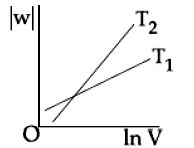
B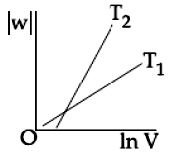
C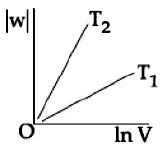
D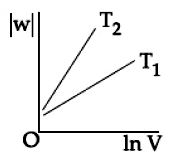
Solution
(B) For a reversible isothermal expansion,the work done by the gas is given by $w = -nRT \ln(\frac{V_f}{V_i})$.
Taking the magnitude,we have $|w| = nRT \ln V_f - nRT \ln V_i$.
This equation is in the form of a straight line $y = mx + c$,where $y = |w|$,$x = ln V_f$,slope $m = nRT$,and intercept $c = -nRT \ln V_i$.
Since $T_2 > T_1$,the slope for $T_2$ $(nRT_2)$ is greater than the slope for $T_1$ $(nRT_1)$.
Also,for a given expansion,the intercept $-nRT \ln V_i$ will be more negative for higher temperatures if we assume the same initial state or consistent expansion parameters,leading to the graph where the line for $T_2$ is steeper and has a lower intercept than the line for $T_1$.
Taking the magnitude,we have $|w| = nRT \ln V_f - nRT \ln V_i$.
This equation is in the form of a straight line $y = mx + c$,where $y = |w|$,$x = ln V_f$,slope $m = nRT$,and intercept $c = -nRT \ln V_i$.
Since $T_2 > T_1$,the slope for $T_2$ $(nRT_2)$ is greater than the slope for $T_1$ $(nRT_1)$.
Also,for a given expansion,the intercept $-nRT \ln V_i$ will be more negative for higher temperatures if we assume the same initial state or consistent expansion parameters,leading to the graph where the line for $T_2$ is steeper and has a lower intercept than the line for $T_1$.
0 likesView Solution
19
ChemistryMCQJEE Main · 2019
If $y=y(x)$ is the solution of the differential equation $x\frac{dy}{dx} + 2y = x^2$ satisfying $y(1)=1$,then $y\left(\frac{1}{2}\right)$ is equal to
A
$\frac{7}{64}$
B
$\frac{1}{4}$
C
$\frac{49}{16}$
D
$\frac{13}{16}$
Solution
(C) The given differential equation is $x \frac{dy}{dx} + 2y = x^2$.
Dividing by $x$,we get $\frac{dy}{dx} + \frac{2}{x}y = x$.
This is a linear differential equation of the form $\frac{dy}{dx} + Py = Q$,where $P = \frac{2}{x}$ and $Q = x$.
The integrating factor $(IF)$ is $e^{\int P dx} = e^{\int \frac{2}{x} dx} = e^{2 \ln|x|} = x^2$.
The solution is given by $y \cdot (IF) = \int Q \cdot (IF) dx + C$.
$y \cdot x^2 = \int x \cdot x^2 dx + C = \int x^3 dx + C$.
$y x^2 = \frac{x^4}{4} + C$.
Given $y(1) = 1$,we substitute $x=1$ and $y=1$ to find $C$: $1(1)^2 = \frac{1^4}{4} + C \implies 1 = \frac{1}{4} + C \implies C = \frac{3}{4}$.
Thus,the solution is $y x^2 = \frac{x^4}{4} + \frac{3}{4} = \frac{x^4 + 3}{4}$.
To find $y\left(\frac{1}{2}\right)$,substitute $x = \frac{1}{2}$:
$y \left(\frac{1}{2}\right)^2 = \frac{(\frac{1}{2})^4 + 3}{4} = \frac{\frac{1}{16} + 3}{4} = \frac{\frac{49}{16}}{4} = \frac{49}{64}$.
Wait,re-evaluating: $y \cdot \frac{1}{4} = \frac{\frac{1}{16} + 3}{4} = \frac{49}{64} \implies y = \frac{49}{64} \times 4 = \frac{49}{16}$.
Dividing by $x$,we get $\frac{dy}{dx} + \frac{2}{x}y = x$.
This is a linear differential equation of the form $\frac{dy}{dx} + Py = Q$,where $P = \frac{2}{x}$ and $Q = x$.
The integrating factor $(IF)$ is $e^{\int P dx} = e^{\int \frac{2}{x} dx} = e^{2 \ln|x|} = x^2$.
The solution is given by $y \cdot (IF) = \int Q \cdot (IF) dx + C$.
$y \cdot x^2 = \int x \cdot x^2 dx + C = \int x^3 dx + C$.
$y x^2 = \frac{x^4}{4} + C$.
Given $y(1) = 1$,we substitute $x=1$ and $y=1$ to find $C$: $1(1)^2 = \frac{1^4}{4} + C \implies 1 = \frac{1}{4} + C \implies C = \frac{3}{4}$.
Thus,the solution is $y x^2 = \frac{x^4}{4} + \frac{3}{4} = \frac{x^4 + 3}{4}$.
To find $y\left(\frac{1}{2}\right)$,substitute $x = \frac{1}{2}$:
$y \left(\frac{1}{2}\right)^2 = \frac{(\frac{1}{2})^4 + 3}{4} = \frac{\frac{1}{16} + 3}{4} = \frac{\frac{49}{16}}{4} = \frac{49}{64}$.
Wait,re-evaluating: $y \cdot \frac{1}{4} = \frac{\frac{1}{16} + 3}{4} = \frac{49}{64} \implies y = \frac{49}{64} \times 4 = \frac{49}{16}$.
0 likesView Solution
20
ChemistryDifficultMCQJEE Main · 2019
The entropy change associated with the conversion of $1 \ kg$ of ice at $273 \ K$ to water vapours at $383 \ K$ is: (Specific heat of water liquid and water vapours are $4.2 \ kJ \ K^{-1} \ kg^{-1}$ and $2.0 \ kJ \ K^{-1} \ kg^{-1},$ heat of fusion and vaporisation of water are $334 \ kJ \ kg^{-1}$ and $2491 \ kJ \ kg^{-1},$ respectively) $(\ln \ 273 = 5.61, \ln \ 373 = 5.92, \ln \ 383 = 5.95)$
A
$7.90$
B
$2.64$
C
$8.49$
D
$9.26$
0 likesView Solution
21
ChemistryDifficultMCQJEE Main · 2019
For the following reaction,the mass of water produced from $445 \ g$ of $C_{57}H_{110}O_6$ is .............. $g$.
$2C_{57}H_{110}O_{6(s)} + 163O_{2(g)} \to 114CO_{2(g)} + 110H_2O_{(l)}$
$2C_{57}H_{110}O_{6(s)} + 163O_{2(g)} \to 114CO_{2(g)} + 110H_2O_{(l)}$
A
$490$
B
$445$
C
$495$
D
$890$
Solution
(C) The balanced chemical equation is:
$2C_{57}H_{110}O_{6(s)} + 163O_{2(g)} \to 114CO_{2(g)} + 110H_2O_{(l)}$
First,calculate the molar mass of $C_{57}H_{110}O_6$:
$M = (57 \times 12) + (110 \times 1) + (6 \times 16) = 684 + 110 + 96 = 890 \ g/mol$.
Calculate the moles of $C_{57}H_{110}O_6$:
$n = \frac{445 \ g}{890 \ g/mol} = 0.5 \ mol$.
From the stoichiometry,$2 \ mol$ of $C_{57}H_{110}O_6$ produces $110 \ mol$ of $H_2O$.
Therefore,$0.5 \ mol$ of $C_{57}H_{110}O_6$ produces:
$n(H_2O) = \frac{110}{2} \times 0.5 = 55 \ mol$.
Mass of $H_2O = 55 \ mol \times 18 \ g/mol = 990 \ g$.
Wait,re-calculating: $55 \times 18 = 990$. Let's check the provided options. The calculation $\frac{0.5}{2} = \frac{x}{110}$ gives $x = 27.5 \ mol$. $27.5 \times 18 = 495 \ g$. The stoichiometry ratio is $2:110$,so $1:55$. $0.5 \times 55 = 27.5 \ mol$. $27.5 \times 18 = 495 \ g$.
$2C_{57}H_{110}O_{6(s)} + 163O_{2(g)} \to 114CO_{2(g)} + 110H_2O_{(l)}$
First,calculate the molar mass of $C_{57}H_{110}O_6$:
$M = (57 \times 12) + (110 \times 1) + (6 \times 16) = 684 + 110 + 96 = 890 \ g/mol$.
Calculate the moles of $C_{57}H_{110}O_6$:
$n = \frac{445 \ g}{890 \ g/mol} = 0.5 \ mol$.
From the stoichiometry,$2 \ mol$ of $C_{57}H_{110}O_6$ produces $110 \ mol$ of $H_2O$.
Therefore,$0.5 \ mol$ of $C_{57}H_{110}O_6$ produces:
$n(H_2O) = \frac{110}{2} \times 0.5 = 55 \ mol$.
Mass of $H_2O = 55 \ mol \times 18 \ g/mol = 990 \ g$.
Wait,re-calculating: $55 \times 18 = 990$. Let's check the provided options. The calculation $\frac{0.5}{2} = \frac{x}{110}$ gives $x = 27.5 \ mol$. $27.5 \times 18 = 495 \ g$. The stoichiometry ratio is $2:110$,so $1:55$. $0.5 \times 55 = 27.5 \ mol$. $27.5 \times 18 = 495 \ g$.
0 likesView Solution
22
ChemistryDifficultMCQJEE Main · 2019
Which of the following conditions in drinking water causes methemoglobinemia?
A
$> 50 \ ppm$ of lead
B
$> 50 \ ppm$ of chloride
C
$> 50 \ ppm$ of nitrate
D
$> 100 \ ppm$ of sulphate
Solution
(C) Methemoglobinemia,also known as 'blue baby syndrome',is caused by the presence of excess nitrate ions in drinking water.
When the concentration of nitrate in drinking water exceeds $50 \ ppm$,it reacts with hemoglobin in the blood to form methemoglobin,which is unable to transport oxygen effectively.
Therefore,the correct condition is $> 50 \ ppm$ of nitrate.
When the concentration of nitrate in drinking water exceeds $50 \ ppm$,it reacts with hemoglobin in the blood to form methemoglobin,which is unable to transport oxygen effectively.
Therefore,the correct condition is $> 50 \ ppm$ of nitrate.
0 likesView Solution
23
ChemistryMCQJEE Main · 2019
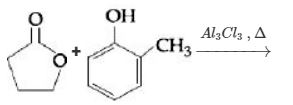
The major product of the following reaction is
A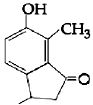
B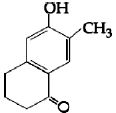
C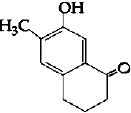
D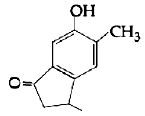
Solution
(C) The reaction involves the Friedel-Crafts acylation of $o$-cresol with $\gamma$-butyrolactone in the presence of a Lewis acid catalyst,$AlCl_3$.
$1$. The $AlCl_3$ coordinates with the carbonyl oxygen of the lactone,activating it for nucleophilic attack.
$2$. The electron-rich aromatic ring of $o$-cresol attacks the activated carbonyl carbon,leading to the ring-opening of the lactone.
$3$. This forms an intermediate ketone with a hydroxypropyl side chain.
$4$. Under the reaction conditions (heating,$\Delta$),this intermediate undergoes intramolecular cyclization (Friedel-Crafts alkylation) to form a bicyclic ketone.
$5$. The regioselectivity is governed by the directing effects of the $-OH$ and $-CH_3$ groups on the aromatic ring,leading to the formation of the product shown in option $C$.
$1$. The $AlCl_3$ coordinates with the carbonyl oxygen of the lactone,activating it for nucleophilic attack.
$2$. The electron-rich aromatic ring of $o$-cresol attacks the activated carbonyl carbon,leading to the ring-opening of the lactone.
$3$. This forms an intermediate ketone with a hydroxypropyl side chain.
$4$. Under the reaction conditions (heating,$\Delta$),this intermediate undergoes intramolecular cyclization (Friedel-Crafts alkylation) to form a bicyclic ketone.
$5$. The regioselectivity is governed by the directing effects of the $-OH$ and $-CH_3$ groups on the aromatic ring,leading to the formation of the product shown in option $C$.
0 likesView Solution
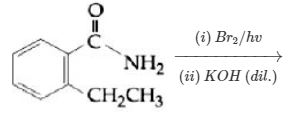
24
ChemistryMCQJEE Main · 2019
The major product of the following reaction is:
A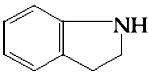
B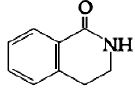
C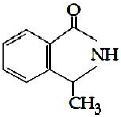
D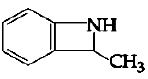
Solution
(D) The reaction involves a radical bromination of the ethyl group at the benzylic position using $Br_2/h\nu$,followed by an intramolecular nucleophilic substitution (cyclization) in the presence of $KOH$.
$1$. The $Br_2/h\nu$ reagent performs a free-radical bromination on the benzylic carbon of the ethyl group attached to the benzene ring.
$2$. The resulting intermediate has a bromine atom at the benzylic position.
$3$. The lone pair on the nitrogen atom of the amide group attacks the benzylic carbon,displacing the bromide ion.
$4$. This cyclization leads to the formation of a cyclic amide (lactam).
$5$. Based on the structure,the product is $4-methyl-3,4-dihydroquinolin-2(1H)-one$ or a similar cyclic structure as shown in option $D$.
$1$. The $Br_2/h\nu$ reagent performs a free-radical bromination on the benzylic carbon of the ethyl group attached to the benzene ring.
$2$. The resulting intermediate has a bromine atom at the benzylic position.
$3$. The lone pair on the nitrogen atom of the amide group attacks the benzylic carbon,displacing the bromide ion.
$4$. This cyclization leads to the formation of a cyclic amide (lactam).
$5$. Based on the structure,the product is $4-methyl-3,4-dihydroquinolin-2(1H)-one$ or a similar cyclic structure as shown in option $D$.
0 likesView Solution
25
ChemistryDifficultMCQJEE Main · 2019
The correct match between Item $I$ and Item $II$ is
| Item $I$ | Item $II$ |
| $a$. Benzaldehyde | $p$. Mobile phase |
| $b$. Alumina | $q$. Adsorbent |
| $c$. Acetonitrile | $r$. Adsorbate |
A
$a \to q, b \to p, c \to r$
B
$a \to r, b \to q, c \to p$
C
$a \to q, b \to r, c \to p$
D
$a \to p, b \to r, c \to q$
Solution
(B) In chromatography,the substance being separated is the adsorbate,the stationary phase is the adsorbent,and the solvent is the mobile phase.
$a$. Benzaldehyde acts as the adsorbate $(r)$ which is adsorbed on the stationary phase.
$b$. Alumina $(Al_2O_3)$ is a common stationary phase used as an adsorbent $(q)$.
$c$. Acetonitrile is a common solvent used as a mobile phase $(p)$.
Therefore,the correct matching is $a \to r, b \to q, c \to p$.
$a$. Benzaldehyde acts as the adsorbate $(r)$ which is adsorbed on the stationary phase.
$b$. Alumina $(Al_2O_3)$ is a common stationary phase used as an adsorbent $(q)$.
$c$. Acetonitrile is a common solvent used as a mobile phase $(p)$.
Therefore,the correct matching is $a \to r, b \to q, c \to p$.
0 likesView Solution
26
ChemistryMediumMCQJEE Main · 2019
The metal that forms nitride by reacting directly with $N_2$ of air is
A
$K$
B
$Li$
C
$Rb$
D
$Cs$
Solution
(B) Among the alkali metals,only $Li$ reacts directly with $N_2$ of the air to form lithium nitride $(Li_3N)$.
This is due to the small size and high charge density of the $Li^+$ ion,which provides high lattice energy to stabilize the nitride ion $(N^{3-})$.
This is due to the small size and high charge density of the $Li^+$ ion,which provides high lattice energy to stabilize the nitride ion $(N^{3-})$.
0 likesView Solution
27
ChemistryMediumMCQJEE Main · 2019
The $pH$ of rain water is approximately
A
$5.6$
B
$7.5$
C
$7$
D
$6.5$
Solution
(A) Rain water becomes acidic because atmospheric gases like $CO_2$ dissolve in it to form carbonic acid.
Therefore,the $pH$ of unpolluted rain water is approximately $5.6$.
Therefore,the $pH$ of unpolluted rain water is approximately $5.6$.
0 likesView Solution
28
ChemistryDifficultMCQJEE Main · 2019
Consider the following reversible chemical reactions:
$A_{2(g)} + B_{2(g)} \overset {K_1} \leftrightarrows 2AB_{(g)} ......(1)$
$6AB_{(g)} \overset {K_2} \leftrightarrows 3A_{2(g)} + 3B_{2(g)} ......(2)$
The relation between $K_1$ and $K_2$ is:
$A_{2(g)} + B_{2(g)} \overset {K_1} \leftrightarrows 2AB_{(g)} ......(1)$
$6AB_{(g)} \overset {K_2} \leftrightarrows 3A_{2(g)} + 3B_{2(g)} ......(2)$
The relation between $K_1$ and $K_2$ is:
A
$K_1K_2 = \frac{1}{3}$
B
$K_2 = K_1^3$
C
$K_2 = K_1^{-3}$
D
$K_1K_2 = 3$
Solution
(C) For reaction $(1)$: $A_{2(g)} + B_{2(g)} \leftrightarrows 2AB_{(g)}$ with equilibrium constant $K_1$.
For reaction $(2)$: $6AB_{(g)} \leftrightarrows 3A_{2(g)} + 3B_{2(g)}$ with equilibrium constant $K_2$.
Reaction $(2)$ is obtained by reversing reaction $(1)$ and multiplying by $3$.
If a reaction is reversed,the equilibrium constant becomes $1/K$.
If a reaction is multiplied by a factor $n$,the equilibrium constant becomes $K^n$.
Therefore,$K_2 = (1/K_1)^3 = K_1^{-3}$.
For reaction $(2)$: $6AB_{(g)} \leftrightarrows 3A_{2(g)} + 3B_{2(g)}$ with equilibrium constant $K_2$.
Reaction $(2)$ is obtained by reversing reaction $(1)$ and multiplying by $3$.
If a reaction is reversed,the equilibrium constant becomes $1/K$.
If a reaction is multiplied by a factor $n$,the equilibrium constant becomes $K^n$.
Therefore,$K_2 = (1/K_1)^3 = K_1^{-3}$.
0 likesView Solution
29
ChemistryMediumMCQJEE Main · 2019
The temporary hardness of water is due to
A
$Na_2SO_4$
B
$NaCl$
C
$Ca(HCO_3)_2$
D
$CaCl_2$
Solution
(C) The temporary hardness of water is caused by the presence of dissolved magnesium hydrogen carbonate $Mg(HCO_3)_2$ or calcium hydrogen carbonate $Ca(HCO_3)_2$.
These bicarbonates decompose upon heating,leading to the precipitation of insoluble carbonates.
The reaction for calcium hydrogen carbonate is:
$Ca(HCO_3)_2 \rightarrow CaCO_3 \downarrow + H_2O + CO_2$
These bicarbonates decompose upon heating,leading to the precipitation of insoluble carbonates.
The reaction for calcium hydrogen carbonate is:
$Ca(HCO_3)_2 \rightarrow CaCO_3 \downarrow + H_2O + CO_2$
0 likesView Solution
30
ChemistryMCQJEE Main · 2019
In which of the following processes,the bond order has increased and paramagnetic character has changed to diamagnetic?
A
$NO \to NO^{+}$
B
$N_2 \to N_2^+$
C
$O_2 \to O_2^+$
D
$O_2 \to O_2^{2-}$
Solution
(A) The bond order and magnetic character are determined using Molecular Orbital Theory $(MOT)$.
$1$. For $NO$ ($15$ electrons): Bond order = $(10-5)/2 = 2.5$. It has one unpaired electron,so it is paramagnetic.
$2$. For $NO^{+}$ ($14$ electrons): Bond order = $(10-4)/2 = 3.0$. All electrons are paired,so it is diamagnetic.
$3$. In the process $NO \to NO^{+}$,the bond order increases from $2.5$ to $3.0$ and the character changes from paramagnetic to diamagnetic.
$4$. For $N_2 \to N_2^{+}$,bond order decreases $(3.0 \to 2.5)$.
$5$. For $O_2 \to O_2^{+}$,bond order increases $(2.0 \to 2.5)$,but it remains paramagnetic.
$6$. For $O_2 \to O_2^{2-}$,bond order decreases $(2.0 \to 1.0)$.
$1$. For $NO$ ($15$ electrons): Bond order = $(10-5)/2 = 2.5$. It has one unpaired electron,so it is paramagnetic.
$2$. For $NO^{+}$ ($14$ electrons): Bond order = $(10-4)/2 = 3.0$. All electrons are paired,so it is diamagnetic.
$3$. In the process $NO \to NO^{+}$,the bond order increases from $2.5$ to $3.0$ and the character changes from paramagnetic to diamagnetic.
$4$. For $N_2 \to N_2^{+}$,bond order decreases $(3.0 \to 2.5)$.
$5$. For $O_2 \to O_2^{+}$,bond order increases $(2.0 \to 2.5)$,but it remains paramagnetic.
$6$. For $O_2 \to O_2^{2-}$,bond order decreases $(2.0 \to 1.0)$.
0 likesView Solution
31
ChemistryDifficultMCQJEE Main · 2019
Which of the following combination of statements is true regarding the interpretation of the atomic orbitals?
$1$. An electron in an orbital of high angular momentum stays further away from the nucleus than an electron in an orbital of lower angular momentum.
$2$. For a given value of the principal quantum number,the size of the orbit is inversely proportional to the azimuthal quantum number.
$3$. According to wave mechanics,the ground state angular momentum is equal to $\frac{h}{2\pi}$.
$4$. The plot of $\Psi$ vs $r$ for various azimuthal quantum numbers shows peak shifting towards higher $r$ values.
$1$. An electron in an orbital of high angular momentum stays further away from the nucleus than an electron in an orbital of lower angular momentum.
$2$. For a given value of the principal quantum number,the size of the orbit is inversely proportional to the azimuthal quantum number.
$3$. According to wave mechanics,the ground state angular momentum is equal to $\frac{h}{2\pi}$.
$4$. The plot of $\Psi$ vs $r$ for various azimuthal quantum numbers shows peak shifting towards higher $r$ values.
A
$1, 3$
B
$1, 2$
C
$1, 4$
D
$2, 3$
Solution
(A) Statement $1$ is true: Electrons in orbitals with higher angular momentum $(l)$ experience more shielding and are generally found further from the nucleus.
Statement $2$ is false: The size of the orbital depends primarily on the principal quantum number $(n)$,not the azimuthal quantum number $(l)$.
Statement $3$ is true: According to the Bohr model,the angular momentum of an electron in the ground state $(n=1)$ is $mvr = \frac{h}{2\pi}$.
Statement $4$ is false: The radial probability distribution plots show that as $l$ increases,the electron density shifts further from the nucleus,but the statement regarding $\Psi$ vs $r$ is not a standard interpretation of orbital size trends.
Therefore,the correct combination is $1$ and $3$.
Statement $2$ is false: The size of the orbital depends primarily on the principal quantum number $(n)$,not the azimuthal quantum number $(l)$.
Statement $3$ is true: According to the Bohr model,the angular momentum of an electron in the ground state $(n=1)$ is $mvr = \frac{h}{2\pi}$.
Statement $4$ is false: The radial probability distribution plots show that as $l$ increases,the electron density shifts further from the nucleus,but the statement regarding $\Psi$ vs $r$ is not a standard interpretation of orbital size trends.
Therefore,the correct combination is $1$ and $3$.
0 likesView Solution
32
ChemistryDifficultMCQJEE Main · 2019
Which of the following compounds is not aromatic?
A
Cyclopentadienyl cation
B
Pyrrole
C
Pyridine
D
Cyclopentadienyl anion
Solution
(A) To determine aromaticity,we use $H$ückel's rule: a compound must be cyclic,planar,fully conjugated,and have $(4n + 2) \pi$ electrons.
$A$. Cyclopentadienyl cation: It has $4 \pi$ electrons. According to $H$ückel's rule,it is anti-aromatic.
$B$. Pyrrole: It has $6 \pi$ electrons ($4$ from double bonds + $2$ from the lone pair on $N$). It is aromatic.
$C$. Pyridine: It has $6 \pi$ electrons. It is aromatic.
$D$. Cyclopentadienyl anion: It has $6 \pi$ electrons ($4$ from double bonds + $2$ from the negative charge). It is aromatic.
Therefore,the cyclopentadienyl cation is not aromatic (it is anti-aromatic).
$A$. Cyclopentadienyl cation: It has $4 \pi$ electrons. According to $H$ückel's rule,it is anti-aromatic.
$B$. Pyrrole: It has $6 \pi$ electrons ($4$ from double bonds + $2$ from the lone pair on $N$). It is aromatic.
$C$. Pyridine: It has $6 \pi$ electrons. It is aromatic.
$D$. Cyclopentadienyl anion: It has $6 \pi$ electrons ($4$ from double bonds + $2$ from the negative charge). It is aromatic.
Therefore,the cyclopentadienyl cation is not aromatic (it is anti-aromatic).
0 likesView Solution
33
ChemistryMediumMCQJEE Main · 2019
When the first electron gain enthalpy $(\Delta _{eg}H)$ of oxygen is $-141 \ kJ/mol,$ its second electron gain enthalpy is
A
a more negative value than the first
B
almost the same as that of the first
C
negative,but less negative than the first
D
a positive value
Solution
(D) The first electron gain enthalpy of oxygen is negative because energy is released when an electron is added to a neutral oxygen atom to form $O^-$.
However,the second electron gain enthalpy is positive because energy must be supplied to overcome the strong electrostatic repulsion between the incoming electron and the negatively charged $O^-$ ion.
However,the second electron gain enthalpy is positive because energy must be supplied to overcome the strong electrostatic repulsion between the incoming electron and the negatively charged $O^-$ ion.
0 likesView Solution
34
ChemistryMCQJEE Main · 2019
The logical statement $[ \sim ( \sim p \vee q) \vee (p \wedge r) ] \wedge ( \sim q \wedge r)$ is equivalent to
A
$(p \wedge r) \wedge \sim q$
B
$(\sim p \wedge \sim q) \wedge r$
C
$\sim p \vee r$
D
$(p \wedge \sim q) \wedge r$
Solution
(D) Given expression: $[ \sim ( \sim p \vee q) \vee (p \wedge r) ] \wedge ( \sim q \wedge r)$
Using De Morgan's Law,$\sim ( \sim p \vee q) \equiv (p \wedge \sim q)$.
So,the expression becomes: $[ (p \wedge \sim q) \vee (p \wedge r) ] \wedge ( \sim q \wedge r)$
Using the Distributive Law,$(p \wedge \sim q) \vee (p \wedge r) \equiv p \wedge ( \sim q \vee r)$.
Now,the expression is: $[ p \wedge ( \sim q \vee r) ] \wedge ( \sim q \wedge r)$
By Associative Law: $p \wedge [ ( \sim q \vee r) \wedge ( \sim q \wedge r) ]$
Since $( \sim q \vee r) \wedge ( \sim q \wedge r) \equiv ( \sim q \wedge r)$ (by Absorption Law),the expression simplifies to:
$p \wedge ( \sim q \wedge r) \equiv (p \wedge \sim q) \wedge r$.
Using De Morgan's Law,$\sim ( \sim p \vee q) \equiv (p \wedge \sim q)$.
So,the expression becomes: $[ (p \wedge \sim q) \vee (p \wedge r) ] \wedge ( \sim q \wedge r)$
Using the Distributive Law,$(p \wedge \sim q) \vee (p \wedge r) \equiv p \wedge ( \sim q \vee r)$.
Now,the expression is: $[ p \wedge ( \sim q \vee r) ] \wedge ( \sim q \wedge r)$
By Associative Law: $p \wedge [ ( \sim q \vee r) \wedge ( \sim q \wedge r) ]$
Since $( \sim q \vee r) \wedge ( \sim q \wedge r) \equiv ( \sim q \wedge r)$ (by Absorption Law),the expression simplifies to:
$p \wedge ( \sim q \wedge r) \equiv (p \wedge \sim q) \wedge r$.
0 likesView Solution
35
ChemistryMCQJEE Main · 2019
If $f(x) = \int \frac{5x^8 + 7x^6}{(x^2 + 1 + 2x^7)^2} dx, (x \ge 0)$ and $f(0) = 0$,then the value of $f(1)$ is
A
$-\frac{1}{2}$
B
$\frac{1}{2}$
C
$-\frac{1}{4}$
D
$\frac{1}{4}$
Solution
(D) Given the integral $f(x) = \int \frac{5x^8 + 7x^6}{(x^2 + 1 + 2x^7)^2} dx$.
Divide the numerator and denominator by $x^{14}$ inside the square:
$f(x) = \int \frac{5x^8 + 7x^6}{x^{14} (x^{-5} + x^{-7} + 2)^2} dx = \int \frac{5x^{-6} + 7x^{-8}}{(x^{-5} + x^{-7} + 2)^2} dx$.
Let $u = x^{-5} + x^{-7} + 2$.
Then $du = (-5x^{-6} - 7x^{-8}) dx$,which implies $-(5x^{-6} + 7x^{-8}) dx = du$.
Substituting this into the integral:
$f(x) = -\int u^{-2} du = u^{-1} + C = \frac{1}{x^{-5} + x^{-7} + 2} + C = \frac{x^7}{1 + x^2 + 2x^7} + C$.
Given $f(0) = 0$,we find $C = 0$.
Thus,$f(x) = \frac{x^7}{2x^7 + x^2 + 1}$.
Evaluating at $x = 1$:
$f(1) = \frac{1^7}{2(1)^7 + (1)^2 + 1} = \frac{1}{2 + 1 + 1} = \frac{1}{4}$.
Divide the numerator and denominator by $x^{14}$ inside the square:
$f(x) = \int \frac{5x^8 + 7x^6}{x^{14} (x^{-5} + x^{-7} + 2)^2} dx = \int \frac{5x^{-6} + 7x^{-8}}{(x^{-5} + x^{-7} + 2)^2} dx$.
Let $u = x^{-5} + x^{-7} + 2$.
Then $du = (-5x^{-6} - 7x^{-8}) dx$,which implies $-(5x^{-6} + 7x^{-8}) dx = du$.
Substituting this into the integral:
$f(x) = -\int u^{-2} du = u^{-1} + C = \frac{1}{x^{-5} + x^{-7} + 2} + C = \frac{x^7}{1 + x^2 + 2x^7} + C$.
Given $f(0) = 0$,we find $C = 0$.
Thus,$f(x) = \frac{x^7}{2x^7 + x^2 + 1}$.
Evaluating at $x = 1$:
$f(1) = \frac{1^7}{2(1)^7 + (1)^2 + 1} = \frac{1}{2 + 1 + 1} = \frac{1}{4}$.
0 likesView Solution
36
ChemistryMCQJEE Main · 2019
If $\int\limits_0^{\frac{\pi }{3}} {\frac{{\tan \theta }}{{\sqrt {2k \sec \theta } }}} \,d\theta = 1 - \frac{1}{\sqrt{2}}, (k > 0),$ then the value of $k$ is
A
$2$
B
$\frac{1}{2}$
C
$4$
D
$1$
Solution
(A) Given the integral $I = \int\limits_0^{\frac{\pi }{3}} \frac{\tan \theta}{\sqrt{2k \sec \theta}} d\theta = 1 - \frac{1}{\sqrt{2}}$.
We can rewrite the integrand as:
$I = \frac{1}{\sqrt{2k}} \int\limits_0^{\frac{\pi }{3}} \frac{\sin \theta / \cos \theta}{\sqrt{1 / \cos \theta}} d\theta = \frac{1}{\sqrt{2k}} \int\limits_0^{\frac{\pi }{3}} \frac{\sin \theta}{\sqrt{\cos \theta}} d\theta$.
Let $u = \cos \theta$,then $du = -\sin \theta d\theta$. When $\theta = 0, u = 1$. When $\theta = \frac{\pi}{3}, u = \frac{1}{2}$.
$I = \frac{1}{\sqrt{2k}} \int_{1}^{1/2} -u^{-1/2} du = \frac{1}{\sqrt{2k}} \int_{1/2}^{1} u^{-1/2} du$.
$I = \frac{1}{\sqrt{2k}} [2\sqrt{u}]_{1/2}^{1} = \frac{2}{\sqrt{2k}} (1 - \frac{1}{\sqrt{2}}) = \sqrt{\frac{2}{k}} (1 - \frac{1}{\sqrt{2}})$.
Equating this to the given value $1 - \frac{1}{\sqrt{2}}$:
$\sqrt{\frac{2}{k}} (1 - \frac{1}{\sqrt{2}}) = 1 - \frac{1}{\sqrt{2}}$.
Thus,$\sqrt{\frac{2}{k}} = 1$,which implies $\frac{2}{k} = 1$,so $k = 2$.
We can rewrite the integrand as:
$I = \frac{1}{\sqrt{2k}} \int\limits_0^{\frac{\pi }{3}} \frac{\sin \theta / \cos \theta}{\sqrt{1 / \cos \theta}} d\theta = \frac{1}{\sqrt{2k}} \int\limits_0^{\frac{\pi }{3}} \frac{\sin \theta}{\sqrt{\cos \theta}} d\theta$.
Let $u = \cos \theta$,then $du = -\sin \theta d\theta$. When $\theta = 0, u = 1$. When $\theta = \frac{\pi}{3}, u = \frac{1}{2}$.
$I = \frac{1}{\sqrt{2k}} \int_{1}^{1/2} -u^{-1/2} du = \frac{1}{\sqrt{2k}} \int_{1/2}^{1} u^{-1/2} du$.
$I = \frac{1}{\sqrt{2k}} [2\sqrt{u}]_{1/2}^{1} = \frac{2}{\sqrt{2k}} (1 - \frac{1}{\sqrt{2}}) = \sqrt{\frac{2}{k}} (1 - \frac{1}{\sqrt{2}})$.
Equating this to the given value $1 - \frac{1}{\sqrt{2}}$:
$\sqrt{\frac{2}{k}} (1 - \frac{1}{\sqrt{2}}) = 1 - \frac{1}{\sqrt{2}}$.
Thus,$\sqrt{\frac{2}{k}} = 1$,which implies $\frac{2}{k} = 1$,so $k = 2$.
0 likesView Solution
37
ChemistryMediumMCQJEE Main · 2019
$A$ process has $\Delta H = 200 \ J \ mol^{-1}$ and $\Delta S = 40 \ J \ K^{-1} \ mol^{-1}$. Choose the minimum temperature above which the process will be spontaneous.
A
$20$
B
$12$
C
$5$
D
$4$
Solution
(C) For a process to be spontaneous,the Gibbs free energy change $\Delta G$ must be negative,i.e.,$\Delta G < 0$.
We know that $\Delta G = \Delta H - T\Delta S$.
Setting $\Delta G = 0$ gives the equilibrium temperature: $0 = \Delta H - T\Delta S$.
Therefore,$T = \frac{\Delta H}{\Delta S}$.
Substituting the given values: $T = \frac{200 \ J \ mol^{-1}}{40 \ J \ K^{-1} \ mol^{-1}} = 5 \ K$.
For the process to be spontaneous,$T$ must be greater than $5 \ K$ (since $\Delta H$ and $\Delta S$ are both positive,the process is spontaneous at higher temperatures).
We know that $\Delta G = \Delta H - T\Delta S$.
Setting $\Delta G = 0$ gives the equilibrium temperature: $0 = \Delta H - T\Delta S$.
Therefore,$T = \frac{\Delta H}{\Delta S}$.
Substituting the given values: $T = \frac{200 \ J \ mol^{-1}}{40 \ J \ K^{-1} \ mol^{-1}} = 5 \ K$.
For the process to be spontaneous,$T$ must be greater than $5 \ K$ (since $\Delta H$ and $\Delta S$ are both positive,the process is spontaneous at higher temperatures).
0 likesView Solution
38
ChemistryDifficultMCQJEE Main · 2019
The values of $K_p/K_c$ for the following reactions at $300 \ K$ are respectively (At $300 \ K, RT = 24.62 \ dm^3 \ atm \ mol^{-1}$):
$(i) \ N_{2(g)} + O_{2(g)} \rightleftharpoons 2NO_{(g)}$
$(ii) \ N_2O_{4(g)} \rightleftharpoons 2NO_{2(g)}$
$(iii) \ N_{2(g)} + 3H_{2(g)} \rightleftharpoons 2NH_{3(g)}$
$(i) \ N_{2(g)} + O_{2(g)} \rightleftharpoons 2NO_{(g)}$
$(ii) \ N_2O_{4(g)} \rightleftharpoons 2NO_{2(g)}$
$(iii) \ N_{2(g)} + 3H_{2(g)} \rightleftharpoons 2NH_{3(g)}$
A
$1, 24.62 \ dm^3 \ atm \ mol^{-1}, 606.0 \ dm^6 \ atm^2 \ mol^{-2}$
B
$1, 24.62 \ dm^3 \ atm \ mol^{-1}, 1.65 \times 10^{-3} \ dm^{-6} \ atm^{-2} \ mol^2$
C
$1, 4.1 \times 10^{-2} \ dm^{-3} \ atm^{-1} \ mol, 606.0 \ dm^6 \ atm^2 \ mol^{-2}$
D
$24.62 \ dm^3 \ atm \ mol^{-1}, 606.0 \ dm^6 \ atm^2 \ mol^{-2}, 1.65 \times 10^{-3} \ dm^{-6} \ atm^{-2} \ mol^2$
Solution
(B) The relationship between $K_p$ and $K_c$ is given by $K_p = K_c(RT)^{\Delta n_g}$,which implies $K_p/K_c = (RT)^{\Delta n_g}$.
Given $RT = 24.62 \ dm^3 \ atm \ mol^{-1}$.
For reaction $(i): N_{2(g)} + O_{2(g)} \rightleftharpoons 2NO_{(g)}$,$\Delta n_g = 2 - (1+1) = 0$. So,$K_p/K_c = (RT)^0 = 1$.
For reaction $(ii): N_2O_{4(g)} \rightleftharpoons 2NO_{2(g)}$,$\Delta n_g = 2 - 1 = 1$. So,$K_p/K_c = (RT)^1 = 24.62 \ dm^3 \ atm \ mol^{-1}$.
For reaction $(iii): N_{2(g)} + 3H_{2(g)} \rightleftharpoons 2NH_{3(g)}$,$\Delta n_g = 2 - (1+3) = -2$. So,$K_p/K_c = (RT)^{-2} = (24.62)^{-2} \approx 1.65 \times 10^{-3} \ dm^{-6} \ atm^{-2} \ mol^2$.
Given $RT = 24.62 \ dm^3 \ atm \ mol^{-1}$.
For reaction $(i): N_{2(g)} + O_{2(g)} \rightleftharpoons 2NO_{(g)}$,$\Delta n_g = 2 - (1+1) = 0$. So,$K_p/K_c = (RT)^0 = 1$.
For reaction $(ii): N_2O_{4(g)} \rightleftharpoons 2NO_{2(g)}$,$\Delta n_g = 2 - 1 = 1$. So,$K_p/K_c = (RT)^1 = 24.62 \ dm^3 \ atm \ mol^{-1}$.
For reaction $(iii): N_{2(g)} + 3H_{2(g)} \rightleftharpoons 2NH_{3(g)}$,$\Delta n_g = 2 - (1+3) = -2$. So,$K_p/K_c = (RT)^{-2} = (24.62)^{-2} \approx 1.65 \times 10^{-3} \ dm^{-6} \ atm^{-2} \ mol^2$.
0 likesView Solution
39
ChemistryEasyMCQJEE Main · 2019
The total number of isotopes of hydrogen and the number of radioactive isotopes among them,respectively,are:
A
$3$ and $1$
B
$3$ and $2$
C
$2$ and $1$
D
$2$ and $0$
Solution
(A) The total number of isotopes of hydrogen is $3$.
These are protium $({}_{1}^{1}H)$,deuterium (${}_{1}^{2}H$ or $D$),and tritium (${}_{1}^{3}H$ or $T$).
Among these,only tritium $({}_{1}^{3}H)$ is a radioactive isotope.
Therefore,the total number of isotopes is $3$ and the number of radioactive isotopes is $1$.
Hence,the correct option is $A$.
These are protium $({}_{1}^{1}H)$,deuterium (${}_{1}^{2}H$ or $D$),and tritium (${}_{1}^{3}H$ or $T$).
Among these,only tritium $({}_{1}^{3}H)$ is a radioactive isotope.
Therefore,the total number of isotopes is $3$ and the number of radioactive isotopes is $1$.
Hence,the correct option is $A$.
0 likesView Solution
40
ChemistryDifficultMCQJEE Main · 2019
Water filled in two glasses $A$ and $B$ have $BOD$ values of $10$ and $20$ respectively. The correct statement regarding them is:
A
$B$ is more polluted than $A$
B
$A$ is suitable for drinking,whereas $B$ is not
C
both $A$ and $B$ are suitable for drinking
D
$A$ is more polluted than $B$
Solution
(A) Biological Oxygen Demand $(BOD)$ is a measure of the amount of dissolved oxygen required by aerobic microorganisms to decompose the organic matter present in a given volume of water.
Higher $BOD$ values indicate a higher concentration of organic pollutants in the water.
Since the $BOD$ value of glass $B$ $(20)$ is higher than that of glass $A$ $(10)$,glass $B$ is more polluted than glass $A$.
Higher $BOD$ values indicate a higher concentration of organic pollutants in the water.
Since the $BOD$ value of glass $B$ $(20)$ is higher than that of glass $A$ $(10)$,glass $B$ is more polluted than glass $A$.
0 likesView Solution
41
ChemistryDifficultMCQJEE Main · 2019
If dichloromethane $(DCM)$ and water $(H_2O)$ are used for differential extraction,which one of the following statements is correct?
A
$DCM$ and $H_2O$ would stay as lower and upper layer respectively in the $S.F$.
B
$DCM$ and $H_2O$ will make turbid/colloidal mixture.
C
$DCM$ and $H_2O$ would stay as upper and lower layer respectively in the separating funnel $(S.F)$.
D
$DCM$ and $H_2O$ will be miscible clearly.
Solution
(A) The density of dichloromethane $(DCM)$ is approximately $1.33 \ g/cm^3$,which is greater than the density of water $(H_2O)$,which is $1.00 \ g/cm^3$.
Because $DCM$ is denser than water,it will form the lower layer,and water will form the upper layer in a separating funnel $(S.F)$.
Because $DCM$ is denser than water,it will form the lower layer,and water will form the upper layer in a separating funnel $(S.F)$.
0 likesView Solution
42
ChemistryDifficultMCQJEE Main · 2019
Which of the graphs shown below does not represent the relationship between incident light and the electron ejected from a metal surface?
A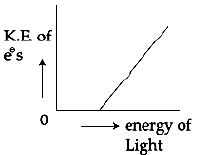
B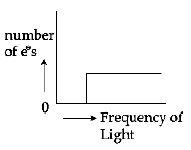
C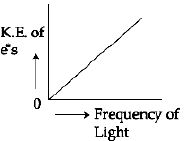
D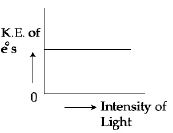
Solution
(C) According to Einstein's photoelectric equation,the kinetic energy $(K.E.)$ of the ejected electron is given by: $K.E. = h\nu - h\nu_0$,where $h\nu$ is the energy of the incident photon and $h\nu_0$ is the work function of the metal.
$1$. The relationship between $K.E.$ and energy of light $(h\nu)$ is a straight line with a positive intercept $(-h\nu_0)$,which matches graph $(A)$.
$2$. The number of ejected electrons depends on the intensity of light,not the frequency (above the threshold),so graph $(B)$ is a valid representation.
$3$. The relationship between $K.E.$ and frequency $(
u)$ is $K.E. = h\nu - h\nu_0$. This is a straight line with a negative intercept on the $K.E.$ axis,not one passing through the origin. Therefore,graph $(C)$ is incorrect.
$4$. $K.E.$ is independent of the intensity of incident light,so graph $(D)$ is a valid representation.
Thus,the graph that does not represent the relationship is $(C)$.
$1$. The relationship between $K.E.$ and energy of light $(h\nu)$ is a straight line with a positive intercept $(-h\nu_0)$,which matches graph $(A)$.
$2$. The number of ejected electrons depends on the intensity of light,not the frequency (above the threshold),so graph $(B)$ is a valid representation.
$3$. The relationship between $K.E.$ and frequency $(
u)$ is $K.E. = h\nu - h\nu_0$. This is a straight line with a negative intercept on the $K.E.$ axis,not one passing through the origin. Therefore,graph $(C)$ is incorrect.
$4$. $K.E.$ is independent of the intensity of incident light,so graph $(D)$ is a valid representation.
Thus,the graph that does not represent the relationship is $(C)$.
0 likesView Solution
43
ChemistryDifficultMCQJEE Main · 2019
Which hydrogen in compound $(E)$ is easily replaceable during bromination reaction in the presence of light?
$CH_3 - CH_2 - CH = CH_2$
$(E)$
$CH_3 - CH_2 - CH = CH_2$
$(E)$
A
$\alpha$-hydrogen
B
$\gamma$-hydrogen
C
$\delta$-hydrogen
D
$\beta$-hydrogen
Solution
(A) In the presence of light,bromination of alkenes occurs via a free radical mechanism.
The hydrogen atoms attached to the carbon atom adjacent to the double bond (allylic position) are the most easily replaceable because the resulting allylic radical is stabilized by resonance.
In the structure $CH_3 - CH_2 - CH = CH_2$,the carbon atom adjacent to the double bond is the $CH_2$ group.
The hydrogen atoms on this $CH_2$ group are known as the $\alpha$-hydrogens relative to the double bond.
Therefore,the $\alpha$-hydrogen is the most easily replaceable.
The hydrogen atoms attached to the carbon atom adjacent to the double bond (allylic position) are the most easily replaceable because the resulting allylic radical is stabilized by resonance.
In the structure $CH_3 - CH_2 - CH = CH_2$,the carbon atom adjacent to the double bond is the $CH_2$ group.
The hydrogen atoms on this $CH_2$ group are known as the $\alpha$-hydrogens relative to the double bond.
Therefore,the $\alpha$-hydrogen is the most easily replaceable.
0 likesView Solution
44
ChemistryMCQJEE Main · 2019
The major product of the following reaction is:
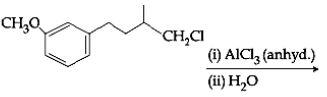
A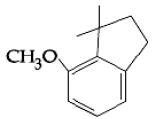
B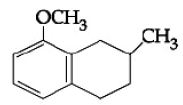
C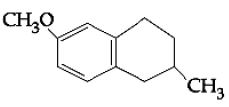
D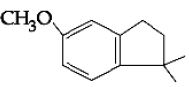
Solution
(D) The reaction involves an intramolecular Friedel-Crafts alkylation.
$1$. The $AlCl_3$ acts as a Lewis acid and removes the $Cl^-$ from the primary alkyl chloride to form a primary carbocation.
$2$. This primary carbocation undergoes a $1,2$-hydride shift to form a more stable tertiary carbocation.
$3$. The tertiary carbocation then undergoes an intramolecular electrophilic aromatic substitution (Friedel-Crafts alkylation) at the ortho position relative to the electron-donating $-OCH_3$ group.
$4$. The resulting product is a substituted indane derivative. Based on the provided options,the structure corresponds to option $D$.
$1$. The $AlCl_3$ acts as a Lewis acid and removes the $Cl^-$ from the primary alkyl chloride to form a primary carbocation.
$2$. This primary carbocation undergoes a $1,2$-hydride shift to form a more stable tertiary carbocation.
$3$. The tertiary carbocation then undergoes an intramolecular electrophilic aromatic substitution (Friedel-Crafts alkylation) at the ortho position relative to the electron-donating $-OCH_3$ group.
$4$. The resulting product is a substituted indane derivative. Based on the provided options,the structure corresponds to option $D$.
0 likesView Solution
45
ChemistryEasyMCQJEE Main · 2019
The electronegativity of aluminium is similar to
A
carbon
B
boron
C
beryllium
D
lithium
Solution
(C) The electronegativity ($E$.$N$.) of $Al$ is $1.5$,which is similar to that of $Be$ $(1.5)$.
$Al$ and $Be$ exhibit a diagonal relationship in the periodic table,which explains the similarity in their properties.
$Al$ and $Be$ exhibit a diagonal relationship in the periodic table,which explains the similarity in their properties.
0 likesView Solution
46
ChemistryMediumMCQJEE Main · 2019
The chemical nature of hydrogen peroxide is
A
oxidising agent in acidic medium,but not in basic medium
B
reducing agent in basic medium but not in acidic medium
C
oxidising and reducing agent in acidic medium but not in basic medium
D
oxidising and reducing agent in both acidic and basic medium
Solution
(D) Correct option: $D$. Hydrogen peroxide $(H_{2}O_{2})$ acts as both an oxidising and a reducing agent in both acidic and basic media.
$H_{2}O_{2}$ as an oxidant:
In acidic medium: $H_{2}O_{2} + 2H^{+} + 2e^{-} \longrightarrow 2H_{2}O$
In basic medium: $H_{2}O_{2} + 2e^{-} \longrightarrow 2OH^{-}$
$H_{2}O_{2}$ as a reductant:
In acidic medium: $H_{2}O_{2} \longrightarrow O_{2} + 2H^{+} + 2e^{-}$
In basic medium: $H_{2}O_{2} + 2OH^{-} \longrightarrow 2H_{2}O + O_{2} + 2e^{-}$
$H_{2}O_{2}$ as an oxidant:
In acidic medium: $H_{2}O_{2} + 2H^{+} + 2e^{-} \longrightarrow 2H_{2}O$
In basic medium: $H_{2}O_{2} + 2e^{-} \longrightarrow 2OH^{-}$
$H_{2}O_{2}$ as a reductant:
In acidic medium: $H_{2}O_{2} \longrightarrow O_{2} + 2H^{+} + 2e^{-}$
In basic medium: $H_{2}O_{2} + 2OH^{-} \longrightarrow 2H_{2}O + O_{2} + 2e^{-}$
0 likesView Solution
47
ChemistryDifficultMCQJEE Main · 2019
$A$ mixture of $100 \ mmol$ of $Ca(OH)_2$ and $2 \ g$ of $Na_2SO_4$ was dissolved in water and the volume was made up to $100 \ mL$. The mass of $CaSO_4$ formed and the concentration of $OH^{-}$ in the resulting solution,respectively,are:
(Molar mass of $Ca(OH)_2$,$Na_2SO_4$ and $CaSO_4$ are $74$,$142$ and $136 \ g \ mol^{-1}$ respectively; $K_{sp}$ of $Ca(OH)_2$ is $5.5 \times 10^{-6}$)
(Molar mass of $Ca(OH)_2$,$Na_2SO_4$ and $CaSO_4$ are $74$,$142$ and $136 \ g \ mol^{-1}$ respectively; $K_{sp}$ of $Ca(OH)_2$ is $5.5 \times 10^{-6}$)
A
$1.9 \ g, 0.28 \ mol \ L^{-1}$
B
$13.6 \ g, 0.28 \ mol \ L^{-1}$
C
$1.9 \ g, 0.14 \ mol \ L^{-1}$
D
$13.6 \ g, 0.14 \ mol \ L^{-1}$
Solution
(A) The reaction is: $Ca(OH)_2 + Na_2SO_4 \to CaSO_4(s) + 2NaOH$.
Initial moles of $Ca(OH)_2 = 100 \ mmol = 0.1 \ mol$.
Initial moles of $Na_2SO_4 = \frac{2 \ g}{142 \ g \ mol^{-1}} \approx 0.014 \ mol = 14 \ mmol$.
Since $Na_2SO_4$ is the limiting reagent,$14 \ mmol$ of $CaSO_4$ will be formed.
Mass of $CaSO_4 = 14 \times 10^{-3} \ mol \times 136 \ g \ mol^{-1} = 1.904 \ g \approx 1.9 \ g$.
In the reaction,$2 \ mmol$ of $NaOH$ are produced for every $1 \ mmol$ of $Na_2SO_4$ consumed.
Moles of $OH^{-} = 2 \times 14 \ mmol = 28 \ mmol = 0.028 \ mol$.
Concentration of $OH^{-} = \frac{0.028 \ mol}{0.1 \ L} = 0.28 \ mol \ L^{-1}$.
Initial moles of $Ca(OH)_2 = 100 \ mmol = 0.1 \ mol$.
Initial moles of $Na_2SO_4 = \frac{2 \ g}{142 \ g \ mol^{-1}} \approx 0.014 \ mol = 14 \ mmol$.
Since $Na_2SO_4$ is the limiting reagent,$14 \ mmol$ of $CaSO_4$ will be formed.
Mass of $CaSO_4 = 14 \times 10^{-3} \ mol \times 136 \ g \ mol^{-1} = 1.904 \ g \approx 1.9 \ g$.
In the reaction,$2 \ mmol$ of $NaOH$ are produced for every $1 \ mmol$ of $Na_2SO_4$ consumed.
Moles of $OH^{-} = 2 \times 14 \ mmol = 28 \ mmol = 0.028 \ mol$.
Concentration of $OH^{-} = \frac{0.028 \ mol}{0.1 \ L} = 0.28 \ mol \ L^{-1}$.
0 likesView Solution
48
ChemistryEasyMCQJEE Main · 2019
$X$-ray tube windows are made using which of the following metals?
A
$Mg$
B
$Na$
C
$Be$
D
$Ca$
Solution
(C) $Be$ (Beryllium) is used to make $X$-ray tube windows.
This is because $Be$ has a very low atomic number ($Z = 4$), which allows $X$-rays to pass through it with minimal absorption.
Therefore, it is highly transparent to $X$-rays.
This is because $Be$ has a very low atomic number ($Z = 4$), which allows $X$-rays to pass through it with minimal absorption.
Therefore, it is highly transparent to $X$-rays.
0 likesView Solution
49
ChemistryMediumMCQJEE Main · 2019
Two $\pi$ and half $\sigma$ bonds are present in
A
$O_2^+$
B
$N_2$
C
$O_2$
D
$N_2^+$
Solution
(D) The bond order $(B.O.)$ is calculated using the formula: $B.O. = \frac{1}{2} (N_b - N_a)$.
For $N_2^+$,the total electrons are $13$. The molecular orbital configuration is: $\sigma 1s^2, \sigma^* 1s^2, \sigma 2s^2, \sigma^* 2s^2, \sigma 2p_z^2, \pi 2p_x^2 = \pi 2p_y^1$.
Here,$N_b = 9$ and $N_a = 4$. So,$B.O. = \frac{1}{2} (9 - 4) = 2.5$.
In $N_2^+$,the triple bond structure of $N_2$ is modified by removing one electron from the bonding $\sigma 2p_z$ orbital,resulting in $2 \ \pi$ bonds and $0.5 \ \sigma$ bond.
For $N_2^+$,the total electrons are $13$. The molecular orbital configuration is: $\sigma 1s^2, \sigma^* 1s^2, \sigma 2s^2, \sigma^* 2s^2, \sigma 2p_z^2, \pi 2p_x^2 = \pi 2p_y^1$.
Here,$N_b = 9$ and $N_a = 4$. So,$B.O. = \frac{1}{2} (9 - 4) = 2.5$.
In $N_2^+$,the triple bond structure of $N_2$ is modified by removing one electron from the bonding $\sigma 2p_z$ orbital,resulting in $2 \ \pi$ bonds and $0.5 \ \sigma$ bond.
0 likesView Solution
50
ChemistryMCQJEE Main · 2019
If a circle $C$ passing through the point $(4, 0)$ touches the circle $x^2 + y^2 + 4x - 6y = 12$ externally at the point $(1, -1)$,then the radius of $C$ is
A
$2\sqrt{5}$
B
$4$
C
$5$
D
$\sqrt{57}$
Solution
(C) The equation of the given circle is $x^2 + y^2 + 4x - 6y - 12 = 0$.
The tangent to this circle at the point $(1, -1)$ is given by $x(1) + y(-1) + 2(x + 1) - 3(y - 1) - 12 = 0$.
Simplifying this,we get $x - y + 2x + 2 - 3y + 3 - 12 = 0$,which is $3x - 4y - 7 = 0$.
The family of circles touching the given circle at $(1, -1)$ is $(x - 1)^2 + (y + 1)^2 + \lambda(3x - 4y - 7) = 0$.
Since the circle passes through $(4, 0)$,we substitute these coordinates: $(4 - 1)^2 + (0 + 1)^2 + \lambda(3(4) - 4(0) - 7) = 0$.
This gives $9 + 1 + \lambda(12 - 7) = 0$,so $10 + 5\lambda = 0$,which implies $\lambda = -2$.
Substituting $\lambda = -2$ back into the equation: $(x^2 - 2x + 1) + (y^2 + 2y + 1) - 6x + 8y + 14 = 0$.
This simplifies to $x^2 + y^2 - 8x + 10y + 16 = 0$.
The radius of this circle is $\sqrt{g^2 + f^2 - c} = \sqrt{(-4)^2 + (5)^2 - 16} = \sqrt{16 + 25 - 16} = \sqrt{25} = 5$.
The tangent to this circle at the point $(1, -1)$ is given by $x(1) + y(-1) + 2(x + 1) - 3(y - 1) - 12 = 0$.
Simplifying this,we get $x - y + 2x + 2 - 3y + 3 - 12 = 0$,which is $3x - 4y - 7 = 0$.
The family of circles touching the given circle at $(1, -1)$ is $(x - 1)^2 + (y + 1)^2 + \lambda(3x - 4y - 7) = 0$.
Since the circle passes through $(4, 0)$,we substitute these coordinates: $(4 - 1)^2 + (0 + 1)^2 + \lambda(3(4) - 4(0) - 7) = 0$.
This gives $9 + 1 + \lambda(12 - 7) = 0$,so $10 + 5\lambda = 0$,which implies $\lambda = -2$.
Substituting $\lambda = -2$ back into the equation: $(x^2 - 2x + 1) + (y^2 + 2y + 1) - 6x + 8y + 14 = 0$.
This simplifies to $x^2 + y^2 - 8x + 10y + 16 = 0$.
The radius of this circle is $\sqrt{g^2 + f^2 - c} = \sqrt{(-4)^2 + (5)^2 - 16} = \sqrt{16 + 25 - 16} = \sqrt{25} = 5$.
0 likesView Solution
51
ChemistryDifficultMCQJEE Main · 2019
The major product obtained in the following reaction is:
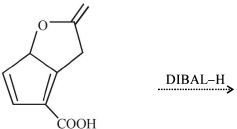
A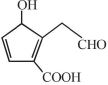
B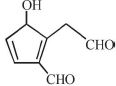
C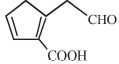
D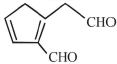
Solution
(A) $DIBAL-H$ (Diisobutylaluminium hydride) is a selective reducing agent. It is commonly used to reduce esters or lactones (cyclic esters) to aldehydes. In the given reaction,the lactone ring is opened and reduced to an aldehyde group,while the hydroxyl group is formed at the position where the oxygen was attached to the ring. The carboxylic acid group $(-COOH)$ remains unaffected under these specific reaction conditions.
0 likesView Solution
52
ChemistryDifficultMCQJEE Main · 2019
Two complexes $[Cr(H_2O)_6]Cl_3 \ (A)$ and $[Cr(NH_3)_6]Cl_3 \ (B)$ are violet and yellow coloured respectively. The incorrect statement regarding them is
A
$ \Delta_0 $ values of $(A)$ and $(B)$ are calculated from the energies of violet and yellow light,respectively
B
both are paramagnetic with three unpaired electrons
C
both absorb energies corresponding to their complementary colours
D
$ \Delta_0 $ value for $(A)$ is less than that of $(B)$
Solution
(A) The colour observed is the complementary colour of the light absorbed by the complex.
$ \Delta_0 $ is calculated from the energy of the absorbed light,not the emitted (observed) light.
Since $(A)$ is violet,it absorbs yellow light,and since $(B)$ is yellow,it absorbs violet light.
Therefore,the statement that $ \Delta_0 $ values are calculated from the energies of violet and yellow light respectively is incorrect.
$ \Delta_0 $ is calculated from the energy of the absorbed light,not the emitted (observed) light.
Since $(A)$ is violet,it absorbs yellow light,and since $(B)$ is yellow,it absorbs violet light.
Therefore,the statement that $ \Delta_0 $ values are calculated from the energies of violet and yellow light respectively is incorrect.
0 likesView Solution
53
ChemistryDifficultMCQJEE Main · 2019
The correct decreasing order for acidic strength is
A
$NO_2CH_2COOH > FCH_2COOH > CNCH_2COOH > ClCH_2COOH$
B
$FCH_2COOH > NCCH_2COOH > NO_2CH_2COOH > ClCH_2COOH$
C
$CNCH_2COOH > O_2NCH_2COOH > FCH_2COOH > ClCH_2COOH$
D
$NO_2CH_2COOH > NCCH_2COOH > FCH_2COOH > ClCH_2COOH$
Solution
(D) Acidic strength is directly proportional to the electron-withdrawing effect ($-I$ effect) of the substituent group attached to the $\alpha$-carbon of the carboxylic acid.
The strength of the $-I$ effect follows the order: $NO_2 > CN > F > Cl$.
Therefore,the correct decreasing order of acidic strength is $NO_2CH_2COOH > NCCH_2COOH > FCH_2COOH > ClCH_2COOH$.
The strength of the $-I$ effect follows the order: $NO_2 > CN > F > Cl$.
Therefore,the correct decreasing order of acidic strength is $NO_2CH_2COOH > NCCH_2COOH > FCH_2COOH > ClCH_2COOH$.
0 likesView Solution
54
ChemistryDifficultMCQJEE Main · 2019
The major product of the following reaction is
$R-C \equiv N \xrightarrow[(2) \ H_2O]{(1) \ AlH(i-Bu)_2} ?$
$R-C \equiv N \xrightarrow[(2) \ H_2O]{(1) \ AlH(i-Bu)_2} ?$
A
$RCOOH$
B
$RCONH_2$
C
$RCHO$
D
$RCH_2NH_2$
Solution
(C) The reagent $AlH(i-Bu)_2$ is known as $DIBAL-H$ (Diisobutylaluminium hydride).
It is a selective reducing agent that reduces nitriles $(R-C \equiv N)$ to imines,which upon subsequent hydrolysis with $H_2O$ yield aldehydes $(RCHO)$.
The reaction mechanism involves the nucleophilic attack of the hydride from $DIBAL-H$ onto the carbon of the nitrile group,followed by hydrolysis of the resulting imine intermediate to form the aldehyde.
It is a selective reducing agent that reduces nitriles $(R-C \equiv N)$ to imines,which upon subsequent hydrolysis with $H_2O$ yield aldehydes $(RCHO)$.
The reaction mechanism involves the nucleophilic attack of the hydride from $DIBAL-H$ onto the carbon of the nitrile group,followed by hydrolysis of the resulting imine intermediate to form the aldehyde.
0 likesView Solution
55
ChemistryDifficultMCQJEE Main · 2019
The highest value of the calculated spin-only magnetic moment (in $BM$) among all the transition metal complexes is
A
$5.92$
B
$6.93$
C
$3.87$
D
$4.90$
Solution
(A) The spin-only magnetic moment is given by the formula $\mu_s = \sqrt{n(n+2)} \ BM$,where $n$ is the number of unpaired electrons.
For transition metal complexes,the maximum number of unpaired electrons in the $d$-orbitals is $n = 5$ (as in $d^5$ configuration).
Substituting $n = 5$ into the formula:
$\mu_s = \sqrt{5(5+2)} = \sqrt{35} \approx 5.92 \ BM$.
Thus,the highest value of the calculated spin-only magnetic moment is $5.92 \ BM$.
For transition metal complexes,the maximum number of unpaired electrons in the $d$-orbitals is $n = 5$ (as in $d^5$ configuration).
Substituting $n = 5$ into the formula:
$\mu_s = \sqrt{5(5+2)} = \sqrt{35} \approx 5.92 \ BM$.
Thus,the highest value of the calculated spin-only magnetic moment is $5.92 \ BM$.
0 likesView Solution
56
ChemistryDifficultMCQJEE Main · 2019
The one that is extensively used as a piezoelectric material is
A
tridymite
B
amorphous silica
C
quartz
D
mica
Solution
(C) Materials that produce an electric current when they are subjected to mechanical stress are called piezoelectric materials. $Quartz$ is a well-known example of a piezoelectric material and is extensively used in various electronic devices.
1 likesView Solution
57
ChemistryDifficultMCQJEE Main · 2019
$A$ solution of sodium sulphate contains $92 \ g$ of $Na^{+}$ ions per kilogram of water. The molality of $Na^{+}$ ions in that solution in $mol \ kg^{-1}$ is:
A
$12$
B
$4$
C
$8$
D
$16$
Solution
(B) The molality $(m)$ is defined as the number of moles of solute per kilogram of solvent.
Given mass of $Na^{+}$ ions = $92 \ g$.
Molar mass of $Na^{+}$ ions = $23 \ g \ mol^{-1}$.
Moles of $Na^{+}$ ions = $\frac{92 \ g}{23 \ g \ mol^{-1}} = 4 \ mol$.
Mass of solvent (water) = $1 \ kg$.
Molality = $\frac{\text{moles of solute}}{\text{mass of solvent in kg}} = \frac{4 \ mol}{1 \ kg} = 4 \ mol \ kg^{-1}$.
Given mass of $Na^{+}$ ions = $92 \ g$.
Molar mass of $Na^{+}$ ions = $23 \ g \ mol^{-1}$.
Moles of $Na^{+}$ ions = $\frac{92 \ g}{23 \ g \ mol^{-1}} = 4 \ mol$.
Mass of solvent (water) = $1 \ kg$.
Molality = $\frac{\text{moles of solute}}{\text{mass of solvent in kg}} = \frac{4 \ mol}{1 \ kg} = 4 \ mol \ kg^{-1}$.
0 likesView Solution
58
ChemistryMediumMCQJEE Main · 2019
The correct match between Item $-I$ and Item $-II$ is
| Item $-I$ (drug) | Item $-II$ (test) |
| $(a)$ Chloroxylenol | $(p)$ Carbylamine test |
| $(b)$ Norethindrone | $(q)$ Sodium hydrogen carbonate test |
| $(c)$ Sulpha pyridine | $(r)$ Ferric chloride test |
| $(d)$ Penicillin | $(s)$ Bayer's test |
A
$a \to r, b \to p, c \to s, d \to q$
B
$a \to q, b \to s, c \to p, d \to r$
C
$a \to r, b \to s, c \to p, d \to q$
D
$a \to q, b \to p, c \to s, d \to r$
Solution
(C) Chloroxylenol is a phenol derivative,so it gives a positive Ferric chloride test $(r)$.
$(b)$ Norethindrone contains a carbon-carbon triple bond (alkyne),so it gives a positive Bayer's test $(s)$.
$(c)$ Sulpha pyridine contains a primary amine group $(-NH_2)$,so it gives a positive Carbylamine test $(p)$.
$(d)$ Penicillin contains a carboxylic acid group $(-COOH)$,so it gives a positive Sodium hydrogen carbonate test $(q)$.
Thus,the correct match is $a \to r, b \to s, c \to p, d \to q$.
$(b)$ Norethindrone contains a carbon-carbon triple bond (alkyne),so it gives a positive Bayer's test $(s)$.
$(c)$ Sulpha pyridine contains a primary amine group $(-NH_2)$,so it gives a positive Carbylamine test $(p)$.
$(d)$ Penicillin contains a carboxylic acid group $(-COOH)$,so it gives a positive Sodium hydrogen carbonate test $(q)$.
Thus,the correct match is $a \to r, b \to s, c \to p, d \to q$.
0 likesView Solution
59
ChemistryDifficultMCQJEE Main · 2019
The anodic half-cell of a lead-acid battery is recharged using electricity of $0.05 \ F$. The amount of $PbSO_4$ electrolyzed in $g$ during the process is (Molar mass of $PbSO_4 = 303 \ g \ mol^{-1}$)
A
$22.8$
B
$15.2$
C
$7.6$
D
$11.4$
Solution
(C) The anodic reaction during the recharging of a lead-acid battery is: $PbSO_4 + 2e^- \to Pb_{(s)} + SO_4^{2-}$.
According to the reaction,$2 \ F$ of electricity is required to reduce $1 \ mol$ $(303 \ g)$ of $PbSO_4$.
Therefore,for $0.05 \ F$ of electricity,the amount of $PbSO_4$ electrolyzed is:
$\text{Mass} = \frac{303 \ g \ mol^{-1} \times 0.05 \ F}{2 \ F} = 7.6 \ g$.
According to the reaction,$2 \ F$ of electricity is required to reduce $1 \ mol$ $(303 \ g)$ of $PbSO_4$.
Therefore,for $0.05 \ F$ of electricity,the amount of $PbSO_4$ electrolyzed is:
$\text{Mass} = \frac{303 \ g \ mol^{-1} \times 0.05 \ F}{2 \ F} = 7.6 \ g$.
0 likesView Solution
60
ChemistryEasyMCQJEE Main · 2019
Which one of the following statements regarding Henry's law is not correct?
A
Higher the value of $K_H$ at a given pressure,higher is the solubility of the gas in the liquids
B
Different gases have different $K_H$ (Henry's law constant) values at the same temperature
C
The partial pressure of the gas in vapour phase is proportional to the mole fraction of the gas in the solution
D
The value of $K_H$ increases with increase of temperature and $K_H$ is function of the nature of the gas
Solution
(A) Henry's law is expressed as $P = K_H \times x$,where $P$ is the partial pressure of the gas,$x$ is the mole fraction of the gas in the solution,and $K_H$ is Henry's law constant.
From this relation,$x = P / K_H$.
This shows that for a given partial pressure $P$,the solubility $(x)$ is inversely proportional to $K_H$.
Therefore,a higher value of $K_H$ implies lower solubility of the gas in the liquid.
Thus,the statement in option $A$ is incorrect.
From this relation,$x = P / K_H$.
This shows that for a given partial pressure $P$,the solubility $(x)$ is inversely proportional to $K_H$.
Therefore,a higher value of $K_H$ implies lower solubility of the gas in the liquid.
Thus,the statement in option $A$ is incorrect.
0 likesView Solution
61
ChemistryDifficultMCQJEE Main · 2019
The following results were obtained during kinetic studies of the reaction $2A + B \to$ products:
The time (in minutes) required to consume half of $A$ is:
| Experiment | $[A]$ $(mol \ L^{-1})$ | $[B]$ $(mol \ L^{-1})$ | Initial rate $(mol \ L^{-1} \ min^{-1})$ |
|---|---|---|---|
| $I$ | $0.10$ | $0.20$ | $6.93 \times 10^{-3}$ |
| $II$ | $0.10$ | $0.25$ | $6.93 \times 10^{-3}$ |
| $III$ | $0.20$ | $0.30$ | $1.386 \times 10^{-2}$ |
The time (in minutes) required to consume half of $A$ is:
A
$5$
B
$10$
C
$1$
D
$100$
Solution
(B) The rate law is given by $R = k[A]^x [B]^y$.
From experiments $I$ and $II$,$[A]$ is constant and $[B]$ changes,but the rate remains constant. Thus,$y = 0$ (zero order with respect to $B$).
From experiments $I$ and $III$,when $[A]$ doubles ($0.10$ to $0.20$),the rate doubles ($6.93 \times 10^{-3}$ to $1.386 \times 10^{-2}$). Thus,$x = 1$ (first order with respect to $A$).
The rate equation is $R = k[A]$.
Using experiment $I$: $6.93 \times 10^{-3} = k(0.10) \Rightarrow k = 6.93 \times 10^{-2} \ min^{-1}$.
For a first-order reaction,the half-life is $t_{1/2} = \frac{\ln(2)}{k} = \frac{0.693}{6.93 \times 10^{-2}} = 10 \ min$.
From experiments $I$ and $II$,$[A]$ is constant and $[B]$ changes,but the rate remains constant. Thus,$y = 0$ (zero order with respect to $B$).
From experiments $I$ and $III$,when $[A]$ doubles ($0.10$ to $0.20$),the rate doubles ($6.93 \times 10^{-3}$ to $1.386 \times 10^{-2}$). Thus,$x = 1$ (first order with respect to $A$).
The rate equation is $R = k[A]$.
Using experiment $I$: $6.93 \times 10^{-3} = k(0.10) \Rightarrow k = 6.93 \times 10^{-2} \ min^{-1}$.
For a first-order reaction,the half-life is $t_{1/2} = \frac{\ln(2)}{k} = \frac{0.693}{6.93 \times 10^{-2}} = 10 \ min$.
0 likesView Solution
62
ChemistryAdvancedMCQJEE Main · 2019
Major product of the following reaction is

A
B
C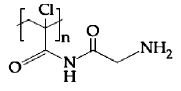
D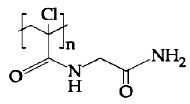
Solution
(D) The reaction proceeds in two steps:
$1$. Nucleophilic substitution: The amino group of glycinamide attacks the acid chloride to form an amide linkage,releasing $HCl$. Triethylamine $(Et_3N)$ is used to neutralize the $HCl$ produced.
$2$. Free radical polymerization: The resulting monomer,which contains a vinyl group,undergoes free radical polymerization to form the final polymer product.
The structure of the final polymer is shown in option $D$.
$1$. Nucleophilic substitution: The amino group of glycinamide attacks the acid chloride to form an amide linkage,releasing $HCl$. Triethylamine $(Et_3N)$ is used to neutralize the $HCl$ produced.
$2$. Free radical polymerization: The resulting monomer,which contains a vinyl group,undergoes free radical polymerization to form the final polymer product.
The structure of the final polymer is shown in option $D$.
0 likesView Solution
63
ChemistryDifficultMCQJEE Main · 2019
Adsorption of a gas follows the Freundlich adsorption isotherm. In the given plot,$x$ is the mass of gas adsorbed on mass $m$ of the adsorbent at pressure $p$. $\frac{x}{m}$ is proportional to:
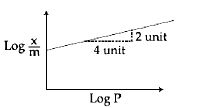
A
$p^2$
B
$p^{1/4}$
C
$p^{1/2}$
D
$p$
Solution
(C) The Freundlich adsorption isotherm is given by the equation: $\frac{x}{m} = kP^{1/n}$.
Taking logarithm on both sides: $\log(\frac{x}{m}) = \log k + \frac{1}{n} \log P$.
This is in the form of a straight line equation $y = mx + c$,where the slope is $\frac{1}{n}$.
From the given plot,the slope is calculated as: $\text{Slope} = \frac{\text{change in } y}{\text{change in } x} = \frac{2}{4} = \frac{1}{2}$.
Therefore,$\frac{1}{n} = \frac{1}{2}$.
Substituting this back into the original equation,we get: $\frac{x}{m} \propto P^{1/2}$.
Taking logarithm on both sides: $\log(\frac{x}{m}) = \log k + \frac{1}{n} \log P$.
This is in the form of a straight line equation $y = mx + c$,where the slope is $\frac{1}{n}$.
From the given plot,the slope is calculated as: $\text{Slope} = \frac{\text{change in } y}{\text{change in } x} = \frac{2}{4} = \frac{1}{2}$.
Therefore,$\frac{1}{n} = \frac{1}{2}$.
Substituting this back into the original equation,we get: $\frac{x}{m} \propto P^{1/2}$.
0 likesView Solution
64
ChemistryMediumMCQJEE Main · 2019
The ore that contains both iron and copper is
A
copper pyrites
B
malachite
C
dolomite
D
azurite
Solution
(A) Copper pyrites is $CuFeS_2$,which contains both iron and copper.
Malachite is $CuCO_3 \cdot Cu(OH)_2$,which contains only copper.
Azurite is $2CuCO_3 \cdot Cu(OH)_2$,which contains only copper.
Dolomite is $CaCO_3 \cdot MgCO_3$,which contains calcium and magnesium.
Malachite is $CuCO_3 \cdot Cu(OH)_2$,which contains only copper.
Azurite is $2CuCO_3 \cdot Cu(OH)_2$,which contains only copper.
Dolomite is $CaCO_3 \cdot MgCO_3$,which contains calcium and magnesium.
0 likesView Solution
65
ChemistryDifficultMCQJEE Main · 2019
The major product of the following reaction is:
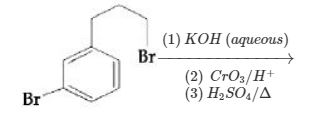
A
$6-$bromo$-1-$indanone
B
$4-$bromo$-1-$indanone
C
$4-$hydroxy$-1-$indanone
D
$6-$hydroxy$-1-$indanone
Solution
(A) Step $1$: Treatment with aqueous $KOH$ performs nucleophilic substitution of the primary alkyl bromide to form a primary alcohol,$3-(3-bromophenyl)propan-1-ol$.
Step $2$: Oxidation with $CrO_3/H^+$ (Jones reagent) converts the primary alcohol into a carboxylic acid,$3-(3-bromophenyl)propanoic acid$.
Step $3$: Intramolecular Friedel-Crafts acylation using $H_2SO_4/\Delta$ leads to cyclization. The carboxylic acid group attacks the ortho position relative to the alkyl chain. Since the meta-bromo group directs the cyclization,the product formed is $6-bromo-1-indanone$.
Step $2$: Oxidation with $CrO_3/H^+$ (Jones reagent) converts the primary alcohol into a carboxylic acid,$3-(3-bromophenyl)propanoic acid$.
Step $3$: Intramolecular Friedel-Crafts acylation using $H_2SO_4/\Delta$ leads to cyclization. The carboxylic acid group attacks the ortho position relative to the alkyl chain. Since the meta-bromo group directs the cyclization,the product formed is $6-bromo-1-indanone$.
0 likesView Solution
66
ChemistryMediumMCQJEE Main · 2019
Aluminium is usually found in $+3$ oxidation state. In contrast,thallium exists in $+1$ and $+3$ oxidation states. This is due to
A
inert pair effect
B
diagonal relationship
C
lattice effect
D
lanthanoid contraction
Solution
(A) The outermost electron configuration of $Tl$ is $6s^2 6p^1$.
Due to the poor shielding effect of $d$ and $f$ electrons,the $6s$ electrons are held tightly by the nucleus and do not participate in bonding,which is known as the inert pair effect.
Consequently,$Tl$ shows a $+1$ oxidation state more stably than a $+3$ oxidation state.
Due to the poor shielding effect of $d$ and $f$ electrons,the $6s$ electrons are held tightly by the nucleus and do not participate in bonding,which is known as the inert pair effect.
Consequently,$Tl$ shows a $+1$ oxidation state more stably than a $+3$ oxidation state.
1 likesView Solution
67
ChemistryDifficultMCQJEE Main · 2019
The increasing order of $pKa$ of the following amino acids in aqueous solution is $Gly, Asp, Lys, Arg$.
A
$Asp < Gly < Arg < Lys$
B
$Gly < Asp < Arg < Lys$
C
$Asp < Gly < Lys < Arg$
D
$Arg < Lys < Gly < Asp$
Solution
(C) The $pI$ (isoelectric point) values for the given amino acids are as follows:
$Asp$ $(pI = 3.0)$,
$Gly$ $(pI = 6.0)$,
$Lys$ $(pI = 9.8)$,
$Arg$ $(pI = 10.8)$.
The $pKa$ values of the side chains or the overall acidity of amino acids correlate with their $pI$ values.
Acidic amino acids like $Asp$ have lower $pI$ values,while basic amino acids like $Lys$ and $Arg$ have higher $pI$ values.
Therefore,the increasing order of $pKa$ values is $Asp < Gly < Lys < Arg$.
$Asp$ $(pI = 3.0)$,
$Gly$ $(pI = 6.0)$,
$Lys$ $(pI = 9.8)$,
$Arg$ $(pI = 10.8)$.
The $pKa$ values of the side chains or the overall acidity of amino acids correlate with their $pI$ values.
Acidic amino acids like $Asp$ have lower $pI$ values,while basic amino acids like $Lys$ and $Arg$ have higher $pI$ values.
Therefore,the increasing order of $pKa$ values is $Asp < Gly < Lys < Arg$.
0 likesView Solution
68
ChemistryDifficultMCQJEE Main · 2019
The decreasing order of basicity for the following amine compounds is:
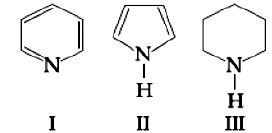
A
$III > I > II$
B
$I > III > II$
C
$III > II > I$
D
$II > I > III$
Solution
(A) The basicity of amines depends on the availability of the lone pair of electrons on the nitrogen atom.
In compound $(III)$ (piperidine),the nitrogen atom is $sp^3$ hybridized,and the lone pair is localized,making it the most basic.
In compound $(I)$ (pyridine),the nitrogen atom is $sp^2$ hybridized. The lone pair is in an $sp^2$ orbital,which is more electronegative than an $sp^3$ orbital,making it less basic than $(III)$.
In compound $(II)$ (pyrrole),the lone pair of electrons on the nitrogen atom participates in the aromatic sextet (delocalization). Therefore,it is not available for protonation,making it the least basic.
Thus,the decreasing order of basicity is $III > I > II$.
In compound $(III)$ (piperidine),the nitrogen atom is $sp^3$ hybridized,and the lone pair is localized,making it the most basic.
In compound $(I)$ (pyridine),the nitrogen atom is $sp^2$ hybridized. The lone pair is in an $sp^2$ orbital,which is more electronegative than an $sp^3$ orbital,making it less basic than $(III)$.
In compound $(II)$ (pyrrole),the lone pair of electrons on the nitrogen atom participates in the aromatic sextet (delocalization). Therefore,it is not available for protonation,making it the least basic.
Thus,the decreasing order of basicity is $III > I > II$.
0 likesView Solution
69
ChemistryDifficultMCQJEE Main · 2019
The compounds $A$ and $B$ in the following reaction are,respectively:
$Benzene$ $\xrightarrow{HCHO + HCl}$ $A$ $\xrightarrow{AgCN}$ $B$
$Benzene$ $\xrightarrow{HCHO + HCl}$ $A$ $\xrightarrow{AgCN}$ $B$
A
$A =$ Benzyl alcohol,$B =$ Benzyl cyanide
B
$A =$ Benzyl chloride,$B =$ Benzyl cyanide
C
$A =$ Benzyl alcohol,$B =$ Benzyl isocyanide
D
$A =$ Benzyl chloride,$B =$ Benzyl isocyanide
Solution
(D) $1$. The reaction of $Benzene$ with $HCHO$ and $HCl$ is a chloromethylation reaction (Blanc reaction),which produces $Benzyl$ $chloride$ $(C_6H_5CH_2Cl)$ as compound $A$.
$2$. The reaction of $Benzyl$ $chloride$ with $AgCN$ is a nucleophilic substitution reaction. Since $AgCN$ is a covalent reagent,the nitrogen atom acts as the nucleophile,leading to the formation of $Benzyl$ $isocyanide$ $(C_6H_5CH_2NC)$ as compound $B$.
$2$. The reaction of $Benzyl$ $chloride$ with $AgCN$ is a nucleophilic substitution reaction. Since $AgCN$ is a covalent reagent,the nitrogen atom acts as the nucleophile,leading to the formation of $Benzyl$ $isocyanide$ $(C_6H_5CH_2NC)$ as compound $B$.
0 likesView Solution
70
ChemistryDifficultMCQJEE Main · 2019
The major product formed in the following reaction is:
$CH_3CHO + PhCOCH_3 \xrightarrow{\text{dil. } NaOH}$
$CH_3CHO + PhCOCH_3 \xrightarrow{\text{dil. } NaOH}$
A
$CH_3CH(OH)CH_2CHO$
B
$H-CH_2-C(OH)(CH_3)-Ph$
C
$CH_3CH(OH)CH_2COPh$
D
$Ph-CO-CH_2-C(OH)(CH_3)-Ph$
Solution
(C) The reaction between $CH_3CHO$ (acetaldehyde) and $PhCOCH_3$ (acetophenone) in the presence of dilute $NaOH$ is a cross-aldol condensation reaction.
$1$. Acetophenone has an $\alpha$-hydrogen atom,so it can form an enolate ion in the presence of a base $(NaOH)$.
$2$. The enolate ion formed from acetophenone acts as a nucleophile and attacks the carbonyl carbon of the acetaldehyde $(CH_3CHO)$,which is more electrophilic than acetophenone.
$3$. The nucleophilic attack leads to the formation of a $\beta$-hydroxy ketone.
$4$. The reaction proceeds as follows:
$PhCOCH_3 + OH^- \rightarrow [PhCOCH_2]^- + H_2O$
$[PhCOCH_2]^- + CH_3CHO \rightarrow CH_3-CH(O^-)-CH_2-COPh$
$CH_3-CH(O^-)-CH_2-COPh + H_2O \rightarrow CH_3-CH(OH)-CH_2-COPh + OH^-$
Thus,the major product is $CH_3-CH(OH)-CH_2-COPh$.
$1$. Acetophenone has an $\alpha$-hydrogen atom,so it can form an enolate ion in the presence of a base $(NaOH)$.
$2$. The enolate ion formed from acetophenone acts as a nucleophile and attacks the carbonyl carbon of the acetaldehyde $(CH_3CHO)$,which is more electrophilic than acetophenone.
$3$. The nucleophilic attack leads to the formation of a $\beta$-hydroxy ketone.
$4$. The reaction proceeds as follows:
$PhCOCH_3 + OH^- \rightarrow [PhCOCH_2]^- + H_2O$
$[PhCOCH_2]^- + CH_3CHO \rightarrow CH_3-CH(O^-)-CH_2-COPh$
$CH_3-CH(O^-)-CH_2-COPh + H_2O \rightarrow CH_3-CH(OH)-CH_2-COPh + OH^-$
Thus,the major product is $CH_3-CH(OH)-CH_2-COPh$.
0 likesView Solution
71
ChemistryDifficultMCQJEE Main · 2019
The major product obtained in the following reaction is:
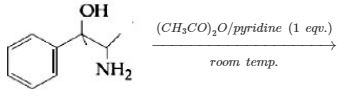
A
$A$ structure showing an alkene with an acetamide group.
B
$A$ structure showing an acetyl group on the benzene ring and an amino group.
C
$A$ structure showing an ester group at the hydroxyl position.
D
$A$ structure showing an acetamide group at the amino position with the hydroxyl group intact.
Solution
(D) The reactant is $2$-amino-$1$-phenylpropan-$1$-ol. It contains both an amino group $(-NH_2)$ and a hydroxyl group $(-OH)$.
When treated with acetic anhydride $((CH_3CO)_2O)$ in the presence of pyridine at room temperature,acetylation occurs.
Since the nucleophilicity of the amino group $(-NH_2)$ is significantly higher than that of the hydroxyl group $(-OH)$,the amino group undergoes acetylation preferentially to form an amide.
Therefore,the major product is the $N$-acetylated derivative,where the $-NH_2$ group is converted to $-NHCOCH_3$ while the $-OH$ group remains unchanged.
When treated with acetic anhydride $((CH_3CO)_2O)$ in the presence of pyridine at room temperature,acetylation occurs.
Since the nucleophilicity of the amino group $(-NH_2)$ is significantly higher than that of the hydroxyl group $(-OH)$,the amino group undergoes acetylation preferentially to form an amide.
Therefore,the major product is the $N$-acetylated derivative,where the $-NH_2$ group is converted to $-NHCOCH_3$ while the $-OH$ group remains unchanged.
0 likesView Solution
72
ChemistryDifficultMCQJEE Main · 2019
For arsenious sulphide sol,which one of the following salt solutions will be most effective for coagulation?
A
$BaCl_2$
B
$AlCl_3$
C
$NaCl$
D
$Na_3PO_4$
Solution
(B) Arsenious sulphide $(As_2S_3)$ sol is a negatively charged colloidal sol.
According to the Hardy-Schulze rule,the coagulating power of an electrolyte depends on the valency of the oppositely charged ion.
For a negatively charged sol,the coagulating power increases with the increase in the valency of the cation.
The valencies of the cations are: $Na^+$ $(+1)$,$Ba^{2+}$ $(+2)$,and $Al^{3+}$ $(+3)$.
Since $Al^{3+}$ has the highest valency,$AlCl_3$ is the most effective coagulating agent.
According to the Hardy-Schulze rule,the coagulating power of an electrolyte depends on the valency of the oppositely charged ion.
For a negatively charged sol,the coagulating power increases with the increase in the valency of the cation.
The valencies of the cations are: $Na^+$ $(+1)$,$Ba^{2+}$ $(+2)$,and $Al^{3+}$ $(+3)$.
Since $Al^{3+}$ has the highest valency,$AlCl_3$ is the most effective coagulating agent.
0 likesView Solution
73
ChemistryAdvancedMCQJEE Main · 2019
The complex that has the highest crystal field splitting energy $(\Delta)$ is
A
$[Co(NH_3)_5(H_2O)]Cl_3$
B
$K_2[CoCl_4]$
C
$[Co(NH_3)_5Cl]Cl_2$
D
$K_3[Co(CN)_6]$
Solution
(D) The crystal field splitting energy $(\Delta)$ depends on the nature of the ligand and the oxidation state of the central metal ion.
Strong field ligands cause larger splitting compared to weak field ligands.
Among the given ligands,$CN^-$ is a strong field ligand (spectrochemical series).
In $K_3[Co(CN)_6]$,the cobalt ion is in the $+3$ oxidation state and is coordinated to six strong $CN^-$ ligands,resulting in the highest crystal field splitting energy.
Strong field ligands cause larger splitting compared to weak field ligands.
Among the given ligands,$CN^-$ is a strong field ligand (spectrochemical series).
In $K_3[Co(CN)_6]$,the cobalt ion is in the $+3$ oxidation state and is coordinated to six strong $CN^-$ ligands,resulting in the highest crystal field splitting energy.
0 likesView Solution
74
ChemistryAdvancedMCQJEE Main · 2019
The correct sequence of amino acids present in the tripeptide given below is
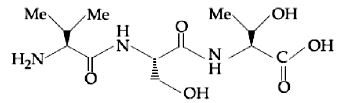
A
$Val-Ser-Thr$
B
$Thr-Ser-Val$
C
$Leu-Ser-Thr$
D
$Thr-Ser-Leu$
Solution
(A) The given tripeptide is hydrolyzed to obtain three amino acids: $Valine$ $(Val)$,$Serine$ $(Ser)$,and $Threonine$ $(Thr)$.
By observing the structure from the $N$-terminal (left side) to the $C$-terminal (right side),the sequence of amino acids is $Val-Ser-Thr$.
By observing the structure from the $N$-terminal (left side) to the $C$-terminal (right side),the sequence of amino acids is $Val-Ser-Thr$.
0 likesView Solution
75
ChemistryMediumMCQJEE Main · 2019
For the reaction,$2A + B \to \text{products}$,when the concentrations of $A$ and $B$ both were doubled,the rate of the reaction increased from $0.3 \ mol \ L^{-1} \ s^{-1}$ to $2.4 \ mol \ L^{-1} \ s^{-1}$. When the concentration of $A$ alone is doubled,the rate increased from $0.3 \ mol \ L^{-1} \ s^{-1}$ to $0.6 \ mol \ L^{-1} \ s^{-1}$. Which one of the following statements is correct?
A
Total order of the reaction is $4$
B
Order of the reaction with respect to $B$ is $2$
C
Order of the reaction with respect to $B$ is $1$
D
Order of the reaction with respect to $A$ is $2$
Solution
(B) The rate law for the reaction is given by: $Rate = K [A]^x [B]^y$
Initial rate: $0.3 = K [A]^x [B]^y$ $(1)$
When both concentrations are doubled: $2.4 = K [2A]^x [2B]^y = K [A]^x [B]^y \times 2^{x+y} = 0.3 \times 2^{x+y}$
$2^{x+y} = 2.4 / 0.3 = 8 = 2^3$,so $x + y = 3$ $(2)$
When only $A$ is doubled: $0.6 = K [2A]^x [B]^y = K [A]^x [B]^y \times 2^x = 0.3 \times 2^x$
$2^x = 0.6 / 0.3 = 2 = 2^1$,so $x = 1$
Substituting $x = 1$ into $x + y = 3$,we get $y = 2$
Thus,the order with respect to $A$ is $1$ and with respect to $B$ is $2$.
Initial rate: $0.3 = K [A]^x [B]^y$ $(1)$
When both concentrations are doubled: $2.4 = K [2A]^x [2B]^y = K [A]^x [B]^y \times 2^{x+y} = 0.3 \times 2^{x+y}$
$2^{x+y} = 2.4 / 0.3 = 8 = 2^3$,so $x + y = 3$ $(2)$
When only $A$ is doubled: $0.6 = K [2A]^x [B]^y = K [A]^x [B]^y \times 2^x = 0.3 \times 2^x$
$2^x = 0.6 / 0.3 = 2 = 2^1$,so $x = 1$
Substituting $x = 1$ into $x + y = 3$,we get $y = 2$
Thus,the order with respect to $A$ is $1$ and with respect to $B$ is $2$.
0 likesView Solution
76
ChemistryAdvancedMCQJEE Main · 2019
The products formed in the reaction of cumene with $O_2$ followed by treatment with dil. $HCl$ are
A
$Phenol$ and $Acetone$
B
$Benzyl$ $alcohol$ and $Acetaldehyde$
C
$Benzene$ and $Propene$
D
$Benzaldehyde$ and $Methane$
Solution
(A) Cumene $(Isopropylbenzene)$ reacts with $O_2$ to form cumene hydroperoxide.
Upon further treatment with dil. $HCl$,cumene hydroperoxide undergoes rearrangement to yield $Phenol$ and $Acetone$ as the final products.
Upon further treatment with dil. $HCl$,cumene hydroperoxide undergoes rearrangement to yield $Phenol$ and $Acetone$ as the final products.
0 likesView Solution
77
ChemistryDifficultMCQJEE Main · 2019
The tests performed on compound $X$ and their inferences are:
Compound $X$ is:
| Test | Inference |
|---|---|
| $(a)$ $2, 4-DNP$ test | Coloured precipitate |
| $(b)$ Iodoform test | Yellow precipitate |
| $(c)$ Azo-dye test | No dye formation |
Compound $X$ is:
A
$2-$aminophenylacetaldehyde
B
$2-$(dimethylamino)acetophenone
C
$1-$($2$-aminophenyl)ethanol
D
$2-$(dimethylamino)phenylacetaldehyde
Solution
(B) The $2, 4-DNP$ test is positive for aldehydes and ketones,indicating the presence of a carbonyl group.
The iodoform test is positive for methyl ketones $(-COCH_3)$ or compounds that can be oxidized to methyl ketones (like $CH_3CH(OH)-R$).
The azo-dye test is used to detect primary aromatic amines. $A$ negative result indicates that the amine is either not primary or its reactivity is hindered.
Option $(B)$ is $2-(dimethylamino)acetophenone$. It contains a $-COCH_3$ group,which gives a positive $2, 4-DNP$ test and a positive iodoform test. The nitrogen atom is tertiary (dimethylamino),so it does not form an azo-dye,consistent with the observations.
The iodoform test is positive for methyl ketones $(-COCH_3)$ or compounds that can be oxidized to methyl ketones (like $CH_3CH(OH)-R$).
The azo-dye test is used to detect primary aromatic amines. $A$ negative result indicates that the amine is either not primary or its reactivity is hindered.
Option $(B)$ is $2-(dimethylamino)acetophenone$. It contains a $-COCH_3$ group,which gives a positive $2, 4-DNP$ test and a positive iodoform test. The nitrogen atom is tertiary (dimethylamino),so it does not form an azo-dye,consistent with the observations.
0 likesView Solution
78
ChemistryDifficultMCQJEE Main · 2019
If the standard electrode potential for a cell is $2 \ V$ at $300 \ K,$ the equilibrium constant $(K)$ for the reaction $Zn_{(s)} + Cu^{2+}_{(aq)} \rightleftharpoons Zn^{2+}_{(aq)} + Cu_{(s)}$ at $300 \ K$ is approximately $(R = 8 \ J \ K^{-1} \ mol^{-1}, F = 96000 \ C \ mol^{-1})$
A
$e^{-80}$
B
$e^{-160}$
C
$e^{320}$
D
$e^{160}$
Solution
(D) The reaction is $Zn_{(s)} + Cu^{2+}_{(aq)} \rightleftharpoons Zn^{2+}_{(aq)} + Cu_{(s)}$.
Here,the number of electrons transferred,$n = 2$.
The relationship between standard cell potential and equilibrium constant is given by $\Delta G^{\circ} = -nFE^{\circ}_{cell} = -RT \ln K$.
Rearranging for $\ln K$,we get $\ln K = \frac{nFE^{\circ}_{cell}}{RT}$.
Substituting the given values: $n = 2$,$F = 96000 \ C \ mol^{-1}$,$E^{\circ}_{cell} = 2 \ V$,$R = 8 \ J \ K^{-1} \ mol^{-1}$,and $T = 300 \ K$.
$\ln K = \frac{2 \times 96000 \times 2}{8 \times 300}$.
$\ln K = \frac{384000}{2400} = 160$.
Therefore,$K = e^{160}$.
Here,the number of electrons transferred,$n = 2$.
The relationship between standard cell potential and equilibrium constant is given by $\Delta G^{\circ} = -nFE^{\circ}_{cell} = -RT \ln K$.
Rearranging for $\ln K$,we get $\ln K = \frac{nFE^{\circ}_{cell}}{RT}$.
Substituting the given values: $n = 2$,$F = 96000 \ C \ mol^{-1}$,$E^{\circ}_{cell} = 2 \ V$,$R = 8 \ J \ K^{-1} \ mol^{-1}$,and $T = 300 \ K$.
$\ln K = \frac{2 \times 96000 \times 2}{8 \times 300}$.
$\ln K = \frac{384000}{2400} = 160$.
Therefore,$K = e^{160}$.
0 likesView Solution
79
ChemistryDifficultMCQJEE Main · 2019
The good reducing nature of $H_3PO_2$ is attributed to the presence of:
A
Two $P-OH$ bonds
B
One $P-H$ bond
C
Two $P-H$ bonds
D
One $P-OH$ bond
Solution
(C) The structure of hypophosphorous acid $(H_3PO_2)$ contains one $P=O$ bond,two $P-OH$ bonds,and two $P-H$ bonds.
Reducing character in phosphorus oxoacids is directly related to the number of $P-H$ bonds present in the molecule.
Since $H_3PO_2$ contains two $P-H$ bonds,it acts as a strong reducing agent.
Reducing character in phosphorus oxoacids is directly related to the number of $P-H$ bonds present in the molecule.
Since $H_3PO_2$ contains two $P-H$ bonds,it acts as a strong reducing agent.
0 likesView Solution
80
ChemistryDifficultMCQJEE Main · 2019
The correct statement regarding the given Ellingham diagram is
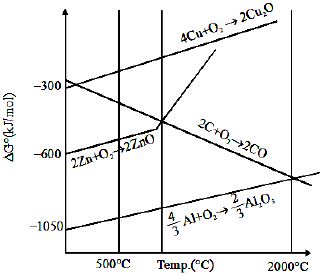
A
At $1400\,^\circ C,$ $Al$ can be used for the extraction of $Zn$ from $ZnO$.
B
At $500\,^\circ C,$ coke can be used for the extraction of $Zn$ from $ZnO$.
C
Coke cannot be used for the extraction of $Cu$ from $Cu_2O$.
D
At $800\,^\circ C,$ $Cu$ can be used for the extraction of $Zn$ from $ZnO$.
Solution
(A) In an Ellingham diagram,a metal can reduce the oxide of another metal if the line for the formation of its own oxide lies below the line for the formation of the other metal's oxide.
$1$. At $1400\,^\circ C,$ the line for the formation of $Al_2O_3$ is below the line for the formation of $ZnO.$ Therefore,$Al$ can reduce $ZnO$ to $Zn$.
$2$. At $500\,^\circ C,$ the line for the formation of $ZnO$ is below the line for the formation of $CO,$ so coke cannot reduce $ZnO$.
$3$. The line for the formation of $CO$ is below the line for the formation of $Cu_2O$ at all temperatures,so coke can reduce $Cu_2O$.
$4$. At $800\,^\circ C,$ the line for the formation of $ZnO$ is below the line for the formation of $Cu_2O,$ so $Cu$ cannot reduce $ZnO$.
Thus,option $A$ is correct.
$1$. At $1400\,^\circ C,$ the line for the formation of $Al_2O_3$ is below the line for the formation of $ZnO.$ Therefore,$Al$ can reduce $ZnO$ to $Zn$.
$2$. At $500\,^\circ C,$ the line for the formation of $ZnO$ is below the line for the formation of $CO,$ so coke cannot reduce $ZnO$.
$3$. The line for the formation of $CO$ is below the line for the formation of $Cu_2O$ at all temperatures,so coke can reduce $Cu_2O$.
$4$. At $800\,^\circ C,$ the line for the formation of $ZnO$ is below the line for the formation of $Cu_2O,$ so $Cu$ cannot reduce $ZnO$.
Thus,option $A$ is correct.
0 likesView Solution
81
ChemistryEasyMCQJEE Main · 2019
The transition element that has the lowest enthalpy of atomisation is
A
$Fe$
B
$Cu$
C
$V$
D
$Zn$
Solution
(D) The enthalpy of atomisation depends on the strength of metallic bonding,which is determined by the number of unpaired electrons in the $d$-orbital.
$Zn$ has a completely filled $d$-orbital $(3d^{10} 4s^2)$,meaning there are no unpaired electrons available for metallic bonding.
Consequently,$Zn$ exhibits the weakest metallic bonding among the $3d$ transition series,resulting in the lowest enthalpy of atomisation.
$Zn$ has a completely filled $d$-orbital $(3d^{10} 4s^2)$,meaning there are no unpaired electrons available for metallic bonding.
Consequently,$Zn$ exhibits the weakest metallic bonding among the $3d$ transition series,resulting in the lowest enthalpy of atomisation.
0 likesView Solution
82
ChemistryDifficultMCQJEE Main · 2019
The increasing basicity order of the following compounds is:
$(1)$ $CH_3CH_2NH_2$
$(2)$ $(CH_3CH_2)_2NH$
$(3)$ $(CH_3)_3N$
$(4)$ $PhNHCH_3$
$(1)$ $CH_3CH_2NH_2$
$(2)$ $(CH_3CH_2)_2NH$
$(3)$ $(CH_3)_3N$
$(4)$ $PhNHCH_3$
A
$(4) < (3) < (2) < (1)$
B
$(4) < (3) < (1) < (2)$
C
$(1) < (2) < (3) < (4)$
D
$(1) < (2) < (4) < (3)$
Solution
(B) The basicity of amines depends on the availability of the lone pair on the nitrogen atom and the stability of the resulting conjugate acid.
$(i)$ $PhNHCH_3$ $(4)$ is an aromatic amine where the lone pair on nitrogen is delocalized into the benzene ring,making it the least basic.
$(ii)$ Among aliphatic amines,basicity is influenced by the inductive effect $(+I)$,solvation,and steric hindrance.
$(iii)$ Diethylamine $(2)$ is a $2^\circ$ amine,which is more basic than Ethylamine $(1)$ ($1^\circ$ amine) due to the $+I$ effect of two ethyl groups.
$(iv)$ Trimethylamine $(3)$ is a $3^\circ$ amine. Due to significant steric hindrance and reduced solvation of its conjugate acid in water,it is less basic than Ethylamine $(1)$.
Thus,the increasing order of basicity is: $(4) < (3) < (1) < (2)$.
$(i)$ $PhNHCH_3$ $(4)$ is an aromatic amine where the lone pair on nitrogen is delocalized into the benzene ring,making it the least basic.
$(ii)$ Among aliphatic amines,basicity is influenced by the inductive effect $(+I)$,solvation,and steric hindrance.
$(iii)$ Diethylamine $(2)$ is a $2^\circ$ amine,which is more basic than Ethylamine $(1)$ ($1^\circ$ amine) due to the $+I$ effect of two ethyl groups.
$(iv)$ Trimethylamine $(3)$ is a $3^\circ$ amine. Due to significant steric hindrance and reduced solvation of its conjugate acid in water,it is less basic than Ethylamine $(1)$.
Thus,the increasing order of basicity is: $(4) < (3) < (1) < (2)$.
0 likesView Solution
83
ChemistryMediumMCQJEE Main · 2019
At $100\, ^\circ C$,copper $(Cu)$ has $FCC$ unit cell structure with cell edge length $x\, \mathring{A}$. What is the approximate density of $Cu$ (in $g\, cm^{-3}$) at this temperature? [Atomic mass of $Cu = 63.55\, u$]
A
$\frac{205}{x^3}$
B
$\frac{105}{x^3}$
C
$\frac{211}{x^3}$
D
$\frac{422}{x^3}$
Solution
(D) The density $(d)$ of a unit cell is given by the formula: $d = \frac{Z \times M}{N_A \times a^3}$
For an $FCC$ unit cell,the number of atoms per unit cell $(Z) = 4$.
The atomic mass of $Cu$ $(M) = 63.55\, g\, mol^{-1}$.
The Avogadro constant $(N_A) = 6.023 \times 10^{23}\, mol^{-1}$.
The edge length $(a) = x\, \mathring{A} = x \times 10^{-8}\, cm$.
Substituting these values into the formula:
$d = \frac{4 \times 63.55}{(6.023 \times 10^{23}) \times (x \times 10^{-8})^3}$
$d = \frac{254.2}{6.023 \times 10^{23} \times x^3 \times 10^{-24}}$
$d = \frac{254.2}{0.6023 \times x^3} \approx \frac{422}{x^3}\, g\, cm^{-3}$
For an $FCC$ unit cell,the number of atoms per unit cell $(Z) = 4$.
The atomic mass of $Cu$ $(M) = 63.55\, g\, mol^{-1}$.
The Avogadro constant $(N_A) = 6.023 \times 10^{23}\, mol^{-1}$.
The edge length $(a) = x\, \mathring{A} = x \times 10^{-8}\, cm$.
Substituting these values into the formula:
$d = \frac{4 \times 63.55}{(6.023 \times 10^{23}) \times (x \times 10^{-8})^3}$
$d = \frac{254.2}{6.023 \times 10^{23} \times x^3 \times 10^{-24}}$
$d = \frac{254.2}{0.6023 \times x^3} \approx \frac{422}{x^3}\, g\, cm^{-3}$
0 likesView Solution
84
ChemistryDifficultMCQJEE Main · 2019
$A$ solution containing $62 \ g$ of ethylene glycol in $250 \ g$ of water is cooled to $-10 \ ^\circ C$. If $K_f$ for water is $1.86 \ K \ kg \ mol^{-1}$,the amount of water (in $g$) separated as ice is:
A
$48$
B
$32$
C
$64$
D
$16$
Solution
(C) The molar mass of ethylene glycol $(C_2H_6O_2)$ is $62 \ g \ mol^{-1}$.
Moles of ethylene glycol $= \frac{62 \ g}{62 \ g \ mol^{-1}} = 1 \ mol$.
Let the mass of water remaining in the liquid phase be $w \ g$.
The freezing point depression is $\Delta T_f = 0 - (-10) = 10 \ K$.
Using the formula $\Delta T_f = K_f \times m$,where $m$ is the molality:
$10 = 1.86 \times \frac{1 \ mol}{(w / 1000) \ kg}$.
$w = \frac{1.86 \times 1000}{10} = 186 \ g$.
The amount of water separated as ice $= \text{Initial mass} - \text{Remaining mass} = 250 \ g - 186 \ g = 64 \ g$.
Moles of ethylene glycol $= \frac{62 \ g}{62 \ g \ mol^{-1}} = 1 \ mol$.
Let the mass of water remaining in the liquid phase be $w \ g$.
The freezing point depression is $\Delta T_f = 0 - (-10) = 10 \ K$.
Using the formula $\Delta T_f = K_f \times m$,where $m$ is the molality:
$10 = 1.86 \times \frac{1 \ mol}{(w / 1000) \ kg}$.
$w = \frac{1.86 \times 1000}{10} = 186 \ g$.
The amount of water separated as ice $= \text{Initial mass} - \text{Remaining mass} = 250 \ g - 186 \ g = 64 \ g$.
0 likesView Solution
85
ChemistryAdvancedMCQJEE Main · 2019
Homoleptic octahedral complexes of a metal ion $M^{3+}$ with three monodentate ligands $L_1, L_2$ and $L_3$ absorb wavelengths in the region of green,blue and red respectively. The increasing order of the ligand strength is:
A
$L_3 < L_1 < L_2$
B
$L_3 < L_2 < L_1$
C
$L_1 < L_2 < L_3$
D
$L_2 < L_1 < L_3$
Solution
(A) The crystal field splitting energy $(\Delta_o)$ is inversely proportional to the wavelength of light absorbed $(\Delta_o = \frac{hc}{\lambda})$.
The order of wavelengths for the given colors is $\lambda_{blue} < \lambda_{green} < \lambda_{red}$.
Thus,the energy order is $E_{blue} > E_{green} > E_{red}$.
Since ligand strength is directly proportional to $\Delta_o$,the order of ligand strength is $L_2 > L_1 > L_3$ or $L_3 < L_1 < L_2$.
The order of wavelengths for the given colors is $\lambda_{blue} < \lambda_{green} < \lambda_{red}$.
Thus,the energy order is $E_{blue} > E_{green} > E_{red}$.
Since ligand strength is directly proportional to $\Delta_o$,the order of ligand strength is $L_2 > L_1 > L_3$ or $L_3 < L_1 < L_2$.
0 likesView Solution
86
ChemistryMediumMCQJEE Main · 2019
The total number of isomers for a square planar complex $[M(F)(Cl)(SCN)(NO_2)]$ is
A
$16$
B
$8$
C
$4$
D
$12$
Solution
(D) For a square planar complex of the type $[M(abcd)]$,there are $3$ geometrical isomers.
In the given complex $[M(F)(Cl)(SCN)(NO_2)]$,the ligands $SCN^-$ and $NO_2^-$ are ambidentate ligands.
$SCN^-$ can coordinate through $S$ $(SCN^-)$ or $N$ $(NCS^-)$.
$NO_2^-$ can coordinate through $N$ $(NO_2^-)$ or $O$ $(ONO^-)$.
This gives rise to linkage isomerism.
There are $4$ possible combinations of these ambidentate ligands:
$1$. $[M(F)(Cl)(SCN)(NO_2)]$
$2$. $[M(F)(Cl)(NCS)(NO_2)]$
$3$. $[M(F)(Cl)(SCN)(ONO)]$
$4$. $[M(F)(Cl)(NCS)(ONO)]$
Each of these $4$ combinations exhibits $3$ geometrical isomers.
Therefore,the total number of isomers = $4 \times 3 = 12$.
In the given complex $[M(F)(Cl)(SCN)(NO_2)]$,the ligands $SCN^-$ and $NO_2^-$ are ambidentate ligands.
$SCN^-$ can coordinate through $S$ $(SCN^-)$ or $N$ $(NCS^-)$.
$NO_2^-$ can coordinate through $N$ $(NO_2^-)$ or $O$ $(ONO^-)$.
This gives rise to linkage isomerism.
There are $4$ possible combinations of these ambidentate ligands:
$1$. $[M(F)(Cl)(SCN)(NO_2)]$
$2$. $[M(F)(Cl)(NCS)(NO_2)]$
$3$. $[M(F)(Cl)(SCN)(ONO)]$
$4$. $[M(F)(Cl)(NCS)(ONO)]$
Each of these $4$ combinations exhibits $3$ geometrical isomers.
Therefore,the total number of isomers = $4 \times 3 = 12$.
0 likesView Solution
87
ChemistryEasyMCQJEE Main · 2019
Which primitive unit cell has unequal edge length $(a \ne b \ne c)$ and all axial angles different from $90^{\circ}$?
A
Triclinic
B
Hexagonal
C
Monoclinic
D
Tetragonal
Solution
(A) In a Triclinic unit cell,the parameters are defined as $a \ne b \ne c$ and $\alpha \ne \beta \ne \gamma \ne 90^{\circ}$.
This represents the most unsymmetrical crystal system.
This represents the most unsymmetrical crystal system.
1 likesView Solution
88
ChemistryDifficultMCQJEE Main · 2019
The major product of the following reaction is:
$Ph-CH(CH_3)-CH(Br)-CH_2-CH_2-Br \xrightarrow{KOH \text{ (alc, excess)}, \Delta} ?$
$Ph-CH(CH_3)-CH(Br)-CH_2-CH_2-Br \xrightarrow{KOH \text{ (alc, excess)}, \Delta} ?$
A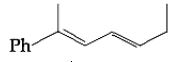
B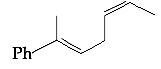
C
D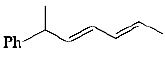
Solution
(A) The reaction involves the dehydrohalogenation of a vicinal dibromide (or a dihaloalkane) using excess alcoholic $KOH$ at high temperature $(\Delta)$.
This is an $E_2$ elimination reaction that proceeds to form a conjugated diene.
The starting material is $Ph-CH(CH_3)-CH(Br)-CH_2-CH_2-Br$.
Upon treatment with excess alcoholic $KOH$,two molecules of $HBr$ are eliminated to form a conjugated system.
The most stable product is the one with extended conjugation,which is $Ph-C(CH_3)=CH-CH=CH_2$ (or a similar conjugated diene structure as shown in option $A$).
Thus,the major product is the conjugated diene.
This is an $E_2$ elimination reaction that proceeds to form a conjugated diene.
The starting material is $Ph-CH(CH_3)-CH(Br)-CH_2-CH_2-Br$.
Upon treatment with excess alcoholic $KOH$,two molecules of $HBr$ are eliminated to form a conjugated system.
The most stable product is the one with extended conjugation,which is $Ph-C(CH_3)=CH-CH=CH_2$ (or a similar conjugated diene structure as shown in option $A$).
Thus,the major product is the conjugated diene.
0 likesView Solution
89
ChemistryMediumMCQJEE Main · 2019
Consider the given plots for a reaction obeying the Arrhenius equation $(0\,^{\circ}C < T < 300\,^{\circ}C)$: ($k$ and $E_a$ are rate constant and activation energy respectively). Choose the correct option.
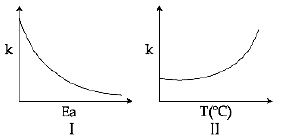
A
$I$ is right but $II$ is wrong
B
Both $I$ and $II$ are correct
C
$I$ is wrong but $II$ is right
D
Both $I$ and $II$ are wrong
Solution
(A) The Arrhenius equation is given by $k = A e^{-E_a/RT}$.
Plot $I$: As $E_a$ increases,the term $e^{-E_a/RT}$ decreases,so $k$ decreases. Thus,the plot of $k$ versus $E_a$ is an exponential decay curve,which is correct.
Plot $II$: As temperature $T$ increases,the term $e^{-E_a/RT}$ increases,so $k$ increases exponentially with $T$. The provided plot $II$ shows a curve that does not represent the standard exponential increase of $k$ with $T$ correctly (it looks more like a linear or different growth). Therefore,$II$ is incorrect.
Hence,$I$ is right but $II$ is wrong.
Plot $I$: As $E_a$ increases,the term $e^{-E_a/RT}$ decreases,so $k$ decreases. Thus,the plot of $k$ versus $E_a$ is an exponential decay curve,which is correct.
Plot $II$: As temperature $T$ increases,the term $e^{-E_a/RT}$ increases,so $k$ increases exponentially with $T$. The provided plot $II$ shows a curve that does not represent the standard exponential increase of $k$ with $T$ correctly (it looks more like a linear or different growth). Therefore,$II$ is incorrect.
Hence,$I$ is right but $II$ is wrong.
0 likesView Solution
90
ChemistryDifficultMCQJEE Main · 2019
The major product formed in the reaction given below will be
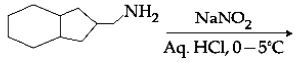
A
Bicyclo[$4.4$.$0$]decyl$-2-$nitromethane
B
Bicyclo[$4.3$.$0$]nonyl$-2-$nitro
C
Decalin$-2-$methanol
D
Decalin$-2-$ol
Solution
(D) The reaction of a primary aliphatic amine with $NaNO_2$ and $HCl$ at $0-5^{\circ}C$ produces an unstable diazonium salt.
This diazonium salt undergoes rapid loss of $N_2$ gas to form a primary carbocation.
Since the primary carbocation is unstable,it undergoes a ring expansion rearrangement to form a more stable secondary carbocation.
Specifically,the $5$-membered ring expands to a $6$-membered ring to form a decalin system.
Finally,the secondary carbocation reacts with water to form the major product,which is decalin-$2$-ol.
This diazonium salt undergoes rapid loss of $N_2$ gas to form a primary carbocation.
Since the primary carbocation is unstable,it undergoes a ring expansion rearrangement to form a more stable secondary carbocation.
Specifically,the $5$-membered ring expands to a $6$-membered ring to form a decalin system.
Finally,the secondary carbocation reacts with water to form the major product,which is decalin-$2$-ol.
0 likesView Solution
91
ChemistryDifficultMCQJEE Main · 2019
The Wilkinson catalyst is:
A
$[(Ph_3P)_3IrCl]$
B
$[(Et_3P)_3RhCl]$
C
$[(Ph_3P)_3RhCl]$
D
$[(Et_3P)_3IrCl]$
Solution
(C) The Wilkinson catalyst is a well-known organometallic complex used as a homogeneous catalyst for the hydrogenation of alkenes.
Its chemical formula is $RhCl(PPh_3)_3$,which is represented as $[(Ph_3P)_3RhCl]$.
It consists of a rhodium center coordinated to three triphenylphosphine ligands and one chloride ion.
Its chemical formula is $RhCl(PPh_3)_3$,which is represented as $[(Ph_3P)_3RhCl]$.
It consists of a rhodium center coordinated to three triphenylphosphine ligands and one chloride ion.
0 likesView Solution
92
ChemistryDifficultMCQJEE Main · 2019
Which dicarboxylic acid,in the presence of a dehydrating agent,is least reactive to form an anhydride?
A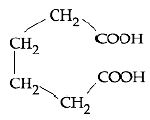
B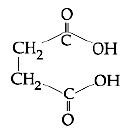
C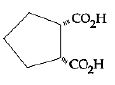
D
Solution
(A) The formation of cyclic anhydrides from dicarboxylic acids depends on the stability of the resulting ring. Five-membered and six-membered rings are generally stable and form easily.
$1$. Succinic acid forms a $5$-membered anhydride (succinic anhydride).
$2$. Phthalic acid forms a $5$-membered cyclic anhydride.
$3$. Cyclopentane-$1,2$-dicarboxylic acid (cis-isomer) forms a $5$-membered fused anhydride.
$4$. Adipic acid $(HOOC(CH_2)_4COOH)$ would form a $7$-membered ring anhydride,which is highly unstable due to ring strain and transannular interactions. Therefore,it is the least reactive toward anhydride formation.
$1$. Succinic acid forms a $5$-membered anhydride (succinic anhydride).
$2$. Phthalic acid forms a $5$-membered cyclic anhydride.
$3$. Cyclopentane-$1,2$-dicarboxylic acid (cis-isomer) forms a $5$-membered fused anhydride.
$4$. Adipic acid $(HOOC(CH_2)_4COOH)$ would form a $7$-membered ring anhydride,which is highly unstable due to ring strain and transannular interactions. Therefore,it is the least reactive toward anhydride formation.
0 likesView Solution
93
ChemistryDifficultMCQJEE Main · 2019
The decreasing order of the rate of alkaline hydrolysis for the following esters is:
$I: C_6H_5COOC_2H_5$
$II: p-Cl-C_6H_4COOC_2H_5$
$III: p-NO_2-C_6H_4COOC_2H_5$
$IV: p-CH_3O-C_6H_4COOC_2H_5$
$I: C_6H_5COOC_2H_5$
$II: p-Cl-C_6H_4COOC_2H_5$
$III: p-NO_2-C_6H_4COOC_2H_5$
$IV: p-CH_3O-C_6H_4COOC_2H_5$
A
$III > II > I > IV$
B
$III > II > IV > I$
C
$IV > II > III > I$
D
$II > III > I > IV$
Solution
(A) The rate of alkaline hydrolysis of esters depends on the electrophilicity of the carbonyl carbon.
Electron-withdrawing groups $(EWG)$ increase the electrophilicity of the carbonyl carbon,thereby increasing the rate of nucleophilic attack by $OH^-$.
Electron-donating groups $(EDG)$ decrease the electrophilicity,thereby decreasing the rate.
The substituents at the para-position are:
$III: -NO_2$ (Strong $EWG$,$-I$ and $-M$ effect)
$II: -Cl$ ($EWG$,$-I$ effect > $+M$ effect)
$I: -H$ (Reference)
$IV: -OCH_3$ (Strong $EDG$,$+M$ effect > $-I$ effect)
The order of electron-withdrawing strength is $-NO_2 > -Cl > -H > -OCH_3$.
Therefore,the decreasing order of the rate of alkaline hydrolysis is $III > II > I > IV$.
Electron-withdrawing groups $(EWG)$ increase the electrophilicity of the carbonyl carbon,thereby increasing the rate of nucleophilic attack by $OH^-$.
Electron-donating groups $(EDG)$ decrease the electrophilicity,thereby decreasing the rate.
The substituents at the para-position are:
$III: -NO_2$ (Strong $EWG$,$-I$ and $-M$ effect)
$II: -Cl$ ($EWG$,$-I$ effect > $+M$ effect)
$I: -H$ (Reference)
$IV: -OCH_3$ (Strong $EDG$,$+M$ effect > $-I$ effect)
The order of electron-withdrawing strength is $-NO_2 > -Cl > -H > -OCH_3$.
Therefore,the decreasing order of the rate of alkaline hydrolysis is $III > II > I > IV$.
0 likesView Solution
94
ChemistryDifficultMCQJEE Main · 2019
Which of the following is not an example of a heterogeneous catalytic reaction?
A
Ostwald's process
B
Combustion of coal
C
Hydrogenation of vegetable oils
D
Haber's process
Solution
(B) heterogeneous catalytic reaction involves a catalyst in a different phase from the reactants.
$A$. Ostwald's process uses a $Pt$ catalyst (solid) for the oxidation of $NH_3$ (gas),which is heterogeneous.
$B$. Combustion of coal is a spontaneous oxidation reaction that does not require a catalyst.
$C$. Hydrogenation of vegetable oils uses a $Ni$ catalyst (solid) for liquid oils and $H_2$ (gas),which is heterogeneous.
$D$. Haber's process uses an $Fe$ catalyst (solid) for $N_2$ and $H_2$ (gases),which is heterogeneous.
Therefore,the combustion of coal is not a catalytic reaction at all.
$A$. Ostwald's process uses a $Pt$ catalyst (solid) for the oxidation of $NH_3$ (gas),which is heterogeneous.
$B$. Combustion of coal is a spontaneous oxidation reaction that does not require a catalyst.
$C$. Hydrogenation of vegetable oils uses a $Ni$ catalyst (solid) for liquid oils and $H_2$ (gas),which is heterogeneous.
$D$. Haber's process uses an $Fe$ catalyst (solid) for $N_2$ and $H_2$ (gases),which is heterogeneous.
Therefore,the combustion of coal is not a catalytic reaction at all.
0 likesView Solution
95
ChemistryEasyMCQJEE Main · 2019
What is the effect of lanthanoid contraction in the lanthanoid series of elements?
A
Increase in both atomic and ionic radii
B
Decrease in atomic radii and increase in ionic radii
C
Decrease in both atomic and ionic radii
D
Increase in atomic radii and decrease in ionic radii
Solution
(C) Lanthanoid contraction refers to the steady decrease in the atomic and ionic radii of the lanthanoid elements as the atomic number increases from $La$ $(Z=57)$ to $Lu$ $(Z=71)$.
This occurs due to the poor shielding effect of the $4f$ electrons,which causes the effective nuclear charge to increase,pulling the valence shell closer to the nucleus.
This occurs due to the poor shielding effect of the $4f$ electrons,which causes the effective nuclear charge to increase,pulling the valence shell closer to the nucleus.
0 likesView Solution
96
ChemistryDifficultMCQJEE Main · 2019
The correct structure of product $P$ in the following reaction is
$Asn-Ser + (excess) (CH_3CO)_2O \xrightarrow{NEt_3} P$
$Asn-Ser + (excess) (CH_3CO)_2O \xrightarrow{NEt_3} P$
A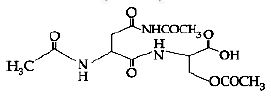
B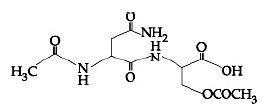
C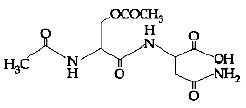
D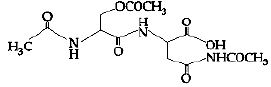
Solution
(D) The reaction involves the treatment of the dipeptide $Asn-Ser$ with excess acetic anhydride $((CH_3CO)_2O)$ in the presence of a base $(NEt_3)$.
Acetic anhydride is an acetylating agent that reacts with nucleophilic functional groups.
In the dipeptide $Asn-Ser$:
$1$. The $N$-terminal amino group $(-NH_2)$ of $Asn$ is nucleophilic and will be acetylated to form an amide $(-NHCOCH_3)$.
$2$. The side-chain amide group $(-CONH_2)$ of $Asn$ is also nucleophilic and will be acetylated to form an imide $(-CONHCOCH_3)$.
$3$. The side-chain hydroxyl group $(-OH)$ of $Ser$ is nucleophilic and will be acetylated to form an ester $(-OCOCH_3)$.
Therefore,all three nucleophilic sites are acetylated,resulting in the structure shown in option $D$.
Acetic anhydride is an acetylating agent that reacts with nucleophilic functional groups.
In the dipeptide $Asn-Ser$:
$1$. The $N$-terminal amino group $(-NH_2)$ of $Asn$ is nucleophilic and will be acetylated to form an amide $(-NHCOCH_3)$.
$2$. The side-chain amide group $(-CONH_2)$ of $Asn$ is also nucleophilic and will be acetylated to form an imide $(-CONHCOCH_3)$.
$3$. The side-chain hydroxyl group $(-OH)$ of $Ser$ is nucleophilic and will be acetylated to form an ester $(-OCOCH_3)$.
Therefore,all three nucleophilic sites are acetylated,resulting in the structure shown in option $D$.
0 likesView Solution
97
ChemistryMediumMCQJEE Main · 2019
The type of hybridisation and number of lone pair$(s)$ of electrons of $Xe$ in $XeOF_4$ respectively are
A
$sp^3d^2$ and $1$
B
$sp^3d$ and $2$
C
$sp^3d^2$ and $2$
D
$sp^3d$ and $1$
Solution
(A) To determine the hybridisation and lone pairs of $Xe$ in $XeOF_4$:
$1$. The central atom is $Xe$,which has $8$ valence electrons.
$2$. $Xe$ forms $4$ single bonds with $F$ atoms and $1$ double bond with the $O$ atom.
$3$. Total number of electron pairs around $Xe$ = (Number of sigma bonds) + (Number of lone pairs).
$4$. $Xe$ forms $5$ sigma bonds ($4$ with $F$ and $1$ with $O$) and $1$ pi bond with $O$.
$5$. The number of lone pairs on $Xe$ = (Total valence electrons - Electrons used in bonding) / $2$ = $(8 - (4 \times 1 + 1 \times 2)) / 2 = (8 - 6) / 2 = 1$ lone pair.
$6$. Steric number = (Number of sigma bonds) + (Number of lone pairs) = $5 + 1 = 6$.
$7$. $A$ steric number of $6$ corresponds to $sp^3d^2$ hybridisation.
$8$. Therefore,the hybridisation is $sp^3d^2$ and the number of lone pairs is $1$.
$1$. The central atom is $Xe$,which has $8$ valence electrons.
$2$. $Xe$ forms $4$ single bonds with $F$ atoms and $1$ double bond with the $O$ atom.
$3$. Total number of electron pairs around $Xe$ = (Number of sigma bonds) + (Number of lone pairs).
$4$. $Xe$ forms $5$ sigma bonds ($4$ with $F$ and $1$ with $O$) and $1$ pi bond with $O$.
$5$. The number of lone pairs on $Xe$ = (Total valence electrons - Electrons used in bonding) / $2$ = $(8 - (4 \times 1 + 1 \times 2)) / 2 = (8 - 6) / 2 = 1$ lone pair.
$6$. Steric number = (Number of sigma bonds) + (Number of lone pairs) = $5 + 1 = 6$.
$7$. $A$ steric number of $6$ corresponds to $sp^3d^2$ hybridisation.
$8$. Therefore,the hybridisation is $sp^3d^2$ and the number of lone pairs is $1$.
0 likesView Solution
98
ChemistryDifficultMCQJEE Main · 2019
Consider the following:
$Zn^{2+} + 2e^- \longrightarrow Zn_{(s)} ; E^o = -0.76 \, V$
$Ca^{2+} + 2e^- \longrightarrow Ca_{(s)} ; E^o = -2.87 \, V$
$Mg^{2+} + 2e^- \longrightarrow Mg_{(s)} ; E^o = -2.36 \, V$
$Ni^{2+} + 2e^- \longrightarrow Ni_{(s)} ; E^o = -0.25 \, V$
The reducing power of the metals increases in the order:
$Zn^{2+} + 2e^- \longrightarrow Zn_{(s)} ; E^o = -0.76 \, V$
$Ca^{2+} + 2e^- \longrightarrow Ca_{(s)} ; E^o = -2.87 \, V$
$Mg^{2+} + 2e^- \longrightarrow Mg_{(s)} ; E^o = -2.36 \, V$
$Ni^{2+} + 2e^- \longrightarrow Ni_{(s)} ; E^o = -0.25 \, V$
The reducing power of the metals increases in the order:
A
$Ni < Zn < Mg < Ca$
B
$Ni < Zn < Ca < Mg$
C
$Zn < Mg < Ni < Ca$
D
$Ca < Mg < Zn < Ni$
Solution
(A) The reducing power of a metal is inversely proportional to its Standard Reduction Potential $(SRP)$ value.
Lower $SRP$ value indicates a stronger reducing agent.
The given $SRP$ values are:
$Ni^{2+}/Ni = -0.25 \, V$
$Zn^{2+}/Zn = -0.76 \, V$
$Mg^{2+}/Mg = -2.36 \, V$
$Ca^{2+}/Ca = -2.87 \, V$
Arranging these in increasing order of $SRP$ values: $Ni < Zn < Mg < Ca$.
Therefore,the order of increasing reducing power is: $Ni < Zn < Mg < Ca$.
Lower $SRP$ value indicates a stronger reducing agent.
The given $SRP$ values are:
$Ni^{2+}/Ni = -0.25 \, V$
$Zn^{2+}/Zn = -0.76 \, V$
$Mg^{2+}/Mg = -2.36 \, V$
$Ca^{2+}/Ca = -2.87 \, V$
Arranging these in increasing order of $SRP$ values: $Ni < Zn < Mg < Ca$.
Therefore,the order of increasing reducing power is: $Ni < Zn < Mg < Ca$.
0 likesView Solution
99
ChemistryDifficultMCQJEE Main · 2019
Liquids $A$ and $B$ form an ideal solution in the entire composition range. At $350 \ K$,the vapour pressures of pure $A$ and pure $B$ are $7 \times 10^3 \ Pa$ and $12 \times 10^3 \ Pa$,respectively. The composition of the vapour in equilibrium with a solution containing $40 \ \text{mole percent}$ of $A$ at this temperature is
A
$y_A = 0.37$; $y_B = 0.63$
B
$y_A = 0.28$; $y_B = 0.72$
C
$y_A = 0.40$; $y_B = 0.60$
D
$y_A = 0.76$; $y_B = 0.24$
Solution
(B) Given: $\chi_A = 0.4$,$\chi_B = 0.6$,$P_A^o = 7 \times 10^3 \ Pa$,$P_B^o = 12 \times 10^3 \ Pa$.
Total pressure of the solution is $P_T = \chi_A P_A^o + \chi_B P_B^o$.
$P_T = (0.4 \times 7 \times 10^3) + (0.6 \times 12 \times 10^3) = 2.8 \times 10^3 + 7.2 \times 10^3 = 10 \times 10^3 \ Pa = 10^4 \ Pa$.
The mole fraction of $A$ in the vapour phase $(y_A)$ is given by $y_A = \frac{P_A}{P_T} = \frac{\chi_A P_A^o}{P_T}$.
$y_A = \frac{0.4 \times 7 \times 10^3}{10^4} = \frac{2800}{10000} = 0.28$.
The mole fraction of $B$ in the vapour phase is $y_B = 1 - y_A = 1 - 0.28 = 0.72$.
Total pressure of the solution is $P_T = \chi_A P_A^o + \chi_B P_B^o$.
$P_T = (0.4 \times 7 \times 10^3) + (0.6 \times 12 \times 10^3) = 2.8 \times 10^3 + 7.2 \times 10^3 = 10 \times 10^3 \ Pa = 10^4 \ Pa$.
The mole fraction of $A$ in the vapour phase $(y_A)$ is given by $y_A = \frac{P_A}{P_T} = \frac{\chi_A P_A^o}{P_T}$.
$y_A = \frac{0.4 \times 7 \times 10^3}{10^4} = \frac{2800}{10000} = 0.28$.
The mole fraction of $B$ in the vapour phase is $y_B = 1 - y_A = 1 - 0.28 = 0.72$.
0 likesView Solution
100
ChemistryAdvancedMCQJEE Main · 2019
The major product $X$ formed in the following reaction is:
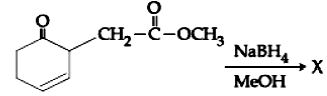
A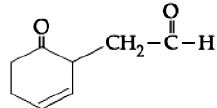
B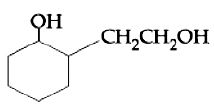
C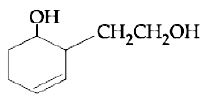
D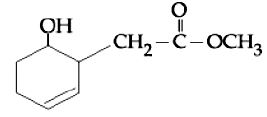
Solution
(D) $NaBH_4$ is a selective reducing agent that reduces ketones and aldehydes to alcohols but does not reduce esters or carboxylic acids.
In the given molecule,there is a ketone group and an ester group.
$NaBH_4$ will selectively reduce the ketone group to a secondary alcohol while leaving the ester group intact.
Therefore,the major product $X$ is an unsaturated cyclic alcohol with an ester side chain.
In the given molecule,there is a ketone group and an ester group.
$NaBH_4$ will selectively reduce the ketone group to a secondary alcohol while leaving the ester group intact.
Therefore,the major product $X$ is an unsaturated cyclic alcohol with an ester side chain.
0 likesView Solution
Vedclass Products
For Students
Vedclass Test Series
Mock tests in real JEE Main style covering Chemistry with performance analysis. 5-day free trial.
Start Free TrialFor Teachers
Exam Paper Generator
Generate Set A/B/C/D Chemistry papers from 7.5L+ questions in 2 minutes. 3 chapters free.
Try FreeFor Institutes
Online Exam Module
Run live JEE Main mock exams with unlimited students, 360° analytics & white-label branding.
See DemoFrequently Asked Questions
How many Chemistry questions are in JEE Main 2019?
There are 521 Chemistry questions from the JEE Main 2019 paper on Vedclass, each with a detailed step-by-step solution in English.
Are JEE Main 2019 Chemistry solutions available in English?
Yes. All solutions on this page are in English. You can also switch to English or Hindi using the language buttons above the questions.
Can I practice JEE Main 2019 Chemistry as a timed test?
Yes. Use the Vedclass Test Series to attempt a full JEE Main mock test covering Chemistry with time limits and instant score analysis.
Can teachers create Chemistry papers from JEE Main previous year questions?
Yes. The Vedclass Exam Paper Generator lets teachers mix JEE Main Chemistry questions and generate Set A/B/C/D papers in minutes.
For Teachers & Institutes
Build a Custom Chemistry Paper
Pick JEE Main 2019 Chemistry questions, set difficulty, and generate Set A/B/C/D in 2 minutes.