
ChemistryQ101–200 of 726 questions
Page 3 of 9 · English
101
ChemistryMediumMCQJEE Main · 2023
Boric acid is solid,whereas $BF_3$ is gas at room temperature because of
A
Strong ionic bond in Boric acid
B
Strong van der Waal's interaction in Boric acid
C
Strong hydrogen bond in Boric acid
D
Strong covalent bond in $BF_3$
Solution
(C) Boric acid $(H_3BO_3)$ molecules are linked together by strong intermolecular hydrogen bonding,which results in a layered solid structure at room temperature.
In contrast,$BF_3$ is a monomeric covalent molecule with weak van der Waals forces of attraction between its molecules,making it a gas at room temperature.
In contrast,$BF_3$ is a monomeric covalent molecule with weak van der Waals forces of attraction between its molecules,making it a gas at room temperature.
0 likesView Solution
102
ChemistryDifficultMCQJEE Main · 2023
$1 \, \text{mole}$ of an ideal gas is allowed to expand reversibly and adiabatically from a temperature of $27^{\circ}C$. The work done is $3 \, \text{kJ} \, \text{mol}^{-1}$. The final temperature of the gas is $...... \text{K}$ (Nearest integer). Given $C_{V} = 20 \, \text{J} \, \text{mol}^{-1} \, \text{K}^{-1}$.
A
$120$
B
$130$
C
$140$
D
$150$
Solution
(D) For an adiabatic process,$q = 0$.
According to the first law of thermodynamics,$\Delta U = q + w$.
Since $q = 0$,$\Delta U = w$.
Given $w = -3000 \, \text{J} \, \text{mol}^{-1}$ (work done by the system).
We know $\Delta U = n C_{V} \Delta T$.
Substituting the values: $1 \times 20 \times (T_{2} - 300) = -3000$.
$T_{2} - 300 = -150$.
$T_{2} = 300 - 150 = 150 \, \text{K}$.
According to the first law of thermodynamics,$\Delta U = q + w$.
Since $q = 0$,$\Delta U = w$.
Given $w = -3000 \, \text{J} \, \text{mol}^{-1}$ (work done by the system).
We know $\Delta U = n C_{V} \Delta T$.
Substituting the values: $1 \times 20 \times (T_{2} - 300) = -3000$.
$T_{2} - 300 = -150$.
$T_{2} = 300 - 150 = 150 \, \text{K}$.
0 likesView Solution
103
ChemistryMediumMCQJEE Main · 2023
Consider the following equation:
$2 SO_{2(g)} + O_{2(g)} \rightleftharpoons 2 SO_{3(g)}, \Delta H = -190 \ kJ$
The number of factors which will increase the yield of $SO_3$ at equilibrium from the following is $.............$.
$A.$ Increasing temperature
$B.$ Increasing pressure
$C.$ Adding more $SO_2$
$D.$ Adding more $O_2$
$E.$ Addition of catalyst
$2 SO_{2(g)} + O_{2(g)} \rightleftharpoons 2 SO_{3(g)}, \Delta H = -190 \ kJ$
The number of factors which will increase the yield of $SO_3$ at equilibrium from the following is $.............$.
$A.$ Increasing temperature
$B.$ Increasing pressure
$C.$ Adding more $SO_2$
$D.$ Adding more $O_2$
$E.$ Addition of catalyst
A
$2$
B
$6$
C
$5$
D
$3$
Solution
(D) The given reaction is $2 SO_{2(g)} + O_{2(g)} \rightleftharpoons 2 SO_{3(g)}$ with $\Delta H = -190 \ kJ$.
$1$. Increasing temperature: Since the reaction is exothermic $(\Delta H < 0)$,increasing the temperature shifts the equilibrium to the left,decreasing the yield of $SO_3$.
$2$. Increasing pressure: The reaction involves a decrease in the number of moles of gas $(3 \text{ moles of reactants} \rightarrow 2 \text{ moles of products})$. According to Le Chatelier's principle,increasing pressure shifts the equilibrium to the right,increasing the yield of $SO_3$.
$3$. Adding more $SO_2$ or $O_2$: Increasing the concentration of reactants shifts the equilibrium to the right,increasing the yield of $SO_3$.
$4$. Addition of catalyst: $A$ catalyst only increases the rate of reaction and does not change the position of equilibrium or the yield of products.
Therefore,the factors that increase the yield are $B, C,$ and $D$. The total number of such factors is $3$.
$1$. Increasing temperature: Since the reaction is exothermic $(\Delta H < 0)$,increasing the temperature shifts the equilibrium to the left,decreasing the yield of $SO_3$.
$2$. Increasing pressure: The reaction involves a decrease in the number of moles of gas $(3 \text{ moles of reactants} \rightarrow 2 \text{ moles of products})$. According to Le Chatelier's principle,increasing pressure shifts the equilibrium to the right,increasing the yield of $SO_3$.
$3$. Adding more $SO_2$ or $O_2$: Increasing the concentration of reactants shifts the equilibrium to the right,increasing the yield of $SO_3$.
$4$. Addition of catalyst: $A$ catalyst only increases the rate of reaction and does not change the position of equilibrium or the yield of products.
Therefore,the factors that increase the yield are $B, C,$ and $D$. The total number of such factors is $3$.
0 likesView Solution
104
ChemistryDifficultMCQJEE Main · 2023
The strength of $50$ volume solution of hydrogen peroxide is $...... \ g/L$ (Nearest integer). Given: Molar mass of $H_2O_2$ is $34 \ g \ mol^{-1}$. Molar volume of gas at $STP = 22.7 \ L$.
A
$149$
B
$148$
C
$146$
D
$150$
Solution
(D) The decomposition of $H_2O_2$ is given by: $2H_2O_2 \rightarrow 2H_2O + O_2$.
At $STP$,$2 \ mol$ of $H_2O_2$ $(2 \times 34 \ g = 68 \ g)$ produces $22.7 \ L$ of $O_2$.
Strength of $V$ volume $H_2O_2$ solution is given by the formula: $\text{Strength} (g/L) = \frac{V \times 34}{11.35}$.
Given $V = 50$,so $\text{Strength} = \frac{50 \times 34}{11.35}$.
$\text{Strength} = \frac{1700}{11.35} \approx 149.77 \ g/L$.
Rounding to the nearest integer,we get $150 \ g/L$.
At $STP$,$2 \ mol$ of $H_2O_2$ $(2 \times 34 \ g = 68 \ g)$ produces $22.7 \ L$ of $O_2$.
Strength of $V$ volume $H_2O_2$ solution is given by the formula: $\text{Strength} (g/L) = \frac{V \times 34}{11.35}$.
Given $V = 50$,so $\text{Strength} = \frac{50 \times 34}{11.35}$.
$\text{Strength} = \frac{1700}{11.35} \approx 149.77 \ g/L$.
Rounding to the nearest integer,we get $150 \ g/L$.
0 likesView Solution
105
ChemistryDifficultMCQJEE Main · 2023
Identify $X$,$Y$,and $Z$ in the following reaction. (Equation not balanced)
$ClO + NO_2$ $\rightarrow \underline{X}$ $\xrightarrow{H_2O} \underline{Y} + \underline{Z}$
$ClO + NO_2$ $\rightarrow \underline{X}$ $\xrightarrow{H_2O} \underline{Y} + \underline{Z}$
A
$X = ClONO_2, Y = HOCl, Z = NO_2$
B
$X = ClNO_2, Y = HCl, Z = HNO_3$
C
$X = ClONO_2, Y = HOCl, Z = HNO_3$
D
$X = ClNO_3, Y = Cl_2, Z = NO_2$
Solution
(C) The reaction of chlorine monoxide $(ClO)$ with nitrogen dioxide $(NO_2)$ produces chlorine nitrate $(ClONO_2)$.
$ClO + NO_2 \rightarrow ClONO_2 \, (X)$
Chlorine nitrate $(ClONO_2)$ reacts with water $(H_2O)$ to form hypochlorous acid $(HOCl)$ and nitric acid $(HNO_3)$.
$ClONO_2 + H_2O \rightarrow HOCl \, (Y) + HNO_3 \, (Z)$
Therefore,the correct identification is $X = ClONO_2, Y = HOCl, Z = HNO_3$.
$ClO + NO_2 \rightarrow ClONO_2 \, (X)$
Chlorine nitrate $(ClONO_2)$ reacts with water $(H_2O)$ to form hypochlorous acid $(HOCl)$ and nitric acid $(HNO_3)$.
$ClONO_2 + H_2O \rightarrow HOCl \, (Y) + HNO_3 \, (Z)$
Therefore,the correct identification is $X = ClONO_2, Y = HOCl, Z = HNO_3$.
0 likesView Solution
106
ChemistryMediumMCQJEE Main · 2023
Which transition in the hydrogen spectrum would have the same wavelength as the Balmer type transition from $n = 4$ to $n = 2$ of $He^+$ spectrum?
A
$n = 2$ to $n = 1$
B
$n = 1$ to $n = 3$
C
$n = 1$ to $n = 2$
D
$n = 3$ to $n = 4$
Solution
(A) The Rydberg formula for the wavelength $\lambda$ is given by $\frac{1}{\lambda} = R Z^2 \left( \frac{1}{n_1^2} - \frac{1}{n_2^2} \right)$.
For $He^+$ $(Z = 2)$,the transition from $n_2 = 4$ to $n_1 = 2$ is:
$\frac{1}{\lambda} = R (2)^2 \left( \frac{1}{2^2} - \frac{1}{4^2} \right) = 4R \left( \frac{1}{4} - \frac{1}{16} \right) = 4R \left( \frac{3}{16} \right) = R \left( \frac{3}{4} \right)$.
For Hydrogen $(Z = 1)$,we want the transition from $n_2$ to $n_1$ such that:
$\frac{1}{\lambda} = R (1)^2 \left( \frac{1}{n_1^2} - \frac{1}{n_2^2} \right) = R \left( \frac{3}{4} \right)$.
Comparing the two,we need $\frac{1}{n_1^2} - \frac{1}{n_2^2} = \frac{3}{4} = 1 - \frac{1}{4} = \frac{1}{1^2} - \frac{1}{2^2}$.
Thus,the transition is from $n = 2$ to $n = 1$.
For $He^+$ $(Z = 2)$,the transition from $n_2 = 4$ to $n_1 = 2$ is:
$\frac{1}{\lambda} = R (2)^2 \left( \frac{1}{2^2} - \frac{1}{4^2} \right) = 4R \left( \frac{1}{4} - \frac{1}{16} \right) = 4R \left( \frac{3}{16} \right) = R \left( \frac{3}{4} \right)$.
For Hydrogen $(Z = 1)$,we want the transition from $n_2$ to $n_1$ such that:
$\frac{1}{\lambda} = R (1)^2 \left( \frac{1}{n_1^2} - \frac{1}{n_2^2} \right) = R \left( \frac{3}{4} \right)$.
Comparing the two,we need $\frac{1}{n_1^2} - \frac{1}{n_2^2} = \frac{3}{4} = 1 - \frac{1}{4} = \frac{1}{1^2} - \frac{1}{2^2}$.
Thus,the transition is from $n = 2$ to $n = 1$.
0 likesView Solution
107
ChemistryDifficultMCQJEE Main · 2023
Match items of Column-$I$ and Column-$II$.
Correct match is:
| Column-$I$ (Mixture of compounds) | Column-$II$ (Separation Technique) |
|---|---|
| $A$. $H_2O / CH_2Cl_2$ | $I$. Crystallization |
| $B$. $\alpha$-tetralone / $p$-nitrophenol | $II$. Differential solvent extraction |
| $C$. Kerosene / Naphthalene | $III$. Column chromatography |
| $D$. $C_6H_{12}O_6 / NaCl$ | $IV$. Fractional Distillation |
Correct match is:
A
$A-III, B-IV, C-II, D-I$
B
$A-I, B-III, C-II, D-IV$
C
$A-II, B-III, C-IV, D-I$
D
$A-II, B-IV, C-I, D-III$
Solution
(C) . $H_2O / CH_2Cl_2 \rightarrow II$. $CH_2Cl_2$ and $H_2O$ are immiscible liquids with different densities,so they can be separated by differential solvent extraction.
$B$. $\alpha$-tetralone / $p$-nitrophenol $\rightarrow III$. Due to the presence of an $-OH$ group in $p$-nitrophenol,it exhibits hydrogen bonding and has different polarity compared to $\alpha$-tetralone,allowing separation by column chromatography.
$C$. Kerosene / Naphthalene $\rightarrow IV$. Due to the difference in boiling points,they can be separated by fractional distillation.
$D$. $C_6H_{12}O_6 / NaCl \rightarrow I$. $NaCl$ (ionic compound) can be separated from glucose by crystallization based on solubility differences.
$B$. $\alpha$-tetralone / $p$-nitrophenol $\rightarrow III$. Due to the presence of an $-OH$ group in $p$-nitrophenol,it exhibits hydrogen bonding and has different polarity compared to $\alpha$-tetralone,allowing separation by column chromatography.
$C$. Kerosene / Naphthalene $\rightarrow IV$. Due to the difference in boiling points,they can be separated by fractional distillation.
$D$. $C_6H_{12}O_6 / NaCl \rightarrow I$. $NaCl$ (ionic compound) can be separated from glucose by crystallization based on solubility differences.
0 likesView Solution
108
ChemistryEasyMCQJEE Main · 2023
The correct increasing order of the ionic radii is:
A
$Cl^{-} < Ca^{2+} < K^{+} < S^{2-}$
B
$K^{+} < S^{2-} < Ca^{2+} < Cl^{-}$
C
$S^{2-} < Cl^{-} < Ca^{2+} < K^{+}$
D
$Ca^{2+} < K^{+} < Cl^{-} < S^{2-}$
Solution
(D) For isoelectronic species (species with the same number of electrons),the ionic radius decreases as the nuclear charge $(Z)$ increases.
All the given ions,$S^{2-}$,$Cl^{-}$,$K^{+}$,and $Ca^{2+}$,have $18$ electrons.
Their respective nuclear charges $(Z)$ are $16, 17, 19,$ and $20$.
As the nuclear charge increases,the attraction between the nucleus and the electrons increases,causing the ionic radius to decrease.
Therefore,the correct increasing order of ionic radii is: $Ca^{2+} < K^{+} < Cl^{-} < S^{2-}$.
All the given ions,$S^{2-}$,$Cl^{-}$,$K^{+}$,and $Ca^{2+}$,have $18$ electrons.
Their respective nuclear charges $(Z)$ are $16, 17, 19,$ and $20$.
As the nuclear charge increases,the attraction between the nucleus and the electrons increases,causing the ionic radius to decrease.
Therefore,the correct increasing order of ionic radii is: $Ca^{2+} < K^{+} < Cl^{-} < S^{2-}$.
0 likesView Solution
109
ChemistryMediumMCQJEE Main · 2023
$H_2O_2$ acts as a reducing agent in
A
$2 NaOCl + H_2O_2 \rightarrow 2 NaCl + H_2O + O_2$
B
$2 Fe^{2+} + 2 H^{+} + H_2O_2 \rightarrow 2 Fe^{3+} + 2 H_2O$
C
$Mn^{2+} + 2 H_2O_2 \rightarrow MnO_2 + 2 H_2O$
D
$Na_2S + 4 H_2O_2 \rightarrow Na_2SO_4 + 4 H_2O$
Solution
(A) reducing agent is a substance that undergoes oxidation (increase in oxidation state) and reduces another substance.
In the reaction $2 NaOCl + H_2O_2 \rightarrow 2 NaCl + H_2O + O_2$,the oxidation state of oxygen in $H_2O_2$ increases from $-1$ to $0$ (in $O_2$).
Since $H_2O_2$ is oxidized,it acts as a reducing agent.
In the other reactions (options $B$,$C$,and $D$),$H_2O_2$ acts as an oxidizing agent because the oxidation state of oxygen decreases from $-1$ to $-2$.
In the reaction $2 NaOCl + H_2O_2 \rightarrow 2 NaCl + H_2O + O_2$,the oxidation state of oxygen in $H_2O_2$ increases from $-1$ to $0$ (in $O_2$).
Since $H_2O_2$ is oxidized,it acts as a reducing agent.
In the other reactions (options $B$,$C$,and $D$),$H_2O_2$ acts as an oxidizing agent because the oxidation state of oxygen decreases from $-1$ to $-2$.
0 likesView Solution
110
ChemistryMediumMCQJEE Main · 2023
Match List-$I$ with List-$II$:
Choose the correct answer from the options given below:
| List-$I$ | List-$II$ |
| $A. XeF_4$ | $I. See-saw$ |
| $B. SF_4$ | $II. Square planar$ |
| $C. NH_4^{+}$ | $III. Bent T-shaped$ |
| $D. BrF_3$ | $IV. Tetrahedral$ |
Choose the correct answer from the options given below:
A
$A-IV, B-III, C-II, D-I$
B
$A-II, B-I, C-III, D-IV$
C
$A-IV, B-I, C-II, D-III$
D
$A-II, B-I, C-IV, D-III$
Solution
(D) To determine the geometry of the molecules,we use the $VSEPR$ theory:
$1$. $XeF_4$: The central atom $Xe$ has $8$ valence electrons. It forms $4$ bonds with $F$ atoms and has $2$ lone pairs. The steric number is $6$ ($sp^3d^2$ hybridization),resulting in a square planar geometry $(A-II)$.
$2$. $SF_4$: The central atom $S$ has $6$ valence electrons. It forms $4$ bonds with $F$ atoms and has $1$ lone pair. The steric number is $5$ ($sp^3d$ hybridization),resulting in a see-saw geometry $(B-I)$.
$3$. $NH_4^{+}$: The central atom $N$ has $5$ valence electrons. It forms $4$ bonds with $H$ atoms and has no lone pairs. The steric number is $4$ ($sp^3$ hybridization),resulting in a tetrahedral geometry $(C-IV)$.
$4$. $BrF_3$: The central atom $Br$ has $7$ valence electrons. It forms $3$ bonds with $F$ atoms and has $2$ lone pairs. The steric number is $5$ ($sp^3d$ hybridization),resulting in a bent $T$-shaped geometry $(D-III)$.
Thus,the correct matching is $A-II, B-I, C-IV, D-III$.
$1$. $XeF_4$: The central atom $Xe$ has $8$ valence electrons. It forms $4$ bonds with $F$ atoms and has $2$ lone pairs. The steric number is $6$ ($sp^3d^2$ hybridization),resulting in a square planar geometry $(A-II)$.
$2$. $SF_4$: The central atom $S$ has $6$ valence electrons. It forms $4$ bonds with $F$ atoms and has $1$ lone pair. The steric number is $5$ ($sp^3d$ hybridization),resulting in a see-saw geometry $(B-I)$.
$3$. $NH_4^{+}$: The central atom $N$ has $5$ valence electrons. It forms $4$ bonds with $H$ atoms and has no lone pairs. The steric number is $4$ ($sp^3$ hybridization),resulting in a tetrahedral geometry $(C-IV)$.
$4$. $BrF_3$: The central atom $Br$ has $7$ valence electrons. It forms $3$ bonds with $F$ atoms and has $2$ lone pairs. The steric number is $5$ ($sp^3d$ hybridization),resulting in a bent $T$-shaped geometry $(D-III)$.
Thus,the correct matching is $A-II, B-I, C-IV, D-III$.
0 likesView Solution
111
ChemistryMediumMCQJEE Main · 2023
Choose the correct set of reagents for the following conversion:
$trans-(Ph-CH=CH-CH_3) \rightarrow cis-(Ph-CH=CH-CH_3)$
$trans-(Ph-CH=CH-CH_3) \rightarrow cis-(Ph-CH=CH-CH_3)$
A
$Br_2, \text{alc. } KOH, NaNH_2, Na(Liq. NH_3)$
B
$Br_2, \text{alc. } KOH, NaNH_2, H_2, \text{Lindlar Catalyst}$
C
$Br_2, \text{aq. } KOH, NaNH_2, H_2, \text{Lindlar Catalyst}$
D
$Br_2, \text{aq. } KOH, NaNH_2, Na(Liq. NH_3)$
Solution
(B) $1$. First,the $trans$-alkene reacts with $Br_2$ to form a vicinal dibromide: $Ph-CH(Br)-CH(Br)-CH_3$.
$2$. Next,dehydrohalogenation occurs using $alc. KOH$ followed by $NaNH_2$ to remove two moles of $HBr$,resulting in the formation of an alkyne: $Ph-C \equiv C-CH_3$.
$3$. Finally,the partial hydrogenation of the alkyne to a $cis$-alkene is achieved using $H_2$ with $Lindlar \text{ } Catalyst$ (a poisoned $Pd$ catalyst).
$4$. Therefore,the correct sequence is $Br_2, \text{alc. } KOH, NaNH_2, H_2, \text{Lindlar Catalyst}$.
$2$. Next,dehydrohalogenation occurs using $alc. KOH$ followed by $NaNH_2$ to remove two moles of $HBr$,resulting in the formation of an alkyne: $Ph-C \equiv C-CH_3$.
$3$. Finally,the partial hydrogenation of the alkyne to a $cis$-alkene is achieved using $H_2$ with $Lindlar \text{ } Catalyst$ (a poisoned $Pd$ catalyst).
$4$. Therefore,the correct sequence is $Br_2, \text{alc. } KOH, NaNH_2, H_2, \text{Lindlar Catalyst}$.
0 likesView Solution
112
ChemistryDifficultMCQJEE Main · 2023
The enthalpy change for the conversion of $\frac{1}{2} Cl_{2(g)}$ to $Cl^{-}_{(aq)}$ is $......$ $kJ \, mol^{-1}$ (Nearest integer).
Given:
$\Delta_{dis}H^{\circ}_{Cl_{2(g)}} = 240 \, kJ \, mol^{-1}$
$\Delta_{eg}H^{\circ}_{Cl_{(g)}} = -350 \, kJ \, mol^{-1}$
$\Delta_{hyd}H^{\circ}_{Cl^{-(g)}} = -380 \, kJ \, mol^{-1}$
Given:
$\Delta_{dis}H^{\circ}_{Cl_{2(g)}} = 240 \, kJ \, mol^{-1}$
$\Delta_{eg}H^{\circ}_{Cl_{(g)}} = -350 \, kJ \, mol^{-1}$
$\Delta_{hyd}H^{\circ}_{Cl^{-(g)}} = -380 \, kJ \, mol^{-1}$
A
$600$
B
$620$
C
$630$
D
$610$
Solution
(D) The process involves three steps:
$1. \text{Dissociation of } \frac{1}{2} Cl_{2(g)}$ $\rightarrow Cl_{(g)}: \Delta H_1 = \frac{1}{2} \times 240 = 120 \, kJ \, mol^{-1}$
$2. \text{Electron gain of } Cl_{(g)} \rightarrow Cl^{-}_{(g)}: \Delta H_2 = -350 \, kJ \, mol^{-1}$
$3. \text{Hydration of } Cl^{-}_{(g)} \rightarrow Cl^{-}_{(aq)}: \Delta H_3 = -380 \, kJ \, mol^{-1}$
Total enthalpy change $\Delta H^{\circ} = \Delta H_1 + \Delta H_2 + \Delta H_3$
$\Delta H^{\circ} = 120 + (-350) + (-380) = -610 \, kJ \, mol^{-1}$
The magnitude is $610$.
$1. \text{Dissociation of } \frac{1}{2} Cl_{2(g)}$ $\rightarrow Cl_{(g)}: \Delta H_1 = \frac{1}{2} \times 240 = 120 \, kJ \, mol^{-1}$
$2. \text{Electron gain of } Cl_{(g)} \rightarrow Cl^{-}_{(g)}: \Delta H_2 = -350 \, kJ \, mol^{-1}$
$3. \text{Hydration of } Cl^{-}_{(g)} \rightarrow Cl^{-}_{(aq)}: \Delta H_3 = -380 \, kJ \, mol^{-1}$
Total enthalpy change $\Delta H^{\circ} = \Delta H_1 + \Delta H_2 + \Delta H_3$
$\Delta H^{\circ} = 120 + (-350) + (-380) = -610 \, kJ \, mol^{-1}$
The magnitude is $610$.
0 likesView Solution
113
ChemistryMediumMCQJEE Main · 2023
On complete combustion,$0.492 \ g$ of an organic compound gave $0.792 \ g$ of $CO_2$. The $\%$ of carbon in the organic compound is $..................$ (Nearest integer)
A
$42$
B
$43$
C
$48$
D
$44$
Solution
(D) The mass of $C$ in $CO_2$ is calculated using the molar mass ratio:
Mass of $C = (12 / 44) \times 0.792 \ g = 0.216 \ g$.
The percentage of carbon in the organic compound is given by:
$\% \text{ of } C = (\text{Mass of } C / \text{Mass of compound}) \times 100$.
$\% \text{ of } C = (0.216 / 0.492) \times 100 = 43.90 \%$.
Rounding to the nearest integer,we get $44 \%$.
Thus,the correct option is $D$.
Mass of $C = (12 / 44) \times 0.792 \ g = 0.216 \ g$.
The percentage of carbon in the organic compound is given by:
$\% \text{ of } C = (\text{Mass of } C / \text{Mass of compound}) \times 100$.
$\% \text{ of } C = (0.216 / 0.492) \times 100 = 43.90 \%$.
Rounding to the nearest integer,we get $44 \%$.
Thus,the correct option is $D$.
0 likesView Solution
114
ChemistryDifficultMCQJEE Main · 2023
Zinc reacts with hydrochloric acid to give hydrogen and zinc chloride. The volume of hydrogen gas produced at $STP$ from the reaction of $11.5 \ g$ of zinc with excess $HCl$ is $.......... \ L$ (Nearest integer) (Given: Molar mass of $Zn$ is $65.4 \ g \ mol^{-1}$ and Molar volume of $H_2$ at $STP = 22.7 \ L$)
A
$2$
B
$6$
C
$8$
D
$4$
Solution
(D) The balanced chemical equation is: $Zn(s) + 2HCl(aq) \rightarrow ZnCl_2(aq) + H_2(g) \uparrow$
Moles of $Zn$ used $= \frac{\text{mass}}{\text{molar mass}} = \frac{11.5 \ g}{65.4 \ g \ mol^{-1}} \approx 0.1758 \ mol$.
According to the stoichiometry of the reaction,$1 \ mol$ of $Zn$ produces $1 \ mol$ of $H_2$.
Therefore,moles of $H_2$ produced $= 0.1758 \ mol$.
Volume of $H_2$ at $STP = \text{moles} \times \text{molar volume at } STP = 0.1758 \ mol \times 22.7 \ L \ mol^{-1} \approx 3.99 \ L$.
Rounding to the nearest integer,the volume is $4 \ L$.
Moles of $Zn$ used $= \frac{\text{mass}}{\text{molar mass}} = \frac{11.5 \ g}{65.4 \ g \ mol^{-1}} \approx 0.1758 \ mol$.
According to the stoichiometry of the reaction,$1 \ mol$ of $Zn$ produces $1 \ mol$ of $H_2$.
Therefore,moles of $H_2$ produced $= 0.1758 \ mol$.
Volume of $H_2$ at $STP = \text{moles} \times \text{molar volume at } STP = 0.1758 \ mol \times 22.7 \ L \ mol^{-1} \approx 3.99 \ L$.
Rounding to the nearest integer,the volume is $4 \ L$.
0 likesView Solution
115
ChemistryMediumMCQJEE Main · 2023
For the reaction: $SO_{2(g)} + \frac{1}{2} O_{2(g)} \rightleftharpoons SO_{3(g)}$,$K_P = 2 \times 10^{12}$ at $27^{\circ} C$ and $1 \ atm$ pressure. The $K_C$ for the same reaction is $......... \times 10^{13}$. (Nearest integer)
(Given $R = 0.082 \ L \ atm \ K^{-1} \ mol^{-1}$)
(Given $R = 0.082 \ L \ atm \ K^{-1} \ mol^{-1}$)
A
$2$
B
$3$
C
$4$
D
$1$
Solution
(D) The relationship between $K_P$ and $K_C$ is given by the equation: $K_P = K_C(RT)^{\Delta n_g}$.
For the reaction $SO_{2(g)} + \frac{1}{2} O_{2(g)} \rightleftharpoons SO_{3(g)}$,the change in the number of moles of gaseous species is $\Delta n_g = 1 - (1 + 0.5) = -0.5$.
Given $T = 27^{\circ} C = 300 \ K$,$R = 0.082 \ L \ atm \ K^{-1} \ mol^{-1}$,and $K_P = 2 \times 10^{12}$.
Substituting the values: $2 \times 10^{12} = K_C \times (0.082 \times 300)^{-0.5}$.
$2 \times 10^{12} = K_C \times (24.6)^{-0.5} = K_C \times \frac{1}{\sqrt{24.6}}$.
$K_C = 2 \times 10^{12} \times \sqrt{24.6} \approx 2 \times 10^{12} \times 4.96 = 9.92 \times 10^{12}$.
Expressing in terms of $10^{13}$: $K_C = 0.992 \times 10^{13}$.
Rounding to the nearest integer,we get $1 \times 10^{13}$.
For the reaction $SO_{2(g)} + \frac{1}{2} O_{2(g)} \rightleftharpoons SO_{3(g)}$,the change in the number of moles of gaseous species is $\Delta n_g = 1 - (1 + 0.5) = -0.5$.
Given $T = 27^{\circ} C = 300 \ K$,$R = 0.082 \ L \ atm \ K^{-1} \ mol^{-1}$,and $K_P = 2 \times 10^{12}$.
Substituting the values: $2 \times 10^{12} = K_C \times (0.082 \times 300)^{-0.5}$.
$2 \times 10^{12} = K_C \times (24.6)^{-0.5} = K_C \times \frac{1}{\sqrt{24.6}}$.
$K_C = 2 \times 10^{12} \times \sqrt{24.6} \approx 2 \times 10^{12} \times 4.96 = 9.92 \times 10^{12}$.
Expressing in terms of $10^{13}$: $K_C = 0.992 \times 10^{13}$.
Rounding to the nearest integer,we get $1 \times 10^{13}$.
0 likesView Solution
116
ChemistryMediumMCQJEE Main · 2023
The oxidation state of phosphorus in hypophosphoric acid is $+......$
A
$2$
B
$8$
C
$6$
D
$4$
Solution
(D) The chemical formula for hypophosphoric acid is $H_4P_2O_6$.
To calculate the oxidation state of phosphorus $(P)$,let its oxidation state be $x$.
The oxidation state of hydrogen $(H)$ is $+1$ and oxygen $(O)$ is $-2$.
Applying the rule: $4(+1) + 2(x) + 6(-2) = 0$
$4 + 2x - 12 = 0$
$2x - 8 = 0$
$2x = 8$
$x = +4$
Therefore,the oxidation state of phosphorus in hypophosphoric acid is $+4$.
To calculate the oxidation state of phosphorus $(P)$,let its oxidation state be $x$.
The oxidation state of hydrogen $(H)$ is $+1$ and oxygen $(O)$ is $-2$.
Applying the rule: $4(+1) + 2(x) + 6(-2) = 0$
$4 + 2x - 12 = 0$
$2x - 8 = 0$
$2x = 8$
$x = +4$
Therefore,the oxidation state of phosphorus in hypophosphoric acid is $+4$.
0 likesView Solution
117
ChemistryDifficultMCQJEE Main · 2023
The total pressure of a mixture of non-reacting gases $X$ $(0.6 \ g)$ and $Y$ $(0.45 \ g)$ in a vessel is $740 \ mm$ of $Hg$. The partial pressure of the gas $X$ is $........ \ mm$ of $Hg$. (Nearest Integer) (Given: molar mass $X = 20 \ g \ mol^{-1}$ and $Y = 45 \ g \ mol^{-1}$)
A
$550$
B
$552$
C
$553$
D
$555$
Solution
(D) Step $1$: Calculate the number of moles of each gas.
$n_X = \frac{0.6 \ g}{20 \ g \ mol^{-1}} = 0.03 \ mol$
$n_Y = \frac{0.45 \ g}{45 \ g \ mol^{-1}} = 0.01 \ mol$
Step $2$: Calculate the mole fraction of gas $X$ $(\chi_X)$.
$\chi_X = \frac{n_X}{n_X + n_Y} = \frac{0.03}{0.03 + 0.01} = \frac{0.03}{0.04} = 0.75$
Step $3$: Calculate the partial pressure of gas $X$ $(P_X)$.
$P_X = \chi_X \times P_{total} = 0.75 \times 740 \ mm \ Hg = 555 \ mm \ Hg$
$n_X = \frac{0.6 \ g}{20 \ g \ mol^{-1}} = 0.03 \ mol$
$n_Y = \frac{0.45 \ g}{45 \ g \ mol^{-1}} = 0.01 \ mol$
Step $2$: Calculate the mole fraction of gas $X$ $(\chi_X)$.
$\chi_X = \frac{n_X}{n_X + n_Y} = \frac{0.03}{0.03 + 0.01} = \frac{0.03}{0.04} = 0.75$
Step $3$: Calculate the partial pressure of gas $X$ $(P_X)$.
$P_X = \chi_X \times P_{total} = 0.75 \times 740 \ mm \ Hg = 555 \ mm \ Hg$
0 likesView Solution
118
ChemistryDifficultMCQJEE Main · 2023
Which of the following statements is incorrect regarding the use of indicators in acid-base titration?
A
Methyl orange may be used for a weak acid vs. weak base titration.
B
Methyl orange is a suitable indicator for a strong acid vs. weak base titration.
C
Phenolphthalein is a suitable indicator for a weak acid vs. strong base titration.
D
Phenolphthalein may be used for a strong acid vs. strong base titration.
Solution
(A)
Indicators are chosen based on the $pH$ range of the equivalence point of the titration.
$1$. Methyl orange is suitable for titrations where the equivalence point falls in the acidic range $(pH \approx 3-5)$,such as strong acid vs. weak base.
$2$. Phenolphthalein is suitable for titrations where the equivalence point falls in the basic range $(pH \approx 8-10)$,such as weak acid vs. strong base.
$3$. Both indicators can be used for strong acid vs. strong base titrations because the $pH$ change at the equivalence point is very sharp $(pH \approx 4-10)$.
$4$. For weak acid vs. weak base titrations,there is no sharp change in $pH$ at the equivalence point,so no simple indicator is suitable. Therefore,the statement that Methyl orange may be used for a weak acid vs. weak base titration is incorrect.
| Indicator | $pH$ range |
| Methyl orange | $3.2-4.5$ |
| Phenolphthalein | $8.3-10.5$ |
Indicators are chosen based on the $pH$ range of the equivalence point of the titration.
$1$. Methyl orange is suitable for titrations where the equivalence point falls in the acidic range $(pH \approx 3-5)$,such as strong acid vs. weak base.
$2$. Phenolphthalein is suitable for titrations where the equivalence point falls in the basic range $(pH \approx 8-10)$,such as weak acid vs. strong base.
$3$. Both indicators can be used for strong acid vs. strong base titrations because the $pH$ change at the equivalence point is very sharp $(pH \approx 4-10)$.
$4$. For weak acid vs. weak base titrations,there is no sharp change in $pH$ at the equivalence point,so no simple indicator is suitable. Therefore,the statement that Methyl orange may be used for a weak acid vs. weak base titration is incorrect.
0 likesView Solution
119
ChemistryDifficultMCQJEE Main · 2023
$A$ hydrocarbon '$X$' with formula $C_6H_8$ uses two moles of $H_2$ on catalytic hydrogenation of its one mole. On ozonolysis,'$X$' yields two moles of methane dicarbaldehyde (malonaldehyde). The hydrocarbon '$X$' is :
A
hexa$-1, 3, 5-$triene
B
$1-$methylcyclopenta$-1, 4-$diene
C
cyclohexa$-1, 3-$diene
D
cyclohexa$-1, 4-$diene
Solution
(D) $1$. The hydrocarbon '$X$' has the molecular formula $C_6H_8$.
$2$. It consumes two moles of $H_2$ upon catalytic hydrogenation,indicating the presence of two double bonds.
$3$. Ozonolysis of '$X$' yields two moles of methane dicarbaldehyde $(OHC-CH_2-CHO)$.
$4$. Methane dicarbaldehyde is also known as malonaldehyde.
$5$. Cyclohexa$-1, 4-$diene undergoes ozonolysis to break the two double bonds,resulting in two molecules of $OHC-CH_2-CHO$.
$6$. Therefore,the hydrocarbon '$X$' is cyclohexa$-1, 4-$diene.
$2$. It consumes two moles of $H_2$ upon catalytic hydrogenation,indicating the presence of two double bonds.
$3$. Ozonolysis of '$X$' yields two moles of methane dicarbaldehyde $(OHC-CH_2-CHO)$.
$4$. Methane dicarbaldehyde is also known as malonaldehyde.
$5$. Cyclohexa$-1, 4-$diene undergoes ozonolysis to break the two double bonds,resulting in two molecules of $OHC-CH_2-CHO$.
$6$. Therefore,the hydrocarbon '$X$' is cyclohexa$-1, 4-$diene.
0 likesView Solution
120
ChemistryMediumMCQJEE Main · 2023
Arrange the following orbitals in decreasing order of energy:
$A$. $n = 3, l = 0, m = 0$
$B$. $n = 4, l = 0, m = 0$
$C$. $n = 3, l = 1, m = 0$
$D$. $n = 3, l = 2, m = 1$
The correct option for the order is:
$A$. $n = 3, l = 0, m = 0$
$B$. $n = 4, l = 0, m = 0$
$C$. $n = 3, l = 1, m = 0$
$D$. $n = 3, l = 2, m = 1$
The correct option for the order is:
A
$B > D > C > A$
B
$D > B > C > A$
C
$A > C > B > D$
D
$D > B > A > C$
Solution
(B) The energy of an orbital is determined by the $(n+l)$ rule.
$A$. $n = 3, l = 0, m = 0 \implies (n+l) = 3 + 0 = 3$ ($3s$ orbital)
$B$. $n = 4, l = 0, m = 0 \implies (n+l) = 4 + 0 = 4$ ($4s$ orbital)
$C$. $n = 3, l = 1, m = 0 \implies (n+l) = 3 + 1 = 4$ ($3p$ orbital)
$D$. $n = 3, l = 2, m = 1 \implies (n+l) = 3 + 2 = 5$ ($3d$ orbital)
Comparing $(n+l)$ values: $D (5) > B (4) = C (4) > A (3)$.
For $B$ and $C$,both have $(n+l) = 4$. According to the rule,the orbital with the higher $n$ value has higher energy. Thus,$B (n=4) > C (n=3)$.
The decreasing order of energy is $D > B > C > A$.
$A$. $n = 3, l = 0, m = 0 \implies (n+l) = 3 + 0 = 3$ ($3s$ orbital)
$B$. $n = 4, l = 0, m = 0 \implies (n+l) = 4 + 0 = 4$ ($4s$ orbital)
$C$. $n = 3, l = 1, m = 0 \implies (n+l) = 3 + 1 = 4$ ($3p$ orbital)
$D$. $n = 3, l = 2, m = 1 \implies (n+l) = 3 + 2 = 5$ ($3d$ orbital)
Comparing $(n+l)$ values: $D (5) > B (4) = C (4) > A (3)$.
For $B$ and $C$,both have $(n+l) = 4$. According to the rule,the orbital with the higher $n$ value has higher energy. Thus,$B (n=4) > C (n=3)$.
The decreasing order of energy is $D > B > C > A$.
0 likesView Solution
121
ChemistryMediumMCQJEE Main · 2023
The Lewis acid character of boron trihalides follows the order:
A
$BBr_3 > BI_3 > BCl_3 > BF_3$
B
$BCl_3 > BF_3 > BBr_3 > BI_3$
C
$BF_3 > BCl_3 > BBr_3 > BI_3$
D
$BI_3 > BBr_3 > BCl_3 > BF_3$
Solution
(D) The Lewis acidity of boron trihalides is determined by the extent of $p\pi-p\pi$ back bonding between the halogen atom and the boron atom.
In $BF_3$,the $2p-2p$ overlap is most effective,resulting in the strongest back bonding,which reduces the electron deficiency of the boron atom.
As we move from $BF_3$ to $BI_3$,the size of the halogen atom increases,making the $p\pi-p\pi$ overlap less effective $(2p-2p > 2p-3p > 2p-4p > 2p-5p)$.
Consequently,the extent of back bonding decreases,and the Lewis acidity increases in the order: $BF_3 < BCl_3 < BBr_3 < BI_3$.
In $BF_3$,the $2p-2p$ overlap is most effective,resulting in the strongest back bonding,which reduces the electron deficiency of the boron atom.
As we move from $BF_3$ to $BI_3$,the size of the halogen atom increases,making the $p\pi-p\pi$ overlap less effective $(2p-2p > 2p-3p > 2p-4p > 2p-5p)$.
Consequently,the extent of back bonding decreases,and the Lewis acidity increases in the order: $BF_3 < BCl_3 < BBr_3 < BI_3$.
0 likesView Solution
122
ChemistryMediumMCQJEE Main · 2023
The element playing a significant role in neuromuscular function and interneuronal transmission is:
A
$Be$
B
$Ca$
C
$Li$
D
$Mg$
Solution
(B) $Ca^{2+}$ ions play a significant role in neuromuscular function,interneuronal transmission,and cell membrane integrity.
They are essential for the release of neurotransmitters at the synaptic junction.
They are essential for the release of neurotransmitters at the synaptic junction.
0 likesView Solution
123
ChemistryDifficultMCQJEE Main · 2023
Given below are two statements :
Statement $I$ : $H_2O_2$ is used in the synthesis of Cephalosporin.
Statement $II$ : $H_2O_2$ is used for the restoration of aerobic conditions to sewage wastes.
In the light of the above statements,choose the most appropriate answer from the options given below :
Statement $I$ : $H_2O_2$ is used in the synthesis of Cephalosporin.
Statement $II$ : $H_2O_2$ is used for the restoration of aerobic conditions to sewage wastes.
In the light of the above statements,choose the most appropriate answer from the options given below :
A
Both Statement $I$ and Statement $II$ are correct.
B
Statement $I$ is incorrect but Statement $II$ is correct.
C
Statement $I$ is correct but Statement $II$ is incorrect.
D
Both Statement $I$ and Statement $II$ are incorrect.
Solution
(A) $H_2O_2$ is widely used in industries for various purposes.
It is used in the synthesis of hydroquinone,tartaric acid,and certain food products and pharmaceuticals,including $Cephalosporin$.
Additionally,it is used for the restoration of aerobic conditions to sewage wastes.
Therefore,both Statement $I$ and Statement $II$ are correct.
It is used in the synthesis of hydroquinone,tartaric acid,and certain food products and pharmaceuticals,including $Cephalosporin$.
Additionally,it is used for the restoration of aerobic conditions to sewage wastes.
Therefore,both Statement $I$ and Statement $II$ are correct.
0 likesView Solution
124
ChemistryMediumMCQJEE Main · 2023
The normal rain water is slightly acidic and its $pH$ value is $5.6$ because of which one of the following?
A
$CO_2 + H_2O \rightarrow H_2CO_3$
B
$4NO_2 + O_2 + 2H_2O \rightarrow 4HNO_3$
C
$2SO_2 + O_2 + 2H_2O \rightarrow 2H_2SO_4$
D
$N_2O_5 + H_2O \rightarrow 2HNO_3$
Solution
(A) Normally,rain water has a $pH$ of $5.6$ due to the presence of $H^{+}$ ions formed by the reaction of rain water with atmospheric carbon dioxide.
$H_2O_{(l)} + CO_{2_{(g)}} \rightleftharpoons H_2CO_{3_{(aq)}}$
$H_2CO_{3_{(aq)}} \rightleftharpoons H^{+}_{(aq)} + HCO_{3^{-(aq)}}$
$H_2O_{(l)} + CO_{2_{(g)}} \rightleftharpoons H_2CO_{3_{(aq)}}$
$H_2CO_{3_{(aq)}} \rightleftharpoons H^{+}_{(aq)} + HCO_{3^{-(aq)}}$
0 likesView Solution
125
ChemistryDifficultMCQJEE Main · 2023
When a hydrocarbon $A$ undergoes complete combustion,it requires $11$ equivalents of oxygen and produces $4$ equivalents of water. What is the molecular formula of $A$?
A
$C_9H_8$
B
$C_{11}H_4$
C
$C_5H_8$
D
$C_{11}H_8$
Solution
(A) The general combustion reaction for a hydrocarbon $C_xH_y$ is given by:
$C_xH_y + (x + \frac{y}{4}) O_2 \rightarrow xCO_2 + \frac{y}{2} H_2O$
Given that the reaction produces $4$ equivalents of water:
$\frac{y}{2} = 4 \implies y = 8$
Given that the reaction requires $11$ equivalents of oxygen:
$x + \frac{y}{4} = 11$
Substituting $y = 8$:
$x + \frac{8}{4} = 11$
$x + 2 = 11$
$x = 9$
Therefore,the molecular formula of the hydrocarbon $A$ is $C_9H_8$.
$C_xH_y + (x + \frac{y}{4}) O_2 \rightarrow xCO_2 + \frac{y}{2} H_2O$
Given that the reaction produces $4$ equivalents of water:
$\frac{y}{2} = 4 \implies y = 8$
Given that the reaction requires $11$ equivalents of oxygen:
$x + \frac{y}{4} = 11$
Substituting $y = 8$:
$x + \frac{8}{4} = 11$
$x + 2 = 11$
$x = 9$
Therefore,the molecular formula of the hydrocarbon $A$ is $C_9H_8$.
0 likesView Solution
126
ChemistryMediumMCQJEE Main · 2023
In Dumas method for the estimation of $N_2$,the sample is heated with copper oxide and the gas evolved is passed over :
A
$Ni$
B
Copper gauze
C
$Pd$
D
Copper oxide
Solution
(B) In the Dumas method,the nitrogen-containing organic compound is heated with $CuO$ in an atmosphere of $CO_2$,which yields free $N_2$ gas along with $CO_2$ and $H_2O$.
The chemical reaction is: $C_xH_yN_z + (2x + \frac{y}{2}) CuO \rightarrow x CO_2 + \frac{y}{2} H_2O + \frac{z}{2} N_2 + (2x + \frac{y}{2}) Cu$.
Any traces of nitrogen oxides $(NO_x)$ that may be formed during the combustion are reduced back to $N_2$ gas by passing the gaseous mixture over a heated copper gauze.
The chemical reaction is: $C_xH_yN_z + (2x + \frac{y}{2}) CuO \rightarrow x CO_2 + \frac{y}{2} H_2O + \frac{z}{2} N_2 + (2x + \frac{y}{2}) Cu$.
Any traces of nitrogen oxides $(NO_x)$ that may be formed during the combustion are reduced back to $N_2$ gas by passing the gaseous mixture over a heated copper gauze.
0 likesView Solution
127
ChemistryMediumMCQJEE Main · 2023
Amongst the following,the number of species having a linear shape is $...........$
$XeF_2, I_3^{+}, C_3O_2, I_3^{-}, CO_2, SO_2, BeCl_2$ and $BCl_2^{\Theta}$
$XeF_2, I_3^{+}, C_3O_2, I_3^{-}, CO_2, SO_2, BeCl_2$ and $BCl_2^{\Theta}$
A
$4$
B
$3$
C
$5$
D
$6$
Solution
(C) To determine the shape of the given species,we use the $VSEPR$ theory:
$1$. $XeF_2$: $sp^3d$ hybridization,$3$ lone pairs on $Xe$,shape is linear.
$2$. $I_3^{+}$: $sp^3$ hybridization,$2$ lone pairs on central $I$,shape is bent ($V$-shape).
$3$. $C_3O_2$: $O=C=C=C=O$,central carbon is $sp$ hybridized,shape is linear.
$4$. $I_3^{-}$: $sp^3d$ hybridization,$3$ lone pairs on central $I$,shape is linear.
$5$. $CO_2$: $O=C=O$,$sp$ hybridization,shape is linear.
$6$. $SO_2$: $sp^2$ hybridization,$1$ lone pair on $S$,shape is bent ($V$-shape).
$7$. $BeCl_2$: $sp$ hybridization,no lone pairs on $Be$,shape is linear.
$8$. $BCl_2^{\Theta}$: $sp^2$ hybridization,$1$ lone pair on $B$,shape is bent ($V$-shape).
The linear species are: $XeF_2, C_3O_2, I_3^{-}, CO_2, BeCl_2$.
Total number of linear species = $5$.
$1$. $XeF_2$: $sp^3d$ hybridization,$3$ lone pairs on $Xe$,shape is linear.
$2$. $I_3^{+}$: $sp^3$ hybridization,$2$ lone pairs on central $I$,shape is bent ($V$-shape).
$3$. $C_3O_2$: $O=C=C=C=O$,central carbon is $sp$ hybridized,shape is linear.
$4$. $I_3^{-}$: $sp^3d$ hybridization,$3$ lone pairs on central $I$,shape is linear.
$5$. $CO_2$: $O=C=O$,$sp$ hybridization,shape is linear.
$6$. $SO_2$: $sp^2$ hybridization,$1$ lone pair on $S$,shape is bent ($V$-shape).
$7$. $BeCl_2$: $sp$ hybridization,no lone pairs on $Be$,shape is linear.
$8$. $BCl_2^{\Theta}$: $sp^2$ hybridization,$1$ lone pair on $B$,shape is bent ($V$-shape).
The linear species are: $XeF_2, C_3O_2, I_3^{-}, CO_2, BeCl_2$.
Total number of linear species = $5$.
0 likesView Solution
128
ChemistryDifficultMCQJEE Main · 2023
At $298 \ K$,the solubility of silver chloride in water is $1.434 \times 10^{-3} \ g \ L^{-1}$. The value of $-\log K_{sp}$ for silver chloride is $........$ (Given: molar mass of $Ag = 107.9 \ g \ mol^{-1}$ and $Cl = 35.5 \ g \ mol^{-1}$)
A
$9$
B
$8$
C
$10$
D
$7$
Solution
(C) The molar mass of $AgCl = 107.9 + 35.5 = 143.4 \ g \ mol^{-1}$.
Solubility in $mol \ L^{-1}$ $(S)$ = $\frac{1.434 \times 10^{-3} \ g \ L^{-1}}{143.4 \ g \ mol^{-1}} = 10^{-5} \ mol \ L^{-1}$.
For $AgCl_{(s)} \rightleftharpoons Ag^{+}_{(aq)} + Cl^{-}_{(aq)}$,the solubility product $K_{sp} = [Ag^{+}][Cl^{-}] = S^2$.
$K_{sp} = (10^{-5})^2 = 10^{-10}$.
Therefore,$-\log K_{sp} = -\log(10^{-10}) = 10$.
Solubility in $mol \ L^{-1}$ $(S)$ = $\frac{1.434 \times 10^{-3} \ g \ L^{-1}}{143.4 \ g \ mol^{-1}} = 10^{-5} \ mol \ L^{-1}$.
For $AgCl_{(s)} \rightleftharpoons Ag^{+}_{(aq)} + Cl^{-}_{(aq)}$,the solubility product $K_{sp} = [Ag^{+}][Cl^{-}] = S^2$.
$K_{sp} = (10^{-5})^2 = 10^{-10}$.
Therefore,$-\log K_{sp} = -\log(10^{-10}) = 10$.
0 likesView Solution
129
ChemistryDifficultMCQJEE Main · 2023
$A$ sample of a metal oxide has the formula $M_{0.83}O_{1.00}$. The metal $M$ can exist in two oxidation states,$+2$ and $+3$. In the sample of $M_{0.83}O_{1.00}$,the percentage of metal ions existing in the $+2$ oxidation state is $.........\%$ (nearest integer).
A
$58$
B
$57$
C
$59$
D
$56$
Solution
(C) Let the number of $M^{2+}$ ions be $x$. Then the number of $M^{3+}$ ions is $(0.83 - x)$.
Since the compound is electrically neutral,the total positive charge must equal the total negative charge:
$2x + 3(0.83 - x) = 2$
$2x + 2.49 - 3x = 2$
$-x = -0.49$
$x = 0.49$
Thus,the number of $M^{2+}$ ions is $0.49$.
The percentage of $M^{2+}$ ions is given by:
$\% M^{2+} = \frac{0.49}{0.83} \times 100 \approx 59.036\%$
Rounding to the nearest integer,we get $59\%$.
Since the compound is electrically neutral,the total positive charge must equal the total negative charge:
$2x + 3(0.83 - x) = 2$
$2x + 2.49 - 3x = 2$
$-x = -0.49$
$x = 0.49$
Thus,the number of $M^{2+}$ ions is $0.49$.
The percentage of $M^{2+}$ ions is given by:
$\% M^{2+} = \frac{0.49}{0.83} \times 100 \approx 59.036\%$
Rounding to the nearest integer,we get $59\%$.
0 likesView Solution
130
ChemistryMediumMCQJEE Main · 2023
Assume carbon burns according to the following equation:
$2C_{(s)} + O_{2(g)} \rightarrow 2CO_{(g)}$
When $12 \ g$ of carbon is burnt in $48 \ g$ of oxygen,the volume of carbon monoxide produced is $...... \times 10^{-1} \ L$ at $STP$ [nearest integer].
[Given: Assume $CO$ as an ideal gas,molar mass of $C = 12 \ g \ mol^{-1}$,molar mass of $O = 16 \ g \ mol^{-1}$,and molar volume of an ideal gas at $STP$ = $22.7 \ L \ mol^{-1}$]
$2C_{(s)} + O_{2(g)} \rightarrow 2CO_{(g)}$
When $12 \ g$ of carbon is burnt in $48 \ g$ of oxygen,the volume of carbon monoxide produced is $...... \times 10^{-1} \ L$ at $STP$ [nearest integer].
[Given: Assume $CO$ as an ideal gas,molar mass of $C = 12 \ g \ mol^{-1}$,molar mass of $O = 16 \ g \ mol^{-1}$,and molar volume of an ideal gas at $STP$ = $22.7 \ L \ mol^{-1}$]
A
$226$
B
$223$
C
$227$
D
$229$
Solution
(C) The balanced chemical equation is: $2C_{(s)} + O_{2(g)} \rightarrow 2CO_{(g)}$
Moles of $C = \frac{12 \ g}{12 \ g \ mol^{-1}} = 1 \ mol$.
Moles of $O_2 = \frac{48 \ g}{32 \ g \ mol^{-1}} = 1.5 \ mol$.
According to the stoichiometry,$2 \ mol$ of $C$ requires $1 \ mol$ of $O_2$. Therefore,$1 \ mol$ of $C$ requires $0.5 \ mol$ of $O_2$.
Since we have $1.5 \ mol$ of $O_2$,$C$ is the limiting reagent.
From the equation,$2 \ mol$ of $C$ produces $2 \ mol$ of $CO$,so $1 \ mol$ of $C$ produces $1 \ mol$ of $CO$.
Volume of $1 \ mol$ of $CO$ at $STP$ = $22.7 \ L = 227 \times 10^{-1} \ L$.
Moles of $C = \frac{12 \ g}{12 \ g \ mol^{-1}} = 1 \ mol$.
Moles of $O_2 = \frac{48 \ g}{32 \ g \ mol^{-1}} = 1.5 \ mol$.
According to the stoichiometry,$2 \ mol$ of $C$ requires $1 \ mol$ of $O_2$. Therefore,$1 \ mol$ of $C$ requires $0.5 \ mol$ of $O_2$.
Since we have $1.5 \ mol$ of $O_2$,$C$ is the limiting reagent.
From the equation,$2 \ mol$ of $C$ produces $2 \ mol$ of $CO$,so $1 \ mol$ of $C$ produces $1 \ mol$ of $CO$.
Volume of $1 \ mol$ of $CO$ at $STP$ = $22.7 \ L = 227 \times 10^{-1} \ L$.
0 likesView Solution
131
ChemistryDifficultMCQJEE Main · 2023
The number of alkali metal$(s)$,from $Li$,$K$,$Cs$,$Rb$ having ionization enthalpy greater than $400 \ kJ \ mol^{-1}$ and forming stable super oxide is $.......$
A
$3$
B
$4$
C
$2$
D
$1$
Solution
(C) The ionization enthalpies of the given alkali metals are: $Li \approx 520 \ kJ \ mol^{-1}$,$K \approx 419 \ kJ \ mol^{-1}$,$Rb \approx 403 \ kJ \ mol^{-1}$,and $Cs \approx 376 \ kJ \ mol^{-1}$.
Among these,$Li$,$K$,and $Rb$ have ionization enthalpy greater than $400 \ kJ \ mol^{-1}$.
Regarding the formation of stable superoxides $(MO_2)$,only the larger alkali metals $K$,$Rb$,and $Cs$ form stable superoxides.
Comparing both conditions,only $K$ and $Rb$ satisfy both criteria (ionization enthalpy $> 400 \ kJ \ mol^{-1}$ and formation of stable superoxide).
Therefore,the number of such metals is $2$.
Among these,$Li$,$K$,and $Rb$ have ionization enthalpy greater than $400 \ kJ \ mol^{-1}$.
Regarding the formation of stable superoxides $(MO_2)$,only the larger alkali metals $K$,$Rb$,and $Cs$ form stable superoxides.
Comparing both conditions,only $K$ and $Rb$ satisfy both criteria (ionization enthalpy $> 400 \ kJ \ mol^{-1}$ and formation of stable superoxide).
Therefore,the number of such metals is $2$.
0 likesView Solution
132
ChemistryMediumMCQJEE Main · 2023
Enthalpies of formation of $CCl_{4(g)}$,$H_2O_{(g)}$,$CO_{2(g)}$ and $HCl_{(g)}$ are $-105$,$-242$,$-394$ and $-92 \ kJ \ mol^{-1}$ respectively. The magnitude of enthalpy of the reaction given below is $...... \ kJ \ mol^{-1}$ (nearest integer): $CCl_{4(g)} + 2H_2O_{(g)} \rightarrow CO_{2(g)} + 4HCl_{(g)}$
A
$172$
B
$174$
C
$173$
D
$176$
Solution
(C) The enthalpy of reaction is calculated using the formula: $\Delta_{r}H^{\circ} = \sum \Delta_{f}H^{\circ}(\text{products}) - \sum \Delta_{f}H^{\circ}(\text{reactants})$
For the reaction: $CCl_{4(g)} + 2H_2O_{(g)} \rightarrow CO_{2(g)} + 4HCl_{(g)}$
$\Delta_{r}H^{\circ} = [\Delta_{f}H^{\circ}(CO_{2(g)}) + 4 \times \Delta_{f}H^{\circ}(HCl_{(g)})] - [\Delta_{f}H^{\circ}(CCl_{4(g)}) + 2 \times \Delta_{f}H^{\circ}(H_2O_{(g)})]$
Substituting the given values:
$\Delta_{r}H^{\circ} = [-394 + 4 \times (-92)] - [-105 + 2 \times (-242)]$
$\Delta_{r}H^{\circ} = [-394 - 368] - [-105 - 484]$
$\Delta_{r}H^{\circ} = -762 - (-589)$
$\Delta_{r}H^{\circ} = -762 + 589 = -173 \ kJ \ mol^{-1}$
The magnitude of the enthalpy of the reaction is $173 \ kJ \ mol^{-1}$.
For the reaction: $CCl_{4(g)} + 2H_2O_{(g)} \rightarrow CO_{2(g)} + 4HCl_{(g)}$
$\Delta_{r}H^{\circ} = [\Delta_{f}H^{\circ}(CO_{2(g)}) + 4 \times \Delta_{f}H^{\circ}(HCl_{(g)})] - [\Delta_{f}H^{\circ}(CCl_{4(g)}) + 2 \times \Delta_{f}H^{\circ}(H_2O_{(g)})]$
Substituting the given values:
$\Delta_{r}H^{\circ} = [-394 + 4 \times (-92)] - [-105 + 2 \times (-242)]$
$\Delta_{r}H^{\circ} = [-394 - 368] - [-105 - 484]$
$\Delta_{r}H^{\circ} = -762 - (-589)$
$\Delta_{r}H^{\circ} = -762 + 589 = -173 \ kJ \ mol^{-1}$
The magnitude of the enthalpy of the reaction is $173 \ kJ \ mol^{-1}$.
0 likesView Solution
133
ChemistryMCQJEE Main · 2023
Match List-$I$ with List-$II$:
Choose the correct answer from the options given below:
| List-$I$ | List-$II$ |
| $A$. Tranquilizers | $I$. Anti blood clotting |
| $B$. Aspirin | $II$. Salvarsan |
| $C$. Antibiotic | $III$. Antidepressant drugs |
| $D$. Antiseptic | $IV$. Soframicine |
Choose the correct answer from the options given below:
A
$A-IV, B-II, C-I, D-III$
B
$A-II, B-I, C-III, D-IV$
C
$A-III, B-I, C-II, D-IV$
D
$A-II, B-IV, C-I, D-III$
Solution
(C) . Tranquilizers are used as antidepressant drugs $(A-III)$.
$B$. Aspirin acts as an anti-blood clotting agent $(B-I)$.
$C$. Salvarsan is an early antibiotic $(C-II)$.
$D$. Soframicine is an antiseptic $(D-IV)$.
Therefore,the correct matching is $A-III, B-I, C-II, D-IV$.
$B$. Aspirin acts as an anti-blood clotting agent $(B-I)$.
$C$. Salvarsan is an early antibiotic $(C-II)$.
$D$. Soframicine is an antiseptic $(D-IV)$.
Therefore,the correct matching is $A-III, B-I, C-II, D-IV$.
0 likesView Solution
134
ChemistryMediumMCQJEE Main · 2023
Given below are two statements:
Statement $I$: Chlorine can easily combine with oxygen to form oxides,and the product has a tendency to explode.
Statement $II$: Chemical reactivity of an element can be determined by its reaction with oxygen and halogens.
In the light of the above statements,choose the correct answer from the options given below.
Statement $I$: Chlorine can easily combine with oxygen to form oxides,and the product has a tendency to explode.
Statement $II$: Chemical reactivity of an element can be determined by its reaction with oxygen and halogens.
In the light of the above statements,choose the correct answer from the options given below.
A
Both the statements $I$ and $II$ are true
B
Statement $I$ is true but Statement $II$ is false
C
Statement $I$ is false but Statement $II$ is true
D
Both the Statements $I$ and $II$ are false
Solution
(A) Statement $I$ is true: Chlorine oxides like $Cl_2O$,$ClO_2$,$Cl_2O_6$,and $Cl_2O_7$ are highly reactive oxidizing agents and are known to be unstable and prone to explosion.
Statement $II$ is true: The chemical reactivity of elements is often assessed by observing their ability to react with oxygen and halogens,which helps in determining their oxidation states and bonding characteristics.
Therefore,both statements are correct.
Statement $II$ is true: The chemical reactivity of elements is often assessed by observing their ability to react with oxygen and halogens,which helps in determining their oxidation states and bonding characteristics.
Therefore,both statements are correct.
0 likesView Solution
135
ChemistryMediumMCQJEE Main · 2023
Resonance in carbonate ion $CO_3^{2-}$ is shown below. Which of the following statements is true?
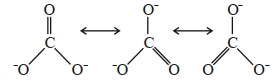
A
It is possible to identify each structure individually by some physical or chemical method.
B
All these structures are in dynamic equilibrium with each other.
C
Each structure exists for an equal amount of time.
D
$CO_3^{2-}$ has a single structure,i.e.,the resonance hybrid of the above three structures.
Solution
(D) Resonating structures are hypothetical and do not exist in reality.
Resonance hybrid is the real structure which is the weighted average of all the resonating structures.
Therefore,the $CO_3^{2-}$ ion exists as a single resonance hybrid structure.
Resonance hybrid is the real structure which is the weighted average of all the resonating structures.
Therefore,the $CO_3^{2-}$ ion exists as a single resonance hybrid structure.
0 likesView Solution
136
ChemistryMediumMCQJEE Main · 2023
How can photochemical smog be controlled?
A
By using tall chimneys
B
By complete combustion of fuel
C
By using catalytic converters in the automobiles/industry
D
By using catalyst
Solution
(C) Photochemical smog is caused by the presence of nitrogen oxides $(NO_x)$ and hydrocarbons in the atmosphere.
To control it,we must reduce the emission of these precursors.
Using catalytic converters in automobiles and industries helps in controlling the release of nitrogen oxides and hydrocarbons,thereby reducing the formation of photochemical smog.
Therefore,option $C$ is the correct answer.
To control it,we must reduce the emission of these precursors.
Using catalytic converters in automobiles and industries helps in controlling the release of nitrogen oxides and hydrocarbons,thereby reducing the formation of photochemical smog.
Therefore,option $C$ is the correct answer.
0 likesView Solution
137
ChemistryMediumMCQJEE Main · 2023
Match List-$I$ with List-$II$:
Choose the correct answer from the options given below:
| List-$I$ | List-$II$ |
| $A$. Slaked lime | $I$. $NaOH$ |
| $B$. Dead burnt plaster | $II$. $Ca(OH)_2$ |
| $C$. Caustic soda | $III$. $Na_2CO_3 \cdot 10H_2O$ |
| $D$. Washing soda | $IV$. $CaSO_4$ |
Choose the correct answer from the options given below:
A
$A-I, B-IV, C-II, D-III$
B
$A-III, B-IV, C-II, D-I$
C
$A-II, B-IV, C-I, D-III$
D
$A-III, B-II, C-IV, D-I$
Solution
(C) The correct matches are as follows:
$A$. Slaked lime is $Ca(OH)_2$ $(II)$.
$B$. Dead burnt plaster is $CaSO_4$ $(IV)$.
$C$. Caustic soda is $NaOH$ $(I)$.
$D$. Washing soda is $Na_2CO_3 \cdot 10H_2O$ $(III)$.
Therefore,the correct matching is $A-II, B-IV, C-I, D-III$.
$A$. Slaked lime is $Ca(OH)_2$ $(II)$.
$B$. Dead burnt plaster is $CaSO_4$ $(IV)$.
$C$. Caustic soda is $NaOH$ $(I)$.
$D$. Washing soda is $Na_2CO_3 \cdot 10H_2O$ $(III)$.
Therefore,the correct matching is $A-II, B-IV, C-I, D-III$.
0 likesView Solution
138
ChemistryDifficultMCQJEE Main · 2023
Choose the correct statement$(s)$:
$A.$ Beryllium oxide is purely acidic in nature.
$B.$ Beryllium carbonate is kept in the atmosphere of $CO_2$.
$C.$ Beryllium sulphate is readily soluble in water.
$D.$ Beryllium shows anomalous behavior.
Choose the correct answer from the options given below:
$A.$ Beryllium oxide is purely acidic in nature.
$B.$ Beryllium carbonate is kept in the atmosphere of $CO_2$.
$C.$ Beryllium sulphate is readily soluble in water.
$D.$ Beryllium shows anomalous behavior.
Choose the correct answer from the options given below:
A
$A, B$ and $C$ only
B
$B, C$ and $D$ only
C
$A$ and $B$ only
D
$A$ only
Solution
(B) $A.$ Beryllium oxide $(BeO)$ is amphoteric in nature, not purely acidic.
$B.$ Beryllium carbonate $(BeCO_3)$ is thermally unstable and decomposes easily, so it is kept in an atmosphere of $CO_2$ to prevent decomposition.
$C.$ Beryllium sulphate $(BeSO_4)$ is readily soluble in water due to the high hydration enthalpy of the small $Be^{2+}$ ion.
$D.$ Beryllium shows anomalous behavior compared to other alkaline earth metals due to its small atomic size, high ionization energy, and high polarising power $(\phi)$.
Therefore, statements $B, C,$ and $D$ are correct.
$B.$ Beryllium carbonate $(BeCO_3)$ is thermally unstable and decomposes easily, so it is kept in an atmosphere of $CO_2$ to prevent decomposition.
$C.$ Beryllium sulphate $(BeSO_4)$ is readily soluble in water due to the high hydration enthalpy of the small $Be^{2+}$ ion.
$D.$ Beryllium shows anomalous behavior compared to other alkaline earth metals due to its small atomic size, high ionization energy, and high polarising power $(\phi)$.
Therefore, statements $B, C,$ and $D$ are correct.
0 likesView Solution
139
ChemistryDifficultMCQJEE Main · 2023
$but-2-yne$ is reacted separately with one mole of $H_2$ as shown below:
$\underline{ B } \xleftarrow[\text{liq } NH_3]{Na} CH_3-C \equiv C-CH_3 \xrightarrow[\Delta]{Pd/C} \underline{ A }$
Identify the incorrect statements from the options given below:
$A.$ $A$ is more soluble than $B$.
$B.$ The boiling point and melting point of $A$ are higher and lower than $B$ respectively.
$C.$ $A$ is more polar than $B$ because dipole moment of $A$ is zero.
$D.$ $Br_2$ adds easily to $B$ than $A$.
$\underline{ B } \xleftarrow[\text{liq } NH_3]{Na} CH_3-C \equiv C-CH_3 \xrightarrow[\Delta]{Pd/C} \underline{ A }$
Identify the incorrect statements from the options given below:
$A.$ $A$ is more soluble than $B$.
$B.$ The boiling point and melting point of $A$ are higher and lower than $B$ respectively.
$C.$ $A$ is more polar than $B$ because dipole moment of $A$ is zero.
$D.$ $Br_2$ adds easily to $B$ than $A$.
A
$B$ and $C$ only
B
$B, C$ and $D$ only
C
$A, C$ and $D$ only
D
$A$ and $B$ only
Solution
(C, D) The reaction of $but-2-yne$ with $Na/liq. NH_3$ (Birch reduction) yields $trans-but-2-ene$ $(B)$.
The reaction of $but-2-yne$ with $Pd/C$ (Lindlar's catalyst) yields $cis-but-2-ene$ $(A)$.
$A$ $(cis-but-2-ene)$ has a dipole moment $\mu \neq 0$,while $B$ $(trans-but-2-ene)$ has $\mu = 0$.
Statement $A$: $cis$ isomers are generally more polar and have higher boiling points,but solubility depends on crystal packing; $trans$ isomers $(B)$ pack better,leading to higher melting points.
Statement $B$: $A$ $(cis)$ has a higher boiling point than $B$ $(trans)$,but $B$ has a higher melting point due to better symmetry.
Statement $C$: $A$ is more polar than $B$ because $A$ has a non-zero dipole moment,while $B$ is zero. The statement claims $A$ is more polar because its dipole moment is zero,which is false.
Statement $D$: Both $A$ and $B$ are alkenes and react similarly with $Br_2$; there is no significant difference in ease of addition. Thus,$D$ is also incorrect.
Since $C$ and $D$ are incorrect,and no option matches,the question is flawed.
The reaction of $but-2-yne$ with $Pd/C$ (Lindlar's catalyst) yields $cis-but-2-ene$ $(A)$.
$A$ $(cis-but-2-ene)$ has a dipole moment $\mu \neq 0$,while $B$ $(trans-but-2-ene)$ has $\mu = 0$.
Statement $A$: $cis$ isomers are generally more polar and have higher boiling points,but solubility depends on crystal packing; $trans$ isomers $(B)$ pack better,leading to higher melting points.
Statement $B$: $A$ $(cis)$ has a higher boiling point than $B$ $(trans)$,but $B$ has a higher melting point due to better symmetry.
Statement $C$: $A$ is more polar than $B$ because $A$ has a non-zero dipole moment,while $B$ is zero. The statement claims $A$ is more polar because its dipole moment is zero,which is false.
Statement $D$: Both $A$ and $B$ are alkenes and react similarly with $Br_2$; there is no significant difference in ease of addition. Thus,$D$ is also incorrect.
Since $C$ and $D$ are incorrect,and no option matches,the question is flawed.
0 likesView Solution
140
ChemistryMediumMCQJEE Main · 2023
Given below are two statements: one is labelled as Assertion $A$ and the other is labelled as Reason $R$.
Assertion $A:$ Hydrogen is an environment-friendly fuel.
Reason $R:$ Atomic number of hydrogen is $1$ and it is a very light element.
In the light of the above statements,choose the correct answer from the options given below:
Assertion $A:$ Hydrogen is an environment-friendly fuel.
Reason $R:$ Atomic number of hydrogen is $1$ and it is a very light element.
In the light of the above statements,choose the correct answer from the options given below:
A
$A$ is true but $R$ is false
B
Both $A$ and $R$ are true but $R$ is $NOT$ the correct explanation of $A$
C
$A$ is false but $R$ is true
D
Both $A$ and $R$ are true and $R$ is the correct explanation of $A$
Solution
(B) Assertion $A$ is true because the combustion of hydrogen produces only water $(H_2O)$ as a byproduct,making it an environment-friendly fuel.
Reason $R$ is also true because the atomic number of hydrogen is $1$ and it is indeed a very light element.
However,the fact that hydrogen is a light element with atomic number $1$ is not the reason why it is environment-friendly; its environment-friendly nature is due to the clean combustion product $(H_2O)$.
Therefore,both $A$ and $R$ are true,but $R$ is not the correct explanation of $A$.
Reason $R$ is also true because the atomic number of hydrogen is $1$ and it is indeed a very light element.
However,the fact that hydrogen is a light element with atomic number $1$ is not the reason why it is environment-friendly; its environment-friendly nature is due to the clean combustion product $(H_2O)$.
Therefore,both $A$ and $R$ are true,but $R$ is not the correct explanation of $A$.
0 likesView Solution
141
ChemistryDifficultMCQJEE Main · 2023
Electrons in a cathode ray tube have been emitted with a velocity of $1000 \, m \, s^{-1}$. The number of following statements which is/are true about the emitted radiation is
Given : $h = 6 \times 10^{-34} \, Js$,$m_{e} = 9 \times 10^{-31} \, kg$.
$(A)$ The de Broglie wavelength of the electron emitted is $666.67 \, nm$.
$(B)$ The characteristic of electrons emitted depend upon the material of the electrodes of the cathode ray tube.
$(C)$ The cathode rays start from cathode and move towards anode.
$(D)$ The nature of the emitted electrons depends on the nature of the gas present in cathode ray tube.
Given : $h = 6 \times 10^{-34} \, Js$,$m_{e} = 9 \times 10^{-31} \, kg$.
$(A)$ The de Broglie wavelength of the electron emitted is $666.67 \, nm$.
$(B)$ The characteristic of electrons emitted depend upon the material of the electrodes of the cathode ray tube.
$(C)$ The cathode rays start from cathode and move towards anode.
$(D)$ The nature of the emitted electrons depends on the nature of the gas present in cathode ray tube.
A
$2$
B
$1$
C
$3$
D
$4$
Solution
(A) Calculation of de Broglie wavelength: $\lambda = \frac{h}{mv} = \frac{6 \times 10^{-34} \, Js}{(9 \times 10^{-31} \, kg) \times (1000 \, m \, s^{-1})} = 6.6667 \times 10^{-7} \, m = 666.67 \, nm$. Thus,statement $(A)$ is true.
$(B)$ The characteristics of cathode rays (electrons) are independent of the material of the electrodes. Thus,statement $(B)$ is false.
$(C)$ Cathode rays originate from the cathode and travel towards the anode. Thus,statement $(C)$ is true.
$(D)$ The nature of cathode rays is independent of the nature of the gas present in the tube. Thus,statement $(D)$ is false.
Therefore,there are $2$ true statements ($A$ and $C$).
$(B)$ The characteristics of cathode rays (electrons) are independent of the material of the electrodes. Thus,statement $(B)$ is false.
$(C)$ Cathode rays originate from the cathode and travel towards the anode. Thus,statement $(C)$ is true.
$(D)$ The nature of cathode rays is independent of the nature of the gas present in the tube. Thus,statement $(D)$ is false.
Therefore,there are $2$ true statements ($A$ and $C$).
0 likesView Solution
142
ChemistryMediumMCQJEE Main · 2023
Sum of oxidation states of bromine in bromic acid and perbromic acid is $..........$
A
$12$
B
$13$
C
$14$
D
$15$
Solution
(A) In $HBrO_3$ (bromic acid),let the oxidation state of $Br$ be $x$.
$1 + x + 3(-2) = 0 \implies x - 5 = 0 \implies x = +5$.
In $HBrO_4$ (perbromic acid),let the oxidation state of $Br$ be $y$.
$1 + y + 4(-2) = 0 \implies y - 7 = 0 \implies y = +7$.
The sum of the oxidation states is $5 + 7 = 12$.
$1 + x + 3(-2) = 0 \implies x - 5 = 0 \implies x = +5$.
In $HBrO_4$ (perbromic acid),let the oxidation state of $Br$ be $y$.
$1 + y + 4(-2) = 0 \implies y - 7 = 0 \implies y = +7$.
The sum of the oxidation states is $5 + 7 = 12$.
0 likesView Solution
143
ChemistryDifficultMCQJEE Main · 2023
$(i) X(g) \rightleftharpoons Y(g) + Z(g), K_{p1} = 3$
$(ii) A(g) \rightleftharpoons 2B(g), K_{p2} = 1$
If the degree of dissociation and initial concentration of both the reactants $X(g)$ and $A(g)$ are equal,then the ratio of the total pressure at equilibrium $\left( \frac{p_1}{p_2} \right)$ is equal to $x : 1$. The value of $x$ is $......$ (Nearest integer)
$(ii) A(g) \rightleftharpoons 2B(g), K_{p2} = 1$
If the degree of dissociation and initial concentration of both the reactants $X(g)$ and $A(g)$ are equal,then the ratio of the total pressure at equilibrium $\left( \frac{p_1}{p_2} \right)$ is equal to $x : 1$. The value of $x$ is $......$ (Nearest integer)
A
$12$
B
$11$
C
$10$
D
$18$
Solution
(A) For reaction $(i): X(g) \rightleftharpoons Y(g) + Z(g)$
Total moles at equilibrium $= n(1-\alpha) + n\alpha + n\alpha = n(1+\alpha)$.
Partial pressures: $p_X = \frac{1-\alpha}{1+\alpha} p_1$,$p_Y = \frac{\alpha}{1+\alpha} p_1$,$p_Z = \frac{\alpha}{1+\alpha} p_1$.
$K_{p1} = \frac{p_Y p_Z}{p_X} = \frac{\alpha^2 p_1}{1-\alpha^2} = 3$
For reaction $(ii): A(g) \rightleftharpoons 2B(g)$
Total moles at equilibrium $= n(1-\alpha) + 2n\alpha = n(1+\alpha)$.
Partial pressures: $p_A = \frac{1-\alpha}{1+\alpha} p_2$,$p_B = \frac{2\alpha}{1+\alpha} p_2$.
$K_{p2} = \frac{p_B^2}{p_A} = \frac{4\alpha^2 p_2}{1-\alpha^2} = 1$
Dividing the two expressions: $\frac{K_{p1}}{K_{p2}} = \frac{3}{1} = \frac{\alpha^2 p_1 / (1-\alpha^2)}{4\alpha^2 p_2 / (1-\alpha^2)} = \frac{p_1}{4p_2}$
Therefore,$\frac{p_1}{p_2} = 3 \times 4 = 12$.
Thus,$x = 12$.
| $Initial \ moles$ | $n$ | $0$ | $0$ |
| $Equilibrium \ moles$ | $n(1-\alpha)$ | $n\alpha$ | $n\alpha$ |
Total moles at equilibrium $= n(1-\alpha) + n\alpha + n\alpha = n(1+\alpha)$.
Partial pressures: $p_X = \frac{1-\alpha}{1+\alpha} p_1$,$p_Y = \frac{\alpha}{1+\alpha} p_1$,$p_Z = \frac{\alpha}{1+\alpha} p_1$.
$K_{p1} = \frac{p_Y p_Z}{p_X} = \frac{\alpha^2 p_1}{1-\alpha^2} = 3$
For reaction $(ii): A(g) \rightleftharpoons 2B(g)$
| $Initial \ moles$ | $n$ | $0$ |
| $Equilibrium \ moles$ | $n(1-\alpha)$ | $2n\alpha$ |
Total moles at equilibrium $= n(1-\alpha) + 2n\alpha = n(1+\alpha)$.
Partial pressures: $p_A = \frac{1-\alpha}{1+\alpha} p_2$,$p_B = \frac{2\alpha}{1+\alpha} p_2$.
$K_{p2} = \frac{p_B^2}{p_A} = \frac{4\alpha^2 p_2}{1-\alpha^2} = 1$
Dividing the two expressions: $\frac{K_{p1}}{K_{p2}} = \frac{3}{1} = \frac{\alpha^2 p_1 / (1-\alpha^2)}{4\alpha^2 p_2 / (1-\alpha^2)} = \frac{p_1}{4p_2}$
Therefore,$\frac{p_1}{p_2} = 3 \times 4 = 12$.
Thus,$x = 12$.
0 likesView Solution
144
ChemistryMediumMCQJEE Main · 2023
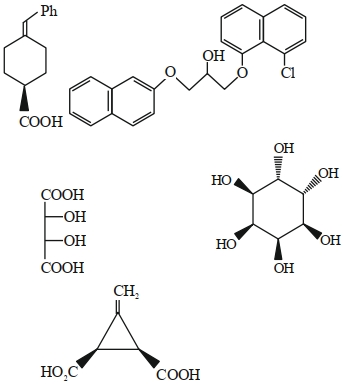
The total number of chiral compound/s from the following is $..............$.
A
$2$
B
$4$
C
$6$
D
$8$
Solution
(A) $1$. The first compound is $4$-benzylidenecyclohexanecarboxylic acid. It lacks a plane of symmetry $(POS)$ and center of symmetry $(COS)$,making it chiral.
$2$. The second compound is a substituted ether derivative. It contains a chiral center and lacks $POS$ and $COS$,making it chiral.
$3$. The third compound is tartaric acid (meso form). It has a plane of symmetry $(POS)$,making it achiral.
$4$. The fourth compound is myo-inositol. It has a plane of symmetry $(POS)$,making it achiral.
$5$. The fifth compound is $2$-methylenecyclopropane-$1,3$-dicarboxylic acid. It has a plane of symmetry $(POS)$,making it achiral.
$6$. Thus,there are $2$ chiral compounds.
$2$. The second compound is a substituted ether derivative. It contains a chiral center and lacks $POS$ and $COS$,making it chiral.
$3$. The third compound is tartaric acid (meso form). It has a plane of symmetry $(POS)$,making it achiral.
$4$. The fourth compound is myo-inositol. It has a plane of symmetry $(POS)$,making it achiral.
$5$. The fifth compound is $2$-methylenecyclopropane-$1,3$-dicarboxylic acid. It has a plane of symmetry $(POS)$,making it achiral.
$6$. Thus,there are $2$ chiral compounds.
0 likesView Solution
145
ChemistryMCQJEE Main · 2023
$A$ and $B$ are two substances undergoing radioactive decay in a container. The half-life of $A$ is $15 \ min$ and that of $B$ is $5 \ min$. If the initial concentration of $B$ is $4$ times that of $A$ and they both start decaying at the same time,how much time will it take for the concentration of both of them to be same? $.......... \ min$
A
$15$
B
$14$
C
$13$
D
$12$
Solution
(A) The radioactive decay follows first-order kinetics: $[N]_t = [N]_0 e^{-kt}$,where $k = \frac{\ln 2}{t_{1/2}}$.
For substance $A$: $[A]_t = [A]_0 e^{-k_A t}$,where $k_A = \frac{\ln 2}{15}$.
For substance $B$: $[B]_t = [B]_0 e^{-k_B t}$,where $k_B = \frac{\ln 2}{5}$ and $[B]_0 = 4[A]_0$.
We want to find time $t$ such that $[A]_t = [B]_t$.
$[A]_0 e^{-(\frac{\ln 2}{15})t} = 4[A]_0 e^{-(\frac{\ln 2}{5})t}$.
Dividing both sides by $[A]_0 e^{-(\frac{\ln 2}{5})t}$:
$e^{(\frac{\ln 2}{5} - \frac{\ln 2}{15})t} = 4$.
Taking the natural logarithm on both sides:
$t(\frac{\ln 2}{5} - \frac{\ln 2}{15}) = \ln 4$.
$t(\ln 2)(\frac{1}{5} - \frac{1}{15}) = 2 \ln 2$.
$t(\frac{3-1}{15}) = 2$.
$t(\frac{2}{15}) = 2$.
$t = 15 \ min$.
For substance $A$: $[A]_t = [A]_0 e^{-k_A t}$,where $k_A = \frac{\ln 2}{15}$.
For substance $B$: $[B]_t = [B]_0 e^{-k_B t}$,where $k_B = \frac{\ln 2}{5}$ and $[B]_0 = 4[A]_0$.
We want to find time $t$ such that $[A]_t = [B]_t$.
$[A]_0 e^{-(\frac{\ln 2}{15})t} = 4[A]_0 e^{-(\frac{\ln 2}{5})t}$.
Dividing both sides by $[A]_0 e^{-(\frac{\ln 2}{5})t}$:
$e^{(\frac{\ln 2}{5} - \frac{\ln 2}{15})t} = 4$.
Taking the natural logarithm on both sides:
$t(\frac{\ln 2}{5} - \frac{\ln 2}{15}) = \ln 4$.
$t(\ln 2)(\frac{1}{5} - \frac{1}{15}) = 2 \ln 2$.
$t(\frac{3-1}{15}) = 2$.
$t(\frac{2}{15}) = 2$.
$t = 15 \ min$.
0 likesView Solution
146
ChemistryMediumMCQJEE Main · 2023
At $25^{\circ} C$, the enthalpy of the following processes are given:
$H_{2(g)} + O_{2(g)} \rightarrow 2 OH_{(g)} \quad \Delta H^{\circ} = 78 \ kJ \ mol^{-1}$
$H_{2(g)} + \frac{1}{2} O_{2(g)} \rightarrow H_2O_{(g)} \quad \Delta H^{\circ} = -242 \ kJ \ mol^{-1}$
$H_{2(g)} \rightarrow 2 H_{(g)} \quad \Delta H^{\circ} = 436 \ kJ \ mol^{-1}$
$\frac{1}{2} O_{2(g)} \rightarrow O_{(g)} \quad \Delta H^{\circ} = 249 \ kJ \ mol^{-1}$
What would be the value of $X$ for the following reaction? (Nearest integer)
$H_2O_{(g)} \rightarrow H_{(g)} + OH_{(g)} \quad \Delta H^{\circ} = X \ kJ \ mol^{-1}$
$H_{2(g)} + O_{2(g)} \rightarrow 2 OH_{(g)} \quad \Delta H^{\circ} = 78 \ kJ \ mol^{-1}$
$H_{2(g)} + \frac{1}{2} O_{2(g)} \rightarrow H_2O_{(g)} \quad \Delta H^{\circ} = -242 \ kJ \ mol^{-1}$
$H_{2(g)} \rightarrow 2 H_{(g)} \quad \Delta H^{\circ} = 436 \ kJ \ mol^{-1}$
$\frac{1}{2} O_{2(g)} \rightarrow O_{(g)} \quad \Delta H^{\circ} = 249 \ kJ \ mol^{-1}$
What would be the value of $X$ for the following reaction? (Nearest integer)
$H_2O_{(g)} \rightarrow H_{(g)} + OH_{(g)} \quad \Delta H^{\circ} = X \ kJ \ mol^{-1}$
A
$499$
B
$498$
C
$497$
D
$500$
Solution
(A) To find the enthalpy change for the reaction $H_2O_{(g)} \rightarrow H_{(g)} + OH_{(g)}$, we use Hess's Law by manipulating the given equations:
$1$. $2 H_2O_{(g)} \rightarrow 2 H_{2(g)} + O_{2(g)} \quad \Delta H^{\circ} = -2 \times (-242) = +484 \ kJ \ mol^{-1}$
$2$. $H_{2(g)} + O_{2(g)} \rightarrow 2 OH_{(g)} \quad \Delta H^{\circ} = +78 \ kJ \ mol^{-1}$
$3$. $H_{2(g)} \rightarrow 2 H_{(g)} \quad \Delta H^{\circ} = +436 \ kJ \ mol^{-1}$
Adding these equations:
$2 H_2O_{(g)} + H_{2(g)} + O_{2(g)} + H_{2(g)} \rightarrow 2 H_{2(g)} + O_{2(g)} + 2 OH_{(g)} + 2 H_{(g)}$
Simplifying, we get: $2 H_2O_{(g)} \rightarrow 2 H_{(g)} + 2 OH_{(g)}$
$\Delta H^{\circ} = 484 + 78 + 436 = +998 \ kJ \ mol^{-1}$
For the reaction $H_2O_{(g)} \rightarrow H_{(g)} + OH_{(g)}$, the enthalpy change is:
$X = \frac{998}{2} = 499 \ kJ \ mol^{-1}$
$1$. $2 H_2O_{(g)} \rightarrow 2 H_{2(g)} + O_{2(g)} \quad \Delta H^{\circ} = -2 \times (-242) = +484 \ kJ \ mol^{-1}$
$2$. $H_{2(g)} + O_{2(g)} \rightarrow 2 OH_{(g)} \quad \Delta H^{\circ} = +78 \ kJ \ mol^{-1}$
$3$. $H_{2(g)} \rightarrow 2 H_{(g)} \quad \Delta H^{\circ} = +436 \ kJ \ mol^{-1}$
Adding these equations:
$2 H_2O_{(g)} + H_{2(g)} + O_{2(g)} + H_{2(g)} \rightarrow 2 H_{2(g)} + O_{2(g)} + 2 OH_{(g)} + 2 H_{(g)}$
Simplifying, we get: $2 H_2O_{(g)} \rightarrow 2 H_{(g)} + 2 OH_{(g)}$
$\Delta H^{\circ} = 484 + 78 + 436 = +998 \ kJ \ mol^{-1}$
For the reaction $H_2O_{(g)} \rightarrow H_{(g)} + OH_{(g)}$, the enthalpy change is:
$X = \frac{998}{2} = 499 \ kJ \ mol^{-1}$
0 likesView Solution
147
ChemistryMediumMCQJEE Main · 2023
The correct order of bond enthalpy $\left( kJ \, mol^{-1} \right)$ is :
A
$Si - Si > C - C > Sn - Sn > Ge - Ge$
B
$Si - Si > C - C > Ge - Ge > Sn - Sn$
C
$C - C > Si - Si > Sn - Sn > Ge - Ge$
D
$C - C > Si - Si > Ge - Ge > Sn - Sn$
Solution
(D) Bond enthalpy is inversely proportional to the atomic size of the elements involved in the bond. \\ As we move down the group $14$ from $C$ to $Sn$,the atomic size increases,which leads to a decrease in the strength of the covalent bond formed between the atoms. \\ The atomic radii order is $C < Si < Ge < Sn$. \\ Therefore,the bond enthalpy order is $C - C > Si - Si > Ge - Ge > Sn - Sn$.
0 likesView Solution
148
ChemistryMediumMCQJEE Main · 2023
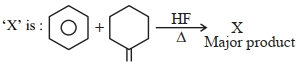
In the above reaction,' $X$ ' is:
A
$1-$methyl$-1-$phenylcyclohexane
B
$3-$methyl$-1-$phenylcyclohexane
C
$2-$methyl$-1-$phenylcyclohexane
D
$1-$methyl$-2-$phenylcyclohexane
Solution
(A) The reaction involves the electrophilic addition of benzene to methylenecyclohexane in the presence of an acid catalyst $(HF)$.
$1$. First,the $HF$ protonates the double bond of methylenecyclohexane to form a stable tertiary carbocation,the $1$-methylcyclohexyl cation.
$2$. This carbocation then acts as an electrophile and undergoes an electrophilic aromatic substitution $(EAS)$ reaction with benzene.
$3$. The final product formed is $1$-methyl-$1$-phenylcyclohexane.
$1$. First,the $HF$ protonates the double bond of methylenecyclohexane to form a stable tertiary carbocation,the $1$-methylcyclohexyl cation.
$2$. This carbocation then acts as an electrophile and undergoes an electrophilic aromatic substitution $(EAS)$ reaction with benzene.
$3$. The final product formed is $1$-methyl-$1$-phenylcyclohexane.
0 likesView Solution
149
ChemistryDifficultMCQJEE Main · 2023
Given below are two statements:
Statement $I$ : Sulphanilic acid gives esterification test for carboxyl group.
Statement $II$ : Sulphanilic acid gives red colour in Lassaigne's test for extra element detection.
In the light of the above statements,choose the most appropriate answer from the options given below :
Statement $I$ : Sulphanilic acid gives esterification test for carboxyl group.
Statement $II$ : Sulphanilic acid gives red colour in Lassaigne's test for extra element detection.
In the light of the above statements,choose the most appropriate answer from the options given below :
A
Statement $I$ is correct but Statement $II$ is incorrect.
B
Both Statement $I$ and Statement $II$ are incorrect.
C
Both Statement $I$ and Statement $II$ are correct.
D
Statement $I$ is incorrect but Statement $II$ is correct.
Solution
(D) Sulphanilic acid exists as a zwitterion $(H_3N^+-C_6H_4-SO_3^-)$. Due to the presence of the strong acidic $-SO_3H$ group and basic $-NH_2$ group,it does not behave as a typical carboxylic acid and does not undergo esterification.
Sulphanilic acid contains $C, H, N, O,$ and $S$. In Lassaigne's test,if both nitrogen and sulphur are present,they react to form sodium thiocyanate $(NaSCN)$. This compound reacts with $Fe^{3+}$ ions to form a blood-red colouration $([Fe(SCN)]^{2+})$,which confirms the presence of both $N$ and $S$.
Sulphanilic acid contains $C, H, N, O,$ and $S$. In Lassaigne's test,if both nitrogen and sulphur are present,they react to form sodium thiocyanate $(NaSCN)$. This compound reacts with $Fe^{3+}$ ions to form a blood-red colouration $([Fe(SCN)]^{2+})$,which confirms the presence of both $N$ and $S$.
0 likesView Solution
150
ChemistryMCQJEE Main · 2023
Below are two statements. One is labeled as Assertion $(A)$ and the other as Reason $(R).$
Assertion $(A):$ Gypsum is used to make boards for fireproof walls.
Reason $(R):$ Gypsum is unstable at high temperatures.
In the context of the above statements,choose the correct answer from the options given below:
Assertion $(A):$ Gypsum is used to make boards for fireproof walls.
Reason $(R):$ Gypsum is unstable at high temperatures.
In the context of the above statements,choose the correct answer from the options given below:
A
Both $A$ and $R$ are true,but $R$ is not the correct explanation of $A$.
B
$A$ is true,but $R$ is false.
C
$A$ is false,but $R$ is true.
D
Both $A$ and $R$ are true,and $R$ is the correct explanation of $A$.
Solution
(D) Assertion $(A)$ is true because gypsum $(CaSO_4 \cdot 2H_2O)$ is used in the construction of fireproof wall boards due to its low thermal conductivity and the presence of water of crystallization.
Reason $(R)$ is also true because gypsum loses its water of crystallization when heated to high temperatures (forming Plaster of Paris at $393 \ K$ and anhydrous calcium sulfate at higher temperatures),which makes it lose its structural integrity.
Since the fireproof nature of gypsum boards is specifically due to the endothermic release of water vapor when exposed to heat,which prevents the temperature of the wall from rising rapidly,the reason $R$ correctly explains why it is used for fireproofing. Thus,both $A$ and $R$ are true and $R$ is the correct explanation of $A$.
Reason $(R)$ is also true because gypsum loses its water of crystallization when heated to high temperatures (forming Plaster of Paris at $393 \ K$ and anhydrous calcium sulfate at higher temperatures),which makes it lose its structural integrity.
Since the fireproof nature of gypsum boards is specifically due to the endothermic release of water vapor when exposed to heat,which prevents the temperature of the wall from rising rapidly,the reason $R$ correctly explains why it is used for fireproofing. Thus,both $A$ and $R$ are true and $R$ is the correct explanation of $A$.
0 likesView Solution
151
ChemistryMediumMCQJEE Main · 2023
Match List-$I$ with List-$II$.
Choose the correct answer from the options given below:
| List-$I$ | List-$II$ |
| $A$. van't Hoff factor,$i$ | $I$. Cryoscopic constant |
| $B$. $k_{f}$ | $II$. Isotonic solutions |
| $C$. Solutions with same osmotic pressure | $III$. $\frac{\text{Normal molar mass}}{\text{Abnormal molar mass}}$ |
| $D$. Azeotropes | $IV$. Solutions with same composition of vapour above it |
Choose the correct answer from the options given below:
A
$A-III, B-I, C-II, D-IV$
B
$A-III, B-II, C-I, D-IV$
C
$A-III, B-I, C-IV, D-II$
D
$A-I, B-III, C-II, D-IV$
Solution
(A) van't Hoff factor,$i = \frac{\text{Normal molar mass}}{\text{Abnormal molar mass}}$,which corresponds to $III$.
$(B)$ $k_{f}$ is the Cryoscopic constant (molal depression constant),which corresponds to $I$.
$(C)$ Solutions with the same osmotic pressure are known as Isotonic solutions,which corresponds to $II$.
$(D)$ Azeotropes are binary mixtures having the same composition in liquid and vapour phases,which corresponds to $IV$.
Therefore,the correct matching is $A-III, B-I, C-II, D-IV$.
$(B)$ $k_{f}$ is the Cryoscopic constant (molal depression constant),which corresponds to $I$.
$(C)$ Solutions with the same osmotic pressure are known as Isotonic solutions,which corresponds to $II$.
$(D)$ Azeotropes are binary mixtures having the same composition in liquid and vapour phases,which corresponds to $IV$.
Therefore,the correct matching is $A-III, B-I, C-II, D-IV$.
0 likesView Solution
152
ChemistryMediumMCQJEE Main · 2023
For conversion of compound $A \rightarrow B$,the rate constant of the reaction was found to be $4.6 \times 10^{-5} \ L \ mol^{-1} \ s^{-1}$. The order of the reaction is $..........$
A
$4$
B
$6$
C
$2$
D
$8$
Solution
(C) The unit of the rate constant for a reaction of order $n$ is given by $(\text{mol} \ L^{-1})^{1-n} \ s^{-1}$.
Given the unit is $L \ mol^{-1} \ s^{-1}$,which is equivalent to $(\text{mol} \ L^{-1})^{-1} \ s^{-1}$.
Comparing the exponents: $1 - n = -1$.
Therefore,$n = 2$.
The reaction is of second order.
Given the unit is $L \ mol^{-1} \ s^{-1}$,which is equivalent to $(\text{mol} \ L^{-1})^{-1} \ s^{-1}$.
Comparing the exponents: $1 - n = -1$.
Therefore,$n = 2$.
The reaction is of second order.
0 likesView Solution
153
ChemistryMediumMCQJEE Main · 2023
Total number of acidic oxides among $N_2O_3, NO_2, N_2O, Cl_2O_7, SO_2, CO, CaO, Na_2O$ and $NO$ is $...........$
A
$8$
B
$2$
C
$4$
D
$9$
Solution
(C) The nature of the given oxides is as follows:
$1$. $N_2O_3$: Acidic
$2$. $NO_2$: Acidic
$3$. $N_2O$: Neutral
$4$. $Cl_2O_7$: Acidic
$5$. $SO_2$: Acidic
$6$. $CO$: Neutral
$7$. $CaO$: Basic
$8$. $Na_2O$: Basic
$9$. $NO$: Neutral
Therefore,the acidic oxides are $N_2O_3, NO_2, Cl_2O_7$ and $SO_2$.
The total number of acidic oxides is $4$.
$1$. $N_2O_3$: Acidic
$2$. $NO_2$: Acidic
$3$. $N_2O$: Neutral
$4$. $Cl_2O_7$: Acidic
$5$. $SO_2$: Acidic
$6$. $CO$: Neutral
$7$. $CaO$: Basic
$8$. $Na_2O$: Basic
$9$. $NO$: Neutral
Therefore,the acidic oxides are $N_2O_3, NO_2, Cl_2O_7$ and $SO_2$.
The total number of acidic oxides is $4$.
0 likesView Solution
154
ChemistryMediumMCQJEE Main · 2023
The denticity of the ligand present in the Fehling's reagent is $..........$.
A
$2$
B
$6$
C
$4$
D
$8$
Solution
(A) Fehling's reagent contains a copper$(II)$ complex with tartrate ions $(C_4H_4O_6^{2-})$.
In this complex,the tartrate ion acts as a bidentate ligand,meaning it coordinates to the central metal ion through two donor atoms (typically the carboxylate oxygen and the hydroxyl oxygen).
Therefore,the denticity of the tartrate ligand is $2$.
In this complex,the tartrate ion acts as a bidentate ligand,meaning it coordinates to the central metal ion through two donor atoms (typically the carboxylate oxygen and the hydroxyl oxygen).
Therefore,the denticity of the tartrate ligand is $2$.
0 likesView Solution
155
ChemistryDifficultMCQJEE Main · 2023
$A$ metal $M$ forms a hexagonal close-packed structure. The total number of voids in $0.02 \ mol$ of it is $......... \times 10^{21}$ (Nearest integer) (Given $N_{A} = 6.02 \times 10^{23}$)
A
$18$
B
$9$
C
$36$
D
$54$
Solution
(C) In a hexagonal close-packed $(hcp)$ structure,the number of octahedral voids is equal to the number of atoms $(N)$,and the number of tetrahedral voids is equal to $2N$.
Total number of voids per atom $= N + 2N = 3N$.
Given amount of metal $= 0.02 \ mol$.
Number of atoms $= 0.02 \times 6.02 \times 10^{23} = 1.204 \times 10^{22}$.
Total number of voids $= 3 \times (1.204 \times 10^{22}) = 3.612 \times 10^{22} = 36.12 \times 10^{21}$.
The nearest integer is $36$.
Total number of voids per atom $= N + 2N = 3N$.
Given amount of metal $= 0.02 \ mol$.
Number of atoms $= 0.02 \times 6.02 \times 10^{23} = 1.204 \times 10^{22}$.
Total number of voids $= 3 \times (1.204 \times 10^{22}) = 3.612 \times 10^{22} = 36.12 \times 10^{21}$.
The nearest integer is $36$.
0 likesView Solution
156
ChemistryMediumMCQJEE Main · 2023
The equilibrium constant for the reaction $Zn_{(s)} + Sn^{2+}_{(aq)} \rightleftharpoons Zn^{2+}_{(aq)} + Sn_{(s)}$ is $1 \times 10^{20}$ at $298 \ K$. The magnitude of standard electrode potential of $Sn/Sn^{2+}$ if $E_{Zn^{2+}/Zn}^0 = -0.76 \ V$ is $............ \times 10^{-2} \ V$. (Nearest integer)
Given : $\frac{2.303 \ RT}{F} = 0.059 \ V$
Given : $\frac{2.303 \ RT}{F} = 0.059 \ V$
A
$16$
B
$15$
C
$17$
D
$14$
Solution
(C) The cell reaction is $Zn_{(s)} + Sn^{2+}_{(aq)} \rightleftharpoons Zn^{2+}_{(aq)} + Sn_{(s)}$.
For this reaction,the number of electrons transferred is $n = 2$.
The relationship between standard cell potential and equilibrium constant is given by $E_{cell}^0 = \frac{0.059}{n} \log_{10} K_{eq}$.
Substituting the values: $E_{cell}^0 = \frac{0.059}{2} \log_{10} (1 \times 10^{20}) = \frac{0.059 \times 20}{2} = 0.59 \ V$.
We know that $E_{cell}^0 = E_{cathode}^0 - E_{anode}^0 = E_{Sn^{2+}/Sn}^0 - E_{Zn^{2+}/Zn}^0$.
$0.59 \ V = E_{Sn^{2+}/Sn}^0 - (-0.76 \ V)$.
$E_{Sn^{2+}/Sn}^0 = 0.59 - 0.76 = -0.17 \ V$.
The standard electrode potential for $Sn/Sn^{2+}$ is the negative of $E_{Sn^{2+}/Sn}^0$,so $E_{Sn/Sn^{2+}}^0 = -(-0.17 \ V) = 0.17 \ V$.
$0.17 \ V = 17 \times 10^{-2} \ V$.
Thus,the magnitude is $17$.
For this reaction,the number of electrons transferred is $n = 2$.
The relationship between standard cell potential and equilibrium constant is given by $E_{cell}^0 = \frac{0.059}{n} \log_{10} K_{eq}$.
Substituting the values: $E_{cell}^0 = \frac{0.059}{2} \log_{10} (1 \times 10^{20}) = \frac{0.059 \times 20}{2} = 0.59 \ V$.
We know that $E_{cell}^0 = E_{cathode}^0 - E_{anode}^0 = E_{Sn^{2+}/Sn}^0 - E_{Zn^{2+}/Zn}^0$.
$0.59 \ V = E_{Sn^{2+}/Sn}^0 - (-0.76 \ V)$.
$E_{Sn^{2+}/Sn}^0 = 0.59 - 0.76 = -0.17 \ V$.
The standard electrode potential for $Sn/Sn^{2+}$ is the negative of $E_{Sn^{2+}/Sn}^0$,so $E_{Sn/Sn^{2+}}^0 = -(-0.17 \ V) = 0.17 \ V$.
$0.17 \ V = 17 \times 10^{-2} \ V$.
Thus,the magnitude is $17$.
0 likesView Solution
157
ChemistryMediumMCQJEE Main · 2023
Given below are two statements: one is labelled as Assertion $(A)$ and the other is labelled as Reason $(R)$.
Assertion $(A)$: Ketoses give Seliwanoff's test faster than Aldoses.
Reason $(R)$: Ketoses undergo $\beta$-elimination followed by formation of furfural.
In the light of the above statements,choose the correct answer from the options given below:
Assertion $(A)$: Ketoses give Seliwanoff's test faster than Aldoses.
Reason $(R)$: Ketoses undergo $\beta$-elimination followed by formation of furfural.
In the light of the above statements,choose the correct answer from the options given below:
A
$(A)$ is false but $(R)$ is true
B
Both $(A)$ and $(R)$ are true and $(R)$ is the correct explanation of $(A)$
C
$(A)$ is true but $(R)$ is false
D
Both $(A)$ and $(R)$ are true but $(R)$ is not the correct explanation of $(A)$
Solution
(C) Seliwanoff's test is a chemical test used to distinguish between aldose and ketose sugars.
Ketoses are more rapidly dehydrated in the presence of concentrated acid to form $5$-hydroxymethylfurfural compared to aldoses.
This intermediate then reacts with resorcinol to produce a cherry-red colored complex.
Therefore,Assertion $(A)$ is true.
However,the mechanism involves acid-catalyzed dehydration,not $\beta$-elimination to form furfural. Thus,Reason $(R)$ is false.
Ketoses are more rapidly dehydrated in the presence of concentrated acid to form $5$-hydroxymethylfurfural compared to aldoses.
This intermediate then reacts with resorcinol to produce a cherry-red colored complex.
Therefore,Assertion $(A)$ is true.
However,the mechanism involves acid-catalyzed dehydration,not $\beta$-elimination to form furfural. Thus,Reason $(R)$ is false.
0 likesView Solution
158
ChemistryMediumMCQJEE Main · 2023
In the extraction of copper,its sulphide ore is heated in a reverberatory furnace after mixing with silica to:
A
separate $CuO$ as $CuSiO_3$
B
remove calcium as $CaSiO_3$
C
decrease the temperature needed for roasting of $Cu_2S$
D
remove $FeO$ as $FeSiO_3$
Solution
(D) The copper ore contains iron as an impurity.
It is mixed with silica $(SiO_2)$ before heating in a reverberatory furnace.
$FeO$ acts as a basic impurity and reacts with acidic silica to form iron silicate slag $(FeSiO_3)$,which can be easily removed.
$FeO + SiO_2 \longrightarrow FeSiO_3$
It is mixed with silica $(SiO_2)$ before heating in a reverberatory furnace.
$FeO$ acts as a basic impurity and reacts with acidic silica to form iron silicate slag $(FeSiO_3)$,which can be easily removed.
$FeO + SiO_2 \longrightarrow FeSiO_3$
0 likesView Solution
159
ChemistryMediumMCQJEE Main · 2023
Amongst the following compounds,which one is an antacid?
A
Ranitidine
B
Meprobamate
C
Terfenadine
D
Brompheniramine
Solution
(A) $1.$ Ranitidine: Antacid
$2.$ Meprobamate: Tranquilizer
$3.$ Terfenadine: Antihistamine
$4.$ Brompheniramine: Antihistamine
$2.$ Meprobamate: Tranquilizer
$3.$ Terfenadine: Antihistamine
$4.$ Brompheniramine: Antihistamine
0 likesView Solution
160
ChemistryMediumMCQJEE Main · 2023
Benzyl isocyanide can be obtained by:
Choose the correct answer from the options given below:
Choose the correct answer from the options given below:
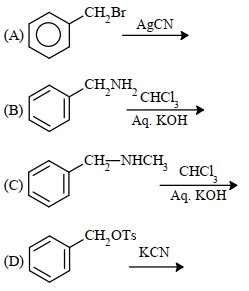
A
$A$ and $D$
B
Only $B$
C
$A$ and $B$
D
$B$ and $C$
Solution
(C) The synthesis of benzyl isocyanide $(C_6H_5CH_2NC)$ can be achieved through the following reactions:
$(A)$ Benzyl bromide $(C_6H_5CH_2Br)$ reacts with $AgCN$ to form benzyl isocyanide $(C_6H_5CH_2NC)$ as the major product because $AgCN$ is a covalent compound.
$(B)$ Benzylamine $(C_6H_5CH_2NH_2)$ is a primary amine. Primary amines undergo the carbylamine reaction when heated with chloroform $(CHCl_3)$ and alcoholic $KOH$ to form isocyanides $(R-NC)$. Thus,benzylamine gives benzyl isocyanide.
$(C)$ $N$-methylbenzylamine is a secondary amine and does not undergo the carbylamine reaction.
$(D)$ Benzyl tosylate $(C_6H_5CH_2OTs)$ reacts with $KCN$ (an ionic compound) to form benzyl cyanide $(C_6H_5CH_2CN)$ as the major product.
Therefore,benzyl isocyanide is obtained in reactions $(A)$ and $(B)$.
$(A)$ Benzyl bromide $(C_6H_5CH_2Br)$ reacts with $AgCN$ to form benzyl isocyanide $(C_6H_5CH_2NC)$ as the major product because $AgCN$ is a covalent compound.
$(B)$ Benzylamine $(C_6H_5CH_2NH_2)$ is a primary amine. Primary amines undergo the carbylamine reaction when heated with chloroform $(CHCl_3)$ and alcoholic $KOH$ to form isocyanides $(R-NC)$. Thus,benzylamine gives benzyl isocyanide.
$(C)$ $N$-methylbenzylamine is a secondary amine and does not undergo the carbylamine reaction.
$(D)$ Benzyl tosylate $(C_6H_5CH_2OTs)$ reacts with $KCN$ (an ionic compound) to form benzyl cyanide $(C_6H_5CH_2CN)$ as the major product.
Therefore,benzyl isocyanide is obtained in reactions $(A)$ and $(B)$.
0 likesView Solution
161
ChemistryMediumMCQJEE Main · 2023
Given below are two statements: one is labelled as Assertion $(A)$ and the other is labelled as Reason $(R)$.
Assertion $(A)$: In expensive scientific instruments,silica gel is kept in watch-glasses or in semipermeable membrane bags.
Reason $(R)$: Silica gel adsorbs moisture from air via adsorption,thus protects the instrument from water corrosion (rusting) and/or prevents malfunctioning.
In the light of the above statements,choose the correct answer from the options given below:
Assertion $(A)$: In expensive scientific instruments,silica gel is kept in watch-glasses or in semipermeable membrane bags.
Reason $(R)$: Silica gel adsorbs moisture from air via adsorption,thus protects the instrument from water corrosion (rusting) and/or prevents malfunctioning.
In the light of the above statements,choose the correct answer from the options given below:
A
$(A)$ is false but $(R)$ is true
B
$(A)$ is true but $(R)$ is false
C
Both $(A)$ and $(R)$ are true and $(R)$ is the correct explanation of $(A)$
D
Both $(A)$ and $(R)$ are true but $(R)$ is not the correct explanation of $(A)$
Solution
(C) Silica gel is a well-known adsorbent used to remove moisture from the surrounding environment.
In expensive scientific instruments,it is placed in watch-glasses or semipermeable bags to adsorb water vapor from the air.
By adsorbing moisture,it prevents the corrosion of metallic parts and protects sensitive electronic components from malfunctioning due to humidity.
Therefore,both the Assertion $(A)$ and the Reason $(R)$ are true,and $(R)$ is the correct explanation of $(A)$.
In expensive scientific instruments,it is placed in watch-glasses or semipermeable bags to adsorb water vapor from the air.
By adsorbing moisture,it prevents the corrosion of metallic parts and protects sensitive electronic components from malfunctioning due to humidity.
Therefore,both the Assertion $(A)$ and the Reason $(R)$ are true,and $(R)$ is the correct explanation of $(A)$.
0 likesView Solution
162
ChemistryMediumMCQJEE Main · 2023
Match List-$I$ with List-$II$:
| List-$I$ | List-$II$ |
| :--- | :--- |
| $A$. $C_6H_5Cl + CH_3Cl + 2Na \rightarrow C_6H_5CH_3 + 2NaCl$ | $I$. Wurtz-Fitting reaction |
| $B$. $2C_6H_5Cl + 2Na \rightarrow C_6H_5-C_6H_5 + 2NaCl$ | $II$. Fitting reaction |
| $C$. $C_6H_5N_2^+Cl^- \xrightarrow{Cu_2Cl_2} C_6H_5Cl + N_2$ | $III$. Sandmeyer reaction |
| $D$. $C_2H_5Cl + NaI \rightarrow C_2H_5I + NaCl$ | $IV$. Finkelstein reaction |
| List-$I$ | List-$II$ |
| :--- | :--- |
| $A$. $C_6H_5Cl + CH_3Cl + 2Na \rightarrow C_6H_5CH_3 + 2NaCl$ | $I$. Wurtz-Fitting reaction |
| $B$. $2C_6H_5Cl + 2Na \rightarrow C_6H_5-C_6H_5 + 2NaCl$ | $II$. Fitting reaction |
| $C$. $C_6H_5N_2^+Cl^- \xrightarrow{Cu_2Cl_2} C_6H_5Cl + N_2$ | $III$. Sandmeyer reaction |
| $D$. $C_2H_5Cl + NaI \rightarrow C_2H_5I + NaCl$ | $IV$. Finkelstein reaction |
A
$A-I, B-II, C-III, D-IV$
B
$A-II, B-I, C-III, D-IV$
C
$A-I, B-II, C-IV, D-III$
D
$A-II, B-I, C-IV, D-III$
Solution
(A) The correct matches are:
$A$. The reaction of an aryl halide with an alkyl halide in the presence of sodium is known as the Wurtz-Fitting reaction. Thus,$A-I$.
$B$. The reaction of two molecules of aryl halide with sodium to form a diaryl is known as the Fitting reaction. Thus,$B-II$.
$C$. The conversion of benzene diazonium chloride to chlorobenzene using $Cu_2Cl_2$ is the Sandmeyer reaction. Thus,$C-III$.
$D$. The reaction of an alkyl halide with $NaI$ in acetone to form an alkyl iodide is the Finkelstein reaction. Thus,$D-IV$.
Therefore,the correct matching is $A-I, B-II, C-III, D-IV$.
$A$. The reaction of an aryl halide with an alkyl halide in the presence of sodium is known as the Wurtz-Fitting reaction. Thus,$A-I$.
$B$. The reaction of two molecules of aryl halide with sodium to form a diaryl is known as the Fitting reaction. Thus,$B-II$.
$C$. The conversion of benzene diazonium chloride to chlorobenzene using $Cu_2Cl_2$ is the Sandmeyer reaction. Thus,$C-III$.
$D$. The reaction of an alkyl halide with $NaI$ in acetone to form an alkyl iodide is the Finkelstein reaction. Thus,$D-IV$.
Therefore,the correct matching is $A-I, B-II, C-III, D-IV$.
0 likesView Solution
163
ChemistryMediumMCQJEE Main · 2023
Caprolactam,when heated at high temperature in the presence of water,gives:
A
Teflon
B
Dacron
C
Nylon $6,6$
D
Nylon $6$
Solution
(D) Caprolactam is heated with water at a high temperature $(533-543 \ K)$ to undergo ring-opening polymerization.
This process results in the formation of the polyamide known as Nylon $6$.
The reaction is represented as:
Caprolactam $\xrightarrow{H_2O, \Delta} [CO-(CH_2)_5-NH]_n$ (Nylon $6$).
This process results in the formation of the polyamide known as Nylon $6$.
The reaction is represented as:
Caprolactam $\xrightarrow{H_2O, \Delta} [CO-(CH_2)_5-NH]_n$ (Nylon $6$).
0 likesView Solution
164
ChemistryMediumMCQJEE Main · 2023
Which of the following is the correct order of ligand field strength?
A
$S^{2-} < C_2O_4^{2-} < NH_3 < en < CO$
B
$S^{2-} < C_2O_4^{2-} < NH_3 < en < CO$
C
$NH_3 < en < CO < S^{2-} < C_2O_4^{2-}$
D
$S^{2-} < NH_3 < en < CO < C_2O_4^{2-}$
Solution
(A) The spectrochemical series arranges ligands in the increasing order of their crystal field splitting energy (field strength).
The correct order is: $S^{2-} < C_2O_4^{2-} < NH_3 < en < CO$.
Thus,option $A$ (and $B$) represents the correct sequence.
The correct order is: $S^{2-} < C_2O_4^{2-} < NH_3 < en < CO$.
Thus,option $A$ (and $B$) represents the correct sequence.
0 likesView Solution
165
ChemistryMediumMCQJEE Main · 2023
During the qualitative analysis of $SO_{3}^{2-}$ using dilute $H_{2}SO_{4}$,$SO_{2}$ gas is evolved which turns $K_{2}Cr_{2}O_{7}$ solution (acidified with dilute $H_{2}SO_{4}$):
A
Black
B
Red
C
Green
D
Blue
Solution
(C) When $SO_{2}$ gas is passed through an acidified solution of $K_{2}Cr_{2}O_{7}$,the orange-colored dichromate ion $(Cr_{2}O_{7}^{2-})$ is reduced to the green-colored chromium$(III)$ ion $(Cr^{3+})$.
The balanced chemical equation is:
$Cr_{2}O_{7}^{2-} + 3SO_{2} + 2H^{+} \longrightarrow 2Cr^{3+} + 3SO_{4}^{2-} + H_{2}O$
Thus,the solution turns green.
The balanced chemical equation is:
$Cr_{2}O_{7}^{2-} + 3SO_{2} + 2H^{+} \longrightarrow 2Cr^{3+} + 3SO_{4}^{2-} + H_{2}O$
Thus,the solution turns green.
0 likesView Solution
166
ChemistryMediumMCQJEE Main · 2023
To inhibit the growth of tumours,identify the compounds used from the following:
$(A)$ $EDTA$
$(B)$ Coordination Compounds of $Pt$
$(C)$ $D$-Penicillamine
$(D)$ $Cis-Platin$
Choose the correct answer from the option given below:
$(A)$ $EDTA$
$(B)$ Coordination Compounds of $Pt$
$(C)$ $D$-Penicillamine
$(D)$ $Cis-Platin$
Choose the correct answer from the option given below:
A
$B$ and $D$ Only
B
$C$ and $D$ Only
C
$A$ and $B$ Only
D
$A$ and $C$ Only
Solution
(A) $Cis-Platin$ is a coordination compound of $Pt$ used in chemotherapy to inhibit the growth of tumors.
Its chemical formula is $cis-[Pt(NH_3)_2Cl_2]$.
Therefore,both $B$ and $D$ are correct as $Cis-Platin$ is a specific type of coordination compound of $Pt$.
Its chemical formula is $cis-[Pt(NH_3)_2Cl_2]$.
Therefore,both $B$ and $D$ are correct as $Cis-Platin$ is a specific type of coordination compound of $Pt$.
0 likesView Solution
167
ChemistryMediumMCQJEE Main · 2023
In the wet tests for identification of various cations by precipitation,which transition element cation does not belong to group $IV$ in qualitative inorganic analysis?
A
$Fe^{3+}$
B
$Zn^{2+}$
C
$Co^{2+}$
D
$Ni^{2+}$
Solution
(A) In qualitative inorganic analysis,cations are classified into groups based on their precipitation reactions with specific reagents.
$Zn^{2+}$,$Co^{2+}$,and $Ni^{2+}$ belong to group $IV$,which are precipitated as sulfides in the presence of $NH_4OH$ and $H_2S$.
$Fe^{3+}$ belongs to group $III$,which is precipitated as a hydroxide in the presence of $NH_4Cl$ and $NH_4OH$.
Therefore,$Fe^{3+}$ does not belong to group $IV$.
$Zn^{2+}$,$Co^{2+}$,and $Ni^{2+}$ belong to group $IV$,which are precipitated as sulfides in the presence of $NH_4OH$ and $H_2S$.
$Fe^{3+}$ belongs to group $III$,which is precipitated as a hydroxide in the presence of $NH_4Cl$ and $NH_4OH$.
Therefore,$Fe^{3+}$ does not belong to group $IV$.
0 likesView Solution
168
ChemistryDifficultMCQJEE Main · 2023
Consider the cell
$Pt_{(s)} \mid H_2(g, 1\,atm) \mid H^{+}(aq, 1\,M) \parallel Fe^{3+}_{(aq)}, Fe^{2+}_{(aq)} \mid Pt_{(s)}$
When the potential of the cell is $0.712\,V$ at $298\,K$,the ratio $[Fe^{2+}] / [Fe^{3+}]$ is $.......$ (Nearest integer).
Given: $Fe^{3+} + e^- \longrightarrow Fe^{2+}$,$E^{\circ}_{Fe^{3+}/Fe^{2+}} = 0.771\,V$
$\frac{2.303 RT}{F} = 0.06\,V$
$Pt_{(s)} \mid H_2(g, 1\,atm) \mid H^{+}(aq, 1\,M) \parallel Fe^{3+}_{(aq)}, Fe^{2+}_{(aq)} \mid Pt_{(s)}$
When the potential of the cell is $0.712\,V$ at $298\,K$,the ratio $[Fe^{2+}] / [Fe^{3+}]$ is $.......$ (Nearest integer).
Given: $Fe^{3+} + e^- \longrightarrow Fe^{2+}$,$E^{\circ}_{Fe^{3+}/Fe^{2+}} = 0.771\,V$
$\frac{2.303 RT}{F} = 0.06\,V$
A
$30$
B
$10$
C
$20$
D
$50$
Solution
(B) The cell reaction is: $H_2(g) + 2Fe^{3+}(aq) \longrightarrow 2H^+(aq) + 2Fe^{2+}(aq)$.
The standard cell potential $E^{\circ}_{cell} = E^{\circ}_{cathode} - E^{\circ}_{anode} = 0.771\,V - 0\,V = 0.771\,V$.
Using the Nernst equation: $E_{cell} = E^{\circ}_{cell} - \frac{0.06}{n} \log Q$,where $n = 2$.
$0.712 = 0.771 - \frac{0.06}{2} \log \frac{[H^+]^2 [Fe^{2+}]^2}{[H_2] [Fe^{3+}]^2}$.
Given $[H^+] = 1\,M$,$P_{H_2} = 1\,atm$,so $0.712 = 0.771 - 0.03 \log \frac{[Fe^{2+}]^2}{[Fe^{3+}]^2}$.
$0.712 = 0.771 - 0.06 \log \frac{[Fe^{2+}]}{[Fe^{3+}]}$.
$0.06 \log \frac{[Fe^{2+}]}{[Fe^{3+}]} = 0.771 - 0.712 = 0.059$.
$\log \frac{[Fe^{2+}]}{[Fe^{3+}]} = \frac{0.059}{0.06} \approx 0.983 \approx 1$.
$\frac{[Fe^{2+}]}{[Fe^{3+}]} = 10^1 = 10$.
The standard cell potential $E^{\circ}_{cell} = E^{\circ}_{cathode} - E^{\circ}_{anode} = 0.771\,V - 0\,V = 0.771\,V$.
Using the Nernst equation: $E_{cell} = E^{\circ}_{cell} - \frac{0.06}{n} \log Q$,where $n = 2$.
$0.712 = 0.771 - \frac{0.06}{2} \log \frac{[H^+]^2 [Fe^{2+}]^2}{[H_2] [Fe^{3+}]^2}$.
Given $[H^+] = 1\,M$,$P_{H_2} = 1\,atm$,so $0.712 = 0.771 - 0.03 \log \frac{[Fe^{2+}]^2}{[Fe^{3+}]^2}$.
$0.712 = 0.771 - 0.06 \log \frac{[Fe^{2+}]}{[Fe^{3+}]}$.
$0.06 \log \frac{[Fe^{2+}]}{[Fe^{3+}]} = 0.771 - 0.712 = 0.059$.
$\log \frac{[Fe^{2+}]}{[Fe^{3+}]} = \frac{0.059}{0.06} \approx 0.983 \approx 1$.
$\frac{[Fe^{2+}]}{[Fe^{3+}]} = 10^1 = 10$.
0 likesView Solution
169
ChemistryMediumMCQJEE Main · 2023
$A$ solution containing $2 \ g$ of a non-volatile solute in $20 \ g$ of water boils at $373.52 \ K$. The molecular mass of the solute is $....... \ g \ mol^{-1}$. (Nearest integer) Given,water boils at $373 \ K$,$K_b$ for water $= 0.52 \ K \ kg \ mol^{-1}$.
A
$10$
B
$100$
C
$80$
D
$90$
Solution
(B) The elevation in boiling point is given by $\Delta T_b = T_b - T_b^\circ = 373.52 \ K - 373 \ K = 0.52 \ K$.
Using the formula $\Delta T_b = K_b \times m$,where $m$ is the molality of the solution.
Molality $m = \frac{\text{mass of solute}}{\text{molar mass of solute}} \times \frac{1000}{\text{mass of solvent in } g}$.
Substituting the values: $0.52 = 0.52 \times \frac{2}{M} \times \frac{1000}{20}$.
$1 = \frac{2}{M} \times 50$.
$M = 100 \ g \ mol^{-1}$.
Using the formula $\Delta T_b = K_b \times m$,where $m$ is the molality of the solution.
Molality $m = \frac{\text{mass of solute}}{\text{molar mass of solute}} \times \frac{1000}{\text{mass of solvent in } g}$.
Substituting the values: $0.52 = 0.52 \times \frac{2}{M} \times \frac{1000}{20}$.
$1 = \frac{2}{M} \times 50$.
$M = 100 \ g \ mol^{-1}$.
0 likesView Solution
170
ChemistryMediumMCQJEE Main · 2023
If compound $A$ reacts with $B$ following first order kinetics with rate constant $2.011 \times 10^{-3} \ s^{-1}$. The time taken by $A$ (in seconds) to reduce from $7 \ g$ to $2 \ g$ will be $.........$ (Nearest Integer) $[\log 5=0.698, \log 7=0.845, \log 2=0.301]$
A
$620$
B
$623$
C
$622$
D
$625$
Solution
(B) For a first order reaction,the time $t$ is given by:
$t = \frac{2.303}{k} \log \frac{[A]_0}{[A]_t}$
Given:
$k = 2.011 \times 10^{-3} \ s^{-1}$
$[A]_0 = 7 \ g$
$[A]_t = 2 \ g$
$\log 7 = 0.845$
$\log 2 = 0.301$
Substituting the values:
$t = \frac{2.303}{2.011 \times 10^{-3}} \log \left( \frac{7}{2} \right)$
$t = \frac{2.303}{2.011 \times 10^{-3}} (\log 7 - \log 2)$
$t = \frac{2.303}{2.011 \times 10^{-3}} (0.845 - 0.301)$
$t = \frac{2.303 \times 0.544}{2.011} \times 10^3$
$t = \frac{1.252832}{2.011} \times 1000$
$t \approx 622.989 \ s$
The nearest integer is $623$.
$t = \frac{2.303}{k} \log \frac{[A]_0}{[A]_t}$
Given:
$k = 2.011 \times 10^{-3} \ s^{-1}$
$[A]_0 = 7 \ g$
$[A]_t = 2 \ g$
$\log 7 = 0.845$
$\log 2 = 0.301$
Substituting the values:
$t = \frac{2.303}{2.011 \times 10^{-3}} \log \left( \frac{7}{2} \right)$
$t = \frac{2.303}{2.011 \times 10^{-3}} (\log 7 - \log 2)$
$t = \frac{2.303}{2.011 \times 10^{-3}} (0.845 - 0.301)$
$t = \frac{2.303 \times 0.544}{2.011} \times 10^3$
$t = \frac{1.252832}{2.011} \times 1000$
$t \approx 622.989 \ s$
The nearest integer is $623$.
0 likesView Solution
171
ChemistryDifficultMCQJEE Main · 2023
$A$ trisubstituted compound '$A$',$C_{10}H_{12}O_2$ gives a neutral $FeCl_3$ test positive. Treatment of compound '$A$' with $NaOH$ and $CH_3Br$ gives $C_{11}H_{14}O_2$,with hydroiodic acid $(HI)$ gives methyl iodide,and with hot conc. $NaOH$ gives a compound $B$,$C_{10}H_{12}O_2$. Compound '$A$' also decolorises alkaline $KMnO_4$. The number of $\pi$ bonds present in the compound '$A$' is $...........$
A
$2$
B
$4$
C
$3$
D
$1$
Solution
(B) $1$. Compound '$A$' is trisubstituted and gives a positive neutral $FeCl_3$ test,indicating it is a phenol derivative.
$2$. The formula $C_{10}H_{12}O_2$ with a benzene ring ($6$ carbons) leaves $4$ carbons for substituents. The degree of unsaturation is $10 - 12/2 + 1 = 5$. Since the benzene ring accounts for $4$ degrees of unsaturation ($3$ $\pi$ bonds + $1$ ring),there is $1$ additional $\pi$ bond or ring present in the side chains.
$3$. The compound decolorises alkaline $KMnO_4$,confirming the presence of an alkene or an oxidizable side chain.
$4$. The reaction with $HI$ gives methyl iodide,indicating the presence of a methoxy group $(-OCH_3)$ or a similar ether linkage. However,the initial test with $NaOH$ and $CH_3Br$ suggests the presence of a phenolic $-OH$ group which gets methylated.
$5$. Given the structure is trisubstituted on a benzene ring,the total $\pi$ bonds are $3$ (from the benzene ring) + $1$ (from the alkene side chain) = $4$ $\pi$ bonds.
$2$. The formula $C_{10}H_{12}O_2$ with a benzene ring ($6$ carbons) leaves $4$ carbons for substituents. The degree of unsaturation is $10 - 12/2 + 1 = 5$. Since the benzene ring accounts for $4$ degrees of unsaturation ($3$ $\pi$ bonds + $1$ ring),there is $1$ additional $\pi$ bond or ring present in the side chains.
$3$. The compound decolorises alkaline $KMnO_4$,confirming the presence of an alkene or an oxidizable side chain.
$4$. The reaction with $HI$ gives methyl iodide,indicating the presence of a methoxy group $(-OCH_3)$ or a similar ether linkage. However,the initial test with $NaOH$ and $CH_3Br$ suggests the presence of a phenolic $-OH$ group which gets methylated.
$5$. Given the structure is trisubstituted on a benzene ring,the total $\pi$ bonds are $3$ (from the benzene ring) + $1$ (from the alkene side chain) = $4$ $\pi$ bonds.
0 likesView Solution
172
ChemistryDifficultMCQJEE Main · 2023
Some amount of dichloromethane $(CH_2Cl_2)$ is added to $671.141 \ mL$ of chloroform $(CHCl_3)$ to prepare a $2.6 \times 10^{-3} \ M$ solution of $CH_2Cl_2$ $(DCM)$. The concentration of $DCM$ is $......... \ ppm$ (by mass). Given: Atomic mass: $C = 12, H = 1, Cl = 35.5$; density of $CHCl_3 = 1.49 \ g \ cm^{-3}$.
A
$220$
B
$148$
C
$256$
D
$250$
Solution
(B) $1$. Calculate the molar mass of $CH_2Cl_2$: $12 + 2(1) + 2(35.5) = 85 \ g \ mol^{-1}$.
$2$. Calculate the moles of $CH_2Cl_2$ in $0.671141 \ L$ of solution: $\text{moles} = \text{Molarity} \times \text{Volume} = 2.6 \times 10^{-3} \ mol \ L^{-1} \times 0.671141 \ L = 1.745 \times 10^{-3} \ mol$.
$3$. Calculate the mass of $CH_2Cl_2$ $(x)$: $x = \text{moles} \times \text{molar mass} = 1.745 \times 10^{-3} \ mol \times 85 \ g \ mol^{-1} = 0.1483 \ g$.
$4$. Calculate the mass of the solvent $(CHCl_3)$: $\text{mass} = \text{density} \times \text{volume} = 1.49 \ g \ cm^{-3} \times 671.141 \ cm^3 = 1000 \ g$.
$5$. Calculate the concentration in $ppm$: $\text{ppm} = \frac{\text{mass of solute}}{\text{mass of solvent}} \times 10^6 = \frac{0.1483 \ g}{1000 \ g} \times 10^6 = 148.3 \ ppm \approx 148 \ ppm$.
$2$. Calculate the moles of $CH_2Cl_2$ in $0.671141 \ L$ of solution: $\text{moles} = \text{Molarity} \times \text{Volume} = 2.6 \times 10^{-3} \ mol \ L^{-1} \times 0.671141 \ L = 1.745 \times 10^{-3} \ mol$.
$3$. Calculate the mass of $CH_2Cl_2$ $(x)$: $x = \text{moles} \times \text{molar mass} = 1.745 \times 10^{-3} \ mol \times 85 \ g \ mol^{-1} = 0.1483 \ g$.
$4$. Calculate the mass of the solvent $(CHCl_3)$: $\text{mass} = \text{density} \times \text{volume} = 1.49 \ g \ cm^{-3} \times 671.141 \ cm^3 = 1000 \ g$.
$5$. Calculate the concentration in $ppm$: $\text{ppm} = \frac{\text{mass of solute}}{\text{mass of solvent}} \times 10^6 = \frac{0.1483 \ g}{1000 \ g} \times 10^6 = 148.3 \ ppm \approx 148 \ ppm$.
0 likesView Solution
173
ChemistryAdvancedMCQJEE Main · 2023
The correct order of $pK_{a}$ values for the following compounds is:
$(a)$ Phenol
$(b)$ $p$-Dimethylaminophenol
$(c)$ $p$-Nitrophenol
$(d)$ $p$-Isopropylphenol
$(a)$ Phenol
$(b)$ $p$-Dimethylaminophenol
$(c)$ $p$-Nitrophenol
$(d)$ $p$-Isopropylphenol
A
$c > a > d > b$
B
$b > d > a > c$
C
$b > a > d > c$
D
$a > b > c > d$
Solution
(B) The acidity of phenols is determined by the stability of the phenoxide ion formed after the loss of a proton.
Electron-withdrawing groups $(-EWG)$ increase acidity,while electron-donating groups $(-EDG)$ decrease acidity.
$1$. Compound $(c)$ has a $-NO_{2}$ group,which exerts a strong $-M$ and $-I$ effect,making it the most acidic.
$2$. Compound $(a)$ is phenol,which has no substituent.
$3$. Compound $(d)$ has an isopropyl group,which exerts a $+I$ effect and hyperconjugation,making it less acidic than phenol.
$4$. Compound $(b)$ has a $-N(CH_{3})_{2}$ group,which exerts a strong $+M$ effect,making it the least acidic.
Therefore,the order of acidic strength is $(c) > (a) > (d) > (b)$.
Since $pK_{a} \propto \frac{1}{\text{acidic strength}}$,the order of $pK_{a}$ values is $(b) > (d) > (a) > (c)$.
Electron-withdrawing groups $(-EWG)$ increase acidity,while electron-donating groups $(-EDG)$ decrease acidity.
$1$. Compound $(c)$ has a $-NO_{2}$ group,which exerts a strong $-M$ and $-I$ effect,making it the most acidic.
$2$. Compound $(a)$ is phenol,which has no substituent.
$3$. Compound $(d)$ has an isopropyl group,which exerts a $+I$ effect and hyperconjugation,making it less acidic than phenol.
$4$. Compound $(b)$ has a $-N(CH_{3})_{2}$ group,which exerts a strong $+M$ effect,making it the least acidic.
Therefore,the order of acidic strength is $(c) > (a) > (d) > (b)$.
Since $pK_{a} \propto \frac{1}{\text{acidic strength}}$,the order of $pK_{a}$ values is $(b) > (d) > (a) > (c)$.
0 likesView Solution
174
ChemistryMediumMCQJEE Main · 2023
The decreasing order of reactivity towards $S_N 1$ reaction for the following compounds is:
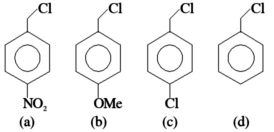
A
$a > c > d > b$
B
$a > b > c > d$
C
$b > d > c > a$
D
$d > b > c > a$
Solution
(C) The rate of $S_N 1$ reaction depends upon the stability of the carbocation intermediate formed after the departure of the leaving group $(Cl^-)$.
Electron-donating groups (like $-OCH_3$) increase the stability of the carbocation,while electron-withdrawing groups (like $-NO_2$ and $-Cl$) decrease its stability.
The stability order of the carbocations is:
$p-methoxybenzyl$ carbocation $(b)$ $>$ $benzyl$ carbocation $(d)$ $>$ $p-chlorobenzyl$ carbocation $(c)$ $>$ $p-nitrobenzyl$ carbocation $(a)$.
Therefore,the decreasing order of reactivity towards $S_N 1$ reaction is:
$(b) > (d) > (c) > (a)$.
Electron-donating groups (like $-OCH_3$) increase the stability of the carbocation,while electron-withdrawing groups (like $-NO_2$ and $-Cl$) decrease its stability.
The stability order of the carbocations is:
$p-methoxybenzyl$ carbocation $(b)$ $>$ $benzyl$ carbocation $(d)$ $>$ $p-chlorobenzyl$ carbocation $(c)$ $>$ $p-nitrobenzyl$ carbocation $(a)$.
Therefore,the decreasing order of reactivity towards $S_N 1$ reaction is:
$(b) > (d) > (c) > (a)$.
0 likesView Solution
175
ChemistryMediumMCQJEE Main · 2023
In the above conversion of compound $(X)$ to product $(Y)$,the sequence of reagents to be used will be:
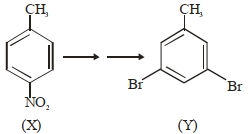
A
$(I) Br_2, Fe$ $(II) Fe, H^{+}$ $(III) LiAlH_4$
B
$(I) Br_2 (aq)$ $(II) LiAlH_4$ $(III) H_3O^{+}$
C
$(I) Fe, H^{+}$ $(II) Br_2 (aq)$ $(III) HNO_2$ $(IV) CuBr$
D
$(I) Fe, H^{+}$ $(II) Br_2 (aq)$ $(III) HNO_2$ $(IV) H_3PO_2$
Solution
(D) The conversion of $p$-nitrotoluene $(X)$ to $3,5$-dibromotoluene $(Y)$ involves the following steps:
$1$. Reduction of the nitro group to an amino group: $p$-nitrotoluene is reduced using $Fe/H^{+}$ to form $p$-toluidine.
$2$. Bromination: $p$-toluidine is treated with $Br_2 (aq)$ to form $2,6$-dibromo-$4$-methylaniline due to the strong activating effect of the $-NH_2$ group.
$3$. Diazotization: The amino group is converted to a diazonium salt using $HNO_2$ at $0-5 \ ^{\circ}C$.
$4$. Deamination: The diazonium group is removed using $H_3PO_2$ and water to yield $3,5$-dibromotoluene $(Y)$.
$1$. Reduction of the nitro group to an amino group: $p$-nitrotoluene is reduced using $Fe/H^{+}$ to form $p$-toluidine.
$2$. Bromination: $p$-toluidine is treated with $Br_2 (aq)$ to form $2,6$-dibromo-$4$-methylaniline due to the strong activating effect of the $-NH_2$ group.
$3$. Diazotization: The amino group is converted to a diazonium salt using $HNO_2$ at $0-5 \ ^{\circ}C$.
$4$. Deamination: The diazonium group is removed using $H_3PO_2$ and water to yield $3,5$-dibromotoluene $(Y)$.
0 likesView Solution
176
ChemistryMediumMCQJEE Main · 2023
Match List-$I$ with List-$II$:
| List-$I$ (Complexes) | List-$II$ (Hybridisation) |
|---|---|
| $A$. $[Ni(CO)_4]$ | $I$. $sp^3$ |
| $B$. $[Cu(NH_3)_4]^{2+}$ | $II$. $dsp^2$ |
| $C$. $[Fe(NH_3)_6]^{2+}$ | $III$. $sp^3d^2$ |
| $D$. $[Fe(H_2O)_6]^{2+}$ | $IV$. $d^2sp^3$ |
A
$A-II, B-I, C-III, D-IV$
B
$A-I, B-II, C-III, D-IV$
C
$A-II, B-I, C-IV, D-III$
D
$A-I, B-II, C-IV, D-III$
Solution
(D) $1$. $[Ni(CO)_4]$: $Ni$ is in $0$ oxidation state $(3d^8 4s^2)$. $CO$ is a strong field ligand,causing pairing. Hybridisation is $sp^3$ $(I)$.
$2$. $[Cu(NH_3)_4]^{2+}$: $Cu^{2+}$ is $3d^9$. The unpaired electron is in $4p_z$,and the hybridisation is $dsp^2$ $(II)$.
$3$. $[Fe(NH_3)_6]^{2+}$: $Fe^{2+}$ is $3d^6$. $NH_3$ is a strong field ligand,causing pairing. Hybridisation is $d^2sp^3$ $(IV)$.
$4$. $[Fe(H_2O)_6]^{2+}$: $Fe^{2+}$ is $3d^6$. $H_2O$ is a weak field ligand,no pairing. Hybridisation is $sp^3d^2$ $(III)$.
Thus,the correct match is $A-I, B-II, C-IV, D-III$.
$2$. $[Cu(NH_3)_4]^{2+}$: $Cu^{2+}$ is $3d^9$. The unpaired electron is in $4p_z$,and the hybridisation is $dsp^2$ $(II)$.
$3$. $[Fe(NH_3)_6]^{2+}$: $Fe^{2+}$ is $3d^6$. $NH_3$ is a strong field ligand,causing pairing. Hybridisation is $d^2sp^3$ $(IV)$.
$4$. $[Fe(H_2O)_6]^{2+}$: $Fe^{2+}$ is $3d^6$. $H_2O$ is a weak field ligand,no pairing. Hybridisation is $sp^3d^2$ $(III)$.
Thus,the correct match is $A-I, B-II, C-IV, D-III$.
0 likesView Solution
177
ChemistryMediumMCQJEE Main · 2023
The $Cl-Co-Cl$ bond angle values in a $fac-[Co(NH_3)_3Cl_3]$ complex is/are:
A
$90^{\circ}$ and $180^{\circ}$
B
$90^{\circ}$
C
$180^{\circ}$
D
$90^{\circ}$ and $120^{\circ}$
Solution
(B) In a $fac-[Co(NH_3)_3Cl_3]$ complex,the three $Cl^-$ ligands occupy one face of the octahedral geometry.
This means the three $Cl^-$ ligands are at the corners of a triangular face.
In this arrangement,each $Cl^-$ ligand is adjacent to the other two $Cl^-$ ligands.
The bond angle between any two adjacent $Cl^-$ ligands in an octahedral geometry is $90^{\circ}$.
Therefore,the only $Cl-Co-Cl$ bond angle present is $90^{\circ}$.
This means the three $Cl^-$ ligands are at the corners of a triangular face.
In this arrangement,each $Cl^-$ ligand is adjacent to the other two $Cl^-$ ligands.
The bond angle between any two adjacent $Cl^-$ ligands in an octahedral geometry is $90^{\circ}$.
Therefore,the only $Cl-Co-Cl$ bond angle present is $90^{\circ}$.
0 likesView Solution
178
ChemistryDifficultMCQJEE Main · 2023
Given below are two statements: One is labelled as Assertion $A$ and the other is labelled as Reason $R$.
Assertion $A$ : $Image-I$ can be easily reduced using $Zn-Hg / HCl$ to $Image-II$.
Reason $R : Zn-Hg / HCl$ is used to reduce carbonyl group to $-CH_2-$ group.
In the light of the above statements,choose the correct answer from the options given below:
Assertion $A$ : $Image-I$ can be easily reduced using $Zn-Hg / HCl$ to $Image-II$.
Reason $R : Zn-Hg / HCl$ is used to reduce carbonyl group to $-CH_2-$ group.
In the light of the above statements,choose the correct answer from the options given below:
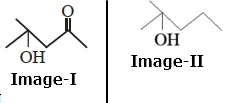
A
$A$ is false but $R$ is true
B
$A$ is true but $R$ is false
C
Both $A$ and $R$ are true but $R$ is not the correct explanation of $A$
D
Both $A$ and $R$ are true and $R$ is the correct explanation of $A$
Solution
(A) Assertion $A$ is false because the molecule contains an alcohol group which is acid-sensitive. In the presence of $HCl$ (a strong acid),the $-OH$ group will undergo dehydration or substitution,making Clemmensen reduction unsuitable for this specific conversion.
Reason $R$ is true because $Zn-Hg / HCl$ (Clemmensen reduction) is indeed a standard reagent used to reduce carbonyl groups to methylene $(-CH_2-)$ groups in acid-stable compounds.
Reason $R$ is true because $Zn-Hg / HCl$ (Clemmensen reduction) is indeed a standard reagent used to reduce carbonyl groups to methylene $(-CH_2-)$ groups in acid-stable compounds.
0 likesView Solution
179
ChemistryMediumMCQJEE Main · 2023
Given below are two statements: One is labelled as Assertion $A$ and the other labelled as Reason $R$.
Assertion $A:$ Antihistamines do not affect the secretion of acid in stomach.
Reason $R :$ Antiallergic and antacid drugs work on different receptors.
In the light of the above statements,choose the correct answer from the options given below:
Assertion $A:$ Antihistamines do not affect the secretion of acid in stomach.
Reason $R :$ Antiallergic and antacid drugs work on different receptors.
In the light of the above statements,choose the correct answer from the options given below:
A
$A$ is false but $R$ is true
B
Both $A$ and $R$ are true and $R$ is the correct explanation of $A$
C
$A$ is true but $R$ is false
D
Both $A$ and $R$ are true but $R$ is not the correct explanation of $A$.
Solution
(B) Assertion $A$ is true because antihistamines (like brompheniramine) are used to treat allergies by blocking histamine receptors,but they do not affect the secretion of acid in the stomach.
Reason $R$ is true because antacids (like cimetidine) work by preventing the interaction of histamine with receptors present in the stomach wall,which is a different mechanism compared to antiallergic drugs.
Since antihistamines used for allergies do not block the specific receptors in the stomach that trigger acid secretion,the reason correctly explains why the assertion is true.
Reason $R$ is true because antacids (like cimetidine) work by preventing the interaction of histamine with receptors present in the stomach wall,which is a different mechanism compared to antiallergic drugs.
Since antihistamines used for allergies do not block the specific receptors in the stomach that trigger acid secretion,the reason correctly explains why the assertion is true.
0 likesView Solution
180
ChemistryMediumMCQJEE Main · 2023
The bond dissociation energy of the $E-H$ bond in the $H_2E$ hydrides of group $16$ elements (where $E = O, S, Se, Te$) follows which order?
A
$H_2O > H_2S > H_2Se > H_2Te$
B
$H_2O > H_2S > H_2Te > H_2Se$
C
$H_2S > H_2O > H_2Se > H_2Te$
D
$H_2Te > H_2Se > H_2S > H_2O$
Solution
(A) As we move down the group $16$ from $O$ to $Te$,the atomic size of the central element $E$ increases.
Due to the increase in atomic size,the bond length of the $E-H$ bond increases.
As the bond length increases,the bond strength decreases,which leads to a decrease in the bond dissociation energy.
Therefore,the order of bond dissociation energy is $H_2O > H_2S > H_2Se > H_2Te$.
Due to the increase in atomic size,the bond length of the $E-H$ bond increases.
As the bond length increases,the bond strength decreases,which leads to a decrease in the bond dissociation energy.
Therefore,the order of bond dissociation energy is $H_2O > H_2S > H_2Se > H_2Te$.
0 likesView Solution
181
ChemistryMediumMCQJEE Main · 2023
Given below are two statements:
Statement $I$: During electrolytic refining,the pure metal is made to act as anode and its impure metallic form is used as cathode.
Statement $II$: During the Hall-Heroult electrolysis process,purified $Al_2O_3$ is mixed with $Na_3AlF_6$ to lower the melting point of the mixture.
In the light of the above statements,choose the most appropriate answer from the options given below:
Statement $I$: During electrolytic refining,the pure metal is made to act as anode and its impure metallic form is used as cathode.
Statement $II$: During the Hall-Heroult electrolysis process,purified $Al_2O_3$ is mixed with $Na_3AlF_6$ to lower the melting point of the mixture.
In the light of the above statements,choose the most appropriate answer from the options given below:
A
Statement $I$ is incorrect but Statement $II$ is correct
B
Both Statement $I$ and Statement $II$ are incorrect
C
Statement $I$ is correct but Statement $II$ is incorrect
D
Both Statement $I$ and Statement $II$ are correct
Solution
(A) In electrolytic refining,the impure metal is made to act as the anode and the pure metal is made to act as the cathode. Thus,Statement $I$ is incorrect.
In the Hall-Heroult process,$Al_2O_3$ is mixed with cryolite $(Na_3AlF_6)$ and fluorspar $(CaF_2)$. This mixture lowers the melting point of the electrolyte and increases its electrical conductivity. Thus,Statement $II$ is correct.
In the Hall-Heroult process,$Al_2O_3$ is mixed with cryolite $(Na_3AlF_6)$ and fluorspar $(CaF_2)$. This mixture lowers the melting point of the electrolyte and increases its electrical conductivity. Thus,Statement $II$ is correct.
0 likesView Solution
182
ChemistryDifficultMCQJEE Main · 2023
The formula for Nessler's reagent is:
A
$K_2HgI_4$
B
$KHgI_3$
C
$K_2HgI_4$
D
$HgI_2$
Solution
(A) Nessler's reagent is an alkaline solution of potassium tetraiodomercurate$(II)$,which has the chemical formula $K_2[HgI_4]$.
0 likesView Solution
183
ChemistryMediumMCQJEE Main · 2023
$1\,L, 0.02\,M$ solution of $[Co(NH_3)_5SO_4]Br$ is mixed with $1\,L, 0.02\,M$ solution of $[Co(NH_3)_5Br]SO_4$. The resulting solution is divided into two equal parts $(X)$ and treated with excess $AgNO_3$ solution and $BaCl_2$ solution respectively as shown below:
$1\,L$ Solution $(X) + AgNO_3$ solution (excess) $\rightarrow Y$
$1\,L$ Solution $(X) + BaCl_2$ solution (excess) $\rightarrow Z$
The number of moles of $Y$ and $Z$ respectively are:
$1\,L$ Solution $(X) + AgNO_3$ solution (excess) $\rightarrow Y$
$1\,L$ Solution $(X) + BaCl_2$ solution (excess) $\rightarrow Z$
The number of moles of $Y$ and $Z$ respectively are:
A
$0.02, 0.02$
B
$0.01, 0.01$
C
$0.02, 0.01$
D
$0.01, 0.02$
Solution
(B) The initial moles of $[Co(NH_3)_5SO_4]Br$ are $1\,L \times 0.02\,M = 0.02\,mol$.
The initial moles of $[Co(NH_3)_5Br]SO_4$ are $1\,L \times 0.02\,M = 0.02\,mol$.
The total volume of the mixture is $2\,L$.
When the mixture is divided into two equal parts $(X)$,each part has a volume of $1\,L$.
In $1\,L$ of solution $(X)$,the moles of each complex are halved: $0.01\,mol$ of $[Co(NH_3)_5SO_4]Br$ and $0.01\,mol$ of $[Co(NH_3)_5Br]SO_4$.
The complex $[Co(NH_3)_5SO_4]Br$ dissociates to give $Br^-$ ions,and $[Co(NH_3)_5Br]SO_4$ dissociates to give $SO_4^{2-}$ ions.
Moles of $Br^-$ in $1\,L$ of $(X) = 0.01\,mol$.
Moles of $SO_4^{2-}$ in $1\,L$ of $(X) = 0.01\,mol$.
Reaction with $AgNO_3$: $Br^- + AgNO_3 \rightarrow AgBr(Y) + NO_3^-$. Moles of $Y (AgBr) = 0.01\,mol$.
Reaction with $BaCl_2$: $SO_4^{2-} + BaCl_2 \rightarrow BaSO_4(Z) + 2Cl^-$. Moles of $Z (BaSO_4) = 0.01\,mol$.
The initial moles of $[Co(NH_3)_5Br]SO_4$ are $1\,L \times 0.02\,M = 0.02\,mol$.
The total volume of the mixture is $2\,L$.
When the mixture is divided into two equal parts $(X)$,each part has a volume of $1\,L$.
In $1\,L$ of solution $(X)$,the moles of each complex are halved: $0.01\,mol$ of $[Co(NH_3)_5SO_4]Br$ and $0.01\,mol$ of $[Co(NH_3)_5Br]SO_4$.
The complex $[Co(NH_3)_5SO_4]Br$ dissociates to give $Br^-$ ions,and $[Co(NH_3)_5Br]SO_4$ dissociates to give $SO_4^{2-}$ ions.
Moles of $Br^-$ in $1\,L$ of $(X) = 0.01\,mol$.
Moles of $SO_4^{2-}$ in $1\,L$ of $(X) = 0.01\,mol$.
Reaction with $AgNO_3$: $Br^- + AgNO_3 \rightarrow AgBr(Y) + NO_3^-$. Moles of $Y (AgBr) = 0.01\,mol$.
Reaction with $BaCl_2$: $SO_4^{2-} + BaCl_2 \rightarrow BaSO_4(Z) + 2Cl^-$. Moles of $Z (BaSO_4) = 0.01\,mol$.
0 likesView Solution
184
ChemistryMediumMCQJEE Main · 2023
Iron oxide $FeO$ crystallises in a cubic lattice with a unit cell edge length of $5.0 \ \mathring{A}$. If the density of the $FeO$ in the crystal is $4.0 \ g \ cm^{-3}$,then the number of $FeO$ units present per unit cell is $...........$ (Nearest integer).
Given: Molar mass of $Fe$ and $O$ is $56$ and $16 \ g \ mol^{-1}$ respectively.
$N_{A} = 6.0 \times 10^{23} \ mol^{-1}$
Given: Molar mass of $Fe$ and $O$ is $56$ and $16 \ g \ mol^{-1}$ respectively.
$N_{A} = 6.0 \times 10^{23} \ mol^{-1}$
A
$2$
B
$6$
C
$8$
D
$4$
Solution
(D) The density formula for a unit cell is given by $d = \frac{Z \times M}{N_{A} \times a^3}$.
Here,$d = 4.0 \ g \ cm^{-3}$,$M = 56 + 16 = 72 \ g \ mol^{-1}$,$a = 5.0 \ \mathring{A} = 5.0 \times 10^{-8} \ cm$,and $N_{A} = 6.0 \times 10^{23} \ mol^{-1}$.
Substituting the values: $4.0 = \frac{Z \times 72}{6.0 \times 10^{23} \times (5.0 \times 10^{-8})^3}$.
$4.0 = \frac{Z \times 72}{6.0 \times 10^{23} \times 125 \times 10^{-24}}$.
$4.0 = \frac{Z \times 72}{0.075}$.
$Z = \frac{4.0 \times 0.075}{72} \approx 4.166$.
The nearest integer value for the number of $FeO$ units per unit cell is $4$.
Here,$d = 4.0 \ g \ cm^{-3}$,$M = 56 + 16 = 72 \ g \ mol^{-1}$,$a = 5.0 \ \mathring{A} = 5.0 \times 10^{-8} \ cm$,and $N_{A} = 6.0 \times 10^{23} \ mol^{-1}$.
Substituting the values: $4.0 = \frac{Z \times 72}{6.0 \times 10^{23} \times (5.0 \times 10^{-8})^3}$.
$4.0 = \frac{Z \times 72}{6.0 \times 10^{23} \times 125 \times 10^{-24}}$.
$4.0 = \frac{Z \times 72}{0.075}$.
$Z = \frac{4.0 \times 0.075}{72} \approx 4.166$.
The nearest integer value for the number of $FeO$ units per unit cell is $4$.
0 likesView Solution
185
ChemistryDifficultMCQJEE Main · 2023
An organic compound undergoes first order decomposition. If the time taken for the $60 \%$ decomposition is $540 \ s$,then the time required for $90 \%$ decomposition will be $.......... \ s$. (Nearest integer). Given : $\ln 10 = 2.3 ; \log 2 = 0.3$
A
$1351$
B
$1352$
C
$1353$
D
$1350$
Solution
(D) For a first order reaction,the rate constant $k$ is given by $k = \frac{1}{t} \ln \frac{a_0}{a_t}$.
For $60 \%$ decomposition,$a_t = a_0 - 0.6 a_0 = 0.4 a_0$ and $t_1 = 540 \ s$.
$k = \frac{1}{540} \ln \frac{a_0}{0.4 a_0} = \frac{1}{540} \ln \frac{10}{4} = \frac{1}{540} (\ln 10 - \ln 4) = \frac{1}{540} (2.3 - 2 \times 0.3 \times 2.3 / 2.3) = \frac{1}{540} (2.3 - 1.38) = \frac{0.92}{540}$.
For $90 \%$ decomposition,$a_t = a_0 - 0.9 a_0 = 0.1 a_0$.
$t_2 = \frac{1}{k} \ln \frac{a_0}{0.1 a_0} = \frac{1}{k} \ln 10 = \frac{1}{k} \times 2.3$.
Substituting $k$: $t_2 = \frac{540}{0.92} \times 2.3 = \frac{540 \times 2.3}{0.92} = \frac{1242}{0.92} = 1350 \ s$.
For $60 \%$ decomposition,$a_t = a_0 - 0.6 a_0 = 0.4 a_0$ and $t_1 = 540 \ s$.
$k = \frac{1}{540} \ln \frac{a_0}{0.4 a_0} = \frac{1}{540} \ln \frac{10}{4} = \frac{1}{540} (\ln 10 - \ln 4) = \frac{1}{540} (2.3 - 2 \times 0.3 \times 2.3 / 2.3) = \frac{1}{540} (2.3 - 1.38) = \frac{0.92}{540}$.
For $90 \%$ decomposition,$a_t = a_0 - 0.9 a_0 = 0.1 a_0$.
$t_2 = \frac{1}{k} \ln \frac{a_0}{0.1 a_0} = \frac{1}{k} \ln 10 = \frac{1}{k} \times 2.3$.
Substituting $k$: $t_2 = \frac{540}{0.92} \times 2.3 = \frac{540 \times 2.3}{0.92} = \frac{1242}{0.92} = 1350 \ s$.
0 likesView Solution
186
ChemistryDifficultMCQJEE Main · 2023
Lead storage battery contains $38\%$ by weight solution of $H_2SO_4$. The van't Hoff factor is $2.67$ at this concentration. The temperature in Kelvin at which the solution in the battery will freeze is $..........$ (Nearest integer). Given $K_f = 1.8 \, K \, kg \, mol^{-1}$.
A
$241$
B
$242$
C
$256$
D
$243$
Solution
(D) The formula for freezing point depression is $\Delta T_f = i \cdot K_f \cdot m$.
Here,$i = 2.67$,$K_f = 1.8 \, K \, kg \, mol^{-1}$.
The molality $m$ is calculated as: $m = \frac{\text{mass of solute}}{\text{molar mass of solute}} \times \frac{1000}{\text{mass of solvent in grams}}$.
For $38\%$ by weight $H_2SO_4$,mass of $H_2SO_4 = 38 \, g$,mass of water = $100 - 38 = 62 \, g$.
$m = \frac{38}{98} \times \frac{1000}{62} \approx 6.254 \, mol \, kg^{-1}$.
$\Delta T_f = 2.67 \times 1.8 \times 6.254 \approx 30.05 \, K$.
Freezing point of pure water = $273.15 \, K$.
Freezing point of solution = $273.15 - 30.05 = 243.1 \, K$.
Rounding to the nearest integer,we get $243 \, K$.
Here,$i = 2.67$,$K_f = 1.8 \, K \, kg \, mol^{-1}$.
The molality $m$ is calculated as: $m = \frac{\text{mass of solute}}{\text{molar mass of solute}} \times \frac{1000}{\text{mass of solvent in grams}}$.
For $38\%$ by weight $H_2SO_4$,mass of $H_2SO_4 = 38 \, g$,mass of water = $100 - 38 = 62 \, g$.
$m = \frac{38}{98} \times \frac{1000}{62} \approx 6.254 \, mol \, kg^{-1}$.
$\Delta T_f = 2.67 \times 1.8 \times 6.254 \approx 30.05 \, K$.
Freezing point of pure water = $273.15 \, K$.
Freezing point of solution = $273.15 - 30.05 = 243.1 \, K$.
Rounding to the nearest integer,we get $243 \, K$.
0 likesView Solution
187
ChemistryDifficultMCQJEE Main · 2023
The graph of $\log \frac{x}{m}$ vs $\log p$ for an adsorption process is a straight line inclined at an angle of $45^{\circ}$ with an intercept equal to $0.6020$. The mass of gas adsorbed per unit mass of adsorbent at the pressure of $0.4 \ atm$ is $......... \times 10^{-1}$ (Nearest integer). Given: $\log 2 = 0.3010$.
A
$14$
B
$12$
C
$10$
D
$16$
Solution
(D) The Freundlich adsorption isotherm is given by the equation: $\log \frac{x}{m} = \log k + \frac{1}{n} \log P$.
Comparing this with the equation of a straight line $y = mx + c$,we have the slope $\frac{1}{n} = \tan 45^{\circ} = 1$ and the intercept $c = \log k = 0.6020$.
Since $\log 2 = 0.3010$,then $2 \times \log 2 = 0.6020$,which implies $\log 2^2 = \log 4 = 0.6020$. Thus,$k = 4$.
Substituting these values into the isotherm equation: $\frac{x}{m} = k \cdot P^{1/n} = 4 \times (0.4)^1 = 1.6$.
Expressing $1.6$ in the form $......... \times 10^{-1}$,we get $1.6 = 16 \times 10^{-1}$.
Therefore,the nearest integer is $16$.
Comparing this with the equation of a straight line $y = mx + c$,we have the slope $\frac{1}{n} = \tan 45^{\circ} = 1$ and the intercept $c = \log k = 0.6020$.
Since $\log 2 = 0.3010$,then $2 \times \log 2 = 0.6020$,which implies $\log 2^2 = \log 4 = 0.6020$. Thus,$k = 4$.
Substituting these values into the isotherm equation: $\frac{x}{m} = k \cdot P^{1/n} = 4 \times (0.4)^1 = 1.6$.
Expressing $1.6$ in the form $......... \times 10^{-1}$,we get $1.6 = 16 \times 10^{-1}$.
Therefore,the nearest integer is $16$.
0 likesView Solution
188
ChemistryDifficultMCQJEE Main · 2023
Number of compounds from the following which will not dissolve in cold $NaHCO_3$ and $NaOH$ solutions but will dissolve in hot $NaOH$ solution is $........$.
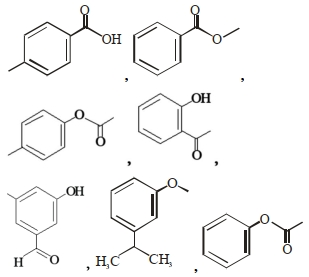
A
$4$
B
$5$
C
$6$
D
$3$
Solution
(D) The compounds are analyzed for their solubility in cold $NaHCO_3$,cold $NaOH$,and hot $NaOH$:
$1$. $p$-Toluic acid: Dissolves in $NaHCO_3$ and $NaOH$.
$2$. Methyl benzoate: Does not dissolve in cold $NaHCO_3$ or $NaOH$,but undergoes hydrolysis in hot $NaOH$ to form benzoic acid and methanol,thus dissolving.
$3$. $p$-Cresyl acetate: Does not dissolve in cold $NaHCO_3$ or $NaOH$,but undergoes hydrolysis in hot $NaOH$ to form $p$-cresol and acetic acid,thus dissolving.
$4$. $o$-Hydroxyacetophenone: Dissolves in $NaOH$ (phenolic group) but not $NaHCO_3$.
$5$. $3$-Hydroxy$-5-$methylbenzaldehyde: Dissolves in $NaOH$ (phenolic group) but not $NaHCO_3$.
$6$. $1$-Isopropyl$-3-$methoxybenzene: Does not dissolve in any of these.
$7$. Phenyl acetate: Does not dissolve in cold $NaHCO_3$ or $NaOH$,but undergoes hydrolysis in hot $NaOH$ to form phenol and acetic acid,thus dissolving.
Therefore,the compounds that do not dissolve in cold $NaHCO_3$ and $NaOH$ but dissolve in hot $NaOH$ are $2$,$3$,and $7$. The total count is $3$.
$1$. $p$-Toluic acid: Dissolves in $NaHCO_3$ and $NaOH$.
$2$. Methyl benzoate: Does not dissolve in cold $NaHCO_3$ or $NaOH$,but undergoes hydrolysis in hot $NaOH$ to form benzoic acid and methanol,thus dissolving.
$3$. $p$-Cresyl acetate: Does not dissolve in cold $NaHCO_3$ or $NaOH$,but undergoes hydrolysis in hot $NaOH$ to form $p$-cresol and acetic acid,thus dissolving.
$4$. $o$-Hydroxyacetophenone: Dissolves in $NaOH$ (phenolic group) but not $NaHCO_3$.
$5$. $3$-Hydroxy$-5-$methylbenzaldehyde: Dissolves in $NaOH$ (phenolic group) but not $NaHCO_3$.
$6$. $1$-Isopropyl$-3-$methoxybenzene: Does not dissolve in any of these.
$7$. Phenyl acetate: Does not dissolve in cold $NaHCO_3$ or $NaOH$,but undergoes hydrolysis in hot $NaOH$ to form phenol and acetic acid,thus dissolving.
Therefore,the compounds that do not dissolve in cold $NaHCO_3$ and $NaOH$ but dissolve in hot $NaOH$ are $2$,$3$,and $7$. The total count is $3$.
0 likesView Solution
189
ChemistryDifficultMCQJEE Main · 2023
$A$ short peptide on complete hydrolysis produces $3$ moles of glycine $(G)$,$2$ moles of leucine $(L)$ and $2$ moles of valine $(V)$ per mole of peptide. The number of peptide linkages in it are $..............$.
A
$4$
B
$2$
C
$8$
D
$6$
Solution
(D) The total number of amino acid residues in the peptide is the sum of the moles of each amino acid produced upon hydrolysis.
Total amino acid residues $= 3 (G) + 2 (L) + 2 (V) = 7$.
For a peptide chain containing $n$ amino acid residues,the number of peptide linkages is given by $(n - 1)$.
Therefore,the number of peptide linkages $= 7 - 1 = 6$.
Total amino acid residues $= 3 (G) + 2 (L) + 2 (V) = 7$.
For a peptide chain containing $n$ amino acid residues,the number of peptide linkages is given by $(n - 1)$.
Therefore,the number of peptide linkages $= 7 - 1 = 6$.
0 likesView Solution
190
ChemistryMediumMCQJEE Main · 2023
The electrode potential of the following half cell at $298 \ K$ is given by the cell reaction:
$X | X^{2+}(0.001 \ M) || Y^{2+}(0.01 \ M) | Y$
The cell potential is $....... \times 10^{-2} \ V$ (Nearest integer).
Given: $E^0_{X^{2+} | X} = -2.36 \ V$,$E^0_{Y^{2+} | Y} = +0.36 \ V$,$\frac{2.303 \ RT}{F} = 0.06 \ V$.
$X | X^{2+}(0.001 \ M) || Y^{2+}(0.01 \ M) | Y$
The cell potential is $....... \times 10^{-2} \ V$ (Nearest integer).
Given: $E^0_{X^{2+} | X} = -2.36 \ V$,$E^0_{Y^{2+} | Y} = +0.36 \ V$,$\frac{2.303 \ RT}{F} = 0.06 \ V$.
A
$274$
B
$273$
C
$272$
D
$275$
Solution
(D) The cell reaction is: $X(s) + Y^{2+}(aq) \rightarrow X^{2+}(aq) + Y(s)$.
The standard cell potential is $E^0_{cell} = E^0_{cathode} - E^0_{anode} = 0.36 \ V - (-2.36 \ V) = 2.72 \ V$.
Using the Nernst equation: $E_{cell} = E^0_{cell} - \frac{0.06}{n} \log \frac{[X^{2+}]}{[Y^{2+}]}$.
Here,$n = 2$,$[X^{2+}] = 0.001 \ M$,and $[Y^{2+}] = 0.01 \ M$.
$E_{cell} = 2.72 - \frac{0.06}{2} \log \frac{0.001}{0.01} = 2.72 - 0.03 \log(0.1) = 2.72 - 0.03(-1) = 2.72 + 0.03 = 2.75 \ V$.
Thus,$E_{cell} = 275 \times 10^{-2} \ V$.
The standard cell potential is $E^0_{cell} = E^0_{cathode} - E^0_{anode} = 0.36 \ V - (-2.36 \ V) = 2.72 \ V$.
Using the Nernst equation: $E_{cell} = E^0_{cell} - \frac{0.06}{n} \log \frac{[X^{2+}]}{[Y^{2+}]}$.
Here,$n = 2$,$[X^{2+}] = 0.001 \ M$,and $[Y^{2+}] = 0.01 \ M$.
$E_{cell} = 2.72 - \frac{0.06}{2} \log \frac{0.001}{0.01} = 2.72 - 0.03 \log(0.1) = 2.72 - 0.03(-1) = 2.72 + 0.03 = 2.75 \ V$.
Thus,$E_{cell} = 275 \times 10^{-2} \ V$.
0 likesView Solution
191
ChemistryMediumMCQJEE Main · 2023
What is the electronic configuration of $Nd^{2+}$?
A
$4f^2 6s^2$
B
$4f^4$
C
$4f^3$
D
$4f^4 6s^2$
Solution
(B) The atomic number of Neodymium $(Nd)$ is $60$.
The ground state electronic configuration of $Nd$ is $[Xe] 4f^4 6s^2$.
When $Nd$ forms the $Nd^{2+}$ ion,it loses two electrons from the outermost $6s$ orbital.
Therefore,the electronic configuration of $Nd^{2+}$ is $[Xe] 4f^4$.
The ground state electronic configuration of $Nd$ is $[Xe] 4f^4 6s^2$.
When $Nd$ forms the $Nd^{2+}$ ion,it loses two electrons from the outermost $6s$ orbital.
Therefore,the electronic configuration of $Nd^{2+}$ is $[Xe] 4f^4$.
0 likesView Solution
192
ChemistryMediumMCQJEE Main · 2023
The methods $NOT$ involved in the concentration of ore are:
$A$. Liquation
$B$. Leaching
$C$. Electrolysis
$D$. Hydraulic washing
$E$. Froth flotation
Choose the correct answer from the options given below:
$A$. Liquation
$B$. Leaching
$C$. Electrolysis
$D$. Hydraulic washing
$E$. Froth flotation
Choose the correct answer from the options given below:
A
$B, D$ and $C$ only
B
$C, D$ and $E$ only
C
$A$ and $C$ only
D
$B, D$ and $E$ only
Solution
(C) The concentration of ore (also known as beneficiation or dressing) involves removing gangue from the ore. The common methods are:
$(i)$ Hydraulic Washing (Gravity separation)
$(ii)$ Froth Flotation
$(iii)$ Magnetic Separation
$(iv)$ Leaching
Liquation $(A)$ is a method used for the refining of metals with low melting points.
Electrolysis $(C)$ is a method used for the refining of metals.
Therefore,the methods $NOT$ involved in the concentration of ore are $A$ (Liquation) and $C$ (Electrolysis).
$(i)$ Hydraulic Washing (Gravity separation)
$(ii)$ Froth Flotation
$(iii)$ Magnetic Separation
$(iv)$ Leaching
Liquation $(A)$ is a method used for the refining of metals with low melting points.
Electrolysis $(C)$ is a method used for the refining of metals.
Therefore,the methods $NOT$ involved in the concentration of ore are $A$ (Liquation) and $C$ (Electrolysis).
0 likesView Solution
193
ChemistryDifficultMCQJEE Main · 2023
Consider the following reaction:
$\text{Propanal} + \text{Methanal}$ $\xrightarrow[\text{(ii)}\Delta, \text{(iii)}\text{NaCN}, \text{(iv)}\text{H}_3\text{O}^+]{\text{(i)}\text{dil. NaOH}} \text{Product } B (C_5H_8O_3)$
The correct statement for product $B$ is:
$\text{Propanal} + \text{Methanal}$ $\xrightarrow[\text{(ii)}\Delta, \text{(iii)}\text{NaCN}, \text{(iv)}\text{H}_3\text{O}^+]{\text{(i)}\text{dil. NaOH}} \text{Product } B (C_5H_8O_3)$
The correct statement for product $B$ is:
A
optically active and adds one mole of bromine
B
racemic mixture and is neutral
C
racemic mixture and gives a gas with saturated $\text{NaHCO}_3$ solution
D
optically active alcohol and is neutral
Solution
(C) $1$. The reaction of $\text{Propanal} (CH_3CH_2CHO)$ and $\text{Methanal} (HCHO)$ in the presence of $\text{dil. NaOH}$ followed by heating $(\Delta)$ undergoes a cross-aldol condensation to form $2-\text{methylacrolein}$ $(CH_2=C(CH_3)CHO)$.
$2$. The subsequent reaction with $\text{NaCN}$ followed by acid hydrolysis $(\text{H}_3\text{O}^ )$ is a cyanohydrin formation reaction,which converts the aldehyde group $(-CHO)$ into a carboxylic acid group $(-COOH)$ with an adjacent hydroxyl group $(-OH)$.
$3$. The final product $B$ is $2-\text{hydroxy}-2-\text{methylbut}-3-\text{enoic acid}$ (or a similar structure depending on the specific pathway,but the key is the presence of the $-COOH$ group and the chiral center).
$4$. The product contains a chiral center (marked with $*$ in the mechanism),and since the reaction conditions do not involve chiral catalysts,it is formed as a racemic mixture.
$5$. The presence of the carboxylic acid group $(-COOH)$ ensures that it reacts with $\text{NaHCO}_3$ to release $\text{CO}_2$ gas.
$2$. The subsequent reaction with $\text{NaCN}$ followed by acid hydrolysis $(\text{H}_3\text{O}^ )$ is a cyanohydrin formation reaction,which converts the aldehyde group $(-CHO)$ into a carboxylic acid group $(-COOH)$ with an adjacent hydroxyl group $(-OH)$.
$3$. The final product $B$ is $2-\text{hydroxy}-2-\text{methylbut}-3-\text{enoic acid}$ (or a similar structure depending on the specific pathway,but the key is the presence of the $-COOH$ group and the chiral center).
$4$. The product contains a chiral center (marked with $*$ in the mechanism),and since the reaction conditions do not involve chiral catalysts,it is formed as a racemic mixture.
$5$. The presence of the carboxylic acid group $(-COOH)$ ensures that it reacts with $\text{NaHCO}_3$ to release $\text{CO}_2$ gas.
0 likesView Solution
194
ChemistryMediumMCQJEE Main · 2023
The correct order of basicity of oxides of vanadium is
A
$V_2O_3 > V_2O_4 > V_2O_5$
B
$V_2O_3 > V_2O_5 > V_2O_4$
C
$V_2O_5 > V_2O_4 > V_2O_3$
D
$V_2O_4 > V_2O_3 > V_2O_5$
Solution
(A) The basicity of oxides of a transition metal decreases as the oxidation state of the metal increases.
In $V_2O_3$,the oxidation state of $V$ is $+3$.
In $V_2O_4$,the oxidation state of $V$ is $+4$.
In $V_2O_5$,the oxidation state of $V$ is $+5$.
As the oxidation state increases,the acidic character increases and the basic character decreases.
Therefore,the order of basicity is $V_2O_3 > V_2O_4 > V_2O_5$.
In $V_2O_3$,the oxidation state of $V$ is $+3$.
In $V_2O_4$,the oxidation state of $V$ is $+4$.
In $V_2O_5$,the oxidation state of $V$ is $+5$.
As the oxidation state increases,the acidic character increases and the basic character decreases.
Therefore,the order of basicity is $V_2O_3 > V_2O_4 > V_2O_5$.
0 likesView Solution
195
ChemistryMediumMCQJEE Main · 2023
When $Cu^{2+}$ ion is treated with $KI$,a white precipitate,$X$ appears in solution. The solution is titrated with sodium thiosulphate,the compound $Y$ is formed. $X$ and $Y$ respectively are
A
$X = Cu_2I_2, Y = Na_2S_4O_5$
B
$X = Cu_2I_2, Y = Na_2S_4O_6$
C
$X = CuI_2, Y = Na_2S_4O_3$
D
$X = CuI_2, Y = Na_2S_4O_6$
Solution
(B) When $Cu^{2+}$ ions react with $KI$,$CuI_2$ is initially formed,which is unstable and decomposes to form a white precipitate of $Cu_2I_2$ and iodine $(I_2)$:
$2Cu^{2+} + 4I^-$ $\rightarrow 2CuI_2$ $\rightarrow Cu_2I_2 \downarrow + I_2$
The liberated $I_2$ dissolves in excess $KI$ to form $KI_3$ (triiodide ion),which gives a brown color to the solution:
$I_2 + I^- \rightarrow I_3^-$
This solution is then titrated against sodium thiosulphate $(Na_2S_2O_3)$,where $I_2$ is reduced to $I^-$ and thiosulphate is oxidized to tetrathionate $(Na_2S_4O_6)$:
$I_2 + 2Na_2S_2O_3 \rightarrow 2NaI + Na_2S_4O_6$
Thus,$X$ is $Cu_2I_2$ and $Y$ is $Na_2S_4O_6$.
$2Cu^{2+} + 4I^-$ $\rightarrow 2CuI_2$ $\rightarrow Cu_2I_2 \downarrow + I_2$
The liberated $I_2$ dissolves in excess $KI$ to form $KI_3$ (triiodide ion),which gives a brown color to the solution:
$I_2 + I^- \rightarrow I_3^-$
This solution is then titrated against sodium thiosulphate $(Na_2S_2O_3)$,where $I_2$ is reduced to $I^-$ and thiosulphate is oxidized to tetrathionate $(Na_2S_4O_6)$:
$I_2 + 2Na_2S_2O_3 \rightarrow 2NaI + Na_2S_4O_6$
Thus,$X$ is $Cu_2I_2$ and $Y$ is $Na_2S_4O_6$.
0 likesView Solution
196
ChemistryEasyMCQJEE Main · 2023
Find $B$ in the following reaction sequence:
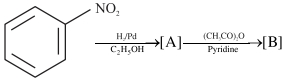
A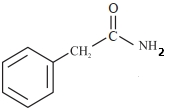
B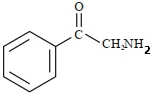
C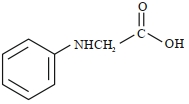
D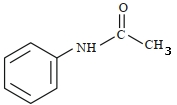
Solution
(D) The reaction sequence is as follows:
$1$. Nitrobenzene $(C_6H_5NO_2)$ is reduced using $H_2/Pd$ in ethanol $(C_2H_5OH)$ to form aniline $(C_6H_5NH_2)$,which is compound $[A]$.
$2$. Aniline $(C_6H_5NH_2)$ reacts with acetic anhydride $((CH_3CO)_2O)$ in the presence of pyridine to undergo acetylation,forming $N$-phenylacetamide (acetanilide),$C_6H_5NHCOCH_3$,which is compound $[B]$.
$1$. Nitrobenzene $(C_6H_5NO_2)$ is reduced using $H_2/Pd$ in ethanol $(C_2H_5OH)$ to form aniline $(C_6H_5NH_2)$,which is compound $[A]$.
$2$. Aniline $(C_6H_5NH_2)$ reacts with acetic anhydride $((CH_3CO)_2O)$ in the presence of pyridine to undergo acetylation,forming $N$-phenylacetamide (acetanilide),$C_6H_5NHCOCH_3$,which is compound $[B]$.
0 likesView Solution
197
ChemistryMediumMCQJEE Main · 2023
Cobalt chloride when dissolved in water forms a pink-colored complex $X$ which has an octahedral geometry. This solution,upon treatment with concentrated $HCl$,forms a deep blue complex $Y$ which has a $Z$ geometry. $X$,$Y$,and $Z$,respectively,are:
A
$X = [Co(H_2O)_6]^{2+}, Y = [CoCl_4]^{2-}, Z = \text{Tetrahedral}$
B
$X = [Co(H_2O)_6]^{2+}, Y = [CoCl_6]^{3-}, Z = \text{Octahedral}$
C
$X = [Co(H_2O)_6]^{3+}, Y = [CoCl_6]^{3-}, Z = \text{Octahedral}$
D
$X = [Co(H_2O)_4Cl_2]^{+}, Y = [CoCl_4]^{2-}, Z = \text{Tetrahedral}$
Solution
(A) When $CoCl_2$ is dissolved in water,it forms the pink-colored hexaaquacobalt$(II)$ ion,$[Co(H_2O)_6]^{2+}$,which has an octahedral geometry $(X)$.
Upon adding concentrated $HCl$,the water ligands are replaced by chloride ions to form the deep blue tetrachlorocobaltate$(II)$ ion,$[CoCl_4]^{2-}$ $(Y)$,which has a tetrahedral geometry $(Z)$.
Upon adding concentrated $HCl$,the water ligands are replaced by chloride ions to form the deep blue tetrachlorocobaltate$(II)$ ion,$[CoCl_4]^{2-}$ $(Y)$,which has a tetrahedral geometry $(Z)$.
0 likesView Solution
198
ChemistryMediumMCQJEE Main · 2023
The correct order of melting point of dichlorobenzenes is
A
$1,2-$dichlorobenzene > $1,3-$dichlorobenzene > $1,4-$dichlorobenzene
B
$1,4-$dichlorobenzene > $1,2-$dichlorobenzene > $1,3-$dichlorobenzene
C
$1,4-$dichlorobenzene > $1,3-$dichlorobenzene > $1,2-$dichlorobenzene
D
$1,2-$dichlorobenzene > $1,4-$dichlorobenzene > $1,3-$dichlorobenzene
Solution
(B) The melting point of $1,4-$dichlorobenzene is higher than those of $1,2-$ and $1,3-$ isomers due to its symmetrical structure,which allows for better packing in the crystal lattice.
Comparing the melting points:
$1,4-$dichlorobenzene: $323 \ K$
$1,2-$dichlorobenzene: $256 \ K$
$1,3-$dichlorobenzene: $249 \ K$
Thus,the correct order is $1,4- > 1,2- > 1,3-$dichlorobenzene.
Comparing the melting points:
$1,4-$dichlorobenzene: $323 \ K$
$1,2-$dichlorobenzene: $256 \ K$
$1,3-$dichlorobenzene: $249 \ K$
Thus,the correct order is $1,4- > 1,2- > 1,3-$dichlorobenzene.
0 likesView Solution
199
ChemistryDifficultMCQJEE Main · 2023
$A$ protein '$X$' with a molecular weight of $70,000 \ u$,on hydrolysis gives amino acids. One of these amino acids is:
A
$NH_2-CH_2-CH(CH_3)-CH_2-CH_2-COOH$
B
$CH_3-CH(CH_3)-CH_2-CH(NH_2)-COOH$
C
$CH_3-CH(CH_3)-CH(NH_2)-CH_2-COOH$
D
$CH_3-C(CH_3)(NH_2)-CH_2-CH_2-COOH$
Solution
(B) Proteins are polymers of $\alpha$-amino acids. An $\alpha$-amino acid is one in which the amino group $(-NH_2)$ is attached to the carbon atom adjacent to the carboxylic acid group $(-COOH)$,i.e.,the $\alpha$-carbon.
In option $(B)$,the structure is $CH_3-CH(CH_3)-CH_2-CH(NH_2)-COOH$. Here,the $-NH_2$ group is attached to the carbon atom directly adjacent to the $-COOH$ group. This is the structure of the amino acid Leucine.
In the other options,the $-NH_2$ group is attached to a carbon atom further away from the $-COOH$ group,meaning they are not $\alpha$-amino acids.
In option $(B)$,the structure is $CH_3-CH(CH_3)-CH_2-CH(NH_2)-COOH$. Here,the $-NH_2$ group is attached to the carbon atom directly adjacent to the $-COOH$ group. This is the structure of the amino acid Leucine.
In the other options,the $-NH_2$ group is attached to a carbon atom further away from the $-COOH$ group,meaning they are not $\alpha$-amino acids.
0 likesView Solution
200
ChemistryEasyMCQJEE Main · 2023
Which of the following artificial sweeteners has the highest sweetness value in comparison to cane sugar?
A
Aspartame
B
Sucralose
C
Alitame
D
Saccharin
Solution
(C) The sweetness values of artificial sweeteners relative to cane sugar are as follows:
$1$. $Alitame$: $2000$ times
$2$. $Sucralose$: $600$ times
$3$. $Saccharin$: $550$ times
$4$. $Aspartame$: $100$ times
Therefore,the order of sweetness is $Alitame > Sucralose > Saccharin > Aspartame$.
Thus,$Alitame$ has the highest sweetness value.
$1$. $Alitame$: $2000$ times
$2$. $Sucralose$: $600$ times
$3$. $Saccharin$: $550$ times
$4$. $Aspartame$: $100$ times
Therefore,the order of sweetness is $Alitame > Sucralose > Saccharin > Aspartame$.
Thus,$Alitame$ has the highest sweetness value.
0 likesView Solution
Vedclass Products
For Students
Vedclass Test Series
Mock tests in real JEE Main style covering Chemistry with performance analysis. 5-day free trial.
Start Free TrialFor Teachers
Exam Paper Generator
Generate Set A/B/C/D Chemistry papers from 7.5L+ questions in 2 minutes. 3 chapters free.
Try FreeFor Institutes
Online Exam Module
Run live JEE Main mock exams with unlimited students, 360° analytics & white-label branding.
See DemoFrequently Asked Questions
How many Chemistry questions are in JEE Main 2023?
There are 726 Chemistry questions from the JEE Main 2023 paper on Vedclass, each with a detailed step-by-step solution in English.
Are JEE Main 2023 Chemistry solutions available in English?
Yes. All solutions on this page are in English. You can also switch to English or Hindi using the language buttons above the questions.
Can I practice JEE Main 2023 Chemistry as a timed test?
Yes. Use the Vedclass Test Series to attempt a full JEE Main mock test covering Chemistry with time limits and instant score analysis.
Can teachers create Chemistry papers from JEE Main previous year questions?
Yes. The Vedclass Exam Paper Generator lets teachers mix JEE Main Chemistry questions and generate Set A/B/C/D papers in minutes.
For Teachers & Institutes
Build a Custom Chemistry Paper
Pick JEE Main 2023 Chemistry questions, set difficulty, and generate Set A/B/C/D in 2 minutes.