
ChemistryQ1–100 of 666 questions
Page 1 of 8 · English
1
ChemistryDifficultMCQJEE Main · 2022
$120 \ g$ of an organic compound that contains only carbon and hydrogen gives $330 \ g$ of $CO_{2}$ and $270 \ g$ of water on complete combustion. The percentage of carbon and hydrogen,respectively,are ...... .
A
$25$ and $75$
B
$40$ and $60$
C
$60$ and $40$
D
$75$ and $25$
Solution
(D) Given mass of organic compound $= 120 \ g$.
Mass of $CO_{2} = 330 \ g$.
Mass of $H_{2}O = 270 \ g$.
Mass of carbon $= (\text{moles of } CO_{2}) \times 12 = (330 / 44) \times 12 = 7.5 \times 12 = 90 \ g$.
Percentage of carbon $= (90 / 120) \times 100 = 75 \ \%$.
Mass of hydrogen $= (\text{moles of } H_{2}O) \times 2 = (270 / 18) \times 2 = 15 \times 2 = 30 \ g$.
Percentage of hydrogen $= (30 / 120) \times 100 = 25 \ \%$.
Therefore,the percentages are $75 \ \%$ and $25 \ \%$ respectively.
Mass of $CO_{2} = 330 \ g$.
Mass of $H_{2}O = 270 \ g$.
Mass of carbon $= (\text{moles of } CO_{2}) \times 12 = (330 / 44) \times 12 = 7.5 \times 12 = 90 \ g$.
Percentage of carbon $= (90 / 120) \times 100 = 75 \ \%$.
Mass of hydrogen $= (\text{moles of } H_{2}O) \times 2 = (270 / 18) \times 2 = 15 \times 2 = 30 \ g$.
Percentage of hydrogen $= (30 / 120) \times 100 = 25 \ \%$.
Therefore,the percentages are $75 \ \%$ and $25 \ \%$ respectively.
0 likesView Solution
2
ChemistryMediumMCQJEE Main · 2022
The energy of one mole of photons of radiation of wavelength $300 \ nm$ is ...... $kJ \ mol^{-1}$. (Given: $h = 6.63 \times 10^{-34} \ J \ s, N_A = 6.02 \times 10^{23} \ mol^{-1}, c = 3 \times 10^8 \ m \ s^{-1}$)
A
$235$
B
$325$
C
$399$
D
$435$
Solution
(C) The energy of one mole of photons is given by the formula: $E = \frac{hcN_A}{\lambda}$
Substituting the given values:
$E = \frac{6.63 \times 10^{-34} \ J \ s \times 3 \times 10^8 \ m \ s^{-1} \times 6.02 \times 10^{23} \ mol^{-1}}{300 \times 10^{-9} \ m}$
$E = \frac{11.976 \times 10^{-2} \ J \ mol^{-1}}{3 \times 10^{-7}}$
$E = 3.9913 \times 10^5 \ J \ mol^{-1}$
$E \approx 399 \ kJ \ mol^{-1}$
Substituting the given values:
$E = \frac{6.63 \times 10^{-34} \ J \ s \times 3 \times 10^8 \ m \ s^{-1} \times 6.02 \times 10^{23} \ mol^{-1}}{300 \times 10^{-9} \ m}$
$E = \frac{11.976 \times 10^{-2} \ J \ mol^{-1}}{3 \times 10^{-7}}$
$E = 3.9913 \times 10^5 \ J \ mol^{-1}$
$E \approx 399 \ kJ \ mol^{-1}$
0 likesView Solution
3
ChemistryMediumMCQJEE Main · 2022
The correct order of bond orders of $C_{2}^{2-}$,$N_{2}^{2-}$,and $O_{2}^{2-}$ is,respectively.
A
$C_{2}^{2-} < N_{2}^{2-} < O_{2}^{2-}$
B
$O_{2}^{2-} < N_{2}^{2-} < C_{2}^{2-}$
C
$C_{2}^{2-} < O_{2}^{2-} < N_{2}^{2-}$
D
$N_{2}^{2-} < C_{2}^{2-} < O_{2}^{2-}$
Solution
(B) To determine the bond order,we use the Molecular Orbital Theory $(MOT)$ configuration:
$1$. For $C_{2}^{2-}$ ($14$ electrons): $\sigma 1s^2, \sigma^* 1s^2, \sigma 2s^2, \sigma^* 2s^2, \pi 2p_x^2 = \pi 2p_y^2, \sigma 2p_z^2$. Bond order = $(10-4)/2 = 3$.
$2$. For $N_{2}^{2-}$ ($16$ electrons): $\sigma 1s^2, \sigma^* 1s^2, \sigma 2s^2, \sigma^* 2s^2, \pi 2p_x^2 = \pi 2p_y^2, \sigma 2p_z^2, \pi^* 2p_x^1 = \pi^* 2p_y^1$. Bond order = $(10-6)/2 = 2$.
$3$. For $O_{2}^{2-}$ ($18$ electrons): $\sigma 1s^2, \sigma^* 1s^2, \sigma 2s^2, \sigma^* 2s^2, \sigma 2p_z^2, \pi 2p_x^2 = \pi 2p_y^2, \pi^* 2p_x^2 = \pi^* 2p_y^2$. Bond order = $(10-8)/2 = 1$.
Thus,the order of bond orders is $O_{2}^{2-} (1) < N_{2}^{2-} (2) < C_{2}^{2-} (3)$.
$1$. For $C_{2}^{2-}$ ($14$ electrons): $\sigma 1s^2, \sigma^* 1s^2, \sigma 2s^2, \sigma^* 2s^2, \pi 2p_x^2 = \pi 2p_y^2, \sigma 2p_z^2$. Bond order = $(10-4)/2 = 3$.
$2$. For $N_{2}^{2-}$ ($16$ electrons): $\sigma 1s^2, \sigma^* 1s^2, \sigma 2s^2, \sigma^* 2s^2, \pi 2p_x^2 = \pi 2p_y^2, \sigma 2p_z^2, \pi^* 2p_x^1 = \pi^* 2p_y^1$. Bond order = $(10-6)/2 = 2$.
$3$. For $O_{2}^{2-}$ ($18$ electrons): $\sigma 1s^2, \sigma^* 1s^2, \sigma 2s^2, \sigma^* 2s^2, \sigma 2p_z^2, \pi 2p_x^2 = \pi 2p_y^2, \pi^* 2p_x^2 = \pi^* 2p_y^2$. Bond order = $(10-8)/2 = 1$.
Thus,the order of bond orders is $O_{2}^{2-} (1) < N_{2}^{2-} (2) < C_{2}^{2-} (3)$.
0 likesView Solution
4
ChemistryMediumMCQJEE Main · 2022
At $25^{\circ} C$ and $1 \ atm$ pressure,the enthalpies of combustion are as given below:
The enthalpy of formation of ethane is ........ .
| Substance | $H_{2(g)}$ | $C_{\text{(graphite)}}$ | $C_{2}H_{6(g)}$ |
| $\Delta_{c}H^{\Theta} / (kJ \ mol^{-1})$ | $-286.0$ | $-394.0$ | $-1560.0$ |
The enthalpy of formation of ethane is ........ .
A
$+54.0 \ kJ \ mol^{-1}$
B
$-68.0 \ kJ \ mol^{-1}$
C
$-86.0 \ kJ \ mol^{-1}$
D
$+97.0 \ kJ \ mol^{-1}$
Solution
(C) The formation reaction of ethane is: $2C_{\text{(graphite)}} + 3H_{2(g)} \rightarrow C_{2}H_{6(g)}$
The enthalpy of formation is given by: $\Delta_{f}H^{\Theta}(C_{2}H_{6}) = [2 \times \Delta_{c}H^{\Theta}(C) + 3 \times \Delta_{c}H^{\Theta}(H_{2})] - \Delta_{c}H^{\Theta}(C_{2}H_{6})$
Substituting the given values:
$\Delta_{f}H^{\Theta}(C_{2}H_{6}) = [2 \times (-394.0) + 3 \times (-286.0)] - (-1560.0)$
$\Delta_{f}H^{\Theta}(C_{2}H_{6}) = [-788.0 - 858.0] + 1560.0$
$\Delta_{f}H^{\Theta}(C_{2}H_{6}) = -1646.0 + 1560.0 = -86.0 \ kJ \ mol^{-1}$
The enthalpy of formation is given by: $\Delta_{f}H^{\Theta}(C_{2}H_{6}) = [2 \times \Delta_{c}H^{\Theta}(C) + 3 \times \Delta_{c}H^{\Theta}(H_{2})] - \Delta_{c}H^{\Theta}(C_{2}H_{6})$
Substituting the given values:
$\Delta_{f}H^{\Theta}(C_{2}H_{6}) = [2 \times (-394.0) + 3 \times (-286.0)] - (-1560.0)$
$\Delta_{f}H^{\Theta}(C_{2}H_{6}) = [-788.0 - 858.0] + 1560.0$
$\Delta_{f}H^{\Theta}(C_{2}H_{6}) = -1646.0 + 1560.0 = -86.0 \ kJ \ mol^{-1}$
0 likesView Solution
5
ChemistryEasyMCQJEE Main · 2022
Metals generally melt at very high temperatures. Amongst the following,the metal with the highest melting point will be $......$
A
$Hg$
B
$Ag$
C
$Ga$
D
$Cs$
Solution
(B) The melting points of the given metals are as follows:
$Hg$ (mercury) = $-38.8 \ ^\circ C$
$Ga$ (gallium) = $29.76 \ ^\circ C$
$Cs$ (cesium) = $28.44 \ ^\circ C$
$Ag$ (silver) = $961.78 \ ^\circ C$
Among the given options,$Ag$ has the highest melting point.
$Hg$ (mercury) = $-38.8 \ ^\circ C$
$Ga$ (gallium) = $29.76 \ ^\circ C$
$Cs$ (cesium) = $28.44 \ ^\circ C$
$Ag$ (silver) = $961.78 \ ^\circ C$
Among the given options,$Ag$ has the highest melting point.
0 likesView Solution
6
ChemistryEasyMCQJEE Main · 2022
Which one of the following compounds is used as a chemical in certain types of fire extinguishers?
A
Baking Soda
B
Soda ash
C
Washing Soda
D
Caustic Soda
Solution
(A) Sodium hydrogencarbonate $(NaHCO_{3})$,commonly known as Baking soda,is used in certain types of fire extinguishers because it releases $CO_{2}$ gas upon heating or reacting with an acid,which helps in extinguishing the fire.
0 likesView Solution
7
ChemistryEasyMCQJEE Main · 2022
Some gases are responsible for the heating of the atmosphere (greenhouse effect). Identify from the following the gaseous species which does not cause it.
A
$CH_4$
B
$O_3$
C
$H_2O$
D
$N_2$
Solution
(D) $CH_4$,$O_3$,and $H_2O$ are greenhouse gases that contribute to global warming.
$N_2$ is the most abundant gas in the atmosphere and does not absorb infrared radiation,therefore it does not contribute to the greenhouse effect.
$N_2$ is the most abundant gas in the atmosphere and does not absorb infrared radiation,therefore it does not contribute to the greenhouse effect.
0 likesView Solution
8
ChemistryMediumMCQJEE Main · 2022
Arrange the following carbocations in decreasing order of stability.
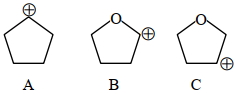
A
$A > C > B$
B
$A > B > C$
C
$C > B > A$
D
$B > A > C$
Solution
(D) The stability of carbocations is determined by resonance and inductive effects.
In structure $B$,the positive charge is on the carbon atom adjacent to the oxygen atom. The lone pair on the oxygen atom can donate electron density through resonance,which significantly stabilizes the carbocation.
In structure $C$,the positive charge is on the carbon atom at the $\beta$-position relative to the oxygen atom. The oxygen atom exerts an electron-withdrawing inductive effect ($-I$ effect),which destabilizes the carbocation.
In structure $A$,the carbocation is a simple secondary carbocation without any adjacent heteroatom effects.
Therefore,the stability order is $B > A > C$.
In structure $B$,the positive charge is on the carbon atom adjacent to the oxygen atom. The lone pair on the oxygen atom can donate electron density through resonance,which significantly stabilizes the carbocation.
In structure $C$,the positive charge is on the carbon atom at the $\beta$-position relative to the oxygen atom. The oxygen atom exerts an electron-withdrawing inductive effect ($-I$ effect),which destabilizes the carbocation.
In structure $A$,the carbocation is a simple secondary carbocation without any adjacent heteroatom effects.
Therefore,the stability order is $B > A > C$.
0 likesView Solution
9
ChemistryMediumMCQJEE Main · 2022
Given below are two statements.
Statement $I :$ The presence of weaker $\pi$-bonds makes alkenes less stable than alkanes.
Statement $II :$ The strength of the double bond is greater than that of carbon-carbon single bond.
In the light of the above statements,choose the correct answer from the options given below.
Statement $I :$ The presence of weaker $\pi$-bonds makes alkenes less stable than alkanes.
Statement $II :$ The strength of the double bond is greater than that of carbon-carbon single bond.
In the light of the above statements,choose the correct answer from the options given below.
A
Both Statement $I$ and Statement $II$ are correct.
B
Both Statement $I$ and Statement $II$ are incorrect.
C
Statement $I$ is correct but Statement $II$ is incorrect.
D
Statement $I$ is incorrect but Statement $II$ is correct.
Solution
(D) Statement $I$ is incorrect. Alkenes are generally considered more reactive than alkanes due to the presence of the $\pi$-bond,but the stability of a molecule depends on its total bond energy. Alkenes are not inherently 'less stable' than alkanes in a way that makes them unstable compounds; they are simply more reactive towards electrophilic addition.
Statement $II$ is correct. $A$ carbon-carbon double bond $(C=C)$ consists of one $\sigma$-bond and one $\pi$-bond. The total bond energy of a $C=C$ bond (approx. $610 \ kJ/mol$) is significantly higher than that of a $C-C$ single bond (approx. $348 \ kJ/mol$). Therefore,the strength of the double bond is greater than that of the single bond.
Statement $II$ is correct. $A$ carbon-carbon double bond $(C=C)$ consists of one $\sigma$-bond and one $\pi$-bond. The total bond energy of a $C=C$ bond (approx. $610 \ kJ/mol$) is significantly higher than that of a $C-C$ single bond (approx. $348 \ kJ/mol$). Therefore,the strength of the double bond is greater than that of the single bond.
0 likesView Solution
10
ChemistryDifficultMCQJEE Main · 2022
At $300 \ K$,a sample of $3.0 \ g$ of gas $A$ occupies the same volume as $0.2 \ g$ of hydrogen $(H_2)$ at $200 \ K$ at the same pressure. The molar mass of gas $A$ is $...... \ g \ mol^{-1}$ (nearest integer). Assume that the gases behave as ideal gases.
A
$55$
B
$105$
C
$60$
D
$45$
Solution
(D) Given: Ideal gas $A$ and $H_2$ gas are at the same pressure $(P)$ and volume $(V)$.
From the ideal gas equation,$PV = nRT$,we have $n = \frac{PV}{RT}$.
Since $P$ and $V$ are the same for both gases,$n_A T_A = n_{H_2} T_{H_2}$.
Here,$n_A = \frac{3.0}{M_A}$ and $n_{H_2} = \frac{0.2}{2.0} = 0.1 \ mol$.
Substituting the values: $\frac{3.0}{M_A} \times 300 = 0.1 \times 200$.
$\frac{900}{M_A} = 20$.
$M_A = \frac{900}{20} = 45 \ g \ mol^{-1}$.
From the ideal gas equation,$PV = nRT$,we have $n = \frac{PV}{RT}$.
Since $P$ and $V$ are the same for both gases,$n_A T_A = n_{H_2} T_{H_2}$.
Here,$n_A = \frac{3.0}{M_A}$ and $n_{H_2} = \frac{0.2}{2.0} = 0.1 \ mol$.
Substituting the values: $\frac{3.0}{M_A} \times 300 = 0.1 \times 200$.
$\frac{900}{M_A} = 20$.
$M_A = \frac{900}{20} = 45 \ g \ mol^{-1}$.
0 likesView Solution
11
ChemistryMediumMCQJEE Main · 2022
$PCl_{5}$ dissociates as $PCl_{5(g)} \rightleftharpoons PCl_{3(g)} + Cl_{2(g)}$. $5 \, \text{moles}$ of $PCl_{5}$ are placed in a $200 \, L$ vessel which contains $2 \, \text{moles}$ of $N_{2}$ and is maintained at $600 \, K$. The equilibrium pressure is $2.46 \, atm$. The equilibrium constant $K_{p}$ for the dissociation of $PCl_{5}$ is $...... \times 10^{-3}$. (nearest integer) (Given: $R = 0.082 \, L \, atm \, K^{-1} \, mol^{-1}$: Assume ideal gas behaviour)
A
$2312$
B
$954$
C
$1107$
D
$1451$
Solution
(C) Initial moles: $n(PCl_{5}) = 5$,$n(N_{2}) = 2$. Total moles at equilibrium: $n_{total} = (5-x) + x + x + 2 = 7+x$.
Using ideal gas law $PV = nRT$ at equilibrium:
$2.46 \times 200 = (7+x) \times 0.082 \times 600$
$492 = (7+x) \times 49.2$
$7+x = 10 \implies x = 3$.
At equilibrium: $n(PCl_{5}) = 2$,$n(PCl_{3}) = 3$,$n(Cl_{2}) = 3$,$n(N_{2}) = 2$. Total moles $= 10$.
Partial pressures: $P(PCl_{5}) = (2/10) \times 2.46 = 0.492 \, atm$,$P(PCl_{3}) = (3/10) \times 2.46 = 0.738 \, atm$,$P(Cl_{2}) = (3/10) \times 2.46 = 0.738 \, atm$.
$K_{p} = \frac{P(PCl_{3}) \times P(Cl_{2})}{P(PCl_{5})} = \frac{0.738 \times 0.738}{0.492} = 1.107$.
$K_{p} = 1107 \times 10^{-3}$.
Using ideal gas law $PV = nRT$ at equilibrium:
$2.46 \times 200 = (7+x) \times 0.082 \times 600$
$492 = (7+x) \times 49.2$
$7+x = 10 \implies x = 3$.
At equilibrium: $n(PCl_{5}) = 2$,$n(PCl_{3}) = 3$,$n(Cl_{2}) = 3$,$n(N_{2}) = 2$. Total moles $= 10$.
Partial pressures: $P(PCl_{5}) = (2/10) \times 2.46 = 0.492 \, atm$,$P(PCl_{3}) = (3/10) \times 2.46 = 0.738 \, atm$,$P(Cl_{2}) = (3/10) \times 2.46 = 0.738 \, atm$.
$K_{p} = \frac{P(PCl_{3}) \times P(Cl_{2})}{P(PCl_{5})} = \frac{0.738 \times 0.738}{0.492} = 1.107$.
$K_{p} = 1107 \times 10^{-3}$.
0 likesView Solution
12
ChemistryMediumMCQJEE Main · 2022
Manganese $(VI)$ has the ability to disproportionate in an acidic solution. The difference in oxidation states of the two ions it forms in an acidic solution is $...... .$
A
$3$
B
$2$
C
$1$
D
$4$
Solution
(A) The disproportionation reaction of manganate $(VI)$ ion $(MnO_{4}^{2-})$ in an acidic medium is given by:
$3MnO_{4}^{2-} + 4H^{+} \longrightarrow 2MnO_{4}^{-} + MnO_{2} + 2H_{2}O$
In $MnO_{4}^{-}$,the oxidation state of $Mn$ is $+7$.
In $MnO_{2}$,the oxidation state of $Mn$ is $+4$.
The difference in oxidation states is $|7 - 4| = 3$.
$3MnO_{4}^{2-} + 4H^{+} \longrightarrow 2MnO_{4}^{-} + MnO_{2} + 2H_{2}O$
In $MnO_{4}^{-}$,the oxidation state of $Mn$ is $+7$.
In $MnO_{2}$,the oxidation state of $Mn$ is $+4$.
The difference in oxidation states is $|7 - 4| = 3$.
0 likesView Solution
13
ChemistryMediumMCQJEE Main · 2022
$0.2 \ g$ of an organic compound was subjected to estimation of nitrogen by Dumas method in which volume of $N_2$ evolved (at $STP$) was found to be $22.400 \ mL$. The percentage of nitrogen in the compound is $.......$. [nearest integer] (Given: Molar mass of $N_2$ is $28 \ g \ mol^{-1}$. Molar volume of $N_2$ at $STP$ : $22.4 \ L \ mol^{-1}$ )
A
$14$
B
$21$
C
$18$
D
$56$
Solution
(A) Weight of organic compound $= 0.2 \ g$.
Volume of $N_2$ at $STP$ $= 22.400 \ mL = 22.4 \times 10^{-3} \ L$.
Moles of $N_2 = \frac{22.4 \times 10^{-3} \ L}{22.4 \ L \ mol^{-1}} = 10^{-3} \ mol$.
Mass of $N_2$ evolved $= 10^{-3} \ mol \times 28 \ g \ mol^{-1} = 28 \times 10^{-3} \ g$.
Percentage of nitrogen $= \frac{\text{Mass of } N_2}{\text{Mass of compound}} \times 100$.
Percentage of nitrogen $= \frac{28 \times 10^{-3} \ g}{0.2 \ g} \times 100 = \frac{0.028}{0.2} \times 100 = 14 \%$.
Volume of $N_2$ at $STP$ $= 22.400 \ mL = 22.4 \times 10^{-3} \ L$.
Moles of $N_2 = \frac{22.4 \times 10^{-3} \ L}{22.4 \ L \ mol^{-1}} = 10^{-3} \ mol$.
Mass of $N_2$ evolved $= 10^{-3} \ mol \times 28 \ g \ mol^{-1} = 28 \times 10^{-3} \ g$.
Percentage of nitrogen $= \frac{\text{Mass of } N_2}{\text{Mass of compound}} \times 100$.
Percentage of nitrogen $= \frac{28 \times 10^{-3} \ g}{0.2 \ g} \times 100 = \frac{0.028}{0.2} \times 100 = 14 \%$.
0 likesView Solution
14
ChemistryDifficultMCQJEE Main · 2022
If a rocket runs on a fuel $(C_{15}H_{30})$ and liquid oxygen,the weight of oxygen required and $CO_{2}$ released for every litre of fuel respectively are: (Given: density of the fuel is $0.756 \ g/mL$)
A
$1188 \ g$ and $1296 \ g$
B
$2376 \ g$ and $2592 \ g$
C
$2592 \ g$ and $2376 \ g$
D
$3429 \ g$ and $3142 \ g$
Solution
(C) The balanced chemical equation for the combustion of the fuel is:
$C_{15}H_{30} + \frac{45}{2} O_{2} \rightarrow 15 CO_{2} + 15 H_{2}O$
First,calculate the mass of $1 \ L$ $(1000 \ mL)$ of fuel:
$\text{Mass} = \text{density} \times \text{volume} = 0.756 \ g/mL \times 1000 \ mL = 756 \ g$
The molar mass of $C_{15}H_{30}$ is $(15 \times 12) + (30 \times 1) = 210 \ g/mol$.
Number of moles of fuel $= \frac{756 \ g}{210 \ g/mol} = 3.6 \ mol$.
According to the stoichiometry,$1 \ mol$ of fuel requires $\frac{45}{2} = 22.5 \ mol$ of $O_{2}$.
So,$3.6 \ mol$ of fuel requires $3.6 \times 22.5 = 81 \ mol$ of $O_{2}$.
Weight of $O_{2} = 81 \ mol \times 32 \ g/mol = 2592 \ g$.
According to the stoichiometry,$1 \ mol$ of fuel produces $15 \ mol$ of $CO_{2}$.
So,$3.6 \ mol$ of fuel produces $3.6 \times 15 = 54 \ mol$ of $CO_{2}$.
Weight of $CO_{2} = 54 \ mol \times 44 \ g/mol = 2376 \ g$.
$C_{15}H_{30} + \frac{45}{2} O_{2} \rightarrow 15 CO_{2} + 15 H_{2}O$
First,calculate the mass of $1 \ L$ $(1000 \ mL)$ of fuel:
$\text{Mass} = \text{density} \times \text{volume} = 0.756 \ g/mL \times 1000 \ mL = 756 \ g$
The molar mass of $C_{15}H_{30}$ is $(15 \times 12) + (30 \times 1) = 210 \ g/mol$.
Number of moles of fuel $= \frac{756 \ g}{210 \ g/mol} = 3.6 \ mol$.
According to the stoichiometry,$1 \ mol$ of fuel requires $\frac{45}{2} = 22.5 \ mol$ of $O_{2}$.
So,$3.6 \ mol$ of fuel requires $3.6 \times 22.5 = 81 \ mol$ of $O_{2}$.
Weight of $O_{2} = 81 \ mol \times 32 \ g/mol = 2592 \ g$.
According to the stoichiometry,$1 \ mol$ of fuel produces $15 \ mol$ of $CO_{2}$.
So,$3.6 \ mol$ of fuel produces $3.6 \times 15 = 54 \ mol$ of $CO_{2}$.
Weight of $CO_{2} = 54 \ mol \times 44 \ g/mol = 2376 \ g$.
0 likesView Solution
15
ChemistryMediumMCQJEE Main · 2022
Consider the following pairs of electrons:
$(A)$ $(a)$ $n=3, l=1, m_{l}=1, m_{s}=+\frac{1}{2}$
$(b)$ $n=3, l=2, m_{l}=1, m_{s}=+\frac{1}{2}$
$(B)$ $(a)$ $n=3, l=2, m_{l}=-2, m_{s}=-\frac{1}{2}$
$(b)$ $n=3, l=2, m_{l}=-1, m_{s}=-\frac{1}{2}$
$(C)$ $(a)$ $n=4, l=2, m_{l}=2, m_{s}=+\frac{1}{2}$
$(b)$ $n=3, l=2, m_{l}=2, m_{s}=+\frac{1}{2}$
The pair$(s)$ of electrons present in degenerate orbitals is/are...... .
$(A)$ $(a)$ $n=3, l=1, m_{l}=1, m_{s}=+\frac{1}{2}$
$(b)$ $n=3, l=2, m_{l}=1, m_{s}=+\frac{1}{2}$
$(B)$ $(a)$ $n=3, l=2, m_{l}=-2, m_{s}=-\frac{1}{2}$
$(b)$ $n=3, l=2, m_{l}=-1, m_{s}=-\frac{1}{2}$
$(C)$ $(a)$ $n=4, l=2, m_{l}=2, m_{s}=+\frac{1}{2}$
$(b)$ $n=3, l=2, m_{l}=2, m_{s}=+\frac{1}{2}$
The pair$(s)$ of electrons present in degenerate orbitals is/are...... .
A
Only $A$
B
Only $B$
C
Only $C$
D
$B$ and $C$
Solution
(B) Degenerate orbitals are orbitals that have the same energy level.
For a hydrogen-like atom,energy depends only on the principal quantum number $n$.
For multi-electron atoms,orbitals are degenerate if they have the same $n$ and $l$ values.
In pair $(A)$: $(a)$ has $n=3, l=1$ ($3p$ orbital) and $(b)$ has $n=3, l=2$ ($3d$ orbital). These have different $l$ values,so they are not degenerate.
In pair $(B)$: $(a)$ has $n=3, l=2$ ($3d$ orbital) and $(b)$ has $n=3, l=2$ ($3d$ orbital). Since both have the same $n=3$ and $l=2$,they belong to the same subshell and are degenerate.
In pair $(C)$: $(a)$ has $n=4, l=2$ ($4d$ orbital) and $(b)$ has $n=3, l=2$ ($3d$ orbital). These have different $n$ values,so they are not degenerate.
Therefore,only pair $(B)$ consists of electrons in degenerate orbitals.
For a hydrogen-like atom,energy depends only on the principal quantum number $n$.
For multi-electron atoms,orbitals are degenerate if they have the same $n$ and $l$ values.
In pair $(A)$: $(a)$ has $n=3, l=1$ ($3p$ orbital) and $(b)$ has $n=3, l=2$ ($3d$ orbital). These have different $l$ values,so they are not degenerate.
In pair $(B)$: $(a)$ has $n=3, l=2$ ($3d$ orbital) and $(b)$ has $n=3, l=2$ ($3d$ orbital). Since both have the same $n=3$ and $l=2$,they belong to the same subshell and are degenerate.
In pair $(C)$: $(a)$ has $n=4, l=2$ ($4d$ orbital) and $(b)$ has $n=3, l=2$ ($3d$ orbital). These have different $n$ values,so they are not degenerate.
Therefore,only pair $(B)$ consists of electrons in degenerate orbitals.
0 likesView Solution
16
ChemistryMediumMCQJEE Main · 2022
For a reaction at equilibrium $A_{(g)} \rightleftharpoons B_{(g)} + \frac{1}{2} C_{(g)}$,the relation between dissociation constant $(K)$,degree of dissociation $(\alpha)$ and equilibrium pressure $(p)$ is given by?
A
$K = \frac{\alpha^{\frac{3}{2}} p^{\frac{1}{2}}}{(2 + \alpha)^{\frac{1}{2}}(1 - \alpha)}$
B
$K = \frac{\alpha^{\frac{1}{2}} p^{\frac{3}{2}}}{(1 + \frac{3}{2} \alpha)^{\frac{1}{2}}(1 - \alpha)}$
C
$K = \frac{(\alpha p)^{\frac{3}{2}}}{(1 + \frac{3}{2} \alpha)^{\frac{1}{2}}(1 - \alpha)}$
D
$K = \frac{(\alpha p)^{\frac{3}{2}}}{(1 + \alpha)(1 - \alpha)^{\frac{1}{2}}}$
Solution
(A) For the reaction: $A_{(g)} \rightleftharpoons B_{(g)} + \frac{1}{2} C_{(g)}$
Initial moles: $1, 0, 0$
At equilibrium: $(1 - \alpha), \alpha, \frac{\alpha}{2}$
Total moles at equilibrium = $(1 - \alpha) + \alpha + \frac{\alpha}{2} = 1 + \frac{\alpha}{2}$
Partial pressures are given by $P_i = x_i \cdot p$,where $x_i$ is the mole fraction and $p$ is the total pressure.
$P_A = \frac{1 - \alpha}{1 + \frac{\alpha}{2}} p$
$P_B = \frac{\alpha}{1 + \frac{\alpha}{2}} p$
$P_C = \frac{\alpha/2}{1 + \frac{\alpha}{2}} p$
$K_p = \frac{P_B \cdot P_C^{1/2}}{P_A} = \frac{(\frac{\alpha}{1 + \alpha/2} p) \cdot (\frac{\alpha/2}{1 + \alpha/2} p)^{1/2}}{\frac{1 - \alpha}{1 + \alpha/2} p}$
Simplifying the expression:
$K_p = \frac{\alpha \cdot (\alpha/2)^{1/2} \cdot p^{1/2}}{1 - \alpha} \cdot \frac{(1 + \alpha/2)^{1/2}}{(1 + \alpha/2)^{1/2}} = \frac{\alpha \cdot \alpha^{1/2} \cdot p^{1/2}}{\sqrt{2} \cdot (1 - \alpha) \cdot (\frac{2 + \alpha}{2})^{1/2}} = \frac{\alpha^{3/2} p^{1/2}}{(2 + \alpha)^{1/2}(1 - \alpha)}$
Initial moles: $1, 0, 0$
At equilibrium: $(1 - \alpha), \alpha, \frac{\alpha}{2}$
Total moles at equilibrium = $(1 - \alpha) + \alpha + \frac{\alpha}{2} = 1 + \frac{\alpha}{2}$
Partial pressures are given by $P_i = x_i \cdot p$,where $x_i$ is the mole fraction and $p$ is the total pressure.
$P_A = \frac{1 - \alpha}{1 + \frac{\alpha}{2}} p$
$P_B = \frac{\alpha}{1 + \frac{\alpha}{2}} p$
$P_C = \frac{\alpha/2}{1 + \frac{\alpha}{2}} p$
$K_p = \frac{P_B \cdot P_C^{1/2}}{P_A} = \frac{(\frac{\alpha}{1 + \alpha/2} p) \cdot (\frac{\alpha/2}{1 + \alpha/2} p)^{1/2}}{\frac{1 - \alpha}{1 + \alpha/2} p}$
Simplifying the expression:
$K_p = \frac{\alpha \cdot (\alpha/2)^{1/2} \cdot p^{1/2}}{1 - \alpha} \cdot \frac{(1 + \alpha/2)^{1/2}}{(1 + \alpha/2)^{1/2}} = \frac{\alpha \cdot \alpha^{1/2} \cdot p^{1/2}}{\sqrt{2} \cdot (1 - \alpha) \cdot (\frac{2 + \alpha}{2})^{1/2}} = \frac{\alpha^{3/2} p^{1/2}}{(2 + \alpha)^{1/2}(1 - \alpha)}$
0 likesView Solution
17
ChemistryEasyMCQJEE Main · 2022
Given below are the oxides:
$Na_{2}O, As_{2}O_{3}, N_{2}O, NO$ and $Cl_{2}O_{7}$
Number of amphoteric oxides is ..... .
$Na_{2}O, As_{2}O_{3}, N_{2}O, NO$ and $Cl_{2}O_{7}$
Number of amphoteric oxides is ..... .
A
$0$
B
$1$
C
$2$
D
$3$
Solution
(B) The nature of the given oxides is as follows:
$Na_{2}O$: Basic oxide (alkali metal oxide).
$As_{2}O_{3}$: Amphoteric oxide.
$N_{2}O$: Neutral oxide.
$NO$: Neutral oxide.
$Cl_{2}O_{7}$: Acidic oxide (non-metal oxide).
Thus,only $As_{2}O_{3}$ is an amphoteric oxide.
The total number of amphoteric oxides is $1$.
$Na_{2}O$: Basic oxide (alkali metal oxide).
$As_{2}O_{3}$: Amphoteric oxide.
$N_{2}O$: Neutral oxide.
$NO$: Neutral oxide.
$Cl_{2}O_{7}$: Acidic oxide (non-metal oxide).
Thus,only $As_{2}O_{3}$ is an amphoteric oxide.
The total number of amphoteric oxides is $1$.
0 likesView Solution
18
ChemistryEasyMCQJEE Main · 2022
The highest industrial consumption of molecular hydrogen is to produce compounds of element ...... .
A
Carbon
B
Nitrogen
C
Oxygen
D
Chlorine
Solution
(B) The highest industrial consumption of molecular hydrogen is in the Haber process for the production of ammonia $(NH_3)$.
Around $55 \, \%$ of the global hydrogen production is utilized for the synthesis of ammonia by reacting it with nitrogen.
Around $55 \, \%$ of the global hydrogen production is utilized for the synthesis of ammonia by reacting it with nitrogen.
0 likesView Solution
19
ChemistryMediumMCQJEE Main · 2022
Which of the following statements are correct?
$(A)$ Both $LiCl$ and $MgCl_2$ are soluble in ethanol.
$(B)$ The oxides $Li_2O$ and $MgO$ combine with excess of oxygen to give superoxide.
$(C)$ $LiF$ is less soluble in water than other alkali metal fluorides.
$(D)$ $Li_2O$ is more soluble in water than other alkali metal oxides.
Choose the most appropriate answer from the options given below.
$(A)$ Both $LiCl$ and $MgCl_2$ are soluble in ethanol.
$(B)$ The oxides $Li_2O$ and $MgO$ combine with excess of oxygen to give superoxide.
$(C)$ $LiF$ is less soluble in water than other alkali metal fluorides.
$(D)$ $Li_2O$ is more soluble in water than other alkali metal oxides.
Choose the most appropriate answer from the options given below.
A
$(A)$ and $(C)$ only
B
$(A)$, $(C)$ and $(D)$ only
C
$(B)$ and $(C)$ only
D
$(A)$ and $(B)$ only
Solution
(A) $(A)$ $LiCl$ and $MgCl_2$ are covalent in nature due to polarization (Fajans' rule), hence they are soluble in ethanol.
$(B)$ $Li$ and $Mg$ do not form superoxides; they form oxides and peroxides respectively.
$(C)$ $LiF$ has a very high lattice energy due to the small size of both $Li^+$ and $F^-$ ions, making it less soluble in water compared to other alkali metal fluorides.
$(D)$ $Li_2O$ is less soluble in water compared to other alkali metal oxides due to high lattice energy.
Therefore, statements $(A)$ and $(C)$ are correct.
$(B)$ $Li$ and $Mg$ do not form superoxides; they form oxides and peroxides respectively.
$(C)$ $LiF$ has a very high lattice energy due to the small size of both $Li^+$ and $F^-$ ions, making it less soluble in water compared to other alkali metal fluorides.
$(D)$ $Li_2O$ is less soluble in water compared to other alkali metal oxides due to high lattice energy.
Therefore, statements $(A)$ and $(C)$ are correct.
0 likesView Solution
20
ChemistryEasyMCQJEE Main · 2022
Identify the correct statement for $B_2H_6$ from those given below.
$(A)$ In $B_2H_6$,all $B-H$ bonds are equivalent.
$(B)$ In $B_2H_6$ there are four $3$-centre-$2$-electron bonds.
$(C)$ $B_2H_6$ is a Lewis acid.
$(D)$ $B_2H_6$ can be synthesized from both $BF_3$ and $NaBH_4$.
$(E)$ $B_2H_6$ is a planar molecule.
Choose the most appropriate answer from the options given below.
$(A)$ In $B_2H_6$,all $B-H$ bonds are equivalent.
$(B)$ In $B_2H_6$ there are four $3$-centre-$2$-electron bonds.
$(C)$ $B_2H_6$ is a Lewis acid.
$(D)$ $B_2H_6$ can be synthesized from both $BF_3$ and $NaBH_4$.
$(E)$ $B_2H_6$ is a planar molecule.
Choose the most appropriate answer from the options given below.
A
$(A)$ and $(E)$ only
B
$(B)$,$(C)$ and $(E)$ only
C
$(C)$ and $(D)$ only
D
$(C)$ and $(E)$ only
Solution
(C) Analysis of statements:
$(A)$ Incorrect: $B_2H_6$ has two types of $B-H$ bonds: terminal $B-H$ bonds (covalent) and bridging $B-H-B$ bonds ($3$-centre-$2$-electron).
$(B)$ Incorrect: $B_2H_6$ contains two $3$-centre-$2$-electron bonds,not four.
$(C)$ Correct: $B_2H_6$ is an electron-deficient molecule and acts as a Lewis acid.
$(D)$ Correct: $B_2H_6$ can be synthesized by the reaction: $3NaBH_4 + 4BF_3 \rightarrow 2B_2H_6 + 3NaBF_4$.
$(E)$ Incorrect: $B_2H_6$ is a non-planar molecule.
Therefore,statements $(C)$ and $(D)$ are correct.
$(A)$ Incorrect: $B_2H_6$ has two types of $B-H$ bonds: terminal $B-H$ bonds (covalent) and bridging $B-H-B$ bonds ($3$-centre-$2$-electron).
$(B)$ Incorrect: $B_2H_6$ contains two $3$-centre-$2$-electron bonds,not four.
$(C)$ Correct: $B_2H_6$ is an electron-deficient molecule and acts as a Lewis acid.
$(D)$ Correct: $B_2H_6$ can be synthesized by the reaction: $3NaBH_4 + 4BF_3 \rightarrow 2B_2H_6 + 3NaBF_4$.
$(E)$ Incorrect: $B_2H_6$ is a non-planar molecule.
Therefore,statements $(C)$ and $(D)$ are correct.
0 likesView Solution
21
ChemistryMediumMCQJEE Main · 2022
Which one of the following elemental forms is not present in the enamel of the teeth?
A
$Ca^{2+}$
B
$P^{3+}$
C
$F^{-}$
D
$P^{5+}$
Solution
(B) The enamel of human teeth is primarily composed of hydroxyapatite,which is a crystalline form of calcium phosphate,$Ca_{10}(PO_4)_6(OH)_2$.
In this structure,calcium exists in the $Ca^{2+}$ oxidation state.
Phosphorus exists in the phosphate ion $(PO_4)^{3-}$,where the oxidation state of phosphorus is $+5$ $(P^{5+})$.
Fluoride ions $(F^{-})$ are also often incorporated into the enamel structure to form fluorapatite,which strengthens the teeth.
Therefore,$P^{3+}$ is not present in the enamel of the teeth.
In this structure,calcium exists in the $Ca^{2+}$ oxidation state.
Phosphorus exists in the phosphate ion $(PO_4)^{3-}$,where the oxidation state of phosphorus is $+5$ $(P^{5+})$.
Fluoride ions $(F^{-})$ are also often incorporated into the enamel structure to form fluorapatite,which strengthens the teeth.
Therefore,$P^{3+}$ is not present in the enamel of the teeth.
0 likesView Solution
22
ChemistryMediumMCQJEE Main · 2022
$2O_{3(g)} \rightleftharpoons 3O_{2(g)}$
At $300 \ K$,ozone is $50\%$ dissociated. The standard free energy change at this temperature and $1 \ atm$ pressure is $(-) \dots \ J \ mol^{-1}$ (Nearest integer).
[Given: $\ln 1.35 = 0.3$ and $R = 8.3 \ J \ K^{-1} \ mol^{-1}$ ]
At $300 \ K$,ozone is $50\%$ dissociated. The standard free energy change at this temperature and $1 \ atm$ pressure is $(-) \dots \ J \ mol^{-1}$ (Nearest integer).
[Given: $\ln 1.35 = 0.3$ and $R = 8.3 \ J \ K^{-1} \ mol^{-1}$ ]
A
$102$
B
$243$
C
$747$
D
$545$
Solution
(C) For the reaction $2O_{3(g)} \rightleftharpoons 3O_{2(g)}$,let the initial moles of $O_3$ be $1$.
At equilibrium,moles of $O_3 = 1 - 0.5 = 0.5$ and moles of $O_2 = \frac{3}{2} \times 0.5 = 0.75$.
Total moles = $0.5 + 0.75 = 1.25$.
Mole fraction of $O_3 = \frac{0.5}{1.25} = 0.4$ and $O_2 = \frac{0.75}{1.25} = 0.6$.
Partial pressures at $P = 1 \ atm$: $P_{O_3} = 0.4 \ atm$,$P_{O_2} = 0.6 \ atm$.
$K_p = \frac{(P_{O_2})^3}{(P_{O_3})^2} = \frac{(0.6)^3}{(0.4)^2} = \frac{0.216}{0.16} = 1.35$.
$\Delta G^{\circ} = -RT \ln K_p$.
$\Delta G^{\circ} = -8.3 \times 300 \times \ln 1.35$.
$\Delta G^{\circ} = -8.3 \times 300 \times 0.3 = -747 \ J \ mol^{-1}$.
At equilibrium,moles of $O_3 = 1 - 0.5 = 0.5$ and moles of $O_2 = \frac{3}{2} \times 0.5 = 0.75$.
Total moles = $0.5 + 0.75 = 1.25$.
Mole fraction of $O_3 = \frac{0.5}{1.25} = 0.4$ and $O_2 = \frac{0.75}{1.25} = 0.6$.
Partial pressures at $P = 1 \ atm$: $P_{O_3} = 0.4 \ atm$,$P_{O_2} = 0.6 \ atm$.
$K_p = \frac{(P_{O_2})^3}{(P_{O_3})^2} = \frac{(0.6)^3}{(0.4)^2} = \frac{0.216}{0.16} = 1.35$.
$\Delta G^{\circ} = -RT \ln K_p$.
$\Delta G^{\circ} = -8.3 \times 300 \times \ln 1.35$.
$\Delta G^{\circ} = -8.3 \times 300 \times 0.3 = -747 \ J \ mol^{-1}$.
0 likesView Solution
23
ChemistryEasyMCQJEE Main · 2022
The difference in oxidation state of chromium in chromate and dichromate salts is $....$ .
A
$1$
B
$0$
C
$2$
D
$3$
Solution
(B) In chromate ion $(CrO_4^{2-})$,let the oxidation state of $Cr$ be $x$.
$x + 4(-2) = -2 \implies x - 8 = -2 \implies x = +6$.
In dichromate ion $(Cr_2O_7^{2-})$,let the oxidation state of $Cr$ be $y$.
$2y + 7(-2) = -2 \implies 2y - 14 = -2 \implies 2y = +12 \implies y = +6$.
The difference in oxidation state is $|+6 - (+6)| = 0$.
$x + 4(-2) = -2 \implies x - 8 = -2 \implies x = +6$.
In dichromate ion $(Cr_2O_7^{2-})$,let the oxidation state of $Cr$ be $y$.
$2y + 7(-2) = -2 \implies 2y - 14 = -2 \implies 2y = +12 \implies y = +6$.
The difference in oxidation state is $|+6 - (+6)| = 0$.
1 likesView Solution
24
ChemistryMediumMCQJEE Main · 2022
The number of electrophilic centers in the given compound is ...... .
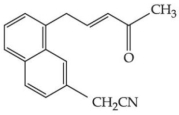
A
$1$
B
$2$
C
$6$
D
$3$
Solution
(D) An electrophilic center is an atom that is electron-deficient and can accept an electron pair. In the given molecule,we identify the following electrophilic centers:
$1$. The carbonyl carbon $(C=O)$ is electrophilic due to the high electronegativity of oxygen,which creates a partial positive charge on the carbon.
$2$. The $\beta$-carbon of the $\alpha,\beta$-unsaturated carbonyl system is electrophilic due to resonance,which delocalizes the positive charge from the carbonyl carbon to the $\beta$-carbon.
$3$. The carbon atom of the nitrile group $(-CN)$ is electrophilic because the nitrogen atom is more electronegative than carbon,creating a partial positive charge on the carbon.
Thus,there are $3$ electrophilic centers in the molecule.
$1$. The carbonyl carbon $(C=O)$ is electrophilic due to the high electronegativity of oxygen,which creates a partial positive charge on the carbon.
$2$. The $\beta$-carbon of the $\alpha,\beta$-unsaturated carbonyl system is electrophilic due to resonance,which delocalizes the positive charge from the carbonyl carbon to the $\beta$-carbon.
$3$. The carbon atom of the nitrile group $(-CN)$ is electrophilic because the nitrogen atom is more electronegative than carbon,creating a partial positive charge on the carbon.
Thus,there are $3$ electrophilic centers in the molecule.
0 likesView Solution
25
ChemistryDifficultMCQJEE Main · 2022
The major product $'A'$ of the following given reaction has $......\,sp^2$ hybridized carbon atoms.
$2,7-\text{Dimethyl}-2,6-\text{octadiene} \xrightarrow{H^{+}} A \text{ (Major Product)}$
$2,7-\text{Dimethyl}-2,6-\text{octadiene} \xrightarrow{H^{+}} A \text{ (Major Product)}$
A
$5$
B
$3$
C
$1$
D
$2$
Solution
(D) The reaction involves the acid-catalyzed cyclization of $2,7-\text{dimethyl}-2,6-\text{octadiene}$.
First,the protonation of one of the double bonds forms a tertiary carbocation.
Then,an internal nucleophilic attack by the other double bond occurs,leading to the formation of a five-membered ring with a tertiary carbocation.
Finally,the loss of a proton $(-H^{+})$ from the carbocation results in the formation of the major product,which is $1,1,2-\text{trimethyl}-2-\text{isopropylidenecyclopentane}$ (or a similar isomer depending on the specific mechanism path).
Looking at the final structure shown in the mechanism: the product is $1,1-\text{dimethyl}-2-\text{isopropylidenecyclopentane}$.
In this structure,the double bond is between the ring carbon and the isopropylidene carbon.
This double bond involves $2$ carbon atoms,both of which are $sp^2$ hybridized.
Therefore,the major product has $2$ $sp^2$ hybridized carbon atoms.
First,the protonation of one of the double bonds forms a tertiary carbocation.
Then,an internal nucleophilic attack by the other double bond occurs,leading to the formation of a five-membered ring with a tertiary carbocation.
Finally,the loss of a proton $(-H^{+})$ from the carbocation results in the formation of the major product,which is $1,1,2-\text{trimethyl}-2-\text{isopropylidenecyclopentane}$ (or a similar isomer depending on the specific mechanism path).
Looking at the final structure shown in the mechanism: the product is $1,1-\text{dimethyl}-2-\text{isopropylidenecyclopentane}$.
In this structure,the double bond is between the ring carbon and the isopropylidene carbon.
This double bond involves $2$ carbon atoms,both of which are $sp^2$ hybridized.
Therefore,the major product has $2$ $sp^2$ hybridized carbon atoms.
0 likesView Solution
26
ChemistryEasyMCQJEE Main · 2022
The minimum energy that must be possessed by photons in order to produce the photoelectric effect with platinum metal is $.... \times 10^{-19} \, J$
[Given: The threshold frequency of platinum is $1.3 \times 10^{15} \, s^{-1}$ and $h = 6.6 \times 10^{-34} \, J \, s$.]
[Given: The threshold frequency of platinum is $1.3 \times 10^{15} \, s^{-1}$ and $h = 6.6 \times 10^{-34} \, J \, s$.]
A
$32.1$
B
$0.624$
C
$8.58$
D
$976$
Solution
(C) The minimum energy required for the photoelectric effect is known as the work function $(W)$.
The formula for the work function is $W = h \nu_0$,where $h$ is Planck's constant and $\nu_0$ is the threshold frequency.
Given:
$h = 6.6 \times 10^{-34} \, J \, s$
$\nu_0 = 1.3 \times 10^{15} \, s^{-1}$
Calculation:
$W = (6.6 \times 10^{-34} \, J \, s) \times (1.3 \times 10^{15} \, s^{-1})$
$W = 8.58 \times 10^{-19} \, J$
Thus,the minimum energy is $8.58 \times 10^{-19} \, J$.
The formula for the work function is $W = h \nu_0$,where $h$ is Planck's constant and $\nu_0$ is the threshold frequency.
Given:
$h = 6.6 \times 10^{-34} \, J \, s$
$\nu_0 = 1.3 \times 10^{15} \, s^{-1}$
Calculation:
$W = (6.6 \times 10^{-34} \, J \, s) \times (1.3 \times 10^{15} \, s^{-1})$
$W = 8.58 \times 10^{-19} \, J$
Thus,the minimum energy is $8.58 \times 10^{-19} \, J$.
0 likesView Solution
27
ChemistryMediumMCQJEE Main · 2022
At $25^{\circ} C$ and $1 \, atm$ pressure,the enthalpy of combustion of benzene$_{(l)}$ and acetylene$_{(g)}$ are $-3268 \, kJ \, mol^{-1}$ and $-1300 \, kJ \, mol^{-1}$,respectively. The change in enthalpy for the reaction $3 C_2H_{2(g)} \rightarrow C_6H_{6(l)}$ is $..... \, kJ \, mol^{-1}$.
A
$+324$
B
$+632$
C
$-632$
D
$-324$
Solution
(C) The enthalpy of reaction is calculated using the enthalpies of combustion of reactants and products:
$\Delta H = \sum \Delta H_{\text{combustion}} \text{ (Reactants)} - \sum \Delta H_{\text{combustion}} \text{ (Products)}$
For the reaction $3 C_2H_{2(g)} \rightarrow C_6H_{6(l)}$:
$\Delta H = [3 \times \Delta H_{\text{combustion}}(C_2H_{2(g)})] - [1 \times \Delta H_{\text{combustion}}(C_6H_{6(l)})]$
Substituting the given values:
$\Delta H = [3 \times (-1300 \, kJ \, mol^{-1})] - [-3268 \, kJ \, mol^{-1}]$
$\Delta H = -3900 + 3268 = -632 \, kJ \, mol^{-1}$
$\Delta H = \sum \Delta H_{\text{combustion}} \text{ (Reactants)} - \sum \Delta H_{\text{combustion}} \text{ (Products)}$
For the reaction $3 C_2H_{2(g)} \rightarrow C_6H_{6(l)}$:
$\Delta H = [3 \times \Delta H_{\text{combustion}}(C_2H_{2(g)})] - [1 \times \Delta H_{\text{combustion}}(C_6H_{6(l)})]$
Substituting the given values:
$\Delta H = [3 \times (-1300 \, kJ \, mol^{-1})] - [-3268 \, kJ \, mol^{-1}]$
$\Delta H = -3900 + 3268 = -632 \, kJ \, mol^{-1}$
0 likesView Solution
28
ChemistryMediumMCQJEE Main · 2022
The $K_{sp}$ for bismuth sulphide $(Bi_{2}S_{3})$ is $1.08 \times 10^{-73}$. The solubility of $Bi_{2}S_{3}$ in $mol \ L^{-1}$ at $298 \ K$ is ......
A
$1.0 \times 10^{-15}$
B
$2.7 \times 10^{-12}$
C
$3.2 \times 10^{-10}$
D
$4.2 \times 10^{-8}$
Solution
(A) The dissociation of bismuth sulphide is given by: $Bi_{2}S_{3}(s) \rightleftharpoons 2Bi^{3+}(aq) + 3S^{2-}(aq)$.
Let the solubility be $s \ mol \ L^{-1}$. Then the concentrations are $[Bi^{3+}] = 2s$ and $[S^{2-}] = 3s$.
The solubility product expression is $K_{sp} = [Bi^{3+}]^{2} [S^{2-}]^{3}$.
Substituting the values: $K_{sp} = (2s)^{2} (3s)^{3} = 4s^{2} \times 27s^{3} = 108s^{5}$.
Given $K_{sp} = 1.08 \times 10^{-73}$,we have $108s^{5} = 1.08 \times 10^{-73}$.
$s^{5} = \frac{1.08 \times 10^{-73}}{108} = 0.01 \times 10^{-73} = 10^{-75}$.
Taking the fifth root: $s = (10^{-75})^{1/5} = 10^{-15} \ mol \ L^{-1}$.
Let the solubility be $s \ mol \ L^{-1}$. Then the concentrations are $[Bi^{3+}] = 2s$ and $[S^{2-}] = 3s$.
The solubility product expression is $K_{sp} = [Bi^{3+}]^{2} [S^{2-}]^{3}$.
Substituting the values: $K_{sp} = (2s)^{2} (3s)^{3} = 4s^{2} \times 27s^{3} = 108s^{5}$.
Given $K_{sp} = 1.08 \times 10^{-73}$,we have $108s^{5} = 1.08 \times 10^{-73}$.
$s^{5} = \frac{1.08 \times 10^{-73}}{108} = 0.01 \times 10^{-73} = 10^{-75}$.
Taking the fifth root: $s = (10^{-75})^{1/5} = 10^{-15} \ mol \ L^{-1}$.
0 likesView Solution
29
ChemistryEasyMCQJEE Main · 2022
The correct order of electron gain enthalpies of $Cl$,$F$,$Te$,and $Po$ is .....
A
$F < Cl < Te < Po$
B
$Cl < F < Te < Po$
C
$Te < Po < Cl < F$
D
$Po < Te < F < Cl$
Solution
(D) The electron gain enthalpy $(\Delta_{eg}H)$ becomes less negative as we move down a group.
For Group $16$ ($Te$ and $Po$): The order is $Po < Te$ (in terms of magnitude of negative value,$Te$ is more negative than $Po$).
For Group $17$ ($F$ and $Cl$): Due to the small size of $F$,the electron-electron repulsion is high,making $Cl$ have a more negative electron gain enthalpy than $F$.
The values are:
$Cl: -349 \ kJ/mol$
$F: -328 \ kJ/mol$
$Te: -190 \ kJ/mol$
$Po: -174 \ kJ/mol$
Comparing the magnitude of negative values (more negative means more energy released,i.e.,lower enthalpy value):
$Po (-174) < Te (-190) < F (-328) < Cl (-349)$.
Thus,the correct order of electron gain enthalpies is $Po < Te < F < Cl$.
For Group $16$ ($Te$ and $Po$): The order is $Po < Te$ (in terms of magnitude of negative value,$Te$ is more negative than $Po$).
For Group $17$ ($F$ and $Cl$): Due to the small size of $F$,the electron-electron repulsion is high,making $Cl$ have a more negative electron gain enthalpy than $F$.
The values are:
$Cl: -349 \ kJ/mol$
$F: -328 \ kJ/mol$
$Te: -190 \ kJ/mol$
$Po: -174 \ kJ/mol$
Comparing the magnitude of negative values (more negative means more energy released,i.e.,lower enthalpy value):
$Po (-174) < Te (-190) < F (-328) < Cl (-349)$.
Thus,the correct order of electron gain enthalpies is $Po < Te < F < Cl$.
1 likesView Solution
30
ChemistryEasyMCQJEE Main · 2022
Given below are two statements,one is labelled as Assertion $A$ and the other is labelled as Reason $R:$
Assertion $A :$ The amphoteric nature of water is explained by using Lewis acid/base concept.
Reason $R :$ Water acts as an acid with $NH_{3}$ and as a base with $H_{2}S$.
In the light of the above statements,choose the correct answer from the options given below:
Assertion $A :$ The amphoteric nature of water is explained by using Lewis acid/base concept.
Reason $R :$ Water acts as an acid with $NH_{3}$ and as a base with $H_{2}S$.
In the light of the above statements,choose the correct answer from the options given below:
A
Both $A$ and $R$ are true and $R$ is the correct explanation of $A$.
B
Both $A$ and $R$ are true but $R$ is $NOT$ the correct explanation of $A$.
C
$A$ is true but $R$ is false.
D
$A$ is false but $R$ is true.
Solution
(D) The amphoteric nature of water is explained by the Brønsted-Lowry acid/base concept,not the Lewis concept.
In the reaction $H_{2}O + NH_{3} \rightleftharpoons NH_{4}^{+} + OH^{-}$,water acts as a Brønsted-Lowry acid (proton donor).
In the reaction $H_{2}S + H_{2}O \rightleftharpoons H_{3}O^{+} + HS^{-}$,water acts as a Brønsted-Lowry base (proton acceptor).
Since Assertion $A$ claims the Lewis concept explains this,$A$ is false.
Reason $R$ correctly describes the behavior of water in these reactions,so $R$ is true.
Therefore,$A$ is false but $R$ is true.
In the reaction $H_{2}O + NH_{3} \rightleftharpoons NH_{4}^{+} + OH^{-}$,water acts as a Brønsted-Lowry acid (proton donor).
In the reaction $H_{2}S + H_{2}O \rightleftharpoons H_{3}O^{+} + HS^{-}$,water acts as a Brønsted-Lowry base (proton acceptor).
Since Assertion $A$ claims the Lewis concept explains this,$A$ is false.
Reason $R$ correctly describes the behavior of water in these reactions,so $R$ is true.
Therefore,$A$ is false but $R$ is true.
0 likesView Solution
31
ChemistryEasyMCQJEE Main · 2022
Given below are two statements: one is labelled as Assertion $A$ and the other is labelled as Reason $R:$
Assertion $A:$ Polluted water may have a value of $BOD$ of the order of $17 \, ppm$.
Reason $R:$ $BOD$ is a measure of oxygen required to oxidise both the biodegradable and non-biodegradable organic material in water.
In the light of the above statements,choose the most appropriate answer from the options given below.
Assertion $A:$ Polluted water may have a value of $BOD$ of the order of $17 \, ppm$.
Reason $R:$ $BOD$ is a measure of oxygen required to oxidise both the biodegradable and non-biodegradable organic material in water.
In the light of the above statements,choose the most appropriate answer from the options given below.
A
Both $A$ and $R$ are correct and $R$ is the correct explanation of $A$.
B
Both $A$ and $R$ are correct but $R$ is $NOT$ the correct explanation of $A$.
C
$A$ is correct but $R$ is not correct.
D
$A$ is not correct but $R$ is correct.
Solution
(C) Clean water has a $BOD$ value of less than $5 \, ppm$,whereas highly polluted water has a $BOD$ value of $17 \, ppm$ or more. Therefore,Assertion $A$ is correct.
$BOD$ (Biochemical Oxygen Demand) is a measure of the amount of dissolved oxygen required by bacteria to decompose only the biodegradable organic matter present in water. It does not include non-biodegradable organic material. Therefore,Reason $R$ is incorrect.
$BOD$ (Biochemical Oxygen Demand) is a measure of the amount of dissolved oxygen required by bacteria to decompose only the biodegradable organic matter present in water. It does not include non-biodegradable organic material. Therefore,Reason $R$ is incorrect.
0 likesView Solution
32
ChemistryMediumMCQJEE Main · 2022
Given below are two statements: one is labelled as Assertion $A$ and the other is labelled as Reason $R$.
Assertion $A:$ $A$ mixture contains benzoic acid and naphthalene. The pure benzoic acid can be separated out by the use of benzene.
Reason $R:$ Benzoic acid is soluble in hot water.
In the light of the above statements,choose the most appropriate answer from the options given below.
Assertion $A:$ $A$ mixture contains benzoic acid and naphthalene. The pure benzoic acid can be separated out by the use of benzene.
Reason $R:$ Benzoic acid is soluble in hot water.
In the light of the above statements,choose the most appropriate answer from the options given below.
A
Both $A$ and $R$ are true and $R$ is the correct explanation of $A$.
B
Both $A$ and $R$ are true but $R$ is $NOT$ the correct explanation of $A$.
C
$A$ is true but $R$ is false.
D
$A$ is false but $R$ is true.
Solution
(D) Benzoic acid is soluble in hot water,while naphthalene is insoluble in water. Therefore,they can be separated by crystallization using hot water,not benzene.
Assertion $A$ is false because benzene would dissolve both benzoic acid and naphthalene,making separation difficult.
Reason $R$ is true as benzoic acid is indeed soluble in hot water.
Thus,$A$ is false but $R$ is true.
Assertion $A$ is false because benzene would dissolve both benzoic acid and naphthalene,making separation difficult.
Reason $R$ is true as benzoic acid is indeed soluble in hot water.
Thus,$A$ is false but $R$ is true.
0 likesView Solution
33
ChemistryMediumMCQJEE Main · 2022
During the halogen test,the sodium fusion extract is boiled with concentrated $HNO_3$ to ... .
A
remove unreacted sodium
B
decompose cyanide or sulphide of sodium
C
extract halogen from organic compound
D
maintain the $pH$ of the extract
Solution
(B) The sodium fusion extract is boiled with concentrated $HNO_3$ to decompose sodium cyanide $(NaCN)$ and sodium sulphide $(Na_2S)$ present in the extract.
This is necessary because these ions interfere with the silver nitrate $(AgNO_3)$ test for halogens by forming precipitates like $AgCN$ or $Ag_2S$.
This is necessary because these ions interfere with the silver nitrate $(AgNO_3)$ test for halogens by forming precipitates like $AgCN$ or $Ag_2S$.
0 likesView Solution
34
ChemistryMediumMCQJEE Main · 2022
Amongst the following,the major product of the given chemical reaction is $.....$ .
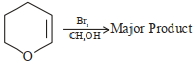
A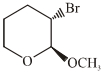
B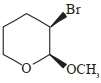
C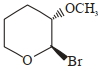
D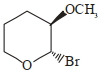
Solution
(A) The reaction of $3,4-dihydro-2H-pyran$ with $Br_2$ in the presence of $CH_3OH$ proceeds via the formation of a cyclic bromonium ion intermediate.
$1.$ $Br_2$ adds to the double bond to form a cyclic bromonium ion.
$2.$ The nucleophile $CH_3OH$ attacks the more substituted carbon atom of the bromonium ion due to electronic effects and the stability of the transition state.
$3.$ This results in an anti-addition product where the $-OCH_3$ group and the $-Br$ atom are in a trans-configuration relative to each other.
Thus,the major product is the one where $-Br$ and $-OCH_3$ are trans to each other.
$1.$ $Br_2$ adds to the double bond to form a cyclic bromonium ion.
$2.$ The nucleophile $CH_3OH$ attacks the more substituted carbon atom of the bromonium ion due to electronic effects and the stability of the transition state.
$3.$ This results in an anti-addition product where the $-OCH_3$ group and the $-Br$ atom are in a trans-configuration relative to each other.
Thus,the major product is the one where $-Br$ and $-OCH_3$ are trans to each other.
0 likesView Solution
35
ChemistryMCQJEE Main · 2022
The major product formed in the following reaction is .... .
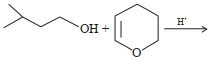
A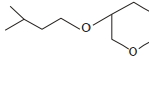
B
C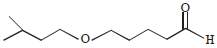
D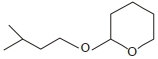
Solution
(D) The reaction involves the acid-catalyzed addition of an alcohol to a vinyl ether,specifically $3,4-$dihydro-$2$$H$-pyran.
$1$. The acid catalyst $(H^+)$ protonates the double bond of the vinyl ether to form a stable resonance-stabilized oxocarbenium ion.
$2$. The alcohol (isopentyl alcohol) acts as a nucleophile and attacks the electrophilic carbon of the oxocarbenium ion.
$3$. Subsequent deprotonation yields the final acetal product.
This reaction is commonly used for the protection of alcohols as tetrahydropyranyl $(THP)$ ethers.
The structure of the product is an isopentyl tetrahydropyranyl ether.
$1$. The acid catalyst $(H^+)$ protonates the double bond of the vinyl ether to form a stable resonance-stabilized oxocarbenium ion.
$2$. The alcohol (isopentyl alcohol) acts as a nucleophile and attacks the electrophilic carbon of the oxocarbenium ion.
$3$. Subsequent deprotonation yields the final acetal product.
This reaction is commonly used for the protection of alcohols as tetrahydropyranyl $(THP)$ ethers.
The structure of the product is an isopentyl tetrahydropyranyl ether.
0 likesView Solution
36
ChemistryDifficultMCQJEE Main · 2022
$A$ protein $'A'$ contains $0.30\, \%$ of glycine (molecular weight $75$). The minimum molar mass of the protein $'A'$ is $.......\, \times 10^{3} \, g\, mol^{-1}$ [nearest integer]
A
$25$
B
$250$
C
$50$
D
$2$
Solution
(A) The minimum molar mass of a protein is calculated assuming that at least one molecule of the constituent (glycine) is present in the protein molecule.
Given that $0.30\, \%$ of the protein is glycine,we have:
$0.30\, g$ of glycine in $100\, g$ of protein.
Since the molecular weight of glycine is $75\, g\, mol^{-1}$,the minimum molar mass of the protein is calculated as:
$\text{Minimum molar mass} = \frac{\text{Molecular weight of glycine} \times 100}{\text{Percentage of glycine}}$
$\text{Minimum molar mass} = \frac{75 \times 100}{0.30} = \frac{7500}{0.30} = 25000\, g\, mol^{-1}$
Converting this to the required format: $25000\, g\, mol^{-1} = 25 \times 10^{3} \, g\, mol^{-1}$.
Thus,the value is $25$.
Given that $0.30\, \%$ of the protein is glycine,we have:
$0.30\, g$ of glycine in $100\, g$ of protein.
Since the molecular weight of glycine is $75\, g\, mol^{-1}$,the minimum molar mass of the protein is calculated as:
$\text{Minimum molar mass} = \frac{\text{Molecular weight of glycine} \times 100}{\text{Percentage of glycine}}$
$\text{Minimum molar mass} = \frac{75 \times 100}{0.30} = \frac{7500}{0.30} = 25000\, g\, mol^{-1}$
Converting this to the required format: $25000\, g\, mol^{-1} = 25 \times 10^{3} \, g\, mol^{-1}$.
Thus,the value is $25$.
0 likesView Solution
37
ChemistryMediumMCQJEE Main · 2022
$A$ rigid nitrogen tank stored inside a laboratory has a pressure of $30 \ atm$ at $06:00 \ am$ when the temperature is $27^{\circ} C$. At $03:00 \ pm$, when the temperature is $45^{\circ} C$, the pressure in the tank will be $...... \ atm.$ [nearest integer]
A
$32$
B
$320$
C
$3.2$
D
$16$
Solution
(A) Since the tank is rigid, the volume $V$ remains constant. According to Gay-Lussac's Law, for a fixed amount of gas at constant volume, the pressure is directly proportional to the absolute temperature: $\frac{P_1}{T_1} = \frac{P_2}{T_2}$.
Given:
$P_1 = 30 \ atm$
$T_1 = 27^{\circ} C = 27 + 273 = 300 \ K$
$T_2 = 45^{\circ} C = 45 + 273 = 318 \ K$
Substituting the values into the equation:
$\frac{30}{300} = \frac{P_2}{318}$
$0.1 = \frac{P_2}{318}$
$P_2 = 0.1 \times 318 = 31.8 \ atm$.
Rounding to the nearest integer, we get $P_2 = 32 \ atm$.
Given:
$P_1 = 30 \ atm$
$T_1 = 27^{\circ} C = 27 + 273 = 300 \ K$
$T_2 = 45^{\circ} C = 45 + 273 = 318 \ K$
Substituting the values into the equation:
$\frac{30}{300} = \frac{P_2}{318}$
$0.1 = \frac{P_2}{318}$
$P_2 = 0.1 \times 318 = 31.8 \ atm$.
Rounding to the nearest integer, we get $P_2 = 32 \ atm$.
0 likesView Solution
38
ChemistryEasyMCQJEE Main · 2022
Amongst $BeF_{2}$,$BF_{3}$,$H_{2}O$,$NH_{3}$,$CCl_{4}$ and $HCl$,the number of molecules with non-zero net dipole moment is ...... .
A
$3$
B
$2$
C
$1$
D
$4$
Solution
(A) The net dipole moment $(\mu_{net})$ depends on the molecular geometry and the electronegativity difference between atoms.
$BeF_{2}$ is linear,$BF_{3}$ is trigonal planar,and $CCl_{4}$ is tetrahedral. These molecules have symmetric structures where individual bond dipoles cancel each other out,resulting in $\mu_{net} = 0$.
$H_{2}O$ (bent),$NH_{3}$ (trigonal pyramidal),and $HCl$ (heteronuclear diatomic) have asymmetric charge distributions,resulting in $\mu_{net} \neq 0$.
Therefore,the molecules with non-zero net dipole moment are $H_{2}O$,$NH_{3}$,and $HCl$.
The total count is $3$.
$BeF_{2}$ is linear,$BF_{3}$ is trigonal planar,and $CCl_{4}$ is tetrahedral. These molecules have symmetric structures where individual bond dipoles cancel each other out,resulting in $\mu_{net} = 0$.
$H_{2}O$ (bent),$NH_{3}$ (trigonal pyramidal),and $HCl$ (heteronuclear diatomic) have asymmetric charge distributions,resulting in $\mu_{net} \neq 0$.
Therefore,the molecules with non-zero net dipole moment are $H_{2}O$,$NH_{3}$,and $HCl$.
The total count is $3$.
0 likesView Solution
39
ChemistryMediumMCQJEE Main · 2022
Consider the following reactions:
$PCl_{3} + 3H_{2}O \longrightarrow A + 3HCl$
$A + H_{2}O \longrightarrow B + HCl$
Identify the number of ionisable protons present in the product $B$.
$PCl_{3} + 3H_{2}O \longrightarrow A + 3HCl$
$A + H_{2}O \longrightarrow B + HCl$
Identify the number of ionisable protons present in the product $B$.
A
$1$
B
$2$
C
$3$
D
$4$
Solution
(B) The hydrolysis of $PCl_{3}$ proceeds as follows:
$PCl_{3} + 3H_{2}O \longrightarrow H_{3}PO_{3} (A) + 3HCl$
However,the question implies a stepwise hydrolysis where $A$ is an intermediate like $PCl_{2}(OH)$ or $PCl(OH)_{2}$.
Upon further hydrolysis,$A$ converts to $B$,which is phosphorous acid $(H_{3}PO_{3})$.
The structure of $H_{3}PO_{3}$ is $H-P(=O)(OH)_{2}$.
In $H_{3}PO_{3}$,only the two hydrogen atoms attached to oxygen atoms are ionisable as protons $(H^{+})$.
The hydrogen atom directly attached to the phosphorus atom is not ionisable.
Therefore,the number of ionisable protons in $B$ is $2$.
$PCl_{3} + 3H_{2}O \longrightarrow H_{3}PO_{3} (A) + 3HCl$
However,the question implies a stepwise hydrolysis where $A$ is an intermediate like $PCl_{2}(OH)$ or $PCl(OH)_{2}$.
Upon further hydrolysis,$A$ converts to $B$,which is phosphorous acid $(H_{3}PO_{3})$.
The structure of $H_{3}PO_{3}$ is $H-P(=O)(OH)_{2}$.
In $H_{3}PO_{3}$,only the two hydrogen atoms attached to oxygen atoms are ionisable as protons $(H^{+})$.
The hydrogen atom directly attached to the phosphorus atom is not ionisable.
Therefore,the number of ionisable protons in $B$ is $2$.
0 likesView Solution
40
ChemistryMediumMCQJEE Main · 2022
The neutralization occurs when $10 \, mL$ of $0.1 \, M$ acid $A$ is allowed to react with $30 \, mL$ of $0.05 \, M$ base $M(OH)_2$. The basicity of the acid $A$ is $...$ $[M$ is a metal$]$
A
$2$
B
$1$
C
$3$
D
$4$
Solution
(C) At the equivalence point,the number of equivalents of acid equals the number of equivalents of base.
The formula for equivalents is $N \times V = M \times n_{factor} \times V$.
For the acid $A$: $M_1 = 0.1 \, M$,$V_1 = 10 \, mL$,$n_{factor} = x$ (basicity).
For the base $M(OH)_2$: $M_2 = 0.05 \, M$,$V_2 = 30 \, mL$,$n_{factor} = 2$ (acidity).
Equating the equivalents: $0.1 \times 10 \times x = 0.05 \times 30 \times 2$.
$1 \times x = 3$.
Therefore,$x = 3$.
The formula for equivalents is $N \times V = M \times n_{factor} \times V$.
For the acid $A$: $M_1 = 0.1 \, M$,$V_1 = 10 \, mL$,$n_{factor} = x$ (basicity).
For the base $M(OH)_2$: $M_2 = 0.05 \, M$,$V_2 = 30 \, mL$,$n_{factor} = 2$ (acidity).
Equating the equivalents: $0.1 \times 10 \times x = 0.05 \times 30 \times 2$.
$1 \times x = 3$.
Therefore,$x = 3$.
0 likesView Solution
41
ChemistryEasyMCQJEE Main · 2022
Bonding in which of the following diatomic molecule$(s)$ becomes stronger,on the basis of $M.O.$ Theory,by removal of an electron?
$(A)$ $NO$
$(B)$ $N_2$
$(C)$ $O_2$
$(D)$ $C_2$
$(E)$ $B_2$
Choose the most appropriate answer from the options given below.
$(A)$ $NO$
$(B)$ $N_2$
$(C)$ $O_2$
$(D)$ $C_2$
$(E)$ $B_2$
Choose the most appropriate answer from the options given below.
A
$(A), (C)$ only
B
$(B), (C), (E)$ only
C
$(A), (B), (C)$ only
D
$(D)$ only
Solution
(A) According to $M.O.$ Theory,bond strength is directly proportional to bond order $(B.O.)$.
If an electron is removed from an antibonding molecular orbital $(M.O.)$,the bond order increases,making the bond stronger.
Let us analyze the molecules:
$1$. $NO$ ($15$ $e^-$): Configuration is $\sigma 1s^2, \sigma^* 1s^2, \sigma 2s^2, \sigma^* 2s^2, \sigma 2p_z^2, \pi 2p_x^2 = \pi 2p_y^2, \pi^* 2p_x^1$. Removing an electron from $\pi^* 2p_x$ increases $B.O.$ from $2.5$ to $3.0$.
$2$. $N_2$ ($14$ $e^-$): Removing an electron from a bonding orbital $(\sigma 2p_z)$ decreases $B.O.$ from $3.0$ to $2.5$.
$3$. $O_2$ ($16$ $e^-$): Configuration has electrons in $\pi^* 2p_x$ and $\pi^* 2p_y$. Removing an electron from $\pi^*$ increases $B.O.$ from $2.0$ to $2.5$.
$4$. $C_2$ ($12$ $e^-$): Removing an electron from a bonding orbital $(\pi 2p)$ decreases $B.O.$ from $2.0$ to $1.5$.
$5$. $B_2$ ($10$ $e^-$): Removing an electron from a bonding orbital $(\pi 2p)$ decreases $B.O.$ from $1.0$ to $0.5$.
Thus,the bond becomes stronger for $NO$ and $O_2$.
If an electron is removed from an antibonding molecular orbital $(M.O.)$,the bond order increases,making the bond stronger.
Let us analyze the molecules:
$1$. $NO$ ($15$ $e^-$): Configuration is $\sigma 1s^2, \sigma^* 1s^2, \sigma 2s^2, \sigma^* 2s^2, \sigma 2p_z^2, \pi 2p_x^2 = \pi 2p_y^2, \pi^* 2p_x^1$. Removing an electron from $\pi^* 2p_x$ increases $B.O.$ from $2.5$ to $3.0$.
$2$. $N_2$ ($14$ $e^-$): Removing an electron from a bonding orbital $(\sigma 2p_z)$ decreases $B.O.$ from $3.0$ to $2.5$.
$3$. $O_2$ ($16$ $e^-$): Configuration has electrons in $\pi^* 2p_x$ and $\pi^* 2p_y$. Removing an electron from $\pi^*$ increases $B.O.$ from $2.0$ to $2.5$.
$4$. $C_2$ ($12$ $e^-$): Removing an electron from a bonding orbital $(\pi 2p)$ decreases $B.O.$ from $2.0$ to $1.5$.
$5$. $B_2$ ($10$ $e^-$): Removing an electron from a bonding orbital $(\pi 2p)$ decreases $B.O.$ from $1.0$ to $0.5$.
Thus,the bond becomes stronger for $NO$ and $O_2$.
0 likesView Solution
42
ChemistryEasyMCQJEE Main · 2022
The pair,in which ions are isoelectronic with $Al^{3+}$ is ..... .
A
$Br^{-}$ and $Be^{2+}$
B
$Cl^{-}$ and $Li^{+}$
C
$S^{2-}$ and $K^{+}$
D
$O^{2-}$ and $Mg^{2+}$
Solution
(D) Isoelectronic species are those that have the same number of electrons.
$Al^{3+}$ has $13 - 3 = 10$ electrons.
$O^{2-}$ has $8 + 2 = 10$ electrons.
$Mg^{2+}$ has $12 - 2 = 10$ electrons.
Since $O^{2-}$ and $Mg^{2+}$ both have $10$ electrons,they are isoelectronic with $Al^{3+}$.
$Al^{3+}$ has $13 - 3 = 10$ electrons.
$O^{2-}$ has $8 + 2 = 10$ electrons.
$Mg^{2+}$ has $12 - 2 = 10$ electrons.
Since $O^{2-}$ and $Mg^{2+}$ both have $10$ electrons,they are isoelectronic with $Al^{3+}$.
0 likesView Solution
43
ChemistryEasyMCQJEE Main · 2022
Number of electron-deficient molecules among the following $PH_{3}$,$B_{2}H_{6}$,$CCl_{4}$,$NH_{3}$,$LiH$,and $BCl_{3}$ is ..... .
A
$0$
B
$1$
C
$2$
D
$3$
Solution
(D) Electron-deficient species are those in which the central atom has an incomplete octet,meaning it has fewer than $8$ electrons in its valence shell.
$1$. $PH_{3}$: $P$ has $8$ electrons (octet complete).
$2$. $B_{2}H_{6}$: Boron has $6$ electrons (electron-deficient).
$3$. $CCl_{4}$: $C$ has $8$ electrons (octet complete).
$4$. $NH_{3}$: $N$ has $8$ electrons (octet complete).
$5$. $LiH$: $Li$ has $2$ electrons (electron-deficient).
$6$. $BCl_{3}$: $B$ has $6$ electrons (electron-deficient).
Therefore,the electron-deficient molecules are $B_{2}H_{6}$,$LiH$,and $BCl_{3}$.
The total number of electron-deficient molecules is $3$.
$1$. $PH_{3}$: $P$ has $8$ electrons (octet complete).
$2$. $B_{2}H_{6}$: Boron has $6$ electrons (electron-deficient).
$3$. $CCl_{4}$: $C$ has $8$ electrons (octet complete).
$4$. $NH_{3}$: $N$ has $8$ electrons (octet complete).
$5$. $LiH$: $Li$ has $2$ electrons (electron-deficient).
$6$. $BCl_{3}$: $B$ has $6$ electrons (electron-deficient).
Therefore,the electron-deficient molecules are $B_{2}H_{6}$,$LiH$,and $BCl_{3}$.
The total number of electron-deficient molecules is $3$.
0 likesView Solution
44
ChemistryMediumMCQJEE Main · 2022
Which one of the following alkaline earth metal ions has the highest ionic mobility in its aqueous solution?
A
$Be^{2+}$
B
$Mg^{2+}$
C
$Ca^{2+}$
D
$Sr^{2+}$
Solution
(D) In aqueous solutions,the ionic mobility is inversely proportional to the degree of hydration.
Smaller ions have a higher charge density,leading to a larger hydration shell,which decreases their mobility.
Among the given ions,$Be^{2+}$ is the smallest and has the highest hydration energy,resulting in the largest hydrated radius and lowest mobility.
Conversely,$Sr^{2+}$ is the largest among the options,has the smallest hydration shell,and therefore exhibits the highest ionic mobility.
Smaller ions have a higher charge density,leading to a larger hydration shell,which decreases their mobility.
Among the given ions,$Be^{2+}$ is the smallest and has the highest hydration energy,resulting in the largest hydrated radius and lowest mobility.
Conversely,$Sr^{2+}$ is the largest among the options,has the smallest hydration shell,and therefore exhibits the highest ionic mobility.
0 likesView Solution
45
ChemistryEasyMCQJEE Main · 2022
The eutrophication of water body results in ...... .
A
loss of Biodiversity
B
breakdown of organic matter
C
increase in biodiversity
D
decrease in $BOD$
Solution
(A) Eutrophication is the process in which nutrient enrichment (such as nitrates and phosphates) leads to excessive growth of algae and aquatic plants.
This excessive growth depletes dissolved oxygen in the water,which leads to the death of aquatic organisms and ultimately results in the loss of biodiversity.
This excessive growth depletes dissolved oxygen in the water,which leads to the death of aquatic organisms and ultimately results in the loss of biodiversity.
0 likesView Solution
46
ChemistryMediumMCQJEE Main · 2022
In the following structures,which one is having a staggered conformation with the maximum dihedral angle?
A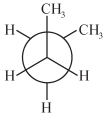
B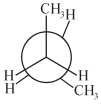
C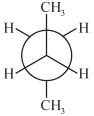
D
Solution
(C) Dihedral angle $:$ It is the angle between $2$ specified groups ($-CH_3$ here) in a Newman projection.
Staggered conformation refers to the arrangement where the groups on the front and back carbons are as far apart as possible.
In option $(A)$,the dihedral angle between the two $-CH_3$ groups is $60^{\circ}$ (gauche).
In option $(B)$,the structure is eclipsed.
In option $(C)$,the two $-CH_3$ groups are in the anti-position,meaning the dihedral angle is $180^{\circ}$. This is the staggered conformation with the maximum dihedral angle.
In option $(D)$,the structure is eclipsed.
Staggered conformation refers to the arrangement where the groups on the front and back carbons are as far apart as possible.
In option $(A)$,the dihedral angle between the two $-CH_3$ groups is $60^{\circ}$ (gauche).
In option $(B)$,the structure is eclipsed.
In option $(C)$,the two $-CH_3$ groups are in the anti-position,meaning the dihedral angle is $180^{\circ}$. This is the staggered conformation with the maximum dihedral angle.
In option $(D)$,the structure is eclipsed.
0 likesView Solution
47
ChemistryEasyMCQJEE Main · 2022
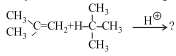
The products formed in the following reaction are:
A
$(CH_3)_2CH-CH_2-CH_2-CH(CH_3)_2$
B
$(CH_3)_2CH-CH_2-C(CH_3)_3$
C
$(CH_3)_2CH-CH(CH_3)-CH(CH_3)_2$
D
$(CH_3)_3C-C(CH_3)_3$
Solution
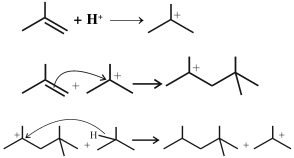
(B) The reaction involves the acid-catalyzed alkylation of an alkene (isobutylene) with an alkane (isobutane).
$1$. The $H^+$ ion protonates the isobutylene to form a stable tert-butyl carbocation: $(CH_3)_2C=CH_2 + H^+ \rightarrow (CH_3)_3C^+$.
$2$. This carbocation then attacks another molecule of isobutylene to form a larger carbocation: $(CH_3)_3C^+ + (CH_3)_2C=CH_2 \rightarrow (CH_3)_3C-CH_2-C^+(CH_3)_2$.
$3$. This new carbocation then abstracts a hydride ion from a molecule of isobutane: $(CH_3)_3C-CH_2-C^+(CH_3)_2 + (CH_3)_3CH \rightarrow (CH_3)_3C-CH_2-CH(CH_3)_2 + (CH_3)_3C^+$.
The final product is $2,2,4$-trimethylpentane,which is $(CH_3)_3C-CH_2-CH(CH_3)_2$.
$1$. The $H^+$ ion protonates the isobutylene to form a stable tert-butyl carbocation: $(CH_3)_2C=CH_2 + H^+ \rightarrow (CH_3)_3C^+$.
$2$. This carbocation then attacks another molecule of isobutylene to form a larger carbocation: $(CH_3)_3C^+ + (CH_3)_2C=CH_2 \rightarrow (CH_3)_3C-CH_2-C^+(CH_3)_2$.
$3$. This new carbocation then abstracts a hydride ion from a molecule of isobutane: $(CH_3)_3C-CH_2-C^+(CH_3)_2 + (CH_3)_3CH \rightarrow (CH_3)_3C-CH_2-CH(CH_3)_2 + (CH_3)_3C^+$.
The final product is $2,2,4$-trimethylpentane,which is $(CH_3)_3C-CH_2-CH(CH_3)_2$.
0 likesView Solution
48
ChemistryDifficultMCQJEE Main · 2022
The number of $N$ atoms in $681 \ g$ of $C_{7}H_{5}N_{3}O_{6}$ is $x \times 10^{21}$. The value of $x$ is $.....$ $(N_{A} = 6.02 \times 10^{23} \ mol^{-1})$ (Nearest Integer)
A
$6418$
B
$5418$
C
$5118$
D
$5948$
Solution
(B) The molar mass of $C_{7}H_{5}N_{3}O_{6}$ is $(7 \times 12) + (5 \times 1) + (3 \times 14) + (6 \times 16) = 84 + 5 + 42 + 96 = 227 \ g/mol$.
The number of moles of $C_{7}H_{5}N_{3}O_{6}$ is $n = \frac{681 \ g}{227 \ g/mol} = 3 \ mol$.
Since each molecule of $C_{7}H_{5}N_{3}O_{6}$ contains $3$ atoms of $N$,the total moles of $N$ atoms is $n_{N} = 3 \times 3 = 9 \ mol$.
The number of $N$ atoms is $9 \times N_{A} = 9 \times 6.02 \times 10^{23} = 54.18 \times 10^{23} = 5418 \times 10^{21}$.
Therefore,the value of $x$ is $5418$.
The number of moles of $C_{7}H_{5}N_{3}O_{6}$ is $n = \frac{681 \ g}{227 \ g/mol} = 3 \ mol$.
Since each molecule of $C_{7}H_{5}N_{3}O_{6}$ contains $3$ atoms of $N$,the total moles of $N$ atoms is $n_{N} = 3 \times 3 = 9 \ mol$.
The number of $N$ atoms is $9 \times N_{A} = 9 \times 6.02 \times 10^{23} = 54.18 \times 10^{23} = 5418 \times 10^{21}$.
Therefore,the value of $x$ is $5418$.
0 likesView Solution
49
ChemistryMediumMCQJEE Main · 2022
The longest wavelength of light that can be used for the ionisation of lithium atom $(Li)$ in its ground state is $x \times 10^{-8} \, m$. The value of $x$ is $.....$ (Nearest Integer)
(Given : Energy of the electron in the first shell of the hydrogen atom is $-2.2 \times 10^{-18} \, J$; $h = 6.63 \times 10^{-34} \, Js$ and $c = 3 \times 10^{8} \, ms^{-1}$ )
(Given : Energy of the electron in the first shell of the hydrogen atom is $-2.2 \times 10^{-18} \, J$; $h = 6.63 \times 10^{-34} \, Js$ and $c = 3 \times 10^{8} \, ms^{-1}$ )
A
$3$
B
$4$
C
$2$
D
$1$
Solution
(D) The ionization energy of a hydrogen-like species is given by $E_n = -13.6 \times Z^2 / n^2 \, eV$ or $E_n = -E_H \times Z^2 / n^2$.
For $Li$ $(Z=3)$ in the ground state $(n=1)$,the energy required to remove the electron is $E = E_{\infty} - E_1 = 0 - (-2.2 \times 10^{-18} \times 3^2 / 1^2) = 19.8 \times 10^{-18} \, J$.
The energy of a photon is $E = hc / \lambda$,so $\lambda = hc / E$.
Substituting the values: $\lambda = (6.63 \times 10^{-34} \times 3 \times 10^8) / (19.8 \times 10^{-18}) = 19.89 \times 10^{-26} / 19.8 \times 10^{-18} \approx 1.0045 \times 10^{-8} \, m$.
Comparing this with $x \times 10^{-8} \, m$,we get $x \approx 1$.
For $Li$ $(Z=3)$ in the ground state $(n=1)$,the energy required to remove the electron is $E = E_{\infty} - E_1 = 0 - (-2.2 \times 10^{-18} \times 3^2 / 1^2) = 19.8 \times 10^{-18} \, J$.
The energy of a photon is $E = hc / \lambda$,so $\lambda = hc / E$.
Substituting the values: $\lambda = (6.63 \times 10^{-34} \times 3 \times 10^8) / (19.8 \times 10^{-18}) = 19.89 \times 10^{-26} / 19.8 \times 10^{-18} \approx 1.0045 \times 10^{-8} \, m$.
Comparing this with $x \times 10^{-8} \, m$,we get $x \approx 1$.
0 likesView Solution
50
ChemistryMediumMCQJEE Main · 2022
The standard entropy change for the reaction $4 Fe ( s ) + 3 O_{2} ( g ) \rightarrow 2 Fe_{2} O_{3} ( s )$ is $-550 \ J K^{-1}$ at $298 \ K$. Given: The standard enthalpy change for the reaction is $-165 \ kJ \ mol^{-1}$. The temperature in $K$ at which the reaction attains equilibrium is ... . (Nearest Integer)
A
$30$
B
$300$
C
$210$
D
$670$
Solution
(B) At equilibrium,the Gibbs free energy change $\Delta G$ is equal to $0$.
Using the relation $\Delta G = \Delta H - T \Delta S = 0$,we get $T = \frac{\Delta H}{\Delta S}$.
Given $\Delta H = -165 \ kJ \ mol^{-1} = -165000 \ J \ mol^{-1}$ and $\Delta S = -550 \ J K^{-1} mol^{-1}$.
Substituting the values: $T = \frac{-165000 \ J \ mol^{-1}}{-550 \ J K^{-1} mol^{-1}} = 300 \ K$.
Therefore,the temperature at which the reaction attains equilibrium is $300 \ K$.
Using the relation $\Delta G = \Delta H - T \Delta S = 0$,we get $T = \frac{\Delta H}{\Delta S}$.
Given $\Delta H = -165 \ kJ \ mol^{-1} = -165000 \ J \ mol^{-1}$ and $\Delta S = -550 \ J K^{-1} mol^{-1}$.
Substituting the values: $T = \frac{-165000 \ J \ mol^{-1}}{-550 \ J K^{-1} mol^{-1}} = 300 \ K$.
Therefore,the temperature at which the reaction attains equilibrium is $300 \ K$.
0 likesView Solution
51
ChemistryMediumMCQJEE Main · 2022
For a first order reaction,the time required for completion of $90 \%$ reaction is '$x$' times the half life of the reaction. The value of '$x$' is $........$. (Given: $\ln 10 = 2.303$ and $\log 2 = 0.3010$)
A
$1.12$
B
$2.43$
C
$3.32$
D
$33.31$
Solution
(C) For a first order reaction,the rate constant $K$ is given by $K = \frac{0.693}{t_{1/2}}$.
The time $t$ required for a reaction to complete $90 \%$ is given by $t_{90\%} = \frac{2.303}{K} \log \left( \frac{100}{100 - 90} \right) = \frac{2.303}{K} \log 10 = \frac{2.303}{K}$.
Substituting $K = \frac{\ln 2}{t_{1/2}} = \frac{0.693}{t_{1/2}}$ into the equation:
$t_{90\%} = \frac{2.303}{0.693} \times t_{1/2}$.
Since $2.303 \approx \ln 10$ and $0.693 \approx \ln 2$,we have $t_{90\%} = \frac{\ln 10}{\ln 2} \times t_{1/2} = \frac{2.303}{2.303 \times 0.3010} \times t_{1/2} = \frac{1}{0.3010} \times t_{1/2} \approx 3.32 \times t_{1/2}$.
Therefore,$x = 3.32$.
The time $t$ required for a reaction to complete $90 \%$ is given by $t_{90\%} = \frac{2.303}{K} \log \left( \frac{100}{100 - 90} \right) = \frac{2.303}{K} \log 10 = \frac{2.303}{K}$.
Substituting $K = \frac{\ln 2}{t_{1/2}} = \frac{0.693}{t_{1/2}}$ into the equation:
$t_{90\%} = \frac{2.303}{0.693} \times t_{1/2}$.
Since $2.303 \approx \ln 10$ and $0.693 \approx \ln 2$,we have $t_{90\%} = \frac{\ln 10}{\ln 2} \times t_{1/2} = \frac{2.303}{2.303 \times 0.3010} \times t_{1/2} = \frac{1}{0.3010} \times t_{1/2} \approx 3.32 \times t_{1/2}$.
Therefore,$x = 3.32$.
0 likesView Solution
52
ChemistryEasyMCQJEE Main · 2022
Which of the following chemical reactions represents the Hall-Heroult process?
A
$Cr_2O_3 + 2 Al \rightarrow Al_2O_3 + 2 Cr$
B
$2 Al_2O_3 + 3 C \rightarrow 4 Al + 3 CO_2$
C
$FeO + CO \rightarrow Fe + CO_2$
D
$2[Au(CN)_2]_{(aq)}^{-} + Zn_{(s)} \rightarrow 2 Au_{(s)} + [Zn(CN)_4]^{2-}$
Solution
(B) The Hall-Heroult process is the major industrial method for the extraction of aluminium from alumina $(Al_2O_3)$.
In this electrolytic process,alumina is dissolved in molten cryolite $(Na_3AlF_6)$ and electrolyzed using carbon electrodes.
The overall chemical reaction is: $2 Al_2O_3 + 3 C \rightarrow 4 Al + 3 CO_2$.
In this electrolytic process,alumina is dissolved in molten cryolite $(Na_3AlF_6)$ and electrolyzed using carbon electrodes.
The overall chemical reaction is: $2 Al_2O_3 + 3 C \rightarrow 4 Al + 3 CO_2$.
0 likesView Solution
53
ChemistryEasyMCQJEE Main · 2022
In the industrial production of which of the following,molecular hydrogen is obtained as a byproduct?
A
$NaOH$
B
$NaCl$
C
$Na$ metal
D
$Na_{2}CO_{3}$
Solution
(A) Sodium hydroxide $(NaOH)$ is prepared commercially by the electrolysis of brine ($NaCl$ solution) in a $Castner-Kellner$ cell.
At the cathode,sodium ions are reduced to sodium amalgam $(Na-Hg)$:
$Na^{+} + e^{-} \xrightarrow{Hg} Na-Hg$
At the anode,chloride ions are oxidized to chlorine gas:
$Cl^{-} \longrightarrow \frac{1}{2}Cl_{2} + e^{-}$
The sodium amalgam is then treated with water to produce sodium hydroxide and molecular hydrogen gas as a byproduct:
$2Na(amalgam) + 2H_{2}O \longrightarrow 2NaOH + H_{2} + 2Hg$
At the cathode,sodium ions are reduced to sodium amalgam $(Na-Hg)$:
$Na^{+} + e^{-} \xrightarrow{Hg} Na-Hg$
At the anode,chloride ions are oxidized to chlorine gas:
$Cl^{-} \longrightarrow \frac{1}{2}Cl_{2} + e^{-}$
The sodium amalgam is then treated with water to produce sodium hydroxide and molecular hydrogen gas as a byproduct:
$2Na(amalgam) + 2H_{2}O \longrightarrow 2NaOH + H_{2} + 2Hg$
0 likesView Solution
54
ChemistryEasyMCQJEE Main · 2022
$PCl_5$ is well known,but $NCl_5$ is not. Why?
A
Nitrogen is less reactive than phosphorus.
B
Nitrogen does not have $d-$orbitals in its valence shell.
C
Catenation tendency is weaker in nitrogen than phosphorus.
D
Size of phosphorus is larger than nitrogen.
Solution
(B) $PCl_5$ forms five bonds by using the $d-$orbitals to expand its octet.
$NCl_5$ does not exist because nitrogen belongs to the $2^{nd}$ period and lacks $d-$orbitals in its valence shell.
Therefore,nitrogen cannot expand its octet beyond a covalency of $4$.
$NCl_5$ does not exist because nitrogen belongs to the $2^{nd}$ period and lacks $d-$orbitals in its valence shell.
Therefore,nitrogen cannot expand its octet beyond a covalency of $4$.
0 likesView Solution
55
ChemistryMediumMCQJEE Main · 2022
The transition metal complex with the highest value of crystal field splitting $(\Delta_{0})$ is ........ .
A
$[Cr(H_{2}O)_{6}]^{3+}$
B
$[Mo(H_{2}O)_{6}]^{3+}$
C
$[Fe(H_{2}O)_{6}]^{3+}$
D
$[Os(H_{2}O)_{6}]^{3+}$
Solution
(D) The crystal field splitting energy $(\Delta_{0})$ increases down a group in the periodic table for metal ions with the same charge and same ligand environment.
This is because the $d$-orbitals of the $5d$ series elements are more extended in space compared to the $3d$ and $4d$ series,leading to stronger interaction with the ligands.
Among the given complexes,$Cr^{3+}$ $(3d)$,$Mo^{3+}$ $(4d)$,$Fe^{3+}$ $(3d)$,and $Os^{3+}$ $(5d)$ are present.
Since $Os$ belongs to the $5d$ series,the complex $[Os(H_{2}O)_{6}]^{3+}$ will have the highest $\Delta_{0}$ value.
This is because the $d$-orbitals of the $5d$ series elements are more extended in space compared to the $3d$ and $4d$ series,leading to stronger interaction with the ligands.
Among the given complexes,$Cr^{3+}$ $(3d)$,$Mo^{3+}$ $(4d)$,$Fe^{3+}$ $(3d)$,and $Os^{3+}$ $(5d)$ are present.
Since $Os$ belongs to the $5d$ series,the complex $[Os(H_{2}O)_{6}]^{3+}$ will have the highest $\Delta_{0}$ value.
0 likesView Solution
56
ChemistryMediumMCQJEE Main · 2022
Which of the following reagents/reactions will convert $A$ to $B$?
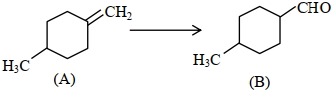
A
$PCC$ oxidation
B
Ozonolysis
C
$BH_3, H_2O_2 / OH^-$ followed by $PCC$ oxidation
D
$HBr$,hydrolysis followed by oxidation by $K_2Cr_2O_7$.
Solution
(C) The conversion of $A$ ($4$-methylmethylenecyclohexane) to $B$ ($4$-methylcyclohexanecarbaldehyde) involves the transformation of an exocyclic double bond into an aldehyde group.
$1$. First,hydroboration-oxidation using $BH_3, H_2O_2 / OH^-$ is performed. This reaction follows anti-Markovnikov addition of water across the double bond to form a primary alcohol,$4$-methylcyclohexylmethanol.
$2$. Second,the primary alcohol is oxidized to an aldehyde using $PCC$ (Pyridinium chlorochromate). $PCC$ is a mild oxidizing agent that stops the oxidation at the aldehyde stage,preventing further oxidation to a carboxylic acid.
$1$. First,hydroboration-oxidation using $BH_3, H_2O_2 / OH^-$ is performed. This reaction follows anti-Markovnikov addition of water across the double bond to form a primary alcohol,$4$-methylcyclohexylmethanol.
$2$. Second,the primary alcohol is oxidized to an aldehyde using $PCC$ (Pyridinium chlorochromate). $PCC$ is a mild oxidizing agent that stops the oxidation at the aldehyde stage,preventing further oxidation to a carboxylic acid.
0 likesView Solution
57
ChemistryMediumMCQJEE Main · 2022
Hex$-4-$en$-2-$ol on treatment with $PCC$ gives $'A'.$ $'A'$ on reaction with sodium hypoiodite gives $'B',$ which on further heating with soda lime gives $'C'.$ The compound $'C'$ is $....... .$
A
$2-$pentene
B
proponaldehyde
C
$2-$butene
D
$4-$methylpent$-2-$ene
Solution
(C) $1$. $PCC$ (Pyridinium chlorochromate) oxidizes the secondary alcohol $CH_3-CH=CH-CH_2-CH(OH)-CH_3$ to the ketone $CH_3-CH=CH-CH_2-CO-CH_3$ (Compound $'A'$).
$2$. Compound $'A'$ contains a methyl ketone group,so it undergoes the iodoform reaction with sodium hypoiodite $(NaOI)$ to form the carboxylic acid $CH_3-CH=CH-CH_2-COOH$ (Compound $'B'$) and iodoform $(CHI_3)$.
$3$. Decarboxylation of the carboxylic acid $CH_3-CH=CH-CH_2-COOH$ with soda lime $(NaOH + CaO)$ removes $CO_2$ to yield $CH_3-CH=CH-CH_3$ (Compound $'C'$),which is $but-2-ene$.
$2$. Compound $'A'$ contains a methyl ketone group,so it undergoes the iodoform reaction with sodium hypoiodite $(NaOI)$ to form the carboxylic acid $CH_3-CH=CH-CH_2-COOH$ (Compound $'B'$) and iodoform $(CHI_3)$.
$3$. Decarboxylation of the carboxylic acid $CH_3-CH=CH-CH_2-COOH$ with soda lime $(NaOH + CaO)$ removes $CO_2$ to yield $CH_3-CH=CH-CH_3$ (Compound $'C'$),which is $but-2-ene$.
0 likesView Solution
58
ChemistryMediumMCQJEE Main · 2022
The conversion of propan$-1-$ol to $n-$butylamine involves the sequential addition of reagents. The correct sequential order of reagents is:
A
$(i) SOCl_2, (ii) KCN, (iii) H_2 / Ni \text{ or } Na(Hg) / C_2H_5OH$
B
$(i) HCl, (ii) H_2 / Ni \text{ or } Na(Hg) / C_2H_5OH$
C
$(i) SOCl_2, (ii) KCN, (iii) CH_3NH_2$
D
$(i) HCl, (ii) CH_3NH_2$
Solution
(A) The conversion of propan$-1-$ol $(CH_3CH_2CH_2OH)$ to $n-$butylamine $(CH_3CH_2CH_2CH_2NH_2)$ requires increasing the carbon chain length by one carbon atom.
Step $1$: Propan$-1-$ol reacts with $SOCl_2$ to form $1-$chloropropane $(CH_3CH_2CH_2Cl)$.
Step $2$: $1-$chloropropane reacts with $KCN$ (nucleophilic substitution) to form butanenitrile $(CH_3CH_2CH_2CN)$.
Step $3$: Butanenitrile is reduced using $H_2/Ni$ or $Na(Hg)/C_2H_5OH$ (Mendius reduction) to form $n-$butylamine $(CH_3CH_2CH_2CH_2NH_2)$.
Step $1$: Propan$-1-$ol reacts with $SOCl_2$ to form $1-$chloropropane $(CH_3CH_2CH_2Cl)$.
Step $2$: $1-$chloropropane reacts with $KCN$ (nucleophilic substitution) to form butanenitrile $(CH_3CH_2CH_2CN)$.
Step $3$: Butanenitrile is reduced using $H_2/Ni$ or $Na(Hg)/C_2H_5OH$ (Mendius reduction) to form $n-$butylamine $(CH_3CH_2CH_2CH_2NH_2)$.
0 likesView Solution
59
ChemistryMediumMCQJEE Main · 2022
Which of the following is not an example of a condensation polymer?
A
Nylon $6,6$
B
Dacron
C
Buna$-N$
D
Silicone
Solution
(C) Buna$-N$ is an addition copolymer formed by the polymerization of $1,3-$butadiene and acrylonitrile.
Condensation polymers are formed by the repeated condensation reaction between two different bi-functional or tri-functional monomeric units,usually with the elimination of small molecules like $H_2O$,$HCl$,or $NH_3$.
Nylon $6,6$,Dacron,and Silicone are examples of condensation polymers.
Buna$-N$ is an addition polymer,not a condensation polymer.
Condensation polymers are formed by the repeated condensation reaction between two different bi-functional or tri-functional monomeric units,usually with the elimination of small molecules like $H_2O$,$HCl$,or $NH_3$.
Nylon $6,6$,Dacron,and Silicone are examples of condensation polymers.
Buna$-N$ is an addition polymer,not a condensation polymer.
0 likesView Solution
60
ChemistryMediumMCQJEE Main · 2022
The structure shown below is of which well-known drug molecule?
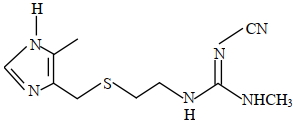
A
Ranitidine
B
Seldane
C
Cimetidine
D
Codeine
Solution
(C) The structure provided is that of $Cimetidine$.
$Cimetidine$ is a well-known histamine $H_2$-receptor antagonist that inhibits stomach acid production.
It is characterized by an imidazole ring attached to a thioether chain,which terminates in a cyanoguanidine group.
$Cimetidine$ is a well-known histamine $H_2$-receptor antagonist that inhibits stomach acid production.
It is characterized by an imidazole ring attached to a thioether chain,which terminates in a cyanoguanidine group.
0 likesView Solution
61
ChemistryMediumMCQJEE Main · 2022
In the flame test of a mixture of salts,a green flame with a blue centre was observed. Which one of the following cations may be present?
A
$Cu^{2+}$
B
$Sr^{2+}$
C
$Ba^{2+}$
D
$Ca^{2+}$
Solution
(A) The flame test is a diagnostic tool used to identify the presence of certain metal ions in a sample based on the characteristic color they impart to a non-luminous flame.
Based on the observation,the presence of a green flame with a blue centre is characteristic of the $Cu^{2+}$ ion.
| Ion | Colour of the flame |
| $A. Cu^{2+}$ | Green flame with blue centre |
| $B. Sr^{2+}$ | Crimson Red |
| $C. Ba^{2+}$ | Apple green |
| $D. Ca^{2+}$ | Brick red |
Based on the observation,the presence of a green flame with a blue centre is characteristic of the $Cu^{2+}$ ion.
0 likesView Solution
62
ChemistryMediumMCQJEE Main · 2022
$A$ company dissolves '$X$' amount of $CO_{2}$ at $298 \ K$ in $1 \ L$ of water to prepare soda water. $X = ........ \ \times 10^{-3} \ g$ (nearest integer).
(Given: partial pressure of $CO_{2}$ at $298 \ K = 0.835 \ bar$.
Henry's law constant for $CO_{2}$ at $298 \ K = 1.67 \ kbar$.
Atomic mass of $H$,$C$ and $O$ is $1$,$12$ and $16 \ g \ mol^{-1}$,respectively.)
(Given: partial pressure of $CO_{2}$ at $298 \ K = 0.835 \ bar$.
Henry's law constant for $CO_{2}$ at $298 \ K = 1.67 \ kbar$.
Atomic mass of $H$,$C$ and $O$ is $1$,$12$ and $16 \ g \ mol^{-1}$,respectively.)
A
$870$
B
$1180$
C
$1500$
D
$1222$
Solution
(D) According to Henry's Law: $P = K_{H} \times \chi_{CO_{2}}$
Given:
$P = 0.835 \ bar$
$K_{H} = 1.67 \ kbar = 1670 \ bar$
Since the amount of $CO_{2}$ is very small,we can approximate the mole fraction $\chi_{CO_{2}} \approx \frac{n_{CO_{2}}}{n_{H_{2}O}}$
$n_{H_{2}O} = \frac{1000 \ g}{18 \ g \ mol^{-1}} = 55.55 \ mol$
$0.835 = 1670 \times \frac{n_{CO_{2}}}{55.55}$
$n_{CO_{2}} = \frac{0.835 \times 55.55}{1670} = 0.02777 \ mol$
Mass of $CO_{2} = n_{CO_{2}} \times \text{Molar mass of } CO_{2} = 0.02777 \times 44 = 1.222 \ g$
$X = 1.222 \times 10^{3} \times 10^{-3} \ g = 1222 \times 10^{-3} \ g$
Thus,$X = 1222$.
Given:
$P = 0.835 \ bar$
$K_{H} = 1.67 \ kbar = 1670 \ bar$
Since the amount of $CO_{2}$ is very small,we can approximate the mole fraction $\chi_{CO_{2}} \approx \frac{n_{CO_{2}}}{n_{H_{2}O}}$
$n_{H_{2}O} = \frac{1000 \ g}{18 \ g \ mol^{-1}} = 55.55 \ mol$
$0.835 = 1670 \times \frac{n_{CO_{2}}}{55.55}$
$n_{CO_{2}} = \frac{0.835 \times 55.55}{1670} = 0.02777 \ mol$
Mass of $CO_{2} = n_{CO_{2}} \times \text{Molar mass of } CO_{2} = 0.02777 \times 44 = 1.222 \ g$
$X = 1.222 \times 10^{3} \times 10^{-3} \ g = 1222 \times 10^{-3} \ g$
Thus,$X = 1222$.
0 likesView Solution
63
ChemistryMediumMCQJEE Main · 2022
The resistance of a conductivity cell containing $0.01 \, M \, KCl$ solution at $298 \, K$ is $1750 \, \Omega$. If the conductivity of $0.01 \, M \, KCl$ solution at $298 \, K$ is $0.152 \times 10^{-3} \, S \, cm^{-1}$,then the cell constant of the conductivity cell is $.......... \, \times 10^{-3} \, cm^{-1}$.
A
$452$
B
$312$
C
$266$
D
$199$
Solution
(C) The relationship between conductivity $(k)$,resistance $(R)$,and cell constant $(G^*)$ is given by:
$k = \frac{1}{R} \times G^*$
Given:
$R = 1750 \, \Omega$
$k = 0.152 \times 10^{-3} \, S \, cm^{-1}$
Substituting the values:
$0.152 \times 10^{-3} = \frac{1}{1750} \times G^*$
$G^* = 0.152 \times 10^{-3} \times 1750$
$G^* = 266 \times 10^{-3} \, cm^{-1}$
$k = \frac{1}{R} \times G^*$
Given:
$R = 1750 \, \Omega$
$k = 0.152 \times 10^{-3} \, S \, cm^{-1}$
Substituting the values:
$0.152 \times 10^{-3} = \frac{1}{1750} \times G^*$
$G^* = 0.152 \times 10^{-3} \times 1750$
$G^* = 266 \times 10^{-3} \, cm^{-1}$
0 likesView Solution
64
ChemistryDifficultMCQJEE Main · 2022
When $200 \, mL$ of $0.2 \, M$ acetic acid is shaken with $0.6 \, g$ of wood charcoal,the final concentration of acetic acid after adsorption is $0.1 \, M$. The mass of acetic acid adsorbed per gram of carbon is $...... \, g$.
A
$1$
B
$0.2$
C
$2$
D
$20$
Solution
(C) Initial moles of acetic acid $= M_1 \times V_1 = 0.2 \, M \times 0.2 \, L = 0.04 \, mol$.
Final moles of acetic acid $= M_2 \times V_2 = 0.1 \, M \times 0.2 \, L = 0.02 \, mol$.
Moles of acetic acid adsorbed $= 0.04 - 0.02 = 0.02 \, mol$.
Molar mass of acetic acid $(CH_3COOH) = 60 \, g/mol$.
Mass of acetic acid adsorbed $= 0.02 \, mol \times 60 \, g/mol = 1.2 \, g$.
Mass of wood charcoal $= 0.6 \, g$.
Mass of acetic acid adsorbed per gram of carbon $= \frac{1.2 \, g}{0.6 \, g} = 2 \, g/g$.
Final moles of acetic acid $= M_2 \times V_2 = 0.1 \, M \times 0.2 \, L = 0.02 \, mol$.
Moles of acetic acid adsorbed $= 0.04 - 0.02 = 0.02 \, mol$.
Molar mass of acetic acid $(CH_3COOH) = 60 \, g/mol$.
Mass of acetic acid adsorbed $= 0.02 \, mol \times 60 \, g/mol = 1.2 \, g$.
Mass of wood charcoal $= 0.6 \, g$.
Mass of acetic acid adsorbed per gram of carbon $= \frac{1.2 \, g}{0.6 \, g} = 2 \, g/g$.
0 likesView Solution
65
ChemistryEasyMCQJEE Main · 2022
$(a)$ Baryte,$(b)$ Galena,$(c)$ Zinc blende,and $(d)$ Copper pyrites. How many of these minerals are sulphide-based?
A
$3$
B
$2$
C
$1$
D
$4$
Solution
(A) $(1)$ Baryte: $BaSO_4$ (Sulphate ore)
$(2)$ Galena: $PbS$ (Sulphide ore)
$(3)$ Zinc blende: $ZnS$ (Sulphide ore)
$(4)$ Copper pyrites: $CuFeS_2$ (Sulphide ore)
Thus,$(2)$,$(3)$,and $(4)$ are sulphide $(S^{2-})$ based ores.
Therefore,the total number of sulphide-based minerals is $3$.
$(2)$ Galena: $PbS$ (Sulphide ore)
$(3)$ Zinc blende: $ZnS$ (Sulphide ore)
$(4)$ Copper pyrites: $CuFeS_2$ (Sulphide ore)
Thus,$(2)$,$(3)$,and $(4)$ are sulphide $(S^{2-})$ based ores.
Therefore,the total number of sulphide-based minerals is $3$.
0 likesView Solution
66
ChemistryEasyMCQJEE Main · 2022
Consider the reaction shown below. The number of $\pi$ electrons present in the major product '$P$' is ...... .
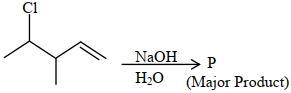
A
$1$
B
$2$
C
$3$
D
$5$
Solution
(B) The reaction of $3$-chloro-$2$-methylpent-$4$-ene with aqueous $NaOH$ is a nucleophilic substitution reaction ($S_N1$ or $S_N2$ depending on conditions,but here it leads to the substitution of $-Cl$ by $-OH$).
The product '$P$' is $3$-methylpent-$4$-en-$2$-ol.
The structure of the product contains one double bond $(C=C)$.
Since each double bond consists of one $\pi$ bond,and each $\pi$ bond contains $2$ electrons,the total number of $\pi$ electrons in the product is $2$.
The product '$P$' is $3$-methylpent-$4$-en-$2$-ol.
The structure of the product contains one double bond $(C=C)$.
Since each double bond consists of one $\pi$ bond,and each $\pi$ bond contains $2$ electrons,the total number of $\pi$ electrons in the product is $2$.
0 likesView Solution
67
ChemistryEasyMCQJEE Main · 2022
In $\text{alanyl-glycyl-leucyl-alanyl-valine}$,the number of peptide linkages is $......$
A
$2$
B
$4$
C
$5$
D
$1$
Solution
(B) The given peptide is a pentapeptide,which consists of $5$ amino acid residues: $\text{alanine}$,$\text{glycine}$,$\text{leucine}$,$\text{alanine}$,and $\text{valine}$.
In a polypeptide chain,the number of peptide linkages is always $(n-1)$,where $n$ is the number of amino acid residues.
Here,$n = 5$,so the number of peptide linkages $= 5 - 1 = 4$.
In a polypeptide chain,the number of peptide linkages is always $(n-1)$,where $n$ is the number of amino acid residues.
Here,$n = 5$,so the number of peptide linkages $= 5 - 1 = 4$.
0 likesView Solution
68
ChemistryMediumMCQJEE Main · 2022
Match List $-I$ with List $-II$:
| List $-I$ | List $-II$ |
| $A$. $[PtCl_4]^{2-}$ | $I$. $sp^3d$ |
| $B$. $BrF_5$ | $II$. $d^2sp^3$ |
| $C$. $PCl_5$ | $III$. $dsp^2$ |
| $D$. $[Co(NH_3)_6]^{3+}$ | $IV$. $sp^3d^2$ |
A
$A-II, B-IV, C-I, D-III$
B
$A-III, B-IV, C-I, D-II$
C
$A-III, B-I, C-IV, D-II$
D
$A-II, B-I, C-IV, D-III$
Solution
(B) The hybridization of the given species is as follows:
$1$. $[PtCl_4]^{2-}$: $Pt^{2+}$ has a $d^8$ configuration. It forms a square planar complex with $dsp^2$ hybridization. $(A-III)$
$2$. $BrF_5$: The central atom $Br$ has $7$ valence electrons. It forms $5$ bonds and has $1$ lone pair,resulting in $sp^3d^2$ hybridization. $(B-IV)$
$3$. $PCl_5$: The central atom $P$ has $5$ valence electrons. It forms $5$ bonds with no lone pairs,resulting in $sp^3d$ hybridization. $(C-I)$
$4$. $[Co(NH_3)_6]^{3+}$: $Co^{3+}$ has a $d^6$ configuration. $NH_3$ is a strong field ligand,forcing pairing of electrons,resulting in $d^2sp^3$ hybridization. $(D-II)$
Thus,the correct match is $A-III, B-IV, C-I, D-II$.
$1$. $[PtCl_4]^{2-}$: $Pt^{2+}$ has a $d^8$ configuration. It forms a square planar complex with $dsp^2$ hybridization. $(A-III)$
$2$. $BrF_5$: The central atom $Br$ has $7$ valence electrons. It forms $5$ bonds and has $1$ lone pair,resulting in $sp^3d^2$ hybridization. $(B-IV)$
$3$. $PCl_5$: The central atom $P$ has $5$ valence electrons. It forms $5$ bonds with no lone pairs,resulting in $sp^3d$ hybridization. $(C-I)$
$4$. $[Co(NH_3)_6]^{3+}$: $Co^{3+}$ has a $d^6$ configuration. $NH_3$ is a strong field ligand,forcing pairing of electrons,resulting in $d^2sp^3$ hybridization. $(D-II)$
Thus,the correct match is $A-III, B-IV, C-I, D-II$.
0 likesView Solution
69
ChemistryMediumMCQJEE Main · 2022
Given below are two statements:
Statement $I :$ Emulsions of oil in water are unstable and sometimes they separate into two layers on standing.
Statement $II :$ For stabilisation of an emulsion,excess of electrolyte is added.
In the light of the above statements,choose the most appropriate answer from the options given below:
Statement $I :$ Emulsions of oil in water are unstable and sometimes they separate into two layers on standing.
Statement $II :$ For stabilisation of an emulsion,excess of electrolyte is added.
In the light of the above statements,choose the most appropriate answer from the options given below:
A
Both Statement $I$ and Statement $II$ are correct.
B
Both Statement $I$ and Statement $II$ are incorrect.
C
Statement $I$ is correct but Statement $II$ is incorrect.
D
Statement $I$ is incorrect but Statement $II$ is correct.
Solution
(C) Statement $I$ is correct because emulsions are thermodynamically unstable systems,and oil droplets tend to coalesce and separate into two layers over time.
Statement $II$ is incorrect because adding an excess of electrolyte to an emulsion typically causes coagulation or breaking of the emulsion,not stabilization. Emulsions are stabilized by adding emulsifying agents (emulsifiers) like soaps,proteins,or gums,which form a protective film around the dispersed droplets.
Statement $II$ is incorrect because adding an excess of electrolyte to an emulsion typically causes coagulation or breaking of the emulsion,not stabilization. Emulsions are stabilized by adding emulsifying agents (emulsifiers) like soaps,proteins,or gums,which form a protective film around the dispersed droplets.
0 likesView Solution
70
ChemistryEasyMCQJEE Main · 2022
Match List-$I$ with List-$II$:
Choose the correct answer from the options given below:
| List-$I$ | List-$II$ |
| $(a)$ Sphalerite | $(i)$ $FeCO_3$ |
| $(b)$ Calamine | $(ii)$ $PbS$ |
| $(c)$ Galena | $(iii)$ $ZnCO_3$ |
| $(d)$ Siderite | $(iv)$ $ZnS$ |
Choose the correct answer from the options given below:
A
$(a)-iv, (b)-iii, (c)-ii, (d)-i$
B
$(a)-iv, (b)-i, (c)-ii, (d)-iii$
C
$(a)-ii, (b)-iii, (c)-i, (d)-iv$
D
$(a)-iii, (b)-iv, (c)-ii, (d)-i$
Solution
(A) The correct matches for the ores are as follows:
- Sphalerite is $ZnS$ $(iv)$.
- Calamine is $ZnCO_3$ $(iii)$.
- Galena is $PbS$ $(ii)$.
- Siderite is $FeCO_3$ $(i)$.
Therefore,the correct sequence is $(a)-iv, (b)-iii, (c)-ii, (d)-i$.
- Sphalerite is $ZnS$ $(iv)$.
- Calamine is $ZnCO_3$ $(iii)$.
- Galena is $PbS$ $(ii)$.
- Siderite is $FeCO_3$ $(i)$.
Therefore,the correct sequence is $(a)-iv, (b)-iii, (c)-ii, (d)-i$.
0 likesView Solution
71
ChemistryMediumMCQJEE Main · 2022
The most stable trihalide of nitrogen is ..... .
A
$NF_{3}$
B
$NCl_{3}$
C
$NBr_{3}$
D
$NI_{3}$
Solution
(A) The stability of nitrogen trihalides decreases as the size of the halogen atom increases.
The bond energy of the $N-X$ bond decreases from $F$ to $I$ due to the increasing mismatch in the size of the orbitals of $N$ and $X$ atoms.
Therefore,the order of stability is: $NF_{3} > NCl_{3} > NBr_{3} > NI_{3}$.
Thus,$NF_{3}$ is the most stable trihalide.
The bond energy of the $N-X$ bond decreases from $F$ to $I$ due to the increasing mismatch in the size of the orbitals of $N$ and $X$ atoms.
Therefore,the order of stability is: $NF_{3} > NCl_{3} > NBr_{3} > NI_{3}$.
Thus,$NF_{3}$ is the most stable trihalide.
0 likesView Solution
72
ChemistryMediumMCQJEE Main · 2022
In the given reaction sequence,the major product $C$ is ..... .

A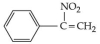
B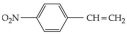
C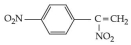
D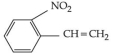
Solution
(B) The starting material $C_8H_{10}$ is ethylbenzene.
$1$. Nitration of ethylbenzene with $HNO_3/H_2SO_4$ gives $p$-nitroethylbenzene as the major product $(A)$.
$2$. Radical bromination of $p$-nitroethylbenzene with $Br_2/\Delta$ occurs at the benzylic position to form $1-(4-nitrophenyl)ethyl$ bromide $(B)$.
$3$. Dehydrohalogenation of $B$ with alcoholic $KOH$ yields $p$-nitrostyrene $(C)$ as the major product.
$1$. Nitration of ethylbenzene with $HNO_3/H_2SO_4$ gives $p$-nitroethylbenzene as the major product $(A)$.
$2$. Radical bromination of $p$-nitroethylbenzene with $Br_2/\Delta$ occurs at the benzylic position to form $1-(4-nitrophenyl)ethyl$ bromide $(B)$.
$3$. Dehydrohalogenation of $B$ with alcoholic $KOH$ yields $p$-nitrostyrene $(C)$ as the major product.
0 likesView Solution
73
ChemistryMediumMCQJEE Main · 2022
Two statements are given below:
Statement $I:$ The melting point of monocarboxylic acids with an even number of carbon atoms is higher than that of acids with an odd number of carbon atoms immediately below and above it in the series.
Statement $II:$ The solubility of monocarboxylic acids in water decreases with an increase in molar mass.
Choose the most appropriate option.
Statement $I:$ The melting point of monocarboxylic acids with an even number of carbon atoms is higher than that of acids with an odd number of carbon atoms immediately below and above it in the series.
Statement $II:$ The solubility of monocarboxylic acids in water decreases with an increase in molar mass.
Choose the most appropriate option.
A
Both Statement $I$ and Statement $II$ are correct.
B
Both Statement $I$ and Statement $II$ are incorrect.
C
Statement $I$ is correct but Statement $II$ is incorrect.
D
Statement $I$ is incorrect but Statement $II$ is correct.
Solution
(A) $I.$ Monocarboxylic acids with an even number of carbon atoms exhibit better packing efficiency in the crystal lattice,which results in a higher melting point $(M.P.)$ compared to their odd-numbered counterparts.
$II.$ As the molar mass of monocarboxylic acids increases,the size of the hydrophobic alkyl chain increases,which reduces the interaction with water molecules,thereby decreasing solubility.
$II.$ As the molar mass of monocarboxylic acids increases,the size of the hydrophobic alkyl chain increases,which reduces the interaction with water molecules,thereby decreasing solubility.
0 likesView Solution
74
ChemistryMediumMCQJEE Main · 2022
Which of the following is an example of a conjugated diketone?
A
$CH_3-CO-CH_2-CH_2-CH_2-CO-CH_3$
B
$CH_3-CO-CH_2-(C_6H_8O)$
C
$p-Benzoquinone$
D
$C_6H_5-CO-CH_2-CH_2-CO-CH_3$
Solution
(C) conjugated diketone is a compound where the two carbonyl groups are separated by a system of alternating single and double bonds,allowing for resonance delocalization between the two carbonyl groups.
In $p-Benzoquinone$,the two carbonyl groups are part of a cyclic system where they are conjugated with the carbon-carbon double bonds in the ring.
Therefore,$p-Benzoquinone$ is a conjugated diketone.
In $p-Benzoquinone$,the two carbonyl groups are part of a cyclic system where they are conjugated with the carbon-carbon double bonds in the ring.
Therefore,$p-Benzoquinone$ is a conjugated diketone.
0 likesView Solution
75
ChemistryMediumMCQJEE Main · 2022
The major product of the above reaction is $A$.
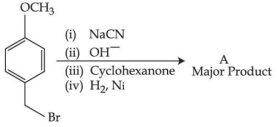
A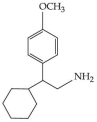
B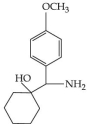
C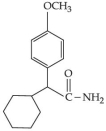
D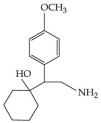
Solution
(A) Step $1$: $4$-Methoxybenzyl bromide reacts with $NaCN$ to form $4$-methoxybenzyl cyanide $(CH_3O-C_6H_4-CH_2CN)$.
Step $2$: In the presence of $OH^-$,the alpha-hydrogen of the nitrile is abstracted to form a carbanion,which then performs a nucleophilic attack on the carbonyl carbon of cyclohexanone.
Step $3$: This results in the formation of a cyanohydrin derivative: $CH_3O-C_6H_4-CH(CN)-C(OH)(C_6H_{10})$.
Step $4$: Finally,catalytic hydrogenation using $H_2, Ni$ reduces the nitrile group $(-CN)$ to a primary amine group $(-CH_2NH_2)$.
The final product is $1-(4-methoxyphenyl)-2-(cyclohexyl)-2-hydroxyethanamine$ derivative,which matches the structure in option $A$.
Step $2$: In the presence of $OH^-$,the alpha-hydrogen of the nitrile is abstracted to form a carbanion,which then performs a nucleophilic attack on the carbonyl carbon of cyclohexanone.
Step $3$: This results in the formation of a cyanohydrin derivative: $CH_3O-C_6H_4-CH(CN)-C(OH)(C_6H_{10})$.
Step $4$: Finally,catalytic hydrogenation using $H_2, Ni$ reduces the nitrile group $(-CN)$ to a primary amine group $(-CH_2NH_2)$.
The final product is $1-(4-methoxyphenyl)-2-(cyclohexyl)-2-hydroxyethanamine$ derivative,which matches the structure in option $A$.
0 likesView Solution
76
ChemistryEasyMCQJEE Main · 2022
Which of the following is an example of a polyester?
A
Butadiene-styrene copolymer
B
Melamine polymer
C
Neoprene
D
Poly-$ \beta $-hydroxybutyrate-co-$ \beta $-hydroxy valerate
Solution
(D) . Polyesters are polymers that contain the ester functional group in their main chain.
$PHBV$ (Poly-$ \beta $-hydroxybutyrate-co-$ \beta $-hydroxy valerate) is a biodegradable aliphatic polyester formed by the copolymerization of $3$-hydroxybutanoic acid and $3$-hydroxypentanoic acid.
$PHBV$ (Poly-$ \beta $-hydroxybutyrate-co-$ \beta $-hydroxy valerate) is a biodegradable aliphatic polyester formed by the copolymerization of $3$-hydroxybutanoic acid and $3$-hydroxypentanoic acid.
0 likesView Solution
77
ChemistryMediumMCQJEE Main · 2022
$A$ polysaccharide '$X$' on boiling with dil $H_2SO_4$ at $393 \ K$ under $2-3 \ atm$ pressure yields '$Y$'. '$Y$' on treatment with bromine water gives gluconic acid. '$X$' contains $\beta-$glycosidic linkages only. Compound '$X$' is ..... .
A
starch
B
cellulose
C
amylose
D
amylopectin
Solution
(B) $1$. The polysaccharide '$X$' on hydrolysis yields '$Y$'.
$2$. Since '$Y$' gives gluconic acid on treatment with bromine water,'$Y$' must be glucose.
$3$. Cellulose is a polysaccharide composed of $D$-glucose units linked by $\beta-1,4-$glycosidic linkages.
$4$. Starch (amylose and amylopectin) contains $\alpha-$glycosidic linkages.
$5$. Therefore,'$X$' is cellulose.
$2$. Since '$Y$' gives gluconic acid on treatment with bromine water,'$Y$' must be glucose.
$3$. Cellulose is a polysaccharide composed of $D$-glucose units linked by $\beta-1,4-$glycosidic linkages.
$4$. Starch (amylose and amylopectin) contains $\alpha-$glycosidic linkages.
$5$. Therefore,'$X$' is cellulose.
0 likesView Solution
78
ChemistryMediumMCQJEE Main · 2022
Which of the following is not a broad spectrum antibiotic?
A
Vancomycin
B
Ampicillin
C
Ofloxacin
D
Penicillin $G$
Solution
(D) Broad spectrum antibiotics are effective against a wide range of Gram-positive and Gram-negative bacteria. $Vancomycin$,$Ampicillin$,and $Ofloxacin$ are examples of broad spectrum antibiotics. $Penicillin \ G$ is a narrow spectrum antibiotic,as it is primarily effective against Gram-positive bacteria.
0 likesView Solution
79
ChemistryMediumMCQJEE Main · 2022
During the qualitative analysis of a salt with cation $y^{2+}$,the addition of a reagent $(X)$ to an alkaline solution of the salt gives a bright red precipitate. The reagent $(X)$ and the cation $(y^{2+})$ present are respectively .... .
A
Dimethylglyoxime and $Ni^{2+}$
B
Dimethylglyoxime and $Co^{2+}$
C
Nessler's reagent and $Hg^{2+}$
D
Nessler's reagent and $Ni^{2+}$
Solution
(A) The qualitative analysis of $Ni^{2+}$ ions involves the addition of dimethylglyoxime $(DMG)$ in an ammoniacal (alkaline) medium.
This reaction results in the formation of a bright red precipitate of nickel dimethylglyoximate,$[Ni(DMG)_{2}]$.
The reaction is: $Ni^{2+} + 2DMG \xrightarrow{NH_4OH} [Ni(DMG)_{2}] \downarrow + 2H^+$.
Therefore,the reagent $(X)$ is dimethylglyoxime and the cation $(y^{2+})$ is $Ni^{2+}$.
This reaction results in the formation of a bright red precipitate of nickel dimethylglyoximate,$[Ni(DMG)_{2}]$.
The reaction is: $Ni^{2+} + 2DMG \xrightarrow{NH_4OH} [Ni(DMG)_{2}] \downarrow + 2H^+$.
Therefore,the reagent $(X)$ is dimethylglyoxime and the cation $(y^{2+})$ is $Ni^{2+}$.
0 likesView Solution
80
ChemistryEasyMCQJEE Main · 2022
Atoms of element $X$ form $hcp$ lattice and those of element $Y$ occupy $\frac{2}{3}$ of its tetrahedral voids. The percentage of element $X$ in the lattice is ..... . (Nearest integer)
A
$34$
B
$24$
C
$43$
D
$42$
Solution
(C) In an $hcp$ lattice,the number of atoms per unit cell is $6$.
Number of tetrahedral voids $= 2 \times \text{number of atoms} = 2 \times 6 = 12$.
Number of $Y$ atoms $= \frac{2}{3} \times 12 = 8$.
Total number of atoms in the lattice $= 6 (X) + 8 (Y) = 14$.
Percentage of element $X = \frac{6}{14} \times 100 = 42.85 \%$.
Rounding to the nearest integer,we get $43 \%$.
Number of tetrahedral voids $= 2 \times \text{number of atoms} = 2 \times 6 = 12$.
Number of $Y$ atoms $= \frac{2}{3} \times 12 = 8$.
Total number of atoms in the lattice $= 6 (X) + 8 (Y) = 14$.
Percentage of element $X = \frac{6}{14} \times 100 = 42.85 \%$.
Rounding to the nearest integer,we get $43 \%$.
0 likesView Solution
81
ChemistryMediumMCQJEE Main · 2022
The osmotic pressure of blood is $7.47 \, bar$ at $300 \, K$. To inject glucose to a patient intravenously,it has to be isotonic with blood. The concentration of glucose solution in $g \, L^{-1}$ is $......$ (Molar mass of glucose $= 180 \, g \, mol^{-1}$,$R = 0.083 \, L \, bar \, K^{-1} \, mol^{-1}$) (Nearest integer)
A
$11$
B
$33$
C
$54$
D
$44$
Solution
(C) The formula for osmotic pressure is $\pi = C \times R \times T$,where $C$ is the molar concentration in $mol \, L^{-1}$.
Given $\pi = 7.47 \, bar$,$R = 0.083 \, L \, bar \, K^{-1} \, mol^{-1}$,and $T = 300 \, K$.
Substituting the values: $7.47 = C \times 0.083 \times 300$.
$C = \frac{7.47}{0.083 \times 300} = \frac{7.47}{24.9} = 0.3 \, mol \, L^{-1}$.
To find the concentration in $g \, L^{-1}$,multiply the molar concentration by the molar mass of glucose $(180 \, g \, mol^{-1})$:
$\text{Concentration} = 0.3 \, mol \, L^{-1} \times 180 \, g \, mol^{-1} = 54 \, g \, L^{-1}$.
Given $\pi = 7.47 \, bar$,$R = 0.083 \, L \, bar \, K^{-1} \, mol^{-1}$,and $T = 300 \, K$.
Substituting the values: $7.47 = C \times 0.083 \times 300$.
$C = \frac{7.47}{0.083 \times 300} = \frac{7.47}{24.9} = 0.3 \, mol \, L^{-1}$.
To find the concentration in $g \, L^{-1}$,multiply the molar concentration by the molar mass of glucose $(180 \, g \, mol^{-1})$:
$\text{Concentration} = 0.3 \, mol \, L^{-1} \times 180 \, g \, mol^{-1} = 54 \, g \, L^{-1}$.
0 likesView Solution
82
ChemistryMediumMCQJEE Main · 2022
The cell potential for the following cell
$Pt \mid H_{2(g)} \mid H^{+}_{(aq)} \parallel Cu^{2+}(0.01 \, M) \mid Cu_{(s)}$
is $0.576 \, V$ at $298 \, K$. The $pH$ of the solution is $......$ (Nearest integer)
$Pt \mid H_{2(g)} \mid H^{+}_{(aq)} \parallel Cu^{2+}(0.01 \, M) \mid Cu_{(s)}$
is $0.576 \, V$ at $298 \, K$. The $pH$ of the solution is $......$ (Nearest integer)
A
$50$
B
$5$
C
$15$
D
$25$
Solution
(B) The cell reaction is: $Cu^{2+} + H_{2(g)} \rightarrow Cu_{(s)} + 2H^{+}_{(aq)}$
The standard cell potential $E_{cell}^{0} = E_{cathode}^{0} - E_{anode}^{0} = 0.34 \, V - 0.00 \, V = 0.34 \, V$.
Using the Nernst equation at $298 \, K$:
$E_{cell} = E_{cell}^{0} - \frac{0.0591}{n} \log \frac{[H^{+}]^{2}}{[Cu^{2+}] \cdot P_{H_2}}$
Assuming $P_{H_2} = 1 \, bar$:
$0.576 = 0.34 - \frac{0.0591}{2} \log \frac{[H^{+}]^{2}}{0.01}$
$0.236 = -0.02955 \cdot \log \frac{[H^{+}]^{2}}{10^{-2}}$
$-7.986 = \log [H^{+}]^{2} - \log 10^{-2}$
$-7.986 = 2 \log [H^{+}] + 2$
$-9.986 = 2 \log [H^{+}]$
$\log [H^{+}] = -4.993$
$pH = -\log [H^{+}] = 4.993 \approx 5$.
The standard cell potential $E_{cell}^{0} = E_{cathode}^{0} - E_{anode}^{0} = 0.34 \, V - 0.00 \, V = 0.34 \, V$.
Using the Nernst equation at $298 \, K$:
$E_{cell} = E_{cell}^{0} - \frac{0.0591}{n} \log \frac{[H^{+}]^{2}}{[Cu^{2+}] \cdot P_{H_2}}$
Assuming $P_{H_2} = 1 \, bar$:
$0.576 = 0.34 - \frac{0.0591}{2} \log \frac{[H^{+}]^{2}}{0.01}$
$0.236 = -0.02955 \cdot \log \frac{[H^{+}]^{2}}{10^{-2}}$
$-7.986 = \log [H^{+}]^{2} - \log 10^{-2}$
$-7.986 = 2 \log [H^{+}] + 2$
$-9.986 = 2 \log [H^{+}]$
$\log [H^{+}] = -4.993$
$pH = -\log [H^{+}] = 4.993 \approx 5$.
0 likesView Solution
83
ChemistryMediumMCQJEE Main · 2022
The rate constants for the decomposition of acetaldehyde have been measured over the temperature range $700-1000 \ K$. The data has been analysed by plotting a $\ln \ k \ vs \ \frac{10^{3}}{T}$ graph,which gives a slope of $-18.5$. The value of activation energy for the reaction is $...... \ kJ \ mol^{-1}$. (Nearest integer) (Given: $R = 8.31 \ J \ K^{-1} \ mol^{-1}$)
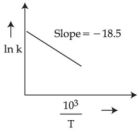
A
$234$
B
$154$
C
$701$
D
$185$
Solution
(B) According to the Arrhenius equation,$\ln \ k = \ln \ A - \frac{E_a}{RT}$.
We are plotting $\ln \ k$ versus $\frac{10^{3}}{T}$.
Rewriting the equation: $\ln \ k = \ln \ A - \left( \frac{E_a}{R \times 10^{3}} \right) \times \left( \frac{10^{3}}{T} \right)$.
Comparing this with the equation of a straight line $y = mx + c$,the slope $m = -\frac{E_a}{R \times 10^{3}}$.
Given the slope is $-18.5$,we have: $-18.5 = -\frac{E_a}{8.31 \times 10^{3}}$.
$E_a = 18.5 \times 8.31 \times 10^{3} \ J \ mol^{-1} = 153735 \ J \ mol^{-1}$.
Converting to $kJ \ mol^{-1}$: $E_a = 153.735 \ kJ \ mol^{-1}$.
Rounding to the nearest integer,we get $154 \ kJ \ mol^{-1}$.
We are plotting $\ln \ k$ versus $\frac{10^{3}}{T}$.
Rewriting the equation: $\ln \ k = \ln \ A - \left( \frac{E_a}{R \times 10^{3}} \right) \times \left( \frac{10^{3}}{T} \right)$.
Comparing this with the equation of a straight line $y = mx + c$,the slope $m = -\frac{E_a}{R \times 10^{3}}$.
Given the slope is $-18.5$,we have: $-18.5 = -\frac{E_a}{8.31 \times 10^{3}}$.
$E_a = 18.5 \times 8.31 \times 10^{3} \ J \ mol^{-1} = 153735 \ J \ mol^{-1}$.
Converting to $kJ \ mol^{-1}$: $E_a = 153.735 \ kJ \ mol^{-1}$.
Rounding to the nearest integer,we get $154 \ kJ \ mol^{-1}$.
0 likesView Solution
84
ChemistryMediumMCQJEE Main · 2022
In the cobalt-carbonyl complex: $[Co_{2}(CO)_{8}]$,the number of $Co-Co$ bonds is "$X$" and the number of terminal $CO$ ligands is "$Y$". Find the value of $X + Y$.
A
$5$
B
$7$
C
$8$
D
$4$
Solution
(B) The structure of the cobalt-carbonyl complex $[Co_{2}(CO)_{8}]$ consists of two $Co$ atoms bonded to each other.
$1$. Number of $Co-Co$ bonds $(X)$: There is $1$ direct metal-metal bond between the two cobalt atoms. So,$X = 1$.
$2$. Number of terminal $CO$ ligands $(Y)$: In the solid-state structure of $[Co_{2}(CO)_{8}]$,there are $6$ terminal $CO$ ligands (each $Co$ atom is bonded to $3$ terminal $CO$ groups) and $2$ bridging $CO$ ligands. So,$Y = 6$.
$3$. Calculation: $X + Y = 1 + 6 = 7$.
$1$. Number of $Co-Co$ bonds $(X)$: There is $1$ direct metal-metal bond between the two cobalt atoms. So,$X = 1$.
$2$. Number of terminal $CO$ ligands $(Y)$: In the solid-state structure of $[Co_{2}(CO)_{8}]$,there are $6$ terminal $CO$ ligands (each $Co$ atom is bonded to $3$ terminal $CO$ groups) and $2$ bridging $CO$ ligands. So,$Y = 6$.
$3$. Calculation: $X + Y = 1 + 6 = 7$.
0 likesView Solution
85
ChemistryMediumMCQJEE Main · 2022
$A$ $0.166 \ g$ sample of an organic compound was digested with conc. $H_2SO_4$ and then distilled with $NaOH$. The ammonia gas evolved was passed through $50.0 \ mL$ of $0.5 \ N \ H_2SO_4$. The excess acid required $30.0 \ mL$ of $0.25 \ N \ NaOH$ for complete neutralization. The mass percentage of nitrogen in the organic compound is $..... \ \%$.
A
$15$
B
$250$
C
$70$
D
$148$
Solution
(D) Step $1$: Calculate the milliequivalents $(m_{eq})$ of $NaOH$ used for back titration: $m_{eq} = 30.0 \ mL \times 0.25 \ N = 7.5 \ m_{eq}$.
Step $2$: Calculate the total $m_{eq}$ of $H_2SO_4$ taken: $m_{eq} = 50.0 \ mL \times 0.5 \ N = 25.0 \ m_{eq}$.
Step $3$: Calculate the $m_{eq}$ of $H_2SO_4$ reacted with $NH_3$: $m_{eq} = 25.0 - 7.5 = 17.5 \ m_{eq}$.
Step $4$: Since $m_{eq}$ of $NH_3 = m_{eq}$ of $H_2SO_4$ reacted,$m_{eq}$ of $NH_3 = 17.5 \ m_{eq}$.
Step $5$: Calculate the mass of nitrogen: $\text{Mass of } N = 17.5 \times 10^{-3} \times 14 \ g = 0.245 \ g$.
Step $6$: Calculate the percentage of nitrogen: $\% N = (0.245 / 0.166) \times 100 \approx 147.59 \%$. Rounding to the nearest integer,we get $148 \%$.
Step $2$: Calculate the total $m_{eq}$ of $H_2SO_4$ taken: $m_{eq} = 50.0 \ mL \times 0.5 \ N = 25.0 \ m_{eq}$.
Step $3$: Calculate the $m_{eq}$ of $H_2SO_4$ reacted with $NH_3$: $m_{eq} = 25.0 - 7.5 = 17.5 \ m_{eq}$.
Step $4$: Since $m_{eq}$ of $NH_3 = m_{eq}$ of $H_2SO_4$ reacted,$m_{eq}$ of $NH_3 = 17.5 \ m_{eq}$.
Step $5$: Calculate the mass of nitrogen: $\text{Mass of } N = 17.5 \times 10^{-3} \times 14 \ g = 0.245 \ g$.
Step $6$: Calculate the percentage of nitrogen: $\% N = (0.245 / 0.166) \times 100 \approx 147.59 \%$. Rounding to the nearest integer,we get $148 \%$.
0 likesView Solution
86
ChemistryMediumMCQJEE Main · 2022
Solute $A$ associates in water. When $0.7 \ g$ of solute $A$ is dissolved in $42.0 \ g$ of water,it depresses the freezing point by $0.2^{\circ} C$. The percentage association of solute $A$ in water is $..... \ \%$.
[Given: Molar mass of $A = 93 \ g \ mol^{-1}$. Molal depression constant of water is $1.86 \ K \ kg \ mol^{-1}$]
[Given: Molar mass of $A = 93 \ g \ mol^{-1}$. Molal depression constant of water is $1.86 \ K \ kg \ mol^{-1}$]
A
$50$
B
$60$
C
$70$
D
$80$
Solution
(D) The formula for freezing point depression is $\Delta T_f = i \cdot K_f \cdot m$.
First,calculate the molality $(m)$: $m = \frac{0.7 \ g}{93 \ g \ mol^{-1}} \times \frac{1000 \ g \ kg^{-1}}{42.0 \ g} = 0.1792 \ mol \ kg^{-1}$.
Using $\Delta T_f = 0.2 \ K$ and $K_f = 1.86 \ K \ kg \ mol^{-1}$,we find the van't Hoff factor $(i)$:
$0.2 = i \cdot 1.86 \cdot 0.1792 \implies i = \frac{0.2}{1.86 \cdot 0.1792} \approx 0.60$.
For the association reaction $2A \rightleftharpoons A_2$,the van't Hoff factor is $i = 1 - \alpha + \frac{\alpha}{2} = 1 - \frac{\alpha}{2}$.
Equating $1 - \frac{\alpha}{2} = 0.60$,we get $\frac{\alpha}{2} = 0.40$,so $\alpha = 0.80$.
The percentage association is $80 \%$.
First,calculate the molality $(m)$: $m = \frac{0.7 \ g}{93 \ g \ mol^{-1}} \times \frac{1000 \ g \ kg^{-1}}{42.0 \ g} = 0.1792 \ mol \ kg^{-1}$.
Using $\Delta T_f = 0.2 \ K$ and $K_f = 1.86 \ K \ kg \ mol^{-1}$,we find the van't Hoff factor $(i)$:
$0.2 = i \cdot 1.86 \cdot 0.1792 \implies i = \frac{0.2}{1.86 \cdot 0.1792} \approx 0.60$.
For the association reaction $2A \rightleftharpoons A_2$,the van't Hoff factor is $i = 1 - \alpha + \frac{\alpha}{2} = 1 - \frac{\alpha}{2}$.
Equating $1 - \frac{\alpha}{2} = 0.60$,we get $\frac{\alpha}{2} = 0.40$,so $\alpha = 0.80$.
The percentage association is $80 \%$.
0 likesView Solution
87
ChemistryMediumMCQJEE Main · 2022
Match List-$I$ with List-$II$.
Choose the correct answer from the options given below:
| List-$I$ | List-$II$ |
|---|---|
| $a$. Zymase | $i$. Stomach |
| $b$. Diastase | $ii$. Yeast |
| $c$. Urease | $iii$. Malt |
| $d$. Pepsin | $iv$. Soyabean |
Choose the correct answer from the options given below:
A
$a-ii, b-iii, c-i, d-iv$
B
$a-ii, b-iii, c-iv, d-i$
C
$a-iii, b-ii, c-iv, d-i$
D
$a-iii, b-ii, c-i, d-iv$
Solution
(B) The correct matches are:
$a$. Zymase is an enzyme obtained from $ii$. Yeast.
$b$. Diastase is an enzyme obtained from $iii$. Malt.
$c$. Urease is an enzyme obtained from $iv$. Soyabean.
$d$. Pepsin is an enzyme found in $i$. Stomach.
Therefore,the correct sequence is $a-ii, b-iii, c-iv, d-i$.
$a$. Zymase is an enzyme obtained from $ii$. Yeast.
$b$. Diastase is an enzyme obtained from $iii$. Malt.
$c$. Urease is an enzyme obtained from $iv$. Soyabean.
$d$. Pepsin is an enzyme found in $i$. Stomach.
Therefore,the correct sequence is $a-ii, b-iii, c-iv, d-i$.
0 likesView Solution
88
ChemistryMediumMCQJEE Main · 2022
Given below are two statements.
Statement $I:$ During electrolytic refining,blister copper deposits precious metals.
Statement $II:$ In the process of obtaining pure copper by electrolysis method,blister copper is used to make the anode.
In the light of the above statements,choose the most appropriate answer from the options given below.
Statement $I:$ During electrolytic refining,blister copper deposits precious metals.
Statement $II:$ In the process of obtaining pure copper by electrolysis method,blister copper is used to make the anode.
In the light of the above statements,choose the most appropriate answer from the options given below.
A
Both Statement $I$ and Statement $II$ are true.
B
Both Statement $I$ and Statement $II$ are false.
C
Statement $I$ is true but Statement $II$ is false.
D
Statement $I$ is false but Statement $II$ is true.
Solution
(A) In electrolytic refining,the impure metal (blister copper) is made the anode.
During the process,the impure copper dissolves into the electrolyte,while precious metals like $Au$ and $Pt$ do not dissolve and settle at the bottom of the anode as anode mud.
Statement $I$ is true because precious metals are recovered from the anode mud,not deposited as pure metal on the cathode.
Statement $II$ is true because blister copper is indeed used as the anode in the electrolytic refining of copper.
Therefore,both statements are true.
During the process,the impure copper dissolves into the electrolyte,while precious metals like $Au$ and $Pt$ do not dissolve and settle at the bottom of the anode as anode mud.
Statement $I$ is true because precious metals are recovered from the anode mud,not deposited as pure metal on the cathode.
Statement $II$ is true because blister copper is indeed used as the anode in the electrolytic refining of copper.
Therefore,both statements are true.
0 likesView Solution
89
ChemistryEasyMCQJEE Main · 2022
The correct order of reduction potentials of the following pairs is
$A.$ $Cl_2 / Cl^{-}$
$B.$ $I_2 / I^{-}$
$C.$ $Ag^{+} / Ag$
$D.$ $Na^{+} / Na$
$E.$ $Li^{+} / Li$
Choose the correct answer from the options given below.
$A.$ $Cl_2 / Cl^{-}$
$B.$ $I_2 / I^{-}$
$C.$ $Ag^{+} / Ag$
$D.$ $Na^{+} / Na$
$E.$ $Li^{+} / Li$
Choose the correct answer from the options given below.
A
$A > C > B > D > E$
B
$A > B > C > D > E$
C
$A > C > B > E > D$
D
$A > B > C > E > D$
Solution
(A) The standard reduction potentials $(E^{\circ})$ for the given pairs are:
$E^{\circ}_{Cl_2 / Cl^{-}} = +1.36 \, V$
$E^{\circ}_{Ag^{+} / Ag} = +0.80 \, V$
$E^{\circ}_{I_2 / I^{-}} = +0.54 \, V$
$E^{\circ}_{Na^{+} / Na} = -2.71 \, V$
$E^{\circ}_{Li^{+} / Li} = -3.05 \, V$
Comparing these values,the order is $1.36 > 0.80 > 0.54 > -2.71 > -3.05$.
Therefore,the correct order is $A > C > B > D > E$.
$E^{\circ}_{Cl_2 / Cl^{-}} = +1.36 \, V$
$E^{\circ}_{Ag^{+} / Ag} = +0.80 \, V$
$E^{\circ}_{I_2 / I^{-}} = +0.54 \, V$
$E^{\circ}_{Na^{+} / Na} = -2.71 \, V$
$E^{\circ}_{Li^{+} / Li} = -3.05 \, V$
Comparing these values,the order is $1.36 > 0.80 > 0.54 > -2.71 > -3.05$.
Therefore,the correct order is $A > C > B > D > E$.
0 likesView Solution
90
ChemistryEasyMCQJEE Main · 2022
The number of bridged oxygen atoms present in compound $B$ formed from the following reactions is
$Pb(NO_3)_2 \xrightarrow{673 \ K} A + PbO + O_2$
$A \xrightarrow{\text{Dimerise}} B$
$Pb(NO_3)_2 \xrightarrow{673 \ K} A + PbO + O_2$
$A \xrightarrow{\text{Dimerise}} B$
A
$0$
B
$1$
C
$2$
D
$3$
Solution
(A) The thermal decomposition of lead nitrate is given by:
$2Pb(NO_3)_2 \xrightarrow{673 \ K} 2PbO + 4NO_2 + O_2$
Here,$A$ is $NO_2$.
On dimerisation,$NO_2$ forms $N_2O_4$ $(B)$:
$2NO_2 \rightleftharpoons N_2O_4$
The structure of $N_2O_4$ consists of two $NO_2$ units linked by a $N-N$ bond. The structure is $O_2N-NO_2$. It does not contain any bridged oxygen atoms (i.e.,no $N-O-N$ linkage).
Therefore,the number of bridged oxygen atoms in $B$ is $0$.
$2Pb(NO_3)_2 \xrightarrow{673 \ K} 2PbO + 4NO_2 + O_2$
Here,$A$ is $NO_2$.
On dimerisation,$NO_2$ forms $N_2O_4$ $(B)$:
$2NO_2 \rightleftharpoons N_2O_4$
The structure of $N_2O_4$ consists of two $NO_2$ units linked by a $N-N$ bond. The structure is $O_2N-NO_2$. It does not contain any bridged oxygen atoms (i.e.,no $N-O-N$ linkage).
Therefore,the number of bridged oxygen atoms in $B$ is $0$.
0 likesView Solution
91
ChemistryEasyMCQJEE Main · 2022
The metal ion (in gaseous state) with the lowest spin-only magnetic moment value is .... .
A
$V^{2+}$
B
$Ni^{2+}$
C
$Cr^{2+}$
D
$Fe^{2+}$
Solution
(B) The spin-only magnetic moment $(\mu)$ is given by the formula $\mu = \sqrt{n(n+2)} \ BM$, where $n$ is the number of unpaired electrons.
To find the lowest magnetic moment, we need to identify the ion with the minimum number of unpaired electrons $(n)$.
$1$. $V^{2+}$ $(Z=23)$: Electronic configuration is $[Ar] 3d^3$. Number of unpaired electrons $(n)$ = $3$.
$2$. $Ni^{2+}$ $(Z=28)$: Electronic configuration is $[Ar] 3d^8$. Number of unpaired electrons $(n)$ = $2$.
$3$. $Cr^{2+}$ $(Z=24)$: Electronic configuration is $[Ar] 3d^4$. Number of unpaired electrons $(n)$ = $4$.
$4$. $Fe^{2+}$ $(Z=26)$: Electronic configuration is $[Ar] 3d^6$. Number of unpaired electrons $(n)$ = $4$.
Since $Ni^{2+}$ has the lowest number of unpaired electrons $(n=2)$, it has the lowest spin-only magnetic moment value.
To find the lowest magnetic moment, we need to identify the ion with the minimum number of unpaired electrons $(n)$.
$1$. $V^{2+}$ $(Z=23)$: Electronic configuration is $[Ar] 3d^3$. Number of unpaired electrons $(n)$ = $3$.
$2$. $Ni^{2+}$ $(Z=28)$: Electronic configuration is $[Ar] 3d^8$. Number of unpaired electrons $(n)$ = $2$.
$3$. $Cr^{2+}$ $(Z=24)$: Electronic configuration is $[Ar] 3d^4$. Number of unpaired electrons $(n)$ = $4$.
$4$. $Fe^{2+}$ $(Z=26)$: Electronic configuration is $[Ar] 3d^6$. Number of unpaired electrons $(n)$ = $4$.
Since $Ni^{2+}$ has the lowest number of unpaired electrons $(n=2)$, it has the lowest spin-only magnetic moment value.
0 likesView Solution
92
ChemistryDifficultMCQJEE Main · 2022
In the given reaction,$A$ can be .... .
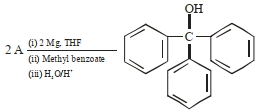
A
benzyl bromide
B
bromobenzene
C
cyclohexyl bromide
D
methyl bromide
Solution
(B) The reaction involves the formation of a Grignard reagent from $A$ followed by its reaction with methyl benzoate to form triphenylmethanol.
$1$. $A + Mg \xrightarrow{THF} A-MgBr$
$2$. The Grignard reagent $(PhMgBr)$ attacks the carbonyl carbon of methyl benzoate $(PhCOOCH_3)$.
$3$. This leads to the formation of a ketone intermediate,benzophenone $(Ph_2CO)$,which further reacts with another equivalent of $PhMgBr$ to form the final product,triphenylmethanol $(Ph_3COH)$.
Since the product contains three phenyl groups attached to the central carbon,and one comes from the methyl benzoate,the other two must come from the Grignard reagent. Thus,$A$ must be bromobenzene $(C_6H_5Br)$.
$1$. $A + Mg \xrightarrow{THF} A-MgBr$
$2$. The Grignard reagent $(PhMgBr)$ attacks the carbonyl carbon of methyl benzoate $(PhCOOCH_3)$.
$3$. This leads to the formation of a ketone intermediate,benzophenone $(Ph_2CO)$,which further reacts with another equivalent of $PhMgBr$ to form the final product,triphenylmethanol $(Ph_3COH)$.
Since the product contains three phenyl groups attached to the central carbon,and one comes from the methyl benzoate,the other two must come from the Grignard reagent. Thus,$A$ must be bromobenzene $(C_6H_5Br)$.
0 likesView Solution
93
ChemistryDifficultMCQJEE Main · 2022
Which of the following conditions or reaction sequences will $NOT$ give acetophenone as the major product?
A
$C_6H_5CHO + CH_3MgBr$ followed by $Na_2Cr_2O_7, H^+$
B
$CH_3CHO + C_6H_5MgBr$ followed by $PCC, DCM$
C
$C_6H_5COOC_2H_5 + 2CH_3MgBr$
D
$C_6H_5COCl + CH_3MgBr + CdCl_2$
Solution
(C) Acetophenone is $C_6H_5COCH_3$.
$(A)$ $C_6H_5CHO + CH_3MgBr \rightarrow C_6H_5CH(OH)CH_3$. Oxidation with $Na_2Cr_2O_7/H^+$ gives $C_6H_5COCH_3$ (Acetophenone).
$(B)$ $CH_3CHO + C_6H_5MgBr \rightarrow CH_3CH(OH)C_6H_5$. Oxidation with $PCC$ gives $CH_3COC_6H_5$ (Acetophenone).
$(C)$ Esters react with $2$ equivalents of Grignard reagent to form tertiary alcohols. $C_6H_5COOC_2H_5 + 2CH_3MgBr \rightarrow C_6H_5C(OH)(CH_3)_2$. This does not give acetophenone.
$(D)$ Acid chlorides react with organocadmium reagents (formed in situ from $2RMgX + CdCl_2$) to give ketones. $2C_6H_5COCl + (CH_3)_2Cd \rightarrow 2C_6H_5COCH_3$. This gives acetophenone.
$(A)$ $C_6H_5CHO + CH_3MgBr \rightarrow C_6H_5CH(OH)CH_3$. Oxidation with $Na_2Cr_2O_7/H^+$ gives $C_6H_5COCH_3$ (Acetophenone).
$(B)$ $CH_3CHO + C_6H_5MgBr \rightarrow CH_3CH(OH)C_6H_5$. Oxidation with $PCC$ gives $CH_3COC_6H_5$ (Acetophenone).
$(C)$ Esters react with $2$ equivalents of Grignard reagent to form tertiary alcohols. $C_6H_5COOC_2H_5 + 2CH_3MgBr \rightarrow C_6H_5C(OH)(CH_3)_2$. This does not give acetophenone.
$(D)$ Acid chlorides react with organocadmium reagents (formed in situ from $2RMgX + CdCl_2$) to give ketones. $2C_6H_5COCl + (CH_3)_2Cd \rightarrow 2C_6H_5COCH_3$. This gives acetophenone.
0 likesView Solution
94
ChemistryDifficultMCQJEE Main · 2022
Which of the following ketones will $NOT$ give an enamine upon treatment with secondary amines?
A
$Diethyl \ ketone$ $(C_2H_5-CO-C_2H_5)$
B
$Ethyl \ methyl \ ketone$ $(C_2H_5-CO-CH_3)$
C
$Di-tert-butyl \ ketone$ $((t-Bu)_2CO)$
D
$Cyclohexanone$
Solution
(C) Enamine formation is a nucleophilic addition-elimination reaction between a carbonyl compound (having at least one $\alpha$-hydrogen) and a secondary amine.
In the case of $Di-tert-butyl \ ketone$ $((t-Bu)_2CO)$,the carbonyl carbon is highly sterically hindered by two bulky $tert-butyl$ groups.
Due to this extreme steric hindrance,the secondary amine cannot approach the carbonyl carbon to initiate the nucleophilic attack,thus preventing the formation of an enamine.
In the case of $Di-tert-butyl \ ketone$ $((t-Bu)_2CO)$,the carbonyl carbon is highly sterically hindered by two bulky $tert-butyl$ groups.
Due to this extreme steric hindrance,the secondary amine cannot approach the carbonyl carbon to initiate the nucleophilic attack,thus preventing the formation of an enamine.
0 likesView Solution
95
ChemistryMediumMCQJEE Main · 2022
An antiseptic,Dettol,is a mixture of two compounds '$A$' and '$B$',where $A$ has $6$ $\pi$ electrons and $B$ has $2$ $\pi$ electrons. What is '$B$'?
A
Bithionol
B
Terpineol
C
Chloroxylenol
D
Chloramphenicol
Solution
(B) Dettol is a mixture of Chloroxylenol and Terpineol.
Chloroxylenol (Compound '$A$') contains a benzene ring,which has $6$ $\pi$ electrons.
Terpineol (Compound '$B$') contains one double bond,which has $2$ $\pi$ electrons.
Therefore,compound '$B$' is Terpineol.
Chloroxylenol (Compound '$A$') contains a benzene ring,which has $6$ $\pi$ electrons.
Terpineol (Compound '$B$') contains one double bond,which has $2$ $\pi$ electrons.
Therefore,compound '$B$' is Terpineol.
0 likesView Solution
96
ChemistryMediumMCQJEE Main · 2022
At $345 \ K$,the half-life for the decomposition of a sample of a gaseous compound initially at $55.5 \ kPa$ was $340 \ s$. When the pressure was $27.8 \ kPa$,the half-life was found to be $170 \ s$. The order of the reaction is $......$ [integer answer]
A
$1$
B
$0$
C
$2$
D
$3$
Solution
(B) For a gaseous reaction,the half-life $t_{1/2}$ is related to the initial pressure $P_0$ by the relation: $t_{1/2} \propto \frac{1}{(P_0)^{n-1}}$,where $n$ is the order of the reaction.
Given:
$P_1 = 55.5 \ kPa$,$t_1 = 340 \ s$
$P_2 = 27.8 \ kPa$,$t_2 = 170 \ s$
Using the ratio formula:
$\frac{t_1}{t_2} = \left(\frac{P_2}{P_1}\right)^{n-1}$
Substituting the values:
$\frac{340}{170} = \left(\frac{27.8}{55.5}\right)^{n-1}$
$2 = \left(\frac{1}{2}\right)^{n-1}$
$2^1 = (2^{-1})^{n-1}$
$2^1 = 2^{-(n-1)}$
$1 = -(n-1)$
$1 = -n + 1$
$n = 0$
Thus,the order of the reaction is $0$.
Given:
$P_1 = 55.5 \ kPa$,$t_1 = 340 \ s$
$P_2 = 27.8 \ kPa$,$t_2 = 170 \ s$
Using the ratio formula:
$\frac{t_1}{t_2} = \left(\frac{P_2}{P_1}\right)^{n-1}$
Substituting the values:
$\frac{340}{170} = \left(\frac{27.8}{55.5}\right)^{n-1}$
$2 = \left(\frac{1}{2}\right)^{n-1}$
$2^1 = (2^{-1})^{n-1}$
$2^1 = 2^{-(n-1)}$
$1 = -(n-1)$
$1 = -n + 1$
$n = 0$
Thus,the order of the reaction is $0$.
0 likesView Solution
97
ChemistryEasyMCQJEE Main · 2022
$A$ solution of $Fe_{2}(SO_{4})_{3}$ is electrolyzed for '$x$' min with a current of $1.5 \ A$ to deposit $0.3482 \ g$ of $Fe$. The value of $x$ is $.......$. [nearest integer]
Given : $1 \ F = 96500 \ C \ mol^{-1}$
Atomic mass of $Fe = 56 \ g \ mol^{-1}$
Given : $1 \ F = 96500 \ C \ mol^{-1}$
Atomic mass of $Fe = 56 \ g \ mol^{-1}$
A
$10$
B
$20$
C
$25$
D
$35$
Solution
(B) The reduction reaction is: $Fe^{3+} + 3e^{-} \longrightarrow Fe$
From the stoichiometry,$3 \ mol$ of electrons are required to deposit $1 \ mol$ of $Fe$ $(56 \ g)$.
Total charge required for $0.3482 \ g$ of $Fe$ is:
$Q = \frac{3 \times 96500 \times 0.3482}{56} \approx 1800 \ C$
Using the formula $Q = I \times t$ (where $t$ is in seconds):
$1800 = 1.5 \times t$
$t = \frac{1800}{1.5} = 1200 \ s$
Converting time to minutes:
$x = \frac{1200}{60} = 20 \ min$
From the stoichiometry,$3 \ mol$ of electrons are required to deposit $1 \ mol$ of $Fe$ $(56 \ g)$.
Total charge required for $0.3482 \ g$ of $Fe$ is:
$Q = \frac{3 \times 96500 \times 0.3482}{56} \approx 1800 \ C$
Using the formula $Q = I \times t$ (where $t$ is in seconds):
$1800 = 1.5 \times t$
$t = \frac{1800}{1.5} = 1200 \ s$
Converting time to minutes:
$x = \frac{1200}{60} = 20 \ min$
0 likesView Solution
98
ChemistryMediumMCQJEE Main · 2022
Amongst $FeCl_{3} \cdot 3H_{2}O$,$K_{3}[Fe(CN)_{6}]$ and $[Co(NH_{3})_{6}]Cl_{3}$,the spin-only magnetic moment value of the inner-orbital complex that absorbs light at the shortest wavelength is $B.M.$ [nearest integer].
A
$5$
B
$0.2$
C
$2$
D
$20$
Solution
(C) The inner-orbital complexes are $K_{3}[Fe(CN)_{6}]$ and $[Co(NH_{3})_{6}]Cl_{3}$.
$K_{3}[Fe(CN)_{6}]$ contains $Fe^{3+}$ $(3d^{5})$,which forms a $d^{2}sp^{3}$ complex with $1$ unpaired electron. Its spin-only magnetic moment is $\mu = \sqrt{1(1+2)} = \sqrt{3} \approx 1.732 \ B.M.$
$[Co(NH_{3})_{6}]Cl_{3}$ contains $Co^{3+}$ $(3d^{6})$,which forms a $d^{2}sp^{3}$ complex with $0$ unpaired electrons. Its spin-only magnetic moment is $\mu = 0 \ B.M.$
$CN^{-}$ is a stronger field ligand than $NH_{3}$,so $K_{3}[Fe(CN)_{6}]$ has a larger crystal field splitting energy $(\Delta_{0})$ than $[Co(NH_{3})_{6}]Cl_{3}$.
Since $\Delta_{0} = \frac{hc}{\lambda}$,a larger $\Delta_{0}$ corresponds to a shorter wavelength $(\lambda)$ of absorbed light.
Therefore,$K_{3}[Fe(CN)_{6}]$ is the complex that absorbs light at the shortest wavelength.
Its spin-only magnetic moment is $1.732 \ B.M.$,which rounds to $2$ to the nearest integer.
$K_{3}[Fe(CN)_{6}]$ contains $Fe^{3+}$ $(3d^{5})$,which forms a $d^{2}sp^{3}$ complex with $1$ unpaired electron. Its spin-only magnetic moment is $\mu = \sqrt{1(1+2)} = \sqrt{3} \approx 1.732 \ B.M.$
$[Co(NH_{3})_{6}]Cl_{3}$ contains $Co^{3+}$ $(3d^{6})$,which forms a $d^{2}sp^{3}$ complex with $0$ unpaired electrons. Its spin-only magnetic moment is $\mu = 0 \ B.M.$
$CN^{-}$ is a stronger field ligand than $NH_{3}$,so $K_{3}[Fe(CN)_{6}]$ has a larger crystal field splitting energy $(\Delta_{0})$ than $[Co(NH_{3})_{6}]Cl_{3}$.
Since $\Delta_{0} = \frac{hc}{\lambda}$,a larger $\Delta_{0}$ corresponds to a shorter wavelength $(\lambda)$ of absorbed light.
Therefore,$K_{3}[Fe(CN)_{6}]$ is the complex that absorbs light at the shortest wavelength.
Its spin-only magnetic moment is $1.732 \ B.M.$,which rounds to $2$ to the nearest integer.
0 likesView Solution
99
ChemistryMediumMCQJEE Main · 2022
The Novolac polymer has a mass of $963 \ g$. The number of monomer units present in it is $......$
A
$15$
B
$10$
C
$9$
D
$45$
Solution
(C) The monomer unit of Novolac is $o$-hydroxybenzyl alcohol (saligenin),which has the chemical formula $C_7H_8O_2$.
The molecular mass of the monomer unit is $(7 \times 12) + (8 \times 1) + (2 \times 16) = 84 + 8 + 32 = 124 \ g/mol$.
Novolac is formed by the condensation polymerization of phenol and formaldehyde,where water molecules are eliminated.
For a polymer chain consisting of $n$ monomer units,$(n-1)$ molecules of water are removed.
The mass of the polymer is given by: $Mass_{polymer} = (n \times Mass_{monomer}) - ((n-1) \times Mass_{water})$.
Substituting the given values: $963 = (n \times 124) - ((n-1) \times 18)$.
$963 = 124n - 18n + 18$.
$963 - 18 = 106n$.
$945 = 106n$.
$n = 945 / 106 \approx 8.91$.
Rounding to the nearest integer,the number of monomer units $n = 9$.
The molecular mass of the monomer unit is $(7 \times 12) + (8 \times 1) + (2 \times 16) = 84 + 8 + 32 = 124 \ g/mol$.
Novolac is formed by the condensation polymerization of phenol and formaldehyde,where water molecules are eliminated.
For a polymer chain consisting of $n$ monomer units,$(n-1)$ molecules of water are removed.
The mass of the polymer is given by: $Mass_{polymer} = (n \times Mass_{monomer}) - ((n-1) \times Mass_{water})$.
Substituting the given values: $963 = (n \times 124) - ((n-1) \times 18)$.
$963 = 124n - 18n + 18$.
$963 - 18 = 106n$.
$945 = 106n$.
$n = 945 / 106 \approx 8.91$.
Rounding to the nearest integer,the number of monomer units $n = 9$.
0 likesView Solution
100
ChemistryMediumMCQJEE Main · 2022
How many of the given compounds will give a positive Biuret test?
Glycine,Glycylalanine,Tripeptide,Biuret.
Glycine,Glycylalanine,Tripeptide,Biuret.
A
$1$
B
$3$
C
$4$
D
$2$
Solution
(D) The Biuret test is a chemical test used for detecting the presence of peptide bonds.
It gives a positive result for compounds containing at least two peptide linkages $(-CO-NH-)$.
$1$. Glycine: An amino acid,contains no peptide linkage.
$2$. Glycylalanine: $A$ dipeptide,contains only one peptide linkage.
$3$. Tripeptide: Contains two peptide linkages.
$4$. Biuret: Contains two peptide linkages $(NH_2-CO-NH-CO-NH_2)$.
Therefore,only the Tripeptide and Biuret give a positive Biuret test.
The total count is $2$.
It gives a positive result for compounds containing at least two peptide linkages $(-CO-NH-)$.
$1$. Glycine: An amino acid,contains no peptide linkage.
$2$. Glycylalanine: $A$ dipeptide,contains only one peptide linkage.
$3$. Tripeptide: Contains two peptide linkages.
$4$. Biuret: Contains two peptide linkages $(NH_2-CO-NH-CO-NH_2)$.
Therefore,only the Tripeptide and Biuret give a positive Biuret test.
The total count is $2$.
0 likesView Solution
Vedclass Products
For Students
Vedclass Test Series
Mock tests in real JEE Main style covering Chemistry with performance analysis. 5-day free trial.
Start Free TrialFor Teachers
Exam Paper Generator
Generate Set A/B/C/D Chemistry papers from 7.5L+ questions in 2 minutes. 3 chapters free.
Try FreeFor Institutes
Online Exam Module
Run live JEE Main mock exams with unlimited students, 360° analytics & white-label branding.
See DemoFrequently Asked Questions
How many Chemistry questions are in JEE Main 2022?
There are 666 Chemistry questions from the JEE Main 2022 paper on Vedclass, each with a detailed step-by-step solution in English.
Are JEE Main 2022 Chemistry solutions available in English?
Yes. All solutions on this page are in English. You can also switch to English or Hindi using the language buttons above the questions.
Can I practice JEE Main 2022 Chemistry as a timed test?
Yes. Use the Vedclass Test Series to attempt a full JEE Main mock test covering Chemistry with time limits and instant score analysis.
Can teachers create Chemistry papers from JEE Main previous year questions?
Yes. The Vedclass Exam Paper Generator lets teachers mix JEE Main Chemistry questions and generate Set A/B/C/D papers in minutes.
For Teachers & Institutes
Build a Custom Chemistry Paper
Pick JEE Main 2022 Chemistry questions, set difficulty, and generate Set A/B/C/D in 2 minutes.