
ChemistryQ1–100 of 102 questions
Page 1 of 2 · English
1
ChemistryMCQJEE Main · 2018
If the curves $y^2 = 6x$ and $9x^2 + by^2 = 16$ intersect each other at right angles,then the value of $b$ is:
A
$\frac{7}{2}$
B
$4$
C
$\frac{9}{2}$
D
$6$
Solution
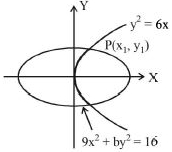
(C) Let the curves intersect each other at point $P(x_1, y_1)$.
Since the point of intersection lies on both curves,we have:
$y_1^2 = 6x_1 \quad \dots(i)$
$9x_1^2 + by_1^2 = 16 \quad \dots(ii)$
Now,find the slope of the tangent to both curves at the point of intersection $P(x_1, y_1)$.
For curve $(i)$,differentiating with respect to $x$:
$2y \frac{dy}{dx} = 6 \Rightarrow \frac{dy}{dx} = \frac{3}{y}$
So,$m_1 = \left( \frac{dy}{dx} \right)_{P} = \frac{3}{y_1}$.
For curve $(ii)$,differentiating with respect to $x$:
$18x + 2by \frac{dy}{dx} = 0 \Rightarrow \frac{dy}{dx} = -\frac{9x}{by}$
So,$m_2 = \left( \frac{dy}{dx} \right)_{P} = -\frac{9x_1}{by_1}$.
Since the curves intersect at right angles,$m_1 m_2 = -1$:
$\left( \frac{3}{y_1} \right) \left( -\frac{9x_1}{by_1} \right) = -1$
$\frac{27x_1}{by_1^2} = 1 \Rightarrow b = \frac{27x_1}{y_1^2}$
Substitute $y_1^2 = 6x_1$ from equation $(i)$ into the expression for $b$:
$b = \frac{27x_1}{6x_1} = \frac{27}{6} = \frac{9}{2}$.
Since the point of intersection lies on both curves,we have:
$y_1^2 = 6x_1 \quad \dots(i)$
$9x_1^2 + by_1^2 = 16 \quad \dots(ii)$
Now,find the slope of the tangent to both curves at the point of intersection $P(x_1, y_1)$.
For curve $(i)$,differentiating with respect to $x$:
$2y \frac{dy}{dx} = 6 \Rightarrow \frac{dy}{dx} = \frac{3}{y}$
So,$m_1 = \left( \frac{dy}{dx} \right)_{P} = \frac{3}{y_1}$.
For curve $(ii)$,differentiating with respect to $x$:
$18x + 2by \frac{dy}{dx} = 0 \Rightarrow \frac{dy}{dx} = -\frac{9x}{by}$
So,$m_2 = \left( \frac{dy}{dx} \right)_{P} = -\frac{9x_1}{by_1}$.
Since the curves intersect at right angles,$m_1 m_2 = -1$:
$\left( \frac{3}{y_1} \right) \left( -\frac{9x_1}{by_1} \right) = -1$
$\frac{27x_1}{by_1^2} = 1 \Rightarrow b = \frac{27x_1}{y_1^2}$
Substitute $y_1^2 = 6x_1$ from equation $(i)$ into the expression for $b$:
$b = \frac{27x_1}{6x_1} = \frac{27}{6} = \frac{9}{2}$.
0 likesView Solution
2
ChemistryMCQJEE Main · 2018
Let $y = y(x)$ be the solution of the differential equation $\sin x \frac{dy}{dx} + y \cos x = 4x$,where $x \in (0, \pi)$. If $y(\frac{\pi}{2}) = 0$,then find the value of $y(\frac{\pi}{6})$.
A
$-\frac{8}{9\sqrt{3}} \pi^2$
B
$-\frac{8}{9} \pi^2$
C
$-\frac{4}{9} \pi^2$
D
$\frac{4}{9\sqrt{3}} \pi^2$
Solution
(B) The given differential equation is $\sin x \frac{dy}{dx} + y \cos x = 4x$.
This can be written as $\frac{d}{dx}(y \sin x) = 4x$.
Integrating both sides with respect to $x$,we get $y \sin x = \int 4x \, dx = 2x^2 + C$.
Given that $y(\frac{\pi}{2}) = 0$,we substitute $x = \frac{\pi}{2}$ and $y = 0$ into the equation:
$0 \cdot \sin(\frac{\pi}{2}) = 2(\frac{\pi}{2})^2 + C \Rightarrow 0 = 2(\frac{\pi^2}{4}) + C \Rightarrow C = -\frac{\pi^2}{2}$.
Thus,the solution is $y \sin x = 2x^2 - \frac{\pi^2}{2}$.
Now,we find $y(\frac{\pi}{6})$ by substituting $x = \frac{\pi}{6}$:
$y \sin(\frac{\pi}{6}) = 2(\frac{\pi}{6})^2 - \frac{\pi^2}{2}$.
$y(\frac{1}{2}) = 2(\frac{\pi^2}{36}) - \frac{\pi^2}{2} = \frac{\pi^2}{18} - \frac{\pi^2}{2} = \frac{\pi^2 - 9\pi^2}{18} = -\frac{8\pi^2}{18} = -\frac{4\pi^2}{9}$.
Therefore,$y = 2 \times (-\frac{4\pi^2}{9}) = -\frac{8\pi^2}{9}$.
This can be written as $\frac{d}{dx}(y \sin x) = 4x$.
Integrating both sides with respect to $x$,we get $y \sin x = \int 4x \, dx = 2x^2 + C$.
Given that $y(\frac{\pi}{2}) = 0$,we substitute $x = \frac{\pi}{2}$ and $y = 0$ into the equation:
$0 \cdot \sin(\frac{\pi}{2}) = 2(\frac{\pi}{2})^2 + C \Rightarrow 0 = 2(\frac{\pi^2}{4}) + C \Rightarrow C = -\frac{\pi^2}{2}$.
Thus,the solution is $y \sin x = 2x^2 - \frac{\pi^2}{2}$.
Now,we find $y(\frac{\pi}{6})$ by substituting $x = \frac{\pi}{6}$:
$y \sin(\frac{\pi}{6}) = 2(\frac{\pi}{6})^2 - \frac{\pi^2}{2}$.
$y(\frac{1}{2}) = 2(\frac{\pi^2}{36}) - \frac{\pi^2}{2} = \frac{\pi^2}{18} - \frac{\pi^2}{2} = \frac{\pi^2 - 9\pi^2}{18} = -\frac{8\pi^2}{18} = -\frac{4\pi^2}{9}$.
Therefore,$y = 2 \times (-\frac{4\pi^2}{9}) = -\frac{8\pi^2}{9}$.
0 likesView Solution
3
ChemistryMCQJEE Main · 2018
$A$ solid sphere of radius $r$ made of a soft material of bulk modulus $K$ is surrounded by a liquid in a cylindrical container. $A$ massless piston of area $a$ floats on the surface of the liquid,covering the entire cross-section of the cylindrical container. When a mass $m$ is placed on the surface of the piston to compress the liquid,the fractional decrement in the radius of the sphere $\left( \frac{dr}{r} \right)$ is
A
$\frac{Ka}{3mg}$
B
$\frac{mg}{3Ka}$
C
$\frac{mg}{Ka}$
D
$\frac{Ka}{mg}$
Solution
(B) The bulk modulus $K$ is defined as the ratio of volumetric stress to volumetric strain: $K = \frac{\Delta P}{\left( \frac{dV}{V} \right)}$.
The pressure increase $\Delta P$ due to the mass $m$ on the piston of area $a$ is $\Delta P = \frac{mg}{a}$.
Substituting this into the bulk modulus formula: $K = \frac{mg/a}{dV/V} \Rightarrow \frac{dV}{V} = \frac{mg}{Ka} \dots (i)$.
The volume of a sphere is $V = \frac{4}{3}\pi r^3$. Taking the logarithmic derivative,we get $\frac{dV}{V} = 3 \frac{dr}{r} \dots (ii)$.
Equating $(i)$ and $(ii)$: $3 \frac{dr}{r} = \frac{mg}{Ka}$.
Therefore,the fractional decrement in the radius is $\frac{dr}{r} = \frac{mg}{3Ka}$.
The pressure increase $\Delta P$ due to the mass $m$ on the piston of area $a$ is $\Delta P = \frac{mg}{a}$.
Substituting this into the bulk modulus formula: $K = \frac{mg/a}{dV/V} \Rightarrow \frac{dV}{V} = \frac{mg}{Ka} \dots (i)$.
The volume of a sphere is $V = \frac{4}{3}\pi r^3$. Taking the logarithmic derivative,we get $\frac{dV}{V} = 3 \frac{dr}{r} \dots (ii)$.
Equating $(i)$ and $(ii)$: $3 \frac{dr}{r} = \frac{mg}{Ka}$.
Therefore,the fractional decrement in the radius is $\frac{dr}{r} = \frac{mg}{3Ka}$.
0 likesView Solution
4
ChemistryDifficultMCQJEE Main · 2018
$A$ sample of $NaClO_3$ is converted by heat to $NaCl$ with a loss of $0.16 \ g$ of oxygen. The residue is dissolved in water and precipitated as $AgCl$. The mass of $AgCl$ (in $g$) obtained will be (Given: Molar mass of $AgCl = 143.5 \ g \ mol^{-1}$)
A
$0.35$
B
$0.54$
C
$0.41$
D
$0.48$
Solution
(D) The balanced chemical equation for the thermal decomposition of $NaClO_3$ is:
$2NaClO_3 \xrightarrow{\Delta} 2NaCl + 3O_2$
Number of moles of $O_2$ produced from $0.16 \ g$ of $O_2$ (molar mass = $32 \ g \ mol^{-1}$):
$n(O_2) = \frac{0.16 \ g}{32 \ g \ mol^{-1}} = 0.005 \ mol$
From the stoichiometry of the reaction,$3 \ mol$ of $O_2$ is produced along with $2 \ mol$ of $NaCl$.
Therefore,$0.005 \ mol$ of $O_2$ corresponds to:
$n(NaCl) = n(O_2) \times \frac{2}{3} = 0.005 \times \frac{2}{3} = 0.00333 \ mol$
Since $NaCl$ reacts with $AgNO_3$ to form $AgCl$ in a $1:1$ molar ratio $(NaCl + AgNO_3 \rightarrow AgCl + NaNO_3)$:
$n(AgCl) = n(NaCl) = 0.00333 \ mol$
Mass of $AgCl$ obtained:
$Mass = n(AgCl) \times \text{Molar mass}(AgCl) = 0.00333 \ mol \times 143.5 \ g \ mol^{-1} \approx 0.478 \ g \approx 0.48 \ g$
$2NaClO_3 \xrightarrow{\Delta} 2NaCl + 3O_2$
Number of moles of $O_2$ produced from $0.16 \ g$ of $O_2$ (molar mass = $32 \ g \ mol^{-1}$):
$n(O_2) = \frac{0.16 \ g}{32 \ g \ mol^{-1}} = 0.005 \ mol$
From the stoichiometry of the reaction,$3 \ mol$ of $O_2$ is produced along with $2 \ mol$ of $NaCl$.
Therefore,$0.005 \ mol$ of $O_2$ corresponds to:
$n(NaCl) = n(O_2) \times \frac{2}{3} = 0.005 \times \frac{2}{3} = 0.00333 \ mol$
Since $NaCl$ reacts with $AgNO_3$ to form $AgCl$ in a $1:1$ molar ratio $(NaCl + AgNO_3 \rightarrow AgCl + NaNO_3)$:
$n(AgCl) = n(NaCl) = 0.00333 \ mol$
Mass of $AgCl$ obtained:
$Mass = n(AgCl) \times \text{Molar mass}(AgCl) = 0.00333 \ mol \times 143.5 \ g \ mol^{-1} \approx 0.478 \ g \approx 0.48 \ g$
1 likesView Solution
5
ChemistryDifficultMCQJEE Main · 2018
For which of the following reactions,$\Delta H$ is equal to $\Delta U$ ?
A
$N_{2(g)} + 3H_{2(g)} \to 2NH_{3(g)}$
B
$2HI_{(g)} \to H_{2(g)} + I_{2(g)}$
C
$2SO_{2(g)} + O_{2(g)} \to 2SO_{3(g)}$
D
$2NO_{2(g)} \to N_2O_{4(g)}$
Solution
(B) The relationship between enthalpy change $(\Delta H)$ and internal energy change $(\Delta U)$ is given by the equation: $\Delta H = \Delta U \Delta n_g RT$.
For $\Delta H$ to be equal to $\Delta U$,the term $\Delta n_g$ must be $0$.
$\Delta n_g$ is the difference between the sum of stoichiometric coefficients of gaseous products and gaseous reactants.
For option $B$: $2HI_{(g)} \to H_{2(g)} I_{2(g)}$,$\Delta n_g = (1 1) - 2 = 0$.
Since $\Delta n_g = 0$,$\Delta H = \Delta U 0$,which means $\Delta H = \Delta U$.
For $\Delta H$ to be equal to $\Delta U$,the term $\Delta n_g$ must be $0$.
$\Delta n_g$ is the difference between the sum of stoichiometric coefficients of gaseous products and gaseous reactants.
For option $B$: $2HI_{(g)} \to H_{2(g)} I_{2(g)}$,$\Delta n_g = (1 1) - 2 = 0$.
Since $\Delta n_g = 0$,$\Delta H = \Delta U 0$,which means $\Delta H = \Delta U$.
0 likesView Solution
6
ChemistryMediumMCQJEE Main · 2018
In the molecular orbital diagram for the molecular ion,$N_2^+$,the number of electrons in the $\sigma_{2p_z}$ molecular orbital is
A
$0$
B
$2$
C
$3$
D
$1$
Solution
(D) The total number of electrons in $N_2^+$ is $(7 \times 2) - 1 = 13$.
The molecular orbital configuration for $N_2^+$ is $\sigma_{1s}^2, \sigma_{1s}^{*2}, \sigma_{2s}^2, \sigma_{2s}^{*2}, \pi_{2p_x}^2, \pi_{2p_y}^2, \sigma_{2p_z}^1$.
Thus,the number of electrons in the $\sigma_{2p_z}$ molecular orbital is $1$.
The molecular orbital configuration for $N_2^+$ is $\sigma_{1s}^2, \sigma_{1s}^{*2}, \sigma_{2s}^2, \sigma_{2s}^{*2}, \pi_{2p_x}^2, \pi_{2p_y}^2, \sigma_{2p_z}^1$.
Thus,the number of electrons in the $\sigma_{2p_z}$ molecular orbital is $1$.
0 likesView Solution
7
ChemistryDifficultMCQJEE Main · 2018
Identify the pair in which the geometry of the species is $T$-shape and square pyramidal,respectively.
A
$ICl_2^-$ and $ICl_5$
B
$IO_3^-$ and $IO_2F_2^-$
C
$ClF_3$ and $IO_4^-$
D
$XeOF_2$ and $XeOF_4$
Solution
(D) To determine the geometry,we calculate the number of electron pairs around the central atom using the formula: $Total \ electron \ pairs = \frac{1}{2} (V + M - C + A)$,where $V$ is the number of valence electrons,$M$ is the number of monovalent atoms,$C$ is the cationic charge,and $A$ is the anionic charge.
$1$. For $XeOF_2$: The central atom $Xe$ has $8$ valence electrons. $M = 2$ ($F$ atoms),$O$ is divalent (does not contribute to $M$). Total electron pairs = $\frac{1}{2}(8 + 2) = 5$. This corresponds to $sp^3d$ hybridization with $3$ bond pairs and $2$ lone pairs,resulting in a $T$-shape geometry.
$2$. For $XeOF_4$: The central atom $Xe$ has $8$ valence electrons. $M = 4$ ($F$ atoms),$O$ is divalent. Total electron pairs = $\frac{1}{2}(8 + 4) = 6$. This corresponds to $sp^3d^2$ hybridization with $5$ bond pairs and $1$ lone pair,resulting in a square pyramidal geometry.
Therefore,the correct pair is $XeOF_2$ and $XeOF_4$.
$1$. For $XeOF_2$: The central atom $Xe$ has $8$ valence electrons. $M = 2$ ($F$ atoms),$O$ is divalent (does not contribute to $M$). Total electron pairs = $\frac{1}{2}(8 + 2) = 5$. This corresponds to $sp^3d$ hybridization with $3$ bond pairs and $2$ lone pairs,resulting in a $T$-shape geometry.
$2$. For $XeOF_4$: The central atom $Xe$ has $8$ valence electrons. $M = 4$ ($F$ atoms),$O$ is divalent. Total electron pairs = $\frac{1}{2}(8 + 4) = 6$. This corresponds to $sp^3d^2$ hybridization with $5$ bond pairs and $1$ lone pair,resulting in a square pyramidal geometry.
Therefore,the correct pair is $XeOF_2$ and $XeOF_4$.
0 likesView Solution
8
ChemistryMCQJEE Main · 2018
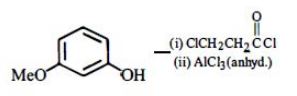
The major product of the following reaction is:
A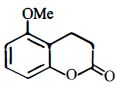
B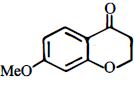
C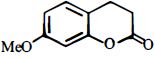
D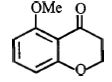
Solution
(D) The reaction proceeds in two steps:
$1$. The phenolic $-OH$ group reacts with $ClCH_2CH_2COCl$ to form an ester intermediate,$m-MeO-C_6H_4-O-CO-CH_2CH_2Cl$.
$2$. In the presence of anhydrous $AlCl_3$,an intramolecular Friedel-Crafts acylation occurs. The acyl group attacks the ortho position relative to the $-OH$ group (which is now part of the ester linkage) to form a cyclic compound. The methoxy group $(-OMe)$ is an ortho-para directing group,and the cyclization occurs to form the most stable bicyclic structure,which is the coumarin derivative shown in option $D$.
$1$. The phenolic $-OH$ group reacts with $ClCH_2CH_2COCl$ to form an ester intermediate,$m-MeO-C_6H_4-O-CO-CH_2CH_2Cl$.
$2$. In the presence of anhydrous $AlCl_3$,an intramolecular Friedel-Crafts acylation occurs. The acyl group attacks the ortho position relative to the $-OH$ group (which is now part of the ester linkage) to form a cyclic compound. The methoxy group $(-OMe)$ is an ortho-para directing group,and the cyclization occurs to form the most stable bicyclic structure,which is the coumarin derivative shown in option $D$.
0 likesView Solution
9
ChemistryMediumMCQJEE Main · 2018
$H - N\mathop { - - - }\limits^{(I)} N\mathop { - - - }\limits^{(II)} N$
In hydrogen azide,the bond orders of bonds $(I)$ and $(II)$ are . . . . . .
In hydrogen azide,the bond orders of bonds $(I)$ and $(II)$ are . . . . . .
A
$I < 2, II > 2$
B
$I > 2, II > 2$
C
$I > 2, II < 2$
D
$I < 2, II < 2$
Solution
(A) The structure of hydrogen azide $(HN_3)$ is represented by resonance hybrids.
The resonance structures are:
$H-N=N^{+}=N^{-} \leftrightarrow H-N^{-}-N^{+}\equiv N$
In the first structure,bond $(I)$ is a double bond and bond $(II)$ is a double bond.
In the second structure,bond $(I)$ is a single bond and bond $(II)$ is a triple bond.
Considering the resonance hybrid,the bond order of bond $(I)$ (between $N_1$ and $N_2$) is between $1$ and $2$,i.e.,$< 2$.
The bond order of bond $(II)$ (between $N_2$ and $N_3$) is between $2$ and $3$,i.e.,$> 2$.
Therefore,the bond order of $(I)$ is $< 2$ and $(II)$ is $> 2$.
The resonance structures are:
$H-N=N^{+}=N^{-} \leftrightarrow H-N^{-}-N^{+}\equiv N$
In the first structure,bond $(I)$ is a double bond and bond $(II)$ is a double bond.
In the second structure,bond $(I)$ is a single bond and bond $(II)$ is a triple bond.
Considering the resonance hybrid,the bond order of bond $(I)$ (between $N_1$ and $N_2$) is between $1$ and $2$,i.e.,$< 2$.
The bond order of bond $(II)$ (between $N_2$ and $N_3$) is between $2$ and $3$,i.e.,$> 2$.
Therefore,the bond order of $(I)$ is $< 2$ and $(II)$ is $> 2$.
0 likesView Solution
10
ChemistryMediumMCQJEE Main · 2018
For $Na^{+}$,$Mg^{2+}$,$F^{-}$,and $O^{2-}$; the correct order of increasing ionic radii is
A
$Mg^{2+} < Na^{+} < F^{-} < O^{2-}$
B
$Na^{+} < Mg^{2+} < F^{-} < O^{2-}$
C
$Mg^{2+} < Na^{+} < O^{2-} < F^{-}$
D
$Mg^{2+} < O^{2-} < Na^{+} < F^{-}$
Solution
(A) All given species ($Na^{+}$,$Mg^{2+}$,$F^{-}$,$O^{2-}$) are isoelectronic,as each contains $10 \ e^-$.
In an isoelectronic series,the ionic radius decreases as the nuclear charge (atomic number) increases.
The atomic numbers are: $O (8)$,$F (9)$,$Na (11)$,$Mg (12)$.
Therefore,the order of increasing ionic radii is $Mg^{2+} < Na^{+} < F^{-} < O^{2-}$.
In an isoelectronic series,the ionic radius decreases as the nuclear charge (atomic number) increases.
The atomic numbers are: $O (8)$,$F (9)$,$Na (11)$,$Mg (12)$.
Therefore,the order of increasing ionic radii is $Mg^{2+} < Na^{+} < F^{-} < O^{2-}$.
0 likesView Solution
11
ChemistryDifficultMCQJEE Main · 2018
The correct match between items of List-$I$ and List-$II$ is
| List-$I$ | List-$II$ |
| $A$. Coloured impurity | $(p)$. Steam distillation |
| $B$. Mixture of $o-$nitrophenol and $p-$nitrophenol | $(q)$. Fractional distillation |
| $C$. Crude naphtha | $(r)$. Charcoal treatment |
| $D$. Mixture of glycerol and sugars | $(s)$. Distillation under reduced pressure |
A
$A-r, B-p, C-q, D-s$
B
$A-p, B-s, C-r, D-q$
C
$A-r, B-p, C-s, D-q$
D
$A-r, B-q, C-p, D-s$
Solution
(A) . Coloured impurity is removed by charcoal treatment $(r)$.
$B$. Mixture of $o-$nitrophenol and $p-$nitrophenol is separated by steam distillation $(p)$ because $o-$nitrophenol is steam volatile due to intramolecular hydrogen bonding.
$C$. Crude naphtha is separated by fractional distillation $(q)$.
$D$. Mixture of glycerol and sugars is separated by distillation under reduced pressure $(s)$ to prevent decomposition of glycerol at high temperatures.
Therefore,the correct match is $A-r, B-p, C-q, D-s$.
$B$. Mixture of $o-$nitrophenol and $p-$nitrophenol is separated by steam distillation $(p)$ because $o-$nitrophenol is steam volatile due to intramolecular hydrogen bonding.
$C$. Crude naphtha is separated by fractional distillation $(q)$.
$D$. Mixture of glycerol and sugars is separated by distillation under reduced pressure $(s)$ to prevent decomposition of glycerol at high temperatures.
Therefore,the correct match is $A-r, B-p, C-q, D-s$.
0 likesView Solution
12
ChemistryDifficultMCQJEE Main · 2018
Which of the following is a Lewis acid?
A
$PH_3$
B
$NF_3$
C
$NaH$
D
$B(CH_3)_3$
Solution
(D) Lewis acid is defined as an electron-pair acceptor.
$PH_3$ and $NF_3$ have a lone pair on the central atom,making them Lewis bases.
$NaH$ is an ionic hydride containing the hydride ion $(H^-)$,which acts as a Lewis base.
In $B(CH_3)_3$,the central Boron atom has only $6$ valence electrons (an incomplete octet),as shown in the structure. Therefore,it can accept an electron pair to complete its octet,making it a Lewis acid.
$PH_3$ and $NF_3$ have a lone pair on the central atom,making them Lewis bases.
$NaH$ is an ionic hydride containing the hydride ion $(H^-)$,which acts as a Lewis base.
In $B(CH_3)_3$,the central Boron atom has only $6$ valence electrons (an incomplete octet),as shown in the structure. Therefore,it can accept an electron pair to complete its octet,making it a Lewis acid.
0 likesView Solution
13
ChemistryDifficultMCQJEE Main · 2018
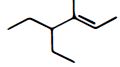
The $IUPAC$ name of the following compound is
A
$3-$ethyl$-4-$methylhex$-4-$ene
B
$4, 4-$diethyl$-3-$methylbut$-2-$ene
C
$4-$methyl$-3-$ethylhex$-4-$ene
D
$4-$ethyl$-3-$methylhex$-2-$ene
Solution
(D) $1$. Identify the longest carbon chain containing the double bond. The longest chain has $6$ carbon atoms,so the parent alkane is hexane. Since there is a double bond,it is a hexene.
$2$. Number the chain from the end that gives the double bond the lowest possible locant. Numbering from right to left gives the double bond the position $2$ $(C2=C3)$.
$3$. Identify the substituents: There is an ethyl group at position $4$ and a methyl group at position $3$.
$4$. Combine these to get the name: $4-$ethyl$-3-$methylhex$-2-$ene.
$2$. Number the chain from the end that gives the double bond the lowest possible locant. Numbering from right to left gives the double bond the position $2$ $(C2=C3)$.
$3$. Identify the substituents: There is an ethyl group at position $4$ and a methyl group at position $3$.
$4$. Combine these to get the name: $4-$ethyl$-3-$methylhex$-2-$ene.
0 likesView Solution
14
ChemistryDifficultMCQJEE Main · 2018
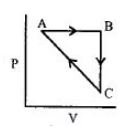
An ideal gas undergoes a cyclic process as shown in the figure.
$\Delta U_{BC} = -5 \ kJ \ mol^{-1}$,$q_{AB} = 2 \ kJ \ mol^{-1}$
$\Delta W_{AB} = -5 \ kJ \ mol^{-1}$,$W_{CA} = 3 \ kJ \ mol^{-1}$
Heat absorbed by the system during process $CA$ is......$kJ \ mol^{-1}$
$\Delta U_{BC} = -5 \ kJ \ mol^{-1}$,$q_{AB} = 2 \ kJ \ mol^{-1}$
$\Delta W_{AB} = -5 \ kJ \ mol^{-1}$,$W_{CA} = 3 \ kJ \ mol^{-1}$
Heat absorbed by the system during process $CA$ is......$kJ \ mol^{-1}$
A
$-5$
B
$+5$
C
$18$
D
$-18$
Solution
(B) For the process $AB$:
$\Delta U_{AB} = q_{AB} + W_{AB} = 2 + (-5) = -3 \ kJ \ mol^{-1}$
For the cyclic process,the total change in internal energy is zero:
$\Delta U_{AB} + \Delta U_{BC} + \Delta U_{CA} = 0$
Substituting the known values:
$-3 + (-5) + \Delta U_{CA} = 0$
$\Delta U_{CA} = 8 \ kJ \ mol^{-1}$
Using the first law of thermodynamics for process $CA$:
$\Delta U_{CA} = q_{CA} + W_{CA}$
$8 = q_{CA} + 3$
$q_{CA} = 5 \ kJ \ mol^{-1}$
Thus,the heat absorbed by the system during process $CA$ is $+5 \ kJ \ mol^{-1}$.
$\Delta U_{AB} = q_{AB} + W_{AB} = 2 + (-5) = -3 \ kJ \ mol^{-1}$
For the cyclic process,the total change in internal energy is zero:
$\Delta U_{AB} + \Delta U_{BC} + \Delta U_{CA} = 0$
Substituting the known values:
$-3 + (-5) + \Delta U_{CA} = 0$
$\Delta U_{CA} = 8 \ kJ \ mol^{-1}$
Using the first law of thermodynamics for process $CA$:
$\Delta U_{CA} = q_{CA} + W_{CA}$
$8 = q_{CA} + 3$
$q_{CA} = 5 \ kJ \ mol^{-1}$
Thus,the heat absorbed by the system during process $CA$ is $+5 \ kJ \ mol^{-1}$.
0 likesView Solution
15
ChemistryDifficultMCQJEE Main · 2018
Ejection of the photoelectron from metal in the photoelectric effect experiment can be stopped by applying $0.5\, V$ when the radiation of $250\, nm$ is used. The work function of the metal is ................ $eV$
A
$4$
B
$5.5$
C
$4.5$
D
$5$
Solution
(C) The energy of the incident radiation is given by $E = \frac{hc}{\lambda}$.
Using $hc = 12400\, eV\, \mathring{A}$ and $\lambda = 250\, nm = 2500\, \mathring{A}$,we get $E = \frac{12400}{2500} = 4.96\, eV$.
According to the photoelectric equation,$E = W_0 + K.E._{max}$,where $W_0$ is the work function and $K.E._{max}$ is the maximum kinetic energy.
The stopping potential is $0.5\, V$,so $K.E._{max} = 0.5\, eV$.
Substituting the values: $4.96 = W_0 + 0.5$.
Therefore,$W_0 = 4.96 - 0.5 = 4.46\, eV$,which is approximately $4.5\, eV$.
Using $hc = 12400\, eV\, \mathring{A}$ and $\lambda = 250\, nm = 2500\, \mathring{A}$,we get $E = \frac{12400}{2500} = 4.96\, eV$.
According to the photoelectric equation,$E = W_0 + K.E._{max}$,where $W_0$ is the work function and $K.E._{max}$ is the maximum kinetic energy.
The stopping potential is $0.5\, V$,so $K.E._{max} = 0.5\, eV$.
Substituting the values: $4.96 = W_0 + 0.5$.
Therefore,$W_0 = 4.96 - 0.5 = 4.46\, eV$,which is approximately $4.5\, eV$.
1 likesView Solution
16
ChemistryDifficultMCQJEE Main · 2018
In graphite and diamond,the percentage of $p-$ characters of the hybrid orbitals in hybridisation are respectively
A
$33$ and $25$
B
$67$ and $75$
C
$50$ and $75$
D
$33$ and $75$
Solution
(B) In graphite,carbon is $sp^2$ hybridized. The percentage of $p-$ character is $\frac{2}{3} \times 100 = 66.67\% \approx 67\%$.
In diamond,carbon is $sp^3$ hybridized. The percentage of $p-$ character is $\frac{3}{4} \times 100 = 75\%$.
Therefore,the values are $67\%$ and $75\%$ respectively.
In diamond,carbon is $sp^3$ hybridized. The percentage of $p-$ character is $\frac{3}{4} \times 100 = 75\%$.
Therefore,the values are $67\%$ and $75\%$ respectively.
0 likesView Solution
17
ChemistryDifficultMCQJEE Main · 2018
The minimum volume of water required to dissolve $0.1 \ g$ of lead $(II)$ chloride to get a saturated solution ($K_{sp}$ of $PbCl_2 = 3.2 \times 10^{-8}$; atomic mass of $Pb = 207 \ u$,$Cl = 35.5 \ u$) is......$L$
A
$1.798$
B
$0.36$
C
$17.95$
D
$0.18$
Solution
(D) The molar mass of $PbCl_2 = 207 + 2 \times 35.5 = 278 \ g/mol$.
The solubility equilibrium is $PbCl_2(s) \leftrightarrow Pb^{2+}(aq) + 2Cl^-(aq)$.
The solubility product expression is $K_{sp} = [Pb^{2+}][Cl^-]^2 = (s)(2s)^2 = 4s^3$.
Given $K_{sp} = 3.2 \times 10^{-8}$,we have $4s^3 = 3.2 \times 10^{-8}$,so $s^3 = 0.8 \times 10^{-8} = 8 \times 10^{-9}$.
Thus,solubility $s = 2 \times 10^{-3} \ mol/L$.
The number of moles of $PbCl_2$ is $n = \frac{0.1 \ g}{278 \ g/mol} \approx 3.597 \times 10^{-4} \ mol$.
Since $s = \frac{n}{V}$,the volume $V = \frac{n}{s} = \frac{3.597 \times 10^{-4}}{2 \times 10^{-3}} \approx 0.1798 \ L \approx 0.18 \ L$.
The solubility equilibrium is $PbCl_2(s) \leftrightarrow Pb^{2+}(aq) + 2Cl^-(aq)$.
The solubility product expression is $K_{sp} = [Pb^{2+}][Cl^-]^2 = (s)(2s)^2 = 4s^3$.
Given $K_{sp} = 3.2 \times 10^{-8}$,we have $4s^3 = 3.2 \times 10^{-8}$,so $s^3 = 0.8 \times 10^{-8} = 8 \times 10^{-9}$.
Thus,solubility $s = 2 \times 10^{-3} \ mol/L$.
The number of moles of $PbCl_2$ is $n = \frac{0.1 \ g}{278 \ g/mol} \approx 3.597 \times 10^{-4} \ mol$.
Since $s = \frac{n}{V}$,the volume $V = \frac{n}{s} = \frac{3.597 \times 10^{-4}}{2 \times 10^{-3}} \approx 0.1798 \ L \approx 0.18 \ L$.
0 likesView Solution
18
ChemistryMediumMCQJEE Main · 2018
In which of the following reactions,an increase in the volume of the container will favour the formation of products?
A
$4NH_{3(g)} + 5O_{2(g)} \rightleftharpoons 4NO_{(g)} + 6H_2O_{(l)}$
B
$2NO_{2(g)} \rightleftharpoons 2NO_{(g)} + O_{2(g)}$
C
$3O_{2(g)} \rightleftharpoons 2O_{3(g)}$
D
$H_{2(g)} + I_{2(g)} \rightleftharpoons 2HI_{(g)}$
Solution
(B) According to Le Chatelier's principle,an increase in the volume of the container leads to a decrease in pressure.
To counteract this,the equilibrium shifts towards the side with a greater number of moles of gaseous species.
For option $B$: $2NO_{2(g)} \rightleftharpoons 2NO_{(g)} + O_{2(g)}$,the number of moles of gaseous products is $3$ $(2+1)$ and gaseous reactants is $2$.
Since $3 > 2$,an increase in volume will favour the formation of products.
To counteract this,the equilibrium shifts towards the side with a greater number of moles of gaseous species.
For option $B$: $2NO_{2(g)} \rightleftharpoons 2NO_{(g)} + O_{2(g)}$,the number of moles of gaseous products is $3$ $(2+1)$ and gaseous reactants is $2$.
Since $3 > 2$,an increase in volume will favour the formation of products.
0 likesView Solution
19
ChemistryDifficultMCQJEE Main · 2018
The decreasing order of bond angles in $BF_3$,$NH_3$,$PF_3$ and $I_3^-$ is
A
$I_3^- > BF_3 > NH_3 > PF_3$
B
$BF_3 > I_3^- > PF_3 > NH_3$
C
$BF_3 > NH_3 > PF_3 > I_3^-$
D
$I_3^- > NH_3 > PF_3 > BF_3$
Solution
(A) $1$. $I_3^-$: The central $I$ atom is $sp^3d$ hybridized with $3$ lone pairs in the equatorial positions,resulting in a linear geometry with a bond angle of $180^\circ$.
$2$. $BF_3$: The central $B$ atom is $sp^2$ hybridized with no lone pairs,resulting in a trigonal planar geometry with a bond angle of $120^\circ$.
$3$. $NH_3$ and $PF_3$: Both have $sp^3$ hybridization with $1$ lone pair,giving them a trigonal pyramidal geometry. The bond angle in $NH_3$ is $\approx 107^\circ$,while in $PF_3$ it is $\approx 96^\circ$. As the electronegativity of the surrounding atoms decreases or the size of the central atom increases,the bond angle decreases. Thus,$NH_3 > PF_3$.
$4$. Combining these,the decreasing order of bond angles is $I_3^- (180^\circ) > BF_3 (120^\circ) > NH_3 (107^\circ) > PF_3 (96^\circ)$.
$2$. $BF_3$: The central $B$ atom is $sp^2$ hybridized with no lone pairs,resulting in a trigonal planar geometry with a bond angle of $120^\circ$.
$3$. $NH_3$ and $PF_3$: Both have $sp^3$ hybridization with $1$ lone pair,giving them a trigonal pyramidal geometry. The bond angle in $NH_3$ is $\approx 107^\circ$,while in $PF_3$ it is $\approx 96^\circ$. As the electronegativity of the surrounding atoms decreases or the size of the central atom increases,the bond angle decreases. Thus,$NH_3 > PF_3$.
$4$. Combining these,the decreasing order of bond angles is $I_3^- (180^\circ) > BF_3 (120^\circ) > NH_3 (107^\circ) > PF_3 (96^\circ)$.
0 likesView Solution
20
ChemistryMCQJEE Main · 2018
If $(p \wedge \sim q) \wedge (p \wedge r) \to \sim p \vee q$ is false,then the truth values of $p, q$ and $r$ are respectively
A
$F, T, F$
B
$T, F, T$
C
$F, F, F$
D
$T, T, T$
Solution
(B) conditional statement $A \to B$ is false if and only if $A$ is true and $B$ is false.
Here,$A = (p \wedge \sim q) \wedge (p \wedge r)$ and $B = \sim p \vee q$.
For $A \to B$ to be false,we must have $A = T$ and $B = F$.
$1$. Since $A = (p \wedge \sim q) \wedge (p \wedge r) = T$,all components must be true: $p = T$,$\sim q = T$ (so $q = F$),and $r = T$.
$2$. Now,check if $B = \sim p \vee q$ is false with these values: $\sim T \vee F = F \vee F = F$.
Since $B = F$ holds,the values $p = T, q = F, r = T$ satisfy the condition.
Therefore,the truth values are $p = T, q = F, r = T$.
Here,$A = (p \wedge \sim q) \wedge (p \wedge r)$ and $B = \sim p \vee q$.
For $A \to B$ to be false,we must have $A = T$ and $B = F$.
$1$. Since $A = (p \wedge \sim q) \wedge (p \wedge r) = T$,all components must be true: $p = T$,$\sim q = T$ (so $q = F$),and $r = T$.
$2$. Now,check if $B = \sim p \vee q$ is false with these values: $\sim T \vee F = F \vee F = F$.
Since $B = F$ holds,the values $p = T, q = F, r = T$ satisfy the condition.
Therefore,the truth values are $p = T, q = F, r = T$.
0 likesView Solution
21
ChemistryDifficultMCQJEE Main · 2018
In $KO_2$,the nature of oxygen species and the oxidation state of oxygen atom are,respectively
A
Superoxide and $-1$
B
Superoxide and $-1/2$
C
Peroxide and $-1/2$
D
Oxide and $-2$
Solution
(B) In $KO_2$,the nature of oxygen species is superoxide (superoxide ion is $O_2^-$).
To calculate the oxidation state of oxygen,let $x$ be the oxidation state of oxygen.
The oxidation state of $K$ is $+1$.
Applying the rule for the sum of oxidation states in a neutral molecule:
$+1 + 2(x) = 0$
$2x = -1$
$x = -\frac{1}{2}$
Thus,the oxidation state of oxygen in $KO_2$ is $-\frac{1}{2}$.
To calculate the oxidation state of oxygen,let $x$ be the oxidation state of oxygen.
The oxidation state of $K$ is $+1$.
Applying the rule for the sum of oxidation states in a neutral molecule:
$+1 + 2(x) = 0$
$2x = -1$
$x = -\frac{1}{2}$
Thus,the oxidation state of oxygen in $KO_2$ is $-\frac{1}{2}$.
0 likesView Solution
22
ChemistryDifficultMCQJEE Main · 2018
$\Delta _f G^o$ at $500 \, K$ for substance '$S$' in liquid state and gaseous state are $+100.7 \, kcal \, mol^{-1}$ and $+103 \, kcal \, mol^{-1}$,respectively. The vapour pressure of liquid '$S$' at $500 \, K$ is approximately equal to $(R = 2 \, cal \, K^{-1} \, mol^{-1}) \dots \dots \text{atm}$.
A
$100$
B
$1$
C
$10$
D
$0.1$
Solution
(D) The process of vaporization is represented as: $S(l) \rightleftharpoons S(g)$.
The standard Gibbs free energy change for the reaction is given by: $\Delta G_{vap}^o = \Delta _f G^o(g) - \Delta _f G^o(l)$.
Substituting the given values: $\Delta G_{vap}^o = 103 \, kcal/mol - 100.7 \, kcal/mol = 2.3 \, kcal/mol = 2300 \, cal/mol$.
At equilibrium,$\Delta G_{vap}^o = -RT \ln K_p$,where $K_p = P_{vap}$.
$2300 \, cal/mol = -(2 \, cal \, K^{-1} \, mol^{-1}) \times (500 \, K) \times \ln K_p$.
$2300 = -1000 \ln K_p$.
$\ln K_p = -2.3$.
$K_p = e^{-2.3} \approx 0.1 \, \text{atm}$.
The standard Gibbs free energy change for the reaction is given by: $\Delta G_{vap}^o = \Delta _f G^o(g) - \Delta _f G^o(l)$.
Substituting the given values: $\Delta G_{vap}^o = 103 \, kcal/mol - 100.7 \, kcal/mol = 2.3 \, kcal/mol = 2300 \, cal/mol$.
At equilibrium,$\Delta G_{vap}^o = -RT \ln K_p$,where $K_p = P_{vap}$.
$2300 \, cal/mol = -(2 \, cal \, K^{-1} \, mol^{-1}) \times (500 \, K) \times \ln K_p$.
$2300 = -1000 \ln K_p$.
$\ln K_p = -2.3$.
$K_p = e^{-2.3} \approx 0.1 \, \text{atm}$.
0 likesView Solution
23
ChemistryDifficultMCQJEE Main · 2018
In $XeO_3F_2$,the number of bond pair$(s)$,$\pi$-bond$(s)$ and lone pair$(s)$ on $Xe$ atom respectively are:
A
$5, 3, 0$
B
$5, 2, 0$
C
$4, 2, 2$
D
$4, 4, 0$
Solution
(A) The central atom $Xe$ has $8$ valence electrons.
In $XeO_3F_2$,$Xe$ forms $3$ double bonds with $3$ oxygen atoms and $2$ single bonds with $2$ fluorine atoms.
Total bond pairs = $3$ (from $Xe=O$) + $2$ (from $Xe-F$) = $5$.
Number of $\pi$-bonds = $3$ (each $Xe=O$ bond contains one $\pi$-bond).
Number of lone pairs on $Xe$ = $\frac{1}{2} \times (8 - 5 - 3) = 0$.
Thus,the number of bond pairs,$\pi$-bonds,and lone pairs are $5, 3, 0$ respectively.
In $XeO_3F_2$,$Xe$ forms $3$ double bonds with $3$ oxygen atoms and $2$ single bonds with $2$ fluorine atoms.
Total bond pairs = $3$ (from $Xe=O$) + $2$ (from $Xe-F$) = $5$.
Number of $\pi$-bonds = $3$ (each $Xe=O$ bond contains one $\pi$-bond).
Number of lone pairs on $Xe$ = $\frac{1}{2} \times (8 - 5 - 3) = 0$.
Thus,the number of bond pairs,$\pi$-bonds,and lone pairs are $5, 3, 0$ respectively.
0 likesView Solution
24
ChemistryMediumMCQJEE Main · 2018
Which of the following best describes the given molecular orbital diagram?

A
$A$ bonding $\pi$ orbital
B
$A$ non-bonding orbital
C
An antibonding $\sigma$ orbital
D
An antibonding $\pi$ orbital
Solution
(D) The given diagram shows the out-of-phase overlap of two $p-$orbitals.
In this interaction,the lobes with opposite signs ($+$ and $-$) are adjacent to each other,which leads to destructive interference.
This type of lateral overlap results in the formation of an antibonding $\pi$ molecular orbital,denoted as $\pi^* \ MO$.
In this interaction,the lobes with opposite signs ($+$ and $-$) are adjacent to each other,which leads to destructive interference.
This type of lateral overlap results in the formation of an antibonding $\pi$ molecular orbital,denoted as $\pi^* \ MO$.
0 likesView Solution
25
ChemistryMediumMCQJEE Main · 2018
Following four solutions are prepared by mixing different volumes of $NaOH$ and $HCl$ of different concentrations. The $pH$ of which one of them will be equal to $1$?
A
$55 \ mL \ \frac{M}{10} \ HCl + 45 \ mL \ \frac{M}{10} \ NaOH$
B
$75 \ mL \ \frac{M}{5} \ HCl + 25 \ mL \ \frac{M}{5} \ NaOH$
C
$100 \ mL \ \frac{M}{10} \ HCl + 100 \ mL \ \frac{M}{10} \ NaOH$
D
$60 \ mL \ \frac{M}{10} \ HCl + 40 \ mL \ \frac{M}{10} \ NaOH$
Solution
(B) For $pH = 1$,the concentration of $[H^{+}]$ must be $10^{-1} \ M$ or $0.1 \ M$ $(M/10)$.
For option $B$: $75 \ mL \ \frac{M}{5} \ HCl + 25 \ mL \ \frac{M}{5} \ NaOH$.
$25 \ mL \ \frac{M}{5} \ NaOH$ will neutralize $25 \ mL \ \frac{M}{5} \ HCl$.
Remaining $HCl$ volume = $75 \ mL - 25 \ mL = 50 \ mL$ of $\frac{M}{5} \ HCl$.
Total volume of the solution = $75 \ mL + 25 \ mL = 100 \ mL$.
New concentration of $HCl = \frac{M}{5} \times \frac{50 \ mL}{100 \ mL} = \frac{M}{10} = 0.1 \ M$.
Since $HCl$ is a strong acid,$[H^{+}] = 0.1 \ M$.
$pH = -\log_{10}[H^{+}] = -\log_{10}(10^{-1}) = 1$.
For option $B$: $75 \ mL \ \frac{M}{5} \ HCl + 25 \ mL \ \frac{M}{5} \ NaOH$.
$25 \ mL \ \frac{M}{5} \ NaOH$ will neutralize $25 \ mL \ \frac{M}{5} \ HCl$.
Remaining $HCl$ volume = $75 \ mL - 25 \ mL = 50 \ mL$ of $\frac{M}{5} \ HCl$.
Total volume of the solution = $75 \ mL + 25 \ mL = 100 \ mL$.
New concentration of $HCl = \frac{M}{5} \times \frac{50 \ mL}{100 \ mL} = \frac{M}{10} = 0.1 \ M$.
Since $HCl$ is a strong acid,$[H^{+}] = 0.1 \ M$.
$pH = -\log_{10}[H^{+}] = -\log_{10}(10^{-1}) = 1$.
0 likesView Solution
26
ChemistryDifficultMCQJEE Main · 2018
Given
$(i) \, 2Fe_2O_{3(s)} \to 4Fe_{(s)} + 3O_{2(g)}$
$\Delta _rG^o = + 1487.0 \, kJ \, mol^{-1}$
$(ii) \, 2CO_{(g)} + O_{2(g)} \to 2CO_{2(g)}$
$\Delta _rG^o = - 514.4 \, kJ \, mol^{-1}$
Free energy change,$\Delta _rG^o$ for the reaction
$2Fe_2O_{3(s)} + 6CO_{(g)} \to 4Fe_{(s)} + 6CO_{2(g)}$ will be ..... $kJ \, mol^{-1}$
$(i) \, 2Fe_2O_{3(s)} \to 4Fe_{(s)} + 3O_{2(g)}$
$\Delta _rG^o = + 1487.0 \, kJ \, mol^{-1}$
$(ii) \, 2CO_{(g)} + O_{2(g)} \to 2CO_{2(g)}$
$\Delta _rG^o = - 514.4 \, kJ \, mol^{-1}$
Free energy change,$\Delta _rG^o$ for the reaction
$2Fe_2O_{3(s)} + 6CO_{(g)} \to 4Fe_{(s)} + 6CO_{2(g)}$ will be ..... $kJ \, mol^{-1}$
A
$-112.4$
B
$-56.2$
C
$-208$
D
$-168.2$
Solution
(B) Given reactions are:
$(i) \, 2Fe_2O_{3(s)} \to 4Fe_{(s)} + 3O_{2(g)}; \, \Delta _rG^o = + 1487.0 \, kJ \, mol^{-1}$
$(ii) \, 2CO_{(g)} + O_{2(g)} \to 2CO_{2(g)}; \, \Delta _rG^o = - 514.4 \, kJ \, mol^{-1}$
To obtain the target reaction $2Fe_2O_{3(s)} + 6CO_{(g)} \to 4Fe_{(s)} + 6CO_{2(g)}$,multiply reaction $(ii)$ by $3$:
$(iii) \, 6CO_{(g)} + 3O_{2(g)} \to 6CO_{2(g)}; \, \Delta _rG^o = 3 \times (- 514.4) = - 1543.2 \, kJ \, mol^{-1}$
Now,add reaction $(i)$ and reaction $(iii)$:
$(2Fe_2O_{3(s)} + 6CO_{(g)} + 3O_{2(g)}) \to (4Fe_{(s)} + 3O_{2(g)} + 6CO_{2(g)})$
Canceling $3O_{2(g)}$ from both sides gives the target reaction:
$2Fe_2O_{3(s)} + 6CO_{(g)} \to 4Fe_{(s)} + 6CO_{2(g)}$
The total $\Delta _rG^o$ is the sum of the $\Delta _rG^o$ values:
$\Delta _rG^o = 1487.0 + (- 1543.2) = - 56.2 \, kJ \, mol^{-1}$
$(i) \, 2Fe_2O_{3(s)} \to 4Fe_{(s)} + 3O_{2(g)}; \, \Delta _rG^o = + 1487.0 \, kJ \, mol^{-1}$
$(ii) \, 2CO_{(g)} + O_{2(g)} \to 2CO_{2(g)}; \, \Delta _rG^o = - 514.4 \, kJ \, mol^{-1}$
To obtain the target reaction $2Fe_2O_{3(s)} + 6CO_{(g)} \to 4Fe_{(s)} + 6CO_{2(g)}$,multiply reaction $(ii)$ by $3$:
$(iii) \, 6CO_{(g)} + 3O_{2(g)} \to 6CO_{2(g)}; \, \Delta _rG^o = 3 \times (- 514.4) = - 1543.2 \, kJ \, mol^{-1}$
Now,add reaction $(i)$ and reaction $(iii)$:
$(2Fe_2O_{3(s)} + 6CO_{(g)} + 3O_{2(g)}) \to (4Fe_{(s)} + 3O_{2(g)} + 6CO_{2(g)})$
Canceling $3O_{2(g)}$ from both sides gives the target reaction:
$2Fe_2O_{3(s)} + 6CO_{(g)} \to 4Fe_{(s)} + 6CO_{2(g)}$
The total $\Delta _rG^o$ is the sum of the $\Delta _rG^o$ values:
$\Delta _rG^o = 1487.0 + (- 1543.2) = - 56.2 \, kJ \, mol^{-1}$
0 likesView Solution
27
ChemistryDifficultMCQJEE Main · 2018
At a certain temperature in a $5\,L$ vessel,$2\,moles$ of carbon monoxide and $3\,moles$ of chlorine were allowed to reach equilibrium according to the reaction,$CO + Cl_2 \rightleftharpoons COCl_2$. At equilibrium,if $1\,mole$ of $CO$ is present,then the equilibrium constant $(K_c)$ for the reaction is:
A
$2.5$
B
$4$
C
$2$
D
$3$
Solution
(A) The reaction is $CO + Cl_2 \rightleftharpoons COCl_2$.
Initially,$CO = 2\,mol$,$Cl_2 = 3\,mol$,$COCl_2 = 0\,mol$.
At equilibrium,$CO = 1\,mol$.
Change in $CO = 2 - 1 = 1\,mol$ reacted.
According to stoichiometry,$1\,mol$ of $CO$ reacts with $1\,mol$ of $Cl_2$ to produce $1\,mol$ of $COCl_2$.
At equilibrium: $[CO] = \frac{1\,mol}{5\,L} = 0.2\,M$,$[Cl_2] = \frac{3-1\,mol}{5\,L} = \frac{2\,mol}{5\,L} = 0.4\,M$,$[COCl_2] = \frac{1\,mol}{5\,L} = 0.2\,M$.
$K_c = \frac{[COCl_2]}{[CO][Cl_2]} = \frac{0.2}{0.2 \times 0.4} = \frac{1}{0.4} = 2.5$.
Initially,$CO = 2\,mol$,$Cl_2 = 3\,mol$,$COCl_2 = 0\,mol$.
At equilibrium,$CO = 1\,mol$.
Change in $CO = 2 - 1 = 1\,mol$ reacted.
According to stoichiometry,$1\,mol$ of $CO$ reacts with $1\,mol$ of $Cl_2$ to produce $1\,mol$ of $COCl_2$.
At equilibrium: $[CO] = \frac{1\,mol}{5\,L} = 0.2\,M$,$[Cl_2] = \frac{3-1\,mol}{5\,L} = \frac{2\,mol}{5\,L} = 0.4\,M$,$[COCl_2] = \frac{1\,mol}{5\,L} = 0.2\,M$.
$K_c = \frac{[COCl_2]}{[CO][Cl_2]} = \frac{0.2}{0.2 \times 0.4} = \frac{1}{0.4} = 2.5$.
0 likesView Solution
28
ChemistryAdvancedMCQJEE Main · 2018
When $2-$butyne is treated with $H_2/$ Lindlar's catalyst,compound $X$ is produced as the major product and when treated with $Na/liq. NH_3$ it produces $Y$ as the major product. Which of the following statements is correct?
A
$Y$ will have higher dipole moment and higher boiling point than $X$
B
$Y$ will have higher dipole moment and lower boiling point than $X$
C
$X$ will have lower dipole moment and lower boiling point than $Y$
D
$X$ will have higher dipole moment and higher boiling point than $Y$
Solution
(D) When $2-$butyne is treated with $H_2/$ Lindlar's catalyst,compound $X$ (cis$-2-$butene) is produced as the major product.
When $2-$butyne is treated with $Na/liq. NH_3$,it produces $Y$ (trans$-2-$butene) as the major product.
Due to the polar nature of the cis isomer,$X$ (cis$-2-$butene) has a higher dipole moment than the trans isomer $Y$ (trans$-2-$butene).
Additionally,the cis isomer has a higher boiling point than the trans isomer due to stronger intermolecular dipole-dipole interactions.
Therefore,$X$ will have a higher dipole moment and higher boiling point than $Y$.
When $2-$butyne is treated with $Na/liq. NH_3$,it produces $Y$ (trans$-2-$butene) as the major product.
Due to the polar nature of the cis isomer,$X$ (cis$-2-$butene) has a higher dipole moment than the trans isomer $Y$ (trans$-2-$butene).
Additionally,the cis isomer has a higher boiling point than the trans isomer due to stronger intermolecular dipole-dipole interactions.
Therefore,$X$ will have a higher dipole moment and higher boiling point than $Y$.
0 likesView Solution
29
ChemistryDifficultMCQJEE Main · 2018
The de-Broglie's wavelength of an electron present in the first Bohr orbit of an $H$ atom is:
A
$4 \times 0.529 \ \mathring{A}$
B
$2\pi \times 0.529 \ \mathring{A}$
C
$\frac{0.529}{2\pi} \ \mathring{A}$
D
$0.529 \ \mathring{A}$
Solution
(B) The radius of the first Bohr orbit of an $H$ atom is given by $r = 0.529 \ \mathring{A}$.
According to Bohr's postulate,the angular momentum is quantized as $mvr = \frac{nh}{2\pi}$.
For the first orbit,$n = 1$,so $mvr = \frac{h}{2\pi}$.
Rearranging this gives $2\pi r = \frac{h}{mv}$.
According to the de-Broglie relation,$\lambda = \frac{h}{mv}$.
Therefore,$\lambda = 2\pi r$.
Substituting the value of $r$,we get $\lambda = 2\pi \times 0.529 \ \mathring{A}$.
According to Bohr's postulate,the angular momentum is quantized as $mvr = \frac{nh}{2\pi}$.
For the first orbit,$n = 1$,so $mvr = \frac{h}{2\pi}$.
Rearranging this gives $2\pi r = \frac{h}{mv}$.
According to the de-Broglie relation,$\lambda = \frac{h}{mv}$.
Therefore,$\lambda = 2\pi r$.
Substituting the value of $r$,we get $\lambda = 2\pi \times 0.529 \ \mathring{A}$.
0 likesView Solution
30
ChemistryDifficultMCQJEE Main · 2018
Lithium aluminium hydride reacts with silicon tetrachloride to form:
A
$LiCl, AlH_3$ and $SiH_4$
B
$LiCl, AlCl_3$ and $SiH_4$
C
$LiH, AlCl_3$ and $SiCl_2$
D
$LiH, AlH_3$ and $SiH_4$
Solution
(B) The reaction between lithium aluminium hydride $(LiAlH_4)$ and silicon tetrachloride $(SiCl_4)$ is a reduction reaction.
The balanced chemical equation is:
$LiAlH_4 + SiCl_4 \to LiCl + AlCl_3 + SiH_4$
Thus,the products formed are lithium chloride $(LiCl)$,aluminium chloride $(AlCl_3)$,and silane $(SiH_4)$.
The balanced chemical equation is:
$LiAlH_4 + SiCl_4 \to LiCl + AlCl_3 + SiH_4$
Thus,the products formed are lithium chloride $(LiCl)$,aluminium chloride $(AlCl_3)$,and silane $(SiH_4)$.
0 likesView Solution
31
ChemistryMediumMCQJEE Main · 2018
The correct order of electron affinity is
A
$O > F > Cl$
B
$F > O > Cl$
C
$F > Cl > O$
D
$Cl > F > O$
Solution
(D) The electron affinity (or electron gain enthalpy) generally increases (becomes more negative) across a period and decreases down a group.
However,due to the small size of the $F$ atom,the incoming electron experiences significant inter-electronic repulsion in the $2p$ subshell.
In contrast,the $Cl$ atom has a larger $3p$ subshell,which reduces this repulsion,making the addition of an electron more favorable.
Therefore,the magnitude of electron affinity follows the order $Cl > F > O$.
However,due to the small size of the $F$ atom,the incoming electron experiences significant inter-electronic repulsion in the $2p$ subshell.
In contrast,the $Cl$ atom has a larger $3p$ subshell,which reduces this repulsion,making the addition of an electron more favorable.
Therefore,the magnitude of electron affinity follows the order $Cl > F > O$.
0 likesView Solution
32
ChemistryDifficultMCQJEE Main · 2018
For per gram of reactant,the maximum quantity of $N_2$ gas is produced in which of the following thermal decomposition reactions? (Given: Atomic wt. : $Cr = 52 \ u, Ba = 137 \ u$).
A
$Ba(N_3)_{2(s)} \to Ba_{(s)} + 3N_{2(g)}$
B
$(NH_4)_2Cr_2O_{7(s)} \to N_{2(g)} + 4H_2O_{(g)} + Cr_2O_{3(s)}$
C
$2NH_{3(g)} \to N_{2(g)} + 3H_{2(g)}$
D
$2NH_4NO_{3(s)} \to 2N_{2(g)} + 4H_2O_{(g)} + O_{2(g)}$
Solution
(C) To find the maximum quantity of $N_2$ produced per gram of reactant,we calculate the moles of $N_2$ produced per gram of each reactant:
$(a)$ Molar mass of $Ba(N_3)_2 = 137 + 6 \times 14 = 221 \ g/mol$.
$1 \ mol$ of $Ba(N_3)_2$ produces $3 \ mol$ of $N_2$.
$N_2$ produced per gram $= \frac{3}{221} \approx 0.0136 \ mol$.
$(b)$ Molar mass of $(NH_4)_2Cr_2O_7 = 2(14+4) + 2(52) + 7(16) = 36 + 104 + 112 = 252 \ g/mol$.
$1 \ mol$ of $(NH_4)_2Cr_2O_7$ produces $1 \ mol$ of $N_2$.
$N_2$ produced per gram $= \frac{1}{252} \approx 0.0040 \ mol$.
$(c)$ Molar mass of $NH_3 = 14 + 3 = 17 \ g/mol$.
$2 \ mol$ of $NH_3$ produces $1 \ mol$ of $N_2$.
$N_2$ produced per gram $= \frac{1}{2 \times 17} = \frac{1}{34} \approx 0.0294 \ mol$.
$(d)$ Molar mass of $NH_4NO_3 = 14 + 4 + 14 + 48 = 80 \ g/mol$.
$2 \ mol$ of $NH_4NO_3$ produces $2 \ mol$ of $N_2$ (i.e.,$1 \ mol$ of $NH_4NO_3$ produces $1 \ mol$ of $N_2$).
$N_2$ produced per gram $= \frac{1}{80} = 0.0125 \ mol$.
Comparing the values,$0.0294 > 0.0136 > 0.0125 > 0.0040$. Thus,$NH_3$ produces the maximum amount of $N_2$.
$(a)$ Molar mass of $Ba(N_3)_2 = 137 + 6 \times 14 = 221 \ g/mol$.
$1 \ mol$ of $Ba(N_3)_2$ produces $3 \ mol$ of $N_2$.
$N_2$ produced per gram $= \frac{3}{221} \approx 0.0136 \ mol$.
$(b)$ Molar mass of $(NH_4)_2Cr_2O_7 = 2(14+4) + 2(52) + 7(16) = 36 + 104 + 112 = 252 \ g/mol$.
$1 \ mol$ of $(NH_4)_2Cr_2O_7$ produces $1 \ mol$ of $N_2$.
$N_2$ produced per gram $= \frac{1}{252} \approx 0.0040 \ mol$.
$(c)$ Molar mass of $NH_3 = 14 + 3 = 17 \ g/mol$.
$2 \ mol$ of $NH_3$ produces $1 \ mol$ of $N_2$.
$N_2$ produced per gram $= \frac{1}{2 \times 17} = \frac{1}{34} \approx 0.0294 \ mol$.
$(d)$ Molar mass of $NH_4NO_3 = 14 + 4 + 14 + 48 = 80 \ g/mol$.
$2 \ mol$ of $NH_4NO_3$ produces $2 \ mol$ of $N_2$ (i.e.,$1 \ mol$ of $NH_4NO_3$ produces $1 \ mol$ of $N_2$).
$N_2$ produced per gram $= \frac{1}{80} = 0.0125 \ mol$.
Comparing the values,$0.0294 > 0.0136 > 0.0125 > 0.0040$. Thus,$NH_3$ produces the maximum amount of $N_2$.
0 likesView Solution
33
ChemistryDifficultMCQJEE Main · 2018
Biochemical oxygen demand $(BOD)$ value can be a measure of water pollution caused by organic matter. Which of the following statements is correct?
A
Polluted water has $BOD$ value higher than $10 \ ppm$
B
Aerobic bacteria decreases the $BOD$ value
C
Anaerobic bacteria increases the $BOD$ value
D
Clean water has $BOD$ value higher than $10 \ ppm$
Solution
(A) The $BOD$ value is a measure of the amount of dissolved oxygen required by bacteria to decompose organic matter present in a water sample.
Clean water has a $BOD$ value of less than $5 \ ppm$.
Polluted water has a $BOD$ value of $17 \ ppm$ or higher,typically considered higher than $10 \ ppm$.
Therefore,the statement that polluted water has a $BOD$ value higher than $10 \ ppm$ is correct.
Clean water has a $BOD$ value of less than $5 \ ppm$.
Polluted water has a $BOD$ value of $17 \ ppm$ or higher,typically considered higher than $10 \ ppm$.
Therefore,the statement that polluted water has a $BOD$ value higher than $10 \ ppm$ is correct.
0 likesView Solution
34
ChemistryMCQJEE Main · 2018
If the mean of the data $7, 8, 9, 7, 8, 7, \lambda, 8$ is $8$,then the variance of this data is
A
$\frac{9}{8}$
B
$2$
C
$\frac{7}{8}$
D
$1$
Solution
(D) Given the mean $\bar{x} = 8$ for the data set $7, 8, 9, 7, 8, 7, \lambda, 8$.
$\bar{x} = \frac{7 + 8 + 9 + 7 + 8 + 7 + \lambda + 8}{8} = 8$
$\Rightarrow \frac{54 + \lambda}{8} = 8$
$\Rightarrow 54 + \lambda = 64$
$\Rightarrow \lambda = 10$
The data set is $7, 8, 9, 7, 8, 7, 10, 8$.
Variance $\sigma^2 = \frac{1}{n} \sum (x_i - \bar{x})^2$
$\sigma^2 = \frac{(7-8)^2 + (8-8)^2 + (9-8)^2 + (7-8)^2 + (8-8)^2 + (7-8)^2 + (10-8)^2 + (8-8)^2}{8}$
$\sigma^2 = \frac{(-1)^2 + 0^2 + 1^2 + (-1)^2 + 0^2 + (-1)^2 + 2^2 + 0^2}{8}$
$\sigma^2 = \frac{1 + 0 + 1 + 1 + 0 + 1 + 4 + 0}{8} = \frac{8}{8} = 1$.
Thus,the variance is $1$.
$\bar{x} = \frac{7 + 8 + 9 + 7 + 8 + 7 + \lambda + 8}{8} = 8$
$\Rightarrow \frac{54 + \lambda}{8} = 8$
$\Rightarrow 54 + \lambda = 64$
$\Rightarrow \lambda = 10$
The data set is $7, 8, 9, 7, 8, 7, 10, 8$.
Variance $\sigma^2 = \frac{1}{n} \sum (x_i - \bar{x})^2$
$\sigma^2 = \frac{(7-8)^2 + (8-8)^2 + (9-8)^2 + (7-8)^2 + (8-8)^2 + (7-8)^2 + (10-8)^2 + (8-8)^2}{8}$
$\sigma^2 = \frac{(-1)^2 + 0^2 + 1^2 + (-1)^2 + 0^2 + (-1)^2 + 2^2 + 0^2}{8}$
$\sigma^2 = \frac{1 + 0 + 1 + 1 + 0 + 1 + 4 + 0}{8} = \frac{8}{8} = 1$.
Thus,the variance is $1$.
0 likesView Solution
35
ChemistryMediumMCQJEE Main · 2018
Which of the following conversions involves a change in both shape and hybridisation?
A
$H_2O \to H_3O^+$
B
$BF_3 \to BF_4^-$
C
$CH_4 \to C_2H_6$
D
$NH_3 \to NH_4^+$
Solution
(B) Let us analyze each option:
$A) H_2O (sp^3, \text{bent}) \to H_3O^+ (sp^3, \text{pyramidal})$. Hybridisation remains $sp^3$.
$B) BF_3 (sp^2, \text{trigonal planar}) \to BF_4^- (sp^3, \text{tetrahedral})$. Both hybridisation and shape change.
$C) CH_4 (sp^3, \text{tetrahedral}) \to C_2H_6 (sp^3, \text{tetrahedral})$. Hybridisation remains $sp^3$.
$D) NH_3 (sp^3, \text{pyramidal}) \to NH_4^+ (sp^3, \text{tetrahedral})$. Hybridisation remains $sp^3$.
Therefore,the correct conversion is $BF_3 \to BF_4^-$.
$A) H_2O (sp^3, \text{bent}) \to H_3O^+ (sp^3, \text{pyramidal})$. Hybridisation remains $sp^3$.
$B) BF_3 (sp^2, \text{trigonal planar}) \to BF_4^- (sp^3, \text{tetrahedral})$. Both hybridisation and shape change.
$C) CH_4 (sp^3, \text{tetrahedral}) \to C_2H_6 (sp^3, \text{tetrahedral})$. Hybridisation remains $sp^3$.
$D) NH_3 (sp^3, \text{pyramidal}) \to NH_4^+ (sp^3, \text{tetrahedral})$. Hybridisation remains $sp^3$.
Therefore,the correct conversion is $BF_3 \to BF_4^-$.
0 likesView Solution
36
ChemistryDifficultMCQJEE Main · 2018
The most polar compound among the following is
A
B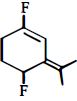
C
D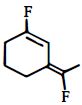
Solution
(C) The polarity of a molecule depends on its net dipole moment,which is determined by the vector sum of individual bond dipoles.
Fluorine is the most electronegative element,so $C-F$ bonds have significant dipole moments.
In option $(a)$,there are no $F$ atoms,so it is the least polar.
In option $(b)$,the two $F$ atoms are attached to the ring in a way that their dipole moments partially cancel each other out due to their relative orientation.
In option $(c)$,the two $F$ atoms are attached such that their dipole moments are oriented in a similar direction,leading to a larger net dipole moment.
In option $(d)$,the $F$ atoms are oriented such that their dipole moments are at a wider angle,resulting in a smaller net dipole moment compared to $(c)$.
Therefore,the compound in option $(c)$ has the maximum net dipole moment and is the most polar.
Fluorine is the most electronegative element,so $C-F$ bonds have significant dipole moments.
In option $(a)$,there are no $F$ atoms,so it is the least polar.
In option $(b)$,the two $F$ atoms are attached to the ring in a way that their dipole moments partially cancel each other out due to their relative orientation.
In option $(c)$,the two $F$ atoms are attached such that their dipole moments are oriented in a similar direction,leading to a larger net dipole moment.
In option $(d)$,the $F$ atoms are oriented such that their dipole moments are at a wider angle,resulting in a smaller net dipole moment compared to $(c)$.
Therefore,the compound in option $(c)$ has the maximum net dipole moment and is the most polar.
0 likesView Solution
37
ChemistryDifficultMCQJEE Main · 2018
At $320 \ K,$ a gas $A_2$ is $20 \%$ dissociated to $A_{(g)}.$ The standard free energy change at $320 \ K$ and $1 \ atm$ in $J \ mol^{-1}$ is approximately $(R = 8.314 \ J \ K^{-1} \ mol^{-1}; \ ln \ 2 = 0.693; \ ln \ 3 = 1.098).$
A
$1844$
B
$2068$
C
$4281$
D
$4763$
Solution
(D) The dissociation reaction is $A_2(g) \leftrightarrow 2A(g).$
Let the initial moles of $A_2$ be $1 \ mol.$
After $20 \%$ dissociation,moles of $A_2$ remaining $= 1 - 0.2 = 0.8 \ mol.$
Moles of $A$ formed $= 2 \times 0.2 = 0.4 \ mol.$
Total moles at equilibrium $= 0.8 + 0.4 = 1.2 \ mol.$
Partial pressures at $1 \ atm$ total pressure:
$P_{A_2} = \frac{0.8}{1.2} \times 1 = \frac{2}{3} \ atm.$
$P_A = \frac{0.4}{1.2} \times 1 = \frac{1}{3} \ atm.$
Equilibrium constant $K_p = \frac{(P_A)^2}{P_{A_2}} = \frac{(1/3)^2}{2/3} = \frac{1/9}{2/3} = \frac{1}{6}.$
Standard free energy change $\Delta G^o = -RT \ ln \ K_p = -8.314 \times 320 \times ln(1/6).$
$\Delta G^o = -8.314 \times 320 \times (-ln \ 6) = 8.314 \times 320 \times (ln \ 2 + ln \ 3).$
$\Delta G^o = 8.314 \times 320 \times (0.693 + 1.098) = 8.314 \times 320 \times 1.791 \approx 4763 \ J \ mol^{-1}.$
Let the initial moles of $A_2$ be $1 \ mol.$
After $20 \%$ dissociation,moles of $A_2$ remaining $= 1 - 0.2 = 0.8 \ mol.$
Moles of $A$ formed $= 2 \times 0.2 = 0.4 \ mol.$
Total moles at equilibrium $= 0.8 + 0.4 = 1.2 \ mol.$
Partial pressures at $1 \ atm$ total pressure:
$P_{A_2} = \frac{0.8}{1.2} \times 1 = \frac{2}{3} \ atm.$
$P_A = \frac{0.4}{1.2} \times 1 = \frac{1}{3} \ atm.$
Equilibrium constant $K_p = \frac{(P_A)^2}{P_{A_2}} = \frac{(1/3)^2}{2/3} = \frac{1/9}{2/3} = \frac{1}{6}.$
Standard free energy change $\Delta G^o = -RT \ ln \ K_p = -8.314 \times 320 \times ln(1/6).$
$\Delta G^o = -8.314 \times 320 \times (-ln \ 6) = 8.314 \times 320 \times (ln \ 2 + ln \ 3).$
$\Delta G^o = 8.314 \times 320 \times (0.693 + 1.098) = 8.314 \times 320 \times 1.791 \approx 4763 \ J \ mol^{-1}.$
0 likesView Solution
38
ChemistryMediumMCQJEE Main · 2018
Which of the following statements is false?
A
Splitting of spectral lines in an electrical field is called the $Stark$ effect.
B
Frequency of emitted radiation from a black body goes from a lower wavelength to a higher wavelength as the temperature increases.
C
$A$ photon has momentum as well as wavelength.
D
The $Rydberg$ constant has the unit of energy.
Solution
(D) The statement in option $B$ is false because as the temperature of a black body increases,the intensity of radiation increases and the peak of the emission curve shifts to shorter wavelengths (higher frequency).
The statement in option $D$ is also false because the $Rydberg$ constant $(R_H)$ has the unit of reciprocal length,i.e.,$cm^{-1}$ or $m^{-1}$.
However,in the context of standard multiple-choice questions,option $D$ is the most fundamentally incorrect regarding physical units.
The statement in option $D$ is also false because the $Rydberg$ constant $(R_H)$ has the unit of reciprocal length,i.e.,$cm^{-1}$ or $m^{-1}$.
However,in the context of standard multiple-choice questions,option $D$ is the most fundamentally incorrect regarding physical units.
0 likesView Solution
39
ChemistryDifficultMCQJEE Main · 2018
For which of the following processes,$\Delta S$ is negative?
A
$C$ (diamond) $\to$ $C$ (graphite)
B
$N_2(g, 1 \ atm) \to N_2(g, 5 \ atm)$
C
$N_2(g, 273 \ K) \to N_2(g, 300 \ K)$
D
$H_2(g) \to 2H(g)$
Solution
(B) . The conversion of diamond to graphite involves a structural change where entropy generally increases,so $\Delta S > 0$.
$B$. When the pressure of a gas increases at constant temperature,the gas molecules are compressed into a smaller volume,leading to a decrease in the number of available microstates and a decrease in randomness. Thus,$\Delta S < 0$.
$C$. Increasing the temperature of a gas increases the kinetic energy and the randomness of the molecules,leading to an increase in entropy,so $\Delta S > 0$.
$D$. The dissociation of $H_2$ gas into $2H$ atoms increases the number of moles of gas particles,which increases the disorder of the system,so $\Delta S > 0$.
$B$. When the pressure of a gas increases at constant temperature,the gas molecules are compressed into a smaller volume,leading to a decrease in the number of available microstates and a decrease in randomness. Thus,$\Delta S < 0$.
$C$. Increasing the temperature of a gas increases the kinetic energy and the randomness of the molecules,leading to an increase in entropy,so $\Delta S > 0$.
$D$. The dissociation of $H_2$ gas into $2H$ atoms increases the number of moles of gas particles,which increases the disorder of the system,so $\Delta S > 0$.
0 likesView Solution
40
ChemistryDifficultMCQJEE Main · 2018
An unknown chlorohydrocarbon has $3.55\%$ of chlorine. If each molecule of the hydrocarbon has one chlorine atom only,the number of chlorine atoms present in $1\,g$ of chlorohydrocarbon is (Atomic wt. of $Cl = 35.5\,u$; Avogadro constant $= 6.023 \times 10^{23}\,mol^{-1}$)
A
$6.023 \times 10^9$
B
$6.023 \times 10^{23}$
C
$6.023 \times 10^{21}$
D
$6.023 \times 10^{20}$
Solution
(D) Given percentage of chlorine in the chlorohydrocarbon $= 3.55\%$.
This means $100\,g$ of chlorohydrocarbon contains $3.55\,g$ of chlorine.
Therefore,$1\,g$ of chlorohydrocarbon contains $\frac{3.55}{100} = 0.0355\,g$ of chlorine.
Given atomic weight of $Cl = 35.5\,g/mol$.
Number of moles of $Cl$ atoms $= \frac{0.0355\,g}{35.5\,g/mol} = 0.001\,mol$.
Number of $Cl$ atoms $= \text{moles} \times N_A = 0.001 \times 6.023 \times 10^{23} = 6.023 \times 10^{20}$ atoms.
This means $100\,g$ of chlorohydrocarbon contains $3.55\,g$ of chlorine.
Therefore,$1\,g$ of chlorohydrocarbon contains $\frac{3.55}{100} = 0.0355\,g$ of chlorine.
Given atomic weight of $Cl = 35.5\,g/mol$.
Number of moles of $Cl$ atoms $= \frac{0.0355\,g}{35.5\,g/mol} = 0.001\,mol$.
Number of $Cl$ atoms $= \text{moles} \times N_A = 0.001 \times 6.023 \times 10^{23} = 6.023 \times 10^{20}$ atoms.
0 likesView Solution
41
ChemistryMediumMCQJEE Main · 2018
The incorrect geometry is represented by
A
$NF_3-$ trigonal planar
B
$BF_3-$ trigonal planar
C
$AsF_5-$ trigonal bipyramidal
D
$H_2O-$ bent
Solution
(A) $NF_3$ has a trigonal pyramidal geometry,not trigonal planar.
In $NF_3$,the $N$ atom is $sp^3$ hybridised with one lone pair and three bond pairs of electrons.
The electron pair geometry is tetrahedral,while the molecular geometry is trigonal pyramidal.
$BF_3$ is trigonal planar,$AsF_5$ is trigonal bipyramidal,and $H_2O$ is bent.
Therefore,the incorrect geometry is represented by $NF_3$.
In $NF_3$,the $N$ atom is $sp^3$ hybridised with one lone pair and three bond pairs of electrons.
The electron pair geometry is tetrahedral,while the molecular geometry is trigonal pyramidal.
$BF_3$ is trigonal planar,$AsF_5$ is trigonal bipyramidal,and $H_2O$ is bent.
Therefore,the incorrect geometry is represented by $NF_3$.
1 likesView Solution
42
ChemistryDifficultMCQJEE Main · 2018
Assuming ideal gas behaviour,the ratio of density of ammonia to that of hydrogen chloride at the same temperature and pressure is: (Atomic wt. of $Cl = 35.5 \ u$)
A
$1.46$
B
$1.64$
C
$0.46$
D
$0.64$
Solution
(C) From the ideal gas equation,$PV = nRT$.
Since $n = \frac{m}{M}$,we have $PV = \frac{mRT}{M}$.
Rearranging for density $(d = \frac{m}{V})$,we get $P = \frac{dRT}{M}$,which implies $d = \frac{PM}{RT}$.
At constant temperature and pressure,$d \propto M$.
Therefore,the ratio of densities is $\frac{d_{NH_3}}{d_{HCl}} = \frac{M_{NH_3}}{M_{HCl}}$.
The molar mass of $NH_3 = 14 + 3(1) = 17 \ g/mol$.
The molar mass of $HCl = 1 + 35.5 = 36.5 \ g/mol$.
Ratio $= \frac{17}{36.5} \approx 0.4657 \approx 0.46$.
Since $n = \frac{m}{M}$,we have $PV = \frac{mRT}{M}$.
Rearranging for density $(d = \frac{m}{V})$,we get $P = \frac{dRT}{M}$,which implies $d = \frac{PM}{RT}$.
At constant temperature and pressure,$d \propto M$.
Therefore,the ratio of densities is $\frac{d_{NH_3}}{d_{HCl}} = \frac{M_{NH_3}}{M_{HCl}}$.
The molar mass of $NH_3 = 14 + 3(1) = 17 \ g/mol$.
The molar mass of $HCl = 1 + 35.5 = 36.5 \ g/mol$.
Ratio $= \frac{17}{36.5} \approx 0.4657 \approx 0.46$.
0 likesView Solution
43
ChemistryMediumMCQJEE Main · 2018
The gas phase reaction $2NO_{2(g)} \rightleftharpoons N_2O_{4(g)}$ is an exothermic reaction. The decomposition of $N_2O_4$ in an equilibrium mixture of $NO_{2(g)}$ and $N_2O_{4(g)}$ can be increased by:
A
addition of an inert gas at constant pressure
B
lowering the temperature
C
increasing the pressure
D
addition of an inert gas at constant volume
Solution
(A) The decomposition reaction is $N_2O_{4(g)} \rightleftharpoons 2NO_{2(g)}$.
Since the forward reaction $2NO_{2(g)} \rightleftharpoons N_2O_{4(g)}$ is exothermic,the reverse reaction (decomposition) is endothermic.
According to Le Chatelier's principle:
$(a)$ Addition of an inert gas at constant pressure increases the total volume of the system,which shifts the equilibrium towards the side with a greater number of moles of gas. Here,the product side $(2NO_2)$ has more moles than the reactant side $(N_2O_4)$,so the decomposition of $N_2O_4$ increases.
$(b)$ Lowering the temperature favors the exothermic direction,which is the formation of $N_2O_4$,not its decomposition.
$(c)$ Increasing the pressure shifts the equilibrium towards the side with fewer moles of gas,favoring the formation of $N_2O_4$.
$(d)$ Addition of an inert gas at constant volume does not change the partial pressures of the reacting species,so it has no effect on the equilibrium.
Since the forward reaction $2NO_{2(g)} \rightleftharpoons N_2O_{4(g)}$ is exothermic,the reverse reaction (decomposition) is endothermic.
According to Le Chatelier's principle:
$(a)$ Addition of an inert gas at constant pressure increases the total volume of the system,which shifts the equilibrium towards the side with a greater number of moles of gas. Here,the product side $(2NO_2)$ has more moles than the reactant side $(N_2O_4)$,so the decomposition of $N_2O_4$ increases.
$(b)$ Lowering the temperature favors the exothermic direction,which is the formation of $N_2O_4$,not its decomposition.
$(c)$ Increasing the pressure shifts the equilibrium towards the side with fewer moles of gas,favoring the formation of $N_2O_4$.
$(d)$ Addition of an inert gas at constant volume does not change the partial pressures of the reacting species,so it has no effect on the equilibrium.
0 likesView Solution
44
ChemistryDifficultMCQJEE Main · 2018
$A$ group $13$ element '$X$' reacts with chlorine gas to produce a compound $XCl_3$. $XCl_3$ is electron deficient and easily reacts with $NH_3$ to form $Cl_3X \leftarrow NH_3$ adduct,however,$XCl_3$ does not dimerize. $X$ is
A
$B$
B
$Al$
C
$In$
D
$Ga$
Solution
(A) $BCl_3$ is the compound formed.
$2B + 3Cl_2 \rightarrow 2BCl_3$
$BCl_3$ is electron deficient but it does not form a dimer like $AlCl_3$,$GaCl_3$,or $InCl_3$ because its electron deficiency is compensated by the formation of a $p\pi - p\pi$ back-bonding between the lone pair of electrons of chlorine and the empty unhybridized $p$-orbital of boron.
Thus,$X$ is Boron $(B)$.
$2B + 3Cl_2 \rightarrow 2BCl_3$
$BCl_3$ is electron deficient but it does not form a dimer like $AlCl_3$,$GaCl_3$,or $InCl_3$ because its electron deficiency is compensated by the formation of a $p\pi - p\pi$ back-bonding between the lone pair of electrons of chlorine and the empty unhybridized $p$-orbital of boron.
Thus,$X$ is Boron $(B)$.
0 likesView Solution
45
ChemistryMCQJEE Main · 2018
If $p \to ( \sim p \vee \sim q)$ is false,then the truth values of $p$ and $q$ are respectively.
A
$T, F$
B
$F, F$
C
$F, T$
D
$T, T$
Solution
(D) The implication $p \to r$ is false if and only if $p$ is $T$ and $r$ is $F$.
Here,$r = (\sim p \vee \sim q)$.
For $r$ to be $F$,both $\sim p$ and $\sim q$ must be $F$.
This implies $p$ must be $T$ and $q$ must be $T$.
Thus,the statement $p \to (\sim p \vee \sim q)$ is false when $p = T$ and $q = T$.
Here,$r = (\sim p \vee \sim q)$.
For $r$ to be $F$,both $\sim p$ and $\sim q$ must be $F$.
This implies $p$ must be $T$ and $q$ must be $T$.
Thus,the statement $p \to (\sim p \vee \sim q)$ is false when $p = T$ and $q = T$.
0 likesView Solution
46
ChemistryMCQJEE Main · 2018
If the curves $y^2=6x$ and $9x^2+by^2=16$ intersect each other at right angles,then the value of $b$ is
A
$\frac{9}{2}$
B
$6$
C
$\frac{7}{2}$
D
$4$
Solution
(A) Given curves are $y^2=6x$ $(i)$ and $9x^2+by^2=16$ (ii).
Differentiating $(i)$ with respect to $x$: $2y \frac{dy}{dx} = 6 \Rightarrow \frac{dy}{dx} = \frac{3}{y}$.
Differentiating (ii) with respect to $x$: $18x + 2by \frac{dy}{dx} = 0 \Rightarrow \frac{dy}{dx} = -\frac{9x}{by}$.
Since the curves intersect at right angles,the product of their slopes at the point of intersection $(x, y)$ must be $-1$.
$\left(\frac{3}{y}\right) \times \left(-\frac{9x}{by}\right) = -1$.
$\Rightarrow \frac{27x}{by^2} = 1 \Rightarrow by^2 = 27x$.
Substitute $y^2=6x$ from $(i)$ into this equation: $b(6x) = 27x$.
Assuming $x \neq 0$,we get $6b = 27 \Rightarrow b = \frac{27}{6} = \frac{9}{2}$.
Differentiating $(i)$ with respect to $x$: $2y \frac{dy}{dx} = 6 \Rightarrow \frac{dy}{dx} = \frac{3}{y}$.
Differentiating (ii) with respect to $x$: $18x + 2by \frac{dy}{dx} = 0 \Rightarrow \frac{dy}{dx} = -\frac{9x}{by}$.
Since the curves intersect at right angles,the product of their slopes at the point of intersection $(x, y)$ must be $-1$.
$\left(\frac{3}{y}\right) \times \left(-\frac{9x}{by}\right) = -1$.
$\Rightarrow \frac{27x}{by^2} = 1 \Rightarrow by^2 = 27x$.
Substitute $y^2=6x$ from $(i)$ into this equation: $b(6x) = 27x$.
Assuming $x \neq 0$,we get $6b = 27 \Rightarrow b = \frac{27}{6} = \frac{9}{2}$.
0 likesView Solution
47
ChemistryMCQJEE Main · 2018
If the curves $y^2=6x$ and $9x^2+by^2=16$ intersect each other at right angles,the value of $b$ is
A
$4$
B
$\frac{7}{2}$
C
$6$
D
$\frac{9}{2}$
Solution
(D) For the curve $C_1: y^2=6x$,differentiating with respect to $x$ gives $2y \frac{dy}{dx} = 6$,so $\left(\frac{dy}{dx}\right)_{C_1} = \frac{3}{y}$.
For the curve $C_2: 9x^2+by^2=16$,differentiating with respect to $x$ gives $18x + 2by \frac{dy}{dx} = 0$,so $\left(\frac{dy}{dx}\right)_{C_2} = -\frac{9x}{by}$.
Since the curves intersect at right angles,the product of their slopes must be $-1$:
$\left(\frac{3}{y}\right) \times \left(-\frac{9x}{by}\right) = -1$
$\Rightarrow \frac{27x}{by^2} = 1$
$\Rightarrow 27x = by^2$
Substituting $y^2=6x$ into the equation:
$27x = b(6x)$
Since $x \neq 0$ at the point of intersection,we divide by $3x$:
$9 = 2b$
$b = \frac{9}{2}$
For the curve $C_2: 9x^2+by^2=16$,differentiating with respect to $x$ gives $18x + 2by \frac{dy}{dx} = 0$,so $\left(\frac{dy}{dx}\right)_{C_2} = -\frac{9x}{by}$.
Since the curves intersect at right angles,the product of their slopes must be $-1$:
$\left(\frac{3}{y}\right) \times \left(-\frac{9x}{by}\right) = -1$
$\Rightarrow \frac{27x}{by^2} = 1$
$\Rightarrow 27x = by^2$
Substituting $y^2=6x$ into the equation:
$27x = b(6x)$
Since $x \neq 0$ at the point of intersection,we divide by $3x$:
$9 = 2b$
$b = \frac{9}{2}$
0 likesView Solution
48
ChemistryMCQJEE Main · 2018
If $p \rightarrow (\sim p \vee \sim q)$ is false,then the truth values of $p$ and $q$ are respectively:
A
$F, F$
B
$F, T$
C
$T, T$
D
$T, F$
Solution
(C) The implication $p \rightarrow r$ is false only when $p$ is $T$ and $r$ is $F$.
Here,$p \rightarrow (\sim p \vee \sim q)$ is false.
This implies $p = T$ and $(\sim p \vee \sim q) = F$.
Since $p = T$,$\sim p = F$.
Substituting this,we get $(F \vee \sim q) = F$.
For the disjunction to be false,both components must be false.
Thus,$\sim q = F$,which means $q = T$.
Therefore,the truth values are $p = T$ and $q = T$.
Here,$p \rightarrow (\sim p \vee \sim q)$ is false.
This implies $p = T$ and $(\sim p \vee \sim q) = F$.
Since $p = T$,$\sim p = F$.
Substituting this,we get $(F \vee \sim q) = F$.
For the disjunction to be false,both components must be false.
Thus,$\sim q = F$,which means $q = T$.
Therefore,the truth values are $p = T$ and $q = T$.
0 likesView Solution
49
ChemistryMCQJEE Main · 2018
If $p \rightarrow (p \wedge \sim q)$ is false,then the truth values of $p$ and $q$ are respectively
A
$F, F$
B
$T, F$
C
$F, T$
D
$T, T$
Solution
(D) The implication $p \rightarrow (p \wedge \sim q)$ is false only when the antecedent $p$ is $T$ and the consequent $(p \wedge \sim q)$ is $F$.
Since $p$ is $T$,the expression $(p \wedge \sim q)$ becomes $(T \wedge \sim q)$.
For $(T \wedge \sim q)$ to be $F$,$\sim q$ must be $F$,which implies $q$ must be $T$.
Therefore,the truth values are $p = T$ and $q = T$.
Since $p$ is $T$,the expression $(p \wedge \sim q)$ becomes $(T \wedge \sim q)$.
For $(T \wedge \sim q)$ to be $F$,$\sim q$ must be $F$,which implies $q$ must be $T$.
Therefore,the truth values are $p = T$ and $q = T$.
0 likesView Solution
50
ChemistryMCQJEE Main · 2018
If $p \rightarrow (\sim p \vee q)$ is false,then the truth values of $p$ and $q$ are,respectively
A
$T, F$
B
$F, F$
C
$F, T$
D
$T, T$
Solution
(A) The implication $p \rightarrow (\sim p \vee q)$ is false only when the antecedent is true and the consequent is false.
Thus,$p \equiv T$ and $(\sim p \vee q) \equiv F$.
Since $p \equiv T$,then $\sim p \equiv F$.
Substituting this into the second condition: $F \vee q \equiv F$.
For a disjunction to be false,both components must be false,so $q \equiv F$.
Therefore,the truth values are $p \equiv T$ and $q \equiv F$.
Thus,$p \equiv T$ and $(\sim p \vee q) \equiv F$.
Since $p \equiv T$,then $\sim p \equiv F$.
Substituting this into the second condition: $F \vee q \equiv F$.
For a disjunction to be false,both components must be false,so $q \equiv F$.
Therefore,the truth values are $p \equiv T$ and $q \equiv F$.
0 likesView Solution
51
ChemistryDifficultMCQJEE Main · 2018
Which of the following will not exist in zwitter ionic form at $pH = 7$?
A
$2-$aminocyclohexanecarboxylic acid
B
$N$-acetylalanine
C
$2-$aminobenzenesulfonic acid
D
$2-$aminocyclohexanesulfonic acid
Solution
(B) zwitterion is a molecule that has both a positive and a negative charge,allowing it to exist as a dipolar ion. This requires the presence of both an acidic group (like $-COOH$ or $-SO_3H$) and a basic group (like $-NH_2$) in the same molecule.
In $N$-acetylalanine,the amino group $(-NH_2)$ is converted into an amide group $(-NH-CO-CH_3)$. The nitrogen atom in an amide is not basic because its lone pair of electrons is involved in resonance with the carbonyl group $(C=O)$.
Therefore,$N$-acetylalanine cannot accept a proton to form a positive charge,and thus it cannot exist in a zwitterionic form at $pH = 7$.
In $N$-acetylalanine,the amino group $(-NH_2)$ is converted into an amide group $(-NH-CO-CH_3)$. The nitrogen atom in an amide is not basic because its lone pair of electrons is involved in resonance with the carbonyl group $(C=O)$.
Therefore,$N$-acetylalanine cannot accept a proton to form a positive charge,and thus it cannot exist in a zwitterionic form at $pH = 7$.
0 likesView Solution
52
ChemistryAdvancedMCQJEE Main · 2018
$N_2O_5$ decomposes to $NO_2$ and $O_2$ and follows first order kinetics. After $50 \, min$,the pressure inside the vessel increases from $50 \, mm \, Hg$ to $87.5 \, mm \, Hg$. The pressure of the gaseous mixture after $100 \, min$ at constant temperature will be ........... $mm \, Hg$
A
$136.25$
B
$106.25$
C
$175.0$
D
$116.25$
Solution
(B) The decomposition reaction is: $N_2O_5(g) \to 2NO_2(g) + \frac{1}{2}O_2(g)$
At $t = 0$: $P_{N_2O_5} = 50 \, mm \, Hg$,$P_{NO_2} = 0$,$P_{O_2} = 0$. Total pressure $P_0 = 50 \, mm \, Hg$.
At $t = 50 \, min$: Let $p_1$ be the decrease in pressure of $N_2O_5$. The partial pressures are: $P_{N_2O_5} = 50 - p_1$,$P_{NO_2} = 2p_1$,$P_{O_2} = 0.5p_1$.
Total pressure $P_t = (50 - p_1) + 2p_1 + 0.5p_1 = 50 + 1.5p_1 = 87.5 \, mm \, Hg$.
$1.5p_1 = 37.5 \implies p_1 = 25 \, mm \, Hg$.
Since $p_1 = 25$ is half of the initial pressure $50$,the half-life $t_{1/2} = 50 \, min$.
At $t = 100 \, min$ $(2 \times t_{1/2})$,the remaining pressure of $N_2O_5$ is $50 \times (1/2)^2 = 12.5 \, mm \, Hg$.
Thus,$50 - p_2 = 12.5 \implies p_2 = 37.5 \, mm \, Hg$.
Total pressure at $100 \, min = 50 + 1.5p_2 = 50 + 1.5(37.5) = 50 + 56.25 = 106.25 \, mm \, Hg$.
At $t = 0$: $P_{N_2O_5} = 50 \, mm \, Hg$,$P_{NO_2} = 0$,$P_{O_2} = 0$. Total pressure $P_0 = 50 \, mm \, Hg$.
At $t = 50 \, min$: Let $p_1$ be the decrease in pressure of $N_2O_5$. The partial pressures are: $P_{N_2O_5} = 50 - p_1$,$P_{NO_2} = 2p_1$,$P_{O_2} = 0.5p_1$.
Total pressure $P_t = (50 - p_1) + 2p_1 + 0.5p_1 = 50 + 1.5p_1 = 87.5 \, mm \, Hg$.
$1.5p_1 = 37.5 \implies p_1 = 25 \, mm \, Hg$.
Since $p_1 = 25$ is half of the initial pressure $50$,the half-life $t_{1/2} = 50 \, min$.
At $t = 100 \, min$ $(2 \times t_{1/2})$,the remaining pressure of $N_2O_5$ is $50 \times (1/2)^2 = 12.5 \, mm \, Hg$.
Thus,$50 - p_2 = 12.5 \implies p_2 = 37.5 \, mm \, Hg$.
Total pressure at $100 \, min = 50 + 1.5p_2 = 50 + 1.5(37.5) = 50 + 56.25 = 106.25 \, mm \, Hg$.
0 likesView Solution
53
ChemistryDifficultMCQJEE Main · 2018
Which of the following will most readily give the dehydrohalogenation product?
A
$3-$bromo$-1-$phenyl$-1,3-$butadiene
B
$3-$bromo$-1,3-$pentadiene
C
$1-$bromocyclohexene
D
Bromobenzene
Solution
(A) Dehydrohalogenation in these systems often proceeds via an $E1cB$ mechanism,where the rate-determining step is the formation of a carbanion intermediate.
The stability of the resulting carbanion determines the ease of the reaction.
In option $(A)$,the structure is $CH_2=CH-CH(Br)-CH=CH-Ph$. Upon removal of the proton at the $C3$ position,the resulting carbanion is stabilized by resonance with both the adjacent vinyl group and the phenyl ring $(Ph)$.
This extensive conjugation makes the carbanion in $(A)$ the most stable among the given choices,thus making it the most reactive towards dehydrohalogenation.
The stability of the resulting carbanion determines the ease of the reaction.
In option $(A)$,the structure is $CH_2=CH-CH(Br)-CH=CH-Ph$. Upon removal of the proton at the $C3$ position,the resulting carbanion is stabilized by resonance with both the adjacent vinyl group and the phenyl ring $(Ph)$.
This extensive conjugation makes the carbanion in $(A)$ the most stable among the given choices,thus making it the most reactive towards dehydrohalogenation.
0 likesView Solution
54
ChemistryDifficultMCQJEE Main · 2018
The increasing order of nitration of the following compounds is:
$(A)$ Aniline
$(B)$ Chlorobenzene
$(C)$ Anisole
$(D)$ Toluene
$(A)$ Aniline
$(B)$ Chlorobenzene
$(C)$ Anisole
$(D)$ Toluene
A
$A < B < D < C$
B
$A < B < C < D$
C
$B < A < C < D$
D
$B < A < D < C$
Solution
(A) Nitration is an electrophilic aromatic substitution reaction. The rate of this reaction depends on the electron density of the benzene ring.
$1$. $-OCH_3$ (in Anisole,$C$) is a strongly activating group due to $+M$ effect.
$2$. $-CH_3$ (in Toluene,$D$) is a weakly activating group due to $+I$ and hyperconjugation.
$3$. $-Cl$ (in Chlorobenzene,$B$) is a deactivating group due to $-I$ effect,though it is ortho/para directing.
$4$. $-NH_2$ (in Aniline,$A$) is a strongly activating group,but in the presence of acidic nitrating mixture $(HNO_3 + H_2SO_4)$,it gets protonated to form the anilinium ion $(-NH_3^+)$,which is a strongly deactivating group due to its powerful $-I$ effect.
Comparing the reactivity: Anisole $(C)$ > Toluene $(D)$ > Chlorobenzene $(B)$ > Anilinium ion $(A)$.
Therefore,the increasing order of nitration is $A < B < D < C$.
$1$. $-OCH_3$ (in Anisole,$C$) is a strongly activating group due to $+M$ effect.
$2$. $-CH_3$ (in Toluene,$D$) is a weakly activating group due to $+I$ and hyperconjugation.
$3$. $-Cl$ (in Chlorobenzene,$B$) is a deactivating group due to $-I$ effect,though it is ortho/para directing.
$4$. $-NH_2$ (in Aniline,$A$) is a strongly activating group,but in the presence of acidic nitrating mixture $(HNO_3 + H_2SO_4)$,it gets protonated to form the anilinium ion $(-NH_3^+)$,which is a strongly deactivating group due to its powerful $-I$ effect.
Comparing the reactivity: Anisole $(C)$ > Toluene $(D)$ > Chlorobenzene $(B)$ > Anilinium ion $(A)$.
Therefore,the increasing order of nitration is $A < B < D < C$.
0 likesView Solution
55
ChemistryDifficultMCQJEE Main · 2018
The copolymer formed by addition polymerization of styrene and acrylonitrile in the presence of peroxide is
A
$[C(C_6H_5)(CH_3)-CH(CN)-CH_2]_n$
B
$[CH_2-CH(C_6H_5)-CH_2-CH(CN)]_n$
C
$[CH_2-CH(C_6H_5)-CH(CN)-CH_2]_n$
D
$[CH(C_6H_5)-CH_2-CH_2-CH(CN)]_n$
Solution
(B) . Styrene $(CH_2=CH-C_6H_5)$ and acrylonitrile $(CH_2=CH-CN)$ undergo addition polymerization in the presence of peroxide to form a copolymer.
The monomers link in a head-to-tail fashion,resulting in the following structure:
$n CH_2=CH(C_6H_5) + n CH_2=CH(CN) \xrightarrow{\text{Peroxide}} [CH_2-CH(C_6H_5)-CH_2-CH(CN)]_n$
The monomers link in a head-to-tail fashion,resulting in the following structure:
$n CH_2=CH(C_6H_5) + n CH_2=CH(CN) \xrightarrow{\text{Peroxide}} [CH_2-CH(C_6H_5)-CH_2-CH(CN)]_n$
0 likesView Solution
56
ChemistryDifficultMCQJEE Main · 2018
Which of the following statements about colloids is false?
A
When $AgNO_3$ solution is added to $KI$ solution,a negatively charged colloidal solution is formed
B
Freezing point of colloidal solution is lower than true solution at same concentration of a solute
C
Colloidal particles can pass through ordinary filter paper
D
When excess of electrolyte is added to colloidal solution,colloidal particle will be precipitated
Solution
(B) The correct answer is $B$.
$(a)$ Colloidal particles are small enough to pass through ordinary filter paper.
$(b)$ The freezing point of a colloidal solution is the same as that of a true solution at the same molar concentration,because the number of particles in a colloidal solution is much smaller than in a true solution,leading to negligible depression in freezing point. Thus,the statement that it is lower is false.
$(c)$ When $AgNO_3$ is added to $KI$ (excess $KI$),$I^-$ ions are adsorbed on the surface of $AgI$ particles,forming a negatively charged colloid.
$(d)$ Addition of excess electrolyte causes coagulation (precipitation) of colloidal particles due to the neutralization of charge.
$(a)$ Colloidal particles are small enough to pass through ordinary filter paper.
$(b)$ The freezing point of a colloidal solution is the same as that of a true solution at the same molar concentration,because the number of particles in a colloidal solution is much smaller than in a true solution,leading to negligible depression in freezing point. Thus,the statement that it is lower is false.
$(c)$ When $AgNO_3$ is added to $KI$ (excess $KI$),$I^-$ ions are adsorbed on the surface of $AgI$ particles,forming a negatively charged colloid.
$(d)$ Addition of excess electrolyte causes coagulation (precipitation) of colloidal particles due to the neutralization of charge.
0 likesView Solution
57
ChemistryDifficultMCQJEE Main · 2018
Which of the following is the correct structure of adenosine?
A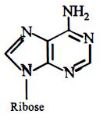
B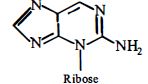
C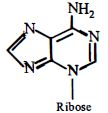
D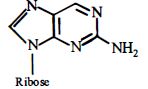
Solution
(A) Adenosine is a nucleoside formed by the attachment of a ribose sugar to the adenine base.
In the structure of adenosine,the ribose sugar is attached to the $N-9$ nitrogen atom of the adenine purine ring.
Looking at the provided options,option $A$ correctly depicts the ribose sugar attached to the $N-9$ position of the adenine base,which is the characteristic structure of adenosine.
In the structure of adenosine,the ribose sugar is attached to the $N-9$ nitrogen atom of the adenine purine ring.
Looking at the provided options,option $A$ correctly depicts the ribose sugar attached to the $N-9$ position of the adenine base,which is the characteristic structure of adenosine.
0 likesView Solution
58
ChemistryDifficultMCQJEE Main · 2018
The correct combination is
A
$[NiCl_4]^{2-} -$ square-planar; $[Ni(CN)_4]^{2-} -$ paramagnetic
B
$[Ni(CN)_4]^{2-} -$ tetrahedral; $[Ni(CO)_4] -$ paramagnetic
C
$[NiCl_4]^{2-} -$ paramagnetic; $[Ni(CO)_4] -$ tetrahedral
D
$[NiCl_4]^{2-} -$ diamagnetic; $[Ni(CO)_4] -$ square-planar
Solution
(C) $[Ni(CN)_4]^{2-}$ is square-planar,diamagnetic ($0$ unpaired electrons) with $dsp^2$ hybridisation.
$[Ni(CO)_4]$ is tetrahedral,diamagnetic ($0$ unpaired electrons) with $sp^3$ hybridisation.
$[NiCl_4]^{2-}$ is tetrahedral,paramagnetic ($2$ unpaired electrons) with $sp^3$ hybridisation.
Hence,the option $(c)$ is the correct answer.
$[Ni(CO)_4]$ is tetrahedral,diamagnetic ($0$ unpaired electrons) with $sp^3$ hybridisation.
$[NiCl_4]^{2-}$ is tetrahedral,paramagnetic ($2$ unpaired electrons) with $sp^3$ hybridisation.
Hence,the option $(c)$ is the correct answer.
0 likesView Solution
59
ChemistryDifficultMCQJEE Main · 2018
When an electric current is passed through acidified water,$112 \ mL$ of hydrogen gas at $N.T.P.$ was collected at the cathode in $965 \ seconds$. The current passed,in ampere,is
A
$2.0$
B
$0.1$
C
$0.5$
D
$1.0$
Solution
(D) The reduction reaction at the cathode is: $2H_2O + 2e^- \to H_2 + 2OH^-$.
From the stoichiometry,$2 \ moles$ of electrons are required to produce $1 \ mole$ of $H_2$ gas.
At $N.T.P.$,$1 \ mole$ of gas occupies $22400 \ mL$. Therefore,the number of moles of $H_2$ produced is: $n(H_2) = \frac{112 \ mL}{22400 \ mL/mol} = 0.005 \ mol$.
Using Faraday's law,the moles of electrons required is: $n(e^-) = 2 \times n(H_2) = 2 \times 0.005 = 0.01 \ mol$.
Since $Q = I \times t$ and $Q = n(e^-) \times F$,where $F \approx 96500 \ C/mol$:
$I = \frac{n(e^-) \times 96500}{t} = \frac{0.01 \times 96500}{965} = 1.0 \ A$.
From the stoichiometry,$2 \ moles$ of electrons are required to produce $1 \ mole$ of $H_2$ gas.
At $N.T.P.$,$1 \ mole$ of gas occupies $22400 \ mL$. Therefore,the number of moles of $H_2$ produced is: $n(H_2) = \frac{112 \ mL}{22400 \ mL/mol} = 0.005 \ mol$.
Using Faraday's law,the moles of electrons required is: $n(e^-) = 2 \times n(H_2) = 2 \times 0.005 = 0.01 \ mol$.
Since $Q = I \times t$ and $Q = n(e^-) \times F$,where $F \approx 96500 \ C/mol$:
$I = \frac{n(e^-) \times 96500}{t} = \frac{0.01 \times 96500}{965} = 1.0 \ A$.
0 likesView Solution
60
ChemistryEasyMCQJEE Main · 2018
Which of the following arrangements shows the schematic alignment of magnetic moments of an antiferromagnetic substance?
A
B
C
D
Solution
(D) Antiferromagnetic substances are characterized by a domain structure where the magnetic moments of the domains are aligned in a compensatory manner,such that the net magnetic moment is zero. This occurs when the spins are aligned in equal numbers in opposite directions,as shown in option $D$.
0 likesView Solution
61
ChemistryDifficultMCQJEE Main · 2018
The reagent$(s)$ required for the following conversion are:
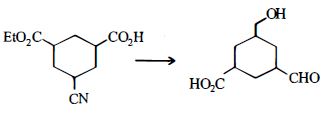
A
$(i) NaBH_4, (ii) Raney Ni/H_2, (iii) H_3O^{+}$
B
$(i) LiAlH_4, (ii) H_3O^{+}$
C
$(i) B_2H_6, (ii) DIBAL-H, (iii) H_3O^{+}$
D
$(i) B_2H_6, (ii) SnCl_2/HCl, (iii) H_3O^{+}$
Solution
(D) The starting material contains an ester group $(EtO_2C-)$,a carboxylic acid group $(-COOH)$,and a nitrile group $(-CN)$.
$1$. Treatment with $B_2H_6$ selectively reduces the carboxylic acid group to a primary alcohol $(-CH_2OH)$ without affecting the ester or nitrile groups.
$2$. Treatment with $SnCl_2/HCl$ (Stephen reduction) reduces the nitrile group to an aldehyde $(-CHO)$ group.
$3$. Finally,acidic hydrolysis $(H_3O^{+})$ hydrolyzes the ester group to a carboxylic acid group $(-COOH)$.
Thus,the correct sequence of reagents is $(i) B_2H_6, (ii) SnCl_2/HCl, (iii) H_3O^{+}$.
$1$. Treatment with $B_2H_6$ selectively reduces the carboxylic acid group to a primary alcohol $(-CH_2OH)$ without affecting the ester or nitrile groups.
$2$. Treatment with $SnCl_2/HCl$ (Stephen reduction) reduces the nitrile group to an aldehyde $(-CHO)$ group.
$3$. Finally,acidic hydrolysis $(H_3O^{+})$ hydrolyzes the ester group to a carboxylic acid group $(-COOH)$.
Thus,the correct sequence of reagents is $(i) B_2H_6, (ii) SnCl_2/HCl, (iii) H_3O^{+}$.
0 likesView Solution
62
ChemistryDifficultMCQJEE Main · 2018
The main reduction product of the following compound with $NaBH_4$ in methanol is
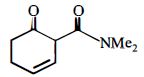
A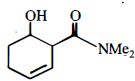
B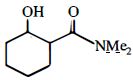
C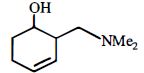
D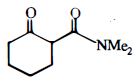
Solution
(A) $NaBH_4$ (sodium borohydride) is a selective reducing agent that specifically reduces aldehydes and ketones to their corresponding alcohols. It does not reduce amides,esters,or $C=C$ double bonds under standard conditions. In the given compound,there is a ketonic group and an amide group along with a $C=C$ double bond. Therefore,$NaBH_4$ will selectively reduce the ketone to a secondary alcohol while leaving the amide and the $C=C$ double bond unaffected. The product is the corresponding hydroxy-amide with the double bond intact.
0 likesView Solution
63
ChemistryDifficultMCQJEE Main · 2018
Xenon hexafluoride on partial hydrolysis produces compounds $X$ and $Y$. Compounds $X$ and $Y$ and the oxidation state of $Xe$ are respectively
A
$XeOF_4 (+6)$ and $XeO_3 (+6)$
B
$XeO_2 (+4)$ and $XeO_3 (+6)$
C
$XeOF_4 (+6)$ and $XeO_2F_2 (+6)$
D
$XeO_2F_2 (+6)$ and $XeO_2 (+4)$
Solution
(C) The partial hydrolysis of $XeF_6$ occurs in steps:
$1. XeF_6 + H_2O \to XeOF_4 + 2HF$
Here,$X$ is $XeOF_4$. The oxidation state of $Xe$ is $x + (-2) + 4(-1) = 0$,so $x = +6$.
$2. XeOF_4 + H_2O \to XeO_2F_2 + 2HF$
Here,$Y$ is $XeO_2F_2$. The oxidation state of $Xe$ is $x + 2(-2) + 2(-1) = 0$,so $x = +6$.
Thus,the compounds are $XeOF_4 (+6)$ and $XeO_2F_2 (+6)$.
$1. XeF_6 + H_2O \to XeOF_4 + 2HF$
Here,$X$ is $XeOF_4$. The oxidation state of $Xe$ is $x + (-2) + 4(-1) = 0$,so $x = +6$.
$2. XeOF_4 + H_2O \to XeO_2F_2 + 2HF$
Here,$Y$ is $XeO_2F_2$. The oxidation state of $Xe$ is $x + 2(-2) + 2(-1) = 0$,so $x = +6$.
Thus,the compounds are $XeOF_4 (+6)$ and $XeO_2F_2 (+6)$.
0 likesView Solution
64
ChemistryDifficultMCQJEE Main · 2018
$A$ white sodium salt dissolves readily in water to give a solution which is neutral to litmus. When silver nitrate solution is added to the aforementioned solution,a white precipitate is obtained which does not dissolve in dilute nitric acid. The anion is:
A
$CO_3^{2-}$
B
$SO_4^{2-}$
C
$S^{2-}$
D
$Cl^{-}$
Solution
(D) The salt is $NaCl$,which is a neutral salt formed from a strong acid $(HCl)$ and a strong base $(NaOH)$.
When $NaCl$ reacts with silver nitrate $(AgNO_3)$,it forms a white precipitate of silver chloride $(AgCl)$:
$NaCl(aq) + AgNO_3(aq) \to AgCl(s) + NaNO_3(aq)$
$AgCl$ is a white precipitate that is insoluble in dilute nitric acid $(HNO_3)$.
Therefore,the anion present is $Cl^{-}$.
When $NaCl$ reacts with silver nitrate $(AgNO_3)$,it forms a white precipitate of silver chloride $(AgCl)$:
$NaCl(aq) + AgNO_3(aq) \to AgCl(s) + NaNO_3(aq)$
$AgCl$ is a white precipitate that is insoluble in dilute nitric acid $(HNO_3)$.
Therefore,the anion present is $Cl^{-}$.
0 likesView Solution
65
ChemistryDifficultMCQJEE Main · 2018
The increasing order of diazotisation of the following compounds is:
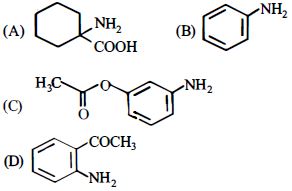
A
$ (D) < (C) < (B) < (A) $
B
$ (A) < (D) < (B) < (C) $
C
$ (A) < (B) < (C) < (D) $
D
$ (A) < (D) < (C) < (B) $
Solution
(B) The ease of diazotisation depends on the basicity of the amine and the stability of the resulting diazonium salt.
$ (A) $ is an aliphatic amine,which forms highly unstable diazonium salts that decompose immediately. Thus,it has the lowest tendency for diazotisation.
Among aromatic amines,electron-donating groups increase the electron density on the nitrogen atom,increasing basicity and facilitating diazotisation. Electron-withdrawing groups decrease electron density,making diazotisation more difficult.
$ (B) $ is aniline.
$ (C) $ has an $ -OCOCH_3 $ group at the meta position,which is electron-donating by resonance but electron-withdrawing by induction. Overall,it is slightly activating or neutral.
$ (D) $ has an $ -COCH_3 $ group at the ortho position,which is a strong electron-withdrawing group,significantly reducing the basicity of the amine and making diazotisation difficult.
Therefore,the increasing order of diazotisation is $ (A) < (D) < (B) < (C) $.
$ (A) $ is an aliphatic amine,which forms highly unstable diazonium salts that decompose immediately. Thus,it has the lowest tendency for diazotisation.
Among aromatic amines,electron-donating groups increase the electron density on the nitrogen atom,increasing basicity and facilitating diazotisation. Electron-withdrawing groups decrease electron density,making diazotisation more difficult.
$ (B) $ is aniline.
$ (C) $ has an $ -OCOCH_3 $ group at the meta position,which is electron-donating by resonance but electron-withdrawing by induction. Overall,it is slightly activating or neutral.
$ (D) $ has an $ -COCH_3 $ group at the ortho position,which is a strong electron-withdrawing group,significantly reducing the basicity of the amine and making diazotisation difficult.
Therefore,the increasing order of diazotisation is $ (A) < (D) < (B) < (C) $.
0 likesView Solution
66
ChemistryDifficultMCQJEE Main · 2018
The total number of optically active compounds formed in the following reaction is
$CH_3CH_2C(CH_3)=CHOCH(CH_3)_2$ $\xrightarrow{HBr}$
$CH_3CH_2C(CH_3)=CHOCH(CH_3)_2$ $\xrightarrow{HBr}$
A
$0$
B
$6$
C
$4$
D
$2$
Solution
(C) The reaction of the given vinyl ether with $HBr$ involves the protonation of the double bond followed by the nucleophilic attack of $Br^-$ to form a bromo-ether product.
The product formed has two chiral centers.
For a molecule with $n$ chiral centers,the maximum number of stereoisomers is $2^n$.
Here,$n = 2$,so there are $2^2 = 4$ stereoisomers.
Since all four stereoisomers are chiral (optically active),the total number of optically active compounds formed is $4$.
The product formed has two chiral centers.
For a molecule with $n$ chiral centers,the maximum number of stereoisomers is $2^n$.
Here,$n = 2$,so there are $2^2 = 4$ stereoisomers.
Since all four stereoisomers are chiral (optically active),the total number of optically active compounds formed is $4$.
0 likesView Solution
67
ChemistryDifficultMCQJEE Main · 2018
The correct order of spin-only magnetic moments among the following is: (Atomic number: $Mn = 25, Co = 27, Ni = 28, Zn = 30$)
A
$[ZnCl_4]^{2-} > [NiCl_4]^{2-} > [CoCl_4]^{2-} > [MnCl_4]^{2-}$
B
$[CoCl_4]^{2-} > [MnCl_4]^{2-} > [NiCl_4]^{2-} > [ZnCl_4]^{2-}$
C
$[NiCl_4]^{2-} > [CoCl_4]^{2-} > [MnCl_4]^{2-} > [ZnCl_4]^{2-}$
D
$[MnCl_4]^{2-} > [CoCl_4]^{2-} > [NiCl_4]^{2-} > [ZnCl_4]^{2-}$
Solution
(D) The complex having a higher number of unpaired electrons will have a higher value of spin-only magnetic moment.
In all these complexes,the central metal ion is in the $+2$ oxidation state.
$Zn^{2+}$ $(3d^{10})$ has $0$ unpaired electrons.
$Ni^{2+}$ $(3d^8)$ has $2$ unpaired electrons.
$Co^{2+}$ $(3d^7)$ has $3$ unpaired electrons.
$Mn^{2+}$ $(3d^5)$ has $5$ unpaired electrons.
Since the magnetic moment $\mu = \sqrt{n(n+2)} \ BM$,where $n$ is the number of unpaired electrons,the order of magnetic moments is determined by the number of unpaired electrons.
Therefore,the correct order is $[MnCl_4]^{2-} > [CoCl_4]^{2-} > [NiCl_4]^{2-} > [ZnCl_4]^{2-}$.
In all these complexes,the central metal ion is in the $+2$ oxidation state.
$Zn^{2+}$ $(3d^{10})$ has $0$ unpaired electrons.
$Ni^{2+}$ $(3d^8)$ has $2$ unpaired electrons.
$Co^{2+}$ $(3d^7)$ has $3$ unpaired electrons.
$Mn^{2+}$ $(3d^5)$ has $5$ unpaired electrons.
Since the magnetic moment $\mu = \sqrt{n(n+2)} \ BM$,where $n$ is the number of unpaired electrons,the order of magnetic moments is determined by the number of unpaired electrons.
Therefore,the correct order is $[MnCl_4]^{2-} > [CoCl_4]^{2-} > [NiCl_4]^{2-} > [ZnCl_4]^{2-}$.
0 likesView Solution
68
ChemistryDifficultMCQJEE Main · 2018
For a first order reaction,$A \to P$,$t_{1/2}$ (half-life) is $10 \ days$. The time required for $\frac{1}{4}$ conversion of $A$ (in days) is: $(\ln 2 = 0.693, \ln 3 = 1.1)$.
A
$3.2$
B
$2.5$
C
$4.1$
D
$5$
Solution
(C) The half-life $t_{1/2} = 10 \ days$.
The rate constant $k$ is given by $k = \frac{\ln 2}{t_{1/2}} = \frac{0.693}{10} = 0.0693 \ days^{-1}$.
For a first-order reaction,the time $t$ required for a fraction $x$ of the reactant to be converted is given by $t = \frac{1}{k} \ln \left( \frac{a}{a - x} \right)$.
Here,$x = \frac{1}{4}a$,so the remaining amount is $a - x = a - \frac{1}{4}a = \frac{3}{4}a$.
Thus,$t = \frac{1}{0.0693} \ln \left( \frac{a}{3a/4} \right) = \frac{1}{0.0693} \ln \left( \frac{4}{3} \right)$.
$t = \frac{\ln 4 - \ln 3}{0.0693} = \frac{2 \ln 2 - \ln 3}{0.0693} = \frac{2(0.693) - 1.1}{0.0693} = \frac{1.386 - 1.1}{0.0693} = \frac{0.286}{0.0693} \approx 4.13 \ days$.
The closest option is $4.1 \ days$.
The rate constant $k$ is given by $k = \frac{\ln 2}{t_{1/2}} = \frac{0.693}{10} = 0.0693 \ days^{-1}$.
For a first-order reaction,the time $t$ required for a fraction $x$ of the reactant to be converted is given by $t = \frac{1}{k} \ln \left( \frac{a}{a - x} \right)$.
Here,$x = \frac{1}{4}a$,so the remaining amount is $a - x = a - \frac{1}{4}a = \frac{3}{4}a$.
Thus,$t = \frac{1}{0.0693} \ln \left( \frac{a}{3a/4} \right) = \frac{1}{0.0693} \ln \left( \frac{4}{3} \right)$.
$t = \frac{\ln 4 - \ln 3}{0.0693} = \frac{2 \ln 2 - \ln 3}{0.0693} = \frac{2(0.693) - 1.1}{0.0693} = \frac{1.386 - 1.1}{0.0693} = \frac{0.286}{0.0693} \approx 4.13 \ days$.
The closest option is $4.1 \ days$.
1 likesView Solution
69
ChemistryDifficultMCQJEE Main · 2018
The major product formed in the following reaction is
$1,2-dichloro-3-methyl-5-nitrocyclopentane$ $\xrightarrow[{Heat}]{{NaOCH_3(1 \ eq.)}}$ ?
$1,2-dichloro-3-methyl-5-nitrocyclopentane$ $\xrightarrow[{Heat}]{{NaOCH_3(1 \ eq.)}}$ ?
A
$1-chloro-2-methyl-5-nitrocyclopent-1-ene$
B
$3-chloro-2-methyl-5-nitrocyclopent-1-ene$
C
$4-chloro-5-methyl-3-nitrocyclopent-1-ene$
D
$3-chloro-4-methyl-5-nitrocyclopent-1-ene$
Solution
(B) The reaction is a dehydrohalogenation reaction using a base $(NaOCH_3)$.
The nitro group $(-NO_2)$ is a strong electron-withdrawing group,which increases the acidity of the hydrogen atom on the carbon bearing the nitro group.
Under the influence of the base,the proton adjacent to the nitro group is removed,leading to the elimination of $HCl$ and the formation of a $C=C$ double bond in conjugation with the nitro group.
Therefore,the major product is $3-chloro-2-methyl-5-nitrocyclopent-1-ene$ (as shown in the provided figure $2$).
The nitro group $(-NO_2)$ is a strong electron-withdrawing group,which increases the acidity of the hydrogen atom on the carbon bearing the nitro group.
Under the influence of the base,the proton adjacent to the nitro group is removed,leading to the elimination of $HCl$ and the formation of a $C=C$ double bond in conjugation with the nitro group.
Therefore,the major product is $3-chloro-2-methyl-5-nitrocyclopent-1-ene$ (as shown in the provided figure $2$).
0 likesView Solution
70
ChemistryAdvancedMCQJEE Main · 2018
Two $5 \ molal$ solutions are prepared by dissolving a non-electrolyte,non-volatile solute separately in the solvents $X$ and $Y$. The molecular weights of the solvents are $M_X$ and $M_Y$,respectively,where $M_X = \frac{3}{4} M_Y$. The relative lowering of vapour pressure of the solution in $X$ is $m$ times that of the solution in $Y$. Given that the number of moles of solute is very small in comparison to that of solvent,the value of $m$ is
A
$\frac{3}{4}$
B
$\frac{1}{2}$
C
$\frac{1}{4}$
D
$\frac{4}{3}$
Solution
(A) The relative lowering of vapour pressure is given by the mole fraction of the solute: $\frac{\Delta P}{P} = x_{solute} = \frac{n_{solute}}{n_{solute} + n_{solvent}}$.
Since the number of moles of solute is very small compared to the solvent,$n_{solute} + n_{solvent} \approx n_{solvent}$.
Thus,$\frac{\Delta P}{P} \approx \frac{n_{solute}}{n_{solvent}} = \frac{n_{solute} \times M_{solvent}}{w_{solvent}}$.
For a $5 \ molal$ solution,$n_{solute} = 5 \ mol$ and $w_{solvent} = 1000 \ g$.
Therefore,$\left( \frac{\Delta P}{P} \right) = \frac{5 \times M_{solvent}}{1000}$.
Given $\left( \frac{\Delta P}{P} \right)_X = m \left( \frac{\Delta P}{P} \right)_Y$,we have $\frac{5 \times M_X}{1000} = m \times \frac{5 \times M_Y}{1000}$.
This simplifies to $M_X = m \times M_Y$.
Given $M_X = \frac{3}{4} M_Y$,we get $m = \frac{3}{4}$.
Since the number of moles of solute is very small compared to the solvent,$n_{solute} + n_{solvent} \approx n_{solvent}$.
Thus,$\frac{\Delta P}{P} \approx \frac{n_{solute}}{n_{solvent}} = \frac{n_{solute} \times M_{solvent}}{w_{solvent}}$.
For a $5 \ molal$ solution,$n_{solute} = 5 \ mol$ and $w_{solvent} = 1000 \ g$.
Therefore,$\left( \frac{\Delta P}{P} \right) = \frac{5 \times M_{solvent}}{1000}$.
Given $\left( \frac{\Delta P}{P} \right)_X = m \left( \frac{\Delta P}{P} \right)_Y$,we have $\frac{5 \times M_X}{1000} = m \times \frac{5 \times M_Y}{1000}$.
This simplifies to $M_X = m \times M_Y$.
Given $M_X = \frac{3}{4} M_Y$,we get $m = \frac{3}{4}$.
0 likesView Solution
71
ChemistryDifficultMCQJEE Main · 2018
On the treatment of the following compound with a strong acid,the most susceptible site for bond cleavage is
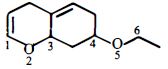
A
$O2-C3$
B
$O5-C6$
C
$C4-O5$
D
$C1-O2$
Solution
(C) The lone pair of electrons on the oxygen atom at position $2$ $(O2)$ is involved in resonance with the adjacent $C=C$ double bond,making it less basic and less susceptible to protonation.
In contrast,the lone pair of electrons on the oxygen atom at position $5$ $(O5)$ is not involved in resonance with any $C=C$ double bond,making it more basic and readily protonated by a strong acid.
Upon protonation of $O5$,the $C4-O5$ bond becomes susceptible to cleavage,as the resulting oxonium ion is a good leaving group. The cleavage occurs at the $C4-O5$ bond,leading to the formation of a carbocation at $C4$.
In contrast,the lone pair of electrons on the oxygen atom at position $5$ $(O5)$ is not involved in resonance with any $C=C$ double bond,making it more basic and readily protonated by a strong acid.
Upon protonation of $O5$,the $C4-O5$ bond becomes susceptible to cleavage,as the resulting oxonium ion is a good leaving group. The cleavage occurs at the $C4-O5$ bond,leading to the formation of a carbocation at $C4$.
0 likesView Solution
72
ChemistryDifficultMCQJEE Main · 2018
All of the following share the same crystal structure except:
A
$RbCl$
B
$NaCl$
C
$CsCl$
D
$LiCl$
Solution
(C) $NaCl$,$RbCl$,and $LiCl$ all crystallize with the rock salt $(fcc)$ structure,where each ion has a coordination number of $6:6$.
$CsCl$ crystallizes with a body-centered cubic $(bcc)$ structure,where each ion has a coordination number of $8:8$.
Therefore,$CsCl$ is the exception.
$CsCl$ crystallizes with a body-centered cubic $(bcc)$ structure,where each ion has a coordination number of $8:8$.
Therefore,$CsCl$ is the exception.
0 likesView Solution
73
ChemistryDifficultMCQJEE Main · 2018
The total number of possible isomers for square planar $[Pt(Cl)(NO_2)(NO_3)(SCN)]^{2-}$ is:
A
$16$
B
$12$
C
$8$
D
$24$
Solution
(B) The square planar complex is of the type $[Mabcd]^{n\pm}$,where $M = Pt^{2+}$,$a = Cl^-$,$b = NO_2^-$,$c = NO_3^-$,and $d = SCN^-$.
For a square planar complex $[Mabcd]$,there are $3$ geometrical isomers.
In this complex,$NO_2^-$ and $SCN^-$ are ambidentate ligands.
An ambidentate ligand can coordinate through two different donor atoms.
Since there are $2$ ambidentate ligands,each geometrical isomer can exist in $2 \times 2 = 4$ linkage isomeric forms.
Therefore,the total number of isomers = (Number of geometrical isomers) $\times$ (Number of linkage isomers per geometrical isomer) = $3 \times 4 = 12$.
For a square planar complex $[Mabcd]$,there are $3$ geometrical isomers.
In this complex,$NO_2^-$ and $SCN^-$ are ambidentate ligands.
An ambidentate ligand can coordinate through two different donor atoms.
Since there are $2$ ambidentate ligands,each geometrical isomer can exist in $2 \times 2 = 4$ linkage isomeric forms.
Therefore,the total number of isomers = (Number of geometrical isomers) $\times$ (Number of linkage isomers per geometrical isomer) = $3 \times 4 = 12$.
0 likesView Solution
74
ChemistryDifficultMCQJEE Main · 2018
Two compounds $I$ and $II$ are eluted by column chromatography (adsorption of $I > II$). Which one of the following is a correct statement?
A
$II$ moves slower and has higher $R_f$ value than $I$
B
$II$ moves faster and has higher $R_f$ value than $I$
C
$I$ moves faster and has higher $R_f$ value than $II$
D
$I$ moves slower and has higher $R_f$ value than $II$
Solution
(B) In column chromatography,the compound that is more strongly adsorbed on the stationary phase moves slower through the column.
Given that the adsorption of $I > II$,compound $I$ is more strongly adsorbed than compound $II$.
Therefore,compound $I$ moves slower and travels a shorter distance,while compound $II$ moves faster and travels a longer distance.
The $R_f$ value is defined as the ratio of the distance traveled by the substance to the distance traveled by the solvent front.
Since compound $II$ travels a greater distance,it has a higher $R_f$ value than compound $I$.
Given that the adsorption of $I > II$,compound $I$ is more strongly adsorbed than compound $II$.
Therefore,compound $I$ moves slower and travels a shorter distance,while compound $II$ moves faster and travels a longer distance.
The $R_f$ value is defined as the ratio of the distance traveled by the substance to the distance traveled by the solvent front.
Since compound $II$ travels a greater distance,it has a higher $R_f$ value than compound $I$.
0 likesView Solution
75
ChemistryMediumMCQJEE Main · 2018
The number of $P-O$ bonds in $P_4O_6$ is:
A
$9$
B
$6$
C
$12$
D
$18$
Solution
(C) In the structure of $P_4O_6$,there are $4$ phosphorus atoms arranged at the corners of a tetrahedron.
Each phosphorus atom is bonded to $3$ oxygen atoms,and each oxygen atom acts as a bridge between two phosphorus atoms.
There are $6$ edges in a tetrahedron,and each edge contains one oxygen atom bridging two phosphorus atoms,resulting in $6$ $P-O-P$ linkages.
Since each $P-O-P$ linkage contains $2$ $P-O$ bonds,the total number of $P-O$ bonds is $6 \times 2 = 12$.
Each phosphorus atom is bonded to $3$ oxygen atoms,and each oxygen atom acts as a bridge between two phosphorus atoms.
There are $6$ edges in a tetrahedron,and each edge contains one oxygen atom bridging two phosphorus atoms,resulting in $6$ $P-O-P$ linkages.
Since each $P-O-P$ linkage contains $2$ $P-O$ bonds,the total number of $P-O$ bonds is $6 \times 2 = 12$.
0 likesView Solution
76
ChemistryDifficultMCQJEE Main · 2018
The major product formed in the following reaction is
(Structure of the reactant) $\xrightarrow[{CHCl_3}]{{PCC}}$
(Structure of the reactant) $\xrightarrow[{CHCl_3}]{{PCC}}$
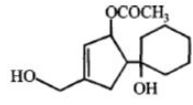
A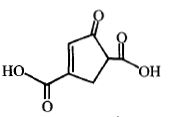
B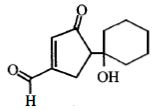
C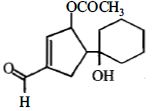
D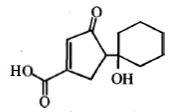
Solution
(C) $PCC$ (Pyridinium chlorochromate) is a selective oxidizing agent that oxidizes primary alcohols to aldehydes and secondary alcohols to ketones. In the given reactant,there is a primary allylic alcohol group $(-CH_2OH)$ and a secondary alcohol group $(-OH)$ attached to the ring. $PCC$ will oxidize the primary alcohol to an aldehyde and the secondary alcohol to a ketone. The $-OCOCH_3$ group remains unaffected under these conditions. Therefore,the product is the one where the primary alcohol is converted to an aldehyde and the secondary alcohol is converted to a ketone.
0 likesView Solution
77
ChemistryDifficultMCQJEE Main · 2018
If $x$ gram of gas is adsorbed by $m$ gram of adsorbent at pressure $P$,the plot of $\log \frac{x}{m}$ versus $\log P$ is linear. The slope of the plot is: ($n$ and $k$ are constants and $n > 1$ )
A
$\log k$
B
$\frac{1}{n}$
C
$2k$
D
$n$
Solution
(B) According to the Freundlich adsorption isotherm,the relationship is given by:
$\frac{x}{m} = kP^{\frac{1}{n}}$
Taking the logarithm on both sides:
$\log_{10} \frac{x}{m} = \log_{10} (kP^{\frac{1}{n}})$
$\log_{10} \frac{x}{m} = \frac{1}{n} \log_{10} P + \log_{10} k$
This equation follows the linear form $y = mx + c$,where $y = \log \frac{x}{m}$,$x = \log P$,the slope $m = \frac{1}{n}$,and the intercept $c = \log k$.
Therefore,the slope of the plot is $\frac{1}{n}$.
$\frac{x}{m} = kP^{\frac{1}{n}}$
Taking the logarithm on both sides:
$\log_{10} \frac{x}{m} = \log_{10} (kP^{\frac{1}{n}})$
$\log_{10} \frac{x}{m} = \frac{1}{n} \log_{10} P + \log_{10} k$
This equation follows the linear form $y = mx + c$,where $y = \log \frac{x}{m}$,$x = \log P$,the slope $m = \frac{1}{n}$,and the intercept $c = \log k$.
Therefore,the slope of the plot is $\frac{1}{n}$.
0 likesView Solution
78
ChemistryDifficultMCQJEE Main · 2018
In the leaching method,bauxite ore is digested with a concentrated solution of $NaOH$ that produces $X$. When $CO_2$ gas is passed through the aqueous solution of $X$,a hydrated compound $Y$ is precipitated. $X$ and $Y$ respectively are
A
$Na[Al(OH)_4]$ and $Al_2O_3 \cdot xH_2O$
B
$Al(OH)_3$ and $Al_2O_3 \cdot xH_2O$
C
$NaAlO_2$ and $Al_2(CO_3)_3 \cdot xH_2O$
D
$Na[Al(OH)_4]$ and $Al(OH)_3$
Solution
(A) In the Bayer's process for leaching bauxite $(Al_2O_3 \cdot 2H_2O)$,the ore is treated with concentrated $NaOH$ solution at $473-523 \ K$ and $35-36 \ bar$ pressure.
$Al_2O_3 \cdot 2H_2O(s) + 2NaOH(aq) + H_2O(l) \to 2Na[Al(OH)_4](aq)$
Here,$X$ is sodium tetrahydroxoaluminate,$Na[Al(OH)_4]$.
When $CO_2$ gas is passed through this solution,$Al(OH)_3$ precipitates out,which on heating gives hydrated alumina $(Al_2O_3 \cdot xH_2O)$.
$2Na[Al(OH)_4](aq) + 2CO_2(g) \to 2Al(OH)_3(s) + 2NaHCO_3(aq)$
$2Al(OH)_3(s) \xrightarrow{\Delta} Al_2O_3 \cdot xH_2O(s) + (3-x)H_2O$
Thus,$X$ is $Na[Al(OH)_4]$ and $Y$ is $Al_2O_3 \cdot xH_2O$.
$Al_2O_3 \cdot 2H_2O(s) + 2NaOH(aq) + H_2O(l) \to 2Na[Al(OH)_4](aq)$
Here,$X$ is sodium tetrahydroxoaluminate,$Na[Al(OH)_4]$.
When $CO_2$ gas is passed through this solution,$Al(OH)_3$ precipitates out,which on heating gives hydrated alumina $(Al_2O_3 \cdot xH_2O)$.
$2Na[Al(OH)_4](aq) + 2CO_2(g) \to 2Al(OH)_3(s) + 2NaHCO_3(aq)$
$2Al(OH)_3(s) \xrightarrow{\Delta} Al_2O_3 \cdot xH_2O(s) + (3-x)H_2O$
Thus,$X$ is $Na[Al(OH)_4]$ and $Y$ is $Al_2O_3 \cdot xH_2O$.
0 likesView Solution
79
ChemistryMediumMCQJEE Main · 2018
Which of the following statements is not true?
A
Chain growth polymerisation involves homopolymerisation only
B
Chain growth polymerisation includes both homopolymerisation and copolymerisation
C
Nylon $6$ is an example of step-growth polymerisation
D
Step growth polymerisation requires a bifunctional monomer
Solution
(A) The statement $(A)$ is not true.
Chain growth polymerisation (or addition polymerisation) involves both homopolymerisation and copolymerisation.
For example,the polymerisation of ethene is homopolymerisation,while the polymerisation of a mixture of ethene and propene is copolymerisation.
Nylon $6$ is indeed formed by the ring-opening polymerisation of caprolactam,which is a type of step-growth polymerisation.
Step-growth polymerisation typically requires bifunctional monomers to form long chains.
Chain growth polymerisation (or addition polymerisation) involves both homopolymerisation and copolymerisation.
For example,the polymerisation of ethene is homopolymerisation,while the polymerisation of a mixture of ethene and propene is copolymerisation.
Nylon $6$ is indeed formed by the ring-opening polymerisation of caprolactam,which is a type of step-growth polymerisation.
Step-growth polymerisation typically requires bifunctional monomers to form long chains.
0 likesView Solution
80
ChemistryMediumMCQJEE Main · 2018
The dipeptide,$Gln-Gly$,on treatment with $CH_3COCl$ followed by aqueous work-up gives:
A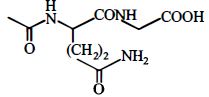
B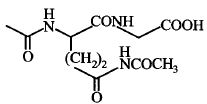
C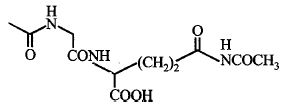
D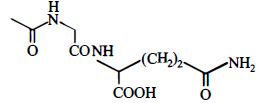
Solution
(D) The dipeptide $Gln-Gly$ consists of Glutamine $(Gln)$ at the $N$-terminus and Glycine $(Gly)$ at the $C$-terminus. The structure of $Gln-Gly$ is $H_2N-CH(CH_2CH_2CONH_2)-CONH-CH_2-COOH$.
When treated with $CH_3COCl$ (acetyl chloride),the primary amino group $(-NH_2)$ at the $N$-terminus is acetylated to form an acetamide group $(-NHCOCH_3)$.
The amide group $(-CONH_2)$ present in the side chain of Glutamine is significantly less nucleophilic due to resonance stabilization and is generally not acetylated under these conditions.
Therefore,the product is $CH_3CONH-CH(CH_2CH_2CONH_2)-CONH-CH_2-COOH$,which corresponds to the structure shown in option $D$.
When treated with $CH_3COCl$ (acetyl chloride),the primary amino group $(-NH_2)$ at the $N$-terminus is acetylated to form an acetamide group $(-NHCOCH_3)$.
The amide group $(-CONH_2)$ present in the side chain of Glutamine is significantly less nucleophilic due to resonance stabilization and is generally not acetylated under these conditions.
Therefore,the product is $CH_3CONH-CH(CH_2CH_2CONH_2)-CONH-CH_2-COOH$,which corresponds to the structure shown in option $D$.
0 likesView Solution
81
ChemistryDifficultMCQJEE Main · 2018
The increasing order of the acidity of the following carboxylic acids is:
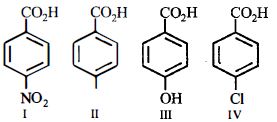
A
$III < II < IV < I$
B
$I < III < II < IV$
C
$IV < II < III < I$
D
$II < IV < III < I$
Solution
(A) The acidity of substituted benzoic acids depends on the electronic effects of the substituents at the para position.
$1$. $-NO_2$ is a strong electron-withdrawing group ($-I$ and $-M$ effects),which significantly increases acidity.
$2$. $-Cl$ is an electron-withdrawing group ($-I$ effect) but an electron-donating group ($+M$ effect). The $-I$ effect dominates,increasing acidity compared to benzoic acid.
$3$. $-OH$ is an electron-donating group ($+M$ effect),which decreases acidity compared to benzoic acid.
$4$. Benzoic acid $(II)$ is the reference.
Comparing the substituents: $-NO_2$ (strongest electron-withdrawing) > $-Cl$ (weak electron-withdrawing) > $H$ (no effect) > $-OH$ (electron-donating).
Therefore,the increasing order of acidity is $III < II < IV < I$.
$1$. $-NO_2$ is a strong electron-withdrawing group ($-I$ and $-M$ effects),which significantly increases acidity.
$2$. $-Cl$ is an electron-withdrawing group ($-I$ effect) but an electron-donating group ($+M$ effect). The $-I$ effect dominates,increasing acidity compared to benzoic acid.
$3$. $-OH$ is an electron-donating group ($+M$ effect),which decreases acidity compared to benzoic acid.
$4$. Benzoic acid $(II)$ is the reference.
Comparing the substituents: $-NO_2$ (strongest electron-withdrawing) > $-Cl$ (weak electron-withdrawing) > $H$ (no effect) > $-OH$ (electron-donating).
Therefore,the increasing order of acidity is $III < II < IV < I$.
0 likesView Solution
82
ChemistryDifficultMCQJEE Main · 2018
For standardizing $NaOH$ solution,which of the following is used as a primary standard?
A
Sodium tetraborate
B
Ferrous ammonium sulfate
C
Oxalic acid
D
dil. $HCl$
Solution
(C) primary standard is a reagent that is pure,stable,and has a high molar mass.
Oxalic acid $(H_2C_2O_4 \cdot 2H_2O)$ is a solid,stable compound that meets these criteria and is commonly used to standardize $NaOH$ solutions via titration.
Oxalic acid $(H_2C_2O_4 \cdot 2H_2O)$ is a solid,stable compound that meets these criteria and is commonly used to standardize $NaOH$ solutions via titration.
0 likesView Solution
83
ChemistryDifficultMCQJEE Main · 2018
Products $A$ and $B$ formed in the following reactions are respectively:
$p$-aminobenzenesulfonic acid + $HNO_2$ $\longrightarrow$ $A$ $\xrightarrow{C_6H_5NH_2}$ $B$
$p$-aminobenzenesulfonic acid + $HNO_2$ $\longrightarrow$ $A$ $\xrightarrow{C_6H_5NH_2}$ $B$
A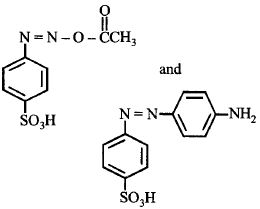
B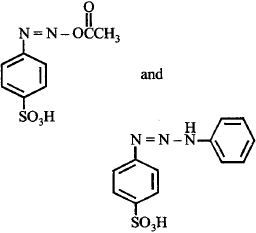
C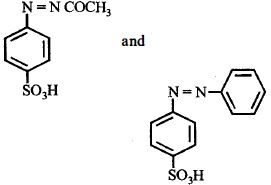
D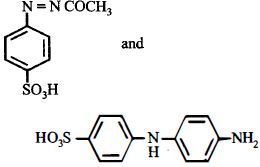
Solution
(A) The reaction of $p$-aminobenzenesulfonic acid with $HNO_2$ produces a diazonium salt intermediate.
In the presence of acetic anhydride or similar conditions (often implied in such reaction schemes),the diazonium group can form a diazo-ester linkage.
Product $A$ is the diazo-ester formed from the reaction.
When this intermediate reacts with aniline $(C_6H_5NH_2)$,it undergoes a coupling reaction to form an amino-azo compound $(B)$,specifically $p$-aminoazobenzene-sulfonic acid derivative.
In the presence of acetic anhydride or similar conditions (often implied in such reaction schemes),the diazonium group can form a diazo-ester linkage.
Product $A$ is the diazo-ester formed from the reaction.
When this intermediate reacts with aniline $(C_6H_5NH_2)$,it undergoes a coupling reaction to form an amino-azo compound $(B)$,specifically $p$-aminoazobenzene-sulfonic acid derivative.
0 likesView Solution
84
ChemistryDifficultMCQJEE Main · 2018
When $XO_2$ is fused with an alkali metal hydroxide in the presence of an oxidizing agent such as $KNO_3$,a dark green product is formed which disproportionates in an acidic solution to afford a dark purple solution. $X$ is
A
$Mn$
B
$Cr$
C
$V$
D
$Ti$
Solution
(A) The reaction of $MnO_2$ with $KOH$ and $KNO_3$ is: $MnO_2 + 2KOH + KNO_3 \to K_2MnO_4 + KNO_2 + H_2O$.
The product $K_2MnO_4$ (potassium manganate) is dark green in color.
In an acidic medium,the manganate ion $(MnO_4^{2-})$ undergoes disproportionation: $3MnO_4^{2-} + 4H^+ \to 2MnO_4^- + MnO_2 + 2H_2O$.
The $MnO_4^-$ (permanganate) ion is dark purple in color.
Thus,$X$ is $Mn$.
The product $K_2MnO_4$ (potassium manganate) is dark green in color.
In an acidic medium,the manganate ion $(MnO_4^{2-})$ undergoes disproportionation: $3MnO_4^{2-} + 4H^+ \to 2MnO_4^- + MnO_2 + 2H_2O$.
The $MnO_4^-$ (permanganate) ion is dark purple in color.
Thus,$X$ is $Mn$.
0 likesView Solution
85
ChemistryDifficultMCQJEE Main · 2018
The major product $B$ formed in the following reaction sequence is
$p-Methoxybenzaldehyde$ $\xrightarrow[(ii) H_2O]{(i) C_2H_5MgBr} A$ $\xrightarrow{HCl} B$
$p-Methoxybenzaldehyde$ $\xrightarrow[(ii) H_2O]{(i) C_2H_5MgBr} A$ $\xrightarrow{HCl} B$
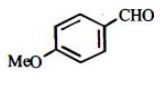
A
$4-Chloro-1-methoxy-4-ethylbenzene$
B
$1-(4-Methoxyphenyl)propan-1-ol$
C
$1-Methoxy-4-(prop-1-enyl)benzene$
D
$1-(1-Chloropropyl)-4-methoxybenzene$
Solution
(D) Step $1$: The reaction of $p-methoxybenzaldehyde$ with $C_2H_5MgBr$ followed by hydrolysis $(H_2O)$ is a Grignard reaction. The nucleophilic ethyl group attacks the carbonyl carbon to form a secondary alcohol,$A$,which is $1-(4-methoxyphenyl)propan-1-ol$.
Step $2$: The reaction of $A$ with $HCl$ proceeds via an $S_N1$ mechanism. The hydroxyl group is protonated to form a good leaving group $(H_2O)$,which leaves to form a stable benzylic carbocation. The chloride ion then attacks this carbocation to form the major product $B$,which is $1-(1-chloropropyl)-4-methoxybenzene$.
Step $2$: The reaction of $A$ with $HCl$ proceeds via an $S_N1$ mechanism. The hydroxyl group is protonated to form a good leaving group $(H_2O)$,which leaves to form a stable benzylic carbocation. The chloride ion then attacks this carbocation to form the major product $B$,which is $1-(1-chloropropyl)-4-methoxybenzene$.
0 likesView Solution
86
ChemistryMediumMCQJEE Main · 2018
In a complexometric titration of a metal ion with a ligand,the reaction is $M$ $(Metal-ion)$ + $L$ $(Ligand)$ $\to$ $C$ $(Complex)$. The end point is estimated spectrophotometrically (through light absorption). If '$M$' and '$C$' do not absorb light and only '$L$' absorbs,then the titration plot between absorbed light $(A)$ versus the volume of ligand '$L$' $(V)$ would look like:
A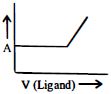
B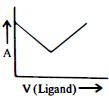
C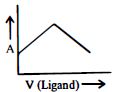
D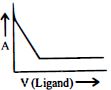
Solution
(A) Initially,the ligand is consumed by the metal ion to form the complex $(C)$. Since neither the metal ion $(M)$ nor the complex $(C)$ absorbs light,the absorbance $(A)$ remains near zero or constant during this phase.
After the equivalence point is reached,all metal ions have been converted into the complex. Any further addition of the ligand $(L)$ increases its concentration in the solution.
Since the ligand $(L)$ absorbs light,the absorbance $(A)$ starts to increase linearly with the volume of the added ligand $(V)$.
Therefore,the plot shows a horizontal line followed by an upward slope,which corresponds to the graph in option $A$.
After the equivalence point is reached,all metal ions have been converted into the complex. Any further addition of the ligand $(L)$ increases its concentration in the solution.
Since the ligand $(L)$ absorbs light,the absorbance $(A)$ starts to increase linearly with the volume of the added ligand $(V)$.
Therefore,the plot shows a horizontal line followed by an upward slope,which corresponds to the graph in option $A$.
0 likesView Solution
87
ChemistryDifficultMCQJEE Main · 2018
The major product of the following reaction is:
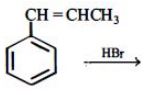
A
$Ph-CH_2-CH_2-CH_2-Br$
B
$Ph-CH(Br)-CH_2-CH_3$
C
$Ph-CH_2-CH(Br)-CH_3$
D
$p-Br-C_6H_4-CH=CH-CH_3$
Solution
(B) The reaction is the electrophilic addition of $HBr$ to $1-phenylpropene$ $(Ph-CH=CH-CH_3)$.
According to Markovnikov's rule,the electrophile $(H^+)$ adds to the carbon atom of the double bond that has more hydrogen atoms,resulting in the formation of the most stable carbocation.
In $Ph-CH=CH-CH_3$,the carbocation formed at the benzylic position $(Ph-CH^+-CH_2-CH_3)$ is highly stabilized by resonance with the phenyl ring.
Therefore,the bromide ion $(Br^-)$ attacks this benzylic carbocation to form $1-phenyl-1-bromopropane$ $(Ph-CH(Br)-CH_2-CH_3)$ as the major product.
According to Markovnikov's rule,the electrophile $(H^+)$ adds to the carbon atom of the double bond that has more hydrogen atoms,resulting in the formation of the most stable carbocation.
In $Ph-CH=CH-CH_3$,the carbocation formed at the benzylic position $(Ph-CH^+-CH_2-CH_3)$ is highly stabilized by resonance with the phenyl ring.
Therefore,the bromide ion $(Br^-)$ attacks this benzylic carbocation to form $1-phenyl-1-bromopropane$ $(Ph-CH(Br)-CH_2-CH_3)$ as the major product.
0 likesView Solution
88
ChemistryDifficultMCQJEE Main · 2018
Among the following,the incorrect statement is
A
Cellulose and amylose have $1,4-$ glycosidic linkage
B
Lactose contains $\beta -D-$ galactose and $\beta -D-$ glucose
C
Maltose and lactose have $1,4-$ glycosidic linkage
D
Sucrose and amylose have $1,2-$ glycosidic linkage
Solution
(D) The correct answer is $D$.
Sucrose consists of $\alpha -D-$ glucose and $\beta -D-$ fructose linked by a $1,2-$ glycosidic bond.
Amylose is a linear polymer of $\alpha -D-$ glucose units linked by $1,4-$ glycosidic bonds.
Therefore,the statement that sucrose and amylose have $1,2-$ glycosidic linkage is incorrect.
Sucrose consists of $\alpha -D-$ glucose and $\beta -D-$ fructose linked by a $1,2-$ glycosidic bond.
Amylose is a linear polymer of $\alpha -D-$ glucose units linked by $1,4-$ glycosidic bonds.
Therefore,the statement that sucrose and amylose have $1,2-$ glycosidic linkage is incorrect.
0 likesView Solution
89
ChemistryMediumMCQJEE Main · 2018
In the extraction of copper from its sulphide ore,metal is finally obtained by the oxidation of cuprous sulphide with
A
$SO_2$
B
$Fe_2O_3$
C
$Cu_2O$
D
$CO$
Solution
(C) In the extraction of copper from copper glance $(Cu_2S)$,the ore is partially roasted to form cuprous oxide $(Cu_2O)$.
The remaining $Cu_2S$ then reacts with the formed $Cu_2O$ in a process known as auto-reduction or self-reduction.
The chemical equation is: $Cu_2S + 2Cu_2O \to 6Cu + SO_2$.
Thus,$Cu_2S$ is oxidized by $Cu_2O$ to produce copper metal.
The remaining $Cu_2S$ then reacts with the formed $Cu_2O$ in a process known as auto-reduction or self-reduction.
The chemical equation is: $Cu_2S + 2Cu_2O \to 6Cu + SO_2$.
Thus,$Cu_2S$ is oxidized by $Cu_2O$ to produce copper metal.
0 likesView Solution
90
ChemistryDifficultMCQJEE Main · 2018
Among the oxides of nitrogen $N_2O_3$,$N_2O_4$,and $N_2O_5$,the molecule$(s)$ having nitrogen-nitrogen bond is/are
A
$N_2O_3$ and $N_2O_4$
B
$N_2O_4$ and $N_2O_5$
C
$N_2O_3$ and $N_2O_5$
D
only $N_2O_5$
Solution
(A) The structures of the given nitrogen oxides are as follows:
$1$. $N_2O_3$: It has a direct $N-N$ bond $(O=N-NO_2)$.
$2$. $N_2O_4$: It has a direct $N-N$ bond $(O_2N-NO_2)$.
$3$. $N_2O_5$: It has an $N-O-N$ linkage $(O_2N-O-NO_2)$ and does not contain a direct $N-N$ bond.
Therefore,$N_2O_3$ and $N_2O_4$ contain a nitrogen-nitrogen bond.
$1$. $N_2O_3$: It has a direct $N-N$ bond $(O=N-NO_2)$.
$2$. $N_2O_4$: It has a direct $N-N$ bond $(O_2N-NO_2)$.
$3$. $N_2O_5$: It has an $N-O-N$ linkage $(O_2N-O-NO_2)$ and does not contain a direct $N-N$ bond.
Therefore,$N_2O_3$ and $N_2O_4$ contain a nitrogen-nitrogen bond.
0 likesView Solution
91
ChemistryDifficultMCQJEE Main · 2018
In Wilkinson's catalyst,the hybridization of the central metal ion and its shape are respectively:
A
$sp^3d,$ trigonal bipyramidal
B
$d^2sp^3,$ octahedral
C
$dsp^2,$ square planar
D
$sp^3,$ tetrahedral
Solution
(C) The chemical formula of Wilkinson's catalyst is $[RhCl(PPh_3)_3].$
In this complex,the central metal ion is Rhodium $(Rh^+)$,which has a $d^8$ electronic configuration.
For a $d^8$ metal ion in a four-coordinate complex with strong field ligands like $PPh_3,$ the hybridization is $dsp^2.$
Consequently,the geometry of the complex is square planar.
In this complex,the central metal ion is Rhodium $(Rh^+)$,which has a $d^8$ electronic configuration.
For a $d^8$ metal ion in a four-coordinate complex with strong field ligands like $PPh_3,$ the hybridization is $dsp^2.$
Consequently,the geometry of the complex is square planar.
0 likesView Solution
92
ChemistryDifficultMCQJEE Main · 2018
Which of the following complexes will show geometrical isomerism?
A
Potassium tris(oxalato) chromate$(III)$
B
Penta aqua chloro chromium$(III)$ chloride
C
Aqua chlorobis(ethylenediamine) cobalt$(III)$ chloride
D
Potassium ammine trichloroplatinate$(II)$
Solution
(C) Geometrical isomerism is shown by complexes of the type $[M(AA)_2b_2]$ or $[M(AA)_2bc]$.
In the complex $[Co(en)_2(H_2O)Cl]Cl_2$,the coordination entity is $[Co(en)_2(H_2O)Cl]^{2+}$.
This complex has the formula $[M(AA)_2bc]$,where $M = Co$,$AA = en$,$b = H_2O$,and $c = Cl$.
It exists in two geometrical isomeric forms: $cis$ and $trans$,as shown in the figure.
In the complex $[Co(en)_2(H_2O)Cl]Cl_2$,the coordination entity is $[Co(en)_2(H_2O)Cl]^{2+}$.
This complex has the formula $[M(AA)_2bc]$,where $M = Co$,$AA = en$,$b = H_2O$,and $c = Cl$.
It exists in two geometrical isomeric forms: $cis$ and $trans$,as shown in the figure.
0 likesView Solution
93
ChemistryDifficultMCQJEE Main · 2018
When $9.65 \ A$ current was passed for $1.0 \ h$ into nitrobenzene in an acidic medium,the amount of $p$-aminophenol produced is .............. $g$.
A
$109$
B
$98.1$
C
$9.81$
D
$10.9$
Solution
(C) The total charge passed is $Q = I \times t = 9.65 \ A \times 3600 \ s = 34740 \ C$.
Number of moles of electrons passed $= \frac{Q}{F} = \frac{34740 \ C}{96500 \ C/mol} = 0.36 \ mol$.
The reduction of nitrobenzene to $p$-aminophenol involves $4$ electrons:
$C_6H_5NO_2 + 4H^+ + 4e^- \to HOC_6H_4NH_2 + H_2O$.
Since $4 \ mol$ of electrons produce $1 \ mol$ of $p$-aminophenol,$0.36 \ mol$ of electrons will produce $\frac{0.36}{4} = 0.09 \ mol$ of $p$-aminophenol.
The molar mass of $p$-aminophenol $(C_6H_7NO)$ is $109.13 \ g/mol$.
Mass of $p$-aminophenol $= 0.09 \ mol \times 109.13 \ g/mol = 9.82 \ g \approx 9.81 \ g$.
Number of moles of electrons passed $= \frac{Q}{F} = \frac{34740 \ C}{96500 \ C/mol} = 0.36 \ mol$.
The reduction of nitrobenzene to $p$-aminophenol involves $4$ electrons:
$C_6H_5NO_2 + 4H^+ + 4e^- \to HOC_6H_4NH_2 + H_2O$.
Since $4 \ mol$ of electrons produce $1 \ mol$ of $p$-aminophenol,$0.36 \ mol$ of electrons will produce $\frac{0.36}{4} = 0.09 \ mol$ of $p$-aminophenol.
The molar mass of $p$-aminophenol $(C_6H_7NO)$ is $109.13 \ g/mol$.
Mass of $p$-aminophenol $= 0.09 \ mol \times 109.13 \ g/mol = 9.82 \ g \approx 9.81 \ g$.
0 likesView Solution
94
ChemistryDifficultMCQJEE Main · 2018
The incorrect statement out of the following is:
A
$Cu^{2+}$ ion gives chocolate coloured precipitate with potassium ferrocyanide solution.
B
$Cu^{2+}$ and $Ni^{2+}$ ions give black precipitate with $H_2S$ in presence of $HCl$ solution.
C
Ferric ion gives blood red colour with potassium thiocyanate.
D
$Cu^{2+}$ salts give red coloured borax bead test in reducing flame.
Solution
(B) $1$. $Cu^{2+}$ reacts with $K_4[Fe(CN)_6]$ to form $Cu_2[Fe(CN)_6]$,which is a chocolate-brown precipitate.
$2$. In the presence of $HCl$,the concentration of $S^{2-}$ ions is suppressed due to the common ion effect. $CuS$ $(K_{sp} \approx 10^{-36})$ precipitates,but $NiS$ $(K_{sp} \approx 10^{-21})$ does not precipitate because its ionic product remains lower than its $K_{sp}$. Thus,the statement that both give black precipitate is incorrect.
$3$. $Fe^{3+}$ reacts with $SCN^-$ to form $[Fe(SCN)]^{2+}$,which is blood-red.
$4$. $Cu^{2+}$ in a reducing flame forms metallic copper,which gives a red-coloured bead.
$2$. In the presence of $HCl$,the concentration of $S^{2-}$ ions is suppressed due to the common ion effect. $CuS$ $(K_{sp} \approx 10^{-36})$ precipitates,but $NiS$ $(K_{sp} \approx 10^{-21})$ does not precipitate because its ionic product remains lower than its $K_{sp}$. Thus,the statement that both give black precipitate is incorrect.
$3$. $Fe^{3+}$ reacts with $SCN^-$ to form $[Fe(SCN)]^{2+}$,which is blood-red.
$4$. $Cu^{2+}$ in a reducing flame forms metallic copper,which gives a red-coloured bead.
0 likesView Solution
95
ChemistryDifficultMCQJEE Main · 2018
The mass of non-volatile,non-electrolyte solute (molar mass $= 50 \ g \ mol^{-1}$) needed to be dissolved in $114 \ g$ octane to reduce its vapour pressure to $75\%$ is .............. $g$.
A
$37.5$
B
$75$
C
$150$
D
$50$
Solution
(C) According to Raoult's law for a non-volatile solute,the relative lowering of vapour pressure is given by: $\frac{P^o - P_s}{P^o} = \frac{n_2}{n_1 + n_2}$.
Given that the vapour pressure is reduced to $75\%$,we have $P_s = 0.75 P^o$,which implies $\frac{P_s}{P^o} = 0.75$.
The mole fraction of the solvent is $X_1 = \frac{P_s}{P^o} = 0.75$.
Since $X_1 + X_2 = 1$,the mole fraction of the solute is $X_2 = 1 - 0.75 = 0.25$.
We know $X_2 = \frac{n_2}{n_1 + n_2} = \frac{W_2/M_2}{W_1/M_1 + W_2/M_2}$.
Molar mass of octane $(C_8H_{18})$ is $M_1 = (8 \times 12) + (18 \times 1) = 114 \ g \ mol^{-1}$.
Given $W_1 = 114 \ g$,so $n_1 = \frac{114}{114} = 1 \ mol$.
Substituting the values: $0.25 = \frac{W_2/50}{1 + W_2/50}$.
$0.25(1 + W_2/50) = W_2/50$.
$0.25 + 0.005 W_2 = 0.02 W_2$.
$0.25 = 0.015 W_2$.
$W_2 = \frac{0.25}{0.015} = 16.67 \ g$.
Wait,re-evaluating the expression: $\frac{P_s}{P^o} = X_1 = \frac{n_1}{n_1 + n_2} = 0.75$.
$\frac{1}{1 + W_2/50} = 0.75$.
$1 = 0.75 + 0.75(W_2/50)$.
$0.25 = 0.75(W_2/50)$.
$W_2/50 = 0.25/0.75 = 1/3$.
$W_2 = 50/3 = 16.67 \ g$.
Given the options provided,there might be a calculation error in the prompt's provided solution. Based on the standard formula,the correct answer is $16.67 \ g$. However,if the question implies the vapour pressure is reduced $BY$ $75\%$,then $P_s = 0.25 P^o$,leading to $X_1 = 0.25$,$n_1/(n_1+n_2) = 0.25$,$1/(1+W_2/50) = 0.25$,$1+W_2/50 = 4$,$W_2/50 = 3$,$W_2 = 150 \ g$. Thus,the intended meaning is reduction $BY$ $75\%$.
Given that the vapour pressure is reduced to $75\%$,we have $P_s = 0.75 P^o$,which implies $\frac{P_s}{P^o} = 0.75$.
The mole fraction of the solvent is $X_1 = \frac{P_s}{P^o} = 0.75$.
Since $X_1 + X_2 = 1$,the mole fraction of the solute is $X_2 = 1 - 0.75 = 0.25$.
We know $X_2 = \frac{n_2}{n_1 + n_2} = \frac{W_2/M_2}{W_1/M_1 + W_2/M_2}$.
Molar mass of octane $(C_8H_{18})$ is $M_1 = (8 \times 12) + (18 \times 1) = 114 \ g \ mol^{-1}$.
Given $W_1 = 114 \ g$,so $n_1 = \frac{114}{114} = 1 \ mol$.
Substituting the values: $0.25 = \frac{W_2/50}{1 + W_2/50}$.
$0.25(1 + W_2/50) = W_2/50$.
$0.25 + 0.005 W_2 = 0.02 W_2$.
$0.25 = 0.015 W_2$.
$W_2 = \frac{0.25}{0.015} = 16.67 \ g$.
Wait,re-evaluating the expression: $\frac{P_s}{P^o} = X_1 = \frac{n_1}{n_1 + n_2} = 0.75$.
$\frac{1}{1 + W_2/50} = 0.75$.
$1 = 0.75 + 0.75(W_2/50)$.
$0.25 = 0.75(W_2/50)$.
$W_2/50 = 0.25/0.75 = 1/3$.
$W_2 = 50/3 = 16.67 \ g$.
Given the options provided,there might be a calculation error in the prompt's provided solution. Based on the standard formula,the correct answer is $16.67 \ g$. However,if the question implies the vapour pressure is reduced $BY$ $75\%$,then $P_s = 0.25 P^o$,leading to $X_1 = 0.25$,$n_1/(n_1+n_2) = 0.25$,$1/(1+W_2/50) = 0.25$,$1+W_2/50 = 4$,$W_2/50 = 3$,$W_2 = 150 \ g$. Thus,the intended meaning is reduction $BY$ $75\%$.
0 likesView Solution
96
ChemistryDifficultMCQJEE Main · 2018
The correct match between items of List-$I$ and List-$II$ is
| List-$I$ | List-$II$ |
| $A$. Phenelzine | $p$. Pyrimidine |
| $B$. Chloroxylenol | $q$. Furan |
| $C$. Uracil | $r$. Hydrazine |
| $D$. Ranitidine | $s$. Phenol |
A
$A-s, B-r, C-q, D-p$
B
$A-r, B-s, C-p, D-q$
C
$A-r, B-s, C-q, D-p$
D
$A-s, B-r, C-p, D-q$
Solution
(B) The correct matches are as follows:
$A$. Phenelzine contains a hydrazine moiety $(r)$.
$B$. Chloroxylenol is a derivative of phenol $(s)$.
$C$. Uracil is a pyrimidine base $(p)$.
$D$. Ranitidine contains a furan ring $(q)$.
Therefore,the correct sequence is $A-r, B-s, C-p, D-q$.
$A$. Phenelzine contains a hydrazine moiety $(r)$.
$B$. Chloroxylenol is a derivative of phenol $(s)$.
$C$. Uracil is a pyrimidine base $(p)$.
$D$. Ranitidine contains a furan ring $(q)$.
Therefore,the correct sequence is $A-r, B-s, C-p, D-q$.
0 likesView Solution
97
ChemistryDifficultMCQJEE Main · 2018
Which one of the following is not a property of physical adsorption?
A
Higher the pressure,more the adsorption
B
Greater the surface area,more the adsorption
C
Lower the temperature,more the adsorption
D
Unilayer adsorption occurs
Solution
(D) Physical adsorption (physisorption) is characterized by weak van der Waals forces between the adsorbate and the adsorbent.
It is a reversible process that is favored by low temperatures and high pressures.
It increases with an increase in the surface area of the adsorbent.
Unlike chemisorption,physical adsorption is multi-layered in nature.
Therefore,the statement that 'Unilayer adsorption occurs' is incorrect,as it is a property of chemisorption.
It is a reversible process that is favored by low temperatures and high pressures.
It increases with an increase in the surface area of the adsorbent.
Unlike chemisorption,physical adsorption is multi-layered in nature.
Therefore,the statement that 'Unilayer adsorption occurs' is incorrect,as it is a property of chemisorption.
0 likesView Solution
98
ChemistryDifficultMCQJEE Main · 2018
The major product of the following reaction is:
(Structure of $4-$bromo-pent$-2-$en$-2-$amine derivative) $\xrightarrow[{S_N2}]{{KOH}}$
(Structure of $4-$bromo-pent$-2-$en$-2-$amine derivative) $\xrightarrow[{S_N2}]{{KOH}}$
A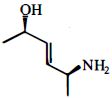
B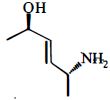
C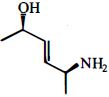
D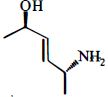
Solution
(A) The reaction proceeds via an $S_N2$ mechanism.
In an $S_N2$ reaction,the nucleophile $(OH^-)$ attacks the electrophilic carbon from the side opposite to the leaving group $(-Br)$.
This results in a Walden inversion (inversion of configuration) at the carbon atom bonded to the bromine.
The $-NH_2$ group is not involved in this substitution reaction and remains in its original configuration.
Therefore,the major product is the one where the $-OH$ group is attached with an inverted stereochemistry relative to the original $-Br$ position.
In an $S_N2$ reaction,the nucleophile $(OH^-)$ attacks the electrophilic carbon from the side opposite to the leaving group $(-Br)$.
This results in a Walden inversion (inversion of configuration) at the carbon atom bonded to the bromine.
The $-NH_2$ group is not involved in this substitution reaction and remains in its original configuration.
Therefore,the major product is the one where the $-OH$ group is attached with an inverted stereochemistry relative to the original $-Br$ position.
0 likesView Solution
99
ChemistryDifficultMCQJEE Main · 2018
If $50\%$ of a reaction occurs in $100 \ s$ and $75\%$ of the reaction occurs in $200 \ s$,the order of this reaction is
A
$2$
B
$3$
C
$0$
D
$1$
Solution
(D) For a first-order reaction,the half-life $(t_{1/2})$ is constant.
Given that $50\%$ of the reaction is complete in $100 \ s$,this is the half-life,$t_{1/2} = 100 \ s$.
After another $100 \ s$ (total $200 \ s$),the remaining concentration becomes $A_0/4$,which means $75\%$ of the reaction is complete.
Since the time taken for the second half-life is also $100 \ s$,the reaction follows first-order kinetics.
Given that $50\%$ of the reaction is complete in $100 \ s$,this is the half-life,$t_{1/2} = 100 \ s$.
After another $100 \ s$ (total $200 \ s$),the remaining concentration becomes $A_0/4$,which means $75\%$ of the reaction is complete.
Since the time taken for the second half-life is also $100 \ s$,the reaction follows first-order kinetics.
0 likesView Solution
100
ChemistryDifficultMCQJEE Main · 2018
The major product of the given reaction is
$3-methoxyphenol$ $\xrightarrow[{(ii) \ H_2SO_4, \ heat}]{{(i) \ OHCCH_2COCl}}$
$3-methoxyphenol$ $\xrightarrow[{(ii) \ H_2SO_4, \ heat}]{{(i) \ OHCCH_2COCl}}$
A
$7-$methoxy-2H-chromen$-2-$one
B
$5-$methoxy-2H-chromen$-2-$one
C
$5-$methoxy-chroman$-4-$one
D
$7-$methoxy-chroman$-4-$one
Solution
(A) The reaction of $3-methoxyphenol$ with $OHCCH_2COCl$ involves the esterification of the phenolic $-OH$ group with the acid chloride group $(-COCl)$,as acid chlorides are more reactive than aldehydes.
This forms an intermediate ester: $3-methoxyphenyl \ 2-formylacetate$.
In the presence of concentrated $H_2SO_4$ and heat,this intermediate undergoes an intramolecular Pechmann-type condensation (cyclisation) between the aldehyde group and the ortho-position of the benzene ring.
Since the starting material is $3-methoxyphenol$,the cyclisation can occur at the $2$ or $6$ positions. The $6$-position is less sterically hindered than the $2$-position (which is between the $-OMe$ and the ester group),leading to $7-methoxy-2H-chromen-2-one$ as the major product.
This forms an intermediate ester: $3-methoxyphenyl \ 2-formylacetate$.
In the presence of concentrated $H_2SO_4$ and heat,this intermediate undergoes an intramolecular Pechmann-type condensation (cyclisation) between the aldehyde group and the ortho-position of the benzene ring.
Since the starting material is $3-methoxyphenol$,the cyclisation can occur at the $2$ or $6$ positions. The $6$-position is less sterically hindered than the $2$-position (which is between the $-OMe$ and the ester group),leading to $7-methoxy-2H-chromen-2-one$ as the major product.
0 likesView Solution
Vedclass Products
For Students
Vedclass Test Series
Mock tests in real JEE Main style covering Chemistry with performance analysis. 5-day free trial.
Start Free TrialFor Teachers
Exam Paper Generator
Generate Set A/B/C/D Chemistry papers from 7.5L+ questions in 2 minutes. 3 chapters free.
Try FreeFor Institutes
Online Exam Module
Run live JEE Main mock exams with unlimited students, 360° analytics & white-label branding.
See DemoFrequently Asked Questions
How many Chemistry questions are in JEE Main 2018?
There are 102 Chemistry questions from the JEE Main 2018 paper on Vedclass, each with a detailed step-by-step solution in English.
Are JEE Main 2018 Chemistry solutions available in English?
Yes. All solutions on this page are in English. You can also switch to English or Hindi using the language buttons above the questions.
Can I practice JEE Main 2018 Chemistry as a timed test?
Yes. Use the Vedclass Test Series to attempt a full JEE Main mock test covering Chemistry with time limits and instant score analysis.
Can teachers create Chemistry papers from JEE Main previous year questions?
Yes. The Vedclass Exam Paper Generator lets teachers mix JEE Main Chemistry questions and generate Set A/B/C/D papers in minutes.
For Teachers & Institutes
Build a Custom Chemistry Paper
Pick JEE Main 2018 Chemistry questions, set difficulty, and generate Set A/B/C/D in 2 minutes.