
ChemistryQ1–100 of 178 questions
Page 1 of 2 · English
1
ChemistryMCQJEE Main · 2014
Amongst $LiCl$,$RbCl$,$BeCl_{2}$,and $MgCl_{2}$,the compounds with the greatest and the least ionic character,respectively,are
A
$LiCl$ and $RbCl$
B
$RbCl$ and $BeCl_{2}$
C
$RbCl$ and $MgCl_{2}$
D
$MgCl_{2}$ and $BeCl_{2}$
Solution
(B) According to Fajan's rule,the ionic character of a bond depends on the polarizing power of the cation.
Greater size of the cation and smaller charge on the cation lead to less polarization,resulting in more ionic character.
Comparing the cations: $Rb^+$ is the largest with a $+1$ charge,making $RbCl$ the most ionic.
$Be^{2+}$ is the smallest with a $+2$ charge,leading to the highest polarization and the least ionic (most covalent) character.
Therefore,$RbCl$ has the greatest ionic character and $BeCl_{2}$ has the least ionic character.
Greater size of the cation and smaller charge on the cation lead to less polarization,resulting in more ionic character.
Comparing the cations: $Rb^+$ is the largest with a $+1$ charge,making $RbCl$ the most ionic.
$Be^{2+}$ is the smallest with a $+2$ charge,leading to the highest polarization and the least ionic (most covalent) character.
Therefore,$RbCl$ has the greatest ionic character and $BeCl_{2}$ has the least ionic character.
0 likesView Solution
2
ChemistryMCQJEE Main · 2014
Amongst $LiCl, RbCl, BeCl_2$ and $MgCl_2$,the compounds with the greatest and least ionic character respectively are:
A
$LiCl$ and $RbCl$
B
$MgCl_2$ and $BeCl_2$
C
$RbCl$ and $BeCl_2$
D
$RbCl$ and $MgCl_2$
Solution
(C) According to Fajan's rule,ionic character depends on the polarising power of the cation.
$Rb^+$ has the largest size among the given cations,resulting in the least polarising power and thus the greatest ionic character in $RbCl$.
$Be^{2+}$ has the smallest size and highest charge density,giving it the highest polarising power,which results in the greatest covalent character and the least ionic character in $BeCl_2$.
Therefore,the compounds with the greatest and least ionic character are $RbCl$ and $BeCl_2$ respectively.
$Rb^+$ has the largest size among the given cations,resulting in the least polarising power and thus the greatest ionic character in $RbCl$.
$Be^{2+}$ has the smallest size and highest charge density,giving it the highest polarising power,which results in the greatest covalent character and the least ionic character in $BeCl_2$.
Therefore,the compounds with the greatest and least ionic character are $RbCl$ and $BeCl_2$ respectively.
0 likesView Solution
3
ChemistryMCQJEE Main · 2014
If $X = \{ 4^n - 3n - 1 : n \in N \}$ and $Y = \{ 9(n - 1) : n \in N \}$,then $X \cup Y$ is equal to
A
$X$
B
$Y$
C
$N$
D
None of these
Solution
(B) Given $X = \{ 4^n - 3n - 1 : n \in N \}$.
For $n=1$,$4^1 - 3(1) - 1 = 0$.
For $n=2$,$4^2 - 3(2) - 1 = 16 - 6 - 1 = 9$.
For $n=3$,$4^3 - 3(3) - 1 = 64 - 9 - 1 = 54$.
Using the binomial expansion,$4^n = (1+3)^n = 1 + n(3) + \frac{n(n-1)}{2}(3^2) + \dots + 3^n$.
Thus,$4^n - 3n - 1 = 9 \times [\frac{n(n-1)}{2} + \dots + 3^{n-2}]$.
This shows that every element in $X$ is a multiple of $9$ (including $0$).
$Y = \{ 9(n-1) : n \in N \} = \{ 0, 9, 18, 27, \dots \}$,which is the set of all non-negative multiples of $9$.
Since all elements of $X$ are multiples of $9$,$X \subseteq Y$.
Therefore,$X \cup Y = Y$.
For $n=1$,$4^1 - 3(1) - 1 = 0$.
For $n=2$,$4^2 - 3(2) - 1 = 16 - 6 - 1 = 9$.
For $n=3$,$4^3 - 3(3) - 1 = 64 - 9 - 1 = 54$.
Using the binomial expansion,$4^n = (1+3)^n = 1 + n(3) + \frac{n(n-1)}{2}(3^2) + \dots + 3^n$.
Thus,$4^n - 3n - 1 = 9 \times [\frac{n(n-1)}{2} + \dots + 3^{n-2}]$.
This shows that every element in $X$ is a multiple of $9$ (including $0$).
$Y = \{ 9(n-1) : n \in N \} = \{ 0, 9, 18, 27, \dots \}$,which is the set of all non-negative multiples of $9$.
Since all elements of $X$ are multiples of $9$,$X \subseteq Y$.
Therefore,$X \cup Y = Y$.
0 likesView Solution
4
ChemistryMCQJEE Main · 2014
$\mathop {\lim}\limits_{x \to 0} \frac{{\sin \left( {\pi {{\cos }^2}x} \right)}}{{{x^2}}} = $
A
$-\pi$
B
$\pi$
C
$\frac{\pi}{2}$
D
$1$
Solution
(B) We need to evaluate the limit: $\mathop {\lim}\limits_{x \to 0} \frac{{\sin \left( {\pi {{\cos }^2}x} \right)}}{{{x^2}}}$
Using the identity $\cos^2 x = 1 - \sin^2 x$,we have:
$\mathop {\lim}\limits_{x \to 0} \frac{{\sin \left( {\pi (1 - \sin^2 x)} \right)}}{{{x^2}}}$
$= \mathop {\lim}\limits_{x \to 0} \frac{{\sin \left( {\pi - \pi \sin^2 x} \right)}}{{{x^2}}}$
Since $\sin(\pi - \theta) = \sin \theta$,the expression becomes:
$= \mathop {\lim}\limits_{x \to 0} \frac{{\sin \left( {\pi \sin^2 x} \right)}}{{{x^2}}}$
Multiply and divide by $\pi \sin^2 x$:
$= \mathop {\lim}\limits_{x \to 0} \left( \frac{{\sin \left( {\pi \sin^2 x} \right)}}{{\pi \sin^2 x}} \cdot \frac{{\pi \sin^2 x}}{{{x^2}}} \right)$
$= \left( \mathop {\lim}\limits_{x \to 0} \frac{{\sin \left( {\pi \sin^2 x} \right)}}{{\pi \sin^2 x}} \right) \cdot \pi \cdot \left( \mathop {\lim}\limits_{x \to 0} \frac{{\sin x}}{x} \right)^2$
Using the standard limit $\mathop {\lim}\limits_{\theta \to 0} \frac{{\sin \theta}}{\theta} = 1$:
$= 1 \cdot \pi \cdot (1)^2 = \pi$
Using the identity $\cos^2 x = 1 - \sin^2 x$,we have:
$\mathop {\lim}\limits_{x \to 0} \frac{{\sin \left( {\pi (1 - \sin^2 x)} \right)}}{{{x^2}}}$
$= \mathop {\lim}\limits_{x \to 0} \frac{{\sin \left( {\pi - \pi \sin^2 x} \right)}}{{{x^2}}}$
Since $\sin(\pi - \theta) = \sin \theta$,the expression becomes:
$= \mathop {\lim}\limits_{x \to 0} \frac{{\sin \left( {\pi \sin^2 x} \right)}}{{{x^2}}}$
Multiply and divide by $\pi \sin^2 x$:
$= \mathop {\lim}\limits_{x \to 0} \left( \frac{{\sin \left( {\pi \sin^2 x} \right)}}{{\pi \sin^2 x}} \cdot \frac{{\pi \sin^2 x}}{{{x^2}}} \right)$
$= \left( \mathop {\lim}\limits_{x \to 0} \frac{{\sin \left( {\pi \sin^2 x} \right)}}{{\pi \sin^2 x}} \right) \cdot \pi \cdot \left( \mathop {\lim}\limits_{x \to 0} \frac{{\sin x}}{x} \right)^2$
Using the standard limit $\mathop {\lim}\limits_{\theta \to 0} \frac{{\sin \theta}}{\theta} = 1$:
$= 1 \cdot \pi \cdot (1)^2 = \pi$
0 likesView Solution
5
ChemistryMCQJEE Main · 2014
The variance of the first $50$ even natural numbers is
A
$437$
B
$\frac{437}{4}$
C
$\frac{833}{4}$
D
$833$
Solution
(D) The first $50$ even natural numbers are $2, 4, 6, \dots, 100$.
The formula for variance is $\sigma^2 = \frac{\sum x_i^2}{n} - (\bar{x})^2$.
Here,$n = 50$. The sum of the first $n$ even numbers is $n(n+1) = 50 \times 51 = 2550$. Thus,the mean $\bar{x} = \frac{2550}{50} = 51$.
The sum of squares is $\sum x_i^2 = 2^2 + 4^2 + \dots + 100^2 = 2^2(1^2 + 2^2 + \dots + 50^2)$.
Using the formula $\sum_{k=1}^n k^2 = \frac{n(n+1)(2n+1)}{6}$,we get $\sum x_i^2 = 4 \times \frac{50(51)(101)}{6} = 4 \times \frac{257550}{6} = 4 \times 42925 = 171700$.
Now,$\frac{\sum x_i^2}{n} = \frac{171700}{50} = 3434$.
Variance $\sigma^2 = 3434 - (51)^2 = 3434 - 2601 = 833$.
The formula for variance is $\sigma^2 = \frac{\sum x_i^2}{n} - (\bar{x})^2$.
Here,$n = 50$. The sum of the first $n$ even numbers is $n(n+1) = 50 \times 51 = 2550$. Thus,the mean $\bar{x} = \frac{2550}{50} = 51$.
The sum of squares is $\sum x_i^2 = 2^2 + 4^2 + \dots + 100^2 = 2^2(1^2 + 2^2 + \dots + 50^2)$.
Using the formula $\sum_{k=1}^n k^2 = \frac{n(n+1)(2n+1)}{6}$,we get $\sum x_i^2 = 4 \times \frac{50(51)(101)}{6} = 4 \times \frac{257550}{6} = 4 \times 42925 = 171700$.
Now,$\frac{\sum x_i^2}{n} = \frac{171700}{50} = 3434$.
Variance $\sigma^2 = 3434 - (51)^2 = 3434 - 2601 = 833$.
0 likesView Solution
6
ChemistryMCQJEE Main · 2014
Let $\alpha$ and $\beta$ be the roots of the equation $px^2 + qx + r = 0$ (where $p \neq 0$). If $p, q, r$ are in $A.P.$ and $\frac{1}{\alpha} + \frac{1}{\beta} = 4$,then the value of $|\alpha - \beta|$ is
A
$\frac{\sqrt{61}}{9}$
B
$\frac{2\sqrt{17}}{9}$
C
$\frac{\sqrt{34}}{9}$
D
$\frac{2\sqrt{13}}{9}$
Solution
(D) Given that $\alpha$ and $\beta$ are the roots of $px^2 + qx + r = 0$,we have $\alpha + \beta = -\frac{q}{p}$ and $\alpha\beta = \frac{r}{p}$.
Since $p, q, r$ are in $A.P.$,we have $2q = p + r$.
Given $\frac{1}{\alpha} + \frac{1}{\beta} = 4$,which implies $\frac{\alpha + \beta}{\alpha\beta} = 4$,so $\alpha + \beta = 4\alpha\beta$.
Substituting the values,$-\frac{q}{p} = 4(\frac{r}{p}) \Rightarrow q = -4r$.
Using $2q = p + r$,we get $2(-4r) = p + r$ $\Rightarrow -8r = p + r$ $\Rightarrow p = -9r$.
Now,$\alpha + \beta = -\frac{-4r}{-9r} = -\frac{4}{9}$ and $\alpha\beta = \frac{r}{-9r} = -\frac{1}{9}$.
Using the identity $(\alpha - \beta)^2 = (\alpha + \beta)^2 - 4\alpha\beta$,we get $(\alpha - \beta)^2 = (-\frac{4}{9})^2 - 4(-\frac{1}{9}) = \frac{16}{81} + \frac{4}{9} = \frac{16 + 36}{81} = \frac{52}{81}$.
Therefore,$|\alpha - \beta| = \sqrt{\frac{52}{81}} = \frac{\sqrt{4 \times 13}}{9} = \frac{2\sqrt{13}}{9}$.
Since $p, q, r$ are in $A.P.$,we have $2q = p + r$.
Given $\frac{1}{\alpha} + \frac{1}{\beta} = 4$,which implies $\frac{\alpha + \beta}{\alpha\beta} = 4$,so $\alpha + \beta = 4\alpha\beta$.
Substituting the values,$-\frac{q}{p} = 4(\frac{r}{p}) \Rightarrow q = -4r$.
Using $2q = p + r$,we get $2(-4r) = p + r$ $\Rightarrow -8r = p + r$ $\Rightarrow p = -9r$.
Now,$\alpha + \beta = -\frac{-4r}{-9r} = -\frac{4}{9}$ and $\alpha\beta = \frac{r}{-9r} = -\frac{1}{9}$.
Using the identity $(\alpha - \beta)^2 = (\alpha + \beta)^2 - 4\alpha\beta$,we get $(\alpha - \beta)^2 = (-\frac{4}{9})^2 - 4(-\frac{1}{9}) = \frac{16}{81} + \frac{4}{9} = \frac{16 + 36}{81} = \frac{52}{81}$.
Therefore,$|\alpha - \beta| = \sqrt{\frac{52}{81}} = \frac{\sqrt{4 \times 13}}{9} = \frac{2\sqrt{13}}{9}$.
0 likesView Solution
7
ChemistryMCQJEE Main · 2014
The angle between the lines whose direction cosines satisfy the equations $l + m + n = 0$ and $l^2 = m^2 + n^2$ is
A
$\frac{\pi}{6}$
B
$\frac{\pi}{2}$
C
$\frac{\pi}{3}$
D
$\frac{\pi}{4}$
Solution
(C) We are given the equations for direction cosines $l, m, n$ as $l + m + n = 0$ and $l^2 = m^2 + n^2$.
From the first equation,$n = -(l + m)$.
Substituting this into the second equation: $l^2 = m^2 + (-(l + m))^2$.
$l^2 = m^2 + l^2 + m^2 + 2lm$.
$0 = 2m^2 + 2lm$.
$2m(m + l) = 0$.
This gives two cases: $m = 0$ or $m = -l$.
Case $1$: If $m = 0$,then $l + 0 + n = 0 \Rightarrow n = -l$. The direction ratios are $(l, 0, -l)$,which is proportional to $(1, 0, -1)$. Let $\vec{a} = \hat{i} - \hat{k}$.
Case $2$: If $m = -l$,then $l + (-l) + n = 0 \Rightarrow n = 0$. The direction ratios are $(l, -l, 0)$,which is proportional to $(1, -1, 0)$. Let $\vec{b} = \hat{i} - \hat{j}$.
The angle $\theta$ between the lines is given by $\cos \theta = \frac{|\vec{a} \cdot \vec{b}|}{|\vec{a}| |\vec{b}|}$.
$\vec{a} \cdot \vec{b} = (1)(1) + (0)(-1) + (-1)(0) = 1$.
$|\vec{a}| = \sqrt{1^2 + 0^2 + (-1)^2} = \sqrt{2}$.
$|\vec{b}| = \sqrt{1^2 + (-1)^2 + 0^2} = \sqrt{2}$.
$\cos \theta = \frac{1}{\sqrt{2} \cdot \sqrt{2}} = \frac{1}{2}$.
Therefore,$\theta = \frac{\pi}{3}$.
From the first equation,$n = -(l + m)$.
Substituting this into the second equation: $l^2 = m^2 + (-(l + m))^2$.
$l^2 = m^2 + l^2 + m^2 + 2lm$.
$0 = 2m^2 + 2lm$.
$2m(m + l) = 0$.
This gives two cases: $m = 0$ or $m = -l$.
Case $1$: If $m = 0$,then $l + 0 + n = 0 \Rightarrow n = -l$. The direction ratios are $(l, 0, -l)$,which is proportional to $(1, 0, -1)$. Let $\vec{a} = \hat{i} - \hat{k}$.
Case $2$: If $m = -l$,then $l + (-l) + n = 0 \Rightarrow n = 0$. The direction ratios are $(l, -l, 0)$,which is proportional to $(1, -1, 0)$. Let $\vec{b} = \hat{i} - \hat{j}$.
The angle $\theta$ between the lines is given by $\cos \theta = \frac{|\vec{a} \cdot \vec{b}|}{|\vec{a}| |\vec{b}|}$.
$\vec{a} \cdot \vec{b} = (1)(1) + (0)(-1) + (-1)(0) = 1$.
$|\vec{a}| = \sqrt{1^2 + 0^2 + (-1)^2} = \sqrt{2}$.
$|\vec{b}| = \sqrt{1^2 + (-1)^2 + 0^2} = \sqrt{2}$.
$\cos \theta = \frac{1}{\sqrt{2} \cdot \sqrt{2}} = \frac{1}{2}$.
Therefore,$\theta = \frac{\pi}{3}$.
0 likesView Solution
8
ChemistryMCQJEE Main · 2014
If $X = \{ 4^n - 3n - 1 : n \in N \}$ and $Y = \{ 9(n - 1) : n \in N \}$,then $X \cup Y$ is equal to
A
$X$
B
$Y$
C
$N$
D
None of these
Solution
(B) We have $4^n - 3n - 1 = (1 + 3)^n - 3n - 1$.
Using the binomial expansion,$(1 + 3)^n = 1 + n(3) + \frac{n(n-1)}{2}(3^2) + \dots + 3^n$.
So,$4^n - 3n - 1 = 1 + 3n + 9 \binom{n}{2} + 27 \binom{n}{3} + \dots + 3^n - 3n - 1 = 9 \left[ \binom{n}{2} + 3 \binom{n}{3} + \dots + 3^{n-2} \right]$.
This shows that $4^n - 3n - 1$ is a multiple of $9$ for all $n \ge 2$.
For $n = 1$,$4^1 - 3(1) - 1 = 0$.
For $n = 2$,$4^2 - 3(2) - 1 = 9$.
Thus,$X = \{ 0, 9, 27, 54, \dots \}$.
For $Y = \{ 9(n-1) : n \in N \}$,we have $Y = \{ 0, 9, 18, 27, 36, 45, 54, \dots \}$.
Since every element of $X$ is a multiple of $9$,$X \subseteq Y$.
Therefore,$X \cup Y = Y$.
Using the binomial expansion,$(1 + 3)^n = 1 + n(3) + \frac{n(n-1)}{2}(3^2) + \dots + 3^n$.
So,$4^n - 3n - 1 = 1 + 3n + 9 \binom{n}{2} + 27 \binom{n}{3} + \dots + 3^n - 3n - 1 = 9 \left[ \binom{n}{2} + 3 \binom{n}{3} + \dots + 3^{n-2} \right]$.
This shows that $4^n - 3n - 1$ is a multiple of $9$ for all $n \ge 2$.
For $n = 1$,$4^1 - 3(1) - 1 = 0$.
For $n = 2$,$4^2 - 3(2) - 1 = 9$.
Thus,$X = \{ 0, 9, 27, 54, \dots \}$.
For $Y = \{ 9(n-1) : n \in N \}$,we have $Y = \{ 0, 9, 18, 27, 36, 45, 54, \dots \}$.
Since every element of $X$ is a multiple of $9$,$X \subseteq Y$.
Therefore,$X \cup Y = Y$.
0 likesView Solution
9
ChemistryMediumMCQJEE Main · 2014
Which of the following acids does not exhibit optical isomerism?
A
Maleic acid
B
$\alpha$-amino acids
C
Lactic acid
D
Tartaric acid
Solution
(A) Optical isomerism requires the presence of at least one chiral carbon atom (a carbon atom bonded to four different groups).
Maleic acid $(HOOC-CH=CH-COOH)$ contains $sp^2$ hybridized carbons in a double bond and lacks a chiral carbon atom,so it does not exhibit optical isomerism.
Tartaric acid,lactic acid,and $\alpha$-amino acids all contain at least one chiral carbon atom (indicated by $*$ in the structure),allowing them to exhibit optical isomerism.
Maleic acid $(HOOC-CH=CH-COOH)$ contains $sp^2$ hybridized carbons in a double bond and lacks a chiral carbon atom,so it does not exhibit optical isomerism.
Tartaric acid,lactic acid,and $\alpha$-amino acids all contain at least one chiral carbon atom (indicated by $*$ in the structure),allowing them to exhibit optical isomerism.
0 likesView Solution
10
ChemistryMediumMCQJEE Main · 2014
The correct set of four quantum numbers for the valence electron of rubidium atom $(Z=37)$ is:
A
$n=5, l=0, m=0, s=+1/2$
B
$n=5, l=1, m=0, s=+1/2$
C
$n=5, l=1, m=1, s=+1/2$
D
$n=5, l=0, m=1, s=+1/2$
Solution
(A) The electronic configuration of Rubidium $(Z=37)$ is $1s^2 2s^2 2p^6 3s^2 3p^6 4s^2 3d^{10} 4p^6 5s^1$.
The valence electron is present in the $5s$ orbital.
For the $5s$ orbital,the principal quantum number $n=5$.
Since it is an $s$-orbital,the azimuthal quantum number $l=0$.
For $l=0$,the magnetic quantum number $m=0$.
The spin quantum number $s$ can be $+1/2$ or $-1/2$. Thus,the set is $(5, 0, 0, +1/2)$.
The valence electron is present in the $5s$ orbital.
For the $5s$ orbital,the principal quantum number $n=5$.
Since it is an $s$-orbital,the azimuthal quantum number $l=0$.
For $l=0$,the magnetic quantum number $m=0$.
The spin quantum number $s$ can be $+1/2$ or $-1/2$. Thus,the set is $(5, 0, 0, +1/2)$.
0 likesView Solution
11
ChemistryMediumMCQJEE Main · 2014
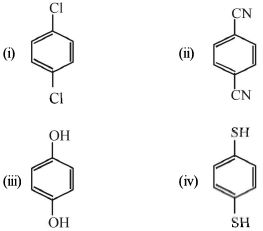
For which of the following molecules is the dipole moment $\mu \ne 0$?
A
Only $(i)$
B
$(i)$ and $(ii)$
C
Only $(iii)$
D
$(iii)$ and $(iv)$
Solution
(D) For $p$-dichlorobenzene $(i)$ and $p$-dicyanobenzene $(ii)$,the dipole moments of the individual bonds cancel each other out because they are equal in magnitude and opposite in direction. Hence,the resultant dipole moment of these molecules is zero.
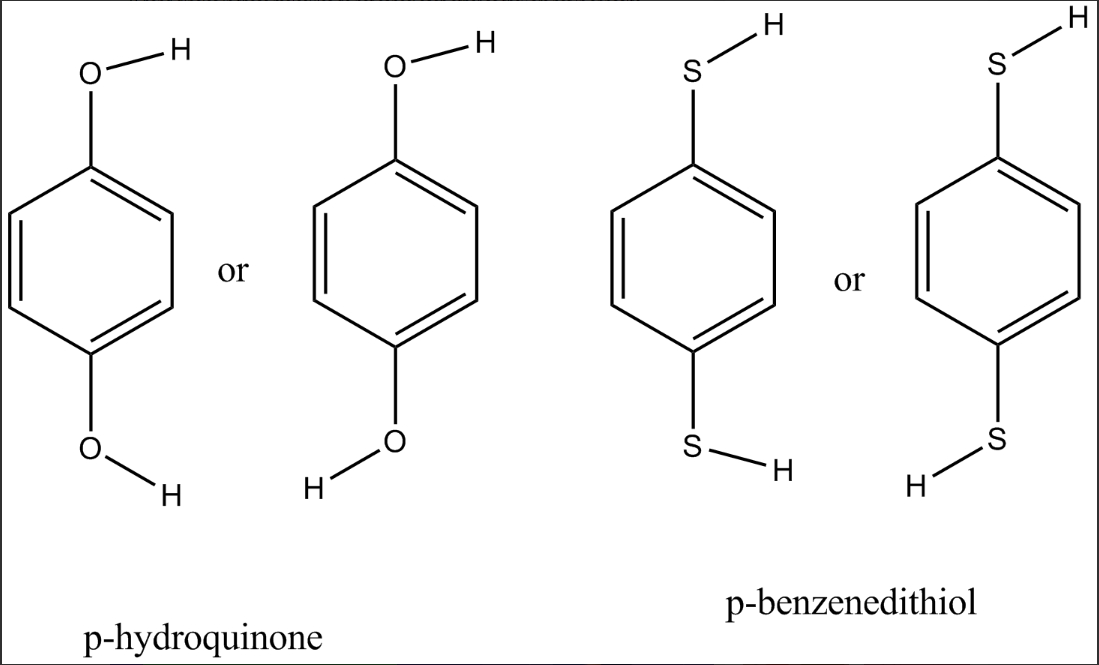
For $p$-hydroquinone $(iii)$ and $p$-benzenedithiol $(iv)$,the $O-H$ and $S-H$ bond dipoles do not cancel each other out because they are not in opposite directions due to the existence of different conformations. Hence,the resultant dipole moment of these molecules is non-zero $(\mu \ne 0)$.
For $p$-hydroquinone $(iii)$ and $p$-benzenedithiol $(iv)$,the $O-H$ and $S-H$ bond dipoles do not cancel each other out because they are not in opposite directions due to the existence of different conformations. Hence,the resultant dipole moment of these molecules is non-zero $(\mu \ne 0)$.
0 likesView Solution
12
ChemistryMediumMCQJEE Main · 2014
If $Z$ is a compressibility factor,the van der Waals equation at low pressure can be written as:
A
$Z=1+ \frac{RT}{pb}$
B
$Z=1 - \frac{a}{VRT}$
C
$Z=1- \frac{pb}{RT}$
D
$Z=1+ \frac{pb}{RT}$
Solution
(B) The van der Waals equation for $1 \ mol$ of a gas is given by:
$(P + \frac{a}{V^2})(V - b) = RT$
At low pressure,the volume $V$ is very large,so $V >> b$. Therefore,the term $(V - b)$ can be approximated as $V$.
The equation simplifies to:
$(P + \frac{a}{V^2})V = RT$
Expanding the equation:
$PV + \frac{a}{V} = RT$
Rearranging to solve for $PV$:
$PV = RT - \frac{a}{V}$
Dividing both sides by $RT$ to express in terms of the compressibility factor $Z = \frac{PV}{RT}$:
$\frac{PV}{RT} = 1 - \frac{a}{VRT}$
Thus,$Z = 1 - \frac{a}{VRT}$.
$(P + \frac{a}{V^2})(V - b) = RT$
At low pressure,the volume $V$ is very large,so $V >> b$. Therefore,the term $(V - b)$ can be approximated as $V$.
The equation simplifies to:
$(P + \frac{a}{V^2})V = RT$
Expanding the equation:
$PV + \frac{a}{V} = RT$
Rearranging to solve for $PV$:
$PV = RT - \frac{a}{V}$
Dividing both sides by $RT$ to express in terms of the compressibility factor $Z = \frac{PV}{RT}$:
$\frac{PV}{RT} = 1 - \frac{a}{VRT}$
Thus,$Z = 1 - \frac{a}{VRT}$.
0 likesView Solution
13
ChemistryMediumMCQJEE Main · 2014
The ratio of masses of oxygen and nitrogen in a particular gaseous mixture is $1 : 4$. The ratio of the number of their molecules is:
A
$1 : 4$
B
$7 : 32$
C
$1 : 8$
D
$3 : 16$
Solution
(B) Let the mass of $O_2$ be $w$ and the mass of $N_2$ be $4w$.
The molar mass of $O_2$ is $32 \ g/mol$ and the molar mass of $N_2$ is $28 \ g/mol$.
The number of molecules is proportional to the number of moles $(n = \frac{\text{mass}}{\text{molar mass}})$.
Number of molecules of $O_2$ $(N_{O_2})$ = $\frac{w}{32} \times N_A$
Number of molecules of $N_2$ $(N_{N_2})$ = $\frac{4w}{28} \times N_A$
Ratio $\frac{N_{O_2}}{N_{N_2}} = \frac{w/32}{4w/28} = \frac{w}{32} \times \frac{28}{4w} = \frac{28}{128} = \frac{7}{32}$.
The molar mass of $O_2$ is $32 \ g/mol$ and the molar mass of $N_2$ is $28 \ g/mol$.
The number of molecules is proportional to the number of moles $(n = \frac{\text{mass}}{\text{molar mass}})$.
Number of molecules of $O_2$ $(N_{O_2})$ = $\frac{w}{32} \times N_A$
Number of molecules of $N_2$ $(N_{N_2})$ = $\frac{4w}{28} \times N_A$
Ratio $\frac{N_{O_2}}{N_{N_2}} = \frac{w/32}{4w/28} = \frac{w}{32} \times \frac{28}{4w} = \frac{28}{128} = \frac{7}{32}$.
0 likesView Solution
14
ChemistryMediumMCQJEE Main · 2014
The standard enthalpy of formation of $NH_3$ is $-46.0 \ kJ \ mol^{-1}.$ If the enthalpy of formation of $H_2$ from its atoms is $-436 \ kJ \ mol^{-1}$ and that of $N_2$ is $-712 \ kJ \ mol^{-1},$ the average bond enthalpy of $N-H$ bond in $NH_3$ is ................ $kJ \ mol^{-1}$
A
$-964$
B
$+352$
C
$+1056$
D
$-1102$
Solution
(B) The reaction for the formation of $2 \ mol$ of $NH_3$ is: $N_2(g) + 3H_2(g) \rightarrow 2NH_3(g)$.
The enthalpy change for this reaction is $\Delta H = 2 \times \Delta_f H^{\circ}(NH_3) = 2 \times (-46.0) = -92 \ kJ \ mol^{-1}$.
Using bond enthalpies,$\Delta H = \sum \text{Bond energies of reactants} - \sum \text{Bond energies of products}$.
Given bond energies (as enthalpy of formation from atoms is negative of bond dissociation energy): $BE(N \equiv N) = 712 \ kJ \ mol^{-1}$ and $BE(H-H) = 436 \ kJ \ mol^{-1}$.
Let $x$ be the bond enthalpy of $N-H$ bond. There are $6$ $N-H$ bonds in $2 \ mol$ of $NH_3$.
$-92 = [BE(N \equiv N) + 3 \times BE(H-H)] - 6x$.
$-92 = [712 + 3 \times 436] - 6x$.
$-92 = [712 + 1308] - 6x$.
$-92 = 2020 - 6x$.
$6x = 2020 + 92 = 2112$.
$x = 2112 / 6 = +352 \ kJ \ mol^{-1}$.
The enthalpy change for this reaction is $\Delta H = 2 \times \Delta_f H^{\circ}(NH_3) = 2 \times (-46.0) = -92 \ kJ \ mol^{-1}$.
Using bond enthalpies,$\Delta H = \sum \text{Bond energies of reactants} - \sum \text{Bond energies of products}$.
Given bond energies (as enthalpy of formation from atoms is negative of bond dissociation energy): $BE(N \equiv N) = 712 \ kJ \ mol^{-1}$ and $BE(H-H) = 436 \ kJ \ mol^{-1}$.
Let $x$ be the bond enthalpy of $N-H$ bond. There are $6$ $N-H$ bonds in $2 \ mol$ of $NH_3$.
$-92 = [BE(N \equiv N) + 3 \times BE(H-H)] - 6x$.
$-92 = [712 + 3 \times 436] - 6x$.
$-92 = [712 + 1308] - 6x$.
$-92 = 2020 - 6x$.
$6x = 2020 + 92 = 2112$.
$x = 2112 / 6 = +352 \ kJ \ mol^{-1}$.
0 likesView Solution
15
ChemistryDifficultMCQJEE Main · 2014
For the complete combustion of ethanol,$C_2H_5OH_{(l)} + 3O_{2(g)} \rightarrow 2CO_{2(g)} + 3H_2O_{(l)}$,the amount of heat produced as measured in a bomb calorimeter is $1364.47 \ kJ \ mol^{-1}$ at $25 \ ^oC$. Assuming ideality,the enthalpy of combustion,$\Delta_cH$,for the reaction will be: $(R = 8.314 \ J \ K^{-1} \ mol^{-1})$ .....$kJ \ mol^{-1}$
A
$-1366.95$
B
$-1361.95$
C
$-1460.95$
D
$-1350.50$
Solution
(A) The reaction is: $C_2H_5OH_{(l)} + 3O_{2(g)} \rightarrow 2CO_{2(g)} + 3H_2O_{(l)}$
Given internal energy change $\Delta U = -1364.47 \ kJ \ mol^{-1}$ (heat released in bomb calorimeter).
Temperature $T = 25 + 273 = 298 \ K$.
Change in moles of gaseous species $\Delta n_g = (n_{products, gas} - n_{reactants, gas}) = 2 - 3 = -1$.
Gas constant $R = 8.314 \ J \ K^{-1} \ mol^{-1} = 8.314 \times 10^{-3} \ kJ \ K^{-1} \ mol^{-1}$.
The relationship between enthalpy change and internal energy change is $\Delta H = \Delta U + \Delta n_g RT$.
Substituting the values: $\Delta H = -1364.47 + (-1 \times 8.314 \times 10^{-3} \times 298)$.
$\Delta H = -1364.47 - 2.477572 \approx -1366.95 \ kJ \ mol^{-1}$.
Given internal energy change $\Delta U = -1364.47 \ kJ \ mol^{-1}$ (heat released in bomb calorimeter).
Temperature $T = 25 + 273 = 298 \ K$.
Change in moles of gaseous species $\Delta n_g = (n_{products, gas} - n_{reactants, gas}) = 2 - 3 = -1$.
Gas constant $R = 8.314 \ J \ K^{-1} \ mol^{-1} = 8.314 \times 10^{-3} \ kJ \ K^{-1} \ mol^{-1}$.
The relationship between enthalpy change and internal energy change is $\Delta H = \Delta U + \Delta n_g RT$.
Substituting the values: $\Delta H = -1364.47 + (-1 \times 8.314 \times 10^{-3} \times 298)$.
$\Delta H = -1364.47 - 2.477572 \approx -1366.95 \ kJ \ mol^{-1}$.
0 likesView Solution
16
ChemistryMediumMCQJEE Main · 2014
For the reaction $SO_{2(g)} + \frac{1}{2} O_{2(g)} \rightleftharpoons SO_{3(g)},$ if $K_P = K_C (RT)^x$ where the symbols have usual meaning,then the value of $x$ is (assuming ideality):
A
$-1$
B
$-0.5$
C
$0.5$
D
$1$
Solution
(B) The relationship between $K_P$ and $K_C$ is given by $K_P = K_C(RT)^{\Delta n_g}$.
For the reaction $SO_{2(g)} + \frac{1}{2} O_{2(g)} \rightleftharpoons SO_{3(g)}$,the change in the number of gaseous moles is calculated as $\Delta n_g = n_{p(g)} - n_{r(g)}$.
Here,$n_{p(g)} = 1$ (for $SO_3$) and $n_{r(g)} = 1 + 0.5 = 1.5$ (for $SO_2$ and $O_2$).
Therefore,$\Delta n_g = 1 - 1.5 = -0.5$.
Comparing this with the given equation $K_P = K_C(RT)^x$,we get $x = -0.5$.
For the reaction $SO_{2(g)} + \frac{1}{2} O_{2(g)} \rightleftharpoons SO_{3(g)}$,the change in the number of gaseous moles is calculated as $\Delta n_g = n_{p(g)} - n_{r(g)}$.
Here,$n_{p(g)} = 1$ (for $SO_3$) and $n_{r(g)} = 1 + 0.5 = 1.5$ (for $SO_2$ and $O_2$).
Therefore,$\Delta n_g = 1 - 1.5 = -0.5$.
Comparing this with the given equation $K_P = K_C(RT)^x$,we get $x = -0.5$.
1 likesView Solution
17
ChemistryEasyMCQJEE Main · 2014
In which of the following reactions does $H_2O_2$ act as a reducing agent?
A
$H_2O_2 + 2H^+ + 2e^- \rightarrow 2H_2O$
B
$H_2O_2 + 2H^+ + 2e^- \rightarrow 2H_2O$ (Note: This is an oxidizing reaction)
C
$H_2O_2 + 2e^- \rightarrow 2OH^-$
D
$H_2O_2 + 2OH^- \rightarrow O_2 + 2H_2O + 2e^-$
Solution
(D) reducing agent is a substance that undergoes oxidation by losing electrons.
In the reaction $H_2O_2 + 2OH^- \rightarrow O_2 + 2H_2O + 2e^-$,the oxidation state of oxygen in $H_2O_2$ increases from $-1$ to $0$ in $O_2$.
Since $H_2O_2$ loses electrons and is oxidized,it acts as a reducing agent.
In the reaction $H_2O_2 + 2OH^- \rightarrow O_2 + 2H_2O + 2e^-$,the oxidation state of oxygen in $H_2O_2$ increases from $-1$ to $0$ in $O_2$.
Since $H_2O_2$ loses electrons and is oxidized,it acts as a reducing agent.
0 likesView Solution
18
ChemistryDifficultMCQJEE Main · 2014
For the estimation of nitrogen,$1.4 \ g$ of an organic compound was digested by Kjeldahl method and the evolved ammonia was absorbed in $60 \ mL$ of $\frac{M}{10}$ sulphuric acid. The unreacted acid required $20 \ mL$ of $\frac{M}{10}$ sodium hydroxide for complete neutralization. The percentage of nitrogen in the compound is .....$\%$
A
$6$
B
$10$
C
$3$
D
$5$
Solution
(B) The formula for the percentage of nitrogen is: $\% \ N = \frac{1.4 \times \text{meq. of acid consumed}}{\text{mass of organic compound}}$
Step $1$: Calculate milliequivalents $(meq)$ of $H_2SO_4$ taken:
$meq \text{ of } H_2SO_4 = 60 \ mL \times \frac{1}{10} \ M \times 2 \text{ (basicity)} = 12 \ meq$
Step $2$: Calculate $meq$ of $NaOH$ used for back titration:
$meq \text{ of } NaOH = 20 \ mL \times \frac{1}{10} \ M \times 1 \text{ (acidity)} = 2 \ meq$
Step $3$: Calculate $meq$ of acid consumed by ammonia:
$meq \text{ of acid consumed} = 12 - 2 = 10 \ meq$
Step $4$: Calculate percentage of nitrogen:
$\% \ N = \frac{1.4 \times 10}{1.4} = 10 \%$
Step $1$: Calculate milliequivalents $(meq)$ of $H_2SO_4$ taken:
$meq \text{ of } H_2SO_4 = 60 \ mL \times \frac{1}{10} \ M \times 2 \text{ (basicity)} = 12 \ meq$
Step $2$: Calculate $meq$ of $NaOH$ used for back titration:
$meq \text{ of } NaOH = 20 \ mL \times \frac{1}{10} \ M \times 1 \text{ (acidity)} = 2 \ meq$
Step $3$: Calculate $meq$ of acid consumed by ammonia:
$meq \text{ of acid consumed} = 12 - 2 = 10 \ meq$
Step $4$: Calculate percentage of nitrogen:
$\% \ N = \frac{1.4 \times 10}{1.4} = 10 \%$
1 likesView Solution
19
ChemistryMediumMCQJEE Main · 2014
The correct statement for the molecule,$CsI_3$ is:
A
It is a covalent molecule.
B
It contains $Cs^{+}$ and $I_3^{-}$ ions.
C
It contains $Cs^{3+}$ and $I^{-}$ ions.
D
It contains $Cs^{+}, I^{-}$ and lattice $I_2$ molecule.
Solution
(B) $CsI_3$ is an ionic compound that dissociates in the solid state as $CsI_3 \rightarrow Cs^{+} + I_3^{-}$.
Here,$Cs^{+}$ is the cesium cation and $I_3^{-}$ is the triiodide anion.
Here,$Cs^{+}$ is the cesium cation and $I_3^{-}$ is the triiodide anion.
0 likesView Solution
20
ChemistryDifficultMCQJEE Main · 2014
The major organic compound formed by the reaction of $1, 1, 1-$trichloroethane with silver powder is:
A
Acetylene
B
Ethene
C
$2-$Butyne
D
$2-$Butene
Solution
(C) The reaction of $1, 1, 1-$trichloroethane $(CH_3-CCl_3)$ with silver powder $(Ag)$ is a dehalogenation reaction.
When $2$ moles of $1, 1, 1-$trichloroethane react with $6$ moles of silver powder,it undergoes coupling to form $2-$butyne.
The chemical equation is: $2 CH_3-CCl_3 + 6 Ag \rightarrow CH_3-C \equiv C-CH_3 + 6 AgCl$.
When $2$ moles of $1, 1, 1-$trichloroethane react with $6$ moles of silver powder,it undergoes coupling to form $2-$butyne.
The chemical equation is: $2 CH_3-CCl_3 + 6 Ag \rightarrow CH_3-C \equiv C-CH_3 + 6 AgCl$.
0 likesView Solution
21
ChemistryMCQJEE Main · 2014
The current-voltage relation of a diode is given by $I = (e^{1000V/T} - 1) \text{ mA}$,where the applied voltage $V$ is in volts and the temperature $T$ is in Kelvin. If a student makes an error of $\mp 0.01 \text{ V}$ while measuring a current of $5 \text{ mA}$ at a temperature of $300 \text{ K}$,what will be the error in the measurement of the current in $\text{ mA}$?
A
$0.02$
B
$0.5$
C
$0.05$
D
$0.2$
Solution
(D) Given the equation: $I = (e^{1000V/T} - 1) \text{ mA}$.
At $I = 5 \text{ mA}$,we have $5 = e^{1000V/T} - 1$,which implies $e^{1000V/T} = 6$.
Differentiating the current $I$ with respect to voltage $V$:
$\frac{dI}{dV} = e^{1000V/T} \cdot \frac{1000}{T}$.
Substituting the value of $e^{1000V/T} = 6$ and $T = 300 \text{ K}$:
$\frac{dI}{dV} = 6 \cdot \frac{1000}{300} = 6 \cdot \frac{10}{3} = 20 \text{ mA/V}$.
The error in current $\Delta I$ is given by $\Delta I = \left| \frac{dI}{dV} \right| \cdot \Delta V$.
Given $\Delta V = 0.01 \text{ V}$,we get:
$\Delta I = 20 \cdot 0.01 = 0.2 \text{ mA}$.
At $I = 5 \text{ mA}$,we have $5 = e^{1000V/T} - 1$,which implies $e^{1000V/T} = 6$.
Differentiating the current $I$ with respect to voltage $V$:
$\frac{dI}{dV} = e^{1000V/T} \cdot \frac{1000}{T}$.
Substituting the value of $e^{1000V/T} = 6$ and $T = 300 \text{ K}$:
$\frac{dI}{dV} = 6 \cdot \frac{1000}{300} = 6 \cdot \frac{10}{3} = 20 \text{ mA/V}$.
The error in current $\Delta I$ is given by $\Delta I = \left| \frac{dI}{dV} \right| \cdot \Delta V$.
Given $\Delta V = 0.01 \text{ V}$,we get:
$\Delta I = 20 \cdot 0.01 = 0.2 \text{ mA}$.
0 likesView Solution
22
ChemistryMCQJEE Main · 2014
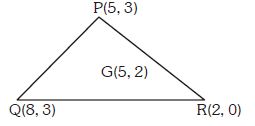
Given three points $P, Q, R$ with $P(5, 3)$ and $R$ lies on the $x-$ axis. If the equation of $RQ$ is $x - 2y = 2$ and $PQ$ is parallel to the $x-$ axis,then the centroid of $\Delta PQR$ lies on the line
A
$x - 2y + 1 = 0$
B
$2x + y - 9 = 0$
C
$2x - 5y = 0$
D
$5x - 2y = 0$
Solution
(C) $1$. Given $P = (5, 3)$. Since $PQ$ is parallel to the $x-$ axis,the $y-$ coordinate of $Q$ is the same as $P$,so $Q = (x_Q, 3)$.
$2$. $Q$ lies on the line $RQ: x - 2y = 2$. Substituting $y = 3$,we get $x - 2(3) = 2$,which implies $x - 6 = 2$,so $x = 8$. Thus,$Q = (8, 3)$.
$3$. $R$ lies on the $x-$ axis,so its $y-$ coordinate is $0$. Let $R = (x_R, 0)$. Since $R$ lies on $x - 2y = 2$,we have $x_R - 2(0) = 2$,so $x_R = 2$. Thus,$R = (2, 0)$.
$4$. The centroid $G$ of $\Delta PQR$ is given by $(\frac{x_P + x_Q + x_R}{3}, \frac{y_P + y_Q + y_R}{3}) = (\frac{5 + 8 + 2}{3}, \frac{3 + 3 + 0}{3}) = (5, 2)$.
$5$. We check which line equation is satisfied by $(5, 2)$:
- For $A: 5 - 2(2) + 1 = 5 - 4 + 1 = 2 \neq 0$.
- For $B: 2(5) + 2 - 9 = 10 + 2 - 9 = 3 \neq 0$.
- For $C: 2(5) - 5(2) = 10 - 10 = 0$. This is satisfied.
- For $D: 5(5) - 2(2) = 25 - 4 = 21 \neq 0$.
$6$. Therefore,the centroid lies on the line $2x - 5y = 0$.
$2$. $Q$ lies on the line $RQ: x - 2y = 2$. Substituting $y = 3$,we get $x - 2(3) = 2$,which implies $x - 6 = 2$,so $x = 8$. Thus,$Q = (8, 3)$.
$3$. $R$ lies on the $x-$ axis,so its $y-$ coordinate is $0$. Let $R = (x_R, 0)$. Since $R$ lies on $x - 2y = 2$,we have $x_R - 2(0) = 2$,so $x_R = 2$. Thus,$R = (2, 0)$.
$4$. The centroid $G$ of $\Delta PQR$ is given by $(\frac{x_P + x_Q + x_R}{3}, \frac{y_P + y_Q + y_R}{3}) = (\frac{5 + 8 + 2}{3}, \frac{3 + 3 + 0}{3}) = (5, 2)$.
$5$. We check which line equation is satisfied by $(5, 2)$:
- For $A: 5 - 2(2) + 1 = 5 - 4 + 1 = 2 \neq 0$.
- For $B: 2(5) + 2 - 9 = 10 + 2 - 9 = 3 \neq 0$.
- For $C: 2(5) - 5(2) = 10 - 10 = 0$. This is satisfied.
- For $D: 5(5) - 2(2) = 25 - 4 = 21 \neq 0$.
$6$. Therefore,the centroid lies on the line $2x - 5y = 0$.
0 likesView Solution
23
ChemistryMCQJEE Main · 2014
The variance of the first $50$ even natural numbers is
A
$437$
B
$\frac{437}{4}$
C
$\frac{833}{4}$
D
$833$
Solution
(D) The first $50$ even natural numbers are $2, 4, 6, \ldots, 100$.
These can be written as $2(1), 2(2), 2(3), \ldots, 2(50)$.
The variance of a set of numbers $x_i$ multiplied by a constant $k$ is given by $\text{Var}(kx_i) = k^2 \text{Var}(x_i)$.
Here,$k = 2$ and the set is the first $50$ natural numbers $(1, 2, 3, \ldots, 50)$.
The variance of the first $n$ natural numbers is $\frac{n^2 - 1}{12}$.
For $n = 50$,$\text{Var} = \frac{50^2 - 1}{12} = \frac{2500 - 1}{12} = \frac{2499}{12}$.
Therefore,the variance of the first $50$ even natural numbers is $2^2 \times \frac{2499}{12} = 4 \times \frac{2499}{12} = \frac{2499}{3} = 833$.
These can be written as $2(1), 2(2), 2(3), \ldots, 2(50)$.
The variance of a set of numbers $x_i$ multiplied by a constant $k$ is given by $\text{Var}(kx_i) = k^2 \text{Var}(x_i)$.
Here,$k = 2$ and the set is the first $50$ natural numbers $(1, 2, 3, \ldots, 50)$.
The variance of the first $n$ natural numbers is $\frac{n^2 - 1}{12}$.
For $n = 50$,$\text{Var} = \frac{50^2 - 1}{12} = \frac{2500 - 1}{12} = \frac{2499}{12}$.
Therefore,the variance of the first $50$ even natural numbers is $2^2 \times \frac{2499}{12} = 4 \times \frac{2499}{12} = \frac{2499}{3} = 833$.
0 likesView Solution
24
ChemistryMCQJEE Main · 2014
Zirconium phosphate $[Zr_3(PO_4)_4]$ dissociates into three zirconium cations of charge $+4$ and four phosphate anions of charge $-3$. If molar solubility of zirconium phosphate is denoted by $S$ and its solubility product by $K_{sp}$,then which of the following relationships between $S$ and $K_{sp}$ is correct?
A
$S = \{ K_{sp} / 144 \}^{1/7}$
B
$S = \{ K_{sp} / (6912)^7 \}$
C
$S = (K_{sp} / 6912)^{1/7}$
D
$S = \{ K_{sp} / 6912 \}^7$
Solution
(C) The dissociation of zirconium phosphate is given by:
$Zr_3(PO_4)_4 (s) \rightleftharpoons 3 Zr^{4+} (aq) + 4 PO_4^{3-} (aq)$
If $S$ is the molar solubility,then $[Zr^{4+}] = 3S$ and $[PO_4^{3-}] = 4S$.
The solubility product expression is:
$K_{sp} = [Zr^{4+}]^3 [PO_4^{3-}]^4$
$K_{sp} = (3S)^3 (4S)^4$
$K_{sp} = (27 S^3) (256 S^4)$
$K_{sp} = 6912 S^7$
Therefore,$S^7 = K_{sp} / 6912$
$S = (K_{sp} / 6912)^{1/7}$
$Zr_3(PO_4)_4 (s) \rightleftharpoons 3 Zr^{4+} (aq) + 4 PO_4^{3-} (aq)$
If $S$ is the molar solubility,then $[Zr^{4+}] = 3S$ and $[PO_4^{3-}] = 4S$.
The solubility product expression is:
$K_{sp} = [Zr^{4+}]^3 [PO_4^{3-}]^4$
$K_{sp} = (3S)^3 (4S)^4$
$K_{sp} = (27 S^3) (256 S^4)$
$K_{sp} = 6912 S^7$
Therefore,$S^7 = K_{sp} / 6912$
$S = (K_{sp} / 6912)^{1/7}$
0 likesView Solution
25
ChemistryMCQJEE Main · 2014
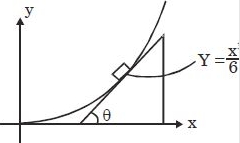
$A$ block of mass $m$ is placed on a surface with a vertical cross-section given by $y = \frac{x^3}{6}$. If the coefficient of friction is $0.5$,the maximum height above the ground at which the block can be placed without slipping is
A
$\frac{1}{6} \text{ m}$
B
$\frac{2}{3} \text{ m}$
C
$\frac{1}{3} \text{ m}$
D
$\frac{1}{2} \text{ m}$
Solution
(A) The slope of the tangent to the curve at any point is given by $\tan \theta = \frac{dy}{dx}$.
Given $y = \frac{x^3}{6}$,we have $\frac{dy}{dx} = \frac{3x^2}{6} = \frac{x^2}{2}$.
Thus,$\tan \theta = \frac{x^2}{2}$.
For the block to remain in equilibrium without slipping,the condition is $\mu \ge \tan \theta$.
The maximum height corresponds to the limiting case where $\mu = \tan \theta$.
Given $\mu = 0.5 = \frac{1}{2}$,we set $\frac{1}{2} = \frac{x^2}{2}$,which gives $x^2 = 1$,so $x = 1 \text{ m}$.
Substituting $x = 1$ into the equation for $y$,we get the maximum height:
$y = \frac{(1)^3}{6} = \frac{1}{6} \text{ m}$.
Given $y = \frac{x^3}{6}$,we have $\frac{dy}{dx} = \frac{3x^2}{6} = \frac{x^2}{2}$.
Thus,$\tan \theta = \frac{x^2}{2}$.
For the block to remain in equilibrium without slipping,the condition is $\mu \ge \tan \theta$.
The maximum height corresponds to the limiting case where $\mu = \tan \theta$.
Given $\mu = 0.5 = \frac{1}{2}$,we set $\frac{1}{2} = \frac{x^2}{2}$,which gives $x^2 = 1$,so $x = 1 \text{ m}$.
Substituting $x = 1$ into the equation for $y$,we get the maximum height:
$y = \frac{(1)^3}{6} = \frac{1}{6} \text{ m}$.
0 likesView Solution
26
ChemistryMCQJEE Main · 2014
$A$ chloro compound of vanadium has a spin-only magnetic moment of $1.73 \ BM$. This vanadium chloride has the formula: (Atomic number of $V = 23$)
A
$VCl_4$
B
$VCl_3$
C
$VCl_2$
D
$VCl_5$
Solution
(A) The spin-only magnetic moment is given by the formula $\mu = \sqrt{n(n+2)} \ BM$,where $n$ is the number of unpaired electrons.
Given $\sqrt{n(n+2)} = 1.73$,which corresponds to $n = 1$.
The electronic configuration of vanadium $(V)$ is $[Ar] 3d^3 4s^2$.
To have $n = 1$ unpaired electron,vanadium must be in the $+4$ oxidation state $(V^{4+})$,which has the configuration $[Ar] 3d^1$.
Therefore,the compound is $VCl_4$.
Given $\sqrt{n(n+2)} = 1.73$,which corresponds to $n = 1$.
The electronic configuration of vanadium $(V)$ is $[Ar] 3d^3 4s^2$.
To have $n = 1$ unpaired electron,vanadium must be in the $+4$ oxidation state $(V^{4+})$,which has the configuration $[Ar] 3d^1$.
Therefore,the compound is $VCl_4$.
0 likesView Solution
27
ChemistryDifficultMCQJEE Main · 2014
Van der Waals equation for a gas is stated as,
$p = \frac{nRT}{V - nb} - a\left( \frac{n}{V} \right)^2$
This equation reduces to the perfect gas equation,$p = \frac{nRT}{V}$,when:
$p = \frac{nRT}{V - nb} - a\left( \frac{n}{V} \right)^2$
This equation reduces to the perfect gas equation,$p = \frac{nRT}{V}$,when:
A
temperature is sufficiently high and pressure is low
B
temperature is sufficiently low and pressure is high
C
both temperature and pressure are very high
D
both temperature and pressure are very low
Solution
(A) The Van der Waals equation is given by $\left( P + \frac{n^2a}{V^2} \right)(V - nb) = nRT$.
At low pressure,the volume $V$ is very large,making the correction term $\frac{n^2a}{V^2}$ negligible compared to $P$.
At high temperature,the volume $V$ is also large,making the correction term $nb$ negligible compared to $V$.
Under these conditions,the equation simplifies to $PV = nRT$,which is the ideal gas equation.
At low pressure,the volume $V$ is very large,making the correction term $\frac{n^2a}{V^2}$ negligible compared to $P$.
At high temperature,the volume $V$ is also large,making the correction term $nb$ negligible compared to $V$.
Under these conditions,the equation simplifies to $PV = nRT$,which is the ideal gas equation.
0 likesView Solution
28
ChemistryDifficultMCQJEE Main · 2014
At a certain temperature,only $50\%$ $HI$ is dissociated into $H_2$ and $I_2$ at equilibrium. The equilibrium constant is:
A
$0.25$
B
$3$
C
$0.5$
D
$1$
Solution
(A) The dissociation reaction of $HI$ is:
$2HI_{(g)} \rightleftharpoons H_{2(g)} + I_{2(g)}$
Let the initial moles of $HI$ be $1$.
Degree of dissociation $\alpha = 50\% = 0.5$.
At equilibrium:
Moles of $HI = 1 - \alpha = 1 - 0.5 = 0.5$
Moles of $H_2 = \frac{\alpha}{2} = \frac{0.5}{2} = 0.25$
Moles of $I_2 = \frac{\alpha}{2} = \frac{0.5}{2} = 0.25$
The equilibrium constant $K_c$ is given by:
$K_c = \frac{[H_2][I_2]}{[HI]^2}$
Since the number of moles on both sides is the same,volume $V$ cancels out.
$K_c = \frac{0.25 \times 0.25}{(0.5)^2} = \frac{0.0625}{0.25} = 0.25$
$2HI_{(g)} \rightleftharpoons H_{2(g)} + I_{2(g)}$
Let the initial moles of $HI$ be $1$.
Degree of dissociation $\alpha = 50\% = 0.5$.
At equilibrium:
Moles of $HI = 1 - \alpha = 1 - 0.5 = 0.5$
Moles of $H_2 = \frac{\alpha}{2} = \frac{0.5}{2} = 0.25$
Moles of $I_2 = \frac{\alpha}{2} = \frac{0.5}{2} = 0.25$
The equilibrium constant $K_c$ is given by:
$K_c = \frac{[H_2][I_2]}{[HI]^2}$
Since the number of moles on both sides is the same,volume $V$ cancels out.
$K_c = \frac{0.25 \times 0.25}{(0.5)^2} = \frac{0.0625}{0.25} = 0.25$
0 likesView Solution
29
ChemistryDifficultMCQJEE Main · 2014
Dissolving $120 \ g$ of a compound (mol. wt. $60$) in $1000 \ g$ of water gave a solution of density $1.12 \ g/mL$. The molarity of the solution is ............ $M$.
A
$1$
B
$2$
C
$2.50$
D
$4$
Solution
(B) Given:
Mass of solute $(w) = 120 \ g$
Mass of solvent $= 1000 \ g$
Molar mass of solute $(M_w) = 60 \ g/mol$
Density of solution $(d) = 1.12 \ g/mL$
Total mass of solution $= 1000 \ g + 120 \ g = 1120 \ g$
Volume of solution $(V) = \frac{\text{Mass of solution}}{d} = \frac{1120 \ g}{1.12 \ g/mL} = 1000 \ mL = 1 \ L$
Moles of solute $(n) = \frac{w}{M_w} = \frac{120 \ g}{60 \ g/mol} = 2 \ mol$
Molarity $(M) = \frac{n}{V(L)} = \frac{2 \ mol}{1 \ L} = 2 \ M$
Mass of solute $(w) = 120 \ g$
Mass of solvent $= 1000 \ g$
Molar mass of solute $(M_w) = 60 \ g/mol$
Density of solution $(d) = 1.12 \ g/mL$
Total mass of solution $= 1000 \ g + 120 \ g = 1120 \ g$
Volume of solution $(V) = \frac{\text{Mass of solution}}{d} = \frac{1120 \ g}{1.12 \ g/mL} = 1000 \ mL = 1 \ L$
Moles of solute $(n) = \frac{w}{M_w} = \frac{120 \ g}{60 \ g/mol} = 2 \ mol$
Molarity $(M) = \frac{n}{V(L)} = \frac{2 \ mol}{1 \ L} = 2 \ M$
0 likesView Solution
30
ChemistryEasyMCQJEE Main · 2014
The energy of an electron in the first Bohr orbit of $H$ atom is $-13.6 \ eV$. The energy value of an electron in the first excited state of $Li^{2+}$ is ............... $eV$.
A
$-27.2$
B
$30.6$
C
$-30.6$
D
$27.2$
Solution
(C) The energy of an electron in a hydrogen-like species is given by the formula $E_n = -13.6 \times \frac{Z^2}{n^2} \ eV$.
For $Li^{2+}$ ion,the atomic number $Z = 3$.
The first excited state corresponds to $n = 2$.
Substituting these values into the formula:
$E_2 = -13.6 \times \frac{3^2}{2^2} \ eV$
$E_2 = -13.6 \times \frac{9}{4} \ eV$
$E_2 = -13.6 \times 2.25 \ eV = -30.6 \ eV$.
For $Li^{2+}$ ion,the atomic number $Z = 3$.
The first excited state corresponds to $n = 2$.
Substituting these values into the formula:
$E_2 = -13.6 \times \frac{3^2}{2^2} \ eV$
$E_2 = -13.6 \times \frac{9}{4} \ eV$
$E_2 = -13.6 \times 2.25 \ eV = -30.6 \ eV$.
0 likesView Solution
31
ChemistryDifficultMCQJEE Main · 2014
The temperature at which oxygen molecules have the same root mean square speed as helium atoms have at $300 \ K$ is (Atomic masses: $He = 4 \ u$,$O = 16 \ u$) (in $K$)
A
$300$
B
$600$
C
$1200$
D
$2400$
Solution
(D) The root mean square speed $(V_{rms})$ is given by the formula $V_{rms} = \sqrt{\frac{3RT}{M}}$.
Given that $V_{rms(O_2)} = V_{rms(He)}$,we equate the expressions:
$\sqrt{\frac{3RT_{O_2}}{M_{O_2}}} = \sqrt{\frac{3RT_{He}}{M_{He}}}$
Squaring both sides and simplifying,we get $\frac{T_{O_2}}{M_{O_2}} = \frac{T_{He}}{M_{He}}$.
Here,$M_{O_2} = 32 \ g/mol$,$M_{He} = 4 \ g/mol$,and $T_{He} = 300 \ K$.
Substituting the values: $\frac{T_{O_2}}{32} = \frac{300}{4}$.
$T_{O_2} = \frac{300 \times 32}{4} = 300 \times 8 = 2400 \ K$.
Given that $V_{rms(O_2)} = V_{rms(He)}$,we equate the expressions:
$\sqrt{\frac{3RT_{O_2}}{M_{O_2}}} = \sqrt{\frac{3RT_{He}}{M_{He}}}$
Squaring both sides and simplifying,we get $\frac{T_{O_2}}{M_{O_2}} = \frac{T_{He}}{M_{He}}$.
Here,$M_{O_2} = 32 \ g/mol$,$M_{He} = 4 \ g/mol$,and $T_{He} = 300 \ K$.
Substituting the values: $\frac{T_{O_2}}{32} = \frac{300}{4}$.
$T_{O_2} = \frac{300 \times 32}{4} = 300 \times 8 = 2400 \ K$.
0 likesView Solution
32
ChemistryDifficultMCQJEE Main · 2014
The standard enthalpy of formation of $NH_3$ is $-46.0 \, kJ/mol$. If the enthalpy of formation of $H_2$ from its atoms is $-436 \, kJ/mol$ and that of $N_2$ is $-712 \, kJ/mol$,the average bond enthalpy of $N-H$ bond in $NH_3$ is......$kJ/mol$
A
$-1102$
B
$-391$
C
$+352$
D
$+1056$
Solution
(C) The formation reaction is: $\frac{1}{2} N_2(g) + \frac{3}{2} H_2(g) \rightarrow NH_3(g)$; $\Delta H_f = -46.0 \, kJ/mol$.
Bond dissociation energies are the negative of the enthalpy of formation from atoms:
$BE(N \equiv N) = +712 \, kJ/mol$
$BE(H-H) = +436 \, kJ/mol$.
Using the formula:
$\Delta H_f = [\frac{1}{2} BE(N \equiv N) + \frac{3}{2} BE(H-H)] - [3 \times BE(N-H)]$.
Substituting the values:
$-46.0 = [\frac{1}{2}(712) + \frac{3}{2}(436)] - 3 \times BE(N-H)$.
$-46.0 = [356 + 654] - 3 \times BE(N-H)$.
$-46.0 = 1010 - 3 \times BE(N-H)$.
$3 \times BE(N-H) = 1010 + 46 = 1056$.
$BE(N-H) = 1056 / 3 = 352 \, kJ/mol$.
Bond dissociation energies are the negative of the enthalpy of formation from atoms:
$BE(N \equiv N) = +712 \, kJ/mol$
$BE(H-H) = +436 \, kJ/mol$.
Using the formula:
$\Delta H_f = [\frac{1}{2} BE(N \equiv N) + \frac{3}{2} BE(H-H)] - [3 \times BE(N-H)]$.
Substituting the values:
$-46.0 = [\frac{1}{2}(712) + \frac{3}{2}(436)] - 3 \times BE(N-H)$.
$-46.0 = [356 + 654] - 3 \times BE(N-H)$.
$-46.0 = 1010 - 3 \times BE(N-H)$.
$3 \times BE(N-H) = 1010 + 46 = 1056$.
$BE(N-H) = 1056 / 3 = 352 \, kJ/mol$.
1 likesView Solution
33
ChemistryMediumMCQJEE Main · 2014
The amount of oxygen in $3.6 \, \text{moles}$ of water is ............ $g$.
A
$115.2$
B
$57.6$
C
$28.8$
D
$18.4$
Solution
(B) $1 \, \text{mole}$ of $H_2O$ contains $1 \, \text{mole}$ of oxygen atoms,which is $16 \, g$ of oxygen.
$\therefore$ $3.6 \, \text{moles}$ of $H_2O$ contains $3.6 \times 16 \, g$ of oxygen.
$= 57.6 \, g$.
$\therefore$ $3.6 \, \text{moles}$ of $H_2O$ contains $3.6 \times 16 \, g$ of oxygen.
$= 57.6 \, g$.
0 likesView Solution
34
ChemistryMCQJEE Main · 2014
$A$ chloro compound of Vanadium has a spin-only magnetic moment of $1.73 \, BM$. This Vanadium chloride has the formula:
A
$VCl_2$
B
$VCl_4$
C
$VCl_3$
D
$VCl_5$
Solution
(B) The spin-only magnetic moment is given by the formula $\mu = \sqrt{n(n + 2)} \, BM$,where $n$ is the number of unpaired electrons.
Given $\mu = 1.73 \, BM$,we have $1.73 = \sqrt{n(n + 2)}$.
Squaring both sides,$3 = n(n + 2)$,which gives $n^2 + 2n - 3 = 0$.
Solving for $n$,we get $(n + 3)(n - 1) = 0$,so $n = 1$.
Vanadium $(Z = 23)$ has the electronic configuration $[Ar] 3d^3 4s^2$.
For $n = 1$ (one unpaired electron),Vanadium must be in the $+4$ oxidation state $(V^{4+})$,which has the configuration $[Ar] 3d^1$.
Therefore,the formula of the chloride is $VCl_4$.
Given $\mu = 1.73 \, BM$,we have $1.73 = \sqrt{n(n + 2)}$.
Squaring both sides,$3 = n(n + 2)$,which gives $n^2 + 2n - 3 = 0$.
Solving for $n$,we get $(n + 3)(n - 1) = 0$,so $n = 1$.
Vanadium $(Z = 23)$ has the electronic configuration $[Ar] 3d^3 4s^2$.
For $n = 1$ (one unpaired electron),Vanadium must be in the $+4$ oxidation state $(V^{4+})$,which has the configuration $[Ar] 3d^1$.
Therefore,the formula of the chloride is $VCl_4$.
0 likesView Solution
35
ChemistryMediumMCQJEE Main · 2014
Which of the following is not formed when $H_2S$ reacts with acidic $K_2Cr_2O_7$ solution?
A
$CrSO_4$
B
$Cr_2(SO_4)_3$
C
$K_2SO_4$
D
$S$
Solution
(A) The balanced chemical equation for the reaction between acidic $K_2Cr_2O_7$ and $H_2S$ is:
$K_2Cr_2O_7 + 4H_2SO_4 + 3H_2S \longrightarrow K_2SO_4 + Cr_2(SO_4)_3 + 7H_2O + 3S$
In this redox reaction,the dichromate ion is reduced to chromium$(III)$ sulfate $(Cr_2(SO_4)_3)$,and $H_2S$ is oxidized to elemental sulfur $(S)$.
$K_2SO_4$ is also formed as a byproduct.
$CrSO_4$ (chromium$(II)$ sulfate) is not formed in this reaction.
$K_2Cr_2O_7 + 4H_2SO_4 + 3H_2S \longrightarrow K_2SO_4 + Cr_2(SO_4)_3 + 7H_2O + 3S$
In this redox reaction,the dichromate ion is reduced to chromium$(III)$ sulfate $(Cr_2(SO_4)_3)$,and $H_2S$ is oxidized to elemental sulfur $(S)$.
$K_2SO_4$ is also formed as a byproduct.
$CrSO_4$ (chromium$(II)$ sulfate) is not formed in this reaction.
0 likesView Solution
36
ChemistryDifficultMCQJEE Main · 2014
Which of the following has unpaired electron$(s)$?
A
$N_2$
B
$O_2^-$
C
$N_2^{2+}$
D
$O_2^{2-}$
Solution
(B) The molecular orbital configuration for $O_2^-$ (total $17$ electrons) is: $KK(\sigma 2s)^2(\sigma^* 2s)^2(\sigma 2p_x)^2(\pi 2p_y)^2(\pi 2p_z)^2(\pi^* 2p_y)^2(\pi^* 2p_z)^1$.
Since there is one unpaired electron in the $\pi^* 2p_z$ orbital,$O_2^-$ is paramagnetic.
For $N_2$ ($14$ electrons): $(\sigma 1s)^2(\sigma^* 1s)^2(\sigma 2s)^2(\sigma^* 2s)^2(\pi 2p_y)^2(\pi 2p_z)^2(\sigma 2p_x)^2$ (all paired).
For $N_2^{2+}$ ($12$ electrons): $(\sigma 1s)^2(\sigma^* 1s)^2(\sigma 2s)^2(\sigma^* 2s)^2(\pi 2p_y)^2(\pi 2p_z)^2$ (all paired).
For $O_2^{2-}$ ($18$ electrons): $(\sigma 1s)^2(\sigma^* 1s)^2(\sigma 2s)^2(\sigma^* 2s)^2(\sigma 2p_x)^2(\pi 2p_y)^2(\pi 2p_z)^2(\pi^* 2p_y)^2(\pi^* 2p_z)^2$ (all paired).
Since there is one unpaired electron in the $\pi^* 2p_z$ orbital,$O_2^-$ is paramagnetic.
For $N_2$ ($14$ electrons): $(\sigma 1s)^2(\sigma^* 1s)^2(\sigma 2s)^2(\sigma^* 2s)^2(\pi 2p_y)^2(\pi 2p_z)^2(\sigma 2p_x)^2$ (all paired).
For $N_2^{2+}$ ($12$ electrons): $(\sigma 1s)^2(\sigma^* 1s)^2(\sigma 2s)^2(\sigma^* 2s)^2(\pi 2p_y)^2(\pi 2p_z)^2$ (all paired).
For $O_2^{2-}$ ($18$ electrons): $(\sigma 1s)^2(\sigma^* 1s)^2(\sigma 2s)^2(\sigma^* 2s)^2(\sigma 2p_x)^2(\pi 2p_y)^2(\pi 2p_z)^2(\pi^* 2p_y)^2(\pi^* 2p_z)^2$ (all paired).
0 likesView Solution
37
ChemistryDifficultMCQJEE Main · 2014
In the following sets of reactants,which two sets best exhibit the amphoteric character of $Al_2O_3 \cdot xH_2O$?
Set $1$: $Al_2O_3 \cdot xH_2O_{(s)}$ and $OH^{-}_{(aq)}$
Set $2$: $Al_2O_3 \cdot xH_2O_{(s)}$ and $H_2O_{(l)}$
Set $3$: $Al_2O_3 \cdot xH_2O_{(s)}$ and $H^{+}_{(aq)}$
Set $4$: $Al_2O_3 \cdot xH_2O_{(s)}$ and $NH_{3(aq)}$
Set $1$: $Al_2O_3 \cdot xH_2O_{(s)}$ and $OH^{-}_{(aq)}$
Set $2$: $Al_2O_3 \cdot xH_2O_{(s)}$ and $H_2O_{(l)}$
Set $3$: $Al_2O_3 \cdot xH_2O_{(s)}$ and $H^{+}_{(aq)}$
Set $4$: $Al_2O_3 \cdot xH_2O_{(s)}$ and $NH_{3(aq)}$
A
$1$ and $2$
B
$1$ and $3$
C
$2$ and $4$
D
$3$ and $4$
Solution
(B) Amphoteric substances are those that can react with both acids and bases.
$Al_2O_3 \cdot xH_2O$ is an amphoteric oxide.
It reacts with a base $(OH^{-})$ to form aluminate:
$Al_2O_3 \cdot xH_2O_{(s)} + 2OH^{-}{(aq)} \longrightarrow 2AlO_2^{-}{(aq)} + (x+1)H_2O_{(l)}$
It reacts with an acid $(H^{+})$ to form aluminum ions:
$Al_2O_3 \cdot xH_2O_{(s)} + 6H^{+}_{(aq)} \longrightarrow 2Al^{3+}_{(aq)} + (x+3)H_2O_{(l)}$
Therefore,Set $1$ (reaction with base) and Set $3$ (reaction with acid) best demonstrate its amphoteric nature.
$Al_2O_3 \cdot xH_2O$ is an amphoteric oxide.
It reacts with a base $(OH^{-})$ to form aluminate:
$Al_2O_3 \cdot xH_2O_{(s)} + 2OH^{-}{(aq)} \longrightarrow 2AlO_2^{-}{(aq)} + (x+1)H_2O_{(l)}$
It reacts with an acid $(H^{+})$ to form aluminum ions:
$Al_2O_3 \cdot xH_2O_{(s)} + 6H^{+}_{(aq)} \longrightarrow 2Al^{3+}_{(aq)} + (x+3)H_2O_{(l)}$
Therefore,Set $1$ (reaction with base) and Set $3$ (reaction with acid) best demonstrate its amphoteric nature.
0 likesView Solution
38
ChemistryMediumMCQJEE Main · 2014
The number and type of bonds in $C_2^{2-}$ ion in $CaC_2$ are
A
One $\sigma$ bond and one $\pi$ bond
B
One $\sigma$ bond and two $\pi$ bonds
C
Two $\sigma$ bonds and two $\pi$ bonds
D
Two $\sigma$ bonds and one $\pi$ bond
Solution
(B) The $CaC_2$ compound consists of $Ca^{2+}$ and $C_2^{2-}$ ions.
In the $C_2^{2-}$ ion,the two carbon atoms are linked by a triple bond.
$A$ triple bond consists of one $\sigma$ bond and two $\pi$ bonds.
Therefore,the $C_2^{2-}$ ion contains one $\sigma$ bond and two $\pi$ bonds.
In the $C_2^{2-}$ ion,the two carbon atoms are linked by a triple bond.
$A$ triple bond consists of one $\sigma$ bond and two $\pi$ bonds.
Therefore,the $C_2^{2-}$ ion contains one $\sigma$ bond and two $\pi$ bonds.
0 likesView Solution
39
ChemistryDifficultMCQJEE Main · 2014
In the hydroboration-oxidation reaction of propene with diborane,$H_2O_2$,and $NaOH$,the organic compound formed is:
A
$CH_3CH_2OH$
B
$CH_3CHOHCH_3$
C
$CH_3CH_2CH_2OH$
D
$(CH_3)_3COH$
Solution
(C) The hydroboration-oxidation of propene follows anti-Markovnikov addition of water across the double bond.
$CH_3CH=CH_2 \xrightarrow{1. B_2H_6, 2. H_2O_2, NaOH} CH_3CH_2CH_2OH$
Thus,the product formed is propan$-1-$ol $(CH_3CH_2CH_2OH)$.
$CH_3CH=CH_2 \xrightarrow{1. B_2H_6, 2. H_2O_2, NaOH} CH_3CH_2CH_2OH$
Thus,the product formed is propan$-1-$ol $(CH_3CH_2CH_2OH)$.
0 likesView Solution
40
ChemistryDifficultMCQJEE Main · 2014
In which of the following pairs is $A$ more stable than $B$?
$A$ $B$
$A$ $B$
A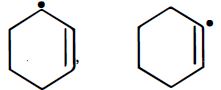
B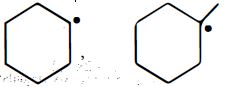
C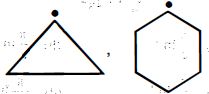
D
$Ph_{3}\dot{C}, (CH_{3})_{3}\dot{C}$
Solution
(D) To determine the stability of free radicals,we compare the factors affecting their stability such as resonance,hyperconjugation,and inductive effects.
In option $B$,the radical on the right is a tertiary alkyl radical,which is stabilized by hyperconjugation from $9$ $\alpha$-hydrogens,whereas the radical on the left is a secondary alkyl radical,which is stabilized by hyperconjugation from $4$ $\alpha$-hydrogens. Thus,the tertiary radical $(B)$ is more stable than the secondary radical $(A)$.
In option $C$,the radical on the right is a primary alkyl radical,while the radical on the left is a cyclopropyl radical. The cyclopropyl radical is less stable due to high angle strain.
In option $D$,$Ph_{3}\dot{C}$ is more stable than $(CH_{3})_{3}\dot{C}$ because resonance stabilisation in $Ph_{3}\dot{C}$ is much more effective than the hyperconjugation in $(CH_{3})_{3}\dot{C}$.
Therefore,in pair $D$,$A$ is more stable than $B$.
In option $B$,the radical on the right is a tertiary alkyl radical,which is stabilized by hyperconjugation from $9$ $\alpha$-hydrogens,whereas the radical on the left is a secondary alkyl radical,which is stabilized by hyperconjugation from $4$ $\alpha$-hydrogens. Thus,the tertiary radical $(B)$ is more stable than the secondary radical $(A)$.
In option $C$,the radical on the right is a primary alkyl radical,while the radical on the left is a cyclopropyl radical. The cyclopropyl radical is less stable due to high angle strain.
In option $D$,$Ph_{3}\dot{C}$ is more stable than $(CH_{3})_{3}\dot{C}$ because resonance stabilisation in $Ph_{3}\dot{C}$ is much more effective than the hyperconjugation in $(CH_{3})_{3}\dot{C}$.
Therefore,in pair $D$,$A$ is more stable than $B$.
0 likesView Solution
41
ChemistryDifficultMCQJEE Main · 2014
Which one of the following classes of compounds is obtained by the cyclic polymerization of acetylene?
A
Poly-yne
B
Poly-ene
C
Poly-ester
D
Poly-amine
Solution
(B) The cyclic polymerization of acetylene $(CH \equiv CH)$ at high temperature (red hot iron tube) yields benzene $(C_6H_6)$,which is a poly-ene (a compound with multiple double bonds in a ring structure).
$3CH \equiv CH \xrightarrow{\Delta, \text{Fe tube}} C_6H_6$ (Benzene).
Similarly,propyne undergoes cyclic polymerization to form $1,3,5$-trimethylbenzene.
$3CH \equiv CH \xrightarrow{\Delta, \text{Fe tube}} C_6H_6$ (Benzene).
Similarly,propyne undergoes cyclic polymerization to form $1,3,5$-trimethylbenzene.
0 likesView Solution
42
ChemistryMediumMCQJEE Main · 2014
If $\lambda_0$ and $\lambda$ are the threshold wavelength and the wavelength of incident light,respectively,the velocity of the photoelectron ejected from the metal surface is:
A
$\sqrt{\frac{2h}{m}(\lambda_0 - \lambda)}$
B
$\sqrt{\frac{2hc}{m}(\lambda_0 - \lambda)}$
C
$\sqrt{\frac{2hc}{m} \left(\frac{\lambda_0 - \lambda}{\lambda \lambda_0}\right)}$
D
$\sqrt{\frac{2h}{m} \left(\frac{1}{\lambda_0} - \frac{1}{\lambda}\right)}$
Solution
(C) According to Einstein's photoelectric equation,the kinetic energy of the ejected electron is given by:
$E = W + K.E.$
$\frac{hc}{\lambda} = \frac{hc}{\lambda_0} + \frac{1}{2}mv^2$
Rearranging for the kinetic energy term:
$\frac{1}{2}mv^2 = \frac{hc}{\lambda} - \frac{hc}{\lambda_0}$
$\frac{1}{2}mv^2 = hc \left(\frac{1}{\lambda} - \frac{1}{\lambda_0}\right) = hc \left(\frac{\lambda_0 - \lambda}{\lambda \lambda_0}\right)$
Solving for velocity $v$:
$v^2 = \frac{2hc}{m} \left(\frac{\lambda_0 - \lambda}{\lambda \lambda_0}\right)$
$v = \sqrt{\frac{2hc}{m} \left(\frac{\lambda_0 - \lambda}{\lambda \lambda_0}\right)}$
$E = W + K.E.$
$\frac{hc}{\lambda} = \frac{hc}{\lambda_0} + \frac{1}{2}mv^2$
Rearranging for the kinetic energy term:
$\frac{1}{2}mv^2 = \frac{hc}{\lambda} - \frac{hc}{\lambda_0}$
$\frac{1}{2}mv^2 = hc \left(\frac{1}{\lambda} - \frac{1}{\lambda_0}\right) = hc \left(\frac{\lambda_0 - \lambda}{\lambda \lambda_0}\right)$
Solving for velocity $v$:
$v^2 = \frac{2hc}{m} \left(\frac{\lambda_0 - \lambda}{\lambda \lambda_0}\right)$
$v = \sqrt{\frac{2hc}{m} \left(\frac{\lambda_0 - \lambda}{\lambda \lambda_0}\right)}$
0 likesView Solution
43
ChemistryMediumMCQJEE Main · 2014
Assuming that the degree of hydrolysis is small,the $pH$ of $0.1 \ M$ solution of sodium acetate $(K_a = 1.0 \times 10^{-5})$ will be
A
$5$
B
$6$
C
$8$
D
$9$
Solution
(D) Sodium acetate is a salt of a strong base $(NaOH)$ and a weak acid $(CH_3COOH)$.
The formula for the $pH$ of a salt of a strong base and a weak acid is given by:
$pH = 7 + \frac{1}{2}pK_a + \frac{1}{2} \log c$
Given:
$c = 0.1 \ M = 10^{-1} \ M$
$K_a = 1.0 \times 10^{-5}$
Step $1$: Calculate $pK_a$
$pK_a = - \log K_a = - \log (10^{-5}) = 5$
Step $2$: Calculate $\log c$
$\log c = \log (10^{-1}) = -1$
Step $3$: Calculate $pH$
$pH = 7 + \frac{1}{2}(5) + \frac{1}{2}(-1)$
$pH = 7 + 2.5 - 0.5$
$pH = 9.0$
The formula for the $pH$ of a salt of a strong base and a weak acid is given by:
$pH = 7 + \frac{1}{2}pK_a + \frac{1}{2} \log c$
Given:
$c = 0.1 \ M = 10^{-1} \ M$
$K_a = 1.0 \times 10^{-5}$
Step $1$: Calculate $pK_a$
$pK_a = - \log K_a = - \log (10^{-5}) = 5$
Step $2$: Calculate $\log c$
$\log c = \log (10^{-1}) = -1$
Step $3$: Calculate $pH$
$pH = 7 + \frac{1}{2}(5) + \frac{1}{2}(-1)$
$pH = 7 + 2.5 - 0.5$
$pH = 9.0$
0 likesView Solution
44
ChemistryMediumMCQJEE Main · 2014
In some solutions,the concentration of $H_3O^{+}$ remains constant even when small amounts of strong acid or strong base are added to them. These solutions are known as
A
Ideal solutions
B
Colloidal solutions
C
True solutions
D
Buffer solutions
Solution
(D) Solutions which resist the change in the value of $pH$ when a small amount of acid or base is added to them are known as buffer solutions.
Since $pH = -\log[H_3O^+]$,a constant $pH$ implies that the concentration of $H_3O^+$ remains effectively constant.
Since $pH = -\log[H_3O^+]$,a constant $pH$ implies that the concentration of $H_3O^+$ remains effectively constant.
0 likesView Solution
45
ChemistryDifficultMCQJEE Main · 2014
The initial volume of a gas cylinder is $750.0 \ mL$. If the pressure of gas inside the cylinder changes from $840.0 \ mm \ Hg$ to $360.0 \ mm \ Hg$,what will be the final volume of the gas (in $L$)?
A
$1.750$
B
$3.60$
C
$4.032$
D
$7.50$
Solution
(A) According to Boyle's law,for a fixed amount of gas at constant temperature,$P_1V_1 = P_2V_2$.
Given: $V_1 = 750.0 \ mL$,$P_1 = 840.0 \ mm \ Hg$,$P_2 = 360.0 \ mm \ Hg$.
Substituting the values: $840.0 \ mm \ Hg \times 750.0 \ mL = 360.0 \ mm \ Hg \times V_2$.
$V_2 = \frac{840.0 \times 750.0}{360.0} \ mL = 1750 \ mL$.
Converting to liters: $1750 \ mL = 1.750 \ L$.
Given: $V_1 = 750.0 \ mL$,$P_1 = 840.0 \ mm \ Hg$,$P_2 = 360.0 \ mm \ Hg$.
Substituting the values: $840.0 \ mm \ Hg \times 750.0 \ mL = 360.0 \ mm \ Hg \times V_2$.
$V_2 = \frac{840.0 \times 750.0}{360.0} \ mL = 1750 \ mL$.
Converting to liters: $1750 \ mL = 1.750 \ L$.
0 likesView Solution
46
ChemistryDifficultMCQJEE Main · 2014
The molar heat capacity $(C_p)$ of $CD_2O$ is $10 \, cal \, K^{-1} \, mol^{-1}$ at $1000 \, K$. The change in entropy associated with cooling of $32 \, g$ of $CD_2O$ vapour from $1000 \, K$ to $100 \, K$ at constant pressure will be.....$cal \, deg^{-1}$ ($D = $ deuterium,atomic mass $= 2 \, u$)
A
$23.03$
B
$-23.03$
C
$2.303$
D
$-2.303$
Solution
(B) Given,$C_p = 10 \, cal \, K^{-1} \, mol^{-1}$.
$T_1 = 1000 \, K$,$T_2 = 100 \, K$.
Mass $m = 32 \, g$.
For $CD_2O$,molar mass $= 12 + 2(2) + 16 = 32 \, g \, mol^{-1}$.
Number of moles $n = \frac{32 \, g}{32 \, g \, mol^{-1}} = 1 \, mol$.
At constant pressure,the change in entropy is given by $\Delta S = n \times C_p \times \ln \frac{T_2}{T_1}$.
Substituting the values: $\Delta S = 1 \times 10 \times 2.303 \times \log \frac{100}{1000}$.
$\Delta S = 23.03 \times \log(10^{-1})$.
$\Delta S = 23.03 \times (-1) = -23.03 \, cal \, deg^{-1}$.
$T_1 = 1000 \, K$,$T_2 = 100 \, K$.
Mass $m = 32 \, g$.
For $CD_2O$,molar mass $= 12 + 2(2) + 16 = 32 \, g \, mol^{-1}$.
Number of moles $n = \frac{32 \, g}{32 \, g \, mol^{-1}} = 1 \, mol$.
At constant pressure,the change in entropy is given by $\Delta S = n \times C_p \times \ln \frac{T_2}{T_1}$.
Substituting the values: $\Delta S = 1 \times 10 \times 2.303 \times \log \frac{100}{1000}$.
$\Delta S = 23.03 \times \log(10^{-1})$.
$\Delta S = 23.03 \times (-1) = -23.03 \, cal \, deg^{-1}$.
0 likesView Solution
47
ChemistryMediumMCQJEE Main · 2014
Based on the equation $\Delta E = - 2.0 \times 10^{-18} \, J \left( \frac{1}{n_2^2} - \frac{1}{n_1^2} \right)$,the wavelength of the light that must be absorbed to excite a hydrogen electron from level $n = 1$ to level $n = 2$ will be: $(h = 6.625 \times 10^{-34} \, J \, s, c = 3 \times 10^8 \, m \, s^{-1})$
A
$1.325 \times 10^{-7} \, m$
B
$1.325 \times 10^{-10} \, m$
C
$2.650 \times 10^{-7} \, m$
D
$5.300 \times 10^{-10} \, m$
Solution
(A) The energy change for the transition from $n_1 = 1$ to $n_2 = 2$ is calculated as:
$\Delta E = - 2.0 \times 10^{-18} \times \left( \frac{1}{2^2} - \frac{1}{1^2} \right)$
$\Delta E = - 2.0 \times 10^{-18} \times \left( \frac{1}{4} - 1 \right) = - 2.0 \times 10^{-18} \times \left( - \frac{3}{4} \right) = 1.5 \times 10^{-18} \, J$
Using the relation $\Delta E = \frac{hc}{\lambda}$,the wavelength $\lambda$ is:
$\lambda = \frac{hc}{\Delta E} = \frac{6.625 \times 10^{-34} \times 3 \times 10^8}{1.5 \times 10^{-18}}$
$\lambda = 1.325 \times 10^{-7} \, m$
$\Delta E = - 2.0 \times 10^{-18} \times \left( \frac{1}{2^2} - \frac{1}{1^2} \right)$
$\Delta E = - 2.0 \times 10^{-18} \times \left( \frac{1}{4} - 1 \right) = - 2.0 \times 10^{-18} \times \left( - \frac{3}{4} \right) = 1.5 \times 10^{-18} \, J$
Using the relation $\Delta E = \frac{hc}{\lambda}$,the wavelength $\lambda$ is:
$\lambda = \frac{hc}{\Delta E} = \frac{6.625 \times 10^{-34} \times 3 \times 10^8}{1.5 \times 10^{-18}}$
$\lambda = 1.325 \times 10^{-7} \, m$
0 likesView Solution
48
ChemistryMediumMCQJEE Main · 2014
Which of the following series correctly represents the relationship between the elements from $X$ to $Y$ $(X \to Y)$?
A
$_{3}Li \to _{19}K$: Ionization enthalpy increases
B
$_{9}F \to _{35}Br$: Electron gain enthalpy (negative sign) increases
C
$_{6}C \to _{32}Ge$: Atomic radii increases
D
$_{18}Ar \to _{54}Xe$: Noble character increases
Solution
(C) In the periodic table,as we move down a group,the number of shells increases,which leads to an increase in the atomic radius.
$C$ $(Z=6)$ and $Ge$ $(Z=32)$ belong to Group $14$. Moving from $C$ to $Ge$ represents moving down the group,hence the atomic radius increases.
For option $A$,ionization enthalpy decreases down the group.
For option $B$,electron gain enthalpy (magnitude) generally decreases down the group.
For option $D$,noble character is a property of the group and does not increase significantly in the manner described.
$C$ $(Z=6)$ and $Ge$ $(Z=32)$ belong to Group $14$. Moving from $C$ to $Ge$ represents moving down the group,hence the atomic radius increases.
For option $A$,ionization enthalpy decreases down the group.
For option $B$,electron gain enthalpy (magnitude) generally decreases down the group.
For option $D$,noble character is a property of the group and does not increase significantly in the manner described.
0 likesView Solution
49
ChemistryMediumMCQJEE Main · 2014
The correct order of bond dissociation energy among $N_2, O_2, O_2^-$ is shown in which of the following arrangements?
A
$N_2 > O_2^- > O_2$
B
$O_2^- > O_2 > N_2$
C
$N_2 > O_2 > O_2^-$
D
$O_2 > O_2^- > N_2$
Solution
(C) The bond order is directly proportional to the bond dissociation energy.
Calculating the bond order using Molecular Orbital Theory:
For $N_2$ ($14$ electrons): Bond order = $(10-4)/2 = 3$.
For $O_2$ ($16$ electrons): Bond order = $(10-6)/2 = 2$.
For $O_2^-$ ($17$ electrons): Bond order = $(10-7)/2 = 1.5$.
Since the bond order follows the order $N_2 (3) > O_2 (2) > O_2^- (1.5)$,the bond dissociation energy follows the same order: $N_2 > O_2 > O_2^-$.
Calculating the bond order using Molecular Orbital Theory:
For $N_2$ ($14$ electrons): Bond order = $(10-4)/2 = 3$.
For $O_2$ ($16$ electrons): Bond order = $(10-6)/2 = 2$.
For $O_2^-$ ($17$ electrons): Bond order = $(10-7)/2 = 1.5$.
Since the bond order follows the order $N_2 (3) > O_2 (2) > O_2^- (1.5)$,the bond dissociation energy follows the same order: $N_2 > O_2 > O_2^-$.
0 likesView Solution
50
ChemistryMediumMCQJEE Main · 2014
Which of the following statements about $Na_2O_2$ is not correct?
A
It is diamagnetic in nature
B
It is a derivative of $H_2O_2$
C
$Na_2O_2$ oxidises $Cr^{3+}$ to $CrO_4^{2-}$ in an acidic medium
D
It is the superoxide of sodium
Solution
(D) $Na_2O_2$ is the peroxide of sodium,not the superoxide.
The formula of sodium superoxide is $NaO_2$.
Therefore,the statement that $Na_2O_2$ is the superoxide of sodium is incorrect.
The formula of sodium superoxide is $NaO_2$.
Therefore,the statement that $Na_2O_2$ is the superoxide of sodium is incorrect.
0 likesView Solution
51
ChemistryDifficultMCQJEE Main · 2014
$CsCl$ crystallises in a body-centred cubic $(BCC)$ lattice. If '$a$' is its edge length,then which of the following expressions is correct?
A
$r_{Cs^{+}} + r_{Cl^{-}} = 3a$
B
$r_{Cs^{+}} + r_{Cl^{-}} = \frac{3}{2} a$
C
$r_{Cs^{+}} + r_{Cl^{-}} = \frac{\sqrt{3}}{2} a$
D
$r_{Cs^{+}} + r_{Cl^{-}} = \sqrt{3} a$
Solution
(C) In a $BCC$ unit cell of $CsCl$,the $Cs^{+}$ ion is at the body center and $Cl^{-}$ ions are at the corners.
The body diagonal of the cube is equal to $\sqrt{3} a$.
Along the body diagonal,the ions are in contact such that the distance is $r_{Cl^{-}} + 2r_{Cs^{+}} + r_{Cl^{-}} = \sqrt{3} a$.
This simplifies to $2(r_{Cs^{+}} + r_{Cl^{-}}) = \sqrt{3} a$.
Therefore,the correct expression is $r_{Cs^{+}} + r_{Cl^{-}} = \frac{\sqrt{3}}{2} a$.
The body diagonal of the cube is equal to $\sqrt{3} a$.
Along the body diagonal,the ions are in contact such that the distance is $r_{Cl^{-}} + 2r_{Cs^{+}} + r_{Cl^{-}} = \sqrt{3} a$.
This simplifies to $2(r_{Cs^{+}} + r_{Cl^{-}}) = \sqrt{3} a$.
Therefore,the correct expression is $r_{Cs^{+}} + r_{Cl^{-}} = \frac{\sqrt{3}}{2} a$.
0 likesView Solution
52
ChemistryDifficultMCQJEE Main · 2014
Consider separate solutions of $0.500 \, M \, C_2H_5OH \, (aq)$,$0.100 \, M \, Mg_3(PO_4)_2 \, (aq)$,$0.250 \, M \, KBr \, (aq)$ and $0.125 \, M \, Na_3PO_4 \, (aq)$ at $25 ^\circ C$. Which statement is true about these solutions,assuming all salts to be strong electrolytes?
A
They all have the same osmotic pressure.
B
$0.100 \, M \, Mg_3(PO_4)_2 \, (aq)$ has the highest osmotic pressure.
C
$0.125 \, M \, Na_3PO_4 \, (aq)$ has the highest osmotic pressure.
D
$0.500 \, M \, C_2H_5OH \, (aq)$ has the highest osmotic pressure.
Solution
(A) The osmotic pressure $\pi$ is given by the formula $\pi = iCRT$,where $i$ is the van't Hoff factor,$C$ is the molar concentration,$R$ is the gas constant,and $T$ is the temperature.
For $C_2H_5OH$ (non-electrolyte): $i = 1$,$\pi = 1 \times 0.500 \times RT = 0.500 RT$.
For $Mg_3(PO_4)_2$ (dissociates into $3Mg^{2+} + 2PO_4^{3-}$,so $i = 5$): $\pi = 5 \times 0.100 \times RT = 0.500 RT$.
For $KBr$ (dissociates into $K^+ + Br^-$,so $i = 2$): $\pi = 2 \times 0.250 \times RT = 0.500 RT$.
For $Na_3PO_4$ (dissociates into $3Na^+ + PO_4^{3-}$,so $i = 4$): $\pi = 4 \times 0.125 \times RT = 0.500 RT$.
Since the osmotic pressure of all the given solutions is equal,they are isotonic.
For $C_2H_5OH$ (non-electrolyte): $i = 1$,$\pi = 1 \times 0.500 \times RT = 0.500 RT$.
For $Mg_3(PO_4)_2$ (dissociates into $3Mg^{2+} + 2PO_4^{3-}$,so $i = 5$): $\pi = 5 \times 0.100 \times RT = 0.500 RT$.
For $KBr$ (dissociates into $K^+ + Br^-$,so $i = 2$): $\pi = 2 \times 0.250 \times RT = 0.500 RT$.
For $Na_3PO_4$ (dissociates into $3Na^+ + PO_4^{3-}$,so $i = 4$): $\pi = 4 \times 0.125 \times RT = 0.500 RT$.
Since the osmotic pressure of all the given solutions is equal,they are isotonic.
0 likesView Solution
53
ChemistryAdvancedMCQJEE Main · 2014
Resistance of $0.2 \, M$ solution of an electrolyte is $50 \, \Omega$. The specific conductance of the solution is $1.4 \, S \, m^{-1}$. The resistance of $0.5 \, M$ solution of the same electrolyte is $280 \, \Omega$. The molar conductivity of $0.5 \, M$ solution of the electrolyte in $S \, m^2 \, mol^{-1}$ is:
A
$5 \times 10^{-4}$
B
$5 \times 10^{-3}$
C
$5 \times 10^{3}$
D
$5 \times 10^{2}$
Solution
(A) For the $0.2 \, M$ solution:
$R_1 = 50 \, \Omega$,$\kappa_1 = 1.4 \, S \, m^{-1}$.
Cell constant $G^* = R_1 \times \kappa_1 = 50 \times 1.4 = 70 \, m^{-1}$.
For the $0.5 \, M$ solution:
$R_2 = 280 \, \Omega$.
Specific conductance $\kappa_2 = \frac{G^*}{R_2} = \frac{70}{280} = 0.25 \, S \, m^{-1}$.
Molar conductivity $\Lambda_m = \frac{\kappa_2}{C} = \frac{0.25 \, S \, m^{-1}}{0.5 \, mol \, L^{-1}}$.
Convert concentration to $mol \, m^{-3}$: $0.5 \, mol \, L^{-1} = 0.5 \times 1000 \, mol \, m^{-3} = 500 \, mol \, m^{-3}$.
$\Lambda_m = \frac{0.25}{500} = 0.0005 = 5 \times 10^{-4} \, S \, m^2 \, mol^{-1}$.
$R_1 = 50 \, \Omega$,$\kappa_1 = 1.4 \, S \, m^{-1}$.
Cell constant $G^* = R_1 \times \kappa_1 = 50 \times 1.4 = 70 \, m^{-1}$.
For the $0.5 \, M$ solution:
$R_2 = 280 \, \Omega$.
Specific conductance $\kappa_2 = \frac{G^*}{R_2} = \frac{70}{280} = 0.25 \, S \, m^{-1}$.
Molar conductivity $\Lambda_m = \frac{\kappa_2}{C} = \frac{0.25 \, S \, m^{-1}}{0.5 \, mol \, L^{-1}}$.
Convert concentration to $mol \, m^{-3}$: $0.5 \, mol \, L^{-1} = 0.5 \times 1000 \, mol \, m^{-3} = 500 \, mol \, m^{-3}$.
$\Lambda_m = \frac{0.25}{500} = 0.0005 = 5 \times 10^{-4} \, S \, m^2 \, mol^{-1}$.
0 likesView Solution
54
ChemistryDifficultMCQJEE Main · 2014
Given below are the half-cell reactions:
$Mn^{2+} + 2e^{-} \rightarrow Mn; E^{o} = -1.18 \ V$
$2(Mn^{3+} + e^{-} \rightarrow Mn^{2+}); E^{o} = +1.51 \ V$
The $E^{o}$ for $3Mn^{2+} \rightarrow Mn + 2Mn^{3+}$ will be:
$Mn^{2+} + 2e^{-} \rightarrow Mn; E^{o} = -1.18 \ V$
$2(Mn^{3+} + e^{-} \rightarrow Mn^{2+}); E^{o} = +1.51 \ V$
The $E^{o}$ for $3Mn^{2+} \rightarrow Mn + 2Mn^{3+}$ will be:
A
$-2.69 \ V$; the reaction will not occur
B
$-2.69 \ V$; the reaction will occur
C
$-0.33 \ V$; the reaction will not occur
D
$-0.33 \ V$; the reaction will occur
Solution
(A) The given half-cell reactions are:
$(i) \ Mn^{2+} + 2e^{-} \rightarrow Mn; E^{\circ}_{red} = -1.18 \ V$
$(ii) \ Mn^{3+} + e^{-} \rightarrow Mn^{2+}; E^{\circ}_{red} = +1.51 \ V$
The target reaction is $3Mn^{2+} \rightarrow Mn + 2Mn^{3+}$.
This reaction is the sum of the reduction of $Mn^{2+}$ to $Mn$ and the oxidation of $Mn^{2+}$ to $Mn^{3+}$.
$E^{\circ}_{cell} = E^{\circ}_{cathode} - E^{\circ}_{anode}$
Here,$Mn^{2+} \rightarrow Mn$ acts as the cathode $(E^{\circ} = -1.18 \ V)$ and $Mn^{2+} \rightarrow Mn^{3+} + e^{-}$ acts as the anode ($E^{\circ}_{ox} = -1.51 \ V$,so $E^{\circ}_{red} = +1.51 \ V$).
$E^{\circ}_{cell} = (-1.18 \ V) - (+1.51 \ V) = -2.69 \ V$.
Since $E^{\circ}_{cell}$ is negative,$\Delta G^{\circ} = -nFE^{\circ}_{cell}$ will be positive,meaning the reaction is non-spontaneous and will not occur.
$(i) \ Mn^{2+} + 2e^{-} \rightarrow Mn; E^{\circ}_{red} = -1.18 \ V$
$(ii) \ Mn^{3+} + e^{-} \rightarrow Mn^{2+}; E^{\circ}_{red} = +1.51 \ V$
The target reaction is $3Mn^{2+} \rightarrow Mn + 2Mn^{3+}$.
This reaction is the sum of the reduction of $Mn^{2+}$ to $Mn$ and the oxidation of $Mn^{2+}$ to $Mn^{3+}$.
$E^{\circ}_{cell} = E^{\circ}_{cathode} - E^{\circ}_{anode}$
Here,$Mn^{2+} \rightarrow Mn$ acts as the cathode $(E^{\circ} = -1.18 \ V)$ and $Mn^{2+} \rightarrow Mn^{3+} + e^{-}$ acts as the anode ($E^{\circ}_{ox} = -1.51 \ V$,so $E^{\circ}_{red} = +1.51 \ V$).
$E^{\circ}_{cell} = (-1.18 \ V) - (+1.51 \ V) = -2.69 \ V$.
Since $E^{\circ}_{cell}$ is negative,$\Delta G^{\circ} = -nFE^{\circ}_{cell}$ will be positive,meaning the reaction is non-spontaneous and will not occur.
0 likesView Solution
55
ChemistryDifficultMCQJEE Main · 2014
The equivalent conductance of $NaCl$ at concentration $C$ and at infinite dilution are $\lambda_C$ and $\lambda_{\infty}$ respectively. The correct relationship between $\lambda_C$ and $\lambda_{\infty}$ is given as: (Where the constant $B$ is positive)
A
$\lambda_C = \lambda_{\infty} + (B)C$
B
$\lambda_C = \lambda_{\infty} - (B)C$
C
$\lambda_C = \lambda_{\infty} - (B) \sqrt{C}$
D
$\lambda_C = \lambda_{\infty} + (B) \sqrt{C}$
Solution
(C) According to the Debye-$H$ückel-Onsager equation,the variation of molar (or equivalent) conductivity with concentration for strong electrolytes is given by the relation:
$\lambda_C = \lambda_{\infty} - B \sqrt{C}$
Here,$\lambda_C$ is the equivalent conductance at concentration $C$,$\lambda_{\infty}$ is the equivalent conductance at infinite dilution,and $B$ is a constant that depends on the nature of the solvent and temperature.
$\lambda_C = \lambda_{\infty} - B \sqrt{C}$
Here,$\lambda_C$ is the equivalent conductance at concentration $C$,$\lambda_{\infty}$ is the equivalent conductance at infinite dilution,and $B$ is a constant that depends on the nature of the solvent and temperature.
0 likesView Solution
56
ChemistryDifficultMCQJEE Main · 2014
For the non-stoichiometric reaction $2A + B \rightarrow C + D,$ the following kinetic data were obtained in three separate experiments,all at $298 \, K.$
The rate law for the formation of $C$ is:
| Initial Concentration $(A)$ | Initial Concentration $(B)$ | Initial rate of formation of $C$ $(mol \, L^{-1} \, s^{-1})$ |
| $0.1 \, M$ | $0.1 \, M$ | $1.2 \times 10^{-3}$ |
| $0.1 \, M$ | $0.2 \, M$ | $1.2 \times 10^{-3}$ |
| $0.2 \, M$ | $0.1 \, M$ | $2.4 \times 10^{-3}$ |
The rate law for the formation of $C$ is:
A
$\frac{d[C]}{dt} = k[A][B]$
B
$\frac{d[C]}{dt} = k[A]^{2}[B]$
C
$\frac{d[C]}{dt} = k[A][B]^{2}$
D
$\frac{d[C]}{dt} = k[A]$
Solution
(D) Let the rate of reaction be $\frac{d[C]}{dt} = k[A]^{x}[B]^{y}.$
From the given data:
$1.2 \times 10^{-3} = k[0.1]^{x}[0.1]^{y} \quad (i)$
$1.2 \times 10^{-3} = k[0.1]^{x}[0.2]^{y} \quad (ii)$
$2.4 \times 10^{-3} = k[0.2]^{x}[0.1]^{y} \quad (iii)$
Dividing equation $(i)$ by $(ii)$:
$\frac{1.2 \times 10^{-3}}{1.2 \times 10^{-3}} = \frac{k[0.1]^{x}[0.1]^{y}}{k[0.1]^{x}[0.2]^{y}}$
$1 = (0.5)^{y} \Rightarrow y = 0.$
Dividing equation $(i)$ by $(iii)$:
$\frac{1.2 \times 10^{-3}}{2.4 \times 10^{-3}} = \frac{k[0.1]^{x}[0.1]^{y}}{k[0.2]^{x}[0.1]^{y}}$
$0.5 = (0.5)^{x} \Rightarrow x = 1.$
Thus,the rate law is $\frac{d[C]}{dt} = k[A]^{1}[B]^{0} = k[A].$
From the given data:
$1.2 \times 10^{-3} = k[0.1]^{x}[0.1]^{y} \quad (i)$
$1.2 \times 10^{-3} = k[0.1]^{x}[0.2]^{y} \quad (ii)$
$2.4 \times 10^{-3} = k[0.2]^{x}[0.1]^{y} \quad (iii)$
Dividing equation $(i)$ by $(ii)$:
$\frac{1.2 \times 10^{-3}}{1.2 \times 10^{-3}} = \frac{k[0.1]^{x}[0.1]^{y}}{k[0.1]^{x}[0.2]^{y}}$
$1 = (0.5)^{y} \Rightarrow y = 0.$
Dividing equation $(i)$ by $(iii)$:
$\frac{1.2 \times 10^{-3}}{2.4 \times 10^{-3}} = \frac{k[0.1]^{x}[0.1]^{y}}{k[0.2]^{x}[0.1]^{y}}$
$0.5 = (0.5)^{x} \Rightarrow x = 1.$
Thus,the rate law is $\frac{d[C]}{dt} = k[A]^{1}[B]^{0} = k[A].$
0 likesView Solution
57
ChemistryMediumMCQJEE Main · 2014
The metal that cannot be obtained by electrolysis of an aqueous solution of its salts is $:$
A
$Ag$
B
$Ca$
C
$Cu$
D
$Cr$
Solution
(B) Metals that are highly reactive,such as those in the $s$-block (e.g.,$Ca$,$Na$,$K$),have a very negative standard reduction potential.
When an aqueous solution of their salts is electrolyzed,water is reduced at the cathode instead of the metal ion.
The reaction at the cathode is $H_2O(l) + e^- \rightarrow \frac{1}{2} H_2(g) + OH^-(aq)$.
Therefore,these metals cannot be obtained by the electrolysis of their aqueous salt solutions; they are typically extracted by the electrolysis of their molten salts.
When an aqueous solution of their salts is electrolyzed,water is reduced at the cathode instead of the metal ion.
The reaction at the cathode is $H_2O(l) + e^- \rightarrow \frac{1}{2} H_2(g) + OH^-(aq)$.
Therefore,these metals cannot be obtained by the electrolysis of their aqueous salt solutions; they are typically extracted by the electrolysis of their molten salts.
0 likesView Solution
58
ChemistryDifficultMCQJEE Main · 2014
Among the following oxoacids,the correct decreasing order of acid strength is:
A
$HOCl > HClO_2 > HClO_3 > HClO_4$
B
$HClO_4 > HOCl > HClO_2 > HClO_3$
C
$HClO_4 > HClO_3 > HClO_2 > HOCl$
D
$HClO_2 > HClO_4 > HClO_3 > HOCl$
Solution
(C) The decreasing order of acid strength of chlorine oxoacids is: $HClO_4 > HClO_3 > HClO_2 > HOCl$.
Reasoning: Consider the stability of the conjugate bases ($ClO_4^-$,$ClO_3^-$,$ClO_2^-$,$ClO^-$).
The negative charge is more delocalized on $ClO_4^-$ due to resonance involving more oxygen atoms,making $ClO_4^-$ the most stable conjugate base and thus $HClO_4$ the strongest acid.
As the number of oxygen atoms around the $Cl$-atom increases,the oxidation state of the $Cl$-atom increases,which increases the electron-withdrawing effect,thereby facilitating the release of the $H^+$ ion.
Reasoning: Consider the stability of the conjugate bases ($ClO_4^-$,$ClO_3^-$,$ClO_2^-$,$ClO^-$).
The negative charge is more delocalized on $ClO_4^-$ due to resonance involving more oxygen atoms,making $ClO_4^-$ the most stable conjugate base and thus $HClO_4$ the strongest acid.
As the number of oxygen atoms around the $Cl$-atom increases,the oxidation state of the $Cl$-atom increases,which increases the electron-withdrawing effect,thereby facilitating the release of the $H^+$ ion.
0 likesView Solution
59
ChemistryDifficultMCQJEE Main · 2014
Which one of the following properties is $not$ shown by $NO$?
A
It is diamagnetic in gaseous state
B
It is neutral oxide
C
It combines with oxygen to form nitrogen dioxide
D
It's bond order is $2.5$
Solution
(A) Nitric oxide $(NO)$ is paramagnetic in the gaseous state because of the presence of one unpaired electron in its antibonding molecular orbital.
The molecular orbital configuration of $NO$ ($15$ electrons) is: $\sigma_{1s}^{2} \sigma_{1s}^{*2} \sigma_{2s}^{2} \sigma_{2s}^{*2} \sigma_{2p_z}^{2} \pi_{2p_x}^{2} \pi_{2p_y}^{2} \pi_{2p_x}^{*1}$.
Since it has an unpaired electron,it is paramagnetic,not diamagnetic.
Therefore,the statement that it is diamagnetic is incorrect.
The molecular orbital configuration of $NO$ ($15$ electrons) is: $\sigma_{1s}^{2} \sigma_{1s}^{*2} \sigma_{2s}^{2} \sigma_{2s}^{*2} \sigma_{2p_z}^{2} \pi_{2p_x}^{2} \pi_{2p_y}^{2} \pi_{2p_x}^{*1}$.
Since it has an unpaired electron,it is paramagnetic,not diamagnetic.
Therefore,the statement that it is diamagnetic is incorrect.
0 likesView Solution
60
ChemistryAdvancedMCQJEE Main · 2014
The octahedral complex of a metal ion $M^{3+}$ with four monodentate ligands $L_1, L_2, L_3$ and $L_4$ absorb wavelengths in the region of red,green,yellow and blue,respectively. The increasing order of ligand strength of the four ligands is:
A
$L_4 < L_3 < L_2 < L_1$
B
$L_1 < L_3 < L_2 < L_4$
C
$L_3 < L_2 < L_4 < L_1$
D
$L_1 < L_2 < L_4 < L_3$
Solution
(B) The crystal field splitting energy $(\Delta_o)$ is inversely proportional to the wavelength $(\lambda)$ of the light absorbed: $\Delta_o = \frac{hc}{\lambda}$.
Stronger ligands cause greater splitting and thus absorb light of shorter wavelengths.
The order of wavelengths for the given colors is: $\text{Red} (L_1) > \text{Yellow} (L_3) > \text{Green} (L_2) > \text{Blue} (L_4)$.
Since ligand strength $\propto \frac{1}{\lambda}$,the increasing order of ligand strength is: $L_1 < L_3 < L_2 < L_4$.
Stronger ligands cause greater splitting and thus absorb light of shorter wavelengths.
The order of wavelengths for the given colors is: $\text{Red} (L_1) > \text{Yellow} (L_3) > \text{Green} (L_2) > \text{Blue} (L_4)$.
Since ligand strength $\propto \frac{1}{\lambda}$,the increasing order of ligand strength is: $L_1 < L_3 < L_2 < L_4$.
0 likesView Solution
61
ChemistryDifficultMCQJEE Main · 2014
Which series of reactions correctly represents chemical reactions related to iron and its compounds?
A
$Fe$ $\xrightarrow{dil. \ H_2SO_4} FeSO_4$ $\xrightarrow{H_2SO_4, \ O_2} Fe_2(SO_4)_3$ $\xrightarrow{heat} Fe$
B
$Fe$ $\xrightarrow{O_2, \ heat} FeO$ $\xrightarrow{dil. \ H_2SO_4} FeSO_4$ $\xrightarrow{heat} Fe$
C
$Fe$ $\xrightarrow{Cl_2, \ heat} FeCl_3$ $\xrightarrow{heat, \ air} FeCl_2$ $\xrightarrow{Zn} Fe$
D
$Fe$ $\xrightarrow{O_2, \ heat} Fe_3O_4$ $\xrightarrow{CO, \ 600^{\circ}C} FeO$ $\xrightarrow{CO, \ 700^{\circ}C} Fe$
Solution
(D) The reduction of iron oxides to metallic iron is a key step in metallurgy.
In option $D$,the sequence is:
$1. \ 3Fe + 2O_2 \xrightarrow{\Delta} Fe_3O_4$
$2. \ Fe_3O_4 + CO \xrightarrow{600^{\circ}C} 3FeO + CO_2$
$3. \ FeO + CO \xrightarrow{700^{\circ}C} Fe + CO_2$
This sequence correctly represents the extraction of iron from its oxide ore using carbon monoxide as a reducing agent at specific temperatures.
In option $D$,the sequence is:
$1. \ 3Fe + 2O_2 \xrightarrow{\Delta} Fe_3O_4$
$2. \ Fe_3O_4 + CO \xrightarrow{600^{\circ}C} 3FeO + CO_2$
$3. \ FeO + CO \xrightarrow{700^{\circ}C} Fe + CO_2$
This sequence correctly represents the extraction of iron from its oxide ore using carbon monoxide as a reducing agent at specific temperatures.
0 likesView Solution
62
ChemistryMediumMCQJEE Main · 2014
In $S_{N}2$ reactions,the correct order of reactivity for the following compounds:
A
$CH_3Cl > (CH_3)_2CHCl > CH_3CH_2Cl > (CH_3)_3CCl$
B
$CH_3Cl > CH_3CH_2Cl > (CH_3)_2CHCl > (CH_3)_3CCl$
C
$CH_3CH_2Cl > CH_3Cl > (CH_3)_2CHCl > (CH_3)_3CCl$
D
$(CH_3)_2CHCl > CH_3CH_2Cl > CH_3Cl > (CH_3)_3CCl$
Solution
(B) The rate of $S_{N}2$ reactions is inversely proportional to the steric hindrance around the electrophilic carbon atom.
As the number of alkyl groups attached to the carbon bearing the halogen increases,the steric crowding increases,which hinders the approach of the nucleophile.
The order of reactivity for alkyl halides in $S_{N}2$ reactions is: $Methyl \ halide > Primary \ (1^{\circ}) \ halide > Secondary \ (2^{\circ}) \ halide > Tertiary \ (3^{\circ}) \ halide$.
Comparing the given compounds:
$CH_3Cl$ (Methyl halide) > $CH_3CH_2Cl$ (Primary) > $(CH_3)_2CHCl$ (Secondary) > $(CH_3)_3CCl$ (Tertiary).
Therefore,the correct order is $CH_3Cl > CH_3CH_2Cl > (CH_3)_2CHCl > (CH_3)_3CCl$.
As the number of alkyl groups attached to the carbon bearing the halogen increases,the steric crowding increases,which hinders the approach of the nucleophile.
The order of reactivity for alkyl halides in $S_{N}2$ reactions is: $Methyl \ halide > Primary \ (1^{\circ}) \ halide > Secondary \ (2^{\circ}) \ halide > Tertiary \ (3^{\circ}) \ halide$.
Comparing the given compounds:
$CH_3Cl$ (Methyl halide) > $CH_3CH_2Cl$ (Primary) > $(CH_3)_2CHCl$ (Secondary) > $(CH_3)_3CCl$ (Tertiary).
Therefore,the correct order is $CH_3Cl > CH_3CH_2Cl > (CH_3)_2CHCl > (CH_3)_3CCl$.
0 likesView Solution
63
ChemistryDifficultMCQJEE Main · 2014
Sodium phenoxide when heated with $CO_2$ under pressure at $125\,^{\circ}C$ yields a product which on acetylation produces $C$. The major product $C$ would be
A
$2-$Acetoxybenzoic acid
B
$4-$Hydroxyacetophenone
C
Methyl salicylate
D
$3-$Acetoxybenzoic acid
Solution
(A) The reaction of sodium phenoxide with $CO_2$ at $125\,^{\circ}C$ and $5 \ atm$ pressure is the Kolbe-Schmidt reaction,which yields salicylic acid ($2$-hydroxybenzoic acid) as the intermediate $B$.
In the second step,salicylic acid undergoes acetylation with acetic anhydride $(Ac_2O)$ to form acetylsalicylic acid,commonly known as Aspirin,which is the major product $C$.
The structure of $C$ is $2$-acetoxybenzoic acid.
In the second step,salicylic acid undergoes acetylation with acetic anhydride $(Ac_2O)$ to form acetylsalicylic acid,commonly known as Aspirin,which is the major product $C$.
The structure of $C$ is $2$-acetoxybenzoic acid.
0 likesView Solution
64
ChemistryMediumMCQJEE Main · 2014
The most suitable reagent for the conversion of $R-CH_2-OH \rightarrow R-CHO$ is:
A
$KMnO_4$
B
$K_2Cr_2O_7$
C
$CrO_3$
D
$PCC$ (Pyridinium Chlorochromate)
Solution
(D) $R-CH_2-OH \xrightarrow{PCC} R-CHO$
$PCC$ (Pyridinium chlorochromate) is a mild oxidizing agent that selectively oxidizes primary alcohols to aldehydes without further oxidation to carboxylic acids.
$KMnO_4$,$K_2Cr_2O_7$,and $CrO_3$ are strong oxidizing agents that typically oxidize primary alcohols directly to carboxylic acids.
$PCC$ (Pyridinium chlorochromate) is a mild oxidizing agent that selectively oxidizes primary alcohols to aldehydes without further oxidation to carboxylic acids.
$KMnO_4$,$K_2Cr_2O_7$,and $CrO_3$ are strong oxidizing agents that typically oxidize primary alcohols directly to carboxylic acids.
0 likesView Solution
65
ChemistryMediumMCQJEE Main · 2014
In the reaction,$CH_3-COOH$ $\xrightarrow{LiAlH_4} A$ $\xrightarrow{PCl_5} B$ $\xrightarrow{Alc. KOH} C$,the product $C$ is:
A
Acetaldehyde
B
Acetylene
C
Ethylene
D
Acetyl chloride
Solution
(C) The reaction sequence is as follows:
$1.$ Reduction: $CH_3-COOH \xrightarrow{LiAlH_4} CH_3-CH_2-OH$ (Ethanol,$A$)
$2.$ Chlorination: $CH_3-CH_2-OH \xrightarrow{PCl_5} CH_3-CH_2-Cl$ (Ethyl chloride,$B$)
$3.$ Dehydrohalogenation: $CH_3-CH_2-Cl \xrightarrow{Alc. KOH} CH_2=CH_2$ (Ethylene,$C$)
Therefore,the product $C$ is Ethylene.
$1.$ Reduction: $CH_3-COOH \xrightarrow{LiAlH_4} CH_3-CH_2-OH$ (Ethanol,$A$)
$2.$ Chlorination: $CH_3-CH_2-OH \xrightarrow{PCl_5} CH_3-CH_2-Cl$ (Ethyl chloride,$B$)
$3.$ Dehydrohalogenation: $CH_3-CH_2-Cl \xrightarrow{Alc. KOH} CH_2=CH_2$ (Ethylene,$C$)
Therefore,the product $C$ is Ethylene.
0 likesView Solution
66
ChemistryMediumMCQJEE Main · 2014
On heating an aliphatic primary amine with chloroform and ethanolic potassium hydroxide,the organic compound formed is:
A
an alkanol
B
an alkanediol
C
an alkyl cyanide
D
an alkyl isocyanide
Solution
(D) This reaction is known as the $Carbylamine$ test,which is used to identify primary amines.
When an aliphatic primary amine $(R-NH_2)$ is heated with chloroform $(CHCl_3)$ and ethanolic potassium hydroxide $(KOH)$,it forms an alkyl isocyanide $(R-NC)$,which has a foul smell.
The chemical equation is: $R-NH_2 + CHCl_3 + 3KOH (alc.) \rightarrow R-NC + 3KCl + 3H_2O$.
This reaction involves the formation of a dichlorocarbene intermediate $(:CCl_2)$.
When an aliphatic primary amine $(R-NH_2)$ is heated with chloroform $(CHCl_3)$ and ethanolic potassium hydroxide $(KOH)$,it forms an alkyl isocyanide $(R-NC)$,which has a foul smell.
The chemical equation is: $R-NH_2 + CHCl_3 + 3KOH (alc.) \rightarrow R-NC + 3KCl + 3H_2O$.
This reaction involves the formation of a dichlorocarbene intermediate $(:CCl_2)$.
0 likesView Solution
67
ChemistryMediumMCQJEE Main · 2014
Considering the basic strength of amines in aqueous solution,which one has the smallest $pK_b$ value?
A
$(CH_3)_2NH$
B
$CH_3NH_2$
C
$(CH_3)_3N$
D
$C_6H_5NH_2$
Solution
(A) The basic strength of amines in aqueous solution depends on the combined effect of inductive effect,solvation effect,and steric hindrance. For methyl-substituted amines,the order of basic strength is $(CH_3)_2NH > CH_3NH_2 > (CH_3)_3N > C_6H_5NH_2$.
Since $pK_b = -\log K_b$,a higher $K_b$ value corresponds to a smaller $pK_b$ value.
Therefore,$(CH_3)_2NH$ (dimethylamine) has the highest basic strength and consequently the smallest $pK_b$ value.
$C_6H_5NH_2$ (aniline) is the least basic due to the resonance of the lone pair with the benzene ring.
Since $pK_b = -\log K_b$,a higher $K_b$ value corresponds to a smaller $pK_b$ value.
Therefore,$(CH_3)_2NH$ (dimethylamine) has the highest basic strength and consequently the smallest $pK_b$ value.
$C_6H_5NH_2$ (aniline) is the least basic due to the resonance of the lone pair with the benzene ring.
0 likesView Solution
68
ChemistryMediumMCQJEE Main · 2014
Which one is classified as a condensation polymer?
A
Dacron
B
Neoprene
C
Teflon
D
Acrylonitrile
Solution
(A) Condensation polymers are formed by the repeated condensation reaction between two different bi-functional or tri-functional monomeric units,usually involving the loss of small molecules like $H_2O$,$HCl$,etc.
$Dacron$ (also known as $Terylene$) is a condensation polymer formed by the polymerization of ethylene glycol $(HO-CH_2-CH_2-OH)$ and terephthalic acid $(HOOC-C_6H_4-COOH)$.
$Neoprene$,$Teflon$,and $Acrylonitrile$ (which forms $PAN$) are addition polymers.
Therefore,the correct option is $A$.
$Dacron$ (also known as $Terylene$) is a condensation polymer formed by the polymerization of ethylene glycol $(HO-CH_2-CH_2-OH)$ and terephthalic acid $(HOOC-C_6H_4-COOH)$.
$Neoprene$,$Teflon$,and $Acrylonitrile$ (which forms $PAN$) are addition polymers.
Therefore,the correct option is $A$.
0 likesView Solution
69
ChemistryEasyMCQJEE Main · 2014
Which one of the following bases is $not$ present in $DNA$?
A
Quinoline
B
Adenine
C
Cytosine
D
Thymine
Solution
(A) Quinoline is an alkaloid and is not present in $DNA$.
$DNA$ contains four nitrogenous bases: adenine,guanine,cytosine,and thymine.
$DNA$ contains four nitrogenous bases: adenine,guanine,cytosine,and thymine.
0 likesView Solution
70
ChemistryDifficultMCQJEE Main · 2014
The equation which is balanced and represents the correct product$(s)$ is:
A
$Li_2O + 2KCl \rightarrow 2LiCl + K_2O$
B
$[CoCl(NH_3)_5]^{2+} + 5H^{+} \rightarrow Co^{2+} + 5NH_4^+ + Cl^{-}$
C
$[Mg(H_2O)_6]^{2+} + (EDTA)^{4-} \rightarrow [Mg(EDTA)]^{2-} + 6H_2O$
D
$CuSO_4 + 4KCN \rightarrow K_2[Cu(CN)_4] + K_2SO_4$
Solution
(D) Option $A$: The reaction $Li_2O + 2KCl \rightarrow 2LiCl + K_2O$ is thermodynamically unfavorable because $Li_2O$ is more stable than $K_2O$.
Option $B$: The reaction $[CoCl(NH_3)_5]^{2+} + 5H^+ \rightarrow Co^{2+} + 5NH_4^+ + Cl^-$ is balanced in terms of atoms and charge ($+2 + 5 = +7$ on left,$+2 + 5 - 1 = +6$ on right; wait,let's re-check: $Co^{2+} + 5NH_4^+ + Cl^-$ gives $+2 + 5 - 1 = +6$. The charge is not balanced).
Option $C$: The reaction $[Mg(H_2O)_6]^{2+} + (EDTA)^{4-} \rightarrow [Mg(EDTA)]^{2-} + 6H_2O$ is balanced.
Option $D$: The reaction $CuSO_4 + 4KCN \rightarrow K_2[Cu(CN)_4] + K_2SO_4$ is balanced: $Cu$ $(1)$,$S$ $(1)$,$O$ $(4)$,$K$ $(4)$,$C$ $(4)$,$N$ $(4)$ on both sides.
Option $B$: The reaction $[CoCl(NH_3)_5]^{2+} + 5H^+ \rightarrow Co^{2+} + 5NH_4^+ + Cl^-$ is balanced in terms of atoms and charge ($+2 + 5 = +7$ on left,$+2 + 5 - 1 = +6$ on right; wait,let's re-check: $Co^{2+} + 5NH_4^+ + Cl^-$ gives $+2 + 5 - 1 = +6$. The charge is not balanced).
Option $C$: The reaction $[Mg(H_2O)_6]^{2+} + (EDTA)^{4-} \rightarrow [Mg(EDTA)]^{2-} + 6H_2O$ is balanced.
Option $D$: The reaction $CuSO_4 + 4KCN \rightarrow K_2[Cu(CN)_4] + K_2SO_4$ is balanced: $Cu$ $(1)$,$S$ $(1)$,$O$ $(4)$,$K$ $(4)$,$C$ $(4)$,$N$ $(4)$ on both sides.
0 likesView Solution
71
ChemistryMediumMCQJEE Main · 2014
In a face centered cubic lattice,atoms $A$ are at the corner points and atoms $B$ are at the face centered points. If one atom $B$ is missing from one of the face centered points,the formula of the ionic compound is:
A
$A_2B_5$
B
$A_5B_2$
C
$A_2B_3$
D
$AB_2$
Solution
(A) In a face centered cubic $(FCC)$ lattice:
Number of atoms $A$ at corners $= 8 \times \frac{1}{8} = 1$.
Number of face centered positions in an $FCC$ unit cell is $6$.
Since one atom $B$ is missing from one of the face centered points,the number of atoms $B$ present $= 5 \times \frac{1}{2} = \frac{5}{2}$.
The ratio of atoms $A:B = 1 : \frac{5}{2} = 2 : 5$.
Therefore,the formula of the ionic compound is $A_2B_5$.
Number of atoms $A$ at corners $= 8 \times \frac{1}{8} = 1$.
Number of face centered positions in an $FCC$ unit cell is $6$.
Since one atom $B$ is missing from one of the face centered points,the number of atoms $B$ present $= 5 \times \frac{1}{2} = \frac{5}{2}$.
The ratio of atoms $A:B = 1 : \frac{5}{2} = 2 : 5$.
Therefore,the formula of the ionic compound is $A_2B_5$.
0 likesView Solution
72
ChemistryDifficultMCQJEE Main · 2014
The standard electrode potentials $\left( E_{M^{+}/M}^\circ \right)$ of four metals $A, B, C$ and $D$ are $-1.2 \ V, 0.6 \ V, 0.85 \ V$ and $-0.76 \ V$,respectively. The sequence of deposition of metals on applying potential is
A
$A, C, B, D$
B
$B, D, C, A$
C
$C, B, D, A$
D
$D, A, B, C$
Solution
(C) The deposition of metals during electrolysis occurs in the order of their reduction potentials,starting from the highest reduction potential to the lowest reduction potential.
Given standard reduction potentials: $E_A^\circ = -1.2 \ V$,$E_B^\circ = 0.6 \ V$,$E_C^\circ = 0.85 \ V$,and $E_D^\circ = -0.76 \ V$.
Arranging these in decreasing order: $0.85 \ V (C) > 0.6 \ V (B) > -0.76 \ V (D) > -1.2 \ V (A)$.
Thus,the sequence of deposition is $C, B, D, A$.
Given standard reduction potentials: $E_A^\circ = -1.2 \ V$,$E_B^\circ = 0.6 \ V$,$E_C^\circ = 0.85 \ V$,and $E_D^\circ = -0.76 \ V$.
Arranging these in decreasing order: $0.85 \ V (C) > 0.6 \ V (B) > -0.76 \ V (D) > -1.2 \ V (A)$.
Thus,the sequence of deposition is $C, B, D, A$.
0 likesView Solution
73
ChemistryDifficultMCQJEE Main · 2014
The half-life period of a first order reaction is $15 \ minutes$. The amount of substance left after one hour will be
A
$\frac{1}{4}$ of the original amount
B
$\frac{1}{8}$ of the original amount
C
$\frac{1}{16}$ of the original amount
D
$\frac{1}{32}$ of the original amount
Solution
(C) Given half-life $t_{1/2} = 15 \ minutes$.
Total time $T = 1 \ hr = 60 \ minutes$.
The number of half-lives $n$ is calculated as $n = \frac{T}{t_{1/2}} = \frac{60}{15} = 4$.
The amount of substance remaining is given by the formula $\frac{N}{N_0} = (\frac{1}{2})^n$.
Substituting the value of $n$,we get $\frac{N}{N_0} = (\frac{1}{2})^4 = \frac{1}{16}$.
Therefore,the amount of substance left after $1 \ hour$ is $\frac{1}{16}$ of the original amount.
Total time $T = 1 \ hr = 60 \ minutes$.
The number of half-lives $n$ is calculated as $n = \frac{T}{t_{1/2}} = \frac{60}{15} = 4$.
The amount of substance remaining is given by the formula $\frac{N}{N_0} = (\frac{1}{2})^n$.
Substituting the value of $n$,we get $\frac{N}{N_0} = (\frac{1}{2})^4 = \frac{1}{16}$.
Therefore,the amount of substance left after $1 \ hour$ is $\frac{1}{16}$ of the original amount.
0 likesView Solution
74
ChemistryDifficultMCQJEE Main · 2014
$A$ current of $10.0 \, A$ flows for $2.00 \, h$ through an electrolytic cell containing a molten salt of metal $X$. This results in the decomposition of $0.250 \, mol$ of metal $X$ at the cathode. The oxidation state of $X$ in the molten salt is $(F = 96,500 \, C \, mol^{-1})$ (in $+$)
A
$1$
B
$2$
C
$3$
D
$4$
Solution
(C) The total charge $Q$ passed through the cell is given by $Q = i \times t$.
Given $i = 10.0 \, A$ and $t = 2.00 \, h = 2.00 \times 3600 \, s = 7200 \, s$.
$Q = 10.0 \, A \times 7200 \, s = 72,000 \, C$.
According to Faraday's law,the number of moles of electrons required to deposit $n$ moles of metal $X$ with oxidation state $x$ is $n \times x = \frac{Q}{F}$.
Here,$n = 0.250 \, mol$ and $F = 96,500 \, C \, mol^{-1}$.
$0.250 \times x = \frac{72,000}{96,500}$.
$0.250 \times x \approx 0.746$.
$x = \frac{0.746}{0.250} \approx 2.98 \approx 3$.
Therefore,the oxidation state of metal $X$ is $3+$.
Given $i = 10.0 \, A$ and $t = 2.00 \, h = 2.00 \times 3600 \, s = 7200 \, s$.
$Q = 10.0 \, A \times 7200 \, s = 72,000 \, C$.
According to Faraday's law,the number of moles of electrons required to deposit $n$ moles of metal $X$ with oxidation state $x$ is $n \times x = \frac{Q}{F}$.
Here,$n = 0.250 \, mol$ and $F = 96,500 \, C \, mol^{-1}$.
$0.250 \times x = \frac{72,000}{96,500}$.
$0.250 \times x \approx 0.746$.
$x = \frac{0.746}{0.250} \approx 2.98 \approx 3$.
Therefore,the oxidation state of metal $X$ is $3+$.
0 likesView Solution
75
ChemistryDifficultMCQJEE Main · 2014
The gas evolved on heating $CaF_2$ and $SiO_2$ with concentrated $H_2SO_4$,on hydrolysis gives a white gelatinous precipitate. The precipitate is
A
hydrofluosilicic acid
B
silica gel
C
silicic acid
D
calcium fluorosilicate
Solution
(C) The reaction of $CaF_2$ and $SiO_2$ with concentrated $H_2SO_4$ produces silicon tetrafluoride gas $(SiF_4)$:
$2CaF_2 + SiO_2 + 2H_2SO_4 \longrightarrow SiF_4 + 2CaSO_4 + 2H_2O$
When $SiF_4$ is hydrolyzed,it forms hydrofluosilicic acid and a white gelatinous precipitate of silicic acid $(H_2SiO_3)$:
$3SiF_4 + 3H_2O \longrightarrow 2H_2SiF_6 + H_2SiO_3$ (white gelatinous precipitate of silicic acid).
$2CaF_2 + SiO_2 + 2H_2SO_4 \longrightarrow SiF_4 + 2CaSO_4 + 2H_2O$
When $SiF_4$ is hydrolyzed,it forms hydrofluosilicic acid and a white gelatinous precipitate of silicic acid $(H_2SiO_3)$:
$3SiF_4 + 3H_2O \longrightarrow 2H_2SiF_6 + H_2SiO_3$ (white gelatinous precipitate of silicic acid).
0 likesView Solution
76
ChemistryDifficultMCQJEE Main · 2014
An octahedral complex of $Co^{3+}$ is diamagnetic. The hybridisation involved in the formation of the complex is
A
$sp^3d^2$
B
$dsp^2$
C
$d^2sp^3$
D
$sp^3d$
Solution
(C) The atomic number of $Co$ is $27$. The electronic configuration of $Co^{3+}$ is $[Ar] 3d^6$.
Since the complex is octahedral and diamagnetic,the ligands must be strong field ligands that cause pairing of electrons in the $3d$ orbitals.
This results in two empty $3d$ orbitals,one $4s$ orbital,and three $4p$ orbitals,which hybridize to form six $d^2sp^3$ hybrid orbitals.
Thus,the hybridisation involved is $d^2sp^3$.
Since the complex is octahedral and diamagnetic,the ligands must be strong field ligands that cause pairing of electrons in the $3d$ orbitals.
This results in two empty $3d$ orbitals,one $4s$ orbital,and three $4p$ orbitals,which hybridize to form six $d^2sp^3$ hybrid orbitals.
Thus,the hybridisation involved is $d^2sp^3$.
0 likesView Solution
77
ChemistryEasyMCQJEE Main · 2014
The form of iron obtained from blast furnace is
A
Steel
B
Cast Iron
C
Pig Iron
D
Wrought Iron
Solution
(C) The iron obtained from the blast furnace is known as $Pig \ Iron$. It contains about $4 \%$ carbon and many impurities like $S, P, Si, Mn$ in smaller amounts.
0 likesView Solution
78
ChemistryDifficultMCQJEE Main · 2014
The correct statement about the magnetic properties of $[Fe(CN)_6]^{3-}$ and $[FeF_6]^{3-}$ is $(Z = 26)$.
A
both are paramagnetic
B
both are diamagnetic
C
$[Fe(CN)_6]^{3-}$ is diamagnetic,$[FeF_6]^{3-}$ is paramagnetic
D
$[Fe(CN)_6]^{3-}$ is paramagnetic,$[FeF_6]^{3-}$ is diamagnetic
Solution
(A) For $[Fe(CN)_6]^{3-}$,the oxidation state of $Fe$ is $+3$. The electronic configuration of $Fe^{3+}$ is $[Ar] 3d^5$. Since $CN^-$ is a strong field ligand,it causes pairing of electrons,resulting in one unpaired electron $(n=1)$. Thus,it is paramagnetic.
For $[FeF_6]^{3-}$,the oxidation state of $Fe$ is $+3$. The electronic configuration of $Fe^{3+}$ is $[Ar] 3d^5$. Since $F^-$ is a weak field ligand,it does not cause pairing,resulting in five unpaired electrons $(n=5)$. Thus,it is also paramagnetic.
Therefore,both complexes are paramagnetic.
For $[FeF_6]^{3-}$,the oxidation state of $Fe$ is $+3$. The electronic configuration of $Fe^{3+}$ is $[Ar] 3d^5$. Since $F^-$ is a weak field ligand,it does not cause pairing,resulting in five unpaired electrons $(n=5)$. Thus,it is also paramagnetic.
Therefore,both complexes are paramagnetic.
0 likesView Solution
79
ChemistryDifficultMCQJEE Main · 2014
Which one of the following reactions will not result in the formation of a carbon-carbon bond?
A
Reimer-Tiemann reaction
B
Friedel-Crafts acylation
C
Wurtz reaction
D
Cannizzaro reaction
Solution
(D) The Cannizzaro reaction is a disproportionation reaction of aldehydes lacking $\alpha$-hydrogen atoms,where one molecule of the aldehyde is reduced to an alcohol and another is oxidized to a salt of a carboxylic acid. It does not involve the formation of a new carbon-carbon bond.
$2C_6H_5CHO + KOH \longrightarrow C_6H_5CH_2OH + C_6H_5COOK$
In contrast,the Reimer-Tiemann reaction,Friedel-Crafts acylation,and Wurtz reaction all involve the formation of new carbon-carbon bonds.
$2C_6H_5CHO + KOH \longrightarrow C_6H_5CH_2OH + C_6H_5COOK$
In contrast,the Reimer-Tiemann reaction,Friedel-Crafts acylation,and Wurtz reaction all involve the formation of new carbon-carbon bonds.
0 likesView Solution
80
ChemistryDifficultMCQJEE Main · 2014
The major product of the reaction is:
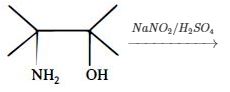
A
$3,3-$dimethylbutan$-2-$one
B
$2,3-$dimethylbut$-2-$ene
C
$2,2,3-$trimethylaziridine
D
$3,3-$dimethylbutan$-2-$ol
0 likesView Solution
81
ChemistryMediumMCQJEE Main · 2014
For the compounds $CH_3Cl$,$CH_3Br$,$CH_3I$,and $CH_3F$,the correct order of increasing $C$-halogen bond length is
A
$CH_3F < CH_3Cl < CH_3Br < CH_3I$
B
$CH_3F < CH_3Br < CH_3Cl < CH_3I$
C
$CH_3F < CH_3I < CH_3Br < CH_3Cl$
D
$CH_3Cl < CH_3Br < CH_3F < CH_3I$
Solution
(A) The bond length depends on the size of the halogen atom.
As the size of the halogen atom increases down the group $(F < Cl < Br < I)$,the bond length of the $C$-halogen bond also increases.
Therefore,the order of increasing bond length is $CH_3F < CH_3Cl < CH_3Br < CH_3I$.
As the size of the halogen atom increases down the group $(F < Cl < Br < I)$,the bond length of the $C$-halogen bond also increases.
Therefore,the order of increasing bond length is $CH_3F < CH_3Cl < CH_3Br < CH_3I$.
0 likesView Solution
82
ChemistryDifficultMCQJEE Main · 2014
Allyl phenyl ether can be prepared by heating:
A
$C_6H_5-Br + CH_2=CH-CH_2-ONa$
B
$CH_2=CH-CH_2-Br + C_6H_5-ONa$
C
$C_6H_5-CH=CH-Br + CH_3-ONa$
D
$CH_2=CH-Br + C_6H_5-CH_2-ONa$
Solution
(B) is the correct option.
Allyl phenyl ether is prepared by the $Williamson$ ether synthesis.
In this reaction,sodium phenoxide $(C_6H_5-ONa)$ acts as a nucleophile and attacks the electrophilic carbon of allyl bromide $(CH_2=CH-CH_2-Br)$ via an $S_N2$ mechanism.
Aryl halides like bromobenzene $(C_6H_5-Br)$ do not undergo nucleophilic substitution under ordinary conditions due to the partial double bond character of the $C-X$ bond.
Reaction: $C_6H_5-ONa + Br-CH_2-CH=CH_2 \rightarrow C_6H_5-O-CH_2-CH=CH_2 + NaBr$
Allyl phenyl ether is prepared by the $Williamson$ ether synthesis.
In this reaction,sodium phenoxide $(C_6H_5-ONa)$ acts as a nucleophile and attacks the electrophilic carbon of allyl bromide $(CH_2=CH-CH_2-Br)$ via an $S_N2$ mechanism.
Aryl halides like bromobenzene $(C_6H_5-Br)$ do not undergo nucleophilic substitution under ordinary conditions due to the partial double bond character of the $C-X$ bond.
Reaction: $C_6H_5-ONa + Br-CH_2-CH=CH_2 \rightarrow C_6H_5-O-CH_2-CH=CH_2 + NaBr$
0 likesView Solution
83
ChemistryDifficultMCQJEE Main · 2014
In a nucleophilic substitution reaction $R - Br + Cl^{-} \xrightarrow{DMF} R - Cl + Br^{-}$,which one of the following undergoes complete inversion of configuration?
A
$C_6H_5CH(C_6H_5)Br$
B
$C_6H_5CH_2Br$
C
$C_6H_5CH(CH_3)Br$
D
$C_6H_5C(CH_3)(C_6H_5)Br$
Solution
(C) The reaction uses $DMF$ (Dimethylformamide),which is a polar aprotic solvent,favoring the $S_N2$ mechanism.
$S_N2$ reactions proceed with complete inversion of configuration (Walden inversion).
Among the given options,$C_6H_5CH(CH_3)Br$ is a secondary alkyl bromide that is sterically accessible for $S_N2$ attack.
$C_6H_5CH_2Br$ is primary and also undergoes $S_N2$,but $C_6H_5CH(CH_3)Br$ is the classic example of an optically active secondary halide showing inversion.
$C_6H_5CH(C_6H_5)Br$ and $C_6H_5C(CH_3)(C_6H_5)Br$ are sterically hindered and likely to proceed via $S_N1$ or show mixed results.
$S_N2$ reactions proceed with complete inversion of configuration (Walden inversion).
Among the given options,$C_6H_5CH(CH_3)Br$ is a secondary alkyl bromide that is sterically accessible for $S_N2$ attack.
$C_6H_5CH_2Br$ is primary and also undergoes $S_N2$,but $C_6H_5CH(CH_3)Br$ is the classic example of an optically active secondary halide showing inversion.
$C_6H_5CH(C_6H_5)Br$ and $C_6H_5C(CH_3)(C_6H_5)Br$ are sterically hindered and likely to proceed via $S_N1$ or show mixed results.
0 likesView Solution
84
ChemistryDifficultMCQJEE Main · 2014
The structures of some important polymers are given. Which one represents Buna-$S$?
A
$-(CH_2-C(CH_3)=CH-CH_2)_n-$
B
$-(CH_2-CH=CH-CH_2-CH(C_6H_5)-CH_2)_n-$
C
$-(CH_2-CH=CH-CH_2-CH(CN)-CH_2)_n-$
D
$-(CH_2-C(Cl)=CH-CH_2)_n-$
Solution
(B) Buna-$S$ is a copolymer formed by the polymerization of $1,3$-butadiene $(CH_2=CH-CH=CH_2)$ and styrene $(C_6H_5-CH=CH_2)$.
Its structure consists of repeating units derived from these two monomers,represented as $-(CH_2-CH=CH-CH_2-CH(C_6H_5)-CH_2)_n-$.
Its structure consists of repeating units derived from these two monomers,represented as $-(CH_2-CH=CH-CH_2-CH(C_6H_5)-CH_2)_n-$.
0 likesView Solution
85
ChemistryDifficultMCQJEE Main · 2014
Which is the major product formed when acetone is heated with iodine and potassium hydroxide?
A
Iodoacetone
B
Acetic acid
C
Iodoform
D
Acetophenone
Solution
(C) Acetone $(CH_3COCH_3)$ reacts with iodine $(I_2)$ in the presence of a base like potassium hydroxide $(KOH)$ to undergo the iodoform reaction.
This reaction is a characteristic test for methyl ketones.
The chemical equation is:
$CH_3COCH_3 + 3I_2 + 4KOH \longrightarrow CHI_3 + CH_3COOK + 3KI + 3H_2O$
The major product formed is iodoform $(CHI_3)$.
This reaction is a characteristic test for methyl ketones.
The chemical equation is:
$CH_3COCH_3 + 3I_2 + 4KOH \longrightarrow CHI_3 + CH_3COOK + 3KI + 3H_2O$
The major product formed is iodoform $(CHI_3)$.
0 likesView Solution
86
ChemistryEasyMCQJEE Main · 2014
The appearance of colour in solid alkali metal halides is generally due to
A
Schottky defect
B
Frenkel defect
C
Interstitial position
D
$F$-centres
Solution
(D) The appearance of colour in solid alkali metal halides is generally due to $F$-centres (Farbe centres).
These are anionic vacancies occupied by unpaired electrons.
When white light falls on these crystals,the electrons absorb energy from the visible region to get excited,which results in the crystal exhibiting a complementary colour.
For example,$NaCl$ with $F$-centres appears yellow,$KCl$ appears magenta,and $KBr$ appears blue.
These are anionic vacancies occupied by unpaired electrons.
When white light falls on these crystals,the electrons absorb energy from the visible region to get excited,which results in the crystal exhibiting a complementary colour.
For example,$NaCl$ with $F$-centres appears yellow,$KCl$ appears magenta,and $KBr$ appears blue.
0 likesView Solution
87
ChemistryDifficultMCQJEE Main · 2014
In the reaction of formation of sulphur trioxide by contact process $2SO_2 + O_2 \rightleftharpoons 2SO_3$,the rate of reaction was measured as $\frac{d[O_2]}{dt} = -2.5 \times 10^{-4} \ mol \ L^{-1} \ s^{-1}$. The rate of reaction in terms of $[SO_2]$ in $mol \ L^{-1} \ s^{-1}$ will be:
A
$-1.25 \times 10^{-4}$
B
$-2.50 \times 10^{-4}$
C
$-3.75 \times 10^{-4}$
D
$-5.00 \times 10^{-4}$
Solution
(D) For the reaction $2SO_2 + O_2 \rightleftharpoons 2SO_3$,the rate of reaction is expressed as:
Rate $= -\frac{1}{2} \frac{d[SO_2]}{dt} = -\frac{d[O_2]}{dt} = \frac{1}{2} \frac{d[SO_3]}{dt}$
Given that $\frac{d[O_2]}{dt} = -2.5 \times 10^{-4} \ mol \ L^{-1} \ s^{-1}$.
Equating the terms for $SO_2$ and $O_2$:
$-\frac{1}{2} \frac{d[SO_2]}{dt} = -\frac{d[O_2]}{dt}$
$\frac{d[SO_2]}{dt} = 2 \times \frac{d[O_2]}{dt}$
$\frac{d[SO_2]}{dt} = 2 \times (-2.5 \times 10^{-4} \ mol \ L^{-1} \ s^{-1})$
$\frac{d[SO_2]}{dt} = -5.00 \times 10^{-4} \ mol \ L^{-1} \ s^{-1}$.
Rate $= -\frac{1}{2} \frac{d[SO_2]}{dt} = -\frac{d[O_2]}{dt} = \frac{1}{2} \frac{d[SO_3]}{dt}$
Given that $\frac{d[O_2]}{dt} = -2.5 \times 10^{-4} \ mol \ L^{-1} \ s^{-1}$.
Equating the terms for $SO_2$ and $O_2$:
$-\frac{1}{2} \frac{d[SO_2]}{dt} = -\frac{d[O_2]}{dt}$
$\frac{d[SO_2]}{dt} = 2 \times \frac{d[O_2]}{dt}$
$\frac{d[SO_2]}{dt} = 2 \times (-2.5 \times 10^{-4} \ mol \ L^{-1} \ s^{-1})$
$\frac{d[SO_2]}{dt} = -5.00 \times 10^{-4} \ mol \ L^{-1} \ s^{-1}$.
0 likesView Solution
88
ChemistryDifficultMCQJEE Main · 2014
For the reaction,$2N_2O_5 \to 4NO_2 + O_2$,the rate equation can be expressed in two ways $-\frac{d[N_2O_5]}{dt} = k[N_2O_5]$ and $+\frac{d[NO_2]}{dt} = k'[N_2O_5]$. $k$ and $k'$ are related as:
A
$k = k'$
B
$2k = k'$
C
$k = 2k'$
D
$k = 4k'$
Solution
(B) The rate of reaction is defined as the rate of disappearance of reactant divided by its stoichiometric coefficient,which is equal to the rate of appearance of product divided by its stoichiometric coefficient.
For the reaction $2N_2O_5 \to 4NO_2 + O_2$,the rate expression is:
$-\frac{1}{2} \frac{d[N_2O_5]}{dt} = \frac{1}{4} \frac{d[NO_2]}{dt}$
Given that $-\frac{d[N_2O_5]}{dt} = k[N_2O_5]$ and $\frac{d[NO_2]}{dt} = k'[N_2O_5]$,substitute these into the rate expression:
$\frac{1}{2} (k[N_2O_5]) = \frac{1}{4} (k'[N_2O_5])$
$\frac{k}{2} = \frac{k'}{4}$
$k' = 2k$ or $2k = k'$.
For the reaction $2N_2O_5 \to 4NO_2 + O_2$,the rate expression is:
$-\frac{1}{2} \frac{d[N_2O_5]}{dt} = \frac{1}{4} \frac{d[NO_2]}{dt}$
Given that $-\frac{d[N_2O_5]}{dt} = k[N_2O_5]$ and $\frac{d[NO_2]}{dt} = k'[N_2O_5]$,substitute these into the rate expression:
$\frac{1}{2} (k[N_2O_5]) = \frac{1}{4} (k'[N_2O_5])$
$\frac{k}{2} = \frac{k'}{4}$
$k' = 2k$ or $2k = k'$.
0 likesView Solution
89
ChemistryDifficultMCQJEE Main · 2014
Given:
$Fe^{3+}_{(aq)} + e^- \to Fe^{2+}_{(aq)}; E^o = +0.77 \ V$
$Al^{3+}_{(aq)} + 3e^- \to Al_{(s)}; E^o = -1.66 \ V$
$Br_{2(aq)} + 2e^- \to 2Br^-_{(aq)}; E^o = +1.09 \ V$
Considering the electrode potentials,which of the following represents the correct order of reducing power?
$Fe^{3+}_{(aq)} + e^- \to Fe^{2+}_{(aq)}; E^o = +0.77 \ V$
$Al^{3+}_{(aq)} + 3e^- \to Al_{(s)}; E^o = -1.66 \ V$
$Br_{2(aq)} + 2e^- \to 2Br^-_{(aq)}; E^o = +1.09 \ V$
Considering the electrode potentials,which of the following represents the correct order of reducing power?
A
$Fe^{2+} < Al < Br^-$
B
$Br^- < Fe^{2+} < Al$
C
$Al < Br^- < Fe^{2+}$
D
$Br^- < Fe^{2+} < Al$
Solution
(B) The reducing power of a species is inversely proportional to its standard reduction potential $(E^o)$.
The given standard reduction potentials are:
$E^o (Al^{3+}/Al) = -1.66 \ V$
$E^o (Fe^{3+}/Fe^{2+}) = +0.77 \ V$
$E^o (Br_2/Br^-) = +1.09 \ V$
$A$ more negative $E^o$ value indicates a stronger reducing agent.
Comparing the values: $-1.66 \ V < +0.77 \ V < +1.09 \ V$.
Therefore,the order of reducing power is $Br^- < Fe^{2+} < Al$.
The given standard reduction potentials are:
$E^o (Al^{3+}/Al) = -1.66 \ V$
$E^o (Fe^{3+}/Fe^{2+}) = +0.77 \ V$
$E^o (Br_2/Br^-) = +1.09 \ V$
$A$ more negative $E^o$ value indicates a stronger reducing agent.
Comparing the values: $-1.66 \ V < +0.77 \ V < +1.09 \ V$.
Therefore,the order of reducing power is $Br^- < Fe^{2+} < Al$.
0 likesView Solution
90
ChemistryDifficultMCQJEE Main · 2014
Shapes of certain interhalogen compounds are stated below. Which one of them is not correctly stated?
A
$IF_7$ : pentagonal bipyramid
B
$BrF_5$ : trigonal bipyramid
C
$BrF_3$ : planar $T$-shaped
D
$ICl_3$ : planar dimeric
Solution
(B) The molecular geometry of $BrF_5$ is square pyramidal,not trigonal bipyramidal.
$Br$ in $BrF_5$ has $7$ valence electrons,forms $5$ bonds with $F$ atoms,and has $1$ lone pair,resulting in $sp^3d^2$ hybridization and square pyramidal geometry.
$Br$ in $BrF_5$ has $7$ valence electrons,forms $5$ bonds with $F$ atoms,and has $1$ lone pair,resulting in $sp^3d^2$ hybridization and square pyramidal geometry.
0 likesView Solution
91
ChemistryDifficultMCQJEE Main · 2014
Which of the following name-formula combinations is not correct?
A
$K_2[Pt(CN)_4] \to$ Potassium tetracyanoplatinate$(II)$
B
$[Mn(CN)_5]^{2-} \to$ Pentacyanomanganate$(II)$ ion
C
$K[Cr(NH_3)_2Cl_4] \to$ Potassium diammine tetrachlorochromate$(III)$
D
$[Co(NH_3)_4(H_2O)I]SO_4 \to$ Tetraamminediaqua-iodocobalt$(III)$ sulfate
Solution
(B) For $[Mn(CN)_5]^{2-}$,let the oxidation state of $Mn$ be $x$.
$x + 5(-1) = -2$
$x - 5 = -2$
$x = +3$.
Thus,the correct $IUPAC$ name is Pentacyanomanganate$(III)$ ion.
Therefore,the combination in option $B$ is incorrect.
$x + 5(-1) = -2$
$x - 5 = -2$
$x = +3$.
Thus,the correct $IUPAC$ name is Pentacyanomanganate$(III)$ ion.
Therefore,the combination in option $B$ is incorrect.
0 likesView Solution
92
ChemistryDifficultMCQJEE Main · 2014
Consider the coordination compound,$[Co(NH_3)_6]Cl_3$. In the formation of this complex,the species which acts as the Lewis acid is
A
$[Co(NH_3)_6]^{3+}$
B
$Cl^{-}$
C
$Co^{3+}$
D
$NH_3$
Solution
(C) In the formation of the coordination complex $[Co(NH_3)_6]^{3+}$,the central metal ion $Co^{3+}$ acts as the Lewis acid because it accepts lone pairs of electrons from the ligands.
$NH_3$ acts as the Lewis base because it donates lone pairs of electrons to the central metal ion.
Therefore,the reaction is: $\mathop {Co^{3+}}\limits_{\text{Lewis acid}} + \mathop {6NH_3}\limits_{\text{Lewis base}} \to \mathop {[Co(NH_3)_6]^{3+}}\limits_{\text{adduct}}$
$NH_3$ acts as the Lewis base because it donates lone pairs of electrons to the central metal ion.
Therefore,the reaction is: $\mathop {Co^{3+}}\limits_{\text{Lewis acid}} + \mathop {6NH_3}\limits_{\text{Lewis base}} \to \mathop {[Co(NH_3)_6]^{3+}}\limits_{\text{adduct}}$
0 likesView Solution
93
ChemistryDifficultMCQJEE Main · 2014
The following reaction is known as:
$Phenol + HCl + HCN \xrightarrow{Anhyd. ZnCl_2} Salicylaldehyde$
$Phenol + HCl + HCN \xrightarrow{Anhyd. ZnCl_2} Salicylaldehyde$
A
Perkin reaction
B
Gatterman-Koch Formylation
C
Kolbe's reaction
D
Gattermann reaction
Solution
(D) The given reaction is known as the Gattermann reaction (specifically,the Gattermann formylation of phenol).
In this reaction,an aromatic compound like phenol is treated with a mixture of $HCN$ and dry $HCl$ gas in the presence of a Lewis acid catalyst such as anhydrous $ZnCl_2$ or $AlCl_3$ to introduce a formyl $(-CHO)$ group into the aromatic ring.
In this reaction,an aromatic compound like phenol is treated with a mixture of $HCN$ and dry $HCl$ gas in the presence of a Lewis acid catalyst such as anhydrous $ZnCl_2$ or $AlCl_3$ to introduce a formyl $(-CHO)$ group into the aromatic ring.
0 likesView Solution
94
ChemistryMediumMCQJEE Main · 2014
Complete reduction of $benzene-diazonium$ chloride with $Zn/HCl$ gives:
A
Aniline
B
Phenylhydrazine
C
Azobenzene
D
Hydrazobenzene
Solution
(B) The reduction of $benzene-diazonium$ chloride $(C_6H_5N_2Cl)$ with $Zn/HCl$ is a strong reduction process.
It leads to the formation of $phenylhydrazine$ $(C_6H_5NHNH_2)$ as the final product.
Note: While mild reducing agents like $SnCl_2/HCl$ or $Na_2SO_3$ can produce $phenylhydrazine$,strong reduction with $Zn/HCl$ also yields $phenylhydrazine$ as the primary product.
It leads to the formation of $phenylhydrazine$ $(C_6H_5NHNH_2)$ as the final product.
Note: While mild reducing agents like $SnCl_2/HCl$ or $Na_2SO_3$ can produce $phenylhydrazine$,strong reduction with $Zn/HCl$ also yields $phenylhydrazine$ as the primary product.
0 likesView Solution
95
ChemistryDifficultMCQJEE Main · 2014
Chlorobenzene reacts with trichloroacetaldehyde (chloral) in the presence of $H_2SO_4$.
$2 C_6H_5Cl + CCl_3CHO \xrightarrow{H_2SO_4} \text{Major Product}$
The major product formed is:
$2 C_6H_5Cl + CCl_3CHO \xrightarrow{H_2SO_4} \text{Major Product}$
The major product formed is:
A
$(Cl-C_6H_4)_2CH-CCl_3$
B
$Cl-C_6H_4-CCl_2-CHO$
C
$(Cl-C_6H_4)_2CH-CCl_3$ $(DDT)$
D
$Cl-C_6H_4-CH_2-CCl_3$
Solution
(C) In the presence of concentrated $H_2SO_4$,two moles of chlorobenzene react with one mole of chloral $(CCl_3CHO)$ through a condensation reaction.
The oxygen atom from the aldehyde group of chloral and the hydrogen atoms from the para-positions of the two chlorobenzene rings are removed as a water molecule $(H_2O)$.
This results in the formation of $p,p'$-dichlorodiphenyltrichloroethane,commonly known as $DDT$.
The reaction is:
$2 C_6H_5Cl + CCl_3CHO \xrightarrow{H_2SO_4} (Cl-C_6H_4)_2CH-CCl_3 + H_2O$
The oxygen atom from the aldehyde group of chloral and the hydrogen atoms from the para-positions of the two chlorobenzene rings are removed as a water molecule $(H_2O)$.
This results in the formation of $p,p'$-dichlorodiphenyltrichloroethane,commonly known as $DDT$.
The reaction is:
$2 C_6H_5Cl + CCl_3CHO \xrightarrow{H_2SO_4} (Cl-C_6H_4)_2CH-CCl_3 + H_2O$
0 likesView Solution
96
ChemistryDifficultMCQJEE Main · 2014
Tischenko reaction is a modification of
A
Aldol condensation
B
Claisen condensation
C
Cannizzaro reaction
D
Pinacol-pinacolon reaction
Solution
(C) The Tishchenko reaction is a modification of the Cannizzaro reaction.
In the Tishchenko reaction,two molecules of an aldehyde (which lacks an $\alpha$-hydrogen atom) undergo disproportionation in the presence of an alkoxide catalyst (such as aluminium alkoxide or sodium alkoxide) to form an ester.
In the Cannizzaro reaction,the base used is typically a strong aqueous base like $NaOH$ or $KOH$,and the products are a carboxylic acid salt and an alcohol.
Both reactions involve the disproportionation of aldehydes lacking $\alpha$-hydrogens,making the Tishchenko reaction a variation of the Cannizzaro process.
In the Tishchenko reaction,two molecules of an aldehyde (which lacks an $\alpha$-hydrogen atom) undergo disproportionation in the presence of an alkoxide catalyst (such as aluminium alkoxide or sodium alkoxide) to form an ester.
In the Cannizzaro reaction,the base used is typically a strong aqueous base like $NaOH$ or $KOH$,and the products are a carboxylic acid salt and an alcohol.
Both reactions involve the disproportionation of aldehydes lacking $\alpha$-hydrogens,making the Tishchenko reaction a variation of the Cannizzaro process.
0 likesView Solution
97
ChemistryDifficultMCQJEE Main · 2014
Which one of the following is used as an antihistamine?
A
Omeprazole
B
Chloramphenicol
C
Diphenhydramine
D
Norethindrone
Solution
(C) Diphenhydramine is a well-known antihistamine drug used to treat symptoms of allergy,such as itching,runny nose,and sneezing.
0 likesView Solution
98
ChemistryDifficultMCQJEE Main · 2014
Which one of the following statements is not correct?
A
Alcohols are weaker acids than water.
B
Acid strength of alcohols decreases in the following order: $RCH_2OH > R_2CHOH > R_3COH$.
C
Carbon-oxygen bond length in methanol, $CH_3OH$ is shorter than that of $C-O$ bond length in phenol.
D
The bond angle $C-O-H$ in methanol is $108.9^o$.
Solution
(C) The $C-O$ bond length in alcohol is $142 \ pm$ and in phenol it is $136 \ pm$. The $C-O$ bond length in phenol is shorter than that in methanol due to the conjugation of unshared pair of electrons on oxygen with the ring, which imparts double bond character to the $C-O$ bond. Thus, statement $C$ is incorrect.
0 likesView Solution
99
ChemistryDifficultMCQJEE Main · 2014
The rate coefficient $(k)$ for a particular reaction is $1.3 \times 10^{-4} \ M^{-1} \ s^{-1}$ at $100 \ ^oC$ and $1.3 \times 10^{-3} \ M^{-1} \ s^{-1}$ at $150 \ ^oC$. What is the energy of activation $(E_a)$ (in $kJ \ mol^{-1}$) for this reaction? $(R = 8.314 \ J \ K^{-1} \ mol^{-1})$
A
$16$
B
$60$
C
$99$
D
$132$
Solution
(B) According to the Arrhenius equation:
$\log \frac{k_2}{k_1} = \frac{E_a}{2.303 \ R} \left( \frac{T_2 - T_1}{T_1 T_2} \right)$
Given: $k_1 = 1.3 \times 10^{-4} \ M^{-1} \ s^{-1}$,$T_1 = 100 + 273 = 373 \ K$
$k_2 = 1.3 \times 10^{-3} \ M^{-1} \ s^{-1}$,$T_2 = 150 + 273 = 423 \ K$
$\log \left( \frac{1.3 \times 10^{-3}}{1.3 \times 10^{-4}} \right) = \frac{E_a}{2.303 \times 8.314} \left( \frac{423 - 373}{373 \times 423} \right)$
$\log(10) = \frac{E_a}{19.147} \left( \frac{50}{157779} \right)$
$1 = \frac{E_a \times 50}{3020755.7}$
$E_a = \frac{3020755.7}{50} \approx 60415 \ J \ mol^{-1} \approx 60.4 \ kJ \ mol^{-1}$
Thus,the closest value is $60 \ kJ \ mol^{-1}$.
$\log \frac{k_2}{k_1} = \frac{E_a}{2.303 \ R} \left( \frac{T_2 - T_1}{T_1 T_2} \right)$
Given: $k_1 = 1.3 \times 10^{-4} \ M^{-1} \ s^{-1}$,$T_1 = 100 + 273 = 373 \ K$
$k_2 = 1.3 \times 10^{-3} \ M^{-1} \ s^{-1}$,$T_2 = 150 + 273 = 423 \ K$
$\log \left( \frac{1.3 \times 10^{-3}}{1.3 \times 10^{-4}} \right) = \frac{E_a}{2.303 \times 8.314} \left( \frac{423 - 373}{373 \times 423} \right)$
$\log(10) = \frac{E_a}{19.147} \left( \frac{50}{157779} \right)$
$1 = \frac{E_a \times 50}{3020755.7}$
$E_a = \frac{3020755.7}{50} \approx 60415 \ J \ mol^{-1} \approx 60.4 \ kJ \ mol^{-1}$
Thus,the closest value is $60 \ kJ \ mol^{-1}$.
0 likesView Solution
100
ChemistryDifficultMCQJEE Main · 2014
How many electrons would be required to deposit $6.35 \ g$ of copper at the cathode during the electrolysis of an aqueous solution of copper sulphate? (Atomic mass of copper $= 63.5 \ u$,$N_A =$ Avogadro's constant)
A
$\frac{N_A}{20}$
B
$\frac{N_A}{10}$
C
$\frac{N_A}{5}$
D
$\frac{N_A}{2}$
Solution
(C) The reduction reaction at the cathode is: $Cu^{2+} (aq) + 2e^- \to Cu (s)$.
To deposit $1 \ mole$ of $Cu$ $(63.5 \ g)$,$2 \ moles$ of electrons are required.
Number of moles of $Cu$ to be deposited $= \frac{\text{Given mass}}{\text{Atomic mass}} = \frac{6.35 \ g}{63.5 \ g/mol} = 0.1 \ mol$.
Since $1 \ mole$ of $Cu$ requires $2 \ moles$ of electrons,$0.1 \ mole$ of $Cu$ requires $0.1 \times 2 = 0.2 \ moles$ of electrons.
Total number of electrons $= 0.2 \times N_A = \frac{2}{10} \times N_A = \frac{N_A}{5}$.
To deposit $1 \ mole$ of $Cu$ $(63.5 \ g)$,$2 \ moles$ of electrons are required.
Number of moles of $Cu$ to be deposited $= \frac{\text{Given mass}}{\text{Atomic mass}} = \frac{6.35 \ g}{63.5 \ g/mol} = 0.1 \ mol$.
Since $1 \ mole$ of $Cu$ requires $2 \ moles$ of electrons,$0.1 \ mole$ of $Cu$ requires $0.1 \times 2 = 0.2 \ moles$ of electrons.
Total number of electrons $= 0.2 \times N_A = \frac{2}{10} \times N_A = \frac{N_A}{5}$.
0 likesView Solution
Vedclass Products
For Students
Vedclass Test Series
Mock tests in real JEE Main style covering Chemistry with performance analysis. 5-day free trial.
Start Free TrialFor Teachers
Exam Paper Generator
Generate Set A/B/C/D Chemistry papers from 7.5L+ questions in 2 minutes. 3 chapters free.
Try FreeFor Institutes
Online Exam Module
Run live JEE Main mock exams with unlimited students, 360° analytics & white-label branding.
See DemoFrequently Asked Questions
How many Chemistry questions are in JEE Main 2014?
There are 178 Chemistry questions from the JEE Main 2014 paper on Vedclass, each with a detailed step-by-step solution in English.
Are JEE Main 2014 Chemistry solutions available in English?
Yes. All solutions on this page are in English. You can also switch to English or Hindi using the language buttons above the questions.
Can I practice JEE Main 2014 Chemistry as a timed test?
Yes. Use the Vedclass Test Series to attempt a full JEE Main mock test covering Chemistry with time limits and instant score analysis.
Can teachers create Chemistry papers from JEE Main previous year questions?
Yes. The Vedclass Exam Paper Generator lets teachers mix JEE Main Chemistry questions and generate Set A/B/C/D papers in minutes.
For Teachers & Institutes
Build a Custom Chemistry Paper
Pick JEE Main 2014 Chemistry questions, set difficulty, and generate Set A/B/C/D in 2 minutes.