
ChemistryQ51–128 of 178 questions
Page 2 of 2 · English
51
ChemistryDifficultMCQJEE Main · 2014
Which of the following statements about the depletion of ozone layer is correct?
A
The problem of ozone depletion is less serious at poles because $NO_2$ solidifies and is not available for consuming $ClO^{\bullet}$ radicals.
B
The problem of ozone depletion is more serious at poles because ice crystals in the clouds over poles act as catalyst for photochemical reactions involving the decomposition of ozone by $Cl^{\bullet}$ and $ClO^{\bullet}$ radicals.
C
Freons,chlorofluorocarbons,are inert. Chemically,they do not react with ozone in stratosphere.
D
Oxides of nitrogen also do not react with ozone in stratosphere.
Solution
(B) Freons and chlorofluorocarbons reach the stratosphere without being destroyed in the troposphere due to their low reactivity.
In the stratosphere,the $Cl$ and $Br$ atoms are liberated from the parent compound by the action of ultraviolet light.
For example:
$CF_2Cl_2 + h\nu \to CF_2Cl^{\bullet} + Cl^{\bullet}$
$CFCl_3 + h\nu \to CFCl_2^{\bullet} + Cl^{\bullet}$
The $Cl^{\bullet}$ atoms destroy ozone molecules through catalytic cycles.
The problem is more serious at the poles because ice crystals in polar stratospheric clouds provide a surface for these reactions to occur more efficiently.
In the stratosphere,the $Cl$ and $Br$ atoms are liberated from the parent compound by the action of ultraviolet light.
For example:
$CF_2Cl_2 + h\nu \to CF_2Cl^{\bullet} + Cl^{\bullet}$
$CFCl_3 + h\nu \to CFCl_2^{\bullet} + Cl^{\bullet}$
The $Cl^{\bullet}$ atoms destroy ozone molecules through catalytic cycles.
The problem is more serious at the poles because ice crystals in polar stratospheric clouds provide a surface for these reactions to occur more efficiently.
0 likesView Solution
52
ChemistryDifficultMCQJEE Main · 2014
$A$ gaseous compound of nitrogen and hydrogen contains $12.5\%$ (by mass) of hydrogen. The density of the compound relative to hydrogen is $16$. The molecular formula of the compound is
A
$NH_2$
B
$N_3H$
C
$NH_3$
D
$N_2H_4$
Solution
(D) Given,percentage of $H = 12.5\%$.
Therefore,percentage of $N = 100 - 12.5 = 87.5\%$.
Empirical formula $= NH_2$.
Empirical formula mass $= 14 + (2 \times 1) = 16 \ g/mol$.
Molecular mass $= 2 \times \text{Vapour density} = 2 \times 16 = 32 \ g/mol$.
$n = \frac{\text{Molecular mass}}{\text{Empirical formula mass}} = \frac{32}{16} = 2$.
Molecular formula $= n \times (\text{Empirical formula}) = 2 \times (NH_2) = N_2H_4$.
Therefore,percentage of $N = 100 - 12.5 = 87.5\%$.
| Element | Percentage | Atomic ratio | Simple ratio |
| $H$ | $12.5\%$ | $\frac{12.5}{1} = 12.5$ | $\frac{12.5}{6.25} = 2$ |
| $N$ | $87.5\%$ | $\frac{87.5}{14} = 6.25$ | $\frac{6.25}{6.25} = 1$ |
Empirical formula $= NH_2$.
Empirical formula mass $= 14 + (2 \times 1) = 16 \ g/mol$.
Molecular mass $= 2 \times \text{Vapour density} = 2 \times 16 = 32 \ g/mol$.
$n = \frac{\text{Molecular mass}}{\text{Empirical formula mass}} = \frac{32}{16} = 2$.
Molecular formula $= n \times (\text{Empirical formula}) = 2 \times (NH_2) = N_2H_4$.
0 likesView Solution
53
ChemistryMediumMCQJEE Main · 2014
Consider the following equilibrium: $AgCl_{(s)} + 2NH_{3(aq)} \rightleftharpoons [Ag(NH_3)_2]^+_{(aq)} + Cl^-_{(aq)}$. $A$ white precipitate of $AgCl$ appears on adding which of the following?
A
$NH_3$
B
aqueous $NaCl$
C
aqueous $HNO_3$
D
aqueous $NH_4Cl$
Solution
(C) The given equilibrium is $AgCl_{(s)} + 2NH_{3(aq)} \rightleftharpoons [Ag(NH_3)_2]^+_{(aq)} + Cl^-_{(aq)}$.
When $HNO_3$ is added,it reacts with $NH_3$ to form $NH_4^+$ ions: $NH_{3(aq)} + H^+_{(aq)} \to NH_{4(aq)}^+$.
This decreases the concentration of $NH_3$,which shifts the equilibrium to the left according to Le Chatelier's principle.
Consequently,the complex ion $[Ag(NH_3)_2]^+$ dissociates,releasing $Ag^+$ ions,which then react with $Cl^-$ ions to precipitate $AgCl_{(s)}$.
The overall reaction is: $[Ag(NH_3)_2]^+_{(aq)} + Cl^-_{(aq)} + 2H^+_{(aq)} \to AgCl_{(s)} + 2NH_{4(aq)}^+$.
Thus,adding $HNO_3$ causes the white precipitate of $AgCl$ to reappear.
When $HNO_3$ is added,it reacts with $NH_3$ to form $NH_4^+$ ions: $NH_{3(aq)} + H^+_{(aq)} \to NH_{4(aq)}^+$.
This decreases the concentration of $NH_3$,which shifts the equilibrium to the left according to Le Chatelier's principle.
Consequently,the complex ion $[Ag(NH_3)_2]^+$ dissociates,releasing $Ag^+$ ions,which then react with $Cl^-$ ions to precipitate $AgCl_{(s)}$.
The overall reaction is: $[Ag(NH_3)_2]^+_{(aq)} + Cl^-_{(aq)} + 2H^+_{(aq)} \to AgCl_{(s)} + 2NH_{4(aq)}^+$.
Thus,adding $HNO_3$ causes the white precipitate of $AgCl$ to reappear.
0 likesView Solution
54
ChemistryDifficultMCQJEE Main · 2014
Which one of the following does not have a pyramidal shape?
A
$(CH_3)_3N$
B
$(SiH_3)_3N$
C
$P(CH_3)_3$
D
$P(SiH_3)_3$
Solution
(B) In the case of $(SiH_3)_3N$,the nitrogen atom is $sp^2$ hybridized because the lone pair of electrons on the nitrogen atom is donated into the empty $d$-orbital of the silicon atom,forming a $d\pi - p\pi$ back-bonding.
This results in a trigonal planar geometry for $(SiH_3)_3N$.
In contrast,$(CH_3)_3N$,$P(CH_3)_3$,and $P(SiH_3)_3$ all have a lone pair on the central atom and exhibit a pyramidal shape due to $sp^3$ hybridization.
This results in a trigonal planar geometry for $(SiH_3)_3N$.
In contrast,$(CH_3)_3N$,$P(CH_3)_3$,and $P(SiH_3)_3$ all have a lone pair on the central atom and exhibit a pyramidal shape due to $sp^3$ hybridization.
0 likesView Solution
55
ChemistryDifficultMCQJEE Main · 2014
The reagent needed for converting $Ph-C \equiv C-Ph$ to trans-stilbene is:
A
Catalytic Hydrogenation
B
$H_2 / \text{Lindlar Catalyst}$
C
$Li / NH_3(l)$
D
$LiAlH_4$
Solution
(C) The reduction of an internal alkyne to a trans-alkene is achieved using dissolving metal reduction,typically with sodium or lithium in liquid ammonia $(NH_3(l))$.
$Ph-C \equiv C-Ph \xrightarrow{Li / NH_3(l)} \text{trans-}Ph-CH=CH-Ph$
Catalytic hydrogenation with $H_2 / \text{Lindlar catalyst}$ yields the cis-alkene,while complete catalytic hydrogenation yields the alkane. $LiAlH_4$ does not reduce alkynes to alkenes.
$Ph-C \equiv C-Ph \xrightarrow{Li / NH_3(l)} \text{trans-}Ph-CH=CH-Ph$
Catalytic hydrogenation with $H_2 / \text{Lindlar catalyst}$ yields the cis-alkene,while complete catalytic hydrogenation yields the alkane. $LiAlH_4$ does not reduce alkynes to alkenes.
0 likesView Solution
56
ChemistryDifficultMCQJEE Main · 2014
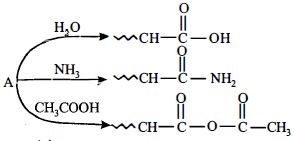
An organic compound $A$,$C_5 H_8 O$,reacts with $H_2 O$,$NH_3$,and $CH_3 COOH$ as shown in the reaction scheme. Identify $A$.
A
$CH_3 CH=C(CH_3)-CHO$
B
$CH_2=CHCH(CH_3)-CHO$
C
$CH_3-CH_2-C(CH_3)=C=O$
D
$CH_3-CH_2-C(=CH_2)-CH=O$
Solution
(C) The compound $A$ reacts with nucleophiles like $H_2 O$,$NH_3$,and $CH_3 COOH$ to form a carboxylic acid,an amide,and an acid anhydride respectively. This reactivity is characteristic of a ketene.
Given the molecular formula $C_5 H_8 O$,the structure $CH_3-CH_2-C(CH_3)=C=O$ (ethylmethylketene) fits the description.
$1$. Reaction with $H_2 O$: $CH_3-CH_2-C(CH_3)=C=O + H_2 O \rightarrow CH_3-CH_2-CH(CH_3)-COOH$
$2$. Reaction with $NH_3$: $CH_3-CH_2-C(CH_3)=C=O + NH_3 \rightarrow CH_3-CH_2-CH(CH_3)-CONH_2$
$3$. Reaction with $CH_3 COOH$: $CH_3-CH_2-C(CH_3)=C=O + CH_3 COOH \rightarrow CH_3-CH_2-CH(CH_3)-COOCOCH_3$
Given the molecular formula $C_5 H_8 O$,the structure $CH_3-CH_2-C(CH_3)=C=O$ (ethylmethylketene) fits the description.
$1$. Reaction with $H_2 O$: $CH_3-CH_2-C(CH_3)=C=O + H_2 O \rightarrow CH_3-CH_2-CH(CH_3)-COOH$
$2$. Reaction with $NH_3$: $CH_3-CH_2-C(CH_3)=C=O + NH_3 \rightarrow CH_3-CH_2-CH(CH_3)-CONH_2$
$3$. Reaction with $CH_3 COOH$: $CH_3-CH_2-C(CH_3)=C=O + CH_3 COOH \rightarrow CH_3-CH_2-CH(CH_3)-COOCOCH_3$
0 likesView Solution
57
ChemistryDifficultMCQJEE Main · 2014
In allene $(C_3H_4)$,the type of hybridization of the carbon atoms is (are)
A
$sp$ and $sp^3$
B
$sp^2$ and $sp$
C
only $sp^2$
D
$sp^2$ and $sp^3$
Solution
(B) The structure of allene is $CH_2=C=CH_2$.
The terminal carbon atoms are bonded to two hydrogen atoms and one carbon atom via a double bond,resulting in $sp^2$ hybridization.
The central carbon atom is bonded to two carbon atoms via two double bonds,resulting in $sp$ hybridization.
Therefore,the hybridization types present are $sp^2$ and $sp$.
The terminal carbon atoms are bonded to two hydrogen atoms and one carbon atom via a double bond,resulting in $sp^2$ hybridization.
The central carbon atom is bonded to two carbon atoms via two double bonds,resulting in $sp$ hybridization.
Therefore,the hybridization types present are $sp^2$ and $sp$.
1 likesView Solution
58
ChemistryDifficultMCQJEE Main · 2014
The gas liberated at the anode by the electrolysis of a concentrated aqueous solution of dipotassium succinate is:
A
Ethane
B
Ethyne
C
Ethene
D
Propene
Solution
(C) The electrolysis of an aqueous solution of dipotassium succinate is an example of the Kolbe electrolysis reaction.
At the anode,the succinate ion undergoes oxidation to form ethene and carbon dioxide:
$CH_2COO^{-} - CH_2COO^{-} \xrightarrow{-2e^-} CH_2=CH_2 + 2CO_2$
At the cathode,water is reduced to produce hydrogen gas:
$2H_2O + 2e^- \to H_2 + 2OH^-$
Therefore,the gas liberated at the anode is ethene $(CH_2=CH_2)$.
At the anode,the succinate ion undergoes oxidation to form ethene and carbon dioxide:
$CH_2COO^{-} - CH_2COO^{-} \xrightarrow{-2e^-} CH_2=CH_2 + 2CO_2$
At the cathode,water is reduced to produce hydrogen gas:
$2H_2O + 2e^- \to H_2 + 2OH^-$
Therefore,the gas liberated at the anode is ethene $(CH_2=CH_2)$.
0 likesView Solution
59
ChemistryDifficultMCQJEE Main · 2014
If $m$ and $e$ are the mass and charge of the revolving electron in the orbit of radius $r$ for a hydrogen atom,the total energy of the revolving electron will be:
A
$\frac{1}{2} \frac{e^2}{r}$
B
$-\frac{e^2}{r}$
C
$\frac{m e^2}{r}$
D
$-\frac{1}{2} \frac{e^2}{r}$
Solution
(D) The total energy $(E)$ of an electron in a hydrogen atom is the sum of its kinetic energy $(K.E.)$ and potential energy $(P.E.)$.
For an electron in an orbit of radius $r$,the electrostatic potential energy is given by $P.E. = -\frac{e^2}{r}$.
The kinetic energy is given by $K.E. = \frac{1}{2} \frac{e^2}{r}$.
Therefore,the total energy is $E = K.E. + P.E. = \frac{e^2}{2r} - \frac{e^2}{r} = -\frac{e^2}{2r}$.
For an electron in an orbit of radius $r$,the electrostatic potential energy is given by $P.E. = -\frac{e^2}{r}$.
The kinetic energy is given by $K.E. = \frac{1}{2} \frac{e^2}{r}$.
Therefore,the total energy is $E = K.E. + P.E. = \frac{e^2}{2r} - \frac{e^2}{r} = -\frac{e^2}{2r}$.
0 likesView Solution
60
ChemistryMediumMCQJEE Main · 2014
The de-Broglie wavelength of a particle of mass $6.63 \ g$ moving with a velocity of $100 \ ms^{-1}$ is
A
$10^{-33} \ m$
B
$10^{-35} \ m$
C
$10^{-31} \ m$
D
$10^{-25} \ m$
Solution
(A) The de-Broglie wavelength $\lambda$ is given by the formula $\lambda = \frac{h}{mv}$.
Given:
Mass $m = 6.63 \ g = 6.63 \times 10^{-3} \ kg$
Velocity $v = 100 \ ms^{-1}$
Planck's constant $h = 6.63 \times 10^{-34} \ J \cdot s$
Substituting the values:
$\lambda = \frac{6.63 \times 10^{-34} \ J \cdot s}{(6.63 \times 10^{-3} \ kg) \times (100 \ ms^{-1})}$
$\lambda = \frac{6.63 \times 10^{-34}}{6.63 \times 10^{-1}} \ m$
$\lambda = 10^{-33} \ m$
Given:
Mass $m = 6.63 \ g = 6.63 \times 10^{-3} \ kg$
Velocity $v = 100 \ ms^{-1}$
Planck's constant $h = 6.63 \times 10^{-34} \ J \cdot s$
Substituting the values:
$\lambda = \frac{6.63 \times 10^{-34} \ J \cdot s}{(6.63 \times 10^{-3} \ kg) \times (100 \ ms^{-1})}$
$\lambda = \frac{6.63 \times 10^{-34}}{6.63 \times 10^{-1}} \ m$
$\lambda = 10^{-33} \ m$
0 likesView Solution
61
ChemistryMediumMCQJEE Main · 2014
What happens when an inert gas is added to an equilibrium system while keeping the volume unchanged?
A
More product will form
B
Less product will form
C
More reactant will form
D
Equilibrium will remain unchanged
Solution
(D) When an inert gas is added to a system at equilibrium at constant volume,the total pressure of the system increases.
However,the partial pressure of each reactant and product remains the same because the concentration (moles/volume) of each species does not change.
According to Le Chatelier's principle,since the concentrations of the reacting species remain unchanged,there is no effect on the state of equilibrium.
However,the partial pressure of each reactant and product remains the same because the concentration (moles/volume) of each species does not change.
According to Le Chatelier's principle,since the concentrations of the reacting species remain unchanged,there is no effect on the state of equilibrium.
0 likesView Solution
62
ChemistryDifficultMCQJEE Main · 2014
The amount of $BaSO_4$ formed upon mixing $100 \ mL$ of $20.8 \%$ $BaCl_2$ solution with $50 \ mL$ of $9.8 \%$ $H_2SO_4$ solution will be ............. $g$
( $Ba = 137, Cl = 35.5, S = 32, H = 1$ and $O = 16$ )
( $Ba = 137, Cl = 35.5, S = 32, H = 1$ and $O = 16$ )
A
$11.65$
B
$23.3$
C
$30.6$
D
$33.2$
Solution
(B) The balanced chemical equation is: $BaCl_2 + H_2SO_4 \to BaSO_4 + 2HCl$
First,calculate the mass of reactants:
Mass of $BaCl_2 = 20.8 \ g$ (assuming $100 \ mL$ solution contains $20.8 \ g$ solute).
Moles of $BaCl_2 = \frac{20.8 \ g}{208 \ g/mol} = 0.1 \ mol$
Mass of $H_2SO_4 = 9.8 \ g$ (assuming $50 \ mL$ solution contains $9.8 \ g$ solute).
Moles of $H_2SO_4 = \frac{9.8 \ g}{98 \ g/mol} = 0.1 \ mol$
Since the stoichiometry is $1:1$,both reactants are consumed completely.
Therefore,$0.1 \ mol$ of $BaSO_4$ is formed.
Mass of $BaSO_4 = 0.1 \ mol \times 233 \ g/mol = 23.3 \ g$
First,calculate the mass of reactants:
Mass of $BaCl_2 = 20.8 \ g$ (assuming $100 \ mL$ solution contains $20.8 \ g$ solute).
Moles of $BaCl_2 = \frac{20.8 \ g}{208 \ g/mol} = 0.1 \ mol$
Mass of $H_2SO_4 = 9.8 \ g$ (assuming $50 \ mL$ solution contains $9.8 \ g$ solute).
Moles of $H_2SO_4 = \frac{9.8 \ g}{98 \ g/mol} = 0.1 \ mol$
Since the stoichiometry is $1:1$,both reactants are consumed completely.
Therefore,$0.1 \ mol$ of $BaSO_4$ is formed.
Mass of $BaSO_4 = 0.1 \ mol \times 233 \ g/mol = 23.3 \ g$
0 likesView Solution
63
ChemistryDifficultMCQJEE Main · 2014
The $S^o$ of the following substances are:
$CH_{4(g)} : 186.2 \ J \ K^{-1} \ mol^{-1}$
$O_{2(g)} : 205.2 \ J \ K^{-1} \ mol^{-1}$
$CO_{2(g)} : 213.6 \ J \ K^{-1} \ mol^{-1}$
$H_2O_{(l)} : 69.9 \ J \ K^{-1} \ mol^{-1}$
The entropy change $\Delta S^o$ . . . . . . $J \ K^{-1} \ mol^{-1}$ for the reaction
$CH_{4(g)} + 2O_{2(g)} \to CO_{2(g)} + 2H_2O_{(l)}$ is
$CH_{4(g)} : 186.2 \ J \ K^{-1} \ mol^{-1}$
$O_{2(g)} : 205.2 \ J \ K^{-1} \ mol^{-1}$
$CO_{2(g)} : 213.6 \ J \ K^{-1} \ mol^{-1}$
$H_2O_{(l)} : 69.9 \ J \ K^{-1} \ mol^{-1}$
The entropy change $\Delta S^o$ . . . . . . $J \ K^{-1} \ mol^{-1}$ for the reaction
$CH_{4(g)} + 2O_{2(g)} \to CO_{2(g)} + 2H_2O_{(l)}$ is
A
$-312.5$
B
$-242.8$
C
$-108.1$
D
$-37.6$
Solution
(B) The entropy change for the reaction is calculated using the formula:
$\Delta S^o = \sum S^o(\text{products}) - \sum S^o(\text{reactants})$
For the reaction $CH_{4(g)} + 2O_{2(g)} \to CO_{2(g)} + 2H_2O_{(l)}$:
$\Delta S^o = [S^o(CO_2) + 2 \times S^o(H_2O)] - [S^o(CH_4) + 2 \times S^o(O_2)]$
Substituting the given values:
$\Delta S^o = [213.6 + 2 \times 69.9] - [186.2 + 2 \times 205.2]$
$\Delta S^o = [213.6 + 139.8] - [186.2 + 410.4]$
$\Delta S^o = 353.4 - 596.6$
$\Delta S^o = -242.8 \ J \ K^{-1} \ mol^{-1}$
$\Delta S^o = \sum S^o(\text{products}) - \sum S^o(\text{reactants})$
For the reaction $CH_{4(g)} + 2O_{2(g)} \to CO_{2(g)} + 2H_2O_{(l)}$:
$\Delta S^o = [S^o(CO_2) + 2 \times S^o(H_2O)] - [S^o(CH_4) + 2 \times S^o(O_2)]$
Substituting the given values:
$\Delta S^o = [213.6 + 2 \times 69.9] - [186.2 + 2 \times 205.2]$
$\Delta S^o = [213.6 + 139.8] - [186.2 + 410.4]$
$\Delta S^o = 353.4 - 596.6$
$\Delta S^o = -242.8 \ J \ K^{-1} \ mol^{-1}$
0 likesView Solution
64
ChemistryEasyMCQJEE Main · 2014
The conjugate base of hydrazoic acid is
A
$N^{3-}$
B
$N_3^{-}$
C
$N_2^{-}$
D
$HN_3^{-}$
Solution
(B) The dissociation of hydrazoic acid $(HN_3)$ is given by the equation:
$HN_3 \rightleftharpoons N_3^{-} + H^{+}$
By definition,a conjugate base is formed when an acid loses a proton $(H^{+})$.
Therefore,the conjugate base of hydrazoic acid $(HN_3)$ is the azide ion,$N_3^{-}$.
$HN_3 \rightleftharpoons N_3^{-} + H^{+}$
By definition,a conjugate base is formed when an acid loses a proton $(H^{+})$.
Therefore,the conjugate base of hydrazoic acid $(HN_3)$ is the azide ion,$N_3^{-}$.
0 likesView Solution
65
ChemistryDifficultMCQJEE Main · 2014
The standard enthalpy of formation $(\Delta_f H^o_{298})$ for methane,$CH_4$ is $-74.9 \ kJ \ mol^{-1}$. In order to calculate the average energy given out in the formation of a $C-H$ bond from this,it is necessary to know which one of the following?
A
The dissociation energy of the hydrogen molecule,$H_2$
B
The first four ionisation energies of carbon.
C
The dissociation energy of $H_2$ and enthalpy of sublimation of carbon (graphite).
D
The first four ionisation energies of carbon and electron affinity of hydrogen.
Solution
(C) To calculate the average enthalpy of a $C-H$ bond in methane,we use the Born-Haber cycle approach based on the reaction: $C_{(graphite)} + 2H_{2(g)} \to CH_{4(g)}$.
To find the bond dissociation energy of $C-H$,we need to convert the reactants into gaseous atoms:
$(i)$ The enthalpy of sublimation of carbon: $C_{(graphite)} \to C_{(g)}$
$(ii)$ The dissociation energy of the hydrogen molecule: $H_{2(g)} \to 2H_{(g)}$
By knowing these values,we can calculate the total energy required to atomize the reactants and then relate it to the formation enthalpy to find the average $C-H$ bond energy.
To find the bond dissociation energy of $C-H$,we need to convert the reactants into gaseous atoms:
$(i)$ The enthalpy of sublimation of carbon: $C_{(graphite)} \to C_{(g)}$
$(ii)$ The dissociation energy of the hydrogen molecule: $H_{2(g)} \to 2H_{(g)}$
By knowing these values,we can calculate the total energy required to atomize the reactants and then relate it to the formation enthalpy to find the average $C-H$ bond energy.
0 likesView Solution
66
ChemistryMediumMCQJEE Main · 2014
An excited hydrogen atom emits light in the ultraviolet region at a frequency of $2.47 \times 10^{15} \ Hz$. Calculate the energy of a single photon. (Given: $h = 6.63 \times 10^{-34} \ J \cdot s$)
A
$8.041 \times 10^{-40} \ J$
B
$2.680 \times 10^{-19} \ J$
C
$1.640 \times 10^{-18} \ J$
D
$6.111 \times 10^{-17} \ J$
Solution
(C) The energy of a photon is given by the equation $E = h \nu$.
Given:
Planck's constant,$h = 6.63 \times 10^{-34} \ J \cdot s$
Frequency,$\nu = 2.47 \times 10^{15} \ Hz$
Substituting the values:
$E = (6.63 \times 10^{-34} \ J \cdot s) \times (2.47 \times 10^{15} \ s^{-1})$
$E = 16.3761 \times 10^{-19} \ J$
$E = 1.63761 \times 10^{-18} \ J \approx 1.640 \times 10^{-18} \ J$.
Given:
Planck's constant,$h = 6.63 \times 10^{-34} \ J \cdot s$
Frequency,$\nu = 2.47 \times 10^{15} \ Hz$
Substituting the values:
$E = (6.63 \times 10^{-34} \ J \cdot s) \times (2.47 \times 10^{15} \ s^{-1})$
$E = 16.3761 \times 10^{-19} \ J$
$E = 1.63761 \times 10^{-18} \ J \approx 1.640 \times 10^{-18} \ J$.
0 likesView Solution
67
ChemistryDifficultMCQJEE Main · 2014
Copper becomes green when exposed to moist air for a long period. This is due to
A
the formation of a layer of cupric oxide on the surface of copper.
B
the formation of a layer of basic carbonate of copper on the surface of copper.
C
the formation of a layer of cupric hydroxide on the surface of copper.
D
the formation of basic copper sulphate layer on the surface of the metal.
Solution
(B) When copper is exposed to moist air containing $CO_2$,it reacts to form a green coating on its surface.
This green layer consists of basic copper carbonate,which has the chemical formula $CuCO_3 \cdot Cu(OH)_2$.
This green layer consists of basic copper carbonate,which has the chemical formula $CuCO_3 \cdot Cu(OH)_2$.
0 likesView Solution
68
ChemistryEasyMCQJEE Main · 2014
Similarity in chemical properties of the atoms of elements in a group of the Periodic table is most closely related to
A
atomic numbers
B
atomic masses
C
number of principal energy levels
D
number of valence electrons
Solution
(D) Elements in the same group of the Periodic table exhibit similar chemical properties because they possess the same number of valence electrons.
These valence electrons determine the chemical reactivity and bonding behavior of the atoms.
While the atomic number determines the position of an element,the specific configuration of valence electrons is the direct cause of the similarity in chemical properties within a group.
These valence electrons determine the chemical reactivity and bonding behavior of the atoms.
While the atomic number determines the position of an element,the specific configuration of valence electrons is the direct cause of the similarity in chemical properties within a group.
0 likesView Solution
69
ChemistryDifficultMCQJEE Main · 2014
Which of the following arrangements represents the increasing order (smallest to largest) of ionic radii of the given species $O^{2-}, S^{2-}, N^{3-}, P^{3-}$?
A
$O^{2-} < N^{3-} < S^{2-} < P^{3-}$
B
$O^{2-} < P^{3-} < N^{3-} < S^{2-}$
C
$N^{3-} < O^{2-} < P^{3-} < S^{2-}$
D
$N^{3-} < S^{2-} < O^{2-} < P^{3-}$
Solution
(A) The ionic radii of species depend on the number of shells and the effective nuclear charge.
For species in the same period,the ionic radius decreases as the atomic number increases (e.g.,$N^{3-} > O^{2-}$).
For species in the same group,the ionic radius increases as we move down the group due to the addition of a new shell (e.g.,$P^{3-} > N^{3-}$ and $S^{2-} > O^{2-}$).
Comparing the given species:
$1$. $O^{2-}$ and $N^{3-}$ are in the second period,so $N^{3-} > O^{2-}$.
$2$. $S^{2-}$ and $P^{3-}$ are in the third period,so $P^{3-} > S^{2-}$.
$3$. Since $S^{2-}$ and $P^{3-}$ have more shells than $O^{2-}$ and $N^{3-}$,they are larger.
Combining these,the order of increasing ionic radii is $O^{2-} < N^{3-} < S^{2-} < P^{3-}$.
For species in the same period,the ionic radius decreases as the atomic number increases (e.g.,$N^{3-} > O^{2-}$).
For species in the same group,the ionic radius increases as we move down the group due to the addition of a new shell (e.g.,$P^{3-} > N^{3-}$ and $S^{2-} > O^{2-}$).
Comparing the given species:
$1$. $O^{2-}$ and $N^{3-}$ are in the second period,so $N^{3-} > O^{2-}$.
$2$. $S^{2-}$ and $P^{3-}$ are in the third period,so $P^{3-} > S^{2-}$.
$3$. Since $S^{2-}$ and $P^{3-}$ have more shells than $O^{2-}$ and $N^{3-}$,they are larger.
Combining these,the order of increasing ionic radii is $O^{2-} < N^{3-} < S^{2-} < P^{3-}$.
0 likesView Solution
70
ChemistryMediumMCQJEE Main · 2014
Global warming is due to an increase of:
A
methane and nitrous oxide in the atmosphere
B
methane and $CO_2$ in the atmosphere
C
methane and $O_3$ in the atmosphere
D
methane and $CO$ in the atmosphere
Solution
(B) Global warming is primarily caused by the increase in greenhouse gases in the atmosphere. The most significant contributor is $CO_2$ (carbon dioxide),followed by methane $(CH_4)$. These gases trap heat in the Earth's atmosphere,leading to a rise in global temperatures.
0 likesView Solution
71
ChemistryDifficultMCQJEE Main · 2014
Hydrogen peroxide acts both as an oxidising and as a reducing agent depending upon the nature of the reacting species. In which of the following cases $H_2O_2$ acts as a reducing agent in acidic medium?
A
$MnO_4^-$
B
$Cr_2O_7^{2-}$
C
$SO_3^{2-}$
D
$KI$
Solution
(A) $H_2O_2$ acts as a reducing agent when it reacts with strong oxidising agents. In an acidic medium,$H_2O_2$ reduces $MnO_4^-$ to $Mn^{2+}$.
The balanced chemical equation is:
$2KMnO_4 + 3H_2SO_4 + 5H_2O_2 \to K_2SO_4 + 2MnSO_4 + 8H_2O + 5O_2$
In this reaction,the oxidation state of $Mn$ changes from $+7$ to $+2$,and $H_2O_2$ is oxidized to $O_2$.
The balanced chemical equation is:
$2KMnO_4 + 3H_2SO_4 + 5H_2O_2 \to K_2SO_4 + 2MnSO_4 + 8H_2O + 5O_2$
In this reaction,the oxidation state of $Mn$ changes from $+7$ to $+2$,and $H_2O_2$ is oxidized to $O_2$.
0 likesView Solution
72
ChemistryMCQJEE Main · 2014
In the Victor-Meyer's test,the colours given by $1^o$,$2^o$ and $3^o$ alcohols are respectively:
A
Red,colourless,blue
B
Red,blue,colourless
C
Colourless,red,blue
D
Red,blue,violet
Solution
(B) The Victor-Meyer's test is used to distinguish between primary $(1^o)$,secondary $(2^o)$,and tertiary $(3^o)$ alcohols.
$(i)$ Primary $(1^o)$ alcohols react to form nitrolic acid,which gives a blood red colour with $KOH$.
(ii) Secondary $(2^o)$ alcohols react to form pseudonitrol,which gives a blue colour with $KOH$.
(iii) Tertiary $(3^o)$ alcohols do not react with $HNO_2$ and remain colourless in the presence of $KOH$.
Thus,the colours are Red,Blue,and Colourless respectively.
$(i)$ Primary $(1^o)$ alcohols react to form nitrolic acid,which gives a blood red colour with $KOH$.
(ii) Secondary $(2^o)$ alcohols react to form pseudonitrol,which gives a blue colour with $KOH$.
(iii) Tertiary $(3^o)$ alcohols do not react with $HNO_2$ and remain colourless in the presence of $KOH$.
Thus,the colours are Red,Blue,and Colourless respectively.
0 likesView Solution
73
ChemistryDifficultMCQJEE Main · 2014
In the presence of peroxide,$HCl$ and $HI$ do not give anti-Markownikoff's addition to alkenes because
A
One of the steps is endothermic in $HCl$ and $HI$
B
Both $HCl$ and $HI$ are strong acids
C
$HCl$ is oxidizing and $HI$ is reducing
D
All the steps are exothermic in $HCl$ and $HI$
Solution
(A) Anti-Markownikoff addition (peroxide effect) is observed only with $HBr$.
In the mechanism,the addition of the halogen radical to the alkene is exothermic for all hydrogen halides.
However,the step involving the abstraction of a hydrogen atom from the hydrogen halide by the alkyl radical is crucial.
For $HBr$,this step is exothermic,making the overall reaction favorable.
For $HCl$,the $H-Cl$ bond is very strong,making this step endothermic.
For $HI$,the $I-I$ bond formation is exothermic,but the addition of the iodine radical to the alkene is endothermic,making the overall process unfavorable.
Therefore,$HCl$ and $HI$ do not undergo anti-Markownikoff's addition.
In the mechanism,the addition of the halogen radical to the alkene is exothermic for all hydrogen halides.
However,the step involving the abstraction of a hydrogen atom from the hydrogen halide by the alkyl radical is crucial.
For $HBr$,this step is exothermic,making the overall reaction favorable.
For $HCl$,the $H-Cl$ bond is very strong,making this step endothermic.
For $HI$,the $I-I$ bond formation is exothermic,but the addition of the iodine radical to the alkene is endothermic,making the overall process unfavorable.
Therefore,$HCl$ and $HI$ do not undergo anti-Markownikoff's addition.
0 likesView Solution
74
ChemistryDifficultMCQJEE Main · 2014
The major product obtained in the photo-catalyzed bromination of $2-$methylbutane is:
A
$1-$bromo$-2-$methylbutane
B
$1-$bromo$-3-$methylbutane
C
$2-$bromo$-3-$methylbutane
D
$2-$bromo$-2-$methylbutane
Solution
(D) The bromination of alkanes follows a free radical mechanism.
Bromine is highly selective and preferentially replaces the hydrogen atom on the carbon that forms the most stable radical.
In $2-$methylbutane $(CH_3-CH(CH_3)-CH_2-CH_3)$,the $C2$ position is a tertiary $(3^\circ)$ carbon.
The $3^\circ$ radical is significantly more stable than $2^\circ$ or $1^\circ$ radicals.
Thus,the major product is $2-$bromo$-2-$methylbutane.
Bromine is highly selective and preferentially replaces the hydrogen atom on the carbon that forms the most stable radical.
In $2-$methylbutane $(CH_3-CH(CH_3)-CH_2-CH_3)$,the $C2$ position is a tertiary $(3^\circ)$ carbon.
The $3^\circ$ radical is significantly more stable than $2^\circ$ or $1^\circ$ radicals.
Thus,the major product is $2-$bromo$-2-$methylbutane.
0 likesView Solution
75
ChemistryMediumMCQJEE Main · 2014
Which of the following molecules has two $\sigma$ and two $\pi$ bonds?
A
$C_2H_4$
B
$N_2F_2$
C
$C_2H_2Cl_2$
D
$HCN$
Solution
(D) In the molecule $HCN$,the structure is $H-C \equiv N$.
There is one $\sigma$ bond between $H$ and $C$.
There is one $\sigma$ bond and two $\pi$ bonds between $C$ and $N$.
Total bonds in $HCN$: $2\,\sigma$ bonds and $2\,\pi$ bonds.
Therefore,the correct option is $D$.
There is one $\sigma$ bond between $H$ and $C$.
There is one $\sigma$ bond and two $\pi$ bonds between $C$ and $N$.
Total bonds in $HCN$: $2\,\sigma$ bonds and $2\,\pi$ bonds.
Therefore,the correct option is $D$.
0 likesView Solution
76
ChemistryDifficultMCQJEE Main · 2014
Which one of the following acids does not exhibit optical isomerism?
A
Lactic acid
B
Tartaric acid
C
Maleic acid
D
$\alpha -$ amino acids
Solution
(C) Optical isomerism requires the presence of an asymmetric (chiral) carbon atom,which is a carbon atom bonded to four different groups.
$1$. Lactic acid $(CH_3CH(OH)COOH)$ has a chiral carbon.
$2$. Tartaric acid $(HOOC-CH(OH)-CH(OH)-COOH)$ has chiral carbons.
$3$. $\alpha -$ amino acids $(R-CH(NH_2)-COOH)$ have a chiral carbon (except glycine).
$4$. Maleic acid $(HOOC-CH=CH-COOH)$ is a geometric isomer (cis-isomer) and does not contain any chiral carbon atom.
Therefore,maleic acid does not exhibit optical isomerism.
$1$. Lactic acid $(CH_3CH(OH)COOH)$ has a chiral carbon.
$2$. Tartaric acid $(HOOC-CH(OH)-CH(OH)-COOH)$ has chiral carbons.
$3$. $\alpha -$ amino acids $(R-CH(NH_2)-COOH)$ have a chiral carbon (except glycine).
$4$. Maleic acid $(HOOC-CH=CH-COOH)$ is a geometric isomer (cis-isomer) and does not contain any chiral carbon atom.
Therefore,maleic acid does not exhibit optical isomerism.
0 likesView Solution
77
ChemistryMCQJEE Main · 2014
$A$ ball of mass $160\, g$ is thrown up at an angle of $60^\circ$ to the horizontal at a speed of $10\, m\,s^{-1}$. The angular momentum of the ball at the highest point of the trajectory with respect to the point from which the ball is thrown is nearly ........ $kg\, m^2/s$ $(g = 10\, m\,s^{-2})$.
A
$1.73$
B
$3.0$
C
$3.46$
D
$6.0$
Solution
(B) Given: Mass $m = 160\, g = 0.16\, kg$,initial velocity $v = 10\, m/s$,angle $\theta = 60^\circ$,and acceleration due to gravity $g = 10\, m/s^2$.
At the highest point,the vertical component of velocity is zero,and the horizontal component is $v_x = v \cos \theta = 10 \cos 60^\circ = 10 \times 0.5 = 5\, m/s$.
The height of the highest point is $H = \frac{v^2 \sin^2 \theta}{2g} = \frac{10^2 \times (\sin 60^\circ)^2}{2 \times 10} = \frac{100 \times 0.75}{20} = 3.75\, m$.
The angular momentum $L$ at the highest point with respect to the point of projection is given by $L = m \times v_x \times H$.
Substituting the values: $L = 0.16 \times 5 \times 3.75 = 0.8 \times 3.75 = 3.0\, kg\, m^2/s$.
At the highest point,the vertical component of velocity is zero,and the horizontal component is $v_x = v \cos \theta = 10 \cos 60^\circ = 10 \times 0.5 = 5\, m/s$.
The height of the highest point is $H = \frac{v^2 \sin^2 \theta}{2g} = \frac{10^2 \times (\sin 60^\circ)^2}{2 \times 10} = \frac{100 \times 0.75}{20} = 3.75\, m$.
The angular momentum $L$ at the highest point with respect to the point of projection is given by $L = m \times v_x \times H$.
Substituting the values: $L = 0.16 \times 5 \times 3.75 = 0.8 \times 3.75 = 3.0\, kg\, m^2/s$.
0 likesView Solution
78
ChemistryDifficultMCQJEE Main · 2014
Ionization energy of gaseous $Na$ atoms is $495.5 \ kJ \ mol^{-1}$. The lowest possible frequency of light that ionizes a sodium atom is $(h = 6.626 \times 10^{-34} \ J \ s, N_A = 6.022 \times 10^{23} \ mol^{-1})$.
A
$7.50 \times 10^4 \ s^{-1}$
B
$4.76 \times 10^{14} \ s^{-1}$
C
$3.15 \times 10^{15} \ s^{-1}$
D
$1.24 \times 10^{15} \ s^{-1}$
Solution
(D) The energy required to ionize one atom of $Na$ is given by $E = \frac{IE}{N_A}$.
$E = \frac{495.5 \times 10^3 \ J \ mol^{-1}}{6.022 \times 10^{23} \ mol^{-1}} = 8.228 \times 10^{-19} \ J$.
Using the relation $E = h\nu$,the frequency $\nu$ is $\nu = \frac{E}{h}$.
$\nu = \frac{8.228 \times 10^{-19} \ J}{6.626 \times 10^{-34} \ J \ s} = 1.2417 \times 10^{15} \ s^{-1}$.
Thus,the lowest frequency is approximately $1.24 \times 10^{15} \ s^{-1}$.
$E = \frac{495.5 \times 10^3 \ J \ mol^{-1}}{6.022 \times 10^{23} \ mol^{-1}} = 8.228 \times 10^{-19} \ J$.
Using the relation $E = h\nu$,the frequency $\nu$ is $\nu = \frac{E}{h}$.
$\nu = \frac{8.228 \times 10^{-19} \ J}{6.626 \times 10^{-34} \ J \ s} = 1.2417 \times 10^{15} \ s^{-1}$.
Thus,the lowest frequency is approximately $1.24 \times 10^{15} \ s^{-1}$.
0 likesView Solution
79
ChemistryDifficultMCQJEE Main · 2014
Which one of the following molecules is paramagnetic?
A
$N_2$
B
$NO$
C
$CO$
D
$O_3$
Solution
(B) The molecular orbital configuration of the molecules is determined by the total number of electrons.
For $NO$:
Total number of electrons $= 7(N) + 8(O) = 15$.
The molecular orbital configuration is $KK(\sigma 2s)^2 (\sigma^* 2s)^2 (\sigma 2p_z)^2 (\pi 2p_x)^2 (\pi 2p_y)^2 (\pi^* 2p_x)^1$.
Due to the presence of one unpaired electron in the $\pi^* 2p_x$ orbital,$NO$ is paramagnetic.
In contrast,$N_2$ ($14$ electrons),$CO$ ($14$ electrons),and $O_3$ ($24$ electrons) have all electrons paired,making them diamagnetic.
For $NO$:
Total number of electrons $= 7(N) + 8(O) = 15$.
The molecular orbital configuration is $KK(\sigma 2s)^2 (\sigma^* 2s)^2 (\sigma 2p_z)^2 (\pi 2p_x)^2 (\pi 2p_y)^2 (\pi^* 2p_x)^1$.
Due to the presence of one unpaired electron in the $\pi^* 2p_x$ orbital,$NO$ is paramagnetic.
In contrast,$N_2$ ($14$ electrons),$CO$ ($14$ electrons),and $O_3$ ($24$ electrons) have all electrons paired,making them diamagnetic.
0 likesView Solution
80
ChemistryDifficultMCQJEE Main · 2014
Zirconium phosphate $[Zr_3(PO_4)_4]$ dissociates into three zirconium cations of charge $+4$ and four phosphate anions of charge $-3$. If molar solubility of zirconium phosphate is denoted by $S$ and its solubility product by $K_{sp}$,then which of the following relationships between $S$ and $K_{sp}$ is correct?
A
$S = \{K_{sp} / (6912)^{1/7}\}$
B
$S = \{K_{sp} / 144\}^{1/7}$
C
$S = \{K_{sp} / 6912\}^{1/7}$
D
$S = \{K_{sp} / 6912\}^{7}$
Solution
(C) The dissociation reaction is: $[Zr_3(PO_4)_4] \rightleftharpoons 3Zr^{4+} + 4PO_4^{3-}$
If $S$ is the molar solubility,the concentration of $Zr^{4+}$ is $3S$ and $PO_4^{3-}$ is $4S$.
The solubility product expression is: $K_{sp} = [Zr^{4+}]^3 [PO_4^{3-}]^4$
Substituting the values: $K_{sp} = (3S)^3 (4S)^4$
$K_{sp} = (27S^3) \times (256S^4)$
$K_{sp} = 6912S^7$
Therefore,$S = (K_{sp} / 6912)^{1/7}$
If $S$ is the molar solubility,the concentration of $Zr^{4+}$ is $3S$ and $PO_4^{3-}$ is $4S$.
The solubility product expression is: $K_{sp} = [Zr^{4+}]^3 [PO_4^{3-}]^4$
Substituting the values: $K_{sp} = (3S)^3 (4S)^4$
$K_{sp} = (27S^3) \times (256S^4)$
$K_{sp} = 6912S^7$
Therefore,$S = (K_{sp} / 6912)^{1/7}$
0 likesView Solution
81
ChemistryDifficultMCQJEE Main · 2014
For the decomposition of the compound,represented as $NH_2COONH_{4(s)} \rightleftharpoons 2NH_{3(g)} + CO_{2(g)}$,the $K_p = 2.9 \times 10^{-5} \ atm^3$. If the reaction is started with $1 \ mol$ of the compound,the total pressure at equilibrium would be............ $\times 10^{-2} \ atm$.
A
$1.94$
B
$5.82$
C
$7.66$
D
$38.8$
Solution
(B) The decomposition reaction is $NH_2COONH_{4(s)} \rightleftharpoons 2NH_{3(g)} + CO_{2(g)}$.
The equilibrium constant expression is $K_p = (P_{NH_3})^2 \times (P_{CO_2})$.
From the stoichiometry,$NH_3$ and $CO_2$ are produced in a $2:1$ molar ratio. If $P$ is the total pressure at equilibrium,then $P_{NH_3} = \frac{2P}{3}$ and $P_{CO_2} = \frac{P}{3}$.
Substituting these into the $K_p$ expression: $K_p = (\frac{2P}{3})^2 \times (\frac{P}{3}) = \frac{4P^3}{27}$.
Given $K_p = 2.9 \times 10^{-5}$,we have $2.9 \times 10^{-5} = \frac{4P^3}{27}$.
Solving for $P$: $P^3 = \frac{2.9 \times 10^{-5} \times 27}{4} = 19.575 \times 10^{-5} = 195.75 \times 10^{-6}$.
$P = (195.75)^{1/3} \times 10^{-2} \ atm \approx 5.82 \times 10^{-2} \ atm$.
The equilibrium constant expression is $K_p = (P_{NH_3})^2 \times (P_{CO_2})$.
From the stoichiometry,$NH_3$ and $CO_2$ are produced in a $2:1$ molar ratio. If $P$ is the total pressure at equilibrium,then $P_{NH_3} = \frac{2P}{3}$ and $P_{CO_2} = \frac{P}{3}$.
Substituting these into the $K_p$ expression: $K_p = (\frac{2P}{3})^2 \times (\frac{P}{3}) = \frac{4P^3}{27}$.
Given $K_p = 2.9 \times 10^{-5}$,we have $2.9 \times 10^{-5} = \frac{4P^3}{27}$.
Solving for $P$: $P^3 = \frac{2.9 \times 10^{-5} \times 27}{4} = 19.575 \times 10^{-5} = 195.75 \times 10^{-6}$.
$P = (195.75)^{1/3} \times 10^{-2} \ atm \approx 5.82 \times 10^{-2} \ atm$.
0 likesView Solution
82
ChemistryDifficultMCQJEE Main · 2014
Sulphur dioxide $(SO_2)$ and oxygen $(O_2)$ were allowed to diffuse through a porous partition. $20 \ dm^3$ of $SO_2$ diffuses through the porous partition in $60 \ seconds$. The volume of $O_2$ in $dm^3$ which diffuses under the similar conditions in $30 \ seconds$ will be (atomic mass of sulphur $= 32 \ u$)
A
$7.09$
B
$14.1$
C
$10$
D
$28.2$
Solution
(B) According to Graham's Law of Diffusion,the rate of diffusion $(r)$ is inversely proportional to the square root of the molar mass $(M)$ of the gas: $r \propto \frac{1}{\sqrt{M}}$.
The rate of diffusion is defined as $r = \frac{V}{t}$,where $V$ is the volume and $t$ is the time.
Thus,$\frac{r_{SO_2}}{r_{O_2}} = \frac{V_{SO_2} / t_{SO_2}}{V_{O_2} / t_{O_2}} = \sqrt{\frac{M_{O_2}}{M_{SO_2}}}$.
Given: $V_{SO_2} = 20 \ dm^3$,$t_{SO_2} = 60 \ s$,$t_{O_2} = 30 \ s$.
Molar mass of $SO_2 = 32 + (2 \times 16) = 64 \ g/mol$.
Molar mass of $O_2 = 2 \times 16 = 32 \ g/mol$.
Substituting the values: $\frac{20 / 60}{V_{O_2} / 30} = \sqrt{\frac{32}{64}} = \sqrt{\frac{1}{2}} = \frac{1}{\sqrt{2}}$.
$\frac{1/3}{V_{O_2}/30} = \frac{1}{\sqrt{2}} \implies \frac{10}{V_{O_2}} = \frac{1}{1.414}$.
$V_{O_2} = 10 \times 1.414 = 14.14 \ dm^3 \approx 14.1 \ dm^3$.
The rate of diffusion is defined as $r = \frac{V}{t}$,where $V$ is the volume and $t$ is the time.
Thus,$\frac{r_{SO_2}}{r_{O_2}} = \frac{V_{SO_2} / t_{SO_2}}{V_{O_2} / t_{O_2}} = \sqrt{\frac{M_{O_2}}{M_{SO_2}}}$.
Given: $V_{SO_2} = 20 \ dm^3$,$t_{SO_2} = 60 \ s$,$t_{O_2} = 30 \ s$.
Molar mass of $SO_2 = 32 + (2 \times 16) = 64 \ g/mol$.
Molar mass of $O_2 = 2 \times 16 = 32 \ g/mol$.
Substituting the values: $\frac{20 / 60}{V_{O_2} / 30} = \sqrt{\frac{32}{64}} = \sqrt{\frac{1}{2}} = \frac{1}{\sqrt{2}}$.
$\frac{1/3}{V_{O_2}/30} = \frac{1}{\sqrt{2}} \implies \frac{10}{V_{O_2}} = \frac{1}{1.414}$.
$V_{O_2} = 10 \times 1.414 = 14.14 \ dm^3 \approx 14.1 \ dm^3$.
0 likesView Solution
83
ChemistryMediumMCQJEE Main · 2014
Consider the reaction $H_2SO_{3(aq)} + Sn^{4+}_{(aq)} + H_2O_{(l)} \to Sn^{2+}_{(aq)} + HSO_4^-(aq) + 3H^{+}_{(aq)}$. Which of the following statements is correct?
A
$Sn^{4+}$ is the oxidizing agent because it undergoes oxidation
B
$Sn^{4+}$ is the reducing agent because it undergoes oxidation
C
$H_2SO_3$ is the reducing agent because it undergoes oxidation
D
$H_2SO_3$ is the reducing agent because it undergoes reduction
Solution
(C) In the given reaction: $\overset{+4}{H_2SO_3}_{(aq)} + Sn^{4+}_{(aq)} + H_2O_{(l)} \to Sn^{2+}_{(aq)} + \overset{+6}{HSO_4^-}_{(aq)} + 3H^{+}_{(aq)}$.
$1$. The oxidation state of $S$ in $H_2SO_3$ increases from $+4$ to $+6$,which means $H_2SO_3$ undergoes oxidation.
$2$. The oxidation state of $Sn$ decreases from $+4$ to $+2$,which means $Sn^{4+}$ undergoes reduction.
$3$. Since $H_2SO_3$ undergoes oxidation,it acts as the reducing agent.
Therefore,the correct statement is that $H_2SO_3$ is the reducing agent because it undergoes oxidation.
$1$. The oxidation state of $S$ in $H_2SO_3$ increases from $+4$ to $+6$,which means $H_2SO_3$ undergoes oxidation.
$2$. The oxidation state of $Sn$ decreases from $+4$ to $+2$,which means $Sn^{4+}$ undergoes reduction.
$3$. Since $H_2SO_3$ undergoes oxidation,it acts as the reducing agent.
Therefore,the correct statement is that $H_2SO_3$ is the reducing agent because it undergoes oxidation.
0 likesView Solution
84
ChemistryMediumMCQJEE Main · 2014
Which one of the following has the largest ionic radius?
A
$O_2^{2-}$
B
$Li^{+}$
C
$B^{3+}$
D
$F^{-}$
Solution
(A) All the given ions $(O_2^{2-}, F^-, Li^+, B^{3+})$ are isoelectronic with the neon configuration $(1s^2 2s^2 2p^6)$,having $10$ electrons.
For isoelectronic species,the ionic radius increases as the nuclear charge $(Z)$ decreases.
The atomic numbers are: $O (Z=8)$,$F (Z=9)$,$Li (Z=3)$,$B (Z=5)$.
Since $O_2^{2-}$ has the lowest nuclear charge $(Z=8)$,it exerts the least attraction on the electrons,resulting in the largest ionic radius.
For isoelectronic species,the ionic radius increases as the nuclear charge $(Z)$ decreases.
The atomic numbers are: $O (Z=8)$,$F (Z=9)$,$Li (Z=3)$,$B (Z=5)$.
Since $O_2^{2-}$ has the lowest nuclear charge $(Z=8)$,it exerts the least attraction on the electrons,resulting in the largest ionic radius.
0 likesView Solution
85
ChemistryDifficultMCQJEE Main · 2014
How many electrons are involved in the following redox reaction?
$Cr_2O_7^{2-} + Fe^{2+} + C_2O_4^{2-} \to Cr^{3+} + Fe^{3+} + CO_2$ (Unbalanced)
$Cr_2O_7^{2-} + Fe^{2+} + C_2O_4^{2-} \to Cr^{3+} + Fe^{3+} + CO_2$ (Unbalanced)
A
$3$
B
$4$
C
$6$
D
$5$
Solution
(C) The given unbalanced reaction is $Cr_2O_7^{2-} + Fe^{2+} + C_2O_4^{2-} \to Cr^{3+} + Fe^{3+} + CO_2$.
Step $1$: Oxidation half-reactions:
$Fe^{2+} \to Fe^{3+} + e^-$ $(i)$
$C_2O_4^{2-} \to 2CO_2 + 2e^-$ $(ii)$
Adding $(i)$ and $(ii)$: $Fe^{2+} + C_2O_4^{2-} \to Fe^{3+} + 2CO_2 + 3e^-$.
Step $2$: Reduction half-reaction:
$Cr_2O_7^{2-} + 14H^+ + 6e^- \to 2Cr^{3+} + 7H_2O$ $(iii)$.
Step $3$: To balance the electrons,multiply the oxidation half-reaction by $2$ and the reduction half-reaction by $1$:
$2(Fe^{2+} + C_2O_4^{2-} \to Fe^{3+} + 2CO_2 + 3e^-) \implies 2Fe^{2+} + 2C_2O_4^{2-} \to 2Fe^{3+} + 4CO_2 + 6e^-$.
Step $4$: Adding the balanced half-reactions:
$Cr_2O_7^{2-} + 2Fe^{2+} + 2C_2O_4^{2-} + 14H^+ \to 2Cr^{3+} + 2Fe^{3+} + 4CO_2 + 7H_2O$.
The total number of electrons involved in the balanced redox reaction is $6$.
Step $1$: Oxidation half-reactions:
$Fe^{2+} \to Fe^{3+} + e^-$ $(i)$
$C_2O_4^{2-} \to 2CO_2 + 2e^-$ $(ii)$
Adding $(i)$ and $(ii)$: $Fe^{2+} + C_2O_4^{2-} \to Fe^{3+} + 2CO_2 + 3e^-$.
Step $2$: Reduction half-reaction:
$Cr_2O_7^{2-} + 14H^+ + 6e^- \to 2Cr^{3+} + 7H_2O$ $(iii)$.
Step $3$: To balance the electrons,multiply the oxidation half-reaction by $2$ and the reduction half-reaction by $1$:
$2(Fe^{2+} + C_2O_4^{2-} \to Fe^{3+} + 2CO_2 + 3e^-) \implies 2Fe^{2+} + 2C_2O_4^{2-} \to 2Fe^{3+} + 4CO_2 + 6e^-$.
Step $4$: Adding the balanced half-reactions:
$Cr_2O_7^{2-} + 2Fe^{2+} + 2C_2O_4^{2-} + 14H^+ \to 2Cr^{3+} + 2Fe^{3+} + 4CO_2 + 7H_2O$.
The total number of electrons involved in the balanced redox reaction is $6$.
0 likesView Solution
86
ChemistryDifficultMCQJEE Main · 2014
Amongst $LiCl$,$RbCl$,$BeCl_2$,and $MgCl_2$,the compounds with the greatest and the least ionic character,respectively,are:
A
$LiCl$ and $RbCl$
B
$RbCl$ and $BeCl_2$
C
$MgCl_2$ and $BeCl_2$
D
$RbCl$ and $MgCl_2$
Solution
(B) According to Fajan's rules,the ionic character of a compound depends on the polarizing power of the cation.
Smaller and highly charged cations have greater polarizing power,leading to higher covalent character and lower ionic character.
Larger and less charged cations have lower polarizing power,leading to higher ionic character.
Comparing the cations: $Rb^+$ (largest size,$+1$ charge),$Li^+$ ($+1$ charge),$Mg^{2+}$ ($+2$ charge),and $Be^{2+}$ (smallest size,$+2$ charge).
$RbCl$ has the largest cation with the lowest charge,making it the most ionic.
$BeCl_2$ has the smallest cation with a high charge,making it the most covalent (least ionic).
Therefore,the compound with the greatest ionic character is $RbCl$ and the one with the least ionic character is $BeCl_2$.
Smaller and highly charged cations have greater polarizing power,leading to higher covalent character and lower ionic character.
Larger and less charged cations have lower polarizing power,leading to higher ionic character.
Comparing the cations: $Rb^+$ (largest size,$+1$ charge),$Li^+$ ($+1$ charge),$Mg^{2+}$ ($+2$ charge),and $Be^{2+}$ (smallest size,$+2$ charge).
$RbCl$ has the largest cation with the lowest charge,making it the most ionic.
$BeCl_2$ has the smallest cation with a high charge,making it the most covalent (least ionic).
Therefore,the compound with the greatest ionic character is $RbCl$ and the one with the least ionic character is $BeCl_2$.
0 likesView Solution
87
ChemistryMediumMCQJEE Main · 2014
Example of a three-dimensional silicate is
A
Zeolites
B
Ultramarines
C
Feldspars
D
Beryls
Solution
(C) Feldspars are the most abundant aluminosilicate minerals on the Earth's surface.
In these structures,silicon and aluminium atoms occupy the centers of interlinked tetrahedra of $SiO_4^{4-}$ and $AlO_4^{5-}$.
These tetrahedra connect at each corner to other tetrahedra,forming an intricate,three-dimensional,negatively charged framework.
Cations like $Na^+$,$K^+$,or $Ca^{2+}$ occupy the voids within this structure.
In these structures,silicon and aluminium atoms occupy the centers of interlinked tetrahedra of $SiO_4^{4-}$ and $AlO_4^{5-}$.
These tetrahedra connect at each corner to other tetrahedra,forming an intricate,three-dimensional,negatively charged framework.
Cations like $Na^+$,$K^+$,or $Ca^{2+}$ occupy the voids within this structure.
0 likesView Solution
88
ChemistryDifficultMCQJEE Main · 2014
Amongst the following,identify the species with an atom in $+6$ oxidation state.
A
$CrO_2Cl_2$
B
$[Cr(CN)_6]^{3-}$
C
$Cr_2O_3$
D
$[MnO_4]^-$
Solution
(A) To find the oxidation state of the central atom in $CrO_2Cl_2$:
Let the oxidation state of $Cr$ be $x$.
Oxygen $(O)$ has an oxidation state of $-2$ and Chlorine $(Cl)$ has an oxidation state of $-1$.
Setting the sum of oxidation states to zero: $x + 2(-2) + 2(-1) = 0$.
$x - 4 - 2 = 0$.
$x - 6 = 0$.
$x = +6$.
Thus,$CrO_2Cl_2$ contains $Cr$ in the $+6$ oxidation state.
Let the oxidation state of $Cr$ be $x$.
Oxygen $(O)$ has an oxidation state of $-2$ and Chlorine $(Cl)$ has an oxidation state of $-1$.
Setting the sum of oxidation states to zero: $x + 2(-2) + 2(-1) = 0$.
$x - 4 - 2 = 0$.
$x - 6 = 0$.
$x = +6$.
Thus,$CrO_2Cl_2$ contains $Cr$ in the $+6$ oxidation state.
0 likesView Solution
89
ChemistryMediumMCQJEE Main · 2014
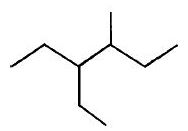
The correct $IUPAC$ name of the following compound is:
A
$4-methyl-3-ethylhexane$
B
$3-ethyl-4-methylhexane$
C
$3, 4-ethylmethylhexane$
D
$4-ethyl-3-methylhexane$
Solution
(B) The longest carbon chain contains $6$ carbon atoms,so the parent alkane is hexane.
There are two substituents: an ethyl group and a methyl group.
Numbering the chain from either end gives the locants $3$ and $4$.
According to $IUPAC$ rules,when two different substituents are present at equivalent positions,the substituent that comes first in alphabetical order (ethyl) is assigned the lower number.
Therefore,the correct name is $3-ethyl-4-methylhexane$.
There are two substituents: an ethyl group and a methyl group.
Numbering the chain from either end gives the locants $3$ and $4$.
According to $IUPAC$ rules,when two different substituents are present at equivalent positions,the substituent that comes first in alphabetical order (ethyl) is assigned the lower number.
Therefore,the correct name is $3-ethyl-4-methylhexane$.
0 likesView Solution
90
ChemistryMCQJEE Main · 2014
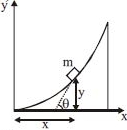
$A$ block of mass $m$ is placed on a surface with a vertical cross-section given by $y = \frac{x^3}{6}$. If the coefficient of friction is $0.5$,the maximum height above the ground at which the block can be placed without slipping is
A
$\frac{1}{2} \, m$
B
$\frac{1}{6} \, m$
C
$\frac{2}{3} \, m$
D
$\frac{1}{3} \, m$
Solution
(B) For the block to remain in equilibrium without slipping,the angle of inclination $\theta$ at the point of placement must satisfy the condition $\tan \theta \le \mu$.
The maximum height corresponds to the limiting case where $\tan \theta = \mu = 0.5$.
The slope of the surface at any point $(x, y)$ is given by $\frac{dy}{dx} = \tan \theta$.
Given the equation of the surface $y = \frac{x^3}{6}$,we find the slope:
$\frac{dy}{dx} = \frac{d}{dx} \left( \frac{x^3}{6} \right) = \frac{3x^2}{6} = \frac{x^2}{2}$.
Equating the slope to the coefficient of friction:
$\frac{x^2}{2} = 0.5$
$x^2 = 1$
$x = 1$.
Now,substitute $x = 1$ into the equation of the surface to find the maximum height $y$:
$y = \frac{(1)^3}{6} = \frac{1}{6} \, m$.
The maximum height corresponds to the limiting case where $\tan \theta = \mu = 0.5$.
The slope of the surface at any point $(x, y)$ is given by $\frac{dy}{dx} = \tan \theta$.
Given the equation of the surface $y = \frac{x^3}{6}$,we find the slope:
$\frac{dy}{dx} = \frac{d}{dx} \left( \frac{x^3}{6} \right) = \frac{3x^2}{6} = \frac{x^2}{2}$.
Equating the slope to the coefficient of friction:
$\frac{x^2}{2} = 0.5$
$x^2 = 1$
$x = 1$.
Now,substitute $x = 1$ into the equation of the surface to find the maximum height $y$:
$y = \frac{(1)^3}{6} = \frac{1}{6} \, m$.
0 likesView Solution
91
ChemistryMCQJEE Main · 2014
Amongst $LiCl$,$RbCl$,$BeCl_2$,and $MgCl_2$,the compounds with the greatest and least ionic character respectively are:
A
$LiCl$ and $RbCl$
B
$RbCl$ and $BeCl_2$
C
$RbCl$ and $MgCl_2$
D
$MgCl_2$ and $BeCl_2$
Solution
(B) According to Fajan's rule,the ionic character of a compound depends on the polarizability of the cation.
As the size of the cation increases,its polarizing power decreases,which leads to an increase in the ionic character of the bond.
Among the given cations ($Li^+$,$Rb^+$,$Be^{2+}$,$Mg^{2+}$),$Rb^+$ has the largest ionic radius,resulting in the highest ionic character for $RbCl$.
Conversely,$Be^{2+}$ has the smallest size and highest charge density,causing the greatest polarization of the chloride ion,which results in the least ionic (most covalent) character for $BeCl_2$.
Therefore,the compound with the greatest ionic character is $RbCl$ and the compound with the least ionic character is $BeCl_2$.
As the size of the cation increases,its polarizing power decreases,which leads to an increase in the ionic character of the bond.
Among the given cations ($Li^+$,$Rb^+$,$Be^{2+}$,$Mg^{2+}$),$Rb^+$ has the largest ionic radius,resulting in the highest ionic character for $RbCl$.
Conversely,$Be^{2+}$ has the smallest size and highest charge density,causing the greatest polarization of the chloride ion,which results in the least ionic (most covalent) character for $BeCl_2$.
Therefore,the compound with the greatest ionic character is $RbCl$ and the compound with the least ionic character is $BeCl_2$.
0 likesView Solution
92
ChemistryMCQJEE Main · 2014
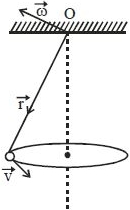
$A$ bob of mass $m$ attached to an inextensible string of length $l$ is suspended from a vertical support. The bob rotates in a horizontal circle with an angular speed $\omega \ rad/s$ about the vertical axis. About the point of suspension:
A
Angular momentum changes in direction but not in magnitude
B
Angular momentum changes both in direction and magnitude
C
Angular momentum is conserved
D
Angular momentum changes in magnitude but not in direction
Solution
(A) The angular momentum of the bob about the point of suspension $O$ is given by $\vec{L} = \vec{r} \times \vec{p} = m(\vec{r} \times \vec{v})$.
As the bob moves in a horizontal circle,the position vector $\vec{r}$ and the velocity vector $\vec{v}$ change their directions continuously.
Specifically,the vector $\vec{L}$ is always perpendicular to the plane containing $\vec{r}$ and $\vec{v}$. As the bob revolves,this plane rotates about the vertical axis,causing the direction of $\vec{L}$ to change continuously.
However,the magnitude of the angular momentum $L = mvr \sin \theta$ remains constant because the speed $v$,the distance $r$ from the suspension point,and the angle $\theta$ between the string and the vertical axis remain constant during the uniform circular motion.
Therefore,the angular momentum changes in direction but not in magnitude.
As the bob moves in a horizontal circle,the position vector $\vec{r}$ and the velocity vector $\vec{v}$ change their directions continuously.
Specifically,the vector $\vec{L}$ is always perpendicular to the plane containing $\vec{r}$ and $\vec{v}$. As the bob revolves,this plane rotates about the vertical axis,causing the direction of $\vec{L}$ to change continuously.
However,the magnitude of the angular momentum $L = mvr \sin \theta$ remains constant because the speed $v$,the distance $r$ from the suspension point,and the angle $\theta$ between the string and the vertical axis remain constant during the uniform circular motion.
Therefore,the angular momentum changes in direction but not in magnitude.
0 likesView Solution
93
ChemistryMCQJEE Main · 2014
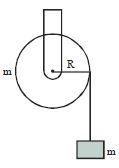
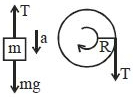
$A$ mass $m$ is supported by a massless string wound around a uniform hollow cylinder of mass $m$ and radius $R$. If the string does not slip on the cylinder,with what acceleration will the mass fall on release?
A
$\frac{5g}{6}$
B
$g$
C
$\frac{2g}{3}$
D
$\frac{g}{2}$
Solution
(D) For the falling mass $m$,the equation of motion is: $mg - T = ma$ ... $(1)$
For the rotation of the hollow cylinder,the torque $\tau$ is given by $\tau = I\alpha$. Since the cylinder is hollow,its moment of inertia is $I = mR^2$.
The torque is provided by the tension $T$,so $T \cdot R = I\alpha = (mR^2) \cdot \frac{a}{R}$,where $a = R\alpha$ is the linear acceleration of the string.
This simplifies to $T = ma$ ... $(2)$
Substituting equation $(2)$ into equation $(1)$:
$mg - ma = ma$
$mg = 2ma$
$a = \frac{g}{2}$
For the rotation of the hollow cylinder,the torque $\tau$ is given by $\tau = I\alpha$. Since the cylinder is hollow,its moment of inertia is $I = mR^2$.
The torque is provided by the tension $T$,so $T \cdot R = I\alpha = (mR^2) \cdot \frac{a}{R}$,where $a = R\alpha$ is the linear acceleration of the string.
This simplifies to $T = ma$ ... $(2)$
Substituting equation $(2)$ into equation $(1)$:
$mg - ma = ma$
$mg = 2ma$
$a = \frac{g}{2}$
0 likesView Solution
94
ChemistryMCQJEE Main · 2014
$A$ particle moves with simple harmonic motion in a straight line. In the first $\tau \, s$,after starting from rest,it travels a distance $a$,and in the next $\tau \, s$,it travels $2a$ in the same direction. Then:
A
amplitude of motion is $3a$
B
time period of oscillations is $8\tau$
C
amplitude of motion is $4a$
D
time period of oscillations is $6\tau$
Solution
(D) Since the particle starts from rest,we can represent its position as $x = A \cos(\omega t)$,where $A$ is the amplitude and $x$ is the displacement from the mean position. At $t=0$,$x=A$.
At $t=\tau$,the distance traveled is $a$,so the position is $x = A - a$.
At $t=2\tau$,the total distance traveled is $a + 2a = 3a$,so the position is $x = A - 3a$.
From the equation $x = A \cos(\omega t)$,we get:
$A - a = A \cos(\omega \tau) \implies \cos(\omega \tau) = \frac{A-a}{A} \quad ...(i)$
$A - 3a = A \cos(2\omega \tau) \implies \cos(2\omega \tau) = \frac{A-3a}{A} \quad ...(ii)$
Using the identity $\cos(2\theta) = 2\cos^2(\theta) - 1$:
$\frac{A-3a}{A} = 2\left(\frac{A-a}{A}\right)^2 - 1$
$A-3a = \frac{2(A^2 + a^2 - 2Aa)}{A} - A$
$A^2 - 3aA = 2A^2 + 2a^2 - 4Aa - A^2$
$A^2 - 3aA = A^2 + 2a^2 - 4Aa$
$a^2 = aA \implies A = 2a$ (Wait,re-evaluating: $A^2 - 3aA = A^2 + 2a^2 - 4Aa \implies aA = 2a^2 \implies A = 2a$ is incorrect,let's re-solve: $A^2 - 3aA = A^2 + 2a^2 - 4Aa \implies aA = 2a^2 \implies A = 2a$ is indeed correct).
Substitute $A=2a$ into $(i)$:
$\cos(\omega \tau) = \frac{2a-a}{2a} = \frac{1}{2}$
$\omega \tau = \frac{\pi}{3}$
$\frac{2\pi}{T} \tau = \frac{\pi}{3} \implies T = 6\tau$.
At $t=\tau$,the distance traveled is $a$,so the position is $x = A - a$.
At $t=2\tau$,the total distance traveled is $a + 2a = 3a$,so the position is $x = A - 3a$.
From the equation $x = A \cos(\omega t)$,we get:
$A - a = A \cos(\omega \tau) \implies \cos(\omega \tau) = \frac{A-a}{A} \quad ...(i)$
$A - 3a = A \cos(2\omega \tau) \implies \cos(2\omega \tau) = \frac{A-3a}{A} \quad ...(ii)$
Using the identity $\cos(2\theta) = 2\cos^2(\theta) - 1$:
$\frac{A-3a}{A} = 2\left(\frac{A-a}{A}\right)^2 - 1$
$A-3a = \frac{2(A^2 + a^2 - 2Aa)}{A} - A$
$A^2 - 3aA = 2A^2 + 2a^2 - 4Aa - A^2$
$A^2 - 3aA = A^2 + 2a^2 - 4Aa$
$a^2 = aA \implies A = 2a$ (Wait,re-evaluating: $A^2 - 3aA = A^2 + 2a^2 - 4Aa \implies aA = 2a^2 \implies A = 2a$ is incorrect,let's re-solve: $A^2 - 3aA = A^2 + 2a^2 - 4Aa \implies aA = 2a^2 \implies A = 2a$ is indeed correct).
Substitute $A=2a$ into $(i)$:
$\cos(\omega \tau) = \frac{2a-a}{2a} = \frac{1}{2}$
$\omega \tau = \frac{\pi}{3}$
$\frac{2\pi}{T} \tau = \frac{\pi}{3} \implies T = 6\tau$.
0 likesView Solution
95
ChemistryMCQJEE Main · 2014
$A$ coil of circular cross-section having $1000$ turns and $4 \, cm^2$ face area is placed with its axis parallel to a magnetic field which decreases by $10^{-2} \, Wb \, m^{-2}$ in $0.01 \, s$. The $e.m.f.$ induced in the coil is......$mV$
A
$400$
B
$200$
C
$4$
D
$0.4$
Solution
(A) Given: Number of turns $N = 1000$.
Face area $A = 4 \, cm^2 = 4 \times 10^{-4} \, m^2$.
Change in magnetic field $\Delta B = 10^{-2} \, Wb \, m^{-2}$.
Time interval $\Delta t = 0.01 \, s = 10^{-2} \, s$.
Since the axis of the coil is parallel to the magnetic field,the angle $\theta$ between the area vector and the magnetic field is $0^\circ$,so $\cos(0^\circ) = 1$.
The induced $e.m.f.$ is given by Faraday's law: $e = N \frac{\Delta \phi}{\Delta t} = N A \frac{\Delta B}{\Delta t}$.
Substituting the values:
$e = 1000 \times (4 \times 10^{-4} \, m^2) \times \frac{10^{-2} \, Wb \, m^{-2}}{10^{-2} \, s}$.
$e = 1000 \times 4 \times 10^{-4} \, V = 0.4 \, V$.
Converting to $mV$: $0.4 \, V = 0.4 \times 1000 \, mV = 400 \, mV$.
Face area $A = 4 \, cm^2 = 4 \times 10^{-4} \, m^2$.
Change in magnetic field $\Delta B = 10^{-2} \, Wb \, m^{-2}$.
Time interval $\Delta t = 0.01 \, s = 10^{-2} \, s$.
Since the axis of the coil is parallel to the magnetic field,the angle $\theta$ between the area vector and the magnetic field is $0^\circ$,so $\cos(0^\circ) = 1$.
The induced $e.m.f.$ is given by Faraday's law: $e = N \frac{\Delta \phi}{\Delta t} = N A \frac{\Delta B}{\Delta t}$.
Substituting the values:
$e = 1000 \times (4 \times 10^{-4} \, m^2) \times \frac{10^{-2} \, Wb \, m^{-2}}{10^{-2} \, s}$.
$e = 1000 \times 4 \times 10^{-4} \, V = 0.4 \, V$.
Converting to $mV$: $0.4 \, V = 0.4 \times 1000 \, mV = 400 \, mV$.
0 likesView Solution
96
ChemistryMCQJEE Main · 2014
$A$ green light is incident from the water to the air-water interface at the critical angle $(\theta_c)$. Select the correct statement.
A
The entire spectrum of visible light will come out of the water at an angle of $90^o$ to the normal.
B
The spectrum of visible light whose frequency is less than that of green light will come out to the air medium.
C
The spectrum of visible light whose frequency is more than that of green light will come out to the air medium.
D
The entire spectrum of visible light will come out of the water at various angles to the normal.
Solution
(B) The critical angle $\theta_c$ is given by the relation $\sin \theta_c = \frac{1}{\mu}$.
Since the refractive index $\mu$ depends on the wavelength $\lambda$ (Cauchy's equation: $\mu \approx A + \frac{B}{\lambda^2}$),$\mu$ decreases as wavelength increases.
Frequency $f$ is inversely proportional to wavelength $(f = \frac{c}{\lambda})$,so $\mu$ decreases as frequency decreases.
For green light,$\sin \theta_c = \frac{1}{\mu_{green}}$.
Light with a frequency less than green light has a longer wavelength,resulting in a smaller refractive index $\mu$ and a larger critical angle $\theta_c$.
Since the incident angle is fixed at $\theta_c$ (for green light),these colors (lower frequency) will have an incident angle less than their respective critical angles,allowing them to refract into the air.
Conversely,light with a higher frequency has a larger $\mu$ and a smaller critical angle,causing it to undergo total internal reflection.
Since the refractive index $\mu$ depends on the wavelength $\lambda$ (Cauchy's equation: $\mu \approx A + \frac{B}{\lambda^2}$),$\mu$ decreases as wavelength increases.
Frequency $f$ is inversely proportional to wavelength $(f = \frac{c}{\lambda})$,so $\mu$ decreases as frequency decreases.
For green light,$\sin \theta_c = \frac{1}{\mu_{green}}$.
Light with a frequency less than green light has a longer wavelength,resulting in a smaller refractive index $\mu$ and a larger critical angle $\theta_c$.
Since the incident angle is fixed at $\theta_c$ (for green light),these colors (lower frequency) will have an incident angle less than their respective critical angles,allowing them to refract into the air.
Conversely,light with a higher frequency has a larger $\mu$ and a smaller critical angle,causing it to undergo total internal reflection.
0 likesView Solution
97
ChemistryMCQJEE Main · 2014
The position of a projectile launched from the origin at $t=0$ is given by $\vec{r}=(40 \hat{i}+50 \hat{j}) \text{ m}$ at $t=2 \text{ s}$. If the projectile was launched at an angle $\theta$ from the horizontal,then $\theta$ is (take $g = 10 \text{ m/s}^2$)
A
$\tan^{-1} \frac{2}{3}$
B
$\tan^{-1} \frac{3}{2}$
C
$\tan^{-1} \frac{7}{4}$
D
$\tan^{-1} \frac{4}{5}$
Solution
(C) The horizontal position is given by $x = u_x t$. Given $x = 40 \text{ m}$ at $t = 2 \text{ s}$,we have $40 = u_x \times 2$,which gives $u_x = 20 \text{ m/s}$.
The vertical position is given by $y = u_y t - \frac{1}{2} g t^2$. Given $y = 50 \text{ m}$ at $t = 2 \text{ s}$ and $g = 10 \text{ m/s}^2$,we have $50 = u_y(2) - \frac{1}{2}(10)(2)^2$.
$50 = 2u_y - 20 \Rightarrow 2u_y = 70 \Rightarrow u_y = 35 \text{ m/s}$.
The angle of projection $\theta$ is given by $\tan \theta = \frac{u_y}{u_x}$.
$\tan \theta = \frac{35}{20} = \frac{7}{4}$.
Therefore,$\theta = \tan^{-1} \frac{7}{4}$.
The vertical position is given by $y = u_y t - \frac{1}{2} g t^2$. Given $y = 50 \text{ m}$ at $t = 2 \text{ s}$ and $g = 10 \text{ m/s}^2$,we have $50 = u_y(2) - \frac{1}{2}(10)(2)^2$.
$50 = 2u_y - 20 \Rightarrow 2u_y = 70 \Rightarrow u_y = 35 \text{ m/s}$.
The angle of projection $\theta$ is given by $\tan \theta = \frac{u_y}{u_x}$.
$\tan \theta = \frac{35}{20} = \frac{7}{4}$.
Therefore,$\theta = \tan^{-1} \frac{7}{4}$.
0 likesView Solution
98
ChemistryMCQJEE Main · 2014
Which of the following expressions corresponds to simple harmonic motion along a straight line,where $x$ is the displacement and $a, b, c$ are positive constants?
A
$a+bx-cx^2$
B
$bx^2$
C
$a-bx+cx^2$
D
$-bx$
Solution
(D) The condition for simple harmonic motion $(S.H.M.)$ is that the restoring force $F$ must be directly proportional to the displacement $x$ and directed towards the equilibrium position.
Mathematically,this is expressed as $F = -kx$,where $k$ is a positive force constant.
Comparing this with the given options,the expression $-bx$ (where $b$ is a positive constant) represents the force in $S.H.M.$
Therefore,the correct option is $D$.
Mathematically,this is expressed as $F = -kx$,where $k$ is a positive force constant.
Comparing this with the given options,the expression $-bx$ (where $b$ is a positive constant) represents the force in $S.H.M.$
Therefore,the correct option is $D$.
0 likesView Solution
99
ChemistryEasyMCQJEE Main · 2014
In a monoclinic unit cell,the relation of sides and angles are respectively
A
$a \neq b \neq c$ and $\alpha = \beta = \gamma = 90^{\circ}$
B
$a \neq b \neq c$ and $\alpha = \gamma = 90^{\circ} \neq \beta$
C
$a \neq b \neq c$ and $\alpha = \gamma = 90^{\circ} \neq \beta$ (Note: Corrected to match standard definition)
D
$a \neq b \neq c$ and $\alpha \neq \beta \neq \gamma \neq 90^{\circ}$
Solution
(B) The monoclinic crystal system is one of the $7$ primitive crystal systems.
In a monoclinic unit cell,the side lengths are unequal,represented as $a \neq b \neq c$.
The angles are defined such that two angles are $90^{\circ}$ and one is not,specifically $\alpha = \gamma = 90^{\circ}$ and $\beta \neq 90^{\circ}$.
In a monoclinic unit cell,the side lengths are unequal,represented as $a \neq b \neq c$.
The angles are defined such that two angles are $90^{\circ}$ and one is not,specifically $\alpha = \gamma = 90^{\circ}$ and $\beta \neq 90^{\circ}$.
0 likesView Solution
100
ChemistryDifficultMCQJEE Main · 2014
Which of the following xenon-oxo compounds may not be obtained by hydrolysis of xenon fluorides?
A
$XeO_2F_2$
B
$XeOF_4$
C
$XeO_3$
D
$XeO_4$
Solution
(D) The hydrolysis of xenon fluorides ($XeF_4$ and $XeF_6$) yields various xenon-oxo compounds.
$XeF_6 + H_2O \rightarrow XeOF_4 + 2HF$
$XeF_6 + 2H_2O \rightarrow XeO_2F_2 + 4HF$
$XeF_6 + 3H_2O \rightarrow XeO_3 + 6HF$
$XeO_4$ (Xenon tetroxide) is an unstable compound and cannot be prepared by the direct hydrolysis of xenon fluorides. It is typically prepared by the reaction of barium perxenate $(Ba_2XeO_6)$ with concentrated sulfuric acid $(H_2SO_4)$.
$XeF_6 + H_2O \rightarrow XeOF_4 + 2HF$
$XeF_6 + 2H_2O \rightarrow XeO_2F_2 + 4HF$
$XeF_6 + 3H_2O \rightarrow XeO_3 + 6HF$
$XeO_4$ (Xenon tetroxide) is an unstable compound and cannot be prepared by the direct hydrolysis of xenon fluorides. It is typically prepared by the reaction of barium perxenate $(Ba_2XeO_6)$ with concentrated sulfuric acid $(H_2SO_4)$.
0 likesView Solution
101
ChemistryMediumMCQJEE Main · 2014
Which one of the following exhibits the largest number of oxidation states?
A
$Ti \ (22)$
B
$V \ (23)$
C
$Cr \ (24)$
D
$Mn \ (25)$
Solution
(D) The transition elements exhibit variable oxidation states due to the participation of $(n-1)d$ and $ns$ electrons in bonding.
Among the given elements,$Mn \ (Z=25)$ has the electronic configuration $[Ar] \ 3d^5 \ 4s^2$.
It exhibits the largest number of oxidation states ranging from $+2$ to $+7$ $(+2, +3, +4, +6, +7)$ because it has the maximum number of unpaired electrons available for bonding.
Among the given elements,$Mn \ (Z=25)$ has the electronic configuration $[Ar] \ 3d^5 \ 4s^2$.
It exhibits the largest number of oxidation states ranging from $+2$ to $+7$ $(+2, +3, +4, +6, +7)$ because it has the maximum number of unpaired electrons available for bonding.
0 likesView Solution
102
ChemistryDifficultMCQJEE Main · 2014
Among the following species,the one which causes the highest $CFSE, \Delta _0$ as a ligand is
A
$CN^{-}$
B
$NH_3$
C
$F^{-}$
D
$CO$
Solution
(D) The magnitude of crystal field splitting energy $(\Delta _0)$ depends on the strength of the ligand,which is described by the spectrochemical series.
The spectrochemical series for the given ligands is: $F^{-} < NH_3 < CN^{-} < CO$.
$CO$ is a strong $\pi$-acid ligand and sits at the end of the spectrochemical series,causing the largest splitting of $d$-orbitals.
Therefore,$CO$ causes the highest $\Delta _0$.
The spectrochemical series for the given ligands is: $F^{-} < NH_3 < CN^{-} < CO$.
$CO$ is a strong $\pi$-acid ligand and sits at the end of the spectrochemical series,causing the largest splitting of $d$-orbitals.
Therefore,$CO$ causes the highest $\Delta _0$.
0 likesView Solution
103
ChemistryDifficultMCQJEE Main · 2014
Which one of the following complexes will most likely absorb visible light? (At. nos. $Sc = 21$,$Ti = 22$,$V = 23$,$Zn = 30$)
A
$[Sc(H_2O)_6]^{3+}$
B
$[Ti(NH_3)_6]^{4+}$
C
$[V(NH_3)_6]^{3+}$
D
$[Zn(NH_3)_6]^{2+}$
Solution
(C) The absorption of visible light and the resulting coloured nature of transition metal complexes are due to the $d-d$ electronic transition,which requires the presence of at least one unpaired $d$-electron.
Let us analyze the electronic configuration of the metal ions in the given complexes:
$1. [Sc(H_2O)_6]^{3+}: Sc^{3+} (Z=21) = [Ar] 3d^0$. No unpaired electrons.
$2. [Ti(NH_3)_6]^{4+}: Ti^{4+} (Z=22) = [Ar] 3d^0$. No unpaired electrons.
$3. [V(NH_3)_6]^{3+}: V^{3+} (Z=23) = [Ar] 3d^2$. Two unpaired electrons.
$4. [Zn(NH_3)_6]^{2+}: Zn^{2+} (Z=30) = [Ar] 3d^{10}$. No unpaired electrons.
Since $[V(NH_3)_6]^{3+}$ contains unpaired $d$-electrons,it can undergo $d-d$ transitions and is the most likely to absorb visible light.
Let us analyze the electronic configuration of the metal ions in the given complexes:
$1. [Sc(H_2O)_6]^{3+}: Sc^{3+} (Z=21) = [Ar] 3d^0$. No unpaired electrons.
$2. [Ti(NH_3)_6]^{4+}: Ti^{4+} (Z=22) = [Ar] 3d^0$. No unpaired electrons.
$3. [V(NH_3)_6]^{3+}: V^{3+} (Z=23) = [Ar] 3d^2$. Two unpaired electrons.
$4. [Zn(NH_3)_6]^{2+}: Zn^{2+} (Z=30) = [Ar] 3d^{10}$. No unpaired electrons.
Since $[V(NH_3)_6]^{3+}$ contains unpaired $d$-electrons,it can undergo $d-d$ transitions and is the most likely to absorb visible light.
0 likesView Solution
104
ChemistryDifficultMCQJEE Main · 2014
The oxymercuration-demercuration of allylbenzene $(C_6H_5-CH_2-CH=CH_2)$ produces the major product:
A
$1-$phenylpropan$-2-$ol
B
$3-$phenylpropan$-1-$ol
C
$1-$phenylpropane$-2,3-$diol
D
$2-$phenylacetic acid
Solution
(A) Oxymercuration-demercuration is a reaction that follows Markovnikov's rule for the addition of water across a double bond without rearrangement.
For allylbenzene $(C_6H_5-CH_2-CH=CH_2)$,the electrophilic mercuric species attacks the terminal carbon $(CH_2)$ to form a more stable carbocation-like intermediate,followed by the attack of water at the more substituted carbon $(CH)$.
This results in the formation of $1-$phenylpropan$-2-$ol as the major product.
The reaction is: $C_6H_5-CH_2-CH=CH_2 \xrightarrow[(ii) NaBH_4]{(i) Hg(OAc)_2} C_6H_5-CH_2-CH(OH)-CH_3$.
For allylbenzene $(C_6H_5-CH_2-CH=CH_2)$,the electrophilic mercuric species attacks the terminal carbon $(CH_2)$ to form a more stable carbocation-like intermediate,followed by the attack of water at the more substituted carbon $(CH)$.
This results in the formation of $1-$phenylpropan$-2-$ol as the major product.
The reaction is: $C_6H_5-CH_2-CH=CH_2 \xrightarrow[(ii) NaBH_4]{(i) Hg(OAc)_2} C_6H_5-CH_2-CH(OH)-CH_3$.
0 likesView Solution
105
ChemistryDifficultMCQJEE Main · 2014
Conversion of benzene diazonium chloride to chlorobenzene is an example of which of the following reactions?
A
Claisen
B
Friedel-craft
C
Sandmeyer
D
Wurtz
Solution
(C) The conversion of benzene diazonium chloride to chlorobenzene using $CuCl/HCl$ is a classic example of the Sandmeyer reaction.
The chemical equation is: $C_6H_5N_2Cl \xrightarrow{CuCl/HCl} C_6H_5Cl + N_2$
Therefore,the correct option is $C$.
The chemical equation is: $C_6H_5N_2Cl \xrightarrow{CuCl/HCl} C_6H_5Cl + N_2$
Therefore,the correct option is $C$.
0 likesView Solution
106
ChemistryMediumMCQJEE Main · 2014
Aminoglycosides are usually used as
A
antibiotic
B
analgesic
C
hypnotic
D
antifertility
Solution
(A) Aminoglycosides are a class of compounds that act as potent $antibiotics$. They are effective against Gram-negative bacteria and are among the oldest classes of antibiotics used in clinical practice.
0 likesView Solution
107
ChemistryEasyMCQJEE Main · 2014
Which of the following will not show mutarotation?
A
Maltose
B
Lactose
C
Glucose
D
Sucrose
Solution
(D) Mutarotation is a property exhibited by reducing sugars that have a free hemiacetal or hemiketal group,allowing them to exist in equilibrium between their open-chain and cyclic forms.
Sucrose is a non-reducing sugar because its glycosidic linkage is formed between the $C1$ of glucose and the $C2$ of fructose,effectively blocking both anomeric carbons.
Since sucrose does not contain a free aldehydic or ketonic group,it cannot undergo ring-opening to exhibit mutarotation.
Sucrose is a non-reducing sugar because its glycosidic linkage is formed between the $C1$ of glucose and the $C2$ of fructose,effectively blocking both anomeric carbons.
Since sucrose does not contain a free aldehydic or ketonic group,it cannot undergo ring-opening to exhibit mutarotation.
0 likesView Solution
108
ChemistryDifficultMCQJEE Main · 2014
Phthalic acid reacts with resorcinol in the presence of concentrated $H_2SO_4$ to give
A
Phenolphthalein
B
Alizarin
C
Coumarin
D
Fluorescein
Solution
(D) The reaction between phthalic acid and resorcinol in the presence of concentrated $H_2SO_4$ is a condensation reaction.
Phthalic acid undergoes dehydration with two molecules of resorcinol to form a dye known as Fluorescein.
The reaction is: $\text{Phthalic acid} + 2 \times \text{Resorcinol} \xrightarrow{\text{Conc. } H_2SO_4} \text{Fluorescein} + 2H_2O$.
Phthalic acid undergoes dehydration with two molecules of resorcinol to form a dye known as Fluorescein.
The reaction is: $\text{Phthalic acid} + 2 \times \text{Resorcinol} \xrightarrow{\text{Conc. } H_2SO_4} \text{Fluorescein} + 2H_2O$.
0 likesView Solution
109
ChemistryDifficultMCQJEE Main · 2014
Choose the correct statement with respect to the vapour pressure of a liquid among the following:
A
Increases linearly with increasing temperature
B
Increases non-linearly with increasing temperature
C
Decreases linearly with increasing temperature
D
Decreases non-linearly with increasing temperature
Solution
(B) The vapour pressure of a liquid increases with an increase in temperature.
According to the Clausius-Clapeyron equation,the relationship between vapour pressure $(P)$ and temperature $(T)$ is exponential,not linear.
Therefore,if we plot a graph between the vapour pressure and the temperature,we obtain a curve that rises faster as $T$ increases,indicating a non-linear increase.
According to the Clausius-Clapeyron equation,the relationship between vapour pressure $(P)$ and temperature $(T)$ is exponential,not linear.
Therefore,if we plot a graph between the vapour pressure and the temperature,we obtain a curve that rises faster as $T$ increases,indicating a non-linear increase.
0 likesView Solution
110
ChemistryDifficultMCQJEE Main · 2014
For the reaction,$3A + 2B \to C + D$,the differential rate law can be written as:
A
$-\frac{1}{3} \frac{d[A]}{dt} = \frac{d[C]}{dt} = k[A]^n[B]^m$
B
$-\frac{d[A]}{dt} = \frac{d[C]}{dt} = k[A]^n[B]^m$
C
$+\frac{1}{3} \frac{d[A]}{dt} = -\frac{d[C]}{dt} = k[A]^n[B]^m$
D
$-\frac{1}{3} \frac{d[A]}{dt} = \frac{d[C]}{dt} = k[A]^n[B]^m$
Solution
(A) For a general reaction $aA + bB \to cC + dD$,the rate of reaction is expressed as:
Rate $= -\frac{1}{a} \frac{d[A]}{dt} = -\frac{1}{b} \frac{d[B]}{dt} = \frac{1}{c} \frac{d[C]}{dt} = \frac{1}{d} \frac{d[D]}{dt} = k[A]^n[B]^m$
Given the reaction $3A + 2B \to C + D$,the rate expression is:
Rate $= -\frac{1}{3} \frac{d[A]}{dt} = -\frac{1}{2} \frac{d[B]}{dt} = \frac{d[C]}{dt} = \frac{d[D]}{dt} = k[A]^n[B]^m$
Comparing this with the given options,the correct representation is $-\frac{1}{3} \frac{d[A]}{dt} = \frac{d[C]}{dt} = k[A]^n[B]^m$.
Rate $= -\frac{1}{a} \frac{d[A]}{dt} = -\frac{1}{b} \frac{d[B]}{dt} = \frac{1}{c} \frac{d[C]}{dt} = \frac{1}{d} \frac{d[D]}{dt} = k[A]^n[B]^m$
Given the reaction $3A + 2B \to C + D$,the rate expression is:
Rate $= -\frac{1}{3} \frac{d[A]}{dt} = -\frac{1}{2} \frac{d[B]}{dt} = \frac{d[C]}{dt} = \frac{d[D]}{dt} = k[A]^n[B]^m$
Comparing this with the given options,the correct representation is $-\frac{1}{3} \frac{d[A]}{dt} = \frac{d[C]}{dt} = k[A]^n[B]^m$.
0 likesView Solution
111
ChemistryDifficultMCQJEE Main · 2014
The observed osmotic pressure for a $0.10 \ M$ solution of $Fe(NH_4)_2(SO_4)_2$ at $25 \ ^oC$ is $10.8 \ atm$. The expected and experimental (observed) values of van't Hoff factor $(i)$ will be respectively: $(R = 0.082 \ L \ atm \ K^{-1} \ mol^{-1})$
A
$5$ and $4.42$
B
$4$ and $4.00$
C
$5$ and $3.42$
D
$3$ and $5.42$
Solution
(A) The dissociation of $Fe(NH_4)_2(SO_4)_2$ is given by: $Fe(NH_4)_2(SO_4)_2 \rightarrow Fe^{2+} + 2NH_4^+ + 2SO_4^{2-}$.
The total number of ions produced per formula unit is $1 + 2 + 2 = 5$. Thus,the expected van't Hoff factor $(i_{expected}) = 5$.
The normal osmotic pressure $(\pi_{nor})$ is calculated using the formula $\pi = CRT$:
$\pi_{nor} = 0.10 \times 0.082 \times 298 = 2.4436 \ atm$.
The observed osmotic pressure $(\pi_{ob})$ is given as $10.8 \ atm$.
The experimental van't Hoff factor $(i_{exp})$ is calculated as:
$i_{exp} = \frac{\pi_{ob}}{\pi_{nor}} = \frac{10.8}{2.4436} \approx 4.42$.
Therefore,the expected and experimental values are $5$ and $4.42$ respectively.
The total number of ions produced per formula unit is $1 + 2 + 2 = 5$. Thus,the expected van't Hoff factor $(i_{expected}) = 5$.
The normal osmotic pressure $(\pi_{nor})$ is calculated using the formula $\pi = CRT$:
$\pi_{nor} = 0.10 \times 0.082 \times 298 = 2.4436 \ atm$.
The observed osmotic pressure $(\pi_{ob})$ is given as $10.8 \ atm$.
The experimental van't Hoff factor $(i_{exp})$ is calculated as:
$i_{exp} = \frac{\pi_{ob}}{\pi_{nor}} = \frac{10.8}{2.4436} \approx 4.42$.
Therefore,the expected and experimental values are $5$ and $4.42$ respectively.
0 likesView Solution
112
ChemistryEasyMCQJEE Main · 2014
The total number of octahedral void$(s)$ per atom present in a cubic close packed structure is
A
$2$
B
$4$
C
$1$
D
$3$
Solution
(C) In a cubic close packed $(ccp)$ or face-centered cubic $(fcc)$ structure,the number of atoms per unit cell is $Z = 4$.
There is one octahedral void at the body center of the cube and $12$ octahedral voids at the edges,each shared by $4$ unit cells.
Number of octahedral voids at the body center $= 1$.
Number of octahedral voids at the edges $= 12 \times \frac{1}{4} = 3$.
Total number of octahedral voids per unit cell $= 1 + 3 = 4$.
Since there are $4$ atoms per unit cell,the number of octahedral voids per atom $= \frac{4}{4} = 1$.
There is one octahedral void at the body center of the cube and $12$ octahedral voids at the edges,each shared by $4$ unit cells.
Number of octahedral voids at the body center $= 1$.
Number of octahedral voids at the edges $= 12 \times \frac{1}{4} = 3$.
Total number of octahedral voids per unit cell $= 1 + 3 = 4$.
Since there are $4$ atoms per unit cell,the number of octahedral voids per atom $= \frac{4}{4} = 1$.
0 likesView Solution
113
ChemistryMediumMCQJEE Main · 2014
For an ideal solution of two components $A$ and $B$,which of the following is true?
A
$\Delta H_{mixing} < 0$
B
$\Delta H_{mixing} > 0$
C
$A-B$ interaction is stronger than $A-A$ and $B-B$ interactions
D
$A-A, B-B$ and $A-B$ interactions are identical
Solution
(D) An ideal solution is defined as a solution that obeys Raoult's law over the entire range of concentration.
For an ideal solution,the enthalpy of mixing,$\Delta H_{mixing}$,is equal to $0$.
Furthermore,the volume of mixing,$\Delta V_{mixing}$,is also equal to $0$.
This occurs because the intermolecular forces of attraction between the solute-solute $(A-A)$,solvent-solvent $(B-B)$,and solute-solvent $(A-B)$ molecules are identical in nature and magnitude.
For an ideal solution,the enthalpy of mixing,$\Delta H_{mixing}$,is equal to $0$.
Furthermore,the volume of mixing,$\Delta V_{mixing}$,is also equal to $0$.
This occurs because the intermolecular forces of attraction between the solute-solute $(A-A)$,solvent-solvent $(B-B)$,and solute-solvent $(A-B)$ molecules are identical in nature and magnitude.
0 likesView Solution
114
ChemistryDifficultMCQJEE Main · 2014
An octahedral complex with molecular composition $M \cdot 5NH_3 \cdot Cl \cdot SO_4$ has two isomers,$A$ and $B$. The solution of $A$ gives a white precipitate with $AgNO_3$ solution and the solution of $B$ gives a white precipitate with $BaCl_2$ solution. The type of isomerism exhibited by the complex is
A
Linkage isomerism
B
Ionisation isomerism
C
Coordination isomerism
D
Geometrical isomerism
Solution
(B) The two possible isomers for the given octahedral complex are $[M(NH_3)_5SO_4]Cl$ and $[M(NH_3)_5Cl]SO_4$.
These isomers produce different ions in solution.
Isomer $A$ gives a white precipitate with $AgNO_3$ due to the presence of free $Cl^-$ ions,indicating the structure $[M(NH_3)_5SO_4]Cl$.
Isomer $B$ gives a white precipitate with $BaCl_2$ due to the presence of free $SO_4^{2-}$ ions,indicating the structure $[M(NH_3)_5Cl]SO_4$.
Since the isomers differ in the ions they provide in solution,the type of isomerism exhibited is ionisation isomerism.
These isomers produce different ions in solution.
Isomer $A$ gives a white precipitate with $AgNO_3$ due to the presence of free $Cl^-$ ions,indicating the structure $[M(NH_3)_5SO_4]Cl$.
Isomer $B$ gives a white precipitate with $BaCl_2$ due to the presence of free $SO_4^{2-}$ ions,indicating the structure $[M(NH_3)_5Cl]SO_4$.
Since the isomers differ in the ions they provide in solution,the type of isomerism exhibited is ionisation isomerism.
0 likesView Solution
115
ChemistryDifficultMCQJEE Main · 2014
Nickel $(Z = 28)$ combines with a uninegative monodentate ligand to form a diamagnetic complex $[NiL_4]^{2-}$. The hybridisation involved and the number of unpaired electrons present in the complex are respectively
A
$sp^3$,two
B
$dsp^2$,zero
C
$dsp^2$,one
D
$sp^3$,zero
Solution
(B) The atomic number of Nickel $(Ni)$ is $28$. Its electronic configuration is $[Ar] 3d^8 4s^2$.
In the complex $[NiL_4]^{2-}$,let the oxidation state of $Ni$ be $x$. Since $L$ is a uninegative ligand,its charge is $-1$.
$x + 4(-1) = -2 \implies x = +2$.
So,$Ni^{2+}$ has the configuration $[Ar] 3d^8$.
For a complex to be diamagnetic,all electrons must be paired.
In a $d^8$ system,if the complex is diamagnetic,the ligand must be a strong field ligand that causes pairing of electrons in the $3d$ orbitals,resulting in $dsp^2$ hybridisation.
With $dsp^2$ hybridisation,the $3d$ orbitals are arranged such that there are no unpaired electrons.
Therefore,the hybridisation is $dsp^2$ and the number of unpaired electrons is $0$.
In the complex $[NiL_4]^{2-}$,let the oxidation state of $Ni$ be $x$. Since $L$ is a uninegative ligand,its charge is $-1$.
$x + 4(-1) = -2 \implies x = +2$.
So,$Ni^{2+}$ has the configuration $[Ar] 3d^8$.
For a complex to be diamagnetic,all electrons must be paired.
In a $d^8$ system,if the complex is diamagnetic,the ligand must be a strong field ligand that causes pairing of electrons in the $3d$ orbitals,resulting in $dsp^2$ hybridisation.
With $dsp^2$ hybridisation,the $3d$ orbitals are arranged such that there are no unpaired electrons.
Therefore,the hybridisation is $dsp^2$ and the number of unpaired electrons is $0$.
0 likesView Solution
116
ChemistryDifficultMCQJEE Main · 2014
Which of these statements is not true?
A
$NO^{+}$ is isoelectronic with $O_2$
B
$B$ is always covalent in its compounds
C
In aqueous solution,the $Ti^{+}$ ion is much more stable than $Ti(III)$
D
$LiAlH_4$ is a versatile reducing agent in organic synthesis
Solution
(C) $(a) \ NO^{+} = 7+8-1 = 14 \ e^-$. $O_2 = 16 \ e^-$. Thus,they are not isoelectronic. This statement is false.
$(b)$ Boron forms only covalent compounds due to its extremely high ionization energy. This statement is true.
$(c)$ In aqueous solution,$Ti^{3+}$ is more stable than $Ti^{+}$. This statement is false.
$(d) \ LiAlH_4$ is a well-known versatile reducing agent in organic synthesis. This statement is true.
Note: The question asks for the statement that is not true. Both $(a)$ and $(c)$ are technically false,but $(c)$ is a more standard textbook error regarding stability in aqueous media.
$(b)$ Boron forms only covalent compounds due to its extremely high ionization energy. This statement is true.
$(c)$ In aqueous solution,$Ti^{3+}$ is more stable than $Ti^{+}$. This statement is false.
$(d) \ LiAlH_4$ is a well-known versatile reducing agent in organic synthesis. This statement is true.
Note: The question asks for the statement that is not true. Both $(a)$ and $(c)$ are technically false,but $(c)$ is a more standard textbook error regarding stability in aqueous media.
1 likesView Solution
117
ChemistryMediumMCQJEE Main · 2014
Which one of the following ores is known as Malachite?
A
$Cu_2O$
B
$Cu_2S$
C
$CuFeS_2$
D
$Cu(OH)_2 \cdot CuCO_3$
Solution
(D) Malachite is a green-colored copper carbonate hydroxide mineral.
Its chemical formula is $Cu(OH)_2 \cdot CuCO_3$.
Its chemical formula is $Cu(OH)_2 \cdot CuCO_3$.
0 likesView Solution
118
ChemistryDifficultMCQJEE Main · 2014
The major product formed when $1, 1, 1-$trichloropropane is treated with aqueous potassium hydroxide is:
A
Propyne
B
$1-$Propanol
C
$2-$Propanol
D
Propionic acid
Solution
(D) When $1, 1, 1-$trichloropropane $(CH_3-CH_2-CCl_3)$ is treated with aqueous $KOH$,a nucleophilic substitution reaction occurs. The three chlorine atoms are replaced by three hydroxyl $(-OH)$ groups to form an unstable intermediate gem-triol. This intermediate immediately loses a water molecule to form propionic acid (propanoic acid).
Reaction:
$CH_3-CH_2-CCl_3 + 3KOH_{(aq)}$ $\rightarrow [CH_3-CH_2-C(OH)_3] + 3KCl$ $\rightarrow CH_3-CH_2-COOH + H_2O$
Reaction:
$CH_3-CH_2-CCl_3 + 3KOH_{(aq)}$ $\rightarrow [CH_3-CH_2-C(OH)_3] + 3KCl$ $\rightarrow CH_3-CH_2-COOH + H_2O$
0 likesView Solution
119
ChemistryMediumMCQJEE Main · 2014
Which one of the following is an example of thermosetting polymers?
A
Neoprene
B
Buna-$N$
C
Nylon $6, 6$
D
Bakelite
Solution
(D) Polymers which change irreversibly into hard and rigid material on heating are known as thermosetting polymers.
For example,$Bakelite$ is a thermosetting polymer.
For example,$Bakelite$ is a thermosetting polymer.
0 likesView Solution
120
ChemistryDifficultMCQJEE Main · 2014
Which one of the following substituents at para position is most effective in stabilizing the phenoxide ion?
A
$-CH_3$
B
$-OCH_3$
C
$-COCH_3$
D
$-CH_2OH$
Solution
(C) The stability of the phenoxide ion is increased by electron-withdrawing groups $(EWG)$ through the delocalization of the negative charge on the oxygen atom into the benzene ring.
$-CH_3$ and $-CH_2OH$ are electron-donating groups $(EDG)$ and decrease the stability of the phenoxide ion.
$-OCH_3$ acts as an electron-donating group via the resonance effect ($+R$ effect),which outweighs its inductive electron-withdrawing effect ($-I$ effect),thus destabilizing the phenoxide ion.
$-COCH_3$ is a strong electron-withdrawing group due to both the inductive effect $(-I)$ and the resonance effect $(-R)$.
Therefore,the $-COCH_3$ group is the most effective in stabilizing the phenoxide ion at the para position.
$-CH_3$ and $-CH_2OH$ are electron-donating groups $(EDG)$ and decrease the stability of the phenoxide ion.
$-OCH_3$ acts as an electron-donating group via the resonance effect ($+R$ effect),which outweighs its inductive electron-withdrawing effect ($-I$ effect),thus destabilizing the phenoxide ion.
$-COCH_3$ is a strong electron-withdrawing group due to both the inductive effect $(-I)$ and the resonance effect $(-R)$.
Therefore,the $-COCH_3$ group is the most effective in stabilizing the phenoxide ion at the para position.
0 likesView Solution
121
ChemistryDifficultMCQJEE Main · 2014
The final product formed when $Methyl \ amine$ is treated with $NaNO_2$ and $HCl$ is
A
Diazomethane
B
Methyl alcohol
C
Methyl cyanide
D
Nitromethane
Solution
(B) When $Methyl \ amine$ $(CH_3NH_2)$ reacts with nitrous acid $(HNO_2)$,which is generated in situ by the reaction of $NaNO_2$ and $HCl$,it forms an unstable diazonium salt $(CH_3N_2^+Cl^-)$.
This salt immediately undergoes hydrolysis to produce $Methyl \ alcohol$ $(CH_3OH)$,nitrogen gas $(N_2)$,and water $(H_2O)$.
The overall reaction is: $CH_3NH_2 + NaNO_2 + HCl \rightarrow CH_3OH + N_2 + H_2O$.
This salt immediately undergoes hydrolysis to produce $Methyl \ alcohol$ $(CH_3OH)$,nitrogen gas $(N_2)$,and water $(H_2O)$.
The overall reaction is: $CH_3NH_2 + NaNO_2 + HCl \rightarrow CH_3OH + N_2 + H_2O$.
0 likesView Solution
122
ChemistryDifficultMCQJEE Main · 2014
Which one of the following compounds will not be soluble in sodium bicarbonate?
A
$2, 4, 6-$Trinitrophenol
B
Benzoic acid
C
$o-$Nitrophenol
D
Benzene sulphonic acid
Solution
(C) Sodium bicarbonate $(NaHCO_3)$ is a weak base. Only acids stronger than carbonic acid $(H_2CO_3)$ can react with it to evolve $CO_2$ gas and become soluble.
$2, 4, 6-$Trinitrophenol (picric acid),benzoic acid,and benzene sulphonic acid are stronger acids than carbonic acid and are soluble in $NaHCO_3$.
$o-$Nitrophenol is a weaker acid than carbonic acid. Additionally,it forms intramolecular hydrogen bonding between the $-OH$ group and the $-NO_2$ group,which makes the acidic proton less available for reaction with the base. Therefore,it is not soluble in sodium bicarbonate.
$2, 4, 6-$Trinitrophenol (picric acid),benzoic acid,and benzene sulphonic acid are stronger acids than carbonic acid and are soluble in $NaHCO_3$.
$o-$Nitrophenol is a weaker acid than carbonic acid. Additionally,it forms intramolecular hydrogen bonding between the $-OH$ group and the $-NO_2$ group,which makes the acidic proton less available for reaction with the base. Therefore,it is not soluble in sodium bicarbonate.
0 likesView Solution
123
ChemistryDifficultMCQJEE Main · 2014
Williamson synthesis of ether is an example of
A
Nucleophilic addition
B
Electrophilic addition
C
Electrophilic substitution
D
Nucleophilic substitution
Solution
(D) The Williamson synthesis involves the reaction of an alkoxide ion $(RO^-)$ with an alkyl halide $(R'X)$.
This reaction proceeds via an $S_N2$ mechanism,where the alkoxide ion acts as a nucleophile and attacks the alkyl halide,displacing the halide ion.
Therefore,it is an example of a nucleophilic substitution reaction.
This reaction proceeds via an $S_N2$ mechanism,where the alkoxide ion acts as a nucleophile and attacks the alkyl halide,displacing the halide ion.
Therefore,it is an example of a nucleophilic substitution reaction.
0 likesView Solution
124
ChemistryMediumMCQJEE Main · 2014
The reason for the double helical structure of $DNA$ is the operation of
A
Electrostatic attractions
B
van der Waals forces
C
Dipole-dipole interactions
D
Hydrogen bonding
Solution
(D) The two polynucleotide chains of $DNA$ molecules are twisted around a common axis but run in opposite directions to form a right-handed helix.
These two chains are held together by specific hydrogen bonds between the complementary nitrogenous bases ($A$ pairs with $T$,and $G$ pairs with $C$).
These two chains are held together by specific hydrogen bonds between the complementary nitrogenous bases ($A$ pairs with $T$,and $G$ pairs with $C$).
0 likesView Solution
125
ChemistryDifficultMCQJEE Main · 2014
Among the following organic acids,the acid present in rancid butter is
A
Pyruvic acid
B
Lactic acid
C
Butyric acid
D
Acetic acid
Solution
(C) Butyric acid,also known as butanoic acid $(CH_3CH_2CH_2COOH)$,is found in milk and butter.
It is a product of anaerobic fermentation and is responsible for the characteristic unpleasant smell and acrid taste of rancid butter.
It is a product of anaerobic fermentation and is responsible for the characteristic unpleasant smell and acrid taste of rancid butter.
0 likesView Solution
126
ChemistryDifficultMCQJEE Main · 2014
In a set of reactions,$p$-nitrotoluene yielded a product $E$. The product $E$ would be:
$p$-nitrotoluene $\xrightarrow[FeBr_3]{Br_2} B$ $\xrightarrow{Sn/HCl} C$ $\xrightarrow[HCl]{NaNO_2} D$ $\xrightarrow[HBr]{CuBr} E$
$p$-nitrotoluene $\xrightarrow[FeBr_3]{Br_2} B$ $\xrightarrow{Sn/HCl} C$ $\xrightarrow[HCl]{NaNO_2} D$ $\xrightarrow[HBr]{CuBr} E$
A
$2,4,6-$tribromotoluene
B
$2-$bromo$-4-$nitrotoluene
C
$2,4-$dibromotoluene
D
$4-$bromo$-2-$nitrotoluene
Solution
(C) $1$. The starting material is $p$-nitrotoluene.
$2$. Electrophilic aromatic substitution with $Br_2/FeBr_3$ introduces a bromine atom at the ortho position relative to the methyl group (since the $-CH_3$ group is ortho/para directing and the $-NO_2$ group is meta directing). This gives $B$ as $2$-bromo-$4$-nitrotoluene.
$3$. Reduction of the nitro group with $Sn/HCl$ converts the $-NO_2$ group to an $-NH_2$ group,yielding $C$ ($2$-bromo-$4$-aminotoluene).
$4$. Diazotization with $NaNO_2/HCl$ at $0-5 \ ^\circ C$ converts the $-NH_2$ group into a diazonium salt,$D$ ($2$-bromo-$4$-methylbenzenediazonium chloride).
$5$. The Sandmeyer reaction with $CuBr/HBr$ replaces the diazonium group with a bromine atom,resulting in $E$ ($2,4$-dibromotoluene).
$2$. Electrophilic aromatic substitution with $Br_2/FeBr_3$ introduces a bromine atom at the ortho position relative to the methyl group (since the $-CH_3$ group is ortho/para directing and the $-NO_2$ group is meta directing). This gives $B$ as $2$-bromo-$4$-nitrotoluene.
$3$. Reduction of the nitro group with $Sn/HCl$ converts the $-NO_2$ group to an $-NH_2$ group,yielding $C$ ($2$-bromo-$4$-aminotoluene).
$4$. Diazotization with $NaNO_2/HCl$ at $0-5 \ ^\circ C$ converts the $-NH_2$ group into a diazonium salt,$D$ ($2$-bromo-$4$-methylbenzenediazonium chloride).
$5$. The Sandmeyer reaction with $CuBr/HBr$ replaces the diazonium group with a bromine atom,resulting in $E$ ($2,4$-dibromotoluene).
0 likesView Solution
127
ChemistryMediumMCQJEE Main · 2014
In the Victor-Meyer's test,the colours given by $1^o$,$2^o$,and $3^o$ alcohols are respectively:
A
red,blue,colourless
B
red,colourless,blue
C
blue,red,violet
D
red,blue,violet
Solution
(A) In the Victor-Meyer's test,the alcohols are converted into nitroalkanes,which are then treated with nitrous acid $(HNO_2)$ and finally made alkaline with $NaOH$.
For $1^o$ alcohols,the product is a nitrolic acid,which gives a blood-red colour in alkaline solution.
For $2^o$ alcohols,the product is a pseudonitrol,which gives a blue colour in alkaline solution.
For $3^o$ alcohols,the product does not react with nitrous acid and remains colourless in alkaline solution.
Therefore,the colours are red,blue,and colourless respectively.
For $1^o$ alcohols,the product is a nitrolic acid,which gives a blood-red colour in alkaline solution.
For $2^o$ alcohols,the product is a pseudonitrol,which gives a blue colour in alkaline solution.
For $3^o$ alcohols,the product does not react with nitrous acid and remains colourless in alkaline solution.
Therefore,the colours are red,blue,and colourless respectively.
0 likesView Solution
128
ChemistryMediumMCQJEE Main · 2014
$A$ chloro compound of vanadium has a spin-only magnetic moment of $1.73 \ BM$. This vanadium chloride has the formula:
A
$VCl_2$
B
$VCl_4$
C
$VCl_3$
D
$VCl_5$
Solution
(B) The spin-only magnetic moment is given by the formula $\mu = \sqrt{n(n+2)} \ BM$,where $n$ is the number of unpaired electrons.
Given $\mu = 1.73 \ BM$,we have $1.73 = \sqrt{n(n+2)}$.
Squaring both sides,$3 = n(n+2)$,which gives $n^2 + 2n - 3 = 0$.
Solving for $n$,we get $(n+3)(n-1) = 0$,so $n = 1$ (since $n$ cannot be negative).
Vanadium $(V)$ has the atomic number $23$ and electronic configuration $[Ar] 3d^3 4s^2$.
For $n=1$,the vanadium ion must have one unpaired electron.
In $VCl_4$,vanadium is in the $+4$ oxidation state $(V^{4+})$.
The configuration of $V^{4+}$ is $[Ar] 3d^1$,which contains $1$ unpaired electron.
Thus,the formula is $VCl_4$.
Given $\mu = 1.73 \ BM$,we have $1.73 = \sqrt{n(n+2)}$.
Squaring both sides,$3 = n(n+2)$,which gives $n^2 + 2n - 3 = 0$.
Solving for $n$,we get $(n+3)(n-1) = 0$,so $n = 1$ (since $n$ cannot be negative).
Vanadium $(V)$ has the atomic number $23$ and electronic configuration $[Ar] 3d^3 4s^2$.
For $n=1$,the vanadium ion must have one unpaired electron.
In $VCl_4$,vanadium is in the $+4$ oxidation state $(V^{4+})$.
The configuration of $V^{4+}$ is $[Ar] 3d^1$,which contains $1$ unpaired electron.
Thus,the formula is $VCl_4$.
0 likesView Solution
Vedclass Products
For Students
Vedclass Test Series
Mock tests in real JEE Main style covering Chemistry with performance analysis. 5-day free trial.
Start Free TrialFor Teachers
Exam Paper Generator
Generate Set A/B/C/D Chemistry papers from 7.5L+ questions in 2 minutes. 3 chapters free.
Try FreeFor Institutes
Online Exam Module
Run live JEE Main mock exams with unlimited students, 360° analytics & white-label branding.
See DemoFrequently Asked Questions
How many Chemistry questions are in JEE Main 2014?
There are 178 Chemistry questions from the JEE Main 2014 paper on Vedclass, each with a detailed step-by-step solution in English.
Are JEE Main 2014 Chemistry solutions available in English?
Yes. All solutions on this page are in English. You can also switch to English or Hindi using the language buttons above the questions.
Can I practice JEE Main 2014 Chemistry as a timed test?
Yes. Use the Vedclass Test Series to attempt a full JEE Main mock test covering Chemistry with time limits and instant score analysis.
Can teachers create Chemistry papers from JEE Main previous year questions?
Yes. The Vedclass Exam Paper Generator lets teachers mix JEE Main Chemistry questions and generate Set A/B/C/D papers in minutes.
For Teachers & Institutes
Build a Custom Chemistry Paper
Pick JEE Main 2014 Chemistry questions, set difficulty, and generate Set A/B/C/D in 2 minutes.