
ChemistryQ151–235 of 492 questions
Page 4 of 7 · English
151
ChemistryMediumMCQAP EAMCET · 2020
The solubility of $A_2 X_3$ is '$y$' $M$. Its solubility product is:
A
$6 y^4$
B
$64 y^4$
C
$36 y^5$
D
$108 y^5$
Solution
(D) For a sparingly soluble salt of molecular formula $A_2 X_3$,if solubility in pure water is $y \ M$ at a given temperature:
$A_2 X_3 \rightleftharpoons 2 A^{3+} + 3 X^{2-}$
Initial concentrations: $0, 0$
Equilibrium concentrations: $2y \ M, 3y \ M$
Solubility product,$K_{sp} = [A^{3+}]^2 [X^{2-}]^3$
$K_{sp} = (2y)^2 \times (3y)^3$
$K_{sp} = 4y^2 \times 27y^3 = 108y^5 \ M^5$
$A_2 X_3 \rightleftharpoons 2 A^{3+} + 3 X^{2-}$
Initial concentrations: $0, 0$
Equilibrium concentrations: $2y \ M, 3y \ M$
Solubility product,$K_{sp} = [A^{3+}]^2 [X^{2-}]^3$
$K_{sp} = (2y)^2 \times (3y)^3$
$K_{sp} = 4y^2 \times 27y^3 = 108y^5 \ M^5$
0 likesView Solution
152
ChemistryMediumMCQAP EAMCET · 2020
When equal volumes of $Ca^{2+}$ and $F^{-}$ solutions are mixed,in which of the solutions precipitation will not occur? $(K_{sp} \text{ of } CaF_2 = 1.6 \times 10^{-10})$
A
$10^{-2} \ M \ Ca^{2+} + 10^{-5} \ M \ F^{-}$
B
$10^{-3} \ M \ Ca^{2+} + 10^{-3} \ M \ F^{-}$
C
$10^{-4} \ M \ Ca^{2+} + 10^{-2} \ M \ F^{-}$
D
$10^{-2} \ M \ Ca^{2+} + 10^{-3} \ M \ F^{-}$
Solution
(A) When equal volumes are mixed,the concentration of each ion is halved. Let the initial concentrations be $[Ca^{2+}]_i$ and $[F^{-}]_i$. The new concentrations are $[Ca^{2+}] = [Ca^{2+}]_i / 2$ and $[F^{-}] = [F^{-}]_i / 2$.
Precipitation occurs if the ionic product $Q_{sp} = [Ca^{2+}][F^{-}]^2 > K_{sp} = 1.6 \times 10^{-10}$.
For option $A$: $[Ca^{2+}] = 0.5 \times 10^{-2}$,$[F^{-}] = 0.5 \times 10^{-5}$. $Q_{sp} = (0.5 \times 10^{-2})(0.5 \times 10^{-5})^2 = 0.5 \times 0.25 \times 10^{-12} = 1.25 \times 10^{-13} < 1.6 \times 10^{-10}$. Precipitation will not occur.
For option $B$: $[Ca^{2+}] = 0.5 \times 10^{-3}$,$[F^{-}] = 0.5 \times 10^{-3}$. $Q_{sp} = (0.5 \times 10^{-3})(0.5 \times 10^{-3})^2 = 0.125 \times 10^{-9} = 1.25 \times 10^{-10} < 1.6 \times 10^{-10}$. Precipitation will not occur.
For option $C$: $[Ca^{2+}] = 0.5 \times 10^{-4}$,$[F^{-}] = 0.5 \times 10^{-2}$. $Q_{sp} = (0.5 \times 10^{-4})(0.5 \times 10^{-2})^2 = 0.5 \times 0.25 \times 10^{-8} = 1.25 \times 10^{-9} > 1.6 \times 10^{-10}$. Precipitation occurs.
For option $D$: $[Ca^{2+}] = 0.5 \times 10^{-2}$,$[F^{-}] = 0.5 \times 10^{-3}$. $Q_{sp} = (0.5 \times 10^{-2})(0.5 \times 10^{-3})^2 = 0.5 \times 0.25 \times 10^{-8} = 1.25 \times 10^{-9} > 1.6 \times 10^{-10}$. Precipitation occurs.
Note: Both $A$ and $B$ do not precipitate. Given the original question structure,$A$ is the most dilute case.
Precipitation occurs if the ionic product $Q_{sp} = [Ca^{2+}][F^{-}]^2 > K_{sp} = 1.6 \times 10^{-10}$.
For option $A$: $[Ca^{2+}] = 0.5 \times 10^{-2}$,$[F^{-}] = 0.5 \times 10^{-5}$. $Q_{sp} = (0.5 \times 10^{-2})(0.5 \times 10^{-5})^2 = 0.5 \times 0.25 \times 10^{-12} = 1.25 \times 10^{-13} < 1.6 \times 10^{-10}$. Precipitation will not occur.
For option $B$: $[Ca^{2+}] = 0.5 \times 10^{-3}$,$[F^{-}] = 0.5 \times 10^{-3}$. $Q_{sp} = (0.5 \times 10^{-3})(0.5 \times 10^{-3})^2 = 0.125 \times 10^{-9} = 1.25 \times 10^{-10} < 1.6 \times 10^{-10}$. Precipitation will not occur.
For option $C$: $[Ca^{2+}] = 0.5 \times 10^{-4}$,$[F^{-}] = 0.5 \times 10^{-2}$. $Q_{sp} = (0.5 \times 10^{-4})(0.5 \times 10^{-2})^2 = 0.5 \times 0.25 \times 10^{-8} = 1.25 \times 10^{-9} > 1.6 \times 10^{-10}$. Precipitation occurs.
For option $D$: $[Ca^{2+}] = 0.5 \times 10^{-2}$,$[F^{-}] = 0.5 \times 10^{-3}$. $Q_{sp} = (0.5 \times 10^{-2})(0.5 \times 10^{-3})^2 = 0.5 \times 0.25 \times 10^{-8} = 1.25 \times 10^{-9} > 1.6 \times 10^{-10}$. Precipitation occurs.
Note: Both $A$ and $B$ do not precipitate. Given the original question structure,$A$ is the most dilute case.
0 likesView Solution
153
ChemistryMediumMCQAP EAMCET · 2020
The solubility of $AgBr$ with solubility product $5.0 \times 10^{-13}$ at $298 \ K$ in $0.1 \ M$ $NaBr$ solution would be:
A
$7 \times 10^{-6} \ M$
B
$5 \times 10^{-12} \ M$
C
$5 \times 10^{-14} \ M$
D
$5 \times 10^{-6} \ M$
Solution
(B) The dissolution of $AgBr$ is represented by the equilibrium: $AgBr(s) \rightleftharpoons Ag^{+}(aq) + Br^{-}(aq)$.
The solubility product expression is $K_{sp} = [Ag^{+}][Br^{-}] = 5.0 \times 10^{-13}$.
In the presence of $0.1 \ M$ $NaBr$,the concentration of $Br^{-}$ ions is dominated by the strong electrolyte $NaBr$,so $[Br^{-}] \approx 0.1 \ M$.
Let the solubility of $AgBr$ be $S$. Then $[Ag^{+}] = S$.
Substituting these values into the $K_{sp}$ expression: $S \times 0.1 = 5.0 \times 10^{-13}$.
Solving for $S$: $S = (5.0 \times 10^{-13}) / 0.1 = 5.0 \times 10^{-12} \ M$.
Therefore,the solubility of $AgBr$ in $0.1 \ M$ $NaBr$ is $5.0 \times 10^{-12} \ M$.
The solubility product expression is $K_{sp} = [Ag^{+}][Br^{-}] = 5.0 \times 10^{-13}$.
In the presence of $0.1 \ M$ $NaBr$,the concentration of $Br^{-}$ ions is dominated by the strong electrolyte $NaBr$,so $[Br^{-}] \approx 0.1 \ M$.
Let the solubility of $AgBr$ be $S$. Then $[Ag^{+}] = S$.
Substituting these values into the $K_{sp}$ expression: $S \times 0.1 = 5.0 \times 10^{-13}$.
Solving for $S$: $S = (5.0 \times 10^{-13}) / 0.1 = 5.0 \times 10^{-12} \ M$.
Therefore,the solubility of $AgBr$ in $0.1 \ M$ $NaBr$ is $5.0 \times 10^{-12} \ M$.
0 likesView Solution
154
ChemistryEasyMCQAP EAMCET · 2020
$K_{sp}$ for $CaSO_4$ is $9 \times 10^{-6}$. The minimum volume of water needed to dissolve $1 \ g$ of $CaSO_4$ at $298 \ K$ temperature is ...... (in $L$)
A
$3.50$
B
$4.25$
C
$1.75$
D
$2.45$
Solution
(D) Let $S$ be the solubility of $CaSO_4$ in $mol/L$.
$CaSO_4(s) \rightleftharpoons Ca^{2+}(aq) + SO_4^{2-}(aq)$
$K_{sp} = [Ca^{2+}][SO_4^{2-}] = S^2 = 9 \times 10^{-6}$
$S = \sqrt{9 \times 10^{-6}} = 3 \times 10^{-3} \ M$ (or $mol/L$).
The molar mass of $CaSO_4 = 40 + 32 + (4 \times 16) = 136 \ g/mol$.
Solubility in $g/L = S \times \text{Molar Mass} = 3 \times 10^{-3} \ mol/L \times 136 \ g/mol = 0.408 \ g/L$.
This means $0.408 \ g$ of $CaSO_4$ dissolves in $1 \ L$ of water.
Therefore,the volume required to dissolve $1 \ g$ of $CaSO_4 = \frac{1 \ g}{0.408 \ g/L} \approx 2.45 \ L$.
Hence,the correct option is $D$.
$CaSO_4(s) \rightleftharpoons Ca^{2+}(aq) + SO_4^{2-}(aq)$
$K_{sp} = [Ca^{2+}][SO_4^{2-}] = S^2 = 9 \times 10^{-6}$
$S = \sqrt{9 \times 10^{-6}} = 3 \times 10^{-3} \ M$ (or $mol/L$).
The molar mass of $CaSO_4 = 40 + 32 + (4 \times 16) = 136 \ g/mol$.
Solubility in $g/L = S \times \text{Molar Mass} = 3 \times 10^{-3} \ mol/L \times 136 \ g/mol = 0.408 \ g/L$.
This means $0.408 \ g$ of $CaSO_4$ dissolves in $1 \ L$ of water.
Therefore,the volume required to dissolve $1 \ g$ of $CaSO_4 = \frac{1 \ g}{0.408 \ g/L} \approx 2.45 \ L$.
Hence,the correct option is $D$.
0 likesView Solution
155
ChemistryMCQAP EAMCET · 2020
$A$ block of mass $m$ is placed on a smooth wedge of inclination $\theta$. The whole system is accelerated horizontally so that the block does not slip on the wedge. The force exerted by the wedge on the block ($g$ is acceleration due to gravity) will be
A
$m g \cos \theta$
B
$m g \sin \theta$
C
$m g$
D
$m g \sec \theta$
Solution
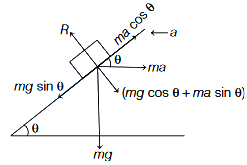
(D) Consider the block of mass $m$ in the frame of the wedge. Since the block does not slip,it is in equilibrium in the frame of the wedge.
The forces acting on the block are:
$1$. Gravitational force $m g$ acting vertically downwards.
$2$. Normal reaction $R$ exerted by the wedge,acting perpendicular to the inclined surface.
$3$. Pseudo force $m a$ acting horizontally in the direction opposite to the acceleration of the wedge.
Resolving the forces along the inclined plane:
$m g \sin \theta = m a \cos \theta$
$\Rightarrow a = g \tan \theta$ ... $(i)$
Resolving the forces perpendicular to the inclined plane:
$R = m g \cos \theta + m a \sin \theta$
Substituting the value of $a$ from equation $(i)$:
$R = m g \cos \theta + m (g \tan \theta) \sin \theta$
$R = m g \cos \theta + m g \frac{\sin^2 \theta}{\cos \theta}$
$R = \frac{m g \cos^2 \theta + m g \sin^2 \theta}{\cos \theta}$
$R = \frac{m g (\cos^2 \theta + \sin^2 \theta)}{\cos \theta}$
$R = \frac{m g}{\cos \theta} = m g \sec \theta$
The forces acting on the block are:
$1$. Gravitational force $m g$ acting vertically downwards.
$2$. Normal reaction $R$ exerted by the wedge,acting perpendicular to the inclined surface.
$3$. Pseudo force $m a$ acting horizontally in the direction opposite to the acceleration of the wedge.
Resolving the forces along the inclined plane:
$m g \sin \theta = m a \cos \theta$
$\Rightarrow a = g \tan \theta$ ... $(i)$
Resolving the forces perpendicular to the inclined plane:
$R = m g \cos \theta + m a \sin \theta$
Substituting the value of $a$ from equation $(i)$:
$R = m g \cos \theta + m (g \tan \theta) \sin \theta$
$R = m g \cos \theta + m g \frac{\sin^2 \theta}{\cos \theta}$
$R = \frac{m g \cos^2 \theta + m g \sin^2 \theta}{\cos \theta}$
$R = \frac{m g (\cos^2 \theta + \sin^2 \theta)}{\cos \theta}$
$R = \frac{m g}{\cos \theta} = m g \sec \theta$
0 likesView Solution
156
ChemistryMCQAP EAMCET · 2020
$A$ body of mass $5 \ kg$ starts from the origin with an initial velocity $u = 30 \hat{i} + 40 \hat{j} \ ms^{-1}$. When a constant force $F = -(\hat{i} + 5 \hat{j}) \ N$ acts on the body,the time in which the $y$-component of the velocity becomes zero is (in $s$)
A
$5$
B
$20$
C
$40$
D
$80$
Solution
(C) Given: Mass $m = 5 \ kg$,initial velocity $u = 30 \hat{i} + 40 \hat{j} \ ms^{-1}$,and force $F = -(\hat{i} + 5 \hat{j}) \ N$.
We focus on the $y$-component of motion.
Initial $y$-velocity $u_y = 40 \ ms^{-1}$ and $y$-component of force $F_y = -5 \ N$.
Using Newton's second law,the acceleration along the $y$-axis is $a_y = \frac{F_y}{m} = \frac{-5 \ N}{5 \ kg} = -1 \ ms^{-2}$.
We want to find the time $t$ when the final $y$-velocity $v_y = 0$.
Using the first equation of motion $v_y = u_y + a_y t$:
$0 = 40 + (-1)t$
$t = 40 \ s$.
We focus on the $y$-component of motion.
Initial $y$-velocity $u_y = 40 \ ms^{-1}$ and $y$-component of force $F_y = -5 \ N$.
Using Newton's second law,the acceleration along the $y$-axis is $a_y = \frac{F_y}{m} = \frac{-5 \ N}{5 \ kg} = -1 \ ms^{-2}$.
We want to find the time $t$ when the final $y$-velocity $v_y = 0$.
Using the first equation of motion $v_y = u_y + a_y t$:
$0 = 40 + (-1)t$
$t = 40 \ s$.
0 likesView Solution
157
ChemistryMCQAP EAMCET · 2020
One end of a string of length $l$ is connected to a particle of mass $m$ and the other to a small peg on a smooth horizontal table. If the particle moves in a circle with speed $v$ and $T$ is the tension in the string,then the net force on the particle (directed towards the centre) is
A
$T$
B
$0$
C
$\frac{T+mv^2}{l}$
D
$\frac{T-mv^2}{l}$
Solution
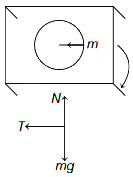
(A) The particle moves in a horizontal circle on a smooth table. The forces acting on the particle are:
$1$. The gravitational force $(mg)$ acting downwards.
$2$. The normal reaction $(N)$ from the table acting upwards.
$3$. The tension $(T)$ in the string acting towards the centre of the circular path.
Since the particle is moving in a horizontal circle,there is no vertical acceleration,so $N = mg$.
The horizontal force acting towards the centre is the tension $T$,which provides the necessary centripetal force for the circular motion. Therefore,the net force on the particle directed towards the centre is equal to $T$.
$1$. The gravitational force $(mg)$ acting downwards.
$2$. The normal reaction $(N)$ from the table acting upwards.
$3$. The tension $(T)$ in the string acting towards the centre of the circular path.
Since the particle is moving in a horizontal circle,there is no vertical acceleration,so $N = mg$.
The horizontal force acting towards the centre is the tension $T$,which provides the necessary centripetal force for the circular motion. Therefore,the net force on the particle directed towards the centre is equal to $T$.
0 likesView Solution
158
ChemistryMediumMCQAP EAMCET · 2020
$BF_3$ is used as a catalyst in several industrial processes due to its
A
strong reducing nature
B
weak reducing action
C
strong Lewis acid nature
D
weak Lewis acid character
Solution
(C) $BF_3$ is used as a catalyst in several industrial processes due to its strong Lewis acid nature.
$sp^2$-hybridized boron in $BF_3$ is electron-deficient ($6 \ e^-$ in valence shell,$2 \ e^-$ less than the octet) and acts as a strong Lewis acid.
$sp^2$-hybridized boron in $BF_3$ is electron-deficient ($6 \ e^-$ in valence shell,$2 \ e^-$ less than the octet) and acts as a strong Lewis acid.
0 likesView Solution
159
ChemistryMediumMCQAP EAMCET · 2020
$A$ compound $X$,of boron reacts with $NH_3$ on heating to give another compound $Y$,which is called inorganic benzene. The compound $X$ can be prepared by treating $BF_3$ with lithium aluminium hydride. The compounds $X$ and $Y$ are represented by the formulas.
A
$B_2H_6, B_3N_3H_6$
B
$B_2O_3, B_3N_3H_6$
C
$BF_3, B_3N_3H_6$
D
$B_3N_3H_6, B_2H_6$
Solution
(A) $BF_3 \xrightarrow{LiAlH_4} B_2H_6 (X)$
$3B_2H_6 + 6NH_3 \xrightarrow{\Delta} 2B_3N_3H_6 (Y) + 12H_2$
Compound $X$ is $B_2H_6$ (Diborane).
Compound $Y$ is $B_3N_3H_6$ (Borazine),which is known as inorganic benzene.
$3B_2H_6 + 6NH_3 \xrightarrow{\Delta} 2B_3N_3H_6 (Y) + 12H_2$
Compound $X$ is $B_2H_6$ (Diborane).
Compound $Y$ is $B_3N_3H_6$ (Borazine),which is known as inorganic benzene.
0 likesView Solution
160
ChemistryMediumMCQAP EAMCET · 2020
Which of the following compounds are formed when boron trichloride is treated with water?
A
$H_3BO_3 + HCl$
B
$B_2H_6 + HCl$
C
$B_2O_3 + HCl$
D
$HBO_3 + HCl$
Solution
(A) When boron trichloride $(BCl_3)$ reacts with water,it undergoes hydrolysis to form boric acid $(H_3BO_3)$ and hydrochloric acid $(HCl)$.
The balanced chemical equation is:
$BCl_3 + 3H_2O \longrightarrow H_3BO_3 + 3HCl$
The balanced chemical equation is:
$BCl_3 + 3H_2O \longrightarrow H_3BO_3 + 3HCl$
0 likesView Solution
161
ChemistryMediumMCQAP EAMCET · 2020
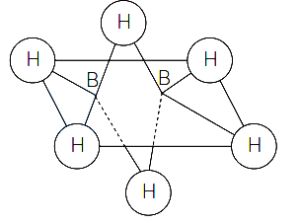
According to the given figure,which of the following statements is incorrect?
A
The $2$ bridged hydrogen atoms and $2$ boron atoms lie in one plane.
B
Out of $6$ $B-H$ bonds,two bonds can be described in terms of $3$-centre-$2$-electron bonds.
C
Out of $6$ $B-H$ bonds,four bonds can be described in terms of $3$-centre-$2$-electron bonds.
D
The four terminal $B-H$ bonds are $2$-centre-$2$-electron regular bonds.
Solution
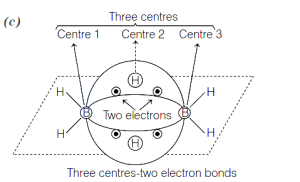
(C) In $B_2H_6$,there are $4$ terminal $B-H$ bonds which are $2$-centre-$2$-electron $(2c-2e)$ bonds.
There are $2$ bridged hydrogen atoms which form $2$ bridge $B-H-B$ bonds.
Each bridge $B-H-B$ bond is a $3$-centre-$2$-electron $(3c-2e)$ bond.
Therefore,there are only $2$ such $3c-2e$ bonds,not $4$.
Thus,statement $(C)$ is incorrect.
There are $2$ bridged hydrogen atoms which form $2$ bridge $B-H-B$ bonds.
Each bridge $B-H-B$ bond is a $3$-centre-$2$-electron $(3c-2e)$ bond.
Therefore,there are only $2$ such $3c-2e$ bonds,not $4$.
Thus,statement $(C)$ is incorrect.
0 likesView Solution
162
ChemistryMediumMCQAP EAMCET · 2020
Boron halides are usually Lewis acids in nature. This is due to:
A
Presence of six valence electrons
B
Their ionic character
C
Presence of lone pair of electrons
D
Their covalent character
Solution
(A) Boron halides $(BX_3)$ have a central boron atom bonded to three halogen atoms.
In these molecules,boron has only $6$ electrons in its valence shell (an incomplete octet).
Due to this electron deficiency,they act as Lewis acids by accepting a lone pair of electrons from a Lewis base to complete their octet.
In these molecules,boron has only $6$ electrons in its valence shell (an incomplete octet).
Due to this electron deficiency,they act as Lewis acids by accepting a lone pair of electrons from a Lewis base to complete their octet.
0 likesView Solution
163
ChemistryDifficultMCQAP EAMCET · 2020
How many compounds can be formed when carbon combines with oxygen?
A
$4$
B
$1$
C
$2$
D
$3$
Solution
(A) When carbon combines with oxygen,it can form four distinct oxides or oxocarbons:
$1$. Carbon monoxide: $CO$
$2$. Carbon dioxide: $CO_2$
$3$. Carbon suboxide: $C_3O_2$
$4$. Mellitic anhydride: $C_{12}O_9$
Thus,there are $4$ such compounds.
$1$. Carbon monoxide: $CO$
$2$. Carbon dioxide: $CO_2$
$3$. Carbon suboxide: $C_3O_2$
$4$. Mellitic anhydride: $C_{12}O_9$
Thus,there are $4$ such compounds.
0 likesView Solution
164
ChemistryEasyMCQAP EAMCET · 2020
Which among the following does not undergo hydrolysis?
A
$CCl_4$
B
$SiCl_4$
C
$VCl_4$
D
$TiCl_4$
Solution
(A) $CCl_4$ cannot undergo hydrolysis because the $C$ atom,being a member of the second period,does not have vacant $d$-orbitals in its valence shell.
Therefore,it cannot accommodate the lone pair donated by the oxygen atom of the water molecule.
In contrast,$SiCl_4$,$VCl_4$,and $TiCl_4$ possess vacant $d$-orbitals,allowing them to undergo hydrolysis.
Hence,the correct option is $A$.
Therefore,it cannot accommodate the lone pair donated by the oxygen atom of the water molecule.
In contrast,$SiCl_4$,$VCl_4$,and $TiCl_4$ possess vacant $d$-orbitals,allowing them to undergo hydrolysis.
Hence,the correct option is $A$.
0 likesView Solution
165
ChemistryEasyMCQAP EAMCET · 2020
The tendency of catenation in group-$14$ elements follows the order:
A
$C >> Si > Ge > Sn$
B
$C >> Si > Ge \approx Sn$
C
$Si > C > Sn > Ge$
D
$Ge \approx Sn > Si > C$
Solution
(B) In group $14$,as we move down the group,the atomic size increases and the bond energy of the element-element bond decreases.
This leads to a decrease in the tendency to show catenation.
The order of catenation is: $C >> Si > Ge \approx Sn$.
Lead $(Pb)$ does not show catenation due to its large size and weak bond strength.
Thus,the correct option is $B$.
This leads to a decrease in the tendency to show catenation.
The order of catenation is: $C >> Si > Ge \approx Sn$.
Lead $(Pb)$ does not show catenation due to its large size and weak bond strength.
Thus,the correct option is $B$.
0 likesView Solution
166
ChemistryMediumMCQAP EAMCET · 2020
The geometry with respect to the central atom of the molecules $N(SiH_3)_3$,$Me_3N$,and $(SiH_3)_3P$ respectively are
A
$planar, pyramidal, planar$
B
$planar, pyramidal, pyramidal$
C
$pyramidal, pyramidal, pyramidal$
D
$pyramidal, planar, pyramidal$
Solution
(B) $1$. In $N(SiH_3)_3$,the nitrogen atom has a lone pair which is donated into the vacant $3d$-orbital of the silicon atom,forming a $p\pi-d\pi$ back-bonding. This makes the nitrogen atom $sp^2$ hybridized,resulting in a $planar$ geometry.
$2$. In $Me_3N$ (trimethylamine),the carbon atom does not have vacant $d$-orbitals,so no back-bonding occurs. The nitrogen atom remains $sp^3$ hybridized with a lone pair,resulting in a $pyramidal$ geometry.
$3$. In $(SiH_3)_3P$,the phosphorus atom is larger and has a lower electronegativity compared to nitrogen. The lone pair on phosphorus is stereochemically active and does not participate in significant back-bonding with silicon. Thus,it retains a $pyramidal$ geometry.
$2$. In $Me_3N$ (trimethylamine),the carbon atom does not have vacant $d$-orbitals,so no back-bonding occurs. The nitrogen atom remains $sp^3$ hybridized with a lone pair,resulting in a $pyramidal$ geometry.
$3$. In $(SiH_3)_3P$,the phosphorus atom is larger and has a lower electronegativity compared to nitrogen. The lone pair on phosphorus is stereochemically active and does not participate in significant back-bonding with silicon. Thus,it retains a $pyramidal$ geometry.
0 likesView Solution
167
ChemistryMediumMCQAP EAMCET · 2020
Name the kind of silicate formed when two silicate units $(SiO_4)^{4-}$ share one oxygen atom.
A
Chain silicate
B
Cycle (ring) silicate
C
Pyrosilicate
D
Sheet silicate
Solution
(C) In pyrosilicate $(Si_2O_7)^{6-}$,two silicate units $(SiO_4)^{4-}$ share one oxygen atom. The structure is represented as $(Si_2O_7)^{6-} = O_3Si-O-SiO_3$.
0 likesView Solution
168
ChemistryDifficultMCQAP EAMCET · 2020
$Me_3SiCl$ is used during the polymerisation of organosilicones because:
A
the chain length of organosilicone polymers can be controlled by adding $Me_3SiCl$
B
$Me_3SiCl$ improves the quality of the silicone polymer
C
$Me_3SiCl$ improves the yield of the silicone polymer
D
$Me_3SiCl$ acts as a catalyst during polymerisation
Solution
(A) $(CH_3)_3SiCl$ is used during the polymerisation of organosilicones because it acts as a chain terminator.
When added to the reaction mixture,it reacts with the terminal $-OH$ groups of the growing siloxane chain,forming a stable $(CH_3)_3Si-O-$ group at the end.
This prevents further condensation and thus allows the control of the chain length of the organosilicone polymers.
Hence,the correct option is $A$.
When added to the reaction mixture,it reacts with the terminal $-OH$ groups of the growing siloxane chain,forming a stable $(CH_3)_3Si-O-$ group at the end.
This prevents further condensation and thus allows the control of the chain length of the organosilicone polymers.
Hence,the correct option is $A$.
0 likesView Solution
169
ChemistryEasyMCQAP EAMCET · 2020
Which among the following is not a property of silicones?
A
They are organo-silicon polymers having $R_2SiO$ as repeating unit
B
They are water repelling due to non-polar alkyl group
C
They are biocompatible
D
They are good conductors of electricity
Solution
(D) Silicones are synthetic organosilicon polymers with the general formula $(R_2SiO)_n$.
They possess a hydrophobic (water-repelling) nature due to the presence of non-polar organic groups attached to the silicon atoms.
They are widely used in medical applications because they are biocompatible.
However,silicones are excellent electrical insulators,not conductors,due to the strong $Si-O$ bonds and the absence of free electrons or ions for charge transport.
They possess a hydrophobic (water-repelling) nature due to the presence of non-polar organic groups attached to the silicon atoms.
They are widely used in medical applications because they are biocompatible.
However,silicones are excellent electrical insulators,not conductors,due to the strong $Si-O$ bonds and the absence of free electrons or ions for charge transport.
0 likesView Solution
170
ChemistryDifficultMCQAP EAMCET · 2020
Among the following oxides,which one is weakly basic and yet a powerful oxidant?
A
$CO_2$
B
$SnO_2$
C
$SiO_2$
D
$PbO_2$
Solution
(D) Among the dioxides of group-$14$ elements ($CO_2$,$SiO_2$,$GeO_2$,$SnO_2$,and $PbO_2$),$PbO_2$ is weakly basic in nature.
Due to the inert pair effect,the $+2$ oxidation state of $Pb$ is more stable than the $+4$ oxidation state.
Therefore,$PbO_2$ (where $Pb$ is in $+4$ state) has a strong tendency to get reduced to $Pb^{2+}$ $(PbO)$,which makes it a powerful oxidizing agent.
Due to the inert pair effect,the $+2$ oxidation state of $Pb$ is more stable than the $+4$ oxidation state.
Therefore,$PbO_2$ (where $Pb$ is in $+4$ state) has a strong tendency to get reduced to $Pb^{2+}$ $(PbO)$,which makes it a powerful oxidizing agent.
0 likesView Solution
171
ChemistryMediumMCQAP EAMCET · 2020
In $NO_3^{-}$ ion,the number of bond pairs and lone pairs of electrons on the nitrogen atom are
A
$2,2$
B
$3,1$
C
$1,3$
D
$4,0$
Solution
(D) The nitrogen atom in the $NO_3^{-}$ ion has a valence shell configuration of $2s^2 2p^3$.
In the nitrate ion,nitrogen forms three sigma bonds (one with each oxygen atom) and one pi bond (delocalized over the three oxygen atoms).
This means nitrogen uses all its $5$ valence electrons to form $4$ bonds ($3$ single bonds and $1$ double bond equivalent in resonance).
Therefore,the number of bond pairs of electrons on the nitrogen atom is $4$.
Since all valence electrons are involved in bonding,there are $0$ lone pairs of electrons on the nitrogen atom.
Thus,the correct answer is $4,0$.
In the nitrate ion,nitrogen forms three sigma bonds (one with each oxygen atom) and one pi bond (delocalized over the three oxygen atoms).
This means nitrogen uses all its $5$ valence electrons to form $4$ bonds ($3$ single bonds and $1$ double bond equivalent in resonance).
Therefore,the number of bond pairs of electrons on the nitrogen atom is $4$.
Since all valence electrons are involved in bonding,there are $0$ lone pairs of electrons on the nitrogen atom.
Thus,the correct answer is $4,0$.
0 likesView Solution
172
ChemistryEasyMCQAP EAMCET · 2020
The number of different types of bonds present in $P_4O_{10}$ is:
A
$8$ $P-O$ bonds and $4$ $P=O$ bonds
B
$12$ $P-O$ bonds and $3$ $P=O$ bonds
C
$12$ $P-O$ bonds and $4$ $P=O$ bonds
D
$8$ $P-O$ bonds and $3$ $P=O$ bonds
Solution
(C) The structure of $P_4O_{10}$ consists of a $P_4$ tetrahedral core where each edge is bridged by an oxygen atom ($P-O-P$ linkages).
Additionally,each phosphorus atom is bonded to a terminal oxygen atom via a double bond $(P=O)$.
Counting these,there are $12$ $P-O$ single bonds and $4$ $P=O$ double bonds.
Thus,the correct option is $C$.
Additionally,each phosphorus atom is bonded to a terminal oxygen atom via a double bond $(P=O)$.
Counting these,there are $12$ $P-O$ single bonds and $4$ $P=O$ double bonds.
Thus,the correct option is $C$.
0 likesView Solution
173
ChemistryMediumMCQAP EAMCET · 2020
Which among $KI, FeSO_4, K_2MnO_4, KMnO_4$ cannot be oxidised by $O_3$?
A
$KI$
B
$FeSO_4$
C
$K_2MnO_4$
D
$KMnO_4$
Solution
(D) $O_3$ acts as a strong oxidizing agent.
$KI$ is oxidized to $I_2$.
$FeSO_4$ is oxidized to $Fe_2(SO_4)_3$.
$K_2MnO_4$ is oxidized to $KMnO_4$.
In $KMnO_4$,the oxidation state of $Mn$ is $+VII$,which is the maximum possible oxidation state for $Mn$.
Therefore,$KMnO_4$ cannot be further oxidized by $O_3$.
Hence,the correct option is $D$.
$KI$ is oxidized to $I_2$.
$FeSO_4$ is oxidized to $Fe_2(SO_4)_3$.
$K_2MnO_4$ is oxidized to $KMnO_4$.
In $KMnO_4$,the oxidation state of $Mn$ is $+VII$,which is the maximum possible oxidation state for $Mn$.
Therefore,$KMnO_4$ cannot be further oxidized by $O_3$.
Hence,the correct option is $D$.
0 likesView Solution
174
ChemistryDifficultMCQAP EAMCET · 2020
Calculate the mass of $AgCl$ precipitated when $25 \ mL$ of $35 \%$ solution of $AgNO_3$ and $25 \ mL$ of $11.6 \%$ solution of $NaCl$ are mixed. (in $g$)
A
$7$
B
$17$
C
$20$
D
$15$
Solution
(A) The balanced chemical equation is: $AgNO_{3(aq)} + NaCl_{(aq)} \rightarrow AgCl_{(s)} + NaNO_{3(aq)}$
Step $1$: Calculate the mass of reactants.
Mass of $AgNO_3 = 25 \ mL \times 0.35 = 8.75 \ g$.
Moles of $AgNO_3 = \frac{8.75 \ g}{169.87 \ g/mol} \approx 0.0515 \ mol$.
Mass of $NaCl = 25 \ mL \times 0.116 = 2.9 \ g$.
Moles of $NaCl = \frac{2.9 \ g}{58.44 \ g/mol} \approx 0.0496 \ mol$.
Step $2$: Identify the limiting reagent.
Since the stoichiometry is $1:1$,$NaCl$ is the limiting reagent $(0.0496 \ mol < 0.0515 \ mol)$.
Step $3$: Calculate the mass of $AgCl$ formed.
Moles of $AgCl$ formed = Moles of $NaCl = 0.0496 \ mol$.
Mass of $AgCl = 0.0496 \ mol \times 143.32 \ g/mol \approx 7.1 \ g$.
Rounding to the nearest given option,the answer is $7 \ g$.
Step $1$: Calculate the mass of reactants.
Mass of $AgNO_3 = 25 \ mL \times 0.35 = 8.75 \ g$.
Moles of $AgNO_3 = \frac{8.75 \ g}{169.87 \ g/mol} \approx 0.0515 \ mol$.
Mass of $NaCl = 25 \ mL \times 0.116 = 2.9 \ g$.
Moles of $NaCl = \frac{2.9 \ g}{58.44 \ g/mol} \approx 0.0496 \ mol$.
Step $2$: Identify the limiting reagent.
Since the stoichiometry is $1:1$,$NaCl$ is the limiting reagent $(0.0496 \ mol < 0.0515 \ mol)$.
Step $3$: Calculate the mass of $AgCl$ formed.
Moles of $AgCl$ formed = Moles of $NaCl = 0.0496 \ mol$.
Mass of $AgCl = 0.0496 \ mol \times 143.32 \ g/mol \approx 7.1 \ g$.
Rounding to the nearest given option,the answer is $7 \ g$.
0 likesView Solution
175
ChemistryMediumMCQAP EAMCET · 2020
Which oxide among the following cannot act as a reducing agent?
A
$SO_2$
B
$NO_2$
C
$CO_2$
D
$ClO_2$
Solution
(C) reducing agent is a substance that can be oxidized,meaning its central atom must be able to increase its oxidation state.
In $SO_2$,the oxidation state of $S$ is $+4$,and its maximum oxidation state is $+6$,so it can be oxidized.
In $NO_2$,the oxidation state of $N$ is $+4$,and its maximum oxidation state is $+5$,so it can be oxidized.
In $CO_2$,the oxidation state of $C$ is $+4$,which is its maximum group oxidation state (Group $14$). Therefore,it cannot be oxidized further and cannot act as a reducing agent.
In $ClO_2$,the oxidation state of $Cl$ is $+4$,and its maximum oxidation state is $+7$,so it can be oxidized.
In $SO_2$,the oxidation state of $S$ is $+4$,and its maximum oxidation state is $+6$,so it can be oxidized.
In $NO_2$,the oxidation state of $N$ is $+4$,and its maximum oxidation state is $+5$,so it can be oxidized.
In $CO_2$,the oxidation state of $C$ is $+4$,which is its maximum group oxidation state (Group $14$). Therefore,it cannot be oxidized further and cannot act as a reducing agent.
In $ClO_2$,the oxidation state of $Cl$ is $+4$,and its maximum oxidation state is $+7$,so it can be oxidized.
0 likesView Solution
176
ChemistryMediumMCQAP EAMCET · 2020
$SF_6$ is a kinetically inert substance because
A
fluorine is highly electronegative
B
it is sterically protected
C
greater difference in electronegativities of $S$ and $F$
D
larger size of $S$-atom
Solution
(B) In $SF_6$,the sulphur atom is $sp^3d^2$ hybridized,resulting in an octahedral geometry.
Six fluorine atoms surround the central sulphur atom,creating a highly crowded environment.
This steric hindrance prevents the attack of any nucleophile or electrophile on the sulphur atom,making $SF_6$ kinetically inert.
Six fluorine atoms surround the central sulphur atom,creating a highly crowded environment.
This steric hindrance prevents the attack of any nucleophile or electrophile on the sulphur atom,making $SF_6$ kinetically inert.
0 likesView Solution
177
ChemistryEasyMCQAP EAMCET · 2020
What is the correct order comparing the acid strengths of $HF$,$HCl$,$HBr$,and $HI$?
A
$HF >> HCl >> HBr >> HI$
B
$HF << HCl << HBr << HI$
C
$HF > HCl >> HBr >> HI$
D
$HF << HCl >> HBr >> HI$
Solution
(B) As we move down the group in the periodic table,the atomic size of the halogen increases significantly.
This increase in size leads to a decrease in the bond dissociation enthalpy of the $H-X$ bond.
Consequently,the bond becomes weaker and it becomes easier to release the $H^+$ ion.
Therefore,the acidic strength increases down the group.
The correct order is $HF < HCl < HBr < HI$.
This increase in size leads to a decrease in the bond dissociation enthalpy of the $H-X$ bond.
Consequently,the bond becomes weaker and it becomes easier to release the $H^+$ ion.
Therefore,the acidic strength increases down the group.
The correct order is $HF < HCl < HBr < HI$.
0 likesView Solution
178
ChemistryEasyMCQAP EAMCET · 2020
The formation of molecular orbitals can be described by the linear combination of atomic orbitals. Which one of the following correctly represents the formation of bonding molecular orbital from the atomic orbitals having wave functions $\psi_A$ and $\psi_B$?
A
$\psi_A \times \psi_B$
B
$\psi_A / \psi_B$
C
$\psi_A + \psi_B$
D
$\psi_A - \psi_B$
Solution
(C) The formation of molecular orbitals is described by the Linear Combination of Atomic Orbitals $(LCAO)$ method.
Bonding molecular orbitals are formed by the constructive interference of atomic orbitals,which corresponds to the addition of their wave functions.
Therefore,the wave function for a bonding molecular orbital is given by $\psi_{bonding} = \psi_A + \psi_B$.
Conversely,antibonding molecular orbitals are formed by the destructive interference,represented by the subtraction of wave functions,$\psi_{antibonding} = \psi_A - \psi_B$.
Bonding molecular orbitals are formed by the constructive interference of atomic orbitals,which corresponds to the addition of their wave functions.
Therefore,the wave function for a bonding molecular orbital is given by $\psi_{bonding} = \psi_A + \psi_B$.
Conversely,antibonding molecular orbitals are formed by the destructive interference,represented by the subtraction of wave functions,$\psi_{antibonding} = \psi_A - \psi_B$.
0 likesView Solution
179
ChemistryMCQAP EAMCET · 2020
$\tan 9^{\circ}-\tan 27^{\circ}-\tan 63^{\circ}+\tan 81^{\circ} = $
A
$1$
B
$2$
C
$3$
D
$4$
Solution
(D) We have the expression: $\tan 9^{\circ}-\tan 27^{\circ}-\tan 63^{\circ}+\tan 81^{\circ}$
Rearranging the terms: $(\tan 81^{\circ}+\tan 9^{\circ}) - (\tan 63^{\circ}+\tan 27^{\circ})$
Using the identity $\tan(90^{\circ}-\theta) = \cot \theta$:
$= (\cot 9^{\circ}+\tan 9^{\circ}) - (\cot 27^{\circ}+\tan 27^{\circ})$
Using $\cot \theta + \tan \theta = \frac{\cos \theta}{\sin \theta} + \frac{\sin \theta}{\cos \theta} = \frac{\cos^2 \theta + \sin^2 \theta}{\sin \theta \cos \theta} = \frac{1}{\sin \theta \cos \theta} = \frac{2}{\sin 2\theta}$:
$= \frac{2}{\sin 18^{\circ}} - \frac{2}{\sin 54^{\circ}}$
$= 2 \left( \frac{\sin 54^{\circ} - \sin 18^{\circ}}{\sin 54^{\circ} \sin 18^{\circ}} \right)$
Using the identity $\sin C - \sin D = 2 \cos \frac{C+D}{2} \sin \frac{C-D}{2}$:
$= 2 \left( \frac{2 \cos 36^{\circ} \sin 18^{\circ}}{\sin 54^{\circ} \sin 18^{\circ}} \right)$
Since $\sin 54^{\circ} = \cos 36^{\circ}$:
$= 2 \left( \frac{2 \cos 36^{\circ} \sin 18^{\circ}}{\cos 36^{\circ} \sin 18^{\circ}} \right) = 2 \times 2 = 4$
Rearranging the terms: $(\tan 81^{\circ}+\tan 9^{\circ}) - (\tan 63^{\circ}+\tan 27^{\circ})$
Using the identity $\tan(90^{\circ}-\theta) = \cot \theta$:
$= (\cot 9^{\circ}+\tan 9^{\circ}) - (\cot 27^{\circ}+\tan 27^{\circ})$
Using $\cot \theta + \tan \theta = \frac{\cos \theta}{\sin \theta} + \frac{\sin \theta}{\cos \theta} = \frac{\cos^2 \theta + \sin^2 \theta}{\sin \theta \cos \theta} = \frac{1}{\sin \theta \cos \theta} = \frac{2}{\sin 2\theta}$:
$= \frac{2}{\sin 18^{\circ}} - \frac{2}{\sin 54^{\circ}}$
$= 2 \left( \frac{\sin 54^{\circ} - \sin 18^{\circ}}{\sin 54^{\circ} \sin 18^{\circ}} \right)$
Using the identity $\sin C - \sin D = 2 \cos \frac{C+D}{2} \sin \frac{C-D}{2}$:
$= 2 \left( \frac{2 \cos 36^{\circ} \sin 18^{\circ}}{\sin 54^{\circ} \sin 18^{\circ}} \right)$
Since $\sin 54^{\circ} = \cos 36^{\circ}$:
$= 2 \left( \frac{2 \cos 36^{\circ} \sin 18^{\circ}}{\cos 36^{\circ} \sin 18^{\circ}} \right) = 2 \times 2 = 4$
0 likesView Solution
180
ChemistryMCQAP EAMCET · 2020
$A$ homogeneous equation of second degree in $x$ and $y$ represents which of the following?
A
Two lines
B
$A$ pair of straight lines through the origin
C
Only one line through origin
D
$A$ circle whose centre isn't the origin
Solution
(B) homogeneous equation of second degree in $x$ and $y$,given by $ax^2 + 2hxy + by^2 = 0$,represents a pair of straight lines passing through the origin,provided that $h^2 \geq ab$.
0 likesView Solution
181
ChemistryMCQAP EAMCET · 2020
If the pair of straight lines given by $A x^2+2 H x y+B y^2=0$,where $(H^2 > A B)$,forms an equilateral triangle with the line $a x+b y+c=0$,then $(A+3 B)(3 A+B)=$ (in $H^2$)
A
$4$
B
$2$
C
$-2$
D
$-4$
Solution
(A) The pair of straight lines $A x^2+2 H x y+B y^2=0$ passes through the origin. For these lines to form an equilateral triangle with the line $a x+b y+c=0$,the angle between the pair of lines must be $60^{\circ}$ or $\frac{\pi}{3}$.
The angle $\theta$ between the lines $A x^2+2 H x y+B y^2=0$ is given by $\tan \theta = \frac{2 \sqrt{H^2-A B}}{|A+B|}$.
Setting $\theta = \frac{\pi}{3}$,we have $\tan \frac{\pi}{3} = \sqrt{3}$.
So,$\sqrt{3} = \frac{2 \sqrt{H^2-A B}}{|A+B|}$.
Squaring both sides,we get $3 = \frac{4(H^2-A B)}{(A+B)^2}$.
$3(A+B)^2 = 4(H^2-A B)$.
$3(A^2+2 A B+B^2) = 4 H^2-4 A B$.
$3 A^2+6 A B+3 B^2 = 4 H^2-4 A B$.
$3 A^2+10 A B+3 B^2 = 4 H^2$.
Factoring the left side: $3 A^2+9 A B+A B+3 B^2 = 4 H^2$.
$3 A(A+3 B)+B(A+3 B) = 4 H^2$.
$(A+3 B)(3 A+B) = 4 H^2$.
The angle $\theta$ between the lines $A x^2+2 H x y+B y^2=0$ is given by $\tan \theta = \frac{2 \sqrt{H^2-A B}}{|A+B|}$.
Setting $\theta = \frac{\pi}{3}$,we have $\tan \frac{\pi}{3} = \sqrt{3}$.
So,$\sqrt{3} = \frac{2 \sqrt{H^2-A B}}{|A+B|}$.
Squaring both sides,we get $3 = \frac{4(H^2-A B)}{(A+B)^2}$.
$3(A+B)^2 = 4(H^2-A B)$.
$3(A^2+2 A B+B^2) = 4 H^2-4 A B$.
$3 A^2+6 A B+3 B^2 = 4 H^2-4 A B$.
$3 A^2+10 A B+3 B^2 = 4 H^2$.
Factoring the left side: $3 A^2+9 A B+A B+3 B^2 = 4 H^2$.
$3 A(A+3 B)+B(A+3 B) = 4 H^2$.
$(A+3 B)(3 A+B) = 4 H^2$.
0 likesView Solution
182
ChemistryMCQAP EAMCET · 2020
If one of the lines $2x^2 - xy + by^2 = 0$ passes through the point $(-4, -2)$,then $b^2 =$
A
-$6$
B
$36$
C
$4$
D
$16$
Solution
(B) It is given that one of the lines $2x^2 - xy + by^2 = 0$ passes through the point $(-4, -2)$.
Substituting the point $(-4, -2)$ into the equation:
$2(-4)^2 - (-4)(-2) + b(-2)^2 = 0$
$2(16) - (8) + b(4) = 0$
$32 - 8 + 4b = 0$
$24 + 4b = 0$
$4b = -24$
$b = -6$
Therefore,$b^2 = (-6)^2 = 36$.
Hence,option $B$ is correct.
Substituting the point $(-4, -2)$ into the equation:
$2(-4)^2 - (-4)(-2) + b(-2)^2 = 0$
$2(16) - (8) + b(4) = 0$
$32 - 8 + 4b = 0$
$24 + 4b = 0$
$4b = -24$
$b = -6$
Therefore,$b^2 = (-6)^2 = 36$.
Hence,option $B$ is correct.
0 likesView Solution
183
ChemistryMCQAP EAMCET · 2020
Find the value of $k$,if the angle between the straight lines represented by $2x^2 + 5xy + 3y^2 + 6x + 7y + 4 = 0$ is $\tan^{-1}(k)$.
A
$\left(\frac{1}{5}\right)$ only
B
$\left(-\frac{1}{5}\right)$ only
C
$\pm \frac{1}{5}$
D
$0$
Solution
(C) The general equation of a pair of straight lines is $ax^2 + 2hxy + by^2 + 2gx + 2fy + c = 0$.
Comparing this with $2x^2 + 5xy + 3y^2 + 6x + 7y + 4 = 0$,we get $a = 2$,$h = \frac{5}{2}$,and $b = 3$.
The angle $\theta$ between the lines is given by $\tan \theta = \left| \frac{2\sqrt{h^2 - ab}}{a + b} \right|$.
Substituting the values: $\tan \theta = \left| \frac{2\sqrt{(\frac{5}{2})^2 - (2)(3)}}{2 + 3} \right|$.
$\tan \theta = \left| \frac{2\sqrt{\frac{25}{4} - 6}}{5} \right| = \left| \frac{2\sqrt{\frac{1}{4}}}{5} \right| = \left| \frac{2 \times \frac{1}{2}}{5} \right| = \frac{1}{5}$.
Since the angle between the lines is $\tan^{-1}(k)$,we have $\tan \theta = |k| = \frac{1}{5}$,which implies $k = \pm \frac{1}{5}$.
Comparing this with $2x^2 + 5xy + 3y^2 + 6x + 7y + 4 = 0$,we get $a = 2$,$h = \frac{5}{2}$,and $b = 3$.
The angle $\theta$ between the lines is given by $\tan \theta = \left| \frac{2\sqrt{h^2 - ab}}{a + b} \right|$.
Substituting the values: $\tan \theta = \left| \frac{2\sqrt{(\frac{5}{2})^2 - (2)(3)}}{2 + 3} \right|$.
$\tan \theta = \left| \frac{2\sqrt{\frac{25}{4} - 6}}{5} \right| = \left| \frac{2\sqrt{\frac{1}{4}}}{5} \right| = \left| \frac{2 \times \frac{1}{2}}{5} \right| = \frac{1}{5}$.
Since the angle between the lines is $\tan^{-1}(k)$,we have $\tan \theta = |k| = \frac{1}{5}$,which implies $k = \pm \frac{1}{5}$.
0 likesView Solution
184
ChemistryMCQAP EAMCET · 2020
If pairs of straight lines $x^2-2 p x y-y^2=0$ and $x^2-2 q x y-y^2=0$ be such that each pair bisects the angle between the other pair,then
A
$p q=1$
B
$p q=2$
C
$p q=-2$
D
$p q=-1$
Solution
(D) The equation of the angle bisectors for the pair of lines $a x^2+2 h x y+b y^2=0$ is given by $\frac{x^2-y^2}{a-b}=\frac{x y}{h}$.
For the first pair $x^2-2 p x y-y^2=0$,we have $a=1, b=-1, h=-p$.
The angle bisectors are $\frac{x^2-y^2}{1-(-1)}=\frac{x y}{-p}$,which simplifies to $\frac{x^2-y^2}{2}=\frac{x y}{-p}$,or $x^2-y^2+\frac{2 x y}{p}=0$.
Given that this pair of bisectors is $x^2-2 q x y-y^2=0$,we compare the coefficients:
Comparing $x^2+\frac{2}{p} x y-y^2=0$ with $x^2-2 q x y-y^2=0$,we get $\frac{2}{p}=-2 q$.
Therefore,$p q=-1$.
For the first pair $x^2-2 p x y-y^2=0$,we have $a=1, b=-1, h=-p$.
The angle bisectors are $\frac{x^2-y^2}{1-(-1)}=\frac{x y}{-p}$,which simplifies to $\frac{x^2-y^2}{2}=\frac{x y}{-p}$,or $x^2-y^2+\frac{2 x y}{p}=0$.
Given that this pair of bisectors is $x^2-2 q x y-y^2=0$,we compare the coefficients:
Comparing $x^2+\frac{2}{p} x y-y^2=0$ with $x^2-2 q x y-y^2=0$,we get $\frac{2}{p}=-2 q$.
Therefore,$p q=-1$.
0 likesView Solution
185
ChemistryMCQAP EAMCET · 2020
If the pair of straight lines $6x^2 - 5xy + y^2 = 0$ makes angles $\alpha$ and $\beta$ with the $X$-axis,then $\tan(\alpha - \beta) = $
A
$2$
B
$\frac{1}{7}$
C
$3$
D
$7$
Solution
(B) Given the equation of the pair of straight lines is $6x^2 - 5xy + y^2 = 0$.
Dividing by $x^2$ (assuming $x \neq 0$),we get:
$\left(\frac{y}{x}\right)^2 - 5\left(\frac{y}{x}\right) + 6 = 0$.
Let $m = \frac{y}{x}$,then $m^2 - 5m + 6 = 0$.
Factoring the quadratic equation: $(m - 3)(m - 2) = 0$.
So,the slopes are $m_1 = \tan \alpha = 3$ and $m_2 = \tan \beta = 2$.
Using the formula for the tangent of the difference of two angles:
$\tan(\alpha - \beta) = \frac{\tan \alpha - \tan \beta}{1 + \tan \alpha \tan \beta}$.
Substituting the values:
$\tan(\alpha - \beta) = \frac{3 - 2}{1 + (3)(2)} = \frac{1}{1 + 6} = \frac{1}{7}$.
Dividing by $x^2$ (assuming $x \neq 0$),we get:
$\left(\frac{y}{x}\right)^2 - 5\left(\frac{y}{x}\right) + 6 = 0$.
Let $m = \frac{y}{x}$,then $m^2 - 5m + 6 = 0$.
Factoring the quadratic equation: $(m - 3)(m - 2) = 0$.
So,the slopes are $m_1 = \tan \alpha = 3$ and $m_2 = \tan \beta = 2$.
Using the formula for the tangent of the difference of two angles:
$\tan(\alpha - \beta) = \frac{\tan \alpha - \tan \beta}{1 + \tan \alpha \tan \beta}$.
Substituting the values:
$\tan(\alpha - \beta) = \frac{3 - 2}{1 + (3)(2)} = \frac{1}{1 + 6} = \frac{1}{7}$.
0 likesView Solution
186
ChemistryMCQAP EAMCET · 2020
Which of the following pairs of straight lines intersect at right angles?
A
$2 x^2 = y(x + 2 y)$
B
$(x + y)^2 = x(y + 3 x)$
C
$2 y(x + y) = x y$
D
$y = \pm 2 x$
Solution
(A) The general equation of a pair of straight lines is given by $ax^2 + 2hxy + by^2 = 0$. The lines are perpendicular if the sum of the coefficients of $x^2$ and $y^2$ is zero,i.e.,$a + b = 0$.
For option $A$: $2 x^2 = y(x + 2 y) \Rightarrow 2 x^2 - xy - 2 y^2 = 0$.
Here,$a = 2$ and $b = -2$.
Since $a + b = 2 + (-2) = 0$,the lines represented by this equation are perpendicular.
For option $A$: $2 x^2 = y(x + 2 y) \Rightarrow 2 x^2 - xy - 2 y^2 = 0$.
Here,$a = 2$ and $b = -2$.
Since $a + b = 2 + (-2) = 0$,the lines represented by this equation are perpendicular.
0 likesView Solution
187
ChemistryMCQAP EAMCET · 2020
The lines represented by $ax^2 + 2hxy + by^2 = 0$ are perpendicular to each other,if ........
A
$h^2 = a + b$
B
$a + b = 0$
C
$h^2 = ab$
D
$h = 0$
Solution
(B) The pair of straight lines passing through the origin is given by the equation $ax^2 + 2hxy + by^2 = 0$.
The angle $\theta$ between these lines is given by the formula $\tan \theta = \left| \frac{2\sqrt{h^2 - ab}}{a + b} \right|$.
When the lines are perpendicular,the angle $\theta = 90^{\circ}$.
Since $\tan 90^{\circ}$ is undefined (approaches $\infty$),the denominator must be zero.
Therefore,$a + b = 0$.
The angle $\theta$ between these lines is given by the formula $\tan \theta = \left| \frac{2\sqrt{h^2 - ab}}{a + b} \right|$.
When the lines are perpendicular,the angle $\theta = 90^{\circ}$.
Since $\tan 90^{\circ}$ is undefined (approaches $\infty$),the denominator must be zero.
Therefore,$a + b = 0$.
0 likesView Solution
188
ChemistryMCQAP EAMCET · 2020
The lines $ax^2+2hxy+by^2=0$ are at right angles if
A
$a+b=0$
B
$a+b=1$
C
$h^2-ab=0$
D
$a=b$
Solution
(A) The acute angle $(\theta)$ between the lines represented by the homogeneous equation $ax^2+2hxy+by^2=0$ is given by the formula:
$\tan \theta = \left| \frac{2\sqrt{h^2-ab}}{a+b} \right|$
If the lines are at right angles (perpendicular),then $\theta = 90^\circ$.
Since $\tan 90^\circ$ is undefined,the denominator must be zero.
Therefore,$a+b=0$.
$\tan \theta = \left| \frac{2\sqrt{h^2-ab}}{a+b} \right|$
If the lines are at right angles (perpendicular),then $\theta = 90^\circ$.
Since $\tan 90^\circ$ is undefined,the denominator must be zero.
Therefore,$a+b=0$.
0 likesView Solution
189
ChemistryMCQAP EAMCET · 2020
The angle between the straight lines $x^2+4xy+y^2=0$ is....... (in $^{\circ}$)
A
$30$
B
$45$
C
$60$
D
$90$
Solution
(C) The given equation of the pair of straight lines is $x^2+4xy+y^2=0$.
Comparing this with the general equation $ax^2+2hxy+by^2=0$,we get $a=1$,$2h=4 \Rightarrow h=2$,and $b=1$.
The angle $\theta$ between the pair of straight lines is given by the formula:
$\tan \theta = \left| \frac{2\sqrt{h^2-ab}}{a+b} \right|$.
Substituting the values,we get:
$\tan \theta = \left| \frac{2\sqrt{2^2-(1)(1)}}{1+1} \right| = \frac{2\sqrt{4-1}}{2} = \sqrt{3}$.
Since $\tan \theta = \sqrt{3}$,we have $\theta = 60^{\circ}$.
Comparing this with the general equation $ax^2+2hxy+by^2=0$,we get $a=1$,$2h=4 \Rightarrow h=2$,and $b=1$.
The angle $\theta$ between the pair of straight lines is given by the formula:
$\tan \theta = \left| \frac{2\sqrt{h^2-ab}}{a+b} \right|$.
Substituting the values,we get:
$\tan \theta = \left| \frac{2\sqrt{2^2-(1)(1)}}{1+1} \right| = \frac{2\sqrt{4-1}}{2} = \sqrt{3}$.
Since $\tan \theta = \sqrt{3}$,we have $\theta = 60^{\circ}$.
0 likesView Solution
190
ChemistryMCQAP EAMCET · 2020
The pair of straight lines is represented by the equation $3dx^2 - 5xy + (d^2 - 2)y^2 = 0$. If the lines are perpendicular to each other,for how many values of $d$ will this condition be satisfied?
A
$0$
B
$2$
C
$1$
D
$3$
Solution
(B) The given equation of the pair of straight lines is $3dx^2 - 5xy + (d^2 - 2)y^2 = 0$.
For a general equation of a pair of lines $Ax^2 + 2Hxy + By^2 = 0$,the lines are perpendicular if the sum of the coefficients of $x^2$ and $y^2$ is zero,i.e.,$A + B = 0$.
Here,$A = 3d$ and $B = d^2 - 2$.
Setting $A + B = 0$,we get $3d + d^2 - 2 = 0$,which is $d^2 + 3d - 2 = 0$.
Using the quadratic formula $d = \frac{-b \pm \sqrt{b^2 - 4ac}}{2a}$,we find $d = \frac{-3 \pm \sqrt{3^2 - 4(1)(-2)}}{2(1)} = \frac{-3 \pm \sqrt{9 + 8}}{2} = \frac{-3 \pm \sqrt{17}}{2}$.
Since there are two distinct real values for $d$,the condition is satisfied for $2$ values of $d$.
Thus,option $B$ is correct.
For a general equation of a pair of lines $Ax^2 + 2Hxy + By^2 = 0$,the lines are perpendicular if the sum of the coefficients of $x^2$ and $y^2$ is zero,i.e.,$A + B = 0$.
Here,$A = 3d$ and $B = d^2 - 2$.
Setting $A + B = 0$,we get $3d + d^2 - 2 = 0$,which is $d^2 + 3d - 2 = 0$.
Using the quadratic formula $d = \frac{-b \pm \sqrt{b^2 - 4ac}}{2a}$,we find $d = \frac{-3 \pm \sqrt{3^2 - 4(1)(-2)}}{2(1)} = \frac{-3 \pm \sqrt{9 + 8}}{2} = \frac{-3 \pm \sqrt{17}}{2}$.
Since there are two distinct real values for $d$,the condition is satisfied for $2$ values of $d$.
Thus,option $B$ is correct.
0 likesView Solution
191
ChemistryMCQAP EAMCET · 2020
If the pairs of straight lines $x^2-2 q x y-y^2=0$ and $x^2-2 p x y-y^2=0$ bisect the angles between each other,then which of the following is correct?
A
$1-p q=0$
B
$p q-1=0$
C
$p q+1=0$
D
$p q=0$
Solution
(C) The equation of the angle bisectors of the pair of lines $ax^2+2hxy+by^2=0$ is given by $\frac{x^2-y^2}{a-b} = \frac{xy}{h}$.
For the pair $x^2-2pxy-y^2=0$,we have $a=1, h=-p, b=-1$.
The angle bisectors are $\frac{x^2-y^2}{1-(-1)} = \frac{xy}{-p}$,which simplifies to $\frac{x^2-y^2}{2} = \frac{xy}{-p}$,or $x^2-y^2 = -\frac{2}{p}xy$,which is $x^2 + \frac{2}{p}xy - y^2 = 0$.
It is given that this pair of bisectors is the same as the pair $x^2-2qxy-y^2=0$.
Comparing the coefficients of $xy$,we get $\frac{2}{p} = -2q$.
This implies $pq = -1$,or $pq+1=0$.
Thus,option $C$ is correct.
For the pair $x^2-2pxy-y^2=0$,we have $a=1, h=-p, b=-1$.
The angle bisectors are $\frac{x^2-y^2}{1-(-1)} = \frac{xy}{-p}$,which simplifies to $\frac{x^2-y^2}{2} = \frac{xy}{-p}$,or $x^2-y^2 = -\frac{2}{p}xy$,which is $x^2 + \frac{2}{p}xy - y^2 = 0$.
It is given that this pair of bisectors is the same as the pair $x^2-2qxy-y^2=0$.
Comparing the coefficients of $xy$,we get $\frac{2}{p} = -2q$.
This implies $pq = -1$,or $pq+1=0$.
Thus,option $C$ is correct.
0 likesView Solution
192
ChemistryMCQAP EAMCET · 2020
Statement-$I$: Two lines which pass through a given fixed point and are equally inclined to two other lines passing through the same point,are always perpendicular to each other.
Statement-$II$: Angle bisectors of two intersecting lines are always perpendicular to each other.
Statement-$II$: Angle bisectors of two intersecting lines are always perpendicular to each other.
A
Both the statements are true and statement-$II$ is the correct explanation of the statement-$I$.
B
Both the statements are true but statement-$II$ is not the correct explanation of the statement-$I$.
C
Statement-$I$ is true and statement-$II$ is false.
D
Statement-$I$ is false and statement-$II$ is true.
Solution
(A) Let the two fixed lines be $L_1$ and $L_2$ intersecting at a point $P$.
The lines that are equally inclined to $L_1$ and $L_2$ are the angle bisectors of the angles formed by $L_1$ and $L_2$.
The angle bisectors of any two intersecting lines are always perpendicular to each other because the angle between the internal and external bisectors is always $90^{\circ}$.
Thus,Statement-$II$ is true and it correctly explains why the two lines described in Statement-$I$ must be perpendicular.
Therefore,both statements are true and Statement-$II$ is the correct explanation of Statement-$I$.
The lines that are equally inclined to $L_1$ and $L_2$ are the angle bisectors of the angles formed by $L_1$ and $L_2$.
The angle bisectors of any two intersecting lines are always perpendicular to each other because the angle between the internal and external bisectors is always $90^{\circ}$.
Thus,Statement-$II$ is true and it correctly explains why the two lines described in Statement-$I$ must be perpendicular.
Therefore,both statements are true and Statement-$II$ is the correct explanation of Statement-$I$.
0 likesView Solution
193
ChemistryMCQAP EAMCET · 2020
If $lx^2+3xy-2y^2-5x+5y+k=0$ represents a pair of perpendicular lines,then
A
$k=\pm 3, l=\pm 2$
B
$k=-22, l=-12$
C
$k=-3, l=2$
D
$k=-16, l=9$
Solution
(C) The general equation of a second-degree curve is $ax^2+2hxy+by^2+2gx+2fy+c=0$.
For the equation $lx^2+3xy-2y^2-5x+5y+k=0$ to represent a pair of perpendicular lines,the sum of the coefficients of $x^2$ and $y^2$ must be zero,i.e.,$a+b=0$.
Here,$a=l$ and $b=-2$.
So,$l+(-2)=0 \Rightarrow l=2$.
Now the equation becomes $2x^2+3xy-2y^2-5x+5y+k=0$.
For this to represent a pair of lines,the determinant condition $abc+2fgh-af^2-bg^2-ch^2=0$ must be satisfied.
Here,$a=2, b=-2, c=k, h=\frac{3}{2}, g=-\frac{5}{2}, f=\frac{5}{2}$.
Substituting these values: $(2)(-2)(k) + 2(\frac{5}{2})(-\frac{5}{2})(\frac{3}{2}) - 2(\frac{5}{2})^2 - (-2)(-\frac{5}{2})^2 - k(\frac{3}{2})^2 = 0$.
$-4k - \frac{75}{4} - \frac{50}{4} + \frac{50}{4} - \frac{9k}{4} = 0$.
$-4k - \frac{9k}{4} - \frac{75}{4} = 0$.
$-\frac{25k}{4} = \frac{75}{4} \Rightarrow k=-3$.
Thus,$l=2$ and $k=-3$.
For the equation $lx^2+3xy-2y^2-5x+5y+k=0$ to represent a pair of perpendicular lines,the sum of the coefficients of $x^2$ and $y^2$ must be zero,i.e.,$a+b=0$.
Here,$a=l$ and $b=-2$.
So,$l+(-2)=0 \Rightarrow l=2$.
Now the equation becomes $2x^2+3xy-2y^2-5x+5y+k=0$.
For this to represent a pair of lines,the determinant condition $abc+2fgh-af^2-bg^2-ch^2=0$ must be satisfied.
Here,$a=2, b=-2, c=k, h=\frac{3}{2}, g=-\frac{5}{2}, f=\frac{5}{2}$.
Substituting these values: $(2)(-2)(k) + 2(\frac{5}{2})(-\frac{5}{2})(\frac{3}{2}) - 2(\frac{5}{2})^2 - (-2)(-\frac{5}{2})^2 - k(\frac{3}{2})^2 = 0$.
$-4k - \frac{75}{4} - \frac{50}{4} + \frac{50}{4} - \frac{9k}{4} = 0$.
$-4k - \frac{9k}{4} - \frac{75}{4} = 0$.
$-\frac{25k}{4} = \frac{75}{4} \Rightarrow k=-3$.
Thus,$l=2$ and $k=-3$.
0 likesView Solution
194
ChemistryMCQAP EAMCET · 2020
If the pairs of straight lines $x^2-2 p x y-y^2=0$ and $x^2-2 q x y-y^2=0$ are such that each pair bisects the angle between the other pair,then
A
$p q=1$
B
$p q=-1$
C
$p q=2$
D
$p q=-2$
Solution
(B) The equation of the pair of angle bisectors for the pair of straight lines $a x^2+2 h x y+b y^2=0$ is given by $\frac{x^2-y^2}{a-b}=\frac{x y}{h}$.
For the pair $x^2-2 p x y-y^2=0$,the bisectors are given by $\frac{x^2-y^2}{1-(-1)}=\frac{x y}{-p}$.
This simplifies to $\frac{x^2-y^2}{2}=\frac{x y}{-p}$,which implies $-p(x^2-y^2)=2 x y$,or $p x^2+2 x y-p y^2=0$.
Dividing by $p$,we get $x^2+\frac{2}{p} x y-y^2=0$.
Since this is the pair of bisectors,it must be identical to the given pair $x^2-2 q x y-y^2=0$.
Comparing the coefficients of $x y$,we have $-2 q = \frac{2}{p}$.
Thus,$-2 p q = 2$,which gives $p q = -1$.
For the pair $x^2-2 p x y-y^2=0$,the bisectors are given by $\frac{x^2-y^2}{1-(-1)}=\frac{x y}{-p}$.
This simplifies to $\frac{x^2-y^2}{2}=\frac{x y}{-p}$,which implies $-p(x^2-y^2)=2 x y$,or $p x^2+2 x y-p y^2=0$.
Dividing by $p$,we get $x^2+\frac{2}{p} x y-y^2=0$.
Since this is the pair of bisectors,it must be identical to the given pair $x^2-2 q x y-y^2=0$.
Comparing the coefficients of $x y$,we have $-2 q = \frac{2}{p}$.
Thus,$-2 p q = 2$,which gives $p q = -1$.
0 likesView Solution
195
ChemistryMCQAP EAMCET · 2020
Find the equation of the pair of straight lines that bisect the angles between the lines represented by $ax^2 + 2hxy + by^2 = 0$.
A
$\frac{x^2+y^2}{a+b} = \frac{xy}{h}$
B
$\frac{x^2+y^2}{a-b} = \frac{xy}{h}$
C
$\frac{x^2+y^2}{a-b} = \frac{h}{xy}$
D
$\frac{x^2-y^2}{a-b} = \frac{xy}{h}$
Solution
(D) The general equation of a pair of straight lines passing through the origin is given by $ax^2 + 2hxy + by^2 = 0$.
The equation of the pair of angle bisectors for these lines is given by the formula:
$\frac{x^2 - y^2}{a - b} = \frac{xy}{h}$.
Comparing this with the given options,option $D$ is the correct answer.
The equation of the pair of angle bisectors for these lines is given by the formula:
$\frac{x^2 - y^2}{a - b} = \frac{xy}{h}$.
Comparing this with the given options,option $D$ is the correct answer.
0 likesView Solution
196
ChemistryMCQAP EAMCET · 2020
If the line $y=mx$ is one of the bisectors of $x^2+4xy-y^2=0$,then the value of $2m$ is:
A
$-1+\sqrt{5}$
B
$1+\sqrt{5}$
C
$-1-\sqrt{5}$
D
$1-\sqrt{5}$
Solution
(A) The given equation is $x^2+4xy-y^2=0$. Comparing this with $ax^2+2hxy+by^2=0$,we get $a=1, h=2, b=-1$.
The equation of the angle bisectors is given by $\frac{x^2-y^2}{a-b} = \frac{xy}{h}$.
Substituting the values,we get $\frac{x^2-y^2}{1-(-1)} = \frac{xy}{2}$.
$\frac{x^2-y^2}{2} = \frac{xy}{2} \implies x^2-xy-y^2=0$.
Since $y=mx$ is a bisector,substitute $y=mx$ into the equation: $x^2-x(mx)-(mx)^2=0$.
$x^2(1-m-m^2)=0$.
For non-trivial lines,$m^2+m-1=0$.
Using the quadratic formula,$m = \frac{-1 \pm \sqrt{1^2-4(1)(-1)}}{2} = \frac{-1 \pm \sqrt{5}}{2}$.
Therefore,$2m = -1 \pm \sqrt{5}$.
The equation of the angle bisectors is given by $\frac{x^2-y^2}{a-b} = \frac{xy}{h}$.
Substituting the values,we get $\frac{x^2-y^2}{1-(-1)} = \frac{xy}{2}$.
$\frac{x^2-y^2}{2} = \frac{xy}{2} \implies x^2-xy-y^2=0$.
Since $y=mx$ is a bisector,substitute $y=mx$ into the equation: $x^2-x(mx)-(mx)^2=0$.
$x^2(1-m-m^2)=0$.
For non-trivial lines,$m^2+m-1=0$.
Using the quadratic formula,$m = \frac{-1 \pm \sqrt{1^2-4(1)(-1)}}{2} = \frac{-1 \pm \sqrt{5}}{2}$.
Therefore,$2m = -1 \pm \sqrt{5}$.
0 likesView Solution
197
ChemistryMCQAP EAMCET · 2020
If the equation $x^2+2 \sqrt{2} xy+2y^2+4x+4 \sqrt{2}y+1=0$ represents a pair of parallel straight lines,find the distance between them.
A
$4 \text{ units}$
B
$2 \text{ units}$
C
$2 \sqrt{3} \text{ units}$
D
$4 \sqrt{3} \text{ units}$
Solution
(B) The given equation is $x^2+2 \sqrt{2} xy+2y^2+4x+4 \sqrt{2}y+1=0$.
This can be written as $(x+\sqrt{2}y)^2 + 4(x+\sqrt{2}y) + 1 = 0$.
Let $t = x+\sqrt{2}y$. Then the equation becomes $t^2 + 4t + 1 = 0$.
Solving for $t$ using the quadratic formula,$t = \frac{-4 \pm \sqrt{16-4}}{2} = -2 \pm \sqrt{3}$.
Thus,the two parallel lines are $x+\sqrt{2}y + 2 - \sqrt{3} = 0$ and $x+\sqrt{2}y + 2 + \sqrt{3} = 0$.
The distance between two parallel lines $Ax+By+C_1=0$ and $Ax+By+C_2=0$ is given by $d = \frac{|C_1-C_2|}{\sqrt{A^2+B^2}}$.
Here,$A=1, B=\sqrt{2}, C_1=2-\sqrt{3}, C_2=2+\sqrt{3}$.
$d = \frac{|(2-\sqrt{3})-(2+\sqrt{3})|}{\sqrt{1^2+(\sqrt{2})^2}} = \frac{|-2\sqrt{3}|}{\sqrt{3}} = \frac{2\sqrt{3}}{\sqrt{3}} = 2 \text{ units}$.
Therefore,the distance between the lines is $2 \text{ units}$.
This can be written as $(x+\sqrt{2}y)^2 + 4(x+\sqrt{2}y) + 1 = 0$.
Let $t = x+\sqrt{2}y$. Then the equation becomes $t^2 + 4t + 1 = 0$.
Solving for $t$ using the quadratic formula,$t = \frac{-4 \pm \sqrt{16-4}}{2} = -2 \pm \sqrt{3}$.
Thus,the two parallel lines are $x+\sqrt{2}y + 2 - \sqrt{3} = 0$ and $x+\sqrt{2}y + 2 + \sqrt{3} = 0$.
The distance between two parallel lines $Ax+By+C_1=0$ and $Ax+By+C_2=0$ is given by $d = \frac{|C_1-C_2|}{\sqrt{A^2+B^2}}$.
Here,$A=1, B=\sqrt{2}, C_1=2-\sqrt{3}, C_2=2+\sqrt{3}$.
$d = \frac{|(2-\sqrt{3})-(2+\sqrt{3})|}{\sqrt{1^2+(\sqrt{2})^2}} = \frac{|-2\sqrt{3}|}{\sqrt{3}} = \frac{2\sqrt{3}}{\sqrt{3}} = 2 \text{ units}$.
Therefore,the distance between the lines is $2 \text{ units}$.
0 likesView Solution
198
ChemistryMCQAP EAMCET · 2020
The equation of the pair of straight lines parallel to the $X$-axis and touching the circle $x^2+y^2-6x-4y-12=0$ is:
A
$y^2-4y-21=0$
B
$y^2+4y-21=0$
C
$y^2-4y+21=0$
D
$y^2+4y+21=0$
Solution
(A) Given circle is $x^2+y^2-6x-4y-12=0$.
Comparing with $x^2+y^2+2gx+2fy+c=0$,we get $g=-3, f=-2, c=-12$.
Centre $(h, k) = (-g, -f) = (3, 2)$.
Radius $r = \sqrt{g^2+f^2-c} = \sqrt{(-3)^2+(-2)^2-(-12)} = \sqrt{9+4+12} = \sqrt{25} = 5$.
Since the tangents are parallel to the $X$-axis,their equations are of the form $y=k$.
The perpendicular distance from the centre $(3, 2)$ to the line $y-k=0$ must be equal to the radius $r=5$.
$\frac{|2-k|}{\sqrt{0^2+1^2}} = 5 \Rightarrow |2-k| = 5$.
This gives $2-k = 5$ or $2-k = -5$.
So,$k = -3$ or $k = 7$.
The equations of the lines are $y=-3$ and $y=7$,which can be written as $(y+3)=0$ and $(y-7)=0$.
The combined equation of the pair of lines is $(y+3)(y-7) = 0$.
$y^2 - 7y + 3y - 21 = 0 \Rightarrow y^2 - 4y - 21 = 0$.
Comparing with $x^2+y^2+2gx+2fy+c=0$,we get $g=-3, f=-2, c=-12$.
Centre $(h, k) = (-g, -f) = (3, 2)$.
Radius $r = \sqrt{g^2+f^2-c} = \sqrt{(-3)^2+(-2)^2-(-12)} = \sqrt{9+4+12} = \sqrt{25} = 5$.
Since the tangents are parallel to the $X$-axis,their equations are of the form $y=k$.
The perpendicular distance from the centre $(3, 2)$ to the line $y-k=0$ must be equal to the radius $r=5$.
$\frac{|2-k|}{\sqrt{0^2+1^2}} = 5 \Rightarrow |2-k| = 5$.
This gives $2-k = 5$ or $2-k = -5$.
So,$k = -3$ or $k = 7$.
The equations of the lines are $y=-3$ and $y=7$,which can be written as $(y+3)=0$ and $(y-7)=0$.
The combined equation of the pair of lines is $(y+3)(y-7) = 0$.
$y^2 - 7y + 3y - 21 = 0 \Rightarrow y^2 - 4y - 21 = 0$.
0 likesView Solution
199
ChemistryMCQAP EAMCET · 2020
The square of the difference of the slopes of the lines represented by the equation $x^2(\sec^2 \theta - \sin^2 \theta) - 2xy \tan \theta + y^2 \sin^2 \theta = 0$ is:
A
$1$
B
$2$
C
$4$
D
$8$
Solution
(C) The given equation is $x^2(\sec^2 \theta - \sin^2 \theta) - 2xy \tan \theta + y^2 \sin^2 \theta = 0$.
Comparing this with the general form $Ax^2 + 2Hxy + By^2 = 0$,we have:
$A = \sec^2 \theta - \sin^2 \theta$,$2H = -2 \tan \theta \implies H = -\tan \theta$,and $B = \sin^2 \theta$.
Let $m_1$ and $m_2$ be the slopes of the lines. Then $m_1 + m_2 = -\frac{2H}{B} = \frac{2 \tan \theta}{\sin^2 \theta}$ and $m_1 m_2 = \frac{A}{B} = \frac{\sec^2 \theta - \sin^2 \theta}{\sin^2 \theta} = \sec^2 \theta \csc^2 \theta - 1$.
The square of the difference of the slopes is $(m_1 - m_2)^2 = (m_1 + m_2)^2 - 4m_1 m_2$.
$(m_1 - m_2)^2 = \left(\frac{2 \tan \theta}{\sin^2 \theta}\right)^2 - 4\left(\frac{\sec^2 \theta - \sin^2 \theta}{\sin^2 \theta}\right)$.
$(m_1 - m_2)^2 = \frac{4 \sin^2 \theta}{\cos^2 \theta \sin^4 \theta} - \frac{4(\sec^2 \theta - \sin^2 \theta)}{\sin^2 \theta} = \frac{4}{\cos^2 \theta \sin^2 \theta} - \frac{4}{\cos^2 \theta \sin^2 \theta} + 4 = 4$.
Comparing this with the general form $Ax^2 + 2Hxy + By^2 = 0$,we have:
$A = \sec^2 \theta - \sin^2 \theta$,$2H = -2 \tan \theta \implies H = -\tan \theta$,and $B = \sin^2 \theta$.
Let $m_1$ and $m_2$ be the slopes of the lines. Then $m_1 + m_2 = -\frac{2H}{B} = \frac{2 \tan \theta}{\sin^2 \theta}$ and $m_1 m_2 = \frac{A}{B} = \frac{\sec^2 \theta - \sin^2 \theta}{\sin^2 \theta} = \sec^2 \theta \csc^2 \theta - 1$.
The square of the difference of the slopes is $(m_1 - m_2)^2 = (m_1 + m_2)^2 - 4m_1 m_2$.
$(m_1 - m_2)^2 = \left(\frac{2 \tan \theta}{\sin^2 \theta}\right)^2 - 4\left(\frac{\sec^2 \theta - \sin^2 \theta}{\sin^2 \theta}\right)$.
$(m_1 - m_2)^2 = \frac{4 \sin^2 \theta}{\cos^2 \theta \sin^4 \theta} - \frac{4(\sec^2 \theta - \sin^2 \theta)}{\sin^2 \theta} = \frac{4}{\cos^2 \theta \sin^2 \theta} - \frac{4}{\cos^2 \theta \sin^2 \theta} + 4 = 4$.
0 likesView Solution
200
ChemistryMCQAP EAMCET · 2020
The equation of the pair of straight lines parallel to the $X$-axis and touching the circle $x^2+y^2-6x-4y-12=0$ is:
A
$y^2-4y-21=0$
B
$y^2+4y-21=0$
C
$y^2-4y+21=0$
D
$y^2+4y+21=0$
Solution
(A) The given circle is $x^2+y^2-6x-4y-12=0$.
Comparing with $x^2+y^2+2gx+2fy+c=0$,we get $g=-3, f=-2, c=-12$.
Centre $(h, k) = (-g, -f) = (3, 2)$.
Radius $r = \sqrt{g^2+f^2-c} = \sqrt{(-3)^2+(-2)^2-(-12)} = \sqrt{9+4+12} = \sqrt{25} = 5$.
Since the tangents are parallel to the $X$-axis,they are of the form $y=k$.
The perpendicular distance from the centre $(3, 2)$ to the line $y-k=0$ must be equal to the radius $r=5$.
$\frac{|2-k|}{\sqrt{0^2+1^2}} = 5 \Rightarrow |2-k| = 5$.
This gives $2-k = 5$ or $2-k = -5$.
So,$k = -3$ or $k = 7$.
The equations of the lines are $y=-3$ and $y=7$,which can be written as $(y+3)=0$ and $(y-7)=0$.
The combined equation is $(y+3)(y-7) = y^2-7y+3y-21 = y^2-4y-21=0$.
Thus,the correct option is $A$.
Comparing with $x^2+y^2+2gx+2fy+c=0$,we get $g=-3, f=-2, c=-12$.
Centre $(h, k) = (-g, -f) = (3, 2)$.
Radius $r = \sqrt{g^2+f^2-c} = \sqrt{(-3)^2+(-2)^2-(-12)} = \sqrt{9+4+12} = \sqrt{25} = 5$.
Since the tangents are parallel to the $X$-axis,they are of the form $y=k$.
The perpendicular distance from the centre $(3, 2)$ to the line $y-k=0$ must be equal to the radius $r=5$.
$\frac{|2-k|}{\sqrt{0^2+1^2}} = 5 \Rightarrow |2-k| = 5$.
This gives $2-k = 5$ or $2-k = -5$.
So,$k = -3$ or $k = 7$.
The equations of the lines are $y=-3$ and $y=7$,which can be written as $(y+3)=0$ and $(y-7)=0$.
The combined equation is $(y+3)(y-7) = y^2-7y+3y-21 = y^2-4y-21=0$.
Thus,the correct option is $A$.
0 likesView Solution
201
ChemistryEasyMCQAP EAMCET · 2020
The defect produced due to the presence of extra cations at interstitial sites is called
A
metal excess defect
B
Schottky defect
C
metal deficiency defect
D
Frenkel defect
Solution
(A) When a crystal lattice contains extra cations in the interstitial sites to maintain electrical neutrality,it is known as a metal excess defect.
This is a type of non-stoichiometric defect.
This is a type of non-stoichiometric defect.
0 likesView Solution
202
ChemistryEasyMCQAP EAMCET · 2020
Which among the following materials is extensively used as a piezoelectric material?
A
Quartz
B
Mica
C
Amorphous silica
D
Tridymite
Solution
(A) Piezoelectric materials are materials that have the ability to generate an internal electrical charge from applied mechanical stress.
Quartz $(SiO_2)$ is a well-known example of a piezoelectric material.
Hence,option $(A)$ is correct.
Quartz $(SiO_2)$ is a well-known example of a piezoelectric material.
Hence,option $(A)$ is correct.
0 likesView Solution
203
ChemistryEasyMCQAP EAMCET · 2020
Which among the following is a bactericidal antibiotic?
A
Penicillin
B
Erythromycin
C
Tetracycline
D
Chloramphenicol
Solution
(A) Bactericidal antibiotics are those that kill bacteria. Examples include $Penicillin$,$Aminoglycosides$,and $Ofloxacin$.
Bacteriostatic antibiotics are those that inhibit the growth of bacteria. Examples include $Tetracycline$,$Chloramphenicol$,and $Erythromycin$.
Therefore,$Penicillin$ is a bactericidal antibiotic.
Bacteriostatic antibiotics are those that inhibit the growth of bacteria. Examples include $Tetracycline$,$Chloramphenicol$,and $Erythromycin$.
Therefore,$Penicillin$ is a bactericidal antibiotic.
0 likesView Solution
204
ChemistryMediumMCQAP EAMCET · 2020
$160 \ g$ of non-volatile solute '$A$' is dissolved in $54 \ mL$ of water at $373 \ K$. What is the vapour pressure of the aqueous solution of '$A$' (in $Torr$)? (Given: molecular weight of '$A$' = $160 \ g \ mol^{-1}$)
A
$760$
B
$720$
C
$570$
D
$450$
Solution
(C) Relative Lowering of Vapour Pressure $(RLVP)$ is given by the formula: $\frac{p^{\circ} - p}{p^{\circ}} = \chi_A$
At $373 \ K$,the vapour pressure of pure water $(p^{\circ})$ is $760 \ Torr$.
Given mass of solute '$A$' = $160 \ g$,molar mass of '$A$' = $160 \ g \ mol^{-1}$.
Number of moles of '$A$' $(n_A)$ = $\frac{160 \ g}{160 \ g \ mol^{-1}} = 1 \ mol$.
Given volume of water = $54 \ mL$,density of water $\approx 1 \ g \ mL^{-1}$,so mass of water = $54 \ g$.
Molar mass of water $(H_2O)$ = $18 \ g \ mol^{-1}$.
Number of moles of water $(n_{H_2O})$ = $\frac{54 \ g}{18 \ g \ mol^{-1}} = 3 \ mol$.
Mole fraction of solute '$A$' $(\chi_A)$ = $\frac{n_A}{n_A + n_{H_2O}} = \frac{1}{1 + 3} = \frac{1}{4}$.
Using the formula: $\frac{760 - p}{760} = \frac{1}{4}$.
$760 - p = \frac{760}{4} = 190$.
$p = 760 - 190 = 570 \ Torr$.
At $373 \ K$,the vapour pressure of pure water $(p^{\circ})$ is $760 \ Torr$.
Given mass of solute '$A$' = $160 \ g$,molar mass of '$A$' = $160 \ g \ mol^{-1}$.
Number of moles of '$A$' $(n_A)$ = $\frac{160 \ g}{160 \ g \ mol^{-1}} = 1 \ mol$.
Given volume of water = $54 \ mL$,density of water $\approx 1 \ g \ mL^{-1}$,so mass of water = $54 \ g$.
Molar mass of water $(H_2O)$ = $18 \ g \ mol^{-1}$.
Number of moles of water $(n_{H_2O})$ = $\frac{54 \ g}{18 \ g \ mol^{-1}} = 3 \ mol$.
Mole fraction of solute '$A$' $(\chi_A)$ = $\frac{n_A}{n_A + n_{H_2O}} = \frac{1}{1 + 3} = \frac{1}{4}$.
Using the formula: $\frac{760 - p}{760} = \frac{1}{4}$.
$760 - p = \frac{760}{4} = 190$.
$p = 760 - 190 = 570 \ Torr$.
0 likesView Solution
205
ChemistryMediumMCQAP EAMCET · 2020
Which of the following changes decreases the vapour pressure of water kept in a sealed vessel?
A
Decreasing the quantity of water
B
Adding salt to water
C
Decreasing the volume of the vessel to one-half
D
Keeping the temperature of water constant
Solution
(B) When a non-volatile solute like salt is added to water in a sealed vessel,the number of solvent molecules at the surface decreases,which reduces the rate of evaporation. This leads to a decrease in the vapour pressure of the solution compared to pure water. This phenomenon is known as the lowering of vapour pressure,given by $\Delta p = p^{\circ} - p$,where $\Delta p \propto \chi_B$ ($p^{\circ}$ is the vapour pressure of pure water,$p$ is the vapour pressure of the solution,and $\chi_B$ is the mole fraction of the solute).
0 likesView Solution
206
ChemistryEasyMCQAP EAMCET · 2020
Which of the following units is useful in relating concentration of solution with its vapour pressure?
A
Mole fraction
B
Parts per million
C
Mass percentage
D
Molality
Solution
(A) According to Raoult's law,the relative lowering of vapour pressure is directly proportional to the mole fraction of the solute.
Therefore,mole fraction is the unit used to relate the concentration of a solution with its vapour pressure.
Therefore,mole fraction is the unit used to relate the concentration of a solution with its vapour pressure.
0 likesView Solution
207
ChemistryEasyMCQAP EAMCET · 2020
Which of the following pairs of solutions is expected to be isotonic at the same temperature?
A
$0.1 \ M$ urea and $0.1 \ M$ $NaCl$
B
$0.1 \ M$ glucose and $0.2 \ M$ $NaCl$
C
$0.1 \ M$ $NaCl$ and $0.1 \ M$ $CH_3COOH$
D
$0.1 \ M$ $NaCl$ and $0.1 \ M$ $KNO_3$
Solution
(D) Two solutions having the same osmotic pressure $(\pi)$ at the same temperature are called isotonic solutions.
Osmotic pressure is given by $\pi = i \times C \times R \times T$,where $i$ is the van't Hoff factor.
For $0.1 \ M$ $NaCl$,$i = 2$ (as it dissociates into $Na^+$ and $Cl^-$),so $\pi = 2 \times 0.1 \times R \times T = 0.2 \ RT$.
For $0.1 \ M$ $KNO_3$,$i = 2$ (as it dissociates into $K^+$ and $NO_3^-$),so $\pi = 2 \times 0.1 \times R \times T = 0.2 \ RT$.
Since both solutions have the same osmotic pressure,they are isotonic.
Osmotic pressure is given by $\pi = i \times C \times R \times T$,where $i$ is the van't Hoff factor.
For $0.1 \ M$ $NaCl$,$i = 2$ (as it dissociates into $Na^+$ and $Cl^-$),so $\pi = 2 \times 0.1 \times R \times T = 0.2 \ RT$.
For $0.1 \ M$ $KNO_3$,$i = 2$ (as it dissociates into $K^+$ and $NO_3^-$),so $\pi = 2 \times 0.1 \times R \times T = 0.2 \ RT$.
Since both solutions have the same osmotic pressure,they are isotonic.
0 likesView Solution
208
ChemistryMediumMCQAP EAMCET · 2020
Match the items given in Column-$I$ (method used for determining colligative property) and Column-$II$ (the corresponding colligative property) and find the correct order.
| Column-$I$ | Column-$II$ |
| $A$. Beckmann method | $1$. Osmotic pressure |
| $B$. Ostwald-Walker method | $2$. Elevation in $B$.$P$. |
| $C$. Berkeley-Hartley method | $3$. Depression in $F$.$P$. |
| $D$. Landsberger method | $4$. Relative lowering of vapour pressure |
A
$A-2, B-4, C-3, D-1$
B
$A-1, B-4, C-2, D-3$
C
$A-2, B-3, C-4, D-1$
D
$A-3, B-4, C-1, D-2$
Solution
(D) The correct matching of the methods with their respective colligative properties is:
$A$. Beckmann method $\rightarrow$ $3$. Depression in $F$.$P$.
$B$. Ostwald-Walker method $\rightarrow$ $4$. Relative lowering of vapour pressure
$C$. Berkeley-Hartley method $\rightarrow$ $1$. Osmotic pressure
$D$. Landsberger method $\rightarrow$ $2$. Elevation in $B$.$P$.
Therefore,the correct order is $A-3, B-4, C-1, D-2$.
$A$. Beckmann method $\rightarrow$ $3$. Depression in $F$.$P$.
$B$. Ostwald-Walker method $\rightarrow$ $4$. Relative lowering of vapour pressure
$C$. Berkeley-Hartley method $\rightarrow$ $1$. Osmotic pressure
$D$. Landsberger method $\rightarrow$ $2$. Elevation in $B$.$P$.
Therefore,the correct order is $A-3, B-4, C-1, D-2$.
0 likesView Solution
209
ChemistryMediumMCQAP EAMCET · 2020
In comparison to a $0.01 \ M$ solution of glucose,the depression in freezing point of a $0.01 \ M \ MgCl_2$ solution is (Molecular weight of $MgCl_2 = 95$,molecular weight of glucose $= 180$).
A
the same
B
about twice
C
about three times
D
about six times
Solution
(C) The depression in freezing point is a colligative property,which depends on the number of particles in the solution.
Glucose is a non-electrolyte and does not dissociate in water,so its van't Hoff factor $(i)$ is $1$.
$MgCl_2$ is a strong electrolyte that dissociates as $MgCl_2 \rightarrow Mg^{2+} + 2Cl^-$,producing $3$ ions per formula unit,so its van't Hoff factor $(i)$ is $3$.
Since the concentration of both solutions is $0.01 \ M$,the depression in freezing point for $MgCl_2$ will be approximately $3$ times that of the glucose solution.
Therefore,the correct option is $(C)$.
Glucose is a non-electrolyte and does not dissociate in water,so its van't Hoff factor $(i)$ is $1$.
$MgCl_2$ is a strong electrolyte that dissociates as $MgCl_2 \rightarrow Mg^{2+} + 2Cl^-$,producing $3$ ions per formula unit,so its van't Hoff factor $(i)$ is $3$.
Since the concentration of both solutions is $0.01 \ M$,the depression in freezing point for $MgCl_2$ will be approximately $3$ times that of the glucose solution.
Therefore,the correct option is $(C)$.
0 likesView Solution
210
ChemistryEasyMCQAP EAMCET · 2020
Which of the following solutions has the lowest freezing point?
A
$1 \ M$ Urea
B
$1 \ M \ Na_2SO_4$
C
$1 \ M \ NaCl$
D
$1 \ M \ Al_2(SO_4)_3$
Solution
(D) The freezing point depression is a colligative property,which depends on the van't Hoff factor $(i)$,representing the number of particles produced per formula unit in solution.
Urea is a non-electrolyte,so $i = 1$.
$NaCl$ dissociates as $NaCl \rightarrow Na^+ + Cl^-$,so $i = 2$.
$Na_2SO_4$ dissociates as $Na_2SO_4 \rightarrow 2Na^+ + SO_4^{2-}$,so $i = 3$.
$Al_2(SO_4)_3$ dissociates as $Al_2(SO_4)_3 \rightarrow 2Al^{3+} + 3SO_4^{2-}$,so $i = 5$.
Since the freezing point depression $\Delta T_f = i \times K_f \times m$,the solution with the highest value of $i$ will have the maximum depression in freezing point,resulting in the lowest freezing point.
Thus,$1 \ M \ Al_2(SO_4)_3$ has the lowest freezing point. Hence,the correct option is $D$.
Urea is a non-electrolyte,so $i = 1$.
$NaCl$ dissociates as $NaCl \rightarrow Na^+ + Cl^-$,so $i = 2$.
$Na_2SO_4$ dissociates as $Na_2SO_4 \rightarrow 2Na^+ + SO_4^{2-}$,so $i = 3$.
$Al_2(SO_4)_3$ dissociates as $Al_2(SO_4)_3 \rightarrow 2Al^{3+} + 3SO_4^{2-}$,so $i = 5$.
Since the freezing point depression $\Delta T_f = i \times K_f \times m$,the solution with the highest value of $i$ will have the maximum depression in freezing point,resulting in the lowest freezing point.
Thus,$1 \ M \ Al_2(SO_4)_3$ has the lowest freezing point. Hence,the correct option is $D$.
0 likesView Solution
211
ChemistryEasyMCQAP EAMCET · 2020
Calculate the molarity of $NaOH$ solution prepared by dissolving $0.4 \ g$ of $NaOH$ in enough water to form $500 \ mL$ of the solution. (in $M$)
A
$0.02$
B
$0.05$
C
$0.04$
D
$0.03$
Solution
(A) Molarity $(M)$ is defined as the number of moles of solute per liter of solution.
Step $1$: Calculate the number of moles of $NaOH$.
Moles of $NaOH = \frac{\text{mass}}{\text{molar mass}} = \frac{0.4 \ g}{40 \ g \ mol^{-1}} = 0.01 \ mol$.
Step $2$: Convert the volume of the solution to liters.
Volume $= 500 \ mL = 0.5 \ L$.
Step $3$: Calculate Molarity.
$M = \frac{\text{moles of solute}}{\text{volume of solution in liters}} = \frac{0.01 \ mol}{0.5 \ L} = 0.02 \ M$.
Step $1$: Calculate the number of moles of $NaOH$.
Moles of $NaOH = \frac{\text{mass}}{\text{molar mass}} = \frac{0.4 \ g}{40 \ g \ mol^{-1}} = 0.01 \ mol$.
Step $2$: Convert the volume of the solution to liters.
Volume $= 500 \ mL = 0.5 \ L$.
Step $3$: Calculate Molarity.
$M = \frac{\text{moles of solute}}{\text{volume of solution in liters}} = \frac{0.01 \ mol}{0.5 \ L} = 0.02 \ M$.
0 likesView Solution
212
ChemistryMediumMCQAP EAMCET · 2020
$A$ $40 \%$ by mass sucrose solution is heated till it becomes $50 \%$ by mass. Calculate the mass of water lost from $100 \ g$ of the solution. (in $g$)
A
$10$
B
$15$
C
$20$
D
$25$
Solution
(C) Initial mass of solution $= 100 \ g$.
Mass of sucrose $= 40 \ g$ and mass of water $= 60 \ g$.
After heating,the mass of sucrose remains constant at $40 \ g$,but the concentration becomes $50 \%$.
Let the new mass of the solution be $m$.
$50 \% \text{ of } m = 40 \ g$.
$m = \frac{40}{0.50} = 80 \ g$.
Mass of water lost $= 100 \ g - 80 \ g = 20 \ g$.
Mass of sucrose $= 40 \ g$ and mass of water $= 60 \ g$.
After heating,the mass of sucrose remains constant at $40 \ g$,but the concentration becomes $50 \%$.
Let the new mass of the solution be $m$.
$50 \% \text{ of } m = 40 \ g$.
$m = \frac{40}{0.50} = 80 \ g$.
Mass of water lost $= 100 \ g - 80 \ g = 20 \ g$.
0 likesView Solution
213
ChemistryEasyMCQAP EAMCET · 2020
Find $A$ in the reaction $R-NH_2 + A \longrightarrow$ Schiff base.
A
Aldehyde
B
Acid
C
Alcohol
D
Grignard reagent
Solution
(A) Schiff bases are formed by the reaction of a primary amine $(R-NH_2)$ with a carbonyl compound,such as an aldehyde or a ketone.
In this reaction,the amine attacks the carbonyl carbon to form a hemiaminal intermediate,which subsequently undergoes dehydration to produce an imine,commonly known as a Schiff base.
Therefore,$A$ represents an aldehyde or a ketone.
In this reaction,the amine attacks the carbonyl carbon to form a hemiaminal intermediate,which subsequently undergoes dehydration to produce an imine,commonly known as a Schiff base.
Therefore,$A$ represents an aldehyde or a ketone.
0 likesView Solution
214
ChemistryEasyMCQAP EAMCET · 2020
$10 \ g$ of $NaOH$ is dissolved in $500 \ mL$ of aqueous solution. Calculate the molarity of this solution? (Given,formula weight of $NaOH = 40$)
A
$0.5 \times 10^{-3} \ M$
B
$0.4 \ M$
C
$0.25 \times 10^{-3} \ M$
D
$0.5 \ M$
Solution
(D) Molarity $(M)$ is defined as the number of moles of solute per liter of solution.
Step $1$: Calculate the number of moles of $NaOH$.
Moles of $NaOH = \frac{\text{Given mass}}{\text{Molar mass}} = \frac{10 \ g}{40 \ g \ mol^{-1}} = 0.25 \ mol$.
Step $2$: Convert the volume of the solution to liters.
Volume $= 500 \ mL = 0.5 \ L$.
Step $3$: Calculate Molarity.
Molarity $= \frac{\text{Moles of solute}}{\text{Volume of solution in } L} = \frac{0.25 \ mol}{0.5 \ L} = 0.5 \ M$.
Step $1$: Calculate the number of moles of $NaOH$.
Moles of $NaOH = \frac{\text{Given mass}}{\text{Molar mass}} = \frac{10 \ g}{40 \ g \ mol^{-1}} = 0.25 \ mol$.
Step $2$: Convert the volume of the solution to liters.
Volume $= 500 \ mL = 0.5 \ L$.
Step $3$: Calculate Molarity.
Molarity $= \frac{\text{Moles of solute}}{\text{Volume of solution in } L} = \frac{0.25 \ mol}{0.5 \ L} = 0.5 \ M$.
0 likesView Solution
215
ChemistryMediumMCQAP EAMCET · 2020
Calculate the density of an aqueous solution of $KI$,if its molarity and molality are $1.44 \ M$ and $1.5 \ mol \ kg^{-1}$ respectively. (in $g \ mL^{-1}$)
A
$2.20$
B
$2.50$
C
$1.20$
D
$0.50$
Solution
(C) The relationship between molarity $(M)$,molality $(m)$,and density $(d)$ is given by the formula:
$m = \frac{1000 \times M}{1000 \times d - M \times M_B}$
Rearranging for density $(d)$:
$d = \frac{M}{m} + \frac{M \times M_B}{1000} = \frac{1.44}{1.5} + \frac{1.44 \times 166}{1000}$
$d = 0.96 + 0.23904 = 1.19904 \ g \ mL^{-1} \approx 1.20 \ g \ mL^{-1}$
Here,$M = 1.44 \ mol \ L^{-1}$,$m = 1.5 \ mol \ kg^{-1}$,and $M_B (KI) = 166 \ g \ mol^{-1}$.
$m = \frac{1000 \times M}{1000 \times d - M \times M_B}$
Rearranging for density $(d)$:
$d = \frac{M}{m} + \frac{M \times M_B}{1000} = \frac{1.44}{1.5} + \frac{1.44 \times 166}{1000}$
$d = 0.96 + 0.23904 = 1.19904 \ g \ mL^{-1} \approx 1.20 \ g \ mL^{-1}$
Here,$M = 1.44 \ mol \ L^{-1}$,$m = 1.5 \ mol \ kg^{-1}$,and $M_B (KI) = 166 \ g \ mol^{-1}$.
0 likesView Solution
216
ChemistryEasyMCQAP EAMCET · 2020
Calculate the concentration of fluorine in $ppm$ in $500 \ g$ of toothpaste containing $0.2 \ g$ of fluorine.
A
$2 \times 10^2$
B
$4 \times 10^2$
C
$4 \times 10^0$
D
$4 \times 10^3$
Solution
(B) $PPM$ (Parts Per Million) is defined as the mass of the solute in $mg$ per $kg$ of the solution.
Given,mass of toothpaste $= 500 \ g = 0.5 \ kg$.
Mass of fluorine $= 0.2 \ g = 200 \ mg$.
Concentration in $ppm = \frac{\text{mass of solute in } mg}{\text{mass of solution in } kg} = \frac{200 \ mg}{0.5 \ kg} = 400 \ ppm$.
$400 \ ppm$ can be written as $4 \times 10^2 \ ppm$.
Therefore,option $(B)$ is correct.
Given,mass of toothpaste $= 500 \ g = 0.5 \ kg$.
Mass of fluorine $= 0.2 \ g = 200 \ mg$.
Concentration in $ppm = \frac{\text{mass of solute in } mg}{\text{mass of solution in } kg} = \frac{200 \ mg}{0.5 \ kg} = 400 \ ppm$.
$400 \ ppm$ can be written as $4 \times 10^2 \ ppm$.
Therefore,option $(B)$ is correct.
0 likesView Solution
217
ChemistryEasyMCQAP EAMCET · 2020
Find the molarity of the $5$ molal urea solution,whose density is $1.3 \ g / mL$ (given,molecular weight of urea is $60.06 \ g / mol$).
A
$> 5 \ M$
B
$= 5 \ M$
C
$< 5 \ M$
D
Can't be predicted
Solution
(B) Given: Molality $(m) = 5 \ mol / kg$,Density $(d) = 1.3 \ g / mL$,Molar mass of urea $(M_w) = 60.06 \ g / mol$.
$5$ molal solution means $5$ moles of urea are present in $1000 \ g$ of solvent (water).
Mass of urea = $5 \ mol \times 60.06 \ g / mol = 300.3 \ g$.
Total mass of solution = Mass of solute + Mass of solvent = $300.3 \ g + 1000 \ g = 1300.3 \ g$.
Volume of solution = $\frac{\text{Mass}}{\text{Density}} = \frac{1300.3 \ g}{1.3 \ g / mL} \approx 1000.23 \ mL = 1.00023 \ L$.
Molarity $(M) = \frac{\text{Moles of solute}}{\text{Volume of solution in } L} = \frac{5 \ mol}{1.00023 \ L} \approx 4.9988 \ M$.
Since $4.9988 \ M$ is approximately $5 \ M$,the correct option is $(B)$.
$5$ molal solution means $5$ moles of urea are present in $1000 \ g$ of solvent (water).
Mass of urea = $5 \ mol \times 60.06 \ g / mol = 300.3 \ g$.
Total mass of solution = Mass of solute + Mass of solvent = $300.3 \ g + 1000 \ g = 1300.3 \ g$.
Volume of solution = $\frac{\text{Mass}}{\text{Density}} = \frac{1300.3 \ g}{1.3 \ g / mL} \approx 1000.23 \ mL = 1.00023 \ L$.
Molarity $(M) = \frac{\text{Moles of solute}}{\text{Volume of solution in } L} = \frac{5 \ mol}{1.00023 \ L} \approx 4.9988 \ M$.
Since $4.9988 \ M$ is approximately $5 \ M$,the correct option is $(B)$.
0 likesView Solution
218
ChemistryEasyMCQAP EAMCET · 2020
$1 \ g$ of a solute is added to $18 \ g$ of water. In this aqueous solution,what is the mass per cent of the solute (in $\%$)?
A
$2$
B
$5$
C
$1$
D
$10$
Solution
(B) Mass $\%$ of solute = $\frac{\text{Mass of solute}}{\text{Mass of solution}} \times 100$
Mass of solute = $1 \ g$
Mass of solvent = $18 \ g$
Mass of solution = $1 \ g + 18 \ g = 19 \ g$
$\therefore$ Mass $\%$ of solute = $\frac{1}{19} \times 100 \approx 5.26 \%$
Rounding to the nearest whole number,we get $5 \%$.
Hence,the correct option is $(B)$.
Mass of solute = $1 \ g$
Mass of solvent = $18 \ g$
Mass of solution = $1 \ g + 18 \ g = 19 \ g$
$\therefore$ Mass $\%$ of solute = $\frac{1}{19} \times 100 \approx 5.26 \%$
Rounding to the nearest whole number,we get $5 \%$.
Hence,the correct option is $(B)$.
0 likesView Solution
219
ChemistryMediumMCQAP EAMCET · 2020
What will be the molality of the solution containing $18.25 \ g$ of $HCl$ gas in $500 \ g$ of water (in $m$)?
A
$0.5$
B
$0.1$
C
$1$
D
$0.05$
Solution
(C) Given,mass of $HCl = 18.25 \ g$.
Molar mass of $HCl = 36.5 \ g/mol$.
Mass of water $= 500 \ g = 0.5 \ kg$.
Number of moles of $HCl = \frac{\text{Mass of } HCl}{\text{Molar mass of } HCl} = \frac{18.25}{36.5} = 0.5 \ mol$.
Molality $= \frac{\text{Number of moles of solute}}{\text{Mass of solvent in } kg}$.
Molality $= \frac{0.5 \ mol}{0.5 \ kg} = 1 \ m$.
Hence,the molality of the solution is $1 \ m$,thus the correct option is $C$.
Molar mass of $HCl = 36.5 \ g/mol$.
Mass of water $= 500 \ g = 0.5 \ kg$.
Number of moles of $HCl = \frac{\text{Mass of } HCl}{\text{Molar mass of } HCl} = \frac{18.25}{36.5} = 0.5 \ mol$.
Molality $= \frac{\text{Number of moles of solute}}{\text{Mass of solvent in } kg}$.
Molality $= \frac{0.5 \ mol}{0.5 \ kg} = 1 \ m$.
Hence,the molality of the solution is $1 \ m$,thus the correct option is $C$.
0 likesView Solution
220
ChemistryEasyMCQAP EAMCET · 2020
Which among the following is a unitless physical quantity?
A
Molality
B
Molarity
C
Mole fraction
D
Normality
Solution
(C) Mole fraction is a unit of concentration,defined as the ratio of the number of moles of a specific component to the total number of moles of all components in the solution.
Since it is a ratio of two quantities with the same unit (moles),the units cancel out,making mole fraction a unitless quantity.
The sum of the mole fractions of all components in a solution is always equal to $1$.
Therefore,the correct option is $(C)$.
Since it is a ratio of two quantities with the same unit (moles),the units cancel out,making mole fraction a unitless quantity.
The sum of the mole fractions of all components in a solution is always equal to $1$.
Therefore,the correct option is $(C)$.
0 likesView Solution
221
ChemistryEasyMCQAP EAMCET · 2020
For a first order reaction $A_5 \rightarrow 5 B_2$,the concentration vs time plot is as shown. The half-life of the reaction is
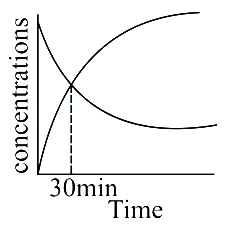
A
$120 \ minutes$
B
$109.75 \ minutes$
C
$112.5 \ minutes$
D
$114 \ minutes$
Solution
(D) The half-life of a reaction is the time required for the reactant concentration to decrease to one-half its initial value.
For a first-order reaction,the rate constant $k$ is given by $k = \frac{2.303}{t} \log \frac{[A]_0}{[A]_t}$.
From the graph,at $t = 30 \ minutes$,the concentration of reactant $[A]_t$ equals the concentration of product $[B_2]$.
Reaction: $A_5 \rightarrow 5 B_2$
Initial: $a \quad 0$
At $t = 30 \ min$: $a-x \quad 5x$
Given $a-x = 5x$,so $a = 6x$.
Substituting into the rate equation:
$k = \frac{2.303}{30} \log \frac{a}{a-x} = \frac{2.303}{30} \log \frac{6x}{x} = \frac{2.303}{30} \log 6 \approx \frac{2.303 \times 0.778}{30} \approx 0.0597 \ min^{-1}$.
The half-life is $t_{1/2} = \frac{0.693}{k} = \frac{0.693}{0.0597} \approx 116 \ minutes$.
Given the options,$114 \ minutes$ is the closest value.
For a first-order reaction,the rate constant $k$ is given by $k = \frac{2.303}{t} \log \frac{[A]_0}{[A]_t}$.
From the graph,at $t = 30 \ minutes$,the concentration of reactant $[A]_t$ equals the concentration of product $[B_2]$.
Reaction: $A_5 \rightarrow 5 B_2$
Initial: $a \quad 0$
At $t = 30 \ min$: $a-x \quad 5x$
Given $a-x = 5x$,so $a = 6x$.
Substituting into the rate equation:
$k = \frac{2.303}{30} \log \frac{a}{a-x} = \frac{2.303}{30} \log \frac{6x}{x} = \frac{2.303}{30} \log 6 \approx \frac{2.303 \times 0.778}{30} \approx 0.0597 \ min^{-1}$.
The half-life is $t_{1/2} = \frac{0.693}{k} = \frac{0.693}{0.0597} \approx 116 \ minutes$.
Given the options,$114 \ minutes$ is the closest value.
0 likesView Solution
222
ChemistryMediumMCQAP EAMCET · 2020
The mass of urea required to make $2.5 \ kg$ of $0.25 \ molal$ aqueous solution is (in $g$)
A
$37$
B
$37.5$
C
$74$
D
$7.4$
Solution
(A) Molality $(m)$ is defined as the number of moles of solute per kilogram of solvent.
Given: Molality $(m)$ = $0.25 \ mol/kg$,Mass of solution = $2.5 \ kg$.
Let the mass of urea be $w \ g$. Molar mass of urea $(NH_2CONH_2)$ = $60 \ g/mol$.
Moles of urea $(n)$ = $\frac{w}{60}$.
Mass of solvent = Mass of solution - Mass of solute = $(2500 - w) \ g = \frac{2500 - w}{1000} \ kg$.
Using the formula: $m = \frac{n}{Mass \ of \ solvent \ (kg)}$.
$0.25 = \frac{w/60}{(2500 - w)/1000}$.
$0.25 = \frac{w}{60} \times \frac{1000}{2500 - w}$.
$0.25 = \frac{1000w}{60(2500 - w)}$.
$15(2500 - w) = 1000w$.
$37500 - 15w = 1000w$.
$1015w = 37500$.
$w \approx 36.94 \ g \approx 37 \ g$.
Given: Molality $(m)$ = $0.25 \ mol/kg$,Mass of solution = $2.5 \ kg$.
Let the mass of urea be $w \ g$. Molar mass of urea $(NH_2CONH_2)$ = $60 \ g/mol$.
Moles of urea $(n)$ = $\frac{w}{60}$.
Mass of solvent = Mass of solution - Mass of solute = $(2500 - w) \ g = \frac{2500 - w}{1000} \ kg$.
Using the formula: $m = \frac{n}{Mass \ of \ solvent \ (kg)}$.
$0.25 = \frac{w/60}{(2500 - w)/1000}$.
$0.25 = \frac{w}{60} \times \frac{1000}{2500 - w}$.
$0.25 = \frac{1000w}{60(2500 - w)}$.
$15(2500 - w) = 1000w$.
$37500 - 15w = 1000w$.
$1015w = 37500$.
$w \approx 36.94 \ g \approx 37 \ g$.
0 likesView Solution
223
ChemistryMediumMCQAP EAMCET · 2020
The rate constant is the same for $3$ reactions of order $I, II$,and $III$,respectively,with the unit of concentration being in moles per litre. If the concentration of the reactant is unity,the rates of reaction $R_1, R_2, R_3$ will be:
A
$R_1 = R_2 = R_3$
B
$R_1 < R_2 < R_3$
C
$R_1 > R_2 > R_3$
D
$R_1 = R_2 \neq R_3$
Solution
(A) Let $R_1, R_2$,and $R_3$ be the rates of three reactions of first,second,and third-order,respectively,and $k$ be the rate constant for all three reactions.
The rate laws are:
$R_1 = k[A]^1$
$R_2 = k[A]^2$
$R_3 = k[A]^3$
where $[A]$ is the concentration of reactant $A$ in moles per litre.
Given that $[A] = 1$,we have:
$R_1 = k(1)^1 = k$
$R_2 = k(1)^2 = k$
$R_3 = k(1)^3 = k$
Therefore,$R_1 = R_2 = R_3$.
The rate laws are:
$R_1 = k[A]^1$
$R_2 = k[A]^2$
$R_3 = k[A]^3$
where $[A]$ is the concentration of reactant $A$ in moles per litre.
Given that $[A] = 1$,we have:
$R_1 = k(1)^1 = k$
$R_2 = k(1)^2 = k$
$R_3 = k(1)^3 = k$
Therefore,$R_1 = R_2 = R_3$.
0 likesView Solution
224
ChemistryMediumMCQAP EAMCET · 2020
Which of the following statements is true?
$1)$ Tertiary amines react with acid chlorides.
$2)$ $N$-ethylbenzene sulphonamide is soluble in alkali.
$3)$ $N,N$-diethylbenzene sulphonamide is soluble in alkali.
$4)$ Tertiary amines react with Hinsberg's reagent.
$1)$ Tertiary amines react with acid chlorides.
$2)$ $N$-ethylbenzene sulphonamide is soluble in alkali.
$3)$ $N,N$-diethylbenzene sulphonamide is soluble in alkali.
$4)$ Tertiary amines react with Hinsberg's reagent.
A
$1$
B
$2$
C
$3$
D
$4$
Solution
(B) $N$-ethylbenzene sulphonamide $(C_6H_5SO_2NHC_2H_5)$ is soluble in alkali because the hydrogen atom attached to the nitrogen atom is acidic due to the strong electron-withdrawing effect of the sulphonyl group $(-SO_2-)$.
This allows it to form a water-soluble salt with alkali.
$N,N$-diethylbenzene sulphonamide does not have an acidic hydrogen atom attached to the nitrogen,so it is insoluble in alkali.
Tertiary amines do not react with acid chlorides or Hinsberg's reagent $(C_6H_5SO_2Cl)$ because they lack an acidic hydrogen atom on the nitrogen.
This allows it to form a water-soluble salt with alkali.
$N,N$-diethylbenzene sulphonamide does not have an acidic hydrogen atom attached to the nitrogen,so it is insoluble in alkali.
Tertiary amines do not react with acid chlorides or Hinsberg's reagent $(C_6H_5SO_2Cl)$ because they lack an acidic hydrogen atom on the nitrogen.
0 likesView Solution
225
ChemistryEasyMCQAP EAMCET · 2020
The formula for calculating 'spin only' magnetic moment is
A
$n(n+2)$
B
$\sqrt{n(n-2)}$
C
$\sqrt{n(n+2)}$
D
$n(n-2)$
Solution
(C) The 'spin only' magnetic moment $(\mu_{so})$ is calculated using the number of unpaired electrons $(n)$ in an atom or ion. The formula is given by:
$\mu_{so} = \sqrt{n(n+2)} \ BM$
where $BM$ stands for Bohr Magneton.
Hence,the correct option is $(C)$.
$\mu_{so} = \sqrt{n(n+2)} \ BM$
where $BM$ stands for Bohr Magneton.
Hence,the correct option is $(C)$.
0 likesView Solution
226
ChemistryEasyMCQAP EAMCET · 2020
Which of the following is not a characteristic of chemisorption?
A
Adsorption is highly specific
B
Heat of adsorption is around $400 \ kJ \ mol^{-1}$
C
The process is irreversible
D
It forms multimolecular layer
Solution
(D) Chemisorption is characterized by high specificity,high enthalpy of adsorption (typically $80-400 \ kJ \ mol^{-1}$),and it is an irreversible process.
Chemisorption results in the formation of a unimolecular layer on the surface of the adsorbent,not a multimolecular layer.
Therefore,option $(d)$ is not a characteristic of chemisorption.
Chemisorption results in the formation of a unimolecular layer on the surface of the adsorbent,not a multimolecular layer.
Therefore,option $(d)$ is not a characteristic of chemisorption.
0 likesView Solution
227
ChemistryMediumMCQAP EAMCET · 2020
$A$ charcoal cube having side length $10 \ cm$ is chopped lengthwise into $5$ equal pieces. Then the effective adsorption power
A
increases by $2.33$ times
B
decreases by $2.33$ times
C
increases by $2.14$ times
D
decreases by $2.14$ times
Solution
(A) Initial surface area of the cube $= 6 \times (10 \ cm)^2 = 600 \ cm^2$.
When the cube is chopped lengthwise into $5$ equal pieces,each piece is a cuboid with dimensions $2 \ cm \times 10 \ cm \times 10 \ cm$.
Surface area of one such cuboid $= 2 \times (2 \times 10 + 10 \times 10 + 10 \times 2) = 2 \times (20 + 100 + 20) = 280 \ cm^2$.
Total surface area of $5$ such cuboids $= 5 \times 280 \ cm^2 = 1400 \ cm^2$.
Since adsorption power is directly proportional to the surface area,the ratio of final to initial adsorption power $= \frac{1400}{600} = \frac{14}{6} = 2.33$.
Thus,the adsorption power increases by $2.33$ times.
When the cube is chopped lengthwise into $5$ equal pieces,each piece is a cuboid with dimensions $2 \ cm \times 10 \ cm \times 10 \ cm$.
Surface area of one such cuboid $= 2 \times (2 \times 10 + 10 \times 10 + 10 \times 2) = 2 \times (20 + 100 + 20) = 280 \ cm^2$.
Total surface area of $5$ such cuboids $= 5 \times 280 \ cm^2 = 1400 \ cm^2$.
Since adsorption power is directly proportional to the surface area,the ratio of final to initial adsorption power $= \frac{1400}{600} = \frac{14}{6} = 2.33$.
Thus,the adsorption power increases by $2.33$ times.
0 likesView Solution
228
ChemistryEasyMCQAP EAMCET · 2020
Which of the following metal ions is colourless?
A
$Ti^{3+}$
B
$Sc^{3+}$
C
$V^{4+}$
D
$Cr^{4+}$
Solution
(B) The electronic configuration of $Sc^{3+}$ is $[Ar] 3d^0$.
Since there are no unpaired electrons in the $d$-orbital,$d-d$ transitions are not possible,making the ion colourless.
In contrast,$Ti^{3+}$ $(3d^1)$,$V^{4+}$ $(3d^1)$,and $Cr^{4+}$ $(3d^2)$ contain unpaired electrons,allowing for $d-d$ transitions,which result in the exhibition of colour.
Since there are no unpaired electrons in the $d$-orbital,$d-d$ transitions are not possible,making the ion colourless.
In contrast,$Ti^{3+}$ $(3d^1)$,$V^{4+}$ $(3d^1)$,and $Cr^{4+}$ $(3d^2)$ contain unpaired electrons,allowing for $d-d$ transitions,which result in the exhibition of colour.
0 likesView Solution
229
ChemistryEasyMCQAP EAMCET · 2020
Which among the following can be explained by adsorption theory?
A
Homogeneous catalysis
B
Heterogeneous catalysis
C
Enzyme catalysis
D
Acid base catalysis
Solution
(B) The adsorption theory of catalysis explains the mechanism of $Heterogeneous \ catalysis$.
According to this theory,the reactant molecules are adsorbed on the surface of the solid catalyst,which increases the concentration of reactants on the surface and facilitates the formation of an intermediate,thereby lowering the activation energy of the reaction.
According to this theory,the reactant molecules are adsorbed on the surface of the solid catalyst,which increases the concentration of reactants on the surface and facilitates the formation of an intermediate,thereby lowering the activation energy of the reaction.
0 likesView Solution
230
ChemistryEasyMCQAP EAMCET · 2020
In a plot of $\log \left( \frac{x}{m} \right)$ $vs$ $\log p$,for the adsorption of a gas on a solid,a straight line is obtained. The slope of that straight line is
A
$\frac{1}{n}$
B
$K$
C
$n$
D
$\log K$
Solution
(A) According to the Freundlich adsorption isotherm,the relationship is given by $\frac{x}{m} = K p^{\frac{1}{n}}$.
Taking the logarithm on both sides,we get $\log \left( \frac{x}{m} \right) = \log K + \frac{1}{n} \log p$.
Comparing this with the equation of a straight line $y = mx + c$,where $y = \log \left( \frac{x}{m} \right)$,$x = \log p$,$m = \frac{1}{n}$,and $c = \log K$.
Therefore,the slope of the straight line is $\frac{1}{n}$.
Taking the logarithm on both sides,we get $\log \left( \frac{x}{m} \right) = \log K + \frac{1}{n} \log p$.
Comparing this with the equation of a straight line $y = mx + c$,where $y = \log \left( \frac{x}{m} \right)$,$x = \log p$,$m = \frac{1}{n}$,and $c = \log K$.
Therefore,the slope of the straight line is $\frac{1}{n}$.
0 likesView Solution
231
ChemistryEasyMCQAP EAMCET · 2020
The Freundlich adsorption isotherm varies with temperature according to the figure given below. Choose the correct option accordingly.
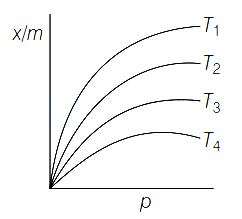
A
$T_1=303 \ K, T_2=298 \ K, T_3=244 \ K, T_4=195 \ K$
B
$T_1=303 \ K, T_2=195 \ K, T_3=244 \ K, T_4=298 \ K$
C
$T_1=195 \ K, T_2=244 \ K, T_3=298 \ K, T_4=303 \ K$
D
$T_1=195 \ K, T_2=303 \ K, T_3=244 \ K, T_4=298 \ K$
Solution
(C) The Freundlich adsorption isotherm represents the variation in the amount of adsorbate $(x/m)$ adsorbed on the surface of an adsorbent with the change in pressure $(p)$ at a constant temperature.
Physical adsorption is an exothermic process. According to Le Chatelier's principle,as the temperature increases,the extent of adsorption decreases.
In the given graph,for a constant pressure,the amount of adsorption $(x/m)$ follows the order: $T_1 > T_2 > T_3 > T_4$.
Since adsorption decreases with an increase in temperature,the corresponding temperatures must follow the order: $T_1 < T_2 < T_3 < T_4$.
Comparing the given values,the order $195 \ K < 244 \ K < 298 \ K < 303 \ K$ matches the trend shown in the graph for $T_1, T_2, T_3, T_4$ respectively.
Therefore,the correct option is $(C)$.
Physical adsorption is an exothermic process. According to Le Chatelier's principle,as the temperature increases,the extent of adsorption decreases.
In the given graph,for a constant pressure,the amount of adsorption $(x/m)$ follows the order: $T_1 > T_2 > T_3 > T_4$.
Since adsorption decreases with an increase in temperature,the corresponding temperatures must follow the order: $T_1 < T_2 < T_3 < T_4$.
Comparing the given values,the order $195 \ K < 244 \ K < 298 \ K < 303 \ K$ matches the trend shown in the graph for $T_1, T_2, T_3, T_4$ respectively.
Therefore,the correct option is $(C)$.
0 likesView Solution
232
ChemistryEasyMCQAP EAMCET · 2020
An example for hydrophobic sol among the following is
A
gum solution
B
arsenic sulphide solution
C
starch solution
D
protein solution
Solution
(B) Arsenic sulphide solution $(As_2S_3)$ is a hydrophobic sol,meaning it has little or no affinity for the dispersion medium $(H_2O)$.
Conversely,solutions of gum,starch,and protein are hydrophilic in nature because they are macromolecules (natural polymers) that have a strong affinity for the dispersion medium.
Conversely,solutions of gum,starch,and protein are hydrophilic in nature because they are macromolecules (natural polymers) that have a strong affinity for the dispersion medium.
0 likesView Solution
233
ChemistryEasyMCQAP EAMCET · 2020
The charge on colloidal particles is due to
A
presence of electrolyte
B
very small size of particles
C
adsorption of ions from the solution
D
Can't be determined
Solution
(C) The colloidal particles have a tendency to preferentially adsorb a particular type of ions from the solution.
$A$ colloidal particle usually adsorbs those ions which are in excess and are common to its own lattice.
This preferential adsorption of a particular type of ions imparts a particular type of charge to colloidal particles.
Hence,the correct option is $(C)$.
$A$ colloidal particle usually adsorbs those ions which are in excess and are common to its own lattice.
This preferential adsorption of a particular type of ions imparts a particular type of charge to colloidal particles.
Hence,the correct option is $(C)$.
0 likesView Solution
234
ChemistryMediumMCQAP EAMCET · 2020
In an electrophoresis setup,a colloidal solution of glycine having a $pH$ of $5.97$ is kept at constant $T$ and $P$. What will happen if a few drops of base are added to it?
A
Cataphoresis
B
Anaphoresis
C
Precipitation
D
Decomposition
Solution
(B) Glycine is an amino acid with an isoelectric point $(pI)$ of $5.97$. At this $pH$,glycine exists as a zwitterion,meaning it has no net charge and does not move towards any electrode in an electric field.
When a base is added,the $pH$ of the solution increases above the $pI$ $(pH > 5.97)$.
In a basic medium,the amino acid loses a proton from the $-NH_3^+$ group,resulting in a net negative charge on the glycine molecule.
Since the colloidal particles become negatively charged,they will move towards the anode under the influence of an electric field.
The movement of negatively charged colloidal particles towards the anode is known as $Anaphoresis$.
When a base is added,the $pH$ of the solution increases above the $pI$ $(pH > 5.97)$.
In a basic medium,the amino acid loses a proton from the $-NH_3^+$ group,resulting in a net negative charge on the glycine molecule.
Since the colloidal particles become negatively charged,they will move towards the anode under the influence of an electric field.
The movement of negatively charged colloidal particles towards the anode is known as $Anaphoresis$.
0 likesView Solution
235
ChemistryEasyMCQAP EAMCET · 2020
Which one of the following is the correct structure of sulphapyridine?
A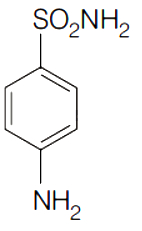
B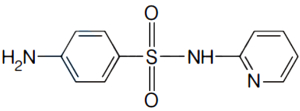
C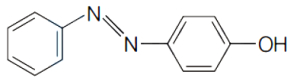
D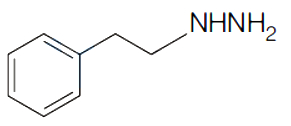
Solution
(B) Sulphapyridine is a sulfonamide antibiotic. Its chemical structure consists of a benzene ring substituted with an amino group $(-NH_2)$ at the para position and a sulfonamide group $(-SO_2NH-)$ attached to a pyridine ring. The correct structure is shown in option $B$.
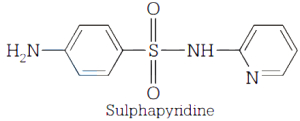
0 likesView Solution
Vedclass Products
For Students
Vedclass Test Series
Mock tests in real AP EAMCET style covering Chemistry with performance analysis. 5-day free trial.
Start Free TrialFor Teachers
Exam Paper Generator
Generate Set A/B/C/D Chemistry papers from 7.5L+ questions in 2 minutes. 3 chapters free.
Try FreeFor Institutes
Online Exam Module
Run live AP EAMCET mock exams with unlimited students, 360° analytics & white-label branding.
See DemoFrequently Asked Questions
How many Chemistry questions are in AP EAMCET 2020?
There are 492 Chemistry questions from the AP EAMCET 2020 paper on Vedclass, each with a detailed step-by-step solution in English.
Are AP EAMCET 2020 Chemistry solutions available in English?
Yes. All solutions on this page are in English. You can also switch to English or Hindi using the language buttons above the questions.
Can I practice AP EAMCET 2020 Chemistry as a timed test?
Yes. Use the Vedclass Test Series to attempt a full AP EAMCET mock test covering Chemistry with time limits and instant score analysis.
Can teachers create Chemistry papers from AP EAMCET previous year questions?
Yes. The Vedclass Exam Paper Generator lets teachers mix AP EAMCET Chemistry questions and generate Set A/B/C/D papers in minutes.
For Teachers & Institutes
Build a Custom Chemistry Paper
Pick AP EAMCET 2020 Chemistry questions, set difficulty, and generate Set A/B/C/D in 2 minutes.