
ChemistryQ201–250 of 492 questions
Page 5 of 7 · English
201
ChemistryMCQAP EAMCET · 2020
The value of $k$ for which the equation $x^2-4xy-y^2+6x+2y+k=0$ represents a pair of straight lines is equal to ........
A
$\frac{4}{5}$
B
$\frac{-3}{5}$
C
$\frac{-4}{5}$
D
$\frac{3}{5}$
Solution
(C) The given equation is $x^2-4xy-y^2+6x+2y+k=0$.
Comparing this with the general second-degree equation $ax^2+2hxy+by^2+2gx+2fy+c=0$,we get:
$a=1, h=-2, b=-1, g=3, f=1, c=k$.
The condition for the equation to represent a pair of straight lines is $\Delta = abc+2fgh-af^2-bg^2-ch^2=0$.
Substituting the values:
$(1)(-1)(k) + 2(1)(3)(-2) - (1)(1)^2 - (-1)(3)^2 - k(-2)^2 = 0$.
$-k - 12 - 1 + 9 - 4k = 0$.
$-5k - 4 = 0$.
$5k = -4$.
$k = -\frac{4}{5}$.
Thus,the correct option is $C$.
Comparing this with the general second-degree equation $ax^2+2hxy+by^2+2gx+2fy+c=0$,we get:
$a=1, h=-2, b=-1, g=3, f=1, c=k$.
The condition for the equation to represent a pair of straight lines is $\Delta = abc+2fgh-af^2-bg^2-ch^2=0$.
Substituting the values:
$(1)(-1)(k) + 2(1)(3)(-2) - (1)(1)^2 - (-1)(3)^2 - k(-2)^2 = 0$.
$-k - 12 - 1 + 9 - 4k = 0$.
$-5k - 4 = 0$.
$5k = -4$.
$k = -\frac{4}{5}$.
Thus,the correct option is $C$.
0 likesView Solution
202
ChemistryMCQAP EAMCET · 2020
The combined equation of the lines passing through the origin and having slopes $\frac{2}{3}$ and $-\frac{2}{3}$ is
A
$2 x^2-9 y^2=0$
B
$4 x^2-x y-9 y^2=0$
C
$4 x^2-9 y^2=0$
D
$4 x^2+x y-9 y^2=0$
Solution
(C) The equations of the lines passing through the origin with slopes $m_1 = \frac{2}{3}$ and $m_2 = -\frac{2}{3}$ are given by $y = m_1 x$ and $y = m_2 x$.
Substituting the slopes,we get $y = \frac{2}{3}x \Rightarrow 2x - 3y = 0$ and $y = -\frac{2}{3}x \Rightarrow 2x + 3y = 0$.
The combined equation is the product of these two linear equations:
$(2x - 3y)(2x + 3y) = 0$.
Using the identity $(a-b)(a+b) = a^2 - b^2$,we get:
$(2x)^2 - (3y)^2 = 0 \Rightarrow 4x^2 - 9y^2 = 0$.
Substituting the slopes,we get $y = \frac{2}{3}x \Rightarrow 2x - 3y = 0$ and $y = -\frac{2}{3}x \Rightarrow 2x + 3y = 0$.
The combined equation is the product of these two linear equations:
$(2x - 3y)(2x + 3y) = 0$.
Using the identity $(a-b)(a+b) = a^2 - b^2$,we get:
$(2x)^2 - (3y)^2 = 0 \Rightarrow 4x^2 - 9y^2 = 0$.
0 likesView Solution
203
ChemistryMCQAP EAMCET · 2020
The point of intersection of the pair of lines represented by $x^2+xy+2y^2-3x+2y+4=0$ is
A
$(1, 2)$
B
$(-1, 2)$
C
$(-2, 1)$
D
$(2, -1)$
Solution
(D) Let $f(x, y) = x^2+xy+2y^2-3x+2y+4=0$. The point of intersection $(x, y)$ of the pair of lines is obtained by solving the partial derivatives $\frac{\partial f}{\partial x} = 0$ and $\frac{\partial f}{\partial y} = 0$.
$\frac{\partial f}{\partial x} = 2x + y - 3 = 0 \quad \dots (i)$
$\frac{\partial f}{\partial y} = x + 4y + 2 = 0 \quad \dots (ii)$
Solving these linear equations:
From $(i)$,$y = 3 - 2x$.
Substituting in $(ii)$: $x + 4(3 - 2x) + 2 = 0$
$x + 12 - 8x + 2 = 0$
$-7x + 14 = 0 \implies x = 2$.
Substituting $x = 2$ in $(i)$: $2(2) + y - 3 = 0 \implies 4 + y - 3 = 0 \implies y = -1$.
Thus,the point of intersection is $(2, -1)$.
Therefore,option $D$ is correct.
$\frac{\partial f}{\partial x} = 2x + y - 3 = 0 \quad \dots (i)$
$\frac{\partial f}{\partial y} = x + 4y + 2 = 0 \quad \dots (ii)$
Solving these linear equations:
From $(i)$,$y = 3 - 2x$.
Substituting in $(ii)$: $x + 4(3 - 2x) + 2 = 0$
$x + 12 - 8x + 2 = 0$
$-7x + 14 = 0 \implies x = 2$.
Substituting $x = 2$ in $(i)$: $2(2) + y - 3 = 0 \implies 4 + y - 3 = 0 \implies y = -1$.
Thus,the point of intersection is $(2, -1)$.
Therefore,option $D$ is correct.
0 likesView Solution
204
ChemistryMCQAP EAMCET · 2020
The equations $x-y=4$ and $x^2+4xy+y^2=0$ represent the sides of a/an
A
Isosceles Triangle
B
Right Angled Triangle
C
Equilateral Triangle
D
Scalene Triangle
Solution
(C) The equation $x^2+4xy+y^2=0$ represents a pair of lines passing through the origin. Let these lines be $y = m_1x$ and $y = m_2x$.
Comparing with $ax^2+2hxy+by^2=0$,we have $a=1, h=2, b=1$.
The slopes $m_1, m_2$ satisfy $m_1+m_2 = -2h/b = -4$ and $m_1m_2 = a/b = 1$.
The angle $\theta$ between these lines is given by $\tan \theta = |\frac{2\sqrt{h^2-ab}}{a+b}| = |\frac{2\sqrt{4-1}}{1+1}| = \sqrt{3}$.
Thus,$\theta = 60^\circ$.
Since the lines pass through the origin and the angle between them is $60^\circ$,the triangle formed by these two lines and the line $x-y=4$ is an equilateral triangle because the line $x-y=4$ makes an angle of $45^\circ$ with the axes,but checking the intersection points shows the triangle is equilateral.
Comparing with $ax^2+2hxy+by^2=0$,we have $a=1, h=2, b=1$.
The slopes $m_1, m_2$ satisfy $m_1+m_2 = -2h/b = -4$ and $m_1m_2 = a/b = 1$.
The angle $\theta$ between these lines is given by $\tan \theta = |\frac{2\sqrt{h^2-ab}}{a+b}| = |\frac{2\sqrt{4-1}}{1+1}| = \sqrt{3}$.
Thus,$\theta = 60^\circ$.
Since the lines pass through the origin and the angle between them is $60^\circ$,the triangle formed by these two lines and the line $x-y=4$ is an equilateral triangle because the line $x-y=4$ makes an angle of $45^\circ$ with the axes,but checking the intersection points shows the triangle is equilateral.
0 likesView Solution
205
ChemistryMCQAP EAMCET · 2020
If the slope of one line of $ax^2 + 4xy + y^2 = 0$ is $3$ times the other,then the value of $a$ is:
A
-$3$
B
-$1$
C
$3$
D
$1$
Solution
(C) The given equation is $ax^2 + 4xy + y^2 = 0$. Let the slopes of the two lines be $m$ and $3m$.
Comparing the equation with $Ax^2 + 2Hxy + By^2 = 0$,we have $A = a$,$2H = 4$ (so $H = 2$),and $B = 1$.
The sum of the slopes is $m + 3m = -\frac{2H}{B} = -\frac{4}{1} = -4$.
$4m = -4 \Rightarrow m = -1$.
The product of the slopes is $m(3m) = \frac{A}{B} = \frac{a}{1} = a$.
$3m^2 = a$.
Substituting $m = -1$,we get $3(-1)^2 = a$,which implies $a = 3$.
Thus,the correct option is $C$.
Comparing the equation with $Ax^2 + 2Hxy + By^2 = 0$,we have $A = a$,$2H = 4$ (so $H = 2$),and $B = 1$.
The sum of the slopes is $m + 3m = -\frac{2H}{B} = -\frac{4}{1} = -4$.
$4m = -4 \Rightarrow m = -1$.
The product of the slopes is $m(3m) = \frac{A}{B} = \frac{a}{1} = a$.
$3m^2 = a$.
Substituting $m = -1$,we get $3(-1)^2 = a$,which implies $a = 3$.
Thus,the correct option is $C$.
0 likesView Solution
206
ChemistryMCQAP EAMCET · 2020
If the circle $x^2+y^2+6x-2y+k=0$ bisects the circumference of the circle $x^2+y^2+2x-6y-15=0$,then $k$ is equal to
A
$21$
B
$-21$
C
$23$
D
$-23$
Solution
(D) Given,the equations of the circles are:
$S: x^2+y^2+6x-2y+k=0$
$S': x^2+y^2+2x-6y-15=0$
The circle $S$ bisects the circumference of circle $S'$,which means the common chord of the two circles passes through the center of circle $S'$.
The equation of the common chord is given by $S - S' = 0$:
$(x^2+y^2+6x-2y+k) - (x^2+y^2+2x-6y-15) = 0$
$4x + 4y + k + 15 = 0$ $(i)$
The center of circle $S'$ is $(-g, -f)$,where $2g=2$ and $2f=-6$,so the center is $(-1, 3)$.
Since the common chord passes through the center $(-1, 3)$,we substitute these coordinates into equation $(i)$:
$4(-1) + 4(3) + k + 15 = 0$
$-4 + 12 + k + 15 = 0$
$8 + k + 15 = 0$
$k + 23 = 0$
$k = -23$
Thus,option $D$ is correct.
$S: x^2+y^2+6x-2y+k=0$
$S': x^2+y^2+2x-6y-15=0$
The circle $S$ bisects the circumference of circle $S'$,which means the common chord of the two circles passes through the center of circle $S'$.
The equation of the common chord is given by $S - S' = 0$:
$(x^2+y^2+6x-2y+k) - (x^2+y^2+2x-6y-15) = 0$
$4x + 4y + k + 15 = 0$ $(i)$
The center of circle $S'$ is $(-g, -f)$,where $2g=2$ and $2f=-6$,so the center is $(-1, 3)$.
Since the common chord passes through the center $(-1, 3)$,we substitute these coordinates into equation $(i)$:
$4(-1) + 4(3) + k + 15 = 0$
$-4 + 12 + k + 15 = 0$
$8 + k + 15 = 0$
$k + 23 = 0$
$k = -23$
Thus,option $D$ is correct.
0 likesView Solution
207
ChemistryMCQAP EAMCET · 2020
The angle between the tangents drawn from the point $(1,4)$ to the parabola $y^2=4x$ is
A
$\frac{\pi}{6}$
B
$\frac{\pi}{4}$
C
$\frac{\pi}{3}$
D
$\frac{\pi}{2}$
Solution
(C) The equation of any tangent to the parabola $y^2=4x$ is $y=mx+\frac{1}{m}$.
Since the tangents pass through the point $(1,4)$,we have $4=m(1)+\frac{1}{m}$.
Multiplying by $m$,we get $m^2-4m+1=0$.
Let the slopes of the two tangents be $m_1$ and $m_2$. Then $m_1+m_2=4$ and $m_1m_2=1$.
The difference between the slopes is $|m_1-m_2| = \sqrt{(m_1+m_2)^2-4m_1m_2} = \sqrt{16-4} = \sqrt{12} = 2\sqrt{3}$.
The angle $\theta$ between the tangents is given by $\tan \theta = \left|\frac{m_1-m_2}{1+m_1m_2}\right|$.
Substituting the values,$\tan \theta = \left|\frac{2\sqrt{3}}{1+1}\right| = \frac{2\sqrt{3}}{2} = \sqrt{3}$.
Therefore,$\theta = \tan^{-1}(\sqrt{3}) = \frac{\pi}{3}$.
Since the tangents pass through the point $(1,4)$,we have $4=m(1)+\frac{1}{m}$.
Multiplying by $m$,we get $m^2-4m+1=0$.
Let the slopes of the two tangents be $m_1$ and $m_2$. Then $m_1+m_2=4$ and $m_1m_2=1$.
The difference between the slopes is $|m_1-m_2| = \sqrt{(m_1+m_2)^2-4m_1m_2} = \sqrt{16-4} = \sqrt{12} = 2\sqrt{3}$.
The angle $\theta$ between the tangents is given by $\tan \theta = \left|\frac{m_1-m_2}{1+m_1m_2}\right|$.
Substituting the values,$\tan \theta = \left|\frac{2\sqrt{3}}{1+1}\right| = \frac{2\sqrt{3}}{2} = \sqrt{3}$.
Therefore,$\theta = \tan^{-1}(\sqrt{3}) = \frac{\pi}{3}$.
0 likesView Solution
208
ChemistryMCQAP EAMCET · 2020
If $\left[\begin{array}{rrr}1 & -1 & x \\ 1 & x & 1 \\ x & -1 & 1\end{array}\right]$ has no inverse,then the real value of $x$ is
A
$2$
B
$3$
C
$0$
D
$1$
Solution
(D) matrix has no inverse if and only if its determinant is equal to $0$.
Let $A = \left[\begin{array}{rrr}1 & -1 & x \\ 1 & x & 1 \\ x & -1 & 1\end{array}\right]$.
We set $|A| = 0$:
$|A| = 1(x - (-1)) - (-1)(1 - x) + x(-1 - x^2) = 0$
$|A| = 1(x + 1) + 1(1 - x) + x(-1 - x^2) = 0$
$|A| = x + 1 + 1 - x - x - x^3 = 0$
$|A| = -x^3 - x + 2 = 0$
$x^3 + x - 2 = 0$
By inspection,if $x = 1$,then $1^3 + 1 - 2 = 0$,which satisfies the equation.
Alternatively,if $x = 1$,the matrix becomes $\left[\begin{array}{rrr}1 & -1 & 1 \\ 1 & 1 & 1 \\ 1 & -1 & 1\end{array}\right]$.
Since the first and third columns are identical,the determinant is $0$.
Thus,the real value of $x$ is $1$.
Let $A = \left[\begin{array}{rrr}1 & -1 & x \\ 1 & x & 1 \\ x & -1 & 1\end{array}\right]$.
We set $|A| = 0$:
$|A| = 1(x - (-1)) - (-1)(1 - x) + x(-1 - x^2) = 0$
$|A| = 1(x + 1) + 1(1 - x) + x(-1 - x^2) = 0$
$|A| = x + 1 + 1 - x - x - x^3 = 0$
$|A| = -x^3 - x + 2 = 0$
$x^3 + x - 2 = 0$
By inspection,if $x = 1$,then $1^3 + 1 - 2 = 0$,which satisfies the equation.
Alternatively,if $x = 1$,the matrix becomes $\left[\begin{array}{rrr}1 & -1 & 1 \\ 1 & 1 & 1 \\ 1 & -1 & 1\end{array}\right]$.
Since the first and third columns are identical,the determinant is $0$.
Thus,the real value of $x$ is $1$.
0 likesView Solution
209
ChemistryMCQAP EAMCET · 2020
The function $f: R \rightarrow R$ defined by $f(x)=\frac{x}{\sqrt{1+x^2}}$ is ........
A
Surjective but not injective
B
Bijective
C
Injective but not surjective
D
Neither injective nor surjective
Solution
(C) To check for injectivity,let $f(x_1) = f(x_2)$.
$\frac{x_1}{\sqrt{1+x_1^2}} = \frac{x_2}{\sqrt{1+x_2^2}}$
Squaring both sides: $\frac{x_1^2}{1+x_1^2} = \frac{x_2^2}{1+x_2^2}$
$x_1^2(1+x_2^2) = x_2^2(1+x_1^2)$
$x_1^2 + x_1^2x_2^2 = x_2^2 + x_1^2x_2^2$
$x_1^2 = x_2^2 \Rightarrow x_1 = x_2$ (since the function is strictly increasing,$x_1 = x_2$).
Thus,$f$ is injective.
To check for surjectivity,let $y = \frac{x}{\sqrt{1+x^2}}$.
$y^2 = \frac{x^2}{1+x^2} \Rightarrow y^2(1+x^2) = x^2 \Rightarrow y^2 = x^2(1-y^2) \Rightarrow x^2 = \frac{y^2}{1-y^2}$.
For $x$ to be a real number,$1-y^2 > 0$,which means $y^2 < 1$,so $-1 < y < 1$.
The range of $f$ is $(-1, 1)$,which is not equal to the codomain $R$.
Therefore,$f$ is not surjective.
$\frac{x_1}{\sqrt{1+x_1^2}} = \frac{x_2}{\sqrt{1+x_2^2}}$
Squaring both sides: $\frac{x_1^2}{1+x_1^2} = \frac{x_2^2}{1+x_2^2}$
$x_1^2(1+x_2^2) = x_2^2(1+x_1^2)$
$x_1^2 + x_1^2x_2^2 = x_2^2 + x_1^2x_2^2$
$x_1^2 = x_2^2 \Rightarrow x_1 = x_2$ (since the function is strictly increasing,$x_1 = x_2$).
Thus,$f$ is injective.
To check for surjectivity,let $y = \frac{x}{\sqrt{1+x^2}}$.
$y^2 = \frac{x^2}{1+x^2} \Rightarrow y^2(1+x^2) = x^2 \Rightarrow y^2 = x^2(1-y^2) \Rightarrow x^2 = \frac{y^2}{1-y^2}$.
For $x$ to be a real number,$1-y^2 > 0$,which means $y^2 < 1$,so $-1 < y < 1$.
The range of $f$ is $(-1, 1)$,which is not equal to the codomain $R$.
Therefore,$f$ is not surjective.
0 likesView Solution
210
ChemistryMCQAP EAMCET · 2020
If $x=e^{y+e^{y+e^{y+\ldots}}}$,then $\frac{d y}{d x}=$
A
$\frac{1-x}{x}$
B
$\frac{1}{x}$
C
$\frac{x}{1+x}$
D
$\frac{1+x}{x}$
Solution
(A) Given that,$x = e^{y+e^{y+e^{y+\ldots}}}$.
Since the exponent repeats infinitely,we can write $x = e^{y+x}$.
Taking the natural logarithm on both sides,we get $\log_e x = y+x$.
Rearranging for $y$,we have $y = \log_e x - x$.
Differentiating both sides with respect to $x$,we get $\frac{dy}{dx} = \frac{d}{dx}(\log_e x) - \frac{d}{dx}(x)$.
Thus,$\frac{dy}{dx} = \frac{1}{x} - 1 = \frac{1-x}{x}$.
Therefore,option $(A)$ is correct.
Since the exponent repeats infinitely,we can write $x = e^{y+x}$.
Taking the natural logarithm on both sides,we get $\log_e x = y+x$.
Rearranging for $y$,we have $y = \log_e x - x$.
Differentiating both sides with respect to $x$,we get $\frac{dy}{dx} = \frac{d}{dx}(\log_e x) - \frac{d}{dx}(x)$.
Thus,$\frac{dy}{dx} = \frac{1}{x} - 1 = \frac{1-x}{x}$.
Therefore,option $(A)$ is correct.
0 likesView Solution
211
ChemistryMediumMCQAP EAMCET · 2020
Which of the following does not show a disproportionation reaction?
A
$ClO_2^{-}$
B
$ClO_3^{-}$
C
$ClO_4^{-}$
D
$ClO^{-}$
Solution
(C) disproportionation reaction is a type of redox reaction in which the same element is simultaneously oxidized and reduced.
For an element to undergo disproportionation,it must be in an intermediate oxidation state.
In $ClO_4^{-}$,the oxidation state of $Cl$ is calculated as: $x + 4(-2) = -1$,which gives $x = +7$.
Since $+7$ is the maximum possible oxidation state for chlorine (as it has $7$ valence electrons),it cannot be further oxidized.
Therefore,$ClO_4^{-}$ cannot undergo a disproportionation reaction.
For an element to undergo disproportionation,it must be in an intermediate oxidation state.
In $ClO_4^{-}$,the oxidation state of $Cl$ is calculated as: $x + 4(-2) = -1$,which gives $x = +7$.
Since $+7$ is the maximum possible oxidation state for chlorine (as it has $7$ valence electrons),it cannot be further oxidized.
Therefore,$ClO_4^{-}$ cannot undergo a disproportionation reaction.
0 likesView Solution
212
ChemistryEasyMCQAP EAMCET · 2020
Which species among the following does not show disproportionation reactions?
A
$ClO_2^{-}$
B
$ClO_3^{-}$
C
$ClO^{-}$
D
$ClO_4^{-}$
Solution
(D) Disproportionation is a specific type of redox reaction in which a species is simultaneously reduced and oxidized to form two different products.
In a disproportionation reaction,the central atom must be in an intermediate oxidation state so that it can both increase and decrease its oxidation number.
The oxidation state of $Cl$ in the given species is:
$ClO^{-}$: $+1$
$ClO_2^{-}$: $+3$
$ClO_3^{-}$: $+5$
$ClO_4^{-}$: $+7$
Since $Cl$ in $ClO_4^{-}$ is already in its maximum oxidation state of $+7$,it cannot be further oxidized.
Therefore,$ClO_4^{-}$ cannot undergo a disproportionation reaction.
Hence,the correct option is $(D)$.
In a disproportionation reaction,the central atom must be in an intermediate oxidation state so that it can both increase and decrease its oxidation number.
The oxidation state of $Cl$ in the given species is:
$ClO^{-}$: $+1$
$ClO_2^{-}$: $+3$
$ClO_3^{-}$: $+5$
$ClO_4^{-}$: $+7$
Since $Cl$ in $ClO_4^{-}$ is already in its maximum oxidation state of $+7$,it cannot be further oxidized.
Therefore,$ClO_4^{-}$ cannot undergo a disproportionation reaction.
Hence,the correct option is $(D)$.
0 likesView Solution
213
ChemistryEasyMCQAP EAMCET · 2020
Which of the following represents the disproportionation of potassium chlorate?
A
$2 KClO_3 \longrightarrow 2 KCl + 3 O_2$
B
$3 KClO_3 \longrightarrow 2 KClO_2 + KClO_4$
C
$4 KClO_3 \longrightarrow 3 KClO_4 + KCl$
D
None of the above
Solution
(C) In the reaction $4 KClO_3 \longrightarrow 3 KClO_4 + KCl$,the oxidation state of chlorine in $KClO_3$ is $+5$.
In $KClO_4$,the oxidation state of chlorine is $+7$ (oxidation).
In $KCl$,the oxidation state of chlorine is $-1$ (reduction).
Since the same element (chlorine) is simultaneously oxidized and reduced,this is a disproportionation reaction.
Hence,the correct option is $(C)$.
In $KClO_4$,the oxidation state of chlorine is $+7$ (oxidation).
In $KCl$,the oxidation state of chlorine is $-1$ (reduction).
Since the same element (chlorine) is simultaneously oxidized and reduced,this is a disproportionation reaction.
Hence,the correct option is $(C)$.
0 likesView Solution
214
ChemistryMediumMCQAP EAMCET · 2020
Which one of the following does not undergo disproportionation reaction?
A
$ClO^{-}$
B
$ClO_3^{-}$
C
$ClO_2^{-}$
D
$ClO_4^{-}$
Solution
(D) disproportionation reaction is a redox reaction in which the same element is simultaneously oxidized and reduced.
For an element to undergo disproportionation,it must exist in an intermediate oxidation state,meaning it should be capable of both increasing and decreasing its oxidation number.
In $ClO_4^-$,the oxidation state of chlorine is $+7$.
Since chlorine is in its maximum possible oxidation state $(+7)$,it cannot be further oxidized.
Therefore,$ClO_4^-$ cannot undergo a disproportionation reaction.
For an element to undergo disproportionation,it must exist in an intermediate oxidation state,meaning it should be capable of both increasing and decreasing its oxidation number.
In $ClO_4^-$,the oxidation state of chlorine is $+7$.
Since chlorine is in its maximum possible oxidation state $(+7)$,it cannot be further oxidized.
Therefore,$ClO_4^-$ cannot undergo a disproportionation reaction.
0 likesView Solution
215
ChemistryEasyMCQAP EAMCET · 2020
The oxidation number of an element in a compound is evaluated on the basis of certain rules. Which of the following rules is not correct?
$1$. The oxidation number of hydrogen is always $+1$.
$2$. The algebraic sum of all the oxidation numbers of all elements in a compound is zero.
$3$. An element in the free or the uncombined state bears oxidation number zero.
$4$. In all its compounds,the oxidation number of fluorine is $-1$.
$1$. The oxidation number of hydrogen is always $+1$.
$2$. The algebraic sum of all the oxidation numbers of all elements in a compound is zero.
$3$. An element in the free or the uncombined state bears oxidation number zero.
$4$. In all its compounds,the oxidation number of fluorine is $-1$.
A
$1$
B
$2$
C
$3$
D
$4$
Solution
(A) The oxidation number of hydrogen is usually $+1$ in compounds with more electronegative atoms (as in $H_2O$).
However,in metal hydrides like lithium hydride $(LiH)$,the oxidation state of the hydrogen atom is $-1$.
Therefore,the statement that the oxidation number of hydrogen is always $+1$ is incorrect.
However,in metal hydrides like lithium hydride $(LiH)$,the oxidation state of the hydrogen atom is $-1$.
Therefore,the statement that the oxidation number of hydrogen is always $+1$ is incorrect.
0 likesView Solution
216
ChemistryMediumMCQAP EAMCET · 2020
After balancing the equation,$C_2O_4^{2-} + H^+ + MnO_4^- \longrightarrow CO_2 + Mn^{2+} + H_2O$,the coefficient of $CO_2$ is:
A
$4$
B
$5$
C
$10$
D
$2$
Solution
(C) The redox reaction is: $a C_2O_4^{2-} + b MnO_4^- + H^+ \longrightarrow p CO_2 + q Mn^{2+} + H_2O$
Step $1$: Determine the $n$-factors.
For $C_2O_4^{2-}$,the oxidation state of $C$ changes from $+3$ to $+4$. The $n$-factor is $(4-3) \times 2 = 2$.
For $MnO_4^-$,the oxidation state of $Mn$ changes from $+7$ to $+2$. The $n$-factor is $(7-2) \times 1 = 5$.
Step $2$: Balance the $n$-factors by cross-multiplying.
We take $5$ moles of oxalate $(a=5)$ and $2$ moles of permanganate $(b=2)$.
Step $3$: Balance the atoms.
For $C$-atoms: $2a = p \implies p = 2 \times 5 = 10$.
For $Mn$-atoms: $b = q \implies q = 2$.
For $O$-atoms: $5(4) + 2(4) = 10(2) + 2(1) + H_2O \implies 28 = 22 + H_2O \implies H_2O = 6$.
For $H$-atoms: $H^+ = 2 \times 6 = 12$.
The balanced equation is $5C_2O_4^{2-} + 2MnO_4^- + 16H^+ \longrightarrow 10CO_2 + 2Mn^{2+} + 8H_2O$.
Thus,the coefficient of $CO_2$ is $10$.
Step $1$: Determine the $n$-factors.
For $C_2O_4^{2-}$,the oxidation state of $C$ changes from $+3$ to $+4$. The $n$-factor is $(4-3) \times 2 = 2$.
For $MnO_4^-$,the oxidation state of $Mn$ changes from $+7$ to $+2$. The $n$-factor is $(7-2) \times 1 = 5$.
Step $2$: Balance the $n$-factors by cross-multiplying.
We take $5$ moles of oxalate $(a=5)$ and $2$ moles of permanganate $(b=2)$.
Step $3$: Balance the atoms.
For $C$-atoms: $2a = p \implies p = 2 \times 5 = 10$.
For $Mn$-atoms: $b = q \implies q = 2$.
For $O$-atoms: $5(4) + 2(4) = 10(2) + 2(1) + H_2O \implies 28 = 22 + H_2O \implies H_2O = 6$.
For $H$-atoms: $H^+ = 2 \times 6 = 12$.
The balanced equation is $5C_2O_4^{2-} + 2MnO_4^- + 16H^+ \longrightarrow 10CO_2 + 2Mn^{2+} + 8H_2O$.
Thus,the coefficient of $CO_2$ is $10$.
0 likesView Solution
217
ChemistryEasyMCQAP EAMCET · 2020
Find the equivalent weight of $MnO_4^{-}$ for acid medium reactions. (Atomic weight of $Mn = 55$,Atomic weight of $O = 16$)
A
$118.93$
B
$23.78$
C
$64$
D
$54.93$
Solution
(B) The molar mass of $MnO_4^{-}$ is calculated as: $55 + (4 \times 16) = 55 + 64 = 119 \ g/mol$.
In an acidic medium,the reduction reaction is: $MnO_4^{-} + 8H^{+} + 5e^{-} \longrightarrow Mn^{2+} + 4H_2O$.
Here,the change in oxidation state of $Mn$ is from $+7$ to $+2$,so the $n$-factor is $5$.
$\text{Equivalent weight} = \frac{\text{Molar mass}}{n\text{-factor}} = \frac{119}{5} = 23.8$.
Hence,the correct option is $B$.
In an acidic medium,the reduction reaction is: $MnO_4^{-} + 8H^{+} + 5e^{-} \longrightarrow Mn^{2+} + 4H_2O$.
Here,the change in oxidation state of $Mn$ is from $+7$ to $+2$,so the $n$-factor is $5$.
$\text{Equivalent weight} = \frac{\text{Molar mass}}{n\text{-factor}} = \frac{119}{5} = 23.8$.
Hence,the correct option is $B$.
0 likesView Solution
218
ChemistryEasyMCQAP EAMCET · 2020
In acidic medium,iodide $(I^{-})$ is oxidized to iodine $(I_2)$ by $KMnO_4$. What is the change in the oxidation number of manganese in this reaction?
A
$1$
B
$2$
C
$4$
D
$5$
Solution
(D) The balanced chemical equation for the reaction in acidic medium is: $10I^{-} + 2MnO_4^{-} + 16H^{+} \rightarrow 5I_2 + 2Mn^{2+} + 8H_2O$.
In $KMnO_4$,the oxidation state of $Mn$ is calculated as: $x + 1(-2) = -1 \Rightarrow x = +7$.
In the product $Mn^{2+}$,the oxidation state of $Mn$ is $+2$.
The change in the oxidation number of manganese is $|(+2) - (+7)| = 5$ units.
In $KMnO_4$,the oxidation state of $Mn$ is calculated as: $x + 1(-2) = -1 \Rightarrow x = +7$.
In the product $Mn^{2+}$,the oxidation state of $Mn$ is $+2$.
The change in the oxidation number of manganese is $|(+2) - (+7)| = 5$ units.
0 likesView Solution
219
ChemistryEasyMCQAP EAMCET · 2020
Choose the alkali metal with the highest reactivity among the following.
A
$Cs$
B
$Li$
C
$Na$
D
$Rb$
Solution
(A) Among alkali metals (group-$1$),$Cs$ is the most reactive because it has the lowest ionisation energy ($IE$,or $\Delta_i H_1$).
Note: $Fr$ is not considered as it is radioactive.
Note: $Fr$ is not considered as it is radioactive.
0 likesView Solution
220
ChemistryMediumMCQAP EAMCET · 2020
Which factor makes $Li$ the strongest reducing agent in aqueous solution?
A
Sublimation enthalpy
B
Ionisation enthalpy
C
Hydration enthalpy
D
Electron gain enthalpy
Solution
(C) $Li$ has the highest hydration enthalpy among alkali metals,which accounts for its high negative $E^{\circ}$ value and its high reducing power in aqueous solution.
Hence,the correct option is $(C)$.
Hence,the correct option is $(C)$.
0 likesView Solution
221
ChemistryEasyMCQAP EAMCET · 2020
When sodium is dissolved in liquid ammonia,a deep blue coloured solution is obtained. This colour of the solution is due to:
A
Ammoniated electrons
B
Sodium ions
C
Sodium amide
D
Ammoniated sodium ions
Solution
(A) When alkali metals like sodium dissolve in liquid ammonia,they undergo the following reaction: $Na + (x+y)NH_3 \rightarrow [Na(NH_3)_x]^+ + [e(NH_3)_y]^-$.
The deep blue colour of the solution is primarily due to the presence of ammoniated electrons,which absorb energy in the visible region of the spectrum to promote electrons to higher energy levels.
The deep blue colour of the solution is primarily due to the presence of ammoniated electrons,which absorb energy in the visible region of the spectrum to promote electrons to higher energy levels.
0 likesView Solution
222
ChemistryMediumMCQAP EAMCET · 2020
Two metals $A$ and $B$ having similar ionic radii,react with oxygen to give only monoxides and react with nitrogen to give nitrides. Then,$A$ and $B$ respectively are
A
$Li$ and $Mg$
B
$Na$ and $Ca$
C
$Li$ and $Na$
D
$Na$ and $Be$
Solution
(A) $Li^{+}$ (group-$1$) and $Mg^{2+}$ (group-$2$) exhibit a diagonal relationship in the periodic table,resulting in similar ionic radii.
Both $Li$ and $Mg$ react with oxygen to form only monoxides ($Li_2O$ and $MgO$ respectively) and react directly with nitrogen to form nitrides ($Li_3N$ and $Mg_3N_2$ respectively).
Therefore,the metals $A$ and $B$ are $Li$ and $Mg$.
Both $Li$ and $Mg$ react with oxygen to form only monoxides ($Li_2O$ and $MgO$ respectively) and react directly with nitrogen to form nitrides ($Li_3N$ and $Mg_3N_2$ respectively).
Therefore,the metals $A$ and $B$ are $Li$ and $Mg$.
0 likesView Solution
223
ChemistryMediumMCQAP EAMCET · 2020
$A$ chemical $A$ is used for the preparation of washing soda to recover ammonia. When $CO_2$ is bubbled through an aqueous solution of $A$,the solution turns milky. It is used in white washing due to its disinfectant nature. What is the chemical formula of $A$?
A
$Ca(HCO_3)_2$
B
$CaO$
C
$Ca(OH)_2$
D
$CaCO_3$
Solution
(C) $Ca(OH)_2$ (calcium hydroxide) is used in the Solvay process for the preparation of washing soda $(Na_2CO_3 \cdot 10H_2O)$ to recover ammonia $(NH_3)$ from ammonium chloride $(NH_4Cl)$.
$2NH_4Cl + Ca(OH)_2 \longrightarrow 2NH_3 + CaCl_2 + 2H_2O$
When $CO_2$ is passed through an aqueous solution of $Ca(OH)_2$ (lime water),it forms $CaCO_3$,which makes the solution milky.
$Ca(OH)_2 + CO_2 \longrightarrow CaCO_3 \downarrow + H_2O$
$Ca(OH)_2$ is also used in white washing due to its disinfectant nature.
Therefore,the correct option is $C$.
$2NH_4Cl + Ca(OH)_2 \longrightarrow 2NH_3 + CaCl_2 + 2H_2O$
When $CO_2$ is passed through an aqueous solution of $Ca(OH)_2$ (lime water),it forms $CaCO_3$,which makes the solution milky.
$Ca(OH)_2 + CO_2 \longrightarrow CaCO_3 \downarrow + H_2O$
$Ca(OH)_2$ is also used in white washing due to its disinfectant nature.
Therefore,the correct option is $C$.
0 likesView Solution
224
ChemistryDifficultMCQAP EAMCET · 2020
Choose the correct statement from the following:
$(i)$ Beryllium is not readily attacked by acids because of the presence of an oxide film on the surface of the metal.
$(ii)$ $BeO$ is an amphoteric oxide.
$(iii)$ Beryllium exhibits coordination number more than four.
$(iv)$ Beryllium oxide is purely acidic in nature.
$(i)$ Beryllium is not readily attacked by acids because of the presence of an oxide film on the surface of the metal.
$(ii)$ $BeO$ is an amphoteric oxide.
$(iii)$ Beryllium exhibits coordination number more than four.
$(iv)$ Beryllium oxide is purely acidic in nature.
A
$(i)$ and $(ii)$
B
$(ii)$ and $(iii)$
C
$(i)$,$(ii)$ and $(iii)$
D
$(i)$ and $(iv)$
Solution
(C) Statement $(i)$ is correct: Beryllium is not readily attacked by acids due to the formation of a protective oxide layer on its surface.
Statement $(ii)$ is correct: $BeO$ is amphoteric in nature,meaning it reacts with both acids and bases.
Statement $(iii)$ is correct: Due to its small size and availability of vacant $2p$ orbitals,Beryllium can exhibit a coordination number greater than $4$ (e.g.,in $[Be(H_2O)_4]^{2+}$ or complex fluorides).
Statement $(iv)$ is incorrect: $BeO$ is amphoteric,not purely acidic.
Therefore,statements $(i)$,$(ii)$,and $(iii)$ are correct.
Statement $(ii)$ is correct: $BeO$ is amphoteric in nature,meaning it reacts with both acids and bases.
Statement $(iii)$ is correct: Due to its small size and availability of vacant $2p$ orbitals,Beryllium can exhibit a coordination number greater than $4$ (e.g.,in $[Be(H_2O)_4]^{2+}$ or complex fluorides).
Statement $(iv)$ is incorrect: $BeO$ is amphoteric,not purely acidic.
Therefore,statements $(i)$,$(ii)$,and $(iii)$ are correct.
0 likesView Solution
225
ChemistryMCQAP EAMCET · 2020
If the vectors $a \hat{i}+\hat{j}+\hat{k}$,$\hat{i}+b \hat{j}+\hat{k}$,and $\hat{i}+\hat{j}+c \hat{k}$ $(a \neq 1, b \neq 1, c \neq 1, a \neq b \neq c)$ are coplanar,then the value of $\frac{1}{1-a}+\frac{1}{1-b}+\frac{1}{1-c}$ is:
A
$0$
B
$1$
C
$2$
D
$-1$
Solution
(B) Since the vectors are coplanar,their scalar triple product is zero:
$\begin{vmatrix} a & 1 & 1 \\ 1 & b & 1 \\ 1 & 1 & c \end{vmatrix} = 0$
Applying row operations $R_2 \rightarrow R_2 - R_1$ and $R_3 \rightarrow R_3 - R_1$:
$\begin{vmatrix} a & 1 & 1 \\ 1-a & b-1 & 0 \\ 1-a & 0 & c-1 \end{vmatrix} = 0$
Expanding along the first row:
$a((b-1)(c-1) - 0) - 1((1-a)(c-1) - 0) + 1(0 - (1-a)(b-1)) = 0$
$a(b-1)(c-1) - (1-a)(c-1) - (1-a)(b-1) = 0$
Divide the entire equation by $(1-a)(1-b)(1-c)$ (noting $a, b, c \neq 1$):
$\frac{a(b-1)(c-1)}{(1-a)(1-b)(1-c)} - \frac{(1-a)(c-1)}{(1-a)(1-b)(1-c)} - \frac{(1-a)(b-1)}{(1-a)(1-b)(1-c)} = 0$
$\frac{-a}{(1-a)} - \frac{1}{(1-b)} - \frac{1}{(1-c)} = 0$
Since $\frac{-a}{1-a} = \frac{1-a-1}{1-a} = 1 - \frac{1}{1-a}$,we substitute:
$1 - \frac{1}{1-a} - \frac{1}{1-b} - \frac{1}{1-c} = 0$
Therefore,$\frac{1}{1-a} + \frac{1}{1-b} + \frac{1}{1-c} = 1$.
$\begin{vmatrix} a & 1 & 1 \\ 1 & b & 1 \\ 1 & 1 & c \end{vmatrix} = 0$
Applying row operations $R_2 \rightarrow R_2 - R_1$ and $R_3 \rightarrow R_3 - R_1$:
$\begin{vmatrix} a & 1 & 1 \\ 1-a & b-1 & 0 \\ 1-a & 0 & c-1 \end{vmatrix} = 0$
Expanding along the first row:
$a((b-1)(c-1) - 0) - 1((1-a)(c-1) - 0) + 1(0 - (1-a)(b-1)) = 0$
$a(b-1)(c-1) - (1-a)(c-1) - (1-a)(b-1) = 0$
Divide the entire equation by $(1-a)(1-b)(1-c)$ (noting $a, b, c \neq 1$):
$\frac{a(b-1)(c-1)}{(1-a)(1-b)(1-c)} - \frac{(1-a)(c-1)}{(1-a)(1-b)(1-c)} - \frac{(1-a)(b-1)}{(1-a)(1-b)(1-c)} = 0$
$\frac{-a}{(1-a)} - \frac{1}{(1-b)} - \frac{1}{(1-c)} = 0$
Since $\frac{-a}{1-a} = \frac{1-a-1}{1-a} = 1 - \frac{1}{1-a}$,we substitute:
$1 - \frac{1}{1-a} - \frac{1}{1-b} - \frac{1}{1-c} = 0$
Therefore,$\frac{1}{1-a} + \frac{1}{1-b} + \frac{1}{1-c} = 1$.
0 likesView Solution
226
ChemistryMCQAP EAMCET · 2020
Let $u$ and $v$ be two vectors. Then,$|u-v|=||u|-|v||$ if and only if
A
$|u|=|v|$
B
$u$ and $v$ have the opposite direction
C
$u$ and $v$ have the same direction
D
$u$ and $v$ are perpendicular to each other
Solution
(C) Given the equation $|u-v| = ||u|-|v||$.
Squaring both sides,we get:
$|u-v|^2 = (||u|-|v||)^2$
$|u|^2 + |v|^2 - 2(u \cdot v) = |u|^2 + |v|^2 - 2|u||v|$
$-2(u \cdot v) = -2|u||v|$
$u \cdot v = |u||v|$
Since $u \cdot v = |u||v| \cos \theta$,we have $|u||v| \cos \theta = |u||v|$.
This implies $\cos \theta = 1$,which means $\theta = 0$.
Therefore,$u$ and $v$ have the same direction.
Squaring both sides,we get:
$|u-v|^2 = (||u|-|v||)^2$
$|u|^2 + |v|^2 - 2(u \cdot v) = |u|^2 + |v|^2 - 2|u||v|$
$-2(u \cdot v) = -2|u||v|$
$u \cdot v = |u||v|$
Since $u \cdot v = |u||v| \cos \theta$,we have $|u||v| \cos \theta = |u||v|$.
This implies $\cos \theta = 1$,which means $\theta = 0$.
Therefore,$u$ and $v$ have the same direction.
0 likesView Solution
227
ChemistryMediumMCQAP EAMCET · 2020
Which among the following is a correct statement based on Heisenberg's uncertainty principle?
A
$1$
B
$2$
C
$3$
D
$4$
Solution
(A) According to Heisenberg's uncertainty principle,it is impossible to determine the exact position and exact momentum of a microscopic particle like an electron simultaneously. $\Delta x \cdot \Delta p \geq \frac{h}{4\pi}$.
This principle is significant only for microscopic particles. For macroscopic objects,the uncertainty is negligible and practically non-existent.
This principle is significant only for microscopic particles. For macroscopic objects,the uncertainty is negligible and practically non-existent.
0 likesView Solution
228
ChemistryMediumMCQAP EAMCET · 2020
Which of the following arrangements is correct regarding the three types of radii for an atom?
A
Metallic radius < Covalent radius < Van der Waals radius
B
Covalent radius < Metallic radius < Van der Waals radius
C
Van der Waals radius < Metallic radius < Covalent radius
D
Metallic radius < Covalent radius > Van der Waals radius
Solution
(B) The covalent radius is defined as half the distance between the nuclei of two covalently bonded atoms. Since there is orbital overlap,the distance is the smallest.
In metallic bonding,atoms are in contact but there is no orbital overlap,making the metallic radius larger than the covalent radius.
Van der Waals radius corresponds to the distance between non-bonded atoms in adjacent molecules,which is the largest due to the absence of any chemical bond.
Therefore,the correct order is: $Covalent \ radius < Metallic \ radius < Van \ der \ Waals \ radius$.
In metallic bonding,atoms are in contact but there is no orbital overlap,making the metallic radius larger than the covalent radius.
Van der Waals radius corresponds to the distance between non-bonded atoms in adjacent molecules,which is the largest due to the absence of any chemical bond.
Therefore,the correct order is: $Covalent \ radius < Metallic \ radius < Van \ der \ Waals \ radius$.
0 likesView Solution
229
ChemistryDifficultMCQAP EAMCET · 2020
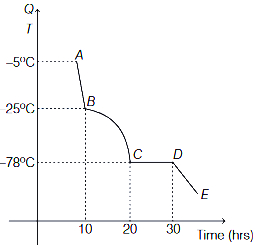
$A$ beaker containing a mixture of liquid $A$ and liquid $B$,in equilibrium with each other,is cooled very slowly. If point '$D$' on the graph is where solidification of both liquids is complete,how many different phases co-exist along line '$C D$' if freezing points of liquid $B$ and liquid $A$ are $-25^{\circ} C$ and $-78^{\circ} C$ respectively?
A
$1$
B
$2$
C
$3$
D
$4$
Solution
(D) The graph represents the cooling curve of a mixture of two liquids $A$ and $B$.
At point $B$ $(-25^{\circ} C)$,liquid $B$ starts to solidify. Along the curve $BC$,liquid $B$ is solidifying,so two phases (liquid $B$ and solid $B$) co-exist along with liquid $A$.
At point $C$ $(-78^{\circ} C)$,liquid $A$ also starts to solidify.
Along the line $CD$,both liquid $A$ and liquid $B$ are undergoing solidification.
Therefore,the phases present are: liquid $A$,solid $A$,liquid $B$,and solid $B$.
Thus,$4$ different phases co-exist along the line $CD$.
At point $B$ $(-25^{\circ} C)$,liquid $B$ starts to solidify. Along the curve $BC$,liquid $B$ is solidifying,so two phases (liquid $B$ and solid $B$) co-exist along with liquid $A$.
At point $C$ $(-78^{\circ} C)$,liquid $A$ also starts to solidify.
Along the line $CD$,both liquid $A$ and liquid $B$ are undergoing solidification.
Therefore,the phases present are: liquid $A$,solid $A$,liquid $B$,and solid $B$.
Thus,$4$ different phases co-exist along the line $CD$.
0 likesView Solution
230
ChemistryMediumMCQAP EAMCET · 2020
Assertion: Standard boiling point of a liquid is slightly higher than the normal boiling point. Reason: $1 \ bar$ pressure is slightly less than $1 \ atm$ pressure.
A
Assertion and Reason are correct statements and Reason is the correct explanation for Assertion.
B
Assertion and Reason are correct statements and Reason is not the explanation for Assertion.
C
Assertion is correct,Reason is incorrect.
D
Assertion is incorrect,Reason is correct.
Solution
(D) Assertion: The statement is incorrect because the standard boiling point (boiling point at $1 \ bar$ pressure) of a liquid is slightly lower than the normal boiling point (boiling point at $1 \ atm$ pressure).
Reason: The statement is correct because $1 \ atm = 1.01325 \ bar$,which means $1 \ bar$ pressure is slightly lower than $1 \ atm$ pressure.
Since the Assertion is incorrect and the Reason is correct,the correct option is $D$.
Reason: The statement is correct because $1 \ atm = 1.01325 \ bar$,which means $1 \ bar$ pressure is slightly lower than $1 \ atm$ pressure.
Since the Assertion is incorrect and the Reason is correct,the correct option is $D$.
0 likesView Solution
231
ChemistryEasyMCQAP EAMCET · 2020
For any pure liquid at a pressure of $1.013 \ bar$,the temperature at which the liquid and vapor are at equilibrium is called:
A
Melting point
B
Boiling point
C
Freezing point
D
Triple point
Solution
(B) The temperature at which the vapor pressure of a liquid becomes equal to the external pressure is defined as the boiling point of the liquid.
At a standard atmospheric pressure of $1.013 \ bar$ $(1 \ atm)$,this temperature is specifically known as the normal boiling point.
At a standard atmospheric pressure of $1.013 \ bar$ $(1 \ atm)$,this temperature is specifically known as the normal boiling point.
0 likesView Solution
232
ChemistryEasyMCQAP EAMCET · 2020
At $STP$,if $5.6 \ L$ of a gas weighs $7.5 \ g$,then identify the gas.
A
$CO$
B
$NO$
C
$NO_2$
D
$CO_2$
Solution
(B) One mole of gas at $STP$ occupies $22.4 \ L$.
Thus,$5.6 \ L$ of gas at $STP$ contains $n = \frac{5.6}{22.4} = 0.25 \ \text{moles}$.
Number of moles = $\frac{\text{weight in gram}}{\text{molecular weight (M)}}$.
$0.25 = \frac{7.5}{M}$.
$M = \frac{7.5}{0.25} = 30 \ \text{g/mol}$.
The molar mass of $NO$ is $14 + 16 = 30 \ \text{g/mol}$.
Thus,the gas is $NO$.
Hence,the correct option is $B$.
Thus,$5.6 \ L$ of gas at $STP$ contains $n = \frac{5.6}{22.4} = 0.25 \ \text{moles}$.
Number of moles = $\frac{\text{weight in gram}}{\text{molecular weight (M)}}$.
$0.25 = \frac{7.5}{M}$.
$M = \frac{7.5}{0.25} = 30 \ \text{g/mol}$.
The molar mass of $NO$ is $14 + 16 = 30 \ \text{g/mol}$.
Thus,the gas is $NO$.
Hence,the correct option is $B$.
0 likesView Solution
233
ChemistryEasyMCQAP EAMCET · 2020
Calculate the amount of $CO_2$ gas produced when $32 \text{ g}$ of $CH_4$ is burned with a sufficient amount of oxygen. (Given: atomic weights of $C=12, O=16, H=1$) (in $\text{ g}$)
A
$132$
B
$44$
C
$88$
D
$176$
Solution
(C) The balanced chemical equation for the combustion of methane is:
$CH_4 + 2O_2 \rightarrow CO_2 + 2H_2O$
Molar mass of $CH_4 = 12 + 4(1) = 16 \text{ g/mol}$
Molar mass of $CO_2 = 12 + 2(16) = 44 \text{ g/mol}$
From the stoichiometry of the reaction,$16 \text{ g}$ of $CH_4$ produces $44 \text{ g}$ of $CO_2$.
Therefore,$32 \text{ g}$ of $CH_4$ will produce:
$\text{Amount of } CO_2 = \frac{44 \times 32}{16} = 88 \text{ g}$
$CH_4 + 2O_2 \rightarrow CO_2 + 2H_2O$
Molar mass of $CH_4 = 12 + 4(1) = 16 \text{ g/mol}$
Molar mass of $CO_2 = 12 + 2(16) = 44 \text{ g/mol}$
From the stoichiometry of the reaction,$16 \text{ g}$ of $CH_4$ produces $44 \text{ g}$ of $CO_2$.
Therefore,$32 \text{ g}$ of $CH_4$ will produce:
$\text{Amount of } CO_2 = \frac{44 \times 32}{16} = 88 \text{ g}$
0 likesView Solution
234
ChemistryEasyMCQAP EAMCET · 2020
Vapour density of a metal chloride is $83$. If equivalent weight of the metal is $6$,its atomic weight will be . . . . . . .
A
$12$
B
$24$
C
$18$
D
$60$
Solution
(B) The molecular weight of the metal chloride is $2 \times \text{vapour density} = 2 \times 83 = 166$.
Let the valency of the metal be $n$. The formula of the metal chloride is $MCl_n$.
Molecular weight $= \text{Atomic weight of metal} + n \times 35.5$.
Since $\text{Atomic weight} = n \times \text{Equivalent weight} = n \times 6$,we have:
$166 = 6n + 35.5n$.
$166 = 41.5n$.
$n = \frac{166}{41.5} = 4$.
Atomic weight of metal $= n \times \text{Equivalent weight} = 4 \times 6 = 24$.
Hence,the correct option is $B$.
Let the valency of the metal be $n$. The formula of the metal chloride is $MCl_n$.
Molecular weight $= \text{Atomic weight of metal} + n \times 35.5$.
Since $\text{Atomic weight} = n \times \text{Equivalent weight} = n \times 6$,we have:
$166 = 6n + 35.5n$.
$166 = 41.5n$.
$n = \frac{166}{41.5} = 4$.
Atomic weight of metal $= n \times \text{Equivalent weight} = 4 \times 6 = 24$.
Hence,the correct option is $B$.
0 likesView Solution
235
ChemistryEasyMCQAP EAMCET · 2020
When $10 \ g$ of copper and $10 \ g$ of iodine are mixed,calculate the theoretical yield of $CuI$ according to the equation,$2Cu + I_2 \longrightarrow 2CuI$. (in $g$)
A
$30$
B
$10$
C
$15$
D
$20$
Solution
(C) Step $1$: Calculate the moles of reactants.
Molar mass of $Cu \approx 63.5 \ g/mol$,Molar mass of $I_2 \approx 253.8 \ g/mol$.
Moles of $Cu = \frac{10}{63.5} \approx 0.157 \ mol$.
Moles of $I_2 = \frac{10}{253.8} \approx 0.0394 \ mol$.
Step $2$: Identify the limiting reagent.
According to the equation $2Cu + I_2 \longrightarrow 2CuI$,$1 \ mol$ of $I_2$ requires $2 \ mol$ of $Cu$.
For $0.0394 \ mol$ of $I_2$,we need $2 \times 0.0394 = 0.0788 \ mol$ of $Cu$.
Since we have $0.157 \ mol$ of $Cu$ (which is $> 0.0788 \ mol$),$I_2$ is the limiting reagent.
Step $3$: Calculate the yield of $CuI$.
Moles of $CuI$ produced $= 2 \times \text{moles of } I_2 = 2 \times 0.0394 = 0.0788 \ mol$.
Molar mass of $CuI = 63.5 + 126.9 = 190.4 \ g/mol$.
Mass of $CuI = 0.0788 \ mol \times 190.4 \ g/mol \approx 15 \ g$.
Thus,the correct option is $C$.
Molar mass of $Cu \approx 63.5 \ g/mol$,Molar mass of $I_2 \approx 253.8 \ g/mol$.
Moles of $Cu = \frac{10}{63.5} \approx 0.157 \ mol$.
Moles of $I_2 = \frac{10}{253.8} \approx 0.0394 \ mol$.
Step $2$: Identify the limiting reagent.
According to the equation $2Cu + I_2 \longrightarrow 2CuI$,$1 \ mol$ of $I_2$ requires $2 \ mol$ of $Cu$.
For $0.0394 \ mol$ of $I_2$,we need $2 \times 0.0394 = 0.0788 \ mol$ of $Cu$.
Since we have $0.157 \ mol$ of $Cu$ (which is $> 0.0788 \ mol$),$I_2$ is the limiting reagent.
Step $3$: Calculate the yield of $CuI$.
Moles of $CuI$ produced $= 2 \times \text{moles of } I_2 = 2 \times 0.0394 = 0.0788 \ mol$.
Molar mass of $CuI = 63.5 + 126.9 = 190.4 \ g/mol$.
Mass of $CuI = 0.0788 \ mol \times 190.4 \ g/mol \approx 15 \ g$.
Thus,the correct option is $C$.
0 likesView Solution
236
ChemistryEasyMCQAP EAMCET · 2020
Calculate the amount of $NO_2$ required for producing $4$ moles of $HNO_3$ as per the chemical reaction,$3 NO_2 + H_2O \longrightarrow 2 HNO_3 + NO$. (in $g$)
A
$276$
B
$274$
C
$2$
D
$275$
Solution
(A) The balanced chemical equation is: $3 NO_2 + H_2O \longrightarrow 2 HNO_3 + NO$.
From the stoichiometry of the reaction,$3$ moles of $NO_2$ produce $2$ moles of $HNO_3$.
To produce $4$ moles of $HNO_3$,we need:
$\text{Moles of } NO_2 = \frac{3}{2} \times 4 = 6 \text{ moles}$.
The molar mass of $NO_2 = 14 + (2 \times 16) = 46 \ g/mol$.
Therefore,the mass of $NO_2$ required $= 6 \text{ moles} \times 46 \ g/mol = 276 \ g$.
Hence,the correct option is $A$.
From the stoichiometry of the reaction,$3$ moles of $NO_2$ produce $2$ moles of $HNO_3$.
To produce $4$ moles of $HNO_3$,we need:
$\text{Moles of } NO_2 = \frac{3}{2} \times 4 = 6 \text{ moles}$.
The molar mass of $NO_2 = 14 + (2 \times 16) = 46 \ g/mol$.
Therefore,the mass of $NO_2$ required $= 6 \text{ moles} \times 46 \ g/mol = 276 \ g$.
Hence,the correct option is $A$.
0 likesView Solution
237
ChemistryEasyMCQAP EAMCET · 2020
$A$ $40 \%$ $HCl$ solution has density $1.2 \ g \ mL^{-1}$. The molarity of the solution is nearly . . . . . . (in $M$)
A
$11$
B
$12$
C
$13$
D
$14$
Solution
(C) Given,density $(d)$ of $HCl$ solution $= 1.2 \ g \ mL^{-1}$.
Percentage strength by mass $(w/w)$ $= 40 \%$.
Molar mass of $HCl$ $(M_{HCl})$ $= 1 + 35.5 = 36.5 \ g \ mol^{-1}$.
The formula for molarity is: $\text{Molarity} = \frac{\text{Percentage}(w/w) \times d \times 10}{M_{HCl}}$.
Substituting the values: $\text{Molarity} = \frac{40 \times 1.2 \times 10}{36.5} = \frac{480}{36.5} \approx 13.15 \ M$.
Therefore,the molarity is nearly $13 \ M$.
Percentage strength by mass $(w/w)$ $= 40 \%$.
Molar mass of $HCl$ $(M_{HCl})$ $= 1 + 35.5 = 36.5 \ g \ mol^{-1}$.
The formula for molarity is: $\text{Molarity} = \frac{\text{Percentage}(w/w) \times d \times 10}{M_{HCl}}$.
Substituting the values: $\text{Molarity} = \frac{40 \times 1.2 \times 10}{36.5} = \frac{480}{36.5} \approx 13.15 \ M$.
Therefore,the molarity is nearly $13 \ M$.
0 likesView Solution
238
ChemistryMediumMCQAP EAMCET · 2020
$0.12 \ g$ of an organic compound '$X$' containing phosphorus on reacting with magnesia mixture gave $0.22 \ g$ of magnesium pyrophosphate $(Mg_2P_2O_7)$. The percentage of phosphorus in the compound '$X$' is (in $\%$)
A
$45.30$
B
$28.70$
C
$64.25$
D
$51.20$
Solution
(D) The estimation of phosphorus in an organic compound is performed by using a magnesia mixture.
$1 \ mol$ of $Mg_2P_2O_7$ contains $2 \ mol$ of phosphorus $(P)$.
Molar mass of $Mg_2P_2O_7 = (2 \times 24.3) + (2 \times 31) + (7 \times 16) = 48.6 + 62 + 112 = 222.6 \ g/mol$.
Mass of phosphorus in $0.22 \ g$ of $Mg_2P_2O_7 = \frac{2 \times 31}{222.6} \times 0.22 \ g = 0.06127 \ g$.
Percentage of phosphorus $= \frac{\text{Mass of } P}{\text{Mass of compound}} \times 100 = \frac{0.06127}{0.12} \times 100 \approx 51.06 \%$.
Using the standard formula: $P \% = \frac{62}{222.6} \times \frac{w_1}{w} \times 100 = \frac{62}{222.6} \times \frac{0.22}{0.12} \times 100 \approx 51.06 \%$.
Rounding to the nearest provided option,the correct answer is $51.20 \%$.
$1 \ mol$ of $Mg_2P_2O_7$ contains $2 \ mol$ of phosphorus $(P)$.
Molar mass of $Mg_2P_2O_7 = (2 \times 24.3) + (2 \times 31) + (7 \times 16) = 48.6 + 62 + 112 = 222.6 \ g/mol$.
Mass of phosphorus in $0.22 \ g$ of $Mg_2P_2O_7 = \frac{2 \times 31}{222.6} \times 0.22 \ g = 0.06127 \ g$.
Percentage of phosphorus $= \frac{\text{Mass of } P}{\text{Mass of compound}} \times 100 = \frac{0.06127}{0.12} \times 100 \approx 51.06 \%$.
Using the standard formula: $P \% = \frac{62}{222.6} \times \frac{w_1}{w} \times 100 = \frac{62}{222.6} \times \frac{0.22}{0.12} \times 100 \approx 51.06 \%$.
Rounding to the nearest provided option,the correct answer is $51.20 \%$.
0 likesView Solution
239
ChemistryEasyMCQAP EAMCET · 2020
When $30 \ mL$ of $H_2$ reacts with $20 \ mL$ of $O_2$ to form water,what is leftover when the reaction ends?
A
$10 \ mL \ H_2$
B
$5 \ mL \ H_2$
C
$10 \ mL \ O_2$
D
$5 \ mL \ O_2$
Solution
(D) The balanced chemical equation for the reaction is: $2H_2(g) + O_2(g) \rightarrow 2H_2O(g)$.
According to the stoichiometry,$2 \ volumes$ of $H_2$ react with $1 \ volume$ of $O_2$.
Given initial volumes: $V(H_2) = 30 \ mL$ and $V(O_2) = 20 \ mL$.
Since $H_2$ is the limiting reagent,all $30 \ mL$ of $H_2$ will be consumed.
The volume of $O_2$ required to react with $30 \ mL$ of $H_2$ is $30 \ mL \times (1/2) = 15 \ mL$.
Therefore,the leftover volume of $O_2$ is $20 \ mL - 15 \ mL = 5 \ mL$ of $O_2$.
According to the stoichiometry,$2 \ volumes$ of $H_2$ react with $1 \ volume$ of $O_2$.
Given initial volumes: $V(H_2) = 30 \ mL$ and $V(O_2) = 20 \ mL$.
Since $H_2$ is the limiting reagent,all $30 \ mL$ of $H_2$ will be consumed.
The volume of $O_2$ required to react with $30 \ mL$ of $H_2$ is $30 \ mL \times (1/2) = 15 \ mL$.
Therefore,the leftover volume of $O_2$ is $20 \ mL - 15 \ mL = 5 \ mL$ of $O_2$.
0 likesView Solution
240
ChemistryEasyMCQAP EAMCET · 2020
The molarity of $0.2 \ N$ $Na_2CO_3$ solution will be (in $M$)
A
$0.05$
B
$0.2$
C
$0.1$
D
$0.4$
Solution
(C) The $n$-factor for $Na_2CO_3$ is $2$ because it acts as a base and can accept $2 \ H^+$ ions.
Normality is related to molarity by the formula: $\text{Normality} = n\text{-factor} \times \text{Molarity}$.
Given: $\text{Normality} = 0.2 \ N$ and $n\text{-factor} = 2$.
Therefore,$\text{Molarity} = \frac{\text{Normality}}{n\text{-factor}} = \frac{0.2}{2} = 0.1 \ M$.
Hence,the correct option is $C$.
Normality is related to molarity by the formula: $\text{Normality} = n\text{-factor} \times \text{Molarity}$.
Given: $\text{Normality} = 0.2 \ N$ and $n\text{-factor} = 2$.
Therefore,$\text{Molarity} = \frac{\text{Normality}}{n\text{-factor}} = \frac{0.2}{2} = 0.1 \ M$.
Hence,the correct option is $C$.
0 likesView Solution
241
ChemistryEasyMCQAP EAMCET · 2020
Predict the correct order of rate of diffusion of the following molecules.
A
$CO_2 > SO_2 > SO_3 > PCl_3$
B
$PCl_3 > SO_3 > SO_2 > CO_2$
C
$SO_3 > PCl_3 > SO_2 > CO_2$
D
$CO_2 > SO_2 > PCl_3 > SO_3$
Solution
(A) According to Graham's Law,the rate of diffusion $(r)$ of a gas is inversely proportional to the square root of its molar mass $(M)$: $r \propto \frac{1}{\sqrt{M}}$.
First,calculate the molar masses of the given molecules:
$CO_2: 12 + 2(16) = 44 \ g/mol$
$SO_2: 32 + 2(16) = 64 \ g/mol$
$SO_3: 32 + 3(16) = 80 \ g/mol$
$PCl_3: 31 + 3(35.5) = 31 + 106.5 = 137.5 \ g/mol$
Since the rate of diffusion is inversely proportional to the square root of the molar mass,the molecule with the lowest molar mass will diffuse the fastest.
The order of molar masses is: $CO_2 (44) < SO_2 (64) < SO_3 (80) < PCl_3 (137.5)$.
Therefore,the order of the rate of diffusion is: $CO_2 > SO_2 > SO_3 > PCl_3$.
First,calculate the molar masses of the given molecules:
$CO_2: 12 + 2(16) = 44 \ g/mol$
$SO_2: 32 + 2(16) = 64 \ g/mol$
$SO_3: 32 + 3(16) = 80 \ g/mol$
$PCl_3: 31 + 3(35.5) = 31 + 106.5 = 137.5 \ g/mol$
Since the rate of diffusion is inversely proportional to the square root of the molar mass,the molecule with the lowest molar mass will diffuse the fastest.
The order of molar masses is: $CO_2 (44) < SO_2 (64) < SO_3 (80) < PCl_3 (137.5)$.
Therefore,the order of the rate of diffusion is: $CO_2 > SO_2 > SO_3 > PCl_3$.
0 likesView Solution
242
ChemistryEasyMCQAP EAMCET · 2020
Isochores are drawn at
A
constant volume,pressure $vs$ temperature
B
constant pressure,volume $vs$ temperature
C
constant temperature,pressure $vs$ volume
D
constant temperature,volume $vs$ temperature
Solution
(A) Isochores are drawn at constant volume,$\Delta V = 0$.
We get a plot of pressure $(p)$ $vs$ temperature $(T$,in $K)$ as shown in the graph.
For $1 \ mol$ of an ideal gas,$pV = nRT$.
At isochoric condition,$V$ is constant,so $p \propto T$.
We get a plot of pressure $(p)$ $vs$ temperature $(T$,in $K)$ as shown in the graph.
For $1 \ mol$ of an ideal gas,$pV = nRT$.
At isochoric condition,$V$ is constant,so $p \propto T$.
0 likesView Solution
243
ChemistryEasyMCQAP EAMCET · 2020
One mole of oxygen gas at $STP$ is equal to
A
$6.022 \times 10^{23}$ molecules of oxygen
B
$6.022 \times 10^{23}$ atoms of oxygen
C
$16 \ g$ of oxygen
D
$3.2 \ g$ of oxygen
Solution
(A) $1$ mole of $O_{2(g)}$ at $STP$ contains Avogadro number $(N_A = 6.022 \times 10^{23} \ mol^{-1})$ of $O_2$ molecules.
Since $1$ mole of $O_2$ has a molar mass of $32 \ g/mol$,it corresponds to $32 \ g$ of oxygen gas.
Therefore,the correct statement is that it contains $6.022 \times 10^{23}$ molecules of oxygen.
Since $1$ mole of $O_2$ has a molar mass of $32 \ g/mol$,it corresponds to $32 \ g$ of oxygen gas.
Therefore,the correct statement is that it contains $6.022 \times 10^{23}$ molecules of oxygen.
0 likesView Solution
244
ChemistryEasyMCQAP EAMCET · 2020
The density of oxygen gas at $5 \text{ atm}$ and $127^{\circ} C$ will be (in $\text{ g/L}$)
A
$2.80$
B
$4.88$
C
$1.49$
D
$5.60$
Solution
(B) The density $(d)$ of a gas is given by the formula: $d = \frac{pM}{RT}$
Given:
Pressure $(p)$ = $5 \text{ atm}$
Molar mass of $O_2$ $(M)$ = $32 \text{ g mol}^{-1}$
Gas constant $(R)$ = $0.082 \text{ L atm K}^{-1} \text{ mol}^{-1}$
Temperature $(T)$ = $127 + 273 = 400 \text{ K}$
Substituting the values:
$d = \frac{5 \times 32}{0.082 \times 400}$
$d = \frac{160}{32.8} \approx 4.878 \text{ g L}^{-1}$
Thus,the density is approximately $4.88 \text{ g L}^{-1}$.
Given:
Pressure $(p)$ = $5 \text{ atm}$
Molar mass of $O_2$ $(M)$ = $32 \text{ g mol}^{-1}$
Gas constant $(R)$ = $0.082 \text{ L atm K}^{-1} \text{ mol}^{-1}$
Temperature $(T)$ = $127 + 273 = 400 \text{ K}$
Substituting the values:
$d = \frac{5 \times 32}{0.082 \times 400}$
$d = \frac{160}{32.8} \approx 4.878 \text{ g L}^{-1}$
Thus,the density is approximately $4.88 \text{ g L}^{-1}$.
0 likesView Solution
245
ChemistryEasyMCQAP EAMCET · 2020
The temperature at which $4 \ mol$ of a gas occupies $5 \ dm^3$ volume at $3.32 \ bar$ pressure is:
A
$50 \ K$
B
$50^{\circ} C$
C
$27^{\circ} C$
D
$100 \ K$
Solution
(A) Using the ideal gas equation,$PV = nRT$,the temperature $T$ is given by $T = \frac{PV}{nR}$.
Given values are $P = 3.32 \ bar$,$V = 5 \ dm^3 = 5 \ L$,$n = 4 \ mol$,and the gas constant $R = 0.08314 \ bar \ L \ K^{-1} \ mol^{-1}$.
Substituting these values into the equation:
$T = \frac{3.32 \times 5}{4 \times 0.08314} = \frac{16.6}{0.33256} \approx 49.91 \ K$.
Rounding to the nearest whole number,we get $T \approx 50 \ K$.
Given values are $P = 3.32 \ bar$,$V = 5 \ dm^3 = 5 \ L$,$n = 4 \ mol$,and the gas constant $R = 0.08314 \ bar \ L \ K^{-1} \ mol^{-1}$.
Substituting these values into the equation:
$T = \frac{3.32 \times 5}{4 \times 0.08314} = \frac{16.6}{0.33256} \approx 49.91 \ K$.
Rounding to the nearest whole number,we get $T \approx 50 \ K$.
0 likesView Solution
246
ChemistryEasyMCQAP EAMCET · 2020
Match the following graphs of a gas with their corresponding $y$ and $x$ coordinates:
| Graph | Coordinates ($y$ vs $x$) |
| $(A)$ Hyperbola | $1. \ y = PV, x = V$ |
| $(B)$ Straight line passing through origin | $2. \ y = P, x = V$ |
| $(C)$ Horizontal line parallel to $x$-axis | $3. \ y = P, x = 1/V$ |
A
$A-2, B-3, C-1$
B
$A-1, B-3, C-2$
C
$A-2, B-1, C-3$
D
$A-1, B-2, C-3$
Solution
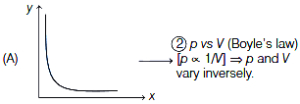
(A) According to Boyle's law,at constant temperature,$PV = k$.
$1.$ For $y = P$ and $x = V$,the relation $P = k/V$ represents a hyperbola. Thus,$(A)$ matches $2$.
$2.$ For $y = P$ and $x = 1/V$,the relation $P = k(1/V)$ represents a straight line passing through the origin. Thus,$(B)$ matches $3$.
$3.$ For $y = PV$ and $x = P$,the relation $PV = k$ represents a horizontal line parallel to the $x$-axis. Thus,$(C)$ matches $1$.
$1.$ For $y = P$ and $x = V$,the relation $P = k/V$ represents a hyperbola. Thus,$(A)$ matches $2$.
$2.$ For $y = P$ and $x = 1/V$,the relation $P = k(1/V)$ represents a straight line passing through the origin. Thus,$(B)$ matches $3$.
$3.$ For $y = PV$ and $x = P$,the relation $PV = k$ represents a horizontal line parallel to the $x$-axis. Thus,$(C)$ matches $1$.
0 likesView Solution
247
ChemistryEasyMCQAP EAMCET · 2020
What is the temperature of $4$ moles of a gas occupying $5 \ L$ volume at $3.32 \ bar$ (in $K$)? $\left(R=0.083 \ bar \ L \ K^{-1} \ mol^{-1}\right)$
A
$5$
B
$50$
C
$500$
D
$0.5$
Solution
(B) Given: $n = 4 \ mol$,$V = 5 \ L$,$P = 3.32 \ bar$,$R = 0.083 \ bar \ L \ K^{-1} \ mol^{-1}$.
Using the ideal gas equation: $PV = nRT$.
Rearranging for temperature: $T = \frac{PV}{nR}$.
Substituting the values: $T = \frac{3.32 \times 5}{4 \times 0.083}$.
$T = \frac{16.6}{0.332} = 50 \ K$.
Therefore,the correct option is $B$.
Using the ideal gas equation: $PV = nRT$.
Rearranging for temperature: $T = \frac{PV}{nR}$.
Substituting the values: $T = \frac{3.32 \times 5}{4 \times 0.083}$.
$T = \frac{16.6}{0.332} = 50 \ K$.
Therefore,the correct option is $B$.
0 likesView Solution
248
ChemistryEasyMCQAP EAMCET · 2020
The volume of a given mass of a gas is directly proportional to its Kelvin temperature at constant pressure. The above statement is known as . . . . . .
A
Boyle's law
B
vant Hoff's law
C
Charles's law
D
Dalton's law of partial pressures
Solution
(C) The variation in the volume of a gas with temperature was first studied by Jacques Charles $(1787)$ and is known as Charles's law.
Charles's law states that,"The volume of a given mass of a gas is directly proportional to its absolute temperature at constant pressure."
Mathematically,$V \propto T$ or $\frac{V}{T} = k$ at constant pressure.
Hence,the correct option is $(C)$.
Charles's law states that,"The volume of a given mass of a gas is directly proportional to its absolute temperature at constant pressure."
Mathematically,$V \propto T$ or $\frac{V}{T} = k$ at constant pressure.
Hence,the correct option is $(C)$.
0 likesView Solution
249
ChemistryEasyMCQAP EAMCET · 2020
In order to increase the volume of a gas by $10 \%$ at constant temperature,the pressure of the gas should be:
A
increased by $10 \%$
B
increased by $1 \%$
C
decreased by $1 \%$
D
decreased by $10 \%$
Solution
(D) According to Boyle's law,at constant temperature,$P_1V_1 = P_2V_2$.
Let the initial volume be $V_1 = V$.
The new volume $V_2 = V + 0.10V = 1.10V$.
Substituting into the equation: $P_1V = P_2(1.10V)$.
$P_2 = P_1 / 1.10 \approx 0.9091 P_1$.
The change in pressure is $P_2 - P_1 = 0.9091 P_1 - P_1 = -0.0909 P_1$.
This represents a decrease of approximately $9.09 \%$.
Given the options provided,the closest value is a decrease of $10 \%$,which corresponds to option $(D)$.
Let the initial volume be $V_1 = V$.
The new volume $V_2 = V + 0.10V = 1.10V$.
Substituting into the equation: $P_1V = P_2(1.10V)$.
$P_2 = P_1 / 1.10 \approx 0.9091 P_1$.
The change in pressure is $P_2 - P_1 = 0.9091 P_1 - P_1 = -0.0909 P_1$.
This represents a decrease of approximately $9.09 \%$.
Given the options provided,the closest value is a decrease of $10 \%$,which corresponds to option $(D)$.
0 likesView Solution
250
ChemistryEasyMCQAP EAMCET · 2020
Which of the following laws gives the relation between volume and temperature?
A
Boyle's law
B
Charles' law
C
Gay-Lussac's law
D
Avogadro's law
Solution
(B) Charles' law states that the volume of a fixed mass of an ideal gas is directly proportional to its absolute temperature at constant pressure.
At constant pressure,$V \propto T$.
Or,$\frac{V_1}{T_1} = \frac{V_2}{T_2}$.
Hence,the correct option is $(B)$.
At constant pressure,$V \propto T$.
Or,$\frac{V_1}{T_1} = \frac{V_2}{T_2}$.
Hence,the correct option is $(B)$.
0 likesView Solution
Vedclass Products
For Students
Vedclass Test Series
Mock tests in real AP EAMCET style covering Chemistry with performance analysis. 5-day free trial.
Start Free TrialFor Teachers
Exam Paper Generator
Generate Set A/B/C/D Chemistry papers from 7.5L+ questions in 2 minutes. 3 chapters free.
Try FreeFor Institutes
Online Exam Module
Run live AP EAMCET mock exams with unlimited students, 360° analytics & white-label branding.
See DemoFrequently Asked Questions
How many Chemistry questions are in AP EAMCET 2020?
There are 492 Chemistry questions from the AP EAMCET 2020 paper on Vedclass, each with a detailed step-by-step solution in English.
Are AP EAMCET 2020 Chemistry solutions available in English?
Yes. All solutions on this page are in English. You can also switch to English or Hindi using the language buttons above the questions.
Can I practice AP EAMCET 2020 Chemistry as a timed test?
Yes. Use the Vedclass Test Series to attempt a full AP EAMCET mock test covering Chemistry with time limits and instant score analysis.
Can teachers create Chemistry papers from AP EAMCET previous year questions?
Yes. The Vedclass Exam Paper Generator lets teachers mix AP EAMCET Chemistry questions and generate Set A/B/C/D papers in minutes.
For Teachers & Institutes
Build a Custom Chemistry Paper
Pick AP EAMCET 2020 Chemistry questions, set difficulty, and generate Set A/B/C/D in 2 minutes.