
ChemistryQ301–307 of 492 questions
Page 7 of 7 · English
301
ChemistryDifficultMCQAP EAMCET · 2020
For the reaction,$2 NH_{3(g)} + CO_{2(g)} \rightleftharpoons NH_2CONH_{2(aq)} + H_2O_{(l)}$,find the value of the equilibrium constant at $295 \ K$. Given,the standard Gibbs energy change at the given temperature is $13.9 \ kJ \ mol^{-1}$.
A
$2.88 \times 10^2$
B
$2.58 \times 10^2$
C
$2.40 \times 10^2$
D
$2.65 \times 10^2$
Solution
(A) The relationship between standard Gibbs energy change and equilibrium constant is given by: $\Delta G^{\circ} = -RT \ln K$ or $\Delta G^{\circ} = -2.303 RT \log K$.
Given: $\Delta G^{\circ} = 13.9 \ kJ \ mol^{-1} = 13900 \ J \ mol^{-1}$,$R = 8.314 \ J \ K^{-1} \ mol^{-1}$,$T = 295 \ K$.
Substituting the values: $13900 = -2.303 \times 8.314 \times 295 \times \log K$.
$\log K = \frac{-13900}{2.303 \times 8.314 \times 295} = \frac{-13900}{5650.3} \approx -2.46$.
Wait,the standard Gibbs energy change for the formation of urea from ammonia and carbon dioxide is typically negative. Assuming the value provided is $\Delta G^{\circ} = -13.9 \ kJ \ mol^{-1}$:
$\log K = \frac{13900}{5650.3} \approx 2.46$.
$K = 10^{2.46} \approx 288.4 = 2.88 \times 10^2$.
Hence,option $(A)$ is correct.
Given: $\Delta G^{\circ} = 13.9 \ kJ \ mol^{-1} = 13900 \ J \ mol^{-1}$,$R = 8.314 \ J \ K^{-1} \ mol^{-1}$,$T = 295 \ K$.
Substituting the values: $13900 = -2.303 \times 8.314 \times 295 \times \log K$.
$\log K = \frac{-13900}{2.303 \times 8.314 \times 295} = \frac{-13900}{5650.3} \approx -2.46$.
Wait,the standard Gibbs energy change for the formation of urea from ammonia and carbon dioxide is typically negative. Assuming the value provided is $\Delta G^{\circ} = -13.9 \ kJ \ mol^{-1}$:
$\log K = \frac{13900}{5650.3} \approx 2.46$.
$K = 10^{2.46} \approx 288.4 = 2.88 \times 10^2$.
Hence,option $(A)$ is correct.
0 likesView Solution
302
ChemistryMediumMCQAP EAMCET · 2020
For the reaction,$N_2O_{4(g)} \rightleftharpoons 2NO_{2(g)}$,if dinitrogen tetroxide is $50\%$ dissociated at $60^\circ C$,the standard free energy change at this temperature and $1 \ atm$ pressure is:
A
$-367.8 \ J \ mol^{-1}$
B
$-763.8 \ J \ mol^{-1}$
C
$-867 \ J \ mol^{-1}$
D
$-249 \ J \ mol^{-1}$
Solution
(B) For the reaction: $N_2O_{4(g)} \rightleftharpoons 2NO_{2(g)}$
Degree of dissociation $\alpha = 0.5$
Total pressure $P = 1 \ atm$
Temperature $T = 60 + 273 = 333 \ K$
The equilibrium constant $K_p$ is given by the expression: $K_p = \frac{4\alpha^2 P}{1-\alpha^2}$
Substituting the values: $K_p = \frac{4(0.5)^2 \times 1}{1-(0.5)^2} = \frac{1}{0.75} = 1.333$
Standard free energy change $\Delta G^\circ = -RT \ln K_p$
$\Delta G^\circ = -8.314 \times 333 \times \ln(1.333) \approx -8.314 \times 333 \times 0.2874 \approx -796.8 \ J \ mol^{-1}$
Given the options,the closest value is $-763.8 \ J \ mol^{-1}$.
Degree of dissociation $\alpha = 0.5$
Total pressure $P = 1 \ atm$
Temperature $T = 60 + 273 = 333 \ K$
The equilibrium constant $K_p$ is given by the expression: $K_p = \frac{4\alpha^2 P}{1-\alpha^2}$
Substituting the values: $K_p = \frac{4(0.5)^2 \times 1}{1-(0.5)^2} = \frac{1}{0.75} = 1.333$
Standard free energy change $\Delta G^\circ = -RT \ln K_p$
$\Delta G^\circ = -8.314 \times 333 \times \ln(1.333) \approx -8.314 \times 333 \times 0.2874 \approx -796.8 \ J \ mol^{-1}$
Given the options,the closest value is $-763.8 \ J \ mol^{-1}$.
0 likesView Solution
303
ChemistryEasyMCQAP EAMCET · 2020
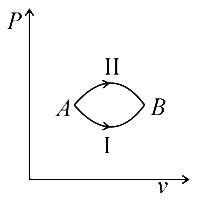
$A$ system goes from $A$ to $B$ via two processes $I$ and $II$ as shown in the figure. If $\Delta U_1$ and $\Delta U_2$ are the changes in internal energies in the processes $I$ and $II$ respectively,then:
A
$\Delta U_1 = \Delta U_2$
B
$\Delta U_1 > \Delta U_2$
C
$\Delta U_1 < \Delta U_2$
D
$\Delta U_1 \neq \Delta U_2$
Solution
(A) Internal energy $(U)$ is a state function.
State functions depend only on the initial and final states of the system and are independent of the path taken to reach the final state.
In both processes $I$ and $II$,the system starts at state $A$ and ends at state $B$.
Therefore,the change in internal energy for both processes is the same: $\Delta U_1 = U_B - U_A$ and $\Delta U_2 = U_B - U_A$.
Hence,$\Delta U_1 = \Delta U_2$.
State functions depend only on the initial and final states of the system and are independent of the path taken to reach the final state.
In both processes $I$ and $II$,the system starts at state $A$ and ends at state $B$.
Therefore,the change in internal energy for both processes is the same: $\Delta U_1 = U_B - U_A$ and $\Delta U_2 = U_B - U_A$.
Hence,$\Delta U_1 = \Delta U_2$.
0 likesView Solution
304
ChemistryEasyMCQAP EAMCET · 2020
When is a reaction spontaneous?
A
$ \Delta G = 0 $
B
$ \Delta G < 0 $
C
$ \Delta G > 0 $
D
Can't be determined based on $ \Delta G $
Solution
(B) reaction is spontaneous when the change in Gibbs free energy $( \Delta G )$ is negative.
For a spontaneous process,$ \Delta G < 0 $ at constant temperature and pressure.
If $ \Delta G = 0 $,the reaction is at equilibrium.
If $ \Delta G > 0 $,the reaction is non-spontaneous.
For a spontaneous process,$ \Delta G < 0 $ at constant temperature and pressure.
If $ \Delta G = 0 $,the reaction is at equilibrium.
If $ \Delta G > 0 $,the reaction is non-spontaneous.
0 likesView Solution
305
ChemistryDifficultMCQAP EAMCET · 2020
At $300 \ K$,for the reaction $PCl_{5(g)} \rightleftharpoons PCl_{3(g)} + Cl_{2(g)}$,the equilibrium constant $K_p = 1.8 \times 10^{-7}$. Calculate its standard Gibbs free energy change $\Delta G^0$.
A
$38.72 \ kJ \ mol^{-1}$
B
$44.80 \ kJ \ mol^{-1}$
C
$80.80 \ kJ \ mol^{-1}$
D
$45.80 \ kJ \ mol^{-1}$
Solution
(A) The relationship between standard Gibbs free energy change $\Delta G^0$ and equilibrium constant $K_p$ is given by the formula: $\Delta G^0 = -RT \ln K_p$.
Given: $R = 8.314 \ J \ K^{-1} \ mol^{-1}$,$T = 300 \ K$,$K_p = 1.8 \times 10^{-7}$.
Substituting the values: $\Delta G^0 = -(8.314 \ J \ K^{-1} \ mol^{-1}) \times (300 \ K) \times \ln(1.8 \times 10^{-7})$.
$\Delta G^0 = -2494.2 \times (\ln(1.8) + \ln(10^{-7}))$.
$\Delta G^0 = -2494.2 \times (0.5878 - 16.118)$.
$\Delta G^0 = -2494.2 \times (-15.5302) \approx 38735 \ J \ mol^{-1}$.
Converting to $kJ \ mol^{-1}$: $\Delta G^0 \approx 38.74 \ kJ \ mol^{-1}$.
Thus,the closest option is $38.72 \ kJ \ mol^{-1}$.
Given: $R = 8.314 \ J \ K^{-1} \ mol^{-1}$,$T = 300 \ K$,$K_p = 1.8 \times 10^{-7}$.
Substituting the values: $\Delta G^0 = -(8.314 \ J \ K^{-1} \ mol^{-1}) \times (300 \ K) \times \ln(1.8 \times 10^{-7})$.
$\Delta G^0 = -2494.2 \times (\ln(1.8) + \ln(10^{-7}))$.
$\Delta G^0 = -2494.2 \times (0.5878 - 16.118)$.
$\Delta G^0 = -2494.2 \times (-15.5302) \approx 38735 \ J \ mol^{-1}$.
Converting to $kJ \ mol^{-1}$: $\Delta G^0 \approx 38.74 \ kJ \ mol^{-1}$.
Thus,the closest option is $38.72 \ kJ \ mol^{-1}$.
0 likesView Solution
306
ChemistryMCQAP EAMCET · 2020
$A$ closed organ pipe and an open organ pipe of the same length produce $2 \text{ beats } \sec^{-1}$ when they are set into vibrations together in their fundamental mode. The length of the open pipe is now halved and that of the closed pipe is doubled. The number of beats produced will be
A
$7$
B
$4$
C
$8$
D
$2$
Solution
(A) The fundamental frequency of a closed organ pipe is $f_c = \frac{v}{4l}$.
The fundamental frequency of an open organ pipe is $f_o = \frac{v}{2l}$.
Given the initial beat frequency is $2 \text{ Hz}$:
$f_o - f_c = 2$
$\frac{v}{2l} - \frac{v}{4l} = 2$
$\frac{v}{4l} = 2 \implies \frac{v}{l} = 8$.
After changing the lengths,the new length of the open pipe is $l' = \frac{l}{2}$ and the new length of the closed pipe is $l'' = 2l$.
The new fundamental frequencies are:
$f_o' = \frac{v}{2l'} = \frac{v}{2(l/2)} = \frac{v}{l} = 8 \text{ Hz}$.
$f_c' = \frac{v}{4l''} = \frac{v}{4(2l)} = \frac{v}{8l} = \frac{8}{8} = 1 \text{ Hz}$.
The new beat frequency is $|f_o' - f_c'| = |8 - 1| = 7 \text{ beats } \sec^{-1}$.
The fundamental frequency of an open organ pipe is $f_o = \frac{v}{2l}$.
Given the initial beat frequency is $2 \text{ Hz}$:
$f_o - f_c = 2$
$\frac{v}{2l} - \frac{v}{4l} = 2$
$\frac{v}{4l} = 2 \implies \frac{v}{l} = 8$.
After changing the lengths,the new length of the open pipe is $l' = \frac{l}{2}$ and the new length of the closed pipe is $l'' = 2l$.
The new fundamental frequencies are:
$f_o' = \frac{v}{2l'} = \frac{v}{2(l/2)} = \frac{v}{l} = 8 \text{ Hz}$.
$f_c' = \frac{v}{4l''} = \frac{v}{4(2l)} = \frac{v}{8l} = \frac{8}{8} = 1 \text{ Hz}$.
The new beat frequency is $|f_o' - f_c'| = |8 - 1| = 7 \text{ beats } \sec^{-1}$.
0 likesView Solution
307
ChemistryMCQAP EAMCET · 2020
If a line makes angles $\frac{\pi}{3}$ and $\frac{\pi}{4}$ with the $X$-axis and $Y$-axis respectively,then the angle made by the line with the $Z$-axis is
A
$\frac{\pi}{2}$
B
$\frac{\pi}{4}$
C
$\frac{5 \pi}{12}$
D
$\frac{\pi}{3}$
Solution
(D) We know that the direction cosines of a line satisfy the relation: $\cos^2 \alpha + \cos^2 \beta + \cos^2 \gamma = 1$,where $\alpha, \beta, \gamma$ are the angles made by the line with the $X, Y,$ and $Z$-axes respectively.
Given $\alpha = \frac{\pi}{3}$ and $\beta = \frac{\pi}{4}$.
Substituting these values into the identity:
$\cos^2 \left(\frac{\pi}{3}\right) + \cos^2 \left(\frac{\pi}{4}\right) + \cos^2 \gamma = 1$
$\Rightarrow \left(\frac{1}{2}\right)^2 + \left(\frac{1}{\sqrt{2}}\right)^2 + \cos^2 \gamma = 1$
$\Rightarrow \frac{1}{4} + \frac{1}{2} + \cos^2 \gamma = 1$
$\Rightarrow \frac{3}{4} + \cos^2 \gamma = 1$
$\Rightarrow \cos^2 \gamma = 1 - \frac{3}{4} = \frac{1}{4}$
$\Rightarrow \cos \gamma = \pm \frac{1}{2}$.
Considering the principal value,$\cos \gamma = \frac{1}{2} = \cos \left(\frac{\pi}{3}\right)$,which gives $\gamma = \frac{\pi}{3}$.
Given $\alpha = \frac{\pi}{3}$ and $\beta = \frac{\pi}{4}$.
Substituting these values into the identity:
$\cos^2 \left(\frac{\pi}{3}\right) + \cos^2 \left(\frac{\pi}{4}\right) + \cos^2 \gamma = 1$
$\Rightarrow \left(\frac{1}{2}\right)^2 + \left(\frac{1}{\sqrt{2}}\right)^2 + \cos^2 \gamma = 1$
$\Rightarrow \frac{1}{4} + \frac{1}{2} + \cos^2 \gamma = 1$
$\Rightarrow \frac{3}{4} + \cos^2 \gamma = 1$
$\Rightarrow \cos^2 \gamma = 1 - \frac{3}{4} = \frac{1}{4}$
$\Rightarrow \cos \gamma = \pm \frac{1}{2}$.
Considering the principal value,$\cos \gamma = \frac{1}{2} = \cos \left(\frac{\pi}{3}\right)$,which gives $\gamma = \frac{\pi}{3}$.
0 likesView Solution
Vedclass Products
For Students
Vedclass Test Series
Mock tests in real AP EAMCET style covering Chemistry with performance analysis. 5-day free trial.
Start Free TrialFor Teachers
Exam Paper Generator
Generate Set A/B/C/D Chemistry papers from 7.5L+ questions in 2 minutes. 3 chapters free.
Try FreeFor Institutes
Online Exam Module
Run live AP EAMCET mock exams with unlimited students, 360° analytics & white-label branding.
See DemoFrequently Asked Questions
How many Chemistry questions are in AP EAMCET 2020?
There are 492 Chemistry questions from the AP EAMCET 2020 paper on Vedclass, each with a detailed step-by-step solution in English.
Are AP EAMCET 2020 Chemistry solutions available in English?
Yes. All solutions on this page are in English. You can also switch to English or Hindi using the language buttons above the questions.
Can I practice AP EAMCET 2020 Chemistry as a timed test?
Yes. Use the Vedclass Test Series to attempt a full AP EAMCET mock test covering Chemistry with time limits and instant score analysis.
Can teachers create Chemistry papers from AP EAMCET previous year questions?
Yes. The Vedclass Exam Paper Generator lets teachers mix AP EAMCET Chemistry questions and generate Set A/B/C/D papers in minutes.
For Teachers & Institutes
Build a Custom Chemistry Paper
Pick AP EAMCET 2020 Chemistry questions, set difficulty, and generate Set A/B/C/D in 2 minutes.