
ChemistryQ101–200 of 492 questions
Page 3 of 7 · English
101
ChemistryEasyMCQAP EAMCET · 2020
The insecticide $DDT$ is considered as . . . . . .
A
greenhouse gas
B
biodegradable pollutant
C
non-biodegradable pollutant
D
a fertiliser
Solution
(C) $DDT$ (dichlorodiphenyltrichloroethane) is a persistent organic pollutant.
It does not break down easily in the environment by natural processes,which makes it a non-biodegradable pollutant.
Therefore,the correct option is $C$.
It does not break down easily in the environment by natural processes,which makes it a non-biodegradable pollutant.
Therefore,the correct option is $C$.
0 likesView Solution
102
ChemistryEasyMCQAP EAMCET · 2020
$DDT$ is
A
an antibiotic
B
biodegradable pollutant
C
non-biodegradable pollutant
D
nitrogen containing insecticide
Solution
(C) Those pollutants,which cannot be broken down into simpler,harmless substances in nature,are called non-biodegradable pollutants.
$DDT$,plastics,polythene bags,mercury,lead,arsenic,metal articles like aluminium cans,synthetic fibers,glass objects,iron products,and silver foils are non-biodegradable pollutants.
Hence,the correct option is $(C)$.
$DDT$,plastics,polythene bags,mercury,lead,arsenic,metal articles like aluminium cans,synthetic fibers,glass objects,iron products,and silver foils are non-biodegradable pollutants.
Hence,the correct option is $(C)$.
0 likesView Solution
103
ChemistryEasyMCQAP EAMCET · 2020
In an agricultural field,which among the following is the highest producer of methane?
A
Wheat crop
B
Paddy crop
C
Cotton crop
D
Groundnut crop
Solution
(B) Rice is grown in flooded fields,a situation that depletes the soil of oxygen.
Soils that are anaerobic (lacking oxygen) allow the bacteria that produce methane from decomposing organic matter to thrive.
Some of this methane then bubbles to the surface,but most of it is diffused back into the atmosphere through the rice plants themselves.
Hence,rice paddy fields produce the maximum amount of methane gas into the atmosphere.
Therefore,option $(B)$ is correct.
Soils that are anaerobic (lacking oxygen) allow the bacteria that produce methane from decomposing organic matter to thrive.
Some of this methane then bubbles to the surface,but most of it is diffused back into the atmosphere through the rice plants themselves.
Hence,rice paddy fields produce the maximum amount of methane gas into the atmosphere.
Therefore,option $(B)$ is correct.
0 likesView Solution
104
ChemistryEasyMCQAP EAMCET · 2020
$BOD$ stands for:
A
The amount of oxygen utilized by organisms in water
B
The amount of oxygen utilized by microorganisms for decomposition
C
The total amount of oxygen present in water
D
The amount of oxygen decomposed by organisms in water
Solution
(B) $BOD$ stands for $\text{Biochemical Oxygen Demand}$.
It is defined as the amount of dissolved oxygen required by aerobic microorganisms to break down the organic matter present in a given volume of water at a specific temperature over a specified time period (usually $5$ days).
It is defined as the amount of dissolved oxygen required by aerobic microorganisms to break down the organic matter present in a given volume of water at a specific temperature over a specified time period (usually $5$ days).
0 likesView Solution
105
ChemistryEasyMCQAP EAMCET · 2020
The common name of isopropyl benzene is
A
styrene
B
quinol
C
cumene
D
cresol
Solution
(C) The structure of isopropyl benzene is $C_6H_5CH(CH_3)_2$.
It is commonly known as cumene.
Hence,option $(C)$ is correct.
It is commonly known as cumene.
Hence,option $(C)$ is correct.
0 likesView Solution
106
ChemistryEasyMCQAP EAMCET · 2020
The $IUPAC$ name for the following compound is $BrCH_2-CH_2-CH=CH-CH_2-CO-CH_3$.
A
$7-$bromohept$-4-$en$-2-$one
B
$2-$oxo$-7-$bromohept$-4-$ene
C
$7-$bromo$-2-$oxohept$-4-$ene
D
$7-$bromohept$-4-$en$-2-$one
Solution
(D) The carbonyl group (ketone) has higher priority than the double bond and the bromine substituent. Therefore,the numbering must start from the end closest to the carbonyl group.
The structure is $Br(7)CH_2-CH_2(6)-CH(5)=CH(4)-CH_2(3)-CO(2)-CH_3(1)$.
The parent chain has $7$ carbons,so the root is 'hept'.
There is a double bond at position $4$ and a ketone at position $2$.
The bromine substituent is at position $7$.
Combining these,the $IUPAC$ name is $7-$bromohept$-4-$en$-2-$one.
Thus,the correct option is $D$.
The structure is $Br(7)CH_2-CH_2(6)-CH(5)=CH(4)-CH_2(3)-CO(2)-CH_3(1)$.
The parent chain has $7$ carbons,so the root is 'hept'.
There is a double bond at position $4$ and a ketone at position $2$.
The bromine substituent is at position $7$.
Combining these,the $IUPAC$ name is $7-$bromohept$-4-$en$-2-$one.
Thus,the correct option is $D$.
0 likesView Solution
107
ChemistryEasyMCQAP EAMCET · 2020
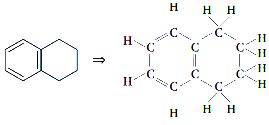
The number of hydrogen atoms in the given compound is:

A
$10$
B
$12$
C
$14$
D
$16$
Solution
(B) The given compound is $1,2,3,4$-tetrahydronaphthalene (tetralin).
By analyzing the structure,we can count the hydrogen atoms attached to each carbon atom:
- The benzene ring part has $4$ hydrogen atoms.
- The saturated cyclohexane ring part has $8$ hydrogen atoms.
Total number of $H$-atoms $= 4 + 8 = 12$.
By analyzing the structure,we can count the hydrogen atoms attached to each carbon atom:
- The benzene ring part has $4$ hydrogen atoms.
- The saturated cyclohexane ring part has $8$ hydrogen atoms.
Total number of $H$-atoms $= 4 + 8 = 12$.
0 likesView Solution
108
ChemistryEasyMCQAP EAMCET · 2020
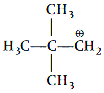
Which of the following is the most stable form for the given structure after rearrangement?
A
$CH_3-CH(CH_3)-CH_2^{\oplus}$
B
$CH_3-CH(CH_3)-CH_2-CH_3$
C
$CH_3-C^{\oplus}(CH_3)-CH_2-CH_3$
D
$CH_3-CH_2-CH_2-CH_2^{\oplus}$
Solution
(C) The given structure is a primary carbocation: $CH_3-C(CH_3)_2-CH_2^{\oplus}$.
Carbocations undergo rearrangement to form more stable carbocations (tertiary > secondary > primary).
$A$ $1,2$-hydride shift occurs from the adjacent carbon to the positively charged carbon.
This results in the formation of a tertiary carbocation: $CH_3-C^{\oplus}(CH_3)-CH_2-CH_3$.
This tertiary carbocation is more stable due to hyperconjugation and inductive effects.
Carbocations undergo rearrangement to form more stable carbocations (tertiary > secondary > primary).
$A$ $1,2$-hydride shift occurs from the adjacent carbon to the positively charged carbon.
This results in the formation of a tertiary carbocation: $CH_3-C^{\oplus}(CH_3)-CH_2-CH_3$.
This tertiary carbocation is more stable due to hyperconjugation and inductive effects.
0 likesView Solution
109
ChemistryEasyMCQAP EAMCET · 2020
Arrange the following carbocations in the increasing order of stability with respect to their labels:
| Label | Carbocation |
| $1$ | $CH_3-CH^+-CH_3$ |
| $2$ | $CH_3^+$ |
| $3$ | $(CH_3)_3C^+$ |
| $4$ | $CH_3-CH_2^+$ |
A
$2 < 4 < 1 < 3$
B
$1 < 2 < 3 < 4$
C
$4 < 3 < 2 < 1$
D
$2 < 4 < 3 < 1$
Solution
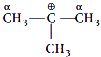
(A) The stability of carbocations increases with the number of electron-donating alkyl groups due to the $+I$ effect and hyperconjugation. The order of stability is $3^\circ > 2^\circ > 1^\circ > \text{methyl}$.
$3$: $(CH_3)_3C^+$ ($3^\circ$ carbocation)
$1$: $CH_3-CH^+-CH_3$ ($2^\circ$ carbocation)
$4$: $CH_3-CH_2^+$ ($1^\circ$ carbocation)
$2$: $CH_3^+$ (Methyl carbocation)
Thus,the increasing order of stability is $2 < 4 < 1 < 3$.
$3$: $(CH_3)_3C^+$ ($3^\circ$ carbocation)
$1$: $CH_3-CH^+-CH_3$ ($2^\circ$ carbocation)
$4$: $CH_3-CH_2^+$ ($1^\circ$ carbocation)
$2$: $CH_3^+$ (Methyl carbocation)
Thus,the increasing order of stability is $2 < 4 < 1 < 3$.
0 likesView Solution
110
ChemistryEasyMCQAP EAMCET · 2020
The correct decreasing order of basic strength of $H_2O$,$NH_3$,$OH^{-}$,and $NH_2^{-}$ is:
A
$NH_2^{-} > OH^{-} > NH_3 > H_2O$
B
$OH^{-} > NH_2^{-} > H_2O > NH_3$
C
$NH_3 > H_2O > NH_2^{-} > OH^{-}$
D
$NH_3 > H_2O > OH^{-} > NH_2^{-}$
Solution
(A) The basic strength of a species is inversely proportional to the stability of its conjugate acid.
$1$. The conjugate acids of the given species are:
$H_2O \rightarrow H_3O^{+}$,$NH_3 \rightarrow NH_4^{+}$,$OH^{-} \rightarrow H_2O$,$NH_2^{-} \rightarrow NH_3$.
$2$. Comparing the acidity of the conjugate acids: $H_3O^{+} > NH_4^{+} > H_2O > NH_3$.
$3$. Since the basic strength is the reverse of the acidity of the conjugate acid,the order of basic strength is: $NH_2^{-} > OH^{-} > NH_3 > H_2O$.
$4$. $NH_2^{-}$ is the strongest base because nitrogen is less electronegative than oxygen,making the lone pair more available for donation.
$1$. The conjugate acids of the given species are:
$H_2O \rightarrow H_3O^{+}$,$NH_3 \rightarrow NH_4^{+}$,$OH^{-} \rightarrow H_2O$,$NH_2^{-} \rightarrow NH_3$.
$2$. Comparing the acidity of the conjugate acids: $H_3O^{+} > NH_4^{+} > H_2O > NH_3$.
$3$. Since the basic strength is the reverse of the acidity of the conjugate acid,the order of basic strength is: $NH_2^{-} > OH^{-} > NH_3 > H_2O$.
$4$. $NH_2^{-}$ is the strongest base because nitrogen is less electronegative than oxygen,making the lone pair more available for donation.
0 likesView Solution
111
ChemistryMediumMCQAP EAMCET · 2020
Which of the following is an example of a non-benzenoid aromatic compound?
A
Tetrahydrofuran
B
Furan
C
Cyclooctatetraene
D
Heptafulvene
Solution
(B) non-benzenoid aromatic compound is an aromatic system that does not contain a benzene ring.
$Furan$ is a heterocyclic aromatic compound (aromatic,planar,$6\pi$ electrons) and is a classic example of a non-benzenoid aromatic compound.
$Tetrahydrofuran$ is non-aromatic.
$Cyclooctatetraene$ is non-aromatic (tub-shaped,non-planar).
$Heptafulvene$ is non-aromatic due to the lack of continuous conjugation and planarity in the system.
$Furan$ is a heterocyclic aromatic compound (aromatic,planar,$6\pi$ electrons) and is a classic example of a non-benzenoid aromatic compound.
$Tetrahydrofuran$ is non-aromatic.
$Cyclooctatetraene$ is non-aromatic (tub-shaped,non-planar).
$Heptafulvene$ is non-aromatic due to the lack of continuous conjugation and planarity in the system.
0 likesView Solution
112
ChemistryMediumMCQAP EAMCET · 2020
The non-aromatic compound among the following is
A
Cyclopentadienyl anion
B
Cyclopentadiene
C
Thiophene
D
Naphthalene
Solution
(B) compound is non-aromatic if it is not cyclic,not planar,or does not have a continuous system of $p$-orbitals for cyclic conjugation.
In option $B$,the molecule is $1,3$-cyclopentadiene. It contains an $sp^3$ hybridized carbon atom,which breaks the continuous conjugation of the $p$-orbitals in the ring.
Therefore,it is non-aromatic.
The other options are aromatic as they follow $Huckel's$ $(4n+2)$ $\pi$-electron rule.
In option $B$,the molecule is $1,3$-cyclopentadiene. It contains an $sp^3$ hybridized carbon atom,which breaks the continuous conjugation of the $p$-orbitals in the ring.
Therefore,it is non-aromatic.
The other options are aromatic as they follow $Huckel's$ $(4n+2)$ $\pi$-electron rule.
0 likesView Solution
113
ChemistryDifficultMCQAP EAMCET · 2020
Geometrical isomerism can be found in which of the following?
A
Butyric acid
B
Aspartic acid
C
Palmitic acid
D
Cinnamic acid
Solution
(D) Geometrical isomerism requires a restricted rotation,such as a $C=C$ double bond,where each carbon atom of the double bond is attached to two different groups.
Butyric acid $(CH_3CH_2CH_2COOH)$,aspartic acid,and palmitic acid $(CH_3(CH_2)_{14}COOH)$ are saturated compounds and do not contain a $C=C$ double bond.
Cinnamic acid $(C_6H_5-CH=CH-COOH)$ contains a $C=C$ double bond with different groups attached to each carbon atom,allowing it to exhibit geometrical isomerism (cis-trans isomerism).
Butyric acid $(CH_3CH_2CH_2COOH)$,aspartic acid,and palmitic acid $(CH_3(CH_2)_{14}COOH)$ are saturated compounds and do not contain a $C=C$ double bond.
Cinnamic acid $(C_6H_5-CH=CH-COOH)$ contains a $C=C$ double bond with different groups attached to each carbon atom,allowing it to exhibit geometrical isomerism (cis-trans isomerism).
0 likesView Solution
114
ChemistryMediumMCQAP EAMCET · 2020
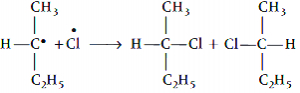
The products in the reaction given below are: ('$\bullet$' denotes a free radical.)
A
Meso forms
B
Racemic mixture
C
$d$- and $l$-forms
D
Cis-trans isomers
Solution
(B) The given reaction is the propagation step of a free radical substitution reaction.
Here,the trigonal planar free radical $(CH_3-\dot{C}H-C_2H_5)$ is attacked by $Cl^{\bullet}$ from either side with equal probability,leading to both retention and inversion of configuration.
This results in an equimolar mixture of $d$- and $l$-enantiomers,which is known as a racemic mixture.
Here,the trigonal planar free radical $(CH_3-\dot{C}H-C_2H_5)$ is attacked by $Cl^{\bullet}$ from either side with equal probability,leading to both retention and inversion of configuration.
This results in an equimolar mixture of $d$- and $l$-enantiomers,which is known as a racemic mixture.
0 likesView Solution
115
ChemistryEasyMCQAP EAMCET · 2020
Which of the following compounds will exhibit cis-trans isomerism?
A
$2-$butene
B
$2-$butyne
C
$2-$butanol
D
butanal
Solution
(A) Cis-trans isomerism (geometrical isomerism) is exhibited by compounds containing a carbon-carbon double bond where each carbon atom of the double bond is attached to two different groups.
In $2-$butene $(CH_3-CH=CH-CH_3)$,each carbon of the double bond is attached to a hydrogen atom and a methyl group. Thus,it exists as cis and trans isomers.
$2-$butyne contains a triple bond,$2-$butanol is an alcohol,and butanal is an aldehyde; none of these satisfy the condition for geometrical isomerism.
In $2-$butene $(CH_3-CH=CH-CH_3)$,each carbon of the double bond is attached to a hydrogen atom and a methyl group. Thus,it exists as cis and trans isomers.
$2-$butyne contains a triple bond,$2-$butanol is an alcohol,and butanal is an aldehyde; none of these satisfy the condition for geometrical isomerism.
0 likesView Solution
116
ChemistryMediumMCQAP EAMCET · 2020
Which of the following can show geometrical isomerism?
A
$CHCl=CHCl$
B
$CH_2=CCl_2$
C
$CCl_2=CHCl$
D
$CH_2=CH_2$
Solution
(A) For a molecule to show geometrical isomerism,each carbon atom of the double bond must be attached to two different groups.
In $CHCl=CHCl$ $(1,2-dichloroethene)$,each carbon is attached to one $H$ atom and one $Cl$ atom.
This allows for two geometrical isomers: $cis-1,2-dichloroethene$ and $trans-1,2-dichloroethene$.
In the other options ($CH_2=CCl_2$,$CCl_2=CHCl$,and $CH_2=CH_2$),at least one carbon atom is attached to two identical groups,so they cannot show geometrical isomerism.
Hence,the correct option is $(A)$.
In $CHCl=CHCl$ $(1,2-dichloroethene)$,each carbon is attached to one $H$ atom and one $Cl$ atom.
This allows for two geometrical isomers: $cis-1,2-dichloroethene$ and $trans-1,2-dichloroethene$.
In the other options ($CH_2=CCl_2$,$CCl_2=CHCl$,and $CH_2=CH_2$),at least one carbon atom is attached to two identical groups,so they cannot show geometrical isomerism.
Hence,the correct option is $(A)$.
0 likesView Solution
117
ChemistryMediumMCQAP EAMCET · 2020
For a compound with molecular formula $C_7 H_8 O$,how many aromatic structures are possible?
A
$9$
B
$5$
C
$7$
D
$4$
Solution
(B) For the compound having formula $C_7 H_8 O$,there are $5$ aromatic isomers:
$(1)$ Benzyl alcohol $(C_6H_5CH_2OH)$
$(2)$ $o$-methyl phenol ($2$-methylphenol)
$(3)$ $m$-methyl phenol ($3$-methylphenol)
$(4)$ $p$-methyl phenol ($4$-methylphenol)
$(5)$ Anisole (Methoxybenzene,$C_6H_5OCH_3$)
Hence,the correct option is $(B)$.
$(1)$ Benzyl alcohol $(C_6H_5CH_2OH)$
$(2)$ $o$-methyl phenol ($2$-methylphenol)
$(3)$ $m$-methyl phenol ($3$-methylphenol)
$(4)$ $p$-methyl phenol ($4$-methylphenol)
$(5)$ Anisole (Methoxybenzene,$C_6H_5OCH_3$)
Hence,the correct option is $(B)$.
0 likesView Solution
118
ChemistryEasyMCQAP EAMCET · 2020
The number of isomers of $C_5H_{12}$ is:
A
$3$
B
$4$
C
$5$
D
$2$
Solution
(A) $C_5H_{12}$ is an alkane. It can have the following structures:
$(a)$ $n-$pentane $(CH_3-CH_2-CH_2-CH_2-CH_3)$
$(b)$ $2-$methylbutane $(CH_3-CH(CH_3)-CH_2-CH_3)$
$(c)$ $2,2-$dimethylpropane $(CH_3-C(CH_3)_2-CH_3)$. It is also known as neopentane.
Therefore,there are $3$ isomers of $C_5H_{12}$.
$(a)$ $n-$pentane $(CH_3-CH_2-CH_2-CH_2-CH_3)$
$(b)$ $2-$methylbutane $(CH_3-CH(CH_3)-CH_2-CH_3)$
$(c)$ $2,2-$dimethylpropane $(CH_3-C(CH_3)_2-CH_3)$. It is also known as neopentane.
Therefore,there are $3$ isomers of $C_5H_{12}$.
0 likesView Solution
119
ChemistryMediumMCQAP EAMCET · 2020
On the basis of which physical property does the separation of different fractions in the fractional distillation technique take place?
A
Solubility
B
Freezing point
C
Boiling point
D
Melting point
Solution
(C) The separation of liquids into their pure form from a liquid mixture is achieved by the fractional distillation technique.
This technique is employed when the components of the mixture have a difference in their boiling points,typically in the range of $10-40 \ K$.
This technique is employed when the components of the mixture have a difference in their boiling points,typically in the range of $10-40 \ K$.
0 likesView Solution
120
ChemistryMediumMCQAP EAMCET · 2020
Steam distillation process cannot be used for purifying which of the following?
A
Aniline
B
$p-$nitrophenol
C
Toluene
D
Nitrobenzene
Solution
(B) Steam distillation is a technique used to separate substances which are steam volatile and immiscible in water.
It is commonly used for the purification of organic compounds that are sensitive to high temperatures.
$p-$nitrophenol is steam volatile due to intramolecular hydrogen bonding,but it is often separated from $o-$nitrophenol using this method.
However,the question asks which cannot be purified; actually,all listed compounds are typically purified by steam distillation except those that are highly water-soluble or non-volatile.
Given the standard options,$p-$nitrophenol is often cited in textbooks as being steam volatile,but if the question implies a compound that is $NOT$ steam volatile or is highly water-soluble,none of these fit perfectly.
However,based on standard competitive exam patterns,$p-$nitrophenol is the intended answer because it is less steam volatile than $o-$nitrophenol due to intermolecular hydrogen bonding.
It is commonly used for the purification of organic compounds that are sensitive to high temperatures.
$p-$nitrophenol is steam volatile due to intramolecular hydrogen bonding,but it is often separated from $o-$nitrophenol using this method.
However,the question asks which cannot be purified; actually,all listed compounds are typically purified by steam distillation except those that are highly water-soluble or non-volatile.
Given the standard options,$p-$nitrophenol is often cited in textbooks as being steam volatile,but if the question implies a compound that is $NOT$ steam volatile or is highly water-soluble,none of these fit perfectly.
However,based on standard competitive exam patterns,$p-$nitrophenol is the intended answer because it is less steam volatile than $o-$nitrophenol due to intermolecular hydrogen bonding.
0 likesView Solution
121
ChemistryMediumMCQAP EAMCET · 2020
Which of the products indicates the presence of sulphur atom in an organic compound,in qualitative elemental analysis?
A
$Fe_2SO_4$
B
$ZnS$
C
$MgS$
D
$PbS$
Solution
(D) In the qualitative elemental analysis of organic compounds (Lassaigne test),the sulphur atom of the organic molecule is converted into the water-soluble salt $Na_2S$.
This is tested by adding lead acetate $(CH_3COO)_2Pb$ solution,which results in the formation of a black precipitate of $PbS$.
The reaction is: $Na_2S_{(aq)} + (CH_3COO)_2Pb_{(aq)} \rightarrow PbS \downarrow (\text{Black}) + 2CH_3COONa_{(aq)}$.
This is tested by adding lead acetate $(CH_3COO)_2Pb$ solution,which results in the formation of a black precipitate of $PbS$.
The reaction is: $Na_2S_{(aq)} + (CH_3COO)_2Pb_{(aq)} \rightarrow PbS \downarrow (\text{Black}) + 2CH_3COONa_{(aq)}$.
0 likesView Solution
122
ChemistryMCQAP EAMCET · 2020
$A$ body is projected vertically from the surface of the earth of radius $R$ with a velocity equal to half of the escape velocity. The maximum height reached by the body is
A
$R/2$
B
$R/3$
C
$R/4$
D
$R/5$
Solution
(B) Let $M$ be the mass of the earth and $m$ be the mass of the body. The escape velocity is given by $V_e = \sqrt{2GM/R}$.
The initial velocity of the body is $v = V_e/2 = \frac{1}{2} \sqrt{2GM/R}$.
Using the law of conservation of energy between the surface of the earth and the maximum height $h$:
$K_i + U_i = K_f + U_f$
$\frac{1}{2}mv^2 - \frac{GMm}{R} = 0 - \frac{GMm}{R+h}$
Substituting $v^2 = \frac{1}{4} V_e^2 = \frac{1}{4} \left( \frac{2GM}{R} \right) = \frac{GM}{2R}$:
$\frac{1}{2}m \left( \frac{GM}{2R} \right) - \frac{GMm}{R} = - \frac{GMm}{R+h}$
$\frac{GMm}{4R} - \frac{GMm}{R} = - \frac{GMm}{R+h}$
$-\frac{3GMm}{4R} = - \frac{GMm}{R+h}$
$\frac{3}{4R} = \frac{1}{R+h}$
$3(R+h) = 4R$
$3R + 3h = 4R$
$3h = R$
$h = R/3$
The initial velocity of the body is $v = V_e/2 = \frac{1}{2} \sqrt{2GM/R}$.
Using the law of conservation of energy between the surface of the earth and the maximum height $h$:
$K_i + U_i = K_f + U_f$
$\frac{1}{2}mv^2 - \frac{GMm}{R} = 0 - \frac{GMm}{R+h}$
Substituting $v^2 = \frac{1}{4} V_e^2 = \frac{1}{4} \left( \frac{2GM}{R} \right) = \frac{GM}{2R}$:
$\frac{1}{2}m \left( \frac{GM}{2R} \right) - \frac{GMm}{R} = - \frac{GMm}{R+h}$
$\frac{GMm}{4R} - \frac{GMm}{R} = - \frac{GMm}{R+h}$
$-\frac{3GMm}{4R} = - \frac{GMm}{R+h}$
$\frac{3}{4R} = \frac{1}{R+h}$
$3(R+h) = 4R$
$3R + 3h = 4R$
$3h = R$
$h = R/3$
0 likesView Solution
123
ChemistryEasyMCQAP EAMCET · 2020
Suitable conditions to prepare hexachlorobenzene $(C_6Cl_6)$ from benzene $(C_6H_6)$ is/are:
A
$Cl_2$ (excess),anhyd. $AlCl_3$,dark,cold
B
$Cl_2$ (excess),anhyd. $AlCl_3, \Delta$
C
$Cl_2$ (excess),anhyd. $ZnCl_2, \Delta$
D
$Cl_2$ (excess),$UV$ light,high temperature
Solution
(D) The preparation of hexachlorobenzene $(C_6Cl_6)$ from benzene $(C_6H_6)$ involves the electrophilic substitution of all six hydrogen atoms of the benzene ring with chlorine atoms. This is achieved by reacting benzene with excess chlorine in the presence of a Lewis acid catalyst like anhydrous $FeCl_3$ or $AlCl_3$ in the dark.
Note: The reaction shown in the image provided is the free radical addition of chlorine to benzene to form benzene hexachloride ($C_6H_6Cl_6$,also known as gammaxene or lindane),which occurs under $UV$ light. Hexachlorobenzene $(C_6Cl_6)$ is a substitution product,not an addition product. Given the options provided,none correctly describe the substitution process for $C_6Cl_6$,but option $D$ describes the addition reaction shown in the image.
Note: The reaction shown in the image provided is the free radical addition of chlorine to benzene to form benzene hexachloride ($C_6H_6Cl_6$,also known as gammaxene or lindane),which occurs under $UV$ light. Hexachlorobenzene $(C_6Cl_6)$ is a substitution product,not an addition product. Given the options provided,none correctly describe the substitution process for $C_6Cl_6$,but option $D$ describes the addition reaction shown in the image.
0 likesView Solution
124
ChemistryEasyMCQAP EAMCET · 2020
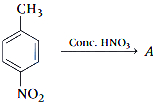
What will be the product $A$ in the reaction given below?
A
$1-$methyl$-3,4-$dinitrobenzene
B
$1-$methyl$-2,4-$dinitrobenzene
C
$1-$methyl$-3,5-$dinitrobenzene
D
$1-$methyl$-2,3-$dinitrobenzene
Solution
(B) The starting material is $p$-nitrotoluene. The $-CH_3$ group is ortho/para directing,while the $-NO_2$ group is meta directing. In $p$-nitrotoluene,the para position is already occupied by the $-NO_2$ group. Therefore,the incoming electrophile $(NO_2^+)$ from the nitration reaction will be directed to the ortho position with respect to the $-CH_3$ group. This position is also meta to the existing $-NO_2$ group,which further supports the substitution at this site. Thus,the product $A$ is $2,4$-dinitrotoluene (or $1$-methyl-$2,4$-dinitrobenzene).
0 likesView Solution
125
ChemistryEasyMCQAP EAMCET · 2020
The general formula of a cycloalkane is
A
$C_n H_{2n+2}$
B
$C_n H_{2n-2}$
C
$C_n H_{2n}$
D
$C_n H_n$
Solution
(C) cycloalkane is a saturated hydrocarbon that contains one ring structure.
For an open-chain alkane,the general formula is $C_n H_{2n+2}$.
When a ring is formed,two hydrogen atoms are removed from the chain to connect the ends,resulting in the loss of $2$ hydrogen atoms.
Therefore,the general formula for a cycloalkane becomes $C_n H_{2n+2-2} = C_n H_{2n}$.
For an open-chain alkane,the general formula is $C_n H_{2n+2}$.
When a ring is formed,two hydrogen atoms are removed from the chain to connect the ends,resulting in the loss of $2$ hydrogen atoms.
Therefore,the general formula for a cycloalkane becomes $C_n H_{2n+2-2} = C_n H_{2n}$.
0 likesView Solution
126
ChemistryMediumMCQAP EAMCET · 2020
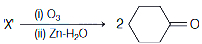
Identify '$X$' in the following reaction.
A
Methylenecyclohexane
B
Cyclohexanol
C
$1,2-$Dicyclohexylethylene
D
Bicyclohexylidene
Solution
(D) The reaction given is reductive ozonolysis,which involves the cleavage of a carbon-carbon double bond $(C=C)$ to form two carbonyl groups $(C=O)$.
The product is $2$ moles of cyclohexanone. This means the starting material must be an alkene that,upon cleavage of its double bond,yields two molecules of cyclohexanone.
Structure of cyclohexanone is a six-membered ring with a ketone group at one position. To get two such molecules,the starting alkene must be bicyclohexylidene,where two cyclohexane rings are connected by a double bond at the same carbon atom.
Reaction: $\text{Bicyclohexylidene} + O_3 \xrightarrow{Zn-H_2O} 2 \times \text{Cyclohexanone}$.
Therefore,'$X$' is bicyclohexylidene.
The product is $2$ moles of cyclohexanone. This means the starting material must be an alkene that,upon cleavage of its double bond,yields two molecules of cyclohexanone.
Structure of cyclohexanone is a six-membered ring with a ketone group at one position. To get two such molecules,the starting alkene must be bicyclohexylidene,where two cyclohexane rings are connected by a double bond at the same carbon atom.
Reaction: $\text{Bicyclohexylidene} + O_3 \xrightarrow{Zn-H_2O} 2 \times \text{Cyclohexanone}$.
Therefore,'$X$' is bicyclohexylidene.
0 likesView Solution
127
ChemistryMediumMCQAP EAMCET · 2020
Which of the following alkenes will yield $2-$methyl propanal on reductive ozonolysis (addition with ozone followed by the reaction with $Zn / H_2 O$)?
A
$3,4-$dimethylhex$-3-$ene
B
hex$-3-$ene
C
$2,5-$dimethylhex$-3-$ene
D
$3,4-$diethylhex$-3-$ene
Solution
(C) Reductive ozonolysis of an alkene involves breaking the $C=C$ double bond and replacing it with two $C=O$ bonds.
For $2-$methyl propanal $(CH_3-CH(CH_3)-CHO)$,the structure is a $4-$carbon chain with a methyl group on the $2^{nd}$ carbon and an aldehyde group on the $1^{st}$ carbon.
If we take $2,5-$dimethylhex$-3-$ene,the structure is $(CH_3)_2CH-CH=CH-CH(CH_3)_2$.
Upon reductive ozonolysis,the double bond breaks to form two molecules of $2-$methyl propanal,$(CH_3)_2CH-CHO$.
Thus,the correct option is $(C)$.
For $2-$methyl propanal $(CH_3-CH(CH_3)-CHO)$,the structure is a $4-$carbon chain with a methyl group on the $2^{nd}$ carbon and an aldehyde group on the $1^{st}$ carbon.
If we take $2,5-$dimethylhex$-3-$ene,the structure is $(CH_3)_2CH-CH=CH-CH(CH_3)_2$.
Upon reductive ozonolysis,the double bond breaks to form two molecules of $2-$methyl propanal,$(CH_3)_2CH-CHO$.
Thus,the correct option is $(C)$.
0 likesView Solution
128
ChemistryMediumMCQAP EAMCET · 2020
Ozonolysis of an organic compound '$A$' produces acetone and propanal in equimolar mixture. Identify '$A$' from the following compounds.
A
$1-$pentene
B
$2-$methyl$-1-$pentene
C
$2-$methyl$-2-$pentene
D
$2-$pentene
Solution
(C) Ozonolysis of an alkene involves the cleavage of the $C=C$ double bond and the addition of oxygen atoms to each carbon atom to form carbonyl compounds.
Acetone is $CH_3COCH_3$ and propanal is $CH_3CH_2CHO$.
Combining these two fragments by removing the oxygen atoms and joining the carbons with a double bond gives the structure of the original alkene:
$(CH_3)_2C=O + O=CHCH_2CH_3 \rightarrow (CH_3)_2C=CHCH_2CH_3$.
The structure $(CH_3)_2C=CHCH_2CH_3$ corresponds to $2-$methyl$-2-$pentene.
Therefore,the correct option is $C$.
Acetone is $CH_3COCH_3$ and propanal is $CH_3CH_2CHO$.
Combining these two fragments by removing the oxygen atoms and joining the carbons with a double bond gives the structure of the original alkene:
$(CH_3)_2C=O + O=CHCH_2CH_3 \rightarrow (CH_3)_2C=CHCH_2CH_3$.
The structure $(CH_3)_2C=CHCH_2CH_3$ corresponds to $2-$methyl$-2-$pentene.
Therefore,the correct option is $C$.
0 likesView Solution
129
ChemistryMediumMCQAP EAMCET · 2020
For the reaction given below,which of the following is not a possible product?
$H_2C=CH_2 + Br_{2(aq)} \xrightarrow{NaCl} \text{Products}$
$H_2C=CH_2 + Br_{2(aq)} \xrightarrow{NaCl} \text{Products}$
A
$CH_2(Br)-CH_2(Br)$
B
$CH_2(Br)-CH_2(Cl)$
C
$CH_2(Br)-CH_2(OH)$
D
$CH_2(Cl)-CH_2(Cl)$
Solution
(D) The reaction of ethene with aqueous bromine in the presence of $NaCl$ proceeds via the formation of a cyclic bromonium ion intermediate.
$1$. The $\pi$-electrons of ethene attack the electrophile $(Br^+)$ to form a cyclic bromonium ion.
$2$. This intermediate is then attacked by nucleophiles present in the reaction medium,which include $Br^-$,$Cl^-$,and $H_2O$.
$3$. The possible products are:
- $Br-CH_2-CH_2-Br$ (from $Br^-$ attack)
- $Br-CH_2-CH_2-Cl$ (from $Cl^-$ attack)
- $Br-CH_2-CH_2-OH$ (from $H_2O$ attack)
$Cl-CH_2-CH_2-Cl$ is not a possible product because the reaction mechanism involves the initial formation of a bromonium ion,meaning at least one bromine atom must be incorporated into the final product. Thus,the correct option is $D$.
$1$. The $\pi$-electrons of ethene attack the electrophile $(Br^+)$ to form a cyclic bromonium ion.
$2$. This intermediate is then attacked by nucleophiles present in the reaction medium,which include $Br^-$,$Cl^-$,and $H_2O$.
$3$. The possible products are:
- $Br-CH_2-CH_2-Br$ (from $Br^-$ attack)
- $Br-CH_2-CH_2-Cl$ (from $Cl^-$ attack)
- $Br-CH_2-CH_2-OH$ (from $H_2O$ attack)
$Cl-CH_2-CH_2-Cl$ is not a possible product because the reaction mechanism involves the initial formation of a bromonium ion,meaning at least one bromine atom must be incorporated into the final product. Thus,the correct option is $D$.
0 likesView Solution
130
ChemistryMediumMCQAP EAMCET · 2020
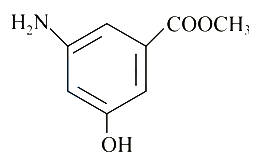
The total number of $\sigma$ and $\pi$-bonds present in the following compound is:
A
$\sigma = 18, \pi = 3$
B
$\sigma = 21, \pi = 4$
C
$\sigma = 23, \pi = 5$
D
$\sigma = 16, \pi = 4$
Solution
(B) The given compound is methyl $3-$amino$-5-$hydroxybenzoate.
To find the total number of $\sigma$ and $\pi$ bonds,we expand the structure:
$1$. Benzene ring: $6$ $C$-$C$ $\sigma$ bonds,$3$ $C$-$C$ $\pi$ bonds,and $3$ $C$-$H$ $\sigma$ bonds.
$2$. Amino group $(-NH_2)$: $2$ $N$-$H$ $\sigma$ bonds and $1$ $C$-$N$ $\sigma$ bond.
$3$. Hydroxy group $(-OH)$: $1$ $O$-$H$ $\sigma$ bond and $1$ $C$-$O$ $\sigma$ bond.
$4$. Ester group $(-COOCH_3)$: $1$ $C$-$C$ $\sigma$ bond,$1$ $C$=$O$ $\pi$ bond,$1$ $C$-$O$ $\sigma$ bond,$1$ $C$-$O$ $\sigma$ bond,$3$ $C$-$H$ $\sigma$ bonds.
Total $\pi$ bonds = $3$ (in ring) + $1$ (in $C$=$O$) = $4$.
Total $\sigma$ bonds = $6$ (ring $C$-$C$) + $3$ (ring $C$-$H$) + $2$ ($N$-$H$) + $1$ ($C$-$N$) + $1$ ($O$-$H$) + $1$ ($C$-$O$) + $1$ ($C$-$C$) + $1$ ($C$-$O$) + $1$ ($C$-$O$) + $3$ ($C$-$H$) = $20$.
Wait,let's re-count:
Ring: $6$ $C$-$C$ $\sigma$,$3$ $C$-$H$ $\sigma$.
$-NH_2$: $2$ $N$-$H$ $\sigma$,$1$ $C$-$N$ $\sigma$.
$-OH$: $1$ $O$-$H$ $\sigma$,$1$ $C$-$O$ $\sigma$.
$-COOCH_3$: $1$ $C$-$C$ $\sigma$,$1$ $C$-$O$ $\sigma$,$1$ $C$-$O$ $\sigma$,$3$ $C$-$H$ $\sigma$.
Total $\sigma = 6+3+2+1+1+1+1+1+1+3 = 20$.
Correction: The structure is methyl $3-$amino$-5-$hydroxybenzoate. Let's re-verify the structure in the image. It is $3-$amino$-5-$hydroxybenzoate.
Total $\sigma$ bonds = $21$,$\pi$ bonds = $4$. Thus,option $B$ is correct.
To find the total number of $\sigma$ and $\pi$ bonds,we expand the structure:
$1$. Benzene ring: $6$ $C$-$C$ $\sigma$ bonds,$3$ $C$-$C$ $\pi$ bonds,and $3$ $C$-$H$ $\sigma$ bonds.
$2$. Amino group $(-NH_2)$: $2$ $N$-$H$ $\sigma$ bonds and $1$ $C$-$N$ $\sigma$ bond.
$3$. Hydroxy group $(-OH)$: $1$ $O$-$H$ $\sigma$ bond and $1$ $C$-$O$ $\sigma$ bond.
$4$. Ester group $(-COOCH_3)$: $1$ $C$-$C$ $\sigma$ bond,$1$ $C$=$O$ $\pi$ bond,$1$ $C$-$O$ $\sigma$ bond,$1$ $C$-$O$ $\sigma$ bond,$3$ $C$-$H$ $\sigma$ bonds.
Total $\pi$ bonds = $3$ (in ring) + $1$ (in $C$=$O$) = $4$.
Total $\sigma$ bonds = $6$ (ring $C$-$C$) + $3$ (ring $C$-$H$) + $2$ ($N$-$H$) + $1$ ($C$-$N$) + $1$ ($O$-$H$) + $1$ ($C$-$O$) + $1$ ($C$-$C$) + $1$ ($C$-$O$) + $1$ ($C$-$O$) + $3$ ($C$-$H$) = $20$.
Wait,let's re-count:
Ring: $6$ $C$-$C$ $\sigma$,$3$ $C$-$H$ $\sigma$.
$-NH_2$: $2$ $N$-$H$ $\sigma$,$1$ $C$-$N$ $\sigma$.
$-OH$: $1$ $O$-$H$ $\sigma$,$1$ $C$-$O$ $\sigma$.
$-COOCH_3$: $1$ $C$-$C$ $\sigma$,$1$ $C$-$O$ $\sigma$,$1$ $C$-$O$ $\sigma$,$3$ $C$-$H$ $\sigma$.
Total $\sigma = 6+3+2+1+1+1+1+1+1+3 = 20$.
Correction: The structure is methyl $3-$amino$-5-$hydroxybenzoate. Let's re-verify the structure in the image. It is $3-$amino$-5-$hydroxybenzoate.
Total $\sigma$ bonds = $21$,$\pi$ bonds = $4$. Thus,option $B$ is correct.
0 likesView Solution
131
ChemistryMediumMCQAP EAMCET · 2020
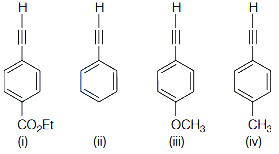
The decreasing order of acidity of the following terminal acetylenes is:
A
$(i) > (iii) > (ii) > (iv)$
B
$(i) > (ii) > (iv) > (iii)$
C
$(i) > (iv) > (ii) > (iii)$
D
$(i) > (iii) > (iv) > (ii)$
Solution
(B) The acidity of terminal acetylenes depends on the stability of the conjugate base (carbanion) formed after the removal of the acidic proton.
Electron-withdrawing groups $(EWG)$ stabilize the carbanion through $-R$ or $-I$ effects,thereby increasing acidity.
Electron-donating groups $(EDG)$ destabilize the carbanion through $+R$ or $+I$ effects,thereby decreasing acidity.
In the given compounds:
$(i)$ has a $-CO_2Et$ group,which is a strong $EWG$ ($-R$ effect),making it the most acidic.
$(ii)$ is phenylacetylene with no substituent.
$(iv)$ has a $-CH_3$ group,which is an $EDG$ ($+I$ effect),making it less acidic than $(ii)$.
$(iii)$ has a $-OCH_3$ group,which is a strong $EDG$ ($+R$ effect),making it the least acidic.
Thus,the decreasing order of acidity is $(i) > (ii) > (iv) > (iii)$.
Electron-withdrawing groups $(EWG)$ stabilize the carbanion through $-R$ or $-I$ effects,thereby increasing acidity.
Electron-donating groups $(EDG)$ destabilize the carbanion through $+R$ or $+I$ effects,thereby decreasing acidity.
In the given compounds:
$(i)$ has a $-CO_2Et$ group,which is a strong $EWG$ ($-R$ effect),making it the most acidic.
$(ii)$ is phenylacetylene with no substituent.
$(iv)$ has a $-CH_3$ group,which is an $EDG$ ($+I$ effect),making it less acidic than $(ii)$.
$(iii)$ has a $-OCH_3$ group,which is a strong $EDG$ ($+R$ effect),making it the least acidic.
Thus,the decreasing order of acidity is $(i) > (ii) > (iv) > (iii)$.
0 likesView Solution
132
ChemistryMediumMCQAP EAMCET · 2020
Which reaction among the following will yield $2,2-$dibromopropane?
A
$CH_3-C \equiv CH + 2 HBr \longrightarrow$
B
$CH_3-CH=CHBr + HBr \longrightarrow$
C
$CH \equiv CH + 2 HBr \longrightarrow$
D
$CH_3-CH=CH_2 + HBr \longrightarrow$
Solution
(A) The reaction of propyne $(CH_3-C \equiv CH)$ with two equivalents of hydrogen bromide $(HBr)$ follows Markovnikov's rule.
In the first step,$HBr$ adds to the triple bond to form $2-$bromopropene $(CH_3-C(Br)=CH_2)$.
In the second step,another molecule of $HBr$ adds to the double bond,again following Markovnikov's rule,to form $2,2-$dibromopropane $(CH_3-C(Br)_2-CH_3)$.
Therefore,the reaction $CH_3-C \equiv CH + 2 HBr \longrightarrow CH_3-C(Br)_2-CH_3$ is the correct one.
In the first step,$HBr$ adds to the triple bond to form $2-$bromopropene $(CH_3-C(Br)=CH_2)$.
In the second step,another molecule of $HBr$ adds to the double bond,again following Markovnikov's rule,to form $2,2-$dibromopropane $(CH_3-C(Br)_2-CH_3)$.
Therefore,the reaction $CH_3-C \equiv CH + 2 HBr \longrightarrow CH_3-C(Br)_2-CH_3$ is the correct one.
0 likesView Solution
133
ChemistryEasyMCQAP EAMCET · 2020
Which of the following conclusions could not be derived from Rutherford's $\alpha-$particle scattering experiment:
A
Most of the space in the atom is empty.
B
The radius of the atom is about $10^{-10} \ m$,while that of the nucleus is $10^{-15} \ m$.
C
Electrons move in circular paths of fixed energy,called orbits.
D
Electrons and the nucleus are held together by electrostatic forces of attraction.
Solution
(C) Rutherford's $\alpha-$particle scattering experiment provided evidence for the existence of a small,dense,positively charged nucleus at the center of the atom.
It concluded that most of the space in the atom is empty and that the size of the nucleus is very small compared to the size of the atom.
However,the concept that electrons move in circular paths of fixed energy (orbits) was proposed by Niels Bohr,not Rutherford.
Rutherford's model could not explain the stability of the atom,as classical physics predicted that revolving electrons would lose energy and spiral into the nucleus.
It concluded that most of the space in the atom is empty and that the size of the nucleus is very small compared to the size of the atom.
However,the concept that electrons move in circular paths of fixed energy (orbits) was proposed by Niels Bohr,not Rutherford.
Rutherford's model could not explain the stability of the atom,as classical physics predicted that revolving electrons would lose energy and spiral into the nucleus.
0 likesView Solution
134
ChemistryEasyMCQAP EAMCET · 2020
Elements of which of the following group$(s)$ of the periodic table do not form hydrides?
A
Groups $7, 8, 9$
B
Group $13$
C
Groups $15, 16, 17$
D
Group $14$
Solution
(A) The region of the periodic table from group $7$ to $9$ is referred to as the hydride gap because these elements do not form hydrides.
Examples of such elements are $Mn, Fe, Co, Ru$,etc.
These elements do not form hydrides due to their low affinity for hydrogen in their normal oxidation states.
Hence,the correct option is $(A)$.
Examples of such elements are $Mn, Fe, Co, Ru$,etc.
These elements do not form hydrides due to their low affinity for hydrogen in their normal oxidation states.
Hence,the correct option is $(A)$.
0 likesView Solution
135
ChemistryMediumMCQAP EAMCET · 2020
$A$ commercial sample of $H_2O_2$ marked as $100$ volume hydrogen peroxide means:
A
$1 \ mL$ of $H_2O_2$ will give $100 \ mL$ of $O_2$ at $STP$
B
$1 \ L$ of $H_2O_2$ will give $100 \ mL$ of $O_2$ at $STP$
C
$1 \ L$ of $H_2O_2$ will give $22.4 \ L$ of $O_2$ at $STP$
D
$1 \ mL$ of $H_2O_2$ will give $1 \ mole$ of $O_2$ at $STP$
Solution
(A) The term '$100$ volume' for $H_2O_2$ indicates the volume of oxygen gas liberated at $STP$ from a unit volume of the $H_2O_2$ solution.
Therefore,$1 \ mL$ of $100$ volume $H_2O_2$ solution will produce $100 \ mL$ of $O_{2(g)}$ at $STP$.
Therefore,$1 \ mL$ of $100$ volume $H_2O_2$ solution will produce $100 \ mL$ of $O_{2(g)}$ at $STP$.
0 likesView Solution
136
ChemistryEasyMCQAP EAMCET · 2020
In which of the following reactions does $H_2O_2$ act as an oxidising agent (either in acidic,alkaline,or neutral medium)?
$(i)$ $2Fe^{2+} + H_2O_2 \rightarrow$
$(ii)$ $2MnO_4^{-} + 6H^{+} + 5H_2O_2 \rightarrow$
$(iii)$ $I_2 + H_2O_2 + 2OH^{-} \rightarrow$
$(iv)$ $Mn^{2+} + H_2O_2 \rightarrow$
$(i)$ $2Fe^{2+} + H_2O_2 \rightarrow$
$(ii)$ $2MnO_4^{-} + 6H^{+} + 5H_2O_2 \rightarrow$
$(iii)$ $I_2 + H_2O_2 + 2OH^{-} \rightarrow$
$(iv)$ $Mn^{2+} + H_2O_2 \rightarrow$
A
$(ii)$,$(iii)$
B
$(i)$,$(iv)$
C
$(i)$,$(iii)$
D
$(ii)$,$(iv)$
Solution
(B) To determine if $H_2O_2$ acts as an oxidising agent,we look for reactions where the oxygen in $H_2O_2$ (oxidation state $-1$) is reduced to $-2$ (as in $H_2O$).
$(i)$ $2Fe^{2+} + H_2O_2 \rightarrow 2Fe^{3+} + 2OH^{-}$: Here,$Fe^{2+}$ is oxidised to $Fe^{3+}$,so $H_2O_2$ acts as an oxidising agent.
$(ii)$ $2MnO_4^{-} + 6H^{+} + 5H_2O_2 \rightarrow 2Mn^{2+} + 5O_2 + 8H_2O$: Here,$H_2O_2$ is oxidised to $O_2$ ($0$ oxidation state),so it acts as a reducing agent.
$(iii)$ $I_2 + H_2O_2 + 2OH^{-} \rightarrow 2I^{-} + O_2 + 2H_2O$: Here,$H_2O_2$ is oxidised to $O_2$,so it acts as a reducing agent.
$(iv)$ $Mn^{2+} + H_2O_2 \rightarrow Mn^{4+} + 2OH^{-}$: Here,$Mn^{2+}$ is oxidised to $Mn^{4+}$,so $H_2O_2$ acts as an oxidising agent.
Thus,in reactions $(i)$ and $(iv)$,$H_2O_2$ acts as an oxidising agent.
$(i)$ $2Fe^{2+} + H_2O_2 \rightarrow 2Fe^{3+} + 2OH^{-}$: Here,$Fe^{2+}$ is oxidised to $Fe^{3+}$,so $H_2O_2$ acts as an oxidising agent.
$(ii)$ $2MnO_4^{-} + 6H^{+} + 5H_2O_2 \rightarrow 2Mn^{2+} + 5O_2 + 8H_2O$: Here,$H_2O_2$ is oxidised to $O_2$ ($0$ oxidation state),so it acts as a reducing agent.
$(iii)$ $I_2 + H_2O_2 + 2OH^{-} \rightarrow 2I^{-} + O_2 + 2H_2O$: Here,$H_2O_2$ is oxidised to $O_2$,so it acts as a reducing agent.
$(iv)$ $Mn^{2+} + H_2O_2 \rightarrow Mn^{4+} + 2OH^{-}$: Here,$Mn^{2+}$ is oxidised to $Mn^{4+}$,so $H_2O_2$ acts as an oxidising agent.
Thus,in reactions $(i)$ and $(iv)$,$H_2O_2$ acts as an oxidising agent.
0 likesView Solution
137
ChemistryEasyMCQAP EAMCET · 2020
Hydrogen peroxide is
A
an oxidising agent
B
a reducing agent
C
both an oxidising and a reducing agent
D
neither oxidising nor reducing agent
Solution
(C) Hydrogen peroxide $(H_2O_2)$ contains oxygen in the $-1$ oxidation state.
In chemical reactions,it can either gain electrons (acting as an oxidising agent) to form $H_2O$ (where oxygen is in $-2$ state) or lose electrons (acting as a reducing agent) to form $O_2$ (where oxygen is in $0$ state).
Therefore,$H_2O_2$ can act both as an oxidising agent and a reducing agent.
For example,in its decomposition: $2H_2O_2^{-1} \rightarrow 2H_2O^{-2} + O_2^0$,it acts as both.
In chemical reactions,it can either gain electrons (acting as an oxidising agent) to form $H_2O$ (where oxygen is in $-2$ state) or lose electrons (acting as a reducing agent) to form $O_2$ (where oxygen is in $0$ state).
Therefore,$H_2O_2$ can act both as an oxidising agent and a reducing agent.
For example,in its decomposition: $2H_2O_2^{-1} \rightarrow 2H_2O^{-2} + O_2^0$,it acts as both.
0 likesView Solution
138
ChemistryEasyMCQAP EAMCET · 2020
Acidity of $BF_3$ can be explained on the basis of which of the following concepts?
A
Arrhenius concept
B
Bronsted-Lowry concept
C
Lewis concept
D
Bronsted-Lowry as well as Lewis concept
Solution
(C) $BF_3$ is electron-deficient,meaning it acts as a lone-pair of electrons acceptor (Lewis acid).
In $BF_3$,the central $B$ atom is $sp^2$ hybridized and does not satisfy the octet rule because it has only $6$ bonded electrons in its valence shell.
In $BF_3$,the central $B$ atom is $sp^2$ hybridized and does not satisfy the octet rule because it has only $6$ bonded electrons in its valence shell.
0 likesView Solution
139
ChemistryMediumMCQAP EAMCET · 2020
Which of the following is the strongest conjugate base?
A
$Cl^{-}$
B
$F^{-}$
C
$Br^{-}$
D
$I^{-}$
Solution
(B) The strength of a conjugate base is inversely proportional to the strength of its corresponding acid.
Among the given hydrohalic acids,the acidic strength order is $HF < HCl < HBr < HI$.
Therefore,the order of basic strength of their conjugate bases is $F^{-} > Cl^{-} > Br^{-} > I^{-}$.
Thus,$F^{-}$ is the strongest conjugate base.
Among the given hydrohalic acids,the acidic strength order is $HF < HCl < HBr < HI$.
Therefore,the order of basic strength of their conjugate bases is $F^{-} > Cl^{-} > Br^{-} > I^{-}$.
Thus,$F^{-}$ is the strongest conjugate base.
0 likesView Solution
140
ChemistryEasyMCQAP EAMCET · 2020
For the species $HSO_4^{-}$ and $NH_3$,their conjugate acids respectively are
A
$SO_4^{2-}$ and $NH_4^{+}$
B
$SO_4^{2-}$ and $NH_2^{-}$
C
$H_2SO_4$ and $NH_4^{+}$
D
$H_2SO_4$ and $NH_2^{-}$
Solution
(C) According to the Bronsted-Lowry theory,a conjugate acid is formed when a base accepts a proton $(H^{+})$.
To find the conjugate acid of a species,we add one $H^{+}$ ion to it.
For $HSO_4^{-}$,adding $H^{+}$ gives $H_2SO_4$.
For $NH_3$,adding $H^{+}$ gives $NH_4^{+}$.
Therefore,the conjugate acids are $H_2SO_4$ and $NH_4^{+}$.
Thus,the correct option is $C$.
To find the conjugate acid of a species,we add one $H^{+}$ ion to it.
For $HSO_4^{-}$,adding $H^{+}$ gives $H_2SO_4$.
For $NH_3$,adding $H^{+}$ gives $NH_4^{+}$.
Therefore,the conjugate acids are $H_2SO_4$ and $NH_4^{+}$.
Thus,the correct option is $C$.
0 likesView Solution
141
ChemistryEasyMCQAP EAMCET · 2020
The ionic product of water with increase in temperature.
A
remains constant
B
increases
C
decreases
D
may increase or decrease
Solution
(B) The dissociation of $H_2O$ is an endothermic process.
With an increase in temperature,the equilibrium shifts in the forward direction according to Le Chatelier's principle.
This leads to an increase in the concentration of $H^+$ and $OH^-$ ions.
Therefore,the ionic product of water $(K_w = [H^+][OH^-])$ increases with an increase in temperature.
With an increase in temperature,the equilibrium shifts in the forward direction according to Le Chatelier's principle.
This leads to an increase in the concentration of $H^+$ and $OH^-$ ions.
Therefore,the ionic product of water $(K_w = [H^+][OH^-])$ increases with an increase in temperature.
0 likesView Solution
142
ChemistryEasyMCQAP EAMCET · 2020
Which of the following will have the highest $pH$?
A
Saturated solution of $NaOH$
B
$1 \ M \ HCl$ solution
C
Human saliva
D
Lemon juice
Solution
(A) The $pH$ scale ranges from $0$ to $14$ for aqueous solutions at $25^{\circ}C$,where higher $pH$ values indicate higher basicity.
$(A)$ Saturated solution of $NaOH$ is a strong base with a very high concentration of $OH^-$ ions,resulting in a $pH \approx 15$.
$(B)$ $1 \ M \ HCl$ is a strong acid,resulting in a $pH \approx 0$.
$(C)$ Human saliva is slightly acidic to neutral,with a $pH \approx 6.4$.
$(D)$ Lemon juice is acidic,with a $pH \approx 2.2$.
Therefore,the saturated solution of $NaOH$ has the highest $pH$ value. Hence,option $(A)$ is correct.
$(A)$ Saturated solution of $NaOH$ is a strong base with a very high concentration of $OH^-$ ions,resulting in a $pH \approx 15$.
$(B)$ $1 \ M \ HCl$ is a strong acid,resulting in a $pH \approx 0$.
$(C)$ Human saliva is slightly acidic to neutral,with a $pH \approx 6.4$.
$(D)$ Lemon juice is acidic,with a $pH \approx 2.2$.
Therefore,the saturated solution of $NaOH$ has the highest $pH$ value. Hence,option $(A)$ is correct.
0 likesView Solution
143
ChemistryMediumMCQAP EAMCET · 2020
The $pK_a$ of a weak acid,benzoic acid and $pK_b$ of a weak base,ammonium hydroxide are $4.25$ and $4.75$ respectively. Then the $pH$ of $0.1 \ M$ solution of ammonium benzoate will be
A
$7.1$
B
$7.5$
C
$6.75$
D
$6.5$
Solution
(C) Ammonium benzoate $(C_6H_5COONH_4)$ is a salt of a weak acid $(C_6H_5COOH, pK_a = 4.25)$ and a weak base $(NH_4OH, pK_b = 4.75)$.
For a salt of a weak acid and a weak base,the $pH$ is given by the formula:
$pH = 7 + \frac{1}{2}(pK_a - pK_b)$
Substituting the given values:
$pH = 7 + \frac{1}{2}(4.25 - 4.75)$
$pH = 7 + \frac{1}{2}(-0.50)$
$pH = 7 - 0.25 = 6.75$
For a salt of a weak acid and a weak base,the $pH$ is given by the formula:
$pH = 7 + \frac{1}{2}(pK_a - pK_b)$
Substituting the given values:
$pH = 7 + \frac{1}{2}(4.25 - 4.75)$
$pH = 7 + \frac{1}{2}(-0.50)$
$pH = 7 - 0.25 = 6.75$
0 likesView Solution
144
ChemistryEasyMCQAP EAMCET · 2020
Which acid among the following has the highest $pK_a$ value?
A
$HCl$
B
$HF$
C
$HI$
D
$HBr$
Solution
(B) The $pK_a$ value is inversely proportional to the acid strength. Stronger acids have lower $pK_a$ values.
The order of acid strength for hydrohalic acids is $HF < HCl < HBr < HI$.
The corresponding $pK_a$ values are:
$HF$ $(pK_a \approx 3.1)$
$HCl$ $(pK_a \approx -6.0)$
$HBr$ $(pK_a \approx -9.0)$
$HI$ $(pK_a \approx -9.5)$
Thus,$HF$ is the weakest acid among the given options and possesses the highest $pK_a$ value.
Therefore,the correct option is $(B)$.
The order of acid strength for hydrohalic acids is $HF < HCl < HBr < HI$.
The corresponding $pK_a$ values are:
$HF$ $(pK_a \approx 3.1)$
$HCl$ $(pK_a \approx -6.0)$
$HBr$ $(pK_a \approx -9.0)$
$HI$ $(pK_a \approx -9.5)$
Thus,$HF$ is the weakest acid among the given options and possesses the highest $pK_a$ value.
Therefore,the correct option is $(B)$.
0 likesView Solution
145
ChemistryEasyMCQAP EAMCET · 2020
The $pH$ of $10^{-8} \ M \ HCl$ solution is
A
$8$
B
$-8$
C
Between $7-8$
D
Between $6-7$
Solution
(D) $HCl$ is a strong acid. All acids have a $pH$ in the acidic range,i.e.,below $7$.
The concentration of $HCl$ is given as $10^{-8} \ M$.
$pH$ is calculated by considering the contribution of protons from both the acid and the water.
Since $10^{-8} \ M$ is a very low concentration,the contribution of $H^+$ ions from the auto-ionization of water $(10^{-7} \ M)$ cannot be ignored.
Total $[H^+] = [H^+]_{acid} + [H^+]_{water} = 10^{-8} + 10^{-7} = 1.1 \times 10^{-7} \ M$.
$pH = -\log[H^+] = -\log(1.1 \times 10^{-7}) = 7 - \log(1.1) \approx 6.96$.
This value lies between $6$ and $7$.
Thus,the correct answer is option $(d)$.
The concentration of $HCl$ is given as $10^{-8} \ M$.
$pH$ is calculated by considering the contribution of protons from both the acid and the water.
Since $10^{-8} \ M$ is a very low concentration,the contribution of $H^+$ ions from the auto-ionization of water $(10^{-7} \ M)$ cannot be ignored.
Total $[H^+] = [H^+]_{acid} + [H^+]_{water} = 10^{-8} + 10^{-7} = 1.1 \times 10^{-7} \ M$.
$pH = -\log[H^+] = -\log(1.1 \times 10^{-7}) = 7 - \log(1.1) \approx 6.96$.
This value lies between $6$ and $7$.
Thus,the correct answer is option $(d)$.
0 likesView Solution
146
ChemistryEasyMCQAP EAMCET · 2020
Lemon and orange juices contain ......... and ......... acids respectively.
A
tartaric,oxalic
B
citric,citric
C
oxalic,ascorbic
D
ascorbic,oxalic
Solution
(B) Both lemon juice and orange juice are rich sources of citric acid.
Citric acid is the primary organic acid found in citrus fruits,including lemons,limes,oranges,and grapefruits.
Therefore,both contain citric acid.
Citric acid is the primary organic acid found in citrus fruits,including lemons,limes,oranges,and grapefruits.
Therefore,both contain citric acid.
0 likesView Solution
147
ChemistryMediumMCQAP EAMCET · 2020
Weak acids are partially ionised in aqueous solutions. The ionisation constants of some acids are given below. Arrange these acids in increasing order of their acid strength.
| Acid Index | Acid Name and Ionisation Constant $(K_a)$ |
|---|---|
| $1$ | Formic acid $(HCOOH)$: $1.8 \times 10^{-4}$ |
| $2$ | Hypochlorous acid $(HClO)$: $3.0 \times 10^{-8}$ |
| $3$ | Nitrous acid $(HNO_2)$: $4.5 \times 10^{-4}$ |
| $4$ | Hydrocyanic acid $(HCN)$: $4.9 \times 10^{-10}$ |
A
$4 < 2 < 1 < 3$
B
$1 < 2 < 3 < 4$
C
$2 < 3 < 1 < 4$
D
$4 < 3 < 2 < 1$
Solution
(A) The relative strength of an acid is directly proportional to its ionisation constant $(K_a)$.
$A$ larger $K_a$ value indicates a stronger acid because it ionises to a greater extent in aqueous solution.
Comparing the given $K_a$ values:
$HCN: 4.9 \times 10^{-10}$ $(4)$
$HClO: 3.0 \times 10^{-8}$ $(2)$
$HCOOH: 1.8 \times 10^{-4}$ $(1)$
$HNO_2: 4.5 \times 10^{-4}$ $(3)$
Arranging them in increasing order of $K_a$: $4.9 \times 10^{-10} < 3.0 \times 10^{-8} < 1.8 \times 10^{-4} < 4.5 \times 10^{-4}$.
Therefore,the increasing order of acid strength is $4 < 2 < 1 < 3$.
$A$ larger $K_a$ value indicates a stronger acid because it ionises to a greater extent in aqueous solution.
Comparing the given $K_a$ values:
$HCN: 4.9 \times 10^{-10}$ $(4)$
$HClO: 3.0 \times 10^{-8}$ $(2)$
$HCOOH: 1.8 \times 10^{-4}$ $(1)$
$HNO_2: 4.5 \times 10^{-4}$ $(3)$
Arranging them in increasing order of $K_a$: $4.9 \times 10^{-10} < 3.0 \times 10^{-8} < 1.8 \times 10^{-4} < 4.5 \times 10^{-4}$.
Therefore,the increasing order of acid strength is $4 < 2 < 1 < 3$.
0 likesView Solution
148
ChemistryEasyMCQAP EAMCET · 2020
The concentration of hydrogen ion in a sample solution is $4.7 \times 10^{-4} \ M$. Find its $pH$.
A
$2.32$
B
$3.33$
C
$4.70$
D
$0.047$
Solution
(B) The $pH$ of a solution is defined as the negative logarithm of the hydrogen ion concentration: $pH = -\log[H^+]$.
Given $[H^+] = 4.7 \times 10^{-4} \ M$.
$pH = -\log(4.7 \times 10^{-4})$.
Using the property $\log(a \times b) = \log a + \log b$,we get:
$pH = -(\log 4.7 + \log 10^{-4})$.
$pH = -(\log 4.7 - 4)$.
$pH = 4 - \log 4.7$.
Since $\log 4.7 \approx 0.672$,
$pH = 4 - 0.672 = 3.328 \approx 3.33$.
Given $[H^+] = 4.7 \times 10^{-4} \ M$.
$pH = -\log(4.7 \times 10^{-4})$.
Using the property $\log(a \times b) = \log a + \log b$,we get:
$pH = -(\log 4.7 + \log 10^{-4})$.
$pH = -(\log 4.7 - 4)$.
$pH = 4 - \log 4.7$.
Since $\log 4.7 \approx 0.672$,
$pH = 4 - 0.672 = 3.328 \approx 3.33$.
0 likesView Solution
149
ChemistryDifficultMCQAP EAMCET · 2020
Calculate the molar ratio of a weak acid $HA$ $(K_a=10^{-6})$ and its salt with a strong base,so that the $pH$ of the buffer solution is $6$.
A
$10$
B
$1$
C
$6$
D
$0.1$
Solution
(B) The Henderson-Hasselbalch equation for an acidic buffer is given by: $pH = pK_a + \log \frac{[Salt]}{[Acid]}$.
Given: $K_a = 10^{-6}$,so $pK_a = -\log(10^{-6}) = 6$.
Given: $pH = 6$.
Substituting the values into the equation: $6 = 6 + \log \frac{[Salt]}{[Acid]}$.
This simplifies to: $\log \frac{[Salt]}{[Acid]} = 0$.
Taking the antilog on both sides: $\frac{[Salt]}{[Acid]} = 10^0 = 1$.
Therefore,the molar ratio of the weak acid $[Acid]$ to its salt $[Salt]$ is $\frac{[Acid]}{[Salt]} = \frac{1}{1} = 1$.
Given: $K_a = 10^{-6}$,so $pK_a = -\log(10^{-6}) = 6$.
Given: $pH = 6$.
Substituting the values into the equation: $6 = 6 + \log \frac{[Salt]}{[Acid]}$.
This simplifies to: $\log \frac{[Salt]}{[Acid]} = 0$.
Taking the antilog on both sides: $\frac{[Salt]}{[Acid]} = 10^0 = 1$.
Therefore,the molar ratio of the weak acid $[Acid]$ to its salt $[Salt]$ is $\frac{[Acid]}{[Salt]} = \frac{1}{1} = 1$.
0 likesView Solution
150
ChemistryMediumMCQAP EAMCET · 2020
The solubility product of $Ni(OH)_2$ at $298 \ K$ is $2 \times 10^{-15} \ mol^3 \ dm^{-9}$. The $pH$ value of its aqueous and saturated solution is
A
$5$
B
$7.5$
C
$9$
D
$13$
Solution
(C) The dissociation of $Ni(OH)_2$ is given by: $Ni(OH)_2 \rightleftharpoons Ni^{2+} + 2OH^-$
Let the solubility be $S \ mol \ L^{-1}$. Then $[Ni^{2+}] = S$ and $[OH^-] = 2S$.
The solubility product expression is: $K_{sp} = [Ni^{2+}][OH^-]^2 = S(2S)^2 = 4S^3$.
Given $K_{sp} = 2 \times 10^{-15}$,we have $4S^3 = 2 \times 10^{-15}$,so $S^3 = 0.5 \times 10^{-15} = 5 \times 10^{-16}$.
$S = (5 \times 10^{-16})^{1/3} \approx 7.937 \times 10^{-6} \ mol \ L^{-1}$.
$[OH^-] = 2S = 2 \times 7.937 \times 10^{-6} = 1.587 \times 10^{-5} \ mol \ L^{-1}$.
$pOH = -\log[OH^-] = -\log(1.587 \times 10^{-5}) \approx 5 - 0.2 = 4.8$.
Since $pH + pOH = 14$,$pH = 14 - 4.8 = 9.2 \approx 9$.
Let the solubility be $S \ mol \ L^{-1}$. Then $[Ni^{2+}] = S$ and $[OH^-] = 2S$.
The solubility product expression is: $K_{sp} = [Ni^{2+}][OH^-]^2 = S(2S)^2 = 4S^3$.
Given $K_{sp} = 2 \times 10^{-15}$,we have $4S^3 = 2 \times 10^{-15}$,so $S^3 = 0.5 \times 10^{-15} = 5 \times 10^{-16}$.
$S = (5 \times 10^{-16})^{1/3} \approx 7.937 \times 10^{-6} \ mol \ L^{-1}$.
$[OH^-] = 2S = 2 \times 7.937 \times 10^{-6} = 1.587 \times 10^{-5} \ mol \ L^{-1}$.
$pOH = -\log[OH^-] = -\log(1.587 \times 10^{-5}) \approx 5 - 0.2 = 4.8$.
Since $pH + pOH = 14$,$pH = 14 - 4.8 = 9.2 \approx 9$.
0 likesView Solution
151
ChemistryEasyMCQAP EAMCET · 2020
Calculate the mass percentage of $3 \ g$ of solute $A$ dissolved in $18 \ g$ of water. (in $\%$)
A
$15.28$
B
$14.28$
C
$16.28$
D
$17.28$
Solution
(B) Mass percent of solute $= \frac{\text{Mass of solute}}{\text{Mass of solution}} \times 100$
$= \frac{3 \ g}{3 \ g + 18 \ g} \times 100$
$= \frac{3}{21} \times 100$
$= \frac{1}{7} \times 100 \approx 14.28 \%$
$= \frac{3 \ g}{3 \ g + 18 \ g} \times 100$
$= \frac{3}{21} \times 100$
$= \frac{1}{7} \times 100 \approx 14.28 \%$
0 likesView Solution
152
ChemistryEasyMCQAP EAMCET · 2020
Match the following items of List-$I$ with those of List-$II$:
The correct answer is:
| List-$I$ | List-$II$ |
|---|---|
| $(A)$ Nickel | $(1)$ Electrolytic refining |
| $(B)$ Titanium | $(2)$ Zone refining |
| $(C)$ Germanium | $(3)$ van-Arkel method |
| $(D)$ Copper | $(4)$ Mond process |
The correct answer is:
A
$A-4, B-1, C-3, D-2$
B
$A-3, B-4, C-2, D-1$
C
$A-4, B-3, C-2, D-1$
D
$A-2, B-1, C-4, D-3$
Solution
(C) Nickel is refined by the Mond process $(A-4)$.
Titanium is refined by the van-Arkel method $(B-3)$.
Germanium is refined by Zone refining $(C-2)$.
Copper is refined by Electrolytic refining $(D-1)$.
Therefore,the correct matching is $A-4, B-3, C-2, D-1$.
Titanium is refined by the van-Arkel method $(B-3)$.
Germanium is refined by Zone refining $(C-2)$.
Copper is refined by Electrolytic refining $(D-1)$.
Therefore,the correct matching is $A-4, B-3, C-2, D-1$.
0 likesView Solution
153
ChemistryEasyMCQAP EAMCET · 2020
Which among the following is used as flux in the extraction of iron from oxide ores?
A
$SiO_2$
B
$CaCO_3$
C
$CaO$
D
$CaSiO_3$
Solution
(B) Limestone $(CaCO_3)$ is used as a flux in the extraction of $Fe$ from haematite in a blast furnace.
It decomposes to $CaO$,which acts as the flux to remove the silicate impurity (gangue) present in the ore as molten slag.
$CaCO_3 \xrightarrow{\Delta} CaO + CO_2$
$CaO + SiO_2 \xrightarrow{\Delta} CaSiO_3$ (slag)
It decomposes to $CaO$,which acts as the flux to remove the silicate impurity (gangue) present in the ore as molten slag.
$CaCO_3 \xrightarrow{\Delta} CaO + CO_2$
$CaO + SiO_2 \xrightarrow{\Delta} CaSiO_3$ (slag)
0 likesView Solution
154
ChemistryMediumMCQAP EAMCET · 2020
Which statement is incorrect regarding the Hall-Heroult process for the metallurgy of aluminium?
$1$. Use of $Na_3AlF_6$ lowers the melting point of $Al_2O_3$.
$2$. Steel vessel with a lining of carbon acts as the cathode.
$3$. Graphite is used as the anode.
$4$. Carbon dioxide gas is generated at the cathode.
$1$. Use of $Na_3AlF_6$ lowers the melting point of $Al_2O_3$.
$2$. Steel vessel with a lining of carbon acts as the cathode.
$3$. Graphite is used as the anode.
$4$. Carbon dioxide gas is generated at the cathode.
A
$1$
B
$2$
C
$3$
D
$4$
Solution
(D) In the Hall-Heroult process for the extraction of aluminium from alumina $(Al_2O_3)$,the following reactions occur:
At the cathode: $Al^{3+} + 3e^- \rightarrow Al(l)$
At the anode: $C(s) + O^{2-} \rightarrow CO(g) + 2e^-$ and $C(s) + 2O^{2-} \rightarrow CO_2(g) + 4e^-$
Statements $(1)$,$(2)$,and $(3)$ are correct: Cryolite $(Na_3AlF_6)$ is added to $Al_2O_3$ to lower its melting point and increase electrical conductivity. $A$ steel vessel with a carbon lining acts as the cathode,and graphite rods act as the anode.
Statement $(4)$ is incorrect because $CO_2$ gas is generated at the anode due to the oxidation of the carbon rods,not at the cathode.
At the cathode: $Al^{3+} + 3e^- \rightarrow Al(l)$
At the anode: $C(s) + O^{2-} \rightarrow CO(g) + 2e^-$ and $C(s) + 2O^{2-} \rightarrow CO_2(g) + 4e^-$
Statements $(1)$,$(2)$,and $(3)$ are correct: Cryolite $(Na_3AlF_6)$ is added to $Al_2O_3$ to lower its melting point and increase electrical conductivity. $A$ steel vessel with a carbon lining acts as the cathode,and graphite rods act as the anode.
Statement $(4)$ is incorrect because $CO_2$ gas is generated at the anode due to the oxidation of the carbon rods,not at the cathode.
0 likesView Solution
155
ChemistryMediumMCQAP EAMCET · 2020
In the extraction of silver,zinc metal is used as a reducing agent. What is the molecular structure of the zinc complex formed in this reaction?
A
Tetrahedral
B
Linear
C
Bent
D
Square planar
Solution
(A) During the extraction of silver,the finely powdered silver ore is treated with a dilute $KCN$ solution to form a cyano complex of silver,which is water-soluble.
$Ag_2S + 4NaCN \rightleftharpoons 2Na[Ag(CN)_2] + Na_2S$
Then,zinc is added to the solution. Being more electropositive,zinc displaces silver from the complex.
$2Na[Ag(CN)_2] + Zn \longrightarrow Na_2[Zn(CN)_4] + 2Ag$
In the complex $[Zn(CN)_4]^{2-}$,the zinc ion $(Zn^{2+})$ undergoes $sp^3$ hybridization,resulting in a tetrahedral coordination geometry.
Hence,the correct option is $(A)$.
$Ag_2S + 4NaCN \rightleftharpoons 2Na[Ag(CN)_2] + Na_2S$
Then,zinc is added to the solution. Being more electropositive,zinc displaces silver from the complex.
$2Na[Ag(CN)_2] + Zn \longrightarrow Na_2[Zn(CN)_4] + 2Ag$
In the complex $[Zn(CN)_4]^{2-}$,the zinc ion $(Zn^{2+})$ undergoes $sp^3$ hybridization,resulting in a tetrahedral coordination geometry.
Hence,the correct option is $(A)$.
0 likesView Solution
156
ChemistryMediumMCQAP EAMCET · 2020
Which among the following is most common in alkyl halides?
A
Nucleophilic substitution
B
Electrophilic substitution
C
Electrophilic addition
D
Nucleophilic addition
Solution
(A) Alkyl halides readily undergo nucleophilic substitution reactions like $S_{N}2$ and $S_{N}1$.
In these reactions,a stronger nucleophile $(Nu^{\ominus})$ substitutes a weaker nucleophile (the leaving group,$X^{-}$) from an alkyl halide $(R-X)$.
The general reaction is: $R-X + Nu^{\ominus} \rightarrow R-Nu + X^{-}$.
In these reactions,a stronger nucleophile $(Nu^{\ominus})$ substitutes a weaker nucleophile (the leaving group,$X^{-}$) from an alkyl halide $(R-X)$.
The general reaction is: $R-X + Nu^{\ominus} \rightarrow R-Nu + X^{-}$.
0 likesView Solution
157
ChemistryMediumMCQAP EAMCET · 2020
Which of the following reactions produce ethyl cyanide $(CH_3 CH_2 CN)$ as a major product?
$1.$ $CH_3 CH_2 CH=NOH \xrightarrow{(CH_3 CO)_2 O} CH_3 CH_2 CN$
$2.$ $CH_3 CH_2 Cl \xrightarrow{\text{Ethanolic } KCN} CH_3 CH_2 CN$
$3.$ $CH_3 CH_2 Cl \xrightarrow{\text{Ethanolic } AgCN} CH_3 CH_2 NC$
$4.$ $CH_3 CH_2 CON(CH_3)_2 \xrightarrow[\text{Pyridine, } 70^{\circ} C]{C_6 H_5 SO_2 Cl} CH_3 CH_2 CN$
$1.$ $CH_3 CH_2 CH=NOH \xrightarrow{(CH_3 CO)_2 O} CH_3 CH_2 CN$
$2.$ $CH_3 CH_2 Cl \xrightarrow{\text{Ethanolic } KCN} CH_3 CH_2 CN$
$3.$ $CH_3 CH_2 Cl \xrightarrow{\text{Ethanolic } AgCN} CH_3 CH_2 NC$
$4.$ $CH_3 CH_2 CON(CH_3)_2 \xrightarrow[\text{Pyridine, } 70^{\circ} C]{C_6 H_5 SO_2 Cl} CH_3 CH_2 CN$
A
$1, 2$
B
$2, 3$
C
$3, 4$
D
$1, 4$
Solution
(A) $1.$ Dehydration of aldoxime with acetic anhydride gives nitrile: $CH_3 CH_2 CH=NOH \xrightarrow{(CH_3 CO)_2 O} CH_3 CH_2 CN + 2 CH_3 COOH$.
$2.$ Nucleophilic substitution of alkyl halide with $KCN$ gives alkyl cyanide: $CH_3 CH_2 Cl + KCN \rightarrow CH_3 CH_2 CN + KCl$.
$3.$ Reaction with $AgCN$ gives isocyanide: $CH_3 CH_2 Cl + AgCN \rightarrow CH_3 CH_2 NC + AgCl$.
$4.$ Dehydration of amide with $C_6 H_5 SO_2 Cl$ in pyridine gives nitrile: $CH_3 CH_2 CON(CH_3)_2 \xrightarrow{C_6 H_5 SO_2 Cl, \text{ Pyridine}} CH_3 CH_2 CN + C_6 H_5 SO_3 H + (CH_3)_2 NH$.
Thus,reactions $1, 2,$ and $4$ produce ethyl cyanide. Given the options,the most appropriate set is $1, 2$.
$2.$ Nucleophilic substitution of alkyl halide with $KCN$ gives alkyl cyanide: $CH_3 CH_2 Cl + KCN \rightarrow CH_3 CH_2 CN + KCl$.
$3.$ Reaction with $AgCN$ gives isocyanide: $CH_3 CH_2 Cl + AgCN \rightarrow CH_3 CH_2 NC + AgCl$.
$4.$ Dehydration of amide with $C_6 H_5 SO_2 Cl$ in pyridine gives nitrile: $CH_3 CH_2 CON(CH_3)_2 \xrightarrow{C_6 H_5 SO_2 Cl, \text{ Pyridine}} CH_3 CH_2 CN + C_6 H_5 SO_3 H + (CH_3)_2 NH$.
Thus,reactions $1, 2,$ and $4$ produce ethyl cyanide. Given the options,the most appropriate set is $1, 2$.
0 likesView Solution
158
ChemistryMediumMCQAP EAMCET · 2020
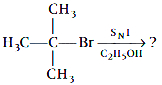
What is the product of the reaction given below?
A
$CH_3-CH_2-CH_2-OC_2H_5$
B
$CH_3-C(CH_3)_2-OC_2H_5$
C
$CH_3-CH(CH_3)-CH(CH_3)-OC_2H_5$
D
$CH_3-C(CH_3)_2-OH$
Solution
(B) The reaction involves the solvolysis of $2$-bromo-$2$-methylpropane in ethanol $(C_2H_5OH)$.
This is an $S_N1$ reaction.
Step $1$: The $C-Br$ bond breaks to form a stable $3^{\circ}$ carbocation,$(CH_3)_3C^+$.
Step $2$: The nucleophile,which is the solvent ethanol $(C_2H_5OH)$,attacks the $3^{\circ}$ carbocation.
This leads to the formation of an ether,$(CH_3)_3C-OC_2H_5$ (tert-butyl ethyl ether),as the major product.
This is an $S_N1$ reaction.
Step $1$: The $C-Br$ bond breaks to form a stable $3^{\circ}$ carbocation,$(CH_3)_3C^+$.
Step $2$: The nucleophile,which is the solvent ethanol $(C_2H_5OH)$,attacks the $3^{\circ}$ carbocation.
This leads to the formation of an ether,$(CH_3)_3C-OC_2H_5$ (tert-butyl ethyl ether),as the major product.
0 likesView Solution
159
ChemistryEasyMCQAP EAMCET · 2020
The increasing order of densities of the following alkyl halides is:
$(I)$ $n-C_3H_7Br$
$(II)$ $n-C_3H_7Cl$
$(III)$ $n-C_3H_7I$
$(I)$ $n-C_3H_7Br$
$(II)$ $n-C_3H_7Cl$
$(III)$ $n-C_3H_7I$
A
$(II) < (I) < (III)$
B
$(III) < (I) < (II)$
C
$(I) < (II) < (III)$
D
$(III) < (II) < (I)$
Solution
(A) For the same alkyl group,the density of alkyl halides increases with the increase in the atomic mass of the halogen atom.
The order of atomic masses of halogens is $Cl < Br < I$.
Therefore,the order of density is $n-C_3H_7Cl < n-C_3H_7Br < n-C_3H_7I$,which corresponds to $(II) < (I) < (III)$.
The order of atomic masses of halogens is $Cl < Br < I$.
Therefore,the order of density is $n-C_3H_7Cl < n-C_3H_7Br < n-C_3H_7I$,which corresponds to $(II) < (I) < (III)$.
0 likesView Solution
160
ChemistryMediumMCQAP EAMCET · 2020
Which of the following undergoes nucleophilic substitution exclusively by $S_N1$ mechanism?
A
Ethyl chloride
B
Isopropyl chloride
C
Chlorobenzene
D
Benzyl chloride
Solution
(D) $S_N1$ mechanism proceeds via the formation of a carbocation intermediate. The stability of the carbocation determines the reactivity.
Benzyl chloride $(C_6H_5CH_2Cl)$ forms a benzyl carbocation $(C_6H_5CH_2^+)$,which is highly stabilized by resonance with the benzene ring.
Ethyl chloride $(CH_3CH_2Cl)$ and isopropyl chloride $(CH_3CHClCH_3)$ primarily undergo $S_N2$ or a mixture of $S_N1/S_N2$ mechanisms depending on conditions,but they are not exclusive $S_N1$ substrates.
Chlorobenzene does not undergo nucleophilic substitution under normal conditions due to partial double bond character in the $C-Cl$ bond.
Therefore,benzyl chloride is the correct answer as it forms a stable carbocation.
Benzyl chloride $(C_6H_5CH_2Cl)$ forms a benzyl carbocation $(C_6H_5CH_2^+)$,which is highly stabilized by resonance with the benzene ring.
Ethyl chloride $(CH_3CH_2Cl)$ and isopropyl chloride $(CH_3CHClCH_3)$ primarily undergo $S_N2$ or a mixture of $S_N1/S_N2$ mechanisms depending on conditions,but they are not exclusive $S_N1$ substrates.
Chlorobenzene does not undergo nucleophilic substitution under normal conditions due to partial double bond character in the $C-Cl$ bond.
Therefore,benzyl chloride is the correct answer as it forms a stable carbocation.
0 likesView Solution
161
ChemistryEasyMCQAP EAMCET · 2020
What is $A$ in the following reaction?
Benzyl chloride + $Cl_2 \xrightarrow{FeCl_3} A + \text{p-chlorobenzyl chloride}$
Benzyl chloride + $Cl_2 \xrightarrow{FeCl_3} A + \text{p-chlorobenzyl chloride}$
A
m-chlorobenzyl chloride
B
o-chlorobenzyl chloride
C
toluene
D
benzal chloride
Solution
(B) The reaction of benzyl chloride with $Cl_2$ in the presence of a Lewis acid catalyst like $FeCl_3$ is an electrophilic aromatic substitution reaction.
The $-CH_2Cl$ group is ortho/para directing due to its inductive effect and the nature of the benzene ring activation.
Therefore,the reaction produces a mixture of ortho-chlorobenzyl chloride and para-chlorobenzyl chloride.
In the given reaction,$A$ represents the ortho-substituted product,which is o-chlorobenzyl chloride.
The $-CH_2Cl$ group is ortho/para directing due to its inductive effect and the nature of the benzene ring activation.
Therefore,the reaction produces a mixture of ortho-chlorobenzyl chloride and para-chlorobenzyl chloride.
In the given reaction,$A$ represents the ortho-substituted product,which is o-chlorobenzyl chloride.
0 likesView Solution
162
ChemistryEasyMCQAP EAMCET · 2020
Which among the following statements is true about the reactivity of haloarenes towards nucleophilic substitution reactions?
$1$. Haloarenes are very reactive towards nucleophilic substitution reaction.
$2$. In haloarenes,the $C-X$ bond acquires partial double bond character.
$3$. The $C-X$ bond in haloarenes is longer than the $C-X$ bond in haloalkanes.
$4$. In haloarenes,the phenyl cation formed as a result of self-ionisation is stable.
$1$. Haloarenes are very reactive towards nucleophilic substitution reaction.
$2$. In haloarenes,the $C-X$ bond acquires partial double bond character.
$3$. The $C-X$ bond in haloarenes is longer than the $C-X$ bond in haloalkanes.
$4$. In haloarenes,the phenyl cation formed as a result of self-ionisation is stable.
A
$1$
B
$2$
C
$3$
D
$4$
Solution
(B) Due to the $+R$ effect of the halogen atom $X$,the $C-X$ bond of haloarene acquires partial double bond character.
This makes the $C-X$ bond shorter and stronger than the $C-X$ bond in haloalkanes,thereby making nucleophilic substitution difficult.
Therefore,statement $2$ is correct.
This makes the $C-X$ bond shorter and stronger than the $C-X$ bond in haloalkanes,thereby making nucleophilic substitution difficult.
Therefore,statement $2$ is correct.
0 likesView Solution
163
ChemistryEasyMCQAP EAMCET · 2020
$1-$chlorobutane on treatment with alcoholic potash forms
A
$2-$butanol
B
$1-$butene
C
$1-$butanol
D
$2-$butene
Solution
(B) Alcoholic $KOH$ acts as a dehydrohalogenating agent. It removes a molecule of $HCl$ from the alkyl halide to form an alkene.
For $1-$chlorobutane,the reaction is:
$CH_3CH_2CH_2CH_2Cl \xrightarrow{\text{Alc. } KOH} CH_3CH_2CH=CH_2 + KCl + H_2O$
This process is known as dehydrohalogenation,and the major product formed is $1-$butene.
Therefore,option $(B)$ is correct.
For $1-$chlorobutane,the reaction is:
$CH_3CH_2CH_2CH_2Cl \xrightarrow{\text{Alc. } KOH} CH_3CH_2CH=CH_2 + KCl + H_2O$
This process is known as dehydrohalogenation,and the major product formed is $1-$butene.
Therefore,option $(B)$ is correct.
0 likesView Solution
164
ChemistryMediumMCQAP EAMCET · 2020
The fraction of voids occupied in the inverse spinel compounds are
A
$1/8^{th}$ of tetrahedral voids and $1/2$ of octahedral voids.
B
$1/2$ of tetrahedral voids and $1/8^{th}$ of octahedral voids.
C
$1/4^{th}$ of tetrahedral voids and $1/8^{th}$ of octahedral voids
D
$1/8^{th}$ of tetrahedral voids and $1/4^{th}$ of octahedral voids
Solution
(A) The general formula for inverse spinel is $B(AB)O_4$,where $O^{2-}$ ions form a $ccp$ lattice.
In inverse spinels,the divalent $A^{2+}$ ions occupy octahedral voids.
The trivalent $B^{3+}$ ions are distributed such that half of them occupy tetrahedral voids and the other half occupy octahedral voids.
Since there are $2$ tetrahedral voids and $1$ octahedral void per $O^{2-}$ ion in a $ccp$ lattice,for $4$ $O^{2-}$ ions,there are $8$ tetrahedral voids and $4$ octahedral voids.
Thus,$B^{3+}$ ions occupy $1/8$ of the $8$ tetrahedral voids (i.e.,$1$ ion) and $1/4$ of the $4$ octahedral voids (i.e.,$1$ ion),while $A^{2+}$ occupies the remaining $1/4$ of octahedral voids (i.e.,$1$ ion).
In inverse spinels,the divalent $A^{2+}$ ions occupy octahedral voids.
The trivalent $B^{3+}$ ions are distributed such that half of them occupy tetrahedral voids and the other half occupy octahedral voids.
Since there are $2$ tetrahedral voids and $1$ octahedral void per $O^{2-}$ ion in a $ccp$ lattice,for $4$ $O^{2-}$ ions,there are $8$ tetrahedral voids and $4$ octahedral voids.
Thus,$B^{3+}$ ions occupy $1/8$ of the $8$ tetrahedral voids (i.e.,$1$ ion) and $1/4$ of the $4$ octahedral voids (i.e.,$1$ ion),while $A^{2+}$ occupies the remaining $1/4$ of octahedral voids (i.e.,$1$ ion).
0 likesView Solution
165
ChemistryEasyMCQAP EAMCET · 2020
Presence of which of the following is suitable for the synthesis of bromobenzene from benzene diazonium salts?
A
$HBr$
B
$MgBr, HBr$
C
$Cu_2Br_2, HBr$
D
$KBr$
Solution
(C) The synthesis of bromobenzene from benzene diazonium salts is a classic example of the Sandmeyer reaction.
In this reaction,the benzene diazonium salt is treated with cuprous bromide $(Cu_2Br_2)$ in the presence of hydrobromic acid $(HBr)$.
The reaction proceeds as follows:
$C_6H_5N_2^+Cl^- + Cu_2Br_2 \xrightarrow{HBr} C_6H_5Br + N_2 + Cu_2Cl_2$
Thus,the presence of $Cu_2Br_2$ and $HBr$ is required.
In this reaction,the benzene diazonium salt is treated with cuprous bromide $(Cu_2Br_2)$ in the presence of hydrobromic acid $(HBr)$.
The reaction proceeds as follows:
$C_6H_5N_2^+Cl^- + Cu_2Br_2 \xrightarrow{HBr} C_6H_5Br + N_2 + Cu_2Cl_2$
Thus,the presence of $Cu_2Br_2$ and $HBr$ is required.
0 likesView Solution
166
ChemistryMediumMCQAP EAMCET · 2020
Identify the product $Y$ in the given reaction sequence:
Benzene $\xrightarrow[Conc. H_2SO_4]{Conc. HNO_3} X$ $\xrightarrow[FeCl_3]{Cl_2} Y$
Benzene $\xrightarrow[Conc. H_2SO_4]{Conc. HNO_3} X$ $\xrightarrow[FeCl_3]{Cl_2} Y$
A
$1-$chloro$-3-$nitrobenzene
B
$3-$chloro$-1-$nitrobenzene
C
$2-$chloro$-1-$nitrobenzene
D
$1-$chloro$-4-$nitrobenzene
Solution
(A) $1$. The first step is the nitration of benzene using a mixture of concentrated $HNO_3$ and concentrated $H_2SO_4$,which produces nitrobenzene $(X)$.
$2$. The second step is the chlorination of nitrobenzene in the presence of a Lewis acid catalyst $(FeCl_3)$.
$3$. The nitro group $(-NO_2)$ is a strong electron-withdrawing group and is meta-directing.
$4$. Therefore,the incoming chlorine atom will attach to the meta-position relative to the nitro group,resulting in $1-$chloro$-3-$nitrobenzene (or $m-$chloronitrobenzene) as the major product $Y$.
$2$. The second step is the chlorination of nitrobenzene in the presence of a Lewis acid catalyst $(FeCl_3)$.
$3$. The nitro group $(-NO_2)$ is a strong electron-withdrawing group and is meta-directing.
$4$. Therefore,the incoming chlorine atom will attach to the meta-position relative to the nitro group,resulting in $1-$chloro$-3-$nitrobenzene (or $m-$chloronitrobenzene) as the major product $Y$.
0 likesView Solution
167
ChemistryEasyMCQAP EAMCET · 2020
The correct order of acidic character of group-$16$ hydrides is
A
$H_2O < H_2S < H_2Se < H_2Te$
B
$H_2O > H_2S > H_2Se > H_2Te$
C
$H_2O < H_2S > H_2Se > H_2Te$
D
$H_2O < H_2S < H_2Se > H_2Te$
Solution
(A) The acidic character of group-$16$ hydrides increases down the group.
This is because the bond dissociation enthalpy of the $M-H$ bond decreases as the size of the central atom increases down the group.
As the $M-H$ bond becomes weaker,it becomes easier to release a proton $(H^+)$.
Therefore,the correct order is $H_2O < H_2S < H_2Se < H_2Te$.
Hence,the correct option is $(A)$.
This is because the bond dissociation enthalpy of the $M-H$ bond decreases as the size of the central atom increases down the group.
As the $M-H$ bond becomes weaker,it becomes easier to release a proton $(H^+)$.
Therefore,the correct order is $H_2O < H_2S < H_2Se < H_2Te$.
Hence,the correct option is $(A)$.
0 likesView Solution
168
ChemistryMediumMCQAP EAMCET · 2020
$K_{H}$ values for $H_2, CO_2, CH_4$ and $O_2$ at $298 \ K$ are $71.18, 1.67, 41.85$ and $34.86 \ kbar$ respectively. Arrange these gases in the increasing order of their solubility.
A
$H_2 < CH_4 < O_2 < CO_2$
B
$H_2 < CH_4 < CO_2 < O_2$
C
$CO_2 < O_2 < CH_4 < H_2$
D
$CO_2 < CH_4 < O_2 < H_2$
Solution
(A) According to Henry's Law,the solubility of a gas in a liquid is inversely proportional to its Henry's Law constant $(K_{H})$.
Mathematically,$S \propto \frac{1}{K_{H}}$.
Given $K_{H}$ values are:
$H_2 = 71.18 \ kbar$
$CH_4 = 41.85 \ kbar$
$O_2 = 34.86 \ kbar$
$CO_2 = 1.67 \ kbar$
Since the solubility is inversely proportional to $K_{H}$,the gas with the highest $K_{H}$ value will have the lowest solubility.
The order of $K_{H}$ values is: $CO_2 < O_2 < CH_4 < H_2$.
Therefore,the increasing order of solubility is: $H_2 < CH_4 < O_2 < CO_2$.
Mathematically,$S \propto \frac{1}{K_{H}}$.
Given $K_{H}$ values are:
$H_2 = 71.18 \ kbar$
$CH_4 = 41.85 \ kbar$
$O_2 = 34.86 \ kbar$
$CO_2 = 1.67 \ kbar$
Since the solubility is inversely proportional to $K_{H}$,the gas with the highest $K_{H}$ value will have the lowest solubility.
The order of $K_{H}$ values is: $CO_2 < O_2 < CH_4 < H_2$.
Therefore,the increasing order of solubility is: $H_2 < CH_4 < O_2 < CO_2$.
0 likesView Solution
169
ChemistryDifficultMCQAP EAMCET · 2020
Dilute sodium hydroxide does not react with which of the following?
A
$Ga$
B
$Al$
C
$Ti$
D
$B$
Solution
(D) Among group-$13$ elements $(B, Al, Ga)$ and titanium $(Ti)$,boron $(B)$ does not react with dilute $NaOH$.
However,boron $(B)$ reacts with concentrated $NaOH$ to form sodium borate and hydrogen gas.
However,boron $(B)$ reacts with concentrated $NaOH$ to form sodium borate and hydrogen gas.
0 likesView Solution
170
ChemistryEasyMCQAP EAMCET · 2020
The 'dry ice' is
A
dry $CO_2$ gas
B
solid $CO_2$
C
dry $SO_2$ gas
D
solid $NH_3$
Solution
(B) Dry ice is the solid form of $CO_2$.
It is a molecular crystal that undergoes sublimation at atmospheric pressure.
It is a molecular crystal that undergoes sublimation at atmospheric pressure.
0 likesView Solution
171
ChemistryDifficultMCQAP EAMCET · 2020
Which of the following mineral acids can attack $SiO_2$?
A
Conc. $HNO_3$
B
$H_2SO_4$
C
$HF$
D
$HCl$
Solution
(C) Hydrofluoric acid $(HF)$ reacts with silicon dioxide $(SiO_2)$ to form silicon tetrafluoride $(SiF_4)$ and water,or hexafluorosilicic acid $(H_2SiF_6)$ in excess $HF$.
The reaction is: $SiO_2 + 4HF \rightarrow SiF_4 + 2H_2O$.
Because of this property,$HF$ is used to etch glass.
Hence,the correct option is $(C)$.
The reaction is: $SiO_2 + 4HF \rightarrow SiF_4 + 2H_2O$.
Because of this property,$HF$ is used to etch glass.
Hence,the correct option is $(C)$.
0 likesView Solution
172
ChemistryEasyMCQAP EAMCET · 2020
Concentrated $HNO_3$ turns brown on standing due to the formation of:
A
$NO$
B
$NO_2$
C
$N_2O$
D
$N_2O_4$
Solution
(B) The decomposition of concentrated $HNO_3$ is represented by the following chemical equation:
$4 HNO_3 \longrightarrow 2 H_2O + 4 NO_2 + O_2$
Due to the formation of nitrogen dioxide $(NO_2)$,which is a brown-colored gas,the concentrated nitric acid turns yellow-brown upon standing.
Hence,option $(B)$ is correct.
$4 HNO_3 \longrightarrow 2 H_2O + 4 NO_2 + O_2$
Due to the formation of nitrogen dioxide $(NO_2)$,which is a brown-colored gas,the concentrated nitric acid turns yellow-brown upon standing.
Hence,option $(B)$ is correct.
0 likesView Solution
173
ChemistryDifficultMCQAP EAMCET · 2020
$A$ pungent smelling gas $A$ gives dense white fumes with conc. $HCl$. When $A$ reacts with an alkaline solution of a colourless reagent $B$,a reddish-brown precipitate $C$ is formed. The compounds $A, B, C$ respectively are:
A
$NO_2, NaOH, [Fe(H_2O)_5NO]^{2+}$
B
$NH_3, NaOH, K_2HgI_4$
C
$NH_3, K_2HgI_4, NH_2Hg_2OI$
D
$Cl_2, \text{Sodium nitroprusside}, [Na_2Fe(CN)_5NOS]$
Solution
(C) Ammonia gas $(NH_3)$ reacts with hydrogen chloride gas $(HCl)$ to form dense white fumes of ammonium chloride $(NH_4Cl)$. This reaction is a characteristic test for ammonia.
$NH_{3(g)} + HCl_{(g)} \longrightarrow NH_4Cl_{(s)}$
Nessler's reagent $(B)$ is an alkaline solution of potassium tetraiodomercurate$(II)$,$K_2HgI_4$. When ammonia reacts with Nessler's reagent in an alkaline medium,it forms a reddish-brown precipitate known as the iodide of Millon's base,which has the formula $NH_2Hg_2OI$ (or $HgO \cdot Hg(NH_2)I$).
Therefore,$A = NH_3$,$B = K_2HgI_4$,and $C = NH_2Hg_2OI$.
$NH_{3(g)} + HCl_{(g)} \longrightarrow NH_4Cl_{(s)}$
Nessler's reagent $(B)$ is an alkaline solution of potassium tetraiodomercurate$(II)$,$K_2HgI_4$. When ammonia reacts with Nessler's reagent in an alkaline medium,it forms a reddish-brown precipitate known as the iodide of Millon's base,which has the formula $NH_2Hg_2OI$ (or $HgO \cdot Hg(NH_2)I$).
Therefore,$A = NH_3$,$B = K_2HgI_4$,and $C = NH_2Hg_2OI$.
0 likesView Solution
174
ChemistryMediumMCQAP EAMCET · 2020
Gas '$X$' is obtained on heating $KClO_3$ with catalyst $MnO_2$. This gas (in excess) on reaction with white phosphorus forms an acidic oxide '$Y$'. '$Y$' on dissolving in water forms a compound '$Z$'. Identify $X, Y$ and $Z$.
A
$O_2, P_2O_5, H_3PO_4$
B
$O_3, P_2O_5, H_3PO_4$
C
$O_2, P_2O_3, H_3PO_3$
D
$O_2, P_2O_5, H_3PO_3$
Solution
(A) $1$. Heating $KClO_3$ in the presence of $MnO_2$ (catalyst) produces oxygen gas $(X)$:
$2KClO_3 \xrightarrow{\Delta, MnO_2} 2KCl + 3O_2(g)$
$2$. Oxygen gas reacts with white phosphorus $(P_4)$ in excess to form phosphorus pentoxide $(Y)$:
$P_4 + 5O_2 \longrightarrow P_4O_{10} \text{ (or } 2P_2O_5)$
$3$. Phosphorus pentoxide $(Y)$ dissolves in water to form phosphoric acid $(Z)$:
$P_4O_{10} + 6H_2O \longrightarrow 4H_3PO_4$
Thus,$X = O_2$,$Y = P_2O_5$,and $Z = H_3PO_4$.
$2KClO_3 \xrightarrow{\Delta, MnO_2} 2KCl + 3O_2(g)$
$2$. Oxygen gas reacts with white phosphorus $(P_4)$ in excess to form phosphorus pentoxide $(Y)$:
$P_4 + 5O_2 \longrightarrow P_4O_{10} \text{ (or } 2P_2O_5)$
$3$. Phosphorus pentoxide $(Y)$ dissolves in water to form phosphoric acid $(Z)$:
$P_4O_{10} + 6H_2O \longrightarrow 4H_3PO_4$
Thus,$X = O_2$,$Y = P_2O_5$,and $Z = H_3PO_4$.
0 likesView Solution
175
ChemistryEasyMCQAP EAMCET · 2020
The formula of the vapour state of white phosphorus is ......
A
$P_5$
B
$P_{16}$
C
$P_3$
D
$P_4$
Solution
(D) White phosphorus exists as discrete $P_4$ molecules in the solid,liquid,and vapour states.
In the vapour state,these $P_4$ molecules maintain a tetrahedral structure where each phosphorus atom is linked to the other three by covalent bonds.
Therefore,the formula of the vapour state of white phosphorus is $P_4$.
Hence,the correct option is $D$.
In the vapour state,these $P_4$ molecules maintain a tetrahedral structure where each phosphorus atom is linked to the other three by covalent bonds.
Therefore,the formula of the vapour state of white phosphorus is $P_4$.
Hence,the correct option is $D$.
0 likesView Solution
176
ChemistryEasyMCQAP EAMCET · 2020
Phosphorus can be stored in
A
Kerosene
B
Alcohol
C
Water
D
Ammonia
Solution
(C) White phosphorus is highly reactive and catches fire spontaneously in air to form phosphorus pentoxide $(P_4O_{10})$. To prevent contact with atmospheric oxygen,it is stored under water.
0 likesView Solution
177
ChemistryEasyMCQAP EAMCET · 2020
Match the following items of List-$I$ with those in List-$II$ and choose the correct option.
| List-$I$ | List-$II$ |
|---|---|
| $(a) \ [S_2 O_3]^{2-}$ | $(I)$ Paramagnetic |
| $(b) \ H_2 O_2$ | $(II)$ Toxic gas |
| $(c) \ H_2 S$ | $(III)$ Strong reducing agent |
| $(d) \ S_2$ | $(IV)$ Disproportionate in presence of $Mn^{2+}$ |
A
$((a)$ $\rightarrow (IV)), ((b)$ $\rightarrow (II)), ((c)$ $\rightarrow (I)), ((d)$ $\rightarrow (III))$
B
$((a)$ $\rightarrow (I)), ((b)$ $\rightarrow (III)), ((c)$ $\rightarrow (IV)), ((d)$ $\rightarrow (II))$
C
$((a)$ $\rightarrow (III)), ((b)$ $\rightarrow (I)), ((c)$ $\rightarrow (II)), ((d)$ $\rightarrow (IV))$
D
$((a)$ $\rightarrow (III)), ((b)$ $\rightarrow (IV)), ((c)$ $\rightarrow (II)), ((d)$ $\rightarrow (I))$
Solution
(D) $(a) \ [S_2 O_3]^{2-}$ (thiosulfate) acts as a strong reducing agent $(III)$.
$(b) \ H_2 O_2$ undergoes disproportionation in the presence of $Mn^{2+}$ ions $(IV)$.
$(c) \ H_2 S$ is a toxic gas $(II)$.
$(d) \ S_2$ is paramagnetic $(I)$ due to the presence of two unpaired electrons in its molecular orbitals,similar to $O_2$.
Therefore,the correct matching is $(a)$ $\rightarrow (III), (b)$ $\rightarrow (IV), (c)$ $\rightarrow (II), (d)$ $\rightarrow (I)$.
$(b) \ H_2 O_2$ undergoes disproportionation in the presence of $Mn^{2+}$ ions $(IV)$.
$(c) \ H_2 S$ is a toxic gas $(II)$.
$(d) \ S_2$ is paramagnetic $(I)$ due to the presence of two unpaired electrons in its molecular orbitals,similar to $O_2$.
Therefore,the correct matching is $(a)$ $\rightarrow (III), (b)$ $\rightarrow (IV), (c)$ $\rightarrow (II), (d)$ $\rightarrow (I)$.
0 likesView Solution
178
ChemistryMediumMCQAP EAMCET · 2020
Identify the products formed when chlorine reacts with cold and dilute sodium hydroxide solution.
A
$NaCl, NaClO_3, H_2O$
B
$NaCl, NaClO_4, H_2O$
C
$NaCl, NaOCl, H_2O$
D
$NaCl, HCl, H_2O$
Solution
(C) When chlorine reacts with cold and dilute sodium hydroxide $(NaOH)$,it undergoes disproportionation to form sodium chloride $(NaCl)$ and sodium hypochlorite $(NaOCl)$.
The chemical equation is: $Cl_2 + 2NaOH \longrightarrow NaCl + NaOCl + H_2O$.
The chemical equation is: $Cl_2 + 2NaOH \longrightarrow NaCl + NaOCl + H_2O$.
0 likesView Solution
179
ChemistryMediumMCQAP EAMCET · 2020
Which halogen can be oxidised by concentrated nitric acid?
A
Fluorine
B
Chlorine
C
Bromine
D
Iodine
Solution
(D) Reducing properties increase from fluorine to iodine,so it is oxidised by nitric acid.
$I_2 + 10 HNO_3 \longrightarrow 2 HIO_3 + 10 NO_2 + 4 H_2O$
Nitric acid oxidises iodine to iodic acid,$HIO_3$,and not periodic acid,$HIO_4$,which is of a higher oxidation state.
Hence,option $(D)$ is the correct.
$I_2 + 10 HNO_3 \longrightarrow 2 HIO_3 + 10 NO_2 + 4 H_2O$
Nitric acid oxidises iodine to iodic acid,$HIO_3$,and not periodic acid,$HIO_4$,which is of a higher oxidation state.
Hence,option $(D)$ is the correct.
0 likesView Solution
180
ChemistryMediumMCQAP EAMCET · 2020
When $SbF_5$ reacts with $XeF_4$ to form an adduct,the shapes of cation and anion in the adduct respectively are
A
square planar,trigonal bipyramidal
B
$T$-shaped,octahedral
C
square pyramidal,octahedral
D
plane triangular,trigonal bipyramidal
Solution
(B) In the reaction between $XeF_4$ and $SbF_5$,$XeF_4$ acts as a fluoride $(F^-)$ donor.
The reaction is: $XeF_4 + SbF_5 \rightarrow [XeF_3]^+ + [SbF_6]^-$.
For the $[XeF_3]^+$ cation,the central $Xe$ atom has $7 + 4 - 1 = 10$ valence electrons,leading to $sp^3d$ hybridization with two lone pairs,resulting in a $T$-shaped structure.
For the $[SbF_6]^-$ anion,the central $Sb$ atom has $5 + 6 + 1 = 12$ valence electrons,leading to $sp^3d^2$ hybridization with no lone pairs,resulting in an octahedral structure.
The reaction is: $XeF_4 + SbF_5 \rightarrow [XeF_3]^+ + [SbF_6]^-$.
For the $[XeF_3]^+$ cation,the central $Xe$ atom has $7 + 4 - 1 = 10$ valence electrons,leading to $sp^3d$ hybridization with two lone pairs,resulting in a $T$-shaped structure.
For the $[SbF_6]^-$ anion,the central $Sb$ atom has $5 + 6 + 1 = 12$ valence electrons,leading to $sp^3d^2$ hybridization with no lone pairs,resulting in an octahedral structure.
0 likesView Solution
181
ChemistryEasyMCQAP EAMCET · 2020
Find the product of the following reaction,when $Xe$ is taken in excess:
$Xe_{(g)} + F_{2(g)} \longrightarrow ?$
$Xe_{(g)} + F_{2(g)} \longrightarrow ?$
A
$XeF_4$
B
$XeF_2$
C
$XeF_6$
D
$XeF_7$
Solution
(B) When excess of xenon gas reacts with fluorine gas at a temperature of $673 \ K$ and a pressure of $1 \ bar$,xenon difluoride $(XeF_2)$ is formed.
$Xe \text{ (excess)} + F_{2(g)} \xrightarrow{673 \ K, 1 \ bar} XeF_2$
Hence,the correct option is $B$.
$Xe \text{ (excess)} + F_{2(g)} \xrightarrow{673 \ K, 1 \ bar} XeF_2$
Hence,the correct option is $B$.
0 likesView Solution
182
ChemistryEasyMCQAP EAMCET · 2020
To avoid bends sickness,the tanks used by scuba divers are filled with air and diluted with ......
A
helium gas
B
argon gas
C
krypton gas
D
xenon gas
Solution
(A) The gas bubbles (like $N_2$) in the bodily fluids affect nerve impulses,giving rise to decompression sickness or bends. These can be painful and fatal. To avoid bends sickness,the tanks used by scuba divers are filled with air diluted with helium gas $(He)$.
0 likesView Solution
183
ChemistryEasyMCQAP EAMCET · 2020
Which of the following does not exist?
A
$XeO_3$
B
$XeOF_4$
C
$XeF_6$
D
$NeF_2$
Solution
(D) Although $Xe$ and $Ne$ are both noble gases,$Xe$ can form compounds with highly electronegative elements like $O$ and $F$ due to its larger atomic size and lower ionization energy.
$Ne$ has a very small atomic size and a very high ionization energy,making it extremely inert.
Therefore,$Ne$ does not form stable chemical bonds with other atoms,and $NeF_2$ does not exist.
$Ne$ has a very small atomic size and a very high ionization energy,making it extremely inert.
Therefore,$Ne$ does not form stable chemical bonds with other atoms,and $NeF_2$ does not exist.
0 likesView Solution
184
ChemistryEasyMCQAP EAMCET · 2020
Which of the following is not a semi-synthetic polymer?
A
$Cis-polyisoprene$
B
Cellulose nitrate
C
Cellulose acetate
D
Vulcanised rubber
Solution
(A) Semi-synthetic polymers are derived from naturally occurring polymers by chemical modifications.
Cellulose nitrate,cellulose acetate,and vulcanised rubber are examples of semi-synthetic polymers.
$Cis-polyisoprene$ (natural rubber) is a natural polymer obtained from the latex of rubber trees.
Cellulose nitrate,cellulose acetate,and vulcanised rubber are examples of semi-synthetic polymers.
$Cis-polyisoprene$ (natural rubber) is a natural polymer obtained from the latex of rubber trees.
0 likesView Solution
185
ChemistryEasyMCQAP EAMCET · 2020
Which of the following is an example of a chain-growth polymer?
A
Bakelite
B
Teflon
C
Nylon
D
Terylene
Solution
(B) Chain-growth polymerization is a process where unsaturated monomer molecules add to the active site of a growing polymer chain one at a time.
Growth of the polymer occurs only at one or more active ends.
Addition of each monomer unit regenerates the active site.
Examples include polyethylene,polypropylene,polyvinyl chloride $(PVC)$,and $Teflon$.
Bakelite,$Nylon$,and $Terylene$ are examples of step-growth polymers.
Hence,option $(B)$ is correct.
Growth of the polymer occurs only at one or more active ends.
Addition of each monomer unit regenerates the active site.
Examples include polyethylene,polypropylene,polyvinyl chloride $(PVC)$,and $Teflon$.
Bakelite,$Nylon$,and $Terylene$ are examples of step-growth polymers.
Hence,option $(B)$ is correct.
0 likesView Solution
186
ChemistryDifficultMCQAP EAMCET · 2020
Which among the following polymers exhibit hydrogen bonding?
A
Polyvinyl chloride
B
Nylon-$6, 6$
C
Neoprene
D
Teflon
Solution
(B) Polyvinyl chloride,neoprene,and teflon are addition homopolymers. They do not contain polar groups capable of forming strong hydrogen bonds.
Nylon-$6, 6$ is a polyamide. It contains amide linkages $(-CONH-)$ where the $N-H$ group acts as a hydrogen bond donor and the $C=O$ group acts as a hydrogen bond acceptor,leading to strong inter-chain hydrogen bonding.
Nylon-$6, 6$ is a polyamide. It contains amide linkages $(-CONH-)$ where the $N-H$ group acts as a hydrogen bond donor and the $C=O$ group acts as a hydrogen bond acceptor,leading to strong inter-chain hydrogen bonding.
0 likesView Solution
187
ChemistryEasyMCQAP EAMCET · 2020
Intermolecular forces in nylon-$6,6$ are
A
dipole-dipole interactions
B
hydrogen bonding
C
van der Waals' forces
D
ionic bonds
Solution
(B) Nylon-$6,6$ is a polyamide polymer.
It contains amide groups $(-CONH-)$ in its chain.
The presence of these groups allows for strong intermolecular hydrogen bonding between the polymer chains,which gives it the properties of a fibre.
It contains amide groups $(-CONH-)$ in its chain.
The presence of these groups allows for strong intermolecular hydrogen bonding between the polymer chains,which gives it the properties of a fibre.
0 likesView Solution
188
ChemistryEasyMCQAP EAMCET · 2020
Which among the following polymers can be formed by using caprolactam monomer unit?
A
Nylon-$6,6$
B
Nylon-$2$-nylon-$6$
C
Melamine polymer
D
Nylon-$6$
Solution
(D) Caprolactam is an intermediate primarily used in the production of nylon-$6$ fibres and resins.
When caprolactam is heated with water at $533-574 \ K$,it undergoes ring-opening polymerization to form nylon-$6$.
When caprolactam is heated with water at $533-574 \ K$,it undergoes ring-opening polymerization to form nylon-$6$.
0 likesView Solution
189
ChemistryEasyMCQAP EAMCET · 2020
Which of the following is an example of a fibre?
A
Polyester
B
Urea-formaldehyde resin
C
Polyvinyl chloride
D
Neoprene
Solution
(A) Polyamides and polyesters are two groups of synthetic fibres that possess high tensile strength,are not easily stretched,and are widely used in the textile industry.
Polyvinyl chloride is a synthetic plastic polymer,and neoprene is a synthetic rubber.
Therefore,polyester is an example of a fibre.
Hence,option $(A)$ is correct.
Polyvinyl chloride is a synthetic plastic polymer,and neoprene is a synthetic rubber.
Therefore,polyester is an example of a fibre.
Hence,option $(A)$ is correct.
0 likesView Solution
190
ChemistryEasyMCQAP EAMCET · 2020
Which of the following polymers is biodegradable?
A
Nylon-$6, 6$
B
Nylon-$2$-nylon-$6$
C
Melamine polymer
D
Nylon-$6$
Solution
(B) Biodegradable polymers are those that can be broken down by microorganisms in the environment.
Nylon-$2$-nylon-$6$ is a polyamide copolymer of glycine and amino caproic acid,which is biodegradable.
Nylon-$6, 6$,Nylon-$6$,and Melamine polymers are synthetic,non-biodegradable polymers.
Therefore,the correct option is $(B)$.
Nylon-$2$-nylon-$6$ is a polyamide copolymer of glycine and amino caproic acid,which is biodegradable.
Nylon-$6, 6$,Nylon-$6$,and Melamine polymers are synthetic,non-biodegradable polymers.
Therefore,the correct option is $(B)$.
0 likesView Solution
191
ChemistryMediumMCQAP EAMCET · 2020
Find the product in the reaction given below:
$HO-CH_2-CH_2-OH + C_6H_4(COOH)_2 \xrightarrow{\text{Polymerisation}} ?$
$HO-CH_2-CH_2-OH + C_6H_4(COOH)_2 \xrightarrow{\text{Polymerisation}} ?$
A
Rayon
B
Buna-$S$
C
Glyptal
D
Neoprene
Solution
(C) The reaction between ethylene glycol $(HO-CH_2-CH_2-OH)$ and phthalic acid $(C_6H_4(COOH)_2)$ is a condensation polymerisation reaction.
This reaction leads to the formation of a polyester known as Glyptal.
Step-growth polymerisation refers to a type of polymerisation mechanism in which bi-functional or multifunctional monomers react to form first dimers,then trimers,longer oligomers,and eventually long-chain polymers.
Hence,the correct option is $C$.
This reaction leads to the formation of a polyester known as Glyptal.
Step-growth polymerisation refers to a type of polymerisation mechanism in which bi-functional or multifunctional monomers react to form first dimers,then trimers,longer oligomers,and eventually long-chain polymers.
Hence,the correct option is $C$.
0 likesView Solution
192
ChemistryEasyMCQAP EAMCET · 2020
Teflon is an example of
A
Formaldehyde resin
B
Polyamide
C
Polyester
D
Addition polymer
Solution
(D) Teflon is a polymer of tetrafluoroethene $(CF_2=CF_2)$.
It is formed by the polymerization of tetrafluoroethene monomers without the loss of any small molecules.
Therefore,it is classified as an addition polymer.
It is formed by the polymerization of tetrafluoroethene monomers without the loss of any small molecules.
Therefore,it is classified as an addition polymer.
0 likesView Solution
193
ChemistryEasyMCQAP EAMCET · 2020
Which of the following can be used as a chain transfer agent during vinyl polymerization?
A
$CCl_4$
B
$C_6H_5OH$
C
$t-butylperoxide$
D
Diphenylamine
Solution
(A) chain transfer agent is a substance that reacts with the growing polymer chain to terminate its growth while simultaneously initiating a new chain.
$CCl_4$ (carbon tetrachloride) acts as an effective chain transfer agent in vinyl polymerization because the $C-Cl$ bond is relatively weak,allowing for the abstraction of a chlorine atom by the growing radical,which terminates the original chain and creates a new radical species to continue the polymerization process.
Therefore,the correct option is $A$.
$CCl_4$ (carbon tetrachloride) acts as an effective chain transfer agent in vinyl polymerization because the $C-Cl$ bond is relatively weak,allowing for the abstraction of a chlorine atom by the growing radical,which terminates the original chain and creates a new radical species to continue the polymerization process.
Therefore,the correct option is $A$.
0 likesView Solution
194
ChemistryMediumMCQAP EAMCET · 2020
Which among the following statements is incorrect for manganate and permanganate ions?
A
Both ions are tetrahedral in structure.
B
In both the ions,$p\pi-d\pi$ bonding is observed between oxygen and manganese.
C
Both ions are paramagnetic.
D
Permanganate is a stronger oxidising agent than manganate.
Solution
(C) For Manganate ion $(MnO_4^{2-})$:
$1$. It has a tetrahedral structure.
$2$. $p\pi-d\pi$ bonding is present between $Mn$ and $O$.
$3$. It is paramagnetic due to the presence of one unpaired $d$-electron in $Mn^{+6}$ $(3d^1)$.
For Permanganate ion $(MnO_4^{-})$:
$1$. It has a tetrahedral structure.
$2$. $p\pi-d\pi$ bonding is present between $Mn$ and $O$.
$3$. It is diamagnetic due to the absence of unpaired $d$-electrons in $Mn^{+7}$ $(3d^0)$.
$4$. It is a stronger oxidising agent than manganate.
Comparing these,statement $C$ is incorrect because manganate is paramagnetic while permanganate is diamagnetic.
$1$. It has a tetrahedral structure.
$2$. $p\pi-d\pi$ bonding is present between $Mn$ and $O$.
$3$. It is paramagnetic due to the presence of one unpaired $d$-electron in $Mn^{+6}$ $(3d^1)$.
For Permanganate ion $(MnO_4^{-})$:
$1$. It has a tetrahedral structure.
$2$. $p\pi-d\pi$ bonding is present between $Mn$ and $O$.
$3$. It is diamagnetic due to the absence of unpaired $d$-electrons in $Mn^{+7}$ $(3d^0)$.
$4$. It is a stronger oxidising agent than manganate.
Comparing these,statement $C$ is incorrect because manganate is paramagnetic while permanganate is diamagnetic.
0 likesView Solution
195
ChemistryMediumMCQAP EAMCET · 2020
The oxidation state of phosphorus in cyclo-tri-meta phosphoric acid is
A
$3$
B
$-3$
C
$-5$
D
$5$
Solution
(D) The formula for cyclo-tri-meta phosphoric acid is $(HPO_3)_3$ or $H_3P_3O_9$.
In this structure,each phosphorus atom is bonded to one double-bonded oxygen,two single-bonded oxygen atoms (one of which is part of the $P-O-P$ linkage),and one hydroxyl group $(-OH)$.
Let the oxidation state of phosphorus be $x$.
In $(HPO_3)_3$,the sum of oxidation states is $3 \times (1 + x + 3 \times (-2)) = 0$.
$3 \times (1 + x - 6) = 0$.
$3 \times (x - 5) = 0$.
$x = 5$.
Therefore,the oxidation state of phosphorus in cyclo-tri-meta phosphoric acid is $5$.
In this structure,each phosphorus atom is bonded to one double-bonded oxygen,two single-bonded oxygen atoms (one of which is part of the $P-O-P$ linkage),and one hydroxyl group $(-OH)$.
Let the oxidation state of phosphorus be $x$.
In $(HPO_3)_3$,the sum of oxidation states is $3 \times (1 + x + 3 \times (-2)) = 0$.
$3 \times (1 + x - 6) = 0$.
$3 \times (x - 5) = 0$.
$x = 5$.
Therefore,the oxidation state of phosphorus in cyclo-tri-meta phosphoric acid is $5$.
0 likesView Solution
196
ChemistryEasyMCQAP EAMCET · 2020
Which metal among the following is most sensitive towards oxidation?
A
$Fe$
B
$Cr$
C
$Ca$
D
$Al$
Solution
(C) The sensitivity of a metal towards oxidation is determined by its standard oxidation potential. Metals with higher positive standard oxidation potentials are more easily oxidized.
Comparing the standard oxidation potentials $(E^o_{ox})$:
$Ca \rightarrow Ca^{2+} + 2e^-$,$E^o_{ox} = +2.87 \ V$
$Al \rightarrow Al^{3+} + 3e^-$,$E^o_{ox} = +1.66 \ V$
$Cr \rightarrow Cr^{3+} + 3e^-$,$E^o_{ox} = +0.74 \ V$
$Fe \rightarrow Fe^{2+} + 2e^-$,$E^o_{ox} = +0.44 \ V$
Since $Ca$ has the highest positive oxidation potential,it is the most sensitive towards oxidation.
Comparing the standard oxidation potentials $(E^o_{ox})$:
$Ca \rightarrow Ca^{2+} + 2e^-$,$E^o_{ox} = +2.87 \ V$
$Al \rightarrow Al^{3+} + 3e^-$,$E^o_{ox} = +1.66 \ V$
$Cr \rightarrow Cr^{3+} + 3e^-$,$E^o_{ox} = +0.74 \ V$
$Fe \rightarrow Fe^{2+} + 2e^-$,$E^o_{ox} = +0.44 \ V$
Since $Ca$ has the highest positive oxidation potential,it is the most sensitive towards oxidation.
0 likesView Solution
197
ChemistryEasyMCQAP EAMCET · 2020
Calculate the coordination number of $Na^{+}$ in $NaCl$ crystal, given the radii of $Na^{+}$ and $Cl^{-}$ are $95 \ pm$ and $181 \ pm$ respectively.
A
$8$
B
$4$
C
$6$
D
$12$
Solution
(C) For $NaCl$ crystal, the radius ratio is calculated as follows:
Radius ratio $= \frac{r_{Na^{+}}}{r_{Cl^{-}}} = \frac{95 \ pm}{181 \ pm} = 0.5248$.
Since the radius ratio $0.5248$ lies in the range of $0.414 - 0.732$, the crystal structure corresponds to an octahedral geometry.
Therefore, the coordination number of $Na^{+}$ in $NaCl$ crystal is $6$.
Radius ratio $= \frac{r_{Na^{+}}}{r_{Cl^{-}}} = \frac{95 \ pm}{181 \ pm} = 0.5248$.
Since the radius ratio $0.5248$ lies in the range of $0.414 - 0.732$, the crystal structure corresponds to an octahedral geometry.
Therefore, the coordination number of $Na^{+}$ in $NaCl$ crystal is $6$.
0 likesView Solution
198
ChemistryMediumMCQAP EAMCET · 2020
Analysis shows that nickel oxide has the formula $Ni_{0.98}O_{1.00}$. The fractions of $Ni^{2+}$ and $Ni^{3+}$ ions in the crystal are ......
A
$Ni^{2+}=98 \%$ and $Ni^{3+}=2 \%$
B
$Ni^{2+}=2 \%$ and $Ni^{3+}=98 \%$
C
$Ni^{2+}=4 \%$ and $Ni^{3+}=96 \%$
D
$Ni^{2+}=96 \%$ and $Ni^{3+}=4 \%$
Solution
(D) Given the formula of nickel oxide is $Ni_{0.98}O_{1.00}$.
Let the number of $Ni^{2+}$ ions be $x$ and the number of $Ni^{3+}$ ions be $(0.98 - x)$.
Since the total charge of the compound must be zero,the sum of positive charges equals the sum of negative charges.
$2x + 3(0.98 - x) + 1(-2) = 0$
$2x + 2.94 - 3x - 2 = 0$
$-x + 0.94 = 0$
$x = 0.94$
So,the fraction of $Ni^{2+}$ ions $= \frac{0.94}{0.98} \times 100 \approx 96 \%$.
The fraction of $Ni^{3+}$ ions $= \frac{0.98 - 0.94}{0.98} \times 100 = \frac{0.04}{0.98} \times 100 \approx 4 \%$.
Therefore,the fractions are $Ni^{2+}=96 \%$ and $Ni^{3+}=4 \%$.
Let the number of $Ni^{2+}$ ions be $x$ and the number of $Ni^{3+}$ ions be $(0.98 - x)$.
Since the total charge of the compound must be zero,the sum of positive charges equals the sum of negative charges.
$2x + 3(0.98 - x) + 1(-2) = 0$
$2x + 2.94 - 3x - 2 = 0$
$-x + 0.94 = 0$
$x = 0.94$
So,the fraction of $Ni^{2+}$ ions $= \frac{0.94}{0.98} \times 100 \approx 96 \%$.
The fraction of $Ni^{3+}$ ions $= \frac{0.98 - 0.94}{0.98} \times 100 = \frac{0.04}{0.98} \times 100 \approx 4 \%$.
Therefore,the fractions are $Ni^{2+}=96 \%$ and $Ni^{3+}=4 \%$.
0 likesView Solution
199
ChemistryEasyMCQAP EAMCET · 2020
When $CaCl_2$ is added to $AgCl$ crystal,the defect introduced is
A
Frenkel defect only
B
Schottky defect only
C
No change
D
Both Frenkel and Schottky defects
Solution
(B) When $CaCl_2$ is added to $AgCl$ crystal,each $Ca^{2+}$ ion replaces two $Ag^{+}$ ions to maintain electrical neutrality.
Since one $Ca^{2+}$ ion replaces two $Ag^{+}$ ions,one $Ag^{+}$ site remains vacant,creating a cation vacancy.
This type of defect is a form of impurity defect,which is related to the Schottky defect mechanism where vacancies are created in the lattice.
Therefore,the introduction of $CaCl_2$ into $AgCl$ leads to the formation of cation vacancies,which is characteristic of Schottky-type defects.
Thus,the correct option is $B$.
Since one $Ca^{2+}$ ion replaces two $Ag^{+}$ ions,one $Ag^{+}$ site remains vacant,creating a cation vacancy.
This type of defect is a form of impurity defect,which is related to the Schottky defect mechanism where vacancies are created in the lattice.
Therefore,the introduction of $CaCl_2$ into $AgCl$ leads to the formation of cation vacancies,which is characteristic of Schottky-type defects.
Thus,the correct option is $B$.
0 likesView Solution
200
ChemistryMediumMCQAP EAMCET · 2020
$A$ metallic solid undergoes Frenkel defect. Its original mass,volume and density are $M_0$,$V_0$ and $D_0$ respectively. After Frenkel defect the mass,volume and density are $M$,$V$ and $D$ respectively. The variations of $M$,$V$ and $D$ after Frenkel defect are
A
$M=M_0, V=V_0, D=D_0$
B
$M < M_0, V < V_0, D < D_0$
C
$M > M_0, V=V_0, D > D_0$
D
$M=M_0, V < V_0, D > D_0$
Solution
(A) In a Frenkel defect,an ion leaves its lattice site and occupies an interstitial site within the same crystal lattice.
Since no atoms or ions are lost from or added to the crystal,the total mass $(M)$ remains constant $(M = M_0)$.
The volume $(V)$ of the crystal remains unchanged because the lattice structure does not expand or contract significantly $(V = V_0)$.
Since density $(D)$ is defined as mass divided by volume $(D = M/V)$,and both mass and volume remain constant,the density remains unchanged $(D = D_0)$.
Therefore,the correct option is $(A)$.
Since no atoms or ions are lost from or added to the crystal,the total mass $(M)$ remains constant $(M = M_0)$.
The volume $(V)$ of the crystal remains unchanged because the lattice structure does not expand or contract significantly $(V = V_0)$.
Since density $(D)$ is defined as mass divided by volume $(D = M/V)$,and both mass and volume remain constant,the density remains unchanged $(D = D_0)$.
Therefore,the correct option is $(A)$.
0 likesView Solution
Vedclass Products
For Students
Vedclass Test Series
Mock tests in real AP EAMCET style covering Chemistry with performance analysis. 5-day free trial.
Start Free TrialFor Teachers
Exam Paper Generator
Generate Set A/B/C/D Chemistry papers from 7.5L+ questions in 2 minutes. 3 chapters free.
Try FreeFor Institutes
Online Exam Module
Run live AP EAMCET mock exams with unlimited students, 360° analytics & white-label branding.
See DemoFrequently Asked Questions
How many Chemistry questions are in AP EAMCET 2020?
There are 492 Chemistry questions from the AP EAMCET 2020 paper on Vedclass, each with a detailed step-by-step solution in English.
Are AP EAMCET 2020 Chemistry solutions available in English?
Yes. All solutions on this page are in English. You can also switch to English or Hindi using the language buttons above the questions.
Can I practice AP EAMCET 2020 Chemistry as a timed test?
Yes. Use the Vedclass Test Series to attempt a full AP EAMCET mock test covering Chemistry with time limits and instant score analysis.
Can teachers create Chemistry papers from AP EAMCET previous year questions?
Yes. The Vedclass Exam Paper Generator lets teachers mix AP EAMCET Chemistry questions and generate Set A/B/C/D papers in minutes.
For Teachers & Institutes
Build a Custom Chemistry Paper
Pick AP EAMCET 2020 Chemistry questions, set difficulty, and generate Set A/B/C/D in 2 minutes.