
ChemistryQ51–150 of 492 questions
Page 2 of 7 · English
51
ChemistryMCQAP EAMCET · 2020
In which of the following molecules/ions are all the bonds not equal?
A
$XeF_4$
B
$BF_4^{-}$
C
$C_2H_4$
D
$SiF_4$
Solution
(C) In $XeF_4$,$BF_4^{-}$,and $SiF_4$,all the central atom-ligand bonds are equivalent due to the high symmetry of the molecules/ions.
In $C_2H_4$ (ethene),there are two types of bonds: $C=C$ double bonds and $C-H$ single bonds.
These bonds differ in bond length,bond energy,and bond order,therefore they are not equal.
In $C_2H_4$ (ethene),there are two types of bonds: $C=C$ double bonds and $C-H$ single bonds.
These bonds differ in bond length,bond energy,and bond order,therefore they are not equal.
0 likesView Solution
52
ChemistryEasyMCQAP EAMCET · 2020
What is the hybridisation of $Be$ in $BeF_2$ molecule?
A
$dsp^2$
B
$sp^2d$
C
$sp$
D
$sp^3$
Solution
(C) The hybridisation state of $Be$ in $BeF_2$ is determined using the formula: $H = \frac{1}{2}(V + M - C + A)$.
Here,$V$ is the number of valence electrons of the central atom $(Be)$ = $2$.
$M$ is the number of monovalent atoms attached $(F)$ = $2$.
$C$ is the cationic charge = $0$.
$A$ is the anionic charge = $0$.
Substituting these values: $H = \frac{1}{2}(2 + 2 - 0 + 0) = 2$.
$A$ value of $2$ corresponds to $sp$ hybridisation.
Thus,the hybridisation of $Be$ in $BeF_2$ is $sp$.
Here,$V$ is the number of valence electrons of the central atom $(Be)$ = $2$.
$M$ is the number of monovalent atoms attached $(F)$ = $2$.
$C$ is the cationic charge = $0$.
$A$ is the anionic charge = $0$.
Substituting these values: $H = \frac{1}{2}(2 + 2 - 0 + 0) = 2$.
$A$ value of $2$ corresponds to $sp$ hybridisation.
Thus,the hybridisation of $Be$ in $BeF_2$ is $sp$.
0 likesView Solution
53
ChemistryEasyMCQAP EAMCET · 2020
The types of hybridisation on the five carbon atoms from left to right in $pent-1-en-4-yne$ are
A
$sp^2, sp^2, sp^3, sp, sp$
B
$sp, sp, sp^3, sp^2, sp^2$
C
$sp^2, sp^3, sp, sp, sp^3$
D
$sp^2, sp, sp^3, sp, sp^2$
Solution
(A) The structure of $pent-1-en-4-yne$ is $CH_2=CH-CH_2-C \equiv CH$.
Let us determine the hybridisation of each carbon atom:
$C_1$: $CH_2=$ (double bond),so it is $sp^2$ hybridised.
$C_2$: $-CH=$ (double bond),so it is $sp^2$ hybridised.
$C_3$: $-CH_2-$ (all single bonds),so it is $sp^3$ hybridised.
$C_4$: $-C \equiv$ (triple bond),so it is $sp$ hybridised.
$C_5$: $\equiv CH$ (triple bond),so it is $sp$ hybridised.
Thus,the hybridisation sequence from left to right is $sp^2, sp^2, sp^3, sp, sp$.
Let us determine the hybridisation of each carbon atom:
$C_1$: $CH_2=$ (double bond),so it is $sp^2$ hybridised.
$C_2$: $-CH=$ (double bond),so it is $sp^2$ hybridised.
$C_3$: $-CH_2-$ (all single bonds),so it is $sp^3$ hybridised.
$C_4$: $-C \equiv$ (triple bond),so it is $sp$ hybridised.
$C_5$: $\equiv CH$ (triple bond),so it is $sp$ hybridised.
Thus,the hybridisation sequence from left to right is $sp^2, sp^2, sp^3, sp, sp$.
0 likesView Solution
54
ChemistryEasyMCQAP EAMCET · 2020
Which of the following molecules can be represented as $AB_2E_2$,where $A$ is the central atom,$B$ represents bond pairs of electrons,and $E$ represents lone pairs of electrons?
A
$SO_2$
B
$H_2O_2$
C
$H_2O$
D
$XeF_2$
Solution
(C) To determine the $AB_nE_m$ type for a molecule,we identify the central atom $(A)$,the number of atoms bonded to it $(B)$,and the number of lone pairs on the central atom $(E)$:
$1$. For $SO_2$: The central atom $S$ has $2$ bond pairs and $1$ lone pair,so it is $AB_2E$.
$2$. For $H_2O_2$: The structure is $H-O-O-H$. Each oxygen atom is bonded to $2$ atoms and has $2$ lone pairs,but it is not a simple $AB_2E_2$ system due to the $O-O$ bond.
$3$. For $H_2O$: The central oxygen atom is bonded to $2$ hydrogen atoms $(B=2)$ and has $2$ lone pairs $(E=2)$. Thus,it is $AB_2E_2$.
$4$. For $XeF_2$: The central xenon atom is bonded to $2$ fluorine atoms $(B=2)$ and has $3$ lone pairs $(E=3)$. Thus,it is $AB_2E_3$.
Therefore,the correct molecule is $H_2O$.
$1$. For $SO_2$: The central atom $S$ has $2$ bond pairs and $1$ lone pair,so it is $AB_2E$.
$2$. For $H_2O_2$: The structure is $H-O-O-H$. Each oxygen atom is bonded to $2$ atoms and has $2$ lone pairs,but it is not a simple $AB_2E_2$ system due to the $O-O$ bond.
$3$. For $H_2O$: The central oxygen atom is bonded to $2$ hydrogen atoms $(B=2)$ and has $2$ lone pairs $(E=2)$. Thus,it is $AB_2E_2$.
$4$. For $XeF_2$: The central xenon atom is bonded to $2$ fluorine atoms $(B=2)$ and has $3$ lone pairs $(E=3)$. Thus,it is $AB_2E_3$.
Therefore,the correct molecule is $H_2O$.
0 likesView Solution
55
ChemistryEasyMCQAP EAMCET · 2020
The number of $120^{\circ}$ $Cl-P-Cl$ angles in phosphorus pentachloride is
A
$3$
B
$6$
C
$9$
D
$1$
Solution
(A) The geometry of the phosphorus pentachloride $(PCl_5)$ molecule is trigonal bipyramidal,where the central $P$ atom is $sp^3d$ hybridized.
In this structure,three $Cl$ atoms are located at the equatorial positions,forming a trigonal plane.
The bond angle between any two equatorial $Cl-P-Cl$ bonds is $120^{\circ}$.
Since there are three such equatorial $Cl$ atoms,the number of $120^{\circ}$ angles is $3$ (specifically,the angles between equatorial-equatorial bonds).
In this structure,three $Cl$ atoms are located at the equatorial positions,forming a trigonal plane.
The bond angle between any two equatorial $Cl-P-Cl$ bonds is $120^{\circ}$.
Since there are three such equatorial $Cl$ atoms,the number of $120^{\circ}$ angles is $3$ (specifically,the angles between equatorial-equatorial bonds).
0 likesView Solution
56
ChemistryEasyMCQAP EAMCET · 2020
The linear shape of $CO_2$ is due to
A
$sp^3$-hybridisation of carbon
B
$sp$-hybridisation of carbon
C
$p\pi-d\pi$ bonding between carbon and oxygen
D
$sp^2$-hybridisation of carbon
Solution
(B) The geometry of $CO_2$ is linear.
In $CO_2$,the carbon atom is bonded to two oxygen atoms by double bonds.
The carbon atom undergoes $sp$-hybridisation,resulting in two $sp$-hybrid orbitals oriented at an angle of $180^{\circ}$.
There are no lone pairs on the central carbon atom,which maintains the linear geometry.
Hence,option $(B)$ is correct.
In $CO_2$,the carbon atom is bonded to two oxygen atoms by double bonds.
The carbon atom undergoes $sp$-hybridisation,resulting in two $sp$-hybrid orbitals oriented at an angle of $180^{\circ}$.
There are no lone pairs on the central carbon atom,which maintains the linear geometry.
Hence,option $(B)$ is correct.
0 likesView Solution
57
ChemistryEasyMCQAP EAMCET · 2020
What is the shape of $I_3^{-}$ ion?
A
Trigonal
B
Linear
C
Bent
D
Trigonal planar
Solution
(B) The central iodine atom in the $I_3^{-}$ ion is surrounded by $3$ lone pairs and $2$ bond pairs,resulting in a total of $5$ electron pairs.
According to $VSEPR$ theory,this corresponds to $sp^3d$ hybridization with a trigonal bipyramidal electron geometry.
Since the $3$ lone pairs occupy the equatorial positions to minimize repulsion,the remaining $2$ iodine atoms occupy the axial positions,resulting in a linear molecular geometry.
Hence,the correct option is $B$.
According to $VSEPR$ theory,this corresponds to $sp^3d$ hybridization with a trigonal bipyramidal electron geometry.
Since the $3$ lone pairs occupy the equatorial positions to minimize repulsion,the remaining $2$ iodine atoms occupy the axial positions,resulting in a linear molecular geometry.
Hence,the correct option is $B$.
0 likesView Solution
58
ChemistryMediumMCQAP EAMCET · 2020
Which of the following statements is correct about $CO_3^{2-}$ ?
$A$. The hybridisation of the central atom is $sp^3$.
$B$. Its resonance structure has one $C-O$ single bond and two $C=O$ double bonds.
$C$. The average formal charge on each oxygen atom is $0.67$ units.
$D$. All $C-O$ bond lengths are equal.
$A$. The hybridisation of the central atom is $sp^3$.
$B$. Its resonance structure has one $C-O$ single bond and two $C=O$ double bonds.
$C$. The average formal charge on each oxygen atom is $0.67$ units.
$D$. All $C-O$ bond lengths are equal.
A
$A$
B
$A$ and $C$
C
$B$ and $D$
D
$C$ and $D$
Solution
(D) The hybridisation of the central carbon atom is $sp^2$ (trigonal planar geometry).
Since a net charge of $-2$ is delocalized over $3$ oxygen atoms,the average formal charge on each oxygen atom is $|-2/3| = 0.67$ units.
Due to resonance,the $C-O$ bonds are not fixed as single or double,and therefore,all $C-O$ bond lengths are equal.
Thus,statements $C$ and $D$ are correct.
Since a net charge of $-2$ is delocalized over $3$ oxygen atoms,the average formal charge on each oxygen atom is $|-2/3| = 0.67$ units.
Due to resonance,the $C-O$ bonds are not fixed as single or double,and therefore,all $C-O$ bond lengths are equal.
Thus,statements $C$ and $D$ are correct.
0 likesView Solution
59
ChemistryMediumMCQAP EAMCET · 2020
Which among the following represents the correct order of variation of bond angles in the given molecules?
A
$NH_3 > NF_3 > PCl_3 > BF_3$
B
$BF_3 > PCl_3 > NH_3 > NF_3$
C
$BF_3 > NH_3 > PCl_3 > NF_3$
D
$BF_3 > NH_3 > NF_3 > PCl_3$
Solution
(D) The bond angles for the given molecules are as follows:
$BF_3$: $120^{\circ}$ (trigonal planar geometry)
$NH_3$: $107^{\circ}$ (pyramidal geometry)
$NF_3$: $102^{\circ}$ (pyramidal geometry,lower than $NH_3$ due to higher electronegativity of $F$)
$PCl_3$: $100^{\circ}$ (pyramidal geometry,lower than $NH_3$ due to larger size of $P$ atom)
Thus,the correct order of bond angles is $BF_3 > NH_3 > NF_3 > PCl_3$.
Therefore,the correct option is $(D)$.
$BF_3$: $120^{\circ}$ (trigonal planar geometry)
$NH_3$: $107^{\circ}$ (pyramidal geometry)
$NF_3$: $102^{\circ}$ (pyramidal geometry,lower than $NH_3$ due to higher electronegativity of $F$)
$PCl_3$: $100^{\circ}$ (pyramidal geometry,lower than $NH_3$ due to larger size of $P$ atom)
Thus,the correct order of bond angles is $BF_3 > NH_3 > NF_3 > PCl_3$.
Therefore,the correct option is $(D)$.
0 likesView Solution
60
ChemistryEasyMCQAP EAMCET · 2020
The molecular geometry of $PF_3$ is $...$.
A
tetrahedral
B
pyramidal
C
trigonal planar
D
square planar
Solution
(B) The central $P$ atom in $PF_3$ has $5$ valence electrons. It forms $3$ $P-F$ bonds and has $1$ lone pair of electrons.
Total electron pairs = $3$ (bonding) + $1$ (lone pair) = $4$.
According to $VSEPR$ theory,$4$ electron pairs result in a tetrahedral electron geometry.
Due to the presence of one lone pair,the molecular geometry is trigonal pyramidal.
Thus,the correct option is $B$.
Total electron pairs = $3$ (bonding) + $1$ (lone pair) = $4$.
According to $VSEPR$ theory,$4$ electron pairs result in a tetrahedral electron geometry.
Due to the presence of one lone pair,the molecular geometry is trigonal pyramidal.
Thus,the correct option is $B$.
0 likesView Solution
61
ChemistryMediumMCQAP EAMCET · 2020
Which of the following statements is true regarding the $PCl_5$ molecule?
$(i)$ The two axial $P-Cl$ bonds in $PCl_5$ are longer than the three equatorial bonds.
$(ii)$ The axial bonds in $PCl_5$ are stronger than equatorial bonds.
$(iii)$ The axial bonds in $PCl_5$ are more stable than equatorial bonds.
$(iv)$ All five bonds in $PCl_5$ molecule are equivalent.
$(i)$ The two axial $P-Cl$ bonds in $PCl_5$ are longer than the three equatorial bonds.
$(ii)$ The axial bonds in $PCl_5$ are stronger than equatorial bonds.
$(iii)$ The axial bonds in $PCl_5$ are more stable than equatorial bonds.
$(iv)$ All five bonds in $PCl_5$ molecule are equivalent.
A
$(i)$
B
$(ii)$
C
$(iii)$
D
$(iv)$
Solution
(A) In $PCl_5$,the phosphorus atom undergoes $sp^3d$ hybridization,resulting in a trigonal bipyramidal geometry.
There are three equatorial bonds and two axial bonds.
The axial bonds experience greater repulsion from the three equatorial bonds because they are at a $90^{\circ}$ angle to them.
Consequently,the axial $P-Cl$ bonds are longer and weaker than the equatorial $P-Cl$ bonds.
Therefore,statement $(i)$ is true.
There are three equatorial bonds and two axial bonds.
The axial bonds experience greater repulsion from the three equatorial bonds because they are at a $90^{\circ}$ angle to them.
Consequently,the axial $P-Cl$ bonds are longer and weaker than the equatorial $P-Cl$ bonds.
Therefore,statement $(i)$ is true.
0 likesView Solution
62
ChemistryEasyMCQAP EAMCET · 2020
Which of the following species has tetrahedral geometry?
A
$BH_4^{-}$
B
$NH_2^{-}$
C
$CO_3^{2-}$
D
$H_3O^{+}$
Solution
(A) The central $B$ atom in $BH_4^{-}$ undergoes $sp^3$ hybridisation.
This results in a tetrahedral geometry with $4$ bond pairs and $0$ lone pairs of electrons,as shown in the structure.
This results in a tetrahedral geometry with $4$ bond pairs and $0$ lone pairs of electrons,as shown in the structure.
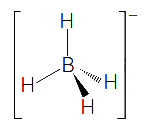
0 likesView Solution
63
ChemistryEasyMCQAP EAMCET · 2020
What is the molecular geometry of $H_3O^{+}$?
A
Trigonal pyramidal
B
Square planar
C
Trigonal bipyramidal
D
Trigonal planar
Solution
(A) The central oxygen atom in $H_3O^{+}$ is $sp^3$ hybridized.
It has $3$ bond pairs and $1$ lone pair of electrons,resulting in a total of $4$ electron domains.
According to the $\text{VSEPR}$ theory,the electron geometry is tetrahedral,but the presence of one lone pair distorts the shape.
Therefore,the molecular geometry of $H_3O^{+}$ is trigonal pyramidal.
Hence,the correct option is $(A)$.
It has $3$ bond pairs and $1$ lone pair of electrons,resulting in a total of $4$ electron domains.
According to the $\text{VSEPR}$ theory,the electron geometry is tetrahedral,but the presence of one lone pair distorts the shape.
Therefore,the molecular geometry of $H_3O^{+}$ is trigonal pyramidal.
Hence,the correct option is $(A)$.
0 likesView Solution
64
ChemistryMediumMCQAP EAMCET · 2020
The isostructural molecules among $CO_2, SiO_2, SO_2, TeO_2, [NO_2]^{+}$ are
A
$CO_2, SO_2, TeO_2$
B
$CO_2, SiO_2, [NO_2]^{+}$
C
$CO_2, [NO_2]^{+}$
D
$SO_2, TeO_2$
Solution
(C) To determine isostructural molecules,we check the hybridization and geometry of the central atom:
$CO_2$: The central $C$ atom is $sp$-hybridized,resulting in a linear geometry.
$[NO_2]^{+}$: The central $N$ atom is $sp$-hybridized,resulting in a linear geometry.
$SiO_2$: Exists as a giant covalent network (quartz) with $sp^3$ hybridization.
$SO_2$ and $TeO_2$: Both have $sp^2$ hybridization with one lone pair,resulting in a bent (angular) geometry.
Since both $CO_2$ and $[NO_2]^{+}$ are linear,they are isostructural.
Thus,the correct option is $C$.
$CO_2$: The central $C$ atom is $sp$-hybridized,resulting in a linear geometry.
$[NO_2]^{+}$: The central $N$ atom is $sp$-hybridized,resulting in a linear geometry.
$SiO_2$: Exists as a giant covalent network (quartz) with $sp^3$ hybridization.
$SO_2$ and $TeO_2$: Both have $sp^2$ hybridization with one lone pair,resulting in a bent (angular) geometry.
Since both $CO_2$ and $[NO_2]^{+}$ are linear,they are isostructural.
Thus,the correct option is $C$.
0 likesView Solution
65
ChemistryMediumMCQAP EAMCET · 2020
Which of the following statements is incorrect?
$(i)$ $NaCl$,being an ionic compound,is a good conductor of electricity in the solid state.
$(ii)$ In canonical structures,there is no difference in the arrangement of atoms.
$(iii)$ Hybrid orbitals form stronger bonds than pure orbitals.
$(iv)$ $VSEPR$ theory can explain the square planar geometry of $XeF_4$.
$(i)$ $NaCl$,being an ionic compound,is a good conductor of electricity in the solid state.
$(ii)$ In canonical structures,there is no difference in the arrangement of atoms.
$(iii)$ Hybrid orbitals form stronger bonds than pure orbitals.
$(iv)$ $VSEPR$ theory can explain the square planar geometry of $XeF_4$.
A
$(i)$
B
$(ii)$
C
$(iii)$
D
$(iv)$
Solution
(A) In the solid state,$NaCl$ exists as a rigid crystal lattice where ions are held together by strong electrostatic forces of attraction. Since there are no free ions or electrons to carry charge,it is a poor conductor of electricity in the solid state. It conducts electricity only in the molten state or in an aqueous solution where ions become free to move. Thus,statement $(i)$ is incorrect.
Statement $(ii)$ is correct as canonical structures differ only in the distribution of electrons,not the positions of atoms.
Statement $(iii)$ is correct because hybrid orbitals have more directional character,leading to better overlap.
Statement $(iv)$ is correct as $VSEPR$ theory accounts for the lone pairs on $Xe$ in $XeF_4$ to predict its square planar geometry.
Statement $(ii)$ is correct as canonical structures differ only in the distribution of electrons,not the positions of atoms.
Statement $(iii)$ is correct because hybrid orbitals have more directional character,leading to better overlap.
Statement $(iv)$ is correct as $VSEPR$ theory accounts for the lone pairs on $Xe$ in $XeF_4$ to predict its square planar geometry.
0 likesView Solution
66
ChemistryMediumMCQAP EAMCET · 2020
The hybridizations of $C_2$ and $C_3$ in the molecule $H_3C-CH=C=CH-CH_3$ are respectively:
A
$sp, sp^3$
B
$sp^2, sp$
C
$sp^2, sp^2$
D
$sp, sp$
Solution
(B) In the molecule $H_3C-CH=C=CH-CH_3$,let us number the carbon atoms from left to right: $C_1(H_3)-C_2(H)=C_3=C_4(H)-C_5(H_3)$.
$C_2$ is bonded to one hydrogen atom,one carbon atom via a single bond,and one carbon atom via a double bond. It has $3$ sigma bonds and $0$ lone pairs,resulting in $sp^2$ hybridization.
$C_3$ is bonded to two carbon atoms via double bonds on both sides. It has $2$ sigma bonds and $0$ lone pairs,resulting in $sp$ hybridization.
Therefore,the hybridizations of $C_2$ and $C_3$ are $sp^2$ and $sp$ respectively.
$C_2$ is bonded to one hydrogen atom,one carbon atom via a single bond,and one carbon atom via a double bond. It has $3$ sigma bonds and $0$ lone pairs,resulting in $sp^2$ hybridization.
$C_3$ is bonded to two carbon atoms via double bonds on both sides. It has $2$ sigma bonds and $0$ lone pairs,resulting in $sp$ hybridization.
Therefore,the hybridizations of $C_2$ and $C_3$ are $sp^2$ and $sp$ respectively.
0 likesView Solution
67
ChemistryMediumMCQAP EAMCET · 2020
Which of the following sets of species have similar bond order?
A
$N_2, O_2^{2-}, NO^{+}$
B
$N_2, F_2, O_2^{2-}$
C
$N_2, N_2^{2-}, O_2^{-}$
D
$N_2, CO, NO^{+}$
Solution
(D) The bond order $(BO)$ is calculated using the formula: $BO = \frac{N_b - N_a}{2}$.
For $N_2$ $(14 \ e^-)$: $BO = \frac{10 - 4}{2} = 3$.
For $CO$ $(14 \ e^-)$: $BO = \frac{10 - 4}{2} = 3$.
For $NO^+$ $(14 \ e^-)$: $BO = \frac{10 - 4}{2} = 3$.
Since $N_2$,$CO$,and $NO^+$ all have a bond order of $3$,they have similar bond orders.
Therefore,the correct set is $(N_2, CO, NO^{+})$.
For $N_2$ $(14 \ e^-)$: $BO = \frac{10 - 4}{2} = 3$.
For $CO$ $(14 \ e^-)$: $BO = \frac{10 - 4}{2} = 3$.
For $NO^+$ $(14 \ e^-)$: $BO = \frac{10 - 4}{2} = 3$.
Since $N_2$,$CO$,and $NO^+$ all have a bond order of $3$,they have similar bond orders.
Therefore,the correct set is $(N_2, CO, NO^{+})$.
0 likesView Solution
68
ChemistryEasyMCQAP EAMCET · 2020
The magnetic property of $NO_2$ is
A
Ferromagnetic
B
Diamagnetic
C
Non-magnetic
D
Paramagnetic
Solution
(D) The nitrogen dioxide molecule $(NO_2)$ has a total of $17$ valence electrons ($5$ from $N$ and $6 \times 2 = 12$ from $O$).
Due to the odd number of electrons,there is an unpaired electron present on the nitrogen atom.
This unpaired electron makes the $NO_2$ molecule paramagnetic.
Due to the odd number of electrons,there is an unpaired electron present on the nitrogen atom.
This unpaired electron makes the $NO_2$ molecule paramagnetic.
0 likesView Solution
69
ChemistryEasyMCQAP EAMCET · 2020
The bond stability of $N_2$,$N_2^{-}$,and $N_2^{2-}$ varies as:
A
$N_2 < N_2^{-} < N_2^{2-}$
B
$N_2^{-} < N_2 < N_2^{2-}$
C
$N_2^{2-} < N_2^{-} < N_2$
D
$N_2^{-} < N_2^{2-} < N_2$
Solution
(C) The stability of a molecule is directly proportional to its bond order:
Stability $\propto$ Bond order.
Using Molecular Orbital Theory $(MOT)$,the electronic configurations are:
$N_2$ ($14$ electrons): $(\sigma 1s)^2 (\sigma^* 1s)^2 (\sigma 2s)^2 (\sigma^* 2s)^2 (\pi 2p_x)^2 (\pi 2p_y)^2 (\sigma 2p_z)^2$. Bond order = $(10-4)/2 = 3$.
$N_2^{-}$ ($15$ electrons): $(\sigma 1s)^2 (\sigma^* 1s)^2 (\sigma 2s)^2 (\sigma^* 2s)^2 (\pi 2p_x)^2 (\pi 2p_y)^2 (\sigma 2p_z)^2 (\pi^* 2p_x)^1$. Bond order = $(10-5)/2 = 2.5$.
$N_2^{2-}$ ($16$ electrons): $(\sigma 1s)^2 (\sigma^* 1s)^2 (\sigma 2s)^2 (\sigma^* 2s)^2 (\pi 2p_x)^2 (\pi 2p_y)^2 (\sigma 2p_z)^2 (\pi^* 2p_x)^1 (\pi^* 2p_y)^1$. Bond order = $(10-6)/2 = 2$.
Since the bond order follows the order $N_2 > N_2^{-} > N_2^{2-}$,the stability follows the same order: $N_2^{2-} < N_2^{-} < N_2$.
Thus,the correct option is $(C)$.
Stability $\propto$ Bond order.
Using Molecular Orbital Theory $(MOT)$,the electronic configurations are:
$N_2$ ($14$ electrons): $(\sigma 1s)^2 (\sigma^* 1s)^2 (\sigma 2s)^2 (\sigma^* 2s)^2 (\pi 2p_x)^2 (\pi 2p_y)^2 (\sigma 2p_z)^2$. Bond order = $(10-4)/2 = 3$.
$N_2^{-}$ ($15$ electrons): $(\sigma 1s)^2 (\sigma^* 1s)^2 (\sigma 2s)^2 (\sigma^* 2s)^2 (\pi 2p_x)^2 (\pi 2p_y)^2 (\sigma 2p_z)^2 (\pi^* 2p_x)^1$. Bond order = $(10-5)/2 = 2.5$.
$N_2^{2-}$ ($16$ electrons): $(\sigma 1s)^2 (\sigma^* 1s)^2 (\sigma 2s)^2 (\sigma^* 2s)^2 (\pi 2p_x)^2 (\pi 2p_y)^2 (\sigma 2p_z)^2 (\pi^* 2p_x)^1 (\pi^* 2p_y)^1$. Bond order = $(10-6)/2 = 2$.
Since the bond order follows the order $N_2 > N_2^{-} > N_2^{2-}$,the stability follows the same order: $N_2^{2-} < N_2^{-} < N_2$.
Thus,the correct option is $(C)$.
0 likesView Solution
70
ChemistryMediumMCQAP EAMCET · 2020
Arrange $O_2$,$O_2[AsF_6]$,and $KO_2$ in the increasing order of bond length of the $O-O$ bond.
A
$O_2 < KO_2 < O_2[AsF_6]$
B
$KO_2 < O_2 < O_2[AsF_6]$
C
$O_2[AsF_6] < KO_2 < O_2$
D
$O_2[AsF_6] < O_2 < KO_2$
Solution
(D) The bond length is inversely proportional to the bond order: $\text{Bond length} \propto \frac{1}{\text{Bond order}}$.
In $KO_2$,the species is $O_2^-$,which has a bond order of $1.5$.
In $O_2$,the bond order is $2.0$.
In $O_2[AsF_6]$,the species is $O_2^+$,which has a bond order of $2.5$.
Since the bond order follows the order $O_2^+ (2.5) > O_2 (2.0) > O_2^- (1.5)$,the bond length follows the reverse order: $O_2[AsF_6] < O_2 < KO_2$.
In $KO_2$,the species is $O_2^-$,which has a bond order of $1.5$.
In $O_2$,the bond order is $2.0$.
In $O_2[AsF_6]$,the species is $O_2^+$,which has a bond order of $2.5$.
Since the bond order follows the order $O_2^+ (2.5) > O_2 (2.0) > O_2^- (1.5)$,the bond length follows the reverse order: $O_2[AsF_6] < O_2 < KO_2$.
0 likesView Solution
71
ChemistryMediumMCQAP EAMCET · 2020
The correct order of increasing ionic character among $LiH$,$NaH$,$KH$,$RbH$,$CsH$ is
A
$LiH < NaH < CsH < KH < RbH$
B
$LiH < NaH < KH < RbH < CsH$
C
$RbH < CsH < NaH < KH < LiH$
D
$NaH < CsH < RbH < LiH < KH$
Solution
(B) The ionic character of metal hydrides depends on the electronegativity difference between the metal and hydrogen.
As we move down the group from $Li$ to $Cs$,the electronegativity of the alkali metal decreases.
Consequently,the electronegativity difference between the metal and hydrogen increases,leading to an increase in the ionic character of the metal hydride.
Therefore,the order of increasing ionic character is $LiH < NaH < KH < RbH < CsH$.
Hence,the correct option is $B$.
As we move down the group from $Li$ to $Cs$,the electronegativity of the alkali metal decreases.
Consequently,the electronegativity difference between the metal and hydrogen increases,leading to an increase in the ionic character of the metal hydride.
Therefore,the order of increasing ionic character is $LiH < NaH < KH < RbH < CsH$.
Hence,the correct option is $B$.
0 likesView Solution
72
ChemistryEasyMCQAP EAMCET · 2020
In which of the following substances will hydrogen bonds be strongest?
A
$HCl$
B
$H_2O$
C
$HI$
D
$H_2S$
Solution
(B) The strength of hydrogen bonding depends on the electronegativity of the atom bonded to the hydrogen atom. The order of electronegativity is $F > O > N > Cl$.
Hydrogen bonding is significant when $H$ is bonded to highly electronegative elements like $F$,$O$,or $N$.
$HI$ and $H_2S$ do not form significant hydrogen bonds.
In $HCl$,the electronegativity difference is small,making $H$-bonding very weak.
Among the given options,$H_2O$ contains $O-H$ bonds,which exhibit the strongest hydrogen bonding.
Hydrogen bonding is significant when $H$ is bonded to highly electronegative elements like $F$,$O$,or $N$.
$HI$ and $H_2S$ do not form significant hydrogen bonds.
In $HCl$,the electronegativity difference is small,making $H$-bonding very weak.
Among the given options,$H_2O$ contains $O-H$ bonds,which exhibit the strongest hydrogen bonding.
0 likesView Solution
73
ChemistryEasyMCQAP EAMCET · 2020
The number of hydrogen bonds formed by a water molecule at normal conditions is
A
$1$
B
$2$
C
$3$
D
$4$
Solution
(D) In a water molecule $(H_2O)$,the oxygen atom is $sp^3$ hybridized and has two lone pairs of electrons.
Each water molecule can form hydrogen bonds through its two hydrogen atoms (as donors) and its two lone pairs on the oxygen atom (as acceptors).
Therefore,a single water molecule can theoretically form up to $4$ hydrogen bonds with surrounding water molecules.
In liquid water at $25^{\circ}C$,due to thermal motion,the average number of hydrogen bonds per molecule is approximately $3.4$ to $3.6$.
Among the given options,$4$ represents the maximum number of hydrogen bonds a water molecule can form in its tetrahedral structure.
Hence,the correct option is $(D)$.
Each water molecule can form hydrogen bonds through its two hydrogen atoms (as donors) and its two lone pairs on the oxygen atom (as acceptors).
Therefore,a single water molecule can theoretically form up to $4$ hydrogen bonds with surrounding water molecules.
In liquid water at $25^{\circ}C$,due to thermal motion,the average number of hydrogen bonds per molecule is approximately $3.4$ to $3.6$.
Among the given options,$4$ represents the maximum number of hydrogen bonds a water molecule can form in its tetrahedral structure.
Hence,the correct option is $(D)$.
0 likesView Solution
74
ChemistryMediumMCQAP EAMCET · 2020
The dipole-dipole interaction energy between polar molecules in the solid state will be proportional to ...... [if $r$ denotes the distance between polar molecules]
A
$1/r^6$
B
$1/r^3$
C
$1/r^2$
D
$1/r$
Solution
(B) The dipole-dipole interaction energy between stationary polar molecules is inversely proportional to the cube of the distance between them.
Mathematically,the potential energy $V$ is given by $V \propto \frac{1}{r^3}$.
Therefore,the interaction energy is proportional to $\frac{1}{r^3}$.
Hence,the correct option is $B$.
Mathematically,the potential energy $V$ is given by $V \propto \frac{1}{r^3}$.
Therefore,the interaction energy is proportional to $\frac{1}{r^3}$.
Hence,the correct option is $B$.
0 likesView Solution
75
ChemistryEasyMCQAP EAMCET · 2020
Which of the following represents the structure of inorganic benzene?
A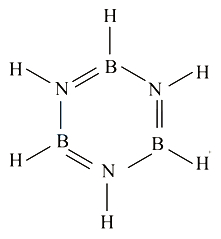
B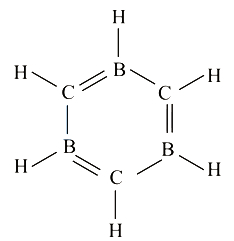
C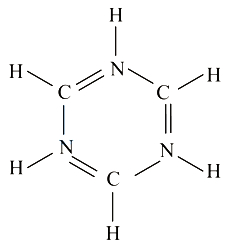
D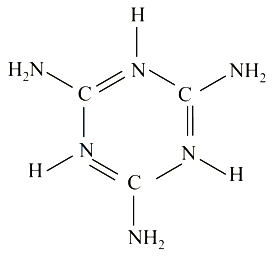
Solution
(A) Inorganic benzene,also known as borazine $(B_3N_3H_6)$,is isoelectronic with benzene $(C_6H_6)$.
It consists of a hexagonal ring with alternating boron and nitrogen atoms,where each boron and nitrogen atom is bonded to one hydrogen atom.
The structure is stabilized by resonance,similar to benzene,and is often represented with partial charges on the atoms $(B^{\delta-}-N^{\delta+})$ due to the difference in electronegativity between boron and nitrogen.
Option $A$ correctly depicts this alternating $B-N$ hexagonal structure.
It consists of a hexagonal ring with alternating boron and nitrogen atoms,where each boron and nitrogen atom is bonded to one hydrogen atom.
The structure is stabilized by resonance,similar to benzene,and is often represented with partial charges on the atoms $(B^{\delta-}-N^{\delta+})$ due to the difference in electronegativity between boron and nitrogen.
Option $A$ correctly depicts this alternating $B-N$ hexagonal structure.
0 likesView Solution
76
ChemistryEasyMCQAP EAMCET · 2020
For a reversible reaction,if the concentration of the reactants is reduced to half,the equilibrium constant will be.........
A
doubled
B
halved
C
reduced to one-fourth
D
remains same
Solution
(D) The value of the equilibrium constant $K_{eq}$ depends only on the temperature of the reaction.
It is independent of the initial concentrations of reactants and products.
Therefore,if the concentration of the reactants is reduced to half,the equilibrium constant remains the same.
It is independent of the initial concentrations of reactants and products.
Therefore,if the concentration of the reactants is reduced to half,the equilibrium constant remains the same.
0 likesView Solution
77
ChemistryMediumMCQAP EAMCET · 2020
For the reaction,$NO_2 + CO \rightleftharpoons NO + CO_2$,one mole of $NO_2$ and $2$ moles of $CO$ were kept in a vessel. Calculate the equilibrium constant $K_p$,if at equilibrium $25 \%$ of the initial amount of $CO$ is consumed.
A
$1/2$
B
$1/3$
C
$1$
D
$1/4$
Solution
(B) Assuming the volume of the vessel is $1 \ L$.
The reaction is: $NO_2(g) + CO(g) \rightleftharpoons NO(g) + CO_2(g)$
Initial moles: $NO_2 = 1$,$CO = 2$,$NO = 0$,$CO_2 = 0$.
At equilibrium,$25 \%$ of $CO$ is consumed,so amount consumed $= 2 \times 0.25 = 0.5 \ mol$.
Equilibrium moles: $NO_2 = 1 - 0.5 = 0.5$,$CO = 2 - 0.5 = 1.5$,$NO = 0.5$,$CO_2 = 0.5$.
Since volume is $1 \ L$,molar concentrations are equal to the number of moles.
$K_c = \frac{[NO][CO_2]}{[NO_2][CO]} = \frac{0.5 \times 0.5}{0.5 \times 1.5} = \frac{0.5}{1.5} = 1/3$.
For this reaction,$\Delta n_g = (1+1) - (1+1) = 0$.
Since $\Delta n_g = 0$,$K_p = K_c(RT)^{\Delta n_g} = K_c(RT)^0 = K_c$.
Therefore,$K_p = 1/3$.
The reaction is: $NO_2(g) + CO(g) \rightleftharpoons NO(g) + CO_2(g)$
Initial moles: $NO_2 = 1$,$CO = 2$,$NO = 0$,$CO_2 = 0$.
At equilibrium,$25 \%$ of $CO$ is consumed,so amount consumed $= 2 \times 0.25 = 0.5 \ mol$.
Equilibrium moles: $NO_2 = 1 - 0.5 = 0.5$,$CO = 2 - 0.5 = 1.5$,$NO = 0.5$,$CO_2 = 0.5$.
Since volume is $1 \ L$,molar concentrations are equal to the number of moles.
$K_c = \frac{[NO][CO_2]}{[NO_2][CO]} = \frac{0.5 \times 0.5}{0.5 \times 1.5} = \frac{0.5}{1.5} = 1/3$.
For this reaction,$\Delta n_g = (1+1) - (1+1) = 0$.
Since $\Delta n_g = 0$,$K_p = K_c(RT)^{\Delta n_g} = K_c(RT)^0 = K_c$.
Therefore,$K_p = 1/3$.
0 likesView Solution
78
ChemistryEasyMCQAP EAMCET · 2020
For a reversible reaction,if the concentration of reactants is increased,the equilibrium constant of the reaction
A
increases
B
remains constant
C
decreases
D
depends on amount of reactant
Solution
(B) The equilibrium constant ($K_c$ or $K_p$) is a characteristic value for a given reaction at a specific temperature.
It is independent of the initial concentrations of reactants or products.
It changes only when the temperature of the system is changed.
Therefore,if the concentration of reactants is increased,the equilibrium constant remains constant.
Hence,the correct option is $(B)$.
It is independent of the initial concentrations of reactants or products.
It changes only when the temperature of the system is changed.
Therefore,if the concentration of reactants is increased,the equilibrium constant remains constant.
Hence,the correct option is $(B)$.
0 likesView Solution
79
ChemistryDifficultMCQAP EAMCET · 2020
The supply of oxygen to tissues by blood can be explained by:
A
$Le \ Chatelier's$ principle
B
$Boyle's$ law
C
$Charles'$ law
D
$Dalton's$ law
Solution
(A) $Le \ Chatelier's$ principle explains the transport of gases in the blood. As blood reaches the tissues,the partial pressure of $O_2$ is low,causing $O_2$ to dissociate from hemoglobin. Conversely,in the lungs,the high partial pressure of $O_2$ drives the formation of oxyhemoglobin. The equilibrium $Hb + 4O_2 \rightleftharpoons Hb(O_2)_4$ shifts according to the concentration of reactants and products,which is a direct application of $Le \ Chatelier's$ principle. Thus,the correct answer is option $(A)$.
0 likesView Solution
80
ChemistryMCQAP EAMCET · 2020
At $298 \ K$,the value of $-\frac{\Delta[Br^-]}{\Delta t}$ for the reaction $5 Br^- (aq) + BrO_3^- (aq) + 6 H^+ (aq) \rightarrow 3 Br_2 (aq) + 3 H_2 O (l)$ is $x \ mol \ L^{-1} \ min^{-1}$. What is the rate (in $mol \ L^{-1} \ min^{-1}$) of this reaction?
A
$5 x$
B
$x$
C
$\frac{x}{5}$
D
$-\frac{x}{5}$
Solution
(C) For the given reaction: $5 Br^- (aq) + BrO_3^- (aq) + 6 H^+ (aq) \rightarrow 3 Br_2 (aq) + 3 H_2 O (l)$.
The rate of reaction is defined as the rate of disappearance of a reactant divided by its stoichiometric coefficient.
Rate $= -\frac{1}{5} \frac{\Delta[Br^-]}{\Delta t} = -\frac{\Delta[BrO_3^-]}{\Delta t} = -\frac{1}{6} \frac{\Delta[H^+]}{\Delta t} = \frac{1}{3} \frac{\Delta[Br_2]}{\Delta t} = \frac{1}{3} \frac{\Delta[H_2O]}{\Delta t}$.
Given that $-\frac{\Delta[Br^-]}{\Delta t} = x \ mol \ L^{-1} \ min^{-1}$.
Substituting this into the rate expression: Rate $= \frac{1}{5} \times x = \frac{x}{5} \ mol \ L^{-1} \ min^{-1}$.
The rate of reaction is defined as the rate of disappearance of a reactant divided by its stoichiometric coefficient.
Rate $= -\frac{1}{5} \frac{\Delta[Br^-]}{\Delta t} = -\frac{\Delta[BrO_3^-]}{\Delta t} = -\frac{1}{6} \frac{\Delta[H^+]}{\Delta t} = \frac{1}{3} \frac{\Delta[Br_2]}{\Delta t} = \frac{1}{3} \frac{\Delta[H_2O]}{\Delta t}$.
Given that $-\frac{\Delta[Br^-]}{\Delta t} = x \ mol \ L^{-1} \ min^{-1}$.
Substituting this into the rate expression: Rate $= \frac{1}{5} \times x = \frac{x}{5} \ mol \ L^{-1} \ min^{-1}$.
0 likesView Solution
81
ChemistryMCQAP EAMCET · 2020
$A$ reaction,$3 X_{(g)} \rightarrow 2 Y_{(g)} + Z_{(g)}$,takes place in a closed vessel. What is the rate of formation of $Y$ (in $mol \ L^{-1} \ s^{-1}$) if the rate of disappearance of $X$ is $7.2 \times 10^{-3} \ mol \ L^{-1} \ s^{-1}$?
A
$3.6 \times 10^{-3}$
B
$4.8 \times 10^{-3}$
C
$2.4 \times 10^{-3}$
D
$1.2 \times 10^{-3}$
Solution
(B) The rate of reaction is given by the expression: $-\frac{1}{3} \frac{d[X]}{dt} = \frac{1}{2} \frac{d[Y]}{dt} = \frac{d[Z]}{dt}$.
Given that the rate of disappearance of $X$ is $-\frac{d[X]}{dt} = 7.2 \times 10^{-3} \ mol \ L^{-1} \ s^{-1}$.
Substituting this into the relation: $\frac{1}{2} \frac{d[Y]}{dt} = \frac{1}{3} \left( -\frac{d[X]}{dt} \right)$.
Therefore,the rate of formation of $Y$ is $\frac{d[Y]}{dt} = \frac{2}{3} \times (7.2 \times 10^{-3}) = 4.8 \times 10^{-3} \ mol \ L^{-1} \ s^{-1}$.
Given that the rate of disappearance of $X$ is $-\frac{d[X]}{dt} = 7.2 \times 10^{-3} \ mol \ L^{-1} \ s^{-1}$.
Substituting this into the relation: $\frac{1}{2} \frac{d[Y]}{dt} = \frac{1}{3} \left( -\frac{d[X]}{dt} \right)$.
Therefore,the rate of formation of $Y$ is $\frac{d[Y]}{dt} = \frac{2}{3} \times (7.2 \times 10^{-3}) = 4.8 \times 10^{-3} \ mol \ L^{-1} \ s^{-1}$.
0 likesView Solution
82
ChemistryMCQAP EAMCET · 2020
For a first order reaction,the concentration of reactant was reduced from $0.03 \ mol \ L^{-1}$ to $0.02 \ mol \ L^{-1}$ in $25 \ min$. What is its rate (in $mol \ L^{-1} \ s^{-1}$)?
A
$6.667 \times 10^{-6}$
B
$4 \times 10^{-4}$
C
$6.667 \times 10^{-4}$
D
$4 \times 10^{-6}$
Solution
(A) The rate of reaction is defined as the change in concentration of reactant over time: $Rate = -\frac{\Delta[R]}{\Delta t}$.
Given: $\Delta[R] = [R]_f - [R]_i = 0.02 \ mol \ L^{-1} - 0.03 \ mol \ L^{-1} = -0.01 \ mol \ L^{-1}$.
Time $\Delta t = 25 \ min = 25 \times 60 \ s = 1500 \ s$.
$Rate = -\frac{-0.01 \ mol \ L^{-1}}{1500 \ s} = \frac{0.01}{1500} \ mol \ L^{-1} \ s^{-1}$.
$Rate = 6.667 \times 10^{-6} \ mol \ L^{-1} \ s^{-1}$.
Given: $\Delta[R] = [R]_f - [R]_i = 0.02 \ mol \ L^{-1} - 0.03 \ mol \ L^{-1} = -0.01 \ mol \ L^{-1}$.
Time $\Delta t = 25 \ min = 25 \times 60 \ s = 1500 \ s$.
$Rate = -\frac{-0.01 \ mol \ L^{-1}}{1500 \ s} = \frac{0.01}{1500} \ mol \ L^{-1} \ s^{-1}$.
$Rate = 6.667 \times 10^{-6} \ mol \ L^{-1} \ s^{-1}$.
0 likesView Solution
83
ChemistryEasyMCQAP EAMCET · 2020
$O_3 + 2KI_{(aq)} \rightarrow ?$ The product of the reaction is:
A
$IO_3$
B
$Cl_2$
C
$I_2$
D
$HI$
Solution
(C) This is an oxidation-reduction $(redox)$ reaction.
$2I^{-} \rightarrow I_2 + 2e^{-}$ (oxidation)
$O_3 + H_2O + 2e^{-} \rightarrow O_2 + 2OH^{-}$ (reduction)
$KI$ acts as a reducing agent and $O_3$ acts as an oxidising agent.
The balanced chemical equation is:
$O_3 + 2KI + H_2O \rightarrow 2KOH + I_2 + O_2$
Thus,the product formed is $I_2$.
$2I^{-} \rightarrow I_2 + 2e^{-}$ (oxidation)
$O_3 + H_2O + 2e^{-} \rightarrow O_2 + 2OH^{-}$ (reduction)
$KI$ acts as a reducing agent and $O_3$ acts as an oxidising agent.
The balanced chemical equation is:
$O_3 + 2KI + H_2O \rightarrow 2KOH + I_2 + O_2$
Thus,the product formed is $I_2$.
0 likesView Solution
84
ChemistryMediumMCQAP EAMCET · 2020
The geometry of $SF_6$ molecule is
A
tetrahedral
B
planar
C
octahedral
D
trigonal bipyramidal
Solution
(C) In $SF_6$,the central sulphur atom is bonded to $6$ fluorine atoms.
There are $6$ bond pairs and $0$ lone pairs around the sulphur atom.
According to $VSEPR$ theory,a molecule with $6$ bond pairs and $0$ lone pairs has an octahedral geometry.
There are $6$ bond pairs and $0$ lone pairs around the sulphur atom.
According to $VSEPR$ theory,a molecule with $6$ bond pairs and $0$ lone pairs has an octahedral geometry.
0 likesView Solution
85
ChemistryEasyMCQAP EAMCET · 2020
"The properties of elements are periodic functions of their atomic weights." This periodic law was given by
A
Dobereiner
B
Lothar Meyer
C
Mendeleev
D
Alexander
Solution
(C) "The properties of elements are periodic functions of their atomic weights." This statement is known as $Mendeleev's$ periodic law.
0 likesView Solution
86
ChemistryEasyMCQAP EAMCET · 2020
Assertion $(A)$: Boron has a smaller first ionisation enthalpy than beryllium.
Reason $(R)$: The penetration of a $2s$-electron to the nucleus is more than the $2p$-electron; hence,the $2p$-electron is more shielded by the inner core of electrons than $2s$-electrons.
Reason $(R)$: The penetration of a $2s$-electron to the nucleus is more than the $2p$-electron; hence,the $2p$-electron is more shielded by the inner core of electrons than $2s$-electrons.
A
Assertion and Reason both are correct statements but Reason is not correct explanation for Assertion.
B
Assertion is correct statement but Reason is wrong statement.
C
Assertion and Reason both are correct statements and Reason is correct explanation for Assertion.
D
Assertion and Reason both are wrong statements.
Solution
(C) Assertion $(A)$: Electronic configuration of Boron $(Z=5)$ is $[He] 2s^2 2p^1$. In the first ionisation ($IE_1$ or $\Delta_i H_1$),the electron is removed from the $2p^1$ orbital.
Electronic configuration of Beryllium $(Z=4)$ is $[He] 2s^2$. The electron is removed from the fully filled $2s^2$ orbital,which is more stable and requires more energy.
Thus,the Assertion is correct.
Reason $(R)$: The $s$-orbital is spherical and closer to the nucleus,providing better shielding for the $2p$ electron from the nuclear charge. Consequently,the $2p$ electron in Boron experiences a lower effective nuclear charge compared to the $2s$ electrons in Beryllium,making it easier to remove.
Therefore,the Reason is the correct explanation for the Assertion.
Electronic configuration of Beryllium $(Z=4)$ is $[He] 2s^2$. The electron is removed from the fully filled $2s^2$ orbital,which is more stable and requires more energy.
Thus,the Assertion is correct.
Reason $(R)$: The $s$-orbital is spherical and closer to the nucleus,providing better shielding for the $2p$ electron from the nuclear charge. Consequently,the $2p$ electron in Boron experiences a lower effective nuclear charge compared to the $2s$ electrons in Beryllium,making it easier to remove.
Therefore,the Reason is the correct explanation for the Assertion.
0 likesView Solution
87
ChemistryEasyMCQAP EAMCET · 2020
Choose the smallest ion from the following.
A
$Mg^{2+}$
B
$S^{2-}$
C
$Na^{+}$
D
$Cl^{-}$
Solution
(A) For an isoelectronic series,the ionic radius decreases as the nuclear charge (atomic number) increases.
All the given ions ($Mg^{2+}$,$Na^{+}$,$Cl^{-}$,$S^{2-}$) are not isoelectronic. Let us check their electron configurations:
$Mg^{2+}$: $1s^2 2s^2 2p^6$ ($10$ electrons)
$Na^{+}$: $1s^2 2s^2 2p^6$ ($10$ electrons)
$Cl^{-}$: $1s^2 2s^2 2p^6 3s^2 3p^6$ ($18$ electrons)
$S^{2-}$: $1s^2 2s^2 2p^6 3s^2 3p^6$ ($18$ electrons)
Comparing the isoelectronic pairs:
Among $Mg^{2+}$ and $Na^{+}$,$Mg^{2+}$ has a higher nuclear charge $(Z=12)$ compared to $Na^{+}$ $(Z=11)$,so $Mg^{2+}$ is smaller.
Among $Cl^{-}$ and $S^{2-}$,$Cl^{-}$ has a higher nuclear charge $(Z=17)$ compared to $S^{2-}$ $(Z=16)$,so $Cl^{-}$ is smaller.
Comparing the two groups,the ions with $10$ electrons are significantly smaller than those with $18$ electrons due to fewer shells.
Thus,the overall order of ionic radii is $Mg^{2+} < Na^{+} < Cl^{-} < S^{2-}$.
The smallest ion is $Mg^{2+}$.
All the given ions ($Mg^{2+}$,$Na^{+}$,$Cl^{-}$,$S^{2-}$) are not isoelectronic. Let us check their electron configurations:
$Mg^{2+}$: $1s^2 2s^2 2p^6$ ($10$ electrons)
$Na^{+}$: $1s^2 2s^2 2p^6$ ($10$ electrons)
$Cl^{-}$: $1s^2 2s^2 2p^6 3s^2 3p^6$ ($18$ electrons)
$S^{2-}$: $1s^2 2s^2 2p^6 3s^2 3p^6$ ($18$ electrons)
Comparing the isoelectronic pairs:
Among $Mg^{2+}$ and $Na^{+}$,$Mg^{2+}$ has a higher nuclear charge $(Z=12)$ compared to $Na^{+}$ $(Z=11)$,so $Mg^{2+}$ is smaller.
Among $Cl^{-}$ and $S^{2-}$,$Cl^{-}$ has a higher nuclear charge $(Z=17)$ compared to $S^{2-}$ $(Z=16)$,so $Cl^{-}$ is smaller.
Comparing the two groups,the ions with $10$ electrons are significantly smaller than those with $18$ electrons due to fewer shells.
Thus,the overall order of ionic radii is $Mg^{2+} < Na^{+} < Cl^{-} < S^{2-}$.
The smallest ion is $Mg^{2+}$.
0 likesView Solution
88
ChemistryEasyMCQAP EAMCET · 2020
Which of the following statements is correct about the "shielding effect"?
$1$. It is effective when the orbitals in the inner shells are completely filled.
$2$. Inner shells do not show any effect.
$3$. With an increase of shielding down the group,ionization energy increases.
$4$. With increasing nuclear charge,the shielding effect increases.
$1$. It is effective when the orbitals in the inner shells are completely filled.
$2$. Inner shells do not show any effect.
$3$. With an increase of shielding down the group,ionization energy increases.
$4$. With increasing nuclear charge,the shielding effect increases.
A
$1$
B
$2$
C
$3$
D
$4$
Solution
(A) $1$. The shielding effect is most effective when the orbitals in the inner shells are completely filled,as they provide a dense electron cloud to screen the valence electrons from the nucleus. Thus,statement $(1)$ is correct.
$2$. Inner shells exhibit a significant shielding effect. Thus,statement $(2)$ is incorrect.
$3$. As we move down a group,the shielding effect increases due to the addition of new shells,which leads to a decrease in ionization energy. Thus,statement $(3)$ is incorrect.
$4$. The shielding effect depends on the number of inner electrons,not directly on the nuclear charge. An increase in nuclear charge actually increases the effective nuclear charge $(Z_{eff})$,which is the opposite of the shielding effect. Thus,statement $(4)$ is incorrect.
$2$. Inner shells exhibit a significant shielding effect. Thus,statement $(2)$ is incorrect.
$3$. As we move down a group,the shielding effect increases due to the addition of new shells,which leads to a decrease in ionization energy. Thus,statement $(3)$ is incorrect.
$4$. The shielding effect depends on the number of inner electrons,not directly on the nuclear charge. An increase in nuclear charge actually increases the effective nuclear charge $(Z_{eff})$,which is the opposite of the shielding effect. Thus,statement $(4)$ is incorrect.
0 likesView Solution
89
ChemistryMediumMCQAP EAMCET · 2020
The second ionisation energies of $Li, Be, B$ and $C$ are in the order
A
$Li > C > B > Be$
B
$Li > B > C > Be$
C
$Be > C > B > Li$
D
$B > C > Be > Li$
Solution
(B) The second ionisation energy is the energy required to remove an electron from a $M^{+}$ cation in the gaseous state: $X^{+}_{(g)} \rightarrow X^{2+}_{(g)} + e^{-}$.
For the given elements,the electronic configurations of the $M^{+}$ ions are:
$Li^{+} (1s^2)$ - Stable noble gas configuration.
$Be^{+} (1s^2 2s^1)$
$B^{+} (1s^2 2s^2)$
$C^{+} (1s^2 2s^2 2p^1)$
$Li$ has the highest second ionisation energy because the electron is removed from a stable $1s^2$ noble gas core.
Comparing $Be^{+}, B^{+},$ and $C^{+}$,the removal of the second electron from $B^{+}$ involves breaking a stable $2s^2$ configuration,making its $IE_2$ higher than $C^{+}$.
Thus,the order is $Li > B > C > Be$.
Therefore,the correct option is $B$.
For the given elements,the electronic configurations of the $M^{+}$ ions are:
$Li^{+} (1s^2)$ - Stable noble gas configuration.
$Be^{+} (1s^2 2s^1)$
$B^{+} (1s^2 2s^2)$
$C^{+} (1s^2 2s^2 2p^1)$
$Li$ has the highest second ionisation energy because the electron is removed from a stable $1s^2$ noble gas core.
Comparing $Be^{+}, B^{+},$ and $C^{+}$,the removal of the second electron from $B^{+}$ involves breaking a stable $2s^2$ configuration,making its $IE_2$ higher than $C^{+}$.
Thus,the order is $Li > B > C > Be$.
Therefore,the correct option is $B$.
0 likesView Solution
90
ChemistryEasyMCQAP EAMCET · 2020
Calculate the energy required to convert all atoms in $4.8 \ g$ of $Mg$ to $Mg^{2+}$ in the vapour state. $IE_1$ and $IE_2$ of $Mg$ are $740 \ kJ / mol$ and $1450 \ kJ / mol$ respectively.
A
$+740 \ kJ / mol$
B
$-740 \ kJ / mol$
C
$-1450 \ kJ / mol$
D
$+438 \ kJ$
Solution
(D) The total ionization energy required to convert $1 \ mol$ of $Mg$ atoms to $Mg^{2+}$ ions is the sum of the first and second ionization energies: $IE_{total} = IE_1 + IE_2 = 740 \ kJ/mol + 1450 \ kJ/mol = 2190 \ kJ/mol$.
The number of moles in $4.8 \ g$ of $Mg$ (atomic mass $= 24 \ g/mol$) is calculated as: $n = \frac{4.8 \ g}{24 \ g/mol} = 0.2 \ mol$.
The total energy required for $0.2 \ mol$ of $Mg$ is: $E = n \times IE_{total} = 0.2 \ mol \times 2190 \ kJ/mol = 438 \ kJ$.
Thus,the energy required is $438 \ kJ$.
Hence,the correct option is $(D)$.
The number of moles in $4.8 \ g$ of $Mg$ (atomic mass $= 24 \ g/mol$) is calculated as: $n = \frac{4.8 \ g}{24 \ g/mol} = 0.2 \ mol$.
The total energy required for $0.2 \ mol$ of $Mg$ is: $E = n \times IE_{total} = 0.2 \ mol \times 2190 \ kJ/mol = 438 \ kJ$.
Thus,the energy required is $438 \ kJ$.
Hence,the correct option is $(D)$.
0 likesView Solution
91
ChemistryEasyMCQAP EAMCET · 2020
The possible oxidation states of group $13$ elements is/are
A
$+3$
B
$+1, +3$
C
$+1$
D
$+1, +2, +3$
Solution
(B) The general electronic configuration of group $13$ elements is $ns^2 np^1$.
Due to the presence of these valence electrons,the elements exhibit oxidation states of $+3$ and $+1$.
As we move down the group,the stability of the $+1$ oxidation state increases due to the inert pair effect,which is the reluctance of the $ns^2$ electrons to participate in bonding.
Therefore,the possible oxidation states are $+1$ and $+3$.
Due to the presence of these valence electrons,the elements exhibit oxidation states of $+3$ and $+1$.
As we move down the group,the stability of the $+1$ oxidation state increases due to the inert pair effect,which is the reluctance of the $ns^2$ electrons to participate in bonding.
Therefore,the possible oxidation states are $+1$ and $+3$.
0 likesView Solution
92
ChemistryEasyMCQAP EAMCET · 2020
In which of the following options does the order of arrangement not agree with the variation of property indicated against it?
A
$Al^{3+} < Mg^{2+} < Na^{+} < F^{-}$ (increasing ionic size)
B
$B < C < O < N$ (increasing first ionisation enthalpy)
C
$I < Br < Cl < F$ (increasing electron gain enthalpy)
D
$Li < Na < K < Rb$ (increasing metallic radius)
Solution
(C) Electron gain enthalpy becomes less negative on moving down a group due to an increase in atomic size.
However,the electron gain enthalpy of $F$ is less negative than $Cl$ due to inter-electronic repulsion in the small-sized $F$ atom.
Thus,the correct order of electron gain enthalpy is $I < Br < F < Cl$.
Since the given order $I < Br < Cl < F$ does not match the actual trend,option $(C)$ is the correct answer.
However,the electron gain enthalpy of $F$ is less negative than $Cl$ due to inter-electronic repulsion in the small-sized $F$ atom.
Thus,the correct order of electron gain enthalpy is $I < Br < F < Cl$.
Since the given order $I < Br < Cl < F$ does not match the actual trend,option $(C)$ is the correct answer.
0 likesView Solution
93
ChemistryEasyMCQAP EAMCET · 2020
The order of screening effect among $s, p, d$ and $f$-orbitals of a given shell of an atom on its outer shell electrons is
A
$s > p > d > f$
B
$f > d > p > s$
C
$p < d < s > f$
D
$d > f > p > s$
Solution
(A) The screening effect (or shielding effect) is the reduction in the effective nuclear charge on an electron due to the presence of other electrons in the inner shells or the same shell.
For a given shell,the $s$-orbital is closest to the nucleus and has the highest electron density near the nucleus,making it the most effective at shielding outer electrons.
The order of penetration power and screening ability is $s > p > d > f$.
This is because $s$-orbitals are more spherical and closer to the nucleus,while $f$-orbitals are more diffused and further away,providing the least shielding.
Therefore,the correct order of the screening effect is $s > p > d > f$.
Hence,the correct option is $A$.
For a given shell,the $s$-orbital is closest to the nucleus and has the highest electron density near the nucleus,making it the most effective at shielding outer electrons.
The order of penetration power and screening ability is $s > p > d > f$.
This is because $s$-orbitals are more spherical and closer to the nucleus,while $f$-orbitals are more diffused and further away,providing the least shielding.
Therefore,the correct order of the screening effect is $s > p > d > f$.
Hence,the correct option is $A$.
0 likesView Solution
94
ChemistryEasyMCQAP EAMCET · 2020
Arrange $Li, Be, B$ and $C$ in decreasing order of their first ionisation enthalpies.
A
$Li > B > Be > C$
B
$C > Li > Be > B$
C
$C > Be > B > Li$
D
$C > B > Be > Li$
Solution
(C) Across a period,the first ionisation enthalpy generally increases from left to right due to an increase in effective nuclear charge.
However,there are exceptions due to stable electronic configurations.
$Li$ $(1s^2, 2s^1)$ has the lowest ionisation enthalpy.
$Be$ $(1s^2, 2s^2)$ has a fully filled $2s$ subshell,which is more stable than the $2p^1$ configuration of $B$ $(1s^2, 2s^2, 2p^1)$.
Therefore,the ionisation enthalpy of $Be$ is higher than that of $B$.
$C$ $(1s^2, 2s^2, 2p^2)$ has the highest ionisation enthalpy among these elements.
The correct decreasing order is $C > Be > B > Li$.
Thus,option $(C)$ is correct.
However,there are exceptions due to stable electronic configurations.
$Li$ $(1s^2, 2s^1)$ has the lowest ionisation enthalpy.
$Be$ $(1s^2, 2s^2)$ has a fully filled $2s$ subshell,which is more stable than the $2p^1$ configuration of $B$ $(1s^2, 2s^2, 2p^1)$.
Therefore,the ionisation enthalpy of $Be$ is higher than that of $B$.
$C$ $(1s^2, 2s^2, 2p^2)$ has the highest ionisation enthalpy among these elements.
The correct decreasing order is $C > Be > B > Li$.
Thus,option $(C)$ is correct.
0 likesView Solution
95
ChemistryEasyMCQAP EAMCET · 2020
The largest element among $O$,$Se$,$S$,and $Te$ is:
A
$S$
B
$Se$
C
$O$
D
$Te$
Solution
(D) As we move down the group in the periodic table,the atomic size increases due to an increase in the principal quantum number.
Oxygen $(O)$,sulfur $(S)$,selenium $(Se)$,and tellurium $(Te)$ all belong to Group $16$ of the periodic table.
Since $Te$ is at the bottom of this group,it has the largest atomic size.
Thus,the correct option is $(D)$.
Oxygen $(O)$,sulfur $(S)$,selenium $(Se)$,and tellurium $(Te)$ all belong to Group $16$ of the periodic table.
Since $Te$ is at the bottom of this group,it has the largest atomic size.
Thus,the correct option is $(D)$.
0 likesView Solution
96
ChemistryEasyMCQAP EAMCET · 2020
The products $Q$ and $R$ in the following reactions respectively are:
$H_2 + CH_3-C \equiv CH$ $\xrightarrow{\text{Lindlar's catalyst}} P$ $\xrightarrow[Zn + H_2O]{O_3} Q + R$
$H_2 + CH_3-C \equiv CH$ $\xrightarrow{\text{Lindlar's catalyst}} P$ $\xrightarrow[Zn + H_2O]{O_3} Q + R$
A
$Ethanol$,$Methanoic \ acid$
B
$Ethanoic \ acid$,$Methanol$
C
$Ethanal$,$Methanal$
D
$Ethanoic \ acid$,$Methanoic \ acid$
Solution
(C) $1$. The reaction of $CH_3-C \equiv CH$ (propyne) with $H_2$ in the presence of Lindlar's catalyst results in the formation of $CH_3-CH=CH_2$ (propene) as product $P$.
$2$. The ozonolysis of propene $(CH_3-CH=CH_2)$ in the presence of $Zn/H_2O$ (reductive ozonolysis) leads to the cleavage of the double bond.
$3$. The reaction is: $CH_3-CH=CH_2 + O_3 \xrightarrow{Zn/H_2O} CH_3CHO + HCHO$.
$4$. Thus,the products $Q$ and $R$ are $CH_3CHO$ $(Ethanal)$ and $HCHO$ $(Methanal)$.
$2$. The ozonolysis of propene $(CH_3-CH=CH_2)$ in the presence of $Zn/H_2O$ (reductive ozonolysis) leads to the cleavage of the double bond.
$3$. The reaction is: $CH_3-CH=CH_2 + O_3 \xrightarrow{Zn/H_2O} CH_3CHO + HCHO$.
$4$. Thus,the products $Q$ and $R$ are $CH_3CHO$ $(Ethanal)$ and $HCHO$ $(Methanal)$.
0 likesView Solution
97
ChemistryEasyMCQAP EAMCET · 2020
Which among the following is the possible electronic configuration of an element '$X$' having first and second ionization enthalpy values as $520 \ kJ \ mol^{-1}$ and $7300 \ kJ \ mol^{-1}$ respectively?
A
$1 s^2 2 s^2 2 p^1$
B
$1 s^2 2 s^2 2 p^3$
C
$1 s^2 2 s^2 2 p^6 3 s^1$
D
$1 s^2 2 s^2 2 p^6 3 s^2 3 p^2$
Solution
(C) The first ionization enthalpy $(IE_1)$ is $520 \ kJ \ mol^{-1}$,which is relatively low,indicating that the first electron is easily removed from the valence shell.
The second ionization enthalpy $(IE_2)$ is $7300 \ kJ \ mol^{-1}$,which is significantly higher than $IE_1$.
This large jump in ionization energy indicates that after the removal of the first electron,the second electron is being removed from a stable,noble gas core configuration.
Therefore,the element must have only one electron in its outermost shell.
Among the given options,$1 s^2 2 s^2 2 p^6 3 s^1$ (which is Sodium,$Na$) has one valence electron in the $3s$ orbital.
Removing this electron leads to a stable $2p^6$ configuration,explaining the high $IE_2$ value.
The second ionization enthalpy $(IE_2)$ is $7300 \ kJ \ mol^{-1}$,which is significantly higher than $IE_1$.
This large jump in ionization energy indicates that after the removal of the first electron,the second electron is being removed from a stable,noble gas core configuration.
Therefore,the element must have only one electron in its outermost shell.
Among the given options,$1 s^2 2 s^2 2 p^6 3 s^1$ (which is Sodium,$Na$) has one valence electron in the $3s$ orbital.
Removing this electron leads to a stable $2p^6$ configuration,explaining the high $IE_2$ value.
0 likesView Solution
98
ChemistryEasyMCQAP EAMCET · 2020
How many unpaired electrons will be present in the ground state of an atom which has valence electronic configuration $3d^6$ in its $+3$ oxidation state?
A
$1$
B
$3$
C
$4$
D
$7$
Solution
(B) The atom has a valence electronic configuration of $3d^6$ in its $+3$ oxidation state. This corresponds to the $Co^{3+}$ ion $(Z=27)$.
To find the ground state configuration of the neutral atom $(Co)$,we add back the $3$ electrons removed during oxidation.
The neutral $Co$ atom has the configuration $[Ar] 3d^7 4s^2$.
In the $3d^7$ subshell,there are $5$ orbitals. According to Hund's rule,the $7$ electrons are filled as follows: $5$ electrons occupy the orbitals singly,and $2$ electrons pair up.
This leaves $5 - 2 = 3$ unpaired electrons in the $3d$ subshell.
Therefore,the number of unpaired electrons in the ground state of the atom is $3$.
To find the ground state configuration of the neutral atom $(Co)$,we add back the $3$ electrons removed during oxidation.
The neutral $Co$ atom has the configuration $[Ar] 3d^7 4s^2$.
In the $3d^7$ subshell,there are $5$ orbitals. According to Hund's rule,the $7$ electrons are filled as follows: $5$ electrons occupy the orbitals singly,and $2$ electrons pair up.
This leaves $5 - 2 = 3$ unpaired electrons in the $3d$ subshell.
Therefore,the number of unpaired electrons in the ground state of the atom is $3$.
0 likesView Solution
99
ChemistryEasyMCQAP EAMCET · 2020
For the reaction $2 H_{2(g)} + O_{2(g)} \longrightarrow 2 H_2O_{(g)}$,at $300 \ K$,$\Delta G$ and $\Delta H$ of water are $-228.4 \ kJ \ mol^{-1}$ and $-241.60 \ kJ \ mol^{-1}$,respectively. Calculate the value of change in entropy for the given reaction.
A
$+88 \ J \ K^{-1}$
B
$+4.4 \ kJ \ K^{-1}$
C
$-88 \ J \ K^{-1}$
D
$-44 \ J \ K^{-1}$
Solution
(D) The relationship between Gibbs free energy,enthalpy,and entropy is given by the equation: $\Delta G = \Delta H - T\Delta S$.
Rearranging for entropy change: $\Delta S = \frac{\Delta H - \Delta G}{T}$.
Given: $\Delta H = -241.60 \ kJ \ mol^{-1} = -241600 \ J \ mol^{-1}$,$\Delta G = -228.4 \ kJ \ mol^{-1} = -228400 \ J \ mol^{-1}$,and $T = 300 \ K$.
Substituting the values: $\Delta S = \frac{-241600 - (-228400)}{300} \ J \ K^{-1}$.
$\Delta S = \frac{-241600 + 228400}{300} \ J \ K^{-1} = \frac{-13200}{300} \ J \ K^{-1} = -44 \ J \ K^{-1}$.
Rearranging for entropy change: $\Delta S = \frac{\Delta H - \Delta G}{T}$.
Given: $\Delta H = -241.60 \ kJ \ mol^{-1} = -241600 \ J \ mol^{-1}$,$\Delta G = -228.4 \ kJ \ mol^{-1} = -228400 \ J \ mol^{-1}$,and $T = 300 \ K$.
Substituting the values: $\Delta S = \frac{-241600 - (-228400)}{300} \ J \ K^{-1}$.
$\Delta S = \frac{-241600 + 228400}{300} \ J \ K^{-1} = \frac{-13200}{300} \ J \ K^{-1} = -44 \ J \ K^{-1}$.
0 likesView Solution
100
ChemistryMCQAP EAMCET · 2020
Light is an electromagnetic wave. Its speed in vacuum is given by the expression
A
$\sqrt{\mu_0 \varepsilon_0}$
B
$\sqrt{\frac{\mu_0}{\varepsilon_0}}$
C
$\sqrt{\frac{\varepsilon_0}{\mu_0}}$
D
$\frac{1}{\sqrt{\mu_0 \varepsilon_0}}$
Solution
(D) The speed of an electromagnetic wave in vacuum is derived from Maxwell's equations.
It is given by the formula:
$c = \frac{1}{\sqrt{\mu_0 \varepsilon_0}}$
where:
$\mu_0$ is the permeability of free space,
$\varepsilon_0$ is the permittivity of free space.
It is given by the formula:
$c = \frac{1}{\sqrt{\mu_0 \varepsilon_0}}$
where:
$\mu_0$ is the permeability of free space,
$\varepsilon_0$ is the permittivity of free space.
0 likesView Solution
101
ChemistryEasyMCQAP EAMCET · 2020
Which of the following chemicals can be added for sweetening of food items at cooking temperature and does not provide calories?
A
Sucrose
B
Glucose
C
Fructose
D
Sucralose
Solution
(D) Among the given options,$Sucrose$,$Glucose$,$Fructose$,and $Sucralose$ are sweetening agents.
$Sucrose$,$Glucose$,and $Fructose$ are carbohydrates that provide calories upon metabolism.
$Sucralose$ is a trichloro derivative of sucrose. It is an artificial sweetener that is stable at cooking temperature and does not provide any calories to the body.
$Sucrose$,$Glucose$,and $Fructose$ are carbohydrates that provide calories upon metabolism.
$Sucralose$ is a trichloro derivative of sucrose. It is an artificial sweetener that is stable at cooking temperature and does not provide any calories to the body.
0 likesView Solution
102
ChemistryMediumMCQAP EAMCET · 2020
Which among the following is used as a food preservative?
A
$C_6H_5CH_2ONa$
B
$C_6H_5COOONa$
C
$C_6H_5COONa$
D
$C_6H_5CH=CHCOONa$
Solution
(C) Sodium benzoate $(C_6H_5COONa)$ is widely used as a food preservative to inhibit the growth of microorganisms in food products.
0 likesView Solution
103
ChemistryEasyMCQAP EAMCET · 2020
The artificial sweetener sucralose is $ . . . . .$.
A
$hexachloro$ derivative of sucrose
B
$trichloro$ derivative of sucrose
C
$pentachloro$ derivative of sucrose
D
$tetrachloro$ derivative of sucrose
Solution
(B) The artificial sweetener sucralose is a $trichloro$ derivative of sucrose.
It is stable at cooking temperatures and does not provide calories to the body.
It is stable at cooking temperatures and does not provide calories to the body.
0 likesView Solution
104
ChemistryEasyMCQAP EAMCET · 2020
How many compounds given below are amphoteric oxides?
$P_2O_5, P_4O_6, As_2O_5, As_4O_6, Sb_2O_5, Sb_4O_6, Bi_2O_3$
$P_2O_5, P_4O_6, As_2O_5, As_4O_6, Sb_2O_5, Sb_4O_6, Bi_2O_3$
A
$2$
B
$3$
C
$4$
D
$6$
Solution
(A) The oxides of the type $\stackrel{+3}{E_2}O_3$ of $N$ and $P$ ($P_4O_6$,dimer of $P_2O_3$) are purely acidic.
$As_4O_6$ (dimer of $As_2O_3$) and $Sb_4O_6$ (dimer of $Sb_2O_3$) are amphoteric.
$Bi_2O_3$ is predominantly basic.
The oxides of the type $\stackrel{+5}{E_2}O_5$ $(P_2O_5, As_2O_5, Sb_2O_5)$ are acidic.
Therefore,among the given oxides,only $As_4O_6$ and $Sb_4O_6$ are amphoteric. The total count is $2$.
$As_4O_6$ (dimer of $As_2O_3$) and $Sb_4O_6$ (dimer of $Sb_2O_3$) are amphoteric.
$Bi_2O_3$ is predominantly basic.
The oxides of the type $\stackrel{+5}{E_2}O_5$ $(P_2O_5, As_2O_5, Sb_2O_5)$ are acidic.
Therefore,among the given oxides,only $As_4O_6$ and $Sb_4O_6$ are amphoteric. The total count is $2$.
0 likesView Solution
105
ChemistryEasyMCQAP EAMCET · 2020
Find the correct order of the given elements with respect to their size.
A
$Zn > Fe > Fe^{2+} > Fe^{3+}$
B
$Fe^{2+} > Fe^{3+} > Zn > Fe$
C
$Fe > Fe^{2+} > Fe^{3+} > Zn$
D
$Zn > Fe^{3+} > Fe^{2+} > Fe$
Solution
$(A)$ The atomic radius of $Zn$ is $137 \ pm$.
The atomic radius of $Fe$ is $126 \ pm$.
The ionic radius of $Fe^{2+}$ is $77 \ pm$.
The ionic radius of $Fe^{3+}$ is $63 \ pm$.
Comparing these values: $137 \ pm > 126 \ pm > 77 \ pm > 63 \ pm$.
Therefore, the correct order of size is $Zn > Fe > Fe^{2+} > Fe^{3+}$.
Hence, the correct option is $A$.
The atomic radius of $Fe$ is $126 \ pm$.
The ionic radius of $Fe^{2+}$ is $77 \ pm$.
The ionic radius of $Fe^{3+}$ is $63 \ pm$.
Comparing these values: $137 \ pm > 126 \ pm > 77 \ pm > 63 \ pm$.
Therefore, the correct order of size is $Zn > Fe > Fe^{2+} > Fe^{3+}$.
Hence, the correct option is $A$.
0 likesView Solution
106
ChemistryEasyMCQAP EAMCET · 2020
The correct statement among the following,regarding defects in solids is:
$(1)$ Frenkel defect is favored by small difference in the sizes of cation and anion.
$(2)$ Frenkel defect is a metal excess defect.
$(3)$ Trapping of electron in the lattice leads to formation of $F$-centres.
$(4)$ Schottky defect has no effect on the physical property of solids.
$(1)$ Frenkel defect is favored by small difference in the sizes of cation and anion.
$(2)$ Frenkel defect is a metal excess defect.
$(3)$ Trapping of electron in the lattice leads to formation of $F$-centres.
$(4)$ Schottky defect has no effect on the physical property of solids.
A
$(1)$
B
$(2)$
C
$(3)$
D
$(4)$
Solution
(C) Analysis of the statements:
$(1)$ Incorrect: Frenkel defect is favored by a large difference in the sizes of cation and anion.
$(2)$ Incorrect: Frenkel defect is a dislocation defect,not a metal excess defect.
$(3)$ Correct: Trapping of electrons in anionic vacancies in the crystal lattice leads to the formation of $F$-centres (Farbenzenter),which are responsible for the color of the crystal.
$(4)$ Incorrect: Schottky defect decreases the density of the solid,thus affecting its physical properties.
$(1)$ Incorrect: Frenkel defect is favored by a large difference in the sizes of cation and anion.
$(2)$ Incorrect: Frenkel defect is a dislocation defect,not a metal excess defect.
$(3)$ Correct: Trapping of electrons in anionic vacancies in the crystal lattice leads to the formation of $F$-centres (Farbenzenter),which are responsible for the color of the crystal.
$(4)$ Incorrect: Schottky defect decreases the density of the solid,thus affecting its physical properties.
0 likesView Solution
107
ChemistryEasyMCQAP EAMCET · 2020
Oxidation number of $Cr$ in $[Cr(CO)_6]$ is
A
$6$
B
$-6$
C
$3$
D
$0$
Solution
(D) $CO$ (carbonyl) is a neutral ligand.
So,the oxidation number of the metal in metal carbonyl compounds is $0$ (zero).
$[Cr(CO)_6]$ : Hexacarbonylchromium$(0)$.
So,the oxidation number of the metal in metal carbonyl compounds is $0$ (zero).
$[Cr(CO)_6]$ : Hexacarbonylchromium$(0)$.
0 likesView Solution
108
ChemistryEasyMCQAP EAMCET · 2020
The oxidation state and covalency of $Al$ in $[AlCl(H_2O)_5]^{2+}$ respectively are
A
$+3$ and $6$
B
$+6$ and $3$
C
$+1$ and $2$
D
$-2$ and $1$
Solution
(A) To find the oxidation state of $Al$ in $[AlCl(H_2O)_5]^{2+}$,let the oxidation state be $x$.
The charge on $Cl$ is $-1$ and $H_2O$ is a neutral ligand $(0)$.
$x + (-1) + 5(0) = +2$
$x - 1 = +2$
$x = +3$.
The covalency is defined as the total number of coordinate bonds formed by the central metal atom with the ligands.
Here,$Al$ is bonded to $5$ $H_2O$ molecules and $1$ $Cl^-$ ion.
Total covalency = $5 + 1 = 6$.
Therefore,the oxidation state is $+3$ and the covalency is $6$.
The charge on $Cl$ is $-1$ and $H_2O$ is a neutral ligand $(0)$.
$x + (-1) + 5(0) = +2$
$x - 1 = +2$
$x = +3$.
The covalency is defined as the total number of coordinate bonds formed by the central metal atom with the ligands.
Here,$Al$ is bonded to $5$ $H_2O$ molecules and $1$ $Cl^-$ ion.
Total covalency = $5 + 1 = 6$.
Therefore,the oxidation state is $+3$ and the covalency is $6$.
0 likesView Solution
109
ChemistryEasyMCQAP EAMCET · 2020
The oxidation state of $Co$ in $K[Co(CO)_4]$ is
A
$3$
B
$-3$
C
$1$
D
$-1$
Solution
(D) In the complex $K[Co(CO)_4]$,the potassium ion $K^+$ has an oxidation state of $+1$.
Let the oxidation state of $Co$ be $x$.
The carbonyl ligand $(CO)$ is neutral,so its oxidation state is $0$.
The sum of oxidation states in the complex ion $[Co(CO)_4]^-$ must equal the charge on the ion,which is $-1$.
Therefore,$x + 4(0) = -1$,which gives $x = -1$.
Thus,the oxidation state of $Co$ is $-1$.
Let the oxidation state of $Co$ be $x$.
The carbonyl ligand $(CO)$ is neutral,so its oxidation state is $0$.
The sum of oxidation states in the complex ion $[Co(CO)_4]^-$ must equal the charge on the ion,which is $-1$.
Therefore,$x + 4(0) = -1$,which gives $x = -1$.
Thus,the oxidation state of $Co$ is $-1$.
0 likesView Solution
110
ChemistryEasyMCQAP EAMCET · 2020
The oxidation state and covalency of $Al$ in $[AlCl(H_2O)_5]^{2+}$ are $...$ and $...$ respectively.
A
$+3$ & $3$
B
$+3$ & $4$
C
$+3$ & $5$
D
$+3$ & $6$
Solution
(D) In the complex $[AlCl(H_2O)_5]^{2+}$,let the oxidation state of $Al$ be $x$.
The oxidation state of $Cl$ is $-1$ and $H_2O$ is $0$.
So,$x + (-1) + 5(0) = +2$.
$x - 1 = +2$,which gives $x = +3$.
Thus,the oxidation state of $Al$ is $+3$.
The covalency (coordination number) is the total number of coordinate bonds formed by the central metal atom with the ligands.
Here,$1$ $Cl^-$ ion and $5$ $H_2O$ molecules are attached to $Al$,so the coordination number is $1 + 5 = 6$.
The oxidation state of $Cl$ is $-1$ and $H_2O$ is $0$.
So,$x + (-1) + 5(0) = +2$.
$x - 1 = +2$,which gives $x = +3$.
Thus,the oxidation state of $Al$ is $+3$.
The covalency (coordination number) is the total number of coordinate bonds formed by the central metal atom with the ligands.
Here,$1$ $Cl^-$ ion and $5$ $H_2O$ molecules are attached to $Al$,so the coordination number is $1 + 5 = 6$.
0 likesView Solution
111
ChemistryEasyMCQAP EAMCET · 2020
Which among the following complexes can be named “dichlorido-bis-(ethane-$1, 2$-diamine)-platinum$(IV)$ nitrate"?
A
$[PtCl_2(en)_2](NO_3)_2$
B
$[PtCl_2(en)_2](NO_3)_4$
C
$[PtCl_2(en)_2(NO_3)]$
D
$[PtCl_2(en)_2(NO_2)]$
Solution
(A) The name "dichlorido-bis-(ethane-$1, 2$-diamine)-platinum$(IV)$ nitrate" indicates the following components:
$1$. Central metal: $Pt$ (Platinum) with oxidation state $+4$.
$2$. Ligands: Two chloride ions $(Cl^-)$ and two ethane-$1, 2$-diamine $(en)$ molecules.
$3$. Counter ion: Nitrate $(NO_3^-)$.
Calculation of oxidation state for $[PtCl_2(en)_2](NO_3)_2$:
Let the oxidation state of $Pt$ be $x$.
$x + 2(-1) + 2(0) + 2(-1) = 0$
$x - 2 - 2 = 0$
$x = +4$.
Thus,the complex is $[PtCl_2(en)_2](NO_3)_2$.
$1$. Central metal: $Pt$ (Platinum) with oxidation state $+4$.
$2$. Ligands: Two chloride ions $(Cl^-)$ and two ethane-$1, 2$-diamine $(en)$ molecules.
$3$. Counter ion: Nitrate $(NO_3^-)$.
Calculation of oxidation state for $[PtCl_2(en)_2](NO_3)_2$:
Let the oxidation state of $Pt$ be $x$.
$x + 2(-1) + 2(0) + 2(-1) = 0$
$x - 2 - 2 = 0$
$x = +4$.
Thus,the complex is $[PtCl_2(en)_2](NO_3)_2$.
0 likesView Solution
112
ChemistryMediumMCQAP EAMCET · 2020
Which of the following complex ions shows geometrical isomerism?
A
$\left[Cr(H_2O)_4Cl_2\right]^{+}$
B
$\left[Pt(NH_3)_3Cl\right]^{+}$
C
$\left[Co(NH_3)_6\right]^{3+}$
D
$\left[Co(CN)_5(NC)\right]^{3-}$
Solution
(A) The complex ion $\left[Cr(H_2O)_4Cl_2\right]^{+}$ exhibits geometrical isomerism.
It is an octahedral complex of the type $\left[Ma_4b_2\right]$,where $M = Cr$,$a = H_2O$,and $b = Cl$.
In this type of complex,the two $b$ ligands can be adjacent to each other (cis-isomer) or opposite to each other (trans-isomer).
Other options do not show geometrical isomerism:
$\left[Pt(NH_3)_3Cl\right]^{+}$ is of the type $\left[Ma_3b\right]$ (square planar),which does not show geometrical isomerism.
$\left[Co(NH_3)_6\right]^{3+}$ is of the type $\left[Ma_6\right]$,which is highly symmetrical and does not show isomerism.
$\left[Co(CN)_5(NC)\right]^{3-}$ is of the type $\left[Ma_5b\right]$,which does not show geometrical isomerism.
It is an octahedral complex of the type $\left[Ma_4b_2\right]$,where $M = Cr$,$a = H_2O$,and $b = Cl$.
In this type of complex,the two $b$ ligands can be adjacent to each other (cis-isomer) or opposite to each other (trans-isomer).
Other options do not show geometrical isomerism:
$\left[Pt(NH_3)_3Cl\right]^{+}$ is of the type $\left[Ma_3b\right]$ (square planar),which does not show geometrical isomerism.
$\left[Co(NH_3)_6\right]^{3+}$ is of the type $\left[Ma_6\right]$,which is highly symmetrical and does not show isomerism.
$\left[Co(CN)_5(NC)\right]^{3-}$ is of the type $\left[Ma_5b\right]$,which does not show geometrical isomerism.
0 likesView Solution
113
ChemistryEasyMCQAP EAMCET · 2020
Which of the following outer octahedral complexes have the same number of unpaired electrons?
$1$. $[MnCl_6]^{3-}$
$2$. $[FeF_6]^{3-}$
$3$. $[CoF_6]^{3-}$
$4$. $[Ni(NH_3)_6]^{2+}$
$1$. $[MnCl_6]^{3-}$
$2$. $[FeF_6]^{3-}$
$3$. $[CoF_6]^{3-}$
$4$. $[Ni(NH_3)_6]^{2+}$
A
$1$ and $3$
B
$1$ and $2$
C
$3$ and $4$
D
$2$ and $3$
Solution
(A) The complexes are octahedral and involve weak field ligands,resulting in high spin (outer orbital) complexes.
$1$. $[MnCl_6]^{3-}$: $Mn^{3+}$ is $d^4$. With weak field ligands,all $4$ electrons remain unpaired $(n = 4)$.
$2$. $[FeF_6]^{3-}$: $Fe^{3+}$ is $d^5$. With weak field ligands,all $5$ electrons remain unpaired $(n = 5)$.
$3$. $[CoF_6]^{3-}$: $Co^{3+}$ is $d^6$. With weak field ligands,the configuration is $t_{2g}^4 e_g^2$,resulting in $4$ unpaired electrons $(n = 4)$.
$4$. $[Ni(NH_3)_6]^{2+}$: $Ni^{2+}$ is $d^8$. The configuration is $t_{2g}^6 e_g^2$,resulting in $2$ unpaired electrons $(n = 2)$.
Thus,complexes $1$ and $3$ have the same number of unpaired electrons $(n = 4)$.
$1$. $[MnCl_6]^{3-}$: $Mn^{3+}$ is $d^4$. With weak field ligands,all $4$ electrons remain unpaired $(n = 4)$.
$2$. $[FeF_6]^{3-}$: $Fe^{3+}$ is $d^5$. With weak field ligands,all $5$ electrons remain unpaired $(n = 5)$.
$3$. $[CoF_6]^{3-}$: $Co^{3+}$ is $d^6$. With weak field ligands,the configuration is $t_{2g}^4 e_g^2$,resulting in $4$ unpaired electrons $(n = 4)$.
$4$. $[Ni(NH_3)_6]^{2+}$: $Ni^{2+}$ is $d^8$. The configuration is $t_{2g}^6 e_g^2$,resulting in $2$ unpaired electrons $(n = 2)$.
Thus,complexes $1$ and $3$ have the same number of unpaired electrons $(n = 4)$.
0 likesView Solution
114
ChemistryMediumMCQAP EAMCET · 2020
Which complex among the following has the highest value of spin only magnetic moment?
$[Fe(CN)_6]^{3-}, [Fe(CN)_6]^{4-}, [Ni(CN)_4]^{2-}, [NiCl_4]^{2-}$
$[Fe(CN)_6]^{3-}, [Fe(CN)_6]^{4-}, [Ni(CN)_4]^{2-}, [NiCl_4]^{2-}$
A
$[Fe(CN)_6]^{3-}$
B
$[Fe(CN)_6]^{4-}$
C
$[Ni(CN)_4]^{2-}$
D
$[NiCl_4]^{2-}$
Solution
(D) To determine the spin only magnetic moment,we calculate the number of unpaired electrons $(n)$ in each complex:
$1$. $[Fe(CN)_6]^{3-}$: $Fe^{3+}$ is $3d^5$. $CN^-$ is a strong field ligand,causing pairing. Configuration: $t_{2g}^5, e_g^0$. Unpaired electrons $(n)$ = $1$.
$2$. $[Fe(CN)_6]^{4-}$: $Fe^{2+}$ is $3d^6$. $CN^-$ is a strong field ligand. Configuration: $t_{2g}^6, e_g^0$. Unpaired electrons $(n)$ = $0$.
$3$. $[Ni(CN)_4]^{2-}$: $Ni^{2+}$ is $3d^8$. $CN^-$ is a strong field ligand,forcing pairing to form $dsp^2$ hybridisation. Unpaired electrons $(n)$ = $0$.
$4$. $[NiCl_4]^{2-}$: $Ni^{2+}$ is $3d^8$. $Cl^-$ is a weak field ligand,no pairing occurs. Configuration: $3d^8$ with $sp^3$ hybridisation. Unpaired electrons $(n)$ = $2$.
Since magnetic moment $\mu = \sqrt{n(n+2)} \ BM$,the complex with the highest number of unpaired electrons $(n=2)$ has the highest magnetic moment.
Therefore,$[NiCl_4]^{2-}$ has the highest value.
$1$. $[Fe(CN)_6]^{3-}$: $Fe^{3+}$ is $3d^5$. $CN^-$ is a strong field ligand,causing pairing. Configuration: $t_{2g}^5, e_g^0$. Unpaired electrons $(n)$ = $1$.
$2$. $[Fe(CN)_6]^{4-}$: $Fe^{2+}$ is $3d^6$. $CN^-$ is a strong field ligand. Configuration: $t_{2g}^6, e_g^0$. Unpaired electrons $(n)$ = $0$.
$3$. $[Ni(CN)_4]^{2-}$: $Ni^{2+}$ is $3d^8$. $CN^-$ is a strong field ligand,forcing pairing to form $dsp^2$ hybridisation. Unpaired electrons $(n)$ = $0$.
$4$. $[NiCl_4]^{2-}$: $Ni^{2+}$ is $3d^8$. $Cl^-$ is a weak field ligand,no pairing occurs. Configuration: $3d^8$ with $sp^3$ hybridisation. Unpaired electrons $(n)$ = $2$.
Since magnetic moment $\mu = \sqrt{n(n+2)} \ BM$,the complex with the highest number of unpaired electrons $(n=2)$ has the highest magnetic moment.
Therefore,$[NiCl_4]^{2-}$ has the highest value.
0 likesView Solution
115
ChemistryMediumMCQAP EAMCET · 2020
The correct order for wavelengths of absorption in the visible region for the following complexes will be
A
$[Ni(NH_3)_6]^{2+} < [Ni(H_2O)_6]^{2+} < [Ni(NO_2)_6]^{4-}$
B
$[Ni(NO_2)_6]^{4-} < [Ni(NH_3)_6]^{2+} < [Ni(H_2O)_6]^{2+}$
C
$[Ni(NH_3)_6]^{2+} < [Ni(NO_2)_6]^{4-} < [Ni(H_2O)_6]^{2+}$
D
$[Ni(NO_2)_6]^{4-} < [Ni(H_2O)_6]^{2+} < [Ni(NH_3)_6]^{2+}$
Solution
(B) The complexes are $I: [Ni(H_2O)_6]^{2+}$,$II: [Ni(NH_3)_6]^{2+}$,and $III: [Ni(NO_2)_6]^{4-}$.
According to the spectrochemical series,the field strength of the ligands is $H_2O < NH_3 < NO_2^-$.
The Crystal Field Splitting Energy $(CFSE)$,denoted as $\Delta_0$,is directly proportional to the field strength of the ligand.
Therefore,the order of $CFSE$ is $\Delta_0(I) < \Delta_0(II) < \Delta_0(III)$.
Since the energy of absorption $E$ is inversely proportional to the wavelength $\lambda$ $(E = \frac{hc}{\lambda})$,the order of wavelengths will be the reverse of the energy order.
Thus,the correct order of wavelengths is $\lambda(III) < \lambda(II) < \lambda(I)$,which corresponds to $[Ni(NO_2)_6]^{4-} < [Ni(NH_3)_6]^{2+} < [Ni(H_2O)_6]^{2+}$.
According to the spectrochemical series,the field strength of the ligands is $H_2O < NH_3 < NO_2^-$.
The Crystal Field Splitting Energy $(CFSE)$,denoted as $\Delta_0$,is directly proportional to the field strength of the ligand.
Therefore,the order of $CFSE$ is $\Delta_0(I) < \Delta_0(II) < \Delta_0(III)$.
Since the energy of absorption $E$ is inversely proportional to the wavelength $\lambda$ $(E = \frac{hc}{\lambda})$,the order of wavelengths will be the reverse of the energy order.
Thus,the correct order of wavelengths is $\lambda(III) < \lambda(II) < \lambda(I)$,which corresponds to $[Ni(NO_2)_6]^{4-} < [Ni(NH_3)_6]^{2+} < [Ni(H_2O)_6]^{2+}$.
0 likesView Solution
116
ChemistryMediumMCQAP EAMCET · 2020
For the complex $Cr(CO)_x$,find the value of $x$?
A
$4$
B
$6$
C
$2$
D
$1$
Solution
(B) The complex $Cr(CO)_x$ follows the $18$-electron rule for stability in metal carbonyls.
$Cr$ (atomic number $24$) has $6$ valence electrons.
Each $CO$ ligand acts as a $2$-electron donor.
According to the $18$-electron rule: $6 + 2x = 18$.
$2x = 12$,which gives $x = 6$.
Thus,the compound is $Cr(CO)_6$,which is a stable octahedral complex.
Hence,the correct option is $(B)$.
$Cr$ (atomic number $24$) has $6$ valence electrons.
Each $CO$ ligand acts as a $2$-electron donor.
According to the $18$-electron rule: $6 + 2x = 18$.
$2x = 12$,which gives $x = 6$.
Thus,the compound is $Cr(CO)_6$,which is a stable octahedral complex.
Hence,the correct option is $(B)$.
0 likesView Solution
117
ChemistryMediumMCQAP EAMCET · 2020
The correct statement about $Cr^{2+}$ and $Mn^{3+}$ among the following is (Given,atomic numbers of $Cr=24$ and $Mn=25$)
A
$Cr^{2+}$ is a reducing agent
B
$Mn^{3+}$ is a reducing agent
C
Both $Cr^{2+}$ and $Mn^{3+}$ exhibit $d^5$ outer electronic configuration
D
When $Cr^{2+}$ is used as a reducing agent,it attains $d^5$ configuration
Solution
(A) $Cr^{2+}$ has the electronic configuration $[Ar] 3d^4$. It acts as a reducing agent because it gets oxidized to $Cr^{3+}$ $([Ar] 3d^3)$,which is more stable due to the half-filled $t_{2g}$ orbital.
$Mn^{3+}$ has the electronic configuration $[Ar] 3d^4$. It acts as an oxidizing agent because it gets reduced to $Mn^{2+}$ $([Ar] 3d^5)$,which is more stable due to the half-filled $d$-orbital.
Therefore,$Cr^{2+}$ is a reducing agent,while $Mn^{3+}$ is an oxidizing agent.
Thus,the correct statement is that $Cr^{2+}$ is a reducing agent.
$Mn^{3+}$ has the electronic configuration $[Ar] 3d^4$. It acts as an oxidizing agent because it gets reduced to $Mn^{2+}$ $([Ar] 3d^5)$,which is more stable due to the half-filled $d$-orbital.
Therefore,$Cr^{2+}$ is a reducing agent,while $Mn^{3+}$ is an oxidizing agent.
Thus,the correct statement is that $Cr^{2+}$ is a reducing agent.
0 likesView Solution
118
ChemistryEasyMCQAP EAMCET · 2020
The alloy,which contains $95 \%$ aluminium and small amounts of copper,magnesium and manganese is . . . . . .
A
magnalium
B
aluminium bronze
C
invar
D
duralumin
Solution
(D) Duralumin is an alloy that primarily consists of $95 \% Al$,$3 \% Cu$,$0.5-1 \% Mg$,and $1-1.5 \% Mn$.
Therefore,the correct option is $D$.
Therefore,the correct option is $D$.
0 likesView Solution
119
ChemistryEasyMCQAP EAMCET · 2020
Which transition metal oxide among the following has electrical conductivity similar to that of copper?
A
$MnO$
B
$FeO$
C
$ReO_3$
D
$TiO_2$
Solution
(C) The electrical conductivity of $Cu$ is approximately $1 \times 10^7 \ S \ m^{-1}$.
Among the given transition metal oxides,$ReO_3$ exhibits metallic properties and its electrical conductivity is comparable to that of copper.
Therefore,option $(C)$ is the correct answer.
Among the given transition metal oxides,$ReO_3$ exhibits metallic properties and its electrical conductivity is comparable to that of copper.
Therefore,option $(C)$ is the correct answer.
0 likesView Solution
120
ChemistryEasyMCQAP EAMCET · 2020
The yellow colour of chromate ion and orange colour of dichromate ion is due to
A
$d-d$ transition only
B
charge transfer only
C
both $d-d$ transition and charge transfer
D
$s-d$ transitions only
Solution
(B) In both chromate $(CrO_4^{2-})$ and dichromate $(Cr_2O_7^{2-})$ ions,$Cr$ is present in $+6$ oxidation state,which corresponds to a $d^0$ electronic configuration.
Since there are no electrons in the $d$-orbitals,$d-d$ transitions are impossible.
The intense colours (yellow for $CrO_4^{2-}$ and orange for $Cr_2O_7^{2-}$) arise due to ligand-to-metal charge transfer $(LMCT)$,where electrons from oxygen are transferred to the vacant $d$-orbitals of $Cr(VI)$.
Since there are no electrons in the $d$-orbitals,$d-d$ transitions are impossible.
The intense colours (yellow for $CrO_4^{2-}$ and orange for $Cr_2O_7^{2-}$) arise due to ligand-to-metal charge transfer $(LMCT)$,where electrons from oxygen are transferred to the vacant $d$-orbitals of $Cr(VI)$.
0 likesView Solution
121
ChemistryEasyMCQAP EAMCET · 2020
Which among the following statements is incorrect for interstitial compounds?
$1$. They are very hard and rigid
$2$. They have higher melting point than pure metal
$3$. They do not show conductivity
$4$. They are chemically inert
$1$. They are very hard and rigid
$2$. They have higher melting point than pure metal
$3$. They do not show conductivity
$4$. They are chemically inert
A
$1$
B
$2$
C
$3$
D
$4$
Solution
(C) Statement $(3)$ is incorrect because interstitial compounds of $d$- or $f$-block metals show conductivity,which is similar to their parent metals.
0 likesView Solution
122
ChemistryEasyMCQAP EAMCET · 2020
Which of the following is the common oxidation state for transition elements?
A
$3$
B
$1$
C
$2$
D
$4$
Solution
(C) Transition metals commonly exhibit a $+2$ oxidation state.
This is because the two electrons in the outermost $s$-orbital are relatively easy to remove.
Removing additional electrons from the inner $d$-subshell requires significantly higher energy,which limits the most common stable oxidation state to $+2$ for many transition elements.
Hence,the correct option is $(C)$.
This is because the two electrons in the outermost $s$-orbital are relatively easy to remove.
Removing additional electrons from the inner $d$-subshell requires significantly higher energy,which limits the most common stable oxidation state to $+2$ for many transition elements.
Hence,the correct option is $(C)$.
0 likesView Solution
123
ChemistryEasyMCQAP EAMCET · 2020
Which element of the $3d$-series has the highest third ionisation enthalpy?
A
$Mn$
B
$Zn$
C
$Fe$
D
$Cu$
Solution
(B) The electronic configuration of $Zn$ is $[Ar] 3d^{10} 4s^2$.
After the removal of two electrons,the configuration becomes $[Ar] 3d^{10}$.
Since $3d^{10}$ is a completely filled stable configuration,removing the third electron requires a very high amount of energy.
Therefore,$Zn$ has the highest third ionisation enthalpy among the $3d$-series elements.
Thus,the correct option is $B$.
After the removal of two electrons,the configuration becomes $[Ar] 3d^{10}$.
Since $3d^{10}$ is a completely filled stable configuration,removing the third electron requires a very high amount of energy.
Therefore,$Zn$ has the highest third ionisation enthalpy among the $3d$-series elements.
Thus,the correct option is $B$.
0 likesView Solution
124
ChemistryMediumMCQAP EAMCET · 2020
The compounds formed when $KMnO_4$ is heated to $513 \ K$ are . . . . . .
A
$MnO_2, O_2$ and $KOH$
B
$K_2MnO_4, MnO_2$ and $O_2$
C
$K_2MnO_4, MnO_2$ and $H_2O$
D
$MnO, MnO_2$ and $O_2$
Solution
(B) When potassium permanganate $(KMnO_4)$ is heated to $513 \ K$,it undergoes thermal decomposition to form potassium manganate $(K_2MnO_4)$,manganese dioxide $(MnO_2)$,and oxygen gas $(O_2)$.
The balanced chemical equation for this reaction is:
$2KMnO_4 \xrightarrow{513 \ K} K_2MnO_4 + MnO_2 + O_2$
The balanced chemical equation for this reaction is:
$2KMnO_4 \xrightarrow{513 \ K} K_2MnO_4 + MnO_2 + O_2$
0 likesView Solution
125
ChemistryEasyMCQAP EAMCET · 2020
Choose the correct option regarding the following.
Assertion: Actinides exhibit a larger number of oxidation states than lanthanides.
Reason: There is a large energy gap between $5f$,$6d$ and $7s$ sub-shells.
Assertion: Actinides exhibit a larger number of oxidation states than lanthanides.
Reason: There is a large energy gap between $5f$,$6d$ and $7s$ sub-shells.
A
Assertion and Reason are correct,and Reason is the correct explanation for the Assertion.
B
Assertion and Reason are correct,and Reason is not the correct explanation for the Assertion.
C
Assertion is correct,Reason is wrong.
D
Assertion is incorrect,Reason is correct.
Solution
(C) Actinides exhibit a larger number of oxidation states than lanthanides because the energy gap between the $5f$,$6d$,and $7s$ subshells is very small.
This allows the electrons to be easily excited to higher energy levels,leading to variable oxidation states.
In contrast,the energy gap between $4f$,$5d$,and $6s$ subshells in lanthanides is relatively larger.
Therefore,the Assertion is correct,but the Reason is incorrect because the energy gap is small,not large.
Thus,the correct option is $(C)$.
This allows the electrons to be easily excited to higher energy levels,leading to variable oxidation states.
In contrast,the energy gap between $4f$,$5d$,and $6s$ subshells in lanthanides is relatively larger.
Therefore,the Assertion is correct,but the Reason is incorrect because the energy gap is small,not large.
Thus,the correct option is $(C)$.
0 likesView Solution
126
ChemistryMediumMCQAP EAMCET · 2020
Find the observed $EMF$ of the cell $Cd | Cd^{2+}(0.01 \ M) || Cu^{2+}(0.01 \ M) | Cu$ under conditions where the internal resistance is $4 \ \Omega$ and it is producing a current of $0.15 \ A$. (Given: $E^{\circ}_{Cu^{2+}/Cu} = 0.35 \ V$ and $E^{\circ}_{Cd^{2+}/Cd} = -0.4 \ V$) (in $V$)
A
$0.75$
B
$0.15$
C
$0.6$
D
$0.9$
Solution
(B) The cell reaction is $Cd_{(s)} + Cu^{2+}(aq) \longrightarrow Cd^{2+}(aq) + Cu_{(s)}$.
First,calculate the standard cell potential: $E^{\circ}_{cell} = E^{\circ}_{cathode} - E^{\circ}_{anode} = 0.35 \ V - (-0.40 \ V) = 0.75 \ V$.
Using the Nernst equation: $E_{cell} = E^{\circ}_{cell} - \frac{0.0591}{n} \log Q$.
Here,$Q = \frac{[Cd^{2+}]}{[Cu^{2+}]} = \frac{0.01}{0.01} = 1$.
Since $\log(1) = 0$,$E_{cell} = 0.75 \ V$.
The observed $EMF$ under load is given by $E_{observed} = E_{cell} - (I \times R)$.
$E_{observed} = 0.75 \ V - (0.15 \ A \times 4 \ \Omega) = 0.75 \ V - 0.60 \ V = 0.15 \ V$.
First,calculate the standard cell potential: $E^{\circ}_{cell} = E^{\circ}_{cathode} - E^{\circ}_{anode} = 0.35 \ V - (-0.40 \ V) = 0.75 \ V$.
Using the Nernst equation: $E_{cell} = E^{\circ}_{cell} - \frac{0.0591}{n} \log Q$.
Here,$Q = \frac{[Cd^{2+}]}{[Cu^{2+}]} = \frac{0.01}{0.01} = 1$.
Since $\log(1) = 0$,$E_{cell} = 0.75 \ V$.
The observed $EMF$ under load is given by $E_{observed} = E_{cell} - (I \times R)$.
$E_{observed} = 0.75 \ V - (0.15 \ A \times 4 \ \Omega) = 0.75 \ V - 0.60 \ V = 0.15 \ V$.
0 likesView Solution
127
ChemistryDifficultMCQAP EAMCET · 2020
For the cell reaction,$3 Sn^{4+} + 2 Cr \longrightarrow 3 Sn^{2+} + 2 Cr^{3+}$,$E^{\circ}_{cell}$ is $0.89 \ V$. Then $\Delta G^{\circ}$ for the reaction is
A
$-515.31 \ kJ \ mol^{-1}$
B
$-125.41 \ kJ \ mol^{-1}$
C
$-457.41 \ kJ \ mol^{-1}$
D
$-347.40 \ kJ \ mol^{-1}$
Solution
(A) The cell reaction is $3 Sn^{4+} + 2 Cr \longrightarrow 3 Sn^{2+} + 2 Cr^{3+}$.
Here,the number of electrons transferred $(n)$ is $6$ (since $Sn^{4+} + 2e^- \longrightarrow Sn^{2+}$ occurs $3$ times and $Cr \longrightarrow Cr^{3+} + 3e^-$ occurs $2$ times).
The standard Gibbs free energy change is given by the formula $\Delta G^{\circ} = -n F E^{\circ}_{cell}$.
Substituting the values: $n = 6$,$F = 96500 \ C \ mol^{-1}$,and $E^{\circ}_{cell} = 0.89 \ V$.
$\Delta G^{\circ} = -6 \times 96500 \times 0.89 \ J \ mol^{-1}$.
$\Delta G^{\circ} = -515310 \ J \ mol^{-1} = -515.31 \ kJ \ mol^{-1}$.
Here,the number of electrons transferred $(n)$ is $6$ (since $Sn^{4+} + 2e^- \longrightarrow Sn^{2+}$ occurs $3$ times and $Cr \longrightarrow Cr^{3+} + 3e^-$ occurs $2$ times).
The standard Gibbs free energy change is given by the formula $\Delta G^{\circ} = -n F E^{\circ}_{cell}$.
Substituting the values: $n = 6$,$F = 96500 \ C \ mol^{-1}$,and $E^{\circ}_{cell} = 0.89 \ V$.
$\Delta G^{\circ} = -6 \times 96500 \times 0.89 \ J \ mol^{-1}$.
$\Delta G^{\circ} = -515310 \ J \ mol^{-1} = -515.31 \ kJ \ mol^{-1}$.
0 likesView Solution
128
ChemistryMediumMCQAP EAMCET · 2020
$A$ $200 \ W, 100 \ V$ bulb is connected in series with an electrolytic cell. If an aqueous solution of an $Sn$-salt is electrolysed for $5 \ hrs$,$11.1 \ g$ of $Sn$ gets deposited. The chemical formula of the compound is (Given atomic weight of $Sn$ is $118.7 \ g \ mol^{-1}$).
A
$SnO$
B
$SnCl_2$
C
$SnCl_4$
D
$SnO_2$
Solution
(C) The current $i$ flowing through the circuit is calculated as $i = \frac{P}{V} = \frac{200 \ W}{100 \ V} = 2 \ A$.
Using Faraday's law of electrolysis,$w = \frac{M \times i \times t}{n \times F}$,where $w = 11.1 \ g$,$M = 118.7 \ g \ mol^{-1}$,$i = 2 \ A$,$t = 5 \times 3600 \ s$,and $F = 96500 \ C \ mol^{-1}$.
Rearranging for $n$: $n = \frac{M \times i \times t}{w \times F} = \frac{118.7 \times 2 \times 18000}{11.1 \times 96500} \approx 3.99 \approx 4$.
Since the valency $n$ of $Sn$ is $4$,the compound is $SnCl_4$.
Using Faraday's law of electrolysis,$w = \frac{M \times i \times t}{n \times F}$,where $w = 11.1 \ g$,$M = 118.7 \ g \ mol^{-1}$,$i = 2 \ A$,$t = 5 \times 3600 \ s$,and $F = 96500 \ C \ mol^{-1}$.
Rearranging for $n$: $n = \frac{M \times i \times t}{w \times F} = \frac{118.7 \times 2 \times 18000}{11.1 \times 96500} \approx 3.99 \approx 4$.
Since the valency $n$ of $Sn$ is $4$,the compound is $SnCl_4$.
0 likesView Solution
129
ChemistryMediumMCQAP EAMCET · 2020
When a current of $0.5 \ A$ is passed for $2 \ hours$ through a molten metal salt,$3.88 \ g$ of the metal was deposited. If the atomic mass of the metal is $208 \ units$,the oxidation state of the metal in the salt is:
A
$1$
B
$2$
C
$3$
D
$4$
Solution
(B) Using Faraday's law of electrolysis: $w = \frac{E \times i \times t}{F} = \frac{A \times i \times t}{n \times F}$
Where $w = 3.88 \ g$,$A = 208 \ g/mol$,$i = 0.5 \ A$,$t = 2 \times 3600 \ s = 7200 \ s$,and $F = 96500 \ C/mol$.
Rearranging for $n$: $n = \frac{A \times i \times t}{w \times F}$
$n = \frac{208 \times 0.5 \times 7200}{3.88 \times 96500} = \frac{748800}{374420} \approx 1.999 \approx 2$
Therefore,the oxidation state of the metal in the salt is $+2$.
Where $w = 3.88 \ g$,$A = 208 \ g/mol$,$i = 0.5 \ A$,$t = 2 \times 3600 \ s = 7200 \ s$,and $F = 96500 \ C/mol$.
Rearranging for $n$: $n = \frac{A \times i \times t}{w \times F}$
$n = \frac{208 \times 0.5 \times 7200}{3.88 \times 96500} = \frac{748800}{374420} \approx 1.999 \approx 2$
Therefore,the oxidation state of the metal in the salt is $+2$.
0 likesView Solution
130
ChemistryEasyMCQAP EAMCET · 2020
In the Daniell cell,$Zn|Zn^{2+} || Cu^{2+}|Cu$,when an external voltage is applied such that $E_{\text{external}} > E_{\text{cell}}$,current flows from.........
A
$Zn$ to $Cu$
B
$Cu$ to $Zn$
C
no current flows
D
data insufficient
Solution
(B) In a Daniell cell,the standard cell potential is $1.1 \ V$.
When an external voltage $E_{\text{external}}$ is applied such that $E_{\text{external}} > E_{\text{cell}}$,the cell acts as an electrolytic cell.
In this state,the direction of current flow reverses,moving from the cathode $(Cu)$ to the anode $(Zn)$.
Consequently,electrons flow from $Zn$ to $Cu$,and the chemical reaction becomes $Zn^{2+} + Cu \longrightarrow Zn + Cu^{2+}$.
When an external voltage $E_{\text{external}}$ is applied such that $E_{\text{external}} > E_{\text{cell}}$,the cell acts as an electrolytic cell.
In this state,the direction of current flow reverses,moving from the cathode $(Cu)$ to the anode $(Zn)$.
Consequently,electrons flow from $Zn$ to $Cu$,and the chemical reaction becomes $Zn^{2+} + Cu \longrightarrow Zn + Cu^{2+}$.
0 likesView Solution
131
ChemistryEasyMCQAP EAMCET · 2020
Which of the following statements is correct for the cell $Zn|Zn^{2+} \parallel Cu^{2+}|Cu$?
A
$Zn$ is the reducing agent.
B
$Cu$ is the anode.
C
$Cu$ is the oxidising agent.
D
The cell reaction is $Zn + Cu^{2+} \longrightarrow Zn^{2+} + Cu$.
Solution
(A) In the Daniell cell,$Zn$ acts as the anode and $Cu$ acts as the cathode.
At the anode,oxidation occurs: $Zn_{(s)} \longrightarrow Zn^{2+}_{(aq)} + 2e^-$.
At the cathode,reduction occurs: $Cu^{2+}_{(aq)} + 2e^- \longrightarrow Cu_{(s)}$.
Since $Zn$ undergoes oxidation,it acts as a reducing agent.
Since $Cu^{2+}$ undergoes reduction,it acts as an oxidising agent.
The overall cell reaction is $Zn_{(s)} + Cu^{2+}_{(aq)} \longrightarrow Zn^{2+}_{(aq)} + Cu_{(s)}$.
Comparing this with the given options,option $(A)$ states that $Zn$ is a reducing agent,which is correct. Note: Option $(D)$ in the original text had a typo in the reaction notation ($Zn^{+}Cu^{2+}$ instead of $Zn+Cu^{2+}$),but $(A)$ is fundamentally correct.
At the anode,oxidation occurs: $Zn_{(s)} \longrightarrow Zn^{2+}_{(aq)} + 2e^-$.
At the cathode,reduction occurs: $Cu^{2+}_{(aq)} + 2e^- \longrightarrow Cu_{(s)}$.
Since $Zn$ undergoes oxidation,it acts as a reducing agent.
Since $Cu^{2+}$ undergoes reduction,it acts as an oxidising agent.
The overall cell reaction is $Zn_{(s)} + Cu^{2+}_{(aq)} \longrightarrow Zn^{2+}_{(aq)} + Cu_{(s)}$.
Comparing this with the given options,option $(A)$ states that $Zn$ is a reducing agent,which is correct. Note: Option $(D)$ in the original text had a typo in the reaction notation ($Zn^{+}Cu^{2+}$ instead of $Zn+Cu^{2+}$),but $(A)$ is fundamentally correct.
0 likesView Solution
132
ChemistryMediumMCQAP EAMCET · 2020
How much current is required to produce $H_2$ gas at the rate of $1 \ cc / sec$ under $STP$ (in $A$)?
A
$2.33$
B
$6.0$
C
$7.9$
D
$8.61$
Solution
(D) The reduction reaction for the production of $H_2$ gas is: $2H^{+} + 2e^{-} \longrightarrow H_2$.
At $STP$,$1 \ mole$ of $H_2$ gas occupies $22400 \ cc$.
From the reaction,$2 \ moles$ of electrons are required to produce $1 \ mole$ of $H_2$ gas.
Charge required for $1 \ mole$ of $H_2 = 2 \times 96500 \ C$.
Therefore,charge required for $1 \ cc$ of $H_2 = \frac{2 \times 96500}{22400} \approx 8.616 \ C$.
Since the rate is $1 \ cc / sec$,the current $I = \frac{Q}{t} = \frac{8.616 \ C}{1 \ sec} = 8.616 \ A$.
Thus,the required current is approximately $8.61 \ A$.
Hence,option $(D)$ is correct.
At $STP$,$1 \ mole$ of $H_2$ gas occupies $22400 \ cc$.
From the reaction,$2 \ moles$ of electrons are required to produce $1 \ mole$ of $H_2$ gas.
Charge required for $1 \ mole$ of $H_2 = 2 \times 96500 \ C$.
Therefore,charge required for $1 \ cc$ of $H_2 = \frac{2 \times 96500}{22400} \approx 8.616 \ C$.
Since the rate is $1 \ cc / sec$,the current $I = \frac{Q}{t} = \frac{8.616 \ C}{1 \ sec} = 8.616 \ A$.
Thus,the required current is approximately $8.61 \ A$.
Hence,option $(D)$ is correct.
0 likesView Solution
133
ChemistryDifficultMCQAP EAMCET · 2020
$A$ solution containing $4.5 \ mM$ of $MnO_4^{-}$ and $15 \ mM$ of $Mn^{2+}$ shows $pH$ of $2$. The potential of the half-cell reaction is $......$. (Given: $\log 15 = 1.176$,$\log 4.5 = 0.653$,and standard potential of $MnO_4^{-} \longrightarrow Mn^{2+}$ is $1.51 \ V$) (in $V$)
A
$1.51$
B
$1.31$
C
$1.71$
D
$1.04$
Solution
(B) The half-cell reaction is: $MnO_4^{-} + 8H^{+} + 5e^{-} \longrightarrow Mn^{2+} + 4H_2O$
Using the Nernst equation: $E = E^{\circ} - \frac{0.059}{n} \log \frac{[Mn^{2+}]}{[MnO_4^{-}][H^{+}]^8}$
Given: $[MnO_4^{-}] = 4.5 \times 10^{-3} \ M$,$[Mn^{2+}] = 15 \times 10^{-3} \ M$,$[H^{+}] = 10^{-pH} = 10^{-2} \ M$,$E^{\circ} = 1.51 \ V$,$n = 5$.
$E = 1.51 - \frac{0.059}{5} \log \frac{15 \times 10^{-3}}{(4.5 \times 10^{-3})(10^{-2})^8}$
$E = 1.51 - 0.0118 \log \frac{15}{4.5 \times 10^{-19}}$
$E = 1.51 - 0.0118 \times (\log 3.33 + 19)$
$E = 1.51 - 0.0118 \times (0.522 + 19) \approx 1.51 - 0.23 = 1.28 \ V$.
Considering the provided options and standard approximations,the closest value is $1.31 \ V$.
Hence,the correct option is $B$.
Using the Nernst equation: $E = E^{\circ} - \frac{0.059}{n} \log \frac{[Mn^{2+}]}{[MnO_4^{-}][H^{+}]^8}$
Given: $[MnO_4^{-}] = 4.5 \times 10^{-3} \ M$,$[Mn^{2+}] = 15 \times 10^{-3} \ M$,$[H^{+}] = 10^{-pH} = 10^{-2} \ M$,$E^{\circ} = 1.51 \ V$,$n = 5$.
$E = 1.51 - \frac{0.059}{5} \log \frac{15 \times 10^{-3}}{(4.5 \times 10^{-3})(10^{-2})^8}$
$E = 1.51 - 0.0118 \log \frac{15}{4.5 \times 10^{-19}}$
$E = 1.51 - 0.0118 \times (\log 3.33 + 19)$
$E = 1.51 - 0.0118 \times (0.522 + 19) \approx 1.51 - 0.23 = 1.28 \ V$.
Considering the provided options and standard approximations,the closest value is $1.31 \ V$.
Hence,the correct option is $B$.
0 likesView Solution
134
ChemistryDifficultMCQAP EAMCET · 2020
Calculate the equilibrium constant of the reaction,$Cu_{(s)} + 2 Ag^{+}_{(aq)} \longrightarrow Cu^{2+}_{(aq)} + 2 Ag_{(s)}$,given that for the reaction $E^{\circ}_{cell} = 0.46 \ V$.
A
$4.2 \times 10^8$
B
$6.23 \times 10^9$
C
$3.92 \times 10^{15}$
D
$4.54 \times 10^{20}$
Solution
(C) The relationship between the standard cell potential $(E^{\circ}_{cell})$ and the equilibrium constant $(K)$ is given by the formula: $\log K = \frac{n E^{\circ}_{cell}}{0.0591}$ at $298 \ K$.
Here,$n = 2$ (number of electrons transferred in the redox reaction).
Substituting the values: $\log K = \frac{2 \times 0.46}{0.0591} = \frac{0.92}{0.0591} \approx 15.566$.
Therefore,$K = 10^{15.566} \approx 3.68 \times 10^{15}$.
Rounding to the nearest provided option,$K = 3.92 \times 10^{15}$.
Hence,the correct option is $C$.
Here,$n = 2$ (number of electrons transferred in the redox reaction).
Substituting the values: $\log K = \frac{2 \times 0.46}{0.0591} = \frac{0.92}{0.0591} \approx 15.566$.
Therefore,$K = 10^{15.566} \approx 3.68 \times 10^{15}$.
Rounding to the nearest provided option,$K = 3.92 \times 10^{15}$.
Hence,the correct option is $C$.
0 likesView Solution
135
ChemistryEasyMCQAP EAMCET · 2020
Match the entries from Column $I$ and Column $II$ and choose the correct order.
| $A$. Leclanche cell | $1$. Converts energy of combustion into electrical energy |
| $B$. Fuel cell | $2$. Rechargeable cell |
| $C$. Ni-Cd cell | $3$. At anode,$Zn \longrightarrow Zn^{2+} + 2e^{-}$ |
A
$A-3, B-1, C-2$
B
$A-1, B-2, C-3$
C
$A-3, B-2, C-1$
D
$A-2, B-1, C-3$
Solution
(A) The correct matching is as follows:
$A$. Leclanche cell: The anode reaction is $Zn \longrightarrow Zn^{2+} + 2e^{-}$. Thus,$A-3$.
$B$. Fuel cell: It converts the energy of combustion of fuels like $H_2$ directly into electrical energy. Thus,$B-1$.
$C$. Ni-Cd cell: It is a rechargeable (secondary) cell. Thus,$C-2$.
Therefore,the correct sequence is $A-3, B-1, C-2$.
$A$. Leclanche cell: The anode reaction is $Zn \longrightarrow Zn^{2+} + 2e^{-}$. Thus,$A-3$.
$B$. Fuel cell: It converts the energy of combustion of fuels like $H_2$ directly into electrical energy. Thus,$B-1$.
$C$. Ni-Cd cell: It is a rechargeable (secondary) cell. Thus,$C-2$.
Therefore,the correct sequence is $A-3, B-1, C-2$.
0 likesView Solution
136
ChemistryEasyMCQAP EAMCET · 2020
Which of the following is a biodegradable polymer of polyamide class?
A
Dextron
B
Nylon-$2$-nylon-$6$
C
Nylon-$6, 6$
D
$PHBV$
Solution
(B) Dextron - Biodegradable polymer of polyester class.
$(b)$ Nylon-$2$-nylon-$6$ - Biodegradable polymer of polyamide class.
$(c)$ Nylon-$6, 6$ - Non-biodegradable polymer of polyamide class.
$(d)$ $PHBV$ - Biodegradable polymer of polyester class.
Therefore,option $(b)$ is correct.
$(b)$ Nylon-$2$-nylon-$6$ - Biodegradable polymer of polyamide class.
$(c)$ Nylon-$6, 6$ - Non-biodegradable polymer of polyamide class.
$(d)$ $PHBV$ - Biodegradable polymer of polyester class.
Therefore,option $(b)$ is correct.
0 likesView Solution
137
ChemistryEasyMCQAP EAMCET · 2020
Identify the primary halide among the following compounds.
A
$1-$bromo-but$-2-$ene
B
$4-$bromo-pent$-2-$ene
C
$2-$bromo$-2-$methylpropane
D
$t-$butyl bromide
Solution
(A) primary $(1^{\circ})$ halide is one in which the halogen atom is attached to a primary carbon atom (a carbon atom bonded to only one other carbon atom).
Let us analyze the structures:
$A$. $1-$bromo-but$-2-$ene: $CH_2(Br)-CH=CH-CH_3$. The $Br$ is attached to a $CH_2$ group,which is bonded to only one carbon atom. Thus,it is a primary halide.
$B$. $4-$bromo-pent$-2-$ene: $CH_3-CH=CH-CH_2-CH_2(Br)$. This is also a primary halide,but $1-$bromo-but$-2-$ene is the most standard example of an allylic primary halide.
$C$. $2-$bromo$-2-$methylpropane: $(CH_3)_3C-Br$. The $Br$ is attached to a tertiary carbon.
$D$. $t-$butyl bromide: $(CH_3)_3C-Br$. This is the same as $C$,a tertiary halide.
Therefore,$1-$bromo-but$-2-$ene is a primary halide.
Let us analyze the structures:
$A$. $1-$bromo-but$-2-$ene: $CH_2(Br)-CH=CH-CH_3$. The $Br$ is attached to a $CH_2$ group,which is bonded to only one carbon atom. Thus,it is a primary halide.
$B$. $4-$bromo-pent$-2-$ene: $CH_3-CH=CH-CH_2-CH_2(Br)$. This is also a primary halide,but $1-$bromo-but$-2-$ene is the most standard example of an allylic primary halide.
$C$. $2-$bromo$-2-$methylpropane: $(CH_3)_3C-Br$. The $Br$ is attached to a tertiary carbon.
$D$. $t-$butyl bromide: $(CH_3)_3C-Br$. This is the same as $C$,a tertiary halide.
Therefore,$1-$bromo-but$-2-$ene is a primary halide.
0 likesView Solution
138
ChemistryEasyMCQAP EAMCET · 2020
Which among the following compounds is a gem-dihalide?
A
Ethylidene chloride
B
Ethylene dichloride
C
Methyl chloride
D
Benzyl chloride
Solution
(A) gem-dihalide is a compound that has two halogen atoms on the same carbon atom.
Ethylidene chloride $(CH_3CHCl_2)$ is a gem-dihalide because both chlorine atoms are attached to the same carbon atom.
Ethylene dichloride $(ClCH_2CH_2Cl)$ is a vic-dihalide.
Hence,the correct option is $(A)$.
Ethylidene chloride $(CH_3CHCl_2)$ is a gem-dihalide because both chlorine atoms are attached to the same carbon atom.
Ethylene dichloride $(ClCH_2CH_2Cl)$ is a vic-dihalide.
Hence,the correct option is $(A)$.
0 likesView Solution
139
ChemistryEasyMCQAP EAMCET · 2020
Which of the following is called "Lunar Caustic"?
A
$NaOH$
B
$AgCl$
C
$AgOH$
D
$AgNO_3$
Solution
(D) Fused silver nitrate $(AgNO_3)$,shaped into sticks,was traditionally called "lunar caustic".
It is used as a cauterizing agent in medicine.
It is used as a cauterizing agent in medicine.
0 likesView Solution
140
ChemistryEasyMCQAP EAMCET · 2020
When soap is dissolved in hard water,its cleaning ability decreases. This is due to the formation of:
A
$(C_{17}H_{35}COO)_2Sn$
B
$(C_{17}H_{35}COO)_2Ca$
C
$C_{17}H_{35}COOLi$
D
$C_{17}H_{35}COOH$
Solution
(B) Soap is the sodium or potassium salt of long-chain fatty acids (e.g.,$C_{17}H_{35}COONa$).
Hard water contains dissolved calcium $(Ca^{2+})$ and magnesium $(Mg^{2+})$ ions.
When soap is added to hard water,these ions react with the soap to form insoluble calcium or magnesium salts of the fatty acids,such as $(C_{17}H_{35}COO)_2Ca$.
These insoluble salts precipitate as a greyish white scum,which prevents the formation of lather and reduces the cleaning efficiency of the soap.
Hard water contains dissolved calcium $(Ca^{2+})$ and magnesium $(Mg^{2+})$ ions.
When soap is added to hard water,these ions react with the soap to form insoluble calcium or magnesium salts of the fatty acids,such as $(C_{17}H_{35}COO)_2Ca$.
These insoluble salts precipitate as a greyish white scum,which prevents the formation of lather and reduces the cleaning efficiency of the soap.
0 likesView Solution
141
ChemistryMediumMCQAP EAMCET · 2020
The correct order of increasing acidic strength among the following is:
A
ethanol $ < $ phenol $ < $ chloroacetic acid $ < $ acetic acid
B
ethanol $ < $ phenol $ < $ chloroacetic acid $ < $ acetic acid
C
ethanol $ < $ phenol $ < $ acetic acid $ < $ chloroacetic acid
D
chloroacetic acid $ < $ acetic acid $ < $ phenol $ < $ ethanol
Solution
(C) The correct order of increasing acidic strength is: $\text{ethanol} < \text{phenol} < \text{acetic acid} < \text{chloroacetic acid}$.
$1$. $\text{Ethanol}$ is the least acidic among the given compounds.
$2$. $\text{Phenol}$ is more acidic than $\text{ethanol}$ because the $\text{phenoxide ion}$ formed after deprotonation is stabilized by resonance,whereas the $\text{ethoxide ion}$ is not.
$3$. $\text{Carboxylic acids}$ are more acidic than $\text{phenols}$ because the $\text{carboxylate ion}$ is stabilized by two equivalent resonance structures.
$4$. $\text{Chloroacetic acid}$ $(ClCH_2COOH)$ is more acidic than $\text{acetic acid}$ $(CH_3COOH)$ due to the strong electron-withdrawing inductive effect ($-I$ effect) of the $\text{chlorine}$ atom,which stabilizes the $\text{carboxylate anion}$.
Therefore,the correct option is $(C)$.
$1$. $\text{Ethanol}$ is the least acidic among the given compounds.
$2$. $\text{Phenol}$ is more acidic than $\text{ethanol}$ because the $\text{phenoxide ion}$ formed after deprotonation is stabilized by resonance,whereas the $\text{ethoxide ion}$ is not.
$3$. $\text{Carboxylic acids}$ are more acidic than $\text{phenols}$ because the $\text{carboxylate ion}$ is stabilized by two equivalent resonance structures.
$4$. $\text{Chloroacetic acid}$ $(ClCH_2COOH)$ is more acidic than $\text{acetic acid}$ $(CH_3COOH)$ due to the strong electron-withdrawing inductive effect ($-I$ effect) of the $\text{chlorine}$ atom,which stabilizes the $\text{carboxylate anion}$.
Therefore,the correct option is $(C)$.
0 likesView Solution
142
ChemistryDifficultMCQAP EAMCET · 2020
The correct order of decreasing acid strength of the following acids is:
$(1)$ Trichloroacetic acid
$(2)$ Trifluoroacetic acid
$(3)$ Acetic acid
$(4)$ Formic acid
$(1)$ Trichloroacetic acid
$(2)$ Trifluoroacetic acid
$(3)$ Acetic acid
$(4)$ Formic acid
A
$1 > 2 > 3 > 4$
B
$1 > 3 > 2 > 4$
C
$2 > 1 > 4 > 3$
D
$2 > 4 > 3 > 1$
Solution
(C) The acid strength depends on the stability of the conjugate base formed after the loss of $H^+$ ion.
Electron-withdrawing groups ($-I$ effect) stabilize the carboxylate anion,thereby increasing acidity.
Fluorine $(F)$ has a stronger $-I$ effect than Chlorine $(Cl)$.
Therefore,trifluoroacetic acid $(CF_3COOH)$ is a stronger acid than trichloroacetic acid $(CCl_3COOH)$.
Formic acid $(HCOOH)$ is stronger than acetic acid $(CH_3COOH)$ because the methyl group in acetic acid exerts a $+I$ effect,which destabilizes the carboxylate anion.
The order of decreasing acid strength is: Trifluoroacetic acid $(2)$ $>$ Trichloroacetic acid $(1)$ $>$ Formic acid $(4)$ $>$ Acetic acid $(3)$.
Thus,the correct order is $2 > 1 > 4 > 3$.
Electron-withdrawing groups ($-I$ effect) stabilize the carboxylate anion,thereby increasing acidity.
Fluorine $(F)$ has a stronger $-I$ effect than Chlorine $(Cl)$.
Therefore,trifluoroacetic acid $(CF_3COOH)$ is a stronger acid than trichloroacetic acid $(CCl_3COOH)$.
Formic acid $(HCOOH)$ is stronger than acetic acid $(CH_3COOH)$ because the methyl group in acetic acid exerts a $+I$ effect,which destabilizes the carboxylate anion.
The order of decreasing acid strength is: Trifluoroacetic acid $(2)$ $>$ Trichloroacetic acid $(1)$ $>$ Formic acid $(4)$ $>$ Acetic acid $(3)$.
Thus,the correct order is $2 > 1 > 4 > 3$.
0 likesView Solution
143
ChemistryMediumMCQAP EAMCET · 2020
One mole of an organic compound $(A)$ with the formula $C_3H_8O$ reacts completely with two moles of $HI$ to form $X$ and $Y$. When $Y$ is boiled with aqueous alkali it forms $Z$. $Z$ answers the iodoform test. The compound $(A)$ is
A
Propan$-1-$ol
B
Propan$-2-$ol
C
Ethoxy ethane
D
Methoxy ethane
Solution
(D) The molecular formula $C_3H_8O$ corresponds to either an alcohol or an ether. Since it reacts with $HI$ to form two products ($X$ and $Y$),it must be an ether. The reaction is: $CH_3-CH_2-O-CH_3 + 2HI \rightarrow CH_3-I (X) + CH_3-CH_2-I (Y) + H_2O$.
When ethyl iodide $(Y)$ is boiled with aqueous alkali $(NaOH)$,it forms ethanol $(CH_3CH_2OH)$.
However,the iodoform test is given by compounds containing the $CH_3CO-$ group or $CH_3CH(OH)-$ group. Ethanol $(CH_3CH_2OH)$ gives a positive iodoform test. Thus,$(A)$ is methoxyethane.
When ethyl iodide $(Y)$ is boiled with aqueous alkali $(NaOH)$,it forms ethanol $(CH_3CH_2OH)$.
However,the iodoform test is given by compounds containing the $CH_3CO-$ group or $CH_3CH(OH)-$ group. Ethanol $(CH_3CH_2OH)$ gives a positive iodoform test. Thus,$(A)$ is methoxyethane.
0 likesView Solution
144
ChemistryMediumMCQAP EAMCET · 2020
The total number of hydroxyl $(-OH)$ groups in saccharic acid is:
A
$3$
B
$2$
C
$4$
D
$5$
Solution
(C) Saccharic acid is also known as $(2R, 3S, 4S, 5S)-2,3,4,5-$tetrahydroxyhexanedioic acid.
Its chemical structure is $HOOC-(CHOH)_4-COOH$.
As shown in the structure,saccharic acid has four hydroxyl groups attached to the four central carbon atoms.
Therefore,the total number of hydroxyl groups is $4$.
Its chemical structure is $HOOC-(CHOH)_4-COOH$.
As shown in the structure,saccharic acid has four hydroxyl groups attached to the four central carbon atoms.
Therefore,the total number of hydroxyl groups is $4$.
0 likesView Solution
145
ChemistryEasyMCQAP EAMCET · 2020
Copper matte is composed of . . . . . .
A
$Cu_2S$ and $Cu_2O$
B
$Cu_2S$ and $FeS$
C
$CuFeS_2$ and $Cu_2S$
D
$CuS$ and $FeS$
Solution
(B) Copper matte is a molten mixture obtained during the extraction of copper from copper pyrites $(CuFeS_2)$.
It primarily consists of cuprous sulfide $(Cu_2S)$ and ferrous sulfide $(FeS)$.
It primarily consists of cuprous sulfide $(Cu_2S)$ and ferrous sulfide $(FeS)$.
0 likesView Solution
146
ChemistryEasyMCQAP EAMCET · 2020
Calamine,bauxite,malachite and siderite respectively are ores of .........
A
$Zn, Al, Cu, Fe$
B
$Cu, Al, Zn, Fe$
C
$Zn, Al, Fe, Cu$
D
$Al, Fe, Zn, Cu$
Solution
(A) Calamine $(ZnCO_3)$ is the ore of $Zn$.
Bauxite $(AlO_x(OH)_{3-2x})$ is the ore of $Al$ (where $0 < x < 1$).
Malachite $(CuCO_3 \cdot Cu(OH)_2)$ is the ore of $Cu$.
Siderite $(FeCO_3)$ is the ore of $Fe$.
Therefore,the correct sequence is $Zn, Al, Cu, Fe$.
Bauxite $(AlO_x(OH)_{3-2x})$ is the ore of $Al$ (where $0 < x < 1$).
Malachite $(CuCO_3 \cdot Cu(OH)_2)$ is the ore of $Cu$.
Siderite $(FeCO_3)$ is the ore of $Fe$.
Therefore,the correct sequence is $Zn, Al, Cu, Fe$.
0 likesView Solution
147
ChemistryEasyMCQAP EAMCET · 2020
Match the items of List-$I$ with those of List-$II$ and choose the correct option given below.
| List-$I$ | List-$II$ |
| $A$. Calcination | $1$. Galena |
| $B$. Roasting | $2$. Magnetite |
| $C$. Magnetic separation | $3$. Pyrometallurgy |
| $D$. Carbon reduction of metal oxide | $4$. Malachite |
A
$A-4, B-1, C-3, D-2$
B
$A-4, B-1, C-2, D-3$
C
$A-2, B-4, C-3, D-2$
D
$A-3, B-2, C-1, D-4$
Solution
(B) Calcination: Used for hydrated carbonate or hydroxide ores,such as malachite,$CuCO_3 \cdot Cu(OH)_2$ (Matches $4$).
$(B)$ Roasting: Used for sulphide ores,such as galena,$PbS$ (Matches $1$).
$(C)$ Magnetic separation: Used for magnetic ores or gangue,such as magnetite,$Fe_3O_4$ (Matches $2$).
$(D)$ Carbon reduction of metal oxide: $A$ process involving the reduction of metal oxides using carbon in a furnace,which is a type of pyrometallurgy (Matches $3$).
Therefore,the correct matching is $A-4, B-1, C-2, D-3$.
$(B)$ Roasting: Used for sulphide ores,such as galena,$PbS$ (Matches $1$).
$(C)$ Magnetic separation: Used for magnetic ores or gangue,such as magnetite,$Fe_3O_4$ (Matches $2$).
$(D)$ Carbon reduction of metal oxide: $A$ process involving the reduction of metal oxides using carbon in a furnace,which is a type of pyrometallurgy (Matches $3$).
Therefore,the correct matching is $A-4, B-1, C-2, D-3$.
0 likesView Solution
148
ChemistryMediumMCQAP EAMCET · 2020
Which of the following statements is not correct?
$(i)$ Froth-floatation is used for removing gangue from sulphide ore.
$(ii)$ Cresols are used to stabilise the froth.
$(iii)$ Sodium cyanide can be used as depressant for preferential separation.
$(iv)$ Aniline can be used as froth enhancer.
$(i)$ Froth-floatation is used for removing gangue from sulphide ore.
$(ii)$ Cresols are used to stabilise the froth.
$(iii)$ Sodium cyanide can be used as depressant for preferential separation.
$(iv)$ Aniline can be used as froth enhancer.
A
$(i)$
B
$(ii)$
C
$(iii)$
D
$(iv)$
Solution
(D) Froth-flotation is a process used for the concentration of sulphide ores.
$(i)$ Froth-flotation is indeed used for removing gangue from sulphide ores.
$(ii)$ Cresols and aniline are used as froth stabilizers.
$(iii)$ Sodium cyanide $(NaCN)$ is used as a depressant to separate $ZnS$ from $PbS$.
$(iv)$ Aniline is used as a froth stabilizer,not as a froth enhancer. Froth enhancers are substances like pine oil or fatty acids. Therefore,statement $(iv)$ is incorrect.
$(i)$ Froth-flotation is indeed used for removing gangue from sulphide ores.
$(ii)$ Cresols and aniline are used as froth stabilizers.
$(iii)$ Sodium cyanide $(NaCN)$ is used as a depressant to separate $ZnS$ from $PbS$.
$(iv)$ Aniline is used as a froth stabilizer,not as a froth enhancer. Froth enhancers are substances like pine oil or fatty acids. Therefore,statement $(iv)$ is incorrect.
0 likesView Solution
149
ChemistryEasyMCQAP EAMCET · 2020
In the froth floatation process for the concentration of ores,the ore particles float because:
A
They are light
B
Their surface is not easily wetted by water
C
They are insoluble in water
D
They are charged
Solution
(B) The froth floatation process is based on the difference in the wetting properties of the ore and the gangue particles with water and oil.
Ore particles are preferentially wetted by oil,making their surface hydrophobic (water-repelling).
Because their surface is not easily wetted by water,they attach to the air bubbles and rise to the surface along with the froth.
Gangue particles are preferentially wetted by water and remain in the aqueous phase.
Ore particles are preferentially wetted by oil,making their surface hydrophobic (water-repelling).
Because their surface is not easily wetted by water,they attach to the air bubbles and rise to the surface along with the froth.
Gangue particles are preferentially wetted by water and remain in the aqueous phase.
0 likesView Solution
150
ChemistryMediumMCQAP EAMCET · 2020
Which of the following statements is not correct?
$1$. Reduction of alumina to give aluminium by magnesium is thermodynamically feasible.
$2$. The point of intersection of $Al_2O_3$ and $MgO$ curves in Ellingham diagram is below $1665 \ K$.
$3$. Use of magnesium as reducing agent in metallurgy of aluminium is economical.
$4$. Ellingham diagram represents the graphical plot of Gibbs energy vs temperature for the formation of the oxides of common metals and reducing agents.
$1$. Reduction of alumina to give aluminium by magnesium is thermodynamically feasible.
$2$. The point of intersection of $Al_2O_3$ and $MgO$ curves in Ellingham diagram is below $1665 \ K$.
$3$. Use of magnesium as reducing agent in metallurgy of aluminium is economical.
$4$. Ellingham diagram represents the graphical plot of Gibbs energy vs temperature for the formation of the oxides of common metals and reducing agents.
A
$1$
B
$2$
C
$3$
D
$4$
Solution
(C) According to the Ellingham diagram,the reduction of $Al_2O_3$ by $Mg$ is thermodynamically feasible because the curve for the formation of $MgO$ lies below the curve for the formation of $Al_2O_3$ at temperatures below $1665 \ K$.
However,the use of magnesium as a reducing agent for the extraction of aluminium is not economical due to the high cost of magnesium compared to the value of the aluminium produced.
Therefore,statement $3$ is incorrect.
However,the use of magnesium as a reducing agent for the extraction of aluminium is not economical due to the high cost of magnesium compared to the value of the aluminium produced.
Therefore,statement $3$ is incorrect.
0 likesView Solution
Vedclass Products
For Students
Vedclass Test Series
Mock tests in real AP EAMCET style covering Chemistry with performance analysis. 5-day free trial.
Start Free TrialFor Teachers
Exam Paper Generator
Generate Set A/B/C/D Chemistry papers from 7.5L+ questions in 2 minutes. 3 chapters free.
Try FreeFor Institutes
Online Exam Module
Run live AP EAMCET mock exams with unlimited students, 360° analytics & white-label branding.
See DemoFrequently Asked Questions
How many Chemistry questions are in AP EAMCET 2020?
There are 492 Chemistry questions from the AP EAMCET 2020 paper on Vedclass, each with a detailed step-by-step solution in English.
Are AP EAMCET 2020 Chemistry solutions available in English?
Yes. All solutions on this page are in English. You can also switch to English or Hindi using the language buttons above the questions.
Can I practice AP EAMCET 2020 Chemistry as a timed test?
Yes. Use the Vedclass Test Series to attempt a full AP EAMCET mock test covering Chemistry with time limits and instant score analysis.
Can teachers create Chemistry papers from AP EAMCET previous year questions?
Yes. The Vedclass Exam Paper Generator lets teachers mix AP EAMCET Chemistry questions and generate Set A/B/C/D papers in minutes.
For Teachers & Institutes
Build a Custom Chemistry Paper
Pick AP EAMCET 2020 Chemistry questions, set difficulty, and generate Set A/B/C/D in 2 minutes.