
ChemistryQ1–100 of 389 questions
Page 1 of 4 · English
1
ChemistryMCQAP EAMCET · 2024
$A$ large tank filled with water to a height $h$ is to be emptied through a small hole at the bottom. The ratio of the time taken for the level of water to fall from $h$ to $\frac{h}{2}$ and from $\frac{h}{2}$ to zero is:
A
$\sqrt{2}$
B
$\frac{1}{\sqrt{2}}$
C
$\sqrt{2} - 1$
D
$\frac{1}{\sqrt{2} - 1}$
Solution
(C) The time $t$ taken for the water level to fall from an initial height $H_1$ to a final height $H_2$ in a tank with cross-sectional area $A$ and orifice area $A_0$ is given by $t = \frac{A}{A_0} \sqrt{\frac{2}{g}} (\sqrt{H_1} - \sqrt{H_2})$.
For the first interval,the level falls from $h$ to $\frac{h}{2}$. Thus,$t_1 = \frac{A}{A_0} \sqrt{\frac{2}{g}} (\sqrt{h} - \sqrt{\frac{h}{2}}) = \frac{A}{A_0} \sqrt{\frac{2h}{g}} (1 - \frac{1}{\sqrt{2}})$.
For the second interval,the level falls from $\frac{h}{2}$ to $0$. Thus,$t_2 = \frac{A}{A_0} \sqrt{\frac{2}{g}} (\sqrt{\frac{h}{2}} - 0) = \frac{A}{A_0} \sqrt{\frac{2h}{g}} (\frac{1}{\sqrt{2}})$.
The ratio is $\frac{t_1}{t_2} = \frac{1 - \frac{1}{\sqrt{2}}}{\frac{1}{\sqrt{2}}} = \sqrt{2} - 1$.
For the first interval,the level falls from $h$ to $\frac{h}{2}$. Thus,$t_1 = \frac{A}{A_0} \sqrt{\frac{2}{g}} (\sqrt{h} - \sqrt{\frac{h}{2}}) = \frac{A}{A_0} \sqrt{\frac{2h}{g}} (1 - \frac{1}{\sqrt{2}})$.
For the second interval,the level falls from $\frac{h}{2}$ to $0$. Thus,$t_2 = \frac{A}{A_0} \sqrt{\frac{2}{g}} (\sqrt{\frac{h}{2}} - 0) = \frac{A}{A_0} \sqrt{\frac{2h}{g}} (\frac{1}{\sqrt{2}})$.
The ratio is $\frac{t_1}{t_2} = \frac{1 - \frac{1}{\sqrt{2}}}{\frac{1}{\sqrt{2}}} = \sqrt{2} - 1$.
0 likesView Solution
2
ChemistryMCQAP EAMCET · 2024
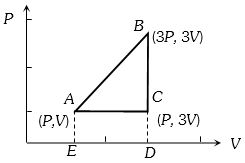
An ideal gas is taken around the cycle $ABCA$ as shown in the $P-V$ diagram. The work done during the cycle is
A
$2PV$
B
$PV$
C
$1/2PV$
D
Zero
Solution
(A) The work done in a cyclic process is equal to the area enclosed by the cycle in the $P-V$ diagram.
In the given diagram,the cycle $ABCA$ forms a right-angled triangle with vertices at $A(P, V)$,$C(P, 3V)$,and $B(3P, 3V)$.
The base of the triangle is $AC = (3V - V) = 2V$.
The height of the triangle is $BC = (3P - P) = 2P$.
The area of the triangle $ABC$ is given by:
$\text{Area} = \frac{1}{2} \times \text{base} \times \text{height}$
$\text{Area} = \frac{1}{2} \times (2V) \times (2P) = 2PV$.
Since the cycle is traversed in the clockwise direction,the work done by the gas is positive.
Therefore,the work done during the cycle is $2PV$.
In the given diagram,the cycle $ABCA$ forms a right-angled triangle with vertices at $A(P, V)$,$C(P, 3V)$,and $B(3P, 3V)$.
The base of the triangle is $AC = (3V - V) = 2V$.
The height of the triangle is $BC = (3P - P) = 2P$.
The area of the triangle $ABC$ is given by:
$\text{Area} = \frac{1}{2} \times \text{base} \times \text{height}$
$\text{Area} = \frac{1}{2} \times (2V) \times (2P) = 2PV$.
Since the cycle is traversed in the clockwise direction,the work done by the gas is positive.
Therefore,the work done during the cycle is $2PV$.
0 likesView Solution
3
ChemistryMCQAP EAMCET · 2024
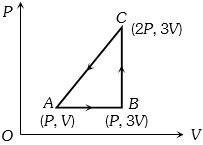
An ideal gas is taken around the cycle $ABCA$ as shown in the $P-V$ diagram. The work done during the cycle is
A
Zero
B
$\frac{1}{2}PV$
C
$2 PV$
D
$PV$
Solution
(D) The work done in a cyclic process is equal to the area enclosed by the $P-V$ curve.
The area of the triangle $ABC$ is given by:
$\text{Area} = \frac{1}{2} \times \text{base} \times \text{height}$
From the diagram,the base $AB$ is along the volume axis:
$\text{Base} = 3V - V = 2V$
The height $BC$ is along the pressure axis:
$\text{Height} = 2P - P = P$
Therefore,the work done is:
$W = \frac{1}{2} \times (2V) \times (P) = PV$
The area of the triangle $ABC$ is given by:
$\text{Area} = \frac{1}{2} \times \text{base} \times \text{height}$
From the diagram,the base $AB$ is along the volume axis:
$\text{Base} = 3V - V = 2V$
The height $BC$ is along the pressure axis:
$\text{Height} = 2P - P = P$
Therefore,the work done is:
$W = \frac{1}{2} \times (2V) \times (P) = PV$
0 likesView Solution
4
ChemistryMCQAP EAMCET · 2024
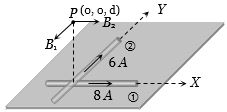
Two infinite length wires carry currents $8A$ and $6A$ respectively and are placed along the $X$ and $Y$-axes. The magnetic field at a point $P(0, 0, d) \ m$ will be:
A
$\frac{7\mu_0}{\pi d}$
B
$\frac{10\mu_0}{\pi d}$
C
$\frac{14\mu_0}{\pi d}$
D
$\frac{5\mu_0}{\pi d}$
Solution
(D) The magnetic field due to an infinite wire at a distance $d$ is given by $B = \frac{\mu_0 I}{2\pi d}$.
For wire $1$ along the $X$-axis carrying current $I_1 = 8A$,the magnetic field at $P(0, 0, d)$ is $B_1 = \frac{\mu_0 (8)}{2\pi d} = \frac{4\mu_0}{\pi d}$.
For wire $2$ along the $Y$-axis carrying current $I_2 = 6A$,the magnetic field at $P(0, 0, d)$ is $B_2 = \frac{\mu_0 (6)}{2\pi d} = \frac{3\mu_0}{\pi d}$.
Since these two magnetic fields are mutually perpendicular,the net magnetic field is $B_{net} = \sqrt{B_1^2 + B_2^2}$.
$B_{net} = \sqrt{\left(\frac{4\mu_0}{\pi d}\right)^2 + \left(\frac{3\mu_0}{\pi d}\right)^2} = \frac{\mu_0}{\pi d} \sqrt{16 + 9} = \frac{\mu_0}{\pi d} \sqrt{25} = \frac{5\mu_0}{\pi d}$.
For wire $1$ along the $X$-axis carrying current $I_1 = 8A$,the magnetic field at $P(0, 0, d)$ is $B_1 = \frac{\mu_0 (8)}{2\pi d} = \frac{4\mu_0}{\pi d}$.
For wire $2$ along the $Y$-axis carrying current $I_2 = 6A$,the magnetic field at $P(0, 0, d)$ is $B_2 = \frac{\mu_0 (6)}{2\pi d} = \frac{3\mu_0}{\pi d}$.
Since these two magnetic fields are mutually perpendicular,the net magnetic field is $B_{net} = \sqrt{B_1^2 + B_2^2}$.
$B_{net} = \sqrt{\left(\frac{4\mu_0}{\pi d}\right)^2 + \left(\frac{3\mu_0}{\pi d}\right)^2} = \frac{\mu_0}{\pi d} \sqrt{16 + 9} = \frac{\mu_0}{\pi d} \sqrt{25} = \frac{5\mu_0}{\pi d}$.
0 likesView Solution
5
ChemistryMCQAP EAMCET · 2024
Energy required to remove an electron from an aluminium surface is $4.2 \text{ eV}$. If light of wavelength $2000 \text{ \AA}$ falls on the surface, the velocity of the fastest electron ejected from the surface will be:
A
$8.4 \times 10^5 \text{ m/s}$
B
$7.4 \times 10^5 \text{ m/s}$
C
$6.4 \times 10^5 \text{ m/s}$
D
$8.4 \times 10^6 \text{ m/s}$
Solution
(A) The energy of the incident photon is given by $E = \frac{12400}{\lambda (\text{\AA})} \text{ eV} = \frac{12400}{2000} \text{ eV} = 6.2 \text{ eV}$.
Using Einstein's photoelectric equation: $E = W_0 + K_{\max}$, where $W_0 = 4.2 \text{ eV}$ is the work function.
$K_{\max} = E - W_0 = 6.2 \text{ eV} - 4.2 \text{ eV} = 2.0 \text{ eV}$.
Converting to Joules: $K_{\max} = 2.0 \times 1.6 \times 10^{-19} \text{ J} = 3.2 \times 10^{-19} \text{ J}$.
Since $K_{\max} = \frac{1}{2}mv_{\max}^2$, we have $v_{\max} = \sqrt{\frac{2K_{\max}}{m}}$.
Substituting $m = 9.1 \times 10^{-31} \text{ kg}$:
$v_{\max} = \sqrt{\frac{2 \times 3.2 \times 10^{-19}}{9.1 \times 10^{-31}}} = \sqrt{0.703 \times 10^{12}} \approx 0.838 \times 10^6 \text{ m/s} \approx 8.4 \times 10^5 \text{ m/s}$.
Using Einstein's photoelectric equation: $E = W_0 + K_{\max}$, where $W_0 = 4.2 \text{ eV}$ is the work function.
$K_{\max} = E - W_0 = 6.2 \text{ eV} - 4.2 \text{ eV} = 2.0 \text{ eV}$.
Converting to Joules: $K_{\max} = 2.0 \times 1.6 \times 10^{-19} \text{ J} = 3.2 \times 10^{-19} \text{ J}$.
Since $K_{\max} = \frac{1}{2}mv_{\max}^2$, we have $v_{\max} = \sqrt{\frac{2K_{\max}}{m}}$.
Substituting $m = 9.1 \times 10^{-31} \text{ kg}$:
$v_{\max} = \sqrt{\frac{2 \times 3.2 \times 10^{-19}}{9.1 \times 10^{-31}}} = \sqrt{0.703 \times 10^{12}} \approx 0.838 \times 10^6 \text{ m/s} \approx 8.4 \times 10^5 \text{ m/s}$.
0 likesView Solution
6
ChemistryMCQAP EAMCET · 2024
The minimum deviation produced by a hollow prism filled with a certain liquid is found to be $30^o$. The angle of refraction is also found to be $30^o$. The refractive index of the liquid is
A
$\sqrt{2}$
B
$\sqrt{3}$
C
$\sqrt{\frac{3}{2}}$
D
$\frac{3}{2}$
Solution
(A) For a prism at the condition of minimum deviation,the angle of incidence $i$ is equal to the angle of emergence $e$,and the angle of refraction $r_1$ is equal to $r_2 = r$.
Given that the angle of refraction $r = 30^o$,we know that for a prism,the angle of the prism $A = r_1 + r_2 = 2r$.
Therefore,$A = 2 \times 30^o = 60^o$.
The formula for the refractive index $\mu$ of a prism is given by $\mu = \frac{\sin(\frac{A + \delta_m}{2})}{\sin(\frac{A}{2})}$,where $\delta_m$ is the angle of minimum deviation.
Given $\delta_m = 30^o$ and $A = 60^o$,we have:
$\mu = \frac{\sin(\frac{60^o + 30^o}{2})}{\sin(\frac{60^o}{2})} = \frac{\sin(45^o)}{\sin(30^o)}$.
Substituting the values,$\mu = \frac{1/\sqrt{2}}{1/2} = \frac{2}{\sqrt{2}} = \sqrt{2}$.
Given that the angle of refraction $r = 30^o$,we know that for a prism,the angle of the prism $A = r_1 + r_2 = 2r$.
Therefore,$A = 2 \times 30^o = 60^o$.
The formula for the refractive index $\mu$ of a prism is given by $\mu = \frac{\sin(\frac{A + \delta_m}{2})}{\sin(\frac{A}{2})}$,where $\delta_m$ is the angle of minimum deviation.
Given $\delta_m = 30^o$ and $A = 60^o$,we have:
$\mu = \frac{\sin(\frac{60^o + 30^o}{2})}{\sin(\frac{60^o}{2})} = \frac{\sin(45^o)}{\sin(30^o)}$.
Substituting the values,$\mu = \frac{1/\sqrt{2}}{1/2} = \frac{2}{\sqrt{2}} = \sqrt{2}$.
0 likesView Solution
7
ChemistryMCQAP EAMCET · 2024
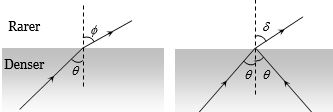
$A$ ray of light travels from an optically denser to a rarer medium. The critical angle for the two media is $C$. The maximum possible deviation of the ray will be
A
$\left( \frac{\pi}{2} - C \right)$
B
$2C$
C
$\pi - 2C$
D
$\pi - C$
Solution
(C) When a ray of light travels from a denser to a rarer medium,the deviation $\delta$ is given by $\delta = \phi - \theta$,where $\phi$ is the angle of refraction and $\theta$ is the angle of incidence.
For refraction,the maximum deviation occurs when $\theta = C$ and $\phi = \frac{\pi}{2}$. In this case,$\delta_{refraction} = \frac{\pi}{2} - C$.
When total internal reflection occurs,the angle of incidence $\theta$ is greater than or equal to $C$. The deviation is $\delta = \pi - 2\theta$. The deviation is maximum when $\theta$ is minimum,i.e.,$\theta = C$. Thus,$\delta_{reflection} = \pi - 2C$.
Comparing the two cases,since $\pi - 2C > \frac{\pi}{2} - C$ (as $C < \frac{\pi}{2}$),the maximum possible deviation is $\pi - 2C$.
For refraction,the maximum deviation occurs when $\theta = C$ and $\phi = \frac{\pi}{2}$. In this case,$\delta_{refraction} = \frac{\pi}{2} - C$.
When total internal reflection occurs,the angle of incidence $\theta$ is greater than or equal to $C$. The deviation is $\delta = \pi - 2\theta$. The deviation is maximum when $\theta$ is minimum,i.e.,$\theta = C$. Thus,$\delta_{reflection} = \pi - 2C$.
Comparing the two cases,since $\pi - 2C > \frac{\pi}{2} - C$ (as $C < \frac{\pi}{2}$),the maximum possible deviation is $\pi - 2C$.
0 likesView Solution
8
ChemistryMCQAP EAMCET · 2024
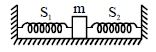
When a mass $m$ is connected individually to two springs $S_1$ and $S_2$,the oscillation frequencies are $v_1$ and $v_2$. If the same mass is attached to the two springs as shown in the figure,the oscillation frequency would be
A
$v_1 + v_2$
B
$\sqrt{v_1^2 + v_2^2}$
C
$(\frac{1}{v_1} + \frac{1}{v_2})^{-1}$
D
$\sqrt{v_1^2 - v_2^2}$
Solution
(B) The frequency of oscillation for a mass $m$ connected to a spring with constant $K$ is given by $v = \frac{1}{2\pi} \sqrt{\frac{K}{m}}$.
For springs $S_1$ and $S_2$ with constants $K_1$ and $K_2$ respectively:
$v_1 = \frac{1}{2\pi} \sqrt{\frac{K_1}{m}} \implies K_1 = 4\pi^2 v_1^2 m$
$v_2 = \frac{1}{2\pi} \sqrt{\frac{K_2}{m}} \implies K_2 = 4\pi^2 v_2^2 m$
In the given figure,the mass is connected to two springs in parallel. The effective spring constant is $K_{eff} = K_1 + K_2$.
The new frequency $v$ is given by:
$v = \frac{1}{2\pi} \sqrt{\frac{K_1 + K_2}{m}}$
Substituting the values of $K_1$ and $K_2$:
$v = \frac{1}{2\pi} \sqrt{\frac{4\pi^2 v_1^2 m + 4\pi^2 v_2^2 m}{m}}$
$v = \frac{1}{2\pi} \sqrt{4\pi^2 (v_1^2 + v_2^2)}$
$v = \sqrt{v_1^2 + v_2^2}$
For springs $S_1$ and $S_2$ with constants $K_1$ and $K_2$ respectively:
$v_1 = \frac{1}{2\pi} \sqrt{\frac{K_1}{m}} \implies K_1 = 4\pi^2 v_1^2 m$
$v_2 = \frac{1}{2\pi} \sqrt{\frac{K_2}{m}} \implies K_2 = 4\pi^2 v_2^2 m$
In the given figure,the mass is connected to two springs in parallel. The effective spring constant is $K_{eff} = K_1 + K_2$.
The new frequency $v$ is given by:
$v = \frac{1}{2\pi} \sqrt{\frac{K_1 + K_2}{m}}$
Substituting the values of $K_1$ and $K_2$:
$v = \frac{1}{2\pi} \sqrt{\frac{4\pi^2 v_1^2 m + 4\pi^2 v_2^2 m}{m}}$
$v = \frac{1}{2\pi} \sqrt{4\pi^2 (v_1^2 + v_2^2)}$
$v = \sqrt{v_1^2 + v_2^2}$
0 likesView Solution
9
ChemistryMediumMCQAP EAMCET · 2024
What is $X$ in the following reaction?

A
$3-$bromocyclohex$-1-$ene
B
$1,2-$dibromocyclohexane
C
$1-$bromocyclohex$-1-$ene
D
Bromocyclohexane
Solution
(A) The given reaction shows that $C_6H_{10}$ (cyclohexene) reacts with $KMnO_4-H_2SO_4$ to form adipic acid (hexanedioic acid),which is a standard oxidative cleavage reaction of cyclohexene.
When cyclohexene $(C_6H_{10})$ reacts with $Br_2$ in the presence of $UV$ light,it undergoes allylic bromination.
The allylic position in cyclohexene is the carbon adjacent to the double bond.
Therefore,the product $X$ is $3$-bromocyclohex-$1$-ene.
When cyclohexene $(C_6H_{10})$ reacts with $Br_2$ in the presence of $UV$ light,it undergoes allylic bromination.
The allylic position in cyclohexene is the carbon adjacent to the double bond.
Therefore,the product $X$ is $3$-bromocyclohex-$1$-ene.
0 likesView Solution
10
ChemistryMediumMCQAP EAMCET · 2024
What are $X$ and $Y$ respectively in the following reaction sequence?
Isopentane $\xrightarrow{KMnO_4} X$ $\xrightarrow{\text{dehydration}} \underset{\text{Major}}{Y}$
Isopentane $\xrightarrow{KMnO_4} X$ $\xrightarrow{\text{dehydration}} \underset{\text{Major}}{Y}$
A
$X$ = $2-$methylbutan$-2-$ol,$Y$ = $2-$methylbut$-2-$ene
B
$X$ = $3-$methylbutan$-2-$ol,$Y$ = $2-$methylbut$-2-$ene
C
$X$ = $2-$methylbutan$-2-$ol,$Y$ = $2-$methylbut$-1-$ene
D
$X$ = $3-$methylbutan$-2-$ol,$Y$ = $3-$methylbut$-1-$ene
Solution
(A) The reaction proceeds as follows:
$1$. Oxidation of isopentane ($2$-methylbutane) with $KMnO_4$ occurs at the tertiary carbon atom to form $2-$methylbutan$-2-$ol $(X)$.
$2$. Dehydration of $2-$methylbutan$-2-$ol using an acid catalyst follows Saytzeff's rule to form the more substituted and stable alkene,$2$-methylbut$-2-$ene,as the major product $(Y)$.
$1$. Oxidation of isopentane ($2$-methylbutane) with $KMnO_4$ occurs at the tertiary carbon atom to form $2-$methylbutan$-2-$ol $(X)$.
$2$. Dehydration of $2-$methylbutan$-2-$ol using an acid catalyst follows Saytzeff's rule to form the more substituted and stable alkene,$2$-methylbut$-2-$ene,as the major product $(Y)$.
0 likesView Solution
11
ChemistryEasyMCQAP EAMCET · 2024
Styrene on reaction with reagent $X$ gave $Y$, which on hydrolysis followed by oxidation gave $Z$. $Z$ gives a positive $2,4-DNP$ test but does not give the iodoform test. What are $X$ and $Z$ respectively?
A
$HBr ; C_6H_5COCH_3$
B
$HBr ; C_6H_5CH_2CHO$
C
$HBr / (C_6H_5CO)_2O_2 ; C_6H_5CH_2CHO$
D
$HBr / (C_6H_5CO)_2O_2 ; C_6H_5COCH_3$
Solution
(C) Styrene $(C_6H_5CH=CH_2)$ reacts with $HBr$ in the presence of peroxide $((C_6H_5CO)_2O_2)$ via anti-Markovnikov addition to give $Y$ $(C_6H_5CH_2CH_2Br)$.
Hydrolysis of $Y$ gives $C_6H_5CH_2CH_2OH$, and subsequent oxidation gives $Z$ ($C_6H_5CH_2CHO$, phenylacetaldehyde).
$Z$ $(C_6H_5CH_2CHO)$ is an aldehyde, so it gives a positive $2,4-DNP$ test.
However, it does not contain the $CH_3CO-$ group, so it does not give the iodoform test.
Therefore, $X$ is $HBr / (C_6H_5CO)_2O_2$ and $Z$ is $C_6H_5CH_2CHO$.
Hydrolysis of $Y$ gives $C_6H_5CH_2CH_2OH$, and subsequent oxidation gives $Z$ ($C_6H_5CH_2CHO$, phenylacetaldehyde).
$Z$ $(C_6H_5CH_2CHO)$ is an aldehyde, so it gives a positive $2,4-DNP$ test.
However, it does not contain the $CH_3CO-$ group, so it does not give the iodoform test.
Therefore, $X$ is $HBr / (C_6H_5CO)_2O_2$ and $Z$ is $C_6H_5CH_2CHO$.
0 likesView Solution
12
ChemistryEasyMCQAP EAMCET · 2024
The correct formula used to determine the formal charge $(Q_{f})$ on an atom in the given Lewis structure of a molecule or ion is ($V=$ number of valence electrons in free atom,$U=$ number of unshared electrons on the atom,$B=$ number of bonds around the atom)
A
$Q_{f} = V - (U / B)$
B
$Q_{f} = V + (U - B)$
C
$Q_{f} = V - (U + B)$
D
$Q_{f} = V - (B / U)$
Solution
(C) The formal charge $(Q_f)$ on an atom in a Lewis structure is calculated using the formula:
$Q_f = [\text{Total number of valence electrons in the free atom } (V)] - [\text{Total number of non-bonding/unshared electrons } (U)] - [\text{Number of bonds around the atom } (B)]$.
This can be simplified as:
$Q_f = V - U - B$
$Q_f = V - (U + B)$
Therefore,the correct option is $C$.
$Q_f = [\text{Total number of valence electrons in the free atom } (V)] - [\text{Total number of non-bonding/unshared electrons } (U)] - [\text{Number of bonds around the atom } (B)]$.
This can be simplified as:
$Q_f = V - U - B$
$Q_f = V - (U + B)$
Therefore,the correct option is $C$.
0 likesView Solution
13
ChemistryMediumMCQAP EAMCET · 2024
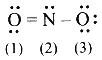
Observe the following structure. The formal charges on the atoms $1, 2, 3$ respectively are:
A
$+1, 0, -1$
B
$0, 0, -1$
C
$-1, 0, +1$
D
$0, 0, 0$
Solution
(B) The formal charge can be calculated by the formula: $\text{Formal charge} = [\text{Total number of valence electrons in the free state}] - [\text{Total number of non-bonding (lone pair) electrons}] - \frac{1}{2} [\text{Total number of bonding (shared) electrons}]$.
For atom $1$ (Oxygen): Valence electrons = $6$,non-bonding electrons = $4$,bonding electrons = $4$.
$\text{Formal charge} = 6 - 4 - \frac{1}{2}(4) = 6 - 4 - 2 = 0$.
For atom $2$ (Nitrogen): Valence electrons = $5$,non-bonding electrons = $2$,bonding electrons = $6$.
$\text{Formal charge} = 5 - 2 - \frac{1}{2}(6) = 5 - 2 - 3 = 0$.
For atom $3$ (Oxygen): Valence electrons = $6$,non-bonding electrons = $6$,bonding electrons = $2$.
$\text{Formal charge} = 6 - 6 - \frac{1}{2}(2) = 6 - 6 - 1 = -1$.
Thus,the formal charges are $0, 0, -1$.
For atom $1$ (Oxygen): Valence electrons = $6$,non-bonding electrons = $4$,bonding electrons = $4$.
$\text{Formal charge} = 6 - 4 - \frac{1}{2}(4) = 6 - 4 - 2 = 0$.
For atom $2$ (Nitrogen): Valence electrons = $5$,non-bonding electrons = $2$,bonding electrons = $6$.
$\text{Formal charge} = 5 - 2 - \frac{1}{2}(6) = 5 - 2 - 3 = 0$.
For atom $3$ (Oxygen): Valence electrons = $6$,non-bonding electrons = $6$,bonding electrons = $2$.
$\text{Formal charge} = 6 - 6 - \frac{1}{2}(2) = 6 - 6 - 1 = -1$.
Thus,the formal charges are $0, 0, -1$.
0 likesView Solution
14
ChemistryEasyMCQAP EAMCET · 2024
The number of lone pairs of electrons on the central atom of $BrF_5, XeO_3, SO_2$ respectively are
A
$1, 1, 2$
B
$1, 2, 2$
C
$2, 2, 1$
D
$1, 1, 1$
Solution
(D) In $BrF_5$,the central atom $Br$ has $7$ valence electrons. $5$ electrons form bonds with $5$ $F$ atoms,leaving $2$ electrons ($1$ lone pair).
In $XeO_3$,$Xe$ has $8$ valence electrons. $6$ electrons form double bonds with $3$ $O$ atoms,leaving $2$ electrons ($1$ lone pair).
In $SO_2$,$S$ has $6$ valence electrons. $4$ electrons form double bonds with $2$ $O$ atoms,leaving $2$ electrons ($1$ lone pair).
Thus,the number of lone pairs are $1, 1, 1$ respectively.
In $XeO_3$,$Xe$ has $8$ valence electrons. $6$ electrons form double bonds with $3$ $O$ atoms,leaving $2$ electrons ($1$ lone pair).
In $SO_2$,$S$ has $6$ valence electrons. $4$ electrons form double bonds with $2$ $O$ atoms,leaving $2$ electrons ($1$ lone pair).
Thus,the number of lone pairs are $1, 1, 1$ respectively.
0 likesView Solution
15
ChemistryMediumMCQAP EAMCET · 2024
Identify the set of molecules in which the central atom has only one lone pair of electrons in their valence shells.
A
$BrF_5, SF_4, SnCl_2$
B
$BrF_5, XeF_4, SnCl_2$
C
$XeF_4, NH_3, ClF_3$
D
$XeF_6, ClF_3, SF_4$
Solution
(A) To determine the number of lone pairs on the central atom,we use the formula: $\text{Lone pair} = \frac{V - (M + C - A)}{2}$,where $V$ is the number of valence electrons of the central atom,$M$ is the number of monovalent atoms,$C$ is the charge of the cation,and $A$ is the charge of the anion.
Based on the calculation,the molecules $BrF_5$,$SF_4$,and $SnCl_2$ each contain exactly $1$ lone pair on the central atom.
| Molecule | Lone Pairs |
| $BrF_5$ | $1$ |
| $SF_4$ | $1$ |
| $SnCl_2$ | $1$ |
| $XeF_4$ | $2$ |
| $NH_3$ | $1$ |
| $ClF_3$ | $2$ |
Based on the calculation,the molecules $BrF_5$,$SF_4$,and $SnCl_2$ each contain exactly $1$ lone pair on the central atom.
0 likesView Solution
16
ChemistryEasyMCQAP EAMCET · 2024
The correct increasing order of the number of lone pairs of electrons on the central atom of $SnCl_2$,$XeF_2$,$ClF_3$,and $SO_3$ is:
A
$SO_3 < SnCl_2 < ClF_3 < XeF_2$
B
$SO_3 < ClF_3 < SnCl_2 < XeF_2$
C
$XeF_2 < SnCl_2 < ClF_3 < SO_3$
D
$XeF_2 < ClF_3 < SnCl_2 < SO_3$
Solution
(A) To determine the number of lone pairs on the central atom,we use the formula: $\text{Lone pair} = \frac{1}{2} (V - M - C + A)$,where $V$ is the number of valence electrons,$M$ is the number of monovalent atoms,$C$ is the cationic charge,and $A$ is the anionic charge. Alternatively,we can use the structure:
The increasing order of lone pairs is $SO_3 (0) < SnCl_2 (1) < ClF_3 (2) < XeF_2 (3)$.
| Molecule | Lone pairs on central atom |
|---|---|
| $SO_3$ | $0$ |
| $SnCl_2$ | $1$ |
| $ClF_3$ | $2$ |
| $XeF_2$ | $3$ |
The increasing order of lone pairs is $SO_3 (0) < SnCl_2 (1) < ClF_3 (2) < XeF_2 (3)$.
0 likesView Solution
17
ChemistryEasyMCQAP EAMCET · 2024
In which of the following sets of molecules,do the central atoms have the same hybridisation?
A
$NH_3, ClF_3$
B
$H_2O, SO_3$
C
$SF_4, CH_4$
D
$XeF_6, IF_7$
Solution
(D) To determine the hybridisation,we calculate the steric number $(SN)$ using the formula: $SN = \text{Number of bond pairs} + \text{Number of lone pairs}$.
Comparing the options:
- Option $A$: $NH_3$ $(sp^3)$ and $ClF_3$ $(sp^3d)$ - Different.
- Option $B$: $H_2O$ $(sp^3)$ and $SO_3$ $(sp^2)$ - Different.
- Option $C$: $SF_4$ $(sp^3d)$ and $CH_4$ $(sp^3)$ - Different.
- Option $D$: $XeF_6$ $(sp^3d^3)$ and $IF_7$ $(sp^3d^3)$ - Same.
Therefore,the correct set is $XeF_6$ and $IF_7$.
| $1. \ NH_3$ | $sp^3$ |
| $2. \ ClF_3$ | $sp^3d$ |
| $3. \ H_2O$ | $sp^3$ |
| $4. \ SO_3$ | $sp^2$ |
| $5. \ SF_4$ | $sp^3d$ |
| $6. \ CH_4$ | $sp^3$ |
| $7. \ XeF_6$ | $sp^3d^3$ |
| $8. \ IF_7$ | $sp^3d^3$ |
Comparing the options:
- Option $A$: $NH_3$ $(sp^3)$ and $ClF_3$ $(sp^3d)$ - Different.
- Option $B$: $H_2O$ $(sp^3)$ and $SO_3$ $(sp^2)$ - Different.
- Option $C$: $SF_4$ $(sp^3d)$ and $CH_4$ $(sp^3)$ - Different.
- Option $D$: $XeF_6$ $(sp^3d^3)$ and $IF_7$ $(sp^3d^3)$ - Same.
Therefore,the correct set is $XeF_6$ and $IF_7$.
0 likesView Solution
18
ChemistryMediumMCQAP EAMCET · 2024
The correct order of bond angles of the molecules $SiCl_4$,$SO_3$,$NH_3$,and $HgCl_2$ is:
A
$SO_3 > SiCl_4 > NH_3 > HgCl_2$
B
$SiCl_4 > NH_3 > HgCl_2 > SO_3$
C
$HgCl_2 > SO_3 > NH_3 > SiCl_4$
D
$HgCl_2 > SO_3 > SiCl_4 > NH_3$
Solution
(D) The bond angles for the given molecules are as follows:
$1.$ $HgCl_2$: Linear geometry ($sp$ hybridization),bond angle = $180^{\circ}$.
$2.$ $SO_3$: Trigonal planar geometry ($sp^2$ hybridization),bond angle = $120^{\circ}$.
$3.$ $SiCl_4$: Tetrahedral geometry ($sp^3$ hybridization),bond angle = $109.5^{\circ}$.
$4.$ $NH_3$: Trigonal pyramidal geometry ($sp^3$ hybridization with one lone pair),bond angle = $107^{\circ}$.
Therefore,the correct order is $HgCl_2 > SO_3 > SiCl_4 > NH_3$.
$1.$ $HgCl_2$: Linear geometry ($sp$ hybridization),bond angle = $180^{\circ}$.
$2.$ $SO_3$: Trigonal planar geometry ($sp^2$ hybridization),bond angle = $120^{\circ}$.
$3.$ $SiCl_4$: Tetrahedral geometry ($sp^3$ hybridization),bond angle = $109.5^{\circ}$.
$4.$ $NH_3$: Trigonal pyramidal geometry ($sp^3$ hybridization with one lone pair),bond angle = $107^{\circ}$.
Therefore,the correct order is $HgCl_2 > SO_3 > SiCl_4 > NH_3$.
0 likesView Solution
19
ChemistryMediumMCQAP EAMCET · 2024
Among the following species,the correct set of isostructural pairs is:
$XeO_3, CO_3^{2-}, SO_3, H_3O^{+}, ClF_3$
$XeO_3, CO_3^{2-}, SO_3, H_3O^{+}, ClF_3$
A
$(XeO_3, CO_3^{2-})$ and $(SO_3, H_3O^{+})$
B
$(XeO_3, SO_3)$ and $(CO_3^{2-}, H_3O^{+})$
C
$(XeO_3, H_3O^{+})$ and $(SO_3, CO_3^{2-})$
D
$(SO_3, ClF_3)$ and $(XeO_3, CO_3^{2-})$
Solution
(C) To determine the isostructural pairs,we analyze the geometry of each species:
$1$. $XeO_3$: $sp^3$ hybridized with $1$ lone pair,resulting in a pyramidal shape.
$2$. $CO_3^{2-}$: $sp^2$ hybridized with $0$ lone pairs,resulting in a trigonal planar shape.
$3$. $SO_3$: $sp^2$ hybridized with $0$ lone pairs,resulting in a trigonal planar shape.
$4$. $H_3O^{+}$: $sp^3$ hybridized with $1$ lone pair,resulting in a pyramidal shape.
$5$. $ClF_3$: $sp^3d$ hybridized with $2$ lone pairs,resulting in a $T$-shape.
Comparing the shapes:
- $(XeO_3, H_3O^{+})$ are both pyramidal.
- $(SO_3, CO_3^{2-})$ are both trigonal planar.
Therefore,the correct set of isostructural pairs is $(XeO_3, H_3O^{+})$ and $(SO_3, CO_3^{2-})$.
$1$. $XeO_3$: $sp^3$ hybridized with $1$ lone pair,resulting in a pyramidal shape.
$2$. $CO_3^{2-}$: $sp^2$ hybridized with $0$ lone pairs,resulting in a trigonal planar shape.
$3$. $SO_3$: $sp^2$ hybridized with $0$ lone pairs,resulting in a trigonal planar shape.
$4$. $H_3O^{+}$: $sp^3$ hybridized with $1$ lone pair,resulting in a pyramidal shape.
$5$. $ClF_3$: $sp^3d$ hybridized with $2$ lone pairs,resulting in a $T$-shape.
Comparing the shapes:
- $(XeO_3, H_3O^{+})$ are both pyramidal.
- $(SO_3, CO_3^{2-})$ are both trigonal planar.
Therefore,the correct set of isostructural pairs is $(XeO_3, H_3O^{+})$ and $(SO_3, CO_3^{2-})$.
0 likesView Solution
20
ChemistryMediumMCQAP EAMCET · 2024
Observe the following reactions. Identify the reaction in which the hybridisation of the underlined atom is changed.
A
$NH_3 + H^{+} \rightarrow NH_4^{+}$
B
$PCl_3 + 3 H_2 O \rightarrow H_3 \underline{P}O_3 + 3 HCl$
C
$Na\underline{N}O_3 + H_2 SO_4 \rightarrow NaHSO_4 + HNO_3$
D
$XeF_6 + H_2 O \rightarrow \underline{Xe}OF_4 + 2 HF$
Solution
(D) Let us analyze the hybridization of the underlined atoms in each reaction:
$A$) $NH_3 + H^{+} \rightarrow NH_4^{+}$: In $NH_3$,$N$ is $sp^3$ hybridized. In $NH_4^{+}$,$N$ is also $sp^3$ hybridized.
$B$) $PCl_3 + 3 H_2 O \rightarrow H_3PO_3 + 3 HCl$: In $PCl_3$,$P$ is $sp^3$ hybridized. In $H_3PO_3$ (phosphorous acid),$P$ is also $sp^3$ hybridized.
$C$) $NaNO_3 + H_2 SO_4 \rightarrow NaHSO_4 + HNO_3$: In $NaNO_3$,$N$ is $sp^2$ hybridized. In $HNO_3$,$N$ is also $sp^2$ hybridized.
$D$) $XeF_6 + H_2 O \rightarrow XeOF_4 + 2 HF$: In $XeF_6$,$Xe$ is $sp^3d^3$ hybridized (distorted octahedral). In $XeOF_4$,$Xe$ is $sp^3d^2$ hybridized (square pyramidal). Thus,the hybridization changes from $sp^3d^3$ to $sp^3d^2$.
$A$) $NH_3 + H^{+} \rightarrow NH_4^{+}$: In $NH_3$,$N$ is $sp^3$ hybridized. In $NH_4^{+}$,$N$ is also $sp^3$ hybridized.
$B$) $PCl_3 + 3 H_2 O \rightarrow H_3PO_3 + 3 HCl$: In $PCl_3$,$P$ is $sp^3$ hybridized. In $H_3PO_3$ (phosphorous acid),$P$ is also $sp^3$ hybridized.
$C$) $NaNO_3 + H_2 SO_4 \rightarrow NaHSO_4 + HNO_3$: In $NaNO_3$,$N$ is $sp^2$ hybridized. In $HNO_3$,$N$ is also $sp^2$ hybridized.
$D$) $XeF_6 + H_2 O \rightarrow XeOF_4 + 2 HF$: In $XeF_6$,$Xe$ is $sp^3d^3$ hybridized (distorted octahedral). In $XeOF_4$,$Xe$ is $sp^3d^2$ hybridized (square pyramidal). Thus,the hybridization changes from $sp^3d^3$ to $sp^3d^2$.
0 likesView Solution
21
ChemistryMediumMCQAP EAMCET · 2024
In which of the following reactions is there no change in the hybridisation of the central atom?
A
$NH_3+H^{+} \rightarrow NH_4^{+}$
B
$PCl_3+Cl_2 \rightarrow PCl_5$
C
$BF_3+F^{-} \rightarrow BF_4^{-}$
D
$ClF_3+F_2 \rightarrow ClF_5$
Solution
(A) Let us analyze the hybridisation of the central atom in each reaction:
$A$) $NH_3+H^{+} \rightarrow NH_4^{+}$:
In $NH_3$,$N$ is $sp^3$ hybridised ($3$ bond pairs + $1$ lone pair).
In $NH_4^{+}$,$N$ is $sp^3$ hybridised ($4$ bond pairs + $0$ lone pairs).
There is no change in hybridisation.
$B$) $PCl_3+Cl_2 \rightarrow PCl_5$:
In $PCl_3$,$P$ is $sp^3$ hybridised.
In $PCl_5$,$P$ is $sp^3d$ hybridised.
Hybridisation changes from $sp^3$ to $sp^3d$.
$C$) $BF_3+F^{-} \rightarrow BF_4^{-}$:
In $BF_3$,$B$ is $sp^2$ hybridised.
In $BF_4^{-}$,$B$ is $sp^3$ hybridised.
Hybridisation changes from $sp^2$ to $sp^3$.
$D$) $ClF_3+F_2 \rightarrow ClF_5$:
In $ClF_3$,$Cl$ is $sp^3d$ hybridised.
In $ClF_5$,$Cl$ is $sp^3d^2$ hybridised.
Hybridisation changes from $sp^3d$ to $sp^3d^2$.
Therefore,the correct option is $A$.
$A$) $NH_3+H^{+} \rightarrow NH_4^{+}$:
In $NH_3$,$N$ is $sp^3$ hybridised ($3$ bond pairs + $1$ lone pair).
In $NH_4^{+}$,$N$ is $sp^3$ hybridised ($4$ bond pairs + $0$ lone pairs).
There is no change in hybridisation.
$B$) $PCl_3+Cl_2 \rightarrow PCl_5$:
In $PCl_3$,$P$ is $sp^3$ hybridised.
In $PCl_5$,$P$ is $sp^3d$ hybridised.
Hybridisation changes from $sp^3$ to $sp^3d$.
$C$) $BF_3+F^{-} \rightarrow BF_4^{-}$:
In $BF_3$,$B$ is $sp^2$ hybridised.
In $BF_4^{-}$,$B$ is $sp^3$ hybridised.
Hybridisation changes from $sp^2$ to $sp^3$.
$D$) $ClF_3+F_2 \rightarrow ClF_5$:
In $ClF_3$,$Cl$ is $sp^3d$ hybridised.
In $ClF_5$,$Cl$ is $sp^3d^2$ hybridised.
Hybridisation changes from $sp^3d$ to $sp^3d^2$.
Therefore,the correct option is $A$.
0 likesView Solution
22
ChemistryMediumMCQAP EAMCET · 2024
The bond lengths of diatomic molecules of elements $X$,$Y$ and $Z$ respectively are $143 \text{ pm}$,$110 \text{ pm}$ and $121 \text{ pm}$. The atomic numbers of $X$,$Y$ and $Z$ respectively are:
A
$9, 7, 8$
B
$7, 8, 9$
C
$9, 8, 7$
D
$7, 9, 8$
Solution
(A) We know that bond order is inversely proportional to bond length,i.e.,$\text{Bond order} \propto \frac{1}{\text{Bond Length}}$.
As the bond order of a diatomic molecule increases,its bond length decreases.
Based on the provided data:
- For $X$: Bond length = $143 \text{ pm}$,which corresponds to $F_2$ (Total electrons = $18$,Bond order = $1$),so atomic number = $9$.
- For $Y$: Bond length = $110 \text{ pm}$,which corresponds to $N_2$ (Total electrons = $14$,Bond order = $3$),so atomic number = $7$.
- For $Z$: Bond length = $121 \text{ pm}$,which corresponds to $O_2$ (Total electrons = $16$,Bond order = $2$),so atomic number = $8$.
Thus,the atomic numbers of $X$,$Y$ and $Z$ are $9, 7, 8$ respectively.
As the bond order of a diatomic molecule increases,its bond length decreases.
Based on the provided data:
- For $X$: Bond length = $143 \text{ pm}$,which corresponds to $F_2$ (Total electrons = $18$,Bond order = $1$),so atomic number = $9$.
- For $Y$: Bond length = $110 \text{ pm}$,which corresponds to $N_2$ (Total electrons = $14$,Bond order = $3$),so atomic number = $7$.
- For $Z$: Bond length = $121 \text{ pm}$,which corresponds to $O_2$ (Total electrons = $16$,Bond order = $2$),so atomic number = $8$.
Thus,the atomic numbers of $X$,$Y$ and $Z$ are $9, 7, 8$ respectively.
0 likesView Solution
23
ChemistryMediumMCQAP EAMCET · 2024
In which of the following sets is the sum of bond orders of the three species maximum?
A
$B_2, CN^{-}, O_2^{2-}$
B
$O_2, F_2, O_2^{2+}$
C
$O_2^-, N_2, O_2^+$
D
$C_2, O_2, He_2^{2+}$
Solution
(C) The bond order is calculated using the formula: $\text{Bond Order} = \frac{1}{2} (N_b - N_a)$.
Sum of bond orders for each set:
$A$: $1 + 3 + 1 = 5$
$B$: $2 + 1 + 3 = 6$
$C$: $1.5 + 3 + 2.5 = 7$
$D$: $2 + 2 + 1 = 5$
The sum is maximum for set $C$.
| Species | Bond Order |
| $B_2$ | $1$ |
| $CN^{-}$ | $3$ |
| $O_2^{2-}$ | $1$ |
| $O_2$ | $2$ |
| $F_2$ | $1$ |
| $O_2^{2+}$ | $3$ |
| $O_2^-$ | $1.5$ |
| $N_2$ | $3$ |
| $O_2^+$ | $2.5$ |
| $C_2$ | $2$ |
| $He_2^{2+}$ | $1$ |
Sum of bond orders for each set:
$A$: $1 + 3 + 1 = 5$
$B$: $2 + 1 + 3 = 6$
$C$: $1.5 + 3 + 2.5 = 7$
$D$: $2 + 2 + 1 = 5$
The sum is maximum for set $C$.
0 likesView Solution
24
ChemistryEasyMCQAP EAMCET · 2024
The bond order of which of the following two species is the same?
A
$O_2, N_2$
B
$C_2, O_2$
C
$B_2, C_2$
D
$F_2, C_2$
Solution
(B) The bond order of $C_2$ and $O_2$ is the same.
For $C_2$ ($12$ electrons),the molecular orbital configuration is $\sigma 1s^2, \sigma^* 1s^2, \sigma 2s^2, \sigma^* 2s^2, \pi 2p_x^2 = \pi 2p_y^2$.
Bond order = $\frac{1}{2}(N_b - N_a) = \frac{1}{2}(8 - 4) = 2$.
For $O_2$ ($16$ electrons),the molecular orbital configuration is $\sigma 1s^2, \sigma^* 1s^2, \sigma 2s^2, \sigma^* 2s^2, \sigma 2p_z^2, \pi 2p_x^2 = \pi 2p_y^2, \pi^* 2p_x^1 = \pi^* 2p_y^1$.
Bond order = $\frac{1}{2}(10 - 6) = 2$.
For $C_2$ ($12$ electrons),the molecular orbital configuration is $\sigma 1s^2, \sigma^* 1s^2, \sigma 2s^2, \sigma^* 2s^2, \pi 2p_x^2 = \pi 2p_y^2$.
Bond order = $\frac{1}{2}(N_b - N_a) = \frac{1}{2}(8 - 4) = 2$.
For $O_2$ ($16$ electrons),the molecular orbital configuration is $\sigma 1s^2, \sigma^* 1s^2, \sigma 2s^2, \sigma^* 2s^2, \sigma 2p_z^2, \pi 2p_x^2 = \pi 2p_y^2, \pi^* 2p_x^1 = \pi^* 2p_y^1$.
Bond order = $\frac{1}{2}(10 - 6) = 2$.
0 likesView Solution
25
ChemistryMediumMCQAP EAMCET · 2024
Which of the following orders are correct regarding their covalent character?
$i. KF < KI$
$ii. LiF < KF$
$iii. SnCl_2 < SnCl_4$
$iv. NaCl < CuCl$
The correct option is
$i. KF < KI$
$ii. LiF < KF$
$iii. SnCl_2 < SnCl_4$
$iv. NaCl < CuCl$
The correct option is
A
$i, ii, iii$ only
B
$ii, iii, iv$ only
C
$i, iii, iv$ only
D
$i, ii, iv$ only
Solution
(C) According to Fajan's rule,covalent character increases when the cation is smaller and has a higher positive charge,and the anion is larger and has a higher negative charge.
$(i)$ $I^-$ has a larger size than $F^-$,so $KI$ has more covalent character than $KF$. Thus,$KF < KI$ is correct.
$(ii)$ $Li^+$ is smaller than $K^+$,so $LiF$ has more covalent character than $KF$. Thus,$LiF > KF$,making $LiF < KF$ incorrect.
$(iii)$ $Sn^{4+}$ has a higher positive charge than $Sn^{2+}$,so $SnCl_4$ has more covalent character than $SnCl_2$. Thus,$SnCl_2 < SnCl_4$ is correct.
$(iv)$ $Cu^+$ has a pseudo-noble gas configuration $(d^{10})$,which causes higher polarization than the noble gas configuration of $Na^+$. Thus,$CuCl > NaCl$,making $NaCl < CuCl$ correct.
Therefore,the correct orders are $(i), (iii),$ and $(iv)$.
$(i)$ $I^-$ has a larger size than $F^-$,so $KI$ has more covalent character than $KF$. Thus,$KF < KI$ is correct.
$(ii)$ $Li^+$ is smaller than $K^+$,so $LiF$ has more covalent character than $KF$. Thus,$LiF > KF$,making $LiF < KF$ incorrect.
$(iii)$ $Sn^{4+}$ has a higher positive charge than $Sn^{2+}$,so $SnCl_4$ has more covalent character than $SnCl_2$. Thus,$SnCl_2 < SnCl_4$ is correct.
$(iv)$ $Cu^+$ has a pseudo-noble gas configuration $(d^{10})$,which causes higher polarization than the noble gas configuration of $Na^+$. Thus,$CuCl > NaCl$,making $NaCl < CuCl$ correct.
Therefore,the correct orders are $(i), (iii),$ and $(iv)$.
0 likesView Solution
26
ChemistryEasyMCQAP EAMCET · 2024
The correct order of covalent bond character of $BCl_3, CCl_4, BeCl_2, LiCl$ is
A
$LiCl < BeCl_2 < BCl_3 < CCl_4$
B
$CCl_4 < BeCl_2 < BCl_3 < LiCl$
C
$CCl_4 < BCl_3 < BeCl_2 < LiCl$
D
$LiCl < BCl_3 < BeCl_2 < CCl_4$
Solution
(A) According to Fajan's rule,the covalent character of an ionic bond increases with:
$1$. Smaller size of the cation.
$2$. Higher charge on the cation.
Comparing the cations $Li^{+}$,$Be^{2+}$,$B^{3+}$,and $C^{4+}$:
- The charge increases in the order: $Li^{+} < Be^{2+} < B^{3+} < C^{4+}$.
- The ionic radius decreases in the order: $Li^{+} > Be^{2+} > B^{3+} > C^{4+}$.
Both factors favor increased polarization of the anion by the cation as we move from $LiCl$ to $CCl_4$.
Therefore,the covalent character increases in the order: $LiCl < BeCl_2 < BCl_3 < CCl_4$.
$1$. Smaller size of the cation.
$2$. Higher charge on the cation.
Comparing the cations $Li^{+}$,$Be^{2+}$,$B^{3+}$,and $C^{4+}$:
- The charge increases in the order: $Li^{+} < Be^{2+} < B^{3+} < C^{4+}$.
- The ionic radius decreases in the order: $Li^{+} > Be^{2+} > B^{3+} > C^{4+}$.
Both factors favor increased polarization of the anion by the cation as we move from $LiCl$ to $CCl_4$.
Therefore,the covalent character increases in the order: $LiCl < BeCl_2 < BCl_3 < CCl_4$.
0 likesView Solution
27
ChemistryMediumMCQAP EAMCET · 2024
Observe the following sets:
Which of the above sets are correctly matched?
| Label | Order | Property |
|---|---|---|
| $i.$ | $NH_3 > H_2O > SO_2$ | Bond angle |
| $ii.$ | $H_2O > NH_3 > H_2S$ | Dipole moment |
| $iii.$ | $N_2 > O_2 > H_2$ | Bond enthalpy |
| $iv.$ | $NO^{+} > O_2 > O_2^{2-}$ | Bond order |
Which of the above sets are correctly matched?
A
$i, ii, iv$ only
B
$ii, iii$ only
C
$ii, iii, iv$ only
D
$i, iii, iv$ only
Solution
(C) $(i)$ Bond angle: $SO_2$ $(119^{\circ})$ > $NH_3$ $(107.3^{\circ})$ > $H_2O$ $(104.5^{\circ})$. Thus,set $i$ is incorrect.
$(ii)$ Dipole moment: $H_2O$ $(1.85 \ D)$ > $NH_3$ $(1.47 \ D)$ > $H_2S$ $(0.95 \ D)$. Thus,set $ii$ is correct.
$(iii)$ Bond enthalpy is directly proportional to bond order. Bond orders are: $N_2$ $(3)$,$O_2$ $(2)$,$H_2$ $(1)$. Thus,$N_2 > O_2 > H_2$ is correct. Set $iii$ is correct.
$(iv)$ Bond order: $NO^{+}$ $(3)$,$O_2$ $(2)$,$O_2^{2-}$ $(1)$. Thus,$NO^{+} > O_2 > O_2^{2-}$ is correct. Set $iv$ is correct.
Therefore,sets $(ii), (iii),$ and $(iv)$ are correctly matched.
$(ii)$ Dipole moment: $H_2O$ $(1.85 \ D)$ > $NH_3$ $(1.47 \ D)$ > $H_2S$ $(0.95 \ D)$. Thus,set $ii$ is correct.
$(iii)$ Bond enthalpy is directly proportional to bond order. Bond orders are: $N_2$ $(3)$,$O_2$ $(2)$,$H_2$ $(1)$. Thus,$N_2 > O_2 > H_2$ is correct. Set $iii$ is correct.
$(iv)$ Bond order: $NO^{+}$ $(3)$,$O_2$ $(2)$,$O_2^{2-}$ $(1)$. Thus,$NO^{+} > O_2 > O_2^{2-}$ is correct. Set $iv$ is correct.
Therefore,sets $(ii), (iii),$ and $(iv)$ are correctly matched.
0 likesView Solution
28
ChemistryMediumMCQAP EAMCET · 2024
In which of the following pairs,both molecules possess a dipole moment?
A
$CO_2, BCl_3$
B
$BCl_3, NF_3$
C
$CO_2, SO_2$
D
$SO_2, NF_3$
Solution
(D) molecule possesses a dipole moment if its net dipole moment $\mu \neq 0$.
$CO_2$ is linear and symmetric,so $\mu = 0$.
$BCl_3$ is trigonal planar and symmetric,so $\mu = 0$.
$SO_2$ is bent (angular) due to a lone pair on $S$,so $\mu \neq 0$.
$NF_3$ is pyramidal due to a lone pair on $N$,so $\mu \neq 0$.
Therefore,both $SO_2$ and $NF_3$ possess a dipole moment.
$CO_2$ is linear and symmetric,so $\mu = 0$.
$BCl_3$ is trigonal planar and symmetric,so $\mu = 0$.
$SO_2$ is bent (angular) due to a lone pair on $S$,so $\mu \neq 0$.
$NF_3$ is pyramidal due to a lone pair on $N$,so $\mu \neq 0$.
Therefore,both $SO_2$ and $NF_3$ possess a dipole moment.
0 likesView Solution
29
ChemistryMediumMCQAP EAMCET · 2024
At $T(K)$,$K_c$ for the reaction $A_{2(g)} \rightleftharpoons B_{2(g)}$ is $99.0$. Two moles of $A_{2(g)}$ were heated to $T(K)$ in a $1 \ L$ closed flask to reach the above equilibrium. What are the concentrations (in $mol \ L^{-1}$) of $A_{2(g)}$ and $B_{2(g)}$ respectively at equilibrium?
A
$0.0187, 1.86$
B
$1.98, 0.02$
C
$0.0187, 1.86$
D
$0.02, 1.98$
Solution
(D) Given $K_c = 99.0$.
Initial moles of $A_2 = 2 \ mol$,Volume = $1 \ L$,so $[A_2]_{initial} = 2 \ mol \ L^{-1}$.
Let $x$ be the concentration of $B_2$ formed at equilibrium.
Reaction: $A_{2(g)} \rightleftharpoons B_{2(g)}$
Initial: $2 \ 0$
Equilibrium: $(2-x) \ x$
$K_c = \frac{[B_2]}{[A_2]} = \frac{x}{2-x} = 99.0$.
$x = 99(2-x) = 198 - 99x$.
$100x = 198 \implies x = 1.98 \ mol \ L^{-1}$.
Concentration of $B_2$ at equilibrium = $1.98 \ mol \ L^{-1}$.
Concentration of $A_2$ at equilibrium = $2 - 1.98 = 0.02 \ mol \ L^{-1}$.
Thus,the concentrations of $A_2$ and $B_2$ are $0.02 \ mol \ L^{-1}$ and $1.98 \ mol \ L^{-1}$ respectively.
Initial moles of $A_2 = 2 \ mol$,Volume = $1 \ L$,so $[A_2]_{initial} = 2 \ mol \ L^{-1}$.
Let $x$ be the concentration of $B_2$ formed at equilibrium.
Reaction: $A_{2(g)} \rightleftharpoons B_{2(g)}$
Initial: $2 \ 0$
Equilibrium: $(2-x) \ x$
$K_c = \frac{[B_2]}{[A_2]} = \frac{x}{2-x} = 99.0$.
$x = 99(2-x) = 198 - 99x$.
$100x = 198 \implies x = 1.98 \ mol \ L^{-1}$.
Concentration of $B_2$ at equilibrium = $1.98 \ mol \ L^{-1}$.
Concentration of $A_2$ at equilibrium = $2 - 1.98 = 0.02 \ mol \ L^{-1}$.
Thus,the concentrations of $A_2$ and $B_2$ are $0.02 \ mol \ L^{-1}$ and $1.98 \ mol \ L^{-1}$ respectively.
0 likesView Solution
30
ChemistryDifficultMCQAP EAMCET · 2024
$K_{c}$ for the following reaction is $99.0$: $A_{2(g)} \rightleftharpoons B_{2(g)}$. In a $1 \ L$ flask,$2 \ moles$ of $A_{2}$ were heated to $T(K)$ and equilibrium was reached. The concentrations at equilibrium of $A_{2}$ and $B_{2}$ are $C_{1}(A_{2})$ and $C_{2}(B_{2})$ respectively. Now,$1 \ mole$ of $A_{2}$ was added to the flask and heated to $T(K)$ to establish equilibrium again. The concentrations of $A_{2}$ and $B_{2}$ are $C_{3}(A_{2})$ and $C_{4}(B_{2})$ respectively. What is the value of $C_{3}(A_{2})$ in $mol \ L^{-1}$?
A
$0.01$
B
$0.03$
C
$0.02$
D
$2.97$
Solution
(B) The reaction is $A_{2(g)} \rightleftharpoons B_{2(g)}$. Given $K_{c} = \frac{[B_{2}]}{[A_{2}]} = 99.0$.
Initially,$2 \ moles$ of $A_{2}$ are in $1 \ L$,so $[A_{2}] = 2 \ M$.
After adding $1 \ mole$ of $A_{2}$,the total moles of $A_{2}$ becomes $2 + 1 = 3 \ moles$.
Let the amount of $A_{2}$ that reacts to form $B_{2}$ at the new equilibrium be $x \ mol$.
At equilibrium: $[A_{2}] = (3 - x) \ M$ and $[B_{2}] = x \ M$.
Substituting into the equilibrium expression: $\frac{x}{3 - x} = 99.0$.
$x = 99(3 - x) = 297 - 99x$.
$100x = 297$,so $x = 2.97 \ M$.
Therefore,$[A_{2}] = 3 - 2.97 = 0.03 \ M$.
Thus,$C_{3}(A_{2}) = 0.03 \ mol \ L^{-1}$.
Initially,$2 \ moles$ of $A_{2}$ are in $1 \ L$,so $[A_{2}] = 2 \ M$.
After adding $1 \ mole$ of $A_{2}$,the total moles of $A_{2}$ becomes $2 + 1 = 3 \ moles$.
Let the amount of $A_{2}$ that reacts to form $B_{2}$ at the new equilibrium be $x \ mol$.
At equilibrium: $[A_{2}] = (3 - x) \ M$ and $[B_{2}] = x \ M$.
Substituting into the equilibrium expression: $\frac{x}{3 - x} = 99.0$.
$x = 99(3 - x) = 297 - 99x$.
$100x = 297$,so $x = 2.97 \ M$.
Therefore,$[A_{2}] = 3 - 2.97 = 0.03 \ M$.
Thus,$C_{3}(A_{2}) = 0.03 \ mol \ L^{-1}$.
0 likesView Solution
31
ChemistryMediumMCQAP EAMCET · 2024
$K_{c}$ for the reaction,$A_{2(g)} \rightleftarrows B_{2(g)}$ is $99.0$. In a $1 \ L$ closed flask,two moles of $B_{2(g)}$ are heated to $T(K)$. What is the concentration of $B_{2(g)}$ (in $mol \ L^{-1}$) at equilibrium?
A
$0.02$
B
$1.98$
C
$0.198$
D
$1.5$
Solution
(B) The reaction is $A_{2(g)} \rightleftarrows B_{2(g)}$. The equilibrium constant expression is $K_{c} = \frac{[B_2]}{[A_2]} = 99.0$.
Initial concentration of $B_2 = 2 \ mol / 1 \ L = 2 \ M$.
Let the concentration of $A_2$ at equilibrium be $x \ M$. Then the concentration of $B_2$ at equilibrium will be $(2 - x) \ M$.
Substituting these into the $K_c$ expression:
$99 = \frac{2 - x}{x}$
$99x = 2 - x$
$100x = 2$
$x = 0.02 \ M$ (concentration of $A_2$ at equilibrium).
Concentration of $B_2$ at equilibrium $= 2 - x = 2 - 0.02 = 1.98 \ M$.
Initial concentration of $B_2 = 2 \ mol / 1 \ L = 2 \ M$.
Let the concentration of $A_2$ at equilibrium be $x \ M$. Then the concentration of $B_2$ at equilibrium will be $(2 - x) \ M$.
Substituting these into the $K_c$ expression:
$99 = \frac{2 - x}{x}$
$99x = 2 - x$
$100x = 2$
$x = 0.02 \ M$ (concentration of $A_2$ at equilibrium).
Concentration of $B_2$ at equilibrium $= 2 - x = 2 - 0.02 = 1.98 \ M$.
0 likesView Solution
32
ChemistryMediumMCQAP EAMCET · 2024
At $T$ $(K)$,the equilibrium constant for the reaction $H_{2(g)} + Br_{2(g)} \rightleftharpoons 2 HBr_{(g)}$ is $1.6 \times 10^5$. If $10 \ bar$ of $HBr$ is introduced into a sealed vessel at $T$ $(K)$,the equilibrium pressure of $HBr$ (in $bar$) is approximately
A
$10.20$
B
$10.95$
C
$9.95$
D
$11.95$
Solution
(C) The reaction is $H_{2(g)} + Br_{2(g)} \rightleftharpoons 2 HBr_{(g)}$ with $K_p = 1.6 \times 10^5$.
For the reverse reaction $2 HBr_{(g)} \rightleftharpoons H_{2(g)} + Br_{2(g)}$,the equilibrium constant is $K_p' = \frac{1}{K_p} = \frac{1}{1.6 \times 10^5} = 6.25 \times 10^{-6}$.
For the reaction $HBr_{(g)} \rightleftharpoons \frac{1}{2} H_{2(g)} + \frac{1}{2} Br_{2(g)}$,the equilibrium constant is $K_p'' = \sqrt{K_p'} = \sqrt{6.25 \times 10^{-6}} = 2.5 \times 10^{-3}$.
Let the initial pressure of $HBr$ be $10 \ bar$. At equilibrium,let the pressure of $HBr$ be $(10 - x) \ bar$,and the pressures of $H_2$ and $Br_2$ be $\frac{x}{2} \ bar$ each.
Since $K_p''$ is very small,$x$ will be very small,so $10 - x \approx 10$.
$K_p'' = \frac{p_{H_2}^{1/2} \times p_{Br_2}^{1/2}}{p_{HBr}} = \frac{(\frac{x}{2})^{1/2} \times (\frac{x}{2})^{1/2}}{10 - x} = \frac{x/2}{10 - x} \approx \frac{x}{20}$.
$2.5 \times 10^{-3} = \frac{x}{20} \implies x = 0.05 \ bar$.
Thus,the equilibrium pressure of $HBr = 10 - 0.05 = 9.95 \ bar$.
For the reverse reaction $2 HBr_{(g)} \rightleftharpoons H_{2(g)} + Br_{2(g)}$,the equilibrium constant is $K_p' = \frac{1}{K_p} = \frac{1}{1.6 \times 10^5} = 6.25 \times 10^{-6}$.
For the reaction $HBr_{(g)} \rightleftharpoons \frac{1}{2} H_{2(g)} + \frac{1}{2} Br_{2(g)}$,the equilibrium constant is $K_p'' = \sqrt{K_p'} = \sqrt{6.25 \times 10^{-6}} = 2.5 \times 10^{-3}$.
Let the initial pressure of $HBr$ be $10 \ bar$. At equilibrium,let the pressure of $HBr$ be $(10 - x) \ bar$,and the pressures of $H_2$ and $Br_2$ be $\frac{x}{2} \ bar$ each.
Since $K_p''$ is very small,$x$ will be very small,so $10 - x \approx 10$.
$K_p'' = \frac{p_{H_2}^{1/2} \times p_{Br_2}^{1/2}}{p_{HBr}} = \frac{(\frac{x}{2})^{1/2} \times (\frac{x}{2})^{1/2}}{10 - x} = \frac{x/2}{10 - x} \approx \frac{x}{20}$.
$2.5 \times 10^{-3} = \frac{x}{20} \implies x = 0.05 \ bar$.
Thus,the equilibrium pressure of $HBr = 10 - 0.05 = 9.95 \ bar$.
0 likesView Solution
33
ChemistryEasyMCQAP EAMCET · 2024
$K_{c}$ for the reaction $A_{2(g)} \rightleftharpoons B_{2(g)}$ is $39.0$. In a closed one litre flask,one mole of $A_{2(g)}$ was heated to $T \ K$. What are the concentrations of $A_{2(g)}$ and $B_{2(g)}$ (in $mol \ L^{-1}$) respectively at equilibrium?
A
$0.025, 0.975$
B
$0.975, 0.025$
C
$0.05, 0.95$
D
$0.02, 0.98$
Solution
(A) Initial: $[A_2] = 1 \ M, [B_2] = 0 \ M$
Equilibrium: $[A_2] = (1-x) \ M, [B_2] = x \ M$
$K_{c} = \frac{[B_2]}{[A_2]}$
$39 = \frac{x}{1-x}$
$39 - 39x = x$
$40x = 39$
$x = \frac{39}{40} = 0.975$
$[B_2] = 0.975 \ M$
$[A_2] = 1 - 0.975 = 0.025 \ M$
Equilibrium: $[A_2] = (1-x) \ M, [B_2] = x \ M$
$K_{c} = \frac{[B_2]}{[A_2]}$
$39 = \frac{x}{1-x}$
$39 - 39x = x$
$40x = 39$
$x = \frac{39}{40} = 0.975$
$[B_2] = 0.975 \ M$
$[A_2] = 1 - 0.975 = 0.025 \ M$
0 likesView Solution
34
ChemistryMediumMCQAP EAMCET · 2024
$15 \ mol$ of $H_2$ and $5.2 \ mol$ of $I_2$ are mixed and allowed to attain equilibrium at $773 \ K$. At equilibrium,the number of moles of $HI$ is found to be $10$. The equilibrium constant for the dissociation of $HI$ is
A
$2 \times 10^{-2}$
B
$50$
C
$2 \times 10^{-1}$
D
$5$
Solution
(A) The reaction is: $H_2(g) + I_2(g) \rightleftharpoons 2HI(g)$
Given that at equilibrium,moles of $HI = 10$,so $2x = 10$,which implies $x = 5$.
Equilibrium moles:
$n(H_2) = 15 - 5 = 10 \ mol$
$n(I_2) = 5.2 - 5 = 0.2 \ mol$
$n(HI) = 10 \ mol$
Let $V$ be the volume of the container in $L$. The equilibrium constant $K_c$ for the formation of $HI$ is:
$K_c = \frac{[HI]^2}{[H_2][I_2]} = \frac{(10/V)^2}{(10/V) \times (0.2/V)} = \frac{100}{2} = 50$
The dissociation of $HI$ is the reverse reaction: $2HI(g) \rightleftharpoons H_2(g) + I_2(g)$.
The equilibrium constant for dissociation,$K'_c = \frac{1}{K_c} = \frac{1}{50} = 0.02 = 2 \times 10^{-2}$.
| Initial moles | $15$ | $5.2$ | $0$ |
| Equilibrium moles | $15 - x$ | $5.2 - x$ | $2x$ |
Given that at equilibrium,moles of $HI = 10$,so $2x = 10$,which implies $x = 5$.
Equilibrium moles:
$n(H_2) = 15 - 5 = 10 \ mol$
$n(I_2) = 5.2 - 5 = 0.2 \ mol$
$n(HI) = 10 \ mol$
Let $V$ be the volume of the container in $L$. The equilibrium constant $K_c$ for the formation of $HI$ is:
$K_c = \frac{[HI]^2}{[H_2][I_2]} = \frac{(10/V)^2}{(10/V) \times (0.2/V)} = \frac{100}{2} = 50$
The dissociation of $HI$ is the reverse reaction: $2HI(g) \rightleftharpoons H_2(g) + I_2(g)$.
The equilibrium constant for dissociation,$K'_c = \frac{1}{K_c} = \frac{1}{50} = 0.02 = 2 \times 10^{-2}$.
0 likesView Solution
35
ChemistryMediumMCQAP EAMCET · 2024
At equilibrium for the reaction $A_{2(g)} + B_{2(g)} \rightleftharpoons 2 AB_{(g)}$,the concentrations of $A_2$,$B_2$,and $AB$ respectively are $1.5 \times 10^{-3} \ M$,$2.1 \times 10^{-3} \ M$,and $1.4 \times 10^{-3} \ M$ in a sealed vessel at $800 \ K$. What will be $K_p$ for the decomposition of $AB$ at the same temperature?
A
$0.62$
B
$1.6$
C
$0.44$
D
$2.27$
Solution
(B) The reaction is $A_{2(g)} + B_{2(g)} \rightleftharpoons 2 AB_{(g)}$.
First,calculate $K_c$ for the formation of $AB$:
$K_c = \frac{[AB]^2}{[A_2][B_2]} = \frac{(1.4 \times 10^{-3})^2}{(1.5 \times 10^{-3})(2.1 \times 10^{-3})} = \frac{1.96 \times 10^{-6}}{3.15 \times 10^{-6}} \approx 0.622$.
Since $\Delta n = 2 - (1 + 1) = 0$,$K_p = K_c(RT)^0 = K_c = 0.622$.
The decomposition of $AB$ is the reverse reaction: $2 AB_{(g)} \rightleftharpoons A_{2(g)} + B_{2(g)}$.
Therefore,$K_p' = \frac{1}{K_p} = \frac{1}{0.622} \approx 1.60$.
First,calculate $K_c$ for the formation of $AB$:
$K_c = \frac{[AB]^2}{[A_2][B_2]} = \frac{(1.4 \times 10^{-3})^2}{(1.5 \times 10^{-3})(2.1 \times 10^{-3})} = \frac{1.96 \times 10^{-6}}{3.15 \times 10^{-6}} \approx 0.622$.
Since $\Delta n = 2 - (1 + 1) = 0$,$K_p = K_c(RT)^0 = K_c = 0.622$.
The decomposition of $AB$ is the reverse reaction: $2 AB_{(g)} \rightleftharpoons A_{2(g)} + B_{2(g)}$.
Therefore,$K_p' = \frac{1}{K_p} = \frac{1}{0.622} \approx 1.60$.
0 likesView Solution
36
ChemistryEasyMCQAP EAMCET · 2024
At $300 \ K$,$K_C$ for the reaction $A_2B_{2(g)} \rightleftharpoons A_{2(g)} + B_{2(g)}$ is $100 \ mol \ L^{-1}$. What is its $K_p$ (in $atm$) at the same temperature? $(R = 0.082 \ L \ atm \ K^{-1} \ mol^{-1})$
A
$100$
B
$2460$
C
$4.06$
D
$246$
Solution
(B) The relationship between $K_p$ and $K_c$ is given by the formula: $K_p = K_c(RT)^{\Delta n_g}$.
Given:
$K_c = 100 \ mol \ L^{-1}$
$R = 0.082 \ L \ atm \ K^{-1} \ mol^{-1}$
$T = 300 \ K$
For the reaction $A_2B_{2(g)} \rightleftharpoons A_{2(g)} + B_{2(g)}$,the change in the number of gaseous moles is $\Delta n_g = (1 + 1) - 1 = 1$.
Substituting the values into the formula:
$K_p = 100 \times (0.082 \times 300)^1$
$K_p = 100 \times 24.6 = 2460 \ atm$.
Given:
$K_c = 100 \ mol \ L^{-1}$
$R = 0.082 \ L \ atm \ K^{-1} \ mol^{-1}$
$T = 300 \ K$
For the reaction $A_2B_{2(g)} \rightleftharpoons A_{2(g)} + B_{2(g)}$,the change in the number of gaseous moles is $\Delta n_g = (1 + 1) - 1 = 1$.
Substituting the values into the formula:
$K_p = 100 \times (0.082 \times 300)^1$
$K_p = 100 \times 24.6 = 2460 \ atm$.
0 likesView Solution
37
ChemistryMCQAP EAMCET · 2024
At $298 \ K$,the value of $-\frac{\Delta[Br^-]}{\Delta t}$ for the reaction $5 Br^- (aq) + BrO_3^- (aq) + 6 H^+ (aq) \rightarrow 3 Br_2 (aq) + 3 H_2 O (l)$ is $x \ mol \ L^{-1} \ min^{-1}$. What is the rate (in $mol \ L^{-1} \ min^{-1}$) of this reaction?
A
$5 x$
B
$x$
C
$\frac{x}{5}$
D
$-\frac{x}{5}$
Solution
(C) For the given reaction: $5 Br^- (aq) + BrO_3^- (aq) + 6 H^+ (aq) \rightarrow 3 Br_2 (aq) + 3 H_2 O (l)$.
The rate of reaction is defined as the rate of disappearance of a reactant divided by its stoichiometric coefficient.
Rate $= -\frac{1}{5} \frac{\Delta[Br^-]}{\Delta t} = -\frac{\Delta[BrO_3^-]}{\Delta t} = -\frac{1}{6} \frac{\Delta[H^+]}{\Delta t} = \frac{1}{3} \frac{\Delta[Br_2]}{\Delta t} = \frac{1}{3} \frac{\Delta[H_2O]}{\Delta t}$.
Given that $-\frac{\Delta[Br^-]}{\Delta t} = x \ mol \ L^{-1} \ min^{-1}$.
Substituting this into the rate expression: Rate $= \frac{1}{5} \times x = \frac{x}{5} \ mol \ L^{-1} \ min^{-1}$.
The rate of reaction is defined as the rate of disappearance of a reactant divided by its stoichiometric coefficient.
Rate $= -\frac{1}{5} \frac{\Delta[Br^-]}{\Delta t} = -\frac{\Delta[BrO_3^-]}{\Delta t} = -\frac{1}{6} \frac{\Delta[H^+]}{\Delta t} = \frac{1}{3} \frac{\Delta[Br_2]}{\Delta t} = \frac{1}{3} \frac{\Delta[H_2O]}{\Delta t}$.
Given that $-\frac{\Delta[Br^-]}{\Delta t} = x \ mol \ L^{-1} \ min^{-1}$.
Substituting this into the rate expression: Rate $= \frac{1}{5} \times x = \frac{x}{5} \ mol \ L^{-1} \ min^{-1}$.
0 likesView Solution
38
ChemistryDifficultMCQAP EAMCET · 2024
Match the following:
The correct answer is:
| List-$I$ (Symbol of element) | List-$II$ (Group number) |
|---|---|
| $A$. $Mc$ | $I$. $16$ |
| $B$. $Lv$ | $II$. $17$ |
| $C$. $Fl$ | $III$. $15$ |
| $D$. $Ts$ | $IV$. $14$ |
The correct answer is:
A
$A-III, B-IV, C-I, D-II$
B
$A-IV, B-III, C-I, D-II$
C
$A-III, B-I, C-IV, D-II$
D
$A-II, B-IV, C-I, D-III$
Solution
(C) The elements and their corresponding group numbers are as follows:
$A$. $Mc$ (Moscovium,$Z=115$) belongs to Group $15$ $(III)$.
$B$. $Lv$ (Livermorium,$Z=116$) belongs to Group $16$ $(I)$.
$C$. $Fl$ (Flerovium,$Z=114$) belongs to Group $14$ $(IV)$.
$D$. $Ts$ (Tennessine,$Z=117$) belongs to Group $17$ $(II)$.
Therefore,the correct match is $A-III, B-I, C-IV, D-II$.
$A$. $Mc$ (Moscovium,$Z=115$) belongs to Group $15$ $(III)$.
$B$. $Lv$ (Livermorium,$Z=116$) belongs to Group $16$ $(I)$.
$C$. $Fl$ (Flerovium,$Z=114$) belongs to Group $14$ $(IV)$.
$D$. $Ts$ (Tennessine,$Z=117$) belongs to Group $17$ $(II)$.
Therefore,the correct match is $A-III, B-I, C-IV, D-II$.
0 likesView Solution
39
ChemistryEasyMCQAP EAMCET · 2024
Match the following elements in List-$I$ with their respective electron gain enthalpy values in List-$II$:
| List-$I$ (Element) | List-$II$ (Electron gain enthalpy in $kJ \ mol^{-1}$) |
|---|---|
| $(A)$ $F$ | $(I)$ $-141$ |
| $(B)$ $Cl$ | $(II)$ $-328$ |
| $(C)$ $O$ | $(III)$ $-200$ |
| $(D)$ $S$ | $(IV)$ $-349$ |
A
$A-II, B-IV, C-I, D-III$
B
$A-IV, B-II, C-I, D-III$
C
$A-III, B-II, C-IV, D-I$
D
$A-II, B-III, C-IV, D-I$
Solution
(A) The electron gain enthalpy values for the given elements are:
$F$: $-328 \ kJ \ mol^{-1}$ (Matches $II$)
$Cl$: $-349 \ kJ \ mol^{-1}$ (Matches $IV$)
$O$: $-141 \ kJ \ mol^{-1}$ (Matches $I$)
$S$: $-200 \ kJ \ mol^{-1}$ (Matches $III$)
Therefore,the correct matching is $A-II, B-IV, C-I, D-III$.
$F$: $-328 \ kJ \ mol^{-1}$ (Matches $II$)
$Cl$: $-349 \ kJ \ mol^{-1}$ (Matches $IV$)
$O$: $-141 \ kJ \ mol^{-1}$ (Matches $I$)
$S$: $-200 \ kJ \ mol^{-1}$ (Matches $III$)
Therefore,the correct matching is $A-II, B-IV, C-I, D-III$.
0 likesView Solution
40
ChemistryMediumMCQAP EAMCET · 2024
If the first ionisation enthalpy of $Li$,$Be$,and $C$ respectively are $520$,$899$,and $1086 \ kJ \ mol^{-1}$,the first ionisation enthalpy (in $kJ \ mol^{-1}$) of $B$ will be:
A
$487$
B
$950$
C
$801$
D
$1402$
Solution
(C) The first ionisation enthalpy values for $Li$,$Be$,and $C$ are $520$,$899$,and $1086 \ kJ \ mol^{-1}$ respectively.
Ionisation enthalpy generally increases from left to right across a period due to an increase in effective nuclear charge and a decrease in atomic size.
The electronic configurations are:
$Li: [He] \ 2s^1$
$Be: [He] \ 2s^2$
$B: [He] \ 2s^2 \ 2p^1$
$C: [He] \ 2s^2 \ 2p^2$
Due to the stable fully-filled $2s$ orbital in $Be$,its ionisation enthalpy is higher than that of $B$,which has a single electron in the $2p$ orbital.
Therefore,the trend in ionisation enthalpy for these elements is $C > Be > B > Li$.
Substituting the given values: $1086 > 899 > B > 520$.
The value for $B$ must be between $520$ and $899 \ kJ \ mol^{-1}$.
Among the given options,$801 \ kJ \ mol^{-1}$ is the only value that fits this range.
Thus,the correct option is $(C)$.
Ionisation enthalpy generally increases from left to right across a period due to an increase in effective nuclear charge and a decrease in atomic size.
The electronic configurations are:
$Li: [He] \ 2s^1$
$Be: [He] \ 2s^2$
$B: [He] \ 2s^2 \ 2p^1$
$C: [He] \ 2s^2 \ 2p^2$
Due to the stable fully-filled $2s$ orbital in $Be$,its ionisation enthalpy is higher than that of $B$,which has a single electron in the $2p$ orbital.
Therefore,the trend in ionisation enthalpy for these elements is $C > Be > B > Li$.
Substituting the given values: $1086 > 899 > B > 520$.
The value for $B$ must be between $520$ and $899 \ kJ \ mol^{-1}$.
Among the given options,$801 \ kJ \ mol^{-1}$ is the only value that fits this range.
Thus,the correct option is $(C)$.
0 likesView Solution
41
ChemistryMediumMCQAP EAMCET · 2024
Match the following and select the correct option:
| List-$I$ | List-$II$ |
|---|---|
| $(A)$ Ionization enthalpy | $(i)$ $P < Si < Mg < Na$ |
| $(B)$ Metallic character | $(ii)$ $I < N < O < F$ |
| $(C)$ Electron gain enthalpy | $(iii)$ $B < Be < C < O < N$ |
| $(D)$ Electronegativity | $(iv)$ $I < Br < F < Cl$ |
A
$A-III, B-IV, C-I, D-II$
B
$A-III, B-I, C-IV, D-II$
C
$A-IV, B-II, C-I, D-III$
D
$A-IV, B-III, C-I, D-II$
Solution
(B) Ionization enthalpy: Across a period,it increases. For $B, Be, C, O, N$,the order is $B < Be < C < O < N$. Thus,$A \rightarrow III$.
$(B)$ Metallic character: It decreases across a period and increases down a group. For $Na, Mg, Si, P$,the order of metallic character is $P < Si < Mg < Na$. Thus,$B \rightarrow I$.
$(C)$ Electron gain enthalpy: Generally becomes more negative across a period. For halogens,the order of electron gain enthalpy (magnitude) is $I < Br < F < Cl$. Thus,$C \rightarrow IV$.
$(D)$ Electronegativity: Increases across a period. For $I, N, O, F$,the order is $I < N < O < F$. Thus,$D \rightarrow II$.
Therefore,the correct match is $A-III, B-I, C-IV, D-II$.
$(B)$ Metallic character: It decreases across a period and increases down a group. For $Na, Mg, Si, P$,the order of metallic character is $P < Si < Mg < Na$. Thus,$B \rightarrow I$.
$(C)$ Electron gain enthalpy: Generally becomes more negative across a period. For halogens,the order of electron gain enthalpy (magnitude) is $I < Br < F < Cl$. Thus,$C \rightarrow IV$.
$(D)$ Electronegativity: Increases across a period. For $I, N, O, F$,the order is $I < N < O < F$. Thus,$D \rightarrow II$.
Therefore,the correct match is $A-III, B-I, C-IV, D-II$.
0 likesView Solution
42
ChemistryMediumMCQAP EAMCET · 2024
Which of the following orders is not correct against the given property?
A
$Ga < In < Tl < Al$ - melting point
B
$Al < Ga < In < Tl < B$ - Electronegativity
C
$B < Al < Ga < In < Tl$ - density
D
$B < Al > Ga < In < Tl$ - atomic radius
Solution
(A) The melting point order for Group $13$ elements is $Ga < In < Al < Tl < B$. Thus,option $A$ is incorrect.
The electronegativity order is $Tl < In < Ga < Al < B$. Thus,option $B$ is incorrect.
The density order is $B < Al < Ga < In < Tl$. Thus,option $C$ is correct.
The atomic radius order is $B < Al > Ga < In < Tl$. Thus,option $D$ is correct.
Note: In many competitive contexts,this question is considered to have multiple incorrect statements ($A$ and $B$). However,based on standard trends,$A$ is the most frequently cited incorrect order.
The electronegativity order is $Tl < In < Ga < Al < B$. Thus,option $B$ is incorrect.
The density order is $B < Al < Ga < In < Tl$. Thus,option $C$ is correct.
The atomic radius order is $B < Al > Ga < In < Tl$. Thus,option $D$ is correct.
Note: In many competitive contexts,this question is considered to have multiple incorrect statements ($A$ and $B$). However,based on standard trends,$A$ is the most frequently cited incorrect order.
0 likesView Solution
43
ChemistryEasyMCQAP EAMCET · 2024
The correct order of atomic radii of given elements is
A
$B < Be < Mg$
B
$Mg < Be < B$
C
$Be < B < Mg$
D
$B < Mg < Be$
Solution
(A) In the periodic table,atomic radii decrease from left to right across a period and increase from top to bottom down a group.
$Be$ $(Z=4)$ and $B$ $(Z=5)$ belong to the $2$nd period,while $Mg$ $(Z=12)$ belongs to the $3$rd period.
Within the $2$nd period,the atomic radius decreases from left to right,so $Be > B$.
Since $Mg$ is in the $3$rd period,it has a larger atomic radius than elements in the $2$nd period.
Therefore,the correct order of atomic radii is $B < Be < Mg$.
$Be$ $(Z=4)$ and $B$ $(Z=5)$ belong to the $2$nd period,while $Mg$ $(Z=12)$ belongs to the $3$rd period.
Within the $2$nd period,the atomic radius decreases from left to right,so $Be > B$.
Since $Mg$ is in the $3$rd period,it has a larger atomic radius than elements in the $2$nd period.
Therefore,the correct order of atomic radii is $B < Be < Mg$.
0 likesView Solution
44
ChemistryEasyMCQAP EAMCET · 2024
The correct order of atomic radii of $N$,$F$,$Al$,and $Si$ is:
A
$F < N < Si < Al$
B
$F < N < Al < Si$
C
$Al > Si > F > N$
D
$Al > Si > N > F$
Solution
(D) In the periodic table,atomic radii decrease from left to right across a period and increase from top to bottom down a group.
$N$ and $F$ belong to period $2$,while $Al$ and $Si$ belong to period $3$.
Since period $3$ elements have a larger principal quantum number $(n=3)$ than period $2$ elements $(n=2)$,$Al$ and $Si$ are larger than $N$ and $F$.
Within period $3$,atomic radius decreases from left to right: $Al > Si$.
Within period $2$,atomic radius decreases from left to right: $N > F$.
Therefore,the correct order of atomic radii is $Al > Si > N > F$.
$N$ and $F$ belong to period $2$,while $Al$ and $Si$ belong to period $3$.
Since period $3$ elements have a larger principal quantum number $(n=3)$ than period $2$ elements $(n=2)$,$Al$ and $Si$ are larger than $N$ and $F$.
Within period $3$,atomic radius decreases from left to right: $Al > Si$.
Within period $2$,atomic radius decreases from left to right: $N > F$.
Therefore,the correct order of atomic radii is $Al > Si > N > F$.
0 likesView Solution
45
ChemistryEasyMCQAP EAMCET · 2024
In which of the following sets,elements are not correctly arranged with the property shown in brackets?
A
$S > Se > O$ (Electron gain enthalpy)
B
$F > O > Cl$ (Electronegativity)
C
$Na > Li > Al$ (Metallic radius)
D
$Na > K > Ba$ (Metallic nature)
Solution
(D) Electron gain enthalpy: In a group,electron gain enthalpy generally decreases down the group,but for $p$-block elements,the $EA_1$ of the second period element is less than that of the third period element due to smaller size and inter-electronic repulsion. Thus,the order is $S > Se > O$ (Correct).
Electronegativity: Across a period,it increases,and down a group,it decreases. The order $F > O > Cl$ is correct.
Metallic radius: It decreases from left to right and increases from top to bottom. The order $Na > Li > Al$ is correct.
Metallic character: It increases down the group. Therefore,the order should be $Ba > K > Na$. The given set $Na > K > Ba$ is incorrect.
Electronegativity: Across a period,it increases,and down a group,it decreases. The order $F > O > Cl$ is correct.
Metallic radius: It decreases from left to right and increases from top to bottom. The order $Na > Li > Al$ is correct.
Metallic character: It increases down the group. Therefore,the order should be $Ba > K > Na$. The given set $Na > K > Ba$ is incorrect.
0 likesView Solution
46
ChemistryMediumMCQAP EAMCET · 2024
Two statements are given below.
Statement $I$: Nitrogen has more ionization enthalpy and electronegativity than beryllium.
Statement $II$: $CrO_3$ and $B_2O_3$ are acidic oxides.
Correct answer is
Statement $I$: Nitrogen has more ionization enthalpy and electronegativity than beryllium.
Statement $II$: $CrO_3$ and $B_2O_3$ are acidic oxides.
Correct answer is
A
Both statements $I$ and $II$ are correct
B
Both statements $I$ and $II$ are not correct
C
Statement $I$ is correct,but statement $II$ is not correct
D
Statement $I$ is not correct,but statement $II$ is correct
Solution
(A) Statement $I$: Nitrogen $(Z=7)$ has a half-filled $2p^3$ configuration,which provides extra stability,leading to a higher ionization enthalpy compared to Beryllium $(Z=4)$. Also,electronegativity increases across a period,so Nitrogen $(3.04)$ is more electronegative than Beryllium $(1.57)$. Thus,statement $I$ is correct.
Statement $II$: Non-metal oxides and high oxidation state metal oxides are generally acidic. $B_2O_3$ is a non-metal oxide (acidic),and $CrO_3$ (where $Cr$ is in $+6$ oxidation state) is an acidic oxide. Thus,statement $II$ is correct.
Statement $II$: Non-metal oxides and high oxidation state metal oxides are generally acidic. $B_2O_3$ is a non-metal oxide (acidic),and $CrO_3$ (where $Cr$ is in $+6$ oxidation state) is an acidic oxide. Thus,statement $II$ is correct.
0 likesView Solution
47
ChemistryEasyMCQAP EAMCET · 2024
$Ba$,$Ca$,and $Sr$ form halide hydrates. Their formulas are $BaCl_2 \cdot x H_2 O$,$CaCl_2 \cdot y H_2 O$,and $SrCl_2 \cdot z H_2 O$. The values of $x$,$y$,and $z$ respectively are:
A
$2, 6, 6$
B
$8, 6, 2$
C
$8, 6, 6$
D
$6, 4, 2$
Solution
(A) The common hydrate forms for these alkaline earth metal chlorides are $BaCl_2 \cdot 2 H_2 O$,$CaCl_2 \cdot 6 H_2 O$,and $SrCl_2 \cdot 6 H_2 O$.
Comparing these with the given formulas $BaCl_2 \cdot x H_2 O$,$CaCl_2 \cdot y H_2 O$,and $SrCl_2 \cdot z H_2 O$,we get $x = 2$,$y = 6$,and $z = 6$.
Comparing these with the given formulas $BaCl_2 \cdot x H_2 O$,$CaCl_2 \cdot y H_2 O$,and $SrCl_2 \cdot z H_2 O$,we get $x = 2$,$y = 6$,and $z = 6$.
0 likesView Solution
48
ChemistryEasyMCQAP EAMCET · 2024
The number of $d$ electrons in $Fe$ is equal to which of the following?
$i$. Total number of '$s$' electrons of $Mg$
$ii$. Total number of '$p$' electrons of $Cl$
$iii$. Total number of '$p$' electrons of $Ne$
The correct option is
$i$. Total number of '$s$' electrons of $Mg$
$ii$. Total number of '$p$' electrons of $Cl$
$iii$. Total number of '$p$' electrons of $Ne$
The correct option is
A
$i, ii$ only
B
$ii, iii$ only
C
$i, iii$ only
D
$i, ii, iii$
Solution
(C) The electronic configuration of $Fe$ $(Z=26)$ is $[Ar] 3d^6 4s^2$. Thus,$Fe$ has $6$ electrons in the $d$ orbital.
Electronic configurations of the given elements:
$Mg$ $(Z=12)$: $1s^2 2s^2 2p^6 3s^2$. Total '$s$' electrons = $2+2+2 = 6$.
$Cl$ $(Z=17)$: $1s^2 2s^2 2p^6 3s^2 3p^5$. Total '$p$' electrons = $6+5 = 11$.
$Ne$ $(Z=10)$: $1s^2 2s^2 2p^6$. Total '$p$' electrons = $6$.
Comparing these values,the number of $d$ electrons in $Fe$ $(6)$ is equal to the total '$s$' electrons of $Mg$ $(6)$ and the total '$p$' electrons of $Ne$ $(6)$.
Therefore,statements $(i)$ and $(iii)$ are correct.
Electronic configurations of the given elements:
$Mg$ $(Z=12)$: $1s^2 2s^2 2p^6 3s^2$. Total '$s$' electrons = $2+2+2 = 6$.
$Cl$ $(Z=17)$: $1s^2 2s^2 2p^6 3s^2 3p^5$. Total '$p$' electrons = $6+5 = 11$.
$Ne$ $(Z=10)$: $1s^2 2s^2 2p^6$. Total '$p$' electrons = $6$.
Comparing these values,the number of $d$ electrons in $Fe$ $(6)$ is equal to the total '$s$' electrons of $Mg$ $(6)$ and the total '$p$' electrons of $Ne$ $(6)$.
Therefore,statements $(i)$ and $(iii)$ are correct.
0 likesView Solution
49
ChemistryEasyMCQAP EAMCET · 2024
In neutral medium,potassium permanganate oxidises $I^{-}$ to $X$. Identify $X$.
A
Iodine
B
Iodate
C
Periodate
D
Hypoiodite
Solution
(B) In neutral or faintly alkaline medium,the iodide ion $(I^{-})$ is oxidised to the iodate ion $(IO_3^{-})$.
The balanced chemical equation is:
$2 MnO_4^{-} + H_2O + I^{-} \rightarrow 2 MnO_2 + 2 OH^{-} + IO_3^{-}$
Thus,$X$ is the iodate ion.
The balanced chemical equation is:
$2 MnO_4^{-} + H_2O + I^{-} \rightarrow 2 MnO_2 + 2 OH^{-} + IO_3^{-}$
Thus,$X$ is the iodate ion.
0 likesView Solution
50
ChemistryMediumMCQAP EAMCET · 2024
As per standard reduction potential values,which is the strongest reducing agent among the given elements?
A
$Rb$
B
$Sr$
C
$Na$
D
$Mg$
Solution
(A) The strength of a reducing agent is determined by its ability to lose electrons,which is measured by its standard oxidation potential.
Greater the negative value of standard reduction potential $(E^{\circ}_{red})$,the stronger is the reducing agent.
Among the given elements,alkali metals ($Rb$ and $Na$) have more negative reduction potentials than alkaline earth metals ($Sr$ and $Mg$).
Within the alkali metal group,the reduction potential becomes more negative down the group as the ionization energy decreases.
Therefore,$Rb$ has the most negative standard reduction potential,making it the strongest reducing agent among the options provided.
Greater the negative value of standard reduction potential $(E^{\circ}_{red})$,the stronger is the reducing agent.
Among the given elements,alkali metals ($Rb$ and $Na$) have more negative reduction potentials than alkaline earth metals ($Sr$ and $Mg$).
Within the alkali metal group,the reduction potential becomes more negative down the group as the ionization energy decreases.
Therefore,$Rb$ has the most negative standard reduction potential,making it the strongest reducing agent among the options provided.
0 likesView Solution
51
ChemistryMediumMCQAP EAMCET · 2024
Consider the following reactions:
$C_2H_2 + H_2O \xrightarrow[333 \ K]{Hg^{2+} / H^{+}} [X] \stackrel{\text{Isomerisation}}{\rightleftharpoons} Y$
$Y$ cannot be obtained from which of the following reactions?
$C_2H_2 + H_2O \xrightarrow[333 \ K]{Hg^{2+} / H^{+}} [X] \stackrel{\text{Isomerisation}}{\rightleftharpoons} Y$
$Y$ cannot be obtained from which of the following reactions?
A
$CH_3COCl + H_2 \xrightarrow{Pd / BaSO_4}$
B
$CH_3CH_2OH \xrightarrow{Cu / 573 \ K}$
C
$CH_3CN + SnCl_2 + HCl$ $\longrightarrow \text{Intermediate}$ $\xrightarrow{H_3O^{+}} CH_3CHO$
D
$CH_3COOH \xrightarrow[\text{(ii) } H_2O]{\text{(i) } LiAlH_4 / \text{ether}}$
Solution
(D) The reaction sequence is:
$HC \equiv CH + H_2O \xrightarrow{Hg^{2+}/H^+, 333 \ K} [CH_2=CH-OH] \rightleftharpoons CH_3CHO$
Here,$Y$ is $CH_3CHO$ (Ethanal).
$A$: Rosenmund reduction of acetyl chloride gives ethanal $(CH_3COCl + H_2 \xrightarrow{Pd/BaSO_4} CH_3CHO + HCl)$.
$B$: Dehydrogenation of ethanol gives ethanal $(CH_3CH_2OH \xrightarrow{Cu, 573 \ K} CH_3CHO + H_2)$.
$C$: Stephen reduction of acetonitrile gives ethanal $(CH_3CN + SnCl_2 + HCl$ $\rightarrow CH_3CH=NH$ $\xrightarrow{H_3O^+} CH_3CHO)$.
$D$: Reduction of acetic acid with $LiAlH_4$ gives ethanol $(CH_3CH_2OH)$,not ethanal $(CH_3CHO)$.
Therefore,$Y$ cannot be obtained from reaction $D$.
$HC \equiv CH + H_2O \xrightarrow{Hg^{2+}/H^+, 333 \ K} [CH_2=CH-OH] \rightleftharpoons CH_3CHO$
Here,$Y$ is $CH_3CHO$ (Ethanal).
$A$: Rosenmund reduction of acetyl chloride gives ethanal $(CH_3COCl + H_2 \xrightarrow{Pd/BaSO_4} CH_3CHO + HCl)$.
$B$: Dehydrogenation of ethanol gives ethanal $(CH_3CH_2OH \xrightarrow{Cu, 573 \ K} CH_3CHO + H_2)$.
$C$: Stephen reduction of acetonitrile gives ethanal $(CH_3CN + SnCl_2 + HCl$ $\rightarrow CH_3CH=NH$ $\xrightarrow{H_3O^+} CH_3CHO)$.
$D$: Reduction of acetic acid with $LiAlH_4$ gives ethanol $(CH_3CH_2OH)$,not ethanal $(CH_3CHO)$.
Therefore,$Y$ cannot be obtained from reaction $D$.
0 likesView Solution
52
ChemistryDifficultMCQAP EAMCET · 2024
$A$ Grignard reagent $(X)$ on reaction with a carbonyl compound $(Y)$ followed by hydrolysis gives $Z$. $Z$ reacts with conc. $HCl$ at room temperature to give immediate turbidity. $X$ and $Y$ respectively are:
A
$CH_3MgBr, CH_3CH_2CHO$
B
$CH_3MgBr, CH_3COCH_3$
C
$CH_3CH_2CH_2MgBr, HCHO$
D
$CH_3CH_2MgBr, CH_3CHO$
Solution
(B) The reaction of a Grignard reagent with a carbonyl compound followed by hydrolysis produces an alcohol.
$Z$ reacts with conc. $HCl$ at room temperature to give immediate turbidity,which is the characteristic test for a tertiary $(3^{\circ})$ alcohol (Lucas test).
Among the options,the reaction of $CH_3MgBr$ $(X)$ with $CH_3COCH_3$ $(Y)$ produces $tert$-butyl alcohol,which is a tertiary alcohol.
The reaction is: $CH_3MgBr + CH_3COCH_3$ $\rightarrow (CH_3)_3COMgBr$ $\xrightarrow{H_3O^+} (CH_3)_3COH$.
Thus,the correct option is $B$.
$Z$ reacts with conc. $HCl$ at room temperature to give immediate turbidity,which is the characteristic test for a tertiary $(3^{\circ})$ alcohol (Lucas test).
Among the options,the reaction of $CH_3MgBr$ $(X)$ with $CH_3COCH_3$ $(Y)$ produces $tert$-butyl alcohol,which is a tertiary alcohol.
The reaction is: $CH_3MgBr + CH_3COCH_3$ $\rightarrow (CH_3)_3COMgBr$ $\xrightarrow{H_3O^+} (CH_3)_3COH$.
Thus,the correct option is $B$.
0 likesView Solution
53
ChemistryMediumMCQAP EAMCET · 2024
An alcohol $X$ $(C_4H_{10}O)$ reacts with concentrated $HCl$ at room temperature to give $Y$ $(C_4H_9Cl)$. Reaction of $X$ with copper at $573 \ K$ gives $Z$. What is $Z$?
A
Butan$-2-$one
B
$2-$Methylpropene
C
Butanal
D
Butanoic acid
Solution
(B) The alcohol $X$ $(C_4H_{10}O)$ reacts with concentrated $HCl$ at room temperature to form $Y$ $(C_4H_9Cl)$. This indicates that $X$ is a tertiary alcohol,specifically $2$-methylpropan-$2$-ol (tert-butyl alcohol),because tertiary alcohols react rapidly with $HCl$ at room temperature (Lucas test).
The reaction is:
$(CH_3)_3C-OH + HCl \rightarrow (CH_3)_3C-Cl + H_2O$
When $X$ ($2$-methylpropan-$2$-ol) is passed over heated copper at $573 \ K$,it undergoes dehydration to form an alkene,$2$-methylpropene $(Z)$:
$(CH_3)_3C-OH \xrightarrow{Cu, 573 \ K} CH_3-C(CH_3)=CH_2 + H_2O$
Therefore,$Z$ is $2$-methylpropene.
The reaction is:
$(CH_3)_3C-OH + HCl \rightarrow (CH_3)_3C-Cl + H_2O$
When $X$ ($2$-methylpropan-$2$-ol) is passed over heated copper at $573 \ K$,it undergoes dehydration to form an alkene,$2$-methylpropene $(Z)$:
$(CH_3)_3C-OH \xrightarrow{Cu, 573 \ K} CH_3-C(CH_3)=CH_2 + H_2O$
Therefore,$Z$ is $2$-methylpropene.
0 likesView Solution
54
ChemistryEasyMCQAP EAMCET · 2024
Which of the following sequence of reagents converts propene to $1$-chloropropane?
A
$(i) (BH_3)_2, (ii) H_2O_2 / OH^- ; HCl, ZnCl_2$
B
$(i) (BH_3)_2, (ii) H_2O_2 / OH^- ; NaCl$
C
dil. $H_2SO_4 ; HCl, ZnCl_2$
D
dil. $H_2SO_4 ;$ Conc. $HCl$
Solution
(A) The conversion of propene $(CH_3-CH=CH_2)$ to $1$-chloropropane $(CH_3-CH_2-CH_2-Cl)$ requires an anti-Markovnikov hydration followed by the conversion of the primary alcohol to an alkyl chloride.
Step $1$: Hydroboration-oxidation of propene using $(i) (BH_3)_2$ and $(ii) H_2O_2 / OH^-$ yields propan-$1$-ol $(CH_3-CH_2-CH_2-OH)$.
Step $2$: The conversion of propan-$1$-ol to $1$-chloropropane is typically achieved using $HCl$ in the presence of a catalyst like $ZnCl_2$ (Lucas reagent) or other chlorinating agents. Although primary alcohols react slowly with Lucas reagent,the sequence provided in option $A$ represents the standard synthetic route for this transformation.
Step $1$: Hydroboration-oxidation of propene using $(i) (BH_3)_2$ and $(ii) H_2O_2 / OH^-$ yields propan-$1$-ol $(CH_3-CH_2-CH_2-OH)$.
Step $2$: The conversion of propan-$1$-ol to $1$-chloropropane is typically achieved using $HCl$ in the presence of a catalyst like $ZnCl_2$ (Lucas reagent) or other chlorinating agents. Although primary alcohols react slowly with Lucas reagent,the sequence provided in option $A$ represents the standard synthetic route for this transformation.
0 likesView Solution
55
ChemistryMediumMCQAP EAMCET · 2024
What are $X$ and $Y$ respectively in the following reactions?
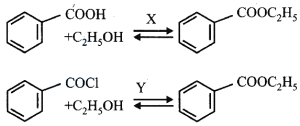
A
$H^{+}$,$H^{+}$
B
$H^{+}$,Pyridine
C
Pyridine,$H^{+}$
D
Pyridine,Pyridine
Solution
(B) The first reaction is an esterification reaction between benzoic acid and ethanol,which is acid-catalyzed,requiring $H^{+}$ as a catalyst.
The second reaction is the acylation of an alcohol using benzoyl chloride. This reaction produces $HCl$ as a byproduct. Pyridine is added to the reaction mixture to neutralize the $HCl$ formed,which prevents the reverse reaction and drives the equilibrium forward.
The second reaction is the acylation of an alcohol using benzoyl chloride. This reaction produces $HCl$ as a byproduct. Pyridine is added to the reaction mixture to neutralize the $HCl$ formed,which prevents the reverse reaction and drives the equilibrium forward.
0 likesView Solution
56
ChemistryEasyMCQAP EAMCET · 2024
An alcohol $X$ $(C_4H_{10}O)$ does not give turbidity with conc. $HCl$ and $ZnCl_2$ at room temperature. $X$ on reaction with reagent $Y$ gives $Z$. What are $X, Y$ and $Z$ respectively?
A
$n$-butanol,$PCC$,butanal
B
$n$-butanol,$KMnO_4/H^+$,butanal
C
butan-$2$-ol,$CrO_3$,butan-$2$-one
D
$2$-methylpropan-$2$-ol,$Cu/573 \ K$,$2$-methylpropene
Solution
(A) The Lucas test uses conc. $HCl$ and $ZnCl_2$ to distinguish between $1^{\circ}$,$2^{\circ}$,and $3^{\circ}$ alcohols.
$3^{\circ}$ alcohols give immediate turbidity,$2^{\circ}$ alcohols give turbidity within $5-10$ minutes,and $1^{\circ}$ alcohols do not give turbidity at room temperature.
Since alcohol $X$ $(C_4H_{10}O)$ does not give turbidity at room temperature,it must be a $1^{\circ}$ alcohol.
Among the options,$n$-butanol is a $1^{\circ}$ alcohol.
$n$-butanol reacts with $PCC$ (Pyridinium chlorochromate) to form butanal $(Z)$.
Therefore,$X = n$-butanol,$Y = PCC$,and $Z = \text{butanal}$.
$3^{\circ}$ alcohols give immediate turbidity,$2^{\circ}$ alcohols give turbidity within $5-10$ minutes,and $1^{\circ}$ alcohols do not give turbidity at room temperature.
Since alcohol $X$ $(C_4H_{10}O)$ does not give turbidity at room temperature,it must be a $1^{\circ}$ alcohol.
Among the options,$n$-butanol is a $1^{\circ}$ alcohol.
$n$-butanol reacts with $PCC$ (Pyridinium chlorochromate) to form butanal $(Z)$.
Therefore,$X = n$-butanol,$Y = PCC$,and $Z = \text{butanal}$.
0 likesView Solution
57
ChemistryMediumMCQAP EAMCET · 2024
Consider the following reactions:
$C_6H_5N_2Cl$ $\xrightarrow{H_2O, 283 \ K} X$ $\xrightarrow{Conc. \ HNO_3} Y$
$X \xrightarrow{Br_2/H_2O} Z$
$Y$ and $Z$ respectively are:
$C_6H_5N_2Cl$ $\xrightarrow{H_2O, 283 \ K} X$ $\xrightarrow{Conc. \ HNO_3} Y$
$X \xrightarrow{Br_2/H_2O} Z$
$Y$ and $Z$ respectively are:
A
Picric acid ($2,4,6-$Trinitrophenol),$2,4,6-$Tribromophenol
B
$o-$nitrophenol,$p-$bromophenol
C
$p-$Nitrophenol,$o-$bromophenol
D
$2,4-$dinitrophenol,$2,4-$dibromophenol
Solution
(A) $1$. The reaction of benzenediazonium chloride $(C_6H_5N_2Cl)$ with water at $283 \ K$ yields phenol $(X)$.
$2$. Phenol $(X)$ reacts with concentrated $HNO_3$ to undergo electrophilic aromatic substitution,resulting in the formation of $2,4,6-$trinitrophenol,also known as picric acid $(Y)$.
$3$. Phenol $(X)$ reacts with bromine water $(Br_2/H_2O)$ to undergo rapid electrophilic substitution at all available ortho and para positions,yielding $2,4,6-$tribromophenol $(Z)$.
$2$. Phenol $(X)$ reacts with concentrated $HNO_3$ to undergo electrophilic aromatic substitution,resulting in the formation of $2,4,6-$trinitrophenol,also known as picric acid $(Y)$.
$3$. Phenol $(X)$ reacts with bromine water $(Br_2/H_2O)$ to undergo rapid electrophilic substitution at all available ortho and para positions,yielding $2,4,6-$tribromophenol $(Z)$.
0 likesView Solution
58
ChemistryMediumMCQAP EAMCET · 2024
What is $Y$ in the given reaction sequence?
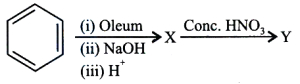
A
$2-$Nitrophenol
B
$2,6-$Dinitrophenol
C
$2,4-$Dinitrophenol
D
$2,4,6-$Trinitrophenol (Picric acid)
Solution
(D) The reaction sequence is as follows:
$1$. Benzene reacts with $Oleum$ $(H_2S_2O_7)$ to form benzene sulphonic acid.
$2$. Benzene sulphonic acid reacts with $NaOH$ followed by $H^+$ to form phenol $(X)$.
$3$. Phenol $(X)$ reacts with concentrated $HNO_3$ (nitration) to form $2,4,6-trinitrophenol$,commonly known as $Picric \ acid$ $(Y)$.
$1$. Benzene reacts with $Oleum$ $(H_2S_2O_7)$ to form benzene sulphonic acid.
$2$. Benzene sulphonic acid reacts with $NaOH$ followed by $H^+$ to form phenol $(X)$.
$3$. Phenol $(X)$ reacts with concentrated $HNO_3$ (nitration) to form $2,4,6-trinitrophenol$,commonly known as $Picric \ acid$ $(Y)$.
0 likesView Solution
59
ChemistryMediumMCQAP EAMCET · 2024
What is the major product '$Z$' in the following reaction sequence?
Benzene $\xrightarrow{\text{Oleum}}$ $X$ $\xrightarrow[(2) H^+]{(1) NaOH}$ $Y$ $\xrightarrow[(2) H^+]{(1) CHCl_3/NaOH}$ $Z$
Benzene $\xrightarrow{\text{Oleum}}$ $X$ $\xrightarrow[(2) H^+]{(1) NaOH}$ $Y$ $\xrightarrow[(2) H^+]{(1) CHCl_3/NaOH}$ $Z$
A
$o-$Hydroxy benzaldehyde
B
$p-$Hydroxy benzaldehyde
C
$o-$Hydroxy benzoic acid
D
$p-$Hydroxy benzoic acid
Solution
(A) $1$. The reaction of benzene with oleum $(H_2S_2O_7)$ gives benzene sulfonic acid $(X)$.
$2$. The fusion of benzene sulfonic acid with $NaOH$ followed by acidification gives phenol $(Y)$.
$3$. The reaction of phenol with $CHCl_3$ and $NaOH$ is the Reimer-Tiemann reaction,which introduces a formyl group $(-CHO)$ at the ortho position to the $-OH$ group.
$4$. Thus,the major product '$Z$' is $o-$hydroxy benzaldehyde (salicylaldehyde).
$2$. The fusion of benzene sulfonic acid with $NaOH$ followed by acidification gives phenol $(Y)$.
$3$. The reaction of phenol with $CHCl_3$ and $NaOH$ is the Reimer-Tiemann reaction,which introduces a formyl group $(-CHO)$ at the ortho position to the $-OH$ group.
$4$. Thus,the major product '$Z$' is $o-$hydroxy benzaldehyde (salicylaldehyde).
0 likesView Solution
60
ChemistryDifficultMCQAP EAMCET · 2024
What are $X$ and $Y$ respectively in the following reactions?
$C_6H_5COOH \xrightarrow{X} C_6H_5CHO$
$C_6H_5CHO \xrightarrow[OH^-, 293 \ K]{C_6H_5COOH} Y \text{ (Major product)}$
$C_6H_5COOH \xrightarrow{X} C_6H_5CHO$
$C_6H_5CHO \xrightarrow[OH^-, 293 \ K]{C_6H_5COOH} Y \text{ (Major product)}$
A
$(i) \ SOCl_2, (ii) \ H_2|Ni; \ C_6H_5-C(CH_3)=CH-C_6H_5$
B
$(i) \ SOCl_2, (ii) \ H_2|Ni; \ C_6H_5-CH=CH-CO-C_6H_5$
C
$(i) \ C_2H_5OH|H^+, (ii) \ DiBAL-H, (iii) \ H_2O; \ C_6H_5-CH=CH-CO-C_6H_5$
D
$(i) \ C_2H_5OH|H^+, (ii) \ DiBAL-H, (iii) \ H_2O; \ C_6H_5-C(CH_3)=CH-C_6H_5$
Solution
(C) The first reaction is the reduction of benzoic acid $(C_6H_5COOH)$ to benzaldehyde $(C_6H_5CHO)$. This cannot be done directly with $SOCl_2$ and $H_2|Ni$ (which reduces acid chlorides to aldehydes,but the conditions are specific). The standard laboratory method to reduce a carboxylic acid to an aldehyde involves converting it to an ester first,followed by reduction with $DiBAL-H$.
Step $1$: $C_6H_5COOH + C_2H_5OH \xrightarrow{H^+} C_6H_5COOC_2H_5 + H_2O$ (Esterification).
Step $2$: $C_6H_5COOC_2H_5 \xrightarrow{(i) \ DiBAL-H, (ii) \ H_2O} C_6H_5CHO$ (Reduction of ester to aldehyde).
Thus,$X$ is $(i) \ C_2H_5OH|H^+, (ii) \ DiBAL-H, (iii) \ H_2O$.
Step $3$: The second reaction is an Aldol condensation between benzaldehyde $(C_6H_5CHO)$ and acetophenone (implied,though the prompt shows $C_6H_5COOH$ as a reactant,the product $Y$ is clearly the Claisen-Schmidt condensation product,benzalacetophenone or chalcone,$C_6H_5-CH=CH-CO-C_6H_5$).
Therefore,the correct option is $C$.
Step $1$: $C_6H_5COOH + C_2H_5OH \xrightarrow{H^+} C_6H_5COOC_2H_5 + H_2O$ (Esterification).
Step $2$: $C_6H_5COOC_2H_5 \xrightarrow{(i) \ DiBAL-H, (ii) \ H_2O} C_6H_5CHO$ (Reduction of ester to aldehyde).
Thus,$X$ is $(i) \ C_2H_5OH|H^+, (ii) \ DiBAL-H, (iii) \ H_2O$.
Step $3$: The second reaction is an Aldol condensation between benzaldehyde $(C_6H_5CHO)$ and acetophenone (implied,though the prompt shows $C_6H_5COOH$ as a reactant,the product $Y$ is clearly the Claisen-Schmidt condensation product,benzalacetophenone or chalcone,$C_6H_5-CH=CH-CO-C_6H_5$).
Therefore,the correct option is $C$.
0 likesView Solution
61
ChemistryEasyMCQAP EAMCET · 2024
Arrange the following in the correct order of their acidic strength:
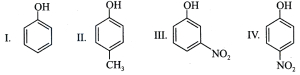
A
$III > IV > I > II$
B
$IV > III > I > II$
C
$II > I > III > IV$
D
$I > IV > III > II$
Solution
(B) The acidic strength of phenols is determined by the stability of the corresponding phenoxide ion. Electron-withdrawing groups $(EWG)$ increase acidity by stabilizing the phenoxide ion,while electron-donating groups $(EDG)$ decrease acidity by destabilizing it.
$1.$ $IV$ ($p$-nitrophenol): The $-NO_2$ group at the $p$-position exerts both a strong $-I$ effect and a strong $-M$ (mesomeric) effect,which significantly stabilizes the phenoxide ion.
$2.$ $III$ ($m$-nitrophenol): The $-NO_2$ group at the $m$-position exerts only a $-I$ effect (no $-M$ effect),providing less stabilization than at the $p$-position.
$3.$ $I$ (Phenol): This is the reference compound.
$4.$ $II$ ($p$-methylphenol): The $-CH_3$ group at the $p$-position exerts a $+I$ effect and hyperconjugation $(+H)$,which donates electron density and destabilizes the phenoxide ion,making it the least acidic.
Therefore,the correct order of acidic strength is $IV > III > I > II$.
$1.$ $IV$ ($p$-nitrophenol): The $-NO_2$ group at the $p$-position exerts both a strong $-I$ effect and a strong $-M$ (mesomeric) effect,which significantly stabilizes the phenoxide ion.
$2.$ $III$ ($m$-nitrophenol): The $-NO_2$ group at the $m$-position exerts only a $-I$ effect (no $-M$ effect),providing less stabilization than at the $p$-position.
$3.$ $I$ (Phenol): This is the reference compound.
$4.$ $II$ ($p$-methylphenol): The $-CH_3$ group at the $p$-position exerts a $+I$ effect and hyperconjugation $(+H)$,which donates electron density and destabilizes the phenoxide ion,making it the least acidic.
Therefore,the correct order of acidic strength is $IV > III > I > II$.
0 likesView Solution
62
ChemistryDifficultMCQAP EAMCET · 2024
Which of the following statements is incorrect?
A
Shaving soaps contain glycerol
B
Branched chain detergents are easily biodegradable
C
Commonly used Dettol is a mixture of chloroxylenol and terpineol
D
$0.2 \%$ of phenol acts as antiseptic
Solution
(B) Branched chain detergents are not easily biodegradable because bacteria cannot easily break down the branched structures. Therefore,the statement that they are easily biodegradable is incorrect.
0 likesView Solution
63
ChemistryMediumMCQAP EAMCET · 2024
Which of the following sets of reagents convert toluene to benzaldehyde?
$A$. $Cl_2 / h\nu ; H_2O, \Delta$
$B$. $Cl_2 / Fe ; H_2O$
$C$. $KMnO_4 / OH^{-} ; H^{+}$
$D$. $CrO_2Cl_2 / CS_2 ; H_3O^{+}$
$A$. $Cl_2 / h\nu ; H_2O, \Delta$
$B$. $Cl_2 / Fe ; H_2O$
$C$. $KMnO_4 / OH^{-} ; H^{+}$
$D$. $CrO_2Cl_2 / CS_2 ; H_3O^{+}$
A
$B, C, D$
B
$A, C$
C
$A, D$
D
$B, D$
Solution
(C) The conversion of toluene to benzaldehyde can be achieved by the following methods:
$1$. Side chain chlorination followed by hydrolysis $(A)$: Toluene reacts with $Cl_2$ in the presence of light $(h\nu)$ to form benzal chloride $(C_6H_5CHCl_2)$,which upon hydrolysis with $H_2O$ at high temperature $(\Delta)$ yields benzaldehyde.
$2$. Etard reaction $(D)$: Toluene reacts with chromyl chloride $(CrO_2Cl_2)$ in $CS_2$ solvent followed by acidic hydrolysis $(H_3O^{+})$ to give benzaldehyde.
$3$. Reagent $C$ $(KMnO_4 / OH^{-} ; H^{+})$ is an oxidizing agent that converts toluene directly to benzoic acid,not benzaldehyde.
Therefore,the correct sets are $A$ and $D$.
$1$. Side chain chlorination followed by hydrolysis $(A)$: Toluene reacts with $Cl_2$ in the presence of light $(h\nu)$ to form benzal chloride $(C_6H_5CHCl_2)$,which upon hydrolysis with $H_2O$ at high temperature $(\Delta)$ yields benzaldehyde.
$2$. Etard reaction $(D)$: Toluene reacts with chromyl chloride $(CrO_2Cl_2)$ in $CS_2$ solvent followed by acidic hydrolysis $(H_3O^{+})$ to give benzaldehyde.
$3$. Reagent $C$ $(KMnO_4 / OH^{-} ; H^{+})$ is an oxidizing agent that converts toluene directly to benzoic acid,not benzaldehyde.
Therefore,the correct sets are $A$ and $D$.
0 likesView Solution
64
ChemistryMediumMCQAP EAMCET · 2024
What are $X$,$Y$,and $Z$ in the following reaction sequence respectively?
Benzene $\xrightarrow{X}$ Benzaldehyde $\xrightarrow{\text{Conc. NaOH}, \Delta} Y + Z$
Benzene $\xrightarrow{X}$ Benzaldehyde $\xrightarrow{\text{Conc. NaOH}, \Delta} Y + Z$
A
$X = \text{CO, HCl, AlCl}_3$; $Y = \text{Benzyl alcohol}$,$Z = \text{Sodium benzoate}$
B
$X = \text{CO, HCl, CuCl}$; $Y = \text{Benzyl alcohol}$,$Z = \text{Sodium benzoate}$
C
$X = \text{HCHO, HCl, anhydrous AlCl}_3$; $Y = \text{Benzyl alcohol}$,$Z = \text{Benzoic acid}$
D
$X = \text{CO, HCl}$; $Y = \text{Phenylacetic acid}$,$Z = \text{Phenol}$
Solution
(B) The first step is the Gattermann-Koch reaction,where benzene reacts with carbon monoxide $(\text{CO})$ and hydrogen chloride $(\text{HCl})$ in the presence of anhydrous aluminum chloride $(\text{AlCl}_3)$ and cuprous chloride $(\text{CuCl})$ to form benzaldehyde. Thus,$X = \text{CO, HCl, CuCl}$.
The second step is the Cannizzaro reaction. Benzaldehyde,which lacks $\alpha$-hydrogen atoms,undergoes self-oxidation and reduction in the presence of concentrated sodium hydroxide $(\text{NaOH})$ to form benzyl alcohol $(Y)$ and sodium benzoate $(Z)$.
The second step is the Cannizzaro reaction. Benzaldehyde,which lacks $\alpha$-hydrogen atoms,undergoes self-oxidation and reduction in the presence of concentrated sodium hydroxide $(\text{NaOH})$ to form benzyl alcohol $(Y)$ and sodium benzoate $(Z)$.
0 likesView Solution
65
ChemistryMediumMCQAP EAMCET · 2024
The sequence of reagents required to convert ethyl bromide to propanal is
A
$CH_3COOAg, DIBAL-H, H_2O$
B
$CH_3COOAg, LiAlH_4, H_2O$
C
$Mg/ether, HCHO, H_2O$
D
$CH_3COOH, LiAlH_4, H_2O$
Solution
(A) The conversion of ethyl bromide $(CH_3CH_2Br)$ to propanal $(CH_3CH_2CHO)$ involves the following steps:
$1$. Reaction of ethyl bromide with silver acetate $(CH_3COOAg)$ to form ethyl ethanoate $(CH_3COOCH_2CH_3)$:
$CH_3COOAg + CH_3CH_2Br \rightarrow CH_3COOCH_2CH_3 + AgBr \downarrow$
$2$. Reduction of the ester (ethyl ethanoate) to an aldehyde using $DIBAL-H$ (Diisobutylaluminium hydride) followed by hydrolysis $(H_2O)$:
$CH_3COOCH_2CH_3 \xrightarrow{DIBAL-H, H_2O} CH_3CH_2CHO$
Thus,the correct sequence of reagents is $CH_3COOAg, DIBAL-H, H_2O$.
$1$. Reaction of ethyl bromide with silver acetate $(CH_3COOAg)$ to form ethyl ethanoate $(CH_3COOCH_2CH_3)$:
$CH_3COOAg + CH_3CH_2Br \rightarrow CH_3COOCH_2CH_3 + AgBr \downarrow$
$2$. Reduction of the ester (ethyl ethanoate) to an aldehyde using $DIBAL-H$ (Diisobutylaluminium hydride) followed by hydrolysis $(H_2O)$:
$CH_3COOCH_2CH_3 \xrightarrow{DIBAL-H, H_2O} CH_3CH_2CHO$
Thus,the correct sequence of reagents is $CH_3COOAg, DIBAL-H, H_2O$.
0 likesView Solution
66
ChemistryMediumMCQAP EAMCET · 2024
$A$ carbonyl compound $X$ $(C_3H_6O)$ on oxidation gives a carboxylic acid $Y$ $(C_3H_6O_2)$. The oxime of $X$ is:
A
$CH_3-C(CH_3)=NNH_2$
B
$CH_3-C(CH_3)=NOH$
C
$CH_3-CH_2-CH=NOH$
D
$CH_3-CH_2-CH=NNH_2$
Solution
(C) The carbonyl compound $X$ has the molecular formula $C_3H_6O$. On oxidation,it gives a carboxylic acid $Y$ with the formula $C_3H_6O_2$.
Since the number of carbon atoms remains the same ($3$ carbons) during oxidation,$X$ must be an aldehyde (propanal,$CH_3-CH_2-CHO$).
Ketones with $3$ carbons would undergo cleavage and produce acids with fewer carbon atoms.
Therefore,$X$ is propanal $(CH_3-CH_2-CHO)$.
The reaction of an aldehyde with hydroxylamine $(NH_2OH)$ forms an oxime:
$CH_3-CH_2-CHO + NH_2OH \rightarrow CH_3-CH_2-CH=NOH + H_2O$.
Thus,the oxime of $X$ is $CH_3-CH_2-CH=NOH$.
Since the number of carbon atoms remains the same ($3$ carbons) during oxidation,$X$ must be an aldehyde (propanal,$CH_3-CH_2-CHO$).
Ketones with $3$ carbons would undergo cleavage and produce acids with fewer carbon atoms.
Therefore,$X$ is propanal $(CH_3-CH_2-CHO)$.
The reaction of an aldehyde with hydroxylamine $(NH_2OH)$ forms an oxime:
$CH_3-CH_2-CHO + NH_2OH \rightarrow CH_3-CH_2-CH=NOH + H_2O$.
Thus,the oxime of $X$ is $CH_3-CH_2-CH=NOH$.
0 likesView Solution
67
ChemistryEasyMCQAP EAMCET · 2024
The carbohydrate which does not react with ammoniacal $AgNO_3$ solution is
A
Sucrose
B
Maltose
C
Lactose
D
Fructose
Solution
(A) Ammoniacal $AgNO_3$ solution is known as Tollen's reagent,which is used to test for reducing sugars.
Reducing sugars contain a free aldehydic or ketonic group that can reduce $Ag^+$ to metallic silver.
$Sucrose$ is a non-reducing sugar because the glycosidic linkage involves the anomeric carbons of both glucose and fructose,leaving no free aldehydic or ketonic group.
$Maltose$,$Lactose$,and $Fructose$ are reducing sugars as they possess at least one free functional group capable of oxidation.
Reducing sugars contain a free aldehydic or ketonic group that can reduce $Ag^+$ to metallic silver.
$Sucrose$ is a non-reducing sugar because the glycosidic linkage involves the anomeric carbons of both glucose and fructose,leaving no free aldehydic or ketonic group.
$Maltose$,$Lactose$,and $Fructose$ are reducing sugars as they possess at least one free functional group capable of oxidation.
0 likesView Solution
68
ChemistryMediumMCQAP EAMCET · 2024
The reaction sequence is as follows:
Benzene + $CH_3Cl$ $\xrightarrow{Anhy. AlCl_3} A$ $\xrightarrow[(2) H_3O^+, \Delta]{(1) CrO_3 / (CH_3CO)_2O, 273-283K} B$
The incorrect statement about '$B$' is:
Benzene + $CH_3Cl$ $\xrightarrow{Anhy. AlCl_3} A$ $\xrightarrow[(2) H_3O^+, \Delta]{(1) CrO_3 / (CH_3CO)_2O, 273-283K} B$
The incorrect statement about '$B$' is:
A
It gives test with Tollens reagent
B
It gives test with Fehling's solution
C
It does not give test with $NaOH + I_2$ solution
D
It forms acid and alcohol with concentrated $NaOH$,followed by acidification
Solution
(B) $1$. The reaction of benzene with $CH_3Cl$ in the presence of anhydrous $AlCl_3$ is a Friedel-Crafts alkylation,yielding toluene $(A)$.
$2$. The oxidation of toluene with $CrO_3$ in the presence of acetic anhydride followed by hydrolysis is the Etard reaction,which yields benzaldehyde $(B)$.
$3$. Benzaldehyde $(B)$ is an aromatic aldehyde.
$4$. Aromatic aldehydes give a positive Tollens' reagent test.
$5$. Aromatic aldehydes do not give the Fehling's solution test.
$6$. Benzaldehyde does not contain an $\alpha$-methyl group,so it does not give the iodoform test $(NaOH + I_2)$.
$7$. Benzaldehyde undergoes the Cannizzaro reaction with concentrated $NaOH$ to form benzoic acid and benzyl alcohol.
$8$. Therefore,the statement that it gives a test with Fehling's solution is incorrect.
$2$. The oxidation of toluene with $CrO_3$ in the presence of acetic anhydride followed by hydrolysis is the Etard reaction,which yields benzaldehyde $(B)$.
$3$. Benzaldehyde $(B)$ is an aromatic aldehyde.
$4$. Aromatic aldehydes give a positive Tollens' reagent test.
$5$. Aromatic aldehydes do not give the Fehling's solution test.
$6$. Benzaldehyde does not contain an $\alpha$-methyl group,so it does not give the iodoform test $(NaOH + I_2)$.
$7$. Benzaldehyde undergoes the Cannizzaro reaction with concentrated $NaOH$ to form benzoic acid and benzyl alcohol.
$8$. Therefore,the statement that it gives a test with Fehling's solution is incorrect.
0 likesView Solution
69
ChemistryMediumMCQAP EAMCET · 2024
Match the following reagents with the products obtained when they react with a ketone.
Correct answer is:
| List-$I$ | List-$II$ |
|---|---|
| $A. \ C_6H_5NHNH_2$ | $I. \ \text{Schiff base}$ |
| $B. \ NH_2OH$ | $II. \ \text{Hydrazone}$ |
| $C. \ C_6H_5NH_2$ | $III. \ \text{Oxime}$ |
| $IV. \ \text{Phenyl hydrazone}$ |
Correct answer is:
A
$A-IV, B-III, C-I$
B
$A-IV, B-II, C-I$
C
$A-II, B-III, C-IV$
D
$A-II, B-IV, C-III$
Solution
(A) The reaction of a ketone with various nitrogen-containing nucleophiles produces different derivatives:
$1$. $C_6H_5NHNH_2$ (Phenylhydrazine) reacts with a ketone to form a phenylhydrazone $(A-IV)$.
$2$. $NH_2OH$ (Hydroxylamine) reacts with a ketone to form an oxime $(B-III)$.
$3$. $C_6H_5NH_2$ (Aniline) reacts with a ketone to form a Schiff base $(C-I)$.
Therefore,the correct matching is $A-IV, B-III, C-I$.
$1$. $C_6H_5NHNH_2$ (Phenylhydrazine) reacts with a ketone to form a phenylhydrazone $(A-IV)$.
$2$. $NH_2OH$ (Hydroxylamine) reacts with a ketone to form an oxime $(B-III)$.
$3$. $C_6H_5NH_2$ (Aniline) reacts with a ketone to form a Schiff base $(C-I)$.
Therefore,the correct matching is $A-IV, B-III, C-I$.
0 likesView Solution
70
ChemistryEasyMCQAP EAMCET · 2024
An organic compound $(X)$ has an empirical formula $C_4H_8O$. This gives a pale yellow precipitate with iodine in $NaOH$ solution. What is $X$?
A
$CH_3CH_2CH_2CHO$
B
$CH_2=CHCH(OH)CH_3$
C
$CH_2=C(CH_3)OCH_3$
D
$CH_3CH_2OCH=CH_2$
Solution
(B) The empirical formula is $C_4H_8O$. The compound $(X)$ gives a pale yellow precipitate with iodine in $NaOH$ solution,which indicates the presence of a methyl ketone group or a secondary alcohol that can be oxidized to a methyl ketone (iodoform test).
Among the options,$CH_2=CHCH(OH)CH_3$ is a secondary alcohol. Upon oxidation,it forms $CH_2=CHCOCH_3$ (methyl vinyl ketone),which contains a methyl ketone group $(CH_3CO-)$ and thus gives a positive iodoform test.
The reaction is:
$CH_2=CHCH(OH)CH_3$ $\xrightarrow{\text{Oxidation}} CH_2=CHCOCH_3$ $\xrightarrow{I_2/NaOH} CHI_3 + CH_2=CHCOO^-Na^+$.
Among the options,$CH_2=CHCH(OH)CH_3$ is a secondary alcohol. Upon oxidation,it forms $CH_2=CHCOCH_3$ (methyl vinyl ketone),which contains a methyl ketone group $(CH_3CO-)$ and thus gives a positive iodoform test.
The reaction is:
$CH_2=CHCH(OH)CH_3$ $\xrightarrow{\text{Oxidation}} CH_2=CHCOCH_3$ $\xrightarrow{I_2/NaOH} CHI_3 + CH_2=CHCOO^-Na^+$.
0 likesView Solution
71
ChemistryMediumMCQAP EAMCET · 2024
What are $X$ and $Y$ respectively in the following reactions?
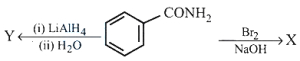
A
$C_6H_5NH_2$ and $C_6H_5NH_2$
B
$C_6H_5NH_2$ and $C_6H_5CH_2NH_2$
C
$C_6H_5CH_2NH_2$ and $C_6H_5CH_2NH_2$
D
$C_6H_5CH_2NH_2$ and $C_6H_5NH_2$
Solution
(B) The given reaction involves two different chemical transformations of benzamide $(C_6H_5CONH_2)$:
$1$. Reaction with $LiAlH_4$ followed by $H_2O$: This is a reduction reaction. $LiAlH_4$ reduces the amide group $(-CONH_2)$ to an amine group $(-CH_2NH_2)$. Thus,$Y$ is benzylamine $(C_6H_5CH_2NH_2)$.
$2$. Reaction with $Br_2$ and $NaOH$: This is the Hoffmann bromamide degradation reaction. It converts an amide $(-CONH_2)$ into a primary amine with one carbon atom less $(-NH_2)$. Thus,$X$ is aniline $(C_6H_5NH_2)$.
Therefore,$X$ is $C_6H_5NH_2$ and $Y$ is $C_6H_5CH_2NH_2$.
$1$. Reaction with $LiAlH_4$ followed by $H_2O$: This is a reduction reaction. $LiAlH_4$ reduces the amide group $(-CONH_2)$ to an amine group $(-CH_2NH_2)$. Thus,$Y$ is benzylamine $(C_6H_5CH_2NH_2)$.
$2$. Reaction with $Br_2$ and $NaOH$: This is the Hoffmann bromamide degradation reaction. It converts an amide $(-CONH_2)$ into a primary amine with one carbon atom less $(-NH_2)$. Thus,$X$ is aniline $(C_6H_5NH_2)$.
Therefore,$X$ is $C_6H_5NH_2$ and $Y$ is $C_6H_5CH_2NH_2$.
0 likesView Solution
72
ChemistryMediumMCQAP EAMCET · 2024
Arrange the following compounds in decreasing order of their basicity:
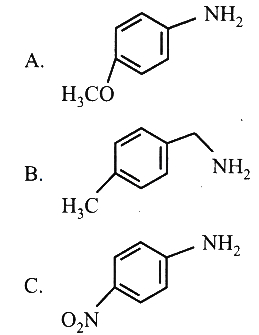
A
$B > A > C$
B
$B > C > A$
C
$A > B > C$
D
$A > C > B$
Solution
(A) The basicity of amines depends on the availability of the lone pair on the nitrogen atom for protonation.
$1$. Compound $(B)$ is $p$-methylbenzylamine. The nitrogen lone pair is not in conjugation with the benzene ring,making it a primary aliphatic amine,which is significantly more basic than aromatic amines.
$2$. Compound $(A)$ is $p$-methoxyaniline. The $-OCH_3$ group is an electron-donating group by resonance ($+M$ effect),which increases the electron density on the nitrogen atom,making it more basic than aniline.
$3$. Compound $(C)$ is $p$-nitroaniline. The $-NO_2$ group is a strong electron-withdrawing group by resonance ($-M$ effect),which significantly decreases the electron density on the nitrogen atom,making it the least basic.
Therefore,the decreasing order of basicity is $B > A > C$.
$1$. Compound $(B)$ is $p$-methylbenzylamine. The nitrogen lone pair is not in conjugation with the benzene ring,making it a primary aliphatic amine,which is significantly more basic than aromatic amines.
$2$. Compound $(A)$ is $p$-methoxyaniline. The $-OCH_3$ group is an electron-donating group by resonance ($+M$ effect),which increases the electron density on the nitrogen atom,making it more basic than aniline.
$3$. Compound $(C)$ is $p$-nitroaniline. The $-NO_2$ group is a strong electron-withdrawing group by resonance ($-M$ effect),which significantly decreases the electron density on the nitrogen atom,making it the least basic.
Therefore,the decreasing order of basicity is $B > A > C$.
0 likesView Solution
73
ChemistryDifficultMCQAP EAMCET · 2024
In the reaction sequence $Y$ is $CH_3CO_2H$ $\xrightarrow[(2) \Delta]{(1) NH_3} P$ $\xrightarrow{Br_2 / NaOH} Y$
A
a primary amine with same number of carbons as in $P$
B
a primary amine with one carbon less than in $P$
C
a secondary amine with same number of carbons as in $P$
D
a secondary amine with one carbon less than in $P$
Solution
(B) The reaction sequence is as follows:
$1$. $CH_3COOH + NH_3$ $\rightarrow CH_3COONH_4$ $\xrightarrow{\Delta} CH_3CONH_2 (P) + H_2O$
$2$. $CH_3CONH_2 (P) \xrightarrow{Br_2 / NaOH} CH_3NH_2 (Y) + Na_2CO_3 + NaBr + H_2O$
This is the Hofmann bromamide degradation reaction,which converts an amide into a primary amine containing one carbon atom less than the original amide $(P)$.
$1$. $CH_3COOH + NH_3$ $\rightarrow CH_3COONH_4$ $\xrightarrow{\Delta} CH_3CONH_2 (P) + H_2O$
$2$. $CH_3CONH_2 (P) \xrightarrow{Br_2 / NaOH} CH_3NH_2 (Y) + Na_2CO_3 + NaBr + H_2O$
This is the Hofmann bromamide degradation reaction,which converts an amide into a primary amine containing one carbon atom less than the original amide $(P)$.
0 likesView Solution
74
ChemistryDifficultMCQAP EAMCET · 2024
What are $X$ and $Y$ respectively in the following reaction sequence?

A
$NH_2NH_2, C_6H_5SO_2Cl$ / Pyridine
B
$NH_2NH_2, (CH_3CO)_2O$
C
$NH_2OH, C_6H_5SO_2Cl$ / Pyridine
D
$NH_2OH, (CH_3CO)_2O$
Solution
(D) The reaction sequence is as follows:
$1$. Benzaldehyde reacts with hydroxylamine $(NH_2OH)$ to form benzaldoxime. This is reagent $X$.
$2$. Benzaldoxime is then dehydrated using acetic anhydride $((CH_3CO)_2O)$ to form benzonitrile $(C_6H_5CN)$. This is reagent $Y$.
Therefore,$X = NH_2OH$ and $Y = (CH_3CO)_2O$.
$1$. Benzaldehyde reacts with hydroxylamine $(NH_2OH)$ to form benzaldoxime. This is reagent $X$.
$2$. Benzaldoxime is then dehydrated using acetic anhydride $((CH_3CO)_2O)$ to form benzonitrile $(C_6H_5CN)$. This is reagent $Y$.
Therefore,$X = NH_2OH$ and $Y = (CH_3CO)_2O$.
0 likesView Solution
75
ChemistryEasyMCQAP EAMCET · 2024
The correct sequence of reactions involved in the following conversion is:
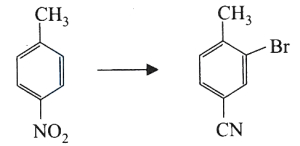
A
Bromination,reduction,carbylamine reaction
B
Reduction,Bromination,carbylamine reaction
C
Bromination,reduction,oxidation
D
Reduction,Bromination,oxidation
Solution
(A) The conversion of $p$-nitrotoluene to $2$-bromo-$4$-methylbenzonitrile involves the following steps:
$1$. Bromination: $p$-Nitrotoluene reacts with $Br_2$ to form $2$-bromo-$4$-nitrotoluene.
$2$. Reduction: The nitro group $(-NO_2)$ is reduced to an amino group $(-NH_2)$ using $Sn + HCl$ to form $2$-bromo-$4$-methylaniline.
$3$. Carbylamine reaction: The primary amine $(-NH_2)$ is converted to an isocyanide $(-NC)$ using $CHCl_3 + KOH$ (Note: The final product in the provided image is an isocyanide,not a nitrile,which is characteristic of the carbylamine reaction).
Thus,the correct sequence is Bromination,reduction,carbylamine reaction.
$1$. Bromination: $p$-Nitrotoluene reacts with $Br_2$ to form $2$-bromo-$4$-nitrotoluene.
$2$. Reduction: The nitro group $(-NO_2)$ is reduced to an amino group $(-NH_2)$ using $Sn + HCl$ to form $2$-bromo-$4$-methylaniline.
$3$. Carbylamine reaction: The primary amine $(-NH_2)$ is converted to an isocyanide $(-NC)$ using $CHCl_3 + KOH$ (Note: The final product in the provided image is an isocyanide,not a nitrile,which is characteristic of the carbylamine reaction).
Thus,the correct sequence is Bromination,reduction,carbylamine reaction.
0 likesView Solution
76
ChemistryMediumMCQAP EAMCET · 2024
Identify the final product $A$ in the given reaction sequence.
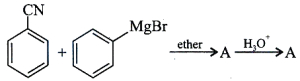
A
The intermediate imine salt $Ph-C(Ph)=NMgBr$
B
Benzophenone imine $(Ph_2C=NH)$
C
Benzophenone $(Ph_2C=O)$
D
Benzophenone oxime $(Ph_2C=NOH)$
Solution
(C) The reaction involves the nucleophilic addition of a Grignard reagent $(PhMgBr)$ to a nitrile $(PhCN)$.
$1$. The phenyl group $(Ph^-)$ from $PhMgBr$ attacks the electrophilic carbon of the nitrile group $(-CN)$,forming an intermediate imine salt: $Ph-C(Ph)=NMgBr$.
$2$. Upon hydrolysis with $H_3O^+$,the imine salt is converted into an imine $(Ph_2C=NH)$,which is further hydrolyzed to the final carbonyl compound,benzophenone $(Ph_2C=O)$.
$1$. The phenyl group $(Ph^-)$ from $PhMgBr$ attacks the electrophilic carbon of the nitrile group $(-CN)$,forming an intermediate imine salt: $Ph-C(Ph)=NMgBr$.
$2$. Upon hydrolysis with $H_3O^+$,the imine salt is converted into an imine $(Ph_2C=NH)$,which is further hydrolyzed to the final carbonyl compound,benzophenone $(Ph_2C=O)$.
0 likesView Solution
77
ChemistryEasyMCQAP EAMCET · 2024
$p-$Methylbenzonitrile can be prepared from which of the following?
A
$4-$Chlorotoluene reacting with $NaCN$.
B
$4-$Chlorotoluene reacting with $AgCN$.
C
$p-$Toluidine reacting with $(i) NaNO_2/HCl, 273-278 \ K$ and $(ii) CuCN/KCN$.
D
$p-$Toluidine reacting with $CHCl_3/KOH, \Delta$.
Solution
(C) The preparation of $p-$methylbenzonitrile ($p-$tolunitrile) is best achieved via the Sandmeyer reaction starting from $p-$toluidine.
$1$. $p-$Toluidine reacts with $NaNO_2/HCl$ at $273-278 \ K$ to form the $p-$methylbenzenediazonium chloride salt.
$2$. This diazonium salt then reacts with $CuCN/KCN$ to yield $p-$methylbenzonitrile.
- Option $(a)$ and $(b)$: Aryl halides like $4-$chlorotoluene do not undergo nucleophilic substitution with $NaCN$ or $AgCN$ under standard conditions due to the partial double bond character of the $C-Cl$ bond.
- Option $(d)$: This is the carbylamine reaction,which converts primary amines into isocyanides $(R-NC)$,not nitriles $(R-CN)$.
$1$. $p-$Toluidine reacts with $NaNO_2/HCl$ at $273-278 \ K$ to form the $p-$methylbenzenediazonium chloride salt.
$2$. This diazonium salt then reacts with $CuCN/KCN$ to yield $p-$methylbenzonitrile.
- Option $(a)$ and $(b)$: Aryl halides like $4-$chlorotoluene do not undergo nucleophilic substitution with $NaCN$ or $AgCN$ under standard conditions due to the partial double bond character of the $C-Cl$ bond.
- Option $(d)$: This is the carbylamine reaction,which converts primary amines into isocyanides $(R-NC)$,not nitriles $(R-CN)$.
0 likesView Solution
78
ChemistryMediumMCQAP EAMCET · 2024
$Benzamide$ $\xrightarrow{Br_2 / NaOH} X$ $\xrightarrow[\text{alc. } KOH]{CHCl_3} Y$
The conversion of $X$ to $Y$ is
The conversion of $X$ to $Y$ is
A
Hoffmann reaction
B
Etard reaction
C
Stephen reaction
D
Carbylamine reaction
Solution
(D) $1$. The first step,$Benzamide \xrightarrow{Br_2 / NaOH} X$,is the Hoffmann bromamide degradation reaction,where $X$ is $Aniline$ $(C_6H_5NH_2)$.
$2$. The second step,$X \xrightarrow[\text{alc. } KOH]{CHCl_3} Y$,involves the reaction of a primary amine $(Aniline)$ with chloroform $(CHCl_3)$ and alcoholic potassium hydroxide $(KOH)$.
$3$. This specific reaction is known as the Carbylamine reaction,which produces an isocyanide ($Y = Phenyl \ isocyanide$ or $C_6H_5NC$).
$4$. Therefore,the conversion of $X$ to $Y$ is the Carbylamine reaction.
$2$. The second step,$X \xrightarrow[\text{alc. } KOH]{CHCl_3} Y$,involves the reaction of a primary amine $(Aniline)$ with chloroform $(CHCl_3)$ and alcoholic potassium hydroxide $(KOH)$.
$3$. This specific reaction is known as the Carbylamine reaction,which produces an isocyanide ($Y = Phenyl \ isocyanide$ or $C_6H_5NC$).
$4$. Therefore,the conversion of $X$ to $Y$ is the Carbylamine reaction.
0 likesView Solution
79
ChemistryEasyMCQAP EAMCET · 2024
The number of $-OH$ groups in open chain and ring structures of $D$-glucose are respectively:
A
$4, 5$
B
$5, 5$
C
$5, 4$
D
$6, 5$
Solution
(B) In the open-chain structure of $D$-glucose $(CHO-(CHOH)_4-CH_2OH)$,there are $5$ hydroxyl $(-OH)$ groups.
In the cyclic (ring) structure of $D$-glucose (glucopyranose),one $-OH$ group is involved in the formation of the hemiacetal linkage,but it remains as an $-OH$ group (the anomeric hydroxyl group). Thus,there are still $5$ hydroxyl groups present in the ring structure.
In the cyclic (ring) structure of $D$-glucose (glucopyranose),one $-OH$ group is involved in the formation of the hemiacetal linkage,but it remains as an $-OH$ group (the anomeric hydroxyl group). Thus,there are still $5$ hydroxyl groups present in the ring structure.
0 likesView Solution
80
ChemistryMediumMCQAP EAMCET · 2024
When glucose is oxidized with nitric acid,the compound formed is:
A
Gluconic acid
B
$n-$hexanoic acid
C
Saccharic acid
D
Cyanohydrin
Solution
(C) When $D-(+)-$glucose is oxidized with strong oxidizing agents like nitric acid $(HNO_3)$,both the terminal aldehyde group $(-CHO)$ and the primary alcoholic group $(-CH_2OH)$ are oxidized to carboxylic acid groups $(-COOH)$.
This results in the formation of a dicarboxylic acid known as saccharic acid (also called glucaric acid).
The reaction is as follows:
$CHO-(CHOH)_4-CH_2OH + [O] \xrightarrow{HNO_3} COOH-(CHOH)_4-COOH$
Thus,the correct option is $C$.
This results in the formation of a dicarboxylic acid known as saccharic acid (also called glucaric acid).
The reaction is as follows:
$CHO-(CHOH)_4-CH_2OH + [O] \xrightarrow{HNO_3} COOH-(CHOH)_4-COOH$
Thus,the correct option is $C$.
0 likesView Solution
81
ChemistryMediumMCQAP EAMCET · 2024
Which of the following represents the simplified version of a nucleoside?
A
Base $-$ sugar $-$ phosphate
B
Sugar $-$ base
C
Sugar $-$ phosphate
D
Base $-$ phosphate
Solution
(B) unit formed by the attachment of a nitrogenous base to the $1^{\prime}$ position of a sugar molecule is known as a nucleoside.
In a nucleoside,the sugar carbons are numbered as $1^{\prime}, 2^{\prime}, 3^{\prime}$,etc.
Therefore,a nucleoside consists only of a sugar and a base.
Nucleotide = Sugar $+$ Base $+$ Phosphate group.
In a nucleoside,the sugar carbons are numbered as $1^{\prime}, 2^{\prime}, 3^{\prime}$,etc.
Therefore,a nucleoside consists only of a sugar and a base.
Nucleotide = Sugar $+$ Base $+$ Phosphate group.
0 likesView Solution
82
ChemistryMediumMCQAP EAMCET · 2024
Which one of the following is $NOT$ a disaccharide?
A
Sucrose
B
Fructose
C
Maltose
D
Lactose
Solution
(B) Monosaccharides: $A$ carbohydrate that cannot be hydrolysed further to give simpler units of polyhydroxy aldehyde or ketone is called a monosaccharide.
Examples: $Glucose$,$Fructose$,$Ribose$.
Disaccharides: The sugar formed when $2$ monosaccharides are joined by a glycosidic linkage.
Examples: $Sucrose$,$Lactose$,$Maltose$.
Since $Fructose$ is a monosaccharide,it is not a disaccharide.
Examples: $Glucose$,$Fructose$,$Ribose$.
Disaccharides: The sugar formed when $2$ monosaccharides are joined by a glycosidic linkage.
Examples: $Sucrose$,$Lactose$,$Maltose$.
Since $Fructose$ is a monosaccharide,it is not a disaccharide.
0 likesView Solution
83
ChemistryMediumMCQAP EAMCET · 2024
Which of the following is a correct statement?
A
Starch is a polymer of $\beta-D$-glucose
B
Amylose is a component of starch
C
Proteins are biopolymers of only one type of amino acids
D
Lactose is a disaccharide of $\alpha-D$-glucose and $\beta-D$-glucose
Solution
(B) Starch is a polymer of $\alpha-D$-glucose.
Amylose and Amylopectin are the two components of starch.
Lactose is a disaccharide composed of $\beta-D$-galactose and $\beta-D$-glucose.
Proteins are biopolymers composed of various types of amino acids.
Amylose and Amylopectin are the two components of starch.
Lactose is a disaccharide composed of $\beta-D$-galactose and $\beta-D$-glucose.
Proteins are biopolymers composed of various types of amino acids.
0 likesView Solution
84
ChemistryDifficultMCQAP EAMCET · 2024
Which of the following is an essential amino acid?
A
$CH_3-CH(NH_2)-COOH$ (Alanine)
B
$HOCH_2-CH(NH_2)-COOH$ (Serine)
C
$(CH_3)_2CH-CH_2-CH(NH_2)-COOH$ (Leucine)
D
$HSCH_2-CH(NH_2)-COOH$ (Cysteine)
Solution
(C) Essential amino acids are those that cannot be synthesized by the human body and must be obtained through diet.
Among the given options,Leucine is an essential amino acid.
Among the given options,Leucine is an essential amino acid.
| Essential Amino Acid | Non-essential Amino Acid |
|---|---|
| Arginine | Alanine |
| Histidine | Asparagine |
| Isoleucine | Aspartate |
| Leucine | Glutamate |
| Lysine | Glycine |
| Methionine | Serine |
| Phenylalanine | Tyrosine |
| Threonine | |
| Tryptophan | |
| Valine |
0 likesView Solution
85
ChemistryMediumMCQAP EAMCET · 2024
Identify the amino acid which has $-NH_2$,$-CO_2H$ and $-CONH_2$ groups.
A
Alanine
B
Arginine
C
Asparagine
D
Aspartic acid
Solution
(C) The structure of Asparagine is $H_2N-CO-CH_2-CH(NH_2)-COOH$.
It contains an amino group $(-NH_2)$,a carboxylic acid group $(-COOH)$,and an amide group $(-CONH_2)$ in its side chain.
Therefore,the correct option is $C$.
It contains an amino group $(-NH_2)$,a carboxylic acid group $(-COOH)$,and an amide group $(-CONH_2)$ in its side chain.
Therefore,the correct option is $C$.
0 likesView Solution
86
ChemistryMediumMCQAP EAMCET · 2024
The number of essential and non-essential amino acids from the following list respectively is:
Val,Gly,Leu,Lys,Pro,Ser
Val,Gly,Leu,Lys,Pro,Ser
A
$3, 3$
B
$4, 2$
C
$2, 4$
D
$5, 1$
Solution
(A) The given amino acids are: $Val$ (Valine),$Gly$ (Glycine),$Leu$ (Leucine),$Lys$ (Lysine),$Pro$ (Proline),and $Ser$ (Serine).
Essential amino acids are those that cannot be synthesized by the body and must be obtained through the diet. Among the given list,$Val$,$Leu$,and $Lys$ are essential amino acids.
Non-essential amino acids are those that can be synthesized by the body. Among the given list,$Gly$,$Pro$,and $Ser$ are non-essential amino acids.
Thus,there are $3$ essential and $3$ non-essential amino acids.
Therefore,the correct option is $A$.
Essential amino acids are those that cannot be synthesized by the body and must be obtained through the diet. Among the given list,$Val$,$Leu$,and $Lys$ are essential amino acids.
Non-essential amino acids are those that can be synthesized by the body. Among the given list,$Gly$,$Pro$,and $Ser$ are non-essential amino acids.
Thus,there are $3$ essential and $3$ non-essential amino acids.
Therefore,the correct option is $A$.
0 likesView Solution
87
ChemistryMediumMCQAP EAMCET · 2024
Which of the following amino acids possesses two chiral centres?
A
Leucine
B
Valine
C
Serine
D
Threonine
Solution
(D) The structure of Threonine is $CH_3-CH(OH)-CH(NH_2)-COOH$.
In this structure,the carbon atom attached to the $-NH_2$ group is chiral because it is bonded to four different groups: $-H$,$-NH_2$,$-COOH$,and the $-CH(OH)CH_3$ group.
The carbon atom attached to the $-OH$ group is also chiral because it is bonded to four different groups: $-H$,$-OH$,$-CH_3$,and the $-CH(NH_2)COOH$ group.
Therefore,Threonine has $2$ chiral centres.
In this structure,the carbon atom attached to the $-NH_2$ group is chiral because it is bonded to four different groups: $-H$,$-NH_2$,$-COOH$,and the $-CH(OH)CH_3$ group.
The carbon atom attached to the $-OH$ group is also chiral because it is bonded to four different groups: $-H$,$-OH$,$-CH_3$,and the $-CH(NH_2)COOH$ group.
Therefore,Threonine has $2$ chiral centres.
0 likesView Solution
88
ChemistryEasyMCQAP EAMCET · 2024
Which of the following is not an essential amino acid?
A
Lysine
B
Histidine
C
Glutamine
D
Methionine
Solution
(C) Essential amino acids are those that cannot be synthesized by the human body and must be obtained through the diet. Non-essential amino acids are those that the body can synthesize on its own.
Based on the table,$Glutamine$ is a non-essential amino acid.
| Essential Amino Acids | Non-essential Amino Acids |
|---|---|
| $Arginine$ $(Arg)$ | $Alanine$ $(Ala)$ |
| $Histidine$ $(His)$ | $Asparagine$ $(Asn)$ |
| $Isoleucine$ $(Ile)$ | $Aspartic$ $acid$ $(Asp)$ |
| $Leucine$ $(Leu)$ | $Glutamic$ $acid$ $(Glu)$ |
| $Lysine$ $(Lys)$ | $Glutamine$ $(Gln)$ |
| $Methionine$ $(Met)$ | $Glycine$ $(Gly)$ |
| $Phenylalanine$ $(Phe)$ | $Proline$ $(Pro)$ |
| $Threonine$ $(Thr)$ | $Serine$ $(Ser)$ |
| $Tryptophan$ $(Trp)$ | $Cysteine$ $(Cys)$ |
| $Valine$ $(Val)$ | $Tyrosine$ $(Tyr)$ |
Based on the table,$Glutamine$ is a non-essential amino acid.
0 likesView Solution
89
ChemistryMediumMCQAP EAMCET · 2024
Which of the following structures of proteins represents its constitution?
A
Secondary structure
B
Quaternary structure
C
Primary structure
D
Tertiary structure
Solution
(C) The $Primary$ structure of a protein refers to the specific sequence of amino acids in a polypeptide chain,which defines its constitution.
$Secondary$ structure refers to the local folding of the polypeptide chain into structures like $\alpha$-helices and $\beta$-pleated sheets,stabilized by hydrogen bonding.
$Tertiary$ structure refers to the overall three-dimensional shape of a single polypeptide chain,determined by interactions between side chains.
$Quaternary$ structure refers to the arrangement of multiple polypeptide chains in a multi-subunit protein.
$Secondary$ structure refers to the local folding of the polypeptide chain into structures like $\alpha$-helices and $\beta$-pleated sheets,stabilized by hydrogen bonding.
$Tertiary$ structure refers to the overall three-dimensional shape of a single polypeptide chain,determined by interactions between side chains.
$Quaternary$ structure refers to the arrangement of multiple polypeptide chains in a multi-subunit protein.
0 likesView Solution
90
ChemistryMediumMCQAP EAMCET · 2024
Given below are two statements:
Statement $I$: Cytosine and guanine are formed in equal quantities in $DNA$ hydrolysis.
Statement $II$: Adenine and uracil are formed in equal quantities in $RNA$ hydrolysis.
The correct answer is:
Statement $I$: Cytosine and guanine are formed in equal quantities in $DNA$ hydrolysis.
Statement $II$: Adenine and uracil are formed in equal quantities in $RNA$ hydrolysis.
The correct answer is:
A
Statements $I$ and $II$ both are correct
B
Statements $I$ and $II$ both are incorrect
C
Statement $I$ is correct but statement $II$ is incorrect
D
Statement $I$ is incorrect but statement $II$ is correct
Solution
(C) Chargaff's rule states that in the $DNA$ of any species,the amount of guanine $(G)$ is equal to the amount of cytosine $(C)$,and the amount of adenine $(A)$ is equal to the amount of thymine $(T)$.
Statement $I$ is correct because $G = C$ in $DNA$.
Statement $II$ is incorrect because in $RNA$,adenine pairs with uracil,but there is no fixed stoichiometric rule stating their quantities must be equal in the total hydrolysate of $RNA$ as there is for $DNA$ base pairing.
Therefore,statement $I$ is correct but statement $II$ is incorrect.
Statement $I$ is correct because $G = C$ in $DNA$.
Statement $II$ is incorrect because in $RNA$,adenine pairs with uracil,but there is no fixed stoichiometric rule stating their quantities must be equal in the total hydrolysate of $RNA$ as there is for $DNA$ base pairing.
Therefore,statement $I$ is correct but statement $II$ is incorrect.
0 likesView Solution
91
ChemistryEasyMCQAP EAMCET · 2024
Carrot and curd are sources for the vitamins respectively:
A
$A, B_{12}$
B
$A, B_1$
C
$E, \text{Pyridoxine}$
D
$E, \text{Riboflavin}$
Solution
(A) Carrot is a rich source of Vitamin $A$ (beta-carotene).
Curd is a source of Vitamin $B_{12}$ because it is synthesized by lactic acid bacteria during the fermentation of milk into curd.
Curd is a source of Vitamin $B_{12}$ because it is synthesized by lactic acid bacteria during the fermentation of milk into curd.
0 likesView Solution
92
ChemistryMediumMCQAP EAMCET · 2024
Identify the correctly matched set from the following:
A
Vitamin $A$ - Water soluble - Xerophthalmia
B
Vitamin $B_{6}$ - Water soluble - Scurvy
C
Vitamin $D$ - Fat soluble - Rickets
D
Vitamin $C$ - Fat soluble - Convulsions
Solution
(C) The correct matches for vitamins,their solubility,and deficiency diseases are as follows:
$1$. Vitamin $A$: Fat-soluble,deficiency causes Xerophthalmia (or night blindness).
$2$. Vitamin $B_{6}$: Water-soluble,deficiency causes convulsions.
$3$. Vitamin $D$: Fat-soluble,deficiency causes Rickets.
$4$. Vitamin $C$: Water-soluble,deficiency causes Scurvy.
Comparing these with the given options,option $C$ is the only correctly matched set.
$1$. Vitamin $A$: Fat-soluble,deficiency causes Xerophthalmia (or night blindness).
$2$. Vitamin $B_{6}$: Water-soluble,deficiency causes convulsions.
$3$. Vitamin $D$: Fat-soluble,deficiency causes Rickets.
$4$. Vitamin $C$: Water-soluble,deficiency causes Scurvy.
Comparing these with the given options,option $C$ is the only correctly matched set.
0 likesView Solution
93
ChemistryEasyMCQAP EAMCET · 2024
The deficiency of vitamin $x$ causes beri beri and deficiency of vitamin $y$ causes convulsions. What are $x$ and $y$ respectively?
A
$B_2, B_{12}$
B
$B_1, B_{12}$
C
$B_2, B_6$
D
$B_1, B_6$
Solution
(D) The deficiency of vitamin $B_1$ (thiamine) in the diet leads to beri beri.
The deficiency of vitamin $B_6$ (pyridoxine) causes convulsions.
The deficiency of vitamin $B_6$ (pyridoxine) causes convulsions.
0 likesView Solution
94
ChemistryEasyMCQAP EAMCET · 2024
Arrange the following compounds in decreasing order of their acidity:
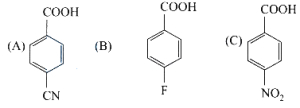
A
$C > B > A$
B
$C > A > B$
C
$B > C > A$
D
$B > A > C$
Solution
(B) The acidity of substituted benzoic acids is directly proportional to the electron-withdrawing effect ($-I$ and $-M$ effects) of the substituent group.
The substituents present are:
$(A) -CN$ (strong $-I$ and $-M$ effect)
$(B) -F$ (strong $-I$ effect,weak $+M$ effect)
$(C) -NO_2$ (very strong $-I$ and $-M$ effect)
The overall electron-withdrawing power follows the order: $-NO_2 > -CN > -F$.
Therefore,the decreasing order of acidity is $C > A > B$.
The substituents present are:
$(A) -CN$ (strong $-I$ and $-M$ effect)
$(B) -F$ (strong $-I$ effect,weak $+M$ effect)
$(C) -NO_2$ (very strong $-I$ and $-M$ effect)
The overall electron-withdrawing power follows the order: $-NO_2 > -CN > -F$.
Therefore,the decreasing order of acidity is $C > A > B$.
0 likesView Solution
95
ChemistryEasyMCQAP EAMCET · 2024
What are $A$ and $B$ in the following reaction sequence?
$CH_3COOH$ $\xrightarrow{A} X$ $\xrightarrow[H^{+}]{Y} \underset{\text{(Analgesic drug)}}{B}$
$CH_3COOH$ $\xrightarrow{A} X$ $\xrightarrow[H^{+}]{Y} \underset{\text{(Analgesic drug)}}{B}$
A
$A = P_2O_5, \Delta; B = \text{2-acetoxybenzoic acid}$
B
$A = P_2O_5, \Delta; B = \text{methyl salicylate}$
C
$A = SOCl_2, \Delta; B = \text{4-acetoxybenzoic acid}$
D
$A = SOCl_2, \Delta; B = \text{4-hydroxybenzoic acid}$
Solution
(A) The reaction sequence is as follows:
$1$. $CH_3COOH$ reacts with $P_2O_5$ under heating $(\Delta)$ to form acetic anhydride $(X)$ via dehydration.
$2$. Acetic anhydride $(X)$ then reacts with salicylic acid $(Y)$ in the presence of an acid catalyst $(H^ )$ to undergo acetylation of the phenolic $-OH$ group.
$3$. This reaction produces $2-\text{acetoxybenzoic acid}$,commonly known as aspirin $(B)$,which acts as an analgesic drug.
Therefore,$A = P_2O_5, \Delta$ and $B = \text{2-acetoxybenzoic acid}$.
$1$. $CH_3COOH$ reacts with $P_2O_5$ under heating $(\Delta)$ to form acetic anhydride $(X)$ via dehydration.
$2$. Acetic anhydride $(X)$ then reacts with salicylic acid $(Y)$ in the presence of an acid catalyst $(H^ )$ to undergo acetylation of the phenolic $-OH$ group.
$3$. This reaction produces $2-\text{acetoxybenzoic acid}$,commonly known as aspirin $(B)$,which acts as an analgesic drug.
Therefore,$A = P_2O_5, \Delta$ and $B = \text{2-acetoxybenzoic acid}$.
0 likesView Solution
96
ChemistryMediumMCQAP EAMCET · 2024
Toluene on reaction with the reagent $X$ gives $Y$,which dissolves in $NaHCO_3$ and when reacted with $Br_2 / Fe$ gives $Z$. What are $X$ and $Z$?
A
$(i) \ KMnO_4 / OH^-, \Delta \ (ii) \ H_3O^+; \text{p-bromobenzoic acid}$
B
$(i) \ CrO_2Cl_2 \ (ii) \ H_3O^+; \text{p-bromobenzoic acid}$
C
$(i) \ CrO_2Cl_2 \ (ii) \ H_3O^+; \text{m-bromobenzoic acid}$
D
$(i) \ KMnO_4 / OH^-, \Delta \ (ii) \ H_3O^+; \text{m-bromobenzoic acid}$
Solution
(D) $1$. Toluene reacts with $KMnO_4 / OH^-, \Delta$ followed by $H_3O^+$ (reagent $X$) to form benzoic acid $(Y)$.
$2$. Benzoic acid dissolves in $NaHCO_3$ because it is acidic.
$3$. The $-COOH$ group is a meta-directing group in electrophilic aromatic substitution reactions.
$4$. Therefore,reaction of benzoic acid with $Br_2 / Fe$ (electrophilic bromination) yields m-bromobenzoic acid $(Z)$.
$5$. Thus,$X$ is $(i) \ KMnO_4 / OH^-, \Delta \ (ii) \ H_3O^+$ and $Z$ is m-bromobenzoic acid.
$2$. Benzoic acid dissolves in $NaHCO_3$ because it is acidic.
$3$. The $-COOH$ group is a meta-directing group in electrophilic aromatic substitution reactions.
$4$. Therefore,reaction of benzoic acid with $Br_2 / Fe$ (electrophilic bromination) yields m-bromobenzoic acid $(Z)$.
$5$. Thus,$X$ is $(i) \ KMnO_4 / OH^-, \Delta \ (ii) \ H_3O^+$ and $Z$ is m-bromobenzoic acid.
0 likesView Solution
97
ChemistryMediumMCQAP EAMCET · 2024
What are $X$ and $Y$ in the following set of reactions?

A
$X = H_2 / \text{Catalyst} ; Y = (i) \text{DIBAL-H} (ii) H_2O$
B
$X = (i) \text{DIBAL-H} (ii) H_2O ; Y = (i) \text{DIBAL-H} (ii) H_2O$
C
$X = H_2 / \text{Catalyst} ; Y = H_2 / \text{Catalyst}$
D
$X = (i) \text{DIBAL-H} (ii) H_2O ; Y = H_2 / \text{Catalyst}$
Solution
(A) The conversion of ethyl benzoate $(C_6H_5COOC_2H_5)$ to benzyl alcohol $(C_6H_5CH_2OH)$ requires a strong reducing agent like $H_2 / \text{Catalyst}$ or $LiAlH_4$ to reduce the ester group completely to a primary alcohol. Thus,$X = H_2 / \text{Catalyst}$.
The conversion of ethyl benzoate $(C_6H_5COOC_2H_5)$ to benzaldehyde $(C_6H_5CHO)$ is a partial reduction,which is specifically achieved using $DIBAL-H$ (diisobutylaluminium hydride) at low temperature followed by hydrolysis. Thus,$Y = (i) \text{DIBAL-H} (ii) H_2O$.
The conversion of ethyl benzoate $(C_6H_5COOC_2H_5)$ to benzaldehyde $(C_6H_5CHO)$ is a partial reduction,which is specifically achieved using $DIBAL-H$ (diisobutylaluminium hydride) at low temperature followed by hydrolysis. Thus,$Y = (i) \text{DIBAL-H} (ii) H_2O$.
0 likesView Solution
98
ChemistryEasyMCQAP EAMCET · 2024
Some substances are given below:
$Ag$; $CO_{2(s)}$; $SiO_2$; $ZnS$;
$SO_{2(s)}$; $AlN$; $HCl_{(s)}$; $H_2O_{(s)}$
The number of molecular solids and network solids in the above list is respectively
$Ag$; $CO_{2(s)}$; $SiO_2$; $ZnS$;
$SO_{2(s)}$; $AlN$; $HCl_{(s)}$; $H_2O_{(s)}$
The number of molecular solids and network solids in the above list is respectively
A
$3, 3$
B
$2, 4$
C
$4, 2$
D
$3, 2$
Solution
(C) $Ag$ is a metallic solid.
$ZnS$ is an ionic solid.
$CO_{2(s)}$,$SO_{2(s)}$,$HCl_{(s)}$,and $H_2O_{(s)}$ are molecular solids (Total = $4$).
$SiO_2$ and $AlN$ are network solids (Total = $2$).
Therefore,the number of molecular solids is $4$ and the number of network solids is $2$.
$ZnS$ is an ionic solid.
$CO_{2(s)}$,$SO_{2(s)}$,$HCl_{(s)}$,and $H_2O_{(s)}$ are molecular solids (Total = $4$).
$SiO_2$ and $AlN$ are network solids (Total = $2$).
Therefore,the number of molecular solids is $4$ and the number of network solids is $2$.
0 likesView Solution
99
ChemistryMediumMCQAP EAMCET · 2024
Identify the incorrect set from the following:
A
$SiO_2$,covalent solid,insulator,high melting point
B
$MgO$,covalent solid,insulator,high melting point
C
$H_2O_{\text{(ice)}}$,molecular solid,insulator,low melting point
D
$Ag_{(s)}$,metallic solid,conductor,high melting point
Solution
(B) $1$. $SiO_2$ is a covalent network solid,which is an insulator and has a very high melting point. This is correct.
$2$. $MgO$ is an ionic solid,not a covalent solid. It consists of $Mg^{2+}$ and $O^{2-}$ ions held together by strong electrostatic forces of attraction. It is an insulator in the solid state and has a high melting point. Therefore,the description 'covalent solid' for $MgO$ is incorrect.
$3$. $H_2O_{\text{(ice)}}$ is a molecular solid held by hydrogen bonding,which is an insulator and has a low melting point. This is correct.
$4$. $Ag_{(s)}$ is a metallic solid,which is a conductor of electricity and has a high melting point. This is correct.
Thus,the incorrect set is $B$.
$2$. $MgO$ is an ionic solid,not a covalent solid. It consists of $Mg^{2+}$ and $O^{2-}$ ions held together by strong electrostatic forces of attraction. It is an insulator in the solid state and has a high melting point. Therefore,the description 'covalent solid' for $MgO$ is incorrect.
$3$. $H_2O_{\text{(ice)}}$ is a molecular solid held by hydrogen bonding,which is an insulator and has a low melting point. This is correct.
$4$. $Ag_{(s)}$ is a metallic solid,which is a conductor of electricity and has a high melting point. This is correct.
Thus,the incorrect set is $B$.
0 likesView Solution
100
ChemistryMediumMCQAP EAMCET · 2024
$A \rightarrow P$ is a first-order reaction. The following graph is obtained for this reaction ($x$-axis $=$ time,$y$-axis $=$ concentration of $A$). The instantaneous rate of the reaction at point $C$ is:
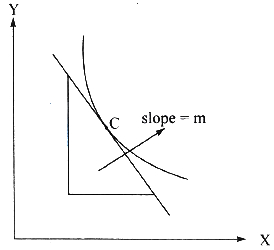
A
$\frac{1}{m}$
B
$m$
C
$2.303 \ m$
D
$\frac{1}{2.303 \ m}$
Solution
(B) For a reaction $A \rightarrow P$,the rate of reaction is defined as the negative of the rate of change of concentration of reactant $A$ with respect to time.
$r_{\text{inst}} = -\frac{d[A]}{dt}$
In the given graph,the $y$-axis represents the concentration of $A$ and the $x$-axis represents time.
The slope of the tangent drawn to the curve at any point gives the value of $\frac{d[A]}{dt}$.
Since the slope of the tangent at point $C$ is $m$,the value of $\frac{d[A]}{dt}$ at point $C$ is $m$.
Therefore,the instantaneous rate of reaction at point $C$ is $-(\text{slope}) = -m$.
However,in the context of magnitude of rate,the instantaneous rate is represented by the absolute value of the slope,which is $m$.
$r_{\text{inst}} = -\frac{d[A]}{dt}$
In the given graph,the $y$-axis represents the concentration of $A$ and the $x$-axis represents time.
The slope of the tangent drawn to the curve at any point gives the value of $\frac{d[A]}{dt}$.
Since the slope of the tangent at point $C$ is $m$,the value of $\frac{d[A]}{dt}$ at point $C$ is $m$.
Therefore,the instantaneous rate of reaction at point $C$ is $-(\text{slope}) = -m$.
However,in the context of magnitude of rate,the instantaneous rate is represented by the absolute value of the slope,which is $m$.
0 likesView Solution
Vedclass Products
For Students
Vedclass Test Series
Mock tests in real AP EAMCET style covering Chemistry with performance analysis. 5-day free trial.
Start Free TrialFor Teachers
Exam Paper Generator
Generate Set A/B/C/D Chemistry papers from 7.5L+ questions in 2 minutes. 3 chapters free.
Try FreeFor Institutes
Online Exam Module
Run live AP EAMCET mock exams with unlimited students, 360° analytics & white-label branding.
See DemoFrequently Asked Questions
How many Chemistry questions are in AP EAMCET 2024?
There are 389 Chemistry questions from the AP EAMCET 2024 paper on Vedclass, each with a detailed step-by-step solution in English.
Are AP EAMCET 2024 Chemistry solutions available in English?
Yes. All solutions on this page are in English. You can also switch to English or Hindi using the language buttons above the questions.
Can I practice AP EAMCET 2024 Chemistry as a timed test?
Yes. Use the Vedclass Test Series to attempt a full AP EAMCET mock test covering Chemistry with time limits and instant score analysis.
Can teachers create Chemistry papers from AP EAMCET previous year questions?
Yes. The Vedclass Exam Paper Generator lets teachers mix AP EAMCET Chemistry questions and generate Set A/B/C/D papers in minutes.
For Teachers & Institutes
Build a Custom Chemistry Paper
Pick AP EAMCET 2024 Chemistry questions, set difficulty, and generate Set A/B/C/D in 2 minutes.