
ChemistryQ1–100 of 284 questions
Page 1 of 3 · English
1
ChemistryMCQAP EAMCET · 2019
If the circle $x^2 + y^2 + 6x - 2y + k = 0$ bisects the circumference of the circle $x^2 + y^2 + 2x - 6y - 15 = 0$,then $k =$
A
$21$
B
$-21$
C
$23$
D
$-23$
Solution
(D) The condition for a circle $S_1 = x^2 + y^2 + 2g_1x + 2f_1y + c_1 = 0$ to bisect the circumference of another circle $S_2 = x^2 + y^2 + 2g_2x + 2f_2y + c_2 = 0$ is that the common chord must pass through the center of the second circle.
The common chord is given by $S_1 - S_2 = 0$,which is $(6-2)x + (-2+6)y + (k+15) = 0$,or $4x + 4y + k + 15 = 0$.
The center of the second circle $x^2 + y^2 + 2x - 6y - 15 = 0$ is $(-g_2, -f_2) = (-1, 3)$.
Substituting $(-1, 3)$ into the equation of the common chord: $4(-1) + 4(3) + k + 15 = 0$.
$-4 + 12 + k + 15 = 0$.
$8 + k + 15 = 0$.
$k + 23 = 0 \Rightarrow k = -23$.
The common chord is given by $S_1 - S_2 = 0$,which is $(6-2)x + (-2+6)y + (k+15) = 0$,or $4x + 4y + k + 15 = 0$.
The center of the second circle $x^2 + y^2 + 2x - 6y - 15 = 0$ is $(-g_2, -f_2) = (-1, 3)$.
Substituting $(-1, 3)$ into the equation of the common chord: $4(-1) + 4(3) + k + 15 = 0$.
$-4 + 12 + k + 15 = 0$.
$8 + k + 15 = 0$.
$k + 23 = 0 \Rightarrow k = -23$.
0 likesView Solution
2
ChemistryMCQAP EAMCET · 2019
An electron accelerated through a potential difference $V$ enters a uniform transverse magnetic field and experiences a force $F$. If the accelerating potential is increased to $2V$,the electron in the same magnetic field will experience a force:
A
$F$
B
$\frac{F}{2}$
C
$\sqrt{2} F$
D
$2F$
Solution
(C) The magnetic force on a charged particle moving in a magnetic field is given by $F = Bqv \sin \theta$. Since the electron enters the field transversely,$\theta = 90^\circ$,so $F = Bqv$.
The kinetic energy gained by an electron accelerated through a potential difference $V$ is given by $\frac{1}{2}mv^2 = eV$,which implies $v = \sqrt{\frac{2eV}{m}}$.
Substituting this into the force equation: $F = B e \sqrt{\frac{2eV}{m}} = B e \sqrt{\frac{2e}{m}} \sqrt{V}$.
From this expression,we see that $F \propto \sqrt{V}$.
If the potential is increased to $V' = 2V$,the new force $F'$ will be $F' \propto \sqrt{2V}$.
Taking the ratio: $\frac{F'}{F} = \frac{\sqrt{2V}}{\sqrt{V}} = \sqrt{2}$.
Therefore,$F' = \sqrt{2} F$.
The kinetic energy gained by an electron accelerated through a potential difference $V$ is given by $\frac{1}{2}mv^2 = eV$,which implies $v = \sqrt{\frac{2eV}{m}}$.
Substituting this into the force equation: $F = B e \sqrt{\frac{2eV}{m}} = B e \sqrt{\frac{2e}{m}} \sqrt{V}$.
From this expression,we see that $F \propto \sqrt{V}$.
If the potential is increased to $V' = 2V$,the new force $F'$ will be $F' \propto \sqrt{2V}$.
Taking the ratio: $\frac{F'}{F} = \frac{\sqrt{2V}}{\sqrt{V}} = \sqrt{2}$.
Therefore,$F' = \sqrt{2} F$.
0 likesView Solution
3
ChemistryMCQAP EAMCET · 2019
An electron accelerated through a potential difference '$V$' passes through a uniform transverse magnetic field and experiences a force '$F$'. If the accelerating potential is increased to '$2V$',the electron in the same magnetic field will experience a force:
A
$3F$
B
$F$
C
$\sqrt{2}F$
D
$\frac{F}{2}$
Solution
(C) The kinetic energy of the electron is given by $K = eV$,where '$e$' is the charge of the electron and '$V$' is the accelerating potential.
In the first case,$K_1 = eV_1 = eV$.
In the second case,$K_2 = eV_2 = e(2V) = 2eV$.
Since $K = \frac{1}{2}mv^2$,we have $v = \sqrt{\frac{2K}{m}}$.
Thus,the ratio of velocities is $\frac{v_2}{v_1} = \sqrt{\frac{K_2}{K_1}} = \sqrt{\frac{2eV}{eV}} = \sqrt{2}$.
The magnetic force on a moving charge is given by $F = evB \sin(\theta)$. Since the electron enters the transverse magnetic field,$\theta = 90^\circ$ and $\sin(90^\circ) = 1$,so $F = evB$.
Since '$e$' and '$B$' are constant,$F \propto v$.
Therefore,$\frac{F_2}{F_1} = \frac{v_2}{v_1} = \sqrt{2}$.
Hence,$F_2 = \sqrt{2}F$.
In the first case,$K_1 = eV_1 = eV$.
In the second case,$K_2 = eV_2 = e(2V) = 2eV$.
Since $K = \frac{1}{2}mv^2$,we have $v = \sqrt{\frac{2K}{m}}$.
Thus,the ratio of velocities is $\frac{v_2}{v_1} = \sqrt{\frac{K_2}{K_1}} = \sqrt{\frac{2eV}{eV}} = \sqrt{2}$.
The magnetic force on a moving charge is given by $F = evB \sin(\theta)$. Since the electron enters the transverse magnetic field,$\theta = 90^\circ$ and $\sin(90^\circ) = 1$,so $F = evB$.
Since '$e$' and '$B$' are constant,$F \propto v$.
Therefore,$\frac{F_2}{F_1} = \frac{v_2}{v_1} = \sqrt{2}$.
Hence,$F_2 = \sqrt{2}F$.
0 likesView Solution
4
ChemistryEasyMCQAP EAMCET · 2019
Wurtz reaction of bromoethane gives $n$-butane. Sodium salt of $X$ on heating with sodalime also results in $n$-butane. Compound $X$ is
A
$CH_3-CH_2-CH_2-COOH$
B
$CH_3-(CH_2)_3-COOH$
C
$CH_3-(CH_2)_4-COOH$
D
$CH_3-CH_2-COOH$
Solution
(B) In Wurtz reaction, two molecules of bromoethane react with $2$ molecules of sodium to form $n$-butane:
$2CH_3CH_2Br + 2Na \rightarrow CH_3CH_2CH_2CH_3 + 2NaBr$
Decarboxylation of the sodium salt of a carboxylic acid with sodalime $(NaOH + CaO)$ removes one carbon atom as $Na_2CO_3$ to produce an alkane with one less carbon atom than the original acid.
To obtain $n$-butane ($4$ carbons), the sodium salt must be derived from a pentanoic acid ($5$ carbons).
The reaction is:
$CH_3CH_2CH_2CH_2COONa + NaOH \xrightarrow{CaO, \Delta} CH_3CH_2CH_2CH_3 + Na_2CO_3$
Thus, $X$ is pentanoic acid, $CH_3(CH_2)_3COOH$.
$2CH_3CH_2Br + 2Na \rightarrow CH_3CH_2CH_2CH_3 + 2NaBr$
Decarboxylation of the sodium salt of a carboxylic acid with sodalime $(NaOH + CaO)$ removes one carbon atom as $Na_2CO_3$ to produce an alkane with one less carbon atom than the original acid.
To obtain $n$-butane ($4$ carbons), the sodium salt must be derived from a pentanoic acid ($5$ carbons).
The reaction is:
$CH_3CH_2CH_2CH_2COONa + NaOH \xrightarrow{CaO, \Delta} CH_3CH_2CH_2CH_3 + Na_2CO_3$
Thus, $X$ is pentanoic acid, $CH_3(CH_2)_3COOH$.
0 likesView Solution
5
ChemistryEasyMCQAP EAMCET · 2019
Which one of the following has the maximum number of hybrid orbitals?
A
$C_6H_6$
B
$(CH_3)_4C$
C
$(CH_3)_2C=O$
D
$CH_3-CH=CH-CN$
Solution
(B) Hydrogen atoms do not undergo hybridization. The number of hybrid orbitals is calculated as follows:
$(A)$ $C_6H_6$: All six $C$-atoms are $sp^2$-hybridized (each has $3$ hybrid orbitals). Total $= 6 \times 3 = 18$.
$(B)$ $(CH_3)_4C$: All five $C$-atoms are $sp^3$-hybridized (each has $4$ hybrid orbitals). Total $= 5 \times 4 = 20$.
$(C)$ $(CH_3)_2C=O$: Two $C$-atoms in $CH_3$ groups are $sp^3$-hybridized ($2 \times 4 = 8$ orbitals). The carbonyl $C$-atom is $sp^2$-hybridized ($3$ orbitals). The $O$-atom is $sp^2$-hybridized ($3$ orbitals). Total $= 8 + 3 + 3 = 14$.
$(D)$ $CH_3-CH=CH-CN$: $C_4$ is $sp^3$ ($4$ orbitals),$C_3$ and $C_2$ are $sp^2$ ($2 \times 3 = 6$ orbitals),$C_1$ is $sp$ ($2$ orbitals),and $N$ is $sp$ ($2$ orbitals). Total $= 4 + 6 + 2 + 2 = 14$.
Thus,$(CH_3)_4C$ has the maximum number of hybrid orbitals. The correct option is $(B)$.
$(A)$ $C_6H_6$: All six $C$-atoms are $sp^2$-hybridized (each has $3$ hybrid orbitals). Total $= 6 \times 3 = 18$.
$(B)$ $(CH_3)_4C$: All five $C$-atoms are $sp^3$-hybridized (each has $4$ hybrid orbitals). Total $= 5 \times 4 = 20$.
$(C)$ $(CH_3)_2C=O$: Two $C$-atoms in $CH_3$ groups are $sp^3$-hybridized ($2 \times 4 = 8$ orbitals). The carbonyl $C$-atom is $sp^2$-hybridized ($3$ orbitals). The $O$-atom is $sp^2$-hybridized ($3$ orbitals). Total $= 8 + 3 + 3 = 14$.
$(D)$ $CH_3-CH=CH-CN$: $C_4$ is $sp^3$ ($4$ orbitals),$C_3$ and $C_2$ are $sp^2$ ($2 \times 3 = 6$ orbitals),$C_1$ is $sp$ ($2$ orbitals),and $N$ is $sp$ ($2$ orbitals). Total $= 4 + 6 + 2 + 2 = 14$.
Thus,$(CH_3)_4C$ has the maximum number of hybrid orbitals. The correct option is $(B)$.
0 likesView Solution
6
ChemistryEasyMCQAP EAMCET · 2019
Arrange the following species in the increasing order of lone pairs of electrons:
$(A)$ $CO$
$(B)$ $NO_2^-$
$(C)$ $NF_3$
$(D)$ $CO_3^{2-}$
$(A)$ $CO$
$(B)$ $NO_2^-$
$(C)$ $NF_3$
$(D)$ $CO_3^{2-}$
A
$A < B < C < D$
B
$B < C < A < D$
C
$C < A < D < B$
D
$A < B < D < C$
Solution
(D) To determine the number of lone pairs,we draw the Lewis structures:
$1$. $CO$: The structure is $:C \equiv O:$. It has $1$ lone pair on $C$ and $1$ lone pair on $O$,total = $2$ lone pairs.
$2$. $NO_2^-$: The structure is $[:O-N=O:]^-$. $N$ has $1$ lone pair,one $O$ has $3$ lone pairs,and the other $O$ has $2$ lone pairs,total = $6$ lone pairs.
$3$. $CO_3^{2-}$: The structure has $3$ oxygen atoms each with $3$ lone pairs (for single-bonded $O$) or $2$ lone pairs (for double-bonded $O$). Total lone pairs = $8$.
$4$. $NF_3$: $N$ has $1$ lone pair and each of the $3$ $F$ atoms has $3$ lone pairs,total = $1 + 3 \times 3 = 10$ lone pairs.
Comparing the counts: $CO (2) < NO_2^- (6) < CO_3^{2-} (8) < NF_3 (10)$.
Thus,the increasing order is $A < B < D < C$. The correct option is $(D)$.
$1$. $CO$: The structure is $:C \equiv O:$. It has $1$ lone pair on $C$ and $1$ lone pair on $O$,total = $2$ lone pairs.
$2$. $NO_2^-$: The structure is $[:O-N=O:]^-$. $N$ has $1$ lone pair,one $O$ has $3$ lone pairs,and the other $O$ has $2$ lone pairs,total = $6$ lone pairs.
$3$. $CO_3^{2-}$: The structure has $3$ oxygen atoms each with $3$ lone pairs (for single-bonded $O$) or $2$ lone pairs (for double-bonded $O$). Total lone pairs = $8$.
$4$. $NF_3$: $N$ has $1$ lone pair and each of the $3$ $F$ atoms has $3$ lone pairs,total = $1 + 3 \times 3 = 10$ lone pairs.
Comparing the counts: $CO (2) < NO_2^- (6) < CO_3^{2-} (8) < NF_3 (10)$.
Thus,the increasing order is $A < B < D < C$. The correct option is $(D)$.
0 likesView Solution
7
ChemistryEasyMCQAP EAMCET · 2019
Identify the molecule in which the arrangement of electron pairs around the central atom is octahedral and the shape is not octahedral.
A
$SF_6$
B
$XeF_6$
C
$BrF_5$
D
$XeO_2F_4$
Solution
(C) The arrangement of electron pairs around the central atom is octahedral when the steric number is $6$ (i.e.,$sp^3d^2$ hybridization). $A$ molecule has a non-octahedral shape if it contains one or more lone pairs of electrons.
$(i)$ $SF_6$: Steric number = $6$ ($6$ bond pairs,$0$ lone pairs). Shape is octahedral.
$(ii)$ $XeF_6$: Steric number = $7$ ($6$ bond pairs,$1$ lone pair). The electron pair arrangement is pentagonal bipyramidal,not octahedral.
$(iii)$ $BrF_5$: Steric number = $6$ ($5$ bond pairs,$1$ lone pair). The electron pair arrangement is octahedral,but the shape is square pyramidal (not octahedral).
$(iv)$ $XeO_2F_4$: Steric number = $6$ ($6$ bond pairs,$0$ lone pairs). Shape is octahedral.
Therefore,$BrF_5$ is the molecule where the electron pair arrangement is octahedral but the shape is not.
$(i)$ $SF_6$: Steric number = $6$ ($6$ bond pairs,$0$ lone pairs). Shape is octahedral.
$(ii)$ $XeF_6$: Steric number = $7$ ($6$ bond pairs,$1$ lone pair). The electron pair arrangement is pentagonal bipyramidal,not octahedral.
$(iii)$ $BrF_5$: Steric number = $6$ ($5$ bond pairs,$1$ lone pair). The electron pair arrangement is octahedral,but the shape is square pyramidal (not octahedral).
$(iv)$ $XeO_2F_4$: Steric number = $6$ ($6$ bond pairs,$0$ lone pairs). Shape is octahedral.
Therefore,$BrF_5$ is the molecule where the electron pair arrangement is octahedral but the shape is not.
0 likesView Solution
8
ChemistryEasyMCQAP EAMCET · 2019
Observe the following molecules: $PCl_5, BrF_5, ClF_5, PF_5, ClF_3, XeF_4, XeF_2, IF_5$. The number of molecules having square pyramidal geometry from the above is:
A
$4$
B
$5$
C
$3$
D
$6$
Solution
(C) To determine the geometry,we calculate the hybridization and the number of lone pairs for each molecule:
$1$. $PCl_5$: $sp^3d$ hybridization,trigonal bipyramidal geometry.
$2$. $BrF_5$: $sp^3d^2$ hybridization with $1$ lone pair,square pyramidal geometry.
$3$. $ClF_5$: $sp^3d^2$ hybridization with $1$ lone pair,square pyramidal geometry.
$4$. $PF_5$: $sp^3d$ hybridization,trigonal bipyramidal geometry.
$5$. $ClF_3$: $sp^3d$ hybridization with $2$ lone pairs,$T$-shaped geometry.
$6$. $XeF_4$: $sp^3d^2$ hybridization with $2$ lone pairs,square planar geometry.
$7$. $XeF_2$: $sp^3d$ hybridization with $3$ lone pairs,linear geometry.
$8$. $IF_5$: $sp^3d^2$ hybridization with $1$ lone pair,square pyramidal geometry.
Thus,the molecules with square pyramidal geometry are $BrF_5, ClF_5$,and $IF_5$.
The total count is $3$.
$1$. $PCl_5$: $sp^3d$ hybridization,trigonal bipyramidal geometry.
$2$. $BrF_5$: $sp^3d^2$ hybridization with $1$ lone pair,square pyramidal geometry.
$3$. $ClF_5$: $sp^3d^2$ hybridization with $1$ lone pair,square pyramidal geometry.
$4$. $PF_5$: $sp^3d$ hybridization,trigonal bipyramidal geometry.
$5$. $ClF_3$: $sp^3d$ hybridization with $2$ lone pairs,$T$-shaped geometry.
$6$. $XeF_4$: $sp^3d^2$ hybridization with $2$ lone pairs,square planar geometry.
$7$. $XeF_2$: $sp^3d$ hybridization with $3$ lone pairs,linear geometry.
$8$. $IF_5$: $sp^3d^2$ hybridization with $1$ lone pair,square pyramidal geometry.
Thus,the molecules with square pyramidal geometry are $BrF_5, ClF_5$,and $IF_5$.
The total count is $3$.
0 likesView Solution
9
ChemistryEasyMCQAP EAMCET · 2019
Identify the correct set of molecules with different geometries and central atoms with different hybridisations.
A
$SnCl_2, BeCl_2, OF_2$
B
$H_2O, SO_2, HOCl$
C
$NH_3, H_2SO_3, XeO_3$
D
$SF_4, XeF_4, CF_4$
Solution
(D) In the set $SF_4, XeF_4, CF_4$,the molecules have different geometries and their central atoms exhibit different hybridisations as shown below:
| Molecule | Hybridisation | Geometry |
| $SF_4$ | $sp^3d$ | See-saw |
| $XeF_4$ | $sp^3d^2$ | Square planar |
| $CF_4$ | $sp^3$ | Tetrahedral |
0 likesView Solution
10
ChemistryEasyMCQAP EAMCET · 2019
Match the following:
The correct answer is:
| List-$I$ | List-$II$ |
| $A. BrF_5$ | $I. AB_4E$,see-saw |
| $B. SF_4$ | $II. AB_4E_2$,square planar |
| $C. XeF_4$ | $III. AB_5E$,square pyramidal |
| $D. ClF_3$ | $IV. AB_3E_2$,$T$-shape |
The correct answer is:
A
$A-V, B-I, C-II, D-IV$
B
$A-III, B-I, C-II, D-V$
C
$A-III, B-I, C-II, D-IV$
D
$A-V, B-I, C-III, D-II$
Solution
(C) The molecular geometries are determined by $VSEPR$ theory:
Matching the items:
$A$ $(BrF_5)$ matches $III$ ($AB_5E$,square pyramidal).
$B$ $(SF_4)$ matches $I$ ($AB_4E$,see-saw).
$C$ $(XeF_4)$ matches $II$ ($AB_4E_2$,square planar).
$D$ $(ClF_3)$ matches $IV$ ($AB_3E_2$,$T$-shape).
Therefore,the correct match is $A-III, B-I, C-II, D-IV$.
| Molecule | Type | Shape |
| $BrF_5$ | $AB_5E$ | Square pyramidal |
| $SF_4$ | $AB_4E$ | See-saw |
| $XeF_4$ | $AB_4E_2$ | Square planar |
| $ClF_3$ | $AB_3E_2$ | $T$-shape |
Matching the items:
$A$ $(BrF_5)$ matches $III$ ($AB_5E$,square pyramidal).
$B$ $(SF_4)$ matches $I$ ($AB_4E$,see-saw).
$C$ $(XeF_4)$ matches $II$ ($AB_4E_2$,square planar).
$D$ $(ClF_3)$ matches $IV$ ($AB_3E_2$,$T$-shape).
Therefore,the correct match is $A-III, B-I, C-II, D-IV$.
0 likesView Solution
11
ChemistryMediumMCQAP EAMCET · 2019
Observe the following statements:
$i$. According to $\text{VSEPR}$ theory,$ClF_3$ and $SO_2$ are shown as $AB_3E_2$ and $AB_2E$ type molecules respectively.
$ii$. $SF_4$ has a "See-saw" shape.
$iii$. $HgCl_2$ and $PbCl_2$ have the same shape.
The statements which are not correct are:
$i$. According to $\text{VSEPR}$ theory,$ClF_3$ and $SO_2$ are shown as $AB_3E_2$ and $AB_2E$ type molecules respectively.
$ii$. $SF_4$ has a "See-saw" shape.
$iii$. $HgCl_2$ and $PbCl_2$ have the same shape.
The statements which are not correct are:
A
$i, ii$ only
B
$i, iii$ only
C
$i, ii, iii$
D
$ii, iii$ only
Solution
(B) Statement $(i)$ is correct: $ClF_3$ has $3$ bond pairs and $2$ lone pairs $(AB_3E_2)$,and $SO_2$ has $2$ bond pairs and $1$ lone pair $(AB_2E)$.
Statement $(ii)$ is correct: $SF_4$ has $4$ bond pairs and $1$ lone pair,resulting in a "See-saw" geometry.
Statement $(iii)$ is incorrect: $HgCl_2$ has $2$ bond pairs and $0$ lone pairs,resulting in a linear shape. $PbCl_2$ has $2$ bond pairs and $1$ lone pair,resulting in a bent shape.
Therefore,only statement $(iii)$ is incorrect.
Statement $(ii)$ is correct: $SF_4$ has $4$ bond pairs and $1$ lone pair,resulting in a "See-saw" geometry.
Statement $(iii)$ is incorrect: $HgCl_2$ has $2$ bond pairs and $0$ lone pairs,resulting in a linear shape. $PbCl_2$ has $2$ bond pairs and $1$ lone pair,resulting in a bent shape.
Therefore,only statement $(iii)$ is incorrect.
0 likesView Solution
12
ChemistryEasyMCQAP EAMCET · 2019
The molecule/ion having paramagnetic nature and a bond order of $1.0$ is
A
$He_2^{+}$
B
$Li_2^{+}$
C
$B_2$
D
$C_2$
Solution
(C) The molecular orbital configurations and bond orders $(BO)$ are calculated as follows:
$He_2^{+}: (\sigma 1s)^2 (\sigma^* 1s)^1$; $BO = \frac{2-1}{2} = 0.5$. It is paramagnetic due to one unpaired electron.
$Li_2^{+}: (\sigma 1s)^2 (\sigma^* 1s)^2 (\sigma 2s)^1$; $BO = \frac{3-2}{2} = 0.5$. It is paramagnetic.
$B_2: (\sigma 1s)^2 (\sigma^* 1s)^2 (\sigma 2s)^2 (\sigma^* 2s)^2 (\pi 2p_x)^1 (\pi 2p_y)^1$; $BO = \frac{6-4}{2} = 1.0$. It is paramagnetic due to two unpaired electrons.
$C_2: (\sigma 1s)^2 (\sigma^* 1s)^2 (\sigma 2s)^2 (\sigma^* 2s)^2 (\pi 2p_x)^2 (\pi 2p_y)^2$; $BO = \frac{8-4}{2} = 2.0$. It is diamagnetic.
Thus,the molecule with a bond order of $1.0$ and paramagnetic nature is $B_2$.
$He_2^{+}: (\sigma 1s)^2 (\sigma^* 1s)^1$; $BO = \frac{2-1}{2} = 0.5$. It is paramagnetic due to one unpaired electron.
$Li_2^{+}: (\sigma 1s)^2 (\sigma^* 1s)^2 (\sigma 2s)^1$; $BO = \frac{3-2}{2} = 0.5$. It is paramagnetic.
$B_2: (\sigma 1s)^2 (\sigma^* 1s)^2 (\sigma 2s)^2 (\sigma^* 2s)^2 (\pi 2p_x)^1 (\pi 2p_y)^1$; $BO = \frac{6-4}{2} = 1.0$. It is paramagnetic due to two unpaired electrons.
$C_2: (\sigma 1s)^2 (\sigma^* 1s)^2 (\sigma 2s)^2 (\sigma^* 2s)^2 (\pi 2p_x)^2 (\pi 2p_y)^2$; $BO = \frac{8-4}{2} = 2.0$. It is diamagnetic.
Thus,the molecule with a bond order of $1.0$ and paramagnetic nature is $B_2$.
0 likesView Solution
13
ChemistryEasyMCQAP EAMCET · 2019
The changes in bond length with respect to $N-N$ and $O-O$,when $N_2$ becomes $N_2^{+}$ and $O_2$ becomes $O_2^{+}$ are respectively
A
increases,decreases
B
decreases,increases
C
increases,increases
D
decreases,decreases
Solution
(A) $N_2$ ($14$ electrons): Bond order $= \frac{10-4}{2} = 3$.
$N_2^{+}$ ($13$ electrons): Bond order $= \frac{9-4}{2} = 2.5$.
Since bond order decreases,the bond length of $N-N$ increases.
$O_2$ ($16$ electrons): Bond order $= \frac{10-6}{2} = 2$.
$O_2^{+}$ ($15$ electrons): Bond order $= \frac{10-5}{2} = 2.5$.
Since bond order increases,the bond length of $O-O$ decreases.
Therefore,the changes are increases and decreases respectively.
$N_2^{+}$ ($13$ electrons): Bond order $= \frac{9-4}{2} = 2.5$.
Since bond order decreases,the bond length of $N-N$ increases.
$O_2$ ($16$ electrons): Bond order $= \frac{10-6}{2} = 2$.
$O_2^{+}$ ($15$ electrons): Bond order $= \frac{10-5}{2} = 2.5$.
Since bond order increases,the bond length of $O-O$ decreases.
Therefore,the changes are increases and decreases respectively.
0 likesView Solution
14
ChemistryEasyMCQAP EAMCET · 2019
Observe the following molecules / ions $H_2, N_2, O_2, N_2^+, O_2^+, O_2^-, F_2$. Identify the correct statement.
A
$H_2, N_2, O_2, F_2$ show diamagnetic property
B
$O_2, O_2^+, O_2^-, N_2^+$ show paramagnetic property
C
$N_2, F_2, O_2^+, O_2^-$ show diamagnetic property
D
$H_2, N_2^+, O_2^+, O_2^-$ show paramagnetic property
Solution
(B) Based on Molecular Orbital Theory $(MOT)$:
$H_2$ $(1s^2)$: No unpaired electrons $\rightarrow$ Diamagnetic
$N_2$ $(KK(\sigma 2s)^2(\sigma^* 2s)^2(\pi 2p_x)^2(\pi 2p_y)^2(\sigma 2p_z)^2)$: No unpaired electrons $\rightarrow$ Diamagnetic
$O_2$ $(KK(\sigma 2s)^2(\sigma^* 2s)^2(\sigma 2p_z)^2(\pi 2p_x)^2(\pi 2p_y)^2(\pi^* 2p_x)^1(\pi^* 2p_y)^1)$: $2$ unpaired electrons $\rightarrow$ Paramagnetic
$N_2^+$: $1$ unpaired electron $\rightarrow$ Paramagnetic
$O_2^+$: $1$ unpaired electron $\rightarrow$ Paramagnetic
$O_2^-$: $1$ unpaired electron $\rightarrow$ Paramagnetic
$F_2$: No unpaired electrons $\rightarrow$ Diamagnetic
Thus,$O_2, O_2^+, O_2^-, N_2^+$ are all paramagnetic.
$H_2$ $(1s^2)$: No unpaired electrons $\rightarrow$ Diamagnetic
$N_2$ $(KK(\sigma 2s)^2(\sigma^* 2s)^2(\pi 2p_x)^2(\pi 2p_y)^2(\sigma 2p_z)^2)$: No unpaired electrons $\rightarrow$ Diamagnetic
$O_2$ $(KK(\sigma 2s)^2(\sigma^* 2s)^2(\sigma 2p_z)^2(\pi 2p_x)^2(\pi 2p_y)^2(\pi^* 2p_x)^1(\pi^* 2p_y)^1)$: $2$ unpaired electrons $\rightarrow$ Paramagnetic
$N_2^+$: $1$ unpaired electron $\rightarrow$ Paramagnetic
$O_2^+$: $1$ unpaired electron $\rightarrow$ Paramagnetic
$O_2^-$: $1$ unpaired electron $\rightarrow$ Paramagnetic
$F_2$: No unpaired electrons $\rightarrow$ Diamagnetic
Thus,$O_2, O_2^+, O_2^-, N_2^+$ are all paramagnetic.
0 likesView Solution
15
ChemistryDifficultMCQAP EAMCET · 2019
Observe the following molecules: $C_2, N_2, O_2, F_2$. Which one of the following statements is correct for the above molecules?
A
They exhibit same magnetic property
B
They have same number of bonding molecular orbitals and same number of antibonding molecular orbitals
C
The sequence of molecular orbitals is as follows $\sigma 2p_z < (\pi 2p_x = \pi 2p_y) < (\pi^* 2p_x = \pi^* 2p_y) < \sigma^* 2p_z$
D
They have same bond order
Solution
(B) The correct statement is $(b)$.
All these molecules $(C_2, N_2, O_2, F_2)$ are formed by the combination of atomic orbitals of the second period elements.
In each case,the total number of atomic orbitals involved is $10$ ($5$ from each atom),which results in the formation of $5$ bonding molecular orbitals $(BMOs)$ and $5$ antibonding molecular orbitals $(ABMOs)$ in the molecular orbital diagram (considering the $1s$ shell).
Therefore,they all possess the same number of bonding and antibonding molecular orbitals.
All these molecules $(C_2, N_2, O_2, F_2)$ are formed by the combination of atomic orbitals of the second period elements.
In each case,the total number of atomic orbitals involved is $10$ ($5$ from each atom),which results in the formation of $5$ bonding molecular orbitals $(BMOs)$ and $5$ antibonding molecular orbitals $(ABMOs)$ in the molecular orbital diagram (considering the $1s$ shell).
Therefore,they all possess the same number of bonding and antibonding molecular orbitals.
0 likesView Solution
16
ChemistryEasyMCQAP EAMCET · 2019
Which of the following orders are correct against the property given?
| $(I)$ | Dipole moment | $NF_3 > NH_3 > BF_3$ |
| $(II)$ | Covalent bond length | $C-O > N-O > O-H$ |
| $(III)$ | Bond order | $C_2 > B_2 > He_2$ |
A
$I, II$ only
B
$II, III$ only
C
$I, III$ only
D
$I, II, III$
Solution
(B) $(I)$ Incorrect: In $NH_3$,the orbital dipole due to the lone pair and the net dipole moment of the three $N-H$ bonds are in the same direction,whereas in $NF_3$,they are in opposite directions. Thus,$\mu(NH_3) > \mu(NF_3)$. $BF_3$ is symmetrical and has zero dipole moment. The correct order is $NH_3 > NF_3 > BF_3$.
$(II)$ Correct: Bond length increases with the increase in the size of the atoms. Atomic radii follow the order $C > N > O > H$,so the bond length order $C-O > N-O > O-H$ is correct.
$(III)$ Correct: According to Molecular Orbital Theory,the bond order of $C_2$ is $2$,$B_2$ is $1$,and $He_2$ is $0$. The order $C_2 > B_2 > He_2$ is correct.
$(II)$ Correct: Bond length increases with the increase in the size of the atoms. Atomic radii follow the order $C > N > O > H$,so the bond length order $C-O > N-O > O-H$ is correct.
$(III)$ Correct: According to Molecular Orbital Theory,the bond order of $C_2$ is $2$,$B_2$ is $1$,and $He_2$ is $0$. The order $C_2 > B_2 > He_2$ is correct.

0 likesView Solution
17
ChemistryEasyMCQAP EAMCET · 2019
Observe the following equations:
$Ag^{+} + NH_3 \rightleftharpoons [Ag(NH_3)]^{+}$,$K_1 = 1.6 \times 10^3$
$[Ag(NH_3)]^{+} + NH_3 \rightleftharpoons [Ag(NH_3)_2]^{+}$,$K_2 = 6.8 \times 10^3$
The equilibrium constant for the following reaction,$Ag^{+} + 2 NH_3 \rightleftharpoons [Ag(NH_3)_2]^{+}$ is
$Ag^{+} + NH_3 \rightleftharpoons [Ag(NH_3)]^{+}$,$K_1 = 1.6 \times 10^3$
$[Ag(NH_3)]^{+} + NH_3 \rightleftharpoons [Ag(NH_3)_2]^{+}$,$K_2 = 6.8 \times 10^3$
The equilibrium constant for the following reaction,$Ag^{+} + 2 NH_3 \rightleftharpoons [Ag(NH_3)_2]^{+}$ is
A
$6.008 \times 10^3$
B
$1.088 \times 10^7$
C
$1.088 \times 10^6$
D
$1.028 \times 10^3$
Solution
(B) The overall reaction is the sum of the two given equilibrium steps:
Step $1$: $Ag^{+} + NH_3 \rightleftharpoons [Ag(NH_3)]^{+}$,$K_1 = 1.6 \times 10^3$
Step $2$: $[Ag(NH_3)]^{+} + NH_3 \rightleftharpoons [Ag(NH_3)_2]^{+}$,$K_2 = 6.8 \times 10^3$
Adding these two equations gives the net reaction:
$Ag^{+} + 2 NH_3 \rightleftharpoons [Ag(NH_3)_2]^{+}$
The equilibrium constant $(K_{net})$ for the net reaction is the product of the equilibrium constants of the individual steps:
$K_{net} = K_1 \times K_2$
$K_{net} = (1.6 \times 10^3) \times (6.8 \times 10^3)$
$K_{net} = 10.88 \times 10^6 = 1.088 \times 10^7$
Step $1$: $Ag^{+} + NH_3 \rightleftharpoons [Ag(NH_3)]^{+}$,$K_1 = 1.6 \times 10^3$
Step $2$: $[Ag(NH_3)]^{+} + NH_3 \rightleftharpoons [Ag(NH_3)_2]^{+}$,$K_2 = 6.8 \times 10^3$
Adding these two equations gives the net reaction:
$Ag^{+} + 2 NH_3 \rightleftharpoons [Ag(NH_3)_2]^{+}$
The equilibrium constant $(K_{net})$ for the net reaction is the product of the equilibrium constants of the individual steps:
$K_{net} = K_1 \times K_2$
$K_{net} = (1.6 \times 10^3) \times (6.8 \times 10^3)$
$K_{net} = 10.88 \times 10^6 = 1.088 \times 10^7$
0 likesView Solution
18
ChemistryEasyMCQAP EAMCET · 2019
The equilibrium constant at $850 \ K$ for the reaction $N_{2(g)} + O_{2(g)} \rightleftharpoons 2 NO_{(g)}$ is $0.5625$. The equilibrium concentration of $NO_{(g)}$ is $3.0 \times 10^{-3} \ M$. If the equilibrium concentrations of $N_{2(g)}$ and $O_{2(g)}$ are equal,the concentration of $N_{2(g)}$ in $M$ is
A
$4.0 \times 10^{-3}$
B
$4.0 \times 10^{-2}$
C
$1.6 \times 10^{-3}$
D
$3.0 \times 10^{-3}$
Solution
(A) Given reaction: $N_{2(g)} + O_{2(g)} \rightleftharpoons 2 NO_{(g)}$
Equilibrium constant,$K_C = 0.5625$
Equilibrium concentration,$[NO] = 3.0 \times 10^{-3} \ M$
The expression for equilibrium constant is $K_C = \frac{[NO]^2}{[N_2][O_2]}$
Since $[N_2] = [O_2]$,we can write $K_C = \frac{[NO]^2}{[N_2]^2}$
Substituting the values: $0.5625 = \frac{(3.0 \times 10^{-3})^2}{[N_2]^2}$
$[N_2]^2 = \frac{9.0 \times 10^{-6}}{0.5625} = 16 \times 10^{-6}$
$[N_2] = \sqrt{16 \times 10^{-6}} = 4.0 \times 10^{-3} \ M$
Therefore,the correct option is $(A)$.
Equilibrium constant,$K_C = 0.5625$
Equilibrium concentration,$[NO] = 3.0 \times 10^{-3} \ M$
The expression for equilibrium constant is $K_C = \frac{[NO]^2}{[N_2][O_2]}$
Since $[N_2] = [O_2]$,we can write $K_C = \frac{[NO]^2}{[N_2]^2}$
Substituting the values: $0.5625 = \frac{(3.0 \times 10^{-3})^2}{[N_2]^2}$
$[N_2]^2 = \frac{9.0 \times 10^{-6}}{0.5625} = 16 \times 10^{-6}$
$[N_2] = \sqrt{16 \times 10^{-6}} = 4.0 \times 10^{-3} \ M$
Therefore,the correct option is $(A)$.
0 likesView Solution
19
ChemistryEasyMCQAP EAMCET · 2019
The value of $K_{C}$ for the equilibrium reaction: $CO_{2(g)} + C_{(s)} \rightleftharpoons 2CO_{(g)}$ at $T \ K$ is $0.036$. If the equilibrium concentration of $CO_{2(g)}$ is $0.004 \ M$,the concentration of $CO_{(g)}$ in $mol \ L^{-1}$ is:
A
$3.6 \times 10^{-2}$
B
$2.0 \times 10^{-2}$
C
$1.2 \times 10^{-2}$
D
$1.2 \times 10^{-3}$
Solution
(C) The equilibrium constant expression for the reaction $CO_{2(g)} + C_{(s)} \rightleftharpoons 2CO_{(g)}$ is given by:
$K_c = \frac{[CO]^2}{[CO_2]}$
Given $K_c = 0.036$ and $[CO_2] = 0.004 \ M$.
Substituting the values:
$0.036 = \frac{[CO]^2}{0.004}$
$[CO]^2 = 0.036 \times 0.004 = 0.000144$
$[CO] = \sqrt{0.000144} = 0.012 \ M = 1.2 \times 10^{-2} \ mol \ L^{-1}$.
$K_c = \frac{[CO]^2}{[CO_2]}$
Given $K_c = 0.036$ and $[CO_2] = 0.004 \ M$.
Substituting the values:
$0.036 = \frac{[CO]^2}{0.004}$
$[CO]^2 = 0.036 \times 0.004 = 0.000144$
$[CO] = \sqrt{0.000144} = 0.012 \ M = 1.2 \times 10^{-2} \ mol \ L^{-1}$.
0 likesView Solution
20
ChemistryDifficultMCQAP EAMCET · 2019
At $1000 \ K$,the partial pressures of $CO_{2(g)}$ and $CO_{(g)}$ for the reaction $CO_{2(g)} + C_{(s)} \rightleftharpoons 2 CO_{(g)}$ in a closed vessel at equilibrium are $0.15 \ bar$ and $0.60 \ bar$ respectively. The $K_c$ for this reaction at the same temperature is approximately
A
$2.0 \times 10^{-4}$
B
$2.89 \times 10^{-2}$
C
$2.89 \times 10^{-3}$
D
$5.78 \times 10^{-3}$
Solution
(B) For the reaction,$CO_{2(g)} + C_{(s)} \rightleftharpoons 2 CO_{(g)}$
$K_p = \frac{(p_{CO})^2}{p_{CO_2}} = \frac{(0.6)^2}{0.15} = \frac{0.36}{0.15} = 2.4$
Using the relation $K_p = K_c(RT)^{\Delta n}$,where $\Delta n = 2 - 1 = 1$ and $R = 0.08314 \ L \ bar \ K^{-1} \ mol^{-1}$.
$K_c = \frac{K_p}{RT} = \frac{2.4}{0.08314 \times 1000} = \frac{2.4}{83.14} \approx 0.02887 \approx 2.89 \times 10^{-2}$.
Thus,the correct option is $(B)$.
$K_p = \frac{(p_{CO})^2}{p_{CO_2}} = \frac{(0.6)^2}{0.15} = \frac{0.36}{0.15} = 2.4$
Using the relation $K_p = K_c(RT)^{\Delta n}$,where $\Delta n = 2 - 1 = 1$ and $R = 0.08314 \ L \ bar \ K^{-1} \ mol^{-1}$.
$K_c = \frac{K_p}{RT} = \frac{2.4}{0.08314 \times 1000} = \frac{2.4}{83.14} \approx 0.02887 \approx 2.89 \times 10^{-2}$.
Thus,the correct option is $(B)$.
0 likesView Solution
21
ChemistryMediumMCQAP EAMCET · 2019
$K_p$ for the conversion of oxygen to ozone at $400 \ K$ is $1.0 \times 10^{-30}$,its standard Gibbs energy change in $kJ \ mol^{-1}$ is approximately
A
$229.8$
B
$114.9$
C
$-229.8$
D
$-114.9$
Solution
(A) Given,$K_p$ for the conversion of oxygen to ozone at $400 \ K$ is $1.0 \times 10^{-30}$.
Standard Gibbs energy change $\Delta G^{\circ} = -RT \ln K_p = -2.303 RT \log_{10} K_p$.
Here,$R = 8.314 \ J \ K^{-1} \ mol^{-1}$ and $T = 400 \ K$.
Substituting the values:
$\Delta G^{\circ} = -2.303 \times 8.314 \times 400 \times \log_{10} (1.0 \times 10^{-30})$
$\Delta G^{\circ} = -2.303 \times 8.314 \times 400 \times (-30)$
$\Delta G^{\circ} = 229765.7 \ J \ mol^{-1}$
Converting to $kJ \ mol^{-1}$:
$\Delta G^{\circ} \approx 229.8 \ kJ \ mol^{-1}$.
Standard Gibbs energy change $\Delta G^{\circ} = -RT \ln K_p = -2.303 RT \log_{10} K_p$.
Here,$R = 8.314 \ J \ K^{-1} \ mol^{-1}$ and $T = 400 \ K$.
Substituting the values:
$\Delta G^{\circ} = -2.303 \times 8.314 \times 400 \times \log_{10} (1.0 \times 10^{-30})$
$\Delta G^{\circ} = -2.303 \times 8.314 \times 400 \times (-30)$
$\Delta G^{\circ} = 229765.7 \ J \ mol^{-1}$
Converting to $kJ \ mol^{-1}$:
$\Delta G^{\circ} \approx 229.8 \ kJ \ mol^{-1}$.
0 likesView Solution
22
ChemistryMediumMCQAP EAMCET · 2019
$18.4 \ g$ of $N_2O_4$ was placed in a $1 \ L$ vessel at $400 \ K$ and allowed to attain the following equilibrium: $N_2O_{4(g)} \rightleftharpoons 2NO_{2(g)}$. If the total pressure at equilibrium was $10.64 \ bar$,the approximate $K_p$ is (Given: $R = 0.083 \ L \ bar \ K^{-1} \ mol^{-1}$,assume $N_2O_4$ and $NO_2$ behave as ideal gases).
A
$57.2$
B
$24.24$
C
$14.3$
D
$6.64$
Solution
(B) Initial pressure $(p)$ of $N_2O_4$ can be calculated using the ideal gas equation $pV = nRT$:
$p = \frac{nRT}{V} = \frac{(18.4 \ g / 92 \ g \ mol^{-1}) \times 0.083 \ L \ bar \ K^{-1} \ mol^{-1} \times 400 \ K}{1 \ L} = 0.2 \ mol \times 0.083 \times 400 = 6.64 \ bar$.
For the equilibrium reaction $N_2O_{4(g)} \rightleftharpoons 2NO_{2(g)}$:
Initial: $p$ atm,$0$
At equilibrium: $(p - p_i)$ atm,$2p_i$ atm
Total pressure $(p_T)$ at equilibrium:
$p_T = (p - p_i) + 2p_i = p + p_i$
$10.64 = 6.64 + p_i$
$p_i = 10.64 - 6.64 = 4.00 \ bar$.
Partial pressures at equilibrium:
$p_{N_2O_4} = p - p_i = 6.64 - 4.00 = 2.64 \ bar$
$p_{NO_2} = 2p_i = 2 \times 4.00 = 8.00 \ bar$
Equilibrium constant $K_p$:
$K_p = \frac{(p_{NO_2})^2}{p_{N_2O_4}} = \frac{(8.00)^2}{2.64} = \frac{64}{2.64} \approx 24.24$.
$p = \frac{nRT}{V} = \frac{(18.4 \ g / 92 \ g \ mol^{-1}) \times 0.083 \ L \ bar \ K^{-1} \ mol^{-1} \times 400 \ K}{1 \ L} = 0.2 \ mol \times 0.083 \times 400 = 6.64 \ bar$.
For the equilibrium reaction $N_2O_{4(g)} \rightleftharpoons 2NO_{2(g)}$:
Initial: $p$ atm,$0$
At equilibrium: $(p - p_i)$ atm,$2p_i$ atm
Total pressure $(p_T)$ at equilibrium:
$p_T = (p - p_i) + 2p_i = p + p_i$
$10.64 = 6.64 + p_i$
$p_i = 10.64 - 6.64 = 4.00 \ bar$.
Partial pressures at equilibrium:
$p_{N_2O_4} = p - p_i = 6.64 - 4.00 = 2.64 \ bar$
$p_{NO_2} = 2p_i = 2 \times 4.00 = 8.00 \ bar$
Equilibrium constant $K_p$:
$K_p = \frac{(p_{NO_2})^2}{p_{N_2O_4}} = \frac{(8.00)^2}{2.64} = \frac{64}{2.64} \approx 24.24$.
0 likesView Solution
23
ChemistryMCQAP EAMCET · 2019
Consider the following reaction: $N_{2(g)} + 3H_{2(g)} \longrightarrow 2NH_{3(g)}$. The rate of this reaction in terms of $N_2$ at $T \ K$ is $-\frac{d[N_2]}{dt} = 0.02 \ mol \ L^{-1} \ s^{-1}$. What is the value of $-\frac{d[H_2]}{dt}$ (in units of $mol \ L^{-1} \ s^{-1}$) at the same temperature?
A
$0.02$
B
$50$
C
$0.06$
D
$0.04$
Solution
(C) For the reaction $N_{2(g)} + 3H_{2(g)} \longrightarrow 2NH_{3(g)}$,the rate expression is given by: $\text{Rate} = -\frac{d[N_2]}{dt} = -\frac{1}{3} \frac{d[H_2]}{dt} = \frac{1}{2} \frac{d[NH_3]}{dt}$.
Given that $-\frac{d[N_2]}{dt} = 0.02 \ mol \ L^{-1} \ s^{-1}$.
Equating the terms: $-\frac{d[N_2]}{dt} = -\frac{1}{3} \frac{d[H_2]}{dt}$.
Therefore,$-\frac{d[H_2]}{dt} = 3 \times (-\frac{d[N_2]}{dt}) = 3 \times 0.02 \ mol \ L^{-1} \ s^{-1} = 0.06 \ mol \ L^{-1} \ s^{-1}$.
Given that $-\frac{d[N_2]}{dt} = 0.02 \ mol \ L^{-1} \ s^{-1}$.
Equating the terms: $-\frac{d[N_2]}{dt} = -\frac{1}{3} \frac{d[H_2]}{dt}$.
Therefore,$-\frac{d[H_2]}{dt} = 3 \times (-\frac{d[N_2]}{dt}) = 3 \times 0.02 \ mol \ L^{-1} \ s^{-1} = 0.06 \ mol \ L^{-1} \ s^{-1}$.
0 likesView Solution
24
ChemistryMCQAP EAMCET · 2019
Which one of the following equations is correct for the reaction $N_{2(g)} + 3H_{2(g)} \longrightarrow 2NH_{3(g)}$?
A
$3 \frac{d[NH_3]}{dt} = 2 \frac{d[H_2]}{dt}$
B
$3 \frac{d[NH_3]}{dt} = 3 \frac{d[H_2]}{dt}$
C
$2 \frac{d[NH_3]}{dt} = -3 \frac{d[H_2]}{dt}$
D
$3 \frac{d[NH_3]}{dt} = -2 \frac{d[H_2]}{dt}$
Solution
(D) For the reaction $N_{2(g)} + 3H_{2(g)} \longrightarrow 2NH_{3(g)}$,the rate of reaction is given by the expression:
Rate $= -\frac{d[N_2]}{dt} = -\frac{1}{3} \frac{d[H_2]}{dt} = \frac{1}{2} \frac{d[NH_3]}{dt}$.
Equating the terms for $NH_3$ and $H_2$:
$-\frac{1}{3} \frac{d[H_2]}{dt} = \frac{1}{2} \frac{d[NH_3]}{dt}$.
Multiplying both sides by $6$,we get:
$-2 \frac{d[H_2]}{dt} = 3 \frac{d[NH_3]}{dt}$.
Rearranging gives $3 \frac{d[NH_3]}{dt} = -2 \frac{d[H_2]}{dt}$.
Rate $= -\frac{d[N_2]}{dt} = -\frac{1}{3} \frac{d[H_2]}{dt} = \frac{1}{2} \frac{d[NH_3]}{dt}$.
Equating the terms for $NH_3$ and $H_2$:
$-\frac{1}{3} \frac{d[H_2]}{dt} = \frac{1}{2} \frac{d[NH_3]}{dt}$.
Multiplying both sides by $6$,we get:
$-2 \frac{d[H_2]}{dt} = 3 \frac{d[NH_3]}{dt}$.
Rearranging gives $3 \frac{d[NH_3]}{dt} = -2 \frac{d[H_2]}{dt}$.
0 likesView Solution
25
ChemistryDifficultMCQAP EAMCET · 2019
Match the following:
The correct answer is:
| List-$I$ | List-$II$ |
|---|---|
| $A$. Insecticide | $I$. $COD$ |
| $B$. $K_2Cr_2O_7 / 50\% H_2SO_4$ | $II$. $PAN$ |
| $C$. Bleaching of clothes and paper | $III$. $Na_3AsO_3$ |
| $D$. Eye irritant | $IV$. $BOD$ |
| $V$. $H_2O_2$ |
The correct answer is:
A
$III, IV, V, II$
B
$III, I, V, II$
C
$III, I, II, V$
D
$V, I, III, II$
Solution
(B) The correct matching is as follows:
$A$. Insecticide $\rightarrow III$. $Na_3AsO_3$ (Sodium arsenite is used as an insecticide).
$B$. $K_2Cr_2O_7 / 50\% H_2SO_4$ $\rightarrow I$. $COD$ (This mixture is used to determine the Chemical Oxygen Demand).
$C$. Bleaching of clothes and paper $\rightarrow V$. $H_2O_2$ (Hydrogen peroxide is a common bleaching agent).
$D$. Eye irritant $\rightarrow II$. $PAN$ (Peroxyacetyl nitrate is a well-known eye irritant in photochemical smog).
Thus,the correct sequence is $A-III, B-I, C-V, D-II$. The correct option is $B$.
$A$. Insecticide $\rightarrow III$. $Na_3AsO_3$ (Sodium arsenite is used as an insecticide).
$B$. $K_2Cr_2O_7 / 50\% H_2SO_4$ $\rightarrow I$. $COD$ (This mixture is used to determine the Chemical Oxygen Demand).
$C$. Bleaching of clothes and paper $\rightarrow V$. $H_2O_2$ (Hydrogen peroxide is a common bleaching agent).
$D$. Eye irritant $\rightarrow II$. $PAN$ (Peroxyacetyl nitrate is a well-known eye irritant in photochemical smog).
Thus,the correct sequence is $A-III, B-I, C-V, D-II$. The correct option is $B$.
0 likesView Solution
26
ChemistryDifficultMCQAP EAMCET · 2019
Which one of the following is used as a refrigerant for ice-cream and frozen foods?
A
Dry $CO_2$
B
Liquid $CH_4$
C
Dry ice
D
Liquid $H_2$
Solution
(C) Dry ice is solid $CO_2$.
It is widely used as a refrigerant for ice-cream and frozen foods because it sublimes at $-78.5 \ ^{\circ}C$ at atmospheric pressure,providing intense cooling without leaving any liquid residue.
It is widely used as a refrigerant for ice-cream and frozen foods because it sublimes at $-78.5 \ ^{\circ}C$ at atmospheric pressure,providing intense cooling without leaving any liquid residue.
0 likesView Solution
27
ChemistryEasyMCQAP EAMCET · 2019
Identify the set of acidic oxides.
A
$Na_2O, CaO, BaO$
B
$ZnO, PbO, BeO$
C
$CO, NO, N_2O$
D
$Mn_2O_7, CrO_3, V_2O_5$
Solution
(D) Acidic oxides $\rightarrow Mn_2O_7, CrO_3, V_2O_5$ (due to higher oxidation state of the central metal).
Basic oxides $\rightarrow Na_2O, CaO, BaO$ (due to lower oxidation state of the central metal).
Alkali and alkaline earth metal oxides are generally basic.
Neutral oxides $\rightarrow CO, NO, N_2O$.
Amphoteric oxides $\rightarrow ZnO, PbO, BeO$ (exhibit both acidic and basic properties).
Hence,option $(D)$ is correct.
Basic oxides $\rightarrow Na_2O, CaO, BaO$ (due to lower oxidation state of the central metal).
Alkali and alkaline earth metal oxides are generally basic.
Neutral oxides $\rightarrow CO, NO, N_2O$.
Amphoteric oxides $\rightarrow ZnO, PbO, BeO$ (exhibit both acidic and basic properties).
Hence,option $(D)$ is correct.
0 likesView Solution
28
ChemistryMediumMCQAP EAMCET · 2019
Identify the correct statements from the following :
$I$. Tendency to form halide hydrates gradually increases from $Be$ to $Ba$ down the group.
$II$. Tendency to form stable superoxides increases from $Li$ to $Cs$ down the group.
$III$. Low solubility of $LiF$ is due to its high lattice energy.
$IV$. Solubility of carbonates of group-$2$ elements increases down the group.
$I$. Tendency to form halide hydrates gradually increases from $Be$ to $Ba$ down the group.
$II$. Tendency to form stable superoxides increases from $Li$ to $Cs$ down the group.
$III$. Low solubility of $LiF$ is due to its high lattice energy.
$IV$. Solubility of carbonates of group-$2$ elements increases down the group.
A
$I, II$
B
$III, IV$
C
$II, III$
D
$I, III$
Solution
(C) $I$. The tendency to form halide hydrates decreases down the group as the size of the cation increases,which reduces the hydration energy.
$II$. As we move down the group,the size of the alkali metal cation increases,which stabilizes the large superoxide ion $(O_2^-)$ more effectively due to reduced polarizing power.
$III$. $LiF$ has a very high lattice energy due to the small size of both $Li^+$ and $F^-$ ions,which outweighs its hydration energy,leading to low solubility.
$IV$. The solubility of group-$2$ carbonates decreases down the group because the lattice energy decreases less rapidly than the hydration energy.
Therefore,statements $II$ and $III$ are correct.
$II$. As we move down the group,the size of the alkali metal cation increases,which stabilizes the large superoxide ion $(O_2^-)$ more effectively due to reduced polarizing power.
$III$. $LiF$ has a very high lattice energy due to the small size of both $Li^+$ and $F^-$ ions,which outweighs its hydration energy,leading to low solubility.
$IV$. The solubility of group-$2$ carbonates decreases down the group because the lattice energy decreases less rapidly than the hydration energy.
Therefore,statements $II$ and $III$ are correct.
0 likesView Solution
29
ChemistryEasyMCQAP EAMCET · 2019
In which of the following is the electron gain enthalpy of elements correctly arranged?
A
$S > Se > Te > O$
B
$F > Cl > Br > I$
C
$Na > Li > K > Rb$
D
$O > S > Se > Te$
Solution
(A) On moving down the group,the electron gain enthalpy generally decreases.
Oxygen,due to its small size,experiences significant electron-electron repulsions in its relatively small $2p$-subshell.
Consequently,an incoming electron is not accepted as easily as in the case of other elements in the same group,which is why oxygen has a lower electron gain enthalpy than sulfur.
Therefore,the correct order of electron gain enthalpy for the group $16$ elements is $S > Se > Te > O$.
Oxygen,due to its small size,experiences significant electron-electron repulsions in its relatively small $2p$-subshell.
Consequently,an incoming electron is not accepted as easily as in the case of other elements in the same group,which is why oxygen has a lower electron gain enthalpy than sulfur.
Therefore,the correct order of electron gain enthalpy for the group $16$ elements is $S > Se > Te > O$.
0 likesView Solution
30
ChemistryEasyMCQAP EAMCET · 2019
Which of the following statements are correct for the classification of elements?
$I$. The properties of elements are periodic functions of their atomic numbers.
$II$. Non-metallic elements are less in number than the metallic elements.
$III$. The first ionisation energies of elements along a period do not vary in a regular manner.
$IV$. The ground state electronic configuration of $Pd (Z=46)$ is $[Kr] 4d^8 5s^2$.
$I$. The properties of elements are periodic functions of their atomic numbers.
$II$. Non-metallic elements are less in number than the metallic elements.
$III$. The first ionisation energies of elements along a period do not vary in a regular manner.
$IV$. The ground state electronic configuration of $Pd (Z=46)$ is $[Kr] 4d^8 5s^2$.
A
$I, II, III, IV$
B
$I, II, III$ only
C
$II, III, IV$ only
D
$I, II, IV$ only
Solution
(B) $I$ and $II$ are correct: The properties of elements are periodic functions of their atomic numbers,and non-metals are fewer in number compared to metallic elements.
$III$ is correct: In the periodic table,the first ionisation energy of elements along a period does not vary in a regular manner due to variations in effective nuclear charge and shielding effects.
$IV$ is incorrect: The ground state electronic configuration of $Pd (Z=46)$ is $[Kr] 4d^{10} 5s^0$.
Therefore,statements $I, II,$ and $III$ are correct.
$III$ is correct: In the periodic table,the first ionisation energy of elements along a period does not vary in a regular manner due to variations in effective nuclear charge and shielding effects.
$IV$ is incorrect: The ground state electronic configuration of $Pd (Z=46)$ is $[Kr] 4d^{10} 5s^0$.
Therefore,statements $I, II,$ and $III$ are correct.
0 likesView Solution
31
ChemistryDifficultMCQAP EAMCET · 2019
The electron gain enthalpy $\Delta_{eg}H$ of $Cl_{(g)}$ is $-349 \ kJ \ mol^{-1}$. If the ground state energy of $Cl_{(g)}$ is $x \ kJ \ mol^{-1}$,the ground state energy (in $kJ \ mol^{-1}$) of $Cl^{-}_{(g)}$ is
A
$x+349$
B
$x$
C
$x-349$
D
$\frac{x-349}{17}$
Solution
(C) The process of electron gain is represented as: $Cl_{(g)} + e^{-} \xrightarrow{\Delta_{eg}H} Cl^{-}_{(g)}$
Energy of the product $Cl^{-}_{(g)}$ is equal to the sum of the energy of the reactant $Cl_{(g)}$ and the enthalpy change $\Delta_{eg}H$ of the reaction.
$\text{Energy of } Cl^{-}_{(g)} = \text{Energy of } Cl_{(g)} + \Delta_{eg}H$
Given that the energy of $Cl_{(g)}$ is $x \ kJ \ mol^{-1}$ and $\Delta_{eg}H = -349 \ kJ \ mol^{-1}$.
$\text{Energy of } Cl^{-}_{(g)} = x + (-349) = x - 349 \ kJ \ mol^{-1}$.
Energy of the product $Cl^{-}_{(g)}$ is equal to the sum of the energy of the reactant $Cl_{(g)}$ and the enthalpy change $\Delta_{eg}H$ of the reaction.
$\text{Energy of } Cl^{-}_{(g)} = \text{Energy of } Cl_{(g)} + \Delta_{eg}H$
Given that the energy of $Cl_{(g)}$ is $x \ kJ \ mol^{-1}$ and $\Delta_{eg}H = -349 \ kJ \ mol^{-1}$.
$\text{Energy of } Cl^{-}_{(g)} = x + (-349) = x - 349 \ kJ \ mol^{-1}$.
0 likesView Solution
32
ChemistryEasyMCQAP EAMCET · 2019
In the detection of nitrogen of an organic compound by Lassaigne's test,a Prussian blue colour is obtained. This is due to the formation of which of the following complexes?
A
$Fe_2[Fe(CN)_6]$
B
$Fe_4[Fe(CN)_6]_3$
C
$Fe_3[Fe(CN)_6]_4$
D
$Na_4[Fe(CN)_6]$
Solution
(B) In Lassaigne's test,the organic compound is fused with sodium metal to convert nitrogen into sodium cyanide $(NaCN)$.
$Na + C + N \rightarrow NaCN$
When the extract is treated with ferrous sulphate $(FeSO_4)$,sodium ferrocyanide is formed:
$6NaCN + FeSO_4 \rightarrow Na_4[Fe(CN)_6] + Na_2SO_4$
Some $Fe^{2+}$ ions are oxidized to $Fe^{3+}$ ions by the atmosphere or concentrated $H_2SO_4$ added during acidification.
These $Fe^{3+}$ ions react with the ferrocyanide ions to form ferric ferrocyanide,which is Prussian blue in colour:
$4Fe^{3+} + 3[Fe(CN)_6]^{4-} \rightarrow Fe_4[Fe(CN)_6]_3$
Thus,the complex responsible for the Prussian blue colour is $Fe_4[Fe(CN)_6]_3$.
$Na + C + N \rightarrow NaCN$
When the extract is treated with ferrous sulphate $(FeSO_4)$,sodium ferrocyanide is formed:
$6NaCN + FeSO_4 \rightarrow Na_4[Fe(CN)_6] + Na_2SO_4$
Some $Fe^{2+}$ ions are oxidized to $Fe^{3+}$ ions by the atmosphere or concentrated $H_2SO_4$ added during acidification.
These $Fe^{3+}$ ions react with the ferrocyanide ions to form ferric ferrocyanide,which is Prussian blue in colour:
$4Fe^{3+} + 3[Fe(CN)_6]^{4-} \rightarrow Fe_4[Fe(CN)_6]_3$
Thus,the complex responsible for the Prussian blue colour is $Fe_4[Fe(CN)_6]_3$.
0 likesView Solution
33
ChemistryMCQAP EAMCET · 2019
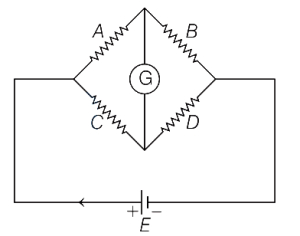
Four resistors $A, B, C$ and $D$ form a Wheatstone bridge as shown in the figure. The bridge is balanced when $C = 100 \Omega$. If $A$ and $B$ are interchanged,the bridge balances for $C = 121 \Omega$. The value of $D$ is (in $Omega$)
A
$10$
B
$100$
C
$110$
D
$120$
Solution
(C) For a balanced Wheatstone bridge,the condition is $\frac{A}{B} = \frac{C}{D}$.
Case $1$: When $C = 100 \Omega$,the bridge is balanced,so $\frac{A}{B} = \frac{100}{D}$ ... $(i)$
Case $2$: When $A$ and $B$ are interchanged,the new resistances in the arms are $B$ and $A$ respectively. The bridge balances for $C = 121 \Omega$,so $\frac{B}{A} = \frac{121}{D}$ ... (ii)
From equation $(i)$,we have $\frac{A}{B} = \frac{100}{D}$. Therefore,$\frac{B}{A} = \frac{D}{100}$.
Substituting this into equation (ii),we get $\frac{D}{100} = \frac{121}{D}$.
$D^2 = 100 \times 121 = 12100$.
$D = \sqrt{12100} = 110 \Omega$.
Case $1$: When $C = 100 \Omega$,the bridge is balanced,so $\frac{A}{B} = \frac{100}{D}$ ... $(i)$
Case $2$: When $A$ and $B$ are interchanged,the new resistances in the arms are $B$ and $A$ respectively. The bridge balances for $C = 121 \Omega$,so $\frac{B}{A} = \frac{121}{D}$ ... (ii)
From equation $(i)$,we have $\frac{A}{B} = \frac{100}{D}$. Therefore,$\frac{B}{A} = \frac{D}{100}$.
Substituting this into equation (ii),we get $\frac{D}{100} = \frac{121}{D}$.
$D^2 = 100 \times 121 = 12100$.
$D = \sqrt{12100} = 110 \Omega$.
0 likesView Solution
34
ChemistryMCQAP EAMCET · 2019
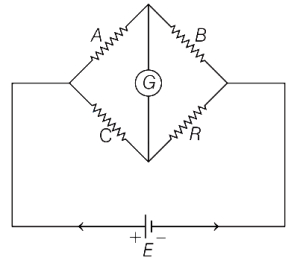
Four resistors $A, B, C$ and $D$ form a Wheatstone bridge. The bridge is balanced when $C = 100 \ \Omega$. If $A$ and $B$ are interchanged,the bridge balances for $C = 121 \ \Omega$. The value of $D$ is (in $Omega$)
A
$10$
B
$100$
C
$110$
D
$120$
Solution
(C) For a balanced Wheatstone bridge,the ratio of resistances is given by $\frac{A}{B} = \frac{C}{D}$.
Let $D = x$. Initially,$\frac{A}{B} = \frac{100}{x}$.
When $A$ and $B$ are interchanged,the new condition is $\frac{B}{A} = \frac{121}{x}$.
From the first equation,$\frac{B}{A} = \frac{x}{100}$.
Equating the two expressions for $\frac{B}{A}$,we get $\frac{x}{100} = \frac{121}{x}$.
$x^2 = 121 \times 100 = 12100$.
$x = \sqrt{12100} = 110 \ \Omega$.
Thus,the value of $D$ is $110 \ \Omega$.
Let $D = x$. Initially,$\frac{A}{B} = \frac{100}{x}$.
When $A$ and $B$ are interchanged,the new condition is $\frac{B}{A} = \frac{121}{x}$.
From the first equation,$\frac{B}{A} = \frac{x}{100}$.
Equating the two expressions for $\frac{B}{A}$,we get $\frac{x}{100} = \frac{121}{x}$.
$x^2 = 121 \times 100 = 12100$.
$x = \sqrt{12100} = 110 \ \Omega$.
Thus,the value of $D$ is $110 \ \Omega$.
0 likesView Solution
35
ChemistryEasyMCQAP EAMCET · 2019
Which one of the following reactions does not take place?
A
$2 CuSO_{4(aq)} + 4 KI_{(aq)} \longrightarrow 2 CuI_2 + 2 K_2SO_4$
B
$2 CuSO_{4(aq)} + 4 KCl_{(aq)} \longrightarrow 2 CuCl_2 + 2 K_2SO_4$
C
$CuSO_{4(aq)} + Zn_{(s)} \longrightarrow ZnSO_{4(aq)} + Cu_{(s)}$
D
$2 CuSO_{4(aq)} + 4 KF_{(aq)} \longrightarrow 2 CuF_2 + 2 K_2SO_4$
Solution
(A) The reaction $2 CuSO_{4(aq)} + 4 KI_{(aq)} \longrightarrow 2 CuI_2 + 2 K_2SO_4$ does not occur as written because $CuI_2$ is unstable and spontaneously decomposes into $Cu_2I_2$ and $I_2$.
The correct reaction is: $2 CuSO_{4(aq)} + 4 KI_{(aq)} \longrightarrow Cu_2I_2(s) + 2 K_2SO_4(aq) + I_2(s)$.
The correct reaction is: $2 CuSO_{4(aq)} + 4 KI_{(aq)} \longrightarrow Cu_2I_2(s) + 2 K_2SO_4(aq) + I_2(s)$.
0 likesView Solution
36
ChemistryEasyMCQAP EAMCET · 2019
The non-biodegradable waste formed in fertilizer industries is
A
fly ash
B
carbon monoxide
C
gypsum
D
lead
Solution
(C) Gypsum $(CaSO_4 \cdot 2H_2O)$ is a significant non-biodegradable solid waste byproduct generated during the production of phosphate fertilizers.
0 likesView Solution
37
ChemistryEasyMCQAP EAMCET · 2019
Which one of the following statements is not correct?
A
$NO_2$ is a lung irritant
B
The municipal sewage has $BOD$ value of $100-4000 \ ppm$
C
Main source of $CO$ is automobile exhaust fumes
D
$COD$ is the measure of bacteria in water
Solution
(D) In environmental chemistry,Chemical Oxygen Demand $(COD)$ is the total amount of oxygen (in $ppm$) required to chemically oxidize all organic and inorganic pollutants in a given water sample. It is not a measure of bacteria.
Thus,option $(D)$ is incorrect.
- $NO_2$ is known to be a lung irritant.
- Municipal sewage typically has a $BOD$ (Biological Oxygen Demand) value ranging from $100-4000 \ ppm$.
- The primary source of $CO$ (carbon monoxide) in the atmosphere is automobile exhaust fumes.
Thus,option $(D)$ is incorrect.
- $NO_2$ is known to be a lung irritant.
- Municipal sewage typically has a $BOD$ (Biological Oxygen Demand) value ranging from $100-4000 \ ppm$.
- The primary source of $CO$ (carbon monoxide) in the atmosphere is automobile exhaust fumes.
0 likesView Solution
38
ChemistryEasyMCQAP EAMCET · 2019
Acid rain is caused by the presence of $X$ and $Y$ in air. $X, Y$ are respectively
A
$SO_2, NO_2$
B
$CFC, O_3$
C
$CO, CFC$
D
$SO_2, O_3$
Solution
(A) Acid rain is primarily caused by the emission of sulphur dioxide $(SO_2)$ and nitrogen oxides $(NO_x)$,specifically nitrogen dioxide $(NO_2)$.
These gases react with water vapor,oxygen,and other chemicals in the atmosphere to form sulphuric acid $(H_2SO_4)$ and nitric acid $(HNO_3)$.
These acids then fall to the ground as acid rain.
These gases react with water vapor,oxygen,and other chemicals in the atmosphere to form sulphuric acid $(H_2SO_4)$ and nitric acid $(HNO_3)$.
These acids then fall to the ground as acid rain.
0 likesView Solution
39
ChemistryEasyMCQAP EAMCET · 2019
Identify the correct statements from the following:
$i$. In the presence of $UV$ light,$CF_2Cl_2(g)$ gives chlorine free radicals which will react with $O_3(g)$ to form $O_2(g)$.
$ii$. Drinking water with $10 \ ppm$ fluoride is better than drinking water with $1 \ ppm$ fluoride.
$iii$. The maximum permissible concentration of lead in drinking water is $50 \ ppb$.
$i$. In the presence of $UV$ light,$CF_2Cl_2(g)$ gives chlorine free radicals which will react with $O_3(g)$ to form $O_2(g)$.
$ii$. Drinking water with $10 \ ppm$ fluoride is better than drinking water with $1 \ ppm$ fluoride.
$iii$. The maximum permissible concentration of lead in drinking water is $50 \ ppb$.
A
$i, ii, iii$
B
$i, ii$ only
C
$ii, iii$ only
D
$i, iii$ only
Solution
(D) Statement $(i)$ is correct because $CF_2Cl_2$ (Freon-$12$) undergoes photolysis in the presence of $UV$ light to produce chlorine free radicals,which catalyze the depletion of ozone $(O_3)$ to oxygen $(O_2)$.
Statement $(ii)$ is incorrect because fluoride concentration in drinking water should be around $1 \ ppm$. Excess fluoride (e.g.,$10 \ ppm$) causes harmful effects like mottled teeth and skeletal fluorosis.
Statement $(iii)$ is correct as the maximum permissible concentration of lead in drinking water is indeed $50 \ ppb$ $(0.05 \ ppm)$.
Statement $(ii)$ is incorrect because fluoride concentration in drinking water should be around $1 \ ppm$. Excess fluoride (e.g.,$10 \ ppm$) causes harmful effects like mottled teeth and skeletal fluorosis.
Statement $(iii)$ is correct as the maximum permissible concentration of lead in drinking water is indeed $50 \ ppb$ $(0.05 \ ppm)$.
0 likesView Solution
40
ChemistryMCQAP EAMCET · 2019
$N$ divisions on the main scale of a vernier calipers coincide with $(N + 1)$ divisions of the vernier scale. If each division of main scale is $a$ units, then the least count of the calipers is
A
$\frac{a}{N}$
B
$a$
C
$\frac{a}{N + 1}$
D
$\frac{N a}{N + 1}$
Solution
It is given that $(N + 1)$ divisions on vernier scale $(VSD) = N$ divisions on main scale $(MSD)$.
$\Rightarrow 1 \ VSD = \frac{N}{N + 1} \ MSD$
Least count of vernier callipers $(LC) = 1 \ MSD - 1 \ VSD$
$\Rightarrow LC = a - a \left( \frac{N}{N + 1} \right) = \frac{a}{N + 1} \ unit$
$\Rightarrow 1 \ VSD = \frac{N}{N + 1} \ MSD$
Least count of vernier callipers $(LC) = 1 \ MSD - 1 \ VSD$
$\Rightarrow LC = a - a \left( \frac{N}{N + 1} \right) = \frac{a}{N + 1} \ unit$
0 likesView Solution
41
ChemistryEasyMCQAP EAMCET · 2019
The $IUPAC$ name of the given compound is:

A
$3-$methoxycyclohexene
B
$1-$methoxycyclohex$-3-$ene
C
$1-$methoxycyclohex$-4-$ene
D
$4-$methoxycyclohexene
Solution
(D) $1$. In cyclic compounds containing a double bond,the double bond is given priority in numbering.
$2$. The carbon atoms of the double bond are assigned positions $1$ and $2$ such that the substituent gets the lowest possible locant.
$3$. Starting from the double bond,if we number in the direction that gives the methoxy group position $4$,we get $4-$methoxycyclohexene.
$4$. Therefore,the correct $IUPAC$ name is $4-$methoxycyclohexene.
$2$. The carbon atoms of the double bond are assigned positions $1$ and $2$ such that the substituent gets the lowest possible locant.
$3$. Starting from the double bond,if we number in the direction that gives the methoxy group position $4$,we get $4-$methoxycyclohexene.
$4$. Therefore,the correct $IUPAC$ name is $4-$methoxycyclohexene.
0 likesView Solution
42
ChemistryMediumMCQAP EAMCET · 2019
Identify the compound which has the maximum number of no-bond resonance (hyperconjugation) structures.
A
tert-Butylbenzene $(C_6H_5-C(CH_3)_3)$
B
Ethylbenzene $(C_6H_5-CH_2CH_3)$
C
Isopropylbenzene $(C_6H_5-CH(CH_3)_2)$
D
Toluene $(C_6H_5-CH_3)$
Solution
(D) Key Idea: The number of no-bond resonance (hyperconjugation) structures is equal to the number of $\alpha$-hydrogen atoms present on the carbon atom directly attached to the benzene ring.
$(a)$ tert-Butylbenzene: The $\alpha$-carbon has $0$ $H$-atoms. Number of hyperconjugation structures = $0$.
$(b)$ Ethylbenzene: The $\alpha$-carbon $(CH_2)$ has $2$ $H$-atoms. Number of hyperconjugation structures = $2$.
$(c)$ Isopropylbenzene: The $\alpha$-carbon $(CH)$ has $1$ $H$-atom. Number of hyperconjugation structures = $1$.
$(d)$ Toluene: The $\alpha$-carbon $(CH_3)$ has $3$ $H$-atoms. Number of hyperconjugation structures = $3$.
Since toluene has the maximum number of $\alpha$-hydrogen atoms $(3)$,it has the maximum number of no-bond resonance structures. Hence,option $(d)$ is the correct answer.
$(a)$ tert-Butylbenzene: The $\alpha$-carbon has $0$ $H$-atoms. Number of hyperconjugation structures = $0$.
$(b)$ Ethylbenzene: The $\alpha$-carbon $(CH_2)$ has $2$ $H$-atoms. Number of hyperconjugation structures = $2$.
$(c)$ Isopropylbenzene: The $\alpha$-carbon $(CH)$ has $1$ $H$-atom. Number of hyperconjugation structures = $1$.
$(d)$ Toluene: The $\alpha$-carbon $(CH_3)$ has $3$ $H$-atoms. Number of hyperconjugation structures = $3$.
Since toluene has the maximum number of $\alpha$-hydrogen atoms $(3)$,it has the maximum number of no-bond resonance structures. Hence,option $(d)$ is the correct answer.
0 likesView Solution
43
ChemistryEasyMCQAP EAMCET · 2019
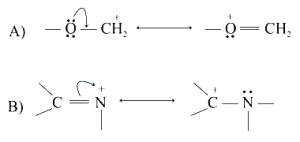
In the following resonance structures,the curved arrow indicates that electrons are shifted from:
A
Atom to adjacent bond in both $(A)$ and $(B)$.
B
$\pi$ bond to adjacent atom in both $(A)$ and $(B)$.
C
$\pi$ bond to adjacent atom in $(A)$ and atom to adjacent bond in $(B)$.
D
Atom to adjacent bond in $(A)$ and $\pi$ bond to adjacent atom in $(B)$.
Solution
(D) In structure $(A)$,the curved arrow shows the movement of a lone pair of electrons from the oxygen atom to the adjacent bond position to form a $\pi$ bond between oxygen and carbon.
In structure $(B)$,the curved arrow shows the movement of electrons from the $\pi$ bond between the carbon and nitrogen atoms to the adjacent nitrogen atom.
In structure $(B)$,the curved arrow shows the movement of electrons from the $\pi$ bond between the carbon and nitrogen atoms to the adjacent nitrogen atom.
0 likesView Solution
44
ChemistryMediumMCQAP EAMCET · 2019
The stability order of the following resonance structures is:
$I. CH_2=CH-CH=O$
$II. CH_2^+-CH=CH-O^-$
$III. CH_2^--CH=CH-O^+$
$I. CH_2=CH-CH=O$
$II. CH_2^+-CH=CH-O^-$
$III. CH_2^--CH=CH-O^+$
A
$III < II < I$
B
$II > I > III$
C
$II < I < III$
D
$II > III > I$
Solution
(A) $(I)$ is a neutral structure with a complete octet for all atoms,making it the most stable resonance structure.
Between $(II)$ and $(III)$,structure $(II)$ places a negative charge on the more electronegative oxygen atom,whereas structure $(III)$ places a positive charge on the oxygen atom.
Since a more electronegative atom is more stable with a negative charge,$(II)$ is more stable than $(III)$.
Therefore,the stability order is $III < II < I$.
Hence,option $(A)$ is correct.
Between $(II)$ and $(III)$,structure $(II)$ places a negative charge on the more electronegative oxygen atom,whereas structure $(III)$ places a positive charge on the oxygen atom.
Since a more electronegative atom is more stable with a negative charge,$(II)$ is more stable than $(III)$.
Therefore,the stability order is $III < II < I$.
Hence,option $(A)$ is correct.
0 likesView Solution
45
ChemistryMediumMCQAP EAMCET · 2019
In the Dumas method,$1 \ g$ of an organic compound gives $50 \ mL$ of $N_2$ gas at $300 \ K$ and $740 \ mm \ Hg$ pressure. If the aqueous tension at $300 \ K$ is $15 \ mm \ Hg$,what is the percentage of nitrogen in the compound?
A
$5.42$
B
$10.84$
C
$21.68$
D
$2.71$
Solution
(A) The pressure of dry $N_2$ gas is $P_{dry} = P_{total} - P_{aqueous} = 740 - 15 = 725 \ mm \ Hg$.
Using the ideal gas equation at $STP$ $(P_2 = 760 \ mm \ Hg, T_2 = 273 \ K)$:
$\frac{P_1 V_1}{T_1} = \frac{P_2 V_2}{T_2} \Rightarrow \frac{725 \times 50}{300} = \frac{760 \times V_2}{273}$.
$V_2 = \frac{725 \times 50 \times 273}{300 \times 760} \approx 43.47 \ mL$.
Since $22400 \ mL$ of $N_2$ at $STP$ weighs $28 \ g$,the mass of $N_2$ is:
$\text{Mass} = \frac{28 \times 43.47}{22400} \approx 0.0543 \ g$.
Percentage of $N_2 = \frac{\text{Mass of } N_2}{\text{Mass of compound}} \times 100 = \frac{0.0543}{1} \times 100 = 5.43 \%$.
Rounding to the nearest provided option,$5.42 \%$ is the correct value.
Using the ideal gas equation at $STP$ $(P_2 = 760 \ mm \ Hg, T_2 = 273 \ K)$:
$\frac{P_1 V_1}{T_1} = \frac{P_2 V_2}{T_2} \Rightarrow \frac{725 \times 50}{300} = \frac{760 \times V_2}{273}$.
$V_2 = \frac{725 \times 50 \times 273}{300 \times 760} \approx 43.47 \ mL$.
Since $22400 \ mL$ of $N_2$ at $STP$ weighs $28 \ g$,the mass of $N_2$ is:
$\text{Mass} = \frac{28 \times 43.47}{22400} \approx 0.0543 \ g$.
Percentage of $N_2 = \frac{\text{Mass of } N_2}{\text{Mass of compound}} \times 100 = \frac{0.0543}{1} \times 100 = 5.43 \%$.
Rounding to the nearest provided option,$5.42 \%$ is the correct value.
0 likesView Solution
46
ChemistryEasyMCQAP EAMCET · 2019
For which of the following,Kjeldahl's method is not used for the estimation of nitrogen?
$I$. Aniline
$II$. Azobenzene
$III$. Nitrobenzene
$IV$. Pyridine
$I$. Aniline
$II$. Azobenzene
$III$. Nitrobenzene
$IV$. Pyridine
A
$II, III, IV$
B
$II, III$ only
C
$III, IV$ only
D
$I, III, IV$
Solution
(A) Key Idea: Kjeldahl's method is not applicable to compounds containing nitrogen in nitro $(-NO_2)$,azo $(-N=N-)$ groups,or nitrogen present in a heterocyclic ring (like pyridine).
$I$. Aniline $(C_6H_5NH_2)$: Nitrogen is in the amino group $(-NH_2)$,which can be estimated by Kjeldahl's method.
$II$. Azobenzene $(C_6H_5-N=N-C_6H_5)$: Contains an azo $(-N=N-)$ group,so it cannot be estimated.
$III$. Nitrobenzene $(C_6H_5NO_2)$: Contains a nitro $(-NO_2)$ group,so it cannot be estimated.
$IV$. Pyridine $(C_5H_5N)$: Nitrogen is part of a heterocyclic aromatic ring,so it cannot be estimated.
Therefore,compounds $II, III,$ and $IV$ cannot be estimated by Kjeldahl's method.
Thus,option $(A)$ is the correct answer.
$I$. Aniline $(C_6H_5NH_2)$: Nitrogen is in the amino group $(-NH_2)$,which can be estimated by Kjeldahl's method.
$II$. Azobenzene $(C_6H_5-N=N-C_6H_5)$: Contains an azo $(-N=N-)$ group,so it cannot be estimated.
$III$. Nitrobenzene $(C_6H_5NO_2)$: Contains a nitro $(-NO_2)$ group,so it cannot be estimated.
$IV$. Pyridine $(C_5H_5N)$: Nitrogen is part of a heterocyclic aromatic ring,so it cannot be estimated.
Therefore,compounds $II, III,$ and $IV$ cannot be estimated by Kjeldahl's method.
Thus,option $(A)$ is the correct answer.
0 likesView Solution
47
ChemistryMCQAP EAMCET · 2019
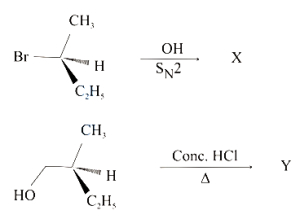
What are $X$ and $Y$ in the following reactions?
A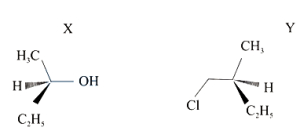
B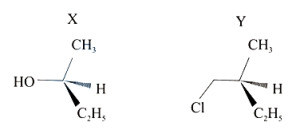
C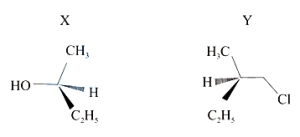
D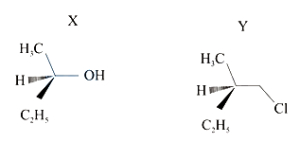
Solution
(A) In an $S_N2$ reaction,the nucleophile attacks from the side opposite to the leaving group,resulting in a Walden inversion (inversion of configuration). Thus,$X$ is the inverted alcohol.
In the reaction of a primary alcohol with $Conc. \ HCl$,the reaction typically proceeds via an $S_N2$ mechanism (or $S_N1$ depending on the substrate,but here the primary alcohol structure is given). However,looking at the options and the standard transformation of a primary alcohol to a primary alkyl chloride,the reaction involves the substitution of $-OH$ by $-Cl$. Since the chiral center is not involved in the bond-breaking/forming step for the primary alcohol,the configuration at the chiral center remains unchanged. Thus,$Y$ is the product with retained configuration.
In the reaction of a primary alcohol with $Conc. \ HCl$,the reaction typically proceeds via an $S_N2$ mechanism (or $S_N1$ depending on the substrate,but here the primary alcohol structure is given). However,looking at the options and the standard transformation of a primary alcohol to a primary alkyl chloride,the reaction involves the substitution of $-OH$ by $-Cl$. Since the chiral center is not involved in the bond-breaking/forming step for the primary alcohol,the configuration at the chiral center remains unchanged. Thus,$Y$ is the product with retained configuration.
0 likesView Solution
48
ChemistryDifficultMCQAP EAMCET · 2019
Sodium acetate was electrolysed by Kolbe's method to form two gases $A$ and $B$ at the anode. $C$ and $D$ are formed when $B$ is heated with a regulated supply of $O_2$ or air in the presence of $(CH_3COO)_2Mn$. $C$ reacts with $NaOH$ to form a salt. $A$ and $D$ are respectively,
A
$CO_2, CH_3COOH$
B
$CO_2, H_2O$
C
$C_2H_6, H_2O$
D
$CO_2, H_2O_2$
Solution
(C) Kolbe electrolysis of $CH_3COONa$ produces $C_2H_6$ and $CO_2$ at the anode.
$2CH_3COONa + 2H_2O \xrightarrow{\text{electrolysis}} CH_3-CH_3 (A) + 2CO_2 (B) + H_2 + 2NaOH$
When $B$ $(CO_2)$ is heated with $O_2$ in the presence of $(CH_3COO)_2Mn$,it is not the standard reaction; however,the question implies the oxidation of $CH_3-CH_3$ $(A)$. The combustion of ethane is:
$2C_2H_6 + 7O_2 \xrightarrow{(CH_3COO)_2Mn} 4CO_2 (C) + 6H_2O (D)$
$C$ $(CO_2)$ reacts with $NaOH$ to form sodium carbonate $(Na_2CO_3)$ or sodium bicarbonate $(NaHCO_3)$,which are salts.
Thus,$A$ is $C_2H_6$ and $D$ is $H_2O$.
$2CH_3COONa + 2H_2O \xrightarrow{\text{electrolysis}} CH_3-CH_3 (A) + 2CO_2 (B) + H_2 + 2NaOH$
When $B$ $(CO_2)$ is heated with $O_2$ in the presence of $(CH_3COO)_2Mn$,it is not the standard reaction; however,the question implies the oxidation of $CH_3-CH_3$ $(A)$. The combustion of ethane is:
$2C_2H_6 + 7O_2 \xrightarrow{(CH_3COO)_2Mn} 4CO_2 (C) + 6H_2O (D)$
$C$ $(CO_2)$ reacts with $NaOH$ to form sodium carbonate $(Na_2CO_3)$ or sodium bicarbonate $(NaHCO_3)$,which are salts.
Thus,$A$ is $C_2H_6$ and $D$ is $H_2O$.
0 likesView Solution
49
ChemistryDifficultMCQAP EAMCET · 2019
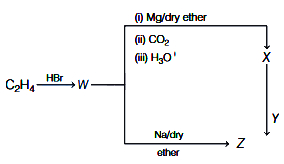
What are $Y$ and $Z$ in the following reaction sequence?
A
$Y - NaOH / CaO; Z - CH_3(CH_2)_2 CH_3$
B
$Y - NaOH / \text{electrolysis}; Z - CH_3CH_2CH_2CH_3$
C
$Y - NaOH / CaO; Z - CH_3CH_2CH_2CH_3$
D
$Y - NaOH / \text{electrolysis}; Z - CH_3CH_2CH_2CH_3$
Solution
(D) The reaction sequence is as follows:
$1$. $C_2H_4 + HBr \rightarrow CH_3CH_2Br$ $(W)$
$2$. $W + Mg / \text{dry ether} \rightarrow CH_3CH_2MgBr$
$3$. $CH_3CH_2MgBr + CO_2 \xrightarrow{H_3O^+} CH_3CH_2COOH$ $(X)$
$4$. $CH_3CH_2COOH$ undergoes Kolbe's electrolysis $(Y)$ to form $CH_3CH_2CH_2CH_3$ $(Z)$.
$5$. $W + Na / \text{dry ether}$ (Wurtz reaction) also forms $CH_3CH_2CH_2CH_3$ $(Z)$.
Thus,$Y$ is electrolysis and $Z$ is $CH_3CH_2CH_2CH_3$.
$1$. $C_2H_4 + HBr \rightarrow CH_3CH_2Br$ $(W)$
$2$. $W + Mg / \text{dry ether} \rightarrow CH_3CH_2MgBr$
$3$. $CH_3CH_2MgBr + CO_2 \xrightarrow{H_3O^+} CH_3CH_2COOH$ $(X)$
$4$. $CH_3CH_2COOH$ undergoes Kolbe's electrolysis $(Y)$ to form $CH_3CH_2CH_2CH_3$ $(Z)$.
$5$. $W + Na / \text{dry ether}$ (Wurtz reaction) also forms $CH_3CH_2CH_2CH_3$ $(Z)$.
Thus,$Y$ is electrolysis and $Z$ is $CH_3CH_2CH_2CH_3$.
0 likesView Solution
50
ChemistryMediumMCQAP EAMCET · 2019
What are $X$ and $Y$ in the following reaction? $Hex-2-ene$ $\xrightarrow{O_3} \text{Ozonide}$ $\xrightarrow{Zn + H_2O} X + Y$
A
$X = CH_3-CH_2-CHO, Y = (CH_3)_2CO$
B
$X = CH_3-CH(CH_3)-COOH, Y = CH_3-COOH$
C
$X = CH_3-CH_2-CH_2-CHO, Y = CH_3-CHO$
D
$X = CH_3-CH(CH_3)-CHO, Y = CH_3-CHO$
Solution
(C) Reductive ozonolysis of $Hex-2-ene$ $(CH_3-CH_2-CH_2-CH=CH-CH_3)$ involves the addition of ozone across the double bond followed by cleavage with $Zn/H_2O$ to produce two carbonyl compounds.
Cleavage of the $C=C$ bond in $Hex-2-ene$ occurs at the $2^{nd}$ position.
The reaction is: $CH_3-CH_2-CH_2-CH=CH-CH_3 \xrightarrow{O_3, Zn/H_2O} CH_3-CH_2-CH_2-CHO + CH_3-CHO$.
Thus,$X = CH_3-CH_2-CH_2-CHO$ $(Butanal)$ and $Y = CH_3-CHO$ $(Ethanal)$.
Cleavage of the $C=C$ bond in $Hex-2-ene$ occurs at the $2^{nd}$ position.
The reaction is: $CH_3-CH_2-CH_2-CH=CH-CH_3 \xrightarrow{O_3, Zn/H_2O} CH_3-CH_2-CH_2-CHO + CH_3-CHO$.
Thus,$X = CH_3-CH_2-CH_2-CHO$ $(Butanal)$ and $Y = CH_3-CHO$ $(Ethanal)$.
0 likesView Solution
51
ChemistryMediumMCQAP EAMCET · 2019
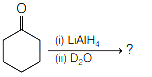
The major product of the following reaction is
A
Cyclohexanol with a $D$ atom attached to the carbon and an $-OH$ group.
B
Cyclohexanol with a $D$ atom attached to the carbon and an $-OD$ group.
C
Cyclohexanol with a $D$ atom and an $H$ atom attached to the carbon.
D
Cyclohexanol with an $H$ atom attached to the carbon and an $-OD$ group.
Solution
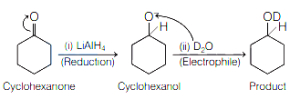
(D) $LiAlH_4$ acts as a source of hydride ion $(H^-)$,which attacks the electrophilic carbonyl carbon of cyclohexanone to form an alkoxide intermediate.
In the second step,$D_2O$ acts as a source of deuterium $(D^+)$,which protonates (deuterates) the alkoxide oxygen to form the final product,which is a cyclohexanol derivative with an $-OD$ group and a hydrogen atom attached to the alpha carbon.
In the second step,$D_2O$ acts as a source of deuterium $(D^+)$,which protonates (deuterates) the alkoxide oxygen to form the final product,which is a cyclohexanol derivative with an $-OD$ group and a hydrogen atom attached to the alpha carbon.
0 likesView Solution
52
ChemistryDifficultMCQAP EAMCET · 2019
Identify $X, Y, Z$ in the following reaction sequence:

A
$X = CH_3CH_2COCl, Y = CH_3MgBr, Z = HOCH_2CH_2OH/OH^-$
B
$X = CH_3CH_2CH_2Cl, Y = (CH_3)_2Cd, Z = HOCH_2CH_2Cl$
C
$X = CH_3CH_2COCl, Y = (CH_3)_2Cd, Z = HOCH_2CH_2OH/HCl \text{ (gas)}$
D
$X = CH_3COCl, Y = (C_2H_5)_2Cd, Z = HOCH_2CH_2OH/H^+$
Solution
(C) $1$. The starting material is propan$-1-$ol $(CH_3CH_2CH_2OH)$.
$2$. Oxidation with $CrO_3/H_2SO_4$ (Jones reagent) converts the primary alcohol to propanoic acid $(CH_3CH_2COOH)$.
$3$. Treatment with $SOCl_2$ converts the carboxylic acid to propanoyl chloride $(CH_3CH_2COCl)$,which is $X$.
$4$. Reaction of $X$ with dimethylcadmium $((CH_3)_2Cd)$ is a standard method to prepare ketones from acid chlorides,yielding butan$-2-$one $(CH_3CH_2COCH_3)$. Thus,$Y = (CH_3)_2Cd$.
$5$. The final step is the protection of the ketone as a cyclic acetal using ethylene glycol $(HOCH_2CH_2OH)$ in the presence of dry $HCl$ gas. Thus,$Z = HOCH_2CH_2OH/HCl \text{ (gas)}$.
$6$. Therefore,option $C$ is correct.
$2$. Oxidation with $CrO_3/H_2SO_4$ (Jones reagent) converts the primary alcohol to propanoic acid $(CH_3CH_2COOH)$.
$3$. Treatment with $SOCl_2$ converts the carboxylic acid to propanoyl chloride $(CH_3CH_2COCl)$,which is $X$.
$4$. Reaction of $X$ with dimethylcadmium $((CH_3)_2Cd)$ is a standard method to prepare ketones from acid chlorides,yielding butan$-2-$one $(CH_3CH_2COCH_3)$. Thus,$Y = (CH_3)_2Cd$.
$5$. The final step is the protection of the ketone as a cyclic acetal using ethylene glycol $(HOCH_2CH_2OH)$ in the presence of dry $HCl$ gas. Thus,$Z = HOCH_2CH_2OH/HCl \text{ (gas)}$.
$6$. Therefore,option $C$ is correct.
0 likesView Solution
53
ChemistryDifficultMCQAP EAMCET · 2019
Identify the reagents $X, Y, Z$ for the following dehydration reactions of alcohols:
$CH_3-CH_2-OH \xrightarrow{X} CH_2=CH_2 + H_2O$
$CH_3-CH(OH)-CH_3 \xrightarrow{Y} CH_3-CH=CH_2 + H_2O$
$(CH_3)_3C-OH \xrightarrow{Z} (CH_3)_2C=CH_2 + H_2O$
$CH_3-CH_2-OH \xrightarrow{X} CH_2=CH_2 + H_2O$
$CH_3-CH(OH)-CH_3 \xrightarrow{Y} CH_3-CH=CH_2 + H_2O$
$(CH_3)_3C-OH \xrightarrow{Z} (CH_3)_2C=CH_2 + H_2O$
A
| $X$ | $Y$ | $Z$ |
| $H_2SO_4, 443 \ K$ | $85 \% \ H_3PO_4, 440 \ K$ | $20 \% \ H_3PO_4, 358 \ K$ |
B
| $X$ | $Y$ | $Z$ |
| $85 \% \ H_3PO_4, 440 \ K$ | $H_2SO_4, 443 \ K$ | $20 \% \ H_3PO_4, 358 \ K$ |
C
| $X$ | $Y$ | $Z$ |
| $20 \% \ H_3PO_4, 358 \ K$ | $H_2SO_4, 443 \ K$ | $85 \% \ H_3PO_4, 440 \ K$ |
D
| $X$ | $Y$ | $Z$ |
| $H_2SO_4, 443 \ K$ | $20 \% \ H_3PO_4, 358 \ K$ | $85 \% \ H_3PO_4, 440 \ K$ |
Solution
(A) The dehydration of alcohols depends on the degree of substitution of the alcohol:
$1$. Primary $(1^{\circ})$ alcohols like ethanol undergo dehydration using concentrated $H_2SO_4$ at $443 \ K$.
$2$. Secondary $(2^{\circ})$ alcohols like propan$-2-$ol undergo dehydration using $85 \% \ H_3PO_4$ at $440 \ K$.
$3$. Tertiary $(3^{\circ})$ alcohols like tert-butyl alcohol undergo dehydration using $20 \% \ H_3PO_4$ at $358 \ K$.
Therefore,$X = H_2SO_4, 443 \ K$; $Y = 85 \% \ H_3PO_4, 440 \ K$; $Z = 20 \% \ H_3PO_4, 358 \ K$.
$1$. Primary $(1^{\circ})$ alcohols like ethanol undergo dehydration using concentrated $H_2SO_4$ at $443 \ K$.
$2$. Secondary $(2^{\circ})$ alcohols like propan$-2-$ol undergo dehydration using $85 \% \ H_3PO_4$ at $440 \ K$.
$3$. Tertiary $(3^{\circ})$ alcohols like tert-butyl alcohol undergo dehydration using $20 \% \ H_3PO_4$ at $358 \ K$.
Therefore,$X = H_2SO_4, 443 \ K$; $Y = 85 \% \ H_3PO_4, 440 \ K$; $Z = 20 \% \ H_3PO_4, 358 \ K$.
0 likesView Solution
54
ChemistryDifficultMCQAP EAMCET · 2019
An organic compound $C_6H_7N$ on reaction with $NaNO_2 / HCl$ at $273-278 \ K$ followed by warming with water gives $B$. $B$ reacts with concentrated $HNO_3$ to give $C$. What is $C$?
A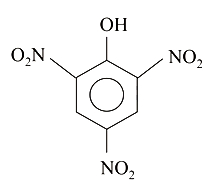
B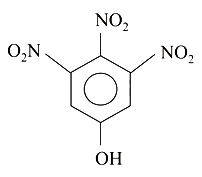
C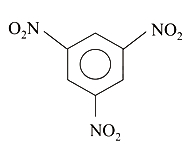
D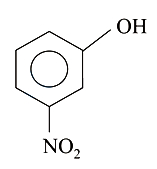
Solution
(A) $C_6H_7N$ corresponds to aniline $(A)$.
Aniline undergoes diazotisation reaction with $NaNO_2 / HCl$ at $273-278 \ K$ to form benzene diazonium chloride,which on warming with water produces phenol $(B)$.
Phenol reacts with concentrated nitric acid $(HNO_3)$ to undergo electrophilic aromatic substitution,yielding $2,4,6-$trinitrophenol $(C)$,which is commonly known as picric acid.
Aniline undergoes diazotisation reaction with $NaNO_2 / HCl$ at $273-278 \ K$ to form benzene diazonium chloride,which on warming with water produces phenol $(B)$.
Phenol reacts with concentrated nitric acid $(HNO_3)$ to undergo electrophilic aromatic substitution,yielding $2,4,6-$trinitrophenol $(C)$,which is commonly known as picric acid.
0 likesView Solution
55
ChemistryDifficultMCQAP EAMCET · 2019
What is $Z$ in the following sequence of reactions?
$p-chloronitrobenzene$ $\xrightarrow{NaOH, 443 \ K} X$ $\xrightarrow{(i) Sn + HCl (ii) NaNO_2 / HCl, 0-5^{\circ}C} Y$ $\xrightarrow{H_3O^{+}, 10^{\circ}C} Z$
$p-chloronitrobenzene$ $\xrightarrow{NaOH, 443 \ K} X$ $\xrightarrow{(i) Sn + HCl (ii) NaNO_2 / HCl, 0-5^{\circ}C} Y$ $\xrightarrow{H_3O^{+}, 10^{\circ}C} Z$
A
p-nitrophenol
B
p-aminophenol
C
hydroquinone
D
phloroglucinol
Solution
(C) The reaction sequence is as follows:
$1$. $p-chloronitrobenzene$ reacts with $NaOH$ at $443 \ K$ to form $p-nitrophenol$ $(X)$.
$2$. $p-nitrophenol$ is reduced using $Sn + HCl$ to form $p-aminophenol$ $(Y)$.
$3$. $p-aminophenol$ reacts with $NaNO_2 / HCl$ at $0-5^{\circ}C$ to form a diazonium salt intermediate.
$4$. Hydrolysis of this diazonium salt with $H_3O^{+}$ at $10^{\circ}C$ replaces the diazonium group with an $-OH$ group,resulting in the formation of $hydroquinone$ $(Z)$.
$1$. $p-chloronitrobenzene$ reacts with $NaOH$ at $443 \ K$ to form $p-nitrophenol$ $(X)$.
$2$. $p-nitrophenol$ is reduced using $Sn + HCl$ to form $p-aminophenol$ $(Y)$.
$3$. $p-aminophenol$ reacts with $NaNO_2 / HCl$ at $0-5^{\circ}C$ to form a diazonium salt intermediate.
$4$. Hydrolysis of this diazonium salt with $H_3O^{+}$ at $10^{\circ}C$ replaces the diazonium group with an $-OH$ group,resulting in the formation of $hydroquinone$ $(Z)$.
0 likesView Solution
56
ChemistryEasyMCQAP EAMCET · 2019
What are $A$,$B$ and $C$ in the following reactions?
$\text{Cumene}$ $\xrightarrow{O_2} A$ $\xrightarrow{H_3O^{+}} B + C$
$\text{Cumene}$ $\xrightarrow{O_2} A$ $\xrightarrow{H_3O^{+}} B + C$
A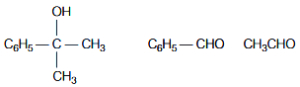
B
C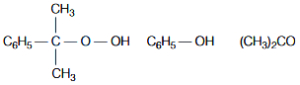
D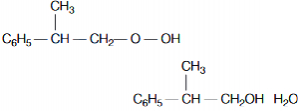
Solution
(C) The given reaction is the industrial preparation of phenol from cumene (isopropylbenzene).
$1$. Cumene reacts with oxygen $(O_2)$ to form cumene hydroperoxide $(A)$:
$C_6H_5-CH(CH_3)_2 + O_2 \rightarrow C_6H_5-C(CH_3)_2-O-OH$
$2$. Cumene hydroperoxide $(A)$ on treatment with dilute acid $(H_3O^+)$ undergoes rearrangement to produce phenol $(B)$ and acetone $(C)$:
$C_6H_5-C(CH_3)_2-O-OH \xrightarrow{H_3O^+} C_6H_5OH + (CH_3)_2CO$
Thus,$A$ is cumene hydroperoxide,$B$ is phenol,and $C$ is acetone. The correct option is $C$.
$1$. Cumene reacts with oxygen $(O_2)$ to form cumene hydroperoxide $(A)$:
$C_6H_5-CH(CH_3)_2 + O_2 \rightarrow C_6H_5-C(CH_3)_2-O-OH$
$2$. Cumene hydroperoxide $(A)$ on treatment with dilute acid $(H_3O^+)$ undergoes rearrangement to produce phenol $(B)$ and acetone $(C)$:
$C_6H_5-C(CH_3)_2-O-OH \xrightarrow{H_3O^+} C_6H_5OH + (CH_3)_2CO$
Thus,$A$ is cumene hydroperoxide,$B$ is phenol,and $C$ is acetone. The correct option is $C$.
0 likesView Solution
57
ChemistryEasyMCQAP EAMCET · 2019
The major product obtained in the following reaction is $C_2H_5ONa + (CH_3)_3C-Cl \rightarrow$
A
$CH_3-C(CH_3)_2-O-C_2H_5$
B
$CH_2=C(CH_3)_2$
C
$CH_3-CH(CH_3)-O-C_2H_5$
D
$(CH_3)_3C-CH_2CHO$
Solution
(B) The reaction involves a tertiary alkyl halide,$(CH_3)_3C-Cl$,and a strong base,$C_2H_5ONa$ (sodium ethoxide).
Since the alkyl halide is sterically hindered (tertiary),the $S_N2$ pathway is unfavorable.
Instead,the base acts as a proton acceptor,leading to an $E2$ elimination reaction.
The base abstracts a proton from one of the $\beta$-carbon atoms,resulting in the formation of an alkene.
The major product is $2$-methylpropene,which is $(CH_3)_2C=CH_2$.
Since the alkyl halide is sterically hindered (tertiary),the $S_N2$ pathway is unfavorable.
Instead,the base acts as a proton acceptor,leading to an $E2$ elimination reaction.
The base abstracts a proton from one of the $\beta$-carbon atoms,resulting in the formation of an alkene.
The major product is $2$-methylpropene,which is $(CH_3)_2C=CH_2$.
0 likesView Solution
58
ChemistryMediumMCQAP EAMCET · 2019
What are $X, Y$ and $Z$ in the following reactions?
$(CH_3)_3 C-O^- Na^+ + CH_3 CH_2 Br \longrightarrow X + NaBr$
$(CH_3)_3 C-Br + CH_3 CH_2 O^- Na^+ \longrightarrow Y + Z$
$(CH_3)_3 C-O^- Na^+ + CH_3 CH_2 Br \longrightarrow X + NaBr$
$(CH_3)_3 C-Br + CH_3 CH_2 O^- Na^+ \longrightarrow Y + Z$
A
$(CH_3)_3 C-Br, (CH_3)_3 C-OH, CH_3 CH_2 Br$
B
$CH_3-C(CH_3)=CH_2, (CH_3)_3 C-OCH_2 CH_3, NaBr$
C
$(CH_3)_3 C-OCH_2 CH_3, CH_3-C(CH_3)=CH_2, CH_3 CH_2 OH$
D
$CH_3-CH(CH_3)-CH_2 OH, CH_3-CH(CH_3)-OCH_2 CH_3, NaBr$
Solution
(C) The first reaction is: $(CH_3)_3 C-O^- Na^+ + CH_3 CH_2 Br \longrightarrow (CH_3)_3 C-OCH_2 CH_3 (X) + NaBr$.
This is a $S_N2$ reaction where a primary halide reacts with a bulky alkoxide to form an ether.
The second reaction is: $(CH_3)_3 C-Br + CH_3 CH_2 O^- Na^+ \longrightarrow CH_3-C(CH_3)=CH_2 (Y) + CH_3 CH_2 OH (Z) + NaBr$.
This is an elimination reaction $(E2)$ where a tertiary alkyl halide reacts with a strong base (alkoxide) to form an alkene and an alcohol.
This is a $S_N2$ reaction where a primary halide reacts with a bulky alkoxide to form an ether.
The second reaction is: $(CH_3)_3 C-Br + CH_3 CH_2 O^- Na^+ \longrightarrow CH_3-C(CH_3)=CH_2 (Y) + CH_3 CH_2 OH (Z) + NaBr$.
This is an elimination reaction $(E2)$ where a tertiary alkyl halide reacts with a strong base (alkoxide) to form an alkene and an alcohol.
0 likesView Solution
59
ChemistryDifficultMCQAP EAMCET · 2019
Identify the products $(X, Y)$ and reaction mechanism $(Z)$ of the following reaction:
$CH_3CH_2-O-C(CH_3)_2CH_2CH_3 \xrightarrow{HI, \Delta} X + Y$
$CH_3CH_2-O-C(CH_3)_2CH_2CH_3 \xrightarrow{HI, \Delta} X + Y$
A
$X = CH_3CH_2OH, Y = (CH_3)_2(CH_3CH_2)C-I, Z = S_N1$
B
$X = CH_3CH_2OH, Y = (CH_3)_2(CH_3CH_2)C-I, Z = S_N2$
C
$X = CH_3CH_2I, Y = (CH_3)_2(CH_3CH_2)C-OH, Z = S_N1$
D
$X = CH_3CH_2I, Y = (CH_3)_2(CH_3CH_2)C-OH, Z = S_N2$
Solution
(A) $(i)$ The reaction of an ether with $HI$ produces an alcohol and an alkyl iodide. In the presence of a $3^{\circ}$ carbon atom in one of the alkyl groups of the ether,the iodide ion $(-I)$ attacks the more substituted carbon atom (the $3^{\circ}$ carbon) via the $S_N1$ mechanism.
$(ii)$ This occurs because the $3^{\circ}$ carbocation formed during the reaction is highly stable compared to $1^{\circ}$ or $2^{\circ}$ carbocations,and the $S_N2$ mechanism is hindered by significant steric hindrance at the $3^{\circ}$ carbon.
$(iii)$ In the given reaction,the ether is $2-ethoxy-2-methylbutane$. The $HI$ cleaves the bond between the oxygen and the $3^{\circ}$ carbon,leading to the formation of ethanol $(CH_3CH_2OH)$ and $2-iodo-2-methylbutane$ $((CH_3)_2(CH_3CH_2)C-I)$ via the $S_N1$ mechanism.
Thus,option $A$ is the correct answer.
$(ii)$ This occurs because the $3^{\circ}$ carbocation formed during the reaction is highly stable compared to $1^{\circ}$ or $2^{\circ}$ carbocations,and the $S_N2$ mechanism is hindered by significant steric hindrance at the $3^{\circ}$ carbon.
$(iii)$ In the given reaction,the ether is $2-ethoxy-2-methylbutane$. The $HI$ cleaves the bond between the oxygen and the $3^{\circ}$ carbon,leading to the formation of ethanol $(CH_3CH_2OH)$ and $2-iodo-2-methylbutane$ $((CH_3)_2(CH_3CH_2)C-I)$ via the $S_N1$ mechanism.
Thus,option $A$ is the correct answer.
0 likesView Solution
60
ChemistryEasyMCQAP EAMCET · 2019
What are the products formed when an aldehyde $(R-CHO)$ is reacted with Tollen's reagent?
A
$Ag, H_2O, R-CH_2OH, NH_3$
B
$Ag, H_2O, R-COO^-, H_2$
C
$Ag, H_2O, R-COO^-, NH_3$
D
$Ag_2, H_2O, R-COO^-, NH_3$
Solution
(C) When an aldehyde $(R-CHO)$ reacts with Tollen's reagent,the following reaction takes place:
$R-CHO + 2[Ag(NH_3)_2]^+ + 3OH^- \longrightarrow R-COO^- + 2Ag + 4NH_3 + 2H_2O$
Thus,the products formed are $Ag, H_2O, R-COO^-$ and $NH_3$,and option $(C)$ is the correct answer.
$R-CHO + 2[Ag(NH_3)_2]^+ + 3OH^- \longrightarrow R-COO^- + 2Ag + 4NH_3 + 2H_2O$
Thus,the products formed are $Ag, H_2O, R-COO^-$ and $NH_3$,and option $(C)$ is the correct answer.
0 likesView Solution
61
ChemistryMediumMCQAP EAMCET · 2019
The reaction of $A$ to give $B$ and $C$ as shown in the reaction scheme is an example of:
$CH_2=CH_2$ $\xrightarrow[2. Zn/H_2O]{1. O_3} A$ $\xrightarrow{Conc. NaOH} B + C$
(Where $B$ is an alcohol and $C$ is a sodium salt of a carboxylic acid)
$CH_2=CH_2$ $\xrightarrow[2. Zn/H_2O]{1. O_3} A$ $\xrightarrow{Conc. NaOH} B + C$
(Where $B$ is an alcohol and $C$ is a sodium salt of a carboxylic acid)
A
$HVZ$ reaction
B
Stephen reaction
C
Etard reaction
D
Cannizzaro reaction
Solution
(D) The reaction sequence is as follows:
$1$. Reductive ozonolysis of ethene $(CH_2=CH_2)$ gives formaldehyde $(HCHO)$ as product $A$.
$CH_2=CH_2 \xrightarrow[2. Zn/H_2O]{1. O_3} 2HCHO (A)$
$2$. Formaldehyde $(HCHO)$ lacks $\alpha$-hydrogen atoms,so it undergoes a self-oxidation-reduction reaction (disproportionation) in the presence of concentrated $NaOH$,known as the Cannizzaro reaction.
$2HCHO + NaOH (conc.) \rightarrow CH_3OH (B) + HCOONa (C)$
Here,$B$ is methanol (alcohol) and $C$ is sodium formate (sodium salt of carboxylic acid).
Therefore,the reaction of $A$ to give $B$ and $C$ is an example of the Cannizzaro reaction.
$1$. Reductive ozonolysis of ethene $(CH_2=CH_2)$ gives formaldehyde $(HCHO)$ as product $A$.
$CH_2=CH_2 \xrightarrow[2. Zn/H_2O]{1. O_3} 2HCHO (A)$
$2$. Formaldehyde $(HCHO)$ lacks $\alpha$-hydrogen atoms,so it undergoes a self-oxidation-reduction reaction (disproportionation) in the presence of concentrated $NaOH$,known as the Cannizzaro reaction.
$2HCHO + NaOH (conc.) \rightarrow CH_3OH (B) + HCOONa (C)$
Here,$B$ is methanol (alcohol) and $C$ is sodium formate (sodium salt of carboxylic acid).
Therefore,the reaction of $A$ to give $B$ and $C$ is an example of the Cannizzaro reaction.
0 likesView Solution
62
ChemistryMediumMCQAP EAMCET · 2019
The mixed aldol products obtained from the aldol condensation of ethanal $(CH_3CHO)$ and propanone $(CH_3COCH_3)$ are:
A
$4-$hydroxypentan$-2-$one and pent$-3-$en$-2-$one
B
$4-$hydroxypentan$-2-$one and pent$-3-$en$-2-$one
C
$4-$hydroxy$-4-$methylpentan$-2-$one and $4-$methylpent$-3-$en$-2-$one
D
$4-$hydroxy$-4-$methylpentan$-2-$one and $4-$methylpent$-3-$en$-2-$one
Solution
(A) When ethanal $(CH_3CHO)$ and propanone $(CH_3COCH_3)$ undergo crossed-aldol condensation,the nucleophilic enolate of propanone attacks the carbonyl carbon of ethanal.
$1$. The initial addition product is $4$-hydroxypentan-$2$-one $(CH_3-CH(OH)-CH_2-COCH_3)$.
$2$. Upon dehydration (heating),this yields the unsaturated product,pent-$3$-en-$2$-one $(CH_3-CH=CH-COCH_3)$.
$1$. The initial addition product is $4$-hydroxypentan-$2$-one $(CH_3-CH(OH)-CH_2-COCH_3)$.
$2$. Upon dehydration (heating),this yields the unsaturated product,pent-$3$-en-$2$-one $(CH_3-CH=CH-COCH_3)$.
0 likesView Solution
63
ChemistryMediumMCQAP EAMCET · 2019
Arrange the following in increasing order of acidic character.
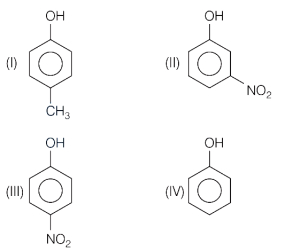
A
$I < IV < II < III$
B
$I < II < III < IV$
C
$IV < III < II < I$
D
$II < III < IV < I$
Solution
(A) Acidic character $\propto$ stability of conjugate base (phenoxide ion).
The stability of the phenoxide ion is increased by electron-withdrawing groups ($-M$ and $-I$ effects) and decreased by electron-donating groups ($+M$,$+H$,and $+I$ effects).
The substituents are:
$(I)$ $p$-methylphenol: $-CH_3$ group shows $+H$ and $+I$ effects,which destabilize the phenoxide ion.
$(II)$ $m$-nitrophenol: $-NO_2$ group shows only $-I$ effect ($-M$ effect does not operate at $m$-position).
$(III)$ $p$-nitrophenol: $-NO_2$ group shows both $-M$ and $-I$ effects,providing strong stabilization.
$(IV)$ Phenol: No substituent.
Comparing these,the order of stability of the conjugate base is: $p$-methylphenoxide < phenoxide < $m$-nitrophenoxide < $p$-nitrophenoxide.
Therefore,the increasing order of acidic character is: $I < IV < II < III$.
The stability of the phenoxide ion is increased by electron-withdrawing groups ($-M$ and $-I$ effects) and decreased by electron-donating groups ($+M$,$+H$,and $+I$ effects).
The substituents are:
$(I)$ $p$-methylphenol: $-CH_3$ group shows $+H$ and $+I$ effects,which destabilize the phenoxide ion.
$(II)$ $m$-nitrophenol: $-NO_2$ group shows only $-I$ effect ($-M$ effect does not operate at $m$-position).
$(III)$ $p$-nitrophenol: $-NO_2$ group shows both $-M$ and $-I$ effects,providing strong stabilization.
$(IV)$ Phenol: No substituent.
Comparing these,the order of stability of the conjugate base is: $p$-methylphenoxide < phenoxide < $m$-nitrophenoxide < $p$-nitrophenoxide.
Therefore,the increasing order of acidic character is: $I < IV < II < III$.
0 likesView Solution
64
ChemistryMediumMCQAP EAMCET · 2019
The product of the following reaction is $C_6H_5CHO + CH_3CH_2CHO \xrightarrow[\Delta]{\text{Dil. NaOH}}$
A
$C_6H_5CH=C(CH_3)CHO$
B
$C_6H_5CH=CHCH_2CHO$
C
$C_6H_5CH=C(CH_3)CHO$
D
$C_6H_5CH_2CH(OH)CH(CH_3)CHO$
Solution
(A) The reaction is a Claisen-Schmidt condensation,which is a type of crossed aldol condensation between benzaldehyde (which has no $\alpha$-hydrogens) and propanal (which has $\alpha$-hydrogens).
In the presence of dilute $NaOH$,the $\alpha$-carbon of propanal acts as a nucleophile and attacks the carbonyl carbon of benzaldehyde to form an aldol intermediate.
Subsequent dehydration (loss of $H_2O$) under heating $(\Delta)$ yields the $\alpha,\beta$-unsaturated aldehyde,$C_6H_5CH=C(CH_3)CHO$.
Thus,the correct product is $C_6H_5CH=C(CH_3)CHO$.
In the presence of dilute $NaOH$,the $\alpha$-carbon of propanal acts as a nucleophile and attacks the carbonyl carbon of benzaldehyde to form an aldol intermediate.
Subsequent dehydration (loss of $H_2O$) under heating $(\Delta)$ yields the $\alpha,\beta$-unsaturated aldehyde,$C_6H_5CH=C(CH_3)CHO$.
Thus,the correct product is $C_6H_5CH=C(CH_3)CHO$.
0 likesView Solution
65
ChemistryEasyMCQAP EAMCET · 2019
Benzaldehyde on heating with concentrated $NaOH$ gives:
A
Phenylacetic acid
B
Cinnamaldehyde
C
$C_6H_5CH_2OH$ and $C_6H_5COO^-Na^+$
D
Phenol and $C_6H_5CH_2COO^-Na^+$
Solution
(C) When benzaldehyde is heated with concentrated $NaOH$,it undergoes the Cannizzaro reaction.
In this reaction,aldehydes that do not contain an $\alpha$-hydrogen atom undergo self-oxidation and reduction (disproportionation).
Benzaldehyde $(C_6H_5CHO)$ lacks an $\alpha$-hydrogen,so it is reduced to benzyl alcohol $(C_6H_5CH_2OH)$ and oxidized to sodium benzoate $(C_6H_5COO^-Na^+)$.
The overall reaction is:
$2C_6H_5CHO + NaOH \xrightarrow{\Delta} C_6H_5CH_2OH + C_6H_5COO^-Na^+$
In this reaction,aldehydes that do not contain an $\alpha$-hydrogen atom undergo self-oxidation and reduction (disproportionation).
Benzaldehyde $(C_6H_5CHO)$ lacks an $\alpha$-hydrogen,so it is reduced to benzyl alcohol $(C_6H_5CH_2OH)$ and oxidized to sodium benzoate $(C_6H_5COO^-Na^+)$.
The overall reaction is:
$2C_6H_5CHO + NaOH \xrightarrow{\Delta} C_6H_5CH_2OH + C_6H_5COO^-Na^+$
0 likesView Solution
66
ChemistryMediumMCQAP EAMCET · 2019
Which of the following are oxidised by $NaOCl$ ?
$I. RCH(OH)CH_3$
$II. RCH_2CH_2-CO-CH_2CH_3$
$III. R-COCH_3$
$IV. CH_3CHO$
$V. (CH_3)_2C=C(CH_3)COCH_3$
$I. RCH(OH)CH_3$
$II. RCH_2CH_2-CO-CH_2CH_3$
$III. R-COCH_3$
$IV. CH_3CHO$
$V. (CH_3)_2C=C(CH_3)COCH_3$
A
$I, III, IV, V$
B
$I, II, III$
C
$II, IV, V$
D
$II, III, IV$
Solution
(A) $NaOCl$ acts as an oxidizing agent and is used in the haloform reaction. Compounds that undergo the haloform reaction with $NaOCl$ are:
$1$. Secondary alcohols with a methyl group attached to the carbinol carbon $(RCH(OH)CH_3)$.
$2$. Methyl ketones $(R-COCH_3)$.
$3$. Acetaldehyde $(CH_3CHO)$.
$4$. Compounds containing a $CH_3CO-$ group,such as $V$ $( (CH_3)_2C=C(CH_3)COCH_3 )$.
Analyzing the given compounds:
$I. RCH(OH)CH_3$ is a $2^{\circ}$ alcohol with a $CH_3$ group,so it reacts.
$II. RCH_2CH_2-CO-CH_2CH_3$ is a ketone but lacks a $CH_3$ group attached to the carbonyl carbon,so it does not react.
$III. R-COCH_3$ is a methyl ketone,so it reacts.
$IV. CH_3CHO$ is acetaldehyde,which reacts.
$V. (CH_3)_2C=C(CH_3)COCH_3$ contains a $CH_3CO-$ group,so it reacts.
Therefore,$I, III, IV,$ and $V$ are oxidized by $NaOCl$.
$1$. Secondary alcohols with a methyl group attached to the carbinol carbon $(RCH(OH)CH_3)$.
$2$. Methyl ketones $(R-COCH_3)$.
$3$. Acetaldehyde $(CH_3CHO)$.
$4$. Compounds containing a $CH_3CO-$ group,such as $V$ $( (CH_3)_2C=C(CH_3)COCH_3 )$.
Analyzing the given compounds:
$I. RCH(OH)CH_3$ is a $2^{\circ}$ alcohol with a $CH_3$ group,so it reacts.
$II. RCH_2CH_2-CO-CH_2CH_3$ is a ketone but lacks a $CH_3$ group attached to the carbonyl carbon,so it does not react.
$III. R-COCH_3$ is a methyl ketone,so it reacts.
$IV. CH_3CHO$ is acetaldehyde,which reacts.
$V. (CH_3)_2C=C(CH_3)COCH_3$ contains a $CH_3CO-$ group,so it reacts.
Therefore,$I, III, IV,$ and $V$ are oxidized by $NaOCl$.
0 likesView Solution
67
ChemistryEasyMCQAP EAMCET · 2019
Identify $Z$ in the above sequence of reactions.
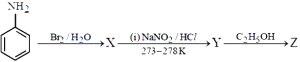
A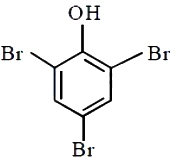
B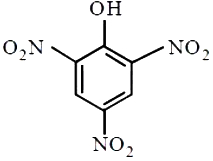
C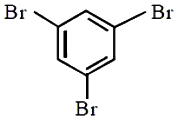
D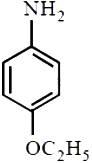
Solution
(C) $1$. Aniline reacts with $Br_2/H_2O$ to form $2,4,6$-tribromoaniline $(X)$.
$2$. $2,4,6$-tribromoaniline reacts with $NaNO_2/HCl$ at $273-278 \ K$ to form the diazonium salt,$2,4,6$-tribromobenzenediazonium chloride $(Y)$.
$3$. The diazonium salt $(Y)$ reacts with ethanol $(C_2H_5OH)$ to undergo reduction,where the diazonium group is replaced by a hydrogen atom,yielding $1,3,5$-tribromobenzene $(Z)$.
$2$. $2,4,6$-tribromoaniline reacts with $NaNO_2/HCl$ at $273-278 \ K$ to form the diazonium salt,$2,4,6$-tribromobenzenediazonium chloride $(Y)$.
$3$. The diazonium salt $(Y)$ reacts with ethanol $(C_2H_5OH)$ to undergo reduction,where the diazonium group is replaced by a hydrogen atom,yielding $1,3,5$-tribromobenzene $(Z)$.
0 likesView Solution
68
ChemistryEasyMCQAP EAMCET · 2019
What are $X$ and $Y$ in the following reactions?
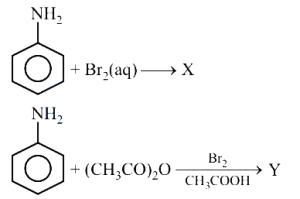
A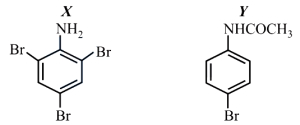
B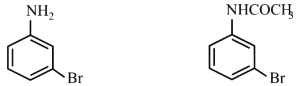
C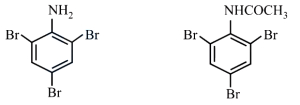
D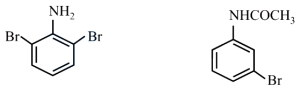
Solution
(A) $(i)$ Aniline is highly reactive towards electrophilic substitution. When treated with $Br_2$ in $H_2O$,it undergoes rapid poly-substitution to form $2, 4, 6-$tribromoaniline as the major product $(X)$.
$(ii)$ To control the reactivity of the $-NH_2$ group,it is first acetylated using acetic anhydride $(CH_3CO)_2O$ to form acetanilide. The $-NHCOCH_3$ group is less activating than the $-NH_2$ group,which restricts the bromination to the $p-$position,yielding $p-$bromoacetanilide as the major product $(Y)$.
$(ii)$ To control the reactivity of the $-NH_2$ group,it is first acetylated using acetic anhydride $(CH_3CO)_2O$ to form acetanilide. The $-NHCOCH_3$ group is less activating than the $-NH_2$ group,which restricts the bromination to the $p-$position,yielding $p-$bromoacetanilide as the major product $(Y)$.
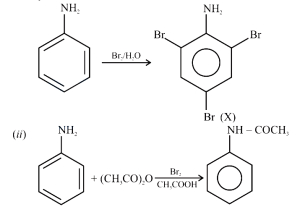
0 likesView Solution
69
ChemistryMediumMCQAP EAMCET · 2019
Identify the correct set of monosaccharides present in sucrose $(X)$,lactose $(Y)$ and maltose $(Z)$.
A
| $X$ | $Y$ | $Z$ |
|---|---|---|
| glucose,fructose | galactose,glucose | glucose,fructose |
B
| $X$ | $Y$ | $Z$ |
|---|---|---|
| glucose,fructose | galactose,glucose | glucose,glucose |
C
| $X$ | $Y$ | $Z$ |
|---|---|---|
| glucose,glucose | galactose,glucose | glucose,glucose |
D
| $X$ | $Y$ | $Z$ |
|---|---|---|
| galactose,glucose | glucose,fructose | glucose,glucose |
Solution
(B) $(X) \longrightarrow$ Sucrose on hydrolysis gives glucose and fructose.
Sucrose $\longrightarrow$ glucose + fructose
$(Y) \longrightarrow$ Lactose on hydrolysis gives $D$-glucose and $D$-galactose.
Lactose $\longrightarrow$ $D$-glucose + $D$-galactose
$(Z) \longrightarrow$ Maltose on hydrolysis gives $2$ units of glucose.
Maltose $\longrightarrow$ glucose + glucose
Thus,the correct option is $(B)$.
Sucrose $\longrightarrow$ glucose + fructose
$(Y) \longrightarrow$ Lactose on hydrolysis gives $D$-glucose and $D$-galactose.
Lactose $\longrightarrow$ $D$-glucose + $D$-galactose
$(Z) \longrightarrow$ Maltose on hydrolysis gives $2$ units of glucose.
Maltose $\longrightarrow$ glucose + glucose
Thus,the correct option is $(B)$.
0 likesView Solution
70
ChemistryEasyMCQAP EAMCET · 2019
Which of the following statements are correct?
$(A)$ $A$ tripeptide has two peptide bonds.
$(B)$ $A$ pentapeptide contains five amino acids.
$(C)$ Nucleotide is a product of base and sugar.
$(D)$ In cellulose,$\beta$-glycosidic linkages are present.
$(A)$ $A$ tripeptide has two peptide bonds.
$(B)$ $A$ pentapeptide contains five amino acids.
$(C)$ Nucleotide is a product of base and sugar.
$(D)$ In cellulose,$\beta$-glycosidic linkages are present.
A
$B, C, D$
B
$C, D$ only
C
$A, B, D$
D
$A, C$ only
Solution
(C) The explanations of the given statements are as follows:
$(A)$ $A$ tripeptide contains $3$ amino acids linked by $2$ peptide bonds. Thus,statement $(A)$ is correct.
$(B)$ $A$ pentapeptide contains $5$ amino acids linked by $4$ peptide bonds. Thus,statement $(B)$ is correct.
$(C)$ $A$ nucleoside is a product of a base and a sugar. $A$ nucleotide is a product of a base,a sugar,and a phosphate group. Thus,statement $(C)$ is incorrect.
$(D)$ In cellulose,$\beta-D$-glucose units are joined by $\beta$-glycosidic linkages between $C-1$ of one glucose and $C-4$ of the next glucose unit. Thus,statement $(D)$ is correct.
Therefore,the correct statements are $(A)$,$(B)$,and $(D)$. Hence,option $(C)$ is correct.
$(A)$ $A$ tripeptide contains $3$ amino acids linked by $2$ peptide bonds. Thus,statement $(A)$ is correct.
$(B)$ $A$ pentapeptide contains $5$ amino acids linked by $4$ peptide bonds. Thus,statement $(B)$ is correct.
$(C)$ $A$ nucleoside is a product of a base and a sugar. $A$ nucleotide is a product of a base,a sugar,and a phosphate group. Thus,statement $(C)$ is incorrect.
$(D)$ In cellulose,$\beta-D$-glucose units are joined by $\beta$-glycosidic linkages between $C-1$ of one glucose and $C-4$ of the next glucose unit. Thus,statement $(D)$ is correct.
Therefore,the correct statements are $(A)$,$(B)$,and $(D)$. Hence,option $(C)$ is correct.
0 likesView Solution
71
ChemistryEasyMCQAP EAMCET · 2019
The general structural formula of $\alpha$-amino acid is $NH_2-CH(R)-COOH$. The group $R$ in tryptophan $(X)$ and histidine $(Y)$ are respectively:
A
$X$: Indolyl-methyl group; $Y$: Imidazolyl-methyl group
B
$X$: Indolyl-ethyl group; $Y$: Imidazolyl-ethyl group
C
$X$: Indolyl-methyl group; $Y$: Imidazolyl-ethyl group
D
$X$: Indolyl-ethyl group; $Y$: Imidazolyl-methyl group
Solution
(A) The general structure of an $\alpha$-amino acid is $NH_2-CH(R)-COOH$.
In tryptophan,the $R$ group is an indolyl-methyl group (specifically,a $3$-indolylmethyl group).
In histidine,the $R$ group is an imidazolyl-methyl group (specifically,a $4$-imidazolylmethyl group).
Therefore,the correct representation for $R$ in tryptophan $(X)$ and histidine $(Y)$ is the indolyl-methyl group and the imidazolyl-methyl group respectively.
In tryptophan,the $R$ group is an indolyl-methyl group (specifically,a $3$-indolylmethyl group).
In histidine,the $R$ group is an imidazolyl-methyl group (specifically,a $4$-imidazolylmethyl group).
Therefore,the correct representation for $R$ in tryptophan $(X)$ and histidine $(Y)$ is the indolyl-methyl group and the imidazolyl-methyl group respectively.
0 likesView Solution
72
ChemistryMediumMCQAP EAMCET · 2019
Which one of the following enzymes converts proteins into amino acids?
A
Maltase
B
Pepsin
C
Trypsin
D
Zymase
Solution
(C) Both $Pepsin$ and $Trypsin$ are proteolytic enzymes that break down proteins into amino acids. $Pepsin$ acts in the stomach,while $Trypsin$ acts in the small intestine. Given the options,$Trypsin$ is a standard answer for pancreatic protein digestion. $Pepsin$ is also a correct answer in biological contexts. However,in many academic contexts,$Trypsin$ is highlighted for its role in the final breakdown of proteins into amino acids in the small intestine.
0 likesView Solution
73
ChemistryMediumMCQAP EAMCET · 2019
Which of the following statements about $DNA$ is not correct?
A
It has a double helix structure
B
Adenine forms hydrogen bonds with thymine and cytosine forms hydrogen bonds with guanine
C
The two strands in a $DNA$ molecule are not complementary to each other
D
It contains the pentose sugar,$2$-deoxyribose
Solution
(C) $I$. $DNA$ has a double helix structure.
$II$. Adenine forms hydrogen bonds with thymine $(A=T)$ and cytosine forms hydrogen bonds with guanine $(C \equiv G)$.
$III$. The two strands in $DNA$ molecules are complementary to each other.
$IV$. $DNA$ strand contains pentose $2$-deoxyribose sugar.
Thus,option $(C)$ is incorrect.
$II$. Adenine forms hydrogen bonds with thymine $(A=T)$ and cytosine forms hydrogen bonds with guanine $(C \equiv G)$.
$III$. The two strands in $DNA$ molecules are complementary to each other.
$IV$. $DNA$ strand contains pentose $2$-deoxyribose sugar.
Thus,option $(C)$ is incorrect.
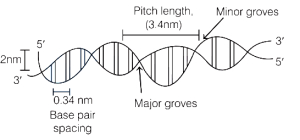
0 likesView Solution
74
ChemistryMediumMCQAP EAMCET · 2019
Identify the correct statements from the following:
$I)$ When $DNA$ is hydrolysed,adenine and thymine are obtained in equal quantities.
$II)$ When $RNA$ is hydrolysed,adenine and uracil are obtained in equal quantities.
$III)$ Amylose is a branched polymer with $\alpha-1 \rightarrow 4$ and $\alpha-1 \rightarrow 6$ glycosidic linkages.
$IV)$ Addison disease is due to the abnormal functioning of adrenal cortex.
$I)$ When $DNA$ is hydrolysed,adenine and thymine are obtained in equal quantities.
$II)$ When $RNA$ is hydrolysed,adenine and uracil are obtained in equal quantities.
$III)$ Amylose is a branched polymer with $\alpha-1 \rightarrow 4$ and $\alpha-1 \rightarrow 6$ glycosidic linkages.
$IV)$ Addison disease is due to the abnormal functioning of adrenal cortex.
A
$I, II, III$ only
B
$I, II, III, IV$
C
$I, II, IV$ only
D
$I, IV$ only
Solution
(D) $I)$ According to Chargaff's rule,in $DNA$,the amount of adenine equals thymine $(A = T)$. This is correct.
$II)$ In $RNA$,adenine pairs with uracil,but there is no rule stating their amounts must be equal. This is incorrect.
$III)$ Amylose is a linear polymer of $\alpha-D$-glucose units linked by $\alpha-1 \rightarrow 4$ glycosidic linkages. Amylopectin is the branched polymer. This is incorrect.
$IV)$ Addison disease is caused by the hypofunctioning of the adrenal cortex,leading to a deficiency of glucocorticoids and mineralocorticoids. This is correct.
Therefore,statements $I$ and $IV$ are correct.
$II)$ In $RNA$,adenine pairs with uracil,but there is no rule stating their amounts must be equal. This is incorrect.
$III)$ Amylose is a linear polymer of $\alpha-D$-glucose units linked by $\alpha-1 \rightarrow 4$ glycosidic linkages. Amylopectin is the branched polymer. This is incorrect.
$IV)$ Addison disease is caused by the hypofunctioning of the adrenal cortex,leading to a deficiency of glucocorticoids and mineralocorticoids. This is correct.
Therefore,statements $I$ and $IV$ are correct.
0 likesView Solution
75
ChemistryEasyMCQAP EAMCET · 2019
Identify the correct set from the following:

A
Vitamin $B_6$,Source: Milk,Deficiency disease: Convulsions
B
Vitamin $K$,Source: Leaf vegetables,Deficiency disease: Anaemia
C
Vitamin $C$,Source: Fish,Deficiency disease: Scurvy
D
Vitamin $D$,Source: Citrus fruits,Deficiency disease: Rickets
Solution
(A) Let us analyze the given sets of vitamins,their sources,and deficiency diseases:
$(a)$ Vitamin $B_6$ (pyridoxine) is found in milk,cereals,and fish. Its deficiency can lead to convulsions. This is a correct set.
$(b)$ Vitamin $K$ is found in green leafy vegetables. Its deficiency leads to increased blood clotting time,not anaemia. This is an incorrect set.
$(c)$ Vitamin $C$ (ascorbic acid) is found in citrus fruits and green leafy vegetables,not primarily in fish. Its deficiency causes scurvy. This is an incorrect set.
$(d)$ Vitamin $D$ is obtained from exposure to sunlight and egg yolk,not citrus fruits. Its deficiency causes rickets. This is an incorrect set.
Therefore,the correct set is $(a)$.
$(a)$ Vitamin $B_6$ (pyridoxine) is found in milk,cereals,and fish. Its deficiency can lead to convulsions. This is a correct set.
$(b)$ Vitamin $K$ is found in green leafy vegetables. Its deficiency leads to increased blood clotting time,not anaemia. This is an incorrect set.
$(c)$ Vitamin $C$ (ascorbic acid) is found in citrus fruits and green leafy vegetables,not primarily in fish. Its deficiency causes scurvy. This is an incorrect set.
$(d)$ Vitamin $D$ is obtained from exposure to sunlight and egg yolk,not citrus fruits. Its deficiency causes rickets. This is an incorrect set.
Therefore,the correct set is $(a)$.
0 likesView Solution
76
ChemistryMediumMCQAP EAMCET · 2019
Acetic acid on heating with $NH_3$ forms $A$. When $A$ reacts with $LiAlH_4$ followed by hydrolysis,it gives $B$. When $B$ is heated with chloroform in $KOH$ medium,it gives $C$. What are $B$ and $C$ respectively?
A
$CH_3CONH_2, CH_3CH_2NC$
B
$CH_3CH_2NH_2, CH_3CH_2NC$
C
$CH_3CH_2NH_2, CH_3COOH$
D
$CH_3CH_2CH_2NH_2, CH_3CH_2NC$
Solution
(B) $1$. Acetic acid $(CH_3COOH)$ reacts with $NH_3$ to form ammonium acetate,which upon heating undergoes dehydration to form acetamide $(A)$: $CH_3COOH + NH_3$ $\rightarrow CH_3COONH_4$ $\xrightarrow{\Delta} CH_3CONH_2 (A) + H_2O$.
$2$. Acetamide $(A)$ is reduced by $LiAlH_4$ to form ethylamine $(B)$: $CH_3CONH_2 \xrightarrow{LiAlH_4} CH_3CH_2NH_2 (B)$.
$3$. Ethylamine $(B)$ reacts with chloroform $(CHCl_3)$ in the presence of $KOH$ (Carbylamine reaction) to form ethyl isocyanide $(C)$: $CH_3CH_2NH_2 + CHCl_3 + 3KOH \rightarrow CH_3CH_2NC (C) + 3KCl + 3H_2O$.
$4$. Therefore,$B$ is $CH_3CH_2NH_2$ and $C$ is $CH_3CH_2NC$.
$2$. Acetamide $(A)$ is reduced by $LiAlH_4$ to form ethylamine $(B)$: $CH_3CONH_2 \xrightarrow{LiAlH_4} CH_3CH_2NH_2 (B)$.
$3$. Ethylamine $(B)$ reacts with chloroform $(CHCl_3)$ in the presence of $KOH$ (Carbylamine reaction) to form ethyl isocyanide $(C)$: $CH_3CH_2NH_2 + CHCl_3 + 3KOH \rightarrow CH_3CH_2NC (C) + 3KCl + 3H_2O$.
$4$. Therefore,$B$ is $CH_3CH_2NH_2$ and $C$ is $CH_3CH_2NC$.
0 likesView Solution
77
ChemistryDifficultMCQAP EAMCET · 2019
In the following reaction sequence,the product $D$ is:
$CH_3COOH$ $\xrightarrow{SOCl_2} A$ $\xrightarrow[AlCl_3]{C_6H_6} B$ $\xrightarrow{HCN} C$ $\xrightarrow{H_2O} D$
$CH_3COOH$ $\xrightarrow{SOCl_2} A$ $\xrightarrow[AlCl_3]{C_6H_6} B$ $\xrightarrow{HCN} C$ $\xrightarrow{H_2O} D$
A
$2-$phenyl$-2-$hydroxypropanoic acid
B
$2-$phenyl$-2-$hydroxypropanenitrile
C
$2-$phenyl$-2-$methylpropanenitrile
D
$2-$phenyl$-2-$hydroxypropanoic acid
Solution
(D) $1$. $CH_3COOH + SOCl_2 \rightarrow CH_3COCl$ (Compound $A$ is acetyl chloride).
$2$. $CH_3COCl + C_6H_6 \xrightarrow{AlCl_3} C_6H_5COCH_3$ (Friedel-Crafts acylation,Compound $B$ is acetophenone).
$3$. $C_6H_5COCH_3 + HCN \rightarrow C_6H_5C(OH)(CH_3)CN$ (Nucleophilic addition,Compound $C$ is acetophenone cyanohydrin).
$4$. $C_6H_5C(OH)(CH_3)CN + H_2O \rightarrow C_6H_5C(OH)(CH_3)COOH$ (Hydrolysis of nitrile to carboxylic acid,Compound $D$ is $2-$hydroxy$-2-$phenylpropanoic acid).
$2$. $CH_3COCl + C_6H_6 \xrightarrow{AlCl_3} C_6H_5COCH_3$ (Friedel-Crafts acylation,Compound $B$ is acetophenone).
$3$. $C_6H_5COCH_3 + HCN \rightarrow C_6H_5C(OH)(CH_3)CN$ (Nucleophilic addition,Compound $C$ is acetophenone cyanohydrin).
$4$. $C_6H_5C(OH)(CH_3)CN + H_2O \rightarrow C_6H_5C(OH)(CH_3)COOH$ (Hydrolysis of nitrile to carboxylic acid,Compound $D$ is $2-$hydroxy$-2-$phenylpropanoic acid).
0 likesView Solution
78
ChemistryMediumMCQAP EAMCET · 2019
The following species are involved in the formation of an ester from a carboxylic acid in the presence of acid. The correct sequence of formation of these species is
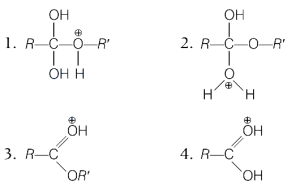
A
$2, 1, 4, 3$
B
$1, 4, 3, 2$
C
$2, 3, 1, 4$
D
$4, 2, 1, 3$
Solution
(D) The mechanism of esterification (Fischer esterification) involves the following steps:
$1$. Protonation of the carbonyl oxygen of the carboxylic acid: The carboxylic acid $(R-COOH)$ reacts with $H^+$ to form a protonated species,which is represented by structure $4$.
$2$. Nucleophilic attack by the alcohol: The alcohol $(R'-OH)$ attacks the electrophilic carbonyl carbon of the protonated carboxylic acid,leading to the formation of the tetrahedral intermediate,which is represented by structure $2$.
$3$. Proton transfer: $A$ proton is transferred from the oxygen of the alcohol group to one of the hydroxyl groups,resulting in the formation of an oxonium ion,represented by structure $1$.
$4$. Elimination of water and deprotonation: The water molecule is eliminated,and the loss of a proton leads to the formation of the protonated ester,which is represented by structure $3$.
Thus,the correct sequence is $4$ $\rightarrow 2$ $\rightarrow 1$ $\rightarrow 3$.
$1$. Protonation of the carbonyl oxygen of the carboxylic acid: The carboxylic acid $(R-COOH)$ reacts with $H^+$ to form a protonated species,which is represented by structure $4$.
$2$. Nucleophilic attack by the alcohol: The alcohol $(R'-OH)$ attacks the electrophilic carbonyl carbon of the protonated carboxylic acid,leading to the formation of the tetrahedral intermediate,which is represented by structure $2$.
$3$. Proton transfer: $A$ proton is transferred from the oxygen of the alcohol group to one of the hydroxyl groups,resulting in the formation of an oxonium ion,represented by structure $1$.
$4$. Elimination of water and deprotonation: The water molecule is eliminated,and the loss of a proton leads to the formation of the protonated ester,which is represented by structure $3$.
Thus,the correct sequence is $4$ $\rightarrow 2$ $\rightarrow 1$ $\rightarrow 3$.
0 likesView Solution
79
ChemistryMediumMCQAP EAMCET · 2019
Which of the following conversions represents the Fries rearrangement?
A
$O$-acylated phenol to $C$-acylated phenol
B
$C$-acylated phenol to $O$-acylated phenol
C
$N$-acylated phenol to $C$-acylated phenol
D
$C$-acylated phenol to $N$-acylated phenol
Solution
(A) Key Idea: The Fries rearrangement is the rearrangement of a phenolic ester to a hydroxy aryl ketone in the presence of a Lewis acid catalyst.
In this reaction,the acyl group $(RCO-)$ migrates from the oxygen atom of the ester to the ortho or para position of the benzene ring.
Thus,it represents the conversion of an $O$-acylated phenol (phenolic ester) to a $C$-acylated phenol (hydroxy aryl ketone).
Therefore,option $(A)$ is correct.
The reaction is as follows:
$C_6H_5OCOR \xrightarrow{AlCl_3} o-HOC_6H_4COR + p-HOC_6H_4COR$
In this reaction,the acyl group $(RCO-)$ migrates from the oxygen atom of the ester to the ortho or para position of the benzene ring.
Thus,it represents the conversion of an $O$-acylated phenol (phenolic ester) to a $C$-acylated phenol (hydroxy aryl ketone).
Therefore,option $(A)$ is correct.
The reaction is as follows:
$C_6H_5OCOR \xrightarrow{AlCl_3} o-HOC_6H_4COR + p-HOC_6H_4COR$
0 likesView Solution
80
ChemistryMediumMCQAP EAMCET · 2019
The bond angle between $C-O$ and $O-H$ bonds in alcohols is close to (in $^{\circ}$)
A
$109$
B
$120$
C
$180$
D
$90$
Solution
(A) In alcohols,the oxygen atom is $sp^3$ hybridized.
Due to the presence of two lone pairs on the oxygen atom,the bond angle is slightly less than the ideal tetrahedral angle of $109.5^{\circ}$ $(109^{\circ} 28')$.
Therefore,the bond angle in alcohols is close to $109^{\circ}$.
Due to the presence of two lone pairs on the oxygen atom,the bond angle is slightly less than the ideal tetrahedral angle of $109.5^{\circ}$ $(109^{\circ} 28')$.
Therefore,the bond angle in alcohols is close to $109^{\circ}$.
0 likesView Solution
81
ChemistryMediumMCQAP EAMCET · 2019
The stepwise stability constants of a complex are given below. What is its overall reaction stability constant $\beta_4$ ?
$M + L \rightleftharpoons ML ; K_1 = 1.0 \times 10^4$
$ML + L \rightleftharpoons ML_2 ; K_2 = 1.0 \times 10^3$
$ML_2 + L \rightleftharpoons ML_3 ; K_3 = 1.0 \times 10^3$
$ML_3 + L \rightleftharpoons ML_4 ; K_4 = 1.0 \times 10^2$
(Overall reaction : $M + 4L \rightleftharpoons ML_4$)
$M + L \rightleftharpoons ML ; K_1 = 1.0 \times 10^4$
$ML + L \rightleftharpoons ML_2 ; K_2 = 1.0 \times 10^3$
$ML_2 + L \rightleftharpoons ML_3 ; K_3 = 1.0 \times 10^3$
$ML_3 + L \rightleftharpoons ML_4 ; K_4 = 1.0 \times 10^2$
(Overall reaction : $M + 4L \rightleftharpoons ML_4$)
A
$1.0 \times 10^{12}$
B
$12.1 \times 10^3$
C
$1.0 \times 10^6$
D
$1.0 \times 10^8$
Solution
(A) The overall stability constant $\beta_n$ for a complex formation reaction is the product of the stepwise stability constants $K_1, K_2, ..., K_n$.
Given the stepwise constants:
$K_1 = 1.0 \times 10^4$
$K_2 = 1.0 \times 10^3$
$K_3 = 1.0 \times 10^3$
$K_4 = 1.0 \times 10^2$
The overall stability constant $\beta_4$ is calculated as:
$\beta_4 = K_1 \times K_2 \times K_3 \times K_4$
$\beta_4 = (1.0 \times 10^4) \times (1.0 \times 10^3) \times (1.0 \times 10^3) \times (1.0 \times 10^2)$
$\beta_4 = 1.0 \times 10^{(4+3+3+2)} = 1.0 \times 10^{12}$
Given the stepwise constants:
$K_1 = 1.0 \times 10^4$
$K_2 = 1.0 \times 10^3$
$K_3 = 1.0 \times 10^3$
$K_4 = 1.0 \times 10^2$
The overall stability constant $\beta_4$ is calculated as:
$\beta_4 = K_1 \times K_2 \times K_3 \times K_4$
$\beta_4 = (1.0 \times 10^4) \times (1.0 \times 10^3) \times (1.0 \times 10^3) \times (1.0 \times 10^2)$
$\beta_4 = 1.0 \times 10^{(4+3+3+2)} = 1.0 \times 10^{12}$
0 likesView Solution
82
ChemistryMediumMCQAP EAMCET · 2019
Consider the following reaction: $N_{2(g)} + 3H_{2(g)} \longrightarrow 2NH_{3(g)}$. The rate of this reaction in terms of $N_2$ at $T \ K$ is $\frac{-d[N_2]}{dt} = 0.02 \ mol \ L^{-1} \ s^{-1}$. What is the value of $\frac{-d[H_2]}{dt}$ (in units of $mol \ L^{-1} \ s^{-1}$) at the same temperature?
A
$0.02$
B
$50$
C
$0.06$
D
$0.04$
Solution
(C) For the reaction $N_{2(g)} + 3H_{2(g)} \longrightarrow 2NH_{3(g)}$,the rate of reaction is given by:
Rate $= -\frac{d[N_2]}{dt} = -\frac{1}{3} \frac{d[H_2]}{dt} = \frac{1}{2} \frac{d[NH_3]}{dt}$.
Given that $-\frac{d[N_2]}{dt} = 0.02 \ mol \ L^{-1} \ s^{-1}$.
Equating the terms for $N_2$ and $H_2$:
$-\frac{d[N_2]}{dt} = -\frac{1}{3} \frac{d[H_2]}{dt}$.
Therefore,$-\frac{d[H_2]}{dt} = 3 \times (-\frac{d[N_2]}{dt})$.
$-\frac{d[H_2]}{dt} = 3 \times 0.02 = 0.06 \ mol \ L^{-1} \ s^{-1}$.
Rate $= -\frac{d[N_2]}{dt} = -\frac{1}{3} \frac{d[H_2]}{dt} = \frac{1}{2} \frac{d[NH_3]}{dt}$.
Given that $-\frac{d[N_2]}{dt} = 0.02 \ mol \ L^{-1} \ s^{-1}$.
Equating the terms for $N_2$ and $H_2$:
$-\frac{d[N_2]}{dt} = -\frac{1}{3} \frac{d[H_2]}{dt}$.
Therefore,$-\frac{d[H_2]}{dt} = 3 \times (-\frac{d[N_2]}{dt})$.
$-\frac{d[H_2]}{dt} = 3 \times 0.02 = 0.06 \ mol \ L^{-1} \ s^{-1}$.
0 likesView Solution
83
ChemistryMediumMCQAP EAMCET · 2019
Which one of the following equations is correct for the reaction $N_{2(g)} + 3H_{2(g)} \longrightarrow 2NH_{3(g)}$?
A
$3 \frac{d[NH_3]}{dt} = 2 \frac{d[H_2]}{dt}$
B
$3 \frac{d[NH_3]}{dt} = 3 \frac{d[H_2]}{dt}$
C
$2 \frac{d[NH_3]}{dt} = -3 \frac{d[H_2]}{dt}$
D
$3 \frac{d[NH_3]}{dt} = -2 \frac{d[H_2]}{dt}$
Solution
(D) For the reaction $N_{2(g)} + 3H_{2(g)} \longrightarrow 2NH_{3(g)}$,the rate of reaction is expressed as:
$Rate = -\frac{d[N_2]}{dt} = -\frac{1}{3} \frac{d[H_2]}{dt} = \frac{1}{2} \frac{d[NH_3]}{dt}$
Equating the terms for $NH_3$ and $H_2$:
$-\frac{1}{3} \frac{d[H_2]}{dt} = \frac{1}{2} \frac{d[NH_3]}{dt}$
Multiplying both sides by $6$:
$-2 \frac{d[H_2]}{dt} = 3 \frac{d[NH_3]}{dt}$
Rearranging gives $3 \frac{d[NH_3]}{dt} = -2 \frac{d[H_2]}{dt}$.
$Rate = -\frac{d[N_2]}{dt} = -\frac{1}{3} \frac{d[H_2]}{dt} = \frac{1}{2} \frac{d[NH_3]}{dt}$
Equating the terms for $NH_3$ and $H_2$:
$-\frac{1}{3} \frac{d[H_2]}{dt} = \frac{1}{2} \frac{d[NH_3]}{dt}$
Multiplying both sides by $6$:
$-2 \frac{d[H_2]}{dt} = 3 \frac{d[NH_3]}{dt}$
Rearranging gives $3 \frac{d[NH_3]}{dt} = -2 \frac{d[H_2]}{dt}$.
0 likesView Solution
84
ChemistryEasyMCQAP EAMCET · 2019
$A \rightarrow P$ is a zero order reaction. At $298 \ K$ the rate constant of the reaction is $1 \times 10^{-3} \ mol \ L^{-1} \ s^{-1}$. Initial concentration of '$A$' is $0.1 \ mol \ L^{-1}$. What is the concentration of '$A$' after $10 \ s$?
A
$0.09 \ mol \ L^{-1}$
B
$0.099 \ mol \ L^{-1}$
C
$0.087 \ mol \ L^{-1}$
D
$0.011 \ mol \ L^{-1}$
Solution
(A) For a zero order reaction,the integrated rate equation is given by:
$[A]_t = [A]_0 - kt$
Given:
Rate constant,$k = 1 \times 10^{-3} \ mol \ L^{-1} \ s^{-1}$
Initial concentration,$[A]_0 = 0.1 \ mol \ L^{-1}$
Time,$t = 10 \ s$
Substituting the values into the equation:
$[A]_t = 0.1 - (1 \times 10^{-3} \times 10)$
$[A]_t = 0.1 - 10^{-2}$
$[A]_t = 0.1 - 0.01$
$[A]_t = 0.09 \ mol \ L^{-1}$
$[A]_t = [A]_0 - kt$
Given:
Rate constant,$k = 1 \times 10^{-3} \ mol \ L^{-1} \ s^{-1}$
Initial concentration,$[A]_0 = 0.1 \ mol \ L^{-1}$
Time,$t = 10 \ s$
Substituting the values into the equation:
$[A]_t = 0.1 - (1 \times 10^{-3} \times 10)$
$[A]_t = 0.1 - 10^{-2}$
$[A]_t = 0.1 - 0.01$
$[A]_t = 0.09 \ mol \ L^{-1}$
0 likesView Solution
85
ChemistryDifficultMCQAP EAMCET · 2019
Isomerisation of gaseous cyclobutene to butadiene is a first order reaction. At $T \ K$,the rate constant of the reaction is $3.3 \times 10^{-4} \ s^{-1}$. What is the time required (in $min$) to complete $90 \%$ of this reaction at the same temperature? $(\log 2 = 0.3)$
A
$116.67$
B
$233.34$
C
$58.34$
D
$350$
Solution
(A) For a first order reaction,the rate constant $K$ is given by:
$K = \frac{2.303}{t} \log \frac{[A]_0}{[A]_t}$
Given $K = 3.3 \times 10^{-4} \ s^{-1}$ and the reaction is $90 \%$ complete,so $[A]_t = [A]_0 - 0.90[A]_0 = 0.10[A]_0$.
Substituting the values:
$3.3 \times 10^{-4} = \frac{2.303}{t} \log \frac{[A]_0}{0.10[A]_0}$
$3.3 \times 10^{-4} = \frac{2.303}{t} \log(10)$
Since $\log(10) = 1$:
$t = \frac{2.303}{3.3 \times 10^{-4}} \ s$
$t \approx 0.6978 \times 10^4 \ s = 6978 \ s$
To convert time into minutes:
$t = \frac{6978}{60} \ min \approx 116.3 \ min$
Rounding to the nearest provided option,the answer is $116.67 \ min$.
$K = \frac{2.303}{t} \log \frac{[A]_0}{[A]_t}$
Given $K = 3.3 \times 10^{-4} \ s^{-1}$ and the reaction is $90 \%$ complete,so $[A]_t = [A]_0 - 0.90[A]_0 = 0.10[A]_0$.
Substituting the values:
$3.3 \times 10^{-4} = \frac{2.303}{t} \log \frac{[A]_0}{0.10[A]_0}$
$3.3 \times 10^{-4} = \frac{2.303}{t} \log(10)$
Since $\log(10) = 1$:
$t = \frac{2.303}{3.3 \times 10^{-4}} \ s$
$t \approx 0.6978 \times 10^4 \ s = 6978 \ s$
To convert time into minutes:
$t = \frac{6978}{60} \ min \approx 116.3 \ min$
Rounding to the nearest provided option,the answer is $116.67 \ min$.
0 likesView Solution
86
ChemistryEasyMCQAP EAMCET · 2019
The rate equation for a first-order reaction is given by $[R] = [R]_0 e^{-kt}$. $A$ straight line with a positive slope is obtained by plotting: ($[R]_0 =$ initial concentration of reactant,$[R] =$ concentration of reactant at time $t$)
A
$\log \frac{[R]_0}{[R]}$ vs $t$
B
$[R]$ vs $t$
C
$\log [R]$ vs $t$
D
$\log \frac{[R]}{[R]_0}$ vs $t$
Solution
(A) For a first-order reaction: $[R] = [R]_0 e^{-kt}$.
Taking natural logarithm on both sides: $\ln [R] = \ln [R]_0 - kt$.
Rearranging the terms: $\ln [R]_0 - \ln [R] = kt$,which gives $\ln \frac{[R]_0}{[R]} = kt$.
Converting to base $10$ logarithm: $2.303 \log \frac{[R]_0}{[R]} = kt$.
Therefore,$\log \frac{[R]_0}{[R]} = \frac{k}{2.303} t$.
Comparing this with the equation of a straight line $y = mx + c$,a plot of $\log \frac{[R]_0}{[R]}$ vs $t$ gives a straight line passing through the origin with a positive slope $m = \frac{k}{2.303}$.
Taking natural logarithm on both sides: $\ln [R] = \ln [R]_0 - kt$.
Rearranging the terms: $\ln [R]_0 - \ln [R] = kt$,which gives $\ln \frac{[R]_0}{[R]} = kt$.
Converting to base $10$ logarithm: $2.303 \log \frac{[R]_0}{[R]} = kt$.
Therefore,$\log \frac{[R]_0}{[R]} = \frac{k}{2.303} t$.
Comparing this with the equation of a straight line $y = mx + c$,a plot of $\log \frac{[R]_0}{[R]}$ vs $t$ gives a straight line passing through the origin with a positive slope $m = \frac{k}{2.303}$.
0 likesView Solution
87
ChemistryEasyMCQAP EAMCET · 2019
The time taken for half of the initial amount of $N_2O_5$ to decompose is $12 \ min$ at $310 \ K$ and $2 \ hrs$ at $300 \ K$. The activation energy of the reaction in $kJ \ mol^{-1}$ is $\left(R=8.3 \ J \ K^{-1} \ mol^{-1}\right)$
A
$177.76$
B
$17.776$
C
$355.52$
D
$35.552$
Solution
(A) For a first-order reaction,the half-life is given by $t_{1/2} = \frac{0.693}{k}$.
At $T_1 = 310 \ K$,$t_{1/2} = 12 \ min$,so $k_1 = \frac{0.693}{12} \ min^{-1}$.
At $T_2 = 300 \ K$,$t_{1/2} = 2 \ hrs = 120 \ min$,so $k_2 = \frac{0.693}{120} \ min^{-1}$.
Using the Arrhenius equation: $\ln\left(\frac{k_1}{k_2}\right) = \frac{E_a}{R} \left(\frac{T_1 - T_2}{T_1 T_2}\right)$.
$\ln\left(\frac{0.693/12}{0.693/120}\right) = \ln(10) = 2.303$.
$2.303 = \frac{E_a}{8.3} \left(\frac{310 - 300}{310 \times 300}\right)$.
$2.303 = \frac{E_a}{8.3} \left(\frac{10}{93000}\right) = \frac{E_a}{8.3 \times 9300}$.
$E_a = 2.303 \times 8.3 \times 9300 \approx 177760 \ J \ mol^{-1} = 177.76 \ kJ \ mol^{-1}$.
At $T_1 = 310 \ K$,$t_{1/2} = 12 \ min$,so $k_1 = \frac{0.693}{12} \ min^{-1}$.
At $T_2 = 300 \ K$,$t_{1/2} = 2 \ hrs = 120 \ min$,so $k_2 = \frac{0.693}{120} \ min^{-1}$.
Using the Arrhenius equation: $\ln\left(\frac{k_1}{k_2}\right) = \frac{E_a}{R} \left(\frac{T_1 - T_2}{T_1 T_2}\right)$.
$\ln\left(\frac{0.693/12}{0.693/120}\right) = \ln(10) = 2.303$.
$2.303 = \frac{E_a}{8.3} \left(\frac{310 - 300}{310 \times 300}\right)$.
$2.303 = \frac{E_a}{8.3} \left(\frac{10}{93000}\right) = \frac{E_a}{8.3 \times 9300}$.
$E_a = 2.303 \times 8.3 \times 9300 \approx 177760 \ J \ mol^{-1} = 177.76 \ kJ \ mol^{-1}$.
0 likesView Solution
88
ChemistryMediumMCQAP EAMCET · 2019
Which of the following are broad spectrum antibiotics?
| $(I)$ Penicillin $G$ | $(II)$ Chloramphenicol |
| $(III)$ Ofloxacin | $(IV)$ Ampicillin |
A
$I, II$ only
B
$I, II, III$
C
$II, III, IV$
D
$I, III$ only
Solution
(C) $(II)$,$(III)$,and $(IV)$ are broad spectrum antibiotics.
$\text{Penicillin G}$ is a narrow spectrum antibiotic.
Broad spectrum antibiotics are effective against a wide range of Gram-positive and Gram-negative bacteria.
$\text{Penicillin G}$ is a narrow spectrum antibiotic.
Broad spectrum antibiotics are effective against a wide range of Gram-positive and Gram-negative bacteria.
0 likesView Solution
89
ChemistryEasyMCQAP EAMCET · 2019
Which of the following is not an analgesic?
A
Ofloxacin
B
Paracetamol
C
Morphine
D
Codeine
Solution
(A) Ofloxacin is an antibiotic,whereas paracetamol,morphine,and codeine act as analgesics.
Thus,option $(A)$ is the correct answer.
Thus,option $(A)$ is the correct answer.
0 likesView Solution
90
ChemistryMediumMCQAP EAMCET · 2019
Identify the correct pair from the following.
A
$Codeine$ - analgesic ; $Equanil$ - tranquilizer
B
$Chloramphenicol$ - analgesic ; $Nardil$ - antibiotic
C
$Histamine$ - tranquilizer ; $Salvarsan$ - antibiotic
D
$Norethindrone$ - antacid ; $Alitame$ - artificial sweetening agent
Solution
(A) $Codeine$ is an analgesic,while $Equanil$ is a tranquilizer. Thus,this pair is correct.
$Chloramphenicol$ is an antibiotic,while $Nardil$ is an antidepressant.
$Histamine$ is a chemical messenger involved in inflammatory responses,while $Salvarsan$ is an antibiotic used to treat syphilis.
$Norethindrone$ is a synthetic progesterone derivative used as an antifertility drug,while $Alitame$ is a high-potency artificial sweetener.
$Chloramphenicol$ is an antibiotic,while $Nardil$ is an antidepressant.
$Histamine$ is a chemical messenger involved in inflammatory responses,while $Salvarsan$ is an antibiotic used to treat syphilis.
$Norethindrone$ is a synthetic progesterone derivative used as an antifertility drug,while $Alitame$ is a high-potency artificial sweetener.
0 likesView Solution
91
ChemistryEasyMCQAP EAMCET · 2019
Identify antihistamines from the following:
| $1. \text{Serotonin}$ | $2. \text{Dimetane}$ |
| $3. \text{Phenelzine}$ | $4. \text{Seldane}$ |
A
$1, 3$ only
B
$1, 3, 4$
C
$2, 4$ only
D
$1, 2, 3$
Solution
(C) Antihistamines are drugs that treat allergic reactions by blocking the action of histamine.
$2. \text{Dimetane}$ (Brompheniramine) and $4. \text{Seldane}$ (Terfenadine) are well-known antihistamines.
$1. \text{Serotonin}$ is a neurotransmitter.
$3. \text{Phenelzine}$ is an antidepressant ($MAO$ inhibitor).
Therefore,the correct option is $C$.
$2. \text{Dimetane}$ (Brompheniramine) and $4. \text{Seldane}$ (Terfenadine) are well-known antihistamines.
$1. \text{Serotonin}$ is a neurotransmitter.
$3. \text{Phenelzine}$ is an antidepressant ($MAO$ inhibitor).
Therefore,the correct option is $C$.
0 likesView Solution
92
ChemistryEasyMCQAP EAMCET · 2019
Which of the following statements are correct?
$I$. Binding of inhibitor at allosteric site changes the shape of the active site.
$II$. Shape of the receptor does not change after attachment of chemical messenger to it.
$III$. $A$ chemical messenger gives message to the cell by entering it.
$IV$. Erythromycin is an example of bacteriostatic antibiotic.
$I$. Binding of inhibitor at allosteric site changes the shape of the active site.
$II$. Shape of the receptor does not change after attachment of chemical messenger to it.
$III$. $A$ chemical messenger gives message to the cell by entering it.
$IV$. Erythromycin is an example of bacteriostatic antibiotic.
A
$I, II$
B
$II, III$
C
$I, IV$
D
$III, IV$
Solution
(C) $(i)$ Binding of inhibitor at allosteric site changes the shape of the active site in such a way that the substrate cannot recognize it. This statement is correct.
$(ii)$ The shape of the receptor changes after the attachment of a chemical messenger to it. This statement is incorrect.
$(iii)$ $A$ chemical messenger gives a message to the cell without entering the cell. This statement is incorrect.
$(iv)$ Erythromycin is a bacteriostatic antibiotic used for the treatment of a number of bacterial infections. This statement is correct.
Hence,option $(C)$ is the correct answer.
$(ii)$ The shape of the receptor changes after the attachment of a chemical messenger to it. This statement is incorrect.
$(iii)$ $A$ chemical messenger gives a message to the cell without entering the cell. This statement is incorrect.
$(iv)$ Erythromycin is a bacteriostatic antibiotic used for the treatment of a number of bacterial infections. This statement is correct.
Hence,option $(C)$ is the correct answer.
0 likesView Solution
93
ChemistryEasyMCQAP EAMCET · 2019
Which one of the following contains $-As=As-$ in its structure?
A
Ranitidine
B
Saccharin
C
Salvarsan
D
Seldane
Solution
(C) The structures of the given compounds are as follows:
$(a)$ Ranitidine: An antacid.
$(b)$ Saccharin: An artificial sweetener.
$(c)$ Salvarsan: An antimicrobial drug that contains an $-As=As-$ linkage in its structure.
$(d)$ Seldane: An antihistamine.
Therefore,Salvarsan contains the $-As=As-$ linkage,and option $(c)$ is the correct answer.
$(a)$ Ranitidine: An antacid.
$(b)$ Saccharin: An artificial sweetener.
$(c)$ Salvarsan: An antimicrobial drug that contains an $-As=As-$ linkage in its structure.
$(d)$ Seldane: An antihistamine.
Therefore,Salvarsan contains the $-As=As-$ linkage,and option $(c)$ is the correct answer.
0 likesView Solution
94
ChemistryMediumMCQAP EAMCET · 2019
Which one of the following is the correct order of ionic radii?
A
$Pr^{3+} > Gd^{3+} > Tm^{3+}$
B
$Pr^{3+} < Gd^{3+} < Tm^{3+}$
C
$Pr^{3+} > Tm^{3+} > Gd^{3+}$
D
$Pr^{3+} < Tm^{3+} < Gd^{3+}$
Solution
$(A)$ In the $4f$-series, as the atomic number increases from $La$ to $Lu$, the atomic and ionic radii decrease gradually.
This decrease in atomic and ionic size from lanthanum to lutetium is known as lanthanide contraction.
Since the atomic number of $Pr$ $(59)$, $Gd$ $(64)$, and $Tm$ $(69)$ increases in that order, their ionic radii decrease accordingly.
Therefore, the correct order of ionic radii is $Pr^{3+} (101 \text{ pm}) > Gd^{3+} (94 \text{ pm}) > Tm^{3+} (87 \text{ pm})$.
This decrease in atomic and ionic size from lanthanum to lutetium is known as lanthanide contraction.
Since the atomic number of $Pr$ $(59)$, $Gd$ $(64)$, and $Tm$ $(69)$ increases in that order, their ionic radii decrease accordingly.
Therefore, the correct order of ionic radii is $Pr^{3+} (101 \text{ pm}) > Gd^{3+} (94 \text{ pm}) > Tm^{3+} (87 \text{ pm})$.
0 likesView Solution
95
ChemistryEasyMCQAP EAMCET · 2019
Which of the following correctly represents copper sulphate pentahydrate?
A
$[Cu(SO_4)(H_2O)_3] \cdot 2H_2O$
B
$[Cu(SO_4)(H_2O)_5]$
C
$[Cu(H_2O)_4]SO_4 \cdot H_2O$
D
None of the above
Solution
(C) The chemical formula of copper sulphate pentahydrate is $[Cu(H_2O)_4]SO_4 \cdot H_2O$.
Copper sulphate pentahydrate contains $5$ molecules of water of crystallisation.
In the crystal structure,four water molecules are coordinated to the $Cu^{2+}$ ion,while the fifth water molecule is hydrogen-bonded to the $SO_4^{2-}$ ion.
Thus,the correct representation is $[Cu(H_2O)_4]SO_4 \cdot H_2O$.
Copper sulphate pentahydrate contains $5$ molecules of water of crystallisation.
In the crystal structure,four water molecules are coordinated to the $Cu^{2+}$ ion,while the fifth water molecule is hydrogen-bonded to the $SO_4^{2-}$ ion.
Thus,the correct representation is $[Cu(H_2O)_4]SO_4 \cdot H_2O$.
0 likesView Solution
96
ChemistryMediumMCQAP EAMCET · 2019
Which one of the following coordination complexes exhibits the lowest value of magnetic moment (in $BM$)?
A
$\left[Cr(CN)_6\right]^{3-}$
B
$\left[Mn(CN)_6\right]^{3-}$
C
$\left[Fe(CN)_6\right]^{3-}$
D
$\left[Co(CN)_6\right]^{3-}$
Solution
(D) To find the magnetic moment,we calculate the number of unpaired electrons $(n)$ in each complex. The magnetic moment is given by $\mu = \sqrt{n(n+2)} \ BM$.
$(I)$ $\left[Cr(CN)_6\right]^{3-}$: $Cr^{3+}$ is $3d^3$. With $CN^-$ as a strong field ligand,all $3$ electrons remain unpaired in the $t_{2g}$ orbitals. $n = 3$,$\mu = \sqrt{3(3+2)} = \sqrt{15} \ BM$.
$(II)$ $\left[Mn(CN)_6\right]^{3-}$: $Mn^{3+}$ is $3d^4$. With $CN^-$ as a strong field ligand,electrons pair up,leaving $n = 2$ unpaired electrons. $\mu = \sqrt{2(2+2)} = \sqrt{8} \ BM$.
$(III)$ $\left[Fe(CN)_6\right]^{3-}$: $Fe^{3+}$ is $3d^5$. With $CN^-$ as a strong field ligand,electrons pair up,leaving $n = 1$ unpaired electron. $\mu = \sqrt{1(1+2)} = \sqrt{3} \ BM$.
$(IV)$ $\left[Co(CN)_6\right]^{3-}$: $Co^{3+}$ is $3d^6$. With $CN^-$ as a strong field ligand,all electrons pair up in the $t_{2g}$ orbitals $(t_{2g}^6 e_g^0)$. $n = 0$,$\mu = 0 \ BM$.
Thus,$\left[Co(CN)_6\right]^{3-}$ has the lowest magnetic moment.
$(I)$ $\left[Cr(CN)_6\right]^{3-}$: $Cr^{3+}$ is $3d^3$. With $CN^-$ as a strong field ligand,all $3$ electrons remain unpaired in the $t_{2g}$ orbitals. $n = 3$,$\mu = \sqrt{3(3+2)} = \sqrt{15} \ BM$.
$(II)$ $\left[Mn(CN)_6\right]^{3-}$: $Mn^{3+}$ is $3d^4$. With $CN^-$ as a strong field ligand,electrons pair up,leaving $n = 2$ unpaired electrons. $\mu = \sqrt{2(2+2)} = \sqrt{8} \ BM$.
$(III)$ $\left[Fe(CN)_6\right]^{3-}$: $Fe^{3+}$ is $3d^5$. With $CN^-$ as a strong field ligand,electrons pair up,leaving $n = 1$ unpaired electron. $\mu = \sqrt{1(1+2)} = \sqrt{3} \ BM$.
$(IV)$ $\left[Co(CN)_6\right]^{3-}$: $Co^{3+}$ is $3d^6$. With $CN^-$ as a strong field ligand,all electrons pair up in the $t_{2g}$ orbitals $(t_{2g}^6 e_g^0)$. $n = 0$,$\mu = 0 \ BM$.
Thus,$\left[Co(CN)_6\right]^{3-}$ has the lowest magnetic moment.
0 likesView Solution
97
ChemistryMediumMCQAP EAMCET · 2019
The wavelengths of light absorbed by the complexes $[Ni(H_2O)_6]^{2+}$,$[Ni(en)_3]^{2+}$,and $[Ni(H_2O)_4en]^{2+}$ are $\lambda_1$,$\lambda_2$,and $\lambda_3$ respectively. The correct order of wavelengths is:
A
$\lambda_1 > \lambda_2 > \lambda_3$
B
$\lambda_3 > \lambda_2 > \lambda_1$
C
$\lambda_1 > \lambda_3 > \lambda_2$
D
$\lambda_2 > \lambda_3 > \lambda_1$
Solution
(C) The wavelength of light absorbed by a complex is inversely proportional to the crystal field splitting energy $(\Delta_o)$,which in turn depends on the strength of the ligands.
According to the spectrochemical series,the strength of the ligands is $en > H_2O$.
Therefore,the crystal field splitting energy follows the order: $[Ni(en)_3]^{2+} > [Ni(H_2O)_4en]^{2+} > [Ni(H_2O)_6]^{2+}$.
Since $E = \frac{hc}{\lambda}$,the energy is inversely proportional to the wavelength.
Thus,the order of wavelengths absorbed is: $[Ni(H_2O)_6]^{2+} > [Ni(H_2O)_4en]^{2+} > [Ni(en)_3]^{2+}$.
This corresponds to $\lambda_1 > \lambda_3 > \lambda_2$.
According to the spectrochemical series,the strength of the ligands is $en > H_2O$.
Therefore,the crystal field splitting energy follows the order: $[Ni(en)_3]^{2+} > [Ni(H_2O)_4en]^{2+} > [Ni(H_2O)_6]^{2+}$.
Since $E = \frac{hc}{\lambda}$,the energy is inversely proportional to the wavelength.
Thus,the order of wavelengths absorbed is: $[Ni(H_2O)_6]^{2+} > [Ni(H_2O)_4en]^{2+} > [Ni(en)_3]^{2+}$.
This corresponds to $\lambda_1 > \lambda_3 > \lambda_2$.
0 likesView Solution
98
ChemistryMediumMCQAP EAMCET · 2019
The $\Delta_0$ of a coordination complex of a metal ion $(3d^1)$ is $1000 \ kJ \ mol^{-1}$. If the energy of $t_{2g}$ orbitals is $-400 \ kJ \ mol^{-1}$,the energy (in $kJ \ mol^{-1}$) of $e_g$ orbitals is
A
$ -600 $
B
$ 600 $
C
$ 1000 $
D
$ 400 $
Solution
(B) Given,$\Delta_0$ for the coordination complex is $1000 \ kJ \ mol^{-1}$.
Energy of $t_{2g}$ orbitals,$E(t_{2g}) = -400 \ kJ \ mol^{-1}$.
We know that the crystal field splitting energy $\Delta_0$ is defined as the difference between the energies of $e_g$ and $t_{2g}$ orbitals:
$\Delta_0 = E(e_g) - E(t_{2g})$
Substituting the given values:
$1000 = E(e_g) - (-400)$
$1000 = E(e_g) + 400$
$E(e_g) = 1000 - 400$
$E(e_g) = 600 \ kJ \ mol^{-1}$
Thus,the energy of $e_g$ orbitals is $600 \ kJ \ mol^{-1}$.
Therefore,option $(B)$ is the correct answer.
Energy of $t_{2g}$ orbitals,$E(t_{2g}) = -400 \ kJ \ mol^{-1}$.
We know that the crystal field splitting energy $\Delta_0$ is defined as the difference between the energies of $e_g$ and $t_{2g}$ orbitals:
$\Delta_0 = E(e_g) - E(t_{2g})$
Substituting the given values:
$1000 = E(e_g) - (-400)$
$1000 = E(e_g) + 400$
$E(e_g) = 1000 - 400$
$E(e_g) = 600 \ kJ \ mol^{-1}$
Thus,the energy of $e_g$ orbitals is $600 \ kJ \ mol^{-1}$.
Therefore,option $(B)$ is the correct answer.
0 likesView Solution
99
ChemistryDifficultMCQAP EAMCET · 2019
If the crystal field splitting energy of a tetrahedral complex $\Delta_t$ of the type $[ML_4]^{n+}$ is $x \ eV$,what is the crystal field splitting energy with respect to an octahedral complex,$[ML_6]^{n+}$?
A
$\frac{9x}{4} \ eV$
B
$\frac{9x}{8} \ eV$
C
$\frac{4x}{9} \ eV$
D
$\frac{4x}{5} \ eV$
Solution
(A) The crystal field splitting energy in a tetrahedral complex $(\Delta_t)$ is related to the octahedral complex $(\Delta_o)$ by the expression: $\Delta_t = \frac{4}{9} \Delta_o$.
Given that $\Delta_t = x \ eV$,we can rearrange the formula to solve for $\Delta_o$:
$\Delta_o = \frac{9}{4} \Delta_t = \frac{9x}{4} \ eV$.
Given that $\Delta_t = x \ eV$,we can rearrange the formula to solve for $\Delta_o$:
$\Delta_o = \frac{9}{4} \Delta_t = \frac{9x}{4} \ eV$.
0 likesView Solution
100
ChemistryEasyMCQAP EAMCET · 2019
Which of the following complex ions is most stable?
A
$[Co(H_2O)_6]^{3+}$
B
$[Co(CN)_6]^{3-}$
C
$[Co(C_2O_4)_3]^{3-}$
D
$[CoF_6]^{3-}$
Solution
(B) The stability of a complex ion is influenced by the nature of the ligand and the chelate effect.
$CN^-$ is a strong field ligand that forms a very stable complex with $Co^{3+}$.
Additionally,the stability of coordination complexes is often determined by the chelate effect,where polydentate ligands like oxalate $(C_2O_4^{2-})$ form more stable complexes than monodentate ligands.
However,among the given options,$[Co(CN)_6]^{3-}$ is exceptionally stable due to the strong field nature of the $CN^-$ ligand,which causes large crystal field splitting energy $(CFSE)$.
Thus,$[Co(CN)_6]^{3-}$ is the most stable complex.
$CN^-$ is a strong field ligand that forms a very stable complex with $Co^{3+}$.
Additionally,the stability of coordination complexes is often determined by the chelate effect,where polydentate ligands like oxalate $(C_2O_4^{2-})$ form more stable complexes than monodentate ligands.
However,among the given options,$[Co(CN)_6]^{3-}$ is exceptionally stable due to the strong field nature of the $CN^-$ ligand,which causes large crystal field splitting energy $(CFSE)$.
Thus,$[Co(CN)_6]^{3-}$ is the most stable complex.
0 likesView Solution
Vedclass Products
For Students
Vedclass Test Series
Mock tests in real AP EAMCET style covering Chemistry with performance analysis. 5-day free trial.
Start Free TrialFor Teachers
Exam Paper Generator
Generate Set A/B/C/D Chemistry papers from 7.5L+ questions in 2 minutes. 3 chapters free.
Try FreeFor Institutes
Online Exam Module
Run live AP EAMCET mock exams with unlimited students, 360° analytics & white-label branding.
See DemoFrequently Asked Questions
How many Chemistry questions are in AP EAMCET 2019?
There are 284 Chemistry questions from the AP EAMCET 2019 paper on Vedclass, each with a detailed step-by-step solution in English.
Are AP EAMCET 2019 Chemistry solutions available in English?
Yes. All solutions on this page are in English. You can also switch to English or Hindi using the language buttons above the questions.
Can I practice AP EAMCET 2019 Chemistry as a timed test?
Yes. Use the Vedclass Test Series to attempt a full AP EAMCET mock test covering Chemistry with time limits and instant score analysis.
Can teachers create Chemistry papers from AP EAMCET previous year questions?
Yes. The Vedclass Exam Paper Generator lets teachers mix AP EAMCET Chemistry questions and generate Set A/B/C/D papers in minutes.
For Teachers & Institutes
Build a Custom Chemistry Paper
Pick AP EAMCET 2019 Chemistry questions, set difficulty, and generate Set A/B/C/D in 2 minutes.