
A English
Textbook - Number Systems Questions in English
Class 9 Mathematics · Number Systems · Textbook - Number Systems
48+
Questions
English
Language
100%
With Solutions
Showing 48 of 48 questions in English
1
Easy
Are the following statements true or false? Give reasons for your answers.
$(i)$ Every whole number is a natural number.
$(ii)$ Every integer is a rational number.
$(iii)$ Every rational number is an integer.
$(i)$ Every whole number is a natural number.
$(ii)$ Every integer is a rational number.
$(iii)$ Every rational number is an integer.
Solution
(N/A) $(i)$ False,because $0$ is a whole number but not a natural number.
$(ii)$ True,because every integer $m$ can be expressed in the form $\frac{m}{1}$,where $m$ is an integer and $1$ is a non-zero integer,so it is a rational number.
$(iii)$ False,because $\frac{3}{5}$ is a rational number but it is not an integer.
$(ii)$ True,because every integer $m$ can be expressed in the form $\frac{m}{1}$,where $m$ is an integer and $1$ is a non-zero integer,so it is a rational number.
$(iii)$ False,because $\frac{3}{5}$ is a rational number but it is not an integer.
0 likes
View Solution2
Easy
Find five rational numbers between $1$ and $2$.
Solution
(A) We can approach this problem in at least two ways.
Method $1$: To find a rational number between $r$ and $s$,we can use the formula $\frac{r+s}{2}$.
First number: $\frac{1+2}{2} = \frac{3}{2}$.
Second number: $\frac{1 + 3/2}{2} = \frac{5/2}{2} = \frac{5}{4}$.
Third number: $\frac{1 + 5/4}{2} = \frac{9/4}{2} = \frac{9}{8}$.
Fourth number: $\frac{3/2 + 2}{2} = \frac{7/2}{2} = \frac{7}{4}$.
Fifth number: $\frac{7/4 + 2}{2} = \frac{15/4}{2} = \frac{15}{8}$.
Method $2$: To find $n$ rational numbers between two numbers,we can express them with denominator $n+1$.
Here $n=5$,so we use denominator $5+1=6$.
$1 = \frac{6}{6}$ and $2 = \frac{12}{6}$.
The five rational numbers are $\frac{7}{6}, \frac{8}{6}, \frac{9}{6}, \frac{10}{6}, \text{ and } \frac{11}{6}$.
Simplifying these,we get $\frac{7}{6}, \frac{4}{3}, \frac{3}{2}, \frac{5}{3}, \text{ and } \frac{11}{6}$.
Method $1$: To find a rational number between $r$ and $s$,we can use the formula $\frac{r+s}{2}$.
First number: $\frac{1+2}{2} = \frac{3}{2}$.
Second number: $\frac{1 + 3/2}{2} = \frac{5/2}{2} = \frac{5}{4}$.
Third number: $\frac{1 + 5/4}{2} = \frac{9/4}{2} = \frac{9}{8}$.
Fourth number: $\frac{3/2 + 2}{2} = \frac{7/2}{2} = \frac{7}{4}$.
Fifth number: $\frac{7/4 + 2}{2} = \frac{15/4}{2} = \frac{15}{8}$.
Method $2$: To find $n$ rational numbers between two numbers,we can express them with denominator $n+1$.
Here $n=5$,so we use denominator $5+1=6$.
$1 = \frac{6}{6}$ and $2 = \frac{12}{6}$.
The five rational numbers are $\frac{7}{6}, \frac{8}{6}, \frac{9}{6}, \frac{10}{6}, \text{ and } \frac{11}{6}$.
Simplifying these,we get $\frac{7}{6}, \frac{4}{3}, \frac{3}{2}, \frac{5}{3}, \text{ and } \frac{11}{6}$.
0 likes
View Solution3
Easy
Is zero a rational number? Can you write it in the form $\frac{p}{q}$,where $p$ and $q$ are integers and $q \ne 0$?
Solution
(A) Yes,zero is a rational number. $A$ rational number is defined as any number that can be expressed in the form $\frac{p}{q}$,where $p$ and $q$ are integers and $q \ne 0$. Since zero can be written as $\frac{0}{1}$,$\frac{0}{2}$,$\frac{0}{3}$,etc.,where the numerator $p = 0$ (an integer) and the denominator $q$ is any non-zero integer,it satisfies the definition of a rational number.
0 likes
View Solution4
Easy
Find six rational numbers between $3$ and $4$.
Solution
(N/A) There are infinitely many rational numbers between $3$ and $4$.
To find $n = 6$ rational numbers,we can express $3$ and $4$ as fractions with a denominator of $n + 1 = 7$.
$3 = \frac{3 \times 7}{7} = \frac{21}{7}$
$4 = \frac{4 \times 7}{7} = \frac{28}{7}$
Thus,six rational numbers between $\frac{21}{7}$ and $\frac{28}{7}$ are $\frac{22}{7}, \frac{23}{7}, \frac{24}{7}, \frac{25}{7}, \frac{26}{7}, \text{ and } \frac{27}{7}$.
To find $n = 6$ rational numbers,we can express $3$ and $4$ as fractions with a denominator of $n + 1 = 7$.
$3 = \frac{3 \times 7}{7} = \frac{21}{7}$
$4 = \frac{4 \times 7}{7} = \frac{28}{7}$
Thus,six rational numbers between $\frac{21}{7}$ and $\frac{28}{7}$ are $\frac{22}{7}, \frac{23}{7}, \frac{24}{7}, \frac{25}{7}, \frac{26}{7}, \text{ and } \frac{27}{7}$.
0 likes
View Solution5
Medium
Find five rational numbers between $\frac{3}{5}$ and $\frac{4}{5}$.
Solution
(N/A) There are infinitely many rational numbers between $\frac{3}{5}$ and $\frac{4}{5}$.
To find $5$ rational numbers,we can multiply the numerator and denominator of both fractions by $(5 + 1) = 6$.
$\frac{3}{5} = \frac{3 \times 6}{5 \times 6} = \frac{18}{30}$
$\frac{4}{5} = \frac{4 \times 6}{5 \times 6} = \frac{24}{30}$
Therefore,$5$ rational numbers between $\frac{18}{30}$ and $\frac{24}{30}$ are:
$\frac{19}{30}, \frac{20}{30}, \frac{21}{30}, \frac{22}{30}, \frac{23}{30}$.
To find $5$ rational numbers,we can multiply the numerator and denominator of both fractions by $(5 + 1) = 6$.
$\frac{3}{5} = \frac{3 \times 6}{5 \times 6} = \frac{18}{30}$
$\frac{4}{5} = \frac{4 \times 6}{5 \times 6} = \frac{24}{30}$
Therefore,$5$ rational numbers between $\frac{18}{30}$ and $\frac{24}{30}$ are:
$\frac{19}{30}, \frac{20}{30}, \frac{21}{30}, \frac{22}{30}, \frac{23}{30}$.
0 likes
View Solution6
Easy
State whether the following statements are true or false. Give reasons for your answers.
$(i)$ Every natural number is a whole number.
$(ii)$ Every integer is a whole number.
$(iii)$ Every rational number is a whole number.
$(i)$ Every natural number is a whole number.
$(ii)$ Every integer is a whole number.
$(iii)$ Every rational number is a whole number.
Solution
(N/A) $(i)$ True; the collection of whole numbers is ${0, 1, 2, 3, ...}$ and the collection of natural numbers is ${1, 2, 3, ...}$. Since all natural numbers are present in the set of whole numbers,the statement is true.
$(ii)$ False; integers include negative numbers,zero,and positive numbers,whereas whole numbers only include zero and positive numbers. For example,$-3$ is an integer but not a whole number.
$(iii)$ False; rational numbers include fractions and decimals,whereas whole numbers are non-negative integers. For example,$\frac{1}{5}$ is a rational number but not a whole number.
$(ii)$ False; integers include negative numbers,zero,and positive numbers,whereas whole numbers only include zero and positive numbers. For example,$-3$ is an integer but not a whole number.
$(iii)$ False; rational numbers include fractions and decimals,whereas whole numbers are non-negative integers. For example,$\frac{1}{5}$ is a rational number but not a whole number.
0 likes
View Solution7
Medium
Locate $\sqrt{2}$ on the number line.
Solution
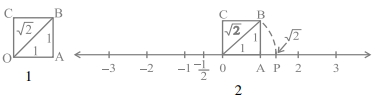
It is easy to see how the Greeks might have discovered $\sqrt{2}$. Consider a square $OABC$,with each side $1$ unit in length. Then you can see by the Pythagoras theorem that $OB = \sqrt{1^{2} + 1^{2}} = \sqrt{2}$.
To represent $\sqrt{2}$ on the number line,place the square $OABC$ on the number line such that the vertex $O$ coincides with zero and the side $OA$ lies along the positive direction of the number line.
We have just seen that $OB = \sqrt{2}$. Using a compass with centre $O$ and radius $OB$,draw an arc intersecting the number line at the point $P$. Then the point $P$ corresponds to $\sqrt{2}$ on the number line.
To represent $\sqrt{2}$ on the number line,place the square $OABC$ on the number line such that the vertex $O$ coincides with zero and the side $OA$ lies along the positive direction of the number line.
We have just seen that $OB = \sqrt{2}$. Using a compass with centre $O$ and radius $OB$,draw an arc intersecting the number line at the point $P$. Then the point $P$ corresponds to $\sqrt{2}$ on the number line.
0 likes
View Solution8
Medium
Locate $\sqrt{3}$ on the number line.
Solution
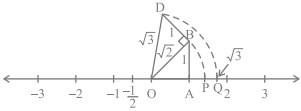
(N/A) To locate $\sqrt{3}$ on the number line,follow these steps:
$1$. First,locate $\sqrt{2}$ on the number line by constructing a right-angled triangle with base $1$ unit and height $1$ unit. The hypotenuse will be $\sqrt{1^2 + 1^2} = \sqrt{2}$.
$2$. Now,construct a line segment $BD$ of unit length ($1$ unit) perpendicular to the hypotenuse $OB$ (where $OB = \sqrt{2}$).
$3$. Join $OD$. In the right-angled triangle $\triangle OBD$,by the Pythagoras theorem:
$OD^2 = OB^2 + BD^2$
$OD^2 = (\sqrt{2})^2 + 1^2 = 2 + 1 = 3$
$OD = \sqrt{3}$.
$4$. Using a compass,with centre $O$ and radius $OD$,draw an arc that intersects the number line at point $Q$. The point $Q$ represents $\sqrt{3}$ on the number line.
In the same way,you can locate $\sqrt{n}$ for any positive integer $n$,after $\sqrt{n-1}$ has been located.
$1$. First,locate $\sqrt{2}$ on the number line by constructing a right-angled triangle with base $1$ unit and height $1$ unit. The hypotenuse will be $\sqrt{1^2 + 1^2} = \sqrt{2}$.
$2$. Now,construct a line segment $BD$ of unit length ($1$ unit) perpendicular to the hypotenuse $OB$ (where $OB = \sqrt{2}$).
$3$. Join $OD$. In the right-angled triangle $\triangle OBD$,by the Pythagoras theorem:
$OD^2 = OB^2 + BD^2$
$OD^2 = (\sqrt{2})^2 + 1^2 = 2 + 1 = 3$
$OD = \sqrt{3}$.
$4$. Using a compass,with centre $O$ and radius $OD$,draw an arc that intersects the number line at point $Q$. The point $Q$ represents $\sqrt{3}$ on the number line.
In the same way,you can locate $\sqrt{n}$ for any positive integer $n$,after $\sqrt{n-1}$ has been located.
0 likes
View Solution9
Easy
State whether the following statements are true or false. Justify your answers.
$(i)$ Every irrational number is a real number.
$(ii)$ Every point on the number line is of the form $\sqrt{m}$,where $m$ is a natural number.
$(iii)$ Every real number is an irrational number.
$(i)$ Every irrational number is a real number.
$(ii)$ Every point on the number line is of the form $\sqrt{m}$,where $m$ is a natural number.
$(iii)$ Every real number is an irrational number.
Solution
(N/A) $(i)$ True; the set of real numbers consists of both rational and irrational numbers. Therefore,every irrational number is a real number.
$(ii)$ False; negative numbers on the number line cannot be expressed as the square root of any natural number $m$,as the square root of any natural number is always non-negative.
$(iii)$ False; real numbers include both rational and irrational numbers. For example,$2$ is a real number but it is a rational number,not an irrational number.
$(ii)$ False; negative numbers on the number line cannot be expressed as the square root of any natural number $m$,as the square root of any natural number is always non-negative.
$(iii)$ False; real numbers include both rational and irrational numbers. For example,$2$ is a real number but it is a rational number,not an irrational number.
0 likes
View Solution10
Easy
Are the square roots of all positive integers irrational? If not,give an example of the square root of a number that is a rational number.
Solution
(B) No,the square roots of all positive integers are not irrational.
For example,consider the square roots of perfect squares such as $\sqrt{4}$ and $\sqrt{9}$.
We know that $\sqrt{4} = 2$ and $\sqrt{9} = 3$.
Since $2$ and $3$ can be expressed in the form $\frac{p}{q}$ (where $p$ and $q$ are integers and $q \neq 0$),they are rational numbers.
Therefore,the square roots of all positive integers are not irrational.
For example,consider the square roots of perfect squares such as $\sqrt{4}$ and $\sqrt{9}$.
We know that $\sqrt{4} = 2$ and $\sqrt{9} = 3$.
Since $2$ and $3$ can be expressed in the form $\frac{p}{q}$ (where $p$ and $q$ are integers and $q \neq 0$),they are rational numbers.
Therefore,the square roots of all positive integers are not irrational.
0 likes
View Solution11
Medium
Show how $\sqrt{5}$ can be represented on the number line.
Solution
(N/A) To represent $\sqrt{5}$ on the number line,we use the Pythagorean theorem: $\sqrt{5} = \sqrt{2^2 + 1^2}$.
$1$. Draw a number line and mark a point $O$ representing $0$ and a point $A$ representing $2$ units from $O$.
$2$. At point $A$,construct a perpendicular line segment $AB$ of length $1$ unit.
$3$. Join $O$ and $B$. In the right-angled triangle $\triangle OAB$,by the Pythagorean theorem:
$OB^2 = OA^2 + AB^2$
$OB^2 = 2^2 + 1^2 = 4 + 1 = 5$
$OB = \sqrt{5}$
$4$. Now,with $O$ as the center and $OB$ as the radius,draw an arc that intersects the number line at point $C$.
$5$. The distance $OC$ is equal to $OB$,which is $\sqrt{5}$. Thus,point $C$ represents $\sqrt{5}$ on the number line.
$1$. Draw a number line and mark a point $O$ representing $0$ and a point $A$ representing $2$ units from $O$.
$2$. At point $A$,construct a perpendicular line segment $AB$ of length $1$ unit.
$3$. Join $O$ and $B$. In the right-angled triangle $\triangle OAB$,by the Pythagorean theorem:
$OB^2 = OA^2 + AB^2$
$OB^2 = 2^2 + 1^2 = 4 + 1 = 5$
$OB = \sqrt{5}$
$4$. Now,with $O$ as the center and $OB$ as the radius,draw an arc that intersects the number line at point $C$.
$5$. The distance $OC$ is equal to $OB$,which is $\sqrt{5}$. Thus,point $C$ represents $\sqrt{5}$ on the number line.

0 likes
View Solution12
Difficult
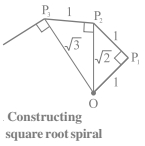
Classroom activity (Constructing the 'square root spiral') : Take a large sheet of paper and construct the 'square root spiral' in the following fashion. Start with a point $O$ and draw a line segment $OP_1$ of unit length. Draw a line segment $P_1P_2$ perpendicular to $OP_1$ of unit length (see Fig.). Now draw a line segment $P_2P_3$ perpendicular to $OP_2$. Then draw a line segment $P_3P_4$ perpendicular to $OP_3$. Continuing in this manner,you can get the line segment $P_{n-1}P_n$ by drawing a line segment of unit length perpendicular to $OP_{n-1}$. In this manner,you will have created the points $P_2, P_3, ..., P_n, ...$,and joined them to create a beautiful spiral depicting $\sqrt{2}, \sqrt{3}, \sqrt{4}, ...$.
Solution
(N/A) The construction of the square root spiral is based on the Pythagorean theorem,which states that in a right-angled triangle,the square of the hypotenuse is equal to the sum of the squares of the other two sides $(h^2 = a^2 + b^2)$.
$1$. Start with point $O$ and draw $OP_1 = 1$ unit.
$2$. Draw $P_1P_2$ perpendicular to $OP_1$ such that $P_1P_2 = 1$ unit. In $\triangle OP_1P_2$,by Pythagoras theorem,$OP_2 = \sqrt{OP_1^2 + P_1P_2^2} = \sqrt{1^2 + 1^2} = \sqrt{2}$.
$3$. Draw $P_2P_3$ perpendicular to $OP_2$ such that $P_2P_3 = 1$ unit. In $\triangle OP_2P_3$,$OP_3 = \sqrt{OP_2^2 + P_2P_3^2} = \sqrt{(\sqrt{2})^2 + 1^2} = \sqrt{2 + 1} = \sqrt{3}$.
$4$. Similarly,draw $P_3P_4$ perpendicular to $OP_3$ such that $P_3P_4 = 1$ unit. In $\triangle OP_3P_4$,$OP_4 = \sqrt{OP_3^2 + P_3P_4^2} = \sqrt{(\sqrt{3})^2 + 1^2} = \sqrt{3 + 1} = \sqrt{4} = 2$.
$5$. By continuing this process,the length of the hypotenuse $OP_n$ will be $\sqrt{n}$.
$1$. Start with point $O$ and draw $OP_1 = 1$ unit.
$2$. Draw $P_1P_2$ perpendicular to $OP_1$ such that $P_1P_2 = 1$ unit. In $\triangle OP_1P_2$,by Pythagoras theorem,$OP_2 = \sqrt{OP_1^2 + P_1P_2^2} = \sqrt{1^2 + 1^2} = \sqrt{2}$.
$3$. Draw $P_2P_3$ perpendicular to $OP_2$ such that $P_2P_3 = 1$ unit. In $\triangle OP_2P_3$,$OP_3 = \sqrt{OP_2^2 + P_2P_3^2} = \sqrt{(\sqrt{2})^2 + 1^2} = \sqrt{2 + 1} = \sqrt{3}$.
$4$. Similarly,draw $P_3P_4$ perpendicular to $OP_3$ such that $P_3P_4 = 1$ unit. In $\triangle OP_3P_4$,$OP_4 = \sqrt{OP_3^2 + P_3P_4^2} = \sqrt{(\sqrt{3})^2 + 1^2} = \sqrt{3 + 1} = \sqrt{4} = 2$.
$5$. By continuing this process,the length of the hypotenuse $OP_n$ will be $\sqrt{n}$.
1 likes
View Solution13
Medium
Find the decimal expansions of $\frac{10}{3}$,$\frac{7}{8}$ and $\frac{1}{7}$.
Solution
(N/A) For $\frac{10}{3} = 3.333... = 3.\overline{3}$. The remainder is always $1$,which repeats. The divisor is $3$.
For $\frac{7}{8} = 0.875$. The remainder becomes $0$ after a finite number of steps. The divisor is $8$.
For $\frac{1}{7} = 0.\overline{142857}$. The remainders are $3, 2, 6, 4, 5, 1$ which repeat. The divisor is $7$.
Observations:
$(i)$ The remainders either become $0$ after a certain stage,or start repeating themselves.
$(ii)$ The number of entries in the repeating string of remainders is less than the divisor.
$(iii)$ If the remainders repeat,then we get a repeating block of digits in the quotient.
For $\frac{7}{8} = 0.875$. The remainder becomes $0$ after a finite number of steps. The divisor is $8$.
For $\frac{1}{7} = 0.\overline{142857}$. The remainders are $3, 2, 6, 4, 5, 1$ which repeat. The divisor is $7$.
Observations:
$(i)$ The remainders either become $0$ after a certain stage,or start repeating themselves.
$(ii)$ The number of entries in the repeating string of remainders is less than the divisor.
$(iii)$ If the remainders repeat,then we get a repeating block of digits in the quotient.
0 likes
View Solution14
Easy
Show that $3.142678$ is a rational number. In other words,express $3.142678$ in the form $\frac{p}{q}$,where $p$ and $q$ are integers and $q \ne 0$.
Solution
(N/A) number is rational if it can be expressed in the form $\frac{p}{q}$,where $p$ and $q$ are integers and $q \ne 0$.
Given the number $3.142678$,we can remove the decimal point by dividing by the appropriate power of $10$.
Since there are $6$ digits after the decimal point,we multiply and divide by $1,000,000$.
$3.142678 = \frac{3142678}{1000000}$.
This fraction can be simplified by dividing both the numerator and the denominator by their greatest common divisor,which is $2$.
$\frac{3142678 \div 2}{1000000 \div 2} = \frac{1571339}{500000}$.
Since $1571339$ and $500000$ are integers and $500000 \ne 0$,the number $3.142678$ is a rational number.
Given the number $3.142678$,we can remove the decimal point by dividing by the appropriate power of $10$.
Since there are $6$ digits after the decimal point,we multiply and divide by $1,000,000$.
$3.142678 = \frac{3142678}{1000000}$.
This fraction can be simplified by dividing both the numerator and the denominator by their greatest common divisor,which is $2$.
$\frac{3142678 \div 2}{1000000 \div 2} = \frac{1571339}{500000}$.
Since $1571339$ and $500000$ are integers and $500000 \ne 0$,the number $3.142678$ is a rational number.
0 likes
View Solution15
Medium
Show that $0.3333... = 0.\overline{3}$ can be expressed in the form $\frac{p}{q}$,where $p$ and $q$ are integers and $q \ne 0$.
Solution
(N/A) Let $x = 0.3333...$ (Equation $1$).
Multiply both sides by $10$:
$10x = 3.3333...$ (Equation $2$).
Since $x = 0.3333...$,we can write $10x = 3 + 0.3333... = 3 + x$.
Subtracting $x$ from both sides:
$10x - x = 3$
$9x = 3$
$x = \frac{3}{9} = \frac{1}{3}$.
Thus,$0.\overline{3}$ can be expressed as $\frac{1}{3}$,where $p = 1$ and $q = 3$ are integers and $q \ne 0$.
Multiply both sides by $10$:
$10x = 3.3333...$ (Equation $2$).
Since $x = 0.3333...$,we can write $10x = 3 + 0.3333... = 3 + x$.
Subtracting $x$ from both sides:
$10x - x = 3$
$9x = 3$
$x = \frac{3}{9} = \frac{1}{3}$.
Thus,$0.\overline{3}$ can be expressed as $\frac{1}{3}$,where $p = 1$ and $q = 3$ are integers and $q \ne 0$.
0 likes
View Solution16
Medium
Show that $1.272727 \ldots = 1.\overline{27}$ can be expressed in the form $\frac{p}{q}$,where $p$ and $q$ are integers and $q \neq 0$.
Solution
(C) Let $x = 1.272727 \ldots$
Since two digits are repeating,we multiply $x$ by $100$ to get:
$100x = 127.2727 \ldots$
We can write this as:
$100x = 126 + 1.272727 \ldots$
Since $x = 1.272727 \ldots$,we substitute $x$ into the equation:
$100x = 126 + x$
Subtracting $x$ from both sides:
$100x - x = 126$
$99x = 126$
$x = \frac{126}{99}$
Dividing both numerator and denominator by their greatest common divisor,$9$:
$x = \frac{14}{11}$
Thus,$1.\overline{27} = \frac{14}{11}$,where $p = 14$ and $q = 11$ are integers and $q \neq 0$.
Since two digits are repeating,we multiply $x$ by $100$ to get:
$100x = 127.2727 \ldots$
We can write this as:
$100x = 126 + 1.272727 \ldots$
Since $x = 1.272727 \ldots$,we substitute $x$ into the equation:
$100x = 126 + x$
Subtracting $x$ from both sides:
$100x - x = 126$
$99x = 126$
$x = \frac{126}{99}$
Dividing both numerator and denominator by their greatest common divisor,$9$:
$x = \frac{14}{11}$
Thus,$1.\overline{27} = \frac{14}{11}$,where $p = 14$ and $q = 11$ are integers and $q \neq 0$.
0 likes
View Solution17
Medium
Show that $0.2353535 \ldots = 0.2 \overline{35}$ can be expressed in the form $\frac{p}{q}$,where $p$ and $q$ are integers and $q \neq 0$.
Solution
(N/A) Let $x = 0.2 \overline{35}$.
Here,the digit $2$ does not repeat,but the block $35$ repeats.
Since two digits are repeating,we multiply $x$ by $100$ to get:
$100x = 23.53535 \ldots$
We can write this as:
$100x = 23.3 + 0.23535 \ldots$
Since $x = 0.23535 \ldots$,we substitute $x$ into the equation:
$100x = 23.3 + x$
Subtract $x$ from both sides:
$99x = 23.3$
Convert the decimal to a fraction:
$99x = \frac{233}{10}$
Divide by $99$:
$x = \frac{233}{990}$
Thus,$0.2 \overline{35} = \frac{233}{990}$.
Here,the digit $2$ does not repeat,but the block $35$ repeats.
Since two digits are repeating,we multiply $x$ by $100$ to get:
$100x = 23.53535 \ldots$
We can write this as:
$100x = 23.3 + 0.23535 \ldots$
Since $x = 0.23535 \ldots$,we substitute $x$ into the equation:
$100x = 23.3 + x$
Subtract $x$ from both sides:
$99x = 23.3$
Convert the decimal to a fraction:
$99x = \frac{233}{10}$
Divide by $99$:
$x = \frac{233}{990}$
Thus,$0.2 \overline{35} = \frac{233}{990}$.
0 likes
View Solution18
MediumMCQ
Find an irrational number between $\frac{1}{7}$ and $\frac{2}{7}$. (in $...$)
A
$0.15015001500015$
B
$0.141414$
C
$0.285714$
D
$0.142857$
Solution
(A) We know that $\frac{1}{7} = 0.\overline{142857}$ and $\frac{2}{7} = 0.\overline{285714}$.
To find an irrational number between these two values,we need a number that is non-terminating and non-recurring.
Any number of the form $0.15015001500015...$ satisfies this condition because it lies between $0.142857...$ and $0.285714...$ and does not repeat in a fixed pattern.
Thus,one such irrational number is $0.15015001500015...$.
To find an irrational number between these two values,we need a number that is non-terminating and non-recurring.
Any number of the form $0.15015001500015...$ satisfies this condition because it lies between $0.142857...$ and $0.285714...$ and does not repeat in a fixed pattern.
Thus,one such irrational number is $0.15015001500015...$.
0 likes
View Solution19
Medium
Write the following in decimal form and state what kind of decimal expansion each has:
$(i)$ $\frac{36}{100}$
$(ii)$ $\frac{1}{11}$
$(iii)$ $4 \frac{1}{8}$
$(iv)$ $\frac{3}{13}$
$(v)$ $\frac{2}{11}$
$(vi)$ $\frac{329}{400}$
$(i)$ $\frac{36}{100}$
$(ii)$ $\frac{1}{11}$
$(iii)$ $4 \frac{1}{8}$
$(iv)$ $\frac{3}{13}$
$(v)$ $\frac{2}{11}$
$(vi)$ $\frac{329}{400}$
Solution
(N/A) $(i)$ $\frac{36}{100} = 0.36$. This is a terminating decimal expansion.
$(ii)$ $\frac{1}{11} = 0.090909 \ldots = 0.\overline{09}$. This is a non-terminating repeating decimal expansion.
$(iii)$ $4 \frac{1}{8} = \frac{33}{8} = 4.125$. This is a terminating decimal expansion.
$(iv)$ $\frac{3}{13} = 0.230769230769 \ldots = 0.\overline{230769}$. This is a non-terminating repeating decimal expansion.
$(v)$ $\frac{2}{11} = 0.18181818 \ldots = 0.\overline{18}$. This is a non-terminating repeating decimal expansion.
$(vi)$ $\frac{329}{400} = 0.8225$. This is a terminating decimal expansion.
$(ii)$ $\frac{1}{11} = 0.090909 \ldots = 0.\overline{09}$. This is a non-terminating repeating decimal expansion.
$(iii)$ $4 \frac{1}{8} = \frac{33}{8} = 4.125$. This is a terminating decimal expansion.
$(iv)$ $\frac{3}{13} = 0.230769230769 \ldots = 0.\overline{230769}$. This is a non-terminating repeating decimal expansion.
$(v)$ $\frac{2}{11} = 0.18181818 \ldots = 0.\overline{18}$. This is a non-terminating repeating decimal expansion.
$(vi)$ $\frac{329}{400} = 0.8225$. This is a terminating decimal expansion.
0 likes
View Solution20
Easy
You know that $\frac{1}{7} = 0.\overline{142857}$. Can you predict what the decimal expansions of $\frac{2}{7}, \frac{3}{7}, \frac{4}{7}, \frac{5}{7}, \frac{6}{7}$ are,without actually doing the long division? If so,how?
Solution
(N/A) We are given that $\frac{1}{7} = 0.\overline{142857}$.
To find the decimal expansions of the given fractions without long division,we multiply the value of $\frac{1}{7}$ by the respective numerators:
$\frac{2}{7} = 2 \times \frac{1}{7} = 2 \times 0.\overline{142857} = 0.\overline{285714}$
$\frac{3}{7} = 3 \times \frac{1}{7} = 3 \times 0.\overline{142857} = 0.\overline{428571}$
$\frac{4}{7} = 4 \times \frac{1}{7} = 4 \times 0.\overline{142857} = 0.\overline{571428}$
$\frac{5}{7} = 5 \times \frac{1}{7} = 5 \times 0.\overline{142857} = 0.\overline{714285}$
$\frac{6}{7} = 6 \times \frac{1}{7} = 6 \times 0.\overline{142857} = 0.\overline{857142}$
Thus,by multiplying the decimal expansion of $\frac{1}{7}$ by the respective numerators,we can determine the decimal expansions of these rational numbers without performing long division.
To find the decimal expansions of the given fractions without long division,we multiply the value of $\frac{1}{7}$ by the respective numerators:
$\frac{2}{7} = 2 \times \frac{1}{7} = 2 \times 0.\overline{142857} = 0.\overline{285714}$
$\frac{3}{7} = 3 \times \frac{1}{7} = 3 \times 0.\overline{142857} = 0.\overline{428571}$
$\frac{4}{7} = 4 \times \frac{1}{7} = 4 \times 0.\overline{142857} = 0.\overline{571428}$
$\frac{5}{7} = 5 \times \frac{1}{7} = 5 \times 0.\overline{142857} = 0.\overline{714285}$
$\frac{6}{7} = 6 \times \frac{1}{7} = 6 \times 0.\overline{142857} = 0.\overline{857142}$
Thus,by multiplying the decimal expansion of $\frac{1}{7}$ by the respective numerators,we can determine the decimal expansions of these rational numbers without performing long division.
0 likes
View Solution21
Medium
Express the following in the form $\frac{p}{q}$,where $p$ and $q$ are integers and $q \ne 0$.
$(i)$ $0.\overline{6}$
$(ii)$ $0.4\overline{7}$
$(iii)$ $0.\overline{001}$
$(i)$ $0.\overline{6}$
$(ii)$ $0.4\overline{7}$
$(iii)$ $0.\overline{001}$
Solution
(N/A) $(i)$ Let $x = 0.\overline{6} = 0.6666\ldots$
Since there is one repeating digit,we multiply both sides by $10$:
$10x = 6.6666\ldots$
Subtracting $x$ from $10x$:
$10x - x = 6.6666\ldots - 0.6666\ldots$
$9x = 6$
$x = \frac{6}{9} = \frac{2}{3}$
Thus,$0.\overline{6} = \frac{2}{3}$.
$(ii)$ Let $x = 0.4\overline{7} = 0.4777\ldots$
Multiply by $10$:
$10x = 4.777\ldots$ $(1)$
Multiply by $100$:
$100x = 47.777\ldots$ $(2)$
Subtracting $(1)$ from $(2)$:
$100x - 10x = 47.777\ldots - 4.777\ldots$
$90x = 43$
$x = \frac{43}{90}$
Thus,$0.4\overline{7} = \frac{43}{90}$.
$(iii)$ Let $x = 0.\overline{001} = 0.001001\ldots$ $(1)$
Since there are three repeating digits,multiply by $1000$:
$1000x = 1.001001\ldots$ $(2)$
Subtracting $(1)$ from $(2)$:
$1000x - x = 1.001001\ldots - 0.001001\ldots$
$999x = 1$
$x = \frac{1}{999}$
Thus,$0.\overline{001} = \frac{1}{999}$.
Since there is one repeating digit,we multiply both sides by $10$:
$10x = 6.6666\ldots$
Subtracting $x$ from $10x$:
$10x - x = 6.6666\ldots - 0.6666\ldots$
$9x = 6$
$x = \frac{6}{9} = \frac{2}{3}$
Thus,$0.\overline{6} = \frac{2}{3}$.
$(ii)$ Let $x = 0.4\overline{7} = 0.4777\ldots$
Multiply by $10$:
$10x = 4.777\ldots$ $(1)$
Multiply by $100$:
$100x = 47.777\ldots$ $(2)$
Subtracting $(1)$ from $(2)$:
$100x - 10x = 47.777\ldots - 4.777\ldots$
$90x = 43$
$x = \frac{43}{90}$
Thus,$0.4\overline{7} = \frac{43}{90}$.
$(iii)$ Let $x = 0.\overline{001} = 0.001001\ldots$ $(1)$
Since there are three repeating digits,multiply by $1000$:
$1000x = 1.001001\ldots$ $(2)$
Subtracting $(1)$ from $(2)$:
$1000x - x = 1.001001\ldots - 0.001001\ldots$
$999x = 1$
$x = \frac{1}{999}$
Thus,$0.\overline{001} = \frac{1}{999}$.
0 likes
View Solution22
Medium
Express $0.99999 \ldots$ in the form $\frac{p}{q}$. Are you surprised by your answer? With your teacher and classmates,discuss why the answer makes sense.
Solution
(A) Let $x = 0.9999 \ldots$ $(1)$
Multiply both sides by $10$,we have:
$10x = 9.9999 \ldots$ $(2)$
Subtracting equation $(1)$ from equation $(2)$,we get:
$10x - x = (9.9999 \ldots) - (0.9999 \ldots)$
$9x = 9$
$x = \frac{9}{9} = 1$
Thus,$0.9999 \ldots = 1$.
As $0.9999 \ldots$ continues infinitely,there is no gap between $1$ and $0.9999 \ldots$. Hence,both are equal.
Multiply both sides by $10$,we have:
$10x = 9.9999 \ldots$ $(2)$
Subtracting equation $(1)$ from equation $(2)$,we get:
$10x - x = (9.9999 \ldots) - (0.9999 \ldots)$
$9x = 9$
$x = \frac{9}{9} = 1$
Thus,$0.9999 \ldots = 1$.
As $0.9999 \ldots$ continues infinitely,there is no gap between $1$ and $0.9999 \ldots$. Hence,both are equal.
0 likes
View Solution23
MediumMCQ
What can the maximum number of digits be in the repeating block of digits in the decimal expansion of $\frac{1}{17}$?
A
$16$
B
$17$
C
$15$
D
$18$
Solution
(A) In the decimal expansion of a rational number $\frac{p}{q}$,the number of entries in the repeating block of digits is always less than the divisor $q$.
In the fraction $\frac{1}{17}$,the divisor is $17$.
Therefore,the maximum number of digits in the repeating block is $17 - 1 = 16$.
By performing long division,we find:
$\frac{1}{17} = 0.\overline{0588235294117647}$
Thus,there are $16$ digits in the repeating block of the decimal expansion of $\frac{1}{17}$.
In the fraction $\frac{1}{17}$,the divisor is $17$.
Therefore,the maximum number of digits in the repeating block is $17 - 1 = 16$.
By performing long division,we find:
$\frac{1}{17} = 0.\overline{0588235294117647}$
Thus,there are $16$ digits in the repeating block of the decimal expansion of $\frac{1}{17}$.
0 likes
View Solution24
Difficult
Look at several examples of rational numbers in the form $\frac{p}{q}$ $(q \neq 0)$,where $p$ and $q$ are integers with no common factors other than $1$ and having terminating decimal representations (expansions). Can you guess what property $q$ must satisfy?
Solution
(N/A) Let us examine the decimal expansion of the following terminating rational numbers:
$\frac{3}{2} = \frac{3 \times 5}{2 \times 5} = \frac{15}{10} = 1.5$ [Denominator $= 2 = 2^1$]
$\frac{1}{5} = \frac{1 \times 2}{5 \times 2} = \frac{2}{10} = 0.2$ [Denominator $= 5 = 5^1$]
$\frac{7}{8} = \frac{7 \times 125}{8 \times 125} = \frac{875}{1000} = 0.875$ [Denominator $= 8 = 2^3$]
$\frac{8}{125} = \frac{8 \times 8}{125 \times 8} = \frac{64}{1000} = 0.064$ [Denominator $= 125 = 5^3$]
$\frac{13}{20} = \frac{13 \times 5}{20 \times 5} = \frac{65}{100} = 0.65$ [Denominator $= 20 = 2^2 \times 5^1$]
$\frac{17}{16} = \frac{17 \times 625}{16 \times 625} = \frac{10625}{10000} = 1.0625$ [Denominator $= 16 = 2^4$]
We observe that the prime factorization of $q$ (i.e.,the denominator) has only powers of $2$,powers of $5$,or powers of both. Thus,$q$ must be of the form $2^n \times 5^m$,where $n$ and $m$ are non-negative integers.
$\frac{3}{2} = \frac{3 \times 5}{2 \times 5} = \frac{15}{10} = 1.5$ [Denominator $= 2 = 2^1$]
$\frac{1}{5} = \frac{1 \times 2}{5 \times 2} = \frac{2}{10} = 0.2$ [Denominator $= 5 = 5^1$]
$\frac{7}{8} = \frac{7 \times 125}{8 \times 125} = \frac{875}{1000} = 0.875$ [Denominator $= 8 = 2^3$]
$\frac{8}{125} = \frac{8 \times 8}{125 \times 8} = \frac{64}{1000} = 0.064$ [Denominator $= 125 = 5^3$]
$\frac{13}{20} = \frac{13 \times 5}{20 \times 5} = \frac{65}{100} = 0.65$ [Denominator $= 20 = 2^2 \times 5^1$]
$\frac{17}{16} = \frac{17 \times 625}{16 \times 625} = \frac{10625}{10000} = 1.0625$ [Denominator $= 16 = 2^4$]
We observe that the prime factorization of $q$ (i.e.,the denominator) has only powers of $2$,powers of $5$,or powers of both. Thus,$q$ must be of the form $2^n \times 5^m$,where $n$ and $m$ are non-negative integers.
0 likes
View Solution25
Easy
Write three numbers whose decimal expansions are non-terminating non-recurring.
Solution
(N/A) number whose decimal expansion is non-terminating and non-recurring is an irrational number.
Three examples of such numbers are:
$1$. $\sqrt{2} = 1.414213562 \ldots$
$2$. $\sqrt{3} = 1.732050808 \ldots$
$3$. $\sqrt{5} = 2.236067978 \ldots$
Three examples of such numbers are:
$1$. $\sqrt{2} = 1.414213562 \ldots$
$2$. $\sqrt{3} = 1.732050808 \ldots$
$3$. $\sqrt{5} = 2.236067978 \ldots$
0 likes
View Solution26
Medium
Find three different irrational numbers between the rational numbers $\frac{5}{7}$ and $\frac{9}{11}$.
Solution
(N/A) First,convert the rational numbers into decimal form:
$\frac{5}{7} = 0.\overline{714285}$
$\frac{9}{11} = 0.\overline{81}$
An irrational number is a non-terminating and non-repeating decimal.
We need to find three numbers between $0.714285...$ and $0.818181...$ that follow a non-terminating,non-repeating pattern.
Three such examples are:
$1) 0.73073007300073...$
$2) 0.75075007500075...$
$3) 0.79079007900079...$
$\frac{5}{7} = 0.\overline{714285}$
$\frac{9}{11} = 0.\overline{81}$
An irrational number is a non-terminating and non-repeating decimal.
We need to find three numbers between $0.714285...$ and $0.818181...$ that follow a non-terminating,non-repeating pattern.
Three such examples are:
$1) 0.73073007300073...$
$2) 0.75075007500075...$
$3) 0.79079007900079...$
0 likes
View Solution27
Medium
Classify the following numbers as rational or irrational:
$(i)$ $\sqrt{23}$
$(ii)$ $\sqrt{225}$
$(iii)$ $0.3796$
$(iv)$ $7.478478 \ldots$
$(v)$ $1.101001000100001 \ldots$
$(i)$ $\sqrt{23}$
$(ii)$ $\sqrt{225}$
$(iii)$ $0.3796$
$(iv)$ $7.478478 \ldots$
$(v)$ $1.101001000100001 \ldots$
Solution
(N/A) $(i)$ $\sqrt{23} \approx 4.79583152331 \ldots$
Since the decimal expansion is non-terminating and non-recurring,it is an irrational number.
$(ii)$ $\sqrt{225} = 15 = \frac{15}{1}$
Since it can be expressed in the form $\frac{p}{q}$ where $p, q$ are integers and $q \neq 0$,it is a rational number.
$(iii)$ $0.3796 = \frac{3796}{10000} = \frac{949}{2500}$
Since the decimal expansion is terminating,it is a rational number.
$(iv)$ $7.478478 \ldots = 7.\overline{478}$
Since the decimal expansion is non-terminating but recurring,it is a rational number.
$(v)$ $1.101001000100001 \ldots$
Since the decimal expansion is non-terminating and non-repeating,it is an irrational number.
Since the decimal expansion is non-terminating and non-recurring,it is an irrational number.
$(ii)$ $\sqrt{225} = 15 = \frac{15}{1}$
Since it can be expressed in the form $\frac{p}{q}$ where $p, q$ are integers and $q \neq 0$,it is a rational number.
$(iii)$ $0.3796 = \frac{3796}{10000} = \frac{949}{2500}$
Since the decimal expansion is terminating,it is a rational number.
$(iv)$ $7.478478 \ldots = 7.\overline{478}$
Since the decimal expansion is non-terminating but recurring,it is a rational number.
$(v)$ $1.101001000100001 \ldots$
Since the decimal expansion is non-terminating and non-repeating,it is an irrational number.
0 likes
View Solution28
Medium
Visualize the representation of $5.3\overline{7}$ on the number line up to $5$ decimal places,that is,up to $5.37777$.
Solution
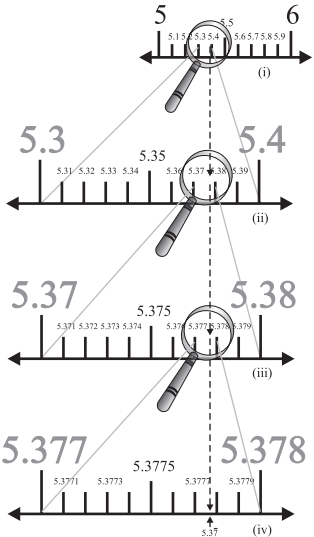
(N/A) To visualize $5.3\overline{7}$ on the number line up to $5$ decimal places,we use the process of successive magnification:
$1$. We know that $5.3\overline{7}$ lies between $5$ and $6$. We divide the distance between $5$ and $6$ into $10$ equal parts and locate $5.3$ and $5.4$. $5.3\overline{7}$ lies between $5.3$ and $5.4$ [Fig $(i)$].
$2$. Next,we divide the distance between $5.3$ and $5.4$ into $10$ equal parts to locate $5.37$ and $5.38$. $5.3\overline{7}$ lies between $5.37$ and $5.38$ [Fig $(ii)$].
$3$. We then divide the distance between $5.37$ and $5.38$ into $10$ equal parts to locate $5.377$ and $5.378$. $5.3\overline{7}$ lies between $5.377$ and $5.378$ [Fig $(iii)$].
$4$. Finally,we divide the distance between $5.377$ and $5.378$ into $10$ equal parts to locate $5.3777$ and $5.3778$. By magnifying this portion,we can represent $5.37777$ on the number line [Fig $(iv)$].
$1$. We know that $5.3\overline{7}$ lies between $5$ and $6$. We divide the distance between $5$ and $6$ into $10$ equal parts and locate $5.3$ and $5.4$. $5.3\overline{7}$ lies between $5.3$ and $5.4$ [Fig $(i)$].
$2$. Next,we divide the distance between $5.3$ and $5.4$ into $10$ equal parts to locate $5.37$ and $5.38$. $5.3\overline{7}$ lies between $5.37$ and $5.38$ [Fig $(ii)$].
$3$. We then divide the distance between $5.37$ and $5.38$ into $10$ equal parts to locate $5.377$ and $5.378$. $5.3\overline{7}$ lies between $5.377$ and $5.378$ [Fig $(iii)$].
$4$. Finally,we divide the distance between $5.377$ and $5.378$ into $10$ equal parts to locate $5.3777$ and $5.3778$. By magnifying this portion,we can represent $5.37777$ on the number line [Fig $(iv)$].
0 likes
View Solution29
Medium
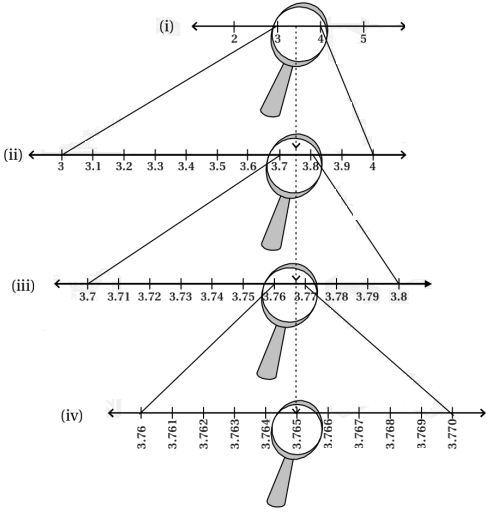
Visualise $3.765$ on the number line,using successive magnification.
Solution
(N/A) $3.765$ lies between $3$ and $4$.
Let us divide the interval $(3, 4)$ into $10$ equal parts.
Since $3.765$ lies between $3.7$ and $3.8$,we again magnify the interval $[3.7, 3.8]$ by dividing it further into $10$ parts to focus on the distance between $3.76$ and $3.77$.
The number $3.765$ lies between $3.76$ and $3.77$. Therefore,we further magnify the interval $[3.76, 3.77]$ into $10$ equal parts.
Now,the point corresponding to $3.765$ is clearly located,as shown in the final step of the magnification process.
Let us divide the interval $(3, 4)$ into $10$ equal parts.
Since $3.765$ lies between $3.7$ and $3.8$,we again magnify the interval $[3.7, 3.8]$ by dividing it further into $10$ parts to focus on the distance between $3.76$ and $3.77$.
The number $3.765$ lies between $3.76$ and $3.77$. Therefore,we further magnify the interval $[3.76, 3.77]$ into $10$ equal parts.
Now,the point corresponding to $3.765$ is clearly located,as shown in the final step of the magnification process.
0 likes
View Solution30
Medium
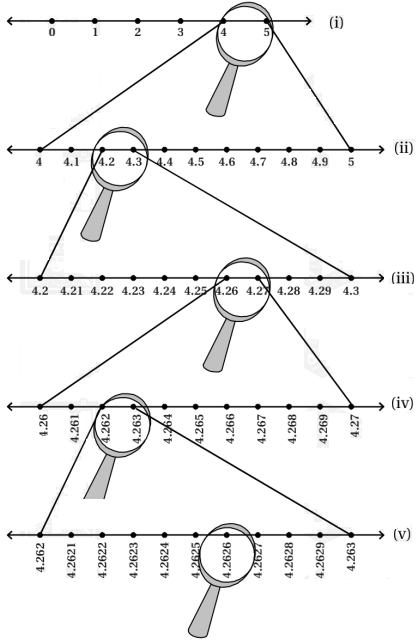
Visualize $4.\overline{26}$ on the number line,up to $4$ decimal places.
Solution
(N/A) We can visualize the number $4.\overline{26}$ or $4.2626\ldots$ on the number line using the process of successive magnification.
$I$. The number $4.2626\ldots$ lies between $4$ and $5$. We divide the interval $[4, 5]$ into $10$ equal parts and locate $4.2$ and $4.3$.
$II$. The number $4.2626\ldots$ lies between $4.2$ and $4.3$. We magnify the interval $[4.2, 4.3]$ and divide it into $10$ equal parts to locate $4.26$ and $4.27$.
$III$. The number $4.2626\ldots$ lies between $4.26$ and $4.27$. We magnify the interval $[4.26, 4.27]$ and divide it into $10$ equal parts to locate $4.262$ and $4.263$.
$IV$. The number $4.2626\ldots$ lies between $4.262$ and $4.263$. We magnify the interval $[4.262, 4.263]$ and divide it into $10$ equal parts. We can now locate $4.2626$ on the number line.
$I$. The number $4.2626\ldots$ lies between $4$ and $5$. We divide the interval $[4, 5]$ into $10$ equal parts and locate $4.2$ and $4.3$.
$II$. The number $4.2626\ldots$ lies between $4.2$ and $4.3$. We magnify the interval $[4.2, 4.3]$ and divide it into $10$ equal parts to locate $4.26$ and $4.27$.
$III$. The number $4.2626\ldots$ lies between $4.26$ and $4.27$. We magnify the interval $[4.26, 4.27]$ and divide it into $10$ equal parts to locate $4.262$ and $4.263$.
$IV$. The number $4.2626\ldots$ lies between $4.262$ and $4.263$. We magnify the interval $[4.262, 4.263]$ and divide it into $10$ equal parts. We can now locate $4.2626$ on the number line.
0 likes
View Solution31
Medium
Check whether $7 \sqrt{5}$,$\frac{7}{\sqrt{5}}$,$\sqrt{2}+21$,and $\pi-2$ are irrational numbers or not.
Solution
(N/A) To determine if a number is irrational,we check if it can be expressed as a non-terminating,non-recurring decimal.
$1$. $7 \sqrt{5}$: Since $\sqrt{5} \approx 2.236$ is an irrational number,the product of a non-zero rational number $(7)$ and an irrational number $(\sqrt{5})$ is always irrational. Thus,$7 \sqrt{5} \approx 15.652...$ is irrational.
$2$. $\frac{7}{\sqrt{5}}$: Rationalizing the denominator,we get $\frac{7 \sqrt{5}}{5} \approx 3.1304...$. Since the quotient of a non-zero rational number and an irrational number is irrational,$\frac{7}{\sqrt{5}}$ is irrational.
$3$. $\sqrt{2}+21$: Since $\sqrt{2} \approx 1.414$ is irrational,the sum of an irrational number and a rational number $(21)$ is always irrational. Thus,$\sqrt{2}+21 \approx 22.414...$ is irrational.
$4$. $\pi-2$: Since $\pi \approx 3.1415...$ is an irrational number,the difference between an irrational number and a rational number $(2)$ is always irrational. Thus,$\pi-2 \approx 1.1415...$ is irrational.
Conclusion: All the given numbers are irrational.
$1$. $7 \sqrt{5}$: Since $\sqrt{5} \approx 2.236$ is an irrational number,the product of a non-zero rational number $(7)$ and an irrational number $(\sqrt{5})$ is always irrational. Thus,$7 \sqrt{5} \approx 15.652...$ is irrational.
$2$. $\frac{7}{\sqrt{5}}$: Rationalizing the denominator,we get $\frac{7 \sqrt{5}}{5} \approx 3.1304...$. Since the quotient of a non-zero rational number and an irrational number is irrational,$\frac{7}{\sqrt{5}}$ is irrational.
$3$. $\sqrt{2}+21$: Since $\sqrt{2} \approx 1.414$ is irrational,the sum of an irrational number and a rational number $(21)$ is always irrational. Thus,$\sqrt{2}+21 \approx 22.414...$ is irrational.
$4$. $\pi-2$: Since $\pi \approx 3.1415...$ is an irrational number,the difference between an irrational number and a rational number $(2)$ is always irrational. Thus,$\pi-2 \approx 1.1415...$ is irrational.
Conclusion: All the given numbers are irrational.
0 likes
View Solution32
EasyMCQ
Add $2 \sqrt{2} + 5 \sqrt{3}$ and $\sqrt{2} - 3 \sqrt{3}$.
A
$3 \sqrt{2} + 2 \sqrt{3}$
B
$2 \sqrt{3} + 3 \sqrt{2}$
C
$2 \sqrt{2} + 2 \sqrt{2}$
D
$3 \sqrt{3} + 3 \sqrt{3}$
Solution
(A) To add the given expressions,group the like terms (terms with the same square root factor):
$(2 \sqrt{2} + 5 \sqrt{3}) + (\sqrt{2} - 3 \sqrt{3})$
$= (2 \sqrt{2} + \sqrt{2}) + (5 \sqrt{3} - 3 \sqrt{3})$
$= (2 + 1) \sqrt{2} + (5 - 3) \sqrt{3}$
$= 3 \sqrt{2} + 2 \sqrt{3}$
$(2 \sqrt{2} + 5 \sqrt{3}) + (\sqrt{2} - 3 \sqrt{3})$
$= (2 \sqrt{2} + \sqrt{2}) + (5 \sqrt{3} - 3 \sqrt{3})$
$= (2 + 1) \sqrt{2} + (5 - 3) \sqrt{3}$
$= 3 \sqrt{2} + 2 \sqrt{3}$
0 likes
View Solution33
EasyMCQ
Multiply $6 \sqrt{5}$ by $2 \sqrt{5}$.
A
$55$
B
$60$
C
$50$
D
$66$
Solution
(B) To multiply $6 \sqrt{5}$ by $2 \sqrt{5}$,we follow these steps:
$1$. Multiply the rational coefficients: $6 \times 2 = 12$.
$2$. Multiply the square root terms: $\sqrt{5} \times \sqrt{5} = 5$.
$3$. Multiply the results together: $12 \times 5 = 60$.
Thus,$6 \sqrt{5} \times 2 \sqrt{5} = 60$.
$1$. Multiply the rational coefficients: $6 \times 2 = 12$.
$2$. Multiply the square root terms: $\sqrt{5} \times \sqrt{5} = 5$.
$3$. Multiply the results together: $12 \times 5 = 60$.
Thus,$6 \sqrt{5} \times 2 \sqrt{5} = 60$.
0 likes
View Solution34
EasyMCQ
Divide $8 \sqrt{15}$ by $2 \sqrt{3}$.
A
$5 \sqrt{5}$
B
$4 \sqrt{4}$
C
$4 \sqrt{5}$
D
$5 \sqrt{4}$
Solution
(C) To divide $8 \sqrt{15}$ by $2 \sqrt{3}$,we write it as a fraction:
$\frac{8 \sqrt{15}}{2 \sqrt{3}}$
We can simplify the expression by splitting $\sqrt{15}$ into $\sqrt{3} \times \sqrt{5}$:
$= \frac{8 \times \sqrt{3} \times \sqrt{5}}{2 \sqrt{3}}$
Cancel out the common term $\sqrt{3}$ from the numerator and the denominator:
$= \frac{8}{2} \times \sqrt{5}$
$= 4 \sqrt{5}$
$\frac{8 \sqrt{15}}{2 \sqrt{3}}$
We can simplify the expression by splitting $\sqrt{15}$ into $\sqrt{3} \times \sqrt{5}$:
$= \frac{8 \times \sqrt{3} \times \sqrt{5}}{2 \sqrt{3}}$
Cancel out the common term $\sqrt{3}$ from the numerator and the denominator:
$= \frac{8}{2} \times \sqrt{5}$
$= 4 \sqrt{5}$
0 likes
View Solution35
Easy
Simplify the following expressions :
$(i)$ $(5+\sqrt{7})(2+\sqrt{5})$
$(ii)$ $(5+\sqrt{5})(5-\sqrt{5})$
$(iii)$ $(\sqrt{3}+\sqrt{7})^{2}$
$(iv)$ $(\sqrt{11}-\sqrt{7})(\sqrt{11}+\sqrt{7})$
$(i)$ $(5+\sqrt{7})(2+\sqrt{5})$
$(ii)$ $(5+\sqrt{5})(5-\sqrt{5})$
$(iii)$ $(\sqrt{3}+\sqrt{7})^{2}$
$(iv)$ $(\sqrt{11}-\sqrt{7})(\sqrt{11}+\sqrt{7})$
Solution
$(i)$ Using the distributive property: $(5+\sqrt{7})(2+\sqrt{5}) = 5(2) + 5(\sqrt{5}) + \sqrt{7}(2) + \sqrt{7}(\sqrt{5}) = 10 + 5\sqrt{5} + 2\sqrt{7} + \sqrt{35}$.
$(ii)$ Using the identity $(a+b)(a-b) = a^2 - b^2$: $(5+\sqrt{5})(5-\sqrt{5}) = 5^2 - (\sqrt{5})^2 = 25 - 5 = 20$.
$(iii)$ Using the identity $(a+b)^2 = a^2 + 2ab + b^2$: $(\sqrt{3}+\sqrt{7})^2 = (\sqrt{3})^2 + 2(\sqrt{3})(\sqrt{7}) + (\sqrt{7})^2 = 3 + 2\sqrt{21} + 7 = 10 + 2\sqrt{21}$.
$(iv)$ Using the identity $(a-b)(a+b) = a^2 - b^2$: $(\sqrt{11}-\sqrt{7})(\sqrt{11}+\sqrt{7}) = (\sqrt{11})^2 - (\sqrt{7})^2 = 11 - 7 = 4$.
$(ii)$ Using the identity $(a+b)(a-b) = a^2 - b^2$: $(5+\sqrt{5})(5-\sqrt{5}) = 5^2 - (\sqrt{5})^2 = 25 - 5 = 20$.
$(iii)$ Using the identity $(a+b)^2 = a^2 + 2ab + b^2$: $(\sqrt{3}+\sqrt{7})^2 = (\sqrt{3})^2 + 2(\sqrt{3})(\sqrt{7}) + (\sqrt{7})^2 = 3 + 2\sqrt{21} + 7 = 10 + 2\sqrt{21}$.
$(iv)$ Using the identity $(a-b)(a+b) = a^2 - b^2$: $(\sqrt{11}-\sqrt{7})(\sqrt{11}+\sqrt{7}) = (\sqrt{11})^2 - (\sqrt{7})^2 = 11 - 7 = 4$.
0 likes
View Solution36
EasyMCQ
Rationalise the denominator of $\frac{1}{\sqrt{2}}$.
A
$\frac{\sqrt{2}}{2}$
B
$\frac{1}{2}$
C
$\sqrt{2}$
D
$\frac{2}{\sqrt{2}}$
Solution
(A) To rationalise the denominator of $\frac{1}{\sqrt{2}}$,we multiply both the numerator and the denominator by $\sqrt{2}$.
$\frac{1}{\sqrt{2}} = \frac{1 \times \sqrt{2}}{\sqrt{2} \times \sqrt{2}}$
Since $\sqrt{2} \times \sqrt{2} = 2$,we get:
$\frac{1}{\sqrt{2}} = \frac{\sqrt{2}}{2}$
Thus,the rationalised form is $\frac{\sqrt{2}}{2}$.
$\frac{1}{\sqrt{2}} = \frac{1 \times \sqrt{2}}{\sqrt{2} \times \sqrt{2}}$
Since $\sqrt{2} \times \sqrt{2} = 2$,we get:
$\frac{1}{\sqrt{2}} = \frac{\sqrt{2}}{2}$
Thus,the rationalised form is $\frac{\sqrt{2}}{2}$.
0 likes
View Solution37
EasyMCQ
Rationalise the denominator of $\frac{1}{2+\sqrt{3}}$.
A
$2+\sqrt{3}$
B
$2-\sqrt{3}$
C
$\sqrt{3}-2$
D
$\sqrt{3}+2$
Solution
(B) To rationalise the denominator of $\frac{1}{2+\sqrt{3}}$,we multiply the numerator and the denominator by the conjugate of the denominator,which is $(2-\sqrt{3})$.
$\frac{1}{2+\sqrt{3}} \times \frac{2-\sqrt{3}}{2-\sqrt{3}} = \frac{2-\sqrt{3}}{(2)^2 - (\sqrt{3})^2}$
Using the identity $(a+b)(a-b) = a^2 - b^2$,we get:
$= \frac{2-\sqrt{3}}{4-3} = \frac{2-\sqrt{3}}{1} = 2-\sqrt{3}$.
$\frac{1}{2+\sqrt{3}} \times \frac{2-\sqrt{3}}{2-\sqrt{3}} = \frac{2-\sqrt{3}}{(2)^2 - (\sqrt{3})^2}$
Using the identity $(a+b)(a-b) = a^2 - b^2$,we get:
$= \frac{2-\sqrt{3}}{4-3} = \frac{2-\sqrt{3}}{1} = 2-\sqrt{3}$.
0 likes
View Solution38
EasyMCQ
Rationalise the denominator of $\frac{5}{\sqrt{3}-\sqrt{5}}$.
A
$\frac{5}{2}(\sqrt{3}+\sqrt{5})$
B
$-\frac{5}{2}(\sqrt{3}+\sqrt{5})$
C
$\frac{5}{2}(\sqrt{3}-\sqrt{5})$
D
$-\frac{5}{2}(\sqrt{3}-\sqrt{5})$
Solution
(B) To rationalise the denominator,we multiply the numerator and the denominator by the conjugate of the denominator,which is $(\sqrt{3}+\sqrt{5})$.
$\frac{5}{\sqrt{3}-\sqrt{5}} = \frac{5}{\sqrt{3}-\sqrt{5}} \times \frac{\sqrt{3}+\sqrt{5}}{\sqrt{3}+\sqrt{5}}$
Using the algebraic identity $(a-b)(a+b) = a^2 - b^2$ in the denominator:
$= \frac{5(\sqrt{3}+\sqrt{5})}{(\sqrt{3})^2 - (\sqrt{5})^2}$
$= \frac{5(\sqrt{3}+\sqrt{5})}{3 - 5}$
$= \frac{5(\sqrt{3}+\sqrt{5})}{-2}$
$= -\frac{5}{2}(\sqrt{3}+\sqrt{5})$
$\frac{5}{\sqrt{3}-\sqrt{5}} = \frac{5}{\sqrt{3}-\sqrt{5}} \times \frac{\sqrt{3}+\sqrt{5}}{\sqrt{3}+\sqrt{5}}$
Using the algebraic identity $(a-b)(a+b) = a^2 - b^2$ in the denominator:
$= \frac{5(\sqrt{3}+\sqrt{5})}{(\sqrt{3})^2 - (\sqrt{5})^2}$
$= \frac{5(\sqrt{3}+\sqrt{5})}{3 - 5}$
$= \frac{5(\sqrt{3}+\sqrt{5})}{-2}$
$= -\frac{5}{2}(\sqrt{3}+\sqrt{5})$
0 likes
View Solution39
EasyMCQ
Rationalise the denominator of $\frac{1}{7+3 \sqrt{2}}$
A
$\frac{7-3 \sqrt{2}}{31}$
B
$\frac{7+3 \sqrt{2}}{31}$
C
$\frac{7-3 \sqrt{2}}{43}$
D
$\frac{7+3 \sqrt{2}}{43}$
Solution
(A) To rationalise the denominator of $\frac{1}{7+3 \sqrt{2}}$,we multiply the numerator and the denominator by the conjugate of the denominator,which is $(7-3 \sqrt{2})$.
$\frac{1}{7+3 \sqrt{2}} = \frac{1}{7+3 \sqrt{2}} \times \frac{7-3 \sqrt{2}}{7-3 \sqrt{2}}$
Using the identity $(a+b)(a-b) = a^2 - b^2$ in the denominator:
$= \frac{7-3 \sqrt{2}}{(7)^2 - (3 \sqrt{2})^2}$
$= \frac{7-3 \sqrt{2}}{49 - (9 \times 2)}$
$= \frac{7-3 \sqrt{2}}{49 - 18}$
$= \frac{7-3 \sqrt{2}}{31}$
$\frac{1}{7+3 \sqrt{2}} = \frac{1}{7+3 \sqrt{2}} \times \frac{7-3 \sqrt{2}}{7-3 \sqrt{2}}$
Using the identity $(a+b)(a-b) = a^2 - b^2$ in the denominator:
$= \frac{7-3 \sqrt{2}}{(7)^2 - (3 \sqrt{2})^2}$
$= \frac{7-3 \sqrt{2}}{49 - (9 \times 2)}$
$= \frac{7-3 \sqrt{2}}{49 - 18}$
$= \frac{7-3 \sqrt{2}}{31}$
0 likes
View Solution40
Medium
Classify the following numbers as rational or irrational:
$(i)$ $2-\sqrt{5}$
$(ii)$ $(3+\sqrt{23})-\sqrt{23}$
$(iii)$ $\frac{2 \sqrt{7}}{7 \sqrt{7}}$
$(iv)$ $\frac{1}{\sqrt{2}}$
$(v)$ $2 \pi$
$(i)$ $2-\sqrt{5}$
$(ii)$ $(3+\sqrt{23})-\sqrt{23}$
$(iii)$ $\frac{2 \sqrt{7}}{7 \sqrt{7}}$
$(iv)$ $\frac{1}{\sqrt{2}}$
$(v)$ $2 \pi$
Solution
(N/A) $(i)$ $2-\sqrt{5}$: Since it is the difference between a rational number and an irrational number,it is an irrational number.
$(ii)$ $(3+\sqrt{23})-\sqrt{23} = 3+\sqrt{23}-\sqrt{23} = 3$. Since $3$ can be expressed as $\frac{3}{1}$,it is a rational number.
$(iii)$ $\frac{2 \sqrt{7}}{7 \sqrt{7}} = \frac{2}{7}$. Since this is in the form $\frac{p}{q}$ where $p, q$ are integers and $q \neq 0$,it is a rational number.
$(iv)$ $\frac{1}{\sqrt{2}}$: The quotient of a rational number and an irrational number is always an irrational number. Therefore,it is an irrational number.
$(v)$ $2 \pi$: The product of a non-zero rational number and an irrational number is always an irrational number. Therefore,$2 \pi$ is an irrational number.
$(ii)$ $(3+\sqrt{23})-\sqrt{23} = 3+\sqrt{23}-\sqrt{23} = 3$. Since $3$ can be expressed as $\frac{3}{1}$,it is a rational number.
$(iii)$ $\frac{2 \sqrt{7}}{7 \sqrt{7}} = \frac{2}{7}$. Since this is in the form $\frac{p}{q}$ where $p, q$ are integers and $q \neq 0$,it is a rational number.
$(iv)$ $\frac{1}{\sqrt{2}}$: The quotient of a rational number and an irrational number is always an irrational number. Therefore,it is an irrational number.
$(v)$ $2 \pi$: The product of a non-zero rational number and an irrational number is always an irrational number. Therefore,$2 \pi$ is an irrational number.
0 likes
View Solution41
Medium
Simplify each of the following expressions:
$(i)$ $(3+\sqrt{3})(2+\sqrt{2})$
$(ii)$ $(3+\sqrt{3})(3-\sqrt{3})$
$(iii)$ $(\sqrt{5}+\sqrt{2})^{2}$
$(iv)$ $(\sqrt{5}-\sqrt{2})(\sqrt{5}+\sqrt{2})$
$(i)$ $(3+\sqrt{3})(2+\sqrt{2})$
$(ii)$ $(3+\sqrt{3})(3-\sqrt{3})$
$(iii)$ $(\sqrt{5}+\sqrt{2})^{2}$
$(iv)$ $(\sqrt{5}-\sqrt{2})(\sqrt{5}+\sqrt{2})$
Solution
(N/A) $(i)$ $(3+\sqrt{3})(2+\sqrt{2}) = 3(2+\sqrt{2}) + \sqrt{3}(2+\sqrt{2})$
$= 6 + 3\sqrt{2} + 2\sqrt{3} + \sqrt{6}$
$(ii)$ Using the identity $(a+b)(a-b) = a^2 - b^2$:
$(3+\sqrt{3})(3-\sqrt{3}) = (3)^2 - (\sqrt{3})^2 = 9 - 3 = 6$
$(iii)$ Using the identity $(a+b)^2 = a^2 + b^2 + 2ab$:
$(\sqrt{5}+\sqrt{2})^2 = (\sqrt{5})^2 + (\sqrt{2})^2 + 2(\sqrt{5})(\sqrt{2}) = 5 + 2 + 2\sqrt{10} = 7 + 2\sqrt{10}$
$(iv)$ Using the identity $(a-b)(a+b) = a^2 - b^2$:
$(\sqrt{5}-\sqrt{2})(\sqrt{5}+\sqrt{2}) = (\sqrt{5})^2 - (\sqrt{2})^2 = 5 - 2 = 3$
$= 6 + 3\sqrt{2} + 2\sqrt{3} + \sqrt{6}$
$(ii)$ Using the identity $(a+b)(a-b) = a^2 - b^2$:
$(3+\sqrt{3})(3-\sqrt{3}) = (3)^2 - (\sqrt{3})^2 = 9 - 3 = 6$
$(iii)$ Using the identity $(a+b)^2 = a^2 + b^2 + 2ab$:
$(\sqrt{5}+\sqrt{2})^2 = (\sqrt{5})^2 + (\sqrt{2})^2 + 2(\sqrt{5})(\sqrt{2}) = 5 + 2 + 2\sqrt{10} = 7 + 2\sqrt{10}$
$(iv)$ Using the identity $(a-b)(a+b) = a^2 - b^2$:
$(\sqrt{5}-\sqrt{2})(\sqrt{5}+\sqrt{2}) = (\sqrt{5})^2 - (\sqrt{2})^2 = 5 - 2 = 3$
0 likes
View Solution42
Easy
Recall,$\pi$ is defined as the ratio of the circumference (say $c$) of a circle to its diameter (say $d$). That is,$\pi = \frac{c}{d}$. This seems to contradict the fact that $\pi$ is irrational. How will you resolve this contradiction?
Solution
(N/A) When we measure the length of a line with a scale or any other device,we only obtain an approximate rational value. This implies that at least one of $c$ or $d$ is irrational. Therefore,the ratio $\frac{c}{d}$ is irrational,which makes $\pi$ an irrational number. Thus,there is no contradiction in stating that $\pi$ is irrational.
0 likes
View Solution43
Difficult
Represent $\sqrt{9.3}$ on the number line.
.jpg)
Solution
(N/A) To represent $\sqrt{9.3}$ on the number line,follow these steps:
$1$. Draw a line segment $AB = 9.3 \text{ units}$ on a line $l$.
$2$. From point $B$,mark a point $C$ such that $BC = 1 \text{ unit}$. Now,$AC = 9.3 + 1 = 10.3 \text{ units}$.
$3$. Find the midpoint of $AC$,let it be $O$. Draw a semicircle with center $O$ and radius $OA = OC$.
$4$. Draw a perpendicular line at point $B$ to the line $l$,which intersects the semicircle at point $D$. The length of $BD$ is $\sqrt{9.3}$.
$5$. With $B$ as the center and $BD$ as the radius,draw an arc on the number line $l$ to intersect it at point $E$. The distance $BE$ represents $\sqrt{9.3}$ on the number line.
$1$. Draw a line segment $AB = 9.3 \text{ units}$ on a line $l$.
$2$. From point $B$,mark a point $C$ such that $BC = 1 \text{ unit}$. Now,$AC = 9.3 + 1 = 10.3 \text{ units}$.
$3$. Find the midpoint of $AC$,let it be $O$. Draw a semicircle with center $O$ and radius $OA = OC$.
$4$. Draw a perpendicular line at point $B$ to the line $l$,which intersects the semicircle at point $D$. The length of $BD$ is $\sqrt{9.3}$.
$5$. With $B$ as the center and $BD$ as the radius,draw an arc on the number line $l$ to intersect it at point $E$. The distance $BE$ represents $\sqrt{9.3}$ on the number line.
0 likes
View Solution44
Medium
Rationalise the denominators of the following:
$(i)$ $\frac{1}{\sqrt{7}}$
$(ii)$ $\frac{1}{\sqrt{7}-\sqrt{6}}$
$(iii)$ $\frac{1}{\sqrt{5}+\sqrt{2}}$
$(iv)$ $\frac{1}{\sqrt{7}-2}$
$(i)$ $\frac{1}{\sqrt{7}}$
$(ii)$ $\frac{1}{\sqrt{7}-\sqrt{6}}$
$(iii)$ $\frac{1}{\sqrt{5}+\sqrt{2}}$
$(iv)$ $\frac{1}{\sqrt{7}-2}$
Solution
(N/A) $(i)$ $\frac{1}{\sqrt{7}} = \frac{1 \times \sqrt{7}}{\sqrt{7} \times \sqrt{7}} = \frac{\sqrt{7}}{7}$
$(ii)$ $\frac{1}{\sqrt{7}-\sqrt{6}} = \frac{1 \times (\sqrt{7}+\sqrt{6})}{(\sqrt{7}-\sqrt{6})(\sqrt{7}+\sqrt{6})} = \frac{\sqrt{7}+\sqrt{6}}{(\sqrt{7})^2 - (\sqrt{6})^2} = \frac{\sqrt{7}+\sqrt{6}}{7-6} = \sqrt{7}+\sqrt{6}$
$(iii)$ $\frac{1}{\sqrt{5}+\sqrt{2}} = \frac{1 \times (\sqrt{5}-\sqrt{2})}{(\sqrt{5}+\sqrt{2})(\sqrt{5}-\sqrt{2})} = \frac{\sqrt{5}-\sqrt{2}}{(\sqrt{5})^2 - (\sqrt{2})^2} = \frac{\sqrt{5}-\sqrt{2}}{5-2} = \frac{\sqrt{5}-\sqrt{2}}{3}$
$(iv)$ $\frac{1}{\sqrt{7}-2} = \frac{1 \times (\sqrt{7}+2)}{(\sqrt{7}-2)(\sqrt{7}+2)} = \frac{\sqrt{7}+2}{(\sqrt{7})^2 - (2)^2} = \frac{\sqrt{7}+2}{7-4} = \frac{\sqrt{7}+2}{3}$
$(ii)$ $\frac{1}{\sqrt{7}-\sqrt{6}} = \frac{1 \times (\sqrt{7}+\sqrt{6})}{(\sqrt{7}-\sqrt{6})(\sqrt{7}+\sqrt{6})} = \frac{\sqrt{7}+\sqrt{6}}{(\sqrt{7})^2 - (\sqrt{6})^2} = \frac{\sqrt{7}+\sqrt{6}}{7-6} = \sqrt{7}+\sqrt{6}$
$(iii)$ $\frac{1}{\sqrt{5}+\sqrt{2}} = \frac{1 \times (\sqrt{5}-\sqrt{2})}{(\sqrt{5}+\sqrt{2})(\sqrt{5}-\sqrt{2})} = \frac{\sqrt{5}-\sqrt{2}}{(\sqrt{5})^2 - (\sqrt{2})^2} = \frac{\sqrt{5}-\sqrt{2}}{5-2} = \frac{\sqrt{5}-\sqrt{2}}{3}$
$(iv)$ $\frac{1}{\sqrt{7}-2} = \frac{1 \times (\sqrt{7}+2)}{(\sqrt{7}-2)(\sqrt{7}+2)} = \frac{\sqrt{7}+2}{(\sqrt{7})^2 - (2)^2} = \frac{\sqrt{7}+2}{7-4} = \frac{\sqrt{7}+2}{3}$
0 likes
View Solution45
Medium
Simplify:
$(i)$ $2^{\frac{2}{3}} \cdot 2^{\frac{1}{3}}$
$(ii)$ $\left(3^{\frac{1}{5}}\right)^{4}$
$(iii)$ $\frac{7^{\frac{1}{5}}}{7^{\frac{1}{3}}}$
$(iv)$ $13^{\frac{1}{5}} \cdot 17^{\frac{1}{5}}$
$(i)$ $2^{\frac{2}{3}} \cdot 2^{\frac{1}{3}}$
$(ii)$ $\left(3^{\frac{1}{5}}\right)^{4}$
$(iii)$ $\frac{7^{\frac{1}{5}}}{7^{\frac{1}{3}}}$
$(iv)$ $13^{\frac{1}{5}} \cdot 17^{\frac{1}{5}}$
Solution
To simplify these expressions,we use the laws of exponents:
$(i)$ Using the product rule $a^m \cdot a^n = a^{m+n}$:
$2^{\frac{2}{3}} \cdot 2^{\frac{1}{3}} = 2^{\left(\frac{2}{3} + \frac{1}{3}\right)} = 2^{\frac{3}{3}} = 2^1 = 2$.
$(ii)$ Using the power of a power rule $(a^m)^n = a^{m \cdot n}$:
$\left(3^{\frac{1}{5}}\right)^4 = 3^{\left(\frac{1}{5} \cdot 4\right)} = 3^{\frac{4}{5}}$.
$(iii)$ Using the quotient rule $\frac{a^m}{a^n} = a^{m-n}$:
$\frac{7^{\frac{1}{5}}}{7^{\frac{1}{3}}} = 7^{\left(\frac{1}{5} - \frac{1}{3}\right)} = 7^{\left(\frac{3-5}{15}\right)} = 7^{-\frac{2}{15}}$.
$(iv)$ Using the product rule for different bases with the same exponent $a^n \cdot b^n = (a \cdot b)^n$:
$13^{\frac{1}{5}} \cdot 17^{\frac{1}{5}} = (13 \times 17)^{\frac{1}{5}} = 221^{\frac{1}{5}}$.
$(i)$ Using the product rule $a^m \cdot a^n = a^{m+n}$:
$2^{\frac{2}{3}} \cdot 2^{\frac{1}{3}} = 2^{\left(\frac{2}{3} + \frac{1}{3}\right)} = 2^{\frac{3}{3}} = 2^1 = 2$.
$(ii)$ Using the power of a power rule $(a^m)^n = a^{m \cdot n}$:
$\left(3^{\frac{1}{5}}\right)^4 = 3^{\left(\frac{1}{5} \cdot 4\right)} = 3^{\frac{4}{5}}$.
$(iii)$ Using the quotient rule $\frac{a^m}{a^n} = a^{m-n}$:
$\frac{7^{\frac{1}{5}}}{7^{\frac{1}{3}}} = 7^{\left(\frac{1}{5} - \frac{1}{3}\right)} = 7^{\left(\frac{3-5}{15}\right)} = 7^{-\frac{2}{15}}$.
$(iv)$ Using the product rule for different bases with the same exponent $a^n \cdot b^n = (a \cdot b)^n$:
$13^{\frac{1}{5}} \cdot 17^{\frac{1}{5}} = (13 \times 17)^{\frac{1}{5}} = 221^{\frac{1}{5}}$.
0 likes
View Solution46
Easy
Find the values of:
$(i)$ $64^{\frac{1}{2}}$
$(ii)$ $32^{\frac{1}{5}}$
$(iii)$ $125^{\frac{1}{3}}$
$(i)$ $64^{\frac{1}{2}}$
$(ii)$ $32^{\frac{1}{5}}$
$(iii)$ $125^{\frac{1}{3}}$
Solution
$(i)$ $64^{\frac{1}{2}} = (8^2)^{\frac{1}{2}} = 8^{2 \times \frac{1}{2}} = 8^1 = 8$
$(ii)$ $32^{\frac{1}{5}} = (2^5)^{\frac{1}{5}} = 2^{5 \times \frac{1}{5}} = 2^1 = 2$
$(iii)$ $125^{\frac{1}{3}} = (5^3)^{\frac{1}{3}} = 5^{3 \times \frac{1}{3}} = 5^1 = 5$
$(ii)$ $32^{\frac{1}{5}} = (2^5)^{\frac{1}{5}} = 2^{5 \times \frac{1}{5}} = 2^1 = 2$
$(iii)$ $125^{\frac{1}{3}} = (5^3)^{\frac{1}{3}} = 5^{3 \times \frac{1}{3}} = 5^1 = 5$
0 likes
View Solution47
Easy
Find:
$(i)$ $9^{\frac{3}{2}}$
$(ii)$ $32^{\frac{2}{5}}$
$(iii)$ $16^{\frac{3}{4}}$
$(iv)$ $125^{-\frac{1}{3}}$
$(i)$ $9^{\frac{3}{2}}$
$(ii)$ $32^{\frac{2}{5}}$
$(iii)$ $16^{\frac{3}{4}}$
$(iv)$ $125^{-\frac{1}{3}}$
Solution
$(i)$ $9^{\frac{3}{2}} = (3^2)^{\frac{3}{2}} = 3^{2 \times \frac{3}{2}} = 3^3 = 27$
$(ii)$ $32^{\frac{2}{5}} = (2^5)^{\frac{2}{5}} = 2^{5 \times \frac{2}{5}} = 2^2 = 4$
$(iii)$ $16^{\frac{3}{4}} = (2^4)^{\frac{3}{4}} = 2^{4 \times \frac{3}{4}} = 2^3 = 8$
$(iv)$ $125^{-\frac{1}{3}} = (5^3)^{-\frac{1}{3}} = 5^{3 \times (-\frac{1}{3})} = 5^{-1} = \frac{1}{5}$
$(ii)$ $32^{\frac{2}{5}} = (2^5)^{\frac{2}{5}} = 2^{5 \times \frac{2}{5}} = 2^2 = 4$
$(iii)$ $16^{\frac{3}{4}} = (2^4)^{\frac{3}{4}} = 2^{4 \times \frac{3}{4}} = 2^3 = 8$
$(iv)$ $125^{-\frac{1}{3}} = (5^3)^{-\frac{1}{3}} = 5^{3 \times (-\frac{1}{3})} = 5^{-1} = \frac{1}{5}$
0 likes
View Solution48
Easy
Find:
$(i)$ $2^{2/3} \cdot 2^{1/5}$
$(ii)$ $(1/3^3)^7$
$(iii)$ $11^{1/2} / 11^{1/4}$
$(iv)$ $7^{1/2} \cdot 8^{1/2}$
$(i)$ $2^{2/3} \cdot 2^{1/5}$
$(ii)$ $(1/3^3)^7$
$(iii)$ $11^{1/2} / 11^{1/4}$
$(iv)$ $7^{1/2} \cdot 8^{1/2}$
Solution
(N/A) $(i)$ Using the law of exponents $a^m \cdot a^n = a^{m+n}$:
$2^{2/3} \cdot 2^{1/5} = 2^{(2/3 + 1/5)} = 2^{(10+3)/15} = 2^{13/15}$
$(ii)$ Using the law of exponents $(a^m)^n = a^{m \cdot n}$:
$(1/3^3)^7 = (3^{-3})^7 = 3^{-3 \cdot 7} = 3^{-21}$
$(iii)$ Using the law of exponents $a^m / a^n = a^{m-n}$:
$11^{1/2} / 11^{1/4} = 11^{(1/2 - 1/4)} = 11^{(2-1)/4} = 11^{1/4}$
$(iv)$ Using the law of exponents $a^m \cdot b^m = (a \cdot b)^m$:
$7^{1/2} \cdot 8^{1/2} = (7 \cdot 8)^{1/2} = 56^{1/2}$
$2^{2/3} \cdot 2^{1/5} = 2^{(2/3 + 1/5)} = 2^{(10+3)/15} = 2^{13/15}$
$(ii)$ Using the law of exponents $(a^m)^n = a^{m \cdot n}$:
$(1/3^3)^7 = (3^{-3})^7 = 3^{-3 \cdot 7} = 3^{-21}$
$(iii)$ Using the law of exponents $a^m / a^n = a^{m-n}$:
$11^{1/2} / 11^{1/4} = 11^{(1/2 - 1/4)} = 11^{(2-1)/4} = 11^{1/4}$
$(iv)$ Using the law of exponents $a^m \cdot b^m = (a \cdot b)^m$:
$7^{1/2} \cdot 8^{1/2} = (7 \cdot 8)^{1/2} = 56^{1/2}$
0 likes
View SolutionNumber Systems — Textbook - Number Systems · Frequently Asked Questions
1Are these Number Systems questions useful for JEE and NEET?
Yes. All questions in this section are mapped to JEE Main and NEET exam patterns. Previous year questions from JEE Main, NEET, GUJCET and state-level exams are included with full solutions.
2Can I switch to Hindi or Gujarati for these questions?
Yes. Use the language tabs in the hero section or the sidebar to view the same questions and solutions in English, Hindi or Gujarati.
3How do I generate a question paper from this subtopic?
Use the Vedclass Exam Paper Generator — select the chapter and subtopic, set difficulty, and generate Sets A, B, C, D automatically. First 3 chapters of every subject are free.
Vedclass Products
For Students
Vedclass Test Series
Mock tests in real JEE/NEET style with performance analysis. 5-day free trial.
Start Free TrialFor Teachers
Exam Paper Generator
Generate Set A/B/C/D papers from this chapter in 2 minutes. 3 chapters free.
Try FreeFor Institutes
Online Exam Module
Live online exams with unlimited students, 360° analytics & white-label branding.
See DemoFor Teachers & Institutes
Generate a Number Systems Exam Paper in 2 Minutes
Select subtopic & difficulty — Sets A, B, C, D auto-generated with No Repeat logic.
First 3 chapters of every subject are free — no payment required.