
अ Hindi
Differentiation by substitution Questions in Hindi
Class 12 Mathematics · Continuity and Differentiation · Differentiation by substitution
159+
Questions
Hindi
Language
100%
With Solutions
Showing 49 of 159 questions in Hindi
101
DifficultMCQ
यदि $y=\tan ^{-1}\left[\frac{\log \left(\frac{e}{x^2}\right)}{\log \left(ex^2\right)}\right]+\tan ^{-1}\left[\frac{3+2 \log x}{1-6 \log x}\right]$ है,तो $\frac{d^2 y}{dx^2}=$
A
$\frac{2}{1+x^2}$
B
$\frac{1}{1+x^2}$
C
$\frac{3}{1+x^2}$
D
$0$
Solution
(D) दिया गया है $y=\tan ^{-1}\left[\frac{\log \left(\frac{e}{x^2}\right)}{\log \left(ex^2\right)}\right]+\tan ^{-1}\left[\frac{3+2 \log x}{1-6 \log x}\right]$.
लघुगणक के गुणों का उपयोग करते हुए,$\log(e/x^2) = \log e - \log x^2 = 1 - 2\log x$ और $\log(ex^2) = \log e + \log x^2 = 1 + 2\log x$.
माना $u = 2\log x$. तब पहला पद $\tan^{-1}\left(\frac{1-u}{1+u}\right) = \tan^{-1}(1) - \tan^{-1}(u) = \frac{\pi}{4} - \tan^{-1}(2\log x)$ होगा।
दूसरे पद के लिए,$\tan^{-1}\left[\frac{3+2 \log x}{1-6 \log x}\right] = \tan^{-1}(3) + \tan^{-1}(2\log x)$.
इन दोनों को जोड़ने पर,$y = \frac{\pi}{4} - \tan^{-1}(2\log x) + \tan^{-1}(3) + \tan^{-1}(2\log x) = \frac{\pi}{4} + \tan^{-1}(3)$.
चूंकि $y$ एक अचर पद है,इसलिए $\frac{dy}{dx} = 0$ और $\frac{d^2 y}{dx^2} = 0$ होगा।
लघुगणक के गुणों का उपयोग करते हुए,$\log(e/x^2) = \log e - \log x^2 = 1 - 2\log x$ और $\log(ex^2) = \log e + \log x^2 = 1 + 2\log x$.
माना $u = 2\log x$. तब पहला पद $\tan^{-1}\left(\frac{1-u}{1+u}\right) = \tan^{-1}(1) - \tan^{-1}(u) = \frac{\pi}{4} - \tan^{-1}(2\log x)$ होगा।
दूसरे पद के लिए,$\tan^{-1}\left[\frac{3+2 \log x}{1-6 \log x}\right] = \tan^{-1}(3) + \tan^{-1}(2\log x)$.
इन दोनों को जोड़ने पर,$y = \frac{\pi}{4} - \tan^{-1}(2\log x) + \tan^{-1}(3) + \tan^{-1}(2\log x) = \frac{\pi}{4} + \tan^{-1}(3)$.
चूंकि $y$ एक अचर पद है,इसलिए $\frac{dy}{dx} = 0$ और $\frac{d^2 y}{dx^2} = 0$ होगा।
0 likes
View Solution102
DifficultMCQ
यदि $y = \tan^{-1} \left[ \frac{x - \sqrt{1 - x^2}}{x + \sqrt{1 - x^2}} \right]$ है,तो $\frac{dy}{dx} = $
A
$\frac{-1}{\sqrt{1 - x^2}}$
B
$\frac{-x}{\sqrt{1 - x^2}}$
C
$\frac{1}{\sqrt{1 - x^2}}$
D
$\frac{x}{\sqrt{1 - x^2}}$
Solution
(C) दिया गया है $y = \tan^{-1} \left[ \frac{x - \sqrt{1 - x^2}}{x + \sqrt{1 - x^2}} \right]$.
मान लीजिए $x = \cos \theta$,तो $\theta = \cos^{-1} x$.
$x = \cos \theta$ को व्यंजक में प्रतिस्थापित करने पर:
$y = \tan^{-1} \left[ \frac{\cos \theta - \sin \theta}{\cos \theta + \sin \theta} \right]$
अंश और हर को $\cos \theta$ से विभाजित करने पर:
$y = \tan^{-1} \left[ \frac{1 - \tan \theta}{1 + \tan \theta} \right]$
सूत्र $\tan(\frac{\pi}{4} - \theta) = \frac{1 - \tan \theta}{1 + \tan \theta}$ का उपयोग करने पर:
$y = \tan^{-1} \left[ \tan \left( \frac{\pi}{4} - \theta \right) \right] = \frac{\pi}{4} - \theta$
$\theta = \cos^{-1} x$ वापस रखने पर:
$y = \frac{\pi}{4} - \cos^{-1} x$
$x$ के सापेक्ष अवकलन करने पर:
$\frac{dy}{dx} = \frac{d}{dx} \left( \frac{\pi}{4} - \cos^{-1} x \right) = 0 - \left( -\frac{1}{\sqrt{1 - x^2}} \right) = \frac{1}{\sqrt{1 - x^2}}$.
मान लीजिए $x = \cos \theta$,तो $\theta = \cos^{-1} x$.
$x = \cos \theta$ को व्यंजक में प्रतिस्थापित करने पर:
$y = \tan^{-1} \left[ \frac{\cos \theta - \sin \theta}{\cos \theta + \sin \theta} \right]$
अंश और हर को $\cos \theta$ से विभाजित करने पर:
$y = \tan^{-1} \left[ \frac{1 - \tan \theta}{1 + \tan \theta} \right]$
सूत्र $\tan(\frac{\pi}{4} - \theta) = \frac{1 - \tan \theta}{1 + \tan \theta}$ का उपयोग करने पर:
$y = \tan^{-1} \left[ \tan \left( \frac{\pi}{4} - \theta \right) \right] = \frac{\pi}{4} - \theta$
$\theta = \cos^{-1} x$ वापस रखने पर:
$y = \frac{\pi}{4} - \cos^{-1} x$
$x$ के सापेक्ष अवकलन करने पर:
$\frac{dy}{dx} = \frac{d}{dx} \left( \frac{\pi}{4} - \cos^{-1} x \right) = 0 - \left( -\frac{1}{\sqrt{1 - x^2}} \right) = \frac{1}{\sqrt{1 - x^2}}$.
0 likes
View Solution103
MediumMCQ
यदि $f(x) = \sin^{-1}\left(\sqrt{\frac{1-x}{2}}\right)$ है,तो $f^{\prime}(x) = $
A
$\frac{-1}{2 \sqrt{1-x^{2}}}$
B
$\frac{1}{\sqrt{1-x^{2}}}$
C
$\frac{-1}{2 \sqrt{1+x^{2}}}$
D
$\frac{1}{2 \sqrt{1+x^{2}}}$
Solution
(A) दिया गया है $f(x) = \sin^{-1}\left(\sqrt{\frac{1-x}{2}}\right)$.
विधि $1$: श्रृंखला नियम (chain rule) का उपयोग करके:
$f^{\prime}(x) = \frac{d}{dx}\left[\sin^{-1}\left(\sqrt{\frac{1-x}{2}}\right)\right] = \frac{1}{\sqrt{1-\left(\sqrt{\frac{1-x}{2}}\right)^{2}}} \cdot \frac{d}{dx}\left(\sqrt{\frac{1-x}{2}}\right)$
$= \frac{1}{\sqrt{1-\frac{1-x}{2}}} \cdot \frac{1}{2\sqrt{\frac{1-x}{2}}} \cdot \left(-\frac{1}{2}\right)$
$= \frac{1}{\sqrt{\frac{1+x}{2}}} \cdot \frac{1}{\sqrt{2}\sqrt{1-x}} \cdot \left(-\frac{1}{2}\right)$
$= \frac{\sqrt{2}}{\sqrt{1+x}} \cdot \frac{1}{\sqrt{2}\sqrt{1-x}} \cdot \left(-\frac{1}{2}\right) = \frac{-1}{2\sqrt{1-x^{2}}}$.
विधि $2$: प्रतिस्थापन (substitution) का उपयोग करके:
माना $x = \cos \theta$,तब $\sqrt{\frac{1-x}{2}} = \sqrt{\frac{1-\cos \theta}{2}} = \sqrt{\frac{2\sin^{2}(\theta/2)}{2}} = \sin(\theta/2)$.
अतः,$f(x) = \sin^{-1}(\sin(\theta/2)) = \theta/2 = \frac{1}{2}\cos^{-1}(x)$.
$x$ के सापेक्ष अवकलन करने पर:
$f^{\prime}(x) = \frac{1}{2} \cdot \left(-\frac{1}{\sqrt{1-x^{2}}}\right) = \frac{-1}{2\sqrt{1-x^{2}}}$.
अतः,सही विकल्प $A$ है.
विधि $1$: श्रृंखला नियम (chain rule) का उपयोग करके:
$f^{\prime}(x) = \frac{d}{dx}\left[\sin^{-1}\left(\sqrt{\frac{1-x}{2}}\right)\right] = \frac{1}{\sqrt{1-\left(\sqrt{\frac{1-x}{2}}\right)^{2}}} \cdot \frac{d}{dx}\left(\sqrt{\frac{1-x}{2}}\right)$
$= \frac{1}{\sqrt{1-\frac{1-x}{2}}} \cdot \frac{1}{2\sqrt{\frac{1-x}{2}}} \cdot \left(-\frac{1}{2}\right)$
$= \frac{1}{\sqrt{\frac{1+x}{2}}} \cdot \frac{1}{\sqrt{2}\sqrt{1-x}} \cdot \left(-\frac{1}{2}\right)$
$= \frac{\sqrt{2}}{\sqrt{1+x}} \cdot \frac{1}{\sqrt{2}\sqrt{1-x}} \cdot \left(-\frac{1}{2}\right) = \frac{-1}{2\sqrt{1-x^{2}}}$.
विधि $2$: प्रतिस्थापन (substitution) का उपयोग करके:
माना $x = \cos \theta$,तब $\sqrt{\frac{1-x}{2}} = \sqrt{\frac{1-\cos \theta}{2}} = \sqrt{\frac{2\sin^{2}(\theta/2)}{2}} = \sin(\theta/2)$.
अतः,$f(x) = \sin^{-1}(\sin(\theta/2)) = \theta/2 = \frac{1}{2}\cos^{-1}(x)$.
$x$ के सापेक्ष अवकलन करने पर:
$f^{\prime}(x) = \frac{1}{2} \cdot \left(-\frac{1}{\sqrt{1-x^{2}}}\right) = \frac{-1}{2\sqrt{1-x^{2}}}$.
अतः,सही विकल्प $A$ है.
0 likes
View Solution104
DifficultMCQ
यदि $y = \sin^{-1} \left[ \frac{\sqrt{1+x} + \sqrt{1-x}}{2} \right]$ है,तो $\frac{dy}{dx} = $
A
$-\frac{1}{2\sqrt{1-x^2}}$
B
$-\frac{1}{2\sqrt{x^2-1}}$
C
$\frac{1}{4\sqrt{1-x^2}}$
D
$-\frac{1}{2\sqrt{1+x}}$
Solution
(A) माना $x = \cos(2\theta)$,इसलिए $2\theta = \cos^{-1}(x)$ और $\theta = \frac{1}{2} \cos^{-1}(x)$.
तब $\sqrt{1+x} = \sqrt{1+\cos(2\theta)} = \sqrt{2\cos^2(\theta)} = \sqrt{2} \cos(\theta)$ और $\sqrt{1-x} = \sqrt{1-\cos(2\theta)} = \sqrt{2\sin^2(\theta)} = \sqrt{2} \sin(\theta)$.
इन मानों को $y$ के व्यंजक में प्रतिस्थापित करने पर:
$y = \sin^{-1} \left[ \frac{\sqrt{2}\cos(\theta) + \sqrt{2}\sin(\theta)}{2} \right] = \sin^{-1} \left[ \frac{1}{\sqrt{2}} \cos(\theta) + \frac{1}{\sqrt{2}} \sin(\theta) \right]$.
सर्वसमिका $\sin(\frac{\pi}{4} + \theta) = \sin(\frac{\pi}{4}) \cos(\theta) + \cos(\frac{\pi}{4}) \sin(\theta) = \frac{1}{\sqrt{2}} \cos(\theta) + \frac{1}{\sqrt{2}} \sin(\theta)$ का उपयोग करने पर.
अतः,$y = \sin^{-1} [\sin(\frac{\pi}{4} + \theta)] = \frac{\pi}{4} + \theta = \frac{\pi}{4} + \frac{1}{2} \cos^{-1}(x)$.
$x$ के सापेक्ष अवकलन करने पर:
$\frac{dy}{dx} = 0 + \frac{1}{2} \left( -\frac{1}{\sqrt{1-x^2}} \right) = -\frac{1}{2\sqrt{1-x^2}}$.
तब $\sqrt{1+x} = \sqrt{1+\cos(2\theta)} = \sqrt{2\cos^2(\theta)} = \sqrt{2} \cos(\theta)$ और $\sqrt{1-x} = \sqrt{1-\cos(2\theta)} = \sqrt{2\sin^2(\theta)} = \sqrt{2} \sin(\theta)$.
इन मानों को $y$ के व्यंजक में प्रतिस्थापित करने पर:
$y = \sin^{-1} \left[ \frac{\sqrt{2}\cos(\theta) + \sqrt{2}\sin(\theta)}{2} \right] = \sin^{-1} \left[ \frac{1}{\sqrt{2}} \cos(\theta) + \frac{1}{\sqrt{2}} \sin(\theta) \right]$.
सर्वसमिका $\sin(\frac{\pi}{4} + \theta) = \sin(\frac{\pi}{4}) \cos(\theta) + \cos(\frac{\pi}{4}) \sin(\theta) = \frac{1}{\sqrt{2}} \cos(\theta) + \frac{1}{\sqrt{2}} \sin(\theta)$ का उपयोग करने पर.
अतः,$y = \sin^{-1} [\sin(\frac{\pi}{4} + \theta)] = \frac{\pi}{4} + \theta = \frac{\pi}{4} + \frac{1}{2} \cos^{-1}(x)$.
$x$ के सापेक्ष अवकलन करने पर:
$\frac{dy}{dx} = 0 + \frac{1}{2} \left( -\frac{1}{\sqrt{1-x^2}} \right) = -\frac{1}{2\sqrt{1-x^2}}$.
0 likes
View Solution105
MediumMCQ
यदि $f(x) = \cos^{-1} \left[ \frac{1 - (\log x)^2}{1 + (\log x)^2} \right]$ है,तो $f'(e) = \_\_\_\_$
A
$1/e$
B
$2/e^2$
C
$2/e$
D
$1$
Solution
(A) दिया गया है $f(x) = \cos^{-1} \left( \frac{1 - (\log x)^2}{1 + (\log x)^2} \right)$.
माना $u = \log x$. तब व्यंजक $f(x) = \cos^{-1} \left( \frac{1 - u^2}{1 + u^2} \right)$ हो जाता है।
त्रिकोणमितीय प्रतिस्थापन $u = \tan \theta$ का उपयोग करते हुए,हम जानते हैं कि $\cos^{-1} \left( \frac{1 - \tan^2 \theta}{1 + \tan^2 \theta} \right) = \cos^{-1} (\cos 2\theta) = 2\theta = 2 \tan^{-1} u$.
अतः,$f(x) = 2 \tan^{-1} (\log x)$.
श्रृंखला नियम (chain rule) का उपयोग करके $x$ के सापेक्ष अवकलन करने पर:
$f'(x) = 2 \cdot \frac{1}{1 + (\log x)^2} \cdot \frac{d}{dx}(\log x) = \frac{2}{1 + (\log x)^2} \cdot \frac{1}{x}$.
अब,$x = e$ पर मान ज्ञात करने पर:
$f'(e) = \frac{2}{1 + (\log e)^2} \cdot \frac{1}{e} = \frac{2}{1 + 1^2} \cdot \frac{1}{e} = \frac{2}{2} \cdot \frac{1}{e} = \frac{1}{e}$.
माना $u = \log x$. तब व्यंजक $f(x) = \cos^{-1} \left( \frac{1 - u^2}{1 + u^2} \right)$ हो जाता है।
त्रिकोणमितीय प्रतिस्थापन $u = \tan \theta$ का उपयोग करते हुए,हम जानते हैं कि $\cos^{-1} \left( \frac{1 - \tan^2 \theta}{1 + \tan^2 \theta} \right) = \cos^{-1} (\cos 2\theta) = 2\theta = 2 \tan^{-1} u$.
अतः,$f(x) = 2 \tan^{-1} (\log x)$.
श्रृंखला नियम (chain rule) का उपयोग करके $x$ के सापेक्ष अवकलन करने पर:
$f'(x) = 2 \cdot \frac{1}{1 + (\log x)^2} \cdot \frac{d}{dx}(\log x) = \frac{2}{1 + (\log x)^2} \cdot \frac{1}{x}$.
अब,$x = e$ पर मान ज्ञात करने पर:
$f'(e) = \frac{2}{1 + (\log e)^2} \cdot \frac{1}{e} = \frac{2}{1 + 1^2} \cdot \frac{1}{e} = \frac{2}{2} \cdot \frac{1}{e} = \frac{1}{e}$.
0 likes
View Solution106
MediumMCQ
$\tan ^{-1}\left(\frac{\sqrt{1+x}-\sqrt{1-x}}{\sqrt{1+x}+\sqrt{1-x}}\right)$ का अवकलज क्या है?
A
$x$
B
$\frac{1}{2 \sqrt{1-x^2}}$
C
$\frac{1}{\sqrt{1-x^2}}$
D
$\sqrt{1-x^2}$
Solution
(B) माना $y = \tan ^{-1}\left(\frac{\sqrt{1+x}-\sqrt{1-x}}{\sqrt{1+x}+\sqrt{1-x}}\right)$ है।
$x = \cos 2\theta$ प्रतिस्थापित करने पर,जिससे $\theta = \frac{1}{2} \cos ^{-1} x$ प्राप्त होता है।
तब $y = \tan ^{-1}\left(\frac{\sqrt{1+\cos 2\theta}-\sqrt{1-\cos 2\theta}}{\sqrt{1+\cos 2\theta}+\sqrt{1-\cos 2\theta}}\right)$ है।
त्रिकोणमितीय सर्वसमिकाओं $1+\cos 2\theta = 2\cos^2\theta$ और $1-\cos 2\theta = 2\sin^2\theta$ का उपयोग करने पर:
$y = \tan ^{-1}\left(\frac{\sqrt{2}\cos\theta - \sqrt{2}\sin\theta}{\sqrt{2}\cos\theta + \sqrt{2}\sin\theta}\right) = \tan ^{-1}\left(\frac{1-\tan\theta}{1+\tan\theta}\right)$ प्राप्त होता है।
सूत्र $\tan(\frac{\pi}{4} - \theta) = \frac{1-\tan\theta}{1+\tan\theta}$ का उपयोग करने पर:
$y = \tan ^{-1}\tan(\frac{\pi}{4} - \theta) = \frac{\pi}{4} - \theta = \frac{\pi}{4} - \frac{1}{2} \cos ^{-1} x$ है।
$x$ के सापेक्ष अवकलन करने पर:
$\frac{dy}{dx} = 0 - \frac{1}{2} \times \left(-\frac{1}{\sqrt{1-x^2}}\right) = \frac{1}{2 \sqrt{1-x^2}}$।
$x = \cos 2\theta$ प्रतिस्थापित करने पर,जिससे $\theta = \frac{1}{2} \cos ^{-1} x$ प्राप्त होता है।
तब $y = \tan ^{-1}\left(\frac{\sqrt{1+\cos 2\theta}-\sqrt{1-\cos 2\theta}}{\sqrt{1+\cos 2\theta}+\sqrt{1-\cos 2\theta}}\right)$ है।
त्रिकोणमितीय सर्वसमिकाओं $1+\cos 2\theta = 2\cos^2\theta$ और $1-\cos 2\theta = 2\sin^2\theta$ का उपयोग करने पर:
$y = \tan ^{-1}\left(\frac{\sqrt{2}\cos\theta - \sqrt{2}\sin\theta}{\sqrt{2}\cos\theta + \sqrt{2}\sin\theta}\right) = \tan ^{-1}\left(\frac{1-\tan\theta}{1+\tan\theta}\right)$ प्राप्त होता है।
सूत्र $\tan(\frac{\pi}{4} - \theta) = \frac{1-\tan\theta}{1+\tan\theta}$ का उपयोग करने पर:
$y = \tan ^{-1}\tan(\frac{\pi}{4} - \theta) = \frac{\pi}{4} - \theta = \frac{\pi}{4} - \frac{1}{2} \cos ^{-1} x$ है।
$x$ के सापेक्ष अवकलन करने पर:
$\frac{dy}{dx} = 0 - \frac{1}{2} \times \left(-\frac{1}{\sqrt{1-x^2}}\right) = \frac{1}{2 \sqrt{1-x^2}}$।
0 likes
View Solution107
EasyMCQ
यदि $f(x)=e^x$,$g(x)=\sin^{-1} x$ और $h(x)=f(g(x))$ है,तो $\frac{h^{\prime}(x)}{h(x)}$ का मान क्या है?
A
$e^{\sin^{-1} x}$
B
$\frac{1}{\sqrt{1-x^2}}$
C
$\sin^{-1} x$
D
$\frac{e^{\sin^{-1} x}}{\sqrt{1-x^2}}$
Solution
(B) $h(x) = f(g(x))$
$h(x) = f(\sin^{-1} x) = e^{\sin^{-1} x}$
$x$ के सापेक्ष अवकलन करने पर:
$h^{\prime}(x) = \frac{d}{dx}(e^{\sin^{-1} x}) = e^{\sin^{-1} x} \cdot \frac{d}{dx}(\sin^{-1} x)$
$h^{\prime}(x) = e^{\sin^{-1} x} \cdot \frac{1}{\sqrt{1-x^2}}$
अब,अनुपात $\frac{h^{\prime}(x)}{h(x)}$ की गणना करने पर:
$\frac{h^{\prime}(x)}{h(x)} = \frac{e^{\sin^{-1} x} \cdot \frac{1}{\sqrt{1-x^2}}}{e^{\sin^{-1} x}}$
$\frac{h^{\prime}(x)}{h(x)} = \frac{1}{\sqrt{1-x^2}}$
$h(x) = f(\sin^{-1} x) = e^{\sin^{-1} x}$
$x$ के सापेक्ष अवकलन करने पर:
$h^{\prime}(x) = \frac{d}{dx}(e^{\sin^{-1} x}) = e^{\sin^{-1} x} \cdot \frac{d}{dx}(\sin^{-1} x)$
$h^{\prime}(x) = e^{\sin^{-1} x} \cdot \frac{1}{\sqrt{1-x^2}}$
अब,अनुपात $\frac{h^{\prime}(x)}{h(x)}$ की गणना करने पर:
$\frac{h^{\prime}(x)}{h(x)} = \frac{e^{\sin^{-1} x} \cdot \frac{1}{\sqrt{1-x^2}}}{e^{\sin^{-1} x}}$
$\frac{h^{\prime}(x)}{h(x)} = \frac{1}{\sqrt{1-x^2}}$
0 likes
View Solution108
MediumMCQ
$x=0$ पर $\tan ^{-1}\left(\frac{\sqrt{1+x^2}-1}{x}\right)$ का $\tan ^{-1}\left(\frac{2 x \sqrt{1-x^2}}{1-2 x^2}\right)$ के सापेक्ष अवकलज ज्ञात कीजिए।
A
$\frac{1}{8}$
B
$\frac{1}{4}$
C
$\frac{1}{2}$
D
$1$
Solution
(B) माना $u = \tan ^{-1}\left(\frac{\sqrt{1+x^2}-1}{x}\right)$ है। $x = \tan \theta$ रखने पर,$u = \tan ^{-1}\left(\frac{\sec \theta - 1}{\tan \theta}\right) = \tan ^{-1}\left(\frac{1-\cos \theta}{\sin \theta}\right) = \tan ^{-1}\left(\tan \frac{\theta}{2}\right) = \frac{\theta}{2} = \frac{1}{2} \tan ^{-1} x$ प्राप्त होता है।
अतः,$\frac{du}{dx} = \frac{1}{2(1+x^2)}$।
माना $v = \tan ^{-1}\left(\frac{2 x \sqrt{1-x^2}}{1-2 x^2}\right)$ है। $x = \sin \phi$ रखने पर,$v = \tan ^{-1}\left(\frac{2 \sin \phi \cos \phi}{1-2 \sin^2 \phi}\right) = \tan ^{-1}(\tan 2\phi) = 2\phi = 2 \sin ^{-1} x$ प्राप्त होता है।
अतः,$\frac{dv}{dx} = \frac{2}{\sqrt{1-x^2}}$।
हमें $\frac{du}{dv} = \frac{du/dx}{dv/dx} = \frac{1}{2(1+x^2)} \times \frac{\sqrt{1-x^2}}{2} = \frac{\sqrt{1-x^2}}{4(1+x^2)}$ ज्ञात करना है।
$x=0$ पर,$\frac{du}{dv} = \frac{\sqrt{1-0}}{4(1+0)} = \frac{1}{4}$।
अतः,$\frac{du}{dx} = \frac{1}{2(1+x^2)}$।
माना $v = \tan ^{-1}\left(\frac{2 x \sqrt{1-x^2}}{1-2 x^2}\right)$ है। $x = \sin \phi$ रखने पर,$v = \tan ^{-1}\left(\frac{2 \sin \phi \cos \phi}{1-2 \sin^2 \phi}\right) = \tan ^{-1}(\tan 2\phi) = 2\phi = 2 \sin ^{-1} x$ प्राप्त होता है।
अतः,$\frac{dv}{dx} = \frac{2}{\sqrt{1-x^2}}$।
हमें $\frac{du}{dv} = \frac{du/dx}{dv/dx} = \frac{1}{2(1+x^2)} \times \frac{\sqrt{1-x^2}}{2} = \frac{\sqrt{1-x^2}}{4(1+x^2)}$ ज्ञात करना है।
$x=0$ पर,$\frac{du}{dv} = \frac{\sqrt{1-0}}{4(1+0)} = \frac{1}{4}$।
0 likes
View Solution109
MediumMCQ
यदि $y = \tan^{-1}\left(\sqrt{\frac{1+\sin x}{1-\sin x}}\right)$,जहाँ $0 \leqslant x < \frac{\pi}{2}$,तो $y'\left(\frac{\pi}{6}\right)$ का मान ज्ञात कीजिए।
A
$-\frac{1}{4}$
B
$\frac{1}{6}$
C
$\frac{1}{4}$
D
$\frac{1}{2}$
Solution
(D) दिया गया है $y = \tan^{-1}\left(\sqrt{\frac{1+\sin x}{1-\sin x}}\right)$.
सर्वसमिकाओं $1+\sin x = \left(\cos\frac{x}{2} + \sin\frac{x}{2}\right)^2$ और $1-\sin x = \left(\cos\frac{x}{2} - \sin\frac{x}{2}\right)^2$ का उपयोग करने पर:
$y = \tan^{-1}\left(\sqrt{\frac{(\cos(x/2) + \sin(x/2))^2}{(\cos(x/2) - \sin(x/2))^2}}\right) = \tan^{-1}\left(\frac{\cos(x/2) + \sin(x/2)}{\cos(x/2) - \sin(x/2)}\right)$.
अंश और हर को $\cos(x/2)$ से विभाजित करने पर,हमें प्राप्त होता है:
$y = \tan^{-1}\left(\frac{1 + \tan(x/2)}{1 - \tan(x/2)}\right) = \tan^{-1}\left(\tan\left(\frac{\pi}{4} + \frac{x}{2}\right)\right)$.
चूंकि $0 \leqslant x < \frac{\pi}{2}$,इसलिए $\frac{\pi}{4} \leqslant \frac{\pi}{4} + \frac{x}{2} < \frac{\pi}{2}$,अतः $y = \frac{\pi}{4} + \frac{x}{2}$.
$x$ के सापेक्ष अवकलन करने पर,$y' = \frac{1}{2}$ प्राप्त होता है।
अतः,$y'\left(\frac{\pi}{6}\right) = \frac{1}{2}$.
सर्वसमिकाओं $1+\sin x = \left(\cos\frac{x}{2} + \sin\frac{x}{2}\right)^2$ और $1-\sin x = \left(\cos\frac{x}{2} - \sin\frac{x}{2}\right)^2$ का उपयोग करने पर:
$y = \tan^{-1}\left(\sqrt{\frac{(\cos(x/2) + \sin(x/2))^2}{(\cos(x/2) - \sin(x/2))^2}}\right) = \tan^{-1}\left(\frac{\cos(x/2) + \sin(x/2)}{\cos(x/2) - \sin(x/2)}\right)$.
अंश और हर को $\cos(x/2)$ से विभाजित करने पर,हमें प्राप्त होता है:
$y = \tan^{-1}\left(\frac{1 + \tan(x/2)}{1 - \tan(x/2)}\right) = \tan^{-1}\left(\tan\left(\frac{\pi}{4} + \frac{x}{2}\right)\right)$.
चूंकि $0 \leqslant x < \frac{\pi}{2}$,इसलिए $\frac{\pi}{4} \leqslant \frac{\pi}{4} + \frac{x}{2} < \frac{\pi}{2}$,अतः $y = \frac{\pi}{4} + \frac{x}{2}$.
$x$ के सापेक्ष अवकलन करने पर,$y' = \frac{1}{2}$ प्राप्त होता है।
अतः,$y'\left(\frac{\pi}{6}\right) = \frac{1}{2}$.
0 likes
View Solution110
MediumMCQ
यदि $y = \tan^{-1}(\sec x + \tan x)$ है,तो $\frac{dy}{dx} = $
A
$\frac{1}{2}$
B
$1$
C
$-\frac{1}{2}$
D
$-1$
Solution
(A) दिया गया है $y = \tan^{-1}(\sec x + \tan x)$.
हम प्रतिलोम स्पर्शज्या (inverse tangent) फलन के अंदर के व्यंजक को इस प्रकार लिख सकते हैं:
$y = \tan^{-1}\left(\frac{1}{\cos x} + \frac{\sin x}{\cos x}\right) = \tan^{-1}\left(\frac{1 + \sin x}{\cos x}\right)$.
अर्ध-कोण सर्वसमिकाओं $\sin x = 2\sin\frac{x}{2}\cos\frac{x}{2}$,$\cos x = \cos^2\frac{x}{2} - \sin^2\frac{x}{2}$,और $1 = \cos^2\frac{x}{2} + \sin^2\frac{x}{2}$ का उपयोग करने पर:
$y = \tan^{-1}\left[\frac{\cos^2\frac{x}{2} + \sin^2\frac{x}{2} + 2\sin\frac{x}{2}\cos\frac{x}{2}}{\cos^2\frac{x}{2} - \sin^2\frac{x}{2}}\right]$
$y = \tan^{-1}\left[\frac{(\cos\frac{x}{2} + \sin\frac{x}{2})^2}{(\cos\frac{x}{2} - \sin\frac{x}{2})(\cos\frac{x}{2} + \sin\frac{x}{2})}\right]$
$y = \tan^{-1}\left[\frac{\cos\frac{x}{2} + \sin\frac{x}{2}}{\cos\frac{x}{2} - \sin\frac{x}{2}}\right]$
अंश और हर को $\cos\frac{x}{2}$ से विभाजित करने पर:
$y = \tan^{-1}\left(\frac{1 + \tan\frac{x}{2}}{1 - \tan\frac{x}{2}}\right) = \tan^{-1}\left(\tan(\frac{\pi}{4} + \frac{x}{2})\right)$
$y = \frac{\pi}{4} + \frac{x}{2}$.
अब,$x$ के सापेक्ष अवकलन करने पर:
$\frac{dy}{dx} = 0 + \frac{1}{2} = \frac{1}{2}$.
हम प्रतिलोम स्पर्शज्या (inverse tangent) फलन के अंदर के व्यंजक को इस प्रकार लिख सकते हैं:
$y = \tan^{-1}\left(\frac{1}{\cos x} + \frac{\sin x}{\cos x}\right) = \tan^{-1}\left(\frac{1 + \sin x}{\cos x}\right)$.
अर्ध-कोण सर्वसमिकाओं $\sin x = 2\sin\frac{x}{2}\cos\frac{x}{2}$,$\cos x = \cos^2\frac{x}{2} - \sin^2\frac{x}{2}$,और $1 = \cos^2\frac{x}{2} + \sin^2\frac{x}{2}$ का उपयोग करने पर:
$y = \tan^{-1}\left[\frac{\cos^2\frac{x}{2} + \sin^2\frac{x}{2} + 2\sin\frac{x}{2}\cos\frac{x}{2}}{\cos^2\frac{x}{2} - \sin^2\frac{x}{2}}\right]$
$y = \tan^{-1}\left[\frac{(\cos\frac{x}{2} + \sin\frac{x}{2})^2}{(\cos\frac{x}{2} - \sin\frac{x}{2})(\cos\frac{x}{2} + \sin\frac{x}{2})}\right]$
$y = \tan^{-1}\left[\frac{\cos\frac{x}{2} + \sin\frac{x}{2}}{\cos\frac{x}{2} - \sin\frac{x}{2}}\right]$
अंश और हर को $\cos\frac{x}{2}$ से विभाजित करने पर:
$y = \tan^{-1}\left(\frac{1 + \tan\frac{x}{2}}{1 - \tan\frac{x}{2}}\right) = \tan^{-1}\left(\tan(\frac{\pi}{4} + \frac{x}{2})\right)$
$y = \frac{\pi}{4} + \frac{x}{2}$.
अब,$x$ के सापेक्ष अवकलन करने पर:
$\frac{dy}{dx} = 0 + \frac{1}{2} = \frac{1}{2}$.
0 likes
View Solution111
MediumMCQ
यदि $u=\tan ^{-1}\left(\frac{\sqrt{1+x^{2}}-1}{x}\right)$ और $v=\tan ^{-1}\left(\frac{2 x \sqrt{1-x^{2}}}{1-2 x^{2}}\right)$ है,तो $x=0$ पर $\frac{d u}{d v}$ का मान ज्ञात कीजिए।
A
$\frac{1}{4}$
B
$\frac{1}{8}$
C
$1$
D
$\frac{-1}{8}$
Solution
(A) दिया गया है $u=\tan ^{-1}\left(\frac{\sqrt{1+x^{2}}-1}{x}\right)$.
माना $x=\tan \theta$,तो $\theta=\tan ^{-1} x$.
$u=\tan ^{-1}\left(\frac{\sec \theta-1}{\tan \theta}\right) = \tan ^{-1}\left(\frac{1-\cos \theta}{\sin \theta}\right) = \tan ^{-1}\left(\frac{2 \sin ^{2}(\theta/2)}{2 \sin(\theta/2) \cos(\theta/2)}\right) = \tan ^{-1}(\tan(\theta/2)) = \frac{\theta}{2} = \frac{1}{2} \tan ^{-1} x$.
अतः,$\frac{d u}{d x} = \frac{1}{2(1+x^{2})}$.
दिया गया है $v=\tan ^{-1}\left(\frac{2 x \sqrt{1-x^{2}}}{1-2 x^{2}}\right)$.
माना $x=\sin \theta$,तो $\theta=\sin ^{-1} x$.
$v=\tan ^{-1}\left(\frac{2 \sin \theta \cos \theta}{1-2 \sin ^{2} \theta}\right) = \tan ^{-1}\left(\frac{\sin 2 \theta}{\cos 2 \theta}\right) = \tan ^{-1}(\tan 2 \theta) = 2 \theta = 2 \sin ^{-1} x$.
अतः,$\frac{d v}{d x} = \frac{2}{\sqrt{1-x^{2}}}$.
तब $\frac{d u}{d v} = \frac{d u/d x}{d v/d x} = \frac{1}{2(1+x^{2})} \times \frac{\sqrt{1-x^{2}}}{2} = \frac{\sqrt{1-x^{2}}}{4(1+x^{2})}$.
$x=0$ पर,$\frac{d u}{d v} = \frac{\sqrt{1-0}}{4(1+0)} = \frac{1}{4}$.
माना $x=\tan \theta$,तो $\theta=\tan ^{-1} x$.
$u=\tan ^{-1}\left(\frac{\sec \theta-1}{\tan \theta}\right) = \tan ^{-1}\left(\frac{1-\cos \theta}{\sin \theta}\right) = \tan ^{-1}\left(\frac{2 \sin ^{2}(\theta/2)}{2 \sin(\theta/2) \cos(\theta/2)}\right) = \tan ^{-1}(\tan(\theta/2)) = \frac{\theta}{2} = \frac{1}{2} \tan ^{-1} x$.
अतः,$\frac{d u}{d x} = \frac{1}{2(1+x^{2})}$.
दिया गया है $v=\tan ^{-1}\left(\frac{2 x \sqrt{1-x^{2}}}{1-2 x^{2}}\right)$.
माना $x=\sin \theta$,तो $\theta=\sin ^{-1} x$.
$v=\tan ^{-1}\left(\frac{2 \sin \theta \cos \theta}{1-2 \sin ^{2} \theta}\right) = \tan ^{-1}\left(\frac{\sin 2 \theta}{\cos 2 \theta}\right) = \tan ^{-1}(\tan 2 \theta) = 2 \theta = 2 \sin ^{-1} x$.
अतः,$\frac{d v}{d x} = \frac{2}{\sqrt{1-x^{2}}}$.
तब $\frac{d u}{d v} = \frac{d u/d x}{d v/d x} = \frac{1}{2(1+x^{2})} \times \frac{\sqrt{1-x^{2}}}{2} = \frac{\sqrt{1-x^{2}}}{4(1+x^{2})}$.
$x=0$ पर,$\frac{d u}{d v} = \frac{\sqrt{1-0}}{4(1+0)} = \frac{1}{4}$.
0 likes
View Solution112
MediumMCQ
यदि $y = \tan^{-1} \left( \frac{1 - \cos 3x}{\sin 3x} \right)$ है,तो $\frac{dy}{dx} = \ldots$
A
$-\frac{3}{2}$
B
$-\frac{1}{2}$
C
$\frac{3}{2}$
D
$\frac{1}{2}$
Solution
(C) दिया गया है,$y = \tan^{-1} \left( \frac{1 - \cos 3x}{\sin 3x} \right)$.
त्रिकोणमितीय सर्वसमिकाओं $1 - \cos \theta = 2 \sin^2 \left( \frac{\theta}{2} \right)$ और $\sin \theta = 2 \sin \left( \frac{\theta}{2} \right) \cos \left( \frac{\theta}{2} \right)$ का उपयोग करने पर:
$y = \tan^{-1} \left( \frac{2 \sin^2 \left( \frac{3x}{2} \right)}{2 \sin \left( \frac{3x}{2} \right) \cos \left( \frac{3x}{2} \right)} \right)$
$y = \tan^{-1} \left( \frac{\sin \left( \frac{3x}{2} \right)}{\cos \left( \frac{3x}{2} \right)} \right)$
$y = \tan^{-1} \left( \tan \left( \frac{3x}{2} \right) \right)$
$y = \frac{3x}{2}$
$x$ के सापेक्ष अवकलन करने पर:
$\frac{dy}{dx} = \frac{d}{dx} \left( \frac{3x}{2} \right) = \frac{3}{2}$.
त्रिकोणमितीय सर्वसमिकाओं $1 - \cos \theta = 2 \sin^2 \left( \frac{\theta}{2} \right)$ और $\sin \theta = 2 \sin \left( \frac{\theta}{2} \right) \cos \left( \frac{\theta}{2} \right)$ का उपयोग करने पर:
$y = \tan^{-1} \left( \frac{2 \sin^2 \left( \frac{3x}{2} \right)}{2 \sin \left( \frac{3x}{2} \right) \cos \left( \frac{3x}{2} \right)} \right)$
$y = \tan^{-1} \left( \frac{\sin \left( \frac{3x}{2} \right)}{\cos \left( \frac{3x}{2} \right)} \right)$
$y = \tan^{-1} \left( \tan \left( \frac{3x}{2} \right) \right)$
$y = \frac{3x}{2}$
$x$ के सापेक्ष अवकलन करने पर:
$\frac{dy}{dx} = \frac{d}{dx} \left( \frac{3x}{2} \right) = \frac{3}{2}$.
0 likes
View Solution113
EasyMCQ
यदि $y=\tan ^{-1}\left(\frac{\sin 2 x}{1+\cos 2 x}\right)$ है,तो $\frac{d y}{d x}=$
A
$1$
B
$0$
C
$-1$
D
$2$
Solution
(A) दिया गया है $y=\tan ^{-1}\left(\frac{\sin 2 x}{1+\cos 2 x}\right)$.
त्रिकोणमितीय सर्वसमिकाओं $\sin 2x = 2 \sin x \cos x$ और $1 + \cos 2x = 2 \cos^2 x$ का उपयोग करने पर:
$y = \tan^{-1}\left(\frac{2 \sin x \cos x}{2 \cos^2 x}\right)$
$y = \tan^{-1}(\tan x)$
$y = x$
अतः,$\frac{dy}{dx} = \frac{d}{dx}(x) = 1$.
त्रिकोणमितीय सर्वसमिकाओं $\sin 2x = 2 \sin x \cos x$ और $1 + \cos 2x = 2 \cos^2 x$ का उपयोग करने पर:
$y = \tan^{-1}\left(\frac{2 \sin x \cos x}{2 \cos^2 x}\right)$
$y = \tan^{-1}(\tan x)$
$y = x$
अतः,$\frac{dy}{dx} = \frac{d}{dx}(x) = 1$.
0 likes
View Solution114
EasyMCQ
$\frac{d}{dx} \tan^{-1} \left( \frac{1-x}{1+x} \right) = $ . . . . . .
A
$\frac{-1}{1+x^2}$
B
$\frac{1}{1+x^2}$
C
$\frac{1+x}{1-x}$
D
$\frac{2}{1+x^2}$
Solution
(A) माना $y = \tan^{-1} \left( \frac{1-x}{1+x} \right)$.
हम जानते हैं कि $\tan^{-1} \left( \frac{a-b}{1+ab} \right) = \tan^{-1} a - \tan^{-1} b$.
यहाँ,$a = 1$ और $b = x$ है,इसलिए $y = \tan^{-1}(1) - \tan^{-1}(x)$.
चूँकि $\tan^{-1}(1) = \frac{\pi}{4}$,इसलिए $y = \frac{\pi}{4} - \tan^{-1}(x)$.
$x$ के सापेक्ष अवकलन करने पर:
$\frac{dy}{dx} = \frac{d}{dx} \left( \frac{\pi}{4} \right) - \frac{d}{dx} \left( \tan^{-1} x \right)$.
$\frac{dy}{dx} = 0 - \frac{1}{1+x^2} = \frac{-1}{1+x^2}$.
अतः,सही विकल्प $A$ है.
हम जानते हैं कि $\tan^{-1} \left( \frac{a-b}{1+ab} \right) = \tan^{-1} a - \tan^{-1} b$.
यहाँ,$a = 1$ और $b = x$ है,इसलिए $y = \tan^{-1}(1) - \tan^{-1}(x)$.
चूँकि $\tan^{-1}(1) = \frac{\pi}{4}$,इसलिए $y = \frac{\pi}{4} - \tan^{-1}(x)$.
$x$ के सापेक्ष अवकलन करने पर:
$\frac{dy}{dx} = \frac{d}{dx} \left( \frac{\pi}{4} \right) - \frac{d}{dx} \left( \tan^{-1} x \right)$.
$\frac{dy}{dx} = 0 - \frac{1}{1+x^2} = \frac{-1}{1+x^2}$.
अतः,सही विकल्प $A$ है.
0 likes
View Solution115
EasyMCQ
$x \in R$ के लिए $\tan ^{-1} x$ का $\cot ^{-1} x$ के सापेक्ष अवकलन कीजिए।
A
$1$
B
$\frac{1}{1+x^2}$
C
$-1$
D
$\frac{-1}{1+x^2}$
Solution
(C) माना $u = \tan^{-1} x$ और $v = \cot^{-1} x$ है।
हम जानते हैं कि सभी $x \in R$ के लिए $\tan^{-1} x + \cot^{-1} x = \frac{\pi}{2}$ होता है।
अतः,$u + v = \frac{\pi}{2}$,जिसका अर्थ है कि $u = \frac{\pi}{2} - v$ है।
अब,$u$ का $v$ के सापेक्ष अवकलन करने पर:
$\frac{du}{dv} = \frac{d}{dv} (\frac{\pi}{2} - v) = 0 - 1 = -1$।
इस प्रकार,$\tan^{-1} x$ का $\cot^{-1} x$ के सापेक्ष अवकलज $-1$ है।
हम जानते हैं कि सभी $x \in R$ के लिए $\tan^{-1} x + \cot^{-1} x = \frac{\pi}{2}$ होता है।
अतः,$u + v = \frac{\pi}{2}$,जिसका अर्थ है कि $u = \frac{\pi}{2} - v$ है।
अब,$u$ का $v$ के सापेक्ष अवकलन करने पर:
$\frac{du}{dv} = \frac{d}{dv} (\frac{\pi}{2} - v) = 0 - 1 = -1$।
इस प्रकार,$\tan^{-1} x$ का $\cot^{-1} x$ के सापेक्ष अवकलज $-1$ है।
0 likes
View Solution116
EasyMCQ
$\frac{d}{dx} \left( \tan^{-1} \left( \frac{x}{1+6x^2} \right) \right) = $ . . . . . .
A
$\frac{3}{1+9x^2} + \frac{2}{1+4x^2}$
B
$\frac{1}{1+9x^2} - \frac{1}{1+4x^2}$
C
$\frac{3}{1+9x^2} - \frac{2}{1+4x^2}$
D
$\frac{(1+6x^2)^2}{1+7x^2}$
Solution
(C) माना $y = \tan^{-1} \left( \frac{x}{1+6x^2} \right)$.
हम $\tan^{-1}$ के तर्क को $\frac{3x - 2x}{1 + (3x)(2x)}$ के रूप में लिख सकते हैं।
सूत्र $\tan^{-1}(A) - \tan^{-1}(B) = \tan^{-1} \left( \frac{A-B}{1+AB} \right)$ का उपयोग करने पर:
$y = \tan^{-1}(3x) - \tan^{-1}(2x)$.
अब,$x$ के सापेक्ष अवकलन करने पर:
$\frac{dy}{dx} = \frac{d}{dx} (\tan^{-1}(3x)) - \frac{d}{dx} (\tan^{-1}(2x))$.
श्रृंखला नियम (chain rule) $\frac{d}{dx} (\tan^{-1}(u)) = \frac{1}{1+u^2} \cdot \frac{du}{dx}$ का उपयोग करने पर:
$\frac{dy}{dx} = \frac{1}{1+(3x)^2} \cdot 3 - \frac{1}{1+(2x)^2} \cdot 2$.
$\frac{dy}{dx} = \frac{3}{1+9x^2} - \frac{2}{1+4x^2}$.
अतः,सही विकल्प $C$ है।
हम $\tan^{-1}$ के तर्क को $\frac{3x - 2x}{1 + (3x)(2x)}$ के रूप में लिख सकते हैं।
सूत्र $\tan^{-1}(A) - \tan^{-1}(B) = \tan^{-1} \left( \frac{A-B}{1+AB} \right)$ का उपयोग करने पर:
$y = \tan^{-1}(3x) - \tan^{-1}(2x)$.
अब,$x$ के सापेक्ष अवकलन करने पर:
$\frac{dy}{dx} = \frac{d}{dx} (\tan^{-1}(3x)) - \frac{d}{dx} (\tan^{-1}(2x))$.
श्रृंखला नियम (chain rule) $\frac{d}{dx} (\tan^{-1}(u)) = \frac{1}{1+u^2} \cdot \frac{du}{dx}$ का उपयोग करने पर:
$\frac{dy}{dx} = \frac{1}{1+(3x)^2} \cdot 3 - \frac{1}{1+(2x)^2} \cdot 2$.
$\frac{dy}{dx} = \frac{3}{1+9x^2} - \frac{2}{1+4x^2}$.
अतः,सही विकल्प $C$ है।
0 likes
View Solution117
MediumMCQ
यदि $y = \tan^{-1}\left(\frac{\sin x + \cos x}{\cos x - \sin x}\right)$ है,तो $\frac{dy}{dx}$ का मान ज्ञात कीजिए।
A
$1/2$
B
$\pi/4$
C
$0$
D
$1$
Solution
(D) दिया गया है,$y = \tan^{-1}\left(\frac{\sin x + \cos x}{\cos x - \sin x}\right)$.
अंश और हर को $\cos x$ से विभाजित करने पर:
$y = \tan^{-1}\left(\frac{\tan x + 1}{1 - \tan x}\right)$.
सूत्र $\tan(A + B) = \frac{\tan A + \tan B}{1 - \tan A \tan B}$ का उपयोग करने पर,जहाँ $A = \pi/4$ और $B = x$:
$y = \tan^{-1}\left(\tan\left(\frac{\pi}{4} + x\right)\right) = \frac{\pi}{4} + x$.
अब,$x$ के सापेक्ष अवकलन करने पर:
$\frac{dy}{dx} = \frac{d}{dx}\left(\frac{\pi}{4} + x\right) = 0 + 1 = 1$.
अंश और हर को $\cos x$ से विभाजित करने पर:
$y = \tan^{-1}\left(\frac{\tan x + 1}{1 - \tan x}\right)$.
सूत्र $\tan(A + B) = \frac{\tan A + \tan B}{1 - \tan A \tan B}$ का उपयोग करने पर,जहाँ $A = \pi/4$ और $B = x$:
$y = \tan^{-1}\left(\tan\left(\frac{\pi}{4} + x\right)\right) = \frac{\pi}{4} + x$.
अब,$x$ के सापेक्ष अवकलन करने पर:
$\frac{dy}{dx} = \frac{d}{dx}\left(\frac{\pi}{4} + x\right) = 0 + 1 = 1$.
0 likes
View Solution118
MediumMCQ
यदि $f(x)=\cos ^{-1}\left[\frac{1}{\sqrt{13}}(2 \cos x-3 \sin x)\right]$ है,तो $f^{\prime}(0.5)$ का मान ज्ञात कीजिए।
A
$0.5$
B
$1$
C
$0$
D
$-1$
Solution
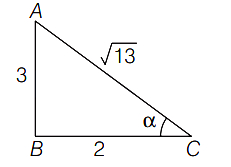
(B) दिया गया है,$f(x)=\cos ^{-1}\left\{\frac{2}{\sqrt{13}} \cos x-\frac{3}{\sqrt{13}} \sin x\right\}$.
मान लीजिए $\cos \alpha = \frac{2}{\sqrt{13}}$ और $\sin \alpha = \frac{3}{\sqrt{13}}$.
तब,$f(x)=\cos ^{-1}(\cos \alpha \cos x - \sin \alpha \sin x)$.
त्रिकोणमितीय सर्वसमिका $\cos(A+B) = \cos A \cos B - \sin A \sin B$ का उपयोग करने पर,हमें प्राप्त होता है:
$f(x) = \cos ^{-1}(\cos(x+\alpha)) = x+\alpha$.
अब,$x$ के सापेक्ष अवकलन करने पर:
$f^{\prime}(x) = \frac{d}{dx}(x+\alpha) = 1 + 0 = 1$.
अतः,$f^{\prime}(0.5) = 1$.
मान लीजिए $\cos \alpha = \frac{2}{\sqrt{13}}$ और $\sin \alpha = \frac{3}{\sqrt{13}}$.
तब,$f(x)=\cos ^{-1}(\cos \alpha \cos x - \sin \alpha \sin x)$.
त्रिकोणमितीय सर्वसमिका $\cos(A+B) = \cos A \cos B - \sin A \sin B$ का उपयोग करने पर,हमें प्राप्त होता है:
$f(x) = \cos ^{-1}(\cos(x+\alpha)) = x+\alpha$.
अब,$x$ के सापेक्ष अवकलन करने पर:
$f^{\prime}(x) = \frac{d}{dx}(x+\alpha) = 1 + 0 = 1$.
अतः,$f^{\prime}(0.5) = 1$.
0 likes
View Solution119
DifficultMCQ
$\frac{d}{d x}\left[\cos ^{2}\left(\cot ^{-1} \sqrt{\frac{2+x}{2-x}}\right)\right]$ का मान ज्ञात कीजिए।
A
$\frac{1}{4}$
B
$\frac{1}{2}$
C
$-\frac{1}{2}$
D
$-\frac{3}{4}$
Solution
(A) माना $y = \cos ^{2}\left(\cot ^{-1} \sqrt{\frac{2+x}{2-x}}\right)$.
$x = 2 \cos \theta$ रखने पर,जिससे $\cos \theta = \frac{x}{2}$ प्राप्त होता है।
तब,$\sqrt{\frac{2+x}{2-x}} = \sqrt{\frac{2+2\cos \theta}{2-2\cos \theta}} = \sqrt{\frac{2(1+\cos \theta)}{2(1-\cos \theta)}} = \sqrt{\frac{2\cos^2(\theta/2)}{2\sin^2(\theta/2)}} = \cot(\theta/2)$.
इस मान को व्यंजक में रखने पर,$y = \cos^2(\cot^{-1}(\cot(\theta/2))) = \cos^2(\theta/2)$ प्राप्त होता है।
सर्वसमिका $\cos^2(\theta/2) = \frac{1+\cos \theta}{2}$ का उपयोग करने पर,$y = \frac{1}{2} + \frac{1}{2}\cos \theta$ प्राप्त होता है।
चूंकि $\cos \theta = \frac{x}{2}$,इसलिए $y = \frac{1}{2} + \frac{x}{4}$ होगा।
अब,$x$ के सापेक्ष अवकलन करने पर: $\frac{dy}{dx} = \frac{d}{dx}(\frac{1}{2} + \frac{x}{4}) = 0 + \frac{1}{4} = \frac{1}{4}$।
$x = 2 \cos \theta$ रखने पर,जिससे $\cos \theta = \frac{x}{2}$ प्राप्त होता है।
तब,$\sqrt{\frac{2+x}{2-x}} = \sqrt{\frac{2+2\cos \theta}{2-2\cos \theta}} = \sqrt{\frac{2(1+\cos \theta)}{2(1-\cos \theta)}} = \sqrt{\frac{2\cos^2(\theta/2)}{2\sin^2(\theta/2)}} = \cot(\theta/2)$.
इस मान को व्यंजक में रखने पर,$y = \cos^2(\cot^{-1}(\cot(\theta/2))) = \cos^2(\theta/2)$ प्राप्त होता है।
सर्वसमिका $\cos^2(\theta/2) = \frac{1+\cos \theta}{2}$ का उपयोग करने पर,$y = \frac{1}{2} + \frac{1}{2}\cos \theta$ प्राप्त होता है।
चूंकि $\cos \theta = \frac{x}{2}$,इसलिए $y = \frac{1}{2} + \frac{x}{4}$ होगा।
अब,$x$ के सापेक्ष अवकलन करने पर: $\frac{dy}{dx} = \frac{d}{dx}(\frac{1}{2} + \frac{x}{4}) = 0 + \frac{1}{4} = \frac{1}{4}$।
0 likes
View Solution120
MediumMCQ
यदि $u=\sin ^{-1}\left(\frac{2 x}{1+x^2}\right)$ और $v=\tan ^{-1}\left(\frac{2 x}{1-x^2}\right)$ है,तो $\frac{d u}{d v}$ का मान ज्ञात कीजिए।
A
$2$
B
$\frac{1-x^2}{1+x^2}$
C
$1$
D
$\frac{1}{2}$
Solution
(C) दिया गया है कि $u = \sin^{-1}\left(\frac{2x}{1+x^2}\right)$.
$x = \tan \theta$ प्रतिस्थापन का उपयोग करने पर,हमें प्राप्त होता है $u = \sin^{-1}(\sin 2\theta) = 2\theta = 2\tan^{-1}x$.
अतः,$\frac{du}{dx} = \frac{2}{1+x^2}$.
दिया गया है कि $v = \tan^{-1}\left(\frac{2x}{1-x^2}\right)$.
$x = \tan \theta$ प्रतिस्थापन का उपयोग करने पर,हमें प्राप्त होता है $v = \tan^{-1}(\tan 2\theta) = 2\theta = 2\tan^{-1}x$.
अतः,$\frac{dv}{dx} = \frac{2}{1+x^2}$.
अब,$\frac{du}{dv} = \frac{du/dx}{dv/dx} = \frac{2/(1+x^2)}{2/(1+x^2)} = 1$.
$x = \tan \theta$ प्रतिस्थापन का उपयोग करने पर,हमें प्राप्त होता है $u = \sin^{-1}(\sin 2\theta) = 2\theta = 2\tan^{-1}x$.
अतः,$\frac{du}{dx} = \frac{2}{1+x^2}$.
दिया गया है कि $v = \tan^{-1}\left(\frac{2x}{1-x^2}\right)$.
$x = \tan \theta$ प्रतिस्थापन का उपयोग करने पर,हमें प्राप्त होता है $v = \tan^{-1}(\tan 2\theta) = 2\theta = 2\tan^{-1}x$.
अतः,$\frac{dv}{dx} = \frac{2}{1+x^2}$.
अब,$\frac{du}{dv} = \frac{du/dx}{dv/dx} = \frac{2/(1+x^2)}{2/(1+x^2)} = 1$.
0 likes
View Solution121
DifficultMCQ
$\tan ^{-1}\left[\frac{\sin x}{1+\cos x}\right]$ का $\tan ^{-1}\left[\frac{\cos x}{1+\sin x}\right]$ के सापेक्ष अवकलज क्या है?
A
$2$
B
$-1$
C
$0$
D
$-2$
Solution
(B) माना $u = \tan ^{-1}\left(\frac{\sin x}{1+\cos x}\right)$ और $v = \tan ^{-1}\left(\frac{\cos x}{1+\sin x}\right)$.
$u$ के लिए:
$u = \tan ^{-1}\left(\frac{2 \sin(x/2) \cos(x/2)}{2 \cos^2(x/2)}\right) = \tan ^{-1}(\tan(x/2)) = x/2$.
अतः,$\frac{du}{dx} = \frac{1}{2}$.
$v$ के लिए:
$v = \tan ^{-1}\left(\frac{\cos^2(x/2) - \sin^2(x/2)}{(\cos(x/2) + \sin(x/2))^2}\right) = \tan ^{-1}\left(\frac{(\cos(x/2) - \sin(x/2))(\cos(x/2) + \sin(x/2))}{(\cos(x/2) + \sin(x/2))^2}\right)$.
$v = \tan ^{-1}\left(\frac{\cos(x/2) - \sin(x/2)}{\cos(x/2) + \sin(x/2)}\right) = \tan ^{-1}\left(\frac{1 - \tan(x/2)}{1 + \tan(x/2)}\right) = \tan ^{-1}\left(\tan\left(\frac{\pi}{4} - \frac{x}{2}\right)\right) = \frac{\pi}{4} - \frac{x}{2}$.
अतः,$\frac{dv}{dx} = -\frac{1}{2}$.
अब,$\frac{du}{dv} = \frac{du/dx}{dv/dx} = \frac{1/2}{-1/2} = -1$.
$u$ के लिए:
$u = \tan ^{-1}\left(\frac{2 \sin(x/2) \cos(x/2)}{2 \cos^2(x/2)}\right) = \tan ^{-1}(\tan(x/2)) = x/2$.
अतः,$\frac{du}{dx} = \frac{1}{2}$.
$v$ के लिए:
$v = \tan ^{-1}\left(\frac{\cos^2(x/2) - \sin^2(x/2)}{(\cos(x/2) + \sin(x/2))^2}\right) = \tan ^{-1}\left(\frac{(\cos(x/2) - \sin(x/2))(\cos(x/2) + \sin(x/2))}{(\cos(x/2) + \sin(x/2))^2}\right)$.
$v = \tan ^{-1}\left(\frac{\cos(x/2) - \sin(x/2)}{\cos(x/2) + \sin(x/2)}\right) = \tan ^{-1}\left(\frac{1 - \tan(x/2)}{1 + \tan(x/2)}\right) = \tan ^{-1}\left(\tan\left(\frac{\pi}{4} - \frac{x}{2}\right)\right) = \frac{\pi}{4} - \frac{x}{2}$.
अतः,$\frac{dv}{dx} = -\frac{1}{2}$.
अब,$\frac{du}{dv} = \frac{du/dx}{dv/dx} = \frac{1/2}{-1/2} = -1$.
0 likes
View Solution122
DifficultMCQ
यदि $f(x) = \sin^{-1}\left[\frac{2^{x+1}}{1+4^x}\right]$ है,तो $f'(0) = $
A
$\log 2$
B
$\frac{4 \log 2}{5}$
C
$2 \log 2$
D
$\frac{2 \log 2}{5}$
Solution
(A) दिया गया है $f(x) = \sin^{-1}\left[\frac{2 \cdot 2^x}{1 + (2^x)^2}\right]$.
मान लीजिए $2^x = \tan \theta$,तो $\theta = \tan^{-1}(2^x)$.
इसे फलन में प्रतिस्थापित करने पर:
$f(x) = \sin^{-1}\left[\frac{2 \tan \theta}{1 + \tan^2 \theta}\right]$
सर्वसमिका $\sin 2\theta = \frac{2 \tan \theta}{1 + \tan^2 \theta}$ का उपयोग करने पर:
$f(x) = \sin^{-1}(\sin 2\theta) = 2\theta = 2 \tan^{-1}(2^x)$.
अब,$x$ के सापेक्ष अवकलन करने पर:
$f'(x) = 2 \cdot \frac{1}{1 + (2^x)^2} \cdot \frac{d}{dx}(2^x)$
$f'(x) = \frac{2}{1 + 4^x} \cdot 2^x \log_e 2$.
$x = 0$ पर मान ज्ञात करने पर:
$f'(0) = \frac{2}{1 + 4^0} \cdot 2^0 \log_e 2 = \frac{2}{1 + 1} \cdot 1 \cdot \log_e 2 = \frac{2}{2} \log_e 2 = \log_e 2$.
मान लीजिए $2^x = \tan \theta$,तो $\theta = \tan^{-1}(2^x)$.
इसे फलन में प्रतिस्थापित करने पर:
$f(x) = \sin^{-1}\left[\frac{2 \tan \theta}{1 + \tan^2 \theta}\right]$
सर्वसमिका $\sin 2\theta = \frac{2 \tan \theta}{1 + \tan^2 \theta}$ का उपयोग करने पर:
$f(x) = \sin^{-1}(\sin 2\theta) = 2\theta = 2 \tan^{-1}(2^x)$.
अब,$x$ के सापेक्ष अवकलन करने पर:
$f'(x) = 2 \cdot \frac{1}{1 + (2^x)^2} \cdot \frac{d}{dx}(2^x)$
$f'(x) = \frac{2}{1 + 4^x} \cdot 2^x \log_e 2$.
$x = 0$ पर मान ज्ञात करने पर:
$f'(0) = \frac{2}{1 + 4^0} \cdot 2^0 \log_e 2 = \frac{2}{1 + 1} \cdot 1 \cdot \log_e 2 = \frac{2}{2} \log_e 2 = \log_e 2$.
0 likes
View Solution123
MediumMCQ
यदि $f(x)=\sin ^{-1}\left(\frac{2 x}{1+x^{2}}\right)$ है,तो $f^{\prime}(\sqrt{3})$ का मान ज्ञात कीजिए।
A
$-\frac{1}{2}$
B
$\frac{1}{2}$
C
$\frac{1}{\sqrt{3}}$
D
$-\frac{1}{\sqrt{3}}$
Solution
(B) हमें दिया गया है,$f(x)=\sin ^{-1}\left(\frac{2 x}{1+x^{2}}\right)$.
माना $x=\tan \theta$,तब $\theta=\tan ^{-1} x$.
इस मान को फलन में रखने पर,हमें प्राप्त होता है $f(x)=\sin ^{-1}\left(\frac{2 \tan \theta}{1+\tan ^{2} \theta}\right)$.
चूँकि $\sin 2\theta = \frac{2 \tan \theta}{1+\tan ^{2} \theta}$,इसलिए $f(x)=\sin ^{-1}(\sin 2 \theta) = 2 \theta = 2 \tan ^{-1} x$.
$x$ के सापेक्ष अवकलन करने पर,हमें $f^{\prime}(x) = \frac{2}{1+x^{2}}$ प्राप्त होता है।
अब $x=\sqrt{3}$ रखने पर,$f^{\prime}(\sqrt{3}) = \frac{2}{1+(\sqrt{3})^{2}} = \frac{2}{1+3} = \frac{2}{4} = \frac{1}{2}$.
माना $x=\tan \theta$,तब $\theta=\tan ^{-1} x$.
इस मान को फलन में रखने पर,हमें प्राप्त होता है $f(x)=\sin ^{-1}\left(\frac{2 \tan \theta}{1+\tan ^{2} \theta}\right)$.
चूँकि $\sin 2\theta = \frac{2 \tan \theta}{1+\tan ^{2} \theta}$,इसलिए $f(x)=\sin ^{-1}(\sin 2 \theta) = 2 \theta = 2 \tan ^{-1} x$.
$x$ के सापेक्ष अवकलन करने पर,हमें $f^{\prime}(x) = \frac{2}{1+x^{2}}$ प्राप्त होता है।
अब $x=\sqrt{3}$ रखने पर,$f^{\prime}(\sqrt{3}) = \frac{2}{1+(\sqrt{3})^{2}} = \frac{2}{1+3} = \frac{2}{4} = \frac{1}{2}$.
0 likes
View Solution124
DifficultMCQ
यदि $y = \operatorname{Tan}^{-1}\left(\frac{2x}{1-x^2}\right)$ जहाँ $|x| < 1$,तो $x = \frac{1}{2}$ पर $\left(\frac{dy}{dx}\right)$ का मान ज्ञात कीजिए।
A
$\frac{1}{5}$
B
$\frac{2}{5}$
C
$\frac{4}{5}$
D
$\frac{8}{5}$
Solution
(D) दिया गया है $y = \operatorname{Tan}^{-1}\left(\frac{2x}{1-x^2}\right)$.
हम जानते हैं कि त्रिकोणमितीय सर्वसमिका $2\operatorname{Tan}^{-1}(x) = \operatorname{Tan}^{-1}\left(\frac{2x}{1-x^2}\right)$ होती है,जहाँ $|x| < 1$ है।
इसे समीकरण में प्रतिस्थापित करने पर,हमें $y = 2\operatorname{Tan}^{-1}(x)$ प्राप्त होता है।
अब,$x$ के सापेक्ष अवकलन करने पर:
$\frac{dy}{dx} = 2 \times \frac{1}{1+x^2} = \frac{2}{1+x^2}$.
अवकलज में $x = \frac{1}{2}$ रखने पर:
$\left(\frac{dy}{dx}\right)_{x=\frac{1}{2}} = \frac{2}{1 + (\frac{1}{2})^2} = \frac{2}{1 + \frac{1}{4}} = \frac{2}{\frac{5}{4}} = \frac{8}{5}$.
अतः,सही विकल्प $D$ है।
हम जानते हैं कि त्रिकोणमितीय सर्वसमिका $2\operatorname{Tan}^{-1}(x) = \operatorname{Tan}^{-1}\left(\frac{2x}{1-x^2}\right)$ होती है,जहाँ $|x| < 1$ है।
इसे समीकरण में प्रतिस्थापित करने पर,हमें $y = 2\operatorname{Tan}^{-1}(x)$ प्राप्त होता है।
अब,$x$ के सापेक्ष अवकलन करने पर:
$\frac{dy}{dx} = 2 \times \frac{1}{1+x^2} = \frac{2}{1+x^2}$.
अवकलज में $x = \frac{1}{2}$ रखने पर:
$\left(\frac{dy}{dx}\right)_{x=\frac{1}{2}} = \frac{2}{1 + (\frac{1}{2})^2} = \frac{2}{1 + \frac{1}{4}} = \frac{2}{\frac{5}{4}} = \frac{8}{5}$.
अतः,सही विकल्प $D$ है।
0 likes
View Solution125
MediumMCQ
यदि $y = \operatorname{Tanh}^{-1} \sqrt{\frac{1-x}{1+x}}$ है,तो $\frac{dy}{dx} = $
A
$-\frac{1}{2 \sqrt{1-x^2}}$
B
$\frac{-1}{2 x \sqrt{1-x^2}}$
C
$\frac{2}{1+x^2}$
D
$\frac{1}{2 \sqrt{1+x^2}}$
Solution
(B) दिया गया है $y = \operatorname{Tanh}^{-1} \sqrt{\frac{1-x}{1+x}}$.
माना $x = \cos \theta$,तब $\theta = \cos^{-1} x$.
तब $\sqrt{\frac{1-x}{1+x}} = \sqrt{\frac{1-\cos \theta}{1+\cos \theta}} = \sqrt{\frac{2 \sin^2 (\theta/2)}{2 \cos^2 (\theta/2)}} = \tan(\theta/2)$.
अतः,$y = \operatorname{Tanh}^{-1} (\tan(\theta/2))$.
सर्वसमिका $\operatorname{Tanh}^{-1} z = \frac{1}{2} \ln \left( \frac{1+z}{1-z} \right)$ का उपयोग करने पर:
$y = \frac{1}{2} \ln \left( \frac{1+\tan(\theta/2)}{1-\tan(\theta/2)} \right) = \frac{1}{2} \ln \left( \tan \left( \frac{\pi}{4} + \frac{\theta}{2} \right) \right) = \frac{1}{2} \left( \ln \tan \left( \frac{\pi}{4} + \frac{\cos^{-1} x}{2} \right) \right)$.
$x$ के सापेक्ष अवकलन करने पर:
$\frac{dy}{dx} = \frac{1}{2} \cdot \frac{1}{\tan(\frac{\pi}{4} + \frac{\theta}{2})} \cdot \sec^2(\frac{\pi}{4} + \frac{\theta}{2}) \cdot \frac{1}{2} \cdot \frac{d}{dx}(\cos^{-1} x)$.
$\frac{dy}{dx} = \frac{1}{4} \cdot \frac{1}{\sin(\frac{\pi}{4} + \frac{\theta}{2}) \cos(\frac{\pi}{4} + \frac{\theta}{2})} \cdot \left( -\frac{1}{\sqrt{1-x^2}} \right)$.
$\frac{dy}{dx} = \frac{1}{2 \sin(\frac{\pi}{2} + \theta)} \cdot \left( -\frac{1}{\sqrt{1-x^2}} \right) = \frac{1}{2 \cos \theta} \cdot \left( -\frac{1}{\sqrt{1-x^2}} \right) = -\frac{1}{2x \sqrt{1-x^2}}$.
माना $x = \cos \theta$,तब $\theta = \cos^{-1} x$.
तब $\sqrt{\frac{1-x}{1+x}} = \sqrt{\frac{1-\cos \theta}{1+\cos \theta}} = \sqrt{\frac{2 \sin^2 (\theta/2)}{2 \cos^2 (\theta/2)}} = \tan(\theta/2)$.
अतः,$y = \operatorname{Tanh}^{-1} (\tan(\theta/2))$.
सर्वसमिका $\operatorname{Tanh}^{-1} z = \frac{1}{2} \ln \left( \frac{1+z}{1-z} \right)$ का उपयोग करने पर:
$y = \frac{1}{2} \ln \left( \frac{1+\tan(\theta/2)}{1-\tan(\theta/2)} \right) = \frac{1}{2} \ln \left( \tan \left( \frac{\pi}{4} + \frac{\theta}{2} \right) \right) = \frac{1}{2} \left( \ln \tan \left( \frac{\pi}{4} + \frac{\cos^{-1} x}{2} \right) \right)$.
$x$ के सापेक्ष अवकलन करने पर:
$\frac{dy}{dx} = \frac{1}{2} \cdot \frac{1}{\tan(\frac{\pi}{4} + \frac{\theta}{2})} \cdot \sec^2(\frac{\pi}{4} + \frac{\theta}{2}) \cdot \frac{1}{2} \cdot \frac{d}{dx}(\cos^{-1} x)$.
$\frac{dy}{dx} = \frac{1}{4} \cdot \frac{1}{\sin(\frac{\pi}{4} + \frac{\theta}{2}) \cos(\frac{\pi}{4} + \frac{\theta}{2})} \cdot \left( -\frac{1}{\sqrt{1-x^2}} \right)$.
$\frac{dy}{dx} = \frac{1}{2 \sin(\frac{\pi}{2} + \theta)} \cdot \left( -\frac{1}{\sqrt{1-x^2}} \right) = \frac{1}{2 \cos \theta} \cdot \left( -\frac{1}{\sqrt{1-x^2}} \right) = -\frac{1}{2x \sqrt{1-x^2}}$.
0 likes
View Solution126
MediumMCQ
यदि $y = \operatorname{Tan}^{-1}\left(\frac{x}{1+2x^2}\right) + \operatorname{Tan}^{-1}\left(\frac{x}{1+6x^2}\right)$ है,तो $\frac{dy}{dx} = $
A
$\frac{4}{16x^2+1} - \frac{3}{9x^2+1}$
B
$\frac{3}{9x^2+1} - \frac{1}{x^2+1}$
C
$\frac{3}{9x^2+1} - \frac{2}{4x^2+1}$
D
$\frac{1}{9x^2+1} - \frac{1}{x^2+1}$
Solution
(B) हम जानते हैं कि $\operatorname{Tan}^{-1}(a) - \operatorname{Tan}^{-1}(b) = \operatorname{Tan}^{-1}\left(\frac{a-b}{1+ab}\right)$ होता है।
हम पदों को इस प्रकार लिख सकते हैं:
$\operatorname{Tan}^{-1}\left(\frac{x}{1+2x^2}\right) = \operatorname{Tan}^{-1}\left(\frac{2x-x}{1+(2x)(x)}\right) = \operatorname{Tan}^{-1}(2x) - \operatorname{Tan}^{-1}(x)$.
$\operatorname{Tan}^{-1}\left(\frac{x}{1+6x^2}\right) = \operatorname{Tan}^{-1}\left(\frac{3x-2x}{1+(3x)(2x)}\right) = \operatorname{Tan}^{-1}(3x) - \operatorname{Tan}^{-1}(2x)$.
इन मानों को $y$ के व्यंजक में प्रतिस्थापित करने पर:
$y = (\operatorname{Tan}^{-1}(2x) - \operatorname{Tan}^{-1}(x)) + (\operatorname{Tan}^{-1}(3x) - \operatorname{Tan}^{-1}(2x)) = \operatorname{Tan}^{-1}(3x) - \operatorname{Tan}^{-1}(x)$.
$x$ के सापेक्ष अवकलन करने पर:
$\frac{dy}{dx} = \frac{d}{dx}(\operatorname{Tan}^{-1}(3x)) - \frac{d}{dx}(\operatorname{Tan}^{-1}(x)) = \frac{3}{1+(3x)^2} - \frac{1}{1+x^2} = \frac{3}{9x^2+1} - \frac{1}{x^2+1}$.
हम पदों को इस प्रकार लिख सकते हैं:
$\operatorname{Tan}^{-1}\left(\frac{x}{1+2x^2}\right) = \operatorname{Tan}^{-1}\left(\frac{2x-x}{1+(2x)(x)}\right) = \operatorname{Tan}^{-1}(2x) - \operatorname{Tan}^{-1}(x)$.
$\operatorname{Tan}^{-1}\left(\frac{x}{1+6x^2}\right) = \operatorname{Tan}^{-1}\left(\frac{3x-2x}{1+(3x)(2x)}\right) = \operatorname{Tan}^{-1}(3x) - \operatorname{Tan}^{-1}(2x)$.
इन मानों को $y$ के व्यंजक में प्रतिस्थापित करने पर:
$y = (\operatorname{Tan}^{-1}(2x) - \operatorname{Tan}^{-1}(x)) + (\operatorname{Tan}^{-1}(3x) - \operatorname{Tan}^{-1}(2x)) = \operatorname{Tan}^{-1}(3x) - \operatorname{Tan}^{-1}(x)$.
$x$ के सापेक्ष अवकलन करने पर:
$\frac{dy}{dx} = \frac{d}{dx}(\operatorname{Tan}^{-1}(3x)) - \frac{d}{dx}(\operatorname{Tan}^{-1}(x)) = \frac{3}{1+(3x)^2} - \frac{1}{1+x^2} = \frac{3}{9x^2+1} - \frac{1}{x^2+1}$.
0 likes
View Solution127
MediumMCQ
यदि $y = \operatorname{Tan}^{-1} \sqrt{x^2-1} + \operatorname{Sinh}^{-1} \sqrt{x^2-1}$,$x > 1$ है,तो $\frac{dy}{dx} = $
A
$\frac{1}{x \sqrt{x^2-1}}$
B
$\frac{x+1}{x \sqrt{x^2-1}}$
C
$\frac{x+1}{x^2 \sqrt{x^2-1}}$
D
$\frac{x}{\sqrt{x^2-1}}$
Solution
(B) माना $u = \sqrt{x^2-1}$ है। तो $y = \operatorname{Tan}^{-1}(u) + \operatorname{Sinh}^{-1}(u)$ है।
श्रृंखला नियम (chain rule) का उपयोग करते हुए,$\frac{dy}{dx} = \frac{dy}{du} \cdot \frac{du}{dx}$ है।
सबसे पहले,$\frac{dy}{du} = \frac{d}{du}(\operatorname{Tan}^{-1} u) + \frac{d}{du}(\operatorname{Sinh}^{-1} u) = \frac{1}{1+u^2} + \frac{1}{\sqrt{1+u^2}}$ है।
$u^2 = x^2-1$ प्रतिस्थापित करने पर: $\frac{dy}{du} = \frac{1}{1+(x^2-1)} + \frac{1}{\sqrt{1+(x^2-1)}} = \frac{1}{x^2} + \frac{1}{x} = \frac{1+x}{x^2}$ है।
अब,$\frac{du}{dx} = \frac{d}{dx}(\sqrt{x^2-1}) = \frac{1}{2\sqrt{x^2-1}} \cdot 2x = \frac{x}{\sqrt{x^2-1}}$ है।
अतः,$\frac{dy}{dx} = \left(\frac{1+x}{x^2}\right) \cdot \left(\frac{x}{\sqrt{x^2-1}}\right) = \frac{1+x}{x \sqrt{x^2-1}}$ है।
इस प्रकार,सही विकल्प $B$ है।
श्रृंखला नियम (chain rule) का उपयोग करते हुए,$\frac{dy}{dx} = \frac{dy}{du} \cdot \frac{du}{dx}$ है।
सबसे पहले,$\frac{dy}{du} = \frac{d}{du}(\operatorname{Tan}^{-1} u) + \frac{d}{du}(\operatorname{Sinh}^{-1} u) = \frac{1}{1+u^2} + \frac{1}{\sqrt{1+u^2}}$ है।
$u^2 = x^2-1$ प्रतिस्थापित करने पर: $\frac{dy}{du} = \frac{1}{1+(x^2-1)} + \frac{1}{\sqrt{1+(x^2-1)}} = \frac{1}{x^2} + \frac{1}{x} = \frac{1+x}{x^2}$ है।
अब,$\frac{du}{dx} = \frac{d}{dx}(\sqrt{x^2-1}) = \frac{1}{2\sqrt{x^2-1}} \cdot 2x = \frac{x}{\sqrt{x^2-1}}$ है।
अतः,$\frac{dy}{dx} = \left(\frac{1+x}{x^2}\right) \cdot \left(\frac{x}{\sqrt{x^2-1}}\right) = \frac{1+x}{x \sqrt{x^2-1}}$ है।
इस प्रकार,सही विकल्प $B$ है।
0 likes
View Solution128
EasyMCQ
यदि $y=\tan ^{-1}\left(\frac{2-3 \sin x}{3-2 \sin x}\right)$ है,तो $\frac{d y}{d x}=$
A
$\frac{(3-2 \sin x)^2}{13 \sin ^2 x-24 \sin x+13}$
B
$\frac{-5 \cos x}{13 \sin ^2 x-24 \sin x+13}$
C
$\frac{5 \sin x}{13 \sin ^2 x-24 \sin x+13}$
D
$\frac{-5 \sin x}{13 \sin ^2 x-24 \sin x+13}$
Solution
(B) दिया गया है,$y=\tan ^{-1}\left(\frac{2-3 \sin x}{3-2 \sin x}\right)$.
श्रृंखला नियम (chain rule) का उपयोग करते हुए,$\frac{d y}{d x}=\frac{1}{1+\left(\frac{2-3 \sin x}{3-2 \sin x}\right)^2} \times \frac{d}{d x}\left(\frac{2-3 \sin x}{3-2 \sin x}\right)$.
हर (denominator) को सरल करने पर: $1+\left(\frac{2-3 \sin x}{3-2 \sin x}\right)^2 = \frac{(3-2 \sin x)^2 + (2-3 \sin x)^2}{(3-2 \sin x)^2} = \frac{9+4 \sin^2 x - 12 \sin x + 4 + 9 \sin^2 x - 12 \sin x}{(3-2 \sin x)^2} = \frac{13 \sin^2 x - 24 \sin x + 13}{(3-2 \sin x)^2}$.
अब,भागफल नियम (quotient rule) का उपयोग करके आंतरिक फलन का अवकलन करने पर: $\frac{d}{d x}\left(\frac{2-3 \sin x}{3-2 \sin x}\right) = \frac{(3-2 \sin x)(-3 \cos x) - (2-3 \sin x)(-2 \cos x)}{(3-2 \sin x)^2}$.
$= \frac{-9 \cos x + 6 \sin x \cos x + 4 \cos x - 6 \sin x \cos x}{(3-2 \sin x)^2} = \frac{-5 \cos x}{(3-2 \sin x)^2}$.
इन दोनों को संयोजित करने पर,$\frac{d y}{d x} = \frac{(3-2 \sin x)^2}{13 \sin^2 x - 24 \sin x + 13} \times \frac{-5 \cos x}{(3-2 \sin x)^2} = \frac{-5 \cos x}{13 \sin^2 x - 24 \sin x + 13}$.
श्रृंखला नियम (chain rule) का उपयोग करते हुए,$\frac{d y}{d x}=\frac{1}{1+\left(\frac{2-3 \sin x}{3-2 \sin x}\right)^2} \times \frac{d}{d x}\left(\frac{2-3 \sin x}{3-2 \sin x}\right)$.
हर (denominator) को सरल करने पर: $1+\left(\frac{2-3 \sin x}{3-2 \sin x}\right)^2 = \frac{(3-2 \sin x)^2 + (2-3 \sin x)^2}{(3-2 \sin x)^2} = \frac{9+4 \sin^2 x - 12 \sin x + 4 + 9 \sin^2 x - 12 \sin x}{(3-2 \sin x)^2} = \frac{13 \sin^2 x - 24 \sin x + 13}{(3-2 \sin x)^2}$.
अब,भागफल नियम (quotient rule) का उपयोग करके आंतरिक फलन का अवकलन करने पर: $\frac{d}{d x}\left(\frac{2-3 \sin x}{3-2 \sin x}\right) = \frac{(3-2 \sin x)(-3 \cos x) - (2-3 \sin x)(-2 \cos x)}{(3-2 \sin x)^2}$.
$= \frac{-9 \cos x + 6 \sin x \cos x + 4 \cos x - 6 \sin x \cos x}{(3-2 \sin x)^2} = \frac{-5 \cos x}{(3-2 \sin x)^2}$.
इन दोनों को संयोजित करने पर,$\frac{d y}{d x} = \frac{(3-2 \sin x)^2}{13 \sin^2 x - 24 \sin x + 13} \times \frac{-5 \cos x}{(3-2 \sin x)^2} = \frac{-5 \cos x}{13 \sin^2 x - 24 \sin x + 13}$.
0 likes
View Solution129
MediumMCQ
यदि $y = \tan^{-1} \left( \frac{\sqrt{1 + x^2} + \sqrt{1 - x^2}}{\sqrt{1 + x^2} - \sqrt{1 - x^2}} \right)$,जहाँ $x^2 \le 1$ है,तो $\frac{dy}{dx}$ ज्ञात कीजिए।
A
$\frac{\pi}{4} + \frac{1}{2} \cos^{-1} (x^2)$
B
$\frac{\pi}{4} - \frac{1}{2} \cos^{-1} (x^2)$
C
$\frac{-x}{\sqrt{1 - x^4}}$
D
$\frac{-2x}{\sqrt{1 - x^4}}$
Solution
(C) दिया गया है कि $y = \tan^{-1} \left( \frac{\sqrt{1 + x^2} + \sqrt{1 - x^2}}{\sqrt{1 + x^2} - \sqrt{1 - x^2}} \right)$.
माना $x^2 = \cos 2\theta$,तब $\theta = \frac{1}{2} \cos^{-1} (x^2)$.
$x^2 = \cos 2\theta$ को व्यंजक में प्रतिस्थापित करने पर:
$y = \tan^{-1} \left( \frac{\sqrt{1 + \cos 2\theta} + \sqrt{1 - \cos 2\theta}}{\sqrt{1 + \cos 2\theta} - \sqrt{1 - \cos 2\theta}} \right)$.
सर्वसमिकाओं $1 + \cos 2\theta = 2 \cos^2 \theta$ और $1 - \cos 2\theta = 2 \sin^2 \theta$ का उपयोग करने पर:
$y = \tan^{-1} \left( \frac{\sqrt{2} \cos \theta + \sqrt{2} \sin \theta}{\sqrt{2} \cos \theta - \sqrt{2} \sin \theta} \right) = \tan^{-1} \left( \frac{\cos \theta + \sin \theta}{\cos \theta - \sin \theta} \right)$.
अंश और हर को $\cos \theta$ से विभाजित करने पर:
$y = \tan^{-1} \left( \frac{1 + \tan \theta}{1 - \tan \theta} \right) = \tan^{-1} \left( \tan \left( \frac{\pi}{4} + \theta \right) \right) = \frac{\pi}{4} + \theta$.
$\theta = \frac{1}{2} \cos^{-1} (x^2)$ रखने पर:
$y = \frac{\pi}{4} + \frac{1}{2} \cos^{-1} (x^2)$.
$x$ के सापेक्ष अवकलन करने पर:
$\frac{dy}{dx} = 0 + \frac{1}{2} \left( \frac{-1}{\sqrt{1 - (x^2)^2}} \right) \cdot \frac{d}{dx}(x^2) = \frac{1}{2} \left( \frac{-1}{\sqrt{1 - x^4}} \right) \cdot 2x = \frac{-x}{\sqrt{1 - x^4}}$.
माना $x^2 = \cos 2\theta$,तब $\theta = \frac{1}{2} \cos^{-1} (x^2)$.
$x^2 = \cos 2\theta$ को व्यंजक में प्रतिस्थापित करने पर:
$y = \tan^{-1} \left( \frac{\sqrt{1 + \cos 2\theta} + \sqrt{1 - \cos 2\theta}}{\sqrt{1 + \cos 2\theta} - \sqrt{1 - \cos 2\theta}} \right)$.
सर्वसमिकाओं $1 + \cos 2\theta = 2 \cos^2 \theta$ और $1 - \cos 2\theta = 2 \sin^2 \theta$ का उपयोग करने पर:
$y = \tan^{-1} \left( \frac{\sqrt{2} \cos \theta + \sqrt{2} \sin \theta}{\sqrt{2} \cos \theta - \sqrt{2} \sin \theta} \right) = \tan^{-1} \left( \frac{\cos \theta + \sin \theta}{\cos \theta - \sin \theta} \right)$.
अंश और हर को $\cos \theta$ से विभाजित करने पर:
$y = \tan^{-1} \left( \frac{1 + \tan \theta}{1 - \tan \theta} \right) = \tan^{-1} \left( \tan \left( \frac{\pi}{4} + \theta \right) \right) = \frac{\pi}{4} + \theta$.
$\theta = \frac{1}{2} \cos^{-1} (x^2)$ रखने पर:
$y = \frac{\pi}{4} + \frac{1}{2} \cos^{-1} (x^2)$.
$x$ के सापेक्ष अवकलन करने पर:
$\frac{dy}{dx} = 0 + \frac{1}{2} \left( \frac{-1}{\sqrt{1 - (x^2)^2}} \right) \cdot \frac{d}{dx}(x^2) = \frac{1}{2} \left( \frac{-1}{\sqrt{1 - x^4}} \right) \cdot 2x = \frac{-x}{\sqrt{1 - x^4}}$.
0 likes
View Solution130
MediumMCQ
$\frac{d}{dx} \left\{ \sin^2 \left( \cot^{-1} \sqrt{\frac{1 + x}{1 - x}} \right) \right\} =$
A
$0$
B
$\frac{- 1}{2}$
C
$\frac{1}{2}$
D
$- 1$
Solution
(B) माना $y = \sin^2 \left( \cot^{-1} \sqrt{\frac{1 + x}{1 - x}} \right)$.
$x = \cos 2\theta$ प्रतिस्थापित करने पर,अतः $\theta = \frac{1}{2} \cos^{-1} x$.
तब $\sqrt{\frac{1 + x}{1 - x}} = \sqrt{\frac{1 + \cos 2\theta}{1 - \cos 2\theta}} = \sqrt{\frac{2 \cos^2 \theta}{2 \sin^2 \theta}} = \cot \theta$.
अतः,$y = \sin^2 \left( \cot^{-1} (\cot \theta) \right) = \sin^2 \theta$.
सर्वसमिका $\sin^2 \theta = \frac{1 - \cos 2\theta}{2}$ का उपयोग करने पर,हमें $y = \frac{1 - x}{2} = \frac{1}{2} - \frac{x}{2}$ प्राप्त होता है।
$x$ के सापेक्ष अवकलन करने पर:
$\frac{dy}{dx} = \frac{d}{dx} \left( \frac{1}{2} - \frac{x}{2} \right) = 0 - \frac{1}{2} = -\frac{1}{2}$.
$x = \cos 2\theta$ प्रतिस्थापित करने पर,अतः $\theta = \frac{1}{2} \cos^{-1} x$.
तब $\sqrt{\frac{1 + x}{1 - x}} = \sqrt{\frac{1 + \cos 2\theta}{1 - \cos 2\theta}} = \sqrt{\frac{2 \cos^2 \theta}{2 \sin^2 \theta}} = \cot \theta$.
अतः,$y = \sin^2 \left( \cot^{-1} (\cot \theta) \right) = \sin^2 \theta$.
सर्वसमिका $\sin^2 \theta = \frac{1 - \cos 2\theta}{2}$ का उपयोग करने पर,हमें $y = \frac{1 - x}{2} = \frac{1}{2} - \frac{x}{2}$ प्राप्त होता है।
$x$ के सापेक्ष अवकलन करने पर:
$\frac{dy}{dx} = \frac{d}{dx} \left( \frac{1}{2} - \frac{x}{2} \right) = 0 - \frac{1}{2} = -\frac{1}{2}$.
0 likes
View Solution131
MediumMCQ
यदि $y = \tan^{-1}\left(\frac{a \cos x - b \sin x}{b \cos x + a \sin x}\right)$ है,तो $\frac{dy}{dx}$ का मान ज्ञात कीजिए।
A
$0$
B
$\frac{a}{b}$
C
$-1$
D
$2$
Solution
(C) दिया गया है $y = \tan^{-1}\left(\frac{a \cos x - b \sin x}{b \cos x + a \sin x}\right)$.
अंश और हर को $b \cos x$ से विभाजित करने पर:
$y = \tan^{-1}\left(\frac{\frac{a}{b} - \tan x}{1 + \frac{a}{b} \tan x}\right)$.
माना $\frac{a}{b} = \tan \theta$,जहाँ $\theta = \tan^{-1}(\frac{a}{b})$.
तब $y = \tan^{-1}\left(\frac{\tan \theta - \tan x}{1 + \tan \theta \tan x}\right)$.
सूत्र $\tan(A - B) = \frac{\tan A - \tan B}{1 + \tan A \tan B}$ का उपयोग करने पर:
$y = \tan^{-1}(\tan(\theta - x)) = \theta - x$.
चूंकि $\theta = \tan^{-1}(\frac{a}{b})$ एक स्थिरांक है,इसलिए इसका अवकलन $0$ होगा।
अतः,$\frac{dy}{dx} = \frac{d}{dx}(\theta - x) = 0 - 1 = -1$.
अंश और हर को $b \cos x$ से विभाजित करने पर:
$y = \tan^{-1}\left(\frac{\frac{a}{b} - \tan x}{1 + \frac{a}{b} \tan x}\right)$.
माना $\frac{a}{b} = \tan \theta$,जहाँ $\theta = \tan^{-1}(\frac{a}{b})$.
तब $y = \tan^{-1}\left(\frac{\tan \theta - \tan x}{1 + \tan \theta \tan x}\right)$.
सूत्र $\tan(A - B) = \frac{\tan A - \tan B}{1 + \tan A \tan B}$ का उपयोग करने पर:
$y = \tan^{-1}(\tan(\theta - x)) = \theta - x$.
चूंकि $\theta = \tan^{-1}(\frac{a}{b})$ एक स्थिरांक है,इसलिए इसका अवकलन $0$ होगा।
अतः,$\frac{dy}{dx} = \frac{d}{dx}(\theta - x) = 0 - 1 = -1$.
0 likes
View Solution132
DifficultMCQ
यदि $y=\sin ^{-1}\left[x \sqrt{1-x^2}-\sqrt{x} \sqrt{1-x}\right]$ और $0 < x < 1$ है,तो $\frac{d y}{d x}$ का मान ज्ञात कीजिए।
A
$\frac{1}{\sqrt{1-x^2}}-\frac{1}{2 \sqrt{x-x^2}}$
B
$\frac{1}{2 \sqrt{1-x^2}}-\frac{1}{2 \sqrt{x-x^2}}$
C
$\frac{1}{2 \sqrt{1-x^2}}+\frac{1}{\sqrt{1-x^2}}$
D
$\frac{-1}{\sqrt{1-x^2}}-\frac{1}{2 \sqrt{x-x^2}}$
Solution
(A) दिया गया है $y = \sin^{-1}(x \sqrt{1-x^2} - \sqrt{x} \sqrt{1-x})$.
मान लीजिए $x = \sin \alpha$ और $\sqrt{x} = \sin \beta$. तब $\sqrt{1-x^2} = \cos \alpha$ और $\sqrt{1-x} = \cos \beta$.
इन मानों को समीकरण में रखने पर,$y = \sin^{-1}(\sin \alpha \cos \beta - \cos \alpha \sin \beta)$.
सर्वसमिका $\sin(\alpha - \beta) = \sin \alpha \cos \beta - \cos \alpha \sin \beta$ का उपयोग करने पर,$y = \sin^{-1}(\sin(\alpha - \beta)) = \alpha - \beta$.
अतः,$y = \sin^{-1} x - \sin^{-1} \sqrt{x}$.
$x$ के सापेक्ष अवकलन करने पर:
$\frac{dy}{dx} = \frac{d}{dx}(\sin^{-1} x) - \frac{d}{dx}(\sin^{-1} \sqrt{x})$.
$\frac{dy}{dx} = \frac{1}{\sqrt{1-x^2}} - \frac{1}{\sqrt{1-(\sqrt{x})^2}} \cdot \frac{d}{dx}(\sqrt{x})$.
$\frac{dy}{dx} = \frac{1}{\sqrt{1-x^2}} - \frac{1}{\sqrt{1-x}} \cdot \frac{1}{2\sqrt{x}}$.
$\frac{dy}{dx} = \frac{1}{\sqrt{1-x^2}} - \frac{1}{2\sqrt{x(1-x)}} = \frac{1}{\sqrt{1-x^2}} - \frac{1}{2\sqrt{x-x^2}}$.
मान लीजिए $x = \sin \alpha$ और $\sqrt{x} = \sin \beta$. तब $\sqrt{1-x^2} = \cos \alpha$ और $\sqrt{1-x} = \cos \beta$.
इन मानों को समीकरण में रखने पर,$y = \sin^{-1}(\sin \alpha \cos \beta - \cos \alpha \sin \beta)$.
सर्वसमिका $\sin(\alpha - \beta) = \sin \alpha \cos \beta - \cos \alpha \sin \beta$ का उपयोग करने पर,$y = \sin^{-1}(\sin(\alpha - \beta)) = \alpha - \beta$.
अतः,$y = \sin^{-1} x - \sin^{-1} \sqrt{x}$.
$x$ के सापेक्ष अवकलन करने पर:
$\frac{dy}{dx} = \frac{d}{dx}(\sin^{-1} x) - \frac{d}{dx}(\sin^{-1} \sqrt{x})$.
$\frac{dy}{dx} = \frac{1}{\sqrt{1-x^2}} - \frac{1}{\sqrt{1-(\sqrt{x})^2}} \cdot \frac{d}{dx}(\sqrt{x})$.
$\frac{dy}{dx} = \frac{1}{\sqrt{1-x^2}} - \frac{1}{\sqrt{1-x}} \cdot \frac{1}{2\sqrt{x}}$.
$\frac{dy}{dx} = \frac{1}{\sqrt{1-x^2}} - \frac{1}{2\sqrt{x(1-x)}} = \frac{1}{\sqrt{1-x^2}} - \frac{1}{2\sqrt{x-x^2}}$.
0 likes
View Solution133
EasyMCQ
$\tan ^{-1}\left[\frac{x}{1+\sqrt{1-x^2}}\right]$ का $\sec ^{-1}\left(\frac{1}{2 x^2-1}\right)$ के सापेक्ष अवकलज क्या है?
A
$\frac{1}{2}$
B
$\frac{1}{4}$
C
$\frac{-1}{4}$
D
$\frac{-1}{2}$
Solution
(C) माना $y = \tan ^{-1}\left(\frac{x}{1+\sqrt{1-x^2}}\right)$ और $u = \sec ^{-1}\left(\frac{1}{2 x^2-1}\right)$.
$x = \sin \theta$ प्रतिस्थापित करने पर,$\sqrt{1-x^2} = \cos \theta$ प्राप्त होता है।
$y = \tan ^{-1}\left(\frac{\sin \theta}{1+\cos \theta}\right) = \tan ^{-1}\left(\frac{2 \sin(\theta/2) \cos(\theta/2)}{2 \cos^2(\theta/2)}\right) = \tan ^{-1}(\tan(\theta/2)) = \frac{\theta}{2}$.
अब,$u = \sec ^{-1}\left(\frac{1}{2 \sin^2 \theta - 1}\right) = \sec ^{-1}\left(\frac{1}{-(1-2 \sin^2 \theta)}\right) = \sec ^{-1}\left(\frac{1}{-\cos 2 \theta}\right) = \sec ^{-1}(-\sec 2 \theta) = \sec ^{-1}(\sec(\pi - 2 \theta)) = \pi - 2 \theta$.
चूँकि $x = \sin \theta$,इसलिए $\theta = \sin^{-1} x$.
अतः,$y = \frac{1}{2} \sin^{-1} x$ और $u = \pi - 2 \sin^{-1} x$.
अब $\frac{dy}{dx} = \frac{1}{2 \sqrt{1-x^2}}$ और $\frac{du}{dx} = \frac{-2}{\sqrt{1-x^2}}$.
इसलिए,$\frac{dy}{du} = \frac{dy/dx}{du/dx} = \frac{1/(2 \sqrt{1-x^2})}{-2/\sqrt{1-x^2}} = -\frac{1}{4}$.
$x = \sin \theta$ प्रतिस्थापित करने पर,$\sqrt{1-x^2} = \cos \theta$ प्राप्त होता है।
$y = \tan ^{-1}\left(\frac{\sin \theta}{1+\cos \theta}\right) = \tan ^{-1}\left(\frac{2 \sin(\theta/2) \cos(\theta/2)}{2 \cos^2(\theta/2)}\right) = \tan ^{-1}(\tan(\theta/2)) = \frac{\theta}{2}$.
अब,$u = \sec ^{-1}\left(\frac{1}{2 \sin^2 \theta - 1}\right) = \sec ^{-1}\left(\frac{1}{-(1-2 \sin^2 \theta)}\right) = \sec ^{-1}\left(\frac{1}{-\cos 2 \theta}\right) = \sec ^{-1}(-\sec 2 \theta) = \sec ^{-1}(\sec(\pi - 2 \theta)) = \pi - 2 \theta$.
चूँकि $x = \sin \theta$,इसलिए $\theta = \sin^{-1} x$.
अतः,$y = \frac{1}{2} \sin^{-1} x$ और $u = \pi - 2 \sin^{-1} x$.
अब $\frac{dy}{dx} = \frac{1}{2 \sqrt{1-x^2}}$ और $\frac{du}{dx} = \frac{-2}{\sqrt{1-x^2}}$.
इसलिए,$\frac{dy}{du} = \frac{dy/dx}{du/dx} = \frac{1/(2 \sqrt{1-x^2})}{-2/\sqrt{1-x^2}} = -\frac{1}{4}$.
0 likes
View Solution134
EasyMCQ
$\frac{d}{d x}\left(\cos ^{-1}\left(\frac{4 x^3}{27}-x\right)\right)=$
A
$\frac{3}{\sqrt{9-x^2}}$
B
$\frac{1}{\sqrt{9-x^2}}$
C
$\frac{-3}{\sqrt{9-x^2}}$
D
$\frac{-1}{\sqrt{9-x^2}}$
Solution
(C) माना $y = \cos ^{-1}\left(\frac{4 x^3}{27}-x\right)$.
हम व्यंजक को $y = \cos ^{-1}\left(4\left(\frac{x}{3}\right)^3 - 3\left(\frac{x}{3}\right)\right)$ के रूप में लिख सकते हैं।
माना $\frac{x}{3} = \cos A$,तो $A = \cos ^{-1}\left(\frac{x}{3}\right)$.
इसे व्यंजक में प्रतिस्थापित करने पर,हमें $y = \cos ^{-1}(4 \cos ^3 A - 3 \cos A)$ प्राप्त होता है।
त्रिकोणमितीय सर्वसमिका $\cos(3A) = 4 \cos ^3 A - 3 \cos A$ का उपयोग करते हुए,$y = \cos ^{-1}(\cos 3A) = 3A$ प्राप्त होता है।
अतः,$y = 3 \cos ^{-1}\left(\frac{x}{3}\right)$.
$x$ के सापेक्ष अवकलन करने पर:
$\frac{dy}{dx} = 3 \times \left(-\frac{1}{\sqrt{1 - (x/3)^2}}\right) \times \frac{d}{dx}\left(\frac{x}{3}\right)$.
$\frac{dy}{dx} = 3 \times \left(-\frac{1}{\sqrt{(9-x^2)/9}}\right) \times \frac{1}{3} = 3 \times \left(-\frac{3}{\sqrt{9-x^2}}\right) \times \frac{1}{3} = -\frac{3}{\sqrt{9-x^2}}$.
हम व्यंजक को $y = \cos ^{-1}\left(4\left(\frac{x}{3}\right)^3 - 3\left(\frac{x}{3}\right)\right)$ के रूप में लिख सकते हैं।
माना $\frac{x}{3} = \cos A$,तो $A = \cos ^{-1}\left(\frac{x}{3}\right)$.
इसे व्यंजक में प्रतिस्थापित करने पर,हमें $y = \cos ^{-1}(4 \cos ^3 A - 3 \cos A)$ प्राप्त होता है।
त्रिकोणमितीय सर्वसमिका $\cos(3A) = 4 \cos ^3 A - 3 \cos A$ का उपयोग करते हुए,$y = \cos ^{-1}(\cos 3A) = 3A$ प्राप्त होता है।
अतः,$y = 3 \cos ^{-1}\left(\frac{x}{3}\right)$.
$x$ के सापेक्ष अवकलन करने पर:
$\frac{dy}{dx} = 3 \times \left(-\frac{1}{\sqrt{1 - (x/3)^2}}\right) \times \frac{d}{dx}\left(\frac{x}{3}\right)$.
$\frac{dy}{dx} = 3 \times \left(-\frac{1}{\sqrt{(9-x^2)/9}}\right) \times \frac{1}{3} = 3 \times \left(-\frac{3}{\sqrt{9-x^2}}\right) \times \frac{1}{3} = -\frac{3}{\sqrt{9-x^2}}$.
0 likes
View Solution135
MediumMCQ
$y = \tan^{-1} \left[ \frac{\sqrt{1 + \sin x} + \sqrt{1 - \sin x}}{\sqrt{1 + \sin x} - \sqrt{1 - \sin x}} \right]$ का $x$ के सापेक्ष अवकलन क्या है?
A
$-1$
B
$0$
C
$\pm 2$
D
$\pm \frac{1}{2}$
Solution
(D) दिया गया है कि $y = \tan^{-1} \left[ \frac{\sqrt{1 + \sin x} + \sqrt{1 - \sin x}}{\sqrt{1 + \sin x} - \sqrt{1 - \sin x}} \right]$.
हम जानते हैं कि $1 + \sin x = (\cos \frac{x}{2} + \sin \frac{x}{2})^2$ और $1 - \sin x = (\cos \frac{x}{2} - \sin \frac{x}{2})^2$.
अतः,$\sqrt{1 + \sin x} = |\cos \frac{x}{2} + \sin \frac{x}{2}|$ और $\sqrt{1 - \sin x} = |\cos \frac{x}{2} - \sin \frac{x}{2}|$.
इन मानों को $y$ के समीकरण में रखने पर:
$y = \tan^{-1} \left[ \frac{(\cos \frac{x}{2} + \sin \frac{x}{2}) + (\cos \frac{x}{2} - \sin \frac{x}{2})}{(\cos \frac{x}{2} + \sin \frac{x}{2}) - (\cos \frac{x}{2} - \sin \frac{x}{2})} \right]$ (मान लीजिए $0 < x < \frac{\pi}{2}$).
$y = \tan^{-1} \left( \frac{2 \cos \frac{x}{2}}{2 \sin \frac{x}{2}} \right) = \tan^{-1} (\cot \frac{x}{2}) = \tan^{-1} \left( \tan (\frac{\pi}{2} - \frac{x}{2}) \right) = \frac{\pi}{2} - \frac{x}{2}$.
$x$ के सापेक्ष अवकलन करने पर:
$\frac{dy}{dx} = \frac{d}{dx} (\frac{\pi}{2} - \frac{x}{2}) = -\frac{1}{2}$.
$x$ के अंतराल के आधार पर,अवकलन $\pm \frac{1}{2}$ हो सकता है।
अतः,सही विकल्प $(D)$ है।
हम जानते हैं कि $1 + \sin x = (\cos \frac{x}{2} + \sin \frac{x}{2})^2$ और $1 - \sin x = (\cos \frac{x}{2} - \sin \frac{x}{2})^2$.
अतः,$\sqrt{1 + \sin x} = |\cos \frac{x}{2} + \sin \frac{x}{2}|$ और $\sqrt{1 - \sin x} = |\cos \frac{x}{2} - \sin \frac{x}{2}|$.
इन मानों को $y$ के समीकरण में रखने पर:
$y = \tan^{-1} \left[ \frac{(\cos \frac{x}{2} + \sin \frac{x}{2}) + (\cos \frac{x}{2} - \sin \frac{x}{2})}{(\cos \frac{x}{2} + \sin \frac{x}{2}) - (\cos \frac{x}{2} - \sin \frac{x}{2})} \right]$ (मान लीजिए $0 < x < \frac{\pi}{2}$).
$y = \tan^{-1} \left( \frac{2 \cos \frac{x}{2}}{2 \sin \frac{x}{2}} \right) = \tan^{-1} (\cot \frac{x}{2}) = \tan^{-1} \left( \tan (\frac{\pi}{2} - \frac{x}{2}) \right) = \frac{\pi}{2} - \frac{x}{2}$.
$x$ के सापेक्ष अवकलन करने पर:
$\frac{dy}{dx} = \frac{d}{dx} (\frac{\pi}{2} - \frac{x}{2}) = -\frac{1}{2}$.
$x$ के अंतराल के आधार पर,अवकलन $\pm \frac{1}{2}$ हो सकता है।
अतः,सही विकल्प $(D)$ है।
0 likes
View Solution136
EasyMCQ
$y=\tan ^{-1}\left(\frac{\sqrt{1+x^2}-1}{x}\right)$ का अवकलज क्या है?
A
$\frac{2}{1+x^2}$
B
$\frac{1}{2(1+x^2)}$
C
$1+x^2$
D
$2(1+x^2)$
Solution
(B) दिया गया है,$y=\tan ^{-1}\left(\frac{\sqrt{1+x^2}-1}{x}\right)$.
माना $x=\tan \theta$,तो $\theta = \tan ^{-1} x$.
व्यंजक में $x$ का मान रखने पर:
$y = \tan ^{-1}\left(\frac{\sqrt{1+\tan ^2 \theta}-1}{\tan \theta}\right)$
$y = \tan ^{-1}\left(\frac{\sec \theta-1}{\tan \theta}\right)$
$y = \tan ^{-1}\left(\frac{\frac{1}{\cos \theta}-1}{\frac{\sin \theta}{\cos \theta}}\right) = \tan ^{-1}\left(\frac{1-\cos \theta}{\sin \theta}\right)$
त्रिकोणमितीय सर्वसमिकाओं $1-\cos \theta = 2\sin ^2(\theta/2)$ और $\sin \theta = 2\sin(\theta/2)\cos(\theta/2)$ का उपयोग करने पर:
$y = \tan ^{-1}\left(\frac{2\sin ^2(\theta/2)}{2\sin(\theta/2)\cos(\theta/2)}\right) = \tan ^{-1}(\tan(\theta/2)) = \theta/2$.
चूंकि $\theta = \tan ^{-1} x$,इसलिए $y = \frac{1}{2} \tan ^{-1} x$.
$x$ के सापेक्ष अवकलन करने पर:
$\frac{dy}{dx} = \frac{1}{2} \cdot \frac{1}{1+x^2} = \frac{1}{2(1+x^2)}$.
अतः,विकल्प $B$ सही है।
माना $x=\tan \theta$,तो $\theta = \tan ^{-1} x$.
व्यंजक में $x$ का मान रखने पर:
$y = \tan ^{-1}\left(\frac{\sqrt{1+\tan ^2 \theta}-1}{\tan \theta}\right)$
$y = \tan ^{-1}\left(\frac{\sec \theta-1}{\tan \theta}\right)$
$y = \tan ^{-1}\left(\frac{\frac{1}{\cos \theta}-1}{\frac{\sin \theta}{\cos \theta}}\right) = \tan ^{-1}\left(\frac{1-\cos \theta}{\sin \theta}\right)$
त्रिकोणमितीय सर्वसमिकाओं $1-\cos \theta = 2\sin ^2(\theta/2)$ और $\sin \theta = 2\sin(\theta/2)\cos(\theta/2)$ का उपयोग करने पर:
$y = \tan ^{-1}\left(\frac{2\sin ^2(\theta/2)}{2\sin(\theta/2)\cos(\theta/2)}\right) = \tan ^{-1}(\tan(\theta/2)) = \theta/2$.
चूंकि $\theta = \tan ^{-1} x$,इसलिए $y = \frac{1}{2} \tan ^{-1} x$.
$x$ के सापेक्ष अवकलन करने पर:
$\frac{dy}{dx} = \frac{1}{2} \cdot \frac{1}{1+x^2} = \frac{1}{2(1+x^2)}$.
अतः,विकल्प $B$ सही है।
0 likes
View Solution137
MediumMCQ
$y = \sin^{-1}\left(\frac{\sqrt{1+x} - \sqrt{1-x}}{2}\right)$ का अवकलज क्या है?
A
$\frac{1}{\sqrt{1+x^2}}$
B
$\frac{1}{\sqrt{1-x^2}}$
C
$\frac{1}{2\sqrt{1+x^2}}$
D
$\frac{1}{2\sqrt{1-x^2}}$
Solution
(D) $y = \sin^{-1}\left(\frac{\sqrt{1+x} - \sqrt{1-x}}{2}\right)$
माना $x = \cos 2\theta$,तब $2\theta = \cos^{-1} x$ या $\theta = \frac{1}{2} \cos^{-1} x$।
व्यंजक में $x$ का मान रखने पर:
$y = \sin^{-1}\left(\frac{\sqrt{1+\cos 2\theta} - \sqrt{1-\cos 2\theta}}{2}\right)$
त्रिकोणमितीय सर्वसमिकाओं $1+\cos 2\theta = 2\cos^2 \theta$ और $1-\cos 2\theta = 2\sin^2 \theta$ का उपयोग करने पर:
$y = \sin^{-1}\left(\frac{\sqrt{2}\cos \theta - \sqrt{2}\sin \theta}{2}\right) = \sin^{-1}\left(\frac{\cos \theta - \sin \theta}{\sqrt{2}}\right)$
$y = \sin^{-1}\left(\frac{1}{\sqrt{2}}\cos \theta - \frac{1}{\sqrt{2}}\sin \theta\right)$
$y = \sin^{-1}\left(\sin \frac{\pi}{4} \cos \theta - \cos \frac{\pi}{4} \sin \theta\right)$
$y = \sin^{-1}\left(\sin\left(\frac{\pi}{4} - \theta\right)\right) = \frac{\pi}{4} - \theta$
$\theta = \frac{1}{2} \cos^{-1} x$ रखने पर:
$y = \frac{\pi}{4} - \frac{1}{2} \cos^{-1} x$
$x$ के सापेक्ष अवकलन करने पर:
$\frac{dy}{dx} = 0 - \frac{1}{2} \left(-\frac{1}{\sqrt{1-x^2}}\right) = \frac{1}{2\sqrt{1-x^2}}$
अतः,विकल्प $D$ सही है।
माना $x = \cos 2\theta$,तब $2\theta = \cos^{-1} x$ या $\theta = \frac{1}{2} \cos^{-1} x$।
व्यंजक में $x$ का मान रखने पर:
$y = \sin^{-1}\left(\frac{\sqrt{1+\cos 2\theta} - \sqrt{1-\cos 2\theta}}{2}\right)$
त्रिकोणमितीय सर्वसमिकाओं $1+\cos 2\theta = 2\cos^2 \theta$ और $1-\cos 2\theta = 2\sin^2 \theta$ का उपयोग करने पर:
$y = \sin^{-1}\left(\frac{\sqrt{2}\cos \theta - \sqrt{2}\sin \theta}{2}\right) = \sin^{-1}\left(\frac{\cos \theta - \sin \theta}{\sqrt{2}}\right)$
$y = \sin^{-1}\left(\frac{1}{\sqrt{2}}\cos \theta - \frac{1}{\sqrt{2}}\sin \theta\right)$
$y = \sin^{-1}\left(\sin \frac{\pi}{4} \cos \theta - \cos \frac{\pi}{4} \sin \theta\right)$
$y = \sin^{-1}\left(\sin\left(\frac{\pi}{4} - \theta\right)\right) = \frac{\pi}{4} - \theta$
$\theta = \frac{1}{2} \cos^{-1} x$ रखने पर:
$y = \frac{\pi}{4} - \frac{1}{2} \cos^{-1} x$
$x$ के सापेक्ष अवकलन करने पर:
$\frac{dy}{dx} = 0 - \frac{1}{2} \left(-\frac{1}{\sqrt{1-x^2}}\right) = \frac{1}{2\sqrt{1-x^2}}$
अतः,विकल्प $D$ सही है।
0 likes
View Solution138
MediumMCQ
यदि $y = \tan^{-1} \left( \frac{5x - x}{1 + 5x^2} \right) + \tan^{-1} \left( \frac{2/3 + x}{1 - (2/3)x} \right)$,तो $\frac{dy}{dx} =$
A
$\frac{5}{1 + 25x^2} + \frac{1}{1 + x^2}$
B
$\frac{5}{1 + 25x^2}$
C
$\frac{1}{1 + x^2}$
D
$\frac{5}{1 + 25x^2} + \frac{2}{1 + x^2}$
Solution
(B) दिया गया है $y = \tan^{-1} \left( \frac{5x - x}{1 + 5x^2} \right) + \tan^{-1} \left( \frac{2/3 + x}{1 - (2/3)x} \right)$.
सूत्र $\tan^{-1} a - \tan^{-1} b = \tan^{-1} \left( \frac{a - b}{1 + ab} \right)$ का उपयोग करने पर,पहला पद $\tan^{-1}(5x) - \tan^{-1}(x)$ है।
सूत्र $\tan^{-1} a + \tan^{-1} b = \tan^{-1} \left( \frac{a + b}{1 - ab} \right)$ का उपयोग करने पर,दूसरा पद $\tan^{-1}(2/3) + \tan^{-1}(x)$ है।
अतः,$y = \tan^{-1}(5x) - \tan^{-1}(x) + \tan^{-1}(2/3) + \tan^{-1}(x) = \tan^{-1}(5x) + \tan^{-1}(2/3)$.
$x$ के सापेक्ष अवकलन करने पर:
$\frac{dy}{dx} = \frac{d}{dx} (\tan^{-1}(5x)) + \frac{d}{dx} (\tan^{-1}(2/3))$.
चूंकि $\tan^{-1}(2/3)$ एक स्थिरांक है,इसका अवकलज $0$ है।
$\frac{dy}{dx} = \frac{1}{1 + (5x)^2} \times \frac{d}{dx}(5x) + 0 = \frac{5}{1 + 25x^2}$.
सूत्र $\tan^{-1} a - \tan^{-1} b = \tan^{-1} \left( \frac{a - b}{1 + ab} \right)$ का उपयोग करने पर,पहला पद $\tan^{-1}(5x) - \tan^{-1}(x)$ है।
सूत्र $\tan^{-1} a + \tan^{-1} b = \tan^{-1} \left( \frac{a + b}{1 - ab} \right)$ का उपयोग करने पर,दूसरा पद $\tan^{-1}(2/3) + \tan^{-1}(x)$ है।
अतः,$y = \tan^{-1}(5x) - \tan^{-1}(x) + \tan^{-1}(2/3) + \tan^{-1}(x) = \tan^{-1}(5x) + \tan^{-1}(2/3)$.
$x$ के सापेक्ष अवकलन करने पर:
$\frac{dy}{dx} = \frac{d}{dx} (\tan^{-1}(5x)) + \frac{d}{dx} (\tan^{-1}(2/3))$.
चूंकि $\tan^{-1}(2/3)$ एक स्थिरांक है,इसका अवकलज $0$ है।
$\frac{dy}{dx} = \frac{1}{1 + (5x)^2} \times \frac{d}{dx}(5x) + 0 = \frac{5}{1 + 25x^2}$.
0 likes
View Solution139
EasyMCQ
$\frac{d}{dx} \left( \sin^{-1} \left( \frac{3+4x}{5\sqrt{1+x^2}} \right) \right) =$
A
$\frac{1}{1+x^2}$
B
$\frac{-1}{1+x^2}$
C
$\frac{1}{\sqrt{1+x^2}}$
D
$\frac{-1}{\sqrt{1+x^2}}$
Solution
(A) माना $y = \sin^{-1} \left( \frac{3}{5} \cdot \frac{1}{\sqrt{1+x^2}} + \frac{4}{5} \cdot \frac{x}{\sqrt{1+x^2}} \right)$ है।
माना $\cos \alpha = \frac{3}{5}$,तो $\sin \alpha = \frac{4}{5}$ होगा।
साथ ही,माना $\sin \theta = \frac{x}{\sqrt{1+x^2}}$,तो $\cos \theta = \frac{1}{\sqrt{1+x^2}}$ होगा।
इन मानों को प्रतिस्थापित करने पर,$y = \sin^{-1} (\cos \alpha \cos \theta + \sin \alpha \sin \theta) = \sin^{-1} (\cos(\alpha - \theta)) = \sin^{-1} (\sin(\frac{\pi}{2} - (\alpha - \theta))) = \frac{\pi}{2} - \alpha + \theta$ प्राप्त होता है।
चूंकि $\theta = \tan^{-1} x$ है,इसलिए $y = \frac{\pi}{2} - \alpha + \tan^{-1} x$ होगा।
$x$ के सापेक्ष अवकलन करने पर,$\frac{dy}{dx} = 0 - 0 + \frac{1}{1+x^2} = \frac{1}{1+x^2}$ प्राप्त होता है।
माना $\cos \alpha = \frac{3}{5}$,तो $\sin \alpha = \frac{4}{5}$ होगा।
साथ ही,माना $\sin \theta = \frac{x}{\sqrt{1+x^2}}$,तो $\cos \theta = \frac{1}{\sqrt{1+x^2}}$ होगा।
इन मानों को प्रतिस्थापित करने पर,$y = \sin^{-1} (\cos \alpha \cos \theta + \sin \alpha \sin \theta) = \sin^{-1} (\cos(\alpha - \theta)) = \sin^{-1} (\sin(\frac{\pi}{2} - (\alpha - \theta))) = \frac{\pi}{2} - \alpha + \theta$ प्राप्त होता है।
चूंकि $\theta = \tan^{-1} x$ है,इसलिए $y = \frac{\pi}{2} - \alpha + \tan^{-1} x$ होगा।
$x$ के सापेक्ष अवकलन करने पर,$\frac{dy}{dx} = 0 - 0 + \frac{1}{1+x^2} = \frac{1}{1+x^2}$ प्राप्त होता है।
0 likes
View Solution140
MediumMCQ
यदि $f(x)=\cot ^{-1}\left(\frac{x^x-x^{-x}}{2}\right)$ है,तो $f^{\prime}(1)=$
A
-log2
B
log2
C
$1$
D
-$1$
Solution
(D) दिया गया है,$f(x)=\cot ^{-1}\left(\frac{x^x-x^{-x}}{2}\right)$.
माना $y = \cot ^{-1}\left(\frac{x^{2x}-1}{2x^x}\right)$.
$x^x = \tan \theta$ रखने पर,$y = \cot ^{-1}\left(\frac{\tan^2 \theta - 1}{2 \tan \theta}\right)$.
चूँकि $\cot 2\theta = \frac{1-\tan^2 \theta}{2 \tan \theta}$,इसलिए $y = \cot ^{-1}(-\cot 2\theta)$.
गुणधर्म $\cot ^{-1}(-z) = \pi - \cot ^{-1}(z)$ का उपयोग करने पर,$y = \pi - \cot ^{-1}(\cot 2\theta) = \pi - 2\theta$.
$\theta = \tan ^{-1}(x^x)$ वापस रखने पर,$y = \pi - 2 \tan ^{-1}(x^x)$.
$x$ के सापेक्ष अवकलन करने पर:
$\frac{dy}{dx} = -2 \cdot \frac{1}{1+(x^x)^2} \cdot \frac{d}{dx}(x^x)$.
चूँकि $\frac{d}{dx}(x^x) = x^x(1 + \ln x)$,इसलिए $\frac{dy}{dx} = -\frac{2x^x(1 + \ln x)}{1 + x^{2x}}$.
$x=1$ पर,$\frac{dy}{dx} = -\frac{2(1)^1(1 + \ln 1)}{1 + (1)^2} = -\frac{2(1)(1+0)}{2} = -1$.
माना $y = \cot ^{-1}\left(\frac{x^{2x}-1}{2x^x}\right)$.
$x^x = \tan \theta$ रखने पर,$y = \cot ^{-1}\left(\frac{\tan^2 \theta - 1}{2 \tan \theta}\right)$.
चूँकि $\cot 2\theta = \frac{1-\tan^2 \theta}{2 \tan \theta}$,इसलिए $y = \cot ^{-1}(-\cot 2\theta)$.
गुणधर्म $\cot ^{-1}(-z) = \pi - \cot ^{-1}(z)$ का उपयोग करने पर,$y = \pi - \cot ^{-1}(\cot 2\theta) = \pi - 2\theta$.
$\theta = \tan ^{-1}(x^x)$ वापस रखने पर,$y = \pi - 2 \tan ^{-1}(x^x)$.
$x$ के सापेक्ष अवकलन करने पर:
$\frac{dy}{dx} = -2 \cdot \frac{1}{1+(x^x)^2} \cdot \frac{d}{dx}(x^x)$.
चूँकि $\frac{d}{dx}(x^x) = x^x(1 + \ln x)$,इसलिए $\frac{dy}{dx} = -\frac{2x^x(1 + \ln x)}{1 + x^{2x}}$.
$x=1$ पर,$\frac{dy}{dx} = -\frac{2(1)^1(1 + \ln 1)}{1 + (1)^2} = -\frac{2(1)(1+0)}{2} = -1$.
0 likes
View Solution141
MediumMCQ
$-1 < x < 1$ के लिए,यदि $f(x) = \cos^2 \left( \tan^{-1} \sqrt{\frac{1-x}{1+x}} \right)$ है,तो $f'(x) =$
A
$\frac{1}{2}$
B
$1$
C
$-1$
D
$-\frac{1}{2}$
Solution
(A) दिया गया फलन $f(x) = \cos^2 \left( \tan^{-1} \sqrt{\frac{1-x}{1+x}} \right)$ है,जहाँ $-1 < x < 1$ है।
माना $x = \cos(2\theta)$,जहाँ $0 < 2\theta < \pi$,इसलिए $0 < \theta < \frac{\pi}{2}$ है।
तब,$\sqrt{\frac{1-x}{1+x}} = \sqrt{\frac{1-\cos(2\theta)}{1+\cos(2\theta)}} = \sqrt{\frac{2\sin^2\theta}{2\cos^2\theta}} = \tan\theta$।
इसे फलन में प्रतिस्थापित करने पर,हमें $f(x) = \cos^2(\tan^{-1}(\tan\theta)) = \cos^2\theta$ प्राप्त होता है।
सर्वसमिका $\cos^2\theta = \frac{1+\cos(2\theta)}{2}$ का उपयोग करने पर,$f(x) = \frac{1+x}{2}$ प्राप्त होता है।
$x$ के सापेक्ष अवकलन करने पर,$f'(x) = \frac{d}{dx} \left( \frac{1}{2} + \frac{x}{2} \right) = \frac{1}{2}$ प्राप्त होता है।
माना $x = \cos(2\theta)$,जहाँ $0 < 2\theta < \pi$,इसलिए $0 < \theta < \frac{\pi}{2}$ है।
तब,$\sqrt{\frac{1-x}{1+x}} = \sqrt{\frac{1-\cos(2\theta)}{1+\cos(2\theta)}} = \sqrt{\frac{2\sin^2\theta}{2\cos^2\theta}} = \tan\theta$।
इसे फलन में प्रतिस्थापित करने पर,हमें $f(x) = \cos^2(\tan^{-1}(\tan\theta)) = \cos^2\theta$ प्राप्त होता है।
सर्वसमिका $\cos^2\theta = \frac{1+\cos(2\theta)}{2}$ का उपयोग करने पर,$f(x) = \frac{1+x}{2}$ प्राप्त होता है।
$x$ के सापेक्ष अवकलन करने पर,$f'(x) = \frac{d}{dx} \left( \frac{1}{2} + \frac{x}{2} \right) = \frac{1}{2}$ प्राप्त होता है।
0 likes
View Solution142
MediumMCQ
यदि $a > b > 0$ और $x$ न्यूनकोण है,तो $\frac{d}{dx} \left[ \cos^{-1} \left( \frac{b - a \cos x}{a - b \cos x} \right) \right] = $
A
$\frac{\sqrt{a^2 - b^2}}{a - b \cos x}$
B
$\frac{-\sqrt{a^2 - b^2}}{a - b \cos x}$
C
$\frac{\sqrt{a^2 - b^2}}{b \cos x - a}$
D
$\frac{-\sqrt{a^2 - b^2}}{b \cos x - a}$
Solution
(B) माना $y = \cos^{-1} \left( \frac{b - a \cos x}{a - b \cos x} \right)$.
प्रतिस्थापन $\cos y = \frac{b - a \cos x}{a - b \cos x}$ का उपयोग करते हुए.
त्रिकोणमितीय सर्वसमिका $\tan \left( \frac{y}{2} \right) = \sqrt{\frac{1 - \cos y}{1 + \cos y}}$ का उपयोग करने पर:
$1 - \cos y = \frac{(a - b)(1 + \cos x)}{a - b \cos x}$ और $1 + \cos y = \frac{(a + b)(1 - \cos x)}{a - b \cos x}$.
अतः,$\tan^2 \left( \frac{y}{2} \right) = \frac{a - b}{a + b} \cot^2 \left( \frac{x}{2} \right)$.
इस प्रकार,$y = 2 \tan^{-1} \left( \sqrt{\frac{a - b}{a + b}} \cot \frac{x}{2} \right)$.
$x$ के सापेक्ष अवकलन करने पर:
$\frac{dy}{dx} = \frac{-\sqrt{a^2 - b^2}}{a - b \cos x}$ प्राप्त होता है।
प्रतिस्थापन $\cos y = \frac{b - a \cos x}{a - b \cos x}$ का उपयोग करते हुए.
त्रिकोणमितीय सर्वसमिका $\tan \left( \frac{y}{2} \right) = \sqrt{\frac{1 - \cos y}{1 + \cos y}}$ का उपयोग करने पर:
$1 - \cos y = \frac{(a - b)(1 + \cos x)}{a - b \cos x}$ और $1 + \cos y = \frac{(a + b)(1 - \cos x)}{a - b \cos x}$.
अतः,$\tan^2 \left( \frac{y}{2} \right) = \frac{a - b}{a + b} \cot^2 \left( \frac{x}{2} \right)$.
इस प्रकार,$y = 2 \tan^{-1} \left( \sqrt{\frac{a - b}{a + b}} \cot \frac{x}{2} \right)$.
$x$ के सापेक्ष अवकलन करने पर:
$\frac{dy}{dx} = \frac{-\sqrt{a^2 - b^2}}{a - b \cos x}$ प्राप्त होता है।
0 likes
View Solution143
DifficultMCQ
यदि $0 < |x| < 1$ के लिए $f(x) = \operatorname{Tan}^{-1} \left[ \frac{\sqrt{1+x^2} + \sqrt{1-x^2}}{\sqrt{1+x^2} - \sqrt{1-x^2}} \right]$ है,तो $f'(x) =$
A
$\frac{x}{\sqrt{1-x^4}}$
B
$\frac{-x}{\sqrt{1-x^4}}$
C
$\frac{x}{\sqrt{1-x^2}}$
D
$\frac{-x}{\sqrt{1-x^2}}$
Solution
(B) माना $x^2 = \cos(2\theta)$,जहाँ $2\theta \in (0, \pi)$,इसलिए $\theta = \frac{1}{2} \cos^{-1}(x^2)$.
तब $\sqrt{1+x^2} = \sqrt{1+\cos(2\theta)} = \sqrt{2\cos^2\theta} = \sqrt{2}\cos\theta$ और $\sqrt{1-x^2} = \sqrt{1-\cos(2\theta)} = \sqrt{2\sin^2\theta} = \sqrt{2}\sin\theta$.
इन मानों को $f(x)$ में प्रतिस्थापित करने पर:
$f(x) = \operatorname{Tan}^{-1} \left[ \frac{\sqrt{2}\cos\theta + \sqrt{2}\sin\theta}{\sqrt{2}\cos\theta - \sqrt{2}\sin\theta} \right] = \operatorname{Tan}^{-1} \left[ \frac{\cos\theta + \sin\theta}{\cos\theta - \sin\theta} \right] = \operatorname{Tan}^{-1} \left[ \frac{1 + \tan\theta}{1 - \tan\theta} \right] = \operatorname{Tan}^{-1} [\tan(\frac{\pi}{4} + \theta)] = \frac{\pi}{4} + \theta$.
$\theta$ का मान वापस रखने पर: $f(x) = \frac{\pi}{4} + \frac{1}{2} \cos^{-1}(x^2)$.
$x$ के सापेक्ष अवकलन करने पर:
$f'(x) = 0 + \frac{1}{2} \cdot \frac{-1}{\sqrt{1-(x^2)^2}} \cdot \frac{d}{dx}(x^2) = \frac{-1}{2\sqrt{1-x^4}} \cdot 2x = \frac{-x}{\sqrt{1-x^4}}$.
तब $\sqrt{1+x^2} = \sqrt{1+\cos(2\theta)} = \sqrt{2\cos^2\theta} = \sqrt{2}\cos\theta$ और $\sqrt{1-x^2} = \sqrt{1-\cos(2\theta)} = \sqrt{2\sin^2\theta} = \sqrt{2}\sin\theta$.
इन मानों को $f(x)$ में प्रतिस्थापित करने पर:
$f(x) = \operatorname{Tan}^{-1} \left[ \frac{\sqrt{2}\cos\theta + \sqrt{2}\sin\theta}{\sqrt{2}\cos\theta - \sqrt{2}\sin\theta} \right] = \operatorname{Tan}^{-1} \left[ \frac{\cos\theta + \sin\theta}{\cos\theta - \sin\theta} \right] = \operatorname{Tan}^{-1} \left[ \frac{1 + \tan\theta}{1 - \tan\theta} \right] = \operatorname{Tan}^{-1} [\tan(\frac{\pi}{4} + \theta)] = \frac{\pi}{4} + \theta$.
$\theta$ का मान वापस रखने पर: $f(x) = \frac{\pi}{4} + \frac{1}{2} \cos^{-1}(x^2)$.
$x$ के सापेक्ष अवकलन करने पर:
$f'(x) = 0 + \frac{1}{2} \cdot \frac{-1}{\sqrt{1-(x^2)^2}} \cdot \frac{d}{dx}(x^2) = \frac{-1}{2\sqrt{1-x^4}} \cdot 2x = \frac{-x}{\sqrt{1-x^4}}$.
0 likes
View Solution144
MediumMCQ
यदि $0 < |x| < 1$ के लिए $y = \operatorname{Tan}^{-1}\left(\frac{\sqrt{1+x^2}+\sqrt{1-x^2}}{\sqrt{1+x^2}-\sqrt{1-x^2}}\right)$ है,तो $\frac{dy}{dx} = $
A
$\frac{x}{\sqrt{1-x^4}}$
B
$\frac{x^2}{\sqrt{1-x^4}}$
C
$\frac{\sqrt{1+x^2}}{\sqrt{1-x^4}}$
D
$\frac{-x}{\sqrt{1-x^4}}$
Solution
(D) माना $x^2 = \cos(2\theta)$,इसलिए $2\theta = \cos^{-1}(x^2)$,जिसका अर्थ है $\theta = \frac{1}{2} \cos^{-1}(x^2)$.
तब $\sqrt{1+x^2} = \sqrt{1+\cos(2\theta)} = \sqrt{2\cos^2(\theta)} = \sqrt{2}\cos(\theta)$ और $\sqrt{1-x^2} = \sqrt{1-\cos(2\theta)} = \sqrt{2\sin^2(\theta)} = \sqrt{2}\sin(\theta)$.
इन मानों को $y$ के व्यंजक में रखने पर:
$y = \operatorname{Tan}^{-1}\left(\frac{\sqrt{2}\cos(\theta) + \sqrt{2}\sin(\theta)}{\sqrt{2}\cos(\theta) - \sqrt{2}\sin(\theta)}\right) = \operatorname{Tan}^{-1}\left(\frac{\cos(\theta) + \sin(\theta)}{\cos(\theta) - \sin(\theta)}\right)$.
अंश और हर को $\cos(\theta)$ से विभाजित करने पर:
$y = \operatorname{Tan}^{-1}\left(\frac{1 + \tan(\theta)}{1 - \tan(\theta)}\right) = \operatorname{Tan}^{-1}(\tan(\frac{\pi}{4} + \theta)) = \frac{\pi}{4} + \theta$.
$\theta = \frac{1}{2} \cos^{-1}(x^2)$ रखने पर:
$y = \frac{\pi}{4} + \frac{1}{2} \cos^{-1}(x^2)$.
$x$ के सापेक्ष अवकलन करने पर:
$\frac{dy}{dx} = 0 + \frac{1}{2} \left(-\frac{1}{\sqrt{1-(x^2)^2}}\right) \cdot (2x) = -\frac{x}{\sqrt{1-x^4}}$.
अतः,सही विकल्प $D$ है।
तब $\sqrt{1+x^2} = \sqrt{1+\cos(2\theta)} = \sqrt{2\cos^2(\theta)} = \sqrt{2}\cos(\theta)$ और $\sqrt{1-x^2} = \sqrt{1-\cos(2\theta)} = \sqrt{2\sin^2(\theta)} = \sqrt{2}\sin(\theta)$.
इन मानों को $y$ के व्यंजक में रखने पर:
$y = \operatorname{Tan}^{-1}\left(\frac{\sqrt{2}\cos(\theta) + \sqrt{2}\sin(\theta)}{\sqrt{2}\cos(\theta) - \sqrt{2}\sin(\theta)}\right) = \operatorname{Tan}^{-1}\left(\frac{\cos(\theta) + \sin(\theta)}{\cos(\theta) - \sin(\theta)}\right)$.
अंश और हर को $\cos(\theta)$ से विभाजित करने पर:
$y = \operatorname{Tan}^{-1}\left(\frac{1 + \tan(\theta)}{1 - \tan(\theta)}\right) = \operatorname{Tan}^{-1}(\tan(\frac{\pi}{4} + \theta)) = \frac{\pi}{4} + \theta$.
$\theta = \frac{1}{2} \cos^{-1}(x^2)$ रखने पर:
$y = \frac{\pi}{4} + \frac{1}{2} \cos^{-1}(x^2)$.
$x$ के सापेक्ष अवकलन करने पर:
$\frac{dy}{dx} = 0 + \frac{1}{2} \left(-\frac{1}{\sqrt{1-(x^2)^2}}\right) \cdot (2x) = -\frac{x}{\sqrt{1-x^4}}$.
अतः,सही विकल्प $D$ है।
0 likes
View Solution145
DifficultMCQ
$\begin{aligned} & \text{यदि } y = \tan^{-1} \left\{ \frac{x}{1 + \sqrt{1 - x^2}} \right\} \\ & + \sin \left\{ 2 \tan^{-1} \sqrt{\frac{1 - x}{1 + x}} \right\} \text{ है, तो } \frac{dy}{dx} = \end{aligned}$
A
$\frac{1 - 2x}{2 \sqrt{1 - x^2}}$
B
$\frac{1 - 2x}{x \sqrt{1 - x^2}}$
C
$\frac{2x + 1}{x \sqrt{1 - x}}$
D
$\frac{2 - x}{2 \sqrt{1 - x^2}}$
Solution
(A) दिया गया है,$y = \tan^{-1} \left\{ \frac{x}{1 + \sqrt{1 - x^2}} \right\} + \sin \left\{ 2 \tan^{-1} \sqrt{\frac{1 - x}{1 + x}} \right\}$.
माना $x = \cos 2\theta$,तब $\theta = \frac{1}{2} \cos^{-1} x$.
$x = \cos 2\theta$ को व्यंजक में प्रतिस्थापित करने पर:
$y = \tan^{-1} \left\{ \frac{\cos 2\theta}{1 + \sin 2\theta} \right\} + \sin \left\{ 2 \tan^{-1} \sqrt{\frac{1 - \cos 2\theta}{1 + \cos 2\theta}} \right\}$
$y = \tan^{-1} \left\{ \frac{\cos^2 \theta - \sin^2 \theta}{(\cos \theta + \sin \theta)^2} \right\} + \sin \left\{ 2 \tan^{-1} (\tan \theta) \right\}$
$y = \tan^{-1} \left\{ \frac{\cos \theta - \sin \theta}{\cos \theta + \sin \theta} \right\} + \sin 2\theta$
$y = \tan^{-1} \left\{ \tan \left( \frac{\pi}{4} - \theta \right) \right\} + \sin 2\theta$
$y = \frac{\pi}{4} - \theta + \sin 2\theta$
$\theta = \frac{1}{2} \cos^{-1} x$ और $\sin 2\theta = \sqrt{1 - x^2}$ रखने पर:
$y = \frac{\pi}{4} - \frac{1}{2} \cos^{-1} x + \sqrt{1 - x^2}$
$x$ के सापेक्ष अवकलन करने पर:
$\frac{dy}{dx} = 0 - \frac{1}{2} \left( -\frac{1}{\sqrt{1 - x^2}} \right) + \frac{1}{2\sqrt{1 - x^2}} (-2x)$
$\frac{dy}{dx} = \frac{1}{2\sqrt{1 - x^2}} - \frac{x}{\sqrt{1 - x^2}} = \frac{1 - 2x}{2\sqrt{1 - x^2}}$.
माना $x = \cos 2\theta$,तब $\theta = \frac{1}{2} \cos^{-1} x$.
$x = \cos 2\theta$ को व्यंजक में प्रतिस्थापित करने पर:
$y = \tan^{-1} \left\{ \frac{\cos 2\theta}{1 + \sin 2\theta} \right\} + \sin \left\{ 2 \tan^{-1} \sqrt{\frac{1 - \cos 2\theta}{1 + \cos 2\theta}} \right\}$
$y = \tan^{-1} \left\{ \frac{\cos^2 \theta - \sin^2 \theta}{(\cos \theta + \sin \theta)^2} \right\} + \sin \left\{ 2 \tan^{-1} (\tan \theta) \right\}$
$y = \tan^{-1} \left\{ \frac{\cos \theta - \sin \theta}{\cos \theta + \sin \theta} \right\} + \sin 2\theta$
$y = \tan^{-1} \left\{ \tan \left( \frac{\pi}{4} - \theta \right) \right\} + \sin 2\theta$
$y = \frac{\pi}{4} - \theta + \sin 2\theta$
$\theta = \frac{1}{2} \cos^{-1} x$ और $\sin 2\theta = \sqrt{1 - x^2}$ रखने पर:
$y = \frac{\pi}{4} - \frac{1}{2} \cos^{-1} x + \sqrt{1 - x^2}$
$x$ के सापेक्ष अवकलन करने पर:
$\frac{dy}{dx} = 0 - \frac{1}{2} \left( -\frac{1}{\sqrt{1 - x^2}} \right) + \frac{1}{2\sqrt{1 - x^2}} (-2x)$
$\frac{dy}{dx} = \frac{1}{2\sqrt{1 - x^2}} - \frac{x}{\sqrt{1 - x^2}} = \frac{1 - 2x}{2\sqrt{1 - x^2}}$.
0 likes
View Solution146
MediumMCQ
$x=\frac{1}{2}$ पर $\sqrt{1-x^2}$ के सापेक्ष $\operatorname{Sec}^{-1}\left(\frac{1}{2x^2-1}\right)$ का अवकलज ज्ञात कीजिए।
A
$-2$
B
$1$
C
$2$
D
$4$
Solution
(D) माना $u = \operatorname{Sec}^{-1}\left(\frac{1}{2x^2-1}\right)$ और $v = \sqrt{1-x^2}$ है।
सर्वसमिका $\operatorname{Sec}^{-1}(\frac{1}{z}) = \cos^{-1}(z)$ का उपयोग करने पर,हमें $u = \cos^{-1}(2x^2-1)$ प्राप्त होता है।
माना $x = \cos \theta$,तब $u = \cos^{-1}(2\cos^2 \theta - 1) = \cos^{-1}(\cos 2\theta) = 2\theta = 2\cos^{-1}x$ है।
अतः,$\frac{du}{dx} = 2 \times (-\frac{1}{\sqrt{1-x^2}}) = -\frac{2}{\sqrt{1-x^2}}$ है।
अब,$v = \sqrt{1-x^2}$ है,इसलिए $\frac{dv}{dx} = \frac{1}{2\sqrt{1-x^2}} \times (-2x) = -\frac{x}{\sqrt{1-x^2}}$ है।
हमें $\frac{du}{dv} = \frac{du/dx}{dv/dx} = \frac{-2/\sqrt{1-x^2}}{-x/\sqrt{1-x^2}} = \frac{2}{x}$ ज्ञात करना है।
$x = \frac{1}{2}$ पर,$\frac{du}{dv} = \frac{2}{1/2} = 4$ है।
सर्वसमिका $\operatorname{Sec}^{-1}(\frac{1}{z}) = \cos^{-1}(z)$ का उपयोग करने पर,हमें $u = \cos^{-1}(2x^2-1)$ प्राप्त होता है।
माना $x = \cos \theta$,तब $u = \cos^{-1}(2\cos^2 \theta - 1) = \cos^{-1}(\cos 2\theta) = 2\theta = 2\cos^{-1}x$ है।
अतः,$\frac{du}{dx} = 2 \times (-\frac{1}{\sqrt{1-x^2}}) = -\frac{2}{\sqrt{1-x^2}}$ है।
अब,$v = \sqrt{1-x^2}$ है,इसलिए $\frac{dv}{dx} = \frac{1}{2\sqrt{1-x^2}} \times (-2x) = -\frac{x}{\sqrt{1-x^2}}$ है।
हमें $\frac{du}{dv} = \frac{du/dx}{dv/dx} = \frac{-2/\sqrt{1-x^2}}{-x/\sqrt{1-x^2}} = \frac{2}{x}$ ज्ञात करना है।
$x = \frac{1}{2}$ पर,$\frac{du}{dv} = \frac{2}{1/2} = 4$ है।
0 likes
View Solution147
MediumMCQ
मान लीजिए $f: R \rightarrow R$ एक सतत फलन है। यदि $px+my+n=0$ वक्र $y=f(x)$ पर $x=\alpha$ पर खींची गई एक स्पर्श रेखा है,तो $x=0$ पर $\frac{d}{d x}\left(f\left(\alpha e^{2 x}\right)\right)=$
A
$0$
B
$\frac{p}{m}$
C
$\frac{-2 \alpha m}{p}$
D
$\frac{-2 p \alpha}{m}$
Solution
(D) दिया गया है कि $px+my+n=0$ वक्र $y=f(x)$ पर $x=\alpha$ पर स्पर्श रेखा है।
स्पर्श रेखा $px+my+n=0$ की ढाल $m_t = -\frac{p}{m}$ है।
अतः,$f'(\alpha) = -\frac{p}{m}$।
अब,हमें $x=0$ पर $\frac{d}{dx} [f(\alpha e^{2x})]$ ज्ञात करना है।
श्रृंखला नियम (chain rule) का उपयोग करते हुए:
$\frac{d}{dx} [f(\alpha e^{2x})] = f'(\alpha e^{2x}) \cdot \frac{d}{dx}(\alpha e^{2x}) = f'(\alpha e^{2x}) \cdot (2\alpha e^{2x})$।
$x=0$ पर,व्यंजक इस प्रकार होगा:
$f'(\alpha e^0) \cdot (2\alpha e^0) = f'(\alpha) \cdot (2\alpha)$।
$f'(\alpha) = -\frac{p}{m}$ प्रतिस्थापित करने पर:
$(-\frac{p}{m}) \cdot (2\alpha) = -\frac{2p\alpha}{m}$।
स्पर्श रेखा $px+my+n=0$ की ढाल $m_t = -\frac{p}{m}$ है।
अतः,$f'(\alpha) = -\frac{p}{m}$।
अब,हमें $x=0$ पर $\frac{d}{dx} [f(\alpha e^{2x})]$ ज्ञात करना है।
श्रृंखला नियम (chain rule) का उपयोग करते हुए:
$\frac{d}{dx} [f(\alpha e^{2x})] = f'(\alpha e^{2x}) \cdot \frac{d}{dx}(\alpha e^{2x}) = f'(\alpha e^{2x}) \cdot (2\alpha e^{2x})$।
$x=0$ पर,व्यंजक इस प्रकार होगा:
$f'(\alpha e^0) \cdot (2\alpha e^0) = f'(\alpha) \cdot (2\alpha)$।
$f'(\alpha) = -\frac{p}{m}$ प्रतिस्थापित करने पर:
$(-\frac{p}{m}) \cdot (2\alpha) = -\frac{2p\alpha}{m}$।
0 likes
View Solution148
MediumMCQ
यदि $y = \tan^2 \left( \cos^{-1} \sqrt{\frac{1+x^2}{2}} \right)$ है,तो $\frac{dy}{dx} = $
A
$-\frac{4x}{(1-x^2)^2}$
B
$\frac{4x}{(1+x^2)^2}$
C
$-\frac{4x}{(1+x^2)^2}$
D
$-\frac{4x}{1+x^2}$
Solution
(C) माना $\theta = \cos^{-1} \sqrt{\frac{1+x^2}{2}}$ है। तब $\cos \theta = \sqrt{\frac{1+x^2}{2}}$ है।
दोनों पक्षों का वर्ग करने पर,$\cos^2 \theta = \frac{1+x^2}{2}$ प्राप्त होता है।
सर्वसमिका $\tan^2 \theta = \sec^2 \theta - 1 = \frac{1}{\cos^2 \theta} - 1$ का उपयोग करने पर:
$y = \frac{1}{\cos^2 \theta} - 1 = \frac{1}{\frac{1+x^2}{2}} - 1 = \frac{2}{1+x^2} - 1 = \frac{2 - (1+x^2)}{1+x^2} = \frac{1-x^2}{1+x^2}$ प्राप्त होता है।
अब,भागफल नियम $\frac{d}{dx} \left( \frac{u}{v} \right) = \frac{v u' - u v'}{v^2}$ का उपयोग करके $y$ का $x$ के सापेक्ष अवकलन करने पर:
$\frac{dy}{dx} = \frac{(1+x^2)(-2x) - (1-x^2)(2x)}{(1+x^2)^2} = \frac{-2x - 2x^3 - 2x + 2x^3}{(1+x^2)^2} = \frac{-4x}{(1+x^2)^2}$ प्राप्त होता है।
अतः,सही विकल्प $C$ है।
दोनों पक्षों का वर्ग करने पर,$\cos^2 \theta = \frac{1+x^2}{2}$ प्राप्त होता है।
सर्वसमिका $\tan^2 \theta = \sec^2 \theta - 1 = \frac{1}{\cos^2 \theta} - 1$ का उपयोग करने पर:
$y = \frac{1}{\cos^2 \theta} - 1 = \frac{1}{\frac{1+x^2}{2}} - 1 = \frac{2}{1+x^2} - 1 = \frac{2 - (1+x^2)}{1+x^2} = \frac{1-x^2}{1+x^2}$ प्राप्त होता है।
अब,भागफल नियम $\frac{d}{dx} \left( \frac{u}{v} \right) = \frac{v u' - u v'}{v^2}$ का उपयोग करके $y$ का $x$ के सापेक्ष अवकलन करने पर:
$\frac{dy}{dx} = \frac{(1+x^2)(-2x) - (1-x^2)(2x)}{(1+x^2)^2} = \frac{-2x - 2x^3 - 2x + 2x^3}{(1+x^2)^2} = \frac{-4x}{(1+x^2)^2}$ प्राप्त होता है।
अतः,सही विकल्प $C$ है।
0 likes
View Solution149
DifficultMCQ
यदि $y(x)=\tan ^{-1}\left(\frac{\sqrt{1+a^2 x^2}-1}{a x}\right)$ और $\left(1+a^2 x^2\right) y^{\prime \prime}+g(x) y^{\prime}=0$ है,तो समीकरण $1+a^2 x^2+g(x)=0$ के मूलों का योग क्या है?
A
$2 a$
B
$-2 a^2$
C
$2$
D
$-2$
Solution
(D) दिया गया है,$y=\tan ^{-1}\left(\frac{\sqrt{1+a^2 x^2}-1}{a x}\right)$.
$ax = \tan \theta$ रखने पर,अतः $\theta = \tan ^{-1}(ax)$.
तब $y = \tan ^{-1}\left(\frac{\sec \theta - 1}{\tan \theta}\right) = \tan ^{-1}\left(\frac{1 - \cos \theta}{\sin \theta}\right) = \tan ^{-1}\left(\tan \frac{\theta}{2}\right) = \frac{\theta}{2}$.
अतः,$y = \frac{1}{2} \tan ^{-1}(ax)$.
$x$ के सापेक्ष अवकलन करने पर,$y^{\prime} = \frac{1}{2} \cdot \frac{a}{1+a^2 x^2}$ प्राप्त होता है।
इससे $(1+a^2 x^2) y^{\prime} = \frac{a}{2}$ मिलता है।
पुनः $x$ के सापेक्ष अवकलन करने पर,$(1+a^2 x^2) y^{\prime \prime} + (2a^2 x) y^{\prime} = 0$ प्राप्त होता है।
इसे $(1+a^2 x^2) y^{\prime \prime} + g(x) y^{\prime} = 0$ से तुलना करने पर,$g(x) = 2a^2 x$ प्राप्त होता है।
समीकरण $1+a^2 x^2 + g(x) = 0$ का रूप $a^2 x^2 + 2a^2 x + 1 = 0$ हो जाता है।
द्विघात समीकरण $Ax^2 + Bx + C = 0$ के मूलों का योग $-\frac{B}{A}$ होता है।
यहाँ,मूलों का योग $-\frac{2a^2}{a^2} = -2$ है।
$ax = \tan \theta$ रखने पर,अतः $\theta = \tan ^{-1}(ax)$.
तब $y = \tan ^{-1}\left(\frac{\sec \theta - 1}{\tan \theta}\right) = \tan ^{-1}\left(\frac{1 - \cos \theta}{\sin \theta}\right) = \tan ^{-1}\left(\tan \frac{\theta}{2}\right) = \frac{\theta}{2}$.
अतः,$y = \frac{1}{2} \tan ^{-1}(ax)$.
$x$ के सापेक्ष अवकलन करने पर,$y^{\prime} = \frac{1}{2} \cdot \frac{a}{1+a^2 x^2}$ प्राप्त होता है।
इससे $(1+a^2 x^2) y^{\prime} = \frac{a}{2}$ मिलता है।
पुनः $x$ के सापेक्ष अवकलन करने पर,$(1+a^2 x^2) y^{\prime \prime} + (2a^2 x) y^{\prime} = 0$ प्राप्त होता है।
इसे $(1+a^2 x^2) y^{\prime \prime} + g(x) y^{\prime} = 0$ से तुलना करने पर,$g(x) = 2a^2 x$ प्राप्त होता है।
समीकरण $1+a^2 x^2 + g(x) = 0$ का रूप $a^2 x^2 + 2a^2 x + 1 = 0$ हो जाता है।
द्विघात समीकरण $Ax^2 + Bx + C = 0$ के मूलों का योग $-\frac{B}{A}$ होता है।
यहाँ,मूलों का योग $-\frac{2a^2}{a^2} = -2$ है।
0 likes
View SolutionContinuity and Differentiation — Differentiation by substitution · Frequently Asked Questions
1Are these Continuity and Differentiation questions useful for JEE and NEET?
Yes. All questions in this section are mapped to JEE Main and NEET exam patterns. Previous year questions from JEE Main, NEET, GUJCET and state-level exams are included with full solutions.
2Can I switch to Hindi or Gujarati for these questions?
Yes. Use the language tabs in the hero section or the sidebar to view the same questions and solutions in English, Hindi or Gujarati.
3How do I generate a question paper from this subtopic?
Use the Vedclass Exam Paper Generator — select the chapter and subtopic, set difficulty, and generate Sets A, B, C, D automatically. First 3 chapters of every subject are free.
Vedclass Products
For Students
Vedclass Test Series
Mock tests in real JEE/NEET style with performance analysis. 5-day free trial.
Start Free TrialFor Teachers
Exam Paper Generator
Generate Set A/B/C/D papers from this chapter in 2 minutes. 3 chapters free.
Try FreeFor Institutes
Online Exam Module
Live online exams with unlimited students, 360° analytics & white-label branding.
See DemoFor Teachers & Institutes
Generate a Continuity and Differentiation Exam Paper in 2 Minutes
Select subtopic & difficulty — Sets A, B, C, D auto-generated with No Repeat logic.
First 3 chapters of every subject are free — no payment required.