
અ Gujarati
Fundamental definite integration Questions in Gujarati
Class 12 Mathematics · 7-2.Definite Integral · Fundamental definite integration
682+
Questions
Gujarati
Language
100%
With Solutions
Showing 32 of 682 questions in Gujarati
651
EasyMCQ
$\int_{0}^{2} [x^{2}] dx$ ની કિંમત શોધો,જ્યાં $[.]$ એ મહત્તમ પૂર્ણાંક વિધેય $(GIF)$ દર્શાવે છે.
A
$1$
B
$5-\sqrt{2}-\sqrt{3}$
C
$3-\sqrt{2}$
D
$8/3$
Solution
(B) $\int_{0}^{2} [x^{2}] dx$ ની ગણતરી કરવા માટે,આપણે અંતરાલ $[0, 2]$ ને તે બિંદુઓ પર વિભાજિત કરીએ છીએ જ્યાં $x^{2}$ પૂર્ણાંક હોય: $x^{2} = 1, 2, 3, 4$.
આનાથી આપણને $x = 1, \sqrt{2}, \sqrt{3}, 2$ બિંદુઓ મળે છે.
તેથી,સંકલન નીચે મુજબ થાય છે:
$\int_{0}^{1} [x^{2}] dx + \int_{1}^{\sqrt{2}} [x^{2}] dx + \int_{\sqrt{2}}^{\sqrt{3}} [x^{2}] dx + \int_{\sqrt{3}}^{2} [x^{2}] dx$
$= \int_{0}^{1} 0 dx + \int_{1}^{\sqrt{2}} 1 dx + \int_{\sqrt{2}}^{\sqrt{3}} 2 dx + \int_{\sqrt{3}}^{2} 3 dx$
$= 0 + [x]_{1}^{\sqrt{2}} + 2[x]_{\sqrt{2}}^{\sqrt{3}} + 3[x]_{\sqrt{3}}^{2}$
$= (\sqrt{2} - 1) + 2(\sqrt{3} - \sqrt{2}) + 3(2 - \sqrt{3})$
$= \sqrt{2} - 1 + 2\sqrt{3} - 2\sqrt{2} + 6 - 3\sqrt{3}$
$= 5 - \sqrt{2} - \sqrt{3}$.
આનાથી આપણને $x = 1, \sqrt{2}, \sqrt{3}, 2$ બિંદુઓ મળે છે.
તેથી,સંકલન નીચે મુજબ થાય છે:
$\int_{0}^{1} [x^{2}] dx + \int_{1}^{\sqrt{2}} [x^{2}] dx + \int_{\sqrt{2}}^{\sqrt{3}} [x^{2}] dx + \int_{\sqrt{3}}^{2} [x^{2}] dx$
$= \int_{0}^{1} 0 dx + \int_{1}^{\sqrt{2}} 1 dx + \int_{\sqrt{2}}^{\sqrt{3}} 2 dx + \int_{\sqrt{3}}^{2} 3 dx$
$= 0 + [x]_{1}^{\sqrt{2}} + 2[x]_{\sqrt{2}}^{\sqrt{3}} + 3[x]_{\sqrt{3}}^{2}$
$= (\sqrt{2} - 1) + 2(\sqrt{3} - \sqrt{2}) + 3(2 - \sqrt{3})$
$= \sqrt{2} - 1 + 2\sqrt{3} - 2\sqrt{2} + 6 - 3\sqrt{3}$
$= 5 - \sqrt{2} - \sqrt{3}$.
0 likes
View Solution652
MediumMCQ
ધારો કે $I_{1}=\int_{0}^{n}[x] d x$ અને $I_{2}=\int_{0}^{n}\{x\} d x,$ જ્યાં $[x]$ અને $\{x\}$ એ $x$ ના પૂર્ણાંક અને અપૂર્ણાંક ભાગો છે અને $n \in N-\{1\} .$ તો,$I_{1} / I_{2}$ ની કિંમત શોધો.
A
$\frac{1}{n-1}$
B
$\frac{1}{n}$
C
$n$
D
$n-1$
Solution
(D) આપણી પાસે $I_{1} = \int_{0}^{n} [x] dx = \sum_{k=0}^{n-1} \int_{k}^{k+1} k dx = \sum_{k=0}^{n-1} k(k+1-k) = \sum_{k=0}^{n-1} k = \frac{(n-1)n}{2}$ છે.
હવે,$I_{2} = \int_{0}^{n} \{x\} dx$. કારણ કે $\{x\} = x - [x]$,તેથી $I_{2} = \int_{0}^{n} x dx - \int_{0}^{n} [x] dx$.
$I_{2} = \left[ \frac{x^2}{2} \right]_{0}^{n} - I_{1} = \frac{n^2}{2} - \frac{n(n-1)}{2} = \frac{n^2 - n^2 + n}{2} = \frac{n}{2}$.
તેથી,$\frac{I_{1}}{I_{2}} = \frac{\frac{n(n-1)}{2}}{\frac{n}{2}} = n-1$.
હવે,$I_{2} = \int_{0}^{n} \{x\} dx$. કારણ કે $\{x\} = x - [x]$,તેથી $I_{2} = \int_{0}^{n} x dx - \int_{0}^{n} [x] dx$.
$I_{2} = \left[ \frac{x^2}{2} \right]_{0}^{n} - I_{1} = \frac{n^2}{2} - \frac{n(n-1)}{2} = \frac{n^2 - n^2 + n}{2} = \frac{n}{2}$.
તેથી,$\frac{I_{1}}{I_{2}} = \frac{\frac{n(n-1)}{2}}{\frac{n}{2}} = n-1$.
0 likes
View Solution653
EasyMCQ
જો $[x]$ એ $x$ થી નાની અથવા તેના જેટલી મહત્તમ પૂર્ણાંક સંખ્યા દર્શાવતું હોય,તો સંકલન $\int_{0}^{2} x^{2}[x] d x$ નું મૂલ્ય કેટલું થાય?
A
$\frac{5}{3}$
B
$\frac{7}{3}$
C
$\frac{8}{3}$
D
$\frac{4}{3}$
Solution
(B) ધારો કે $I = \int_{0}^{2} x^{2}[x] d x$.
કારણ કે $[x]$ એ મહત્તમ પૂર્ણાંક વિધેય છે,આપણે અંતરાલ $[0, 2]$ માં પૂર્ણાંક બિંદુઓ પર સંકલનનું વિભાજન કરીશું.
$I = \int_{0}^{1} x^{2}[x] d x + \int_{1}^{2} x^{2}[x] d x$.
$0 \le x < 1$ માટે,$[x] = 0$ છે.
$1 \le x < 2$ માટે,$[x] = 1$ છે.
આ કિંમતો મૂકતા,આપણને મળે છે:
$I = \int_{0}^{1} x^{2}(0) d x + \int_{1}^{2} x^{2}(1) d x$.
$I = 0 + \int_{1}^{2} x^{2} d x$.
$I = \left[ \frac{x^{3}}{3} \right]_{1}^{2}$.
$I = \frac{2^{3}}{3} - \frac{1^{3}}{3} = \frac{8}{3} - \frac{1}{3} = \frac{7}{3}$.
કારણ કે $[x]$ એ મહત્તમ પૂર્ણાંક વિધેય છે,આપણે અંતરાલ $[0, 2]$ માં પૂર્ણાંક બિંદુઓ પર સંકલનનું વિભાજન કરીશું.
$I = \int_{0}^{1} x^{2}[x] d x + \int_{1}^{2} x^{2}[x] d x$.
$0 \le x < 1$ માટે,$[x] = 0$ છે.
$1 \le x < 2$ માટે,$[x] = 1$ છે.
આ કિંમતો મૂકતા,આપણને મળે છે:
$I = \int_{0}^{1} x^{2}(0) d x + \int_{1}^{2} x^{2}(1) d x$.
$I = 0 + \int_{1}^{2} x^{2} d x$.
$I = \left[ \frac{x^{3}}{3} \right]_{1}^{2}$.
$I = \frac{2^{3}}{3} - \frac{1^{3}}{3} = \frac{8}{3} - \frac{1}{3} = \frac{7}{3}$.
0 likes
View Solution654
MediumMCQ
ધારો કે $f(x) = \{x\}$ એ વાસ્તવિક સંખ્યા $x$ નો અપૂર્ણાંક ભાગ દર્શાવે છે. તો,$\int_{0}^{\sqrt{3}} f(x^2) dx$ નું મૂલ્ય શોધો.
A
$\sqrt{3} - \sqrt{2} - 1$
B
$0$
C
$\sqrt{2} - \sqrt{3} + 1$
D
$\sqrt{3} - \sqrt{2} + 1$
Solution
(C) ધારો કે $I = \int_{0}^{\sqrt{3}} \{x^2\} dx$.
કારણ કે $\{x^2\} = x^2 - [x^2]$,આપણે $[x^2]$ ના મૂલ્યોના આધારે સંકલનને વિભાજિત કરીએ છીએ:
$0 \le x < 1$ માટે,$[x^2] = 0$.
$1 \le x < \sqrt{2}$ માટે,$[x^2] = 1$.
$\sqrt{2} \le x < \sqrt{3}$ માટે,$[x^2] = 2$.
આમ,$I = \int_{0}^{1} x^2 dx + \int_{1}^{\sqrt{2}} (x^2 - 1) dx + \int_{\sqrt{2}}^{\sqrt{3}} (x^2 - 2) dx$.
$I = \left[ \frac{x^3}{3} \right]_{0}^{1} + \left[ \frac{x^3}{3} - x \right]_{1}^{\sqrt{2}} + \left[ \frac{x^3}{3} - 2x \right]_{\sqrt{2}}^{\sqrt{3}}$.
$I = \left( \frac{1}{3} - 0 \right) + \left( (\frac{2\sqrt{2}}{3} - \sqrt{2}) - (\frac{1}{3} - 1) \right) + \left( (\frac{3\sqrt{3}}{3} - 2\sqrt{3}) - (\frac{2\sqrt{2}}{3} - 2\sqrt{2}) \right)$.
$I = \frac{1}{3} + (-\frac{\sqrt{2}}{3} + \frac{2}{3}) + (-\sqrt{3} + \frac{4\sqrt{2}}{3})$.
$I = \frac{1}{3} + \frac{2}{3} - \sqrt{3} + \frac{3\sqrt{2}}{3} = 1 - \sqrt{3} + \sqrt{2} = \sqrt{2} - \sqrt{3} + 1$.
કારણ કે $\{x^2\} = x^2 - [x^2]$,આપણે $[x^2]$ ના મૂલ્યોના આધારે સંકલનને વિભાજિત કરીએ છીએ:
$0 \le x < 1$ માટે,$[x^2] = 0$.
$1 \le x < \sqrt{2}$ માટે,$[x^2] = 1$.
$\sqrt{2} \le x < \sqrt{3}$ માટે,$[x^2] = 2$.
આમ,$I = \int_{0}^{1} x^2 dx + \int_{1}^{\sqrt{2}} (x^2 - 1) dx + \int_{\sqrt{2}}^{\sqrt{3}} (x^2 - 2) dx$.
$I = \left[ \frac{x^3}{3} \right]_{0}^{1} + \left[ \frac{x^3}{3} - x \right]_{1}^{\sqrt{2}} + \left[ \frac{x^3}{3} - 2x \right]_{\sqrt{2}}^{\sqrt{3}}$.
$I = \left( \frac{1}{3} - 0 \right) + \left( (\frac{2\sqrt{2}}{3} - \sqrt{2}) - (\frac{1}{3} - 1) \right) + \left( (\frac{3\sqrt{3}}{3} - 2\sqrt{3}) - (\frac{2\sqrt{2}}{3} - 2\sqrt{2}) \right)$.
$I = \frac{1}{3} + (-\frac{\sqrt{2}}{3} + \frac{2}{3}) + (-\sqrt{3} + \frac{4\sqrt{2}}{3})$.
$I = \frac{1}{3} + \frac{2}{3} - \sqrt{3} + \frac{3\sqrt{2}}{3} = 1 - \sqrt{3} + \sqrt{2} = \sqrt{2} - \sqrt{3} + 1$.
0 likes
View Solution655
EasyMCQ
જો $f(x) = \begin{cases} 2x^2 + 1, & x \leq 1 \\ 4x^3 - 1, & x > 1 \end{cases}$ હોય,તો $\int_{0}^{2} f(x) dx$ ની કિંમત શોધો.
A
$47/3$
B
$50/3$
C
$1/3$
D
$47/2$
Solution
(A) આપેલ છે,$f(x) = \begin{cases} 2x^2 + 1, & x \leq 1 \\ 4x^3 - 1, & x > 1 \end{cases}$.
આપણે $\int_{0}^{2} f(x) dx$ ની કિંમત શોધવાની છે.
કારણ કે વિધેયની વ્યાખ્યા $x = 1$ આગળ બદલાય છે,તેથી આપણે સંકલનને બે ભાગમાં વિભાજીત કરીશું:
$\int_{0}^{2} f(x) dx = \int_{0}^{1} (2x^2 + 1) dx + \int_{1}^{2} (4x^3 - 1) dx$.
પ્રથમ ભાગનું સંકલન:
$\int_{0}^{1} (2x^2 + 1) dx = \left[ \frac{2x^3}{3} + x \right]_{0}^{1} = \left( \frac{2(1)^3}{3} + 1 \right) - (0) = \frac{2}{3} + 1 = \frac{5}{3}$.
બીજા ભાગનું સંકલન:
$\int_{1}^{2} (4x^3 - 1) dx = \left[ x^4 - x \right]_{1}^{2} = (2^4 - 2) - (1^4 - 1) = (16 - 2) - (0) = 14$.
બંને ભાગોનો સરવાળો કરતા:
$\int_{0}^{2} f(x) dx = \frac{5}{3} + 14 = \frac{5 + 42}{3} = \frac{47}{3}$.
આપણે $\int_{0}^{2} f(x) dx$ ની કિંમત શોધવાની છે.
કારણ કે વિધેયની વ્યાખ્યા $x = 1$ આગળ બદલાય છે,તેથી આપણે સંકલનને બે ભાગમાં વિભાજીત કરીશું:
$\int_{0}^{2} f(x) dx = \int_{0}^{1} (2x^2 + 1) dx + \int_{1}^{2} (4x^3 - 1) dx$.
પ્રથમ ભાગનું સંકલન:
$\int_{0}^{1} (2x^2 + 1) dx = \left[ \frac{2x^3}{3} + x \right]_{0}^{1} = \left( \frac{2(1)^3}{3} + 1 \right) - (0) = \frac{2}{3} + 1 = \frac{5}{3}$.
બીજા ભાગનું સંકલન:
$\int_{1}^{2} (4x^3 - 1) dx = \left[ x^4 - x \right]_{1}^{2} = (2^4 - 2) - (1^4 - 1) = (16 - 2) - (0) = 14$.
બંને ભાગોનો સરવાળો કરતા:
$\int_{0}^{2} f(x) dx = \frac{5}{3} + 14 = \frac{5 + 42}{3} = \frac{47}{3}$.
0 likes
View Solution656
EasyMCQ
ધારો કે $f(x) = \max \{x+|x|, x-[x]\}$,જ્યાં $[x]$ એ $x$ થી નાનો અથવા તેના જેટલો મહત્તમ પૂર્ણાંક દર્શાવે છે. તો,$\int_{-3}^{3} f(x) dx$ નું મૂલ્ય શોધો.
A
$0$
B
$51/2$
C
$21/2$
D
$1$
Solution
(C) આપેલ છે,$f(x) = \max \{x+|x|, x-[x]\}$.
$x \geq 0$ માટે,$x+|x| = 2x$ અને $x-[x] = \{x\} \in [0, 1)$. કારણ કે $x \geq 0$ માટે $2x \geq \{x\}$,તેથી $f(x) = 2x$.
$x < 0$ માટે,$x+|x| = x-x = 0$ અને $x-[x] = \{x\} \in [0, 1)$. કારણ કે $0 \leq \{x\} < 1$,તેથી $f(x) = x-[x] = \{x\}$.
આમ,$\int_{-3}^{3} f(x) dx = \int_{-3}^{0} (x-[x]) dx + \int_{0}^{3} 2x dx$.
$x-[x]$ એ $1$ આવર્તકાળ ધરાવતું આવર્તી વિધેય હોવાથી,$\int_{-3}^{0} (x-[x]) dx = 3 \int_{0}^{1} x dx = 3 \left[ \frac{x^2}{2} \right]_0^1 = \frac{3}{2}$.
અને $\int_{0}^{3} 2x dx = [x^2]_0^3 = 9$.
તેથી,$\int_{-3}^{3} f(x) dx = \frac{3}{2} + 9 = \frac{21}{2}$.
$x \geq 0$ માટે,$x+|x| = 2x$ અને $x-[x] = \{x\} \in [0, 1)$. કારણ કે $x \geq 0$ માટે $2x \geq \{x\}$,તેથી $f(x) = 2x$.
$x < 0$ માટે,$x+|x| = x-x = 0$ અને $x-[x] = \{x\} \in [0, 1)$. કારણ કે $0 \leq \{x\} < 1$,તેથી $f(x) = x-[x] = \{x\}$.
આમ,$\int_{-3}^{3} f(x) dx = \int_{-3}^{0} (x-[x]) dx + \int_{0}^{3} 2x dx$.
$x-[x]$ એ $1$ આવર્તકાળ ધરાવતું આવર્તી વિધેય હોવાથી,$\int_{-3}^{0} (x-[x]) dx = 3 \int_{0}^{1} x dx = 3 \left[ \frac{x^2}{2} \right]_0^1 = \frac{3}{2}$.
અને $\int_{0}^{3} 2x dx = [x^2]_0^3 = 9$.
તેથી,$\int_{-3}^{3} f(x) dx = \frac{3}{2} + 9 = \frac{21}{2}$.
0 likes
View Solution657
DifficultMCQ
ધારો કે $\lim _{c \rightarrow 0} \int_c^x \frac{b t \cos 4 t - a \sin 4 t}{t^2} d t = \frac{a \sin 4 x}{x} - 1$. $a$ અને $b$ ની કિંમતો શોધો.
A
$a = 2, b = 2$
B
$a = 1 / 4, b = 1$
C
$a = -1, b = 4$
D
$a = 2, b = 4$
Solution
(B) ધારો કે $g(x) = \lim _{c \rightarrow 0} \int_c^x \frac{b t \cos 4 t - a \sin 4 t}{t^2} d t = \frac{a \sin 4 x}{x} - 1$.
જ્યારે $x \rightarrow 0$ હોય ત્યારે લક્ષ લેતા,આપણને $g(0) = \lim _{x \rightarrow 0} (\frac{a \sin 4 x}{x} - 1) = 4a - 1$ મળે છે.
કારણ કે $c$ થી $c$ સુધીનું સંકલન $0$ થાય છે,તેથી $g(0) = 0$ હોવું જોઈએ,એટલે કે $4a - 1 = 0$,જેનો અર્થ છે $a = 1/4$.
હવે,કેલ્ક્યુલસના મૂળભૂત પ્રમેયનો ઉપયોગ કરીને બંને બાજુ $x$ ની સાપેક્ષે વિકલન કરતા:
$g'(x) = \frac{b x \cos 4 x - a \sin 4 x}{x^2}$.
જમણી બાજુનું વિકલન કરતા:
$g'(x) = \frac{d}{dx} (\frac{a \sin 4 x}{x} - 1) = \frac{4ax \cos 4 x - a \sin 4 x}{x^2}$.
$g'(x)$ માટેના બંને પદોની સરખામણી કરતા,આપણને $b = 4a$ મળે છે.
$a = 1/4$ હોવાથી,$b = 4(1/4) = 1$ મળે છે.
આમ,$a = 1/4$ અને $b = 1$ છે.
જ્યારે $x \rightarrow 0$ હોય ત્યારે લક્ષ લેતા,આપણને $g(0) = \lim _{x \rightarrow 0} (\frac{a \sin 4 x}{x} - 1) = 4a - 1$ મળે છે.
કારણ કે $c$ થી $c$ સુધીનું સંકલન $0$ થાય છે,તેથી $g(0) = 0$ હોવું જોઈએ,એટલે કે $4a - 1 = 0$,જેનો અર્થ છે $a = 1/4$.
હવે,કેલ્ક્યુલસના મૂળભૂત પ્રમેયનો ઉપયોગ કરીને બંને બાજુ $x$ ની સાપેક્ષે વિકલન કરતા:
$g'(x) = \frac{b x \cos 4 x - a \sin 4 x}{x^2}$.
જમણી બાજુનું વિકલન કરતા:
$g'(x) = \frac{d}{dx} (\frac{a \sin 4 x}{x} - 1) = \frac{4ax \cos 4 x - a \sin 4 x}{x^2}$.
$g'(x)$ માટેના બંને પદોની સરખામણી કરતા,આપણને $b = 4a$ મળે છે.
$a = 1/4$ હોવાથી,$b = 4(1/4) = 1$ મળે છે.
આમ,$a = 1/4$ અને $b = 1$ છે.
0 likes
View Solution658
DifficultMCQ
જો $I$ એ $I_1=\int_0^1 e^{-x} \cos ^2 x \, dx, I_2=\int_0^1 e^{-x^2} \cos ^2 x \, dx, I_3=\int_0^1 e^{-x^2} \, dx, I_4=\int_0^1 e^{-x^2 / 2} \, dx$ માંથી સૌથી મોટું હોય,તો
A
$I=I_1$
B
$I=I_2$
C
$I=I_3$
D
$I=I_4$
Solution
(D) $0 < x < 1$ માટે,આપણી પાસે $x^2 < x$ અને $0 \le \cos^2 x \le 1$ છે.
સંકલિતોની સરખામણી કરતા:
$e^{-x} \cos^2 x < e^{-x^2} \cos^2 x < e^{-x^2} < e^{-x^2/2}$.
કારણ કે $I_4$ નું સંકલિત તમામ $x \in (0, 1)$ માટે સૌથી મોટું છે,તેથી સંકલન $I_4$ સૌથી મોટું હશે.
તેથી,$I = I_4$.
સંકલિતોની સરખામણી કરતા:
$e^{-x} \cos^2 x < e^{-x^2} \cos^2 x < e^{-x^2} < e^{-x^2/2}$.
કારણ કે $I_4$ નું સંકલિત તમામ $x \in (0, 1)$ માટે સૌથી મોટું છે,તેથી સંકલન $I_4$ સૌથી મોટું હશે.
તેથી,$I = I_4$.
0 likes
View Solution659
MediumMCQ
ધારો કે $I = \int_{10}^{19} \frac{\sin x}{1+x^{6}} dx$. તો,
A
$|I| < 10^{-9}$
B
$|I| < 10^{-7}$
C
$|I| < 10^{-5}$
D
$|I| > 10^{-7}$
Solution
(C) અંતરાલ $x \in [10, 19]$ માટે,આપણી પાસે $|\sin x| \leq 1$ અને $1+x^{6} > 10^{6}$ છે.
કારણ કે $x \geq 10$,તેથી $1+x^{6} > 10^{6}$,જે સૂચવે છે કે $\frac{1}{1+x^{6}} < 10^{-6}$.
તેથી,$|I| = \left| \int_{10}^{19} \frac{\sin x}{1+x^{6}} dx \right| \leq \int_{10}^{19} \frac{|\sin x|}{1+x^{6}} dx$.
કારણ કે $|\sin x| \leq 1$ અને $\frac{1}{1+x^{6}} < 10^{-6}$,તેથી $|I| < \int_{10}^{19} 10^{-6} dx$.
$|I| < 10^{-6} \times (19 - 10) = 9 \times 10^{-6}$.
આમ,$9 \times 10^{-6} < 10^{-5}$ હોવાથી,$|I| < 10^{-5}$ એ સાચો વિકલ્પ છે.
કારણ કે $x \geq 10$,તેથી $1+x^{6} > 10^{6}$,જે સૂચવે છે કે $\frac{1}{1+x^{6}} < 10^{-6}$.
તેથી,$|I| = \left| \int_{10}^{19} \frac{\sin x}{1+x^{6}} dx \right| \leq \int_{10}^{19} \frac{|\sin x|}{1+x^{6}} dx$.
કારણ કે $|\sin x| \leq 1$ અને $\frac{1}{1+x^{6}} < 10^{-6}$,તેથી $|I| < \int_{10}^{19} 10^{-6} dx$.
$|I| < 10^{-6} \times (19 - 10) = 9 \times 10^{-6}$.
આમ,$9 \times 10^{-6} < 10^{-5}$ હોવાથી,$|I| < 10^{-5}$ એ સાચો વિકલ્પ છે.
0 likes
View Solution660
EasyMCQ
સંકલન $\int_{0}^{1} e^{x^{2}} d x$ નું મૂલ્ય:
A
$1$ કરતા ઓછું છે
B
$1$ કરતા વધારે છે
C
$1$ કરતા ઓછું અથવા તેના જેટલું છે
D
સંવૃત અંતરાલ $[1, e]$ માં આવેલું છે
Solution
(D) આપણે જાણીએ છીએ કે $x \in [0, 1]$ માટે,$0 \leq x^2 \leq 1$ થાય.
કારણ કે $e^x$ એ વધતું વિધેય છે,તેથી $e^0 \leq e^{x^2} \leq e^1$,જેનો અર્થ છે કે $1 \leq e^{x^2} \leq e$.
અંતરાલ $[0, 1]$ પર અસમતાનું સંકલન કરતા:
$\int_{0}^{1} 1 \, dx \leq \int_{0}^{1} e^{x^2} \, dx \leq \int_{0}^{1} e \, dx$.
સંકલનની ગણતરી કરતા:
$[x]_{0}^{1} \leq \int_{0}^{1} e^{x^2} \, dx \leq [ex]_{0}^{1}$.
$1 \leq \int_{0}^{1} e^{x^2} \, dx \leq e$.
આમ,સંકલનનું મૂલ્ય સંવૃત અંતરાલ $[1, e]$ માં આવેલું છે.
કારણ કે $e^x$ એ વધતું વિધેય છે,તેથી $e^0 \leq e^{x^2} \leq e^1$,જેનો અર્થ છે કે $1 \leq e^{x^2} \leq e$.
અંતરાલ $[0, 1]$ પર અસમતાનું સંકલન કરતા:
$\int_{0}^{1} 1 \, dx \leq \int_{0}^{1} e^{x^2} \, dx \leq \int_{0}^{1} e \, dx$.
સંકલનની ગણતરી કરતા:
$[x]_{0}^{1} \leq \int_{0}^{1} e^{x^2} \, dx \leq [ex]_{0}^{1}$.
$1 \leq \int_{0}^{1} e^{x^2} \, dx \leq e$.
આમ,સંકલનનું મૂલ્ય સંવૃત અંતરાલ $[1, e]$ માં આવેલું છે.
0 likes
View Solution661
DifficultMCQ
સંકલન $\int_{1}^{5}[|x-3|+|1-x|] dx$ નું મૂલ્ય કેટલું થાય?
A
$4$
B
$8$
C
$12$
D
$16$
Solution
(C) ધારો કે $I = \int_{1}^{5} [|x-3| + |1-x|] dx$.
અહીં $x \in [1, 5]$ હોવાથી,$|1-x| = x-1$ થાય.
તેથી,$I = \int_{1}^{5} |x-3| dx + \int_{1}^{5} (x-1) dx$.
પ્રથમ ભાગ માટે,$\int_{1}^{5} |x-3| dx = \int_{1}^{3} -(x-3) dx + \int_{3}^{5} (x-3) dx$.
$= \int_{1}^{3} (3-x) dx + \int_{3}^{5} (x-3) dx = [3x - \frac{x^2}{2}]_{1}^{3} + [\frac{x^2}{2} - 3x]_{3}^{5}$.
$= (9 - 4.5) - (3 - 0.5) + (12.5 - 15) - (4.5 - 9) = 4.5 - 2.5 - 2.5 + 4.5 = 4$.
બીજા ભાગ માટે,$\int_{1}^{5} (x-1) dx = [\frac{x^2}{2} - x]_{1}^{5} = (12.5 - 5) - (0.5 - 1) = 7.5 - (-0.5) = 8$.
તેથી,$I = 4 + 8 = 12$.
અહીં $x \in [1, 5]$ હોવાથી,$|1-x| = x-1$ થાય.
તેથી,$I = \int_{1}^{5} |x-3| dx + \int_{1}^{5} (x-1) dx$.
પ્રથમ ભાગ માટે,$\int_{1}^{5} |x-3| dx = \int_{1}^{3} -(x-3) dx + \int_{3}^{5} (x-3) dx$.
$= \int_{1}^{3} (3-x) dx + \int_{3}^{5} (x-3) dx = [3x - \frac{x^2}{2}]_{1}^{3} + [\frac{x^2}{2} - 3x]_{3}^{5}$.
$= (9 - 4.5) - (3 - 0.5) + (12.5 - 15) - (4.5 - 9) = 4.5 - 2.5 - 2.5 + 4.5 = 4$.
બીજા ભાગ માટે,$\int_{1}^{5} (x-1) dx = [\frac{x^2}{2} - x]_{1}^{5} = (12.5 - 5) - (0.5 - 1) = 7.5 - (-0.5) = 8$.
તેથી,$I = 4 + 8 = 12$.
0 likes
View Solution662
EasyMCQ
ધારો કે $f$ એ $[0, 1]$ માં એક સતત વિધેય છે,તો $\lim_{n \rightarrow \infty} \sum_{j=0}^n \frac{1}{n} f\left(\frac{j}{n}\right)$ શું થશે?
A
$\frac{1}{2} \int_{0}^{\frac{1}{2}} f(x) dx$
B
$\int_{\frac{1}{2}}^{1} f(x) dx$
C
$\int_{0}^{1} f(x) dx$
D
$\int_{0}^{\frac{1}{2}} f(x) dx$
Solution
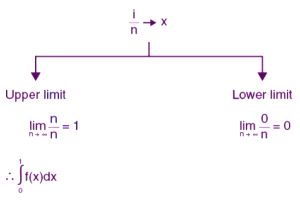
(C) આપેલ પદ એ અંતરાલ $[0, 1]$ પર વિધેય $f(x)$ ના નિશ્ચિત સંકલન માટે રીમાન સરવાળો (Riemann sum) છે.
નિશ્ચિત સંકલનની વ્યાખ્યા મુજબ:
$\lim_{n \rightarrow \infty} \sum_{j=0}^n \frac{1}{n} f\left(\frac{j}{n}\right) = \int_{0}^{1} f(x) dx$
અહીં,આપણે $\frac{j}{n} = x$ અને $\frac{1}{n} = dx$ લઈએ છીએ.
નિમ્ન સીમા $\lim_{n \rightarrow \infty} \frac{0}{n} = 0$ છે.
ઉર્ધ્વ સીમા $\lim_{n \rightarrow \infty} \frac{n}{n} = 1$ છે.
તેથી,લક્ષનું મૂલ્ય $\int_{0}^{1} f(x) dx$ થાય છે.
નિશ્ચિત સંકલનની વ્યાખ્યા મુજબ:
$\lim_{n \rightarrow \infty} \sum_{j=0}^n \frac{1}{n} f\left(\frac{j}{n}\right) = \int_{0}^{1} f(x) dx$
અહીં,આપણે $\frac{j}{n} = x$ અને $\frac{1}{n} = dx$ લઈએ છીએ.
નિમ્ન સીમા $\lim_{n \rightarrow \infty} \frac{0}{n} = 0$ છે.
ઉર્ધ્વ સીમા $\lim_{n \rightarrow \infty} \frac{n}{n} = 1$ છે.
તેથી,લક્ષનું મૂલ્ય $\int_{0}^{1} f(x) dx$ થાય છે.
0 likes
View Solution663
MediumMCQ
ધારો કે $f(x) = \max \{x + |x|, x - [x]\}$,જ્યાં $[x]$ એ $x$ થી મોટો ન હોય તેવો મહત્તમ પૂર્ણાંક દર્શાવે છે. તો $\int_{-3}^3 f(x) \, dx$ નું મૂલ્ય શોધો.
A
$\frac{51}{2}$
B
$\frac{21}{2}$
C
$1$
D
$0$
Solution
(B) આપેલ છે કે $f(x) = \max \{x + |x|, x - [x]\}$.
આપણે જાણીએ છીએ કે $x - [x] = \{x\}$,જ્યાં $\{x\}$ એ $x$ નો અપૂર્ણાંક ભાગ છે.
$x \in [-3, 0)$ માટે,$x + |x| = x - x = 0$. કારણ કે $\{x\} \ge 0$,તેથી $f(x) = \max \{0, \{x\}\} = \{x\}$.
$x \in [0, 3]$ માટે,$x + |x| = x + x = 2x$. કારણ કે $x \ge 0$ માટે $2x \ge \{x\}$,તેથી $f(x) = 2x$.
હવે,સંકલન ગણીએ:
$\int_{-3}^3 f(x) \, dx = \int_{-3}^0 \{x\} \, dx + \int_0^3 2x \, dx$
$\int_{-3}^0 \{x\} \, dx = \int_{-3}^0 (x - [x]) \, dx$. $n$ લંબાઈના અંતરાલ પર અપૂર્ણાંક ભાગનું સંકલન $\frac{n}{2}$ હોવાથી,$\int_{-3}^0 \{x\} \, dx = 3 \times \frac{1}{2} = \frac{3}{2}$.
$\int_0^3 2x \, dx = [x^2]_0^3 = 9 - 0 = 9$.
આમ,$\int_{-3}^3 f(x) \, dx = \frac{3}{2} + 9 = \frac{21}{2}$.
આપણે જાણીએ છીએ કે $x - [x] = \{x\}$,જ્યાં $\{x\}$ એ $x$ નો અપૂર્ણાંક ભાગ છે.
$x \in [-3, 0)$ માટે,$x + |x| = x - x = 0$. કારણ કે $\{x\} \ge 0$,તેથી $f(x) = \max \{0, \{x\}\} = \{x\}$.
$x \in [0, 3]$ માટે,$x + |x| = x + x = 2x$. કારણ કે $x \ge 0$ માટે $2x \ge \{x\}$,તેથી $f(x) = 2x$.
હવે,સંકલન ગણીએ:
$\int_{-3}^3 f(x) \, dx = \int_{-3}^0 \{x\} \, dx + \int_0^3 2x \, dx$
$\int_{-3}^0 \{x\} \, dx = \int_{-3}^0 (x - [x]) \, dx$. $n$ લંબાઈના અંતરાલ પર અપૂર્ણાંક ભાગનું સંકલન $\frac{n}{2}$ હોવાથી,$\int_{-3}^0 \{x\} \, dx = 3 \times \frac{1}{2} = \frac{3}{2}$.
$\int_0^3 2x \, dx = [x^2]_0^3 = 9 - 0 = 9$.
આમ,$\int_{-3}^3 f(x) \, dx = \frac{3}{2} + 9 = \frac{21}{2}$.
0 likes
View Solution664
EasyMCQ
પદાવલિ $\frac{\int_0^n [x] dx}{\int_0^n \{x\} dx}$,જ્યાં $[x]$ અને $\{x\}$ એ અનુક્રમે $x$ નો પૂર્ણાંક અને અપૂર્ણાંક ભાગ છે અને $n \in N$ છે,તે કોના બરાબર છે?
A
$\frac{1}{n-1}$
B
$\frac{1}{n}$
C
$n$
D
$n-1$
Solution
(D) ધારો કે $I_1 = \int_0^n [x] dx$ અને $I_2 = \int_0^n \{x\} dx$.
$I_1 = \int_0^1 0 dx + \int_1^2 1 dx + \int_2^3 2 dx + \dots + \int_{n-1}^n (n-1) dx$.
$I_1 = 0 + 1 + 2 + \dots + (n-1) = \frac{(n-1)n}{2}$.
કારણ કે વિધેય $\{x\}$ એ $1$ આવર્તમાન ધરાવે છે,તેથી $I_2 = n \int_0^1 \{x\} dx = n \int_0^1 x dx$.
$I_2 = n \left[ \frac{x^2}{2} \right]_0^1 = n \left( \frac{1}{2} - 0 \right) = \frac{n}{2}$.
તેથી,પદાવલિ $\frac{I_1}{I_2} = \frac{\frac{n(n-1)}{2}}{\frac{n}{2}} = n-1$ થાય છે.
$I_1 = \int_0^1 0 dx + \int_1^2 1 dx + \int_2^3 2 dx + \dots + \int_{n-1}^n (n-1) dx$.
$I_1 = 0 + 1 + 2 + \dots + (n-1) = \frac{(n-1)n}{2}$.
કારણ કે વિધેય $\{x\}$ એ $1$ આવર્તમાન ધરાવે છે,તેથી $I_2 = n \int_0^1 \{x\} dx = n \int_0^1 x dx$.
$I_2 = n \left[ \frac{x^2}{2} \right]_0^1 = n \left( \frac{1}{2} - 0 \right) = \frac{n}{2}$.
તેથી,પદાવલિ $\frac{I_1}{I_2} = \frac{\frac{n(n-1)}{2}}{\frac{n}{2}} = n-1$ થાય છે.
0 likes
View Solution665
MediumMCQ
$\int_{0}^{5} \max \{x^{2}, 6x-8\} dx$ નું મૂલ્ય શોધો.
A
$72$
B
$125$
C
$43$
D
$69$
Solution
(C) $\int_{0}^{5} \max \{x^{2}, 6x-8\} dx$ ની ગણતરી કરવા માટે,આપણે પહેલા $y = x^{2}$ અને $y = 6x-8$ ના છેદબિંદુઓ શોધીએ.
$x^{2} = 6x-8$ લેતા,આપણને $x^{2}-6x+8 = 0$ મળે છે,જેના અવયવો $(x-2)(x-4) = 0$ થાય છે. આમ,વક્રો $x = 2$ અને $x = 4$ પર છેદે છે.
$x \in [0, 2]$ માટે,$x^{2} \ge 6x-8$.
$x \in [2, 4]$ માટે,$6x-8 \ge x^{2}$.
$x \in [4, 5]$ માટે,$x^{2} \ge 6x-8$.
તેથી,સંકલન નીચે મુજબ વિભાજિત થશે:
$\int_{0}^{2} x^{2} dx + \int_{2}^{4} (6x-8) dx + \int_{4}^{5} x^{2} dx$
$= \left[ \frac{x^{3}}{3} \right]_{0}^{2} + \left[ 3x^{2}-8x \right]_{2}^{4} + \left[ \frac{x^{3}}{3} \right]_{4}^{5}$
$= (\frac{8}{3} - 0) + ((48-32) - (12-16)) + (\frac{125}{3} - \frac{64}{3})$
$= \frac{8}{3} + (16 - (-4)) + \frac{61}{3}$
$= \frac{8}{3} + 20 + \frac{61}{3} = \frac{69}{3} + 20 = 23 + 20 = 43$.
$x^{2} = 6x-8$ લેતા,આપણને $x^{2}-6x+8 = 0$ મળે છે,જેના અવયવો $(x-2)(x-4) = 0$ થાય છે. આમ,વક્રો $x = 2$ અને $x = 4$ પર છેદે છે.
$x \in [0, 2]$ માટે,$x^{2} \ge 6x-8$.
$x \in [2, 4]$ માટે,$6x-8 \ge x^{2}$.
$x \in [4, 5]$ માટે,$x^{2} \ge 6x-8$.
તેથી,સંકલન નીચે મુજબ વિભાજિત થશે:
$\int_{0}^{2} x^{2} dx + \int_{2}^{4} (6x-8) dx + \int_{4}^{5} x^{2} dx$
$= \left[ \frac{x^{3}}{3} \right]_{0}^{2} + \left[ 3x^{2}-8x \right]_{2}^{4} + \left[ \frac{x^{3}}{3} \right]_{4}^{5}$
$= (\frac{8}{3} - 0) + ((48-32) - (12-16)) + (\frac{125}{3} - \frac{64}{3})$
$= \frac{8}{3} + (16 - (-4)) + \frac{61}{3}$
$= \frac{8}{3} + 20 + \frac{61}{3} = \frac{69}{3} + 20 = 23 + 20 = 43$.
0 likes
View Solution666
MediumMCQ
જો $\phi(t)=\begin{cases} 1, & 0 \leq t < 1 \text{ માટે} \\ 0, & \text{અન્યથા} \end{cases}$ હોય,તો $\int_{-3000}^{3000} \left( \sum_{r'=2014}^{2016} \phi(t-r') \phi(t-2016) \right) dt$ ની કિંમત શું થાય?
A
એક વાસ્તવિક સંખ્યા
B
$1$
C
$0$
D
અસ્તિત્વ ધરાવતું નથી
Solution
(B) આપણને આપેલ છે કે $\phi(t) = 1$ જ્યારે $0 \leq t < 1$ અને અન્યથા $0$ છે. આનો અર્થ એ છે કે $\phi(t-k) = 1$ જ્યારે $k \leq t < k+1$ અને અન્યથા $0$ છે.
સંકલન $I = \int_{-3000}^{3000} \sum_{r'=2014}^{2016} \phi(t-r') \phi(t-2016) dt$ છે.
સરવાળાનું વિસ્તરણ કરતા: $I = \int_{-3000}^{3000} [\phi(t-2014)\phi(t-2016) + \phi(t-2015)\phi(t-2016) + \phi(t-2016)\phi(t-2016)] dt$.
નોંધો કે $\phi(t-2014)\phi(t-2016) = 0$ કારણ કે અંતરાલો $[2014, 2015)$ અને $[2016, 2017)$ અલગ છે.
તેવી જ રીતે,$\phi(t-2015)\phi(t-2016) = 0$ કારણ કે અંતરાલો $[2015, 2016)$ અને $[2016, 2017)$ અલગ છે.
આમ,પદાવલિ $\int_{-3000}^{3000} \phi(t-2016)^2 dt$ માં પરિણમે છે.
કારણ કે $\phi(t-2016) = 1$ જ્યારે $2016 \leq t < 2017$ અને અન્યથા $0$ છે,તેથી $\phi(t-2016)^2 = \phi(t-2016)$.
તેથી,$I = \int_{2016}^{2017} 1 dt = [t]_{2016}^{2017} = 2017 - 2016 = 1$.
સંકલન $I = \int_{-3000}^{3000} \sum_{r'=2014}^{2016} \phi(t-r') \phi(t-2016) dt$ છે.
સરવાળાનું વિસ્તરણ કરતા: $I = \int_{-3000}^{3000} [\phi(t-2014)\phi(t-2016) + \phi(t-2015)\phi(t-2016) + \phi(t-2016)\phi(t-2016)] dt$.
નોંધો કે $\phi(t-2014)\phi(t-2016) = 0$ કારણ કે અંતરાલો $[2014, 2015)$ અને $[2016, 2017)$ અલગ છે.
તેવી જ રીતે,$\phi(t-2015)\phi(t-2016) = 0$ કારણ કે અંતરાલો $[2015, 2016)$ અને $[2016, 2017)$ અલગ છે.
આમ,પદાવલિ $\int_{-3000}^{3000} \phi(t-2016)^2 dt$ માં પરિણમે છે.
કારણ કે $\phi(t-2016) = 1$ જ્યારે $2016 \leq t < 2017$ અને અન્યથા $0$ છે,તેથી $\phi(t-2016)^2 = \phi(t-2016)$.
તેથી,$I = \int_{2016}^{2017} 1 dt = [t]_{2016}^{2017} = 2017 - 2016 = 1$.
0 likes
View Solution667
EasyMCQ
સંકલન $\int_{-1}^1 \frac{|x+2|}{x+2} \, dx$ નું મૂલ્ય શું છે?
A
$1$
B
$2$
C
$0$
D
$-1$
Solution
(B) ધારો કે $I = \int_{-1}^1 \frac{|x+2|}{x+2} \, dx$. \\ સંકલનનો અંતરાલ $[-1, 1]$ હોવાથી,આપણી પાસે $x \geq -1$ છે. \\ આનો અર્થ એ છે કે $x+2 \geq 1$,તેથી આપેલ અંતરાલમાં $x+2$ હંમેશા ધન છે. \\ તેથી,$|x+2| = x+2$. \\ આને સંકલનમાં મૂકતા,આપણને મળે છે: \\ $I = \int_{-1}^1 \frac{x+2}{x+2} \, dx = \int_{-1}^1 1 \, dx$. \\ સંકલનનું મૂલ્ય શોધતા: \\ $I = [x]_{-1}^1 = 1 - (-1) = 2$.
0 likes
View Solution668
DifficultMCQ
$\int_0^{\infty} \frac{dx}{(x^2+4)(x^2+9)}$ નું મૂલ્ય શોધો.
A
$\frac{\pi}{60}$
B
$\frac{\pi}{20}$
C
$\frac{\pi}{40}$
D
$\frac{\pi}{80}$
Solution
(A) ધારો કે $I = \int_0^{\infty} \frac{dx}{(x^2+4)(x^2+9)}$.
આંશિક અપૂર્ણાંકની રીતનો ઉપયોગ કરતા,આપણે લખી શકીએ કે $\frac{1}{(x^2+4)(x^2+9)} = \frac{1}{5} \left( \frac{1}{x^2+4} - \frac{1}{x^2+9} \right)$.
તેથી,$I = \frac{1}{5} \left[ \int_0^{\infty} \frac{dx}{x^2+2^2} - \int_0^{\infty} \frac{dx}{x^2+3^2} \right]$.
પ્રમાણિત સંકલન સૂત્ર $\int \frac{dx}{x^2+a^2} = \frac{1}{a} \tan^{-1}(\frac{x}{a}) + C$ નો ઉપયોગ કરતા:
$I = \frac{1}{5} \left[ \left( \frac{1}{2} \tan^{-1}(\frac{x}{2}) \right)_0^{\infty} - \left( \frac{1}{3} \tan^{-1}(\frac{x}{3}) \right)_0^{\infty} \right]$.
સીમાઓ મૂકતા:
$I = \frac{1}{5} \left[ \frac{1}{2} (\frac{\pi}{2} - 0) - \frac{1}{3} (\frac{\pi}{2} - 0) \right]$.
$I = \frac{1}{5} \left[ \frac{\pi}{4} - \frac{\pi}{6} \right] = \frac{1}{5} \left[ \frac{3\pi - 2\pi}{12} \right] = \frac{1}{5} \cdot \frac{\pi}{12} = \frac{\pi}{60}$.
આંશિક અપૂર્ણાંકની રીતનો ઉપયોગ કરતા,આપણે લખી શકીએ કે $\frac{1}{(x^2+4)(x^2+9)} = \frac{1}{5} \left( \frac{1}{x^2+4} - \frac{1}{x^2+9} \right)$.
તેથી,$I = \frac{1}{5} \left[ \int_0^{\infty} \frac{dx}{x^2+2^2} - \int_0^{\infty} \frac{dx}{x^2+3^2} \right]$.
પ્રમાણિત સંકલન સૂત્ર $\int \frac{dx}{x^2+a^2} = \frac{1}{a} \tan^{-1}(\frac{x}{a}) + C$ નો ઉપયોગ કરતા:
$I = \frac{1}{5} \left[ \left( \frac{1}{2} \tan^{-1}(\frac{x}{2}) \right)_0^{\infty} - \left( \frac{1}{3} \tan^{-1}(\frac{x}{3}) \right)_0^{\infty} \right]$.
સીમાઓ મૂકતા:
$I = \frac{1}{5} \left[ \frac{1}{2} (\frac{\pi}{2} - 0) - \frac{1}{3} (\frac{\pi}{2} - 0) \right]$.
$I = \frac{1}{5} \left[ \frac{\pi}{4} - \frac{\pi}{6} \right] = \frac{1}{5} \left[ \frac{3\pi - 2\pi}{12} \right] = \frac{1}{5} \cdot \frac{\pi}{12} = \frac{\pi}{60}$.
0 likes
View Solution669
DifficultMCQ
ધારો કે $f$ એક બહુપદી વિધેય છે જેથી તમામ $x \in \mathbb{R}$ માટે $f(x^{2}+1)=x^{4}+5x^{2}+2$ થાય છે. તો $\int_{0}^{3} f(x) dx$ ની કિંમત શોધો.
A
$\frac{41}{3}$
B
$\frac{33}{2}$
C
$\frac{27}{2}$
D
$\frac{5}{3}$
Solution
(B) આપેલ છે કે $f(x^2+1) = x^4 + 5x^2 + 2$.
ધારો કે $t = x^2 + 1$,જેનો અર્થ છે કે $x^2 = t - 1$.
આ કિંમત $f$ ના પદમાં મૂકતા:
$f(t) = (t-1)^2 + 5(t-1) + 2$
$f(t) = (t^2 - 2t + 1) + 5t - 5 + 2$
$f(t) = t^2 + 3t - 2$.
હવે,આપણે નિશ્ચિત સંકલન ગણીએ:
$\int_{0}^{3} f(t) dt = \int_{0}^{3} (t^2 + 3t - 2) dt$
$= \left[ \frac{t^3}{3} + \frac{3t^2}{2} - 2t \right]_{0}^{3}$
$= \left( \frac{3^3}{3} + \frac{3(3^2)}{2} - 2(3) \right) - (0)$
$= \left( \frac{27}{3} + \frac{27}{2} - 6 \right)$
$= 9 + 13.5 - 6 = 16.5 = \frac{33}{2}$.
ધારો કે $t = x^2 + 1$,જેનો અર્થ છે કે $x^2 = t - 1$.
આ કિંમત $f$ ના પદમાં મૂકતા:
$f(t) = (t-1)^2 + 5(t-1) + 2$
$f(t) = (t^2 - 2t + 1) + 5t - 5 + 2$
$f(t) = t^2 + 3t - 2$.
હવે,આપણે નિશ્ચિત સંકલન ગણીએ:
$\int_{0}^{3} f(t) dt = \int_{0}^{3} (t^2 + 3t - 2) dt$
$= \left[ \frac{t^3}{3} + \frac{3t^2}{2} - 2t \right]_{0}^{3}$
$= \left( \frac{3^3}{3} + \frac{3(3^2)}{2} - 2(3) \right) - (0)$
$= \left( \frac{27}{3} + \frac{27}{2} - 6 \right)$
$= 9 + 13.5 - 6 = 16.5 = \frac{33}{2}$.
0 likes
View Solution670
DifficultMCQ
$\int_{0}^{\pi/4} \sqrt{1+\sin 2x} dx = \rule{1cm}{0.15mm}$
A
$2$
B
$1$
C
$1/2$
D
$0$
Solution
(B) આપણે જાણીએ છીએ કે $1 = \sin^2 x + \cos^2 x$ અને $\sin 2x = 2 \sin x \cos x$ થાય છે.
તેથી,$\sqrt{1+\sin 2x} = \sqrt{\sin^2 x + \cos^2 x + 2 \sin x \cos x} = \sqrt{(\sin x + \cos x)^2} = |\sin x + \cos x|$.
અહીં $x \in [0, \pi/4]$ હોવાથી,$\sin x$ અને $\cos x$ બંને અ-ઋણ છે,તેથી $|\sin x + \cos x| = \sin x + \cos x$ થાય.
હવે,સંકલન $\int_{0}^{\pi/4} (\sin x + \cos x) dx$ બને છે.
દરેક પદનું સંકલન કરતા,આપણને $[-\cos x + \sin x]_0^{\pi/4}$ મળે છે.
સીમાઓ મૂકતા: $(-\cos(\pi/4) + \sin(\pi/4)) - (-\cos(0) + \sin(0))$.
$= (-1/\sqrt{2} + 1/\sqrt{2}) - (-1 + 0) = 0 - (-1) = 1$.
તેથી,$\sqrt{1+\sin 2x} = \sqrt{\sin^2 x + \cos^2 x + 2 \sin x \cos x} = \sqrt{(\sin x + \cos x)^2} = |\sin x + \cos x|$.
અહીં $x \in [0, \pi/4]$ હોવાથી,$\sin x$ અને $\cos x$ બંને અ-ઋણ છે,તેથી $|\sin x + \cos x| = \sin x + \cos x$ થાય.
હવે,સંકલન $\int_{0}^{\pi/4} (\sin x + \cos x) dx$ બને છે.
દરેક પદનું સંકલન કરતા,આપણને $[-\cos x + \sin x]_0^{\pi/4}$ મળે છે.
સીમાઓ મૂકતા: $(-\cos(\pi/4) + \sin(\pi/4)) - (-\cos(0) + \sin(0))$.
$= (-1/\sqrt{2} + 1/\sqrt{2}) - (-1 + 0) = 0 - (-1) = 1$.
0 likes
View Solution671
MediumMCQ
$\int_0^{\pi} (\sin^2 \frac{x}{2} - \cos^2 \frac{x}{2}) dx = $ . . . . . . .
A
$1$
B
$0$
C
$-1$
D
$2$
Solution
(B) આપણે જાણીએ છીએ કે ત્રિકોણમિતીય નિત્યસમ $\cos^2 \theta - \sin^2 \theta = \cos 2\theta$ છે.
તેથી,$\sin^2 \frac{x}{2} - \cos^2 \frac{x}{2} = -(\cos^2 \frac{x}{2} - \sin^2 \frac{x}{2}) = -\cos(2 \cdot \frac{x}{2}) = -\cos x$ થાય.
હવે,સંકલન $I = \int_0^{\pi} -\cos x \, dx$ બને છે.
$-\cos x$ નું $x$ ની સાપેક્ષમાં સંકલન કરતા,આપણને $-\sin x$ મળે છે.
$0$ થી $\pi$ ની સીમાઓ લાગુ પાડતા,$I = [-\sin x]_0^{\pi}$ મળે.
$I = -(\sin \pi - \sin 0)$.
કારણ કે $\sin \pi = 0$ અને $\sin 0 = 0$ છે,તેથી $I = -(0 - 0) = 0$ મળે છે.
તેથી,$\sin^2 \frac{x}{2} - \cos^2 \frac{x}{2} = -(\cos^2 \frac{x}{2} - \sin^2 \frac{x}{2}) = -\cos(2 \cdot \frac{x}{2}) = -\cos x$ થાય.
હવે,સંકલન $I = \int_0^{\pi} -\cos x \, dx$ બને છે.
$-\cos x$ નું $x$ ની સાપેક્ષમાં સંકલન કરતા,આપણને $-\sin x$ મળે છે.
$0$ થી $\pi$ ની સીમાઓ લાગુ પાડતા,$I = [-\sin x]_0^{\pi}$ મળે.
$I = -(\sin \pi - \sin 0)$.
કારણ કે $\sin \pi = 0$ અને $\sin 0 = 0$ છે,તેથી $I = -(0 - 0) = 0$ મળે છે.
0 likes
View Solution672
DifficultMCQ
ધારો કે $f(x) = \begin{cases} \frac{1}{3}, & x \le \pi/2 \\ \frac{b(1-\sin x)}{(\pi-2x)^2}, & x > \pi/2 \end{cases}$. જો $f$ એ $x = \pi/2$ આગળ સતત હોય,તો $\int_0^{3b-6} |x^2+2x-3| dx$ ની કિંમત શોધો.
A
$5$
B
$2$
C
$3$
D
$4$
Solution
(D) $f(x)$ એ $x = \pi/2$ આગળ સતત હોવા માટે,ડાબી બાજુની લક્ષ અને જમણી બાજુની લક્ષ સમાન હોવી જોઈએ.
$\lim_{x \to \pi/2^-} f(x) = 1/3$.
$\lim_{x \to \pi/2^+} f(x) = \lim_{x \to \pi/2^+} \frac{b(1-\sin x)}{4(\pi/2-x)^2}$.
ધારો કે $h = \pi/2 - x$. જ્યારે $x \to \pi/2^+$,ત્યારે $h \to 0^+$.
$\lim_{h \to 0^+} \frac{b(1-\cos h)}{4h^2} = \lim_{h \to 0^+} \frac{b(2\sin^2(h/2))}{4(4(h/2)^2)} = \frac{2b}{16} = \frac{b}{8}$.
લક્ષને સરખાવતા: $b/8 = 1/3 \implies b = 8/3$.
હવે,$3b-6 = 3(8/3) - 6 = 8 - 6 = 2$.
આપણે $\int_0^2 |x^2+2x-3| dx$ ની કિંમત શોધવાની છે.
કારણ કે $x^2+2x-3 = (x+3)(x-1)$,આ પદ $x \in [0, 1)$ માટે ઋણ અને $x \in (1, 2]$ માટે ધન છે.
સંકલન $= -\int_0^1 (x^2+2x-3) dx + \int_1^2 (x^2+2x-3) dx$.
$= -[x^3/3 + x^2 - 3x]_0^1 + [x^3/3 + x^2 - 3x]_1^2$.
$= -[1/3 + 1 - 3] + [(8/3 + 4 - 6) - (1/3 + 1 - 3)]$.
$= -[-5/3] + [2/3 - (-5/3)] = 5/3 + 7/3 = 12/3 = 4$.
$\lim_{x \to \pi/2^-} f(x) = 1/3$.
$\lim_{x \to \pi/2^+} f(x) = \lim_{x \to \pi/2^+} \frac{b(1-\sin x)}{4(\pi/2-x)^2}$.
ધારો કે $h = \pi/2 - x$. જ્યારે $x \to \pi/2^+$,ત્યારે $h \to 0^+$.
$\lim_{h \to 0^+} \frac{b(1-\cos h)}{4h^2} = \lim_{h \to 0^+} \frac{b(2\sin^2(h/2))}{4(4(h/2)^2)} = \frac{2b}{16} = \frac{b}{8}$.
લક્ષને સરખાવતા: $b/8 = 1/3 \implies b = 8/3$.
હવે,$3b-6 = 3(8/3) - 6 = 8 - 6 = 2$.
આપણે $\int_0^2 |x^2+2x-3| dx$ ની કિંમત શોધવાની છે.
કારણ કે $x^2+2x-3 = (x+3)(x-1)$,આ પદ $x \in [0, 1)$ માટે ઋણ અને $x \in (1, 2]$ માટે ધન છે.
સંકલન $= -\int_0^1 (x^2+2x-3) dx + \int_1^2 (x^2+2x-3) dx$.
$= -[x^3/3 + x^2 - 3x]_0^1 + [x^3/3 + x^2 - 3x]_1^2$.
$= -[1/3 + 1 - 3] + [(8/3 + 4 - 6) - (1/3 + 1 - 3)]$.
$= -[-5/3] + [2/3 - (-5/3)] = 5/3 + 7/3 = 12/3 = 4$.
0 likes
View Solution673
AdvancedMCQ
સંકલન $\int_0^2 \frac{\sqrt{x}(x^2 + x + 1)}{(\sqrt{x}+1)(\sqrt{x^4+x^2+1})} dx$ નું મૂલ્ય કેટલું થાય?
A
$\frac{1}{3} \log_e(3 - 2\sqrt{2})$
B
$\frac{2}{3} \log_e(4 + \sqrt{2})$
C
$\frac{2}{3} \log_e(3 + 2\sqrt{2})$
D
$\frac{1}{3} \log_e(1 + 6\sqrt{2})$
Solution
(C) ધારો કે $I = \int_0^2 \frac{\sqrt{x}(x^2 + x + 1)}{(\sqrt{x}+1)\sqrt{(x^2+x+1)(x^2-x+1)}} dx$.
$u = \sqrt{x}$ આદેશ લેતા,$x = u^2$ અને $dx = 2u \, du$ મળે.
જ્યારે $x=0, u=0$ અને જ્યારે $x=2, u=\sqrt{2}$.
$I = \int_0^{\sqrt{2}} \frac{u(u^4 + u^2 + 1)}{(u+1)\sqrt{(u^4+u^2+1)(u^4-u^2+1)}} (2u) \, du$.
આનું સાદું રૂપ આપતા $I = 2 \int_0^{\sqrt{2}} \frac{u^2 \sqrt{u^4+u^2+1}}{(u+1)\sqrt{u^4-u^2+1}} du$ મળે.
આદેશની રીતનો ઉપયોગ કરીને અને નિશ્ચિત સંકલનનું મૂલ્ય શોધતા,આપણને $\frac{2}{3} \log_e(3 + 2\sqrt{2})$ પરિણામ મળે છે.
$u = \sqrt{x}$ આદેશ લેતા,$x = u^2$ અને $dx = 2u \, du$ મળે.
જ્યારે $x=0, u=0$ અને જ્યારે $x=2, u=\sqrt{2}$.
$I = \int_0^{\sqrt{2}} \frac{u(u^4 + u^2 + 1)}{(u+1)\sqrt{(u^4+u^2+1)(u^4-u^2+1)}} (2u) \, du$.
આનું સાદું રૂપ આપતા $I = 2 \int_0^{\sqrt{2}} \frac{u^2 \sqrt{u^4+u^2+1}}{(u+1)\sqrt{u^4-u^2+1}} du$ મળે.
આદેશની રીતનો ઉપયોગ કરીને અને નિશ્ચિત સંકલનનું મૂલ્ય શોધતા,આપણને $\frac{2}{3} \log_e(3 + 2\sqrt{2})$ પરિણામ મળે છે.
0 likes
View Solution674
DifficultMCQ
સંકલન $\int_{-1}^1 \left( \frac{x^3 + |x| + 1}{x^2 + 2|x| + 1} \right) dx$ નું મૂલ્ય કેટલું થાય?
A
$3 \log_e 2$
B
$2 \log_e 2$
C
$5 \log_e 3$
D
$3 \log_e 3$
Solution
(B) ધારો કે $I = \int_{-1}^1 \frac{x^3 + |x| + 1}{x^2 + 2|x| + 1} dx$. છેદ $x^2 + 2|x| + 1 = (|x| + 1)^2$ એ યુગ્મ વિધેય હોવાથી,આપણે સંકલનને બે ભાગમાં વિભાજિત કરી શકીએ: $I = \int_{-1}^0 \frac{x^3 - x + 1}{(|x| + 1)^2} dx + \int_0^1 \frac{x^3 + x + 1}{(|x| + 1)^2} dx$.
પ્રથમ ભાગ માટે,$x = -t$ લેતા,$dx = -dt$ મળે. જ્યારે $x$ એ $-1$ થી $0$ જાય,ત્યારે $t$ એ $1$ થી $0$ જાય છે.
$\int_1^0 \frac{-t^3 + t + 1}{(t + 1)^2} (-dt) = \int_0^1 \frac{-t^3 + t + 1}{(t + 1)^2} dt$.
આમ,$I = \int_0^1 \frac{x^3 + x + 1 - x^3 + x + 1}{(x + 1)^2} dx = \int_0^1 \frac{2x + 2}{(x + 1)^2} dx = \int_0^1 \frac{2(x + 1)}{(x + 1)^2} dx = \int_0^1 \frac{2}{x + 1} dx$.
$I = 2 [\log_e(x + 1)]_0^1 = 2(\log_e 2 - \log_e 1) = 2 \log_e 2$.
પ્રથમ ભાગ માટે,$x = -t$ લેતા,$dx = -dt$ મળે. જ્યારે $x$ એ $-1$ થી $0$ જાય,ત્યારે $t$ એ $1$ થી $0$ જાય છે.
$\int_1^0 \frac{-t^3 + t + 1}{(t + 1)^2} (-dt) = \int_0^1 \frac{-t^3 + t + 1}{(t + 1)^2} dt$.
આમ,$I = \int_0^1 \frac{x^3 + x + 1 - x^3 + x + 1}{(x + 1)^2} dx = \int_0^1 \frac{2x + 2}{(x + 1)^2} dx = \int_0^1 \frac{2(x + 1)}{(x + 1)^2} dx = \int_0^1 \frac{2}{x + 1} dx$.
$I = 2 [\log_e(x + 1)]_0^1 = 2(\log_e 2 - \log_e 1) = 2 \log_e 2$.
0 likes
View Solution675
DifficultMCQ
સંકલન $\int_0^1 \cot^{-1}(1 + x + x^2) dx$ ની કિંમત શોધો:
A
$2 \tan^{-1} 2 + \frac{1}{2} \log_e \left(\frac{5}{4}\right) + \frac{\pi}{2}$
B
$2 \tan^{-1} 2 + \frac{1}{2} \log_e \left(\frac{5}{4}\right) - \frac{\pi}{2}$
C
$2 \tan^{-1} 2 - \frac{1}{2} \log_e \left(\frac{5}{4}\right) + \frac{\pi}{2}$
D
$2 \tan^{-1} 2 - \frac{1}{2} \log_e \left(\frac{5}{4}\right) - \frac{\pi}{2}$
Solution
(D) આપણે જાણીએ છીએ કે $x > 0$ માટે $\cot^{-1} x = \tan^{-1} \left(\frac{1}{x}\right)$.
તેથી,$\cot^{-1}(1 + x + x^2) = \tan^{-1}\left(\frac{1}{1+x(x+1)}\right) = \tan^{-1}(x+1) - \tan^{-1}x$.
ખંડશઃ સંકલનનો ઉપયોગ કરતા,$\int \tan^{-1} u \, du = u \tan^{-1} u - \frac{1}{2} \log_e(1+u^2) + C$.
આ સૂત્રને સંકલન $I = \int_0^1 \tan^{-1}(x+1) dx - \int_0^1 \tan^{-1} x dx$ માં લાગુ પાડતા:
$I = \left[ (x+1) \tan^{-1}(x+1) - \frac{1}{2} \log_e(1+(x+1)^2) \right]_0^1 - \left[ x \tan^{-1} x - \frac{1}{2} \log_e(1+x^2) \right]_0^1$.
સીમાઓ મૂકતા:
$I = \left( 2 \tan^{-1} 2 - \frac{1}{2} \log_e 5 - (1 \tan^{-1} 1 - \frac{1}{2} \log_e 2) \right) - \left( 1 \tan^{-1} 1 - \frac{1}{2} \log_e 2 - 0 \right)$.
$I = 2 \tan^{-1} 2 - \frac{1}{2} \log_e 5 - 2 \tan^{-1} 1 + \log_e 2$.
કારણ કે $\tan^{-1} 1 = \frac{\pi}{4}$,તેથી $I = 2 \tan^{-1} 2 - \frac{\pi}{2} + \frac{1}{2} \log_e \left(\frac{4}{5}\right) = 2 \tan^{-1} 2 - \frac{\pi}{2} - \frac{1}{2} \log_e \left(\frac{5}{4}\right)$.
તેથી,$\cot^{-1}(1 + x + x^2) = \tan^{-1}\left(\frac{1}{1+x(x+1)}\right) = \tan^{-1}(x+1) - \tan^{-1}x$.
ખંડશઃ સંકલનનો ઉપયોગ કરતા,$\int \tan^{-1} u \, du = u \tan^{-1} u - \frac{1}{2} \log_e(1+u^2) + C$.
આ સૂત્રને સંકલન $I = \int_0^1 \tan^{-1}(x+1) dx - \int_0^1 \tan^{-1} x dx$ માં લાગુ પાડતા:
$I = \left[ (x+1) \tan^{-1}(x+1) - \frac{1}{2} \log_e(1+(x+1)^2) \right]_0^1 - \left[ x \tan^{-1} x - \frac{1}{2} \log_e(1+x^2) \right]_0^1$.
સીમાઓ મૂકતા:
$I = \left( 2 \tan^{-1} 2 - \frac{1}{2} \log_e 5 - (1 \tan^{-1} 1 - \frac{1}{2} \log_e 2) \right) - \left( 1 \tan^{-1} 1 - \frac{1}{2} \log_e 2 - 0 \right)$.
$I = 2 \tan^{-1} 2 - \frac{1}{2} \log_e 5 - 2 \tan^{-1} 1 + \log_e 2$.
કારણ કે $\tan^{-1} 1 = \frac{\pi}{4}$,તેથી $I = 2 \tan^{-1} 2 - \frac{\pi}{2} + \frac{1}{2} \log_e \left(\frac{4}{5}\right) = 2 \tan^{-1} 2 - \frac{\pi}{2} - \frac{1}{2} \log_e \left(\frac{5}{4}\right)$.
0 likes
View Solution676
DifficultMCQ
ધારો કે $[\cdot]$ એ મહત્તમ પૂર્ણાંક વિધેય છે. તો $\int_0^3 \left( \frac{e^x + e^{-x}}{[x]!} \right) dx$ નું મૂલ્ય શોધો:
A
$e^2 + e^3 - \frac{1}{e^2} - \frac{1}{e^3}$
B
$\frac{1}{2} (e^2 + e^3 - e^{-2} - e^{-3})$
C
$e^2 + e^3 - \frac{1}{2e^2} - \frac{1}{2e^3}$
D
$\frac{1}{2} (e^2 + e^3) - \frac{1}{e^2} - \frac{1}{e^3}$
Solution
(B) સંકલન $\int_0^3 \frac{e^x + e^{-x}}{[x]!} dx$ છે. આપણે અંતરાલ $[0, 3)$ ને $[0, 1), [1, 2), [2, 3)$ માં વિભાજિત કરીશું.
$x \in [0, 1)$ માટે,$[x] = 0$,તેથી $[x]! = 0! = 1$. સંકલન $\int_0^1 (e^x + e^{-x}) dx = [e^x - e^{-x}]_0^1 = (e - e^{-1}) - (1 - 1) = e - e^{-1}$ થશે.
$x \in [1, 2)$ માટે,$[x] = 1$,તેથી $[x]! = 1! = 1$. સંકલન $\int_1^2 (e^x + e^{-x}) dx = [e^x - e^{-x}]_1^2 = (e^2 - e^{-2}) - (e - e^{-1}) = e^2 - e^{-2} - e + e^{-1}$ થશે.
$x \in [2, 3)$ માટે,$[x] = 2$,તેથી $[x]! = 2! = 2$. સંકલન $\int_2^3 \frac{e^x + e^{-x}}{2} dx = \frac{1}{2} [e^x - e^{-x}]_2^3 = \frac{1}{2} ((e^3 - e^{-3}) - (e^2 - e^{-2})) = \frac{1}{2}e^3 - \frac{1}{2}e^{-3} - \frac{1}{2}e^2 + \frac{1}{2}e^{-2}$ થશે.
આ બધાનો સરવાળો કરતા: $(e - e^{-1}) + (e^2 - e^{-2} - e + e^{-1}) + (\frac{1}{2}e^3 - \frac{1}{2}e^{-3} - \frac{1}{2}e^2 + \frac{1}{2}e^{-2}) = \frac{1}{2}e^3 + \frac{1}{2}e^2 - \frac{1}{2}e^{-2} - \frac{1}{2}e^{-3} = \frac{1}{2}(e^3 + e^2 - e^{-2} - e^{-3})$ મળે છે.
$x \in [0, 1)$ માટે,$[x] = 0$,તેથી $[x]! = 0! = 1$. સંકલન $\int_0^1 (e^x + e^{-x}) dx = [e^x - e^{-x}]_0^1 = (e - e^{-1}) - (1 - 1) = e - e^{-1}$ થશે.
$x \in [1, 2)$ માટે,$[x] = 1$,તેથી $[x]! = 1! = 1$. સંકલન $\int_1^2 (e^x + e^{-x}) dx = [e^x - e^{-x}]_1^2 = (e^2 - e^{-2}) - (e - e^{-1}) = e^2 - e^{-2} - e + e^{-1}$ થશે.
$x \in [2, 3)$ માટે,$[x] = 2$,તેથી $[x]! = 2! = 2$. સંકલન $\int_2^3 \frac{e^x + e^{-x}}{2} dx = \frac{1}{2} [e^x - e^{-x}]_2^3 = \frac{1}{2} ((e^3 - e^{-3}) - (e^2 - e^{-2})) = \frac{1}{2}e^3 - \frac{1}{2}e^{-3} - \frac{1}{2}e^2 + \frac{1}{2}e^{-2}$ થશે.
આ બધાનો સરવાળો કરતા: $(e - e^{-1}) + (e^2 - e^{-2} - e + e^{-1}) + (\frac{1}{2}e^3 - \frac{1}{2}e^{-3} - \frac{1}{2}e^2 + \frac{1}{2}e^{-2}) = \frac{1}{2}e^3 + \frac{1}{2}e^2 - \frac{1}{2}e^{-2} - \frac{1}{2}e^{-3} = \frac{1}{2}(e^3 + e^2 - e^{-2} - e^{-3})$ મળે છે.
0 likes
View Solution677
AdvancedMCQ
ધારો કે $(2^{1-a} + 2^{1+a})$,$f(a)$,$(3^a + 3^{-a})$ સમાંતર શ્રેણી ($A$.$P$.) માં છે અને $\alpha$ એ $f(a)$ ની ન્યૂનતમ કિંમત છે. તો સંકલન $\int_{\log_e(\alpha-1)}^{\log_e(\alpha)} \frac{dx}{(e^{2x} - e^{-2x})}$ ની કિંમત શોધો:
A
$\frac{1}{2}\log_e(\frac{4}{3})$
B
$\frac{1}{4}\log_e(\frac{4}{3})$
C
$\frac{1}{2}\log_e(\frac{8}{5})$
D
$\frac{1}{4}\log_e(\frac{8}{5})$
Solution
(B) આપેલ છે કે $(2^{1-a} + 2^{1+a})$,$f(a)$,અને $(3^a + 3^{-a})$ સમાંતર શ્રેણીમાં છે,તેથી $2f(a) = (2^{1-a} + 2^{1+a}) + (3^a + 3^{-a})$.
કારણ કે $2^{1-a} + 2^{1+a} = 2(2^{-a} + 2^a)$,અને $AM$-$GM$ અસમતા મુજબ,$2^a + 2^{-a} \geq 2$,તેથી $2^a + 2^{-a}$ ની ન્યૂનતમ કિંમત $2$ છે.
તે જ રીતે,$3^a + 3^{-a}$ ની ન્યૂનતમ કિંમત $2$ છે.
આમ,$2f(a) \geq 2(2) + 2 = 6$,જેનો અર્થ છે કે $f(a) \geq 3$. તેથી,$\alpha = 3$.
સંકલન $I = \int_{\log_e 2}^{\log_e 3} \frac{dx}{e^{2x} - e^{-2x}} = \int_{\log_e 2}^{\log_e 3} \frac{e^{2x} dx}{e^{4x} - 1}$ બને છે.
ધારો કે $u = e^{2x}$,તો $du = 2e^{2x} dx$,તેથી $e^{2x} dx = \frac{du}{2}$.
જ્યારે $x = \log_e 2$,ત્યારે $u = e^{2\log_e 2} = 4$. જ્યારે $x = \log_e 3$,ત્યારે $u = e^{2\log_e 3} = 9$.
$I = \frac{1}{2} \int_{4}^{9} \frac{du}{u^2 - 1} = \frac{1}{2} \cdot \frac{1}{2} \log_e |\frac{u-1}{u+1}| \Big|_4^9 = \frac{1}{4} (\log_e \frac{8}{10} - \log_e \frac{3}{5}) = \frac{1}{4} \log_e (\frac{4}{5} \cdot \frac{5}{3}) = \frac{1}{4} \log_e (\frac{4}{3})$.
કારણ કે $2^{1-a} + 2^{1+a} = 2(2^{-a} + 2^a)$,અને $AM$-$GM$ અસમતા મુજબ,$2^a + 2^{-a} \geq 2$,તેથી $2^a + 2^{-a}$ ની ન્યૂનતમ કિંમત $2$ છે.
તે જ રીતે,$3^a + 3^{-a}$ ની ન્યૂનતમ કિંમત $2$ છે.
આમ,$2f(a) \geq 2(2) + 2 = 6$,જેનો અર્થ છે કે $f(a) \geq 3$. તેથી,$\alpha = 3$.
સંકલન $I = \int_{\log_e 2}^{\log_e 3} \frac{dx}{e^{2x} - e^{-2x}} = \int_{\log_e 2}^{\log_e 3} \frac{e^{2x} dx}{e^{4x} - 1}$ બને છે.
ધારો કે $u = e^{2x}$,તો $du = 2e^{2x} dx$,તેથી $e^{2x} dx = \frac{du}{2}$.
જ્યારે $x = \log_e 2$,ત્યારે $u = e^{2\log_e 2} = 4$. જ્યારે $x = \log_e 3$,ત્યારે $u = e^{2\log_e 3} = 9$.
$I = \frac{1}{2} \int_{4}^{9} \frac{du}{u^2 - 1} = \frac{1}{2} \cdot \frac{1}{2} \log_e |\frac{u-1}{u+1}| \Big|_4^9 = \frac{1}{4} (\log_e \frac{8}{10} - \log_e \frac{3}{5}) = \frac{1}{4} \log_e (\frac{4}{5} \cdot \frac{5}{3}) = \frac{1}{4} \log_e (\frac{4}{3})$.
0 likes
View Solution678
DifficultMCQ
સંકલન $\int_{\pi/6}^{\pi/3} \frac{4 - \csc^2 x}{\cos^4 x} dx$ નું મૂલ્ય શોધો:
A
$\frac{11}{\sqrt{3}}$
B
$\frac{16}{\sqrt{3}}$
C
$\frac{32}{3\sqrt{3}}$
D
$\frac{64}{3\sqrt{3}}$
Solution
(C) ધારો કે $I = \int_{\pi/6}^{\pi/3} \frac{4 - \csc^2 x}{\cos^4 x} dx$.
આપણે સંકલ્યને આ રીતે લખી શકીએ:
$\frac{4}{\cos^4 x} - \frac{\csc^2 x}{\cos^4 x} = 4\sec^4 x - \frac{1}{\sin^2 x \cos^4 x}$.
નિત્યસમ $1 = \sin^2 x + \cos^2 x$ નો ઉપયોગ કરતા:
$\frac{1}{\sin^2 x \cos^4 x} = \frac{\sin^2 x + \cos^2 x}{\sin^2 x \cos^4 x} = \frac{1}{\cos^4 x} + \frac{1}{\sin^2 x \cos^2 x} = \sec^4 x + \frac{4}{\sin^2(2x)} = \sec^4 x + 4\csc^2(2x)$.
આ કિંમત સંકલનમાં મૂકતા:
$I = \int_{\pi/6}^{\pi/3} (4\sec^4 x - (\sec^4 x + 4\csc^2(2x))) dx = \int_{\pi/6}^{\pi/3} (3\sec^4 x - 4\csc^2(2x)) dx$.
કારણ કે $\sec^4 x = (1 + \tan^2 x)\sec^2 x$,તેથી:
$I = \int_{\pi/6}^{\pi/3} (3(1 + \tan^2 x)\sec^2 x - 4\csc^2(2x)) dx$.
ધારો કે $u = \tan x$,તો $du = \sec^2 x dx$. જ્યારે $x = \pi/6, u = 1/\sqrt{3}$. જ્યારે $x = \pi/3, u = \sqrt{3}$.
$I = [3(u + \frac{u^3}{3}) + 2\cot(2x)]_{\pi/6}^{\pi/3} = [3u + u^3 + 2\cot(2x)]_{\pi/6}^{\pi/3}$.
સીમાઓ પર કિંમત મૂકતા:
$x = \pi/3$ માટે: $3(\sqrt{3}) + (\sqrt{3})^3 + 2\cot(2\pi/3) = 3\sqrt{3} + 3\sqrt{3} + 2(-1/\sqrt{3}) = 6\sqrt{3} - 2/\sqrt{3} = \frac{16}{\sqrt{3}}$.
$x = \pi/6$ માટે: $3(1/\sqrt{3}) + (1/\sqrt{3})^3 + 2\cot(\pi/3) = \sqrt{3} + 1/(3\sqrt{3}) + 2/\sqrt{3} = \frac{16}{3\sqrt{3}}$.
$I = \frac{16}{\sqrt{3}} - \frac{16}{3\sqrt{3}} = \frac{32}{3\sqrt{3}}$.
આપણે સંકલ્યને આ રીતે લખી શકીએ:
$\frac{4}{\cos^4 x} - \frac{\csc^2 x}{\cos^4 x} = 4\sec^4 x - \frac{1}{\sin^2 x \cos^4 x}$.
નિત્યસમ $1 = \sin^2 x + \cos^2 x$ નો ઉપયોગ કરતા:
$\frac{1}{\sin^2 x \cos^4 x} = \frac{\sin^2 x + \cos^2 x}{\sin^2 x \cos^4 x} = \frac{1}{\cos^4 x} + \frac{1}{\sin^2 x \cos^2 x} = \sec^4 x + \frac{4}{\sin^2(2x)} = \sec^4 x + 4\csc^2(2x)$.
આ કિંમત સંકલનમાં મૂકતા:
$I = \int_{\pi/6}^{\pi/3} (4\sec^4 x - (\sec^4 x + 4\csc^2(2x))) dx = \int_{\pi/6}^{\pi/3} (3\sec^4 x - 4\csc^2(2x)) dx$.
કારણ કે $\sec^4 x = (1 + \tan^2 x)\sec^2 x$,તેથી:
$I = \int_{\pi/6}^{\pi/3} (3(1 + \tan^2 x)\sec^2 x - 4\csc^2(2x)) dx$.
ધારો કે $u = \tan x$,તો $du = \sec^2 x dx$. જ્યારે $x = \pi/6, u = 1/\sqrt{3}$. જ્યારે $x = \pi/3, u = \sqrt{3}$.
$I = [3(u + \frac{u^3}{3}) + 2\cot(2x)]_{\pi/6}^{\pi/3} = [3u + u^3 + 2\cot(2x)]_{\pi/6}^{\pi/3}$.
સીમાઓ પર કિંમત મૂકતા:
$x = \pi/3$ માટે: $3(\sqrt{3}) + (\sqrt{3})^3 + 2\cot(2\pi/3) = 3\sqrt{3} + 3\sqrt{3} + 2(-1/\sqrt{3}) = 6\sqrt{3} - 2/\sqrt{3} = \frac{16}{\sqrt{3}}$.
$x = \pi/6$ માટે: $3(1/\sqrt{3}) + (1/\sqrt{3})^3 + 2\cot(\pi/3) = \sqrt{3} + 1/(3\sqrt{3}) + 2/\sqrt{3} = \frac{16}{3\sqrt{3}}$.
$I = \frac{16}{\sqrt{3}} - \frac{16}{3\sqrt{3}} = \frac{32}{3\sqrt{3}}$.
0 likes
View Solution679
DifficultMCQ
$\int_{0}^{20\pi} (\sin^4 x + \cos^4 x) dx$ નું મૂલ્ય કેટલું થાય?
A
$\frac{15\pi}{2}$
B
$25\pi$
C
$15\pi$
D
$\frac{25\pi}{2}$
Solution
(C) આપણે જાણીએ છીએ કે $\sin^4 x + \cos^4 x = (\sin^2 x + \cos^2 x)^2 - 2\sin^2 x \cos^2 x = 1 - \frac{1}{2} \sin^2(2x)$.
નિત્યસમ $\sin^2(2x) = \frac{1 - \cos(4x)}{2}$ નો ઉપયોગ કરતા,આપણને મળે $\sin^4 x + \cos^4 x = 1 - \frac{1}{2} \left( \frac{1 - \cos(4x)}{2} \right) = 1 - \frac{1}{4} + \frac{1}{4} \cos(4x) = \frac{3}{4} + \frac{1}{4} \cos(4x)$.
હવે,$0$ થી $20\pi$ સુધી સંકલન કરતા:
$\int_0^{20\pi} (\frac{3}{4} + \frac{1}{4} \cos 4x) dx = [\frac{3}{4}x + \frac{1}{16} \sin 4x]_0^{20\pi}$.
સીમાઓ મૂકતા: $(\frac{3}{4} \cdot 20\pi + \frac{1}{16} \sin(80\pi)) - (0 + 0) = 15\pi + 0 = 15\pi$.
નિત્યસમ $\sin^2(2x) = \frac{1 - \cos(4x)}{2}$ નો ઉપયોગ કરતા,આપણને મળે $\sin^4 x + \cos^4 x = 1 - \frac{1}{2} \left( \frac{1 - \cos(4x)}{2} \right) = 1 - \frac{1}{4} + \frac{1}{4} \cos(4x) = \frac{3}{4} + \frac{1}{4} \cos(4x)$.
હવે,$0$ થી $20\pi$ સુધી સંકલન કરતા:
$\int_0^{20\pi} (\frac{3}{4} + \frac{1}{4} \cos 4x) dx = [\frac{3}{4}x + \frac{1}{16} \sin 4x]_0^{20\pi}$.
સીમાઓ મૂકતા: $(\frac{3}{4} \cdot 20\pi + \frac{1}{16} \sin(80\pi)) - (0 + 0) = 15\pi + 0 = 15\pi$.
0 likes
View Solution680
DifficultMCQ
સંકલન $\int_{\pi/6}^{\pi/3} \left(\frac{4 - \csc^2 x}{\cos^4 x}\right) dx$ નું મૂલ્ય શોધો:
A
$\frac{11}{\sqrt{3}}$
B
$\frac{16}{\sqrt{3}}$
C
$\frac{32}{3\sqrt{3}}$
D
$\frac{64}{3\sqrt{3}}$
Solution
(C) ધારો કે $I = \int_{\pi/6}^{\pi/3} \frac{4 - \csc^2 x}{\cos^4 x} dx = \int_{\pi/6}^{\pi/3} (4 \sec^4 x - \csc^2 x \sec^4 x) dx$.
$\sec^2 x = 1 + \tan^2 x$ અને $\csc^2 x = \frac{1}{\sin^2 x}$ નો ઉપયોગ કરતા:
$I = \int_{\pi/6}^{\pi/3} (4 \sec^2 x (1 + \tan^2 x) - \frac{1}{\sin^2 x \cos^4 x}) dx$.
$u = \tan x$ આદેશ લેતા,$du = \sec^2 x dx$. જ્યારે $x = \pi/6, u = 1/\sqrt{3}$; જ્યારે $x = \pi/3, u = \sqrt{3}$.
અહીં $\frac{1}{\sin^2 x \cos^4 x} = \frac{\sin^2 x + \cos^2 x}{\sin^2 x \cos^4 x} = \sec^4 x + \sec^2 x \csc^2 x = (1+u^2)^2 + (1+u^2)(1 + 1/u^2) = (1+u^2)^2 + u^2 + 2 + 1/u^2$.
તેથી,$I = \int_{1/\sqrt{3}}^{\sqrt{3}} (4(1+u^2) - (1+u^2)(1 + 1/u^2)) du = \int_{1/\sqrt{3}}^{\sqrt{3}} (4 + 4u^2 - (1 + 1/u^2 + u^2 + 1)) du = \int_{1/\sqrt{3}}^{\sqrt{3}} (2 + 3u^2 - u^{-2}) du$.
$I = [2u + u^3 + \frac{1}{u}]_{1/\sqrt{3}}^{\sqrt{3}} = (2\sqrt{3} + 3\sqrt{3} + \frac{1}{\sqrt{3}}) - (\frac{2}{\sqrt{3}} + \frac{1}{3\sqrt{3}} + \sqrt{3}) = (5\sqrt{3} + \frac{1}{\sqrt{3}}) - (\sqrt{3} + \frac{7}{3\sqrt{3}}) = 4\sqrt{3} - \frac{4}{3\sqrt{3}} = \frac{32}{3\sqrt{3}}$.
$\sec^2 x = 1 + \tan^2 x$ અને $\csc^2 x = \frac{1}{\sin^2 x}$ નો ઉપયોગ કરતા:
$I = \int_{\pi/6}^{\pi/3} (4 \sec^2 x (1 + \tan^2 x) - \frac{1}{\sin^2 x \cos^4 x}) dx$.
$u = \tan x$ આદેશ લેતા,$du = \sec^2 x dx$. જ્યારે $x = \pi/6, u = 1/\sqrt{3}$; જ્યારે $x = \pi/3, u = \sqrt{3}$.
અહીં $\frac{1}{\sin^2 x \cos^4 x} = \frac{\sin^2 x + \cos^2 x}{\sin^2 x \cos^4 x} = \sec^4 x + \sec^2 x \csc^2 x = (1+u^2)^2 + (1+u^2)(1 + 1/u^2) = (1+u^2)^2 + u^2 + 2 + 1/u^2$.
તેથી,$I = \int_{1/\sqrt{3}}^{\sqrt{3}} (4(1+u^2) - (1+u^2)(1 + 1/u^2)) du = \int_{1/\sqrt{3}}^{\sqrt{3}} (4 + 4u^2 - (1 + 1/u^2 + u^2 + 1)) du = \int_{1/\sqrt{3}}^{\sqrt{3}} (2 + 3u^2 - u^{-2}) du$.
$I = [2u + u^3 + \frac{1}{u}]_{1/\sqrt{3}}^{\sqrt{3}} = (2\sqrt{3} + 3\sqrt{3} + \frac{1}{\sqrt{3}}) - (\frac{2}{\sqrt{3}} + \frac{1}{3\sqrt{3}} + \sqrt{3}) = (5\sqrt{3} + \frac{1}{\sqrt{3}}) - (\sqrt{3} + \frac{7}{3\sqrt{3}}) = 4\sqrt{3} - \frac{4}{3\sqrt{3}} = \frac{32}{3\sqrt{3}}$.
0 likes
View Solution681
DifficultMCQ
$\int_{0}^{20\pi} (\sin^4 x + \cos^4 x) dx$ નું મૂલ્ય કેટલું થાય?
A
$\frac{15\pi}{2}$
B
$25\pi$
C
$15\pi$
D
$\frac{25\pi}{2}$
Solution
(C) આપણે જાણીએ છીએ કે $\sin^4 x + \cos^4 x = (\sin^2 x + \cos^2 x)^2 - 2\sin^2 x \cos^2 x = 1 - \frac{1}{2}(2\sin x \cos x)^2 = 1 - \frac{1}{2} \sin^2(2x)$.
નિત્યસમ $\sin^2 \theta = \frac{1 - \cos 2\theta}{2}$ નો ઉપયોગ કરતા,આપણને $1 - \frac{1}{2} \left( \frac{1 - \cos 4x}{2} \right) = 1 - \frac{1}{4} + \frac{1}{4} \cos 4x = \frac{3}{4} + \frac{1}{4} \cos 4x$ મળે છે.
હવે,સંકલન $I = \int_{0}^{20\pi} (\frac{3}{4} + \frac{1}{4} \cos 4x) dx$.
$I = \int_{0}^{20\pi} \frac{3}{4} dx + \int_{0}^{20\pi} \frac{1}{4} \cos 4x dx$.
કારણ કે $\cos(nx)$ નું તેના સંપૂર્ણ આવર્તકાળ પરનું સંકલન $0$ થાય છે,તેથી $\int_{0}^{20\pi} \frac{1}{4} \cos 4x dx = 0$.
તેથી,$I = \frac{3}{4} [x]_{0}^{20\pi} = \frac{3}{4} \times 20\pi = 15\pi$.
નિત્યસમ $\sin^2 \theta = \frac{1 - \cos 2\theta}{2}$ નો ઉપયોગ કરતા,આપણને $1 - \frac{1}{2} \left( \frac{1 - \cos 4x}{2} \right) = 1 - \frac{1}{4} + \frac{1}{4} \cos 4x = \frac{3}{4} + \frac{1}{4} \cos 4x$ મળે છે.
હવે,સંકલન $I = \int_{0}^{20\pi} (\frac{3}{4} + \frac{1}{4} \cos 4x) dx$.
$I = \int_{0}^{20\pi} \frac{3}{4} dx + \int_{0}^{20\pi} \frac{1}{4} \cos 4x dx$.
કારણ કે $\cos(nx)$ નું તેના સંપૂર્ણ આવર્તકાળ પરનું સંકલન $0$ થાય છે,તેથી $\int_{0}^{20\pi} \frac{1}{4} \cos 4x dx = 0$.
તેથી,$I = \frac{3}{4} [x]_{0}^{20\pi} = \frac{3}{4} \times 20\pi = 15\pi$.
0 likes
View Solution682
DifficultMCQ
જો $\int_{\pi/6}^{\pi/4} (\cot (x - \frac{\pi}{3}) \cot (x + \frac{\pi}{3}) + 1) dx = a \log_e (\sqrt{3} - 1)$ હોય,તો $9a^2$ ની કિંમત . . . . . . . થાય.
A
$36$
B
$40$
C
$45$
D
$50$
Solution
(A) ધારો કે $I = \int_{\pi/6}^{\pi/4} (\cot(x-\frac{\pi}{3})\cot(x+\frac{\pi}{3}) + 1) dx$.
નિત્યસમ $\cot(A)\cot(B) + 1 = \frac{\cos(A-B)}{\sin(A)\sin(B)}$ નો ઉપયોગ કરતા,જ્યાં $A = x-\frac{\pi}{3}$ અને $B = x+\frac{\pi}{3}$,આપણને $A-B = -\frac{2\pi}{3}$ મળે છે.
આમ,સંકલ્ય $\frac{\cos(-2\pi/3)}{\sin(x-\frac{\pi}{3})\sin(x+\frac{\pi}{3})} = \frac{1}{\cos(2x) + 1/2}$ થાય છે.
આનું સંકલન કરતા $\int \frac{dx}{\cos(2x) + 1/2} = \int \frac{2 \sec^2 x dx}{4 - \tan^2 x}$ મળે.
$\tan x = t$ લેતા,$\sec^2 x dx = dt$. સીમાઓ $x = \pi/6$ થી $t = 1/\sqrt{3}$ અને $x = \pi/4$ થી $t = 1$ માં બદલાય છે.
ગણતરી કરતા $a = -2$ મળે છે,તેથી $9a^2 = 9(-2)^2 = 36$.
નિત્યસમ $\cot(A)\cot(B) + 1 = \frac{\cos(A-B)}{\sin(A)\sin(B)}$ નો ઉપયોગ કરતા,જ્યાં $A = x-\frac{\pi}{3}$ અને $B = x+\frac{\pi}{3}$,આપણને $A-B = -\frac{2\pi}{3}$ મળે છે.
આમ,સંકલ્ય $\frac{\cos(-2\pi/3)}{\sin(x-\frac{\pi}{3})\sin(x+\frac{\pi}{3})} = \frac{1}{\cos(2x) + 1/2}$ થાય છે.
આનું સંકલન કરતા $\int \frac{dx}{\cos(2x) + 1/2} = \int \frac{2 \sec^2 x dx}{4 - \tan^2 x}$ મળે.
$\tan x = t$ લેતા,$\sec^2 x dx = dt$. સીમાઓ $x = \pi/6$ થી $t = 1/\sqrt{3}$ અને $x = \pi/4$ થી $t = 1$ માં બદલાય છે.
ગણતરી કરતા $a = -2$ મળે છે,તેથી $9a^2 = 9(-2)^2 = 36$.
0 likes
View Solution7-2.Definite Integral — Fundamental definite integration · Frequently Asked Questions
1Are these 7-2.Definite Integral questions useful for JEE and NEET?
Yes. All questions in this section are mapped to JEE Main and NEET exam patterns. Previous year questions from JEE Main, NEET, GUJCET and state-level exams are included with full solutions.
2Can I switch to Hindi or Gujarati for these questions?
Yes. Use the language tabs in the hero section or the sidebar to view the same questions and solutions in English, Hindi or Gujarati.
3How do I generate a question paper from this subtopic?
Use the Vedclass Exam Paper Generator — select the chapter and subtopic, set difficulty, and generate Sets A, B, C, D automatically. First 3 chapters of every subject are free.
Vedclass Products
For Students
Vedclass Test Series
Mock tests in real JEE/NEET style with performance analysis. 5-day free trial.
Start Free TrialFor Teachers
Exam Paper Generator
Generate Set A/B/C/D papers from this chapter in 2 minutes. 3 chapters free.
Try FreeFor Institutes
Online Exam Module
Live online exams with unlimited students, 360° analytics & white-label branding.
See DemoFor Teachers & Institutes
Generate a 7-2.Definite Integral Exam Paper in 2 Minutes
Select subtopic & difficulty — Sets A, B, C, D auto-generated with No Repeat logic.
First 3 chapters of every subject are free — no payment required.