
A English
Fundamental trigonometrical ratios and functions, Trigonometrical ratio of allied angles Questions in English
Class 11 Mathematics · Trigonometrical Ratios, Functions and Identities · Fundamental trigonometrical ratios and functions, Trigonometrical ratio of allied angles
199+
Questions
English
Language
100%
With Solutions
Showing 50 of 199 questions in English
51
DifficultMCQ
The expression $[1 - \sin(3\pi - \alpha) + \cos(3\pi + \alpha)] [1 - \sin(\frac{3\pi}{2} - \alpha) + \cos(\frac{5\pi}{2} - \alpha)]$ when simplified reduces to:
A
$ \sin 2\alpha $
B
$ - \sin 2\alpha $
C
$ 1 - \sin 2\alpha $
D
$ 1 + \sin 2\alpha $
Solution
(B) First,simplify each trigonometric term using reduction formulas:
$ \sin(3\pi - \alpha) = \sin(\pi - \alpha) = \sin \alpha $
$ \cos(3\pi + \alpha) = -\cos \alpha $
$ \sin(\frac{3\pi}{2} - \alpha) = -\cos \alpha $
$ \cos(\frac{5\pi}{2} - \alpha) = \cos(\frac{\pi}{2} - \alpha) = \sin \alpha $
Substituting these into the expression:
$ [1 - \sin \alpha - \cos \alpha] [1 - (-\cos \alpha) + \sin \alpha ] $
$ = [1 - (\sin \alpha + \cos \alpha)] [1 + (\sin \alpha + \cos \alpha)] $
Using the identity $(a - b)(a + b) = a^2 - b^2$:
$ = 1^2 - (\sin \alpha + \cos \alpha)^2 $
$ = 1 - (\sin^2 \alpha + \cos^2 \alpha + 2 \sin \alpha \cos \alpha) $
$ = 1 - (1 + \sin 2\alpha) $
$ = - \sin 2\alpha $
$ \sin(3\pi - \alpha) = \sin(\pi - \alpha) = \sin \alpha $
$ \cos(3\pi + \alpha) = -\cos \alpha $
$ \sin(\frac{3\pi}{2} - \alpha) = -\cos \alpha $
$ \cos(\frac{5\pi}{2} - \alpha) = \cos(\frac{\pi}{2} - \alpha) = \sin \alpha $
Substituting these into the expression:
$ [1 - \sin \alpha - \cos \alpha] [1 - (-\cos \alpha) + \sin \alpha ] $
$ = [1 - (\sin \alpha + \cos \alpha)] [1 + (\sin \alpha + \cos \alpha)] $
Using the identity $(a - b)(a + b) = a^2 - b^2$:
$ = 1^2 - (\sin \alpha + \cos \alpha)^2 $
$ = 1 - (\sin^2 \alpha + \cos^2 \alpha + 2 \sin \alpha \cos \alpha) $
$ = 1 - (1 + \sin 2\alpha) $
$ = - \sin 2\alpha $
0 likes
View Solution52
AdvancedMCQ
Which of the following is true?
A
$sin\ 95^{\circ} > sin\ 63^{\circ} > sin\ 1^{\circ}$
B
$sin\ 95^{\circ} > sin\ 1^{\circ} > sin\ 63^{\circ}$
C
$sin\ 1^{\circ} > sin\ 95^{\circ} > sin\ 63^{\circ}$
D
$sin\ 63^{\circ} > sin\ 95^{\circ} > sin\ 1^{\circ}$
Solution
(A) We know that the function $f(x) = sin\ x$ is increasing in the interval $[0^{\circ}, 90^{\circ}]$.
For angles greater than $90^{\circ}$,we use the identity $sin\ \theta = sin(180^{\circ} - \theta)$.
Thus,$sin\ 95^{\circ} = sin(180^{\circ} - 95^{\circ}) = sin\ 85^{\circ}$.
Now we compare $sin\ 85^{\circ}$,$sin\ 63^{\circ}$,and $sin\ 1^{\circ}$.
Since $85^{\circ} > 63^{\circ} > 1^{\circ}$ and the sine function is increasing in the first quadrant,we have $sin\ 85^{\circ} > sin\ 63^{\circ} > sin\ 1^{\circ}$.
Therefore,$sin\ 95^{\circ} > sin\ 63^{\circ} > sin\ 1^{\circ}$.
For angles greater than $90^{\circ}$,we use the identity $sin\ \theta = sin(180^{\circ} - \theta)$.
Thus,$sin\ 95^{\circ} = sin(180^{\circ} - 95^{\circ}) = sin\ 85^{\circ}$.
Now we compare $sin\ 85^{\circ}$,$sin\ 63^{\circ}$,and $sin\ 1^{\circ}$.
Since $85^{\circ} > 63^{\circ} > 1^{\circ}$ and the sine function is increasing in the first quadrant,we have $sin\ 85^{\circ} > sin\ 63^{\circ} > sin\ 1^{\circ}$.
Therefore,$sin\ 95^{\circ} > sin\ 63^{\circ} > sin\ 1^{\circ}$.
0 likes
View Solution53
AdvancedMCQ
If $\sin \left( x + \frac{4\pi}{9} \right) = a$ and $\frac{\pi}{9} < x < \frac{\pi}{3}$,then $\cos \left( x + \frac{7\pi}{9} \right)$ equals:
A
$\frac{\sqrt{1 - a^2} - a\sqrt{3}}{2}$
B
$\frac{1 - a^2 + a\sqrt{3}}{2}$
C
$\frac{a\sqrt{3} - \sqrt{1 - a^2}}{2}$
D
$\frac{-\sqrt{1 - a^2} - a\sqrt{3}}{2}$
Solution
(D) Given $\sin \left( x + \frac{4\pi}{9} \right) = a$.
We need to find $\cos \left( x + \frac{7\pi}{9} \right)$.
Note that $\frac{7\pi}{9} = \frac{4\pi}{9} + \frac{3\pi}{9} = \frac{4\pi}{9} + \frac{\pi}{3}$.
So,$\cos \left( x + \frac{7\pi}{9} \right) = \cos \left( \left( x + \frac{4\pi}{9} \right) + \frac{\pi}{3} \right)$.
Using the formula $\cos(A + B) = \cos A \cos B - \sin A \sin B$:
$\cos \left( \left( x + \frac{4\pi}{9} \right) + \frac{\pi}{3} \right) = \cos \left( x + \frac{4\pi}{9} \right) \cos \frac{\pi}{3} - \sin \left( x + \frac{4\pi}{9} \right) \sin \frac{\pi}{3}$.
Given $\frac{\pi}{9} < x < \frac{\pi}{3}$,then $\frac{5\pi}{9} < x + \frac{4\pi}{9} < \frac{7\pi}{9}$.
In this interval,the cosine function is negative.
Since $\sin \left( x + \frac{4\pi}{9} \right) = a$,then $\cos \left( x + \frac{4\pi}{9} \right) = -\sqrt{1 - a^2}$.
Substituting the values:
$-\sqrt{1 - a^2} \cdot \frac{1}{2} - a \cdot \frac{\sqrt{3}}{2} = \frac{-\sqrt{1 - a^2} - a\sqrt{3}}{2}$.
We need to find $\cos \left( x + \frac{7\pi}{9} \right)$.
Note that $\frac{7\pi}{9} = \frac{4\pi}{9} + \frac{3\pi}{9} = \frac{4\pi}{9} + \frac{\pi}{3}$.
So,$\cos \left( x + \frac{7\pi}{9} \right) = \cos \left( \left( x + \frac{4\pi}{9} \right) + \frac{\pi}{3} \right)$.
Using the formula $\cos(A + B) = \cos A \cos B - \sin A \sin B$:
$\cos \left( \left( x + \frac{4\pi}{9} \right) + \frac{\pi}{3} \right) = \cos \left( x + \frac{4\pi}{9} \right) \cos \frac{\pi}{3} - \sin \left( x + \frac{4\pi}{9} \right) \sin \frac{\pi}{3}$.
Given $\frac{\pi}{9} < x < \frac{\pi}{3}$,then $\frac{5\pi}{9} < x + \frac{4\pi}{9} < \frac{7\pi}{9}$.
In this interval,the cosine function is negative.
Since $\sin \left( x + \frac{4\pi}{9} \right) = a$,then $\cos \left( x + \frac{4\pi}{9} \right) = -\sqrt{1 - a^2}$.
Substituting the values:
$-\sqrt{1 - a^2} \cdot \frac{1}{2} - a \cdot \frac{\sqrt{3}}{2} = \frac{-\sqrt{1 - a^2} - a\sqrt{3}}{2}$.
0 likes
View Solution54
AdvancedMCQ
$\frac{\sin 81^o + \cos 81^o}{\sin 81^o - \cos 81^o}$ is equal to
A
$\cot 9^o$
B
$\tan 9^o$
C
$\cot 54^o$
D
$\tan 54^o$
Solution
(D) Given expression $E = \frac{\sin 81^o + \cos 81^o}{\sin 81^o - \cos 81^o}$.
Divide numerator and denominator by $\cos 81^o$:
$E = \frac{\tan 81^o + 1}{\tan 81^o - 1}$.
Multiply numerator and denominator by $-1$:
$E = \frac{1 + \tan 81^o}{1 - \tan 81^o}$.
Using the formula $\tan(A + B) = \frac{\tan A + \tan B}{1 - \tan A \tan B}$,where $A = 45^o$ and $B = 81^o$:
$E = \tan(45^o + 81^o) = \tan 126^o$.
Alternatively,note that $\sin 81^o = \cos 9^o$ and $\cos 81^o = \sin 9^o$:
$E = \frac{\cos 9^o + \sin 9^o}{\cos 9^o - \sin 9^o} = \frac{1 + \tan 9^o}{1 - \tan 9^o} = \tan(45^o + 9^o) = \tan 54^o$.
Divide numerator and denominator by $\cos 81^o$:
$E = \frac{\tan 81^o + 1}{\tan 81^o - 1}$.
Multiply numerator and denominator by $-1$:
$E = \frac{1 + \tan 81^o}{1 - \tan 81^o}$.
Using the formula $\tan(A + B) = \frac{\tan A + \tan B}{1 - \tan A \tan B}$,where $A = 45^o$ and $B = 81^o$:
$E = \tan(45^o + 81^o) = \tan 126^o$.
Alternatively,note that $\sin 81^o = \cos 9^o$ and $\cos 81^o = \sin 9^o$:
$E = \frac{\cos 9^o + \sin 9^o}{\cos 9^o - \sin 9^o} = \frac{1 + \tan 9^o}{1 - \tan 9^o} = \tan(45^o + 9^o) = \tan 54^o$.
0 likes
View Solution55
AdvancedMCQ
If $A = \sin 45^{\circ} + \cos 45^{\circ}$ and $B = \sin 44^{\circ} + \cos 44^{\circ}$,then
A
$A > B$
B
$A < B$
C
$A = B$
D
none of these
Solution
(A) We know that $\sin \theta + \cos \theta = \sqrt{2} \sin(\theta + 45^{\circ})$.
For $A$,$\theta = 45^{\circ}$,so $A = \sqrt{2} \sin(45^{\circ} + 45^{\circ}) = \sqrt{2} \sin 90^{\circ} = \sqrt{2}(1) = \sqrt{2}$.
For $B$,$\theta = 44^{\circ}$,so $B = \sqrt{2} \sin(44^{\circ} + 45^{\circ}) = \sqrt{2} \sin 89^{\circ}$.
Since $\sin 89^{\circ} < \sin 90^{\circ}$,it follows that $\sqrt{2} \sin 89^{\circ} < \sqrt{2} \sin 90^{\circ}$.
Therefore,$B < A$ or $A > B$.
For $A$,$\theta = 45^{\circ}$,so $A = \sqrt{2} \sin(45^{\circ} + 45^{\circ}) = \sqrt{2} \sin 90^{\circ} = \sqrt{2}(1) = \sqrt{2}$.
For $B$,$\theta = 44^{\circ}$,so $B = \sqrt{2} \sin(44^{\circ} + 45^{\circ}) = \sqrt{2} \sin 89^{\circ}$.
Since $\sin 89^{\circ} < \sin 90^{\circ}$,it follows that $\sqrt{2} \sin 89^{\circ} < \sqrt{2} \sin 90^{\circ}$.
Therefore,$B < A$ or $A > B$.
0 likes
View Solution56
MediumMCQ
If $\alpha$ lies in the second quadrant,then $\sqrt{\frac{1 - \sin \alpha}{1 + \sin \alpha}} - \sqrt{\frac{1 + \sin \alpha}{1 - \sin \alpha}} = $
A
$2 \tan \alpha$
B
$-2 \tan \alpha$
C
$2 \cot \alpha$
D
$-2 \cot \alpha$
Solution
(A) Let the expression be $E = \sqrt{\frac{1 - \sin \alpha}{1 + \sin \alpha}} - \sqrt{\frac{1 + \sin \alpha}{1 - \sin \alpha}}$.
Rationalizing the denominators:
$E = \frac{\sqrt{(1 - \sin \alpha)^2}}{\sqrt{1 - \sin^2 \alpha}} - \frac{\sqrt{(1 + \sin \alpha)^2}}{\sqrt{1 - \sin^2 \alpha}}$
$E = \frac{|1 - \sin \alpha| - |1 + \sin \alpha|}{\sqrt{\cos^2 \alpha}}$
$E = \frac{(1 - \sin \alpha) - (1 + \sin \alpha)}{|\cos \alpha|}$ (Since $\sin \alpha \in (0, 1)$ in the second quadrant,$1 - \sin \alpha > 0$ and $1 + \sin \alpha > 0$)
$E = \frac{-2 \sin \alpha}{|\cos \alpha|}$.
Since $\alpha$ is in the second quadrant,$\cos \alpha < 0$,so $|\cos \alpha| = -\cos \alpha$.
$E = \frac{-2 \sin \alpha}{-\cos \alpha} = 2 \tan \alpha$.
Rationalizing the denominators:
$E = \frac{\sqrt{(1 - \sin \alpha)^2}}{\sqrt{1 - \sin^2 \alpha}} - \frac{\sqrt{(1 + \sin \alpha)^2}}{\sqrt{1 - \sin^2 \alpha}}$
$E = \frac{|1 - \sin \alpha| - |1 + \sin \alpha|}{\sqrt{\cos^2 \alpha}}$
$E = \frac{(1 - \sin \alpha) - (1 + \sin \alpha)}{|\cos \alpha|}$ (Since $\sin \alpha \in (0, 1)$ in the second quadrant,$1 - \sin \alpha > 0$ and $1 + \sin \alpha > 0$)
$E = \frac{-2 \sin \alpha}{|\cos \alpha|}$.
Since $\alpha$ is in the second quadrant,$\cos \alpha < 0$,so $|\cos \alpha| = -\cos \alpha$.
$E = \frac{-2 \sin \alpha}{-\cos \alpha} = 2 \tan \alpha$.
0 likes
View Solution57
DifficultMCQ
If $A, B, C, D$ are the angles of a cyclic quadrilateral taken in order,then $\cos(180^{\circ} + A) + \cos(180^{\circ} - B) + \cos(180^{\circ} - C) - \sin(90^{\circ} - D) =$
A
$0$
B
$1$
C
$-1$
D
None of these
Solution
(A) In a cyclic quadrilateral,the sum of opposite angles is $180^{\circ}$. Thus,$A + C = 180^{\circ}$ and $B + D = 180^{\circ}$.
Using trigonometric identities:
$\cos(180^{\circ} + A) = -\cos A$
$\cos(180^{\circ} - B) = -\cos B$
$\cos(180^{\circ} - C) = -\cos C$
$\sin(90^{\circ} - D) = \cos D$
Substituting these into the expression:
$-\cos A - \cos B - \cos C - \cos D = -(\cos A + \cos C) - (\cos B + \cos D)$
Since $C = 180^{\circ} - A$,$\cos C = \cos(180^{\circ} - A) = -\cos A$,so $\cos A + \cos C = 0$.
Similarly,$D = 180^{\circ} - B$,$\cos D = \cos(180^{\circ} - B) = -\cos B$,so $\cos B + \cos D = 0$.
Therefore,the expression equals $-(0) - (0) = 0$.
Using trigonometric identities:
$\cos(180^{\circ} + A) = -\cos A$
$\cos(180^{\circ} - B) = -\cos B$
$\cos(180^{\circ} - C) = -\cos C$
$\sin(90^{\circ} - D) = \cos D$
Substituting these into the expression:
$-\cos A - \cos B - \cos C - \cos D = -(\cos A + \cos C) - (\cos B + \cos D)$
Since $C = 180^{\circ} - A$,$\cos C = \cos(180^{\circ} - A) = -\cos A$,so $\cos A + \cos C = 0$.
Similarly,$D = 180^{\circ} - B$,$\cos D = \cos(180^{\circ} - B) = -\cos B$,so $\cos B + \cos D = 0$.
Therefore,the expression equals $-(0) - (0) = 0$.
0 likes
View Solution58
AdvancedMCQ
The value of $\sin ^2 \frac{\pi}{8} + \sin ^2 \frac{3\pi}{8} + \sin ^2 \frac{5\pi}{8} + \sin ^2 \frac{7\pi}{8}$ is
A
$1$
B
$2$
C
$1\frac{1}{8}$
D
$2\frac{1}{8}$
Solution
(B) We know that $\sin(\pi - \theta) = \sin \theta$.
$\sin \frac{7\pi}{8} = \sin(\pi - \frac{\pi}{8}) = \sin \frac{\pi}{8}$
$\sin \frac{5\pi}{8} = \sin(\pi - \frac{3\pi}{8}) = \sin \frac{3\pi}{8}$
Substituting these into the expression:
$\text{Expression} = \sin ^2 \frac{\pi}{8} + \sin ^2 \frac{3\pi}{8} + \sin ^2 \frac{3\pi}{8} + \sin ^2 \frac{\pi}{8}$
$= 2(\sin ^2 \frac{\pi}{8} + \sin ^2 \frac{3\pi}{8})$
Since $\sin \frac{3\pi}{8} = \sin(\frac{\pi}{2} - \frac{\pi}{8}) = \cos \frac{\pi}{8}$,we have:
$= 2(\sin ^2 \frac{\pi}{8} + \cos ^2 \frac{\pi}{8})$
Using the identity $\sin ^2 \theta + \cos ^2 \theta = 1$:
$= 2(1) = 2$
$\sin \frac{7\pi}{8} = \sin(\pi - \frac{\pi}{8}) = \sin \frac{\pi}{8}$
$\sin \frac{5\pi}{8} = \sin(\pi - \frac{3\pi}{8}) = \sin \frac{3\pi}{8}$
Substituting these into the expression:
$\text{Expression} = \sin ^2 \frac{\pi}{8} + \sin ^2 \frac{3\pi}{8} + \sin ^2 \frac{3\pi}{8} + \sin ^2 \frac{\pi}{8}$
$= 2(\sin ^2 \frac{\pi}{8} + \sin ^2 \frac{3\pi}{8})$
Since $\sin \frac{3\pi}{8} = \sin(\frac{\pi}{2} - \frac{\pi}{8}) = \cos \frac{\pi}{8}$,we have:
$= 2(\sin ^2 \frac{\pi}{8} + \cos ^2 \frac{\pi}{8})$
Using the identity $\sin ^2 \theta + \cos ^2 \theta = 1$:
$= 2(1) = 2$
0 likes
View Solution59
AdvancedMCQ
Which of the following is correct?
A
$sin 1 > sin 2 > sin 3$
B
$sin 1 < sin 2 < sin 3$
C
$sin 1 < sin 3 < sin 2$
D
$sin 3 < sin 1 < sin 2$
Solution
(D) We know that $1 \text{ radian} \approx 57.295^\circ$.
$\sin 1 \text{ rad} = \sin 57.295^\circ \approx 0.841$
$\sin 2 \text{ rad} = \sin 114.591^\circ = \sin(180^\circ - 114.591^\circ) = \sin 65.409^\circ \approx 0.909$
$\sin 3 \text{ rad} = \sin 171.887^\circ = \sin(180^\circ - 171.887^\circ) = \sin 8.113^\circ \approx 0.141$
Comparing the values: $0.141 < 0.841 < 0.909$.
Therefore,$\sin 3 < \sin 1 < \sin 2$.
$\sin 1 \text{ rad} = \sin 57.295^\circ \approx 0.841$
$\sin 2 \text{ rad} = \sin 114.591^\circ = \sin(180^\circ - 114.591^\circ) = \sin 65.409^\circ \approx 0.909$
$\sin 3 \text{ rad} = \sin 171.887^\circ = \sin(180^\circ - 171.887^\circ) = \sin 8.113^\circ \approx 0.141$
Comparing the values: $0.141 < 0.841 < 0.909$.
Therefore,$\sin 3 < \sin 1 < \sin 2$.
0 likes
View Solution60
DifficultMCQ
The value of $\cos 255^o + \sin 195^o$ is
A
$\frac{\sqrt{3} - 1}{2\sqrt{2}}$
B
$\frac{\sqrt{3} - 1}{\sqrt{2}}$
C
$-\frac{\sqrt{3} - 1}{\sqrt{2}}$
D
$\frac{\sqrt{3} + 1}{\sqrt{2}}$
Solution
(C) Consider $\cos 255^o + \sin 195^o$.
Using the reduction formulas:
$\cos 255^o = \cos(270^o - 15^o) = -\sin 15^o$.
$\sin 195^o = \sin(180^o + 15^o) = -\sin 15^o$.
Therefore,the expression becomes:
$-\sin 15^o - \sin 15^o = -2 \sin 15^o$.
Using the value $\sin 15^o = \frac{\sqrt{6} - \sqrt{2}}{4} = \frac{\sqrt{3} - 1}{2\sqrt{2}}$:
$-2 \left( \frac{\sqrt{3} - 1}{2\sqrt{2}} \right) = -\frac{\sqrt{3} - 1}{\sqrt{2}}$.
Using the reduction formulas:
$\cos 255^o = \cos(270^o - 15^o) = -\sin 15^o$.
$\sin 195^o = \sin(180^o + 15^o) = -\sin 15^o$.
Therefore,the expression becomes:
$-\sin 15^o - \sin 15^o = -2 \sin 15^o$.
Using the value $\sin 15^o = \frac{\sqrt{6} - \sqrt{2}}{4} = \frac{\sqrt{3} - 1}{2\sqrt{2}}$:
$-2 \left( \frac{\sqrt{3} - 1}{2\sqrt{2}} \right) = -\frac{\sqrt{3} - 1}{\sqrt{2}}$.
0 likes
View Solution61
EasyMCQ
Convert $40^{\circ} 20^{\prime}$ into radian measure.
A
$\frac{121 \pi}{540}$
B
$\frac{121 \pi}{270}$
C
$\frac{121 \pi}{180}$
D
$\frac{121 \pi}{360}$
Solution
(A) We know that $180^{\circ} = \pi \text{ radians}$.
First,convert $40^{\circ} 20^{\prime}$ into degrees:
$20^{\prime} = (\frac{20}{60})^{\circ} = (\frac{1}{3})^{\circ}$.
So,$40^{\circ} 20^{\prime} = (40 + \frac{1}{3})^{\circ} = (\frac{120+1}{3})^{\circ} = (\frac{121}{3})^{\circ}$.
Now,convert degrees to radians by multiplying by $\frac{\pi}{180}$:
$\text{Radian measure} = (\frac{121}{3}) \times \frac{\pi}{180} = \frac{121 \pi}{540} \text{ radians}$.
Therefore,$40^{\circ} 20^{\prime} = \frac{121 \pi}{540} \text{ radians}$.
First,convert $40^{\circ} 20^{\prime}$ into degrees:
$20^{\prime} = (\frac{20}{60})^{\circ} = (\frac{1}{3})^{\circ}$.
So,$40^{\circ} 20^{\prime} = (40 + \frac{1}{3})^{\circ} = (\frac{120+1}{3})^{\circ} = (\frac{121}{3})^{\circ}$.
Now,convert degrees to radians by multiplying by $\frac{\pi}{180}$:
$\text{Radian measure} = (\frac{121}{3}) \times \frac{\pi}{180} = \frac{121 \pi}{540} \text{ radians}$.
Therefore,$40^{\circ} 20^{\prime} = \frac{121 \pi}{540} \text{ radians}$.
0 likes
View Solution62
EasyMCQ
Convert $6$ radians into degree measure.
A
$343^{\circ} 38^{\prime} 11^{\prime \prime}$
B
$343^{\circ} 38^{\prime} 12^{\prime \prime}$
C
$343^{\circ} 39^{\prime} 11^{\prime \prime}$
D
$342^{\circ} 38^{\prime} 11^{\prime \prime}$
Solution
(A) We know that $\pi \text{ radians} = 180^{\circ}$.
Therefore,$6 \text{ radians} = \frac{180}{\pi} \times 6 \text{ degrees} = \frac{1080 \times 7}{22} \text{ degrees} \approx 343.6363^{\circ}$.
Converting the decimal part to minutes: $0.6363^{\circ} = 0.6363 \times 60^{\prime} = 38.1818^{\prime} = 38^{\prime} + 0.1818^{\prime}$.
Converting the remaining decimal part to seconds: $0.1818^{\prime} = 0.1818 \times 60^{\prime \prime} \approx 10.9^{\prime \prime} \approx 11^{\prime \prime}$.
Thus,$6 \text{ radians} \approx 343^{\circ} 38^{\prime} 11^{\prime \prime}$.
Therefore,$6 \text{ radians} = \frac{180}{\pi} \times 6 \text{ degrees} = \frac{1080 \times 7}{22} \text{ degrees} \approx 343.6363^{\circ}$.
Converting the decimal part to minutes: $0.6363^{\circ} = 0.6363 \times 60^{\prime} = 38.1818^{\prime} = 38^{\prime} + 0.1818^{\prime}$.
Converting the remaining decimal part to seconds: $0.1818^{\prime} = 0.1818 \times 60^{\prime \prime} \approx 10.9^{\prime \prime} \approx 11^{\prime \prime}$.
Thus,$6 \text{ radians} \approx 343^{\circ} 38^{\prime} 11^{\prime \prime}$.
0 likes
View Solution63
MediumMCQ
If the arcs of the same lengths in two circles subtend angles $65^{\circ}$ and $110^{\circ}$ at the centre,find the ratio of their radii.
A
$13: 22$
B
$22: 13$
C
$11: 6$
D
$6: 11$
Solution
(B) Let $r_{1}$ and $r_{2}$ be the radii of the two circles and $l$ be the length of the arc in both cases.
We know that the arc length formula is $l = r \theta$,where $\theta$ is in radians.
Given $\theta_{1} = 65^{\circ}$ and $\theta_{2} = 110^{\circ}$.
Since the arc lengths are equal,$l = r_{1} \theta_{1} = r_{2} \theta_{2}$.
Therefore,$\frac{r_{1}}{r_{2}} = \frac{\theta_{2}}{\theta_{1}}$.
Substituting the values,$\frac{r_{1}}{r_{2}} = \frac{110^{\circ}}{65^{\circ}} = \frac{110}{65} = \frac{22}{13}$.
Thus,the ratio of their radii is $22: 13$.
We know that the arc length formula is $l = r \theta$,where $\theta$ is in radians.
Given $\theta_{1} = 65^{\circ}$ and $\theta_{2} = 110^{\circ}$.
Since the arc lengths are equal,$l = r_{1} \theta_{1} = r_{2} \theta_{2}$.
Therefore,$\frac{r_{1}}{r_{2}} = \frac{\theta_{2}}{\theta_{1}}$.
Substituting the values,$\frac{r_{1}}{r_{2}} = \frac{110^{\circ}}{65^{\circ}} = \frac{110}{65} = \frac{22}{13}$.
Thus,the ratio of their radii is $22: 13$.
0 likes
View Solution64
EasyMCQ
Find the radian measure corresponding to the following degree measure: $25^{\circ}$
A
$\frac{5 \pi}{36}$
B
$\frac{5 \pi}{18}$
C
$\frac{5 \pi}{9}$
D
$\frac{5 \pi}{72}$
Solution
(A) We know that $180^{\circ} = \pi \text{ radians}$.
Therefore,$1^{\circ} = \frac{\pi}{180} \text{ radians}$.
To convert $25^{\circ}$ into radians,we multiply by $\frac{\pi}{180}$:
$25^{\circ} = 25 \times \frac{\pi}{180} \text{ radians}$.
Simplifying the fraction by dividing both numerator and denominator by $5$:
$25^{\circ} = \frac{5 \pi}{36} \text{ radians}$.
Therefore,$1^{\circ} = \frac{\pi}{180} \text{ radians}$.
To convert $25^{\circ}$ into radians,we multiply by $\frac{\pi}{180}$:
$25^{\circ} = 25 \times \frac{\pi}{180} \text{ radians}$.
Simplifying the fraction by dividing both numerator and denominator by $5$:
$25^{\circ} = \frac{5 \pi}{36} \text{ radians}$.
0 likes
View Solution65
EasyMCQ
Find the radian measure corresponding to the following degree measure: $-47^{\circ} 30^{\prime}$.
A
$-\frac{19}{72} \pi$
B
$-\frac{19}{36} \pi$
C
$-\frac{19}{24} \pi$
D
$-\frac{19}{18} \pi$
Solution
(A) We know that $1^{\circ} = 60^{\prime}$,so $30^{\prime} = (\frac{30}{60})^{\circ} = 0.5^{\circ}$.
Thus,$-47^{\circ} 30^{\prime} = -(47 + 0.5)^{\circ} = -47.5^{\circ} = -\frac{95}{2}^{\circ}$.
Since $180^{\circ} = \pi \text{ radians}$,$1^{\circ} = \frac{\pi}{180} \text{ radians}$.
Therefore,$-\frac{95}{2}^{\circ} = (-\frac{95}{2}) \times \frac{\pi}{180} \text{ radians}$.
Simplifying the expression: $(-\frac{95}{360}) \pi = -\frac{19}{72} \pi \text{ radians}$.
Hence,$-47^{\circ} 30^{\prime} = -\frac{19}{72} \pi \text{ radians}$.
Thus,$-47^{\circ} 30^{\prime} = -(47 + 0.5)^{\circ} = -47.5^{\circ} = -\frac{95}{2}^{\circ}$.
Since $180^{\circ} = \pi \text{ radians}$,$1^{\circ} = \frac{\pi}{180} \text{ radians}$.
Therefore,$-\frac{95}{2}^{\circ} = (-\frac{95}{2}) \times \frac{\pi}{180} \text{ radians}$.
Simplifying the expression: $(-\frac{95}{360}) \pi = -\frac{19}{72} \pi \text{ radians}$.
Hence,$-47^{\circ} 30^{\prime} = -\frac{19}{72} \pi \text{ radians}$.
0 likes
View Solution66
EasyMCQ
Find the radian measure corresponding to the following degree measure: $240^{\circ}$
A
$\frac{4}{3} \pi$
B
$\frac{3}{4} \pi$
C
$\frac{2}{3} \pi$
D
$\frac{5}{6} \pi$
Solution
(A) We know that $180^{\circ} = \pi \text{ radians}$.
To convert degrees to radians,we use the formula: $\text{Radian measure} = \text{Degree measure} \times \frac{\pi}{180^{\circ}}$.
Therefore,$240^{\circ} = 240 \times \frac{\pi}{180} \text{ radians}$.
Simplifying the fraction: $\frac{240}{180} \pi = \frac{4}{3} \pi \text{ radians}$.
To convert degrees to radians,we use the formula: $\text{Radian measure} = \text{Degree measure} \times \frac{\pi}{180^{\circ}}$.
Therefore,$240^{\circ} = 240 \times \frac{\pi}{180} \text{ radians}$.
Simplifying the fraction: $\frac{240}{180} \pi = \frac{4}{3} \pi \text{ radians}$.
0 likes
View Solution67
EasyMCQ
Find the radian measure corresponding to the following degree measure: $520^{\circ}$
A
$\frac{26 \pi}{9}$
B
$\frac{25 \pi}{9}$
C
$\frac{28 \pi}{9}$
D
$\frac{23 \pi}{9}$
Solution
(A) We know that $180^{\circ} = \pi \text{ radian}$.
To convert degrees to radians,we multiply the degree measure by $\frac{\pi}{180}$.
$\therefore 520^{\circ} = 520 \times \frac{\pi}{180} \text{ radian}$.
$= \frac{520}{180} \pi \text{ radian}$.
$= \frac{52}{18} \pi \text{ radian} = \frac{26 \pi}{9} \text{ radian}$.
To convert degrees to radians,we multiply the degree measure by $\frac{\pi}{180}$.
$\therefore 520^{\circ} = 520 \times \frac{\pi}{180} \text{ radian}$.
$= \frac{520}{180} \pi \text{ radian}$.
$= \frac{52}{18} \pi \text{ radian} = \frac{26 \pi}{9} \text{ radian}$.
0 likes
View Solution68
EasyMCQ
Find the degree measure corresponding to the following radian measure (Use $\pi = \frac{22}{7}$): $\frac{11}{16}$ radian.
A
$39^{\circ} 22^{\prime} 30^{\prime \prime}$
B
$39^{\circ} 22^{\prime} 45^{\prime \prime}$
C
$39^{\circ} 25^{\prime} 30^{\prime \prime}$
D
$39^{\circ} 20^{\prime} 30^{\prime \prime}$
Solution
(A) We know that $\pi \text{ radian} = 180^{\circ}$.
$\therefore \frac{11}{16} \text{ radian} = \frac{180}{\pi} \times \frac{11}{16} \text{ degree}$.
Using $\pi = \frac{22}{7}$,we get: $\frac{180 \times 7}{22} \times \frac{11}{16} = \frac{180 \times 7}{2 \times 16} = \frac{90 \times 7}{16} = \frac{45 \times 7}{8} = \frac{315}{8} \text{ degree}$.
$= 39 \frac{3}{8} \text{ degree} = 39^{\circ} + \frac{3}{8} \times 60^{\prime} \quad [\because 1^{\circ} = 60^{\prime}]$.
$= 39^{\circ} + \frac{180}{8}^{\prime} = 39^{\circ} + 22.5^{\prime} = 39^{\circ} + 22^{\prime} + 0.5^{\prime}$.
$= 39^{\circ} + 22^{\prime} + 0.5 \times 60^{\prime \prime} \quad [\because 1^{\prime} = 60^{\prime \prime}]$.
$= 39^{\circ} 22^{\prime} 30^{\prime \prime}$.
$\therefore \frac{11}{16} \text{ radian} = \frac{180}{\pi} \times \frac{11}{16} \text{ degree}$.
Using $\pi = \frac{22}{7}$,we get: $\frac{180 \times 7}{22} \times \frac{11}{16} = \frac{180 \times 7}{2 \times 16} = \frac{90 \times 7}{16} = \frac{45 \times 7}{8} = \frac{315}{8} \text{ degree}$.
$= 39 \frac{3}{8} \text{ degree} = 39^{\circ} + \frac{3}{8} \times 60^{\prime} \quad [\because 1^{\circ} = 60^{\prime}]$.
$= 39^{\circ} + \frac{180}{8}^{\prime} = 39^{\circ} + 22.5^{\prime} = 39^{\circ} + 22^{\prime} + 0.5^{\prime}$.
$= 39^{\circ} + 22^{\prime} + 0.5 \times 60^{\prime \prime} \quad [\because 1^{\prime} = 60^{\prime \prime}]$.
$= 39^{\circ} 22^{\prime} 30^{\prime \prime}$.
0 likes
View Solution69
MediumMCQ
Find the degree measure corresponding to the following radian measure (Use $\pi = \frac{22}{7}$):
$-4$ radians
$-4$ radians
A
$-229^{\circ} 5^{\prime} 27^{\prime \prime}$
B
$-229^{\circ} 5^{\prime} 28^{\prime \prime}$
C
$-229^{\circ} 6^{\prime} 27^{\prime \prime}$
D
$-228^{\circ} 5^{\prime} 27^{\prime \prime}$
Solution
(A) We know that $\pi \text{ radians} = 180^{\circ}$.
$-4 \text{ radians} = \frac{180}{\pi} \times (-4) \text{ degrees}$.
Using $\pi = \frac{22}{7}$,we get:
$= \frac{180 \times 7 \times (-4)}{22} \text{ degrees} = \frac{-2520}{11} \text{ degrees} = -229 \frac{1}{11} \text{ degrees}$.
$= -229^{\circ} + \left( \frac{1}{11} \times 60 \right) \text{ minutes} \quad [\because 1^{\circ} = 60^{\prime}]$.
$= -229^{\circ} + 5 \frac{5}{11} \text{ minutes} = -229^{\circ} 5^{\prime} + \left( \frac{5}{11} \times 60 \right) \text{ seconds} \quad [\because 1^{\prime} = 60^{\prime \prime}]$.
$= -229^{\circ} 5^{\prime} + 27.27^{\prime \prime} \approx -229^{\circ} 5^{\prime} 27^{\prime \prime}$.
$-4 \text{ radians} = \frac{180}{\pi} \times (-4) \text{ degrees}$.
Using $\pi = \frac{22}{7}$,we get:
$= \frac{180 \times 7 \times (-4)}{22} \text{ degrees} = \frac{-2520}{11} \text{ degrees} = -229 \frac{1}{11} \text{ degrees}$.
$= -229^{\circ} + \left( \frac{1}{11} \times 60 \right) \text{ minutes} \quad [\because 1^{\circ} = 60^{\prime}]$.
$= -229^{\circ} + 5 \frac{5}{11} \text{ minutes} = -229^{\circ} 5^{\prime} + \left( \frac{5}{11} \times 60 \right) \text{ seconds} \quad [\because 1^{\prime} = 60^{\prime \prime}]$.
$= -229^{\circ} 5^{\prime} + 27.27^{\prime \prime} \approx -229^{\circ} 5^{\prime} 27^{\prime \prime}$.
0 likes
View Solution70
EasyMCQ
Find the degree measure corresponding to the following radian measure (Use $\pi = \frac{22}{7}$):
$\frac{5 \pi}{3}$ (in $^{\circ}$)
$\frac{5 \pi}{3}$ (in $^{\circ}$)
A
$300$
B
$270$
C
$240$
D
$330$
Solution
(A) We know that $1 \text{ radian} = \left( \frac{180}{\pi} \right)^{\circ}$.
Therefore,to convert $\frac{5 \pi}{3}$ radians to degrees,we multiply by $\frac{180}{\pi}$:
$\text{Degree measure} = \frac{5 \pi}{3} \times \left( \frac{180}{\pi} \right)^{\circ}$
$= \frac{5}{3} \times 180^{\circ}$
$= 5 \times 60^{\circ}$
$= 300^{\circ}$
Therefore,to convert $\frac{5 \pi}{3}$ radians to degrees,we multiply by $\frac{180}{\pi}$:
$\text{Degree measure} = \frac{5 \pi}{3} \times \left( \frac{180}{\pi} \right)^{\circ}$
$= \frac{5}{3} \times 180^{\circ}$
$= 5 \times 60^{\circ}$
$= 300^{\circ}$
0 likes
View Solution71
EasyMCQ
Find the degree measure corresponding to the following radian measure (Use $\pi = \frac{22}{7}$): $\frac{7 \pi}{6}$ (in $^{\circ}$)
A
$210$
B
$220$
C
$200$
D
$190$
Solution
(A) We know that $\pi \text{ radian} = 180^{\circ}$.
To convert radians to degrees,we multiply by $\frac{180}{\pi}$.
$\frac{7 \pi}{6} \text{ radian} = \frac{7 \pi}{6} \times \frac{180}{\pi}^{\circ}$.
$= \frac{7}{6} \times 180^{\circ}$.
$= 7 \times 30^{\circ} = 210^{\circ}$.
To convert radians to degrees,we multiply by $\frac{180}{\pi}$.
$\frac{7 \pi}{6} \text{ radian} = \frac{7 \pi}{6} \times \frac{180}{\pi}^{\circ}$.
$= \frac{7}{6} \times 180^{\circ}$.
$= 7 \times 30^{\circ} = 210^{\circ}$.
0 likes
View Solution72
EasyMCQ
$A$ wheel makes $360$ revolutions in one minute. Through how many radians does it turn in one second (in $\pi$)?
A
$6$
B
$12$
C
$18$
D
$24$
Solution
(B) Number of revolutions made by the wheel in $1$ minute $= 360$.
Since $1$ minute $= 60$ seconds,the number of revolutions made by the wheel in $1$ second $= \frac{360}{60} = 6$.
In one complete revolution,the wheel turns an angle of $2 \pi$ radians.
Hence,in $6$ complete revolutions,it will turn an angle of $6 \times 2 \pi = 12 \pi$ radians.
Thus,in one second,the wheel turns an angle of $12 \pi$ radians.
Since $1$ minute $= 60$ seconds,the number of revolutions made by the wheel in $1$ second $= \frac{360}{60} = 6$.
In one complete revolution,the wheel turns an angle of $2 \pi$ radians.
Hence,in $6$ complete revolutions,it will turn an angle of $6 \times 2 \pi = 12 \pi$ radians.
Thus,in one second,the wheel turns an angle of $12 \pi$ radians.
0 likes
View Solution73
EasyMCQ
Find the degree measure of the angle subtended at the centre of a circle of radius $100 \, cm$ by an arc of length $22 \, cm$ (Use $\pi = \frac{22}{7}$).
A
$12^{\circ} 36^{\prime}$
B
$11^{\circ} 36^{\prime}$
C
$13^{\circ} 36^{\prime}$
D
$12^{\circ} 46^{\prime}$
Solution
(A) We know that in a circle of radius $r$,if an arc of length $l$ subtends an angle $\theta$ in radians at the centre,then $\theta = \frac{l}{r}$.
Given $r = 100 \, cm$ and $l = 22 \, cm$,we have:
$\theta = \frac{22}{100} \, \text{radians}$.
To convert radians to degrees,we use the relation $1 \, \text{radian} = \frac{180^{\circ}}{\pi}$.
$\theta = \frac{22}{100} \times \frac{180}{\pi} \, \text{degrees}$.
Substituting $\pi = \frac{22}{7}$:
$\theta = \frac{22}{100} \times 180 \times \frac{7}{22} = \frac{180 \times 7}{100} = \frac{1260}{100} = 12.6^{\circ}$.
Converting $0.6^{\circ}$ to minutes:
$0.6^{\circ} = 0.6 \times 60^{\prime} = 36^{\prime}$.
Thus,the required angle is $12^{\circ} 36^{\prime}$.
Given $r = 100 \, cm$ and $l = 22 \, cm$,we have:
$\theta = \frac{22}{100} \, \text{radians}$.
To convert radians to degrees,we use the relation $1 \, \text{radian} = \frac{180^{\circ}}{\pi}$.
$\theta = \frac{22}{100} \times \frac{180}{\pi} \, \text{degrees}$.
Substituting $\pi = \frac{22}{7}$:
$\theta = \frac{22}{100} \times 180 \times \frac{7}{22} = \frac{180 \times 7}{100} = \frac{1260}{100} = 12.6^{\circ}$.
Converting $0.6^{\circ}$ to minutes:
$0.6^{\circ} = 0.6 \times 60^{\prime} = 36^{\prime}$.
Thus,the required angle is $12^{\circ} 36^{\prime}$.
0 likes
View Solution74
EasyMCQ
Find the angle in radians through which a pendulum swings if its length is $75 \, cm$ and the tip describes an arc of length $10 \, cm$.
A
$2/15 \, \text{radians}$
B
$3/15 \, \text{radians}$
C
$4/15 \, \text{radians}$
D
$5/15 \, \text{radians}$
Solution
(A) We know that in a circle of radius $r$ units,if an arc of length $l$ units subtends an angle $\theta$ radians at the center,then $\theta = \frac{l}{r}$.
Given that the length of the pendulum $r = 75 \, cm$ and the arc length $l = 10 \, cm$.
Substituting these values into the formula:
$\theta = \frac{10}{75} \, \text{radians}$.
Simplifying the fraction,we get $\theta = \frac{2}{15} \, \text{radians}$.
Given that the length of the pendulum $r = 75 \, cm$ and the arc length $l = 10 \, cm$.
Substituting these values into the formula:
$\theta = \frac{10}{75} \, \text{radians}$.
Simplifying the fraction,we get $\theta = \frac{2}{15} \, \text{radians}$.
0 likes
View Solution75
EasyMCQ
Find the angle in radian through which a pendulum swings if its length is $75\, cm$ and the tip describes an arc of length $15\, cm$.
A
$1/5$
B
$1/4$
C
$1/3$
D
$1/2$
Solution
(A) We know that in a circle of radius $r$ unit,if an arc of length $l$ unit subtends an angle $\theta$ radian at the centre,then $\theta = \frac{l}{r}$.
Given that the length of the pendulum $r = 75\, cm$ and the arc length $l = 15\, cm$.
Substituting the values in the formula:
$\theta = \frac{15}{75} \text{ radian}$.
$\theta = \frac{1}{5} \text{ radian}$.
Given that the length of the pendulum $r = 75\, cm$ and the arc length $l = 15\, cm$.
Substituting the values in the formula:
$\theta = \frac{15}{75} \text{ radian}$.
$\theta = \frac{1}{5} \text{ radian}$.
0 likes
View Solution76
EasyMCQ
Find the angle in radians through which a pendulum swings if its length is $75 \, cm$ and the tip describes an arc of length $21 \, cm$.
A
$7/25 \, \text{radians}$
B
$25/7 \, \text{radians}$
C
$1/3 \, \text{radians}$
D
$3/10 \, \text{radians}$
Solution
(A) We know that in a circle of radius $r$,if an arc of length $l$ subtends an angle $\theta$ in radians at the center,then $\theta = \frac{l}{r}$.
Given that the length of the pendulum $r = 75 \, cm$ and the arc length $l = 21 \, cm$.
Substituting these values into the formula:
$\theta = \frac{21}{75} \, \text{radians}$.
Simplifying the fraction by dividing both numerator and denominator by $3$:
$\theta = \frac{7}{25} \, \text{radians}$.
Given that the length of the pendulum $r = 75 \, cm$ and the arc length $l = 21 \, cm$.
Substituting these values into the formula:
$\theta = \frac{21}{75} \, \text{radians}$.
Simplifying the fraction by dividing both numerator and denominator by $3$:
$\theta = \frac{7}{25} \, \text{radians}$.
0 likes
View Solution77
Medium
If $\cos x = -\frac{3}{5}$ and $x$ lies in the third quadrant,find the values of the other five trigonometric functions.
Solution
Given $\cos x = -\frac{3}{5}$.
Since $\sec x = \frac{1}{\cos x}$,we have $\sec x = -\frac{5}{3}$.
Using the identity $\sin^2 x + \cos^2 x = 1$,we get $\sin^2 x = 1 - (-\frac{3}{5})^2 = 1 - \frac{9}{25} = \frac{16}{25}$.
Thus,$\sin x = \pm \frac{4}{5}$.
Since $x$ lies in the third quadrant,$\sin x$ must be negative,so $\sin x = -\frac{4}{5}$.
Consequently,$\csc x = \frac{1}{\sin x} = -\frac{5}{4}$.
Now,$\tan x = \frac{\sin x}{\cos x} = \frac{-4/5}{-3/5} = \frac{4}{3}$.
Finally,$\cot x = \frac{1}{\tan x} = \frac{3}{4}$.
Since $\sec x = \frac{1}{\cos x}$,we have $\sec x = -\frac{5}{3}$.
Using the identity $\sin^2 x + \cos^2 x = 1$,we get $\sin^2 x = 1 - (-\frac{3}{5})^2 = 1 - \frac{9}{25} = \frac{16}{25}$.
Thus,$\sin x = \pm \frac{4}{5}$.
Since $x$ lies in the third quadrant,$\sin x$ must be negative,so $\sin x = -\frac{4}{5}$.
Consequently,$\csc x = \frac{1}{\sin x} = -\frac{5}{4}$.
Now,$\tan x = \frac{\sin x}{\cos x} = \frac{-4/5}{-3/5} = \frac{4}{3}$.
Finally,$\cot x = \frac{1}{\tan x} = \frac{3}{4}$.
0 likes
View Solution78
MediumMCQ
If $\cot x = -\frac{5}{12}$ and $x$ lies in the second quadrant,find the values of the other five trigonometric functions.
A
$\sin x = \frac{12}{13}, \cos x = -\frac{5}{13}, \tan x = -\frac{12}{5}, \csc x = \frac{13}{12}, \sec x = -\frac{13}{5}$
B
$\sin x = -\frac{12}{13}, \cos x = \frac{5}{13}, \tan x = -\frac{12}{5}, \csc x = -\frac{13}{12}, \sec x = \frac{13}{5}$
C
$\sin x = \frac{12}{13}, \cos x = \frac{5}{13}, \tan x = \frac{12}{5}, \csc x = \frac{13}{12}, \sec x = \frac{13}{5}$
D
$\sin x = -\frac{12}{13}, \cos x = -\frac{5}{13}, \tan x = \frac{12}{5}, \csc x = -\frac{13}{12}, \sec x = -\frac{13}{5}$
Solution
(A) Given $\cot x = -\frac{5}{12}$. Since $x$ is in the second quadrant,$\tan x = \frac{1}{\cot x} = -\frac{12}{5}$.
Using the identity $\sec^2 x = 1 + \tan^2 x = 1 + (-\frac{12}{5})^2 = 1 + \frac{144}{25} = \frac{169}{25}$.
Since $x$ is in the second quadrant,$\sec x$ must be negative,so $\sec x = -\frac{13}{5}$.
Consequently,$\cos x = \frac{1}{\sec x} = -\frac{5}{13}$.
Now,$\sin x = \tan x \cdot \cos x = (-\frac{12}{5}) \cdot (-\frac{5}{13}) = \frac{12}{13}$.
Finally,$\csc x = \frac{1}{\sin x} = \frac{13}{12}$.
Using the identity $\sec^2 x = 1 + \tan^2 x = 1 + (-\frac{12}{5})^2 = 1 + \frac{144}{25} = \frac{169}{25}$.
Since $x$ is in the second quadrant,$\sec x$ must be negative,so $\sec x = -\frac{13}{5}$.
Consequently,$\cos x = \frac{1}{\sec x} = -\frac{5}{13}$.
Now,$\sin x = \tan x \cdot \cos x = (-\frac{12}{5}) \cdot (-\frac{5}{13}) = \frac{12}{13}$.
Finally,$\csc x = \frac{1}{\sin x} = \frac{13}{12}$.
0 likes
View Solution79
EasyMCQ
Find the value of $\sin \frac{31 \pi}{3}$.
A
$\frac{\sqrt{3}}{2}$
B
$-\frac{\sqrt{3}}{2}$
C
$\frac{1}{2}$
D
$-\frac{1}{2}$
Solution
(A) We know that the value of $\sin x$ repeats after an interval of $2 \pi$.
Therefore,we can write:
$\sin \frac{31 \pi}{3} = \sin \left( 10 \pi + \frac{\pi}{3} \right)$
Since $\sin(2n \pi + \theta) = \sin \theta$ for any integer $n$,we have:
$\sin \left( 10 \pi + \frac{\pi}{3} \right) = \sin \frac{\pi}{3}$
Finally,the value is:
$\sin \frac{\pi}{3} = \frac{\sqrt{3}}{2}$
Therefore,we can write:
$\sin \frac{31 \pi}{3} = \sin \left( 10 \pi + \frac{\pi}{3} \right)$
Since $\sin(2n \pi + \theta) = \sin \theta$ for any integer $n$,we have:
$\sin \left( 10 \pi + \frac{\pi}{3} \right) = \sin \frac{\pi}{3}$
Finally,the value is:
$\sin \frac{\pi}{3} = \frac{\sqrt{3}}{2}$
0 likes
View Solution80
EasyMCQ
Find the value of $\cos \left(-1710^{\circ}\right)$.
A
$0$
B
$1$
C
$-1$
D
$1/2$
Solution
(A) We know that the value of $\cos(x)$ repeats after an interval of $2\pi$ or $360^{\circ}$.
Therefore,$\cos \left(-1710^{\circ}\right) = \cos \left(-1710^{\circ} + n \times 360^{\circ}\right)$.
To find the smallest positive angle coterminal with $-1710^{\circ}$,we add multiples of $360^{\circ}$:
$-1710^{\circ} + 5 \times 360^{\circ} = -1710^{\circ} + 1800^{\circ} = 90^{\circ}$.
Thus,$\cos \left(-1710^{\circ}\right) = \cos(90^{\circ})$.
Since $\cos(90^{\circ}) = 0$,the value is $0$.
Therefore,$\cos \left(-1710^{\circ}\right) = \cos \left(-1710^{\circ} + n \times 360^{\circ}\right)$.
To find the smallest positive angle coterminal with $-1710^{\circ}$,we add multiples of $360^{\circ}$:
$-1710^{\circ} + 5 \times 360^{\circ} = -1710^{\circ} + 1800^{\circ} = 90^{\circ}$.
Thus,$\cos \left(-1710^{\circ}\right) = \cos(90^{\circ})$.
Since $\cos(90^{\circ}) = 0$,the value is $0$.
0 likes
View Solution81
Easy
Find the values of the other five trigonometric functions if $\cos x = -\frac{1}{2}$ and $x$ lies in the third quadrant.
Solution
Given $\cos x = -\frac{1}{2}$.
$\sec x = \frac{1}{\cos x} = \frac{1}{(-1/2)} = -2$.
Using the identity $\sin^2 x + \cos^2 x = 1$:
$\sin^2 x = 1 - \cos^2 x = 1 - (-1/2)^2 = 1 - 1/4 = 3/4$.
Since $x$ lies in the third quadrant,$\sin x$ must be negative.
$\sin x = -\frac{\sqrt{3}}{2}$.
$\csc x = \frac{1}{\sin x} = -\frac{2}{\sqrt{3}}$.
$\tan x = \frac{\sin x}{\cos x} = \frac{-\sqrt{3}/2}{-1/2} = \sqrt{3}$.
$\cot x = \frac{1}{\tan x} = \frac{1}{\sqrt{3}}$.
$\sec x = \frac{1}{\cos x} = \frac{1}{(-1/2)} = -2$.
Using the identity $\sin^2 x + \cos^2 x = 1$:
$\sin^2 x = 1 - \cos^2 x = 1 - (-1/2)^2 = 1 - 1/4 = 3/4$.
Since $x$ lies in the third quadrant,$\sin x$ must be negative.
$\sin x = -\frac{\sqrt{3}}{2}$.
$\csc x = \frac{1}{\sin x} = -\frac{2}{\sqrt{3}}$.
$\tan x = \frac{\sin x}{\cos x} = \frac{-\sqrt{3}/2}{-1/2} = \sqrt{3}$.
$\cot x = \frac{1}{\tan x} = \frac{1}{\sqrt{3}}$.
0 likes
View Solution82
Medium
Find the values of the other five trigonometric functions if $\sin x = \frac{3}{5}$ and $x$ lies in the second quadrant.
Solution
Given $\sin x = \frac{3}{5}$.
$\csc x = \frac{1}{\sin x} = \frac{1}{\left(\frac{3}{5}\right)} = \frac{5}{3}$.
Using the identity $\sin^{2} x + \cos^{2} x = 1$:
$\cos^{2} x = 1 - \sin^{2} x = 1 - \left(\frac{3}{5}\right)^{2} = 1 - \frac{9}{25} = \frac{16}{25}$.
Since $x$ lies in the $2^{\text{nd}}$ quadrant,$\cos x$ is negative:
$\cos x = -\frac{4}{5}$.
$\sec x = \frac{1}{\cos x} = \frac{1}{(-\frac{4}{5})} = -\frac{5}{4}$.
$\tan x = \frac{\sin x}{\cos x} = \frac{(\frac{3}{5})}{(-\frac{4}{5})} = -\frac{3}{4}$.
$\cot x = \frac{1}{\tan x} = -\frac{4}{3}$.
$\csc x = \frac{1}{\sin x} = \frac{1}{\left(\frac{3}{5}\right)} = \frac{5}{3}$.
Using the identity $\sin^{2} x + \cos^{2} x = 1$:
$\cos^{2} x = 1 - \sin^{2} x = 1 - \left(\frac{3}{5}\right)^{2} = 1 - \frac{9}{25} = \frac{16}{25}$.
Since $x$ lies in the $2^{\text{nd}}$ quadrant,$\cos x$ is negative:
$\cos x = -\frac{4}{5}$.
$\sec x = \frac{1}{\cos x} = \frac{1}{(-\frac{4}{5})} = -\frac{5}{4}$.
$\tan x = \frac{\sin x}{\cos x} = \frac{(\frac{3}{5})}{(-\frac{4}{5})} = -\frac{3}{4}$.
$\cot x = \frac{1}{\tan x} = -\frac{4}{3}$.
0 likes
View Solution83
Easy
Find the values of the other five trigonometric functions if $\cot x = \frac{3}{4}$ and $x$ lies in the third quadrant.
Solution
Given $\cot x = \frac{3}{4}$.
$\tan x = \frac{1}{\cot x} = \frac{1}{3/4} = \frac{4}{3}$.
Using the identity $1 + \tan^2 x = \sec^2 x$:
$1 + (4/3)^2 = \sec^2 x$
$1 + \frac{16}{9} = \sec^2 x$
$\frac{25}{9} = \sec^2 x$
$\sec x = \pm \frac{5}{3}$.
Since $x$ lies in the third quadrant,$\sec x$ is negative:
$\sec x = -\frac{5}{3}$.
$\cos x = \frac{1}{\sec x} = -\frac{3}{5}$.
Since $\tan x = \frac{\sin x}{\cos x}$,we have $\sin x = \tan x \cdot \cos x$:
$\sin x = \left(\frac{4}{3}\right) \cdot \left(-\frac{3}{5}\right) = -\frac{4}{5}$.
$\csc x = \frac{1}{\sin x} = -\frac{5}{4}$.
$\tan x = \frac{1}{\cot x} = \frac{1}{3/4} = \frac{4}{3}$.
Using the identity $1 + \tan^2 x = \sec^2 x$:
$1 + (4/3)^2 = \sec^2 x$
$1 + \frac{16}{9} = \sec^2 x$
$\frac{25}{9} = \sec^2 x$
$\sec x = \pm \frac{5}{3}$.
Since $x$ lies in the third quadrant,$\sec x$ is negative:
$\sec x = -\frac{5}{3}$.
$\cos x = \frac{1}{\sec x} = -\frac{3}{5}$.
Since $\tan x = \frac{\sin x}{\cos x}$,we have $\sin x = \tan x \cdot \cos x$:
$\sin x = \left(\frac{4}{3}\right) \cdot \left(-\frac{3}{5}\right) = -\frac{4}{5}$.
$\csc x = \frac{1}{\sin x} = -\frac{5}{4}$.
0 likes
View Solution84
Difficult
Find the values of the other five trigonometric functions if $\sec x = \frac{13}{5}$ and $x$ lies in the fourth quadrant.
Solution
(N/A) Given $\sec x = \frac{13}{5}$.
Since $\cos x = \frac{1}{\sec x}$,we have $\cos x = \frac{5}{13}$.
Using the identity $\sin^2 x + \cos^2 x = 1$,we get $\sin^2 x = 1 - \cos^2 x = 1 - (\frac{5}{13})^2 = 1 - \frac{25}{169} = \frac{144}{169}$.
Thus,$\sin x = \pm \frac{12}{13}$.
Since $x$ lies in the $4^{\text{th}}$ quadrant,$\sin x$ is negative,so $\sin x = -\frac{12}{13}$.
Now,$\csc x = \frac{1}{\sin x} = -\frac{13}{12}$.
$\tan x = \frac{\sin x}{\cos x} = \frac{-12/13}{5/13} = -\frac{12}{5}$.
$\cot x = \frac{1}{\tan x} = -\frac{5}{12}$.
Since $\cos x = \frac{1}{\sec x}$,we have $\cos x = \frac{5}{13}$.
Using the identity $\sin^2 x + \cos^2 x = 1$,we get $\sin^2 x = 1 - \cos^2 x = 1 - (\frac{5}{13})^2 = 1 - \frac{25}{169} = \frac{144}{169}$.
Thus,$\sin x = \pm \frac{12}{13}$.
Since $x$ lies in the $4^{\text{th}}$ quadrant,$\sin x$ is negative,so $\sin x = -\frac{12}{13}$.
Now,$\csc x = \frac{1}{\sin x} = -\frac{13}{12}$.
$\tan x = \frac{\sin x}{\cos x} = \frac{-12/13}{5/13} = -\frac{12}{5}$.
$\cot x = \frac{1}{\tan x} = -\frac{5}{12}$.
0 likes
View Solution85
Difficult
Find the values of the other five trigonometric functions if $\tan x = -\frac{5}{12}$ and $x$ lies in the second quadrant.
Solution
Given $\tan x = -\frac{5}{12}$.
$\cot x = \frac{1}{\tan x} = \frac{1}{(-\frac{5}{12})} = -\frac{12}{5}$.
Using the identity $1 + \tan^2 x = \sec^2 x$:
$1 + (-\frac{5}{12})^2 = \sec^2 x$
$1 + \frac{25}{144} = \sec^2 x$
$\frac{169}{144} = \sec^2 x$
$\sec x = \pm \frac{13}{12}$.
Since $x$ lies in the $2^{\text{nd}}$ quadrant,$\sec x$ is negative.
$\therefore \sec x = -\frac{13}{12}$.
$\cos x = \frac{1}{\sec x} = \frac{1}{(-\frac{13}{12})} = -\frac{12}{13}$.
Since $\tan x = \frac{\sin x}{\cos x}$,we have:
$\sin x = \tan x \times \cos x = (-\frac{5}{12}) \times (-\frac{12}{13}) = \frac{5}{13}$.
$\csc x = \frac{1}{\sin x} = \frac{1}{(\frac{5}{13})} = \frac{13}{5}$.
$\cot x = \frac{1}{\tan x} = \frac{1}{(-\frac{5}{12})} = -\frac{12}{5}$.
Using the identity $1 + \tan^2 x = \sec^2 x$:
$1 + (-\frac{5}{12})^2 = \sec^2 x$
$1 + \frac{25}{144} = \sec^2 x$
$\frac{169}{144} = \sec^2 x$
$\sec x = \pm \frac{13}{12}$.
Since $x$ lies in the $2^{\text{nd}}$ quadrant,$\sec x$ is negative.
$\therefore \sec x = -\frac{13}{12}$.
$\cos x = \frac{1}{\sec x} = \frac{1}{(-\frac{13}{12})} = -\frac{12}{13}$.
Since $\tan x = \frac{\sin x}{\cos x}$,we have:
$\sin x = \tan x \times \cos x = (-\frac{5}{12}) \times (-\frac{12}{13}) = \frac{5}{13}$.
$\csc x = \frac{1}{\sin x} = \frac{1}{(\frac{5}{13})} = \frac{13}{5}$.
0 likes
View Solution86
EasyMCQ
Find the value of the trigonometric function $\sin 765^{\circ}$.
A
$\frac{1}{2}$
B
$\frac{\sqrt{3}}{2}$
C
$\frac{1}{\sqrt{2}}$
D
$1$
Solution
(C) It is known that the values of $\sin x$ repeat after an interval of $360^{\circ}$ (or $2\pi$ radians).
$\sin 765^{\circ} = \sin (2 \times 360^{\circ} + 45^{\circ})$
Since $\sin (n \times 360^{\circ} + \theta) = \sin \theta$,we have:
$\sin 765^{\circ} = \sin 45^{\circ} = \frac{1}{\sqrt{2}}$.
$\sin 765^{\circ} = \sin (2 \times 360^{\circ} + 45^{\circ})$
Since $\sin (n \times 360^{\circ} + \theta) = \sin \theta$,we have:
$\sin 765^{\circ} = \sin 45^{\circ} = \frac{1}{\sqrt{2}}$.
0 likes
View Solution87
EasyMCQ
Find the value of the trigonometric function $\csc(-1410^{\circ})$.
A
$1$
B
$2$
C
$-1$
D
$-2$
Solution
(B) We know that the trigonometric function $\csc(x)$ has a period of $360^{\circ}$.
Therefore,$\csc(-1410^{\circ}) = \csc(-1410^{\circ} + n \times 360^{\circ})$.
For $n = 4$,we have $-1410^{\circ} + 4 \times 360^{\circ} = -1410^{\circ} + 1440^{\circ} = 30^{\circ}$.
Thus,$\csc(-1410^{\circ}) = \csc(30^{\circ})$.
Since $\csc(30^{\circ}) = \frac{1}{\sin(30^{\circ})} = \frac{1}{1/2} = 2$.
Therefore,$\csc(-1410^{\circ}) = \csc(-1410^{\circ} + n \times 360^{\circ})$.
For $n = 4$,we have $-1410^{\circ} + 4 \times 360^{\circ} = -1410^{\circ} + 1440^{\circ} = 30^{\circ}$.
Thus,$\csc(-1410^{\circ}) = \csc(30^{\circ})$.
Since $\csc(30^{\circ}) = \frac{1}{\sin(30^{\circ})} = \frac{1}{1/2} = 2$.
0 likes
View Solution88
EasyMCQ
Find the value of the trigonometric function $\tan \frac{19 \pi}{3}$.
A
$\sqrt{3}$
B
$-\sqrt{3}$
C
$1/\sqrt{3}$
D
$-1/\sqrt{3}$
Solution
(A) The period of the tangent function $\tan x$ is $\pi$.
We can write $\frac{19 \pi}{3}$ as $6 \pi + \frac{\pi}{3}$.
Using the property $\tan(n \pi + \theta) = \tan \theta$,where $n \in \mathbb{Z}$:
$\tan \frac{19 \pi}{3} = \tan \left(6 \pi + \frac{\pi}{3}\right) = \tan \frac{\pi}{3}$.
Since $\tan \frac{\pi}{3} = \tan 60^{\circ} = \sqrt{3}$,the value is $\sqrt{3}$.
We can write $\frac{19 \pi}{3}$ as $6 \pi + \frac{\pi}{3}$.
Using the property $\tan(n \pi + \theta) = \tan \theta$,where $n \in \mathbb{Z}$:
$\tan \frac{19 \pi}{3} = \tan \left(6 \pi + \frac{\pi}{3}\right) = \tan \frac{\pi}{3}$.
Since $\tan \frac{\pi}{3} = \tan 60^{\circ} = \sqrt{3}$,the value is $\sqrt{3}$.
0 likes
View Solution89
EasyMCQ
Find the value of the trigonometric function $\sin \left(-\frac{11 \pi}{3}\right)$.
A
$\frac{\sqrt{3}}{2}$
B
$-\frac{\sqrt{3}}{2}$
C
$\frac{1}{2}$
D
$-\frac{1}{2}$
Solution
(A) We know that the sine function is periodic with a period of $2\pi$. Therefore,$\sin(x + 2n\pi) = \sin(x)$ for any integer $n$.
$\sin \left(-\frac{11 \pi}{3}\right) = \sin \left(-\frac{11 \pi}{3} + 4\pi\right)$
$= \sin \left(\frac{-11\pi + 12\pi}{3}\right)$
$= \sin \left(\frac{\pi}{3}\right)$
$= \frac{\sqrt{3}}{2}$
$\sin \left(-\frac{11 \pi}{3}\right) = \sin \left(-\frac{11 \pi}{3} + 4\pi\right)$
$= \sin \left(\frac{-11\pi + 12\pi}{3}\right)$
$= \sin \left(\frac{\pi}{3}\right)$
$= \frac{\sqrt{3}}{2}$
0 likes
View Solution90
EasyMCQ
Find the value of the trigonometric function $\cot \left(-\frac{15 \pi}{4}\right)$.
A
$1$
B
$-1$
C
$0$
D
$\sqrt{3}$
Solution
(A) We know that the trigonometric function $\cot(x)$ has a period of $\pi$.
$\therefore \cot \left(-\frac{15 \pi}{4}\right) = \cot \left(-\frac{15 \pi}{4} + 4 \pi\right)$
$= \cot \left(\frac{-15 \pi + 16 \pi}{4}\right)$
$= \cot \left(\frac{\pi}{4}\right)$
$= 1$
$\therefore \cot \left(-\frac{15 \pi}{4}\right) = \cot \left(-\frac{15 \pi}{4} + 4 \pi\right)$
$= \cot \left(\frac{-15 \pi + 16 \pi}{4}\right)$
$= \cot \left(\frac{\pi}{4}\right)$
$= 1$
0 likes
View Solution91
Easy
Prove that $3 \sin \frac{\pi}{6} \sec \frac{\pi}{3} - 4 \sin \frac{5 \pi}{6} \cot \frac{\pi}{4} = 1$.
Solution
(N/A) We have the $L.H.S. = 3 \sin \frac{\pi}{6} \sec \frac{\pi}{3} - 4 \sin \frac{5 \pi}{6} \cot \frac{\pi}{4}$.
Using the values $\sin \frac{\pi}{6} = \frac{1}{2}$,$\sec \frac{\pi}{3} = 2$,$\sin \frac{5 \pi}{6} = \sin(\pi - \frac{\pi}{6}) = \sin \frac{\pi}{6} = \frac{1}{2}$,and $\cot \frac{\pi}{4} = 1$:
$L.H.S. = 3 \times \frac{1}{2} \times 2 - 4 \times \frac{1}{2} \times 1$
$L.H.S. = 3 - 2 = 1$
Since $L.H.S. = R.H.S. = 1$,the identity is proved.
Using the values $\sin \frac{\pi}{6} = \frac{1}{2}$,$\sec \frac{\pi}{3} = 2$,$\sin \frac{5 \pi}{6} = \sin(\pi - \frac{\pi}{6}) = \sin \frac{\pi}{6} = \frac{1}{2}$,and $\cot \frac{\pi}{4} = 1$:
$L.H.S. = 3 \times \frac{1}{2} \times 2 - 4 \times \frac{1}{2} \times 1$
$L.H.S. = 3 - 2 = 1$
Since $L.H.S. = R.H.S. = 1$,the identity is proved.
0 likes
View Solution92
Easy
Prove that: $\sin ^{2} \frac{\pi}{6}+\cos ^{2} \frac{\pi}{3}-\tan ^{2} \frac{\pi}{4}=-\frac{1}{2}$
Solution
(N/A) We start with the $L.H.S$: $\sin ^{2} \frac{\pi}{6}+\cos ^{2} \frac{\pi}{3}-\tan ^{2} \frac{\pi}{4}$
Substituting the standard trigonometric values: $\sin \frac{\pi}{6} = \frac{1}{2}$,$\cos \frac{\pi}{3} = \frac{1}{2}$,and $\tan \frac{\pi}{4} = 1$
$= (\frac{1}{2})^{2} + (\frac{1}{2})^{2} - (1)^{2}$
$= \frac{1}{4} + \frac{1}{4} - 1$
$= \frac{2}{4} - 1 = \frac{1}{2} - 1 = -\frac{1}{2}$
$= R.H.S$
Hence,the identity is proved.
Substituting the standard trigonometric values: $\sin \frac{\pi}{6} = \frac{1}{2}$,$\cos \frac{\pi}{3} = \frac{1}{2}$,and $\tan \frac{\pi}{4} = 1$
$= (\frac{1}{2})^{2} + (\frac{1}{2})^{2} - (1)^{2}$
$= \frac{1}{4} + \frac{1}{4} - 1$
$= \frac{2}{4} - 1 = \frac{1}{2} - 1 = -\frac{1}{2}$
$= R.H.S$
Hence,the identity is proved.
0 likes
View Solution93
Medium
Prove that:
$2 \sin ^{2} \frac{\pi}{6}+\csc ^{2} \frac{7 \pi}{6} \cos ^{2} \frac{\pi}{3}=\frac{3}{2}$
$2 \sin ^{2} \frac{\pi}{6}+\csc ^{2} \frac{7 \pi}{6} \cos ^{2} \frac{\pi}{3}=\frac{3}{2}$
Solution
$L.H.S. = 2 \sin ^{2} \frac{\pi}{6} + \csc ^{2} \frac{7 \pi}{6} \cos ^{2} \frac{\pi}{3}$
$= 2 \left( \frac{1}{2} \right)^{2} + \csc ^{2} \left( \pi + \frac{\pi}{6} \right) \left( \frac{1}{2} \right)^{2}$
$= 2 \times \frac{1}{4} + \left( -\csc \frac{\pi}{6} \right)^{2} \left( \frac{1}{4} \right)$
$= \frac{1}{2} + (-2)^{2} \left( \frac{1}{4} \right)$
$= \frac{1}{2} + \frac{4}{4} = \frac{1}{2} + 1 = \frac{3}{2}$
$= R.H.S.$
$= 2 \left( \frac{1}{2} \right)^{2} + \csc ^{2} \left( \pi + \frac{\pi}{6} \right) \left( \frac{1}{2} \right)^{2}$
$= 2 \times \frac{1}{4} + \left( -\csc \frac{\pi}{6} \right)^{2} \left( \frac{1}{4} \right)$
$= \frac{1}{2} + (-2)^{2} \left( \frac{1}{4} \right)$
$= \frac{1}{2} + \frac{4}{4} = \frac{1}{2} + 1 = \frac{3}{2}$
$= R.H.S.$
0 likes
View Solution94
Easy
Prove that: $\cot ^{2} \frac{\pi}{6} + \csc \frac{5 \pi}{6} + 3 \tan ^{2} \frac{\pi}{6} = 6$
Solution
(N/A) $L.H.S. = \cot ^{2} \frac{\pi}{6} + \csc \frac{5 \pi}{6} + 3 \tan ^{2} \frac{\pi}{6}$
$= (\sqrt{3})^{2} + \csc \left(\pi - \frac{\pi}{6}\right) + 3 \left(\frac{1}{\sqrt{3}}\right)^{2}$
$= 3 + \csc \frac{\pi}{6} + 3 \times \frac{1}{3}$
$= 3 + 2 + 1 = 6$
$= R.H.S.$
$= (\sqrt{3})^{2} + \csc \left(\pi - \frac{\pi}{6}\right) + 3 \left(\frac{1}{\sqrt{3}}\right)^{2}$
$= 3 + \csc \frac{\pi}{6} + 3 \times \frac{1}{3}$
$= 3 + 2 + 1 = 6$
$= R.H.S.$
0 likes
View Solution95
Medium
Prove that $2 \sin ^{2} \frac{3 \pi}{4} + 2 \cos ^{2} \frac{\pi}{4} + 2 \sec ^{2} \frac{\pi}{3} = 10$.
Solution
(N/A) $L.H.S. = 2 \sin ^{2} \frac{3 \pi}{4} + 2 \cos ^{2} \frac{\pi}{4} + 2 \sec ^{2} \frac{\pi}{3}$
$= 2 \left\{ \sin \left( \pi - \frac{\pi}{4} \right) \right\}^{2} + 2 \left( \frac{1}{\sqrt{2}} \right)^{2} + 2 (2)^{2}$
$= 2 \left( \sin \frac{\pi}{4} \right)^{2} + 2 \times \frac{1}{2} + 2(4)$
$= 2 \left( \frac{1}{\sqrt{2}} \right)^{2} + 1 + 8$
$= 2 \left( \frac{1}{2} \right) + 1 + 8$
$= 1 + 1 + 8 = 10$
$= R.H.S.$
$= 2 \left\{ \sin \left( \pi - \frac{\pi}{4} \right) \right\}^{2} + 2 \left( \frac{1}{\sqrt{2}} \right)^{2} + 2 (2)^{2}$
$= 2 \left( \sin \frac{\pi}{4} \right)^{2} + 2 \times \frac{1}{2} + 2(4)$
$= 2 \left( \frac{1}{\sqrt{2}} \right)^{2} + 1 + 8$
$= 2 \left( \frac{1}{2} \right) + 1 + 8$
$= 1 + 1 + 8 = 10$
$= R.H.S.$
0 likes
View Solution96
Easy
Prove that $\frac{\cos (\pi+x) \cos (-x)}{\sin (\pi-x) \cos (\frac{\pi}{2}+x)} = \cot^{2} x$.
Solution
(N/A) We start with the $L.H.S.$: $\frac{\cos (\pi+x) \cos (-x)}{\sin (\pi-x) \cos (\frac{\pi}{2}+x)}$
Using the allied angle formulas:
$\cos (\pi+x) = -\cos x$
$\cos (-x) = \cos x$
$\sin (\pi-x) = \sin x$
$\cos (\frac{\pi}{2}+x) = -\sin x$
Substituting these values into the expression:
$= \frac{(-\cos x)(\cos x)}{(\sin x)(-\sin x)}$
$= \frac{-\cos^{2} x}{-\sin^{2} x}$
$= \frac{\cos^{2} x}{\sin^{2} x}$
$= \cot^{2} x = R.H.S.$
Using the allied angle formulas:
$\cos (\pi+x) = -\cos x$
$\cos (-x) = \cos x$
$\sin (\pi-x) = \sin x$
$\cos (\frac{\pi}{2}+x) = -\sin x$
Substituting these values into the expression:
$= \frac{(-\cos x)(\cos x)}{(\sin x)(-\sin x)}$
$= \frac{-\cos^{2} x}{-\sin^{2} x}$
$= \frac{\cos^{2} x}{\sin^{2} x}$
$= \cot^{2} x = R.H.S.$
0 likes
View Solution97
Easy
Prove that $\cos \left(\frac{3 \pi}{2}+x\right) \cos (2 \pi+x)\left[\cot \left(\frac{3 \pi}{2}-x\right)+\cot (2 \pi+x)\right]=1$.
Solution
(N/A) $L.H.S. = \cos \left(\frac{3 \pi}{2}+x\right) \cos (2 \pi+x) \left[\cot \left(\frac{3 \pi}{2}-x\right)+\cot (2 \pi+x)\right]$
Using allied angle formulas:
$\cos \left(\frac{3 \pi}{2}+x\right) = \sin x$
$\cos (2 \pi+x) = \cos x$
$\cot \left(\frac{3 \pi}{2}-x\right) = \tan x$
$\cot (2 \pi+x) = \cot x$
Substituting these values:
$= \sin x \cos x [\tan x + \cot x]$
$= \sin x \cos x \left(\frac{\sin x}{\cos x} + \frac{\cos x}{\sin x}\right)$
$= \sin x \cos x \left[\frac{\sin^2 x + \cos^2 x}{\sin x \cos x}\right]$
$= \sin^2 x + \cos^2 x = 1 = R.H.S.$
Using allied angle formulas:
$\cos \left(\frac{3 \pi}{2}+x\right) = \sin x$
$\cos (2 \pi+x) = \cos x$
$\cot \left(\frac{3 \pi}{2}-x\right) = \tan x$
$\cot (2 \pi+x) = \cot x$
Substituting these values:
$= \sin x \cos x [\tan x + \cot x]$
$= \sin x \cos x \left(\frac{\sin x}{\cos x} + \frac{\cos x}{\sin x}\right)$
$= \sin x \cos x \left[\frac{\sin^2 x + \cos^2 x}{\sin x \cos x}\right]$
$= \sin^2 x + \cos^2 x = 1 = R.H.S.$
0 likes
View Solution98
AdvancedMCQ
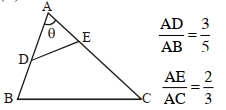
Suppose $ABC$ is a triangle and $D, E$ are points on the sides $AB$ and $AC$ respectively. If $AD : AB = 3 : 5$ and $AE : AC = 2 : 3$,then the ratio of the areas of the triangles $ABC$ and $ADE$ lies in the interval.
A
$(1, 2]$
B
$\left(2, \frac{5}{2}\right]$
C
$\left(\frac{5}{2}, 3\right]$
D
$\left(3, \frac{7}{2}\right]$
Solution
(B) Let $\angle A = \theta$.
The area of $\triangle ABC$ is given by $\text{ar}(\triangle ABC) = \frac{1}{2} \cdot AB \cdot AC \cdot \sin \theta$.
The area of $\triangle ADE$ is given by $\text{ar}(\triangle ADE) = \frac{1}{2} \cdot AD \cdot AE \cdot \sin \theta$.
Therefore,the ratio of the areas is:
$\frac{\text{ar}(\triangle ABC)}{\text{ar}(\triangle ADE)} = \frac{\frac{1}{2} \cdot AB \cdot AC \cdot \sin \theta}{\frac{1}{2} \cdot AD \cdot AE \cdot \sin \theta} = \frac{AB}{AD} \times \frac{AC}{AE}$.
Given $AD : AB = 3 : 5$,we have $\frac{AB}{AD} = \frac{5}{3}$.
Given $AE : AC = 2 : 3$,we have $\frac{AC}{AE} = \frac{3}{2}$.
Thus,the ratio is $\frac{5}{3} \times \frac{3}{2} = \frac{5}{2} = 2.5$.
The value $2.5$ lies in the interval $\left(2, \frac{5}{2}\right]$.
Hence,the correct option is $B$.
The area of $\triangle ABC$ is given by $\text{ar}(\triangle ABC) = \frac{1}{2} \cdot AB \cdot AC \cdot \sin \theta$.
The area of $\triangle ADE$ is given by $\text{ar}(\triangle ADE) = \frac{1}{2} \cdot AD \cdot AE \cdot \sin \theta$.
Therefore,the ratio of the areas is:
$\frac{\text{ar}(\triangle ABC)}{\text{ar}(\triangle ADE)} = \frac{\frac{1}{2} \cdot AB \cdot AC \cdot \sin \theta}{\frac{1}{2} \cdot AD \cdot AE \cdot \sin \theta} = \frac{AB}{AD} \times \frac{AC}{AE}$.
Given $AD : AB = 3 : 5$,we have $\frac{AB}{AD} = \frac{5}{3}$.
Given $AE : AC = 2 : 3$,we have $\frac{AC}{AE} = \frac{3}{2}$.
Thus,the ratio is $\frac{5}{3} \times \frac{3}{2} = \frac{5}{2} = 2.5$.
The value $2.5$ lies in the interval $\left(2, \frac{5}{2}\right]$.
Hence,the correct option is $B$.
0 likes
View Solution99
MediumMCQ
If $\sin x = -\frac{3}{5}$,where $\pi < x < \frac{3\pi}{2}$,then $80(\tan^2 x - \cos x)$ is equal to:
A
$109$
B
$108$
C
$18$
D
$19$
Solution
(A) Given $\sin x = -\frac{3}{5}$ and $\pi < x < \frac{3\pi}{2}$ (which is the third quadrant).
In the third quadrant,$\tan x$ is positive and $\cos x$ is negative.
Using $\cos^2 x = 1 - \sin^2 x$,we get $\cos^2 x = 1 - (-\frac{3}{5})^2 = 1 - \frac{9}{25} = \frac{16}{25}$.
Since $x$ is in the third quadrant,$\cos x = -\frac{4}{5}$.
Now,$\tan x = \frac{\sin x}{\cos x} = \frac{-3/5}{-4/5} = \frac{3}{4}$.
Therefore,$\tan^2 x = (\frac{3}{4})^2 = \frac{9}{16}$.
Substituting these values into the expression $80(\tan^2 x - \cos x)$:
$80(\frac{9}{16} - (-\frac{4}{5})) = 80(\frac{9}{16} + \frac{4}{5})$.
$= 80(\frac{45 + 64}{80}) = 45 + 64 = 109$.
In the third quadrant,$\tan x$ is positive and $\cos x$ is negative.
Using $\cos^2 x = 1 - \sin^2 x$,we get $\cos^2 x = 1 - (-\frac{3}{5})^2 = 1 - \frac{9}{25} = \frac{16}{25}$.
Since $x$ is in the third quadrant,$\cos x = -\frac{4}{5}$.
Now,$\tan x = \frac{\sin x}{\cos x} = \frac{-3/5}{-4/5} = \frac{3}{4}$.
Therefore,$\tan^2 x = (\frac{3}{4})^2 = \frac{9}{16}$.
Substituting these values into the expression $80(\tan^2 x - \cos x)$:
$80(\frac{9}{16} - (-\frac{4}{5})) = 80(\frac{9}{16} + \frac{4}{5})$.
$= 80(\frac{45 + 64}{80}) = 45 + 64 = 109$.
0 likes
View Solution100
DifficultMCQ
If the value of $\frac{3 \cos 36^{\circ}+5 \sin 18^{\circ}}{5 \cos 36^{\circ}-3 \sin 18^{\circ}}$ is $\frac{a \sqrt{5}-b}{c}$ where $a, b, c$ are natural numbers and $\gcd(a, c)=1$,then $a+b+c$ is equal to :
A
$50$
B
$40$
C
$52$
D
$54$
Solution
(C) We know that $\cos 36^{\circ} = \frac{\sqrt{5}+1}{4}$ and $\sin 18^{\circ} = \frac{\sqrt{5}-1}{4}$.
Substituting these values into the expression:
$\frac{3(\frac{\sqrt{5}+1}{4}) + 5(\frac{\sqrt{5}-1}{4})}{5(\frac{\sqrt{5}+1}{4}) - 3(\frac{\sqrt{5}-1}{4})} = \frac{3\sqrt{5}+3+5\sqrt{5}-5}{5\sqrt{5}+5-3\sqrt{5}+3} = \frac{8\sqrt{5}-2}{2\sqrt{5}+8} = \frac{4\sqrt{5}-1}{\sqrt{5}+4}$.
Rationalizing the denominator:
$\frac{4\sqrt{5}-1}{\sqrt{5}+4} \times \frac{4-\sqrt{5}}{4-\sqrt{5}} = \frac{16\sqrt{5}-20-4+\sqrt{5}}{16-5} = \frac{17\sqrt{5}-24}{11}$.
Comparing this with $\frac{a\sqrt{5}-b}{c}$,we get $a=17, b=24, c=11$.
Since $\gcd(17, 11)=1$,the values are valid.
Thus,$a+b+c = 17+24+11 = 52$.
Substituting these values into the expression:
$\frac{3(\frac{\sqrt{5}+1}{4}) + 5(\frac{\sqrt{5}-1}{4})}{5(\frac{\sqrt{5}+1}{4}) - 3(\frac{\sqrt{5}-1}{4})} = \frac{3\sqrt{5}+3+5\sqrt{5}-5}{5\sqrt{5}+5-3\sqrt{5}+3} = \frac{8\sqrt{5}-2}{2\sqrt{5}+8} = \frac{4\sqrt{5}-1}{\sqrt{5}+4}$.
Rationalizing the denominator:
$\frac{4\sqrt{5}-1}{\sqrt{5}+4} \times \frac{4-\sqrt{5}}{4-\sqrt{5}} = \frac{16\sqrt{5}-20-4+\sqrt{5}}{16-5} = \frac{17\sqrt{5}-24}{11}$.
Comparing this with $\frac{a\sqrt{5}-b}{c}$,we get $a=17, b=24, c=11$.
Since $\gcd(17, 11)=1$,the values are valid.
Thus,$a+b+c = 17+24+11 = 52$.
0 likes
View SolutionTrigonometrical Ratios, Functions and Identities — Fundamental trigonometrical ratios and functions, Trigonometrical ratio of allied angles · Frequently Asked Questions
1Are these Trigonometrical Ratios, Functions and Identities questions useful for JEE and NEET?
Yes. All questions in this section are mapped to JEE Main and NEET exam patterns. Previous year questions from JEE Main, NEET, GUJCET and state-level exams are included with full solutions.
2Can I switch to Hindi or Gujarati for these questions?
Yes. Use the language tabs in the hero section or the sidebar to view the same questions and solutions in English, Hindi or Gujarati.
3How do I generate a question paper from this subtopic?
Use the Vedclass Exam Paper Generator — select the chapter and subtopic, set difficulty, and generate Sets A, B, C, D automatically. First 3 chapters of every subject are free.
Vedclass Products
For Students
Vedclass Test Series
Mock tests in real JEE/NEET style with performance analysis. 5-day free trial.
Start Free TrialFor Teachers
Exam Paper Generator
Generate Set A/B/C/D papers from this chapter in 2 minutes. 3 chapters free.
Try FreeFor Institutes
Online Exam Module
Live online exams with unlimited students, 360° analytics & white-label branding.
See DemoFor Teachers & Institutes
Generate a Trigonometrical Ratios, Functions and Identities Exam Paper in 2 Minutes
Select subtopic & difficulty — Sets A, B, C, D auto-generated with No Repeat logic.
First 3 chapters of every subject are free — no payment required.