
A English
Fundamental trigonometrical ratios and functions, Trigonometrical ratio of allied angles Questions in English
Class 11 Mathematics · Trigonometrical Ratios, Functions and Identities · Fundamental trigonometrical ratios and functions, Trigonometrical ratio of allied angles
199+
Questions
English
Language
100%
With Solutions
Showing 44 of 199 questions in English
151
EasyMCQ
$\cos \theta(\operatorname{cosec} \theta - \sec \theta) - \cot \theta =$
A
$-1$
B
$1$
C
$0$
D
$\cos^2 \theta - \tan^2 \theta$
Solution
(A) Given expression: $\cos \theta(\operatorname{cosec} \theta - \sec \theta) - \cot \theta$
$= \cos \theta \left( \frac{1}{\sin \theta} - \frac{1}{\cos \theta} \right) - \cot \theta$
$= \frac{\cos \theta}{\sin \theta} - \frac{\cos \theta}{\cos \theta} - \cot \theta$
$= \cot \theta - 1 - \cot \theta$
$= -1$
$= \cos \theta \left( \frac{1}{\sin \theta} - \frac{1}{\cos \theta} \right) - \cot \theta$
$= \frac{\cos \theta}{\sin \theta} - \frac{\cos \theta}{\cos \theta} - \cot \theta$
$= \cot \theta - 1 - \cot \theta$
$= -1$
0 likes
View Solution152
EasyMCQ
Let $\theta$ be an angle in the standard position such that the point $(-5, 12)$ lies on its terminal side. Then:
A
$|\sin \theta| = -\sin \theta$
B
$|\cos \theta| = \cos \theta$
C
$|\tan \theta| = -\tan \theta$
D
$|\operatorname{cosec} \theta| = -\operatorname{cosec} \theta$
Solution
(C) The point $(-5, 12)$ has a negative $x$-coordinate and a positive $y$-coordinate,which means it lies in the second quadrant.
In the second quadrant,$\sin \theta$ and $\operatorname{cosec} \theta$ are positive,while $\cos \theta, \sec \theta, \tan \theta,$ and $\cot \theta$ are negative.
By the definition of the modulus function,for any value $x$,$|x| = x$ if $x \ge 0$ and $|x| = -x$ if $x < 0$.
Since $\sin \theta > 0$,$|\sin \theta| = \sin \theta$.
Since $\cos \theta < 0$,$|\cos \theta| = -\cos \theta$.
Since $\tan \theta < 0$,$|\tan \theta| = -\tan \theta$.
Since $\operatorname{cosec} \theta > 0$,$|\operatorname{cosec} \theta| = \operatorname{cosec} \theta$.
Comparing these with the given options,option $C$ is correct.
In the second quadrant,$\sin \theta$ and $\operatorname{cosec} \theta$ are positive,while $\cos \theta, \sec \theta, \tan \theta,$ and $\cot \theta$ are negative.
By the definition of the modulus function,for any value $x$,$|x| = x$ if $x \ge 0$ and $|x| = -x$ if $x < 0$.
Since $\sin \theta > 0$,$|\sin \theta| = \sin \theta$.
Since $\cos \theta < 0$,$|\cos \theta| = -\cos \theta$.
Since $\tan \theta < 0$,$|\tan \theta| = -\tan \theta$.
Since $\operatorname{cosec} \theta > 0$,$|\operatorname{cosec} \theta| = \operatorname{cosec} \theta$.
Comparing these with the given options,option $C$ is correct.
0 likes
View Solution153
MediumMCQ
If $x \neq 0$,then $\frac{\sin (\pi+x) \cos (\frac{\pi}{2}+x) \tan (\frac{3 \pi}{2}-x) \cot (2 \pi-x)}{\sin (2 \pi-x) \cos (2 \pi+x) \operatorname{cosec}(-x) \sin (\frac{3 \pi}{2}+x)} = $
A
$0$
B
$-1$
C
$1$
D
$2$
Solution
(C) Using the allied angle formulas:
$\sin(\pi+x) = -\sin x$
$\cos(\frac{\pi}{2}+x) = -\sin x$
$\tan(\frac{3\pi}{2}-x) = \cot x$
$\cot(2\pi-x) = -\cot x$
$\sin(2\pi-x) = -\sin x$
$\cos(2\pi+x) = \cos x$
$\operatorname{cosec}(-x) = -\operatorname{cosec} x$
$\sin(\frac{3\pi}{2}+x) = -\cos x$
Substituting these values into the expression:
$= \frac{(-\sin x)(-\sin x)(\cot x)(-\cot x)}{(-\sin x)(\cos x)(-\operatorname{cosec} x)(-\cos x)}$
$= \frac{-\sin^2 x \cot^2 x}{\sin x \cos x \operatorname{cosec} x \cos x}$
$= \frac{-\sin^2 x \cot^2 x}{\sin x \cos^2 x \cdot \frac{1}{\sin x}}$
$= \frac{-\sin^2 x \cot^2 x}{\cos^2 x} = -\tan^2 x \cdot \cot^2 x = -1$
Wait,let us re-evaluate the signs carefully:
Numerator: $(-\sin x)(-\sin x)(\cot x)(-\cot x) = -\sin^2 x \cot^2 x$
Denominator: $(-\sin x)(\cos x)(-\operatorname{cosec} x)(-\cos x) = -\sin x \cos^2 x \operatorname{cosec} x = -\cos^2 x$
Result: $\frac{-\sin^2 x \cot^2 x}{-\cos^2 x} = \frac{\sin^2 x \cdot \frac{\cos^2 x}{\sin^2 x}}{\cos^2 x} = \frac{\cos^2 x}{\cos^2 x} = 1$
Thus,the correct option is $C$.
$\sin(\pi+x) = -\sin x$
$\cos(\frac{\pi}{2}+x) = -\sin x$
$\tan(\frac{3\pi}{2}-x) = \cot x$
$\cot(2\pi-x) = -\cot x$
$\sin(2\pi-x) = -\sin x$
$\cos(2\pi+x) = \cos x$
$\operatorname{cosec}(-x) = -\operatorname{cosec} x$
$\sin(\frac{3\pi}{2}+x) = -\cos x$
Substituting these values into the expression:
$= \frac{(-\sin x)(-\sin x)(\cot x)(-\cot x)}{(-\sin x)(\cos x)(-\operatorname{cosec} x)(-\cos x)}$
$= \frac{-\sin^2 x \cot^2 x}{\sin x \cos x \operatorname{cosec} x \cos x}$
$= \frac{-\sin^2 x \cot^2 x}{\sin x \cos^2 x \cdot \frac{1}{\sin x}}$
$= \frac{-\sin^2 x \cot^2 x}{\cos^2 x} = -\tan^2 x \cdot \cot^2 x = -1$
Wait,let us re-evaluate the signs carefully:
Numerator: $(-\sin x)(-\sin x)(\cot x)(-\cot x) = -\sin^2 x \cot^2 x$
Denominator: $(-\sin x)(\cos x)(-\operatorname{cosec} x)(-\cos x) = -\sin x \cos^2 x \operatorname{cosec} x = -\cos^2 x$
Result: $\frac{-\sin^2 x \cot^2 x}{-\cos^2 x} = \frac{\sin^2 x \cdot \frac{\cos^2 x}{\sin^2 x}}{\cos^2 x} = \frac{\cos^2 x}{\cos^2 x} = 1$
Thus,the correct option is $C$.
0 likes
View Solution154
EasyMCQ
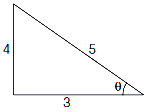
If $\theta$ lies in the third quadrant and $\cos \theta = -\frac{3}{5}$,find the value of $\tan \theta$.
A
$\frac{2}{3}$
B
$-\frac{2}{3}$
C
$-\frac{4}{3}$
D
$\frac{4}{3}$
Solution
(D) Given that $\theta$ lies in the third quadrant,where $\tan \theta$ is positive.
We know that $\sin^2 \theta + \cos^2 \theta = 1$.
Substituting $\cos \theta = -\frac{3}{5}$,we get $\sin^2 \theta + (-\frac{3}{5})^2 = 1$.
$\sin^2 \theta + \frac{9}{25} = 1 \implies \sin^2 \theta = 1 - \frac{9}{25} = \frac{16}{25}$.
Since $\theta$ is in the third quadrant,$\sin \theta$ must be negative,so $\sin \theta = -\frac{4}{5}$.
Now,$\tan \theta = \frac{\sin \theta}{\cos \theta} = \frac{-4/5}{-3/5} = \frac{4}{3}$.
Hence,option $D$ is correct.
We know that $\sin^2 \theta + \cos^2 \theta = 1$.
Substituting $\cos \theta = -\frac{3}{5}$,we get $\sin^2 \theta + (-\frac{3}{5})^2 = 1$.
$\sin^2 \theta + \frac{9}{25} = 1 \implies \sin^2 \theta = 1 - \frac{9}{25} = \frac{16}{25}$.
Since $\theta$ is in the third quadrant,$\sin \theta$ must be negative,so $\sin \theta = -\frac{4}{5}$.
Now,$\tan \theta = \frac{\sin \theta}{\cos \theta} = \frac{-4/5}{-3/5} = \frac{4}{3}$.
Hence,option $D$ is correct.
0 likes
View Solution155
MediumMCQ
$\frac{1+\tanh \left(\frac{x}{2}\right)}{1-\tanh \left(\frac{x}{2}\right)} = $
A
$e^{-x}$
B
$e^x$
C
$2 e^{x/2}$
D
$2 e^{-x/2}$
Solution
(B) We know that $\tanh \left(\frac{x}{2}\right) = \frac{e^{x/2} - e^{-x/2}}{e^{x/2} + e^{-x/2}}$.
Substituting this into the expression:
$\frac{1 + \tanh \left(\frac{x}{2}\right)}{1 - \tanh \left(\frac{x}{2}\right)} = \frac{1 + \frac{e^{x/2} - e^{-x/2}}{e^{x/2} + e^{-x/2}}}{1 - \frac{e^{x/2} - e^{-x/2}}{e^{x/2} + e^{-x/2}}}$
$= \frac{\frac{e^{x/2} + e^{-x/2} + e^{x/2} - e^{-x/2}}{e^{x/2} + e^{-x/2}}}{\frac{e^{x/2} + e^{-x/2} - (e^{x/2} - e^{-x/2})}{e^{x/2} + e^{-x/2}}}$
$= \frac{2e^{x/2}}{2e^{-x/2}}$
$= e^{x/2 - (-x/2)} = e^x$.
Substituting this into the expression:
$\frac{1 + \tanh \left(\frac{x}{2}\right)}{1 - \tanh \left(\frac{x}{2}\right)} = \frac{1 + \frac{e^{x/2} - e^{-x/2}}{e^{x/2} + e^{-x/2}}}{1 - \frac{e^{x/2} - e^{-x/2}}{e^{x/2} + e^{-x/2}}}$
$= \frac{\frac{e^{x/2} + e^{-x/2} + e^{x/2} - e^{-x/2}}{e^{x/2} + e^{-x/2}}}{\frac{e^{x/2} + e^{-x/2} - (e^{x/2} - e^{-x/2})}{e^{x/2} + e^{-x/2}}}$
$= \frac{2e^{x/2}}{2e^{-x/2}}$
$= e^{x/2 - (-x/2)} = e^x$.
0 likes
View Solution156
EasyMCQ
If $\operatorname{cosec} \theta + \cot \theta = \frac{1}{3}$,then $\theta$ lies in the
A
$1^{\text{st}}$ quadrant
B
$2^{\text{nd}}$ quadrant
C
$3^{\text{rd}}$ quadrant
D
$4^{\text{th}}$ quadrant
Solution
(B) Given $\operatorname{cosec} \theta + \cot \theta = \frac{1}{3}$.
Since $\operatorname{cosec} \theta - \cot \theta = \frac{1}{\operatorname{cosec} \theta + \cot \theta}$,we have $\operatorname{cosec} \theta - \cot \theta = 3$.
Adding the two equations: $(\operatorname{cosec} \theta + \cot \theta) + (\operatorname{cosec} \theta - \cot \theta) = \frac{1}{3} + 3 = \frac{10}{3}$.
$2 \operatorname{cosec} \theta = \frac{10}{3}$ $\Rightarrow \operatorname{cosec} \theta = \frac{5}{3}$ $\Rightarrow \sin \theta = \frac{3}{5}$.
Subtracting the equations: $(\operatorname{cosec} \theta + \cot \theta) - (\operatorname{cosec} \theta - \cot \theta) = \frac{1}{3} - 3 = -\frac{8}{3}$.
$2 \cot \theta = -\frac{8}{3}$ $\Rightarrow \cot \theta = -\frac{4}{3}$ $\Rightarrow \cos \theta = -\frac{4}{5}$.
Since $\sin \theta > 0$ and $\cos \theta < 0$,$\theta$ lies in the $2^{\text{nd}}$ quadrant.
Since $\operatorname{cosec} \theta - \cot \theta = \frac{1}{\operatorname{cosec} \theta + \cot \theta}$,we have $\operatorname{cosec} \theta - \cot \theta = 3$.
Adding the two equations: $(\operatorname{cosec} \theta + \cot \theta) + (\operatorname{cosec} \theta - \cot \theta) = \frac{1}{3} + 3 = \frac{10}{3}$.
$2 \operatorname{cosec} \theta = \frac{10}{3}$ $\Rightarrow \operatorname{cosec} \theta = \frac{5}{3}$ $\Rightarrow \sin \theta = \frac{3}{5}$.
Subtracting the equations: $(\operatorname{cosec} \theta + \cot \theta) - (\operatorname{cosec} \theta - \cot \theta) = \frac{1}{3} - 3 = -\frac{8}{3}$.
$2 \cot \theta = -\frac{8}{3}$ $\Rightarrow \cot \theta = -\frac{4}{3}$ $\Rightarrow \cos \theta = -\frac{4}{5}$.
Since $\sin \theta > 0$ and $\cos \theta < 0$,$\theta$ lies in the $2^{\text{nd}}$ quadrant.
0 likes
View Solution157
MediumMCQ
$\cos ^2\left(\frac{7 \pi}{8}\right)+\cos ^2\left(\frac{5 \pi}{8}\right)+\cos ^2\left(\frac{3 \pi}{8}\right)+\cos ^2\left(\frac{\pi}{8}\right)=$
A
$\frac{3}{2}$
B
$\frac{2}{3}$
C
$2$
D
$1$
Solution
(C) We know that $\cos(\pi - \theta) = -\cos \theta$,so $\cos^2(\pi - \theta) = \cos^2 \theta$.
Also,$\cos(\frac{\pi}{2} - \theta) = \sin \theta$,so $\cos^2(\frac{\pi}{2} - \theta) = \sin^2 \theta$.
Given expression: $E = \cos^2(\frac{7\pi}{8}) + \cos^2(\frac{5\pi}{8}) + \cos^2(\frac{3\pi}{8}) + \cos^2(\frac{\pi}{8})$.
Note that $\frac{7\pi}{8} = \pi - \frac{\pi}{8}$,so $\cos^2(\frac{7\pi}{8}) = \cos^2(\frac{\pi}{8})$.
Note that $\frac{5\pi}{8} = \pi - \frac{3\pi}{8}$,so $\cos^2(\frac{5\pi}{8}) = \cos^2(\frac{3\pi}{8})$.
Thus,$E = 2\cos^2(\frac{\pi}{8}) + 2\cos^2(\frac{3\pi}{8})$.
Since $\frac{3\pi}{8} = \frac{\pi}{2} - \frac{\pi}{8}$,we have $\cos^2(\frac{3\pi}{8}) = \sin^2(\frac{\pi}{8})$.
Substituting this into $E$: $E = 2\cos^2(\frac{\pi}{8}) + 2\sin^2(\frac{\pi}{8})$.
$E = 2(\cos^2(\frac{\pi}{8}) + \sin^2(\frac{\pi}{8}))$.
Using the identity $\sin^2 \theta + \cos^2 \theta = 1$,we get $E = 2(1) = 2$.
Also,$\cos(\frac{\pi}{2} - \theta) = \sin \theta$,so $\cos^2(\frac{\pi}{2} - \theta) = \sin^2 \theta$.
Given expression: $E = \cos^2(\frac{7\pi}{8}) + \cos^2(\frac{5\pi}{8}) + \cos^2(\frac{3\pi}{8}) + \cos^2(\frac{\pi}{8})$.
Note that $\frac{7\pi}{8} = \pi - \frac{\pi}{8}$,so $\cos^2(\frac{7\pi}{8}) = \cos^2(\frac{\pi}{8})$.
Note that $\frac{5\pi}{8} = \pi - \frac{3\pi}{8}$,so $\cos^2(\frac{5\pi}{8}) = \cos^2(\frac{3\pi}{8})$.
Thus,$E = 2\cos^2(\frac{\pi}{8}) + 2\cos^2(\frac{3\pi}{8})$.
Since $\frac{3\pi}{8} = \frac{\pi}{2} - \frac{\pi}{8}$,we have $\cos^2(\frac{3\pi}{8}) = \sin^2(\frac{\pi}{8})$.
Substituting this into $E$: $E = 2\cos^2(\frac{\pi}{8}) + 2\sin^2(\frac{\pi}{8})$.
$E = 2(\cos^2(\frac{\pi}{8}) + \sin^2(\frac{\pi}{8}))$.
Using the identity $\sin^2 \theta + \cos^2 \theta = 1$,we get $E = 2(1) = 2$.
0 likes
View Solution158
EasyMCQ
If $\sin(270^{\circ}-x^{\circ})=\cos 292^{\circ}$,then a value of $x$ is
A
$120$
B
$60$
C
$113$
D
$112$
Solution
(D) Given the equation: $\sin(270^{\circ}-x^{\circ})=\cos 292^{\circ}$.
Using the allied angle formula $\sin(270^{\circ}-\theta) = -\cos \theta$,we have:
$-\cos x^{\circ} = \cos 292^{\circ}$.
Since $\cos(180^{\circ}-\theta) = -\cos \theta$,we can write:
$-\cos x^{\circ} = \cos(180^{\circ}-112^{\circ}) = \cos 68^{\circ}$.
Alternatively,using $-\cos \theta = \cos(180^{\circ}+\theta)$:
$-\cos x^{\circ} = \cos(180^{\circ}+x^{\circ})$.
Comparing $\cos(180^{\circ}+x^{\circ}) = \cos 292^{\circ}$,we get:
$180+x = 292 \implies x = 292-180 = 112$.
Thus,$x = 112$.
Using the allied angle formula $\sin(270^{\circ}-\theta) = -\cos \theta$,we have:
$-\cos x^{\circ} = \cos 292^{\circ}$.
Since $\cos(180^{\circ}-\theta) = -\cos \theta$,we can write:
$-\cos x^{\circ} = \cos(180^{\circ}-112^{\circ}) = \cos 68^{\circ}$.
Alternatively,using $-\cos \theta = \cos(180^{\circ}+\theta)$:
$-\cos x^{\circ} = \cos(180^{\circ}+x^{\circ})$.
Comparing $\cos(180^{\circ}+x^{\circ}) = \cos 292^{\circ}$,we get:
$180+x = 292 \implies x = 292-180 = 112$.
Thus,$x = 112$.
0 likes
View Solution159
DifficultMCQ
If $\theta$ lies in the first quadrant and $5 \tan \theta = 4$,then $\frac{5 \sin \theta - 3 \cos \theta}{\sin \theta + 2 \cos \theta}$ is equal to
A
$\frac{5}{14}$
B
$\frac{3}{14}$
C
$\frac{1}{14}$
D
$0$
Solution
(A) Given,$\theta$ lies in the first quadrant and $5 \tan \theta = 4$.
Dividing the numerator and denominator of the expression by $\cos \theta$,we get:
$\frac{5 \tan \theta - 3}{\tan \theta + 2}$
Substituting $\tan \theta = \frac{4}{5}$:
$\frac{5(\frac{4}{5}) - 3}{\frac{4}{5} + 2} = \frac{4 - 3}{\frac{4 + 10}{5}} = \frac{1}{\frac{14}{5}} = \frac{5}{14}$.
Dividing the numerator and denominator of the expression by $\cos \theta$,we get:
$\frac{5 \tan \theta - 3}{\tan \theta + 2}$
Substituting $\tan \theta = \frac{4}{5}$:
$\frac{5(\frac{4}{5}) - 3}{\frac{4}{5} + 2} = \frac{4 - 3}{\frac{4 + 10}{5}} = \frac{1}{\frac{14}{5}} = \frac{5}{14}$.
0 likes
View Solution160
DifficultMCQ
$\sin 120^{\circ} \cos 150^{\circ} - \cos 240^{\circ} \sin 330^{\circ}$ is equal to :
A
$1$
B
$-1$
C
$\frac{2}{3}$
D
$-\left(\frac{\sqrt{3}+1}{4}\right)$
Solution
(B) We use the values of trigonometric functions for allied angles:
$\sin 120^{\circ} = \sin(180^{\circ} - 60^{\circ}) = \sin 60^{\circ} = \frac{\sqrt{3}}{2}$
$\cos 150^{\circ} = \cos(180^{\circ} - 30^{\circ}) = -\cos 30^{\circ} = -\frac{\sqrt{3}}{2}$
$\cos 240^{\circ} = \cos(180^{\circ} + 60^{\circ}) = -\cos 60^{\circ} = -\frac{1}{2}$
$\sin 330^{\circ} = \sin(360^{\circ} - 30^{\circ}) = -\sin 30^{\circ} = -\frac{1}{2}$
Substituting these values into the expression:
$\left(\frac{\sqrt{3}}{2}\right) \left(-\frac{\sqrt{3}}{2}\right) - \left(-\frac{1}{2}\right) \left(-\frac{1}{2}\right)$
$= -\frac{3}{4} - \frac{1}{4}$
$= -\frac{4}{4} = -1$
$\sin 120^{\circ} = \sin(180^{\circ} - 60^{\circ}) = \sin 60^{\circ} = \frac{\sqrt{3}}{2}$
$\cos 150^{\circ} = \cos(180^{\circ} - 30^{\circ}) = -\cos 30^{\circ} = -\frac{\sqrt{3}}{2}$
$\cos 240^{\circ} = \cos(180^{\circ} + 60^{\circ}) = -\cos 60^{\circ} = -\frac{1}{2}$
$\sin 330^{\circ} = \sin(360^{\circ} - 30^{\circ}) = -\sin 30^{\circ} = -\frac{1}{2}$
Substituting these values into the expression:
$\left(\frac{\sqrt{3}}{2}\right) \left(-\frac{\sqrt{3}}{2}\right) - \left(-\frac{1}{2}\right) \left(-\frac{1}{2}\right)$
$= -\frac{3}{4} - \frac{1}{4}$
$= -\frac{4}{4} = -1$
0 likes
View Solution161
DifficultMCQ
If $x \cos \theta = y \cos \left(\theta + \frac{2 \pi}{3}\right) = z \cos \left(\theta + \frac{4 \pi}{3}\right)$,then $\frac{1}{x} + \frac{1}{y} + \frac{1}{z} = $
A
$1$
B
$2$
C
$0$
D
$3$
Solution
(C) Let $x \cos \theta = y \cos \left(\theta + \frac{2 \pi}{3}\right) = z \cos \left(\theta + \frac{4 \pi}{3}\right) = \lambda$ (where $\lambda \neq 0$).
Then,$\frac{1}{x} = \frac{\cos \theta}{\lambda}$,$\frac{1}{y} = \frac{\cos \left(\theta + \frac{2 \pi}{3}\right)}{\lambda}$,and $\frac{1}{z} = \frac{\cos \left(\theta + \frac{4 \pi}{3}\right)}{\lambda}$.
Summing these,we get $\frac{1}{x} + \frac{1}{y} + \frac{1}{z} = \frac{1}{\lambda} \left[ \cos \theta + \cos \left(\theta + \frac{2 \pi}{3}\right) + \cos \left(\theta + \frac{4 \pi}{3}\right) \right]$.
Using the identity $\cos A + \cos B = 2 \cos \left(\frac{A+B}{2}\right) \cos \left(\frac{A-B}{2}\right)$ for the first and third terms:
$\cos \theta + \cos \left(\theta + \frac{4 \pi}{3}\right) = 2 \cos \left(\theta + \frac{2 \pi}{3}\right) \cos \left(-\frac{2 \pi}{3}\right) = 2 \cos \left(\theta + \frac{2 \pi}{3}\right) \left(-\frac{1}{2}\right) = -\cos \left(\theta + \frac{2 \pi}{3}\right)$.
Substituting this back into the sum:
$\frac{1}{x} + \frac{1}{y} + \frac{1}{z} = \frac{1}{\lambda} \left[ -\cos \left(\theta + \frac{2 \pi}{3}\right) + \cos \left(\theta + \frac{2 \pi}{3}\right) \right] = \frac{1}{\lambda} (0) = 0$.
Then,$\frac{1}{x} = \frac{\cos \theta}{\lambda}$,$\frac{1}{y} = \frac{\cos \left(\theta + \frac{2 \pi}{3}\right)}{\lambda}$,and $\frac{1}{z} = \frac{\cos \left(\theta + \frac{4 \pi}{3}\right)}{\lambda}$.
Summing these,we get $\frac{1}{x} + \frac{1}{y} + \frac{1}{z} = \frac{1}{\lambda} \left[ \cos \theta + \cos \left(\theta + \frac{2 \pi}{3}\right) + \cos \left(\theta + \frac{4 \pi}{3}\right) \right]$.
Using the identity $\cos A + \cos B = 2 \cos \left(\frac{A+B}{2}\right) \cos \left(\frac{A-B}{2}\right)$ for the first and third terms:
$\cos \theta + \cos \left(\theta + \frac{4 \pi}{3}\right) = 2 \cos \left(\theta + \frac{2 \pi}{3}\right) \cos \left(-\frac{2 \pi}{3}\right) = 2 \cos \left(\theta + \frac{2 \pi}{3}\right) \left(-\frac{1}{2}\right) = -\cos \left(\theta + \frac{2 \pi}{3}\right)$.
Substituting this back into the sum:
$\frac{1}{x} + \frac{1}{y} + \frac{1}{z} = \frac{1}{\lambda} \left[ -\cos \left(\theta + \frac{2 \pi}{3}\right) + \cos \left(\theta + \frac{2 \pi}{3}\right) \right] = \frac{1}{\lambda} (0) = 0$.
0 likes
View Solution162
EasyMCQ
$\frac{\cos 10^{\circ} + \cos 80^{\circ}}{\sin 80^{\circ} - \sin 10^{\circ}} = ?$
A
$\tan 35^{\circ}$
B
$\tan 55^{\circ}$
C
$\tan 20^{\circ}$
D
$\tan 70^{\circ}$
Solution
(B) Using the sum-to-product formulas: $\cos A + \cos B = 2 \cos \left( \frac{A+B}{2} \right) \cos \left( \frac{A-B}{2} \right)$ and $\sin A - \sin B = 2 \cos \left( \frac{A+B}{2} \right) \sin \left( \frac{A-B}{2} \right)$.
Applying these to the expression:
$\frac{\cos 10^{\circ} + \cos 80^{\circ}}{\sin 80^{\circ} - \sin 10^{\circ}} = \frac{2 \cos \left( \frac{80^{\circ} + 10^{\circ}}{2} \right) \cos \left( \frac{80^{\circ} - 10^{\circ}}{2} \right)}{2 \cos \left( \frac{80^{\circ} + 10^{\circ}}{2} \right) \sin \left( \frac{80^{\circ} - 10^{\circ}}{2} \right)}$
$= \frac{\cos 45^{\circ} \cos 35^{\circ}}{\cos 45^{\circ} \sin 35^{\circ}}$
$= \cot 35^{\circ} = \tan(90^{\circ} - 35^{\circ}) = \tan 55^{\circ}$.
Applying these to the expression:
$\frac{\cos 10^{\circ} + \cos 80^{\circ}}{\sin 80^{\circ} - \sin 10^{\circ}} = \frac{2 \cos \left( \frac{80^{\circ} + 10^{\circ}}{2} \right) \cos \left( \frac{80^{\circ} - 10^{\circ}}{2} \right)}{2 \cos \left( \frac{80^{\circ} + 10^{\circ}}{2} \right) \sin \left( \frac{80^{\circ} - 10^{\circ}}{2} \right)}$
$= \frac{\cos 45^{\circ} \cos 35^{\circ}}{\cos 45^{\circ} \sin 35^{\circ}}$
$= \cot 35^{\circ} = \tan(90^{\circ} - 35^{\circ}) = \tan 55^{\circ}$.
0 likes
View Solution163
EasyMCQ
$\frac{1}{\cos 290^{\circ}}+\frac{1}{\sqrt{3} \sin 250^{\circ}} = $
A
$\frac{\sqrt{3}}{4}$
B
$\frac{4}{\sqrt{3}}$
C
$\frac{2}{\sqrt{3}}$
D
$\frac{\sqrt{3}}{2}$
Solution
(B) Given expression: $E = \frac{1}{\cos 290^{\circ}} + \frac{1}{\sqrt{3} \sin 250^{\circ}}$
Using allied angles: $\cos 290^{\circ} = \cos(270^{\circ} + 20^{\circ}) = \sin 20^{\circ}$ and $\sin 250^{\circ} = \sin(270^{\circ} - 20^{\circ}) = -\cos 20^{\circ}$.
So,$E = \frac{1}{\sin 20^{\circ}} - \frac{1}{\sqrt{3} \cos 20^{\circ}}$
$E = \frac{\sqrt{3} \cos 20^{\circ} - \sin 20^{\circ}}{\sqrt{3} \sin 20^{\circ} \cos 20^{\circ}}$
Multiply numerator and denominator by $2$:
$E = \frac{2(\frac{\sqrt{3}}{2} \cos 20^{\circ} - \frac{1}{2} \sin 20^{\circ})}{\frac{\sqrt{3}}{2} (2 \sin 20^{\circ} \cos 20^{\circ})}$
$E = \frac{2(\sin 60^{\circ} \cos 20^{\circ} - \cos 60^{\circ} \sin 20^{\circ})}{\frac{\sqrt{3}}{2} \sin 40^{\circ}}$
$E = \frac{2 \sin(60^{\circ} - 20^{\circ})}{\frac{\sqrt{3}}{2} \sin 40^{\circ}} = \frac{2 \sin 40^{\circ}}{\frac{\sqrt{3}}{2} \sin 40^{\circ}} = \frac{4}{\sqrt{3}}$
Using allied angles: $\cos 290^{\circ} = \cos(270^{\circ} + 20^{\circ}) = \sin 20^{\circ}$ and $\sin 250^{\circ} = \sin(270^{\circ} - 20^{\circ}) = -\cos 20^{\circ}$.
So,$E = \frac{1}{\sin 20^{\circ}} - \frac{1}{\sqrt{3} \cos 20^{\circ}}$
$E = \frac{\sqrt{3} \cos 20^{\circ} - \sin 20^{\circ}}{\sqrt{3} \sin 20^{\circ} \cos 20^{\circ}}$
Multiply numerator and denominator by $2$:
$E = \frac{2(\frac{\sqrt{3}}{2} \cos 20^{\circ} - \frac{1}{2} \sin 20^{\circ})}{\frac{\sqrt{3}}{2} (2 \sin 20^{\circ} \cos 20^{\circ})}$
$E = \frac{2(\sin 60^{\circ} \cos 20^{\circ} - \cos 60^{\circ} \sin 20^{\circ})}{\frac{\sqrt{3}}{2} \sin 40^{\circ}}$
$E = \frac{2 \sin(60^{\circ} - 20^{\circ})}{\frac{\sqrt{3}}{2} \sin 40^{\circ}} = \frac{2 \sin 40^{\circ}}{\frac{\sqrt{3}}{2} \sin 40^{\circ}} = \frac{4}{\sqrt{3}}$
0 likes
View Solution164
MediumMCQ
If $\left[1-\cos \left(\frac{\pi}{2}+\alpha\right)+\sin \left(\frac{3 \pi}{2}+\alpha\right)\right]^2+\left[1-\sin \left(\frac{3 \pi}{2}-\alpha\right)-\cos \left(\frac{3 \pi}{2}+\alpha\right)\right]^2=a+b \sin ^2\left(\frac{\pi}{4}+\alpha\right)$,then $a^2+b^2=$
A
$20$
B
$52$
C
$40$
D
$32$
Solution
(B) Given the expression: $\left[1-\cos \left(\frac{\pi}{2}+\alpha\right)+\sin \left(\frac{3 \pi}{2}+\alpha\right)\right]^2+\left[1-\sin \left(\frac{3 \pi}{2}-\alpha\right)-\cos \left(\frac{3 \pi}{2}+\alpha\right)\right]^2=a+b \sin ^2\left(\frac{\pi}{4}+\alpha\right)$.
Using trigonometric identities: $\cos(\frac{\pi}{2}+\alpha) = -\sin \alpha$,$\sin(\frac{3\pi}{2}+\alpha) = -\cos \alpha$,$\sin(\frac{3\pi}{2}-\alpha) = -\cos \alpha$,and $\cos(\frac{3\pi}{2}+\alpha) = \sin \alpha$.
The expression becomes: $(1+\sin \alpha-\cos \alpha)^2+(1+\cos \alpha-\sin \alpha)^2 = a+b \sin ^2(\frac{\pi}{4}+\alpha)$.
Expanding both squares: $(1+\sin^2 \alpha+\cos^2 \alpha+2\sin \alpha-2\sin \alpha \cos \alpha-2\cos \alpha) + (1+\cos^2 \alpha+\sin^2 \alpha+2\cos \alpha-2\sin \alpha \cos \alpha-2\sin \alpha) = a+b \sin^2(\frac{\pi}{4}+\alpha)$.
Simplifying: $4-4\sin \alpha \cos \alpha = a+b(\sin \frac{\pi}{4} \cos \alpha+\cos \frac{\pi}{4} \sin \alpha)^2$.
$4-4\sin \alpha \cos \alpha = a+\frac{b}{2}(\cos \alpha+\sin \alpha)^2 = a+\frac{b}{2}(1+2\sin \alpha \cos \alpha) = (a+\frac{b}{2}) + b\sin \alpha \cos \alpha$.
Comparing coefficients: $b = -4$ and $a+\frac{b}{2} = 4$ $\Rightarrow a-2 = 4$ $\Rightarrow a = 6$.
Thus,$a^2+b^2 = 6^2+(-4)^2 = 36+16 = 52$.
Using trigonometric identities: $\cos(\frac{\pi}{2}+\alpha) = -\sin \alpha$,$\sin(\frac{3\pi}{2}+\alpha) = -\cos \alpha$,$\sin(\frac{3\pi}{2}-\alpha) = -\cos \alpha$,and $\cos(\frac{3\pi}{2}+\alpha) = \sin \alpha$.
The expression becomes: $(1+\sin \alpha-\cos \alpha)^2+(1+\cos \alpha-\sin \alpha)^2 = a+b \sin ^2(\frac{\pi}{4}+\alpha)$.
Expanding both squares: $(1+\sin^2 \alpha+\cos^2 \alpha+2\sin \alpha-2\sin \alpha \cos \alpha-2\cos \alpha) + (1+\cos^2 \alpha+\sin^2 \alpha+2\cos \alpha-2\sin \alpha \cos \alpha-2\sin \alpha) = a+b \sin^2(\frac{\pi}{4}+\alpha)$.
Simplifying: $4-4\sin \alpha \cos \alpha = a+b(\sin \frac{\pi}{4} \cos \alpha+\cos \frac{\pi}{4} \sin \alpha)^2$.
$4-4\sin \alpha \cos \alpha = a+\frac{b}{2}(\cos \alpha+\sin \alpha)^2 = a+\frac{b}{2}(1+2\sin \alpha \cos \alpha) = (a+\frac{b}{2}) + b\sin \alpha \cos \alpha$.
Comparing coefficients: $b = -4$ and $a+\frac{b}{2} = 4$ $\Rightarrow a-2 = 4$ $\Rightarrow a = 6$.
Thus,$a^2+b^2 = 6^2+(-4)^2 = 36+16 = 52$.
0 likes
View Solution165
EasyMCQ
Find the value of $\operatorname{cosec} 750^{\circ} - 2 \cot 765^{\circ}$.
A
$0$
B
$1$
C
$2$
D
$-1$
Solution
(A) We have the expression $\operatorname{cosec} 750^{\circ} - 2 \cot 765^{\circ}$.
Using the periodicity of trigonometric functions,$\operatorname{cosec}(n \times 360^{\circ} + \theta) = \operatorname{cosec} \theta$ and $\cot(n \times 360^{\circ} + \theta) = \cot \theta$.
$\operatorname{cosec} 750^{\circ} = \operatorname{cosec}(2 \times 360^{\circ} + 30^{\circ}) = \operatorname{cosec} 30^{\circ} = 2$.
$\cot 765^{\circ} = \cot(2 \times 360^{\circ} + 45^{\circ}) = \cot 45^{\circ} = 1$.
Substituting these values into the expression:
$2 - 2(1) = 2 - 2 = 0$.
Thus,the correct option is $A$.
Using the periodicity of trigonometric functions,$\operatorname{cosec}(n \times 360^{\circ} + \theta) = \operatorname{cosec} \theta$ and $\cot(n \times 360^{\circ} + \theta) = \cot \theta$.
$\operatorname{cosec} 750^{\circ} = \operatorname{cosec}(2 \times 360^{\circ} + 30^{\circ}) = \operatorname{cosec} 30^{\circ} = 2$.
$\cot 765^{\circ} = \cot(2 \times 360^{\circ} + 45^{\circ}) = \cot 45^{\circ} = 1$.
Substituting these values into the expression:
$2 - 2(1) = 2 - 2 = 0$.
Thus,the correct option is $A$.
0 likes
View Solution166
MediumMCQ
$\sin \frac{\pi}{5} + \sin \frac{2\pi}{5} + \sin \frac{3\pi}{5} + \sin \frac{4\pi}{5} =$
A
$1$
B
$ \sqrt{5 + 2\sqrt{5}}$
C
$\frac{1}{2} \sqrt{10 + 2\sqrt{5}}$
D
$\frac{1}{4} \sqrt{10 + 2\sqrt{5}}$
Solution
(B) We need to evaluate $S = \sin \frac{\pi}{5} + \sin \frac{2\pi}{5} + \sin \frac{3\pi}{5} + \sin \frac{4\pi}{5}$.
Note that $\sin \frac{4\pi}{5} = \sin(\pi - \frac{\pi}{5}) = \sin \frac{\pi}{5}$ and $\sin \frac{3\pi}{5} = \sin(\pi - \frac{2\pi}{5}) = \sin \frac{2\pi}{5}$.
So,$S = 2(\sin \frac{\pi}{5} + \sin \frac{2\pi}{5})$.
Using the values $\sin \frac{\pi}{5} = \frac{\sqrt{10 - 2\sqrt{5}}}{4}$ and $\sin \frac{2\pi}{5} = \frac{\sqrt{10 + 2\sqrt{5}}}{4}$,
$S = 2 \left( \frac{\sqrt{10 - 2\sqrt{5}} + \sqrt{10 + 2\sqrt{5}}}{4} \right) = \frac{\sqrt{10 - 2\sqrt{5}} + \sqrt{10 + 2\sqrt{5}}}{2}$.
Squaring $S$: $S^2 = \frac{1}{4} (10 - 2\sqrt{5} + 10 + 2\sqrt{5} + 2\sqrt{(10 - 2\sqrt{5})(10 + 2\sqrt{5})}) = \frac{1}{4} (20 + 2\sqrt{100 - 20}) = \frac{1}{4} (20 + 2\sqrt{80}) = \frac{1}{4} (20 + 8\sqrt{5}) = 5 + 2\sqrt{5}$.
Thus,$S = \sqrt{5 + 2\sqrt{5}}$.
Note that $\sin \frac{4\pi}{5} = \sin(\pi - \frac{\pi}{5}) = \sin \frac{\pi}{5}$ and $\sin \frac{3\pi}{5} = \sin(\pi - \frac{2\pi}{5}) = \sin \frac{2\pi}{5}$.
So,$S = 2(\sin \frac{\pi}{5} + \sin \frac{2\pi}{5})$.
Using the values $\sin \frac{\pi}{5} = \frac{\sqrt{10 - 2\sqrt{5}}}{4}$ and $\sin \frac{2\pi}{5} = \frac{\sqrt{10 + 2\sqrt{5}}}{4}$,
$S = 2 \left( \frac{\sqrt{10 - 2\sqrt{5}} + \sqrt{10 + 2\sqrt{5}}}{4} \right) = \frac{\sqrt{10 - 2\sqrt{5}} + \sqrt{10 + 2\sqrt{5}}}{2}$.
Squaring $S$: $S^2 = \frac{1}{4} (10 - 2\sqrt{5} + 10 + 2\sqrt{5} + 2\sqrt{(10 - 2\sqrt{5})(10 + 2\sqrt{5})}) = \frac{1}{4} (20 + 2\sqrt{100 - 20}) = \frac{1}{4} (20 + 2\sqrt{80}) = \frac{1}{4} (20 + 8\sqrt{5}) = 5 + 2\sqrt{5}$.
Thus,$S = \sqrt{5 + 2\sqrt{5}}$.
0 likes
View Solution167
EasyMCQ
$\frac{\sqrt{3} \sin \theta + \cos \theta}{\sin \left(\theta + \frac{\pi}{6}\right)} = $
A
$-2$
B
$1$
C
$2$
D
$-1$
Solution
(C) We are given the expression: $\frac{\sqrt{3} \sin \theta + \cos \theta}{\sin \left(\theta + \frac{\pi}{6}\right)}$.
Using the expansion formula $\sin(A + B) = \sin A \cos B + \cos A \sin B$,we expand the denominator:
$\sin \left(\theta + \frac{\pi}{6}\right) = \sin \theta \cos \frac{\pi}{6} + \cos \theta \sin \frac{\pi}{6}$.
Since $\cos \frac{\pi}{6} = \frac{\sqrt{3}}{2}$ and $\sin \frac{\pi}{6} = \frac{1}{2}$,the denominator becomes:
$\frac{\sqrt{3}}{2} \sin \theta + \frac{1}{2} \cos \theta = \frac{1}{2} (\sqrt{3} \sin \theta + \cos \theta)$.
Substituting this back into the original expression:
$\frac{\sqrt{3} \sin \theta + \cos \theta}{\frac{1}{2} (\sqrt{3} \sin \theta + \cos \theta)} = \frac{1}{1/2} = 2$.
Thus,the correct option is $C$.
Using the expansion formula $\sin(A + B) = \sin A \cos B + \cos A \sin B$,we expand the denominator:
$\sin \left(\theta + \frac{\pi}{6}\right) = \sin \theta \cos \frac{\pi}{6} + \cos \theta \sin \frac{\pi}{6}$.
Since $\cos \frac{\pi}{6} = \frac{\sqrt{3}}{2}$ and $\sin \frac{\pi}{6} = \frac{1}{2}$,the denominator becomes:
$\frac{\sqrt{3}}{2} \sin \theta + \frac{1}{2} \cos \theta = \frac{1}{2} (\sqrt{3} \sin \theta + \cos \theta)$.
Substituting this back into the original expression:
$\frac{\sqrt{3} \sin \theta + \cos \theta}{\frac{1}{2} (\sqrt{3} \sin \theta + \cos \theta)} = \frac{1}{1/2} = 2$.
Thus,the correct option is $C$.
0 likes
View Solution168
MediumMCQ
$\tan \left(-\frac{23 \pi}{3}\right)-\cot \left(\theta-\frac{13 \pi}{3}\right) =$
A
$\sqrt{3}+\cot \theta$
B
$\sqrt{3}-\tan \left(\frac{\pi}{6}+\theta\right)$
C
$\sqrt{3}+\tan \theta$
D
$\sqrt{3}+\cot \left(\frac{\pi}{3}-\theta\right)$
Solution
(D) We have the expression: $\tan \left(-\frac{23 \pi}{3}\right)-\cot \left(\theta-\frac{13 \pi}{3}\right)$
Since $\tan(-x) = -\tan(x)$,we have $\tan \left(-\frac{23 \pi}{3}\right) = -\tan \left(\frac{23 \pi}{3}\right) = -\tan \left(8 \pi - \frac{\pi}{3}\right) = -(-\tan \frac{\pi}{3}) = \sqrt{3}$.
For the second term,$\cot \left(\theta-\frac{13 \pi}{3}\right) = \cot \left(\theta - (4 \pi + \frac{\pi}{3})\right) = \cot \left(\theta - \frac{\pi}{3}\right) = -\cot \left(\frac{\pi}{3} - \theta\right)$.
Substituting these back into the expression: $\sqrt{3} - (-\cot \left(\frac{\pi}{3} - \theta\right)) = \sqrt{3} + \cot \left(\frac{\pi}{3} - \theta\right)$.
Thus,the correct option is $D$.
Since $\tan(-x) = -\tan(x)$,we have $\tan \left(-\frac{23 \pi}{3}\right) = -\tan \left(\frac{23 \pi}{3}\right) = -\tan \left(8 \pi - \frac{\pi}{3}\right) = -(-\tan \frac{\pi}{3}) = \sqrt{3}$.
For the second term,$\cot \left(\theta-\frac{13 \pi}{3}\right) = \cot \left(\theta - (4 \pi + \frac{\pi}{3})\right) = \cot \left(\theta - \frac{\pi}{3}\right) = -\cot \left(\frac{\pi}{3} - \theta\right)$.
Substituting these back into the expression: $\sqrt{3} - (-\cot \left(\frac{\pi}{3} - \theta\right)) = \sqrt{3} + \cot \left(\frac{\pi}{3} - \theta\right)$.
Thus,the correct option is $D$.
0 likes
View Solution169
EasyMCQ
Factorize the expression: $2 \cot^2 \theta - \cot \theta - 3$.
A
$(2 \cot \theta - 3)(\cot \theta + 1)$
B
$(2 \cot \theta - 1)(\cot \theta + 3)$
C
$(2 \cot \theta + 3)(\cot \theta - 1)$
D
$(2 \cot \theta + 1)(\cot \theta - 3)$
Solution
(A) Let $x = \cot \theta$. The expression becomes $2x^2 - x - 3$.
To factorize $2x^2 - x - 3$,we look for two numbers whose product is $2 \times (-3) = -6$ and whose sum is $-1$.
These numbers are $-3$ and $2$.
$2x^2 - 3x + 2x - 3 = x(2x - 3) + 1(2x - 3) = (2x - 3)(x + 1)$.
Substituting $x = \cot \theta$ back,we get $(2 \cot \theta - 3)(\cot \theta + 1)$.
To factorize $2x^2 - x - 3$,we look for two numbers whose product is $2 \times (-3) = -6$ and whose sum is $-1$.
These numbers are $-3$ and $2$.
$2x^2 - 3x + 2x - 3 = x(2x - 3) + 1(2x - 3) = (2x - 3)(x + 1)$.
Substituting $x = \cot \theta$ back,we get $(2 \cot \theta - 3)(\cot \theta + 1)$.
0 likes
View Solution170
MediumMCQ
$\tan x + \frac{\cos x}{1 + \sin x} = $
A
$\tan 2x$
B
$\operatorname{cosec} x$
C
$\sec x$
D
$\cos 2x$
Solution
(C) Given expression: $\tan x + \frac{\cos x}{1 + \sin x}$
$= \frac{\sin x}{\cos x} + \frac{\cos x}{1 + \sin x}$
$= \frac{\sin x(1 + \sin x) + \cos^2 x}{\cos x(1 + \sin x)}$
$= \frac{\sin x + \sin^2 x + \cos^2 x}{\cos x(1 + \sin x)}$
Since $\sin^2 x + \cos^2 x = 1$,we get:
$= \frac{\sin x + 1}{\cos x(1 + \sin x)}$
$= \frac{1}{\cos x} = \sec x$
$= \frac{\sin x}{\cos x} + \frac{\cos x}{1 + \sin x}$
$= \frac{\sin x(1 + \sin x) + \cos^2 x}{\cos x(1 + \sin x)}$
$= \frac{\sin x + \sin^2 x + \cos^2 x}{\cos x(1 + \sin x)}$
Since $\sin^2 x + \cos^2 x = 1$,we get:
$= \frac{\sin x + 1}{\cos x(1 + \sin x)}$
$= \frac{1}{\cos x} = \sec x$
0 likes
View Solution171
EasyMCQ
$\sin \left(\frac{5 \pi}{3}\right) + \sec \left(\frac{13 \pi}{3}\right) = $
A
$2 - \frac{\sqrt{3}}{2}$
B
$2 + \frac{\sqrt{3}}{2}$
C
$\sqrt{3} + \frac{1}{\sqrt{2}}$
D
$\sqrt{3} - \frac{1}{\sqrt{2}}$
Solution
(A) We have $\sin \left(\frac{5 \pi}{3}\right) + \sec \left(\frac{13 \pi}{3}\right)$.
First,simplify $\sin \left(\frac{5 \pi}{3}\right) = \sin \left(2 \pi - \frac{\pi}{3}\right) = -\sin \left(\frac{\pi}{3}\right) = -\frac{\sqrt{3}}{2}$.
Next,simplify $\sec \left(\frac{13 \pi}{3}\right) = \sec \left(4 \pi + \frac{\pi}{3}\right) = \sec \left(\frac{\pi}{3}\right) = 2$.
Adding these values,we get $-\frac{\sqrt{3}}{2} + 2 = 2 - \frac{\sqrt{3}}{2}$.
Thus,the correct option is $A$.
First,simplify $\sin \left(\frac{5 \pi}{3}\right) = \sin \left(2 \pi - \frac{\pi}{3}\right) = -\sin \left(\frac{\pi}{3}\right) = -\frac{\sqrt{3}}{2}$.
Next,simplify $\sec \left(\frac{13 \pi}{3}\right) = \sec \left(4 \pi + \frac{\pi}{3}\right) = \sec \left(\frac{\pi}{3}\right) = 2$.
Adding these values,we get $-\frac{\sqrt{3}}{2} + 2 = 2 - \frac{\sqrt{3}}{2}$.
Thus,the correct option is $A$.
0 likes
View Solution172
MediumMCQ
If $\sqrt{3} \cos \theta + \sin \theta > 0$,then:
A
$-\frac{\pi}{2} < \theta < \frac{\pi}{2}$
B
$-\frac{\pi}{3} < \theta < \frac{2 \pi}{3}$
C
$-\frac{2 \pi}{3} < \theta < \frac{\pi}{3}$
D
$-\frac{\pi}{6} < \theta < \frac{5 \pi}{6}$
Solution
(B) Given the inequality $\sqrt{3} \cos \theta + \sin \theta > 0$.
Divide the entire inequality by $2$:
$\frac{\sqrt{3}}{2} \cos \theta + \frac{1}{2} \sin \theta > 0$.
We know that $\cos \frac{\pi}{6} = \frac{\sqrt{3}}{2}$ and $\sin \frac{\pi}{6} = \frac{1}{2}$.
So,$\cos \frac{\pi}{6} \cos \theta + \sin \frac{\pi}{6} \sin \theta > 0$.
Using the identity $\cos(A - B) = \cos A \cos B + \sin A \sin B$,we get:
$\cos(\theta - \frac{\pi}{6}) > 0$.
For $\cos x > 0$,$x$ must lie in the interval $(-\frac{\pi}{2}, \frac{\pi}{2})$ within one period.
So,$-\frac{\pi}{2} < \theta - \frac{\pi}{6} < \frac{\pi}{2}$.
Adding $\frac{\pi}{6}$ to all parts:
$-\frac{\pi}{2} + \frac{\pi}{6} < \theta < \frac{\pi}{2} + \frac{\pi}{6}$.
$-\frac{3\pi}{6} + \frac{\pi}{6} < \theta < \frac{3\pi}{6} + \frac{\pi}{6}$.
$-\frac{2\pi}{6} < \theta < \frac{4\pi}{6}$.
$-\frac{\pi}{3} < \theta < \frac{2\pi}{3}$.
Thus,the correct option is $B$.
Divide the entire inequality by $2$:
$\frac{\sqrt{3}}{2} \cos \theta + \frac{1}{2} \sin \theta > 0$.
We know that $\cos \frac{\pi}{6} = \frac{\sqrt{3}}{2}$ and $\sin \frac{\pi}{6} = \frac{1}{2}$.
So,$\cos \frac{\pi}{6} \cos \theta + \sin \frac{\pi}{6} \sin \theta > 0$.
Using the identity $\cos(A - B) = \cos A \cos B + \sin A \sin B$,we get:
$\cos(\theta - \frac{\pi}{6}) > 0$.
For $\cos x > 0$,$x$ must lie in the interval $(-\frac{\pi}{2}, \frac{\pi}{2})$ within one period.
So,$-\frac{\pi}{2} < \theta - \frac{\pi}{6} < \frac{\pi}{2}$.
Adding $\frac{\pi}{6}$ to all parts:
$-\frac{\pi}{2} + \frac{\pi}{6} < \theta < \frac{\pi}{2} + \frac{\pi}{6}$.
$-\frac{3\pi}{6} + \frac{\pi}{6} < \theta < \frac{3\pi}{6} + \frac{\pi}{6}$.
$-\frac{2\pi}{6} < \theta < \frac{4\pi}{6}$.
$-\frac{\pi}{3} < \theta < \frac{2\pi}{3}$.
Thus,the correct option is $B$.
0 likes
View Solution173
EasyMCQ
$\tanh (\log x) = $
A
$\frac{x+1}{x-1}$
B
$\frac{x^2+1}{x^2-1}$
C
$\frac{x^2-1}{x^2+1}$
D
$2x$
Solution
(C) We know that $\tanh(y) = \frac{e^y - e^{-y}}{e^y + e^{-y}}$.
Substituting $y = \log x$,we get:
$\tanh(\log x) = \frac{e^{\log x} - e^{-\log x}}{e^{\log x} + e^{-\log x}}$
Since $e^{\log x} = x$ and $e^{-\log x} = e^{\log(x^{-1})} = \frac{1}{x}$,the expression becomes:
$\tanh(\log x) = \frac{x - \frac{1}{x}}{x + \frac{1}{x}}$
Multiplying the numerator and denominator by $x$,we get:
$\tanh(\log x) = \frac{x^2 - 1}{x^2 + 1}$
Substituting $y = \log x$,we get:
$\tanh(\log x) = \frac{e^{\log x} - e^{-\log x}}{e^{\log x} + e^{-\log x}}$
Since $e^{\log x} = x$ and $e^{-\log x} = e^{\log(x^{-1})} = \frac{1}{x}$,the expression becomes:
$\tanh(\log x) = \frac{x - \frac{1}{x}}{x + \frac{1}{x}}$
Multiplying the numerator and denominator by $x$,we get:
$\tanh(\log x) = \frac{x^2 - 1}{x^2 + 1}$
0 likes
View Solution174
MediumMCQ
$\operatorname{Tanh}^{-1}(\sin \theta) =$
A
$\operatorname{Sinh}^{-1}(\operatorname{cosec} \theta)$
B
$\operatorname{Sinh}^{-1}(\sec \theta)$
C
$\operatorname{Cosh}^{-1}(\operatorname{cosec} \theta)$
D
$\operatorname{Cosh}^{-1}(\sec \theta)$
Solution
(D) Let $x = \operatorname{Tanh}^{-1}(\sin \theta)$.
Then $\tanh x = \sin \theta$.
We know that $\tanh x = \frac{e^x - e^{-x}}{e^x + e^{-x}}$.
Using the identity $\cosh^2 x - \sinh^2 x = 1$,we have $\operatorname{sech}^2 x = 1 - \tanh^2 x = 1 - \sin^2 \theta = \cos^2 \theta$.
Thus,$\operatorname{sech} x = \cos \theta$,which implies $\cosh x = \sec \theta$.
Using the identity $\cosh^2 x - \sinh^2 x = 1$,we get $\sinh^2 x = \cosh^2 x - 1 = \sec^2 \theta - 1 = \tan^2 \theta$.
Therefore,$\sinh x = \tan \theta$.
This implies $x = \operatorname{Sinh}^{-1}(\tan \theta)$.
However,checking the options,we use the identity $\operatorname{Tanh}^{-1}(y) = \operatorname{Sinh}^{-1}\left(\frac{y}{\sqrt{1-y^2}}\right)$.
Substituting $y = \sin \theta$,we get $\operatorname{Sinh}^{-1}\left(\frac{\sin \theta}{\sqrt{1-\sin^2 \theta}}\right) = \operatorname{Sinh}^{-1}\left(\frac{\sin \theta}{\cos \theta}\right) = \operatorname{Sinh}^{-1}(\tan \theta)$.
Wait,checking the options again,let us re-evaluate $\operatorname{Cosh}^{-1}(\sec \theta)$.
Since $\cosh x = \sec \theta$,then $x = \operatorname{Cosh}^{-1}(\sec \theta)$.
Thus,$\operatorname{Tanh}^{-1}(\sin \theta) = \operatorname{Cosh}^{-1}(\sec \theta)$.
Then $\tanh x = \sin \theta$.
We know that $\tanh x = \frac{e^x - e^{-x}}{e^x + e^{-x}}$.
Using the identity $\cosh^2 x - \sinh^2 x = 1$,we have $\operatorname{sech}^2 x = 1 - \tanh^2 x = 1 - \sin^2 \theta = \cos^2 \theta$.
Thus,$\operatorname{sech} x = \cos \theta$,which implies $\cosh x = \sec \theta$.
Using the identity $\cosh^2 x - \sinh^2 x = 1$,we get $\sinh^2 x = \cosh^2 x - 1 = \sec^2 \theta - 1 = \tan^2 \theta$.
Therefore,$\sinh x = \tan \theta$.
This implies $x = \operatorname{Sinh}^{-1}(\tan \theta)$.
However,checking the options,we use the identity $\operatorname{Tanh}^{-1}(y) = \operatorname{Sinh}^{-1}\left(\frac{y}{\sqrt{1-y^2}}\right)$.
Substituting $y = \sin \theta$,we get $\operatorname{Sinh}^{-1}\left(\frac{\sin \theta}{\sqrt{1-\sin^2 \theta}}\right) = \operatorname{Sinh}^{-1}\left(\frac{\sin \theta}{\cos \theta}\right) = \operatorname{Sinh}^{-1}(\tan \theta)$.
Wait,checking the options again,let us re-evaluate $\operatorname{Cosh}^{-1}(\sec \theta)$.
Since $\cosh x = \sec \theta$,then $x = \operatorname{Cosh}^{-1}(\sec \theta)$.
Thus,$\operatorname{Tanh}^{-1}(\sin \theta) = \operatorname{Cosh}^{-1}(\sec \theta)$.
0 likes
View Solution175
EasyMCQ
$\cos 18^{\circ} = $
A
$\frac{1}{8}(5-\sqrt{5})$
B
$\frac{1}{2 \sqrt{2}} \sqrt{5+\sqrt{5}}$
C
$\frac{\sqrt{5}-1}{4}$
D
$\frac{\sqrt{5}+1}{4}$
Solution
(B) We know that,$\sin 18^{\circ} = \frac{\sqrt{5}-1}{4}$.
Using the identity $\cos^2 \theta + \sin^2 \theta = 1$,we have:
$\cos 18^{\circ} = \sqrt{1 - \sin^2 18^{\circ}}$
$= \sqrt{1 - \left(\frac{\sqrt{5}-1}{4}\right)^2}$
$= \sqrt{1 - \frac{5+1-2\sqrt{5}}{16}}$
$= \sqrt{\frac{16 - 6 + 2\sqrt{5}}{16}}$
$= \sqrt{\frac{10 + 2\sqrt{5}}{16}}$
$= \frac{\sqrt{10 + 2\sqrt{5}}}{4}$
$= \frac{\sqrt{2(5 + \sqrt{5})}}{4} = \frac{\sqrt{2} \cdot \sqrt{5+\sqrt{5}}}{2 \cdot 2} = \frac{\sqrt{5+\sqrt{5}}}{2\sqrt{2}}$.
Using the identity $\cos^2 \theta + \sin^2 \theta = 1$,we have:
$\cos 18^{\circ} = \sqrt{1 - \sin^2 18^{\circ}}$
$= \sqrt{1 - \left(\frac{\sqrt{5}-1}{4}\right)^2}$
$= \sqrt{1 - \frac{5+1-2\sqrt{5}}{16}}$
$= \sqrt{\frac{16 - 6 + 2\sqrt{5}}{16}}$
$= \sqrt{\frac{10 + 2\sqrt{5}}{16}}$
$= \frac{\sqrt{10 + 2\sqrt{5}}}{4}$
$= \frac{\sqrt{2(5 + \sqrt{5})}}{4} = \frac{\sqrt{2} \cdot \sqrt{5+\sqrt{5}}}{2 \cdot 2} = \frac{\sqrt{5+\sqrt{5}}}{2\sqrt{2}}$.
0 likes
View Solution176
EasyMCQ
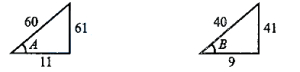
$\tan A = \frac{-60}{11}$ and $A$ does not lie in the $4^{\text{th}}$ quadrant. $\sec B = \frac{41}{9}$ and $B$ does not lie in the $1^{\text{st}}$ quadrant. If $\operatorname{cosec} A + \cot B = K$,then $24K =$
A
$11$
B
$19$
C
$40$
D
$61$
Solution
(B) Given $\tan A = \frac{-60}{11}$. Since $\tan A$ is negative,$A$ lies in the $2^{\text{nd}}$ or $4^{\text{th}}$ quadrant. Given $A$ does not lie in the $4^{\text{th}}$ quadrant,$A$ must lie in the $2^{\text{nd}}$ quadrant.
In the $2^{\text{nd}}$ quadrant,$\operatorname{cosec} A$ is positive. Using the triangle with sides $60, 11, 61$,we get $\operatorname{cosec} A = \frac{61}{60}$.
Given $\sec B = \frac{41}{9}$. Since $\sec B$ is positive,$B$ lies in the $1^{\text{st}}$ or $4^{\text{th}}$ quadrant. Given $B$ does not lie in the $1^{\text{st}}$ quadrant,$B$ must lie in the $4^{\text{th}}$ quadrant.
In the $4^{\text{th}}$ quadrant,$\cot B$ is negative. Using the triangle with sides $40, 9, 41$,we get $\cot B = -\frac{9}{40}$.
Now,$K = \operatorname{cosec} A + \cot B = \frac{61}{60} - \frac{9}{40}$.
Finding a common denominator $(120)$: $K = \frac{122 - 27}{120} = \frac{95}{120} = \frac{19}{24}$.
Therefore,$24K = 24 \times \frac{19}{24} = 19$.
In the $2^{\text{nd}}$ quadrant,$\operatorname{cosec} A$ is positive. Using the triangle with sides $60, 11, 61$,we get $\operatorname{cosec} A = \frac{61}{60}$.
Given $\sec B = \frac{41}{9}$. Since $\sec B$ is positive,$B$ lies in the $1^{\text{st}}$ or $4^{\text{th}}$ quadrant. Given $B$ does not lie in the $1^{\text{st}}$ quadrant,$B$ must lie in the $4^{\text{th}}$ quadrant.
In the $4^{\text{th}}$ quadrant,$\cot B$ is negative. Using the triangle with sides $40, 9, 41$,we get $\cot B = -\frac{9}{40}$.
Now,$K = \operatorname{cosec} A + \cot B = \frac{61}{60} - \frac{9}{40}$.
Finding a common denominator $(120)$: $K = \frac{122 - 27}{120} = \frac{95}{120} = \frac{19}{24}$.
Therefore,$24K = 24 \times \frac{19}{24} = 19$.
0 likes
View Solution177
EasyMCQ
If $\cot \theta = -\frac{2}{3}$ and $\theta$ does not lie in the $4^{\text{th}}$ quadrant,then $\frac{(5 \sin \theta + \cos \theta)^2}{\tan \theta + \cot \theta} = $
A
$-13$
B
$-6$
C
$-\frac{1734}{169}$
D
$13$
Solution
(B) Given $\cot \theta = -\frac{2}{3}$.
Since $\cot \theta < 0$ and $\theta$ is not in the $4^{\text{th}}$ quadrant,$\theta$ must lie in the $2^{\text{nd}}$ quadrant.
In the $2^{\text{nd}}$ quadrant,$\sin \theta > 0$ and $\cos \theta < 0$.
Using $\cot \theta = \frac{\cos \theta}{\sin \theta} = -\frac{2}{3}$,let $\cos \theta = -2k$ and $\sin \theta = 3k$.
Since $\sin^2 \theta + \cos^2 \theta = 1$,we have $(3k)^2 + (-2k)^2 = 1 \implies 13k^2 = 1 \implies k = \frac{1}{\sqrt{13}}$.
Thus,$\sin \theta = \frac{3}{\sqrt{13}}$,$\cos \theta = -\frac{2}{\sqrt{13}}$,and $\tan \theta = -\frac{3}{2}$.
Substituting these values into the expression:
$\frac{(5 \sin \theta + \cos \theta)^2}{\tan \theta + \cot \theta} = \frac{(\frac{15}{\sqrt{13}} - \frac{2}{\sqrt{13}})^2}{-\frac{3}{2} - \frac{2}{3}} = \frac{(\frac{13}{\sqrt{13}})^2}{-\frac{9+4}{6}} = \frac{13}{-\frac{13}{6}} = -6$.
Since $\cot \theta < 0$ and $\theta$ is not in the $4^{\text{th}}$ quadrant,$\theta$ must lie in the $2^{\text{nd}}$ quadrant.
In the $2^{\text{nd}}$ quadrant,$\sin \theta > 0$ and $\cos \theta < 0$.
Using $\cot \theta = \frac{\cos \theta}{\sin \theta} = -\frac{2}{3}$,let $\cos \theta = -2k$ and $\sin \theta = 3k$.
Since $\sin^2 \theta + \cos^2 \theta = 1$,we have $(3k)^2 + (-2k)^2 = 1 \implies 13k^2 = 1 \implies k = \frac{1}{\sqrt{13}}$.
Thus,$\sin \theta = \frac{3}{\sqrt{13}}$,$\cos \theta = -\frac{2}{\sqrt{13}}$,and $\tan \theta = -\frac{3}{2}$.
Substituting these values into the expression:
$\frac{(5 \sin \theta + \cos \theta)^2}{\tan \theta + \cot \theta} = \frac{(\frac{15}{\sqrt{13}} - \frac{2}{\sqrt{13}})^2}{-\frac{3}{2} - \frac{2}{3}} = \frac{(\frac{13}{\sqrt{13}})^2}{-\frac{9+4}{6}} = \frac{13}{-\frac{13}{6}} = -6$.
0 likes
View Solution178
EasyMCQ
$\frac{1}{\sin 250^{\circ}}+\frac{\sqrt{3}}{\cos 290^{\circ}} = $
A
$\frac{1}{\sqrt{3}}$
B
$4$
C
$\frac{4}{\sqrt{3}}$
D
$1$
Solution
(B) Given expression: $\frac{1}{\sin 250^{\circ}}+\frac{\sqrt{3}}{\cos 290^{\circ}}$
$= \frac{1}{\sin(270^{\circ}-20^{\circ})} + \frac{\sqrt{3}}{\cos(270^{\circ}+20^{\circ})}$
$= -\frac{1}{\cos 20^{\circ}} + \frac{\sqrt{3}}{\sin 20^{\circ}}$
$= \frac{-\sin 20^{\circ} + \sqrt{3} \cos 20^{\circ}}{\cos 20^{\circ} \sin 20^{\circ}}$
$= \frac{2 \left( -\frac{1}{2} \sin 20^{\circ} + \frac{\sqrt{3}}{2} \cos 20^{\circ} \right)}{\frac{1}{2} \sin 40^{\circ}}$
$= \frac{2 (\sin 60^{\circ} \cos 20^{\circ} - \cos 60^{\circ} \sin 20^{\circ})}{\frac{1}{2} \sin 40^{\circ}}$
$= \frac{2 \sin(60^{\circ}-20^{\circ})}{\frac{1}{2} \sin 40^{\circ}}$
$= \frac{4 \sin 40^{\circ}}{\sin 40^{\circ}} = 4$
Therefore,option $B$ is correct.
$= \frac{1}{\sin(270^{\circ}-20^{\circ})} + \frac{\sqrt{3}}{\cos(270^{\circ}+20^{\circ})}$
$= -\frac{1}{\cos 20^{\circ}} + \frac{\sqrt{3}}{\sin 20^{\circ}}$
$= \frac{-\sin 20^{\circ} + \sqrt{3} \cos 20^{\circ}}{\cos 20^{\circ} \sin 20^{\circ}}$
$= \frac{2 \left( -\frac{1}{2} \sin 20^{\circ} + \frac{\sqrt{3}}{2} \cos 20^{\circ} \right)}{\frac{1}{2} \sin 40^{\circ}}$
$= \frac{2 (\sin 60^{\circ} \cos 20^{\circ} - \cos 60^{\circ} \sin 20^{\circ})}{\frac{1}{2} \sin 40^{\circ}}$
$= \frac{2 \sin(60^{\circ}-20^{\circ})}{\frac{1}{2} \sin 40^{\circ}}$
$= \frac{4 \sin 40^{\circ}}{\sin 40^{\circ}} = 4$
Therefore,option $B$ is correct.
0 likes
View Solution179
MediumMCQ
If $\sin A = \frac{-7}{25}$,$\cos B = \frac{8}{17}$,$A$ does not lie in the $3^{\text{rd}}$ quadrant and $B$ does not lie in the $1^{\text{st}}$ quadrant,then $8 \tan A - 5 \cot B =$
A
$0$
B
$\frac{1}{3}$
C
$\frac{1}{2}$
D
$1$
Solution
(B) Given $\sin A = \frac{-7}{25}$. Since $\sin A < 0$ and $A$ is not in the $3^{\text{rd}}$ quadrant,$A$ must be in the $4^{\text{th}}$ quadrant.
In the $4^{\text{th}}$ quadrant,$\cos A > 0$. Thus,$\cos A = \sqrt{1 - \sin^2 A} = \sqrt{1 - (\frac{-7}{25})^2} = \sqrt{1 - \frac{49}{625}} = \sqrt{\frac{576}{625}} = \frac{24}{25}$.
Therefore,$\tan A = \frac{\sin A}{\cos A} = \frac{-7/25}{24/25} = \frac{-7}{24}$.
Given $\cos B = \frac{8}{17}$. Since $\cos B > 0$ and $B$ is not in the $1^{\text{st}}$ quadrant,$B$ must be in the $4^{\text{th}}$ quadrant.
In the $4^{\text{th}}$ quadrant,$\sin B < 0$. Thus,$\sin B = -\sqrt{1 - \cos^2 B} = -\sqrt{1 - (\frac{8}{17})^2} = -\sqrt{1 - \frac{64}{289}} = -\sqrt{\frac{225}{289}} = \frac{-15}{17}$.
Therefore,$\cot B = \frac{\cos B}{\sin B} = \frac{8/17}{-15/17} = \frac{-8}{15}$.
Now,$8 \tan A - 5 \cot B = 8(\frac{-7}{24}) - 5(\frac{-8}{15}) = \frac{-7}{3} + \frac{8}{3} = \frac{1}{3}$.
In the $4^{\text{th}}$ quadrant,$\cos A > 0$. Thus,$\cos A = \sqrt{1 - \sin^2 A} = \sqrt{1 - (\frac{-7}{25})^2} = \sqrt{1 - \frac{49}{625}} = \sqrt{\frac{576}{625}} = \frac{24}{25}$.
Therefore,$\tan A = \frac{\sin A}{\cos A} = \frac{-7/25}{24/25} = \frac{-7}{24}$.
Given $\cos B = \frac{8}{17}$. Since $\cos B > 0$ and $B$ is not in the $1^{\text{st}}$ quadrant,$B$ must be in the $4^{\text{th}}$ quadrant.
In the $4^{\text{th}}$ quadrant,$\sin B < 0$. Thus,$\sin B = -\sqrt{1 - \cos^2 B} = -\sqrt{1 - (\frac{8}{17})^2} = -\sqrt{1 - \frac{64}{289}} = -\sqrt{\frac{225}{289}} = \frac{-15}{17}$.
Therefore,$\cot B = \frac{\cos B}{\sin B} = \frac{8/17}{-15/17} = \frac{-8}{15}$.
Now,$8 \tan A - 5 \cot B = 8(\frac{-7}{24}) - 5(\frac{-8}{15}) = \frac{-7}{3} + \frac{8}{3} = \frac{1}{3}$.
0 likes
View Solution180
EasyMCQ
Let $\triangle ACB$ be a triangle with a right angle at $C$. Let $AB = 29$ units,$BC = 21$ units,and $\angle ABC = \theta$. Then $\cos^2 \theta - \sin^2 \theta = $
A
$1$
B
$\frac{41}{841}$
C
$\frac{40}{441}$
D
$\frac{41}{800}$
Solution
(B) $\triangle ACB$ is a right-angled triangle at $C$.
By the Pythagoras theorem,$AB^2 = AC^2 + BC^2$.
$AC^2 = AB^2 - BC^2 = 29^2 - 21^2 = 841 - 441 = 400$.
Thus,$AC = \sqrt{400} = 20$ units.
$\cos \theta = \frac{BC}{AB} = \frac{21}{29}$ and $\sin \theta = \frac{AC}{AB} = \frac{20}{29}$.
$\cos^2 \theta - \sin^2 \theta = \left(\frac{21}{29}\right)^2 - \left(\frac{20}{29}\right)^2 = \frac{441 - 400}{841} = \frac{41}{841}$.
By the Pythagoras theorem,$AB^2 = AC^2 + BC^2$.
$AC^2 = AB^2 - BC^2 = 29^2 - 21^2 = 841 - 441 = 400$.
Thus,$AC = \sqrt{400} = 20$ units.
$\cos \theta = \frac{BC}{AB} = \frac{21}{29}$ and $\sin \theta = \frac{AC}{AB} = \frac{20}{29}$.
$\cos^2 \theta - \sin^2 \theta = \left(\frac{21}{29}\right)^2 - \left(\frac{20}{29}\right)^2 = \frac{441 - 400}{841} = \frac{41}{841}$.
0 likes
View Solution181
MediumMCQ
If $\operatorname{cosec} \theta - \cot \theta = 2017$,then the quadrant in which $\theta$ lies is
A
$I$
B
$IV$
C
$III$
D
$II$
Solution
(D) We are given that $\operatorname{cosec} \theta - \cot \theta = 2017$ $(i)$.
Using the identity $\operatorname{cosec}^2 \theta - \cot^2 \theta = 1$,we can write $(\operatorname{cosec} \theta - \cot \theta)(\operatorname{cosec} \theta + \cot \theta) = 1$.
Therefore,$\operatorname{cosec} \theta + \cot \theta = \frac{1}{2017}$ (ii).
Adding $(i)$ and (ii):
$2 \operatorname{cosec} \theta = 2017 + \frac{1}{2017} > 0$,which implies $\operatorname{cosec} \theta > 0$.
Since $\operatorname{cosec} \theta > 0$,$\theta$ must lie in the $I$ or $II$ quadrant.
Subtracting $(i)$ from (ii):
$2 \cot \theta = \frac{1}{2017} - 2017 < 0$,which implies $\cot \theta < 0$.
Since $\cot \theta < 0$,$\theta$ must lie in the $II$ or $IV$ quadrant.
Since $\theta$ must satisfy both conditions ($\operatorname{cosec} \theta > 0$ and $\cot \theta < 0$),$\theta$ lies in the $II$ quadrant.
Using the identity $\operatorname{cosec}^2 \theta - \cot^2 \theta = 1$,we can write $(\operatorname{cosec} \theta - \cot \theta)(\operatorname{cosec} \theta + \cot \theta) = 1$.
Therefore,$\operatorname{cosec} \theta + \cot \theta = \frac{1}{2017}$ (ii).
Adding $(i)$ and (ii):
$2 \operatorname{cosec} \theta = 2017 + \frac{1}{2017} > 0$,which implies $\operatorname{cosec} \theta > 0$.
Since $\operatorname{cosec} \theta > 0$,$\theta$ must lie in the $I$ or $II$ quadrant.
Subtracting $(i)$ from (ii):
$2 \cot \theta = \frac{1}{2017} - 2017 < 0$,which implies $\cot \theta < 0$.
Since $\cot \theta < 0$,$\theta$ must lie in the $II$ or $IV$ quadrant.
Since $\theta$ must satisfy both conditions ($\operatorname{cosec} \theta > 0$ and $\cot \theta < 0$),$\theta$ lies in the $II$ quadrant.
0 likes
View Solution182
EasyMCQ
The value of $\tan 1^\circ \tan 2^\circ \tan 3^\circ \dots \tan 89^\circ$ is equal to
A
$-1$
B
$2$
C
$\frac{\pi}{2}$
D
$1$
Solution
(D) We know that $\tan(90^\circ - \theta) = \cot \theta$.
Given expression is $E = \tan 1^\circ \tan 2^\circ \tan 3^\circ \dots \tan 44^\circ \tan 45^\circ \tan 46^\circ \dots \tan 88^\circ \tan 89^\circ$.
We can pair the terms as:
$(\tan 1^\circ \tan 89^\circ) \times (\tan 2^\circ \tan 88^\circ) \times \dots \times (\tan 44^\circ \tan 46^\circ) \times \tan 45^\circ$.
Since $\tan 89^\circ = \tan(90^\circ - 1^\circ) = \cot 1^\circ$,we have $\tan 1^\circ \tan 89^\circ = \tan 1^\circ \cot 1^\circ = 1$.
Similarly,$\tan k^\circ \tan(90^\circ - k^\circ) = 1$ for all $k$ from $1$ to $44$.
Thus,$E = 1 \times 1 \times \dots \times 1 \times \tan 45^\circ = 1 \times 1 = 1$.
Given expression is $E = \tan 1^\circ \tan 2^\circ \tan 3^\circ \dots \tan 44^\circ \tan 45^\circ \tan 46^\circ \dots \tan 88^\circ \tan 89^\circ$.
We can pair the terms as:
$(\tan 1^\circ \tan 89^\circ) \times (\tan 2^\circ \tan 88^\circ) \times \dots \times (\tan 44^\circ \tan 46^\circ) \times \tan 45^\circ$.
Since $\tan 89^\circ = \tan(90^\circ - 1^\circ) = \cot 1^\circ$,we have $\tan 1^\circ \tan 89^\circ = \tan 1^\circ \cot 1^\circ = 1$.
Similarly,$\tan k^\circ \tan(90^\circ - k^\circ) = 1$ for all $k$ from $1$ to $44$.
Thus,$E = 1 \times 1 \times \dots \times 1 \times \tan 45^\circ = 1 \times 1 = 1$.
0 likes
View Solution183
EasyMCQ
$\left(\frac{\sin 35^{\circ}}{\cos 55^{\circ}}\right)^2+\left(\frac{\cos 55^{\circ}}{\sin 35^{\circ}}\right)^2-2 \cos 30^{\circ}=$
A
$2+\sqrt{3}$
B
$2-\sqrt{3}$
C
$2 \sqrt{3}$
D
$3 \sqrt{2}$
Solution
(B) Given expression: $\left(\frac{\sin 35^{\circ}}{\cos 55^{\circ}}\right)^2+\left(\frac{\cos 55^{\circ}}{\sin 35^{\circ}}\right)^2-2 \cos 30^{\circ}$
Since $\cos 55^{\circ} = \cos(90^{\circ}-35^{\circ}) = \sin 35^{\circ}$,we substitute this into the expression:
$= \left(\frac{\sin 35^{\circ}}{\sin 35^{\circ}}\right)^2 + \left(\frac{\sin 35^{\circ}}{\sin 35^{\circ}}\right)^2 - 2 \cos 30^{\circ}$
$= (1)^2 + (1)^2 - 2 \left(\frac{\sqrt{3}}{2}\right)$
$= 1 + 1 - \sqrt{3}$
$= 2 - \sqrt{3}$
Since $\cos 55^{\circ} = \cos(90^{\circ}-35^{\circ}) = \sin 35^{\circ}$,we substitute this into the expression:
$= \left(\frac{\sin 35^{\circ}}{\sin 35^{\circ}}\right)^2 + \left(\frac{\sin 35^{\circ}}{\sin 35^{\circ}}\right)^2 - 2 \cos 30^{\circ}$
$= (1)^2 + (1)^2 - 2 \left(\frac{\sqrt{3}}{2}\right)$
$= 1 + 1 - \sqrt{3}$
$= 2 - \sqrt{3}$
0 likes
View Solution184
MediumMCQ
$\cos 36^{\circ} - \cos 72^{\circ}$ is equal to
A
$1$
B
$\frac{1}{2}$
C
$\frac{1}{4}$
D
$\frac{1}{8}$
Solution
(B) Using the formula $\cos C - \cos D = -2 \sin \left(\frac{C+D}{2}\right) \sin \left(\frac{C-D}{2}\right)$,we have:
$\cos 36^{\circ} - \cos 72^{\circ} = -2 \sin \left(\frac{36^{\circ}+72^{\circ}}{2}\right) \sin \left(\frac{36^{\circ}-72^{\circ}}{2}\right)$
$= -2 \sin 54^{\circ} \sin (-18^{\circ})$
$= 2 \sin 54^{\circ} \sin 18^{\circ}$
Substituting the values $\sin 54^{\circ} = \frac{\sqrt{5}+1}{4}$ and $\sin 18^{\circ} = \frac{\sqrt{5}-1}{4}$:
$= 2 \times \left(\frac{\sqrt{5}+1}{4}\right) \times \left(\frac{\sqrt{5}-1}{4}\right)$
$= 2 \times \frac{(\sqrt{5})^2 - 1^2}{16} = 2 \times \frac{5-1}{16} = 2 \times \frac{4}{16} = 2 \times \frac{1}{4} = \frac{1}{2}$
$\cos 36^{\circ} - \cos 72^{\circ} = -2 \sin \left(\frac{36^{\circ}+72^{\circ}}{2}\right) \sin \left(\frac{36^{\circ}-72^{\circ}}{2}\right)$
$= -2 \sin 54^{\circ} \sin (-18^{\circ})$
$= 2 \sin 54^{\circ} \sin 18^{\circ}$
Substituting the values $\sin 54^{\circ} = \frac{\sqrt{5}+1}{4}$ and $\sin 18^{\circ} = \frac{\sqrt{5}-1}{4}$:
$= 2 \times \left(\frac{\sqrt{5}+1}{4}\right) \times \left(\frac{\sqrt{5}-1}{4}\right)$
$= 2 \times \frac{(\sqrt{5})^2 - 1^2}{16} = 2 \times \frac{5-1}{16} = 2 \times \frac{4}{16} = 2 \times \frac{1}{4} = \frac{1}{2}$
0 likes
View Solution185
MediumMCQ
$\sin ^4 \frac{\pi}{8} + \cos ^4 \frac{3 \pi}{8} - \sin ^4 \frac{3 \pi}{8} + \sin ^4 \frac{5 \pi}{8} + \cos ^4 \frac{7 \pi}{8} - \sin ^4 \frac{7 \pi}{8} = ?$
A
$\frac{1}{4}$
B
$\frac{1}{2}$
C
$0$
D
$\frac{3}{4}$
Solution
(D) Given expression: $E = \sin ^4 \frac{\pi}{8} + \cos ^4 \frac{3 \pi}{8} - \sin ^4 \frac{3 \pi}{8} + \sin ^4 \frac{5 \pi}{8} + \cos ^4 \frac{7 \pi}{8} - \sin ^4 \frac{7 \pi}{8}$
Using $\sin(\pi - \theta) = \sin \theta$ and $\cos(\pi - \theta) = -\cos \theta$:
$\sin^4 \frac{5 \pi}{8} = \sin^4(\pi - \frac{3 \pi}{8}) = \sin^4 \frac{3 \pi}{8}$
$\cos^4 \frac{7 \pi}{8} = \cos^4(\pi - \frac{\pi}{8}) = (-\cos \frac{\pi}{8})^4 = \cos^4 \frac{\pi}{8}$
$\sin^4 \frac{7 \pi}{8} = \sin^4(\pi - \frac{\pi}{8}) = \sin^4 \frac{\pi}{8}$
Substituting these into the expression:
$E = \sin ^4 \frac{\pi}{8} + \cos ^4 \frac{3 \pi}{8} - \sin ^4 \frac{3 \pi}{8} + \sin ^4 \frac{3 \pi}{8} + \cos ^4 \frac{\pi}{8} - \sin ^4 \frac{\pi}{8}$
$E = \cos ^4 \frac{3 \pi}{8} + \cos ^4 \frac{\pi}{8}$
Using $\cos^2 \theta = \frac{1 + \cos 2 \theta}{2}$:
$E = \left(\frac{1 + \cos \frac{3 \pi}{4}}{2}\right)^2 + \left(\frac{1 + \cos \frac{\pi}{4}}{2}\right)^2$
$E = \frac{1}{4} \left[ (1 - \frac{1}{\sqrt{2}})^2 + (1 + \frac{1}{\sqrt{2}})^2 \right]$
$E = \frac{1}{4} \left[ (1 + \frac{1}{2} - \sqrt{2}) + (1 + \frac{1}{2} + \sqrt{2}) \right]$
$E = \frac{1}{4} [3] = \frac{3}{4}$
Using $\sin(\pi - \theta) = \sin \theta$ and $\cos(\pi - \theta) = -\cos \theta$:
$\sin^4 \frac{5 \pi}{8} = \sin^4(\pi - \frac{3 \pi}{8}) = \sin^4 \frac{3 \pi}{8}$
$\cos^4 \frac{7 \pi}{8} = \cos^4(\pi - \frac{\pi}{8}) = (-\cos \frac{\pi}{8})^4 = \cos^4 \frac{\pi}{8}$
$\sin^4 \frac{7 \pi}{8} = \sin^4(\pi - \frac{\pi}{8}) = \sin^4 \frac{\pi}{8}$
Substituting these into the expression:
$E = \sin ^4 \frac{\pi}{8} + \cos ^4 \frac{3 \pi}{8} - \sin ^4 \frac{3 \pi}{8} + \sin ^4 \frac{3 \pi}{8} + \cos ^4 \frac{\pi}{8} - \sin ^4 \frac{\pi}{8}$
$E = \cos ^4 \frac{3 \pi}{8} + \cos ^4 \frac{\pi}{8}$
Using $\cos^2 \theta = \frac{1 + \cos 2 \theta}{2}$:
$E = \left(\frac{1 + \cos \frac{3 \pi}{4}}{2}\right)^2 + \left(\frac{1 + \cos \frac{\pi}{4}}{2}\right)^2$
$E = \frac{1}{4} \left[ (1 - \frac{1}{\sqrt{2}})^2 + (1 + \frac{1}{\sqrt{2}})^2 \right]$
$E = \frac{1}{4} \left[ (1 + \frac{1}{2} - \sqrt{2}) + (1 + \frac{1}{2} + \sqrt{2}) \right]$
$E = \frac{1}{4} [3] = \frac{3}{4}$
0 likes
View Solution186
MediumMCQ
If $\sin A = -\frac{60}{61}$,$\cot B = -\frac{40}{9}$ and neither $A$ nor $B$ is in the $4^{\text{th}}$ quadrant,then $6 \cot A + 4 \sec B = $
A
$\frac{26}{5}$
B
$-\frac{26}{5}$
C
$-3$
D
$3$
Solution
(C) Given $\sin A = -\frac{60}{61}$. Since $A$ is not in the $4^{\text{th}}$ quadrant and $\sin A < 0$,$A$ must be in the $3^{\text{rd}}$ quadrant. In the $3^{\text{rd}}$ quadrant,$\cot A > 0$. $\cos A = -\sqrt{1 - \sin^2 A} = -\sqrt{1 - (-\frac{60}{61})^2} = -\sqrt{\frac{3721 - 3600}{3721}} = -\frac{11}{61}$. Thus,$\cot A = \frac{\cos A}{\sin A} = \frac{-11/61}{-60/61} = \frac{11}{60}$.
Given $\cot B = -\frac{40}{9}$. Since $B$ is not in the $4^{\text{th}}$ quadrant and $\cot B < 0$,$B$ must be in the $2^{\text{nd}}$ quadrant. In the $2^{\text{nd}}$ quadrant,$\sec B < 0$. $\sec B = -\sqrt{1 + \tan^2 B} = -\sqrt{1 + (-\frac{9}{40})^2} = -\sqrt{1 + \frac{81}{1600}} = -\sqrt{\frac{1681}{1600}} = -\frac{41}{40}$.
Now,$6 \cot A + 4 \sec B = 6(\frac{11}{60}) + 4(-\frac{41}{40}) = \frac{11}{10} - \frac{41}{10} = -\frac{30}{10} = -3$.
Given $\cot B = -\frac{40}{9}$. Since $B$ is not in the $4^{\text{th}}$ quadrant and $\cot B < 0$,$B$ must be in the $2^{\text{nd}}$ quadrant. In the $2^{\text{nd}}$ quadrant,$\sec B < 0$. $\sec B = -\sqrt{1 + \tan^2 B} = -\sqrt{1 + (-\frac{9}{40})^2} = -\sqrt{1 + \frac{81}{1600}} = -\sqrt{\frac{1681}{1600}} = -\frac{41}{40}$.
Now,$6 \cot A + 4 \sec B = 6(\frac{11}{60}) + 4(-\frac{41}{40}) = \frac{11}{10} - \frac{41}{10} = -\frac{30}{10} = -3$.
0 likes
View Solution187
MediumMCQ
If $y = \log_e \tan \left(\frac{\pi}{4} + \frac{x}{2}\right)$,then $\tanh \left(\frac{y}{2}\right) = $
A
$\cot \frac{x}{2}$
B
$\tan x$
C
$\coth x$
D
$\tan \frac{x}{2}$
Solution
(D) Given $y = \log_e \tan \left(\frac{\pi}{4} + \frac{x}{2}\right)$.
$e^y = \tan \left(\frac{\pi}{4} + \frac{x}{2}\right) = \frac{1 + \tan \frac{x}{2}}{1 - \tan \frac{x}{2}}$.
We know that $\tanh \left(\frac{y}{2}\right) = \frac{e^y - 1}{e^y + 1}$.
Substituting the value of $e^y$:
$\tanh \left(\frac{y}{2}\right) = \frac{\frac{1 + \tan \frac{x}{2}}{1 - \tan \frac{x}{2}} - 1}{\frac{1 + \tan \frac{x}{2}}{1 - \tan \frac{x}{2}} + 1} = \frac{(1 + \tan \frac{x}{2}) - (1 - \tan \frac{x}{2})}{(1 + \tan \frac{x}{2}) + (1 - \tan \frac{x}{2})} = \frac{2 \tan \frac{x}{2}}{2} = \tan \frac{x}{2}$.
Thus,option $D$ is correct.
$e^y = \tan \left(\frac{\pi}{4} + \frac{x}{2}\right) = \frac{1 + \tan \frac{x}{2}}{1 - \tan \frac{x}{2}}$.
We know that $\tanh \left(\frac{y}{2}\right) = \frac{e^y - 1}{e^y + 1}$.
Substituting the value of $e^y$:
$\tanh \left(\frac{y}{2}\right) = \frac{\frac{1 + \tan \frac{x}{2}}{1 - \tan \frac{x}{2}} - 1}{\frac{1 + \tan \frac{x}{2}}{1 - \tan \frac{x}{2}} + 1} = \frac{(1 + \tan \frac{x}{2}) - (1 - \tan \frac{x}{2})}{(1 + \tan \frac{x}{2}) + (1 - \tan \frac{x}{2})} = \frac{2 \tan \frac{x}{2}}{2} = \tan \frac{x}{2}$.
Thus,option $D$ is correct.
0 likes
View Solution188
MediumMCQ
If $\cosh x = \frac{\sqrt{14}}{3}$,$\sinh x = \cos \theta$ and $-\pi < \theta < -\frac{\pi}{2}$,then $\sin \theta =$
A
$\frac{1}{3}$
B
$\frac{2}{3}$
C
$-\frac{1}{3}$
D
$-\frac{2}{3}$
Solution
(B) Given $\cosh x = \frac{\sqrt{14}}{3}$.
Using the identity $\sinh^2 x = \cosh^2 x - 1$,we get:
$\sinh^2 x = \left(\frac{\sqrt{14}}{3}\right)^2 - 1 = \frac{14}{9} - 1 = \frac{5}{9}$.
Since $\sinh x = \cos \theta$,we have $\cos \theta = \frac{\sqrt{5}}{3}$ (taking the positive root as $\sinh x$ is positive for $x > 0$ and $\cos \theta$ is positive in the given range).
Now,$\sin^2 \theta = 1 - \cos^2 \theta = 1 - \frac{5}{9} = \frac{4}{9}$.
Thus,$\sin \theta = \pm \frac{2}{3}$.
Given $-\pi < \theta < -\frac{\pi}{2}$,$\theta$ lies in the second quadrant (or equivalent to the range $(-\pi, -\pi/2)$ which corresponds to the second quadrant in the standard circle).
In the second quadrant,$\sin \theta$ is positive.
However,checking the range $-\pi < \theta < -\frac{\pi}{2}$,this corresponds to the interval where $\sin \theta$ is positive.
Wait,re-evaluating the quadrant: $-\pi < \theta < -\frac{\pi}{2}$ is the second quadrant where $\sin \theta > 0$.
Therefore,$\sin \theta = \frac{2}{3}$.
Using the identity $\sinh^2 x = \cosh^2 x - 1$,we get:
$\sinh^2 x = \left(\frac{\sqrt{14}}{3}\right)^2 - 1 = \frac{14}{9} - 1 = \frac{5}{9}$.
Since $\sinh x = \cos \theta$,we have $\cos \theta = \frac{\sqrt{5}}{3}$ (taking the positive root as $\sinh x$ is positive for $x > 0$ and $\cos \theta$ is positive in the given range).
Now,$\sin^2 \theta = 1 - \cos^2 \theta = 1 - \frac{5}{9} = \frac{4}{9}$.
Thus,$\sin \theta = \pm \frac{2}{3}$.
Given $-\pi < \theta < -\frac{\pi}{2}$,$\theta$ lies in the second quadrant (or equivalent to the range $(-\pi, -\pi/2)$ which corresponds to the second quadrant in the standard circle).
In the second quadrant,$\sin \theta$ is positive.
However,checking the range $-\pi < \theta < -\frac{\pi}{2}$,this corresponds to the interval where $\sin \theta$ is positive.
Wait,re-evaluating the quadrant: $-\pi < \theta < -\frac{\pi}{2}$ is the second quadrant where $\sin \theta > 0$.
Therefore,$\sin \theta = \frac{2}{3}$.
0 likes
View Solution189
EasyMCQ
$A$ wire of length $44 \text{ cm}$ is bent into an arc of a circle of radius $12 \text{ cm}$. The angle (in degrees) subtended by the arc at the centre of the circle is
A
$\left(\frac{11}{3}\right)^{\circ}$
B
$\left(\frac{660}{\pi}\right)^{\circ}$
C
$150^{\circ}$
D
$\left(\frac{5}{3}\right)^{\circ}$
Solution
(B) Given,length of the arc $l = 44 \text{ cm}$.
Radius of the circle $r = 12 \text{ cm}$.
The angle $\theta$ subtended by the arc at the centre in radians is given by $\theta = \frac{l}{r}$.
$\theta = \frac{44}{12} = \frac{11}{3} \text{ radians}$.
To convert the angle from radians to degrees,we multiply by $\frac{180}{\pi}$.
$\theta_{\text{deg}} = \frac{11}{3} \times \frac{180}{\pi} = \frac{11 \times 60}{\pi} = \left(\frac{660}{\pi}\right)^{\circ}$.
Radius of the circle $r = 12 \text{ cm}$.
The angle $\theta$ subtended by the arc at the centre in radians is given by $\theta = \frac{l}{r}$.
$\theta = \frac{44}{12} = \frac{11}{3} \text{ radians}$.
To convert the angle from radians to degrees,we multiply by $\frac{180}{\pi}$.
$\theta_{\text{deg}} = \frac{11}{3} \times \frac{180}{\pi} = \frac{11 \times 60}{\pi} = \left(\frac{660}{\pi}\right)^{\circ}$.
0 likes
View Solution190
MediumMCQ
$\frac{1+\tanh \frac{x}{2}}{1-\tanh \frac{x}{2}}$ is equal to
A
$e^{-x}$
B
$e^{x}$
C
$2 e^{x / 2}$
D
$2 e^{-x / 2}$
Solution
(B) We know that $\tanh \theta = \frac{\sinh \theta}{\cosh \theta}$.
Substituting $\theta = \frac{x}{2}$,we have $\tanh \frac{x}{2} = \frac{\sinh \frac{x}{2}}{\cosh \frac{x}{2}}$.
Substituting this into the expression:
$\frac{1+\tanh \frac{x}{2}}{1-\tanh \frac{x}{2}} = \frac{1+\frac{\sinh \frac{x}{2}}{\cosh \frac{x}{2}}}{1-\frac{\sinh \frac{x}{2}}{\cosh \frac{x}{2}}}$
$= \frac{\cosh \frac{x}{2} + \sinh \frac{x}{2}}{\cosh \frac{x}{2} - \sinh \frac{x}{2}}$
Using the definitions $\cosh \theta = \frac{e^{\theta} + e^{-\theta}}{2}$ and $\sinh \theta = \frac{e^{\theta} - e^{-\theta}}{2}$,we get:
$\cosh \frac{x}{2} + \sinh \frac{x}{2} = e^{x/2}$
$\cosh \frac{x}{2} - \sinh \frac{x}{2} = e^{-x/2}$
Therefore,the expression becomes $\frac{e^{x/2}}{e^{-x/2}} = e^{x/2 - (-x/2)} = e^x$.
Substituting $\theta = \frac{x}{2}$,we have $\tanh \frac{x}{2} = \frac{\sinh \frac{x}{2}}{\cosh \frac{x}{2}}$.
Substituting this into the expression:
$\frac{1+\tanh \frac{x}{2}}{1-\tanh \frac{x}{2}} = \frac{1+\frac{\sinh \frac{x}{2}}{\cosh \frac{x}{2}}}{1-\frac{\sinh \frac{x}{2}}{\cosh \frac{x}{2}}}$
$= \frac{\cosh \frac{x}{2} + \sinh \frac{x}{2}}{\cosh \frac{x}{2} - \sinh \frac{x}{2}}$
Using the definitions $\cosh \theta = \frac{e^{\theta} + e^{-\theta}}{2}$ and $\sinh \theta = \frac{e^{\theta} - e^{-\theta}}{2}$,we get:
$\cosh \frac{x}{2} + \sinh \frac{x}{2} = e^{x/2}$
$\cosh \frac{x}{2} - \sinh \frac{x}{2} = e^{-x/2}$
Therefore,the expression becomes $\frac{e^{x/2}}{e^{-x/2}} = e^{x/2 - (-x/2)} = e^x$.
0 likes
View Solution191
EasyMCQ
The value of $(1+\cos \frac{\pi}{6})(1+\cos \frac{\pi}{3})(1+\cos \frac{2\pi}{3})(1+\cos \frac{7\pi}{6})$ is
A
$\frac{3}{16}$
B
$\frac{3}{8}$
C
$\frac{3}{4}$
D
$\frac{1}{2}$
Solution
(A) Given expression: $(1+\cos \frac{\pi}{6})(1+\cos \frac{\pi}{3})(1+\cos \frac{2\pi}{3})(1+\cos \frac{7\pi}{6})$
Using the values of trigonometric functions:
$\cos \frac{\pi}{6} = \frac{\sqrt{3}}{2}$,$\cos \frac{\pi}{3} = \frac{1}{2}$,$\cos \frac{2\pi}{3} = -\frac{1}{2}$,$\cos \frac{7\pi}{6} = -\frac{\sqrt{3}}{2}$
Substituting these values:
$= (1 + \frac{\sqrt{3}}{2})(1 + \frac{1}{2})(1 - \frac{1}{2})(1 - \frac{\sqrt{3}}{2})$
Group the terms using the identity $(a+b)(a-b) = a^2 - b^2$:
$= [(1 + \frac{\sqrt{3}}{2})(1 - \frac{\sqrt{3}}{2})] \times [(1 + \frac{1}{2})(1 - \frac{1}{2})]$
$= (1^2 - (\frac{\sqrt{3}}{2})^2) \times (1^2 - (\frac{1}{2})^2)$
$= (1 - \frac{3}{4}) \times (1 - \frac{1}{4})$
$= \frac{1}{4} \times \frac{3}{4} = \frac{3}{16}$
Using the values of trigonometric functions:
$\cos \frac{\pi}{6} = \frac{\sqrt{3}}{2}$,$\cos \frac{\pi}{3} = \frac{1}{2}$,$\cos \frac{2\pi}{3} = -\frac{1}{2}$,$\cos \frac{7\pi}{6} = -\frac{\sqrt{3}}{2}$
Substituting these values:
$= (1 + \frac{\sqrt{3}}{2})(1 + \frac{1}{2})(1 - \frac{1}{2})(1 - \frac{\sqrt{3}}{2})$
Group the terms using the identity $(a+b)(a-b) = a^2 - b^2$:
$= [(1 + \frac{\sqrt{3}}{2})(1 - \frac{\sqrt{3}}{2})] \times [(1 + \frac{1}{2})(1 - \frac{1}{2})]$
$= (1^2 - (\frac{\sqrt{3}}{2})^2) \times (1^2 - (\frac{1}{2})^2)$
$= (1 - \frac{3}{4}) \times (1 - \frac{1}{4})$
$= \frac{1}{4} \times \frac{3}{4} = \frac{3}{16}$
0 likes
View Solution192
MediumMCQ
If $\frac{\cos A}{3} = \frac{\cos B}{4} = \frac{1}{5}$,$-\frac{\pi}{2} < A < 0$,and $-\frac{\pi}{2} < B < 0$,then the value of $2 \sin A + 4 \sin B$ is
A
$4$
B
$-2$
C
$-4$
D
$0$
Solution
(C) Given $\frac{\cos A}{3} = \frac{1}{5} \implies \cos A = \frac{3}{5}$.
Since $-\frac{\pi}{2} < A < 0$,$A$ lies in the fourth quadrant,so $\sin A$ is negative.
$\sin A = -\sqrt{1 - \cos^2 A} = -\sqrt{1 - (\frac{3}{5})^2} = -\sqrt{1 - \frac{9}{25}} = -\sqrt{\frac{16}{25}} = -\frac{4}{5}$.
Given $\frac{\cos B}{4} = \frac{1}{5} \implies \cos B = \frac{4}{5}$.
Since $-\frac{\pi}{2} < B < 0$,$B$ lies in the fourth quadrant,so $\sin B$ is negative.
$\sin B = -\sqrt{1 - \cos^2 B} = -\sqrt{1 - (\frac{4}{5})^2} = -\sqrt{1 - \frac{16}{25}} = -\sqrt{\frac{9}{25}} = -\frac{3}{5}$.
Now,calculate $2 \sin A + 4 \sin B = 2(-\frac{4}{5}) + 4(-\frac{3}{5}) = -\frac{8}{5} - \frac{12}{5} = -\frac{20}{5} = -4$.
Since $-\frac{\pi}{2} < A < 0$,$A$ lies in the fourth quadrant,so $\sin A$ is negative.
$\sin A = -\sqrt{1 - \cos^2 A} = -\sqrt{1 - (\frac{3}{5})^2} = -\sqrt{1 - \frac{9}{25}} = -\sqrt{\frac{16}{25}} = -\frac{4}{5}$.
Given $\frac{\cos B}{4} = \frac{1}{5} \implies \cos B = \frac{4}{5}$.
Since $-\frac{\pi}{2} < B < 0$,$B$ lies in the fourth quadrant,so $\sin B$ is negative.
$\sin B = -\sqrt{1 - \cos^2 B} = -\sqrt{1 - (\frac{4}{5})^2} = -\sqrt{1 - \frac{16}{25}} = -\sqrt{\frac{9}{25}} = -\frac{3}{5}$.
Now,calculate $2 \sin A + 4 \sin B = 2(-\frac{4}{5}) + 4(-\frac{3}{5}) = -\frac{8}{5} - \frac{12}{5} = -\frac{20}{5} = -4$.
0 likes
View Solution193
EasyMCQ
The value of $\frac{\cot 54^{\circ}}{\tan 36^{\circ}} + \frac{\tan 20^{\circ}}{\cot 70^{\circ}}$ is
A
$0$
B
$2$
C
$3$
D
$1$
Solution
(B) We know that $\cot \theta = \tan(90^{\circ} - \theta)$.
Using this identity:
$\cot 54^{\circ} = \tan(90^{\circ} - 54^{\circ}) = \tan 36^{\circ}$.
$\cot 70^{\circ} = \tan(90^{\circ} - 70^{\circ}) = \tan 20^{\circ}$.
Substituting these values into the expression:
$\frac{\tan 36^{\circ}}{\tan 36^{\circ}} + \frac{\tan 20^{\circ}}{\tan 20^{\circ}} = 1 + 1 = 2$.
Using this identity:
$\cot 54^{\circ} = \tan(90^{\circ} - 54^{\circ}) = \tan 36^{\circ}$.
$\cot 70^{\circ} = \tan(90^{\circ} - 70^{\circ}) = \tan 20^{\circ}$.
Substituting these values into the expression:
$\frac{\tan 36^{\circ}}{\tan 36^{\circ}} + \frac{\tan 20^{\circ}}{\tan 20^{\circ}} = 1 + 1 = 2$.
0 likes
View Solution194
EasyMCQ
The value of $\frac{\sin 55^{\circ} - \cos 55^{\circ}}{\sin 10^{\circ}}$ is
A
$\frac{1}{\sqrt{2}}$
B
$2$
C
$1$
D
$\sqrt{2}$
Solution
(D) We know that $\cos 55^{\circ} = \sin(90^{\circ} - 55^{\circ}) = \sin 35^{\circ}$.
Substituting this into the expression,we get $\frac{\sin 55^{\circ} - \sin 35^{\circ}}{\sin 10^{\circ}}$.
Using the formula $\sin C - \sin D = 2 \cos\left(\frac{C+D}{2}\right) \sin\left(\frac{C-D}{2}\right)$,we have:
$\sin 55^{\circ} - \sin 35^{\circ} = 2 \cos\left(\frac{55^{\circ} + 35^{\circ}}{2}\right) \sin\left(\frac{55^{\circ} - 35^{\circ}}{2}\right) = 2 \cos 45^{\circ} \sin 10^{\circ}$.
Now,the expression becomes $\frac{2 \cos 45^{\circ} \sin 10^{\circ}}{\sin 10^{\circ}} = 2 \cos 45^{\circ}$.
Since $\cos 45^{\circ} = \frac{1}{\sqrt{2}}$,the value is $2 \times \frac{1}{\sqrt{2}} = \sqrt{2}$.
Substituting this into the expression,we get $\frac{\sin 55^{\circ} - \sin 35^{\circ}}{\sin 10^{\circ}}$.
Using the formula $\sin C - \sin D = 2 \cos\left(\frac{C+D}{2}\right) \sin\left(\frac{C-D}{2}\right)$,we have:
$\sin 55^{\circ} - \sin 35^{\circ} = 2 \cos\left(\frac{55^{\circ} + 35^{\circ}}{2}\right) \sin\left(\frac{55^{\circ} - 35^{\circ}}{2}\right) = 2 \cos 45^{\circ} \sin 10^{\circ}$.
Now,the expression becomes $\frac{2 \cos 45^{\circ} \sin 10^{\circ}}{\sin 10^{\circ}} = 2 \cos 45^{\circ}$.
Since $\cos 45^{\circ} = \frac{1}{\sqrt{2}}$,the value is $2 \times \frac{1}{\sqrt{2}} = \sqrt{2}$.
0 likes
View SolutionTrigonometrical Ratios, Functions and Identities — Fundamental trigonometrical ratios and functions, Trigonometrical ratio of allied angles · Frequently Asked Questions
1Are these Trigonometrical Ratios, Functions and Identities questions useful for JEE and NEET?
Yes. All questions in this section are mapped to JEE Main and NEET exam patterns. Previous year questions from JEE Main, NEET, GUJCET and state-level exams are included with full solutions.
2Can I switch to Hindi or Gujarati for these questions?
Yes. Use the language tabs in the hero section or the sidebar to view the same questions and solutions in English, Hindi or Gujarati.
3How do I generate a question paper from this subtopic?
Use the Vedclass Exam Paper Generator — select the chapter and subtopic, set difficulty, and generate Sets A, B, C, D automatically. First 3 chapters of every subject are free.
Vedclass Products
For Students
Vedclass Test Series
Mock tests in real JEE/NEET style with performance analysis. 5-day free trial.
Start Free TrialFor Teachers
Exam Paper Generator
Generate Set A/B/C/D papers from this chapter in 2 minutes. 3 chapters free.
Try FreeFor Institutes
Online Exam Module
Live online exams with unlimited students, 360° analytics & white-label branding.
See DemoFor Teachers & Institutes
Generate a Trigonometrical Ratios, Functions and Identities Exam Paper in 2 Minutes
Select subtopic & difficulty — Sets A, B, C, D auto-generated with No Repeat logic.
First 3 chapters of every subject are free — no payment required.