
ChemistryQ1–79 of 97 questions
Page 1 of 2 · English
1
ChemistryMCQAIEEE · 2003
$A$ magnetic needle lying parallel to a magnetic field requires $W$ units of work to turn it through $60^{\circ}$. The torque required to maintain the needle in this position will be
A
$\sqrt{3} W$
B
$W$
C
$\frac{\sqrt{3}}{2} W$
D
$2 W$
Solution
(A) The work done $W$ in rotating a magnetic needle from an angle $\theta_1$ to $\theta_2$ in a magnetic field $B$ is given by $W = MB(\cos \theta_1 - \cos \theta_2)$.
Given $\theta_1 = 0^{\circ}$ and $\theta_2 = 60^{\circ}$,we have:
$W = MB(\cos 0^{\circ} - \cos 60^{\circ}) = MB(1 - 0.5) = 0.5 MB = \frac{MB}{2}$.
Thus,$MB = 2W$.
The torque $\tau$ required to maintain the needle at an angle $\theta = 60^{\circ}$ is given by $\tau = MB \sin \theta$.
Substituting the values,$\tau = MB \sin 60^{\circ} = (2W) \times \frac{\sqrt{3}}{2} = \sqrt{3} W$.
Given $\theta_1 = 0^{\circ}$ and $\theta_2 = 60^{\circ}$,we have:
$W = MB(\cos 0^{\circ} - \cos 60^{\circ}) = MB(1 - 0.5) = 0.5 MB = \frac{MB}{2}$.
Thus,$MB = 2W$.
The torque $\tau$ required to maintain the needle at an angle $\theta = 60^{\circ}$ is given by $\tau = MB \sin \theta$.
Substituting the values,$\tau = MB \sin 60^{\circ} = (2W) \times \frac{\sqrt{3}}{2} = \sqrt{3} W$.
0 likesView Solution
2
ChemistryMCQAIEEE · 2003
Which of the following radiations has the least wavelength?
A
$X$-rays
B
$\alpha$-rays
C
$\gamma$-rays
D
$\beta$-rays
Solution
(C) The electromagnetic spectrum is ordered by wavelength. Among the given options,$\gamma$-rays (gamma rays) are electromagnetic waves with the highest frequency and,consequently,the shortest wavelength. $X$-rays have longer wavelengths than $\gamma$-rays. $\alpha$-rays and $\beta$-rays are particles (helium nuclei and electrons,respectively),not electromagnetic radiation,and thus do not have a wavelength in the same context as photons.
0 likesView Solution
3
ChemistryMCQAIEEE · 2003
Consider telecommunication through optical fibres. Which of the following statements is not true?
A
Optical fibres may have a homogeneous core with a suitable cladding.
B
Optical fibres can be of graded refractive index.
C
Optical fibres are subject to electromagnetic interference from outside.
D
Optical fibres have extremely low transmission loss.
Solution
(C) Optical fibres operate on the principle of total internal reflection of light. Because they transmit signals as light pulses rather than electrical currents,they are immune to electromagnetic interference from external sources. Therefore,the statement that they are subject to electromagnetic interference is false.
0 likesView Solution
4
ChemistryDifficultMCQAIEEE · 2003
What volume of Hydrogen gas,at $273 \ K$ and $1 \ atm$ pressure,will be consumed in obtaining $21.6 \ g$ of elemental boron (atomic mass $= 10.8$) from the reduction of boron trichloride by Hydrogen? (Answer in $L$)
A
$22.4$
B
$89.6$
C
$67.2$
D
$44.8$
Solution
(C) The balanced chemical equation for the reduction of boron trichloride by hydrogen is:
$2BCl_3(g) + 3H_2(g) \to 2B(s) + 6HCl(g)$
First,calculate the number of moles of Boron $(B)$ produced:
$n(B) = \frac{\text{mass}}{\text{atomic mass}} = \frac{21.6 \ g}{10.8 \ g/mol} = 2 \ mol$
From the stoichiometry of the reaction,$2 \ mol$ of $B$ are produced by $3 \ mol$ of $H_2$ gas.
Since $2 \ mol$ of $B$ are produced,the moles of $H_2$ required is $3 \ mol$.
At $STP$ ($273 \ K$ and $1 \ atm$),$1 \ mol$ of any ideal gas occupies $22.4 \ L$.
Therefore,the volume of $H_2$ required is:
$V = 3 \ mol \times 22.4 \ L/mol = 67.2 \ L$
$2BCl_3(g) + 3H_2(g) \to 2B(s) + 6HCl(g)$
First,calculate the number of moles of Boron $(B)$ produced:
$n(B) = \frac{\text{mass}}{\text{atomic mass}} = \frac{21.6 \ g}{10.8 \ g/mol} = 2 \ mol$
From the stoichiometry of the reaction,$2 \ mol$ of $B$ are produced by $3 \ mol$ of $H_2$ gas.
Since $2 \ mol$ of $B$ are produced,the moles of $H_2$ required is $3 \ mol$.
At $STP$ ($273 \ K$ and $1 \ atm$),$1 \ mol$ of any ideal gas occupies $22.4 \ L$.
Therefore,the volume of $H_2$ required is:
$V = 3 \ mol \times 22.4 \ L/mol = 67.2 \ L$
0 likesView Solution
5
ChemistryMediumMCQAIEEE · 2003
Which one of the following groupings represents a collection of isoelectronic species?
A
$Na^{+}, Ca^{2+}, Mg^{2+}$
B
$N^{3-}, F^{-}, Na^{+}$
C
$Be, Al^{3+}, Cl^{-}$
D
$Ca^{2+}, Cs^{+}, Br^{-}$
Solution
(B) Isoelectronic species are those that have the same number of electrons.
For $N^{3-}$,the number of electrons is $7 + 3 = 10$.
For $F^{-}$,the number of electrons is $9 + 1 = 10$.
For $Na^{+}$,the number of electrons is $11 - 1 = 10$.
Since all three species have $10$ electrons,they are isoelectronic.
For $N^{3-}$,the number of electrons is $7 + 3 = 10$.
For $F^{-}$,the number of electrons is $9 + 1 = 10$.
For $Na^{+}$,the number of electrons is $11 - 1 = 10$.
Since all three species have $10$ electrons,they are isoelectronic.
1 likesView Solution
6
ChemistryMediumMCQAIEEE · 2003
In the Balmer series of lines of the hydrogen spectrum,the third line from the red end corresponds to which one of the following inter-orbit jumps of the electron for Bohr orbits in an atom of hydrogen?
A
$n = 3 \to n = 2$
B
$n = 5 \to n = 2$
C
$n = 4 \to n = 1$
D
$n = 2 \to n = 5$
Solution
(B) The Balmer series corresponds to electronic transitions ending at the $n = 2$ energy level.
Lines in the series are ordered by increasing energy and decreasing wavelength starting from the red end.
The first line (red end) corresponds to the transition $n = 3 \to n = 2$.
The second line corresponds to the transition $n = 4 \to n = 2$.
The third line corresponds to the transition $n = 5 \to n = 2$.
Lines in the series are ordered by increasing energy and decreasing wavelength starting from the red end.
The first line (red end) corresponds to the transition $n = 3 \to n = 2$.
The second line corresponds to the transition $n = 4 \to n = 2$.
The third line corresponds to the transition $n = 5 \to n = 2$.
0 likesView Solution
7
ChemistryMediumMCQAIEEE · 2003
For the reaction equilibrium $N_2O_4(g) \rightleftharpoons 2NO_2(g)$,the concentrations of $N_2O_4$ and $NO_2$ at equilibrium are $4.8 \times 10^{-2} \ mol \ L^{-1}$ and $1.2 \times 10^{-2} \ mol \ L^{-1}$ respectively. The value of $K_c$ for the reaction is:
A
$3.3 \times 10^2 \ mol \ L^{-1}$
B
$3 \times 10^{-1} \ mol \ L^{-1}$
C
$3 \times 10^{-3} \ mol \ L^{-1}$
D
$3 \times 10^3 \ mol \ L^{-1}$
Solution
(C) The equilibrium constant $K_c$ for the reaction $N_2O_4(g) \rightleftharpoons 2NO_2(g)$ is given by the expression:
$K_c = \frac{[NO_2]^2}{[N_2O_4]}$
Given:
$[NO_2] = 1.2 \times 10^{-2} \ mol \ L^{-1}$
$[N_2O_4] = 4.8 \times 10^{-2} \ mol \ L^{-1}$
Substituting the values:
$K_c = \frac{(1.2 \times 10^{-2})^2}{4.8 \times 10^{-2}} = \frac{1.44 \times 10^{-4}}{4.8 \times 10^{-2}}$
$K_c = 0.3 \times 10^{-2} = 3 \times 10^{-3} \ mol \ L^{-1}$
$K_c = \frac{[NO_2]^2}{[N_2O_4]}$
Given:
$[NO_2] = 1.2 \times 10^{-2} \ mol \ L^{-1}$
$[N_2O_4] = 4.8 \times 10^{-2} \ mol \ L^{-1}$
Substituting the values:
$K_c = \frac{(1.2 \times 10^{-2})^2}{4.8 \times 10^{-2}} = \frac{1.44 \times 10^{-4}}{4.8 \times 10^{-2}}$
$K_c = 0.3 \times 10^{-2} = 3 \times 10^{-3} \ mol \ L^{-1}$
0 likesView Solution
8
ChemistryEasyMCQAIEEE · 2003
Consider the reaction equilibrium,$2SO_{2(g)} + O_{2(g)} \rightleftharpoons 2SO_{3(g)}$; $\Delta H^\circ = -198 \ kJ$. On the basis of Le Chatelier's principle,the condition favourable for the forward reaction is
A
Lowering of temperature as well as pressure
B
Increasing temperature as well as pressure
C
Lowering the temperature and increasing the pressure
D
Any value of temperature and pressure
Solution
(C) The given reaction is $2SO_{2(g)} + O_{2(g)} \rightleftharpoons 2SO_{3(g)}$ with $\Delta H^\circ = -198 \ kJ$.
Since $\Delta H^\circ < 0$,the reaction is exothermic.
According to Le Chatelier's principle,for an exothermic reaction,a decrease in temperature favors the forward reaction.
Regarding pressure,the number of moles of gaseous products is $2$,while the number of moles of gaseous reactants is $2 + 1 = 3$.
Since the number of moles decreases in the forward direction $(3 \rightarrow 2)$,an increase in pressure favors the forward reaction.
Therefore,lowering the temperature and increasing the pressure are the favorable conditions.
Since $\Delta H^\circ < 0$,the reaction is exothermic.
According to Le Chatelier's principle,for an exothermic reaction,a decrease in temperature favors the forward reaction.
Regarding pressure,the number of moles of gaseous products is $2$,while the number of moles of gaseous reactants is $2 + 1 = 3$.
Since the number of moles decreases in the forward direction $(3 \rightarrow 2)$,an increase in pressure favors the forward reaction.
Therefore,lowering the temperature and increasing the pressure are the favorable conditions.
0 likesView Solution
9
ChemistryEasyMCQAIEEE · 2003
Which one of the following substances has the highest proton affinity?
A
$H_2O$
B
$H_2S$
C
$NH_3$
D
$PH_3$
Solution
(C) Proton affinity is directly related to the basicity of a substance.
Among the given compounds,$NH_3$ is the strongest Lewis base because the lone pair on the nitrogen atom is more available for donation compared to the lone pairs on $O$,$S$,or $P$.
Therefore,$NH_3$ has the highest affinity for hydrogen ions $(H^+)$.
Among the given compounds,$NH_3$ is the strongest Lewis base because the lone pair on the nitrogen atom is more available for donation compared to the lone pairs on $O$,$S$,or $P$.
Therefore,$NH_3$ has the highest affinity for hydrogen ions $(H^+)$.
0 likesView Solution
10
ChemistryEasyMCQAIEEE · 2003
Which of the following is not an example of the $Br\text{ø}nsted-Lowry$ theory?
A
$AlCl_3$
B
$H_2SO_4$
C
$SO_2$
D
$HNO_3$
Solution
(A) The $Br\text{ø}nsted-Lowry$ theory defines acids as proton $(H^+)$ donors and bases as proton acceptors.
$H_2SO_4$ and $HNO_3$ act as proton donors,fitting the $Br\text{ø}nsted-Lowry$ definition.
$AlCl_3$ and $SO_2$ do not contain ionizable protons and act as Lewis acids (electron pair acceptors),which is explained by the Lewis theory,not the $Br\text{ø}nsted-Lowry$ theory.
Since both $AlCl_3$ and $SO_2$ are listed as options,and the question asks for an example not covered by the theory,both are technically correct; however,$AlCl_3$ is the classic example of a Lewis acid.
$H_2SO_4$ and $HNO_3$ act as proton donors,fitting the $Br\text{ø}nsted-Lowry$ definition.
$AlCl_3$ and $SO_2$ do not contain ionizable protons and act as Lewis acids (electron pair acceptors),which is explained by the Lewis theory,not the $Br\text{ø}nsted-Lowry$ theory.
Since both $AlCl_3$ and $SO_2$ are listed as options,and the question asks for an example not covered by the theory,both are technically correct; however,$AlCl_3$ is the classic example of a Lewis acid.
0 likesView Solution
11
ChemistryMediumMCQAIEEE · 2003
The solubility in water of a sparingly soluble salt $AB_2$ is $1.0 \times 10^{-5} \ mol \ L^{-1}$. Its solubility product constant will be
A
$4 \times 10^{-15}$
B
$4 \times 10^{-10}$
C
$1 \times 10^{-15}$
D
$1 \times 10^{-10}$
Solution
(A) The dissociation of the salt is given by: $AB_2(s) \rightleftharpoons A^{2+}(aq) + 2B^{-}(aq)$
Let the solubility be $s = 1.0 \times 10^{-5} \ mol \ L^{-1}$.
The concentrations of the ions are $[A^{2+}] = s$ and $[B^{-}] = 2s$.
The solubility product constant $K_{sp}$ is defined as: $K_{sp} = [A^{2+}][B^{-}]^2$
Substituting the values: $K_{sp} = (s)(2s)^2 = 4s^3$
Calculating the value: $K_{sp} = 4 \times (1.0 \times 10^{-5})^3 = 4 \times 10^{-15}$
Let the solubility be $s = 1.0 \times 10^{-5} \ mol \ L^{-1}$.
The concentrations of the ions are $[A^{2+}] = s$ and $[B^{-}] = 2s$.
The solubility product constant $K_{sp}$ is defined as: $K_{sp} = [A^{2+}][B^{-}]^2$
Substituting the values: $K_{sp} = (s)(2s)^2 = 4s^3$
Calculating the value: $K_{sp} = 4 \times (1.0 \times 10^{-5})^3 = 4 \times 10^{-15}$
0 likesView Solution
12
ChemistryMediumMCQAIEEE · 2003
When rain is accompanied by a thunderstorm,the collected rainwater will have a $pH$ value:
A
Slightly lower than that of rainwater without a thunderstorm
B
Slightly higher than that when the thunderstorm is not there
C
Uninfluenced by the occurrence of a thunderstorm
D
Which depends on the amount of dust in the air
Solution
(A) During a thunderstorm,high energy lightning causes atmospheric nitrogen and oxygen to react to form nitrogen oxides ($NO$ and $NO_2$).
These oxides dissolve in rainwater to form nitric acid $(HNO_3)$ and nitrous acid $(HNO_2)$.
The formation of these acids increases the concentration of $H^+$ ions in the rainwater.
Consequently,the acidity of the rainwater increases,which leads to a decrease in the $pH$ value compared to normal rainwater.
These oxides dissolve in rainwater to form nitric acid $(HNO_3)$ and nitrous acid $(HNO_2)$.
The formation of these acids increases the concentration of $H^+$ ions in the rainwater.
Consequently,the acidity of the rainwater increases,which leads to a decrease in the $pH$ value compared to normal rainwater.
0 likesView Solution
13
ChemistryMediumMCQAIEEE · 2003
Which one of the following statements is not true?
A
The conjugate base of $H_2PO_4^-$ is $HPO_4^{2-}$
B
$pH + pOH = 14$ for all aqueous solutions at $298 \ K$
C
The $pH$ of $1 \times 10^{-8} \ M \ HCl$ is $8$
D
$96,500 \ C$ of electricity when passed through a $CuSO_4$ solution deposits $1 \ g$ equivalent of copper at the cathode
Solution
(C) Statement $(C)$ is incorrect.
For a very dilute acid solution like $1 \times 10^{-8} \ M \ HCl$,the contribution of $H^+$ ions from water cannot be neglected.
The total $[H^+] = 10^{-8} + 10^{-7} \approx 1.1 \times 10^{-7} \ M$.
Therefore,$pH = -\log(1.1 \times 10^{-7}) \approx 6.96$,which is slightly acidic,not $8$ (which is basic).
For a very dilute acid solution like $1 \times 10^{-8} \ M \ HCl$,the contribution of $H^+$ ions from water cannot be neglected.
The total $[H^+] = 10^{-8} + 10^{-7} \approx 1.1 \times 10^{-7} \ M$.
Therefore,$pH = -\log(1.1 \times 10^{-7}) \approx 6.96$,which is slightly acidic,not $8$ (which is basic).
0 likesView Solution
14
ChemistryEasyMCQAIEEE · 2003
Enthalpy change for a reaction does not depend upon
A
The physical states of reactants and products
B
Use of different reactants for the same product
C
The nature of intermediate reaction steps
D
The differences in initial or final temperatures of involved substances
Solution
(C) According to Hess's Law,the enthalpy change for a chemical reaction is a state function.
This means it depends only on the initial and final states of the system and is independent of the path taken or the nature of intermediate reaction steps.
This means it depends only on the initial and final states of the system and is independent of the path taken or the nature of intermediate reaction steps.
0 likesView Solution
15
ChemistryMediumMCQAIEEE · 2003
The correct relationship between the standard free energy change in a reaction and the corresponding equilibrium constant $K_c$ is:
A
$\Delta G = RT \ln K_c$
B
$-\Delta G = RT \ln K_c$
C
$\Delta G^o = RT \ln K_c$
D
$-\Delta G^o = RT \ln K_c$
Solution
(D) The relationship between standard Gibbs free energy change $(\Delta G^o)$ and the equilibrium constant $(K_c)$ is derived from the equation: $\Delta G = \Delta G^o + RT \ln Q$.
At equilibrium,the reaction quotient $Q = K_c$ and the change in Gibbs free energy $\Delta G = 0$.
Substituting these values into the equation gives: $0 = \Delta G^o + RT \ln K_c$.
Rearranging this,we get: $\Delta G^o = -RT \ln K_c$ or $-\Delta G^o = RT \ln K_c$.
At equilibrium,the reaction quotient $Q = K_c$ and the change in Gibbs free energy $\Delta G = 0$.
Substituting these values into the equation gives: $0 = \Delta G^o + RT \ln K_c$.
Rearranging this,we get: $\Delta G^o = -RT \ln K_c$ or $-\Delta G^o = RT \ln K_c$.
0 likesView Solution
16
ChemistryMediumMCQAIEEE · 2003
In an irreversible process taking place at constant $T$ and $P$ and in which only pressure-volume work is being done,the change in Gibbs free energy $(dG)$ and change in entropy $(dS)$ satisfy the criteria:
A
$(dS)_{V,E} < 0, (dG)_{T,P} < 0$
B
$(dS)_{V,E} > 0, (dG)_{T,P} < 0$
C
$(dS)_{V,E} = 0, (dG)_{T,P} = 0$
D
$(dS)_{V,E} = 0, (dG)_{T,P} > 0$
Solution
(B) For any spontaneous (irreversible) process in an isolated system,the change in entropy is positive,i.e.,$(dS)_{V,E} > 0$.
For a process occurring at constant temperature $(T)$ and pressure $(P)$ involving only pressure-volume work,the spontaneity criterion is given by the change in Gibbs free energy,which must be negative,i.e.,$(dG)_{T,P} < 0$.
Therefore,the correct criteria are $(dS)_{V,E} > 0$ and $(dG)_{T,P} < 0$.
For a process occurring at constant temperature $(T)$ and pressure $(P)$ involving only pressure-volume work,the spontaneity criterion is given by the change in Gibbs free energy,which must be negative,i.e.,$(dG)_{T,P} < 0$.
Therefore,the correct criteria are $(dS)_{V,E} > 0$ and $(dG)_{T,P} < 0$.
0 likesView Solution
17
ChemistryMediumMCQAIEEE · 2003
If at $298 \, K$ the bond energies of $C-H, C-C, C=C$ and $H-H$ bonds are respectively $414, 347, 615$ and $435 \, kJ \, mol^{-1}$,the value of enthalpy change for the reaction $H_2C=CH_{2(g)} + H_{2(g)} \to H_3C-CH_{3(g)}$ at $298 \, K$ will be $.... \, kJ$.
A
$+250$
B
$-250$
C
$+125$
D
$-125$
Solution
(D) The reaction is: $H_2C=CH_{2(g)} + H_{2(g)} \to H_3C-CH_{3(g)}$
$\Delta H = \sum \text{Bond energy of reactants} - \sum \text{Bond energy of products}$
$\text{Reactants: } (4 \times C-H) + (1 \times C=C) + (1 \times H-H) = (4 \times 414) + 615 + 435 = 1656 + 615 + 435 = 2706 \, kJ \, mol^{-1}$
$\text{Products: } (6 \times C-H) + (1 \times C-C) = (6 \times 414) + 347 = 2484 + 347 = 2831 \, kJ \, mol^{-1}$
$\Delta H = 2706 - 2831 = -125 \, kJ$
$\Delta H = \sum \text{Bond energy of reactants} - \sum \text{Bond energy of products}$
$\text{Reactants: } (4 \times C-H) + (1 \times C=C) + (1 \times H-H) = (4 \times 414) + 615 + 435 = 1656 + 615 + 435 = 2706 \, kJ \, mol^{-1}$
$\text{Products: } (6 \times C-H) + (1 \times C-C) = (6 \times 414) + 347 = 2484 + 347 = 2831 \, kJ \, mol^{-1}$
$\Delta H = 2706 - 2831 = -125 \, kJ$
0 likesView Solution
18
ChemistryMediumMCQAIEEE · 2003
Which one of the following nitrates will leave behind a metal on strong heating?
A
Ferric nitrate
B
Copper nitrate
C
Manganese nitrate
D
Silver nitrate
Solution
(D) The thermal decomposition of metal nitrates depends on the position of the metal in the electrochemical series.
Nitrates of noble metals like silver $(Ag)$ and mercury $(Hg)$ decompose upon heating to yield the corresponding metal,nitrogen dioxide $(NO_2)$,and oxygen $(O_2)$.
The reaction for silver nitrate is:
$2AgNO_3 \xrightarrow{\Delta} 2Ag + 2NO_2 + O_2$
Other nitrates like those of iron,copper,or manganese typically decompose to form their respective metal oxides.
Nitrates of noble metals like silver $(Ag)$ and mercury $(Hg)$ decompose upon heating to yield the corresponding metal,nitrogen dioxide $(NO_2)$,and oxygen $(O_2)$.
The reaction for silver nitrate is:
$2AgNO_3 \xrightarrow{\Delta} 2Ag + 2NO_2 + O_2$
Other nitrates like those of iron,copper,or manganese typically decompose to form their respective metal oxides.
0 likesView Solution
19
ChemistryEasyMCQAIEEE · 2003
According to the modern periodic law of elements,the variation in properties of elements is related to their
A
Atomic masses
B
Nuclear masses
C
Atomic numbers
D
Nuclear neutron-proton number
Solution
(C) The modern periodic law states that the physical and chemical properties of elements are a periodic function of their atomic numbers $(Z)$.
In the modern periodic table,elements are arranged in the order of increasing atomic number.
This arrangement explains the periodicity in properties,as elements with similar electronic configurations recur at regular intervals.
In the modern periodic table,elements are arranged in the order of increasing atomic number.
This arrangement explains the periodicity in properties,as elements with similar electronic configurations recur at regular intervals.
0 likesView Solution
20
ChemistryMediumMCQAIEEE · 2003
The solubilities of carbonates decrease down the magnesium group (Group $2$) due to a decrease in:
A
Lattice energies of solids
B
Hydration energies of cations
C
Inter-ionic attraction
D
Entropy of solution formation
Solution
(B) The solubility of alkaline earth metal carbonates decreases down the group.
This is because the hydration energy of the cation decreases more rapidly than the lattice energy as the size of the cation increases down the group.
Since the hydration energy is not sufficient to overcome the lattice energy,the solubility decreases.
Therefore,the correct option is $(b)$.
This is because the hydration energy of the cation decreases more rapidly than the lattice energy as the size of the cation increases down the group.
Since the hydration energy is not sufficient to overcome the lattice energy,the solubility decreases.
Therefore,the correct option is $(b)$.
0 likesView Solution
21
ChemistryMediumMCQAIEEE · 2003
What would happen when a solution of potassium chromate is treated with an excess of dilute nitric acid?
A
$Cr^{3+}$ and $Cr_2O_7^{2-}$ are formed
B
$Cr_2O_7^{2-}$ and $H_2O$ are formed
C
$CrO_4^{2-}$ is reduced to $+3$ state of $Cr$
D
$CrO_4^{2-}$ is oxidized to $+7$ state of $Cr$
Solution
(B) The reaction between potassium chromate $(K_2CrO_4)$ and dilute nitric acid $(HNO_3)$ is an acid-base equilibrium reaction where the chromate ion $(CrO_4^{2-})$ is converted into the dichromate ion $(Cr_2O_7^{2-})$.
The balanced chemical equation is:
$2K_2CrO_4 + 2HNO_3 \rightarrow K_2Cr_2O_7 + 2KNO_3 + H_2O$
In ionic form:
$2CrO_4^{2-} + 2H^{+} \rightarrow Cr_2O_7^{2-} + H_2O$
This is not a redox reaction; the oxidation state of chromium remains $+6$ in both $CrO_4^{2-}$ and $Cr_2O_7^{2-}$.
The balanced chemical equation is:
$2K_2CrO_4 + 2HNO_3 \rightarrow K_2Cr_2O_7 + 2KNO_3 + H_2O$
In ionic form:
$2CrO_4^{2-} + 2H^{+} \rightarrow Cr_2O_7^{2-} + H_2O$
This is not a redox reaction; the oxidation state of chromium remains $+6$ in both $CrO_4^{2-}$ and $Cr_2O_7^{2-}$.
0 likesView Solution
22
ChemistryMediumMCQAIEEE · 2003
Concentrated hydrochloric acid when kept in open air sometimes produces a cloud of white fumes. The explanation for it is that
A
Concentrated hydrochloric acid emits strongly smelling $HCl$ gas all the time
B
Oxygen in air reacts with the emitted $HCl$ gas to form a cloud of chlorine gas
C
Strong affinity of $HCl$ gas for moisture in air results in forming of droplets of liquid solution which appears like a cloudy smoke
D
Due to strong affinity for water,concentrated hydrochloric acid pulls moisture of air towards itself. This moisture forms droplets of water and hence the cloud
Solution
(C) Concentrated $HCl$ is a highly volatile liquid that releases $HCl$ gas.
$HCl$ gas has a very strong affinity for water vapor present in the atmosphere.
When $HCl$ gas molecules come in contact with atmospheric moisture,they absorb the water vapor to form tiny droplets of concentrated hydrochloric acid solution.
These microscopic droplets scatter light and appear as a white cloud or fumes in the air.
$HCl$ gas has a very strong affinity for water vapor present in the atmosphere.
When $HCl$ gas molecules come in contact with atmospheric moisture,they absorb the water vapor to form tiny droplets of concentrated hydrochloric acid solution.
These microscopic droplets scatter light and appear as a white cloud or fumes in the air.
0 likesView Solution
23
ChemistryMediumMCQAIEEE · 2003
The substance not likely to contain $CaCO_3$ is
A
Marble statue
B
Calcined gypsum
C
Sea shells
D
Dolomite
Solution
(B) . Marble statue contains $CaCO_3$.
$B$. Calcined gypsum is $CaSO_4 \cdot \frac{1}{2}H_2O$ (or $CaSO_4 \cdot 2H_2O$ for gypsum),which does not contain $CaCO_3$.
$C$. Sea shells are primarily composed of $CaCO_3$.
$D$. Dolomite is a double carbonate of calcium and magnesium,$CaCO_3 \cdot MgCO_3$.
$B$. Calcined gypsum is $CaSO_4 \cdot \frac{1}{2}H_2O$ (or $CaSO_4 \cdot 2H_2O$ for gypsum),which does not contain $CaCO_3$.
$C$. Sea shells are primarily composed of $CaCO_3$.
$D$. Dolomite is a double carbonate of calcium and magnesium,$CaCO_3 \cdot MgCO_3$.
0 likesView Solution
24
ChemistryMediumMCQAIEEE · 2003
$A$ red solid is insoluble in water. However,it becomes soluble if some $KI$ is added to water. Heating the red solid in a test tube results in the liberation of violet-coloured fumes and droplets of a metal appear on the cooler parts of the test tube. The red solid is:
A
$(NH_4)_2Cr_2O_7$
B
$HgI_2$
C
$HgO$
D
$Pb_3O_4$
Solution
(B) The red solid is $HgI_2$ (mercuric iodide).
$HgI_2$ is insoluble in water but dissolves in a solution of $KI$ due to the formation of a soluble complex: $HgI_2 + 2KI \to K_2[HgI_4]$.
Upon heating,$HgI_2$ undergoes thermal decomposition: $HgI_2 \to Hg + I_2$.
The $I_2$ vapours appear as violet-coloured fumes,and metallic mercury $(Hg)$ droplets condense on the cooler parts of the test tube.
$HgI_2$ is insoluble in water but dissolves in a solution of $KI$ due to the formation of a soluble complex: $HgI_2 + 2KI \to K_2[HgI_4]$.
Upon heating,$HgI_2$ undergoes thermal decomposition: $HgI_2 \to Hg + I_2$.
The $I_2$ vapours appear as violet-coloured fumes,and metallic mercury $(Hg)$ droplets condense on the cooler parts of the test tube.
0 likesView Solution
25
ChemistryMediumMCQAIEEE · 2003
The $IUPAC$ name of $CH_3COCH(CH_3)_2$ is
A
Isopropyl methyl ketone
B
$2-$methyl$-3-$butanone
C
$4-$Isopropyl methyl ketone
D
$3-$methyl$-2-$butanone
Solution
(D) The structure is $CH_3-CO-CH(CH_3)_2$.
The longest carbon chain containing the ketone functional group consists of $4$ carbon atoms.
Numbering the chain from the end that gives the ketone group the lowest possible locant,we start from the left: $C_1$ is $CH_3$,$C_2$ is $CO$,$C_3$ is $CH(CH_3)$,and $C_4$ is $CH_3$.
There is a methyl substituent at the $C_3$ position.
Therefore,the $IUPAC$ name is $3-$methylbutan$-2-$one or $3-$methyl$-2-$butanone.
The longest carbon chain containing the ketone functional group consists of $4$ carbon atoms.
Numbering the chain from the end that gives the ketone group the lowest possible locant,we start from the left: $C_1$ is $CH_3$,$C_2$ is $CO$,$C_3$ is $CH(CH_3)$,and $C_4$ is $CH_3$.
There is a methyl substituent at the $C_3$ position.
Therefore,the $IUPAC$ name is $3-$methylbutan$-2-$one or $3-$methyl$-2-$butanone.
0 likesView Solution
26
ChemistryMediumMCQAIEEE · 2003
Which one gives only one monosubstitution product on chlorination?
A
$n-$pentane
B
Neopentane
C
Isopentane
D
$n-$butane
Solution
(B) The correct answer is $(b)$.
In neopentane $(CH_3-C(CH_3)_2-CH_3)$,all $12$ hydrogen atoms are chemically equivalent because the molecule is highly symmetrical.
Therefore,the replacement of any of these hydrogen atoms by a chlorine atom results in the formation of only one unique monosubstituted product,which is $1-$chloro$-2,2-$dimethylpropane.
In neopentane $(CH_3-C(CH_3)_2-CH_3)$,all $12$ hydrogen atoms are chemically equivalent because the molecule is highly symmetrical.
Therefore,the replacement of any of these hydrogen atoms by a chlorine atom results in the formation of only one unique monosubstituted product,which is $1-$chloro$-2,2-$dimethylpropane.
0 likesView Solution
27
ChemistryMediumMCQAIEEE · 2003
$But-1-ene$ may be converted to $butane$ by reaction with:
A
$Zn-HCl$
B
$Sn-HCl$
C
$Zn-Hg$
D
$Pd / H_2$
Solution
(D) The conversion of an alkene to an alkane is a hydrogenation reaction.
$But-1-ene$ $(CH_3CH_2CH=CH_2)$ reacts with hydrogen gas in the presence of a metal catalyst like $Pd$,$Pt$,or $Ni$ to form $butane$ $(CH_3CH_2CH_2CH_3)$.
This process is known as catalytic hydrogenation.
Therefore,the correct reagent is $Pd / H_2$.
$But-1-ene$ $(CH_3CH_2CH=CH_2)$ reacts with hydrogen gas in the presence of a metal catalyst like $Pd$,$Pt$,or $Ni$ to form $butane$ $(CH_3CH_2CH_2CH_3)$.
This process is known as catalytic hydrogenation.
Therefore,the correct reagent is $Pd / H_2$.
0 likesView Solution
28
ChemistryMediumMCQAIEEE · 2003
Pressure cooker reduces cooking time for food because
A
Heat is more evenly distributed in the cooking space
B
Boiling point of water involved in cooking is increased
C
The higher pressure inside the cooker crushes the food material
D
Cooking involves chemical changes helped by a rise in temperature
Solution
(B) In a pressure cooker,the pressure inside is higher than the atmospheric pressure.
According to the principle of elevation of boiling point,as the pressure increases,the boiling point of water increases.
This allows the food to cook at a higher temperature,which significantly reduces the cooking time.
According to the principle of elevation of boiling point,as the pressure increases,the boiling point of water increases.
This allows the food to cook at a higher temperature,which significantly reduces the cooking time.
0 likesView Solution
29
ChemistryMediumMCQAIEEE · 2003
The atomic numbers of vanadium $(V)$,chromium $(Cr)$,manganese $(Mn)$,and iron $(Fe)$ are $23$,$24$,$25$,and $26$ respectively. Which one of these is expected to have the highest second ionization enthalpy?
A
$V$
B
$Cr$
C
$Mn$
D
$Fe$
Solution
(B) The electronic configurations of the neutral atoms are:
$V: [Ar] 3d^3 4s^2$
$Cr: [Ar] 3d^5 4s^1$
$Mn: [Ar] 3d^5 4s^2$
$Fe: [Ar] 3d^6 4s^2$
To find the second ionization enthalpy,we remove one electron to form the $+1$ ion and then remove the second electron:
$V^+: [Ar] 3d^3 4s^1 \rightarrow V^{2+}: [Ar] 3d^3$
$Cr^+: [Ar] 3d^5 \rightarrow Cr^{2+}: [Ar] 3d^4$
$Mn^+: [Ar] 3d^5 4s^1 \rightarrow Mn^{2+}: [Ar] 3d^5$
$Fe^+: [Ar] 3d^6 4s^1 \rightarrow Fe^{2+}: [Ar] 3d^6$
Among these,$Cr^+$ has a stable half-filled $d^5$ configuration. Removing an electron from this stable configuration requires a very high amount of energy. Therefore,$Cr$ has the highest second ionization enthalpy.
$V: [Ar] 3d^3 4s^2$
$Cr: [Ar] 3d^5 4s^1$
$Mn: [Ar] 3d^5 4s^2$
$Fe: [Ar] 3d^6 4s^2$
To find the second ionization enthalpy,we remove one electron to form the $+1$ ion and then remove the second electron:
$V^+: [Ar] 3d^3 4s^1 \rightarrow V^{2+}: [Ar] 3d^3$
$Cr^+: [Ar] 3d^5 \rightarrow Cr^{2+}: [Ar] 3d^4$
$Mn^+: [Ar] 3d^5 4s^1 \rightarrow Mn^{2+}: [Ar] 3d^5$
$Fe^+: [Ar] 3d^6 4s^1 \rightarrow Fe^{2+}: [Ar] 3d^6$
Among these,$Cr^+$ has a stable half-filled $d^5$ configuration. Removing an electron from this stable configuration requires a very high amount of energy. Therefore,$Cr$ has the highest second ionization enthalpy.
0 likesView Solution
30
ChemistryMediumMCQAIEEE · 2003
When $CH_2=CH-COOH$ is reduced with $LiAlH_4$,the compound obtained will be:
A
$CH_3-CH_2-COOH$
B
$CH_2=CH-CH_2OH$
C
$CH_3-CH_2-CH_2OH$
D
$CH_3-CH_2-CHO$
Solution
(B) $LiAlH_4$ is a strong reducing agent that reduces carboxylic acids to primary alcohols but does not reduce isolated carbon-carbon double bonds.
Therefore,$CH_2=CH-COOH \xrightarrow{LiAlH_4} CH_2=CH-CH_2OH$.
Therefore,$CH_2=CH-COOH \xrightarrow{LiAlH_4} CH_2=CH-CH_2OH$.
0 likesView Solution
31
ChemistryMCQAIEEE · 2003
If $z$ and $\omega$ are two non-zero complex numbers such that $|z\omega| = 1$ and $\text{arg}(z) - \text{arg}(\omega) = \frac{\pi}{2}$,then $\bar{z}\omega$ is equal to
A
$1$
B
$-1$
C
$i$
D
$-i$
Solution
(D) Given $|z\omega| = 1$,which implies $|z||\omega| = 1$ ... $(i)$
Also,$\text{arg}(z) - \text{arg}(\omega) = \frac{\pi}{2}$,which implies $\text{arg}(\frac{z}{\omega}) = \frac{\pi}{2}$.
This means $\frac{z}{\omega} = |\frac{z}{\omega}| e^{i\pi/2} = |\frac{z}{\omega}| i$. Since $|\frac{z}{\omega}| = \frac{|z|}{|\omega|}$,we have $\frac{z}{\omega} = \frac{|z|}{|\omega|} i$ ... $(ii)$
From $(i)$,$|z| = \frac{1}{|\omega|}$. Substituting this into $(ii)$,we get $\frac{z}{\omega} = \frac{1}{|\omega|^2} i$.
However,a simpler approach: $\frac{z}{\omega} = i \implies z = i\omega$.
Taking the conjugate,$\bar{z} = \bar{i}\bar{\omega} = -i\bar{\omega}$.
Then $\bar{z}\omega = (-i\bar{\omega})\omega = -i(\bar{\omega}\omega) = -i|\omega|^2$.
Since $|z\omega| = 1$ and $\frac{z}{\omega} = i$,we have $|z| = |i\omega| = |\omega|$,so $|\omega|^2 = |z||\omega| = 1$.
Therefore,$\bar{z}\omega = -i(1) = -i$.
Also,$\text{arg}(z) - \text{arg}(\omega) = \frac{\pi}{2}$,which implies $\text{arg}(\frac{z}{\omega}) = \frac{\pi}{2}$.
This means $\frac{z}{\omega} = |\frac{z}{\omega}| e^{i\pi/2} = |\frac{z}{\omega}| i$. Since $|\frac{z}{\omega}| = \frac{|z|}{|\omega|}$,we have $\frac{z}{\omega} = \frac{|z|}{|\omega|} i$ ... $(ii)$
From $(i)$,$|z| = \frac{1}{|\omega|}$. Substituting this into $(ii)$,we get $\frac{z}{\omega} = \frac{1}{|\omega|^2} i$.
However,a simpler approach: $\frac{z}{\omega} = i \implies z = i\omega$.
Taking the conjugate,$\bar{z} = \bar{i}\bar{\omega} = -i\bar{\omega}$.
Then $\bar{z}\omega = (-i\bar{\omega})\omega = -i(\bar{\omega}\omega) = -i|\omega|^2$.
Since $|z\omega| = 1$ and $\frac{z}{\omega} = i$,we have $|z| = |i\omega| = |\omega|$,so $|\omega|^2 = |z||\omega| = 1$.
Therefore,$\bar{z}\omega = -i(1) = -i$.
0 likesView Solution
32
ChemistryMCQAIEEE · 2003
If $^nC_r$ denotes the number of combinations of $n$ things taken $r$ at a time,then the expression $^nC_{r+1} + ^nC_{r-1} + 2 \times ^nC_r$ equals
A
$^{n+2}C_r$
B
$^{n+2}C_{r+1}$
C
$^{n+1}C_r$
D
$^{n+1}C_{r+1}$
Solution
(B) The given expression is $^nC_{r+1} + ^nC_{r-1} + 2 \times ^nC_r$.
We can rewrite $2 \times ^nC_r$ as $^nC_r + ^nC_r$.
So,the expression becomes $(^nC_{r+1} + ^nC_r) + (^nC_r + ^nC_{r-1})$.
Using the Pascal's identity formula $^nC_r + ^nC_{r-1} = ^{n+1}C_r$,we get:
$(^nC_{r+1} + ^nC_r) + (^nC_r + ^nC_{r-1}) = ^{n+1}C_{r+1} + ^{n+1}C_r$.
Applying the same identity again:
$^{n+1}C_{r+1} + ^{n+1}C_r = ^{n+2}C_{r+1}$.
Thus,the correct option is $B$.
We can rewrite $2 \times ^nC_r$ as $^nC_r + ^nC_r$.
So,the expression becomes $(^nC_{r+1} + ^nC_r) + (^nC_r + ^nC_{r-1})$.
Using the Pascal's identity formula $^nC_r + ^nC_{r-1} = ^{n+1}C_r$,we get:
$(^nC_{r+1} + ^nC_r) + (^nC_r + ^nC_{r-1}) = ^{n+1}C_{r+1} + ^{n+1}C_r$.
Applying the same identity again:
$^{n+1}C_{r+1} + ^{n+1}C_r = ^{n+2}C_{r+1}$.
Thus,the correct option is $B$.
0 likesView Solution
33
ChemistryMCQAIEEE · 2003
$A$ student is to answer $10$ out of $13$ questions in an examination such that he must choose at least $4$ from the first $5$ questions. The number of choices available to him is
A
$140$
B
$196$
C
$280$
D
$346$
Solution
(B) The student must choose $10$ questions out of $13$. The first $5$ questions are in one group and the remaining $8$ questions are in another group.
He must choose at least $4$ from the first $5$ questions. The possible cases are:
Case $1$: Choose $4$ from the first $5$ and $6$ from the remaining $8$.
Number of ways $= {^5}C_4 \times {^8}C_6 = 5 \times 28 = 140$.
Case $2$: Choose $5$ from the first $5$ and $5$ from the remaining $8$.
Number of ways $= {^5}C_5 \times {^8}C_5 = 1 \times 56 = 56$.
Total number of ways $= 140 + 56 = 196$.
He must choose at least $4$ from the first $5$ questions. The possible cases are:
Case $1$: Choose $4$ from the first $5$ and $6$ from the remaining $8$.
Number of ways $= {^5}C_4 \times {^8}C_6 = 5 \times 28 = 140$.
Case $2$: Choose $5$ from the first $5$ and $5$ from the remaining $8$.
Number of ways $= {^5}C_5 \times {^8}C_5 = 1 \times 56 = 56$.
Total number of ways $= 140 + 56 = 196$.
0 likesView Solution
34
ChemistryMCQAIEEE · 2003
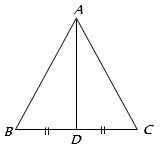
The vectors $\overrightarrow{AB} = 3\hat{i} + 4\hat{k}$ and $\overrightarrow{AC} = 5\hat{i} - 2\hat{j} + 4\hat{k}$ are the sides of a triangle $ABC$. The length of the median through $A$ is
A
$\sqrt{18}$
B
$\sqrt{72}$
C
$\sqrt{33}$
D
$\sqrt{288}$
Solution
(C) Let $D$ be the midpoint of $BC$. The median through $A$ is the vector $\overrightarrow{AD}$.
Since $D$ is the midpoint of $BC$,we have $\overrightarrow{AD} = \frac{1}{2}(\overrightarrow{AB} + \overrightarrow{AC})$.
Substituting the given vectors:
$\overrightarrow{AD} = \frac{1}{2}((3\hat{i} + 4\hat{k}) + (5\hat{i} - 2\hat{j} + 4\hat{k}))$
$\overrightarrow{AD} = \frac{1}{2}(8\hat{i} - 2\hat{j} + 8\hat{k}) = 4\hat{i} - \hat{j} + 4\hat{k}$.
The length of the median is the magnitude of $\overrightarrow{AD}$:
$|\overrightarrow{AD}| = \sqrt{4^2 + (-1)^2 + 4^2} = \sqrt{16 + 1 + 16} = \sqrt{33}$.
Since $D$ is the midpoint of $BC$,we have $\overrightarrow{AD} = \frac{1}{2}(\overrightarrow{AB} + \overrightarrow{AC})$.
Substituting the given vectors:
$\overrightarrow{AD} = \frac{1}{2}((3\hat{i} + 4\hat{k}) + (5\hat{i} - 2\hat{j} + 4\hat{k}))$
$\overrightarrow{AD} = \frac{1}{2}(8\hat{i} - 2\hat{j} + 8\hat{k}) = 4\hat{i} - \hat{j} + 4\hat{k}$.
The length of the median is the magnitude of $\overrightarrow{AD}$:
$|\overrightarrow{AD}| = \sqrt{4^2 + (-1)^2 + 4^2} = \sqrt{16 + 1 + 16} = \sqrt{33}$.
0 likesView Solution
35
ChemistryMCQAIEEE · 2003
The degree and order of the differential equation of the family of all parabolas whose axis is the $x$-axis,are respectively
A
$2, 1$
B
$1, 2$
C
$3, 2$
D
$2, 3$
Solution
(B) The general equation of a parabola with its axis as the $x$-axis is given by $y^2 = 4a(x - h)$,where $a$ and $h$ are arbitrary constants.
Since there are two arbitrary constants,we differentiate the equation twice.
First derivative: $2y y_1 = 4a$,which simplifies to $y y_1 = 2a$.
Second derivative: $y_1^2 + y y_2 = 0$.
In the differential equation $y_2 y + y_1^2 = 0$,the highest order derivative is $y_2$,so the order is $2$.
The power of the highest order derivative $y_2$ is $1$,so the degree is $1$.
Therefore,the degree is $1$ and the order is $2$.
Since there are two arbitrary constants,we differentiate the equation twice.
First derivative: $2y y_1 = 4a$,which simplifies to $y y_1 = 2a$.
Second derivative: $y_1^2 + y y_2 = 0$.
In the differential equation $y_2 y + y_1^2 = 0$,the highest order derivative is $y_2$,so the order is $2$.
The power of the highest order derivative $y_2$ is $1$,so the degree is $1$.
Therefore,the degree is $1$ and the order is $2$.
0 likesView Solution
36
ChemistryMCQAIEEE · 2003
In an experiment with $15$ observations on $x$,the following results were available: $\sum x^2 = 2830$ and $\sum x = 170$. One observation that was $20$ was found to be wrong and was replaced by the correct value $30$. Then the corrected variance is:
A
$78$
B
$188.66$
C
$177.33$
D
$8.33$
Solution
(A) Given $n = 15$,$\sum x = 170$,and $\sum x^2 = 2830$.
When the incorrect observation $20$ is replaced by $30$,the new sum $\sum x'$ is:
$\sum x' = 170 - 20 + 30 = 180$.
The new sum of squares $\sum x'^2$ is:
$\sum x'^2 = 2830 - (20)^2 + (30)^2 = 2830 - 400 + 900 = 3330$.
The variance is given by the formula $\sigma^2 = \frac{1}{n} \sum x'^2 - \left( \frac{\sum x'}{n} \right)^2$.
Substituting the values:
$\sigma^2 = \frac{3330}{15} - \left( \frac{180}{15} \right)^2$
$\sigma^2 = 222 - (12)^2$
$\sigma^2 = 222 - 144 = 78$.
When the incorrect observation $20$ is replaced by $30$,the new sum $\sum x'$ is:
$\sum x' = 170 - 20 + 30 = 180$.
The new sum of squares $\sum x'^2$ is:
$\sum x'^2 = 2830 - (20)^2 + (30)^2 = 2830 - 400 + 900 = 3330$.
The variance is given by the formula $\sigma^2 = \frac{1}{n} \sum x'^2 - \left( \frac{\sum x'}{n} \right)^2$.
Substituting the values:
$\sigma^2 = \frac{3330}{15} - \left( \frac{180}{15} \right)^2$
$\sigma^2 = 222 - (12)^2$
$\sigma^2 = 222 - 144 = 78$.
0 likesView Solution
37
ChemistryMCQAIEEE · 2003
Which part of the body secretes the hormone secretin?
A
Ileum
B
Stomach
C
Duodenum
D
Oesophagus
Solution
(C) The hormone secretin is produced by the $S$-cells located in the mucosal lining of the duodenum. When acidic chyme from the stomach enters the duodenum,it triggers the release of secretin into the bloodstream. This hormone then stimulates the pancreas to secrete bicarbonate-rich pancreatic juice to neutralize the acidity.
0 likesView Solution
38
ChemistryMCQAIEEE · 2003
Which of the following atoms has the lowest ionization potential?
A
$_7^{14}N$
B
$_{55}^{133}Cs$
C
$_{18}^{40}Ar$
D
$_8^{16}O$
Solution
(B) Ionization potential is the energy required to remove the most loosely bound electron from an isolated gaseous atom.
As we move down a group in the periodic table,the atomic size increases due to the addition of new shells.
As the atomic size increases,the distance between the nucleus and the valence electron increases,resulting in a weaker electrostatic force of attraction.
Therefore,it becomes easier to remove the valence electron,leading to a decrease in ionization potential.
Among the given elements,$_7^{14}N$ (Nitrogen),$_8^{16}O$ (Oxygen),and $_{18}^{40}Ar$ (Argon) are non-metals or noble gases with relatively small atomic radii.
$_{55}^{133}Cs$ (Cesium) is an alkali metal located at the bottom of the periodic table (Group $1$,Period $6$),which has the largest atomic radius among the options.
Thus,$_{55}^{133}Cs$ has the lowest ionization potential.
As we move down a group in the periodic table,the atomic size increases due to the addition of new shells.
As the atomic size increases,the distance between the nucleus and the valence electron increases,resulting in a weaker electrostatic force of attraction.
Therefore,it becomes easier to remove the valence electron,leading to a decrease in ionization potential.
Among the given elements,$_7^{14}N$ (Nitrogen),$_8^{16}O$ (Oxygen),and $_{18}^{40}Ar$ (Argon) are non-metals or noble gases with relatively small atomic radii.
$_{55}^{133}Cs$ (Cesium) is an alkali metal located at the bottom of the periodic table (Group $1$,Period $6$),which has the largest atomic radius among the options.
Thus,$_{55}^{133}Cs$ has the lowest ionization potential.
0 likesView Solution
39
ChemistryMCQAIEEE · 2003
The atomic numbers of Vanadium $(V)$,Chromium $(Cr)$,Manganese $(Mn)$,and Iron $(Fe)$ are $23, 24, 25$,and $26$ respectively. Which of the following has the highest second ionization enthalpy?
A
$V$
B
$Cr$
C
$Mn$
D
$Fe$
Solution
(B) The electronic configurations of the given elements are:
$V (Z=23): [Ar] 3d^3 4s^2$
$Cr (Z=24): [Ar] 3d^5 4s^1$
$Mn (Z=25): [Ar] 3d^5 4s^2$
$Fe (Z=26): [Ar] 3d^6 4s^2$
To find the second ionization enthalpy,we remove one electron from each to form the $M^+$ ion:
$V^+: [Ar] 3d^3 4s^1$
$Cr^+: [Ar] 3d^5$
$Mn^+: [Ar] 3d^5 4s^1$
$Fe^+: [Ar] 3d^6 4s^1$
The second ionization enthalpy involves removing an electron from the $M^+$ ion. For $Cr^+$,the configuration is $[Ar] 3d^5$,which is a stable half-filled $d$-orbital configuration. Removing an electron from this stable state requires a significantly higher amount of energy compared to the others. Therefore,$Cr$ has the highest second ionization enthalpy.
$V (Z=23): [Ar] 3d^3 4s^2$
$Cr (Z=24): [Ar] 3d^5 4s^1$
$Mn (Z=25): [Ar] 3d^5 4s^2$
$Fe (Z=26): [Ar] 3d^6 4s^2$
To find the second ionization enthalpy,we remove one electron from each to form the $M^+$ ion:
$V^+: [Ar] 3d^3 4s^1$
$Cr^+: [Ar] 3d^5$
$Mn^+: [Ar] 3d^5 4s^1$
$Fe^+: [Ar] 3d^6 4s^1$
The second ionization enthalpy involves removing an electron from the $M^+$ ion. For $Cr^+$,the configuration is $[Ar] 3d^5$,which is a stable half-filled $d$-orbital configuration. Removing an electron from this stable state requires a significantly higher amount of energy compared to the others. Therefore,$Cr$ has the highest second ionization enthalpy.
0 likesView Solution
40
ChemistryMCQAIEEE · 2003
The atomic numbers of Vanadium $(V)$,Chromium $(Cr)$,Manganese $(Mn)$,and Iron $(Fe)$ are $23, 24, 25$,and $26$ respectively. Which of these elements will have the highest second ionization enthalpy?
A
$V$
B
$Cr$
C
$Mn$
D
$Fe$
Solution
(B) The electronic configurations are as follows:
$V (Z=23): [Ar] 3d^3 4s^2$
$Cr (Z=24): [Ar] 3d^5 4s^1$
$Mn (Z=25): [Ar] 3d^5 4s^2$
$Fe (Z=26): [Ar] 3d^6 4s^2$
To find the second ionization enthalpy,we remove one electron from each:
$V^+: [Ar] 3d^3 4s^1$
$Cr^+: [Ar] 3d^5 4s^0$
$Mn^+: [Ar] 3d^5 4s^1$
$Fe^+: [Ar] 3d^6 4s^1$
Removing the second electron from $Cr^+$ involves removing an electron from the stable half-filled $3d^5$ subshell,which requires a very high amount of energy.
Therefore,$Cr$ has the highest second ionization enthalpy.
$V (Z=23): [Ar] 3d^3 4s^2$
$Cr (Z=24): [Ar] 3d^5 4s^1$
$Mn (Z=25): [Ar] 3d^5 4s^2$
$Fe (Z=26): [Ar] 3d^6 4s^2$
To find the second ionization enthalpy,we remove one electron from each:
$V^+: [Ar] 3d^3 4s^1$
$Cr^+: [Ar] 3d^5 4s^0$
$Mn^+: [Ar] 3d^5 4s^1$
$Fe^+: [Ar] 3d^6 4s^1$
Removing the second electron from $Cr^+$ involves removing an electron from the stable half-filled $3d^5$ subshell,which requires a very high amount of energy.
Therefore,$Cr$ has the highest second ionization enthalpy.
0 likesView Solution
41
ChemistryMCQAIEEE · 2003
In the coordination compound $K_4[Ni(CN)_4]$,the oxidation state of nickel is:
A
$0$
B
$+1$
C
$+2$
D
$-1$
Solution
(A) Let the oxidation state of $Ni$ be $x$.
The oxidation state of $K$ is $+1$ and the oxidation state of $CN^-$ is $-1$.
The sum of oxidation states in a neutral complex is $0$.
$4(+1) + x + 4(-1) = 0$
$4 + x - 4 = 0$
$x = 0$.
Therefore,the oxidation state of $Ni$ in $K_4[Ni(CN)_4]$ is $0$.
The oxidation state of $K$ is $+1$ and the oxidation state of $CN^-$ is $-1$.
The sum of oxidation states in a neutral complex is $0$.
$4(+1) + x + 4(-1) = 0$
$4 + x - 4 = 0$
$x = 0$.
Therefore,the oxidation state of $Ni$ in $K_4[Ni(CN)_4]$ is $0$.
0 likesView Solution
42
ChemistryMCQAIEEE · 2003
$A$ tetrahedron has vertices at $O(0, 0, 0)$,$A(1, 2, 1)$,$B(2, 1, 3)$,and $C(-1, 1, 2)$. The angle between the faces $OAB$ and $ABC$ is:
A
$90^{\circ}$
B
$\cos^{-1}\left(\frac{19}{35}\right)$
C
$\cos^{-1}\left(\frac{17}{31}\right)$
D
$30^{\circ}$
Solution
(B) Let $\vec{n_1}$ and $\vec{n_2}$ be the normal vectors to the faces $OAB$ and $ABC$ respectively.
For face $OAB$,the normal vector is $\vec{n_1} = \vec{OA} \times \vec{OB} = \begin{vmatrix} \hat{i} & \hat{j} & \hat{k} \\ 1 & 2 & 1 \\ 2 & 1 & 3 \end{vmatrix} = \hat{i}(6-1) - \hat{j}(3-2) + \hat{k}(1-4) = 5\hat{i} - \hat{j} - 3\hat{k}$.
For face $ABC$,the vectors are $\vec{AB} = (2-1, 1-2, 3-1) = (1, -1, 2)$ and $\vec{AC} = (-1-1, 1-2, 2-1) = (-2, -1, 1)$.
The normal vector is $\vec{n_2} = \vec{AB} \times \vec{AC} = \begin{vmatrix} \hat{i} & \hat{j} & \hat{k} \\ 1 & -1 & 2 \\ -2 & -1 & 1 \end{vmatrix} = \hat{i}(-1+2) - \hat{j}(1+4) + \hat{k}(-1-2) = \hat{i} - 5\hat{j} - 3\hat{k}$.
If $\theta$ is the angle between the faces $OAB$ and $ABC$,then $\cos \theta = \frac{|\vec{n_1} \cdot \vec{n_2}|}{|\vec{n_1}| |\vec{n_2}|}$.
$\vec{n_1} \cdot \vec{n_2} = (5)(1) + (-1)(-5) + (-3)(-3) = 5 + 5 + 9 = 19$.
$|\vec{n_1}| = \sqrt{5^2 + (-1)^2 + (-3)^2} = \sqrt{25 + 1 + 9} = \sqrt{35}$.
$|\vec{n_2}| = \sqrt{1^2 + (-5)^2 + (-3)^2} = \sqrt{1 + 25 + 9} = \sqrt{35}$.
Therefore,$\cos \theta = \frac{19}{\sqrt{35} \cdot \sqrt{35}} = \frac{19}{35}$.
$\theta = \cos^{-1}\left(\frac{19}{35}\right)$.
For face $OAB$,the normal vector is $\vec{n_1} = \vec{OA} \times \vec{OB} = \begin{vmatrix} \hat{i} & \hat{j} & \hat{k} \\ 1 & 2 & 1 \\ 2 & 1 & 3 \end{vmatrix} = \hat{i}(6-1) - \hat{j}(3-2) + \hat{k}(1-4) = 5\hat{i} - \hat{j} - 3\hat{k}$.
For face $ABC$,the vectors are $\vec{AB} = (2-1, 1-2, 3-1) = (1, -1, 2)$ and $\vec{AC} = (-1-1, 1-2, 2-1) = (-2, -1, 1)$.
The normal vector is $\vec{n_2} = \vec{AB} \times \vec{AC} = \begin{vmatrix} \hat{i} & \hat{j} & \hat{k} \\ 1 & -1 & 2 \\ -2 & -1 & 1 \end{vmatrix} = \hat{i}(-1+2) - \hat{j}(1+4) + \hat{k}(-1-2) = \hat{i} - 5\hat{j} - 3\hat{k}$.
If $\theta$ is the angle between the faces $OAB$ and $ABC$,then $\cos \theta = \frac{|\vec{n_1} \cdot \vec{n_2}|}{|\vec{n_1}| |\vec{n_2}|}$.
$\vec{n_1} \cdot \vec{n_2} = (5)(1) + (-1)(-5) + (-3)(-3) = 5 + 5 + 9 = 19$.
$|\vec{n_1}| = \sqrt{5^2 + (-1)^2 + (-3)^2} = \sqrt{25 + 1 + 9} = \sqrt{35}$.
$|\vec{n_2}| = \sqrt{1^2 + (-5)^2 + (-3)^2} = \sqrt{1 + 25 + 9} = \sqrt{35}$.
Therefore,$\cos \theta = \frac{19}{\sqrt{35} \cdot \sqrt{35}} = \frac{19}{35}$.
$\theta = \cos^{-1}\left(\frac{19}{35}\right)$.
0 likesView Solution
43
ChemistryMCQAIEEE · 2003
If the foci of the ellipse $\frac{x^2}{16} + \frac{y^2}{b^2} = 1$ and the hyperbola $\frac{x^2}{144} - \frac{y^2}{81} = \frac{1}{25}$ are the same,then the value of $b^2$ is:
A
$9$
B
$1$
C
$5$
D
$7$
Solution
(D) For the hyperbola $\frac{x^2}{144} - \frac{y^2}{81} = \frac{1}{25}$,we rewrite it as $\frac{x^2}{144/25} - \frac{y^2}{81/25} = 1$.
Here,$a^2 = \frac{144}{25}$ and $b^2 = \frac{81}{25}$.
The eccentricity $e_h$ is given by $e_h^2 = 1 + \frac{b^2}{a^2} = 1 + \frac{81/25}{144/25} = 1 + \frac{81}{144} = \frac{225}{144}$.
So,$e_h = \frac{15}{12} = \frac{5}{4}$.
The foci of the hyperbola are $(\pm a_h e_h, 0) = (\pm \frac{12}{5} \times \frac{5}{4}, 0) = (\pm 3, 0)$.
For the ellipse $\frac{x^2}{16} + \frac{y^2}{b^2} = 1$,the foci are $(\pm ae, 0)$ where $a^2 = 16$.
Since the foci are the same,$ae = 3$,so $e = \frac{3}{4}$.
For an ellipse,$e^2 = 1 - \frac{b^2}{a^2}$,so $(\frac{3}{4})^2 = 1 - \frac{b^2}{16}$.
$\frac{9}{16} = 1 - \frac{b^2}{16} \implies \frac{b^2}{16} = 1 - \frac{9}{16} = \frac{7}{16}$.
Therefore,$b^2 = 7$.
Here,$a^2 = \frac{144}{25}$ and $b^2 = \frac{81}{25}$.
The eccentricity $e_h$ is given by $e_h^2 = 1 + \frac{b^2}{a^2} = 1 + \frac{81/25}{144/25} = 1 + \frac{81}{144} = \frac{225}{144}$.
So,$e_h = \frac{15}{12} = \frac{5}{4}$.
The foci of the hyperbola are $(\pm a_h e_h, 0) = (\pm \frac{12}{5} \times \frac{5}{4}, 0) = (\pm 3, 0)$.
For the ellipse $\frac{x^2}{16} + \frac{y^2}{b^2} = 1$,the foci are $(\pm ae, 0)$ where $a^2 = 16$.
Since the foci are the same,$ae = 3$,so $e = \frac{3}{4}$.
For an ellipse,$e^2 = 1 - \frac{b^2}{a^2}$,so $(\frac{3}{4})^2 = 1 - \frac{b^2}{16}$.
$\frac{9}{16} = 1 - \frac{b^2}{16} \implies \frac{b^2}{16} = 1 - \frac{9}{16} = \frac{7}{16}$.
Therefore,$b^2 = 7$.
0 likesView Solution
44
ChemistryMCQAIEEE · 2003
If the function $f(x) = 2x^3 - 9ax^2 + 12a^2x + 1$,where $a > 0$,attains its maximum and minimum values at $p$ and $q$ respectively,such that $p^2 = q$,then what is the value of $a$?
A
$1/2$
B
$3$
C
$1$
D
$2$
Solution
(D) Given the function $f(x) = 2x^3 - 9ax^2 + 12a^2x + 1$ with $a > 0$.
First,find the derivative: $f'(x) = 6x^2 - 18ax + 12a^2$.
Set $f'(x) = 0$ to find critical points: $6(x^2 - 3ax + 2a^2) = 0$,which factors to $6(x - a)(x - 2a) = 0$.
Thus,the critical points are $x = a$ and $x = 2a$.
Find the second derivative: $f''(x) = 12x - 18a$.
At $x = a$,$f''(a) = 12a - 18a = -6a < 0$ (since $a > 0$),so $x = a$ is a point of local maximum. Thus,$p = a$.
At $x = 2a$,$f''(2a) = 12(2a) - 18a = 6a > 0$,so $x = 2a$ is a point of local minimum. Thus,$q = 2a$.
Given the condition $p^2 = q$,we substitute the values: $a^2 = 2a$.
Since $a > 0$,we can divide by $a$ to get $a = 2$.
First,find the derivative: $f'(x) = 6x^2 - 18ax + 12a^2$.
Set $f'(x) = 0$ to find critical points: $6(x^2 - 3ax + 2a^2) = 0$,which factors to $6(x - a)(x - 2a) = 0$.
Thus,the critical points are $x = a$ and $x = 2a$.
Find the second derivative: $f''(x) = 12x - 18a$.
At $x = a$,$f''(a) = 12a - 18a = -6a < 0$ (since $a > 0$),so $x = a$ is a point of local maximum. Thus,$p = a$.
At $x = 2a$,$f''(2a) = 12(2a) - 18a = 6a > 0$,so $x = 2a$ is a point of local minimum. Thus,$q = 2a$.
Given the condition $p^2 = q$,we substitute the values: $a^2 = 2a$.
Since $a > 0$,we can divide by $a$ to get $a = 2$.
0 likesView Solution
45
ChemistryDifficultMCQAIEEE · 2003
The orbital angular momentum of an electron in an $s$ orbital is:
A
$+ \frac{1}{2} \cdot \frac{h}{2\pi}$
B
Zero
C
$\frac{h}{2\pi}$
D
$\sqrt{2} \cdot \frac{h}{2\pi}$
Solution
(B) The orbital angular momentum of an electron is given by the formula: $\text{Angular momentum} = \sqrt{l(l + 1)} \frac{h}{2\pi}$.
For an $s$ orbital,the azimuthal quantum number $l = 0$.
Substituting $l = 0$ into the formula: $\text{Angular momentum} = \sqrt{0(0 + 1)} \frac{h}{2\pi} = 0$.
Therefore,the orbital angular momentum of an electron in an $s$ orbital is zero.
For an $s$ orbital,the azimuthal quantum number $l = 0$.
Substituting $l = 0$ into the formula: $\text{Angular momentum} = \sqrt{0(0 + 1)} \frac{h}{2\pi} = 0$.
Therefore,the orbital angular momentum of an electron in an $s$ orbital is zero.
0 likesView Solution
46
ChemistryMCQAIEEE · 2003
If the system of linear equations $x + 2ay + az = 0$,$x + 3by + bz = 0$,and $x + 4cy + cz = 0$ has a non-zero solution,then $a, b, c$:
A
are in $G.P.$
B
are in $H.P.$
C
satisfy $a + 2b + 3c = 0$
D
are in $A.P.$
Solution
(B) For the system of linear equations to have a non-zero solution,the determinant of the coefficient matrix must be zero:
$\left|\begin{array}{lll}1 & 2a & a \\ 1 & 3b & b \\ 1 & 4c & c\end{array}\right| = 0$
Applying row operations $R_{2} \rightarrow R_{2} - R_{1}$ and $R_{3} \rightarrow R_{3} - R_{1}$:
$\left|\begin{array}{ccc}1 & 2a & a \\ 0 & 3b - 2a & b - a \\ 0 & 4c - 2a & c - a\end{array}\right| = 0$
Expanding along the first column:
$(3b - 2a)(c - a) - (4c - 2a)(b - a) = 0$
Expanding the terms:
$(3bc - 3ab - 2ac + 2a^{2}) - (4bc - 4ab - 2ac + 2a^{2}) = 0$
Simplifying the expression:
$3bc - 3ab - 2ac + 2a^{2} - 4bc + 4ab + 2ac - 2a^{2} = 0$
$-bc + ab = 0$
$ab = bc$
Wait,let us re-evaluate the expansion:
$3bc - 3ab - 2ac + 2a^{2} - (4bc - 4ab - 2ac + 2a^{2}) = 0$
$3bc - 3ab - 2ac + 2a^{2} - 4bc + 4ab + 2ac - 2a^{2} = 0$
$-bc + ab = 0 \Rightarrow ab = bc$.
Actually,let's re-calculate:
$(3b-2a)(c-a) = 3bc - 3ab - 2ac + 2a^2$
$(4c-2a)(b-a) = 4bc - 4ac - 2ab + 2a^2$
Subtracting: $(3bc - 3ab - 2ac + 2a^2) - (4bc - 4ac - 2ab + 2a^2) = 0$
$-bc - ab + 2ac = 0$
$2ac = ab + bc$
Dividing by $abc$:
$\frac{2}{b} = \frac{1}{c} + \frac{1}{a}$
This implies that $a, b, c$ are in $H.P.$
$\left|\begin{array}{lll}1 & 2a & a \\ 1 & 3b & b \\ 1 & 4c & c\end{array}\right| = 0$
Applying row operations $R_{2} \rightarrow R_{2} - R_{1}$ and $R_{3} \rightarrow R_{3} - R_{1}$:
$\left|\begin{array}{ccc}1 & 2a & a \\ 0 & 3b - 2a & b - a \\ 0 & 4c - 2a & c - a\end{array}\right| = 0$
Expanding along the first column:
$(3b - 2a)(c - a) - (4c - 2a)(b - a) = 0$
Expanding the terms:
$(3bc - 3ab - 2ac + 2a^{2}) - (4bc - 4ab - 2ac + 2a^{2}) = 0$
Simplifying the expression:
$3bc - 3ab - 2ac + 2a^{2} - 4bc + 4ab + 2ac - 2a^{2} = 0$
$-bc + ab = 0$
$ab = bc$
Wait,let us re-evaluate the expansion:
$3bc - 3ab - 2ac + 2a^{2} - (4bc - 4ab - 2ac + 2a^{2}) = 0$
$3bc - 3ab - 2ac + 2a^{2} - 4bc + 4ab + 2ac - 2a^{2} = 0$
$-bc + ab = 0 \Rightarrow ab = bc$.
Actually,let's re-calculate:
$(3b-2a)(c-a) = 3bc - 3ab - 2ac + 2a^2$
$(4c-2a)(b-a) = 4bc - 4ac - 2ab + 2a^2$
Subtracting: $(3bc - 3ab - 2ac + 2a^2) - (4bc - 4ac - 2ab + 2a^2) = 0$
$-bc - ab + 2ac = 0$
$2ac = ab + bc$
Dividing by $abc$:
$\frac{2}{b} = \frac{1}{c} + \frac{1}{a}$
This implies that $a, b, c$ are in $H.P.$
0 likesView Solution
47
ChemistryMCQAIEEE · 2003
Curie temperature is the temperature above which :
A
a ferromagnetic material becomes paramagnetic
B
a paramagnetic material becomes diamagnetic
C
a ferromagnetic material becomes diamagnetic
D
a paramagnetic material becomes ferromagnetic
Solution
(A) The Curie temperature $(T_{C})$ is the temperature at which certain materials lose their permanent magnetic properties and transition to induced magnetism.
Specifically,when a ferromagnetic material is heated above its Curie temperature,the thermal agitation overcomes the alignment of magnetic dipoles.
As a result,the material loses its spontaneous magnetization and behaves as a paramagnetic material.
Therefore,above the Curie temperature,a ferromagnetic material becomes paramagnetic.
Specifically,when a ferromagnetic material is heated above its Curie temperature,the thermal agitation overcomes the alignment of magnetic dipoles.
As a result,the material loses its spontaneous magnetization and behaves as a paramagnetic material.
Therefore,above the Curie temperature,a ferromagnetic material becomes paramagnetic.
0 likesView Solution
48
ChemistryMCQAIEEE · 2003
Bottles containing $C_6H_5I$ and $C_6H_5CH_2I$ lost their original labels. They were labelled $A$ and $B$ for testing. $A$ and $B$ were separately taken in a test tube and boiled with $NaOH$ solution. The end solution in each tube was made acidic with dilute $HNO_3$ and then some $AgNO_3$ solution was added. Substance $B$ gave a yellow precipitate. Which one of the following statements is true for this experiment?
A
$A$ was $C_6H_5I$
B
$A$ was $C_6H_5CH_2I$
C
$B$ was $C_6H_5I$
D
Addition of $HNO_3$ was unnecessary
Solution
(A) $C_6H_5I$ is an aryl halide where the $C-I$ bond has partial double bond character due to resonance,making it resistant to nucleophilic substitution under these conditions. Thus,it does not release $I^-$ ions to form a yellow precipitate of $AgI$ with $AgNO_3$.
$C_6H_5CH_2I$ is a primary alkyl halide (benzyl iodide) which undergoes nucleophilic substitution with $NaOH$ to form $C_6H_5CH_2OH$ and $NaI$. The $NaI$ dissociates to provide $I^-$ ions,which react with $AgNO_3$ to form a yellow precipitate of $AgI$.
Since $B$ gave a yellow precipitate,$B$ must be $C_6H_5CH_2I$,and $A$ must be $C_6H_5I$.
Therefore,the statement '$A$ was $C_6H_5I$' is true.
$C_6H_5CH_2I$ is a primary alkyl halide (benzyl iodide) which undergoes nucleophilic substitution with $NaOH$ to form $C_6H_5CH_2OH$ and $NaI$. The $NaI$ dissociates to provide $I^-$ ions,which react with $AgNO_3$ to form a yellow precipitate of $AgI$.
Since $B$ gave a yellow precipitate,$B$ must be $C_6H_5CH_2I$,and $A$ must be $C_6H_5I$.
Therefore,the statement '$A$ was $C_6H_5I$' is true.
0 likesView Solution
49
ChemistryMCQAIEEE · 2003
One mole of the complex compound $Co(NH_3)_5Cl_3$ gives $3$ moles of ions on dissolution in water. One mole of the same complex reacts with two moles of $AgNO_3$ solution to yield two moles of $AgCl_{(s)}$. The structure of the complex is :-
A
$[Co(NH_3)_5Cl]Cl_2$
B
$[Co(NH_3)_3Cl_3] \cdot 2NH_3$
C
$[Co(NH_3)_4Cl_2]Cl \cdot NH_3$
D
$[Co(NH_3)_4Cl]Cl_2 \cdot NH_3$
Solution
(A) The reaction of the complex with $AgNO_3$ to yield $2$ moles of $AgCl_{(s)}$ indicates that there are $2$ chloride ions $(Cl^-)$ present outside the coordination sphere (ionizable chloride ions).
When $[Co(NH_3)_5Cl]Cl_2$ dissolves in water,it dissociates as follows:
$[Co(NH_3)_5Cl]Cl_2 \rightarrow [Co(NH_3)_5Cl]^{2+} + 2Cl^-$
This results in a total of $1 + 2 = 3$ moles of ions per mole of the complex,which matches the given information.
Therefore,the correct structure is $[Co(NH_3)_5Cl]Cl_2$.
When $[Co(NH_3)_5Cl]Cl_2$ dissolves in water,it dissociates as follows:
$[Co(NH_3)_5Cl]Cl_2 \rightarrow [Co(NH_3)_5Cl]^{2+} + 2Cl^-$
This results in a total of $1 + 2 = 3$ moles of ions per mole of the complex,which matches the given information.
Therefore,the correct structure is $[Co(NH_3)_5Cl]Cl_2$.
0 likesView Solution
50
ChemistryMCQAIEEE · 2003
The median of a set of $9$ distinct observations is $20.5$. If each of the largest $4$ observations of the set is increased by $2$,then the median of the new set
A
is increased by $2$
B
is decreased by $2$
C
is two times the original median
D
remains the same as that of the original set
Solution
(D) Let the $9$ distinct observations in ascending order be $x_1, x_2, x_3, x_4, x_5, x_6, x_7, x_8, x_9$.
Since the number of observations $n = 9$ is odd,the median is the $\left(\frac{n+1}{2}\right)^{th}$ observation,which is the $5^{th}$ observation,$x_5$.
Given,$x_5 = 20.5$.
When the largest $4$ observations $(x_6, x_7, x_8, x_9)$ are increased by $2$,the order of the observations remains unchanged because $x_5 < x_6 < x_7 < x_8 < x_9$ and the new values $x_6+2, x_7+2, x_8+2, x_9+2$ are still greater than $x_5$.
The new set of observations is $x_1, x_2, x_3, x_4, x_5, x_6+2, x_7+2, x_8+2, x_9+2$.
The median of the new set is still the $5^{th}$ observation,which is $x_5 = 20.5$.
Thus,the median remains the same.
Since the number of observations $n = 9$ is odd,the median is the $\left(\frac{n+1}{2}\right)^{th}$ observation,which is the $5^{th}$ observation,$x_5$.
Given,$x_5 = 20.5$.
When the largest $4$ observations $(x_6, x_7, x_8, x_9)$ are increased by $2$,the order of the observations remains unchanged because $x_5 < x_6 < x_7 < x_8 < x_9$ and the new values $x_6+2, x_7+2, x_8+2, x_9+2$ are still greater than $x_5$.
The new set of observations is $x_1, x_2, x_3, x_4, x_5, x_6+2, x_7+2, x_8+2, x_9+2$.
The median of the new set is still the $5^{th}$ observation,which is $x_5 = 20.5$.
Thus,the median remains the same.
0 likesView Solution
51
ChemistryMediumMCQAIEEE · 2003
The negative $Zn$ pole of a Daniel cell,sending a constant current through a circuit,decreases in mass by $0.13 \ g$ in $30$ minutes. If the electrochemical equivalent of $Zn$ and $Cu$ are $32.5$ and $31.5$ respectively,the increase in the mass of the positive $Cu$ pole in this time is .............. $g$.
A
$0.126$
B
$0.190$
C
$0.141$
D
$0.242$
Solution
(A) According to Faraday's law of electrolysis,the mass deposited or dissolved is given by $m = ZIt$.
Since the current $I$ and time $t$ are constant for both electrodes in the series circuit,we have the ratio: $\frac{m_{Cu}}{m_{Zn}} = \frac{Z_{Cu}}{Z_{Zn}}$.
Given $m_{Zn} = 0.13 \ g$,$Z_{Zn} = 32.5$,and $Z_{Cu} = 31.5$.
Substituting the values: $m_{Cu} = m_{Zn} \times \frac{Z_{Cu}}{Z_{Zn}} = 0.13 \times \frac{31.5}{32.5} = 0.126 \ g$.
Therefore,the increase in the mass of the $Cu$ pole is $0.126 \ g$.
Since the current $I$ and time $t$ are constant for both electrodes in the series circuit,we have the ratio: $\frac{m_{Cu}}{m_{Zn}} = \frac{Z_{Cu}}{Z_{Zn}}$.
Given $m_{Zn} = 0.13 \ g$,$Z_{Zn} = 32.5$,and $Z_{Cu} = 31.5$.
Substituting the values: $m_{Cu} = m_{Zn} \times \frac{Z_{Cu}}{Z_{Zn}} = 0.13 \times \frac{31.5}{32.5} = 0.126 \ g$.
Therefore,the increase in the mass of the $Cu$ pole is $0.126 \ g$.
0 likesView Solution
52
ChemistryMediumMCQAIEEE · 2003
Several blocks of magnesium are fixed to the bottom of a ship to
A
Keep away the sharks
B
Make the ship lighter
C
Prevent corrosion of the iron hull by water and salt
D
Prevent puncturing by under-sea rocks
Solution
(C) . Magnesium acts as a sacrificial anode because it is more reactive than iron. It undergoes oxidation instead of iron,thereby protecting the iron hull of the ship from corrosion caused by water and salt.
0 likesView Solution
53
ChemistryEasyMCQAIEEE · 2003
Glass is a
A
Micro-crystalline solid
B
Super cooled liquid
C
Gel
D
Polymeric mixture
Solution
(B) Glass is considered a supercooled liquid because it possesses a disordered,amorphous structure similar to a liquid,but it has a very high viscosity that prevents it from flowing at room temperature.
Supercooling is a process of lowering the temperature of a liquid or a gas below its freezing point without it becoming a solid.
Supercooling is a process of lowering the temperature of a liquid or a gas below its freezing point without it becoming a solid.
0 likesView Solution
54
ChemistryEasyMCQAIEEE · 2003
What may be expected to happen when phosphine gas is mixed with chlorine gas?
A
The mixture only cools down
B
$PCl_3$ and $HCl$ are formed and the mixture warms up
C
$PCl_5$ and $HCl$ are formed and the mixture warms up
D
$PH_3 \cdot Cl_2$ is formed with warming up
Solution
(C) When phosphine $(PH_3)$ is mixed with chlorine gas $(Cl_2)$,it reacts vigorously to form phosphorus pentachloride $(PCl_5)$ and hydrogen chloride $(HCl)$.
The balanced chemical equation is: $PH_3 + 4Cl_2 \to PCl_5 + 3HCl$.
This reaction is highly exothermic,meaning the mixture warms up.
The balanced chemical equation is: $PH_3 + 4Cl_2 \to PCl_5 + 3HCl$.
This reaction is highly exothermic,meaning the mixture warms up.
0 likesView Solution
55
ChemistryMediumMCQAIEEE · 2003
$25 \ mL$ of a solution of barium hydroxide on titration with a $0.1 \ M$ solution of hydrochloric acid gave a titre value of $35 \ mL$. The molarity of barium hydroxide solution was (in $M$)
A
$0.07$
B
$0.14$
C
$0.28$
D
$0.35$
Solution
(A) The balanced chemical equation for the reaction is: $Ba(OH)_2 + 2HCl \rightarrow BaCl_2 + 2H_2O$.
According to the stoichiometry,$1 \ mole$ of $Ba(OH)_2$ reacts with $2 \ moles$ of $HCl$.
Using the molarity equation: $\frac{M_1 V_1}{n_1} = \frac{M_2 V_2}{n_2}$,where $M_1$ and $V_1$ are for $Ba(OH)_2$ and $M_2$ and $V_2$ are for $HCl$.
Given: $V_1 = 25 \ mL$,$M_2 = 0.1 \ M$,$V_2 = 35 \ mL$,$n_1 = 1$,$n_2 = 2$.
$\frac{M_1 \times 25}{1} = \frac{0.1 \times 35}{2}$.
$M_1 = \frac{0.1 \times 35}{25 \times 2} = \frac{3.5}{50} = 0.07 \ M$.
According to the stoichiometry,$1 \ mole$ of $Ba(OH)_2$ reacts with $2 \ moles$ of $HCl$.
Using the molarity equation: $\frac{M_1 V_1}{n_1} = \frac{M_2 V_2}{n_2}$,where $M_1$ and $V_1$ are for $Ba(OH)_2$ and $M_2$ and $V_2$ are for $HCl$.
Given: $V_1 = 25 \ mL$,$M_2 = 0.1 \ M$,$V_2 = 35 \ mL$,$n_1 = 1$,$n_2 = 2$.
$\frac{M_1 \times 25}{1} = \frac{0.1 \times 35}{2}$.
$M_1 = \frac{0.1 \times 35}{25 \times 2} = \frac{3.5}{50} = 0.07 \ M$.
1 likesView Solution
56
ChemistryEasyMCQAIEEE · 2003
Liquids $A$ and $B$ form an ideal solution. Which of the following statements is true?
A
The enthalpy of mixing is zero
B
The entropy of mixing is zero
C
The free energy of mixing is zero
D
The free energy as well as the entropy of mixing are each zero
Solution
(A) For an ideal solution,the following conditions must be satisfied:-
$1. \Delta H_{mix} = 0$ (Enthalpy of mixing is zero)
$2. \Delta V_{mix} = 0$ (Volume of mixing is zero)
$3. \Delta S_{mix} > 0$ (Entropy of mixing is positive)
$4. \Delta G_{mix} < 0$ (Gibbs free energy of mixing is negative)
Since $\Delta H_{mix} = 0$ is a defining characteristic of an ideal solution,option $A$ is correct.
$1. \Delta H_{mix} = 0$ (Enthalpy of mixing is zero)
$2. \Delta V_{mix} = 0$ (Volume of mixing is zero)
$3. \Delta S_{mix} > 0$ (Entropy of mixing is positive)
$4. \Delta G_{mix} < 0$ (Gibbs free energy of mixing is negative)
Since $\Delta H_{mix} = 0$ is a defining characteristic of an ideal solution,option $A$ is correct.
0 likesView Solution
57
ChemistryMediumMCQAIEEE · 2003
How many unit cells are present in a cube-shaped ideal crystal of $NaCl$ of mass $1.00 \ g$? [Atomic masses: $Na = 23, Cl = 35.5$]
A
$2.57 \times 10^{21}$ unit cells
B
$5.14 \times 10^{21}$ unit cells
C
$1.28 \times 10^{21}$ unit cells
D
$1.71 \times 10^{21}$ unit cells
Solution
(A) The molar mass of $NaCl$ is $23 + 35.5 = 58.5 \ g/mol$.
Number of formula units in $1.00 \ g$ of $NaCl = \frac{1.00 \ g}{58.5 \ g/mol} \times 6.022 \times 10^{23} \text{ formula units/mol} = 1.029 \times 10^{22}$ formula units.
Since one unit cell of $NaCl$ (fcc structure) contains $4$ formula units of $NaCl$,the number of unit cells is $\frac{1.029 \times 10^{22}}{4} = 2.57 \times 10^{21}$ unit cells.
Number of formula units in $1.00 \ g$ of $NaCl = \frac{1.00 \ g}{58.5 \ g/mol} \times 6.022 \times 10^{23} \text{ formula units/mol} = 1.029 \times 10^{22}$ formula units.
Since one unit cell of $NaCl$ (fcc structure) contains $4$ formula units of $NaCl$,the number of unit cells is $\frac{1.029 \times 10^{22}}{4} = 2.57 \times 10^{21}$ unit cells.
0 likesView Solution
58
ChemistryMediumMCQAIEEE · 2003
The radionuclide $_{90}^{234}Th$ undergoes two successive $\beta$-decays followed by one $\alpha$-decay. The atomic number and the mass number respectively of the resulting radionuclide are
A
$92$ and $234$
B
$94$ and $230$
C
$90$ and $230$
D
$92$ and $230$
Solution
(C) The initial radionuclide is $_{90}^{234}Th$.
$1$. First $\beta$-decay: $_{90}^{234}Th \rightarrow {}_{91}^{234}X + {}_{-1}^{0}e$.
$2$. Second $\beta$-decay: $_{91}^{234}X \rightarrow {}_{92}^{234}Y + {}_{-1}^{0}e$.
$3$. One $\alpha$-decay: $_{92}^{234}Y \rightarrow {}_{90}^{230}Z + {}_{2}^{4}He$.
Thus,the resulting radionuclide has an atomic number of $90$ and a mass number of $230$.
$1$. First $\beta$-decay: $_{90}^{234}Th \rightarrow {}_{91}^{234}X + {}_{-1}^{0}e$.
$2$. Second $\beta$-decay: $_{91}^{234}X \rightarrow {}_{92}^{234}Y + {}_{-1}^{0}e$.
$3$. One $\alpha$-decay: $_{92}^{234}Y \rightarrow {}_{90}^{230}Z + {}_{2}^{4}He$.
Thus,the resulting radionuclide has an atomic number of $90$ and a mass number of $230$.
0 likesView Solution
59
ChemistryMediumMCQAIEEE · 2003
The half-life of a radioactive isotope is $3 \ hours$. If the initial mass of the isotope were $256 \ g$,the mass of it remaining undecayed after $18 \ hours$ would be ....... $g$. (in $.0$)
A
$4$
B
$8$
C
$12$
D
$16$
Solution
(A) The number of half-lives $(n)$ is calculated as: $n = \frac{\text{Total time}}{\text{Half-life}} = \frac{18 \ h}{3 \ h} = 6$.
Using the radioactive decay formula: $N_t = N_o \times (1/2)^n$.
Substituting the values: $N_t = 256 \times (1/2)^6$.
$N_t = 256 \times \frac{1}{64} = 4 \ g$.
Therefore,the remaining mass is $4.0 \ g$.
Using the radioactive decay formula: $N_t = N_o \times (1/2)^n$.
Substituting the values: $N_t = 256 \times (1/2)^6$.
$N_t = 256 \times \frac{1}{64} = 4 \ g$.
Therefore,the remaining mass is $4.0 \ g$.
0 likesView Solution
60
ChemistryEasyMCQAIEEE · 2003
For the reaction system $2NO_{(g)} + O_{2(g)} \to 2NO_{2(g)}$,the volume is suddenly reduced to half its initial value by increasing the pressure. If the reaction is of first order with respect to $O_2$ and second order with respect to $NO$,the rate of reaction will:
A
Diminish to one fourth of its initial value
B
Diminish to one eighth of its initial value
C
Increase to eight times of its initial value
D
Increase to four times of its initial value
Solution
(C) The rate law for the reaction is given by: $R = k[NO]^2[O_2]$.
When the volume is reduced to half,the concentration of each reactant doubles because $C = \frac{n}{V}$.
Let the new concentrations be $[NO]' = 2[NO]$ and $[O_2]' = 2[O_2]$.
The new rate $R'$ is: $R' = k(2[NO])^2(2[O_2])$.
$R' = k \times 4[NO]^2 \times 2[O_2] = 8 \times k[NO]^2[O_2]$.
Therefore,$R' = 8R$. The rate of reaction increases to eight times its initial value.
When the volume is reduced to half,the concentration of each reactant doubles because $C = \frac{n}{V}$.
Let the new concentrations be $[NO]' = 2[NO]$ and $[O_2]' = 2[O_2]$.
The new rate $R'$ is: $R' = k(2[NO])^2(2[O_2])$.
$R' = k \times 4[NO]^2 \times 2[O_2] = 8 \times k[NO]^2[O_2]$.
Therefore,$R' = 8R$. The rate of reaction increases to eight times its initial value.
0 likesView Solution
61
ChemistryDifficultMCQAIEEE · 2003
In respect of the equation $k = A e^{-E_a/RT}$ in chemical kinetics,which one of the following statements is correct?
A
$k$ is equilibrium constant
B
$A$ is adsorption factor
C
$E_a$ is energy of activation
D
$R$ is Rydberg's constant
Solution
(C) The given equation $k = A e^{-E_a/RT}$ is known as the Arrhenius equation.
In this equation:
$k$ is the rate constant.
$A$ is the Arrhenius factor or frequency factor.
$E_a$ is the activation energy.
$R$ is the universal gas constant.
$T$ is the temperature in Kelvin.
Therefore,the statement '$E_a$ is energy of activation' is correct.
In this equation:
$k$ is the rate constant.
$A$ is the Arrhenius factor or frequency factor.
$E_a$ is the activation energy.
$R$ is the universal gas constant.
$T$ is the temperature in Kelvin.
Therefore,the statement '$E_a$ is energy of activation' is correct.
0 likesView Solution
62
ChemistryMediumMCQAIEEE · 2003
The rate law for a reaction between the substances $A$ and $B$ is given by,$rate = k[A]^n[B]^m$. On doubling the concentration of $A$ and halving the concentration of $B$,the ratio of the new rate to the earlier rate of the reaction will be as
A
$2^{(n - m)}$
B
$2^{(m - n)}$
C
$2^{(n + m)}$
D
$2^{(m + n)}$
Solution
(A) The initial rate is given by $R = k[A]^n[B]^m$.
When the concentration of $A$ is doubled $([A]' = 2[A])$ and the concentration of $B$ is halved $([B]' = \frac{B}{2})$,the new rate $R'$ is:
$R' = k[2A]^n[\frac{B}{2}]^m$
$R' = k \cdot 2^n [A]^n \cdot 2^{-m} [B]^m$
$R' = k[A]^n[B]^m \cdot 2^{n - m}$
$R' = R \cdot 2^{n - m}$
Therefore,the ratio of the new rate to the earlier rate is:
$\frac{R'}{R} = 2^{n - m}$.
When the concentration of $A$ is doubled $([A]' = 2[A])$ and the concentration of $B$ is halved $([B]' = \frac{B}{2})$,the new rate $R'$ is:
$R' = k[2A]^n[\frac{B}{2}]^m$
$R' = k \cdot 2^n [A]^n \cdot 2^{-m} [B]^m$
$R' = k[A]^n[B]^m \cdot 2^{n - m}$
$R' = R \cdot 2^{n - m}$
Therefore,the ratio of the new rate to the earlier rate is:
$\frac{R'}{R} = 2^{n - m}$.
0 likesView Solution
63
ChemistryMediumMCQAIEEE · 2003
During the electrolysis of a solution of $AgNO_3$,$9650 \ C$ of charge passes through the electroplating bath. The mass of silver deposited at the cathode will be .............. $g$.
A
$1.08$
B
$10.8$
C
$21.6$
D
$108$
Solution
(B) The reduction reaction at the cathode is: $Ag^{+} + e^{-} \rightarrow Ag(s)$.
According to Faraday's first law of electrolysis,$1 \ \text{mole}$ of electrons $(96500 \ C)$ deposits $1 \ \text{mole}$ of silver $(108 \ g)$.
Therefore,the mass of silver deposited by $9650 \ C$ of charge is:
$\text{Mass} = \frac{108 \ g}{96500 \ C} \times 9650 \ C = 10.8 \ g$.
According to Faraday's first law of electrolysis,$1 \ \text{mole}$ of electrons $(96500 \ C)$ deposits $1 \ \text{mole}$ of silver $(108 \ g)$.
Therefore,the mass of silver deposited by $9650 \ C$ of charge is:
$\text{Mass} = \frac{108 \ g}{96500 \ C} \times 9650 \ C = 10.8 \ g$.
0 likesView Solution
64
ChemistryMediumMCQAIEEE · 2003
For the redox reaction $Zn_{(s)} + Cu^{2+}(0.1 \ M) \to Zn^{2+}(1 \ M) + Cu_{(s)}$ taking place in a cell,$E_{cell}^o$ is $1.10 \ V$. $E_{cell}$ for the cell will be ............ $V$ $\left( 2.303 \frac{RT}{F} = 0.0591 \right)$
A
$2.14$
B
$1.80$
C
$1.07$
D
$0.82$
Solution
(C) The Nernst equation for the cell reaction is given by:
$E_{cell} = E_{cell}^o - \frac{0.0591}{n} \log \frac{[Zn^{2+}]}{[Cu^{2+}]}$
Here,$n = 2$ (number of electrons transferred).
Substituting the given values:
$E_{cell} = 1.10 - \frac{0.0591}{2} \log \frac{1}{0.1}$
$E_{cell} = 1.10 - 0.02955 \times \log(10)$
Since $\log(10) = 1$,we get:
$E_{cell} = 1.10 - 0.02955 = 1.07045 \ V \approx 1.07 \ V$.
$E_{cell} = E_{cell}^o - \frac{0.0591}{n} \log \frac{[Zn^{2+}]}{[Cu^{2+}]}$
Here,$n = 2$ (number of electrons transferred).
Substituting the given values:
$E_{cell} = 1.10 - \frac{0.0591}{2} \log \frac{1}{0.1}$
$E_{cell} = 1.10 - 0.02955 \times \log(10)$
Since $\log(10) = 1$,we get:
$E_{cell} = 1.10 - 0.02955 = 1.07045 \ V \approx 1.07 \ V$.
0 likesView Solution
65
ChemistryMediumMCQAIEEE · 2003
Standard reduction electrode potentials of three metals $A$,$B$,and $C$ are respectively $+0.5 \ V$,$-3.0 \ V$,and $-1.2 \ V$. The reducing powers of these metals are
A
$B > C > A$
B
$A > B > C$
C
$C > B > A$
D
$A > C > B$
Solution
(A) The reducing power of a metal is inversely proportional to its standard reduction potential.
Lower reduction potential indicates a greater tendency to lose electrons,hence higher reducing power.
Given reduction potentials: $E^{\circ}_{A} = +0.5 \ V$,$E^{\circ}_{B} = -3.0 \ V$,$E^{\circ}_{C} = -1.2 \ V$.
Comparing the values: $-3.0 \ V < -1.2 \ V < +0.5 \ V$.
Therefore,the order of reducing power is $B > C > A$.
Lower reduction potential indicates a greater tendency to lose electrons,hence higher reducing power.
Given reduction potentials: $E^{\circ}_{A} = +0.5 \ V$,$E^{\circ}_{B} = -3.0 \ V$,$E^{\circ}_{C} = -1.2 \ V$.
Comparing the values: $-3.0 \ V < -1.2 \ V < +0.5 \ V$.
Therefore,the order of reducing power is $B > C > A$.
0 likesView Solution
66
ChemistryDifficultMCQAIEEE · 2003
For a cell reaction involving a two-electron change,the standard emf of the cell is found to be $0.295 \ V$ at $25 \ ^oC$. The equilibrium constant of the reaction at $25 \ ^oC$ will be
A
$1 \times 10^{-10}$
B
$29.5 \times 10^{-2}$
C
$10$
D
$1 \times 10^{10}$
Solution
(D) The relationship between standard emf $(E^o)$ and equilibrium constant $(K)$ is given by the equation: $\log \ K = \frac{nFE^o}{2.303 \ RT}$.
Given: $n = 2$,$E^o = 0.295 \ V$,$T = 298 \ K$,$F = 96500 \ C \ mol^{-1}$,$R = 8.314 \ J \ K^{-1} \ mol^{-1}$.
Substituting the values: $\log \ K = \frac{2 \times 96500 \times 0.295}{2.303 \times 8.314 \times 298}$.
$\log \ K = \frac{56935}{5705.8} \approx 9.978$.
Since $\log \ K \approx 10$,we get $K = 10^{10}$.
Given: $n = 2$,$E^o = 0.295 \ V$,$T = 298 \ K$,$F = 96500 \ C \ mol^{-1}$,$R = 8.314 \ J \ K^{-1} \ mol^{-1}$.
Substituting the values: $\log \ K = \frac{2 \times 96500 \times 0.295}{2.303 \times 8.314 \times 298}$.
$\log \ K = \frac{56935}{5705.8} \approx 9.978$.
Since $\log \ K \approx 10$,we get $K = 10^{10}$.
0 likesView Solution
67
ChemistryEasyMCQAIEEE · 2003
Which one of the following characteristics is not correct for physical adsorption?
A
Adsorption on solids is reversible
B
Adsorption increases with increase in temperature
C
Adsorption is spontaneous
D
Both enthalpy and entropy of adsorption are negative
Solution
(B) Physical adsorption is an exothermic process. According to Le Chatelier's Principle,for an exothermic process,an increase in temperature favors the reverse process (desorption). Therefore,physical adsorption decreases with an increase in temperature.
For a process to be spontaneous,the Gibbs free energy change $\Delta G$ must be negative. Since $\Delta G = \Delta H - T\Delta S$,and adsorption involves a decrease in entropy $(\Delta S < 0)$,the process can only be spontaneous if $\Delta H$ is negative (exothermic) and the temperature $T$ is low enough such that $|\Delta H| > |T\Delta S|$.
For a process to be spontaneous,the Gibbs free energy change $\Delta G$ must be negative. Since $\Delta G = \Delta H - T\Delta S$,and adsorption involves a decrease in entropy $(\Delta S < 0)$,the process can only be spontaneous if $\Delta H$ is negative (exothermic) and the temperature $T$ is low enough such that $|\Delta H| > |T\Delta S|$.
0 likesView Solution
68
ChemistryMediumMCQAIEEE · 2003
$A$ reduction in atomic size with an increase in atomic number is a characteristic of elements of
A
High atomic masses
B
$d-$ block
C
$f-$ block
D
Radioactive series
Solution
(C) The phenomenon where there is a regular decrease in the atomic and ionic radii of lanthanoids with an increase in atomic number is known as lanthanide contraction. This is a characteristic feature of the $f-$ block elements.
0 likesView Solution
69
ChemistryMediumMCQAIEEE · 2003
Which one of the following statements is correct?
A
Manganese salts give violet borax bead test in the reducing flame
B
From a mixed precipitate of $AgCl$ and $AgI$,ammonia solution dissolves only $AgCl$
C
Ferric ions give a deep green precipitate on adding potassium ferrocyanide solution
D
On boiling a solution having $K^{+}$,$Ca^{2+}$ and $HCO_3^-$ ions we get a precipitate of $K_2Ca(CO_3)_2$
Solution
(B) The correct statement is that from a mixed precipitate of $AgCl$ and $AgI$,ammonia solution dissolves only $AgCl$.
$AgCl$ is soluble in aqueous ammonia due to the formation of the complex $[Ag(NH_3)_2]Cl$,whereas $AgI$ is much less soluble and does not dissolve significantly in dilute ammonia.
$AgCl$ is soluble in aqueous ammonia due to the formation of the complex $[Ag(NH_3)_2]Cl$,whereas $AgI$ is much less soluble and does not dissolve significantly in dilute ammonia.
0 likesView Solution
70
ChemistryDifficultMCQAIEEE · 2003
Ammonia forms the complex ion $[Cu(NH_3)_4]^{2+}$ with copper ions in alkaline solutions but not in acidic solution. What is the reason for it?
A
In acidic solutions hydration protects copper ions
B
In acidic solutions protons coordinate with ammonia molecules forming $NH_4^+$ ions and $NH_3$ molecules are not available
C
In alkaline solutions insoluble $Cu(OH)_2$ is precipitated which is soluble in excess of any alkali
D
Copper hydroxide is an amphoteric substance
Solution
(B) Ammonia acts as a ligand because it donates its lone pair of electrons to $Cu^{2+}$ ions to form the $[Cu(NH_3)_4]^{2+}$ complex.
This reaction occurs in a basic medium.
In an acidic medium,the lone pair of electrons on the nitrogen atom of ammonia is donated to $H^+$ ions (protons) to form ammonium ions $(NH_4^+)$.
Since $NH_4^+$ does not possess a lone pair,it cannot act as a ligand,and thus the complex cannot form.
The reaction is: $Cu^{2+}_{(aq)} + 4NH_3 \rightleftharpoons [Cu(NH_3)_4]^{2+}$
In the presence of acid: $NH_3 + H^+ \rightarrow NH_4^+$
This reaction occurs in a basic medium.
In an acidic medium,the lone pair of electrons on the nitrogen atom of ammonia is donated to $H^+$ ions (protons) to form ammonium ions $(NH_4^+)$.
Since $NH_4^+$ does not possess a lone pair,it cannot act as a ligand,and thus the complex cannot form.
The reaction is: $Cu^{2+}_{(aq)} + 4NH_3 \rightleftharpoons [Cu(NH_3)_4]^{2+}$
In the presence of acid: $NH_3 + H^+ \rightarrow NH_4^+$
0 likesView Solution
71
ChemistryMediumMCQAIEEE · 2003
In the coordination compound $K_4[Ni(CN)_4]$,the oxidation state of nickel is:
A
$-1$
B
$0$
C
$+1$
D
$+2$
Solution
(B) Let the oxidation state of $Ni$ be $x$.
In $K_4[Ni(CN)_4]$,the oxidation state of $K$ is $+1$ and $CN$ is $-1$.
The sum of oxidation states of all atoms in a neutral complex is $0$.
$4(+1) + x + 4(-1) = 0$
$4 + x - 4 = 0$
$x = 0$
Therefore,the oxidation state of $Ni$ is $0$.
In $K_4[Ni(CN)_4]$,the oxidation state of $K$ is $+1$ and $CN$ is $-1$.
The sum of oxidation states of all atoms in a neutral complex is $0$.
$4(+1) + x + 4(-1) = 0$
$4 + x - 4 = 0$
$x = 0$
Therefore,the oxidation state of $Ni$ is $0$.
0 likesView Solution
72
ChemistryDifficultMCQAIEEE · 2003
One mole of the complex compound $Co(NH_3)_5Cl_3$ gives $3$ moles of ions on dissolution in water. One mole of the same complex reacts with two moles of $AgNO_3$ solution to yield two moles of $AgCl_{(s)}$. The structure of the complex is
A
$[Co(NH_3)_5Cl]Cl_2$
B
$[Co(NH_3)_3Cl_3] \cdot 2NH_3$
C
$[Co(NH_3)_4Cl_2]Cl \cdot NH_3$
D
$[Co(NH_3)_4Cl]Cl_2 \cdot NH_3$
Solution
(A) The complex $Co(NH_3)_5Cl_3$ reacts with $2$ moles of $AgNO_3$ to form $2$ moles of $AgCl_{(s)}$,which indicates that there are $2$ ionizable $Cl^-$ ions outside the coordination sphere.
Therefore,the formula is $[Co(NH_3)_5Cl]Cl_2$.
Upon dissolution in water,it dissociates as: $[Co(NH_3)_5Cl]Cl_2 \rightleftharpoons [Co(NH_3)_5Cl]^{2+} + 2Cl^-$.
This produces $1$ complex cation and $2$ chloride anions,totaling $3$ moles of ions per mole of the complex.
Therefore,the formula is $[Co(NH_3)_5Cl]Cl_2$.
Upon dissolution in water,it dissociates as: $[Co(NH_3)_5Cl]Cl_2 \rightleftharpoons [Co(NH_3)_5Cl]^{2+} + 2Cl^-$.
This produces $1$ complex cation and $2$ chloride anions,totaling $3$ moles of ions per mole of the complex.
0 likesView Solution
73
ChemistryAdvancedMCQAIEEE · 2003
Bottles containing $C_6H_5I$ and $C_6H_5CH_2I$ lost their original labels. They were labelled $A$ and $B$ for testing. $A$ and $B$ were separately taken in test tubes and boiled with $NaOH$ solution. The end solution in each tube was made acidic with dilute $HNO_3$ and then some $AgNO_3$ solution was added. Substance $B$ gave a yellow precipitate. Which one of the following statements is true for this experiment?
A
$A$ was $C_6H_5I$
B
$A$ was $C_6H_5CH_2I$
C
$B$ was $C_6H_5I$
D
Addition of $HNO_3$ was unnecessary
Solution
(A) $C_6H_5CH_2I$ is an alkyl halide where the iodine is attached to an $sp^3$ hybridized carbon,making it reactive towards nucleophilic substitution with $NaOH$ to produce $I^-$ ions.
$C_6H_5I$ is an aryl halide where the iodine is attached to an $sp^2$ hybridized carbon,making it inert towards nucleophilic substitution under these conditions.
When $AgNO_3$ is added to the acidified solution,$I^-$ ions react to form a yellow precipitate of $AgI$.
Since $B$ gave a yellow precipitate,$B$ must be $C_6H_5CH_2I$.
Therefore,$A$ must be $C_6H_5I$.
$C_6H_5I$ is an aryl halide where the iodine is attached to an $sp^2$ hybridized carbon,making it inert towards nucleophilic substitution under these conditions.
When $AgNO_3$ is added to the acidified solution,$I^-$ ions react to form a yellow precipitate of $AgI$.
Since $B$ gave a yellow precipitate,$B$ must be $C_6H_5CH_2I$.
Therefore,$A$ must be $C_6H_5I$.
0 likesView Solution
74
ChemistryDifficultMCQAIEEE · 2003
During the dehydration of alcohols to alkenes by heating with conc. $H_2SO_4$,the initiation step is:
A
Protonation of alcohol molecule
B
Formation of carbocation
C
Elimination of water
D
Formation of an ester
Solution
(A) The dehydration of alcohols to alkenes in the presence of concentrated $H_2SO_4$ follows an $E1$ mechanism.
Step $1$: The initiation step involves the protonation of the alcohol molecule by the acid catalyst $(H_2SO_4)$ to form a protonated alcohol (alkyloxonium ion).
$CH_3CH_2OH + H^+ \rightarrow CH_3CH_2OH_2^+$
This step makes the $-OH$ group a better leaving group (as $H_2O$).
Therefore,the correct initiation step is the protonation of the alcohol molecule.
Step $1$: The initiation step involves the protonation of the alcohol molecule by the acid catalyst $(H_2SO_4)$ to form a protonated alcohol (alkyloxonium ion).
$CH_3CH_2OH + H^+ \rightarrow CH_3CH_2OH_2^+$
This step makes the $-OH$ group a better leaving group (as $H_2O$).
Therefore,the correct initiation step is the protonation of the alcohol molecule.
0 likesView Solution
75
ChemistryMediumMCQAIEEE · 2003
An ether is more volatile than an alcohol having the same molecular formula. This is due to
A
Dipolar character of ethers
B
Alcohols having resonance structures
C
Inter-molecular hydrogen bonding in ethers
D
Inter-molecular hydrogen bonding in alcohols
Solution
(D) Due to inter-molecular hydrogen bonding in alcohols,the boiling point of alcohols is much higher than that of ethers.
Because ethers do not form inter-molecular hydrogen bonds,they have weaker intermolecular forces,making them more volatile.
Because ethers do not form inter-molecular hydrogen bonds,they have weaker intermolecular forces,making them more volatile.
0 likesView Solution
76
ChemistryMediumMCQAIEEE · 2003
The general formula $C_nH_{2n}O_2$ could be for open chain:
A
Diketones
B
Carboxylic acids
C
Diols
D
Dialdehydes
Solution
(B) The general formula $C_nH_{2n}O_2$ represents compounds with a degree of unsaturation (double bond equivalent) of $1$.
For carboxylic acids $(R-COOH)$,the general formula is $C_nH_{2n}O_2$.
For example,acetic acid $(CH_3COOH)$ has $n=2$,giving $C_2H_4O_2$.
Diketones,diols,and dialdehydes generally have different general formulas or require different degrees of unsaturation.
Thus,the correct option is $B$.
For carboxylic acids $(R-COOH)$,the general formula is $C_nH_{2n}O_2$.
For example,acetic acid $(CH_3COOH)$ has $n=2$,giving $C_2H_4O_2$.
Diketones,diols,and dialdehydes generally have different general formulas or require different degrees of unsaturation.
Thus,the correct option is $B$.
0 likesView Solution
77
ChemistryMediumMCQAIEEE · 2003
The correct order of increasing basic nature for the bases $NH_3$,$CH_3NH_2$ and $(CH_3)_2NH$ is
A
$CH_3NH_2 < NH_3 < (CH_3)_2NH$
B
$(CH_3)_2NH < NH_3 < CH_3NH_2$
C
$NH_3 < CH_3NH_2 < (CH_3)_2NH$
D
$CH_3NH_2 < (CH_3)_2NH < NH_3$
Solution
(C) The basicity of amines depends on the availability of the lone pair of electrons on the nitrogen atom.
$1$. The alkyl group $(CH_3-)$ is an electron-donating group that exhibits the $+I$ effect,which increases the electron density on the nitrogen atom.
$2$. Ammonia $(NH_3)$ has no alkyl groups,so it is the least basic among the three.
$3$. Methylamine $(CH_3NH_2)$ has one methyl group,while dimethylamine $((CH_3)_2NH)$ has two methyl groups.
$4$. Since $(CH_3)_2NH$ has two electron-donating groups,it has higher electron density on the nitrogen atom compared to $CH_3NH_2$.
Therefore,the correct order of increasing basicity is $NH_3 < CH_3NH_2 < (CH_3)_2NH$.
$1$. The alkyl group $(CH_3-)$ is an electron-donating group that exhibits the $+I$ effect,which increases the electron density on the nitrogen atom.
$2$. Ammonia $(NH_3)$ has no alkyl groups,so it is the least basic among the three.
$3$. Methylamine $(CH_3NH_2)$ has one methyl group,while dimethylamine $((CH_3)_2NH)$ has two methyl groups.
$4$. Since $(CH_3)_2NH$ has two electron-donating groups,it has higher electron density on the nitrogen atom compared to $CH_3NH_2$.
Therefore,the correct order of increasing basicity is $NH_3 < CH_3NH_2 < (CH_3)_2NH$.
0 likesView Solution
78
ChemistryMediumMCQAIEEE · 2003
Complete hydrolysis of cellulose gives
A
$D$-fructose
B
$D$-ribose
C
$D$-glucose
D
$L$-glucose
Solution
(C) Cellulose is a linear polysaccharide consisting of a large number of $D$-glucose units joined by $\beta$-glycosidic linkages.
Upon complete hydrolysis,cellulose yields only $D$-glucose molecules.
Upon complete hydrolysis,cellulose yields only $D$-glucose molecules.
0 likesView Solution
79
ChemistryEasyMCQAIEEE · 2003
Nylon threads are made of
A
Polyvinyl polymer
B
Polyester polymer
C
Polyamide polymer
D
Polyethylene polymer
Solution
(C) Nylon threads are made up of polyamide.
Some common examples are nylon $6$ and nylon $6,6$.
Polyamides are polymers which contain repeating amide,$-CONH-$ linkages.
Some common examples are nylon $6$ and nylon $6,6$.
Polyamides are polymers which contain repeating amide,$-CONH-$ linkages.
0 likesView Solution
Vedclass Products
For Students
Vedclass Test Series
Mock tests in real AIEEE style covering Chemistry with performance analysis. 5-day free trial.
Start Free TrialFor Teachers
Exam Paper Generator
Generate Set A/B/C/D Chemistry papers from 7.5L+ questions in 2 minutes. 3 chapters free.
Try FreeFor Institutes
Online Exam Module
Run live AIEEE mock exams with unlimited students, 360° analytics & white-label branding.
See DemoFrequently Asked Questions
How many Chemistry questions are in AIEEE 2003?
There are 97 Chemistry questions from the AIEEE 2003 paper on Vedclass, each with a detailed step-by-step solution in English.
Are AIEEE 2003 Chemistry solutions available in English?
Yes. All solutions on this page are in English. You can also switch to English or Hindi using the language buttons above the questions.
Can I practice AIEEE 2003 Chemistry as a timed test?
Yes. Use the Vedclass Test Series to attempt a full AIEEE mock test covering Chemistry with time limits and instant score analysis.
Can teachers create Chemistry papers from AIEEE previous year questions?
Yes. The Vedclass Exam Paper Generator lets teachers mix AIEEE Chemistry questions and generate Set A/B/C/D papers in minutes.
For Teachers & Institutes
Build a Custom Chemistry Paper
Pick AIEEE 2003 Chemistry questions, set difficulty, and generate Set A/B/C/D in 2 minutes.