
ChemistryQ1–100 of 189 questions
Page 1 of 3 · English
1
ChemistryMCQAIEEE · 2012
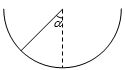
An insect crawls up a hemispherical surface very slowly (see the figure). The coefficient of friction between the insect and the surface is $\mu = 1/3$. If the line joining the centre of the hemispherical surface to the insect makes an angle $\alpha$ with the vertical,the maximum possible value of $\alpha$ is given by
A
$\cot \alpha = 3$
B
$\tan \alpha = 3$
C
$\sec \alpha = 3$
D
$\csc \alpha = 3$
Solution
(A) Let the mass of the insect be $m$. The forces acting on the insect are its weight $mg$ (acting vertically downwards),the normal reaction $N$ (acting radially outwards),and the frictional force $f$ (acting tangentially upwards along the surface).
Resolving the weight $mg$ into two components: $mg \cos \alpha$ along the radial direction and $mg \sin \alpha$ along the tangential direction.
Since the insect crawls very slowly,it is in equilibrium at any point.
For the radial direction: $N = mg \cos \alpha$.
For the tangential direction: $f = mg \sin \alpha$.
For the insect to not slip,the frictional force must satisfy $f \le \mu N$.
At the maximum angle $\alpha$,the limiting friction condition is reached: $f = \mu N$.
Substituting the expressions for $f$ and $N$: $mg \sin \alpha = \mu (mg \cos \alpha)$.
This simplifies to $\tan \alpha = \mu$.
Given $\mu = 1/3$,we have $\tan \alpha = 1/3$.
Therefore,$\cot \alpha = 1/\tan \alpha = 3$.
Resolving the weight $mg$ into two components: $mg \cos \alpha$ along the radial direction and $mg \sin \alpha$ along the tangential direction.
Since the insect crawls very slowly,it is in equilibrium at any point.
For the radial direction: $N = mg \cos \alpha$.
For the tangential direction: $f = mg \sin \alpha$.
For the insect to not slip,the frictional force must satisfy $f \le \mu N$.
At the maximum angle $\alpha$,the limiting friction condition is reached: $f = \mu N$.
Substituting the expressions for $f$ and $N$: $mg \sin \alpha = \mu (mg \cos \alpha)$.
This simplifies to $\tan \alpha = \mu$.
Given $\mu = 1/3$,we have $\tan \alpha = 1/3$.
Therefore,$\cot \alpha = 1/\tan \alpha = 3$.
0 likesView Solution
2
ChemistryMCQAIEEE · 2012
$A$ large open tank has two holes in the wall. One is a square hole of side $L$ at a depth $y$ from the top and the other is a circular hole of radius $R$ at a depth $4y$ from the top. When the tank is completely filled with water,the quantities of water flowing out per second from both the holes are the same. Then $R$ is equal to
A
$2\pi L$
B
$\frac{L}{\sqrt{2\pi}}$
C
$L$
D
$\frac{L}{2\pi}$
Solution
(B) The velocity of efflux for a hole at depth $h$ is given by Torricelli's law: $v = \sqrt{2gh}$.
The rate of flow of water (volume per second) is given by $Q = A \cdot v$,where $A$ is the area of the hole.
For the square hole at depth $y$:
Area $A_1 = L^2$
Velocity $v_1 = \sqrt{2gy}$
$Q_1 = L^2 \sqrt{2gy}$
For the circular hole at depth $4y$:
Area $A_2 = \pi R^2$
Velocity $v_2 = \sqrt{2g(4y)} = 2\sqrt{2gy}$
$Q_2 = \pi R^2 (2\sqrt{2gy})$
Given that $Q_1 = Q_2$:
$L^2 \sqrt{2gy} = \pi R^2 (2\sqrt{2gy})$
$L^2 = 2\pi R^2$
$R^2 = \frac{L^2}{2\pi}$
$R = \frac{L}{\sqrt{2\pi}}$
The rate of flow of water (volume per second) is given by $Q = A \cdot v$,where $A$ is the area of the hole.
For the square hole at depth $y$:
Area $A_1 = L^2$
Velocity $v_1 = \sqrt{2gy}$
$Q_1 = L^2 \sqrt{2gy}$
For the circular hole at depth $4y$:
Area $A_2 = \pi R^2$
Velocity $v_2 = \sqrt{2g(4y)} = 2\sqrt{2gy}$
$Q_2 = \pi R^2 (2\sqrt{2gy})$
Given that $Q_1 = Q_2$:
$L^2 \sqrt{2gy} = \pi R^2 (2\sqrt{2gy})$
$L^2 = 2\pi R^2$
$R^2 = \frac{L^2}{2\pi}$
$R = \frac{L}{\sqrt{2\pi}}$
0 likesView Solution
3
ChemistryDifficultMCQAIEEE · 2012
The equilibrium constant for the reaction $N_{2(g)} + O_{2(g)} \rightleftharpoons 2NO_{(g)}$ at temperature $T$ is $4 \times 10^{-4}$. The value of $K_c$ for the reaction $NO_{(g)} \rightleftharpoons \frac{1}{2}N_{2(g)} + \frac{1}{2}O_{2(g)}$ at the same temperature is
A
$4 \times 10^{-4}$
B
$50$
C
$2.5 \times 10^{2}$
D
$0.02$
Solution
(B) For the reaction $N_{2(g)} + O_{2(g)} \rightleftharpoons 2NO_{(g)}$,the equilibrium constant is $K_c = \frac{[NO]^2}{[N_2][O_2]} = 4 \times 10^{-4}$.
For the reaction $NO_{(g)} \rightleftharpoons \frac{1}{2}N_{2(g)} + \frac{1}{2}O_{2(g)}$,the equilibrium constant $K'_c$ is given by $K'_c = \frac{[N_2]^{1/2}[O_2]^{1/2}}{[NO]}$.
Comparing the two expressions,we see that $K'_c = \frac{1}{\sqrt{K_c}}$.
Substituting the value of $K_c$,we get $K'_c = \frac{1}{\sqrt{4 \times 10^{-4}}} = \frac{1}{2 \times 10^{-2}} = \frac{100}{2} = 50$.
For the reaction $NO_{(g)} \rightleftharpoons \frac{1}{2}N_{2(g)} + \frac{1}{2}O_{2(g)}$,the equilibrium constant $K'_c$ is given by $K'_c = \frac{[N_2]^{1/2}[O_2]^{1/2}}{[NO]}$.
Comparing the two expressions,we see that $K'_c = \frac{1}{\sqrt{K_c}}$.
Substituting the value of $K_c$,we get $K'_c = \frac{1}{\sqrt{4 \times 10^{-4}}} = \frac{1}{2 \times 10^{-2}} = \frac{100}{2} = 50$.
0 likesView Solution
4
ChemistryMCQAIEEE · 2012
The logically equivalent proposition of $p \Leftrightarrow q$ is
A
$(p \wedge q) \vee (\neg p \wedge \neg q)$
B
$(p$ $\Rightarrow q) \wedge (q$ $\Rightarrow p)$
C
$(p \wedge q) \vee (q \Rightarrow p)$
D
$(p \wedge q) \Rightarrow (q \vee p)$
Solution
(B) The biconditional statement $p \Leftrightarrow q$ is defined as the conjunction of the two conditional statements $p \Rightarrow q$ and $q \Rightarrow p$.
Therefore,the logically equivalent proposition is $(p$ $\Rightarrow q) \wedge (q$ $\Rightarrow p)$.
Therefore,the logically equivalent proposition is $(p$ $\Rightarrow q) \wedge (q$ $\Rightarrow p)$.
0 likesView Solution
5
ChemistryMCQAIEEE · 2012
$A$ transition metal $M$ forms a volatile chloride with a vapor density of $94.8$. If it contains $74.75\%$ chlorine,what is the formula of the metal chloride?
A
$MCl_2$
B
$MCl_4$
C
$MCl_5$
D
$MCl_3$
0 likesView Solution
6
ChemistryMCQAIEEE · 2012
An open vessel at $300 \ K$ is heated until $2/5$ of the air in it has been expelled. Assuming the volume of the vessel remains constant,find the temperature to which the vessel has been heated in $K$.
A
$750$
B
$400$
C
$500$
D
$1500$
Solution
(C) For an open vessel,the pressure $P$ and volume $V$ remain constant. According to the ideal gas law,$PV = nRT$,which implies $n_1 T_1 = n_2 T_2$.
Let the initial number of moles be $n_1 = n$.
Since $2/5$ of the air is expelled,the remaining moles $n_2 = n - (2/5)n = 3/5 n$.
The initial temperature $T_1 = 300 \ K$.
Using the relation $n_1 T_1 = n_2 T_2$:
$n \times 300 = (3/5)n \times T_2$.
$300 = (3/5)T_2$.
$T_2 = 300 \times (5/3) = 500 \ K$.
Let the initial number of moles be $n_1 = n$.
Since $2/5$ of the air is expelled,the remaining moles $n_2 = n - (2/5)n = 3/5 n$.
The initial temperature $T_1 = 300 \ K$.
Using the relation $n_1 T_1 = n_2 T_2$:
$n \times 300 = (3/5)n \times T_2$.
$300 = (3/5)T_2$.
$T_2 = 300 \times (5/3) = 500 \ K$.
0 likesView Solution
7
ChemistryMCQAIEEE · 2012
The freezing point of a $1.00 \, m$ aqueous solution of $HF$ is $-1.91^o C$. The freezing point depression constant of water $K_f$ is $1.86 \, K \, kg \, mol^{-1}$. The percentage of dissociation of $HF$ at this concentration is ......... $\%$
A
$2.7$
B
$30$
C
$10$
D
$5.2$
Solution
(A) Given: Molality $(m) = 1.00 \, m$,$\Delta T_f = 0 - (-1.91) = 1.91 \, K$,$K_f = 1.86 \, K \, kg \, mol^{-1}$.
Using the formula: $\Delta T_f = i \times K_f \times m$.
$1.91 = i \times 1.86 \times 1.00 \Rightarrow i = \frac{1.91}{1.86} \approx 1.02688$.
For dissociation $HF \rightleftharpoons H^+ + F^-$,the number of ions $(n) = 2$.
The degree of dissociation $(\alpha)$ is given by $\alpha = \frac{i - 1}{n - 1}$.
$\alpha = \frac{1.02688 - 1}{2 - 1} = 0.02688$.
Percentage of dissociation $= 0.02688 \times 100 \approx 2.7 \%$.
Using the formula: $\Delta T_f = i \times K_f \times m$.
$1.91 = i \times 1.86 \times 1.00 \Rightarrow i = \frac{1.91}{1.86} \approx 1.02688$.
For dissociation $HF \rightleftharpoons H^+ + F^-$,the number of ions $(n) = 2$.
The degree of dissociation $(\alpha)$ is given by $\alpha = \frac{i - 1}{n - 1}$.
$\alpha = \frac{1.02688 - 1}{2 - 1} = 0.02688$.
Percentage of dissociation $= 0.02688 \times 100 \approx 2.7 \%$.
0 likesView Solution
8
ChemistryMCQAIEEE · 2012
An object $2.4 \; m$ in front of a lens forms a sharp image on a film $12 \; cm$ behind the lens. $A$ glass plate $1 \; cm$ thick,of refractive index $1.50$ is interposed between the lens and the film with its plane faces parallel to the film. At what distance (from the lens) should the object be shifted to be in sharp focus on the film (in $; cm$)?
A
$3.2$
B
$5.6$
C
$2.4$
D
$7.2$
Solution
(A) The shift in the image position due to the glass plate is given by $S = (1 - \frac{1}{\mu}) t = (1 - \frac{1}{1.5}) \times 1 \; cm = \frac{1}{3} \; cm$.
First,calculate the focal length $f$ of the lens using the initial conditions: $u = -240 \; cm$ and $v = 12 \; cm$.
$\frac{1}{f} = \frac{1}{v} - \frac{1}{u} = \frac{1}{12} - \frac{1}{-240} = \frac{20 + 1}{240} = \frac{21}{240} \; cm^{-1}$.
When the glass plate is introduced,the image must be formed at a distance $v' = 12 - \frac{1}{3} = \frac{35}{3} \; cm$ from the lens so that the plate shifts it back to the film.
Using the lens formula again: $\frac{1}{u'} = \frac{1}{v'} - \frac{1}{f} = \frac{3}{35} - \frac{21}{240} = \frac{3}{35} - \frac{7}{80}$.
$\frac{1}{u'} = \frac{48 - 49}{560} = -\frac{1}{560} \; cm^{-1}$.
Thus,$u' = -560 \; cm = -5.6 \; m$.
The shift required for the object is $|u'| - |u| = 5.6 \; m - 2.4 \; m = 3.2 \; m$.
First,calculate the focal length $f$ of the lens using the initial conditions: $u = -240 \; cm$ and $v = 12 \; cm$.
$\frac{1}{f} = \frac{1}{v} - \frac{1}{u} = \frac{1}{12} - \frac{1}{-240} = \frac{20 + 1}{240} = \frac{21}{240} \; cm^{-1}$.
When the glass plate is introduced,the image must be formed at a distance $v' = 12 - \frac{1}{3} = \frac{35}{3} \; cm$ from the lens so that the plate shifts it back to the film.
Using the lens formula again: $\frac{1}{u'} = \frac{1}{v'} - \frac{1}{f} = \frac{3}{35} - \frac{21}{240} = \frac{3}{35} - \frac{7}{80}$.
$\frac{1}{u'} = \frac{48 - 49}{560} = -\frac{1}{560} \; cm^{-1}$.
Thus,$u' = -560 \; cm = -5.6 \; m$.
The shift required for the object is $|u'| - |u| = 5.6 \; m - 2.4 \; m = 3.2 \; m$.
0 likesView Solution
9
ChemistryMCQAIEEE · 2012
$A$ $10 \ kW$ transmitter emits radio waves of wavelength $500 \ m$. The number of photons emitted per second by the transmitter is of the order of:
A
$10^{25}$
B
$10^{30}$
C
$10^{43}$
D
$10^{37}$
Solution
(B) Given: Power $P = 10 \ kW = 10^4 \ W$,Wavelength $\lambda = 500 \ m$.
Energy of one photon is $E = \frac{hc}{\lambda}$.
The number of photons emitted per second $n$ is given by $n = \frac{P}{E} = \frac{P \lambda}{hc}$.
Substituting the values: $h = 6.63 \times 10^{-34} \ J \cdot s$,$c = 3 \times 10^8 \ m/s$.
$n = \frac{10^4 \times 500}{6.63 \times 10^{-34} \times 3 \times 10^8} = \frac{5 \times 10^6}{19.89 \times 10^{-26}} \approx 0.251 \times 10^{32} = 2.51 \times 10^{31}$.
The order of magnitude is $10^{31}$,which is closest to $10^{30}$ among the given options.
Energy of one photon is $E = \frac{hc}{\lambda}$.
The number of photons emitted per second $n$ is given by $n = \frac{P}{E} = \frac{P \lambda}{hc}$.
Substituting the values: $h = 6.63 \times 10^{-34} \ J \cdot s$,$c = 3 \times 10^8 \ m/s$.
$n = \frac{10^4 \times 500}{6.63 \times 10^{-34} \times 3 \times 10^8} = \frac{5 \times 10^6}{19.89 \times 10^{-26}} \approx 0.251 \times 10^{32} = 2.51 \times 10^{31}$.
The order of magnitude is $10^{31}$,which is closest to $10^{30}$ among the given options.
0 likesView Solution
10
ChemistryMCQAIEEE · 2012
Extraction of zinc from zinc blende is achieved by:
A
Electrolytic reduction
B
Roasting followed by reduction with carbon
C
Roasting followed by reduction with another metal
D
Roasting followed by self-reduction
Solution
(B) Zinc blende is $ZnS$.
First,$ZnS$ is converted to zinc oxide $(ZnO)$ by roasting: $2ZnS + 3O_2 \rightarrow 2ZnO + 2SO_2$.
Then,$ZnO$ is reduced to zinc metal using carbon (coke) at high temperature: $ZnO + C \rightarrow Zn + CO$.
First,$ZnS$ is converted to zinc oxide $(ZnO)$ by roasting: $2ZnS + 3O_2 \rightarrow 2ZnO + 2SO_2$.
Then,$ZnO$ is reduced to zinc metal using carbon (coke) at high temperature: $ZnO + C \rightarrow Zn + CO$.
0 likesView Solution
11
ChemistryMCQAIEEE · 2012
Which of the following compounds exhibits a dipole moment?
A
trans-$2,3$-dichloro-$2$-butene
B
$1,2$-dichlorobenzene
C
$1,4$-dichlorobenzene
D
trans-$1,2$-dinitroethene
Solution
(B) molecule exhibits a dipole moment if its net dipole moment is non-zero $(mu \neq 0)$.
$1$. trans-$2,3$-dichloro-$2$-butene: The two $C-Cl$ bonds are in opposite directions,canceling each other's dipole moments. Thus,$mu = 0$.
$2$. $1,2$-dichlorobenzene: The two $C-Cl$ bonds are at an angle of $60^{\circ}$ to each other,so their dipole moments do not cancel out. Thus,$mu \neq 0$.
$3$. $1,4$-dichlorobenzene: The two $C-Cl$ bonds are in opposite directions $(180^{\circ})$,canceling each other's dipole moments. Thus,$mu = 0$.
$4$. trans-$1,2$-dinitroethene: The two $C-NO_2$ groups are in opposite directions,canceling each other's dipole moments. Thus,$mu = 0$.
Therefore,$1,2$-dichlorobenzene exhibits a dipole moment.
$1$. trans-$2,3$-dichloro-$2$-butene: The two $C-Cl$ bonds are in opposite directions,canceling each other's dipole moments. Thus,$mu = 0$.
$2$. $1,2$-dichlorobenzene: The two $C-Cl$ bonds are at an angle of $60^{\circ}$ to each other,so their dipole moments do not cancel out. Thus,$mu \neq 0$.
$3$. $1,4$-dichlorobenzene: The two $C-Cl$ bonds are in opposite directions $(180^{\circ})$,canceling each other's dipole moments. Thus,$mu = 0$.
$4$. trans-$1,2$-dinitroethene: The two $C-NO_2$ groups are in opposite directions,canceling each other's dipole moments. Thus,$mu = 0$.
Therefore,$1,2$-dichlorobenzene exhibits a dipole moment.
0 likesView Solution
12
ChemistryMCQAIEEE · 2012
How many cyclic structures are possible for $C_4H_6$?
A
$3$
B
$5$
C
$4$
D
$6$
Solution
(B) The molecular formula $C_4H_6$ corresponds to a degree of unsaturation (double bond equivalent) of $4 - (6/2) + 1 = 2$.
For cyclic structures,we consider rings with two double bonds,one triple bond,or two rings.
The possible cyclic isomers for $C_4H_6$ are:
$1$. Cyclobutene (one double bond,one ring)
$2$. $1-$Methylcyclopropene (one double bond,one ring)
$3$. $3-$Methylcyclopropene (one double bond,one ring)
$4$. Methylenecyclopropane (one double bond,one ring)
$5$. Bicyclo[$1.1$.$0$]butane (two rings,no double bonds)
Thus,there are $5$ possible cyclic structures.
For cyclic structures,we consider rings with two double bonds,one triple bond,or two rings.
The possible cyclic isomers for $C_4H_6$ are:
$1$. Cyclobutene (one double bond,one ring)
$2$. $1-$Methylcyclopropene (one double bond,one ring)
$3$. $3-$Methylcyclopropene (one double bond,one ring)
$4$. Methylenecyclopropane (one double bond,one ring)
$5$. Bicyclo[$1.1$.$0$]butane (two rings,no double bonds)
Thus,there are $5$ possible cyclic structures.
0 likesView Solution
13
ChemistryMCQAIEEE · 2012
Which of the following complex ions exhibits optical isomerism? ($en = 1,2$-diaminoethane)
A
$[Co(en)_2Cl_2]^+$
B
$[Zn(en)_2]^{2+}$
C
$[Co(NH_3)_4Cl_2]^+$
D
$[Cr(NH_3)_2Cl_2]^{2+}$
Solution
(A) Optical isomerism is exhibited by complexes that lack a plane of symmetry or center of inversion (i.e.,they are chiral).
For octahedral complexes of the type $[M(AA)_2X_2]$,the $cis$-isomer is optically active because it lacks a plane of symmetry.
In the given options,$[Co(en)_2Cl_2]^+$ exists as $cis$ and $trans$ isomers.
The $cis$-isomer of $[Co(en)_2Cl_2]^+$ is non-superimposable on its mirror image and thus exhibits optical isomerism.
The other complexes listed do not satisfy the structural requirements for optical activity in this context.
For octahedral complexes of the type $[M(AA)_2X_2]$,the $cis$-isomer is optically active because it lacks a plane of symmetry.
In the given options,$[Co(en)_2Cl_2]^+$ exists as $cis$ and $trans$ isomers.
The $cis$-isomer of $[Co(en)_2Cl_2]^+$ is non-superimposable on its mirror image and thus exhibits optical isomerism.
The other complexes listed do not satisfy the structural requirements for optical activity in this context.
0 likesView Solution
14
ChemistryMCQAIEEE · 2012
If $P_1$ and $P_2$ are two points on the ellipse $\frac{x^2}{4} + y^2 = 1$ such that the tangents at these points are parallel to the chord joining the points $(0, 1)$ and $(2, 0)$,then the distance between $P_1$ and $P_2$ is:
A
$\sqrt{10}$
B
$2\sqrt{2}$
C
$\sqrt{5}$
D
$2\sqrt{3}$
Solution
(A) The slope of the chord joining $(0, 1)$ and $(2, 0)$ is $m = \frac{0-1}{2-0} = -\frac{1}{2}$.
Since the tangents are parallel to this chord,their slope is $m = -\frac{1}{2}$.
The equation of a tangent to the ellipse $\frac{x^2}{a^2} + \frac{y^2}{b^2} = 1$ with slope $m$ is $y = mx \pm \sqrt{a^2m^2 + b^2}$.
Here $a^2 = 4$,$b^2 = 1$,and $m = -\frac{1}{2}$.
So,$y = -\frac{1}{2}x \pm \sqrt{4(-\frac{1}{2})^2 + 1} = -\frac{1}{2}x \pm \sqrt{1+1} = -\frac{1}{2}x \pm \sqrt{2}$.
The points of contact for the tangent $y = mx + c$ are $(\frac{-a^2m}{c}, \frac{b^2}{c})$.
For $y = -\frac{1}{2}x + \sqrt{2}$,$P_1 = (\frac{-4(-1/2)}{\sqrt{2}}, \frac{1}{\sqrt{2}}) = (\sqrt{2}, \frac{1}{\sqrt{2}})$.
For $y = -\frac{1}{2}x - \sqrt{2}$,$P_2 = (\frac{-4(-1/2)}{-\sqrt{2}}, \frac{1}{-\sqrt{2}}) = (-\sqrt{2}, -\frac{1}{\sqrt{2}})$.
The distance between $P_1$ and $P_2$ is $\sqrt{(\sqrt{2} - (-\sqrt{2}))^2 + (\frac{1}{\sqrt{2}} - (-\frac{1}{\sqrt{2}}))^2} = \sqrt{(2\sqrt{2})^2 + (\sqrt{2})^2} = \sqrt{8 + 2} = \sqrt{10}$.
Since the tangents are parallel to this chord,their slope is $m = -\frac{1}{2}$.
The equation of a tangent to the ellipse $\frac{x^2}{a^2} + \frac{y^2}{b^2} = 1$ with slope $m$ is $y = mx \pm \sqrt{a^2m^2 + b^2}$.
Here $a^2 = 4$,$b^2 = 1$,and $m = -\frac{1}{2}$.
So,$y = -\frac{1}{2}x \pm \sqrt{4(-\frac{1}{2})^2 + 1} = -\frac{1}{2}x \pm \sqrt{1+1} = -\frac{1}{2}x \pm \sqrt{2}$.
The points of contact for the tangent $y = mx + c$ are $(\frac{-a^2m}{c}, \frac{b^2}{c})$.
For $y = -\frac{1}{2}x + \sqrt{2}$,$P_1 = (\frac{-4(-1/2)}{\sqrt{2}}, \frac{1}{\sqrt{2}}) = (\sqrt{2}, \frac{1}{\sqrt{2}})$.
For $y = -\frac{1}{2}x - \sqrt{2}$,$P_2 = (\frac{-4(-1/2)}{-\sqrt{2}}, \frac{1}{-\sqrt{2}}) = (-\sqrt{2}, -\frac{1}{\sqrt{2}})$.
The distance between $P_1$ and $P_2$ is $\sqrt{(\sqrt{2} - (-\sqrt{2}))^2 + (\frac{1}{\sqrt{2}} - (-\frac{1}{\sqrt{2}}))^2} = \sqrt{(2\sqrt{2})^2 + (\sqrt{2})^2} = \sqrt{8 + 2} = \sqrt{10}$.
0 likesView Solution
15
ChemistryMCQAIEEE · 2012
On addition of $1 \, mL$ of $10 \% \, NaCl$ solution to $10 \, mL$ gold sol in the presence of $0.25 \, g$ of starch,the coagulation is just prevented. The gold number of starch is:
A
$0.025$
B
$0.25$
C
$2.5$
D
$250$
Solution
(D) The gold number is defined as the minimum amount of protective colloid in milligrams $(mg)$ required to prevent the coagulation of $10 \, mL$ of a standard gold sol when $1 \, mL$ of $10 \% \, NaCl$ solution is added to it.
Given mass of starch = $0.25 \, g = 250 \, mg$.
Since $250 \, mg$ of starch prevents the coagulation of $10 \, mL$ of gold sol,the gold number of starch is $250$.
Given mass of starch = $0.25 \, g = 250 \, mg$.
Since $250 \, mg$ of starch prevents the coagulation of $10 \, mL$ of gold sol,the gold number of starch is $250$.
0 likesView Solution
16
ChemistryMediumMCQAIEEE · 2012
Consider the following reaction:
$xMnO_4^{-} + yC_2O_4^{2-} + zH^{+} \rightarrow xMn^{2+} + 2yCO_2 + \frac{z}{2}H_2O$
The values of $x, y$ and $z$ in the reaction are,respectively:
$xMnO_4^{-} + yC_2O_4^{2-} + zH^{+} \rightarrow xMn^{2+} + 2yCO_2 + \frac{z}{2}H_2O$
The values of $x, y$ and $z$ in the reaction are,respectively:
A
$5, 2$ and $16$
B
$2, 5$ and $8$
C
$2, 5$ and $16$
D
$5, 2$ and $8$
Solution
(C) The half-equations of the reaction are:
$MnO_4^{-} \rightarrow Mn^{2+}$
$C_2O_4^{2-} \rightarrow CO_2$
The balanced half-equations are:
$(MnO_4^{-} + 8H^{+} + 5e^{-} \rightarrow Mn^{2+} + 4H_2O) \times 2$
$(C_2O_4^{2-} \rightarrow 2CO_2 + 2e^{-}) \times 5$
Equating the number of electrons,we get:
$2MnO_4^{-} + 16H^{+} + 10e^{-} \rightarrow 2Mn^{2+} + 8H_2O$
$5C_2O_4^{2-} \rightarrow 10CO_2 + 10e^{-}$
On adding both the equations,we get:
$2MnO_4^{-} + 5C_2O_4^{2-} + 16H^{+} \rightarrow 2Mn^{2+} + 10CO_2 + 8H_2O$
Thus,the values of $x, y$ and $z$ are $2, 5$ and $16,$ respectively.
$MnO_4^{-} \rightarrow Mn^{2+}$
$C_2O_4^{2-} \rightarrow CO_2$
The balanced half-equations are:
$(MnO_4^{-} + 8H^{+} + 5e^{-} \rightarrow Mn^{2+} + 4H_2O) \times 2$
$(C_2O_4^{2-} \rightarrow 2CO_2 + 2e^{-}) \times 5$
Equating the number of electrons,we get:
$2MnO_4^{-} + 16H^{+} + 10e^{-} \rightarrow 2Mn^{2+} + 8H_2O$
$5C_2O_4^{2-} \rightarrow 10CO_2 + 10e^{-}$
On adding both the equations,we get:
$2MnO_4^{-} + 5C_2O_4^{2-} + 16H^{+} \rightarrow 2Mn^{2+} + 10CO_2 + 8H_2O$
Thus,the values of $x, y$ and $z$ are $2, 5$ and $16,$ respectively.
0 likesView Solution
17
ChemistryMediumMCQAIEEE · 2012
The electrons identified by quantum numbers $n$ and $l$ :
$A. n=4, l=1$ $B. n=4, l=0$
$C. n=3, l=2$ $D. n=3, l=1$
can be placed in order of increasing energy as :
$A. n=4, l=1$ $B. n=4, l=0$
$C. n=3, l=2$ $D. n=3, l=1$
can be placed in order of increasing energy as :
A
$D < B < C < A$
B
$D < C < B < A$
C
$B < D < A < C$
D
$A < C < B < D$
Solution
(A) To determine the energy order,we use the $(n+l)$ rule:
$A. n=4, l=1 \implies n+l = 4+1 = 5$ ($4p$ orbital)
$B. n=4, l=0 \implies n+l = 4+0 = 4$ ($4s$ orbital)
$C. n=3, l=2 \implies n+l = 3+2 = 5$ ($3d$ orbital)
$D. n=3, l=1 \implies n+l = 3+1 = 4$ ($3p$ orbital)
According to the $(n+l)$ rule,orbitals with lower $(n+l)$ values have lower energy.
If $(n+l)$ values are equal,the orbital with the lower $n$ value has lower energy.
Comparing the values:
$D (n+l=4, n=3) < B (n+l=4, n=4) < C (n+l=5, n=3) < A (n+l=5, n=4)$
Thus,the order of increasing energy is $D < B < C < A$.
$A. n=4, l=1 \implies n+l = 4+1 = 5$ ($4p$ orbital)
$B. n=4, l=0 \implies n+l = 4+0 = 4$ ($4s$ orbital)
$C. n=3, l=2 \implies n+l = 3+2 = 5$ ($3d$ orbital)
$D. n=3, l=1 \implies n+l = 3+1 = 4$ ($3p$ orbital)
According to the $(n+l)$ rule,orbitals with lower $(n+l)$ values have lower energy.
If $(n+l)$ values are equal,the orbital with the lower $n$ value has lower energy.
Comparing the values:
$D (n+l=4, n=3) < B (n+l=4, n=4) < C (n+l=5, n=3) < A (n+l=5, n=4)$
Thus,the order of increasing energy is $D < B < C < A$.
0 likesView Solution
18
ChemistryEasyMCQAIEEE · 2012
The increasing order of the ionic radii of the given isoelectronic species is:
A
$Cl^{-}, Ca^{2+}, K^{+}, S^{2-}$
B
$S^{2-}, Cl^{-}, Ca^{2+}, K^{+}$
C
$Ca^{2+}, K^{+}, Cl^{-}, S^{2-}$
D
$K^{+}, S^{2-}, Ca^{2+}, Cl^{-}$
Solution
(C) For isoelectronic species,the ionic radius decreases as the nuclear charge (atomic number,$Z$) increases.
All the given species,$S^{2-}, Cl^{-}, K^{+},$ and $Ca^{2+}$,contain $18$ electrons.
Their respective atomic numbers $(Z)$ are: $S = 16, Cl = 17, K = 19, Ca = 20$.
Since the ionic radius is inversely proportional to the nuclear charge for isoelectronic species,the increasing order of ionic radii is: $Ca^{2+} < K^{+} < Cl^{-} < S^{2-}$.
All the given species,$S^{2-}, Cl^{-}, K^{+},$ and $Ca^{2+}$,contain $18$ electrons.
Their respective atomic numbers $(Z)$ are: $S = 16, Cl = 17, K = 19, Ca = 20$.
Since the ionic radius is inversely proportional to the nuclear charge for isoelectronic species,the increasing order of ionic radii is: $Ca^{2+} < K^{+} < Cl^{-} < S^{2-}$.
0 likesView Solution
19
ChemistryDifficultMCQAIEEE · 2012
In which of the following pairs are the two species not isostructural?
A
$CO_3^{2-}$ and $NO_3^-$
B
$PCl_4^+$ and $SiCl_4$
C
$PF_5$ and $BrF_5$
D
$AlF_6^{3-}$ and $SF_6$
Solution
(C) To determine if species are isostructural,we check their hybridization and geometry:
$1$. $CO_3^{2-}$ and $NO_3^-$: Both have $sp^2$ hybridization and are triangular planar.
$2$. $PCl_4^+$ and $SiCl_4$: Both have $sp^3$ hybridization and are tetrahedral.
$3$. $PF_5$: $sp^3d$ hybridization,trigonal bipyramidal geometry.
$BrF_5$: $sp^3d^2$ hybridization,square pyramidal geometry.
Since their geometries differ,they are not isostructural.
$4$. $AlF_6^{3-}$ and $SF_6$: Both have $sp^3d^2$ hybridization and are octahedral.
Therefore,the correct option is $C$.
$1$. $CO_3^{2-}$ and $NO_3^-$: Both have $sp^2$ hybridization and are triangular planar.
$2$. $PCl_4^+$ and $SiCl_4$: Both have $sp^3$ hybridization and are tetrahedral.
$3$. $PF_5$: $sp^3d$ hybridization,trigonal bipyramidal geometry.
$BrF_5$: $sp^3d^2$ hybridization,square pyramidal geometry.
Since their geometries differ,they are not isostructural.
$4$. $AlF_6^{3-}$ and $SF_6$: Both have $sp^3d^2$ hybridization and are octahedral.
Therefore,the correct option is $C$.
0 likesView Solution
20
ChemistryMediumMCQAIEEE · 2012
The compressibility factor for a real gas at high pressure is $:$
A
$1+ \frac{RT}{Pb}$
B
$1$
C
$1+ \frac{Pb}{RT}$
D
$1- \frac{Pb}{RT}$
Solution
(C) The van der Waals equation for a real gas is $(P + \frac{a}{V^2})(V - b) = RT$.
At high pressure,the term $\frac{a}{V^2}$ is very small compared to $P$ and can be neglected.
Thus,the equation simplifies to $P(V - b) = RT$.
Expanding this,we get $PV - Pb = RT$.
Rearranging the terms,$PV = RT + Pb$.
Dividing both sides by $RT$,we get $\frac{PV}{RT} = 1 + \frac{Pb}{RT}$.
Since the compressibility factor $Z = \frac{PV}{RT}$,we have $Z = 1 + \frac{Pb}{RT}$.
Therefore,at high pressure,$Z > 1$.
At high pressure,the term $\frac{a}{V^2}$ is very small compared to $P$ and can be neglected.
Thus,the equation simplifies to $P(V - b) = RT$.
Expanding this,we get $PV - Pb = RT$.
Rearranging the terms,$PV = RT + Pb$.
Dividing both sides by $RT$,we get $\frac{PV}{RT} = 1 + \frac{Pb}{RT}$.
Since the compressibility factor $Z = \frac{PV}{RT}$,we have $Z = 1 + \frac{Pb}{RT}$.
Therefore,at high pressure,$Z > 1$.
0 likesView Solution
21
ChemistryMediumMCQAIEEE · 2012
The incorrect expression among the following is:
A
$\frac{\Delta G_{system}}{\Delta S_{total}} = -T$
B
In isothermal process,$w_{reversible} = -nRT \ln \frac{V_f}{V_i}$
C
$\ln K = \frac{\Delta H^o - T\Delta S^o}{RT}$
D
$K = e^{-\Delta G^o / RT}$
Solution
(C) We know that for a spontaneous process,$\Delta G_{system} = -T \Delta S_{total}$,which makes option $A$ correct.
For an isothermal reversible expansion of an ideal gas,$w_{reversible} = -nRT \ln \frac{V_f}{V_i}$,which makes option $B$ correct.
The relationship between equilibrium constant $K$ and Gibbs free energy is $\Delta G^o = -RT \ln K$,which makes option $D$ correct.
Substituting $\Delta G^o = \Delta H^o - T \Delta S^o$ into the equation $\Delta G^o = -RT \ln K$,we get $-RT \ln K = \Delta H^o - T \Delta S^o$,which implies $\ln K = -\frac{\Delta H^o - T \Delta S^o}{RT}$.
Therefore,the expression in option $C$ is incorrect.
For an isothermal reversible expansion of an ideal gas,$w_{reversible} = -nRT \ln \frac{V_f}{V_i}$,which makes option $B$ correct.
The relationship between equilibrium constant $K$ and Gibbs free energy is $\Delta G^o = -RT \ln K$,which makes option $D$ correct.
Substituting $\Delta G^o = \Delta H^o - T \Delta S^o$ into the equation $\Delta G^o = -RT \ln K$,we get $-RT \ln K = \Delta H^o - T \Delta S^o$,which implies $\ln K = -\frac{\Delta H^o - T \Delta S^o}{RT}$.
Therefore,the expression in option $C$ is incorrect.
0 likesView Solution
22
ChemistryMediumMCQAIEEE · 2012
The equilibrium constant $(K_c)$ for the reaction $N_{2(g)} + O_{2(g)} \rightleftharpoons 2 NO_{(g)}$ at temperature $T$ is $4 \times 10^{-4}$. The value of $K_c$ for the reaction $NO_{(g)} \rightleftharpoons \frac{1}{2} N_{2(g)} + \frac{1}{2} O_{2(g)}$ at the same temperature is:
A
$0.02$
B
$2.5 \times 10^2$
C
$4 \times 10^{-4}$
D
$50$
Solution
(D) For the reaction $N_{2(g)} + O_{2(g)} \rightleftharpoons 2 NO_{(g)}$,the equilibrium constant is $K_c = 4 \times 10^{-4}$.
The given reaction is $NO_{(g)} \rightleftharpoons \frac{1}{2} N_{2(g)} + \frac{1}{2} O_{2(g)}$.
This reaction is the reverse of the original reaction multiplied by a factor of $\frac{1}{2}$.
Therefore,the new equilibrium constant $K_c'$ is given by $K_c' = \frac{1}{\sqrt{K_c}}$.
$K_c' = \frac{1}{\sqrt{4 \times 10^{-4}}} = \frac{1}{2 \times 10^{-2}} = \frac{1}{0.02} = 50$.
The given reaction is $NO_{(g)} \rightleftharpoons \frac{1}{2} N_{2(g)} + \frac{1}{2} O_{2(g)}$.
This reaction is the reverse of the original reaction multiplied by a factor of $\frac{1}{2}$.
Therefore,the new equilibrium constant $K_c'$ is given by $K_c' = \frac{1}{\sqrt{K_c}}$.
$K_c' = \frac{1}{\sqrt{4 \times 10^{-4}}} = \frac{1}{2 \times 10^{-2}} = \frac{1}{0.02} = 50$.
0 likesView Solution
23
ChemistryMediumMCQAIEEE · 2012
The $pH$ of a $0.1 \ M$ solution of the acid $HQ$ is $3$. The value of the ionization constant,$K_a$ of the acid is:
A
$3 \times 10^{-1}$
B
$1 \times 10^{-3}$
C
$1 \times 10^{-5}$
D
$1 \times 10^{-7}$
Solution
(C) Given: $pH = 3$,Concentration $(C) = 0.1 \ M = 10^{-1} \ M$.
We know that $[H^{+}] = 10^{-pH} = 10^{-3} \ M$.
For a weak acid $HQ$,the degree of dissociation $(\alpha)$ is given by $\alpha = \frac{[H^{+}]}{C} = \frac{10^{-3}}{10^{-1}} = 10^{-2}$.
The ionization constant $K_a$ is given by the formula $K_a = C \alpha^{2}$.
Substituting the values: $K_a = (0.1) \times (10^{-2})^{2} = 10^{-1} \times 10^{-4} = 10^{-5}$.
We know that $[H^{+}] = 10^{-pH} = 10^{-3} \ M$.
For a weak acid $HQ$,the degree of dissociation $(\alpha)$ is given by $\alpha = \frac{[H^{+}]}{C} = \frac{10^{-3}}{10^{-1}} = 10^{-2}$.
The ionization constant $K_a$ is given by the formula $K_a = C \alpha^{2}$.
Substituting the values: $K_a = (0.1) \times (10^{-2})^{2} = 10^{-1} \times 10^{-4} = 10^{-5}$.
0 likesView Solution
24
ChemistryMediumMCQAIEEE · 2012
Very pure hydrogen $(99.9 \%)$ can be made by which of the following processes?
A
Reaction of methane with steam
B
Mixing natural hydrocarbons of high molecular weight
C
Electrolysis of water
D
Reaction of salts like hydrides with water
Solution
(D) Very pure hydrogen $(99.9 \%)$ is obtained by the reaction of water with metal hydrides such as sodium hydride $(NaH)$.
The chemical equation is:
$NaH(s) + H_2O(l) \rightarrow NaOH(aq) + H_2(g)$
The chemical equation is:
$NaH(s) + H_2O(l) \rightarrow NaOH(aq) + H_2(g)$
0 likesView Solution
25
ChemistryMediumMCQAIEEE · 2012
Which branched chain isomer of the hydrocarbon with molecular mass $72 \ u$ gives only one isomer of mono-substituted alkyl halide?
A
Tertiary butyl chloride
B
Neopentane
C
Isohexane
D
Neohexane
Solution
(B) The molecular mass of the hydrocarbon is $72 \ u$. The general formula for alkanes is $C_nH_{2n+2}$.
$12n + 1(2n+2) = 72 \implies 14n = 70 \implies n = 5$.
Thus,the hydrocarbon is pentane $(C_5H_{12})$.
Among the isomers of pentane (n-pentane,isopentane,and neopentane),neopentane $(2,2-\text{dimethylpropane})$ has all $12$ hydrogen atoms equivalent.
Therefore,upon mono-halogenation,it yields only one mono-substituted alkyl halide.
$(CH_3)_4C + Cl_2 \xrightarrow{h\nu} (CH_3)_3C-CH_2Cl + HCl$.
$12n + 1(2n+2) = 72 \implies 14n = 70 \implies n = 5$.
Thus,the hydrocarbon is pentane $(C_5H_{12})$.
Among the isomers of pentane (n-pentane,isopentane,and neopentane),neopentane $(2,2-\text{dimethylpropane})$ has all $12$ hydrogen atoms equivalent.
Therefore,upon mono-halogenation,it yields only one mono-substituted alkyl halide.
$(CH_3)_4C + Cl_2 \xrightarrow{h\nu} (CH_3)_3C-CH_2Cl + HCl$.
0 likesView Solution
26
ChemistryDifficultMCQAIEEE · 2012
$2-$Hexyne gives $trans-2-$hexene on treatment with:
A
$Pt/H_2$
B
$Li/NH_3$
C
$Pd/BaSO_4$
D
$LiAlH_4$
Solution
(B) The reduction of internal alkynes to $trans-$alkenes is achieved using alkali metals (like $Li$ or $Na$) in liquid ammonia $(NH_3)$.
This is known as Birch reduction or dissolving metal reduction.
$CH_3-C \equiv C-CH_2-CH_2-CH_3 \xrightarrow{Li/NH_3} \text{trans-}2\text{-hexene}$.
$Pt/H_2$ and $Pd/BaSO_4$ (Lindlar catalyst) typically result in the formation of $cis-$alkenes or complete reduction to alkanes.
This is known as Birch reduction or dissolving metal reduction.
$CH_3-C \equiv C-CH_2-CH_2-CH_3 \xrightarrow{Li/NH_3} \text{trans-}2\text{-hexene}$.
$Pt/H_2$ and $Pd/BaSO_4$ (Lindlar catalyst) typically result in the formation of $cis-$alkenes or complete reduction to alkanes.
0 likesView Solution
27
ChemistryMediumMCQAIEEE · 2012
The molecule having the smallest bond angle is:
A
$NCl_3$
B
$AsCl_3$
C
$SbCl_3$
D
$PCl_3$
Solution
(C) In the series $NCl_3, PCl_3, AsCl_3$,and $SbCl_3$,all central atoms belong to Group $15$ and possess one lone pair of electrons.
As we move down the group from $N$ to $Sb$,the electronegativity of the central atom decreases,and its atomic size increases.
According to $VSEPR$ theory,as the size of the central atom increases,the bond pairs are located further away from the central atom.
This leads to a reduction in the repulsion between the bond pairs,which results in a decrease in the bond angle.
Therefore,$SbCl_3$ has the smallest bond angle among the given molecules.
As we move down the group from $N$ to $Sb$,the electronegativity of the central atom decreases,and its atomic size increases.
According to $VSEPR$ theory,as the size of the central atom increases,the bond pairs are located further away from the central atom.
This leads to a reduction in the repulsion between the bond pairs,which results in a decrease in the bond angle.
Therefore,$SbCl_3$ has the smallest bond angle among the given molecules.
0 likesView Solution
28
ChemistryMediumMCQAIEEE · 2012
Iron exhibits $+2$ and $+3$ oxidation states. Which of the following statements about iron is incorrect?
A
Ferrous oxide is more basic in nature than ferric oxide.
B
Ferrous compounds are relatively more ionic than the corresponding ferric compounds.
C
Ferrous compounds are less volatile than the corresponding ferric compounds.
D
Ferrous compounds are more easily hydrolysed than the corresponding ferric compounds.
Solution
(D) According to Fajan's rule,the polarizing power of a cation increases with an increase in its charge.
$Fe^{3+}$ has a higher charge and smaller size than $Fe^{2+}$,making it more polarizing and more covalent in character.
Consequently,$Fe^{3+}$ compounds are more easily hydrolysed than $Fe^{2+}$ compounds.
Therefore,the statement that ferrous compounds are more easily hydrolysed than ferric compounds is incorrect.
$Fe^{3+}$ has a higher charge and smaller size than $Fe^{2+}$,making it more polarizing and more covalent in character.
Consequently,$Fe^{3+}$ compounds are more easily hydrolysed than $Fe^{2+}$ compounds.
Therefore,the statement that ferrous compounds are more easily hydrolysed than ferric compounds is incorrect.
0 likesView Solution
29
ChemistryMediumMCQAIEEE · 2012
How many chiral compounds are possible on monochlorination of $2$-methylbutane?
A
$8$
B
$2$
C
$4$
D
$6$
Solution
(C) $2$-methylbutane is $CH_3-CH(CH_3)-CH_2-CH_3$.
Monochlorination yields the following products:
$1.$ $Cl-CH_2-CH(CH_3)-CH_2-CH_3$ ($1$-chloro-$2$-methylbutane): This molecule has a chiral center at $C_2$,so it exists as $2$ enantiomers.
$2.$ $CH_3-CCl(CH_3)-CH_2-CH_3$ ($2$-chloro-$2$-methylbutane): This molecule is achiral.
$3.$ $CH_3-CH(CH_3)-CHCl-CH_3$ ($2$-chloro-$3$-methylbutane): This molecule has a chiral center at $C_3$,so it exists as $2$ enantiomers.
$4.$ $CH_3-CH(CH_3)-CH_2-CH_2Cl$ ($1$-chloro-$3$-methylbutane): This molecule is achiral.
Total chiral compounds = $2 + 2 = 4$.
Monochlorination yields the following products:
$1.$ $Cl-CH_2-CH(CH_3)-CH_2-CH_3$ ($1$-chloro-$2$-methylbutane): This molecule has a chiral center at $C_2$,so it exists as $2$ enantiomers.
$2.$ $CH_3-CCl(CH_3)-CH_2-CH_3$ ($2$-chloro-$2$-methylbutane): This molecule is achiral.
$3.$ $CH_3-CH(CH_3)-CHCl-CH_3$ ($2$-chloro-$3$-methylbutane): This molecule has a chiral center at $C_3$,so it exists as $2$ enantiomers.
$4.$ $CH_3-CH(CH_3)-CH_2-CH_2Cl$ ($1$-chloro-$3$-methylbutane): This molecule is achiral.
Total chiral compounds = $2 + 2 = 4$.
0 likesView Solution
30
ChemistryEasyMCQAIEEE · 2012
What is $DDT$ among the following?
A
Greenhouse gas
B
$A$ fertilizer
C
Biodegradable pollutant
D
Non-biodegradable pollutant
Solution
(D) Those pollutants which cannot be broken down into simpler,harmless substances in nature are called non-biodegradable pollutants.
$DDT$,plastics,polythene,insecticides,pesticides,mercury,lead,arsenic,metal articles,synthetic fibers,glass objects,and iron products are examples of non-biodegradable pollutants.
Therefore,$DDT$ is a non-biodegradable pollutant.
$DDT$,plastics,polythene,insecticides,pesticides,mercury,lead,arsenic,metal articles,synthetic fibers,glass objects,and iron products are examples of non-biodegradable pollutants.
Therefore,$DDT$ is a non-biodegradable pollutant.
0 likesView Solution
31
ChemistryMCQAIEEE · 2012
Which one of the following statements is correct?
A
All amino acids except lysine are optically active
B
All amino acids are optically active
C
All amino acids except glycine are optically active
D
All amino acids except glutamic acids are optically active
Solution
(C) All common amino acids possess a chiral center at the $\alpha$-carbon atom,except for glycine $(H_2N-CH_2-COOH)$.
In glycine,the $\alpha$-carbon is bonded to two hydrogen atoms,making it achiral.
Therefore,all amino acids except glycine are optically active.
In glycine,the $\alpha$-carbon is bonded to two hydrogen atoms,making it achiral.
Therefore,all amino acids except glycine are optically active.
0 likesView Solution
32
ChemistryMCQAIEEE · 2012
The negation of the statement ''If $I$ become a teacher,then $I$ will open a school'',is
A
$I$ will become a teacher and $I$ will not open a school
B
Either $I$ will not become a teacher or $I$ will not open a school
C
Neither $I$ will become a teacher nor $I$ will open a school
D
$I$ will not become a teacher or $I$ will open a school
Solution
(A) Let $p:$ $I$ become a teacher.
Let $q:$ $I$ will open a school.
The given statement is of the form $p \rightarrow q$.
The negation of a conditional statement $p \rightarrow q$ is given by $\sim(p \rightarrow q) \equiv p \wedge \sim q$.
Here,$p$ is '$I$ become a teacher' and $\sim q$ is '$I$ will not open a school'.
Therefore,the negation is '$I$ will become a teacher and $I$ will not open a school'.
Let $q:$ $I$ will open a school.
The given statement is of the form $p \rightarrow q$.
The negation of a conditional statement $p \rightarrow q$ is given by $\sim(p \rightarrow q) \equiv p \wedge \sim q$.
Here,$p$ is '$I$ become a teacher' and $\sim q$ is '$I$ will not open a school'.
Therefore,the negation is '$I$ will become a teacher and $I$ will not open a school'.
0 likesView Solution
33
ChemistryMCQAIEEE · 2012
Which of the following is a non-reducing sugar?
A
glucose
B
fructose
C
sucrose
D
maltose
Solution
(C) non-reducing sugar is a carbohydrate that does not have a free aldehyde or ketone group to act as a reducing agent.
Among the given options,$glucose$ and $fructose$ are monosaccharides with free functional groups,making them reducing sugars.
$Maltose$ is a disaccharide with a free hemiacetal group,making it a reducing sugar.
$Sucrose$ is a disaccharide composed of $glucose$ and $fructose$ joined by a glycosidic linkage between their respective reducing groups ($C1$ of $glucose$ and $C2$ of $fructose$).
Therefore,$sucrose$ does not have a free reducing group and is a non-reducing sugar.
Among the given options,$glucose$ and $fructose$ are monosaccharides with free functional groups,making them reducing sugars.
$Maltose$ is a disaccharide with a free hemiacetal group,making it a reducing sugar.
$Sucrose$ is a disaccharide composed of $glucose$ and $fructose$ joined by a glycosidic linkage between their respective reducing groups ($C1$ of $glucose$ and $C2$ of $fructose$).
Therefore,$sucrose$ does not have a free reducing group and is a non-reducing sugar.
0 likesView Solution
34
ChemistryMCQAIEEE · 2012
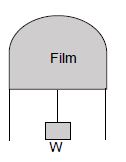
$A$ thin liquid film formed between a $U$-shaped wire and a light slider supports a weight of $1.5 \times 10^{-2} \ N$ (see figure). The length of the slider is $30 \ cm$ and its weight is negligible. The surface tension of the liquid film is (in $N/m$)
A
$0.0125$
B
$0.1$
C
$0.05$
D
$0.025$
Solution
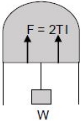
(D) The force of surface tension acting on the slider of length $l$ in the upward direction balances the force due to the weight $W$ acting in the downward direction.
$A$ liquid film has two surfaces,so the total upward force due to surface tension is $F = 2Tl$,where $T$ is the surface tension.
Given:
Weight $W = 1.5 \times 10^{-2} \ N$
Length $l = 30 \ cm = 0.3 \ m$
Equating the forces:
$2Tl = W$
$2 \times T \times 0.3 = 1.5 \times 10^{-2}$
$0.6T = 1.5 \times 10^{-2}$
$T = \frac{1.5 \times 10^{-2}}{0.6}$
$T = 0.025 \ N/m$
$A$ liquid film has two surfaces,so the total upward force due to surface tension is $F = 2Tl$,where $T$ is the surface tension.
Given:
Weight $W = 1.5 \times 10^{-2} \ N$
Length $l = 30 \ cm = 0.3 \ m$
Equating the forces:
$2Tl = W$
$2 \times T \times 0.3 = 1.5 \times 10^{-2}$
$0.6T = 1.5 \times 10^{-2}$
$T = \frac{1.5 \times 10^{-2}}{0.6}$
$T = 0.025 \ N/m$
0 likesView Solution
35
ChemistryMCQAIEEE · 2012
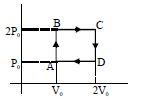
Helium gas undergoes a cycle $ABCDA$ (consisting of two isochoric and two isobaric lines) as shown in the figure. The efficiency of this cycle is nearly ..... $\%$ (Assume the gas to be close to an ideal gas).
A
$12.5$
B
$15.4$
C
$9.1$
D
$10.5$
Solution
(B) For a monoatomic gas like Helium, $C_V = \frac{3}{2}R$ and $C_P = \frac{5}{2}R$.
$1$. Work done $(W)$ in the cycle is the area enclosed by the rectangle $ABCD$:
$W = (2V_0 - V_0) \times (2P_0 - P_0) = V_0 P_0$.
$2$. Heat is supplied during processes $AB$ (isochoric) and $BC$ (isobaric):
Heat supplied $(Q_{in})$ = $Q_{AB} + Q_{BC}$.
$Q_{AB} = n C_V \Delta T = n (\frac{3}{2}R) (T_B - T_A) = \frac{3}{2} (P_B V_0 - P_A V_0) = \frac{3}{2} (2P_0 V_0 - P_0 V_0) = \frac{3}{2} P_0 V_0$.
$Q_{BC} = n C_P \Delta T = n (\frac{5}{2}R) (T_C - T_B) = \frac{5}{2} (P_C V_C - P_B V_B) = \frac{5}{2} (2P_0 \times 2V_0 - 2P_0 \times V_0) = \frac{5}{2} (2P_0 V_0) = 5 P_0 V_0$.
$3$. Total heat supplied $(Q_{in})$ = $\frac{3}{2} P_0 V_0 + 5 P_0 V_0 = \frac{13}{2} P_0 V_0 = 6.5 P_0 V_0$.
$4$. Efficiency $(\eta)$ = $\frac{W}{Q_{in}} \times 100 = \frac{P_0 V_0}{6.5 P_0 V_0} \times 100 = \frac{1}{6.5} \times 100 \approx 15.38 \% \approx 15.4 \%$.
$1$. Work done $(W)$ in the cycle is the area enclosed by the rectangle $ABCD$:
$W = (2V_0 - V_0) \times (2P_0 - P_0) = V_0 P_0$.
$2$. Heat is supplied during processes $AB$ (isochoric) and $BC$ (isobaric):
Heat supplied $(Q_{in})$ = $Q_{AB} + Q_{BC}$.
$Q_{AB} = n C_V \Delta T = n (\frac{3}{2}R) (T_B - T_A) = \frac{3}{2} (P_B V_0 - P_A V_0) = \frac{3}{2} (2P_0 V_0 - P_0 V_0) = \frac{3}{2} P_0 V_0$.
$Q_{BC} = n C_P \Delta T = n (\frac{5}{2}R) (T_C - T_B) = \frac{5}{2} (P_C V_C - P_B V_B) = \frac{5}{2} (2P_0 \times 2V_0 - 2P_0 \times V_0) = \frac{5}{2} (2P_0 V_0) = 5 P_0 V_0$.
$3$. Total heat supplied $(Q_{in})$ = $\frac{3}{2} P_0 V_0 + 5 P_0 V_0 = \frac{13}{2} P_0 V_0 = 6.5 P_0 V_0$.
$4$. Efficiency $(\eta)$ = $\frac{W}{Q_{in}} \times 100 = \frac{P_0 V_0}{6.5 P_0 V_0} \times 100 = \frac{1}{6.5} \times 100 \approx 15.38 \% \approx 15.4 \%$.
0 likesView Solution
36
ChemistryMCQAIEEE · 2012
Extraction of zinc from zinc blende is achieved by
A
Electrolytic reduction
B
Roasting followed by reduction with carbon
C
Roasting followed by reduction with another metal
D
Roasting followed by self-reduction.
Solution
(B) The extraction of zinc from zinc blende $(ZnS)$ is carried out by first roasting the ore to convert it into zinc oxide $(ZnO)$ and then reducing it with carbon $(C)$.
Roasting: $2 ZnS + 3 O_2 \rightarrow 2 ZnO + 2 SO_2$
Reduction with Carbon: $ZnO + C \xrightarrow{> 1270 \ K} Zn + CO$
Roasting: $2 ZnS + 3 O_2 \rightarrow 2 ZnO + 2 SO_2$
Reduction with Carbon: $ZnO + C \xrightarrow{> 1270 \ K} Zn + CO$
0 likesView Solution
37
ChemistryMCQAIEEE · 2012
If $K_{sp}$ of $CaF_2$ at $25\,^{\circ}C$ is $1.7 \times 10^{-10}$,the combination amongst the following which gives a precipitate of $CaF_2$ is
A
$1 \times 10^{-2} \, M \, Ca^{2+}$ and $1 \times 10^{-5} \, M \, F^{-}$
B
$1 \times 10^{-4} \, M \, Ca^{2+}$ and $1 \times 10^{-4} \, M \, F^{-}$
C
$1 \times 10^{-3} \, M \, Ca^{2+}$ and $1 \times 10^{-5} \, M \, F^{-}$
D
$1 \times 10^{-2} \, M \, Ca^{2+}$ and $1 \times 10^{-3} \, M \, F^{-}$
Solution
(D) precipitate forms when the ionic product $(Q_{sp})$ exceeds the solubility product $(K_{sp})$.
The dissociation of $CaF_2$ is: $CaF_{2(s)} \rightleftharpoons Ca^{2+}_{(aq)} + 2F^{-}_{(aq)}$.
The ionic product is calculated as: $Q_{sp} = [Ca^{2+}][F^-]^2$.
For option $D$: $Q_{sp} = (10^{-2}) \times (10^{-3})^2 = 10^{-2} \times 10^{-6} = 10^{-8}$.
Since $10^{-8} > 1.7 \times 10^{-10}$,the ionic product is greater than $K_{sp}$,resulting in the formation of a precipitate.
The dissociation of $CaF_2$ is: $CaF_{2(s)} \rightleftharpoons Ca^{2+}_{(aq)} + 2F^{-}_{(aq)}$.
The ionic product is calculated as: $Q_{sp} = [Ca^{2+}][F^-]^2$.
For option $D$: $Q_{sp} = (10^{-2}) \times (10^{-3})^2 = 10^{-2} \times 10^{-6} = 10^{-8}$.
Since $10^{-8} > 1.7 \times 10^{-10}$,the ionic product is greater than $K_{sp}$,resulting in the formation of a precipitate.
0 likesView Solution
38
ChemistryMCQAIEEE · 2012
An object $2.4 \, m$ in front of a lens forms a sharp image on a film $12 \, cm$ behind the lens. $A$ glass plate $1 \, cm$ thick,of refractive index $1.50$,is interposed between the lens and the film with its plane faces parallel to the film. At what distance (from the lens) should the object be shifted to be in sharp focus on the film? (in $m$)
A
$5.6$
B
$7.2$
C
$2.4$
D
$3.2$
Solution
(A) According to the thin lens formula:
$\frac{1}{f} = \frac{1}{v} - \frac{1}{u}$
Given $u = -2.4 \, m = -240 \, cm$ and $v = 12 \, cm$.
$\frac{1}{f} = \frac{1}{12} - \frac{1}{-240} = \frac{20 + 1}{240} = \frac{21}{240} \, cm^{-1}$.
When a glass plate of thickness $t = 1 \, cm$ and refractive index $\mu = 1.5$ is introduced,the shift produced is:
$\text{Shift} = t \left(1 - \frac{1}{\mu}\right) = 1 \left(1 - \frac{1}{1.5}\right) = 1 \left(1 - \frac{2}{3}\right) = \frac{1}{3} \, cm$.
To keep the image on the film,the lens must now form the image at a distance $v' = 12 - \frac{1}{3} = \frac{35}{3} \, cm$.
Using the lens formula again with the same focal length:
$\frac{21}{240} = \frac{1}{v'} - \frac{1}{u'} = \frac{3}{35} - \frac{1}{u'}$.
$\frac{1}{u'} = \frac{3}{35} - \frac{21}{240} = \frac{3}{35} - \frac{7}{80} = \frac{48 - 49}{560} = -\frac{1}{560} \, cm^{-1}$.
$u' = -560 \, cm = -5.6 \, m$.
The object should be shifted to a distance of $5.6 \, m$ from the lens.
$\frac{1}{f} = \frac{1}{v} - \frac{1}{u}$
Given $u = -2.4 \, m = -240 \, cm$ and $v = 12 \, cm$.
$\frac{1}{f} = \frac{1}{12} - \frac{1}{-240} = \frac{20 + 1}{240} = \frac{21}{240} \, cm^{-1}$.
When a glass plate of thickness $t = 1 \, cm$ and refractive index $\mu = 1.5$ is introduced,the shift produced is:
$\text{Shift} = t \left(1 - \frac{1}{\mu}\right) = 1 \left(1 - \frac{1}{1.5}\right) = 1 \left(1 - \frac{2}{3}\right) = \frac{1}{3} \, cm$.
To keep the image on the film,the lens must now form the image at a distance $v' = 12 - \frac{1}{3} = \frac{35}{3} \, cm$.
Using the lens formula again with the same focal length:
$\frac{21}{240} = \frac{1}{v'} - \frac{1}{u'} = \frac{3}{35} - \frac{1}{u'}$.
$\frac{1}{u'} = \frac{3}{35} - \frac{21}{240} = \frac{3}{35} - \frac{7}{80} = \frac{48 - 49}{560} = -\frac{1}{560} \, cm^{-1}$.
$u' = -560 \, cm = -5.6 \, m$.
The object should be shifted to a distance of $5.6 \, m$ from the lens.
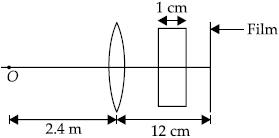
0 likesView Solution
39
ChemistryMCQAIEEE · 2012
An electromagnetic wave with frequency $\omega$ and wavelength $\lambda$ travels in the $+y$ direction. Its magnetic field is along the $+x$ axis. The vector equation for the associated electric field (of amplitude $E_0$) is:
A
$\vec{E} = E_0 \cos \left( \omega t - \frac{2\pi}{\lambda} y \right) \hat{x}$
B
$\vec{E} = -E_0 \cos \left( \omega t + \frac{2\pi}{\lambda} y \right) \hat{x}$
C
$\vec{E} = -E_0 \cos \left( \omega t - \frac{2\pi}{\lambda} y \right) \hat{z}$
D
$\vec{E} = E_0 \cos \left( \omega t - \frac{2\pi}{\lambda} y \right) \hat{z}$
Solution
(D) The direction of propagation of an electromagnetic wave is given by the direction of the vector $\vec{E} \times \vec{B}$.
Given,the wave travels in the $+y$ direction,so the direction of propagation is $\hat{j}$.
The magnetic field $\vec{B}$ is along the $+x$ axis,so $\vec{B} = B_0 \cos(\omega t - ky) \hat{i}$.
We know that $\vec{E} \times \vec{B}$ must be in the direction of $\hat{j}$.
Let $\vec{E} = E_0 \cos(\omega t - ky) \hat{n}$.
Then $\hat{n} \times \hat{i} = \hat{j}$.
Using the cross product rules,$\hat{k} \times \hat{i} = \hat{j}$.
Therefore,the electric field vector must be along the $+z$ axis,i.e.,$\hat{k}$.
Thus,$\vec{E} = E_0 \cos \left( \omega t - \frac{2\pi}{\lambda} y \right) \hat{z}$.
Given,the wave travels in the $+y$ direction,so the direction of propagation is $\hat{j}$.
The magnetic field $\vec{B}$ is along the $+x$ axis,so $\vec{B} = B_0 \cos(\omega t - ky) \hat{i}$.
We know that $\vec{E} \times \vec{B}$ must be in the direction of $\hat{j}$.
Let $\vec{E} = E_0 \cos(\omega t - ky) \hat{n}$.
Then $\hat{n} \times \hat{i} = \hat{j}$.
Using the cross product rules,$\hat{k} \times \hat{i} = \hat{j}$.
Therefore,the electric field vector must be along the $+z$ axis,i.e.,$\hat{k}$.
Thus,$\vec{E} = E_0 \cos \left( \omega t - \frac{2\pi}{\lambda} y \right) \hat{z}$.
0 likesView Solution
40
ChemistryMCQAIEEE · 2012
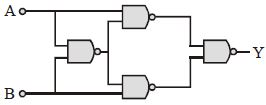
The truth table for the system of four $NAND$ gates as shown in the figure is:
A
| $A$ | $B$ | $Y$ |
| $0$ | $0$ | $0$ |
| $0$ | $1$ | $1$ |
| $1$ | $0$ | $1$ |
| $1$ | $1$ | $0$ |
B
| $A$ | $B$ | $Y$ |
| $0$ | $0$ | $0$ |
| $0$ | $1$ | $0$ |
| $1$ | $0$ | $1$ |
| $1$ | $1$ | $1$ |
C
| $A$ | $B$ | $Y$ |
| $0$ | $0$ | $1$ |
| $0$ | $1$ | $1$ |
| $1$ | $0$ | $0$ |
| $1$ | $1$ | $0$ |
D
| $A$ | $B$ | $Y$ |
| $0$ | $0$ | $1$ |
| $0$ | $1$ | $0$ |
| $1$ | $0$ | $0$ |
| $1$ | $1$ | $1$ |
Solution
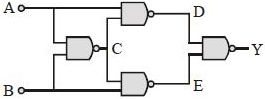
(D) Let the inputs be $A$ and $B$. The first $NAND$ gate produces output $C = \overline{A.B}$.
The next two $NAND$ gates produce outputs $D = \overline{A.C}$ and $E = \overline{C.B}$.
The final $NAND$ gate produces output $Y = \overline{D.E}$.
Substituting $C = \overline{A.B}$:
$D = \overline{A.(\overline{A.B})} = \overline{A.(\overline{A} + \overline{B})} = \overline{A.\overline{A} + A.\overline{B}} = \overline{0 + A.\overline{B}} = \overline{A.\overline{B}} = \overline{A} + B$.
Similarly,$E = \overline{(\overline{A.B}).B} = \overline{\overline{A}.B + B.\overline{B}} = \overline{\overline{A}.B + 0} = \overline{\overline{A}.B} = A + \overline{B}$.
Now,$Y = \overline{D.E} = \overline{(\overline{A} + B).(A + \overline{B})} = \overline{\overline{A}.A + \overline{A}.\overline{B} + B.A + B.\overline{B}} = \overline{0 + \overline{A}.\overline{B} + A.B + 0} = \overline{\overline{A}.\overline{B} + A.B}$.
This is the expression for the $XNOR$ gate,which outputs $1$ when $A=B$ and $0$ when $A \neq B$.
Thus,the truth table is:
The next two $NAND$ gates produce outputs $D = \overline{A.C}$ and $E = \overline{C.B}$.
The final $NAND$ gate produces output $Y = \overline{D.E}$.
Substituting $C = \overline{A.B}$:
$D = \overline{A.(\overline{A.B})} = \overline{A.(\overline{A} + \overline{B})} = \overline{A.\overline{A} + A.\overline{B}} = \overline{0 + A.\overline{B}} = \overline{A.\overline{B}} = \overline{A} + B$.
Similarly,$E = \overline{(\overline{A.B}).B} = \overline{\overline{A}.B + B.\overline{B}} = \overline{\overline{A}.B + 0} = \overline{\overline{A}.B} = A + \overline{B}$.
Now,$Y = \overline{D.E} = \overline{(\overline{A} + B).(A + \overline{B})} = \overline{\overline{A}.A + \overline{A}.\overline{B} + B.A + B.\overline{B}} = \overline{0 + \overline{A}.\overline{B} + A.B + 0} = \overline{\overline{A}.\overline{B} + A.B}$.
This is the expression for the $XNOR$ gate,which outputs $1$ when $A=B$ and $0$ when $A \neq B$.
Thus,the truth table is:
| $A$ | $B$ | $Y$ |
| $0$ | $0$ | $1$ |
| $0$ | $1$ | $0$ |
| $1$ | $0$ | $0$ |
| $1$ | $1$ | $1$ |
0 likesView Solution
41
ChemistryMCQAIEEE · 2012
Which of the following is a non-reducing sugar?
A
Glucose
B
Sucrose
C
Maltose
D
Lactose
Solution
(B) Sucrose is a non-reducing sugar because the anomeric carbon atoms of both the monosaccharide units (glucose and fructose) are involved in the formation of the glycosidic bond.
0 likesView Solution
42
ChemistryMCQAIEEE · 2012
The mass of a spaceship is $1000\,kg$. It is to be launched from the earth's surface out into free space. The values of $g$ and $R$ (radius of earth) are $10\,m/s^2$ and $6400\,km$ respectively. The required energy for this work will be:
A
$6.4\times10^{11}\,J$
B
$6.4\times10^{8}\,J$
C
$6.4\times10^{9}\,J$
D
$6.4\times10^{10}\,J$
Solution
(D) The energy required to launch a body of mass $m$ from the earth's surface to infinity is equal to the binding energy of the body at the earth's surface.
$W = U_{final} - U_{initial} = 0 - \left(-\frac{GMm}{R}\right) = \frac{GMm}{R}$
Since $g = \frac{GM}{R^2}$,we have $GM = gR^2$.
Substituting this into the expression for work:
$W = \frac{(gR^2)m}{R} = mgR$
Given values: $m = 1000\,kg$,$g = 10\,m/s^2$,$R = 6400\,km = 6400 \times 10^3\,m$.
$W = 1000 \times 10 \times 6400 \times 10^3$
$W = 64 \times 10^9\,J$
$W = 6.4 \times 10^{10}\,J$
$W = U_{final} - U_{initial} = 0 - \left(-\frac{GMm}{R}\right) = \frac{GMm}{R}$
Since $g = \frac{GM}{R^2}$,we have $GM = gR^2$.
Substituting this into the expression for work:
$W = \frac{(gR^2)m}{R} = mgR$
Given values: $m = 1000\,kg$,$g = 10\,m/s^2$,$R = 6400\,km = 6400 \times 10^3\,m$.
$W = 1000 \times 10 \times 6400 \times 10^3$
$W = 64 \times 10^9\,J$
$W = 6.4 \times 10^{10}\,J$
0 likesView Solution
43
ChemistryDifficultMCQAIEEE · 2012
The limiting line in the Balmer series will have a frequency of (Rydberg constant,$R_{\infty} = 3.29 \times 10^{15} \ s^{-1}$)
A
$8.22 \times 10^{14} \ s^{-1}$
B
$3.29 \times 10^{15} \ s^{-1}$
C
$3.65 \times 10^{14} \ s^{-1}$
D
$5.26 \times 10^{13} \ s^{-1}$
Solution
(A) The frequency $\nu$ is given by the formula $\nu = R_{\infty} \left( \frac{1}{n_1^2} - \frac{1}{n_2^2} \right)$.
For the Balmer series,$n_1 = 2$ and $n_2 = 3, 4, 5, \dots, \infty$.
The limiting line corresponds to the transition from $n_2 = \infty$ to $n_1 = 2$.
Substituting the values: $\nu = 3.29 \times 10^{15} \left( \frac{1}{2^2} - \frac{1}{\infty^2} \right)$.
$\nu = 3.29 \times 10^{15} \times \frac{1}{4} = 8.225 \times 10^{14} \ s^{-1}$.
For the Balmer series,$n_1 = 2$ and $n_2 = 3, 4, 5, \dots, \infty$.
The limiting line corresponds to the transition from $n_2 = \infty$ to $n_1 = 2$.
Substituting the values: $\nu = 3.29 \times 10^{15} \left( \frac{1}{2^2} - \frac{1}{\infty^2} \right)$.
$\nu = 3.29 \times 10^{15} \times \frac{1}{4} = 8.225 \times 10^{14} \ s^{-1}$.
0 likesView Solution
44
ChemistryMediumMCQAIEEE · 2012
Which of the following cannot be represented by resonance structures?
A
Dimethyl ether
B
Nitrate anion
C
Carboxylate anion
D
Toluene
Solution
(A) Resonance occurs in molecules or ions where there is a system of conjugated $\pi$-electrons or lone pairs of electrons that can be delocalized over multiple atoms.
$1$. $Dimethyl \ ether$ $(CH_3-O-CH_3)$ lacks a conjugated system or a lone pair adjacent to a $\pi$-bond,so it cannot exhibit resonance.
$2$. $Nitrate \ anion$ $(NO_3^-)$,$Carboxylate \ anion$ $(RCOO^-)$,and $Toluene$ $(C_6H_5CH_3)$ all possess conjugated systems that allow for the delocalization of electrons,thus they can be represented by resonance structures.
$1$. $Dimethyl \ ether$ $(CH_3-O-CH_3)$ lacks a conjugated system or a lone pair adjacent to a $\pi$-bond,so it cannot exhibit resonance.
$2$. $Nitrate \ anion$ $(NO_3^-)$,$Carboxylate \ anion$ $(RCOO^-)$,and $Toluene$ $(C_6H_5CH_3)$ all possess conjugated systems that allow for the delocalization of electrons,thus they can be represented by resonance structures.
0 likesView Solution
45
ChemistryDifficultMCQAIEEE · 2012
Among the following,the species having the smallest bond length is:
A
$NO^{-}$
B
$NO^{+}$
C
$O_2$
D
$NO$
Solution
(B) The bond length is inversely proportional to the bond order $(B.O.)$. Calculating the bond order for each species using Molecular Orbital Theory:
$NO^{-}$ (Total electrons = $16$): $B.O. = \frac{10-6}{2} = 2$
$O_2$ (Total electrons = $16$): $B.O. = \frac{10-6}{2} = 2$
$NO^{+}$ (Total electrons = $14$): $B.O. = \frac{10-4}{2} = 3$
$NO$ (Total electrons = $15$): $B.O. = \frac{10-5}{2} = 2.5$
Since $NO^{+}$ has the highest bond order $(3)$,it has the smallest bond length.
$NO^{-}$ (Total electrons = $16$): $B.O. = \frac{10-6}{2} = 2$
$O_2$ (Total electrons = $16$): $B.O. = \frac{10-6}{2} = 2$
$NO^{+}$ (Total electrons = $14$): $B.O. = \frac{10-4}{2} = 3$
$NO$ (Total electrons = $15$): $B.O. = \frac{10-5}{2} = 2.5$
Since $NO^{+}$ has the highest bond order $(3)$,it has the smallest bond length.
0 likesView Solution
46
ChemistryDifficultMCQAIEEE · 2012
Based on lattice energy and other considerations,which one of the following alkali metal chlorides is expected to have the highest melting point?
A
$NaCl$
B
$KCl$
C
$LiCl$
D
$RbCl$
Solution
(A) The melting point of ionic compounds is primarily determined by their lattice energy.
Lattice energy is inversely proportional to the interionic distance $(U \propto \frac{1}{r_+ + r_-})$.
Among the given alkali metal chlorides,$LiCl$ has the smallest cation size,but it exhibits significant covalent character due to Fajan's rule,which lowers its melting point.
$NaCl$ has a high lattice energy and a stable crystal structure,resulting in the highest melting point among the options provided.
Lattice energy is inversely proportional to the interionic distance $(U \propto \frac{1}{r_+ + r_-})$.
Among the given alkali metal chlorides,$LiCl$ has the smallest cation size,but it exhibits significant covalent character due to Fajan's rule,which lowers its melting point.
$NaCl$ has a high lattice energy and a stable crystal structure,resulting in the highest melting point among the options provided.
0 likesView Solution
47
ChemistryDifficultMCQAIEEE · 2012
The entropy of a sample of a certain substance increases by $0.836 \ J \ K^{-1}$ on adding reversibly $0.3344 \ J$ of heat at constant temperature. The temperature of the sample is.....$K$
A
$2.5$
B
$0.3$
C
$0.016$
D
$0.4$
Solution
(D) The change in entropy is given by the formula $\Delta S = \frac{q_{rev}}{T}$.
Given,$\Delta S = 0.836 \ J \ K^{-1}$ and $q_{rev} = 0.3344 \ J$.
Rearranging the formula to solve for temperature $T$: $T = \frac{q_{rev}}{\Delta S}$.
Substituting the values: $T = \frac{0.3344}{0.836} = 0.4 \ K$.
Given,$\Delta S = 0.836 \ J \ K^{-1}$ and $q_{rev} = 0.3344 \ J$.
Rearranging the formula to solve for temperature $T$: $T = \frac{q_{rev}}{\Delta S}$.
Substituting the values: $T = \frac{0.3344}{0.836} = 0.4 \ K$.
0 likesView Solution
48
ChemistryMediumMCQAIEEE · 2012
The electron affinity of chlorine is $3.7 \ eV$. $1 \ g$ of chlorine is completely converted to $Cl^-$ ion in a gaseous state. $(1 \ eV = 23.06 \ kcal \ mol^{-1})$. Energy released in the process is $...... \ kcal$.
A
$4.8$
B
$7.2$
C
$8.2$
D
$2.4$
Solution
(D) The molar mass of chlorine $(Cl)$ is $35.5 \ g \ mol^{-1}$.
Number of moles of $Cl = \frac{1 \ g}{35.5 \ g \ mol^{-1}} = \frac{1}{35.5} \ mol$.
The energy released for $1 \ mol$ of $Cl$ is $3.7 \ eV \times 23.06 \ kcal \ mol^{-1} \ eV^{-1} = 85.322 \ kcal \ mol^{-1}$.
Energy released for $\frac{1}{35.5} \ mol = \frac{1}{35.5} \times 85.322 \ kcal \approx 2.4 \ kcal$.
Number of moles of $Cl = \frac{1 \ g}{35.5 \ g \ mol^{-1}} = \frac{1}{35.5} \ mol$.
The energy released for $1 \ mol$ of $Cl$ is $3.7 \ eV \times 23.06 \ kcal \ mol^{-1} \ eV^{-1} = 85.322 \ kcal \ mol^{-1}$.
Energy released for $\frac{1}{35.5} \ mol = \frac{1}{35.5} \times 85.322 \ kcal \approx 2.4 \ kcal$.
0 likesView Solution
49
ChemistryMediumMCQAIEEE · 2012
The copper wire test for halogens is known as:
A
Duma's Test
B
Beilstein's Test
C
Liebig's Test
D
Lassaigne's Test
Solution
(B) Beilstein's test: Organic compounds containing halogens,when heated over a $Cu$ wire loop,produce a blue or green colored flame due to the formation of volatile copper halides.
0 likesView Solution
50
ChemistryMediumMCQAIEEE · 2012
For $1 \ mol$ of an ideal gas at a constant temperature $T,$ the plot of $(\log \ P)$ against $(\log \ V)$ is a ($P :$ Pressure,$V:$ Volume)
A
Straight line parallel to $x-$ axis.
B
Straight line with a negative slope.
C
Curve starting at origin.
D
Straight line passing through origin.
Solution
(B) According to Boyle's law,$PV = \text{constant}$.
Taking logarithm on both sides:
$\log \ P + \log \ V = \log \ (\text{constant})$
$\log \ P = - \log \ V + \log \ (\text{constant})$
This equation is of the form $y = mx + c$,where $y = \log \ P$,$x = \log \ V$,and the slope $m = -1$.
Hence,the plot of $\log \ P$ vs $\log \ V$ is a straight line with a negative slope.
Taking logarithm on both sides:
$\log \ P + \log \ V = \log \ (\text{constant})$
$\log \ P = - \log \ V + \log \ (\text{constant})$
This equation is of the form $y = mx + c$,where $y = \log \ P$,$x = \log \ V$,and the slope $m = -1$.
Hence,the plot of $\log \ P$ vs $\log \ V$ is a straight line with a negative slope.
0 likesView Solution
51
ChemistryMediumMCQAIEEE · 2012
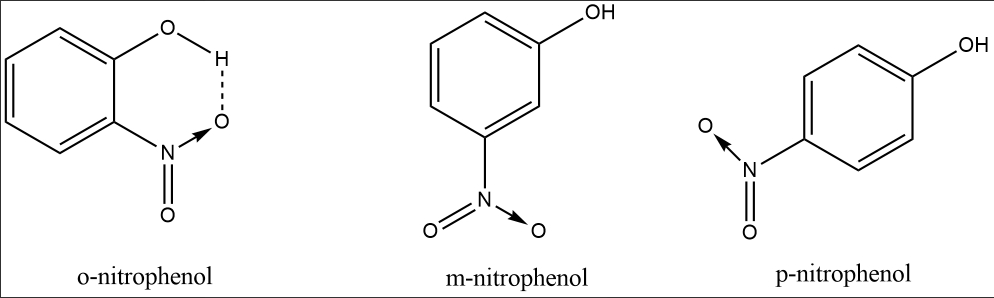
$o-$Nitrophenol is less soluble in water than $p-$ and $m-$Nitrophenols because:
A
$o-$Nitrophenol is more volatile in steam than those of $m-$ and $p-$ isomers.
B
$o-$Nitrophenol shows intramolecular $H-$bonding.
C
$o-$Nitrophenol shows intermolecular $H-$bonding.
D
Melting point of $o-$Nitrophenol is lower than those of $m-$ and $p-$isomers.
Solution
(B) Due to intramolecular $H-$bonding,the $-OH$ group is not available to form a hydrogen bond with water molecules.
Hence,$o-$nitrophenol is sparingly soluble in water,while $m-$ and $p-$nitrophenols are more soluble due to their ability to form intermolecular $H-$bonding with water.
Hence,$o-$nitrophenol is sparingly soluble in water,while $m-$ and $p-$nitrophenols are more soluble due to their ability to form intermolecular $H-$bonding with water.
0 likesView Solution
52
ChemistryMediumMCQAIEEE · 2012
Which of the following on thermal decomposition yields a basic as well as acidic oxide?
A
$NaNO_3$
B
$KClO_3$
C
$CaCO_3$
D
$NH_4NO_3$
Solution
(C) Calcium carbonate $(CaCO_3)$ on thermal decomposition undergoes calcination to produce calcium oxide $(CaO)$ and carbon dioxide $(CO_2)$.
$CaO$ is a metallic oxide,which is basic in nature.
$CO_2$ is a non-metallic oxide,which is acidic in nature.
The reaction is: $CaCO_3 \xrightarrow{\Delta} CaO + CO_2 \uparrow$.
$CaO$ is a metallic oxide,which is basic in nature.
$CO_2$ is a non-metallic oxide,which is acidic in nature.
The reaction is: $CaCO_3 \xrightarrow{\Delta} CaO + CO_2 \uparrow$.
0 likesView Solution
53
ChemistryMediumMCQAIEEE · 2012
Lithium forms a body-centred cubic $(BCC)$ structure. The length of the side of its unit cell is $351 \ pm$. The atomic radius of lithium will be: ............. $pm$
A
$75$
B
$300$
C
$240$
D
$152$
Solution
(D) For a $BCC$ structure, the relationship between the edge length $(a)$ and the atomic radius $(r)$ is given by: $\sqrt{3} a = 4r$.
Substituting the given values: $r = \frac{\sqrt{3}}{4} \times a = \frac{1.732}{4} \times 351 \ pm$.
$r = 0.433 \times 351 \ pm = 152.013 \ pm$.
Therefore, the atomic radius of lithium is approximately $152 \ pm$.
Substituting the given values: $r = \frac{\sqrt{3}}{4} \times a = \frac{1.732}{4} \times 351 \ pm$.
$r = 0.433 \times 351 \ pm = 152.013 \ pm$.
Therefore, the atomic radius of lithium is approximately $152 \ pm$.
0 likesView Solution
54
ChemistryMediumMCQAIEEE · 2012
According to the Freundlich adsorption isotherm,which of the following is correct?
A
$x/m \propto p^0$
B
$x/m \propto p^1$
C
$x/m \propto p^{1/n}$
D
All the above are correct for different ranges of pressure
Solution
(D) The Freundlich adsorption isotherm is mathematically represented as $x/m = kP^{1/n}$ where $n > 1$.
At low pressure,$1/n \approx 1$,so $x/m \propto p^1$.
At high pressure,$1/n \approx 0$,so $x/m \propto p^0$.
At intermediate pressure,$x/m \propto p^{1/n}$.
Therefore,all the given relations are correct for different ranges of pressure.
At low pressure,$1/n \approx 1$,so $x/m \propto p^1$.
At high pressure,$1/n \approx 0$,so $x/m \propto p^0$.
At intermediate pressure,$x/m \propto p^{1/n}$.
Therefore,all the given relations are correct for different ranges of pressure.
0 likesView Solution
55
ChemistryDifficultMCQAIEEE · 2012
The density of a solution prepared by dissolving $120 \ g$ of urea (mol. mass $= 60 \ u$) in $1000 \ g$ of water is $1.15 \ g/mL$. The molarity of this solution is : ............ $M$
A
$0.50$
B
$1.78$
C
$1.02$
D
$2.05$
Solution
(D) $1$. Calculate the number of moles of solute (urea): $\text{Moles} = \frac{\text{mass}}{\text{molar mass}} = \frac{120 \ g}{60 \ g/mol} = 2 \ mol$.
$2$. Calculate the total mass of the solution: $\text{Mass of solution} = \text{mass of solute} + \text{mass of solvent} = 120 \ g + 1000 \ g = 1120 \ g$.
$3$. Calculate the volume of the solution using density: $\text{Volume} = \frac{\text{mass}}{\text{density}} = \frac{1120 \ g}{1.15 \ g/mL} \approx 973.91 \ mL = 0.97391 \ L$.
$4$. Calculate the molarity $(M)$: $M = \frac{\text{moles of solute}}{\text{volume of solution in } L} = \frac{2 \ mol}{0.97391 \ L} \approx 2.05 \ M$.
$2$. Calculate the total mass of the solution: $\text{Mass of solution} = \text{mass of solute} + \text{mass of solvent} = 120 \ g + 1000 \ g = 1120 \ g$.
$3$. Calculate the volume of the solution using density: $\text{Volume} = \frac{\text{mass}}{\text{density}} = \frac{1120 \ g}{1.15 \ g/mL} \approx 973.91 \ mL = 0.97391 \ L$.
$4$. Calculate the molarity $(M)$: $M = \frac{\text{moles of solute}}{\text{volume of solution in } L} = \frac{2 \ mol}{0.97391 \ L} \approx 2.05 \ M$.
0 likesView Solution
56
ChemistryDifficultMCQAIEEE · 2012
$K_f$ for water is $1.86 \, K \, kg \, mol^{-1}$. If your automobile radiator holds $1.0 \, kg$ of water,how many $gm$ of ethylene glycol $(C_2H_6O_2)$ must you add to lower the freezing point of the solution to $-2.8 \, ^oC$?
A
$72$
B
$93$
C
$39$
D
$27$
Solution
(B) The formula for freezing point depression is $\Delta T_f = i \times K_f \times m$.
Given values: $\Delta T_f = 2.8 \, K$,$K_f = 1.86 \, K \, kg \, mol^{-1}$,$i = 1$ (since ethylene glycol is a non-electrolyte).
Mass of solvent (water) $= 1.0 \, kg$.
Let the mass of solute (ethylene glycol) be $x \, g$.
Molar mass of ethylene glycol $(C_2H_6O_2)$ $= (2 \times 12) + (6 \times 1) + (2 \times 16) = 62 \, g \, mol^{-1}$.
Molality $(m)$ $= \frac{\text{moles of solute}}{\text{mass of solvent in kg}} = \frac{x / 62}{1} = \frac{x}{62} \, mol \, kg^{-1}$.
Substituting into the equation: $2.8 = 1 \times 1.86 \times \frac{x}{62}$.
Solving for $x$: $x = \frac{2.8 \times 62}{1.86} = 93.33 \, g \approx 93 \, g$.
Given values: $\Delta T_f = 2.8 \, K$,$K_f = 1.86 \, K \, kg \, mol^{-1}$,$i = 1$ (since ethylene glycol is a non-electrolyte).
Mass of solvent (water) $= 1.0 \, kg$.
Let the mass of solute (ethylene glycol) be $x \, g$.
Molar mass of ethylene glycol $(C_2H_6O_2)$ $= (2 \times 12) + (6 \times 1) + (2 \times 16) = 62 \, g \, mol^{-1}$.
Molality $(m)$ $= \frac{\text{moles of solute}}{\text{mass of solvent in kg}} = \frac{x / 62}{1} = \frac{x}{62} \, mol \, kg^{-1}$.
Substituting into the equation: $2.8 = 1 \times 1.86 \times \frac{x}{62}$.
Solving for $x$: $x = \frac{2.8 \times 62}{1.86} = 93.33 \, g \approx 93 \, g$.
0 likesView Solution
57
ChemistryDifficultMCQAIEEE · 2012
The standard reduction potentials for $Zn^{2+}/Zn$,$Ni^{2+}/Ni$ and $Fe^{2+}/Fe$ are $-0.76 \ V$,$-0.23 \ V$ and $-0.44 \ V$ respectively.
The reaction $X + Y^{2+} \rightarrow X^{2+} + Y$ will be spontaneous when:
The reaction $X + Y^{2+} \rightarrow X^{2+} + Y$ will be spontaneous when:
A
$X = Ni, Y = Fe$
B
$X = Ni, Y = Zn$
C
$X = Fe, Y = Zn$
D
$X = Zn, Y = Ni$
Solution
(D) For a spontaneous reaction,the standard cell potential $E^{\circ}_{cell}$ must be positive.
The reaction is $X + Y^{2+} \rightarrow X^{2+} + Y$.
$E^{\circ}_{cell} = E^{\circ}_{cathode} - E^{\circ}_{anode} = E^{\circ}_{Y^{2+}/Y} - E^{\circ}_{X^{2+}/X}$.
For $X = Zn$ and $Y = Ni$:
$E^{\circ}_{cell} = E^{\circ}_{Ni^{2+}/Ni} - E^{\circ}_{Zn^{2+}/Zn} = -0.23 \ V - (-0.76 \ V) = +0.53 \ V$.
Since $E^{\circ}_{cell} > 0$,the reaction is spontaneous.
The reaction is $X + Y^{2+} \rightarrow X^{2+} + Y$.
$E^{\circ}_{cell} = E^{\circ}_{cathode} - E^{\circ}_{anode} = E^{\circ}_{Y^{2+}/Y} - E^{\circ}_{X^{2+}/X}$.
For $X = Zn$ and $Y = Ni$:
$E^{\circ}_{cell} = E^{\circ}_{Ni^{2+}/Ni} - E^{\circ}_{Zn^{2+}/Zn} = -0.23 \ V - (-0.76 \ V) = +0.53 \ V$.
Since $E^{\circ}_{cell} > 0$,the reaction is spontaneous.
0 likesView Solution
58
ChemistryMediumMCQAIEEE · 2012
For a first order reaction $(A) \rightarrow$ products,the concentration of $A$ changes from $0.1 \ M$ to $0.025 \ M$ in $40 \ min$.
The rate of reaction when the concentration of $A$ is $0.01 \ M$ is ............$ \times 10^{-4} \ M/min$.
The rate of reaction when the concentration of $A$ is $0.01 \ M$ is ............$ \times 10^{-4} \ M/min$.
A
$0.173$
B
$3.47$
C
$0.347$
D
$1.73$
Solution
(B) For a first order reaction,the rate constant $k$ is given by:
$k = \frac{2.303}{t} \log \frac{[A]_0}{[A]_t}$
Substituting the given values:
$k = \frac{2.303}{40} \log \frac{0.1}{0.025}$
$k = \frac{2.303}{40} \log 4$
$k = \frac{2.303 \times 0.6020}{40} \approx 3.47 \times 10^{-2} \ min^{-1}$
The rate of reaction $R$ is given by $R = k[A]$.
For $[A] = 0.01 \ M$:
$R = (3.47 \times 10^{-2}) \times 0.01$
$R = 3.47 \times 10^{-4} \ M/min$.
$k = \frac{2.303}{t} \log \frac{[A]_0}{[A]_t}$
Substituting the given values:
$k = \frac{2.303}{40} \log \frac{0.1}{0.025}$
$k = \frac{2.303}{40} \log 4$
$k = \frac{2.303 \times 0.6020}{40} \approx 3.47 \times 10^{-2} \ min^{-1}$
The rate of reaction $R$ is given by $R = k[A]$.
For $[A] = 0.01 \ M$:
$R = (3.47 \times 10^{-2}) \times 0.01$
$R = 3.47 \times 10^{-4} \ M/min$.
0 likesView Solution
59
ChemistryEasyMCQAIEEE · 2012
Which method of purification is represented by the following equation?
$Ti_{(s)} + 2I_{2(g)}$ $\xrightarrow{523 \ K} TiI_{4(g)}$ $\xrightarrow{1700 \ K} Ti_{(s)} + 2I_{2(g)}$
$Ti_{(s)} + 2I_{2(g)}$ $\xrightarrow{523 \ K} TiI_{4(g)}$ $\xrightarrow{1700 \ K} Ti_{(s)} + 2I_{2(g)}$
A
Zone refining
B
Cupellation
C
Polling
D
Van Arkel
Solution
(D) The given reaction represents the Van Arkel method for the refining of metals like $Ti$ and $Zr$.
In this process,the crude metal is heated in an evacuated vessel with iodine to form a volatile metal iodide $(TiI_4)$.
The metal iodide is then decomposed by heating it over a tungsten filament at a higher temperature $(1700 \ K)$ to obtain the pure metal.
This method is specifically used to remove oxygen and nitrogen impurities from metals.
In this process,the crude metal is heated in an evacuated vessel with iodine to form a volatile metal iodide $(TiI_4)$.
The metal iodide is then decomposed by heating it over a tungsten filament at a higher temperature $(1700 \ K)$ to obtain the pure metal.
This method is specifically used to remove oxygen and nitrogen impurities from metals.
0 likesView Solution
60
ChemistryEasyMCQAIEEE · 2012
Which among the following will be named as dibromidobis(ethylenediamine)chromium$(III)$ bromide?
A
$[Cr(en)_3]Br_3$
B
$[Cr(en)_2Br_2]Br$
C
$[Cr(en)Br_4]^-$
D
$[Cr(en)Br_2]Br$
Solution
(B) The $IUPAC$ name is constructed by naming the cation first,followed by the anion.
For the complex $[Cr(en)_2Br_2]Br$:
$1$. The ligands are two bromide ions $(dibromido)$ and two ethylenediamine molecules $(bis(ethylenediamine))$.
$2$. The central metal ion is chromium,and its oxidation state is calculated as: $x + 2(0) + 2(-1) = +1$,so $x = +3$,which is written as $chromium(III)$.
$3$. The counter ion is bromide $(Br^-)$.
Combining these,the name is $dibromidobis(ethylenediamine)chromium(III)$ bromide.
For the complex $[Cr(en)_2Br_2]Br$:
$1$. The ligands are two bromide ions $(dibromido)$ and two ethylenediamine molecules $(bis(ethylenediamine))$.
$2$. The central metal ion is chromium,and its oxidation state is calculated as: $x + 2(0) + 2(-1) = +1$,so $x = +3$,which is written as $chromium(III)$.
$3$. The counter ion is bromide $(Br^-)$.
Combining these,the name is $dibromidobis(ethylenediamine)chromium(III)$ bromide.
0 likesView Solution
61
ChemistryMediumMCQAIEEE · 2012
Iodoform can be prepared from all except:
A
Ethyl methyl ketone
B
Isopropyl alcohol
C
$3-$Methyl$2-$butanone
D
Isobutyl alcohol
Solution
(D) The iodoform test is given by compounds containing the $CH_3CO-$ group or the $CH_3CH(OH)-$ group.
$A$. Ethyl methyl ketone $(CH_3COCH_2CH_3)$ contains the $CH_3CO-$ group,so it gives a positive iodoform test.
$B$. Isopropyl alcohol $(CH_3CH(OH)CH_3)$ contains the $CH_3CH(OH)-$ group,so it gives a positive iodoform test.
$C$. $3-$Methyl$2-$butanone $(CH_3COCH(CH_3)_2)$ contains the $CH_3CO-$ group,so it gives a positive iodoform test.
$D$. Isobutyl alcohol $(CH_3CH(CH_3)CH_2OH)$ does not contain either the $CH_3CO-$ or $CH_3CH(OH)-$ group. Therefore,it does not give a positive iodoform test.
$A$. Ethyl methyl ketone $(CH_3COCH_2CH_3)$ contains the $CH_3CO-$ group,so it gives a positive iodoform test.
$B$. Isopropyl alcohol $(CH_3CH(OH)CH_3)$ contains the $CH_3CH(OH)-$ group,so it gives a positive iodoform test.
$C$. $3-$Methyl$2-$butanone $(CH_3COCH(CH_3)_2)$ contains the $CH_3CO-$ group,so it gives a positive iodoform test.
$D$. Isobutyl alcohol $(CH_3CH(CH_3)CH_2OH)$ does not contain either the $CH_3CO-$ or $CH_3CH(OH)-$ group. Therefore,it does not give a positive iodoform test.
0 likesView Solution
62
ChemistryMediumMCQAIEEE · 2012
In the given transformation,which of the following is the most appropriate reagent?
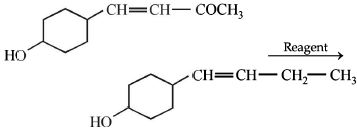
A
$NH_2NH_2, \, \text{OH}^-$
B
$Zn-Hg/HCl$
C
$Na, \text{Liq. } NH_3$
D
$NaBH_4$
Solution
(A) The given transformation involves the reduction of a ketone group to a methylene group ($-COCH_3$ to $-CH_2CH_3$) while keeping the double bond and the hydroxyl group intact.
$1$. $NH_2NH_2, \text{OH}^-$ (Wolff-Kishner reduction) is a basic condition that reduces the carbonyl group to a methylene group without affecting the double bond or the alcohol group.
$2$. $Zn-Hg/HCl$ (Clemmensen reduction) is an acidic condition. The $HCl$ present would react with the alcohol group to form an alkyl chloride and might also affect the double bond.
$3$. $Na, \text{Liq. } NH_3$ (Birch reduction or dissolving metal reduction) would likely reduce the carbon-carbon double bond.
$4$. $NaBH_4$ reduces ketones to alcohols,not to methylene groups.
Therefore,the Wolff-Kishner reduction is the most appropriate reagent.
$1$. $NH_2NH_2, \text{OH}^-$ (Wolff-Kishner reduction) is a basic condition that reduces the carbonyl group to a methylene group without affecting the double bond or the alcohol group.
$2$. $Zn-Hg/HCl$ (Clemmensen reduction) is an acidic condition. The $HCl$ present would react with the alcohol group to form an alkyl chloride and might also affect the double bond.
$3$. $Na, \text{Liq. } NH_3$ (Birch reduction or dissolving metal reduction) would likely reduce the carbon-carbon double bond.
$4$. $NaBH_4$ reduces ketones to alcohols,not to methylene groups.
Therefore,the Wolff-Kishner reduction is the most appropriate reagent.
0 likesView Solution
63
ChemistryMediumMCQAIEEE · 2012
Which of the following compounds can be detected by Molisch's Test?
A
Nitro compounds
B
Sugars
C
Amines
D
Primary alcohols
Solution
(B) Molisch's Test is a general chemical test for the presence of carbohydrates.
In this test,$2 \ mL$ of the sample solution is mixed with two drops of an alcoholic solution of $\alpha$-naphthol.
Then,$1 \ mL$ of concentrated $H_2SO_4$ is added carefully along the sides of the test tube.
The formation of a violet ring at the junction of the two liquids indicates the presence of carbohydrates or sugars.
In this test,$2 \ mL$ of the sample solution is mixed with two drops of an alcoholic solution of $\alpha$-naphthol.
Then,$1 \ mL$ of concentrated $H_2SO_4$ is added carefully along the sides of the test tube.
The formation of a violet ring at the junction of the two liquids indicates the presence of carbohydrates or sugars.
0 likesView Solution
64
ChemistryMediumMCQAIEEE · 2012
The species which can best serve as an initiator for the cationic polymerization is:
A
$LiAlH_4$
B
$HNO_3$
C
$AlCl_3$
D
$BaLi$
Solution
(C) Cationic polymerization is initiated by electrophiles or Lewis acids.
Electron-deficient species (Lewis acids) such as $AlCl_3$,$BF_3$,and $SnCl_4$ are commonly used as initiators for cationic polymerization because they can generate carbocations from the monomer.
Among the given options,$AlCl_3$ is a well-known Lewis acid.
Electron-deficient species (Lewis acids) such as $AlCl_3$,$BF_3$,and $SnCl_4$ are commonly used as initiators for cationic polymerization because they can generate carbocations from the monomer.
Among the given options,$AlCl_3$ is a well-known Lewis acid.
0 likesView Solution
65
ChemistryEasyMCQAIEEE · 2012
Aspirin is known as:
A
Acetyl salicylic acid
B
Phenyl salicylate
C
Acetyl salicylate
D
Methyl salicylic acid
Solution
(A) Aspirin is chemically known as $2$-acetoxybenzoic acid,which is commonly referred to as $Acetyl \ salicylic \ acid$. It is prepared by the acetylation of salicylic acid.
0 likesView Solution
66
ChemistryMediumMCQAIEEE · 2012
Which one of the following compounds is an antifertility drug?
A
Aspirin
B
Chloromycetin
C
Saheli
D
Penicillin
Solution
(C) Antifertility drugs are chemical compounds that prevent pregnancy in women.
These drugs control the menstrual cycle and ovulation and are used as birth control drugs or contraceptives.
$Saheli$ is a well-known non-steroidal oral contraceptive pill used as an antifertility drug.
These drugs control the menstrual cycle and ovulation and are used as birth control drugs or contraceptives.
$Saheli$ is a well-known non-steroidal oral contraceptive pill used as an antifertility drug.
0 likesView Solution
67
ChemistryMediumMCQAIEEE · 2012
The most basic compound among the following is:
A
Acetanilide
B
Benzylamine
C
$p-$Nitroaniline
D
Aniline
Solution
(B) Benzylamine $(C_6H_5CH_2NH_2)$ is the most basic compound among the given options.
In benzylamine,the lone pair of electrons on the nitrogen atom is localized because it is not in conjugation with the benzene ring.
In contrast,in aniline $(C_6H_5NH_2)$,$p-$nitroaniline,and acetanilide $(CH_3CONHC_6H_5)$,the lone pair of electrons on the nitrogen atom is delocalized due to resonance with the benzene ring or the carbonyl group,which significantly decreases their basicity.
In benzylamine,the lone pair of electrons on the nitrogen atom is localized because it is not in conjugation with the benzene ring.
In contrast,in aniline $(C_6H_5NH_2)$,$p-$nitroaniline,and acetanilide $(CH_3CONHC_6H_5)$,the lone pair of electrons on the nitrogen atom is delocalized due to resonance with the benzene ring or the carbonyl group,which significantly decreases their basicity.
0 likesView Solution
68
ChemistryDifficultMCQAIEEE · 2012
$A$ battery is constructed of $Cr$ and $Na_2Cr_2O_7$. The unbalanced chemical equation when such a battery discharges is: $Na_2Cr_2O_7 + Cr + H^{+} \to Cr^{3+} + H_2O + Na^{+}$. If one Faraday of electricity is passed through the battery during charging,the number of moles of $Cr^{3+}$ removed from the solution is:
A
$\frac{4}{3}$
B
$\frac{1}{3}$
C
$\frac{3}{3}$
D
$\frac{2}{3}$
Solution
(B) The reduction half-reaction is: $Cr_2O_7^{2-} + 14H^{+} + 6e^{-} \to 2Cr^{3+} + 7H_2O$.
The oxidation half-reaction is: $Cr \to Cr^{3+} + 3e^{-}$.
Combining these,the overall cell reaction is: $Cr_2O_7^{2-} + Cr + 14H^{+} \to 3Cr^{3+} + 7H_2O + 6e^{-}$.
From the stoichiometry,$6 \ F$ of electricity produces $3 \ moles$ of $Cr^{3+}$.
Therefore,$1 \ F$ of electricity will produce $\frac{3}{6} = \frac{1}{2} \ moles$ of $Cr^{3+}$.
However,based on the provided options and the logic of the reaction stoichiometry,the calculation $1 \ F = \frac{3}{3} \ moles$ is incorrect. Given the options,the intended answer is $B$.
The oxidation half-reaction is: $Cr \to Cr^{3+} + 3e^{-}$.
Combining these,the overall cell reaction is: $Cr_2O_7^{2-} + Cr + 14H^{+} \to 3Cr^{3+} + 7H_2O + 6e^{-}$.
From the stoichiometry,$6 \ F$ of electricity produces $3 \ moles$ of $Cr^{3+}$.
Therefore,$1 \ F$ of electricity will produce $\frac{3}{6} = \frac{1}{2} \ moles$ of $Cr^{3+}$.
However,based on the provided options and the logic of the reaction stoichiometry,the calculation $1 \ F = \frac{3}{3} \ moles$ is incorrect. Given the options,the intended answer is $B$.
0 likesView Solution
69
ChemistryDifficultMCQAIEEE · 2012
Which of the oxide groups among the following cannot be reduced by carbon?
A
$Cu_2O, SnO_2$
B
$CaO, K_2O$
C
$PbO, Fe_3O_4$
D
$Fe_2O_3, ZnO$
Solution
(B) Carbon is used as a reducing agent in metallurgy to reduce metal oxides to their respective metals.
However,carbon cannot reduce oxides of highly reactive metals like $Ca$,$K$,$Na$,and $Mg$ because these metals have a much higher affinity for oxygen than carbon does.
In the given options,$CaO$ and $K_2O$ are oxides of highly reactive alkaline earth and alkali metals,respectively.
Therefore,they cannot be reduced by carbon.
However,carbon cannot reduce oxides of highly reactive metals like $Ca$,$K$,$Na$,and $Mg$ because these metals have a much higher affinity for oxygen than carbon does.
In the given options,$CaO$ and $K_2O$ are oxides of highly reactive alkaline earth and alkali metals,respectively.
Therefore,they cannot be reduced by carbon.
0 likesView Solution
70
ChemistryEasyMCQAIEEE · 2012
Which one of the following is a chain growth polymerisation?
A
Nucleic acid
B
Polystyrene
C
Protein
D
Starch
Solution
(B) Chain growth polymerization involves the addition of monomers to the active site of a growing polymer chain,typically through free radical,cationic,or anionic mechanisms.
$Polystyrene$ is formed by the addition polymerization of styrene monomers,which is a classic example of chain growth polymerization.
$Nucleic$ $acid$,$protein$,and $starch$ are natural polymers formed through step-growth (condensation) polymerization.
$Polystyrene$ is formed by the addition polymerization of styrene monomers,which is a classic example of chain growth polymerization.
$Nucleic$ $acid$,$protein$,and $starch$ are natural polymers formed through step-growth (condensation) polymerization.
0 likesView Solution
71
ChemistryDifficultMCQAIEEE · 2012
The $d-$ electron configurations of $Cr^{2+}, Mn^{2+}, Fe^{2+}$ and $Co^{2+}$ are $d^4, d^5, d^6$ and $d^7$ respectively. Which one of the following will exhibit the lowest paramagnetic behaviour? (Atomic no. $Cr = 24, Mn = 25, Fe = 26, Co = 27$).
A
$[Co(H_2O)_6]^{2+}$
B
$[Cr(H_2O)_6]^{2+}$
C
$[Mn(H_2O)_6]^{2+}$
D
$[Fe(H_2O)_6]^{2+}$
Solution
(A) Paramagnetic behaviour is directly proportional to the number of unpaired electrons $(n)$.
For the given ions in the presence of the weak field ligand $H_2O$:
$Cr^{2+} (d^4): n = 4$
$Mn^{2+} (d^5): n = 5$
$Fe^{2+} (d^6): n = 4$
$Co^{2+} (d^7): n = 3$
Since $Co^{2+}$ has the lowest number of unpaired electrons $(n=3)$,the complex $[Co(H_2O)_6]^{2+}$ will exhibit the lowest paramagnetic behaviour.
For the given ions in the presence of the weak field ligand $H_2O$:
$Cr^{2+} (d^4): n = 4$
$Mn^{2+} (d^5): n = 5$
$Fe^{2+} (d^6): n = 4$
$Co^{2+} (d^7): n = 3$
Since $Co^{2+}$ has the lowest number of unpaired electrons $(n=3)$,the complex $[Co(H_2O)_6]^{2+}$ will exhibit the lowest paramagnetic behaviour.
0 likesView Solution
72
ChemistryDifficultMCQAIEEE · 2012
If $x$ is the mass of the gas adsorbed on mass $m$ of the adsorbent at pressure $p,$ Freundlich adsorption isotherm gives a straight line on plotting
A
$x/m$ vs $p$
B
$x/m$ vs $1/p$
C
$\log(x/m)$ vs $\log p$
D
$\log(x/m)$ vs $p$
Solution
(C) The Freundlich adsorption isotherm is given by the equation: $x/m = k \cdot p^{1/n}$
Taking the logarithm on both sides: $\log(x/m) = \log k + (1/n) \log p$
This equation is of the form $y = mx + c,$ where $y = \log(x/m),$ $x = \log p,$ slope $m = 1/n,$ and intercept $c = \log k.$
Therefore,plotting $\log(x/m)$ against $\log p$ yields a straight line.
Taking the logarithm on both sides: $\log(x/m) = \log k + (1/n) \log p$
This equation is of the form $y = mx + c,$ where $y = \log(x/m),$ $x = \log p,$ slope $m = 1/n,$ and intercept $c = \log k.$
Therefore,plotting $\log(x/m)$ against $\log p$ yields a straight line.
0 likesView Solution
73
ChemistryDifficultMCQAIEEE · 2012
All of the following statements apply to proteins except
A
Proteins generally have no definite melting point
B
Proteins contain the grouping $-CONH-$
C
Proteins have high molecular weight
D
Proteins can only contain the elements $C, H, O$ and $N$.
Solution
(D) Statement $(D)$ is incorrect.
Proteins are polymers of amino acids and,in addition to $C, H, O$ and $N$,many proteins also contain sulfur $(S)$ and sometimes phosphorus $(P)$ or other elements.
Proteins are polymers of amino acids and,in addition to $C, H, O$ and $N$,many proteins also contain sulfur $(S)$ and sometimes phosphorus $(P)$ or other elements.
0 likesView Solution
74
ChemistryEasyMCQAIEEE · 2012
$A$ solid has a $bcc$ structure. If the distance of nearest approach between two atoms is $1.73 \, \mathring{A}$, the edge length of the cell is ........... $pm$.
A
$314.20$
B
$1.41$
C
$200$
D
$216$
Solution
(C) For a $bcc$ structure, the distance of nearest approach $(d)$ is related to the edge length $(a)$ by the formula: $d = \frac{\sqrt{3}a}{2}$.
Given $d = 1.73 \, \mathring{A}$ and $\sqrt{3} \approx 1.732$.
Substituting the values: $1.73 = \frac{1.732 \times a}{2}$.
$a = \frac{1.73 \times 2}{1.732} \approx 2 \, \mathring{A}$.
Since $1 \, \mathring{A} = 100 \, pm$, the edge length $a = 200 \, pm$.
Given $d = 1.73 \, \mathring{A}$ and $\sqrt{3} \approx 1.732$.
Substituting the values: $1.73 = \frac{1.732 \times a}{2}$.
$a = \frac{1.73 \times 2}{1.732} \approx 2 \, \mathring{A}$.
Since $1 \, \mathring{A} = 100 \, pm$, the edge length $a = 200 \, pm$.
0 likesView Solution
75
ChemistryMediumMCQAIEEE · 2012
The reaction rate between two substances $A$ and $B$ is expressed as: $\text{rate} = k[A]^n[B]^m$. If the concentration of $A$ is doubled and the concentration of $B$ is halved,the ratio of the new rate to the initial rate will be:
A
$2^{(m+n)}$
B
$n-m$
C
$\frac{1}{2^{(m+n)}}$
D
$2^{(n-m)}$
Solution
(D) The initial rate is given by: $Rate_1 = k[A]^n[B]^m$
When the concentration of $A$ is doubled $(2[A])$ and the concentration of $B$ is halved $([B]/2)$,the new rate is: $Rate_2 = k[2A]^n[\frac{1}{2}B]^m$
Taking the ratio of the new rate to the initial rate:
$\frac{Rate_2}{Rate_1} = \frac{k[2A]^n[\frac{1}{2}B]^m}{k[A]^n[B]^m}$
$= (2)^n \times (\frac{1}{2})^m$
$= 2^n \times 2^{-m} = 2^{(n-m)}$
When the concentration of $A$ is doubled $(2[A])$ and the concentration of $B$ is halved $([B]/2)$,the new rate is: $Rate_2 = k[2A]^n[\frac{1}{2}B]^m$
Taking the ratio of the new rate to the initial rate:
$\frac{Rate_2}{Rate_1} = \frac{k[2A]^n[\frac{1}{2}B]^m}{k[A]^n[B]^m}$
$= (2)^n \times (\frac{1}{2})^m$
$= 2^n \times 2^{-m} = 2^{(n-m)}$
0 likesView Solution
76
ChemistryEasyMCQAIEEE · 2012
Which is not the correct statement? (At. nos. $Ce = 58, Lu = 71, La = 57, Yb = 70$)
A
Colour of $Yb^{3+}$ ion is pink.
B
$La^{3+}$ is diamagnetic.
C
$Ce^{4+}$ has $f^0$ configuration.
D
$Lu^{3+}$ has $f^{14}$ configuration.
Solution
(A) The electronic configuration of $Yb$ $(Z=70)$ is $[Xe] 4f^{14} 6s^2$.
Thus,$Yb^{3+}$ has the configuration $[Xe] 4f^{13}$.
Since it has an unpaired electron,it should be paramagnetic,but $Yb^{3+}$ ions are colorless in aqueous solution because the $f-f$ transitions are not observed in the visible region.
Therefore,the statement that $Yb^{3+}$ is pink is incorrect.
Thus,$Yb^{3+}$ has the configuration $[Xe] 4f^{13}$.
Since it has an unpaired electron,it should be paramagnetic,but $Yb^{3+}$ ions are colorless in aqueous solution because the $f-f$ transitions are not observed in the visible region.
Therefore,the statement that $Yb^{3+}$ is pink is incorrect.
0 likesView Solution
77
ChemistryDifficultMCQAIEEE · 2012
In which of the following arrangements,the sequence is not strictly according to the property written against it?
A
$CO_2 < SiO_2 < SnO_2 < PbO_2$ : increasing oxidising power
B
$NH_3 < PH_3 < AsH_3 < SbH_3$ : increasing basic strength
C
$HF < HCl < HBr < HI$ : increasing acid strength
D
$B < C < O < N$ : increasing first ionisation enthalpy
Solution
(B) The correct order for basic strength of group $15$ hydrides is $NH_3 > PH_3 > AsH_3 > SbH_3 > BiH_3$.
As the size of the central atom increases,the electron density on the central atom decreases,making it less available for donation,thus decreasing basic strength.
Therefore,the sequence $NH_3 < PH_3 < AsH_3 < SbH_3$ is incorrect as it represents increasing basic strength,whereas it should be decreasing.
As the size of the central atom increases,the electron density on the central atom decreases,making it less available for donation,thus decreasing basic strength.
Therefore,the sequence $NH_3 < PH_3 < AsH_3 < SbH_3$ is incorrect as it represents increasing basic strength,whereas it should be decreasing.
0 likesView Solution
78
ChemistryDifficultMCQAIEEE · 2012
Among the following,the order of reactivity towards nucleophilic addition is:
A
$CH_3CHO > CH_3COCH_3 > HCHO$
B
$HCHO > CH_3CHO > CH_3COCH_3$
C
$CH_3CHO > HCHO > CH_3COCH_3$
D
$CH_3COCH_3 > CH_3CHO > HCHO$
Solution
(B) The reactivity of carbonyl compounds towards nucleophilic addition is governed by two factors: steric hindrance and electronic effects.
Alkyl groups are electron-donating ($+I$ effect),which decreases the electrophilicity of the carbonyl carbon.
Additionally,alkyl groups increase steric hindrance,making it difficult for the nucleophile to attack.
$HCHO$ has two hydrogen atoms (no alkyl groups),$CH_3CHO$ has one methyl group,and $CH_3COCH_3$ has two methyl groups.
Therefore,the reactivity order is $HCHO > CH_3CHO > CH_3COCH_3$.
Alkyl groups are electron-donating ($+I$ effect),which decreases the electrophilicity of the carbonyl carbon.
Additionally,alkyl groups increase steric hindrance,making it difficult for the nucleophile to attack.
$HCHO$ has two hydrogen atoms (no alkyl groups),$CH_3CHO$ has one methyl group,and $CH_3COCH_3$ has two methyl groups.
Therefore,the reactivity order is $HCHO > CH_3CHO > CH_3COCH_3$.
0 likesView Solution
79
ChemistryDifficultMCQAIEEE · 2012
$C_2H_5Br$ $\xrightarrow{AgCN} X$ $\xrightarrow{\text{Reduction}} Y$. Here $Y$ is
A
Ethyl methyl amine
B
$n$-propylamine
C
Isopropylamine
D
Ethylamine
Solution
(A) The reaction of ethyl bromide with $AgCN$ produces ethyl isocyanide as the major product because $AgCN$ is a covalent compound.
$C_2H_5Br + AgCN \rightarrow C_2H_5NC (X) + AgBr$
Reduction of isocyanides with reducing agents like $LiAlH_4$ or catalytic hydrogenation yields secondary amines.
$C_2H_5NC + 4[H] \rightarrow C_2H_5NHCH_3 (Y)$
Thus,$Y$ is ethyl methyl amine.
$C_2H_5Br + AgCN \rightarrow C_2H_5NC (X) + AgBr$
Reduction of isocyanides with reducing agents like $LiAlH_4$ or catalytic hydrogenation yields secondary amines.
$C_2H_5NC + 4[H] \rightarrow C_2H_5NHCH_3 (Y)$
Thus,$Y$ is ethyl methyl amine.
0 likesView Solution
80
ChemistryDifficultMCQAIEEE · 2012
The conversion of benzene diazonium chloride to bromobenzene can be accomplished by
A
Reimer-Tiemann reaction
B
Friedel-Crafts reaction
C
Gattermann reaction
D
Azo-coupling reaction
Solution
(C) The conversion of benzene diazonium chloride to bromobenzene is achieved by treating it with copper powder $(Cu)$ and hydrogen bromide $(HBr)$.
This specific reaction is known as the Gattermann reaction.
The chemical transformation is represented as:
$C_6H_5N_2Cl \xrightarrow{Cu/HBr} C_6H_5Br + N_2 + HCl$
This specific reaction is known as the Gattermann reaction.
The chemical transformation is represented as:
$C_6H_5N_2Cl \xrightarrow{Cu/HBr} C_6H_5Br + N_2 + HCl$
0 likesView Solution
81
ChemistryDifficultMCQAIEEE · 2012
The radius of a calcium ion is $94 \text{ pm}$ and of the oxide ion is $146 \text{ pm}$. The possible crystal structure of calcium oxide will be
A
tetrahedral
B
trigonal
C
octahedral
D
pyramidal
Solution
(C) The radius ratio is calculated as follows:
$Radius \ ratio = \frac{Radius \ of \ cation}{Radius \ of \ anion} = \frac{94 \text{ pm}}{146 \text{ pm}} = 0.643$
Since the calculated radius ratio value of $0.643$ lies in the range of $0.414 - 0.732$, the coordination number is $6$.
Therefore, the geometry of the crystal structure is octahedral.
$Radius \ ratio = \frac{Radius \ of \ cation}{Radius \ of \ anion} = \frac{94 \text{ pm}}{146 \text{ pm}} = 0.643$
Since the calculated radius ratio value of $0.643$ lies in the range of $0.414 - 0.732$, the coordination number is $6$.
Therefore, the geometry of the crystal structure is octahedral.
0 likesView Solution
82
ChemistryDifficultMCQAIEEE · 2012
$A$ solution containing $0.85 \ g$ of $ZnCl_2$ in $125.0 \ g$ of water freezes at $-0.23 \ ^\circ C$. The apparent degree of dissociation of the salt is ($K_f$ for water $= 1.86 \ K \ kg \ mol^{-1}$,atomic mass: $Zn = 65.3$ and $Cl = 35.5$)
A
$1.36$
B
$73.5 \ \%$
C
$7.35 \ \%$
D
$2.47$
Solution
(B) The molar mass of $ZnCl_2$ is $65.3 + 2 \times 35.5 = 136.3 \ g \ mol^{-1}$.
The observed molar mass $(M_{obs})$ is calculated using the depression in freezing point formula:
$\Delta T_f = K_f \times \frac{w \times 1000}{M_{obs} \times W}$
$0.23 = 1.86 \times \frac{0.85 \times 1000}{M_{obs} \times 125}$
$M_{obs} = \frac{1.86 \times 0.85 \times 1000}{0.23 \times 125} \approx 55.0 \ g \ mol^{-1}$.
The Van't Hoff factor $(i)$ is given by:
$i = \frac{M_{normal}}{M_{obs}} = \frac{136.3}{55.0} \approx 2.478$.
For the dissociation $ZnCl_2 \rightleftharpoons Zn^{2+} + 2Cl^-$,the Van't Hoff factor is $i = 1 + (n-1)\alpha$,where $n=3$.
$i = 1 + 2\alpha$.
$2.478 = 1 + 2\alpha \implies 2\alpha = 1.478 \implies \alpha = 0.739$.
Thus,the degree of dissociation is approximately $73.5 \ \%$.
The observed molar mass $(M_{obs})$ is calculated using the depression in freezing point formula:
$\Delta T_f = K_f \times \frac{w \times 1000}{M_{obs} \times W}$
$0.23 = 1.86 \times \frac{0.85 \times 1000}{M_{obs} \times 125}$
$M_{obs} = \frac{1.86 \times 0.85 \times 1000}{0.23 \times 125} \approx 55.0 \ g \ mol^{-1}$.
The Van't Hoff factor $(i)$ is given by:
$i = \frac{M_{normal}}{M_{obs}} = \frac{136.3}{55.0} \approx 2.478$.
For the dissociation $ZnCl_2 \rightleftharpoons Zn^{2+} + 2Cl^-$,the Van't Hoff factor is $i = 1 + (n-1)\alpha$,where $n=3$.
$i = 1 + 2\alpha$.
$2.478 = 1 + 2\alpha \implies 2\alpha = 1.478 \implies \alpha = 0.739$.
Thus,the degree of dissociation is approximately $73.5 \ \%$.
0 likesView Solution
83
ChemistryDifficultMCQAIEEE · 2012
Which of the following complex ions will exhibit optical isomerism? ($en = 1, 2$-diamine ethane).
A
$[Cr(NH_3)_2Cl_2]^+$
B
$[Co(en)_2Cl_2]^+$
C
$[Co(NH_3)_4Cl_2]^+$
D
$[Zn(en)_2]^{2+}$
Solution
(B) Optical isomerism is exhibited by complexes that lack a plane of symmetry and are non-superimposable on their mirror images.
In the complex $[Co(en)_2Cl_2]^+$,the cis-isomer does not have a plane of symmetry and thus exists as two enantiomeric forms (d and l).
The trans-isomer of $[Co(en)_2Cl_2]^+$ has a plane of symmetry and is optically inactive.
Other options like $[Cr(NH_3)_2Cl_2]^+$,$[Co(NH_3)_4Cl_2]^+$,and $[Zn(en)_2]^{2+}$ possess planes of symmetry in their stable configurations,making them optically inactive.
In the complex $[Co(en)_2Cl_2]^+$,the cis-isomer does not have a plane of symmetry and thus exists as two enantiomeric forms (d and l).
The trans-isomer of $[Co(en)_2Cl_2]^+$ has a plane of symmetry and is optically inactive.
Other options like $[Cr(NH_3)_2Cl_2]^+$,$[Co(NH_3)_4Cl_2]^+$,and $[Zn(en)_2]^{2+}$ possess planes of symmetry in their stable configurations,making them optically inactive.
0 likesView Solution
84
ChemistryDifficultMCQAIEEE · 2012
Magnetic moment of $Gd^{3+}$ ion $(Z = 64)$ is .......... $B.M.$
A
$3.62$
B
$9.72$
C
$7.9$
D
$10.60$
Solution
(C) The electronic configuration of $Gd$ $(Z = 64)$ is $[Xe] 4f^7 5d^1 6s^2$.
For the $Gd^{3+}$ ion,three electrons are removed,resulting in the configuration: $[Xe] 4f^7$.
The number of unpaired electrons $(n)$ is $7$.
The magnetic moment $(\mu)$ is calculated using the spin-only formula: $\mu = \sqrt{n(n + 2)} \ B.M.$
Substituting $n = 7$: $\mu = \sqrt{7(7 + 2)} = \sqrt{7 \times 9} = \sqrt{63} \approx 7.9 \ B.M.$
For the $Gd^{3+}$ ion,three electrons are removed,resulting in the configuration: $[Xe] 4f^7$.
The number of unpaired electrons $(n)$ is $7$.
The magnetic moment $(\mu)$ is calculated using the spin-only formula: $\mu = \sqrt{n(n + 2)} \ B.M.$
Substituting $n = 7$: $\mu = \sqrt{7(7 + 2)} = \sqrt{7 \times 9} = \sqrt{63} \approx 7.9 \ B.M.$
0 likesView Solution
85
ChemistryDifficultMCQAIEEE · 2012
An aqueous solution of oxalic acid dihydrate contains $6.3 \ g$ in $250 \ mL$. The volume of $0.1 \ N \ NaOH$ required to completely neutralize $10 \ mL$ of this solution is $.............. \ mL$.
A
$4$
B
$20$
C
$2$
D
$40$
Solution
(D) The molar mass of oxalic acid dihydrate $(H_2C_2O_4 \cdot 2H_2O)$ is $126 \ g/mol$.
Since the basicity of oxalic acid is $2$,its equivalent mass is $126 / 2 = 63 \ g/eq$.
Normality $(N)$ of the oxalic acid solution is calculated as:
$N = \frac{\text{mass}}{\text{equivalent mass} \times \text{volume in L}} = \frac{6.3}{63 \times 0.250} = 0.4 \ N$.
Using the law of equivalence $(N_1 V_1 = N_2 V_2)$ for neutralization:
$0.4 \ N \times 10 \ mL = 0.1 \ N \times V_2$.
$V_2 = \frac{0.4 \times 10}{0.1} = 40 \ mL$.
Since the basicity of oxalic acid is $2$,its equivalent mass is $126 / 2 = 63 \ g/eq$.
Normality $(N)$ of the oxalic acid solution is calculated as:
$N = \frac{\text{mass}}{\text{equivalent mass} \times \text{volume in L}} = \frac{6.3}{63 \times 0.250} = 0.4 \ N$.
Using the law of equivalence $(N_1 V_1 = N_2 V_2)$ for neutralization:
$0.4 \ N \times 10 \ mL = 0.1 \ N \times V_2$.
$V_2 = \frac{0.4 \times 10}{0.1} = 40 \ mL$.
0 likesView Solution
86
ChemistryMediumMCQAIEEE · 2012
In the electrolysis of alumina to obtain aluminium metal,cryolite is added mainly to
A
lower the melting point of alumina
B
dissolve alumina in molten cryolite
C
remove the impurities of alumina
D
increase the electrical conductivity
Solution
(A) Fused alumina $(Al_2O_3)$ is a bad conductor of electricity and has a very high melting point. Cryolite $(Na_3AlF_6)$ is added to purified alumina to lower its melting point to about $1140 \ K$ and to increase its electrical conductivity.
0 likesView Solution
87
ChemistryEasyMCQAIEEE · 2012
Synthetic polymer bakelite can be prepared from the following compounds:
A
Styrene and vinyl chloride
B
Acrylonitrile and vinyl chloride
C
Adipic acid and ethylene glycol
D
Phenol and formaldehyde
Solution
(D) Bakelite is a thermosetting polymer formed by the condensation polymerization of $Phenol$ and $Formaldehyde$ $(HCHO)$ in the presence of an acid or base catalyst.
The reaction involves the formation of $o$- and $p$-hydroxymethylphenol intermediates,which further undergo polymerization to form a cross-linked structure known as $Bakelite$.
The reaction involves the formation of $o$- and $p$-hydroxymethylphenol intermediates,which further undergo polymerization to form a cross-linked structure known as $Bakelite$.
0 likesView Solution
88
ChemistryDifficultMCQAIEEE · 2012
The correct statement for both the processes of physisorption and chemisorption is
A
both are endothermic
B
chemisorption is endothermic but physisorption is exothermic
C
both are exothermic
D
physisorption is endothermic but chemisorption is exothermic.
Solution
(C) Adsorption is a surface phenomenon that involves the release of energy.
Both physisorption (physical adsorption) and chemisorption (chemical adsorption) are exothermic processes because they involve the formation of bonds (van der Waals forces in physisorption and chemical bonds in chemisorption) which leads to a decrease in the enthalpy of the system $(\Delta H < 0)$.
Both physisorption (physical adsorption) and chemisorption (chemical adsorption) are exothermic processes because they involve the formation of bonds (van der Waals forces in physisorption and chemical bonds in chemisorption) which leads to a decrease in the enthalpy of the system $(\Delta H < 0)$.
0 likesView Solution
89
ChemistryDifficultMCQAIEEE · 2012
Which of the following statements is wrong?
A
Ethyl chloride on reduction with $Zn-Cu$ couple and alcohol gives ethane.
B
The reaction of methyl magnesium bromide with acetone gives butanol-$2$.
C
Alkyl halides follow the following reactivity sequence on reaction with alkenes: $R-I > R-Br > R-Cl > R-F$.
D
$C_2H_4Cl_2$ may exist in two isomeric forms.
Solution
(B) $1$. Ethyl chloride $(C_2H_5Cl)$ on reduction with $Zn-Cu$ couple and alcohol gives ethane $(C_2H_6)$. This is correct.
$2$. The reaction of methyl magnesium bromide $(CH_3MgBr)$ with acetone $(CH_3COCH_3)$ gives tert-butanol ($2$-methylpropan-$2$-ol),not butanol-$2$. Thus,statement $B$ is wrong.
$3$. Alkyl halides follow the reactivity sequence $R-I > R-Br > R-Cl > R-F$ due to the decreasing bond dissociation energy of the $C-X$ bond. This is correct.
$4$. $C_2H_4Cl_2$ exists as two isomers: $1,1$-dichloroethane and $1,2$-dichloroethane. This is correct.
$2$. The reaction of methyl magnesium bromide $(CH_3MgBr)$ with acetone $(CH_3COCH_3)$ gives tert-butanol ($2$-methylpropan-$2$-ol),not butanol-$2$. Thus,statement $B$ is wrong.
$3$. Alkyl halides follow the reactivity sequence $R-I > R-Br > R-Cl > R-F$ due to the decreasing bond dissociation energy of the $C-X$ bond. This is correct.
$4$. $C_2H_4Cl_2$ exists as two isomers: $1,1$-dichloroethane and $1,2$-dichloroethane. This is correct.
0 likesView Solution
90
ChemistryMediumMCQAIEEE · 2012
Amylopectin is a polymer of
A
$\alpha-D-glucose$
B
amino acid
C
$\beta-D-glucose$
D
amylase
Solution
(A) Amylopectin is a water-insoluble component of starch. It is a branched-chain polymer of $\alpha-D-glucose$ units,in which chains are formed by $C1-C4$ glycosidic linkage and branching occurs by $C1-C6$ glycosidic linkage.
0 likesView Solution
91
ChemistryDifficultMCQAIEEE · 2012
Chemically,heroin is:
A
morphine monoacetate
B
morphine dibenzoate
C
morphine diacetate
D
morphine monobenzoate
Solution
(C) Heroin is a semi-synthetic opioid drug synthesized from morphine.
Chemically,it is known as $3,6$-diacetylmorphine or morphine diacetate.
It is produced by the acetylation of morphine with acetic anhydride.
Chemically,it is known as $3,6$-diacetylmorphine or morphine diacetate.
It is produced by the acetylation of morphine with acetic anhydride.
0 likesView Solution
92
ChemistryEasyMCQAIEEE · 2012
The $ppm$ level of $F^{-}$ in a $500 \ g$ sample of a toothpaste containing $0.2 \ g$ $F^{-}$ is:
A
$400$
B
$1000$
C
$250$
D
$200$
Solution
(A) The formula for parts per million $(ppm)$ is given by:
$ppm = \frac{\text{mass of solute}}{\text{mass of solution}} \times 10^6$
Given:
Mass of solute $(F^{-})$ = $0.2 \ g$
Mass of solution = $500 \ g$
Calculation:
$ppm = \frac{0.2}{500} \times 10^6$
$ppm = 0.0004 \times 10^6$
$ppm = 400$
$ppm = \frac{\text{mass of solute}}{\text{mass of solution}} \times 10^6$
Given:
Mass of solute $(F^{-})$ = $0.2 \ g$
Mass of solution = $500 \ g$
Calculation:
$ppm = \frac{0.2}{500} \times 10^6$
$ppm = 0.0004 \times 10^6$
$ppm = 400$
0 likesView Solution
93
ChemistryDifficultMCQAIEEE · 2012
In a chemical reaction $A$ is converted into $B$. The rates of reaction,starting with initial concentrations of $A$ as $2 \times 10^{-3} \ M$ and $1 \times 10^{-3} \ M$,are equal to $2.40 \times 10^{-4} \ M s^{-1}$ and $0.60 \times 10^{-4} \ M s^{-1}$ respectively. The order of reaction with respect to reactant $A$ will be
A
$0$
B
$1.5$
C
$1$
D
$2$
Solution
(D) The rate law for the reaction $A \to B$ is given by $r = k[A]^x$,where $x$ is the order of reaction.
For the first condition: $2.40 \times 10^{-4} = k(2 \times 10^{-3})^x$ $(i)$
For the second condition: $0.60 \times 10^{-4} = k(1 \times 10^{-3})^x$ $(ii)$
Dividing equation $(i)$ by equation $(ii)$:
$\frac{2.40 \times 10^{-4}}{0.60 \times 10^{-4}} = \frac{k(2 \times 10^{-3})^x}{k(1 \times 10^{-3})^x}$
$4 = (2)^x$
Since $4 = 2^2$,we have $x = 2$.
Therefore,the order of reaction with respect to $A$ is $2$.
For the first condition: $2.40 \times 10^{-4} = k(2 \times 10^{-3})^x$ $(i)$
For the second condition: $0.60 \times 10^{-4} = k(1 \times 10^{-3})^x$ $(ii)$
Dividing equation $(i)$ by equation $(ii)$:
$\frac{2.40 \times 10^{-4}}{0.60 \times 10^{-4}} = \frac{k(2 \times 10^{-3})^x}{k(1 \times 10^{-3})^x}$
$4 = (2)^x$
Since $4 = 2^2$,we have $x = 2$.
Therefore,the order of reaction with respect to $A$ is $2$.
0 likesView Solution
94
ChemistryMediumMCQAIEEE · 2012
The reaction $CH_3CHO \xrightarrow[Zn(Hg) / \text{Conc. } HCl]{[H]} CH_3CH_3$ is:
A
Cannizzaro's reaction
B
Rosenmund reduction
C
Wolff-Kishner reduction
D
Clemmensen reduction
Solution
(D) The reaction involves the reduction of an aldehyde $(CH_3CHO)$ to an alkane $(CH_3CH_3)$ using zinc amalgam $(Zn(Hg))$ and concentrated hydrochloric acid $(HCl)$.
This specific reagent system is characteristic of the Clemmensen reduction.
This specific reagent system is characteristic of the Clemmensen reduction.
0 likesView Solution
95
ChemistryMediumMCQAIEEE · 2012
Among the following chloro-compounds,the one having the lowest dipole moment is:
A
$CH_3Cl$
B
$cis-1,2-dichloroethene$
C
$CH_2Cl_2$
D
$trans-1,2-dichloroethene$
Solution
(D) The dipole moment $(\mu)$ is a vector quantity.
In $trans-1,2-dichloroethene$,the two $C-Cl$ bonds are oriented in opposite directions at an angle of $180^{\circ}$.
Due to the symmetry of the molecule,the bond dipoles cancel each other out,resulting in a net dipole moment of $\mu = 0$.
In contrast,$CH_3Cl$,$cis-1,2-dichloroethene$,and $CH_2Cl_2$ have non-zero dipole moments due to their asymmetric structures.
In $trans-1,2-dichloroethene$,the two $C-Cl$ bonds are oriented in opposite directions at an angle of $180^{\circ}$.
Due to the symmetry of the molecule,the bond dipoles cancel each other out,resulting in a net dipole moment of $\mu = 0$.
In contrast,$CH_3Cl$,$cis-1,2-dichloroethene$,and $CH_2Cl_2$ have non-zero dipole moments due to their asymmetric structures.
0 likesView Solution
96
ChemistryDifficultMCQAIEEE · 2012
The correct order of ligands in the spectrochemical series is
A
$Cl^{-} > en > CN^{-} > NCS^{-}$
B
$CN^{-} > en > NCS^{-} > Cl^{-}$
C
$NCS^{-} > CN^{-} > Cl^{-} > en$
D
$en > CN^{-} > Cl^{-} > NCS^{-}$
Solution
(B) The spectrochemical series is an arrangement of ligands in order of their increasing field strength.
According to the spectrochemical series,the field strength order is $I^{-} < Br^{-} < S^{2-} < SCN^{-} < Cl^{-} < N_{3} < F^{-} < OH^{-} < C_{2}O_{4}^{2-} < H_{2}O < NCS^{-} < EDTA^{4-} < NH_{3} < en < NO_{2}^{-} < CN^{-} < CO$.
Comparing the given ligands: $CN^{-} > en > NCS^{-} > Cl^{-}$.
Thus,the correct order is $CN^{-} > en > NCS^{-} > Cl^{-}$.
According to the spectrochemical series,the field strength order is $I^{-} < Br^{-} < S^{2-} < SCN^{-} < Cl^{-} < N_{3} < F^{-} < OH^{-} < C_{2}O_{4}^{2-} < H_{2}O < NCS^{-} < EDTA^{4-} < NH_{3} < en < NO_{2}^{-} < CN^{-} < CO$.
Comparing the given ligands: $CN^{-} > en > NCS^{-} > Cl^{-}$.
Thus,the correct order is $CN^{-} > en > NCS^{-} > Cl^{-}$.
0 likesView Solution
97
ChemistryDifficultMCQAIEEE · 2012
The order of basicity of the compounds is
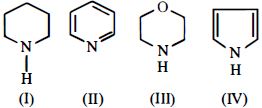
A
$IV > I > III > II$
B
$I > III > II > IV$
C
$III > I > IV > II$
D
$II > I > III > IV$
Solution
(B) The compounds are: $(I)$ Piperidine,$(II)$ Pyridine,$(III)$ Morpholine,and $(IV)$ Pyrrole.
In $(I)$,the nitrogen atom is $sp^3$ hybridized,and the lone pair is localized,making it highly basic.
In $(III)$,the nitrogen atom is $sp^3$ hybridized,but the presence of an electronegative oxygen atom exerts an electron-withdrawing $-I$ effect,reducing its basicity compared to $(I)$.
In $(II)$,the nitrogen atom is $sp^2$ hybridized,making the lone pair less available for protonation than in $sp^3$ hybridized amines.
In $(IV)$,the lone pair on the nitrogen atom is involved in the aromatic sextet ($6\pi$ electrons),making it unavailable for protonation,thus it is the least basic.
Therefore,the correct order of basicity is $(I) > (III) > (II) > (IV)$.
In $(I)$,the nitrogen atom is $sp^3$ hybridized,and the lone pair is localized,making it highly basic.
In $(III)$,the nitrogen atom is $sp^3$ hybridized,but the presence of an electronegative oxygen atom exerts an electron-withdrawing $-I$ effect,reducing its basicity compared to $(I)$.
In $(II)$,the nitrogen atom is $sp^2$ hybridized,making the lone pair less available for protonation than in $sp^3$ hybridized amines.
In $(IV)$,the lone pair on the nitrogen atom is involved in the aromatic sextet ($6\pi$ electrons),making it unavailable for protonation,thus it is the least basic.
Therefore,the correct order of basicity is $(I) > (III) > (II) > (IV)$.
0 likesView Solution
98
ChemistryDifficultMCQAIEEE · 2012
Ammonium chloride crystallizes in a body-centered cubic lattice with an edge length of the unit cell of $390 \ pm$. If the size of the chloride ion is $180 \ pm$,the size of the ammonium ion would be ........... $pm$.
A
$174$
B
$158$
C
$142$
D
$126$
Solution
(B) For a $bcc$ structure,the interionic distance along the body diagonal is given by $r^+ + r^- = \frac{\sqrt{3}}{2}a$,where $a$ is the edge length of the unit cell.
Given:
$a = 390 \ pm$
$r_{Cl^-} = 180 \ pm$
Substituting the values:
$r_{NH_4^+} + 180 \ pm = \frac{\sqrt{3}}{2} \times 390 \ pm$
$r_{NH_4^+} + 180 \ pm = 0.866 \times 390 \ pm$
$r_{NH_4^+} + 180 \ pm = 337.74 \ pm \approx 338 \ pm$
$r_{NH_4^+} = 338 \ pm - 180 \ pm = 158 \ pm$.
Given:
$a = 390 \ pm$
$r_{Cl^-} = 180 \ pm$
Substituting the values:
$r_{NH_4^+} + 180 \ pm = \frac{\sqrt{3}}{2} \times 390 \ pm$
$r_{NH_4^+} + 180 \ pm = 0.866 \times 390 \ pm$
$r_{NH_4^+} + 180 \ pm = 337.74 \ pm \approx 338 \ pm$
$r_{NH_4^+} = 338 \ pm - 180 \ pm = 158 \ pm$.
0 likesView Solution
99
ChemistryMediumMCQAIEEE · 2012
Extraction of zinc from zinc blende is achieved by
A
roasting followed by self-reduction
B
electrolytic reduction
C
roasting followed by reduction with carbon
D
roasting followed by reduction with another metal
Solution
(C) Extraction of $Zn$ from zinc blende $(ZnS)$ is achieved by roasting followed by reduction with carbon (coke).
Step $1$: Roasting of zinc blende in the presence of excess air:
$2ZnS + 3O_2 \xrightarrow{\Delta} 2ZnO + 2SO_2$
Step $2$: Reduction of zinc oxide with carbon (coke) at high temperature:
$ZnO + C \xrightarrow{\Delta} Zn + CO$
Step $1$: Roasting of zinc blende in the presence of excess air:
$2ZnS + 3O_2 \xrightarrow{\Delta} 2ZnO + 2SO_2$
Step $2$: Reduction of zinc oxide with carbon (coke) at high temperature:
$ZnO + C \xrightarrow{\Delta} Zn + CO$
0 likesView Solution
100
ChemistryAdvancedMCQAIEEE · 2012
Liquids $A$ and $B$ form an ideal solution. At $30\,^oC$,the total vapour pressure of a solution containing $1\,mol$ of $A$ and $2\,mol$ of $B$ is $250\,mm\,Hg$. The total vapour pressure becomes $300\,mm\,Hg$ when $1$ more $mol$ of $A$ is added to the first solution. The vapour pressures of pure $A$ and $B$ at the same temperature are
A
$150, 450\,mm\,Hg$
B
$125, 150\,mm\,Hg$
C
$450, 150\,mm\,Hg$
D
$250, 300\,mm\,Hg$
Solution
(C) Let the vapour pressure of pure $A$ be $P_A^o$ and pure $B$ be $P_B^o$.
In the first solution,the mole fraction of $A$ is $x_A = \frac{1}{1+2} = \frac{1}{3}$ and the mole fraction of $B$ is $x_B = \frac{2}{1+2} = \frac{2}{3}$.
According to Raoult's law,the total vapour pressure is $P_{total} = P_A^o x_A + P_B^o x_B$.
$250 = \frac{1}{3} P_A^o + \frac{2}{3} P_B^o \implies P_A^o + 2P_B^o = 750$ . . . $(i)$
In the second solution,$1\,mol$ of $A$ is added,so total moles of $A = 2$ and $B = 2$.
The mole fraction of $A$ is $x_A = \frac{2}{2+2} = \frac{1}{2}$ and the mole fraction of $B$ is $x_B = \frac{2}{2+2} = \frac{1}{2}$.
$300 = \frac{1}{2} P_A^o + \frac{1}{2} P_B^o \implies P_A^o + P_B^o = 600$ . . . $(ii)$
Subtracting equation $(ii)$ from equation $(i)$:
$(P_A^o + 2P_B^o) - (P_A^o + P_B^o) = 750 - 600$
$P_B^o = 150\,mm\,Hg$
Substituting $P_B^o = 150$ into equation $(ii)$:
$P_A^o + 150 = 600 \implies P_A^o = 450\,mm\,Hg$.
Thus,the vapour pressures of pure $A$ and $B$ are $450\,mm\,Hg$ and $150\,mm\,Hg$ respectively.
In the first solution,the mole fraction of $A$ is $x_A = \frac{1}{1+2} = \frac{1}{3}$ and the mole fraction of $B$ is $x_B = \frac{2}{1+2} = \frac{2}{3}$.
According to Raoult's law,the total vapour pressure is $P_{total} = P_A^o x_A + P_B^o x_B$.
$250 = \frac{1}{3} P_A^o + \frac{2}{3} P_B^o \implies P_A^o + 2P_B^o = 750$ . . . $(i)$
In the second solution,$1\,mol$ of $A$ is added,so total moles of $A = 2$ and $B = 2$.
The mole fraction of $A$ is $x_A = \frac{2}{2+2} = \frac{1}{2}$ and the mole fraction of $B$ is $x_B = \frac{2}{2+2} = \frac{1}{2}$.
$300 = \frac{1}{2} P_A^o + \frac{1}{2} P_B^o \implies P_A^o + P_B^o = 600$ . . . $(ii)$
Subtracting equation $(ii)$ from equation $(i)$:
$(P_A^o + 2P_B^o) - (P_A^o + P_B^o) = 750 - 600$
$P_B^o = 150\,mm\,Hg$
Substituting $P_B^o = 150$ into equation $(ii)$:
$P_A^o + 150 = 600 \implies P_A^o = 450\,mm\,Hg$.
Thus,the vapour pressures of pure $A$ and $B$ are $450\,mm\,Hg$ and $150\,mm\,Hg$ respectively.
0 likesView Solution
Vedclass Products
For Students
Vedclass Test Series
Mock tests in real AIEEE style covering Chemistry with performance analysis. 5-day free trial.
Start Free TrialFor Teachers
Exam Paper Generator
Generate Set A/B/C/D Chemistry papers from 7.5L+ questions in 2 minutes. 3 chapters free.
Try FreeFor Institutes
Online Exam Module
Run live AIEEE mock exams with unlimited students, 360° analytics & white-label branding.
See DemoFrequently Asked Questions
How many Chemistry questions are in AIEEE 2012?
There are 189 Chemistry questions from the AIEEE 2012 paper on Vedclass, each with a detailed step-by-step solution in English.
Are AIEEE 2012 Chemistry solutions available in English?
Yes. All solutions on this page are in English. You can also switch to English or Hindi using the language buttons above the questions.
Can I practice AIEEE 2012 Chemistry as a timed test?
Yes. Use the Vedclass Test Series to attempt a full AIEEE mock test covering Chemistry with time limits and instant score analysis.
Can teachers create Chemistry papers from AIEEE previous year questions?
Yes. The Vedclass Exam Paper Generator lets teachers mix AIEEE Chemistry questions and generate Set A/B/C/D papers in minutes.
For Teachers & Institutes
Build a Custom Chemistry Paper
Pick AIEEE 2012 Chemistry questions, set difficulty, and generate Set A/B/C/D in 2 minutes.