
ChemistryQ1–90 of 125 questions
Page 1 of 2 · English
1
ChemistryMCQAIEEE · 2005
If the change in the value of $g$ at a height $h$ above the surface of the earth is the same as at a depth $x$ below it,then (both $x$ and $h$ being much smaller than the radius of the earth)
A
$x = h$
B
$x = 2h$
C
$x = \frac{h}{2}$
D
$x = h^2$
Solution
(B) The value of acceleration due to gravity at a height $h$ above the surface of the earth is given by $g_h = g \left( 1 - \frac{2h}{R} \right)$.
The change in the value of $g$ at height $h$ is $\Delta g_h = g - g_h = g \left( \frac{2h}{R} \right)$.
The value of acceleration due to gravity at a depth $x$ below the surface of the earth is given by $g_x = g \left( 1 - \frac{x}{R} \right)$.
The change in the value of $g$ at depth $x$ is $\Delta g_x = g - g_x = g \left( \frac{x}{R} \right)$.
According to the problem,the change in the value of $g$ is the same at height $h$ and depth $x$,so $\Delta g_h = \Delta g_x$.
Therefore,$g \left( \frac{2h}{R} \right) = g \left( \frac{x}{R} \right)$.
On solving this equation,we get $x = 2h$.
The change in the value of $g$ at height $h$ is $\Delta g_h = g - g_h = g \left( \frac{2h}{R} \right)$.
The value of acceleration due to gravity at a depth $x$ below the surface of the earth is given by $g_x = g \left( 1 - \frac{x}{R} \right)$.
The change in the value of $g$ at depth $x$ is $\Delta g_x = g - g_x = g \left( \frac{x}{R} \right)$.
According to the problem,the change in the value of $g$ is the same at height $h$ and depth $x$,so $\Delta g_h = \Delta g_x$.
Therefore,$g \left( \frac{2h}{R} \right) = g \left( \frac{x}{R} \right)$.
On solving this equation,we get $x = 2h$.
0 likesView Solution
2
ChemistryMCQAIEEE · 2005
$A$ particle of mass $10\, g$ is kept on the surface of a uniform sphere of mass $100\, kg$ and radius $10\, cm$. Find the work to be done against the gravitational force between them to take the particle far away from the sphere (you may take $G = 6.67 \times 10^{-11}\, N m^2/kg^2$).
A
$6.67 \times 10^{-9}\, J$
B
$6.67 \times 10^{-10}\, J$
C
$13.34 \times 10^{-10}\, J$
D
$3.33 \times 10^{-10}\, J$
Solution
(B) The gravitational potential energy $U$ of a system of two masses $M$ and $m$ separated by a distance $R$ is given by $U = -\frac{GMm}{R}$.
Here,$M = 100\, kg$,$m = 10\, g = 0.01\, kg$,$R = 10\, cm = 0.1\, m$,and $G = 6.67 \times 10^{-11}\, N m^2/kg^2$.
Substituting these values into the formula:
$U = -\frac{6.67 \times 10^{-11} \times 100 \times 0.01}{0.1}$
$U = -\frac{6.67 \times 10^{-11} \times 1}{0.1} = -6.67 \times 10^{-10}\, J$.
The work required to take the particle to infinity is equal to the change in potential energy,which is $W = U_{\infty} - U_{surface} = 0 - (-6.67 \times 10^{-10}\, J) = 6.67 \times 10^{-10}\, J$.
Here,$M = 100\, kg$,$m = 10\, g = 0.01\, kg$,$R = 10\, cm = 0.1\, m$,and $G = 6.67 \times 10^{-11}\, N m^2/kg^2$.
Substituting these values into the formula:
$U = -\frac{6.67 \times 10^{-11} \times 100 \times 0.01}{0.1}$
$U = -\frac{6.67 \times 10^{-11} \times 1}{0.1} = -6.67 \times 10^{-10}\, J$.
The work required to take the particle to infinity is equal to the change in potential energy,which is $W = U_{\infty} - U_{surface} = 0 - (-6.67 \times 10^{-10}\, J) = 6.67 \times 10^{-10}\, J$.
0 likesView Solution
3
ChemistryMCQAIEEE · 2005
Two point charges $+8q$ and $-2q$ are located at $x = 0$ and $x = L$ respectively. The location of a point on the $x$-axis at which the net electric field due to these two point charges is zero is
A
$8L$
B
$4L$
C
$2L$
D
$\frac{L}{4}$
Solution
(C) The net electric field will be zero at a point outside the charges and closer to the charge which is smaller in magnitude.
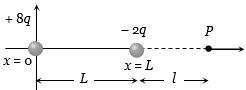
Let the point $P$ be at a distance $l$ from the charge $-2q$ on the $x$-axis,as shown in the figure.
The electric field due to $+8q$ at $P$ is $E_1 = \frac{k(8q)}{(L+l)^2}$ directed away from the origin.
The electric field due to $-2q$ at $P$ is $E_2 = \frac{k(2q)}{l^2}$ directed towards the origin.
For the net electric field to be zero at $P$,we must have $E_1 = E_2$.
$\frac{k(8q)}{(L+l)^2} = \frac{k(2q)}{l^2}$
$\frac{4}{(L+l)^2} = \frac{1}{l^2}$
Taking the square root on both sides: $\frac{2}{L+l} = \frac{1}{l}$
$2l = L + l$
$l = L$
The distance of point $P$ from the origin $(x=0)$ is $L + l = L + L = 2L$.
Let the point $P$ be at a distance $l$ from the charge $-2q$ on the $x$-axis,as shown in the figure.
The electric field due to $+8q$ at $P$ is $E_1 = \frac{k(8q)}{(L+l)^2}$ directed away from the origin.
The electric field due to $-2q$ at $P$ is $E_2 = \frac{k(2q)}{l^2}$ directed towards the origin.
For the net electric field to be zero at $P$,we must have $E_1 = E_2$.
$\frac{k(8q)}{(L+l)^2} = \frac{k(2q)}{l^2}$
$\frac{4}{(L+l)^2} = \frac{1}{l^2}$
Taking the square root on both sides: $\frac{2}{L+l} = \frac{1}{l}$
$2l = L + l$
$l = L$
The distance of point $P$ from the origin $(x=0)$ is $L + l = L + L = 2L$.
0 likesView Solution
4
ChemistryMCQAIEEE · 2005
Starting with a sample of pure $^{66}Cu$,$\frac{7}{8}$ of it decays into $Zn$ in $15 \ min$. The corresponding half-life is .......... $min$.
A
$5$
B
$7.5$
C
$10$
D
$15$
Solution
(A) Given that $\frac{7}{8}$ of the sample decays,the remaining fraction of the sample is $1 - \frac{7}{8} = \frac{1}{8}$.
The law of radioactive decay is given by $N = N_0 \left( \frac{1}{2} \right)^{\frac{t}{T_{1/2}}}$,where $N$ is the remaining amount,$N_0$ is the initial amount,$t$ is the time elapsed,and $T_{1/2}$ is the half-life.
Substituting the values: $\frac{1}{8} = \left( \frac{1}{2} \right)^{\frac{15}{T_{1/2}}}$.
Since $\frac{1}{8} = \left( \frac{1}{2} \right)^3$,we have $\left( \frac{1}{2} \right)^3 = \left( \frac{1}{2} \right)^{\frac{15}{T_{1/2}}}$.
Equating the exponents: $3 = \frac{15}{T_{1/2}}$.
Therefore,$T_{1/2} = \frac{15}{3} = 5 \ min$.
The law of radioactive decay is given by $N = N_0 \left( \frac{1}{2} \right)^{\frac{t}{T_{1/2}}}$,where $N$ is the remaining amount,$N_0$ is the initial amount,$t$ is the time elapsed,and $T_{1/2}$ is the half-life.
Substituting the values: $\frac{1}{8} = \left( \frac{1}{2} \right)^{\frac{15}{T_{1/2}}}$.
Since $\frac{1}{8} = \left( \frac{1}{2} \right)^3$,we have $\left( \frac{1}{2} \right)^3 = \left( \frac{1}{2} \right)^{\frac{15}{T_{1/2}}}$.
Equating the exponents: $3 = \frac{15}{T_{1/2}}$.
Therefore,$T_{1/2} = \frac{15}{3} = 5 \ min$.
0 likesView Solution
5
ChemistryMCQAIEEE · 2005
When an unpolarized light of intensity $I_0$ is incident on a polarizing sheet,the intensity of the light which does not get transmitted is
A
Zero
B
$I_0$
C
$\frac{1}{2}I_0$
D
$\frac{1}{4}I_0$
Solution
(C) When unpolarized light of intensity $I_0$ is incident on a polarizing sheet (polaroid),the transmitted light becomes plane-polarized.
According to Malus' Law and the properties of polarizers,the intensity of the transmitted light is $I = \frac{1}{2}I_0$.
The intensity of the light that does not get transmitted is the difference between the incident intensity and the transmitted intensity.
Therefore,the intensity of the light not transmitted = $I_0 - \frac{1}{2}I_0 = \frac{1}{2}I_0$.
According to Malus' Law and the properties of polarizers,the intensity of the transmitted light is $I = \frac{1}{2}I_0$.
The intensity of the light that does not get transmitted is the difference between the incident intensity and the transmitted intensity.
Therefore,the intensity of the light not transmitted = $I_0 - \frac{1}{2}I_0 = \frac{1}{2}I_0$.
0 likesView Solution
6
ChemistryMCQAIEEE · 2005
If ${I_0}$ is the intensity of the principal maximum in the single slit diffraction pattern,then what will be its intensity when the slit width is doubled?
A
${I_0}$
B
$\frac{I_0}{2}$
C
$2{I_0}$
D
$4{I_0}$
Solution
(D) In a single slit diffraction pattern,the intensity of the central maximum is proportional to the square of the slit width $(a^2)$.
Let the initial slit width be $a$ and the initial intensity be $I_0 \propto a^2$.
When the slit width is doubled,the new width becomes $a' = 2a$.
The new intensity $I'$ will be proportional to the square of the new width: $I' \propto (a')^2 = (2a)^2 = 4a^2$.
Since $I_0 \propto a^2$,we have $I' = 4I_0$.
Therefore,when the slit width is doubled,the intensity of the principal maximum becomes four times the original intensity.
Let the initial slit width be $a$ and the initial intensity be $I_0 \propto a^2$.
When the slit width is doubled,the new width becomes $a' = 2a$.
The new intensity $I'$ will be proportional to the square of the new width: $I' \propto (a')^2 = (2a)^2 = 4a^2$.
Since $I_0 \propto a^2$,we have $I' = 4I_0$.
Therefore,when the slit width is doubled,the intensity of the principal maximum becomes four times the original intensity.
0 likesView Solution
7
ChemistryDifficultMCQAIEEE · 2005
If we consider that $1/6$ of the mass of a carbon atom,in place of $1/12$,is taken to be the relative atomic mass unit,the mass of one mole of a substance will
A
Decrease twice
B
Increase two fold
C
Remain unchanged
D
Be a function of the molecular mass of the substance
Solution
(C) The relative atomic mass unit $(amu)$ is defined as $1/12$ of the mass of a carbon-$12$ atom.
If we redefine the unit as $1/6$ of the mass of a carbon-$12$ atom,the new unit $(amu')$ becomes $2$ times the original unit $(amu' = 2 \times amu)$.
Since the mass of one mole of a substance is defined as the mass of $N_A$ atoms (where $N_A$ is the Avogadro constant),and the definition of the mole is linked to the mass of $12 \, g$ of carbon-$12$,changing the reference unit changes the Avogadro number.
Specifically,if the unit mass is doubled,the number of particles required to make up the same macroscopic mass is halved $(N_A' = N_A/2)$.
Therefore,the mass of one mole of a substance,which is the product of the number of particles and the mass per particle,remains unchanged because the increase in the mass of the unit is exactly compensated by the decrease in the Avogadro number.
If we redefine the unit as $1/6$ of the mass of a carbon-$12$ atom,the new unit $(amu')$ becomes $2$ times the original unit $(amu' = 2 \times amu)$.
Since the mass of one mole of a substance is defined as the mass of $N_A$ atoms (where $N_A$ is the Avogadro constant),and the definition of the mole is linked to the mass of $12 \, g$ of carbon-$12$,changing the reference unit changes the Avogadro number.
Specifically,if the unit mass is doubled,the number of particles required to make up the same macroscopic mass is halved $(N_A' = N_A/2)$.
Therefore,the mass of one mole of a substance,which is the product of the number of particles and the mass per particle,remains unchanged because the increase in the mass of the unit is exactly compensated by the decrease in the Avogadro number.
0 likesView Solution
8
ChemistryMediumMCQAIEEE · 2005
In a multi-electron atom,which of the following orbitals described by the three quantum numbers will have the same energy in the absence of magnetic and electric fields?
$1. n = 1, l = 0, m = 0$
$2. n = 2, l = 0, m = 0$
$3. n = 2, l = 1, m = 1$
$4. n = 3, l = 2, m = 0$
$5. n = 3, l = 2, m = 0$
$1. n = 1, l = 0, m = 0$
$2. n = 2, l = 0, m = 0$
$3. n = 2, l = 1, m = 1$
$4. n = 3, l = 2, m = 0$
$5. n = 3, l = 2, m = 0$
A
$1$ and $2$
B
$2$ and $3$
C
$3$ and $4$
D
$4$ and $5$
Solution
(D) In a multi-electron atom,the energy of an orbital depends on both the principal quantum number $(n)$ and the azimuthal quantum number $(l)$.
Orbitals with the same $n$ and $l$ values are degenerate (have the same energy) in the absence of external fields.
Comparing the given sets:
$1. n=1, l=0$ $(1s)$
$2. n=2, l=0$ $(2s)$
$3. n=2, l=1$ $(2p)$
$4. n=3, l=2$ $(3d)$
$5. n=3, l=2$ $(3d)$
Since $4$ and $5$ have the same $n=3$ and $l=2$,they represent the same subshell $(3d)$ and thus have the same energy.
Orbitals with the same $n$ and $l$ values are degenerate (have the same energy) in the absence of external fields.
Comparing the given sets:
$1. n=1, l=0$ $(1s)$
$2. n=2, l=0$ $(2s)$
$3. n=2, l=1$ $(2p)$
$4. n=3, l=2$ $(3d)$
$5. n=3, l=2$ $(3d)$
Since $4$ and $5$ have the same $n=3$ and $l=2$,they represent the same subshell $(3d)$ and thus have the same energy.
0 likesView Solution
9
ChemistryMediumMCQAIEEE · 2005
Lattice energy of an ionic compound depends upon
A
Charge on the ion only
B
Size of the ion only
C
Packing of ions only
D
Charge on the ion and size of the ion
Solution
(D) The lattice energy $(U)$ of an ionic compound is directly proportional to the product of the charges on the ions $(q_1, q_2)$ and inversely proportional to the distance between them $(r_0)$,expressed as $U \propto \frac{|q_1 q_2|}{r_0}$.
Thus,it depends on both the magnitude of the charges on the ions and the ionic radii (size of the ions).
Thus,it depends on both the magnitude of the charges on the ions and the ionic radii (size of the ions).
0 likesView Solution
10
ChemistryEasyMCQAIEEE · 2005
The number and type of bonds between two carbon atoms in calcium carbide are
A
One sigma,one pi
B
One sigma,two pi
C
Two sigma,one pi
D
Two sigma,two pi
Solution
(B) Calcium carbide $(CaC_2)$ consists of $Ca^{2+}$ and acetylide ions $(C_2^{2-})$.
The acetylide ion has a triple bond between the two carbon atoms,which is represented as $[C \equiv C]^{2-}$.
$A$ triple bond consists of $1 \ \sigma$ bond and $2 \ \pi$ bonds.
Therefore,there is $1 \ \sigma$ and $2 \ \pi$ bond between the two carbon atoms.
The acetylide ion has a triple bond between the two carbon atoms,which is represented as $[C \equiv C]^{2-}$.
$A$ triple bond consists of $1 \ \sigma$ bond and $2 \ \pi$ bonds.
Therefore,there is $1 \ \sigma$ and $2 \ \pi$ bond between the two carbon atoms.
0 likesView Solution
11
ChemistryMediumMCQAIEEE · 2005
Of the following sets,which one does $NOT$ contain isoelectronic species?
A
$PO_4^{3-}, SO_4^{2-}, ClO_4^-$
B
$CN^{-}, N_2, C_2^{2-}$
C
$SO_3^{2-}, CO_3^{2-}, NO_3^-$
D
$BO_3^{3-}, CO_3^{2-}, NO_3^-$
Solution
(C) Isoelectronic species are those that have the same number of electrons.
$A$: $PO_4^{3-} (15+8 \times 4+3 = 50)$,$SO_4^{2-} (16+8 \times 4+2 = 50)$,$ClO_4^- (17+8 \times 4+1 = 50)$. All have $50$ electrons.
$B$: $CN^- (6+7+1 = 14)$,$N_2 (7+7 = 14)$,$C_2^{2-} (6+6+2 = 14)$. All have $14$ electrons.
$C$: $SO_3^{2-} (16+8 \times 3+2 = 42)$,$CO_3^{2-} (6+8 \times 3+2 = 32)$,$NO_3^- (7+8 \times 3+1 = 32)$. These are not isoelectronic.
$D$: $BO_3^{3-} (5+8 \times 3+3 = 32)$,$CO_3^{2-} (6+8 \times 3+2 = 32)$,$NO_3^- (7+8 \times 3+1 = 32)$. All have $32$ electrons.
Therefore,the set that does not contain isoelectronic species is $C$.
$A$: $PO_4^{3-} (15+8 \times 4+3 = 50)$,$SO_4^{2-} (16+8 \times 4+2 = 50)$,$ClO_4^- (17+8 \times 4+1 = 50)$. All have $50$ electrons.
$B$: $CN^- (6+7+1 = 14)$,$N_2 (7+7 = 14)$,$C_2^{2-} (6+6+2 = 14)$. All have $14$ electrons.
$C$: $SO_3^{2-} (16+8 \times 3+2 = 42)$,$CO_3^{2-} (6+8 \times 3+2 = 32)$,$NO_3^- (7+8 \times 3+1 = 32)$. These are not isoelectronic.
$D$: $BO_3^{3-} (5+8 \times 3+3 = 32)$,$CO_3^{2-} (6+8 \times 3+2 = 32)$,$NO_3^- (7+8 \times 3+1 = 32)$. All have $32$ electrons.
Therefore,the set that does not contain isoelectronic species is $C$.
0 likesView Solution
12
ChemistryMediumMCQAIEEE · 2005
The molecular shapes of $SF_4$,$CF_4$,and $XeF_4$ are
A
The same with $2, 0$ and $1$ lone pairs of electrons on the central atom,respectively
B
The same with $1, 1$ and $1$ lone pair of electrons on the central atoms,respectively
C
Different with $0, 1$ and $2$ lone pairs of electrons on the central atom,respectively
D
Different with $1, 0$ and $2$ lone pairs of electrons on the central atom,respectively
Solution
(D) To determine the molecular shapes and lone pairs,we calculate the number of lone pairs on the central atom for each molecule:
$1$. For $SF_4$: The central atom $S$ has $6$ valence electrons. It forms $4$ bonds with $F$ atoms. Lone pairs = $(6 - 4) / 2 = 1$ lone pair. The shape is see-saw.
$2$. For $CF_4$: The central atom $C$ has $4$ valence electrons. It forms $4$ bonds with $F$ atoms. Lone pairs = $(4 - 4) / 2 = 0$ lone pairs. The shape is tetrahedral.
$3$. For $XeF_4$: The central atom $Xe$ has $8$ valence electrons. It forms $4$ bonds with $F$ atoms. Lone pairs = $(8 - 4) / 2 = 2$ lone pairs. The shape is square planar.
Since the shapes and the number of lone pairs are different for all three,option $D$ is correct.
$1$. For $SF_4$: The central atom $S$ has $6$ valence electrons. It forms $4$ bonds with $F$ atoms. Lone pairs = $(6 - 4) / 2 = 1$ lone pair. The shape is see-saw.
$2$. For $CF_4$: The central atom $C$ has $4$ valence electrons. It forms $4$ bonds with $F$ atoms. Lone pairs = $(4 - 4) / 2 = 0$ lone pairs. The shape is tetrahedral.
$3$. For $XeF_4$: The central atom $Xe$ has $8$ valence electrons. It forms $4$ bonds with $F$ atoms. Lone pairs = $(8 - 4) / 2 = 2$ lone pairs. The shape is square planar.
Since the shapes and the number of lone pairs are different for all three,option $D$ is correct.
0 likesView Solution
13
ChemistryMediumMCQAIEEE · 2005
Which one of the following species is diamagnetic in nature?
A
$He_2^+$
B
$H_2$
C
$H_2^+$
D
$H_2^-$
Solution
(B) The correct answer is $(B)$.
According to Molecular Orbital Theory,the electronic configuration of $H_2$ is $(\sigma 1s)^2$.
Since all electrons are paired,$H_2$ is diamagnetic in nature.
In contrast,$He_2^+$ has $3$ electrons $(\sigma 1s)^2 (\sigma^* 1s)^1$,$H_2^+$ has $1$ electron $(\sigma 1s)^1$,and $H_2^-$ has $3$ electrons $(\sigma 1s)^2 (\sigma^* 1s)^1$. All these species have unpaired electrons and are therefore paramagnetic.
According to Molecular Orbital Theory,the electronic configuration of $H_2$ is $(\sigma 1s)^2$.
Since all electrons are paired,$H_2$ is diamagnetic in nature.
In contrast,$He_2^+$ has $3$ electrons $(\sigma 1s)^2 (\sigma^* 1s)^1$,$H_2^+$ has $1$ electron $(\sigma 1s)^1$,and $H_2^-$ has $3$ electrons $(\sigma 1s)^2 (\sigma^* 1s)^1$. All these species have unpaired electrons and are therefore paramagnetic.
0 likesView Solution
14
ChemistryDifficultMCQAIEEE · 2005
Which one of the following statements is $NOT$ true about the effect of an increase in temperature on the distribution of molecular speeds in a gas?
A
The most probable speed increases
B
The fraction of the molecules with the most probable speed increases
C
The distribution becomes broader
D
The area under the distribution curve remains the same as under the lower temperature
Solution
(B) As the temperature of a gas increases,the Maxwell-Boltzmann distribution curve shifts to the right and flattens.
$1$. The most probable speed $(v_{mp} = \sqrt{2RT/M})$ increases.
$2$. The peak of the curve shifts to the right and its height decreases,meaning the fraction of molecules possessing the most probable speed decreases.
$3$. The distribution curve becomes broader.
$4$. The total area under the curve represents the total number of molecules,which remains constant regardless of temperature.
Therefore,the statement that the fraction of molecules with the most probable speed increases is $NOT$ true.
$1$. The most probable speed $(v_{mp} = \sqrt{2RT/M})$ increases.
$2$. The peak of the curve shifts to the right and its height decreases,meaning the fraction of molecules possessing the most probable speed decreases.
$3$. The distribution curve becomes broader.
$4$. The total area under the curve represents the total number of molecules,which remains constant regardless of temperature.
Therefore,the statement that the fraction of molecules with the most probable speed increases is $NOT$ true.
0 likesView Solution
15
ChemistryMediumMCQAIEEE · 2005
An amount of solid $NH_4HS$ is placed in a flask already containing ammonia gas at a certain temperature and $0.50 \ atm$ pressure. Ammonium hydrogen sulphide decomposes to yield $NH_3$ and $H_2S$ gases in the flask. When the decomposition reaction reaches equilibrium,the total pressure in the flask rises to $0.84 \ atm$. The equilibrium constant for $NH_4HS$ decomposition at this temperature is
A
$0.3$
B
$0.18$
C
$0.17$
D
$0.11$
Solution
(D) The decomposition reaction is: $NH_4HS_{(s)} \rightleftharpoons NH_{3(g)} + H_2S_{(g)}$
Initial pressure: $P_{NH_3} = 0.50 \ atm$,$P_{H_2S} = 0 \ atm$
At equilibrium,let the increase in pressure due to decomposition be $x \ atm$ for each gas.
$P_{NH_3} = 0.50 + x$
$P_{H_2S} = x$
Total pressure $P_T = P_{NH_3} + P_{H_2S} = (0.50 + x) + x = 0.84 \ atm$
$0.50 + 2x = 0.84$ $\Rightarrow 2x = 0.34$ $\Rightarrow x = 0.17 \ atm$
Equilibrium pressures: $P_{NH_3} = 0.50 + 0.17 = 0.67 \ atm$ and $P_{H_2S} = 0.17 \ atm$
$K_p = P_{NH_3} \times P_{H_2S} = 0.67 \times 0.17 = 0.1139 \approx 0.11$
Initial pressure: $P_{NH_3} = 0.50 \ atm$,$P_{H_2S} = 0 \ atm$
At equilibrium,let the increase in pressure due to decomposition be $x \ atm$ for each gas.
$P_{NH_3} = 0.50 + x$
$P_{H_2S} = x$
Total pressure $P_T = P_{NH_3} + P_{H_2S} = (0.50 + x) + x = 0.84 \ atm$
$0.50 + 2x = 0.84$ $\Rightarrow 2x = 0.34$ $\Rightarrow x = 0.17 \ atm$
Equilibrium pressures: $P_{NH_3} = 0.50 + 0.17 = 0.67 \ atm$ and $P_{H_2S} = 0.17 \ atm$
$K_p = P_{NH_3} \times P_{H_2S} = 0.67 \times 0.17 = 0.1139 \approx 0.11$
0 likesView Solution
16
ChemistryMediumMCQAIEEE · 2005
For the reaction $2NO_{2(g)} \rightleftharpoons 2NO_{(g)} + O_{2(g)}$,$K_c = 1.8 \times 10^{-6}$ at $184 \, ^\circ C$. Given $R = 0.0831 \, kJ/(mol \cdot K)$,when $K_p$ and $K_c$ are compared at $184 \, ^\circ C$,it is found that:
A
$K_p$ is greater than $K_c$
B
$K_p$ is less than $K_c$
C
$K_p = K_c$
D
Whether $K_p$ is greater than,less than or equal to $K_c$ depends upon the total gas pressure
Solution
(A) The relationship between $K_p$ and $K_c$ is given by the formula: $K_p = K_c(RT)^{\Delta n}$.
For the reaction $2NO_{2(g)} \rightleftharpoons 2NO_{(g)} + O_{2(g)}$,the change in the number of moles of gas is $\Delta n = (2 + 1) - 2 = 1$.
Since $\Delta n = 1$,the equation becomes $K_p = K_c(RT)^1$.
Because $R$ and $T$ are positive values,$(RT)^1 > 1$,which implies $K_p > K_c$.
For the reaction $2NO_{2(g)} \rightleftharpoons 2NO_{(g)} + O_{2(g)}$,the change in the number of moles of gas is $\Delta n = (2 + 1) - 2 = 1$.
Since $\Delta n = 1$,the equation becomes $K_p = K_c(RT)^1$.
Because $R$ and $T$ are positive values,$(RT)^1 > 1$,which implies $K_p > K_c$.
0 likesView Solution
17
ChemistryMediumMCQAIEEE · 2005
The exothermic formation of $ClF_3$ is represented by the equation $Cl_{2(g)} + 3F_{2(g)} \rightleftharpoons 2ClF_{3(g)}$; $\Delta H = -329 \ kJ$. Which of the following will increase the quantity of $ClF_3$ in an equilibrium mixture of $Cl_2, F_2$ and $ClF_3$?
A
Increasing the temperature
B
Removing $Cl_2$
C
Increasing the volume of the container
D
Adding $F_2$
Solution
(D) According to Le Chatelier's principle,for an exothermic reaction $(\Delta H < 0)$,increasing the concentration of reactants shifts the equilibrium to the right to produce more products.
Since the reaction is $Cl_{2(g)} + 3F_{2(g)} \rightleftharpoons 2ClF_{3(g)}$,adding more $F_2$ (a reactant) will shift the equilibrium towards the product side,thereby increasing the quantity of $ClF_3$.
Since the reaction is $Cl_{2(g)} + 3F_{2(g)} \rightleftharpoons 2ClF_{3(g)}$,adding more $F_2$ (a reactant) will shift the equilibrium towards the product side,thereby increasing the quantity of $ClF_3$.
0 likesView Solution
18
ChemistryEasyMCQAIEEE · 2005
What is the conjugate base of $OH^{-}$?
A
$O_2$
B
$H_2O$
C
$O^{-}$
D
$O^{2-}$
Solution
(D) The conjugate base of a species is formed by removing a proton $(H^{+})$ from it.
For $OH^{-}$,the reaction is: $OH^{-} \to O^{2-} + H^{+}$.
Therefore,the conjugate base of $OH^{-}$ is $O^{2-}$.
For $OH^{-}$,the reaction is: $OH^{-} \to O^{2-} + H^{+}$.
Therefore,the conjugate base of $OH^{-}$ is $O^{2-}$.
0 likesView Solution
19
ChemistryMediumMCQAIEEE · 2005
The solubility product of a salt having general formula $MX_2$ in water is $4 \times 10^{-12}$. The concentration of $M^{2+}$ ions in the aqueous solution of the salt is
A
$2.0 \times 10^{-6} \ M$
B
$1.0 \times 10^{-4} \ M$
C
$1.6 \times 10^{-4} \ M$
D
$4.0 \times 10^{-10} \ M$
Solution
(B) For a salt of type $MX_2$,the dissociation is given by: $MX_2(s) ⇌ M^{2+}(aq) + 2X^-(aq)$.
Let the solubility be $S \ M$. Then,$[M^{2+}] = S$ and $[X^-] = 2S$.
The solubility product expression is $K_{sp} = [M^{2+}][X^-]^2$.
Substituting the values: $K_{sp} = (S)(2S)^2 = 4S^3$.
Given $K_{sp} = 4 \times 10^{-12}$,we have $4S^3 = 4 \times 10^{-12}$.
$S^3 = 10^{-12}$,so $S = \sqrt[3]{10^{-12}} = 10^{-4} \ M$.
Since $[M^{2+}] = S$,the concentration of $M^{2+}$ ions is $1.0 \times 10^{-4} \ M$.
Let the solubility be $S \ M$. Then,$[M^{2+}] = S$ and $[X^-] = 2S$.
The solubility product expression is $K_{sp} = [M^{2+}][X^-]^2$.
Substituting the values: $K_{sp} = (S)(2S)^2 = 4S^3$.
Given $K_{sp} = 4 \times 10^{-12}$,we have $4S^3 = 4 \times 10^{-12}$.
$S^3 = 10^{-12}$,so $S = \sqrt[3]{10^{-12}} = 10^{-4} \ M$.
Since $[M^{2+}] = S$,the concentration of $M^{2+}$ ions is $1.0 \times 10^{-4} \ M$.
0 likesView Solution
20
ChemistryMediumMCQAIEEE · 2005
Hydrogen ion concentration in $mol/L$ in a solution of $pH = 5.4$ will be
A
$3.98 \times 10^8$
B
$3.88 \times 10^6$
C
$3.68 \times 10^{-6}$
D
$3.98 \times 10^{-6}$
Solution
(D) The relationship between $pH$ and hydrogen ion concentration is given by the formula: $pH = -\log [H^{+}]$.
Given $pH = 5.4$,we have $5.4 = -\log [H^{+}]$,which implies $\log [H^{+}] = -5.4$.
To find $[H^{+}]$,we calculate the antilog: $[H^{+}] = 10^{-5.4}$.
$[H^{+}] = 10^{0.6} \times 10^{-6} \approx 3.98 \times 10^{-6} \ mol/L$.
Given $pH = 5.4$,we have $5.4 = -\log [H^{+}]$,which implies $\log [H^{+}] = -5.4$.
To find $[H^{+}]$,we calculate the antilog: $[H^{+}] = 10^{-5.4}$.
$[H^{+}] = 10^{0.6} \times 10^{-6} \approx 3.98 \times 10^{-6} \ mol/L$.
0 likesView Solution
21
ChemistryEasyMCQAIEEE · 2005
Consider the reaction: $N_2(g) + 3H_2(g) \to 2NH_3(g)$ carried out at constant temperature and pressure. If $\Delta H$ and $\Delta U$ are the enthalpy and internal energy changes for the reaction,which of the following expressions is true?
A
$\Delta H = 0$
B
$\Delta H = \Delta U$
C
$\Delta H < \Delta U$
D
$\Delta H > \Delta U$
Solution
(C) The relationship between enthalpy change $(\Delta H)$ and internal energy change $(\Delta U)$ is given by the equation: $\Delta H = \Delta U + \Delta n_g RT$.
Here,$\Delta n_g$ is the change in the number of moles of gaseous products and reactants.
For the reaction $N_2(g) + 3H_2(g) \to 2NH_3(g)$,the number of moles of gaseous products is $n_p = 2$ and the number of moles of gaseous reactants is $n_r = 1 + 3 = 4$.
Therefore,$\Delta n_g = n_p - n_r = 2 - 4 = -2$.
Substituting this into the equation,we get $\Delta H = \Delta U - 2RT$.
Since $R$ and $T$ are positive values,it follows that $\Delta H < \Delta U$.
Here,$\Delta n_g$ is the change in the number of moles of gaseous products and reactants.
For the reaction $N_2(g) + 3H_2(g) \to 2NH_3(g)$,the number of moles of gaseous products is $n_p = 2$ and the number of moles of gaseous reactants is $n_r = 1 + 3 = 4$.
Therefore,$\Delta n_g = n_p - n_r = 2 - 4 = -2$.
Substituting this into the equation,we get $\Delta H = \Delta U - 2RT$.
Since $R$ and $T$ are positive values,it follows that $\Delta H < \Delta U$.
0 likesView Solution
22
ChemistryEasyMCQAIEEE · 2005
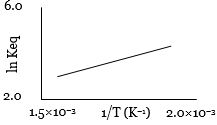
$A$ schematic plot of $\ln K_{eq}$ versus inverse of temperature $(1/T)$ for a reaction is shown below. The reaction must be
A
Exothermic
B
Endothermic
C
One with negligible enthalpy change
D
Highly spontaneous at ordinary temperature
Solution
(A) According to the van't Hoff equation: $\ln K_{eq} = -\frac{\Delta H^{\circ}}{R} (\frac{1}{T}) + \frac{\Delta S^{\circ}}{R}$.
Comparing this with the equation of a straight line $y = mx + c$,where $y = \ln K_{eq}$ and $x = 1/T$,the slope of the line is $m = -\frac{\Delta H^{\circ}}{R}$.
From the given graph,the slope of the line is positive (as $\ln K_{eq}$ increases with $1/T$).
Since $R$ is a positive constant,for the slope to be positive,$\Delta H^{\circ}$ must be negative.
$A$ negative value of $\Delta H^{\circ}$ indicates that the reaction is exothermic.
Comparing this with the equation of a straight line $y = mx + c$,where $y = \ln K_{eq}$ and $x = 1/T$,the slope of the line is $m = -\frac{\Delta H^{\circ}}{R}$.
From the given graph,the slope of the line is positive (as $\ln K_{eq}$ increases with $1/T$).
Since $R$ is a positive constant,for the slope to be positive,$\Delta H^{\circ}$ must be negative.
$A$ negative value of $\Delta H^{\circ}$ indicates that the reaction is exothermic.
0 likesView Solution
23
ChemistryDifficultMCQAIEEE · 2005
If the bond dissociation energies of $XY$,$X_2$,and $Y_2$ (all diatomic molecules) are in the ratio of $1 : 1 : 0.5$ and $\Delta_f H$ for the formation of $XY$ is $-200 \ kJ \ mol^{-1}$,the bond dissociation energy of $X_2$ will be in $kJ \ mol^{-1}$:
A
$100$
B
$800$
C
$300$
D
$400$
Solution
(B) The formation reaction of $XY$ is: $\frac{1}{2}X_2(g) + \frac{1}{2}Y_2(g) \rightarrow XY(g)$; $\Delta_f H = -200 \ kJ \ mol^{-1}$.
Let the bond dissociation energies be $E(XY) = a$,$E(X_2) = a$,and $E(Y_2) = 0.5a$.
The enthalpy of reaction is given by: $\Delta_f H = \sum \text{Bond Energy of Reactants} - \sum \text{Bond Energy of Products}$.
$\Delta_f H = [\frac{1}{2}E(X_2) + \frac{1}{2}E(Y_2)] - E(XY)$.
Substituting the values: $-200 = [\frac{1}{2}(a) + \frac{1}{2}(0.5a)] - a$.
$-200 = 0.5a + 0.25a - a$.
$-200 = -0.25a$.
$a = \frac{200}{0.25} = 800 \ kJ \ mol^{-1}$.
Let the bond dissociation energies be $E(XY) = a$,$E(X_2) = a$,and $E(Y_2) = 0.5a$.
The enthalpy of reaction is given by: $\Delta_f H = \sum \text{Bond Energy of Reactants} - \sum \text{Bond Energy of Products}$.
$\Delta_f H = [\frac{1}{2}E(X_2) + \frac{1}{2}E(Y_2)] - E(XY)$.
Substituting the values: $-200 = [\frac{1}{2}(a) + \frac{1}{2}(0.5a)] - a$.
$-200 = 0.5a + 0.25a - a$.
$-200 = -0.25a$.
$a = \frac{200}{0.25} = 800 \ kJ \ mol^{-1}$.
0 likesView Solution
24
ChemistryMediumMCQAIEEE · 2005
The oxidation state of chromium in the final product formed by the reaction between $KI$ and acidified potassium dichromate solution is
A
$+4$
B
$+6$
C
$+2$
D
$+3$
Solution
(D) The reaction between potassium dichromate $(K_2Cr_2O_7)$ and potassium iodide $(KI)$ in an acidic medium is given by:
$K_2Cr_2O_7 + 6KI + 7H_2SO_4 \to 4K_2SO_4 + Cr_2(SO_4)_3 + 7H_2O + 3I_2$
In the product $Cr_2(SO_4)_3$,the chromium exists as $Cr^{3+}$ ions.
Therefore,the oxidation state of chromium in the final product is $+3$.
$K_2Cr_2O_7 + 6KI + 7H_2SO_4 \to 4K_2SO_4 + Cr_2(SO_4)_3 + 7H_2O + 3I_2$
In the product $Cr_2(SO_4)_3$,the chromium exists as $Cr^{3+}$ ions.
Therefore,the oxidation state of chromium in the final product is $+3$.
0 likesView Solution
25
ChemistryMediumMCQAIEEE · 2005
Which of the following oxides is amphoteric in character?
A
$CaO$
B
$CO_2$
C
$SiO_2$
D
$SnO_2$
Solution
(D) $CaO$ is a basic oxide because it reacts with acids to form salt and water.
$CO_2$ is an acidic oxide as it reacts with bases to form carbonates.
$SiO_2$ is a weakly acidic oxide.
$SnO_2$ is an amphoteric oxide,meaning it can react with both acids and bases.
$CO_2$ is an acidic oxide as it reacts with bases to form carbonates.
$SiO_2$ is a weakly acidic oxide.
$SnO_2$ is an amphoteric oxide,meaning it can react with both acids and bases.
0 likesView Solution
26
ChemistryMediumMCQAIEEE · 2005
In which of the following arrangements is the order $NOT$ according to the property indicated against it?
A
$A$. $Al^{3+} < Mg^{2+} < Na^{+} < F^{-}$ : Increasing ionic size
B
$B$. $B < C < N < O$ : Increasing first ionization enthalpy
C
$C$. $I < Br < F < Cl$ : Increasing electron gain enthalpy (with negative sign)
D
$D$. $Li < Na < K < Rb$ : Increasing metallic radius
Solution
(B) The correct answer is $B$.
In the periodic table,the first ionization enthalpy generally increases from left to right across a period.
However,due to the stable half-filled $2p^3$ configuration of Nitrogen $(N)$,its first ionization enthalpy is higher than that of Oxygen $(O)$.
Therefore,the correct order is $B < C < O < N$,making the given order $B < C < N < O$ incorrect.
In the periodic table,the first ionization enthalpy generally increases from left to right across a period.
However,due to the stable half-filled $2p^3$ configuration of Nitrogen $(N)$,its first ionization enthalpy is higher than that of Oxygen $(O)$.
Therefore,the correct order is $B < C < O < N$,making the given order $B < C < N < O$ incorrect.
0 likesView Solution
27
ChemistryMCQAIEEE · 2005
Based on lattice energy and other considerations,which one of the following alkali metal chlorides is expected to have the highest melting point?
A
$LiCl$
B
$NaCl$
C
$KCl$
D
$RbCl$
Solution
(B) The melting point of alkali metal halides is primarily determined by their lattice energy and the nature of the bond (ionic vs covalent).
$LiCl$ has high lattice energy but exhibits significant covalent character due to the small size of the $Li^+$ ion (Fajans' rule),which lowers its melting point.
$NaCl$ is predominantly ionic and possesses a very high lattice energy,making it the alkali metal chloride with the highest melting point among the given options.
As we move down the group from $Na$ to $Rb$,the size of the alkali metal cation increases,which leads to a decrease in lattice energy and consequently a decrease in the melting point.
Therefore,$NaCl$ has the highest melting point.
$LiCl$ has high lattice energy but exhibits significant covalent character due to the small size of the $Li^+$ ion (Fajans' rule),which lowers its melting point.
$NaCl$ is predominantly ionic and possesses a very high lattice energy,making it the alkali metal chloride with the highest melting point among the given options.
As we move down the group from $Na$ to $Rb$,the size of the alkali metal cation increases,which leads to a decrease in lattice energy and consequently a decrease in the melting point.
Therefore,$NaCl$ has the highest melting point.
0 likesView Solution
28
ChemistryEasyMCQAIEEE · 2005
Heating an aqueous solution of aluminium chloride to dryness will give
A
$AlCl_3$
B
$Al_2Cl_6$
C
$Al_2O_3$
D
$Al(OH)Cl_2$
Solution
(C) An aqueous solution of $AlCl_3$ undergoes hydrolysis to form $Al(OH)_3$ and $HCl$ as follows:
$AlCl_3 + 3H_2O \rightarrow Al(OH)_3 + 3HCl$
Upon heating the solution to dryness,the volatile $HCl$ gas escapes.
The remaining $Al(OH)_3$ is thermally unstable and decomposes to form aluminium oxide $(Al_2O_3)$ and water vapor:
$2Al(OH)_3 \rightarrow Al_2O_3 + 3H_2O$
Therefore,the final product obtained is $Al_2O_3$.
$AlCl_3 + 3H_2O \rightarrow Al(OH)_3 + 3HCl$
Upon heating the solution to dryness,the volatile $HCl$ gas escapes.
The remaining $Al(OH)_3$ is thermally unstable and decomposes to form aluminium oxide $(Al_2O_3)$ and water vapor:
$2Al(OH)_3 \rightarrow Al_2O_3 + 3H_2O$
Therefore,the final product obtained is $Al_2O_3$.
0 likesView Solution
29
ChemistryMediumMCQAIEEE · 2005
The structure of diborane $(B_2H_6)$ contains
A
Four $2c-2e$ bonds and two $3c-2e$ bonds
B
Two $2c-2e$ bonds and four $3c-2e$ bonds
C
Two $2c-2e$ bonds and two $3c-3e$ bonds
D
Four $2c-2e$ bonds and four $3c-2e$ bonds
Solution
(A) In diborane $(B_2H_6)$,there are four terminal $B-H$ bonds which are regular two-center two-electron $(2c-2e)$ bonds.
There are also two bridging $B-H-B$ bonds,known as banana bonds,which are three-center two-electron $(3c-2e)$ bonds.
There are also two bridging $B-H-B$ bonds,known as banana bonds,which are three-center two-electron $(3c-2e)$ bonds.
0 likesView Solution
30
ChemistryMediumMCQAIEEE · 2005
In silicon dioxide $(SiO_2)$,what is the structural arrangement of atoms?
A
Each silicon atom is surrounded by four oxygen atoms and each oxygen atom is bonded to two silicon atoms.
B
Each silicon atom is surrounded by two oxygen atoms and each oxygen atom is bonded to two silicon atoms.
C
Each silicon atom is bonded to two oxygen atoms.
D
There are double bonds between silicon and oxygen atoms.
Solution
(A) In the structure of silicon dioxide $(SiO_2)$,each $Si$ atom is $sp^3$ hybridized and is tetrahedrally bonded to four oxygen atoms. Each oxygen atom is shared between two silicon atoms,forming a three-dimensional network structure. Thus,the correct statement is that each silicon atom is surrounded by four oxygen atoms and each oxygen atom is bonded to two silicon atoms.
0 likesView Solution
31
ChemistryMediumMCQAIEEE · 2005
An organic compound having molecular mass $60$ is found to contain $C = 20\%$,$H = 6.67\%$,and $N = 46.67\%$,while the rest is oxygen. On heating,it gives $NH_3$ along with a solid residue. The solid residue gives a violet color with alkaline copper sulphate solution. The compound is:
A
$CH_3NCO$
B
$CH_3CONH_2$
C
$(NH_2)_2CO$
D
$CH_3CH_2CONH_2$
Solution
(C) The percentage of oxygen is $100 - (20 + 6.67 + 46.67) = 26.66\%$.
The ratio of the number of gram atoms among $C$,$H$,$N$,and $O$ is:
$C : H : N : O = \frac{20}{12} : \frac{6.67}{1} : \frac{46.67}{14} : \frac{26.66}{16} = 1.66 : 6.67 : 3.33 : 1.66$.
Dividing by the smallest value $(1.66)$:
$C : H : N : O = 1 : 4 : 2 : 1$.
The empirical formula is $CH_4N_2O$.
The empirical formula weight is $12 + 4 + 28 + 16 = 60 \ g/mol$.
Since the molecular mass is $60$,the molecular formula is also $CH_4N_2O$,which is urea,$(NH_2)_2CO$.
Urea on heating gives biuret as a solid residue,which gives a violet color with alkaline copper sulphate (biuret test).
The ratio of the number of gram atoms among $C$,$H$,$N$,and $O$ is:
$C : H : N : O = \frac{20}{12} : \frac{6.67}{1} : \frac{46.67}{14} : \frac{26.66}{16} = 1.66 : 6.67 : 3.33 : 1.66$.
Dividing by the smallest value $(1.66)$:
$C : H : N : O = 1 : 4 : 2 : 1$.
The empirical formula is $CH_4N_2O$.
The empirical formula weight is $12 + 4 + 28 + 16 = 60 \ g/mol$.
Since the molecular mass is $60$,the molecular formula is also $CH_4N_2O$,which is urea,$(NH_2)_2CO$.
Urea on heating gives biuret as a solid residue,which gives a violet color with alkaline copper sulphate (biuret test).
0 likesView Solution
32
ChemistryMediumMCQAIEEE · 2005
$2-$Methylbutane on reacting with bromine in the presence of sunlight gives mainly:
A
$1-$bromo$-2-$methylbutane
B
$2-$bromo$-2-$methylbutane
C
$2-$bromo$-3-$methylbutane
D
$1-$bromo$-3-$methylbutane
Solution
(B) The reaction of alkanes with bromine in the presence of sunlight (or $UV$ light) proceeds via a free radical mechanism.
Bromination is highly selective compared to chlorination.
The reactivity order of hydrogen atoms towards free radical substitution is $3^\circ > 2^\circ > 1^\circ$.
In $2-$methylbutane $(CH_3-CH(CH_3)-CH_2-CH_3)$,the hydrogen atom on the $C-2$ carbon is a tertiary $(3^\circ)$ hydrogen.
Therefore,the abstraction of the $3^\circ$ hydrogen is the fastest,leading to the formation of the most stable tertiary free radical.
Consequently,the major product is $2-$bromo$-2-$methylbutane: $CH_3-C(Br)(CH_3)-CH_2-CH_3$.
Bromination is highly selective compared to chlorination.
The reactivity order of hydrogen atoms towards free radical substitution is $3^\circ > 2^\circ > 1^\circ$.
In $2-$methylbutane $(CH_3-CH(CH_3)-CH_2-CH_3)$,the hydrogen atom on the $C-2$ carbon is a tertiary $(3^\circ)$ hydrogen.
Therefore,the abstraction of the $3^\circ$ hydrogen is the fastest,leading to the formation of the most stable tertiary free radical.
Consequently,the major product is $2-$bromo$-2-$methylbutane: $CH_3-C(Br)(CH_3)-CH_2-CH_3$.
0 likesView Solution
33
ChemistryMediumMCQAIEEE · 2005
Of the $5$ isomeric hexanes,the isomer which can give $2$ monochlorinated compounds is
A
$n$-hexane
B
$2,3$-dimethylbutane
C
$2,2$-dimethylbutane
D
$2$-methylpentane
Solution
(B) $2,3$-dimethylbutane has the structure $CH_3-CH(CH_3)-CH(CH_3)-CH_3$.
It contains $2$ types of equivalent hydrogen atoms: $12$ primary hydrogens (on the four $-CH_3$ groups) and $2$ tertiary hydrogens (on the two $-CH$ groups).
Therefore,it can form only $2$ monochlorinated isomers.
It contains $2$ types of equivalent hydrogen atoms: $12$ primary hydrogens (on the four $-CH_3$ groups) and $2$ tertiary hydrogens (on the two $-CH$ groups).
Therefore,it can form only $2$ monochlorinated isomers.
0 likesView Solution
34
ChemistryMediumMCQAIEEE · 2005
Reaction of one molecule of $HBr$ with one molecule of $1,3-$butadiene at $40\,^{\circ}C$ gives predominantly
A
$3-$bromobutene under kinetically controlled conditions
B
$1-$bromo$-2-$butene under thermodynamically controlled conditions
C
$3-$bromobutene under thermodynamically controlled conditions
D
$1-$bromo$-2-$butene under kinetically controlled conditions
Solution
(B) The reaction of $1,3-$butadiene with $HBr$ produces two isomers: $3-$bromobutene ($1,2-$addition product) and $1-$bromo$-2-$butene ($1,4-$addition product).
At low temperatures (e.g.,$-80\,^{\circ}C$),the reaction is kinetically controlled,favoring the $1,2-$addition product ($3-$bromobutene) due to the proximity of the intermediate carbocation.
At higher temperatures (e.g.,$40\,^{\circ}C$),the reaction is thermodynamically controlled,favoring the more stable $1,4-$addition product ($1-$bromo$-2-$butene) because the double bond in the $1,4-$product is more substituted and thus more stable.
Therefore,at $40\,^{\circ}C$,$1-$bromo$-2-$butene is the major product.
At low temperatures (e.g.,$-80\,^{\circ}C$),the reaction is kinetically controlled,favoring the $1,2-$addition product ($3-$bromobutene) due to the proximity of the intermediate carbocation.
At higher temperatures (e.g.,$40\,^{\circ}C$),the reaction is thermodynamically controlled,favoring the more stable $1,4-$addition product ($1-$bromo$-2-$butene) because the double bond in the $1,4-$product is more substituted and thus more stable.
Therefore,at $40\,^{\circ}C$,$1-$bromo$-2-$butene is the major product.
0 likesView Solution
35
ChemistryMediumMCQAIEEE · 2005
Acid-catalyzed hydration of alkenes,except ethene,leads to the formation of:
A
Primary alcohol
B
Secondary or tertiary alcohol
C
Mixture of primary and secondary alcohols
D
Mixture of secondary and tertiary alcohols
Solution
(B) Acid-catalyzed hydration of alkenes follows Markovnikov's rule,where the $-OH$ group adds to the more substituted carbon atom of the $C=C$ double bond.
For ethene $(CH_2=CH_2)$,hydration yields primary alcohol (ethanol).
For other alkenes (e.g.,prop$-1-$ene,$2$-methylprop$-1-$ene),the addition of water results in the formation of secondary or tertiary alcohols,as shown in the reaction schemes:
$1$. Prop$-1-$ene $(CH_3-CH=CH_2)$ $\xrightarrow{H_2O/H^+}$ Propan$-2-$ol (Secondary alcohol).
$2$. $2-$Methylprop$-1-$ene $((CH_3)_2C=CH_2)$ $\xrightarrow{H_2O/H^+}$ $2-$Methylpropan$-2-$ol (Tertiary alcohol).
For ethene $(CH_2=CH_2)$,hydration yields primary alcohol (ethanol).
For other alkenes (e.g.,prop$-1-$ene,$2$-methylprop$-1-$ene),the addition of water results in the formation of secondary or tertiary alcohols,as shown in the reaction schemes:
$1$. Prop$-1-$ene $(CH_3-CH=CH_2)$ $\xrightarrow{H_2O/H^+}$ Propan$-2-$ol (Secondary alcohol).
$2$. $2-$Methylprop$-1-$ene $((CH_3)_2C=CH_2)$ $\xrightarrow{H_2O/H^+}$ $2-$Methylpropan$-2-$ol (Tertiary alcohol).
0 likesView Solution
36
ChemistryMCQAIEEE · 2005
If $A = \begin{bmatrix} 1 & 0 \\ 1 & 1 \end{bmatrix}$ and $I = \begin{bmatrix} 1 & 0 \\ 0 & 1 \end{bmatrix}$,then which one of the following holds for all $n \ge 1$ (by the principle of mathematical induction)?
A
$A^n = nA + (n - 1)I$
B
$A^n = 2^{n - 1}A + (n - 1)I$
C
$A^n = nA - (n - 1)I$
D
$A^n = 2^{n - 1}A - (n - 1)I$
Solution
(C) First,calculate the powers of $A$:
$A^2 = \begin{bmatrix} 1 & 0 \\ 1 & 1 \end{bmatrix} \begin{bmatrix} 1 & 0 \\ 1 & 1 \end{bmatrix} = \begin{bmatrix} 1 & 0 \\ 2 & 1 \end{bmatrix}$
$A^3 = \begin{bmatrix} 1 & 0 \\ 2 & 1 \end{bmatrix} \begin{bmatrix} 1 & 0 \\ 1 & 1 \end{bmatrix} = \begin{bmatrix} 1 & 0 \\ 3 & 1 \end{bmatrix}$
By induction,we can observe that $A^n = \begin{bmatrix} 1 & 0 \\ n & 1 \end{bmatrix}$.
Now,evaluate the expression in option $C$:
$nA = n \begin{bmatrix} 1 & 0 \\ 1 & 1 \end{bmatrix} = \begin{bmatrix} n & 0 \\ n & n \end{bmatrix}$
$(n - 1)I = (n - 1) \begin{bmatrix} 1 & 0 \\ 0 & 1 \end{bmatrix} = \begin{bmatrix} n - 1 & 0 \\ 0 & n - 1 \end{bmatrix}$
$nA - (n - 1)I = \begin{bmatrix} n - (n - 1) & 0 - 0 \\ n - 0 & n - (n - 1) \end{bmatrix} = \begin{bmatrix} 1 & 0 \\ n & 1 \end{bmatrix} = A^n$.
Thus,the correct relation is $A^n = nA - (n - 1)I$.
$A^2 = \begin{bmatrix} 1 & 0 \\ 1 & 1 \end{bmatrix} \begin{bmatrix} 1 & 0 \\ 1 & 1 \end{bmatrix} = \begin{bmatrix} 1 & 0 \\ 2 & 1 \end{bmatrix}$
$A^3 = \begin{bmatrix} 1 & 0 \\ 2 & 1 \end{bmatrix} \begin{bmatrix} 1 & 0 \\ 1 & 1 \end{bmatrix} = \begin{bmatrix} 1 & 0 \\ 3 & 1 \end{bmatrix}$
By induction,we can observe that $A^n = \begin{bmatrix} 1 & 0 \\ n & 1 \end{bmatrix}$.
Now,evaluate the expression in option $C$:
$nA = n \begin{bmatrix} 1 & 0 \\ 1 & 1 \end{bmatrix} = \begin{bmatrix} n & 0 \\ n & n \end{bmatrix}$
$(n - 1)I = (n - 1) \begin{bmatrix} 1 & 0 \\ 0 & 1 \end{bmatrix} = \begin{bmatrix} n - 1 & 0 \\ 0 & n - 1 \end{bmatrix}$
$nA - (n - 1)I = \begin{bmatrix} n - (n - 1) & 0 - 0 \\ n - 0 & n - (n - 1) \end{bmatrix} = \begin{bmatrix} 1 & 0 \\ n & 1 \end{bmatrix} = A^n$.
Thus,the correct relation is $A^n = nA - (n - 1)I$.
0 likesView Solution
37
ChemistryMCQAIEEE · 2005
Three houses are available in a locality. Three persons apply for the houses. Each applies for one house without consulting others. The probability that all the three apply for the same house is
A
$\frac{8}{9}$
B
$\frac{7}{9}$
C
$\frac{2}{9}$
D
$\frac{1}{9}$
Solution
(D) There are $3$ houses and $3$ persons. Each person can choose any of the $3$ houses independently.
Total number of ways for $3$ persons to choose houses $= 3 \times 3 \times 3 = 27$.
For all $3$ persons to apply for the same house,they must all choose house $1$,or all choose house $2$,or all choose house $3$.
Number of favorable outcomes $= 3$ (i.e.,{House $1, 1, 1$},{House $2, 2, 2$},{House $3, 3, 3$}).
Probability $= \frac{\text{Favorable outcomes}}{\text{Total outcomes}} = \frac{3}{27} = \frac{1}{9}$.
Total number of ways for $3$ persons to choose houses $= 3 \times 3 \times 3 = 27$.
For all $3$ persons to apply for the same house,they must all choose house $1$,or all choose house $2$,or all choose house $3$.
Number of favorable outcomes $= 3$ (i.e.,{House $1, 1, 1$},{House $2, 2, 2$},{House $3, 3, 3$}).
Probability $= \frac{\text{Favorable outcomes}}{\text{Total outcomes}} = \frac{3}{27} = \frac{1}{9}$.
0 likesView Solution
38
ChemistryMCQAIEEE · 2005
What is the conjugate base of $OH^{-}$?
A
$H_2O$
B
$O_2$
C
$O^{2-}$
D
$O^{-}$
Solution
(C) The conjugate base of a species is formed by the removal of a proton $(H^+)$ from it.
For the species $OH^-$,removing one proton $(H^+)$ results in the formation of the oxide ion $(O^{2-})$.
The reaction is: $OH^{-} \rightarrow O^{2-} + H^{+}$.
Therefore,the conjugate base of $OH^{-}$ is $O^{2-}$.
For the species $OH^-$,removing one proton $(H^+)$ results in the formation of the oxide ion $(O^{2-})$.
The reaction is: $OH^{-} \rightarrow O^{2-} + H^{+}$.
Therefore,the conjugate base of $OH^{-}$ is $O^{2-}$.
0 likesView Solution
39
ChemistryMCQAIEEE · 2005
In a potentiometer experiment,the balancing length for a cell is $240 \ cm$. When a resistance of $2 \ \Omega$ is connected in parallel with the cell,the balancing length becomes $120 \ cm$. The internal resistance of the cell is ................. $\Omega$.
A
$1$
B
$0.5$
C
$4$
D
$2$
Solution
(D) The balancing length for the cell is $\ell_0 = 240 \ cm$.
When a resistance $R = 2 \ \Omega$ is connected in parallel,the balancing length is $\ell_C = 120 \ cm$.
The formula for the internal resistance $r$ of a cell using a potentiometer is given by $r = R \left( \frac{\ell_0 - \ell_C}{\ell_C} \right)$.
Substituting the given values:
$r = 2 \left( \frac{240 - 120}{120} \right) \ \Omega$.
$r = 2 \left( \frac{120}{120} \right) \ \Omega$.
$r = 2 \times 1 \ \Omega = 2 \ \Omega$.
Therefore,the internal resistance of the cell is $2 \ \Omega$.
When a resistance $R = 2 \ \Omega$ is connected in parallel,the balancing length is $\ell_C = 120 \ cm$.
The formula for the internal resistance $r$ of a cell using a potentiometer is given by $r = R \left( \frac{\ell_0 - \ell_C}{\ell_C} \right)$.
Substituting the given values:
$r = 2 \left( \frac{240 - 120}{120} \right) \ \Omega$.
$r = 2 \left( \frac{120}{120} \right) \ \Omega$.
$r = 2 \times 1 \ \Omega = 2 \ \Omega$.
Therefore,the internal resistance of the cell is $2 \ \Omega$.
0 likesView Solution
40
ChemistryMCQAIEEE · 2005
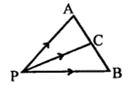
If $C$ is the midpoint of $AB$ and $P$ is any point outside $AB$,then:
A
$\vec{PA} + \vec{PB} = 2\vec{PC}$
B
$\vec{PA} + \vec{PB} = \vec{PC}$
C
$\vec{PA} + \vec{PB} + 2\vec{PC} = \vec{0}$
D
$\vec{PA} + \vec{PB} + \vec{PC} = \vec{0}$
Solution
(A) Given that $C$ is the midpoint of $AB$,we have $\vec{AC} + \vec{CB} = \vec{0}$,which implies $\vec{AC} = -\vec{CB}$.
Using the triangle law of vector addition:
$\vec{PA} = \vec{PC} + \vec{CA}$
$\vec{PB} = \vec{PC} + \vec{CB}$
Adding these two equations:
$\vec{PA} + \vec{PB} = (\vec{PC} + \vec{CA}) + (\vec{PC} + \vec{CB})$
$\vec{PA} + \vec{PB} = 2\vec{PC} + (\vec{CA} + \vec{CB})$
Since $\vec{CA} = -\vec{AC}$ and $\vec{CB} = -\vec{AC}$ (because $C$ is the midpoint),we have $\vec{CA} + \vec{CB} = \vec{0}$.
Therefore,$\vec{PA} + \vec{PB} = 2\vec{PC}$.
Using the triangle law of vector addition:
$\vec{PA} = \vec{PC} + \vec{CA}$
$\vec{PB} = \vec{PC} + \vec{CB}$
Adding these two equations:
$\vec{PA} + \vec{PB} = (\vec{PC} + \vec{CA}) + (\vec{PC} + \vec{CB})$
$\vec{PA} + \vec{PB} = 2\vec{PC} + (\vec{CA} + \vec{CB})$
Since $\vec{CA} = -\vec{AC}$ and $\vec{CB} = -\vec{AC}$ (because $C$ is the midpoint),we have $\vec{CA} + \vec{CB} = \vec{0}$.
Therefore,$\vec{PA} + \vec{PB} = 2\vec{PC}$.
0 likesView Solution
41
ChemistryMCQAIEEE · 2005
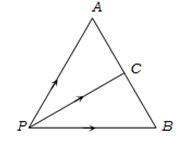
If $C$ is the midpoint of $AB$ and $P$ is any point outside $AB$,then:
A
$\overrightarrow{PA} + \overrightarrow{PB} = \overrightarrow{PC}$
B
$\overrightarrow{PA} + \overrightarrow{PB} = 2\overrightarrow{PC}$
C
$\overrightarrow{PA} + \overrightarrow{PB} + \overrightarrow{PC} = 0$
D
$\overrightarrow{PA} + \overrightarrow{PB} + 2\overrightarrow{PC} = 0$
Solution
(B) Since $C$ is the midpoint of $AB$,we have $\overrightarrow{AC} + \overrightarrow{BC} = 0$,which implies $\overrightarrow{AC} = -\overrightarrow{BC}$ or $\overrightarrow{AC} = \overrightarrow{CB}$.
Using the triangle law of vector addition in $\triangle PAC$ and $\triangle PBC$:
$\overrightarrow{PA} = \overrightarrow{PC} + \overrightarrow{CA}$
$\overrightarrow{PB} = \overrightarrow{PC} + \overrightarrow{CB}$
Adding these two equations:
$\overrightarrow{PA} + \overrightarrow{PB} = (\overrightarrow{PC} + \overrightarrow{CA}) + (\overrightarrow{PC} + \overrightarrow{CB})$
$\overrightarrow{PA} + \overrightarrow{PB} = 2\overrightarrow{PC} + (\overrightarrow{CA} + \overrightarrow{CB})$
Since $C$ is the midpoint of $AB$,$\overrightarrow{CA} = -\overrightarrow{CB}$,so $\overrightarrow{CA} + \overrightarrow{CB} = 0$.
Therefore,$\overrightarrow{PA} + \overrightarrow{PB} = 2\overrightarrow{PC}$.
Using the triangle law of vector addition in $\triangle PAC$ and $\triangle PBC$:
$\overrightarrow{PA} = \overrightarrow{PC} + \overrightarrow{CA}$
$\overrightarrow{PB} = \overrightarrow{PC} + \overrightarrow{CB}$
Adding these two equations:
$\overrightarrow{PA} + \overrightarrow{PB} = (\overrightarrow{PC} + \overrightarrow{CA}) + (\overrightarrow{PC} + \overrightarrow{CB})$
$\overrightarrow{PA} + \overrightarrow{PB} = 2\overrightarrow{PC} + (\overrightarrow{CA} + \overrightarrow{CB})$
Since $C$ is the midpoint of $AB$,$\overrightarrow{CA} = -\overrightarrow{CB}$,so $\overrightarrow{CA} + \overrightarrow{CB} = 0$.
Therefore,$\overrightarrow{PA} + \overrightarrow{PB} = 2\overrightarrow{PC}$.
0 likesView Solution
42
ChemistryMCQAIEEE · 2005
Which of the following is a polyamide?
A
Bakelite
B
Terylene
C
Nylon-$66$
D
Teflon
Solution
(C) Nylon-$66$ is a polyamide because it contains amide linkages $(-CONH-)$ in its polymer chain.
0 likesView Solution
43
ChemistryMCQAIEEE · 2005
Which of the following is a polyamide?
A
Nylon-$6,6$
B
Teflon
C
Terylene
D
Bakelite
Solution
(A) Polyamides are polymers containing amide linkages $(-CONH-)$ in their backbone.
Nylon-$6,6$ is a condensation polymer formed by the reaction of hexamethylenediamine and adipic acid,which contains amide bonds.
Teflon is a polyfluoroethylene (addition polymer).
Terylene is a polyester (contains ester linkages).
Bakelite is a phenol-formaldehyde resin (cross-linked polymer).
Therefore,the correct answer is Nylon-$6,6$.
Nylon-$6,6$ is a condensation polymer formed by the reaction of hexamethylenediamine and adipic acid,which contains amide bonds.
Teflon is a polyfluoroethylene (addition polymer).
Terylene is a polyester (contains ester linkages).
Bakelite is a phenol-formaldehyde resin (cross-linked polymer).
Therefore,the correct answer is Nylon-$6,6$.
0 likesView Solution
44
ChemistryMCQAIEEE · 2005
The angle between the lines $2x = 3y = -z$ and $6x = -y = -4z$ is ......... $^o$.
A
$0$
B
$90$
C
$45$
D
$30$
Solution
(B) First,express the lines in standard symmetric form $\frac{x-x_1}{a} = \frac{y-y_1}{b} = \frac{z-z_1}{c}$.
For the first line $2x = 3y = -z$,divide by $6$ to get $\frac{x}{3} = \frac{y}{2} = \frac{z}{-6}$. The direction ratios are $\vec{v_1} = (3, 2, -6)$.
For the second line $6x = -y = -4z$,divide by $12$ to get $\frac{x}{2} = \frac{y}{-12} = \frac{z}{-3}$. The direction ratios are $\vec{v_2} = (2, -12, -3)$.
The angle $\theta$ between the lines is given by $\cos \theta = \frac{|a_1a_2 + b_1b_2 + c_1c_2|}{\sqrt{a_1^2+b_1^2+c_1^2} \sqrt{a_2^2+b_2^2+c_2^2}}$.
Calculate the dot product: $a_1a_2 + b_1b_2 + c_1c_2 = (3)(2) + (2)(-12) + (-6)(-3) = 6 - 24 + 18 = 0$.
Since the dot product is $0$,the lines are perpendicular,so $\theta = 90^o$.
For the first line $2x = 3y = -z$,divide by $6$ to get $\frac{x}{3} = \frac{y}{2} = \frac{z}{-6}$. The direction ratios are $\vec{v_1} = (3, 2, -6)$.
For the second line $6x = -y = -4z$,divide by $12$ to get $\frac{x}{2} = \frac{y}{-12} = \frac{z}{-3}$. The direction ratios are $\vec{v_2} = (2, -12, -3)$.
The angle $\theta$ between the lines is given by $\cos \theta = \frac{|a_1a_2 + b_1b_2 + c_1c_2|}{\sqrt{a_1^2+b_1^2+c_1^2} \sqrt{a_2^2+b_2^2+c_2^2}}$.
Calculate the dot product: $a_1a_2 + b_1b_2 + c_1c_2 = (3)(2) + (2)(-12) + (-6)(-3) = 6 - 24 + 18 = 0$.
Since the dot product is $0$,the lines are perpendicular,so $\theta = 90^o$.
0 likesView Solution
45
ChemistryMCQAIEEE · 2005
If the pair of lines $ax^2 + 2(a + b)xy + by^2 = 0$ represent the diameters of a circle and divide the circle into four sectors such that the area of one sector is three times the area of the other,then:
A
$3a^2 - 10ab + 3b^2 = 0$
B
$3a^2 - 2ab + 3b^2 = 0$
C
$3a^2 + 10ab + 3b^2 = 0$
D
$3a^2 + 2ab + 3b^2 = 0$
Solution
(D) Let the angle between the two lines be $\theta$. The lines divide the circle into four sectors with angles $\theta$ and $\pi - \theta$.
Given that the area of one sector is three times the area of the other,we have $\pi - \theta = 3\theta$,which implies $4\theta = \pi$,so $\theta = \frac{\pi}{4} = 45^\circ$.
The angle $\theta$ between the lines $ax^2 + 2hxy + by^2 = 0$ is given by $\tan \theta = \left| \frac{2\sqrt{h^2 - ab}}{a + b} \right|$.
Here,$h = a + b$,so $\tan 45^\circ = \left| \frac{2\sqrt{(a + b)^2 - ab}}{a + b} \right|$.
$1 = \frac{2\sqrt{a^2 + 2ab + b^2 - ab}}{a + b} = \frac{2\sqrt{a^2 + ab + b^2}}{a + b}$.
Squaring both sides: $(a + b)^2 = 4(a^2 + ab + b^2)$.
$a^2 + 2ab + b^2 = 4a^2 + 4ab + 4b^2$.
$3a^2 + 2ab + 3b^2 = 0$.
Given that the area of one sector is three times the area of the other,we have $\pi - \theta = 3\theta$,which implies $4\theta = \pi$,so $\theta = \frac{\pi}{4} = 45^\circ$.
The angle $\theta$ between the lines $ax^2 + 2hxy + by^2 = 0$ is given by $\tan \theta = \left| \frac{2\sqrt{h^2 - ab}}{a + b} \right|$.
Here,$h = a + b$,so $\tan 45^\circ = \left| \frac{2\sqrt{(a + b)^2 - ab}}{a + b} \right|$.
$1 = \frac{2\sqrt{a^2 + 2ab + b^2 - ab}}{a + b} = \frac{2\sqrt{a^2 + ab + b^2}}{a + b}$.
Squaring both sides: $(a + b)^2 = 4(a^2 + ab + b^2)$.
$a^2 + 2ab + b^2 = 4a^2 + 4ab + 4b^2$.
$3a^2 + 2ab + 3b^2 = 0$.
0 likesView Solution
46
ChemistryDifficultMCQAIEEE · 2005
The decreasing order of nucleophilicity among the following nucleophiles is:
$(i) CH_3COO^-$
$(ii) CH_3O^-$
$(iii) CN^-$
$(iv) CH_3C_6H_4SO_3^-$
$(i) CH_3COO^-$
$(ii) CH_3O^-$
$(iii) CN^-$
$(iv) CH_3C_6H_4SO_3^-$
A
$(i) > (ii) > (iii) > (iv)$
B
$(iv) > (iii) > (ii) > (i)$
C
$(ii) > (iii) > (i) > (iv)$
D
$(iii) > (ii) > (i) > (iv)$
Solution
(C) Nucleophilicity depends on the availability of the lone pair and the stability of the negative charge.
$1$. $CH_3O^-$ is a strong nucleophile because the negative charge is localized on the oxygen atom.
$2$. $CN^-$ is a strong nucleophile due to the high polarizability of the carbon atom.
$3$. $CH_3COO^-$ has the negative charge delocalized over two oxygen atoms via resonance,making it less nucleophilic than $CH_3O^-$.
$4$. $CH_3C_6H_4SO_3^-$ (tosylate ion) has the negative charge highly delocalized over three oxygen atoms,making it a very weak nucleophile.
Comparing these,the order is: $CH_3O^- > CN^- > CH_3COO^- > CH_3C_6H_4SO_3^-$.
Thus,the correct order is $(ii) > (iii) > (i) > (iv)$.
$1$. $CH_3O^-$ is a strong nucleophile because the negative charge is localized on the oxygen atom.
$2$. $CN^-$ is a strong nucleophile due to the high polarizability of the carbon atom.
$3$. $CH_3COO^-$ has the negative charge delocalized over two oxygen atoms via resonance,making it less nucleophilic than $CH_3O^-$.
$4$. $CH_3C_6H_4SO_3^-$ (tosylate ion) has the negative charge highly delocalized over three oxygen atoms,making it a very weak nucleophile.
Comparing these,the order is: $CH_3O^- > CN^- > CH_3COO^- > CH_3C_6H_4SO_3^-$.
Thus,the correct order is $(ii) > (iii) > (i) > (iv)$.
0 likesView Solution
47
ChemistryMediumMCQAIEEE · 2005
Which type of isomerism is shown by $2,3-$dichlorobutane?
A
Diastereomerism
B
Optical
C
Geometric
D
Structural
Solution
(B) $2,3-$dichlorobutane has two chiral carbon atoms at positions $2$ and $3$.
It exists in three stereoisomeric forms: a pair of enantiomers and a meso compound.
Since it exhibits enantiomerism and meso-form formation,it is a classic example of optical isomerism.
Therefore,the correct option is $B$.
It exists in three stereoisomeric forms: a pair of enantiomers and a meso compound.
Since it exhibits enantiomerism and meso-form formation,it is a classic example of optical isomerism.
Therefore,the correct option is $B$.
0 likesView Solution
48
ChemistryMCQAIEEE · 2005
$A$ gaseous mixture consists of $16 \ g$ of helium and $16 \ g$ of oxygen. The ratio $\frac{C_p}{C_v}$ of the mixture is
A
$1.59$
B
$1.62$
C
$1.4$
D
$1.54$
Solution
(B) Number of moles of Helium $(n_1)$ = $\frac{16 \ g}{4 \ g/mol} = 4 \ mol$. Helium is a monoatomic gas,so its degrees of freedom $f_1 = 3$.
Number of moles of Oxygen $(n_2)$ = $\frac{16 \ g}{32 \ g/mol} = 0.5 \ mol$. Oxygen is a diatomic gas,so its degrees of freedom $f_2 = 5$.
The molar heat capacity at constant volume for the mixture is $C_{v,mix} = \frac{n_1 C_{v1} + n_2 C_{v2}}{n_1 + n_2} = \frac{n_1 (\frac{f_1}{2}R) + n_2 (\frac{f_2}{2}R)}{n_1 + n_2}$.
The molar heat capacity at constant pressure for the mixture is $C_{p,mix} = \frac{n_1 C_{p1} + n_2 C_{p2}}{n_1 + n_2} = \frac{n_1 (\frac{f_1+2}{2}R) + n_2 (\frac{f_2+2}{2}R)}{n_1 + n_2}$.
Calculating $C_{v,mix} = \frac{4(\frac{3}{2}R) + 0.5(\frac{5}{2}R)}{4 + 0.5} = \frac{6R + 1.25R}{4.5} = \frac{7.25R}{4.5} = \frac{29R}{18}$.
Calculating $C_{p,mix} = \frac{4(\frac{5}{2}R) + 0.5(\frac{7}{2}R)}{4 + 0.5} = \frac{10R + 1.75R}{4.5} = \frac{11.75R}{4.5} = \frac{47R}{18}$.
The ratio $\gamma = \frac{C_{p,mix}}{C_{v,mix}} = \frac{47R/18}{29R/18} = \frac{47}{29} \approx 1.62$.
Number of moles of Oxygen $(n_2)$ = $\frac{16 \ g}{32 \ g/mol} = 0.5 \ mol$. Oxygen is a diatomic gas,so its degrees of freedom $f_2 = 5$.
The molar heat capacity at constant volume for the mixture is $C_{v,mix} = \frac{n_1 C_{v1} + n_2 C_{v2}}{n_1 + n_2} = \frac{n_1 (\frac{f_1}{2}R) + n_2 (\frac{f_2}{2}R)}{n_1 + n_2}$.
The molar heat capacity at constant pressure for the mixture is $C_{p,mix} = \frac{n_1 C_{p1} + n_2 C_{p2}}{n_1 + n_2} = \frac{n_1 (\frac{f_1+2}{2}R) + n_2 (\frac{f_2+2}{2}R)}{n_1 + n_2}$.
Calculating $C_{v,mix} = \frac{4(\frac{3}{2}R) + 0.5(\frac{5}{2}R)}{4 + 0.5} = \frac{6R + 1.25R}{4.5} = \frac{7.25R}{4.5} = \frac{29R}{18}$.
Calculating $C_{p,mix} = \frac{4(\frac{5}{2}R) + 0.5(\frac{7}{2}R)}{4 + 0.5} = \frac{10R + 1.75R}{4.5} = \frac{11.75R}{4.5} = \frac{47R}{18}$.
The ratio $\gamma = \frac{C_{p,mix}}{C_{v,mix}} = \frac{47R/18}{29R/18} = \frac{47}{29} \approx 1.62$.
0 likesView Solution
49
ChemistryMCQAIEEE · 2005
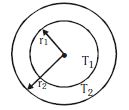
The figure shows a system of two concentric spheres of radii $r_1$ and $r_2$ kept at temperatures $T_1$ and $T_2$,respectively. The radial rate of flow of heat in a substance between the two concentric spheres is proportional to
A
$\frac{(r_2 - r_1)}{(r_1 r_2)}$
B
$\ln \left( \frac{r_2}{r_1} \right)$
C
$\frac{(r_1 r_2)}{(r_2 - r_1)}$
D
$(r_2 - r_1)$
Solution
(C) According to Fourier's law of heat conduction,the rate of heat flow $H$ through a spherical shell of radius $r$ and thickness $dr$ is given by $H = -k A \frac{dT}{dr}$,where $A = 4\pi r^2$ is the surface area.
Thus,$H = -k (4\pi r^2) \frac{dT}{dr}$.
Rearranging the terms,we get $\frac{H}{4\pi k} \frac{dr}{r^2} = -dT$.
Integrating both sides from $r_1$ to $r_2$ and $T_1$ to $T_2$:
$\frac{H}{4\pi k} \int_{r_1}^{r_2} \frac{dr}{r^2} = - \int_{T_1}^{T_2} dT$.
$\frac{H}{4\pi k} \left[ -\frac{1}{r} \right]_{r_1}^{r_2} = -(T_2 - T_1) = T_1 - T_2$.
$\frac{H}{4\pi k} \left( \frac{1}{r_1} - \frac{1}{r_2} \right) = T_1 - T_2$.
$\frac{H}{4\pi k} \left( \frac{r_2 - r_1}{r_1 r_2} \right) = T_1 - T_2$.
Therefore,$H = \frac{4\pi k (T_1 - T_2) r_1 r_2}{r_2 - r_1}$.
Since $H$ is proportional to the term $\frac{r_1 r_2}{r_2 - r_1}$,the correct option is $C$.
Thus,$H = -k (4\pi r^2) \frac{dT}{dr}$.
Rearranging the terms,we get $\frac{H}{4\pi k} \frac{dr}{r^2} = -dT$.
Integrating both sides from $r_1$ to $r_2$ and $T_1$ to $T_2$:
$\frac{H}{4\pi k} \int_{r_1}^{r_2} \frac{dr}{r^2} = - \int_{T_1}^{T_2} dT$.
$\frac{H}{4\pi k} \left[ -\frac{1}{r} \right]_{r_1}^{r_2} = -(T_2 - T_1) = T_1 - T_2$.
$\frac{H}{4\pi k} \left( \frac{1}{r_1} - \frac{1}{r_2} \right) = T_1 - T_2$.
$\frac{H}{4\pi k} \left( \frac{r_2 - r_1}{r_1 r_2} \right) = T_1 - T_2$.
Therefore,$H = \frac{4\pi k (T_1 - T_2) r_1 r_2}{r_2 - r_1}$.
Since $H$ is proportional to the term $\frac{r_1 r_2}{r_2 - r_1}$,the correct option is $C$.
0 likesView Solution
50
ChemistryMCQAIEEE · 2005
Let $f(x)$ be a non-negative continuous function such that the area bounded by the curve $y = f(x)$,$x$-axis and the ordinates $x = \frac{\pi}{4}$ and $x = \beta > \frac{\pi}{4}$ is $\left( \beta \sin \beta + \frac{\pi}{4} \cos \beta + \sqrt{2} \beta \right)$. Then $f\left( \frac{\pi}{2} \right)$ is
A
$\left( \frac{\pi}{4} + \sqrt{2} - 1 \right)$
B
$\left( \frac{\pi}{4} - \sqrt{2} + 1 \right)$
C
$\left( 1 - \frac{\pi}{4} - \sqrt{2} \right)$
D
$\left( 1 - \frac{\pi}{4} + \sqrt{2} \right)$
Solution
(D) Given,$\int_{\pi/4}^{\beta} f(x) dx = \beta \sin \beta + \frac{\pi}{4} \cos \beta + \sqrt{2} \beta$.
On differentiating both sides with respect to $\beta$ using the Leibniz integral rule,we get:
$f(\beta) = \frac{d}{d\beta} \left( \beta \sin \beta + \frac{\pi}{4} \cos \beta + \sqrt{2} \beta \right)$.
Applying the product rule and derivative rules:
$f(\beta) = (1 \cdot \sin \beta + \beta \cos \beta) + \frac{\pi}{4} (-\sin \beta) + \sqrt{2}$.
$f(\beta) = \sin \beta + \beta \cos \beta - \frac{\pi}{4} \sin \beta + \sqrt{2}$.
To find $f\left( \frac{\pi}{2} \right)$,substitute $\beta = \frac{\pi}{2}$:
$f\left( \frac{\pi}{2} \right) = \sin \left( \frac{\pi}{2} \right) + \frac{\pi}{2} \cos \left( \frac{\pi}{2} \right) - \frac{\pi}{4} \sin \left( \frac{\pi}{2} \right) + \sqrt{2}$.
Since $\sin \left( \frac{\pi}{2} \right) = 1$ and $\cos \left( \frac{\pi}{2} \right) = 0$:
$f\left( \frac{\pi}{2} \right) = 1 + \frac{\pi}{2}(0) - \frac{\pi}{4}(1) + \sqrt{2}$.
$f\left( \frac{\pi}{2} \right) = 1 - \frac{\pi}{4} + \sqrt{2}$.
On differentiating both sides with respect to $\beta$ using the Leibniz integral rule,we get:
$f(\beta) = \frac{d}{d\beta} \left( \beta \sin \beta + \frac{\pi}{4} \cos \beta + \sqrt{2} \beta \right)$.
Applying the product rule and derivative rules:
$f(\beta) = (1 \cdot \sin \beta + \beta \cos \beta) + \frac{\pi}{4} (-\sin \beta) + \sqrt{2}$.
$f(\beta) = \sin \beta + \beta \cos \beta - \frac{\pi}{4} \sin \beta + \sqrt{2}$.
To find $f\left( \frac{\pi}{2} \right)$,substitute $\beta = \frac{\pi}{2}$:
$f\left( \frac{\pi}{2} \right) = \sin \left( \frac{\pi}{2} \right) + \frac{\pi}{2} \cos \left( \frac{\pi}{2} \right) - \frac{\pi}{4} \sin \left( \frac{\pi}{2} \right) + \sqrt{2}$.
Since $\sin \left( \frac{\pi}{2} \right) = 1$ and $\cos \left( \frac{\pi}{2} \right) = 0$:
$f\left( \frac{\pi}{2} \right) = 1 + \frac{\pi}{2}(0) - \frac{\pi}{4}(1) + \sqrt{2}$.
$f\left( \frac{\pi}{2} \right) = 1 - \frac{\pi}{4} + \sqrt{2}$.
0 likesView Solution
51
ChemistryEasyMCQAIEEE · 2005
The oxidation state of $Cr$ in $[Cr(NH_3)_4Cl_2]^+$ is
A
$+3$
B
$+2$
C
$+1$
D
$0$
Solution
(A) Let the oxidation state of $Cr$ be $x$.
The oxidation state of $NH_3$ is $0$ and $Cl$ is $-1$.
The overall charge on the complex $[Cr(NH_3)_4Cl_2]^+$ is $+1$.
Therefore,$x + 4(0) + 2(-1) = +1$.
$x - 2 = +1$.
$x = +3$.
The oxidation state of $NH_3$ is $0$ and $Cl$ is $-1$.
The overall charge on the complex $[Cr(NH_3)_4Cl_2]^+$ is $+1$.
Therefore,$x + 4(0) + 2(-1) = +1$.
$x - 2 = +1$.
$x = +3$.
0 likesView Solution
52
ChemistryEasyMCQAIEEE · 2005
The number of hydrogen atom$(s)$ attached directly to the phosphorus atom in hypophosphorous acid $(H_3PO_2)$ is:
A
Zero
B
Two
C
One
D
Three
Solution
(B) The chemical formula of hypophosphorous acid is $H_3PO_2$.
In its structure,the phosphorus atom is bonded to one oxygen atom via a double bond $(P=O)$,one hydroxyl group $(-OH)$,and two hydrogen atoms directly ($P-H$ bonds).
Therefore,there are $2$ hydrogen atoms directly attached to the phosphorus atom.
In its structure,the phosphorus atom is bonded to one oxygen atom via a double bond $(P=O)$,one hydroxyl group $(-OH)$,and two hydrogen atoms directly ($P-H$ bonds).
Therefore,there are $2$ hydrogen atoms directly attached to the phosphorus atom.
0 likesView Solution
53
ChemistryMediumMCQAIEEE · 2005
The correct order of the thermal stability of hydrogen halides $(HX)$ is:
A
$HI > HBr > HCl > HF$
B
$HF > HCl > HBr > HI$
C
$HCl < HF < HBr < HI$
D
$HI > HCl < HF < HBr$
Solution
(B) The thermal stability of hydrogen halides $(HX)$ depends on the bond dissociation enthalpy of the $H-X$ bond.
As the size of the halogen atom increases from $F$ to $I$,the bond length increases and the bond strength decreases.
Therefore,the order of bond dissociation energy is $HF > HCl > HBr > HI$.
Consequently,the correct order of thermal stability is $HF > HCl > HBr > HI$.
As the size of the halogen atom increases from $F$ to $I$,the bond length increases and the bond strength decreases.
Therefore,the order of bond dissociation energy is $HF > HCl > HBr > HI$.
Consequently,the correct order of thermal stability is $HF > HCl > HBr > HI$.
0 likesView Solution
54
ChemistryMediumMCQAIEEE · 2005
The reaction is fastest when $X$ is
$R-C(=O)-X + Nu^- \rightarrow R-C(=O)-Nu + X^-$
$R-C(=O)-X + Nu^- \rightarrow R-C(=O)-Nu + X^-$
A
$Cl$
B
$NH_2$
C
$OC_2H_5$
D
$OCOR$
Solution
(A) The reaction is a nucleophilic acyl substitution reaction.
In this reaction,the leaving group ability of $X^-$ determines the rate of the reaction.
$A$ better leaving group makes the reaction faster.
Leaving group ability is inversely proportional to the basicity of the group.
Since $Cl^-$ is the weakest base among the given options (because its conjugate acid $HCl$ is the strongest acid),it is the best leaving group.
Therefore,the reaction is fastest when $X$ is $Cl$.
In this reaction,the leaving group ability of $X^-$ determines the rate of the reaction.
$A$ better leaving group makes the reaction faster.
Leaving group ability is inversely proportional to the basicity of the group.
Since $Cl^-$ is the weakest base among the given options (because its conjugate acid $HCl$ is the strongest acid),it is the best leaving group.
Therefore,the reaction is fastest when $X$ is $Cl$.
0 likesView Solution
55
ChemistryMediumMCQAIEEE · 2005
Elimination of bromine from $2-$bromobutane results in the formation of
A
Equimolar mixture of $1-$butene and $2-$butene
B
Predominantly $2-$butene
C
Predominantly $1-$butene
D
Predominantly $2-$butyne
Solution
(B) The dehydrohalogenation of $2-$bromobutane follows Saytzeff's rule.
According to this rule,the more substituted alkene is the major product.
$2-$butene $(CH_3-CH=CH-CH_3)$ is a disubstituted alkene,while $1-$butene $(CH_2=CH-CH_2-CH_3)$ is a monosubstituted alkene.
Therefore,$2-$butene is formed as the major product.
According to this rule,the more substituted alkene is the major product.
$2-$butene $(CH_3-CH=CH-CH_3)$ is a disubstituted alkene,while $1-$butene $(CH_2=CH-CH_2-CH_3)$ is a monosubstituted alkene.
Therefore,$2-$butene is formed as the major product.
0 likesView Solution
56
ChemistryMediumMCQAIEEE · 2005
Amongst the following,the most basic compound is:
A
Benzylamine
B
Aniline
C
Acetanilide
D
$p-$nitroaniline
Solution
(A) The basicity of amines depends on the availability of the lone pair of electrons on the nitrogen atom for protonation.
In $Benzylamine$ $(C_6H_5CH_2NH_2)$,the $-NH_2$ group is attached to an $sp^3$ hybridized carbon atom,not directly to the benzene ring. Thus,the lone pair is fully available.
In $Aniline$ $(C_6H_5NH_2)$,the lone pair is involved in resonance with the benzene ring,reducing its availability.
In $Acetanilide$ $(CH_3CONHC_6H_5)$,the lone pair is involved in resonance with the carbonyl group $(C=O)$,further reducing basicity.
In $p-nitroaniline$,the strong electron-withdrawing $-NO_2$ group decreases the electron density on the nitrogen atom,making it the least basic.
Therefore,$Benzylamine$ is the most basic compound.
In $Benzylamine$ $(C_6H_5CH_2NH_2)$,the $-NH_2$ group is attached to an $sp^3$ hybridized carbon atom,not directly to the benzene ring. Thus,the lone pair is fully available.
In $Aniline$ $(C_6H_5NH_2)$,the lone pair is involved in resonance with the benzene ring,reducing its availability.
In $Acetanilide$ $(CH_3CONHC_6H_5)$,the lone pair is involved in resonance with the carbonyl group $(C=O)$,further reducing basicity.
In $p-nitroaniline$,the strong electron-withdrawing $-NO_2$ group decreases the electron density on the nitrogen atom,making it the least basic.
Therefore,$Benzylamine$ is the most basic compound.
0 likesView Solution
57
ChemistryMediumMCQAIEEE · 2005
Two solutions of a substance (non-electrolyte) are mixed in the following manner: $480 \ mL$ of $1.5 \ M$ first solution $+ 520 \ mL$ of $1.2 \ M$ second solution. What is the molarity of the final mixture $.......... \ M$.
A
$1.20$
B
$1.50$
C
$1.34$
D
$2.70$
Solution
(C) The molarity of the final mixture is calculated using the formula: $M_1V_1 + M_2V_2 = M_3V_3$
Given:
$M_1 = 1.5 \ M, V_1 = 480 \ mL$
$M_2 = 1.2 \ M, V_2 = 520 \ mL$
$V_3 = V_1 + V_2 = 480 \ mL + 520 \ mL = 1000 \ mL$
Substituting the values:
$M_3 = \frac{M_1V_1 + M_2V_2}{V_3}$
$M_3 = \frac{(1.5 \times 480) + (1.2 \times 520)}{1000}$
$M_3 = \frac{720 + 624}{1000} = \frac{1344}{1000} = 1.344 \ M$
Rounding to two decimal places,the molarity is $1.34 \ M$.
Given:
$M_1 = 1.5 \ M, V_1 = 480 \ mL$
$M_2 = 1.2 \ M, V_2 = 520 \ mL$
$V_3 = V_1 + V_2 = 480 \ mL + 520 \ mL = 1000 \ mL$
Substituting the values:
$M_3 = \frac{M_1V_1 + M_2V_2}{V_3}$
$M_3 = \frac{(1.5 \times 480) + (1.2 \times 520)}{1000}$
$M_3 = \frac{720 + 624}{1000} = \frac{1344}{1000} = 1.344 \ M$
Rounding to two decimal places,the molarity is $1.34 \ M$.
0 likesView Solution
58
ChemistryEasyMCQAIEEE · 2005
Equimolar solutions in the same solvent have
A
Same boiling point but different freezing point
B
Same freezing point but different boiling point
C
Same boiling and same freezing points
D
Different boiling and different freezing points
Solution
(C) The elevation in the boiling point $(\Delta T_b = K_b \times m)$ and the depression in the freezing point $(\Delta T_f = K_f \times m)$ are colligative properties.
These properties depend on the molality $(m)$ of the solute particles.
Since the solutions are equimolar (same $m$) and in the same solvent (same $K_b$ and $K_f$),the change in boiling point and freezing point will be identical.
Therefore,equimolar solutions of non-electrolytes in the same solvent exhibit the same boiling point and the same freezing point.
These properties depend on the molality $(m)$ of the solute particles.
Since the solutions are equimolar (same $m$) and in the same solvent (same $K_b$ and $K_f$),the change in boiling point and freezing point will be identical.
Therefore,equimolar solutions of non-electrolytes in the same solvent exhibit the same boiling point and the same freezing point.
0 likesView Solution
59
ChemistryMediumMCQAIEEE · 2005
Benzene and toluene form nearly ideal solutions. At $20\,^{\circ}C$,the vapour pressure of benzene is $75\,torr$ and that of toluene is $22\,torr$. The partial vapour pressure of benzene at $20\,^{\circ}C$ for a solution containing $78\,g$ of benzene and $46\,g$ of toluene in $torr$ is
A
$50$
B
$25$
C
$37.5$
D
$53.5$
Solution
(A) According to Raoult's law,the partial vapour pressure of a component is given by $P_i = P_i^{\circ} \times X_i$.
First,calculate the number of moles of benzene $(C_6H_6)$ and toluene $(C_7H_8)$:
$n_{\text{benzene}} = \frac{78\,g}{78\,g/mol} = 1\,mol$.
$n_{\text{toluene}} = \frac{46\,g}{92\,g/mol} = 0.5\,mol$.
Next,calculate the mole fraction of benzene $(X_B)$:
$X_B = \frac{n_{\text{benzene}}}{n_{\text{benzene}} + n_{\text{toluene}}} = \frac{1}{1 + 0.5} = \frac{1}{1.5} = \frac{2}{3}$.
Now,calculate the partial vapour pressure of benzene $(P_B)$:
$P_B = P_B^{\circ} \times X_B = 75\,torr \times \frac{2}{3} = 50\,torr$.
First,calculate the number of moles of benzene $(C_6H_6)$ and toluene $(C_7H_8)$:
$n_{\text{benzene}} = \frac{78\,g}{78\,g/mol} = 1\,mol$.
$n_{\text{toluene}} = \frac{46\,g}{92\,g/mol} = 0.5\,mol$.
Next,calculate the mole fraction of benzene $(X_B)$:
$X_B = \frac{n_{\text{benzene}}}{n_{\text{benzene}} + n_{\text{toluene}}} = \frac{1}{1 + 0.5} = \frac{1}{1.5} = \frac{2}{3}$.
Now,calculate the partial vapour pressure of benzene $(P_B)$:
$P_B = P_B^{\circ} \times X_B = 75\,torr \times \frac{2}{3} = 50\,torr$.
0 likesView Solution
60
ChemistryMediumMCQAIEEE · 2005
If $\alpha$ is the degree of dissociation of $Na_2SO_4$,the Van't Hoff factor $(i)$ used for calculating the molecular mass is
A
$1 + \alpha$
B
$1 - \alpha$
C
$1 + 2\alpha$
D
$1 - 2\alpha$
Solution
(C) The dissociation of $Na_2SO_4$ is represented as: $Na_2SO_4 \rightleftharpoons 2Na^{+} + SO_4^{2-}$
Initial moles: $1 \quad 0 \quad 0$
Moles at equilibrium: $1 - \alpha \quad 2\alpha \quad \alpha$
Total moles at equilibrium = $(1 - \alpha) + 2\alpha + \alpha = 1 + 2\alpha$
The Van't Hoff factor $(i)$ is defined as the ratio of the total number of particles after dissociation to the initial number of particles.
$i = \frac{1 + 2\alpha}{1} = 1 + 2\alpha$
Initial moles: $1 \quad 0 \quad 0$
Moles at equilibrium: $1 - \alpha \quad 2\alpha \quad \alpha$
Total moles at equilibrium = $(1 - \alpha) + 2\alpha + \alpha = 1 + 2\alpha$
The Van't Hoff factor $(i)$ is defined as the ratio of the total number of particles after dissociation to the initial number of particles.
$i = \frac{1 + 2\alpha}{1} = 1 + 2\alpha$
0 likesView Solution
61
ChemistryMediumMCQAIEEE · 2005
An ionic compound has a unit cell consisting of $A$ ions at the corners of a cube and $B$ ions on the centres of the faces of the cube. The empirical formula for this compound would be
A
$AB$
B
$A_2B$
C
$AB_3$
D
$A_3B$
Solution
(C) The number of $A$ ions at the eight corners of the cube is $8 \times \frac{1}{8} = 1$.
The number of $B$ ions at the six face centres of the cube is $6 \times \frac{1}{2} = 3$.
Thus,the ratio of $A$ to $B$ is $1:3$.
Therefore,the empirical formula of the compound is $AB_3$.
The number of $B$ ions at the six face centres of the cube is $6 \times \frac{1}{2} = 3$.
Thus,the ratio of $A$ to $B$ is $1:3$.
Therefore,the empirical formula of the compound is $AB_3$.
0 likesView Solution
62
ChemistryMediumMCQAIEEE · 2005
$A$ photon of hard gamma radiation knocks a proton out of a $_{12}^{24}Mg$ nucleus to form:
A
The isotope of the parent nucleus
B
The isobar of the parent nucleus
C
The nuclide $_{11}^{23}Na$
D
The isobar of $_{11}^{23}Na$
Solution
(C) The nuclear reaction is given by: $_{12}^{24}Mg + \gamma \rightarrow {}_{11}^{23}Na + {}_{1}^{1}H$.
In this reaction,a gamma photon strikes the magnesium nucleus,causing the emission of a proton $(_{1}^{1}H)$.
By balancing the atomic numbers $(12 = 11 + 1)$ and mass numbers $(24 = 23 + 1)$,we identify the product as the sodium nuclide $_{11}^{23}Na$.
In this reaction,a gamma photon strikes the magnesium nucleus,causing the emission of a proton $(_{1}^{1}H)$.
By balancing the atomic numbers $(12 = 11 + 1)$ and mass numbers $(24 = 23 + 1)$,we identify the product as the sodium nuclide $_{11}^{23}Na$.
0 likesView Solution
63
ChemistryMediumMCQAIEEE · 2005
The hydrogen bomb is based on the principle of:
A
Nuclear fission
B
Natural radioactivity
C
Nuclear fusion
D
Artificial radioactivity
Solution
(C) hydrogen bomb operates on the principle of uncontrolled nuclear fusion.
In this process,light nuclei,typically isotopes of hydrogen like deuterium $(^2H)$ and tritium $(^3H)$,fuse together at extremely high temperatures to form a heavier nucleus,such as helium $(^4He)$,releasing a tremendous amount of energy.
In this process,light nuclei,typically isotopes of hydrogen like deuterium $(^2H)$ and tritium $(^3H)$,fuse together at extremely high temperatures to form a heavier nucleus,such as helium $(^4He)$,releasing a tremendous amount of energy.
0 likesView Solution
64
ChemistryEasyMCQAIEEE · 2005
$A$ reaction involving two different reactants:
A
Can never be a second order reaction
B
Can never be a unimolecular reaction
C
Can never be a bimolecular reaction
D
Can never be a first order reaction
Solution
(B) The molecularity of a reaction is defined as the number of reacting species (atoms,ions,or molecules) taking part in an elementary reaction,which must collide simultaneously in order to bring about a chemical reaction.
Since the reaction involves two different reactants,at least two molecules must be involved in the elementary step.
Therefore,the reaction cannot be unimolecular (molecularity = $1$).
Thus,option $(B)$ is correct.
Since the reaction involves two different reactants,at least two molecules must be involved in the elementary step.
Therefore,the reaction cannot be unimolecular (molecularity = $1$).
Thus,option $(B)$ is correct.
0 likesView Solution
65
ChemistryMediumMCQAIEEE · 2005
$t_{1/4}$ can be taken as the time taken for the concentration of a reactant to drop to $3/4$ of its initial value. If the rate constant for a first order reaction is $K$,the $t_{1/4}$ can be written as (in $/K$)
A
$0.10$
B
$0.29$
C
$0.69$
D
$0.75$
Solution
(B) For a first order reaction,the rate equation is $K = \frac{2.303}{t} \log \frac{[A]_0}{[A]_t}$.
Given that the concentration drops to $3/4$ of its initial value,$[A]_t = \frac{3}{4} [A]_0$.
Therefore,$t_{1/4} = \frac{2.303}{K} \log \frac{[A]_0}{\frac{3}{4} [A]_0} = \frac{2.303}{K} \log \frac{4}{3}$.
$t_{1/4} = \frac{2.303}{K} (\log 4 - \log 3) = \frac{2.303}{K} (0.602 - 0.477) = \frac{2.303}{K} \times 0.125$.
$t_{1/4} \approx \frac{0.2878}{K} \approx \frac{0.29}{K}$.
Given that the concentration drops to $3/4$ of its initial value,$[A]_t = \frac{3}{4} [A]_0$.
Therefore,$t_{1/4} = \frac{2.303}{K} \log \frac{[A]_0}{\frac{3}{4} [A]_0} = \frac{2.303}{K} \log \frac{4}{3}$.
$t_{1/4} = \frac{2.303}{K} (\log 4 - \log 3) = \frac{2.303}{K} (0.602 - 0.477) = \frac{2.303}{K} \times 0.125$.
$t_{1/4} \approx \frac{0.2878}{K} \approx \frac{0.29}{K}$.
0 likesView Solution
66
ChemistryEasyMCQAIEEE · 2005
Consider an endothermic reaction $X \to Y$ with the activation energies $E_b$ and $E_f$ for the backward and forward reactions,respectively. In general:
A
$E_b < E_f$
B
$E_b > E_f$
C
$E_b = E_f$
D
There is no definite relation between $E_b$ and $E_f$
Solution
(A) For an endothermic reaction,the enthalpy change $\Delta H$ is positive $(+ve)$.
The relationship between enthalpy change,forward activation energy $(E_f)$,and backward activation energy $(E_b)$ is given by the equation: $\Delta H = E_f - E_b$.
Since $\Delta H > 0$,it follows that $E_f - E_b > 0$,which implies $E_f > E_b$ or $E_b < E_f$.
The relationship between enthalpy change,forward activation energy $(E_f)$,and backward activation energy $(E_b)$ is given by the equation: $\Delta H = E_f - E_b$.
Since $\Delta H > 0$,it follows that $E_f - E_b > 0$,which implies $E_f > E_b$ or $E_b < E_f$.
0 likesView Solution
67
ChemistryDifficultMCQAIEEE · 2005
During the process of electrolytic refining of copper,some metals present as impurity settle as 'anode mud'. These are
A
$Sn$ and $Ag$
B
$Pb$ and $Zn$
C
$Ag$ and $Au$
D
$Fe$ and $Ni$
Solution
(C) During the electrolytic refining of copper,the impurities that are less reactive than copper,such as $Ag$ (silver) and $Au$ (gold),do not dissolve in the electrolyte.
Instead,they settle down at the bottom of the anode as 'anode mud'.
Instead,they settle down at the bottom of the anode as 'anode mud'.
0 likesView Solution
68
ChemistryDifficultMCQAIEEE · 2005
The highest electrical conductivity of the following aqueous solutions is of
A
$0.1\, M$ acetic acid
B
$0.1\, M$ chloroacetic acid
C
$0.1\, M$ fluoroacetic acid
D
$0.1\, M$ difluoroacetic acid
Solution
(D) Electrical conductivity in an aqueous solution depends on the concentration of ions present.
Stronger acids dissociate more completely,leading to a higher concentration of ions.
The acidity of carboxylic acids increases with the presence of electron-withdrawing groups due to the negative inductive effect ($-I$ effect).
Among the given options,$0.1\, M$ difluoroacetic acid contains two fluorine atoms,which exert a strong $-I$ effect,significantly increasing the dissociation of the acid compared to acetic acid,chloroacetic acid,and fluoroacetic acid.
Therefore,$0.1\, M$ difluoroacetic acid provides the highest concentration of ions and exhibits the highest electrical conductivity.
Stronger acids dissociate more completely,leading to a higher concentration of ions.
The acidity of carboxylic acids increases with the presence of electron-withdrawing groups due to the negative inductive effect ($-I$ effect).
Among the given options,$0.1\, M$ difluoroacetic acid contains two fluorine atoms,which exert a strong $-I$ effect,significantly increasing the dissociation of the acid compared to acetic acid,chloroacetic acid,and fluoroacetic acid.
Therefore,$0.1\, M$ difluoroacetic acid provides the highest concentration of ions and exhibits the highest electrical conductivity.
0 likesView Solution
69
ChemistryDifficultMCQAIEEE · 2005
For a spontaneous reaction,the $\Delta G$,equilibrium constant $K$,and $E_{Cell}^{o}$ will be respectively:
A
$- ve, > 1, + ve$
B
$+ ve, > 1, - ve$
C
$- ve, < 1, - ve$
D
$- ve, > 1, - ve$
Solution
(A) For a spontaneous reaction,the Gibbs free energy change $\Delta G$ must be negative $(\Delta G < 0)$.
The relationship between $\Delta G$ and the equilibrium constant $K$ is given by $\Delta G = -RT \ln K$. Since $\Delta G < 0$,we have $-RT \ln K < 0$,which implies $\ln K > 0$,so $K > 1$.
The relationship between $\Delta G$ and the standard cell potential $E_{Cell}^{o}$ is given by $\Delta G = -nF E_{Cell}^{o}$. Since $\Delta G < 0$,we have $-nF E_{Cell}^{o} < 0$,which implies $E_{Cell}^{o} > 0$ (positive).
Therefore,the values are $\Delta G < 0$ $(- ve)$,$K > 1$,and $E_{Cell}^{o} > 0$ $(+ ve)$.
The relationship between $\Delta G$ and the equilibrium constant $K$ is given by $\Delta G = -RT \ln K$. Since $\Delta G < 0$,we have $-RT \ln K < 0$,which implies $\ln K > 0$,so $K > 1$.
The relationship between $\Delta G$ and the standard cell potential $E_{Cell}^{o}$ is given by $\Delta G = -nF E_{Cell}^{o}$. Since $\Delta G < 0$,we have $-nF E_{Cell}^{o} < 0$,which implies $E_{Cell}^{o} > 0$ (positive).
Therefore,the values are $\Delta G < 0$ $(- ve)$,$K > 1$,and $E_{Cell}^{o} > 0$ $(+ ve)$.
0 likesView Solution
70
ChemistryDifficultMCQAIEEE · 2005
Aluminium oxide may be electrolysed at $1000 \, ^\circ C$ to furnish aluminium metal (At. Mass $= 27 \, amu$; $1 \, F = 96,500 \, C$). The cathode reaction is $Al^{3+} + 3e^- \to Al^0$. To prepare $5.12 \, kg$ of aluminium metal by this method would require:
A
$5.49 \times 10^7 \, C$ of electricity
B
$1.83 \times 10^7 \, C$ of electricity
C
$5.49 \times 10^4 \, C$ of electricity
D
$5.49 \times 10^1 \, C$ of electricity
Solution
(A) The cathode reaction is $Al^{3+} + 3e^- \to Al^0$.
This shows that $1 \, \text{mole}$ of $Al$ $(27 \, g)$ requires $3 \, \text{Faradays}$ of charge.
Charge required for $27 \, g$ of $Al = 3 \times 96,500 \, C = 289,500 \, C$.
Mass of $Al$ to be prepared $= 5.12 \, kg = 5,120 \, g$.
Charge required for $5,120 \, g$ of $Al = \frac{289,500 \, C}{27 \, g} \times 5,120 \, g$.
$= 10,722.22 \times 5,120 \, C \approx 5.49 \times 10^7 \, C$.
This shows that $1 \, \text{mole}$ of $Al$ $(27 \, g)$ requires $3 \, \text{Faradays}$ of charge.
Charge required for $27 \, g$ of $Al = 3 \times 96,500 \, C = 289,500 \, C$.
Mass of $Al$ to be prepared $= 5.12 \, kg = 5,120 \, g$.
Charge required for $5,120 \, g$ of $Al = \frac{289,500 \, C}{27 \, g} \times 5,120 \, g$.
$= 10,722.22 \times 5,120 \, C \approx 5.49 \times 10^7 \, C$.
0 likesView Solution
71
ChemistryMediumMCQAIEEE · 2005
Calculate $\Lambda _{HOAc}^{\infty }$ using appropriate molar conductances of the electrolytes listed below at infinite dilution in $H_2O$ at $25\ ^oC$.
| Electrolyte | $\Lambda ^{\infty } (S\ cm^2\ mol^{-1})$ |
|---|---|
| $KCl$ | $149.9$ |
| $KNO_3$ | $145.0$ |
| $HCl$ | $426.2$ |
| $NaOAc$ | $91.0$ |
| $NaCl$ | $126.5$ |
A
$517.2$
B
$552.7$
C
$390.7$
D
$217.5$
Solution
(C) According to Kohlrausch's law of independent migration of ions,the molar conductivity of a weak electrolyte at infinite dilution can be calculated using the molar conductivities of strong electrolytes.
$\Lambda _{HOAc}^{\infty } = \Lambda _{NaOAc}^{\infty } + \Lambda _{HCl}^{\infty } - \Lambda _{NaCl}^{\infty }$
Substituting the given values:
$\Lambda _{HOAc}^{\infty } = 91.0 + 426.2 - 126.5$
$\Lambda _{HOAc}^{\infty } = 390.7 \ S \ cm^2 \ mol^{-1}$
$\Lambda _{HOAc}^{\infty } = \Lambda _{NaOAc}^{\infty } + \Lambda _{HCl}^{\infty } - \Lambda _{NaCl}^{\infty }$
Substituting the given values:
$\Lambda _{HOAc}^{\infty } = 91.0 + 426.2 - 126.5$
$\Lambda _{HOAc}^{\infty } = 390.7 \ S \ cm^2 \ mol^{-1}$
0 likesView Solution
72
ChemistryMediumMCQAIEEE · 2005
The volume of a colloidal particle,$V_C$,as compared to the volume of a solute particle in a true solution,$V_S$,could be:
A
$V_C/V_S \approx 1$
B
$V_C/V_S \approx 10^{23}$
C
$V_C/V_S \approx 10^{-3}$
D
$V_C/V_S \approx 10^3$
Solution
(D) The size of a true solution particle is typically in the range of $10^{-10} \ m$ to $10^{-9} \ m$ (diameter),while a colloidal particle is in the range of $10^{-9} \ m$ to $10^{-6} \ m$ (diameter).
Assuming an average diameter for a true solution particle $d_S \approx 10^{-10} \ m$ and for a colloidal particle $d_C \approx 10^{-9} \ m$.
The volume $V$ of a spherical particle is given by $V = \frac{4}{3} \pi r^3 = \frac{1}{6} \pi d^3$.
Therefore,the ratio of volumes is $\frac{V_C}{V_S} = \frac{d_C^3}{d_S^3} = (\frac{10^{-9}}{10^{-10}})^3 = (10^1)^3 = 10^3$.
Thus,the ratio is approximately $10^3$.
Assuming an average diameter for a true solution particle $d_S \approx 10^{-10} \ m$ and for a colloidal particle $d_C \approx 10^{-9} \ m$.
The volume $V$ of a spherical particle is given by $V = \frac{4}{3} \pi r^3 = \frac{1}{6} \pi d^3$.
Therefore,the ratio of volumes is $\frac{V_C}{V_S} = \frac{d_C^3}{d_S^3} = (\frac{10^{-9}}{10^{-10}})^3 = (10^1)^3 = 10^3$.
Thus,the ratio is approximately $10^3$.
0 likesView Solution
73
ChemistryDifficultMCQAIEEE · 2005
The disperse phase in colloidal iron $(III)$ hydroxide and colloidal gold is positively and negatively charged,respectively. Which of the following statements is $NOT$ correct?
A
Magnesium chloride solution coagulates the gold sol more readily than the iron $(III)$ hydroxide sol
B
Sodium sulphate solution causes coagulation in both sols
C
Mixing the sols has no effect
D
Coagulation in both sols can be brought about by electrophoresis
Solution
(C) The iron $(III)$ hydroxide sol is positively charged,while the gold sol is negatively charged.
$(A)$ According to the Hardy-Schulze rule,the coagulating power of an ion is directly proportional to its charge. For the negatively charged gold sol,the coagulating power of cations $(Mg^{2+} > Na^+)$ is significant. For the positively charged iron $(III)$ hydroxide sol,the coagulating power of anions $(SO_4^{2-} > Cl^-)$ is significant. Magnesium chloride contains $Mg^{2+}$ ions,which are effective for the gold sol,but not for the iron $(III)$ hydroxide sol. Thus,the statement is correct.
$(B)$ Sodium sulphate $(Na_2SO_4)$ provides $Na^+$ ions (which coagulate the gold sol) and $SO_4^{2-}$ ions (which coagulate the iron $(III)$ hydroxide sol). Thus,the statement is correct.
$(C)$ When two oppositely charged sols are mixed,they neutralize each other's charges,leading to mutual coagulation. Therefore,saying that mixing has no effect is incorrect.
$(D)$ Electrophoresis involves the movement of charged colloidal particles under an electric field,which leads to their discharge and subsequent coagulation at the electrodes. Thus,the statement is correct.
$(A)$ According to the Hardy-Schulze rule,the coagulating power of an ion is directly proportional to its charge. For the negatively charged gold sol,the coagulating power of cations $(Mg^{2+} > Na^+)$ is significant. For the positively charged iron $(III)$ hydroxide sol,the coagulating power of anions $(SO_4^{2-} > Cl^-)$ is significant. Magnesium chloride contains $Mg^{2+}$ ions,which are effective for the gold sol,but not for the iron $(III)$ hydroxide sol. Thus,the statement is correct.
$(B)$ Sodium sulphate $(Na_2SO_4)$ provides $Na^+$ ions (which coagulate the gold sol) and $SO_4^{2-}$ ions (which coagulate the iron $(III)$ hydroxide sol). Thus,the statement is correct.
$(C)$ When two oppositely charged sols are mixed,they neutralize each other's charges,leading to mutual coagulation. Therefore,saying that mixing has no effect is incorrect.
$(D)$ Electrophoresis involves the movement of charged colloidal particles under an electric field,which leads to their discharge and subsequent coagulation at the electrodes. Thus,the statement is correct.
0 likesView Solution
74
ChemistryDifficultMCQAIEEE · 2005
Heating a mixture of $Cu_2O$ and $Cu_2S$ will give:
A
$Cu + SO_2$
B
$Cu + SO_3$
C
$CuO + CuS$
D
$Cu_2SO_3$
Solution
(A) The reaction between copper$(I)$ sulfide and copper$(I)$ oxide is known as auto-reduction or self-reduction.
The balanced chemical equation is: $2Cu_2O + Cu_2S \to 6Cu + SO_2$.
This process is carried out in a reverberatory furnace to obtain metallic copper.
The balanced chemical equation is: $2Cu_2O + Cu_2S \to 6Cu + SO_2$.
This process is carried out in a reverberatory furnace to obtain metallic copper.
0 likesView Solution
75
ChemistryEasyMCQAIEEE · 2005
The lanthanide contraction is responsible for the fact that
A
$Zr$ and $Y$ have about the same radius
B
$Zr$ and $Nb$ have similar oxidation state
C
$Zr$ and $Hf$ have about the same radius
D
$Zr$ and $Zn$ have the same oxidation state
Solution
(C) Due to lanthanide contraction,the atomic radii of $Zr$ and $Hf$ are nearly identical.
Lanthanide contraction is explained by the poor shielding effect of $4f$ electrons.
In multi-electron atoms,inner electrons shield outer electrons from the nuclear charge.
The shielding efficiency follows the order $s > p > d > f$.
Because the $4f$ subshell has a very poor shielding effect,the outer electrons experience a higher effective nuclear charge,leading to a decrease in atomic size.
This effect causes elements of the $5d$ series (like $Hf$) to have radii very similar to their counterparts in the $4d$ series (like $Zr$).
Lanthanide contraction is explained by the poor shielding effect of $4f$ electrons.
In multi-electron atoms,inner electrons shield outer electrons from the nuclear charge.
The shielding efficiency follows the order $s > p > d > f$.
Because the $4f$ subshell has a very poor shielding effect,the outer electrons experience a higher effective nuclear charge,leading to a decrease in atomic size.
This effect causes elements of the $5d$ series (like $Hf$) to have radii very similar to their counterparts in the $4d$ series (like $Zr$).
0 likesView Solution
76
ChemistryEasyMCQAIEEE · 2005
Which of the following factors may be regarded as the main cause of lanthanide contraction?
A
Poor shielding of one of $4f$ electron by another in the subshell
B
Effective shielding of one of $4f$ electrons by another in the subshell
C
Poorer shielding of $5d$ electrons by $4f$ electrons
D
Greater shielding of $5d$ electron by $4f$ electrons
Solution
(A) Lanthanoid contraction is primarily caused by the poor shielding effect of $4f$ electrons.
As we move across the lanthanoid series,the nuclear charge increases by one unit at each step,while the additional electron enters the $4f$ subshell.
The $4f$ orbitals have a very diffuse shape,which results in poor shielding of the nuclear charge for the outer electrons.
Consequently,the effective nuclear charge increases,causing the atomic and ionic radii to decrease gradually.
As we move across the lanthanoid series,the nuclear charge increases by one unit at each step,while the additional electron enters the $4f$ subshell.
The $4f$ orbitals have a very diffuse shape,which results in poor shielding of the nuclear charge for the outer electrons.
Consequently,the effective nuclear charge increases,causing the atomic and ionic radii to decrease gradually.
0 likesView Solution
77
ChemistryMediumMCQAIEEE · 2005
The $IUPAC$ name of the coordination compound $K_3[Fe(CN)_6]$ is
A
Potassium hexacyanoferrate $(II)$
B
Potassium hexacyanoferrate $(III)$
C
Potassium hexacyanoiron $(II)$
D
Tripotassium hexacyanoiron $(II)$
Solution
(B) $1$. Identify the cation: $K^+$ is potassium.
$2$. Identify the anion: $[Fe(CN)_6]^{3-}$ is the hexacyanoferrate $(III)$ ion.
$3$. Calculate the oxidation state of $Fe$: Let $x$ be the oxidation state of $Fe$. Then $x + 6(-1) = -3$,which gives $x = +3$.
$4$. Combine the names: The $IUPAC$ name is Potassium hexacyanoferrate $(III)$.
$2$. Identify the anion: $[Fe(CN)_6]^{3-}$ is the hexacyanoferrate $(III)$ ion.
$3$. Calculate the oxidation state of $Fe$: Let $x$ be the oxidation state of $Fe$. Then $x + 6(-1) = -3$,which gives $x = +3$.
$4$. Combine the names: The $IUPAC$ name is Potassium hexacyanoferrate $(III)$.
0 likesView Solution
78
ChemistryDifficultMCQAIEEE · 2005
The value of the 'spin only' magnetic moment for one of the following configurations is $2.84 \ BM$. The correct one is:
A
$d^4$ (in strong ligand field)
B
$d^4$ (in weak ligand field)
C
$d^3$ (in weak as well as in strong fields)
D
$d^5$ (in strong ligand field)
Solution
(A) The 'spin only' magnetic moment is given by the formula $\mu = \sqrt{n(n+2)} \ BM$,where $n$ is the number of unpaired electrons.
For $\mu = 2.84 \ BM$,we have $\sqrt{n(n+2)} = 2.84$,which implies $n(n+2) \approx 8$,so $n = 2$.
In a $d^4$ configuration with a strong ligand field,the electrons pair up in the $t_{2g}$ orbitals,resulting in $2$ unpaired electrons $(t_{2g}^4, e_g^0)$.
Thus,$n = 2$ and $\mu = \sqrt{2(2+2)} = \sqrt{8} = 2.828 \approx 2.84 \ BM$.
For $\mu = 2.84 \ BM$,we have $\sqrt{n(n+2)} = 2.84$,which implies $n(n+2) \approx 8$,so $n = 2$.
In a $d^4$ configuration with a strong ligand field,the electrons pair up in the $t_{2g}$ orbitals,resulting in $2$ unpaired electrons $(t_{2g}^4, e_g^0)$.
Thus,$n = 2$ and $\mu = \sqrt{2(2+2)} = \sqrt{8} = 2.828 \approx 2.84 \ BM$.
0 likesView Solution
79
ChemistryDifficultMCQAIEEE · 2005
Which of the following compounds shows optical isomerism?
A
$[Cu(NH_3)_4]^{2+}$
B
$[ZnCl_4]^{2-}$
C
$[Cr(C_2O_4)_3]^{3-}$
D
$[Co(CN)_6]^{3-}$
Solution
(C) Optical isomerism is shown by coordination compounds that lack a plane of symmetry and a center of symmetry.
$A$. $[Cu(NH_3)_4]^{2+}$ is a square planar complex,which is achiral.
$B$. $[ZnCl_4]^{2-}$ is a tetrahedral complex with identical ligands,which is achiral.
$C$. $[Cr(C_2O_4)_3]^{3-}$ is an octahedral complex with three bidentate oxalate ligands. It exists as a pair of non-superimposable mirror images (enantiomers),thus showing optical isomerism.
$D$. $[Co(CN)_6]^{3-}$ is an octahedral complex with identical ligands,which is achiral.
Therefore,the correct option is $C$.
$A$. $[Cu(NH_3)_4]^{2+}$ is a square planar complex,which is achiral.
$B$. $[ZnCl_4]^{2-}$ is a tetrahedral complex with identical ligands,which is achiral.
$C$. $[Cr(C_2O_4)_3]^{3-}$ is an octahedral complex with three bidentate oxalate ligands. It exists as a pair of non-superimposable mirror images (enantiomers),thus showing optical isomerism.
$D$. $[Co(CN)_6]^{3-}$ is an octahedral complex with identical ligands,which is achiral.
Therefore,the correct option is $C$.
0 likesView Solution
80
ChemistryDifficultMCQAIEEE · 2005
Alkyl halides react with dialkyl copper reagents (Gilman reagents) to give:
A
Alkenes
B
Alkyl copper halides
C
Alkanes
D
Alkenyl halides
Solution
(C) The reaction of alkyl halides $(R'X)$ with Gilman reagents $(R_2CuLi)$ is known as the Corey-House synthesis.
This reaction is used to form higher alkanes by coupling two alkyl groups.
The general reaction is: $R_2CuLi + R'X \rightarrow R-R' + RCu + LiX$.
This reaction is used to form higher alkanes by coupling two alkyl groups.
The general reaction is: $R_2CuLi + R'X \rightarrow R-R' + RCu + LiX$.
0 likesView Solution
81
ChemistryDifficultMCQAIEEE · 2005
The best reagent to convert $pent-3-en-2-ol$ into $pent-3-yn-2-one$ is
A
Acidic permanganate
B
Acidic dichromate
C
Chromic anhydride in glacial acetic acid
D
Pyridinium chlorochromate
Solution
(C) The conversion of $pent-3-en-2-ol$ to $pent-3-yn-2-one$ involves the oxidation of the secondary alcohol group to a ketone while preserving the carbon-carbon double bond (or in this case,the triple bond formation requires specific conditions).
Chromic anhydride in glacial acetic acid (Jones reagent or similar conditions) is effective for the oxidation of alcohols to ketones without affecting the unsaturation in the chain.
Chromic anhydride in glacial acetic acid (Jones reagent or similar conditions) is effective for the oxidation of alcohols to ketones without affecting the unsaturation in the chain.
0 likesView Solution
82
ChemistryMediumMCQAIEEE · 2005
Among the following acids,which has the lowest $pK_a$ value?
A
$CH_3COOH$
B
$HCOOH$
C
$(CH_3)_2CHCOOH$
D
$CH_3CH_2COOH$
Solution
(B) The $pK_a$ value is inversely proportional to the acid dissociation constant $(K_a)$,i.e.,$pK_a = -\log(K_a)$.
Therefore,the acid with the highest $K_a$ value will have the lowest $pK_a$ value.
Among the given carboxylic acids,formic acid $(HCOOH)$ is the strongest acid because the hydrogen atom attached to the carboxyl group exerts no electron-donating inductive effect ($+I$ effect),whereas alkyl groups in other options ($CH_3-$,$CH_3CH_2-$,$(CH_3)_2CH-$) exert a $+I$ effect,which destabilizes the carboxylate anion and decreases acidity.
Thus,$HCOOH$ has the highest $K_a$ and the lowest $pK_a$ value.
Therefore,the acid with the highest $K_a$ value will have the lowest $pK_a$ value.
Among the given carboxylic acids,formic acid $(HCOOH)$ is the strongest acid because the hydrogen atom attached to the carboxyl group exerts no electron-donating inductive effect ($+I$ effect),whereas alkyl groups in other options ($CH_3-$,$CH_3CH_2-$,$(CH_3)_2CH-$) exert a $+I$ effect,which destabilizes the carboxylate anion and decreases acidity.
Thus,$HCOOH$ has the highest $K_a$ and the lowest $pK_a$ value.
0 likesView Solution
83
ChemistryMediumMCQAIEEE · 2005
Which one of the following methods is neither meant for the synthesis nor for separation of amines?
A
Hinsberg method
B
Hofmann method
C
Wurtz reaction
D
Curtius reaction
Solution
(C) The $Wurtz$ reaction is used to prepare alkanes from alkyl halides.
$2 R - X + 2 Na \xrightarrow{\text{Dry ether}} R - R + 2 NaX$
Here,$R$ is an alkyl group and $X$ is a halide.
$Hinsberg$ method is used for the separation of amines.
$Hofmann$ method and $Curtius$ reaction are used for the synthesis of amines.
$2 R - X + 2 Na \xrightarrow{\text{Dry ether}} R - R + 2 NaX$
Here,$R$ is an alkyl group and $X$ is a halide.
$Hinsberg$ method is used for the separation of amines.
$Hofmann$ method and $Curtius$ reaction are used for the synthesis of amines.
0 likesView Solution
84
ChemistryDifficultMCQAIEEE · 2005
The reaction of cyclohexanone with dimethylamine in the presence of a catalytic amount of an acid forms a compound if water is continuously removed during the reaction. The compound formed is generally known as:
A
$A$. Schiff’s base
B
$B$. An enamine
C
$C$. An imine
D
$D$. An amine
Solution
(B) The reaction between a ketone (like cyclohexanone) and a secondary amine (like dimethylamine) in the presence of an acid catalyst results in the formation of an enamine.
The reaction involves the nucleophilic attack of the secondary amine on the carbonyl carbon,followed by the loss of a water molecule to form a carbon-carbon double bond adjacent to the nitrogen atom.
The product formed is $N,N$-dimethylcyclohex$-1-$en$-1-$amine,which is classified as an enamine.
Therefore,the correct option is $B$.
The reaction involves the nucleophilic attack of the secondary amine on the carbonyl carbon,followed by the loss of a water molecule to form a carbon-carbon double bond adjacent to the nitrogen atom.
The product formed is $N,N$-dimethylcyclohex$-1-$en$-1-$amine,which is classified as an enamine.
Therefore,the correct option is $B$.
0 likesView Solution
85
ChemistryEasyMCQAIEEE · 2005
Which of the following is a polyamide?
A
Teflon
B
Nylon-$66$
C
Terylene
D
Bakelite
Solution
(B) The correct answer is $(B)$.
Nylon-$66$ is a synthetic polymer formed by the condensation polymerization of hexamethylenediamine and adipic acid.
It contains amide linkages $(-CONH-)$ in its backbone,which classifies it as a polyamide.
Nylon-$66$ is a synthetic polymer formed by the condensation polymerization of hexamethylenediamine and adipic acid.
It contains amide linkages $(-CONH-)$ in its backbone,which classifies it as a polyamide.
0 likesView Solution
86
ChemistryMediumMCQAIEEE · 2005
Which of the following is a fully fluorinated polymer?
A
Neoprene
B
Teflon
C
Thiokol
D
$PVC$
Solution
(B) Teflon (polytetrafluoroethylene) is a fully fluorinated polymer. Its monomer is tetrafluoroethylene,$F_2C = CF_2$.
Neoprene is made from the monomer chloroprene ($2$-chlorobuta-$1,3$-diene). The structure of Neoprene is $[ -CH_2-C(Cl)=CH-CH_2 -]_n$.
Thiokol is an organic polysulfide polymer.
$PVC$ (polyvinyl chloride) is made from the monomer vinyl chloride. The structure of $PVC$ is $[ -CH_2-CH(Cl) -]_n$.
Neoprene is made from the monomer chloroprene ($2$-chlorobuta-$1,3$-diene). The structure of Neoprene is $[ -CH_2-C(Cl)=CH-CH_2 -]_n$.
Thiokol is an organic polysulfide polymer.
$PVC$ (polyvinyl chloride) is made from the monomer vinyl chloride. The structure of $PVC$ is $[ -CH_2-CH(Cl) -]_n$.
0 likesView Solution
87
ChemistryMediumMCQAIEEE · 2005
Substances used for bringing down the temperature in high fever are called:
A
Pyretics
B
Antipyretics
C
Antibiotics
D
Antiseptics
Solution
(B) These are known as antipyretics.
An antipyretic is a drug that is responsible for lowering the body temperature of a feverish organism to normal.
An antipyretic is a drug that is responsible for lowering the body temperature of a feverish organism to normal.
0 likesView Solution
88
ChemistryMediumMCQAIEEE · 2005
Tertiary alkyl halides are practically inert to substitution by $S_N2$ mechanism because of:
A
Insolubility
B
Instability
C
Inductive effect
D
Steric hindrance
Solution
(D) $S_N2$ reactions involve the attack of a nucleophile from the backside of the carbon atom bonded to the leaving group.
In tertiary alkyl halides,the central carbon atom is surrounded by three bulky alkyl groups.
These bulky groups create significant steric hindrance,which prevents the nucleophile from approaching the electrophilic carbon center.
Therefore,tertiary alkyl halides are practically inert to $S_N2$ substitution.
In tertiary alkyl halides,the central carbon atom is surrounded by three bulky alkyl groups.
These bulky groups create significant steric hindrance,which prevents the nucleophile from approaching the electrophilic carbon center.
Therefore,tertiary alkyl halides are practically inert to $S_N2$ substitution.
0 likesView Solution
89
ChemistryDifficultMCQAIEEE · 2005
$p$-cresol reacts with chloroform in an alkaline medium to give compound $A$,which adds hydrogen cyanide to form compound $B$. The latter,on acidic hydrolysis,gives a chiral carboxylic acid. The structure of the carboxylic acid is:
A
$2-$hydroxy$-5-$methylmandelic acid
B
$2-$hydroxy$-5-$methylmandelic acid (with correct structure)
C
$2-$($2$-hydroxy$-5-$methylphenyl)acetic acid
D
$2-$($2$-hydroxy$-5-$methylphenyl)acetic acid (with correct structure)
Solution
(B) $p$-cresol reacts with $CHCl_3$ in an alkaline medium (Reimer-Tiemann reaction) to form $2$-hydroxy-$5$-methylbenzaldehyde (compound $A$).
Compound $A$ reacts with $HCN$ to form a cyanohydrin,$2$-hydroxy-$5$-methylmandelonitrile (compound $B$).
Acidic hydrolysis of the cyanohydrin $(B)$ yields $2$-hydroxy-$5$-methylmandelic acid,which is a chiral carboxylic acid due to the presence of a chiral carbon atom at the $\alpha$-position.
The structure is $2$-hydroxy-$5$-methylmandelic acid,which corresponds to the structure shown in option $B$.
Compound $A$ reacts with $HCN$ to form a cyanohydrin,$2$-hydroxy-$5$-methylmandelonitrile (compound $B$).
Acidic hydrolysis of the cyanohydrin $(B)$ yields $2$-hydroxy-$5$-methylmandelic acid,which is a chiral carboxylic acid due to the presence of a chiral carbon atom at the $\alpha$-position.
The structure is $2$-hydroxy-$5$-methylmandelic acid,which corresponds to the structure shown in option $B$.
0 likesView Solution
90
ChemistryDifficultMCQAIEEE · 2005
In both $DNA$ and $RNA$,the heterocyclic base and phosphate ester linkages are at which positions of the sugar molecule?
A
$C'_5$ and $C'_2$ respectively of the sugar molecule
B
$C'_2$ and $C'_5$ respectively of the sugar molecule
C
$C'_1$ and $C'_5$ respectively of the sugar molecule
D
$C'_5$ and $C'_1$ respectively of the sugar molecule
Solution
(C) In a nucleotide,the sugar molecule (ribose or deoxyribose) is linked to a heterocyclic base at the $C'_1$ position.
The phosphate group is linked to the sugar molecule through an ester linkage at the $C'_5$ position.
Therefore,the heterocyclic base is at $C'_1$ and the phosphate ester linkage is at $C'_5$ of the sugar molecule.
The phosphate group is linked to the sugar molecule through an ester linkage at the $C'_5$ position.
Therefore,the heterocyclic base is at $C'_1$ and the phosphate ester linkage is at $C'_5$ of the sugar molecule.
0 likesView Solution
Vedclass Products
For Students
Vedclass Test Series
Mock tests in real AIEEE style covering Chemistry with performance analysis. 5-day free trial.
Start Free TrialFor Teachers
Exam Paper Generator
Generate Set A/B/C/D Chemistry papers from 7.5L+ questions in 2 minutes. 3 chapters free.
Try FreeFor Institutes
Online Exam Module
Run live AIEEE mock exams with unlimited students, 360° analytics & white-label branding.
See DemoFrequently Asked Questions
How many Chemistry questions are in AIEEE 2005?
There are 125 Chemistry questions from the AIEEE 2005 paper on Vedclass, each with a detailed step-by-step solution in English.
Are AIEEE 2005 Chemistry solutions available in English?
Yes. All solutions on this page are in English. You can also switch to English or Hindi using the language buttons above the questions.
Can I practice AIEEE 2005 Chemistry as a timed test?
Yes. Use the Vedclass Test Series to attempt a full AIEEE mock test covering Chemistry with time limits and instant score analysis.
Can teachers create Chemistry papers from AIEEE previous year questions?
Yes. The Vedclass Exam Paper Generator lets teachers mix AIEEE Chemistry questions and generate Set A/B/C/D papers in minutes.
For Teachers & Institutes
Build a Custom Chemistry Paper
Pick AIEEE 2005 Chemistry questions, set difficulty, and generate Set A/B/C/D in 2 minutes.