
PhysicsQ1–73 of 73 questions
Page 1 of 1 · English
1
PhysicsMediumMCQAIEEE · 2003
The physical quantities not having the same dimensions are:
A
Speed and ${({\mu _0}{\varepsilon _0})^{ - 1/2}}$
B
Torque and work
C
Momentum and Planck's constant
D
Stress and Young's modulus
Solution
(C) The dimensions of the given quantities are as follows:
$1$. Speed: $[LT^{-1}]$ and ${({\mu _0}{\varepsilon _0})^{-1/2}} = c$ (speed of light): $[LT^{-1}]$. They have the same dimensions.
$2$. Torque: $[ML^2T^{-2}]$ and Work: $[ML^2T^{-2}]$. They have the same dimensions.
$3$. Momentum: $[MLT^{-1}]$ and Planck's constant: $[ML^2T^{-1}]$. They do not have the same dimensions.
$4$. Stress: $[ML^{-1}T^{-2}]$ and Young's modulus: $[ML^{-1}T^{-2}]$. They have the same dimensions.
Therefore,the correct option is $C$.
$1$. Speed: $[LT^{-1}]$ and ${({\mu _0}{\varepsilon _0})^{-1/2}} = c$ (speed of light): $[LT^{-1}]$. They have the same dimensions.
$2$. Torque: $[ML^2T^{-2}]$ and Work: $[ML^2T^{-2}]$. They have the same dimensions.
$3$. Momentum: $[MLT^{-1}]$ and Planck's constant: $[ML^2T^{-1}]$. They do not have the same dimensions.
$4$. Stress: $[ML^{-1}T^{-2}]$ and Young's modulus: $[ML^{-1}T^{-2}]$. They have the same dimensions.
Therefore,the correct option is $C$.
0 likesView Solution
2
PhysicsEasyMCQAIEEE · 2003
$A$ car,moving with a speed of $50 \,km/hr$,can be stopped by brakes after at least $6 \,m$. If the same car is moving at a speed of $100 \,km/hr$,the minimum stopping distance is..........$m$
A
$6$
B
$12$
C
$18$
D
$24$
Solution
(D) Using the equation of motion $v^2 - u^2 = 2as$,where $v = 0$ (final velocity),$u$ is the initial velocity,$a$ is the retardation,and $s$ is the stopping distance.
Since $v = 0$,we have $-u^2 = 2as$,which implies $s = \frac{u^2}{2|a|}$.
This shows that the stopping distance $s \propto u^2$.
Given $u_1 = 50 \,km/hr$ and $s_1 = 6 \,m$.
For $u_2 = 100 \,km/hr$,the ratio is $\frac{s_2}{s_1} = \left(\frac{u_2}{u_1}\right)^2$.
$\frac{s_2}{6} = \left(\frac{100}{50}\right)^2 = (2)^2 = 4$.
Therefore,$s_2 = 4 \times 6 = 24 \,m$.
Since $v = 0$,we have $-u^2 = 2as$,which implies $s = \frac{u^2}{2|a|}$.
This shows that the stopping distance $s \propto u^2$.
Given $u_1 = 50 \,km/hr$ and $s_1 = 6 \,m$.
For $u_2 = 100 \,km/hr$,the ratio is $\frac{s_2}{s_1} = \left(\frac{u_2}{u_1}\right)^2$.
$\frac{s_2}{6} = \left(\frac{100}{50}\right)^2 = (2)^2 = 4$.
Therefore,$s_2 = 4 \times 6 = 24 \,m$.
0 likesView Solution
3
PhysicsMediumMCQAIEEE · 2003
The coordinates of a moving particle at any time $t$ are given by $x = \alpha t^3$ and $y = \beta t^3$. The speed of the particle at time $t$ is given by
A
$\sqrt{\alpha^2 + \beta^2}$
B
$3t\sqrt{\alpha^2 + \beta^2}$
C
$3t^2\sqrt{\alpha^2 + \beta^2}$
D
$t^2\sqrt{\alpha^2 + \beta^2}$
Solution
(C) Given the position coordinates of the particle as $x = \alpha t^3$ and $y = \beta t^3$.
The velocity components are obtained by differentiating the position with respect to time $t$:
$v_x = \frac{dx}{dt} = \frac{d}{dt}(\alpha t^3) = 3\alpha t^2$
$v_y = \frac{dy}{dt} = \frac{d}{dt}(\beta t^3) = 3\beta t^2$
The speed $v$ of the particle is the magnitude of the velocity vector:
$v = \sqrt{v_x^2 + v_y^2}$
$v = \sqrt{(3\alpha t^2)^2 + (3\beta t^2)^2}$
$v = \sqrt{9\alpha^2 t^4 + 9\beta^2 t^4}$
$v = \sqrt{9t^4(\alpha^2 + \beta^2)}$
$v = 3t^2\sqrt{\alpha^2 + \beta^2}$
The velocity components are obtained by differentiating the position with respect to time $t$:
$v_x = \frac{dx}{dt} = \frac{d}{dt}(\alpha t^3) = 3\alpha t^2$
$v_y = \frac{dy}{dt} = \frac{d}{dt}(\beta t^3) = 3\beta t^2$
The speed $v$ of the particle is the magnitude of the velocity vector:
$v = \sqrt{v_x^2 + v_y^2}$
$v = \sqrt{(3\alpha t^2)^2 + (3\beta t^2)^2}$
$v = \sqrt{9\alpha^2 t^4 + 9\beta^2 t^4}$
$v = \sqrt{9t^4(\alpha^2 + \beta^2)}$
$v = 3t^2\sqrt{\alpha^2 + \beta^2}$
0 likesView Solution
4
PhysicsEasyMCQAIEEE · 2003
$A$ rocket with a lift-off mass of $3.5 \times 10^4 \ kg$ is blasted upwards with an initial acceleration of $10 \ m/s^2$. The initial thrust of the blast is:
A
$1.75 \times 10^5 \ N$
B
$3.5 \times 10^5 \ N$
C
$7.0 \times 10^5 \ N$
D
$14.0 \times 10^5 \ N$
Solution
(C) The force equation for a rocket moving upwards is given by: $F_{thrust} - mg = ma$
Therefore,the initial thrust is: $F_{thrust} = m(g + a)$
Given:
Mass $m = 3.5 \times 10^4 \ kg$
Acceleration $a = 10 \ m/s^2$
Acceleration due to gravity $g \approx 10 \ m/s^2$
Substituting the values:
$F_{thrust} = 3.5 \times 10^4 \times (10 + 10)$
$F_{thrust} = 3.5 \times 10^4 \times 20$
$F_{thrust} = 70 \times 10^4 \ N = 7.0 \times 10^5 \ N$
Thus,the correct option is $C$.
Therefore,the initial thrust is: $F_{thrust} = m(g + a)$
Given:
Mass $m = 3.5 \times 10^4 \ kg$
Acceleration $a = 10 \ m/s^2$
Acceleration due to gravity $g \approx 10 \ m/s^2$
Substituting the values:
$F_{thrust} = 3.5 \times 10^4 \times (10 + 10)$
$F_{thrust} = 3.5 \times 10^4 \times 20$
$F_{thrust} = 70 \times 10^4 \ N = 7.0 \times 10^5 \ N$
Thus,the correct option is $C$.
0 likesView Solution
5
PhysicsMediumMCQAIEEE · 2003
$A$ spring balance is attached to the ceiling of a lift. $A$ man hangs his bag on the spring and the spring reads $49 \, N$,when the lift is stationary. If the lift moves downward with an acceleration of $5 \, m/s^2$,the reading of the spring balance will be .......... $N$.
A
$49$
B
$24$
C
$74$
D
$15$
Solution
(B) When the lift is stationary,the reading of the spring balance is equal to the actual weight of the bag: $W = mg = 49 \, N$.
Taking $g = 9.8 \, m/s^2$,we find the mass of the bag: $m = \frac{49}{9.8} = 5 \, kg$.
When the lift moves downward with an acceleration $a = 5 \, m/s^2$,the apparent weight $R$ is given by the formula: $R = m(g - a)$.
Substituting the values: $R = 5 \times (9.8 - 5) = 5 \times 4.8 = 24 \, N$.
Therefore,the reading of the spring balance will be $24 \, N$.
Taking $g = 9.8 \, m/s^2$,we find the mass of the bag: $m = \frac{49}{9.8} = 5 \, kg$.
When the lift moves downward with an acceleration $a = 5 \, m/s^2$,the apparent weight $R$ is given by the formula: $R = m(g - a)$.
Substituting the values: $R = 5 \times (9.8 - 5) = 5 \times 4.8 = 24 \, N$.
Therefore,the reading of the spring balance will be $24 \, N$.
0 likesView Solution
6
PhysicsMediumMCQAIEEE · 2003
$A$ light spring balance hangs from the hook of another light spring balance,and a block of mass $M \, kg$ hangs from the lower one. Which of the following statements is true regarding the scale readings?
A
Both the scales read $M/2 \, kg$ each.
B
Both the scales read $M \, kg$ each.
C
The lower scale reads $M \, kg$ and the upper scale reads zero.
D
The reading of the two scales can be anything,but the sum of the readings will be $M \, kg$.
Solution
(B) Since the spring balances are considered massless,they do not contribute to the weight measured by the system.
When a block of mass $M$ is hung from the lower spring balance,it measures the tension in the spring,which is equal to the weight of the block,$Mg$. Thus,the lower scale reads $M \, kg$.
The upper spring balance supports the entire system,including the lower spring balance and the block. Since the lower spring balance is massless,the tension in the upper spring balance is also equal to the weight of the block,$Mg$. Thus,the upper scale also reads $M \, kg$.
Therefore,both scales read $M \, kg$ each.
When a block of mass $M$ is hung from the lower spring balance,it measures the tension in the spring,which is equal to the weight of the block,$Mg$. Thus,the lower scale reads $M \, kg$.
The upper spring balance supports the entire system,including the lower spring balance and the block. Since the lower spring balance is massless,the tension in the upper spring balance is also equal to the weight of the block,$Mg$. Thus,the upper scale also reads $M \, kg$.
Therefore,both scales read $M \, kg$ each.
0 likesView Solution
7
PhysicsEasyMCQAIEEE · 2003
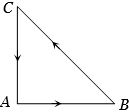
Three forces start acting simultaneously on a particle moving with velocity $\vec{v}.$ These forces are represented in magnitude and direction by the three sides of a triangle $ABC$ (as shown). The particle will now move with velocity
A
$\vec{v}$ remaining unchanged
B
Less than $\vec{v}$
C
Greater than $\vec{v}$
D
$\vec{v}$ in the direction of the largest force $BC$
Solution
(A) According to the triangle law of vector addition,if three forces acting on a particle are represented by the three sides of a triangle taken in the same order,their resultant is zero.
In the given figure,the forces are represented by vectors $\vec{AB},$ $\vec{BC},$ and $\vec{CA}.$ Since they are in cyclic order,their sum is $\vec{F}_{net} = \vec{AB} + \vec{BC} + \vec{CA} = 0.$
According to Newton's first law of motion,if the net external force on a particle is zero,its acceleration is zero.
Therefore,the velocity $\vec{v}$ of the particle remains unchanged.
In the given figure,the forces are represented by vectors $\vec{AB},$ $\vec{BC},$ and $\vec{CA}.$ Since they are in cyclic order,their sum is $\vec{F}_{net} = \vec{AB} + \vec{BC} + \vec{CA} = 0.$
According to Newton's first law of motion,if the net external force on a particle is zero,its acceleration is zero.
Therefore,the velocity $\vec{v}$ of the particle remains unchanged.
0 likesView Solution
8
PhysicsMediumMCQAIEEE · 2003
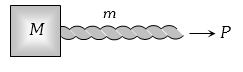
$A$ block of mass $M$ is pulled along a horizontal frictionless surface by a rope of mass $m$. If a force $P$ is applied at the free end of the rope,the force exerted by the rope on the block will be
A
$P$
B
$\frac{Pm}{M + m}$
C
$\frac{PM}{M + m}$
D
$\frac{Pm}{M - m}$
Solution
(C) The total mass of the system is $(M + m)$.
Since the force $P$ is applied to the system,the acceleration $a$ of the system is given by $a = \frac{P}{M + m}$.
The force exerted by the rope on the block is the force required to accelerate the block of mass $M$ with acceleration $a$.
Therefore,the force $F = M \cdot a = M \cdot \left( \frac{P}{M + m} \right) = \frac{PM}{M + m}$.
Since the force $P$ is applied to the system,the acceleration $a$ of the system is given by $a = \frac{P}{M + m}$.
The force exerted by the rope on the block is the force required to accelerate the block of mass $M$ with acceleration $a$.
Therefore,the force $F = M \cdot a = M \cdot \left( \frac{P}{M + m} \right) = \frac{PM}{M + m}$.
1 likesView Solution
9
PhysicsEasyMCQAIEEE · 2003
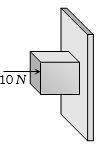
$A$ horizontal force of $10 \, N$ is necessary to just hold a block stationary against a wall. The coefficient of friction between the block and the wall is $0.2$. The weight of the block is ........ $N$.
A
$2$
B
$20$
C
$50$
D
$100$
Solution
(A) To hold the block stationary against the wall,the downward gravitational force (weight $W$) must be balanced by the upward static frictional force $(f_s)$.
The normal force $(N)$ exerted by the wall on the block is equal to the applied horizontal force,so $N = 10 \, N$.
The maximum static frictional force is given by $f_{s,max} = \mu N$,where $\mu = 0.2$ is the coefficient of friction.
For the block to be stationary,$W = f_s$. The limiting condition is $W = f_{s,max}$.
Therefore,$W = 0.2 \times 10 \, N = 2 \, N$.
The normal force $(N)$ exerted by the wall on the block is equal to the applied horizontal force,so $N = 10 \, N$.
The maximum static frictional force is given by $f_{s,max} = \mu N$,where $\mu = 0.2$ is the coefficient of friction.
For the block to be stationary,$W = f_s$. The limiting condition is $W = f_{s,max}$.
Therefore,$W = 0.2 \times 10 \, N = 2 \, N$.
1 likesView Solution
10
PhysicsMediumMCQAIEEE · 2003
$A$ marble block of mass $2 \, kg$ lying on ice,when given a velocity of $6 \, m/s$,is stopped by friction in $10 \, s$. The coefficient of friction is:
A
$0.01$
B
$0.02$
C
$0.03$
D
$0.06$
Solution
(D) Given: Mass $m = 2 \, kg$,initial velocity $u = 6 \, m/s$,final velocity $v = 0 \, m/s$,time $t = 10 \, s$.
Using the first equation of motion: $v = u + at$.
Since the block is decelerating due to friction,$v = u - at$.
Substituting the values: $0 = 6 - a(10) \Rightarrow a = 0.6 \, m/s^2$.
The frictional force is $f = ma = \mu mg$.
Therefore,$\mu g = a \Rightarrow \mu = \frac{a}{g}$.
Taking $g = 10 \, m/s^2$,we get $\mu = \frac{0.6}{10} = 0.06$.
Using the first equation of motion: $v = u + at$.
Since the block is decelerating due to friction,$v = u - at$.
Substituting the values: $0 = 6 - a(10) \Rightarrow a = 0.6 \, m/s^2$.
The frictional force is $f = ma = \mu mg$.
Therefore,$\mu g = a \Rightarrow \mu = \frac{a}{g}$.
Taking $g = 10 \, m/s^2$,we get $\mu = \frac{0.6}{10} = 0.06$.
0 likesView Solution
11
PhysicsMediumMCQAIEEE · 2003
$A$ spring of spring constant $5 \times 10^3 \, N/m$ is stretched initially by $5 \, cm$ from the unstretched position. Then the work required to stretch it further by another $5 \, cm$ is .............. $J$.
A
$6.25$
B
$12.50$
C
$18.75$
D
$25.00$
Solution
(C) The work done in stretching a spring from an initial extension $x_1$ to a final extension $x_2$ is given by the formula: $W = \frac{1}{2} k (x_2^2 - x_1^2)$.
Given:
Spring constant $k = 5 \times 10^3 \, N/m$.
Initial extension $x_1 = 5 \, cm = 0.05 \, m$.
Final extension $x_2 = 5 \, cm + 5 \, cm = 10 \, cm = 0.10 \, m$.
Substituting the values into the formula:
$W = \frac{1}{2} \times (5 \times 10^3) \times ((0.10)^2 - (0.05)^2)$
$W = \frac{1}{2} \times 5000 \times (0.01 - 0.0025)$
$W = 2500 \times 0.0075$
$W = 18.75 \, J$.
Given:
Spring constant $k = 5 \times 10^3 \, N/m$.
Initial extension $x_1 = 5 \, cm = 0.05 \, m$.
Final extension $x_2 = 5 \, cm + 5 \, cm = 10 \, cm = 0.10 \, m$.
Substituting the values into the formula:
$W = \frac{1}{2} \times (5 \times 10^3) \times ((0.10)^2 - (0.05)^2)$
$W = \frac{1}{2} \times 5000 \times (0.01 - 0.0025)$
$W = 2500 \times 0.0075$
$W = 18.75 \, J$.
0 likesView Solution
12
PhysicsMediumMCQAIEEE · 2003
Consider the following two statements:
$1.$ Linear momentum of a system of particles is zero.
$2.$ Kinetic energy of a system of particles is zero.
Then:
$1.$ Linear momentum of a system of particles is zero.
$2.$ Kinetic energy of a system of particles is zero.
Then:
A
$1$ implies $2$ and $2$ implies $1$
B
$1$ does not imply $2$ and $2$ does not imply $1$
C
$1$ implies $2$ but $2$ does not imply $1$
D
$1$ does not imply $2$ but $2$ implies $1$
Solution
(D) Statement $1$: Linear momentum $\vec{P} = \sum m_i \vec{v}_i = 0$. This does not imply that the velocity of each particle is zero. For example,in a system of two particles moving in opposite directions with equal momentum,the total momentum is zero,but the kinetic energy $K = \sum \frac{1}{2} m_i v_i^2$ is non-zero.
Statement $2$: Kinetic energy $K = \sum \frac{1}{2} m_i v_i^2 = 0$. Since mass $m_i > 0$ and $v_i^2 \ge 0$,the only way for the sum to be zero is if each $v_i = 0$. If all velocities are zero,then the total linear momentum $\vec{P} = \sum m_i (0) = 0$.
Therefore,$1$ does not imply $2$,but $2$ implies $1$.
Statement $2$: Kinetic energy $K = \sum \frac{1}{2} m_i v_i^2 = 0$. Since mass $m_i > 0$ and $v_i^2 \ge 0$,the only way for the sum to be zero is if each $v_i = 0$. If all velocities are zero,then the total linear momentum $\vec{P} = \sum m_i (0) = 0$.
Therefore,$1$ does not imply $2$,but $2$ implies $1$.
0 likesView Solution
13
PhysicsDifficultMCQAIEEE · 2003
$A$ body is moved along a straight line by a machine delivering constant power. The distance moved by the body in time $t$ is proportional to
A
$t^{1/2}$
B
$t^{3/4}$
C
$t^{3/2}$
D
$t^2$
Solution
(C) Given that power $P$ is constant. We know that $P = Fv = mav = m \left( \frac{dv}{dt} \right) v$.
Integrating this expression: $\frac{P}{m} dt = v dv$.
Integrating both sides: $\int \frac{P}{m} dt = \int v dv \implies \frac{P}{m} t = \frac{v^2}{2}$.
Thus,$v^2 = \frac{2P}{m} t$,which gives $v = \sqrt{\frac{2P}{m}} t^{1/2}$.
Since $v = \frac{ds}{dt}$,we have $ds = \sqrt{\frac{2P}{m}} t^{1/2} dt$.
Integrating with respect to $t$: $s = \int \sqrt{\frac{2P}{m}} t^{1/2} dt = \sqrt{\frac{2P}{m}} \left( \frac{t^{3/2}}{3/2} \right) = \sqrt{\frac{2P}{m}} \left( \frac{2}{3} t^{3/2} \right)$.
Therefore,$s \propto t^{3/2}$.
Integrating this expression: $\frac{P}{m} dt = v dv$.
Integrating both sides: $\int \frac{P}{m} dt = \int v dv \implies \frac{P}{m} t = \frac{v^2}{2}$.
Thus,$v^2 = \frac{2P}{m} t$,which gives $v = \sqrt{\frac{2P}{m}} t^{1/2}$.
Since $v = \frac{ds}{dt}$,we have $ds = \sqrt{\frac{2P}{m}} t^{1/2} dt$.
Integrating with respect to $t$: $s = \int \sqrt{\frac{2P}{m}} t^{1/2} dt = \sqrt{\frac{2P}{m}} \left( \frac{t^{3/2}}{3/2} \right) = \sqrt{\frac{2P}{m}} \left( \frac{2}{3} t^{3/2} \right)$.
Therefore,$s \propto t^{3/2}$.
0 likesView Solution
14
PhysicsEasyMCQAIEEE · 2003
The escape velocity for a body projected vertically upwards from the surface of earth is $11.2 \ km/s$. If the body is projected at an angle of $45^o$ with the vertical,the escape velocity will be ......... $km/s$.
A
$11.2 / \sqrt{2}$
B
$11.2 \sqrt{2}$
C
$22.4$
D
$11.2$
Solution
(D) The escape velocity of a body from the surface of the Earth is given by the formula $v_e = \sqrt{2gR_e}$,where $g$ is the acceleration due to gravity and $R_e$ is the radius of the Earth.
This expression shows that the escape velocity depends only on the mass and radius of the planet (or the gravitational potential at the point of projection).
It is independent of the direction or the angle at which the body is projected.
Therefore,if the body is projected at an angle of $45^o$ with the vertical,the escape velocity remains the same,which is $11.2 \ km/s$.
This expression shows that the escape velocity depends only on the mass and radius of the planet (or the gravitational potential at the point of projection).
It is independent of the direction or the angle at which the body is projected.
Therefore,if the body is projected at an angle of $45^o$ with the vertical,the escape velocity remains the same,which is $11.2 \ km/s$.
0 likesView Solution
15
PhysicsMediumMCQAIEEE · 2003
The time period of a satellite of the Earth is $5$ hours. If the separation between the Earth and the satellite is increased to four times the previous value,the new time period will become ......... $hours$.
A
$20$
B
$10$
C
$80$
D
$40$
Solution
(D) According to Kepler's third law of planetary motion,the square of the time period $(T)$ is proportional to the cube of the orbital radius $(R)$: $T^2 \propto R^3$,which implies $T \propto R^{3/2}$.
Given the initial time period $T_1 = 5$ hours.
Let the initial separation be $R_1$ and the new separation be $R_2 = 4R_1$.
The new time period $T_2$ is given by the ratio: $\frac{T_2}{T_1} = \left( \frac{R_2}{R_1} \right)^{3/2}$.
Substituting the values: $\frac{T_2}{5} = \left( \frac{4R_1}{R_1} \right)^{3/2} = (4)^{3/2}$.
Calculating the exponent: $(4)^{3/2} = (2^2)^{3/2} = 2^3 = 8$.
Therefore,$T_2 = 5 \times 8 = 40$ hours.
Given the initial time period $T_1 = 5$ hours.
Let the initial separation be $R_1$ and the new separation be $R_2 = 4R_1$.
The new time period $T_2$ is given by the ratio: $\frac{T_2}{T_1} = \left( \frac{R_2}{R_1} \right)^{3/2}$.
Substituting the values: $\frac{T_2}{5} = \left( \frac{4R_1}{R_1} \right)^{3/2} = (4)^{3/2}$.
Calculating the exponent: $(4)^{3/2} = (2^2)^{3/2} = 2^3 = 8$.
Therefore,$T_2 = 5 \times 8 = 40$ hours.
0 likesView Solution
16
PhysicsEasyMCQAIEEE · 2003
$A$ wire suspended vertically from one of its ends is stretched by attaching a weight of $200\, N$ to the lower end. The weight stretches the wire by $1\, mm$. Then the elastic energy stored in the wire is ........ $J$.
A
$0.1$
B
$0.2$
C
$10$
D
$20$
Solution
(A) The elastic potential energy $U$ stored in a stretched wire is given by the formula:
$U = \frac{1}{2} \times F \times \Delta l$
Given:
Force $F = 200\, N$
Extension $\Delta l = 1\, mm = 1 \times 10^{-3}\, m$
Substituting the values into the formula:
$U = \frac{1}{2} \times 200 \times 10^{-3}$
$U = 100 \times 10^{-3}$
$U = 0.1\, J$
Therefore,the elastic energy stored in the wire is $0.1\, J$.
$U = \frac{1}{2} \times F \times \Delta l$
Given:
Force $F = 200\, N$
Extension $\Delta l = 1\, mm = 1 \times 10^{-3}\, m$
Substituting the values into the formula:
$U = \frac{1}{2} \times 200 \times 10^{-3}$
$U = 100 \times 10^{-3}$
$U = 0.1\, J$
Therefore,the elastic energy stored in the wire is $0.1\, J$.
0 likesView Solution
17
PhysicsEasyMCQAIEEE · 2003
Which of the following parameters does not characterize the thermodynamic state of matter?
A
Volume
B
Temperature
C
Pressure
D
Work
Solution
(D) The thermodynamic state of a system is defined by state functions such as Pressure $(P)$,Volume $(V)$,Temperature $(T)$,and Internal Energy $(U)$. These depend only on the current state of the system,not on the path taken to reach that state.
Work $(W)$ is a path function,not a state function. It represents the energy transferred between the system and its surroundings due to a process,and its value depends on the specific path taken during the thermodynamic process. Therefore,work does not characterize the thermodynamic state of matter.
Work $(W)$ is a path function,not a state function. It represents the energy transferred between the system and its surroundings due to a process,and its value depends on the specific path taken during the thermodynamic process. Therefore,work does not characterize the thermodynamic state of matter.
0 likesView Solution
18
PhysicsMediumMCQAIEEE · 2003
“Heat cannot by itself flow from a body at lower temperature to a body at higher temperature” is a statement or consequence of
A
Second law of thermodynamics
B
Conservation of momentum
C
Conservation of mass
D
First law of thermodynamics
Solution
(A) The statement provided is known as the Clausius statement of the Second Law of Thermodynamics.
It asserts that it is impossible to construct a device that operates in a cycle and produces no effect other than the transfer of heat from a lower-temperature body to a higher-temperature body.
Therefore,the correct option is $A$.
It asserts that it is impossible to construct a device that operates in a cycle and produces no effect other than the transfer of heat from a lower-temperature body to a higher-temperature body.
Therefore,the correct option is $A$.
0 likesView Solution
19
PhysicsMediumMCQAIEEE · 2003
$A$ Carnot engine takes $3 \times 10^6 \, \text{cal}$ of heat from a reservoir at $627^{\circ}C$ and gives it to a sink at $27^{\circ}C$. The work done by the engine is:
A
$4.2 \times 10^6 \, \text{J}$
B
$8.4 \times 10^6 \, \text{J}$
C
$16.8 \times 10^6 \, \text{J}$
D
Zero
Solution
(B) The efficiency of a Carnot engine is given by $\eta = 1 - \frac{T_2}{T_1}$,where $T_1$ is the temperature of the source and $T_2$ is the temperature of the sink in Kelvin.
Given: $T_1 = 627^{\circ}C = 627 + 273 = 900 \, \text{K}$,$T_2 = 27^{\circ}C = 27 + 273 = 300 \, \text{K}$,and $Q_1 = 3 \times 10^6 \, \text{cal}$.
Converting heat to Joules: $Q_1 = 3 \times 10^6 \times 4.2 \, \text{J} = 12.6 \times 10^6 \, \text{J}$.
The efficiency is $\eta = 1 - \frac{300}{900} = 1 - \frac{1}{3} = \frac{2}{3}$.
Since $\eta = \frac{W}{Q_1}$,the work done is $W = \eta \times Q_1 = \frac{2}{3} \times 12.6 \times 10^6 \, \text{J} = 2 \times 4.2 \times 10^6 \, \text{J} = 8.4 \times 10^6 \, \text{J}$.
Given: $T_1 = 627^{\circ}C = 627 + 273 = 900 \, \text{K}$,$T_2 = 27^{\circ}C = 27 + 273 = 300 \, \text{K}$,and $Q_1 = 3 \times 10^6 \, \text{cal}$.
Converting heat to Joules: $Q_1 = 3 \times 10^6 \times 4.2 \, \text{J} = 12.6 \times 10^6 \, \text{J}$.
The efficiency is $\eta = 1 - \frac{300}{900} = 1 - \frac{1}{3} = \frac{2}{3}$.
Since $\eta = \frac{W}{Q_1}$,the work done is $W = \eta \times Q_1 = \frac{2}{3} \times 12.6 \times 10^6 \, \text{J} = 2 \times 4.2 \times 10^6 \, \text{J} = 8.4 \times 10^6 \, \text{J}$.
0 likesView Solution
20
PhysicsEasyMCQAIEEE · 2003
The Earth radiates in the infra-red region of the spectrum. The spectrum is correctly given by
A
Planck's law of radiation
B
Rayleigh-Jeans law
C
Wien's displacement law
D
Stefan-Boltzmann law
Solution
(C) The Earth acts as a black body at a relatively low temperature (approximately $288 \ K$). According to Wien's displacement law,the wavelength $\lambda_{max}$ corresponding to the maximum spectral emissive power is inversely proportional to the absolute temperature $T$,given by the relation $\lambda_{max} T = b$,where $b$ is Wien's constant $(2.898 \times 10^{-3} \ m \cdot K)$. For the Earth's temperature,this wavelength falls in the infra-red region of the electromagnetic spectrum. Therefore,Wien's law correctly describes the shift in the peak of the radiation spectrum.
0 likesView Solution
21
PhysicsEasyMCQAIEEE · 2003
According to Newton's law of cooling,the rate of cooling of a body is proportional to $(\Delta \theta )^n$,where $\Delta \theta$ is the difference of the temperature of the body and the surroundings,and $n$ is equal to
A
$1$
B
$2$
C
$3$
D
$4$
Solution
(A) According to Newton's law of cooling,the rate of loss of heat (or rate of cooling) of a body is directly proportional to the temperature difference between the body and its surroundings for small temperature differences.
Mathematically,this is expressed as: $\frac{dQ}{dt} \propto \Delta \theta$.
Comparing this with the given expression $(\Delta \theta)^n$,we find that $n = 1$.
Mathematically,this is expressed as: $\frac{dQ}{dt} \propto \Delta \theta$.
Comparing this with the given expression $(\Delta \theta)^n$,we find that $n = 1$.
0 likesView Solution
22
PhysicsEasyMCQAIEEE · 2003
$A$ body executes simple harmonic motion. The potential energy $(P.E.)$,the kinetic energy $(K.E.)$ and total energy $(T.E.)$ are measured as a function of displacement $x$. Which of the following statements is true?
A
$P.E.$ is maximum when $x = 0$
B
$K.E.$ is maximum when $x = 0$
C
$T.E.$ is zero when $x = 0$
D
$K.E.$ is maximum when $x$ is maximum
Solution
(B) In $S.H.M.$,the potential energy is given by $U = \frac{1}{2} k x^2$ and kinetic energy is given by $K = \frac{1}{2} k (A^2 - x^2)$.
At the mean position,$x = 0$. Substituting this into the expressions:
$U = \frac{1}{2} k (0)^2 = 0$ (Minimum potential energy).
$K = \frac{1}{2} k (A^2 - 0^2) = \frac{1}{2} k A^2$ (Maximum kinetic energy).
The total energy $E = U + K = \frac{1}{2} k A^2$,which remains constant throughout the motion.
Therefore,the kinetic energy is maximum at the mean position $(x = 0)$.
At the mean position,$x = 0$. Substituting this into the expressions:
$U = \frac{1}{2} k (0)^2 = 0$ (Minimum potential energy).
$K = \frac{1}{2} k (A^2 - 0^2) = \frac{1}{2} k A^2$ (Maximum kinetic energy).
The total energy $E = U + K = \frac{1}{2} k A^2$,which remains constant throughout the motion.
Therefore,the kinetic energy is maximum at the mean position $(x = 0)$.
1 likesView Solution
23
PhysicsMediumMCQAIEEE · 2003
$A$ simple pendulum is executing simple harmonic motion with a time period $T$. If the length of the pendulum is increased by $21\%$,the percentage increase in the time period of the pendulum of increased length is ..... $\%$
A
$10$
B
$21$
C
$30$
D
$50$
Solution
(A) The time period of a simple pendulum is given by $T = 2\pi \sqrt{\frac{l}{g}}$.
This implies $T \propto \sqrt{l}$.
Let the initial length be $l_1 = 100$ units. Then the new length $l_2 = 100 + 21 = 121$ units.
The ratio of the time periods is $\frac{T_2}{T_1} = \sqrt{\frac{l_2}{l_1}} = \sqrt{\frac{121}{100}} = \frac{11}{10} = 1.1$.
Thus,$T_2 = 1.1 T_1$.
The percentage increase in the time period is given by $\frac{T_2 - T_1}{T_1} \times 100 = \frac{1.1 T_1 - T_1}{T_1} \times 100 = 0.1 \times 100 = 10\%$.
Therefore,the correct option is $A$.
This implies $T \propto \sqrt{l}$.
Let the initial length be $l_1 = 100$ units. Then the new length $l_2 = 100 + 21 = 121$ units.
The ratio of the time periods is $\frac{T_2}{T_1} = \sqrt{\frac{l_2}{l_1}} = \sqrt{\frac{121}{100}} = \frac{11}{10} = 1.1$.
Thus,$T_2 = 1.1 T_1$.
The percentage increase in the time period is given by $\frac{T_2 - T_1}{T_1} \times 100 = \frac{1.1 T_1 - T_1}{T_1} \times 100 = 0.1 \times 100 = 10\%$.
Therefore,the correct option is $A$.
0 likesView Solution
24
PhysicsMediumMCQAIEEE · 2003
Two bodies $M$ and $N$ of equal masses are suspended from two separate massless springs of force constants $k_1$ and $k_2$ respectively. If the two bodies oscillate vertically such that their maximum velocities are equal,the ratio of the amplitude of $M$ to that of $N$ is
A
$\frac{k_1}{k_2}$
B
$\sqrt{\frac{k_1}{k_2}}$
C
$\frac{k_2}{k_1}$
D
$\sqrt{\frac{k_2}{k_1}}$
Solution
(D) The maximum velocity of a body performing simple harmonic motion is given by $v_{max} = A\omega$,where $A$ is the amplitude and $\omega$ is the angular frequency.
For a spring-mass system,the angular frequency is $\omega = \sqrt{\frac{k}{m}}$.
Thus,$v_{max} = A\sqrt{\frac{k}{m}}$.
Given that the masses are equal $(m_M = m_N = m)$ and their maximum velocities are equal $(v_M = v_N)$:
$A_M \sqrt{\frac{k_1}{m}} = A_N \sqrt{\frac{k_2}{m}}$.
Simplifying this,we get $A_M \sqrt{k_1} = A_N \sqrt{k_2}$.
Therefore,the ratio of the amplitude of $M$ to that of $N$ is $\frac{A_M}{A_N} = \sqrt{\frac{k_2}{k_1}}$.
For a spring-mass system,the angular frequency is $\omega = \sqrt{\frac{k}{m}}$.
Thus,$v_{max} = A\sqrt{\frac{k}{m}}$.
Given that the masses are equal $(m_M = m_N = m)$ and their maximum velocities are equal $(v_M = v_N)$:
$A_M \sqrt{\frac{k_1}{m}} = A_N \sqrt{\frac{k_2}{m}}$.
Simplifying this,we get $A_M \sqrt{k_1} = A_N \sqrt{k_2}$.
Therefore,the ratio of the amplitude of $M$ to that of $N$ is $\frac{A_M}{A_N} = \sqrt{\frac{k_2}{k_1}}$.
0 likesView Solution
25
PhysicsMediumMCQAIEEE · 2003
$A$ mass $M$ is suspended from a spring of negligible mass. The spring is pulled a little and then released so that the mass executes $S.H.M.$ of time period $T$. If the mass is increased by $m$,the time period becomes $5T/3$. Then the ratio of $m/M$ is
A
$5/3$
B
$3/5$
C
$25/9$
D
$16/9$
Solution
(D) The time period of a spring-mass system is given by $T = 2\pi \sqrt{\frac{M}{k}}$.
Since $2\pi$ and $k$ are constant,we have $T \propto \sqrt{M}$.
Initially,the time period is $T_1 = T$ for mass $M_1 = M$.
When the mass is increased by $m$,the new mass is $M_2 = M + m$ and the new time period is $T_2 = \frac{5T}{3}$.
Using the proportionality $T \propto \sqrt{M}$,we get $\frac{T_2}{T_1} = \sqrt{\frac{M_2}{M_1}}$.
Substituting the values: $\frac{5T/3}{T} = \sqrt{\frac{M + m}{M}}$.
$\frac{5}{3} = \sqrt{1 + \frac{m}{M}}$.
Squaring both sides: $\frac{25}{9} = 1 + \frac{m}{M}$.
Therefore,$\frac{m}{M} = \frac{25}{9} - 1 = \frac{16}{9}$.
Since $2\pi$ and $k$ are constant,we have $T \propto \sqrt{M}$.
Initially,the time period is $T_1 = T$ for mass $M_1 = M$.
When the mass is increased by $m$,the new mass is $M_2 = M + m$ and the new time period is $T_2 = \frac{5T}{3}$.
Using the proportionality $T \propto \sqrt{M}$,we get $\frac{T_2}{T_1} = \sqrt{\frac{M_2}{M_1}}$.
Substituting the values: $\frac{5T/3}{T} = \sqrt{\frac{M + m}{M}}$.
$\frac{5}{3} = \sqrt{1 + \frac{m}{M}}$.
Squaring both sides: $\frac{25}{9} = 1 + \frac{m}{M}$.
Therefore,$\frac{m}{M} = \frac{25}{9} - 1 = \frac{16}{9}$.
0 likesView Solution
26
PhysicsEasyMCQAIEEE · 2003
The displacement of a particle varies according to the relation $x = 4(\cos \pi t + \sin \pi t)$. The amplitude of the particle is
A
$8$
B
$-4$
C
$4$
D
$4\sqrt{2}$
Solution
(D) The given displacement equation is $x = 4\cos(\pi t) + 4\sin(\pi t)$.
This is in the form of the superposition of two simple harmonic motions: $x = A_1\sin(\omega t) + A_2\cos(\omega t)$.
The resultant amplitude $A$ is given by the formula $A = \sqrt{A_1^2 + A_2^2}$.
Here,$A_1 = 4$ and $A_2 = 4$.
Therefore,$A = \sqrt{4^2 + 4^2} = \sqrt{16 + 16} = \sqrt{32} = 4\sqrt{2}$.
This is in the form of the superposition of two simple harmonic motions: $x = A_1\sin(\omega t) + A_2\cos(\omega t)$.
The resultant amplitude $A$ is given by the formula $A = \sqrt{A_1^2 + A_2^2}$.
Here,$A_1 = 4$ and $A_2 = 4$.
Therefore,$A = \sqrt{4^2 + 4^2} = \sqrt{16 + 16} = \sqrt{32} = 4\sqrt{2}$.
0 likesView Solution
27
PhysicsEasyMCQAIEEE · 2003
The displacement $y$ of a wave travelling in the $x$-direction is given by $y = 10^{-4} \sin(600t - 2x + \frac{\pi}{3})$ metres,where $x$ is expressed in metres and $t$ in seconds. The speed of the wave motion,in $m \ s^{-1}$,is
A
$200$
B
$300$
C
$600$
D
$1200$
Solution
(B) The standard equation of a travelling wave is given by $y = A \sin(\omega t - kx + \phi)$.
Comparing the given equation $y = 10^{-4} \sin(600t - 2x + \frac{\pi}{3})$ with the standard equation,we get:
Angular frequency $\omega = 600 \ rad \ s^{-1}$
Wave number $k = 2 \ m^{-1}$
The speed of the wave $v$ is given by the formula $v = \frac{\omega}{k}$.
Substituting the values,$v = \frac{600}{2} = 300 \ m \ s^{-1}$.
Therefore,the speed of the wave motion is $300 \ m \ s^{-1}$.
Comparing the given equation $y = 10^{-4} \sin(600t - 2x + \frac{\pi}{3})$ with the standard equation,we get:
Angular frequency $\omega = 600 \ rad \ s^{-1}$
Wave number $k = 2 \ m^{-1}$
The speed of the wave $v$ is given by the formula $v = \frac{\omega}{k}$.
Substituting the values,$v = \frac{600}{2} = 300 \ m \ s^{-1}$.
Therefore,the speed of the wave motion is $300 \ m \ s^{-1}$.
0 likesView Solution
28
PhysicsMediumMCQAIEEE · 2003
$A$ tuning fork of known frequency $256\,Hz$ produces $5$ beats per second with the vibrating string of a piano. The beat frequency decreases to $2$ beats per second when the tension in the piano string is slightly increased. The frequency of the piano string before increasing the tension was
A
$256 + 5\,Hz$
B
$256 + 2\,Hz$
C
$256 - 2\,Hz$
D
$256 - 5\,Hz$
Solution
(D) Let the frequency of the piano string be $n_P$. The frequency of the tuning fork is $n_f = 256\,Hz$.
The beat frequency is given by $|n_f - n_P| = 5\,Hz$. This implies $n_P = 256 \pm 5\,Hz$,so $n_P$ is either $251\,Hz$ or $261\,Hz$.
When the tension $T$ in the piano string is increased,the frequency $n_P$ increases because $n_P \propto \sqrt{T}$.
If $n_P$ was $251\,Hz$,increasing the tension makes $n_P$ approach $256\,Hz$,which would decrease the beat frequency $|256 - n_P|$.
If $n_P$ was $261\,Hz$,increasing the tension makes $n_P$ move further away from $256\,Hz$,which would increase the beat frequency.
Since the beat frequency decreases from $5\,Hz$ to $2\,Hz$,the initial frequency must have been $251\,Hz$.
Therefore,the frequency of the piano string before increasing the tension was $256 - 5 = 251\,Hz$.
The beat frequency is given by $|n_f - n_P| = 5\,Hz$. This implies $n_P = 256 \pm 5\,Hz$,so $n_P$ is either $251\,Hz$ or $261\,Hz$.
When the tension $T$ in the piano string is increased,the frequency $n_P$ increases because $n_P \propto \sqrt{T}$.
If $n_P$ was $251\,Hz$,increasing the tension makes $n_P$ approach $256\,Hz$,which would decrease the beat frequency $|256 - n_P|$.
If $n_P$ was $261\,Hz$,increasing the tension makes $n_P$ move further away from $256\,Hz$,which would increase the beat frequency.
Since the beat frequency decreases from $5\,Hz$ to $2\,Hz$,the initial frequency must have been $251\,Hz$.
Therefore,the frequency of the piano string before increasing the tension was $256 - 5 = 251\,Hz$.
0 likesView Solution
29
PhysicsMediumMCQAIEEE · 2003
$A$ metal wire of linear mass density of $9.8 \, g/m$ is stretched with a tension of $10 \, kg$ weight between two rigid supports $1 \, m$ apart. The wire passes at its middle point between the poles of a permanent magnet,and it vibrates in resonance when carrying an alternating current of frequency $n$. The frequency $n$ of the alternating source is ..... $Hz$.
A
$25$
B
$50$
C
$100$
D
$200$
Solution
(B) In the condition of resonance,the frequency of the alternating current $(n)$ is equal to the fundamental frequency of the vibrating wire.
The fundamental frequency of a stretched string is given by $n = \frac{1}{2l} \sqrt{\frac{T}{\mu}}$,where $l$ is the length,$T$ is the tension,and $\mu$ is the linear mass density.
Given:
Length $l = 1 \, m$
Tension $T = 10 \, kg \text{-} wt = 10 \times 9.8 \, N = 98 \, N$
Linear mass density $\mu = 9.8 \, g/m = 9.8 \times 10^{-3} \, kg/m$
Substituting the values:
$n = \frac{1}{2 \times 1} \sqrt{\frac{98}{9.8 \times 10^{-3}}}$
$n = \frac{1}{2} \sqrt{10000}$
$n = \frac{1}{2} \times 100 = 50 \, Hz$.
The fundamental frequency of a stretched string is given by $n = \frac{1}{2l} \sqrt{\frac{T}{\mu}}$,where $l$ is the length,$T$ is the tension,and $\mu$ is the linear mass density.
Given:
Length $l = 1 \, m$
Tension $T = 10 \, kg \text{-} wt = 10 \times 9.8 \, N = 98 \, N$
Linear mass density $\mu = 9.8 \, g/m = 9.8 \times 10^{-3} \, kg/m$
Substituting the values:
$n = \frac{1}{2 \times 1} \sqrt{\frac{98}{9.8 \times 10^{-3}}}$
$n = \frac{1}{2} \sqrt{10000}$
$n = \frac{1}{2} \times 100 = 50 \, Hz$.
0 likesView Solution
30
PhysicsMediumMCQAIEEE · 2003
$A$ circular disc $X$ of radius $R$ is made from an iron plate of thickness $t$,and another disc $Y$ of radius $4R$ is made from an iron plate of thickness $\frac{t}{4}$. Then the relation between the moment of inertia $I_x$ and $I_y$ is
A
$I_y = 64I_x$
B
$I_y = 32I_x$
C
$I_y = 16I_x$
D
$I_y = I_x$
Solution
(A) The moment of inertia of a circular disc about its central axis is given by $I = \frac{1}{2}MR^2$.
Since mass $M = \text{Volume} \times \text{density} = (\pi R^2 t) \rho$,where $t$ is the thickness and $\rho$ is the density.
Substituting $M$ into the formula,we get $I = \frac{1}{2}(\pi R^2 t \rho) R^2 = \frac{1}{2} \pi \rho t R^4$.
Assuming the density $\rho$ is the same for both discs,the ratio of the moments of inertia is $\frac{I_y}{I_x} = \frac{t_y}{t_x} \left( \frac{R_y}{R_x} \right)^4$.
Given $R_y = 4R$ and $R_x = R$,so $\frac{R_y}{R_x} = 4$.
Given $t_y = \frac{t}{4}$ and $t_x = t$,so $\frac{t_y}{t_x} = \frac{1}{4}$.
Substituting these values: $\frac{I_y}{I_x} = \frac{1}{4} \times (4)^4 = \frac{256}{4} = 64$.
Therefore,$I_y = 64I_x$.
Since mass $M = \text{Volume} \times \text{density} = (\pi R^2 t) \rho$,where $t$ is the thickness and $\rho$ is the density.
Substituting $M$ into the formula,we get $I = \frac{1}{2}(\pi R^2 t \rho) R^2 = \frac{1}{2} \pi \rho t R^4$.
Assuming the density $\rho$ is the same for both discs,the ratio of the moments of inertia is $\frac{I_y}{I_x} = \frac{t_y}{t_x} \left( \frac{R_y}{R_x} \right)^4$.
Given $R_y = 4R$ and $R_x = R$,so $\frac{R_y}{R_x} = 4$.
Given $t_y = \frac{t}{4}$ and $t_x = t$,so $\frac{t_y}{t_x} = \frac{1}{4}$.
Substituting these values: $\frac{I_y}{I_x} = \frac{1}{4} \times (4)^4 = \frac{256}{4} = 64$.
Therefore,$I_y = 64I_x$.
0 likesView Solution
31
PhysicsMediumMCQAIEEE · 2003
If $\vec{F}$ is the force acting on a particle having position vector $\vec{r}$ and $\vec{\tau}$ is the torque of this force about the origin,then
A
$\vec{r} \cdot \vec{\tau} = 0$ and $\vec{F} \cdot \vec{\tau} \neq 0$
B
$\vec{r} \cdot \vec{\tau} \neq 0$ and $\vec{F} \cdot \vec{\tau} = 0$
C
$\vec{r} \cdot \vec{\tau} \neq 0$ and $\vec{F} \cdot \vec{\tau} \neq 0$
D
$\vec{r} \cdot \vec{\tau} = 0$ and $\vec{F} \cdot \vec{\tau} = 0$
Solution
(D) The torque $\vec{\tau}$ is defined as the cross product of the position vector $\vec{r}$ and the force vector $\vec{F}$,given by $\vec{\tau} = \vec{r} \times \vec{F}$.
By the definition of the cross product,the resulting vector $\vec{\tau}$ is always perpendicular to both the vectors $\vec{r}$ and $\vec{F}$ that form it.
Since the dot product of two perpendicular vectors is always zero,we have $\vec{r} \cdot \vec{\tau} = 0$ and $\vec{F} \cdot \vec{\tau} = 0$.
By the definition of the cross product,the resulting vector $\vec{\tau}$ is always perpendicular to both the vectors $\vec{r}$ and $\vec{F}$ that form it.
Since the dot product of two perpendicular vectors is always zero,we have $\vec{r} \cdot \vec{\tau} = 0$ and $\vec{F} \cdot \vec{\tau} = 0$.
0 likesView Solution
32
PhysicsMediumMCQAIEEE · 2003
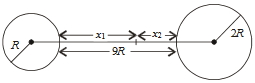
Two spherical bodies of mass $M$ and $5M$ and radii $R$ and $2R$ are released in free space with initial separation between their centres equal to $12R.$ If they attract each other due to gravitational force only,then the distance covered by the smaller body before collision is (in $R$)
A
$2.5$
B
$4.5$
C
$7.5$
D
$1.5$
Solution
(C) The initial distance between the centres is $12R.$ Collision occurs when the distance between the centres is equal to the sum of their radii,which is $R + 2R = 3R.$
Therefore,the total distance covered by both bodies before collision is $12R - 3R = 9R.$
Let $x_1$ and $x_2$ be the distances covered by the bodies of mass $M$ and $5M$ respectively. Since there is no external force,the centre of mass of the system remains stationary. Thus,$M x_1 = 5M x_2$,which gives $x_1 = 5x_2$.
Given $x_1 + x_2 = 9R$,we substitute $x_1 = 5x_2$ to get $5x_2 + x_2 = 9R$,so $6x_2 = 9R$,which means $x_2 = 1.5R$.
Then,$x_1 = 5(1.5R) = 7.5R$.
The distance covered by the smaller body (mass $M$) is $7.5R$.
Therefore,the total distance covered by both bodies before collision is $12R - 3R = 9R.$
Let $x_1$ and $x_2$ be the distances covered by the bodies of mass $M$ and $5M$ respectively. Since there is no external force,the centre of mass of the system remains stationary. Thus,$M x_1 = 5M x_2$,which gives $x_1 = 5x_2$.
Given $x_1 + x_2 = 9R$,we substitute $x_1 = 5x_2$ to get $5x_2 + x_2 = 9R$,so $6x_2 = 9R$,which means $x_2 = 1.5R$.
Then,$x_1 = 5(1.5R) = 7.5R$.
The distance covered by the smaller body (mass $M$) is $7.5R$.
0 likesView Solution
33
PhysicsMediumMCQAIEEE · 2003
During an adiabatic process,the pressure of a gas is found to be proportional to the cube of its temperature. The ratio of $\frac{C_P}{C_V}$ for the gas is
A
$2$
B
$1.67$
C
$1.5$
D
$1.33$
Solution
(C) For an adiabatic process,the relationship between pressure $P$ and temperature $T$ is given by $P^{1-\gamma} T^{\gamma} = \text{constant}$,which can be rewritten as $P T^{\frac{\gamma}{1-\gamma}} = \text{constant}$.
Given that $P \propto T^3$,we have $P T^{-3} = \text{constant}$.
Comparing the exponents of $T$,we get $\frac{\gamma}{1-\gamma} = -3$.
Solving for $\gamma$:
$\gamma = -3(1-\gamma)$
$\gamma = -3 + 3\gamma$
$2\gamma = 3$
$\gamma = \frac{3}{2} = 1.5$.
Since $\gamma = \frac{C_P}{C_V}$,the ratio is $1.5$.
Given that $P \propto T^3$,we have $P T^{-3} = \text{constant}$.
Comparing the exponents of $T$,we get $\frac{\gamma}{1-\gamma} = -3$.
Solving for $\gamma$:
$\gamma = -3(1-\gamma)$
$\gamma = -3 + 3\gamma$
$2\gamma = 3$
$\gamma = \frac{3}{2} = 1.5$.
Since $\gamma = \frac{C_P}{C_V}$,the ratio is $1.5$.
0 likesView Solution
34
PhysicsDifficultMCQAIEEE · 2003
$A$ particle performs uniform circular motion with an angular momentum $L$. If the angular frequency of the particle is doubled and its kinetic energy is halved,what will be its new angular momentum?
A
$4L$
B
$2L$
C
$L/2$
D
$L/4$
Solution
(D) The rotational kinetic energy is given by $K = \frac{1}{2} I \omega^2$,where $I$ is the moment of inertia and $\omega$ is the angular frequency.
Given: $\omega_2 = 2\omega_1$ and $K_2 = \frac{1}{2} K_1$.
Using the ratio: $\frac{K_1}{K_2} = \frac{I_1 \omega_1^2}{I_2 \omega_2^2} \Rightarrow 2 = \frac{I_1}{I_2} \left( \frac{\omega_1}{2\omega_1} \right)^2 = \frac{I_1}{I_2} \cdot \frac{1}{4}$.
Thus,$\frac{I_1}{I_2} = 8$,which means $I_2 = \frac{I_1}{8}$.
The angular momentum is $L = I\omega$.
Therefore,$\frac{L_2}{L_1} = \frac{I_2 \omega_2}{I_1 \omega_1} = \left( \frac{1}{8} \right) \times (2) = \frac{1}{4}$.
Hence,$L_2 = \frac{L}{4}$.
Given: $\omega_2 = 2\omega_1$ and $K_2 = \frac{1}{2} K_1$.
Using the ratio: $\frac{K_1}{K_2} = \frac{I_1 \omega_1^2}{I_2 \omega_2^2} \Rightarrow 2 = \frac{I_1}{I_2} \left( \frac{\omega_1}{2\omega_1} \right)^2 = \frac{I_1}{I_2} \cdot \frac{1}{4}$.
Thus,$\frac{I_1}{I_2} = 8$,which means $I_2 = \frac{I_1}{8}$.
The angular momentum is $L = I\omega$.
Therefore,$\frac{L_2}{L_1} = \frac{I_2 \omega_2}{I_1 \omega_1} = \left( \frac{1}{8} \right) \times (2) = \frac{1}{4}$.
Hence,$L_2 = \frac{L}{4}$.
0 likesView Solution
35
PhysicsMediumMCQAIEEE · 2003
$A$ boy playing on the roof of a $10 \, m$ high building throws a ball with a speed of $10 \, m/s$ at an angle $30^{\circ}$ with the horizontal. How far from the throwing point will the ball be at the height of $10 \, m$ from the ground (in $, m$)? $(g = 10 \, m/s^2, \sin 30^{\circ} = 1/2, \cos 30^{\circ} = \sqrt{3}/2)$
A
$5.20$
B
$4.33$
C
$2.60$
D
$8.66$
Solution
(D) The ball is thrown from a height of $10 \, m$ and we need to find the horizontal distance when it returns to the same height of $10 \, m$.
This is equivalent to the horizontal range of a projectile launched from the ground.
The formula for the horizontal range $R$ is given by $R = \frac{u^2 \sin(2\theta)}{g}$.
Given: $u = 10 \, m/s$,$\theta = 30^{\circ}$,$g = 10 \, m/s^2$.
Substituting the values: $R = \frac{10^2 \times \sin(2 \times 30^{\circ})}{10} = \frac{100 \times \sin(60^{\circ})}{10} = 10 \times \frac{\sqrt{3}}{2}$.
$R = 5 \times 1.732 = 8.66 \, m$.
Thus,the ball will be at the height of $10 \, m$ at a distance of $8.66 \, m$ from the throwing point.
This is equivalent to the horizontal range of a projectile launched from the ground.
The formula for the horizontal range $R$ is given by $R = \frac{u^2 \sin(2\theta)}{g}$.
Given: $u = 10 \, m/s$,$\theta = 30^{\circ}$,$g = 10 \, m/s^2$.
Substituting the values: $R = \frac{10^2 \times \sin(2 \times 30^{\circ})}{10} = \frac{100 \times \sin(60^{\circ})}{10} = 10 \times \frac{\sqrt{3}}{2}$.
$R = 5 \times 1.732 = 8.66 \, m$.
Thus,the ball will be at the height of $10 \, m$ at a distance of $8.66 \, m$ from the throwing point.
0 likesView Solution
36
PhysicsMediumMCQAIEEE · 2003
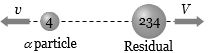
$A$ $^{238}U$ nucleus decays by emitting an $\alpha$ particle of speed $v \ m/s$. The recoil velocity of the residual nucleus is (in $m/s$):
A
$-4v/234$
B
$v/4$
C
$-4v/238$
D
$4v/238$
Solution
(A) Initially,the $^{238}U$ nucleus is at rest. After the decay,the $\alpha$ particle and the residual nucleus move in opposite directions.
According to the law of conservation of linear momentum:
$P_{\text{initial}} = P_{\text{final}}$
$0 = m_{\alpha}v_{\alpha} + m_{\text{residual}}V$
Here,$m_{\alpha} = 4$ units,$v_{\alpha} = -v$ (assuming the $\alpha$ particle moves in the negative direction),and $m_{\text{residual}} = 234$ units.
$0 = 4(-v) + 234V$
$234V = 4v$
$V = \frac{4v}{234}$
However,since the question asks for the recoil velocity vector relative to the $\alpha$ particle's velocity direction,the recoil velocity is $V = -\frac{4v}{234} \ m/s$.
According to the law of conservation of linear momentum:
$P_{\text{initial}} = P_{\text{final}}$
$0 = m_{\alpha}v_{\alpha} + m_{\text{residual}}V$
Here,$m_{\alpha} = 4$ units,$v_{\alpha} = -v$ (assuming the $\alpha$ particle moves in the negative direction),and $m_{\text{residual}} = 234$ units.
$0 = 4(-v) + 234V$
$234V = 4v$
$V = \frac{4v}{234}$
However,since the question asks for the recoil velocity vector relative to the $\alpha$ particle's velocity direction,the recoil velocity is $V = -\frac{4v}{234} \ m/s$.
0 likesView Solution
37
PhysicsMediumMCQAIEEE · 2003
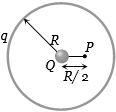
$A$ thin spherical conducting shell of radius $R$ has a charge $q$. Another charge $Q$ is placed at the centre of the shell. The electrostatic potential at a point $P$ at a distance $\frac{R}{2}$ from the centre of the shell is
A
$\frac{(q + Q)}{4\pi \varepsilon_0} \cdot \frac{2}{R}$
B
$\frac{2Q}{4\pi \varepsilon_0 R}$
C
$\frac{2Q}{4\pi \varepsilon_0 R} - \frac{2q}{4\pi \varepsilon_0 R}$
D
$\frac{2Q}{4\pi \varepsilon_0 R} + \frac{q}{4\pi \varepsilon_0 R}$
Solution
(D) The total electrostatic potential at point $P$ is the sum of the potential due to the point charge $Q$ at the centre and the potential due to the spherical shell of charge $q$.
$1$. The potential due to the point charge $Q$ at a distance $r = \frac{R}{2}$ is given by $V_Q = \frac{1}{4\pi \varepsilon_0} \cdot \frac{Q}{R/2} = \frac{2Q}{4\pi \varepsilon_0 R}$.
$2$. For a spherical conducting shell of radius $R$ with charge $q$,the potential at any point inside the shell (including the centre) is constant and equal to the potential at its surface. Thus,the potential at distance $r = \frac{R}{2}$ due to the shell is $V_q = \frac{1}{4\pi \varepsilon_0} \cdot \frac{q}{R}$.
$3$. The total potential at point $P$ is $V = V_Q + V_q = \frac{2Q}{4\pi \varepsilon_0 R} + \frac{q}{4\pi \varepsilon_0 R}$.
Therefore,the correct option is $(d)$.
$1$. The potential due to the point charge $Q$ at a distance $r = \frac{R}{2}$ is given by $V_Q = \frac{1}{4\pi \varepsilon_0} \cdot \frac{Q}{R/2} = \frac{2Q}{4\pi \varepsilon_0 R}$.
$2$. For a spherical conducting shell of radius $R$ with charge $q$,the potential at any point inside the shell (including the centre) is constant and equal to the potential at its surface. Thus,the potential at distance $r = \frac{R}{2}$ due to the shell is $V_q = \frac{1}{4\pi \varepsilon_0} \cdot \frac{q}{R}$.
$3$. The total potential at point $P$ is $V = V_Q + V_q = \frac{2Q}{4\pi \varepsilon_0 R} + \frac{q}{4\pi \varepsilon_0 R}$.
Therefore,the correct option is $(d)$.
0 likesView Solution
38
PhysicsEasyMCQAIEEE · 2003
If the electric flux entering and leaving an enclosed surface respectively is ${\varphi _1}$ and ${\varphi _2}$,the electric charge inside the surface will be:
A
$(\varphi _1 + \varphi _2)\varepsilon _0$
B
$(\varphi _2 - \varphi _1)\varepsilon _0$
C
$(\varphi _1 + \varphi _2)/\varepsilon _0$
D
$(\varphi _2 - \varphi _1)/\varepsilon _0$
Solution
(B) According to Gauss's Law,the net electric flux through a closed surface is equal to the total charge enclosed divided by the permittivity of free space: $\Phi_{net} = \frac{Q_{enc}}{\varepsilon_0}$.
Here,the flux entering the surface is $\varphi_1$ (negative flux) and the flux leaving the surface is $\varphi_2$ (positive flux).
Therefore,the net flux is $\Phi_{net} = \varphi_2 - \varphi_1$.
Substituting this into Gauss's Law: $\varphi_2 - \varphi_1 = \frac{Q_{enc}}{\varepsilon_0}$.
Thus,the charge enclosed is $Q_{enc} = (\varphi_2 - \varphi_1)\varepsilon_0$.
Here,the flux entering the surface is $\varphi_1$ (negative flux) and the flux leaving the surface is $\varphi_2$ (positive flux).
Therefore,the net flux is $\Phi_{net} = \varphi_2 - \varphi_1$.
Substituting this into Gauss's Law: $\varphi_2 - \varphi_1 = \frac{Q_{enc}}{\varepsilon_0}$.
Thus,the charge enclosed is $Q_{enc} = (\varphi_2 - \varphi_1)\varepsilon_0$.
0 likesView Solution
39
PhysicsEasyMCQAIEEE · 2003
$A$ sheet of aluminium foil of negligible thickness is introduced between the plates of a capacitor. The capacitance of the capacitor
A
increases
B
decreases
C
remains unchanged
D
becomes infinite
Solution
(C) The capacitance of a parallel plate capacitor with a dielectric slab of thickness $t$ is given by:
$C = \frac{A \epsilon_0}{(d - t) + \frac{t}{K}}$
where $A$ is the area of the plates,$d$ is the distance between them,and $K$ is the dielectric constant.
When a metal sheet (aluminium foil) of thickness $t$ is introduced,the dielectric constant $K$ for a conductor is $\infty$.
Substituting $K = \infty$ into the formula:
$C' = \frac{A \epsilon_0}{(d - t) + \frac{t}{\infty}} = \frac{A \epsilon_0}{d - t}$
If the thickness $t$ of the foil is negligible $(t \approx 0)$,then:
$C' = \frac{A \epsilon_0}{d - 0} = \frac{A \epsilon_0}{d}$
Since the original capacitance was $C = \frac{A \epsilon_0}{d}$,the capacitance remains unchanged.
$C = \frac{A \epsilon_0}{(d - t) + \frac{t}{K}}$
where $A$ is the area of the plates,$d$ is the distance between them,and $K$ is the dielectric constant.
When a metal sheet (aluminium foil) of thickness $t$ is introduced,the dielectric constant $K$ for a conductor is $\infty$.
Substituting $K = \infty$ into the formula:
$C' = \frac{A \epsilon_0}{(d - t) + \frac{t}{\infty}} = \frac{A \epsilon_0}{d - t}$
If the thickness $t$ of the foil is negligible $(t \approx 0)$,then:
$C' = \frac{A \epsilon_0}{d - 0} = \frac{A \epsilon_0}{d}$
Since the original capacitance was $C = \frac{A \epsilon_0}{d}$,the capacitance remains unchanged.
0 likesView Solution
40
PhysicsEasyMCQAIEEE · 2003
The work done in placing a charge of $8 \times 10^{-18} \, C$ on a condenser of capacity $100 \, \mu F$ is:
A
$32 \times 10^{-32} \, J$
B
$16 \times 10^{-32} \, J$
C
$3.1 \times 10^{-26} \, J$
D
$4 \times 10^{-10} \, J$
Solution
(A) The energy stored in a capacitor,which is equal to the work done in charging it,is given by the formula $W = \frac{Q^2}{2C}$.
Given:
Charge $Q = 8 \times 10^{-18} \, C$
Capacitance $C = 100 \, \mu F = 100 \times 10^{-6} \, F = 10^{-4} \, F$
Substituting the values into the formula:
$W = \frac{(8 \times 10^{-18})^2}{2 \times 10^{-4}}$
$W = \frac{64 \times 10^{-36}}{2 \times 10^{-4}}$
$W = 32 \times 10^{-32} \, J$
Thus,the correct option is $A$.
Given:
Charge $Q = 8 \times 10^{-18} \, C$
Capacitance $C = 100 \, \mu F = 100 \times 10^{-6} \, F = 10^{-4} \, F$
Substituting the values into the formula:
$W = \frac{(8 \times 10^{-18})^2}{2 \times 10^{-4}}$
$W = \frac{64 \times 10^{-36}}{2 \times 10^{-4}}$
$W = 32 \times 10^{-32} \, J$
Thus,the correct option is $A$.
0 likesView Solution
41
PhysicsDifficultMCQAIEEE · 2003
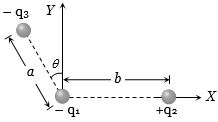
Three charges $-q_1$,$+q_2$,and $-q_3$ are placed as shown in the figure. The $x$-component of the force on $-q_1$ is proportional to
A
$\frac{q_2}{b^2} - \frac{q_3}{a^2} \sin \theta$
B
$\frac{q_2}{b^2} - \frac{q_3}{a^2} \cos \theta$
C
$\frac{q_2}{b^2} + \frac{q_3}{a^2} \sin \theta$
D
$\frac{q_2}{b^2} + \frac{q_3}{a^2} \cos \theta$
Solution
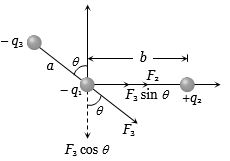
(C) Let $F_2$ be the force applied by $+q_2$ on $-q_1$. Since they have opposite signs,the force is attractive and acts along the positive $x$-axis. Thus,$F_2 = k \frac{q_1 q_2}{b^2}$.
Let $F_3$ be the force applied by $-q_3$ on $-q_1$. Since they have the same sign,the force is repulsive. The force $F_3$ acts along the line joining them,making an angle $\theta$ with the negative $y$-axis. The magnitude is $F_3 = k \frac{q_1 q_3}{a^2}$.
The $x$-component of $F_3$ is $F_{3x} = F_3 \sin \theta = k \frac{q_1 q_3}{a^2} \sin \theta$,acting in the positive $x$-direction.
The net $x$-component of the force on $-q_1$ is $F_x = F_2 + F_{3x} = k \frac{q_1 q_2}{b^2} + k \frac{q_1 q_3}{a^2} \sin \theta$.
Therefore,$F_x = k q_1 \left( \frac{q_2}{b^2} + \frac{q_3}{a^2} \sin \theta \right)$.
Thus,$F_x \propto \left( \frac{q_2}{b^2} + \frac{q_3}{a^2} \sin \theta \right)$.
Let $F_3$ be the force applied by $-q_3$ on $-q_1$. Since they have the same sign,the force is repulsive. The force $F_3$ acts along the line joining them,making an angle $\theta$ with the negative $y$-axis. The magnitude is $F_3 = k \frac{q_1 q_3}{a^2}$.
The $x$-component of $F_3$ is $F_{3x} = F_3 \sin \theta = k \frac{q_1 q_3}{a^2} \sin \theta$,acting in the positive $x$-direction.
The net $x$-component of the force on $-q_1$ is $F_x = F_2 + F_{3x} = k \frac{q_1 q_2}{b^2} + k \frac{q_1 q_3}{a^2} \sin \theta$.
Therefore,$F_x = k q_1 \left( \frac{q_2}{b^2} + \frac{q_3}{a^2} \sin \theta \right)$.
Thus,$F_x \propto \left( \frac{q_2}{b^2} + \frac{q_3}{a^2} \sin \theta \right)$.
0 likesView Solution
42
PhysicsEasyMCQAIEEE · 2003
$A$ strip of copper and another of germanium are cooled from room temperature to $80\, K$. The resistance of
A
Each of these increases
B
Each of these decreases
C
Copper strip increases and that of germanium decreases
D
Copper strip decreases and that of germanium increases
Solution
(D) Copper is a metal (conductor). For metals,the resistance decreases as the temperature decreases because the collision frequency of electrons with lattice ions decreases.
Germanium is a semiconductor. For semiconductors,the resistance increases as the temperature decreases because the number of charge carriers (electrons and holes) decreases exponentially with a decrease in temperature.
Therefore,when cooled from room temperature to $80\, K$,the resistance of the copper strip decreases and the resistance of the germanium strip increases.
Germanium is a semiconductor. For semiconductors,the resistance increases as the temperature decreases because the number of charge carriers (electrons and holes) decreases exponentially with a decrease in temperature.
Therefore,when cooled from room temperature to $80\, K$,the resistance of the copper strip decreases and the resistance of the germanium strip increases.
0 likesView Solution
43
PhysicsMediumMCQAIEEE · 2003
The length of a given cylindrical wire is increased by $100 \%$. Due to the consequent decrease in diameter, the change in the resistance of the wire will be .................. $\%$
A
$300$
B
$200$
C
$100$
D
$50$
Solution
$(A)$ Let the initial length be $l_1 = l$. Since the volume of the wire remains constant, $V = A_1 l_1 = A_2 l_2$.
Given that the length is increased by $100 \%$, the new length $l_2 = l_1 + 1.00 l_1 = 2l_1$.
From the volume conservation, $A_1 l_1 = A_2 (2l_1) \Rightarrow A_2 = \frac{A_1}{2}$.
The resistance of a wire is given by $R = \rho \frac{l}{A}$.
Thus, the initial resistance $R_1 = \rho \frac{l_1}{A_1}$ and the final resistance $R_2 = \rho \frac{l_2}{A_2} = \rho \frac{2l_1}{A_1/2} = 4 \rho \frac{l_1}{A_1} = 4R_1$.
The percentage change in resistance is $\frac{\Delta R}{R_1} \times 100 = \frac{R_2 - R_1}{R_1} \times 100 = \frac{4R_1 - R_1}{R_1} \times 100 = 300 \%$.
Given that the length is increased by $100 \%$, the new length $l_2 = l_1 + 1.00 l_1 = 2l_1$.
From the volume conservation, $A_1 l_1 = A_2 (2l_1) \Rightarrow A_2 = \frac{A_1}{2}$.
The resistance of a wire is given by $R = \rho \frac{l}{A}$.
Thus, the initial resistance $R_1 = \rho \frac{l_1}{A_1}$ and the final resistance $R_2 = \rho \frac{l_2}{A_2} = \rho \frac{2l_1}{A_1/2} = 4 \rho \frac{l_1}{A_1} = 4R_1$.
The percentage change in resistance is $\frac{\Delta R}{R_1} \times 100 = \frac{R_2 - R_1}{R_1} \times 100 = \frac{4R_1 - R_1}{R_1} \times 100 = 300 \%$.
1 likesView Solution
44
PhysicsEasyMCQAIEEE · 2003
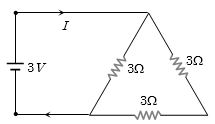
$A$ $3\,V$ battery with negligible internal resistance is connected in a circuit as shown in the figure. The current $I$ in the circuit will be ............. $A$.
A
$1/3$
B
$1$
C
$1.5$
D
$2$
Solution
(C) From the circuit diagram,we can see that two $3\,\Omega$ resistors are in series,and this combination is in parallel with the third $3\,\Omega$ resistor.
First,calculate the equivalent resistance of the two resistors in series: $R_s = 3\,\Omega + 3\,\Omega = 6\,\Omega$.
Now,this $6\,\Omega$ resistor is in parallel with the remaining $3\,\Omega$ resistor.
The equivalent resistance $R_{eq}$ of the circuit is given by: $\frac{1}{R_{eq}} = \frac{1}{6} + \frac{1}{3} = \frac{1+2}{6} = \frac{3}{6} = \frac{1}{2}$.
Therefore,$R_{eq} = 2\,\Omega$.
Using Ohm's law,the total current $I$ in the circuit is: $I = \frac{V}{R_{eq}} = \frac{3\,V}{2\,\Omega} = 1.5\,A$.
First,calculate the equivalent resistance of the two resistors in series: $R_s = 3\,\Omega + 3\,\Omega = 6\,\Omega$.
Now,this $6\,\Omega$ resistor is in parallel with the remaining $3\,\Omega$ resistor.
The equivalent resistance $R_{eq}$ of the circuit is given by: $\frac{1}{R_{eq}} = \frac{1}{6} + \frac{1}{3} = \frac{1+2}{6} = \frac{3}{6} = \frac{1}{2}$.
Therefore,$R_{eq} = 2\,\Omega$.
Using Ohm's law,the total current $I$ in the circuit is: $I = \frac{V}{R_{eq}} = \frac{3\,V}{2\,\Omega} = 1.5\,A$.
0 likesView Solution
45
PhysicsMediumMCQAIEEE · 2003
An ammeter reads up to $1\, A$. Its internal resistance is $0.81\, \Omega$. To increase the range to $10\, A$,the value of the required shunt is ............ $\Omega$.
A
$0.09$
B
$0.03$
C
$0.3$
D
$0.9$
Solution
(A) Given:
Full-scale current of the ammeter,$I_g = 1\, A$.
Internal resistance of the ammeter,$G = 0.81\, \Omega$.
Desired range of the ammeter,$I = 10\, A$.
Let $S$ be the required shunt resistance.
The formula for the shunt resistance required to increase the range of an ammeter is given by:
$S = \frac{I_g \cdot G}{I - I_g}$
Substituting the given values:
$S = \frac{1 \cdot 0.81}{10 - 1}$
$S = \frac{0.81}{9}$
$S = 0.09\, \Omega$.
Therefore,the required shunt resistance is $0.09\, \Omega$.
Full-scale current of the ammeter,$I_g = 1\, A$.
Internal resistance of the ammeter,$G = 0.81\, \Omega$.
Desired range of the ammeter,$I = 10\, A$.
Let $S$ be the required shunt resistance.
The formula for the shunt resistance required to increase the range of an ammeter is given by:
$S = \frac{I_g \cdot G}{I - I_g}$
Substituting the given values:
$S = \frac{1 \cdot 0.81}{10 - 1}$
$S = \frac{0.81}{9}$
$S = 0.09\, \Omega$.
Therefore,the required shunt resistance is $0.09\, \Omega$.
0 likesView Solution
46
PhysicsMediumMCQAIEEE · 2003
The length of a wire of a potentiometer is $100 \, cm$,and the $emf$ of its standard cell is $E \, volt$. It is employed to measure the $emf$ of a battery whose internal resistance is $0.5 \, \Omega$. If the balance point is obtained at $l = 30 \, cm$ from the positive end,the $emf$ of the battery is (where $i$ is the current in the potentiometer wire).
A
$\frac{30E}{100}$
B
$\frac{30E}{100.5}$
C
$\frac{30E}{100 - 0.5}$
D
$\frac{30(E - 0.5i)}{100}$
Solution
(A) The principle of a potentiometer states that the potential drop across a length $l$ of the wire is directly proportional to the length,provided the current $i$ in the potentiometer wire remains constant.
$V = kl$,where $k$ is the potential gradient $(k = \frac{E}{L})$.
Given: $L = 100 \, cm$,$E = emf$ of the standard cell,$l = 30 \, cm$.
The $emf$ of the battery being measured is $V = \frac{E}{L} \times l$.
Substituting the values: $V = \frac{E}{100} \times 30 = \frac{30E}{100}$.
Note: At the balance point,no current flows through the battery being measured,so its internal resistance does not affect the reading.
$V = kl$,where $k$ is the potential gradient $(k = \frac{E}{L})$.
Given: $L = 100 \, cm$,$E = emf$ of the standard cell,$l = 30 \, cm$.
The $emf$ of the battery being measured is $V = \frac{E}{L} \times l$.
Substituting the values: $V = \frac{E}{100} \times 30 = \frac{30E}{100}$.
Note: At the balance point,no current flows through the battery being measured,so its internal resistance does not affect the reading.
0 likesView Solution
47
PhysicsMediumMCQAIEEE · 2003
$A$ $220\, V$,$1000\, W$ bulb is connected across a $110\, V$ mains supply. The power consumed will be ............ $W$.
A
$1000$
B
$750$
C
$500$
D
$250$
Solution
(D) The resistance $R$ of the bulb is constant and is given by $R = \frac{V^2}{P}$.
For the given bulb,$R = \frac{220^2}{1000} = \frac{48400}{1000} = 48.4\, \Omega$.
When connected to a $110\, V$ supply,the power consumed $P'$ is given by $P' = \frac{V'^2}{R}$.
$P' = \frac{110^2}{48.4} = \frac{12100}{48.4} = 250\, W$.
Alternatively,using the ratio formula: $\frac{P_1}{P_2} = \left( \frac{V_1}{V_2} \right)^2$.
$\frac{1000}{P_2} = \left( \frac{220}{110} \right)^2 = 2^2 = 4$.
$P_2 = \frac{1000}{4} = 250\, W$.
For the given bulb,$R = \frac{220^2}{1000} = \frac{48400}{1000} = 48.4\, \Omega$.
When connected to a $110\, V$ supply,the power consumed $P'$ is given by $P' = \frac{V'^2}{R}$.
$P' = \frac{110^2}{48.4} = \frac{12100}{48.4} = 250\, W$.
Alternatively,using the ratio formula: $\frac{P_1}{P_2} = \left( \frac{V_1}{V_2} \right)^2$.
$\frac{1000}{P_2} = \left( \frac{220}{110} \right)^2 = 2^2 = 4$.
$P_2 = \frac{1000}{4} = 250\, W$.
0 likesView Solution
48
PhysicsMediumMCQAIEEE · 2003
The thermo $e.m.f.$ of a thermocouple is $25\,\mu V/^{\circ}C$ at room temperature. $A$ galvanometer of $40\,\Omega$ resistance, capable of detecting current as low as $10^{-5}\,A$, is connected with the thermocouple. The smallest temperature difference that can be detected by this system is ................ $^{\circ}C$.
A
$20$
B
$16$
C
$12$
D
$8$
Solution
(B) The thermo $e.m.f.$ $(e)$ produced by the thermocouple is given by the product of the thermo $e.m.f.$ coefficient $(\alpha)$ and the temperature difference $(\Delta \theta)$: $e = \alpha \Delta \theta$.
According to Ohm's law, the $e.m.f.$ is also equal to the product of the current $(i)$ and the resistance $(R)$: $e = iR$.
Equating the two expressions: $\alpha \Delta \theta = iR$.
Given: $\alpha = 25\,\mu V/^{\circ}C = 25 \times 10^{-6}\,V/^{\circ}C$, $i = 10^{-5}\,A$, and $R = 40\,\Omega$.
Substituting the values: $(25 \times 10^{-6}) \times \Delta \theta = 10^{-5} \times 40$.
$\Delta \theta = \frac{40 \times 10^{-5}}{25 \times 10^{-6}} = \frac{400}{25} = 16\,^{\circ}C$.
Therefore, the smallest temperature difference that can be detected is $16\,^{\circ}C$.
According to Ohm's law, the $e.m.f.$ is also equal to the product of the current $(i)$ and the resistance $(R)$: $e = iR$.
Equating the two expressions: $\alpha \Delta \theta = iR$.
Given: $\alpha = 25\,\mu V/^{\circ}C = 25 \times 10^{-6}\,V/^{\circ}C$, $i = 10^{-5}\,A$, and $R = 40\,\Omega$.
Substituting the values: $(25 \times 10^{-6}) \times \Delta \theta = 10^{-5} \times 40$.
$\Delta \theta = \frac{40 \times 10^{-5}}{25 \times 10^{-6}} = \frac{400}{25} = 16\,^{\circ}C$.
Therefore, the smallest temperature difference that can be detected is $16\,^{\circ}C$.
0 likesView Solution
49
PhysicsEasyMCQAIEEE · 2003
$A$ particle of mass $M$ and charge $Q$ moving with velocity $\vec{v}$ describes a circular path of radius $R$ when subjected to a uniform transverse magnetic field of induction $B$. The work done by the field when the particle completes one full circle is
A
$B Q v 2 \pi R$
B
$\left( \frac{M v^2}{R} \right) 2 \pi R$
C
Zero
D
$B Q 2 \pi R$
Solution
(C) The magnetic force $\vec{F}_m$ acting on a charged particle moving in a magnetic field is given by $\vec{F}_m = Q(\vec{v} \times \vec{B})$.
Since the force $\vec{F}_m$ is always perpendicular to the velocity vector $\vec{v}$,the force is always directed towards the center of the circular path (centripetal force).
Work done $W$ is defined as the line integral of the force over the displacement: $W = \int \vec{F} \cdot d\vec{s}$.
Since the force $\vec{F}_m$ is always perpendicular to the displacement $d\vec{s}$ at every point on the circular path,the dot product $\vec{F}_m \cdot d\vec{s} = F_m ds \cos(90^\circ) = 0$.
Therefore,the total work done by the magnetic field on the particle in one full circle is $0$.
Since the force $\vec{F}_m$ is always perpendicular to the velocity vector $\vec{v}$,the force is always directed towards the center of the circular path (centripetal force).
Work done $W$ is defined as the line integral of the force over the displacement: $W = \int \vec{F} \cdot d\vec{s}$.
Since the force $\vec{F}_m$ is always perpendicular to the displacement $d\vec{s}$ at every point on the circular path,the dot product $\vec{F}_m \cdot d\vec{s} = F_m ds \cos(90^\circ) = 0$.
Therefore,the total work done by the magnetic field on the particle in one full circle is $0$.
0 likesView Solution
50
PhysicsMediumMCQAIEEE · 2003
$A$ particle of charge $q = -16 \times 10^{-18} \, C$ moving with velocity $v = 10 \, m/s$ along the $x$-axis enters a region where a magnetic field of induction $B$ is along the $y$-axis,and an electric field of magnitude $E = 10^4 \, V/m$ is along the negative $z$-axis. If the charged particle continues moving along the $x$-axis,the magnitude of $B$ is:
A
$10^{-3} \, Wb/m^2$
B
$10^3 \, Wb/m^2$
C
$10^5 \, Wb/m^2$
D
$10^{16} \, Wb/m^2$
Solution
(B) The particle moves undeflected along the $x$-axis,which means the net Lorentz force acting on the particle is zero.
The Lorentz force is given by $\vec{F} = q(\vec{E} + \vec{v} \times \vec{B})$.
For the particle to move undeflected,the electric force must be equal and opposite to the magnetic force: $q\vec{E} + q(\vec{v} \times \vec{B}) = 0$.
Given $\vec{v} = v\hat{i}$,$\vec{B} = B\hat{j}$,and $\vec{E} = -E\hat{k}$.
The magnetic force is $\vec{F}_m = q(v\hat{i} \times B\hat{j}) = qvB\hat{k}$.
The electric force is $\vec{F}_e = q(-E\hat{k}) = -qE\hat{k}$.
Equating the magnitudes: $qvB = qE$.
Therefore,$B = E/v$.
Substituting the given values: $B = \frac{10^4}{10} = 10^3 \, Wb/m^2$.
The Lorentz force is given by $\vec{F} = q(\vec{E} + \vec{v} \times \vec{B})$.
For the particle to move undeflected,the electric force must be equal and opposite to the magnetic force: $q\vec{E} + q(\vec{v} \times \vec{B}) = 0$.
Given $\vec{v} = v\hat{i}$,$\vec{B} = B\hat{j}$,and $\vec{E} = -E\hat{k}$.
The magnetic force is $\vec{F}_m = q(v\hat{i} \times B\hat{j}) = qvB\hat{k}$.
The electric force is $\vec{F}_e = q(-E\hat{k}) = -qE\hat{k}$.
Equating the magnitudes: $qvB = qE$.
Therefore,$B = E/v$.
Substituting the given values: $B = \frac{10^4}{10} = 10^3 \, Wb/m^2$.
0 likesView Solution
51
PhysicsEasyMCQAIEEE · 2003
The magnetic lines of force inside a bar magnet
A
Are from south-pole to north-pole of the magnet
B
Are from north-pole to south-pole of the magnet
C
Do not exist
D
Depend upon the area of cross-section of the bar magnet
Solution
(A) Magnetic field lines form continuous closed loops. Outside the magnet,the magnetic field lines emerge from the north pole and enter the south pole. Inside the magnet,to complete the closed loop,the magnetic field lines travel from the south pole to the north pole. Therefore,the correct option is $A$.
0 likesView Solution
52
PhysicsMediumMCQAIEEE · 2003
$A$ thin rectangular magnet suspended freely has a period of oscillation equal to $T$. Now it is broken into two equal halves (each having half of the original length) and one piece is made to oscillate freely in the same field. If its period of oscillation is $T'$,then the ratio $\frac{T'}{T}$ is
A
$\frac{1}{4}$
B
$\frac{1}{2\sqrt{2}}$
C
$\frac{1}{2}$
D
$2$
Solution
(C) The time period of oscillation of a magnetic dipole in a uniform magnetic field is given by $T = 2\pi \sqrt{\frac{I}{MB}}$,where $I$ is the moment of inertia,$M$ is the magnetic moment,and $B$ is the magnetic field.
For the original magnet of mass $m$ and length $l$,$I = \frac{ml^2}{12}$ and $M = m_s l$ (where $m_s$ is pole strength).
When the magnet is cut into two equal halves along its length,for each piece: mass $m' = \frac{m}{2}$,length $l' = \frac{l}{2}$,and pole strength $m_s' = m_s$.
New moment of inertia $I' = \frac{m' (l')^2}{12} = \frac{(m/2) (l/2)^2}{12} = \frac{1}{8} \left( \frac{ml^2}{12} \right) = \frac{I}{8}$.
New magnetic moment $M' = m_s l' = m_s (l/2) = \frac{M}{2}$.
The new time period $T' = 2\pi \sqrt{\frac{I'}{M'B}} = 2\pi \sqrt{\frac{I/8}{(M/2)B}} = 2\pi \sqrt{\frac{I}{4MB}} = \frac{1}{2} \left( 2\pi \sqrt{\frac{I}{MB}} \right) = \frac{T}{2}$.
Therefore,the ratio $\frac{T'}{T} = \frac{1}{2}$.
For the original magnet of mass $m$ and length $l$,$I = \frac{ml^2}{12}$ and $M = m_s l$ (where $m_s$ is pole strength).
When the magnet is cut into two equal halves along its length,for each piece: mass $m' = \frac{m}{2}$,length $l' = \frac{l}{2}$,and pole strength $m_s' = m_s$.
New moment of inertia $I' = \frac{m' (l')^2}{12} = \frac{(m/2) (l/2)^2}{12} = \frac{1}{8} \left( \frac{ml^2}{12} \right) = \frac{I}{8}$.
New magnetic moment $M' = m_s l' = m_s (l/2) = \frac{M}{2}$.
The new time period $T' = 2\pi \sqrt{\frac{I'}{M'B}} = 2\pi \sqrt{\frac{I/8}{(M/2)B}} = 2\pi \sqrt{\frac{I}{4MB}} = \frac{1}{2} \left( 2\pi \sqrt{\frac{I}{MB}} \right) = \frac{T}{2}$.
Therefore,the ratio $\frac{T'}{T} = \frac{1}{2}$.
0 likesView Solution
53
PhysicsEasyMCQAIEEE · 2003
Curie temperature is the temperature above which
A
$A$ paramagnetic material becomes ferromagnetic
B
$A$ ferromagnetic material becomes paramagnetic
C
$A$ paramagnetic material becomes diamagnetic
D
$A$ ferromagnetic material becomes diamagnetic
Solution
(B) The Curie temperature $(T_C)$ is a characteristic property of ferromagnetic materials.
At temperatures below $T_C$,the material exhibits ferromagnetic properties due to the alignment of magnetic domains.
As the temperature increases and reaches $T_C$,the thermal agitation becomes strong enough to overcome the exchange coupling that maintains the alignment of these domains.
Consequently,above the Curie temperature,the material loses its spontaneous magnetization and transitions into a paramagnetic state.
Therefore,the correct option is $(B)$.
At temperatures below $T_C$,the material exhibits ferromagnetic properties due to the alignment of magnetic domains.
As the temperature increases and reaches $T_C$,the thermal agitation becomes strong enough to overcome the exchange coupling that maintains the alignment of these domains.
Consequently,above the Curie temperature,the material loses its spontaneous magnetization and transitions into a paramagnetic state.
Therefore,the correct option is $(B)$.
0 likesView Solution
54
PhysicsMediumMCQAIEEE · 2003
Two coils are placed close to each other. The mutual inductance of the pair of coils depends upon
A
The currents in the two coils
B
The rates at which currents are changing in the two coils
C
Relative position and orientation of the two coils
D
The materials of the wires of the coils
Solution
(C) The mutual inductance $(M)$ of a pair of coils is a geometric property that depends on the physical configuration of the coils.
It is determined by the number of turns in each coil,their cross-sectional areas,the distance between them,and their relative orientation.
It does not depend on the current flowing through the coils or the rate of change of current.
Therefore,the correct option is $(C)$.
It is determined by the number of turns in each coil,their cross-sectional areas,the distance between them,and their relative orientation.
It does not depend on the current flowing through the coils or the rate of change of current.
Therefore,the correct option is $(C)$.
0 likesView Solution
55
PhysicsMediumMCQAIEEE · 2003
When the current changes from $+2 \, A$ to $-2 \, A$ in $0.05 \, s$,an $e.m.f.$ of $8 \, V$ is induced in a coil. The coefficient of self-induction of the coil is ... $H$.
A
$0.1$
B
$0.2$
C
$0.4$
D
$0.8$
Solution
(A) The formula for induced $e.m.f.$ in a coil due to self-induction is given by $e = L \left| \frac{di}{dt} \right|$.
Given:
Initial current $i_1 = +2 \, A$
Final current $i_2 = -2 \, A$
Change in current $di = i_2 - i_1 = -2 - 2 = -4 \, A$
Time interval $dt = 0.05 \, s$
Induced $e.m.f.$ $e = 8 \, V$
Substituting the values into the formula:
$8 = L \times \frac{|-4|}{0.05}$
$8 = L \times \frac{4}{0.05}$
$8 = L \times 80$
$L = \frac{8}{80} = 0.1 \, H$.
Given:
Initial current $i_1 = +2 \, A$
Final current $i_2 = -2 \, A$
Change in current $di = i_2 - i_1 = -2 - 2 = -4 \, A$
Time interval $dt = 0.05 \, s$
Induced $e.m.f.$ $e = 8 \, V$
Substituting the values into the formula:
$8 = L \times \frac{|-4|}{0.05}$
$8 = L \times \frac{4}{0.05}$
$8 = L \times 80$
$L = \frac{8}{80} = 0.1 \, H$.
0 likesView Solution
56
PhysicsMediumMCQAIEEE · 2003
Two identical photo-cathodes receive light of frequencies $f_1$ and $f_2$. If the velocities of the photoelectrons (of mass $m$) coming out are respectively $v_1$ and $v_2$,then:
A
$v_1 - v_2 = [\frac{2h}{m}(f_1 - f_2)]^{1/2}$
B
$v_1^2 - v_2^2 = \frac{2h}{m}(f_1 - f_2)$
C
$v_1 + v_2 = [\frac{2h}{m}(f_1 + f_2)]^{1/2}$
D
$v_1^2 + v_2^2 = \frac{2h}{m}(f_1 + f_2)$
Solution
(B) According to Einstein's photoelectric equation,the maximum kinetic energy is given by $K_{\max} = hf - W_0$,where $W_0$ is the work function.
For the first photo-cathode: $hf_1 = W_0 + \frac{1}{2}mv_1^2$ ... $(i)$
For the second photo-cathode: $hf_2 = W_0 + \frac{1}{2}mv_2^2$ ... $(ii)$
Subtracting equation $(ii)$ from equation $(i)$:
$h(f_1 - f_2) = \frac{1}{2}m(v_1^2 - v_2^2)$
Rearranging the terms to solve for the velocity difference:
$v_1^2 - v_2^2 = \frac{2h}{m}(f_1 - f_2)$
For the first photo-cathode: $hf_1 = W_0 + \frac{1}{2}mv_1^2$ ... $(i)$
For the second photo-cathode: $hf_2 = W_0 + \frac{1}{2}mv_2^2$ ... $(ii)$
Subtracting equation $(ii)$ from equation $(i)$:
$h(f_1 - f_2) = \frac{1}{2}m(v_1^2 - v_2^2)$
Rearranging the terms to solve for the velocity difference:
$v_1^2 - v_2^2 = \frac{2h}{m}(f_1 - f_2)$
0 likesView Solution
57
PhysicsMediumMCQAIEEE · 2003
If the binding energy of the electron in a hydrogen atom is $13.6 \ eV$,the energy required to remove the electron from the first excited state of $Li^{++}$ is.....$eV$.
A
$122.4$
B
$30.6$
C
$13.6$
D
$3.4$
Solution
(B) The energy of an electron in the $n^{th}$ orbit of a hydrogen-like atom is given by the formula $E_n = -\frac{13.6 \ Z^2}{n^2} \ eV$.
For $Li^{++}$ (Lithium ion),the atomic number $Z = 3$.
The first excited state corresponds to $n = 2$.
Substituting these values into the formula,the energy of the electron in the first excited state is $E_2 = -\frac{13.6 \times 3^2}{2^2} = -\frac{13.6 \times 9}{4} = -30.6 \ eV$.
The binding energy (energy required to remove the electron) is the magnitude of this energy,which is $30.6 \ eV$.
For $Li^{++}$ (Lithium ion),the atomic number $Z = 3$.
The first excited state corresponds to $n = 2$.
Substituting these values into the formula,the energy of the electron in the first excited state is $E_2 = -\frac{13.6 \times 3^2}{2^2} = -\frac{13.6 \times 9}{4} = -30.6 \ eV$.
The binding energy (energy required to remove the electron) is the magnitude of this energy,which is $30.6 \ eV$.
0 likesView Solution
58
PhysicsEasyMCQAIEEE · 2003
Which of the following cannot be emitted by radioactive substances during their decay?
A
Proton
B
Helium nucleus
C
Positron
D
Electron
Solution
(A) Radioactive decay involves the emission of particles from an unstable nucleus to achieve stability.
Common emissions include:
$1$. Alpha particles ($He^{2+}$ nucleus): Emitted during alpha decay.
$2$. Beta particles (electrons or positrons): Emitted during beta decay ($n \rightarrow p + e^- + \bar{\nu}_e$ or $p \rightarrow n + e^+ + \nu_e$).
$3$. Gamma rays: High-energy photons emitted during transitions between nuclear energy levels.
Protons are generally not emitted during standard radioactive decay processes (except in rare cases like proton emission in highly proton-rich nuclei,which is not considered a standard decay mode in this context).
Therefore,the correct option is $A$.
Common emissions include:
$1$. Alpha particles ($He^{2+}$ nucleus): Emitted during alpha decay.
$2$. Beta particles (electrons or positrons): Emitted during beta decay ($n \rightarrow p + e^- + \bar{\nu}_e$ or $p \rightarrow n + e^+ + \nu_e$).
$3$. Gamma rays: High-energy photons emitted during transitions between nuclear energy levels.
Protons are generally not emitted during standard radioactive decay processes (except in rare cases like proton emission in highly proton-rich nuclei,which is not considered a standard decay mode in this context).
Therefore,the correct option is $A$.
0 likesView Solution
59
PhysicsMediumMCQAIEEE · 2003
$A$ radioactive sample at any instant has its disintegration rate $5000$ disintegrations per minute. After $5$ minutes,the rate is $1250$ disintegrations per minute. Then,the decay constant (per minute) is (in $, \ln 2$)
A
$0.8$
B
$0.4$
C
$0.2$
D
$0.1$
Solution
(B) The disintegration rate $A$ at any time $t$ is given by $A = A_0 e^{-\lambda t}$.
Given,$A_0 = 5000$ disintegrations per minute at $t = 0$.
At $t = 5$ minutes,$A = 1250$ disintegrations per minute.
Substituting these values into the equation: $1250 = 5000 e^{-\lambda (5)}$.
Dividing both sides by $5000$: $\frac{1250}{5000} = e^{-5\lambda}$.
$\frac{1}{4} = e^{-5\lambda}$.
Taking the natural logarithm on both sides: $\ln(1/4) = -5\lambda$.
$-\ln(4) = -5\lambda$.
$\ln(2^2) = 5\lambda$.
$2 \ln 2 = 5\lambda$.
$\lambda = \frac{2}{5} \ln 2 = 0.4 \ln 2 \text{ per minute}$.
Given,$A_0 = 5000$ disintegrations per minute at $t = 0$.
At $t = 5$ minutes,$A = 1250$ disintegrations per minute.
Substituting these values into the equation: $1250 = 5000 e^{-\lambda (5)}$.
Dividing both sides by $5000$: $\frac{1250}{5000} = e^{-5\lambda}$.
$\frac{1}{4} = e^{-5\lambda}$.
Taking the natural logarithm on both sides: $\ln(1/4) = -5\lambda$.
$-\ln(4) = -5\lambda$.
$\ln(2^2) = 5\lambda$.
$2 \ln 2 = 5\lambda$.
$\lambda = \frac{2}{5} \ln 2 = 0.4 \ln 2 \text{ per minute}$.
0 likesView Solution
60
PhysicsMediumMCQAIEEE · 2003
$A$ nucleus with $Z = 92$ emits the following in a sequence: $\alpha, \beta^-, \beta^-, \alpha, \alpha, \alpha, \alpha, \alpha, \beta^-, \beta^-, \alpha, \beta^+, \beta^+, \alpha$. The $Z$ of the resulting nucleus is
A
$74$
B
$76$
C
$78$
D
$82$
Solution
(C) The initial atomic number is $Z = 92$.
Each $\alpha$ decay decreases $Z$ by $2$.
Each $\beta^-$ decay increases $Z$ by $1$.
Each $\beta^+$ decay decreases $Z$ by $1$.
Counting the emissions:
- $\alpha$ particles: $8$ (emitted at positions $1, 4, 5, 6, 7, 8, 11, 14$)
- $\beta^-$ particles: $4$ (emitted at positions $2, 3, 9, 10$)
- $\beta^+$ particles: $2$ (emitted at positions $12, 13$)
Calculation: $Z_{final} = 92 - (8 \times 2) + (4 \times 1) - (2 \times 1) = 92 - 16 + 4 - 2 = 78$.
Each $\alpha$ decay decreases $Z$ by $2$.
Each $\beta^-$ decay increases $Z$ by $1$.
Each $\beta^+$ decay decreases $Z$ by $1$.
Counting the emissions:
- $\alpha$ particles: $8$ (emitted at positions $1, 4, 5, 6, 7, 8, 11, 14$)
- $\beta^-$ particles: $4$ (emitted at positions $2, 3, 9, 10$)
- $\beta^+$ particles: $2$ (emitted at positions $12, 13$)
Calculation: $Z_{final} = 92 - (8 \times 2) + (4 \times 1) - (2 \times 1) = 92 - 16 + 4 - 2 = 78$.
0 likesView Solution
61
PhysicsMediumMCQAIEEE · 2003
Which of the following atoms has the lowest ionization potential?
A
$_{8}^{16}O$
B
$_{7}^{14}N$
C
$_{55}^{133}Cs$
D
$_{18}^{40}Ar$
Solution
(C) Ionization potential is the energy required to remove the most loosely bound electron from an isolated gaseous atom.
Among the given atoms,$_{55}^{133}Cs$ (Cesium) is an alkali metal located in the first group and the sixth period of the periodic table.
It has the largest atomic size among the options provided,which means the outermost electron is at the greatest distance from the nucleus.
Due to the increased distance,the electrostatic force of attraction between the nucleus and the valence electron is the weakest.
Consequently,the energy required to remove this electron is the lowest for $_{55}^{133}Cs$.
Among the given atoms,$_{55}^{133}Cs$ (Cesium) is an alkali metal located in the first group and the sixth period of the periodic table.
It has the largest atomic size among the options provided,which means the outermost electron is at the greatest distance from the nucleus.
Due to the increased distance,the electrostatic force of attraction between the nucleus and the valence electron is the weakest.
Consequently,the energy required to remove this electron is the lowest for $_{55}^{133}Cs$.
0 likesView Solution
62
PhysicsMediumMCQAIEEE · 2003
The wavelengths involved in the spectrum of deuterium $(_1^2D)$ are slightly different from that of hydrogen spectrum,because
A
The attraction between the electron and the nucleus is different in the two cases
B
The size of the two nuclei are different
C
The nuclear forces are different in the two cases
D
The masses of the two nuclei are different
Solution
(D) The wavelength of the spectral lines is given by the Rydberg formula:
$\frac{1}{\lambda} = R_M \left( \frac{1}{n_1^2} - \frac{1}{n_2^2} \right)$
where $R_M = \frac{R_{\infty}}{1 + \frac{m}{M}}$,$m$ is the mass of the electron,and $M$ is the mass of the nucleus.
Since the mass of the deuterium nucleus $(M_D \approx 2M_H)$ is different from the mass of the hydrogen nucleus $(M_H)$,the Rydberg constant $R_M$ for deuterium is slightly different from that of hydrogen.
Consequently,the wavelengths of the spectral lines for deuterium differ from those of hydrogen.
Therefore,the correct option is $(d)$.
$\frac{1}{\lambda} = R_M \left( \frac{1}{n_1^2} - \frac{1}{n_2^2} \right)$
where $R_M = \frac{R_{\infty}}{1 + \frac{m}{M}}$,$m$ is the mass of the electron,and $M$ is the mass of the nucleus.
Since the mass of the deuterium nucleus $(M_D \approx 2M_H)$ is different from the mass of the hydrogen nucleus $(M_H)$,the Rydberg constant $R_M$ for deuterium is slightly different from that of hydrogen.
Consequently,the wavelengths of the spectral lines for deuterium differ from those of hydrogen.
Therefore,the correct option is $(d)$.
0 likesView Solution
63
PhysicsMediumMCQAIEEE · 2003
In the nuclear fusion reaction $_1^2H + _1^3H \to _2^4He + n$,given that the repulsive potential energy between the two nuclei is $7.7 \times 10^{-14} \ J$,the temperature at which the gases must be heated to initiate the reaction is nearly? [Boltzmann's constant $k = 1.38 \times 10^{-23} \ J/K$]
A
$10^9 \ K$
B
$10^7 \ K$
C
$10^5 \ K$
D
$10^3 \ K$
Solution
(A) The average kinetic energy of the molecules of a gas at temperature $T$ is given by $E = \frac{3}{2}kT$.
To initiate the nuclear fusion reaction,the kinetic energy of the nuclei must be sufficient to overcome the repulsive potential energy barrier.
Equating the kinetic energy to the potential energy: $\frac{3}{2}kT = 7.7 \times 10^{-14} \ J$.
Substituting the value of Boltzmann's constant $k = 1.38 \times 10^{-23} \ J/K$:
$\frac{3}{2} \times (1.38 \times 10^{-23}) \times T = 7.7 \times 10^{-14}$.
$2.07 \times 10^{-23} \times T = 7.7 \times 10^{-14}$.
$T = \frac{7.7 \times 10^{-14}}{2.07 \times 10^{-23}} \approx 3.72 \times 10^9 \ K$.
Rounding to the nearest order of magnitude,the temperature is approximately $10^9 \ K$.
To initiate the nuclear fusion reaction,the kinetic energy of the nuclei must be sufficient to overcome the repulsive potential energy barrier.
Equating the kinetic energy to the potential energy: $\frac{3}{2}kT = 7.7 \times 10^{-14} \ J$.
Substituting the value of Boltzmann's constant $k = 1.38 \times 10^{-23} \ J/K$:
$\frac{3}{2} \times (1.38 \times 10^{-23}) \times T = 7.7 \times 10^{-14}$.
$2.07 \times 10^{-23} \times T = 7.7 \times 10^{-14}$.
$T = \frac{7.7 \times 10^{-14}}{2.07 \times 10^{-23}} \approx 3.72 \times 10^9 \ K$.
Rounding to the nearest order of magnitude,the temperature is approximately $10^9 \ K$.
0 likesView Solution
64
PhysicsEasyMCQAIEEE · 2003
The difference in the variation of resistance with temperature in a metal and a semiconductor arises essentially due to the difference in the
A
Variation of scattering mechanism with temperature
B
Crystal structure
C
Variation of the number of charge carriers with temperature
D
Type of bonding
Solution
(C) In metals,the number of free charge carriers (electrons) is essentially constant with temperature. As temperature increases,the scattering of electrons by lattice vibrations increases,leading to an increase in resistance.
In semiconductors,the number of charge carriers (electrons and holes) increases exponentially with temperature due to the thermal excitation of electrons from the valence band to the conduction band. This increase in the number of charge carriers dominates over the scattering effect,causing the resistance to decrease as temperature increases.
Therefore,the fundamental difference arises due to the variation of the number of charge carriers with temperature.
In semiconductors,the number of charge carriers (electrons and holes) increases exponentially with temperature due to the thermal excitation of electrons from the valence band to the conduction band. This increase in the number of charge carriers dominates over the scattering effect,causing the resistance to decrease as temperature increases.
Therefore,the fundamental difference arises due to the variation of the number of charge carriers with temperature.
0 likesView Solution
65
PhysicsEasyMCQAIEEE · 2003
In the middle of the depletion layer of a reverse-biased $PN$ junction,the
A
Potential is zero
B
Electric field is maximum
C
Potential is maximum
D
Electric field is zero
Solution
(D) In a $PN$ junction,the depletion layer is formed by the diffusion of charge carriers. When the junction is reverse-biased,the width of the depletion layer increases. The electric field in the depletion region is directed from the $N$-side to the $P$-side. At the exact center of the depletion layer,the electric field due to the $P$-side and $N$-side ions cancels out,resulting in a net electric field of zero.
0 likesView Solution
66
PhysicsMediumMCQAIEEE · 2003
To get three images of a single object, one should have two plane mirrors at an angle of $...^\circ$.
A
$30$
B
$60$
C
$90$
D
$150$
Solution
(C) The number of images $n$ formed by two plane mirrors inclined at an angle $\theta$ is given by the formula:
$n = \frac{360^\circ}{\theta} - 1$
Given that the number of images $n = 3$, we substitute this into the formula:
$3 = \frac{360^\circ}{\theta} - 1$
$3 + 1 = \frac{360^\circ}{\theta}$
$4 = \frac{360^\circ}{\theta}$
$\theta = \frac{360^\circ}{4} = 90^\circ$
Thus, the mirrors should be placed at an angle of $90^\circ$.
$n = \frac{360^\circ}{\theta} - 1$
Given that the number of images $n = 3$, we substitute this into the formula:
$3 = \frac{360^\circ}{\theta} - 1$
$3 + 1 = \frac{360^\circ}{\theta}$
$4 = \frac{360^\circ}{\theta}$
$\theta = \frac{360^\circ}{4} = 90^\circ$
Thus, the mirrors should be placed at an angle of $90^\circ$.
0 likesView Solution
67
PhysicsEasyMCQAIEEE · 2003
Consider telecommunication through optical fibres. Which of the following statements is not true?
A
Optical fibres may have a homogeneous core with a suitable cladding.
B
Optical fibres can be of graded refractive index.
C
Optical fibres are subject to electromagnetic interference from outside.
D
Optical fibres have extremely low transmission loss.
Solution
(C) The correct answer is $C$. Optical fibres transmit information in the form of light pulses rather than electrical currents. Because they are made of dielectric materials (glass or plastic),they do not conduct electricity. Therefore,they are immune to electromagnetic interference $(EMI)$ from external sources,such as power lines or radio frequency signals. Statements $A$,$B$,and $D$ are true characteristics of optical fibres.
0 likesView Solution
68
PhysicsEasyMCQAIEEE · 2003
The aperture of the objective lens of a telescope is made large so as to
A
Increase the magnifying power of the telescope
B
Increase the resolving power of the telescope
C
Make image aberration less
D
Focus on distant objects
Solution
(B) The resolving power $(R.P.)$ of a telescope is defined as the inverse of the minimum angular separation between two distant objects that can just be distinguished by the telescope.
Mathematically,the resolving power is given by the relation $R.P. = \frac{D}{1.22 \lambda}$,where $D$ is the diameter (aperture) of the objective lens and $\lambda$ is the wavelength of light used.
Since $R.P. \propto D$,increasing the aperture $D$ of the objective lens directly increases the resolving power of the telescope,allowing it to distinguish finer details of distant objects.
Mathematically,the resolving power is given by the relation $R.P. = \frac{D}{1.22 \lambda}$,where $D$ is the diameter (aperture) of the objective lens and $\lambda$ is the wavelength of light used.
Since $R.P. \propto D$,increasing the aperture $D$ of the objective lens directly increases the resolving power of the telescope,allowing it to distinguish finer details of distant objects.
0 likesView Solution
69
PhysicsEasyMCQAIEEE · 2003
To demonstrate the phenomenon of interference,we require two sources which emit radiation:
A
Of the same frequency and having a definite phase relationship
B
Of nearly the same frequency
C
Of the same frequency
D
Of different wavelengths
Solution
(A) For the phenomenon of interference to be observed,the two sources of light must be coherent.
Coherent sources are defined as sources that emit radiation of the same frequency and maintain a constant phase difference over time.
If the phase difference changes randomly,the interference pattern will not be stable and will not be observable.
Therefore,the correct requirement is that the sources must have the same frequency and a definite (constant) phase relationship.
Coherent sources are defined as sources that emit radiation of the same frequency and maintain a constant phase difference over time.
If the phase difference changes randomly,the interference pattern will not be stable and will not be observable.
Therefore,the correct requirement is that the sources must have the same frequency and a definite (constant) phase relationship.
0 likesView Solution
70
PhysicsEasyMCQAIEEE · 2003
Which of the following radiations has the least wavelength?
A
$\gamma$-rays
B
$\beta$-rays
C
$\alpha$-rays
D
$X$-rays
Solution
(A) The electromagnetic spectrum is ordered by wavelength. Among the given options,$\gamma$-rays have the highest frequency and therefore the shortest wavelength.
Comparing the wavelengths: $\lambda_{\gamma\text{-rays}} < \lambda_{X\text{-rays}}$.
Note that $\alpha$-rays and $\beta$-rays are particle radiations (helium nuclei and electrons,respectively) and do not belong to the electromagnetic spectrum in the same sense as photons; however,in the context of high-energy physics,$\gamma$-rays possess the smallest wavelength among the listed options.
Comparing the wavelengths: $\lambda_{\gamma\text{-rays}} < \lambda_{X\text{-rays}}$.
Note that $\alpha$-rays and $\beta$-rays are particle radiations (helium nuclei and electrons,respectively) and do not belong to the electromagnetic spectrum in the same sense as photons; however,in the context of high-energy physics,$\gamma$-rays possess the smallest wavelength among the listed options.
0 likesView Solution
71
PhysicsMediumMCQAIEEE · 2003
The core of any transformer is laminated so as to
A
make it light weight
B
reduce the energy loss due to eddy currents
C
make it robust and strong
D
increase the secondary voltage
Solution
(B) The core of a transformer is laminated to minimize the energy losses due to eddy currents. When a time-varying magnetic flux passes through the metallic core,it induces eddy currents in the core,which lead to heating and energy dissipation. By using thin,insulated laminated sheets,the path for these eddy currents is restricted,significantly reducing the magnitude of the currents and thus minimizing energy loss.
0 likesView Solution
72
PhysicsDifficultMCQAIEEE · 2003
In an oscillating $L-C$ circuit,the maximum charge on the capacitor is $Q$. What is the charge on the capacitor when the energy is stored equally between the electric and magnetic fields?
A
$Q/2$
B
$Q/\sqrt{3}$
C
$Q/\sqrt{2}$
D
$Q$
Solution
(C) The total energy in an $L-C$ circuit is constant and is given by $U = U_E + U_B$,where $U_E = \frac{q^2}{2C}$ is the electric energy and $U_B = \frac{1}{2}Li^2$ is the magnetic energy.
At maximum charge $Q$,the current $i = 0$,so the total energy is $U = \frac{Q^2}{2C}$.
When the energy is stored equally between the electric and magnetic fields,we have $U_E = U_B$.
Since $U = U_E + U_B$,it follows that $U_E = \frac{1}{2}U$.
Substituting the expressions for energy:
$\frac{q^2}{2C} = \frac{1}{2} \left( \frac{Q^2}{2C} \right)$
$\frac{q^2}{2C} = \frac{Q^2}{4C}$
$q^2 = \frac{Q^2}{2}$
$q = \frac{Q}{\sqrt{2}}$
At maximum charge $Q$,the current $i = 0$,so the total energy is $U = \frac{Q^2}{2C}$.
When the energy is stored equally between the electric and magnetic fields,we have $U_E = U_B$.
Since $U = U_E + U_B$,it follows that $U_E = \frac{1}{2}U$.
Substituting the expressions for energy:
$\frac{q^2}{2C} = \frac{1}{2} \left( \frac{Q^2}{2C} \right)$
$\frac{q^2}{2C} = \frac{Q^2}{4C}$
$q^2 = \frac{Q^2}{2}$
$q = \frac{Q}{\sqrt{2}}$
0 likesView Solution
73
PhysicsMediumMCQAIEEE · 2003
Dimension of $\frac{1}{\mu_0 \varepsilon_0}$ should be equal to
A
$T^2 / L^2$
B
$L / T$
C
$L^2 / T^2$
D
$T / L$
Solution
(C) The speed of light in vacuum is given by the relation $c = \frac{1}{\sqrt{\mu_0 \varepsilon_0}}$.
Squaring both sides,we get $c^2 = \frac{1}{\mu_0 \varepsilon_0}$.
The dimension of speed $c$ is $[L T^{-1}]$.
Therefore,the dimension of $\frac{1}{\mu_0 \varepsilon_0}$ is $[c^2] = [L T^{-1}]^2 = [L^2 T^{-2}] = L^2 / T^2$.
Squaring both sides,we get $c^2 = \frac{1}{\mu_0 \varepsilon_0}$.
The dimension of speed $c$ is $[L T^{-1}]$.
Therefore,the dimension of $\frac{1}{\mu_0 \varepsilon_0}$ is $[c^2] = [L T^{-1}]^2 = [L^2 T^{-2}] = L^2 / T^2$.
0 likesView Solution
Vedclass Products
For Students
Vedclass Test Series
Mock tests in real AIEEE style covering Physics with performance analysis. 5-day free trial.
Start Free TrialFor Teachers
Exam Paper Generator
Generate Set A/B/C/D Physics papers from 7.5L+ questions in 2 minutes. 3 chapters free.
Try FreeFor Institutes
Online Exam Module
Run live AIEEE mock exams with unlimited students, 360° analytics & white-label branding.
See DemoFrequently Asked Questions
How many Physics questions are in AIEEE 2003?
There are 73 Physics questions from the AIEEE 2003 paper on Vedclass, each with a detailed step-by-step solution in English.
Are AIEEE 2003 Physics solutions available in English?
Yes. All solutions on this page are in English. You can also switch to English or Hindi using the language buttons above the questions.
Can I practice AIEEE 2003 Physics as a timed test?
Yes. Use the Vedclass Test Series to attempt a full AIEEE mock test covering Physics with time limits and instant score analysis.
Can teachers create Physics papers from AIEEE previous year questions?
Yes. The Vedclass Exam Paper Generator lets teachers mix AIEEE Physics questions and generate Set A/B/C/D papers in minutes.
For Teachers & Institutes
Build a Custom Physics Paper
Pick AIEEE 2003 Physics questions, set difficulty, and generate Set A/B/C/D in 2 minutes.