
ChemistryQ51–68 of 97 questions
Page 2 of 2 · English
51
ChemistryMCQAIEEE · 2003
Curie temperature is the temperature above which
A
$A$ paramagnetic material becomes ferromagnetic
B
$A$ ferromagnetic material becomes paramagnetic
C
$A$ paramagnetic material becomes diamagnetic
D
$A$ ferromagnetic material becomes diamagnetic
Solution
(B) The Curie temperature $(T_C)$ is a characteristic property of ferromagnetic materials.
Below the Curie temperature,the magnetic moments of atoms in a ferromagnetic material are aligned in domains,resulting in strong spontaneous magnetization.
As the temperature increases,thermal agitation disrupts this alignment.
At temperatures above $T_C$,the thermal energy becomes sufficient to overcome the exchange interaction that keeps the magnetic moments aligned.
Consequently,the material loses its ferromagnetic properties and transitions into a paramagnetic state,where the susceptibility follows the Curie-Weiss law.
Below the Curie temperature,the magnetic moments of atoms in a ferromagnetic material are aligned in domains,resulting in strong spontaneous magnetization.
As the temperature increases,thermal agitation disrupts this alignment.
At temperatures above $T_C$,the thermal energy becomes sufficient to overcome the exchange interaction that keeps the magnetic moments aligned.
Consequently,the material loses its ferromagnetic properties and transitions into a paramagnetic state,where the susceptibility follows the Curie-Weiss law.
0 likesView Solution
52
ChemistryMCQAIEEE · 2003
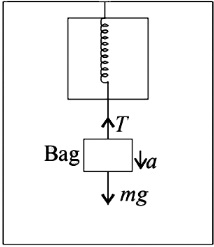
$A$ spring balance is attached to the ceiling of a lift. $A$ man hangs his bag on the spring and the spring reads $49 \, N$,when the lift is stationary. If the lift moves downward with an acceleration of $5 \, m/s^2$,the reading of the spring balance will be .......... $N$.
A
$24.5$
B
$74$
C
$15$
D
$49$
Solution
(A) When the lift is stationary,the reading of the spring balance is equal to the weight of the bag,so $T = mg = 49 \, N$. Taking $g = 9.8 \, m/s^2$,the mass of the bag is $m = \frac{49}{9.8} = 5 \, kg$.
When the lift moves downward with an acceleration $a = 5 \, m/s^2$,the equation of motion for the bag is $mg - T' = ma$,where $T'$ is the new reading of the spring balance.
Therefore,$T' = m(g - a)$.
Substituting the values,$T' = 5 \times (9.8 - 5) = 5 \times 4.8 = 24 \, N$.
When the lift moves downward with an acceleration $a = 5 \, m/s^2$,the equation of motion for the bag is $mg - T' = ma$,where $T'$ is the new reading of the spring balance.
Therefore,$T' = m(g - a)$.
Substituting the values,$T' = 5 \times (9.8 - 5) = 5 \times 4.8 = 24 \, N$.
0 likesView Solution
53
ChemistryMCQAIEEE · 2003
$A$ block of mass $M$ is pulled along a horizontal frictionless surface by a rope of mass $m$. If a force $P$ is applied at the free end of the rope,the force exerted by the rope on the block is-
A
$\frac{Pm}{M + m}$
B
$\frac{Pm}{M - m}$
C
$P$
D
$\frac{PM}{M + m}$
Solution
(D) Consider the system consisting of the block of mass $M$ and the rope of mass $m$ as a single unit.
The total mass of the system is $(M + m)$.
$A$ horizontal force $P$ is applied to the free end of the rope,which acts as the net external force on the system.
According to Newton's second law,the acceleration $a$ of the system is given by:
$a = \frac{\text{Total Force}}{\text{Total Mass}} = \frac{P}{M + m}$
Since the block and the rope move together,the block of mass $M$ also moves with the same acceleration $a$.
The force exerted by the rope on the block is the net force required to accelerate the block of mass $M$:
$F = M \times a$
Substituting the value of $a$:
$F = M \times \left( \frac{P}{M + m} \right) = \frac{PM}{M + m}$
The total mass of the system is $(M + m)$.
$A$ horizontal force $P$ is applied to the free end of the rope,which acts as the net external force on the system.
According to Newton's second law,the acceleration $a$ of the system is given by:
$a = \frac{\text{Total Force}}{\text{Total Mass}} = \frac{P}{M + m}$
Since the block and the rope move together,the block of mass $M$ also moves with the same acceleration $a$.
The force exerted by the rope on the block is the net force required to accelerate the block of mass $M$:
$F = M \times a$
Substituting the value of $a$:
$F = M \times \left( \frac{P}{M + m} \right) = \frac{PM}{M + m}$
0 likesView Solution
54
ChemistryMCQAIEEE · 2003
$A$ marble block of mass $2\, kg$ lying on ice when given a velocity of $6\, m/s$ is stopped by friction in $10\, s$. Then the coefficient of friction is-
A
$0.02$
B
$0.03$
C
$0.06$
D
$0.01$
Solution
(C) Given: Initial velocity $u = 6\, m/s$,final velocity $v = 0\, m/s$,time $t = 10\, s$,and acceleration due to gravity $g = 10\, m/s^2$.
The frictional force $f$ acting on the block is $f = \mu N = \mu mg$.
According to Newton's second law,the retardation $a$ is given by $a = -\frac{f}{m} = -\frac{\mu mg}{m} = -\mu g$.
Using the first equation of motion,$v = u + at$,we substitute the values:
$0 = 6 + (-\mu \times 10) \times 10$.
$0 = 6 - 100\mu$.
$100\mu = 6$.
$\mu = \frac{6}{100} = 0.06$.
The frictional force $f$ acting on the block is $f = \mu N = \mu mg$.
According to Newton's second law,the retardation $a$ is given by $a = -\frac{f}{m} = -\frac{\mu mg}{m} = -\mu g$.
Using the first equation of motion,$v = u + at$,we substitute the values:
$0 = 6 + (-\mu \times 10) \times 10$.
$0 = 6 - 100\mu$.
$100\mu = 6$.
$\mu = \frac{6}{100} = 0.06$.
0 likesView Solution
55
ChemistryMCQAIEEE · 2003
$A$ wire suspended vertically from one of its ends is stretched by attaching a weight of $200 \ N$ to the lower end. The weight stretches the wire by $1 \ mm$. The elastic energy stored in the wire is ......... $J$.
A
$0.1$
B
$0.2$
C
$10$
D
$20$
Solution
(A) The elastic potential energy $U$ stored in a stretched wire is given by the formula:
$U = \frac{1}{2} \times F \times x$
Where $F$ is the applied force and $x$ is the extension produced.
Given:
Force $F = 200 \ N$
Extension $x = 1 \ mm = 10^{-3} \ m$
Substituting these values into the formula:
$U = \frac{1}{2} \times 200 \times 10^{-3}$
$U = 100 \times 10^{-3}$
$U = 0.1 \ J$
Therefore,the elastic energy stored in the wire is $0.1 \ J$.
$U = \frac{1}{2} \times F \times x$
Where $F$ is the applied force and $x$ is the extension produced.
Given:
Force $F = 200 \ N$
Extension $x = 1 \ mm = 10^{-3} \ m$
Substituting these values into the formula:
$U = \frac{1}{2} \times 200 \times 10^{-3}$
$U = 100 \times 10^{-3}$
$U = 0.1 \ J$
Therefore,the elastic energy stored in the wire is $0.1 \ J$.
0 likesView Solution
56
ChemistryMCQAIEEE · 2003
Two identical photo-cathodes receive light of frequencies $f_1$ and $f_2$. If the velocities of the photoelectrons (of mass $m$) coming out are respectively $v_1$ and $v_2$,then:
A
${v_1} - {v_2} = {\left[ {\frac{{2h}}{m}\left( {{f_1} - {f_2}} \right)} \right]^{1/2}}$
B
$v_1^2 - v_2^2 = \frac{{2h}}{m}\left( {{f_1} - {f_2}} \right)$
C
${v_1} + {v_2} = {\left[ {\frac{{2h}}{m}\left( {{f_1} + {f_2}} \right)} \right]^{1/2}}$
D
$v_1^2 + v_2^2 = \frac{{2h}}{m}\left( {{f_1} + {f_2}} \right)$
Solution
(B) Identical photo-cathodes imply they have the same work function,denoted by $\phi$.
According to Einstein's photoelectric equation:
$K_{max,1} = \frac{1}{2}mv_1^2 = hf_1 - \phi$ --- $(1)$
$K_{max,2} = \frac{1}{2}mv_2^2 = hf_2 - \phi$ --- $(2)$
Subtracting equation $(2)$ from equation $(1)$:
$\frac{1}{2}mv_1^2 - \frac{1}{2}mv_2^2 = (hf_1 - \phi) - (hf_2 - \phi)$
$\frac{1}{2}m(v_1^2 - v_2^2) = h(f_1 - f_2)$
$v_1^2 - v_2^2 = \frac{2h}{m}(f_1 - f_2)$
According to Einstein's photoelectric equation:
$K_{max,1} = \frac{1}{2}mv_1^2 = hf_1 - \phi$ --- $(1)$
$K_{max,2} = \frac{1}{2}mv_2^2 = hf_2 - \phi$ --- $(2)$
Subtracting equation $(2)$ from equation $(1)$:
$\frac{1}{2}mv_1^2 - \frac{1}{2}mv_2^2 = (hf_1 - \phi) - (hf_2 - \phi)$
$\frac{1}{2}m(v_1^2 - v_2^2) = h(f_1 - f_2)$
$v_1^2 - v_2^2 = \frac{2h}{m}(f_1 - f_2)$
0 likesView Solution
57
ChemistryMCQAIEEE · 2003
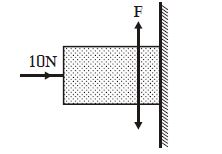
$A$ horizontal force of $10\,N$ is necessary to just hold a block stationary against a wall. The coefficient of friction between the block and the wall is $0.2$. The weight of the block is ........ $N$.
A
$20$
B
$50$
C
$100$
D
$2$
Solution
(D) To hold the block stationary against the wall,the downward gravitational force (weight $W$) must be balanced by the upward frictional force $(f_s)$.
The normal force $(N)$ exerted by the wall on the block is equal to the applied horizontal force,so $N = 10\,N$.
The maximum static frictional force is given by $f_{s,max} = \mu N$,where $\mu = 0.2$ is the coefficient of friction.
Thus,$f_{s,max} = 0.2 \times 10\,N = 2\,N$.
Since the block is held stationary,the weight $W$ must be equal to the frictional force: $W = f_s = 2\,N$.
The normal force $(N)$ exerted by the wall on the block is equal to the applied horizontal force,so $N = 10\,N$.
The maximum static frictional force is given by $f_{s,max} = \mu N$,where $\mu = 0.2$ is the coefficient of friction.
Thus,$f_{s,max} = 0.2 \times 10\,N = 2\,N$.
Since the block is held stationary,the weight $W$ must be equal to the frictional force: $W = f_s = 2\,N$.
0 likesView Solution
58
ChemistryMCQAIEEE · 2003
$A$ thin spherical conducting shell of radius $R$ has a charge $q$. Another charge $Q$ is placed at the centre of the shell. The electrostatic potential at a point $P$ at a distance $R/2$ from the centre of the shell is
A
$\frac{2Q}{4\pi \epsilon_0 R}$
B
$\frac{2Q}{4\pi \epsilon_0 R} - \frac{2q}{4\pi \epsilon_0 R}$
C
$\frac{2Q}{4\pi \epsilon_0 R} + \frac{q}{4\pi \epsilon_0 R}$
D
$\frac{(q + Q)}{4\pi \epsilon_0 R} \cdot \frac{2}{R}$
Solution
(C) The potential at point $P$ inside the shell is the sum of the potential due to the charge $Q$ at the centre and the potential due to the charge $q$ on the shell.
$1$. The potential due to charge $Q$ at a distance $r = R/2$ is given by $V_Q = \frac{1}{4\pi \epsilon_0} \frac{Q}{R/2} = \frac{2Q}{4\pi \epsilon_0 R}$.
$2$. The potential due to the spherical shell of charge $q$ at any point inside it (including the centre) is constant and equal to the potential at its surface,which is $V_q = \frac{1}{4\pi \epsilon_0} \frac{q}{R}$.
$3$. The total potential at point $P$ is $V_P = V_Q + V_q = \frac{2Q}{4\pi \epsilon_0 R} + \frac{q}{4\pi \epsilon_0 R}$.
$1$. The potential due to charge $Q$ at a distance $r = R/2$ is given by $V_Q = \frac{1}{4\pi \epsilon_0} \frac{Q}{R/2} = \frac{2Q}{4\pi \epsilon_0 R}$.
$2$. The potential due to the spherical shell of charge $q$ at any point inside it (including the centre) is constant and equal to the potential at its surface,which is $V_q = \frac{1}{4\pi \epsilon_0} \frac{q}{R}$.
$3$. The total potential at point $P$ is $V_P = V_Q + V_q = \frac{2Q}{4\pi \epsilon_0 R} + \frac{q}{4\pi \epsilon_0 R}$.

0 likesView Solution
59
ChemistryMCQAIEEE · 2003
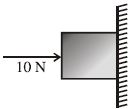
$A$ horizontal force of $10\, N$ is necessary to just hold a block stationary against a wall. The coefficient of friction between the block and the wall is $0.2$. The weight of the block is ........ $N$.
A
$2$
B
$20$
C
$50$
D
$100$
Solution
(A) Given: Horizontal force,$F = 10\, N$ and coefficient of friction between the block and the wall,$\mu = 0.2$.
For the block to remain stationary against the wall,the horizontal force $F$ provides the normal reaction $R$ on the block.
Therefore,$R = F = 10\, N$.
The frictional force $f$ acting upwards balances the weight $W$ of the block acting downwards.
Thus,$W = f = \mu R$.
Substituting the values,$W = 0.2 \times 10 = 2\, N$.
Hence,the weight of the block is $2\, N$.
For the block to remain stationary against the wall,the horizontal force $F$ provides the normal reaction $R$ on the block.
Therefore,$R = F = 10\, N$.
The frictional force $f$ acting upwards balances the weight $W$ of the block acting downwards.
Thus,$W = f = \mu R$.
Substituting the values,$W = 0.2 \times 10 = 2\, N$.
Hence,the weight of the block is $2\, N$.
0 likesView Solution
60
ChemistryMCQAIEEE · 2003
The work done in placing a charge of $8 \times 10^{-18} \text{ C}$ on a condenser of capacity $100 \mu\text{F}$ is:
A
$16 \times 10^{-32} \text{ J}$
B
$3.1 \times 10^{-26} \text{ J}$
C
$4 \times 10^{-10} \text{ J}$
D
$32 \times 10^{-32} \text{ J}$
Solution
(D) The work done $(W)$ in charging a capacitor is given by the formula: $W = \frac{Q^2}{2C}$.
Given:
Charge $(Q)$ = $8 \times 10^{-18} \text{ C}$
Capacitance $(C)$ = $100 \mu\text{F} = 100 \times 10^{-6} \text{ F} = 10^{-4} \text{ F}$.
Substituting the values into the formula:
$W = \frac{(8 \times 10^{-18})^2}{2 \times 10^{-4}}$
$W = \frac{64 \times 10^{-36}}{2 \times 10^{-4}}$
$W = 32 \times 10^{-32} \text{ J}$.
Given:
Charge $(Q)$ = $8 \times 10^{-18} \text{ C}$
Capacitance $(C)$ = $100 \mu\text{F} = 100 \times 10^{-6} \text{ F} = 10^{-4} \text{ F}$.
Substituting the values into the formula:
$W = \frac{(8 \times 10^{-18})^2}{2 \times 10^{-4}}$
$W = \frac{64 \times 10^{-36}}{2 \times 10^{-4}}$
$W = 32 \times 10^{-32} \text{ J}$.
0 likesView Solution
61
ChemistryMCQAIEEE · 2003
$A$ nucleus with $Z = 92$ emits the following in a sequence: $\alpha, \alpha, \beta^-, \beta^-, \alpha, \alpha, \alpha, \alpha, \beta^-, \beta^-, \alpha, \beta^-, \beta^-, \alpha$. The $Z$ of the resulting nucleus is
A
$76$
B
$78$
C
$82$
D
$74$
Solution
(C) For each $\alpha$ decay,the atomic number $Z$ decreases by $2$.
For each $\beta^-$ decay,the atomic number $Z$ increases by $1$.
Counting the emissions from the given sequence:
Total number of $\alpha$ particles emitted $= 8$.
Total number of $\beta^-$ particles emitted $= 6$.
Initial atomic number $Z_i = 92$.
The final atomic number $Z_f$ is given by:
$Z_f = Z_i - 2(\text{number of } \alpha) + 1(\text{number of } \beta^-)$
$Z_f = 92 - 2(8) + 1(6)$
$Z_f = 92 - 16 + 6$
$Z_f = 82$.
For each $\beta^-$ decay,the atomic number $Z$ increases by $1$.
Counting the emissions from the given sequence:
Total number of $\alpha$ particles emitted $= 8$.
Total number of $\beta^-$ particles emitted $= 6$.
Initial atomic number $Z_i = 92$.
The final atomic number $Z_f$ is given by:
$Z_f = Z_i - 2(\text{number of } \alpha) + 1(\text{number of } \beta^-)$
$Z_f = 92 - 2(8) + 1(6)$
$Z_f = 92 - 16 + 6$
$Z_f = 82$.
0 likesView Solution
62
ChemistryMCQAIEEE · 2003
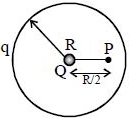
$A$ thin spherical conducting shell of radius $R$ has a charge $q$. Another charge $Q$ is placed at the centre of the shell. The electrostatic potential at a point $P$ at a distance $R/2$ from the centre of the shell is
A
$\frac{(q + Q)2}{4\pi \epsilon_0 R}$
B
$\frac{2Q}{4\pi \epsilon_0 R}$
C
$\frac{2Q}{4\pi \epsilon_0 R} - \frac{2q}{4\pi \epsilon_0 R}$
D
$\frac{2Q}{4\pi \epsilon_0 R} + \frac{q}{4\pi \epsilon_0 R}$
Solution
(D) The electric potential at a point $P$ inside a spherical shell is the sum of the potential due to the charge $Q$ at the centre and the potential due to the charge $q$ on the shell.
$1$. Potential due to charge $Q$ at distance $r = R/2$ is $V_Q = \frac{1}{4\pi \epsilon_0} \frac{Q}{R/2} = \frac{2Q}{4\pi \epsilon_0 R}$.
$2$. Potential due to charge $q$ on the shell at any point inside the shell (including the centre) is constant and equal to the potential at the surface: $V_q = \frac{1}{4\pi \epsilon_0} \frac{q}{R}$.
$3$. Total potential at point $P$ is $V = V_Q + V_q = \frac{2Q}{4\pi \epsilon_0 R} + \frac{q}{4\pi \epsilon_0 R}$.
$1$. Potential due to charge $Q$ at distance $r = R/2$ is $V_Q = \frac{1}{4\pi \epsilon_0} \frac{Q}{R/2} = \frac{2Q}{4\pi \epsilon_0 R}$.
$2$. Potential due to charge $q$ on the shell at any point inside the shell (including the centre) is constant and equal to the potential at the surface: $V_q = \frac{1}{4\pi \epsilon_0} \frac{q}{R}$.
$3$. Total potential at point $P$ is $V = V_Q + V_q = \frac{2Q}{4\pi \epsilon_0 R} + \frac{q}{4\pi \epsilon_0 R}$.
0 likesView Solution
63
ChemistryMCQAIEEE · 2003
Curie temperature is the temperature above which
A
$A$ paramagnetic material becomes ferromagnetic
B
$A$ ferromagnetic material becomes paramagnetic
C
$A$ paramagnetic material becomes diamagnetic
D
$A$ ferromagnetic material becomes diamagnetic
Solution
(B) The Curie temperature $(T_C)$ is a characteristic property of ferromagnetic materials.
Below the Curie temperature,the atomic magnetic moments in a ferromagnetic material are aligned in domains,resulting in strong spontaneous magnetization.
As the temperature increases,thermal agitation disrupts this alignment.
At the Curie temperature,the thermal energy becomes sufficient to overcome the exchange interaction that keeps the magnetic moments aligned.
Above the Curie temperature,the material loses its ferromagnetic property and behaves as a paramagnetic material,where the magnetic susceptibility follows the Curie-Weiss law.
Below the Curie temperature,the atomic magnetic moments in a ferromagnetic material are aligned in domains,resulting in strong spontaneous magnetization.
As the temperature increases,thermal agitation disrupts this alignment.
At the Curie temperature,the thermal energy becomes sufficient to overcome the exchange interaction that keeps the magnetic moments aligned.
Above the Curie temperature,the material loses its ferromagnetic property and behaves as a paramagnetic material,where the magnetic susceptibility follows the Curie-Weiss law.
0 likesView Solution
64
ChemistryMCQAIEEE · 2003
$A$ thin spherical conducting shell of radius $R$ has charge $q$. Another charge $Q$ is placed at the centre of the shell. The electrostatic potential at a point $P$ at a distance $R/2$ from the centre of the shell is
A
$\frac{2Q}{4\pi\varepsilon_0 R}$
B
$\frac{(q+Q)^2}{4\pi\varepsilon_0 R}$
C
$\frac{2Q}{4\pi\varepsilon_0 R} - \frac{2q}{4\pi\varepsilon_0 R}$
D
$\frac{2Q}{4\pi\varepsilon_0 R} + \frac{q}{4\pi\varepsilon_0 R}$
Solution
(D) The potential at any point inside a spherical conducting shell is constant and equal to the potential at its surface.
Given,charge on the shell is $q$ and its radius is $R$.
The potential due to the shell at any point inside (including the centre and at distance $R/2$) is $V_1 = \frac{1}{4\pi\varepsilon_0} \frac{q}{R}$.
The potential due to the point charge $Q$ placed at the centre at a distance $r = R/2$ is $V_2 = \frac{1}{4\pi\varepsilon_0} \frac{Q}{R/2} = \frac{2Q}{4\pi\varepsilon_0 R}$.
The total electrostatic potential at point $P$ is $V = V_1 + V_2$.
Therefore,$V = \frac{q}{4\pi\varepsilon_0 R} + \frac{2Q}{4\pi\varepsilon_0 R} = \frac{1}{4\pi\varepsilon_0 R} (q + 2Q)$.
Given,charge on the shell is $q$ and its radius is $R$.
The potential due to the shell at any point inside (including the centre and at distance $R/2$) is $V_1 = \frac{1}{4\pi\varepsilon_0} \frac{q}{R}$.
The potential due to the point charge $Q$ placed at the centre at a distance $r = R/2$ is $V_2 = \frac{1}{4\pi\varepsilon_0} \frac{Q}{R/2} = \frac{2Q}{4\pi\varepsilon_0 R}$.
The total electrostatic potential at point $P$ is $V = V_1 + V_2$.
Therefore,$V = \frac{q}{4\pi\varepsilon_0 R} + \frac{2Q}{4\pi\varepsilon_0 R} = \frac{1}{4\pi\varepsilon_0 R} (q + 2Q)$.
0 likesView Solution
65
ChemistryMCQAIEEE · 2003
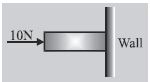
$A$ horizontal force of $10\,N$ is necessary to just hold a block stationary against a wall. The coefficient of friction between the block and wall is $0.2$. The weight of the block is ........ $N$.
A
$20$
B
$50$
C
$100$
D
$2$
Solution
(D) For the block to be held stationary against the wall,the downward gravitational force (weight $W$) must be balanced by the upward frictional force $(f)$.
The normal force $(N)$ exerted by the wall on the block is equal to the applied horizontal force,so $N = 10\,N$.
The maximum static frictional force is given by $f = \mu N$,where $\mu = 0.2$ is the coefficient of friction.
Thus,$f = 0.2 \times 10\,N = 2\,N$.
Since the block is stationary,$W = f = 2\,N$.
The normal force $(N)$ exerted by the wall on the block is equal to the applied horizontal force,so $N = 10\,N$.
The maximum static frictional force is given by $f = \mu N$,where $\mu = 0.2$ is the coefficient of friction.
Thus,$f = 0.2 \times 10\,N = 2\,N$.
Since the block is stationary,$W = f = 2\,N$.
0 likesView Solution
66
ChemistryMCQAIEEE · 2003
$A$ spring of spring constant $5 \times 10^3 \, N/m$ is stretched initially by $5 \, cm$ from the unstretched position. Then the work required to stretch it further by another $5 \, cm$ is .............. $N-m$.
A
$6.25$
B
$12.50$
C
$18.75$
D
$25$
Solution
(C) The work done in stretching a spring from an initial extension $x_1$ to a final extension $x_2$ is given by the formula: $W = \frac{1}{2} k (x_2^2 - x_1^2)$.
Given:
Spring constant $k = 5 \times 10^3 \, N/m$.
Initial extension $x_1 = 5 \, cm = 5 \times 10^{-2} \, m$.
Final extension $x_2 = 5 \, cm + 5 \, cm = 10 \, cm = 10 \times 10^{-2} \, m$.
Substituting the values:
$W = \frac{1}{2} \times (5 \times 10^3) \times [(10 \times 10^{-2})^2 - (5 \times 10^{-2})^2]$
$W = 2500 \times [100 \times 10^{-4} - 25 \times 10^{-4}]$
$W = 2500 \times [75 \times 10^{-4}]$
$W = 2500 \times 0.0075 = 18.75 \, N-m$.
Given:
Spring constant $k = 5 \times 10^3 \, N/m$.
Initial extension $x_1 = 5 \, cm = 5 \times 10^{-2} \, m$.
Final extension $x_2 = 5 \, cm + 5 \, cm = 10 \, cm = 10 \times 10^{-2} \, m$.
Substituting the values:
$W = \frac{1}{2} \times (5 \times 10^3) \times [(10 \times 10^{-2})^2 - (5 \times 10^{-2})^2]$
$W = 2500 \times [100 \times 10^{-4} - 25 \times 10^{-4}]$
$W = 2500 \times [75 \times 10^{-4}]$
$W = 2500 \times 0.0075 = 18.75 \, N-m$.
0 likesView Solution
67
ChemistryMCQAIEEE · 2003
$A$ simple pendulum is executing simple harmonic motion with a time period $T$. If the length of the pendulum is increased by $21\%$,the percentage increase in the time period of the pendulum of increased length is ..... $\%$
A
$10$
B
$21$
C
$30$
D
$50$
Solution
(A) The time period of a simple pendulum is given by $T = 2\pi \sqrt{\frac{\ell}{g}}$,which implies $T \propto \sqrt{\ell}$.
Let the initial length be $\ell_1 = \ell$ and the initial time period be $T_1 = T$.
The new length is $\ell_2 = \ell + 0.21\ell = 1.21\ell$.
The new time period $T_2$ is given by $\frac{T_2}{T_1} = \sqrt{\frac{\ell_2}{\ell_1}} = \sqrt{\frac{1.21\ell}{\ell}} = \sqrt{1.21} = 1.1$.
Thus,$T_2 = 1.1T_1$.
The percentage increase in the time period is $\frac{T_2 - T_1}{T_1} \times 100 = \frac{1.1T_1 - T_1}{T_1} \times 100 = 0.1 \times 100 = 10\%$.
Let the initial length be $\ell_1 = \ell$ and the initial time period be $T_1 = T$.
The new length is $\ell_2 = \ell + 0.21\ell = 1.21\ell$.
The new time period $T_2$ is given by $\frac{T_2}{T_1} = \sqrt{\frac{\ell_2}{\ell_1}} = \sqrt{\frac{1.21\ell}{\ell}} = \sqrt{1.21} = 1.1$.
Thus,$T_2 = 1.1T_1$.
The percentage increase in the time period is $\frac{T_2 - T_1}{T_1} \times 100 = \frac{1.1T_1 - T_1}{T_1} \times 100 = 0.1 \times 100 = 10\%$.
0 likesView Solution
68
ChemistryMCQAIEEE · 2003
Curie temperature is the temperature above which
A
a ferromagnetic material becomes paramagnetic
B
a paramagnetic material becomes diamagnetic
C
a ferromagnetic material becomes diamagnetic
D
a paramagnetic material becomes ferromagnetic
Solution
(A) The Curie temperature $(T_C)$ is a characteristic property of ferromagnetic materials.
At temperatures below the Curie temperature,the magnetic moments in a ferromagnetic material are aligned due to exchange interaction,resulting in spontaneous magnetization.
As the temperature increases,thermal agitation disrupts this alignment.
When the temperature exceeds the Curie temperature $(T > T_C)$,the thermal energy becomes sufficient to overcome the exchange interaction,causing the material to lose its spontaneous magnetization and behave as a paramagnetic material.
Therefore,above the Curie temperature,a ferromagnetic material becomes paramagnetic.
At temperatures below the Curie temperature,the magnetic moments in a ferromagnetic material are aligned due to exchange interaction,resulting in spontaneous magnetization.
As the temperature increases,thermal agitation disrupts this alignment.
When the temperature exceeds the Curie temperature $(T > T_C)$,the thermal energy becomes sufficient to overcome the exchange interaction,causing the material to lose its spontaneous magnetization and behave as a paramagnetic material.
Therefore,above the Curie temperature,a ferromagnetic material becomes paramagnetic.
0 likesView Solution
Vedclass Products
For Students
Vedclass Test Series
Mock tests in real AIEEE style covering Chemistry with performance analysis. 5-day free trial.
Start Free TrialFor Teachers
Exam Paper Generator
Generate Set A/B/C/D Chemistry papers from 7.5L+ questions in 2 minutes. 3 chapters free.
Try FreeFor Institutes
Online Exam Module
Run live AIEEE mock exams with unlimited students, 360° analytics & white-label branding.
See DemoFrequently Asked Questions
How many Chemistry questions are in AIEEE 2003?
There are 97 Chemistry questions from the AIEEE 2003 paper on Vedclass, each with a detailed step-by-step solution in English.
Are AIEEE 2003 Chemistry solutions available in English?
Yes. All solutions on this page are in English. You can also switch to English or Hindi using the language buttons above the questions.
Can I practice AIEEE 2003 Chemistry as a timed test?
Yes. Use the Vedclass Test Series to attempt a full AIEEE mock test covering Chemistry with time limits and instant score analysis.
Can teachers create Chemistry papers from AIEEE previous year questions?
Yes. The Vedclass Exam Paper Generator lets teachers mix AIEEE Chemistry questions and generate Set A/B/C/D papers in minutes.
For Teachers & Institutes
Build a Custom Chemistry Paper
Pick AIEEE 2003 Chemistry questions, set difficulty, and generate Set A/B/C/D in 2 minutes.