
ChemistryQ1–55 of 55 questions
Page 1 of 1 · English
1
ChemistryMCQAIEEE · 2008
If $\int \frac{5\tan x}{\tan x - 2} dx = x + a \ln |\sin x - 2\cos x| + k$,then $a$ is equal to
A
$-1$
B
$-2$
C
$1$
D
$2$
Solution
(D) We are given the integral $I = \int \frac{5\tan x}{\tan x - 2} dx$.
First,express $\tan x$ as $\frac{\sin x}{\cos x}$:
$I = \int \frac{5(\sin x / \cos x)}{(\sin x / \cos x) - 2} dx = \int \frac{5\sin x}{\sin x - 2\cos x} dx$.
We want to express the numerator in terms of the denominator $(\sin x - 2\cos x)$ and its derivative $(\cos x + 2\sin x)$.
Let $5\sin x = A(\sin x - 2\cos x) + B(\cos x + 2\sin x)$.
Equating coefficients of $\sin x$ and $\cos x$:
$A + 2B = 5$
$-2A + B = 0 \implies B = 2A$.
Substituting $B = 2A$ into the first equation: $A + 2(2A) = 5 \implies 5A = 5 \implies A = 1$.
Then $B = 2(1) = 2$.
So,$5\sin x = 1(\sin x - 2\cos x) + 2(\cos x + 2\sin x)$.
Substituting this into the integral:
$I = \int \frac{(\sin x - 2\cos x) + 2(\cos x + 2\sin x)}{\sin x - 2\cos x} dx$
$I = \int 1 dx + 2 \int \frac{\cos x + 2\sin x}{\sin x - 2\cos x} dx$.
Let $t = \sin x - 2\cos x$,then $dt = (\cos x + 2\sin x) dx$.
$I = x + 2 \int \frac{1}{t} dt = x + 2 \ln |t| + k = x + 2 \ln |\sin x - 2\cos x| + k$.
Comparing this with the given form $x + a \ln |\sin x - 2\cos x| + k$,we get $a = 2$.
First,express $\tan x$ as $\frac{\sin x}{\cos x}$:
$I = \int \frac{5(\sin x / \cos x)}{(\sin x / \cos x) - 2} dx = \int \frac{5\sin x}{\sin x - 2\cos x} dx$.
We want to express the numerator in terms of the denominator $(\sin x - 2\cos x)$ and its derivative $(\cos x + 2\sin x)$.
Let $5\sin x = A(\sin x - 2\cos x) + B(\cos x + 2\sin x)$.
Equating coefficients of $\sin x$ and $\cos x$:
$A + 2B = 5$
$-2A + B = 0 \implies B = 2A$.
Substituting $B = 2A$ into the first equation: $A + 2(2A) = 5 \implies 5A = 5 \implies A = 1$.
Then $B = 2(1) = 2$.
So,$5\sin x = 1(\sin x - 2\cos x) + 2(\cos x + 2\sin x)$.
Substituting this into the integral:
$I = \int \frac{(\sin x - 2\cos x) + 2(\cos x + 2\sin x)}{\sin x - 2\cos x} dx$
$I = \int 1 dx + 2 \int \frac{\cos x + 2\sin x}{\sin x - 2\cos x} dx$.
Let $t = \sin x - 2\cos x$,then $dt = (\cos x + 2\sin x) dx$.
$I = x + 2 \int \frac{1}{t} dt = x + 2 \ln |t| + k = x + 2 \ln |\sin x - 2\cos x| + k$.
Comparing this with the given form $x + a \ln |\sin x - 2\cos x| + k$,we get $a = 2$.
0 likesView Solution
2
ChemistryEasyMCQAIEEE · 2008
If a gas expands at constant temperature,it indicates that
A
kinetic energy of molecules remains same
B
number of the molecules of gas increases
C
kinetic energy of molecules decreases
D
pressure of the gas increases
Solution
(A) If a gas expands at a constant temperature,the average kinetic energy of the molecules remains the same.
The average kinetic energy $(KE)$ of a gas molecule is given by the expression:
$KE = \frac{3}{2} kT$
From this expression,it is clear that $KE \propto T$.
Since the temperature $(T)$ is constant,the kinetic energy $(KE)$ of the molecules must also remain constant.
The average kinetic energy $(KE)$ of a gas molecule is given by the expression:
$KE = \frac{3}{2} kT$
From this expression,it is clear that $KE \propto T$.
Since the temperature $(T)$ is constant,the kinetic energy $(KE)$ of the molecules must also remain constant.
0 likesView Solution
3
ChemistryMCQAIEEE · 2008
The speed of sound in oxygen $(O_2)$ at a certain temperature is $460 \; m/s$. The speed of sound in helium $(He)$ at the same temperature will be (assume both gases to be ideal): (in $; m/s$)
A
$1420$
B
$500$
C
$650$
D
$300$
Solution
(A) The speed of sound in an ideal gas is given by the formula: $v = \sqrt{\frac{\gamma RT}{M}}$.
For oxygen $(O_2)$,which is a diatomic gas,the adiabatic index $\gamma_{O_2} = 1.4 = \frac{7}{5}$ and the molar mass $M_{O_2} = 32 \; g/mol$.
Thus,$v_{O_2} = \sqrt{\frac{7RT}{5 \times 32}}$.
For helium $(He)$,which is a monatomic gas,the adiabatic index $\gamma_{He} = 1.67 = \frac{5}{3}$ and the molar mass $M_{He} = 4 \; g/mol$.
Thus,$v_{He} = \sqrt{\frac{5RT}{3 \times 4}}$.
Taking the ratio of the speeds:
$\frac{v_{He}}{v_{O_2}} = \sqrt{\frac{\gamma_{He} / M_{He}}{\gamma_{O_2} / M_{O_2}}} = \sqrt{\frac{5/3}{4} \times \frac{32}{7/5}} = \sqrt{\frac{5}{12} \times \frac{160}{7}} = \sqrt{\frac{800}{84}} = \sqrt{\frac{200}{21}} \approx 3.086$.
Therefore,$v_{He} = 460 \times 3.086 \approx 1420 \; m/s$.
For oxygen $(O_2)$,which is a diatomic gas,the adiabatic index $\gamma_{O_2} = 1.4 = \frac{7}{5}$ and the molar mass $M_{O_2} = 32 \; g/mol$.
Thus,$v_{O_2} = \sqrt{\frac{7RT}{5 \times 32}}$.
For helium $(He)$,which is a monatomic gas,the adiabatic index $\gamma_{He} = 1.67 = \frac{5}{3}$ and the molar mass $M_{He} = 4 \; g/mol$.
Thus,$v_{He} = \sqrt{\frac{5RT}{3 \times 4}}$.
Taking the ratio of the speeds:
$\frac{v_{He}}{v_{O_2}} = \sqrt{\frac{\gamma_{He} / M_{He}}{\gamma_{O_2} / M_{O_2}}} = \sqrt{\frac{5/3}{4} \times \frac{32}{7/5}} = \sqrt{\frac{5}{12} \times \frac{160}{7}} = \sqrt{\frac{800}{84}} = \sqrt{\frac{200}{21}} \approx 3.086$.
Therefore,$v_{He} = 460 \times 3.086 \approx 1420 \; m/s$.
0 likesView Solution
4
ChemistryMediumMCQAIEEE · 2008
Which one of the following constitutes a group of the isoelectronic species?
A
$C_2^{2-}, O_2^-, CO, NO$
B
$NO^{+}, C_2^{2-}, CN^{-}, N_2$
C
$CN^{-}, N_2, O_2^{2-}, C_2^{2-}$
D
$N_2, O_2^-, NO^{+}, CO$
Solution
(B) Isoelectronic species are those that possess the same number of electrons.
For $NO^{+}$: $7 + 8 - 1 = 14$ electrons.
For $C_2^{2-}$: $6 \times 2 + 2 = 14$ electrons.
For $CN^{-}$: $6 + 7 + 1 = 14$ electrons.
For $N_2$: $7 \times 2 = 14$ electrons.
Since $NO^{+}, C_2^{2-}, CN^{-}$,and $N_2$ each have $14$ electrons,they are isoelectronic.
For $NO^{+}$: $7 + 8 - 1 = 14$ electrons.
For $C_2^{2-}$: $6 \times 2 + 2 = 14$ electrons.
For $CN^{-}$: $6 + 7 + 1 = 14$ electrons.
For $N_2$: $7 \times 2 = 14$ electrons.
Since $NO^{+}, C_2^{2-}, CN^{-}$,and $N_2$ each have $14$ electrons,they are isoelectronic.
0 likesView Solution
5
ChemistryDifficultMCQAIEEE · 2008
The ionization enthalpy of a hydrogen atom is $1.312 \times 10^6 \ J \ mol^{-1}$. The energy required to excite the electron in the atom from $n= 1$ to $n= 2$ is
A
$8.51 \times 10^5 \ J \ mol^{-1}$
B
$6.56 \times 10^5 \ J \ mol^{-1}$
C
$7.56 \times 10^5 \ J \ mol^{-1}$
D
$9.84 \times 10^5 \ J \ mol^{-1}$
Solution
(D) The energy of an electron in the $n^{th}$ orbit is given by $E_n = -\frac{1.312 \times 10^6}{n^2} \ J \ mol^{-1}$.
For $n=1$,$E_1 = -1.312 \times 10^6 \ J \ mol^{-1}$.
For $n=2$,$E_2 = -\frac{1.312 \times 10^6}{2^2} = -\frac{1.312 \times 10^6}{4} = -0.328 \times 10^6 \ J \ mol^{-1}$.
The energy required to excite the electron from $n=1$ to $n=2$ is $\Delta E = E_2 - E_1$.
$\Delta E = (-0.328 \times 10^6) - (-1.312 \times 10^6) \ J \ mol^{-1}$.
$\Delta E = (1.312 - 0.328) \times 10^6 \ J \ mol^{-1} = 0.984 \times 10^6 \ J \ mol^{-1} = 9.84 \times 10^5 \ J \ mol^{-1}$.
For $n=1$,$E_1 = -1.312 \times 10^6 \ J \ mol^{-1}$.
For $n=2$,$E_2 = -\frac{1.312 \times 10^6}{2^2} = -\frac{1.312 \times 10^6}{4} = -0.328 \times 10^6 \ J \ mol^{-1}$.
The energy required to excite the electron from $n=1$ to $n=2$ is $\Delta E = E_2 - E_1$.
$\Delta E = (-0.328 \times 10^6) - (-1.312 \times 10^6) \ J \ mol^{-1}$.
$\Delta E = (1.312 - 0.328) \times 10^6 \ J \ mol^{-1} = 0.984 \times 10^6 \ J \ mol^{-1} = 9.84 \times 10^5 \ J \ mol^{-1}$.
0 likesView Solution
6
ChemistryMCQAIEEE · 2008
In which of the following arrangements,the sequence is not strictly according to the property written against it?
A
$HF < HCl < HBr < HI$ : increasing acid strength
B
$NH_3 < PH_3 < AsH_3 < SbH_3$ : increasing basic strength
C
$B < C < O < N$ : increasing first ionization enthalpy
D
$CO_2 < SiO_2 < SnO_2 < PbO_2$ : increasing oxidising power
Solution
(B) In group $15$ hydrides,the basic character decreases on going down the group due to the increase in the size of the central atom and the dispersion of the lone pair over a larger volume.
Thus,the correct order of basicity is $NH_3 > PH_3 > AsH_3 > SbH_3$.
Therefore,the arrangement $NH_3 < PH_3 < AsH_3 < SbH_3$ is incorrect.
Thus,the correct order of basicity is $NH_3 > PH_3 > AsH_3 > SbH_3$.
Therefore,the arrangement $NH_3 < PH_3 < AsH_3 < SbH_3$ is incorrect.
0 likesView Solution
7
ChemistryMediumMCQAIEEE · 2008
Which one of the following pairs of species have the same bond order?
A
$CN^{-}$ and $NO^{+}$
B
$CN^{-}$ and $CN^{+}$
C
$O_2^{-}$ and $CN^{-}$
D
$NO^{+}$ and $CN^{+}$
Solution
(A) The bond order of a diatomic species depends on the total number of electrons in the molecule or ion.
Species with the same number of electrons are isoelectronic and generally possess the same bond order.
Calculating the total number of electrons for each species:
$CN^{-}$: $6 + 7 + 1 = 14$ electrons.
$NO^{+}$: $7 + 8 - 1 = 14$ electrons.
$CN^{+}$: $6 + 7 - 1 = 12$ electrons.
$O_2^{-}$: $8 + 8 + 1 = 17$ electrons.
Since $CN^{-}$ and $NO^{+}$ both have $14$ electrons,they have the same bond order (which is $3$).
Species with the same number of electrons are isoelectronic and generally possess the same bond order.
Calculating the total number of electrons for each species:
$CN^{-}$: $6 + 7 + 1 = 14$ electrons.
$NO^{+}$: $7 + 8 - 1 = 14$ electrons.
$CN^{+}$: $6 + 7 - 1 = 12$ electrons.
$O_2^{-}$: $8 + 8 + 1 = 17$ electrons.
Since $CN^{-}$ and $NO^{+}$ both have $14$ electrons,they have the same bond order (which is $3$).
0 likesView Solution
8
ChemistryMediumMCQAIEEE · 2008
The bond dissociation energy of $B-F$ in $BF_3$ is $646 \ kJ \ mol^{-1}$ whereas that of $C-F$ in $CF_4$ is $515 \ kJ \ mol^{-1}.$ The correct reason for higher $B-F$ bond dissociation energy as compared to that of $C-F$ is
A
stronger $\sigma$ bond between $B$ and $F$ in $BF_3$ as compared to that between $C$ and $F$ in $CF_4.$
B
significant $p\pi - p\pi$ interaction between $B$ and $F$ in $BF_3$ whereas there is no possibility of such interaction between $C$ and $F$ in $CF_4.$
C
lower degree of $p\pi - p\pi$ interaction between $B$ and $F$ in $BF_3$ than that between $C$ and $F$ in $CF_4.$
D
smaller size of $B$ atom as compared to that of $C$ atom.
Solution
(B) $BF_3$ is a Lewis acid due to the incomplete octet of Boron.
In $BF_3$,the Boron atom has a vacant $2p$-orbital,and the Fluorine atom has lone pairs in its $2p$-orbital.
This allows for $p\pi - p\pi$ back-bonding from the Fluorine to the Boron,which increases the bond order and strengthens the $B-F$ bond.
In $CF_4$,the Carbon atom has a complete octet and no vacant orbitals,so no such back-bonding is possible.
Therefore,the $B-F$ bond in $BF_3$ is stronger than the $C-F$ bond in $CF_4$ due to this back-bonding interaction.
In $BF_3$,the Boron atom has a vacant $2p$-orbital,and the Fluorine atom has lone pairs in its $2p$-orbital.
This allows for $p\pi - p\pi$ back-bonding from the Fluorine to the Boron,which increases the bond order and strengthens the $B-F$ bond.
In $CF_4$,the Carbon atom has a complete octet and no vacant orbitals,so no such back-bonding is possible.
Therefore,the $B-F$ bond in $BF_3$ is stronger than the $C-F$ bond in $CF_4$ due to this back-bonding interaction.
0 likesView Solution
9
ChemistryMediumMCQAIEEE · 2008
Using $MO$ theory,predict which of the following species has the shortest bond length?
A
$O_2^+$
B
$O_2^-$
C
$O_2^{2-}$
D
$O_2^{2+}$
Solution
(D) According to $MO$ theory,bond order is inversely proportional to bond length.
$O_2^{2+}$ has a bond order of $3.0$.
$O_2^+$ has a bond order of $2.5$.
$O_2^-$ has a bond order of $1.5$.
$O_2^{2-}$ has a bond order of $1.0$.
Since $O_2^{2+}$ has the highest bond order,it has the shortest bond length.
$O_2^{2+}$ has a bond order of $3.0$.
$O_2^+$ has a bond order of $2.5$.
$O_2^-$ has a bond order of $1.5$.
$O_2^{2-}$ has a bond order of $1.0$.
Since $O_2^{2+}$ has the highest bond order,it has the shortest bond length.
0 likesView Solution
10
ChemistryMediumMCQAIEEE · 2008
Oxidising power of chlorine in aqueous solution can be determined by the parameters indicated below:
$\frac{1}{2} Cl_{2(g)}$ $\xrightarrow{\frac{1}{2} \Delta_{diss} H^{\Theta}} Cl_{(g)}$ $\xrightarrow{\Delta_{eg} H^{\Theta}} Cl^{-}_{(g)}$ $\xrightarrow{\Delta_{Hyd} H^{\Theta}} Cl^{-}_{(aq)}$
(using the data,$\Delta_{diss} H_{Cl_2}^{\Theta} = 240 \ kJ \ mol^{-1}$,$\Delta_{eg} H_{Cl}^{\Theta} = -349 \ kJ \ mol^{-1}$,$\Delta_{Hyd} H_{Cl}^{\Theta} = -381 \ kJ \ mol^{-1}$) will be ............. $kJ \ mol^{-1}$.
$\frac{1}{2} Cl_{2(g)}$ $\xrightarrow{\frac{1}{2} \Delta_{diss} H^{\Theta}} Cl_{(g)}$ $\xrightarrow{\Delta_{eg} H^{\Theta}} Cl^{-}_{(g)}$ $\xrightarrow{\Delta_{Hyd} H^{\Theta}} Cl^{-}_{(aq)}$
(using the data,$\Delta_{diss} H_{Cl_2}^{\Theta} = 240 \ kJ \ mol^{-1}$,$\Delta_{eg} H_{Cl}^{\Theta} = -349 \ kJ \ mol^{-1}$,$\Delta_{Hyd} H_{Cl}^{\Theta} = -381 \ kJ \ mol^{-1}$) will be ............. $kJ \ mol^{-1}$.
A
$+ 152$
B
$- 610$
C
$- 850$
D
$+ 120$
Solution
(B) The total energy change involved in the conversion of $\frac{1}{2} Cl_{2(g)}$ to $Cl^{-}_{(aq)}$ is given by the sum of the enthalpy changes of the individual steps:
$\Delta H = \frac{1}{2} \Delta_{diss} H_{Cl_2}^{\Theta} + \Delta_{eg} H_{Cl}^{\Theta} + \Delta_{Hyd} H_{Cl}^{\Theta}$
Substituting the given values:
$\Delta H = (\frac{1}{2} \times 240) + (-349) + (-381) \ kJ \ mol^{-1}$
$\Delta H = 120 - 349 - 381 \ kJ \ mol^{-1}$
$\Delta H = - 610 \ kJ \ mol^{-1}$
$\Delta H = \frac{1}{2} \Delta_{diss} H_{Cl_2}^{\Theta} + \Delta_{eg} H_{Cl}^{\Theta} + \Delta_{Hyd} H_{Cl}^{\Theta}$
Substituting the given values:
$\Delta H = (\frac{1}{2} \times 240) + (-349) + (-381) \ kJ \ mol^{-1}$
$\Delta H = 120 - 349 - 381 \ kJ \ mol^{-1}$
$\Delta H = - 610 \ kJ \ mol^{-1}$
0 likesView Solution
11
ChemistryDifficultMCQAIEEE · 2008
Standard entropy of $X_2, Y_2$ and $XY_3$ are $60, 40$ and $50 \ J \ K^{-1} \ mol^{-1},$ respectively. For the reaction,$\frac{1}{2}X_2 + \frac{3}{2}Y_2 \to XY_3, \ \Delta H = -30 \ kJ,$ to be at equilibrium,the temperature will be ............... $K$.
A
$1250$
B
$500$
C
$750$
D
$1000$
Solution
(C) For a reaction to be at equilibrium,$\Delta G = 0$.
Since $\Delta G = \Delta H - T \Delta S$,at equilibrium,$\Delta H = T \Delta S$.
For the reaction $\frac{1}{2} X_2 + \frac{3}{2} Y_2 \to XY_3$,$\Delta H = -30 \ kJ = -30000 \ J$.
Calculating $\Delta S$ for the reaction:
$\Delta S = S^{\circ}(XY_3) - [\frac{1}{2} S^{\circ}(X_2) + \frac{3}{2} S^{\circ}(Y_2)]$
$\Delta S = 50 - [\frac{1}{2} \times 60 + \frac{3}{2} \times 40] \ J \ K^{-1} \ mol^{-1}$
$\Delta S = 50 - [30 + 60] = -40 \ J \ K^{-1} \ mol^{-1}$.
At equilibrium,$T = \frac{\Delta H}{\Delta S} = \frac{-30000 \ J}{-40 \ J \ K^{-1}} = 750 \ K$.
Since $\Delta G = \Delta H - T \Delta S$,at equilibrium,$\Delta H = T \Delta S$.
For the reaction $\frac{1}{2} X_2 + \frac{3}{2} Y_2 \to XY_3$,$\Delta H = -30 \ kJ = -30000 \ J$.
Calculating $\Delta S$ for the reaction:
$\Delta S = S^{\circ}(XY_3) - [\frac{1}{2} S^{\circ}(X_2) + \frac{3}{2} S^{\circ}(Y_2)]$
$\Delta S = 50 - [\frac{1}{2} \times 60 + \frac{3}{2} \times 40] \ J \ K^{-1} \ mol^{-1}$
$\Delta S = 50 - [30 + 60] = -40 \ J \ K^{-1} \ mol^{-1}$.
At equilibrium,$T = \frac{\Delta H}{\Delta S} = \frac{-30000 \ J}{-40 \ J \ K^{-1}} = 750 \ K$.
0 likesView Solution
12
ChemistryAdvancedMCQAIEEE · 2008
The equilibrium constants $K_{p1}$ and $K_{p2}$ for the reactions $X \rightleftharpoons 2Y$ and $Z \rightleftharpoons P + Q$ respectively are in the ratio of $1 : 9$. If the degree of dissociation of $X$ and $Z$ be equal,then the ratio of total pressures at these equilibria is:
A
$1 : 36$
B
$1 : 1$
C
$1 : 3$
D
$1 : 9$
Solution
(A) For reaction $X \rightleftharpoons 2Y$:
Initial moles: $a$,$0$
At equilibrium: $a(1 - \alpha)$,$2a\alpha$
Total moles $= a(1 + \alpha)$
$K_{p1} = \frac{(2a\alpha)^2}{a(1 - \alpha)} \times \left(\frac{P_{T1}}{a(1 + \alpha)}\right)^1 = \frac{4\alpha^2 P_{T1}}{1 - \alpha^2}$
For reaction $Z \rightleftharpoons P + Q$:
Initial moles: $b$,$0$,$0$
At equilibrium: $b(1 - \alpha)$,$b\alpha$,$b\alpha$
Total moles $= b(1 + \alpha)$
$K_{p2} = \frac{(b\alpha)(b\alpha)}{b(1 - \alpha)} \times \left(\frac{P_{T2}}{b(1 + \alpha)}\right)^1 = \frac{\alpha^2 P_{T2}}{1 - \alpha^2}$
Given $\frac{K_{p1}}{K_{p2}} = \frac{1}{9}$,we have:
$\frac{4\alpha^2 P_{T1} / (1 - \alpha^2)}{\alpha^2 P_{T2} / (1 - \alpha^2)} = \frac{1}{9}$
$\frac{4 P_{T1}}{P_{T2}} = \frac{1}{9}$
$\frac{P_{T1}}{P_{T2}} = \frac{1}{36}$
Initial moles: $a$,$0$
At equilibrium: $a(1 - \alpha)$,$2a\alpha$
Total moles $= a(1 + \alpha)$
$K_{p1} = \frac{(2a\alpha)^2}{a(1 - \alpha)} \times \left(\frac{P_{T1}}{a(1 + \alpha)}\right)^1 = \frac{4\alpha^2 P_{T1}}{1 - \alpha^2}$
For reaction $Z \rightleftharpoons P + Q$:
Initial moles: $b$,$0$,$0$
At equilibrium: $b(1 - \alpha)$,$b\alpha$,$b\alpha$
Total moles $= b(1 + \alpha)$
$K_{p2} = \frac{(b\alpha)(b\alpha)}{b(1 - \alpha)} \times \left(\frac{P_{T2}}{b(1 + \alpha)}\right)^1 = \frac{\alpha^2 P_{T2}}{1 - \alpha^2}$
Given $\frac{K_{p1}}{K_{p2}} = \frac{1}{9}$,we have:
$\frac{4\alpha^2 P_{T1} / (1 - \alpha^2)}{\alpha^2 P_{T2} / (1 - \alpha^2)} = \frac{1}{9}$
$\frac{4 P_{T1}}{P_{T2}} = \frac{1}{9}$
$\frac{P_{T1}}{P_{T2}} = \frac{1}{36}$
0 likesView Solution
13
ChemistryMediumMCQAIEEE · 2008
For the following three reactions $a, b$ and $c,$ equilibrium constants are given:
$(i)$ $CO_{(g)} + H_2O_{(g)} \rightleftharpoons CO_{2(g)} + H_{2(g)}$ ; $K_1$
$(ii)$ $CH_{4(g)} + H_2O_{(g)} \rightleftharpoons CO_{(g)} + 3H_{2(g)}$ ; $K_2$
$(iii)$ $CH_{4(g)} + 2H_2O_{(g)} \rightleftharpoons CO_{2(g)} + 4H_{2(g)}$ ; $K_3$
Which of the following relations is correct?
$(i)$ $CO_{(g)} + H_2O_{(g)} \rightleftharpoons CO_{2(g)} + H_{2(g)}$ ; $K_1$
$(ii)$ $CH_{4(g)} + H_2O_{(g)} \rightleftharpoons CO_{(g)} + 3H_{2(g)}$ ; $K_2$
$(iii)$ $CH_{4(g)} + 2H_2O_{(g)} \rightleftharpoons CO_{2(g)} + 4H_{2(g)}$ ; $K_3$
Which of the following relations is correct?
A
$K_1 \sqrt{K_2} = K_3$
B
$K_2 K_3 = K_1$
C
$K_3 = K_1 \cdot K_2$
D
$K_3 \cdot K_2^3 = K_1^2$
Solution
(C) Given reactions are:
$(i)$ $CO_{(g)} + H_2O_{(g)} \rightleftharpoons CO_{2(g)} + H_{2(g)}$ ; $K_1$
$(ii)$ $CH_{4(g)} + H_2O_{(g)} \rightleftharpoons CO_{(g)} + 3H_{2(g)}$ ; $K_2$
Adding reaction $(i)$ and $(ii)$:
$(CO_{(g)} + H_2O_{(g)}) + (CH_{4(g)} + H_2O_{(g)}) \rightleftharpoons (CO_{2(g)} + H_{2(g)}) + (CO_{(g)} + 3H_{2(g)})$
Canceling $CO_{(g)}$ from both sides:
$CH_{4(g)} + 2H_2O_{(g)} \rightleftharpoons CO_{2(g)} + 4H_{2(g)}$
This is reaction $(iii)$.
When reactions are added,their equilibrium constants are multiplied.
Therefore,$K_3 = K_1 \cdot K_2$.
$(i)$ $CO_{(g)} + H_2O_{(g)} \rightleftharpoons CO_{2(g)} + H_{2(g)}$ ; $K_1$
$(ii)$ $CH_{4(g)} + H_2O_{(g)} \rightleftharpoons CO_{(g)} + 3H_{2(g)}$ ; $K_2$
Adding reaction $(i)$ and $(ii)$:
$(CO_{(g)} + H_2O_{(g)}) + (CH_{4(g)} + H_2O_{(g)}) \rightleftharpoons (CO_{2(g)} + H_{2(g)}) + (CO_{(g)} + 3H_{2(g)})$
Canceling $CO_{(g)}$ from both sides:
$CH_{4(g)} + 2H_2O_{(g)} \rightleftharpoons CO_{2(g)} + 4H_{2(g)}$
This is reaction $(iii)$.
When reactions are added,their equilibrium constants are multiplied.
Therefore,$K_3 = K_1 \cdot K_2$.
0 likesView Solution
14
ChemistryDifficultMCQAIEEE · 2008
Four species are listed below:
$i. \, HCO_3^-$
$ii. \, H_3O^{+}$
$iii. \, HSO_4^-$
$iv. \, HSO_3F$
Which one of the following is the correct sequence of their acid strength?
$i. \, HCO_3^-$
$ii. \, H_3O^{+}$
$iii. \, HSO_4^-$
$iv. \, HSO_3F$
Which one of the following is the correct sequence of their acid strength?
A
$iv < ii < iii < i$
B
$ii < iii < i < iv$
C
$i < iii < ii < iv$
D
$iii < i < iv < ii$
Solution
(C) The acidic strength depends on the stability of the conjugate base formed after the loss of a proton $(H^{+})$.
$1. \, HSO_3F$ is a superacid,which is the strongest among the given species.
$2. \, H_3O^{+}$ is a strong acid $(pK_a \approx -1.7)$.
$3. \, HSO_4^-$ is a moderately strong acid $(pK_a \approx 1.99)$.
$4. \, HCO_3^-$ is a weak acid $(pK_a \approx 10.3)$.
Therefore,the correct order of acidic strength is:
$HCO_3^- < HSO_4^- < H_3O^{+} < HSO_3F$
Which corresponds to the sequence: $i < iii < ii < iv$.
$1. \, HSO_3F$ is a superacid,which is the strongest among the given species.
$2. \, H_3O^{+}$ is a strong acid $(pK_a \approx -1.7)$.
$3. \, HSO_4^-$ is a moderately strong acid $(pK_a \approx 1.99)$.
$4. \, HCO_3^-$ is a weak acid $(pK_a \approx 10.3)$.
Therefore,the correct order of acidic strength is:
$HCO_3^- < HSO_4^- < H_3O^{+} < HSO_3F$
Which corresponds to the sequence: $i < iii < ii < iv$.
0 likesView Solution
15
ChemistryMediumMCQAIEEE · 2008
The $pK_a$ of a weak acid,$HA,$ is $4.80.$ The $pK_b$ of a weak base,$BOH,$ is $4.78.$ The $pH$ of an aqueous solution of the corresponding salt,$BA,$ will be
A
$9.58$
B
$4.79$
C
$7.01$
D
$9.22$
Solution
(C) The salt $BA$ is formed from a weak acid $(HA)$ and a weak base $(BOH)$.
In aqueous solution,the salt undergoes hydrolysis as follows:
$BA + H_2O \rightleftharpoons BOH + HA$
The $pH$ of a salt of a weak acid and a weak base is given by the formula:
$pH = \frac{1}{2} pK_w + \frac{1}{2} pK_a - \frac{1}{2} pK_b$
Given $pK_w = 14.00$,$pK_a = 4.80$,and $pK_b = 4.78$.
Substituting these values into the formula:
$pH = \frac{1}{2} (14.00 + 4.80 - 4.78)$
$pH = \frac{1}{2} (14.02)$
$pH = 7.01$
In aqueous solution,the salt undergoes hydrolysis as follows:
$BA + H_2O \rightleftharpoons BOH + HA$
The $pH$ of a salt of a weak acid and a weak base is given by the formula:
$pH = \frac{1}{2} pK_w + \frac{1}{2} pK_a - \frac{1}{2} pK_b$
Given $pK_w = 14.00$,$pK_a = 4.80$,and $pK_b = 4.78$.
Substituting these values into the formula:
$pH = \frac{1}{2} (14.00 + 4.80 - 4.78)$
$pH = \frac{1}{2} (14.02)$
$pH = 7.01$
0 likesView Solution
16
ChemistryDifficultMCQAIEEE · 2008
In context with the industrial preparation of hydrogen from water gas $(CO + H_2)$,which of the following is the correct statement?
A
$CO$ and $H_2$ are fractionally separated using differences in their densities
B
$CO$ is removed by absorption in aqueous $Cu_2Cl_2$ solution
C
$H_2$ is removed through occlusion with $Pd$
D
$CO$ is oxidised to $CO_2$ with steam in the presence of a catalyst followed by absorption of $CO_2$ in alkali
Solution
(D) On the industrial scale,hydrogen is prepared from water gas using the water-gas shift reaction:
$CO + H_2O(g) \xrightarrow{\text{catalyst}} CO_2 + H_2$
The resulting $CO_2$ is removed by scrubbing the mixture with an alkali solution (e.g.,$NaOH$ or $K_2CO_3$):
$CO_2 + 2NaOH \longrightarrow Na_2CO_3 + H_2O$
Thus,$CO$ is oxidized to $CO_2$ using steam in the presence of a catalyst,and the $CO_2$ is subsequently removed by absorption in an alkali.
$CO + H_2O(g) \xrightarrow{\text{catalyst}} CO_2 + H_2$
The resulting $CO_2$ is removed by scrubbing the mixture with an alkali solution (e.g.,$NaOH$ or $K_2CO_3$):
$CO_2 + 2NaOH \longrightarrow Na_2CO_3 + H_2O$
Thus,$CO$ is oxidized to $CO_2$ using steam in the presence of a catalyst,and the $CO_2$ is subsequently removed by absorption in an alkali.
0 likesView Solution
17
ChemistryMediumMCQAIEEE · 2008
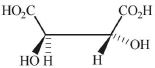
The absolute configuration of the given molecule is:
A
$S, S$
B
$R, R$
C
$R, S$
D
$S, R$
Solution
(B) To determine the absolute configuration,we assign priorities to the groups attached to each chiral center using the Cahn-Ingold-Prelog $(CIP)$ rules.
For the first chiral center (left): The groups are $-OH$ $(1)$,$-COOH$ $(2)$,$-CH(OH)COOH$ $(3)$,and $-H$ $(4)$. Since $-H$ is on a dashed bond (pointing away),the sequence $1$ $\rightarrow 2$ $\rightarrow 3$ is clockwise,which corresponds to the $R$ configuration.
For the second chiral center (right): The groups are $-OH$ $(1)$,$-COOH$ $(2)$,$-CH(OH)COOH$ $(3)$,and $-H$ $(4)$. Since $-H$ is on a dashed bond (pointing away),the sequence $1$ $\rightarrow 2$ $\rightarrow 3$ is clockwise,which corresponds to the $R$ configuration.
Thus,the absolute configuration is $R, R$.
For the first chiral center (left): The groups are $-OH$ $(1)$,$-COOH$ $(2)$,$-CH(OH)COOH$ $(3)$,and $-H$ $(4)$. Since $-H$ is on a dashed bond (pointing away),the sequence $1$ $\rightarrow 2$ $\rightarrow 3$ is clockwise,which corresponds to the $R$ configuration.
For the second chiral center (right): The groups are $-OH$ $(1)$,$-COOH$ $(2)$,$-CH(OH)COOH$ $(3)$,and $-H$ $(4)$. Since $-H$ is on a dashed bond (pointing away),the sequence $1$ $\rightarrow 2$ $\rightarrow 3$ is clockwise,which corresponds to the $R$ configuration.
Thus,the absolute configuration is $R, R$.
0 likesView Solution
18
ChemistryMediumMCQAIEEE · 2008
The electrophile,$E^{\oplus}$ attacks the benzene ring to generate the intermediate $\sigma-$complex. Of the following,which $\sigma-$complex is of the lowest energy?
A
B
C
D
Solution
(B) The stability of the $\sigma-$complex (arenium ion) depends on the substituents present on the benzene ring.
Nitrobenzene contains a $-NO_2$ group,which is a strong electron-withdrawing group ($-I$ and $-M$ effect). This group destabilizes the positively charged $\sigma-$complex by withdrawing electron density.
In contrast,benzene has no such electron-withdrawing substituent.
Therefore,the $\sigma-$complex formed from benzene is more stable and has lower energy compared to the $\sigma-$complexes formed from nitrobenzene (at ortho,meta,or para positions).
Nitrobenzene contains a $-NO_2$ group,which is a strong electron-withdrawing group ($-I$ and $-M$ effect). This group destabilizes the positively charged $\sigma-$complex by withdrawing electron density.
In contrast,benzene has no such electron-withdrawing substituent.
Therefore,the $\sigma-$complex formed from benzene is more stable and has lower energy compared to the $\sigma-$complexes formed from nitrobenzene (at ortho,meta,or para positions).
0 likesView Solution
19
ChemistryMediumMCQAIEEE · 2008
The correct decreasing order of priority for the functional groups of organic compounds in the $IUPAC$ system of nomenclature is:
A
$-COOH > -SO_3H > -CONH_2 > -CHO$
B
$-SO_3H > -COOH > -CONH_2 > -CHO$
C
$-CHO > -COOH > -SO_3H > -CONH_2$
D
$-CONH_2 > -CHO > -SO_3H > -COOH$
Solution
(A) In the $IUPAC$ system of nomenclature,the priority order for functional groups is determined by specific rules.
According to the $IUPAC$ priority table,the carboxylic acid group $(-COOH)$ has the highest priority among the given groups.
The sulfonic acid group $(-SO_3H)$ follows,then the amide group $(-CONH_2)$,and finally the aldehyde group $(-CHO)$.
Therefore,the correct decreasing order is: $-COOH > -SO_3H > -CONH_2 > -CHO$.
According to the $IUPAC$ priority table,the carboxylic acid group $(-COOH)$ has the highest priority among the given groups.
The sulfonic acid group $(-SO_3H)$ follows,then the amide group $(-CONH_2)$,and finally the aldehyde group $(-CHO)$.
Therefore,the correct decreasing order is: $-COOH > -SO_3H > -CONH_2 > -CHO$.
0 likesView Solution
20
ChemistryMCQAIEEE · 2008
In the following sequence of reactions,the alkene affords the compound $B$:
$CH_3-CH=CH-CH_3$ $\xrightarrow{O_3} A$ $\xrightarrow{Zn, H_2O} B$
The compound $B$ is
$CH_3-CH=CH-CH_3$ $\xrightarrow{O_3} A$ $\xrightarrow{Zn, H_2O} B$
The compound $B$ is
A
$CH_3CH_2CHO$
B
$CH_3COCH_3$
C
$CH_3CH_2COCH_3$
D
$CH_3CHO$
Solution
(D) The reaction is an ozonolysis of but$-2-$ene $(CH_3-CH=CH-CH_3)$.
Step $1$: Reaction with $O_3$ forms an ozonide intermediate $(A)$.
Step $2$: Reductive cleavage of the ozonide with $Zn$ and $H_2O$ breaks the $C=C$ bond.
$CH_3-CH=CH-CH_3 + O_3$ $\rightarrow \text{Ozonide}$ $\xrightarrow{Zn, H_2O} 2CH_3CHO$
Thus,the product $B$ is acetaldehyde $(CH_3CHO)$.
Step $1$: Reaction with $O_3$ forms an ozonide intermediate $(A)$.
Step $2$: Reductive cleavage of the ozonide with $Zn$ and $H_2O$ breaks the $C=C$ bond.
$CH_3-CH=CH-CH_3 + O_3$ $\rightarrow \text{Ozonide}$ $\xrightarrow{Zn, H_2O} 2CH_3CHO$
Thus,the product $B$ is acetaldehyde $(CH_3CHO)$.
0 likesView Solution
21
ChemistryMediumMCQAIEEE · 2008
The hydrocarbon which can react with sodium in liquid ammonia is
A
$CH_3CH_2CH_2C \equiv CCH_2CH_2CH_3$
B
$CH_3CH_2C \equiv CH$
C
$CH_3CH \equiv CHCH_3$
D
$CH_3CH_2C \equiv CCH_2CH_3$
Solution
(B) Terminal alkynes contain an acidic hydrogen atom attached to an $sp$-hybridized carbon atom.
These acidic protons can be removed by strong bases like sodium metal in liquid ammonia ($NaNH_2$ is formed in situ or sodium acts as a reducing agent for the proton) to form sodium acetylides.
Among the given options,$CH_3CH_2C \equiv CH$ is a terminal alkyne,whereas the others are internal alkynes.
Therefore,$CH_3CH_2C \equiv CH$ reacts with sodium in liquid ammonia.
These acidic protons can be removed by strong bases like sodium metal in liquid ammonia ($NaNH_2$ is formed in situ or sodium acts as a reducing agent for the proton) to form sodium acetylides.
Among the given options,$CH_3CH_2C \equiv CH$ is a terminal alkyne,whereas the others are internal alkynes.
Therefore,$CH_3CH_2C \equiv CH$ reacts with sodium in liquid ammonia.
0 likesView Solution
22
ChemistryMediumMCQAIEEE · 2008
The treatment of $CH_3MgX$ with $CH_3-C \equiv CH$ produces
A
$CH_3-CH=CH_2$
B
$CH_3-C \equiv C-CH_3$
C
$CH_3-CH=CH-CH_3$
D
$CH_4$
Solution
(D) $CH_3MgX$ is a Grignard reagent,which acts as a strong base.
Terminal alkynes like $CH_3-C \equiv CH$ contain an acidic hydrogen atom attached to the $sp$-hybridized carbon.
The Grignard reagent abstracts this acidic proton to form an alkane.
The reaction is: $CH_3MgX + CH_3-C \equiv CH \rightarrow CH_4 + CH_3-C \equiv C-MgX$.
Therefore,the product formed is methane $(CH_4)$.
Terminal alkynes like $CH_3-C \equiv CH$ contain an acidic hydrogen atom attached to the $sp$-hybridized carbon.
The Grignard reagent abstracts this acidic proton to form an alkane.
The reaction is: $CH_3MgX + CH_3-C \equiv CH \rightarrow CH_4 + CH_3-C \equiv C-MgX$.
Therefore,the product formed is methane $(CH_4)$.
0 likesView Solution
23
ChemistryMCQAIEEE · 2008
Gold numbers of protective colloids $A$,$B$,$C$ and $D$ are $0.50$,$0.01$,$0.10$ and $0.005$,respectively. The correct order of their protective powers is
A
$D < A < C < B$
B
$C < B < D < A$
C
$A < C < B < D$
D
$B < D < A < C$
Solution
(C) The protective power of a colloid is inversely proportional to its gold number.
Given gold numbers are:
$A = 0.50$
$B = 0.01$
$C = 0.10$
$D = 0.005$
Arranging the gold numbers in increasing order: $0.005 (D) < 0.01 (B) < 0.10 (C) < 0.50 (A)$.
Since protective power is inversely proportional to the gold number,the order of protective power is $A < C < B < D$.
Given gold numbers are:
$A = 0.50$
$B = 0.01$
$C = 0.10$
$D = 0.005$
Arranging the gold numbers in increasing order: $0.005 (D) < 0.01 (B) < 0.10 (C) < 0.50 (A)$.
Since protective power is inversely proportional to the gold number,the order of protective power is $A < C < B < D$.
0 likesView Solution
24
ChemistryMCQAIEEE · 2008
For a reaction $\frac{1}{2} A \rightarrow 2B,$ the rate of disappearance of $A$ is related to the rate of appearance of $B$ by the expression:
A
$-\frac{d[A]}{dt} = \frac{1}{2} \frac{d[B]}{dt}$
B
$-\frac{d[A]}{dt} = \frac{1}{4} \frac{d[B]}{dt}$
C
$-\frac{d[A]}{dt} = \frac{d[B]}{dt}$
D
$-\frac{d[A]}{dt} = 4 \frac{d[B]}{dt}$
Solution
(B) For a general reaction $aA \rightarrow bB$,the rate of reaction is given by:
Rate $= -\frac{1}{a} \frac{d[A]}{dt} = \frac{1}{b} \frac{d[B]}{dt}$
Given the reaction $\frac{1}{2} A \rightarrow 2B$,we have $a = \frac{1}{2}$ and $b = 2$.
Substituting these values into the rate expression:
$-\frac{1}{1/2} \frac{d[A]}{dt} = \frac{1}{2} \frac{d[B]}{dt}$
$-2 \frac{d[A]}{dt} = \frac{1}{2} \frac{d[B]}{dt}$
Dividing both sides by $2$:
$-\frac{d[A]}{dt} = \frac{1}{4} \frac{d[B]}{dt}$
Rate $= -\frac{1}{a} \frac{d[A]}{dt} = \frac{1}{b} \frac{d[B]}{dt}$
Given the reaction $\frac{1}{2} A \rightarrow 2B$,we have $a = \frac{1}{2}$ and $b = 2$.
Substituting these values into the rate expression:
$-\frac{1}{1/2} \frac{d[A]}{dt} = \frac{1}{2} \frac{d[B]}{dt}$
$-2 \frac{d[A]}{dt} = \frac{1}{2} \frac{d[B]}{dt}$
Dividing both sides by $2$:
$-\frac{d[A]}{dt} = \frac{1}{4} \frac{d[B]}{dt}$
0 likesView Solution
25
ChemistryMediumMCQAIEEE · 2008
Which one of the following is the correct statement?
A
Boric acid is a protonic acid
B
Beryllium exhibits coordination number of six
C
Chlorides of both beryllium and aluminium have bridged chloride structures in solid phase
D
$B_2H_6 \cdot 2NH_3$ is known as 'inorganic benzene'
Solution
(C) Boric acid is a Lewis acid,not a protonic acid.
Beryllium typically exhibits a coordination number of $4$.
$B_2H_6 \cdot 2NH_3$ is known as 'inorganic benzene' is incorrect; borazine $(B_3N_3H_6)$ is known as inorganic benzene.
Both $BeCl_2$ and $AlCl_3$ exist as polymeric structures with bridged chloride atoms in the solid state.
Beryllium typically exhibits a coordination number of $4$.
$B_2H_6 \cdot 2NH_3$ is known as 'inorganic benzene' is incorrect; borazine $(B_3N_3H_6)$ is known as inorganic benzene.
Both $BeCl_2$ and $AlCl_3$ exist as polymeric structures with bridged chloride atoms in the solid state.
0 likesView Solution
26
ChemistryMCQAIEEE · 2008
The coordination number and the oxidation state of the element $E$ in the complex $[E(en)_2(C_2O_4)]NO_2$ (where $en$ is ethylenediamine) are,respectively,
A
$6$ and $2$
B
$4$ and $2$
C
$4$ and $3$
D
$6$ and $3$
Solution
(D) In the complex $[E(en)_2(C_2O_4)]NO_2$,$en$ (ethylenediamine) and $C_2O_4^{2-}$ (oxalate) are both bidentate ligands.
Coordination number = $(2 \times 2) + (1 \times 2) = 6$.
Let the oxidation state of $E$ be $x$.
The complex ion is $[E(en)_2(C_2O_4)]^+$,as the counter ion $NO_2^-$ has a $-1$ charge.
$x + 2(0) + 1(-2) = +1$.
$x - 2 = +1 \Rightarrow x = +3$.
Thus,the coordination number is $6$ and the oxidation state is $+3$.
Coordination number = $(2 \times 2) + (1 \times 2) = 6$.
Let the oxidation state of $E$ be $x$.
The complex ion is $[E(en)_2(C_2O_4)]^+$,as the counter ion $NO_2^-$ has a $-1$ charge.
$x + 2(0) + 1(-2) = +1$.
$x - 2 = +1 \Rightarrow x = +3$.
Thus,the coordination number is $6$ and the oxidation state is $+3$.
0 likesView Solution
27
ChemistryMediumMCQAIEEE · 2008
Identify the wrong statement among the following:
A
Chlorofluorocarbons are responsible for ozone layer depletion.
B
Greenhouse effect is responsible for global warming.
C
Ozone layer does not permit infrared radiation from the sun to reach the earth.
D
Acid rain is mostly because of oxides of nitrogen and sulphur.
Solution
(C) The ozone layer primarily absorbs ultraviolet $(UV)$ radiation from the sun,preventing it from reaching the earth's surface. It does not block infrared radiation. Therefore,statement $C$ is incorrect. All other statements are scientifically accurate.
0 likesView Solution
28
ChemistryDifficultMCQAIEEE · 2008
Among the following substituted silanes,the one which will give rise to a cross-linked silicone polymer on hydrolysis is:
A
$R_4Si$
B
$RSiCl_3$
C
$R_2SiCl_2$
D
$R_3SiCl$
Solution
(B) The hydrolysis of substituted chlorosilanes leads to the formation of silicones.
$1$. $R_3SiCl$ gives a dimer on hydrolysis,which terminates the chain.
$2$. $R_2SiCl_2$ gives linear silicone polymers.
$3$. $RSiCl_3$ has three chlorine atoms attached to the silicon atom. Upon hydrolysis,it forms $RSi(OH)_3$,which has three hydroxyl groups available for condensation. This allows the polymer to grow in three dimensions,resulting in a cross-linked silicone polymer.
Therefore,$RSiCl_3$ is the correct answer.
$1$. $R_3SiCl$ gives a dimer on hydrolysis,which terminates the chain.
$2$. $R_2SiCl_2$ gives linear silicone polymers.
$3$. $RSiCl_3$ has three chlorine atoms attached to the silicon atom. Upon hydrolysis,it forms $RSi(OH)_3$,which has three hydroxyl groups available for condensation. This allows the polymer to grow in three dimensions,resulting in a cross-linked silicone polymer.
Therefore,$RSiCl_3$ is the correct answer.
0 likesView Solution
29
ChemistryMCQAIEEE · 2008
Standard entropy of $X_2, Y_2$ and $XY_3$ are $60, 40$ and $50 \, J \, K^{-1} \, mol^{-1}$,respectively. For the reaction,$\frac{1}{2} X_2 + \frac{3}{2} Y_2 \to XY_3, \Delta H = -30 \, kJ$,to be at equilibrium,the temperature will be .....$K$.
A
$500$
B
$750$
C
$1000$
D
$1250$
Solution
(B) The reaction is $\frac{1}{2} X_2 + \frac{3}{2} Y_2 \to XY_3$.
First,calculate the change in entropy $\Delta S$ for the reaction:
$\Delta S = S^{\circ}(XY_3) - [\frac{1}{2} S^{\circ}(X_2) + \frac{3}{2} S^{\circ}(Y_2)]$
$\Delta S = 50 - [\frac{1}{2} \times 60 + \frac{3}{2} \times 40] = 50 - [30 + 60] = 50 - 90 = -40 \, J \, K^{-1} \, mol^{-1}$.
At equilibrium,the Gibbs free energy change $\Delta G = 0$.
Since $\Delta G = \Delta H - T \Delta S$,at equilibrium,$\Delta H = T \Delta S$.
Given $\Delta H = -30 \, kJ = -30000 \, J$.
$T = \frac{\Delta H}{\Delta S} = \frac{-30000 \, J}{-40 \, J \, K^{-1}} = 750 \, K$.
First,calculate the change in entropy $\Delta S$ for the reaction:
$\Delta S = S^{\circ}(XY_3) - [\frac{1}{2} S^{\circ}(X_2) + \frac{3}{2} S^{\circ}(Y_2)]$
$\Delta S = 50 - [\frac{1}{2} \times 60 + \frac{3}{2} \times 40] = 50 - [30 + 60] = 50 - 90 = -40 \, J \, K^{-1} \, mol^{-1}$.
At equilibrium,the Gibbs free energy change $\Delta G = 0$.
Since $\Delta G = \Delta H - T \Delta S$,at equilibrium,$\Delta H = T \Delta S$.
Given $\Delta H = -30 \, kJ = -30000 \, J$.
$T = \frac{\Delta H}{\Delta S} = \frac{-30000 \, J}{-40 \, J \, K^{-1}} = 750 \, K$.
0 likesView Solution
30
ChemistryMCQAIEEE · 2008
Two coaxial solenoids are made by winding thin insulated wire over a pipe of cross-sectional area $A = 10 \, cm^2$ and length $\ell = 20 \, cm$. If one of the solenoids has $N_1 = 300$ turns and the other has $N_2 = 400$ turns,their mutual inductance is (given $\mu_0 = 4\pi \times 10^{-7} \, T \cdot m \cdot A^{-1}$):
A
$2.4 \pi \times 10^{-5} \, H$
B
$4.8 \pi \times 10^{-4} \, H$
C
$4.8 \pi \times 10^{-5} \, H$
D
$2.4 \pi \times 10^{-4} \, H$
Solution
(D) The formula for the mutual inductance $M$ of two coaxial solenoids is given by $M = \frac{\mu_0 N_1 N_2 A}{\ell}$.
Given values:
$N_1 = 300$
$N_2 = 400$
$A = 10 \, cm^2 = 10 \times 10^{-4} \, m^2 = 10^{-3} \, m^2$
$\ell = 20 \, cm = 0.2 \, m = 2 \times 10^{-1} \, m$
$\mu_0 = 4\pi \times 10^{-7} \, T \cdot m \cdot A^{-1}$
Substituting these values into the formula:
$M = \frac{(4\pi \times 10^{-7}) \times 300 \times 400 \times 10^{-3}}{0.2}$
$M = \frac{4\pi \times 10^{-7} \times 120000 \times 10^{-3}}{0.2}$
$M = \frac{4\pi \times 10^{-7} \times 120}{0.2}$
$M = 4\pi \times 10^{-7} \times 600$
$M = 2400\pi \times 10^{-7} \, H$
$M = 2.4\pi \times 10^{-4} \, H$.
Given values:
$N_1 = 300$
$N_2 = 400$
$A = 10 \, cm^2 = 10 \times 10^{-4} \, m^2 = 10^{-3} \, m^2$
$\ell = 20 \, cm = 0.2 \, m = 2 \times 10^{-1} \, m$
$\mu_0 = 4\pi \times 10^{-7} \, T \cdot m \cdot A^{-1}$
Substituting these values into the formula:
$M = \frac{(4\pi \times 10^{-7}) \times 300 \times 400 \times 10^{-3}}{0.2}$
$M = \frac{4\pi \times 10^{-7} \times 120000 \times 10^{-3}}{0.2}$
$M = \frac{4\pi \times 10^{-7} \times 120}{0.2}$
$M = 4\pi \times 10^{-7} \times 600$
$M = 2400\pi \times 10^{-7} \, H$
$M = 2.4\pi \times 10^{-4} \, H$.
0 likesView Solution
31
ChemistryMCQAIEEE · 2008
$A$ spherical solid ball of volume $V$ is made of a material of density $\rho_1$. It is falling through a liquid of density $\rho_2$ (where $\rho_2 < \rho_1$). Assume that the liquid applies a viscous force on the ball that is proportional to the square of its speed $v$,i.e.,$F_{\text{viscous}} = -kv^2$ (where $k > 0$). Then the terminal speed of the ball is:
A
$\sqrt{\frac{Vg(\rho_1 - \rho_2)}{k}}$
B
$\frac{Vg\rho_1}{k}$
C
$\sqrt{\frac{Vg\rho_1}{k}}$
D
$\frac{Vg(\rho_1 - \rho_2)}{k}$
Solution
(A) The terminal speed $(v_t)$ is reached when the net force acting on the ball is zero.
The forces acting on the ball are:
$1$. Weight of the ball acting downwards: $W = V \rho_1 g$
$2$. Buoyant force acting upwards: $F_B = V \rho_2 g$
$3$. Viscous force acting upwards: $F_v = kv_t^2$
At terminal speed,the forces are balanced:
$W = F_B + F_v$
$V \rho_1 g = V \rho_2 g + kv_t^2$
Rearranging the equation to solve for $v_t$:
$kv_t^2 = V \rho_1 g - V \rho_2 g$
$kv_t^2 = Vg(\rho_1 - \rho_2)$
$v_t^2 = \frac{Vg(\rho_1 - \rho_2)}{k}$
$v_t = \sqrt{\frac{Vg(\rho_1 - \rho_2)}{k}}$
The forces acting on the ball are:
$1$. Weight of the ball acting downwards: $W = V \rho_1 g$
$2$. Buoyant force acting upwards: $F_B = V \rho_2 g$
$3$. Viscous force acting upwards: $F_v = kv_t^2$
At terminal speed,the forces are balanced:
$W = F_B + F_v$
$V \rho_1 g = V \rho_2 g + kv_t^2$
Rearranging the equation to solve for $v_t$:
$kv_t^2 = V \rho_1 g - V \rho_2 g$
$kv_t^2 = Vg(\rho_1 - \rho_2)$
$v_t^2 = \frac{Vg(\rho_1 - \rho_2)}{k}$
$v_t = \sqrt{\frac{Vg(\rho_1 - \rho_2)}{k}}$
0 likesView Solution
32
ChemistryMCQAIEEE · 2008
Two full turns of the circular scale of a screw gauge cover a distance of $1\,mm$ on the main scale. The total number of divisions on the circular scale is $50$. Further,it is found that the screw gauge has a zero error of $+0.03\,mm$. While measuring the diameter of a thin wire,a student notes the main scale reading of $3\,mm$ and the number of the circular scale division in line with the main scale is $35$. The diameter of the wire is .......... $mm$.
A
$3.32$
B
$3.73$
C
$3.67$
D
$3.38$
Solution
(A) The pitch of the screw gauge is the distance moved by the spindle in one full rotation. Since $2$ full turns cover $1\,mm$,the pitch is $\text{pitch} = \frac{1\,mm}{2} = 0.5\,mm$.
The least count $(LC)$ is given by $\frac{\text{pitch}}{\text{total divisions}} = \frac{0.5\,mm}{50} = 0.01\,mm$.
The observed diameter is calculated as $\text{Main Scale Reading} + (\text{Circular Scale Division} \times LC)$.
$\text{Observed diameter} = 3\,mm + (35 \times 0.01\,mm) = 3.35\,mm$.
The actual diameter is given by $\text{Actual diameter} = \text{Observed diameter} - \text{Zero error}$.
$\text{Actual diameter} = 3.35\,mm - (+0.03\,mm) = 3.32\,mm$.
The least count $(LC)$ is given by $\frac{\text{pitch}}{\text{total divisions}} = \frac{0.5\,mm}{50} = 0.01\,mm$.
The observed diameter is calculated as $\text{Main Scale Reading} + (\text{Circular Scale Division} \times LC)$.
$\text{Observed diameter} = 3\,mm + (35 \times 0.01\,mm) = 3.35\,mm$.
The actual diameter is given by $\text{Actual diameter} = \text{Observed diameter} - \text{Zero error}$.
$\text{Actual diameter} = 3.35\,mm - (+0.03\,mm) = 3.32\,mm$.
0 likesView Solution
33
ChemistryMCQAIEEE · 2008
$A$ spherical solid ball of volume $V$ is made of a material of density $\rho_1$. It is falling through a liquid of density $\rho_2$ (where $\rho_2 < \rho_1$). Assume that the liquid applies a viscous force on the ball that is proportional to the square of its speed $v$,i.e.,$F_{viscous} = -kv^2$ (where $k > 0$). Then the terminal speed of the ball is:
A
$\sqrt{\frac{Vg(\rho_1 - \rho_2)}{k}}$
B
$\frac{Vg\rho_1}{k}$
C
$\sqrt{\frac{Vg\rho_1}{k}}$
D
$\frac{Vg(\rho_1 - \rho_2)}{k}$
Solution
(A) At terminal speed,the net force acting on the ball is zero.
The forces acting on the ball are:
$1$. Weight of the ball acting downwards: $W = V \rho_1 g$
$2$. Buoyant force (upthrust) acting upwards: $F_B = V \rho_2 g$
$3$. Viscous force acting upwards: $F_{viscous} = kv_t^2$
For equilibrium at terminal velocity $v_t$:
$W - F_B = F_{viscous}$
$V \rho_1 g - V \rho_2 g = kv_t^2$
$Vg(\rho_1 - \rho_2) = kv_t^2$
$v_t^2 = \frac{Vg(\rho_1 - \rho_2)}{k}$
$v_t = \sqrt{\frac{Vg(\rho_1 - \rho_2)}{k}}$
The forces acting on the ball are:
$1$. Weight of the ball acting downwards: $W = V \rho_1 g$
$2$. Buoyant force (upthrust) acting upwards: $F_B = V \rho_2 g$
$3$. Viscous force acting upwards: $F_{viscous} = kv_t^2$
For equilibrium at terminal velocity $v_t$:
$W - F_B = F_{viscous}$
$V \rho_1 g - V \rho_2 g = kv_t^2$
$Vg(\rho_1 - \rho_2) = kv_t^2$
$v_t^2 = \frac{Vg(\rho_1 - \rho_2)}{k}$
$v_t = \sqrt{\frac{Vg(\rho_1 - \rho_2)}{k}}$
0 likesView Solution
34
ChemistryMCQAIEEE · 2008
The bond dissociation energy of $B-F$ in $BF_3$ is $646 \ kJ \ mol^{-1}$ whereas that of $C-F$ in $CF_4$ is $515 \ kJ \ mol^{-1}$. The correct reason for higher $B-F$ bond dissociation energy as compared to that of $C-F$ is
A
Significant $p\pi-p\pi$ interaction between $B$ and $F$ in $BF_3$ whereas there is no possibility of such interaction between $C$ and $F$ in $CF_4$
B
Lower degree of $p\pi-p\pi$ interaction between $B$ and $F$ in $BF_3$ than that between $C$ and $F$ in $CF_4$
C
Smaller size of $B$ atom as compared to that of $C$ atom
D
Stronger bond between $B$ and $F$ in $BF_3$ as compared to that between $C$ and $F$ in $CF_4$
Solution
(A) In $BF_3$,the boron atom is electron-deficient and has an empty $2p$ orbital.
Fluorine atoms have lone pairs in their $2p$ orbitals.
This allows for $p\pi-p\pi$ back-bonding from $F$ to $B$,which gives the $B-F$ bond partial double bond character.
This additional bonding interaction increases the bond dissociation energy.
In $CF_4$,carbon has a complete octet and cannot accept electrons via back-bonding,so no such $p\pi-p\pi$ interaction exists.
Fluorine atoms have lone pairs in their $2p$ orbitals.
This allows for $p\pi-p\pi$ back-bonding from $F$ to $B$,which gives the $B-F$ bond partial double bond character.
This additional bonding interaction increases the bond dissociation energy.
In $CF_4$,carbon has a complete octet and cannot accept electrons via back-bonding,so no such $p\pi-p\pi$ interaction exists.
0 likesView Solution
35
ChemistryMCQAIEEE · 2008
$A$ working transistor with its three legs marked $P, Q$ and $R$ is tested using a multimeter. No conduction is found between $P$ and $Q$. By connecting the common (negative) terminal of the multimeter to $R$ and the other (positive) terminal to $P$ or $Q$,some resistance is seen on the multimeter. Which of the following is true for the transistor?
A
It is a $PNP$ transistor with $R$ as collector
B
It is a $PNP$ transistor with $R$ as emitter
C
It is an $NPN$ transistor with $R$ as collector
D
It is an $NPN$ transistor with $R$ as base
Solution
(A) $1$. When the multimeter is connected between $P$ and $Q$,no conduction is observed. This implies that $P$ and $Q$ are of the same type (both $n$-type or both $p$-type). Since the transistor is working,$P$ and $Q$ must be the collector and emitter,and $R$ must be the base.
$2$. When the negative terminal of the multimeter is connected to $R$ (base) and the positive terminal is connected to $P$ or $Q$ (collector/emitter),conduction is observed. This means the base-collector and base-emitter junctions are forward-biased when the base is at a lower potential than the collector/emitter.
$3$. In an $NPN$ transistor,the base is $p$-type and the collector/emitter are $n$-type. Forward biasing occurs when the $p$-type base is connected to the positive terminal and $n$-type regions to the negative terminal. However,the problem states the negative terminal is at $R$. This indicates the base is $n$-type and the collector/emitter are $p$-type,which corresponds to a $PNP$ transistor.
$4$. Re-evaluating the standard multimeter test: If the negative terminal is at $R$ and conduction occurs,$R$ must be $p$-type. Thus,$R$ is the base of a $PNP$ transistor.
$2$. When the negative terminal of the multimeter is connected to $R$ (base) and the positive terminal is connected to $P$ or $Q$ (collector/emitter),conduction is observed. This means the base-collector and base-emitter junctions are forward-biased when the base is at a lower potential than the collector/emitter.
$3$. In an $NPN$ transistor,the base is $p$-type and the collector/emitter are $n$-type. Forward biasing occurs when the $p$-type base is connected to the positive terminal and $n$-type regions to the negative terminal. However,the problem states the negative terminal is at $R$. This indicates the base is $n$-type and the collector/emitter are $p$-type,which corresponds to a $PNP$ transistor.
$4$. Re-evaluating the standard multimeter test: If the negative terminal is at $R$ and conduction occurs,$R$ must be $p$-type. Thus,$R$ is the base of a $PNP$ transistor.
0 likesView Solution
36
ChemistryMCQAIEEE · 2008
$A$ spherical solid ball of volume $V$ is made of a material of density $\rho_1$. It is falling through a liquid of density $\rho_2$ $(\rho_2 < \rho_1)$. Assume that the liquid applies a viscous force on the ball that is proportional to the square of its speed $v$,i.e.,$F_{viscous} = -kv^2$ $(k > 0)$. The terminal speed of the ball is
A
$\sqrt{\frac{Vg(\rho_1 - \rho_2)}{k}}$
B
$\frac{Vg\rho_1}{k}$
C
$\sqrt{\frac{Vg\rho_1}{k}}$
D
$\frac{Vg(\rho_1 - \rho_2)}{k}$
Solution
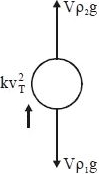
(A) The forces acting on the ball are the gravitational force,the buoyant force,and the viscous force. When the ball reaches its terminal speed,it is in dynamic equilibrium. Let the terminal speed of the ball be $v_T$.
The forces acting downwards are the weight of the ball: $W = V\rho_1 g$.
The forces acting upwards are the buoyant force: $F_B = V\rho_2 g$ and the viscous force: $F_v = kv_T^2$.
In dynamic equilibrium,the net force is zero:
$V\rho_1 g = V\rho_2 g + kv_T^2$
$kv_T^2 = Vg(\rho_1 - \rho_2)$
$v_T^2 = \frac{Vg(\rho_1 - \rho_2)}{k}$
$v_T = \sqrt{\frac{Vg(\rho_1 - \rho_2)}{k}}$
The forces acting downwards are the weight of the ball: $W = V\rho_1 g$.
The forces acting upwards are the buoyant force: $F_B = V\rho_2 g$ and the viscous force: $F_v = kv_T^2$.
In dynamic equilibrium,the net force is zero:
$V\rho_1 g = V\rho_2 g + kv_T^2$
$kv_T^2 = Vg(\rho_1 - \rho_2)$
$v_T^2 = \frac{Vg(\rho_1 - \rho_2)}{k}$
$v_T = \sqrt{\frac{Vg(\rho_1 - \rho_2)}{k}}$
0 likesView Solution
37
ChemistryMCQAIEEE · 2008
$A$ block of mass $0.50 \ kg$ is moving with a speed of $2.00 \ ms^{-1}$ on a smooth surface. It strikes another mass of $1.00 \ kg$ (initially at rest) and then they move together as a single body. The energy loss during the collision is .............. $J$
A
$1.00$
B
$0.67$
C
$0.34$
D
$0.16$
Solution
(B) Given: $m_1 = 0.50 \ kg$,$u_1 = 2.00 \ ms^{-1}$,$m_2 = 1.00 \ kg$,$u_2 = 0 \ ms^{-1}$.
Since the collision is perfectly inelastic,the bodies move together after the collision.
The loss in kinetic energy during a perfectly inelastic collision is given by the formula:
$\Delta K = \frac{m_1 m_2}{2(m_1 + m_2)} (u_1 - u_2)^2$
Substituting the values:
$\Delta K = \frac{0.50 \times 1.00}{2(0.50 + 1.00)} (2.00 - 0)^2$
$\Delta K = \frac{0.50}{2(1.50)} (4)$
$\Delta K = \frac{0.50}{3.00} \times 4 = \frac{2}{3} \approx 0.67 \ J$.
Since the collision is perfectly inelastic,the bodies move together after the collision.
The loss in kinetic energy during a perfectly inelastic collision is given by the formula:
$\Delta K = \frac{m_1 m_2}{2(m_1 + m_2)} (u_1 - u_2)^2$
Substituting the values:
$\Delta K = \frac{0.50 \times 1.00}{2(0.50 + 1.00)} (2.00 - 0)^2$
$\Delta K = \frac{0.50}{2(1.50)} (4)$
$\Delta K = \frac{0.50}{3.00} \times 4 = \frac{2}{3} \approx 0.67 \ J$.
0 likesView Solution
38
ChemistryMCQAIEEE · 2008
$A$ spherical solid ball of volume $V$ is made of a material of density $\rho_1$. It is falling through a liquid of density $\rho_2$ $(\rho_2 < \rho_1)$. Assume that the liquid applies a viscous force on the ball that is proportional to the square of its speed $v$,i.e.,$F_{viscous} = -kv^2$ $(k > 0)$. The terminal speed of the ball is
A
$\sqrt {\frac{{Vg\left( {{\rho _1} - {\rho _2}} \right)}}{k}}$
B
$\frac{{Vg{\rho _1}}}{k}$
C
$\sqrt {\frac{{Vg{\rho _1}}}{k}}$
D
$\frac{{Vg\left( {{\rho _1} - {\rho _2}} \right)}}{k}$
Solution
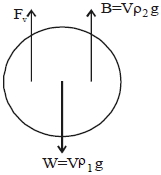
(A) At terminal speed $(v_t)$,the net force acting on the ball is zero. The forces acting on the ball are its weight $(W)$ acting downwards,and the buoyant force $(B)$ and viscous force $(F_v)$ acting upwards.
The condition for terminal speed is:
$W = B + F_v$
Substituting the expressions for the forces:
$V \rho_1 g = V \rho_2 g + k v_t^2$
Rearranging the equation to solve for $v_t^2$:
$k v_t^2 = V \rho_1 g - V \rho_2 g$
$k v_t^2 = Vg(\rho_1 - \rho_2)$
Solving for $v_t$:
$v_t^2 = \frac{Vg(\rho_1 - \rho_2)}{k}$
$v_t = \sqrt{\frac{Vg(\rho_1 - \rho_2)}{k}}$
Therefore,the terminal speed of the ball is $\sqrt{\frac{Vg(\rho_1 - \rho_2)}{k}}$.
The condition for terminal speed is:
$W = B + F_v$
Substituting the expressions for the forces:
$V \rho_1 g = V \rho_2 g + k v_t^2$
Rearranging the equation to solve for $v_t^2$:
$k v_t^2 = V \rho_1 g - V \rho_2 g$
$k v_t^2 = Vg(\rho_1 - \rho_2)$
Solving for $v_t$:
$v_t^2 = \frac{Vg(\rho_1 - \rho_2)}{k}$
$v_t = \sqrt{\frac{Vg(\rho_1 - \rho_2)}{k}}$
Therefore,the terminal speed of the ball is $\sqrt{\frac{Vg(\rho_1 - \rho_2)}{k}}$.
0 likesView Solution
39
ChemistryMediumMCQAIEEE · 2008
In the following sequence of reactions,the alkene affords the compound $B$.
$CH_3-CH=CH-CH_3$ $\xrightarrow{O_3} A$ $\xrightarrow[Zn]{H_2O} B$
The compound $B$ is:
$CH_3-CH=CH-CH_3$ $\xrightarrow{O_3} A$ $\xrightarrow[Zn]{H_2O} B$
The compound $B$ is:
A
$CH_3CH_2CHO$
B
$CH_3COCH_3$
C
$CH_3CH_2COCH_3$
D
$CH_3CHO$
Solution
(D) The reaction is an ozonolysis of but$-2-$ene.
$1$. The alkene $CH_3-CH=CH-CH_3$ reacts with $O_3$ to form an ozonide intermediate $(A)$.
$2$. The ozonide undergoes reductive cleavage with $Zn/H_2O$ to yield two molecules of acetaldehyde $(CH_3CHO)$.
Therefore,the compound $B$ is $CH_3CHO$.
$1$. The alkene $CH_3-CH=CH-CH_3$ reacts with $O_3$ to form an ozonide intermediate $(A)$.
$2$. The ozonide undergoes reductive cleavage with $Zn/H_2O$ to yield two molecules of acetaldehyde $(CH_3CHO)$.
Therefore,the compound $B$ is $CH_3CHO$.
0 likesView Solution
40
ChemistryMediumMCQAIEEE · 2008
Toluene is nitrated and the resulting product is reduced with tin and hydrochloric acid. The product so obtained is diazotised and then heated with cuprous bromide. The reaction mixture so formed contains
A
mixture of $o-$ and $p-$ bromotoluenes
B
mixture of $o-$ and $p-$ dibromobenzenes
C
mixture of $o-$ and $p-$ bromoanilines
D
mixture of $o-$ and $m-$ bromotoluenes
Solution
(A) $1$. Nitration of $Toluene$ $(C_6H_5CH_3)$ with $HNO_3/H_2SO_4$ gives a mixture of $o-$ and $p-$ nitrotoluenes.
$2$. Reduction of these with $Sn/HCl$ converts the $-NO_2$ group into $-NH_2$ group,yielding $o-$ and $p-$ toluidines.
$3$. Diazotisation of these amines with $NaNO_2/HCl$ at $0-5 \ ^{\circ}C$ forms the corresponding diazonium salts.
$4$. Heating these diazonium salts with cuprous bromide $(CuBr)$ (Sandmeyer reaction) replaces the diazonium group with a bromine atom.
$5$. Thus,the final product is a mixture of $o-$ bromotoluene and $p-$ bromotoluene.
$2$. Reduction of these with $Sn/HCl$ converts the $-NO_2$ group into $-NH_2$ group,yielding $o-$ and $p-$ toluidines.
$3$. Diazotisation of these amines with $NaNO_2/HCl$ at $0-5 \ ^{\circ}C$ forms the corresponding diazonium salts.
$4$. Heating these diazonium salts with cuprous bromide $(CuBr)$ (Sandmeyer reaction) replaces the diazonium group with a bromine atom.
$5$. Thus,the final product is a mixture of $o-$ bromotoluene and $p-$ bromotoluene.
0 likesView Solution
41
ChemistryMediumMCQAIEEE · 2008
In a compound,atoms of element $Y$ form $ccp$ lattice and those of element $X$ occupy $2/3$ of tetrahedral voids. The formula of the compound will be
A
$X_4Y_3$
B
$X_2Y_3$
C
$X_2Y$
D
$X_3Y_4$
Solution
(A) Let the number of atoms of element $Y$ in the $ccp$ lattice be $n = 4$.
The number of tetrahedral voids is $2n = 2 \times 4 = 8$.
Element $X$ occupies $2/3$ of the tetrahedral voids,so the number of $X$ atoms $= 8 \times \frac{2}{3} = \frac{16}{3}$.
The ratio of $X:Y$ is $\frac{16}{3} : 4$.
Multiplying by $3$,we get the ratio $16:12$,which simplifies to $4:3$.
Therefore,the formula of the compound is $X_4Y_3$.
The number of tetrahedral voids is $2n = 2 \times 4 = 8$.
Element $X$ occupies $2/3$ of the tetrahedral voids,so the number of $X$ atoms $= 8 \times \frac{2}{3} = \frac{16}{3}$.
The ratio of $X:Y$ is $\frac{16}{3} : 4$.
Multiplying by $3$,we get the ratio $16:12$,which simplifies to $4:3$.
Therefore,the formula of the compound is $X_4Y_3$.
0 likesView Solution
42
ChemistryDifficultMCQAIEEE · 2008
The vapour pressure of water at $20\,^{\circ}C$ is $17.5\, mm\, Hg.$ If $18\, g$ of glucose $(C_6H_{12}O_6)$ is added to $178.2\, g$ of water at $20\,^{\circ}C,$ the vapour pressure of the resulting solution will be $.........\, mm$ of $Hg$.
A
$17.325$
B
$15.750$
C
$16.500$
D
$17.500$
Solution
(A) The relative lowering of vapour pressure is given by Raoult's Law: $\frac{P^o - P_S}{P^o} = \frac{n_2}{n_1 + n_2} \approx \frac{n_2}{n_1}$ for dilute solutions.
$1.$ Calculate moles of glucose $(n_2)$: $n_2 = \frac{18 \, g}{180 \, g/mol} = 0.1 \, mol$.
$2.$ Calculate moles of water $(n_1)$: $n_1 = \frac{178.2 \, g}{18 \, g/mol} = 9.9 \, mol$.
$3.$ Using the formula $\frac{P^o - P_S}{P^o} = \frac{n_2}{n_1 + n_2}$:
$\frac{17.5 - P_S}{17.5} = \frac{0.1}{9.9 + 0.1} = \frac{0.1}{10} = 0.01$.
$4.$ Solve for $P_S$:
$17.5 - P_S = 17.5 \times 0.01 = 0.175$.
$P_S = 17.5 - 0.175 = 17.325 \, mm \, Hg$.
$1.$ Calculate moles of glucose $(n_2)$: $n_2 = \frac{18 \, g}{180 \, g/mol} = 0.1 \, mol$.
$2.$ Calculate moles of water $(n_1)$: $n_1 = \frac{178.2 \, g}{18 \, g/mol} = 9.9 \, mol$.
$3.$ Using the formula $\frac{P^o - P_S}{P^o} = \frac{n_2}{n_1 + n_2}$:
$\frac{17.5 - P_S}{17.5} = \frac{0.1}{9.9 + 0.1} = \frac{0.1}{10} = 0.01$.
$4.$ Solve for $P_S$:
$17.5 - P_S = 17.5 \times 0.01 = 0.175$.
$P_S = 17.5 - 0.175 = 17.325 \, mm \, Hg$.
0 likesView Solution
43
ChemistryDifficultMCQAIEEE · 2008
Given $E^o _{Cr^{3+} / Cr} = -0.72 \, V$ and $E^o _{Fe^{2+} / Fe} = -0.42 \, V$. The potential for the cell $Cr \, | \, Cr^{3+}_{(0.1 \, M)} \, || \, Fe^{2+}_{(0.01 \, M)} \, | \, Fe$ is ......... $V$.
A
$-0.26$
B
$0.336$
C
$-0.339$
D
$0.26$
Solution
(D) The cell reaction is: $2Cr(s) + 3Fe^{2+}(aq) \rightarrow 2Cr^{3+}(aq) + 3Fe(s)$.
$n = 6$ (number of electrons transferred).
$E^o_{cell} = E^o_{cathode} - E^o_{anode} = -0.42 - (-0.72) = 0.30 \, V$.
Using the Nernst equation: $E_{cell} = E^o_{cell} - \frac{0.059}{n} \log \frac{[Cr^{3+}]^2}{[Fe^{2+}]^3}$.
$E_{cell} = 0.30 - \frac{0.059}{6} \log \frac{(0.1)^2}{(0.01)^3}$.
$E_{cell} = 0.30 - \frac{0.059}{6} \log \frac{10^{-2}}{10^{-6}} = 0.30 - \frac{0.059}{6} \log(10^4)$.
$E_{cell} = 0.30 - \frac{0.059}{6} \times 4 = 0.30 - 0.0393 = 0.2607 \, V \approx 0.26 \, V$.
$n = 6$ (number of electrons transferred).
$E^o_{cell} = E^o_{cathode} - E^o_{anode} = -0.42 - (-0.72) = 0.30 \, V$.
Using the Nernst equation: $E_{cell} = E^o_{cell} - \frac{0.059}{n} \log \frac{[Cr^{3+}]^2}{[Fe^{2+}]^3}$.
$E_{cell} = 0.30 - \frac{0.059}{6} \log \frac{(0.1)^2}{(0.01)^3}$.
$E_{cell} = 0.30 - \frac{0.059}{6} \log \frac{10^{-2}}{10^{-6}} = 0.30 - \frac{0.059}{6} \log(10^4)$.
$E_{cell} = 0.30 - \frac{0.059}{6} \times 4 = 0.30 - 0.0393 = 0.2607 \, V \approx 0.26 \, V$.
0 likesView Solution
44
ChemistryMediumMCQAIEEE · 2008
Which of the following factors is of $\text{no significance}$ for roasting sulphide ores to the oxides and not subjecting the sulphide ores to carbon reduction directly?
A
Metal sulphides are thermodynamically more stable than $CS_2$
B
$CO_2$ is thermodynamically more stable than $CS_2$
C
Metal sulphides are less stable than the corresponding oxides
D
$CO_2$ is more volatile than $CS_2$
Solution
(D) The reduction of metal sulphides by carbon is generally not spontaneous because the $\Delta G$ value for the reaction $MS + C \rightarrow M + CS_2$ is positive.
In contrast,the reduction of metal oxides by carbon is spontaneous because the $\Delta G$ value for $MO + C \rightarrow M + CO_2$ is negative.
This difference arises because $CO_2$ is thermodynamically much more stable than $CS_2$.
Therefore,the stability of the metal sulphide compared to the oxide and the relative stability of $CO_2$ versus $CS_2$ are significant factors.
The volatility of $CO_2$ compared to $CS_2$ is not a thermodynamic factor that determines the feasibility of the reduction process.
In contrast,the reduction of metal oxides by carbon is spontaneous because the $\Delta G$ value for $MO + C \rightarrow M + CO_2$ is negative.
This difference arises because $CO_2$ is thermodynamically much more stable than $CS_2$.
Therefore,the stability of the metal sulphide compared to the oxide and the relative stability of $CO_2$ versus $CS_2$ are significant factors.
The volatility of $CO_2$ compared to $CS_2$ is not a thermodynamic factor that determines the feasibility of the reduction process.
0 likesView Solution
45
ChemistryMediumMCQAIEEE · 2008
Larger number of oxidation states are exhibited by the actinoids than those by the lanthanoids,the main reason being
A
$4f$ orbitals are more diffused than the $5f$ orbitals
B
lesser energy difference between $5f$ and $6d$ than between $4f$ and $5d$ orbitals
C
more energy difference between $5f$ and $6d$ than between $4f$ and $5d$ orbitals
D
more reactive nature of the actinoids than the lanthanoids
Solution
(B) The main reason for actinoids exhibiting a larger number of oxidation states compared to lanthanoids is the smaller energy difference between the $5f$ and $6d$ orbitals compared to the energy difference between the $4f$ and $5d$ orbitals.
Because the $5f$,$6d$,and $7s$ orbitals in actinoids have comparable energies,electrons from these orbitals can participate in bonding,leading to a wider range of oxidation states.
Because the $5f$,$6d$,and $7s$ orbitals in actinoids have comparable energies,electrons from these orbitals can participate in bonding,leading to a wider range of oxidation states.
0 likesView Solution
46
ChemistryAdvancedMCQAIEEE · 2008
In which of the following complexes of the $Co$ (at. no. $27$),will the magnitude of $\Delta_o$ be the highest?
A
$[Co(CN)_6]^{3-}$
B
$[Co(C_2O_4)_3]^{3-}$
C
$[Co(H_2O)_6]^{3+}$
D
$[Co(NH_3)_6]^{3+}$
Solution
(A) The magnitude of crystal field splitting energy $(\Delta_o)$ depends on the strength of the ligand field.
According to the spectrochemical series,the strength of ligands increases in the order: $I^- < Br^- < Cl^- < F^- < OH^- < C_2O_4^{2-} < H_2O < NH_3 < en < NO_2^- < CN^-$.
Among the given ligands,$CN^-$ is the strongest field ligand.
Therefore,the complex containing $CN^-$ will have the highest crystal field splitting energy.
The order of $\Delta_o$ for the given complexes is: $[Co(H_2O)_6]^{3+} < [Co(C_2O_4)_3]^{3-} < [Co(NH_3)_6]^{3+} < [Co(CN)_6]^{3-}$.
Thus,the correct option is $A$.
According to the spectrochemical series,the strength of ligands increases in the order: $I^- < Br^- < Cl^- < F^- < OH^- < C_2O_4^{2-} < H_2O < NH_3 < en < NO_2^- < CN^-$.
Among the given ligands,$CN^-$ is the strongest field ligand.
Therefore,the complex containing $CN^-$ will have the highest crystal field splitting energy.
The order of $\Delta_o$ for the given complexes is: $[Co(H_2O)_6]^{3+} < [Co(C_2O_4)_3]^{3-} < [Co(NH_3)_6]^{3+} < [Co(CN)_6]^{3-}$.
Thus,the correct option is $A$.
0 likesView Solution
47
ChemistryMediumMCQAIEEE · 2008
The amount of oxalic acid present in a solution can be determined by its titration with $KMnO_4$ solution in the presence of $H_2SO_4$. The titration gives an unsatisfactory result when carried out in the presence of $HCl$,because $HCl$:
A
gets oxidised by $KMnO_4$ to chlorine
B
furnishes $H^{+}$ ions in addition to those from oxalic acid
C
reduces permanganate to $Mn^{2+}$
D
oxidises oxalic acid to carbon dioxide and water
Solution
(A) The titration of oxalic acid with $KMnO_4$ in the presence of $HCl$ gives an unsatisfactory result because $KMnO_4$ is a strong oxidizing agent and it oxidizes $HCl$ to $Cl_2$ gas along with the oxidation of oxalic acid.
This leads to an error in the titration as the volume of $KMnO_4$ consumed is higher than that required for the oxidation of oxalic acid alone.
This leads to an error in the titration as the volume of $KMnO_4$ consumed is higher than that required for the oxidation of oxalic acid alone.
0 likesView Solution
48
ChemistryDifficultMCQAIEEE · 2008
The organic chloro compound,which shows complete stereochemical inversion during an $S_{N}2$ reaction,is
A
$(C_2H_5)_2CHCl$
B
$(CH_3)_3CCl$
C
$(CH_3)_2CHCl$
D
$CH_3Cl$
Solution
(D) Nucleophilic substitution bimolecular $S_{N}2$ reaction prefers a less sterically hindered site for the nucleophilic attack.
Lesser the steric hindrance,faster is the $S_{N}2$ reaction.
The order of reactivity for $S_{N}2$ reactions is: $\text{Methyl halide} > 1^{\circ} > 2^{\circ} > 3^{\circ}$.
$S_{N}2$ reactions involve complete inversion of configuration (Walden inversion).
Among the given options,$CH_3Cl$ is a methyl halide,which is the least sterically hindered and thus undergoes $S_{N}2$ reaction with complete stereochemical inversion.
Lesser the steric hindrance,faster is the $S_{N}2$ reaction.
The order of reactivity for $S_{N}2$ reactions is: $\text{Methyl halide} > 1^{\circ} > 2^{\circ} > 3^{\circ}$.
$S_{N}2$ reactions involve complete inversion of configuration (Walden inversion).
Among the given options,$CH_3Cl$ is a methyl halide,which is the least sterically hindered and thus undergoes $S_{N}2$ reaction with complete stereochemical inversion.
0 likesView Solution
49
ChemistryMediumMCQAIEEE · 2008
Phenol,when it first reacts with concentrated sulphuric acid and then with concentrated nitric acid,gives:
A
$o-$nitrophenol
B
$2, 4, 6-$trinitrophenol
C
$p-$nitrophenol
D
nitrobenzene
Solution
(B) When phenol reacts with concentrated $H_2SO_4$,it undergoes sulphonation to form phenol-$2, 4-$disulphonic acid.
Subsequently,when this product reacts with concentrated $HNO_3$,the sulphonic acid groups are replaced by nitro groups to yield $2, 4, 6-$trinitrophenol,which is commonly known as picric acid.
Therefore,option $B$ is correct.
Subsequently,when this product reacts with concentrated $HNO_3$,the sulphonic acid groups are replaced by nitro groups to yield $2, 4, 6-$trinitrophenol,which is commonly known as picric acid.
Therefore,option $B$ is correct.
0 likesView Solution
50
ChemistryMediumMCQAIEEE · 2008
Bakelite is obtained from phenol by reacting with
A
$CH_2(OH)_2$
B
$CH_3CHO$
C
$CH_3COCH_3$
D
$HCHO$
Solution
(D) Bakelite is a thermosetting polymer formed by the condensation polymerization of phenol and formaldehyde $(HCHO)$.
In the presence of an acid or base catalyst,phenol reacts with formaldehyde to form $o$- and $p$-hydroxymethylphenol intermediates.
These intermediates undergo further polymerization to form a linear polymer called Novolac.
Upon heating with more formaldehyde,Novolac undergoes cross-linking to form the infusible,hard,and cross-linked polymer known as Bakelite.
In the presence of an acid or base catalyst,phenol reacts with formaldehyde to form $o$- and $p$-hydroxymethylphenol intermediates.
These intermediates undergo further polymerization to form a linear polymer called Novolac.
Upon heating with more formaldehyde,Novolac undergoes cross-linking to form the infusible,hard,and cross-linked polymer known as Bakelite.
0 likesView Solution
51
ChemistryEasyMCQAIEEE · 2008
$\alpha-D-(+)$-glucose and $\beta-D-(+)$-glucose are
A
conformers
B
epimers
C
anomers
D
enantiomers
Solution
(C) $\alpha-D-(+)$-glucose and $\beta-D-(+)$-glucose differ in configuration only at the $C-1$ carbon atom,which is the anomeric carbon.
Such diastereomers that differ in configuration specifically at the $C-1$ atom are known as anomers.
Such diastereomers that differ in configuration specifically at the $C-1$ atom are known as anomers.
0 likesView Solution
52
ChemistryDifficultMCQAIEEE · 2008
In which of the following arrangements,the sequence is not strictly according to the property written against it?
A
$CO_2 < SiO_2 < SnO_2 < PbO_2$ : increasing oxidising power
B
$NH_3 < PH_3 < AsH_3 < SbH_3$ : increasing basic strength
C
$HF < HCl < HBr < HI$ : increasing acid strength
D
$B < C < O < N$ : increasing first ionisation enthalpy
Solution
(B) The correct order for basic strength of group $15$ hydrides is $NH_3 > PH_3 > AsH_3 > SbH_3 > BiH_3$.
As the size of the central atom increases,the electron density on the central atom decreases,making it less available for donation,thus decreasing basic strength.
Therefore,the sequence $NH_3 < PH_3 < AsH_3 < SbH_3$ is incorrect as it represents increasing basic strength,whereas it should be decreasing.
As the size of the central atom increases,the electron density on the central atom decreases,making it less available for donation,thus decreasing basic strength.
Therefore,the sequence $NH_3 < PH_3 < AsH_3 < SbH_3$ is incorrect as it represents increasing basic strength,whereas it should be decreasing.
0 likesView Solution
53
ChemistryEasyMCQAIEEE · 2008
Gold numbers of protective colloids $A, B, C$ and $D$ are $0.50, 0.01, 0.10$ and $0.005$,respectively. The correct order of their protective powers is
A
$A < C < B < D$
B
$C < B < D < A$
C
$A < C < B < D$
D
$D < B < C < A$
Solution
(A) The protective power of a colloid is inversely proportional to its gold number.
Lower gold number indicates higher protective power.
Given gold numbers: $A = 0.50$,$B = 0.01$,$C = 0.10$,$D = 0.005$.
Arranging in increasing order of gold number: $D (0.005) < B (0.01) < C (0.10) < A (0.50)$.
Therefore,the order of protective power is $A < C < B < D$.
Thus,the correct option is $A$ or $C$ (as both represent the same sequence).
Lower gold number indicates higher protective power.
Given gold numbers: $A = 0.50$,$B = 0.01$,$C = 0.10$,$D = 0.005$.
Arranging in increasing order of gold number: $D (0.005) < B (0.01) < C (0.10) < A (0.50)$.
Therefore,the order of protective power is $A < C < B < D$.
Thus,the correct option is $A$ or $C$ (as both represent the same sequence).
0 likesView Solution
54
ChemistryDifficultMCQAIEEE · 2008
The coordination number and the oxidation state of the element $E$ in the complex $[E(en)_2(C_2O_4)]NO_2$ (where $en$ is ethylene diamine) are,respectively:
A
$6$ and $2$
B
$4$ and $2$
C
$4$ and $3$
D
$6$ and $3$
Solution
(D) In the given complex,there are two $en$ ligands and one $C_2O_4$ ligand. Both are bidentate ligands.
Coordination number = $(2 \times 2) + (1 \times 2) = 4 + 2 = 6$.
Let the oxidation state of $E$ be $x$.
The complex is $[E(en)_2(C_2O_4)]NO_2$. Since $NO_2$ is a counter ion with a charge of $-1$,the complex cation $[E(en)_2(C_2O_4)]^+$ has a charge of $+1$.
$x + 2(0) + 1(-2) = +1$
$x - 2 = +1$
$x = +3$.
Therefore,the coordination number is $6$ and the oxidation state is $+3$. Thus,option $(d)$ is correct.
Coordination number = $(2 \times 2) + (1 \times 2) = 4 + 2 = 6$.
Let the oxidation state of $E$ be $x$.
The complex is $[E(en)_2(C_2O_4)]NO_2$. Since $NO_2$ is a counter ion with a charge of $-1$,the complex cation $[E(en)_2(C_2O_4)]^+$ has a charge of $+1$.
$x + 2(0) + 1(-2) = +1$
$x - 2 = +1$
$x = +3$.
Therefore,the coordination number is $6$ and the oxidation state is $+3$. Thus,option $(d)$ is correct.
0 likesView Solution
55
ChemistryEasyMCQAIEEE · 2008
For a reaction $\frac{1}{2} A \rightarrow 2 B$,the rate of disappearance of $A$ is related to the rate of appearance of $B$ by the expression:
A
$\frac{-d[A]}{dt} = 4 \frac{d[B]}{dt}$
B
$\frac{-d[A]}{dt} = \frac{1}{4} \frac{d[B]}{dt}$
C
$\frac{-d[A]}{dt} = \frac{1}{2} \frac{d[B]}{dt}$
D
$\frac{-d[A]}{dt} = \frac{d[B]}{dt}$
Solution
(B) For a general reaction $aA \rightarrow bB$,the rate of reaction is given by:
Rate $= -\frac{1}{a} \frac{d[A]}{dt} = \frac{1}{b} \frac{d[B]}{dt}$
Given the reaction $\frac{1}{2} A \rightarrow 2 B$,we have $a = \frac{1}{2}$ and $b = 2$.
Substituting these values:
$-\frac{1}{1/2} \frac{d[A]}{dt} = \frac{1}{2} \frac{d[B]}{dt}$
$-2 \frac{d[A]}{dt} = \frac{1}{2} \frac{d[B]}{dt}$
Multiplying both sides by $\frac{1}{2}$:
$-\frac{d[A]}{dt} = \frac{1}{4} \frac{d[B]}{dt}$
Rate $= -\frac{1}{a} \frac{d[A]}{dt} = \frac{1}{b} \frac{d[B]}{dt}$
Given the reaction $\frac{1}{2} A \rightarrow 2 B$,we have $a = \frac{1}{2}$ and $b = 2$.
Substituting these values:
$-\frac{1}{1/2} \frac{d[A]}{dt} = \frac{1}{2} \frac{d[B]}{dt}$
$-2 \frac{d[A]}{dt} = \frac{1}{2} \frac{d[B]}{dt}$
Multiplying both sides by $\frac{1}{2}$:
$-\frac{d[A]}{dt} = \frac{1}{4} \frac{d[B]}{dt}$
0 likesView Solution
Vedclass Products
For Students
Vedclass Test Series
Mock tests in real AIEEE style covering Chemistry with performance analysis. 5-day free trial.
Start Free TrialFor Teachers
Exam Paper Generator
Generate Set A/B/C/D Chemistry papers from 7.5L+ questions in 2 minutes. 3 chapters free.
Try FreeFor Institutes
Online Exam Module
Run live AIEEE mock exams with unlimited students, 360° analytics & white-label branding.
See DemoFrequently Asked Questions
How many Chemistry questions are in AIEEE 2008?
There are 55 Chemistry questions from the AIEEE 2008 paper on Vedclass, each with a detailed step-by-step solution in English.
Are AIEEE 2008 Chemistry solutions available in English?
Yes. All solutions on this page are in English. You can also switch to English or Hindi using the language buttons above the questions.
Can I practice AIEEE 2008 Chemistry as a timed test?
Yes. Use the Vedclass Test Series to attempt a full AIEEE mock test covering Chemistry with time limits and instant score analysis.
Can teachers create Chemistry papers from AIEEE previous year questions?
Yes. The Vedclass Exam Paper Generator lets teachers mix AIEEE Chemistry questions and generate Set A/B/C/D papers in minutes.
For Teachers & Institutes
Build a Custom Chemistry Paper
Pick AIEEE 2008 Chemistry questions, set difficulty, and generate Set A/B/C/D in 2 minutes.