
ChemistryQ1–63 of 63 questions
Page 1 of 1 · English
1
ChemistryMCQAIEEE · 2007
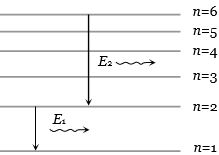
Which of the following transitions in a hydrogen atom emits a photon of the highest frequency?
A
$n = 2$ to $n = 1$
B
$n = 1$ to $n = 2$
C
$n = 2$ to $n = 6$
D
$n = 6$ to $n = 2$
Solution
(A) The energy of a photon emitted during a transition between two energy levels $n_i$ and $n_f$ is given by $\Delta E = E_{n_i} - E_{n_f} = h\nu$,where $\nu$ is the frequency of the emitted photon.
For emission to occur,the electron must transition from a higher energy level to a lower energy level $(n_i > n_f)$.
Among the given options,$n = 2$ to $n = 1$ and $n = 6$ to $n = 2$ are emission transitions.
The energy difference for $n = 2$ to $n = 1$ is $\Delta E_{2 \to 1} = E_2 - E_1 = -3.4 \text{ eV} - (-13.6 \text{ eV}) = 10.2 \text{ eV}$.
The energy difference for $n = 6$ to $n = 2$ is $\Delta E_{6 \to 2} = E_6 - E_2 = -0.38 \text{ eV} - (-3.4 \text{ eV}) = 3.02 \text{ eV}$.
Since $\Delta E_{2 \to 1} > \Delta E_{6 \to 2}$,the frequency $\nu = \frac{\Delta E}{h}$ is highest for the transition $n = 2$ to $n = 1$.
For emission to occur,the electron must transition from a higher energy level to a lower energy level $(n_i > n_f)$.
Among the given options,$n = 2$ to $n = 1$ and $n = 6$ to $n = 2$ are emission transitions.
The energy difference for $n = 2$ to $n = 1$ is $\Delta E_{2 \to 1} = E_2 - E_1 = -3.4 \text{ eV} - (-13.6 \text{ eV}) = 10.2 \text{ eV}$.
The energy difference for $n = 6$ to $n = 2$ is $\Delta E_{6 \to 2} = E_6 - E_2 = -0.38 \text{ eV} - (-3.4 \text{ eV}) = 3.02 \text{ eV}$.
Since $\Delta E_{2 \to 1} > \Delta E_{6 \to 2}$,the frequency $\nu = \frac{\Delta E}{h}$ is highest for the transition $n = 2$ to $n = 1$.
0 likesView Solution
2
ChemistryMCQAIEEE · 2007
If $\sin^{-1}(\frac{x}{5}) + \csc^{-1}(\frac{5}{4}) = \frac{\pi}{2}$,then $x = $
A
$4$
B
$5$
C
$1$
D
$3$
Solution
(D) Given the equation: $\sin^{-1}(\frac{x}{5}) + \csc^{-1}(\frac{5}{4}) = \frac{\pi}{2}$
We know that $\csc^{-1}(\frac{1}{y}) = \sin^{-1}(y)$,so $\csc^{-1}(\frac{5}{4}) = \sin^{-1}(\frac{4}{5})$.
Substituting this into the equation: $\sin^{-1}(\frac{x}{5}) + \sin^{-1}(\frac{4}{5}) = \frac{\pi}{2}$
Rearranging the terms: $\sin^{-1}(\frac{x}{5}) = \frac{\pi}{2} - \sin^{-1}(\frac{4}{5})$
Using the identity $\sin^{-1}(z) + \cos^{-1}(z) = \frac{\pi}{2}$,we have $\frac{\pi}{2} - \sin^{-1}(\frac{4}{5}) = \cos^{-1}(\frac{4}{5})$.
Thus,$\sin^{-1}(\frac{x}{5}) = \cos^{-1}(\frac{4}{5})$.
Since $\cos^{-1}(\frac{4}{5}) = \sin^{-1}(\sqrt{1 - (\frac{4}{5})^2}) = \sin^{-1}(\sqrt{1 - \frac{16}{25}}) = \sin^{-1}(\sqrt{\frac{9}{25}}) = \sin^{-1}(\frac{3}{5})$.
Therefore,$\sin^{-1}(\frac{x}{5}) = \sin^{-1}(\frac{3}{5})$,which implies $\frac{x}{5} = \frac{3}{5}$,so $x = 3$.
We know that $\csc^{-1}(\frac{1}{y}) = \sin^{-1}(y)$,so $\csc^{-1}(\frac{5}{4}) = \sin^{-1}(\frac{4}{5})$.
Substituting this into the equation: $\sin^{-1}(\frac{x}{5}) + \sin^{-1}(\frac{4}{5}) = \frac{\pi}{2}$
Rearranging the terms: $\sin^{-1}(\frac{x}{5}) = \frac{\pi}{2} - \sin^{-1}(\frac{4}{5})$
Using the identity $\sin^{-1}(z) + \cos^{-1}(z) = \frac{\pi}{2}$,we have $\frac{\pi}{2} - \sin^{-1}(\frac{4}{5}) = \cos^{-1}(\frac{4}{5})$.
Thus,$\sin^{-1}(\frac{x}{5}) = \cos^{-1}(\frac{4}{5})$.
Since $\cos^{-1}(\frac{4}{5}) = \sin^{-1}(\sqrt{1 - (\frac{4}{5})^2}) = \sin^{-1}(\sqrt{1 - \frac{16}{25}}) = \sin^{-1}(\sqrt{\frac{9}{25}}) = \sin^{-1}(\frac{3}{5})$.
Therefore,$\sin^{-1}(\frac{x}{5}) = \sin^{-1}(\frac{3}{5})$,which implies $\frac{x}{5} = \frac{3}{5}$,so $x = 3$.
0 likesView Solution
3
ChemistryMCQAIEEE · 2007
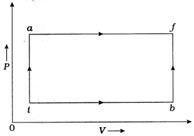
When a system is taken from state $i$ to state $f$ along the path $iaf$,$Q = 50 \, cal$ and $W = 20 \, cal$. Along the path $ibf$,if $Q = 36 \, cal$,find the work $W$ for the path $ibf$ in $cal$.
A
$14$
B
$6$
C
$16$
D
$66$
Solution
(B) According to the first law of thermodynamics,for any path,$Q = \Delta U + W$,where $\Delta U$ is the change in internal energy.
For path $iaf$:
$Q_{iaf} = \Delta U_{iaf} + W_{iaf}$
$50 = \Delta U_{iaf} + 20$
$\Delta U_{iaf} = 50 - 20 = 30 \, cal$
Since internal energy is a state function,the change in internal energy depends only on the initial and final states,not on the path taken.
Therefore,$\Delta U_{ibf} = \Delta U_{iaf} = 30 \, cal$.
For path $ibf$:
$Q_{ibf} = \Delta U_{ibf} + W_{ibf}$
$36 = 30 + W_{ibf}$
$W_{ibf} = 36 - 30 = 6 \, cal$.
For path $iaf$:
$Q_{iaf} = \Delta U_{iaf} + W_{iaf}$
$50 = \Delta U_{iaf} + 20$
$\Delta U_{iaf} = 50 - 20 = 30 \, cal$
Since internal energy is a state function,the change in internal energy depends only on the initial and final states,not on the path taken.
Therefore,$\Delta U_{ibf} = \Delta U_{iaf} = 30 \, cal$.
For path $ibf$:
$Q_{ibf} = \Delta U_{ibf} + W_{ibf}$
$36 = 30 + W_{ibf}$
$W_{ibf} = 36 - 30 = 6 \, cal$.
0 likesView Solution
4
ChemistryMCQAIEEE · 2007
$A$ parallel plate capacitor with a dielectric slab of dielectric constant $K$ between its plates has a capacitance $C$ and is charged to a potential $V$. The dielectric slab is slowly removed from between the plates and then reinserted. The net work done by the system is:
A
$\frac{1}{2}(K - 1)CV^2$
B
$CV^2(K - 1)/K$
C
$(K - 1)CV^2$
D
Zero
Solution
(D) When the dielectric slab is removed from the capacitor,the capacitance changes from $KC$ to $C$. Since the battery is disconnected,the charge $Q = KCV$ remains constant.
Work done by an external agent to remove the slab is $W_{ext} = U_{final} - U_{initial} = \frac{Q^2}{2C} - \frac{Q^2}{2KC} = \frac{Q^2}{2C}(1 - \frac{1}{K}) = \frac{K^2C^2V^2}{2C}(\frac{K-1}{K}) = \frac{1}{2}KC(K-1)V^2$.
When the slab is reinserted,the external agent does negative work of the same magnitude to restore the initial state.
Since the process is conservative and the system returns to its initial state,the net work done by the system (or external agent) over the complete cycle is zero.
Work done by an external agent to remove the slab is $W_{ext} = U_{final} - U_{initial} = \frac{Q^2}{2C} - \frac{Q^2}{2KC} = \frac{Q^2}{2C}(1 - \frac{1}{K}) = \frac{K^2C^2V^2}{2C}(\frac{K-1}{K}) = \frac{1}{2}KC(K-1)V^2$.
When the slab is reinserted,the external agent does negative work of the same magnitude to restore the initial state.
Since the process is conservative and the system returns to its initial state,the net work done by the system (or external agent) over the complete cycle is zero.
0 likesView Solution
5
ChemistryMCQAIEEE · 2007
If the difference between the roots of the equation $x^2 + ax + 1 = 0$ is less than $\sqrt{5}$,then what is the set of possible values of $a$?
A
$(-3, 3)$
B
$(3, \infty)$
C
$(-\infty, -3)$
D
$(-3, -2) \cup (2, 3)$
Solution
(D) Let the roots of the equation $x^2 + ax + 1 = 0$ be $\alpha$ and $\beta$.
Given that the difference between the roots is $|\alpha - \beta| < \sqrt{5}$.
We know that $|\alpha - \beta| = \frac{\sqrt{D}}{|a_{coeff}|}$,where $D$ is the discriminant $b^2 - 4ac$.
Here,$D = a^2 - 4(1)(1) = a^2 - 4$.
Since the roots must be real for the difference to be defined in the real number system,we require $D \ge 0$,which means $a^2 \ge 4$,so $a \in (-\infty, -2] \cup [2, \infty)$.
The condition $|\alpha - \beta| < \sqrt{5}$ implies $\sqrt{a^2 - 4} < \sqrt{5}$.
Squaring both sides,we get $a^2 - 4 < 5$,which simplifies to $a^2 < 9$.
This implies $-3 < a < 3$,or $a \in (-3, 3)$.
Combining the conditions $a \in (-\infty, -2] \cup [2, \infty)$ and $a \in (-3, 3)$,we get $a \in (-3, -2] \cup [2, 3)$.
Given that the difference between the roots is $|\alpha - \beta| < \sqrt{5}$.
We know that $|\alpha - \beta| = \frac{\sqrt{D}}{|a_{coeff}|}$,where $D$ is the discriminant $b^2 - 4ac$.
Here,$D = a^2 - 4(1)(1) = a^2 - 4$.
Since the roots must be real for the difference to be defined in the real number system,we require $D \ge 0$,which means $a^2 \ge 4$,so $a \in (-\infty, -2] \cup [2, \infty)$.
The condition $|\alpha - \beta| < \sqrt{5}$ implies $\sqrt{a^2 - 4} < \sqrt{5}$.
Squaring both sides,we get $a^2 - 4 < 5$,which simplifies to $a^2 < 9$.
This implies $-3 < a < 3$,or $a \in (-3, 3)$.
Combining the conditions $a \in (-\infty, -2] \cup [2, \infty)$ and $a \in (-3, 3)$,we get $a \in (-3, -2] \cup [2, 3)$.
0 likesView Solution
6
ChemistryMCQAIEEE · 2007
$A$ Carnot engine having an efficiency of $1/10$ as a heat engine is used as a refrigerator. If the work done on the system is $10 \, J$,the amount of energy absorbed from the reservoir at a lower temperature is .......... $J$.
A
$100$
B
$99$
C
$90$
D
$1$
Solution
(C) The efficiency of a Carnot engine is given by $\eta = 1 - \frac{T_2}{T_1} = \frac{1}{10}$.
From this,we find $\frac{T_2}{T_1} = 1 - \frac{1}{10} = \frac{9}{10}$.
When the same engine is used as a refrigerator,its coefficient of performance $\beta$ is given by $\beta = \frac{T_2}{T_1 - T_2}$.
Dividing numerator and denominator by $T_1$,we get $\beta = \frac{T_2/T_1}{1 - T_2/T_1}$.
Substituting the value $\frac{T_2}{T_1} = \frac{9}{10}$,we get $\beta = \frac{9/10}{1 - 9/10} = \frac{9/10}{1/10} = 9$.
The coefficient of performance is also defined as $\beta = \frac{Q_2}{W}$,where $Q_2$ is the heat absorbed from the cold reservoir and $W$ is the work done on the system.
Given $W = 10 \, J$,we have $Q_2 = \beta \times W = 9 \times 10 = 90 \, J$.
From this,we find $\frac{T_2}{T_1} = 1 - \frac{1}{10} = \frac{9}{10}$.
When the same engine is used as a refrigerator,its coefficient of performance $\beta$ is given by $\beta = \frac{T_2}{T_1 - T_2}$.
Dividing numerator and denominator by $T_1$,we get $\beta = \frac{T_2/T_1}{1 - T_2/T_1}$.
Substituting the value $\frac{T_2}{T_1} = \frac{9}{10}$,we get $\beta = \frac{9/10}{1 - 9/10} = \frac{9/10}{1/10} = 9$.
The coefficient of performance is also defined as $\beta = \frac{Q_2}{W}$,where $Q_2$ is the heat absorbed from the cold reservoir and $W$ is the work done on the system.
Given $W = 10 \, J$,we have $Q_2 = \beta \times W = 9 \times 10 = 90 \, J$.
0 likesView Solution
7
ChemistryMCQAIEEE · 2007
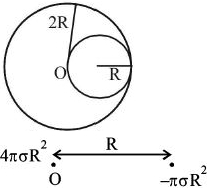
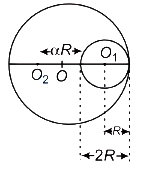
$A$ circular disc of radius $R$ is removed from a bigger circular disc of radius $2R$ such that the circumferences of the discs coincide. The center of mass of the new disc is $\alpha R$ from the center of the bigger disc. The value of $\alpha$ is:
A
$\frac{1}{4}$
B
$\frac{1}{3}$
C
$\frac{1}{2}$
D
$\frac{1}{6}$
Solution
(B) Let the mass per unit area be $\sigma$.
The mass of the complete disc of radius $2R$ is $M_1 = \sigma \pi (2R)^2 = 4\pi \sigma R^2$. Its center of mass is at the origin $O$.
The mass of the removed disc of radius $R$ is $M_2 = \sigma \pi R^2$. Its center of mass is at a distance $R$ from the origin $O$ along the positive x-axis.
Using the concept of negative mass for the cavity,the center of mass of the remaining part is given by:
$x_{cm} = \frac{M_1 x_1 - M_2 x_2}{M_1 - M_2}$
$x_{cm} = \frac{(4\pi \sigma R^2)(0) - (\pi \sigma R^2)(R)}{4\pi \sigma R^2 - \pi \sigma R^2}$
$x_{cm} = \frac{-\pi \sigma R^3}{3\pi \sigma R^2} = -\frac{R}{3}$
The magnitude of the distance is $\frac{R}{3}$,so $\alpha R = \frac{R}{3}$,which gives $\alpha = \frac{1}{3}$.
The mass of the complete disc of radius $2R$ is $M_1 = \sigma \pi (2R)^2 = 4\pi \sigma R^2$. Its center of mass is at the origin $O$.
The mass of the removed disc of radius $R$ is $M_2 = \sigma \pi R^2$. Its center of mass is at a distance $R$ from the origin $O$ along the positive x-axis.
Using the concept of negative mass for the cavity,the center of mass of the remaining part is given by:
$x_{cm} = \frac{M_1 x_1 - M_2 x_2}{M_1 - M_2}$
$x_{cm} = \frac{(4\pi \sigma R^2)(0) - (\pi \sigma R^2)(R)}{4\pi \sigma R^2 - \pi \sigma R^2}$
$x_{cm} = \frac{-\pi \sigma R^3}{3\pi \sigma R^2} = -\frac{R}{3}$
The magnitude of the distance is $\frac{R}{3}$,so $\alpha R = \frac{R}{3}$,which gives $\alpha = \frac{1}{3}$.
0 likesView Solution
8
ChemistryDifficultMCQAIEEE · 2007
The density (in $g \; mL^{-1}$) of a $3.60 \; M$ sulphuric acid solution that is $29 \%$ $H_2SO_4$ (molar mass $= 98 \; g \; mol^{-1}$) by mass will be
A
$1.45$
B
$1.64$
C
$1.88$
D
$1.22$
Solution
(D) The relationship between Molarity $(M)$,percentage by mass $(\% \; w/w)$,and density $(d)$ is given by the formula:
$M = \frac{10 \times \% \; w/w \times d}{M_{solute}}$
Given values are:
$M = 3.60 \; mol \; L^{-1}$
$\% \; w/w = 29 \%$
$M_{solute} = 98 \; g \; mol^{-1}$
Substituting these values into the formula:
$3.60 = \frac{10 \times 29 \times d}{98}$
$d = \frac{3.60 \times 98}{10 \times 29}$
$d = \frac{352.8}{290} \approx 1.2165 \; g \; mL^{-1}$
Rounding to two decimal places,we get $d = 1.22 \; g \; mL^{-1}$.
$M = \frac{10 \times \% \; w/w \times d}{M_{solute}}$
Given values are:
$M = 3.60 \; mol \; L^{-1}$
$\% \; w/w = 29 \%$
$M_{solute} = 98 \; g \; mol^{-1}$
Substituting these values into the formula:
$3.60 = \frac{10 \times 29 \times d}{98}$
$d = \frac{3.60 \times 98}{10 \times 29}$
$d = \frac{352.8}{290} \approx 1.2165 \; g \; mL^{-1}$
Rounding to two decimal places,we get $d = 1.22 \; g \; mL^{-1}$.
0 likesView Solution
9
ChemistryDifficultMCQAIEEE · 2007
In the reaction,$2Al_{(s)} + 6HCl_{(aq)} \rightarrow 2Al^{3+}_{(aq)} + 6Cl^{-}_{(aq)} + 3H_{2(g)}$
A
$11.2 \ L$ of $H_{2(g)}$ at $STP$ is produced for every $2 \ moles$ of $HCl_{(aq)}$ consumed
B
$6 \ L$ of $HCl_{(aq)}$ is consumed for every $3 \ L$ of $H_{2(g)}$ produced
C
$33.6 \ L$ of $H_{2(g)}$ is produced at $STP$ for every mole of $Al$ that reacts
D
$11.2 \ L$ of $H_{2(g)}$ at $STP$ is produced for every mole of $HCl_{(aq)}$ consumed
Solution
(D) From the balanced chemical equation: $2Al_{(s)} + 6HCl_{(aq)} \rightarrow 2Al^{3+}_{(aq)} + 6Cl^{-}_{(aq)} + 3H_{2(g)}$
$6 \ moles$ of $HCl_{(aq)}$ produces $3 \ moles$ of $H_{2(g)}$.
Therefore,$1 \ mole$ of $HCl_{(aq)}$ produces $\frac{3}{6} = 0.5 \ moles$ of $H_{2(g)}$.
At $STP$,$1 \ mole$ of any gas occupies $22.4 \ L$.
Thus,$0.5 \ moles$ of $H_{2(g)}$ occupies $0.5 \times 22.4 \ L = 11.2 \ L$ at $STP$.
Hence,option $D$ is correct.
$6 \ moles$ of $HCl_{(aq)}$ produces $3 \ moles$ of $H_{2(g)}$.
Therefore,$1 \ mole$ of $HCl_{(aq)}$ produces $\frac{3}{6} = 0.5 \ moles$ of $H_{2(g)}$.
At $STP$,$1 \ mole$ of any gas occupies $22.4 \ L$.
Thus,$0.5 \ moles$ of $H_{2(g)}$ occupies $0.5 \times 22.4 \ L = 11.2 \ L$ at $STP$.
Hence,option $D$ is correct.
0 likesView Solution
10
ChemistryMediumMCQAIEEE · 2007
Which of the following sets of quantum numbers represents the highest energy of an atom?
A
$n=3, l=0, m=0, s=+1/2$
B
$n=3, l=1, m=1, s=+1/2$
C
$n=3, l=2, m=1, s=+1/2$
D
$n=4, l=0, m=0, s=+1/2$
Solution
(C) According to the $(n+l)$ rule,the energy of an orbital increases as the sum of the principal quantum number $(n)$ and the azimuthal quantum number $(l)$ increases.
For option $A$: $n+l = 3+0 = 3$
For option $B$: $n+l = 3+1 = 4$
For option $C$: $n+l = 3+2 = 5$
For option $D$: $n+l = 4+0 = 4$
Since option $C$ has the highest $(n+l)$ value of $5$,it represents the highest energy state.
For option $A$: $n+l = 3+0 = 3$
For option $B$: $n+l = 3+1 = 4$
For option $C$: $n+l = 3+2 = 5$
For option $D$: $n+l = 4+0 = 4$
Since option $C$ has the highest $(n+l)$ value of $5$,it represents the highest energy state.
0 likesView Solution
11
ChemistryMediumMCQAIEEE · 2007
Which of the following species exhibits the diamagnetic behaviour?
A
$NO$
B
$O_2^{2-}$
C
$O_2^{+}$
D
$O_2$
Solution
(B) To determine the magnetic behavior,we analyze the molecular orbital configuration of each species.
$1$. $NO$ has $15$ electrons: $\sigma_{1s}^2, \sigma_{1s}^{*2}, \sigma_{2s}^2, \sigma_{2s}^{*2}, \sigma_{2p_z}^2, \pi_{2p_x}^2 = \pi_{2p_y}^2, \pi_{2p_x}^{*1}$. It is paramagnetic due to the unpaired electron.
$2$. $O_2^{2-}$ has $18$ electrons. Its configuration is: $\sigma_{1s}^2, \sigma_{1s}^{*2}, \sigma_{2s}^2, \sigma_{2s}^{*2}, \sigma_{2p_z}^2, \pi_{2p_x}^2 = \pi_{2p_y}^2, \pi_{2p_x}^{*2} = \pi_{2p_y}^{*2}$. Since all electrons are paired,it is diamagnetic.
$3$. $O_2^{+}$ has $15$ electrons and is paramagnetic.
$4$. $O_2$ has $16$ electrons and is paramagnetic due to two unpaired electrons in the $\pi^*$ orbitals.
$1$. $NO$ has $15$ electrons: $\sigma_{1s}^2, \sigma_{1s}^{*2}, \sigma_{2s}^2, \sigma_{2s}^{*2}, \sigma_{2p_z}^2, \pi_{2p_x}^2 = \pi_{2p_y}^2, \pi_{2p_x}^{*1}$. It is paramagnetic due to the unpaired electron.
$2$. $O_2^{2-}$ has $18$ electrons. Its configuration is: $\sigma_{1s}^2, \sigma_{1s}^{*2}, \sigma_{2s}^2, \sigma_{2s}^{*2}, \sigma_{2p_z}^2, \pi_{2p_x}^2 = \pi_{2p_y}^2, \pi_{2p_x}^{*2} = \pi_{2p_y}^{*2}$. Since all electrons are paired,it is diamagnetic.
$3$. $O_2^{+}$ has $15$ electrons and is paramagnetic.
$4$. $O_2$ has $16$ electrons and is paramagnetic due to two unpaired electrons in the $\pi^*$ orbitals.
0 likesView Solution
12
ChemistryMediumMCQAIEEE · 2007
The charge/size ratio of a cation determines its polarizing power. Which one of the following sequences represents the increasing order of the polarizing power of the cationic species,$K^{+}, Ca^{2+}, Mg^{2+}, Be^{2+}$?
A
$Ca^{2+} < Mg^{2+} < Be^{2+} < K^{+}$
B
$Mg^{2+} < Be^{2+} < K^{+} < Ca^{2+}$
C
$Be^{2+} < K^{+} < Ca^{2+} < Mg^{2+}$
D
$K^{+} < Ca^{2+} < Mg^{2+} < Be^{2+}$
Solution
(D) The polarizing power of a cation is directly proportional to its charge density,which is defined by the ratio of charge to size.
As the charge on the cation increases and its ionic radius decreases,the polarizing power increases.
For the given ions,the ionic radii follow the order: $K^{+} > Ca^{2+} > Mg^{2+} > Be^{2+}$.
Since $Be^{2+}$ has the highest charge-to-size ratio and $K^{+}$ has the lowest,the increasing order of polarizing power is $K^{+} < Ca^{2+} < Mg^{2+} < Be^{2+}$.
As the charge on the cation increases and its ionic radius decreases,the polarizing power increases.
For the given ions,the ionic radii follow the order: $K^{+} > Ca^{2+} > Mg^{2+} > Be^{2+}$.
Since $Be^{2+}$ has the highest charge-to-size ratio and $K^{+}$ has the lowest,the increasing order of polarizing power is $K^{+} < Ca^{2+} < Mg^{2+} < Be^{2+}$.
0 likesView Solution
13
ChemistryDifficultMCQAIEEE · 2007
In which of the following ionization processes,the bond order has increased and the magnetic behaviour has changed?
A
$N_2 \rightarrow N_2^+$
B
$C_2 \rightarrow C_2^+$
C
$NO \rightarrow NO^+$
D
$O_2 \rightarrow O_2^+$
Solution
(C) The bond order $(BO)$ is calculated as $\frac{1}{2}(N_b - N_a)$,where $N_b$ is the number of bonding electrons and $N_a$ is the number of antibonding electrons.
For $NO$ ($15$ electrons): Configuration is $\sigma 1s^2, \sigma^* 1s^2, \sigma 2s^2, \sigma^* 2s^2, \sigma 2p_z^2, \pi 2p_x^2 = \pi 2p_y^2, \pi^* 2p_x^1$. $BO = \frac{1}{2}(10 - 5) = 2.5$. It is paramagnetic.
For $NO^+$ ($14$ electrons): Configuration is $\sigma 1s^2, \sigma^* 1s^2, \sigma 2s^2, \sigma^* 2s^2, \sigma 2p_z^2, \pi 2p_x^2 = \pi 2p_y^2$. $BO = \frac{1}{2}(10 - 4) = 3.0$. It is diamagnetic.
In the process $NO \rightarrow NO^+$,the electron is removed from the antibonding $\pi^*$ orbital,which increases the bond order from $2.5$ to $3.0$ and changes the magnetic behavior from paramagnetic to diamagnetic.
For $NO$ ($15$ electrons): Configuration is $\sigma 1s^2, \sigma^* 1s^2, \sigma 2s^2, \sigma^* 2s^2, \sigma 2p_z^2, \pi 2p_x^2 = \pi 2p_y^2, \pi^* 2p_x^1$. $BO = \frac{1}{2}(10 - 5) = 2.5$. It is paramagnetic.
For $NO^+$ ($14$ electrons): Configuration is $\sigma 1s^2, \sigma^* 1s^2, \sigma 2s^2, \sigma^* 2s^2, \sigma 2p_z^2, \pi 2p_x^2 = \pi 2p_y^2$. $BO = \frac{1}{2}(10 - 4) = 3.0$. It is diamagnetic.
In the process $NO \rightarrow NO^+$,the electron is removed from the antibonding $\pi^*$ orbital,which increases the bond order from $2.5$ to $3.0$ and changes the magnetic behavior from paramagnetic to diamagnetic.
0 likesView Solution
14
ChemistryMediumMCQAIEEE · 2007
Which of the following hydrogen bonds is the strongest?
A
$O-H \cdots F$
B
$O-H \cdots H$
C
$F-H \cdots F$
D
$O-H \cdots O$
Solution
(C) The strength of a hydrogen bond depends on the electronegativity difference between the atoms involved in the bond.
Greater the electronegativity difference,the stronger the hydrogen bond.
Fluorine $(F)$ is the most electronegative element.
Therefore,the $F-H \cdots F$ hydrogen bond is the strongest among the given options.
Greater the electronegativity difference,the stronger the hydrogen bond.
Fluorine $(F)$ is the most electronegative element.
Therefore,the $F-H \cdots F$ hydrogen bond is the strongest among the given options.
0 likesView Solution
15
ChemistryMCQAIEEE · 2007
In the conversion of limestone to lime,$CaCO_{3(s)} \rightarrow CaO_{(s)} + CO_{2(g)}$,the values of $\Delta H^o$ and $\Delta S^o$ are $+179.1 \ kJ \ mol^{-1}$ and $160.2 \ J \ K^{-1} \ mol^{-1}$ respectively at $298 \ K$ and $1 \ bar$. Assuming that $\Delta H^o$ and $\Delta S^o$ do not change with temperature,the temperature above which the conversion of limestone to lime will be spontaneous is ............. $K$.
A
$1118$
B
$1008$
C
$1200$
D
$845$
Solution
(A) For a reaction to be spontaneous,the Gibbs free energy change $\Delta G^{\circ}$ must be less than $0$.
Using the relation $\Delta G^{\circ} = \Delta H^{\circ} - T \Delta S^{\circ}$,we set $\Delta G^{\circ} < 0$:
$\Delta H^{\circ} - T \Delta S^{\circ} < 0$
$\Delta H^{\circ} < T \Delta S^{\circ}$
$T > \frac{\Delta H^{\circ}}{\Delta S^{\circ}}$
Given $\Delta H^{\circ} = 179.1 \ kJ \ mol^{-1} = 179100 \ J \ mol^{-1}$ and $\Delta S^{\circ} = 160.2 \ J \ K^{-1} \ mol^{-1}$:
$T > \frac{179100}{160.2} \ K$
$T > 1117.97 \ K$
Rounding to the nearest whole number,$T > 1118 \ K$.
Using the relation $\Delta G^{\circ} = \Delta H^{\circ} - T \Delta S^{\circ}$,we set $\Delta G^{\circ} < 0$:
$\Delta H^{\circ} - T \Delta S^{\circ} < 0$
$\Delta H^{\circ} < T \Delta S^{\circ}$
$T > \frac{\Delta H^{\circ}}{\Delta S^{\circ}}$
Given $\Delta H^{\circ} = 179.1 \ kJ \ mol^{-1} = 179100 \ J \ mol^{-1}$ and $\Delta S^{\circ} = 160.2 \ J \ K^{-1} \ mol^{-1}$:
$T > \frac{179100}{160.2} \ K$
$T > 1117.97 \ K$
Rounding to the nearest whole number,$T > 1118 \ K$.
0 likesView Solution
16
ChemistryMediumMCQAIEEE · 2007
Assuming that water vapour is an ideal gas,the internal energy change $(\Delta U)$ when $1\, mol$ of water is vaporised at $1\, bar$ pressure and $100\, ^{\circ}C$,(given: molar enthalpy of vaporisation of water at $1\, bar$ and $373\, K = 41\, kJ\, mol^{-1}$ and $R = 8.3\, J\, mol^{-1}\, K^{-1}$) will be .............. $kJ\, mol^{-1}$
A
$41$
B
$4.100$
C
$3.7904$
D
$37.904$
Solution
(D) The process is: $H_2O(l) \rightarrow H_2O(g)$.
The change in the number of moles of gas is $\Delta n_g = 1 - 0 = 1$.
Given: $\Delta H = 41\, kJ\, mol^{-1} = 41000\, J\, mol^{-1}$,$T = 373\, K$,and $R = 8.3\, J\, mol^{-1}\, K^{-1}$.
Using the relation $\Delta H = \Delta U + \Delta n_g RT$,we get $\Delta U = \Delta H - \Delta n_g RT$.
$\Delta U = 41000\, J\, mol^{-1} - (1 \times 8.3\, J\, mol^{-1}\, K^{-1} \times 373\, K)$.
$\Delta U = 41000 - 3095.9 = 37904.1\, J\, mol^{-1}$.
Converting to $kJ\, mol^{-1}$,we get $\Delta U = 37.9041\, kJ\, mol^{-1}$.
The change in the number of moles of gas is $\Delta n_g = 1 - 0 = 1$.
Given: $\Delta H = 41\, kJ\, mol^{-1} = 41000\, J\, mol^{-1}$,$T = 373\, K$,and $R = 8.3\, J\, mol^{-1}\, K^{-1}$.
Using the relation $\Delta H = \Delta U + \Delta n_g RT$,we get $\Delta U = \Delta H - \Delta n_g RT$.
$\Delta U = 41000\, J\, mol^{-1} - (1 \times 8.3\, J\, mol^{-1}\, K^{-1} \times 373\, K)$.
$\Delta U = 41000 - 3095.9 = 37904.1\, J\, mol^{-1}$.
Converting to $kJ\, mol^{-1}$,we get $\Delta U = 37.9041\, kJ\, mol^{-1}$.
0 likesView Solution
17
ChemistryMediumMCQAIEEE · 2007
Identify the correct statement regarding a spontaneous process:
A
Lowering of energy in the process is the only criterion for spontaneity.
B
For a spontaneous process in an isolated system,the change in entropy is positive.
C
Endothermic processes are never spontaneous.
D
Exothermic processes are always spontaneous.
Solution
(B) The spontaneity of a process depends on the tendency to acquire a minimum energy state and maximum randomness (entropy).
For a spontaneous process in an isolated system,the total change in entropy $(\Delta S_{total})$ must be greater than zero,i.e.,$\Delta S > 0$.
For a spontaneous process in an isolated system,the total change in entropy $(\Delta S_{total})$ must be greater than zero,i.e.,$\Delta S > 0$.
0 likesView Solution
18
ChemistryMediumMCQAIEEE · 2007
The first and second dissociation constants of an acid $H_2A$ are $1.0 \times 10^{-5}$ and $5.0 \times 10^{-10}$ respectively. The overall dissociation constant of the acid will be
A
$0.2 \times 10^5$
B
$5.0 \times 10^{-5}$
C
$5.0 \times 10^{15}$
D
$5.0 \times 10^{-15}$
Solution
(D) For a polyprotic acid $H_2A$,the dissociation steps are:
$H_2A \rightleftharpoons H^{+} + HA^{-}$; $K_1 = \frac{[H^{+}][HA^{-}]}{[H_2A]} = 1.0 \times 10^{-5}$
$HA^{-} \rightleftharpoons H^{+} + A^{2-}$; $K_2 = \frac{[H^{+}][A^{2-}]}{[HA^{-}]} = 5.0 \times 10^{-10}$
The overall dissociation reaction is the sum of these two steps:
$H_2A \rightleftharpoons 2H^{+} + A^{2-}$
The overall dissociation constant $K$ is the product of the individual dissociation constants:
$K = K_1 \times K_2$
$K = (1.0 \times 10^{-5}) \times (5.0 \times 10^{-10})$
$K = 5.0 \times 10^{-15}$
$H_2A \rightleftharpoons H^{+} + HA^{-}$; $K_1 = \frac{[H^{+}][HA^{-}]}{[H_2A]} = 1.0 \times 10^{-5}$
$HA^{-} \rightleftharpoons H^{+} + A^{2-}$; $K_2 = \frac{[H^{+}][A^{2-}]}{[HA^{-}]} = 5.0 \times 10^{-10}$
The overall dissociation reaction is the sum of these two steps:
$H_2A \rightleftharpoons 2H^{+} + A^{2-}$
The overall dissociation constant $K$ is the product of the individual dissociation constants:
$K = K_1 \times K_2$
$K = (1.0 \times 10^{-5}) \times (5.0 \times 10^{-10})$
$K = 5.0 \times 10^{-15}$
0 likesView Solution
19
ChemistryMediumMCQAIEEE · 2007
The $pK_a$ of a weak acid $(HA)$ is $4.5$. The $pOH$ of an aqueous buffer solution of $HA$ in which $50\%$ of the acid is ionized is
A
$7$
B
$4.5$
C
$2.5$
D
$9.5$
Solution
(D) For a buffer solution,the Henderson-Hasselbalch equation is given by: $pH = pK_a + \log \frac{[Salt]}{[Acid]}$
Given that $50\%$ of the acid is ionized,the concentration of the salt (conjugate base) is equal to the concentration of the remaining undissociated acid,i.e.,$[Salt] = [Acid]$.
Substituting this into the equation: $pH = 4.5 + \log(1) = 4.5 + 0 = 4.5$.
We know that at $25^{\circ}C$,$pH + pOH = 14$.
Therefore,$pOH = 14 - pH = 14 - 4.5 = 9.5$.
Given that $50\%$ of the acid is ionized,the concentration of the salt (conjugate base) is equal to the concentration of the remaining undissociated acid,i.e.,$[Salt] = [Acid]$.
Substituting this into the equation: $pH = 4.5 + \log(1) = 4.5 + 0 = 4.5$.
We know that at $25^{\circ}C$,$pH + pOH = 14$.
Therefore,$pOH = 14 - pH = 14 - 4.5 = 9.5$.
0 likesView Solution
20
ChemistryMediumMCQAIEEE · 2007
In a saturated solution of the sparingly soluble strong electrolyte $AgIO_3$ (molecular mass $= 283$),the equilibrium which sets in is $AgIO_{3(s)} \rightleftharpoons Ag^+_{(aq)} + IO^-_{3(aq)}$. If the solubility product constant $K_{sp}$ of $AgIO_3$ at a given temperature is $1.0 \times 10^{-8}$,what is the mass of $AgIO_3$ contained in $100 \ mL$ of its saturated solution?
A
$1.0 \times 10^{-4} \ g$
B
$28.3 \times 10^{-2} \ g$
C
$2.83 \times 10^{-3} \ g$
D
$1.0 \times 10^{-7} \ g$
Solution
(C) The equilibrium is $AgIO_{3(s)} \rightleftharpoons Ag^+_{(aq)} + IO^-_{3(aq)}$.
Let $S$ be the solubility in $mol/L$.
$K_{sp} = [Ag^+][IO_3^-] = S \times S = S^2$.
Given $K_{sp} = 1.0 \times 10^{-8}$,so $S = \sqrt{1.0 \times 10^{-8}} = 1.0 \times 10^{-4} \ mol/L$.
The molar mass of $AgIO_3$ is $283 \ g/mol$.
Mass in $1 \ L$ (or $1000 \ mL$) $= 1.0 \times 10^{-4} \ mol/L \times 283 \ g/mol = 2.83 \times 10^{-2} \ g/L$.
Mass in $100 \ mL = \frac{2.83 \times 10^{-2} \ g}{1000 \ mL} \times 100 \ mL = 2.83 \times 10^{-3} \ g$.
Let $S$ be the solubility in $mol/L$.
$K_{sp} = [Ag^+][IO_3^-] = S \times S = S^2$.
Given $K_{sp} = 1.0 \times 10^{-8}$,so $S = \sqrt{1.0 \times 10^{-8}} = 1.0 \times 10^{-4} \ mol/L$.
The molar mass of $AgIO_3$ is $283 \ g/mol$.
Mass in $1 \ L$ (or $1000 \ mL$) $= 1.0 \times 10^{-4} \ mol/L \times 283 \ g/mol = 2.83 \times 10^{-2} \ g/L$.
Mass in $100 \ mL = \frac{2.83 \times 10^{-2} \ g}{1000 \ mL} \times 100 \ mL = 2.83 \times 10^{-3} \ g$.
0 likesView Solution
21
ChemistryDifficultMCQAIEEE · 2007
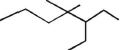
The $IUPAC$ name of the given structure is:
A
$3-$ethyl$-4,4-$dimethylheptane
B
$1,1-$diethyl$-2,2-$dimethylpentane
C
$4,4-$dimethyl$-5,5-$diethylpentane
D
$5,5-$diethyl$-4,4-$dimethylpentane
Solution
(A) $1$. Identify the longest carbon chain in the given structure. The longest chain contains $7$ carbon atoms,so the parent alkane is heptane.
$2$. Number the chain from the end that gives the lowest locants to the substituents. Numbering from right to left gives the substituents at positions $3$ and $4$.
$3$. At position $3$,there is an ethyl group $(-CH_2CH_3)$.
$4$. At position $4$,there are two methyl groups $(-CH_3)$.
$5$. Combining these,the $IUPAC$ name is $3-$ethyl$-4,4-$dimethylheptane.
$2$. Number the chain from the end that gives the lowest locants to the substituents. Numbering from right to left gives the substituents at positions $3$ and $4$.
$3$. At position $3$,there is an ethyl group $(-CH_2CH_3)$.
$4$. At position $4$,there are two methyl groups $(-CH_3)$.
$5$. Combining these,the $IUPAC$ name is $3-$ethyl$-4,4-$dimethylheptane.
0 likesView Solution
22
ChemistryDifficultMCQAIEEE · 2007
Which of the following molecules is expected to rotate the plane of plane-polarised light?
A
Glycine $(H_2N-CH_2-COOH)$
B
Glyceraldehyde $(HOCH_2-CH(OH)-CHO)$
C
Butane$-2-$thiol $(CH_3-CH(SH)-CH_2-CH_3)$
D
$1,2-$Diphenylethane$-1,2-$diamine $(Ph-CH(NH_2)-CH(NH_2)-Ph)$
Solution
(B) molecule is expected to rotate the plane of plane-polarised light if it is optically active.
Optically active molecules must be chiral,meaning they lack a plane of symmetry or center of inversion.
$1$. Glycine $(H_2N-CH_2-COOH)$ has a plane of symmetry and is achiral.
$2$. Glyceraldehyde $(HOCH_2-CH(OH)-CHO)$ has a chiral carbon atom bonded to four different groups $(-H, -OH, -CHO, -CH_2OH)$ and is optically active.
$3$. Butane-$2$-thiol $(CH_3-CH(SH)-CH_2-CH_3)$ has a chiral carbon atom bonded to four different groups $(-H, -SH, -CH_3, -CH_2CH_3)$ and is optically active.
$4$. $1,2$-Diphenylethane-$1,2$-diamine can exist as a meso compound (optically inactive) or as chiral enantiomers depending on the configuration.
In the context of standard chemistry questions,both Glyceraldehyde and Butane-$2$-thiol are classic examples of chiral molecules. However,Glyceraldehyde is the most fundamental example of a chiral molecule in carbohydrates. Given the options,both $B$ and $C$ are chiral. Assuming a single choice is required,Glyceraldehyde is the standard textbook example.
Optically active molecules must be chiral,meaning they lack a plane of symmetry or center of inversion.
$1$. Glycine $(H_2N-CH_2-COOH)$ has a plane of symmetry and is achiral.
$2$. Glyceraldehyde $(HOCH_2-CH(OH)-CHO)$ has a chiral carbon atom bonded to four different groups $(-H, -OH, -CHO, -CH_2OH)$ and is optically active.
$3$. Butane-$2$-thiol $(CH_3-CH(SH)-CH_2-CH_3)$ has a chiral carbon atom bonded to four different groups $(-H, -SH, -CH_3, -CH_2CH_3)$ and is optically active.
$4$. $1,2$-Diphenylethane-$1,2$-diamine can exist as a meso compound (optically inactive) or as chiral enantiomers depending on the configuration.
In the context of standard chemistry questions,both Glyceraldehyde and Butane-$2$-thiol are classic examples of chiral molecules. However,Glyceraldehyde is the most fundamental example of a chiral molecule in carbohydrates. Given the options,both $B$ and $C$ are chiral. Assuming a single choice is required,Glyceraldehyde is the standard textbook example.
0 likesView Solution
23
ChemistryMediumMCQAIEEE · 2007
Which one of the following conformations of cyclohexane is chiral?
A
Boat
B
Twist boat
C
Rigid
D
Chair
Solution
(B) molecule is chiral if it lacks a plane of symmetry or a center of inversion.
The $chair$ and $boat$ conformations of cyclohexane possess planes of symmetry,making them achiral.
The $twist-boat$ conformation of cyclohexane lacks a plane of symmetry,making it chiral.
The $chair$ and $boat$ conformations of cyclohexane possess planes of symmetry,making them achiral.
The $twist-boat$ conformation of cyclohexane lacks a plane of symmetry,making it chiral.
0 likesView Solution
24
ChemistryDifficultMCQAIEEE · 2007
Which of the following reactions will yield $2, 2-$dibromopropane?
A
$CH_3-CH=CH_2 + HBr \rightarrow$
B
$CH_3-C \equiv CH + 2HBr \rightarrow$
C
$CH_3-CH=CHBr + HBr \rightarrow$
D
$CH \equiv CH + 2HBr \rightarrow$
Solution
(B) The reaction of propyne $(CH_3-C \equiv CH)$ with two equivalents of $HBr$ follows Markovnikov's rule.
In the first step,$H^+$ adds to the terminal carbon and $Br^-$ to the middle carbon to form $2-$bromopropene $(CH_3-C(Br)=CH_2)$.
In the second step,another $HBr$ adds following the same rule to form $2, 2-$dibromopropane $(CH_3-C(Br)_2-CH_3)$.
Reaction:
$CH_3-C \equiv CH + HBr$ $\rightarrow CH_3-C(Br)=CH_2$ $\xrightarrow{HBr} CH_3-C(Br)_2-CH_3$
In the first step,$H^+$ adds to the terminal carbon and $Br^-$ to the middle carbon to form $2-$bromopropene $(CH_3-C(Br)=CH_2)$.
In the second step,another $HBr$ adds following the same rule to form $2, 2-$dibromopropane $(CH_3-C(Br)_2-CH_3)$.
Reaction:
$CH_3-C \equiv CH + HBr$ $\rightarrow CH_3-C(Br)=CH_2$ $\xrightarrow{HBr} CH_3-C(Br)_2-CH_3$
0 likesView Solution
25
ChemistryMediumMCQAIEEE · 2007
Equal masses of methane and oxygen are mixed in an empty container at $25^\circ C$. The fraction of the total pressure exerted by oxygen is
A
$1/2$
B
$2/3$
C
$\frac{1}{3} \times \frac{273}{298}$
D
$1/3$
Solution
(D) Let the mass of methane $(CH_4)$ and oxygen $(O_2)$ be $m \ g$.
Moles of $CH_4 = \frac{m}{16}$
Moles of $O_2 = \frac{m}{32}$
According to Dalton's Law of Partial Pressures,the partial pressure of a gas is equal to its mole fraction multiplied by the total pressure.
Mole fraction of $O_2 (x_{O_2}) = \frac{\text{Moles of } O_2}{\text{Moles of } O_2 + \text{Moles of } CH_4}$
$x_{O_2} = \frac{m/32}{m/32 + m/16} = \frac{m/32}{m/32 + 2m/32} = \frac{m/32}{3m/32} = 1/3$
Therefore,the fraction of the total pressure exerted by oxygen is $1/3$.
Moles of $CH_4 = \frac{m}{16}$
Moles of $O_2 = \frac{m}{32}$
According to Dalton's Law of Partial Pressures,the partial pressure of a gas is equal to its mole fraction multiplied by the total pressure.
Mole fraction of $O_2 (x_{O_2}) = \frac{\text{Moles of } O_2}{\text{Moles of } O_2 + \text{Moles of } CH_4}$
$x_{O_2} = \frac{m/32}{m/32 + m/16} = \frac{m/32}{m/32 + 2m/32} = \frac{m/32}{3m/32} = 1/3$
Therefore,the fraction of the total pressure exerted by oxygen is $1/3$.
0 likesView Solution
26
ChemistryMediumMCQAIEEE · 2007
Regular use of which of the following fertilizers increases the acidity of the soil?
A
Ammonium sulphate
B
Potassium nitrate
C
Urea
D
Superphosphate of lime
Solution
(A) The hydrolysis of ammonium sulphate,$(NH_4)_2SO_4$,in the soil produces sulphuric acid as follows:
$(NH_4)_2SO_4 + 2H_2O \longrightarrow H_2SO_4 + 2NH_4OH$
Since $H_2SO_4$ is a strong acid,its accumulation in the soil leads to an increase in soil acidity.
$(NH_4)_2SO_4 + 2H_2O \longrightarrow H_2SO_4 + 2NH_4OH$
Since $H_2SO_4$ is a strong acid,its accumulation in the soil leads to an increase in soil acidity.
0 likesView Solution
27
ChemistryEasyMCQAIEEE · 2007
The stability of dihalides of $Si$,$Ge$,$Sn$ and $Pb$ increases steadily in the sequence
A
$SiX_2 < GeX_2 < SnX_2 < PbX_2$
B
$PbX_2 < SnX_2 < GeX_2 < SiX_2$
C
$SiX_2 < GeX_2 < PbX_2 < SnX_2$
D
$SnX_2 < PbX_2 < SiX_2 < GeX_2$
Solution
(A) The reluctance of valence shell $ns^2$ electrons to participate in bonding due to poor shielding of $d$ and $f$ orbitals is known as the inert pair effect.
As we move down group $14$,the stability of the $+2$ oxidation state increases relative to the $+4$ oxidation state.
Therefore,the stability of dihalides $(MX_2)$ increases in the order: $SiX_2 < GeX_2 < SnX_2 < PbX_2$.
As we move down group $14$,the stability of the $+2$ oxidation state increases relative to the $+4$ oxidation state.
Therefore,the stability of dihalides $(MX_2)$ increases in the order: $SiX_2 < GeX_2 < SnX_2 < PbX_2$.
0 likesView Solution
28
ChemistryMCQAIEEE · 2007
$A$ battery is used to charge a parallel plate capacitor until the potential difference between the plates becomes equal to the electromotive force of the battery. The ratio of the energy stored in the capacitor to the work done by the battery is
A
$2$
B
$1/4$
C
$1/2$
D
$1$
Solution
(C) Let $C$ be the capacitance of the capacitor and $e$ be the electromotive force $(emf)$ of the battery.
When the capacitor is fully charged,the potential difference across the plates $V$ is equal to the $emf$ of the battery,i.e.,$V = e$.
The energy stored in the capacitor is given by $U = \frac{1}{2} C V^2 = \frac{1}{2} C e^2$.
The work done by the battery in charging the capacitor is given by $W = qV = (Ce)e = C e^2$.
The ratio of the energy stored in the capacitor to the work done by the battery is $\frac{U}{W} = \frac{\frac{1}{2} C e^2}{C e^2} = \frac{1}{2}$.
When the capacitor is fully charged,the potential difference across the plates $V$ is equal to the $emf$ of the battery,i.e.,$V = e$.
The energy stored in the capacitor is given by $U = \frac{1}{2} C V^2 = \frac{1}{2} C e^2$.
The work done by the battery in charging the capacitor is given by $W = qV = (Ce)e = C e^2$.
The ratio of the energy stored in the capacitor to the work done by the battery is $\frac{U}{W} = \frac{\frac{1}{2} C e^2}{C e^2} = \frac{1}{2}$.
0 likesView Solution
29
ChemistryMCQAIEEE · 2007
$A$ charged particle moves through a magnetic field perpendicular to its direction. Then
A
both momentum and kinetic energy of the particle are not constant
B
both momentum and kinetic energy of the particle are constant
C
kinetic energy changes but the momentum is constant
D
the momentum changes but the kinetic energy is constant
Solution
(D) When a charged particle enters a magnetic field perpendicular to its direction of motion,it experiences a magnetic Lorentz force $F = q(v \times B)$.
Since the force is always perpendicular to the velocity,it acts as a centripetal force,causing the particle to move in a circular path.
In uniform circular motion,the magnitude of velocity (speed) remains constant,so the kinetic energy $K = \frac{1}{2}mv^2$ remains constant.
However,the direction of the velocity vector changes continuously at every point along the circular path.
Since momentum $p = mv$ is a vector quantity,a change in the direction of velocity implies a change in the momentum vector.
Therefore,the momentum changes while the kinetic energy remains constant.
Since the force is always perpendicular to the velocity,it acts as a centripetal force,causing the particle to move in a circular path.
In uniform circular motion,the magnitude of velocity (speed) remains constant,so the kinetic energy $K = \frac{1}{2}mv^2$ remains constant.
However,the direction of the velocity vector changes continuously at every point along the circular path.
Since momentum $p = mv$ is a vector quantity,a change in the direction of velocity implies a change in the momentum vector.
Therefore,the momentum changes while the kinetic energy remains constant.
0 likesView Solution
30
ChemistryMCQAIEEE · 2007
The half-life period of a radioactive element $X$ is the same as the mean life time of another radioactive element $Y$. Initially,they have the same number of atoms. Then:
A
$X$ and $Y$ have the same decay rate initially.
B
$X$ and $Y$ decay at the same rate always.
C
$Y$ will decay faster than $X$.
D
$X$ will decay faster than $Y$.
Solution
(C) According to the question,the half-life of $X$ is equal to the mean life of $Y$.
$T_{1/2}(X) = \tau_{av}(Y)$
Using the relations $T_{1/2} = \frac{0.693}{\lambda}$ and $\tau_{av} = \frac{1}{\lambda}$,we get:
$\frac{0.693}{\lambda_X} = \frac{1}{\lambda_Y}$
$\lambda_X = 0.693 \cdot \lambda_Y$
Since $0.693 < 1$,it follows that $\lambda_X < \lambda_Y$.
The rate of decay is given by $R = \lambda N$.
Since both elements have the same number of atoms $N$ initially,the element with the larger decay constant $\lambda$ will have a higher decay rate.
Therefore,$Y$ will decay faster than $X$.
$T_{1/2}(X) = \tau_{av}(Y)$
Using the relations $T_{1/2} = \frac{0.693}{\lambda}$ and $\tau_{av} = \frac{1}{\lambda}$,we get:
$\frac{0.693}{\lambda_X} = \frac{1}{\lambda_Y}$
$\lambda_X = 0.693 \cdot \lambda_Y$
Since $0.693 < 1$,it follows that $\lambda_X < \lambda_Y$.
The rate of decay is given by $R = \lambda N$.
Since both elements have the same number of atoms $N$ initially,the element with the larger decay constant $\lambda$ will have a higher decay rate.
Therefore,$Y$ will decay faster than $X$.
0 likesView Solution
31
ChemistryMCQAIEEE · 2007
In the following sequence of reactions
$CH_3CH_2OH$ $\xrightarrow{P + I_2} A$ $\xrightarrow{Mg, \text{Ether}} B$ $\xrightarrow{HCHO} C$ $\xrightarrow{H_2O} D$
then compound $D$ is -
$CH_3CH_2OH$ $\xrightarrow{P + I_2} A$ $\xrightarrow{Mg, \text{Ether}} B$ $\xrightarrow{HCHO} C$ $\xrightarrow{H_2O} D$
then compound $D$ is -
A
butanal
B
$n-$butyl alcohol
C
$n-$propyl alcohol
D
propanal
Solution
(C) Step $1$: $CH_3CH_2OH + P + I_2 \rightarrow CH_3CH_2I$ $(A)$
Step $2$: $CH_3CH_2I + Mg \xrightarrow{\text{Ether}} CH_3CH_2MgI$ ($B$,Grignard reagent)
Step $3$: $CH_3CH_2MgI + HCHO \rightarrow CH_3CH_2CH_2OMgI$ $(C)$
Step $4$: $CH_3CH_2CH_2OMgI + H_2O \rightarrow CH_3CH_2CH_2OH + Mg(OH)I$ $(D)$
Compound $D$ is $n-$propyl alcohol $(CH_3CH_2CH_2OH)$.
Step $2$: $CH_3CH_2I + Mg \xrightarrow{\text{Ether}} CH_3CH_2MgI$ ($B$,Grignard reagent)
Step $3$: $CH_3CH_2MgI + HCHO \rightarrow CH_3CH_2CH_2OMgI$ $(C)$
Step $4$: $CH_3CH_2CH_2OMgI + H_2O \rightarrow CH_3CH_2CH_2OH + Mg(OH)I$ $(D)$
Compound $D$ is $n-$propyl alcohol $(CH_3CH_2CH_2OH)$.
0 likesView Solution
32
ChemistryMCQAIEEE · 2007
$A$ Carnot engine,having an efficiency of $\eta = 1/10$ as a heat engine,is used as a refrigerator. If the work done on the system is $10 \ J$,the amount of energy absorbed from the reservoir at a lower temperature is .......... $J$.
A
$99$
B
$90$
C
$1$
D
$100$
Solution
(B) The efficiency of a Carnot engine is given by $\eta = 1 - \frac{T_2}{T_1} = \frac{1}{10}$.
From this,we get $\frac{T_2}{T_1} = 1 - \frac{1}{10} = \frac{9}{10}$,which implies $\frac{T_1}{T_2} = \frac{10}{9}$.
The Coefficient of Performance $(COP)$ of a refrigerator is given by $COP = \frac{Q_2}{W} = \frac{T_2}{T_1 - T_2} = \frac{1}{\frac{T_1}{T_2} - 1}$.
Substituting the values,$COP = \frac{1}{\frac{10}{9} - 1} = \frac{1}{1/9} = 9$.
Since $COP = \frac{Q_2}{W}$,where $Q_2$ is the heat absorbed from the cold reservoir and $W$ is the work done,we have $Q_2 = COP \times W$.
Given $W = 10 \ J$,we get $Q_2 = 9 \times 10 \ J = 90 \ J$.
From this,we get $\frac{T_2}{T_1} = 1 - \frac{1}{10} = \frac{9}{10}$,which implies $\frac{T_1}{T_2} = \frac{10}{9}$.
The Coefficient of Performance $(COP)$ of a refrigerator is given by $COP = \frac{Q_2}{W} = \frac{T_2}{T_1 - T_2} = \frac{1}{\frac{T_1}{T_2} - 1}$.
Substituting the values,$COP = \frac{1}{\frac{10}{9} - 1} = \frac{1}{1/9} = 9$.
Since $COP = \frac{Q_2}{W}$,where $Q_2$ is the heat absorbed from the cold reservoir and $W$ is the work done,we have $Q_2 = COP \times W$.
Given $W = 10 \ J$,we get $Q_2 = 9 \times 10 \ J = 90 \ J$.
0 likesView Solution
33
ChemistryMCQAIEEE · 2007
An electric charge $10^{-3} \ \mu C$ is placed at the origin $(0, 0)$ of an $X-Y$ coordinate system. Two points $A$ and $B$ are situated at $(\sqrt{2}, \sqrt{2})$ and $(2, 0)$ respectively. The potential difference between the points $A$ and $B$ will be......$V$.
A
$9$
B
$0$
C
$2$
D
$4.5$
Solution
(B) The distance of point $A(\sqrt{2}, \sqrt{2})$ from the origin $(0, 0)$ is given by $r_A = \sqrt{(\sqrt{2})^2 + (\sqrt{2})^2} = \sqrt{2 + 2} = \sqrt{4} = 2 \text{ units}$.
The distance of point $B(2, 0)$ from the origin $(0, 0)$ is given by $r_B = \sqrt{2^2 + 0^2} = \sqrt{4} = 2 \text{ units}$.
The electric potential $V$ at a distance $r$ from a point charge $Q$ is given by $V = \frac{1}{4\pi\epsilon_0} \frac{Q}{r}$.
Since both points $A$ and $B$ are at the same distance $r = 2 \text{ units}$ from the charge $Q = 10^{-3} \ \mu C$,the potential at both points is equal:
$V_A = \frac{kQ}{r_A} = \frac{kQ}{2}$ and $V_B = \frac{kQ}{r_B} = \frac{kQ}{2}$.
Therefore,the potential difference between points $A$ and $B$ is $\Delta V = V_A - V_B = 0 \text{ V}$.
The distance of point $B(2, 0)$ from the origin $(0, 0)$ is given by $r_B = \sqrt{2^2 + 0^2} = \sqrt{4} = 2 \text{ units}$.
The electric potential $V$ at a distance $r$ from a point charge $Q$ is given by $V = \frac{1}{4\pi\epsilon_0} \frac{Q}{r}$.
Since both points $A$ and $B$ are at the same distance $r = 2 \text{ units}$ from the charge $Q = 10^{-3} \ \mu C$,the potential at both points is equal:
$V_A = \frac{kQ}{r_A} = \frac{kQ}{2}$ and $V_B = \frac{kQ}{r_B} = \frac{kQ}{2}$.
Therefore,the potential difference between points $A$ and $B$ is $\Delta V = V_A - V_B = 0 \text{ V}$.
0 likesView Solution
34
ChemistryMCQAIEEE · 2007
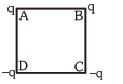
Charges are placed on the vertices of a square as shown. Let $\overrightarrow{E}$ be the electric field and $V$ be the electric potential at the centre. If the charges on $A$ and $B$ are interchanged with those on $D$ and $C$ respectively,then:
A
$\overrightarrow{E}$ remains unchanged,$V$ changes
B
Both $\overrightarrow{E}$ and $V$ change
C
$\overrightarrow{E}$ and $V$ remain unchanged
D
$\overrightarrow{E}$ changes,$V$ remains unchanged
Solution
(D) The electric potential $V$ at the centre of the square is the algebraic sum of potentials due to individual charges: $V = k \sum \frac{q_i}{r}$. Since the distance $r$ from each vertex to the centre is the same,$V = \frac{k}{r} (q_A + q_B + q_C + q_D)$. Interchanging charges does not change the sum $(q_A + q_B + q_C + q_D)$,so $V$ remains unchanged.
The electric field $\overrightarrow{E}$ at the centre is a vector sum: $\overrightarrow{E} = \sum \overrightarrow{E_i}$. Initially,the field vectors from $A$ and $C$ (both $q$) and $B$ and $D$ (both $-q$) result in a net field. When charges are interchanged,the positions of the charges change relative to the centre,which alters the direction and magnitude of the individual field vectors $\overrightarrow{E_i}$. Thus,the resultant vector $\overrightarrow{E}$ changes.
The electric field $\overrightarrow{E}$ at the centre is a vector sum: $\overrightarrow{E} = \sum \overrightarrow{E_i}$. Initially,the field vectors from $A$ and $C$ (both $q$) and $B$ and $D$ (both $-q$) result in a net field. When charges are interchanged,the positions of the charges change relative to the centre,which alters the direction and magnitude of the individual field vectors $\overrightarrow{E_i}$. Thus,the resultant vector $\overrightarrow{E}$ changes.
0 likesView Solution
35
ChemistryMCQAIEEE · 2007
$A$ sound absorber attenuates the sound level by $20\, dB$. The intensity decreases by a factor of:
A
$100$
B
$1000$
C
$10000$
D
$10$
Solution
(A) The change in sound level $\Delta L$ in decibels $(dB)$ is given by the formula: $\Delta L = 10 \log_{10} \left( \frac{I_1}{I_2} \right)$.
Given that the sound level is attenuated by $20\, dB$,we have $\Delta L = 20\, dB$.
Substituting the values into the formula: $20 = 10 \log_{10} \left( \frac{I_1}{I_2} \right)$.
Dividing by $10$,we get: $2 = \log_{10} \left( \frac{I_1}{I_2} \right)$.
Converting the logarithmic form to exponential form: $10^2 = \frac{I_1}{I_2}$.
Therefore,$\frac{I_1}{I_2} = 100$,which means the intensity decreases by a factor of $100$.
Given that the sound level is attenuated by $20\, dB$,we have $\Delta L = 20\, dB$.
Substituting the values into the formula: $20 = 10 \log_{10} \left( \frac{I_1}{I_2} \right)$.
Dividing by $10$,we get: $2 = \log_{10} \left( \frac{I_1}{I_2} \right)$.
Converting the logarithmic form to exponential form: $10^2 = \frac{I_1}{I_2}$.
Therefore,$\frac{I_1}{I_2} = 100$,which means the intensity decreases by a factor of $100$.
0 likesView Solution
36
ChemistryMCQAIEEE · 2007
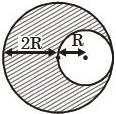
$A$ circular disc of radius $R$ is removed from a bigger uniform circular disc of radius $2R$ such that the circumferences of the discs coincide. The centre of mass of the new disc is $\alpha R$ from the centre of the bigger disc. The value of $\alpha$ is
A
$\frac{1}{3}$
B
$\frac{1}{2}$
C
$\frac{1}{6}$
D
$\frac{1}{4}$
Solution
(A) Let $\sigma$ be the surface mass density of the discs.
Mass of the bigger disc $M = \sigma \pi (2R)^2 = 4 \sigma \pi R^2$.
Mass of the removed smaller disc $m = \sigma \pi R^2$.
Let the origin be at the centre of the bigger disc. The centre of the removed disc is at a distance $d = R$ from the origin.
The centre of mass of the remaining part is given by $X_{cm} = \frac{M(0) - m(d)}{M - m}$.
$X_{cm} = \frac{0 - (\sigma \pi R^2)(R)}{4 \sigma \pi R^2 - \sigma \pi R^2} = \frac{-\sigma \pi R^3}{3 \sigma \pi R^2} = -\frac{R}{3}$.
The magnitude of the distance is $\frac{R}{3}$,so $\alpha R = \frac{R}{3}$,which gives $\alpha = \frac{1}{3}$.
Mass of the bigger disc $M = \sigma \pi (2R)^2 = 4 \sigma \pi R^2$.
Mass of the removed smaller disc $m = \sigma \pi R^2$.
Let the origin be at the centre of the bigger disc. The centre of the removed disc is at a distance $d = R$ from the origin.
The centre of mass of the remaining part is given by $X_{cm} = \frac{M(0) - m(d)}{M - m}$.
$X_{cm} = \frac{0 - (\sigma \pi R^2)(R)}{4 \sigma \pi R^2 - \sigma \pi R^2} = \frac{-\sigma \pi R^3}{3 \sigma \pi R^2} = -\frac{R}{3}$.
The magnitude of the distance is $\frac{R}{3}$,so $\alpha R = \frac{R}{3}$,which gives $\alpha = \frac{1}{3}$.
0 likesView Solution
37
ChemistryMCQAIEEE · 2007
The $pK_a$ of a weak acid $HA$ is $4.5$. The $pOH$ of an aqueous buffered solution of $HA$ in which $50\%$ of the $HA$ acid is ionized is
A
$4.5$
B
$2.5$
C
$9.5$
D
$7$
Solution
(C) The Henderson-Hasselbalch equation for a weak acid is given by: $pH = pK_a + \log \frac{[A^-]}{[HA]}$
Given that $50\%$ of the acid is ionized,the concentration of the conjugate base $[A^-]$ is equal to the concentration of the remaining unionized acid $[HA]$.
Thus,$\frac{[A^-]}{[HA]} = 1$.
Substituting the values: $pH = 4.5 + \log(1) = 4.5 + 0 = 4.5$.
We know that at $25^{\circ}C$,$pH + pOH = 14$.
Therefore,$pOH = 14 - pH = 14 - 4.5 = 9.5$.
Given that $50\%$ of the acid is ionized,the concentration of the conjugate base $[A^-]$ is equal to the concentration of the remaining unionized acid $[HA]$.
Thus,$\frac{[A^-]}{[HA]} = 1$.
Substituting the values: $pH = 4.5 + \log(1) = 4.5 + 0 = 4.5$.
We know that at $25^{\circ}C$,$pH + pOH = 14$.
Therefore,$pOH = 14 - pH = 14 - 4.5 = 9.5$.
0 likesView Solution
38
ChemistryMCQAIEEE · 2007
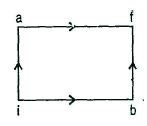
When a system is taken from state $i$ to state $f$ along the path $iaf,$ it is found that $Q = 50 \, cal$ and $W = 20 \, cal$. Along the path $ibf$,$Q = 36 \, cal$. Work done along the path $ibf$ will be ........... $cal$.
A
$6$
B
$16$
C
$66$
D
$14$
Solution
(A) According to the first law of thermodynamics,the heat supplied to a system is equal to the sum of the change in internal energy and the work done by the system: $Q = \Delta U + W$.
For the path $iaf$:
$Q_{iaf} = 50 \, cal$
$W_{iaf} = 20 \, cal$
Using the first law: $50 = \Delta U + 20$
Therefore,the change in internal energy between states $i$ and $f$ is $\Delta U = 30 \, cal$.
Since internal energy is a state function,it depends only on the initial and final states and not on the path taken. Thus,for path $ibf$,the change in internal energy remains $\Delta U = 30 \, cal$.
For the path $ibf$:
$Q_{ibf} = 36 \, cal$
Using the first law: $Q_{ibf} = \Delta U + W_{ibf}$
$36 = 30 + W_{ibf}$
$W_{ibf} = 36 - 30 = 6 \, cal$.
For the path $iaf$:
$Q_{iaf} = 50 \, cal$
$W_{iaf} = 20 \, cal$
Using the first law: $50 = \Delta U + 20$
Therefore,the change in internal energy between states $i$ and $f$ is $\Delta U = 30 \, cal$.
Since internal energy is a state function,it depends only on the initial and final states and not on the path taken. Thus,for path $ibf$,the change in internal energy remains $\Delta U = 30 \, cal$.
For the path $ibf$:
$Q_{ibf} = 36 \, cal$
Using the first law: $Q_{ibf} = \Delta U + W_{ibf}$
$36 = 30 + W_{ibf}$
$W_{ibf} = 36 - 30 = 6 \, cal$.
0 likesView Solution
39
ChemistryMCQAIEEE · 2007
$A$ sound absorber attenuates the sound level by $20\, dB$. The intensity decreases by a factor of
A
$100$
B
$1000$
C
$10000$
D
$10$
Solution
(A) The sound level $L$ in decibels $(dB)$ is given by $L = 10 \log_{10} \left( \frac{I}{I_0} \right)$,where $I$ is the intensity and $I_0$ is the reference intensity.
Let $L_1$ and $L_2$ be the initial and final sound levels,and $I_1$ and $I_2$ be the corresponding intensities.
The change in sound level is given by $\Delta L = L_1 - L_2 = 20\, dB$.
Using the formula: $\Delta L = 10 \log_{10} \left( \frac{I_1}{I_0} \right) - 10 \log_{10} \left( \frac{I_2}{I_0} \right) = 10 \log_{10} \left( \frac{I_1}{I_2} \right)$.
Substituting the given value: $20 = 10 \log_{10} \left( \frac{I_1}{I_2} \right)$.
Dividing by $10$: $2 = \log_{10} \left( \frac{I_1}{I_2} \right)$.
Taking the antilog: $\frac{I_1}{I_2} = 10^2 = 100$.
Therefore,the intensity decreases by a factor of $100$.
Let $L_1$ and $L_2$ be the initial and final sound levels,and $I_1$ and $I_2$ be the corresponding intensities.
The change in sound level is given by $\Delta L = L_1 - L_2 = 20\, dB$.
Using the formula: $\Delta L = 10 \log_{10} \left( \frac{I_1}{I_0} \right) - 10 \log_{10} \left( \frac{I_2}{I_0} \right) = 10 \log_{10} \left( \frac{I_1}{I_2} \right)$.
Substituting the given value: $20 = 10 \log_{10} \left( \frac{I_1}{I_2} \right)$.
Dividing by $10$: $2 = \log_{10} \left( \frac{I_1}{I_2} \right)$.
Taking the antilog: $\frac{I_1}{I_2} = 10^2 = 100$.
Therefore,the intensity decreases by a factor of $100$.
0 likesView Solution
40
ChemistryMediumMCQAIEEE · 2007
In the conversion of limestone to lime,$CaCO_{3(s)} \rightarrow CaO_{(s)} + CO_{2(g)}$,the values of $\Delta H^{\circ}$ and $\Delta S^{\circ}$ are $+179.1 \ kJ \ mol^{-1}$ and $160.2 \ J \ K^{-1} \ mol^{-1}$ respectively at $298 \ K$ and $1 \ bar$. Assuming that $\Delta H^{\circ}$ and $\Delta S^{\circ}$ do not change with temperature,the temperature above which the conversion of limestone to lime will be spontaneous is ........... $K$.
A
$1118$
B
$1008$
C
$1200$
D
$845$
Solution
(A) For a reaction to be spontaneous,the Gibbs free energy change $\Delta G^{\circ}$ must be less than $0$.
Given the equation: $\Delta G^{\circ} = \Delta H^{\circ} - T \Delta S^{\circ}$.
At equilibrium,$\Delta G^{\circ} = 0$,so $T = \frac{\Delta H^{\circ}}{\Delta S^{\circ}}$.
Given values: $\Delta H^{\circ} = 179.1 \ kJ \ mol^{-1} = 179100 \ J \ mol^{-1}$ and $\Delta S^{\circ} = 160.2 \ J \ K^{-1} \ mol^{-1}$.
Substituting these values into the equation:
$T = \frac{179100 \ J \ mol^{-1}}{160.2 \ J \ K^{-1} \ mol^{-1}} \approx 1117.97 \ K$.
Since the reaction is endothermic and entropy increases,the reaction becomes spontaneous at temperatures above $1118 \ K$.
Given the equation: $\Delta G^{\circ} = \Delta H^{\circ} - T \Delta S^{\circ}$.
At equilibrium,$\Delta G^{\circ} = 0$,so $T = \frac{\Delta H^{\circ}}{\Delta S^{\circ}}$.
Given values: $\Delta H^{\circ} = 179.1 \ kJ \ mol^{-1} = 179100 \ J \ mol^{-1}$ and $\Delta S^{\circ} = 160.2 \ J \ K^{-1} \ mol^{-1}$.
Substituting these values into the equation:
$T = \frac{179100 \ J \ mol^{-1}}{160.2 \ J \ K^{-1} \ mol^{-1}} \approx 1117.97 \ K$.
Since the reaction is endothermic and entropy increases,the reaction becomes spontaneous at temperatures above $1118 \ K$.
0 likesView Solution
41
ChemistryMCQAIEEE · 2007
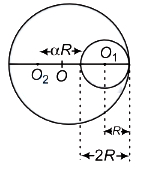
$A$ circular disc of radius $R$ is removed from a bigger circular disc of radius $2R$ such that the circumferences of the discs touch. The centre of mass of the new disc is at a distance $\alpha R$ from the centre of the bigger disc. The value of $\alpha$ is
A
$\frac{1}{2}$
B
$\frac{1}{3}$
C
$\frac{1}{4}$
D
$\frac{1}{6}$
Solution
(B) Let the centre of the bigger disc be the origin $O(0,0)$.
Let the mass of the original disc be $M$ and its radius be $2R$.
The mass of the removed smaller disc of radius $R$ is $m = \frac{\pi R^2}{\pi (2R)^2} M = \frac{M}{4}$.
The centre of the removed disc is at a distance $R$ from the origin along the $x$-axis,so its coordinates are $(R, 0)$.
The centre of mass of the remaining part $(x_{CM})$ is given by the formula:
$x_{CM} = \frac{M_1 x_1 - m x_2}{M_1 - m}$
Here,$M_1 = M$,$x_1 = 0$,$m = M/4$,and $x_2 = R$.
$x_{CM} = \frac{M(0) - (M/4)(R)}{M - M/4} = \frac{-MR/4}{3M/4} = -\frac{R}{3}$.
The distance from the centre is $|x_{CM}| = \frac{R}{3}$.
Comparing this with $\alpha R$,we get $\alpha = \frac{1}{3}$.
Let the mass of the original disc be $M$ and its radius be $2R$.
The mass of the removed smaller disc of radius $R$ is $m = \frac{\pi R^2}{\pi (2R)^2} M = \frac{M}{4}$.
The centre of the removed disc is at a distance $R$ from the origin along the $x$-axis,so its coordinates are $(R, 0)$.
The centre of mass of the remaining part $(x_{CM})$ is given by the formula:
$x_{CM} = \frac{M_1 x_1 - m x_2}{M_1 - m}$
Here,$M_1 = M$,$x_1 = 0$,$m = M/4$,and $x_2 = R$.
$x_{CM} = \frac{M(0) - (M/4)(R)}{M - M/4} = \frac{-MR/4}{3M/4} = -\frac{R}{3}$.
The distance from the centre is $|x_{CM}| = \frac{R}{3}$.
Comparing this with $\alpha R$,we get $\alpha = \frac{1}{3}$.
0 likesView Solution
42
ChemistryMCQAIEEE · 2007
$A$ circular disc of radius $R$ is removed from a bigger circular disc of radius $2R$ such that the circumferences of the discs touch. The centre of mass of the new disc is at a distance $\alpha R$ from the centre of the bigger disc. The value of $\alpha$ is
A
$\frac{1}{2}$
B
$\frac{1}{3}$
C
$\frac{1}{4}$
D
$\frac{1}{6}$
Solution
(B) Let the centre of the bigger disc of radius $2R$ be at the origin $(0,0)$.
Let $M$ be the mass of the bigger disc. The mass per unit area is $\sigma = \frac{M}{\pi(2R)^2} = \frac{M}{4\pi R^2}$.
The mass of the removed smaller disc of radius $R$ is $m = \sigma \cdot \pi R^2 = \frac{M}{4\pi R^2} \cdot \pi R^2 = \frac{M}{4}$.
The centre of mass of the bigger disc is at $x_1 = 0$. The centre of mass of the removed smaller disc is at $x_2 = R$ (since the circumferences touch).
The centre of mass of the remaining part is given by:
$x_{CM} = \frac{M x_1 - m x_2}{M - m}$
$x_{CM} = \frac{M(0) - (M/4)(R)}{M - M/4} = \frac{-MR/4}{3M/4} = -\frac{R}{3}$.
The distance from the centre of the bigger disc is $|x_{CM}| = \frac{R}{3}$.
Comparing this with $\alpha R$,we get $\alpha = \frac{1}{3}$.
Let $M$ be the mass of the bigger disc. The mass per unit area is $\sigma = \frac{M}{\pi(2R)^2} = \frac{M}{4\pi R^2}$.
The mass of the removed smaller disc of radius $R$ is $m = \sigma \cdot \pi R^2 = \frac{M}{4\pi R^2} \cdot \pi R^2 = \frac{M}{4}$.
The centre of mass of the bigger disc is at $x_1 = 0$. The centre of mass of the removed smaller disc is at $x_2 = R$ (since the circumferences touch).
The centre of mass of the remaining part is given by:
$x_{CM} = \frac{M x_1 - m x_2}{M - m}$
$x_{CM} = \frac{M(0) - (M/4)(R)}{M - M/4} = \frac{-MR/4}{3M/4} = -\frac{R}{3}$.
The distance from the centre of the bigger disc is $|x_{CM}| = \frac{R}{3}$.
Comparing this with $\alpha R$,we get $\alpha = \frac{1}{3}$.
0 likesView Solution
43
ChemistryDifficultMCQAIEEE · 2007
Presence of a nitro group in a benzene ring
A
deactivates the ring towards electrophilic substitution
B
activates the ring towards electrophilic substitution
C
renders the ring basic
D
deactivates the ring towards nucleophilic substitution.
Solution
(A) The nitro group $(-NO_2)$ is a strong electron-withdrawing group due to its $-I$ and $-M$ effects.
It withdraws electron density from the benzene ring,thereby reducing the electron density available for electrophilic attack.
Consequently,it deactivates the benzene ring towards electrophilic substitution reactions.
It withdraws electron density from the benzene ring,thereby reducing the electron density available for electrophilic attack.
Consequently,it deactivates the benzene ring towards electrophilic substitution reactions.
0 likesView Solution
44
ChemistryMediumMCQAIEEE · 2007
The compound formed as a result of oxidation of ethyl benzene by $KMnO_4$ is
A
benzyl alcohol
B
benzophenone
C
acetophenone
D
benzoic acid
Solution
(D) When alkyl benzenes (like ethyl benzene) are treated with strong oxidizing agents such as alkaline $KMnO_4$,the alkyl side chain is oxidized to a carboxylic acid group $(-COOH)$ attached to the benzene ring,regardless of the length of the alkyl chain,provided that the benzylic carbon has at least one hydrogen atom.
In the case of ethyl benzene $(C_6H_5-CH_2-CH_3)$,the benzylic carbon has two hydrogen atoms,so it undergoes oxidation to form benzoic acid $(C_6H_5-COOH)$.
In the case of ethyl benzene $(C_6H_5-CH_2-CH_3)$,the benzylic carbon has two hydrogen atoms,so it undergoes oxidation to form benzoic acid $(C_6H_5-COOH)$.
0 likesView Solution
45
ChemistryMediumMCQAIEEE · 2007
The reaction of toluene with $Cl_2$ in the presence of $FeCl_3$ gives predominantly
A
$m-$chlorotoluene
B
benzoyl chloride
C
benzyl chloride
D
$o-$ and $p-$chlorotoluene
Solution
(D) The reaction of toluene with $Cl_2$ in the presence of a Lewis acid catalyst like $FeCl_3$ is an electrophilic aromatic substitution reaction (chlorination).
The methyl group $(-CH_3)$ attached to the benzene ring is an electron-donating group due to the inductive effect and hyperconjugation.
This group activates the benzene ring and directs the incoming electrophile $(Cl^+)$ to the ortho $(o-)$ and para $(p-)$ positions.
Therefore,the reaction yields a mixture of $o-$chlorotoluene and $p-$chlorotoluene.
The methyl group $(-CH_3)$ attached to the benzene ring is an electron-donating group due to the inductive effect and hyperconjugation.
This group activates the benzene ring and directs the incoming electrophile $(Cl^+)$ to the ortho $(o-)$ and para $(p-)$ positions.
Therefore,the reaction yields a mixture of $o-$chlorotoluene and $p-$chlorotoluene.
0 likesView Solution
46
ChemistryMediumMCQAIEEE · 2007
$A$ mixture of ethyl alcohol and propyl alcohol has a vapour pressure of $290 \, mm$ at $300 \, K$. The vapour pressure of propyl alcohol is $200 \, mm$. If the mole fraction of ethyl alcohol is $0.6$,its vapour pressure (in $mm$) at the same temperature will be:
A
$360$
B
$350$
C
$300$
D
$700$
Solution
(B) According to Raoult's law,the total vapour pressure of the solution is given by $P = P_A^\circ x_A + P_B^\circ x_B$.
Given:
$P = 290 \, mm$
$P_B^\circ = 200 \, mm$ (vapour pressure of propyl alcohol)
$x_A = 0.6$ (mole fraction of ethyl alcohol)
$x_B = 1 - x_A = 1 - 0.6 = 0.4$ (mole fraction of propyl alcohol)
Substituting the values in the equation:
$290 = P_A^\circ \times 0.6 + 200 \times 0.4$
$290 = P_A^\circ \times 0.6 + 80$
$290 - 80 = P_A^\circ \times 0.6$
$210 = P_A^\circ \times 0.6$
$P_A^\circ = \frac{210}{0.6} = 350 \, mm$.
Given:
$P = 290 \, mm$
$P_B^\circ = 200 \, mm$ (vapour pressure of propyl alcohol)
$x_A = 0.6$ (mole fraction of ethyl alcohol)
$x_B = 1 - x_A = 1 - 0.6 = 0.4$ (mole fraction of propyl alcohol)
Substituting the values in the equation:
$290 = P_A^\circ \times 0.6 + 200 \times 0.4$
$290 = P_A^\circ \times 0.6 + 80$
$290 - 80 = P_A^\circ \times 0.6$
$210 = P_A^\circ \times 0.6$
$P_A^\circ = \frac{210}{0.6} = 350 \, mm$.
0 likesView Solution
47
ChemistryDifficultMCQAIEEE · 2007
$A$ $5.25\%$ solution of a substance is isotonic with a $1.5\%$ solution of urea (molar mass $= 60\ g\ mol^{-1}$) in the same solvent. If the densities of both the solutions are assumed to be equal to $1.0\ g\ cm^{-3},$ the molar mass of the substance will be .............. $g\ mol^{-1}$.
A
$210$
B
$90$
C
$115$
D
$105$
Solution
(A) For isotonic solutions,the osmotic pressure $(\pi)$ is equal,which implies that their molar concentrations $(C)$ are equal at the same temperature.
Given that the solutions are $5.25\%$ and $1.5\%$ by mass,and assuming the density is $1.0\ g\ cm^{-3}$,the concentration in $g\ L^{-1}$ is the same as the percentage mass multiplied by $10$.
Concentration of substance $(C_1) = \frac{5.25 \times 10}{M} = \frac{52.5}{M} \ mol\ L^{-1}$.
Concentration of urea $(C_2) = \frac{1.5 \times 10}{60} = \frac{15}{60} = 0.25 \ mol\ L^{-1}$.
Since the solutions are isotonic,$C_1 = C_2$.
$\frac{52.5}{M} = 0.25$.
$M = \frac{52.5}{0.25} = 210 \ g\ mol^{-1}$.
Given that the solutions are $5.25\%$ and $1.5\%$ by mass,and assuming the density is $1.0\ g\ cm^{-3}$,the concentration in $g\ L^{-1}$ is the same as the percentage mass multiplied by $10$.
Concentration of substance $(C_1) = \frac{5.25 \times 10}{M} = \frac{52.5}{M} \ mol\ L^{-1}$.
Concentration of urea $(C_2) = \frac{1.5 \times 10}{60} = \frac{15}{60} = 0.25 \ mol\ L^{-1}$.
Since the solutions are isotonic,$C_1 = C_2$.
$\frac{52.5}{M} = 0.25$.
$M = \frac{52.5}{0.25} = 210 \ g\ mol^{-1}$.
0 likesView Solution
48
ChemistryDifficultMCQAIEEE · 2007
At $80\,^oC,$ the vapour pressure of pure liquid $'A'$ is $520\, mm\,Hg$ and that of pure liquid $'B'$ is $1000\, mm\,Hg.$ If a mixture solution of $'A'$ and $'B'$ boils at $80\,^oC$ and $1\, atm$ pressure,the amount of $'A'$ in the mixture is ........... $mol$ percent $(1\, atm = 760\, mm\,Hg).$
A
$52$
B
$34$
C
$48$
D
$50$
Solution
(D) At $1\, atm$ atmospheric pressure,the boiling point of the mixture is $80\,^oC.$
At the boiling point,the total vapour pressure of the mixture,$P_{T} = 1\, atm = 760\, mm\,Hg.$
Using Raoult's law,$P_{T} = P_{A}^{\circ} X_{A} + P_{B}^{\circ} X_{B}.$
Given $P_{A}^{\circ} = 520\, mm\,Hg,$ $P_{B}^{\circ} = 1000\, mm\,Hg,$ and $X_{A} + X_{B} = 1,$
$760 = 520 X_{A} + 1000(1 - X_{A}).$
$760 = 520 X_{A} + 1000 - 1000 X_{A}.$
$480 X_{A} = 240.$
$X_{A} = \frac{240}{480} = 0.5.$
Therefore,the amount of $'A'$ in the mixture is $50\, mol\, percent.$
At the boiling point,the total vapour pressure of the mixture,$P_{T} = 1\, atm = 760\, mm\,Hg.$
Using Raoult's law,$P_{T} = P_{A}^{\circ} X_{A} + P_{B}^{\circ} X_{B}.$
Given $P_{A}^{\circ} = 520\, mm\,Hg,$ $P_{B}^{\circ} = 1000\, mm\,Hg,$ and $X_{A} + X_{B} = 1,$
$760 = 520 X_{A} + 1000(1 - X_{A}).$
$760 = 520 X_{A} + 1000 - 1000 X_{A}.$
$480 X_{A} = 240.$
$X_{A} = \frac{240}{480} = 0.5.$
Therefore,the amount of $'A'$ in the mixture is $50\, mol\, percent.$
0 likesView Solution
49
ChemistryAdvancedMCQAIEEE · 2007
The equivalent conductances of two strong electrolytes at infinite dilution in $H_2O$ (where ions move freely through a solution) at $25 ^\circ C$ are given below:
$\Lambda _{CH_3COONa}^o = 91.0 \ S \ cm^2 / equiv.$
$\Lambda _{HCl}^o = 426.2 \ S \ cm^2 / equiv.$
What additional information/quantity one needs to calculate $\Lambda ^o$ of an aqueous solution of acetic acid?
$\Lambda _{CH_3COONa}^o = 91.0 \ S \ cm^2 / equiv.$
$\Lambda _{HCl}^o = 426.2 \ S \ cm^2 / equiv.$
What additional information/quantity one needs to calculate $\Lambda ^o$ of an aqueous solution of acetic acid?
A
$\Lambda ^o$ of chloroacetic acid $(ClCH_2COOH)$
B
$\Lambda ^o$ of $NaCl$
C
$\Lambda ^o$ of $CH_3COOK$
D
The limiting equivalent conductance of $H^{+} ( \lambda _{H^{+}}^o )$
Solution
(B) According to Kohlrausch's law of independent migration of ions, the molar conductivity of a weak electrolyte at infinite dilution can be determined using the molar conductivities of strong electrolytes.
For acetic acid $(CH_3COOH)$, the expression is:
$\Lambda_{CH_3COOH}^o = \Lambda_{CH_3COONa}^o + \Lambda_{HCl}^o - \Lambda_{NaCl}^o$
Given the values for $\Lambda_{CH_3COONa}^o$ and $\Lambda_{HCl}^o$, we require the value of $\Lambda_{NaCl}^o$ to complete the calculation.
Thus, the correct option is $(B)$.
For acetic acid $(CH_3COOH)$, the expression is:
$\Lambda_{CH_3COOH}^o = \Lambda_{CH_3COONa}^o + \Lambda_{HCl}^o - \Lambda_{NaCl}^o$
Given the values for $\Lambda_{CH_3COONa}^o$ and $\Lambda_{HCl}^o$, we require the value of $\Lambda_{NaCl}^o$ to complete the calculation.
Thus, the correct option is $(B)$.
0 likesView Solution
50
ChemistryAdvancedMCQAIEEE · 2007
The cell,$Zn\ |\ Zn^{2+} \,(1\ M)\ ||\ Cu^{2+}\ (1\ M)\ |\ Cu$ $(E^o_{cell} = 1.10\ V)$ was allowed to be completely discharged at $298\ K.$ The relative concentration of $Zn^{2+}$ to $Cu^{2+}$ $\left( \frac{[Zn^{2+}]}{[Cu^{2+}]} \right)$ is
A
$9.65 \times 10^4$
B
antilog $(24.08)$
C
$37.3$
D
$10^{37.3}$
Solution
(D) When the cell is completely discharged,the cell potential $E_{cell} = 0 \ V.$
The Nernst equation for the cell reaction is given by:
$E_{cell} = E_{cell}^{\circ} - \frac{0.059}{n} \log \left( \frac{[Zn^{2+}]}{[Cu^{2+}]} \right)$
Here,$n = 2$ (number of electrons transferred) and $E_{cell}^{\circ} = 1.10 \ V.$
Substituting the values:
$0 = 1.10 - \frac{0.059}{2} \log \left( \frac{[Zn^{2+}]}{[Cu^{2+}]} \right)$
Rearranging the equation:
$\log \left( \frac{[Zn^{2+}]}{[Cu^{2+}]} \right) = \frac{1.10 \times 2}{0.059} \approx 37.288 \approx 37.3$
Therefore,$\frac{[Zn^{2+}]}{[Cu^{2+}]} = 10^{37.3}$.
The Nernst equation for the cell reaction is given by:
$E_{cell} = E_{cell}^{\circ} - \frac{0.059}{n} \log \left( \frac{[Zn^{2+}]}{[Cu^{2+}]} \right)$
Here,$n = 2$ (number of electrons transferred) and $E_{cell}^{\circ} = 1.10 \ V.$
Substituting the values:
$0 = 1.10 - \frac{0.059}{2} \log \left( \frac{[Zn^{2+}]}{[Cu^{2+}]} \right)$
Rearranging the equation:
$\log \left( \frac{[Zn^{2+}]}{[Cu^{2+}]} \right) = \frac{1.10 \times 2}{0.059} \approx 37.288 \approx 37.3$
Therefore,$\frac{[Zn^{2+}]}{[Cu^{2+}]} = 10^{37.3}$.
0 likesView Solution
51
ChemistryDifficultMCQAIEEE · 2007
The energies of activation for forward and reverse reactions for $A_2 + B_2 \rightleftharpoons 2AB$ are $180 \, kJ \, mol^{-1}$ and $200 \, kJ \, mol^{-1}$ respectively. The presence of a catalyst lowers the activation energy of both (forward and reverse) reactions by $100 \, kJ \, mol^{-1}.$ The enthalpy change of the reaction $(A_2 + B_2 \rightarrow 2AB)$ in the presence of a catalyst will be (in $kJ \, mol^{-1}$)
A
$-20$
B
$300$
C
$120$
D
$280$
Solution
$(A)$ The enthalpy change of a reaction $(\Delta H)$ is defined as the difference between the activation energy of the forward reaction $(E_{af})$ and the activation energy of the reverse reaction $(E_{ab})$.
$\Delta H = E_{af} - E_{ab} = 180 \, kJ \, mol^{-1} - 200 \, kJ \, mol^{-1} = -20 \, kJ \, mol^{-1}$.
$A$ catalyst provides an alternative reaction pathway with lower activation energy, but it does not change the energy of the reactants or the products.
Since $\Delta H$ is a state function, it depends only on the initial and final states of the system.
Therefore, the enthalpy change of the reaction remains unchanged in the presence of a catalyst, which is $-20 \, kJ \, mol^{-1}$.
$\Delta H = E_{af} - E_{ab} = 180 \, kJ \, mol^{-1} - 200 \, kJ \, mol^{-1} = -20 \, kJ \, mol^{-1}$.
$A$ catalyst provides an alternative reaction pathway with lower activation energy, but it does not change the energy of the reactants or the products.
Since $\Delta H$ is a state function, it depends only on the initial and final states of the system.
Therefore, the enthalpy change of the reaction remains unchanged in the presence of a catalyst, which is $-20 \, kJ \, mol^{-1}$.
0 likesView Solution
52
ChemistryDifficultMCQAIEEE · 2007
Consider the reaction,$2A + B \rightarrow$ products. When concentration of $B$ alone was doubled,the half-life did not change. When the concentration of $A$ alone was doubled,the rate increased by two times. The unit of rate constant for this reaction is
A
$s^{-1}$
B
$L \ mol^{-1} \ s^{-1}$
C
no unit
D
$mol \ L^{-1} \ s^{-1}$
Solution
(B) For a reaction,the rate law can be expressed as $Rate = k[A]^x[B]^y$.
$1$. When the concentration of $B$ is doubled,the half-life does not change. This indicates that the reaction is of first order with respect to $B$ $(y=1)$,as the half-life of a first-order reaction is independent of the initial concentration of the reactant.
$2$. When the concentration of $A$ is doubled,the rate increases by two times. This indicates that the reaction is of first order with respect to $A$ $(x=1)$.
$3$. The overall order of the reaction is $n = x + y = 1 + 1 = 2$.
$4$. The unit of the rate constant for a reaction of order $n$ is $(mol \ L^{-1})^{1-n} \ s^{-1}$. For $n=2$,the unit is $(mol \ L^{-1})^{1-2} \ s^{-1} = (mol \ L^{-1})^{-1} \ s^{-1} = L \ mol^{-1} \ s^{-1}$.
$1$. When the concentration of $B$ is doubled,the half-life does not change. This indicates that the reaction is of first order with respect to $B$ $(y=1)$,as the half-life of a first-order reaction is independent of the initial concentration of the reactant.
$2$. When the concentration of $A$ is doubled,the rate increases by two times. This indicates that the reaction is of first order with respect to $A$ $(x=1)$.
$3$. The overall order of the reaction is $n = x + y = 1 + 1 = 2$.
$4$. The unit of the rate constant for a reaction of order $n$ is $(mol \ L^{-1})^{1-n} \ s^{-1}$. For $n=2$,the unit is $(mol \ L^{-1})^{1-2} \ s^{-1} = (mol \ L^{-1})^{-1} \ s^{-1} = L \ mol^{-1} \ s^{-1}$.
0 likesView Solution
53
ChemistryDifficultMCQAIEEE · 2007
$A$ radioactive element gets spilled over the floor of a room. Its half-life period is $30$ days. If the initial activity is ten times the permissible value,after how many days will it be safe to enter the room?
A
$100$
B
$1000$
C
$300$
D
$10$
Solution
(A) The radioactive decay follows first-order kinetics,where the activity $A$ at time $t$ is given by $A = A_0 e^{-\lambda t}$.
Given that the initial activity $A_0 = 10A$,where $A$ is the permissible safe activity level.
The decay constant $\lambda$ is related to the half-life $t_{1/2}$ by $\lambda = \frac{\ln 2}{t_{1/2}} = \frac{0.693}{30 \text{ days}}$.
Using the first-order integrated rate equation: $t = \frac{2.303}{\lambda} \log_{10} \left( \frac{A_0}{A} \right)$.
Substituting the values: $t = \frac{2.303}{(0.693 / 30)} \log_{10} (10)$.
Since $\frac{2.303}{0.693} \approx \frac{1}{0.434} \approx 3.32$ (or more precisely $\frac{2.303}{0.693} \approx 3.32$ and $3.32 \times 30 \approx 100$),we get $t = 30 \times \frac{2.303}{0.693} \times 1 = 30 \times 3.325 \approx 100 \text{ days}$.
Given that the initial activity $A_0 = 10A$,where $A$ is the permissible safe activity level.
The decay constant $\lambda$ is related to the half-life $t_{1/2}$ by $\lambda = \frac{\ln 2}{t_{1/2}} = \frac{0.693}{30 \text{ days}}$.
Using the first-order integrated rate equation: $t = \frac{2.303}{\lambda} \log_{10} \left( \frac{A_0}{A} \right)$.
Substituting the values: $t = \frac{2.303}{(0.693 / 30)} \log_{10} (10)$.
Since $\frac{2.303}{0.693} \approx \frac{1}{0.434} \approx 3.32$ (or more precisely $\frac{2.303}{0.693} \approx 3.32$ and $3.32 \times 30 \approx 100$),we get $t = 30 \times \frac{2.303}{0.693} \times 1 = 30 \times 3.325 \approx 100 \text{ days}$.
0 likesView Solution
54
ChemistryMediumMCQAIEEE · 2007
Which of the following nuclear reactions will generate an isotope?
A
$\beta -$ particle emission
B
Neutron particle emission
C
Positron emission
D
$\alpha -$ particle emission
Solution
(B) Isotopes are atoms of the same element having the same atomic number but different atomic masses.
Neutron has an atomic number of $0$ and an atomic mass of $1$.
Therefore,the loss or gain of a neutron changes the mass number while keeping the atomic number constant,thus generating an isotope.
For example: $_{92}U^{238} + _{0}n^{1} \rightarrow _{92}U^{239}$
Neutron has an atomic number of $0$ and an atomic mass of $1$.
Therefore,the loss or gain of a neutron changes the mass number while keeping the atomic number constant,thus generating an isotope.
For example: $_{92}U^{238} + _{0}n^{1} \rightarrow _{92}U^{239}$
0 likesView Solution
55
ChemistryMediumMCQAIEEE · 2007
Identify the incorrect statement among the following.
A
$Br_2$ reacts with hot and strong $NaOH$ solution to give $NaBr$ and $H_2O$.
B
Ozone reacts with $SO_2$ to give $SO_3$.
C
Silicon reacts with $NaOH_{(aq)}$ in the presence of air to give $Na_2SiO_3$ and $H_2O$.
D
$Cl_2$ reacts with excess of $NH_3$ to give $N_2$ and $HCl$.
Solution
(D) Let us analyze each reaction:
$1$. $3Br_2 6NaOH (\text{hot and conc.}) \rightarrow 5NaBr NaBrO_3 3H_2O$. Thus,option $A$ is incorrect as it does not mention $NaBrO_3$.
$2$. $SO_2 O_3 \rightarrow SO_3 O_2$. This is correct.
$3$. $Si 2NaOH H_2O \rightarrow Na_2SiO_3 2H_2$. This is correct.
$4$. With excess $NH_3$,$Cl_2$ reacts as: $3Cl_2 8NH_3 \rightarrow N_2 6NH_4Cl$. The statement in option $D$ claims $HCl$ is formed,but $HCl$ reacts with excess $NH_3$ to form $NH_4Cl$. Therefore,both $A$ and $D$ are technically incorrect based on standard chemical descriptions,but $D$ is the most commonly cited incorrect statement in this context due to the product being $NH_4Cl$ instead of $HCl$.
$1$. $3Br_2 6NaOH (\text{hot and conc.}) \rightarrow 5NaBr NaBrO_3 3H_2O$. Thus,option $A$ is incorrect as it does not mention $NaBrO_3$.
$2$. $SO_2 O_3 \rightarrow SO_3 O_2$. This is correct.
$3$. $Si 2NaOH H_2O \rightarrow Na_2SiO_3 2H_2$. This is correct.
$4$. With excess $NH_3$,$Cl_2$ reacts as: $3Cl_2 8NH_3 \rightarrow N_2 6NH_4Cl$. The statement in option $D$ claims $HCl$ is formed,but $HCl$ reacts with excess $NH_3$ to form $NH_4Cl$. Therefore,both $A$ and $D$ are technically incorrect based on standard chemical descriptions,but $D$ is the most commonly cited incorrect statement in this context due to the product being $NH_4Cl$ instead of $HCl$.
0 likesView Solution
56
ChemistryMediumMCQAIEEE · 2007
Identify the incorrect statement among the following:
A
$4f$ and $5f$ orbitals are equally shielded.
B
$d-$ Block elements show irregular and erratic chemical properties among themselves.
C
$La$ and $Lu$ have partially filled $d-$orbitals and no other partially filled orbitals.
D
The chemistry of various lanthanoids is very similar.
Solution
(A) The shielding effect of $f-$orbitals is poor. Specifically,the $4f$ orbitals are closer to the nucleus than the $5f$ orbitals,meaning the shielding provided by $4f$ electrons is greater than that provided by $5f$ electrons. Therefore,the statement that $4f$ and $5f$ orbitals are equally shielded is incorrect.
0 likesView Solution
57
ChemistryEasyMCQAIEEE · 2007
Which of the following has a square planar geometry?
(At. nos.: $Fe=26, Co=27, Ni=28, Pt=78$)
(At. nos.: $Fe=26, Co=27, Ni=28, Pt=78$)
A
$[PtCl_4]^{2-}$
B
$[CoCl_4]^{2-}$
C
$[FeCl_4]^{2-}$
D
$[NiCl_4]^{2-}$
Solution
(A) In $[PtCl_4]^{2-}$,the central metal ion is $Pt^{2 }$ ($5d^8$ configuration).
$Pt$ is a $5d$ series element,and for $5d$ elements,the crystal field splitting energy $(\Delta_o)$ is very high,even with weak ligands like $Cl^-$.
This high splitting energy forces the pairing of electrons in the $5d$ orbitals,resulting in $dsp^2$ hybridization.
Therefore,$[PtCl_4]^{2-}$ exhibits a square planar geometry.
In contrast,$[NiCl_4]^{2-}$,$[CoCl_4]^{2-}$,and $[FeCl_4]^{2-}$ involve $3d$ metals with weak ligands,leading to $sp^3$ hybridization and tetrahedral geometry.
$Pt$ is a $5d$ series element,and for $5d$ elements,the crystal field splitting energy $(\Delta_o)$ is very high,even with weak ligands like $Cl^-$.
This high splitting energy forces the pairing of electrons in the $5d$ orbitals,resulting in $dsp^2$ hybridization.
Therefore,$[PtCl_4]^{2-}$ exhibits a square planar geometry.
In contrast,$[NiCl_4]^{2-}$,$[CoCl_4]^{2-}$,and $[FeCl_4]^{2-}$ involve $3d$ metals with weak ligands,leading to $sp^3$ hybridization and tetrahedral geometry.
0 likesView Solution
58
ChemistryMediumMCQAIEEE · 2007
The actinoids exhibit a greater number of oxidation states in general than the lanthanoids. This is because
A
the $5f$ orbitals extend further from the nucleus than the $4f$ orbitals
B
the $5f$ orbitals are more buried than the $4f$ orbitals
C
there is a similarity between $4f$ and $5f$ orbitals in their angular part of the wave function
D
the actinoids are more reactive than the lanthanoids
Solution
(A) The $5f$ orbitals extend further from the nucleus compared to the $4f$ orbitals.
Due to this,the $5f$ electrons are less tightly held by the nucleus and are more available for bonding.
Consequently,the actinoids exhibit a greater variety of oxidation states compared to the lanthanoids.
Due to this,the $5f$ electrons are less tightly held by the nucleus and are more available for bonding.
Consequently,the actinoids exhibit a greater variety of oxidation states compared to the lanthanoids.
0 likesView Solution
59
ChemistryMediumMCQAIEEE · 2007
Which of the following is the correct order of decreasing $S_{N^{2}}$ reactivity?
($X$ is a halogen)
($X$ is a halogen)
A
$R_2CHX > R_3CX > RCH_2X$
B
$RCH_2X > R_3CX > R_2CHX$
C
$RCH_2X > R_2CHX > R_3CX$
D
$R_3CX > R_2CHX > RCH_2X$
Solution
(C) In the $S_{N^{2}}$ mechanism,the transition state is pentavalent.
Steric hindrance plays a crucial role in $S_{N^{2}}$ reactions.
Bulky alkyl groups hinder the approach of the nucleophile,while smaller alkyl groups facilitate it.
Therefore,the reactivity order for $S_{N^{2}}$ is primary $(RCH_2X)$ > secondary $(R_2CHX)$ > tertiary $(R_3CX)$.
The correct order is $RCH_2X > R_2CHX > R_3CX$.
Steric hindrance plays a crucial role in $S_{N^{2}}$ reactions.
Bulky alkyl groups hinder the approach of the nucleophile,while smaller alkyl groups facilitate it.
Therefore,the reactivity order for $S_{N^{2}}$ is primary $(RCH_2X)$ > secondary $(R_2CHX)$ > tertiary $(R_3CX)$.
The correct order is $RCH_2X > R_2CHX > R_3CX$.
0 likesView Solution
60
ChemistryDifficultMCQAIEEE · 2007
In the following sequence of reactions,the compound $D$ is
$CH_3CH_2OH$ $\xrightarrow{P + I_2} A$ $\xrightarrow[{ether}]{Mg} B$ $\xrightarrow{HCHO} C$ $\xrightarrow{H_2O} D$
$CH_3CH_2OH$ $\xrightarrow{P + I_2} A$ $\xrightarrow[{ether}]{Mg} B$ $\xrightarrow{HCHO} C$ $\xrightarrow{H_2O} D$
A
propanal
B
butanal
C
$n-$butyl alcohol
D
$n-$propyl alcohol
Solution
(D) The reaction sequence is as follows:
$CH_3CH_2OH \xrightarrow{P + I_2} CH_3CH_2I (A)$
$CH_3CH_2I \xrightarrow{Mg, \text{ether}} CH_3CH_2MgI (B)$
$CH_3CH_2MgI + HCHO \rightarrow CH_3CH_2CH_2OMgI (C)$
$CH_3CH_2CH_2OMgI \xrightarrow{H_2O} CH_3CH_2CH_2OH (D) + Mg(OH)I$
Compound $D$ is $n-$propyl alcohol (propan$-1-$ol).
$CH_3CH_2OH \xrightarrow{P + I_2} CH_3CH_2I (A)$
$CH_3CH_2I \xrightarrow{Mg, \text{ether}} CH_3CH_2MgI (B)$
$CH_3CH_2MgI + HCHO \rightarrow CH_3CH_2CH_2OMgI (C)$
$CH_3CH_2CH_2OMgI \xrightarrow{H_2O} CH_3CH_2CH_2OH (D) + Mg(OH)I$
Compound $D$ is $n-$propyl alcohol (propan$-1-$ol).
0 likesView Solution
61
ChemistryMediumMCQAIEEE · 2007
Which one of the following is the strongest base in aqueous solution?
A
Methylamine
B
Trimethylamine
C
Aniline
D
Dimethylamine
Solution
(D) Aromatic amines are less basic than aliphatic amines.
Among aliphatic amines,the order of basicity in aqueous solution is $2^{o} > 1^{o} > 3^{o}$ due to a combination of inductive effect,solvation effect,and steric hindrance.
In $3^{o}$ amines (Trimethylamine),the steric hindrance of three alkyl groups makes the approach and bonding of a proton relatively difficult.
Aniline is much less basic than aliphatic amines because the lone pair of electrons on the nitrogen atom is involved in resonance with the benzene ring.
Therefore,Dimethylamine ($2^{o}$ aliphatic amine) is the strongest base among the given choices.
$\therefore$ The correct order of basic strength is $\text{Dimethylamine} > \text{Methylamine} > \text{Trimethylamine} > \text{Aniline}$.
Among aliphatic amines,the order of basicity in aqueous solution is $2^{o} > 1^{o} > 3^{o}$ due to a combination of inductive effect,solvation effect,and steric hindrance.
In $3^{o}$ amines (Trimethylamine),the steric hindrance of three alkyl groups makes the approach and bonding of a proton relatively difficult.
Aniline is much less basic than aliphatic amines because the lone pair of electrons on the nitrogen atom is involved in resonance with the benzene ring.
Therefore,Dimethylamine ($2^{o}$ aliphatic amine) is the strongest base among the given choices.
$\therefore$ The correct order of basic strength is $\text{Dimethylamine} > \text{Methylamine} > \text{Trimethylamine} > \text{Aniline}$.
0 likesView Solution
62
ChemistryMediumMCQAIEEE · 2007
In the chemical reaction,
$CH_3CH_2NH_2 + CHCl_3 + 3KOH \rightarrow (A) + (B) + 3H_2O,$
the compounds $(A)$ and $(B)$ are respectively
$CH_3CH_2NH_2 + CHCl_3 + 3KOH \rightarrow (A) + (B) + 3H_2O,$
the compounds $(A)$ and $(B)$ are respectively
A
$C_2H_5NC$ and $3KCl$
B
$C_2H_5CN$ and $3KCl$
C
$CH_3CH_2CONH_2$ and $3KCl$
D
$C_2H_5NC$ and $K_2CO_3$
Solution
(A) The given reaction is the carbylamine reaction,which is a characteristic test for primary amines.
In this reaction,a primary amine reacts with chloroform $(CHCl_3)$ and alcoholic potassium hydroxide $(KOH)$ to form an isocyanide (carbylamine) and potassium chloride $(KCl)$.
The balanced chemical equation is:
$CH_3CH_2NH_2 + CHCl_3 + 3KOH \rightarrow C_2H_5NC + 3KCl + 3H_2O$
Here,$(A)$ is $C_2H_5NC$ (ethyl isocyanide) and $(B)$ is $3KCl$.
In this reaction,a primary amine reacts with chloroform $(CHCl_3)$ and alcoholic potassium hydroxide $(KOH)$ to form an isocyanide (carbylamine) and potassium chloride $(KCl)$.
The balanced chemical equation is:
$CH_3CH_2NH_2 + CHCl_3 + 3KOH \rightarrow C_2H_5NC + 3KCl + 3H_2O$
Here,$(A)$ is $C_2H_5NC$ (ethyl isocyanide) and $(B)$ is $3KCl$.
0 likesView Solution
63
ChemistryMediumMCQAIEEE · 2007
The secondary structure of a protein refers to
A
fixed configuration of the polypeptide backbone
B
$\alpha -$ helical backbone
C
hydrophobic interactions
D
sequence of $\alpha -$ amino acids
Solution
(A) The primary structure of a protein refers to the specific sequence of $\alpha -$ amino acids in the polypeptide chain.
Secondary structure refers to the regular folding patterns of the polypeptide backbone,such as the $\alpha -$ helix and $\beta -$ pleated sheet structures.
These structures are stabilized by hydrogen bonding between the carbonyl oxygen $(C=O)$ and the amide hydrogen $(N-H)$ of the peptide backbone.
Secondary structure refers to the regular folding patterns of the polypeptide backbone,such as the $\alpha -$ helix and $\beta -$ pleated sheet structures.
These structures are stabilized by hydrogen bonding between the carbonyl oxygen $(C=O)$ and the amide hydrogen $(N-H)$ of the peptide backbone.
0 likesView Solution
Vedclass Products
For Students
Vedclass Test Series
Mock tests in real AIEEE style covering Chemistry with performance analysis. 5-day free trial.
Start Free TrialFor Teachers
Exam Paper Generator
Generate Set A/B/C/D Chemistry papers from 7.5L+ questions in 2 minutes. 3 chapters free.
Try FreeFor Institutes
Online Exam Module
Run live AIEEE mock exams with unlimited students, 360° analytics & white-label branding.
See DemoFrequently Asked Questions
How many Chemistry questions are in AIEEE 2007?
There are 63 Chemistry questions from the AIEEE 2007 paper on Vedclass, each with a detailed step-by-step solution in English.
Are AIEEE 2007 Chemistry solutions available in English?
Yes. All solutions on this page are in English. You can also switch to English or Hindi using the language buttons above the questions.
Can I practice AIEEE 2007 Chemistry as a timed test?
Yes. Use the Vedclass Test Series to attempt a full AIEEE mock test covering Chemistry with time limits and instant score analysis.
Can teachers create Chemistry papers from AIEEE previous year questions?
Yes. The Vedclass Exam Paper Generator lets teachers mix AIEEE Chemistry questions and generate Set A/B/C/D papers in minutes.
For Teachers & Institutes
Build a Custom Chemistry Paper
Pick AIEEE 2007 Chemistry questions, set difficulty, and generate Set A/B/C/D in 2 minutes.