
ChemistryQ1–58 of 58 questions
Page 1 of 1 · English
1
ChemistryMCQAIEEE · 2011
$100 \ g$ of water is heated from $30^{\circ}C$ to $50^{\circ}C$. Neglecting the slight expansion of water,the change in its internal energy is ....... $kJ$? (Specific heat of water = $4184 \ J/kg\cdot K$)
A
$4.2$
B
$8.4$
C
$84$
D
$2.1$
Solution
(B) The heat supplied to the water is given by the formula $\Delta Q = mC\Delta T$.
Here,mass $m = 100 \ g = 0.1 \ kg$,specific heat $C = 4184 \ J/kg\cdot K$,and temperature change $\Delta T = 50^{\circ}C - 30^{\circ}C = 20 \ K$.
Substituting the values: $\Delta Q = 0.1 \times 4184 \times 20 = 8368 \ J = 8.368 \ kJ \approx 8.4 \ kJ$.
According to the first law of thermodynamics,$\Delta Q = \Delta U + \Delta W$.
Since the expansion of water is neglected,the work done $\Delta W = 0$.
Therefore,the change in internal energy $\Delta U = \Delta Q = 8.4 \ kJ$.
Here,mass $m = 100 \ g = 0.1 \ kg$,specific heat $C = 4184 \ J/kg\cdot K$,and temperature change $\Delta T = 50^{\circ}C - 30^{\circ}C = 20 \ K$.
Substituting the values: $\Delta Q = 0.1 \times 4184 \times 20 = 8368 \ J = 8.368 \ kJ \approx 8.4 \ kJ$.
According to the first law of thermodynamics,$\Delta Q = \Delta U + \Delta W$.
Since the expansion of water is neglected,the work done $\Delta W = 0$.
Therefore,the change in internal energy $\Delta U = \Delta Q = 8.4 \ kJ$.
0 likesView Solution
2
ChemistryMCQAIEEE · 2011
The shortest distance between the line $y - x = 1$ and the curve $x = y^2$ is:
A
$\frac{3\sqrt{2}}{8}$
B
$\frac{2\sqrt{3}}{8}$
C
$\frac{3\sqrt{2}}{5}$
D
$\frac{\sqrt{3}}{4}$
Solution
(A) Let the point on the curve $x = y^2$ be $P(a^2, a)$.
The equation of the line is $x - y + 1 = 0$.
The perpendicular distance $D$ from point $P(a^2, a)$ to the line $x - y + 1 = 0$ is given by the formula $D = \frac{|Ax_0 + By_0 + C|}{\sqrt{A^2 + B^2}}$.
Substituting the values,we get $D = \frac{|a^2 - a + 1|}{\sqrt{1^2 + (-1)^2}} = \frac{a^2 - a + 1}{\sqrt{2}}$ (since $a^2 - a + 1 > 0$ for all real $a$).
To find the minimum distance,we minimize the expression $f(a) = a^2 - a + 1$.
Completing the square,$f(a) = (a - \frac{1}{2})^2 + \frac{3}{4}$.
The minimum value of $f(a)$ occurs at $a = \frac{1}{2}$,which is $\frac{3}{4}$.
Therefore,the minimum distance $D_{\min} = \frac{3/4}{\sqrt{2}} = \frac{3}{4\sqrt{2}} = \frac{3\sqrt{2}}{8}$.
The equation of the line is $x - y + 1 = 0$.
The perpendicular distance $D$ from point $P(a^2, a)$ to the line $x - y + 1 = 0$ is given by the formula $D = \frac{|Ax_0 + By_0 + C|}{\sqrt{A^2 + B^2}}$.
Substituting the values,we get $D = \frac{|a^2 - a + 1|}{\sqrt{1^2 + (-1)^2}} = \frac{a^2 - a + 1}{\sqrt{2}}$ (since $a^2 - a + 1 > 0$ for all real $a$).
To find the minimum distance,we minimize the expression $f(a) = a^2 - a + 1$.
Completing the square,$f(a) = (a - \frac{1}{2})^2 + \frac{3}{4}$.
The minimum value of $f(a)$ occurs at $a = \frac{1}{2}$,which is $\frac{3}{4}$.
Therefore,the minimum distance $D_{\min} = \frac{3/4}{\sqrt{2}} = \frac{3}{4\sqrt{2}} = \frac{3\sqrt{2}}{8}$.
0 likesView Solution
3
ChemistryMCQAIEEE · 2011
If $\vec{a}=\frac{1}{\sqrt{10}}(3 \hat{i}+\hat{k})$ and $\vec b = \frac{1}{7}(2 \hat{i} + 3 \hat{j} - 6 \hat{k})$,then the value of $(2\vec a - \vec b) \cdot [(\vec a \times \vec b) \times (\vec a + 2\vec b)]$ is
A
$-3$
B
$5$
C
$3$
D
$-5$
Solution
(D) Given $\vec{a} = \frac{1}{\sqrt{10}}(3\hat{i} + \hat{k})$ and $\vec{b} = \frac{1}{7}(2\hat{i} + 3\hat{j} - 6\hat{k})$.
First,note that $|\vec{a}|^2 = \frac{1}{10}(3^2 + 1^2) = 1$ and $|\vec{b}|^2 = \frac{1}{49}(2^2 + 3^2 + (-6)^2) = \frac{4+9+36}{49} = 1$.
Also,$\vec{a} \cdot \vec{b} = \frac{1}{7\sqrt{10}}(3(2) + 0(3) + 1(-6)) = 0$.
Now,expand the expression: $(2\vec{a} - \vec{b}) \cdot [(\vec{a} \times \vec{b}) \times (\vec{a} + 2\vec{b})]$.
Using the vector triple product formula $\vec{u} \times (\vec{v} + \vec{w}) = \vec{u} \times \vec{v} + \vec{u} \times \vec{w}$,we have:
$(\vec{a} \times \vec{b}) \times (\vec{a} + 2\vec{b}) = (\vec{a} \times \vec{b}) \times \vec{a} + 2((\vec{a} \times \vec{b}) \times \vec{b})$.
Using $\vec{u} \times (\vec{v} \times \vec{w}) = (\vec{u} \cdot \vec{w})\vec{v} - (\vec{u} \cdot \vec{v})\vec{w}$,we get:
$(\vec{a} \times \vec{b}) \times \vec{a} = -(\vec{a} \times (\vec{a} \times \vec{b})) = -((\vec{a} \cdot \vec{b})\vec{a} - (\vec{a} \cdot \vec{a})\vec{b}) = - (0\vec{a} - 1\vec{b}) = \vec{b}$.
$2((\vec{a} \times \vec{b}) \times \vec{b}) = 2((\vec{a} \cdot \vec{b})\vec{b} - (\vec{b} \cdot \vec{b})\vec{a}) = 2(0\vec{b} - 1\vec{a}) = -2\vec{a}$.
So,the expression becomes $(2\vec{a} - \vec{b}) \cdot (\vec{b} - 2\vec{a})$.
$= -(2\vec{a} - \vec{b}) \cdot (2\vec{a} - \vec{b}) = -|2\vec{a} - \vec{b}|^2$.
$= -(4|\vec{a}|^2 + |\vec{b}|^2 - 4\vec{a} \cdot \vec{b}) = -(4(1) + 1 - 4(0)) = -5$.
First,note that $|\vec{a}|^2 = \frac{1}{10}(3^2 + 1^2) = 1$ and $|\vec{b}|^2 = \frac{1}{49}(2^2 + 3^2 + (-6)^2) = \frac{4+9+36}{49} = 1$.
Also,$\vec{a} \cdot \vec{b} = \frac{1}{7\sqrt{10}}(3(2) + 0(3) + 1(-6)) = 0$.
Now,expand the expression: $(2\vec{a} - \vec{b}) \cdot [(\vec{a} \times \vec{b}) \times (\vec{a} + 2\vec{b})]$.
Using the vector triple product formula $\vec{u} \times (\vec{v} + \vec{w}) = \vec{u} \times \vec{v} + \vec{u} \times \vec{w}$,we have:
$(\vec{a} \times \vec{b}) \times (\vec{a} + 2\vec{b}) = (\vec{a} \times \vec{b}) \times \vec{a} + 2((\vec{a} \times \vec{b}) \times \vec{b})$.
Using $\vec{u} \times (\vec{v} \times \vec{w}) = (\vec{u} \cdot \vec{w})\vec{v} - (\vec{u} \cdot \vec{v})\vec{w}$,we get:
$(\vec{a} \times \vec{b}) \times \vec{a} = -(\vec{a} \times (\vec{a} \times \vec{b})) = -((\vec{a} \cdot \vec{b})\vec{a} - (\vec{a} \cdot \vec{a})\vec{b}) = - (0\vec{a} - 1\vec{b}) = \vec{b}$.
$2((\vec{a} \times \vec{b}) \times \vec{b}) = 2((\vec{a} \cdot \vec{b})\vec{b} - (\vec{b} \cdot \vec{b})\vec{a}) = 2(0\vec{b} - 1\vec{a}) = -2\vec{a}$.
So,the expression becomes $(2\vec{a} - \vec{b}) \cdot (\vec{b} - 2\vec{a})$.
$= -(2\vec{a} - \vec{b}) \cdot (2\vec{a} - \vec{b}) = -|2\vec{a} - \vec{b}|^2$.
$= -(4|\vec{a}|^2 + |\vec{b}|^2 - 4\vec{a} \cdot \vec{b}) = -(4(1) + 1 - 4(0)) = -5$.
0 likesView Solution
4
ChemistryMediumMCQAIEEE · 2011
The hybridization of atomic orbitals of nitrogen in $NO_2^+$,$NO_3^-$,and $NH_4^+$ are:
A
$sp$,$sp^3$,and $sp^2$ respectively
B
$sp$,$sp^2$,and $sp^3$ respectively
C
$sp^2$,$sp$,and $sp^3$ respectively
D
$sp^2$,$sp^3$,and $sp$ respectively
Solution
(B) To determine the hybridization,we use the formula: $\text{Hybridization} = \frac{1}{2} [V + M - C + A]$,where $V$ is the number of valence electrons,$M$ is the number of monovalent atoms,$C$ is the cationic charge,and $A$ is the anionic charge.
$1$. For $NO_2^+$: $\text{Hybridization} = \frac{1}{2} [5 + 0 - 1 + 0] = 2$,which corresponds to $sp$ hybridization.
$2$. For $NO_3^-$: $\text{Hybridization} = \frac{1}{2} [5 + 0 - 0 + 1] = 3$,which corresponds to $sp^2$ hybridization.
$3$. For $NH_4^+$: $\text{Hybridization} = \frac{1}{2} [5 + 4 - 1 + 0] = 4$,which corresponds to $sp^3$ hybridization.
Thus,the correct order is $sp$,$sp^2$,and $sp^3$ respectively.
$1$. For $NO_2^+$: $\text{Hybridization} = \frac{1}{2} [5 + 0 - 1 + 0] = 2$,which corresponds to $sp$ hybridization.
$2$. For $NO_3^-$: $\text{Hybridization} = \frac{1}{2} [5 + 0 - 0 + 1] = 3$,which corresponds to $sp^2$ hybridization.
$3$. For $NH_4^+$: $\text{Hybridization} = \frac{1}{2} [5 + 4 - 1 + 0] = 4$,which corresponds to $sp^3$ hybridization.
Thus,the correct order is $sp$,$sp^2$,and $sp^3$ respectively.
0 likesView Solution
5
ChemistryMediumMCQAIEEE · 2011
$A$ gas absorbs a photon of $355 \ nm$ and emits at two wavelengths. If one of the emissions is at $680 \ nm,$ the other is at : ................. $nm$
A
$1035$
B
$325$
C
$743$
D
$518$
Solution
(C) According to the law of conservation of energy,the energy of the absorbed photon is equal to the sum of the energies of the two emitted photons.
$E_{absorbed} = E_{1} + E_{2}$
Since $E = \frac{hc}{\lambda}$,we have:
$\frac{hc}{\lambda} = \frac{hc}{\lambda_{1}} + \frac{hc}{\lambda_{2}}$
$\frac{1}{\lambda} = \frac{1}{\lambda_{1}} + \frac{1}{\lambda_{2}}$
Given $\lambda = 355 \ nm$ and $\lambda_{1} = 680 \ nm$:
$\frac{1}{355} = \frac{1}{680} + \frac{1}{\lambda_{2}}$
$\frac{1}{\lambda_{2}} = \frac{1}{355} - \frac{1}{680} = \frac{680 - 355}{355 \times 680} = \frac{325}{241400}$
$\lambda_{2} = \frac{241400}{325} \approx 742.77 \ nm \approx 743 \ nm$
$E_{absorbed} = E_{1} + E_{2}$
Since $E = \frac{hc}{\lambda}$,we have:
$\frac{hc}{\lambda} = \frac{hc}{\lambda_{1}} + \frac{hc}{\lambda_{2}}$
$\frac{1}{\lambda} = \frac{1}{\lambda_{1}} + \frac{1}{\lambda_{2}}$
Given $\lambda = 355 \ nm$ and $\lambda_{1} = 680 \ nm$:
$\frac{1}{355} = \frac{1}{680} + \frac{1}{\lambda_{2}}$
$\frac{1}{\lambda_{2}} = \frac{1}{355} - \frac{1}{680} = \frac{680 - 355}{355 \times 680} = \frac{325}{241400}$
$\lambda_{2} = \frac{241400}{325} \approx 742.77 \ nm \approx 743 \ nm$
1 likesView Solution
6
ChemistryMediumMCQAIEEE · 2011
Which one of the following orders presents the correct sequence of the increasing basic nature of the given oxides?
A
$Al_2O_3 < MgO < Na_2O < K_2O$
B
$MgO < K_2O < Al_2O_3 < Na_2O$
C
$Na_2O < K_2O < MgO < Al_2O_3$
D
$K_2O < Na_2O < Al_2O_3 < MgO$
Solution
(A) $I$. In a period,from left to right,the metallic character decreases,so the basic nature of oxides decreases.
$II$. In a group,from top to bottom,the metallic character increases,so the basic nature of oxides increases.
$Na, Mg$,and $Al$ are in the same period ($3^{rd}$ period). The order of basic nature is $Na_2O > MgO > Al_2O_3$.
$Na$ and $K$ are in the same group ($1^{st}$ group). Since $K$ is below $Na$,the basic nature of $K_2O > Na_2O$.
Combining these,the correct order of increasing basic nature is $Al_2O_3 < MgO < Na_2O < K_2O$.
$II$. In a group,from top to bottom,the metallic character increases,so the basic nature of oxides increases.
$Na, Mg$,and $Al$ are in the same period ($3^{rd}$ period). The order of basic nature is $Na_2O > MgO > Al_2O_3$.
$Na$ and $K$ are in the same group ($1^{st}$ group). Since $K$ is below $Na$,the basic nature of $K_2O > Na_2O$.
Combining these,the correct order of increasing basic nature is $Al_2O_3 < MgO < Na_2O < K_2O$.
0 likesView Solution
7
ChemistryMediumMCQAIEEE · 2011
Among the following,the maximum covalent character is shown by the compound:
A
$FeCl_2$
B
$SnCl_2$
C
$AlCl_3$
D
$MgCl_2$
Solution
(C) According to Fajan's rule,the covalent character of an ionic bond increases with an increase in the polarizing power of the cation.
Polarizing power is directly proportional to the charge density of the cation,which depends on the charge and size of the cation.
Comparing the charges on the cations: $Fe^{2+}$,$Sn^{2+}$,$Al^{3+}$,and $Mg^{2+}$.
$Al^{3+}$ has the highest positive charge $(+3)$ among the given cations.
Therefore,$AlCl_3$ exhibits the maximum covalent character.
Polarizing power is directly proportional to the charge density of the cation,which depends on the charge and size of the cation.
Comparing the charges on the cations: $Fe^{2+}$,$Sn^{2+}$,$Al^{3+}$,and $Mg^{2+}$.
$Al^{3+}$ has the highest positive charge $(+3)$ among the given cations.
Therefore,$AlCl_3$ exhibits the maximum covalent character.
0 likesView Solution
8
ChemistryMCQAIEEE · 2011
The structure of $IF_7$ is $......$ .
A
square pyramidal
B
trigonal bipyramidal
C
octahedral
D
pentagonal bipyramidal
Solution
(D) In $IF_7$,the central iodine atom $(I)$ undergoes $sp^3d^3$ hybridization.
Due to this hybridization,the molecule adopts a pentagonal bipyramidal geometry to minimize electron pair repulsions.
Due to this hybridization,the molecule adopts a pentagonal bipyramidal geometry to minimize electron pair repulsions.
0 likesView Solution
9
ChemistryMediumMCQAIEEE · 2011
$a$ and $b$ are van der Waals constants for gases. Chlorine is more easily liquefied than ethane because
A
$a$ and $b$ for $Cl_2 > a$ and $b$ for $C_2H_6$
B
$a$ and $b$ for $Cl_2 < a$ and $b$ for $C_2H_6$
C
$a$ for $Cl_2 < a$ for $C_2H_6$ but $b$ for $Cl_2 > b$ for $C_2H_6$
D
$a$ for $Cl_2 > a$ for $C_2H_6$ but $b$ for $Cl_2 < b$ for $C_2H_6$
Solution
(D) The value of $a$ is a measure of the magnitude of the attractive forces between the molecules of the gas. Greater the value of $a$,larger is the attractive inter-molecular force between the gas molecules.
The value of $b$ is related to the effective size of the gas molecules. It is also termed as excluded volume.
The gases with higher value of $a$ and lower value of $b$ are more liquefiable. Since $Cl_2$ is more easily liquefied than $C_2H_6$,$a$ for $Cl_2$ must be greater than $a$ for $C_2H_6$,and $b$ for $Cl_2$ must be less than $b$ for $C_2H_6$.
The value of $b$ is related to the effective size of the gas molecules. It is also termed as excluded volume.
The gases with higher value of $a$ and lower value of $b$ are more liquefiable. Since $Cl_2$ is more easily liquefied than $C_2H_6$,$a$ for $Cl_2$ must be greater than $a$ for $C_2H_6$,and $b$ for $Cl_2$ must be less than $b$ for $C_2H_6$.
0 likesView Solution
10
ChemistryMediumMCQAIEEE · 2011
The entropy change involved in the isothermal reversible expansion of $2 \, \text{mole}$ of an ideal gas from a volume of $10 \, dm^3$ to a volume of $100 \, dm^3$ at $27 \, ^oC$ is : .............. $J \, K^{-1}$
A
$38.3$
B
$35.8$
C
$32.3$
D
$42.3$
Solution
(A) The entropy change for an isothermal reversible process is given by the formula: $\Delta S = n R \ln \frac{V_2}{V_1}$
Substituting the given values: $n = 2 \, \text{mol}$,$R = 8.314 \, J \, K^{-1} \, \text{mol}^{-1}$,$V_1 = 10 \, dm^3$,$V_2 = 100 \, dm^3$.
$\Delta S = 2 \times 8.314 \times 2.303 \log \left( \frac{100}{10} \right)$
$\Delta S = 2 \times 8.314 \times 2.303 \times \log(10)$
$\Delta S = 2 \times 8.314 \times 2.303 \times 1 = 38.29 \, J \, K^{-1} \approx 38.3 \, J \, K^{-1}$
Substituting the given values: $n = 2 \, \text{mol}$,$R = 8.314 \, J \, K^{-1} \, \text{mol}^{-1}$,$V_1 = 10 \, dm^3$,$V_2 = 100 \, dm^3$.
$\Delta S = 2 \times 8.314 \times 2.303 \log \left( \frac{100}{10} \right)$
$\Delta S = 2 \times 8.314 \times 2.303 \times \log(10)$
$\Delta S = 2 \times 8.314 \times 2.303 \times 1 = 38.29 \, J \, K^{-1} \approx 38.3 \, J \, K^{-1}$
0 likesView Solution
11
ChemistryMediumMCQAIEEE · 2011
$A$ vessel at $1000 \ K$ contains $CO_2$ with a pressure of $0.5 \ atm$. Some of the $CO_2$ is converted into $CO$ on the addition of graphite. If the total pressure at equilibrium is $0.8 \ atm$,the value of $K_p$ is $..... \ atm$.
A
$1.8$
B
$3$
C
$0.3$
D
$0.18$
Solution
(A) The chemical equation for the reaction is: $CO_2(g) + C(s) \rightleftharpoons 2CO(g)$
Initially,the pressure of $CO_2$ is $0.5 \ atm$ and $CO$ is $0 \ atm$.
Let $x$ be the decrease in pressure of $CO_2$ at equilibrium.
At equilibrium,the partial pressures are: $P_{CO_2} = (0.5 - x) \ atm$ and $P_{CO} = 2x \ atm$.
The total pressure at equilibrium is given as $0.8 \ atm$.
$P_{\text{total}} = P_{CO_2} + P_{CO} = (0.5 - x) + 2x = 0.5 + x$
$0.5 + x = 0.8 \implies x = 0.3 \ atm$.
Now,calculate the equilibrium constant $K_p$:
$K_p = \frac{(P_{CO})^2}{P_{CO_2}} = \frac{(2x)^2}{(0.5 - x)}$
$K_p = \frac{(2 \times 0.3)^2}{(0.5 - 0.3)} = \frac{(0.6)^2}{0.2} = \frac{0.36}{0.2} = 1.8 \ atm$.
Initially,the pressure of $CO_2$ is $0.5 \ atm$ and $CO$ is $0 \ atm$.
Let $x$ be the decrease in pressure of $CO_2$ at equilibrium.
At equilibrium,the partial pressures are: $P_{CO_2} = (0.5 - x) \ atm$ and $P_{CO} = 2x \ atm$.
The total pressure at equilibrium is given as $0.8 \ atm$.
$P_{\text{total}} = P_{CO_2} + P_{CO} = (0.5 - x) + 2x = 0.5 + x$
$0.5 + x = 0.8 \implies x = 0.3 \ atm$.
Now,calculate the equilibrium constant $K_p$:
$K_p = \frac{(P_{CO})^2}{P_{CO_2}} = \frac{(2x)^2}{(0.5 - x)}$
$K_p = \frac{(2 \times 0.3)^2}{(0.5 - 0.3)} = \frac{(0.6)^2}{0.2} = \frac{0.36}{0.2} = 1.8 \ atm$.
1 likesView Solution
12
ChemistryMediumMCQAIEEE · 2011
Ozonolysis of an organic compound gives formaldehyde as one of the products. This confirms the presence of:
A
two ethylenic double bonds
B
a vinyl group
C
an isopropyl group
D
an acetylenic triple bond
Solution
(B) Ozonolysis of an alkene involves the cleavage of the $C=C$ double bond to form carbonyl compounds.
If the alkene has a terminal $CH_2$ group (i.e.,a vinyl group,$R-CH=CH_2$),the ozonolysis reaction produces formaldehyde $(HCHO)$ as one of the products.
The reaction is represented as: $R-CH=CH_2 + O_3 \rightarrow R-CHO + HCHO$.
Thus,the formation of formaldehyde confirms the presence of a terminal vinyl group.
If the alkene has a terminal $CH_2$ group (i.e.,a vinyl group,$R-CH=CH_2$),the ozonolysis reaction produces formaldehyde $(HCHO)$ as one of the products.
The reaction is represented as: $R-CH=CH_2 + O_3 \rightarrow R-CHO + HCHO$.
Thus,the formation of formaldehyde confirms the presence of a terminal vinyl group.
0 likesView Solution
13
ChemistryMCQAIEEE · 2011
The reduction potential of a hydrogen half-cell will be negative if:
A
$p(H_2) = 1\,atm$ and $[H^{+}] = 2.0\,M$
B
$p(H_2) = 1\,atm$ and $[H^{+}] = 1.0\,M$
C
$p(H_2) = 2\,atm$ and $[H^{+}] = 1.0\,M$
D
$p(H_2) = 2\,atm$ and $[H^{+}] = 2.0\,M$
Solution
(C) The reduction half-reaction for the hydrogen electrode is: $H^{+} + e^{-} \longrightarrow \frac{1}{2} H_{2}$.
Using the Nernst equation: $E = E^{\circ} - \frac{0.0591}{1} \log \frac{(P_{H_{2}})^{1/2}}{[H^{+}]}$.
Since $E^{\circ} = 0 \, V$ for the standard hydrogen electrode,the equation becomes $E = -0.0591 \log \frac{(P_{H_{2}})^{1/2}}{[H^{+}]}$.
For $E$ to be negative,$\log \frac{(P_{H_{2}})^{1/2}}{[H^{+}]}$ must be positive,which means $\frac{(P_{H_{2}})^{1/2}}{[H^{+}]} > 1$.
In option $C$,$P_{H_{2}} = 2 \, atm$ and $[H^{+}] = 1.0 \, M$,so $\frac{(2)^{1/2}}{1} = \sqrt{2} \approx 1.414 > 1$. Thus,$E < 0$.
Using the Nernst equation: $E = E^{\circ} - \frac{0.0591}{1} \log \frac{(P_{H_{2}})^{1/2}}{[H^{+}]}$.
Since $E^{\circ} = 0 \, V$ for the standard hydrogen electrode,the equation becomes $E = -0.0591 \log \frac{(P_{H_{2}})^{1/2}}{[H^{+}]}$.
For $E$ to be negative,$\log \frac{(P_{H_{2}})^{1/2}}{[H^{+}]}$ must be positive,which means $\frac{(P_{H_{2}})^{1/2}}{[H^{+}]} > 1$.
In option $C$,$P_{H_{2}} = 2 \, atm$ and $[H^{+}] = 1.0 \, M$,so $\frac{(2)^{1/2}}{1} = \sqrt{2} \approx 1.414 > 1$. Thus,$E < 0$.
0 likesView Solution
14
ChemistryEasyMCQAIEEE · 2011
Boron cannot form which one of the following anions?
A
$BF_6^{3-}$
B
$BH_4^-$
C
$B(OH)_4^-$
D
$BO_2^-$
Solution
(A) Boron belongs to the second period and has a valence shell configuration of $2s^2 2p^1$.
It lacks $d$-orbitals in its valence shell,which limits its maximum covalency to $4$.
Therefore,boron cannot expand its octet to form $BF_6^{3-}$ because it would require a coordination number of $6$ and the presence of $d$-orbitals to accommodate the extra electrons.
It lacks $d$-orbitals in its valence shell,which limits its maximum covalency to $4$.
Therefore,boron cannot expand its octet to form $BF_6^{3-}$ because it would require a coordination number of $6$ and the presence of $d$-orbitals to accommodate the extra electrons.
0 likesView Solution
15
ChemistryMCQAIEEE · 2011
$100 \ g$ of water is heated from $30^\circ C$ to $50^\circ C$. Ignoring the slight expansion of the water,the change in its internal energy is ...... $kJ$ (specific heat of water is $4184 \ J/kg/K$).
A
$84$
B
$2.1$
C
$4.2$
D
$8.4$
Solution
(D) According to the first law of thermodynamics,$\Delta Q = \Delta U + W$.
Since the expansion of water is ignored,the change in volume $\Delta V = 0$,which implies that the work done $W = P \Delta V = 0$.
Therefore,the change in internal energy $\Delta U$ is equal to the heat supplied $\Delta Q$.
The formula for heat supplied is $\Delta Q = m c \Delta T$.
Given: mass $m = 100 \ g = 0.1 \ kg$,specific heat $c = 4184 \ J/kg/K$,and change in temperature $\Delta T = 50^\circ C - 30^\circ C = 20 \ K$.
Substituting the values: $\Delta U = 0.1 \ kg \times 4184 \ J/kg/K \times 20 \ K = 8368 \ J$.
Converting to $kJ$: $\Delta U = 8368 / 1000 \approx 8.4 \ kJ$.
Since the expansion of water is ignored,the change in volume $\Delta V = 0$,which implies that the work done $W = P \Delta V = 0$.
Therefore,the change in internal energy $\Delta U$ is equal to the heat supplied $\Delta Q$.
The formula for heat supplied is $\Delta Q = m c \Delta T$.
Given: mass $m = 100 \ g = 0.1 \ kg$,specific heat $c = 4184 \ J/kg/K$,and change in temperature $\Delta T = 50^\circ C - 30^\circ C = 20 \ K$.
Substituting the values: $\Delta U = 0.1 \ kg \times 4184 \ J/kg/K \times 20 \ K = 8368 \ J$.
Converting to $kJ$: $\Delta U = 8368 / 1000 \approx 8.4 \ kJ$.
0 likesView Solution
16
ChemistryMCQAIEEE · 2011
$A$ car is fitted with a convex side-view mirror of focal length $20\ cm$. $A$ second car $2.8\ m$ behind the first car is overtaking the first car at a relative speed of $15\ m/s$. The speed of the image of the second car as seen in the mirror of the first one is
A
$10\ m/s$
B
$15\ m/s$
C
$\frac{1}{10}\ m/s$
D
$\frac{1}{15}\ m/s$
Solution
(D) The mirror formula is $\frac{1}{v} + \frac{1}{u} = \frac{1}{f}$.
Differentiating with respect to time $t$,we get $-\frac{1}{v^2} \frac{dv}{dt} - \frac{1}{u^2} \frac{du}{dt} = 0$.
Thus,the velocity of the image $v_I = \frac{dv}{dt} = -(\frac{v}{u})^2 \frac{du}{dt}$.
Since $\frac{v}{u} = \frac{f}{u-f}$,we have $v_I = -(\frac{f}{u-f})^2 v_O$.
Given $f = 20\ cm = 0.2\ m$,$u = -2.8\ m$,and $v_O = -15\ m/s$ (approaching the mirror).
Substituting the values: $v_I = -(\frac{0.2}{-2.8 - 0.2})^2 \times (-15) = -(\frac{0.2}{-3.0})^2 \times (-15) = -(\frac{1}{15})^2 \times (-15) = \frac{1}{15}\ m/s$.
Differentiating with respect to time $t$,we get $-\frac{1}{v^2} \frac{dv}{dt} - \frac{1}{u^2} \frac{du}{dt} = 0$.
Thus,the velocity of the image $v_I = \frac{dv}{dt} = -(\frac{v}{u})^2 \frac{du}{dt}$.
Since $\frac{v}{u} = \frac{f}{u-f}$,we have $v_I = -(\frac{f}{u-f})^2 v_O$.
Given $f = 20\ cm = 0.2\ m$,$u = -2.8\ m$,and $v_O = -15\ m/s$ (approaching the mirror).
Substituting the values: $v_I = -(\frac{0.2}{-2.8 - 0.2})^2 \times (-15) = -(\frac{0.2}{-3.0})^2 \times (-15) = -(\frac{1}{15})^2 \times (-15) = \frac{1}{15}\ m/s$.
0 likesView Solution
17
ChemistryMCQAIEEE · 2011
$A$ thermally insulated vessel contains an ideal gas of molecular mass $M$ and ratio of specific heats $\gamma$. It is moving with speed $v$ and is suddenly brought to rest. Assuming no heat is lost to the surroundings,its temperature increases by:
A
$\frac{\gamma M v^2}{2R} \text{ K}$
B
$\frac{(\gamma - 1)}{2R} M v^2 \text{ K}$
C
$\frac{(\gamma - 1)}{2(\gamma + 1)R} M v^2 \text{ K}$
D
$\frac{(\gamma - 1)}{2\gamma R} M v^2 \text{ K}$
Solution
(B) The kinetic energy of the vessel is converted into the internal energy of the gas when it is suddenly brought to rest.
Let $m$ be the mass of the gas.
The kinetic energy of the gas is $K.E. = \frac{1}{2} m v^2$.
The change in internal energy of an ideal gas is given by $\Delta U = n C_V \Delta T$.
Here,$n = \frac{m}{M}$ and $C_V = \frac{R}{\gamma - 1}$.
Equating the kinetic energy to the change in internal energy: $\frac{1}{2} m v^2 = \frac{m}{M} \cdot \frac{R}{\gamma - 1} \cdot \Delta T$.
Solving for $\Delta T$: $\Delta T = \frac{(\gamma - 1) M v^2}{2R}$.
Thus,the temperature increases by $\frac{(\gamma - 1) M v^2}{2R} \text{ K}$.
Let $m$ be the mass of the gas.
The kinetic energy of the gas is $K.E. = \frac{1}{2} m v^2$.
The change in internal energy of an ideal gas is given by $\Delta U = n C_V \Delta T$.
Here,$n = \frac{m}{M}$ and $C_V = \frac{R}{\gamma - 1}$.
Equating the kinetic energy to the change in internal energy: $\frac{1}{2} m v^2 = \frac{m}{M} \cdot \frac{R}{\gamma - 1} \cdot \Delta T$.
Solving for $\Delta T$: $\Delta T = \frac{(\gamma - 1) M v^2}{2R}$.
Thus,the temperature increases by $\frac{(\gamma - 1) M v^2}{2R} \text{ K}$.
0 likesView Solution
18
ChemistryMCQAIEEE · 2011
$A$ mass $m$ hangs with the help of a string wrapped around a pulley on a frictionless bearing. The pulley has mass $m$ and radius $R$. Assuming the pulley to be a perfect uniform circular disc,the acceleration of the mass $m$,if the string does not slip on the pulley,is:
A
$\frac{2}{3} g$
B
$\frac{g}{3}$
C
$\frac{3}{2} g$
D
$g$
Solution
(A) For the hanging mass $m$,the equation of motion is:
$m g - T = m a$ --- $(1)$
For the pulley,the torque equation is:
$\tau = I \alpha$
$T R = (\frac{1}{2} m R^2) \alpha$
Since the string does not slip,$a = R \alpha$,so $\alpha = \frac{a}{R}$.
$T R = \frac{1}{2} m R^2 (\frac{a}{R})$
$T = \frac{m a}{2}$ --- $(2)$
Substituting equation $(2)$ into equation $(1)$:
$m g - \frac{m a}{2} = m a$
$m g = m a + \frac{m a}{2}$
$m g = \frac{3 m a}{2}$
$a = \frac{2}{3} g$
$m g - T = m a$ --- $(1)$
For the pulley,the torque equation is:
$\tau = I \alpha$
$T R = (\frac{1}{2} m R^2) \alpha$
Since the string does not slip,$a = R \alpha$,so $\alpha = \frac{a}{R}$.
$T R = \frac{1}{2} m R^2 (\frac{a}{R})$
$T = \frac{m a}{2}$ --- $(2)$
Substituting equation $(2)$ into equation $(1)$:
$m g - \frac{m a}{2} = m a$
$m g = m a + \frac{m a}{2}$
$m g = \frac{3 m a}{2}$
$a = \frac{2}{3} g$
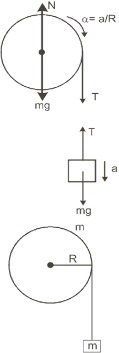
0 likesView Solution
19
ChemistryMCQAIEEE · 2011
$A$ current $I$ flows in an infinitely long wire with a cross-section in the form of a semicircular ring of radius $R$. The magnitude of the magnetic induction along its axis is
A
$\frac{\mu_0 I}{\pi^2 R}$
B
$\frac{\mu_0 I}{2\pi^2 R}$
C
$\frac{\mu_0 I}{2\pi R}$
D
$\frac{\mu_0 I}{4\pi R}$
Solution
(A) Consider an infinitely long wire with a semicircular cross-section of radius $R$. The total current $I$ is distributed over the semicircular arc of length $\pi R$.
The linear current density is $\lambda = \frac{I}{\pi R}$.
Consider a small element of arc length $d\ell = R d\theta$ at an angle $\theta$ from the axis of symmetry. The current in this element is $di = \lambda d\ell = \frac{I}{\pi R} (R d\theta) = \frac{I}{\pi} d\theta$.
This element acts as an infinitely long wire carrying current $di$. The magnetic field $dB$ at the center $O$ due to this element is $dB = \frac{\mu_0 di}{2\pi R} = \frac{\mu_0}{2\pi R} \left( \frac{I}{\pi} d\theta \right) = \frac{\mu_0 I}{2\pi^2 R} d\theta$.
By symmetry,the components of the magnetic field perpendicular to the axis of symmetry cancel out,while the components parallel to the axis add up. The component of $dB$ along the axis is $dB_x = dB \cos \theta$.
Integrating from $\theta = -\pi/2$ to $\pi/2$,or $2 \int_{0}^{\pi/2} dB \cos \theta$:
$B = 2 \int_{0}^{\pi/2} \frac{\mu_0 I}{2\pi^2 R} \cos \theta d\theta = \frac{\mu_0 I}{\pi^2 R} [\sin \theta]_{0}^{\pi/2} = \frac{\mu_0 I}{\pi^2 R} (1 - 0) = \frac{\mu_0 I}{\pi^2 R}$.
The linear current density is $\lambda = \frac{I}{\pi R}$.
Consider a small element of arc length $d\ell = R d\theta$ at an angle $\theta$ from the axis of symmetry. The current in this element is $di = \lambda d\ell = \frac{I}{\pi R} (R d\theta) = \frac{I}{\pi} d\theta$.
This element acts as an infinitely long wire carrying current $di$. The magnetic field $dB$ at the center $O$ due to this element is $dB = \frac{\mu_0 di}{2\pi R} = \frac{\mu_0}{2\pi R} \left( \frac{I}{\pi} d\theta \right) = \frac{\mu_0 I}{2\pi^2 R} d\theta$.
By symmetry,the components of the magnetic field perpendicular to the axis of symmetry cancel out,while the components parallel to the axis add up. The component of $dB$ along the axis is $dB_x = dB \cos \theta$.
Integrating from $\theta = -\pi/2$ to $\pi/2$,or $2 \int_{0}^{\pi/2} dB \cos \theta$:
$B = 2 \int_{0}^{\pi/2} \frac{\mu_0 I}{2\pi^2 R} \cos \theta d\theta = \frac{\mu_0 I}{\pi^2 R} [\sin \theta]_{0}^{\pi/2} = \frac{\mu_0 I}{\pi^2 R} (1 - 0) = \frac{\mu_0 I}{\pi^2 R}$.
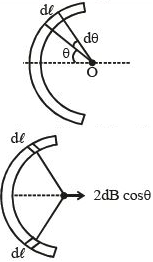
0 likesView Solution
20
ChemistryMCQAIEEE · 2011
$A$ pulley of radius $2\, m$ is rotated about its axis by a force $F = (20t - 5t^2)\, N$ (where $t$ is measured in seconds) applied tangentially. If the moment of inertia of the pulley about its axis of rotation is $10\, kg\, m^2$,the number of rotations made by the pulley before its direction of motion is reversed,is
A
more than $6$ but less than $9$
B
more than $9$
C
less than $3$
D
more than $3$ but less than $6$
Solution
(D) The torque applied is $\tau = rF = 2(20t - 5t^2) = 40t - 10t^2\, N\cdot m$.
Using $\tau = I\alpha$,we have $40t - 10t^2 = 10\alpha$,so $\alpha = 4t - t^2\, rad/s^2$.
Integrating $\alpha$ with respect to time to find angular velocity $\omega$ (assuming $\omega_0 = 0$): $\omega = \int (4t - t^2) dt = 2t^2 - \frac{t^3}{3}$.
The direction of motion reverses when $\omega = 0$,so $2t^2 - \frac{t^3}{3} = 0$,which gives $t^2(2 - \frac{t}{3}) = 0$. Thus,$t = 6\, s$.
To find the angular displacement $\theta$,we integrate $\omega$: $\theta = \int_0^6 (2t^2 - \frac{t^3}{3}) dt = [\frac{2t^3}{3} - \frac{t^4}{12}]_0^6$.
$\theta = \frac{2(216)}{3} - \frac{1296}{12} = 144 - 108 = 36\, rad$.
The number of rotations is $N = \frac{\theta}{2\pi} = \frac{36}{2\pi} \approx \frac{36}{6.28} \approx 5.73$.
Since $5.73$ is between $3$ and $6$,the correct option is $D$.
Using $\tau = I\alpha$,we have $40t - 10t^2 = 10\alpha$,so $\alpha = 4t - t^2\, rad/s^2$.
Integrating $\alpha$ with respect to time to find angular velocity $\omega$ (assuming $\omega_0 = 0$): $\omega = \int (4t - t^2) dt = 2t^2 - \frac{t^3}{3}$.
The direction of motion reverses when $\omega = 0$,so $2t^2 - \frac{t^3}{3} = 0$,which gives $t^2(2 - \frac{t}{3}) = 0$. Thus,$t = 6\, s$.
To find the angular displacement $\theta$,we integrate $\omega$: $\theta = \int_0^6 (2t^2 - \frac{t^3}{3}) dt = [\frac{2t^3}{3} - \frac{t^4}{12}]_0^6$.
$\theta = \frac{2(216)}{3} - \frac{1296}{12} = 144 - 108 = 36\, rad$.
The number of rotations is $N = \frac{\theta}{2\pi} = \frac{36}{2\pi} \approx \frac{36}{6.28} \approx 5.73$.
Since $5.73$ is between $3$ and $6$,the correct option is $D$.
0 likesView Solution
21
ChemistryMCQAIEEE · 2011
$A$ thermally insulated vessel contains an ideal gas of molecular mass $M$ and ratio of specific heats $\gamma$. It is moving with speed $v$ and is suddenly brought to rest. Assuming no heat is lost to the surroundings,its temperature increases by
A
$\frac{\gamma M v^2}{2R} \text{ K}$
B
$\frac{(\gamma - 1)}{2R} M v^2 \text{ K}$
C
$\frac{(\gamma - 1)}{2(\gamma + 1)R} M v^2 \text{ K}$
D
$\frac{(\gamma - 1)}{2\gamma R} M v^2 \text{ K}$
Solution
(B) The kinetic energy of the gas is converted into internal energy of the gas when the vessel is suddenly brought to rest.
Let $m$ be the mass of the gas. The kinetic energy is $K.E. = \frac{1}{2} m v^2$.
The change in internal energy is given by $\Delta U = n C_v \Delta T$,where $n = \frac{m}{M}$ is the number of moles and $C_v = \frac{R}{\gamma - 1}$.
Equating the kinetic energy to the change in internal energy:
$\frac{1}{2} m v^2 = \frac{m}{M} \left( \frac{R}{\gamma - 1} \right) \Delta T$
Canceling $m$ from both sides:
$\frac{1}{2} v^2 = \frac{R}{M(\gamma - 1)} \Delta T$
Solving for $\Delta T$:
$\Delta T = \frac{(\gamma - 1) M v^2}{2R}$
Let $m$ be the mass of the gas. The kinetic energy is $K.E. = \frac{1}{2} m v^2$.
The change in internal energy is given by $\Delta U = n C_v \Delta T$,where $n = \frac{m}{M}$ is the number of moles and $C_v = \frac{R}{\gamma - 1}$.
Equating the kinetic energy to the change in internal energy:
$\frac{1}{2} m v^2 = \frac{m}{M} \left( \frac{R}{\gamma - 1} \right) \Delta T$
Canceling $m$ from both sides:
$\frac{1}{2} v^2 = \frac{R}{M(\gamma - 1)} \Delta T$
Solving for $\Delta T$:
$\Delta T = \frac{(\gamma - 1) M v^2}{2R}$
0 likesView Solution
22
ChemistryMCQAIEEE · 2011
An object,moving with a speed of $6.25\, m/s$,is decelerated at a rate given by $\frac{dv}{dt} = -2.5\sqrt{v}$,where $v$ is the instantaneous speed. The time taken by the object to come to rest would be ........ $s$.
A
$4$
B
$8$
C
$1$
D
$2$
Solution
(D) Given the deceleration equation: $\frac{dv}{dt} = -2.5\sqrt{v}$.
Rearranging the terms to integrate: $\frac{dv}{\sqrt{v}} = -2.5\, dt$.
Integrating both sides with limits from initial speed $v = 6.25\, m/s$ to final speed $v = 0\, m/s$ at time $t$:
$\int_{6.25}^{0} v^{-1/2} dv = \int_{0}^{t} -2.5\, dt$.
Evaluating the integral: $[2\sqrt{v}]_{6.25}^{0} = -2.5[t]_{0}^{t}$.
Substituting the limits: $2(\sqrt{0} - \sqrt{6.25}) = -2.5(t - 0)$.
$2(0 - 2.5) = -2.5t$.
$-5 = -2.5t$.
$t = \frac{5}{2.5} = 2\, s$.
Rearranging the terms to integrate: $\frac{dv}{\sqrt{v}} = -2.5\, dt$.
Integrating both sides with limits from initial speed $v = 6.25\, m/s$ to final speed $v = 0\, m/s$ at time $t$:
$\int_{6.25}^{0} v^{-1/2} dv = \int_{0}^{t} -2.5\, dt$.
Evaluating the integral: $[2\sqrt{v}]_{6.25}^{0} = -2.5[t]_{0}^{t}$.
Substituting the limits: $2(\sqrt{0} - \sqrt{6.25}) = -2.5(t - 0)$.
$2(0 - 2.5) = -2.5t$.
$-5 = -2.5t$.
$t = \frac{5}{2.5} = 2\, s$.
0 likesView Solution
23
ChemistryMCQAIEEE · 2011
Three perfect gases at absolute temperatures $T_1, T_2$ and $T_3$ are mixed. The masses of molecules are $m_1, m_2$ and $m_3$ and the number of molecules are $n_1, n_2$ and $n_3$ respectively. Assuming no loss of energy,the final temperature of the mixture is
A
$\frac{n_1^2T_1^2 + n_2^2T_2^2 + n_3^2T_3^2}{n_1T_1 + n_2T_2 + n_3T_3}$
B
$\frac{T_1 + T_2 + T_3}{3}$
C
$\frac{n_1T_1 + n_2T_2 + n_3T_3}{n_1 + n_2 + n_3}$
D
$\frac{n_1T_1^2 + n_2T_2^2 + n_3T_3^2}{n_1T_1 + n_2T_2 + n_3T_3}$
Solution
(C) The internal energy of an ideal gas is given by $U = \frac{f}{2} n R T$,where $f$ is the degrees of freedom,$n$ is the number of moles,and $T$ is the absolute temperature.
Since the gases are mixed and there is no loss of energy,the total internal energy of the mixture is the sum of the internal energies of the individual gases.
Total internal energy $U_{total} = U_1 + U_2 + U_3$.
Using $n = \frac{N}{N_A}$ (where $N$ is the number of molecules and $N_A$ is Avogadro's number),the energy is $U = \frac{f}{2} \frac{N}{N_A} R T = \frac{f}{2} N k_B T$.
Assuming the gases have the same degrees of freedom $f$,the total energy is $\frac{f}{2} k_B (n_1 T_1 + n_2 T_2 + n_3 T_3) = \frac{f}{2} k_B (n_1 + n_2 + n_3) T_{mix}$.
Canceling the common terms $\frac{f}{2} k_B$,we get $n_1 T_1 + n_2 T_2 + n_3 T_3 = (n_1 + n_2 + n_3) T_{mix}$.
Therefore,the final temperature of the mixture is $T_{mix} = \frac{n_1 T_1 + n_2 T_2 + n_3 T_3}{n_1 + n_2 + n_3}$.
Since the gases are mixed and there is no loss of energy,the total internal energy of the mixture is the sum of the internal energies of the individual gases.
Total internal energy $U_{total} = U_1 + U_2 + U_3$.
Using $n = \frac{N}{N_A}$ (where $N$ is the number of molecules and $N_A$ is Avogadro's number),the energy is $U = \frac{f}{2} \frac{N}{N_A} R T = \frac{f}{2} N k_B T$.
Assuming the gases have the same degrees of freedom $f$,the total energy is $\frac{f}{2} k_B (n_1 T_1 + n_2 T_2 + n_3 T_3) = \frac{f}{2} k_B (n_1 + n_2 + n_3) T_{mix}$.
Canceling the common terms $\frac{f}{2} k_B$,we get $n_1 T_1 + n_2 T_2 + n_3 T_3 = (n_1 + n_2 + n_3) T_{mix}$.
Therefore,the final temperature of the mixture is $T_{mix} = \frac{n_1 T_1 + n_2 T_2 + n_3 T_3}{n_1 + n_2 + n_3}$.
0 likesView Solution
24
ChemistryMCQAIEEE · 2011
After absorbing a slowly moving neutron of mass $m_N$ (momentum $\sim 0$),a nucleus of mass $M$ breaks into two nuclei of masses $m_1$ and $5m_1$ $(6m_1 = M + m_N)$. If the de-Broglie wavelength of the nucleus with mass $m_1$ is $\lambda$,then the de-Broglie wavelength of the other nucleus will be:
A
$25\,\lambda$
B
$5\,\lambda$
C
$\frac{\lambda}{5}$
D
$\lambda$
Solution
(D) According to the law of conservation of linear momentum,the total momentum of the system must remain constant.
Since the initial momentum of the system is approximately zero (as the neutron is moving slowly),the final momentum of the two resulting nuclei must also be zero.
Let $p_1$ be the momentum of the nucleus with mass $m_1$ and $p_2$ be the momentum of the nucleus with mass $5m_1$.
Therefore,$p_1 + p_2 = 0$,which implies $p_1 = -p_2$,or $|p_1| = |p_2|$.
The de-Broglie wavelength $\lambda$ is given by the relation $\lambda = \frac{h}{p}$,where $h$ is Planck's constant and $p$ is the magnitude of the momentum.
Since both nuclei have the same magnitude of momentum $(|p_1| = |p_2|)$,their de-Broglie wavelengths must also be equal.
Thus,the de-Broglie wavelength of the second nucleus is also $\lambda$.
Since the initial momentum of the system is approximately zero (as the neutron is moving slowly),the final momentum of the two resulting nuclei must also be zero.
Let $p_1$ be the momentum of the nucleus with mass $m_1$ and $p_2$ be the momentum of the nucleus with mass $5m_1$.
Therefore,$p_1 + p_2 = 0$,which implies $p_1 = -p_2$,or $|p_1| = |p_2|$.
The de-Broglie wavelength $\lambda$ is given by the relation $\lambda = \frac{h}{p}$,where $h$ is Planck's constant and $p$ is the magnitude of the momentum.
Since both nuclei have the same magnitude of momentum $(|p_1| = |p_2|)$,their de-Broglie wavelengths must also be equal.
Thus,the de-Broglie wavelength of the second nucleus is also $\lambda$.
0 likesView Solution
25
ChemistryMCQAIEEE · 2011
$A$ current $I$ flows in an infinitely long wire with a cross-section in the form of a semicircular ring of radius $R$. The magnitude of the magnetic induction along its axis is
A
$\frac{\mu_0 I}{\pi^2 R}$
B
$\frac{\mu_0 I}{2\pi^2 R}$
C
$\frac{\mu_0 I}{2\pi R}$
D
$\frac{\mu_0 I}{4\pi R}$
Solution
(A) Consider a cross-section of the wire as a semicircular arc of radius $R$. The total current $I$ is distributed over the arc length $\pi R$.
The current per unit arc length is $\lambda = \frac{I}{\pi R}$.
Consider a small element of arc length $dl = R d\theta$ at an angle $\theta$ from the axis. The current in this element is $di = \lambda dl = \frac{I}{\pi R} (R d\theta) = \frac{I}{\pi} d\theta$.
The magnetic field $dB$ at the center $O$ due to this infinite wire element is given by the formula for an infinite wire: $dB = \frac{\mu_0 di}{2\pi R} = \frac{\mu_0}{2\pi R} \left( \frac{I}{\pi} d\theta \right) = \frac{\mu_0 I}{2\pi^2 R} d\theta$.
Due to symmetry,the components of the magnetic field perpendicular to the axis cancel out. The net magnetic field is the integral of the components along the axis: $B = \int_{-\pi/2}^{\pi/2} dB \cos\theta = 2 \int_{0}^{\pi/2} \frac{\mu_0 I}{2\pi^2 R} \cos\theta d\theta$.
$B = \frac{\mu_0 I}{\pi^2 R} \int_{0}^{\pi/2} \cos\theta d\theta = \frac{\mu_0 I}{\pi^2 R} [\sin\theta]_{0}^{\pi/2} = \frac{\mu_0 I}{\pi^2 R}$.
The current per unit arc length is $\lambda = \frac{I}{\pi R}$.
Consider a small element of arc length $dl = R d\theta$ at an angle $\theta$ from the axis. The current in this element is $di = \lambda dl = \frac{I}{\pi R} (R d\theta) = \frac{I}{\pi} d\theta$.
The magnetic field $dB$ at the center $O$ due to this infinite wire element is given by the formula for an infinite wire: $dB = \frac{\mu_0 di}{2\pi R} = \frac{\mu_0}{2\pi R} \left( \frac{I}{\pi} d\theta \right) = \frac{\mu_0 I}{2\pi^2 R} d\theta$.
Due to symmetry,the components of the magnetic field perpendicular to the axis cancel out. The net magnetic field is the integral of the components along the axis: $B = \int_{-\pi/2}^{\pi/2} dB \cos\theta = 2 \int_{0}^{\pi/2} \frac{\mu_0 I}{2\pi^2 R} \cos\theta d\theta$.
$B = \frac{\mu_0 I}{\pi^2 R} \int_{0}^{\pi/2} \cos\theta d\theta = \frac{\mu_0 I}{\pi^2 R} [\sin\theta]_{0}^{\pi/2} = \frac{\mu_0 I}{\pi^2 R}$.
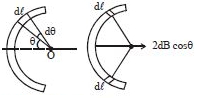
0 likesView Solution
26
ChemistryMCQAIEEE · 2011
Which one of the following orders presents the correct sequence of the increasing basic nature of the given oxides?
A
$Al_2O_3 < MgO < Na_2O < K_2O$
B
$MgO < K_2O < Al_2O_3 < Na_2O$
C
$Na_2O < K_2O < MgO < Al_2O_3$
D
$K_2O < Na_2O < Al_2O_3 < MgO$
Solution
(A) The basic nature of oxides depends on the metallic character of the element.
Metallic character increases down a group and decreases across a period from left to right.
$Al$ is in period $3$,group $13$ (amphoteric oxide).
$Mg$ is in period $3$,group $2$ (basic oxide).
$Na$ is in period $3$,group $1$ (strongly basic oxide).
$K$ is in period $4$,group $1$ (more strongly basic than $Na_2O$ due to larger size).
Thus,the order of increasing basic nature is: $Al_2O_3 < MgO < Na_2O < K_2O$.
Metallic character increases down a group and decreases across a period from left to right.
$Al$ is in period $3$,group $13$ (amphoteric oxide).
$Mg$ is in period $3$,group $2$ (basic oxide).
$Na$ is in period $3$,group $1$ (strongly basic oxide).
$K$ is in period $4$,group $1$ (more strongly basic than $Na_2O$ due to larger size).
Thus,the order of increasing basic nature is: $Al_2O_3 < MgO < Na_2O < K_2O$.
0 likesView Solution
27
ChemistryMCQAIEEE · 2011
Two bodies of masses $m$ and $4m$ are placed at a distance $r$. The gravitational potential at a point on the line joining them where the gravitational field is zero is
A
$-\frac{6Gm}{r}$
B
$-\frac{9Gm}{r}$
C
zero
D
$-\frac{4Gm}{r}$
Solution
(B) Let the point where the gravitational field is zero be at a distance $x$ from mass $m$. The gravitational field due to both masses must be equal in magnitude and opposite in direction.
$\frac{Gm}{x^2} = \frac{G(4m)}{(r-x)^2}$
Taking the square root on both sides:
$\frac{1}{x} = \frac{2}{r-x} \Rightarrow r-x = 2x \Rightarrow 3x = r \Rightarrow x = \frac{r}{3}$
The distance from mass $4m$ is $r-x = r - \frac{r}{3} = \frac{2r}{3}$.
The gravitational potential $V$ at this point is the sum of potentials due to both masses:
$V = -\frac{Gm}{x} - \frac{G(4m)}{r-x}$
Substituting the values of $x$ and $r-x$:
$V = -\frac{Gm}{r/3} - \frac{4Gm}{2r/3} = -\frac{3Gm}{r} - \frac{6Gm}{r} = -\frac{9Gm}{r}$
$\frac{Gm}{x^2} = \frac{G(4m)}{(r-x)^2}$
Taking the square root on both sides:
$\frac{1}{x} = \frac{2}{r-x} \Rightarrow r-x = 2x \Rightarrow 3x = r \Rightarrow x = \frac{r}{3}$
The distance from mass $4m$ is $r-x = r - \frac{r}{3} = \frac{2r}{3}$.
The gravitational potential $V$ at this point is the sum of potentials due to both masses:
$V = -\frac{Gm}{x} - \frac{G(4m)}{r-x}$
Substituting the values of $x$ and $r-x$:
$V = -\frac{Gm}{r/3} - \frac{4Gm}{2r/3} = -\frac{3Gm}{r} - \frac{6Gm}{r} = -\frac{9Gm}{r}$
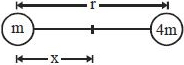
0 likesView Solution
28
ChemistryMCQAIEEE · 2011
The half-life of a radioactive substance is $20 \, min$. The approximate time interval $(t_2 - t_1)$ between the time $t_2$ when $\frac{2}{3}$ of it has decayed and the time $t_1$ when $\frac{1}{3}$ of it has decayed is ......... $min$.
A
$7$
B
$14$
C
$20$
D
$28$
Solution
(C) The radioactive decay law is given by $N(t) = N_0 e^{-\lambda t}$.
At time $t_1$,the amount decayed is $\frac{1}{3} N_0$,so the remaining amount is $N_1 = N_0 - \frac{1}{3} N_0 = \frac{2}{3} N_0$.
At time $t_2$,the amount decayed is $\frac{2}{3} N_0$,so the remaining amount is $N_2 = N_0 - \frac{2}{3} N_0 = \frac{1}{3} N_0$.
We observe that $N_2 = \frac{1}{2} N_1$.
Since the amount of substance reduces to half of its value in one half-life period $(T_{1/2})$,the time interval required for the substance to decay from $N_1$ to $N_2$ is exactly one half-life.
Therefore,$t_2 - t_1 = T_{1/2} = 20 \, min$.
At time $t_1$,the amount decayed is $\frac{1}{3} N_0$,so the remaining amount is $N_1 = N_0 - \frac{1}{3} N_0 = \frac{2}{3} N_0$.
At time $t_2$,the amount decayed is $\frac{2}{3} N_0$,so the remaining amount is $N_2 = N_0 - \frac{2}{3} N_0 = \frac{1}{3} N_0$.
We observe that $N_2 = \frac{1}{2} N_1$.
Since the amount of substance reduces to half of its value in one half-life period $(T_{1/2})$,the time interval required for the substance to decay from $N_1$ to $N_2$ is exactly one half-life.
Therefore,$t_2 - t_1 = T_{1/2} = 20 \, min$.
0 likesView Solution
29
ChemistryMCQAIEEE · 2011
$A$ horizontal straight wire $20\, m$ long extending from east to west is falling with a speed of $5.0\, m/s$,at right angles to the horizontal component of the earth's magnetic field $0.30 \times 10^{-4}\, Wb/m^2$. The instantaneous value of the $e.m.f.$ induced in the wire will be.....$mV$.
A
$6$
B
$3$
C
$4.5$
D
$1.5$
Solution
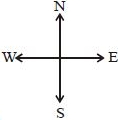
(B) Given:
Length of the wire,$\ell = 20\, m$
Speed of the wire,$v = 5.0\, m/s$
Horizontal component of Earth's magnetic field,$B_H = 0.30 \times 10^{-4}\, Wb/m^2$
The motional $e.m.f.$ induced in a conductor moving in a magnetic field is given by the formula:
$e = B_H v \ell$
Substituting the given values:
$e = (0.30 \times 10^{-4}) \times 5.0 \times 20$
$e = 0.30 \times 10^{-4} \times 100$
$e = 0.30 \times 10^{-2}\, V$
$e = 3 \times 10^{-3}\, V$
Since $1\, mV = 10^{-3}\, V$,the induced $e.m.f.$ is:
$e = 3\, mV$
Length of the wire,$\ell = 20\, m$
Speed of the wire,$v = 5.0\, m/s$
Horizontal component of Earth's magnetic field,$B_H = 0.30 \times 10^{-4}\, Wb/m^2$
The motional $e.m.f.$ induced in a conductor moving in a magnetic field is given by the formula:
$e = B_H v \ell$
Substituting the given values:
$e = (0.30 \times 10^{-4}) \times 5.0 \times 20$
$e = 0.30 \times 10^{-4} \times 100$
$e = 0.30 \times 10^{-2}\, V$
$e = 3 \times 10^{-3}\, V$
Since $1\, mV = 10^{-3}\, V$,the induced $e.m.f.$ is:
$e = 3\, mV$
0 likesView Solution
30
ChemistryMCQAIEEE · 2011
Work done in increasing the size of a soap bubble from a radius of $3\, cm$ to $5\, cm$ is nearly (Surface tension of soap solution $= 0.03\, Nm^{-1}$) (in $pi \,mJ$)
A
$2$
B
$0.4$
C
$4$
D
$0.2$
Solution
(B) soap bubble has two surfaces (inner and outer). The work done $W$ in changing the radius of a soap bubble from $r_1$ to $r_2$ is given by:
$W = 2 \times T \times \Delta A = 2 \times T \times 4\pi(r_2^2 - r_1^2) = 8\pi T(r_2^2 - r_1^2)$
Given: $T = 0.03\, Nm^{-1}$,$r_1 = 3\, cm = 0.03\, m$,$r_2 = 5\, cm = 0.05\, m$.
Substituting the values:
$W = 8 \times \pi \times 0.03 \times ((0.05)^2 - (0.03)^2)$
$W = 8 \times \pi \times 0.03 \times (0.0025 - 0.0009)$
$W = 8 \times \pi \times 0.03 \times 0.0016$
$W = 0.24 \times \pi \times 0.0016 = 0.000384\pi \,J$
$W = 0.384\pi \,mJ \approx 0.4\pi \,mJ$.
$W = 2 \times T \times \Delta A = 2 \times T \times 4\pi(r_2^2 - r_1^2) = 8\pi T(r_2^2 - r_1^2)$
Given: $T = 0.03\, Nm^{-1}$,$r_1 = 3\, cm = 0.03\, m$,$r_2 = 5\, cm = 0.05\, m$.
Substituting the values:
$W = 8 \times \pi \times 0.03 \times ((0.05)^2 - (0.03)^2)$
$W = 8 \times \pi \times 0.03 \times (0.0025 - 0.0009)$
$W = 8 \times \pi \times 0.03 \times 0.0016$
$W = 0.24 \times \pi \times 0.0016 = 0.000384\pi \,J$
$W = 0.384\pi \,mJ \approx 0.4\pi \,mJ$.
0 likesView Solution
31
ChemistryMCQAIEEE · 2011
In the context of the lanthanoids,which of the following statements is not correct?
A
Availability of $4f$ electrons results in the formation of compounds in $+4$ state for all the members of the series.
B
There is a gradual decrease in the radii of the members with increasing atomic number in the series.
C
All the members exhibit $+3$ oxidation state.
D
Because of similar properties,the separation of lanthanoids is not easy.
Solution
(A) The lanthanoids exhibit a common oxidation state of $+3$.
Not all members exhibit a $+4$ oxidation state; only a few,such as $Ce^{+4}$,$Pr^{+4}$,$Nd^{+4}$,$Tb^{+4}$,and $Dy^{+4}$,show this state due to stable configurations.
Therefore,the statement that all members form compounds in the $+4$ state is incorrect.
Not all members exhibit a $+4$ oxidation state; only a few,such as $Ce^{+4}$,$Pr^{+4}$,$Nd^{+4}$,$Tb^{+4}$,and $Dy^{+4}$,show this state due to stable configurations.
Therefore,the statement that all members form compounds in the $+4$ state is incorrect.
0 likesView Solution
32
ChemistryMCQAIEEE · 2011
At two points $P$ and $Q$ on the screen in Young's double-slit experiment,waves from slits $S_1$ and $S_2$ have a path difference of $0$ and $\frac{\lambda}{4}$ respectively. The ratio of intensities at $P$ and $Q$ will be
A
$3:2$
B
$2:1$
C
$\sqrt{2}:1$
D
$4:1$
Solution
(B) Let $I_0$ be the intensity of each individual wave. The resultant intensity is given by $I = 2I_0 + 2I_0 \cos(\Delta \phi) = 4I_0 \cos^2(\frac{\Delta \phi}{2})$.
At point $P$,the path difference $\Delta x = 0$,so the phase difference $\Delta \phi = 0$. The intensity $I_P = 4I_0 \cos^2(0) = 4I_0$.
At point $Q$,the path difference $\Delta x = \frac{\lambda}{4}$,so the phase difference $\Delta \phi = \frac{2\pi}{\lambda} \cdot \frac{\lambda}{4} = \frac{\pi}{2}$. The intensity $I_Q = 4I_0 \cos^2(\frac{\pi}{4}) = 4I_0 \cdot (\frac{1}{\sqrt{2}})^2 = 2I_0$.
The ratio of intensities is $\frac{I_P}{I_Q} = \frac{4I_0}{2I_0} = 2:1$.
At point $P$,the path difference $\Delta x = 0$,so the phase difference $\Delta \phi = 0$. The intensity $I_P = 4I_0 \cos^2(0) = 4I_0$.
At point $Q$,the path difference $\Delta x = \frac{\lambda}{4}$,so the phase difference $\Delta \phi = \frac{2\pi}{\lambda} \cdot \frac{\lambda}{4} = \frac{\pi}{2}$. The intensity $I_Q = 4I_0 \cos^2(\frac{\pi}{4}) = 4I_0 \cdot (\frac{1}{\sqrt{2}})^2 = 2I_0$.
The ratio of intensities is $\frac{I_P}{I_Q} = \frac{4I_0}{2I_0} = 2:1$.
0 likesView Solution
33
ChemistryMCQAIEEE · 2011
Work done in increasing the size of a soap bubble from a radius of $3\, cm$ to $5\, cm$ is nearly (Surface tension of soap solution $= 0.03\, Nm^{-1}$). (in $pi \,mJ$)
A
$2$
B
$0.4$
C
$4$
D
$0.2$
Solution
(B) soap bubble has two surfaces (inner and outer). The work done $W$ in increasing the radius from $r_1$ to $r_2$ is given by $W = 2 \times [4\pi T(r_2^2 - r_1^2)] = 8\pi T(r_2^2 - r_1^2)$.
Given: $T = 0.03\, Nm^{-1}$,$r_1 = 3\, cm = 0.03\, m$,$r_2 = 5\, cm = 0.05\, m$.
Substituting the values:
$W = 8 \times \pi \times 0.03 \times ((0.05)^2 - (0.03)^2)$
$W = 8 \times \pi \times 0.03 \times (0.0025 - 0.0009)$
$W = 8 \times \pi \times 0.03 \times 0.0016$
$W = 0.000384\pi \,J = 0.384\pi \,mJ$.
Rounding to the nearest value,$W \approx 0.4\pi \,mJ$.
Given: $T = 0.03\, Nm^{-1}$,$r_1 = 3\, cm = 0.03\, m$,$r_2 = 5\, cm = 0.05\, m$.
Substituting the values:
$W = 8 \times \pi \times 0.03 \times ((0.05)^2 - (0.03)^2)$
$W = 8 \times \pi \times 0.03 \times (0.0025 - 0.0009)$
$W = 8 \times \pi \times 0.03 \times 0.0016$
$W = 0.000384\pi \,J = 0.384\pi \,mJ$.
Rounding to the nearest value,$W \approx 0.4\pi \,mJ$.
0 likesView Solution
34
ChemistryMCQAIEEE · 2011
$A$ thermally insulated vessel contains an ideal gas of molecular mass $M$ and ratio of specific heats $\gamma$. It is moving with speed $v$ and is suddenly brought to rest. Assuming no heat is lost to the surroundings,its temperature increases by
A
$\frac{(\gamma - 1)}{2\gamma R} M v^2 \ K$
B
$\frac{\gamma M v^2}{2R} \ K$
C
$\frac{(\gamma - 1)}{2R} M v^2 \ K$
D
$\frac{(\gamma - 1)}{2(\gamma + 1)R} M v^2 \ K$
Solution
(C) Since the vessel is thermally insulated,no heat is exchanged with the surroundings.
The kinetic energy of the gas is converted into internal energy of the gas when it is suddenly brought to rest.
Loss in kinetic energy = Gain in internal energy
$\frac{1}{2} m v^2 = n C_V \Delta T$
Here,$n = \frac{m}{M}$ is the number of moles and $C_V = \frac{R}{\gamma - 1}$ is the molar specific heat at constant volume.
Substituting these values:
$\frac{1}{2} m v^2 = \left( \frac{m}{M} \right) \left( \frac{R}{\gamma - 1} \right) \Delta T$
Canceling $m$ from both sides:
$\frac{1}{2} v^2 = \frac{R \Delta T}{M(\gamma - 1)}$
Solving for $\Delta T$:
$\Delta T = \frac{M v^2 (\gamma - 1)}{2R} \ K$
The kinetic energy of the gas is converted into internal energy of the gas when it is suddenly brought to rest.
Loss in kinetic energy = Gain in internal energy
$\frac{1}{2} m v^2 = n C_V \Delta T$
Here,$n = \frac{m}{M}$ is the number of moles and $C_V = \frac{R}{\gamma - 1}$ is the molar specific heat at constant volume.
Substituting these values:
$\frac{1}{2} m v^2 = \left( \frac{m}{M} \right) \left( \frac{R}{\gamma - 1} \right) \Delta T$
Canceling $m$ from both sides:
$\frac{1}{2} v^2 = \frac{R \Delta T}{M(\gamma - 1)}$
Solving for $\Delta T$:
$\Delta T = \frac{M v^2 (\gamma - 1)}{2R} \ K$
0 likesView Solution
35
ChemistryMCQAIEEE · 2011
The electrostatic potential inside a charged spherical ball is given by $\phi = ar^2 + b$,where $r$ is the distance from the centre and $a, b$ are constants. Then the charge density inside the ball is
A
$ - 6a\varepsilon_0$
B
$ - 24\pi a\varepsilon_0$
C
$ - 6a\varepsilon_0 r$
D
$ - 24\pi a\varepsilon_0 r$
Solution
(A) The electric field $E$ is related to the potential $\phi$ by the relation $E = -\frac{d\phi}{dr}$.
Given $\phi = ar^2 + b$,we have $E = -\frac{d}{dr}(ar^2 + b) = -2ar$.
According to Gauss's Law in differential form,the charge density $\rho$ is given by $\rho = \varepsilon_0 (\nabla \cdot E)$.
In spherical coordinates,for a radial field $E_r$,the divergence is $\nabla \cdot E = \frac{1}{r^2} \frac{d}{dr}(r^2 E_r)$.
Substituting $E_r = -2ar$,we get $\nabla \cdot E = \frac{1}{r^2} \frac{d}{dr}(r^2 (-2ar)) = \frac{1}{r^2} \frac{d}{dr}(-2ar^3) = \frac{1}{r^2} (-6ar^2) = -6a$.
Therefore,the charge density is $\rho = \varepsilon_0 (-6a) = -6a\varepsilon_0$.
Given $\phi = ar^2 + b$,we have $E = -\frac{d}{dr}(ar^2 + b) = -2ar$.
According to Gauss's Law in differential form,the charge density $\rho$ is given by $\rho = \varepsilon_0 (\nabla \cdot E)$.
In spherical coordinates,for a radial field $E_r$,the divergence is $\nabla \cdot E = \frac{1}{r^2} \frac{d}{dr}(r^2 E_r)$.
Substituting $E_r = -2ar$,we get $\nabla \cdot E = \frac{1}{r^2} \frac{d}{dr}(r^2 (-2ar)) = \frac{1}{r^2} \frac{d}{dr}(-2ar^3) = \frac{1}{r^2} (-6ar^2) = -6a$.
Therefore,the charge density is $\rho = \varepsilon_0 (-6a) = -6a\varepsilon_0$.
0 likesView Solution
36
ChemistryMediumMCQAIEEE · 2011
The structure of $IF_{7}$ is
A
Square pyramidal
B
Trigonal bipyramidal
C
Octahedral
D
Pentagonal bipyramidal
Solution
(D) The central iodine atom $(I)$ in $IF_{7}$ has $7$ valence electrons. It forms $7$ bonds with $7$ fluorine atoms.
The steric number is calculated as:
$\text{Steric Number} = \frac{1}{2} \times (V + M - C + A) = \frac{1}{2} \times (7 + 7) = 7$.
$A$ steric number of $7$ corresponds to $sp^{3}d^{3}$ hybridization,which results in a pentagonal bipyramidal geometry.
In this structure,five fluorine atoms lie in a pentagonal plane with $I-F$ bond angles of $72^{\circ}$,and two fluorine atoms are positioned above and below the plane at $90^{\circ}$ to the equatorial plane.
The steric number is calculated as:
$\text{Steric Number} = \frac{1}{2} \times (V + M - C + A) = \frac{1}{2} \times (7 + 7) = 7$.
$A$ steric number of $7$ corresponds to $sp^{3}d^{3}$ hybridization,which results in a pentagonal bipyramidal geometry.
In this structure,five fluorine atoms lie in a pentagonal plane with $I-F$ bond angles of $72^{\circ}$,and two fluorine atoms are positioned above and below the plane at $90^{\circ}$ to the equatorial plane.
0 likesView Solution
37
ChemistryMCQAIEEE · 2011
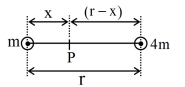
Two bodies of masses $m$ and $4m$ are placed at a distance $r$. The gravitational potential at a point on the line joining them,where the gravitational field is zero,is
A
$-\frac{6Gm}{r}$
B
$-\frac{9Gm}{r}$
C
zero
D
$-\frac{4Gm}{r}$
Solution
(B) Let the point $P$ be at a distance $x$ from mass $m$. At this point,the gravitational field is zero.
Equating the gravitational field intensities due to both masses:
$\frac{Gm}{x^2} = \frac{G(4m)}{(r-x)^2}$
Taking the square root on both sides:
$\frac{1}{x} = \frac{2}{r-x}$
$r - x = 2x \Rightarrow 3x = r \Rightarrow x = \frac{r}{3}$
The distance of point $P$ from mass $4m$ is $r - x = r - \frac{r}{3} = \frac{2r}{3}$.
The gravitational potential $V$ at point $P$ is the sum of potentials due to both masses:
$V = -\frac{Gm}{x} - \frac{G(4m)}{r-x}$
Substituting $x = \frac{r}{3}$ and $r-x = \frac{2r}{3}$:
$V = -\frac{Gm}{r/3} - \frac{4Gm}{2r/3}$
$V = -\frac{3Gm}{r} - \frac{12Gm}{2r}$
$V = -\frac{3Gm}{r} - \frac{6Gm}{r} = -\frac{9Gm}{r}$
Equating the gravitational field intensities due to both masses:
$\frac{Gm}{x^2} = \frac{G(4m)}{(r-x)^2}$
Taking the square root on both sides:
$\frac{1}{x} = \frac{2}{r-x}$
$r - x = 2x \Rightarrow 3x = r \Rightarrow x = \frac{r}{3}$
The distance of point $P$ from mass $4m$ is $r - x = r - \frac{r}{3} = \frac{2r}{3}$.
The gravitational potential $V$ at point $P$ is the sum of potentials due to both masses:
$V = -\frac{Gm}{x} - \frac{G(4m)}{r-x}$
Substituting $x = \frac{r}{3}$ and $r-x = \frac{2r}{3}$:
$V = -\frac{Gm}{r/3} - \frac{4Gm}{2r/3}$
$V = -\frac{3Gm}{r} - \frac{12Gm}{2r}$
$V = -\frac{3Gm}{r} - \frac{6Gm}{r} = -\frac{9Gm}{r}$
0 likesView Solution
38
ChemistryMediumMCQAIEEE · 2011
Identify the compound that exhibits tautomerism:
A
$2-$Butene
B
Lactic acid
C
$2-$Pentanone
D
Phenol
Solution
(C) Tautomerism is a special type of functional isomerism in which a compound exists in two or more interconvertible forms that differ in the relative position of at least one atomic nucleus,generally a hydrogen atom.
For a carbonyl compound to exhibit tautomerism,it must possess at least one $\alpha$-hydrogen atom.
$2-$Pentanone $(CH_3COCH_2CH_2CH_3)$ contains $\alpha$-hydrogen atoms on the carbon adjacent to the carbonyl group,and therefore it exhibits keto-enol tautomerism.
For a carbonyl compound to exhibit tautomerism,it must possess at least one $\alpha$-hydrogen atom.
$2-$Pentanone $(CH_3COCH_2CH_2CH_3)$ contains $\alpha$-hydrogen atoms on the carbon adjacent to the carbonyl group,and therefore it exhibits keto-enol tautomerism.
0 likesView Solution
39
ChemistryMediumMCQAIEEE · 2011
In a face centred cubic lattice,atom $A$ occupies the corner positions and atom $B$ occupies the face centre positions. If one atom of $B$ is missing from one of the face centred points,the formula of the compound is:
A
$A_2B$
B
$AB_2$
C
$A_2B_3$
D
$A_2B_5$
Solution
(D) In a face centred cubic $(FCC)$ lattice:
Number of atoms of $A$ at corners $= 8 \times \frac{1}{8} = 1$.
Total number of face centres in a cube is $6$. Since one atom of $B$ is missing,the number of atoms of $B$ present $= 6 - 1 = 5$.
Number of atoms of $B$ at face centres $= 5 \times \frac{1}{2} = 2.5$.
The ratio of $A : B = 1 : 2.5 = 2 : 5$.
Therefore,the formula of the compound is $A_2B_5$.
Number of atoms of $A$ at corners $= 8 \times \frac{1}{8} = 1$.
Total number of face centres in a cube is $6$. Since one atom of $B$ is missing,the number of atoms of $B$ present $= 6 - 1 = 5$.
Number of atoms of $B$ at face centres $= 5 \times \frac{1}{2} = 2.5$.
The ratio of $A : B = 1 : 2.5 = 2 : 5$.
Therefore,the formula of the compound is $A_2B_5$.
0 likesView Solution
40
ChemistryAdvancedMCQAIEEE · 2011
$A$ $5.2$ molal aqueous solution of methyl alcohol,$CH_3OH$,is supplied. What is the mole fraction of methyl alcohol in the solution?
A
$0.10$
B
$0.19$
C
$0.086$
D
$0.05$
Solution
(C) Molality $(m)$ is defined as the number of moles of solute per kilogram of solvent.
Given $m = 5.2 \ mol/kg$,this means $5.2$ moles of $CH_3OH$ are dissolved in $1000 \ g$ of water $(H_2O)$.
Moles of water $(n_{H_2O})$ $= \frac{1000 \ g}{18 \ g/mol} \approx 55.56 \ mol$.
Mole fraction of methyl alcohol $(X_{CH_3OH})$ $= \frac{n_{CH_3OH}}{n_{CH_3OH} + n_{H_2O}}$.
$X_{CH_3OH} = \frac{5.2}{5.2 + 55.56} = \frac{5.2}{60.76} \approx 0.0856$.
Rounding to two significant figures,we get $0.086$.
Given $m = 5.2 \ mol/kg$,this means $5.2$ moles of $CH_3OH$ are dissolved in $1000 \ g$ of water $(H_2O)$.
Moles of water $(n_{H_2O})$ $= \frac{1000 \ g}{18 \ g/mol} \approx 55.56 \ mol$.
Mole fraction of methyl alcohol $(X_{CH_3OH})$ $= \frac{n_{CH_3OH}}{n_{CH_3OH} + n_{H_2O}}$.
$X_{CH_3OH} = \frac{5.2}{5.2 + 55.56} = \frac{5.2}{60.76} \approx 0.0856$.
Rounding to two significant figures,we get $0.086$.
0 likesView Solution
41
ChemistryDifficultMCQAIEEE · 2011
Ethylene glycol is used as an antifreeze in cold climates. The mass of ethylene glycol $(C_2H_6O_2)$ that should be added to $4 \ kg$ of water to prevent it from freezing at $-6 \ ^oC$ is ......... $g$.
($K_f$ for water $= 1.86 \ K \ kg \ mol^{-1}$,and molar mass of ethylene glycol $= 62 \ g \ mol^{-1}$)
($K_f$ for water $= 1.86 \ K \ kg \ mol^{-1}$,and molar mass of ethylene glycol $= 62 \ g \ mol^{-1}$)
A
$800.00$
B
$204.30$
C
$400.00$
D
$304.60$
Solution
(A) Given:
$K_f = 1.86 \ K \ kg \ mol^{-1}$
Mass of solvent $(W_A)$ $= 4 \ kg = 4000 \ g$
Freezing point depression $\Delta T_f = 0 - (-6) = 6 \ K$
Molar mass of solute $(M_B)$ $= 62 \ g \ mol^{-1}$
The formula for freezing point depression is $\Delta T_f = K_f \times m$,where $m$ is molality.
$\Delta T_f = K_f \times \frac{w \times 1000}{M_B \times W_A \text{ (in g)}}$
$6 = 1.86 \times \frac{w \times 1000}{62 \times 4000}$
$6 = 1.86 \times \frac{w}{62 \times 4}$
$w = \frac{6 \times 62 \times 4}{1.86}$
$w = \frac{1488}{1.86} = 800 \ g$
$K_f = 1.86 \ K \ kg \ mol^{-1}$
Mass of solvent $(W_A)$ $= 4 \ kg = 4000 \ g$
Freezing point depression $\Delta T_f = 0 - (-6) = 6 \ K$
Molar mass of solute $(M_B)$ $= 62 \ g \ mol^{-1}$
The formula for freezing point depression is $\Delta T_f = K_f \times m$,where $m$ is molality.
$\Delta T_f = K_f \times \frac{w \times 1000}{M_B \times W_A \text{ (in g)}}$
$6 = 1.86 \times \frac{w \times 1000}{62 \times 4000}$
$6 = 1.86 \times \frac{w}{62 \times 4}$
$w = \frac{6 \times 62 \times 4}{1.86}$
$w = \frac{1488}{1.86} = 800 \ g$
0 likesView Solution
42
ChemistryDifficultMCQAIEEE · 2011
The degree of dissociation $(\alpha)$ of a weak electrolyte,$A_xB_y$ is related to van't Hoff factor $(i)$ by the expression
A
$\alpha = \frac{i - 1}{x + y - 1}$
B
$\alpha = \frac{i - 1}{x + y + 1}$
C
$\alpha = \frac{x + y - 1}{i - 1}$
D
$\alpha = \frac{x + y + 1}{i - 1}$
Solution
(A) For the dissociation of a weak electrolyte $A_xB_y$:
$A_xB_y \rightleftharpoons xA^{y+} + yB^{x-}$
At $t=0$,the moles are $1, 0, 0$ respectively.
At equilibrium,the moles are $(1 - \alpha), x\alpha, y\alpha$.
The total number of moles at equilibrium is:
$n_{total} = 1 - \alpha + x\alpha + y\alpha = 1 + \alpha(x + y - 1)$
The van't Hoff factor $(i)$ is defined as the ratio of observed moles to initial moles:
$i = \frac{1 + \alpha(x + y - 1)}{1} = 1 + \alpha(x + y - 1)$
Rearranging for $\alpha$:
$i - 1 = \alpha(x + y - 1)$
$\alpha = \frac{i - 1}{x + y - 1}$
$A_xB_y \rightleftharpoons xA^{y+} + yB^{x-}$
At $t=0$,the moles are $1, 0, 0$ respectively.
At equilibrium,the moles are $(1 - \alpha), x\alpha, y\alpha$.
The total number of moles at equilibrium is:
$n_{total} = 1 - \alpha + x\alpha + y\alpha = 1 + \alpha(x + y - 1)$
The van't Hoff factor $(i)$ is defined as the ratio of observed moles to initial moles:
$i = \frac{1 + \alpha(x + y - 1)}{1} = 1 + \alpha(x + y - 1)$
Rearranging for $\alpha$:
$i - 1 = \alpha(x + y - 1)$
$\alpha = \frac{i - 1}{x + y - 1}$
0 likesView Solution
43
ChemistryMediumMCQAIEEE · 2011
The rate of a chemical reaction doubles for every $10\,^{\circ}C$ rise of temperature. If the temperature is raised by $50\,^{\circ}C,$ the rate of the reaction increases by about ......... times.
A
$10$
B
$24$
C
$32$
D
$64$
Solution
(C) The temperature coefficient is $2$ for a $10\,^{\circ}C$ rise in temperature.
For a rise of $50\,^{\circ}C,$ the number of $10\,^{\circ}C$ intervals is $n = \frac{50}{10} = 5$.
The increase in the rate of reaction is given by $2^n = 2^5$.
$2^5 = 2 \times 2 \times 2 \times 2 \times 2 = 32$.
Therefore,the rate of the reaction increases by $32$ times.
For a rise of $50\,^{\circ}C,$ the number of $10\,^{\circ}C$ intervals is $n = \frac{50}{10} = 5$.
The increase in the rate of reaction is given by $2^n = 2^5$.
$2^5 = 2 \times 2 \times 2 \times 2 \times 2 = 32$.
Therefore,the rate of the reaction increases by $32$ times.
0 likesView Solution
44
ChemistryMediumMCQAIEEE · 2011
Which of the following statements is wrong?
A
The stability of hydrides increases from $NH_3$ to $BiH_3$ in group $15$ of the periodic table.
B
Nitrogen cannot form $d\pi - p\pi$ bonds.
C
The single $N-N$ bond is weaker than the single $P-P$ bond.
D
$N_2O_4$ has two resonance structures.
Solution
(A) The stability of hydrides decreases from $NH_3$ to $BiH_3$ as we move down the group $15$. This is because the size of the central atom increases,leading to a weaker $M-H$ bond due to poor orbital overlap.
Therefore,the statement in option $A$ is incorrect.
Additionally,nitrogen cannot form $d\pi - p\pi$ bonds because it lacks $d$-orbitals in its valence shell.
The single $N-N$ bond is weaker than the $P-P$ bond due to high inter-electronic repulsion of the non-bonding electrons in the small $N$ atoms.
$N_2O_4$ exhibits resonance structures.
Therefore,the statement in option $A$ is incorrect.
Additionally,nitrogen cannot form $d\pi - p\pi$ bonds because it lacks $d$-orbitals in its valence shell.
The single $N-N$ bond is weaker than the $P-P$ bond due to high inter-electronic repulsion of the non-bonding electrons in the small $N$ atoms.
$N_2O_4$ exhibits resonance structures.
0 likesView Solution
45
ChemistryMediumMCQAIEEE · 2011
Which of the following statements regarding sulphur is incorrect?
A
$S_2$ molecule is paramagnetic.
B
The vapour at $200\, ^oC$ consists mostly of $S_8$ rings.
C
At $600\, ^oC$ the gas mainly consists of $S_2$ molecules.
D
The oxidation state of sulphur is never less than $+4$ in its compounds.
Solution
(D) The oxidation state of sulphur ranges from $-2$ to $+6$ in its various compounds. For example,in $H_2S$,the oxidation state of sulphur is $-2$. Therefore,the statement that the oxidation state of sulphur is never less than $+4$ is incorrect.
0 likesView Solution
46
ChemistryMediumMCQAIEEE · 2011
Which of the following facts about the complex $[Cr(NH_3)_6]Cl_3$ is wrong?
A
The complex involves $d^2sp^3$ hybridisation and is octahedral in shape.
B
The complex is paramagnetic.
C
The complex is an outer orbital complex.
D
The complex gives white precipitate with silver nitrate solution.
Solution
(C) In the complex $[Cr(NH_3)_6]Cl_3$,the oxidation state of $Cr$ is $+3$. The electronic configuration of $Cr^{3+}$ is $[Ar]3d^3$.
Since $NH_3$ is a ligand,it forms an octahedral complex using $d^2sp^3$ hybridization.
Because it uses $(n-1)d$ orbitals ($3d$ orbitals),it is classified as an inner orbital complex,not an outer orbital complex.
Therefore,the statement that it is an outer orbital complex is wrong.
Since $NH_3$ is a ligand,it forms an octahedral complex using $d^2sp^3$ hybridization.
Because it uses $(n-1)d$ orbitals ($3d$ orbitals),it is classified as an inner orbital complex,not an outer orbital complex.
Therefore,the statement that it is an outer orbital complex is wrong.
0 likesView Solution
47
ChemistryMediumMCQAIEEE · 2011
In the context of the lanthanoids,which of the following statements is not correct?
A
There is a gradual decrease in the radii of the members with increasing atomic number in the series.
B
All the members exhibit $+3$ oxidation state.
C
Because of similar properties,the separation of lanthanoids is not easy.
D
Availability of $4f$ electrons results in the formation of compounds in $+4$ state for all the members of the series.
Solution
(D) Lanthanoids exhibit a common $+3$ oxidation state.
The $4f$ electrons are deeply buried and shielded by $5s$,$5p$,and $5d$ orbitals,making them less available for bonding compared to $d$-block elements.
While some lanthanoids like $Ce$ $(+4)$ and $Tb$ $(+4)$ show $+4$ oxidation states due to stable electronic configurations (like $f^0$ or $f^7$),it is not a property of all members of the series.
Therefore,the statement that all members form compounds in the $+4$ state is incorrect.
The $4f$ electrons are deeply buried and shielded by $5s$,$5p$,and $5d$ orbitals,making them less available for bonding compared to $d$-block elements.
While some lanthanoids like $Ce$ $(+4)$ and $Tb$ $(+4)$ show $+4$ oxidation states due to stable electronic configurations (like $f^0$ or $f^7$),it is not a property of all members of the series.
Therefore,the statement that all members form compounds in the $+4$ state is incorrect.
0 likesView Solution
48
ChemistryEasyMCQAIEEE · 2011
The magnetic moment (spin only) of $[NiCl_{4}]^{2-}$ is ....... $B.M.$
A
$1.82$
B
$5.46$
C
$2.82$
D
$1.41$
Solution
(C) In $[NiCl_{4}]^{2-}$,the oxidation state of $Ni$ is $+2$.
$Ni^{2+}$ has the electronic configuration $[Ar] 3d^{8}$.
Since $Cl^{-}$ is a weak field ligand,it does not cause pairing of electrons in the $3d$ orbitals.
Thus,there are $n = 2$ unpaired electrons.
The spin-only magnetic moment is calculated as $\mu = \sqrt{n(n+2)} \ B.M.$
$\mu = \sqrt{2(2+2)} = \sqrt{8} \approx 2.82 \ B.M.$
$Ni^{2+}$ has the electronic configuration $[Ar] 3d^{8}$.
Since $Cl^{-}$ is a weak field ligand,it does not cause pairing of electrons in the $3d$ orbitals.
Thus,there are $n = 2$ unpaired electrons.
The spin-only magnetic moment is calculated as $\mu = \sqrt{n(n+2)} \ B.M.$
$\mu = \sqrt{2(2+2)} = \sqrt{8} \approx 2.82 \ B.M.$
0 likesView Solution
49
ChemistryMediumMCQAIEEE · 2011
The outer electron configuration of $Gd$ (Atomic No.: $64$) is:
A
$4f^3 5d^5 6s^2$
B
$4f^8 5d^0 6s^2$
C
$4f^4 5d^4 6s^2$
D
$4f^7 5d^1 6s^2$
Solution
(D) The atomic number of $Gd$ (Gadolinium) is $64$.
Its electronic configuration is based on the Aufbau principle,but it is modified to achieve extra stability.
The $4f$ subshell is half-filled $(4f^7)$,which provides extra stability to the atom.
Therefore,the correct configuration is $[Xe] 4f^7 5d^1 6s^2$.
Its electronic configuration is based on the Aufbau principle,but it is modified to achieve extra stability.
The $4f$ subshell is half-filled $(4f^7)$,which provides extra stability to the atom.
Therefore,the correct configuration is $[Xe] 4f^7 5d^1 6s^2$.
0 likesView Solution
50
ChemistryMediumMCQAIEEE · 2011
Phenol is heated with a solution of a mixture of $KBr$ and $KBrO_3$. The major product obtained in the above reaction is:
A
$2-$ Bromophenol
B
$3-$ Bromophenol
C
$4-$ Bromophenol
D
$2, 4, 6-$ Tribromophenol
Solution
(D) When phenol is treated with a mixture of $KBr$ and $KBrO_3$ in an acidic medium,$Br_2$ is generated in situ.
$5KBr + KBrO_3 + 6H^+ \rightarrow 3Br_2 + 6K^+ + 3H_2O$
Due to the highly activating nature of the $-OH$ group,phenol undergoes electrophilic aromatic substitution with bromine water to form a white precipitate of $2, 4, 6-$ tribromophenol.
$5KBr + KBrO_3 + 6H^+ \rightarrow 3Br_2 + 6K^+ + 3H_2O$
Due to the highly activating nature of the $-OH$ group,phenol undergoes electrophilic aromatic substitution with bromine water to form a white precipitate of $2, 4, 6-$ tribromophenol.
0 likesView Solution
51
ChemistryMediumMCQAIEEE · 2011
Which of the following reagents may be used to distinguish between phenol and benzoic acid?
A
Aqueous $NaOH$
B
Tollen's reagent
C
Molisch reagent
D
Neutral $FeCl_3$
Solution
(D) Phenol reacts with neutral $FeCl_3$ to form a violet-colored complex.
Benzoic acid reacts with neutral $FeCl_3$ to form a buff-colored (pale dull yellow) precipitate of ferric benzoate.
Therefore,neutral $FeCl_3$ can be used to distinguish between them.
Benzoic acid reacts with neutral $FeCl_3$ to form a buff-colored (pale dull yellow) precipitate of ferric benzoate.
Therefore,neutral $FeCl_3$ can be used to distinguish between them.
0 likesView Solution
52
ChemistryMediumMCQAIEEE · 2011
Trichloroacetaldehyde was subjected to Cannizzaro's reaction by using $NaOH$. The mixture of the products contains sodium trichloroacetate and another compound. The other compound is:
A
$2, 2, 2-$ Trichloroethanol
B
Trichloromethanol
C
$2, 2, 2-$ Trichloropropanol
D
Chloroform
Solution
(A) Cannizzaro reaction is a disproportionation reaction of aldehydes lacking $\alpha$-hydrogen atoms in the presence of a strong base.
Trichloroacetaldehyde $(CCl_3CHO)$ does not have $\alpha$-hydrogen atoms.
In the presence of $NaOH$,it undergoes self-oxidation and reduction to form sodium trichloroacetate $(CCl_3COO^-)$ and $2, 2, 2-$trichloroethanol $(CCl_3CH_2OH)$.
Trichloroacetaldehyde $(CCl_3CHO)$ does not have $\alpha$-hydrogen atoms.
In the presence of $NaOH$,it undergoes self-oxidation and reduction to form sodium trichloroacetate $(CCl_3COO^-)$ and $2, 2, 2-$trichloroethanol $(CCl_3CH_2OH)$.
0 likesView Solution
53
ChemistryMediumMCQAIEEE · 2011
The strongest acid amongst the following compounds is:
A
$CH_3COOH$
B
$HCOOH$
C
$CH_3CH_2CH(Cl)CO_2H$
D
$ClCH_2CH_2CH_2COOH$
Solution
(C) The acidity of carboxylic acids is increased by the presence of electron-withdrawing groups $(EWG)$ due to the inductive effect ($-I$ effect).
These groups stabilize the carboxylate anion by dispersing the negative charge.
The strength of the $-I$ effect depends on the distance of the substituent from the carboxylic acid group.
In $CH_3CH_2CH(Cl)CO_2H$,the chlorine atom is at the $\alpha$-position (closest to the $-COOH$ group),which exerts a strong $-I$ effect compared to the $\gamma$-position in $ClCH_2CH_2CH_2COOH$.
Therefore,$CH_3CH_2CH(Cl)CO_2H$ is the strongest acid among the given options.
These groups stabilize the carboxylate anion by dispersing the negative charge.
The strength of the $-I$ effect depends on the distance of the substituent from the carboxylic acid group.
In $CH_3CH_2CH(Cl)CO_2H$,the chlorine atom is at the $\alpha$-position (closest to the $-COOH$ group),which exerts a strong $-I$ effect compared to the $\gamma$-position in $ClCH_2CH_2CH_2COOH$.
Therefore,$CH_3CH_2CH(Cl)CO_2H$ is the strongest acid among the given options.
0 likesView Solution
54
ChemistryMediumMCQAIEEE · 2011
Sodium ethoxide reacts with ethanoyl chloride. The compound that is produced in the above reaction is:
A
Diethyl ether
B
$2-$Butanone
C
Ethyl chloride
D
Ethyl ethanoate
Solution
(D) The reaction between sodium ethoxide $(C_2H_5ONa)$ and ethanoyl chloride $(CH_3COCl)$ is a nucleophilic acyl substitution reaction.
In this reaction,the ethoxide ion $(C_2H_5O^-)$ acts as a nucleophile and attacks the carbonyl carbon of the ethanoyl chloride,displacing the chloride ion $(Cl^-)$.
The chemical equation is: $CH_3COCl + C_2H_5ONa \rightarrow CH_3COOC_2H_5 + NaCl$.
The product formed is ethyl ethanoate $(CH_3COOC_2H_5)$.
In this reaction,the ethoxide ion $(C_2H_5O^-)$ acts as a nucleophile and attacks the carbonyl carbon of the ethanoyl chloride,displacing the chloride ion $(Cl^-)$.
The chemical equation is: $CH_3COCl + C_2H_5ONa \rightarrow CH_3COOC_2H_5 + NaCl$.
The product formed is ethyl ethanoate $(CH_3COOC_2H_5)$.
0 likesView Solution
55
ChemistryMediumMCQAIEEE · 2011
Silver Mirror test is given by which one of the following compounds?
A
Acetaldehyde
B
Acetone
C
Formaldehyde
D
$A$ and $C$ both
Solution
(D) The Silver Mirror test (Tollens' test) is given by aldehydes because they can be easily oxidized to carboxylic acids.
Both formaldehyde $(HCHO)$ and acetaldehyde $(CH_3CHO)$ are aldehydes and thus give a positive Silver Mirror test.
$HCHO + 2[Ag(NH_3)_2]^+ + 3OH^- \rightarrow HCOO^- + 2Ag \downarrow + 4NH_3 + 2H_2O$
$CH_3CHO + 2[Ag(NH_3)_2]^+ + 3OH^- \rightarrow CH_3COO^- + 2Ag \downarrow + 4NH_3 + 2H_2O$
Ketones like acetone do not give this test.
Both formaldehyde $(HCHO)$ and acetaldehyde $(CH_3CHO)$ are aldehydes and thus give a positive Silver Mirror test.
$HCHO + 2[Ag(NH_3)_2]^+ + 3OH^- \rightarrow HCOO^- + 2Ag \downarrow + 4NH_3 + 2H_2O$
$CH_3CHO + 2[Ag(NH_3)_2]^+ + 3OH^- \rightarrow CH_3COO^- + 2Ag \downarrow + 4NH_3 + 2H_2O$
Ketones like acetone do not give this test.
0 likesView Solution
56
ChemistryEasyMCQAIEEE · 2011
The presence or absence of a hydroxyl group on which carbon atom of the sugar differentiates $RNA$ and $DNA$?
A
$1^{st}$
B
$2^{nd}$
C
$3^{rd}$
D
$4^{th}$
Solution
(B) The sugar molecule found in $RNA$ is $D$-ribose,while the sugar in $DNA$ is $D$-$2$-deoxyribose.
$D$-$2$-deoxyribose differs from ribose only in the substitution of a hydrogen atom for an $-OH$ group at the $2$-position,as shown in the figure.
$D$-$2$-deoxyribose differs from ribose only in the substitution of a hydrogen atom for an $-OH$ group at the $2$-position,as shown in the figure.
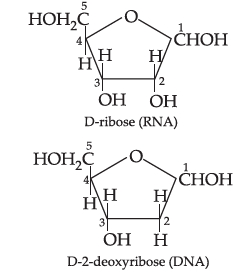
0 likesView Solution
57
ChemistryMediumMCQAIEEE · 2011
Copper crystallises in $fcc$ with a unit cell edge length of $361 \ pm$. What is the radius of the copper atom in $pm$?
A
$157$
B
$128$
C
$108$
D
$181$
Solution
(B) For an $fcc$ (face-centered cubic) unit cell, the relationship between the edge length $a$ and the atomic radius $r$ is given by:
$r = \frac{\sqrt{2} a}{4} = \frac{a}{2\sqrt{2}}$
Given the edge length $a = 361 \ pm$:
$r = \frac{361}{2 \times 1.414}$
$r = \frac{361}{2.828}$
$r \approx 127.65 \ pm$
Rounding to the nearest whole number, we get $r = 128 \ pm$.
$r = \frac{\sqrt{2} a}{4} = \frac{a}{2\sqrt{2}}$
Given the edge length $a = 361 \ pm$:
$r = \frac{361}{2 \times 1.414}$
$r = \frac{361}{2.828}$
$r \approx 127.65 \ pm$
Rounding to the nearest whole number, we get $r = 128 \ pm$.
0 likesView Solution
58
ChemistryMediumMCQAIEEE · 2011
The reduction potential of a hydrogen half-cell will be negative if:
A
$p(H_{2}) = 1 \ atm$ and $[H^{+}] = 1.0 \ M$
B
$p(H_{2}) = 1 \ atm$ and $[H^{+}] = 2.0 \ M$
C
$p(H_{2}) = 2 \ atm$ and $[H^{+}] = 1.0 \ M$
D
$p(H_{2}) = 2 \ atm$ and $[H^{+}] = 2.0 \ M$
Solution
(C) The reduction reaction for a hydrogen half-cell is: $2H^{+} + 2e^{-} \rightarrow H_{2}$
Here,$n = 2$ and the reaction quotient $Q = \frac{p(H_{2})}{[H^{+}]^{2}}$.
Using the Nernst equation: $E_{H^{+}/H_{2}} = E^{0}_{H^{+}/H_{2}} - \frac{0.059}{n} \log Q$.
Since $E^{0}_{H^{+}/H_{2}} = 0 \ V$,we have $E_{H^{+}/H_{2}} = -\frac{0.059}{2} \log Q$.
For $E_{H^{+}/H_{2}}$ to be negative,$\log Q$ must be positive,which means $Q > 1$.
Evaluating the options:
$(A)$ $Q = \frac{1}{1^{2}} = 1$ (Not negative)
$(B)$ $Q = \frac{1}{2^{2}} = 0.25 < 1$ (Positive potential)
$(C)$ $Q = \frac{2}{1^{2}} = 2 > 1$ (Negative potential)
$(D)$ $Q = \frac{2}{2^{2}} = 0.5 < 1$ (Positive potential)
Therefore,the correct option is $(C)$.
Here,$n = 2$ and the reaction quotient $Q = \frac{p(H_{2})}{[H^{+}]^{2}}$.
Using the Nernst equation: $E_{H^{+}/H_{2}} = E^{0}_{H^{+}/H_{2}} - \frac{0.059}{n} \log Q$.
Since $E^{0}_{H^{+}/H_{2}} = 0 \ V$,we have $E_{H^{+}/H_{2}} = -\frac{0.059}{2} \log Q$.
For $E_{H^{+}/H_{2}}$ to be negative,$\log Q$ must be positive,which means $Q > 1$.
Evaluating the options:
$(A)$ $Q = \frac{1}{1^{2}} = 1$ (Not negative)
$(B)$ $Q = \frac{1}{2^{2}} = 0.25 < 1$ (Positive potential)
$(C)$ $Q = \frac{2}{1^{2}} = 2 > 1$ (Negative potential)
$(D)$ $Q = \frac{2}{2^{2}} = 0.5 < 1$ (Positive potential)
Therefore,the correct option is $(C)$.
0 likesView Solution
Vedclass Products
For Students
Vedclass Test Series
Mock tests in real AIEEE style covering Chemistry with performance analysis. 5-day free trial.
Start Free TrialFor Teachers
Exam Paper Generator
Generate Set A/B/C/D Chemistry papers from 7.5L+ questions in 2 minutes. 3 chapters free.
Try FreeFor Institutes
Online Exam Module
Run live AIEEE mock exams with unlimited students, 360° analytics & white-label branding.
See DemoFrequently Asked Questions
How many Chemistry questions are in AIEEE 2011?
There are 58 Chemistry questions from the AIEEE 2011 paper on Vedclass, each with a detailed step-by-step solution in English.
Are AIEEE 2011 Chemistry solutions available in English?
Yes. All solutions on this page are in English. You can also switch to English or Hindi using the language buttons above the questions.
Can I practice AIEEE 2011 Chemistry as a timed test?
Yes. Use the Vedclass Test Series to attempt a full AIEEE mock test covering Chemistry with time limits and instant score analysis.
Can teachers create Chemistry papers from AIEEE previous year questions?
Yes. The Vedclass Exam Paper Generator lets teachers mix AIEEE Chemistry questions and generate Set A/B/C/D papers in minutes.
For Teachers & Institutes
Build a Custom Chemistry Paper
Pick AIEEE 2011 Chemistry questions, set difficulty, and generate Set A/B/C/D in 2 minutes.