
ChemistryQ1–81 of 90 questions
Page 1 of 2 · English
1
ChemistryMCQAIEEE · 2006
If ${x^p}{y^q} = {(x + y)^{p + q}},$ then $\frac{dy}{dx} = $
A
$\frac{y}{x}$
B
$-\frac{y}{x}$
C
$\frac{x}{y}$
D
$-\frac{x}{y}$
Solution
(A) Given the equation: ${x^p}{y^q} = {(x + y)^{p + q}}$
Taking the natural logarithm on both sides:
$\ln({x^p}{y^q}) = \ln({(x + y)^{p + q}})$
$p\ln x + q\ln y = (p + q)\ln(x + y)$
Differentiating both sides with respect to $x$:
$\frac{d}{dx}(p\ln x + q\ln y) = \frac{d}{dx}((p + q)\ln(x + y))$
$\frac{p}{x} + \frac{q}{y}\frac{dy}{dx} = \frac{p + q}{x + y}(1 + \frac{dy}{dx})$
Multiply by $xy(x + y)$ to clear denominators:
$py(x + y) + qx(x + y)\frac{dy}{dx} = x(p + q)y + x(p + q)x\frac{dy}{dx}$
$pxy + py^2 + qx^2\frac{dy}{dx} + qxy\frac{dy}{dx} = pxy + qxy + (px^2 + qx^2)\frac{dy}{dx}$
Rearranging terms to isolate $\frac{dy}{dx}$:
$\frac{dy}{dx}(qx^2 + qxy - px^2 - qx^2) = pxy + qxy - pxy - py^2$
$\frac{dy}{dx}(qxy - px^2) = qxy - py^2$
$\frac{dy}{dx} = \frac{qxy - py^2}{qx^2 - pxy} = \frac{y(qx - py)}{x(qx - py)}$
$\frac{dy}{dx} = \frac{y}{x}$
Taking the natural logarithm on both sides:
$\ln({x^p}{y^q}) = \ln({(x + y)^{p + q}})$
$p\ln x + q\ln y = (p + q)\ln(x + y)$
Differentiating both sides with respect to $x$:
$\frac{d}{dx}(p\ln x + q\ln y) = \frac{d}{dx}((p + q)\ln(x + y))$
$\frac{p}{x} + \frac{q}{y}\frac{dy}{dx} = \frac{p + q}{x + y}(1 + \frac{dy}{dx})$
Multiply by $xy(x + y)$ to clear denominators:
$py(x + y) + qx(x + y)\frac{dy}{dx} = x(p + q)y + x(p + q)x\frac{dy}{dx}$
$pxy + py^2 + qx^2\frac{dy}{dx} + qxy\frac{dy}{dx} = pxy + qxy + (px^2 + qx^2)\frac{dy}{dx}$
Rearranging terms to isolate $\frac{dy}{dx}$:
$\frac{dy}{dx}(qx^2 + qxy - px^2 - qx^2) = pxy + qxy - pxy - py^2$
$\frac{dy}{dx}(qxy - px^2) = qxy - py^2$
$\frac{dy}{dx} = \frac{qxy - py^2}{qx^2 - pxy} = \frac{y(qx - py)}{x(qx - py)}$
$\frac{dy}{dx} = \frac{y}{x}$
0 likesView Solution
2
ChemistryMCQAIEEE · 2006
The resistance of a bulb filament is $100 \ \Omega$ at a temperature of $100 \ ^oC$. If its temperature coefficient of resistance is $0.005 \ ^oC^{-1}$,at what temperature $(^oC)$ will its resistance become $200 \ \Omega$?
A
$300$
B
$400$
C
$500$
D
$200$
Solution
(B) The resistance at temperature $t$ is given by the formula $R_t = R_0(1 + \alpha \Delta T)$,where $R_0$ is the resistance at $0 \ ^oC$ and $\Delta T$ is the temperature change.
Given: $R_1 = 100 \ \Omega$ at $t_1 = 100 \ ^oC$,$R_2 = 200 \ \Omega$ at $t_2 = T$,and $\alpha = 0.005 \ ^oC^{-1}$.
Using the relation $R_t = R_{ref}[1 + \alpha(t - t_{ref})]$,we can write:
$100 = R_0(1 + 0.005 \times 100) \implies 100 = R_0(1 + 0.5) \implies 100 = 1.5 R_0 \implies R_0 = \frac{100}{1.5} = \frac{200}{3} \ \Omega$.
Now,for $R_2 = 200 \ \Omega$ at temperature $T$:
$200 = R_0(1 + 0.005 \times T) = \frac{200}{3}(1 + 0.005T)$.
Dividing both sides by $200$:
$1 = \frac{1}{3}(1 + 0.005T) \implies 3 = 1 + 0.005T \implies 2 = 0.005T$.
$T = \frac{2}{0.005} = \frac{2000}{5} = 400 \ ^oC$.
Given: $R_1 = 100 \ \Omega$ at $t_1 = 100 \ ^oC$,$R_2 = 200 \ \Omega$ at $t_2 = T$,and $\alpha = 0.005 \ ^oC^{-1}$.
Using the relation $R_t = R_{ref}[1 + \alpha(t - t_{ref})]$,we can write:
$100 = R_0(1 + 0.005 \times 100) \implies 100 = R_0(1 + 0.5) \implies 100 = 1.5 R_0 \implies R_0 = \frac{100}{1.5} = \frac{200}{3} \ \Omega$.
Now,for $R_2 = 200 \ \Omega$ at temperature $T$:
$200 = R_0(1 + 0.005 \times T) = \frac{200}{3}(1 + 0.005T)$.
Dividing both sides by $200$:
$1 = \frac{1}{3}(1 + 0.005T) \implies 3 = 1 + 0.005T \implies 2 = 0.005T$.
$T = \frac{2}{0.005} = \frac{2000}{5} = 400 \ ^oC$.
0 likesView Solution
3
ChemistryMCQAIEEE · 2006
The resistance of a bulb filament is $100\, \Omega$ at a temperature of $100\, ^oC$. If its temperature coefficient of resistance is $0.005\, (^oC)^{-1}$,at what temperature will its resistance become $200\, \Omega$?
A
$500$
B
$200$
C
$300$
D
$400$
Solution
(C) Given: Initial temperature $\theta_1 = 100\, ^oC$,Initial resistance $R_{\theta_1} = 100\, \Omega$,Final resistance $R_{\theta_2} = 200\, \Omega$,Temperature coefficient $\alpha = 0.005\, (^oC)^{-1}$.
The formula relating resistance and temperature is $R_{\theta_2} = R_{\theta_1} [1 + \alpha (\theta_2 - \theta_1)]$.
Rearranging the formula to solve for $\theta_2$:
$R_{\theta_2} - R_{\theta_1} = \alpha R_{\theta_1} (\theta_2 - \theta_1)$
$\frac{R_{\theta_2} - R_{\theta_1}}{\alpha R_{\theta_1}} = \theta_2 - \theta_1$
$\theta_2 = \frac{R_{\theta_2} - R_{\theta_1}}{\alpha R_{\theta_1}} + \theta_1$
Substituting the values:
$\theta_2 = \frac{200 - 100}{0.005 \times 100} + 100$
$\theta_2 = \frac{100}{0.5} + 100$
$\theta_2 = 200 + 100 = 300\, ^oC$.
The formula relating resistance and temperature is $R_{\theta_2} = R_{\theta_1} [1 + \alpha (\theta_2 - \theta_1)]$.
Rearranging the formula to solve for $\theta_2$:
$R_{\theta_2} - R_{\theta_1} = \alpha R_{\theta_1} (\theta_2 - \theta_1)$
$\frac{R_{\theta_2} - R_{\theta_1}}{\alpha R_{\theta_1}} = \theta_2 - \theta_1$
$\theta_2 = \frac{R_{\theta_2} - R_{\theta_1}}{\alpha R_{\theta_1}} + \theta_1$
Substituting the values:
$\theta_2 = \frac{200 - 100}{0.005 \times 100} + 100$
$\theta_2 = \frac{100}{0.5} + 100$
$\theta_2 = 200 + 100 = 300\, ^oC$.
0 likesView Solution
4
ChemistryMCQAIEEE · 2006
If the roots of the quadratic equation $x^2 + px + q = 0$ are $\tan 30^\circ$ and $\tan 15^\circ$ respectively,then what is the value of $2 + q - p$?
A
$0$
B
$1$
C
$2$
D
$3$
Solution
(D) Given the quadratic equation $x^2 + px + q = 0$ with roots $\alpha = \tan 30^\circ$ and $\beta = \tan 15^\circ$.
From the relation between roots and coefficients,we have:
Sum of roots: $\alpha + \beta = -p$
Product of roots: $\alpha \beta = q$
We know $\tan 30^\circ = \frac{1}{\sqrt{3}}$ and $\tan 15^\circ = \tan(45^\circ - 30^\circ) = \frac{\tan 45^\circ - \tan 30^\circ}{1 + \tan 45^\circ \tan 30^\circ} = \frac{1 - 1/\sqrt{3}}{1 + 1/\sqrt{3}} = \frac{\sqrt{3}-1}{\sqrt{3}+1} = \frac{(\sqrt{3}-1)^2}{3-1} = \frac{4-2\sqrt{3}}{2} = 2 - \sqrt{3}$.
Thus,$p = -(\alpha + \beta) = -(\frac{1}{\sqrt{3}} + 2 - \sqrt{3}) = -(\frac{1 + 2\sqrt{3} - 3}{\sqrt{3}}) = -(\frac{2\sqrt{3} - 2}{\sqrt{3}}) = \frac{2 - 2\sqrt{3}}{\sqrt{3}}$.
And $q = \alpha \beta = \frac{1}{\sqrt{3}}(2 - \sqrt{3}) = \frac{2}{\sqrt{3}} - 1$.
Now,calculate $2 + q - p$:
$2 + (\frac{2}{\sqrt{3}} - 1) - (\frac{2 - 2\sqrt{3}}{\sqrt{3}}) = 1 + \frac{2}{\sqrt{3}} - \frac{2}{\sqrt{3}} + \frac{2\sqrt{3}}{\sqrt{3}} = 1 + 2 = 3$.
From the relation between roots and coefficients,we have:
Sum of roots: $\alpha + \beta = -p$
Product of roots: $\alpha \beta = q$
We know $\tan 30^\circ = \frac{1}{\sqrt{3}}$ and $\tan 15^\circ = \tan(45^\circ - 30^\circ) = \frac{\tan 45^\circ - \tan 30^\circ}{1 + \tan 45^\circ \tan 30^\circ} = \frac{1 - 1/\sqrt{3}}{1 + 1/\sqrt{3}} = \frac{\sqrt{3}-1}{\sqrt{3}+1} = \frac{(\sqrt{3}-1)^2}{3-1} = \frac{4-2\sqrt{3}}{2} = 2 - \sqrt{3}$.
Thus,$p = -(\alpha + \beta) = -(\frac{1}{\sqrt{3}} + 2 - \sqrt{3}) = -(\frac{1 + 2\sqrt{3} - 3}{\sqrt{3}}) = -(\frac{2\sqrt{3} - 2}{\sqrt{3}}) = \frac{2 - 2\sqrt{3}}{\sqrt{3}}$.
And $q = \alpha \beta = \frac{1}{\sqrt{3}}(2 - \sqrt{3}) = \frac{2}{\sqrt{3}} - 1$.
Now,calculate $2 + q - p$:
$2 + (\frac{2}{\sqrt{3}} - 1) - (\frac{2 - 2\sqrt{3}}{\sqrt{3}}) = 1 + \frac{2}{\sqrt{3}} - \frac{2}{\sqrt{3}} + \frac{2\sqrt{3}}{\sqrt{3}} = 1 + 2 = 3$.
0 likesView Solution
5
ChemistryMCQAIEEE · 2006
If the lines $3x - 4y - 7 = 0$ and $2x - 3y - 5 = 0$ are two diameters of a circle with an area of $49\pi$ square units,then the equation of the circle is:
A
$x^2 + y^2 + 2x - 2y - 62 = 0$
B
$x^2 + y^2 - 2x + 2y - 62 = 0$
C
$x^2 + y^2 - 2x + 2y - 47 = 0$
D
$x^2 + y^2 + 2x - 2y - 47 = 0$
Solution
(C) The center of the circle is the intersection point of the two diameters.
Solving $3x - 4y = 7$ and $2x - 3y = 5$:
Multiply the first by $2$ and the second by $3$: $6x - 8y = 14$ and $6x - 9y = 15$.
Subtracting the equations: $(6x - 8y) - (6x - 9y) = 14 - 15 \implies y = -1$.
Substituting $y = -1$ into $3x - 4y = 7$: $3x - 4(-1) = 7 \implies 3x + 4 = 7 \implies 3x = 3 \implies x = 1$.
So,the center $(h, k)$ is $(1, -1)$.
Given the area of the circle is $49\pi$,we have $\pi r^2 = 49\pi \implies r^2 = 49 \implies r = 7$.
The equation of the circle is $(x - h)^2 + (y - k)^2 = r^2$.
$(x - 1)^2 + (y + 1)^2 = 7^2$.
$x^2 - 2x + 1 + y^2 + 2y + 1 = 49$.
$x^2 + y^2 - 2x + 2y + 2 = 49$.
$x^2 + y^2 - 2x + 2y - 47 = 0$.
Solving $3x - 4y = 7$ and $2x - 3y = 5$:
Multiply the first by $2$ and the second by $3$: $6x - 8y = 14$ and $6x - 9y = 15$.
Subtracting the equations: $(6x - 8y) - (6x - 9y) = 14 - 15 \implies y = -1$.
Substituting $y = -1$ into $3x - 4y = 7$: $3x - 4(-1) = 7 \implies 3x + 4 = 7 \implies 3x = 3 \implies x = 1$.
So,the center $(h, k)$ is $(1, -1)$.
Given the area of the circle is $49\pi$,we have $\pi r^2 = 49\pi \implies r^2 = 49 \implies r = 7$.
The equation of the circle is $(x - h)^2 + (y - k)^2 = r^2$.
$(x - 1)^2 + (y + 1)^2 = 7^2$.
$x^2 - 2x + 1 + y^2 + 2y + 1 = 49$.
$x^2 + y^2 - 2x + 2y + 2 = 49$.
$x^2 + y^2 - 2x + 2y - 47 = 0$.
0 likesView Solution
6
ChemistryMCQAIEEE · 2006
$A$ straight line passes through the point $A(3, 4)$ such that the portion of the line intercepted between the axes is bisected at $A$. Find the equation of the line.
A
$3x - 4y + 7 = 0$
B
$4x + 3y = 24$
C
$3x + 4y = 25$
D
$x + y = 7$
Solution
(B) Let the intercepts of the line on the $x$-axis and $y$-axis be $a$ and $b$ respectively. The equation of the line is $\frac{x}{a} + \frac{y}{b} = 1$.
Since the point $A(3, 4)$ bisects the segment intercepted between the axes,the coordinates of $A$ are $(\frac{a}{2}, \frac{b}{2})$.
Equating the coordinates,we get $\frac{a}{2} = 3 \Rightarrow a = 6$ and $\frac{b}{2} = 4 \Rightarrow b = 8$.
Substituting these values into the intercept form equation: $\frac{x}{6} + \frac{y}{8} = 1$.
Multiplying by $24$,we get $4x + 3y = 24$.
Since the point $A(3, 4)$ bisects the segment intercepted between the axes,the coordinates of $A$ are $(\frac{a}{2}, \frac{b}{2})$.
Equating the coordinates,we get $\frac{a}{2} = 3 \Rightarrow a = 6$ and $\frac{b}{2} = 4 \Rightarrow b = 8$.
Substituting these values into the intercept form equation: $\frac{x}{6} + \frac{y}{8} = 1$.
Multiplying by $24$,we get $4x + 3y = 24$.
0 likesView Solution
7
ChemistryMCQAIEEE · 2006
The function $f(x) = \frac{x}{2} + \frac{2}{x}$ has a local minimum at $x = $ ..........
A
$-2$
B
$0$
C
$1$
D
$2$
Solution
(D) Given function is $f(x) = \frac{x}{2} + \frac{2}{x}$.
First,find the derivative $f'(x)$:
$f'(x) = \frac{1}{2} - \frac{2}{x^2}$.
For local maxima or minima,set $f'(x) = 0$:
$\frac{1}{2} - \frac{2}{x^2} = 0 \implies \frac{1}{2} = \frac{2}{x^2} \implies x^2 = 4 \implies x = \pm 2$.
Now,find the second derivative $f''(x)$:
$f''(x) = \frac{d}{dx}(\frac{1}{2} - 2x^{-2}) = 0 - 2(-2)x^{-3} = \frac{4}{x^3}$.
Check the sign of $f''(x)$ at critical points:
At $x = 2$,$f''(2) = \frac{4}{2^3} = \frac{4}{8} = \frac{1}{2} > 0$.
Since $f''(2) > 0$,the function has a local minimum at $x = 2$.
At $x = -2$,$f''(-2) = \frac{4}{(-2)^3} = \frac{4}{-8} = -\frac{1}{2} < 0$.
Since $f''(-2) < 0$,the function has a local maximum at $x = -2$.
First,find the derivative $f'(x)$:
$f'(x) = \frac{1}{2} - \frac{2}{x^2}$.
For local maxima or minima,set $f'(x) = 0$:
$\frac{1}{2} - \frac{2}{x^2} = 0 \implies \frac{1}{2} = \frac{2}{x^2} \implies x^2 = 4 \implies x = \pm 2$.
Now,find the second derivative $f''(x)$:
$f''(x) = \frac{d}{dx}(\frac{1}{2} - 2x^{-2}) = 0 - 2(-2)x^{-3} = \frac{4}{x^3}$.
Check the sign of $f''(x)$ at critical points:
At $x = 2$,$f''(2) = \frac{4}{2^3} = \frac{4}{8} = \frac{1}{2} > 0$.
Since $f''(2) > 0$,the function has a local minimum at $x = 2$.
At $x = -2$,$f''(-2) = \frac{4}{(-2)^3} = \frac{4}{-8} = -\frac{1}{2} < 0$.
Since $f''(-2) < 0$,the function has a local maximum at $x = -2$.
0 likesView Solution
8
ChemistryMCQAIEEE · 2006
Let $C$ be the circle with centre $(0,0)$ and radius $3$ units. The equation of the locus of the midpoints of the chords of the circle $C$ that subtend an angle of $\frac{2\pi}{3}$ at its center is:
A
$x^2 + y^2 = \frac{3}{2}$
B
$x^2 + y^2 = 1$
C
$x^2 + y^2 = \frac{27}{4}$
D
$x^2 + y^2 = \frac{9}{4}$
Solution
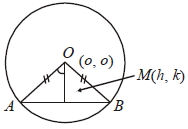
(D) Let $AB$ be a chord of the circle $C$ and $M(h, k)$ be the midpoint of $AB$.
Since the chord $AB$ subtends an angle of $\frac{2\pi}{3}$ at the center $O(0,0)$,the triangle $\triangle OAB$ is an isosceles triangle with $OA = OB = 3$.
The line segment $OM$ is the perpendicular bisector of the chord $AB$.
In the right-angled triangle $\triangle OAM$,the angle $\angle AOM = \frac{1}{2} \angle AOB = \frac{1}{2} \times \frac{2\pi}{3} = \frac{\pi}{3} = 60^{\circ}$.
In $\triangle OAM$,we have $OM = OA \cos(60^{\circ})$.
Since $M(h, k)$ is the midpoint,the distance $OM = \sqrt{h^2 + k^2}$.
Thus,$\sqrt{h^2 + k^2} = 3 \cos(60^{\circ}) = 3 \times \frac{1}{2} = \frac{3}{2}$.
Squaring both sides,we get $h^2 + k^2 = \frac{9}{4}$.
Replacing $(h, k)$ with $(x, y)$,the locus is $x^2 + y^2 = \frac{9}{4}$.
Since the chord $AB$ subtends an angle of $\frac{2\pi}{3}$ at the center $O(0,0)$,the triangle $\triangle OAB$ is an isosceles triangle with $OA = OB = 3$.
The line segment $OM$ is the perpendicular bisector of the chord $AB$.
In the right-angled triangle $\triangle OAM$,the angle $\angle AOM = \frac{1}{2} \angle AOB = \frac{1}{2} \times \frac{2\pi}{3} = \frac{\pi}{3} = 60^{\circ}$.
In $\triangle OAM$,we have $OM = OA \cos(60^{\circ})$.
Since $M(h, k)$ is the midpoint,the distance $OM = \sqrt{h^2 + k^2}$.
Thus,$\sqrt{h^2 + k^2} = 3 \cos(60^{\circ}) = 3 \times \frac{1}{2} = \frac{3}{2}$.
Squaring both sides,we get $h^2 + k^2 = \frac{9}{4}$.
Replacing $(h, k)$ with $(x, y)$,the locus is $x^2 + y^2 = \frac{9}{4}$.
0 likesView Solution
9
ChemistryMCQAIEEE · 2006
$\int_{3}^{6} \frac{\sqrt{x}}{\sqrt{9-x} + \sqrt{x}} \, dx = $
A
$\frac{1}{2}$
B
$\frac{3}{2}$
C
$2$
D
$1$
Solution
(B) Let $I = \int_{3}^{6} \frac{\sqrt{x}}{\sqrt{9-x} + \sqrt{x}} \, dx \quad \dots(i)$
Using the property $\int_{a}^{b} f(x) \, dx = \int_{a}^{b} f(a+b-x) \, dx$,we get:
$I = \int_{3}^{6} \frac{\sqrt{9-x}}{\sqrt{9-(9-x)} + \sqrt{9-x}} \, dx$
$I = \int_{3}^{6} \frac{\sqrt{9-x}}{\sqrt{x} + \sqrt{9-x}} \, dx \quad \dots(ii)$
Adding equations $(i)$ and $(ii)$:
$2I = \int_{3}^{6} \frac{\sqrt{x} + \sqrt{9-x}}{\sqrt{x} + \sqrt{9-x}} \, dx$
$2I = \int_{3}^{6} 1 \, dx$
$2I = [x]_{3}^{6} = 6 - 3 = 3$
$I = \frac{3}{2}$
Using the property $\int_{a}^{b} f(x) \, dx = \int_{a}^{b} f(a+b-x) \, dx$,we get:
$I = \int_{3}^{6} \frac{\sqrt{9-x}}{\sqrt{9-(9-x)} + \sqrt{9-x}} \, dx$
$I = \int_{3}^{6} \frac{\sqrt{9-x}}{\sqrt{x} + \sqrt{9-x}} \, dx \quad \dots(ii)$
Adding equations $(i)$ and $(ii)$:
$2I = \int_{3}^{6} \frac{\sqrt{x} + \sqrt{9-x}}{\sqrt{x} + \sqrt{9-x}} \, dx$
$2I = \int_{3}^{6} 1 \, dx$
$2I = [x]_{3}^{6} = 6 - 3 = 3$
$I = \frac{3}{2}$
0 likesView Solution
10
ChemistryMCQAIEEE · 2006
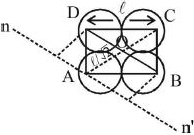
Four point masses,each of value $m$,are placed at the corners of a square $ABCD$ of side $l$. The moment of inertia of this system about an axis passing through $A$ and parallel to $BD$ is
A
$ml^2$
B
$2ml^2$
C
$\sqrt{3}ml^2$
D
$3ml^2$
Solution
(D) Let the axis be $nn'$. The axis passes through $A$ and is parallel to the diagonal $BD$.
The distance of point $A$ from the axis is $0$. Thus,the moment of inertia of the mass at $A$ is $0$.
The distance of point $B$ from the axis is $d_B = \frac{l}{\sqrt{2}}$.
The distance of point $D$ from the axis is $d_D = \frac{l}{\sqrt{2}}$.
The distance of point $C$ from the axis is $d_C = \sqrt{2}l$ (since $C$ is at the opposite corner of the square from $A$).
The total moment of inertia $I$ is given by:
$I = m(d_A)^2 + m(d_B)^2 + m(d_D)^2 + m(d_C)^2$
$I = m(0)^2 + m\left(\frac{l}{\sqrt{2}}\right)^2 + m\left(\frac{l}{\sqrt{2}}\right)^2 + m(\sqrt{2}l)^2$
$I = 0 + m\left(\frac{l^2}{2}\right) + m\left(\frac{l^2}{2}\right) + 2ml^2$
$I = ml^2 + 2ml^2 = 3ml^2$
The distance of point $A$ from the axis is $0$. Thus,the moment of inertia of the mass at $A$ is $0$.
The distance of point $B$ from the axis is $d_B = \frac{l}{\sqrt{2}}$.
The distance of point $D$ from the axis is $d_D = \frac{l}{\sqrt{2}}$.
The distance of point $C$ from the axis is $d_C = \sqrt{2}l$ (since $C$ is at the opposite corner of the square from $A$).
The total moment of inertia $I$ is given by:
$I = m(d_A)^2 + m(d_B)^2 + m(d_D)^2 + m(d_C)^2$
$I = m(0)^2 + m\left(\frac{l}{\sqrt{2}}\right)^2 + m\left(\frac{l}{\sqrt{2}}\right)^2 + m(\sqrt{2}l)^2$
$I = 0 + m\left(\frac{l^2}{2}\right) + m\left(\frac{l^2}{2}\right) + 2ml^2$
$I = ml^2 + 2ml^2 = 3ml^2$
0 likesView Solution
11
ChemistryMCQAIEEE · 2006
$A$ string is stretched between fixed points separated by $75.0 \ cm$. It is observed to have resonant frequencies of $420 \ Hz$ and $315 \ Hz$. There are no other resonant frequencies between these two. Then,the lowest resonant frequency for this string is .... $Hz$.
A
$10.5$
B
$105$
C
$1.05$
D
$1050$
Solution
(B) The resonant frequencies of a string fixed at both ends are given by $f_n = n \times f_1$,where $f_1 = \frac{v}{2L}$ is the fundamental frequency and $n$ is an integer $(n = 1, 2, 3, \dots)$.
Given two consecutive resonant frequencies are $f_n = 315 \ Hz$ and $f_{n+1} = 420 \ Hz$.
We know that $f_{n+1} - f_n = (n+1)f_1 - nf_1 = f_1$.
Therefore,the difference between any two consecutive resonant frequencies is equal to the fundamental frequency $f_1$.
$f_1 = 420 \ Hz - 315 \ Hz = 105 \ Hz$.
Since $105 \ Hz$ is the fundamental frequency,it is also the lowest resonant frequency for the string.
Given two consecutive resonant frequencies are $f_n = 315 \ Hz$ and $f_{n+1} = 420 \ Hz$.
We know that $f_{n+1} - f_n = (n+1)f_1 - nf_1 = f_1$.
Therefore,the difference between any two consecutive resonant frequencies is equal to the fundamental frequency $f_1$.
$f_1 = 420 \ Hz - 315 \ Hz = 105 \ Hz$.
Since $105 \ Hz$ is the fundamental frequency,it is also the lowest resonant frequency for the string.
0 likesView Solution
12
ChemistryDifficultMCQAIEEE · 2006
How many moles of magnesium phosphate,$Mg_{3}(PO_{4})_{2}$ will contain $0.25 \ mol$ of oxygen atoms?
A
$1.25 \times 10^{-2}$
B
$2.5 \times 10^{-2}$
C
$0.02$
D
$3.125 \times 10^{-2}$
Solution
(D) In one mole of $Mg_{3}(PO_{4})_{2}$,there are $8 \ mol$ of oxygen atoms.
Let $M$ be the number of moles of $Mg_{3}(PO_{4})_{2}$.
The number of moles of oxygen atoms is given by $M \times 8$.
According to the question,$M \times 8 = 0.25 \ mol$.
Therefore,$M = \frac{0.25}{8} = 0.03125 \ mol$.
This can be expressed as $3.125 \times 10^{-2} \ mol$.
Let $M$ be the number of moles of $Mg_{3}(PO_{4})_{2}$.
The number of moles of oxygen atoms is given by $M \times 8$.
According to the question,$M \times 8 = 0.25 \ mol$.
Therefore,$M = \frac{0.25}{8} = 0.03125 \ mol$.
This can be expressed as $3.125 \times 10^{-2} \ mol$.
0 likesView Solution
13
ChemistryMediumMCQAIEEE · 2006
According to Bohr's theory,the angular momentum of an electron in the $5^{th}$ orbit is: (in $, h/\pi$)
A
$10$
B
$2.5$
C
$25$
D
$1.0$
Solution
(B) The formula for the angular momentum $(L)$ of an electron in the $n^{th}$ orbit is given by Bohr's postulate:
$L = mvr = \frac{nh}{2\pi}$
Given that the orbit number $n = 5$,we substitute this value into the formula:
$L = \frac{5h}{2\pi}$
Calculating the value:
$L = 2.5 \frac{h}{\pi}$
Therefore,the correct option is $B$.
$L = mvr = \frac{nh}{2\pi}$
Given that the orbit number $n = 5$,we substitute this value into the formula:
$L = \frac{5h}{2\pi}$
Calculating the value:
$L = 2.5 \frac{h}{\pi}$
Therefore,the correct option is $B$.
0 likesView Solution
14
ChemistryDifficultMCQAIEEE · 2006
Uncertainty in the position of an electron (mass $= 9.1 \times 10^{-31} \ kg$) moving with a velocity $300 \ ms^{-1}$,accurate up to $0.001\%$ will be:
A
$1.92 \times 10^{-2} \ m$
B
$3.84 \times 10^{-2} \ m$
C
$19.2 \times 10^{-2} \ m$
D
$5.76 \times 10^{-2} \ m$
Solution
(A) The percentage error in velocity is given as $0.001\%$.
$\frac{\Delta V}{V} \times 100 = 0.001$
$\Delta V = \frac{0.001 \times 300}{100} = 3 \times 10^{-3} \ ms^{-1}$
According to Heisenberg's uncertainty principle:
$\Delta x \cdot m \Delta V \geq \frac{h}{4 \pi}$
$\Delta x = \frac{h}{4 \pi m \Delta V}$
Substituting the values ($h = 6.63 \times 10^{-34} \ J \cdot s$,$m = 9.1 \times 10^{-31} \ kg$,$\Delta V = 3 \times 10^{-3} \ ms^{-1}$):
$\Delta x = \frac{6.63 \times 10^{-34}}{4 \times 3.14159 \times 9.1 \times 10^{-31} \times 3 \times 10^{-3}}$
$\Delta x \approx 1.92 \times 10^{-2} \ m$
$\frac{\Delta V}{V} \times 100 = 0.001$
$\Delta V = \frac{0.001 \times 300}{100} = 3 \times 10^{-3} \ ms^{-1}$
According to Heisenberg's uncertainty principle:
$\Delta x \cdot m \Delta V \geq \frac{h}{4 \pi}$
$\Delta x = \frac{h}{4 \pi m \Delta V}$
Substituting the values ($h = 6.63 \times 10^{-34} \ J \cdot s$,$m = 9.1 \times 10^{-31} \ kg$,$\Delta V = 3 \times 10^{-3} \ ms^{-1}$):
$\Delta x = \frac{6.63 \times 10^{-34}}{4 \times 3.14159 \times 9.1 \times 10^{-31} \times 3 \times 10^{-3}}$
$\Delta x \approx 1.92 \times 10^{-2} \ m$
0 likesView Solution
15
ChemistryMediumMCQAIEEE · 2006
Which one of the following sets of ions represents a collection of isoelectronic species?
A
$N^{3-}, O^{2-}, P^{3-}, S^{2-}$
B
$Li^{+}, Na^{+}, Mg^{2+}, Ca^{2+}$
C
$K^{+}, Cl^{-}, Ca^{2+}, Sc^{3+}$
D
$Ba^{2+}, Sr^{2+}, K^{+}, Ca^{2+}$
Solution
(C) Isoelectronic species are those that have the same number of electrons.
For $K^{+}$ (atomic number $19$): Number of electrons $= 19 - 1 = 18$.
For $Cl^{-}$ (atomic number $17$): Number of electrons $= 17 + 1 = 18$.
For $Ca^{2+}$ (atomic number $20$): Number of electrons $= 20 - 2 = 18$.
For $Sc^{3+}$ (atomic number $21$): Number of electrons $= 21 - 3 = 18$.
Since all these ions have $18$ electrons,they are isoelectronic.
For $K^{+}$ (atomic number $19$): Number of electrons $= 19 - 1 = 18$.
For $Cl^{-}$ (atomic number $17$): Number of electrons $= 17 + 1 = 18$.
For $Ca^{2+}$ (atomic number $20$): Number of electrons $= 20 - 2 = 18$.
For $Sc^{3+}$ (atomic number $21$): Number of electrons $= 21 - 3 = 18$.
Since all these ions have $18$ electrons,they are isoelectronic.
0 likesView Solution
16
ChemistryMediumMCQAIEEE · 2006
Following statements regarding the periodic trends of chemical reactivity of the alkali metals and the halogens are given. Which of these statements gives the correct picture?
A
Chemical reactivity increases with increase in atomic number down the group in both the alkali metals and halogens
B
In alkali metals the reactivity increases but in the halogens it decreases with increase in atomic number down the group
C
The reactivity decreases in the alkali metals but increases in the halogens with increase in atomic number down the group
D
In both the alkali metals and the halogens the chemical reactivity decreases with increase in atomic number down the group
Solution
(B) For alkali metals $(Group \ 1)$,reactivity increases down the group because the ionization enthalpy decreases,making it easier to lose the valence electron.
For halogens $(Group \ 17)$,reactivity decreases down the group because the electron gain enthalpy becomes less negative,making it harder to gain an electron.
Therefore,in alkali metals,reactivity increases,and in halogens,it decreases with an increase in atomic number down the group.
For halogens $(Group \ 17)$,reactivity decreases down the group because the electron gain enthalpy becomes less negative,making it harder to gain an electron.
Therefore,in alkali metals,reactivity increases,and in halogens,it decreases with an increase in atomic number down the group.
0 likesView Solution
17
ChemistryMediumMCQAIEEE · 2006
Which of the following molecules/ions does not contain unpaired electrons?
A
$N_2^+$
B
$O_2$
C
$O_2^{2-}$
D
$B_2$
Solution
(C) According to Molecular Orbital Theory $(MOT)$,we determine the presence of unpaired electrons by filling the molecular orbitals:
$1$. For $N_2^+$ ($13$ electrons): $\sigma_{1s}^2 \sigma_{1s}^{*2} \sigma_{2s}^2 \sigma_{2s}^{*2} \pi_{2p_x}^2 \pi_{2p_y}^2 \sigma_{2p_z}^1$. It has $1$ unpaired electron.
$2$. For $O_2$ ($16$ electrons): $\sigma_{1s}^2 \sigma_{1s}^{*2} \sigma_{2s}^2 \sigma_{2s}^{*2} \sigma_{2p_z}^2 \pi_{2p_x}^2 \pi_{2p_y}^2 \pi_{2p_x}^{*1} \pi_{2p_y}^{*1}$. It has $2$ unpaired electrons.
$3$. For $O_2^{2-}$ ($18$ electrons): $\sigma_{1s}^2 \sigma_{1s}^{*2} \sigma_{2s}^2 \sigma_{2s}^{*2} \sigma_{2p_z}^2 \pi_{2p_x}^2 \pi_{2p_y}^2 \pi_{2p_x}^{*2} \pi_{2p_y}^{*2}$. All electrons are paired.
$4$. For $B_2$ ($10$ electrons): $\sigma_{1s}^2 \sigma_{1s}^{*2} \sigma_{2s}^2 \sigma_{2s}^{*2} \pi_{2p_x}^1 \pi_{2p_y}^1$. It has $2$ unpaired electrons.
Therefore,$O_2^{2-}$ is the only species without unpaired electrons.
$1$. For $N_2^+$ ($13$ electrons): $\sigma_{1s}^2 \sigma_{1s}^{*2} \sigma_{2s}^2 \sigma_{2s}^{*2} \pi_{2p_x}^2 \pi_{2p_y}^2 \sigma_{2p_z}^1$. It has $1$ unpaired electron.
$2$. For $O_2$ ($16$ electrons): $\sigma_{1s}^2 \sigma_{1s}^{*2} \sigma_{2s}^2 \sigma_{2s}^{*2} \sigma_{2p_z}^2 \pi_{2p_x}^2 \pi_{2p_y}^2 \pi_{2p_x}^{*1} \pi_{2p_y}^{*1}$. It has $2$ unpaired electrons.
$3$. For $O_2^{2-}$ ($18$ electrons): $\sigma_{1s}^2 \sigma_{1s}^{*2} \sigma_{2s}^2 \sigma_{2s}^{*2} \sigma_{2p_z}^2 \pi_{2p_x}^2 \pi_{2p_y}^2 \pi_{2p_x}^{*2} \pi_{2p_y}^{*2}$. All electrons are paired.
$4$. For $B_2$ ($10$ electrons): $\sigma_{1s}^2 \sigma_{1s}^{*2} \sigma_{2s}^2 \sigma_{2s}^{*2} \pi_{2p_x}^1 \pi_{2p_y}^1$. It has $2$ unpaired electrons.
Therefore,$O_2^{2-}$ is the only species without unpaired electrons.
0 likesView Solution
18
ChemistryMediumMCQAIEEE · 2006
In which of the following molecules/ions are all the bonds not equal?
A
$XeF_4$
B
$BF_4^-$
C
$SiF_4$
D
$SF_4$
Solution
(D) In $XeF_4$,the geometry is square planar with all $Xe-F$ bonds being equal due to symmetry.
In $BF_4^-$ and $SiF_4$,the geometry is tetrahedral,where all four bonds are equivalent.
In $SF_4$,the sulfur atom undergoes $sp^3d$ hybridization with one lone pair,resulting in a see-saw geometry.
Due to the presence of the lone pair,the axial and equatorial $S-F$ bonds have different bond lengths and bond angles,making them unequal.
In $BF_4^-$ and $SiF_4$,the geometry is tetrahedral,where all four bonds are equivalent.
In $SF_4$,the sulfur atom undergoes $sp^3d$ hybridization with one lone pair,resulting in a see-saw geometry.
Due to the presence of the lone pair,the axial and equatorial $S-F$ bonds have different bond lengths and bond angles,making them unequal.
0 likesView Solution
19
ChemistryMediumMCQAIEEE · 2006
An ideal gas is allowed to expand both reversibly and irreversibly in an isolated system. If $T_i$ is the initial temperature and $T_f$ is the final temperature,which of the following statements is correct?
A
$(T_f)_{rev} = (T_f)_{irrev}$
B
$T_f = T_i$ for both reversible and irreversible processes
C
$(T_f)_{irrev} > (T_f)_{rev}$
D
$T_f > T_i$ for reversible process but $T_f = T_i$ for irreversible process
Solution
(C) For an ideal gas expanding in an isolated system,the internal energy change $\Delta U = q + w = 0$. Since $q = 0$ (isolated system),$w = 0$.
For an ideal gas,$\Delta U = nC_v\Delta T = 0$,which implies $\Delta T = 0$ or $T_f = T_i$ for both processes.
However,if the question implies expansion against external pressure where work is done,in an isolated system $(q=0)$,$\Delta U = w$.
Since $w_{rev} < w_{irrev}$ (more work done in reversible expansion),the temperature drop is greater in the reversible process.
Therefore,$(T_f)_{rev} < (T_f)_{irrev}$.
For an ideal gas,$\Delta U = nC_v\Delta T = 0$,which implies $\Delta T = 0$ or $T_f = T_i$ for both processes.
However,if the question implies expansion against external pressure where work is done,in an isolated system $(q=0)$,$\Delta U = w$.
Since $w_{rev} < w_{irrev}$ (more work done in reversible expansion),the temperature drop is greater in the reversible process.
Therefore,$(T_f)_{rev} < (T_f)_{irrev}$.
0 likesView Solution
20
ChemistryMediumMCQAIEEE · 2006
The standard enthalpy of formation $(\Delta_fH^o)$ at $298 \ K$ for methane,$CH_{4(g)}$ is $-74.8 \ kJ \ mol^{-1}$. The additional information required to determine the average energy for $C-H$ bond formation would be
A
the first four ionization energies of carbon and electron gain enthalpy of hydrogen
B
the dissociation energy of hydrogen molecule,$H_2$
C
the dissociation energy of $H_2$ and enthalpy of sublimation of carbon
D
latent heat of vapourization of methane
Solution
(C) The standard enthalpy of formation of $CH_4$ is given by the reaction:
$C_{(s)} + 2H_{2(g)} \rightarrow CH_{4(g)}$
To calculate the average $C-H$ bond energy,we need to consider the atomization of the reactants:
$1.$ Enthalpy of sublimation of carbon: $C_{(s)} \rightarrow C_{(g)}$
$2.$ Dissociation energy of hydrogen: $2H_{2(g)} \rightarrow 4H_{(g)}$
By using Hess's Law,we combine these with the enthalpy of formation to find the total bond dissociation energy of $CH_4$,which is then divided by $4$ to get the average $C-H$ bond energy.
Therefore,the dissociation energy of $H_2$ and the enthalpy of sublimation of carbon are required.
$C_{(s)} + 2H_{2(g)} \rightarrow CH_{4(g)}$
To calculate the average $C-H$ bond energy,we need to consider the atomization of the reactants:
$1.$ Enthalpy of sublimation of carbon: $C_{(s)} \rightarrow C_{(g)}$
$2.$ Dissociation energy of hydrogen: $2H_{2(g)} \rightarrow 4H_{(g)}$
By using Hess's Law,we combine these with the enthalpy of formation to find the total bond dissociation energy of $CH_4$,which is then divided by $4$ to get the average $C-H$ bond energy.
Therefore,the dissociation energy of $H_2$ and the enthalpy of sublimation of carbon are required.
0 likesView Solution
21
ChemistryMediumMCQAIEEE · 2006
The enthalpy changes for the following processes are listed below:
Given that the standard states for iodine and chlorine are $I_{2(s)}$ and $Cl_{2(g)}$,the standard enthalpy of formation for $ICl_{(g)}$ is : ............... $kJ \ mol^{-1}$
| $Cl_{2(g)} \rightarrow 2Cl_{(g)}$ | $242.3 \ kJ \ mol^{-1}$ |
| $I_{2(g)} \rightarrow 2I_{(g)}$ | $151.0 \ kJ \ mol^{-1}$ |
| $ICl_{(g)} \rightarrow I_{(g)} + Cl_{(g)}$ | $211.3 \ kJ \ mol^{-1}$ |
| $I_{2(s)} \rightarrow I_{2(g)}$ | $62.76 \ kJ \ mol^{-1}$ |
Given that the standard states for iodine and chlorine are $I_{2(s)}$ and $Cl_{2(g)}$,the standard enthalpy of formation for $ICl_{(g)}$ is : ............... $kJ \ mol^{-1}$
A
$+16.8$
B
$+244.8$
C
$-14.6$
D
$-16.8$
Solution
(A) The formation reaction for $ICl_{(g)}$ is: $\frac{1}{2} I_{2(s)} + \frac{1}{2} Cl_{2(g)} \rightarrow ICl_{(g)}$
The enthalpy of formation is calculated using the bond dissociation energies and sublimation energy:
$\Delta H_f^o = [\frac{1}{2} \Delta H_{sub}(I_2) + \frac{1}{2} BE(I-I) + \frac{1}{2} BE(Cl-Cl)] - BE(I-Cl)$
Substituting the given values:
$\Delta H_f^o = [\frac{1}{2}(62.76) + \frac{1}{2}(151.0) + \frac{1}{2}(242.3)] - 211.3$
$\Delta H_f^o = [31.38 + 75.5 + 121.15] - 211.3$
$\Delta H_f^o = 228.03 - 211.3 = 16.73 \ kJ \ mol^{-1}$
Rounding to one decimal place,we get $+16.8 \ kJ \ mol^{-1}$.
The enthalpy of formation is calculated using the bond dissociation energies and sublimation energy:
$\Delta H_f^o = [\frac{1}{2} \Delta H_{sub}(I_2) + \frac{1}{2} BE(I-I) + \frac{1}{2} BE(Cl-Cl)] - BE(I-Cl)$
Substituting the given values:
$\Delta H_f^o = [\frac{1}{2}(62.76) + \frac{1}{2}(151.0) + \frac{1}{2}(242.3)] - 211.3$
$\Delta H_f^o = [31.38 + 75.5 + 121.15] - 211.3$
$\Delta H_f^o = 228.03 - 211.3 = 16.73 \ kJ \ mol^{-1}$
Rounding to one decimal place,we get $+16.8 \ kJ \ mol^{-1}$.
1 likesView Solution
22
ChemistryMediumMCQAIEEE · 2006
$(\Delta H - \Delta U)$ for the formation of carbon monoxide $(CO)$ from its elements at $298 \ K$ is ............. $J \ mol^{-1}$. $(R = 8.314 \ J \ K^{-1} \ mol^{-1})$
A
$- 2477.57$
B
$2477.57$
C
$-1238.78$
D
$1238.78$
Solution
(D) The chemical equation for the formation of $CO$ is:
$C_{(s)} + \frac{1}{2} O_{2(g)} \rightarrow CO_{(g)}$
From the first law of thermodynamics,we know that $\Delta H = \Delta U + \Delta n_g RT$.
Rearranging the equation,we get $\Delta H - \Delta U = \Delta n_g RT$.
Here,$\Delta n_g$ is the change in the number of moles of gaseous species:
$\Delta n_g = n_{p(g)} - n_{r(g)} = 1 - \frac{1}{2} = \frac{1}{2}$.
Substituting the values:
$\Delta H - \Delta U = \frac{1}{2} \times 8.314 \times 298 = 1238.78 \ J \ mol^{-1}$.
$C_{(s)} + \frac{1}{2} O_{2(g)} \rightarrow CO_{(g)}$
From the first law of thermodynamics,we know that $\Delta H = \Delta U + \Delta n_g RT$.
Rearranging the equation,we get $\Delta H - \Delta U = \Delta n_g RT$.
Here,$\Delta n_g$ is the change in the number of moles of gaseous species:
$\Delta n_g = n_{p(g)} - n_{r(g)} = 1 - \frac{1}{2} = \frac{1}{2}$.
Substituting the values:
$\Delta H - \Delta U = \frac{1}{2} \times 8.314 \times 298 = 1238.78 \ J \ mol^{-1}$.
0 likesView Solution
23
ChemistryDifficultMCQAIEEE · 2006
Phosphorus pentachloride dissociates as follows,in a closed reaction vessel:
$PCl_{5(g)} \rightleftharpoons PCl_{3(g)} + Cl_{2(g)}$
If total pressure at equilibrium of the reaction mixture is $P$ and degree of dissociation of $PCl_5$ is $x,$ the partial pressure of $PCl_3$ will be:
$PCl_{5(g)} \rightleftharpoons PCl_{3(g)} + Cl_{2(g)}$
If total pressure at equilibrium of the reaction mixture is $P$ and degree of dissociation of $PCl_5$ is $x,$ the partial pressure of $PCl_3$ will be:
A
$\left( \frac{x}{x - 1} \right) P$
B
$\left( \frac{x}{1 - x} \right) P$
C
$\left( \frac{x}{1 + x} \right) P$
D
$\left( \frac{2x}{1 - x} \right) P$
Solution
(C) The dissociation reaction is: $PCl_{5(g)} \rightleftharpoons PCl_{3(g)} + Cl_{2(g)}$
Initial moles: $1 \quad 0 \quad 0$
Moles at equilibrium: $(1 - x) \quad x \quad x$
Total moles at equilibrium = $(1 - x) + x + x = 1 + x$
Partial pressure of a gas is given by: $P_{gas} = \text{mole fraction} \times P_{total}$
Mole fraction of $PCl_3 = \frac{x}{1 + x}$
Therefore,$P_{PCl_3} = \left( \frac{x}{1 + x} \right) P$
Initial moles: $1 \quad 0 \quad 0$
Moles at equilibrium: $(1 - x) \quad x \quad x$
Total moles at equilibrium = $(1 - x) + x + x = 1 + x$
Partial pressure of a gas is given by: $P_{gas} = \text{mole fraction} \times P_{total}$
Mole fraction of $PCl_3 = \frac{x}{1 + x}$
Therefore,$P_{PCl_3} = \left( \frac{x}{1 + x} \right) P$
0 likesView Solution
24
ChemistryMediumMCQAIEEE · 2006
The equilibrium constant for the reaction $SO_{3(g)} \rightleftharpoons SO_{2(g)} + \frac{1}{2} O_{2(g)}$ is $K_c = 4.9 \times 10^{-2}$. The value of $K_c$ for the reaction $2SO_{2(g)} + O_{2(g)} \rightleftharpoons 2SO_{3(g)}$ will be
A
$9.8 \times 10^{-2}$
B
$4.9 \times 10^{-2}$
C
$416$
D
$2.40 \times 10^{-3}$
Solution
(C) For the reaction $SO_{3(g)} \rightleftharpoons SO_{2(g)} + \frac{1}{2} O_{2(g)}$,the equilibrium constant is $K_c = \frac{[SO_2][O_2]^{1/2}}{[SO_3]} = 4.9 \times 10^{-2}$.
To obtain the reaction $2SO_{2(g)} + O_{2(g)} \rightleftharpoons 2SO_{3(g)}$,we reverse the original reaction and multiply it by $2$.
If a reaction is reversed,the new equilibrium constant becomes $1/K_c$. If it is multiplied by a factor $n$,the new equilibrium constant becomes $(K_c)^n$.
Therefore,for the new reaction,$K_c' = \frac{1}{(K_c)^2} = \frac{1}{(4.9 \times 10^{-2})^2}$.
$K_c' = \frac{1}{24.01 \times 10^{-4}} = \frac{10^4}{24.01} \approx 416.5$.
To obtain the reaction $2SO_{2(g)} + O_{2(g)} \rightleftharpoons 2SO_{3(g)}$,we reverse the original reaction and multiply it by $2$.
If a reaction is reversed,the new equilibrium constant becomes $1/K_c$. If it is multiplied by a factor $n$,the new equilibrium constant becomes $(K_c)^n$.
Therefore,for the new reaction,$K_c' = \frac{1}{(K_c)^2} = \frac{1}{(4.9 \times 10^{-2})^2}$.
$K_c' = \frac{1}{24.01 \times 10^{-4}} = \frac{10^4}{24.01} \approx 416.5$.
0 likesView Solution
25
ChemistryMediumMCQAIEEE · 2006
The ionic mobility of alkali metal ions in aqueous solution is maximum for
A
$Li^{+}$
B
$Na^{+}$
C
$K^{+}$
D
$Rb^{+}$
Solution
(D) In aqueous solution,alkali metal ions are hydrated. The extent of hydration is inversely proportional to the ionic size. Smaller ions have higher charge density and thus get more hydrated,resulting in a larger hydrated radius.
Since ionic mobility is inversely proportional to the size of the hydrated ion,the hydrated radius order is $Li^{+} > Na^{+} > K^{+} > Rb^{+}$.
Therefore,the ionic mobility order is $Li^{+} < Na^{+} < K^{+} < Rb^{+}$.
Thus,the ionic mobility is maximum for $Rb^{+}$.
Since ionic mobility is inversely proportional to the size of the hydrated ion,the hydrated radius order is $Li^{+} > Na^{+} > K^{+} > Rb^{+}$.
Therefore,the ionic mobility order is $Li^{+} < Na^{+} < K^{+} < Rb^{+}$.
Thus,the ionic mobility is maximum for $Rb^{+}$.
0 likesView Solution
26
ChemistryMediumMCQAIEEE · 2006
The $IUPAC$ name of the compound shown below is:

A
$3-$bromo$-1-$chlorocyclohexene
B
$1-$bromo$-3-$chlorocyclohexene
C
$2-$bromo$-6-$chlorocyclohex$-1-$ene
D
$6-$bromo$-2-$chlorocyclohexene
Solution
(A) $1$. In cyclic compounds containing a double bond,the double bond is given priority for numbering.
$2$. The carbon atoms of the double bond are assigned positions $1$ and $2$ such that the substituents get the lowest possible locants.
$3$. Starting from the carbon attached to the chlorine atom as position $1$,we move towards the double bond to assign position $2$ to the other carbon of the double bond.
$4$. This gives the bromine atom at position $3$.
$5$. Thus,the correct name is $3-$bromo$-1-$chlorocyclohexene.
$2$. The carbon atoms of the double bond are assigned positions $1$ and $2$ such that the substituents get the lowest possible locants.
$3$. Starting from the carbon attached to the chlorine atom as position $1$,we move towards the double bond to assign position $2$ to the other carbon of the double bond.
$4$. This gives the bromine atom at position $3$.
$5$. Thus,the correct name is $3-$bromo$-1-$chlorocyclohexene.
0 likesView Solution
27
ChemistryMCQAIEEE · 2006
The increasing order of stability of the following free radicals is:
A
$(C_6H_5)_2 \dot{C}H < (C_6H_5)_3 \dot{C} < (CH_3)_3 \dot{C} < (CH_3)_2 \dot{C}H$
B
$(CH_3)_2 \dot{C}H < (CH_3)_3 \dot{C} < (C_6H_5)_2 \dot{C}H < (C_6H_5)_3 \dot{C}$
C
$(CH_3)_2 \dot{C}H < (CH_3)_3 \dot{C} < (C_6H_5)_3 \dot{C} < (C_6H_5)_2 \dot{C}H$
D
$(C_6H_5)_3 \dot{C} < (C_6H_5)_2 \dot{C}H < (CH_3)_3 \dot{C} < (CH_3)_2 \dot{C}H$
Solution
(B) The stability of free radicals is determined by resonance and inductive effects.
Resonance provides greater stabilization than the inductive effect.
$(C_6H_5)_3 \dot{C}$ is the most stable due to resonance with three phenyl rings.
$(C_6H_5)_2 \dot{C}H$ is the next most stable due to resonance with two phenyl rings.
$(CH_3)_3 \dot{C}$ (tertiary alkyl radical) is more stable than $(CH_3)_2 \dot{C}H$ (secondary alkyl radical) due to the greater inductive effect and hyperconjugation.
Thus,the increasing order of stability is: $(CH_3)_2 \dot{C}H < (CH_3)_3 \dot{C} < (C_6H_5)_2 \dot{C}H < (C_6H_5)_3 \dot{C}$.
Resonance provides greater stabilization than the inductive effect.
$(C_6H_5)_3 \dot{C}$ is the most stable due to resonance with three phenyl rings.
$(C_6H_5)_2 \dot{C}H$ is the next most stable due to resonance with two phenyl rings.
$(CH_3)_3 \dot{C}$ (tertiary alkyl radical) is more stable than $(CH_3)_2 \dot{C}H$ (secondary alkyl radical) due to the greater inductive effect and hyperconjugation.
Thus,the increasing order of stability is: $(CH_3)_2 \dot{C}H < (CH_3)_3 \dot{C} < (C_6H_5)_2 \dot{C}H < (C_6H_5)_3 \dot{C}$.
0 likesView Solution
28
ChemistryMediumMCQAIEEE · 2006
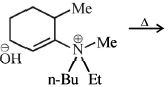
The alkene formed as a major product in the below elimination reaction is
A
$1-$methylcyclohexene
B
$3-$methylcyclohexene
C
$1-$butene
D
$CH_2=CH_2$
Solution
(D) The given reaction is a Hofmann elimination,which occurs when a quaternary ammonium salt is heated with a base like $OH^-$.
In Hofmann elimination,the base abstracts a proton from the $\beta$-carbon that is least sterically hindered,leading to the formation of the least substituted alkene as the major product.
In the provided substrate,the quaternary nitrogen is attached to a methyl group,an ethyl group,a $n$-butyl group,and a cyclohexenyl ring.
Comparing the $\beta$-hydrogens available:
$1$. $\beta_1$ on the ethyl group leads to $CH_2=CH_2$ (ethene).
$2$. $\beta_2$ on the $n$-butyl group leads to $CH_2=CHCH_2CH_3$ ($1$-butene).
$3$. $\beta_3$ and $\beta_4$ on the ring lead to cyclic alkenes.
According to the Hofmann rule,the least substituted alkene,which is $CH_2=CH_2$ (ethene),is formed as the major product because the ethyl group is the least sterically hindered group attached to the nitrogen.
In Hofmann elimination,the base abstracts a proton from the $\beta$-carbon that is least sterically hindered,leading to the formation of the least substituted alkene as the major product.
In the provided substrate,the quaternary nitrogen is attached to a methyl group,an ethyl group,a $n$-butyl group,and a cyclohexenyl ring.
Comparing the $\beta$-hydrogens available:
$1$. $\beta_1$ on the ethyl group leads to $CH_2=CH_2$ (ethene).
$2$. $\beta_2$ on the $n$-butyl group leads to $CH_2=CHCH_2CH_3$ ($1$-butene).
$3$. $\beta_3$ and $\beta_4$ on the ring lead to cyclic alkenes.
According to the Hofmann rule,the least substituted alkene,which is $CH_2=CH_2$ (ethene),is formed as the major product because the ethyl group is the least sterically hindered group attached to the nitrogen.
0 likesView Solution
29
ChemistryEasyMCQAIEEE · 2006
The increasing order of stability among the three main conformations (i.e.,Eclipse,Anti,Gauche) of $2-$fluoroethanol is:
A
Eclipse,Anti,Gauche
B
Anti,Gauche,Eclipse
C
Eclipse,Gauche,Anti
D
Gauche,Eclipse,Anti
Solution
(A) In $2-$fluoroethanol,the Gauche conformation is unexpectedly more stable than the Anti conformation due to the formation of an intramolecular hydrogen bond between the fluorine atom $(F^{\delta -})$ and the hydroxyl hydrogen atom $(H^{\delta +})$.
The Eclipse conformation is the least stable due to high torsional strain and steric repulsion.
Therefore,the increasing order of stability is: $Eclipse < Anti < Gauche$.
The Eclipse conformation is the least stable due to high torsional strain and steric repulsion.
Therefore,the increasing order of stability is: $Eclipse < Anti < Gauche$.
0 likesView Solution
30
ChemistryDifficultMCQAIEEE · 2006
Among the following mixtures,dipole-dipole as the major interaction is present in
A
$KCl$ and water
B
benzene and carbon tetrachloride
C
benzene and ethanol
D
acetonitrile and acetone
Solution
(D) Dipole-dipole interactions occur between polar molecules that possess permanent dipoles.
In this interaction,the positive end of one polar molecule is attracted to the negative end of another polar molecule.
$KCl$ and water involve ion-dipole interactions.
Benzene and carbon tetrachloride are non-polar,involving London dispersion forces.
Benzene and ethanol involve dipole-induced dipole interactions.
Acetonitrile $(CH_{3}CN)$ and acetone $(CH_{3})_{2}CO$ are both polar molecules,and therefore,the major interaction between them is dipole-dipole interaction.
In this interaction,the positive end of one polar molecule is attracted to the negative end of another polar molecule.
$KCl$ and water involve ion-dipole interactions.
Benzene and carbon tetrachloride are non-polar,involving London dispersion forces.
Benzene and ethanol involve dipole-induced dipole interactions.
Acetonitrile $(CH_{3}CN)$ and acetone $(CH_{3})_{2}CO$ are both polar molecules,and therefore,the major interaction between them is dipole-dipole interaction.
0 likesView Solution
31
ChemistryDifficultMCQAIEEE · 2006
Which of the following chemical reactions depicts the oxidizing behavior of $H_2SO_4$?
A
$NaCl + H_2SO_4 \rightarrow NaHSO_4 + HCl$
B
$2PCl_5 + H_2SO_4 \rightarrow 2POCl_3 + 2HCl + SO_2Cl_2$
C
$2HI + H_2SO_4 \rightarrow I_2 + SO_2 + 2H_2O$
D
$Ca(OH)_2 + H_2SO_4 \rightarrow CaSO_4 + 2H_2O$
Solution
(C) In the reaction $2HI + H_2SO_4 \rightarrow I_2 + SO_2 + 2H_2O$,the oxidation state of sulfur $(S)$ decreases from $+6$ in $H_2SO_4$ to $+4$ in $SO_2$,indicating reduction.
Simultaneously,the oxidation state of iodine $(I)$ increases from $-1$ in $HI$ to $0$ in $I_2$,indicating oxidation.
Since $H_2SO_4$ causes the oxidation of $HI$ while being reduced itself,it acts as an oxidizing agent.
Simultaneously,the oxidation state of iodine $(I)$ increases from $-1$ in $HI$ to $0$ in $I_2$,indicating oxidation.
Since $H_2SO_4$ causes the oxidation of $HI$ while being reduced itself,it acts as an oxidizing agent.
0 likesView Solution
32
ChemistryMediumMCQAIEEE · 2006
Which of the following statements is true?
A
$HClO_4$ is a weaker acid than $HClO_3$
B
$HNO_3$ is a stronger acid than $HNO_2$
C
$H_3PO_3$ is a stronger acid than $H_2SO_3$
D
In aqueous medium $HF$ is a stronger acid than $HCl$
Solution
(B) The acidity of oxoacids depends on the stability of their conjugate bases.
$HNO_3$ (nitric acid) forms the nitrate ion $(NO_3^-)$ as its conjugate base,which is stabilized by resonance.
$HNO_2$ (nitrous acid) forms the nitrite ion $(NO_2^-)$ as its conjugate base.
Since the conjugate base of $HNO_3$ is more resonance-stabilized than that of $HNO_2$,$HNO_3$ is a stronger acid than $HNO_2$.
Other options are incorrect because:
$HClO_4$ is a stronger acid than $HClO_3$ due to higher oxidation state of $Cl$.
$H_2SO_3$ is a stronger acid than $H_3PO_3$.
$HCl$ is a stronger acid than $HF$ in aqueous medium due to the high bond dissociation energy of $H-F$.
$HNO_3$ (nitric acid) forms the nitrate ion $(NO_3^-)$ as its conjugate base,which is stabilized by resonance.
$HNO_2$ (nitrous acid) forms the nitrite ion $(NO_2^-)$ as its conjugate base.
Since the conjugate base of $HNO_3$ is more resonance-stabilized than that of $HNO_2$,$HNO_3$ is a stronger acid than $HNO_2$.
Other options are incorrect because:
$HClO_4$ is a stronger acid than $HClO_3$ due to higher oxidation state of $Cl$.
$H_2SO_3$ is a stronger acid than $H_3PO_3$.
$HCl$ is a stronger acid than $HF$ in aqueous medium due to the high bond dissociation energy of $H-F$.
0 likesView Solution
33
ChemistryMediumMCQAIEEE · 2006
The increasing order of the first ionization enthalpies of the elements $B$,$P$,$S$ and $F$ (lowest first) is:
A
$B < S < P < F$
B
$B < P < S < F$
C
$F < S < P < B$
D
$P < S < B < F$
Solution
(A) The first ionization enthalpy generally increases across a period from left to right due to an increase in effective nuclear charge.
$B$ (Boron,group $13$) has the lowest ionization enthalpy among the given elements.
Comparing $P$ (Phosphorus,group $15$) and $S$ (Sulfur,group $16$),$P$ has a higher ionization enthalpy than $S$ because $P$ has a stable half-filled $p$-orbital configuration $(3s^2 3p^3)$.
$F$ (Fluorine,group $17$) has the highest ionization enthalpy due to its small size and high effective nuclear charge.
Thus,the order is $B < S < P < F$.
$B$ (Boron,group $13$) has the lowest ionization enthalpy among the given elements.
Comparing $P$ (Phosphorus,group $15$) and $S$ (Sulfur,group $16$),$P$ has a higher ionization enthalpy than $S$ because $P$ has a stable half-filled $p$-orbital configuration $(3s^2 3p^3)$.
$F$ (Fluorine,group $17$) has the highest ionization enthalpy due to its small size and high effective nuclear charge.
Thus,the order is $B < S < P < F$.
0 likesView Solution
34
ChemistryDifficultMCQAIEEE · 2006
What products are expected from the disproportionation reaction of hypochlorous acid?
A
$HCl$ and $Cl_2O$
B
$HCl$ and $HClO_3$
C
$HClO_3$ and $Cl_2O$
D
$HClO_2$ and $HClO_4$
Solution
(B) Hypochlorous acid $(HOCl)$ undergoes disproportionation reaction upon heating or standing.
The reaction is given by:
$3 HOCl \rightarrow 2 HCl + HClO_3$
In this reaction,the chlorine atom in $HOCl$ (oxidation state $+1$) is simultaneously oxidized to $HClO_3$ (oxidation state $+5$) and reduced to $HCl$ (oxidation state $-1$).
The reaction is given by:
$3 HOCl \rightarrow 2 HCl + HClO_3$
In this reaction,the chlorine atom in $HOCl$ (oxidation state $+1$) is simultaneously oxidized to $HClO_3$ (oxidation state $+5$) and reduced to $HCl$ (oxidation state $-1$).
0 likesView Solution
35
ChemistryMCQAIEEE · 2006
The $IUPAC$ name for the complex $[Co(NO_2)(NH_3)_5]Cl_2$ is:
A
pentaamminenitrito-$N$-cobalt$(II)$ chloride
B
pentaamminenitrito-$N$-cobalt$(III)$ chloride
C
nitrito-$N$-pentaamminecobalt$(III)$ chloride
D
nitrito-$N$-pentaamminecobalt$(II)$ chloride
Solution
(B) $1$. Identify the oxidation state of the central metal atom $Co$: Let the oxidation state be $x$. The complex is $[Co(NO_2)(NH_3)_5]Cl_2$. The charge on $NO_2^-$ is $-1$,$NH_3$ is $0$,and $Cl^-$ is $-1$. Thus,$x + (-1) + 5(0) + 2(-1) = 0$,which gives $x - 3 = 0$,so $x = +3$.
$2$. Name the ligands: There are $5$ ammonia ligands $(ammine)$ and $1$ nitro ligand $(nitrito-N)$.
$3$. Assemble the name: Ligands are named in alphabetical order: $ammine$ comes before $nitrito-N$. So,it is pentaammine.
$4$. Combine: The name is pentaamminenitrito-$N$-cobalt$(III)$ chloride.
$2$. Name the ligands: There are $5$ ammonia ligands $(ammine)$ and $1$ nitro ligand $(nitrito-N)$.
$3$. Assemble the name: Ligands are named in alphabetical order: $ammine$ comes before $nitrito-N$. So,it is pentaammine.
$4$. Combine: The name is pentaamminenitrito-$N$-cobalt$(III)$ chloride.
0 likesView Solution
36
ChemistryMediumMCQAIEEE · 2006
$A$ metal,$M$,forms chlorides in its $+2$ and $+4$ oxidation states. Which of the following statements about these chlorides is correct?
A
$MCl_2$ is more ionic than $MCl_4$
B
$MCl_2$ is more easily hydrolysed than $MCl_4$
C
$MCl_2$ is more volatile than $MCl_4$
D
$MCl_2$ is more soluble in anhydrous ethanol than $MCl_4$
Solution
(A) According to Fajan's rule,the covalent character of a compound increases with an increase in the oxidation state of the metal cation.
In the $+4$ oxidation state,the metal ion has a smaller size and a higher charge density,which leads to greater polarizing power.
Consequently,$MCl_4$ exhibits more covalent character,whereas $MCl_2$ exhibits more ionic character.
Therefore,$MCl_2$ is more ionic than $MCl_4$.
In the $+4$ oxidation state,the metal ion has a smaller size and a higher charge density,which leads to greater polarizing power.
Consequently,$MCl_4$ exhibits more covalent character,whereas $MCl_2$ exhibits more ionic character.
Therefore,$MCl_2$ is more ionic than $MCl_4$.
0 likesView Solution
37
ChemistryMCQAIEEE · 2006
In $Fe(CO)_5$,the $Fe-C$ bond possesses
A
ionic character
B
$\sigma$-character only
C
$\pi$-character
D
both $\sigma$ and $\pi$ characters
Solution
(D) In $Fe(CO)_5$,the $Fe-C$ bond is formed by the donation of a lone pair of electrons from the $CO$ ligand into the empty $d$-orbitals of the $Fe$ atom,which creates a $\sigma$-bond.
Additionally,there is back-bonding where electrons from the filled $d$-orbitals of the $Fe$ atom are donated into the empty antibonding $\pi^*$-orbitals of the $CO$ ligand,which creates a $\pi$-bond.
Therefore,the $Fe-C$ bond possesses both $\sigma$ and $\pi$ characters.
Additionally,there is back-bonding where electrons from the filled $d$-orbitals of the $Fe$ atom are donated into the empty antibonding $\pi^*$-orbitals of the $CO$ ligand,which creates a $\pi$-bond.
Therefore,the $Fe-C$ bond possesses both $\sigma$ and $\pi$ characters.
0 likesView Solution
38
ChemistryMCQAIEEE · 2006
The time taken by a photoelectron to come out after the photon strikes is approximately
A
$10^{-1} \ s$
B
$10^{-4} \ s$
C
$10^{-10} \ s$
D
$10^{-16} \ s$
Solution
(C) The photoelectric effect is an instantaneous process. Experimental observations confirm that there is no measurable time lag between the incidence of a photon and the emission of a photoelectron. The time taken for this process is approximately of the order of $10^{-10} \ s$.
0 likesView Solution
39
ChemistryMCQAIEEE · 2006
The flux linked with a coil at any instant $t$ is given by $\phi = 10t^2 - 50t + 250$. The induced emf at $t = 3 \ s$ is ....... $V$.
A
$10$
B
$190$
C
$-10$
D
$-190$
Solution
(C) The magnetic flux linked with the coil is given by $\phi = 10t^2 - 50t + 250$.
According to Faraday's law of electromagnetic induction,the induced emf $e$ is given by $e = -\frac{d\phi}{dt}$.
Differentiating $\phi$ with respect to $t$:
$\frac{d\phi}{dt} = \frac{d}{dt}(10t^2 - 50t + 250) = 20t - 50$.
Therefore,$e = -(20t - 50) = 50 - 20t$.
At $t = 3 \ s$,the induced emf is:
$e = 50 - 20(3) = 50 - 60 = -10 \ V$.
According to Faraday's law of electromagnetic induction,the induced emf $e$ is given by $e = -\frac{d\phi}{dt}$.
Differentiating $\phi$ with respect to $t$:
$\frac{d\phi}{dt} = \frac{d}{dt}(10t^2 - 50t + 250) = 20t - 50$.
Therefore,$e = -(20t - 50) = 50 - 20t$.
At $t = 3 \ s$,the induced emf is:
$e = 50 - 20(3) = 50 - 60 = -10 \ V$.
0 likesView Solution
40
ChemistryMCQAIEEE · 2006
Two rigid boxes containing different ideal gases are placed on a table. Box $A$ contains one mole of nitrogen at temperature $T_0$,while box $B$ contains one mole of helium at temperature $(7/3) T_0$. The boxes are then put into thermal contact with each other,and heat flows between them until the gases reach a common final temperature (Ignore the heat capacity of boxes). Then,the final temperature of gases,$T_f$,in terms of $T_0$ is
A
$T_f = \frac{3}{7} T_0$
B
$T_f = \frac{7}{3} T_0$
C
$T_f = \frac{3}{2} T_0$
D
$T_f = \frac{5}{2} T_0$
Solution
(C) Since the boxes are rigid and thermally isolated from the surroundings,the heat lost by the hotter gas (helium) equals the heat gained by the colder gas (nitrogen).
For helium (monatomic gas),the molar heat capacity at constant volume is $C_{V,He} = \frac{3R}{2}$.
For nitrogen (diatomic gas),the molar heat capacity at constant volume is $C_{V,N_2} = \frac{5R}{2}$.
Let $T_f$ be the final equilibrium temperature.
Heat lost by helium = Heat gained by nitrogen
$n_{He} C_{V,He} (T_{initial,He} - T_f) = n_{N_2} C_{V,N_2} (T_f - T_{initial,N_2})$
$1 \times \frac{3R}{2} \times (\frac{7}{3} T_0 - T_f) = 1 \times \frac{5R}{2} \times (T_f - T_0)$
Canceling $\frac{R}{2}$ from both sides:
$3(\frac{7}{3} T_0 - T_f) = 5(T_f - T_0)$
$7 T_0 - 3 T_f = 5 T_f - 5 T_0$
$12 T_0 = 8 T_f$
$T_f = \frac{12}{8} T_0 = \frac{3}{2} T_0$
For helium (monatomic gas),the molar heat capacity at constant volume is $C_{V,He} = \frac{3R}{2}$.
For nitrogen (diatomic gas),the molar heat capacity at constant volume is $C_{V,N_2} = \frac{5R}{2}$.
Let $T_f$ be the final equilibrium temperature.
Heat lost by helium = Heat gained by nitrogen
$n_{He} C_{V,He} (T_{initial,He} - T_f) = n_{N_2} C_{V,N_2} (T_f - T_{initial,N_2})$
$1 \times \frac{3R}{2} \times (\frac{7}{3} T_0 - T_f) = 1 \times \frac{5R}{2} \times (T_f - T_0)$
Canceling $\frac{R}{2}$ from both sides:
$3(\frac{7}{3} T_0 - T_f) = 5(T_f - T_0)$
$7 T_0 - 3 T_f = 5 T_f - 5 T_0$
$12 T_0 = 8 T_f$
$T_f = \frac{12}{8} T_0 = \frac{3}{2} T_0$
0 likesView Solution
41
ChemistryMCQAIEEE · 2006
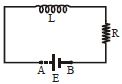
An inductor $(L = 100 \, mH)$,a resistor $(R = 100 \, \Omega)$,and a battery $(E = 100 \, V)$ are initially connected in series as shown in the figure. After a long time,the battery is disconnected by short-circuiting the points $A$ and $B$. The current in the circuit $1 \, ms$ after the short circuit is:
A
$\frac{1}{e} \, A$
B
$e \, A$
C
$0.1 \, A$
D
$1 \, A$
Solution
(A) When the circuit is connected for a long time,the inductor acts as a short circuit (ideal inductor). The steady-state current $I_0$ is given by $I_0 = \frac{E}{R} = \frac{100 \, V}{100 \, \Omega} = 1 \, A$.
When the battery is disconnected and points $A$ and $B$ are short-circuited,the circuit becomes an $LR$ decay circuit. The current at time $t$ is given by $I(t) = I_0 e^{-t/\tau}$,where $\tau$ is the time constant.
The time constant $\tau = \frac{L}{R} = \frac{100 \times 10^{-3} \, H}{100 \, \Omega} = 10^{-3} \, s = 1 \, ms$.
Given $t = 1 \, ms = 10^{-3} \, s$,the current is $I = 1 \times e^{-(10^{-3})/(10^{-3})} = 1 \times e^{-1} = \frac{1}{e} \, A$.
When the battery is disconnected and points $A$ and $B$ are short-circuited,the circuit becomes an $LR$ decay circuit. The current at time $t$ is given by $I(t) = I_0 e^{-t/\tau}$,where $\tau$ is the time constant.
The time constant $\tau = \frac{L}{R} = \frac{100 \times 10^{-3} \, H}{100 \, \Omega} = 10^{-3} \, s = 1 \, ms$.
Given $t = 1 \, ms = 10^{-3} \, s$,the current is $I = 1 \times e^{-(10^{-3})/(10^{-3})} = 1 \times e^{-1} = \frac{1}{e} \, A$.
0 likesView Solution
42
ChemistryMCQAIEEE · 2006
Assuming the sun to be a spherical body of radius $R$ at a temperature of $T \ K$,evaluate the total radiant power incident on the earth at a distance $r$ from the sun. (Where $r_0$ is the radius of the earth and $\sigma$ is Stefan's constant.)
A
$\frac{R^2 \sigma T^4}{r^2}$
B
$\frac{4 \pi r_0^2 R^2 \sigma T^4}{r^2}$
C
$\frac{\pi r_0^2 R^2 \sigma T^4}{r^2}$
D
$\frac{r_0^2 R^2 \sigma T^4}{4 \pi r^2}$
Solution
(C) The total power radiated by the sun is given by the Stefan-Boltzmann law: $P = \sigma T^4 (4 \pi R^2)$.
This energy spreads out over a spherical surface of radius $r$ as it travels from the sun to the earth. The intensity $I$ (power per unit area) at a distance $r$ from the sun is given by: $I = \frac{P}{4 \pi r^2} = \frac{\sigma T^4 (4 \pi R^2)}{4 \pi r^2} = \frac{\sigma R^2 T^4}{r^2}$.
The earth acts as a disc of radius $r_0$ intercepting this radiation. The area of this disc is $A = \pi r_0^2$.
Therefore,the total radiant power incident on the earth is $Q = I \times A = \left( \frac{\sigma R^2 T^4}{r^2} \right) \times (\pi r_0^2) = \frac{\pi r_0^2 R^2 \sigma T^4}{r^2}$.
This energy spreads out over a spherical surface of radius $r$ as it travels from the sun to the earth. The intensity $I$ (power per unit area) at a distance $r$ from the sun is given by: $I = \frac{P}{4 \pi r^2} = \frac{\sigma T^4 (4 \pi R^2)}{4 \pi r^2} = \frac{\sigma R^2 T^4}{r^2}$.
The earth acts as a disc of radius $r_0$ intercepting this radiation. The area of this disc is $A = \pi r_0^2$.
Therefore,the total radiant power incident on the earth is $Q = I \times A = \left( \frac{\sigma R^2 T^4}{r^2} \right) \times (\pi r_0^2) = \frac{\pi r_0^2 R^2 \sigma T^4}{r^2}$.
0 likesView Solution
43
ChemistryMCQAIEEE · 2006
The work of $146 \, kJ$ is performed in order to compress one kilo mole of a gas adiabatically,and in this process,the temperature of the gas increases by $7 \, ^oC$. The gas is $(R = 8.3 \, J \, mol^{-1} \, K^{-1})$.
A
diatomic
B
triatomic
C
a mixture of monoatomic and diatomic
D
monoatomic
Solution
(A) For an adiabatic process,the work done on the gas is given by $W = \frac{nR \Delta T}{\gamma - 1}$.
Given: $W = 146 \, kJ = 146 \times 10^3 \, J$,$n = 1 \, kmol = 10^3 \, mol$,$\Delta T = 7 \, K$,and $R = 8.3 \, J \, mol^{-1} \, K^{-1}$.
Substituting the values into the formula:
$146 \times 10^3 = \frac{10^3 \times 8.3 \times 7}{\gamma - 1}$
$146 = \frac{58.1}{\gamma - 1}$
$\gamma - 1 = \frac{58.1}{146} \approx 0.3979 \approx 0.4$
$\gamma = 1 + 0.4 = 1.4$.
Since $\gamma = 1.4$ for a diatomic gas,the gas is diatomic.
Given: $W = 146 \, kJ = 146 \times 10^3 \, J$,$n = 1 \, kmol = 10^3 \, mol$,$\Delta T = 7 \, K$,and $R = 8.3 \, J \, mol^{-1} \, K^{-1}$.
Substituting the values into the formula:
$146 \times 10^3 = \frac{10^3 \times 8.3 \times 7}{\gamma - 1}$
$146 = \frac{58.1}{\gamma - 1}$
$\gamma - 1 = \frac{58.1}{146} \approx 0.3979 \approx 0.4$
$\gamma = 1 + 0.4 = 1.4$.
Since $\gamma = 1.4$ for a diatomic gas,the gas is diatomic.
0 likesView Solution
44
ChemistryMCQAIEEE · 2006
Two spherical conductors $A$ and $B$ of radii $1 \ mm$ and $2 \ mm$ are separated by a distance of $5 \ cm$ and are uniformly charged. If the spheres are connected by a conducting wire,then in the equilibrium condition,the ratio of the magnitude of the electric fields at the surfaces of spheres $A$ and $B$ is-
A
$4 : 1$
B
$1 : 2$
C
$2 : 1$
D
$1 : 4$
Solution
(C) When two conductors are connected by a conducting wire,charge flows until their potentials become equal,i.e.,$V_1 = V_2$.
Since the potential of a spherical conductor is given by $V = K \frac{Q}{r}$,we have $K \frac{Q_1}{r_1} = K \frac{Q_2}{r_2}$,which implies $\frac{Q_1}{r_1} = \frac{Q_2}{r_2}$ or $\frac{Q_1}{Q_2} = \frac{r_1}{r_2}$.
The electric field at the surface of a spherical conductor is $E = K \frac{Q}{r^2}$.
Therefore,the ratio of the electric fields is $\frac{E_1}{E_2} = \frac{K Q_1 / r_1^2}{K Q_2 / r_2^2} = \frac{Q_1}{Q_2} \times \frac{r_2^2}{r_1^2}$.
Substituting $\frac{Q_1}{Q_2} = \frac{r_1}{r_2}$,we get $\frac{E_1}{E_2} = \frac{r_1}{r_2} \times \frac{r_2^2}{r_1^2} = \frac{r_2}{r_1}$.
Given $r_1 = 1 \ mm$ and $r_2 = 2 \ mm$,the ratio is $\frac{E_1}{E_2} = \frac{2}{1} = 2 : 1$.
Since the potential of a spherical conductor is given by $V = K \frac{Q}{r}$,we have $K \frac{Q_1}{r_1} = K \frac{Q_2}{r_2}$,which implies $\frac{Q_1}{r_1} = \frac{Q_2}{r_2}$ or $\frac{Q_1}{Q_2} = \frac{r_1}{r_2}$.
The electric field at the surface of a spherical conductor is $E = K \frac{Q}{r^2}$.
Therefore,the ratio of the electric fields is $\frac{E_1}{E_2} = \frac{K Q_1 / r_1^2}{K Q_2 / r_2^2} = \frac{Q_1}{Q_2} \times \frac{r_2^2}{r_1^2}$.
Substituting $\frac{Q_1}{Q_2} = \frac{r_1}{r_2}$,we get $\frac{E_1}{E_2} = \frac{r_1}{r_2} \times \frac{r_2^2}{r_1^2} = \frac{r_2}{r_1}$.
Given $r_1 = 1 \ mm$ and $r_2 = 2 \ mm$,the ratio is $\frac{E_1}{E_2} = \frac{2}{1} = 2 : 1$.
0 likesView Solution
45
ChemistryMCQAIEEE · 2006
Needles $N_1, N_2$ and $N_3$ are made of a ferromagnetic,a paramagnetic and a diamagnetic substance respectively. $A$ magnet when brought close to them will
A
Attract $N_1$ strongly,$N_2$ weakly and repel $N_3$ weakly.
B
Attract $N_1$ strongly,but repel $N_2$ and $N_3$ weakly.
C
Attract all three of them.
D
Attract $N_1$ and $N_2$ strongly.
Solution
(A) Ferromagnetic materials (like $N_1$) are strongly attracted by a magnet.
Paramagnetic materials (like $N_2$) are weakly attracted by a magnet.
Diamagnetic materials (like $N_3$) are weakly repelled by a magnet.
Therefore,when a magnet is brought close to them,it will attract $N_1$ strongly,$N_2$ weakly,and repel $N_3$ weakly.
Paramagnetic materials (like $N_2$) are weakly attracted by a magnet.
Diamagnetic materials (like $N_3$) are weakly repelled by a magnet.
Therefore,when a magnet is brought close to them,it will attract $N_1$ strongly,$N_2$ weakly,and repel $N_3$ weakly.
0 likesView Solution
46
ChemistryMCQAIEEE · 2006
Two rigid boxes containing different ideal gases are placed on a table. Box $A$ contains one mole of nitrogen at temperature $T_0$,while box $B$ contains one mole of helium at temperature $(7/3) T_0$. The boxes are then put into thermal contact with each other,and heat flows between them until the gases reach a common final temperature (ignore the heat capacity of the boxes). The final temperature of the gases $T_f$ in terms of $T_0$ is:
A
$T_f = \frac{3}{7} T_0$
B
$T_f = \frac{7}{3} T_0$
C
$T_f = \frac{3}{2} T_0$
D
$T_f = \frac{5}{2} T_0$
Solution
(C) Since the boxes are in thermal contact and isolated from the surroundings,the heat lost by one gas equals the heat gained by the other.
$\Delta Q_A + \Delta Q_B = 0$
$\Delta U_A + \Delta U_B = 0$
$n_A C_{vA} (T_f - T_A) + n_B C_{vB} (T_f - T_B) = 0$
For nitrogen (diatomic),$C_{vA} = \frac{5}{2} R$. For helium (monatomic),$C_{vB} = \frac{3}{2} R$.
Given $n_A = 1, n_B = 1, T_A = T_0, T_B = \frac{7}{3} T_0$.
$1 \times \frac{5}{2} R (T_f - T_0) + 1 \times \frac{3}{2} R (T_f - \frac{7}{3} T_0) = 0$
Dividing by $\frac{1}{2} R$:
$5(T_f - T_0) + 3(T_f - \frac{7}{3} T_0) = 0$
$5 T_f - 5 T_0 + 3 T_f - 7 T_0 = 0$
$8 T_f = 12 T_0$
$T_f = \frac{12}{8} T_0 = \frac{3}{2} T_0$
$\Delta Q_A + \Delta Q_B = 0$
$\Delta U_A + \Delta U_B = 0$
$n_A C_{vA} (T_f - T_A) + n_B C_{vB} (T_f - T_B) = 0$
For nitrogen (diatomic),$C_{vA} = \frac{5}{2} R$. For helium (monatomic),$C_{vB} = \frac{3}{2} R$.
Given $n_A = 1, n_B = 1, T_A = T_0, T_B = \frac{7}{3} T_0$.
$1 \times \frac{5}{2} R (T_f - T_0) + 1 \times \frac{3}{2} R (T_f - \frac{7}{3} T_0) = 0$
Dividing by $\frac{1}{2} R$:
$5(T_f - T_0) + 3(T_f - \frac{7}{3} T_0) = 0$
$5 T_f - 5 T_0 + 3 T_f - 7 T_0 = 0$
$8 T_f = 12 T_0$
$T_f = \frac{12}{8} T_0 = \frac{3}{2} T_0$
0 likesView Solution
47
ChemistryMCQAIEEE · 2006
In a series resonant $LCR$ circuit,the voltage across $R$ is $100\,V$ and $R = 1\,k\Omega$ with $C = 2\,\mu F$. The resonant frequency $\omega$ is $200\,rad/s$. At resonance,the voltage across $L$ is:
A
$40\,V$
B
$250\,V$
C
$4 \times 10^{-3}\,V$
D
$2.5 \times 10^{-2}\,V$
Solution
(B) In a series $LCR$ circuit at resonance,the inductive reactance $X_L$ equals the capacitive reactance $X_C$,i.e.,$X_L = X_C = \frac{1}{\omega C}$.
The current $I$ in the circuit is given by $I = \frac{V_R}{R}$.
Given $V_R = 100\,V$ and $R = 1\,k\Omega = 1000\,\Omega$,we have $I = \frac{100}{1000} = 0.1\,A$.
At resonance,the voltage across the inductor $V_L$ is given by $V_L = I \times X_L$.
Since $X_L = X_C = \frac{1}{\omega C}$,we have $V_L = I \times \frac{1}{\omega C}$.
Substituting the given values: $V_L = 0.1 \times \frac{1}{200 \times 2 \times 10^{-6}}$.
$V_L = 0.1 \times \frac{1}{400 \times 10^{-6}} = 0.1 \times \frac{10^6}{400} = 0.1 \times 2500 = 250\,V$.
Thus,the voltage across $L$ is $250\,V$.
The current $I$ in the circuit is given by $I = \frac{V_R}{R}$.
Given $V_R = 100\,V$ and $R = 1\,k\Omega = 1000\,\Omega$,we have $I = \frac{100}{1000} = 0.1\,A$.
At resonance,the voltage across the inductor $V_L$ is given by $V_L = I \times X_L$.
Since $X_L = X_C = \frac{1}{\omega C}$,we have $V_L = I \times \frac{1}{\omega C}$.
Substituting the given values: $V_L = 0.1 \times \frac{1}{200 \times 2 \times 10^{-6}}$.
$V_L = 0.1 \times \frac{1}{400 \times 10^{-6}} = 0.1 \times \frac{10^6}{400} = 0.1 \times 2500 = 250\,V$.
Thus,the voltage across $L$ is $250\,V$.
0 likesView Solution
48
ChemistryMCQAIEEE · 2006
Needles $N_1, N_2$ and $N_3$ are made of a ferromagnetic,a paramagnetic and a diamagnetic substance respectively. $A$ magnet when brought close to them will
A
Attract $N_1$ strongly,$N_2$ weakly and repel $N_3$ weakly
B
Attract $N_1$ strongly,but repel $N_2$ and $N_3$ weakly
C
Attract all three of them
D
Attract $N_1$ and $N_2$
Solution
(A) Ferromagnetic substances are strongly magnetized in the direction of the external magnetic field,leading to a strong attraction.
Paramagnetic substances are weakly magnetized in the direction of the external magnetic field,leading to a weak attraction.
Diamagnetic substances are weakly magnetized in the direction opposite to the external magnetic field,leading to a weak repulsion.
Therefore,when a magnet is brought close to these needles,it will attract $N_1$ strongly,attract $N_2$ weakly,and repel $N_3$ weakly.
Paramagnetic substances are weakly magnetized in the direction of the external magnetic field,leading to a weak attraction.
Diamagnetic substances are weakly magnetized in the direction opposite to the external magnetic field,leading to a weak repulsion.
Therefore,when a magnet is brought close to these needles,it will attract $N_1$ strongly,attract $N_2$ weakly,and repel $N_3$ weakly.
0 likesView Solution
49
ChemistryMCQAIEEE · 2006
If the terminal speed of a sphere of gold (density $= 19.5 \times 10^3\, kg/m^3$) is $0.2\, m/s$ in a viscous liquid (density $= 1.5 \times 10^3\, kg/m^3$),find the terminal speed of a sphere of silver (density $= 10.5 \times 10^3\, kg/m^3$) of the same size in the same liquid.
A
$0.4$
B
$0.133$
C
$0.1$
D
$0.2$
Solution
(C) The formula for terminal velocity $v$ is given by $v = \frac{2}{9 \eta} r^2 g (\rho - \sigma)$,where $r$ is the radius of the sphere,$\rho$ is the density of the sphere,$\sigma$ is the density of the liquid,and $\eta$ is the coefficient of viscosity.
Since $r$,$g$,and $\eta$ are constant for both spheres in the same liquid,we have $v \propto (\rho - \sigma)$.
For the gold sphere: $v_g = k (\rho_g - \sigma)$,where $k = \frac{2 r^2 g}{9 \eta}$.
$0.2 = k (19.5 \times 10^3 - 1.5 \times 10^3) = k (18 \times 10^3)$.
For the silver sphere: $v_s = k (\rho_s - \sigma) = k (10.5 \times 10^3 - 1.5 \times 10^3) = k (9 \times 10^3)$.
Taking the ratio: $\frac{v_s}{v_g} = \frac{9 \times 10^3}{18 \times 10^3} = \frac{1}{2}$.
Therefore,$v_s = \frac{v_g}{2} = \frac{0.2}{2} = 0.1\, m/s$.
Since $r$,$g$,and $\eta$ are constant for both spheres in the same liquid,we have $v \propto (\rho - \sigma)$.
For the gold sphere: $v_g = k (\rho_g - \sigma)$,where $k = \frac{2 r^2 g}{9 \eta}$.
$0.2 = k (19.5 \times 10^3 - 1.5 \times 10^3) = k (18 \times 10^3)$.
For the silver sphere: $v_s = k (\rho_s - \sigma) = k (10.5 \times 10^3 - 1.5 \times 10^3) = k (9 \times 10^3)$.
Taking the ratio: $\frac{v_s}{v_g} = \frac{9 \times 10^3}{18 \times 10^3} = \frac{1}{2}$.
Therefore,$v_s = \frac{v_g}{2} = \frac{0.2}{2} = 0.1\, m/s$.
0 likesView Solution
50
ChemistryMCQAIEEE · 2006
If the terminal speed of a sphere of gold (density $= 19.5 \times 10^3 \, kg/m^3$) is $0.2 \, m/s$ in a viscous liquid (density $= 1.5 \times 10^3 \, kg/m^3$),find the terminal speed of a sphere of silver (density $= 10.5 \times 10^3 \, kg/m^3$) of the same size in the same liquid.
A
$0.4$
B
$0.133$
C
$0.1$
D
$0.2$
Solution
(C) The terminal velocity $V_T$ of a sphere of radius $r$ and density $\rho$ falling through a liquid of density $\sigma$ and viscosity $\eta$ is given by: $V_T = \frac{2r^2}{9\eta}(\rho - \sigma)g$.
Since $r$,$\eta$,and $\sigma$ are the same for both spheres,$V_T \propto (\rho - \sigma)$.
Let $V_{Au}$ and $V_{Ag}$ be the terminal velocities of gold and silver spheres respectively.
$\frac{V_{Ag}}{V_{Au}} = \frac{\rho_{Ag} - \sigma}{\rho_{Au} - \sigma}$.
Given: $\rho_{Au} = 19.5 \times 10^3 \, kg/m^3$,$\rho_{Ag} = 10.5 \times 10^3 \, kg/m^3$,$\sigma = 1.5 \times 10^3 \, kg/m^3$,and $V_{Au} = 0.2 \, m/s$.
$V_{Ag} = 0.2 \times \frac{10.5 - 1.5}{19.5 - 1.5} = 0.2 \times \frac{9}{18} = 0.2 \times 0.5 = 0.1 \, m/s$.
Since $r$,$\eta$,and $\sigma$ are the same for both spheres,$V_T \propto (\rho - \sigma)$.
Let $V_{Au}$ and $V_{Ag}$ be the terminal velocities of gold and silver spheres respectively.
$\frac{V_{Ag}}{V_{Au}} = \frac{\rho_{Ag} - \sigma}{\rho_{Au} - \sigma}$.
Given: $\rho_{Au} = 19.5 \times 10^3 \, kg/m^3$,$\rho_{Ag} = 10.5 \times 10^3 \, kg/m^3$,$\sigma = 1.5 \times 10^3 \, kg/m^3$,and $V_{Au} = 0.2 \, m/s$.
$V_{Ag} = 0.2 \times \frac{10.5 - 1.5}{19.5 - 1.5} = 0.2 \times \frac{9}{18} = 0.2 \times 0.5 = 0.1 \, m/s$.
0 likesView Solution
51
ChemistryDifficultMCQAIEEE · 2006
Density of a $2.05 \ M$ solution of acetic acid in water is $1.02 \ g/mL$. The molality of the solution is ............. $mol \ kg^{-1}$.
A
$2.28$
B
$0.44$
C
$1.14$
D
$3.28$
Solution
(A) Given: Molarity $(M) = 2.05 \ M$,Density $(d) = 1.02 \ g/mL$,Molar mass of acetic acid $(CH_3COOH) = 60 \ g/mol$.
Molality $(m)$ is calculated using the formula: $m = \frac{1000 \times M}{1000 \times d - M \times M_{solute}}$.
Substituting the values: $m = \frac{1000 \times 2.05}{1000 \times 1.02 - 2.05 \times 60}$.
$m = \frac{2050}{1020 - 123} = \frac{2050}{897} \approx 2.28 \ mol \ kg^{-1}$.
Molality $(m)$ is calculated using the formula: $m = \frac{1000 \times M}{1000 \times d - M \times M_{solute}}$.
Substituting the values: $m = \frac{1000 \times 2.05}{1000 \times 1.02 - 2.05 \times 60}$.
$m = \frac{2050}{1020 - 123} = \frac{2050}{897} \approx 2.28 \ mol \ kg^{-1}$.
0 likesView Solution
52
ChemistryMediumMCQAIEEE · 2006
The decreasing values of bond angles from $NH_3$ $(106^o)$ to $SbH_3$ $(101^o)$ down group-$15$ of the periodic table is due to
A
decreasing $lp-bp$ repulsion
B
decreasing electronegativity
C
increasing $bp-bp$ repulsion
D
increasing $p-$orbital character in $sp^3$
Solution
(B) As we move down group-$15$,the electronegativity of the central atom decreases.
Due to the decrease in electronegativity,the bond pairs of electrons move farther away from the central atom.
This results in a decrease in the $bp-bp$ (bond pair-bond pair) repulsion.
Consequently,the bond angle decreases from $NH_3$ to $SbH_3$.
Due to the decrease in electronegativity,the bond pairs of electrons move farther away from the central atom.
This results in a decrease in the $bp-bp$ (bond pair-bond pair) repulsion.
Consequently,the bond angle decreases from $NH_3$ to $SbH_3$.
0 likesView Solution
53
ChemistryDifficultMCQAIEEE · 2006
Given the data at $25\, ^oC$:
$Ag + I^{-} \rightarrow AgI + e^-$,$E^o = 0.152\, V$
$Ag \rightarrow Ag^{+} + e^-$,$E^o = -0.800\, V$
What is the value of $\log K_{sp}$ for $AgI$? $(2.303\, RT/F = 0.059\, V)$
$Ag + I^{-} \rightarrow AgI + e^-$,$E^o = 0.152\, V$
$Ag \rightarrow Ag^{+} + e^-$,$E^o = -0.800\, V$
What is the value of $\log K_{sp}$ for $AgI$? $(2.303\, RT/F = 0.059\, V)$
A
$-37.83$
B
$-16.13$
C
$-8.12$
D
$+8.612$
Solution
(B) The cell reactions are:
$(I) \ Ag \rightarrow Ag^{+} + e^-$,$E^o = -0.800\, V$
$(II) \ Ag + I^{-} \rightarrow AgI + e^-$,$E^o = 0.152\, V$
Subtracting $(I)$ from $(II)$ gives the reaction for the solubility product:
$AgI \rightarrow Ag^{+} + I^{-}$
$E^o_{cell} = E^o_{(II)} - E^o_{(I)} = 0.152 - (-0.800) = -0.952\, V$
Using the relation $E^o_{cell} = \frac{0.059}{n} \log K_{sp}$ at $25\, ^oC$:
$-0.952 = \frac{0.059}{1} \log K_{sp}$
$\log K_{sp} = -\frac{0.952}{0.059} = -16.135 \approx -16.13$
$(I) \ Ag \rightarrow Ag^{+} + e^-$,$E^o = -0.800\, V$
$(II) \ Ag + I^{-} \rightarrow AgI + e^-$,$E^o = 0.152\, V$
Subtracting $(I)$ from $(II)$ gives the reaction for the solubility product:
$AgI \rightarrow Ag^{+} + I^{-}$
$E^o_{cell} = E^o_{(II)} - E^o_{(I)} = 0.152 - (-0.800) = -0.952\, V$
Using the relation $E^o_{cell} = \frac{0.059}{n} \log K_{sp}$ at $25\, ^oC$:
$-0.952 = \frac{0.059}{1} \log K_{sp}$
$\log K_{sp} = -\frac{0.952}{0.059} = -16.135 \approx -16.13$
0 likesView Solution
54
ChemistryDifficultMCQAIEEE · 2006
$CH_3Br + Nu^{-} \rightarrow CH_3-Nu + Br^{-}$
The decreasing order of the rate of the above reaction with nucleophiles $(Nu^{-})$ $A$ to $D$ is
$[Nu^{-} = (A) \, PhO^{-}, (B) \, AcO^{-}, (C) \, HO^{-}, (D) \, CH_3O^{-}]$
The decreasing order of the rate of the above reaction with nucleophiles $(Nu^{-})$ $A$ to $D$ is
$[Nu^{-} = (A) \, PhO^{-}, (B) \, AcO^{-}, (C) \, HO^{-}, (D) \, CH_3O^{-}]$
A
$A > B > C > D$
B
$B > D > C > A$
C
$D > C > A > B$
D
$D > C > B > A$
Solution
(C) The rate of the $S_N2$ reaction is directly proportional to the nucleophilicity of the attacking nucleophile.
Nucleophilicity is inversely related to the strength of the corresponding conjugate acid.
The order of acidity of the conjugate acids is: $CH_3COOH (AcOH) > C_6H_5OH (PhOH) > H_2O > CH_3OH$.
Therefore,the order of basicity (nucleophilicity) is the reverse: $CH_3COO^{-} < C_6H_5O^{-} < HO^{-} < CH_3O^{-}$.
Thus,the decreasing order of the rate of reaction is: $D > C > A > B$.
Nucleophilicity is inversely related to the strength of the corresponding conjugate acid.
The order of acidity of the conjugate acids is: $CH_3COOH (AcOH) > C_6H_5OH (PhOH) > H_2O > CH_3OH$.
Therefore,the order of basicity (nucleophilicity) is the reverse: $CH_3COO^{-} < C_6H_5O^{-} < HO^{-} < CH_3O^{-}$.
Thus,the decreasing order of the rate of reaction is: $D > C > A > B$.
0 likesView Solution
55
ChemistryMediumMCQAIEEE · 2006
Total volume of atoms present in a face-centred cubic unit cell of a metal is ($r$ is atomic radius)
A
$\frac{12}{3} \pi r^3$
B
$\frac{16}{3} \pi r^3$
C
$\frac{20}{3} \pi r^3$
D
$\frac{24}{3} \pi r^3$
Solution
(B) face-centred cubic $(FCC)$ unit cell contains $4$ atoms per unit cell.
The volume of a single atom is given by the formula $V = \frac{4}{3} \pi r^3$.
Therefore,the total volume of atoms in the unit cell is $4 \times \frac{4}{3} \pi r^3 = \frac{16}{3} \pi r^3$.
The volume of a single atom is given by the formula $V = \frac{4}{3} \pi r^3$.
Therefore,the total volume of atoms in the unit cell is $4 \times \frac{4}{3} \pi r^3 = \frac{16}{3} \pi r^3$.
0 likesView Solution
56
ChemistryMediumMCQAIEEE · 2006
In Langmuir's model of adsorption of a gas on a solid surface:
A
the mass of gas striking a given area of surface is proportional to the pressure of the gas
B
the mass of gas striking a given area of surface is independent of the pressure of the gas
C
the rate of dissociation of adsorbed molecules from the surface does not depend on the surface covered
D
the adsorption at a single site on the surface may involve multiple molecules at the same time
Solution
(A) According to Langmuir's model of adsorption,the rate of adsorption is proportional to the pressure of the gas $(p)$ and the number of vacant sites on the surface.
The mass of gas striking a given area of surface is directly proportional to the pressure of the gas $(p)$ because the frequency of molecular collisions with the surface increases linearly with pressure.
Therefore,the correct statement is that the mass of gas striking a given area of surface is proportional to the pressure of the gas.
The mass of gas striking a given area of surface is directly proportional to the pressure of the gas $(p)$ because the frequency of molecular collisions with the surface increases linearly with pressure.
Therefore,the correct statement is that the mass of gas striking a given area of surface is proportional to the pressure of the gas.
0 likesView Solution
57
ChemistryMediumMCQAIEEE · 2006
$18 \ g$ of glucose $(C_6H_{12}O_6)$ is added to $178.2 \ g$ of water. The vapour pressure of water for this aqueous solution at $100^\circ C$ is ........ $Torr$.
A
$76.00$
B
$752.40$
C
$759.00$
D
$7.60$
Solution
(B) Moles of glucose $(n_{glucose}) = \frac{18 \ g}{180 \ g/mol} = 0.1 \ mol$.
Moles of water $(n_{water}) = \frac{178.2 \ g}{18 \ g/mol} = 9.9 \ mol$.
Mole fraction of water $(\chi_{water}) = \frac{n_{water}}{n_{water} + n_{glucose}} = \frac{9.9}{9.9 + 0.1} = \frac{9.9}{10} = 0.99$.
The vapour pressure of pure water at $100^\circ C$ is $760 \ Torr$.
According to Raoult's law,the vapour pressure of the solution $(P_{sol}) = \chi_{water} \times P^\circ_{water}$.
$P_{sol} = 0.99 \times 760 \ Torr = 752.4 \ Torr$.
Moles of water $(n_{water}) = \frac{178.2 \ g}{18 \ g/mol} = 9.9 \ mol$.
Mole fraction of water $(\chi_{water}) = \frac{n_{water}}{n_{water} + n_{glucose}} = \frac{9.9}{9.9 + 0.1} = \frac{9.9}{10} = 0.99$.
The vapour pressure of pure water at $100^\circ C$ is $760 \ Torr$.
According to Raoult's law,the vapour pressure of the solution $(P_{sol}) = \chi_{water} \times P^\circ_{water}$.
$P_{sol} = 0.99 \times 760 \ Torr = 752.4 \ Torr$.
0 likesView Solution
58
ChemistryDifficultMCQAIEEE · 2006
The molar conductivities $\Lambda_{NaOH}^o$ and $\Lambda_{HCl}^o$ at infinite dilution in water at $25 ^\circ C$ are $91.0$ and $426.2 \ S \ cm^2/mol$ respectively. To calculate $\Lambda_{CH_3COOH}^o$,the additional value required is:
A
$\Lambda_{NaOH}^o$
B
$\Lambda_{NaCl}^o$
C
$\Lambda_{H_2O}^o$
D
$\Lambda_{CH_3COONa}^o$
Solution
(B) According to Kohlrausch's law of independent migration of ions,the molar conductivity of a weak electrolyte like acetic acid $(CH_3COOH)$ at infinite dilution can be calculated using the molar conductivities of strong electrolytes.
The expression is:
$\Lambda_{CH_3COOH}^o = \Lambda_{CH_3COONa}^o + \Lambda_{HCl}^o - \Lambda_{NaCl}^o$
Given that we have $\Lambda_{HCl}^o$,we need $\Lambda_{CH_3COONa}^o$ and $\Lambda_{NaCl}^o$ to complete the calculation. However,if the question implies we are starting from a set of values,the missing component to relate these to acetic acid is $\Lambda_{CH_3COONa}^o$ and $\Lambda_{NaCl}^o$. Based on the provided options,$\Lambda_{NaCl}^o$ is the standard additional value required to cancel out the ions not present in the target electrolyte.
The expression is:
$\Lambda_{CH_3COOH}^o = \Lambda_{CH_3COONa}^o + \Lambda_{HCl}^o - \Lambda_{NaCl}^o$
Given that we have $\Lambda_{HCl}^o$,we need $\Lambda_{CH_3COONa}^o$ and $\Lambda_{NaCl}^o$ to complete the calculation. However,if the question implies we are starting from a set of values,the missing component to relate these to acetic acid is $\Lambda_{CH_3COONa}^o$ and $\Lambda_{NaCl}^o$. Based on the provided options,$\Lambda_{NaCl}^o$ is the standard additional value required to cancel out the ions not present in the target electrolyte.
0 likesView Solution
59
ChemistryMediumMCQAIEEE · 2006
Resistance of a conductivity cell filled with a solution of an electrolyte of concentration $0.1 \, M$ is $100 \, \Omega .$ The conductivity of this solution is $1.29 \, S \, m^{-1}.$ Resistance of the same cell when filled with $0.2 \, M$ of the same solution is $520 \, \Omega .$ The molar conductivity of $0.2 \, M$ solution of electrolyte will be..........$\times 10^{-4} \, S \, m^2 \, mol^{-1}$
A
$1.24$
B
$12.4$
C
$124$
D
$1240$
Solution
(B) Step $1$: Calculate the cell constant $(G^* = l/a)$.
Given for $0.1 \, M$ solution: $R = 100 \, \Omega$ and $\kappa = 1.29 \, S \, m^{-1}$.
$G^* = \kappa \times R = 1.29 \, S \, m^{-1} \times 100 \, \Omega = 129 \, m^{-1}$.
Step $2$: Calculate conductivity $(\kappa)$ for $0.2 \, M$ solution.
Given $R = 520 \, \Omega$ for $0.2 \, M$ solution.
$\kappa = \frac{G^*}{R} = \frac{129 \, m^{-1}}{520 \, \Omega} \approx 0.248 \, S \, m^{-1}$.
Step $3$: Calculate molar conductivity $(\Lambda_m)$.
$\Lambda_m = \frac{\kappa}{C} = \frac{0.248 \, S \, m^{-1}}{0.2 \, mol \, L^{-1}} = \frac{0.248 \, S \, m^{-1}}{0.2 \times 10^3 \, mol \, m^{-3}} = 1.24 \times 10^{-3} \, S \, m^2 \, mol^{-1}$.
Converting to the required units $(\times 10^{-4} \, S \, m^2 \, mol^{-1})$:
$1.24 \times 10^{-3} = 12.4 \times 10^{-4} \, S \, m^2 \, mol^{-1}$.
Given for $0.1 \, M$ solution: $R = 100 \, \Omega$ and $\kappa = 1.29 \, S \, m^{-1}$.
$G^* = \kappa \times R = 1.29 \, S \, m^{-1} \times 100 \, \Omega = 129 \, m^{-1}$.
Step $2$: Calculate conductivity $(\kappa)$ for $0.2 \, M$ solution.
Given $R = 520 \, \Omega$ for $0.2 \, M$ solution.
$\kappa = \frac{G^*}{R} = \frac{129 \, m^{-1}}{520 \, \Omega} \approx 0.248 \, S \, m^{-1}$.
Step $3$: Calculate molar conductivity $(\Lambda_m)$.
$\Lambda_m = \frac{\kappa}{C} = \frac{0.248 \, S \, m^{-1}}{0.2 \, mol \, L^{-1}} = \frac{0.248 \, S \, m^{-1}}{0.2 \times 10^3 \, mol \, m^{-3}} = 1.24 \times 10^{-3} \, S \, m^2 \, mol^{-1}$.
Converting to the required units $(\times 10^{-4} \, S \, m^2 \, mol^{-1})$:
$1.24 \times 10^{-3} = 12.4 \times 10^{-4} \, S \, m^2 \, mol^{-1}$.
0 likesView Solution
60
ChemistryMediumMCQAIEEE · 2006
$A$ reaction was found to be $2nd$ order with respect to the concentration of carbon monoxide. If the concentration of carbon monoxide is doubled,with everything else kept the same,the rate of reaction will
A
increase by a factor of $4$
B
double
C
remain unchanged
D
triple
Solution
(A) Since the reaction is $2nd$ order with respect to $CO$,the rate law is given as:
$r = k[CO]^2$
Let the initial concentration of $CO$ be $a$,so $[CO] = a$.
$r_1 = k(a)^2 = ka^2$
When the concentration is doubled,$[CO] = 2a$.
Therefore,$r_2 = k(2a)^2 = 4ka^2$.
Comparing the two rates,$r_2 = 4r_1$.
Thus,the rate of reaction increases by a factor of $4$.
$r = k[CO]^2$
Let the initial concentration of $CO$ be $a$,so $[CO] = a$.
$r_1 = k(a)^2 = ka^2$
When the concentration is doubled,$[CO] = 2a$.
Therefore,$r_2 = k(2a)^2 = 4ka^2$.
Comparing the two rates,$r_2 = 4r_1$.
Thus,the rate of reaction increases by a factor of $4$.
0 likesView Solution
61
ChemistryEasyMCQAIEEE · 2006
The rate of a reaction can be expressed by the Arrhenius equation as:
$k = A e^{-E_a / RT}$
In this equation,$E_a$ represents:
$k = A e^{-E_a / RT}$
In this equation,$E_a$ represents:
A
the total energy of the reacting molecules at a temperature,$T$
B
the fraction of molecules with energy greater than the activation energy of the reaction
C
the energy above which all the colliding molecules will react
D
the energy below which all the colliding molecules will react
Solution
(C) In the Arrhenius equation $k = A e^{-E_a / RT}$,$E_a$ represents the activation energy.
Activation energy is defined as the minimum extra amount of energy absorbed by the reactant molecules so that their energy becomes equal to the threshold energy,allowing them to react and form products.
Therefore,it is the energy barrier that colliding molecules must overcome to react.
Activation energy is defined as the minimum extra amount of energy absorbed by the reactant molecules so that their energy becomes equal to the threshold energy,allowing them to react and form products.
Therefore,it is the energy barrier that colliding molecules must overcome to react.
0 likesView Solution
62
ChemistryMediumMCQAIEEE · 2006
In the transformation of ${}_{92}^{238}U$ to ${}_{92}^{234}U$,if one emission is an $\alpha$-particle,what should be the other emission$(s)$?
A
one $\beta^-$ and one $\gamma$
B
one $\beta^+$ and one $\beta^-$
C
two $\beta^-$
D
two $\beta^-$ and one $\beta^+$
Solution
(C) The nuclear transformation is ${}_{92}^{238}U \rightarrow {}_{92}^{234}U + \text{emissions}$.
First,the emission of one $\alpha$-particle $({}_{2}^{4}He)$ results in: ${}_{92}^{238}U \rightarrow {}_{90}^{234}Th + {}_{2}^{4}He$.
To reach the final product ${}_{92}^{234}U$,the ${}_{90}^{234}Th$ must undergo beta decay: ${}_{90}^{234}Th \rightarrow {}_{91}^{234}Pa + {}_{-1}^{0}e$ and ${}_{91}^{234}Pa \rightarrow {}_{92}^{234}U + {}_{-1}^{0}e$.
Thus,the total emissions are one $\alpha$-particle and two $\beta^-$-particles.
First,the emission of one $\alpha$-particle $({}_{2}^{4}He)$ results in: ${}_{92}^{238}U \rightarrow {}_{90}^{234}Th + {}_{2}^{4}He$.
To reach the final product ${}_{92}^{234}U$,the ${}_{90}^{234}Th$ must undergo beta decay: ${}_{90}^{234}Th \rightarrow {}_{91}^{234}Pa + {}_{-1}^{0}e$ and ${}_{91}^{234}Pa \rightarrow {}_{92}^{234}U + {}_{-1}^{0}e$.
Thus,the total emissions are one $\alpha$-particle and two $\beta^-$-particles.
0 likesView Solution
63
ChemistryDifficultMCQAIEEE · 2006
The following mechanism has been proposed for the reaction of $NO$ with $Br_2$ to form $NOBr$:
$NO_{(g)} + Br_{2(g)} \rightleftharpoons NOBr_{2(g)}$
$NOBr_{2(g)} + NO_{(g)} \longrightarrow 2NOBr_{(g)}$
If the second step is the rate-determining step,the order of the reaction with respect to $NO_{(g)}$ is:
$NO_{(g)} + Br_{2(g)} \rightleftharpoons NOBr_{2(g)}$
$NOBr_{2(g)} + NO_{(g)} \longrightarrow 2NOBr_{(g)}$
If the second step is the rate-determining step,the order of the reaction with respect to $NO_{(g)}$ is:
A
$3$
B
$2$
C
$1$
D
$0$
Solution
(B) Step $(i)$: $NO_{(g)} + Br_{2(g)} \rightleftharpoons NOBr_{2(g)}$ (Fast equilibrium)
Step $(ii)$: $NOBr_{2(g)} + NO_{(g)} \longrightarrow 2NOBr_{(g)}$ (Slow,rate-determining step)
The rate law is determined by the slow step: $\text{Rate} = k[NOBr_2][NO]$.
Since $NOBr_2$ is an intermediate,we express its concentration using the equilibrium constant $K_C$ from step $(i)$: $K_C = \frac{[NOBr_2]}{[NO][Br_2]}$.
Therefore,$[NOBr_2] = K_C[NO][Br_2]$.
Substituting this into the rate law: $\text{Rate} = k \cdot K_C[NO][Br_2][NO] = k'[NO]^2[Br_2]$.
The order of the reaction with respect to $NO_{(g)}$ is $2$.
Step $(ii)$: $NOBr_{2(g)} + NO_{(g)} \longrightarrow 2NOBr_{(g)}$ (Slow,rate-determining step)
The rate law is determined by the slow step: $\text{Rate} = k[NOBr_2][NO]$.
Since $NOBr_2$ is an intermediate,we express its concentration using the equilibrium constant $K_C$ from step $(i)$: $K_C = \frac{[NOBr_2]}{[NO][Br_2]}$.
Therefore,$[NOBr_2] = K_C[NO][Br_2]$.
Substituting this into the rate law: $\text{Rate} = k \cdot K_C[NO][Br_2][NO] = k'[NO]^2[Br_2]$.
The order of the reaction with respect to $NO_{(g)}$ is $2$.
0 likesView Solution
64
ChemistryDifficultMCQAIEEE · 2006
Nickel $(Z = 28)$ combines with a uninegative monodentate ligand $X^{-}$ to form a paramagnetic complex $[NiX_4]^{-2}.$ The number of unpaired electron$(s)$ in the nickel and geometry of this complex ion are,respectively $:$
A
$1$,square planar
B
$2$,square planar
C
$1$,tetrahedral
D
$2$,tetrahedral
Solution
(D) The atomic number of Nickel $(Ni)$ is $28$. Its electronic configuration is $[Ar] 3d^8 4s^2$.
In the complex $[NiX_4]^{-2}$,let the oxidation state of $Ni$ be $y$.
$y + 4(-1) = -2 \implies y = +2$.
So,$Ni^{+2}$ has the configuration $[Ar] 3d^8$.
In the $3d$ orbital,there are $8$ electrons. According to Hund's rule,these are distributed as $3$ paired and $2$ unpaired electrons.
Since the complex is paramagnetic and the ligand $X^-$ is a weak field ligand (as it forms a tetrahedral complex),no pairing of electrons occurs in the $3d$ orbitals.
Thus,there are $2$ unpaired electrons.
The hybridization involved is $sp^3$,which corresponds to a tetrahedral geometry.
In the complex $[NiX_4]^{-2}$,let the oxidation state of $Ni$ be $y$.
$y + 4(-1) = -2 \implies y = +2$.
So,$Ni^{+2}$ has the configuration $[Ar] 3d^8$.
In the $3d$ orbital,there are $8$ electrons. According to Hund's rule,these are distributed as $3$ paired and $2$ unpaired electrons.
Since the complex is paramagnetic and the ligand $X^-$ is a weak field ligand (as it forms a tetrahedral complex),no pairing of electrons occurs in the $3d$ orbitals.
Thus,there are $2$ unpaired electrons.
The hybridization involved is $sp^3$,which corresponds to a tetrahedral geometry.
0 likesView Solution
65
ChemistryMediumMCQAIEEE · 2006
Lanthanoid contraction is caused due to
A
the same effective nuclear charge from $Ce$ to $Lu$
B
the imperfect shielding on outer electrons by $4f$ electrons from the nuclear charge
C
the appreciable shielding on outer electrons by $4f$ electrons from the nuclear charge
D
the appreciable shielding on outer electrons by $5d$ electrons from the nuclear charge
Solution
(B) The main reason for lanthanoid contraction is the poor shielding of the outer shell electrons by $4f$ electrons.
Because the $4f$ orbitals have a diffuse shape,their shielding effect is imperfect.
Consequently,the effective nuclear charge experienced by the outer electrons increases,causing the nucleus to attract the outer shell electrons more strongly,which leads to a decrease in atomic and ionic radii across the lanthanoid series.
Because the $4f$ orbitals have a diffuse shape,their shielding effect is imperfect.
Consequently,the effective nuclear charge experienced by the outer electrons increases,causing the nucleus to attract the outer shell electrons more strongly,which leads to a decrease in atomic and ionic radii across the lanthanoid series.
0 likesView Solution
66
ChemistryMediumMCQAIEEE · 2006
How many $EDTA$ (ethylenediaminetetraacetic acid) molecules are required to make an octahedral complex with a $Ca^{2+}$ ion?
A
$1$
B
$2$
C
$6$
D
$3$
Solution
(A) $EDTA$ is a hexadentate ligand,meaning it has $6$ donor atoms ($4$ oxygen atoms and $2$ nitrogen atoms) that can coordinate to a central metal ion.
Since an octahedral complex requires a coordination number of $6$,a single molecule of $EDTA$ is sufficient to satisfy all $6$ coordination sites of the $Ca^{2+}$ ion.
Therefore,$1$ molecule of $EDTA$ is required.
Since an octahedral complex requires a coordination number of $6$,a single molecule of $EDTA$ is sufficient to satisfy all $6$ coordination sites of the $Ca^{2+}$ ion.
Therefore,$1$ molecule of $EDTA$ is required.
0 likesView Solution
67
ChemistryMediumMCQAIEEE · 2006
The "spin-only" magnetic moment [ in units of Bohr magneton,$(\mu_B)$ ] of $Ni^{2+}$ in aqueous solution would be (At. No. $Ni = 28$).
A
$6$
B
$1.73$
C
$2.84$
D
$4.90$
Solution
(C) The electronic configuration of $Ni$ $(Z = 28)$ is $[Ar] 3d^8 4s^2$.
For $Ni^{2+}$,the configuration is $[Ar] 3d^8$.
In $3d^8$,there are $2$ unpaired electrons.
The spin-only magnetic moment is calculated using the formula $\mu = \sqrt{n(n+2)} \ \mu_B$,where $n$ is the number of unpaired electrons.
Substituting $n = 2$: $\mu = \sqrt{2(2+2)} = \sqrt{8} \approx 2.83 \ \mu_B$.
Thus,the closest value is $2.84 \ \mu_B$.
For $Ni^{2+}$,the configuration is $[Ar] 3d^8$.
In $3d^8$,there are $2$ unpaired electrons.
The spin-only magnetic moment is calculated using the formula $\mu = \sqrt{n(n+2)} \ \mu_B$,where $n$ is the number of unpaired electrons.
Substituting $n = 2$: $\mu = \sqrt{2(2+2)} = \sqrt{8} \approx 2.83 \ \mu_B$.
Thus,the closest value is $2.84 \ \mu_B$.
0 likesView Solution
68
ChemistryDifficultMCQAIEEE · 2006
Phenyl magnesium bromide reacts with methanol to give
A
a mixture of toluene and $Mg(OH)Br$
B
a mixture of phenol and $Mg(Me)Br$
C
a mixture of anisole and $Mg(OH)Br$
D
a mixture of benzene and $Mg(OMe)Br$
Solution
(D) Grignard reagents $(RMgX)$ are strong bases and react with compounds containing active hydrogen atoms (like alcohols) to form alkanes.
$C_{6}H_{5}MgBr + CH_{3}OH \longrightarrow C_{6}H_{6} + CH_{3}OMgBr$
Here,phenyl magnesium bromide reacts with methanol to produce benzene and methoxymagnesium bromide $(Mg(OMe)Br)$.
$C_{6}H_{5}MgBr + CH_{3}OH \longrightarrow C_{6}H_{6} + CH_{3}OMgBr$
Here,phenyl magnesium bromide reacts with methanol to produce benzene and methoxymagnesium bromide $(Mg(OMe)Br)$.
0 likesView Solution
69
ChemistryAdvancedMCQAIEEE · 2006
Fluorobenzene $(C_6H_5F)$ can be synthesized in the laboratory
A
by direct fluorination of benzene with $F_2$ gas
B
by reacting bromobenzene with $NaF$ solution
C
by heating phenol with $HF$ and $KF$
D
from aniline by diazotisation followed by heating the diazonium salt with $HBF_4$
Solution
(D) Fluorobenzene is prepared by the Balz-Schiemann reaction.
In this process,aniline is first converted to benzene diazonium chloride using $NaNO_2$ and $HCl$ at $0-5^{\circ}C$.
Then,it is treated with fluoroboric acid $(HBF_4)$ to form benzene diazonium tetrafluoroborate $(C_6H_5N_2^+BF_4^-)$.
Finally,heating this salt leads to the formation of fluorobenzene,$BF_3$,and $N_2$ gas.
In this process,aniline is first converted to benzene diazonium chloride using $NaNO_2$ and $HCl$ at $0-5^{\circ}C$.
Then,it is treated with fluoroboric acid $(HBF_4)$ to form benzene diazonium tetrafluoroborate $(C_6H_5N_2^+BF_4^-)$.
Finally,heating this salt leads to the formation of fluorobenzene,$BF_3$,and $N_2$ gas.
0 likesView Solution
70
ChemistryAdvancedMCQAIEEE · 2006
Reaction of trans-$2-$phenyl$-1-$bromocyclopentane with alcoholic $KOH$ produces:
A
$1-$phenylcyclopentene
B
$3-$phenylcyclopentene
C
$4-$phenylcyclopentene
D
$2-$phenylcyclopentene
Solution
(B) The reaction follows the $E2$ mechanism. In an $E2$ elimination,the leaving group $(-Br)$ and the $\beta$-hydrogen atom must be in an anti-periplanar (trans) orientation to allow for the formation of the double bond. In trans-$2-$phenyl$-1-$bromocyclopentane,the $\beta$-hydrogen at the $C-3$ position is anti to the $-Br$ group at the $C-1$ position. Therefore,the elimination occurs between $C-1$ and $C-3$,resulting in the formation of $3-$phenylcyclopentene.
0 likesView Solution
71
ChemistryDifficultMCQAIEEE · 2006
The structure of the major product formed in the following reaction is
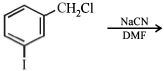
A
$3-$iodobenzyl chloride
B
$3-$iodophenylacetonitrile
C
$3-$cyanobenzyl chloride
D
$3-$cyanophenylacetonitrile
Solution
(B) The reaction involves a nucleophilic substitution of the $-CH_2Cl$ group with the $CN^-$ nucleophile from $NaCN$ in a polar aprotic solvent $(DMF)$.
This reaction proceeds via the $S_N2$ mechanism.
The $-CH_2Cl$ group is a primary alkyl halide,which is highly reactive towards $S_N2$ substitution.
The $-I$ group attached to the benzene ring is an aryl halide,which is much less reactive towards nucleophilic substitution under these conditions.
Therefore,the $CN^-$ nucleophile selectively attacks the $-CH_2Cl$ group to form the $-CH_2CN$ group,while the $-I$ group remains unaffected.
The major product is $3$-iodophenylacetonitrile.
This reaction proceeds via the $S_N2$ mechanism.
The $-CH_2Cl$ group is a primary alkyl halide,which is highly reactive towards $S_N2$ substitution.
The $-I$ group attached to the benzene ring is an aryl halide,which is much less reactive towards nucleophilic substitution under these conditions.
Therefore,the $CN^-$ nucleophile selectively attacks the $-CH_2Cl$ group to form the $-CH_2CN$ group,while the $-I$ group remains unaffected.
The major product is $3$-iodophenylacetonitrile.
0 likesView Solution
72
ChemistryMediumMCQAIEEE · 2006
$HBr$ reacts with $CH_2=CH-OCH_3$ under anhydrous conditions at room temperature to give:
A
$BrCH_2-CH_2-OCH_3$
B
$CH_3-CHBr-OCH_3$
C
$CH_3CHO$ and $CH_3Br$
D
$BrCH_2CHO$ and $CH_3OH$
Solution
(B) The reaction involves electrophilic addition of $HBr$ to the vinyl ether.
$H^{+}$ from $HBr$ adds to the terminal carbon $(CH_2)$ to form a resonance-stabilized carbocation:
$CH_2=CH-OCH_3 + H^{+} \rightarrow CH_3-C^{+}H-OCH_3 \leftrightarrow CH_3-CH=O^{+}-CH_3$
The $Br^{-}$ ion then attacks the carbocation to form the product:
$CH_3-C^{+}H-OCH_3 + Br^{-} \rightarrow CH_3-CHBr-OCH_3$
$H^{+}$ from $HBr$ adds to the terminal carbon $(CH_2)$ to form a resonance-stabilized carbocation:
$CH_2=CH-OCH_3 + H^{+} \rightarrow CH_3-C^{+}H-OCH_3 \leftrightarrow CH_3-CH=O^{+}-CH_3$
The $Br^{-}$ ion then attacks the carbocation to form the product:
$CH_3-C^{+}H-OCH_3 + Br^{-} \rightarrow CH_3-CHBr-OCH_3$
0 likesView Solution
73
ChemistryMediumMCQAIEEE · 2006
Among the following,the one that gives a positive iodoform test upon reaction with $I_2$ and $NaOH$ is
A
$CH_3-CH(CH_3)-CH_2OH$
B
$C_6H_5-CH(OH)-CH_3$
C
$CH_3-CH_2-CH(OH)-CH_2-CH_3$
D
$C_6H_5-CH_2OH$
Solution
(B) The iodoform test is given by alcohols containing the $CH_3-CH(OH)-$ group or carbonyl compounds containing the $CH_3-CO-$ group.
$C_6H_5-CH(OH)-CH_3$ ($1$-phenylethanol) contains the $CH_3-CH(OH)-$ group and thus gives a positive iodoform test.
The reaction is:
$C_6H_5-CH(OH)-CH_3 + 4I_2 + 6NaOH \rightarrow CHI_3 + C_6H_5-COONa + 5NaI + 5H_2O$
$C_6H_5-CH(OH)-CH_3$ ($1$-phenylethanol) contains the $CH_3-CH(OH)-$ group and thus gives a positive iodoform test.
The reaction is:
$C_6H_5-CH(OH)-CH_3 + 4I_2 + 6NaOH \rightarrow CHI_3 + C_6H_5-COONa + 5NaI + 5H_2O$
0 likesView Solution
74
ChemistryDifficultMCQAIEEE · 2006
The structure of the compound that gives a tribromo derivative on treatment with bromine water is
A
B
C
D
Solution
(C) When phenols are treated with bromine water,the $-OH$ group strongly activates the benzene ring,leading to electrophilic substitution at all available ortho and para positions.
For $m$-cresol ($3$-methylphenol),the positions ortho and para to the $-OH$ group are available for substitution.
Specifically,the positions ortho to the $-OH$ group (at $C2$ and $C6$) and the position para to the $-OH$ group (at $C4$) are all activated,leading to the formation of $2,4,6-$tribromo$-3-$methylphenol.
Therefore,$m$-cresol gives a tribromo derivative.
For $m$-cresol ($3$-methylphenol),the positions ortho and para to the $-OH$ group are available for substitution.
Specifically,the positions ortho to the $-OH$ group (at $C2$ and $C6$) and the position para to the $-OH$ group (at $C4$) are all activated,leading to the formation of $2,4,6-$tribromo$-3-$methylphenol.
Therefore,$m$-cresol gives a tribromo derivative.
0 likesView Solution
75
ChemistryMediumMCQAIEEE · 2006
The electrophile involved in the below reaction is:

A
trichloromethyl anion $(:\,CCl_3^-)$
B
formyl cation $(HCO^{+})$
C
dichloromethyl cation $(CHCl_2^+)$
D
dichlorocarbene $(:\,CCl_2)$
Solution
(D) The given reaction is the $Reimer-Tiemann$ reaction.
In this reaction,phenol reacts with chloroform $(CHCl_3)$ in the presence of aqueous sodium hydroxide $(NaOH)$ to form salicylaldehyde.
The mechanism involves the formation of dichlorocarbene $(:\,CCl_2)$ as the reactive intermediate,which acts as an electrophile.
Therefore,the correct option is $D$.
In this reaction,phenol reacts with chloroform $(CHCl_3)$ in the presence of aqueous sodium hydroxide $(NaOH)$ to form salicylaldehyde.
The mechanism involves the formation of dichlorocarbene $(:\,CCl_2)$ as the reactive intermediate,which acts as an electrophile.
Therefore,the correct option is $D$.
0 likesView Solution
76
ChemistryMediumMCQAIEEE · 2006
The increasing order of the rate of $HCN$ addition to the following compounds is:
$(A)\ HCHO$
$(B)\ CH_3COCH_3$
$(C)\ PhCOCH_3$
$(D)\ PhCOPh$
$(A)\ HCHO$
$(B)\ CH_3COCH_3$
$(C)\ PhCOCH_3$
$(D)\ PhCOPh$
A
$D < C < B < A$
B
$C < D < B < A$
C
$A < B < C < D$
D
$D < B < C < A$
Solution
(A) The rate of nucleophilic addition of $HCN$ to carbonyl compounds depends on two factors:
$1$. Steric hindrance: As the size of the groups attached to the carbonyl carbon increases,the rate of nucleophilic attack decreases.
$2$. Electronic effects: Electron-donating groups (like alkyl groups) decrease the electrophilicity of the carbonyl carbon,while electron-withdrawing groups (like phenyl rings via resonance) also decrease the reactivity compared to aliphatic counterparts.
Comparing the given compounds:
$(A)\ HCHO$ (Formaldehyde): No alkyl groups,least steric hindrance,most reactive.
$(B)\ CH_3COCH_3$ (Acetone): Two methyl groups,more steric hindrance than $HCHO$.
$(C)\ PhCOCH_3$ (Acetophenone): One phenyl group and one methyl group. The phenyl group provides resonance stabilization to the carbonyl carbon,reducing its electrophilicity.
$(D)\ PhCOPh$ (Benzophenone): Two phenyl groups,highest steric hindrance and significant resonance stabilization,making it the least reactive.
Thus,the reactivity order is $HCHO > CH_3COCH_3 > PhCOCH_3 > PhCOPh$.
The increasing order is $D < C < B < A$.
$1$. Steric hindrance: As the size of the groups attached to the carbonyl carbon increases,the rate of nucleophilic attack decreases.
$2$. Electronic effects: Electron-donating groups (like alkyl groups) decrease the electrophilicity of the carbonyl carbon,while electron-withdrawing groups (like phenyl rings via resonance) also decrease the reactivity compared to aliphatic counterparts.
Comparing the given compounds:
$(A)\ HCHO$ (Formaldehyde): No alkyl groups,least steric hindrance,most reactive.
$(B)\ CH_3COCH_3$ (Acetone): Two methyl groups,more steric hindrance than $HCHO$.
$(C)\ PhCOCH_3$ (Acetophenone): One phenyl group and one methyl group. The phenyl group provides resonance stabilization to the carbonyl carbon,reducing its electrophilicity.
$(D)\ PhCOPh$ (Benzophenone): Two phenyl groups,highest steric hindrance and significant resonance stabilization,making it the least reactive.
Thus,the reactivity order is $HCHO > CH_3COCH_3 > PhCOCH_3 > PhCOPh$.
The increasing order is $D < C < B < A$.
0 likesView Solution
77
ChemistryMediumMCQAIEEE · 2006
The correct order of increasing acid strength of the compounds is:
$(A) CH_3CO_2H$
$(B) MeOCH_2CO_2H$
$(C) CF_3CO_2H$
$(D) (CH_3)_2CHCO_2H$
$(A) CH_3CO_2H$
$(B) MeOCH_2CO_2H$
$(C) CF_3CO_2H$
$(D) (CH_3)_2CHCO_2H$
A
$D < A < B < C$
B
$A < D < B < C$
C
$B < D < A < C$
D
$D < A < C < B$
Solution
(A) The acid strength of carboxylic acids depends on the stability of the conjugate base (carboxylate ion).
Electron-withdrawing groups $(EWG)$ increase acidity by stabilizing the negative charge,while electron-donating groups $(EDG)$ decrease acidity by destabilizing it.
The compounds are:
$(A) CH_3CO_2H$ (Acetic acid)
$(B) MeOCH_2CO_2H$ (Methoxyacetic acid,$-OCH_3$ is $EWG$)
$(C) CF_3CO_2H$ (Trifluoroacetic acid,$-CF_3$ is a very strong $EWG$)
$(D) (CH_3)_2CHCO_2H$ (Isobutyric acid,isopropyl group is $EDG$)
Comparing the effects:
$(D)$ has an isopropyl group (strongest $EDG$),making it the least acidic.
$(A)$ has a methyl group (weak $EDG$).
$(B)$ has a methoxy group $(EWG)$.
$(C)$ has three fluorine atoms (strongest $EWG$).
The order of increasing acid strength is $D < A < B < C$.
Electron-withdrawing groups $(EWG)$ increase acidity by stabilizing the negative charge,while electron-donating groups $(EDG)$ decrease acidity by destabilizing it.
The compounds are:
$(A) CH_3CO_2H$ (Acetic acid)
$(B) MeOCH_2CO_2H$ (Methoxyacetic acid,$-OCH_3$ is $EWG$)
$(C) CF_3CO_2H$ (Trifluoroacetic acid,$-CF_3$ is a very strong $EWG$)
$(D) (CH_3)_2CHCO_2H$ (Isobutyric acid,isopropyl group is $EDG$)
Comparing the effects:
$(D)$ has an isopropyl group (strongest $EDG$),making it the least acidic.
$(A)$ has a methyl group (weak $EDG$).
$(B)$ has a methoxy group $(EWG)$.
$(C)$ has three fluorine atoms (strongest $EWG$).
The order of increasing acid strength is $D < A < B < C$.
0 likesView Solution
78
ChemistryEasyMCQAIEEE · 2006
The term anomers of glucose refers to
A
enantiomers of glucose
B
isomers of glucose that differ in configuration at carbon one $(C-1)$
C
isomers of glucose that differ in configurations at carbons one and four $(C-1$ and $C-4)$
D
a mixture of $(D)-$glucose and $(L)-$glucose
Solution
(B) Anomers of glucose are cyclic diastereomers (epimers) that differ in configuration at the anomeric carbon,which is $C-1$.
They exist in two forms,$\alpha-$ and $\beta-$form,depending on the orientation of the hydroxyl group at $C-1$ relative to the $CH_2OH$ group.
They exist in two forms,$\alpha-$ and $\beta-$form,depending on the orientation of the hydroxyl group at $C-1$ relative to the $CH_2OH$ group.
0 likesView Solution
79
ChemistryEasyMCQAIEEE · 2006
The pyrimidine bases present in $DNA$ are
A
cytosine and thymine
B
cytosine and uracil
C
cytosine and adenine
D
cytosine and guanine
Solution
(A) $DNA$ contains two types of nitrogenous bases: purines and pyrimidines.
The purines are adenine $(A)$ and guanine $(G)$.
The pyrimidines present in $DNA$ are cytosine $(C)$ and thymine $(T)$.
In $RNA$,thymine is replaced by uracil $(U)$.
Therefore,the pyrimidine bases in $DNA$ are cytosine and thymine.
The purines are adenine $(A)$ and guanine $(G)$.
The pyrimidines present in $DNA$ are cytosine $(C)$ and thymine $(T)$.
In $RNA$,thymine is replaced by uracil $(U)$.
Therefore,the pyrimidine bases in $DNA$ are cytosine and thymine.
0 likesView Solution
80
ChemistryMediumMCQAIEEE · 2006
In $Fe(CO)_5$,the $Fe-C$ bond possesses
A
ionic characters
B
$\sigma$-character only
C
$\pi$-character
D
Both $\sigma$ and $\pi$ characters
Solution
(D) In $Fe(CO)_5$,the $Fe-C$ bond is formed by the donation of a lone pair of electrons from the $C$ atom of $CO$ to the empty $d$-orbital of $Fe$,which creates a $\sigma$-bond.
Additionally,there is back-donation of electrons from the filled $d$-orbitals of $Fe$ into the empty antibonding $\pi^*$-orbitals of $CO$,which creates a $\pi$-bond.
Therefore,the $Fe-C$ bond possesses both $\sigma$ and $\pi$ characters.
Additionally,there is back-donation of electrons from the filled $d$-orbitals of $Fe$ into the empty antibonding $\pi^*$-orbitals of $CO$,which creates a $\pi$-bond.
Therefore,the $Fe-C$ bond possesses both $\sigma$ and $\pi$ characters.
0 likesView Solution
81
ChemistryMediumMCQAIEEE · 2006
The $IUPAC$ name for the complex $[Co(NO_2)(NH_3)_5]Cl_2$ is :
A
Pentaammine nitrito$-N$-cobalt$(II)$ chloride
B
Nitrito$-N$-pentaammine cobalt$(II)$ chloride
C
Nitrito$-N$-pentaammine cobalt$(III)$ chloride
D
Pentaammine nitrito$-N$-cobalt$(III)$ chloride
Solution
(D) $1$. Identify the ligands: There are $5$ ammine $(NH_3)$ ligands and $1$ nitrito$-N$ $(NO_2^-)$ ligand.
$2$. Determine the oxidation state of the central metal atom $(Co)$: Let the oxidation state be $x$. The charge on $NH_3$ is $0$,$NO_2^-$ is $-1$,and $Cl^-$ is $-1$. The total charge of the complex is $0$. Thus,$x + 5(0) + 1(-1) + 2(-1) = 0$,which gives $x - 3 = 0$,so $x = +3$.
$3$. Name the complex: The ligands are named in alphabetical order (ammine before nitrito$-N$). The metal is cobalt followed by its oxidation state in Roman numerals in parentheses. The counter ion is chloride.
$4$. The correct name is Pentaammine nitrito$-N$-cobalt$(III)$ chloride.
$2$. Determine the oxidation state of the central metal atom $(Co)$: Let the oxidation state be $x$. The charge on $NH_3$ is $0$,$NO_2^-$ is $-1$,and $Cl^-$ is $-1$. The total charge of the complex is $0$. Thus,$x + 5(0) + 1(-1) + 2(-1) = 0$,which gives $x - 3 = 0$,so $x = +3$.
$3$. Name the complex: The ligands are named in alphabetical order (ammine before nitrito$-N$). The metal is cobalt followed by its oxidation state in Roman numerals in parentheses. The counter ion is chloride.
$4$. The correct name is Pentaammine nitrito$-N$-cobalt$(III)$ chloride.
0 likesView Solution
Vedclass Products
For Students
Vedclass Test Series
Mock tests in real AIEEE style covering Chemistry with performance analysis. 5-day free trial.
Start Free TrialFor Teachers
Exam Paper Generator
Generate Set A/B/C/D Chemistry papers from 7.5L+ questions in 2 minutes. 3 chapters free.
Try FreeFor Institutes
Online Exam Module
Run live AIEEE mock exams with unlimited students, 360° analytics & white-label branding.
See DemoFrequently Asked Questions
How many Chemistry questions are in AIEEE 2006?
There are 90 Chemistry questions from the AIEEE 2006 paper on Vedclass, each with a detailed step-by-step solution in English.
Are AIEEE 2006 Chemistry solutions available in English?
Yes. All solutions on this page are in English. You can also switch to English or Hindi using the language buttons above the questions.
Can I practice AIEEE 2006 Chemistry as a timed test?
Yes. Use the Vedclass Test Series to attempt a full AIEEE mock test covering Chemistry with time limits and instant score analysis.
Can teachers create Chemistry papers from AIEEE previous year questions?
Yes. The Vedclass Exam Paper Generator lets teachers mix AIEEE Chemistry questions and generate Set A/B/C/D papers in minutes.
For Teachers & Institutes
Build a Custom Chemistry Paper
Pick AIEEE 2006 Chemistry questions, set difficulty, and generate Set A/B/C/D in 2 minutes.