
ChemistryQ1–43 of 43 questions
Page 1 of 1 · English
1
ChemistryMCQAIEEE · 2009
The transition from the state $n = 4$ to $n = 3$ in a hydrogen-like atom results in ultraviolet radiation. Infrared radiation will be obtained in the transition:
A
$2 \to 1$
B
$3 \to 2$
C
$4 \to 2$
D
$5 \to 4$
Solution
(D) The energy of a photon emitted during a transition between energy levels $n_i$ and $n_f$ is given by $\Delta E = 13.6 Z^2 (\frac{1}{n_f^2} - \frac{1}{n_i^2}) \text{ eV}$.
Ultraviolet $(UV)$ radiation corresponds to higher energy transitions (Lyman series),while infrared $(IR)$ radiation corresponds to lower energy transitions (Paschen,Brackett,or Pfund series).
Since the transition $4 \to 3$ results in $UV$ radiation,and $IR$ radiation requires significantly lower energy transitions,we look for a transition where the energy gap is smaller than that of $4 \to 3$.
The energy difference decreases as $n$ increases. Among the given options,the transition $5 \to 4$ involves the smallest energy change,which corresponds to the infrared region of the electromagnetic spectrum.
Ultraviolet $(UV)$ radiation corresponds to higher energy transitions (Lyman series),while infrared $(IR)$ radiation corresponds to lower energy transitions (Paschen,Brackett,or Pfund series).
Since the transition $4 \to 3$ results in $UV$ radiation,and $IR$ radiation requires significantly lower energy transitions,we look for a transition where the energy gap is smaller than that of $4 \to 3$.
The energy difference decreases as $n$ increases. Among the given options,the transition $5 \to 4$ involves the smallest energy change,which corresponds to the infrared region of the electromagnetic spectrum.
0 likesView Solution
2
ChemistryMCQAIEEE · 2009
The half-life period of a first-order chemical reaction is $6.93 \ min$. The time required for $99\%$ completion of the reaction is ........ minutes. $(\log 2 = 0.301)$
A
$46.06$
B
$460.6$
C
$230.3$
D
$23.03$
Solution
(A) For a first-order reaction,the rate constant $k$ is given by $k = \frac{0.693}{t_{1/2}}$.
Given $t_{1/2} = 6.93 \ min$,so $k = \frac{0.693}{6.93} = 0.1 \ min^{-1}$.
The integrated rate equation is $t = \frac{2.303}{k} \log \frac{[A]_0}{[A]_t}$.
For $99\%$ completion,$[A]_0 = 100$ and $[A]_t = 100 - 99 = 1$.
Substituting the values: $t = \frac{2.303}{0.1} \log \frac{100}{1}$.
$t = 23.03 \times \log(10^2) = 23.03 \times 2 = 46.06 \ min$.
Given $t_{1/2} = 6.93 \ min$,so $k = \frac{0.693}{6.93} = 0.1 \ min^{-1}$.
The integrated rate equation is $t = \frac{2.303}{k} \log \frac{[A]_0}{[A]_t}$.
For $99\%$ completion,$[A]_0 = 100$ and $[A]_t = 100 - 99 = 1$.
Substituting the values: $t = \frac{2.303}{0.1} \log \frac{100}{1}$.
$t = 23.03 \times \log(10^2) = 23.03 \times 2 = 46.06 \ min$.
0 likesView Solution
3
ChemistryMCQAIEEE · 2009
Which of the following pairs represents linkage isomerism?
A
$[Co(NH_3)_5NO_3]SO_4$ and $[Co(NH_3)_5SO_4]NO_3$
B
$[PtCl_2(NH_3)_4]Br_2$ and $[PtBr_2(NH_3)_4]Cl_2$
C
$[Cu(NH_3)_4][PtCl_4]$ and $[Pt(NH_3)_4][CuCl_4]$
D
$[Pd(PPh_3)_2(NCS)_2]$ and $[Pd(PPh_3)_2(SCN)_2]$
Solution
(D) Linkage isomerism occurs in coordination compounds containing ambidentate ligands,which can coordinate through two different donor atoms.
In the pair $[Pd(PPh_3)_2(NCS)_2]$ and $[Pd(PPh_3)_2(SCN)_2]$,the ligand $NCS^-$ (isothiocyanate) coordinates through the nitrogen atom,while $SCN^-$ (thiocyanate) coordinates through the sulfur atom.
Therefore,this pair exhibits linkage isomerism.
In the pair $[Pd(PPh_3)_2(NCS)_2]$ and $[Pd(PPh_3)_2(SCN)_2]$,the ligand $NCS^-$ (isothiocyanate) coordinates through the nitrogen atom,while $SCN^-$ (thiocyanate) coordinates through the sulfur atom.
Therefore,this pair exhibits linkage isomerism.
0 likesView Solution
4
ChemistryMCQAIEEE · 2009
The quadratic equations $x^2 - 6x + a = 0$ and $x^2 - cx + 6 = 0$ have one root in common. The other roots of the first and second equations are integers in the ratio $4 : 3$. Then the common root is
A
$1$
B
$4$
C
$3$
D
$2$
Solution
(D) Let the roots of the equation $x^2 - 6x + a = 0$ be $\alpha$ and $4\beta$,and the roots of the equation $x^2 - cx + 6 = 0$ be $\alpha$ and $3\beta$,where $\alpha$ is the common root.
From the sum and product of roots:
For the first equation: $\alpha + 4\beta = 6$ and $4\alpha\beta = a$.
For the second equation: $\alpha + 3\beta = c$ and $3\alpha\beta = 6$.
From $3\alpha\beta = 6$,we get $\alpha\beta = 2$,so $\beta = \frac{2}{\alpha}$.
Substitute $\beta = \frac{2}{\alpha}$ into the first equation: $\alpha + 4(\frac{2}{\alpha}) = 6$.
$\alpha + \frac{8}{\alpha} = 6 \Rightarrow \alpha^2 - 6\alpha + 8 = 0$.
Solving the quadratic equation: $(\alpha - 2)(\alpha - 4) = 0$.
So,$\alpha = 2$ or $\alpha = 4$.
If $\alpha = 2$,then $\beta = 1$. The roots of the first equation are $2$ and $4(1) = 4$. The roots of the second equation are $2$ and $3(1) = 3$. This satisfies the condition.
If $\alpha = 4$,then $\beta = 0.5$,which is not an integer. Since the problem states the other roots are integers,$\alpha = 2$ is the correct common root.
From the sum and product of roots:
For the first equation: $\alpha + 4\beta = 6$ and $4\alpha\beta = a$.
For the second equation: $\alpha + 3\beta = c$ and $3\alpha\beta = 6$.
From $3\alpha\beta = 6$,we get $\alpha\beta = 2$,so $\beta = \frac{2}{\alpha}$.
Substitute $\beta = \frac{2}{\alpha}$ into the first equation: $\alpha + 4(\frac{2}{\alpha}) = 6$.
$\alpha + \frac{8}{\alpha} = 6 \Rightarrow \alpha^2 - 6\alpha + 8 = 0$.
Solving the quadratic equation: $(\alpha - 2)(\alpha - 4) = 0$.
So,$\alpha = 2$ or $\alpha = 4$.
If $\alpha = 2$,then $\beta = 1$. The roots of the first equation are $2$ and $4(1) = 4$. The roots of the second equation are $2$ and $3(1) = 3$. This satisfies the condition.
If $\alpha = 4$,then $\beta = 0.5$,which is not an integer. Since the problem states the other roots are integers,$\alpha = 2$ is the correct common root.
0 likesView Solution
5
ChemistryMediumMCQAIEEE · 2009
Calculate the wavelength (in nanometer) associated with a proton moving at $1.0 \times 10^3 \ m \ s^{-1}$. (Mass of proton $= 1.67 \times 10^{-27} \ kg$ and $h = 6.63 \times 10^{-34} \ J \ s$)
A
$0.40$
B
$2.5$
C
$14$
D
$0.32$
Solution
(A) The de Broglie wavelength $(\lambda)$ is given by the formula: $\lambda = \frac{h}{mv}$
Given:
$h = 6.63 \times 10^{-34} \ J \ s$
$m = 1.67 \times 10^{-27} \ kg$
$v = 1.0 \times 10^3 \ m \ s^{-1}$
Substituting the values:
$\lambda = \frac{6.63 \times 10^{-34}}{1.67 \times 10^{-27} \times 1.0 \times 10^3} \ m$
$\lambda = \frac{6.63}{1.67} \times 10^{-34 + 27 - 3} \ m$
$\lambda \approx 3.97 \times 10^{-10} \ m$
Since $1 \ nm = 10^{-9} \ m$,we have:
$\lambda \approx 0.397 \times 10^{-9} \ m \approx 0.40 \ nm$
Given:
$h = 6.63 \times 10^{-34} \ J \ s$
$m = 1.67 \times 10^{-27} \ kg$
$v = 1.0 \times 10^3 \ m \ s^{-1}$
Substituting the values:
$\lambda = \frac{6.63 \times 10^{-34}}{1.67 \times 10^{-27} \times 1.0 \times 10^3} \ m$
$\lambda = \frac{6.63}{1.67} \times 10^{-34 + 27 - 3} \ m$
$\lambda \approx 3.97 \times 10^{-10} \ m$
Since $1 \ nm = 10^{-9} \ m$,we have:
$\lambda \approx 0.397 \times 10^{-9} \ m \approx 0.40 \ nm$
0 likesView Solution
6
ChemistryDifficultMCQAIEEE · 2009
In an atom,an electron is moving with a speed of $600 \, m/s$ with an accuracy of $0.005 \%$. The certainty with which the position of the electron can be located is $(h = 6.6 \times 10^{-34} \, kg \, m^2 s^{-1}, m_e = 9.1 \times 10^{-31} \, kg)$:
A
$5.10 \times 10^{-3} \, m$
B
$1.92 \times 10^{-3} \, m$
C
$3.84 \times 10^{-3} \, m$
D
$1.52 \times 10^{-4} \, m$
Solution
(B) Given,velocity $v = 600 \, m/s$ and percentage error $= 0.005 \%$.
$\Delta v = \frac{0.005}{100} \times 600 = 0.03 \, m/s = 3 \times 10^{-2} \, m/s$.
According to Heisenberg's uncertainty principle,$\Delta x \cdot \Delta p \geq \frac{h}{4 \pi}$,where $\Delta p = m \Delta v$.
$\Delta x = \frac{h}{4 \pi m \Delta v}$.
Substituting the values: $\Delta x = \frac{6.6 \times 10^{-34}}{4 \times 3.14 \times 9.1 \times 10^{-31} \times 3 \times 10^{-2}}$.
$\Delta x = \frac{6.6 \times 10^{-34}}{34.2264 \times 10^{-33}} \approx 0.1928 \times 10^{-1} \, m = 1.928 \times 10^{-3} \, m$.
$\Delta v = \frac{0.005}{100} \times 600 = 0.03 \, m/s = 3 \times 10^{-2} \, m/s$.
According to Heisenberg's uncertainty principle,$\Delta x \cdot \Delta p \geq \frac{h}{4 \pi}$,where $\Delta p = m \Delta v$.
$\Delta x = \frac{h}{4 \pi m \Delta v}$.
Substituting the values: $\Delta x = \frac{6.6 \times 10^{-34}}{4 \times 3.14 \times 9.1 \times 10^{-31} \times 3 \times 10^{-2}}$.
$\Delta x = \frac{6.6 \times 10^{-34}}{34.2264 \times 10^{-33}} \approx 0.1928 \times 10^{-1} \, m = 1.928 \times 10^{-3} \, m$.
0 likesView Solution
7
ChemistryDifficultMCQAIEEE · 2009
On the basis of the following thermochemical data: $(\Delta_fG^o H^{+}_{(aq)} = 0)$
$H_2O_{(\ell)} \rightarrow H^{+}_{(aq)} + OH^{-}_{(aq)} \,; \, \Delta H = 57.32 \, kJ$
$H_{2(g)} + \frac{1}{2} O_{2(g)} \rightarrow H_2O_{(\ell)} \,; \, \Delta H = -286.20 \, kJ$
The value of enthalpy of formation of $OH^{-}$ ion at $25 \, ^oC$ is : .............. $kJ$
$H_2O_{(\ell)} \rightarrow H^{+}_{(aq)} + OH^{-}_{(aq)} \,; \, \Delta H = 57.32 \, kJ$
$H_{2(g)} + \frac{1}{2} O_{2(g)} \rightarrow H_2O_{(\ell)} \,; \, \Delta H = -286.20 \, kJ$
The value of enthalpy of formation of $OH^{-}$ ion at $25 \, ^oC$ is : .............. $kJ$
A
$-228.88$
B
$+228.88$
C
$-343.52$
D
$-22.88$
Solution
(A) Given,for reaction:
$(I) \quad H_2O_{(\ell)} \rightarrow H^{+}_{(aq)} + OH^{-}_{(aq)} \quad \Delta H_r = 57.32 \, kJ$
$(II) \quad H_{2(g)} + \frac{1}{2} O_{2(g)} \rightarrow H_2O_{(\ell)} \quad \Delta H_r = -286.20 \, kJ$
For reaction $(I)$:
$\Delta H_r = \Delta H_f^o(H^{+}, aq) + \Delta H_f^o(OH^{-}, aq) - \Delta H_f^o(H_2O, \ell)$
Since $\Delta H_f^o(H^{+}, aq) = 0$,we have:
$57.32 = 0 + \Delta H_f^o(OH^{-}, aq) - \Delta H_f^o(H_2O, \ell) \quad \dots (III)$
For reaction $(II)$:
$\Delta H_f^o(H_2O, \ell) = -286.20 \, kJ$
Substituting this value in equation $(III)$:
$57.32 = \Delta H_f^o(OH^{-}, aq) - (-286.20)$
$\Delta H_f^o(OH^{-}, aq) = 57.32 - 286.20$
$\Delta H_f^o(OH^{-}, aq) = -228.88 \, kJ$
$(I) \quad H_2O_{(\ell)} \rightarrow H^{+}_{(aq)} + OH^{-}_{(aq)} \quad \Delta H_r = 57.32 \, kJ$
$(II) \quad H_{2(g)} + \frac{1}{2} O_{2(g)} \rightarrow H_2O_{(\ell)} \quad \Delta H_r = -286.20 \, kJ$
For reaction $(I)$:
$\Delta H_r = \Delta H_f^o(H^{+}, aq) + \Delta H_f^o(OH^{-}, aq) - \Delta H_f^o(H_2O, \ell)$
Since $\Delta H_f^o(H^{+}, aq) = 0$,we have:
$57.32 = 0 + \Delta H_f^o(OH^{-}, aq) - \Delta H_f^o(H_2O, \ell) \quad \dots (III)$
For reaction $(II)$:
$\Delta H_f^o(H_2O, \ell) = -286.20 \, kJ$
Substituting this value in equation $(III)$:
$57.32 = \Delta H_f^o(OH^{-}, aq) - (-286.20)$
$\Delta H_f^o(OH^{-}, aq) = 57.32 - 286.20$
$\Delta H_f^o(OH^{-}, aq) = -228.88 \, kJ$
0 likesView Solution
8
ChemistryMediumMCQAIEEE · 2009
Solid $Ba(NO_3)_2$ is gradually dissolved in a $1.0 \times 10^{-4} \ M$ $Na_2CO_3$ solution. At what concentration of $Ba^{2+}$ will a precipitate begin to form? ($K_{sp}$ for $BaCO_3 = 5.1 \times 10^{-9}$)
A
$5.1 \times 10^{-5} \ M$
B
$8.1 \times 10^{-8} \ M$
C
$8.1 \times 10^{-7} \ M$
D
$4.1 \times 10^{-5} \ M$
Solution
(A) The dissolution of $Na_2CO_3$ in water is given by: $Na_2CO_3 \rightarrow 2Na^{+} + CO_3^{2-}$.
Given the concentration of $Na_2CO_3$ is $1.0 \times 10^{-4} \ M$,the concentration of carbonate ions is $[CO_3^{2-}] = 1.0 \times 10^{-4} \ M$.
For the precipitation of $BaCO_3$ to begin,the ionic product must exceed the solubility product constant $(K_{sp})$.
The condition for the start of precipitation is: $[Ba^{2+}][CO_3^{2-}] = K_{sp}(BaCO_3)$.
Substituting the given values: $[Ba^{2+}] \times (1.0 \times 10^{-4}) = 5.1 \times 10^{-9}$.
Solving for $[Ba^{2+}]$: $[Ba^{2+}] = \frac{5.1 \times 10^{-9}}{1.0 \times 10^{-4}} = 5.1 \times 10^{-5} \ M$.
Given the concentration of $Na_2CO_3$ is $1.0 \times 10^{-4} \ M$,the concentration of carbonate ions is $[CO_3^{2-}] = 1.0 \times 10^{-4} \ M$.
For the precipitation of $BaCO_3$ to begin,the ionic product must exceed the solubility product constant $(K_{sp})$.
The condition for the start of precipitation is: $[Ba^{2+}][CO_3^{2-}] = K_{sp}(BaCO_3)$.
Substituting the given values: $[Ba^{2+}] \times (1.0 \times 10^{-4}) = 5.1 \times 10^{-9}$.
Solving for $[Ba^{2+}]$: $[Ba^{2+}] = \frac{5.1 \times 10^{-9}}{1.0 \times 10^{-4}} = 5.1 \times 10^{-5} \ M$.
0 likesView Solution
9
ChemistryMediumMCQAIEEE · 2009
The $IUPAC$ name of neopentane is
A
$2,2-$dimethylpropane
B
$2-$methylpropane
C
$2,2-$dimethylbutane
D
$2-$methylbutane
Solution
(A) The structure of neopentane is $CH_3-C(CH_3)_2-CH_3$.
To determine the $IUPAC$ name,we identify the longest carbon chain,which contains $3$ carbon atoms,making it a propane derivative.
There are two methyl groups attached to the second carbon atom.
Therefore,the $IUPAC$ name is $2,2-$dimethylpropane.
To determine the $IUPAC$ name,we identify the longest carbon chain,which contains $3$ carbon atoms,making it a propane derivative.
There are two methyl groups attached to the second carbon atom.
Therefore,the $IUPAC$ name is $2,2-$dimethylpropane.
0 likesView Solution
10
ChemistryDifficultMCQAIEEE · 2009
Arrange the carbanions,$(CH_3)_3\overline{C}$,$\overline{C}Cl_3$,$(CH_3)_2\overline{C}H$,$C_6H_5\overline{C}H_2$ in order of their decreasing stability:
A
$(CH_3)_2\overline{C}H > \overline{C}Cl_3 > C_6H_5\overline{C}H_2 > (CH_3)_3\overline{C}$
B
$\overline{C}Cl_3 > C_6H_5\overline{C}H_2 > (CH_3)_2\overline{C}H > (CH_3)_3\overline{C}$
C
$(CH_3)_3\overline{C} > (CH_3)_2\overline{C}H > C_6H_5\overline{C}H_2 > \overline{C}Cl_3$
D
$C_6H_5\overline{C}H_2 > \overline{C}Cl_3 > (CH_3)_3\overline{C} > (CH_3)_2\overline{C}H$
Solution
(B) The stability of carbanions is determined by the electronic effects of the attached groups.
Electron-withdrawing groups ($-I$ effect) stabilize the negative charge,while electron-donating groups ($+I$ effect) destabilize it.
$1$. $\overline{C}Cl_3$: The three $Cl$ atoms exert a strong $-I$ effect,significantly stabilizing the negative charge.
$2$. $C_6H_5\overline{C}H_2$: The phenyl group provides stability through $-I$ effect and resonance (delocalization of electrons).
$3$. $(CH_3)_2\overline{C}H$: This is a secondary carbanion with two electron-donating $CH_3$ groups ($+I$ effect),which destabilize the negative charge.
$4$. $(CH_3)_3\overline{C}$: This is a tertiary carbanion with three electron-donating $CH_3$ groups ($+I$ effect),making it the least stable.
Thus,the order of decreasing stability is: $\overline{C}Cl_3 > C_6H_5\overline{C}H_2 > (CH_3)_2\overline{C}H > (CH_3)_3\overline{C}$.
Electron-withdrawing groups ($-I$ effect) stabilize the negative charge,while electron-donating groups ($+I$ effect) destabilize it.
$1$. $\overline{C}Cl_3$: The three $Cl$ atoms exert a strong $-I$ effect,significantly stabilizing the negative charge.
$2$. $C_6H_5\overline{C}H_2$: The phenyl group provides stability through $-I$ effect and resonance (delocalization of electrons).
$3$. $(CH_3)_2\overline{C}H$: This is a secondary carbanion with two electron-donating $CH_3$ groups ($+I$ effect),which destabilize the negative charge.
$4$. $(CH_3)_3\overline{C}$: This is a tertiary carbanion with three electron-donating $CH_3$ groups ($+I$ effect),making it the least stable.
Thus,the order of decreasing stability is: $\overline{C}Cl_3 > C_6H_5\overline{C}H_2 > (CH_3)_2\overline{C}H > (CH_3)_3\overline{C}$.
0 likesView Solution
11
ChemistryMediumMCQAIEEE · 2009
The alkene that exhibits geometrical isomerism is:
A
$2-$Methylpropene
B
$2-$Butene
C
$2-$Methyl$-2-$butene
D
Propene
Solution
(B) The alkene that exhibits geometrical isomerism is $2-$butene.
$2-$Butene exists as $cis$ and $trans$ isomers.
In the $cis$-isomer,the two methyl groups are on the same side of the double bond,while in the $trans$-isomer,they are on opposite sides.
Due to the restricted rotation around the $C=C$ double bond,it exhibits geometrical isomerism.
$2-$Butene exists as $cis$ and $trans$ isomers.
In the $cis$-isomer,the two methyl groups are on the same side of the double bond,while in the $trans$-isomer,they are on opposite sides.
Due to the restricted rotation around the $C=C$ double bond,it exhibits geometrical isomerism.
0 likesView Solution
12
ChemistryMediumMCQAIEEE · 2009
The number of stereoisomers possible for a compound of the molecular formula $CH_3-CH=CH-CH(OH)-CH_3$ is:
A
$2$
B
$4$
C
$6$
D
$3$
Solution
(B) The molecule exhibits both geometrical and optical isomerism.
The compound $CH_3-CH=CH-CH(OH)-CH_3$ contains one carbon-carbon double bond $(C=C)$ that can exhibit geometrical $(cis-trans)$ isomerism.
It also contains one chiral carbon atom $(C^*)$ at the $C-4$ position,which can exhibit optical isomerism.
Since the double bond and the chiral center are not symmetrically related in a way that would create meso compounds,the total number of stereoisomers is given by $2^n$,where $n$ is the number of stereogenic centers.
Here,$n = 2$ (one double bond + one chiral center).
Therefore,the total number of stereoisomers = $2^2 = 4$.
The compound $CH_3-CH=CH-CH(OH)-CH_3$ contains one carbon-carbon double bond $(C=C)$ that can exhibit geometrical $(cis-trans)$ isomerism.
It also contains one chiral carbon atom $(C^*)$ at the $C-4$ position,which can exhibit optical isomerism.
Since the double bond and the chiral center are not symmetrically related in a way that would create meso compounds,the total number of stereoisomers is given by $2^n$,where $n$ is the number of stereogenic centers.
Here,$n = 2$ (one double bond + one chiral center).
Therefore,the total number of stereoisomers = $2^2 = 4$.
0 likesView Solution
13
ChemistryMCQAIEEE · 2009
Statement $-1$ : $\sim (p \leftrightarrow \sim q)$ is equivalent to $p \leftrightarrow q$.
Statement $-2$ : $\sim (p \leftrightarrow \sim q)$ is a tautology.
Statement $-2$ : $\sim (p \leftrightarrow \sim q)$ is a tautology.
A
Statement $-1$ is True,Statement $-2$ is True; Statement $-2$ is a correct explanation for Statement $-1$.
B
Statement $-1$ is True,Statement $-2$ is True; Statement $-2$ is $NOT$ a correct explanation for Statement $-1$.
C
Statement $-1$ is True,Statement $-2$ is False.
D
Statement $-1$ is False,Statement $-2$ is True.
Solution
(C) We know that $p \leftrightarrow q$ is equivalent to $\sim (p \leftrightarrow \sim q)$.
Let us verify this using a truth table:
$p$ | $q$ | $\sim q$ | $p \leftrightarrow \sim q$ | $\sim (p \leftrightarrow \sim q)$ | $p \leftrightarrow q$
$T$ | $T$ | $F$ | $F$ | $T$ | $T$
$T$ | $F$ | $T$ | $T$ | $F$ | $F$
$F$ | $T$ | $F$ | $T$ | $F$ | $F$
$F$ | $F$ | $T$ | $F$ | $T$ | $T$
From the truth table,the column for $\sim (p \leftrightarrow \sim q)$ is identical to the column for $p \leftrightarrow q$. Thus,Statement $-1$ is True.
Since the truth values of $\sim (p \leftrightarrow \sim q)$ depend on the truth values of $p$ and $q$ (it is $T$ when $p$ and $q$ have the same truth value and $F$ otherwise),it is not a tautology. Thus,Statement $-2$ is False.
Let us verify this using a truth table:
$p$ | $q$ | $\sim q$ | $p \leftrightarrow \sim q$ | $\sim (p \leftrightarrow \sim q)$ | $p \leftrightarrow q$
$T$ | $T$ | $F$ | $F$ | $T$ | $T$
$T$ | $F$ | $T$ | $T$ | $F$ | $F$
$F$ | $T$ | $F$ | $T$ | $F$ | $F$
$F$ | $F$ | $T$ | $F$ | $T$ | $T$
From the truth table,the column for $\sim (p \leftrightarrow \sim q)$ is identical to the column for $p \leftrightarrow q$. Thus,Statement $-1$ is True.
Since the truth values of $\sim (p \leftrightarrow \sim q)$ depend on the truth values of $p$ and $q$ (it is $T$ when $p$ and $q$ have the same truth value and $F$ otherwise),it is not a tautology. Thus,Statement $-2$ is False.
0 likesView Solution
14
ChemistryMCQAIEEE · 2009
The transition from the state $n = 4$ to $n = 3$ in a hydrogen-like atom results in ultraviolet radiation. Infrared radiation will be obtained in the transition:
A
$2 \to 1$
B
$3 \to 2$
C
$4 \to 2$
D
$5 \to 4$
Solution
(D) The energy of the emitted photon is given by $\Delta E = 13.6 Z^2 \left( \frac{1}{n_f^2} - \frac{1}{n_i^2} \right) \text{ eV}$.
Ultraviolet radiation corresponds to higher energy transitions (Lyman series,$n_f = 1$).
Infrared radiation corresponds to lower energy transitions (Paschen series $n_f = 3$,Brackett series $n_f = 4$,or Pfund series $n_f = 5$).
Comparing the options,the transition $5 \to 4$ results in a smaller energy change compared to the others,which is characteristic of the infrared region (Brackett series).
Therefore,the correct transition is $5 \to 4$.
Ultraviolet radiation corresponds to higher energy transitions (Lyman series,$n_f = 1$).
Infrared radiation corresponds to lower energy transitions (Paschen series $n_f = 3$,Brackett series $n_f = 4$,or Pfund series $n_f = 5$).
Comparing the options,the transition $5 \to 4$ results in a smaller energy change compared to the others,which is characteristic of the infrared region (Brackett series).
Therefore,the correct transition is $5 \to 4$.
0 likesView Solution
15
ChemistryMCQAIEEE · 2009
The surface of a metal is illuminated with light of wavelength $400 \, nm$. The kinetic energy of the ejected photoelectrons is found to be $1.68 \, eV$. The work function of the metal is .................. $eV$ $(hc = 1240 \, eV-nm)$.
A
$1.51$
B
$1.68$
C
$3.09$
D
$1.41$
Solution
(D) According to Einstein's photoelectric equation: $E = \phi + K_{max}$.
Here,$E$ is the energy of the incident photon,$\phi$ is the work function,and $K_{max}$ is the maximum kinetic energy of the photoelectrons.
The energy of the incident photon is given by $E = \frac{hc}{\lambda}$.
Given $hc = 1240 \, eV-nm$ and $\lambda = 400 \, nm$,we have $E = \frac{1240}{400} \, eV = 3.1 \, eV$.
Substituting the values into the photoelectric equation: $3.1 \, eV = \phi + 1.68 \, eV$.
Therefore,the work function $\phi = 3.1 \, eV - 1.68 \, eV = 1.42 \, eV$.
Here,$E$ is the energy of the incident photon,$\phi$ is the work function,and $K_{max}$ is the maximum kinetic energy of the photoelectrons.
The energy of the incident photon is given by $E = \frac{hc}{\lambda}$.
Given $hc = 1240 \, eV-nm$ and $\lambda = 400 \, nm$,we have $E = \frac{1240}{400} \, eV = 3.1 \, eV$.
Substituting the values into the photoelectric equation: $3.1 \, eV = \phi + 1.68 \, eV$.
Therefore,the work function $\phi = 3.1 \, eV - 1.68 \, eV = 1.42 \, eV$.
0 likesView Solution
16
ChemistryMCQAIEEE · 2009
Solid $Ba(NO_3)_2$ is gradually dissolved in a $1.0 \times 10^{-3} \ M \ Na_2CO_3$ solution. At what concentration of $Ba^{2+}$ will a precipitate begin to form? ($K_{sp}$ for $BaCO_3 = 5.1 \times 10^{-9}$)
A
$4.1 \times 10^{-5} \ M$
B
$5.1 \times 10^{-6} \ M$
C
$8.1 \times 10^{-8} \ M$
D
$8.1 \times 10^{-7} \ M$
Solution
(B) The precipitation of $BaCO_3$ begins when the ionic product exceeds the solubility product constant $(K_{sp})$.
The equilibrium expression is: $K_{sp} = [Ba^{2+}][CO_3^{2-}]$.
Given: $K_{sp} = 5.1 \times 10^{-9}$ and $[CO_3^{2-}] = 1.0 \times 10^{-3} \ M$.
Substituting the values: $5.1 \times 10^{-9} = [Ba^{2+}] \times (1.0 \times 10^{-3})$.
Therefore,$[Ba^{2+}] = \frac{5.1 \times 10^{-9}}{1.0 \times 10^{-3}} = 5.1 \times 10^{-6} \ M$.
The equilibrium expression is: $K_{sp} = [Ba^{2+}][CO_3^{2-}]$.
Given: $K_{sp} = 5.1 \times 10^{-9}$ and $[CO_3^{2-}] = 1.0 \times 10^{-3} \ M$.
Substituting the values: $5.1 \times 10^{-9} = [Ba^{2+}] \times (1.0 \times 10^{-3})$.
Therefore,$[Ba^{2+}] = \frac{5.1 \times 10^{-9}}{1.0 \times 10^{-3}} = 5.1 \times 10^{-6} \ M$.
0 likesView Solution
17
ChemistryMCQAIEEE · 2009
The half-life period of a first-order chemical reaction is $6.93 \, \text{min}$. The time required for the completion of $99 \%$ of the chemical reaction will be .......... $\text{min}$ $(\log \, 2 = 0.301)$.
A
$46.06$
B
$460.6$
C
$230.3$
D
$23.03$
Solution
(A) For a first-order reaction,the rate constant $K$ is given by $K = \frac{0.693}{t_{1/2}}$.
Given $t_{1/2} = 6.93 \, \text{min}$,so $K = \frac{0.693}{6.93} = 0.1 \, \text{min}^{-1}$.
The time $t$ required for $99 \%$ completion is given by $t = \frac{2.303}{K} \log \frac{[A]_0}{[A]_t}$.
Here,$[A]_0 = 100$ and $[A]_t = 100 - 99 = 1$.
$t = \frac{2.303}{0.1} \log \frac{100}{1} = 23.03 \times \log(10^2) = 23.03 \times 2 = 46.06 \, \text{min}$.
Given $t_{1/2} = 6.93 \, \text{min}$,so $K = \frac{0.693}{6.93} = 0.1 \, \text{min}^{-1}$.
The time $t$ required for $99 \%$ completion is given by $t = \frac{2.303}{K} \log \frac{[A]_0}{[A]_t}$.
Here,$[A]_0 = 100$ and $[A]_t = 100 - 99 = 1$.
$t = \frac{2.303}{0.1} \log \frac{100}{1} = 23.03 \times \log(10^2) = 23.03 \times 2 = 46.06 \, \text{min}$.
0 likesView Solution
18
ChemistryMCQAIEEE · 2009
Arrange the carbanions,$(CH_3)_3\bar{C}$,$\bar{C}Cl_3$,$(CH_3)_2\bar{C}H$,$C_6H_5\bar{C}H_2$ in order of their decreasing stability.
A
$C_6H_5\bar{C}H_2 > \bar{C}Cl_3 > (CH_3)_3\bar{C} > (CH_3)_2\bar{C}H$
B
$(CH_3)_2\bar{C}H > \bar{C}Cl_3 > C_6H_5\bar{C}H_2 > (CH_3)_3\bar{C}$
C
$\bar{C}Cl_3 > C_6H_5\bar{C}H_2 > (CH_3)_2\bar{C}H > (CH_3)_3\bar{C}$
D
$(CH_3)_3\bar{C} > (CH_3)_2\bar{C}H > C_6H_5\bar{C}H_2 > \bar{C}Cl_3$
Solution
(C) The stability order is: $\bar{C}Cl_3 > C_6H_5\bar{C}H_2 > (CH_3)_2\bar{C}H > (CH_3)_3\bar{C}$.
$1$. $\bar{C}Cl_3$: Most stable due to the strong $-I$ effect of three $Cl$ atoms and the delocalization of the negative charge into the vacant $d$-orbitals of $Cl$.
$2$. $C_6H_5\bar{C}H_2$: Stable due to resonance delocalization of the negative charge into the benzene ring.
$3$. $(CH_3)_2\bar{C}H$: $2^{\circ}$ carbanion,stability decreases due to the electron-donating $+I$ effect of two $CH_3$ groups.
$4$. $(CH_3)_3\bar{C}$: $3^{\circ}$ carbanion,least stable due to the destabilizing $+I$ effect of three $CH_3$ groups.
$1$. $\bar{C}Cl_3$: Most stable due to the strong $-I$ effect of three $Cl$ atoms and the delocalization of the negative charge into the vacant $d$-orbitals of $Cl$.
$2$. $C_6H_5\bar{C}H_2$: Stable due to resonance delocalization of the negative charge into the benzene ring.
$3$. $(CH_3)_2\bar{C}H$: $2^{\circ}$ carbanion,stability decreases due to the electron-donating $+I$ effect of two $CH_3$ groups.
$4$. $(CH_3)_3\bar{C}$: $3^{\circ}$ carbanion,least stable due to the destabilizing $+I$ effect of three $CH_3$ groups.
0 likesView Solution
19
ChemistryMCQAIEEE · 2009
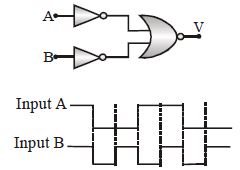
The logic circuit shown below has the input waveforms $A$ and $B$ as shown. Pick out the correct output waveform.
A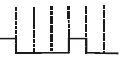
B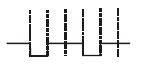
C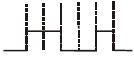
D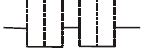
Solution
(D) The given circuit consists of two $NOT$ gates followed by a $NOR$ gate.
Let the inputs be $A$ and $B$.
The outputs of the two $NOT$ gates are $\bar{A}$ and $\bar{B}$.
These are fed into a $NOR$ gate,so the final output $Y$ is given by:
$Y = \overline{\bar{A} + \bar{B}}$
Using De Morgan's theorem,$\overline{\bar{A} + \bar{B}} = \overline{(\bar{A})} \cdot \overline{(\bar{B})} = A \cdot B$.
Thus,the circuit acts as an $AND$ gate.
The output $Y$ is high $(1)$ only when both inputs $A$ and $B$ are high $(1)$.
By observing the input waveforms,the output waveform will be high only during the time interval where both $A$ and $B$ are high.
Let the inputs be $A$ and $B$.
The outputs of the two $NOT$ gates are $\bar{A}$ and $\bar{B}$.
These are fed into a $NOR$ gate,so the final output $Y$ is given by:
$Y = \overline{\bar{A} + \bar{B}}$
Using De Morgan's theorem,$\overline{\bar{A} + \bar{B}} = \overline{(\bar{A})} \cdot \overline{(\bar{B})} = A \cdot B$.
Thus,the circuit acts as an $AND$ gate.
The output $Y$ is high $(1)$ only when both inputs $A$ and $B$ are high $(1)$.
By observing the input waveforms,the output waveform will be high only during the time interval where both $A$ and $B$ are high.
0 likesView Solution
20
ChemistryMCQAIEEE · 2009
The major product obtained on interaction of phenol with sodium hydroxide and carbon dioxide is
A
salicylic acid
B
phthalic acid
C
benzoic acid
D
salicylaldehyde
Solution
(A) The reaction of phenol with sodium hydroxide $(NaOH)$ and carbon dioxide $(CO_2)$ followed by acidic workup is known as the $Kolbe-Schmitt$ reaction.
In this reaction,phenol is first converted to sodium phenoxide,which then undergoes electrophilic substitution with $CO_2$ to form sodium salicylate.
Upon acidification,this yields $2-hydroxybenzoic$ acid,commonly known as salicylic acid.
The chemical equation is: $C_6H_5OH + NaOH + CO_2$ $\rightarrow C_6H_4(OH)COONa$ $\xrightarrow{H^+} C_6H_4(OH)COOH$.
In this reaction,phenol is first converted to sodium phenoxide,which then undergoes electrophilic substitution with $CO_2$ to form sodium salicylate.
Upon acidification,this yields $2-hydroxybenzoic$ acid,commonly known as salicylic acid.
The chemical equation is: $C_6H_5OH + NaOH + CO_2$ $\rightarrow C_6H_4(OH)COONa$ $\xrightarrow{H^+} C_6H_4(OH)COOH$.
0 likesView Solution
21
ChemistryMCQAIEEE · 2009
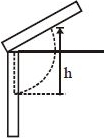
$A$ thin uniform rod of length $l$ and mass $m$ is swinging freely about a horizontal axis passing through its end. Its maximum angular speed is $\omega$. Its centre of mass rises to a maximum height of
A
$\frac{1}{3}\frac{l^2\omega^2}{g}$
B
$\frac{1}{6}\frac{l\omega}{g}$
C
$\frac{1}{2}\frac{l^2\omega^2}{g}$
D
$\frac{1}{6}\frac{l^2\omega^2}{g}$
Solution
(D) The principle of conservation of mechanical energy states that the total mechanical energy remains constant.
At the lowest point,the rotational kinetic energy is maximum,and the potential energy of the centre of mass is minimum (taken as zero).
At the highest point,the rotational kinetic energy is zero,and the potential energy of the centre of mass is maximum.
Let $I$ be the moment of inertia of the rod about the axis passing through its end,which is $I = \frac{1}{3}ml^2$.
Using the conservation of energy:
$K_i + U_i = K_f + U_f$
$\frac{1}{2}I\omega^2 + 0 = 0 + mgh$
Substituting the value of $I$:
$\frac{1}{2} \times (\frac{1}{3}ml^2) \times \omega^2 = mgh$
$\frac{1}{6}ml^2\omega^2 = mgh$
Solving for $h$:
$h = \frac{l^2\omega^2}{6g}$
At the lowest point,the rotational kinetic energy is maximum,and the potential energy of the centre of mass is minimum (taken as zero).
At the highest point,the rotational kinetic energy is zero,and the potential energy of the centre of mass is maximum.
Let $I$ be the moment of inertia of the rod about the axis passing through its end,which is $I = \frac{1}{3}ml^2$.
Using the conservation of energy:
$K_i + U_i = K_f + U_f$
$\frac{1}{2}I\omega^2 + 0 = 0 + mgh$
Substituting the value of $I$:
$\frac{1}{2} \times (\frac{1}{3}ml^2) \times \omega^2 = mgh$
$\frac{1}{6}ml^2\omega^2 = mgh$
Solving for $h$:
$h = \frac{l^2\omega^2}{6g}$
0 likesView Solution
22
ChemistryMCQAIEEE · 2009
Which of the following statements is incorrect regarding physisorption?
A
It occurs because of van der Waals forces.
B
More easily liquefiable gases are adsorbed readily.
C
Under high pressure it results into multi-molecular layer on adsorbent surface.
D
Enthalpy of adsorption $(\Delta H_{adsorption})$ is low and positive.
Solution
(D) For physisorption,the enthalpy of adsorption $(\Delta H_{adsorption})$ is low and negative.
Physisorption is an exothermic process,meaning heat is released during the adsorption process. Therefore,the enthalpy change is negative,not positive.
Physisorption is an exothermic process,meaning heat is released during the adsorption process. Therefore,the enthalpy change is negative,not positive.
0 likesView Solution
23
ChemistryMCQAIEEE · 2009
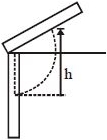
$A$ thin uniform rod of length $l$ and mass $m$ is swinging freely about a horizontal axis passing through its end. Its maximum angular speed is $\omega$. Its centre of mass rises to a maximum height of:
A
$\frac{1}{3} \frac{l^2 \omega^2}{g}$
B
$\frac{1}{6} \frac{l \omega}{g}$
C
$\frac{1}{2} \frac{l^2 \omega^2}{g}$
D
$\frac{1}{6} \frac{l^2 \omega^2}{g}$
Solution
(D) According to the principle of conservation of mechanical energy,the initial rotational kinetic energy is converted into the gravitational potential energy of the centre of mass at the maximum height.
$TE_{i} = TE_{f}$
$\frac{1}{2} I \omega^{2} = mgh$
Here,$I$ is the moment of inertia of the rod about the axis passing through its end,which is $I = \frac{1}{3} m l^{2}$.
Substituting this into the equation:
$\frac{1}{2} \times (\frac{1}{3} m l^{2}) \omega^{2} = mgh$
$\frac{1}{6} m l^{2} \omega^{2} = mgh$
Canceling $m$ from both sides:
$h = \frac{1}{6} \frac{l^{2} \omega^{2}}{g}$
$TE_{i} = TE_{f}$
$\frac{1}{2} I \omega^{2} = mgh$
Here,$I$ is the moment of inertia of the rod about the axis passing through its end,which is $I = \frac{1}{3} m l^{2}$.
Substituting this into the equation:
$\frac{1}{2} \times (\frac{1}{3} m l^{2}) \omega^{2} = mgh$
$\frac{1}{6} m l^{2} \omega^{2} = mgh$
Canceling $m$ from both sides:
$h = \frac{1}{6} \frac{l^{2} \omega^{2}}{g}$
0 likesView Solution
24
ChemistryMCQAIEEE · 2009
The surface of a metal is illuminated with light of $400\, nm$. The maximum kinetic energy of the ejected photoelectrons was found to be $1.68\, eV$. The work function of the metal is.......$eV$ $(hc = 1240\, eV\, nm)$.
A
$3.09$
B
$1.42$
C
$1.51$
D
$1.68$
Solution
(B) According to Einstein's photoelectric equation: $K_{max} = E - W_0$,where $E$ is the energy of the incident photon and $W_0$ is the work function of the metal.
The energy of the incident photon is given by: $E = \frac{hc}{\lambda} = \frac{1240\, eV\, nm}{400\, nm} = 3.1\, eV$.
Given that the maximum kinetic energy $K_{max} = 1.68\, eV$,we can substitute these values into the equation:
$1.68\, eV = 3.1\, eV - W_0$.
Rearranging to solve for the work function $W_0$:
$W_0 = 3.1\, eV - 1.68\, eV = 1.42\, eV$.
The energy of the incident photon is given by: $E = \frac{hc}{\lambda} = \frac{1240\, eV\, nm}{400\, nm} = 3.1\, eV$.
Given that the maximum kinetic energy $K_{max} = 1.68\, eV$,we can substitute these values into the equation:
$1.68\, eV = 3.1\, eV - W_0$.
Rearranging to solve for the work function $W_0$:
$W_0 = 3.1\, eV - 1.68\, eV = 1.42\, eV$.
0 likesView Solution
25
ChemistryMCQAIEEE · 2009
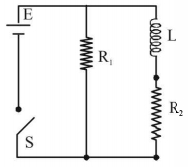
An inductor of inductance $L=400\,mH$ and resistors of resistance $R_1=2\,\Omega$ and $R_2=2\,\Omega$ are connected to a battery of emf $E=12\,V$ as shown in the figure. The internal resistance of the battery is negligible. The switch $S$ is closed at $t=0$. The potential drop across $L$ as a function of time is
A
$\frac{12}{t} e^{-3 t}\,V$
B
$6(1-e^{-t / 0.2})\,V$
C
$12 e^{-5 t}\,V$
D
$6 e^{-5 t}\,V$
Solution
(C) When the switch $S$ is closed at $t=0$,the inductor $L$ and resistor $R_2$ form a series circuit connected across the battery of emf $E=12\,V$. The resistor $R_1$ is in parallel with this branch and does not affect the current through the inductor.
The current $i$ in the $L-R_2$ branch at time $t$ is given by:
$i = \frac{E}{R_2} (1 - e^{-R_2 t / L})$
The potential drop across the inductor $L$ is given by $V_L = L \frac{di}{dt}$.
First,find $\frac{di}{dt}$:
$\frac{di}{dt} = \frac{E}{R_2} \cdot \frac{R_2}{L} \cdot e^{-R_2 t / L} = \frac{E}{L} e^{-R_2 t / L}$
Now,calculate $V_L$:
$V_L = L \left( \frac{E}{L} e^{-R_2 t / L} \right) = E e^{-R_2 t / L}$
Given $E = 12\,V$,$R_2 = 2\,\Omega$,and $L = 400\,mH = 0.4\,H$:
$\frac{R_2}{L} = \frac{2}{0.4} = 5\,s^{-1}$
Therefore,$V_L = 12 e^{-5t}\,V$.
The current $i$ in the $L-R_2$ branch at time $t$ is given by:
$i = \frac{E}{R_2} (1 - e^{-R_2 t / L})$
The potential drop across the inductor $L$ is given by $V_L = L \frac{di}{dt}$.
First,find $\frac{di}{dt}$:
$\frac{di}{dt} = \frac{E}{R_2} \cdot \frac{R_2}{L} \cdot e^{-R_2 t / L} = \frac{E}{L} e^{-R_2 t / L}$
Now,calculate $V_L$:
$V_L = L \left( \frac{E}{L} e^{-R_2 t / L} \right) = E e^{-R_2 t / L}$
Given $E = 12\,V$,$R_2 = 2\,\Omega$,and $L = 400\,mH = 0.4\,H$:
$\frac{R_2}{L} = \frac{2}{0.4} = 5\,s^{-1}$
Therefore,$V_L = 12 e^{-5t}\,V$.
0 likesView Solution
26
ChemistryMediumMCQAIEEE · 2009
Which of the following statements is incorrect regarding physisorption?
A
More easily liquefiable gases are adsorbed readily.
B
Under high pressure it results into multi-molecular layer on adsorbent surface.
C
Enthalpy of adsorption $(\Delta H_{adsorption})$ is low and positive.
D
It occurs because of van der Waal's forces.
Solution
(C) Physisorption is an exothermic process because the formation of weak van der Waal's forces between the adsorbate and adsorbent releases energy.
Therefore,the enthalpy of adsorption $(\Delta H_{adsorption})$ is always negative,typically ranging between $-20 \text{ to } -40 \text{ kJ/mol}$.
Option $C$ states that the enthalpy is positive,which is incorrect.
Therefore,the enthalpy of adsorption $(\Delta H_{adsorption})$ is always negative,typically ranging between $-20 \text{ to } -40 \text{ kJ/mol}$.
Option $C$ states that the enthalpy is positive,which is incorrect.
0 likesView Solution
27
ChemistryMediumMCQAIEEE · 2009
Copper crystallises in $fcc$ with a unit cell length of $361 \ pm$. What is the radius of copper atom? ............... $pm$
A
$127$
B
$157$
C
$181$
D
$108$
Solution
(A) For an $fcc$ unit cell, the relationship between the edge length $a$ and the radius $r$ is given by $4r = \sqrt{2}a$.
Given $a = 361 \ pm$.
Substituting the values: $r = \frac{\sqrt{2} \times 361}{4} = \frac{1.414 \times 361}{4} \approx 127.6 \ pm$.
Rounding to the nearest integer, the radius is $127 \ pm$.
Given $a = 361 \ pm$.
Substituting the values: $r = \frac{\sqrt{2} \times 361}{4} = \frac{1.414 \times 361}{4} \approx 127.6 \ pm$.
Rounding to the nearest integer, the radius is $127 \ pm$.
0 likesView Solution
28
ChemistryEasyMCQAIEEE · 2009
$A$ binary liquid solution is prepared by mixing $n$-heptane and ethanol. Which one of the following statements is correct regarding the behaviour of the solution?
A
The solution is non-ideal,showing $-ve$ deviation from Raoult's Law.
B
The solution is non-ideal,showing $+ve$ deviation from Raoult's Law.
C
$n$-heptane shows $+ve$ deviation while ethanol shows $-ve$ deviation from Raoult's Law.
D
The solution formed is an ideal solution.
Solution
(B) In a mixture of $n$-heptane and ethanol,the intermolecular forces between $n$-heptane and ethanol molecules are weaker than the forces between $n$-heptane$-n$-heptane molecules and ethanol-ethanol molecules.
Due to the presence of hydrogen bonding in pure ethanol,the $n$-heptane molecules disrupt these interactions.
As a result,the total vapor pressure of the solution is higher than that predicted by Raoult's Law.
Therefore,the solution is non-ideal and shows a positive $(+ve)$ deviation from Raoult's Law.
Due to the presence of hydrogen bonding in pure ethanol,the $n$-heptane molecules disrupt these interactions.
As a result,the total vapor pressure of the solution is higher than that predicted by Raoult's Law.
Therefore,the solution is non-ideal and shows a positive $(+ve)$ deviation from Raoult's Law.
0 likesView Solution
29
ChemistryDifficultMCQAIEEE · 2009
Two liquids $X$ and $Y$ form an ideal solution. At $300 \ K,$ vapour pressure of the solution containing $1 \ mol$ of $X$ and $3 \ mol$ of $Y$ is $550 \ mm \ Hg.$ At the same temperature,if $1 \ mol$ of $Y$ is further added to this solution,vapour pressure of the solution increases by $10 \ mm \ Hg.$ Vapour pressure (in $mm \ Hg$) of $X$ and $Y$ in their pure states will be,respectively:
A
$300$ and $400$
B
$400$ and $600$
C
$500$ and $600$
D
$200$ and $300$
Solution
(B) According to Raoult's law,$P_{\text{total}} = P_X^{\circ} X_X + P_Y^{\circ} X_Y.$
For the first case: $X_X = \frac{1}{1+3} = \frac{1}{4}$ and $X_Y = \frac{3}{4}.$
$550 = P_X^{\circ} \times \frac{1}{4} + P_Y^{\circ} \times \frac{3}{4} \implies P_X^{\circ} + 3P_Y^{\circ} = 2200 \dots (i)$
For the second case,total moles of $Y = 3+1 = 4 \ mol.$ Total moles of solution = $1+4 = 5 \ mol.$
$X_X = \frac{1}{5}$ and $X_Y = \frac{4}{5}.$
New vapour pressure = $550 + 10 = 560 \ mm \ Hg.$
$560 = P_X^{\circ} \times \frac{1}{5} + P_Y^{\circ} \times \frac{4}{5} \implies P_X^{\circ} + 4P_Y^{\circ} = 2800 \dots (ii)$
Subtracting equation $(i)$ from $(ii)$:
$(P_X^{\circ} + 4P_Y^{\circ}) - (P_X^{\circ} + 3P_Y^{\circ}) = 2800 - 2200$
$P_Y^{\circ} = 600 \ mm \ Hg.$
Substituting $P_Y^{\circ}$ in equation $(i)$:
$P_X^{\circ} + 3(600) = 2200$
$P_X^{\circ} = 2200 - 1800 = 400 \ mm \ Hg.$
Thus,the vapour pressures are $400 \ mm \ Hg$ and $600 \ mm \ Hg$ respectively.
For the first case: $X_X = \frac{1}{1+3} = \frac{1}{4}$ and $X_Y = \frac{3}{4}.$
$550 = P_X^{\circ} \times \frac{1}{4} + P_Y^{\circ} \times \frac{3}{4} \implies P_X^{\circ} + 3P_Y^{\circ} = 2200 \dots (i)$
For the second case,total moles of $Y = 3+1 = 4 \ mol.$ Total moles of solution = $1+4 = 5 \ mol.$
$X_X = \frac{1}{5}$ and $X_Y = \frac{4}{5}.$
New vapour pressure = $550 + 10 = 560 \ mm \ Hg.$
$560 = P_X^{\circ} \times \frac{1}{5} + P_Y^{\circ} \times \frac{4}{5} \implies P_X^{\circ} + 4P_Y^{\circ} = 2800 \dots (ii)$
Subtracting equation $(i)$ from $(ii)$:
$(P_X^{\circ} + 4P_Y^{\circ}) - (P_X^{\circ} + 3P_Y^{\circ}) = 2800 - 2200$
$P_Y^{\circ} = 600 \ mm \ Hg.$
Substituting $P_Y^{\circ}$ in equation $(i)$:
$P_X^{\circ} + 3(600) = 2200$
$P_X^{\circ} = 2200 - 1800 = 400 \ mm \ Hg.$
Thus,the vapour pressures are $400 \ mm \ Hg$ and $600 \ mm \ Hg$ respectively.
0 likesView Solution
30
ChemistryDifficultMCQAIEEE · 2009
In a fuel cell,methanol is used as fuel and oxygen gas is used as an oxidizer. The reaction is
$CH_3OH_{(l)} + \frac{3}{2} O_{2(g)} \rightarrow CO_{2(g)} + 2H_2O_{(l)}$
At $298 \ K$,standard Gibbs energies of formation for $CH_3OH_{(l)}$,$H_2O_{(l)}$,and $CO_{2(g)}$ are $-166.2$,$-237.2$,and $-394.4 \ kJ \ mol^{-1}$ respectively. If the standard enthalpy of combustion of methanol is $-726 \ kJ \ mol^{-1}$,the efficiency of the fuel cell will be .......... $\%$.
$CH_3OH_{(l)} + \frac{3}{2} O_{2(g)} \rightarrow CO_{2(g)} + 2H_2O_{(l)}$
At $298 \ K$,standard Gibbs energies of formation for $CH_3OH_{(l)}$,$H_2O_{(l)}$,and $CO_{2(g)}$ are $-166.2$,$-237.2$,and $-394.4 \ kJ \ mol^{-1}$ respectively. If the standard enthalpy of combustion of methanol is $-726 \ kJ \ mol^{-1}$,the efficiency of the fuel cell will be .......... $\%$.
A
$87$
B
$90$
C
$97$
D
$80$
Solution
(C) The reaction is $CH_3OH_{(l)} + \frac{3}{2} O_{2(g)} \rightarrow CO_{2(g)} + 2H_2O_{(l)}$.
Standard Gibbs energy change of the reaction is calculated as:
$\Delta G_r^\circ = \Delta G_f^\circ(CO_2, g) + 2 \Delta G_f^\circ(H_2O, l) - \Delta G_f^\circ(CH_3OH, l) - \frac{3}{2} \Delta G_f^\circ(O_2, g)$
Substituting the given values:
$\Delta G_r^\circ = -394.4 + 2(-237.2) - (-166.2) - 0$
$\Delta G_r^\circ = -394.4 - 474.4 + 166.2 = -702.6 \ kJ \ mol^{-1}$.
The efficiency of a fuel cell is given by $\eta = \frac{\Delta G}{\Delta H} \times 100$.
$\eta = \frac{-702.6}{-726} \times 100 \approx 96.77 \% \approx 97 \%$.
Standard Gibbs energy change of the reaction is calculated as:
$\Delta G_r^\circ = \Delta G_f^\circ(CO_2, g) + 2 \Delta G_f^\circ(H_2O, l) - \Delta G_f^\circ(CH_3OH, l) - \frac{3}{2} \Delta G_f^\circ(O_2, g)$
Substituting the given values:
$\Delta G_r^\circ = -394.4 + 2(-237.2) - (-166.2) - 0$
$\Delta G_r^\circ = -394.4 - 474.4 + 166.2 = -702.6 \ kJ \ mol^{-1}$.
The efficiency of a fuel cell is given by $\eta = \frac{\Delta G}{\Delta H} \times 100$.
$\eta = \frac{-702.6}{-726} \times 100 \approx 96.77 \% \approx 97 \%$.
0 likesView Solution
31
ChemistryAdvancedMCQAIEEE · 2009
Given:
$E^o_{Fe^{3+} /Fe} = -0.036 \ V, E^o_{Fe^{2+} /Fe} = -0.439 \ V$
The value of standard electrode potential for the change,
$Fe^{3+}_{(aq)} + e^- \rightarrow Fe^{2+}_{(aq)}$ will be ........ $V$.
$E^o_{Fe^{3+} /Fe} = -0.036 \ V, E^o_{Fe^{2+} /Fe} = -0.439 \ V$
The value of standard electrode potential for the change,
$Fe^{3+}_{(aq)} + e^- \rightarrow Fe^{2+}_{(aq)}$ will be ........ $V$.
A
$0.385$
B
$0.770$
C
$-0.270$
D
$-0.072$
Solution
(B) The given half-cell reactions are:
$(i) Fe^{3+} + 3e^- \rightarrow Fe, E^{\circ}_1 = -0.036 \ V, n_1 = 3$
$(ii) Fe^{2+} + 2e^- \rightarrow Fe, E^{\circ}_2 = -0.439 \ V, n_2 = 2$
We need to find $E^{\circ}$ for the reaction:
$(iii) Fe^{3+} + e^- \rightarrow Fe^{2+}, n_3 = 1$
This reaction can be obtained by $(i) - (ii)$.
Using the relation $\Delta G^{\circ} = -nFE^{\circ}$,we have:
$n_3 E^{\circ}_3 = n_1 E^{\circ}_1 - n_2 E^{\circ}_2$
$1 \times E^{\circ} = 3 \times (-0.036) - 2 \times (-0.439)$
$E^{\circ} = -0.108 + 0.878$
$E^{\circ} = 0.770 \ V$
$(i) Fe^{3+} + 3e^- \rightarrow Fe, E^{\circ}_1 = -0.036 \ V, n_1 = 3$
$(ii) Fe^{2+} + 2e^- \rightarrow Fe, E^{\circ}_2 = -0.439 \ V, n_2 = 2$
We need to find $E^{\circ}$ for the reaction:
$(iii) Fe^{3+} + e^- \rightarrow Fe^{2+}, n_3 = 1$
This reaction can be obtained by $(i) - (ii)$.
Using the relation $\Delta G^{\circ} = -nFE^{\circ}$,we have:
$n_3 E^{\circ}_3 = n_1 E^{\circ}_1 - n_2 E^{\circ}_2$
$1 \times E^{\circ} = 3 \times (-0.036) - 2 \times (-0.439)$
$E^{\circ} = -0.108 + 0.878$
$E^{\circ} = 0.770 \ V$
0 likesView Solution
32
ChemistryDifficultMCQAIEEE · 2009
The half-life period of a first-order chemical reaction is $6.93 \, \text{min}$. The time required for the completion of $99 \%$ of the chemical reaction will be ........ $\text{min}$. $(\log 2 = 0.301)$
A
$23.03$
B
$46.06$
C
$460.6$
D
$230.03$
Solution
(B) For a first-order reaction,the rate constant $k$ is given by $k = \frac{0.693}{t_{1/2}}$.
Given $t_{1/2} = 6.93 \, \text{min}$,so $k = \frac{0.693}{6.93} = 0.1 \, \text{min}^{-1}$.
The integrated rate equation for a first-order reaction is $k = \frac{2.303}{t} \log \frac{[A]_0}{[A]_t}$.
For $99 \%$ completion,$[A]_0 = 100$ and $[A]_t = 100 - 99 = 1$.
Substituting the values: $0.1 = \frac{2.303}{t} \log \frac{100}{1}$.
$0.1 = \frac{2.303 \times 2}{t}$.
$t = \frac{4.606}{0.1} = 46.06 \, \text{min}$.
Given $t_{1/2} = 6.93 \, \text{min}$,so $k = \frac{0.693}{6.93} = 0.1 \, \text{min}^{-1}$.
The integrated rate equation for a first-order reaction is $k = \frac{2.303}{t} \log \frac{[A]_0}{[A]_t}$.
For $99 \%$ completion,$[A]_0 = 100$ and $[A]_t = 100 - 99 = 1$.
Substituting the values: $0.1 = \frac{2.303}{t} \log \frac{100}{1}$.
$0.1 = \frac{2.303 \times 2}{t}$.
$t = \frac{4.606}{0.1} = 46.06 \, \text{min}$.
0 likesView Solution
33
ChemistryDifficultMCQAIEEE · 2009
Which one of the following reactions of xenon compounds is not feasible?
A
$3XeF_4 + 6H_2O \rightarrow 2Xe + XeO_3 + 12HF + 1.5O_2$
B
$2XeF_2 + 2H_2O \rightarrow 2Xe + 4HF + O_2$
C
$XeF_6 + RbF \rightarrow Rb[XeF_7]$
D
$XeO_3 + 6HF \rightarrow XeF_6 + 3H_2O$
Solution
(D) The reaction $XeO_3 + 6HF \rightarrow XeF_6 + 3H_2O$ is not feasible.
$XeF_6$ is highly reactive and undergoes hydrolysis in the presence of water to form $XeO_3$ and $HF$. Therefore,the reverse reaction is not spontaneous under standard conditions.
$XeF_6 + 3H_2O \rightarrow XeO_3 + 6HF$
$XeF_6$ is highly reactive and undergoes hydrolysis in the presence of water to form $XeO_3$ and $HF$. Therefore,the reverse reaction is not spontaneous under standard conditions.
$XeF_6 + 3H_2O \rightarrow XeO_3 + 6HF$
0 likesView Solution
34
ChemistryMediumMCQAIEEE · 2009
Which of the following complexes exhibits optical isomerism?
A
$[Co(en)(NH_3)_2]^{2+}$
B
$[Co(H_2O)_4(en)]^{3+}$
C
$[Co(en)_2(NH_3)_2]^{3+}$
D
$[Co(NH_3)_3Cl_3]$
Solution
(C) Optical isomerism is exhibited by complexes that lack a plane of symmetry or a center of inversion.
For octahedral complexes of the type $[M(AA)_2a_2]^{n+}$,the cis-isomer is optically active because it lacks a plane of symmetry.
In the given options,$[Co(en)_2(NH_3)_2]^{3+}$ is of the type $[M(AA)_2a_2]^{n+}$.
The cis-form of $[Co(en)_2(NH_3)_2]^{3+}$ exists as a pair of enantiomers (non-superimposable mirror images).
Therefore,the correct option is $C$.
For octahedral complexes of the type $[M(AA)_2a_2]^{n+}$,the cis-isomer is optically active because it lacks a plane of symmetry.
In the given options,$[Co(en)_2(NH_3)_2]^{3+}$ is of the type $[M(AA)_2a_2]^{n+}$.
The cis-form of $[Co(en)_2(NH_3)_2]^{3+}$ exists as a pair of enantiomers (non-superimposable mirror images).
Therefore,the correct option is $C$.
0 likesView Solution
35
ChemistryMediumMCQAIEEE · 2009
In context with the transition elements,which of the following statements is incorrect?
A
In the highest oxidation states,the transition metals show basic character and form cationic complexes.
B
In the highest oxidation states of the first five transition elements ($Sc$ to $Mn$),all the $4s$ and $3d$ electrons are used for bonding.
C
In addition to the normal oxidation state,the zero oxidation state is also shown by these elements in complexes.
D
Once the $d^5$ configuration is exceeded,the tendency to involve all the $3d$ electrons in bonding decreases.
Solution
(A) Transition metals in their lower oxidation states generally form basic oxides or hydroxides,whereas those in their higher oxidation states form acidic oxides or hydroxides.
Therefore,the statement that transition metals show basic character in their highest oxidation states is incorrect.
For example:
$\underbrace{MnO, Mn_2O_3}_{(\text{basic}) (+2, +3)} \quad \underbrace{Mn_2O_7}_{(\text{acidic}) (+7)}$
Therefore,the statement that transition metals show basic character in their highest oxidation states is incorrect.
For example:
$\underbrace{MnO, Mn_2O_3}_{(\text{basic}) (+2, +3)} \quad \underbrace{Mn_2O_7}_{(\text{acidic}) (+7)}$
0 likesView Solution
36
ChemistryDifficultMCQAIEEE · 2009
Which of the following pairs represent linkage isomers?
A
$[Pd(PH_3)_2(NCS)_2]$ and $[Pd(PH_3)_2(SCN)_2]$
B
$[Co(NH_3)_5NO_3]SO_4$ and $[Co(NH_3)_5SO_4]NO_3$
C
$[PtCl_2(NH_3)_4]Br_2$ and $[PtBr_2(NH_3)_4]Cl_2$
D
$[Cu(NH_3)_4][PtCl_4]$ and $[Pt(NH_3)_4][CuCl_4]$
Solution
(A) Linkage isomerism occurs in coordination compounds containing ambidentate ligands,which can bind to the central metal atom through two different donor atoms.
In the pair $[Pd(PH_3)_2(NCS)_2]$ and $[Pd(PH_3)_2(SCN)_2]$,the ligand $SCN^-$ is an ambidentate ligand.
It can coordinate through the sulfur atom $(S)$ to form thiocyanato complexes $(M-SCN)$ or through the nitrogen atom $(N)$ to form isothiocyanato complexes $(M-NCS)$.
Therefore,this pair represents linkage isomers.
In the pair $[Pd(PH_3)_2(NCS)_2]$ and $[Pd(PH_3)_2(SCN)_2]$,the ligand $SCN^-$ is an ambidentate ligand.
It can coordinate through the sulfur atom $(S)$ to form thiocyanato complexes $(M-SCN)$ or through the nitrogen atom $(N)$ to form isothiocyanato complexes $(M-NCS)$.
Therefore,this pair represents linkage isomers.
0 likesView Solution
37
ChemistryEasyMCQAIEEE · 2009
Knowing that the chemistry of lanthanoids $(Ln)$ is dominated by its $+3$ oxidation state,which of the following statements is incorrect?
A
The ionic size of $Ln(III)$ ions decreases in general with increasing atomic number.
B
$Ln(III)$ compounds are generally colourless.
C
$Ln(III)$ hydroxides are mainly basic in character.
D
Because of the large size of the $Ln(III)$ ions,the bonding in its compounds is predominantly ionic in character.
Solution
(B) The chemistry of lanthanoids is dominated by the $+3$ oxidation state.
Most $Ln^{3+}$ ions contain unpaired $f$-electrons,which undergo $f-f$ transitions,making them coloured.
Therefore,the statement that $Ln(III)$ compounds are generally colourless is incorrect.
$La^{3+}$ $(f^0)$ and $Lu^{3+}$ $(f^{14})$ are colourless,but most others are coloured.
Most $Ln^{3+}$ ions contain unpaired $f$-electrons,which undergo $f-f$ transitions,making them coloured.
Therefore,the statement that $Ln(III)$ compounds are generally colourless is incorrect.
$La^{3+}$ $(f^0)$ and $Lu^{3+}$ $(f^{14})$ are colourless,but most others are coloured.
0 likesView Solution
38
ChemistryMediumMCQAIEEE · 2009
The major product obtained on interaction of phenol with sodium hydroxide and carbon dioxide is
A
salicylaldehyde
B
salicylic acid
C
phthalic acid
D
benzoic acid
Solution
(B) The reaction of phenol with $NaOH$ followed by $CO_2$ at $6 \ atm$ and $140 \ ^\circ C$,and subsequent acidification,is known as the Kolbe-Schmitt reaction.
In this reaction,phenol is first converted to sodium phenoxide.
Sodium phenoxide then reacts with $CO_2$ to form sodium salicylate,which upon acidification yields salicylic acid as the major product.
In this reaction,phenol is first converted to sodium phenoxide.
Sodium phenoxide then reacts with $CO_2$ to form sodium salicylate,which upon acidification yields salicylic acid as the major product.
0 likesView Solution
39
ChemistryMediumMCQAIEEE · 2009
$A$ liquid was mixed with ethanol and a drop of concentrated $H_2SO_4$ was added. $A$ compound with a fruity smell was formed. The liquid was :
A
$HCHO$
B
$CH_3COCH_3$
C
$CH_3COOH$
D
$CH_3OH$
Solution
(C) The reaction between a carboxylic acid and an alcohol in the presence of concentrated $H_2SO_4$ is known as esterification.
The product formed is an ester,which is characterized by a fruity smell.
Given that ethanol $(C_2H_5OH)$ is one of the reactants,the other reactant must be a carboxylic acid to produce an ester.
Among the options,$CH_3COOH$ (acetic acid) is the only carboxylic acid.
The reaction is: $CH_3COOH + C_2H_5OH \xrightarrow{conc. H_2SO_4} CH_3COOC_2H_5 + H_2O$.
The product formed is an ester,which is characterized by a fruity smell.
Given that ethanol $(C_2H_5OH)$ is one of the reactants,the other reactant must be a carboxylic acid to produce an ester.
Among the options,$CH_3COOH$ (acetic acid) is the only carboxylic acid.
The reaction is: $CH_3COOH + C_2H_5OH \xrightarrow{conc. H_2SO_4} CH_3COOC_2H_5 + H_2O$.
0 likesView Solution
40
ChemistryMediumMCQAIEEE · 2009
Which of the following,on heating with aqueous $KOH$,produces acetaldehyde?
A
$CH_3CH_2Cl$
B
$CH_2ClCH_2Cl$
C
$CH_3CHCl_2$
D
$CH_3COCl$
Solution
(C) When $CH_3CHCl_2$ ($1$,$1$-dichloroethane) is heated with aqueous $KOH$,it undergoes nucleophilic substitution to form a geminal diol,$CH_3CH(OH)_2$.
Geminal diols are unstable and lose a water molecule to form acetaldehyde $(CH_3CHO)$:
$CH_3CHCl_2$ $\xrightarrow{aq. KOH} CH_3CH(OH)_2$ $\xrightarrow{-H_2O} CH_3CHO$.
Geminal diols are unstable and lose a water molecule to form acetaldehyde $(CH_3CHO)$:
$CH_3CHCl_2$ $\xrightarrow{aq. KOH} CH_3CH(OH)_2$ $\xrightarrow{-H_2O} CH_3CHO$.
0 likesView Solution
41
ChemistryMediumMCQAIEEE · 2009
In the Cannizzaro reaction given below:
$2PhCHO \xrightarrow{:\mathop{O}\limits^{\ominus}H} PhCH_2OH + PhC\mathop{O_2^{\ominus}}\limits$
the slowest step is:
$2PhCHO \xrightarrow{:\mathop{O}\limits^{\ominus}H} PhCH_2OH + PhC\mathop{O_2^{\ominus}}\limits$
the slowest step is:
A
the transfer of hydride to the carbonyl group
B
the abstraction of proton from the carboxylic group
C
the deprotonation of $PhCH_2OH$
D
the attack of $:\mathop{O}\limits^{\ominus}H$ at the carboxyl group
Solution
(A) The mechanism of the Cannizzaro reaction involves the nucleophilic attack of the hydroxide ion on the carbonyl carbon to form a di-anion intermediate.
The rate-determining step (slowest step) is the transfer of a hydride ion $(H^-)$ from the di-anion intermediate to the carbonyl carbon of a second molecule of aldehyde.
This hydride transfer results in the formation of a carboxylate ion and an alkoxide ion,which subsequently undergo proton exchange to yield the final products,$PhCH_2OH$ and $PhCOO^-$.
The rate-determining step (slowest step) is the transfer of a hydride ion $(H^-)$ from the di-anion intermediate to the carbonyl carbon of a second molecule of aldehyde.
This hydride transfer results in the formation of a carboxylate ion and an alkoxide ion,which subsequently undergo proton exchange to yield the final products,$PhCH_2OH$ and $PhCOO^-$.
0 likesView Solution
42
ChemistryDifficultMCQAIEEE · 2009
Buna-$N$ synthetic rubber is a copolymer of:
A
$CH_2=CH-CH=CH_2$ and $C_6H_5-CH=CH_2$
B
$CH_2=CH-CN$ and $CH_2=CH-CH=CH_2$
C
$CH_2=CH-CN$ and $CH_2=CH-C(CH_3)=CH_2$
D
$CH_2=CH-C(Cl)=CH_2$ and $CH_2=CH-CH=CH_2$
Solution
(B) Buna-$N$ is a synthetic rubber formed by the copolymerization of $1,3$-butadiene $(CH_2=CH-CH=CH_2)$ and acrylonitrile $(CH_2=CH-CN)$ in the presence of a peroxide catalyst.
0 likesView Solution
43
ChemistryMediumMCQAIEEE · 2009
The two functional groups present in a typical carbohydrate are:
A
$-CHO$ and $-COOH$
B
$ > C=O$ and $-COOH$
C
$-OH$ and $-CHO$ or $ > C=O$
D
$-OH$ and $-COOH$
Solution
(C) Carbohydrates are polyhydroxy aldehydes or polyhydroxy ketones.This means they contain multiple hydroxyl groups $(-OH)$ and either an aldehyde group $(-CHO)$ or a ketone group $( > C=O)$.
0 likesView Solution
Vedclass Products
For Students
Vedclass Test Series
Mock tests in real AIEEE style covering Chemistry with performance analysis. 5-day free trial.
Start Free TrialFor Teachers
Exam Paper Generator
Generate Set A/B/C/D Chemistry papers from 7.5L+ questions in 2 minutes. 3 chapters free.
Try FreeFor Institutes
Online Exam Module
Run live AIEEE mock exams with unlimited students, 360° analytics & white-label branding.
See DemoFrequently Asked Questions
How many Chemistry questions are in AIEEE 2009?
There are 43 Chemistry questions from the AIEEE 2009 paper on Vedclass, each with a detailed step-by-step solution in English.
Are AIEEE 2009 Chemistry solutions available in English?
Yes. All solutions on this page are in English. You can also switch to English or Hindi using the language buttons above the questions.
Can I practice AIEEE 2009 Chemistry as a timed test?
Yes. Use the Vedclass Test Series to attempt a full AIEEE mock test covering Chemistry with time limits and instant score analysis.
Can teachers create Chemistry papers from AIEEE previous year questions?
Yes. The Vedclass Exam Paper Generator lets teachers mix AIEEE Chemistry questions and generate Set A/B/C/D papers in minutes.
For Teachers & Institutes
Build a Custom Chemistry Paper
Pick AIEEE 2009 Chemistry questions, set difficulty, and generate Set A/B/C/D in 2 minutes.