
ChemistryQ1–46 of 46 questions
Page 1 of 1 · English
1
ChemistryMCQAIEEE · 2010
The potential energy function for the force between two atoms in a diatomic molecule is approximately given by $U(x) = \frac{a}{x^{12}} - \frac{b}{x^6}$,where $a$ and $b$ are constants and $x$ is the distance between the atoms. If the dissociation energy of the molecule is $D = [U(x = \infty) - U_{\text{equilibrium}}]$,what is the value of $D$?
A
$\frac{b^2}{6a}$
B
$\frac{b^2}{2a}$
C
$\frac{b^2}{12a}$
D
$\frac{b^2}{4a}$
Solution
(D) The potential energy function is $U(x) = \frac{a}{x^{12}} - \frac{b}{x^6}$.
At equilibrium,the force $F = -\frac{dU}{dx} = 0$.
$F = -(\frac{-12a}{x^{13}} + \frac{6b}{x^7}) = \frac{12a}{x^{13}} - \frac{6b}{x^7} = 0$.
$\frac{12a}{x^{13}} = \frac{6b}{x^7} \Rightarrow x^6 = \frac{2a}{b} \Rightarrow x = (\frac{2a}{b})^{1/6}$.
At $x = \infty$,$U(\infty) = 0$.
At equilibrium,$U_{\text{equilibrium}} = \frac{a}{(2a/b)^2} - \frac{b}{(2a/b)} = \frac{ab^2}{4a^2} - \frac{b^2}{2a} = \frac{b^2}{4a} - \frac{2b^2}{4a} = -\frac{b^2}{4a}$.
The dissociation energy $D = U(\infty) - U_{\text{equilibrium}} = 0 - (-\frac{b^2}{4a}) = \frac{b^2}{4a}$.
At equilibrium,the force $F = -\frac{dU}{dx} = 0$.
$F = -(\frac{-12a}{x^{13}} + \frac{6b}{x^7}) = \frac{12a}{x^{13}} - \frac{6b}{x^7} = 0$.
$\frac{12a}{x^{13}} = \frac{6b}{x^7} \Rightarrow x^6 = \frac{2a}{b} \Rightarrow x = (\frac{2a}{b})^{1/6}$.
At $x = \infty$,$U(\infty) = 0$.
At equilibrium,$U_{\text{equilibrium}} = \frac{a}{(2a/b)^2} - \frac{b}{(2a/b)} = \frac{ab^2}{4a^2} - \frac{b^2}{2a} = \frac{b^2}{4a} - \frac{2b^2}{4a} = -\frac{b^2}{4a}$.
The dissociation energy $D = U(\infty) - U_{\text{equilibrium}} = 0 - (-\frac{b^2}{4a}) = \frac{b^2}{4a}$.
0 likesView Solution
2
ChemistryMCQAIEEE · 2010
$A$ radioactive nucleus (initial mass number $A$ and atomic number $Z$) emits $3$ $\alpha$-particles and $2$ positrons. The ratio of neutrons to protons in the final nucleus will be:
A
$\frac{A - Z - 4}{Z - 2}$
B
$\frac{A - Z - 8}{Z - 4}$
C
$\frac{A - Z - 4}{Z - 8}$
D
$\frac{A - Z - 12}{Z - 4}$
Solution
(C) The initial nucleus is represented as $_{Z}X^{A}$.
When an $\alpha$-particle $(_{2}He^{4})$ is emitted,the mass number decreases by $4$ and the atomic number decreases by $2$.
For $3$ $\alpha$-particles,the change is: $\Delta A = 3 \times 4 = 12$ and $\Delta Z = 3 \times 2 = 6$.
After $3$ $\alpha$ emissions,the nucleus becomes $_{Z-6}Y^{A-12}$.
When a positron $(_{+1}e^{0})$ is emitted,the mass number remains unchanged and the atomic number decreases by $1$.
For $2$ positrons,the change is: $\Delta A = 2 \times 0 = 0$ and $\Delta Z = 2 \times 1 = 2$.
After $2$ positron emissions,the final nucleus is $_{Z-6-2}Y^{A-12} = _{Z-8}Y^{A-12}$.
Number of protons $(P)$ = $Z - 8$.
Number of neutrons $(N)$ = Mass number - Atomic number = $(A - 12) - (Z - 8) = A - Z - 4$.
The ratio of neutrons to protons is $\frac{N}{P} = \frac{A - Z - 4}{Z - 8}$.
When an $\alpha$-particle $(_{2}He^{4})$ is emitted,the mass number decreases by $4$ and the atomic number decreases by $2$.
For $3$ $\alpha$-particles,the change is: $\Delta A = 3 \times 4 = 12$ and $\Delta Z = 3 \times 2 = 6$.
After $3$ $\alpha$ emissions,the nucleus becomes $_{Z-6}Y^{A-12}$.
When a positron $(_{+1}e^{0})$ is emitted,the mass number remains unchanged and the atomic number decreases by $1$.
For $2$ positrons,the change is: $\Delta A = 2 \times 0 = 0$ and $\Delta Z = 2 \times 1 = 2$.
After $2$ positron emissions,the final nucleus is $_{Z-6-2}Y^{A-12} = _{Z-8}Y^{A-12}$.
Number of protons $(P)$ = $Z - 8$.
Number of neutrons $(N)$ = Mass number - Atomic number = $(A - 12) - (Z - 8) = A - Z - 4$.
The ratio of neutrons to protons is $\frac{N}{P} = \frac{A - Z - 4}{Z - 8}$.
0 likesView Solution
3
ChemistryMCQAIEEE · 2010
$A$ thin semi-circular ring of radius $r$ has a positive charge $q$ distributed uniformly over it. The net electric field $\vec{E}$ at the center $O$ is:
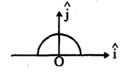
A
$\frac{q}{2{\pi ^2}{\varepsilon _0}{r^2}}\,\hat{j}$
B
$\frac{q}{4{\pi ^2}{\varepsilon _0}{r^2}}\,\hat{j}$
C
$-\frac{q}{4{\pi ^2}{\varepsilon _0}{r^2}}\,\hat{j}$
D
$-\frac{q}{2{\pi ^2}{\varepsilon _0}{r^2}}\,\hat{j}$
Solution
(D) Given,linear charge density $\lambda = \frac{q}{\pi r}$.
Consider a small element of the ring subtending an angle $d\theta$ at the center. The charge on this element is $dq = \lambda (r d\theta) = \frac{q}{\pi r} (r d\theta) = \frac{q}{\pi} d\theta$.
The electric field due to this element at the center $O$ is $dE = \frac{1}{4\pi\varepsilon_0} \frac{dq}{r^2} = \frac{1}{4\pi\varepsilon_0} \frac{q d\theta}{\pi r^2}$.
Due to symmetry,the horizontal components of the electric field cancel out,and the vertical components add up.
The vertical component of the field is $dE_y = dE \cos\theta$ (directed along $-\hat{j}$).
Integrating from $-\pi/2$ to $\pi/2$:
$E = \int_{-\pi/2}^{\pi/2} \frac{1}{4\pi\varepsilon_0} \frac{q d\theta}{\pi r^2} \cos\theta (-\hat{j})$
$E = -\frac{q}{4\pi^2\varepsilon_0 r^2} \hat{j} \int_{-\pi/2}^{\pi/2} \cos\theta d\theta$
$E = -\frac{q}{4\pi^2\varepsilon_0 r^2} \hat{j} [\sin\theta]_{-\pi/2}^{\pi/2}$
$E = -\frac{q}{4\pi^2\varepsilon_0 r^2} \hat{j} [1 - (-1)] = -\frac{q}{4\pi^2\varepsilon_0 r^2} \hat{j} (2) = -\frac{q}{2\pi^2\varepsilon_0 r^2} \hat{j}$.
Consider a small element of the ring subtending an angle $d\theta$ at the center. The charge on this element is $dq = \lambda (r d\theta) = \frac{q}{\pi r} (r d\theta) = \frac{q}{\pi} d\theta$.
The electric field due to this element at the center $O$ is $dE = \frac{1}{4\pi\varepsilon_0} \frac{dq}{r^2} = \frac{1}{4\pi\varepsilon_0} \frac{q d\theta}{\pi r^2}$.
Due to symmetry,the horizontal components of the electric field cancel out,and the vertical components add up.
The vertical component of the field is $dE_y = dE \cos\theta$ (directed along $-\hat{j}$).
Integrating from $-\pi/2$ to $\pi/2$:
$E = \int_{-\pi/2}^{\pi/2} \frac{1}{4\pi\varepsilon_0} \frac{q d\theta}{\pi r^2} \cos\theta (-\hat{j})$
$E = -\frac{q}{4\pi^2\varepsilon_0 r^2} \hat{j} \int_{-\pi/2}^{\pi/2} \cos\theta d\theta$
$E = -\frac{q}{4\pi^2\varepsilon_0 r^2} \hat{j} [\sin\theta]_{-\pi/2}^{\pi/2}$
$E = -\frac{q}{4\pi^2\varepsilon_0 r^2} \hat{j} [1 - (-1)] = -\frac{q}{4\pi^2\varepsilon_0 r^2} \hat{j} (2) = -\frac{q}{2\pi^2\varepsilon_0 r^2} \hat{j}$.
0 likesView Solution
4
ChemistryMCQAIEEE · 2010
$A$ diatomic ideal gas is used in a Carnot engine as the working substance. If during the adiabatic expansion part of the cycle the volume of the gas increases from $V$ to $32V$,the efficiency of the engine is
A
$0.25$
B
$0.5$
C
$0.75$
D
$0.99$
Solution
(C) For an adiabatic process,the relation between temperature and volume is given by $T_1 V_1^{\gamma - 1} = T_2 V_2^{\gamma - 1}$.
Given $V_1 = V$ and $V_2 = 32V$,we have $T_1 V^{\gamma - 1} = T_2 (32V)^{\gamma - 1}$.
This simplifies to $T_1 = (32)^{\gamma - 1} T_2$.
For a diatomic gas,the adiabatic index $\gamma = 7/5$,so $\gamma - 1 = 2/5$.
Substituting this,$T_1 = (32)^{2/5} T_2 = (2^5)^{2/5} T_2 = 2^2 T_2 = 4 T_2$.
The efficiency of a Carnot engine is given by $\eta = 1 - \frac{T_2}{T_1}$.
Substituting $T_1 = 4T_2$,we get $\eta = 1 - \frac{T_2}{4T_2} = 1 - 0.25 = 0.75$.
Given $V_1 = V$ and $V_2 = 32V$,we have $T_1 V^{\gamma - 1} = T_2 (32V)^{\gamma - 1}$.
This simplifies to $T_1 = (32)^{\gamma - 1} T_2$.
For a diatomic gas,the adiabatic index $\gamma = 7/5$,so $\gamma - 1 = 2/5$.
Substituting this,$T_1 = (32)^{2/5} T_2 = (2^5)^{2/5} T_2 = 2^2 T_2 = 4 T_2$.
The efficiency of a Carnot engine is given by $\eta = 1 - \frac{T_2}{T_1}$.
Substituting $T_1 = 4T_2$,we get $\eta = 1 - \frac{T_2}{4T_2} = 1 - 0.25 = 0.75$.
0 likesView Solution
5
ChemistryMediumMCQAIEEE · 2010
The energy required to break one mole of $Cl-Cl$ bonds in $Cl_2$ is $242 \, kJ \, mol^{-1}.$ The longest wavelength of light capable of breaking a single $Cl-Cl$ bond is $............ \, nm.$
$(c = 3 \times 10^8 \, m \, s^{-1}$ and $N_A = 6.02 \times 10^{23} \, mol^{-1}).$
$(c = 3 \times 10^8 \, m \, s^{-1}$ and $N_A = 6.02 \times 10^{23} \, mol^{-1}).$
A
$594$
B
$640$
C
$700$
D
$494$
Solution
(D) Energy required to break one mole of $Cl_2$ molecules is $242 \, kJ \, mol^{-1} = 242 \times 10^3 \, J \, mol^{-1}.$
Energy required to break a single $Cl-Cl$ bond is $E = \frac{242 \times 10^3}{6.02 \times 10^{23}} \, J.$
Using the relation $E = \frac{hc}{\lambda}$,the wavelength is $\lambda = \frac{hc}{E}.$
Substituting the values: $\lambda = \frac{6.626 \times 10^{-34} \, J \cdot s \times 3 \times 10^8 \, m \cdot s^{-1} \times 6.02 \times 10^{23} \, mol^{-1}}{242 \times 10^3 \, J \cdot mol^{-1}}.$
$\lambda \approx 4.94 \times 10^{-7} \, m = 494 \times 10^{-9} \, m = 494 \, nm.$
Energy required to break a single $Cl-Cl$ bond is $E = \frac{242 \times 10^3}{6.02 \times 10^{23}} \, J.$
Using the relation $E = \frac{hc}{\lambda}$,the wavelength is $\lambda = \frac{hc}{E}.$
Substituting the values: $\lambda = \frac{6.626 \times 10^{-34} \, J \cdot s \times 3 \times 10^8 \, m \cdot s^{-1} \times 6.02 \times 10^{23} \, mol^{-1}}{242 \times 10^3 \, J \cdot mol^{-1}}.$
$\lambda \approx 4.94 \times 10^{-7} \, m = 494 \times 10^{-9} \, m = 494 \, nm.$
0 likesView Solution
6
ChemistryDifficultMCQAIEEE · 2010
Ionisation energy of $He^{+}$ is $19.6 \times 10^{-18} \, J \, atom^{-1}$. The energy of the first stationary state $(n = 1)$ of $Li^{2+}$ is
A
$4.41 \times 10^{-16} \, J \, atom^{-1}$
B
$-4.41 \times 10^{-17} \, J \, atom^{-1}$
C
$-2.2 \times 10^{-15} \, J \, atom^{-1}$
D
$8.82 \times 10^{-17} \, J \, atom^{-1}$
Solution
(B) Ionisation energy $(IE)$ is the energy required to move an electron from the ground state to infinity.
$IE = E_{\infty} - E_{1} = 0 - E_{1} = -E_{1}$
Therefore,$E_{1}$ of $He^{+} = -19.6 \times 10^{-18} \, J \, atom^{-1}$.
Energy of a hydrogen-like species at state $n$ is given by $(E_{n})_{species} = (E_{1})_{H} \times \frac{Z^{2}}{n^{2}}$.
For $He^{+}$ $(Z=2, n=1)$: $(E_{1})_{He^{+}} = (E_{1})_{H} \times 2^{2} = -19.6 \times 10^{-18} \, J \, atom^{-1}$.
So,$(E_{1})_{H} = \frac{-19.6 \times 10^{-18}}{4} \, J \, atom^{-1}$.
For $Li^{2+}$ $(Z=3, n=1)$: $(E_{1})_{Li^{2+}} = (E_{1})_{H} \times 3^{2} = \frac{-19.6 \times 10^{-18}}{4} \times 9 = -4.41 \times 10^{-17} \, J \, atom^{-1}$.
$IE = E_{\infty} - E_{1} = 0 - E_{1} = -E_{1}$
Therefore,$E_{1}$ of $He^{+} = -19.6 \times 10^{-18} \, J \, atom^{-1}$.
Energy of a hydrogen-like species at state $n$ is given by $(E_{n})_{species} = (E_{1})_{H} \times \frac{Z^{2}}{n^{2}}$.
For $He^{+}$ $(Z=2, n=1)$: $(E_{1})_{He^{+}} = (E_{1})_{H} \times 2^{2} = -19.6 \times 10^{-18} \, J \, atom^{-1}$.
So,$(E_{1})_{H} = \frac{-19.6 \times 10^{-18}}{4} \, J \, atom^{-1}$.
For $Li^{2+}$ $(Z=3, n=1)$: $(E_{1})_{Li^{2+}} = (E_{1})_{H} \times 3^{2} = \frac{-19.6 \times 10^{-18}}{4} \times 9 = -4.41 \times 10^{-17} \, J \, atom^{-1}$.
0 likesView Solution
7
ChemistryMediumMCQAIEEE · 2010
The correct sequence which shows the decreasing order of the ionic radii of the elements is:
A
$Al^{3+} > Mg^{2+} > Na^{+} > F^{-} > O^{2-}$
B
$Na^{+} > Mg^{2+} > Al^{3+} > O^{2-} > F^{-}$
C
$Na^{+} > F^{-} > Mg^{2+} > O^{2-} > Al^{3+}$
D
$O^{2-} > F^{-} > Na^{+} > Mg^{2+} > Al^{3+}$
Solution
(D) All the given ions $(O^{2-}, F^{-}, Na^{+}, Mg^{2+}, Al^{3+})$ are isoelectronic,meaning they all have $10$ electrons.
For isoelectronic species,the ionic radius decreases as the nuclear charge (atomic number) increases.
$O^{2-}$ $(Z=8)$,$F^{-}$ $(Z=9)$,$Na^{+}$ $(Z=11)$,$Mg^{2+}$ $(Z=12)$,$Al^{3+}$ $(Z=13)$.
Since the nuclear charge increases from $O^{2-}$ to $Al^{3+}$,the ionic radius decreases in the order: $O^{2-} > F^{-} > Na^{+} > Mg^{2+} > Al^{3+}$.
For isoelectronic species,the ionic radius decreases as the nuclear charge (atomic number) increases.
$O^{2-}$ $(Z=8)$,$F^{-}$ $(Z=9)$,$Na^{+}$ $(Z=11)$,$Mg^{2+}$ $(Z=12)$,$Al^{3+}$ $(Z=13)$.
Since the nuclear charge increases from $O^{2-}$ to $Al^{3+}$,the ionic radius decreases in the order: $O^{2-} > F^{-} > Na^{+} > Mg^{2+} > Al^{3+}$.
0 likesView Solution
8
ChemistryMediumMCQAIEEE · 2010
If $10^{-4} \ dm^3$ of water is introduced into a $1.0 \ dm^3$ flask at $300 \ K,$ how many moles of water are in the vapour phase when equilibrium is established? (Given: Vapour pressure of $H_2O$ at $300 \ K$ is $3170 \ Pa;$ $R = 8.314 \ J \ K^{-1} \ mol^{-1}$)
A
$5.56 \times 10^{-3} \ mol$
B
$1.53 \times 10^{-2} \ mol$
C
$4.46 \times 10^{-2} \ mol$
D
$1.27 \times 10^{-3} \ mol$
Solution
(D) At equilibrium,the water vapour exerts a pressure equal to its saturated vapour pressure.
Using the ideal gas equation,$PV = nRT$,where $P = 3170 \ Pa$,$V = 1.0 \ dm^3 = 1.0 \times 10^{-3} \ m^3$,$T = 300 \ K$,and $R = 8.314 \ J \ K^{-1} \ mol^{-1}$.
$n = \frac{PV}{RT} = \frac{3170 \times 1.0 \times 10^{-3}}{8.314 \times 300} \ mol$.
$n = \frac{3.17}{2494.2} \ mol \approx 1.27 \times 10^{-3} \ mol$.
Using the ideal gas equation,$PV = nRT$,where $P = 3170 \ Pa$,$V = 1.0 \ dm^3 = 1.0 \times 10^{-3} \ m^3$,$T = 300 \ K$,and $R = 8.314 \ J \ K^{-1} \ mol^{-1}$.
$n = \frac{PV}{RT} = \frac{3170 \times 1.0 \times 10^{-3}}{8.314 \times 300} \ mol$.
$n = \frac{3.17}{2494.2} \ mol \approx 1.27 \times 10^{-3} \ mol$.
0 likesView Solution
9
ChemistryMediumMCQAIEEE · 2010
The standard enthalpy of formation of $NH_3$ is $-46.0 \ kJ \ mol^{-1}.$ If the enthalpy of formation of $H_2$ from its atoms is $-436 \ kJ \ mol^{-1}$ and that of $N_2$ is $-712 \ kJ \ mol^{-1},$ the average bond enthalpy of $N-H$ bond in $NH_3$ is ................ $kJ \ mol^{-1}$
A
$-964$
B
$+352$
C
$+1056$
D
$-1102$
Solution
(B) The reaction for the formation of $2 \ mol$ of $NH_3$ is: $N_2(g) + 3H_2(g) \rightarrow 2NH_3(g)$.
The enthalpy change for this reaction is $\Delta H = 2 \times \Delta_f H^{\circ}(NH_3) = 2 \times (-46.0) = -92 \ kJ \ mol^{-1}$.
Using bond enthalpies,$\Delta H = \sum \text{Bond energies of reactants} - \sum \text{Bond energies of products}$.
Given bond energies (as enthalpy of formation from atoms is negative of bond dissociation energy): $BE(N \equiv N) = 712 \ kJ \ mol^{-1}$ and $BE(H-H) = 436 \ kJ \ mol^{-1}$.
Let $x$ be the bond enthalpy of $N-H$ bond. There are $6$ $N-H$ bonds in $2 \ mol$ of $NH_3$.
$-92 = [BE(N \equiv N) + 3 \times BE(H-H)] - 6x$.
$-92 = [712 + 3 \times 436] - 6x$.
$-92 = [712 + 1308] - 6x$.
$-92 = 2020 - 6x$.
$6x = 2020 + 92 = 2112$.
$x = 2112 / 6 = +352 \ kJ \ mol^{-1}$.
The enthalpy change for this reaction is $\Delta H = 2 \times \Delta_f H^{\circ}(NH_3) = 2 \times (-46.0) = -92 \ kJ \ mol^{-1}$.
Using bond enthalpies,$\Delta H = \sum \text{Bond energies of reactants} - \sum \text{Bond energies of products}$.
Given bond energies (as enthalpy of formation from atoms is negative of bond dissociation energy): $BE(N \equiv N) = 712 \ kJ \ mol^{-1}$ and $BE(H-H) = 436 \ kJ \ mol^{-1}$.
Let $x$ be the bond enthalpy of $N-H$ bond. There are $6$ $N-H$ bonds in $2 \ mol$ of $NH_3$.
$-92 = [BE(N \equiv N) + 3 \times BE(H-H)] - 6x$.
$-92 = [712 + 3 \times 436] - 6x$.
$-92 = [712 + 1308] - 6x$.
$-92 = 2020 - 6x$.
$6x = 2020 + 92 = 2112$.
$x = 2112 / 6 = +352 \ kJ \ mol^{-1}$.
0 likesView Solution
10
ChemistryMediumMCQAIEEE · 2010
For a particular reversible reaction at temperature $T$,$\Delta H$ and $\Delta S$ were found to be both positive. If $T_e$ is the temperature at equilibrium,the reaction would be spontaneous when
A
$T_e > T$
B
$T > T_e$
C
$T_e$ is $5$ times $T$
D
$T = T_e$
Solution
(B) At equilibrium,the Gibbs free energy change $\Delta G = 0$.
Using the relation $\Delta G = \Delta H - T \Delta S$,at equilibrium we have $\Delta H - T_e \Delta S = 0$,which gives $T_e = \frac{\Delta H}{\Delta S}$.
For a reaction to be spontaneous,the condition is $\Delta G < 0$.
Substituting the expression for $\Delta G$,we get $\Delta H - T \Delta S < 0$,which implies $\Delta H < T \Delta S$.
Dividing by $\Delta S$ (since $\Delta S > 0$),we get $T > \frac{\Delta H}{\Delta S}$.
Since $T_e = \frac{\Delta H}{\Delta S}$,the condition for spontaneity is $T > T_e$.
Using the relation $\Delta G = \Delta H - T \Delta S$,at equilibrium we have $\Delta H - T_e \Delta S = 0$,which gives $T_e = \frac{\Delta H}{\Delta S}$.
For a reaction to be spontaneous,the condition is $\Delta G < 0$.
Substituting the expression for $\Delta G$,we get $\Delta H - T \Delta S < 0$,which implies $\Delta H < T \Delta S$.
Dividing by $\Delta S$ (since $\Delta S > 0$),we get $T > \frac{\Delta H}{\Delta S}$.
Since $T_e = \frac{\Delta H}{\Delta S}$,the condition for spontaneity is $T > T_e$.
0 likesView Solution
11
ChemistryMediumMCQAIEEE · 2010
Three reactions involving $H_2PO_4^-$ are given below :
$(i) \; H_3PO_4 + H_2O \rightarrow H_3O^{+} + H_2PO_4^-$
$(ii) \; H_2PO_4^- + H_2O \rightarrow HPO_4^{2-} + H_3O^{+}$
$(iii) \; H_2PO_4^- + OH^{-} \rightarrow H_2O + HPO_4^{2-}$
In which of the above does $H_2PO_4^-$ act as an acid?
$(i) \; H_3PO_4 + H_2O \rightarrow H_3O^{+} + H_2PO_4^-$
$(ii) \; H_2PO_4^- + H_2O \rightarrow HPO_4^{2-} + H_3O^{+}$
$(iii) \; H_2PO_4^- + OH^{-} \rightarrow H_2O + HPO_4^{2-}$
In which of the above does $H_2PO_4^-$ act as an acid?
A
$(ii)$ only
B
$(i)$ and $(ii)$
C
$(iii)$ only
D
$(i)$ only
Solution
(A) An acid is a substance that donates a proton $(H^{+})$.
In reaction $(i)$,$H_2PO_4^-$ is formed as a product,so it is not acting as an acid.
In reaction $(ii)$,$H_2PO_4^- + H_2O \rightarrow HPO_4^{2-} + H_3O^{+}$,$H_2PO_4^-$ donates a proton to $H_2O$,thus it acts as an acid.
In reaction $(iii)$,$H_2PO_4^- + OH^{-} \rightarrow H_2O + HPO_4^{2-}$,$H_2PO_4^-$ donates a proton to $OH^{-}$,thus it also acts as an acid.
Therefore,$H_2PO_4^-$ acts as an acid in both $(ii)$ and $(iii)$.
In reaction $(i)$,$H_2PO_4^-$ is formed as a product,so it is not acting as an acid.
In reaction $(ii)$,$H_2PO_4^- + H_2O \rightarrow HPO_4^{2-} + H_3O^{+}$,$H_2PO_4^-$ donates a proton to $H_2O$,thus it acts as an acid.
In reaction $(iii)$,$H_2PO_4^- + OH^{-} \rightarrow H_2O + HPO_4^{2-}$,$H_2PO_4^-$ donates a proton to $OH^{-}$,thus it also acts as an acid.
Therefore,$H_2PO_4^-$ acts as an acid in both $(ii)$ and $(iii)$.
0 likesView Solution
12
ChemistryAdvancedMCQAIEEE · 2010
In aqueous solution,the ionization constants for carbonic acid are $K_1 = 4.2 \times 10^{-7}$ and $K_2 = 4.8 \times 10^{-11}$. Select the correct statement for a saturated $0.034 \ M$ solution of carbonic acid.
A
The concentration of $CO_3^{2-}$ is $0.034 \ M$.
B
The concentration of $CO_3^{2-}$ is greater than that of $HCO_3^-$.
C
The concentrations of $H^{+}$ and $HCO_3^-$ are approximately equal.
D
The concentration of $H^{+}$ is double that of $CO_3^{2-}$.
Solution
(C) For the first dissociation step: $H_2CO_3(aq) \rightleftharpoons HCO_3^-(aq) + H^+(aq)$.
Given $K_1 = 4.2 \times 10^{-7}$ and initial concentration $C = 0.034 \ M$.
Since $K_1$ is very small,$[H^+] \approx [HCO_3^-] = \sqrt{K_1 \times C} = \sqrt{4.2 \times 10^{-7} \times 0.034} \approx 1.195 \times 10^{-4} \ M$.
For the second dissociation step: $HCO_3^-(aq) \rightleftharpoons CO_3^{2-}(aq) + H^+(aq)$.
$K_2 = \frac{[CO_3^{2-}][H^+]}{[HCO_3^-]}$.
Since $[H^+] \approx [HCO_3^-]$,we have $[CO_3^{2-}] = K_2 = 4.8 \times 10^{-11} \ M$.
Comparing the values,$[H^+] = [HCO_3^-] = 1.195 \times 10^{-4} \ M$,which are approximately equal.
Given $K_1 = 4.2 \times 10^{-7}$ and initial concentration $C = 0.034 \ M$.
Since $K_1$ is very small,$[H^+] \approx [HCO_3^-] = \sqrt{K_1 \times C} = \sqrt{4.2 \times 10^{-7} \times 0.034} \approx 1.195 \times 10^{-4} \ M$.
For the second dissociation step: $HCO_3^-(aq) \rightleftharpoons CO_3^{2-}(aq) + H^+(aq)$.
$K_2 = \frac{[CO_3^{2-}][H^+]}{[HCO_3^-]}$.
Since $[H^+] \approx [HCO_3^-]$,we have $[CO_3^{2-}] = K_2 = 4.8 \times 10^{-11} \ M$.
Comparing the values,$[H^+] = [HCO_3^-] = 1.195 \times 10^{-4} \ M$,which are approximately equal.
0 likesView Solution
13
ChemistryDifficultMCQAIEEE · 2010
The solubility product of silver bromide is $5.0 \times 10^{-13}$. The quantity of potassium bromide (molar mass taken as $120 \ g \ mol^{-1}$) to be added to $1 \ L$ of $0.05 \ M$ solution of silver nitrate to start the precipitation of $AgBr$ is
A
$1.2 \times 10^{-10} \ g$
B
$1.2 \times 10^{-9} \ g$
C
$6.2 \times 10^{-5} \ g$
D
$5.0 \times 10^{-8} \ g$
Solution
(B) The dissociation of silver bromide is given by: $AgBr(s) \rightleftharpoons Ag^{+}(aq) + Br^{-}(aq)$.
For precipitation to start,the ionic product must exceed the solubility product $(K_{sp})$.
$K_{sp} = [Ag^{+}][Br^{-}] = 5.0 \times 10^{-13}$.
Given $[Ag^{+}] = 0.05 \ M$,the concentration of $Br^{-}$ required is:
$[Br^{-}] = \frac{K_{sp}}{[Ag^{+}]} = \frac{5.0 \times 10^{-13}}{0.05} = 1.0 \times 10^{-11} \ M$.
Since the volume of the solution is $1 \ L$,the number of moles of $Br^{-}$ (or $KBr$) required is $1.0 \times 10^{-11} \ mol$.
The mass of $KBr$ required is: $\text{Mass} = \text{moles} \times \text{molar mass} = 1.0 \times 10^{-11} \ mol \times 120 \ g \ mol^{-1} = 1.2 \times 10^{-9} \ g$.
For precipitation to start,the ionic product must exceed the solubility product $(K_{sp})$.
$K_{sp} = [Ag^{+}][Br^{-}] = 5.0 \times 10^{-13}$.
Given $[Ag^{+}] = 0.05 \ M$,the concentration of $Br^{-}$ required is:
$[Br^{-}] = \frac{K_{sp}}{[Ag^{+}]} = \frac{5.0 \times 10^{-13}}{0.05} = 1.0 \times 10^{-11} \ M$.
Since the volume of the solution is $1 \ L$,the number of moles of $Br^{-}$ (or $KBr$) required is $1.0 \times 10^{-11} \ mol$.
The mass of $KBr$ required is: $\text{Mass} = \text{moles} \times \text{molar mass} = 1.0 \times 10^{-11} \ mol \times 120 \ g \ mol^{-1} = 1.2 \times 10^{-9} \ g$.
0 likesView Solution
14
ChemistryMCQAIEEE · 2010
At $25 \ ^\circ C,$ the solubility product of $Mg(OH)_2$ is $1.0 \times 10^{-11}.$ At which $pH$ will $Mg^{2+}$ ions start precipitating in the form of $Mg(OH)_2$ from a solution of $0.001 \ M \ Mg^{2+}$ ions?
A
$9$
B
$10$
C
$11$
D
$8$
Solution
(B) The dissociation equilibrium is: $Mg(OH)_2 \rightleftharpoons Mg^{2+} + 2OH^-$
The solubility product expression is: $K_{sp} = [Mg^{2+}][OH^-]^2$
Given $K_{sp} = 1.0 \times 10^{-11}$ and $[Mg^{2+}] = 0.001 \ M = 10^{-3} \ M.$
Substituting the values: $1.0 \times 10^{-11} = 10^{-3} \times [OH^-]^2$
$[OH^-]^2 = \frac{1.0 \times 10^{-11}}{10^{-3}} = 10^{-8}$
$[OH^-] = \sqrt{10^{-8}} = 10^{-4} \ M$
Calculating $pOH$: $pOH = -\log[OH^-] = -\log(10^{-4}) = 4$
Since $pH + pOH = 14$ at $25 \ ^\circ C,$
$pH = 14 - 4 = 10.$
The solubility product expression is: $K_{sp} = [Mg^{2+}][OH^-]^2$
Given $K_{sp} = 1.0 \times 10^{-11}$ and $[Mg^{2+}] = 0.001 \ M = 10^{-3} \ M.$
Substituting the values: $1.0 \times 10^{-11} = 10^{-3} \times [OH^-]^2$
$[OH^-]^2 = \frac{1.0 \times 10^{-11}}{10^{-3}} = 10^{-8}$
$[OH^-] = \sqrt{10^{-8}} = 10^{-4} \ M$
Calculating $pOH$: $pOH = -\log[OH^-] = -\log(10^{-4}) = 4$
Since $pH + pOH = 14$ at $25 \ ^\circ C,$
$pH = 14 - 4 = 10.$
0 likesView Solution
15
ChemistryMediumMCQAIEEE · 2010
The correct order of increasing basicity of the given conjugate bases $(R = CH_3)$ is
A
$RCOO^{-} < HC \equiv C^{-} < R^{-} < NH_2^{-}$
B
$R^{-} < HC \equiv C^{-} < RCOO^{-} < NH_2^{-}$
C
$RCOO^{-} < NH_2^{-} < HC \equiv C^{-} < R^{-}$
D
$RCOO^{-} < HC \equiv C^{-} < NH_2^{-} < R^{-}$
Solution
(D) The strength of a conjugate base is inversely proportional to the strength of its corresponding conjugate acid.
First,we determine the acidic strength order of the corresponding conjugate acids: $RCOOH > HC \equiv CH > NH_3 > RH$.
Since $RCOOH$ is the strongest acid,its conjugate base $RCOO^{-}$ is the weakest base.
Since $RH$ (alkane) is the weakest acid,its conjugate base $R^{-}$ is the strongest base.
Therefore,the order of increasing basicity is: $RCOO^{-} < HC \equiv C^{-} < NH_2^{-} < R^{-}$.
First,we determine the acidic strength order of the corresponding conjugate acids: $RCOOH > HC \equiv CH > NH_3 > RH$.
Since $RCOOH$ is the strongest acid,its conjugate base $RCOO^{-}$ is the weakest base.
Since $RH$ (alkane) is the weakest acid,its conjugate base $R^{-}$ is the strongest base.
Therefore,the order of increasing basicity is: $RCOO^{-} < HC \equiv C^{-} < NH_2^{-} < R^{-}$.
0 likesView Solution
16
ChemistryMediumMCQAIEEE · 2010
Out of the following,the alkene that exhibits optical isomerism is
A
$3-methyl-2-pentene$
B
$4-methyl-1-pentene$
C
$3-methyl-1-pentene$
D
$2-methyl-2-pentene$
Solution
(C) The correct answer is $(C)$.
$3-methyl-1-pentene$ exhibits optical isomerism because it contains a chiral carbon atom at the $3^{rd}$ position.
The structure is $CH_2=CH-CH(CH_3)-CH_2-CH_3$.
The four different groups attached to the chiral carbon $(C^*)$ are $-H$,$-CH_3$,$-CH=CH_2$,and $-CH_2-CH_3$.
$3-methyl-1-pentene$ exhibits optical isomerism because it contains a chiral carbon atom at the $3^{rd}$ position.
The structure is $CH_2=CH-CH(CH_3)-CH_2-CH_3$.
The four different groups attached to the chiral carbon $(C^*)$ are $-H$,$-CH_3$,$-CH=CH_2$,and $-CH_2-CH_3$.
0 likesView Solution
17
ChemistryAdvancedMCQAIEEE · 2010
One mole of a symmetrical alkene on ozonolysis gives two moles of an aldehyde having a molecular mass of $44 \ u$. The alkene is
A
propene
B
$1$-butene
C
$2$-butene
D
ethene
Solution
(C) Ozonolysis of a symmetrical alkene $R-CH=CH-R$ yields two moles of the same aldehyde $R-CHO$.
The molecular mass of the aldehyde is $44 \ u$.
The general formula for an aldehyde is $C_nH_{2n}O$.
$12n + 2n + 16 = 44 \implies 14n = 28 \implies n = 2$.
Thus,the aldehyde is acetaldehyde $(CH_3CHO)$.
The reaction is: $CH_3-CH=CH-CH_3 \xrightarrow{O_3, Zn/H_2O} 2CH_3CHO$.
Therefore,the symmetrical alkene is $2$-butene.
The molecular mass of the aldehyde is $44 \ u$.
The general formula for an aldehyde is $C_nH_{2n}O$.
$12n + 2n + 16 = 44 \implies 14n = 28 \implies n = 2$.
Thus,the aldehyde is acetaldehyde $(CH_3CHO)$.
The reaction is: $CH_3-CH=CH-CH_3 \xrightarrow{O_3, Zn/H_2O} 2CH_3CHO$.
Therefore,the symmetrical alkene is $2$-butene.
0 likesView Solution
18
ChemistryMCQAIEEE · 2010
The Gibbs energy for the decomposition of $Al_2O_3$ at $500^o C$ is as follows :
$\frac{2}{3} Al_2O_3 \rightarrow \frac{4}{3} Al + O_2, \Delta G = +966 \ kJ \ mol^{-1}$
The potential difference needed for electrolytic reduction of $Al_2O_3$ at $500^o C$ is at least ...... $V$.
$\frac{2}{3} Al_2O_3 \rightarrow \frac{4}{3} Al + O_2, \Delta G = +966 \ kJ \ mol^{-1}$
The potential difference needed for electrolytic reduction of $Al_2O_3$ at $500^o C$ is at least ...... $V$.
A
$4.5$
B
$3.0$
C
$2.5$
D
$5.0$
Solution
(C) The relationship between Gibbs energy and cell potential is given by $\Delta G = -nFE$.
For the reaction $\frac{2}{3} Al_2O_3 \rightarrow \frac{4}{3} Al + O_2$,the number of electrons transferred $(n)$ is calculated as follows: $Al$ goes from $+3$ to $0$ oxidation state. For $\frac{4}{3}$ moles of $Al$,$n = \frac{4}{3} \times 3 = 4$.
Using the formula $E = -\frac{\Delta G}{nF}$ (where $\Delta G$ is for the reduction reaction,which is $-966 \ kJ \ mol^{-1}$):
$E = -\frac{-966 \times 10^3 \ J \ mol^{-1}}{4 \times 96500 \ C \ mol^{-1}}$
$E = \frac{966000}{386000} = 2.5 \ V$.
Thus,the potential difference needed for the reduction is $2.5 \ V$.
For the reaction $\frac{2}{3} Al_2O_3 \rightarrow \frac{4}{3} Al + O_2$,the number of electrons transferred $(n)$ is calculated as follows: $Al$ goes from $+3$ to $0$ oxidation state. For $\frac{4}{3}$ moles of $Al$,$n = \frac{4}{3} \times 3 = 4$.
Using the formula $E = -\frac{\Delta G}{nF}$ (where $\Delta G$ is for the reduction reaction,which is $-966 \ kJ \ mol^{-1}$):
$E = -\frac{-966 \times 10^3 \ J \ mol^{-1}}{4 \times 96500 \ C \ mol^{-1}}$
$E = \frac{966000}{386000} = 2.5 \ V$.
Thus,the potential difference needed for the reduction is $2.5 \ V$.
0 likesView Solution
19
ChemistryDifficultMCQAIEEE · 2010
$29.5 \ mg$ of an organic compound containing nitrogen was digested according to Kjeldahl's method and the evolved ammonia was absorbed in $20 \ mL$ of $0.1 \ M \ HCl$ solution. The excess of the acid required $15 \ mL$ of $0.1 \ M \ NaOH$ solution for complete neutralization. The percentage of nitrogen in the compound is $..... \%$.
A
$59.0$
B
$47.4$
C
$23.7$
D
$29.5$
Solution
(C) Moles of $HCl$ taken $= 20 \times 0.1 \times 10^{-3} = 2 \times 10^{-3} \ mol$.
Moles of $HCl$ neutralized by $NaOH$ solution $= 15 \times 0.1 \times 10^{-3} = 1.5 \times 10^{-3} \ mol$.
Moles of $HCl$ neutralized by ammonia $= 2 \times 10^{-3} - 1.5 \times 10^{-3} = 0.5 \times 10^{-3} \ mol$.
Since $1 \ mol$ of $NH_3$ reacts with $1 \ mol$ of $HCl$,moles of $N = 0.5 \times 10^{-3} \ mol$.
Mass of nitrogen $= 0.5 \times 10^{-3} \ mol \times 14 \ g/mol = 7 \times 10^{-3} \ g = 7 \ mg$.
Percentage of nitrogen $= (\text{Mass of nitrogen} / \text{Mass of compound}) \times 100 = (7 \ mg / 29.5 \ mg) \times 100 \approx 23.7 \%$.
Moles of $HCl$ neutralized by $NaOH$ solution $= 15 \times 0.1 \times 10^{-3} = 1.5 \times 10^{-3} \ mol$.
Moles of $HCl$ neutralized by ammonia $= 2 \times 10^{-3} - 1.5 \times 10^{-3} = 0.5 \times 10^{-3} \ mol$.
Since $1 \ mol$ of $NH_3$ reacts with $1 \ mol$ of $HCl$,moles of $N = 0.5 \times 10^{-3} \ mol$.
Mass of nitrogen $= 0.5 \times 10^{-3} \ mol \times 14 \ g/mol = 7 \times 10^{-3} \ g = 7 \ mg$.
Percentage of nitrogen $= (\text{Mass of nitrogen} / \text{Mass of compound}) \times 100 = (7 \ mg / 29.5 \ mg) \times 100 \approx 23.7 \%$.
0 likesView Solution
20
ChemistryMCQAIEEE · 2010
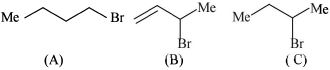
Consider the following bromides:
The correct order of $S_N1$ reactivity is
The correct order of $S_N1$ reactivity is
A
$B > C > A$
B
$B > A > C$
C
$C > B > A$
D
$A > B > C$
Solution
(A) $S_N1$ reactions proceed via the formation of a carbocation intermediate. The stability of the carbocation determines the rate of the reaction; a more stable carbocation leads to a faster reaction.
$1$. Compound $A$ ($1$-bromobutane) forms a primary $(1^{\circ})$ carbocation.
$2$. Compound $C$ ($2$-bromobutane) forms a secondary $(2^{\circ})$ carbocation,which is more stable than the $1^{\circ}$ carbocation.
$3$. Compound $B$ ($3$-bromo$-1-$butene) forms an allylic carbocation,which is resonance-stabilized and significantly more stable than both $1^{\circ}$ and $2^{\circ}$ alkyl carbocations.
Therefore,the stability order of the carbocations is: Allylic $(B)$ > Secondary $(C)$ > Primary $(A)$.
Thus,the correct order of $S_N1$ reactivity is $B > C > A$.
$1$. Compound $A$ ($1$-bromobutane) forms a primary $(1^{\circ})$ carbocation.
$2$. Compound $C$ ($2$-bromobutane) forms a secondary $(2^{\circ})$ carbocation,which is more stable than the $1^{\circ}$ carbocation.
$3$. Compound $B$ ($3$-bromo$-1-$butene) forms an allylic carbocation,which is resonance-stabilized and significantly more stable than both $1^{\circ}$ and $2^{\circ}$ alkyl carbocations.
Therefore,the stability order of the carbocations is: Allylic $(B)$ > Secondary $(C)$ > Primary $(A)$.
Thus,the correct order of $S_N1$ reactivity is $B > C > A$.

0 likesView Solution
21
ChemistryMCQAIEEE · 2010
$A$ diatomic ideal gas is used in a Carnot engine as the working substance. If during the adiabatic expansion part of the cycle the volume of the gas increases from $V$ to $32V$,the efficiency of the engine is:
A
$0.25$
B
$0.5$
C
$0.75$
D
$0.99$
Solution
(C) For a diatomic gas,the adiabatic index $\gamma = 1.4 = 7/5$.
In an adiabatic process,the relation between temperature and volume is $T_1 V_1^{\gamma-1} = T_2 V_2^{\gamma-1}$.
Given $V_1 = V$ and $V_2 = 32V$,we have:
$T_1 (V)^{7/5 - 1} = T_2 (32V)^{7/5 - 1}$
$T_1 (V)^{2/5} = T_2 (32V)^{2/5}$
$T_1 = T_2 (32)^{2/5}$
$T_1 = T_2 (2^5)^{2/5} = T_2 (2^2) = 4T_2$.
The efficiency of a Carnot engine is given by $\eta = 1 - \frac{T_2}{T_1}$.
Substituting $T_1 = 4T_2$:
$\eta = 1 - \frac{T_2}{4T_2} = 1 - 0.25 = 0.75$.
In an adiabatic process,the relation between temperature and volume is $T_1 V_1^{\gamma-1} = T_2 V_2^{\gamma-1}$.
Given $V_1 = V$ and $V_2 = 32V$,we have:
$T_1 (V)^{7/5 - 1} = T_2 (32V)^{7/5 - 1}$
$T_1 (V)^{2/5} = T_2 (32V)^{2/5}$
$T_1 = T_2 (32)^{2/5}$
$T_1 = T_2 (2^5)^{2/5} = T_2 (2^2) = 4T_2$.
The efficiency of a Carnot engine is given by $\eta = 1 - \frac{T_2}{T_1}$.
Substituting $T_1 = 4T_2$:
$\eta = 1 - \frac{T_2}{4T_2} = 1 - 0.25 = 0.75$.
0 likesView Solution
22
ChemistryMCQAIEEE · 2010
$A$ point $P$ moves in a counter-clockwise direction on a circular path as shown in the figure. The movement of $P$ is such that it sweeps out a length $S = t^3 + 5$,where $S$ is in meters and $t$ is in seconds. The radius of the path is $20 \, m$. The acceleration of $P$ when $t = 2 \, s$ is nearly ......... $m/s^2$.
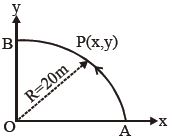
A
$14$
B
$13$
C
$12$
D
$7.2$
Solution
(A) Given the path length $S = t^3 + 5$.
The tangential velocity $v$ is given by $v = \frac{dS}{dt} = 3t^2$.
At $t = 2 \, s$,the velocity $v = 3(2)^2 = 12 \, m/s$.
The centripetal acceleration $a_c$ is given by $a_c = \frac{v^2}{R} = \frac{12^2}{20} = \frac{144}{20} = 7.2 \, m/s^2$.
The tangential acceleration $a_t$ is given by $a_t = \frac{dv}{dt} = \frac{d}{dt}(3t^2) = 6t$.
At $t = 2 \, s$,$a_t = 6(2) = 12 \, m/s^2$.
The total acceleration $a$ is given by $a = \sqrt{a_c^2 + a_t^2} = \sqrt{(7.2)^2 + (12)^2} = \sqrt{51.84 + 144} = \sqrt{195.84} \approx 14 \, m/s^2$.
The tangential velocity $v$ is given by $v = \frac{dS}{dt} = 3t^2$.
At $t = 2 \, s$,the velocity $v = 3(2)^2 = 12 \, m/s$.
The centripetal acceleration $a_c$ is given by $a_c = \frac{v^2}{R} = \frac{12^2}{20} = \frac{144}{20} = 7.2 \, m/s^2$.
The tangential acceleration $a_t$ is given by $a_t = \frac{dv}{dt} = \frac{d}{dt}(3t^2) = 6t$.
At $t = 2 \, s$,$a_t = 6(2) = 12 \, m/s^2$.
The total acceleration $a$ is given by $a = \sqrt{a_c^2 + a_t^2} = \sqrt{(7.2)^2 + (12)^2} = \sqrt{51.84 + 144} = \sqrt{195.84} \approx 14 \, m/s^2$.
0 likesView Solution
23
ChemistryMCQAIEEE · 2010
If a source of power $4 \, kW$ produces $10^{20}$ photons/second, the radiation belongs to a part of the spectrum called
A
$\gamma$-rays
B
$X$-rays
C
Ultraviolet rays
D
Microwaves
Solution
(B) The power $P$ of a source emitting $n$ photons per second with wavelength $\lambda$ is given by $P = \frac{nhc}{\lambda}$.
Rearranging for wavelength: $\lambda = \frac{nhc}{P}$.
Given: $P = 4 \, kW = 4 \times 10^3 \, W$, $n = 10^{20} \, \text{photons/s}$, $h = 6.63 \times 10^{-34} \, J \cdot s$, and $c = 3 \times 10^8 \, m/s$.
Substituting the values: $\lambda = \frac{10^{20} \times 6.63 \times 10^{-34} \times 3 \times 10^8}{4 \times 10^3}$.
$\lambda = \frac{19.89 \times 10^{-6}}{4 \times 10^3} = 4.97 \times 10^{-9} \, m \approx 50 \, \mathring{A}$.
Since the wavelength is approximately $50 \, \mathring{A}$, this radiation falls in the $X$-ray region of the electromagnetic spectrum.
Rearranging for wavelength: $\lambda = \frac{nhc}{P}$.
Given: $P = 4 \, kW = 4 \times 10^3 \, W$, $n = 10^{20} \, \text{photons/s}$, $h = 6.63 \times 10^{-34} \, J \cdot s$, and $c = 3 \times 10^8 \, m/s$.
Substituting the values: $\lambda = \frac{10^{20} \times 6.63 \times 10^{-34} \times 3 \times 10^8}{4 \times 10^3}$.
$\lambda = \frac{19.89 \times 10^{-6}}{4 \times 10^3} = 4.97 \times 10^{-9} \, m \approx 50 \, \mathring{A}$.
Since the wavelength is approximately $50 \, \mathring{A}$, this radiation falls in the $X$-ray region of the electromagnetic spectrum.
0 likesView Solution
24
ChemistryMCQAIEEE · 2010
$A$ radioactive nucleus (initial mass number $A$ and atomic number $Z$) emits $3 \,\alpha-$ particles and $2$ positrons. The ratio of the number of neutrons to that of protons in the final nucleus will be:
A
$\frac{A - Z - 4}{Z - 2}$
B
$\frac{A - Z - 8}{Z - 4}$
C
$\frac{A - Z - 4}{Z - 8}$
D
$\frac{A - Z - 12}{Z - 4}$
Solution
(C) Initial nucleus: Mass number $= A$, Atomic number $= Z$, Number of neutrons $(N) = A - Z$.
Emission of $3 \,\alpha-$ particles:
Each $\alpha-$ particle emission decreases mass number by $4$ and atomic number by $2$.
New mass number $A' = A - (3 \times 4) = A - 12$.
New atomic number $Z' = Z - (3 \times 2) = Z - 6$.
Emission of $2$ positrons ($\beta^+$ decay):
Each positron emission leaves mass number unchanged and decreases atomic number by $1$.
Final mass number $A'' = A' = A - 12$.
Final atomic number $Z'' = Z' - 2 = (Z - 6) - 2 = Z - 8$.
Final number of protons $p = Z'' = Z - 8$.
Final number of neutrons $n = A'' - Z'' = (A - 12) - (Z - 8) = A - Z - 4$.
Ratio of neutrons to protons $= \frac{n}{p} = \frac{A - Z - 4}{Z - 8}$.
Emission of $3 \,\alpha-$ particles:
Each $\alpha-$ particle emission decreases mass number by $4$ and atomic number by $2$.
New mass number $A' = A - (3 \times 4) = A - 12$.
New atomic number $Z' = Z - (3 \times 2) = Z - 6$.
Emission of $2$ positrons ($\beta^+$ decay):
Each positron emission leaves mass number unchanged and decreases atomic number by $1$.
Final mass number $A'' = A' = A - 12$.
Final atomic number $Z'' = Z' - 2 = (Z - 6) - 2 = Z - 8$.
Final number of protons $p = Z'' = Z - 8$.
Final number of neutrons $n = A'' - Z'' = (A - 12) - (Z - 8) = A - Z - 4$.
Ratio of neutrons to protons $= \frac{n}{p} = \frac{A - Z - 4}{Z - 8}$.
0 likesView Solution
25
ChemistryMCQAIEEE · 2010
The Biuret test is not given by:
A
Proteins
B
Carbohydrates
C
Polypeptides
D
Urea
Solution
(B) The Biuret test is a chemical test used for detecting the presence of peptide bonds ($CONH$ linkage).
Proteins and polypeptides contain multiple peptide bonds and thus give a positive Biuret test.
Urea also contains amide linkages and gives a positive Biuret test.
Carbohydrates do not contain peptide or amide linkages; therefore,they do not give the Biuret test.
Proteins and polypeptides contain multiple peptide bonds and thus give a positive Biuret test.
Urea also contains amide linkages and gives a positive Biuret test.
Carbohydrates do not contain peptide or amide linkages; therefore,they do not give the Biuret test.
0 likesView Solution
26
ChemistryMCQAIEEE · 2010
Consider the reaction:
$Cl_{2(aq)} + H_2S_{(aq)} \to S_{(s)} + 2H^{+}_{(aq)} + 2Cl^{-}_{(aq)}$
The rate equation for this reaction is $\text{rate} = k[Cl_2][H_2S]$. Which of these mechanisms is/are consistent with this rate equation?
$A.$ $Cl_2 + H_2S \to H^{+} + Cl^{-} + Cl^{+} + HS^{-}$ (slow)
$Cl^{+} + HS^{-} \to H^{+} + Cl^{-} + S$ (fast)
$B.$ $H_2S \rightleftharpoons H^{+} + HS^{-}$ (fast equilibrium)
$Cl_2 + HS^{-} \to 2Cl^{-} + H^{+} + S$ (slow)
$Cl_{2(aq)} + H_2S_{(aq)} \to S_{(s)} + 2H^{+}_{(aq)} + 2Cl^{-}_{(aq)}$
The rate equation for this reaction is $\text{rate} = k[Cl_2][H_2S]$. Which of these mechanisms is/are consistent with this rate equation?
$A.$ $Cl_2 + H_2S \to H^{+} + Cl^{-} + Cl^{+} + HS^{-}$ (slow)
$Cl^{+} + HS^{-} \to H^{+} + Cl^{-} + S$ (fast)
$B.$ $H_2S \rightleftharpoons H^{+} + HS^{-}$ (fast equilibrium)
$Cl_2 + HS^{-} \to 2Cl^{-} + H^{+} + S$ (slow)
A
$A$ only
B
$B$ only
C
Both $A$ and $B$
D
Neither $A$ nor $B$
Solution
(A) The slow step is the rate-determining step.
For mechanism $A$,the rate is determined by the slow step: $\text{Rate} = k[Cl_2][H_2S]$. This matches the given rate law.
For mechanism $B$,the rate is determined by the slow step: $\text{Rate} = k'[Cl_2][HS^{-}]$ ...... $(1)$
From the fast equilibrium step: $K = \frac{[H^{+}][HS^{-}]}{[H_2S]}$,so $[HS^{-}] = \frac{K[H_2S]}{[H^{+}]}$.
Substituting this into equation $(1)$: $\text{Rate} = k'[Cl_2] \frac{K[H_2S]}{[H^{+}]} = k'' \frac{[Cl_2][H_2S]}{[H^{+}]}$.
This does not match the given rate law. Therefore,only mechanism $A$ is consistent.
For mechanism $A$,the rate is determined by the slow step: $\text{Rate} = k[Cl_2][H_2S]$. This matches the given rate law.
For mechanism $B$,the rate is determined by the slow step: $\text{Rate} = k'[Cl_2][HS^{-}]$ ...... $(1)$
From the fast equilibrium step: $K = \frac{[H^{+}][HS^{-}]}{[H_2S]}$,so $[HS^{-}] = \frac{K[H_2S]}{[H^{+}]}$.
Substituting this into equation $(1)$: $\text{Rate} = k'[Cl_2] \frac{K[H_2S]}{[H^{+}]} = k'' \frac{[Cl_2][H_2S]}{[H^{+}]}$.
This does not match the given rate law. Therefore,only mechanism $A$ is consistent.
0 likesView Solution
27
ChemistryMCQAIEEE · 2010
The equation of a wave on a string of linear mass density $0.04 \, kg \cdot m^{-1}$ is given by: $y = 0.02 \, \sin \left[ 2\pi \left( \frac{t}{0.04} - \frac{x}{0.50} \right) \right]$. The tension in the string is ..... $N$.
A
$4.0$
B
$12.5$
C
$0.5$
D
$6.25$
Solution
(D) The standard wave equation is $y = A \sin(2\pi(\frac{t}{T} - \frac{x}{\lambda}))$. Comparing this with the given equation $y = 0.02 \sin[2\pi(\frac{t}{0.04} - \frac{x}{0.50})]$,we get the time period $T = 0.04 \, s$ and wavelength $\lambda = 0.50 \, m$.
The wave speed $v$ is given by $v = \frac{\lambda}{T} = \frac{0.50}{0.04} = 12.5 \, m/s$.
The tension $T_{tension}$ in the string is related to the linear mass density $\mu$ and wave speed $v$ by the formula $T_{tension} = \mu v^2$.
Given $\mu = 0.04 \, kg \cdot m^{-1}$,we have $T_{tension} = 0.04 \times (12.5)^2 = 0.04 \times 156.25 = 6.25 \, N$.
The wave speed $v$ is given by $v = \frac{\lambda}{T} = \frac{0.50}{0.04} = 12.5 \, m/s$.
The tension $T_{tension}$ in the string is related to the linear mass density $\mu$ and wave speed $v$ by the formula $T_{tension} = \mu v^2$.
Given $\mu = 0.04 \, kg \cdot m^{-1}$,we have $T_{tension} = 0.04 \times (12.5)^2 = 0.04 \times 156.25 = 6.25 \, N$.
0 likesView Solution
28
ChemistryMCQAIEEE · 2010
The Biuret test is not given by:
A
Proteins
B
Carbohydrates
C
Polypeptides
D
Urea
Solution
(B) The Biuret test is a chemical test used for detecting the presence of peptide bonds ($CONH$ linkages) in a substance.
Proteins,polypeptides,and urea all contain peptide or amide linkages and therefore give a positive Biuret test.
Carbohydrates do not contain peptide bonds and thus do not give the Biuret test.
Proteins,polypeptides,and urea all contain peptide or amide linkages and therefore give a positive Biuret test.
Carbohydrates do not contain peptide bonds and thus do not give the Biuret test.
0 likesView Solution
29
ChemistryDifficultMCQAIEEE · 2010
At $25\,^{\circ}C$,the solubility product of $Mg(OH)_2$ is $1.0 \times 10^{-11}$. At which $pH$ will $Mg^{2+}$ ions start precipitating in the form of $Mg(OH)_2$ from a solution of $0.001\, M\, Mg^{2+}$ ions?
A
$9$
B
$10$
C
$11$
D
$8$
Solution
(B) The dissociation of $Mg(OH)_2$ is given by: $Mg(OH)_2(s) \leftrightarrow Mg^{2+}(aq) + 2OH^{-}(aq)$.
The solubility product expression is $K_{sp} = [Mg^{2+}][OH^{-}]^2$.
Given $K_{sp} = 1.0 \times 10^{-11}$ and $[Mg^{2+}] = 0.001\, M = 10^{-3}\, M$.
Substituting the values: $1.0 \times 10^{-11} = (10^{-3})[OH^{-}]^2$.
$[OH^{-}]^2 = \frac{1.0 \times 10^{-11}}{10^{-3}} = 10^{-8}$.
$[OH^{-}] = \sqrt{10^{-8}} = 10^{-4}\, M$.
Now,$pOH = -\log[OH^{-}] = -\log(10^{-4}) = 4$.
Since $pH + pOH = 14$ at $25\,^{\circ}C$,we have $pH = 14 - 4 = 10$.
The solubility product expression is $K_{sp} = [Mg^{2+}][OH^{-}]^2$.
Given $K_{sp} = 1.0 \times 10^{-11}$ and $[Mg^{2+}] = 0.001\, M = 10^{-3}\, M$.
Substituting the values: $1.0 \times 10^{-11} = (10^{-3})[OH^{-}]^2$.
$[OH^{-}]^2 = \frac{1.0 \times 10^{-11}}{10^{-3}} = 10^{-8}$.
$[OH^{-}] = \sqrt{10^{-8}} = 10^{-4}\, M$.
Now,$pOH = -\log[OH^{-}] = -\log(10^{-4}) = 4$.
Since $pH + pOH = 14$ at $25\,^{\circ}C$,we have $pH = 14 - 4 = 10$.
0 likesView Solution
30
ChemistryMCQAIEEE · 2010
At $25^{\circ}C$,the solubility product of $Mg(OH)_2$ is $1.0 \times 10^{-11}$. At what $pH$ value will the precipitation of $Mg^{2+}$ ions begin in a solution containing $0.001 \ M \ Mg^{2+}$ ions?
A
$9$
B
$10$
C
$11$
D
$12$
Solution
(B) The solubility product expression for $Mg(OH)_2$ is $K_{sp} = [Mg^{2+}][OH^-]^2$.
Given $K_{sp} = 1.0 \times 10^{-11}$ and $[Mg^{2+}] = 0.001 \ M = 10^{-3} \ M$.
Substituting the values: $1.0 \times 10^{-11} = (10^{-3})[OH^-]^2$.
$[OH^-]^2 = 1.0 \times 10^{-8}$.
$[OH^-] = 1.0 \times 10^{-4} \ M$.
$pOH = -\log[OH^-] = -\log(10^{-4}) = 4$.
Since $pH + pOH = 14$ at $25^{\circ}C$,$pH = 14 - 4 = 10$.
Given $K_{sp} = 1.0 \times 10^{-11}$ and $[Mg^{2+}] = 0.001 \ M = 10^{-3} \ M$.
Substituting the values: $1.0 \times 10^{-11} = (10^{-3})[OH^-]^2$.
$[OH^-]^2 = 1.0 \times 10^{-8}$.
$[OH^-] = 1.0 \times 10^{-4} \ M$.
$pOH = -\log[OH^-] = -\log(10^{-4}) = 4$.
Since $pH + pOH = 14$ at $25^{\circ}C$,$pH = 14 - 4 = 10$.
0 likesView Solution
31
ChemistryAdvancedMCQAIEEE · 2010
The Gibbs energy for the decomposition of $Al_2O_3$ at $500^oC$ is as follows:
$\frac{2}{3} Al_2O_3 \rightarrow \frac{4}{3} Al + O_2$
$\Delta_rG = +960 \ kJ \ mol^{-1}$
The potential difference needed for the electrolytic reduction of aluminium oxide $(Al_2O_3)$ at $500^oC$ is at least ........ $V$.
$\frac{2}{3} Al_2O_3 \rightarrow \frac{4}{3} Al + O_2$
$\Delta_rG = +960 \ kJ \ mol^{-1}$
The potential difference needed for the electrolytic reduction of aluminium oxide $(Al_2O_3)$ at $500^oC$ is at least ........ $V$.
A
$4.5$
B
$3.0$
C
$2.5$
D
$5.0$
Solution
(C) The relationship between Gibbs energy and cell potential is given by $\Delta G = -nFE_{cell}$.
For the reaction $\frac{2}{3} Al_2O_3 \rightarrow \frac{4}{3} Al + O_2$,the number of electrons transferred $(n)$ is calculated as follows:
$Al$ goes from $+3$ to $0$ (change of $3$ per $Al$ atom).
For $\frac{4}{3}$ moles of $Al$,$n = \frac{4}{3} \times 3 = 4$.
Given $\Delta G = +960 \ kJ \ mol^{-1} = 960000 \ J \ mol^{-1}$.
Using $\Delta G = -nFE_{cell}$:
$960000 = -4 \times 96500 \times E_{cell}$.
$E_{cell} = -\frac{960000}{386000} \approx -2.487 \ V$.
The magnitude of the potential difference required for the electrolytic reduction is approximately $2.5 \ V$.
For the reaction $\frac{2}{3} Al_2O_3 \rightarrow \frac{4}{3} Al + O_2$,the number of electrons transferred $(n)$ is calculated as follows:
$Al$ goes from $+3$ to $0$ (change of $3$ per $Al$ atom).
For $\frac{4}{3}$ moles of $Al$,$n = \frac{4}{3} \times 3 = 4$.
Given $\Delta G = +960 \ kJ \ mol^{-1} = 960000 \ J \ mol^{-1}$.
Using $\Delta G = -nFE_{cell}$:
$960000 = -4 \times 96500 \times E_{cell}$.
$E_{cell} = -\frac{960000}{386000} \approx -2.487 \ V$.
The magnitude of the potential difference required for the electrolytic reduction is approximately $2.5 \ V$.
0 likesView Solution
32
ChemistryMediumMCQAIEEE · 2010
The edge length of a face centered cubic cell of an ionic substance is $508 \, pm.$ If the radius of the cation is $110 \, pm,$ the radius of the anion is ........... $pm$.
A
$288$
B
$398$
C
$618$
D
$144$
Solution
(D) For a face-centered cubic $(Fcc)$ unit cell,the relationship between the edge length $(a)$ and the ionic radii $(r_{cation} + r_{anion})$ along the edge is given by:
$a = 2(r_{cation} + r_{anion})$
Given:
$a = 508 \, pm$
$r_{cation} = 110 \, pm$
Substituting the values:
$508 = 2(110 + r_{anion})$
$254 = 110 + r_{anion}$
$r_{anion} = 254 - 110 = 144 \, pm$
$a = 2(r_{cation} + r_{anion})$
Given:
$a = 508 \, pm$
$r_{cation} = 110 \, pm$
Substituting the values:
$508 = 2(110 + r_{anion})$
$254 = 110 + r_{anion}$
$r_{anion} = 254 - 110 = 144 \, pm$
0 likesView Solution
33
ChemistryEasyMCQAIEEE · 2010
Percentages of free space in cubic close packed structure and in body centered packed structure are respectively
A
$30 \%$ and $26 \%$
B
$26 \%$ and $32 \%$
C
$32 \%$ and $48 \%$
D
$48 \%$ and $26 \%$
Solution
(B) Packing fraction is defined as the ratio of the volume of the unit cell that is occupied by the spheres to the volume of the unit cell.
The packing efficiency for $ccp$ (cubic close packed) is $74 \%$,so the free space is $100 \% - 74 \% = 26 \%$.
The packing efficiency for $bcc$ (body-centered cubic) is $68 \%$,so the free space is $100 \% - 68 \% = 32 \%$.
Therefore,the percentages of free space in $ccp$ and $bcc$ are $26 \%$ and $32 \%$ respectively.
The packing efficiency for $ccp$ (cubic close packed) is $74 \%$,so the free space is $100 \% - 74 \% = 26 \%$.
The packing efficiency for $bcc$ (body-centered cubic) is $68 \%$,so the free space is $100 \% - 68 \% = 32 \%$.
Therefore,the percentages of free space in $ccp$ and $bcc$ are $26 \%$ and $32 \%$ respectively.
0 likesView Solution
34
ChemistryDifficultMCQAIEEE · 2010
If sodium sulphate is considered to be completely dissociated into cations and anions in aqueous solution,the change in freezing point of water $(\Delta T_f),$ when $0.01 \ mol$ of sodium sulphate is dissolved in $1 \ kg$ of water,is $(K_f = 1.86 \ K \ kg \ mol^{-1})$ (in $K$).
A
$0.372$
B
$0.0558$
C
$0.0744$
D
$0.0186$
Solution
(B) Sodium sulphate $(Na_2SO_4)$ dissociates in aqueous solution as follows:
$Na_2SO_4(aq) \rightarrow 2Na^+(aq) + SO_4^{2-}(aq)$
Since it dissociates into $3$ ions,the van't Hoff factor $(i)$ is $3$.
Given:
Molality $(m) = \frac{0.01 \ mol}{1 \ kg} = 0.01 \ mol \ kg^{-1}$
$K_f = 1.86 \ K \ kg \ mol^{-1}$
The depression in freezing point is given by the formula:
$\Delta T_f = i \times K_f \times m$
$\Delta T_f = 3 \times 1.86 \times 0.01 = 0.0558 \ K$
$Na_2SO_4(aq) \rightarrow 2Na^+(aq) + SO_4^{2-}(aq)$
Since it dissociates into $3$ ions,the van't Hoff factor $(i)$ is $3$.
Given:
Molality $(m) = \frac{0.01 \ mol}{1 \ kg} = 0.01 \ mol \ kg^{-1}$
$K_f = 1.86 \ K \ kg \ mol^{-1}$
The depression in freezing point is given by the formula:
$\Delta T_f = i \times K_f \times m$
$\Delta T_f = 3 \times 1.86 \times 0.01 = 0.0558 \ K$
0 likesView Solution
35
ChemistryDifficultMCQAIEEE · 2010
On mixing,heptane and octane form an ideal solution. At $373 \ K$,the vapour pressures of the two liquid components (heptane and octane) are $105 \ kPa$ and $45 \ kPa$ respectively. Vapour pressure of the solution obtained by mixing $25.0 \ g$ of heptane and $35 \ g$ of octane will be $........ \ kPa$.
(molar mass of heptane $= 100 \ g \ mol^{-1}$ and of octane $= 114 \ g \ mol^{-1}$)
(molar mass of heptane $= 100 \ g \ mol^{-1}$ and of octane $= 114 \ g \ mol^{-1}$)
A
$72.0$
B
$36.1$
C
$96.2$
D
$144.5$
Solution
(A) Step $1$: Calculate the number of moles of each component.
$n_{\text{heptane}} = \frac{25.0 \ g}{100 \ g \ mol^{-1}} = 0.25 \ mol$
$n_{\text{octane}} = \frac{35 \ g}{114 \ g \ mol^{-1}} \approx 0.307 \ mol$
Step $2$: Calculate the mole fractions.
$x_{\text{heptane}} = \frac{0.25}{0.25 + 0.307} = \frac{0.25}{0.557} \approx 0.4488$
$x_{\text{octane}} = \frac{0.307}{0.25 + 0.307} = \frac{0.307}{0.557} \approx 0.5512$
Step $3$: Apply Raoult's Law for the total vapour pressure.
$P_{\text{total}} = P_{\text{heptane}}^{\circ} x_{\text{heptane}} + P_{\text{octane}}^{\circ} x_{\text{octane}}$
$P_{\text{total}} = (105 \ kPa \times 0.4488) + (45 \ kPa \times 0.5512)$
$P_{\text{total}} = 47.124 + 24.804 = 71.928 \ kPa \approx 72.0 \ kPa$.
$n_{\text{heptane}} = \frac{25.0 \ g}{100 \ g \ mol^{-1}} = 0.25 \ mol$
$n_{\text{octane}} = \frac{35 \ g}{114 \ g \ mol^{-1}} \approx 0.307 \ mol$
Step $2$: Calculate the mole fractions.
$x_{\text{heptane}} = \frac{0.25}{0.25 + 0.307} = \frac{0.25}{0.557} \approx 0.4488$
$x_{\text{octane}} = \frac{0.307}{0.25 + 0.307} = \frac{0.307}{0.557} \approx 0.5512$
Step $3$: Apply Raoult's Law for the total vapour pressure.
$P_{\text{total}} = P_{\text{heptane}}^{\circ} x_{\text{heptane}} + P_{\text{octane}}^{\circ} x_{\text{octane}}$
$P_{\text{total}} = (105 \ kPa \times 0.4488) + (45 \ kPa \times 0.5512)$
$P_{\text{total}} = 47.124 + 24.804 = 71.928 \ kPa \approx 72.0 \ kPa$.
0 likesView Solution
36
ChemistryMediumMCQAIEEE · 2010
The correct order of $E^{\circ}_{M^{2+}/M}$ values for the four successive elements $Cr$,$Mn$,$Fe$,and $Co$ is:
A
$Mn > Cr > Fe > Co$
B
$Cr < Fe > Mn > Co$
C
$Fe > Mn > Cr > Co$
D
$Cr > Mn > Fe > Co$
Solution
(A) The standard electrode potentials $(E^{\circ}_{M^{2+}/M})$ for the given elements are:
$E^{\circ}_{Mn^{2+}/Mn} = -1.18 \ V$
$E^{\circ}_{Cr^{2+}/Cr} = -0.91 \ V$
$E^{\circ}_{Fe^{2+}/Fe} = -0.44 \ V$
$E^{\circ}_{Co^{2+}/Co} = -0.28 \ V$
Comparing the magnitudes of these negative values,the order of $E^{\circ}_{M^{2+}/M}$ values is $Mn < Cr < Fe < Co$. However,if we consider the values as they appear on the number line (from most negative to least negative),the order is $Mn < Cr < Fe < Co$. The question asks for the order of values. Based on standard values,the correct order is $Mn < Cr < Fe < Co$. Since the options provided represent the magnitude order $Mn > Cr > Fe > Co$,option $A$ is the intended answer.
$E^{\circ}_{Mn^{2+}/Mn} = -1.18 \ V$
$E^{\circ}_{Cr^{2+}/Cr} = -0.91 \ V$
$E^{\circ}_{Fe^{2+}/Fe} = -0.44 \ V$
$E^{\circ}_{Co^{2+}/Co} = -0.28 \ V$
Comparing the magnitudes of these negative values,the order of $E^{\circ}_{M^{2+}/M}$ values is $Mn < Cr < Fe < Co$. However,if we consider the values as they appear on the number line (from most negative to least negative),the order is $Mn < Cr < Fe < Co$. The question asks for the order of values. Based on standard values,the correct order is $Mn < Cr < Fe < Co$. Since the options provided represent the magnitude order $Mn > Cr > Fe > Co$,option $A$ is the intended answer.
0 likesView Solution
37
ChemistryDifficultMCQAIEEE · 2010
The time for the half-life period of a certain reaction $A \rightarrow \text{Products}$ is $1 \ hr$. When the initial concentration of the reactant $A$ is $2.0 \ mol \ L^{-1}$,how many hours does it take for its concentration to decrease from $0.50 \ mol \ L^{-1}$ to $0.25 \ mol \ L^{-1}$ if it is a zero-order reaction?
A
$4$
B
$0.5$
C
$0.25$
D
$1$
Solution
(C) For a zero-order reaction,the half-life is given by $t_{1/2} = \frac{[A]_0}{2k}$.
Given $t_{1/2} = 1 \ hr$ and $[A]_0 = 2.0 \ mol \ L^{-1}$,we calculate the rate constant $k$:
$k = \frac{[A]_0}{2 t_{1/2}} = \frac{2.0 \ mol \ L^{-1}}{2 \times 1 \ hr} = 1 \ mol \ L^{-1} \ hr^{-1}$.
For a zero-order reaction,the time $t$ required for the concentration to change from $[A]_1$ to $[A]_2$ is given by $k = \frac{[A]_1 - [A]_2}{t}$.
Substituting the values: $1 \ mol \ L^{-1} \ hr^{-1} = \frac{0.50 \ mol \ L^{-1} - 0.25 \ mol \ L^{-1}}{t}$.
$t = \frac{0.25 \ mol \ L^{-1}}{1 \ mol \ L^{-1} \ hr^{-1}} = 0.25 \ hr$.
Given $t_{1/2} = 1 \ hr$ and $[A]_0 = 2.0 \ mol \ L^{-1}$,we calculate the rate constant $k$:
$k = \frac{[A]_0}{2 t_{1/2}} = \frac{2.0 \ mol \ L^{-1}}{2 \times 1 \ hr} = 1 \ mol \ L^{-1} \ hr^{-1}$.
For a zero-order reaction,the time $t$ required for the concentration to change from $[A]_1$ to $[A]_2$ is given by $k = \frac{[A]_1 - [A]_2}{t}$.
Substituting the values: $1 \ mol \ L^{-1} \ hr^{-1} = \frac{0.50 \ mol \ L^{-1} - 0.25 \ mol \ L^{-1}}{t}$.
$t = \frac{0.25 \ mol \ L^{-1}}{1 \ mol \ L^{-1} \ hr^{-1}} = 0.25 \ hr$.
0 likesView Solution
38
ChemistryDifficultMCQAIEEE · 2010
Consider the reaction:
$Cl_{2(aq)} + H_2S_{(aq)} \rightarrow S_{(s)} + 2H^{+}_{(aq)} + 2Cl^{-}_{(aq)}$
The rate equation for this reaction is:
$\text{rate} = k[Cl_2][H_2S]$
Which of these mechanisms is/are consistent with this rate equation?
$A.$ $Cl_2 + H_2S \rightarrow H^{+} + Cl^{-} + Cl^{+} + HS^{-}$ (slow)
$Cl^{+} + HS^{-} \rightarrow H^{+} + Cl^{-} + S$ (fast)
$B.$ $H_2S \rightleftharpoons H^{+} + HS^{-}$ (fast equilibrium)
$Cl_2 + HS^{-} \rightarrow 2Cl^{-} + H^{+} + S$ (slow)
$Cl_{2(aq)} + H_2S_{(aq)} \rightarrow S_{(s)} + 2H^{+}_{(aq)} + 2Cl^{-}_{(aq)}$
The rate equation for this reaction is:
$\text{rate} = k[Cl_2][H_2S]$
Which of these mechanisms is/are consistent with this rate equation?
$A.$ $Cl_2 + H_2S \rightarrow H^{+} + Cl^{-} + Cl^{+} + HS^{-}$ (slow)
$Cl^{+} + HS^{-} \rightarrow H^{+} + Cl^{-} + S$ (fast)
$B.$ $H_2S \rightleftharpoons H^{+} + HS^{-}$ (fast equilibrium)
$Cl_2 + HS^{-} \rightarrow 2Cl^{-} + H^{+} + S$ (slow)
A
$B$ only
B
Both $A$ and $B$
C
Neither $A$ nor $B$
D
$A$ only
Solution
(D) The rate-determining step $(RDS)$ is the slow step of the reaction mechanism.
For mechanism $A$:
The slow step is $Cl_2 + H_2S \rightarrow H^{+} + Cl^{-} + Cl^{+} + HS^{-}$.
The rate law derived from this step is $\text{rate} = k[Cl_2][H_2S]$,which matches the given rate equation.
For mechanism $B$:
The slow step is $Cl_2 + HS^{-} \rightarrow 2Cl^{-} + H^{+} + S$.
The rate law is $\text{rate} = k[Cl_2][HS^{-}]$.
From the fast equilibrium $H_2S \rightleftharpoons H^{+} + HS^{-}$,the equilibrium constant is $K = \frac{[H^{+}][HS^{-}]}{[H_2S]}$,so $[HS^{-}] = \frac{K[H_2S]}{[H^{+}]}$.
Substituting this into the rate law gives $\text{rate} = k' \frac{[Cl_2][H_2S]}{[H^{+}]}$,which does not match the given rate equation.
Therefore,only mechanism $A$ is consistent.
For mechanism $A$:
The slow step is $Cl_2 + H_2S \rightarrow H^{+} + Cl^{-} + Cl^{+} + HS^{-}$.
The rate law derived from this step is $\text{rate} = k[Cl_2][H_2S]$,which matches the given rate equation.
For mechanism $B$:
The slow step is $Cl_2 + HS^{-} \rightarrow 2Cl^{-} + H^{+} + S$.
The rate law is $\text{rate} = k[Cl_2][HS^{-}]$.
From the fast equilibrium $H_2S \rightleftharpoons H^{+} + HS^{-}$,the equilibrium constant is $K = \frac{[H^{+}][HS^{-}]}{[H_2S]}$,so $[HS^{-}] = \frac{K[H_2S]}{[H^{+}]}$.
Substituting this into the rate law gives $\text{rate} = k' \frac{[Cl_2][H_2S]}{[H^{+}]}$,which does not match the given rate equation.
Therefore,only mechanism $A$ is consistent.
0 likesView Solution
39
ChemistryDifficultMCQAIEEE · 2010
$A$ solution containing $2.675 \ g$ of $CoCl_3 \cdot 6 NH_3$ (molar mass $= 267.5 \ g \ mol^{-1}$) is passed through a cation exchanger. The chloride ions obtained in solution were treated with excess of $AgNO_3$ to give $4.78 \ g$ of $AgCl$ (molar mass $= 143.5 \ g \ mol^{-1}$). The formula of the complex is
(At. mass of $Ag = 108 \ u$)
(At. mass of $Ag = 108 \ u$)
A
$[Co(NH_3)_6]Cl_3$
B
$[CoCl_2(NH_3)_4]Cl$
C
$[CoCl_3(NH_3)_3]$
D
$[CoCl(NH_3)_5]Cl_2$
Solution
(A) Number of moles of $CoCl_3 \cdot 6 NH_3 = \frac{2.675}{267.5} = 0.01 \ mol$.
Number of moles of $AgCl = \frac{4.78}{143.5} = 0.03 \ mol$.
Since $0.01 \ mol$ of the complex $CoCl_3 \cdot 6 NH_3$ yields $0.03 \ mol$ of $AgCl$ upon treatment with excess $AgNO_3$,it indicates that $3$ chloride ions are present in the ionisable sphere.
Therefore,the formula of the complex is $[Co(NH_3)_6]Cl_3$.
Number of moles of $AgCl = \frac{4.78}{143.5} = 0.03 \ mol$.
Since $0.01 \ mol$ of the complex $CoCl_3 \cdot 6 NH_3$ yields $0.03 \ mol$ of $AgCl$ upon treatment with excess $AgNO_3$,it indicates that $3$ chloride ions are present in the ionisable sphere.
Therefore,the formula of the complex is $[Co(NH_3)_6]Cl_3$.
0 likesView Solution
40
ChemistryMediumMCQAIEEE · 2010
Which one of the following has an optical isomer?
$(en = \text{ethylenediamine})$
$(en = \text{ethylenediamine})$
A
$[Zn(en)(NH_3)_2]^{+2}$
B
$[Co(en)_3]^{+3}$
C
$[Co(H_2O)_4(en)]^{+3}$
D
$[Zn(en)_2]^{+2}$
Solution
(B) Optical isomerism is shown by complexes that lack a plane of symmetry and a center of symmetry.
$1$. $[Zn(en)(NH_3)_2]^{+2}$ is a tetrahedral complex of the type $[M(AA)a_2]$,which is optically inactive due to the presence of a plane of symmetry.
$2$. $[Co(en)_3]^{+3}$ is an octahedral complex of the type $[M(AA)_3]$. It does not possess any plane of symmetry or center of symmetry,making it chiral and optically active.
$3$. $[Co(H_2O)_4(en)]^{+3}$ is of the type $[M(AA)a_4]$,which has a plane of symmetry and is optically inactive.
$4$. $[Zn(en)_2]^{+2}$ is a tetrahedral complex of the type $[M(AA)_2]$,which is optically inactive due to the presence of a plane of symmetry.
Therefore,$[Co(en)_3]^{+3}$ exhibits optical isomerism.
$1$. $[Zn(en)(NH_3)_2]^{+2}$ is a tetrahedral complex of the type $[M(AA)a_2]$,which is optically inactive due to the presence of a plane of symmetry.
$2$. $[Co(en)_3]^{+3}$ is an octahedral complex of the type $[M(AA)_3]$. It does not possess any plane of symmetry or center of symmetry,making it chiral and optically active.
$3$. $[Co(H_2O)_4(en)]^{+3}$ is of the type $[M(AA)a_4]$,which has a plane of symmetry and is optically inactive.
$4$. $[Zn(en)_2]^{+2}$ is a tetrahedral complex of the type $[M(AA)_2]$,which is optically inactive due to the presence of a plane of symmetry.
Therefore,$[Co(en)_3]^{+3}$ exhibits optical isomerism.
0 likesView Solution
41
ChemistryDifficultMCQAIEEE · 2010
From amongst the following alcohols,the one that would react fastest with conc. $HCl$ and anhydrous $ZnCl_2$ is:
A
$2-$Butanol
B
$2-$Methylpropan$-2-$ol
C
$2-$Methylpropanol
D
$1-$Butanol
Solution
(B) The reaction of alcohols with conc. $HCl$ and anhydrous $ZnCl_2$ (Lucas reagent) follows the $S_N1$ mechanism.
The reactivity depends on the stability of the carbocation formed.
The order of reactivity is tertiary $(3^\circ)$ > secondary $(2^\circ)$ > primary $(1^\circ)$.
$1.$ $2-$Methylpropan$-2-$ol $(CH_3-C(OH)(CH_3)-CH_3)$ is a tertiary alcohol and forms a stable tertiary carbocation,thus reacting fastest.
$2.$ $2-$Butanol is a secondary alcohol.
$3.$ $1-$Butanol and $2-$methylpropanol are primary alcohols.
The reactivity depends on the stability of the carbocation formed.
The order of reactivity is tertiary $(3^\circ)$ > secondary $(2^\circ)$ > primary $(1^\circ)$.
$1.$ $2-$Methylpropan$-2-$ol $(CH_3-C(OH)(CH_3)-CH_3)$ is a tertiary alcohol and forms a stable tertiary carbocation,thus reacting fastest.
$2.$ $2-$Butanol is a secondary alcohol.
$3.$ $1-$Butanol and $2-$methylpropanol are primary alcohols.
0 likesView Solution
42
ChemistryDifficultMCQAIEEE · 2010
The main product of the following reaction is:
$C_6H_5-CH_2-CH(OH)-CH(CH_3)_2 \xrightarrow{conc. H_2SO_4} ?$
$C_6H_5-CH_2-CH(OH)-CH(CH_3)_2 \xrightarrow{conc. H_2SO_4} ?$
A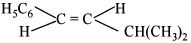
B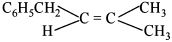
C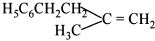
D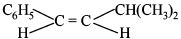
Solution
(B) The reaction involves the acid-catalyzed dehydration of an alcohol using concentrated $H_2SO_4$.
$1.$ Protonation of the $-OH$ group followed by the loss of $H_2O$ forms a secondary carbocation: $C_6H_5-CH_2-CH^+-CH(CH_3)_2$.
$2.$ $A$ $1,2-H$ shift occurs from the tertiary carbon to form a more stable tertiary carbocation: $C_6H_5-CH_2-C^+(CH_3)_2$.
$3.$ Elimination of a proton from the benzylic carbon results in the formation of the most stable alkene,which is trisubstituted and conjugated with the benzene ring: $C_6H_5-CH=C(CH_3)_2$. This corresponds to the structure in option $B$.
$1.$ Protonation of the $-OH$ group followed by the loss of $H_2O$ forms a secondary carbocation: $C_6H_5-CH_2-CH^+-CH(CH_3)_2$.
$2.$ $A$ $1,2-H$ shift occurs from the tertiary carbon to form a more stable tertiary carbocation: $C_6H_5-CH_2-C^+(CH_3)_2$.
$3.$ Elimination of a proton from the benzylic carbon results in the formation of the most stable alkene,which is trisubstituted and conjugated with the benzene ring: $C_6H_5-CH=C(CH_3)_2$. This corresponds to the structure in option $B$.
0 likesView Solution
43
ChemistryMediumMCQAIEEE · 2010
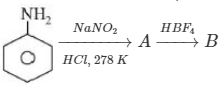
In the chemical reactions,the compounds $A$ and $B$ respectively are
A
nitrobenzene and fluorobenzene
B
phenol and benzene
C
benzene diazonium chloride and fluorobenzene
D
nitrobenzene and chlorobenzene
Solution
(C) The reaction of aniline with $NaNO_2$ and $HCl$ at $278 \ K$ $(0-5 \ ^\circ C)$ is known as diazotization,which produces benzene diazonium chloride $(A)$.
Reaction: $C_6H_5NH_2 + NaNO_2 + 2HCl \xrightarrow{278 \ K} C_6H_5N_2^+Cl^- + NaCl + 2H_2O$.
When benzene diazonium chloride $(A)$ is treated with fluoroboric acid $(HBF_4)$,it forms benzene diazonium fluoroborate,which upon heating decomposes to give fluorobenzene $(B)$.
Reaction: $C_6H_5N_2^+Cl^- + HBF_4$ $\rightarrow C_6H_5N_2^+BF_4^- + HCl$ $\xrightarrow{\Delta} C_6H_5F + N_2 + BF_3$.
Thus,$A$ is benzene diazonium chloride and $B$ is fluorobenzene.
Reaction: $C_6H_5NH_2 + NaNO_2 + 2HCl \xrightarrow{278 \ K} C_6H_5N_2^+Cl^- + NaCl + 2H_2O$.
When benzene diazonium chloride $(A)$ is treated with fluoroboric acid $(HBF_4)$,it forms benzene diazonium fluoroborate,which upon heating decomposes to give fluorobenzene $(B)$.
Reaction: $C_6H_5N_2^+Cl^- + HBF_4$ $\rightarrow C_6H_5N_2^+BF_4^- + HCl$ $\xrightarrow{\Delta} C_6H_5F + N_2 + BF_3$.
Thus,$A$ is benzene diazonium chloride and $B$ is fluorobenzene.
0 likesView Solution
44
ChemistryMediumMCQAIEEE · 2010
The Biuret test is not given by:
A
Carbohydrates
B
Polypeptides
C
Urea
D
Proteins
Solution
(A) The Biuret test is a chemical test used to detect the presence of peptide bonds ($CONH$ linkage).
Since carbohydrates do not contain peptide bonds,they do not give a positive Biuret test.
Polypeptides and proteins contain multiple peptide bonds and thus give a positive test.
Urea $(NH_2CONH_2)$ also gives a positive Biuret test because it contains a structure similar to the biuret molecule $(H_2N-CO-NH-CO-NH_2)$.
Since carbohydrates do not contain peptide bonds,they do not give a positive Biuret test.
Polypeptides and proteins contain multiple peptide bonds and thus give a positive test.
Urea $(NH_2CONH_2)$ also gives a positive Biuret test because it contains a structure similar to the biuret molecule $(H_2N-CO-NH-CO-NH_2)$.
0 likesView Solution
45
ChemistryMediumMCQAIEEE · 2010
The polymer containing strong intermolecular forces,$e.g.$ hydrogen bonding,is
A
Teflon
B
Nylon $6, 6$
C
Polystyrene
D
Natural rubber
Solution
(B) Polymers are classified based on the magnitude of intermolecular forces present between their chains.
Fibers are the polymers that have strong intermolecular forces like hydrogen bonding or dipole-dipole interactions.
These strong forces lead to close packing of chains and impart crystalline character to the polymer.
$Nylon-6, 6$ is a fiber that contains strong intermolecular hydrogen bonding between the amide groups of the polymer chains.
Therefore,the correct option is $B$.
Fibers are the polymers that have strong intermolecular forces like hydrogen bonding or dipole-dipole interactions.
These strong forces lead to close packing of chains and impart crystalline character to the polymer.
$Nylon-6, 6$ is a fiber that contains strong intermolecular hydrogen bonding between the amide groups of the polymer chains.
Therefore,the correct option is $B$.
0 likesView Solution
46
ChemistryMediumMCQAIEEE · 2010
Consider the following bromides.
The correct order of $S_N1$ reactivity is
The correct order of $S_N1$ reactivity is
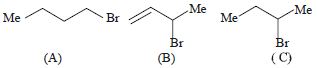
A
$B > C > A$
B
$B > A > C$
C
$C > B > A$
D
$A > B > C$
Solution
(A) $S_N1$ reactions proceed via the formation of a carbocation intermediate. The rate of $S_N1$ reaction depends on the stability of the carbocation formed.
$(A)$ forms a $1^o$ carbocation $(CH_3CH_2CH_2CH_2^+)$,which is the least stable.
$(B)$ forms an allylic carbocation $(CH_2=CH-CH^+(CH_3))$,which is resonance-stabilized and therefore the most stable.
$(C)$ forms a $2^o$ carbocation $(CH_3CH_2CH^+(CH_3))$,which is more stable than a $1^o$ carbocation but less stable than an allylic carbocation.
Thus,the stability order of the carbocations is $B > C > A$. Consequently,the order of $S_N1$ reactivity is $B > C > A$.
$(A)$ forms a $1^o$ carbocation $(CH_3CH_2CH_2CH_2^+)$,which is the least stable.
$(B)$ forms an allylic carbocation $(CH_2=CH-CH^+(CH_3))$,which is resonance-stabilized and therefore the most stable.
$(C)$ forms a $2^o$ carbocation $(CH_3CH_2CH^+(CH_3))$,which is more stable than a $1^o$ carbocation but less stable than an allylic carbocation.
Thus,the stability order of the carbocations is $B > C > A$. Consequently,the order of $S_N1$ reactivity is $B > C > A$.
0 likesView Solution
Vedclass Products
For Students
Vedclass Test Series
Mock tests in real AIEEE style covering Chemistry with performance analysis. 5-day free trial.
Start Free TrialFor Teachers
Exam Paper Generator
Generate Set A/B/C/D Chemistry papers from 7.5L+ questions in 2 minutes. 3 chapters free.
Try FreeFor Institutes
Online Exam Module
Run live AIEEE mock exams with unlimited students, 360° analytics & white-label branding.
See DemoFrequently Asked Questions
How many Chemistry questions are in AIEEE 2010?
There are 46 Chemistry questions from the AIEEE 2010 paper on Vedclass, each with a detailed step-by-step solution in English.
Are AIEEE 2010 Chemistry solutions available in English?
Yes. All solutions on this page are in English. You can also switch to English or Hindi using the language buttons above the questions.
Can I practice AIEEE 2010 Chemistry as a timed test?
Yes. Use the Vedclass Test Series to attempt a full AIEEE mock test covering Chemistry with time limits and instant score analysis.
Can teachers create Chemistry papers from AIEEE previous year questions?
Yes. The Vedclass Exam Paper Generator lets teachers mix AIEEE Chemistry questions and generate Set A/B/C/D papers in minutes.
For Teachers & Institutes
Build a Custom Chemistry Paper
Pick AIEEE 2010 Chemistry questions, set difficulty, and generate Set A/B/C/D in 2 minutes.