
ChemistryQ301–381 of 716 questions
Page 7 of 8 · English
301
ChemistryMCQMHT CET · 2023
When radiation of wavelength $\lambda$ is incident on a metallic surface,the stopping potential is $4.8 \ V$. If the surface is illuminated with radiation of double the wavelength,then the stopping potential becomes $1.6 \ V$. The threshold wavelength for the surface is:
A
$2 \lambda$
B
$4 \lambda$
C
$6 \lambda$
D
$8 \lambda$
Solution
(B) The Einstein's photoelectric equation is given by $eV_0 = \frac{hc}{\lambda} - \phi_0$,where $\phi_0 = \frac{hc}{\lambda_0}$ and $\lambda_0$ is the threshold wavelength.
For the first case: $e(4.8) = \frac{hc}{\lambda} - \phi_0 \quad ... (i)$
For the second case: $e(1.6) = \frac{hc}{2\lambda} - \phi_0 \quad ... (ii)$
Dividing equation $(i)$ by equation $(ii)$:
$\frac{4.8}{1.6} = \frac{\frac{hc}{\lambda} - \phi_0}{\frac{hc}{2\lambda} - \phi_0}$
$3 = \frac{\frac{hc}{\lambda} - \phi_0}{\frac{hc}{2\lambda} - \phi_0}$
$3 \left( \frac{hc}{2\lambda} - \phi_0 \right) = \frac{hc}{\lambda} - \phi_0$
$\frac{3hc}{2\lambda} - 3\phi_0 = \frac{hc}{\lambda} - \phi_0$
$\frac{3hc}{2\lambda} - \frac{hc}{\lambda} = 2\phi_0$
$\frac{hc}{2\lambda} = 2\phi_0 \implies \phi_0 = \frac{hc}{4\lambda}$
Since $\phi_0 = \frac{hc}{\lambda_0}$,we have $\frac{hc}{\lambda_0} = \frac{hc}{4\lambda}$.
Therefore,the threshold wavelength $\lambda_0 = 4\lambda$.
For the first case: $e(4.8) = \frac{hc}{\lambda} - \phi_0 \quad ... (i)$
For the second case: $e(1.6) = \frac{hc}{2\lambda} - \phi_0 \quad ... (ii)$
Dividing equation $(i)$ by equation $(ii)$:
$\frac{4.8}{1.6} = \frac{\frac{hc}{\lambda} - \phi_0}{\frac{hc}{2\lambda} - \phi_0}$
$3 = \frac{\frac{hc}{\lambda} - \phi_0}{\frac{hc}{2\lambda} - \phi_0}$
$3 \left( \frac{hc}{2\lambda} - \phi_0 \right) = \frac{hc}{\lambda} - \phi_0$
$\frac{3hc}{2\lambda} - 3\phi_0 = \frac{hc}{\lambda} - \phi_0$
$\frac{3hc}{2\lambda} - \frac{hc}{\lambda} = 2\phi_0$
$\frac{hc}{2\lambda} = 2\phi_0 \implies \phi_0 = \frac{hc}{4\lambda}$
Since $\phi_0 = \frac{hc}{\lambda_0}$,we have $\frac{hc}{\lambda_0} = \frac{hc}{4\lambda}$.
Therefore,the threshold wavelength $\lambda_0 = 4\lambda$.
0 likesView Solution
302
ChemistryMCQMHT CET · 2023
When a metallic surface is illuminated with radiation of wavelength $\lambda$,the stopping potential is $V$. If the same surface is illuminated with radiation of wavelength $2\lambda$,the stopping potential is $\frac{V}{4}$. The threshold wavelength for the metallic surface is:
A
$\frac{5}{2} \lambda$
B
$3 \lambda$
C
$4 \lambda$
D
$5 \lambda$
Solution
(B) According to Einstein's photoelectric equation,the stopping potential $V$ is given by $eV = \frac{hc}{\lambda} - \frac{hc}{\lambda_0}$,where $\lambda_0$ is the threshold wavelength.
For the first case: $eV = \frac{hc}{\lambda} - \frac{hc}{\lambda_0}$ --- $(1)$
For the second case: $e(\frac{V}{4}) = \frac{hc}{2\lambda} - \frac{hc}{\lambda_0}$ --- $(2)$
Dividing equation $(1)$ by equation $(2)$:
$4 = \frac{\frac{hc}{\lambda} - \frac{hc}{\lambda_0}}{\frac{hc}{2\lambda} - \frac{hc}{\lambda_0}}$
$4 = \frac{\frac{1}{\lambda} - \frac{1}{\lambda_0}}{\frac{1}{2\lambda} - \frac{1}{\lambda_0}}$
$4(\frac{1}{2\lambda} - \frac{1}{\lambda_0}) = \frac{1}{\lambda} - \frac{1}{\lambda_0}$
$\frac{2}{\lambda} - \frac{4}{\lambda_0} = \frac{1}{\lambda} - \frac{1}{\lambda_0}$
$\frac{2}{\lambda} - \frac{1}{\lambda} = \frac{4}{\lambda_0} - \frac{1}{\lambda_0}$
$\frac{1}{\lambda} = \frac{3}{\lambda_0}$
$\lambda_0 = 3\lambda$.
For the first case: $eV = \frac{hc}{\lambda} - \frac{hc}{\lambda_0}$ --- $(1)$
For the second case: $e(\frac{V}{4}) = \frac{hc}{2\lambda} - \frac{hc}{\lambda_0}$ --- $(2)$
Dividing equation $(1)$ by equation $(2)$:
$4 = \frac{\frac{hc}{\lambda} - \frac{hc}{\lambda_0}}{\frac{hc}{2\lambda} - \frac{hc}{\lambda_0}}$
$4 = \frac{\frac{1}{\lambda} - \frac{1}{\lambda_0}}{\frac{1}{2\lambda} - \frac{1}{\lambda_0}}$
$4(\frac{1}{2\lambda} - \frac{1}{\lambda_0}) = \frac{1}{\lambda} - \frac{1}{\lambda_0}$
$\frac{2}{\lambda} - \frac{4}{\lambda_0} = \frac{1}{\lambda} - \frac{1}{\lambda_0}$
$\frac{2}{\lambda} - \frac{1}{\lambda} = \frac{4}{\lambda_0} - \frac{1}{\lambda_0}$
$\frac{1}{\lambda} = \frac{3}{\lambda_0}$
$\lambda_0 = 3\lambda$.
0 likesView Solution
303
ChemistryMCQMHT CET · 2023
$A$ metal disc of radius $R$ rotates with an angular velocity $\omega$ about an axis perpendicular to its plane passing through its centre in a magnetic field of induction $B$ acting perpendicular to the plane of the disc. The magnitude of the induced e.m.f. between the rim and the axis of the disc is:
A
$\pi BR^2$
B
$\frac{2 \pi^2 BR^2}{\omega}$
C
$\pi BR^2 \omega$
D
$\frac{BR^2 \omega}{2}$
Solution
(D) Consider a small radial element of length $dr$ at a distance $r$ from the centre of the disc.
As the disc rotates,this element moves with a linear velocity $v = r\omega$ in the magnetic field $B$.
The motional e.m.f. $de$ induced across this small element is given by $de = Bv dr = B(r\omega) dr$.
To find the total induced e.m.f. $e$ between the centre $(r=0)$ and the rim $(r=R)$,we integrate the expression:
$e = \int_{0}^{R} B\omega r dr$
$e = B\omega \int_{0}^{R} r dr$
$e = B\omega \left[ \frac{r^2}{2} \right]_{0}^{R}$
$e = \frac{B\omega R^2}{2}$
The magnitude of the induced e.m.f. is $|e| = \frac{B\omega R^2}{2}$.
As the disc rotates,this element moves with a linear velocity $v = r\omega$ in the magnetic field $B$.
The motional e.m.f. $de$ induced across this small element is given by $de = Bv dr = B(r\omega) dr$.
To find the total induced e.m.f. $e$ between the centre $(r=0)$ and the rim $(r=R)$,we integrate the expression:
$e = \int_{0}^{R} B\omega r dr$
$e = B\omega \int_{0}^{R} r dr$
$e = B\omega \left[ \frac{r^2}{2} \right]_{0}^{R}$
$e = \frac{B\omega R^2}{2}$
The magnitude of the induced e.m.f. is $|e| = \frac{B\omega R^2}{2}$.
0 likesView Solution
304
ChemistryMCQMHT CET · 2023
Two conducting circular loops of radii $R_1$ and $R_2$ are placed in the same plane with their centres coinciding. If $R_1$ > $R_2$, the mutual inductance $M$ between them will be directly proportional to
A
$\frac{R_1}{R_2}$
B
$\frac{R_2}{R_1}$
C
$\frac{R_1^2}{R_2}$
D
$\frac{R_2^2}{R_1}$
Solution
(D) The magnetic field $B$ at the center of a circular loop of radius $R_1$ carrying current $I_1$ is given by $B = \frac{\mu_0 I_1}{2 R_1}$.
Since $R_1$ > $R_2$, we assume the smaller loop of radius $R_2$ is placed within the magnetic field of the larger loop.
The magnetic flux $\phi_2$ linked with the smaller loop is $\phi_2 = B \cdot A_2$, where $A_2 = \pi R_2^2$ is the area of the smaller loop.
Substituting the values, we get $\phi_2 = \left( \frac{\mu_0 I_1}{2 R_1} \right) (\pi R_2^2) = \left( \frac{\mu_0 \pi R_2^2}{2 R_1} \right) I_1$.
By definition, the mutual inductance $M$ is given by $\phi_2 = M I_1$, so $M = \frac{\mu_0 \pi R_2^2}{2 R_1}$.
Thus, $M$ is directly proportional to $\frac{R_2^2}{R_1}$.
Since $R_1$ > $R_2$, we assume the smaller loop of radius $R_2$ is placed within the magnetic field of the larger loop.
The magnetic flux $\phi_2$ linked with the smaller loop is $\phi_2 = B \cdot A_2$, where $A_2 = \pi R_2^2$ is the area of the smaller loop.
Substituting the values, we get $\phi_2 = \left( \frac{\mu_0 I_1}{2 R_1} \right) (\pi R_2^2) = \left( \frac{\mu_0 \pi R_2^2}{2 R_1} \right) I_1$.
By definition, the mutual inductance $M$ is given by $\phi_2 = M I_1$, so $M = \frac{\mu_0 \pi R_2^2}{2 R_1}$.
Thus, $M$ is directly proportional to $\frac{R_2^2}{R_1}$.
0 likesView Solution
305
ChemistryMCQMHT CET · 2023
Two conducting circular loops of radii $R_1$ and $R_2$ are placed in the same plane with their centres coinciding. If $R_1 > R_2$,the mutual inductance $M$ between them will be directly proportional to
A
$\frac{R_1}{R_2}$
B
$\frac{R_2}{R_1}$
C
$\frac{R_1^2}{R_2}$
D
$\frac{R_2^2}{R_1}$
Solution
(D) The magnetic field produced by the larger loop of radius $R_1$ at its center is $B = \frac{\mu_0 I}{2 R_1}$.
Assuming the smaller loop of radius $R_2$ is placed in this uniform magnetic field,the magnetic flux linked with the smaller loop is $\phi = B \cdot A_2$,where $A_2 = \pi R_2^2$ is the area of the smaller loop.
$\phi = \left( \frac{\mu_0 I}{2 R_1} \right) (\pi R_2^2) = \left( \frac{\mu_0 \pi R_2^2}{2 R_1} \right) I$.
Since $\phi = M I$,comparing the two expressions,we get $M = \frac{\mu_0 \pi R_2^2}{2 R_1}$.
Therefore,the mutual inductance $M$ is directly proportional to $\frac{R_2^2}{R_1}$.
Assuming the smaller loop of radius $R_2$ is placed in this uniform magnetic field,the magnetic flux linked with the smaller loop is $\phi = B \cdot A_2$,where $A_2 = \pi R_2^2$ is the area of the smaller loop.
$\phi = \left( \frac{\mu_0 I}{2 R_1} \right) (\pi R_2^2) = \left( \frac{\mu_0 \pi R_2^2}{2 R_1} \right) I$.
Since $\phi = M I$,comparing the two expressions,we get $M = \frac{\mu_0 \pi R_2^2}{2 R_1}$.
Therefore,the mutual inductance $M$ is directly proportional to $\frac{R_2^2}{R_1}$.
0 likesView Solution
306
ChemistryMCQMHT CET · 2023
An electron is projected along the axis of a circular conductor carrying current $I$. The electron will experience:
A
no force.
B
a force along the axis.
C
a force at an angle of $30^{\circ}$ with the axis.
D
a force perpendicular to the axis.
Solution
(A) The magnetic field $B$ produced by a circular current-carrying loop is directed along its axis.
When an electron is projected along the axis of the circular conductor,its velocity vector $v$ is parallel to the magnetic field vector $B$.
Therefore,the angle $\theta$ between the velocity vector $v$ and the magnetic field $B$ is $0^{\circ}$.
The magnetic force $F$ experienced by a charged particle is given by $F = qvB \sin \theta$.
Substituting $\theta = 0^{\circ}$,we get $F = qvB \sin(0^{\circ}) = 0$.
Thus,the electron experiences no force.
When an electron is projected along the axis of the circular conductor,its velocity vector $v$ is parallel to the magnetic field vector $B$.
Therefore,the angle $\theta$ between the velocity vector $v$ and the magnetic field $B$ is $0^{\circ}$.
The magnetic force $F$ experienced by a charged particle is given by $F = qvB \sin \theta$.
Substituting $\theta = 0^{\circ}$,we get $F = qvB \sin(0^{\circ}) = 0$.
Thus,the electron experiences no force.
0 likesView Solution
307
ChemistryMCQMHT CET · 2023
In a meter bridge experiment,a null point is obtained at $l \text{ cm}$ from the left end. If the meter bridge wire is replaced by a wire of the same material but twice the area of cross-section,then the null point is obtained at a distance:
A
$2l \text{ cm}$ from the left end.
B
$l \text{ cm}$ from the left end.
C
$l/2 \text{ cm}$ from the left end.
D
$l/4 \text{ cm}$ from the left end.
Solution
(B) In a meter bridge experiment,the condition for the null point is given by the Wheatstone bridge principle: $\frac{P}{Q} = \frac{R_1}{R_2}$,where $R_1$ and $R_2$ are the resistances of the two segments of the wire.
Since $R = \rho \frac{L}{A}$,the ratio of the resistances of the two segments is $\frac{R_1}{R_2} = \frac{\rho (l/A)}{\rho ((100-l)/A)} = \frac{l}{100-l}$.
This ratio depends only on the lengths of the segments and is independent of the resistivity $\rho$ and the cross-sectional area $A$ of the wire.
Therefore,changing the cross-sectional area of the wire does not affect the balance condition.
The null point will remain at the same position,i.e.,$l \text{ cm}$ from the left end.
Since $R = \rho \frac{L}{A}$,the ratio of the resistances of the two segments is $\frac{R_1}{R_2} = \frac{\rho (l/A)}{\rho ((100-l)/A)} = \frac{l}{100-l}$.
This ratio depends only on the lengths of the segments and is independent of the resistivity $\rho$ and the cross-sectional area $A$ of the wire.
Therefore,changing the cross-sectional area of the wire does not affect the balance condition.
The null point will remain at the same position,i.e.,$l \text{ cm}$ from the left end.
0 likesView Solution
308
ChemistryMCQMHT CET · 2023
In a meter bridge experiment,the null point was obtained at a distance '$l$' from the left end. The values of the resistances in the left and right gaps are doubled and then interchanged. What is the new position of the null point?
A
$l$
B
$(100-l)$
C
$(100-2l)$
D
$2l$
Solution
(B) In a meter bridge,the condition for the null point is given by the ratio: $\frac{P}{Q} = \frac{l}{100-l}$,where $P$ is the resistance in the left gap and $Q$ is the resistance in the right gap.
Initially,$\frac{P}{Q} = \frac{l}{100-l}$.
When the resistances are doubled,they become $2P$ and $2Q$. When they are interchanged,the new left resistance becomes $2Q$ and the new right resistance becomes $2P$.
The new null point $l'$ satisfies: $\frac{2Q}{2P} = \frac{l'}{100-l'}$.
Simplifying the ratio: $\frac{Q}{P} = \frac{l'}{100-l'}$.
Since $\frac{P}{Q} = \frac{l}{100-l}$,then $\frac{Q}{P} = \frac{100-l}{l}$.
Equating the two: $\frac{l'}{100-l'} = \frac{100-l}{l}$.
By cross-multiplication: $l cdot l' = (100-l)(100-l')$.
$l cdot l' = 10000 - 100l' - 100l + l cdot l'$.
$100l' = 10000 - 100l$.
$l' = 100 - l$.
Therefore,the new position of the null point is $(100-l)$.
Initially,$\frac{P}{Q} = \frac{l}{100-l}$.
When the resistances are doubled,they become $2P$ and $2Q$. When they are interchanged,the new left resistance becomes $2Q$ and the new right resistance becomes $2P$.
The new null point $l'$ satisfies: $\frac{2Q}{2P} = \frac{l'}{100-l'}$.
Simplifying the ratio: $\frac{Q}{P} = \frac{l'}{100-l'}$.
Since $\frac{P}{Q} = \frac{l}{100-l}$,then $\frac{Q}{P} = \frac{100-l}{l}$.
Equating the two: $\frac{l'}{100-l'} = \frac{100-l}{l}$.
By cross-multiplication: $l cdot l' = (100-l)(100-l')$.
$l cdot l' = 10000 - 100l' - 100l + l cdot l'$.
$100l' = 10000 - 100l$.
$l' = 100 - l$.
Therefore,the new position of the null point is $(100-l)$.
0 likesView Solution
309
ChemistryMCQMHT CET · 2023
Two resistances $X$ and $Y$ are connected in the two gaps of a meter bridge,and the null point is obtained at $20 \text{ cm}$ from the zero end. When a resistance of $20 \text{ } \Omega$ is connected in series with the smaller of the two resistances $X$ and $Y$,the null point shifts to $40 \text{ cm}$ from the left end. The value of the smaller resistance in ohms is:
A
$6$
B
$9$
C
$12$
D
$15$
Solution
(C) For a meter bridge,the balancing condition is given by $\frac{X}{Y} = \frac{l}{100-l}$.
In the first case,$l = 20 \text{ cm}$.
$\frac{X}{Y} = \frac{20}{100-20} = \frac{20}{80} = \frac{1}{4}$.
Therefore,$Y = 4X$.
In the second case,the null point shifts to $l' = 40 \text{ cm}$. Since $X < Y$,we connect the $20 \text{ } \Omega$ resistor in series with $X$.
So,$X' = X + 20$ and $Y' = Y = 4X$.
The new balancing condition is $\frac{X+20}{4X} = \frac{40}{100-40} = \frac{40}{60} = \frac{2}{3}$.
Cross-multiplying gives $3(X + 20) = 2(4X)$.
$3X + 60 = 8X$.
$5X = 60$,which gives $X = 12 \text{ } \Omega$.
Since $Y = 4X = 48 \text{ } \Omega$,the smaller resistance is $X = 12 \text{ } \Omega$.
In the first case,$l = 20 \text{ cm}$.
$\frac{X}{Y} = \frac{20}{100-20} = \frac{20}{80} = \frac{1}{4}$.
Therefore,$Y = 4X$.
In the second case,the null point shifts to $l' = 40 \text{ cm}$. Since $X < Y$,we connect the $20 \text{ } \Omega$ resistor in series with $X$.
So,$X' = X + 20$ and $Y' = Y = 4X$.
The new balancing condition is $\frac{X+20}{4X} = \frac{40}{100-40} = \frac{40}{60} = \frac{2}{3}$.
Cross-multiplying gives $3(X + 20) = 2(4X)$.
$3X + 60 = 8X$.
$5X = 60$,which gives $X = 12 \text{ } \Omega$.
Since $Y = 4X = 48 \text{ } \Omega$,the smaller resistance is $X = 12 \text{ } \Omega$.
0 likesView Solution
310
ChemistryMCQMHT CET · 2023
For a gas,$\frac{R}{C_{V}}=0.4$,where $R$ is the universal gas constant and $C_{V}$ is the molar specific heat at constant volume. The gas is made up of molecules which are
A
rigid diatomic
B
monoatomic
C
non-rigid diatomic
D
polyatomic
Solution
(A) Given: $\frac{R}{C_{V}} = 0.4$
$C_{V} = \frac{R}{0.4} = \frac{R}{2/5} = \frac{5R}{2}$
We know that for an ideal gas,$C_{P} = C_{V} + R$.
Substituting the value of $C_{V}$:
$C_{P} = \frac{5R}{2} + R = \frac{7R}{2}$
The adiabatic index $\gamma$ is given by $\gamma = \frac{C_{P}}{C_{V}}$.
$\gamma = \frac{7R/2}{5R/2} = \frac{7}{5} = 1.4$
For a gas,the degree of freedom $f$ is related to $\gamma$ by $\gamma = 1 + \frac{2}{f}$.
$1.4 = 1 + \frac{2}{f} \implies 0.4 = \frac{2}{f} \implies f = \frac{2}{0.4} = 5$.
$A$ gas with $f = 5$ degrees of freedom corresponds to rigid diatomic molecules.
$C_{V} = \frac{R}{0.4} = \frac{R}{2/5} = \frac{5R}{2}$
We know that for an ideal gas,$C_{P} = C_{V} + R$.
Substituting the value of $C_{V}$:
$C_{P} = \frac{5R}{2} + R = \frac{7R}{2}$
The adiabatic index $\gamma$ is given by $\gamma = \frac{C_{P}}{C_{V}}$.
$\gamma = \frac{7R/2}{5R/2} = \frac{7}{5} = 1.4$
For a gas,the degree of freedom $f$ is related to $\gamma$ by $\gamma = 1 + \frac{2}{f}$.
$1.4 = 1 + \frac{2}{f} \implies 0.4 = \frac{2}{f} \implies f = \frac{2}{0.4} = 5$.
$A$ gas with $f = 5$ degrees of freedom corresponds to rigid diatomic molecules.
0 likesView Solution
311
ChemistryMCQMHT CET · 2023
The average force applied on the walls of a closed container depends on $T^{x}$ where $T$ is the temperature of an ideal gas. The value of '$x$' is
A
$4$
B
$3$
C
$2$
D
$1$
Solution
(D) The pressure $P$ exerted by a gas on the walls of a container is defined as the force $F$ per unit area $A$,given by $P = \frac{F}{A}$.
Since the area $A$ of the container is constant,the force $F$ is directly proportional to the pressure $P$,i.e.,$F \propto P$.
From the ideal gas equation,$PV = nRT$,we can write $P = \frac{nRT}{V}$.
For a closed container,the volume $V$ is constant. Therefore,$P \propto T$.
Substituting this into the proportionality for force,we get $F \propto T$.
Comparing this with the given expression $F \propto T^{x}$,we find that $x = 1$.
Since the area $A$ of the container is constant,the force $F$ is directly proportional to the pressure $P$,i.e.,$F \propto P$.
From the ideal gas equation,$PV = nRT$,we can write $P = \frac{nRT}{V}$.
For a closed container,the volume $V$ is constant. Therefore,$P \propto T$.
Substituting this into the proportionality for force,we get $F \propto T$.
Comparing this with the given expression $F \propto T^{x}$,we find that $x = 1$.
0 likesView Solution
312
ChemistryMCQMHT CET · 2023
If a gas is compressed isothermally,then the r.m.s. velocity of the molecules
A
decreases.
B
increases.
C
remains the same.
D
first decreases and then increases.
Solution
(C) The root-mean-square (rms) velocity of gas molecules is given by the formula:
$v_{rms} = \sqrt{\frac{3kT}{m}}$
From this expression,we can see that $v_{rms} \propto \sqrt{T}$ for a given gas.
In an isothermal process,the temperature $(T)$ of the system remains constant.
Since the temperature does not change,the r.m.s. velocity of the gas molecules remains the same.
$v_{rms} = \sqrt{\frac{3kT}{m}}$
From this expression,we can see that $v_{rms} \propto \sqrt{T}$ for a given gas.
In an isothermal process,the temperature $(T)$ of the system remains constant.
Since the temperature does not change,the r.m.s. velocity of the gas molecules remains the same.
0 likesView Solution
313
ChemistryMCQMHT CET · 2023
$A$ square loop of area $25 \, cm^2$ has a resistance of $10 \, \Omega$. This loop is placed in a uniform magnetic field of magnitude $40 \, T$. The plane of the loop is perpendicular to the magnetic field. The work done in pulling the loop out of the magnetic field slowly and uniformly in one second will be:
A
$1 \times 10^{-4} \, J$
B
$1.0 \times 10^{-3} \, J$
C
$5 \times 10^{-3} \, J$
D
$2.5 \times 10^{-3} \, J$
Solution
(B) Given: Area of square loop $A = 25 \, cm^2 = 25 \times 10^{-4} \, m^2$.
Side length $l = \sqrt{A} = 5 \, cm = 0.05 \, m$.
Resistance $R = 10 \, \Omega$, Time $t = 1 \, s$, Magnetic field $B = 40 \, T$.
The velocity $v$ required to pull the loop out in $1 \, s$ is $v = l/t = 0.05/1 = 0.05 \, m/s$.
The induced motional emf is $\varepsilon = Blv$.
The induced current is $I = \varepsilon/R = (Blv)/R$.
Substituting the values: $I = (40 \times 0.05 \times 0.05) / 10 = 0.01 \, A$.
The magnetic force acting on the loop is $F = BIl$.
Substituting the values: $F = 40 \times 0.01 \times 0.05 = 0.02 \, N$.
The work done is $W = F \times l = 0.02 \times 0.05 = 1 \times 10^{-3} \, J$.
Side length $l = \sqrt{A} = 5 \, cm = 0.05 \, m$.
Resistance $R = 10 \, \Omega$, Time $t = 1 \, s$, Magnetic field $B = 40 \, T$.
The velocity $v$ required to pull the loop out in $1 \, s$ is $v = l/t = 0.05/1 = 0.05 \, m/s$.
The induced motional emf is $\varepsilon = Blv$.
The induced current is $I = \varepsilon/R = (Blv)/R$.
Substituting the values: $I = (40 \times 0.05 \times 0.05) / 10 = 0.01 \, A$.
The magnetic force acting on the loop is $F = BIl$.
Substituting the values: $F = 40 \times 0.01 \times 0.05 = 0.02 \, N$.
The work done is $W = F \times l = 0.02 \times 0.05 = 1 \times 10^{-3} \, J$.
0 likesView Solution
314
ChemistryMCQMHT CET · 2023
An electron of mass '$m$' and charge '$q$' is travelling with speed '$v$' along a circular path of radius '$R$',at right angles to a uniform magnetic field of intensity '$B$'. If the speed of the electron is halved and the magnetic field is doubled,the resulting path would have radius:
A
$4 R$
B
$2 R$
C
$\frac{R}{2}$
D
$\frac{R}{4}$
Solution
(D) For a charged particle moving in a uniform magnetic field,the magnetic Lorentz force provides the necessary centripetal force for circular motion.
$q v B = \frac{m v^2}{R}$
$\therefore R = \frac{m v}{q B}$
Given that the new speed $v' = \frac{v}{2}$ and the new magnetic field $B' = 2 B$.
The new radius $R'$ is given by:
$R' = \frac{m v'}{q B'} = \frac{m (v/2)}{q (2 B)}$
$R' = \frac{1}{4} \frac{m v}{q B}$
Since $R = \frac{m v}{q B}$,we get:
$R' = \frac{R}{4}$
$q v B = \frac{m v^2}{R}$
$\therefore R = \frac{m v}{q B}$
Given that the new speed $v' = \frac{v}{2}$ and the new magnetic field $B' = 2 B$.
The new radius $R'$ is given by:
$R' = \frac{m v'}{q B'} = \frac{m (v/2)}{q (2 B)}$
$R' = \frac{1}{4} \frac{m v}{q B}$
Since $R = \frac{m v}{q B}$,we get:
$R' = \frac{R}{4}$
0 likesView Solution
315
ChemistryMCQMHT CET · 2023
An electron is projected along the axis of a circular conductor carrying current $I$. The electron will experience:
A
a force at an angle of $30^{\circ}$ with the axis.
B
no force.
C
a force along the axis.
D
a force perpendicular to the axis.
Solution
(B) The magnetic field produced by a circular current-carrying loop along its axis is directed along the axis itself.
Since the electron is projected along the axis,its velocity vector $\vec{v}$ is parallel or antiparallel to the magnetic field vector $\vec{B}$.
The magnetic force on a moving charge is given by $\vec{F} = q(\vec{v} \times \vec{B})$,which has a magnitude $F = qvB \sin \theta$.
Here,the angle $\theta$ between the velocity and the magnetic field is $0^{\circ}$ or $180^{\circ}$.
Since $\sin(0^{\circ}) = 0$ and $\sin(180^{\circ}) = 0$,the magnetic force $F = 0$.
Therefore,the electron experiences no force.
Since the electron is projected along the axis,its velocity vector $\vec{v}$ is parallel or antiparallel to the magnetic field vector $\vec{B}$.
The magnetic force on a moving charge is given by $\vec{F} = q(\vec{v} \times \vec{B})$,which has a magnitude $F = qvB \sin \theta$.
Here,the angle $\theta$ between the velocity and the magnetic field is $0^{\circ}$ or $180^{\circ}$.
Since $\sin(0^{\circ}) = 0$ and $\sin(180^{\circ}) = 0$,the magnetic force $F = 0$.
Therefore,the electron experiences no force.
0 likesView Solution
316
ChemistryMCQMHT CET · 2023
The materials suitable for making electromagnets should have
A
high retentivity and high coercivity
B
low retentivity and low coercivity
C
high retentivity and low coercivity
D
low retentivity and high coercivity
Solution
(C) An electromagnet requires a material that can be easily magnetized and demagnetized.
$1$. High retentivity allows the material to acquire a strong magnetic field when current flows through the coil.
$2$. Low coercivity ensures that the material loses its magnetism quickly when the current is switched off,allowing for efficient control.
Therefore,materials like soft iron are ideal for electromagnets because they possess high retentivity and low coercivity.
$1$. High retentivity allows the material to acquire a strong magnetic field when current flows through the coil.
$2$. Low coercivity ensures that the material loses its magnetism quickly when the current is switched off,allowing for efficient control.
Therefore,materials like soft iron are ideal for electromagnets because they possess high retentivity and low coercivity.
0 likesView Solution
317
ChemistryMCQMHT CET · 2023
$A$ disc has mass $M$ and radius $R$. How much tangential force should be applied to the rim of the disc,so as to rotate with angular velocity $\omega$ in time $t$?
A
$\frac{MR \omega}{4 t}$
B
$\frac{MR \omega}{2 t}$
C
$\frac{MR \omega}{t}$
D
$M R \omega t$
Solution
(B) The moment of inertia of a disc about its central axis is $I = \frac{1}{2} MR^2$.
Using the equation of rotational motion,$\omega = \omega_0 + \alpha t$. Since the disc starts from rest,$\omega_0 = 0$,so $\alpha = \frac{\omega}{t}$.
The torque $\tau$ required is given by $\tau = I \alpha = (\frac{1}{2} MR^2) \times (\frac{\omega}{t}) = \frac{MR^2 \omega}{2t}$.
Since the force $F$ is applied tangentially at the rim,the torque is $\tau = F \times R$.
Equating the two expressions for torque: $F \times R = \frac{MR^2 \omega}{2t}$.
Therefore,the tangential force is $F = \frac{MR \omega}{2t}$.
Using the equation of rotational motion,$\omega = \omega_0 + \alpha t$. Since the disc starts from rest,$\omega_0 = 0$,so $\alpha = \frac{\omega}{t}$.
The torque $\tau$ required is given by $\tau = I \alpha = (\frac{1}{2} MR^2) \times (\frac{\omega}{t}) = \frac{MR^2 \omega}{2t}$.
Since the force $F$ is applied tangentially at the rim,the torque is $\tau = F \times R$.
Equating the two expressions for torque: $F \times R = \frac{MR^2 \omega}{2t}$.
Therefore,the tangential force is $F = \frac{MR \omega}{2t}$.
0 likesView Solution
318
ChemistryMCQMHT CET · 2023
$A$ simple pendulum performs simple harmonic motion about $x=0$ with an amplitude '$a$' and time period '$T$'. The speed of the pendulum at $x=\frac{a}{2}$ is
A
$\frac{\pi a}{T}$
B
$\frac{3 \pi^2 a}{T}$
C
$\frac{\pi a \sqrt{3}}{T}$
D
$\frac{\pi a \sqrt{3}}{2}$
Solution
(C) The velocity of a particle in simple harmonic motion is given by $v = \omega \sqrt{a^2 - x^2}$.
Given the angular frequency $\omega = \frac{2\pi}{T}$.
At position $x = \frac{a}{2}$,the speed is:
$v = \omega \sqrt{a^2 - (\frac{a}{2})^2}$
$v = \omega \sqrt{a^2 - \frac{a^2}{4}}$
$v = \omega \sqrt{\frac{3a^2}{4}}$
$v = \omega \cdot \frac{a\sqrt{3}}{2}$
Substituting $\omega = \frac{2\pi}{T}$:
$v = \frac{2\pi}{T} \cdot \frac{a\sqrt{3}}{2}$
$v = \frac{\pi a \sqrt{3}}{T}$
Given the angular frequency $\omega = \frac{2\pi}{T}$.
At position $x = \frac{a}{2}$,the speed is:
$v = \omega \sqrt{a^2 - (\frac{a}{2})^2}$
$v = \omega \sqrt{a^2 - \frac{a^2}{4}}$
$v = \omega \sqrt{\frac{3a^2}{4}}$
$v = \omega \cdot \frac{a\sqrt{3}}{2}$
Substituting $\omega = \frac{2\pi}{T}$:
$v = \frac{2\pi}{T} \cdot \frac{a\sqrt{3}}{2}$
$v = \frac{\pi a \sqrt{3}}{T}$
0 likesView Solution
319
ChemistryMCQMHT CET · 2023
The refractive index of a glass convex lens is $1.5$. The radius of curvature of each of the two surfaces of the lens is $20 ~cm$. The ratio of the power of the lens when immersed in a liquid of refractive index $1.25$ to that when placed in air is:
A
$2:3$
B
$2:5$
C
$3:5$
D
$5:2$
Solution
(B) Given: Refractive index of glass $\mu_g = 1.5$,refractive index of air $\mu_a = 1$,refractive index of liquid $\mu_l = 1.25$,and radii of curvature $R_1 = 20 ~cm, R_2 = -20 ~cm$.
Using the Lens Maker's Formula: $P = \frac{1}{f} = (\frac{\mu_g}{\mu_m} - 1)(\frac{1}{R_1} - \frac{1}{R_2})$.
Power in air $(P_a)$: $P_a = (\frac{1.5}{1} - 1)(\frac{1}{20} - \frac{1}{-20}) = (0.5)(\frac{2}{20}) = 0.5 \times 0.1 = 0.05 ~cm^{-1}$.
Power in liquid $(P_l)$: $P_l = (\frac{1.5}{1.25} - 1)(\frac{1}{20} - \frac{1}{-20}) = (1.2 - 1)(0.1) = 0.2 \times 0.1 = 0.02 ~cm^{-1}$.
Ratio of power in liquid to power in air: $\frac{P_l}{P_a} = \frac{0.02}{0.05} = \frac{2}{5}$.
Using the Lens Maker's Formula: $P = \frac{1}{f} = (\frac{\mu_g}{\mu_m} - 1)(\frac{1}{R_1} - \frac{1}{R_2})$.
Power in air $(P_a)$: $P_a = (\frac{1.5}{1} - 1)(\frac{1}{20} - \frac{1}{-20}) = (0.5)(\frac{2}{20}) = 0.5 \times 0.1 = 0.05 ~cm^{-1}$.
Power in liquid $(P_l)$: $P_l = (\frac{1.5}{1.25} - 1)(\frac{1}{20} - \frac{1}{-20}) = (1.2 - 1)(0.1) = 0.2 \times 0.1 = 0.02 ~cm^{-1}$.
Ratio of power in liquid to power in air: $\frac{P_l}{P_a} = \frac{0.02}{0.05} = \frac{2}{5}$.
0 likesView Solution
320
ChemistryMCQMHT CET · 2023
$A$ person is observing a bacteria through a compound microscope. For better observation and to improve its resolving power,he should:
A
increase the wavelength of light.
B
increase the refractive index of the medium between the object and objective lens.
C
decrease the focal length of the eyepiece.
D
decrease the diameter of the objective lens.
Solution
(B) The resolving power $R$ of a microscope is given by the formula: $R = \frac{2n \sin \alpha}{0.61 \lambda}$,where $n$ is the refractive index of the medium between the object and the objective lens,$\alpha$ is the semi-vertical angle,and $\lambda$ is the wavelength of light used.
From the formula,it is clear that $R \propto n$.
Therefore,by increasing the refractive index $n$ of the medium between the object and the objective lens,the resolving power of the microscope can be increased.
From the formula,it is clear that $R \propto n$.
Therefore,by increasing the refractive index $n$ of the medium between the object and the objective lens,the resolving power of the microscope can be increased.
0 likesView Solution
321
ChemistryMCQMHT CET · 2023
An ink mark is made on a piece of paper on which a glass slab of thickness $t$ is placed. The ink mark appears to be raised up through a distance $x$ when viewed at nearly normal incidence. If the refractive index of the material of the glass slab is $\mu$,then the thickness of the glass slab is given by:
A
$\frac{\mu x}{\mu-1}$
B
$\frac{(\mu-1)}{\mu}$
C
$\frac{\mu-1}{\mu x}$
D
$\frac{\mu}{(\mu-1) x}$
Solution
(A) The normal shift $x$ produced by a glass slab of thickness $t$ and refractive index $\mu$ is given by the formula:
$x = t \left( 1 - \frac{1}{\mu} \right)$
Rearranging the terms to solve for $t$:
$x = t \left( \frac{\mu - 1}{\mu} \right)$
$t = \frac{x \mu}{\mu - 1}$
Thus,the thickness of the glass slab is $\frac{\mu x}{\mu - 1}$.
$x = t \left( 1 - \frac{1}{\mu} \right)$
Rearranging the terms to solve for $t$:
$x = t \left( \frac{\mu - 1}{\mu} \right)$
$t = \frac{x \mu}{\mu - 1}$
Thus,the thickness of the glass slab is $\frac{\mu x}{\mu - 1}$.
0 likesView Solution
322
ChemistryMCQMHT CET · 2023
Two bodies have their moments of inertia $I$ and $2I$ respectively about their axis of rotation. If their kinetic energies of rotation are equal,their angular momenta will be in the ratio
A
$1: 2$
B
$\sqrt{2}: 1$
C
$2: 1$
D
$1: \sqrt{2}$
Solution
(D) The kinetic energy of rotation $K$ is related to angular momentum $L$ and moment of inertia $I$ by the formula $K = \frac{L^2}{2I}$.
Rearranging for angular momentum,we get $L = \sqrt{2KI}$.
Since the kinetic energies $K$ are equal for both bodies,we have $L \propto \sqrt{I}$.
Therefore,the ratio of the angular momenta of the two bodies is $\frac{L_1}{L_2} = \sqrt{\frac{I_1}{I_2}}$.
Given $I_1 = I$ and $I_2 = 2I$,we substitute these values:
$\frac{L_1}{L_2} = \sqrt{\frac{I}{2I}} = \sqrt{\frac{1}{2}} = \frac{1}{\sqrt{2}}$.
Thus,the ratio is $1: \sqrt{2}$.
Rearranging for angular momentum,we get $L = \sqrt{2KI}$.
Since the kinetic energies $K$ are equal for both bodies,we have $L \propto \sqrt{I}$.
Therefore,the ratio of the angular momenta of the two bodies is $\frac{L_1}{L_2} = \sqrt{\frac{I_1}{I_2}}$.
Given $I_1 = I$ and $I_2 = 2I$,we substitute these values:
$\frac{L_1}{L_2} = \sqrt{\frac{I}{2I}} = \sqrt{\frac{1}{2}} = \frac{1}{\sqrt{2}}$.
Thus,the ratio is $1: \sqrt{2}$.
0 likesView Solution
323
ChemistryMCQMHT CET · 2023
$A$ disc has mass $m$ and radius $R$. How much tangential force should be applied to the rim of the disc so as to rotate it with angular velocity $\omega$ in time $t$?
A
$\frac{mR \omega}{2 t}$
B
$mR \omega t$
C
$\frac{mR \omega}{4 t}$
D
$\frac{mR \omega}{t}$
Solution
(A) The angular acceleration $\alpha$ is given by $\alpha = \frac{\omega}{t}$.
The moment of inertia of a disc about its central axis is $I = \frac{1}{2} mR^2$.
The torque $\tau$ required is $\tau = I \alpha = (\frac{1}{2} mR^2) (\frac{\omega}{t}) = \frac{mR^2 \omega}{2t}$.
Since torque is also given by $\tau = F \cdot R$,where $F$ is the tangential force applied at the rim,
$F \cdot R = \frac{mR^2 \omega}{2t}$.
Solving for $F$,we get $F = \frac{mR \omega}{2t}$.
The moment of inertia of a disc about its central axis is $I = \frac{1}{2} mR^2$.
The torque $\tau$ required is $\tau = I \alpha = (\frac{1}{2} mR^2) (\frac{\omega}{t}) = \frac{mR^2 \omega}{2t}$.
Since torque is also given by $\tau = F \cdot R$,where $F$ is the tangential force applied at the rim,
$F \cdot R = \frac{mR^2 \omega}{2t}$.
Solving for $F$,we get $F = \frac{mR \omega}{2t}$.
0 likesView Solution
324
ChemistryMCQMHT CET · 2023
Heat energy is incident on the surface at the rate of $1000 ~J/min$. If the coefficient of absorption is $0.8$ and the coefficient of reflection is $0.1$,then the heat energy transmitted by the surface in $5 ~min$ is: (in $~J$)
A
$700$
B
$500$
C
$100$
D
$900$
Solution
(B) According to the law of conservation of energy for incident radiation:
Coefficient of transmission $(t)$ + Coefficient of absorption $(a)$ + Coefficient of reflection $(r)$ $= 1$
Given: $a = 0.8$,$r = 0.1$
Therefore,$t = 1 - 0.8 - 0.1 = 0.1$
This means $10\%$ of the incident energy is transmitted through the surface.
Total incident energy in $5 ~min = 1000 ~J/min \times 5 ~min = 5000 ~J$
Transmitted energy $= 5000 ~J \times 0.1 = 500 ~J$
Coefficient of transmission $(t)$ + Coefficient of absorption $(a)$ + Coefficient of reflection $(r)$ $= 1$
Given: $a = 0.8$,$r = 0.1$
Therefore,$t = 1 - 0.8 - 0.1 = 0.1$
This means $10\%$ of the incident energy is transmitted through the surface.
Total incident energy in $5 ~min = 1000 ~J/min \times 5 ~min = 5000 ~J$
Transmitted energy $= 5000 ~J \times 0.1 = 500 ~J$
0 likesView Solution
325
ChemistryMCQMHT CET · 2023
$A$ monoatomic ideal gas initially at temperature $T_1$ is enclosed in a cylinder fitted with a massless,frictionless piston. By releasing the piston suddenly,the gas is allowed to expand adiabatically to a temperature $T_2$. If $L_1$ and $L_2$ are the lengths of the gas columns before and after expansion respectively,then $\frac{T_2}{T_1}$ is
A
$\frac{L_1}{L_2}$
B
$\frac{L_2}{L_1}$
C
$\left(\frac{L_1}{L_2}\right)^{2/3}$
D
$\left(\frac{L_2}{L_1}\right)^{2/3}$
Solution
(C) For an adiabatic process,the relationship between temperature and volume is given by $T_1 V_1^{\gamma-1} = T_2 V_2^{\gamma-1}$.
Therefore,$\frac{T_2}{T_1} = \left(\frac{V_1}{V_2}\right)^{\gamma-1}$.
For a monoatomic ideal gas,the adiabatic index $\gamma = \frac{5}{3}$.
Thus,$\gamma - 1 = \frac{5}{3} - 1 = \frac{2}{3}$.
Since the gas is in a cylinder of constant cross-sectional area $A$,the volume $V$ is proportional to the length $L$ of the gas column $(V = AL)$.
Substituting $V_1 = AL_1$ and $V_2 = AL_2$,we get $\frac{V_1}{V_2} = \frac{L_1}{L_2}$.
Substituting these values into the temperature ratio equation:
$\frac{T_2}{T_1} = \left(\frac{L_1}{L_2}\right)^{2/3}$.
Therefore,$\frac{T_2}{T_1} = \left(\frac{V_1}{V_2}\right)^{\gamma-1}$.
For a monoatomic ideal gas,the adiabatic index $\gamma = \frac{5}{3}$.
Thus,$\gamma - 1 = \frac{5}{3} - 1 = \frac{2}{3}$.
Since the gas is in a cylinder of constant cross-sectional area $A$,the volume $V$ is proportional to the length $L$ of the gas column $(V = AL)$.
Substituting $V_1 = AL_1$ and $V_2 = AL_2$,we get $\frac{V_1}{V_2} = \frac{L_1}{L_2}$.
Substituting these values into the temperature ratio equation:
$\frac{T_2}{T_1} = \left(\frac{L_1}{L_2}\right)^{2/3}$.
0 likesView Solution
326
ChemistryMCQMHT CET · 2023
Heat energy is incident on the surface at the rate of $1000 ~J/min$. If the coefficient of absorption is $0.8$ and the coefficient of reflection is $0.1$,then the heat energy transmitted by the surface in $5$ minutes is: (in $~J$)
A
$100$
B
$500$
C
$700$
D
$900$
Solution
(B) The total incident energy per unit time is $Q_{in} = 1000 ~J/min$.
According to the law of conservation of energy,the sum of the coefficients of absorption $(a)$,reflection $(r)$,and transmission $(t)$ is equal to $1$:
$a + r + t = 1$
Given $a = 0.8$ and $r = 0.1$,we can find the coefficient of transmission $(t)$:
$0.8 + 0.1 + t = 1$
$0.9 + t = 1$
$t = 0.1$
Now,the rate of heat energy transmitted is $H = t \times Q_{in} = 0.1 \times 1000 = 100 ~J/min$.
The total heat energy transmitted in $5$ minutes is $E = H \times 5 = 100 \times 5 = 500 ~J$.
According to the law of conservation of energy,the sum of the coefficients of absorption $(a)$,reflection $(r)$,and transmission $(t)$ is equal to $1$:
$a + r + t = 1$
Given $a = 0.8$ and $r = 0.1$,we can find the coefficient of transmission $(t)$:
$0.8 + 0.1 + t = 1$
$0.9 + t = 1$
$t = 0.1$
Now,the rate of heat energy transmitted is $H = t \times Q_{in} = 0.1 \times 1000 = 100 ~J/min$.
The total heat energy transmitted in $5$ minutes is $E = H \times 5 = 100 \times 5 = 500 ~J$.
0 likesView Solution
327
ChemistryMCQMHT CET · 2023
$A$ diatomic gas $\left(\gamma = \frac{7}{5}\right)$ is compressed adiabatically to a volume $\frac{V_i}{32}$,where $V_i$ is its initial volume. The initial temperature of the gas is $T_i$ in Kelvin and the final temperature is $xT_i$. The value of $x$ is:
A
$5$
B
$4$
C
$3$
D
$2$
Solution
(B) For an adiabatic process,the relationship between temperature $T$ and volume $V$ is given by $TV^{\gamma-1} = \text{constant}$.
Given,initial volume $= V_i$,initial temperature $= T_i$,and final volume $V_f = \frac{V_i}{32}$.
Using the adiabatic relation: $T_i V_i^{\gamma-1} = T_f V_f^{\gamma-1}$.
Substituting the values: $T_i V_i^{\frac{7}{5}-1} = T_f \left(\frac{V_i}{32}\right)^{\frac{7}{5}-1}$.
$T_i V_i^{\frac{2}{5}} = T_f \left(\frac{V_i}{32}\right)^{\frac{2}{5}}$.
$T_i = T_f \left(\frac{1}{32}\right)^{\frac{2}{5}}$.
$T_f = T_i \times (32)^{\frac{2}{5}}$.
Since $32 = 2^5$,we have $(32)^{\frac{2}{5}} = (2^5)^{\frac{2}{5}} = 2^2 = 4$.
Therefore,$T_f = 4T_i$.
Comparing this with $T_f = xT_i$,we get $x = 4$.
Given,initial volume $= V_i$,initial temperature $= T_i$,and final volume $V_f = \frac{V_i}{32}$.
Using the adiabatic relation: $T_i V_i^{\gamma-1} = T_f V_f^{\gamma-1}$.
Substituting the values: $T_i V_i^{\frac{7}{5}-1} = T_f \left(\frac{V_i}{32}\right)^{\frac{7}{5}-1}$.
$T_i V_i^{\frac{2}{5}} = T_f \left(\frac{V_i}{32}\right)^{\frac{2}{5}}$.
$T_i = T_f \left(\frac{1}{32}\right)^{\frac{2}{5}}$.
$T_f = T_i \times (32)^{\frac{2}{5}}$.
Since $32 = 2^5$,we have $(32)^{\frac{2}{5}} = (2^5)^{\frac{2}{5}} = 2^2 = 4$.
Therefore,$T_f = 4T_i$.
Comparing this with $T_f = xT_i$,we get $x = 4$.
0 likesView Solution
328
ChemistryMCQMHT CET · 2023
$A$ monoatomic ideal gas,initially at temperature $T_1$,is enclosed in a cylinder fitted with a frictionless piston. The gas is allowed to expand adiabatically to a temperature $T_2$ by releasing the piston suddenly. If $L_1$ and $L_2$ are the lengths of the gas column before and after expansion respectively,then $\frac{T_1}{T_2}$ is given by:
A
$\left(\frac{L_1}{L_2}\right)$
B
$\left(\frac{L_2}{L_1}\right)^{2/3}$
C
$\left(\frac{L_1}{L_2}\right)^{2/3}$
D
$\left(\frac{L_2}{L_1}\right)$
Solution
(B) For an adiabatic process,the relationship between temperature $T$ and volume $V$ is given by $T V^{\gamma-1} = \text{constant}$.
Since the gas is monoatomic,the adiabatic index $\gamma = \frac{5}{3}$.
Therefore,$\gamma - 1 = \frac{5}{3} - 1 = \frac{2}{3}$.
The volume of the gas column in a cylinder of cross-sectional area $A$ is $V = A \times L$.
Thus,$T_1 (A L_1)^{\gamma-1} = T_2 (A L_2)^{\gamma-1}$.
Rearranging for the ratio $\frac{T_1}{T_2}$,we get:
$\frac{T_1}{T_2} = \left(\frac{L_2}{L_1}\right)^{\gamma-1} = \left(\frac{L_2}{L_1}\right)^{2/3}$.
Since the gas is monoatomic,the adiabatic index $\gamma = \frac{5}{3}$.
Therefore,$\gamma - 1 = \frac{5}{3} - 1 = \frac{2}{3}$.
The volume of the gas column in a cylinder of cross-sectional area $A$ is $V = A \times L$.
Thus,$T_1 (A L_1)^{\gamma-1} = T_2 (A L_2)^{\gamma-1}$.
Rearranging for the ratio $\frac{T_1}{T_2}$,we get:
$\frac{T_1}{T_2} = \left(\frac{L_2}{L_1}\right)^{\gamma-1} = \left(\frac{L_2}{L_1}\right)^{2/3}$.
0 likesView Solution
329
ChemistryMCQMHT CET · 2023
In a biprism experiment,if the $5^{\text{th}}$ bright band with wavelength $\lambda_{1}$ coincides with the $6^{\text{th}}$ dark band with wavelength $\lambda_{2}$,then the ratio $\left(\frac{\lambda_{2}}{\lambda_{1}}\right)$ is:
A
$\frac{10}{11}$
B
$\frac{7}{9}$
C
$\frac{11}{10}$
D
$\frac{9}{7}$
Solution
(A) The position of the $n^{\text{th}}$ bright fringe is given by $y_{n} = \frac{n \lambda_{1} D}{d}$. For the $5^{\text{th}}$ bright band,$y_{5} = \frac{5 \lambda_{1} D}{d}$.
The position of the $m^{\text{th}}$ dark fringe is given by $y'_{m} = \frac{(2m - 1) \lambda_{2} D}{2d}$. For the $6^{\text{th}}$ dark band,$y'_{6} = \frac{(2 \times 6 - 1) \lambda_{2} D}{2d} = \frac{11 \lambda_{2} D}{2d}$.
Since the bands coincide,$y_{5} = y'_{6}$.
$\frac{5 \lambda_{1} D}{d} = \frac{11 \lambda_{2} D}{2d}$.
Simplifying,$5 \lambda_{1} = \frac{11 \lambda_{2}}{2}$.
Therefore,$\frac{\lambda_{1}}{\lambda_{2}} = \frac{11}{10}$,which implies $\frac{\lambda_{2}}{\lambda_{1}} = \frac{10}{11}$.
The position of the $m^{\text{th}}$ dark fringe is given by $y'_{m} = \frac{(2m - 1) \lambda_{2} D}{2d}$. For the $6^{\text{th}}$ dark band,$y'_{6} = \frac{(2 \times 6 - 1) \lambda_{2} D}{2d} = \frac{11 \lambda_{2} D}{2d}$.
Since the bands coincide,$y_{5} = y'_{6}$.
$\frac{5 \lambda_{1} D}{d} = \frac{11 \lambda_{2} D}{2d}$.
Simplifying,$5 \lambda_{1} = \frac{11 \lambda_{2}}{2}$.
Therefore,$\frac{\lambda_{1}}{\lambda_{2}} = \frac{11}{10}$,which implies $\frac{\lambda_{2}}{\lambda_{1}} = \frac{10}{11}$.
0 likesView Solution
330
ChemistryMCQMHT CET · 2023
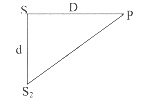
In Young's double slit experiment,the two slits are $d$ distance apart. An interference pattern is observed on a screen at a distance $D$ from the slits. $A$ dark fringe is observed on the screen directly opposite to one of the slits. The wavelength of light is:
A
$\frac{D^2}{2 d}$
B
$\frac{d^2}{2 D}$
C
$\frac{D^2}{d}$
D
$\frac{d^2}{D}$
Solution
(D) Let the two slits be $S_1$ and $S_2$. The point $P$ on the screen is directly opposite to slit $S_1$.
The distance $S_1 P = D$ and the distance $S_2 P = \sqrt{D^2 + d^2}$.
Using the binomial expansion for $S_2 P$:
$S_2 P = D \left(1 + \frac{d^2}{D^2}\right)^{1/2} \approx D \left(1 + \frac{1}{2} \frac{d^2}{D^2}\right) = D + \frac{d^2}{2D}$.
The path difference $\Delta x$ between the two waves reaching point $P$ is:
$\Delta x = S_2 P - S_1 P = (D + \frac{d^2}{2D}) - D = \frac{d^2}{2D}$.
For a dark fringe,the path difference must be an odd multiple of $\frac{\lambda}{2}$. For the first dark fringe (minimum path difference),we set:
$\Delta x = \frac{\lambda}{2}$.
Equating the two expressions:
$\frac{d^2}{2D} = \frac{\lambda}{2}$.
Therefore,the wavelength of light is $\lambda = \frac{d^2}{D}$.
The distance $S_1 P = D$ and the distance $S_2 P = \sqrt{D^2 + d^2}$.
Using the binomial expansion for $S_2 P$:
$S_2 P = D \left(1 + \frac{d^2}{D^2}\right)^{1/2} \approx D \left(1 + \frac{1}{2} \frac{d^2}{D^2}\right) = D + \frac{d^2}{2D}$.
The path difference $\Delta x$ between the two waves reaching point $P$ is:
$\Delta x = S_2 P - S_1 P = (D + \frac{d^2}{2D}) - D = \frac{d^2}{2D}$.
For a dark fringe,the path difference must be an odd multiple of $\frac{\lambda}{2}$. For the first dark fringe (minimum path difference),we set:
$\Delta x = \frac{\lambda}{2}$.
Equating the two expressions:
$\frac{d^2}{2D} = \frac{\lambda}{2}$.
Therefore,the wavelength of light is $\lambda = \frac{d^2}{D}$.
0 likesView Solution
331
ChemistryMCQMHT CET · 2023
In a biprism experiment,if the $5^{\text{th}}$ bright band with wavelength $\lambda_1$ coincides with the $6^{\text{th}}$ dark band with wavelength $\lambda_2$,then the ratio $\left(\frac{\lambda_2}{\lambda_1}\right)$ is:
A
$\frac{9}{7}$
B
$\frac{7}{9}$
C
$\frac{10}{11}$
D
$\frac{11}{10}$
Solution
(C) The position of the $n^{\text{th}}$ bright band is given by $y_n = \frac{n \lambda_1 D}{d}$.
For the $5^{\text{th}}$ bright band $(n=5)$: $y_5 = \frac{5 \lambda_1 D}{d}$.
The position of the $n^{\text{th}}$ dark band is given by $y_n' = \frac{(2n-1) \lambda_2 D}{2d}$.
For the $6^{\text{th}}$ dark band $(n=6)$: $y_6' = \frac{(2 \times 6 - 1) \lambda_2 D}{2d} = \frac{11 \lambda_2 D}{2d}$.
Given that the bands coincide,$y_5 = y_6'$,so:
$\frac{5 \lambda_1 D}{d} = \frac{11 \lambda_2 D}{2d}$.
Canceling $D$ and $d$ from both sides:
$5 \lambda_1 = \frac{11 \lambda_2}{2}$.
Rearranging to find the ratio $\frac{\lambda_2}{\lambda_1}$:
$\frac{\lambda_2}{\lambda_1} = \frac{5 \times 2}{11} = \frac{10}{11}$.
For the $5^{\text{th}}$ bright band $(n=5)$: $y_5 = \frac{5 \lambda_1 D}{d}$.
The position of the $n^{\text{th}}$ dark band is given by $y_n' = \frac{(2n-1) \lambda_2 D}{2d}$.
For the $6^{\text{th}}$ dark band $(n=6)$: $y_6' = \frac{(2 \times 6 - 1) \lambda_2 D}{2d} = \frac{11 \lambda_2 D}{2d}$.
Given that the bands coincide,$y_5 = y_6'$,so:
$\frac{5 \lambda_1 D}{d} = \frac{11 \lambda_2 D}{2d}$.
Canceling $D$ and $d$ from both sides:
$5 \lambda_1 = \frac{11 \lambda_2}{2}$.
Rearranging to find the ratio $\frac{\lambda_2}{\lambda_1}$:
$\frac{\lambda_2}{\lambda_1} = \frac{5 \times 2}{11} = \frac{10}{11}$.
0 likesView Solution
332
ChemistryMediumMCQMHT CET · 2023
Find the radius of a metal atom in a simple cubic unit cell having an edge length of $334.7 \ pm$. (in $pm$)
A
$167.35$
B
$334.70$
C
$144.93$
D
$118.32$
Solution
(A) For a simple cubic unit cell, the relationship between the edge length $(a)$ and the atomic radius $(r)$ is given by $a = 2r$.
Therefore, $r = \frac{a}{2}$.
Given $a = 334.7 \ pm$.
$r = \frac{334.7 \ pm}{2} = 167.35 \ pm$.
Therefore, $r = \frac{a}{2}$.
Given $a = 334.7 \ pm$.
$r = \frac{334.7 \ pm}{2} = 167.35 \ pm$.
0 likesView Solution
333
ChemistryEasyMCQMHT CET · 2023
Which of the following metals has a $ccp$ crystal structure?
A
$Cu$
B
$Zn$
C
$Mg$
D
$Po$
Solution
(A) The $ccp$ (cubic close-packed) structure is also known as $fcc$ (face-centered cubic) structure.
Among the given options,$Cu$ (Copper) crystallizes in the $fcc$ $(ccp)$ structure.
$Zn$ (Zinc) and $Mg$ (Magnesium) crystallize in $hcp$ (hexagonal close-packed) structure.
$Po$ (Polonium) crystallizes in a simple cubic structure.
Among the given options,$Cu$ (Copper) crystallizes in the $fcc$ $(ccp)$ structure.
$Zn$ (Zinc) and $Mg$ (Magnesium) crystallize in $hcp$ (hexagonal close-packed) structure.
$Po$ (Polonium) crystallizes in a simple cubic structure.
0 likesView Solution
334
ChemistryMediumMCQMHT CET · 2023
Calculate the molar mass of an element having density $21 \ g \ cm^{-3}$ that forms $fcc$ unit cell $[a^3 \cdot N_{A} = 36 \ cm^3 \ mol^{-1}]$
A
$292.00 \ g \ mol^{-1}$
B
$189.00 \ g \ mol^{-1}$
C
$140.00 \ g \ mol^{-1}$
D
$108.00 \ g \ mol^{-1}$
Solution
(B) The density formula for a unit cell is given by $\rho = \frac{M \cdot n}{a^3 \cdot N_A}$.
For an $fcc$ unit cell,the number of atoms per unit cell $(n)$ is $4$.
Given: $\rho = 21 \ g \ cm^{-3}$ and $a^3 \cdot N_A = 36 \ cm^3 \ mol^{-1}$.
Substituting the values: $21 = \frac{M \times 4}{36}$.
Solving for $M$: $M = \frac{21 \times 36}{4} = 21 \times 9 = 189.00 \ g \ mol^{-1}$.
For an $fcc$ unit cell,the number of atoms per unit cell $(n)$ is $4$.
Given: $\rho = 21 \ g \ cm^{-3}$ and $a^3 \cdot N_A = 36 \ cm^3 \ mol^{-1}$.
Substituting the values: $21 = \frac{M \times 4}{36}$.
Solving for $M$: $M = \frac{21 \times 36}{4} = 21 \times 9 = 189.00 \ g \ mol^{-1}$.
0 likesView Solution
335
ChemistryMediumMCQMHT CET · 2023
Calculate the molar mass of an element with density $2.7 \ g \ cm^{-3}$ that forms $fcc$ structure. $\left[a^3 \cdot N_{A}=40 \ cm^3 \ mol^{-1}\right]$
A
$112 \ g \ mol^{-1}$
B
$54 \ g \ mol^{-1}$
C
$27 \ g \ mol^{-1}$
D
$78 \ g \ mol^{-1}$
Solution
(C) For an $fcc$ unit cell,the number of atoms per unit cell,$n = 4$.
The formula for density is $\rho = \frac{M \times n}{a^3 \cdot N_A}$.
Given $\rho = 2.7 \ g \ cm^{-3}$ and $a^3 \cdot N_A = 40 \ cm^3 \ mol^{-1}$.
Substituting the values: $2.7 = \frac{M \times 4}{40}$.
Solving for $M$: $M = \frac{2.7 \times 40}{4} = 27 \ g \ mol^{-1}$.
The formula for density is $\rho = \frac{M \times n}{a^3 \cdot N_A}$.
Given $\rho = 2.7 \ g \ cm^{-3}$ and $a^3 \cdot N_A = 40 \ cm^3 \ mol^{-1}$.
Substituting the values: $2.7 = \frac{M \times 4}{40}$.
Solving for $M$: $M = \frac{2.7 \times 40}{4} = 27 \ g \ mol^{-1}$.
0 likesView Solution
336
ChemistryMediumMCQMHT CET · 2023
Calculate the edge length of the unit cell of a metal which crystallises in a $bcc$ structure. (Radius of metal atom $= 173 \ pm$)
A
$5.01 \times 10^{-8} \ cm$
B
$4.00 \times 10^{-8} \ cm$
C
$4.5 \times 10^{-8} \ cm$
D
$5.5 \times 10^{-8} \ cm$
Solution
(B) For a $bcc$ unit cell, the relationship between radius $r$ and edge length $a$ is given by $r = \frac{\sqrt{3}}{4} a$.
Therefore, $a = \frac{4r}{\sqrt{3}}$.
Substituting the given value $r = 173 \ pm$:
$a = \frac{4 \times 173}{1.732} \approx 400 \ pm$.
Converting to centimeters:
$a = 400 \times 10^{-10} \ cm = 4.00 \times 10^{-8} \ cm$.
Therefore, $a = \frac{4r}{\sqrt{3}}$.
Substituting the given value $r = 173 \ pm$:
$a = \frac{4 \times 173}{1.732} \approx 400 \ pm$.
Converting to centimeters:
$a = 400 \times 10^{-10} \ cm = 4.00 \times 10^{-8} \ cm$.
0 likesView Solution
337
ChemistryMediumMCQMHT CET · 2023
Find the radius of an atom in $fcc$ unit cell having edge length $393 \ pm$. (in $pm$)
A
$196.51$
B
$170.22$
C
$78.63$
D
$138.93$
Solution
(D) For $fcc$ crystal structure, the relation between edge length $a$ and atomic radius $r$ is given by $4r = \sqrt{2}a$.
Therefore, $r = \frac{\sqrt{2}a}{4}$.
Substituting the given value $a = 393 \ pm$:
$r = \frac{1.414 \times 393}{4} = 138.93 \ pm$.
Therefore, $r = \frac{\sqrt{2}a}{4}$.
Substituting the given value $a = 393 \ pm$:
$r = \frac{1.414 \times 393}{4} = 138.93 \ pm$.
0 likesView Solution
338
ChemistryMediumMCQMHT CET · 2023
What is the number of unit cells present in a cubic crystal lattice having $4$ atoms per unit cell and weighing $0.60 \ g$ (molar mass $60 \ g \ mol^{-1}$)?
A
$1 \times 10^{21}$
B
$1.5 \times 10^{21}$
C
$3.0 \times 10^{21}$
D
$6.0 \times 10^{21}$
Solution
(B) Number of moles $= \frac{0.6 \ g}{60 \ g \ mol^{-1}} = 0.01 \ mol$
Total number of atoms $= 0.01 \times 6.022 \times 10^{23} = 6.022 \times 10^{21} \ \text{atoms}$
Number of atoms per unit cell $= 4$
Number of unit cells $= \frac{\text{Total number of atoms}}{\text{Atoms per unit cell}} = \frac{6.022 \times 10^{21}}{4} \approx 1.5 \times 10^{21} \ \text{unit cells}$
Total number of atoms $= 0.01 \times 6.022 \times 10^{23} = 6.022 \times 10^{21} \ \text{atoms}$
Number of atoms per unit cell $= 4$
Number of unit cells $= \frac{\text{Total number of atoms}}{\text{Atoms per unit cell}} = \frac{6.022 \times 10^{21}}{4} \approx 1.5 \times 10^{21} \ \text{unit cells}$
0 likesView Solution
339
ChemistryMediumMCQMHT CET · 2023
What is the atomic mass of an element with $BCC$ structure and density $10 \ g \ cm^{-3}$ having an edge length of $300 \ pm$?
A
$51.0 \ g \ mol^{-1}$
B
$60.0 \ g \ mol^{-1}$
C
$81.3 \ g \ mol^{-1}$
D
$96.8 \ g \ mol^{-1}$
Solution
(C) For a $BCC$ unit cell, the number of atoms per unit cell is $n = 2$.
Density formula: $\rho = \frac{M \times n}{a^3 \times N_A}$
Rearranging for molar mass $M$: $M = \frac{\rho \times a^3 \times N_A}{n}$
Given: $\rho = 10 \ g \ cm^{-3}$, $a = 300 \ pm = 3 \times 10^{-8} \ cm$, $N_A = 6.022 \times 10^{23} \ mol^{-1}$, $n = 2$.
$M = \frac{10 \times (3 \times 10^{-8})^3 \times 6.022 \times 10^{23}}{2}$
$M = \frac{10 \times 27 \times 10^{-24} \times 6.022 \times 10^{23}}{2}$
$M = \frac{162.594}{2} \approx 81.3 \ g \ mol^{-1}$.
Density formula: $\rho = \frac{M \times n}{a^3 \times N_A}$
Rearranging for molar mass $M$: $M = \frac{\rho \times a^3 \times N_A}{n}$
Given: $\rho = 10 \ g \ cm^{-3}$, $a = 300 \ pm = 3 \times 10^{-8} \ cm$, $N_A = 6.022 \times 10^{23} \ mol^{-1}$, $n = 2$.
$M = \frac{10 \times (3 \times 10^{-8})^3 \times 6.022 \times 10^{23}}{2}$
$M = \frac{10 \times 27 \times 10^{-24} \times 6.022 \times 10^{23}}{2}$
$M = \frac{162.594}{2} \approx 81.3 \ g \ mol^{-1}$.
0 likesView Solution
340
ChemistryEasyMCQMHT CET · 2023
Which formula is used to calculate edge length $(a)$ in a $bcc$ structure,where $r$ is the radius of the atom?
A
$a = \frac{\sqrt{3} r}{4}$
B
$a = \frac{4}{\sqrt{3} r}$
C
$a = \frac{\sqrt{3}}{4 r}$
D
$a = \frac{4 r}{\sqrt{3}}$
Solution
(D) In a $bcc$ (body-centered cubic) unit cell,the atoms touch each other along the body diagonal.
The length of the body diagonal is given by $\sqrt{3} a$.
Since the body diagonal consists of two radii of the corner atoms and one full diameter of the central atom,we have $\sqrt{3} a = 4r$.
Rearranging this for the edge length $a$,we get $a = \frac{4r}{\sqrt{3}}$.
The length of the body diagonal is given by $\sqrt{3} a$.
Since the body diagonal consists of two radii of the corner atoms and one full diameter of the central atom,we have $\sqrt{3} a = 4r$.
Rearranging this for the edge length $a$,we get $a = \frac{4r}{\sqrt{3}}$.
0 likesView Solution
341
ChemistryMediumMCQMHT CET · 2023
Find the radius of an atom in $fcc$ unit cell having edge length $405 \ pm$. (in $pm$)
A
$202.5$
B
$175.3$
C
$143.2$
D
$181.0$
Solution
(C) For $fcc$ crystal structure, the relationship between radius $r$ and edge length $a$ is given by $r = \frac{a}{2\sqrt{2}} = \frac{\sqrt{2}}{4} a$.
Given $a = 405 \ pm$.
Substituting the value: $r = \frac{1.414 \times 405}{4} = \frac{572.67}{4} = 143.1675 \ pm \approx 143.2 \ pm$.
Given $a = 405 \ pm$.
Substituting the value: $r = \frac{1.414 \times 405}{4} = \frac{572.67}{4} = 143.1675 \ pm \approx 143.2 \ pm$.
0 likesView Solution
342
ChemistryMediumMCQMHT CET · 2023
Calculate the molar mass of a metal having a density of $9.3 \ g \ cm^{-3}$ that forms a simple cubic unit cell. $[a^3 \cdot N_A = 22.6 \ cm^3 \ mol^{-1}]$
A
$210.2 \ g \ mol^{-1}$
B
$105.3 \ g \ mol^{-1}$
C
$52.6 \ g \ mol^{-1}$
D
$70.2 \ g \ mol^{-1}$
Solution
(A) For a simple cubic unit cell,the number of atoms per unit cell is $n = 1$.
The formula for density $(\rho)$ is given by $\rho = \frac{M \cdot n}{a^3 \cdot N_A}$.
Substituting the given values: $9.3 = \frac{M \cdot 1}{22.6}$.
Solving for molar mass $M$: $M = 9.3 \times 22.6 = 210.2 \ g \ mol^{-1}$.
The formula for density $(\rho)$ is given by $\rho = \frac{M \cdot n}{a^3 \cdot N_A}$.
Substituting the given values: $9.3 = \frac{M \cdot 1}{22.6}$.
Solving for molar mass $M$: $M = 9.3 \times 22.6 = 210.2 \ g \ mol^{-1}$.
0 likesView Solution
343
ChemistryMediumMCQMHT CET · 2023
Calculate the molar mass of an element having density $7.8 \ g \ cm^{-3}$ that forms a $bcc$ unit cell. $\left[a^3 \cdot N_{A} = 16.2 \ cm^3 \ mol^{-1}\right]$
A
$63.18 \ g \ mol^{-1}$
B
$61.23 \ g \ mol^{-1}$
C
$59.31 \ g \ mol^{-1}$
D
$65.61 \ g \ mol^{-1}$
Solution
(A) For a $bcc$ unit cell,the number of atoms per unit cell is $n = 2$.
The formula for density is $\rho = \frac{M \cdot n}{a^3 \cdot N_{A}}$.
Given $\rho = 7.8 \ g \ cm^{-3}$ and $a^3 \cdot N_{A} = 16.2 \ cm^3 \ mol^{-1}$.
Substituting the values: $7.8 = \frac{M \times 2}{16.2}$.
Solving for $M$: $M = \frac{7.8 \times 16.2}{2} = 63.18 \ g \ mol^{-1}$.
The formula for density is $\rho = \frac{M \cdot n}{a^3 \cdot N_{A}}$.
Given $\rho = 7.8 \ g \ cm^{-3}$ and $a^3 \cdot N_{A} = 16.2 \ cm^3 \ mol^{-1}$.
Substituting the values: $7.8 = \frac{M \times 2}{16.2}$.
Solving for $M$: $M = \frac{7.8 \times 16.2}{2} = 63.18 \ g \ mol^{-1}$.
0 likesView Solution
344
ChemistryMediumMCQMHT CET · 2023
What are the number of octahedral and tetrahedral voids in $0.3 \ mol$ of a substance respectively,if it forms an $hcp$ structure?
A
$1.8066 \times 10^{23}$ and $3.6132 \times 10^{23}$
B
$3.6132 \times 10^{23}$ and $1.8066 \times 10^{23}$
C
$6.022 \times 10^{23}$ and $12.044 \times 10^{23}$
D
$12.044 \times 10^{23}$ and $6.022 \times 10^{23}$
Solution
(A) Number of atoms in $0.3 \ mol = 0.3 \times N_A = 0.3 \times 6.022 \times 10^{23} = 1.8066 \times 10^{23}$.
$I$. For $hcp$ structure,the number of octahedral voids is equal to the number of atoms.
Number of octahedral voids $= 1.8066 \times 10^{23}$.
$II$. For $hcp$ structure,the number of tetrahedral voids is equal to twice the number of atoms.
Number of tetrahedral voids $= 2 \times 1.8066 \times 10^{23} = 3.6132 \times 10^{23}$.
$I$. For $hcp$ structure,the number of octahedral voids is equal to the number of atoms.
Number of octahedral voids $= 1.8066 \times 10^{23}$.
$II$. For $hcp$ structure,the number of tetrahedral voids is equal to twice the number of atoms.
Number of tetrahedral voids $= 2 \times 1.8066 \times 10^{23} = 3.6132 \times 10^{23}$.
0 likesView Solution
345
ChemistryMediumMCQMHT CET · 2023
Calculate the edge length of a simple cubic unit cell if the radius of an atom is $167.3 \ pm$. (in $pm$)
A
$473.2$
B
$334.6$
C
$386.3$
D
$836.5$
Solution
(B) In a simple cubic unit cell, the atoms touch each other along the edge of the cube.
Therefore, the relationship between the edge length $a$ and the atomic radius $r$ is given by $a = 2r$.
Given $r = 167.3 \ pm$.
Thus, $a = 2 \times 167.3 \ pm = 334.6 \ pm$.
Therefore, the relationship between the edge length $a$ and the atomic radius $r$ is given by $a = 2r$.
Given $r = 167.3 \ pm$.
Thus, $a = 2 \times 167.3 \ pm = 334.6 \ pm$.
0 likesView Solution
346
ChemistryMediumMCQMHT CET · 2023
Calculate the density of an element having molar mass $27 \ g \ mol^{-1}$ that forms $fcc$ unit cell. $[a^3 \cdot N_A = 38.5 \ cm^3 \ mol^{-1}]$ (in $g \ cm^{-3}$)
A
$2.8$
B
$2.1$
C
$3.5$
D
$4.1$
Solution
(A) The density $\rho$ is given by the formula: $\rho = \frac{M \times Z}{a^3 \cdot N_A}$
For an $fcc$ unit cell,the number of atoms per unit cell,$Z = 4$.
Given: $M = 27 \ g \ mol^{-1}$ and $a^3 \cdot N_A = 38.5 \ cm^3 \ mol^{-1}$.
Substituting the values: $\rho = \frac{27 \ g \ mol^{-1} \times 4}{38.5 \ cm^3 \ mol^{-1}}$
$\rho = \frac{108}{38.5} \ g \ cm^{-3} \approx 2.8 \ g \ cm^{-3}$.
For an $fcc$ unit cell,the number of atoms per unit cell,$Z = 4$.
Given: $M = 27 \ g \ mol^{-1}$ and $a^3 \cdot N_A = 38.5 \ cm^3 \ mol^{-1}$.
Substituting the values: $\rho = \frac{27 \ g \ mol^{-1} \times 4}{38.5 \ cm^3 \ mol^{-1}}$
$\rho = \frac{108}{38.5} \ g \ cm^{-3} \approx 2.8 \ g \ cm^{-3}$.
0 likesView Solution
347
ChemistryMediumMCQMHT CET · 2023
Calculate the radius of a metal atom in a $bcc$ unit cell having an edge length of $287 \ pm$. (in $pm$)
A
$124.27$
B
$143.51$
C
$101.45$
D
$57.4$
Solution
(A) For a $bcc$ unit cell, the relationship between the radius $r$ and the edge length $a$ is given by $4r = \sqrt{3}a$.
Substituting the given value of $a = 287 \ pm$:
$r = \frac{\sqrt{3}}{4} \times 287$
$r = \frac{1.732 \times 287}{4} = 124.27 \ pm$.
Substituting the given value of $a = 287 \ pm$:
$r = \frac{\sqrt{3}}{4} \times 287$
$r = \frac{1.732 \times 287}{4} = 124.27 \ pm$.
0 likesView Solution
348
ChemistryEasyMCQMHT CET · 2023
Which of the following metals has an $hcp$ crystal structure?
A
$Cu$
B
$Zn$
C
$Ag$
D
$Po$
Solution
(B) $Zn$ (Zinc) crystallizes in a hexagonal close-packed $(hcp)$ structure.
$Cu$ (Copper) and $Ag$ (Silver) crystallize in a cubic close-packed ($ccp$ or $fcc$) structure.
$Po$ (Polonium) crystallizes in a simple cubic structure.
$Cu$ (Copper) and $Ag$ (Silver) crystallize in a cubic close-packed ($ccp$ or $fcc$) structure.
$Po$ (Polonium) crystallizes in a simple cubic structure.
0 likesView Solution
349
ChemistryMediumMCQMHT CET · 2023
Find the radius of a metal atom in a $bcc$ unit cell having an edge length of $450 \ pm$. (in $pm$)
A
$225.04$
B
$194.85$
C
$159.08$
D
$99.05$
Solution
(B) For a $bcc$ unit cell, the relationship between the radius of the atom $(r)$ and the edge length $(a)$ is given by $4r = \sqrt{3}a$.
Substituting the given edge length $a = 450 \ pm$:
$r = \frac{\sqrt{3} \times 450}{4} = \frac{1.732 \times 450}{4} = 194.85 \ pm$.
Substituting the given edge length $a = 450 \ pm$:
$r = \frac{\sqrt{3} \times 450}{4} = \frac{1.732 \times 450}{4} = 194.85 \ pm$.
0 likesView Solution
350
ChemistryMediumMCQMHT CET · 2023
Calculate the volume of the unit cell if an element having a molar mass of $180 \ g \ mol^{-1}$ forms an $fcc$ unit cell. $\left[\rho \cdot N_{A} = 120 \times 10^{21} \ g \ cm^{-3} \ mol^{-1}\right]$
A
$6.00 \times 10^{-21} \ cm^3$
B
$5.00 \times 10^{-21} \ cm^3$
C
$4.00 \times 10^{-21} \ cm^3$
D
$7.00 \times 10^{-21} \ cm^3$
Solution
(A) For an $fcc$ unit cell,the number of atoms per unit cell $(n)$ is $4$.
The density formula is given by $\rho = \frac{M \times n}{a^3 \times N_A}$.
Rearranging for the volume of the unit cell $(a^3)$,we get $a^3 = \frac{M \times n}{\rho \times N_A}$.
Substituting the given values: $M = 180 \ g \ mol^{-1}$,$n = 4$,and $\rho \cdot N_A = 120 \times 10^{21} \ g \ cm^{-3} \ mol^{-1}$.
$a^3 = \frac{180 \times 4}{120 \times 10^{21}} = \frac{720}{120 \times 10^{21}} = 6.00 \times 10^{-21} \ cm^3$.
The density formula is given by $\rho = \frac{M \times n}{a^3 \times N_A}$.
Rearranging for the volume of the unit cell $(a^3)$,we get $a^3 = \frac{M \times n}{\rho \times N_A}$.
Substituting the given values: $M = 180 \ g \ mol^{-1}$,$n = 4$,and $\rho \cdot N_A = 120 \times 10^{21} \ g \ cm^{-3} \ mol^{-1}$.
$a^3 = \frac{180 \times 4}{120 \times 10^{21}} = \frac{720}{120 \times 10^{21}} = 6.00 \times 10^{-21} \ cm^3$.
0 likesView Solution
351
ChemistryMediumMCQMHT CET · 2023
In an ionic crystalline solid,atoms of element $Y$ form an $hcp$ structure. The atoms of element $X$ occupy one-third of the tetrahedral voids. What is the formula of the compound?
A
$X_2 Y_3$
B
$X Y$
C
$X_3 Y_3$
D
$X Y_2$
Solution
(A) The atoms of element $Y$ form an $hcp$ structure. Let the number of $Y$ atoms be $N$.
The number of tetrahedral voids generated is $2N$.
The atoms of element $X$ occupy $1/3$ of these tetrahedral voids.
Therefore,the number of $X$ atoms $= 2N \times 1/3 = 2/3 N$.
The ratio of $X$ atoms to $Y$ atoms is $(2/3 N) : N = 2/3 : 1 = 2 : 3$.
Thus,the formula of the compound is $X_2 Y_3$.
The number of tetrahedral voids generated is $2N$.
The atoms of element $X$ occupy $1/3$ of these tetrahedral voids.
Therefore,the number of $X$ atoms $= 2N \times 1/3 = 2/3 N$.
The ratio of $X$ atoms to $Y$ atoms is $(2/3 N) : N = 2/3 : 1 = 2 : 3$.
Thus,the formula of the compound is $X_2 Y_3$.
0 likesView Solution
352
ChemistryMediumMCQMHT CET · 2023
Calculate the volume of the unit cell for an element having a molar mass of $56 \ g \ mol^{-1}$ that forms $bcc$ unit cells. $\left[\rho \cdot N_{A} = 4.8 \times 10^{24} \ g \ cm^{-3} \ mol^{-1}\right]$
A
$1.17 \times 10^{-23} \ cm^3$
B
$4.79 \times 10^{-23} \ cm^3$
C
$3.31 \times 10^{-23} \ cm^3$
D
$2.33 \times 10^{-23} \ cm^3$
Solution
(D) The density of a unit cell is given by $\rho = \frac{M \cdot n}{a^3 \cdot N_A}$.
Here,$M = 56 \ g \ mol^{-1}$,$n = 2$ (for $bcc$ structure),and $\rho \cdot N_A = 4.8 \times 10^{24} \ g \ cm^{-3} \ mol^{-1}$.
The volume of the unit cell is $V = a^3 = \frac{M \cdot n}{\rho \cdot N_A}$.
Substituting the values: $V = \frac{56 \times 2}{4.8 \times 10^{24}} \ cm^3$.
$V = \frac{112}{4.8} \times 10^{-24} \ cm^3 = 23.33 \times 10^{-24} \ cm^3 = 2.33 \times 10^{-23} \ cm^3$.
Here,$M = 56 \ g \ mol^{-1}$,$n = 2$ (for $bcc$ structure),and $\rho \cdot N_A = 4.8 \times 10^{24} \ g \ cm^{-3} \ mol^{-1}$.
The volume of the unit cell is $V = a^3 = \frac{M \cdot n}{\rho \cdot N_A}$.
Substituting the values: $V = \frac{56 \times 2}{4.8 \times 10^{24}} \ cm^3$.
$V = \frac{112}{4.8} \times 10^{-24} \ cm^3 = 23.33 \times 10^{-24} \ cm^3 = 2.33 \times 10^{-23} \ cm^3$.
0 likesView Solution
353
ChemistryMediumMCQMHT CET · 2023
Calculate the density of a metal having a molar mass of $210 \ g \ mol^{-1}$ that forms a simple cubic unit cell. $(a^3 \cdot N_{A} = 21.5 \ cm^3 \ mol^{-1})$ (in $g \ cm^{-3}$)
A
$9.77$
B
$7.15$
C
$8.12$
D
$6.94$
Solution
(A) For a simple cubic unit cell,the number of atoms per unit cell $(n)$ is $1$.
Density $(\rho)$ is given by the formula: $\rho = \frac{n \cdot M}{a^3 \cdot N_{A}}$.
Substituting the given values: $\rho = \frac{1 \times 210}{21.5} \ g \ cm^{-3}$.
$\rho = 9.77 \ g \ cm^{-3}$.
Density $(\rho)$ is given by the formula: $\rho = \frac{n \cdot M}{a^3 \cdot N_{A}}$.
Substituting the given values: $\rho = \frac{1 \times 210}{21.5} \ g \ cm^{-3}$.
$\rho = 9.77 \ g \ cm^{-3}$.
0 likesView Solution
354
ChemistryMediumMCQMHT CET · 2023
Calculate the edge length of a $bcc$ unit cell if the radius of the metal atom is $227 \ pm$.
A
$4.54 \times 10^{-8} \ cm$
B
$5.24 \times 10^{-8} \ cm$
C
$6.42 \times 10^{-8} \ cm$
D
$1.135 \times 10^{-8} \ cm$
Solution
(B) For a $bcc$ unit cell, the relationship between the radius $r$ and the edge length $a$ is given by $r = \frac{\sqrt{3}}{4} a$.
Therefore, $a = \frac{4r}{\sqrt{3}}$.
Substituting the value $r = 227 \ pm$:
$a = \frac{4 \times 227}{1.732} \approx 524.83 \ pm$.
Converting $pm$ to $cm$: $1 \ pm = 10^{-10} \ cm$.
$a = 524.83 \times 10^{-10} \ cm = 5.2483 \times 10^{-8} \ cm$.
Rounding to two decimal places, we get $5.24 \times 10^{-8} \ cm$.
Therefore, $a = \frac{4r}{\sqrt{3}}$.
Substituting the value $r = 227 \ pm$:
$a = \frac{4 \times 227}{1.732} \approx 524.83 \ pm$.
Converting $pm$ to $cm$: $1 \ pm = 10^{-10} \ cm$.
$a = 524.83 \times 10^{-10} \ cm = 5.2483 \times 10^{-8} \ cm$.
Rounding to two decimal places, we get $5.24 \times 10^{-8} \ cm$.
0 likesView Solution
355
ChemistryEasyMCQMHT CET · 2023
Which of the following concentration terms depends on temperature?
A
Molality
B
Molarity
C
Mole fraction
D
Percent by mass
Solution
(B) Concentration terms that involve volume are temperature-dependent because volume changes with temperature.
$Molarity$ $(M)$ is defined as the number of moles of solute per liter of solution $(mol/L)$.
Since volume is a component of the denominator,$Molarity$ changes with temperature.
In contrast,$Molality$,$Mole fraction$,and $Percent by mass$ are based on mass,which is independent of temperature.
$Molarity$ $(M)$ is defined as the number of moles of solute per liter of solution $(mol/L)$.
Since volume is a component of the denominator,$Molarity$ changes with temperature.
In contrast,$Molality$,$Mole fraction$,and $Percent by mass$ are based on mass,which is independent of temperature.
0 likesView Solution
356
ChemistryEasyMCQMHT CET · 2023
Which among the following gases exhibits very low solubility in water at room temperature?
A
$O_2$
B
$CO_2$
C
$NH_3$
D
$HCl$
Solution
(A) The solubility of gases in liquids depends on the nature of the gas and the solvent.
$O_2$ is a non-polar gas and exhibits very low solubility in water at room temperature.
In contrast,gases like $CO_2$,$NH_3$,and $HCl$ are highly soluble in water because they either react with water or are polar in nature.
$O_2$ is a non-polar gas and exhibits very low solubility in water at room temperature.
In contrast,gases like $CO_2$,$NH_3$,and $HCl$ are highly soluble in water because they either react with water or are polar in nature.
0 likesView Solution
357
ChemistryEasyMCQMHT CET · 2023
What type of solution is ethyl alcohol in water?
A
Liquid in solid
B
Solid in liquid
C
Liquid in liquid
D
Gas in liquid
Solution
(C) solution of ethyl alcohol in water is formed by dissolving a liquid solute (ethyl alcohol) in a liquid solvent (water). Therefore,it is classified as a $Liquid$ in $Liquid$ type of solution.
0 likesView Solution
358
ChemistryEasyMCQMHT CET · 2023
Identify the $CORRECT$ decreasing order of solubilities of alcohols,alkanes,and amines in water having comparable molar mass.
A
Alcohol $>$ amine $>$ alkane
B
Alkane $>$ amine $>$ alcohol
C
Amine $>$ alcohol $>$ alkane
D
Alkane $>$ alcohol $>$ amine
Solution
(A) The solubility of organic compounds in water depends on their ability to form hydrogen bonds with water molecules.
Alcohols $(R-OH)$ form stronger hydrogen bonds with water due to the high electronegativity of oxygen compared to nitrogen.
Amines $(R-NH_2)$ also form hydrogen bonds with water,but these are weaker than those formed by alcohols because nitrogen is less electronegative than oxygen.
Alkanes are non-polar and cannot form hydrogen bonds with water,making them practically insoluble.
Therefore,the decreasing order of solubility is: $\text{Alcohol} > \text{Amine} > \text{Alkane}$.
Alcohols $(R-OH)$ form stronger hydrogen bonds with water due to the high electronegativity of oxygen compared to nitrogen.
Amines $(R-NH_2)$ also form hydrogen bonds with water,but these are weaker than those formed by alcohols because nitrogen is less electronegative than oxygen.
Alkanes are non-polar and cannot form hydrogen bonds with water,making them practically insoluble.
Therefore,the decreasing order of solubility is: $\text{Alcohol} > \text{Amine} > \text{Alkane}$.
0 likesView Solution
359
ChemistryMediumMCQMHT CET · 2023
What is the vapour pressure of a solution containing $1 \ mol$ of a non-volatile solute in $36 \ g$ of water $\left(P_1^0 = 32 \ mm \ Hg\right) (in $mm \ Hg$)?$
A
$8.14$
B
$12.31$
C
$16.08$
D
$21.33$
Solution
(D) Given: $n_2 = 1 \ mol$ (solute),$w_1 = 36 \ g$ (solvent),$P_1^0 = 32 \ mm \ Hg$.
Moles of water $(n_1)$ = $\frac{36 \ g}{18 \ g/mol} = 2 \ mol$.
According to Raoult's law for non-volatile solutes: $\frac{P_1^0 - P_1}{P_1^0} = \frac{n_2}{n_1 + n_2}$.
Substituting the values: $\frac{32 - P_1}{32} = \frac{1}{2 + 1} = \frac{1}{3}$.
$3(32 - P_1) = 32$.
$96 - 3P_1 = 32$.
$3P_1 = 96 - 32 = 64$.
$P_1 = \frac{64}{3} = 21.33 \ mm \ Hg$.
Moles of water $(n_1)$ = $\frac{36 \ g}{18 \ g/mol} = 2 \ mol$.
According to Raoult's law for non-volatile solutes: $\frac{P_1^0 - P_1}{P_1^0} = \frac{n_2}{n_1 + n_2}$.
Substituting the values: $\frac{32 - P_1}{32} = \frac{1}{2 + 1} = \frac{1}{3}$.
$3(32 - P_1) = 32$.
$96 - 3P_1 = 32$.
$3P_1 = 96 - 32 = 64$.
$P_1 = \frac{64}{3} = 21.33 \ mm \ Hg$.
0 likesView Solution
360
ChemistryEasyMCQMHT CET · 2023
Identify the $FALSE$ statement about ideal solutions from the following.
A
Ideal solutions obey Raoult's law over the entire range of concentration.
B
No heat is evolved or absorbed when two components forming an ideal solution are mixed.
C
The volume of an ideal solution is the same as the sum of the volumes of the two components taken for mixing.
D
The vapour pressure of an ideal solution is either higher or lower than the vapour pressure of the pure components.
Solution
(D) For an ideal solution,the vapour pressure always lies between the vapour pressures of the pure components. Therefore,the statement that it is either higher or lower than the pure components is false.
0 likesView Solution
361
ChemistryMediumMCQMHT CET · 2023
What is the solubility of a gas in water at $25^{\circ} C$ if the partial pressure is $0.18 \ atm$? $(K_{H} = 0.16 \ mol \ dm^{-3} \ atm^{-1})$
A
$0.029 \ mol \ dm^{-3}$
B
$0.022 \ mol \ dm^{-3}$
C
$0.032 \ mol \ dm^{-3}$
D
$0.038 \ mol \ dm^{-3}$
Solution
(A) According to Henry's Law,the solubility $(S)$ of a gas is given by the formula: $S = K_{H} \times P$.
Given: $K_{H} = 0.16 \ mol \ dm^{-3} \ atm^{-1}$ and $P = 0.18 \ atm$.
Substituting the values: $S = 0.16 \times 0.18 = 0.0288 \ mol \ dm^{-3}$.
Rounding to two significant figures,we get $0.029 \ mol \ dm^{-3}$.
Given: $K_{H} = 0.16 \ mol \ dm^{-3} \ atm^{-1}$ and $P = 0.18 \ atm$.
Substituting the values: $S = 0.16 \times 0.18 = 0.0288 \ mol \ dm^{-3}$.
Rounding to two significant figures,we get $0.029 \ mol \ dm^{-3}$.
0 likesView Solution
362
ChemistryEasyMCQMHT CET · 2023
The solubility of a gas in a liquid is directly proportional to the pressure of the gas over the solution. Identify the law for this statement.
A
Henry's law
B
Raoult's law
C
Dalton's law
D
Avogadro's law
Solution
(A) According to Henry's law,the solubility of a gas in a liquid is directly proportional to the partial pressure of the gas above the liquid surface.
Mathematically,$P = K_H \cdot x$,where $P$ is the partial pressure,$x$ is the mole fraction (solubility),and $K_H$ is Henry's law constant.
Mathematically,$P = K_H \cdot x$,where $P$ is the partial pressure,$x$ is the mole fraction (solubility),and $K_H$ is Henry's law constant.
0 likesView Solution
363
ChemistryMediumMCQMHT CET · 2023
What is the solubility of a gas in water at $25^{\circ} C$ if the partial pressure is $0.346 \ bar$ (Henry's law constant is $0.159 \ mol \ dm^{-3} \ bar^{-1}$)?
A
$0.055 \ mol \ dm^{-3}$
B
$0.028 \ mol \ dm^{-3}$
C
$0.083 \ mol \ dm^{-3}$
D
$0.11 \ mol \ dm^{-3}$
Solution
(A) According to Henry's law,the solubility $(S)$ of a gas is given by the formula:
$S = K_{H} \times P$
Given:
$K_{H} = 0.159 \ mol \ dm^{-3} \ bar^{-1}$
$P = 0.346 \ bar$
Calculation:
$S = 0.159 \ mol \ dm^{-3} \ bar^{-1} \times 0.346 \ bar = 0.055 \ mol \ dm^{-3}$
Thus,the solubility of the gas is $0.055 \ mol \ dm^{-3}$.
$S = K_{H} \times P$
Given:
$K_{H} = 0.159 \ mol \ dm^{-3} \ bar^{-1}$
$P = 0.346 \ bar$
Calculation:
$S = 0.159 \ mol \ dm^{-3} \ bar^{-1} \times 0.346 \ bar = 0.055 \ mol \ dm^{-3}$
Thus,the solubility of the gas is $0.055 \ mol \ dm^{-3}$.
0 likesView Solution
364
ChemistryMediumMCQMHT CET · 2023
What is Henry's law constant of a gas if the solubility of the gas in water at $25^{\circ} C$ is $0.028 \ mol \ dm^{-3}$? (Partial pressure of the gas $= 0.346 \ bar$)
A
$0.081 \ mol \ dm^{-3} \ bar^{-1}$
B
$0.075 \ mol \ dm^{-3} \ bar^{-1}$
C
$0.093 \ mol \ dm^{-3} \ bar^{-1}$
D
$0.049 \ mol \ dm^{-3} \ bar^{-1}$
Solution
(A) According to Henry's law,the solubility $(S)$ of a gas is directly proportional to its partial pressure $(P)$: $S = K_{H} \times P$.
Here,$S = 0.028 \ mol \ dm^{-3}$ and $P = 0.346 \ bar$.
Therefore,the Henry's law constant $(K_{H})$ is calculated as:
$K_{H} = \frac{S}{P} = \frac{0.028 \ mol \ dm^{-3}}{0.346 \ bar} \approx 0.081 \ mol \ dm^{-3} \ bar^{-1}$.
Here,$S = 0.028 \ mol \ dm^{-3}$ and $P = 0.346 \ bar$.
Therefore,the Henry's law constant $(K_{H})$ is calculated as:
$K_{H} = \frac{S}{P} = \frac{0.028 \ mol \ dm^{-3}}{0.346 \ bar} \approx 0.081 \ mol \ dm^{-3} \ bar^{-1}$.
0 likesView Solution
365
ChemistryMediumMCQMHT CET · 2023
$A$ solution of a nonvolatile solute is obtained by dissolving $3.5 \ g$ of solute in $100 \ g$ of solvent. The boiling point elevation is $0.35 \ K$. Calculate the molar mass of the solute. $(K_b = 2.5 \ K \ kg \ mol^{-1})$
A
$270 \ g \ mol^{-1}$
B
$260 \ g \ mol^{-1}$
C
$250 \ g \ mol^{-1}$
D
$240 \ g \ mol^{-1}$
Solution
(C) The formula for molar mass of a solute is given by: $M_2 = \frac{K_b \times W_2 \times 1000}{\Delta T_b \times W_1}$
Given: $K_b = 2.5 \ K \ kg \ mol^{-1}$,$W_2 = 3.5 \ g$,$W_1 = 100 \ g$,and $\Delta T_b = 0.35 \ K$.
Substituting the values: $M_2 = \frac{2.5 \times 3.5 \times 1000}{0.35 \times 100}$
$M_2 = \frac{8750}{35} = 250 \ g \ mol^{-1}$.
Given: $K_b = 2.5 \ K \ kg \ mol^{-1}$,$W_2 = 3.5 \ g$,$W_1 = 100 \ g$,and $\Delta T_b = 0.35 \ K$.
Substituting the values: $M_2 = \frac{2.5 \times 3.5 \times 1000}{0.35 \times 100}$
$M_2 = \frac{8750}{35} = 250 \ g \ mol^{-1}$.
0 likesView Solution
366
ChemistryMediumMCQMHT CET · 2023
$0.2 \ M$ aqueous solution of glucose has osmotic pressure $4.9 \ atm$ at $300 \ K$. What is the concentration of glucose if it has osmotic pressure $1.5 \ atm$ at same temperature (in $M$)?
A
$0.03$
B
$0.04$
C
$0.05$
D
$0.06$
Solution
(D) The osmotic pressure $\pi$ is given by the formula $\pi = M \times R \times T$,where $M$ is the molar concentration,$R$ is the gas constant,and $T$ is the temperature in Kelvin.
Since $R$ and $T$ are constant for both cases,we have the relationship $\frac{\pi_1}{M_1} = \frac{\pi_2}{M_2}$.
Given $\pi_1 = 4.9 \ atm$,$M_1 = 0.2 \ M$,and $\pi_2 = 1.5 \ atm$.
Substituting the values: $\frac{4.9}{0.2} = \frac{1.5}{M_2}$.
$M_2 = \frac{1.5 \times 0.2}{4.9} = \frac{0.3}{4.9} \approx 0.0612 \ M$.
Rounding to the nearest option,the concentration is $0.06 \ M$.
Since $R$ and $T$ are constant for both cases,we have the relationship $\frac{\pi_1}{M_1} = \frac{\pi_2}{M_2}$.
Given $\pi_1 = 4.9 \ atm$,$M_1 = 0.2 \ M$,and $\pi_2 = 1.5 \ atm$.
Substituting the values: $\frac{4.9}{0.2} = \frac{1.5}{M_2}$.
$M_2 = \frac{1.5 \times 0.2}{4.9} = \frac{0.3}{4.9} \approx 0.0612 \ M$.
Rounding to the nearest option,the concentration is $0.06 \ M$.
0 likesView Solution
367
ChemistryMediumMCQMHT CET · 2023
$A$ solution of a nonvolatile solute is obtained by dissolving $1 \ g$ in $100 \ g$ of solvent,which decreases its freezing point by $0.3 \ K$. Calculate the cryoscopic constant of the solvent if the molar mass of the solute is $60 \ g \ mol^{-1}$.
A
$1.0 \ K \ kg \ mol^{-1}$
B
$1.4 \ K \ kg \ mol^{-1}$
C
$2.4 \ K \ kg \ mol^{-1}$
D
$1.8 \ K \ kg \ mol^{-1}$
Solution
(D) The formula for freezing point depression is $\Delta T_{f} = K_{f} \times m$,where $m$ is the molality.
$m = \frac{W_2 \times 1000}{M_2 \times W_1} = \frac{1 \ g \times 1000}{60 \ g \ mol^{-1} \times 100 \ g} = \frac{1}{6} \ mol \ kg^{-1}$.
Given $\Delta T_{f} = 0.3 \ K$.
Using $\Delta T_{f} = K_{f} \times m$:
$0.3 \ K = K_{f} \times \frac{1}{6} \ mol \ kg^{-1}$.
$K_{f} = 0.3 \times 6 = 1.8 \ K \ kg \ mol^{-1}$.
$m = \frac{W_2 \times 1000}{M_2 \times W_1} = \frac{1 \ g \times 1000}{60 \ g \ mol^{-1} \times 100 \ g} = \frac{1}{6} \ mol \ kg^{-1}$.
Given $\Delta T_{f} = 0.3 \ K$.
Using $\Delta T_{f} = K_{f} \times m$:
$0.3 \ K = K_{f} \times \frac{1}{6} \ mol \ kg^{-1}$.
$K_{f} = 0.3 \times 6 = 1.8 \ K \ kg \ mol^{-1}$.
0 likesView Solution
368
ChemistryMediumMCQMHT CET · 2023
$A$ solution of $8 \ g$ of a certain organic compound in $2 \ dm^3$ of water develops an osmotic pressure of $0.6 \ atm$ at $300 \ K$. Calculate the molar mass of the compound. $\left[R = 0.082 \ atm \ dm^3 \ K^{-1} \ mol^{-1}\right]$
A
$148 \ g \ mol^{-1}$
B
$164 \ g \ mol^{-1}$
C
$172 \ g \ mol^{-1}$
D
$180 \ g \ mol^{-1}$
Solution
(B) The formula for osmotic pressure is $\pi = \frac{W_2 RT}{M_2 V}$.
Rearranging for molar mass $M_2$,we get $M_2 = \frac{W_2 RT}{\pi V}$.
Substituting the given values: $W_2 = 8 \ g$,$R = 0.082 \ atm \ dm^3 \ K^{-1} \ mol^{-1}$,$T = 300 \ K$,$\pi = 0.6 \ atm$,and $V = 2 \ dm^3$.
$M_2 = \frac{8 \times 0.082 \times 300}{0.6 \times 2} \ g \ mol^{-1}$.
$M_2 = \frac{196.8}{1.2} \ g \ mol^{-1} = 164 \ g \ mol^{-1}$.
Rearranging for molar mass $M_2$,we get $M_2 = \frac{W_2 RT}{\pi V}$.
Substituting the given values: $W_2 = 8 \ g$,$R = 0.082 \ atm \ dm^3 \ K^{-1} \ mol^{-1}$,$T = 300 \ K$,$\pi = 0.6 \ atm$,and $V = 2 \ dm^3$.
$M_2 = \frac{8 \times 0.082 \times 300}{0.6 \times 2} \ g \ mol^{-1}$.
$M_2 = \frac{196.8}{1.2} \ g \ mol^{-1} = 164 \ g \ mol^{-1}$.
0 likesView Solution
369
ChemistryMediumMCQMHT CET · 2023
Which of the following solutions exhibits the lowest value of boiling point elevation assuming complete dissociation?
A
$0.1 \text{ m } AlCl_3$
B
$0.01 \text{ m } MgCl_2$
C
$1 \text{ m } KCl$
D
$0.5 \text{ m } NaCl$
Solution
(B) Boiling point elevation is a colligative property given by $\Delta T_b = i \cdot K_b \cdot m$. Assuming complete dissociation,we compare the product $i \cdot m$ for each solution:
$(A)$ For $0.1 \text{ m } AlCl_3$: $i = 4$,$i \cdot m = 4 \times 0.1 = 0.4$
$(B)$ For $0.01 \text{ m } MgCl_2$: $i = 3$,$i \cdot m = 3 \times 0.01 = 0.03$
$(C)$ For $1 \text{ m } KCl$: $i = 2$,$i \cdot m = 2 \times 1 = 2.0$
$(D)$ For $0.5 \text{ m } NaCl$: $i = 2$,$i \cdot m = 2 \times 0.5 = 1.0$
The lowest value of $i \cdot m$ is $0.03$,hence $0.01 \text{ m } MgCl_2$ has the lowest boiling point elevation.
$(A)$ For $0.1 \text{ m } AlCl_3$: $i = 4$,$i \cdot m = 4 \times 0.1 = 0.4$
$(B)$ For $0.01 \text{ m } MgCl_2$: $i = 3$,$i \cdot m = 3 \times 0.01 = 0.03$
$(C)$ For $1 \text{ m } KCl$: $i = 2$,$i \cdot m = 2 \times 1 = 2.0$
$(D)$ For $0.5 \text{ m } NaCl$: $i = 2$,$i \cdot m = 2 \times 0.5 = 1.0$
The lowest value of $i \cdot m$ is $0.03$,hence $0.01 \text{ m } MgCl_2$ has the lowest boiling point elevation.
0 likesView Solution
370
ChemistryMediumMCQMHT CET · 2023
Find the depression in freezing point of a solution when $3.2 \ g$ of a non-volatile solute with a molar mass of $128 \ g \ mol^{-1}$ is dissolved in $80 \ g$ of solvent,given that the cryoscopic constant of the solvent is $4.8 \ K \ kg \ mol^{-1}$. (in $K$)
A
$3.0$
B
$1.5$
C
$2.0$
D
$2.5$
Solution
(B) The formula for the depression in freezing point is $\Delta T_{f} = K_{f} \times m$,where $m$ is the molality of the solution.
Molality $m = \frac{W_2 \times 1000}{M_2 \times W_1}$,where $W_2$ is the mass of the solute,$M_2$ is the molar mass of the solute,and $W_1$ is the mass of the solvent in grams.
Substituting the given values: $W_2 = 3.2 \ g$,$M_2 = 128 \ g \ mol^{-1}$,$W_1 = 80 \ g$,and $K_{f} = 4.8 \ K \ kg \ mol^{-1}$.
$\Delta T_{f} = \frac{4.8 \ K \ kg \ mol^{-1} \times 3.2 \ g \times 1000 \ g \ kg^{-1}}{128 \ g \ mol^{-1} \times 80 \ g}$.
$\Delta T_{f} = \frac{15360}{10240} \ K = 1.5 \ K$.
Molality $m = \frac{W_2 \times 1000}{M_2 \times W_1}$,where $W_2$ is the mass of the solute,$M_2$ is the molar mass of the solute,and $W_1$ is the mass of the solvent in grams.
Substituting the given values: $W_2 = 3.2 \ g$,$M_2 = 128 \ g \ mol^{-1}$,$W_1 = 80 \ g$,and $K_{f} = 4.8 \ K \ kg \ mol^{-1}$.
$\Delta T_{f} = \frac{4.8 \ K \ kg \ mol^{-1} \times 3.2 \ g \times 1000 \ g \ kg^{-1}}{128 \ g \ mol^{-1} \times 80 \ g}$.
$\Delta T_{f} = \frac{15360}{10240} \ K = 1.5 \ K$.
0 likesView Solution
371
ChemistryMediumMCQMHT CET · 2023
What is the osmotic pressure of a solution of $1.7 \ g$ of $CaCl_2$ in $1.25 \ dm^3$ of water at $300 \ K$,if the van't Hoff factor and molar mass of $CaCl_2$ are $2.47$ and $111 \ g \ mol^{-1}$ respectively (in $atm$)? $[R=0.082 \ dm^3 \ atm \ mol^{-1} \ K^{-1}]$
A
$0.625$
B
$0.744$
C
$0.827$
D
$0.936$
Solution
(B) The formula for osmotic pressure is $\pi = iMRT = \frac{i \times W_2 \times R \times T}{M_2 \times V}$.
Given values are: $i = 2.47$,$W_2 = 1.7 \ g$,$R = 0.082 \ dm^3 \ atm \ mol^{-1} \ K^{-1}$,$T = 300 \ K$,$M_2 = 111 \ g \ mol^{-1}$,and $V = 1.25 \ dm^3$.
Substituting these values into the formula:
$\pi = \frac{2.47 \times 1.7 \times 0.082 \times 300}{111 \times 1.25} \ atm$.
$\pi = \frac{103.3638}{138.75} \ atm$.
$\pi = 0.744 \ atm$.
Given values are: $i = 2.47$,$W_2 = 1.7 \ g$,$R = 0.082 \ dm^3 \ atm \ mol^{-1} \ K^{-1}$,$T = 300 \ K$,$M_2 = 111 \ g \ mol^{-1}$,and $V = 1.25 \ dm^3$.
Substituting these values into the formula:
$\pi = \frac{2.47 \times 1.7 \times 0.082 \times 300}{111 \times 1.25} \ atm$.
$\pi = \frac{103.3638}{138.75} \ atm$.
$\pi = 0.744 \ atm$.
0 likesView Solution
372
ChemistryMediumMCQMHT CET · 2023
If $K_b$ denotes the molal elevation constant of water,then the boiling point of an aqueous solution containing $36 \ g$ of glucose (molar mass $= 180 \ g \ mol^{-1}$) per $dm^3$ is:
A
$(100 + K_b)^{\circ} C$
B
$(100 + 2 \ K_b)^{\circ} C$
C
$(100 + \frac{K_b}{10})^{\circ} C$
D
$(100 + \frac{2 \ K_b}{10})^{\circ} C$
Solution
(D) The molality $m$ of the solution is calculated as follows:
Mass of glucose $(W_2)$ $= 36 \ g$.
Molar mass of glucose $(M_2)$ $= 180 \ g \ mol^{-1}$.
Volume of solution $= 1 \ dm^3 = 1 \ L$.
Assuming the density of the solution is approximately $1 \ g \ mL^{-1}$,the mass of the solvent (water) $W_1$ is $1000 \ g = 1 \ kg$.
Molality $m = \frac{W_2}{M_2 \times W_1 (\text{in } kg)} = \frac{36}{180 \times 1} = 0.2 \ mol \ kg^{-1} = \frac{2}{10} \ mol \ kg^{-1}$.
The elevation in boiling point is given by $\Delta T_b = K_b \times m = K_b \times \frac{2}{10} = \frac{2 \ K_b}{10}$.
The boiling point of water is $100^{\circ} C$.
Therefore,the boiling point of the solution $T_b = 100 + \Delta T_b = (100 + \frac{2 \ K_b}{10})^{\circ} C$.
Mass of glucose $(W_2)$ $= 36 \ g$.
Molar mass of glucose $(M_2)$ $= 180 \ g \ mol^{-1}$.
Volume of solution $= 1 \ dm^3 = 1 \ L$.
Assuming the density of the solution is approximately $1 \ g \ mL^{-1}$,the mass of the solvent (water) $W_1$ is $1000 \ g = 1 \ kg$.
Molality $m = \frac{W_2}{M_2 \times W_1 (\text{in } kg)} = \frac{36}{180 \times 1} = 0.2 \ mol \ kg^{-1} = \frac{2}{10} \ mol \ kg^{-1}$.
The elevation in boiling point is given by $\Delta T_b = K_b \times m = K_b \times \frac{2}{10} = \frac{2 \ K_b}{10}$.
The boiling point of water is $100^{\circ} C$.
Therefore,the boiling point of the solution $T_b = 100 + \Delta T_b = (100 + \frac{2 \ K_b}{10})^{\circ} C$.
0 likesView Solution
373
ChemistryEasyMCQMHT CET · 2023
Calculate the osmotic pressure of a $0.2 \ M$ aqueous $KCl$ solution at $0^{\circ} C$ if the van't Hoff factor for $KCl$ is $1.83$. $[R = 0.082 \ dm^3 \ atm \ mol^{-1} \ K^{-1}]$ (in $atm$)
A
$8.2$
B
$9.4$
C
$10.6$
D
$6.5$
Solution
(A) The formula for osmotic pressure is $\pi = iMRT$.
Given:
$i = 1.83$
$M = 0.2 \ M$
$T = 0^{\circ} C = 273 \ K$
$R = 0.082 \ dm^3 \ atm \ mol^{-1} \ K^{-1}$
Substituting the values:
$\pi = 1.83 \times 0.2 \times 0.082 \times 273$
$\pi = 8.196 \ atm \approx 8.2 \ atm$.
Given:
$i = 1.83$
$M = 0.2 \ M$
$T = 0^{\circ} C = 273 \ K$
$R = 0.082 \ dm^3 \ atm \ mol^{-1} \ K^{-1}$
Substituting the values:
$\pi = 1.83 \times 0.2 \times 0.082 \times 273$
$\pi = 8.196 \ atm \approx 8.2 \ atm$.
0 likesView Solution
374
ChemistryMediumMCQMHT CET · 2023
$A$ solution of a nonvolatile solute is obtained by dissolving $1.5 \ g$ in $30 \ g$ of solvent. The boiling point elevation is $0.65 \ K$. Calculate the molal elevation constant if the molar mass of the solute is $150 \ g \ mol^{-1}$.
A
$1.95 \ K \ kg \ mol^{-1}$
B
$2.23 \ K \ kg \ mol^{-1}$
C
$1.52 \ K \ kg \ mol^{-1}$
D
$2.72 \ K \ kg \ mol^{-1}$
Solution
(A) The formula for boiling point elevation is $\Delta T_b = K_b \times m$,where $m$ is the molality.
Molality $m = \frac{W_2 \times 1000}{M_2 \times W_1}$,where $W_2 = 1.5 \ g$,$M_2 = 150 \ g \ mol^{-1}$,and $W_1 = 30 \ g$.
Substituting these into the equation $\Delta T_b = K_b \times \frac{W_2 \times 1000}{M_2 \times W_1}$:
$0.65 = K_b \times \frac{1.5 \times 1000}{150 \times 30}$
$0.65 = K_b \times \frac{1500}{4500}$
$0.65 = K_b \times \frac{1}{3}$
$K_b = 0.65 \times 3 = 1.95 \ K \ kg \ mol^{-1}$.
Molality $m = \frac{W_2 \times 1000}{M_2 \times W_1}$,where $W_2 = 1.5 \ g$,$M_2 = 150 \ g \ mol^{-1}$,and $W_1 = 30 \ g$.
Substituting these into the equation $\Delta T_b = K_b \times \frac{W_2 \times 1000}{M_2 \times W_1}$:
$0.65 = K_b \times \frac{1.5 \times 1000}{150 \times 30}$
$0.65 = K_b \times \frac{1500}{4500}$
$0.65 = K_b \times \frac{1}{3}$
$K_b = 0.65 \times 3 = 1.95 \ K \ kg \ mol^{-1}$.
0 likesView Solution
375
ChemistryEasyMCQMHT CET · 2023
Calculate the molality of a solution of a nonvolatile solute having a boiling point elevation of $1.89 \ K$,if the boiling point elevation constant of the solvent is $3.15 \ K \ kg \ mol^{-1}$. (in $m$)
A
$0.4$
B
$0.8$
C
$0.6$
D
$0.3$
Solution
(C) The formula for boiling point elevation is $\Delta T_{b} = K_{b} \times m$.
Given: $\Delta T_{b} = 1.89 \ K$ and $K_{b} = 3.15 \ K \ kg \ mol^{-1}$.
Substituting the values: $1.89 = 3.15 \times m$.
Therefore,$m = \frac{1.89}{3.15} = 0.6 \ mol \ kg^{-1}$ or $0.6 \ m$.
Given: $\Delta T_{b} = 1.89 \ K$ and $K_{b} = 3.15 \ K \ kg \ mol^{-1}$.
Substituting the values: $1.89 = 3.15 \times m$.
Therefore,$m = \frac{1.89}{3.15} = 0.6 \ mol \ kg^{-1}$ or $0.6 \ m$.
0 likesView Solution
376
ChemistryEasyMCQMHT CET · 2023
Calculate the osmotic pressure of a solution containing $0.025 \ mol$ of glucose in $100 \ mL$ of water at $300 \ K$. $\left[R = 0.082 \ atm \ dm^3 \ mol^{-1} \ K^{-1}\right]$ (in $atm$)
A
$1.54$
B
$2.05$
C
$6.15$
D
$3.08$
Solution
(C) The formula for osmotic pressure is $\pi = M R T = \frac{n_2 R T}{V}$.
Given:
$n_2 = 0.025 \ mol$
$V = 100 \ mL = 0.1 \ dm^3$
$T = 300 \ K$
$R = 0.082 \ atm \ dm^3 \ mol^{-1} \ K^{-1}$
Substituting the values:
$\pi = \frac{0.025 \ mol \times 0.082 \ atm \ dm^3 \ mol^{-1} \ K^{-1} \times 300 \ K}{0.1 \ dm^3}$
$\pi = \frac{0.615}{0.1} \ atm = 6.15 \ atm$.
Given:
$n_2 = 0.025 \ mol$
$V = 100 \ mL = 0.1 \ dm^3$
$T = 300 \ K$
$R = 0.082 \ atm \ dm^3 \ mol^{-1} \ K^{-1}$
Substituting the values:
$\pi = \frac{0.025 \ mol \times 0.082 \ atm \ dm^3 \ mol^{-1} \ K^{-1} \times 300 \ K}{0.1 \ dm^3}$
$\pi = \frac{0.615}{0.1} \ atm = 6.15 \ atm$.
0 likesView Solution
377
ChemistryEasyMCQMHT CET · 2023
Which among the following solutions has minimum boiling point elevation?
A
$0.1 \ m \ NaCl$
B
$0.2 \ m \ KNO_3$
C
$0.1 \ m \ Na_2SO_4$
D
$0.05 \ m \ CaCl_2$
Solution
(D) The boiling point elevation $\Delta T_b$ is given by $\Delta T_b = i \times K_b \times m$,where $i$ is the van't Hoff factor and $m$ is the molality. The value of $i \times m$ determines the magnitude of elevation.
$A) \ 0.1 \ m \ NaCl: i \times m = 2 \times 0.1 = 0.2 \ m$
$B) \ 0.2 \ m \ KNO_3: i \times m = 2 \times 0.2 = 0.4 \ m$
$C) \ 0.1 \ m \ Na_2SO_4: i \times m = 3 \times 0.1 = 0.3 \ m$
$D) \ 0.05 \ m \ CaCl_2: i \times m = 3 \times 0.05 = 0.15 \ m$
Since $0.05 \ m \ CaCl_2$ has the lowest value of $i \times m$ $(0.15)$,it exhibits the minimum boiling point elevation.
$A) \ 0.1 \ m \ NaCl: i \times m = 2 \times 0.1 = 0.2 \ m$
$B) \ 0.2 \ m \ KNO_3: i \times m = 2 \times 0.2 = 0.4 \ m$
$C) \ 0.1 \ m \ Na_2SO_4: i \times m = 3 \times 0.1 = 0.3 \ m$
$D) \ 0.05 \ m \ CaCl_2: i \times m = 3 \times 0.05 = 0.15 \ m$
Since $0.05 \ m \ CaCl_2$ has the lowest value of $i \times m$ $(0.15)$,it exhibits the minimum boiling point elevation.
0 likesView Solution
378
ChemistryEasyMCQMHT CET · 2023
If $0.15 \ m$ aqueous solution of $KCl$ freezes at $-0.51^{\circ} C$,calculate the van't Hoff factor of $KCl$ (cryoscopic constant of water is $1.86 \ K \ kg \ mol^{-1}$).
A
$1.45$
B
$1.26$
C
$1.82$
D
$3.00$
Solution
(C) The depression in freezing point is given by $\Delta T_{f} = T_{f}^0 - T_{f}$.
Given $T_{f}^0 = 0^{\circ} C$ and $T_{f} = -0.51^{\circ} C$,so $\Delta T_{f} = 0 - (-0.51) = 0.51 \ K$.
The formula for depression in freezing point is $\Delta T_{f} = i \times K_{f} \times m$.
Substituting the values: $0.51 = i \times 1.86 \times 0.15$.
Solving for $i$: $i = \frac{0.51}{1.86 \times 0.15} = \frac{0.51}{0.279} \approx 1.828$.
Rounding to two decimal places,the van't Hoff factor $i$ is $1.82$.
Given $T_{f}^0 = 0^{\circ} C$ and $T_{f} = -0.51^{\circ} C$,so $\Delta T_{f} = 0 - (-0.51) = 0.51 \ K$.
The formula for depression in freezing point is $\Delta T_{f} = i \times K_{f} \times m$.
Substituting the values: $0.51 = i \times 1.86 \times 0.15$.
Solving for $i$: $i = \frac{0.51}{1.86 \times 0.15} = \frac{0.51}{0.279} \approx 1.828$.
Rounding to two decimal places,the van't Hoff factor $i$ is $1.82$.
0 likesView Solution
379
ChemistryMediumMCQMHT CET · 2023
What is the molal elevation constant if one gram mole of a nonvolatile solute is dissolved in $1 \ kg$ of ethyl acetate? $(\Delta T_{b} = x \ K)$
A
$x \ K \ kg \ mol^{-1}$
B
$\frac{x}{2} \ K \ kg \ mol^{-1}$
C
$2x \ K \ kg \ mol^{-1}$
D
$3x \ K \ kg \ mol^{-1}$
Solution
(A) The formula for elevation in boiling point is $\Delta T_{b} = K_{b} \times m$,where $m$ is the molality of the solution.
Molality $(m)$ is defined as the number of moles of solute per kilogram of solvent.
Given that $1 \ \text{mole}$ of solute is dissolved in $1 \ kg$ of solvent,the molality $m = \frac{1 \ \text{mol}}{1 \ \text{kg}} = 1 \ \text{mol} \ kg^{-1}$.
Substituting the values into the equation: $x \ K = K_{b} \times 1 \ \text{mol} \ kg^{-1}$.
Therefore,$K_{b} = x \ K \ kg \ mol^{-1}$.
Molality $(m)$ is defined as the number of moles of solute per kilogram of solvent.
Given that $1 \ \text{mole}$ of solute is dissolved in $1 \ kg$ of solvent,the molality $m = \frac{1 \ \text{mol}}{1 \ \text{kg}} = 1 \ \text{mol} \ kg^{-1}$.
Substituting the values into the equation: $x \ K = K_{b} \times 1 \ \text{mol} \ kg^{-1}$.
Therefore,$K_{b} = x \ K \ kg \ mol^{-1}$.
0 likesView Solution
380
ChemistryEasyMCQMHT CET · 2023
$A$ solution of $5.6 \ g$ nonvolatile solute in $50 \ g$ solvent has an elevation in boiling point of $1.75 \ K$. What is the molar mass of the solute $\left(K_{b} = 3 \ K \ kg \ mol^{-1}\right)$?
A
$192 \ g \ mol^{-1}$
B
$200 \ g \ mol^{-1}$
C
$184 \ g \ mol^{-1}$
D
$176 \ g \ mol^{-1}$
Solution
(A) The formula for elevation in boiling point is $\Delta T_{b} = K_{b} \times m$,where $m$ is the molality.
Molality $m = \frac{W_2 \times 1000}{M_2 \times W_1}$,where $W_2$ is the mass of solute,$M_2$ is the molar mass of solute,and $W_1$ is the mass of solvent.
Substituting the values: $1.75 = \frac{3 \times 5.6 \times 1000}{M_2 \times 50}$.
Rearranging for $M_2$: $M_2 = \frac{3 \times 5.6 \times 1000}{1.75 \times 50}$.
$M_2 = \frac{16800}{87.5} = 192 \ g \ mol^{-1}$.
Molality $m = \frac{W_2 \times 1000}{M_2 \times W_1}$,where $W_2$ is the mass of solute,$M_2$ is the molar mass of solute,and $W_1$ is the mass of solvent.
Substituting the values: $1.75 = \frac{3 \times 5.6 \times 1000}{M_2 \times 50}$.
Rearranging for $M_2$: $M_2 = \frac{3 \times 5.6 \times 1000}{1.75 \times 50}$.
$M_2 = \frac{16800}{87.5} = 192 \ g \ mol^{-1}$.
0 likesView Solution
381
ChemistryMediumMCQMHT CET · 2023
Calculate the van't Hoff factor $(i)$ of $K_2SO_4$ if a $0.1 \ m$ aqueous solution of $K_2SO_4$ freezes at $-0.43 \ ^{\circ}C$. The cryoscopic constant $(K_f)$ of water is $1.86 \ K \ kg \ mol^{-1}$.
A
$2.3$
B
$2.7$
C
$3.1$
D
$3.5$
Solution
(A) The formula for depression in freezing point is $\Delta T_f = i \cdot K_f \cdot m$.
Given: $\Delta T_f = 0 - (-0.43) = 0.43 \ K$,$K_f = 1.86 \ K \ kg \ mol^{-1}$,and $m = 0.1 \ m$.
Substituting the values: $0.43 = i \times 1.86 \times 0.1$.
Solving for $i$: $i = \frac{0.43}{0.186} \approx 2.31$.
Rounding to the nearest given option,the value is $2.3$.
Given: $\Delta T_f = 0 - (-0.43) = 0.43 \ K$,$K_f = 1.86 \ K \ kg \ mol^{-1}$,and $m = 0.1 \ m$.
Substituting the values: $0.43 = i \times 1.86 \times 0.1$.
Solving for $i$: $i = \frac{0.43}{0.186} \approx 2.31$.
Rounding to the nearest given option,the value is $2.3$.
0 likesView Solution
Vedclass Products
For Students
Vedclass Test Series
Mock tests in real MHT CET style covering Chemistry with performance analysis. 5-day free trial.
Start Free TrialFor Teachers
Exam Paper Generator
Generate Set A/B/C/D Chemistry papers from 7.5L+ questions in 2 minutes. 3 chapters free.
Try FreeFor Institutes
Online Exam Module
Run live MHT CET mock exams with unlimited students, 360° analytics & white-label branding.
See DemoFrequently Asked Questions
How many Chemistry questions are in MHT CET 2023?
There are 716 Chemistry questions from the MHT CET 2023 paper on Vedclass, each with a detailed step-by-step solution in English.
Are MHT CET 2023 Chemistry solutions available in English?
Yes. All solutions on this page are in English. You can also switch to English or Hindi using the language buttons above the questions.
Can I practice MHT CET 2023 Chemistry as a timed test?
Yes. Use the Vedclass Test Series to attempt a full MHT CET mock test covering Chemistry with time limits and instant score analysis.
Can teachers create Chemistry papers from MHT CET previous year questions?
Yes. The Vedclass Exam Paper Generator lets teachers mix MHT CET Chemistry questions and generate Set A/B/C/D papers in minutes.
For Teachers & Institutes
Build a Custom Chemistry Paper
Pick MHT CET 2023 Chemistry questions, set difficulty, and generate Set A/B/C/D in 2 minutes.