
ChemistryQ1–58 of 58 questions
Page 1 of 1 · English
1
ChemistryEasyMCQMHT CET · 2018
The formation of $PCl_3$ is explained on the basis of what hybridization of the phosphorus atom?
A
$sp^3$
B
$sp^2$
C
$sp^3d$
D
$sp^3d^2$
Solution
(A) In $PCl_3$,the central phosphorus atom is bonded to $3$ chlorine atoms and has $1$ lone pair of electrons.
Steric number $= \text{Number of sigma bonds} + \text{Number of lone pairs} = 3 + 1 = 4$.
$A$ steric number of $4$ corresponds to $sp^3$ hybridization.
Steric number $= \text{Number of sigma bonds} + \text{Number of lone pairs} = 3 + 1 = 4$.
$A$ steric number of $4$ corresponds to $sp^3$ hybridization.
0 likesView Solution
2
ChemistryMediumMCQMHT CET · 2018
Identify the element that forms amphoteric oxide:
A
Carbon
B
Zinc
C
Calcium
D
Sulphur
Solution
(B) An amphoteric oxide is one that reacts with both acids and bases to form salt and water.
$ZnO$ is a classic example of an amphoteric oxide.
Reaction with acid: $ZnO + 2 HCl \rightarrow ZnCl_2 + H_2O$
Reaction with base: $ZnO + 2 NaOH \rightarrow Na_2ZnO_2 + H_2O$
$ZnO$ is a classic example of an amphoteric oxide.
Reaction with acid: $ZnO + 2 HCl \rightarrow ZnCl_2 + H_2O$
Reaction with base: $ZnO + 2 NaOH \rightarrow Na_2ZnO_2 + H_2O$
0 likesView Solution
3
ChemistryEasyMCQMHT CET · 2018
Identify the functional group that has electron donating inductive effect.
A
$-COOH$
B
$-CN$
C
$-CH_3$
D
$-NO_2$
Solution
(C) The $-CH_3$ group is an electron-donating group that exhibits a $+I$ (positive inductive) effect due to hyperconjugation and the lower electronegativity of carbon compared to the attached atoms in other groups.
Conversely,$-COOH$,$-CN$,and $-NO_2$ contain highly electronegative atoms or groups that withdraw electron density,thereby exhibiting a $-I$ (negative inductive) effect.
Conversely,$-COOH$,$-CN$,and $-NO_2$ contain highly electronegative atoms or groups that withdraw electron density,thereby exhibiting a $-I$ (negative inductive) effect.
0 likesView Solution
4
ChemistryEasyMCQMHT CET · 2018
In case of $R, S$ configuration,the group having the highest priority is-
A
$-NO_2$
B
$-NH_2$
C
$-CN$
D
$-OH$
Solution
(D) According to the $CIP$ (Cahn-Ingold-Prelog) priority rules,priority is assigned based on the atomic number of the atom directly attached to the chiral center.
Comparing the atoms attached to the chiral center: $N$ (in $-NO_2$,$-NH_2$,$-CN$) has an atomic number of $7$,while $O$ (in $-OH$) has an atomic number of $8$.
Since the atomic number of $O$ $(8)$ is greater than that of $N$ $(7)$,the $-OH$ group receives the highest priority among the given options.
Comparing the atoms attached to the chiral center: $N$ (in $-NO_2$,$-NH_2$,$-CN$) has an atomic number of $7$,while $O$ (in $-OH$) has an atomic number of $8$.
Since the atomic number of $O$ $(8)$ is greater than that of $N$ $(7)$,the $-OH$ group receives the highest priority among the given options.
0 likesView Solution
5
ChemistryMediumMCQMHT CET · 2018
Arenes on treatment with chlorine in the presence of ferric chloride $(FeCl_3)$ as a catalyst undergo what type of reaction?
A
Electrophilic substitution
B
Nucleophilic substitution
C
Electrophilic addition
D
Nucleophilic addition
Solution
(A) The reaction of arenes (like benzene) with chlorine $(Cl_2)$ in the presence of a Lewis acid catalyst such as ferric chloride $(FeCl_3)$ is a classic example of electrophilic aromatic substitution.
In this reaction,the $FeCl_3$ acts as a Lewis acid to generate the electrophile $Cl^+$,which then attacks the benzene ring to replace a hydrogen atom,resulting in the formation of chlorobenzene and hydrogen chloride $(HCl)$.
In this reaction,the $FeCl_3$ acts as a Lewis acid to generate the electrophile $Cl^+$,which then attacks the benzene ring to replace a hydrogen atom,resulting in the formation of chlorobenzene and hydrogen chloride $(HCl)$.
0 likesView Solution
6
ChemistryEasyMCQMHT CET · 2018
The reactions of alkanes are explosive with which halogen?
A
Fluorine
B
Chlorine
C
Bromine
D
Iodine
Solution
(A) The reaction of alkanes with fluorine is highly exothermic and difficult to control,often leading to explosive conditions.
The initiation step involves the homolytic cleavage of the $F-F$ bond.
$F-F \rightarrow 2\dot{F} ; \Delta H = +158 \ kJ/mol$
Once fluorine radicals are formed,the propagation steps are extremely exothermic.
$CH_4 + \dot{F} \rightarrow \dot{C}H_3 + HF ; \Delta H = -134 \ kJ/mol$
$\dot{C}H_3 + F_2 \rightarrow CH_3F + \dot{F} ; \Delta H = -293 \ kJ/mol$
The overall reaction is highly exothermic,which releases enough energy to cause explosions if not carefully controlled.
The initiation step involves the homolytic cleavage of the $F-F$ bond.
$F-F \rightarrow 2\dot{F} ; \Delta H = +158 \ kJ/mol$
Once fluorine radicals are formed,the propagation steps are extremely exothermic.
$CH_4 + \dot{F} \rightarrow \dot{C}H_3 + HF ; \Delta H = -134 \ kJ/mol$
$\dot{C}H_3 + F_2 \rightarrow CH_3F + \dot{F} ; \Delta H = -293 \ kJ/mol$
The overall reaction is highly exothermic,which releases enough energy to cause explosions if not carefully controlled.
0 likesView Solution
7
ChemistryEasyMCQMHT CET · 2018
Conversion of hexane into benzene involves the reaction of:
A
Hydration
B
Hydrolysis
C
Hydrogenation
D
Dehydrogenation
Solution
(D) The conversion of $n$-hexane $(CH_3-CH_2-CH_2-CH_2-CH_2-CH_3)$ into benzene $(C_6H_6)$ is a process known as aromatization or catalytic reforming.
In this reaction,$n$-hexane is heated under high pressure in the presence of catalysts like $Cr_2O_3$,$V_2O_5$,or $Mo_2O_3$ supported on alumina $(Al_2O_3)$.
This process involves the removal of hydrogen atoms from the alkane chain to form a cyclic aromatic ring,which is specifically termed as dehydrogenation.
Therefore,the correct reaction is dehydrogenation.
In this reaction,$n$-hexane is heated under high pressure in the presence of catalysts like $Cr_2O_3$,$V_2O_5$,or $Mo_2O_3$ supported on alumina $(Al_2O_3)$.
This process involves the removal of hydrogen atoms from the alkane chain to form a cyclic aromatic ring,which is specifically termed as dehydrogenation.
Therefore,the correct reaction is dehydrogenation.
0 likesView Solution
8
ChemistryEasyMCQMHT CET · 2018
What is the geometry of the $H_2O$ molecule?
A
Distorted tetrahedral
B
Tetrahedral
C
Trigonal planar
D
Diagonal
Solution
(A) In the $H_2O$ molecule,the oxygen atom undergoes $sp^3$ hybridization.
It has two bond pairs and two lone pairs of electrons.
According to $VSEPR$ theory,the presence of two lone pairs causes repulsion,which distorts the bond angle from the ideal tetrahedral angle of $109.5^{\circ}$ to $104.5^{\circ}$.
Therefore,the molecular geometry is described as bent or $V$-shaped,which is derived from a distorted tetrahedral electron geometry.
It has two bond pairs and two lone pairs of electrons.
According to $VSEPR$ theory,the presence of two lone pairs causes repulsion,which distorts the bond angle from the ideal tetrahedral angle of $109.5^{\circ}$ to $104.5^{\circ}$.
Therefore,the molecular geometry is described as bent or $V$-shaped,which is derived from a distorted tetrahedral electron geometry.
0 likesView Solution
9
ChemistryMediumMCQMHT CET · 2018
What are the products obtained when water undergoes auto-protolysis?
A
$H_2$ and $O_2$
B
Steam
C
$H_3O^{+}$ and $OH^{-}$
D
Hydrogen peroxide
Solution
(C) Auto-protolysis (or self-ionization) of water involves the transfer of a proton from one water molecule to another.
The process can be represented as:
$H_2O(l) \rightleftharpoons H^{+}(aq) + OH^{-}(aq)$
$H_2O(l) + H^{+}(aq) \rightarrow H_3O^{+}(aq)$
Combining these,the net reaction is:
$2H_2O(l) \rightleftharpoons H_3O^{+}(aq) + OH^{-}(aq)$
Thus,the products are hydronium ions $(H_3O^{+})$ and hydroxide ions $(OH^{-})$.
The process can be represented as:
$H_2O(l) \rightleftharpoons H^{+}(aq) + OH^{-}(aq)$
$H_2O(l) + H^{+}(aq) \rightarrow H_3O^{+}(aq)$
Combining these,the net reaction is:
$2H_2O(l) \rightleftharpoons H_3O^{+}(aq) + OH^{-}(aq)$
Thus,the products are hydronium ions $(H_3O^{+})$ and hydroxide ions $(OH^{-})$.
0 likesView Solution
10
ChemistryEasyMCQMHT CET · 2018
In which substance does nitrogen exhibit the lowest oxidation state?
A
Nitrogen gas $(N_2)$
B
Ammonia $(NH_3)$
C
Nitrous oxide $(N_2O)$
D
Nitric oxide $(NO)$
Solution
(B) The oxidation states of nitrogen in the given substances are calculated as follows:
$N_2$: $2x = 0 \Rightarrow x = 0$
$NH_3$: $x + 3(+1) = 0 \Rightarrow x = -3$
$N_2O$: $2x + (-2) = 0$ $\Rightarrow 2x = 2$ $\Rightarrow x = +1$
$NO$: $x + (-2) = 0 \Rightarrow x = +2$
Comparing these values $(0, -3, +1, +2)$,the lowest oxidation state is $-3$,which corresponds to ammonia $(NH_3)$.
$N_2$: $2x = 0 \Rightarrow x = 0$
$NH_3$: $x + 3(+1) = 0 \Rightarrow x = -3$
$N_2O$: $2x + (-2) = 0$ $\Rightarrow 2x = 2$ $\Rightarrow x = +1$
$NO$: $x + (-2) = 0 \Rightarrow x = +2$
Comparing these values $(0, -3, +1, +2)$,the lowest oxidation state is $-3$,which corresponds to ammonia $(NH_3)$.
0 likesView Solution
11
ChemistryDifficultMCQMHT CET · 2018
$A$ certain reaction occurs in two steps as:
$(i)$ $2 SO_{2(g)} + 2 NO_{2(g)} \rightarrow 2 SO_{3(g)} + 2 NO_{(g)}$
$(ii)$ $2 NO_{(g)} + O_{2(g)} \rightarrow 2 NO_{2(g)}$
In the reaction,
$(i)$ $2 SO_{2(g)} + 2 NO_{2(g)} \rightarrow 2 SO_{3(g)} + 2 NO_{(g)}$
$(ii)$ $2 NO_{(g)} + O_{2(g)} \rightarrow 2 NO_{2(g)}$
In the reaction,
A
$NO_{2(g)}$ is intermediate
B
$NO_{(g)}$ is intermediate
C
$NO_{(g)}$ is catalyst
D
$O_{2(g)}$ is intermediate
Solution
(B) An intermediate is a substance that is produced in one step of a reaction mechanism and consumed in a subsequent step.
Adding the two steps:
$(i)$ $2 SO_{2(g)} + 2 NO_{2(g)} \rightarrow 2 SO_{3(g)} + 2 NO_{(g)}$
$(ii)$ $2 NO_{(g)} + O_{2(g)} \rightarrow 2 NO_{2(g)}$
Overall reaction: $2 SO_{2(g)} + O_{2(g)} \rightarrow 2 SO_{3(g)}$
Here,$NO_{(g)}$ is produced in step $(i)$ and consumed in step $(ii)$,so it is an intermediate.
Adding the two steps:
$(i)$ $2 SO_{2(g)} + 2 NO_{2(g)} \rightarrow 2 SO_{3(g)} + 2 NO_{(g)}$
$(ii)$ $2 NO_{(g)} + O_{2(g)} \rightarrow 2 NO_{2(g)}$
Overall reaction: $2 SO_{2(g)} + O_{2(g)} \rightarrow 2 SO_{3(g)}$
Here,$NO_{(g)}$ is produced in step $(i)$ and consumed in step $(ii)$,so it is an intermediate.
0 likesView Solution
12
ChemistryEasyMCQMHT CET · 2018
Which among the following elements of group-$2$ exhibits anomalous properties?
A
$Be$
B
$Mg$
C
$Ca$
D
$Ba$
Solution
(A) In group-$2$,the first element,$Be$ (Beryllium),exhibits anomalous properties compared to the rest of the group members.
This is due to its small atomic size,high electronegativity,and high ionization enthalpy compared to other alkaline earth metals.
This is due to its small atomic size,high electronegativity,and high ionization enthalpy compared to other alkaline earth metals.
0 likesView Solution
13
ChemistryEasyMCQMHT CET · 2018
What is the $SI$ unit of density?
A
$g \ m^{-3}$
B
$g \ cm^{-3}$
C
$kg \ m^{-3}$
D
$kg \ cm^{-3}$
Solution
(C) Density is defined as mass per unit volume.
$Density = \frac{Mass}{Volume}$.
The $SI$ unit of mass is $kg$ and the $SI$ unit of volume is $m^3$.
Therefore,the $SI$ unit of density is $kg \ m^{-3}$.
$Density = \frac{Mass}{Volume}$.
The $SI$ unit of mass is $kg$ and the $SI$ unit of volume is $m^3$.
Therefore,the $SI$ unit of density is $kg \ m^{-3}$.
0 likesView Solution
14
ChemistryEasyMCQMHT CET · 2018
Which symbol replaced the unit of atomic mass,$amu$?
A
$u$
B
$A$
C
$M$
D
$n$
Solution
(A) The symbol $u$ (unified mass) has replaced the older unit of atomic mass,$amu$ (atomic mass unit).
0 likesView Solution
15
ChemistryDifficultMCQMHT CET · 2018
Calculate the work done during the combustion of $0.138 \ kg$ of ethanol,$(C_2H_5OH_{(l)})$ at $300 \ K$. Given: $R = 8.314 \ J \ K^{-1} \ mol^{-1}$ and molar mass of ethanol $= 46 \ g \ mol^{-1}$. (in $J$)
A
$-7482$
B
$7482$
C
$-2494$
D
$2494$
Solution
(B) The combustion reaction for ethanol is: $C_2H_5OH_{(l)} + 3O_{2(g)} \rightarrow 2CO_{2(g)} + 3H_2O_{(l)}$
First,calculate the number of moles of ethanol:
Mass of ethanol $= 0.138 \ kg = 138 \ g$
Molar mass of ethanol $= 46 \ g \ mol^{-1}$
Moles of ethanol $(n) = \frac{138 \ g}{46 \ g \ mol^{-1}} = 3 \ mol$
For the combustion of $3 \ mol$ of ethanol,the balanced equation is:
$3C_2H_5OH_{(l)} + 9O_{2(g)} \rightarrow 6CO_{2(g)} + 9H_2O_{(l)}$
Calculate the change in the number of gaseous moles $(\Delta n_g)$:
$\Delta n_g = \sum n_{g(products)} - \sum n_{g(reactants)}$
$\Delta n_g = 6 - 9 = -3$
Work done $(w)$ is given by the formula:
$w = -\Delta n_g RT$
$w = -(-3) \times 8.314 \ J \ K^{-1} \ mol^{-1} \times 300 \ K$
$w = 3 \times 8.314 \times 300 = 7482 \ J$
First,calculate the number of moles of ethanol:
Mass of ethanol $= 0.138 \ kg = 138 \ g$
Molar mass of ethanol $= 46 \ g \ mol^{-1}$
Moles of ethanol $(n) = \frac{138 \ g}{46 \ g \ mol^{-1}} = 3 \ mol$
For the combustion of $3 \ mol$ of ethanol,the balanced equation is:
$3C_2H_5OH_{(l)} + 9O_{2(g)} \rightarrow 6CO_{2(g)} + 9H_2O_{(l)}$
Calculate the change in the number of gaseous moles $(\Delta n_g)$:
$\Delta n_g = \sum n_{g(products)} - \sum n_{g(reactants)}$
$\Delta n_g = 6 - 9 = -3$
Work done $(w)$ is given by the formula:
$w = -\Delta n_g RT$
$w = -(-3) \times 8.314 \ J \ K^{-1} \ mol^{-1} \times 300 \ K$
$w = 3 \times 8.314 \times 300 = 7482 \ J$
0 likesView Solution
16
ChemistryDifficultMCQMHT CET · 2018
Two moles of an ideal gas are allowed to expand from a volume of $10 \ dm^3$ to $2 \ m^3$ at $300 \ K$ against a pressure of $101.325 \ kPa$. Calculate the work done. (in $kJ$)
A
$-201.6$
B
$13.22$
C
$-810.6$
D
$-18.96$
Solution
(A) Given: $n = 2 \ mol$,$V_1 = 10 \ dm^3 = 10 \times 10^{-3} \ m^3 = 0.01 \ m^3$,$V_2 = 2 \ m^3$,$P_{ext} = 101.325 \ kPa = 101.325 \times 10^3 \ Pa$.
The formula for work done in an irreversible expansion is $W = -P_{ext} \cdot \Delta V$.
$\Delta V = V_2 - V_1 = 2 \ m^3 - 0.01 \ m^3 = 1.99 \ m^3$.
$W = -101.325 \times 10^3 \ Pa \times 1.99 \ m^3$.
$W = -201636.75 \ J = -201.63675 \ kJ$.
Rounding to one decimal place,$W = -201.6 \ kJ$.
The formula for work done in an irreversible expansion is $W = -P_{ext} \cdot \Delta V$.
$\Delta V = V_2 - V_1 = 2 \ m^3 - 0.01 \ m^3 = 1.99 \ m^3$.
$W = -101.325 \times 10^3 \ Pa \times 1.99 \ m^3$.
$W = -201636.75 \ J = -201.63675 \ kJ$.
Rounding to one decimal place,$W = -201.6 \ kJ$.
0 likesView Solution
17
ChemistryMediumMCQMHT CET · 2018
Which of the following equations represents the first law of thermodynamics under isobaric conditions?
A
$\Delta U = q - p_{ex} \cdot \Delta V$
B
$q = \Delta U$
C
$\Delta U = w$
D
$w = -q$
Solution
(A) The first law of thermodynamics is given by the equation: $\Delta U = q + w$.
Under isobaric conditions,the work done is given by $w = -p_{ex} \cdot \Delta V$.
Substituting this into the first law equation,we get: $\Delta U = q - p_{ex} \cdot \Delta V$.
Under isobaric conditions,the work done is given by $w = -p_{ex} \cdot \Delta V$.
Substituting this into the first law equation,we get: $\Delta U = q - p_{ex} \cdot \Delta V$.
0 likesView Solution
18
ChemistryMCQMHT CET · 2018
The minimum value of the function $f(x) = x \log x$ is
A
$-\frac{1}{e}$
B
$-e$
C
$\frac{1}{e}$
D
$e$
Solution
(A) Given function: $f(x) = x \log x$
To find the minimum value,we first find the derivative $f'(x)$:
$f'(x) = x \cdot \frac{1}{x} + \log x \cdot 1 = 1 + \log x$
Set $f'(x) = 0$ for critical points:
$1 + \log x = 0 \Rightarrow \log x = -1 \Rightarrow x = e^{-1} = \frac{1}{e}$
Now,find the second derivative $f''(x)$:
$f''(x) = \frac{d}{dx}(1 + \log x) = \frac{1}{x}$
Evaluate $f''(x)$ at $x = \frac{1}{e}$:
$f''(\frac{1}{e}) = \frac{1}{1/e} = e > 0$
Since $f''(\frac{1}{e}) > 0$,the function has a minimum at $x = \frac{1}{e}$.
The minimum value is:
$f(\frac{1}{e}) = \frac{1}{e} \log(\frac{1}{e}) = \frac{1}{e} \log(e^{-1}) = \frac{1}{e} (-1) = -\frac{1}{e}$
To find the minimum value,we first find the derivative $f'(x)$:
$f'(x) = x \cdot \frac{1}{x} + \log x \cdot 1 = 1 + \log x$
Set $f'(x) = 0$ for critical points:
$1 + \log x = 0 \Rightarrow \log x = -1 \Rightarrow x = e^{-1} = \frac{1}{e}$
Now,find the second derivative $f''(x)$:
$f''(x) = \frac{d}{dx}(1 + \log x) = \frac{1}{x}$
Evaluate $f''(x)$ at $x = \frac{1}{e}$:
$f''(\frac{1}{e}) = \frac{1}{1/e} = e > 0$
Since $f''(\frac{1}{e}) > 0$,the function has a minimum at $x = \frac{1}{e}$.
The minimum value is:
$f(\frac{1}{e}) = \frac{1}{e} \log(\frac{1}{e}) = \frac{1}{e} \log(e^{-1}) = \frac{1}{e} (-1) = -\frac{1}{e}$
0 likesView Solution
19
ChemistryMCQMHT CET · 2018
If the slope of one of the lines given by $ax^2+2hxy+by^2=0$ is two times the other,then:
A
$8h^2=9ab$
B
$8h^2=9ab^2$
C
$8h=9ab$
D
$8h=9ab^2$
Solution
(A) The given equation is $ax^2+2hxy+by^2=0$.
Let the slopes of the lines be $m_1$ and $m_2$.
From the properties of homogeneous equations of degree $2$,we have:
$m_1+m_2 = -\frac{2h}{b} \dots (1)$
$m_1 \cdot m_2 = \frac{a}{b} \dots (2)$
Given that one slope is twice the other,let $m_1 = 2m_2 \dots (3)$.
Substituting $(3)$ into $(1)$:
$2m_2 + m_2 = -\frac{2h}{b} \implies 3m_2 = -\frac{2h}{b} \implies m_2 = -\frac{2h}{3b}$.
Substituting $(3)$ into $(2)$:
$2m_2 \cdot m_2 = \frac{a}{b} \implies 2(m_2)^2 = \frac{a}{b}$.
Substituting the value of $m_2$:
$2\left(-\frac{2h}{3b}\right)^2 = \frac{a}{b}
\implies 2\left(\frac{4h^2}{9b^2}\right) = \frac{a}{b}
\implies \frac{8h^2}{9b^2} = \frac{a}{b}
\implies 8h^2 = 9ab^2 \cdot \frac{b}{b} = 9ab$.
Thus,$8h^2 = 9ab$.
Let the slopes of the lines be $m_1$ and $m_2$.
From the properties of homogeneous equations of degree $2$,we have:
$m_1+m_2 = -\frac{2h}{b} \dots (1)$
$m_1 \cdot m_2 = \frac{a}{b} \dots (2)$
Given that one slope is twice the other,let $m_1 = 2m_2 \dots (3)$.
Substituting $(3)$ into $(1)$:
$2m_2 + m_2 = -\frac{2h}{b} \implies 3m_2 = -\frac{2h}{b} \implies m_2 = -\frac{2h}{3b}$.
Substituting $(3)$ into $(2)$:
$2m_2 \cdot m_2 = \frac{a}{b} \implies 2(m_2)^2 = \frac{a}{b}$.
Substituting the value of $m_2$:
$2\left(-\frac{2h}{3b}\right)^2 = \frac{a}{b}
\implies 2\left(\frac{4h^2}{9b^2}\right) = \frac{a}{b}
\implies \frac{8h^2}{9b^2} = \frac{a}{b}
\implies 8h^2 = 9ab^2 \cdot \frac{b}{b} = 9ab$.
Thus,$8h^2 = 9ab$.
0 likesView Solution
20
ChemistryMCQMHT CET · 2018
$A$ die is thrown four times. The probability of getting a perfect square in at least one throw is
A
$\frac{16}{81}$
B
$\frac{65}{81}$
C
$\frac{23}{81}$
D
$\frac{58}{81}$
Solution
(B) The total outcomes on a single die are $\{1, 2, 3, 4, 5, 6\}$.
There are $2$ perfect squares in this set,which are $1$ and $4$.
So,the probability of getting a perfect square in a single throw is $p = \frac{2}{6} = \frac{1}{3}$.
The probability of not getting a perfect square in a single throw is $q = 1 - p = 1 - \frac{1}{3} = \frac{2}{3}$.
Since the die is thrown $4$ times,the probability of not getting a perfect square in any of the $4$ throws is $q^4 = (\frac{2}{3})^4 = \frac{16}{81}$.
The probability of getting a perfect square in at least one throw is $1 - P(\text{no perfect square}) = 1 - \frac{16}{81} = \frac{65}{81}$.
There are $2$ perfect squares in this set,which are $1$ and $4$.
So,the probability of getting a perfect square in a single throw is $p = \frac{2}{6} = \frac{1}{3}$.
The probability of not getting a perfect square in a single throw is $q = 1 - p = 1 - \frac{1}{3} = \frac{2}{3}$.
Since the die is thrown $4$ times,the probability of not getting a perfect square in any of the $4$ throws is $q^4 = (\frac{2}{3})^4 = \frac{16}{81}$.
The probability of getting a perfect square in at least one throw is $1 - P(\text{no perfect square}) = 1 - \frac{16}{81} = \frac{65}{81}$.
0 likesView Solution
21
ChemistryMCQMHT CET · 2018
If $\vec{a}, \vec{b}, \vec{c}$ are mutually perpendicular vectors having magnitudes $1, 2, 3$ respectively,then $[\vec{a}+\vec{b}+\vec{c} \quad \vec{b}-\vec{a} \quad \vec{c}]=$
A
$0$
B
$6$
C
$12$
D
$18$
Solution
(C) Given that $\vec{a}, \vec{b}, \vec{c}$ are mutually perpendicular vectors,we have $|\vec{a}|=1, |\vec{b}|=2, |\vec{c}|=3$ and $\vec{a} \cdot \vec{b} = \vec{b} \cdot \vec{c} = \vec{c} \cdot \vec{a} = 0$.
The scalar triple product is defined as $[\vec{x} \quad \vec{y} \quad \vec{z}] = (\vec{x} \times \vec{y}) \cdot \vec{z}$.
We need to evaluate $[\vec{a}+\vec{b}+\vec{c} \quad \vec{b}-\vec{a} \quad \vec{c}] = ((\vec{a}+\vec{b}+\vec{c}) \times (\vec{b}-\vec{a})) \cdot \vec{c}$.
Expanding the cross product: $(\vec{a}+\vec{b}+\vec{c}) \times (\vec{b}-\vec{a}) = \vec{a} \times \vec{b} - \vec{a} \times \vec{a} + \vec{b} \times \vec{b} - \vec{b} \times \vec{a} + \vec{c} \times \vec{b} - \vec{c} \times \vec{a}$.
Since $\vec{x} \times \vec{x} = 0$ and $\vec{b} \times \vec{a} = -(\vec{a} \times \vec{b})$,we get $\vec{a} \times \vec{b} + \vec{a} \times \vec{b} + \vec{c} \times \vec{b} - \vec{c} \times \vec{a} = 2(\vec{a} \times \vec{b}) + \vec{c} \times \vec{b} - \vec{c} \times \vec{a}$.
Now,taking the dot product with $\vec{c}$: $(2(\vec{a} \times \vec{b}) + \vec{c} \times \vec{b} - \vec{c} \times \vec{a}) \cdot \vec{c} = 2(\vec{a} \times \vec{b}) \cdot \vec{c} + (\vec{c} \times \vec{b}) \cdot \vec{c} - (\vec{c} \times \vec{a}) \cdot \vec{c}$.
Since the scalar triple product is zero if any two vectors are the same,$(\vec{c} \times \vec{b}) \cdot \vec{c} = 0$ and $(\vec{c} \times \vec{a}) \cdot \vec{c} = 0$.
Thus,the expression simplifies to $2(\vec{a} \times \vec{b}) \cdot \vec{c} = 2[\vec{a} \quad \vec{b} \quad \vec{c}]$.
Since $\vec{a}, \vec{b}, \vec{c}$ are mutually perpendicular,$[\vec{a} \quad \vec{b} \quad \vec{c}] = |\vec{a}| |\vec{b}| |\vec{c}| = 1 \times 2 \times 3 = 6$.
Therefore,the result is $2 \times 6 = 12$.
The scalar triple product is defined as $[\vec{x} \quad \vec{y} \quad \vec{z}] = (\vec{x} \times \vec{y}) \cdot \vec{z}$.
We need to evaluate $[\vec{a}+\vec{b}+\vec{c} \quad \vec{b}-\vec{a} \quad \vec{c}] = ((\vec{a}+\vec{b}+\vec{c}) \times (\vec{b}-\vec{a})) \cdot \vec{c}$.
Expanding the cross product: $(\vec{a}+\vec{b}+\vec{c}) \times (\vec{b}-\vec{a}) = \vec{a} \times \vec{b} - \vec{a} \times \vec{a} + \vec{b} \times \vec{b} - \vec{b} \times \vec{a} + \vec{c} \times \vec{b} - \vec{c} \times \vec{a}$.
Since $\vec{x} \times \vec{x} = 0$ and $\vec{b} \times \vec{a} = -(\vec{a} \times \vec{b})$,we get $\vec{a} \times \vec{b} + \vec{a} \times \vec{b} + \vec{c} \times \vec{b} - \vec{c} \times \vec{a} = 2(\vec{a} \times \vec{b}) + \vec{c} \times \vec{b} - \vec{c} \times \vec{a}$.
Now,taking the dot product with $\vec{c}$: $(2(\vec{a} \times \vec{b}) + \vec{c} \times \vec{b} - \vec{c} \times \vec{a}) \cdot \vec{c} = 2(\vec{a} \times \vec{b}) \cdot \vec{c} + (\vec{c} \times \vec{b}) \cdot \vec{c} - (\vec{c} \times \vec{a}) \cdot \vec{c}$.
Since the scalar triple product is zero if any two vectors are the same,$(\vec{c} \times \vec{b}) \cdot \vec{c} = 0$ and $(\vec{c} \times \vec{a}) \cdot \vec{c} = 0$.
Thus,the expression simplifies to $2(\vec{a} \times \vec{b}) \cdot \vec{c} = 2[\vec{a} \quad \vec{b} \quad \vec{c}]$.
Since $\vec{a}, \vec{b}, \vec{c}$ are mutually perpendicular,$[\vec{a} \quad \vec{b} \quad \vec{c}] = |\vec{a}| |\vec{b}| |\vec{c}| = 1 \times 2 \times 3 = 6$.
Therefore,the result is $2 \times 6 = 12$.
0 likesView Solution
22
ChemistryMCQMHT CET · 2018
$A$ sphere of mass $m$ moving with velocity $v$ collides head-on with another sphere of the same mass which is at rest. The ratio of the final velocity of the second sphere to the initial velocity of the first sphere is ($e$ is the coefficient of restitution and the collision is inelastic).
A
$\frac{e-1}{2}$
B
$\frac{e}{2}$
C
$\frac{e+1}{2}$
D
$e$
Solution
(C) According to the law of conservation of linear momentum:
$m v + m(0) = m v_1 + m v_2$
$v_1 + v_2 = v \quad \dots (i)$
Using the definition of the coefficient of restitution $(e)$:
$e = \frac{v_2 - v_1}{v - 0}$
$e v = v_2 - v_1 \quad \dots (ii)$
Adding equation $(i)$ and equation $(ii)$:
$(v_1 + v_2) + (v_2 - v_1) = v + e v$
$2 v_2 = v(1 + e)$
$v_2 = \frac{v(e + 1)}{2}$
Therefore,the ratio of the final velocity of the second sphere $(v_2)$ to the initial velocity of the first sphere $(v)$ is:
$\frac{v_2}{v} = \frac{e + 1}{2}$
$m v + m(0) = m v_1 + m v_2$
$v_1 + v_2 = v \quad \dots (i)$
Using the definition of the coefficient of restitution $(e)$:
$e = \frac{v_2 - v_1}{v - 0}$
$e v = v_2 - v_1 \quad \dots (ii)$
Adding equation $(i)$ and equation $(ii)$:
$(v_1 + v_2) + (v_2 - v_1) = v + e v$
$2 v_2 = v(1 + e)$
$v_2 = \frac{v(e + 1)}{2}$
Therefore,the ratio of the final velocity of the second sphere $(v_2)$ to the initial velocity of the first sphere $(v)$ is:
$\frac{v_2}{v} = \frac{e + 1}{2}$

0 likesView Solution
23
ChemistryMCQMHT CET · 2018
$A$ particle is performing $U.C.M.$ along the circumference of a circle of diameter $50 \ cm$ with frequency $2 \ Hz$. The acceleration of the particle in $m/s^2$ is
A
$2 \pi^2$
B
$8 \pi^2$
C
$\pi^2$
D
$4 \pi^2$
Solution
(D) Given: Diameter of the circle,$d = 50 \ cm = 0.5 \ m$.
Radius of the circle,$r = d/2 = 0.25 \ m$.
Frequency of the particle,$f = 2 \ Hz$.
In uniform circular motion $(U.C.M.)$,the acceleration is the centripetal acceleration,given by $a = \omega^2 r$.
Angular frequency,$\omega = 2 \pi f = 2 \pi (2) = 4 \pi \ rad/s$.
Substituting the values into the formula:
$a = (4 \pi)^2 \times 0.25$
$a = 16 \pi^2 \times 0.25$
$a = 4 \pi^2 \ m/s^2$.
Radius of the circle,$r = d/2 = 0.25 \ m$.
Frequency of the particle,$f = 2 \ Hz$.
In uniform circular motion $(U.C.M.)$,the acceleration is the centripetal acceleration,given by $a = \omega^2 r$.
Angular frequency,$\omega = 2 \pi f = 2 \pi (2) = 4 \pi \ rad/s$.
Substituting the values into the formula:
$a = (4 \pi)^2 \times 0.25$
$a = 16 \pi^2 \times 0.25$
$a = 4 \pi^2 \ m/s^2$.
0 likesView Solution
24
ChemistryMCQMHT CET · 2018
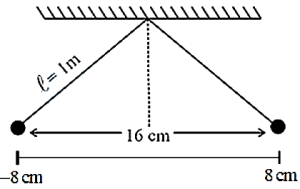
The path length of oscillation of a simple pendulum of length $1 \ m$ is $16 \ cm$. Its maximum velocity is $(g = \pi^2 \ m/s^2)$
A
$2 \pi \ cm/s$
B
$4 \pi \ cm/s$
C
$8 \pi \ cm/s$
D
$16 \pi \ cm/s$
Solution
(C) Given: Length of pendulum $l = 1 \ m$,Path length $= 16 \ cm$,$g = \pi^2 \ m/s^2$.
Since the path length is the total distance between the two extreme positions,the amplitude $A$ is half of the path length.
$A = \frac{16 \ cm}{2} = 8 \ cm = 0.08 \ m$.
The time period $T$ of a simple pendulum is given by $T = 2 \pi \sqrt{\frac{l}{g}}$.
Substituting the values: $T = 2 \pi \sqrt{\frac{1}{\pi^2}} = 2 \pi \times \frac{1}{\pi} = 2 \ s$.
The angular frequency $\omega$ is $\omega = \frac{2 \pi}{T} = \frac{2 \pi}{2} = \pi \ rad/s$.
The maximum velocity $V_{max}$ is given by $V_{max} = A \omega$.
$V_{max} = 8 \ cm \times \pi \ rad/s = 8 \pi \ cm/s$.
Since the path length is the total distance between the two extreme positions,the amplitude $A$ is half of the path length.
$A = \frac{16 \ cm}{2} = 8 \ cm = 0.08 \ m$.
The time period $T$ of a simple pendulum is given by $T = 2 \pi \sqrt{\frac{l}{g}}$.
Substituting the values: $T = 2 \pi \sqrt{\frac{1}{\pi^2}} = 2 \pi \times \frac{1}{\pi} = 2 \ s$.
The angular frequency $\omega$ is $\omega = \frac{2 \pi}{T} = \frac{2 \pi}{2} = \pi \ rad/s$.
The maximum velocity $V_{max}$ is given by $V_{max} = A \omega$.
$V_{max} = 8 \ cm \times \pi \ rad/s = 8 \pi \ cm/s$.
0 likesView Solution
25
ChemistryMCQMHT CET · 2018
$A$ transistor is used as a common emitter amplifier with a load resistance of $2 \ k\Omega$. The input resistance is $150 \ \Omega$. Base current is changed by $20 \ \mu A$,which results in a change in collector current by $1.5 \ mA$. The voltage gain of the amplifier is
A
$900$
B
$1000$
C
$1100$
D
$1200$
Solution
(B) The voltage gain $(A_v)$ of a common emitter amplifier is given by the formula: $A_v = \beta \times \frac{R_L}{R_i}$,where $\beta = \frac{\Delta I_C}{\Delta I_B}$.
Given:
Load resistance $(R_L)$ = $2 \ k\Omega = 2000 \ \Omega$.
Input resistance $(R_i)$ = $150 \ \Omega$.
Change in base current $(\Delta I_B)$ = $20 \ \mu A = 20 \times 10^{-6} \ A$.
Change in collector current $(\Delta I_C)$ = $1.5 \ mA = 1.5 \times 10^{-3} \ A$.
First,calculate the current gain $(\beta)$:
$\beta = \frac{1.5 \times 10^{-3}}{20 \times 10^{-6}} = \frac{1.5}{20} \times 10^3 = 0.075 \times 1000 = 75$.
Now,calculate the voltage gain $(A_v)$:
$A_v = 75 \times \frac{2000}{150} = 75 \times \frac{40}{3} = 25 \times 40 = 1000$.
Given:
Load resistance $(R_L)$ = $2 \ k\Omega = 2000 \ \Omega$.
Input resistance $(R_i)$ = $150 \ \Omega$.
Change in base current $(\Delta I_B)$ = $20 \ \mu A = 20 \times 10^{-6} \ A$.
Change in collector current $(\Delta I_C)$ = $1.5 \ mA = 1.5 \times 10^{-3} \ A$.
First,calculate the current gain $(\beta)$:
$\beta = \frac{1.5 \times 10^{-3}}{20 \times 10^{-6}} = \frac{1.5}{20} \times 10^3 = 0.075 \times 1000 = 75$.
Now,calculate the voltage gain $(A_v)$:
$A_v = 75 \times \frac{2000}{150} = 75 \times \frac{40}{3} = 25 \times 40 = 1000$.
0 likesView Solution
26
ChemistryMediumMCQMHT CET · 2018
Which of the following compounds does $NOT$ undergo haloform reaction?
A
$CH_3-CH(OH)-CH_3$
B
$CH_3-CO-CH_3$
C
$C_2H_5-CH(OH)-C_2H_5$
D
$CH_3-CO-C_2H_5$
Solution
(C) The haloform reaction is given by compounds containing the $CH_3CO-$ group or the $CH_3CH(OH)-$ group.
$(A)$ $CH_3-CH(OH)-CH_3$ contains the $CH_3CH(OH)-$ group,so it gives the haloform reaction.
$(B)$ $CH_3-CO-CH_3$ contains the $CH_3CO-$ group,so it gives the haloform reaction.
$(C)$ $C_2H_5-CH(OH)-C_2H_5$ (pentan$-3-$ol) does not contain the $CH_3CH(OH)-$ group,so it does not give the haloform reaction.
$(D)$ $CH_3-CO-C_2H_5$ (butan$-2-$one) contains the $CH_3CO-$ group,so it gives the haloform reaction.
Therefore,the correct option is $C$.
$(A)$ $CH_3-CH(OH)-CH_3$ contains the $CH_3CH(OH)-$ group,so it gives the haloform reaction.
$(B)$ $CH_3-CO-CH_3$ contains the $CH_3CO-$ group,so it gives the haloform reaction.
$(C)$ $C_2H_5-CH(OH)-C_2H_5$ (pentan$-3-$ol) does not contain the $CH_3CH(OH)-$ group,so it does not give the haloform reaction.
$(D)$ $CH_3-CO-C_2H_5$ (butan$-2-$one) contains the $CH_3CO-$ group,so it gives the haloform reaction.
Therefore,the correct option is $C$.
0 likesView Solution
27
ChemistryMediumMCQMHT CET · 2018
Which of the following compounds reacts immediately with Lucas reagent?
A
$CH_3-CH_2-OH$
B
$CH_3-CH_2-CH_2-OH$
C
$CH_3-CH(OH)-CH_3$
D
$(CH_3)_3C-OH$
Solution
(D) The reaction of alcohol with Lucas reagent ($HCl +$ anhydrous $ZnCl_2$) proceeds via an $SN^1$ mechanism.
The rate of reaction with Lucas reagent follows the order: $3^{\circ} > 2^{\circ} > 1^{\circ}$ alcohol.
$3^{\circ}$ alcohols react immediately with Lucas reagent to form alkyl chlorides,which appear as a cloudy layer (turbidity) in the solution.
Among the given options,$(CH_3)_3C-OH$ is a $3^{\circ}$ alcohol,therefore it reacts immediately.
The rate of reaction with Lucas reagent follows the order: $3^{\circ} > 2^{\circ} > 1^{\circ}$ alcohol.
$3^{\circ}$ alcohols react immediately with Lucas reagent to form alkyl chlorides,which appear as a cloudy layer (turbidity) in the solution.
Among the given options,$(CH_3)_3C-OH$ is a $3^{\circ}$ alcohol,therefore it reacts immediately.
0 likesView Solution
28
ChemistryEasyMCQMHT CET · 2018
Phenol in the presence of sodium hydroxide reacts with chloroform to form salicylaldehyde. This reaction is known as:
A
Kolbe's reaction
B
Reimer-Tiemann reaction
C
Stephen reaction
D
Etard reaction
Solution
(B) The reaction of phenol with chloroform $(CHCl_3)$ in the presence of an aqueous base like sodium hydroxide $(NaOH)$ followed by acidification leads to the introduction of a formyl group $(-CHO)$ at the ortho position of the benzene ring,resulting in the formation of salicylaldehyde.
This specific chemical transformation is known as the Reimer-Tiemann reaction.
This specific chemical transformation is known as the Reimer-Tiemann reaction.
0 likesView Solution
29
ChemistryMediumMCQMHT CET · 2018
Which of the following is most reactive towards the addition reaction of hydrogen cyanide to form the corresponding cyanohydrin?
A
Acetone
B
Formaldehyde
C
Acetaldehyde
D
Diethyl ketone
Solution
(B) The rate of nucleophilic addition reaction is inversely proportional to the steric hindrance around the carbonyl carbon.
$HCHO > CH_3CHO > CH_3COCH_3 > C_2H_5COC_2H_5$
Formaldehyde has the least steric hindrance and the highest electrophilicity of the carbonyl carbon,making it the most reactive towards nucleophilic addition of $HCN$.
$HCHO > CH_3CHO > CH_3COCH_3 > C_2H_5COC_2H_5$
Formaldehyde has the least steric hindrance and the highest electrophilicity of the carbonyl carbon,making it the most reactive towards nucleophilic addition of $HCN$.
0 likesView Solution
30
ChemistryMediumMCQMHT CET · 2018
Excess of ammonia with sodium hypochlorite solution in the presence of glue or gelatine gives:
A
$NaNH_2$
B
$NH_2NH_2$
C
$N_2$
D
$NH_4Cl$
Solution
(B) The reaction of excess ammonia with sodium hypochlorite $(NaOCl)$ in the presence of glue or gelatin is a standard industrial method for the preparation of hydrazine $(NH_2NH_2)$.
The chemical equation is: $2NH_3 + NaOCl \rightarrow NH_2NH_2 + NaCl + H_2O$.
The chemical equation is: $2NH_3 + NaOCl \rightarrow NH_2NH_2 + NaCl + H_2O$.
0 likesView Solution
31
ChemistryDifficultMCQMHT CET · 2018
Identify the product '$C$' in the following reaction.
Aniline $\xrightarrow[\text{Pyridine}]{\left(CH_3CO\right)_2O} A$ $\xrightarrow[CH_3COOH]{Br_2} B$ $\xrightarrow{H^{+} \text{ or } OH^{-}} C$
Aniline $\xrightarrow[\text{Pyridine}]{\left(CH_3CO\right)_2O} A$ $\xrightarrow[CH_3COOH]{Br_2} B$ $\xrightarrow{H^{+} \text{ or } OH^{-}} C$
A
Acetanilide
B
$p$-Bromoacetanilide
C
$p$-Bromoaniline
D
$o$-Bromoaniline
Solution
(C) Step $1$: Aniline reacts with acetic anhydride in the presence of pyridine to form acetanilide $(A)$. This step protects the amino group.
Step $2$: Acetanilide undergoes electrophilic aromatic substitution (bromination) with $Br_2$ in $CH_3COOH$ to form $p$-bromoacetanilide $(B)$. The acetamido group is ortho/para directing,but the para product is major due to steric hindrance.
Step $3$: Hydrolysis of $p$-bromoacetanilide $(B)$ in the presence of acid $(H^+)$ or base $(OH^-)$ removes the acetyl group to yield $p$-bromoaniline $(C)$.
Step $2$: Acetanilide undergoes electrophilic aromatic substitution (bromination) with $Br_2$ in $CH_3COOH$ to form $p$-bromoacetanilide $(B)$. The acetamido group is ortho/para directing,but the para product is major due to steric hindrance.
Step $3$: Hydrolysis of $p$-bromoacetanilide $(B)$ in the presence of acid $(H^+)$ or base $(OH^-)$ removes the acetyl group to yield $p$-bromoaniline $(C)$.
0 likesView Solution
32
ChemistryMediumMCQMHT CET · 2018
Identify the monosaccharide containing only one asymmetric carbon atom in its molecule.
A
$Ribulose$
B
$Ribose$
C
$Erythrose$
D
$Glyceraldehyde$
Solution
(D) An asymmetric carbon atom (chiral center) is a carbon atom bonded to four different groups.
$Glyceraldehyde$ $(CHO-CH(OH)-CH_2OH)$ has the structure where the central carbon is bonded to $-CHO$,$-H$,$-OH$,and $-CH_2OH$ groups.
Since all four groups are different,the central carbon is the only asymmetric carbon atom in the molecule.
Therefore,the correct option is $D$.
$Glyceraldehyde$ $(CHO-CH(OH)-CH_2OH)$ has the structure where the central carbon is bonded to $-CHO$,$-H$,$-OH$,and $-CH_2OH$ groups.
Since all four groups are different,the central carbon is the only asymmetric carbon atom in the molecule.
Therefore,the correct option is $D$.
0 likesView Solution
33
ChemistryMediumMCQMHT CET · 2018
Which carbon atom of deoxyribose sugar in $DNA$ does $NOT$ contain the $-OH$ group?
A
$C_5$
B
$C_3$
C
$C_2$
D
$C_1$
Solution
(C) The sugar present in $DNA$ is $2$-deoxyribose.
In ribose sugar,all carbon atoms ($C_1$ to $C_5$) are attached to an $-OH$ group.
However,in $2$-deoxyribose,the $-OH$ group at the $C_2$ position is replaced by a hydrogen atom $(-H)$.
Therefore,the $C_2$ carbon atom does not contain an $-OH$ group.
In ribose sugar,all carbon atoms ($C_1$ to $C_5$) are attached to an $-OH$ group.
However,in $2$-deoxyribose,the $-OH$ group at the $C_2$ position is replaced by a hydrogen atom $(-H)$.
Therefore,the $C_2$ carbon atom does not contain an $-OH$ group.
0 likesView Solution
34
ChemistryEasyMCQMHT CET · 2018
Which of the following is a tricarboxylic acid?
A
Citric acid
B
Malonic acid
C
Succinic acid
D
Malic acid
Solution
(A) Citric acid is a tricarboxylic acid because it contains three carboxylic acid $(-COOH)$ groups in its structure.
Its chemical formula is $C_6H_8O_7$ or $HOOC-CH_2-C(OH)(COOH)-CH_2-COOH$.
Malonic acid is a dicarboxylic acid $(HOOC-CH_2-COOH)$.
Succinic acid is a dicarboxylic acid $(HOOC-CH_2-CH_2-COOH)$.
Malic acid is a dicarboxylic acid $(HOOC-CH_2-CH(OH)-COOH)$.
Its chemical formula is $C_6H_8O_7$ or $HOOC-CH_2-C(OH)(COOH)-CH_2-COOH$.
Malonic acid is a dicarboxylic acid $(HOOC-CH_2-COOH)$.
Succinic acid is a dicarboxylic acid $(HOOC-CH_2-CH_2-COOH)$.
Malic acid is a dicarboxylic acid $(HOOC-CH_2-CH(OH)-COOH)$.
0 likesView Solution
35
ChemistryEasyMCQMHT CET · 2018
Which of the following carboxylic acids is most reactive towards esterification?
A
$(CH_3)_3CCOOH$
B
$(CH_3)_2CHCOOH$
C
$CH_3CH_2COOH$
D
$(C_2H_5)_2CHCOOH$
Solution
(C) The reactivity of carboxylic acids towards esterification is inversely proportional to the steric hindrance around the carbonyl carbon atom.
$CH_3CH_2COOH$ (propanoic acid) has the least steric hindrance among the given options because it is a primary carboxylic acid with the smallest alkyl group attached to the carbonyl carbon.
As the number of alkyl groups or the size of the alkyl groups attached to the $\alpha$-carbon increases,the steric hindrance increases,which decreases the rate of nucleophilic attack by the alcohol.
Therefore,$CH_3CH_2COOH$ is the most reactive.
$CH_3CH_2COOH$ (propanoic acid) has the least steric hindrance among the given options because it is a primary carboxylic acid with the smallest alkyl group attached to the carbonyl carbon.
As the number of alkyl groups or the size of the alkyl groups attached to the $\alpha$-carbon increases,the steric hindrance increases,which decreases the rate of nucleophilic attack by the alcohol.
Therefore,$CH_3CH_2COOH$ is the most reactive.
0 likesView Solution
36
ChemistryEasyMCQMHT CET · 2018
Slope of the straight line obtained by plotting $\log_{10} k$ against $\frac{1}{T}$ represents which term?
A
$-E_a$
B
$-2.303 E_a / R$
C
$-E_a / (2.303 R)$
D
$-E_a / R$
Solution
(C) The Arrhenius equation is given by $k = A e^{-E_a / (RT)}$.
Taking the natural logarithm on both sides: $\ln k = \ln A - \frac{E_a}{RT}$.
Converting to base $10$ logarithm: $\log_{10} k = \log_{10} A - \frac{E_a}{2.303 R} \times \frac{1}{T}$.
Comparing this with the equation of a straight line $y = mx + c$,where $y = \log_{10} k$ and $x = \frac{1}{T}$.
The slope $m$ is equal to $-\frac{E_a}{2.303 R}$.
Taking the natural logarithm on both sides: $\ln k = \ln A - \frac{E_a}{RT}$.
Converting to base $10$ logarithm: $\log_{10} k = \log_{10} A - \frac{E_a}{2.303 R} \times \frac{1}{T}$.
Comparing this with the equation of a straight line $y = mx + c$,where $y = \log_{10} k$ and $x = \frac{1}{T}$.
The slope $m$ is equal to $-\frac{E_a}{2.303 R}$.
0 likesView Solution
37
ChemistryEasyMCQMHT CET · 2018
Which of the following is $NOT$ a tranquilizer?
A
Meprobamate
B
Equanil
C
Chlordiazepoxide
D
Bromopheniramine
Solution
(D) Tranquilizers are a class of chemical compounds used for the treatment of stress,and mild or even severe mental diseases. Examples include $Meprobamate$,$Equanil$,and $Chlordiazepoxide$.
$Bromopheniramine$ is an antihistamine,not a tranquilizer.
$Bromopheniramine$ is an antihistamine,not a tranquilizer.
0 likesView Solution
38
ChemistryMediumMCQMHT CET · 2018
The most basic hydroxide among the following is-
A
$Pr(OH)_3 \ (Z=59)$
B
$Sm(OH)_3 \ (Z=62)$
C
$Ho(OH)_3 \ (Z=67)$
D
$La(OH)_3 \ (Z=57)$
Solution
(D) In the lanthanide series,the ionic radius decreases from $La^{3+}$ to $Lu^{3+}$ due to lanthanide contraction.
As the ionic radius decreases,the covalent character of the $M-OH$ bond increases,which leads to a decrease in basic strength.
Since $La^{3+}$ has the largest ionic radius among the given options,$La(OH)_3$ is the most basic hydroxide.
As the ionic radius decreases,the covalent character of the $M-OH$ bond increases,which leads to a decrease in basic strength.
Since $La^{3+}$ has the largest ionic radius among the given options,$La(OH)_3$ is the most basic hydroxide.
0 likesView Solution
39
ChemistryMediumMCQMHT CET · 2018
What is the number of donor atoms in dimethylglyoximato ligand?
A
$1$
B
$2$
C
$3$
D
$4$
Solution
(B) The dimethylglyoximato ligand,denoted as $dmg^-$,is a bidentate ligand.
It coordinates to the central metal ion through two nitrogen atoms.
Therefore,the number of donor atoms in a single dimethylglyoximato ligand is $2$.
It coordinates to the central metal ion through two nitrogen atoms.
Therefore,the number of donor atoms in a single dimethylglyoximato ligand is $2$.
0 likesView Solution
40
ChemistryEasyMCQMHT CET · 2018
What is the oxidation number of gold in the complex $[AuCl_{4}]^{-}$?
A
$+4$
B
$+3$
C
$+2$
D
$+1$
Solution
(B) Let the oxidation state of $Au$ be $x$.
In the complex $[AuCl_{4}]^{-}$,the oxidation state of $Cl$ is $-1$.
The sum of oxidation states of all atoms in the complex equals the charge on the complex.
$x + 4(-1) = -1$
$x - 4 = -1$
$x = -1 + 4$
$x = +3$
Therefore,the oxidation number of gold is $+3$.
In the complex $[AuCl_{4}]^{-}$,the oxidation state of $Cl$ is $-1$.
The sum of oxidation states of all atoms in the complex equals the charge on the complex.
$x + 4(-1) = -1$
$x - 4 = -1$
$x = -1 + 4$
$x = +3$
Therefore,the oxidation number of gold is $+3$.
0 likesView Solution
41
ChemistryMediumMCQMHT CET · 2018
Identify the oxidation states of titanium $(Z=22)$ and copper $(Z=29)$ in their colourless compounds.
A
$Ti^{3+}, Cu^{2+}$
B
$Ti^{2+}, Cu^{2+}$
C
$Ti^{4+}, Cu^{1+}$
D
$Ti^{4+}, Cu^{2+}$
Solution
(C) The electronic configuration of titanium $(Z=22)$ is $[Ar] 3d^2 4s^2$. In its $Ti^{4+}$ state,it loses all $4$ valence electrons,resulting in a $3d^0$ configuration,which makes it colourless due to the absence of $d-d$ transitions.
The electronic configuration of copper $(Z=29)$ is $[Ar] 3d^{10} 4s^1$. In its $Cu^+$ state,it loses the $4s$ electron,resulting in a $3d^{10}$ configuration. Since the $d$-subshell is completely filled,no $d-d$ transition is possible,making $Cu^+$ compounds colourless.
The electronic configuration of copper $(Z=29)$ is $[Ar] 3d^{10} 4s^1$. In its $Cu^+$ state,it loses the $4s$ electron,resulting in a $3d^{10}$ configuration. Since the $d$-subshell is completely filled,no $d-d$ transition is possible,making $Cu^+$ compounds colourless.
0 likesView Solution
42
ChemistryEasyMCQMHT CET · 2018
Which catalyst is used for oxidation of $SO_2$ to $SO_3$ in the lead chamber process for the manufacture of sulphuric acid?
A
Nitric oxide
B
Nitrous oxide
C
Potassium iodide
D
Dilute $HCl$
Solution
(A) In the lead chamber process for the manufacture of sulphuric acid,$NO$ (Nitric oxide) acts as a catalyst for the oxidation of $SO_2$ to $SO_3$.
0 likesView Solution
43
ChemistryEasyMCQMHT CET · 2018
During galvanization of iron,which metal is used for coating the iron surface?
A
Copper
B
Zinc
C
Nickel
D
Tin
Solution
(B) Galvanization is the process of applying a protective $Zn$ coating to iron or steel to prevent rusting.
Because $Zn$ is more reactive than $Fe$,it gets oxidized first when it comes in contact with moisture,thereby acting as a sacrificial anode and protecting the iron surface from corrosion.
Because $Zn$ is more reactive than $Fe$,it gets oxidized first when it comes in contact with moisture,thereby acting as a sacrificial anode and protecting the iron surface from corrosion.
0 likesView Solution
44
ChemistryMediumMCQMHT CET · 2018
The number of moles of electrons passed when a current of $2 \ A$ is passed through a solution of electrolyte for $20 \ minutes$ is
A
$4.1 \times 10^{-4} \ mol \ e^{-}$
B
$1.24 \times 10^{-2} \ mol \ e^{-}$
C
$2.487 \times 10^{-2} \ mol \ e^{-}$
D
$2.487 \times 10^{-1} \ mol \ e^{-}$
Solution
(C) The formula to calculate the number of moles of electrons $(n)$ is given by $n = \frac{I \times t}{F}$,where $I$ is the current in amperes,$t$ is the time in seconds,and $F$ is Faraday's constant $(96500 \ C/mol)$.
Given: $I = 2 \ A$,$t = 20 \ minutes = 20 \times 60 \ s = 1200 \ s$.
Substituting the values: $n = \frac{2 \times 1200}{96500} = \frac{2400}{96500} \approx 0.02487 \ mol \ e^{-}$.
Thus,the number of moles of electrons is $2.487 \times 10^{-2} \ mol \ e^{-}$.
Given: $I = 2 \ A$,$t = 20 \ minutes = 20 \times 60 \ s = 1200 \ s$.
Substituting the values: $n = \frac{2 \times 1200}{96500} = \frac{2400}{96500} \approx 0.02487 \ mol \ e^{-}$.
Thus,the number of moles of electrons is $2.487 \times 10^{-2} \ mol \ e^{-}$.
0 likesView Solution
45
ChemistryEasyMCQMHT CET · 2018
Which element is obtained in the pure form by the Van Arkel method?
A
Aluminium
B
Titanium
C
Silicon
D
Nickel
Solution
(B) The Van Arkel method is a technique used for the refining of metals.
It is specifically used for obtaining ultra-pure metals like $Ti$ (Titanium) and $Zr$ (Zirconium).
In this process,the crude metal is converted into a volatile compound (usually an iodide),which is then decomposed on a tungsten filament at high temperatures to yield the pure metal.
Therefore,among the given options,$Ti$ (Titanium) is the correct answer.
It is specifically used for obtaining ultra-pure metals like $Ti$ (Titanium) and $Zr$ (Zirconium).
In this process,the crude metal is converted into a volatile compound (usually an iodide),which is then decomposed on a tungsten filament at high temperatures to yield the pure metal.
Therefore,among the given options,$Ti$ (Titanium) is the correct answer.
0 likesView Solution
46
ChemistryEasyMCQMHT CET · 2018
Bauxite,an ore of aluminium,is purified by which process?
A
Hoope's process
B
Hall's process
C
Mond's process
D
Liquation process
Solution
(B) Bauxite $(Al_2O_3 \cdot 2H_2O)$,an ore of aluminium,is purified by the leaching process known as Hall's process (or Bayer's process) to remove impurities like $Fe_2O_3$,$SiO_2$,and $TiO_2$.
0 likesView Solution
47
ChemistryMediumMCQMHT CET · 2018
Which of the following reactions is used to prepare aryl fluorides from diazonium salts and fluoroboric acid?
A
Sandmeyer reaction
B
Balz-Schiemann reaction
C
Gattermann reaction
D
Swarts reaction
Solution
(B) The reaction of a diazonium salt with fluoroboric acid $(HBF_4)$ followed by heating the resulting diazonium fluoroborate salt to yield an aryl fluoride is known as the Balz-Schiemann reaction.
The reaction sequence is:
$C_6H_5N_2^+Cl^- + HBF_4 \rightarrow C_6H_5N_2^+BF_4^- + HCl$
$C_6H_5N_2^+BF_4^- \xrightarrow{\Delta} C_6H_5F + N_2 + BF_3$
The reaction sequence is:
$C_6H_5N_2^+Cl^- + HBF_4 \rightarrow C_6H_5N_2^+BF_4^- + HCl$
$C_6H_5N_2^+BF_4^- \xrightarrow{\Delta} C_6H_5F + N_2 + BF_3$
0 likesView Solution
48
ChemistryEasyMCQMHT CET · 2018
Which among the group $15$ elements does $NOT$ exist as a tetra-atomic molecule?
A
Nitrogen
B
Phosphorus
C
Arsenic
D
Antimony
Solution
(A) Nitrogen differs from the rest of the members of group $15$ due to its smaller size,high electronegativity,high ionization enthalpy,and the non-availability of $d$-orbitals.
Nitrogen exists as a diatomic molecule $(N_2)$ because it has the unique ability to form $p\pi - p\pi$ multiple bonds with itself.
In contrast,heavier elements like Phosphorus $(P_4)$,Arsenic $(As_4)$,and Antimony $(Sb_4)$ exist as tetra-atomic molecules because their atomic orbitals are too large and diffuse to form effective $p\pi - p\pi$ bonds,leading them to form single bonds instead.
Nitrogen exists as a diatomic molecule $(N_2)$ because it has the unique ability to form $p\pi - p\pi$ multiple bonds with itself.
In contrast,heavier elements like Phosphorus $(P_4)$,Arsenic $(As_4)$,and Antimony $(Sb_4)$ exist as tetra-atomic molecules because their atomic orbitals are too large and diffuse to form effective $p\pi - p\pi$ bonds,leading them to form single bonds instead.
0 likesView Solution
49
ChemistryEasyMCQMHT CET · 2018
The element that does $NOT$ exhibit allotropy is$-$
A
Phosphorus
B
Arsenic
C
Antimony
D
Bismuth
Solution
(D) Allotropy is a property shown by elements where they exist in two or more different physical forms in the same physical state. Among the elements of Group $15$,Nitrogen,Phosphorus,Arsenic,and Antimony exhibit allotropy. Bismuth is a metal and does not exhibit allotropy.
0 likesView Solution
50
ChemistryMediumMCQMHT CET · 2018
Which among the following oxoacids of phosphorus shows a tendency of disproportionation?
A
Phosphinic acid $(H_3PO_2)$
B
Orthophosphoric acid $(H_3PO_4)$
C
Phosphonic acid $(H_3PO_3)$
D
Pyrophosphoric acid $(H_4P_2O_7)$
Solution
(C) The disproportionation reaction is a reaction in which an element in an intermediate oxidation state is simultaneously oxidized and reduced.
In $H_3PO_3$ (phosphonic acid),the oxidation state of phosphorus is $+3$.
It undergoes disproportionation upon heating to form $H_3PO_4$ (oxidation state $+5$) and $PH_3$ (oxidation state $-3$).
The reaction is: $4H_3PO_3 \rightarrow 3H_3PO_4 + PH_3$.
In $H_3PO_3$ (phosphonic acid),the oxidation state of phosphorus is $+3$.
It undergoes disproportionation upon heating to form $H_3PO_4$ (oxidation state $+5$) and $PH_3$ (oxidation state $-3$).
The reaction is: $4H_3PO_3 \rightarrow 3H_3PO_4 + PH_3$.
0 likesView Solution
51
ChemistryEasyMCQMHT CET · 2018
Which of the following polymers is used to manufacture clothes for firefighters?
A
Thiokol
B
Kevlar
C
Nomex
D
Dynel
Solution
(C) Nomex is a heat-resistant meta-aramid fiber. Due to its high thermal stability and flame resistance,it is widely used to manufacture protective clothing for firefighters.
0 likesView Solution
52
ChemistryMediumMCQMHT CET · 2018
Lactic acid and glycolic acid are the monomers used for the preparation of which polymer?
A
Nylon-$2$-nylon-$6$
B
Dexon
C
$PHBV$
D
Buna-$N$
Solution
(B) The copolymerization of lactic acid $(CH_3CH(OH)COOH)$ and glycolic acid $(HOCH_2COOH)$ leads to the formation of a biodegradable polymer known as Dexon (also referred to as polyglycolide-co-lactide or $PLGA$). The reaction involves the condensation of these hydroxy acids with the elimination of water molecules. The structure of the resulting polymer is: $[ -O-CH(CH_3)-CO-O-CH_2-CO- ]_n$.
0 likesView Solution
53
ChemistryEasyMCQMHT CET · 2018
Which among the following metals crystallises as a simple cube?
A
Polonium
B
Iron
C
Copper
D
Gold
Solution
(A) Polonium $(Po)$ is the only known metal that crystallizes in a simple cubic structure.
0 likesView Solution
54
ChemistryEasyMCQMHT CET · 2018
Among the following solids,Schottky defect is $NOT$ observed in-
A
$ZnS$
B
$NaCl$
C
$KCl$
D
$CsCl$
Solution
(A) $ZnS$ exhibits Frenkel defect because the $Zn^{2+}$ ion is small enough to occupy interstitial sites,whereas Schottky defect is typically observed in ionic solids with similar-sized cations and anions,such as $NaCl$,$KCl$,and $CsCl$.
0 likesView Solution
55
ChemistryMediumMCQMHT CET · 2018
The molarity of urea (molar mass $60 \ g \ mol^{-1}$) solution obtained by dissolving $15 \ g$ of urea in $500 \ cm^3$ of water is
A
$0.5 \ mol \ dm^{-3}$
B
$0.25 \ mol \ dm^{-3}$
C
$0.125 \ mol \ dm^{-3}$
D
$0.0005 \ mol \ dm^{-3}$
Solution
(A) Given: Mass of urea $= 15 \ g$,Molar mass of urea $= 60 \ g \ mol^{-1}$,Volume of solution $= 500 \ cm^3 = 0.5 \ L$.
Moles of urea $= \frac{\text{mass}}{\text{molar mass}} = \frac{15 \ g}{60 \ g \ mol^{-1}} = 0.25 \ mol$.
Molarity $(M) = \frac{\text{moles of solute}}{\text{volume of solution in } L} = \frac{0.25 \ mol}{0.5 \ L} = 0.5 \ mol \ dm^{-3}$.
Moles of urea $= \frac{\text{mass}}{\text{molar mass}} = \frac{15 \ g}{60 \ g \ mol^{-1}} = 0.25 \ mol$.
Molarity $(M) = \frac{\text{moles of solute}}{\text{volume of solution in } L} = \frac{0.25 \ mol}{0.5 \ L} = 0.5 \ mol \ dm^{-3}$.
0 likesView Solution
56
ChemistryMediumMCQMHT CET · 2018
The correct relation between the elevation in boiling point and the molar mass of a solute is: ($W_1$ and $W_2$ are respectively weight of solvent $\&$ solute)
A
$M_2 = \frac{K_b \times W_2 \times 1000}{\Delta T_b \times W_1}$
B
$M_2 = \frac{K_b \times W_1 \times 1000}{\Delta T_b \times W_2}$
C
$M_2 = \frac{\Delta T_b \times K_b \times 1000}{W_1 \times W_2}$
D
$M_2 = \frac{\Delta T_b \times W_1 \times 1000}{K_b \times W_2}$
Solution
(A) The elevation in boiling point is given by the formula: $\Delta T_b = K_b \times m$,where $m$ is the molality of the solution.
Molality $m$ is defined as the number of moles of solute $(n_2)$ per kilogram of solvent ($W_1$ in grams): $m = \frac{W_2 \times 1000}{M_2 \times W_1}$.
Substituting this into the elevation formula: $\Delta T_b = \frac{K_b \times W_2 \times 1000}{M_2 \times W_1}$.
Rearranging to solve for the molar mass of the solute $(M_2)$: $M_2 = \frac{K_b \times W_2 \times 1000}{\Delta T_b \times W_1}$.
Molality $m$ is defined as the number of moles of solute $(n_2)$ per kilogram of solvent ($W_1$ in grams): $m = \frac{W_2 \times 1000}{M_2 \times W_1}$.
Substituting this into the elevation formula: $\Delta T_b = \frac{K_b \times W_2 \times 1000}{M_2 \times W_1}$.
Rearranging to solve for the molar mass of the solute $(M_2)$: $M_2 = \frac{K_b \times W_2 \times 1000}{\Delta T_b \times W_1}$.
0 likesView Solution
57
ChemistryEasyMCQMHT CET · 2018
What is the density of a solution of sulphuric acid used as an electrolyte in lead accumulators (in $g \ mL^{-1}$)?
A
$1.5$
B
$1.2$
C
$1.8$
D
$2.0$
Solution
(B) In lead storage batteries (lead accumulators),the electrolyte used is an aqueous solution of sulphuric acid $(H_2SO_4)$.
Its concentration is typically maintained at approximately $38\%$ by mass.
The density of this sulphuric acid solution is approximately $1.2 \ g \ mL^{-1}$.
Its concentration is typically maintained at approximately $38\%$ by mass.
The density of this sulphuric acid solution is approximately $1.2 \ g \ mL^{-1}$.
0 likesView Solution
58
ChemistryEasyMCQMHT CET · 2018
Molarity is:
A
The number of moles of solute present in $1 \ dm^3$ volume of solution
B
The number of moles of solute dissolved in $1 \ kg$ of solvent
C
The number of moles of solute dissolved in $1 \ kg$ of solution
D
The number of moles of solute dissolved in $100 \ dm^3$ volume of solution
Solution
(A) Molarity $(M)$ is defined as the number of moles of solute present in $1 \ dm^3$ (or $1 \ L$) of solution.
$Molarity (M) = \frac{\text{Number of moles of solute}}{\text{Volume of solution in } dm^3}$
$Molarity (M) = \frac{\text{Number of moles of solute}}{\text{Volume of solution in } dm^3}$
0 likesView Solution
Vedclass Products
For Students
Vedclass Test Series
Mock tests in real MHT CET style covering Chemistry with performance analysis. 5-day free trial.
Start Free TrialFor Teachers
Exam Paper Generator
Generate Set A/B/C/D Chemistry papers from 7.5L+ questions in 2 minutes. 3 chapters free.
Try FreeFor Institutes
Online Exam Module
Run live MHT CET mock exams with unlimited students, 360° analytics & white-label branding.
See DemoFrequently Asked Questions
How many Chemistry questions are in MHT CET 2018?
There are 58 Chemistry questions from the MHT CET 2018 paper on Vedclass, each with a detailed step-by-step solution in English.
Are MHT CET 2018 Chemistry solutions available in English?
Yes. All solutions on this page are in English. You can also switch to English or Hindi using the language buttons above the questions.
Can I practice MHT CET 2018 Chemistry as a timed test?
Yes. Use the Vedclass Test Series to attempt a full MHT CET mock test covering Chemistry with time limits and instant score analysis.
Can teachers create Chemistry papers from MHT CET previous year questions?
Yes. The Vedclass Exam Paper Generator lets teachers mix MHT CET Chemistry questions and generate Set A/B/C/D papers in minutes.
For Teachers & Institutes
Build a Custom Chemistry Paper
Pick MHT CET 2018 Chemistry questions, set difficulty, and generate Set A/B/C/D in 2 minutes.