
ChemistryQ251–350 of 716 questions
Page 6 of 8 · English
251
ChemistryEasyMCQMHT CET · 2023
Identify the false statement regarding an isothermal process from the following.
A
The system can exchange heat energy with the surroundings.
B
The enthalpy of the system remains constant.
C
The temperature of the system remains constant.
D
The internal energy of the system remains constant.
Solution
(B) An isothermal process is defined as a process in which the temperature of the system remains constant $(dT = 0)$.
For an ideal gas,the internal energy $(U)$ is a function of temperature only $(U = f(T))$. Therefore,if the temperature is constant,the internal energy remains constant $(dU = 0)$.
However,for real gases or condensed phases,enthalpy $(H = U + PV)$ depends on pressure as well. Even if temperature is constant,enthalpy may change if the pressure changes.
Thus,the statement that the enthalpy of the system remains constant is not universally true for all isothermal processes,making it the false statement.
For an ideal gas,the internal energy $(U)$ is a function of temperature only $(U = f(T))$. Therefore,if the temperature is constant,the internal energy remains constant $(dU = 0)$.
However,for real gases or condensed phases,enthalpy $(H = U + PV)$ depends on pressure as well. Even if temperature is constant,enthalpy may change if the pressure changes.
Thus,the statement that the enthalpy of the system remains constant is not universally true for all isothermal processes,making it the false statement.
0 likesView Solution
252
ChemistryMediumMCQMHT CET · 2023
Calculate $\Delta H$ for the following reaction at $25^{\circ} C$.
$NH_2CN_{(g)} + \frac{3}{2} O_{2_{(g)}} \longrightarrow N_{2_{(g)}} + CO_{2_{(g)}} + H_2O_{(l)}$
$(\Delta U = -740.5 \ kJ, R = 8.314 \ J \ K^{-1} \ mol^{-1})$
$NH_2CN_{(g)} + \frac{3}{2} O_{2_{(g)}} \longrightarrow N_{2_{(g)}} + CO_{2_{(g)}} + H_2O_{(l)}$
$(\Delta U = -740.5 \ kJ, R = 8.314 \ J \ K^{-1} \ mol^{-1})$
A
$-708.4 \ kJ \ mol^{-1}$
B
$-789.4 \ kJ \ mol^{-1}$
C
$-741.7 \ kJ \ mol^{-1}$
D
$-863.9 \ kJ \ mol^{-1}$
Solution
(C) The change in the number of moles of gaseous species is given by $\Delta n_g = (n_{products, g} - n_{reactants, g})$.
For the reaction: $NH_2CN_{(g)} + \frac{3}{2} O_{2_{(g)}} \longrightarrow N_{2_{(g)}} + CO_{2_{(g)}} + H_2O_{(l)}$
$\Delta n_g = (1 + 1) - (1 + 1.5) = 2 - 2.5 = -0.5 \ mol$.
Given $\Delta U = -740.5 \ kJ$,$T = 25 + 273 = 298 \ K$,and $R = 8.314 \times 10^{-3} \ kJ \ K^{-1} \ mol^{-1}$.
Using the relation $\Delta H = \Delta U + \Delta n_g RT$:
$\Delta H = -740.5 \ kJ + (-0.5 \ mol) \times (8.314 \times 10^{-3} \ kJ \ K^{-1} \ mol^{-1}) \times 298 \ K$.
$\Delta H = -740.5 \ kJ - 1.2388 \ kJ = -741.7388 \ kJ \ mol^{-1}$.
Rounding to one decimal place,we get $\Delta H \approx -741.7 \ kJ \ mol^{-1}$.
For the reaction: $NH_2CN_{(g)} + \frac{3}{2} O_{2_{(g)}} \longrightarrow N_{2_{(g)}} + CO_{2_{(g)}} + H_2O_{(l)}$
$\Delta n_g = (1 + 1) - (1 + 1.5) = 2 - 2.5 = -0.5 \ mol$.
Given $\Delta U = -740.5 \ kJ$,$T = 25 + 273 = 298 \ K$,and $R = 8.314 \times 10^{-3} \ kJ \ K^{-1} \ mol^{-1}$.
Using the relation $\Delta H = \Delta U + \Delta n_g RT$:
$\Delta H = -740.5 \ kJ + (-0.5 \ mol) \times (8.314 \times 10^{-3} \ kJ \ K^{-1} \ mol^{-1}) \times 298 \ K$.
$\Delta H = -740.5 \ kJ - 1.2388 \ kJ = -741.7388 \ kJ \ mol^{-1}$.
Rounding to one decimal place,we get $\Delta H \approx -741.7 \ kJ \ mol^{-1}$.
0 likesView Solution
253
ChemistryMediumMCQMHT CET · 2023
Calculate the $PV$ type of work for the following reaction at $1 \ bar$ pressure. $C_3H_{6(g)} (150 \ mL) + HCl_{(g)} (150 \ mL) \longrightarrow C_3H_7Cl_{(g)} (150 \ mL)$ (in $J$)
A
$5.2$
B
$10.21$
C
$15.00$
D
$18.2$
Solution
(C) The work done in a $PV$ system is given by the formula $W = -P_{ext} \Delta V = -P_{ext}(V_2 - V_1)$.
Initial volume $V_1 = 150 \ mL + 150 \ mL = 300 \ mL = 0.3 \ dm^3$.
Final volume $V_2 = 150 \ mL = 0.15 \ dm^3$.
External pressure $P_{ext} = 1 \ bar$.
Substituting the values: $W = -1 \ bar \times (0.15 \ dm^3 - 0.3 \ dm^3) = -1 \times (-0.15) \ dm^3 \ bar = 0.15 \ dm^3 \ bar$.
Since $1 \ dm^3 \ bar = 100 \ J$,the work done is $0.15 \times 100 \ J = 15.00 \ J$.
Initial volume $V_1 = 150 \ mL + 150 \ mL = 300 \ mL = 0.3 \ dm^3$.
Final volume $V_2 = 150 \ mL = 0.15 \ dm^3$.
External pressure $P_{ext} = 1 \ bar$.
Substituting the values: $W = -1 \ bar \times (0.15 \ dm^3 - 0.3 \ dm^3) = -1 \times (-0.15) \ dm^3 \ bar = 0.15 \ dm^3 \ bar$.
Since $1 \ dm^3 \ bar = 100 \ J$,the work done is $0.15 \times 100 \ J = 15.00 \ J$.
0 likesView Solution
254
ChemistryEasyMCQMHT CET · 2023
Which of the following thermodynamic properties is a path function?
A
Internal energy
B
Work
C
Entropy
D
Enthalpy
Solution
(B) Thermodynamic properties are classified as either state functions or path functions.
State functions depend only on the initial and final states of the system,such as $Internal \ energy$ $(U)$,$Enthalpy$ $(H)$,and $Entropy$ $(S)$.
Path functions depend on the path taken to reach the final state,such as $Work$ $(w)$ and $Heat$ $(q)$.
Therefore,$Work$ is a path function.
State functions depend only on the initial and final states of the system,such as $Internal \ energy$ $(U)$,$Enthalpy$ $(H)$,and $Entropy$ $(S)$.
Path functions depend on the path taken to reach the final state,such as $Work$ $(w)$ and $Heat$ $(q)$.
Therefore,$Work$ is a path function.
0 likesView Solution
255
ChemistryMediumMCQMHT CET · 2023
An ideal gas expands by performing $200 \ J$ of work,during this internal energy increases by $432 \ J$. What is the enthalpy change (in $J$)?
A
$200$
B
$232$
C
$432$
D
$632$
Solution
(D) The relationship between enthalpy change $(\Delta H)$,internal energy change $(\Delta U)$,and work done $(W)$ is given by: $\Delta H = \Delta U + P \Delta V$.
Since work done by the system during expansion is $W = -P \Delta V$,we have $P \Delta V = -W$.
Therefore,$\Delta H = \Delta U - W$.
Given:
Internal energy change $\Delta U = +432 \ J$.
Work done by the gas $W = 200 \ J$.
Since the gas performs work,the work done on the system is $-200 \ J$.
Substituting the values: $\Delta H = 432 \ J - (-200 \ J) = 432 \ J + 200 \ J = 632 \ J$.
Since work done by the system during expansion is $W = -P \Delta V$,we have $P \Delta V = -W$.
Therefore,$\Delta H = \Delta U - W$.
Given:
Internal energy change $\Delta U = +432 \ J$.
Work done by the gas $W = 200 \ J$.
Since the gas performs work,the work done on the system is $-200 \ J$.
Substituting the values: $\Delta H = 432 \ J - (-200 \ J) = 432 \ J + 200 \ J = 632 \ J$.
0 likesView Solution
256
ChemistryMediumMCQMHT CET · 2023
For $NaCl_{(s)}$,the enthalpy of solution is $4 \ kJ \ mol^{-1}$ and the lattice enthalpy is $790 \ kJ \ mol^{-1}$. What is the hydration enthalpy of $NaCl$?
A
$786 \ kJ \ mol^{-1}$
B
$794 \ kJ \ mol^{-1}$
C
$-786 \ kJ \ mol^{-1}$
D
$-794 \ kJ \ mol^{-1}$
Solution
(C) The relationship between enthalpy of solution,lattice enthalpy,and hydration enthalpy is given by:
$\Delta_{soln} H = \Delta_{lattice} H + \Delta_{hyd} H$
Rearranging the formula to solve for hydration enthalpy:
$\Delta_{hyd} H = \Delta_{soln} H - \Delta_{lattice} H$
Substituting the given values:
$\Delta_{hyd} H = 4 \ kJ \ mol^{-1} - 790 \ kJ \ mol^{-1}$
$\Delta_{hyd} H = -786 \ kJ \ mol^{-1}$
$\Delta_{soln} H = \Delta_{lattice} H + \Delta_{hyd} H$
Rearranging the formula to solve for hydration enthalpy:
$\Delta_{hyd} H = \Delta_{soln} H - \Delta_{lattice} H$
Substituting the given values:
$\Delta_{hyd} H = 4 \ kJ \ mol^{-1} - 790 \ kJ \ mol^{-1}$
$\Delta_{hyd} H = -786 \ kJ \ mol^{-1}$
0 likesView Solution
257
ChemistryMediumMCQMHT CET · 2023
If $8.84 \ kJ$ heat is liberated for the formation of $3 \ g$ of ethane,calculate its $\Delta_{f} H^{\circ}$.
A
$-8.00 \ kJ \ mol^{-1}$
B
$15.0 \ kJ \ mol^{-1}$
C
$30.0 \ kJ \ mol^{-1}$
D
$-88.4 \ kJ \ mol^{-1}$
Solution
(D) The chemical equation for the formation of ethane is:
$2 C_{(s)} + 3 H_{2(g)} \longrightarrow C_2 H_{6(g)} ; \Delta_{f} H^{\circ} = ?$
The molar mass of ethane $(C_2 H_6)$ is $(2 \times 12) + (6 \times 1) = 30 \ g \ mol^{-1}$.
The number of moles in $3 \ g$ of $C_2 H_6$ is $n = \frac{3 \ g}{30 \ g \ mol^{-1}} = 0.1 \ mol$.
Given that $8.84 \ kJ$ of heat is liberated for $0.1 \ mol$ of $C_2 H_6$,the heat liberated for $1 \ mol$ is:
$\Delta_{f} H^{\circ} = \frac{-8.84 \ kJ}{0.1 \ mol} = -88.4 \ kJ \ mol^{-1}$.
Since heat is liberated,the enthalpy change is negative.
$2 C_{(s)} + 3 H_{2(g)} \longrightarrow C_2 H_{6(g)} ; \Delta_{f} H^{\circ} = ?$
The molar mass of ethane $(C_2 H_6)$ is $(2 \times 12) + (6 \times 1) = 30 \ g \ mol^{-1}$.
The number of moles in $3 \ g$ of $C_2 H_6$ is $n = \frac{3 \ g}{30 \ g \ mol^{-1}} = 0.1 \ mol$.
Given that $8.84 \ kJ$ of heat is liberated for $0.1 \ mol$ of $C_2 H_6$,the heat liberated for $1 \ mol$ is:
$\Delta_{f} H^{\circ} = \frac{-8.84 \ kJ}{0.1 \ mol} = -88.4 \ kJ \ mol^{-1}$.
Since heat is liberated,the enthalpy change is negative.
0 likesView Solution
258
ChemistryMediumMCQMHT CET · 2023
If lattice enthalpy and hydration enthalpy of $KCl$ are $699 \ kJ \ mol^{-1}$ and $-681.8 \ kJ \ mol^{-1}$ respectively,what is the enthalpy of solution of $KCl$?
A
$8.20 \ kJ \ mol^{-1}$
B
$10.25 \ kJ \ mol^{-1}$
C
$13.80 \ kJ \ mol^{-1}$
D
$17.20 \ kJ \ mol^{-1}$
Solution
(D) The enthalpy of solution $(\Delta_{\text{soln}} H)$ is given by the sum of the lattice enthalpy $(\Delta_{L} H)$ and the hydration enthalpy $(\Delta_{\text{hyd}} H)$.
$\Delta_{\text{soln}} H = \Delta_{L} H + \Delta_{\text{hyd}} H$
Given: $\Delta_{L} H = 699 \ kJ \ mol^{-1}$ and $\Delta_{\text{hyd}} H = -681.8 \ kJ \ mol^{-1}$.
Substituting the values:
$\Delta_{\text{soln}} H = 699 \ kJ \ mol^{-1} + (-681.8 \ kJ \ mol^{-1})$
$\Delta_{\text{soln}} H = 17.2 \ kJ \ mol^{-1}$.
$\Delta_{\text{soln}} H = \Delta_{L} H + \Delta_{\text{hyd}} H$
Given: $\Delta_{L} H = 699 \ kJ \ mol^{-1}$ and $\Delta_{\text{hyd}} H = -681.8 \ kJ \ mol^{-1}$.
Substituting the values:
$\Delta_{\text{soln}} H = 699 \ kJ \ mol^{-1} + (-681.8 \ kJ \ mol^{-1})$
$\Delta_{\text{soln}} H = 17.2 \ kJ \ mol^{-1}$.
0 likesView Solution
259
ChemistryMediumMCQMHT CET · 2023
For the reaction $2 H_2 + O_2 \rightarrow 2 H_2 O$,$\Delta H = -571 \ kJ$. Bond energy of $H-H = 435 \ kJ$ and $O=O = 498 \ kJ$. Then the average bond energy of $O-H$ bond will be:
A
$484 \ kJ/mol$
B
$-484 \ kJ/mol$
C
$271 \ kJ/mol$
D
$-271 \ kJ/mol$
Solution
(A) For the reaction: $2 H_2 + O_2 \rightarrow 2 H_2 O$ (which contains $4 \times O-H$ bonds).
$\Delta_{r} H = [2 \times BE(H-H) + BE(O=O)] - [4 \times BE(O-H)]$
$-571 = [2 \times 435 + 498] - 4 \times BE(O-H)$
$-571 = [870 + 498] - 4 \times BE(O-H)$
$-571 = 1368 - 4 \times BE(O-H)$
$4 \times BE(O-H) = 1368 + 571$
$4 \times BE(O-H) = 1939$
$BE(O-H) = \frac{1939}{4} \approx 484.75 \ kJ/mol$
Thus,the average bond energy is approximately $484 \ kJ/mol$.
$\Delta_{r} H = [2 \times BE(H-H) + BE(O=O)] - [4 \times BE(O-H)]$
$-571 = [2 \times 435 + 498] - 4 \times BE(O-H)$
$-571 = [870 + 498] - 4 \times BE(O-H)$
$-571 = 1368 - 4 \times BE(O-H)$
$4 \times BE(O-H) = 1368 + 571$
$4 \times BE(O-H) = 1939$
$BE(O-H) = \frac{1939}{4} \approx 484.75 \ kJ/mol$
Thus,the average bond energy is approximately $484 \ kJ/mol$.
0 likesView Solution
260
ChemistryEasyMCQMHT CET · 2023
Identify the element having positive electron gain enthalpy.
A
$Ne$
B
$I$
C
$S$
D
$O$
Solution
(A) The electron gain enthalpy is the energy change when an electron is added to a neutral gaseous atom.
Noble gases like $Ne$ have a stable $ns^2 np^6$ electronic configuration.
Adding an electron to $Ne$ requires energy to place it in the next higher energy shell,making the process endothermic.
Therefore,$Ne$ has a positive electron gain enthalpy.
Noble gases like $Ne$ have a stable $ns^2 np^6$ electronic configuration.
Adding an electron to $Ne$ requires energy to place it in the next higher energy shell,making the process endothermic.
Therefore,$Ne$ has a positive electron gain enthalpy.
0 likesView Solution
261
ChemistryMediumMCQMHT CET · 2023
Calculate $\Delta S_{total}$ for the following reaction at $300 \ K$.
$NH_4NO_{3(s)} \longrightarrow NH_4^+{(aq)} + NO_3^-{(aq)}$ $(\Delta H = 28.1 \ kJ \ mol^{-1}, \Delta S_{sys} = 108.7 \ J \ K^{-1} \ mol^{-1})$
$NH_4NO_{3(s)} \longrightarrow NH_4^+{(aq)} + NO_3^-{(aq)}$ $(\Delta H = 28.1 \ kJ \ mol^{-1}, \Delta S_{sys} = 108.7 \ J \ K^{-1} \ mol^{-1})$
A
$15.1 \ J \ K^{-1} \ mol^{-1}$
B
$93.6 \ J \ K^{-1} \ mol^{-1}$
C
$84.3 \ J \ K^{-1} \ mol^{-1}$
D
$202.3 \ J \ K^{-1} \ mol^{-1}$
Solution
(A) The entropy change of the surroundings is given by $\Delta S_{surr} = \frac{-\Delta H}{T}$.
Given $\Delta H = 28.1 \ kJ \ mol^{-1} = 28100 \ J \ mol^{-1}$ and $T = 300 \ K$.
$\Delta S_{surr} = \frac{-28100 \ J \ mol^{-1}}{300 \ K} = -93.67 \ J \ K^{-1} \ mol^{-1}$.
The total entropy change is $\Delta S_{total} = \Delta S_{sys} + \Delta S_{surr}$.
$\Delta S_{total} = 108.7 \ J \ K^{-1} \ mol^{-1} + (-93.67 \ J \ K^{-1} \ mol^{-1}) = 15.03 \ J \ K^{-1} \ mol^{-1}$.
Rounding to one decimal place,we get $15.1 \ J \ K^{-1} \ mol^{-1}$.
Given $\Delta H = 28.1 \ kJ \ mol^{-1} = 28100 \ J \ mol^{-1}$ and $T = 300 \ K$.
$\Delta S_{surr} = \frac{-28100 \ J \ mol^{-1}}{300 \ K} = -93.67 \ J \ K^{-1} \ mol^{-1}$.
The total entropy change is $\Delta S_{total} = \Delta S_{sys} + \Delta S_{surr}$.
$\Delta S_{total} = 108.7 \ J \ K^{-1} \ mol^{-1} + (-93.67 \ J \ K^{-1} \ mol^{-1}) = 15.03 \ J \ K^{-1} \ mol^{-1}$.
Rounding to one decimal place,we get $15.1 \ J \ K^{-1} \ mol^{-1}$.
0 likesView Solution
262
ChemistryEasyMCQMHT CET · 2023
If the enthalpy change for the following reaction at $300 \ K$ is $+7 \ kJ \ mol^{-1}$,find the entropy change of the surrounding (in $J \ K^{-1}$)?
$H_2O_{(s)} \longrightarrow H_2O_{(l)}$
$H_2O_{(s)} \longrightarrow H_2O_{(l)}$
A
$-42.8$
B
$-23.3$
C
$-30.7$
D
$-110.0$
Solution
(B) The entropy change of the surrounding is given by the formula: $\Delta S_{surr} = -\frac{\Delta H_{sys}}{T}$.
Given,$\Delta H_{sys} = +7 \ kJ \ mol^{-1} = +7000 \ J \ mol^{-1}$ and $T = 300 \ K$.
Substituting the values: $\Delta S_{surr} = -\frac{7000 \ J \ mol^{-1}}{300 \ K} = -23.33 \ J \ K^{-1} \ mol^{-1}$.
Thus,the correct option is $B$.
Given,$\Delta H_{sys} = +7 \ kJ \ mol^{-1} = +7000 \ J \ mol^{-1}$ and $T = 300 \ K$.
Substituting the values: $\Delta S_{surr} = -\frac{7000 \ J \ mol^{-1}}{300 \ K} = -23.33 \ J \ K^{-1} \ mol^{-1}$.
Thus,the correct option is $B$.
0 likesView Solution
263
ChemistryMediumMCQMHT CET · 2023
Calculate the value of $\Delta G$ for the following reaction at $300 \ K$.
$H_2O_{(s)} \longrightarrow H_2O_{(l)}$
$(\Delta H = 7 \ kJ, \Delta S = 24.8 \ J \ K^{-1})$
$H_2O_{(s)} \longrightarrow H_2O_{(l)}$
$(\Delta H = 7 \ kJ, \Delta S = 24.8 \ J \ K^{-1})$
A
$0.74 \ kJ \ mol^{-1}$
B
$-0.82 \ kJ \ mol^{-1}$
C
$0.21 \ kJ \ mol^{-1}$
D
$-0.44 \ kJ \ mol^{-1}$
Solution
(D) Given:
$\Delta H = 7 \ kJ$
$\Delta S = 24.8 \ J \ K^{-1} = 24.8 \times 10^{-3} \ kJ \ K^{-1}$
$T = 300 \ K$
The Gibbs free energy change is given by the formula:
$\Delta G = \Delta H - T \Delta S$
Substituting the values:
$\Delta G = 7 \ kJ - (300 \ K \times 24.8 \times 10^{-3} \ kJ \ K^{-1})$
$\Delta G = 7 \ kJ - 7.44 \ kJ$
$\Delta G = -0.44 \ kJ$
$\Delta H = 7 \ kJ$
$\Delta S = 24.8 \ J \ K^{-1} = 24.8 \times 10^{-3} \ kJ \ K^{-1}$
$T = 300 \ K$
The Gibbs free energy change is given by the formula:
$\Delta G = \Delta H - T \Delta S$
Substituting the values:
$\Delta G = 7 \ kJ - (300 \ K \times 24.8 \times 10^{-3} \ kJ \ K^{-1})$
$\Delta G = 7 \ kJ - 7.44 \ kJ$
$\Delta G = -0.44 \ kJ$
0 likesView Solution
264
ChemistryMCQMHT CET · 2023
$A$ curve passes through the point $\left(1, \frac{\pi}{6}\right)$. Let the slope of the curve at each point $(x, y)$ be $\frac{y}{x}+\sec \left(\frac{y}{x}\right)$,where $x>0$. Then,the equation of the curve is:
A
$\sin \left(\frac{y}{x}\right)=\log (x)+\frac{1}{2}$
B
$\operatorname{cosec}\left(\frac{y}{x}\right)=\log (x)+2$
C
$\sec \left(\frac{2 y}{x}\right)=\log (x)+2$
D
$\cos \left(\frac{2 y}{x}\right)=\log (x)+\frac{1}{2}$
Solution
(A) The given differential equation is $\frac{dy}{dx} = \frac{y}{x} + \sec \left(\frac{y}{x}\right)$.
This is a homogeneous differential equation. Let $y = vx$,so $\frac{dy}{dx} = v + x \frac{dv}{dx}$.
Substituting these into the equation: $v + x \frac{dv}{dx} = v + \sec(v)$.
This simplifies to $x \frac{dv}{dx} = \sec(v)$,which can be written as $\cos(v) dv = \frac{1}{x} dx$.
Integrating both sides: $\int \cos(v) dv = \int \frac{1}{x} dx$,which gives $\sin(v) = \log(x) + c$.
Substituting $v = \frac{y}{x}$ back,we get $\sin \left(\frac{y}{x}\right) = \log(x) + c$.
The curve passes through $\left(1, \frac{\pi}{6}\right)$,so $\sin \left(\frac{\pi/6}{1}\right) = \log(1) + c$.
Since $\sin \left(\frac{\pi}{6}\right) = \frac{1}{2}$ and $\log(1) = 0$,we have $c = \frac{1}{2}$.
Thus,the equation of the curve is $\sin \left(\frac{y}{x}\right) = \log(x) + \frac{1}{2}$.
This is a homogeneous differential equation. Let $y = vx$,so $\frac{dy}{dx} = v + x \frac{dv}{dx}$.
Substituting these into the equation: $v + x \frac{dv}{dx} = v + \sec(v)$.
This simplifies to $x \frac{dv}{dx} = \sec(v)$,which can be written as $\cos(v) dv = \frac{1}{x} dx$.
Integrating both sides: $\int \cos(v) dv = \int \frac{1}{x} dx$,which gives $\sin(v) = \log(x) + c$.
Substituting $v = \frac{y}{x}$ back,we get $\sin \left(\frac{y}{x}\right) = \log(x) + c$.
The curve passes through $\left(1, \frac{\pi}{6}\right)$,so $\sin \left(\frac{\pi/6}{1}\right) = \log(1) + c$.
Since $\sin \left(\frac{\pi}{6}\right) = \frac{1}{2}$ and $\log(1) = 0$,we have $c = \frac{1}{2}$.
Thus,the equation of the curve is $\sin \left(\frac{y}{x}\right) = \log(x) + \frac{1}{2}$.
0 likesView Solution
265
ChemistryMCQMHT CET · 2023
If the curves $y^2=6x$ and $9x^2+by^2=16$ intersect each other at right angles,then the value of $b$ is
A
$\frac{9}{2}$
B
$6$
C
$\frac{7}{2}$
D
$4$
Solution
(A) Given curves are $y^2=6x$ $(i)$ and $9x^2+by^2=16$ (ii).
Differentiating $(i)$ with respect to $x$: $2y \frac{dy}{dx} = 6 \Rightarrow \frac{dy}{dx} = \frac{3}{y}$.
Differentiating (ii) with respect to $x$: $18x + 2by \frac{dy}{dx} = 0 \Rightarrow \frac{dy}{dx} = -\frac{9x}{by}$.
Since the curves intersect at right angles,the product of their slopes at the point of intersection $(x, y)$ must be $-1$.
$\left(\frac{3}{y}\right) \times \left(-\frac{9x}{by}\right) = -1$.
$\Rightarrow \frac{27x}{by^2} = 1 \Rightarrow by^2 = 27x$.
Substitute $y^2=6x$ from $(i)$ into this equation: $b(6x) = 27x$.
Assuming $x \neq 0$,we get $6b = 27 \Rightarrow b = \frac{27}{6} = \frac{9}{2}$.
Differentiating $(i)$ with respect to $x$: $2y \frac{dy}{dx} = 6 \Rightarrow \frac{dy}{dx} = \frac{3}{y}$.
Differentiating (ii) with respect to $x$: $18x + 2by \frac{dy}{dx} = 0 \Rightarrow \frac{dy}{dx} = -\frac{9x}{by}$.
Since the curves intersect at right angles,the product of their slopes at the point of intersection $(x, y)$ must be $-1$.
$\left(\frac{3}{y}\right) \times \left(-\frac{9x}{by}\right) = -1$.
$\Rightarrow \frac{27x}{by^2} = 1 \Rightarrow by^2 = 27x$.
Substitute $y^2=6x$ from $(i)$ into this equation: $b(6x) = 27x$.
Assuming $x \neq 0$,we get $6b = 27 \Rightarrow b = \frac{27}{6} = \frac{9}{2}$.
0 likesView Solution
266
ChemistryMCQMHT CET · 2023
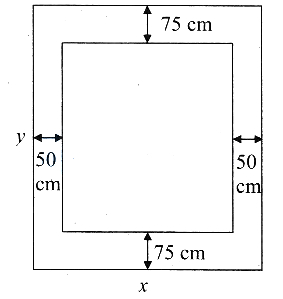
$A$ poster is to be printed on a rectangular sheet of paper of area $18 \ m^2$. The margins at the top and bottom of $75 \ cm$ each and at the sides $50 \ cm$ each are to be left. Then the dimensions i.e. height and breadth of the sheet so that the space available for printing is maximum,are . . . . . . respectively.
A
$2 \sqrt{3} \ m, 3 \sqrt{3} \ m$
B
$3 \sqrt{3} \ m, 2 \sqrt{3} \ m$
C
$3 \ m, 6 \ m$
D
$6 \ m, 3 \ m$
Solution
(B) Let height and breadth of the sheet be $y \ m$ and $x \ m$ respectively.
Since the area is $18 \ m^2$,we have $x y = 18$.
Converting to $cm$,$x y = 180000 \ cm^2$,so $y = \frac{180000}{x}$.
The margins are $75 \ cm$ at top and bottom (total $150 \ cm = 1.5 \ m$) and $50 \ cm$ at each side (total $100 \ cm = 1 \ m$).
The area available for printing is $A = (y - 1.5)(x - 1)$.
Substituting $y = \frac{18}{x}$,we get $A = (\frac{18}{x} - 1.5)(x - 1) = 18 - \frac{18}{x} - 1.5x + 1.5 = 19.5 - 1.5x - \frac{18}{x}$.
To maximize $A$,find $\frac{dA}{dx} = -1.5 + \frac{18}{x^2} = 0$.
$\frac{18}{x^2} = 1.5 \Rightarrow x^2 = \frac{18}{1.5} = 12$.
$x = \sqrt{12} = 2 \sqrt{3} \ m$.
Then $y = \frac{18}{2 \sqrt{3}} = \frac{9}{\sqrt{3}} = 3 \sqrt{3} \ m$.
Thus,the dimensions are height $3 \sqrt{3} \ m$ and breadth $2 \sqrt{3} \ m$.
Since the area is $18 \ m^2$,we have $x y = 18$.
Converting to $cm$,$x y = 180000 \ cm^2$,so $y = \frac{180000}{x}$.
The margins are $75 \ cm$ at top and bottom (total $150 \ cm = 1.5 \ m$) and $50 \ cm$ at each side (total $100 \ cm = 1 \ m$).
The area available for printing is $A = (y - 1.5)(x - 1)$.
Substituting $y = \frac{18}{x}$,we get $A = (\frac{18}{x} - 1.5)(x - 1) = 18 - \frac{18}{x} - 1.5x + 1.5 = 19.5 - 1.5x - \frac{18}{x}$.
To maximize $A$,find $\frac{dA}{dx} = -1.5 + \frac{18}{x^2} = 0$.
$\frac{18}{x^2} = 1.5 \Rightarrow x^2 = \frac{18}{1.5} = 12$.
$x = \sqrt{12} = 2 \sqrt{3} \ m$.
Then $y = \frac{18}{2 \sqrt{3}} = \frac{9}{\sqrt{3}} = 3 \sqrt{3} \ m$.
Thus,the dimensions are height $3 \sqrt{3} \ m$ and breadth $2 \sqrt{3} \ m$.
0 likesView Solution
267
ChemistryMCQMHT CET · 2023
The maximum value of the function $f(x)=3x^3-18x^2+27x-40$ on the set $S=\{x \in R : x^2+30 \leq 11x\}$ is
A
$122$
B
$-122$
C
$-222$
D
$222$
Solution
(A) First,we determine the set $S$ by solving the inequality $x^2+30 \leq 11x$.
$x^2-11x+30 \leq 0$
$(x-5)(x-6) \leq 0$
Thus,$S = [5, 6]$.
Next,we find the derivative of $f(x) = 3x^3-18x^2+27x-40$:
$f'(x) = 9x^2-36x+27 = 9(x^2-4x+3) = 9(x-1)(x-3)$.
For $x \in [5, 6]$,both $(x-1)$ and $(x-3)$ are positive,so $f'(x) > 0$.
Since $f'(x) > 0$ on the interval $[5, 6]$,the function $f(x)$ is strictly increasing on this interval.
Therefore,the maximum value occurs at the right endpoint $x=6$.
$f(6) = 3(6)^3 - 18(6)^2 + 27(6) - 40$
$f(6) = 3(216) - 18(36) + 162 - 40$
$f(6) = 648 - 648 + 162 - 40 = 122$.
$x^2-11x+30 \leq 0$
$(x-5)(x-6) \leq 0$
Thus,$S = [5, 6]$.
Next,we find the derivative of $f(x) = 3x^3-18x^2+27x-40$:
$f'(x) = 9x^2-36x+27 = 9(x^2-4x+3) = 9(x-1)(x-3)$.
For $x \in [5, 6]$,both $(x-1)$ and $(x-3)$ are positive,so $f'(x) > 0$.
Since $f'(x) > 0$ on the interval $[5, 6]$,the function $f(x)$ is strictly increasing on this interval.
Therefore,the maximum value occurs at the right endpoint $x=6$.
$f(6) = 3(6)^3 - 18(6)^2 + 27(6) - 40$
$f(6) = 3(216) - 18(36) + 162 - 40$
$f(6) = 648 - 648 + 162 - 40 = 122$.
0 likesView Solution
268
ChemistryMCQMHT CET · 2023
The values of $a$ and $b$,so that the function $f(x) = \begin{cases} x + a \sqrt{2} \sin x, & 0 \le x \le \frac{\pi}{4} \\ 2x \cot x + b, & \frac{\pi}{4} < x \le \frac{\pi}{2} \\ a \cos 2x - b \sin x, & \frac{\pi}{2} < x \le \pi \end{cases}$ is continuous for $0 \le x \le \pi$,are respectively:
A
$-\frac{\pi}{12}, \frac{\pi}{6}$
B
$-\frac{\pi}{6}, -\frac{\pi}{12}$
C
$\frac{\pi}{6}, \frac{\pi}{12}$
D
$\frac{\pi}{6}, -\frac{\pi}{12}$
Solution
(D) Since the function is continuous at $x = \frac{\pi}{4}$ and $x = \frac{\pi}{2}$,the left-hand limit must equal the right-hand limit at these points.
At $x = \frac{\pi}{4}$:
$\lim_{x \to \frac{\pi}{4}^-} (x + a \sqrt{2} \sin x) = \lim_{x \to \frac{\pi}{4}^+} (2x \cot x + b)$
$\frac{\pi}{4} + a \sqrt{2} \cdot \frac{1}{\sqrt{2}} = 2(\frac{\pi}{4}) \cdot 1 + b$
$\frac{\pi}{4} + a = \frac{\pi}{2} + b \implies a - b = \frac{\pi}{4} \quad (i)$
At $x = \frac{\pi}{2}$:
$\lim_{x \to \frac{\pi}{2}^-} (2x \cot x + b) = \lim_{x \to \frac{\pi}{2}^+} (a \cos 2x - b \sin x)$
Using $\lim_{x \to \frac{\pi}{2}} x \cot x = \lim_{x \to \frac{\pi}{2}} x \frac{\cos x}{\sin x} = 0$:
$0 + b = a \cos(\pi) - b \sin(\frac{\pi}{2})$
$b = -a - b \implies a + 2b = 0 \quad (ii)$
From $(ii)$,$a = -2b$. Substituting into $(i)$:
$-2b - b = \frac{\pi}{4} \implies -3b = \frac{\pi}{4} \implies b = -\frac{\pi}{12}$
Then $a = -2(-\frac{\pi}{12}) = \frac{\pi}{6}$.
Thus,$a = \frac{\pi}{6}$ and $b = -\frac{\pi}{12}$.
At $x = \frac{\pi}{4}$:
$\lim_{x \to \frac{\pi}{4}^-} (x + a \sqrt{2} \sin x) = \lim_{x \to \frac{\pi}{4}^+} (2x \cot x + b)$
$\frac{\pi}{4} + a \sqrt{2} \cdot \frac{1}{\sqrt{2}} = 2(\frac{\pi}{4}) \cdot 1 + b$
$\frac{\pi}{4} + a = \frac{\pi}{2} + b \implies a - b = \frac{\pi}{4} \quad (i)$
At $x = \frac{\pi}{2}$:
$\lim_{x \to \frac{\pi}{2}^-} (2x \cot x + b) = \lim_{x \to \frac{\pi}{2}^+} (a \cos 2x - b \sin x)$
Using $\lim_{x \to \frac{\pi}{2}} x \cot x = \lim_{x \to \frac{\pi}{2}} x \frac{\cos x}{\sin x} = 0$:
$0 + b = a \cos(\pi) - b \sin(\frac{\pi}{2})$
$b = -a - b \implies a + 2b = 0 \quad (ii)$
From $(ii)$,$a = -2b$. Substituting into $(i)$:
$-2b - b = \frac{\pi}{4} \implies -3b = \frac{\pi}{4} \implies b = -\frac{\pi}{12}$
Then $a = -2(-\frac{\pi}{12}) = \frac{\pi}{6}$.
Thus,$a = \frac{\pi}{6}$ and $b = -\frac{\pi}{12}$.
0 likesView Solution
269
ChemistryMCQMHT CET · 2023
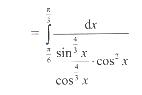
The integral $\int_{\frac{\pi}{6}}^{\frac{\pi}{3}} \sec^{\frac{2}{3}} x \operatorname{cosec}^{\frac{4}{3}} x \, dx$ is equal to
A
$3^{\frac{5}{6}}-3^{\frac{2}{3}}$
B
$3^{\frac{7}{6}}-3^{\frac{5}{6}}$
C
$3^{\frac{5}{3}}-3^{\frac{1}{3}}$
D
$3^{\frac{4}{3}}-3^{\frac{1}{3}}$
Solution
(B) Let $I = \int_{\frac{\pi}{6}}^{\frac{\pi}{3}} \sec^{\frac{2}{3}} x \operatorname{cosec}^{\frac{4}{3}} x \, dx = \int_{\frac{\pi}{6}}^{\frac{\pi}{3}} \frac{1}{\cos^{\frac{2}{3}} x \sin^{\frac{4}{3}} x} \, dx$
Divide numerator and denominator by $\cos^{\frac{4}{3}} x$:
$I = \int_{\frac{\pi}{6}}^{\frac{\pi}{3}} \frac{\frac{1}{\cos^{\frac{4}{3}} x}}{\frac{\cos^{\frac{2}{3}} x \sin^{\frac{4}{3}} x}{\cos^{\frac{4}{3}} x}} \, dx = \int_{\frac{\pi}{6}}^{\frac{\pi}{3}} \frac{\sec^2 x}{\tan^{\frac{4}{3}} x} \, dx$
Put $\tan x = t$,then $\sec^2 x \, dx = dt$.
When $x = \frac{\pi}{6}$,$t = \tan(\frac{\pi}{6}) = \frac{1}{\sqrt{3}}$.
When $x = \frac{\pi}{3}$,$t = \tan(\frac{\pi}{3}) = \sqrt{3}$.
$I = \int_{\frac{1}{\sqrt{3}}}^{\sqrt{3}} t^{-\frac{4}{3}} \, dt = \left[ \frac{t^{-\frac{4}{3} + 1}}{-\frac{4}{3} + 1} \right]_{\frac{1}{\sqrt{3}}}^{\sqrt{3}} = \left[ \frac{t^{-\frac{1}{3}}}{-\frac{1}{3}} \right]_{\frac{1}{\sqrt{3}}}^{\sqrt{3}} = -3 \left[ t^{-\frac{1}{3}} \right]_{\frac{1}{\sqrt{3}}}^{\sqrt{3}}$
$I = -3 \left( (\sqrt{3})^{-\frac{1}{3}} - (\frac{1}{\sqrt{3}})^{-\frac{1}{3}} \right) = -3 \left( (3^{\frac{1}{2}})^{-\frac{1}{3}} - (3^{-\frac{1}{2}})^{-\frac{1}{3}} \right)$
$I = -3 \left( 3^{-\frac{1}{6}} - 3^{\frac{1}{6}} \right) = 3 \cdot 3^{\frac{1}{6}} - 3 \cdot 3^{-\frac{1}{6}} = 3^{1+\frac{1}{6}} - 3^{1-\frac{1}{6}} = 3^{\frac{7}{6}} - 3^{\frac{5}{6}}$
Divide numerator and denominator by $\cos^{\frac{4}{3}} x$:
$I = \int_{\frac{\pi}{6}}^{\frac{\pi}{3}} \frac{\frac{1}{\cos^{\frac{4}{3}} x}}{\frac{\cos^{\frac{2}{3}} x \sin^{\frac{4}{3}} x}{\cos^{\frac{4}{3}} x}} \, dx = \int_{\frac{\pi}{6}}^{\frac{\pi}{3}} \frac{\sec^2 x}{\tan^{\frac{4}{3}} x} \, dx$
Put $\tan x = t$,then $\sec^2 x \, dx = dt$.
When $x = \frac{\pi}{6}$,$t = \tan(\frac{\pi}{6}) = \frac{1}{\sqrt{3}}$.
When $x = \frac{\pi}{3}$,$t = \tan(\frac{\pi}{3}) = \sqrt{3}$.
$I = \int_{\frac{1}{\sqrt{3}}}^{\sqrt{3}} t^{-\frac{4}{3}} \, dt = \left[ \frac{t^{-\frac{4}{3} + 1}}{-\frac{4}{3} + 1} \right]_{\frac{1}{\sqrt{3}}}^{\sqrt{3}} = \left[ \frac{t^{-\frac{1}{3}}}{-\frac{1}{3}} \right]_{\frac{1}{\sqrt{3}}}^{\sqrt{3}} = -3 \left[ t^{-\frac{1}{3}} \right]_{\frac{1}{\sqrt{3}}}^{\sqrt{3}}$
$I = -3 \left( (\sqrt{3})^{-\frac{1}{3}} - (\frac{1}{\sqrt{3}})^{-\frac{1}{3}} \right) = -3 \left( (3^{\frac{1}{2}})^{-\frac{1}{3}} - (3^{-\frac{1}{2}})^{-\frac{1}{3}} \right)$
$I = -3 \left( 3^{-\frac{1}{6}} - 3^{\frac{1}{6}} \right) = 3 \cdot 3^{\frac{1}{6}} - 3 \cdot 3^{-\frac{1}{6}} = 3^{1+\frac{1}{6}} - 3^{1-\frac{1}{6}} = 3^{\frac{7}{6}} - 3^{\frac{5}{6}}$
0 likesView Solution
270
ChemistryMCQMHT CET · 2023
The differential equation of all circles which pass through the origin and whose centres lie on the $Y$-axis is
A
$(x^2-y^2) \frac{dy}{dx}-2xy=0$
B
$(x^2-y^2) \frac{dy}{dx}+2xy=0$
C
$(x^2-y^2) \frac{dy}{dx}+xy=0$
D
$(x^2-y^2) \frac{dy}{dx}-xy=0$
Solution
(A) The circle passes through the origin $(0,0)$ and its centre lies on the $Y$-axis. Let the centre be $(0, k)$. Since it passes through the origin,the radius is $k$.
The equation of the circle is $(x-0)^2 + (y-k)^2 = k^2$.
Expanding this,we get $x^2 + y^2 - 2yk + k^2 = k^2$,which simplifies to $x^2 + y^2 = 2yk$.
From this,we find $k = \frac{x^2+y^2}{2y}$.
Differentiating $x^2 + y^2 = 2yk$ with respect to $x$:
$2x + 2y \frac{dy}{dx} = 2k \frac{dy}{dx}$.
Substituting $k = \frac{x^2+y^2}{2y}$ into the equation:
$2x + 2y \frac{dy}{dx} = 2 \left( \frac{x^2+y^2}{2y} \right) \frac{dy}{dx}$.
$2x + 2y \frac{dy}{dx} = \left( \frac{x^2+y^2}{y} \right) \frac{dy}{dx}$.
Multiplying by $y$: $2xy + 2y^2 \frac{dy}{dx} = (x^2+y^2) \frac{dy}{dx}$.
Rearranging terms: $2xy = (x^2+y^2-2y^2) \frac{dy}{dx}$.
$2xy = (x^2-y^2) \frac{dy}{dx}$.
Thus,$(x^2-y^2) \frac{dy}{dx} - 2xy = 0$.
The equation of the circle is $(x-0)^2 + (y-k)^2 = k^2$.
Expanding this,we get $x^2 + y^2 - 2yk + k^2 = k^2$,which simplifies to $x^2 + y^2 = 2yk$.
From this,we find $k = \frac{x^2+y^2}{2y}$.
Differentiating $x^2 + y^2 = 2yk$ with respect to $x$:
$2x + 2y \frac{dy}{dx} = 2k \frac{dy}{dx}$.
Substituting $k = \frac{x^2+y^2}{2y}$ into the equation:
$2x + 2y \frac{dy}{dx} = 2 \left( \frac{x^2+y^2}{2y} \right) \frac{dy}{dx}$.
$2x + 2y \frac{dy}{dx} = \left( \frac{x^2+y^2}{y} \right) \frac{dy}{dx}$.
Multiplying by $y$: $2xy + 2y^2 \frac{dy}{dx} = (x^2+y^2) \frac{dy}{dx}$.
Rearranging terms: $2xy = (x^2+y^2-2y^2) \frac{dy}{dx}$.
$2xy = (x^2-y^2) \frac{dy}{dx}$.
Thus,$(x^2-y^2) \frac{dy}{dx} - 2xy = 0$.
0 likesView Solution
271
ChemistryMCQMHT CET · 2023
If $(2+\sin x) \frac{dy}{dx} + (y+1) \cos x = 0$ and $y(0) = 1$,then $y\left(\frac{\pi}{2}\right)$ is
A
$\frac{-2}{3}$
B
$\frac{-1}{3}$
C
$\frac{4}{3}$
D
$\frac{1}{3}$
Solution
(D) Given the differential equation: $(2+\sin x) \frac{dy}{dx} + (y+1) \cos x = 0$
Rearranging the terms to separate the variables:
$\frac{dy}{y+1} = -\frac{\cos x}{2+\sin x} dx$
Integrating both sides:
$\int \frac{dy}{y+1} = -\int \frac{\cos x}{2+\sin x} dx$
$\ln(y+1) = -\ln(2+\sin x) + C$
$\ln(y+1) + \ln(2+\sin x) = C$
$\ln((y+1)(2+\sin x)) = C$
$(y+1)(2+\sin x) = e^C = K$
Given $y(0) = 1$,substitute $x=0$ and $y=1$:
$(1+1)(2+\sin 0) = K \Rightarrow 2(2+0) = K \Rightarrow K = 4$
So,$(y+1)(2+\sin x) = 4$
For $x = \frac{\pi}{2}$:
$(y+1)(2+\sin \frac{\pi}{2}) = 4$
$(y+1)(2+1) = 4$
$3(y+1) = 4$
$y+1 = \frac{4}{3}$
$y = \frac{4}{3} - 1 = \frac{1}{3}$
Rearranging the terms to separate the variables:
$\frac{dy}{y+1} = -\frac{\cos x}{2+\sin x} dx$
Integrating both sides:
$\int \frac{dy}{y+1} = -\int \frac{\cos x}{2+\sin x} dx$
$\ln(y+1) = -\ln(2+\sin x) + C$
$\ln(y+1) + \ln(2+\sin x) = C$
$\ln((y+1)(2+\sin x)) = C$
$(y+1)(2+\sin x) = e^C = K$
Given $y(0) = 1$,substitute $x=0$ and $y=1$:
$(1+1)(2+\sin 0) = K \Rightarrow 2(2+0) = K \Rightarrow K = 4$
So,$(y+1)(2+\sin x) = 4$
For $x = \frac{\pi}{2}$:
$(y+1)(2+\sin \frac{\pi}{2}) = 4$
$(y+1)(2+1) = 4$
$3(y+1) = 4$
$y+1 = \frac{4}{3}$
$y = \frac{4}{3} - 1 = \frac{1}{3}$
0 likesView Solution
272
ChemistryMCQMHT CET · 2023
If $y$ is a function of $x$ and $\log(x+y) = 2xy$,then the value of $y'(0)$ is
A
$1$
B
$-1$
C
$2$
D
$0$
Solution
(A) Given the equation: $\log(x+y) = 2xy$ ... $(i)$
At $x = 0$,substituting into $(i)$ gives: $\log(0+y) = 2(0)y \implies \log(y) = 0 \implies y = e^0 = 1$.
Now,differentiate both sides of $(i)$ with respect to $x$:
$\frac{d}{dx}(\log(x+y)) = \frac{d}{dx}(2xy)$
$\frac{1}{x+y} \cdot (1 + y') = 2(y + xy')$
Substitute $x = 0$ and $y = 1$ into the differentiated equation:
$\frac{1}{0+1} \cdot (1 + y'(0)) = 2(1 + 0 \cdot y'(0))$
$1 \cdot (1 + y'(0)) = 2(1)$
$1 + y'(0) = 2$
$y'(0) = 2 - 1 = 1$
Thus,the value of $y'(0)$ is $1$.
At $x = 0$,substituting into $(i)$ gives: $\log(0+y) = 2(0)y \implies \log(y) = 0 \implies y = e^0 = 1$.
Now,differentiate both sides of $(i)$ with respect to $x$:
$\frac{d}{dx}(\log(x+y)) = \frac{d}{dx}(2xy)$
$\frac{1}{x+y} \cdot (1 + y') = 2(y + xy')$
Substitute $x = 0$ and $y = 1$ into the differentiated equation:
$\frac{1}{0+1} \cdot (1 + y'(0)) = 2(1 + 0 \cdot y'(0))$
$1 \cdot (1 + y'(0)) = 2(1)$
$1 + y'(0) = 2$
$y'(0) = 2 - 1 = 1$
Thus,the value of $y'(0)$ is $1$.
0 likesView Solution
273
ChemistryMCQMHT CET · 2023
If $y$ is a function of $x$ and $\log(x+y)=2xy$,then the value of $y'(0)$ is
A
$1$
B
-$1$
C
$2$
D
$0$
Solution
(A) Given equation: $\log(x+y)=2xy$
Differentiating both sides with respect to $x$:
$\frac{1}{x+y} \cdot (1 + y') = 2y + 2xy'$
At $x=0$,the equation becomes $\log(0+y) = 2(0)y$,which implies $\log(y) = 0$,so $y = e^0 = 1$.
Substituting $x=0$ and $y=1$ into the differentiated equation:
$\frac{1}{0+1} \cdot (1 + y'(0)) = 2(1) + 2(0)y'(0)$
$1 \cdot (1 + y'(0)) = 2 + 0$
$1 + y'(0) = 2$
$y'(0) = 2 - 1 = 1$
Differentiating both sides with respect to $x$:
$\frac{1}{x+y} \cdot (1 + y') = 2y + 2xy'$
At $x=0$,the equation becomes $\log(0+y) = 2(0)y$,which implies $\log(y) = 0$,so $y = e^0 = 1$.
Substituting $x=0$ and $y=1$ into the differentiated equation:
$\frac{1}{0+1} \cdot (1 + y'(0)) = 2(1) + 2(0)y'(0)$
$1 \cdot (1 + y'(0)) = 2 + 0$
$1 + y'(0) = 2$
$y'(0) = 2 - 1 = 1$
0 likesView Solution
274
ChemistryMCQMHT CET · 2023
Let $f: R \rightarrow R$ be a function such that $f(x)=x^3+x^2 f^{\prime}(1)+x f^{\prime \prime}(2)+6, x \in R$,then $f(2)$ is
A
$30$
B
-$4$
C
-$2$
D
$8$
Solution
(C) Given $f(x)=x^3+x^2 f^{\prime}(1)+x f^{\prime \prime}(2)+6$. $(i)$
Differentiating with respect to $x$,we get $f^{\prime}(x)=3 x^2+2 x f^{\prime}(1)+f^{\prime \prime}(2)$. (ii)
Differentiating again,we get $f^{\prime \prime}(x)=6 x+2 f^{\prime}(1)$. (iii)
Substituting $x=1$ in (ii),we get $f^{\prime}(1)=3(1)^2+2(1) f^{\prime}(1)+f^{\prime \prime}(2) \Rightarrow f^{\prime}(1)+f^{\prime \prime}(2)=-3$. (iv)
Substituting $x=2$ in (iii),we get $f^{\prime \prime}(2)=6(2)+2 f^{\prime}(1) \Rightarrow f^{\prime \prime}(2)=12+2 f^{\prime}(1)$. $(v)$
Substituting $(v)$ into (iv),we get $f^{\prime}(1)+12+2 f^{\prime}(1)=-3 \Rightarrow 3 f^{\prime}(1)=-15 \Rightarrow f^{\prime}(1)=-5$.
From $(v)$,$f^{\prime \prime}(2)=12+2(-5)=2$.
Now,$f(2)=2^3+2^2(-5)+2(2)+6 = 8-20+4+6 = -2$.
Differentiating with respect to $x$,we get $f^{\prime}(x)=3 x^2+2 x f^{\prime}(1)+f^{\prime \prime}(2)$. (ii)
Differentiating again,we get $f^{\prime \prime}(x)=6 x+2 f^{\prime}(1)$. (iii)
Substituting $x=1$ in (ii),we get $f^{\prime}(1)=3(1)^2+2(1) f^{\prime}(1)+f^{\prime \prime}(2) \Rightarrow f^{\prime}(1)+f^{\prime \prime}(2)=-3$. (iv)
Substituting $x=2$ in (iii),we get $f^{\prime \prime}(2)=6(2)+2 f^{\prime}(1) \Rightarrow f^{\prime \prime}(2)=12+2 f^{\prime}(1)$. $(v)$
Substituting $(v)$ into (iv),we get $f^{\prime}(1)+12+2 f^{\prime}(1)=-3 \Rightarrow 3 f^{\prime}(1)=-15 \Rightarrow f^{\prime}(1)=-5$.
From $(v)$,$f^{\prime \prime}(2)=12+2(-5)=2$.
Now,$f(2)=2^3+2^2(-5)+2(2)+6 = 8-20+4+6 = -2$.
0 likesView Solution
275
ChemistryMCQMHT CET · 2023
Let $f: R \rightarrow R$ be a function such that $f(x)=x^3+x^2 f^{\prime}(1)+x f^{\prime \prime}(2)+6, x \in R$,then $f(2)$ equals
A
$30$
B
-$2$
C
-$4$
D
$8$
Solution
(B) $f(x)=x^3+x^2 f^{\prime}(1)+x f^{\prime \prime}(2)+6$
$\therefore f^{\prime}(x)=3 x^2+2 x f^{\prime}(1)+f^{\prime \prime}(2)$ ...$(i)$
$\therefore f^{\prime \prime}(x)=6 x+2 f^{\prime}(1)$ ...(ii)
Substituting $x=1$ in $(i)$,we get
$f^{\prime}(1)=3(1)^2+2(1) f^{\prime}(1)+f^{\prime \prime}(2)$
$\Rightarrow f^{\prime}(1)+f^{\prime \prime}(2)=-3$ ...(iii)
Substituting $x=2$ in (ii),we get
$f^{\prime \prime}(2)=6(2)+2 f^{\prime}(1)$
$\Rightarrow f^{\prime \prime}(2)=12+2 f^{\prime}(1)$ ...(iv)
From (iii) and (iv),we get
$f^{\prime}(1)+12+2 f^{\prime}(1)=-3$
$\Rightarrow 3 f^{\prime}(1)=-15$
$\Rightarrow f^{\prime}(1)=-5$
From (iii),$-5+f^{\prime \prime}(2)=-3$
$\Rightarrow f^{\prime \prime}(2)=2$
$\therefore f(2) = 2^3+2^2(-5)+2(2)+6$
$= 8-20+4+6$
$= -2$
$\therefore f^{\prime}(x)=3 x^2+2 x f^{\prime}(1)+f^{\prime \prime}(2)$ ...$(i)$
$\therefore f^{\prime \prime}(x)=6 x+2 f^{\prime}(1)$ ...(ii)
Substituting $x=1$ in $(i)$,we get
$f^{\prime}(1)=3(1)^2+2(1) f^{\prime}(1)+f^{\prime \prime}(2)$
$\Rightarrow f^{\prime}(1)+f^{\prime \prime}(2)=-3$ ...(iii)
Substituting $x=2$ in (ii),we get
$f^{\prime \prime}(2)=6(2)+2 f^{\prime}(1)$
$\Rightarrow f^{\prime \prime}(2)=12+2 f^{\prime}(1)$ ...(iv)
From (iii) and (iv),we get
$f^{\prime}(1)+12+2 f^{\prime}(1)=-3$
$\Rightarrow 3 f^{\prime}(1)=-15$
$\Rightarrow f^{\prime}(1)=-5$
From (iii),$-5+f^{\prime \prime}(2)=-3$
$\Rightarrow f^{\prime \prime}(2)=2$
$\therefore f(2) = 2^3+2^2(-5)+2(2)+6$
$= 8-20+4+6$
$= -2$
0 likesView Solution
276
ChemistryMCQMHT CET · 2023
Let $f$ be a differentiable function such that $f(1)=2$ and $f^{\prime}(x)=f(x)$,for all $x \in \mathbb{R}$. If $h(x)=f(f(x))$,then $h^{\prime}(1)$ is equal to
A
$4 e^2$
B
$4 e$
C
$2 e$
D
$2 e^2$
Solution
(B) Given that $f^{\prime}(x)=f(x)$ for all $x \in \mathbb{R}$.
This is a first-order linear differential equation: $\frac{f^{\prime}(x)}{f(x)}=1$.
Integrating both sides with respect to $x$,we get $\ln|f(x)| = x + C$.
Thus,$f(x) = e^{x+C} = k e^x$,where $k = e^C$ is a constant.
Given $f(1)=2$,we have $k e^1 = 2$,which implies $k = \frac{2}{e}$.
So,$f(x) = \frac{2}{e} \cdot e^x = 2 e^{x-1}$.
Now,$h(x) = f(f(x))$.
Using the chain rule,$h^{\prime}(x) = f^{\prime}(f(x)) \cdot f^{\prime}(x)$.
Since $f^{\prime}(x) = f(x)$,we have $h^{\prime}(x) = f(f(x)) \cdot f(x)$.
At $x=1$,$h^{\prime}(1) = f(f(1)) \cdot f(1)$.
Since $f(1)=2$,$h^{\prime}(1) = f(2) \cdot 2$.
Using $f(x) = 2 e^{x-1}$,we find $f(2) = 2 e^{2-1} = 2e$.
Therefore,$h^{\prime}(1) = (2e) \cdot 2 = 4e$.
This is a first-order linear differential equation: $\frac{f^{\prime}(x)}{f(x)}=1$.
Integrating both sides with respect to $x$,we get $\ln|f(x)| = x + C$.
Thus,$f(x) = e^{x+C} = k e^x$,where $k = e^C$ is a constant.
Given $f(1)=2$,we have $k e^1 = 2$,which implies $k = \frac{2}{e}$.
So,$f(x) = \frac{2}{e} \cdot e^x = 2 e^{x-1}$.
Now,$h(x) = f(f(x))$.
Using the chain rule,$h^{\prime}(x) = f^{\prime}(f(x)) \cdot f^{\prime}(x)$.
Since $f^{\prime}(x) = f(x)$,we have $h^{\prime}(x) = f(f(x)) \cdot f(x)$.
At $x=1$,$h^{\prime}(1) = f(f(1)) \cdot f(1)$.
Since $f(1)=2$,$h^{\prime}(1) = f(2) \cdot 2$.
Using $f(x) = 2 e^{x-1}$,we find $f(2) = 2 e^{2-1} = 2e$.
Therefore,$h^{\prime}(1) = (2e) \cdot 2 = 4e$.
0 likesView Solution
277
ChemistryMCQMHT CET · 2023
Let $f(x) = \int \frac{\sqrt{x}}{(1+x)^2} \, dx, x \geq 0$. Then $f(3) - f(1)$ is equal to
A
$-\frac{\pi}{6} + \frac{1}{2} + \frac{\sqrt{3}}{4}$
B
$-\frac{\pi}{12} + \frac{1}{2} + \frac{\sqrt{3}}{4}$
C
$\frac{\pi}{12} - \frac{\sqrt{3}}{4} + \frac{1}{2}$
D
$\frac{\pi}{6} + \frac{1}{2} - \frac{\sqrt{3}}{4}$
Solution
(C) We are given $f(x) = \int \frac{\sqrt{x}}{(1+x)^2} \, dx$.
We need to evaluate $f(3) - f(1) = \int_1^3 \frac{\sqrt{x}}{(1+x)^2} \, dx$.
Let $\sqrt{x} = \tan \theta$,then $x = \tan^2 \theta$ and $dx = 2 \tan \theta \sec^2 \theta \, d\theta$.
When $x = 1$,$\tan \theta = 1 \Rightarrow \theta = \frac{\pi}{4}$.
When $x = 3$,$\tan \theta = \sqrt{3} \Rightarrow \theta = \frac{\pi}{3}$.
Substituting these into the integral:
$I = \int_{\frac{\pi}{4}}^{\frac{\pi}{3}} \frac{\tan \theta \cdot 2 \tan \theta \sec^2 \theta}{(1 + \tan^2 \theta)^2} \, d\theta = \int_{\frac{\pi}{4}}^{\frac{\pi}{3}} \frac{2 \tan^2 \theta \sec^2 \theta}{\sec^4 \theta} \, d\theta = \int_{\frac{\pi}{4}}^{\frac{\pi}{3}} 2 \sin^2 \theta \, d\theta$.
Using the identity $2 \sin^2 \theta = 1 - \cos 2\theta$:
$I = \int_{\frac{\pi}{4}}^{\frac{\pi}{3}} (1 - \cos 2\theta) \, d\theta = [\theta - \frac{\sin 2\theta}{2}]_{\frac{\pi}{4}}^{\frac{\pi}{3}}$.
$I = (\frac{\pi}{3} - \frac{\sin(2\pi/3)}{2}) - (\frac{\pi}{4} - \frac{\sin(\pi/2)}{2}) = (\frac{\pi}{3} - \frac{\sqrt{3}}{4}) - (\frac{\pi}{4} - \frac{1}{2})$.
$I = \frac{\pi}{12} - \frac{\sqrt{3}}{4} + \frac{1}{2}$.
We need to evaluate $f(3) - f(1) = \int_1^3 \frac{\sqrt{x}}{(1+x)^2} \, dx$.
Let $\sqrt{x} = \tan \theta$,then $x = \tan^2 \theta$ and $dx = 2 \tan \theta \sec^2 \theta \, d\theta$.
When $x = 1$,$\tan \theta = 1 \Rightarrow \theta = \frac{\pi}{4}$.
When $x = 3$,$\tan \theta = \sqrt{3} \Rightarrow \theta = \frac{\pi}{3}$.
Substituting these into the integral:
$I = \int_{\frac{\pi}{4}}^{\frac{\pi}{3}} \frac{\tan \theta \cdot 2 \tan \theta \sec^2 \theta}{(1 + \tan^2 \theta)^2} \, d\theta = \int_{\frac{\pi}{4}}^{\frac{\pi}{3}} \frac{2 \tan^2 \theta \sec^2 \theta}{\sec^4 \theta} \, d\theta = \int_{\frac{\pi}{4}}^{\frac{\pi}{3}} 2 \sin^2 \theta \, d\theta$.
Using the identity $2 \sin^2 \theta = 1 - \cos 2\theta$:
$I = \int_{\frac{\pi}{4}}^{\frac{\pi}{3}} (1 - \cos 2\theta) \, d\theta = [\theta - \frac{\sin 2\theta}{2}]_{\frac{\pi}{4}}^{\frac{\pi}{3}}$.
$I = (\frac{\pi}{3} - \frac{\sin(2\pi/3)}{2}) - (\frac{\pi}{4} - \frac{\sin(\pi/2)}{2}) = (\frac{\pi}{3} - \frac{\sqrt{3}}{4}) - (\frac{\pi}{4} - \frac{1}{2})$.
$I = \frac{\pi}{12} - \frac{\sqrt{3}}{4} + \frac{1}{2}$.
0 likesView Solution
278
ChemistryMCQMHT CET · 2023
If $\int \frac{\log \left(t+\sqrt{1+t^2}\right)}{\sqrt{1+t^2}} dt=\frac{1}{2}[g(t)]^2+c$,(where $c$ is a constant of integration),then $g(2)$ is
A
$\frac{1}{\sqrt{5}} \log (2+\sqrt{5})$
B
$\frac{1}{2} \log (2+\sqrt{5})$
C
$2 \log (2+\sqrt{5})$
D
$\log (2+\sqrt{5})$
Solution
(D) Let $y = \log \left(t+\sqrt{1+t^2}\right)$.
Then,differentiating with respect to $t$,we get $dy = \frac{1}{t+\sqrt{1+t^2}} \left(1 + \frac{2t}{2\sqrt{1+t^2}}\right) dt$.
Simplifying the term inside the parenthesis: $1 + \frac{t}{\sqrt{1+t^2}} = \frac{\sqrt{1+t^2}+t}{\sqrt{1+t^2}}$.
Thus,$dy = \frac{1}{t+\sqrt{1+t^2}} \cdot \frac{\sqrt{1+t^2}+t}{\sqrt{1+t^2}} dt = \frac{1}{\sqrt{1+t^2}} dt$.
Substituting this into the integral: $\int y \, dy = \frac{y^2}{2} + c$.
Comparing this with the given expression $\frac{1}{2}[g(t)]^2 + c$,we identify $g(t) = y = \log \left(t+\sqrt{1+t^2}\right)$.
Therefore,$g(2) = \log \left(2+\sqrt{1+2^2}\right) = \log (2+\sqrt{5})$.
Then,differentiating with respect to $t$,we get $dy = \frac{1}{t+\sqrt{1+t^2}} \left(1 + \frac{2t}{2\sqrt{1+t^2}}\right) dt$.
Simplifying the term inside the parenthesis: $1 + \frac{t}{\sqrt{1+t^2}} = \frac{\sqrt{1+t^2}+t}{\sqrt{1+t^2}}$.
Thus,$dy = \frac{1}{t+\sqrt{1+t^2}} \cdot \frac{\sqrt{1+t^2}+t}{\sqrt{1+t^2}} dt = \frac{1}{\sqrt{1+t^2}} dt$.
Substituting this into the integral: $\int y \, dy = \frac{y^2}{2} + c$.
Comparing this with the given expression $\frac{1}{2}[g(t)]^2 + c$,we identify $g(t) = y = \log \left(t+\sqrt{1+t^2}\right)$.
Therefore,$g(2) = \log \left(2+\sqrt{1+2^2}\right) = \log (2+\sqrt{5})$.
0 likesView Solution
279
ChemistryMCQMHT CET · 2023
If $\tan ^{-1} a+\tan ^{-1} b+\tan ^{-1} c=\pi$,then which of the following statements is true?
A
$a+b-c=a b c$
B
$a+b+c=2 a b c$
C
$a b c=1$
D
$a+b+c=a b c$
Solution
(D) Given that $\tan ^{-1} a+\tan ^{-1} b+\tan ^{-1} c=\pi$.
Using the formula $\tan ^{-1} a+\tan ^{-1} b+\tan ^{-1} c = \tan ^{-1} \left( \frac{a+b+c-abc}{1-ab-bc-ca} \right) = \pi$.
Taking $\tan$ on both sides,we get $\frac{a+b+c-abc}{1-ab-bc-ca} = \tan \pi$.
Since $\tan \pi = 0$,we have $\frac{a+b+c-abc}{1-ab-bc-ca} = 0$.
This implies $a+b+c-abc = 0$.
Therefore,$a+b+c=abc$.
Using the formula $\tan ^{-1} a+\tan ^{-1} b+\tan ^{-1} c = \tan ^{-1} \left( \frac{a+b+c-abc}{1-ab-bc-ca} \right) = \pi$.
Taking $\tan$ on both sides,we get $\frac{a+b+c-abc}{1-ab-bc-ca} = \tan \pi$.
Since $\tan \pi = 0$,we have $\frac{a+b+c-abc}{1-ab-bc-ca} = 0$.
This implies $a+b+c-abc = 0$.
Therefore,$a+b+c=abc$.
0 likesView Solution
280
ChemistryMCQMHT CET · 2023
Given $0 \leq x \leq \frac{1}{2}$,then the value of $\tan \left(\sin ^{-1}\left(\frac{x}{\sqrt{2}}+\frac{\sqrt{1-x^2}}{\sqrt{2}}\right)-\sin ^{-1} x\right)$ is
A
$1$
B
$\sqrt{3}$
C
$-1$
D
$\frac{1}{\sqrt{3}}$
Solution
(A) Let $\sin^{-1} x = \theta$,which implies $x = \sin \theta$. Since $0 \leq x \leq \frac{1}{2}$,we have $0 \leq \theta \leq \frac{\pi}{6}$.
Then $\sqrt{1-x^2} = \cos \theta$.
The expression becomes $\tan \left[ \sin^{-1} \left( \frac{\sin \theta}{\sqrt{2}} + \frac{\cos \theta}{\sqrt{2}} \right) - \theta \right]$.
Using the identity $\sin \theta + \cos \theta = \sqrt{2} \sin \left( \theta + \frac{\pi}{4} \right)$,we get:
$\frac{\sin \theta + \cos \theta}{\sqrt{2}} = \sin \left( \theta + \frac{\pi}{4} \right)$.
Substituting this into the expression:
$= \tan \left[ \sin^{-1} \left( \sin \left( \theta + \frac{\pi}{4} \right) \right) - \theta \right]$.
Since $0 \leq \theta \leq \frac{\pi}{6}$,then $\frac{\pi}{4} \leq \theta + \frac{\pi}{4} \leq \frac{\pi}{6} + \frac{\pi}{4} = \frac{5\pi}{12}$.
Since this range is within $[-\frac{\pi}{2}, \frac{\pi}{2}]$,$\sin^{-1}(\sin(\theta + \frac{\pi}{4})) = \theta + \frac{\pi}{4}$.
Thus,the expression simplifies to $\tan \left( \theta + \frac{\pi}{4} - \theta \right) = \tan \frac{\pi}{4} = 1$.
Then $\sqrt{1-x^2} = \cos \theta$.
The expression becomes $\tan \left[ \sin^{-1} \left( \frac{\sin \theta}{\sqrt{2}} + \frac{\cos \theta}{\sqrt{2}} \right) - \theta \right]$.
Using the identity $\sin \theta + \cos \theta = \sqrt{2} \sin \left( \theta + \frac{\pi}{4} \right)$,we get:
$\frac{\sin \theta + \cos \theta}{\sqrt{2}} = \sin \left( \theta + \frac{\pi}{4} \right)$.
Substituting this into the expression:
$= \tan \left[ \sin^{-1} \left( \sin \left( \theta + \frac{\pi}{4} \right) \right) - \theta \right]$.
Since $0 \leq \theta \leq \frac{\pi}{6}$,then $\frac{\pi}{4} \leq \theta + \frac{\pi}{4} \leq \frac{\pi}{6} + \frac{\pi}{4} = \frac{5\pi}{12}$.
Since this range is within $[-\frac{\pi}{2}, \frac{\pi}{2}]$,$\sin^{-1}(\sin(\theta + \frac{\pi}{4})) = \theta + \frac{\pi}{4}$.
Thus,the expression simplifies to $\tan \left( \theta + \frac{\pi}{4} - \theta \right) = \tan \frac{\pi}{4} = 1$.
0 likesView Solution
281
ChemistryMCQMHT CET · 2023
Negation of the statement "The payment will be made if and only if the work is finished in time." is
A
The work is finished in time and the payment is not made.
B
The payment is made and the work is not finished in time.
C
The work is finished in time and the payment is not made,or the payment is made and the work is finished in time.
D
Either the work is finished in time and the payment is not made,or the payment is made and the work is not finished in time.
Solution
(D) Let $p$ : The payment will be made.
Let $q$ : The work is finished in time.
The given statement is a biconditional statement: $p \iff q$,which is equivalent to $(p \rightarrow q) \wedge (q \rightarrow p)$.
The negation of $p \iff q$ is $\sim(p \iff q)$,which is equivalent to $(p \wedge \sim q) \vee (q \wedge \sim p)$.
This translates to: "The payment is made and the work is not finished in time,or the work is finished in time and the payment is not made."
Therefore,option $(D)$ is correct.
Let $q$ : The work is finished in time.
The given statement is a biconditional statement: $p \iff q$,which is equivalent to $(p \rightarrow q) \wedge (q \rightarrow p)$.
The negation of $p \iff q$ is $\sim(p \iff q)$,which is equivalent to $(p \wedge \sim q) \vee (q \wedge \sim p)$.
This translates to: "The payment is made and the work is not finished in time,or the work is finished in time and the payment is not made."
Therefore,option $(D)$ is correct.
0 likesView Solution
282
ChemistryMCQMHT CET · 2023
The logical statement $[\sim(\sim p \vee q) \vee (p \wedge r)] \wedge (\sim q \wedge r)$ is equivalent to
A
$(p \wedge r) \wedge \sim q$
B
$(p \wedge \sim q) \vee r$
C
$\sim p \vee r$
D
$\sim p \wedge r$
Solution
(A) Given expression: $[\sim(\sim p \vee q) \vee (p \wedge r)] \wedge (\sim q \wedge r)$
Applying De Morgan's law: $[(p \wedge \sim q) \vee (p \wedge r)] \wedge (\sim q \wedge r)$
Applying Distributive law: $[p \wedge (\sim q \vee r)] \wedge (\sim q \wedge r)$
Applying Associative law: $p \wedge [(\sim q \vee r) \wedge (\sim q \wedge r)]$
Since $(\sim q \vee r) \wedge (\sim q \wedge r) = (\sim q \wedge r)$,the expression becomes: $p \wedge (\sim q \wedge r)$
Rearranging using Commutative law: $(p \wedge r) \wedge \sim q$
Applying De Morgan's law: $[(p \wedge \sim q) \vee (p \wedge r)] \wedge (\sim q \wedge r)$
Applying Distributive law: $[p \wedge (\sim q \vee r)] \wedge (\sim q \wedge r)$
Applying Associative law: $p \wedge [(\sim q \vee r) \wedge (\sim q \wedge r)]$
Since $(\sim q \vee r) \wedge (\sim q \wedge r) = (\sim q \wedge r)$,the expression becomes: $p \wedge (\sim q \wedge r)$
Rearranging using Commutative law: $(p \wedge r) \wedge \sim q$
0 likesView Solution
283
ChemistryMCQMHT CET · 2023
The logical statement $(\sim(\sim p \vee q) \vee(p \wedge r)) \wedge(\sim q \wedge r)$ is equivalent to
A
$\sim p \vee r$
B
$(p \wedge \sim q) \vee r$
C
$(p \wedge r) \wedge \sim q$
D
$(\sim p \wedge \sim q) \wedge r$
Solution
(C) Given expression: $[(\sim(\sim p \vee q)) \vee (p \wedge r)] \wedge (\sim q \wedge r)$
Using De Morgan's law,$\sim(\sim p \vee q) \equiv (p \wedge \sim q)$.
So,the expression becomes: $[(p \wedge \sim q) \vee (p \wedge r)] \wedge (\sim q \wedge r)$
Applying the Distributive law: $[p \wedge (\sim q \vee r)] \wedge (\sim q \wedge r)$
Using the Associative and Commutative laws: $p \wedge [(\sim q \vee r) \wedge (\sim q \wedge r)]$
Since $(\sim q \vee r) \wedge (\sim q \wedge r) \equiv (\sim q \wedge r)$ by the Absorption law:
The expression simplifies to: $p \wedge (\sim q \wedge r)$
Which is equivalent to: $(p \wedge r) \wedge \sim q$
Using De Morgan's law,$\sim(\sim p \vee q) \equiv (p \wedge \sim q)$.
So,the expression becomes: $[(p \wedge \sim q) \vee (p \wedge r)] \wedge (\sim q \wedge r)$
Applying the Distributive law: $[p \wedge (\sim q \vee r)] \wedge (\sim q \wedge r)$
Using the Associative and Commutative laws: $p \wedge [(\sim q \vee r) \wedge (\sim q \wedge r)]$
Since $(\sim q \vee r) \wedge (\sim q \wedge r) \equiv (\sim q \wedge r)$ by the Absorption law:
The expression simplifies to: $p \wedge (\sim q \wedge r)$
Which is equivalent to: $(p \wedge r) \wedge \sim q$
0 likesView Solution
284
ChemistryMCQMHT CET · 2023
If in a regular polygon,the number of diagonals is $54$,then the number of sides of the polygon is:
A
$10$
B
$12$
C
$9$
D
$6$
Solution
(B) The number of diagonals in a polygon with $n$ sides is given by the formula $\frac{n(n-3)}{2}$.
Given that the number of diagonals is $54$,we have:
$\frac{n(n-3)}{2} = 54$
$n(n-3) = 108$
$n^2 - 3n - 108 = 0$
Factoring the quadratic equation:
$(n - 12)(n + 9) = 0$
Since the number of sides $n$ must be a positive integer,we have $n = 12$.
Given that the number of diagonals is $54$,we have:
$\frac{n(n-3)}{2} = 54$
$n(n-3) = 108$
$n^2 - 3n - 108 = 0$
Factoring the quadratic equation:
$(n - 12)(n + 9) = 0$
Since the number of sides $n$ must be a positive integer,we have $n = 12$.
0 likesView Solution
285
ChemistryMCQMHT CET · 2023
The variance of $20$ observations is $5$. If each observation is multiplied by $2$,then the variance of the resulting observations is:
A
$5$
B
$10$
C
$4$
D
$20$
Solution
(D) Let the observations be $x_1, x_2, \dots, x_n$ with variance $\sigma^2 = 5$.
When each observation is multiplied by a constant $k$,the new variance $\sigma'^2$ is given by $\sigma'^2 = k^2 \times \sigma^2$.
Here,$k = 2$ and $\sigma^2 = 5$.
Therefore,the new variance $= 2^2 \times 5 = 4 \times 5 = 20$.
When each observation is multiplied by a constant $k$,the new variance $\sigma'^2$ is given by $\sigma'^2 = k^2 \times \sigma^2$.
Here,$k = 2$ and $\sigma^2 = 5$.
Therefore,the new variance $= 2^2 \times 5 = 4 \times 5 = 20$.
0 likesView Solution
286
ChemistryMCQMHT CET · 2023
Let $P$ be a plane passing through the points $(2,1,0)$,$(4,1,1)$ and $(5,0,1)$ and $R$ be the point $(2,1,6)$. Then the image of $R$ in the plane $P$ is
A
$(6,5,2)$
B
$(4,3,2)$
C
$(6,5,-2)$
D
$(3,4,-2)$
Solution
(C) The equation of the plane passing through $(2,1,0)$,$(4,1,1)$,and $(5,0,1)$ is given by the determinant equation:
$\begin{vmatrix} x-2 & y-1 & z-0 \\ 4-2 & 1-1 & 1-0 \\ 5-2 & 0-1 & 1-0 \end{vmatrix} = 0$
$\Rightarrow \begin{vmatrix} x-2 & y-1 & z \\ 2 & 0 & 1 \\ 3 & -1 & 1 \end{vmatrix} = 0$
Expanding the determinant: $(x-2)(0+1) - (y-1)(2-3) + z(-2-0) = 0$
$\Rightarrow (x-2) + (y-1) - 2z = 0 \Rightarrow x+y-2z = 3$.
Let $R'(x, y, z)$ be the image of $R(2,1,6)$ with respect to the plane $x+y-2z-3=0$.
The formula for the image $(x, y, z)$ of a point $(x_1, y_1, z_1)$ in the plane $ax+by+cz+d=0$ is $\frac{x-x_1}{a} = \frac{y-y_1}{b} = \frac{z-z_1}{c} = -2 \frac{ax_1+by_1+cz_1+d}{a^2+b^2+c^2}$.
Substituting the values: $\frac{x-2}{1} = \frac{y-1}{1} = \frac{z-6}{-2} = -2 \frac{2+1-2(6)-3}{1^2+1^2+(-2)^2} = -2 \frac{3-12-3}{6} = -2 \frac{-12}{6} = 4$.
Thus,$x-2 = 4 \Rightarrow x=6$,$y-1 = 4 \Rightarrow y=5$,and $z-6 = -8 \Rightarrow z=-2$.
Therefore,the image $R'$ is $(6, 5, -2)$.
$\begin{vmatrix} x-2 & y-1 & z-0 \\ 4-2 & 1-1 & 1-0 \\ 5-2 & 0-1 & 1-0 \end{vmatrix} = 0$
$\Rightarrow \begin{vmatrix} x-2 & y-1 & z \\ 2 & 0 & 1 \\ 3 & -1 & 1 \end{vmatrix} = 0$
Expanding the determinant: $(x-2)(0+1) - (y-1)(2-3) + z(-2-0) = 0$
$\Rightarrow (x-2) + (y-1) - 2z = 0 \Rightarrow x+y-2z = 3$.
Let $R'(x, y, z)$ be the image of $R(2,1,6)$ with respect to the plane $x+y-2z-3=0$.
The formula for the image $(x, y, z)$ of a point $(x_1, y_1, z_1)$ in the plane $ax+by+cz+d=0$ is $\frac{x-x_1}{a} = \frac{y-y_1}{b} = \frac{z-z_1}{c} = -2 \frac{ax_1+by_1+cz_1+d}{a^2+b^2+c^2}$.
Substituting the values: $\frac{x-2}{1} = \frac{y-1}{1} = \frac{z-6}{-2} = -2 \frac{2+1-2(6)-3}{1^2+1^2+(-2)^2} = -2 \frac{3-12-3}{6} = -2 \frac{-12}{6} = 4$.
Thus,$x-2 = 4 \Rightarrow x=6$,$y-1 = 4 \Rightarrow y=5$,and $z-6 = -8 \Rightarrow z=-2$.
Therefore,the image $R'$ is $(6, 5, -2)$.
0 likesView Solution
287
ChemistryMCQMHT CET · 2023
Two lines $\frac{x-3}{1}=\frac{y+1}{3}=\frac{z-6}{-1}$ and $\frac{x+5}{7}=\frac{y-2}{-6}=\frac{z-3}{4}$ intersect at the point $R$. Then the reflection of $R$ in the $xy$-plane has coordinates:
A
$(2,-4,-7)$
B
$(2,-4,7)$
C
$(-2,4,7)$
D
$(2,4,7)$
Solution
(A) Let $\frac{x-3}{1}=\frac{y+1}{3}=\frac{z-6}{-1}=\lambda$.
Then $x = \lambda+3, y = 3\lambda-1, z = 6-\lambda$.
Let $\frac{x+5}{7}=\frac{y-2}{-6}=\frac{z-3}{4}=\mu$.
Then $x = 7\mu-5, y = -6\mu+2, z = 4\mu+3$.
Since the lines intersect,we equate the coordinates:
$\lambda+3 = 7\mu-5 \Rightarrow \lambda - 7\mu = -8$ $(i)$
$3\lambda-1 = -6\mu+2 \Rightarrow 3\lambda + 6\mu = 3 \Rightarrow \lambda + 2\mu = 1$ (ii)
Subtracting $(i)$ from (ii): $9\mu = 9 \Rightarrow \mu = 1$.
Substituting $\mu=1$ in (ii): $\lambda + 2(1) = 1 \Rightarrow \lambda = -1$.
Substituting $\lambda = -1$ into the first line equations: $x = -1+3 = 2, y = 3(-1)-1 = -4, z = 6-(-1) = 7$.
Thus,the point of intersection is $R(2, -4, 7)$.
The reflection of a point $(x, y, z)$ in the $xy$-plane is $(x, y, -z)$.
Therefore,the reflection of $R(2, -4, 7)$ in the $xy$-plane is $(2, -4, -7)$.
Then $x = \lambda+3, y = 3\lambda-1, z = 6-\lambda$.
Let $\frac{x+5}{7}=\frac{y-2}{-6}=\frac{z-3}{4}=\mu$.
Then $x = 7\mu-5, y = -6\mu+2, z = 4\mu+3$.
Since the lines intersect,we equate the coordinates:
$\lambda+3 = 7\mu-5 \Rightarrow \lambda - 7\mu = -8$ $(i)$
$3\lambda-1 = -6\mu+2 \Rightarrow 3\lambda + 6\mu = 3 \Rightarrow \lambda + 2\mu = 1$ (ii)
Subtracting $(i)$ from (ii): $9\mu = 9 \Rightarrow \mu = 1$.
Substituting $\mu=1$ in (ii): $\lambda + 2(1) = 1 \Rightarrow \lambda = -1$.
Substituting $\lambda = -1$ into the first line equations: $x = -1+3 = 2, y = 3(-1)-1 = -4, z = 6-(-1) = 7$.
Thus,the point of intersection is $R(2, -4, 7)$.
The reflection of a point $(x, y, z)$ in the $xy$-plane is $(x, y, -z)$.
Therefore,the reflection of $R(2, -4, 7)$ in the $xy$-plane is $(2, -4, -7)$.
0 likesView Solution
288
ChemistryMCQMHT CET · 2023
$A$ plane is parallel to two lines whose direction ratios are $1, 0, -1$ and $-1, 1, 0$ and it contains the point $(1, 1, 1)$. If it cuts the coordinate axes at $A, B, C$,then the volume of the tetrahedron $OABC$ (in cubic units) is
A
$\frac{9}{4}$
B
$\frac{9}{2}$
C
$9$
D
$27$
Solution
(B) The equation of a plane passing through $(1, 1, 1)$ is $a(x-1) + b(y-1) + c(z-1) = 0$.
Since the plane is parallel to the lines with direction ratios $(1, 0, -1)$ and $(-1, 1, 0)$,the normal vector $(a, b, c)$ must be perpendicular to both direction vectors.
Thus,$a(1) + b(0) + c(-1) = 0 \Rightarrow a = c$ and $a(-1) + b(1) + c(0) = 0 \Rightarrow a = b$.
Therefore,$a = b = c$. Setting $a = b = c = 1$,the equation of the plane becomes $1(x-1) + 1(y-1) + 1(z-1) = 0$,which simplifies to $x + y + z = 3$.
Dividing by $3$,we get the intercept form $\frac{x}{3} + \frac{y}{3} + \frac{z}{3} = 1$.
The intercepts are $A(3, 0, 0)$,$B(0, 3, 0)$,and $C(0, 0, 3)$.
The volume of the tetrahedron $OABC$ is given by $V = \frac{1}{6} |x_A y_B z_C| = \frac{1}{6} |3 \times 3 \times 3| = \frac{27}{6} = \frac{9}{2} \text{ cubic units}$.
Since the plane is parallel to the lines with direction ratios $(1, 0, -1)$ and $(-1, 1, 0)$,the normal vector $(a, b, c)$ must be perpendicular to both direction vectors.
Thus,$a(1) + b(0) + c(-1) = 0 \Rightarrow a = c$ and $a(-1) + b(1) + c(0) = 0 \Rightarrow a = b$.
Therefore,$a = b = c$. Setting $a = b = c = 1$,the equation of the plane becomes $1(x-1) + 1(y-1) + 1(z-1) = 0$,which simplifies to $x + y + z = 3$.
Dividing by $3$,we get the intercept form $\frac{x}{3} + \frac{y}{3} + \frac{z}{3} = 1$.
The intercepts are $A(3, 0, 0)$,$B(0, 3, 0)$,and $C(0, 0, 3)$.
The volume of the tetrahedron $OABC$ is given by $V = \frac{1}{6} |x_A y_B z_C| = \frac{1}{6} |3 \times 3 \times 3| = \frac{27}{6} = \frac{9}{2} \text{ cubic units}$.
0 likesView Solution
289
ChemistryMCQMHT CET · 2023
Two adjacent sides of a parallelogram $ABCD$ are given by $\overline{AB}=2 \hat{i}+10 \hat{j}+11 \hat{k}$ and $\overline{AD}=-\hat{i}+2 \hat{j}+2 \hat{k}$. The side $AD$ is rotated by an angle $\alpha$ in the plane of the parallelogram so that $AD$ becomes $AD^{\prime}$. If $AD^{\prime}$ makes a right angle with the side $AB$,then the cosine of the angle $\alpha$ is given by
A
$\frac{8}{9}$
B
$\frac{1}{9}$
C
$\frac{\sqrt{17}}{9}$
D
$\frac{4 \sqrt{5}}{9}$
Solution
(C) Let $\theta$ be the angle between $\overline{AB}$ and $\overline{AD}$.
$\cos \theta = \frac{\overline{AB} \cdot \overline{AD}}{|\overline{AB}||\overline{AD}|} = \frac{(2 \hat{i}+10 \hat{j}+11 \hat{k}) \cdot(-\hat{i}+2 \hat{j}+2 \hat{k})}{\sqrt{4+100+121} \sqrt{1+4+4}} = \frac{-2+20+22}{\sqrt{225} \sqrt{9}} = \frac{40}{15 \times 3} = \frac{40}{45} = \frac{8}{9}$.
Since $\sin^2 \theta + \cos^2 \theta = 1$,we have $\sin \theta = \sqrt{1 - (\frac{8}{9})^2} = \sqrt{\frac{81-64}{81}} = \frac{\sqrt{17}}{9}$.
Let $\alpha$ be the angle of rotation of $AD$ such that $AD^{\prime} \perp AB$. The angle between $AB$ and $AD^{\prime}$ is $90^{\circ}$.
Thus,$\alpha + \theta = 90^{\circ}$,which implies $\alpha = 90^{\circ} - \theta$.
Therefore,$\cos \alpha = \cos(90^{\circ} - \theta) = \sin \theta$.
Substituting the value of $\sin \theta$,we get $\cos \alpha = \frac{\sqrt{17}}{9}$.
$\cos \theta = \frac{\overline{AB} \cdot \overline{AD}}{|\overline{AB}||\overline{AD}|} = \frac{(2 \hat{i}+10 \hat{j}+11 \hat{k}) \cdot(-\hat{i}+2 \hat{j}+2 \hat{k})}{\sqrt{4+100+121} \sqrt{1+4+4}} = \frac{-2+20+22}{\sqrt{225} \sqrt{9}} = \frac{40}{15 \times 3} = \frac{40}{45} = \frac{8}{9}$.
Since $\sin^2 \theta + \cos^2 \theta = 1$,we have $\sin \theta = \sqrt{1 - (\frac{8}{9})^2} = \sqrt{\frac{81-64}{81}} = \frac{\sqrt{17}}{9}$.
Let $\alpha$ be the angle of rotation of $AD$ such that $AD^{\prime} \perp AB$. The angle between $AB$ and $AD^{\prime}$ is $90^{\circ}$.
Thus,$\alpha + \theta = 90^{\circ}$,which implies $\alpha = 90^{\circ} - \theta$.
Therefore,$\cos \alpha = \cos(90^{\circ} - \theta) = \sin \theta$.
Substituting the value of $\sin \theta$,we get $\cos \alpha = \frac{\sqrt{17}}{9}$.
0 likesView Solution
290
ChemistryMCQMHT CET · 2023
If $\overline{a}, \overline{b}, \overline{c}$ are non-coplanar unit vectors such that $\overline{a} \times (\overline{b} \times \overline{c}) = \frac{\overline{b} + \overline{c}}{\sqrt{2}}$,then the angle between $\overline{a}$ and $\overline{b}$ is
A
$\frac{3 \pi}{4}$
B
$\frac{\pi}{4}$
C
$\frac{\pi}{2}$
D
$\pi$
Solution
(A) Using the vector triple product formula,$\overline{a} \times (\overline{b} \times \overline{c}) = (\overline{a} \cdot \overline{c}) \overline{b} - (\overline{a} \cdot \overline{b}) \overline{c}$.
Given $\overline{a} \times (\overline{b} \times \overline{c}) = \frac{\overline{b} + \overline{c}}{\sqrt{2}}$,we have $(\overline{a} \cdot \overline{c}) \overline{b} - (\overline{a} \cdot \overline{b}) \overline{c} = \frac{1}{\sqrt{2}} \overline{b} + \frac{1}{\sqrt{2}} \overline{c}$.
Rearranging the terms,we get $(\overline{a} \cdot \overline{c} - \frac{1}{\sqrt{2}}) \overline{b} - (\overline{a} \cdot \overline{b} + \frac{1}{\sqrt{2}}) \overline{c} = 0$.
Since $\overline{a}, \overline{b}, \overline{c}$ are non-coplanar,$\overline{b}$ and $\overline{c}$ are linearly independent.
Therefore,the coefficients must be zero: $\overline{a} \cdot \overline{b} + \frac{1}{\sqrt{2}} = 0$.
This implies $\overline{a} \cdot \overline{b} = -\frac{1}{\sqrt{2}}$.
Since $\overline{a}$ and $\overline{b}$ are unit vectors,$|\overline{a}| |\overline{b}| \cos \theta = -\frac{1}{\sqrt{2}}$,where $\theta$ is the angle between $\overline{a}$ and $\overline{b}$.
Thus,$\cos \theta = -\frac{1}{\sqrt{2}}$,which gives $\theta = \frac{3 \pi}{4}$.
Given $\overline{a} \times (\overline{b} \times \overline{c}) = \frac{\overline{b} + \overline{c}}{\sqrt{2}}$,we have $(\overline{a} \cdot \overline{c}) \overline{b} - (\overline{a} \cdot \overline{b}) \overline{c} = \frac{1}{\sqrt{2}} \overline{b} + \frac{1}{\sqrt{2}} \overline{c}$.
Rearranging the terms,we get $(\overline{a} \cdot \overline{c} - \frac{1}{\sqrt{2}}) \overline{b} - (\overline{a} \cdot \overline{b} + \frac{1}{\sqrt{2}}) \overline{c} = 0$.
Since $\overline{a}, \overline{b}, \overline{c}$ are non-coplanar,$\overline{b}$ and $\overline{c}$ are linearly independent.
Therefore,the coefficients must be zero: $\overline{a} \cdot \overline{b} + \frac{1}{\sqrt{2}} = 0$.
This implies $\overline{a} \cdot \overline{b} = -\frac{1}{\sqrt{2}}$.
Since $\overline{a}$ and $\overline{b}$ are unit vectors,$|\overline{a}| |\overline{b}| \cos \theta = -\frac{1}{\sqrt{2}}$,where $\theta$ is the angle between $\overline{a}$ and $\overline{b}$.
Thus,$\cos \theta = -\frac{1}{\sqrt{2}}$,which gives $\theta = \frac{3 \pi}{4}$.
0 likesView Solution
291
ChemistryMCQMHT CET · 2023
If $\bar{a}=\frac{1}{\sqrt{10}}(3 \hat{i}+\hat{k})$ and $\bar{b}=\frac{1}{7}(2 \hat{i}+3 \hat{j}-6 \hat{k})$,then the value of $(2 \bar{a}-\bar{b}) \cdot ((\bar{a} \times \bar{b}) \times (\bar{a}+2 \bar{b})) = $
A
$3$
B
$-3$
C
$5$
D
$-5$
Solution
(D) Let the given expression be $E = (2 \bar{a}-\bar{b}) \cdot ((\bar{a} \times \bar{b}) \times (\bar{a}+2 \bar{b}))$.
Using the vector triple product identity $(\vec{u} \times \vec{v}) \times \vec{w} = (\vec{u} \cdot \vec{w}) \vec{v} - (\vec{v} \cdot \vec{w}) \vec{u}$,we have:
$(\bar{a} \times \bar{b}) \times (\bar{a}+2 \bar{b}) = (\bar{a} \cdot (\bar{a}+2 \bar{b})) \bar{b} - (\bar{b} \cdot (\bar{a}+2 \bar{b})) \bar{a}$.
Since $\bar{a}$ and $\bar{b}$ are unit vectors,$\bar{a} \cdot \bar{a} = 1$ and $\bar{b} \cdot \bar{b} = 1$.
Also,$\bar{a} \cdot \bar{b} = \frac{1}{7\sqrt{10}} (3 \times 2 + 0 \times 3 + 1 \times (-6)) = 0$.
Thus,$(\bar{a} \cdot (\bar{a}+2 \bar{b})) = \bar{a} \cdot \bar{a} + 2(\bar{a} \cdot \bar{b}) = 1 + 0 = 1$.
And $(\bar{b} \cdot (\bar{a}+2 \bar{b})) = \bar{b} \cdot \bar{a} + 2(\bar{b} \cdot \bar{b}) = 0 + 2(1) = 2$.
So,$(\bar{a} \times \bar{b}) \times (\bar{a}+2 \bar{b}) = 1 \bar{b} - 2 \bar{a} = - (2 \bar{a} - \bar{b})$.
Now,$E = (2 \bar{a}-\bar{b}) \cdot (-(2 \bar{a}-\bar{b})) = - |2 \bar{a}-\bar{b}|^2$.
$|2 \bar{a}-\bar{b}|^2 = (2 \bar{a}-\bar{b}) \cdot (2 \bar{a}-\bar{b}) = 4|\bar{a}|^2 + |\bar{b}|^2 - 4(\bar{a} \cdot \bar{b}) = 4(1) + 1 - 4(0) = 5$.
Therefore,$E = -5$.
Using the vector triple product identity $(\vec{u} \times \vec{v}) \times \vec{w} = (\vec{u} \cdot \vec{w}) \vec{v} - (\vec{v} \cdot \vec{w}) \vec{u}$,we have:
$(\bar{a} \times \bar{b}) \times (\bar{a}+2 \bar{b}) = (\bar{a} \cdot (\bar{a}+2 \bar{b})) \bar{b} - (\bar{b} \cdot (\bar{a}+2 \bar{b})) \bar{a}$.
Since $\bar{a}$ and $\bar{b}$ are unit vectors,$\bar{a} \cdot \bar{a} = 1$ and $\bar{b} \cdot \bar{b} = 1$.
Also,$\bar{a} \cdot \bar{b} = \frac{1}{7\sqrt{10}} (3 \times 2 + 0 \times 3 + 1 \times (-6)) = 0$.
Thus,$(\bar{a} \cdot (\bar{a}+2 \bar{b})) = \bar{a} \cdot \bar{a} + 2(\bar{a} \cdot \bar{b}) = 1 + 0 = 1$.
And $(\bar{b} \cdot (\bar{a}+2 \bar{b})) = \bar{b} \cdot \bar{a} + 2(\bar{b} \cdot \bar{b}) = 0 + 2(1) = 2$.
So,$(\bar{a} \times \bar{b}) \times (\bar{a}+2 \bar{b}) = 1 \bar{b} - 2 \bar{a} = - (2 \bar{a} - \bar{b})$.
Now,$E = (2 \bar{a}-\bar{b}) \cdot (-(2 \bar{a}-\bar{b})) = - |2 \bar{a}-\bar{b}|^2$.
$|2 \bar{a}-\bar{b}|^2 = (2 \bar{a}-\bar{b}) \cdot (2 \bar{a}-\bar{b}) = 4|\bar{a}|^2 + |\bar{b}|^2 - 4(\bar{a} \cdot \bar{b}) = 4(1) + 1 - 4(0) = 5$.
Therefore,$E = -5$.
0 likesView Solution
292
ChemistryMCQMHT CET · 2023
If $\bar{a}$ and $\bar{b}$ are two unit vectors such that $\bar{a}+2 \bar{b}$ and $5 \bar{a}-4 \bar{b}$ are perpendicular to each other,then the angle between $\bar{a}$ and $\bar{b}$ is
A
$\frac{\pi}{4}$
B
$\frac{\pi}{3}$
C
$\cos^{-1}\left(\frac{1}{3}\right)$
D
$\cos^{-1}\left(\frac{2}{7}\right)$
Solution
(B) Given that $\bar{a}$ and $\bar{b}$ are unit vectors,so $|\bar{a}| = 1$ and $|\bar{b}| = 1$.
Since $(\bar{a}+2\bar{b})$ and $(5\bar{a}-4\bar{b})$ are perpendicular,their dot product is zero:
$(\bar{a}+2\bar{b}) \cdot (5\bar{a}-4\bar{b}) = 0$
$5|\bar{a}|^2 - 4(\bar{a} \cdot \bar{b}) + 10(\bar{a} \cdot \bar{b}) - 8|\bar{b}|^2 = 0$
$5(1)^2 + 6(\bar{a} \cdot \bar{b}) - 8(1)^2 = 0$
$5 + 6(\bar{a} \cdot \bar{b}) - 8 = 0$
$6(\bar{a} \cdot \bar{b}) = 3$
$\bar{a} \cdot \bar{b} = \frac{3}{6} = \frac{1}{2}$
Since $\bar{a} \cdot \bar{b} = |\bar{a}||\bar{b}| \cos \theta$,we have:
$(1)(1) \cos \theta = \frac{1}{2}$
$\cos \theta = \frac{1}{2}$
$\theta = \frac{\pi}{3}$
Since $(\bar{a}+2\bar{b})$ and $(5\bar{a}-4\bar{b})$ are perpendicular,their dot product is zero:
$(\bar{a}+2\bar{b}) \cdot (5\bar{a}-4\bar{b}) = 0$
$5|\bar{a}|^2 - 4(\bar{a} \cdot \bar{b}) + 10(\bar{a} \cdot \bar{b}) - 8|\bar{b}|^2 = 0$
$5(1)^2 + 6(\bar{a} \cdot \bar{b}) - 8(1)^2 = 0$
$5 + 6(\bar{a} \cdot \bar{b}) - 8 = 0$
$6(\bar{a} \cdot \bar{b}) = 3$
$\bar{a} \cdot \bar{b} = \frac{3}{6} = \frac{1}{2}$
Since $\bar{a} \cdot \bar{b} = |\bar{a}||\bar{b}| \cos \theta$,we have:
$(1)(1) \cos \theta = \frac{1}{2}$
$\cos \theta = \frac{1}{2}$
$\theta = \frac{\pi}{3}$
0 likesView Solution
293
ChemistryMCQMHT CET · 2023
If $\overline{a}=\frac{1}{\sqrt{10}}(3 \hat{i}+\hat{k})$ and $\overline{b}=\frac{1}{7}(2 \hat{i}+3 \hat{j}-6 \hat{k})$,then the value of $(2 \overline{a}-\overline{b}) \cdot [(\overline{a} \times \overline{b}) \times (\overline{a}+2 \overline{b})]$ is
A
$-3$
B
$5$
C
$3$
D
$-5$
Solution
(D) First,we calculate the magnitudes of $\overline{a}$ and $\overline{b}$:
$|\overline{a}| = \frac{1}{\sqrt{10}} \sqrt{3^2 + 0^2 + 1^2} = \frac{\sqrt{10}}{\sqrt{10}} = 1$
$|\overline{b}| = \frac{1}{7} \sqrt{2^2 + 3^2 + (-6)^2} = \frac{1}{7} \sqrt{4 + 9 + 36} = \frac{7}{7} = 1$
Next,we calculate the dot product $\overline{a} \cdot \overline{b}$:
$\overline{a} \cdot \overline{b} = \frac{1}{7\sqrt{10}} (3 \times 2 + 0 \times 3 + 1 \times (-6)) = \frac{1}{7\sqrt{10}} (6 + 0 - 6) = 0$
Since $\overline{a} \cdot \overline{b} = 0$,the vectors are perpendicular.
Now,consider the expression $E = (2 \overline{a}-\overline{b}) \cdot [(\overline{a} \times \overline{b}) \times (\overline{a}+2 \overline{b})]$.
Using the vector triple product identity $(\vec{u} \times \vec{v}) \times \vec{w} = (\vec{u} \cdot \vec{w})\vec{v} - (\vec{v} \cdot \vec{w})\vec{u}$:
$(\overline{a} \times \overline{b}) \times (\overline{a}+2 \overline{b}) = (\overline{a} \cdot (\overline{a}+2 \overline{b}))\overline{b} - (\overline{b} \cdot (\overline{a}+2 \overline{b}))\overline{a}$
$= (\overline{a} \cdot \overline{a} + 2(\overline{a} \cdot \overline{b}))\overline{b} - ((\overline{b} \cdot \overline{a}) + 2(\overline{b} \cdot \overline{b}))\overline{a}$
$= (1 + 0)\overline{b} - (0 + 2(1))\overline{a} = \overline{b} - 2\overline{a}$
Now substitute this back into the expression:
$E = (2 \overline{a}-\overline{b}) \cdot (\overline{b} - 2\overline{a})$
$= -(2 \overline{a}-\overline{b}) \cdot (2 \overline{a}-\overline{b}) = -|2 \overline{a}-\overline{b}|^2$
$= -(4|\overline{a}|^2 + |\overline{b}|^2 - 4(\overline{a} \cdot \overline{b}))$
$= -(4(1) + 1 - 4(0)) = -5$.
$|\overline{a}| = \frac{1}{\sqrt{10}} \sqrt{3^2 + 0^2 + 1^2} = \frac{\sqrt{10}}{\sqrt{10}} = 1$
$|\overline{b}| = \frac{1}{7} \sqrt{2^2 + 3^2 + (-6)^2} = \frac{1}{7} \sqrt{4 + 9 + 36} = \frac{7}{7} = 1$
Next,we calculate the dot product $\overline{a} \cdot \overline{b}$:
$\overline{a} \cdot \overline{b} = \frac{1}{7\sqrt{10}} (3 \times 2 + 0 \times 3 + 1 \times (-6)) = \frac{1}{7\sqrt{10}} (6 + 0 - 6) = 0$
Since $\overline{a} \cdot \overline{b} = 0$,the vectors are perpendicular.
Now,consider the expression $E = (2 \overline{a}-\overline{b}) \cdot [(\overline{a} \times \overline{b}) \times (\overline{a}+2 \overline{b})]$.
Using the vector triple product identity $(\vec{u} \times \vec{v}) \times \vec{w} = (\vec{u} \cdot \vec{w})\vec{v} - (\vec{v} \cdot \vec{w})\vec{u}$:
$(\overline{a} \times \overline{b}) \times (\overline{a}+2 \overline{b}) = (\overline{a} \cdot (\overline{a}+2 \overline{b}))\overline{b} - (\overline{b} \cdot (\overline{a}+2 \overline{b}))\overline{a}$
$= (\overline{a} \cdot \overline{a} + 2(\overline{a} \cdot \overline{b}))\overline{b} - ((\overline{b} \cdot \overline{a}) + 2(\overline{b} \cdot \overline{b}))\overline{a}$
$= (1 + 0)\overline{b} - (0 + 2(1))\overline{a} = \overline{b} - 2\overline{a}$
Now substitute this back into the expression:
$E = (2 \overline{a}-\overline{b}) \cdot (\overline{b} - 2\overline{a})$
$= -(2 \overline{a}-\overline{b}) \cdot (2 \overline{a}-\overline{b}) = -|2 \overline{a}-\overline{b}|^2$
$= -(4|\overline{a}|^2 + |\overline{b}|^2 - 4(\overline{a} \cdot \overline{b}))$
$= -(4(1) + 1 - 4(0)) = -5$.
0 likesView Solution
294
ChemistryMCQMHT CET · 2023
Two adjacent sides of a parallelogram $ABCD$ are given by $\overline{AB}=2 \hat{i}+10 \hat{j}+11 \hat{k}$ and $\overline{AD}=-\hat{i}+2 \hat{j}+2 \hat{k}$. The side $AD$ is rotated by an acute angle $\alpha$ in the plane of the parallelogram so that $AD$ becomes $AD^{\prime}$. If $AD^{\prime}$ makes a right angle with side $AB$,then the cosine of the angle $\alpha$ is given by
A
$\frac{8}{9}$
B
$\frac{\sqrt{17}}{9}$
C
$\frac{1}{9}$
D
$\frac{4 \sqrt{5}}{9}$
Solution
(B) Let $\theta$ be the angle between $\overline{AB}$ and $\overline{AD}$.
$\cos \theta = \frac{\overline{AB} \cdot \overline{AD}}{|\overline{AB}||\overline{AD}|} = \frac{(2 \hat{i}+10 \hat{j}+11 \hat{k}) \cdot(-\hat{i}+2 \hat{j}+2 \hat{k})}{\sqrt{4+100+121} \sqrt{1+4+4}} = \frac{-2+20+22}{15 \times 3} = \frac{40}{45} = \frac{8}{9}$.
Since $\sin^2 \theta + \cos^2 \theta = 1$,we have $\sin \theta = \sqrt{1 - (\frac{8}{9})^2} = \sqrt{\frac{81-64}{81}} = \frac{\sqrt{17}}{9}$.
Let $\alpha$ be the angle of rotation of $AD$ such that the new vector $AD^{\prime}$ is perpendicular to $AB$.
The angle between $AB$ and $AD^{\prime}$ is $90^{\circ}$.
Since $AD$ is rotated by $\alpha$ towards $AB$,the angle between $AB$ and $AD$ is $\theta = \alpha + 90^{\circ}$ (or $\alpha = \theta - 90^{\circ}$ depending on direction,but here $AD^{\prime}$ is perpendicular to $AB$,so the angle between $AB$ and $AD$ is $\theta = 90^{\circ} - \alpha$ if rotating towards $AB$).
Thus,$\alpha = 90^{\circ} - \theta$.
$\cos \alpha = \cos(90^{\circ} - \theta) = \sin \theta = \frac{\sqrt{17}}{9}$.
$\cos \theta = \frac{\overline{AB} \cdot \overline{AD}}{|\overline{AB}||\overline{AD}|} = \frac{(2 \hat{i}+10 \hat{j}+11 \hat{k}) \cdot(-\hat{i}+2 \hat{j}+2 \hat{k})}{\sqrt{4+100+121} \sqrt{1+4+4}} = \frac{-2+20+22}{15 \times 3} = \frac{40}{45} = \frac{8}{9}$.
Since $\sin^2 \theta + \cos^2 \theta = 1$,we have $\sin \theta = \sqrt{1 - (\frac{8}{9})^2} = \sqrt{\frac{81-64}{81}} = \frac{\sqrt{17}}{9}$.
Let $\alpha$ be the angle of rotation of $AD$ such that the new vector $AD^{\prime}$ is perpendicular to $AB$.
The angle between $AB$ and $AD^{\prime}$ is $90^{\circ}$.
Since $AD$ is rotated by $\alpha$ towards $AB$,the angle between $AB$ and $AD$ is $\theta = \alpha + 90^{\circ}$ (or $\alpha = \theta - 90^{\circ}$ depending on direction,but here $AD^{\prime}$ is perpendicular to $AB$,so the angle between $AB$ and $AD$ is $\theta = 90^{\circ} - \alpha$ if rotating towards $AB$).
Thus,$\alpha = 90^{\circ} - \theta$.
$\cos \alpha = \cos(90^{\circ} - \theta) = \sin \theta = \frac{\sqrt{17}}{9}$.
0 likesView Solution
295
ChemistryMCQMHT CET · 2023
With an alternating voltage source of frequency '$f$',an inductor '$L$',a capacitor '$C$',and a resistor '$R$' are connected in series. The voltage leads the current by $45^{\circ}$. The value of '$L$' is: (Given: $\tan 45^{\circ} = 1$)
A
$\frac{1+2 \pi f CR}{4 \pi^2 f^2 C}$
B
$\frac{1-2 \pi fCR}{4 \pi^2 f^2 C}$
C
$\frac{4 \pi^2 f^2 C}{1+2 \pi fCR}$
D
$\frac{4 \pi^2 f^2 C}{1-2 \pi fCR}$
Solution
(A) In an $LCR$ series circuit,the phase difference $\phi$ between voltage and current is given by $\tan \phi = \frac{X_L - X_C}{R}$.
Given $\phi = 45^{\circ}$,so $\tan 45^{\circ} = 1$.
Substituting the values of $X_L = 2 \pi fL$ and $X_C = \frac{1}{2 \pi fC}$:
$1 = \frac{2 \pi fL - \frac{1}{2 \pi fC}}{R}$
$R = 2 \pi fL - \frac{1}{2 \pi fC}$
$R = \frac{(2 \pi f)^2 LC - 1}{2 \pi fC}$
$2 \pi fCR = 4 \pi^2 f^2 LC - 1$
$4 \pi^2 f^2 LC = 1 + 2 \pi fCR$
$L = \frac{1 + 2 \pi fCR}{4 \pi^2 f^2 C}$.
Given $\phi = 45^{\circ}$,so $\tan 45^{\circ} = 1$.
Substituting the values of $X_L = 2 \pi fL$ and $X_C = \frac{1}{2 \pi fC}$:
$1 = \frac{2 \pi fL - \frac{1}{2 \pi fC}}{R}$
$R = 2 \pi fL - \frac{1}{2 \pi fC}$
$R = \frac{(2 \pi f)^2 LC - 1}{2 \pi fC}$
$2 \pi fCR = 4 \pi^2 f^2 LC - 1$
$4 \pi^2 f^2 LC = 1 + 2 \pi fCR$
$L = \frac{1 + 2 \pi fCR}{4 \pi^2 f^2 C}$.
0 likesView Solution
296
ChemistryMCQMHT CET · 2023
$A$ resistor of $2 \Omega$,an inductor of $100 \mu H$,and a capacitor of $400 pF$ are connected in series across a source of $e_{rms} = 0.1 \text{ V}$. At resonance,the voltage drop across the inductor is: (in $text{ V}$)
A
$25$
B
$2.5$
C
$250$
D
$20$
Solution
(A) At resonance,the inductive reactance equals the capacitive reactance $(X_L = X_C)$.
Given: $R = 2 \Omega$,$L = 100 \times 10^{-6} \text{ H}$,$C = 400 \times 10^{-12} \text{ F}$,$e_{rms} = 0.1 \text{ V}$.
The impedance at resonance is $Z = R = 2 \Omega$.
The current in the circuit is $I_{rms} = \frac{e_{rms}}{Z} = \frac{0.1}{2} = 0.05 \text{ A}$.
The resonant angular frequency is $\omega = \frac{1}{\sqrt{LC}} = \frac{1}{\sqrt{100 \times 10^{-6} \times 400 \times 10^{-12}}} = \frac{1}{\sqrt{4 \times 10^{-14}}} = \frac{1}{2 \times 10^{-7}} = 0.5 \times 10^7 = 5 \times 10^6 \text{ rad/s}$.
The voltage drop across the inductor is $V_L = I_{rms} \times X_L = I_{rms} \times L\omega$.
$V_L = 0.05 \times (100 \times 10^{-6}) \times (5 \times 10^6) = 0.05 \times 10^{-4} \times 5 \times 10^6 = 0.05 \times 500 = 25 \text{ V}$.
Given: $R = 2 \Omega$,$L = 100 \times 10^{-6} \text{ H}$,$C = 400 \times 10^{-12} \text{ F}$,$e_{rms} = 0.1 \text{ V}$.
The impedance at resonance is $Z = R = 2 \Omega$.
The current in the circuit is $I_{rms} = \frac{e_{rms}}{Z} = \frac{0.1}{2} = 0.05 \text{ A}$.
The resonant angular frequency is $\omega = \frac{1}{\sqrt{LC}} = \frac{1}{\sqrt{100 \times 10^{-6} \times 400 \times 10^{-12}}} = \frac{1}{\sqrt{4 \times 10^{-14}}} = \frac{1}{2 \times 10^{-7}} = 0.5 \times 10^7 = 5 \times 10^6 \text{ rad/s}$.
The voltage drop across the inductor is $V_L = I_{rms} \times X_L = I_{rms} \times L\omega$.
$V_L = 0.05 \times (100 \times 10^{-6}) \times (5 \times 10^6) = 0.05 \times 10^{-4} \times 5 \times 10^6 = 0.05 \times 500 = 25 \text{ V}$.
0 likesView Solution
297
ChemistryMCQMHT CET · 2023
With an alternating voltage source of frequency '$f$',an inductor '$L$',a capacitor '$C$',and a resistor '$R$' are connected in series. The voltage leads the current by $45^{\circ}$. The value of '$L$' is (given $\tan 45^{\circ} = 1$).
A
$\left(\frac{4 \pi^2 f^2 C}{1+2 \pi f C R}\right)$
B
$\left(\frac{1+2 \pi f C R}{4 \pi^2 f^2 C}\right)$
C
$\left(\frac{1-2 \pi f C R}{4 \pi^2 f^2 C}\right)$
D
$\left(\frac{4 \pi^2 f^2 C}{1-2 \pi f C R}\right)$
Solution
(B) The phase angle $\phi$ in a series $LCR$ circuit is given by $\tan \phi = \frac{X_L - X_C}{R}$.
Given that the voltage leads the current by $45^{\circ}$,we have $\phi = 45^{\circ}$.
Therefore,$\tan 45^{\circ} = \frac{X_L - X_C}{R} = 1$,which implies $X_L - X_C = R$.
Substituting the expressions for inductive reactance $X_L = 2 \pi f L$ and capacitive reactance $X_C = \frac{1}{2 \pi f C}$,we get:
$2 \pi f L - \frac{1}{2 \pi f C} = R$
$2 \pi f L = R + \frac{1}{2 \pi f C}$
$2 \pi f L = \frac{2 \pi f C R + 1}{2 \pi f C}$
$L = \frac{1 + 2 \pi f C R}{4 \pi^2 f^2 C}$
Thus,the correct option is $(B)$.
Given that the voltage leads the current by $45^{\circ}$,we have $\phi = 45^{\circ}$.
Therefore,$\tan 45^{\circ} = \frac{X_L - X_C}{R} = 1$,which implies $X_L - X_C = R$.
Substituting the expressions for inductive reactance $X_L = 2 \pi f L$ and capacitive reactance $X_C = \frac{1}{2 \pi f C}$,we get:
$2 \pi f L - \frac{1}{2 \pi f C} = R$
$2 \pi f L = R + \frac{1}{2 \pi f C}$
$2 \pi f L = \frac{2 \pi f C R + 1}{2 \pi f C}$
$L = \frac{1 + 2 \pi f C R}{4 \pi^2 f^2 C}$
Thus,the correct option is $(B)$.
0 likesView Solution
298
ChemistryMCQMHT CET · 2023
If an electron in a hydrogen atom jumps from an orbit of level $n=3$ to an orbit of level $n=2$,then the emitted radiation frequency is (where $R=$ Rydberg's constant,$C=$ velocity of light).
A
$\frac{3RC}{27}$
B
$\frac{RC}{25}$
C
$\frac{8RC}{9}$
D
$\frac{5RC}{36}$
Solution
(D) The frequency $f$ of the emitted radiation is given by the Rydberg formula:
$f = c \cdot \frac{1}{\lambda} = cR \left[ \frac{1}{n_1^2} - \frac{1}{n_2^2} \right]$
Here,the electron jumps from $n_2 = 3$ to $n_1 = 2$.
Substituting the values:
$f = cR \left[ \frac{1}{2^2} - \frac{1}{3^2} \right]$
$f = cR \left[ \frac{1}{4} - \frac{1}{9} \right]$
$f = cR \left[ \frac{9 - 4}{36} \right]$
$f = \frac{5RC}{36}$
Thus,the correct option is $D$.
$f = c \cdot \frac{1}{\lambda} = cR \left[ \frac{1}{n_1^2} - \frac{1}{n_2^2} \right]$
Here,the electron jumps from $n_2 = 3$ to $n_1 = 2$.
Substituting the values:
$f = cR \left[ \frac{1}{2^2} - \frac{1}{3^2} \right]$
$f = cR \left[ \frac{1}{4} - \frac{1}{9} \right]$
$f = cR \left[ \frac{9 - 4}{36} \right]$
$f = \frac{5RC}{36}$
Thus,the correct option is $D$.
0 likesView Solution
299
ChemistryMCQMHT CET · 2023
Two identical capacitors have the same capacitance $C$. One of them is charged to a potential $V_1$ and the other to $V_2$. The negative ends of the capacitors are connected together. When the positive ends are also connected,the decrease in energy of the combined system is
A
$\frac{1}{4} C(V_1^2 - V_2^2)$
B
$\frac{1}{4} C(V_1^2 + V_2^2)$
C
$\frac{1}{4} C(V_1 - V_2)^2$
D
$\frac{1}{4} C(V_1 + V_2)^2$
Solution
(C) Initial energy of the system is $U_1 = \frac{1}{2} CV_1^2 + \frac{1}{2} CV_2^2 = \frac{C}{2}(V_1^2 + V_2^2)$.
When the capacitors are connected in parallel,the common potential is $V = \frac{V_1 + V_2}{2}$.
The final energy of the system is $U_2 = \frac{1}{2}(C + C)V^2 = C \left(\frac{V_1 + V_2}{2}\right)^2 = \frac{C}{4}(V_1 + V_2)^2$.
The decrease in energy is $\Delta U = U_1 - U_2$.
$\Delta U = \frac{C}{2}(V_1^2 + V_2^2) - \frac{C}{4}(V_1 + V_2)^2$.
$\Delta U = \frac{C}{4} [2(V_1^2 + V_2^2) - (V_1^2 + V_2^2 + 2V_1V_2)]$.
$\Delta U = \frac{C}{4} [V_1^2 + V_2^2 - 2V_1V_2] = \frac{1}{4} C(V_1 - V_2)^2$.
When the capacitors are connected in parallel,the common potential is $V = \frac{V_1 + V_2}{2}$.
The final energy of the system is $U_2 = \frac{1}{2}(C + C)V^2 = C \left(\frac{V_1 + V_2}{2}\right)^2 = \frac{C}{4}(V_1 + V_2)^2$.
The decrease in energy is $\Delta U = U_1 - U_2$.
$\Delta U = \frac{C}{2}(V_1^2 + V_2^2) - \frac{C}{4}(V_1 + V_2)^2$.
$\Delta U = \frac{C}{4} [2(V_1^2 + V_2^2) - (V_1^2 + V_2^2 + 2V_1V_2)]$.
$\Delta U = \frac{C}{4} [V_1^2 + V_2^2 - 2V_1V_2] = \frac{1}{4} C(V_1 - V_2)^2$.
0 likesView Solution
300
ChemistryMCQMHT CET · 2023
Only $4 \%$ of the total current in the circuit passes through a galvanometer. If the resistance of the galvanometer is $G$,then the shunt resistance connected to the galvanometer is
A
$\frac{G}{25}$
B
$\frac{G}{24}$
C
$24 G$
D
$25 G$
Solution
(B) Let the total current in the circuit be $I$ and the current through the galvanometer be $I_g$.
Given that $I_g = 4\% \text{ of } I = 0.04 I$.
Therefore,the ratio $\frac{I}{I_g} = \frac{1}{0.04} = 25$.
The shunt resistance $S$ connected in parallel to a galvanometer of resistance $G$ is given by the formula:
$S = \frac{I_g \times G}{I - I_g}$.
Dividing the numerator and denominator by $I_g$,we get:
$S = \frac{G}{\frac{I}{I_g} - 1}$.
Substituting the value $\frac{I}{I_g} = 25$:
$S = \frac{G}{25 - 1} = \frac{G}{24}$.
Given that $I_g = 4\% \text{ of } I = 0.04 I$.
Therefore,the ratio $\frac{I}{I_g} = \frac{1}{0.04} = 25$.
The shunt resistance $S$ connected in parallel to a galvanometer of resistance $G$ is given by the formula:
$S = \frac{I_g \times G}{I - I_g}$.
Dividing the numerator and denominator by $I_g$,we get:
$S = \frac{G}{\frac{I}{I_g} - 1}$.
Substituting the value $\frac{I}{I_g} = 25$:
$S = \frac{G}{25 - 1} = \frac{G}{24}$.
0 likesView Solution
301
ChemistryEasyMCQMHT CET · 2023
Which among the following salts exhibits an inverse relation between its solubility and temperature?
A
$NaBr$
B
$NaNO_3$
C
$KNO_3$
D
$Na_2SO_4$
Solution
(D) The solubility of most salts increases with an increase in temperature. However,for certain salts like $Na_2SO_4$ (specifically the decahydrate form,$Na_2SO_4 \cdot 10H_2O$),the solubility decreases as the temperature increases beyond a certain point due to the transition to the anhydrous form.
0 likesView Solution
302
ChemistryEasyMCQMHT CET · 2023
Which of the following statements is $NOT$ true about polymorphism?
A
The existence of a substance in more than one crystalline form.
B
Polymorphism occurring in an element is called allotropy.
C
Polymorphic forms of a substance are formed under different conditions.
D
The crystal shape of polymorphic substances is identical to each other.
Solution
(D) Polymorphism is the ability of a solid material to exist in more than one form or crystal structure.
Since these forms have different crystal structures,their physical properties like crystal shape,density,and melting point are different.
Therefore,the statement that the crystal shape of polymorphic substances is identical is false.
Since these forms have different crystal structures,their physical properties like crystal shape,density,and melting point are different.
Therefore,the statement that the crystal shape of polymorphic substances is identical is false.
0 likesView Solution
303
ChemistryEasyMCQMHT CET · 2023
Which of the following formulas represents galena?
A
$CaSO_4 \cdot 2 H_2 O$
B
$PbS$
C
$ZnS$
D
$BaSO_4$
Solution
(B) Galena is a naturally occurring mineral form of lead$(II)$ sulfide.
Its chemical formula is $PbS$.
Its chemical formula is $PbS$.
0 likesView Solution
304
ChemistryDifficultMCQMHT CET · 2023
Identify the reaction intermediate of the following reaction sequence:
$(i)$ $2 SO_{2(g)} + 2 NO_{2(g)} \rightarrow 2 SO_{3(g)} + 2 NO_{(g)}$
$(ii)$ $2 NO_{(g)} + O_{2(g)} \rightarrow 2 NO_{2(g)}$
--------------------------------------------------
Overall: $2 SO_{2(g)} + O_{2(g)} \rightarrow 2 SO_{3(g)}$
$(i)$ $2 SO_{2(g)} + 2 NO_{2(g)} \rightarrow 2 SO_{3(g)} + 2 NO_{(g)}$
$(ii)$ $2 NO_{(g)} + O_{2(g)} \rightarrow 2 NO_{2(g)}$
--------------------------------------------------
Overall: $2 SO_{2(g)} + O_{2(g)} \rightarrow 2 SO_{3(g)}$
A
$NO_{2(g)}$
B
$NO_{(g)}$
C
$SO_{2(g)}$
D
$O_{2(g)}$
Solution
(B) reaction intermediate is a substance that is produced in one step of a reaction mechanism and consumed in a subsequent step.
In the given mechanism:
Step $(i)$: $2 SO_{2(g)} + 2 NO_{2(g)} \rightarrow 2 SO_{3(g)} + 2 NO_{(g)}$
Step $(ii)$: $2 NO_{(g)} + O_{2(g)} \rightarrow 2 NO_{2(g)}$
Here,$NO_{(g)}$ is produced in step $(i)$ and consumed in step $(ii)$.
$NO_{2(g)}$ acts as a catalyst because it is consumed in step $(i)$ and regenerated in step $(ii)$.
Therefore,$NO_{(g)}$ is the reaction intermediate.
In the given mechanism:
Step $(i)$: $2 SO_{2(g)} + 2 NO_{2(g)} \rightarrow 2 SO_{3(g)} + 2 NO_{(g)}$
Step $(ii)$: $2 NO_{(g)} + O_{2(g)} \rightarrow 2 NO_{2(g)}$
Here,$NO_{(g)}$ is produced in step $(i)$ and consumed in step $(ii)$.
$NO_{2(g)}$ acts as a catalyst because it is consumed in step $(i)$ and regenerated in step $(ii)$.
Therefore,$NO_{(g)}$ is the reaction intermediate.
0 likesView Solution
305
ChemistryEasyMCQMHT CET · 2023
Which of the following elements is in a liquid state at room temperature?
A
$Se$
B
$Br$
C
$I$
D
$S$
Solution
(B) Among the given elements,$Se$ (Selenium),$I$ (Iodine),and $S$ (Sulfur) are solids at room temperature.
$Br$ (Bromine) is a non-metallic element that exists in a liquid state at room temperature.
$Br$ (Bromine) is a non-metallic element that exists in a liquid state at room temperature.
0 likesView Solution
306
ChemistryEasyMCQMHT CET · 2023
Which of the following molecules exhibits the highest acidic nature?
A
$H_2O$
B
$H_2S$
C
$H_2Se$
D
$H_2Te$
Solution
(D) The acidic character of the hydrides of group $16$ elements increases down the group as the bond dissociation enthalpy decreases.
Therefore,the order of acidic strength is $H_2O < H_2S < H_2Se < H_2Te$.
Thus,$H_2Te$ is the most acidic molecule among the given options.
Therefore,the order of acidic strength is $H_2O < H_2S < H_2Se < H_2Te$.
Thus,$H_2Te$ is the most acidic molecule among the given options.
0 likesView Solution
307
ChemistryEasyMCQMHT CET · 2023
Which element from the following exhibits the highest number of allotropes?
A
$O$
B
$S$
C
$Se$
D
$Te$
Solution
(B) Among the given elements,$S$ (Sulfur) exhibits the highest tendency for catenation due to its moderate size and electronic configuration.
This property allows it to form a large number of allotropic forms,such as $S_8$,$S_6$,and other cyclic structures.
This property allows it to form a large number of allotropic forms,such as $S_8$,$S_6$,and other cyclic structures.
0 likesView Solution
308
ChemistryEasyMCQMHT CET · 2023
Which of the following molecules exhibits the lowest thermal stability?
A
$H_2O$
B
$H_2Te$
C
$H_2Se$
D
$H_2S$
Solution
(B) The thermal stability of the hydrides of group $16$ elements depends on the bond dissociation energy of the $E-H$ bond.
As the size of the central atom increases down the group $(O < S < Se < Te)$,the bond length increases and the bond dissociation energy decreases.
Therefore,the thermal stability decreases in the order: $H_2O > H_2S > H_2Se > H_2Te$.
Thus,$H_2Te$ has the lowest thermal stability.
As the size of the central atom increases down the group $(O < S < Se < Te)$,the bond length increases and the bond dissociation energy decreases.
Therefore,the thermal stability decreases in the order: $H_2O > H_2S > H_2Se > H_2Te$.
Thus,$H_2Te$ has the lowest thermal stability.
0 likesView Solution
309
ChemistryEasyMCQMHT CET · 2023
Identify the $FALSE$ statement from the following.
A
Boiling point of sulfur is lower than oxygen.
B
Ionization enthalpy of group $16$ elements gradually decreases from top to bottom.
C
Group $16$ elements have lower ionization enthalpy than group $15$ elements in corresponding periods.
D
Oxygen has the highest electronegativity next to fluorine amongst all the elements.
Solution
(A) The melting and boiling points of elements of group $16$ increase with an increase in atomic number due to an increase in the magnitude of van der Waals forces.
Therefore,the boiling point of sulfur is higher than that of oxygen.
Thus,the statement that the boiling point of sulfur is lower than oxygen is $FALSE$.
Therefore,the boiling point of sulfur is higher than that of oxygen.
Thus,the statement that the boiling point of sulfur is lower than oxygen is $FALSE$.
0 likesView Solution
310
ChemistryEasyMCQMHT CET · 2023
Which of the following metals is used as a catalyst in the manufacture of sulphuric acid by the contact process?
A
Iron
B
Platinum
C
Nickel
D
Cobalt
Solution
(B) In the contact process for the industrial production of sulphuric acid,$SO_2$ and $O_2$ react to form $SO_3$ in the presence of a catalyst.
Historically,platinised asbestos was used as the catalyst.
Currently,vanadium pentoxide $(V_2O_5)$ is more commonly used,but among the given options,$Platinum$ is the correct metal catalyst.
Historically,platinised asbestos was used as the catalyst.
Currently,vanadium pentoxide $(V_2O_5)$ is more commonly used,but among the given options,$Platinum$ is the correct metal catalyst.
0 likesView Solution
311
ChemistryEasyMCQMHT CET · 2023
Identify the method used to obtain $SO_2$ gas in industry.
A
By burning sulphur in air
B
By treating sodium sulphite with dil. sulphuric acid
C
By treating sodium sulphite with dil. hydrochloric acid
D
By roasting zinc sulphide and iron pyrites
Solution
(D) In industry,sulphur dioxide is produced as a byproduct by roasting sulphide ores like zinc sulphide and iron pyrites in air.
$2 ZnS_{(s)} + 3 O_{2(g)} \xrightarrow{\Delta} 2 ZnO_{(s)} + 2 SO_{2(g)}$
$4 FeS_{2(s)} + 11 O_{2(g)} \xrightarrow{\Delta} 2 Fe_2O_{3(s)} + 8 SO_{2(g)}$
$2 ZnS_{(s)} + 3 O_{2(g)} \xrightarrow{\Delta} 2 ZnO_{(s)} + 2 SO_{2(g)}$
$4 FeS_{2(s)} + 11 O_{2(g)} \xrightarrow{\Delta} 2 Fe_2O_{3(s)} + 8 SO_{2(g)}$
0 likesView Solution
312
ChemistryEasyMCQMHT CET · 2023
Identify the strongest oxoacid of halogen from the following.
A
Hypochlorous acid
B
Chlorous acid
C
Chloric acid
D
Perchloric acid
Solution
(D) The acid strength of oxoacids of chlorine increases with the increase in the oxidation state of the central chlorine atom.
The increasing order of acid strength is: $HOCl < HClO_2 < HClO_3 < HClO_4$.
In $HClO_4$,the chlorine atom is in the $+7$ oxidation state,which makes it the most stable conjugate base due to the maximum dispersal of negative charge.
Therefore,perchloric acid $(HClO_4)$ is the strongest acid among the given oxoacids of chlorine.
The increasing order of acid strength is: $HOCl < HClO_2 < HClO_3 < HClO_4$.
In $HClO_4$,the chlorine atom is in the $+7$ oxidation state,which makes it the most stable conjugate base due to the maximum dispersal of negative charge.
Therefore,perchloric acid $(HClO_4)$ is the strongest acid among the given oxoacids of chlorine.
0 likesView Solution
313
ChemistryEasyMCQMHT CET · 2023
Identify the weakest halogen acid from the following.
A
$HCl$
B
$HI$
C
$HF$
D
$HBr$
Solution
(C) The acidic strength of hydrohalic acids $(HX)$ depends on the bond dissociation enthalpy of the $H-X$ bond.
As the size of the halogen atom increases from $F$ to $I$,the bond length increases and the bond dissociation enthalpy decreases.
Therefore,the acidic strength increases in the order: $HF < HCl < HBr < HI$.
Hence,the weakest halogen acid is $HF$.
As the size of the halogen atom increases from $F$ to $I$,the bond length increases and the bond dissociation enthalpy decreases.
Therefore,the acidic strength increases in the order: $HF < HCl < HBr < HI$.
Hence,the weakest halogen acid is $HF$.
0 likesView Solution
314
ChemistryEasyMCQMHT CET · 2023
Which element from the following does $NOT$ belong to the chalcogen family?
A
$At$
B
$Po$
C
$Se$
D
$Te$
Solution
(A) The chalcogen family consists of elements in Group $16$ of the periodic table,which are Oxygen $(O)$,Sulfur $(S)$,Selenium $(Se)$,Tellurium $(Te)$,and Polonium $(Po)$.
Astatine $(At)$ belongs to Group $17$,which is the halogen family.
Therefore,$At$ does not belong to the chalcogen family.
Astatine $(At)$ belongs to Group $17$,which is the halogen family.
Therefore,$At$ does not belong to the chalcogen family.
0 likesView Solution
315
ChemistryEasyMCQMHT CET · 2023
Which noble gas element from the following exhibits the highest number of different oxidation states?
A
$Xe$
B
$Kr$
C
$Ar$
D
$Ne$
Solution
(A) Xenon $(Xe)$ has a large atomic size and lower ionization enthalpy compared to $He$,$Ne$,$Ar$,and $Kr$.
Due to its lower ionization energy,it can easily form compounds with highly electronegative elements like fluorine and oxygen.
Consequently,xenon exhibits the highest number of different oxidation states (e.g.,$+2, +4, +6, +8$) among the noble gases.
Due to its lower ionization energy,it can easily form compounds with highly electronegative elements like fluorine and oxygen.
Consequently,xenon exhibits the highest number of different oxidation states (e.g.,$+2, +4, +6, +8$) among the noble gases.
0 likesView Solution
316
ChemistryEasyMCQMHT CET · 2023
Identify the homopolymer from the following.
A
Polyacrylonitrile
B
Glyptal
C
Polycarbonate
D
Buna-$S$
Solution
(A) homopolymer is a polymer formed from only one type of monomer unit.
Polyacrylonitrile is formed by the polymerization of acrylonitrile $(CH_2=CH-CN)$ monomers only,making it a homopolymer.
Glyptal is a copolymer formed from ethylene glycol and phthalic acid.
Polycarbonate is a copolymer formed from bisphenol-$A$ and phosgene.
Buna-$S$ is a copolymer formed from $1,3$-butadiene and styrene.
Polyacrylonitrile is formed by the polymerization of acrylonitrile $(CH_2=CH-CN)$ monomers only,making it a homopolymer.
Glyptal is a copolymer formed from ethylene glycol and phthalic acid.
Polycarbonate is a copolymer formed from bisphenol-$A$ and phosgene.
Buna-$S$ is a copolymer formed from $1,3$-butadiene and styrene.
0 likesView Solution
317
ChemistryEasyMCQMHT CET · 2023
Which from the following polymers is grouped in the category of elastomers?
A
Nylon $6,6$
B
Buna-$S$
C
Terylene
D
Polythene
Solution
(B) Elastomers are polymers in which the polymer chains are held together by the weakest intermolecular forces. These weak forces permit the polymer to be stretched. $A$ few crosslinks are introduced in between the chains,which help the polymer retract to its original position after the force is released. Examples include Buna-$S$,Buna-$N$,and natural rubber. Nylon $6,6$ is a fiber,Terylene is a fiber,and Polythene is a thermoplastic polymer.
0 likesView Solution
318
ChemistryEasyMCQMHT CET · 2023
Identify the linear polymer from the following.
A
High density polythene
B
Low density polythene
C
Bakelite
D
Melamine
Solution
(A) Linear polymers consist of long and straight chains. $High \ density \ polythene$ $(HDPE)$ is a linear polymer formed by addition polymerization of ethene under specific conditions (low pressure and use of Ziegler-Natta catalyst).
$Low \ density \ polythene$ $(LDPE)$ is a branched-chain polymer.
$Bakelite$ and $Melamine$ are cross-linked or network polymers.
$Low \ density \ polythene$ $(LDPE)$ is a branched-chain polymer.
$Bakelite$ and $Melamine$ are cross-linked or network polymers.
0 likesView Solution
319
ChemistryEasyMCQMHT CET · 2023
Identify the biodegradable polymer from the following.
A
Nylon $2$-nylon $6$
B
Terylene
C
Nylon $6$
D
Nylon $6,6$
Solution
(A) Biodegradable polymers are those that can be decomposed by microorganisms.
Nylon $2$-nylon $6$ is a polyamide copolymer of glycine $(H_2N-CH_2-COOH)$ and amino caproic acid $(H_2N-(CH_2)_5-COOH)$.
It is a well-known biodegradable polymer used in medical sutures and other applications.
Other options like Terylene,Nylon $6$,and Nylon $6,6$ are synthetic polymers that are not biodegradable.
Nylon $2$-nylon $6$ is a polyamide copolymer of glycine $(H_2N-CH_2-COOH)$ and amino caproic acid $(H_2N-(CH_2)_5-COOH)$.
It is a well-known biodegradable polymer used in medical sutures and other applications.
Other options like Terylene,Nylon $6$,and Nylon $6,6$ are synthetic polymers that are not biodegradable.
0 likesView Solution
320
ChemistryEasyMCQMHT CET · 2023
Which of the following monomers is used to prepare thermocol?
A
Bisphenol and acrylamide
B
Acrylamide
C
Butadiene
D
Styrene
Solution
(D) Thermocol is a trade name for expanded polystyrene $(EPS)$.
It is prepared by the polymerization of the monomer $Styrene$ $(C_6H_5CH=CH_2)$.
Therefore,the correct monomer used for the preparation of thermocol is $Styrene$.
It is prepared by the polymerization of the monomer $Styrene$ $(C_6H_5CH=CH_2)$.
Therefore,the correct monomer used for the preparation of thermocol is $Styrene$.
0 likesView Solution
321
ChemistryEasyMCQMHT CET · 2023
Identify a copolymer from the following.
A
Natural rubber
B
Polypropene
C
$PVC$
D
Terylene
Solution
(D) Terylene is a copolymer formed by the polymerization of two different monomers,ethylene glycol and terephthalic acid.
Natural rubber,polypropene,and $PVC$ (polyvinyl chloride) are homopolymers because they are formed from a single type of monomer unit.
Natural rubber,polypropene,and $PVC$ (polyvinyl chloride) are homopolymers because they are formed from a single type of monomer unit.
0 likesView Solution
322
ChemistryEasyMCQMHT CET · 2023
Which among the following pairs of polymers contains both members as copolymers?
A
Neoprene and Isoprene
B
Orlon and Teflon
C
Bakelite and Orlon
D
$SBR$ and $PHBV$
Solution
(D) $PHBV$ is a copolymer of two bifunctional $\beta$-hydroxy carboxylic acids,namely,$3$-hydroxybutanoic acid and $3$-hydroxypentanoic acid.
$SBR$ (Styrene-Butadiene Rubber) is a copolymer of styrene and $1,3$-butadiene.
Both $SBR$ and $PHBV$ are examples of copolymers.
$SBR$ (Styrene-Butadiene Rubber) is a copolymer of styrene and $1,3$-butadiene.
Both $SBR$ and $PHBV$ are examples of copolymers.
0 likesView Solution
323
ChemistryEasyMCQMHT CET · 2023
Name the accelerator used to introduce a network of crosslinks in elastomers.
A
Zinc butyl xanthate
B
Zinc ethyl xanthate
C
Zinc butyl stearate
D
Zinc propyl xanthate
Solution
(A) In the process of vulcanization of rubber,accelerators are added to speed up the crosslinking process. $Zinc \ butyl \ xanthate$ is a commonly used accelerator for this purpose.
0 likesView Solution
324
ChemistryEasyMCQMHT CET · 2023
Identify the thermosetting polymer from the following.
A
Urea formaldehyde resin
B
Polythene
C
Polystyrene
D
Polyvinyls
Solution
(A) Thermosetting polymers are cross-linked or heavily branched molecules that undergo extensive cross-linking during molding,which makes them hard and infusible.
$A$. Urea formaldehyde resin is a classic example of a thermosetting polymer.
$B$. Polythene is a thermoplastic polymer.
$C$. Polystyrene is a thermoplastic polymer.
$D$. Polyvinyls (like $PVC$) are thermoplastic polymers.
Therefore,the correct option is $A$.
$A$. Urea formaldehyde resin is a classic example of a thermosetting polymer.
$B$. Polythene is a thermoplastic polymer.
$C$. Polystyrene is a thermoplastic polymer.
$D$. Polyvinyls (like $PVC$) are thermoplastic polymers.
Therefore,the correct option is $A$.
0 likesView Solution
325
ChemistryEasyMCQMHT CET · 2023
Which of the following polymers is grouped in the category of elastomers?
A
Neoprene
B
Terylene
C
Polystyrene
D
Bakelite
Solution
(A) Elastomers are polymers that have weak intermolecular forces of attraction,which allow the polymer to be stretched.
$Neoprene$ is a synthetic rubber and is classified as an elastomer.
$Terylene$ is a polyester (fiber),$Polystyrene$ is a thermoplastic,and $Bakelite$ is a thermosetting polymer.
$Neoprene$ is a synthetic rubber and is classified as an elastomer.
$Terylene$ is a polyester (fiber),$Polystyrene$ is a thermoplastic,and $Bakelite$ is a thermosetting polymer.
0 likesView Solution
326
ChemistryEasyMCQMHT CET · 2023
Which of the following polymers is obtained from $C_2F_4$?
A
$PVC$
B
Polyisobutylene
C
Polyacrylonitrile
D
Teflon
Solution
(D) The monomer used in the preparation of Teflon is tetrafluoroethylene,$(CF_2=CF_2)$.
Polymerization of tetrafluoroethylene under high pressure in the presence of a peroxide or persulphate catalyst yields Teflon,which is $(CF_2-CF_2)_n$.
Polymerization of tetrafluoroethylene under high pressure in the presence of a peroxide or persulphate catalyst yields Teflon,which is $(CF_2-CF_2)_n$.
0 likesView Solution
327
ChemistryEasyMCQMHT CET · 2023
Which among the following statements is $NOT$ true about high density polythene?
A
It is obtained from ethene.
B
It needs high pressure $(1000-2000 \ atm)$ for synthesis.
C
Polymerization occurs in presence of Zieglar-Natta catalyst.
D
Melting point is higher than $LDP$.
Solution
(B) High density polythene $(HDP)$ is obtained by the polymerization of ethene in the presence of a Zieglar-Natta catalyst at a temperature of $333 \ K$ to $343 \ K$ and a pressure of $6-7 \ atm$.
Low density polythene $(LDP)$ requires high pressure $(1000-2000 \ atm)$.
Therefore,the statement that $HDP$ needs high pressure is incorrect.
Its melting point (in the range of $144-150^{\circ}C$) is higher than that of $LDP$ (melting point $110^{\circ}C$).
Low density polythene $(LDP)$ requires high pressure $(1000-2000 \ atm)$.
Therefore,the statement that $HDP$ needs high pressure is incorrect.
Its melting point (in the range of $144-150^{\circ}C$) is higher than that of $LDP$ (melting point $110^{\circ}C$).
0 likesView Solution
328
ChemistryEasyMCQMHT CET · 2023
Which of the following polymers is obtained from isoprene?
A
Teflon
B
Natural rubber
C
Viscose rayon
D
Cuprammonium rayon
Solution
(B) Natural rubber is a high molecular mass linear polymer of isoprene ($2$-methylbuta-$1,3$-diene).
0 likesView Solution
329
ChemistryEasyMCQMHT CET · 2023
Which of the following properties is $NOT$ exhibited by $LDP$?
A
It is crystalline.
B
It is moisture resistant.
C
$LDP$ films are extremely flexible.
D
It is a poor conductor of electricity.
Solution
(A) $LDP$ (Low Density Polyethylene) is amorphous in nature due to its highly branched structure. $HDP$ (High Density Polyethylene) is crystalline due to its linear structure. Therefore,the property of being crystalline is exhibited by $HDP$,not $LDP$.
0 likesView Solution
330
ChemistryEasyMCQMHT CET · 2023
Which of the following polymers is used to obtain tyre cords?
A
Nylon $6$
B
Polyacrylonitrile
C
Bakelite
D
Terylene
Solution
(A) Due to its high tensile strength and luster,Nylon $6$ fibres are used for the manufacturing of tyre cords.
0 likesView Solution
331
ChemistryEasyMCQMHT CET · 2023
Which among the following statements is $NOT$ true for $LDP$?
A
It needs $O_2$ or peroxide as initiator in the synthesis process.
B
It is a branched chain polymer.
C
It needs low pressure about $6-7 \ atm$ in the synthesis process.
D
It has a lower melting point than $HDP$.
Solution
(C) $LDP$ (Low Density Polyethylene) is prepared by the polymerization of ethylene under high pressure $(1000-2000 \ atm)$ and temperature $(350-570 \ K)$ in the presence of traces of $O_2$ or peroxide as an initiator.
Therefore,the statement that it needs low pressure of $6-7 \ atm$ is incorrect.
Therefore,the statement that it needs low pressure of $6-7 \ atm$ is incorrect.
0 likesView Solution
332
ChemistryEasyMCQMHT CET · 2023
Identify the monomer used to prepare Teflon.
A
$C_2H_4$
B
$C_2H_3N$
C
$CONH_2$ and $CH_2O$
D
$C_2F_4$
Solution
(D) Teflon is a polymer of tetrafluoroethylene.
The chemical formula of the monomer tetrafluoroethylene is $CF_2=CF_2$,which is represented as $C_2F_4$.
The chemical formula of the monomer tetrafluoroethylene is $CF_2=CF_2$,which is represented as $C_2F_4$.
0 likesView Solution
333
ChemistryEasyMCQMHT CET · 2023
Which of the following statements is $NOT$ true about natural rubber?
A
It is a linear polymer.
B
In this polymer,the chain has a coiled structure.
C
In this polymer,chains are held together by weak van der Waals forces.
D
It is obtained from chloroprene.
Solution
(D) Natural rubber is a high molecular mass linear polymer of $2$-methyl-$1,3$-butadiene,also known as isoprene.
It consists of various chains held together by weak van der Waals forces and has a coiled structure.
Chloroprene is the monomer used for the preparation of Neoprene,not natural rubber.
Therefore,the statement that natural rubber is obtained from chloroprene is incorrect.
It consists of various chains held together by weak van der Waals forces and has a coiled structure.
Chloroprene is the monomer used for the preparation of Neoprene,not natural rubber.
Therefore,the statement that natural rubber is obtained from chloroprene is incorrect.
0 likesView Solution
334
ChemistryEasyMCQMHT CET · 2023
Which among the following is an example of a branched chain polymer?
A
High density polyethylene
B
Low density polyethylene
C
Bakelite
D
Melamine
Solution
(B) The classification of polymers based on their structure is as follows:
$1$. High density polyethylene $(HDPE)$: Linear chain polymer.
$2$. Low density polyethylene $(LDPE)$: Branched chain polymer.
$3$. Bakelite: Cross-linked or network polymer.
$4$. Melamine: Cross-linked or network polymer.
Therefore,the correct answer is $B$.
$1$. High density polyethylene $(HDPE)$: Linear chain polymer.
$2$. Low density polyethylene $(LDPE)$: Branched chain polymer.
$3$. Bakelite: Cross-linked or network polymer.
$4$. Melamine: Cross-linked or network polymer.
Therefore,the correct answer is $B$.
0 likesView Solution
335
ChemistryEasyMCQMHT CET · 2023
Identify the monomers used to prepare novolac.
A
Isoprene
B
$1,3-$Butadiene
C
Phenol and formaldehyde
D
Melamine
Solution
(C) Novolac is a linear polymer formed by the condensation polymerization of $Phenol$ and $Formaldehyde$ in the presence of an acid catalyst.
It is a type of phenol-formaldehyde resin.
It is a type of phenol-formaldehyde resin.
0 likesView Solution
336
ChemistryEasyMCQMHT CET · 2023
Which of the following polymers is used to obtain plastic dinnerware?
A
Bakelite
B
Teflon
C
Melamine-formaldehyde
D
Polyacrylonitrile
Solution
(C) Melamine-formaldehyde resin is a thermosetting polymer formed by the condensation polymerization of melamine and formaldehyde.
It is highly durable,heat-resistant,and shatterproof,which makes it an ideal material for manufacturing unbreakable plastic dinnerware,such as plates,bowls,and cups.
It is highly durable,heat-resistant,and shatterproof,which makes it an ideal material for manufacturing unbreakable plastic dinnerware,such as plates,bowls,and cups.
0 likesView Solution
337
ChemistryMediumMCQMHT CET · 2023
Identify the polymer obtained from the copolymerization of $CH_2=CH-CN$ (acrylonitrile) and $CH_2=CH-CH=CH_2$ ($1$,$3$-butadiene).
A
Polyacrylamide
B
Buna-$N$
C
Glyptal
D
Perspex
Solution
(B) The copolymerization of $CH_2=CH-CN$ (acrylonitrile) and $CH_2=CH-CH=CH_2$ ($1$,$3$-butadiene) results in the formation of Buna-$N$ (also known as nitrile rubber or $NBR$).
This is a synthetic rubber used in oil-resistant applications.
This is a synthetic rubber used in oil-resistant applications.
0 likesView Solution
338
ChemistryEasyMCQMHT CET · 2023
Identify the use of $HDP$ from the following.
A
Insulation of electric cables
B
Manufacture of toys
C
Submarine cable insulation
D
Producing extruded films
Solution
(B) $HDP$ stands for High Density Polyethene. It is a tough,hard,and chemically inert polymer. It is primarily used in the manufacture of containers like buckets,dustbins,bottles,and pipes,as well as for the manufacture of toys.
0 likesView Solution
339
ChemistryEasyMCQMHT CET · 2023
Which of the following polymers is classified as a fibre depending on intermolecular forces?
A
Vulcanized rubber
B
Buna-$S$
C
Terylene
D
Polystyrene
Solution
(C) Polymers are classified based on intermolecular forces into elastomers,fibres,thermoplastics,and thermosetting polymers.
Fibres are thread-forming solids that possess high tensile strength and high modulus.
These characteristics are due to strong intermolecular forces like hydrogen bonding or dipole-dipole interactions.
Examples of fibres include polyamides (nylon-$6,6$) and polyesters (Terylene).
Vulcanized rubber,Buna-$S$,and Polystyrene are classified as elastomers or thermoplastics,which do not exhibit the strong intermolecular forces characteristic of fibres.
Fibres are thread-forming solids that possess high tensile strength and high modulus.
These characteristics are due to strong intermolecular forces like hydrogen bonding or dipole-dipole interactions.
Examples of fibres include polyamides (nylon-$6,6$) and polyesters (Terylene).
Vulcanized rubber,Buna-$S$,and Polystyrene are classified as elastomers or thermoplastics,which do not exhibit the strong intermolecular forces characteristic of fibres.
0 likesView Solution
340
ChemistryEasyMCQMHT CET · 2023
Which among the following salts shows a decrease in solubility with an increase in temperature?
A
$Na_2SO_4$
B
$KNO_3$
C
$NaNO_3$
D
$KBr$
Solution
(A) The dissolution of $Na_2SO_4$ in water is an exothermic process.
When a substance dissolves in water via an exothermic process,its solubility decreases as the temperature increases.
Therefore,the solubility of $Na_2SO_4$ in water decreases with an increase in temperature.
When a substance dissolves in water via an exothermic process,its solubility decreases as the temperature increases.
Therefore,the solubility of $Na_2SO_4$ in water decreases with an increase in temperature.
0 likesView Solution
341
ChemistryEasyMCQMHT CET · 2023
Which of the following cations in their respective oxidation states develops a colorless aqueous solution?
A
$Fe^{3+}$
B
$Fe^{2+}$
C
$Cu^{2+}$
D
$Cu^{+}$
Solution
(D) $Cu^{+}$ has a $3d^{10}$ electronic configuration.
Due to the absence of unpaired electrons and a completely filled $d$-subshell,$d-d$ transitions are not possible,resulting in a colorless aqueous solution.
In contrast,$Fe^{3+}$ $(3d^5)$,$Fe^{2+}$ $(3d^6)$,and $Cu^{2+}$ $(3d^9)$ have unpaired electrons and exhibit color.
Due to the absence of unpaired electrons and a completely filled $d$-subshell,$d-d$ transitions are not possible,resulting in a colorless aqueous solution.
In contrast,$Fe^{3+}$ $(3d^5)$,$Fe^{2+}$ $(3d^6)$,and $Cu^{2+}$ $(3d^9)$ have unpaired electrons and exhibit color.
0 likesView Solution
342
ChemistryEasyMCQMHT CET · 2023
Which among the following halogens combines readily with metals to form metal halides with highest ionic character?
A
Chlorine
B
Bromine
C
Iodine
D
Fluorine
Solution
(D) The ionic character of metal halides follows the order $MF > MCl > MBr > MI$,where $M$ is a monovalent metal.
According to Fajan's rule,the smaller the size of the anion,the greater is the ionic character of the bond.
Since the fluoride ion $(F^-)$ is the smallest among the halide ions,it forms metal halides with the highest ionic character.
According to Fajan's rule,the smaller the size of the anion,the greater is the ionic character of the bond.
Since the fluoride ion $(F^-)$ is the smallest among the halide ions,it forms metal halides with the highest ionic character.
0 likesView Solution
343
ChemistryEasyMCQMHT CET · 2023
If $K_{b}$ denotes the molal elevation constant of water,then the boiling point of an aqueous solution containing $36 \ g$ of glucose (molar mass $= 180 \ g/mol$) per $1 \ kg$ of water is:
A
$100 + 0.2 K_{b}$
B
$100 + 0.1 K_{b}$
C
$100 + 0.02 K_{b}$
D
$100 + 0.01 K_{b}$
Solution
(A) The molality $(m)$ of the solution is calculated as: $m = \frac{\text{moles of solute}}{\text{mass of solvent in kg}}$.
Given mass of glucose $= 36 \ g$,molar mass $= 180 \ g/mol$.
Moles of glucose $= \frac{36}{180} = 0.2 \ mol$.
Assuming the density of the solution is approximately $1 \ g/mL$,$1 \ dm^3$ (or $1 \ L$) of solution contains $1000 \ g$ of water,which is $1 \ kg$.
Thus,$m = 0.2 \ mol / 1 \ kg = 0.2 \ m$.
The elevation in boiling point is given by $\Delta T_{b} = K_{b} \times m = K_{b} \times 0.2 = 0.2 K_{b}$.
The boiling point of the solution $= 100 + \Delta T_{b} = 100 + 0.2 K_{b}$.
Given mass of glucose $= 36 \ g$,molar mass $= 180 \ g/mol$.
Moles of glucose $= \frac{36}{180} = 0.2 \ mol$.
Assuming the density of the solution is approximately $1 \ g/mL$,$1 \ dm^3$ (or $1 \ L$) of solution contains $1000 \ g$ of water,which is $1 \ kg$.
Thus,$m = 0.2 \ mol / 1 \ kg = 0.2 \ m$.
The elevation in boiling point is given by $\Delta T_{b} = K_{b} \times m = K_{b} \times 0.2 = 0.2 K_{b}$.
The boiling point of the solution $= 100 + \Delta T_{b} = 100 + 0.2 K_{b}$.
0 likesView Solution
344
ChemistryEasyMCQMHT CET · 2023
Which of the following characteristic properties is $NOT$ true for crystalline solids?
A
These substances have a sharp melting point.
B
These have different values of refractive index in different directions.
C
The constituent particles are orderly arranged.
D
These are isotropic.
Solution
(D) Crystalline solids are anisotropic in nature,meaning they exhibit different physical properties (such as refractive index) when measured in different directions. Therefore,the statement that they are isotropic is incorrect.
0 likesView Solution
345
ChemistryEasyMCQMHT CET · 2023
Which from the following is $NOT$ an example of an amorphous solid?
A
Glass
B
Plastic
C
Rubber
D
Diamond
Solution
(D) Diamond is a crystalline solid because its constituent particles are arranged in a regular,repeating pattern throughout the entire structure.
In contrast,glass,plastic,and rubber are amorphous solids because they lack a long-range ordered arrangement of particles.
In contrast,glass,plastic,and rubber are amorphous solids because they lack a long-range ordered arrangement of particles.
0 likesView Solution
346
ChemistryEasyMCQMHT CET · 2023
What is the total number of Bravais lattices present for different crystal systems?
A
$14$
B
$7$
C
$4$
D
$3$
Solution
(A) There are $7$ primitive crystal systems in nature.
These $7$ crystal systems can be further classified into $14$ types of Bravais lattices based on the arrangement of lattice points within the unit cell.
These $7$ crystal systems can be further classified into $14$ types of Bravais lattices based on the arrangement of lattice points within the unit cell.
0 likesView Solution
347
ChemistryEasyMCQMHT CET · 2023
What is the total number of crystal systems associated with $14$ Bravais lattices?
A
$7$
B
$14$
C
$1$
D
$3$
Solution
(A) There are $7$ distinct crystal systems in crystallography. These $7$ crystal systems give rise to $14$ possible Bravais lattices (also known as space lattices) based on the arrangement of lattice points within the unit cells. Therefore,the total number of crystal systems is $7$.
0 likesView Solution
348
ChemistryEasyMCQMHT CET · 2023
What is the number of unit cells in one mole of an atom of a metal that forms a simple cubic structure?
A
$6.022 \times 10^{23}$
B
$1.204 \times 10^{24}$
C
$9.033 \times 10^{23}$
D
$3.011 \times 10^{23}$
Solution
(A) The number of atoms in one mole of a metal is $6.022 \times 10^{23}$.
In a simple cubic unit cell,the number of atoms per unit cell is $1$.
Therefore,the number of unit cells $= \frac{\text{Total number of atoms}}{\text{Number of atoms per unit cell}} = \frac{6.022 \times 10^{23}}{1} = 6.022 \times 10^{23}$.
In a simple cubic unit cell,the number of atoms per unit cell is $1$.
Therefore,the number of unit cells $= \frac{\text{Total number of atoms}}{\text{Number of atoms per unit cell}} = \frac{6.022 \times 10^{23}}{1} = 6.022 \times 10^{23}$.
0 likesView Solution
349
ChemistryEasyMCQMHT CET · 2023
What is the packing efficiency of silver metal in its unit cell (in $\%$)?
A
$52.4$
B
$68.0$
C
$32.0$
D
$74.0$
Solution
(D) Silver $(Ag)$ crystallizes in a face-centered cubic $(fcc)$ lattice structure.
In an $fcc$ unit cell,the packing efficiency is calculated as $74.0 \%$.
In an $fcc$ unit cell,the packing efficiency is calculated as $74.0 \%$.
0 likesView Solution
350
ChemistryMediumMCQMHT CET · 2023
$A$ compound made of elements $A$ and $B$ forms an $fcc$ structure. Atoms of $A$ are at the corners and atoms of $B$ are present at the centres of the faces of the cube. What is the formula of the compound?
A
$AB$
B
$AB_2$
C
$AB_3$
D
$A_2B$
Solution
(C) The number of atoms of $A$ per unit cell (at corners) = $8 \times (1/8) = 1$.
The number of atoms of $B$ per unit cell (at face centres) = $6 \times (1/2) = 3$.
Therefore,the ratio of atoms $A:B = 1:3$.
Hence,the formula of the compound is $AB_3$.
The number of atoms of $B$ per unit cell (at face centres) = $6 \times (1/2) = 3$.
Therefore,the ratio of atoms $A:B = 1:3$.
Hence,the formula of the compound is $AB_3$.
0 likesView Solution
Vedclass Products
For Students
Vedclass Test Series
Mock tests in real MHT CET style covering Chemistry with performance analysis. 5-day free trial.
Start Free TrialFor Teachers
Exam Paper Generator
Generate Set A/B/C/D Chemistry papers from 7.5L+ questions in 2 minutes. 3 chapters free.
Try FreeFor Institutes
Online Exam Module
Run live MHT CET mock exams with unlimited students, 360° analytics & white-label branding.
See DemoFrequently Asked Questions
How many Chemistry questions are in MHT CET 2023?
There are 716 Chemistry questions from the MHT CET 2023 paper on Vedclass, each with a detailed step-by-step solution in English.
Are MHT CET 2023 Chemistry solutions available in English?
Yes. All solutions on this page are in English. You can also switch to English or Hindi using the language buttons above the questions.
Can I practice MHT CET 2023 Chemistry as a timed test?
Yes. Use the Vedclass Test Series to attempt a full MHT CET mock test covering Chemistry with time limits and instant score analysis.
Can teachers create Chemistry papers from MHT CET previous year questions?
Yes. The Vedclass Exam Paper Generator lets teachers mix MHT CET Chemistry questions and generate Set A/B/C/D papers in minutes.
For Teachers & Institutes
Build a Custom Chemistry Paper
Pick MHT CET 2023 Chemistry questions, set difficulty, and generate Set A/B/C/D in 2 minutes.