
ChemistryQ1–100 of 166 questions
Page 1 of 3 · English
1
ChemistryMCQMHT CET · 2019
The magnifying power of a telescope is $9$. When it is adjusted for parallel rays,the distance between the objective and the eye-piece is found to be $20\, cm$. The focal lengths of the two lenses are
A
$18\, cm, 2\, cm$
B
$11\, cm, 9\, cm$
C
$10\, cm, 10\, cm$
D
$15\, cm, 5\, cm$
Solution
(A) For a telescope adjusted for parallel rays (normal adjustment),the magnifying power is given by $m = \frac{f_o}{f_e} = 9$,which implies $f_o = 9f_e$ .........$(i)$
The length of the telescope tube is the sum of the focal lengths of the objective and the eye-piece: $L = f_o + f_e = 20\, cm$ .............$(ii)$
Substituting equation $(i)$ into equation $(ii)$:
$9f_e + f_e = 20\, cm$
$10f_e = 20\, cm$
$f_e = 2\, cm$
Now,substituting $f_e$ back into equation $(i)$:
$f_o = 9 \times 2\, cm = 18\, cm$
Therefore,the focal lengths are $18\, cm$ and $2\, cm$.
The length of the telescope tube is the sum of the focal lengths of the objective and the eye-piece: $L = f_o + f_e = 20\, cm$ .............$(ii)$
Substituting equation $(i)$ into equation $(ii)$:
$9f_e + f_e = 20\, cm$
$10f_e = 20\, cm$
$f_e = 2\, cm$
Now,substituting $f_e$ back into equation $(i)$:
$f_o = 9 \times 2\, cm = 18\, cm$
Therefore,the focal lengths are $18\, cm$ and $2\, cm$.
0 likesView Solution
2
ChemistryMCQMHT CET · 2019
The wavelength of the first line in the Balmer series in the hydrogen spectrum is $\lambda$. What is the wavelength of the second line?
A
$\frac{20\lambda}{27}$
B
$\frac{3\lambda}{16}$
C
$\frac{5\lambda}{36}$
D
$\frac{3\lambda}{4}$
Solution
(A) The Rydberg formula for the hydrogen spectrum is given by $\frac{1}{\lambda} = R \left( \frac{1}{n_1^2} - \frac{1}{n_2^2} \right)$,where $R$ is the Rydberg constant.
For the Balmer series,$n_1 = 2$. The first line corresponds to the transition from $n_2 = 3$ to $n_1 = 2$.
$\frac{1}{\lambda} = R \left( \frac{1}{2^2} - \frac{1}{3^2} \right) = R \left( \frac{1}{4} - \frac{1}{9} \right) = R \left( \frac{5}{36} \right) \Rightarrow \lambda = \frac{36}{5R}$.
The second line corresponds to the transition from $n_2 = 4$ to $n_1 = 2$.
$\frac{1}{\lambda'} = R \left( \frac{1}{2^2} - \frac{1}{4^2} \right) = R \left( \frac{1}{4} - \frac{1}{16} \right) = R \left( \frac{3}{16} \right) \Rightarrow \lambda' = \frac{16}{3R}$.
Dividing $\lambda'$ by $\lambda$:
$\frac{\lambda'}{\lambda} = \frac{16}{3R} \times \frac{5R}{36} = \frac{16 \times 5}{3 \times 36} = \frac{80}{108} = \frac{20}{27}$.
Therefore,$\lambda' = \frac{20}{27}\lambda$.
For the Balmer series,$n_1 = 2$. The first line corresponds to the transition from $n_2 = 3$ to $n_1 = 2$.
$\frac{1}{\lambda} = R \left( \frac{1}{2^2} - \frac{1}{3^2} \right) = R \left( \frac{1}{4} - \frac{1}{9} \right) = R \left( \frac{5}{36} \right) \Rightarrow \lambda = \frac{36}{5R}$.
The second line corresponds to the transition from $n_2 = 4$ to $n_1 = 2$.
$\frac{1}{\lambda'} = R \left( \frac{1}{2^2} - \frac{1}{4^2} \right) = R \left( \frac{1}{4} - \frac{1}{16} \right) = R \left( \frac{3}{16} \right) \Rightarrow \lambda' = \frac{16}{3R}$.
Dividing $\lambda'$ by $\lambda$:
$\frac{\lambda'}{\lambda} = \frac{16}{3R} \times \frac{5R}{36} = \frac{16 \times 5}{3 \times 36} = \frac{80}{108} = \frac{20}{27}$.
Therefore,$\lambda' = \frac{20}{27}\lambda$.
0 likesView Solution
3
ChemistryMCQMHT CET · 2019
The magnifying power of a telescope is $9$. When it is adjusted for parallel rays,the distance between the objective and eyepiece is $20 \ cm$. The focal lengths of the lenses are:
A
$18 \ cm, 2 \ cm$
B
$11 \ cm, 9 \ cm$
C
$10 \ cm, 10 \ cm$
D
$15 \ cm, 5 \ cm$
Solution
(A) The magnifying power $m$ of a telescope adjusted for parallel rays (normal adjustment) is given by $m = \frac{f_o}{f_e} = 9$,where $f_o$ is the focal length of the objective and $f_e$ is the focal length of the eyepiece.
From this,we get $f_o = 9f_e$.
The length of the telescope tube in normal adjustment is $L = f_o + f_e = 20 \ cm$.
Substituting $f_o = 9f_e$ into the length equation: $9f_e + f_e = 20 \ cm$.
$10f_e = 20 \ cm \Rightarrow f_e = 2 \ cm$.
Now,calculating $f_o$: $f_o = 9 \times 2 \ cm = 18 \ cm$.
Thus,the focal lengths are $18 \ cm$ and $2 \ cm$.
From this,we get $f_o = 9f_e$.
The length of the telescope tube in normal adjustment is $L = f_o + f_e = 20 \ cm$.
Substituting $f_o = 9f_e$ into the length equation: $9f_e + f_e = 20 \ cm$.
$10f_e = 20 \ cm \Rightarrow f_e = 2 \ cm$.
Now,calculating $f_o$: $f_o = 9 \times 2 \ cm = 18 \ cm$.
Thus,the focal lengths are $18 \ cm$ and $2 \ cm$.
0 likesView Solution
4
ChemistryMCQMHT CET · 2019
The wavelength of the first line in the Balmer series in the hydrogen spectrum is $\lambda$. What is the wavelength of the second line?
A
$\frac{20 \lambda}{27}$
B
$\frac{3 \lambda}{16}$
C
$\frac{5 \lambda}{36}$
D
$\frac{3 \lambda}{4}$
Solution
(A) The Rydberg formula for the hydrogen spectrum is given by $\frac{1}{\lambda} = R \left( \frac{1}{n_1^2} - \frac{1}{n_2^2} \right)$.
For the Balmer series,$n_1 = 2$.
The first line corresponds to the transition from $n_2 = 3$ to $n_1 = 2$:
$\frac{1}{\lambda} = R \left( \frac{1}{2^2} - \frac{1}{3^2} \right) = R \left( \frac{1}{4} - \frac{1}{9} \right) = R \left( \frac{5}{36} \right)$.
Thus,$\lambda = \frac{36}{5R}$.
The second line corresponds to the transition from $n_2 = 4$ to $n_1 = 2$:
$\frac{1}{\lambda_2} = R \left( \frac{1}{2^2} - \frac{1}{4^2} \right) = R \left( \frac{1}{4} - \frac{1}{16} \right) = R \left( \frac{4-1}{16} \right) = R \left( \frac{3}{16} \right)$.
Thus,$\lambda_2 = \frac{16}{3R}$.
Now,express $\lambda_2$ in terms of $\lambda$:
$\lambda_2 = \frac{16}{3R} = \frac{16}{3} \times \left( \frac{5 \lambda}{36} \right) = \frac{16 \times 5 \lambda}{3 \times 36} = \frac{80 \lambda}{108} = \frac{20 \lambda}{27}$.
For the Balmer series,$n_1 = 2$.
The first line corresponds to the transition from $n_2 = 3$ to $n_1 = 2$:
$\frac{1}{\lambda} = R \left( \frac{1}{2^2} - \frac{1}{3^2} \right) = R \left( \frac{1}{4} - \frac{1}{9} \right) = R \left( \frac{5}{36} \right)$.
Thus,$\lambda = \frac{36}{5R}$.
The second line corresponds to the transition from $n_2 = 4$ to $n_1 = 2$:
$\frac{1}{\lambda_2} = R \left( \frac{1}{2^2} - \frac{1}{4^2} \right) = R \left( \frac{1}{4} - \frac{1}{16} \right) = R \left( \frac{4-1}{16} \right) = R \left( \frac{3}{16} \right)$.
Thus,$\lambda_2 = \frac{16}{3R}$.
Now,express $\lambda_2$ in terms of $\lambda$:
$\lambda_2 = \frac{16}{3R} = \frac{16}{3} \times \left( \frac{5 \lambda}{36} \right) = \frac{16 \times 5 \lambda}{3 \times 36} = \frac{80 \lambda}{108} = \frac{20 \lambda}{27}$.
0 likesView Solution
5
ChemistryMediumMCQMHT CET · 2019
Propene when treated with cold conc. $H_2SO_4$ forms a compound which on heating with water gives
A
Propan$-2-$ol
B
Butan$-1-$ol
C
Ethanol
D
Propan$-1-$ol
Solution
(A) The reaction proceeds via the electrophilic addition of $H_2SO_4$ to propene according to Markovnikov's rule.
$CH_3-CH=CH_2 + HOSO_3H \rightarrow CH_3-CH(OSO_3H)-CH_3$ (Isopropyl hydrogen sulphate).
On heating with water (hydrolysis),the isopropyl hydrogen sulphate yields propan$-2-$ol.
$CH_3-CH(OSO_3H)-CH_3 + H_2O \xrightarrow{\Delta} CH_3-CH(OH)-CH_3 + H_2SO_4$.
$CH_3-CH=CH_2 + HOSO_3H \rightarrow CH_3-CH(OSO_3H)-CH_3$ (Isopropyl hydrogen sulphate).
On heating with water (hydrolysis),the isopropyl hydrogen sulphate yields propan$-2-$ol.
$CH_3-CH(OSO_3H)-CH_3 + H_2O \xrightarrow{\Delta} CH_3-CH(OH)-CH_3 + H_2SO_4$.
0 likesView Solution
6
ChemistryEasyMCQMHT CET · 2019
Which of the following elements does not form an amide when reacted with ammonia?
A
$Li$
B
$Na$
C
$K$
D
$Rb$
Solution
(A) Alkali metals react with liquid ammonia to form amides $(MNH_2)$ and hydrogen gas,except for lithium.
Lithium reacts with ammonia to form a complex compound known as tetraamminelithium,$[Li(NH_3)_4]$.
The chemical equation for this reaction is:
$Li + 4NH_3 \rightarrow [Li(NH_3)_4]$
Therefore,$Li$ does not form an amide under these conditions.
Lithium reacts with ammonia to form a complex compound known as tetraamminelithium,$[Li(NH_3)_4]$.
The chemical equation for this reaction is:
$Li + 4NH_3 \rightarrow [Li(NH_3)_4]$
Therefore,$Li$ does not form an amide under these conditions.
0 likesView Solution
7
ChemistryEasyMCQMHT CET · 2019
The shape of $BrF_5$ molecule is
A
Trigonal pyramidal
B
Square pyramidal
C
Trigonal bipyramidal
D
Square planar
Solution
(B) The central atom in $BrF_5$ is Bromine $(Br)$,which has $7$ valence electrons.
It forms $5$ bonds with $5$ Fluorine $(F)$ atoms and has $1$ lone pair of electrons.
The steric number is $5 + 1 = 6$,which corresponds to $sp^3d^2$ hybridization.
According to $VSEPR$ theory,a molecule with $5$ bond pairs and $1$ lone pair has a square pyramidal geometry.
It forms $5$ bonds with $5$ Fluorine $(F)$ atoms and has $1$ lone pair of electrons.
The steric number is $5 + 1 = 6$,which corresponds to $sp^3d^2$ hybridization.
According to $VSEPR$ theory,a molecule with $5$ bond pairs and $1$ lone pair has a square pyramidal geometry.
0 likesView Solution
8
ChemistryMediumMCQMHT CET · 2019
The number of $\sigma$ and $\pi$ bonds in $2-$formylbenzoic acid are respectively
A
$10, 3$
B
$14, 3$
C
$12, 5$
D
$17, 5$
Solution
(D) The chemical formula of $2-$formylbenzoic acid is $C_8H_6O_3$.
Its structure consists of a benzene ring substituted with a carboxylic acid group $(-COOH)$ and an aldehyde group $(-CHO)$ at the ortho position.
Counting the bonds:
- There are $12$ $\sigma$ bonds in the benzene ring and its substituents (including $C-H$,$C-C$,$C=O$,$C-O$,and $O-H$ bonds).
- Specifically,the structure contains $17$ $\sigma$ bonds and $5$ $\pi$ bonds (three from the benzene ring,one from the $C=O$ of the aldehyde,and one from the $C=O$ of the carboxylic acid).
Its structure consists of a benzene ring substituted with a carboxylic acid group $(-COOH)$ and an aldehyde group $(-CHO)$ at the ortho position.
Counting the bonds:
- There are $12$ $\sigma$ bonds in the benzene ring and its substituents (including $C-H$,$C-C$,$C=O$,$C-O$,and $O-H$ bonds).
- Specifically,the structure contains $17$ $\sigma$ bonds and $5$ $\pi$ bonds (three from the benzene ring,one from the $C=O$ of the aldehyde,and one from the $C=O$ of the carboxylic acid).
0 likesView Solution
9
ChemistryEasyMCQMHT CET · 2019
What is the $H-S-H$ bond angle in $H_2S$ (in $^{\circ}$)?
A
$104.5$
B
$92.1$
C
$91$
D
$90$
Solution
(B) In $H_2S$,the $H-S-H$ bond angle is found to be $92.1^{\circ}$.
This is significantly smaller than the $104.5^{\circ}$ bond angle observed in $H_2O$.
As we move down the group in the hydrides of the oxygen family $(H_2O, H_2S, H_2Se, H_2Te)$,the electronegativity of the central atom decreases.
This leads to less hybridization and the bond angles approach $90^{\circ}$ as the bonds are formed primarily by pure $p$-orbitals.
This is significantly smaller than the $104.5^{\circ}$ bond angle observed in $H_2O$.
As we move down the group in the hydrides of the oxygen family $(H_2O, H_2S, H_2Se, H_2Te)$,the electronegativity of the central atom decreases.
This leads to less hybridization and the bond angles approach $90^{\circ}$ as the bonds are formed primarily by pure $p$-orbitals.
0 likesView Solution
10
ChemistryEasyMCQMHT CET · 2019
Which of the following bonds has the maximum bond length?
A
$C-O$
B
$C-H$
C
$C-C$
D
$C-N$
Solution
(C) Bond length is approximately the sum of the covalent radii of the bonded atoms.
Using the approximate covalent radii: $r_H \approx 0.37 \ \mathring{A}$,$r_C \approx 0.77 \ \mathring{A}$,$r_N \approx 0.75 \ \mathring{A}$,$r_O \approx 0.73 \ \mathring{A}$.
Calculating the bond lengths:
$C-C \approx 0.77 + 0.77 = 1.54 \ \mathring{A}$
$C-N \approx 0.77 + 0.75 = 1.52 \ \mathring{A}$
$C-O \approx 0.77 + 0.73 = 1.50 \ \mathring{A}$
$C-H \approx 0.77 + 0.37 = 1.14 \ \mathring{A}$
Comparing these values,the $C-C$ bond has the maximum bond length.
Using the approximate covalent radii: $r_H \approx 0.37 \ \mathring{A}$,$r_C \approx 0.77 \ \mathring{A}$,$r_N \approx 0.75 \ \mathring{A}$,$r_O \approx 0.73 \ \mathring{A}$.
Calculating the bond lengths:
$C-C \approx 0.77 + 0.77 = 1.54 \ \mathring{A}$
$C-N \approx 0.77 + 0.75 = 1.52 \ \mathring{A}$
$C-O \approx 0.77 + 0.73 = 1.50 \ \mathring{A}$
$C-H \approx 0.77 + 0.37 = 1.14 \ \mathring{A}$
Comparing these values,the $C-C$ bond has the maximum bond length.
0 likesView Solution
11
ChemistryMediumMCQMHT CET · 2019
The ionic charges of manganite and permanganate ion are respectively
A
$-2, -2$
B
$-1, -2$
C
$-2, -1$
D
$-1, -1$
Solution
(C) The chemical formula for the manganite ion is $MnO_4^{2-}$ and for the permanganate ion is $MnO_4^-$.
Thus,the ionic charge of the manganite ion is $-2$ and the ionic charge of the permanganate ion is $-1$.
Thus,the ionic charge of the manganite ion is $-2$ and the ionic charge of the permanganate ion is $-1$.
0 likesView Solution
12
ChemistryEasyMCQMHT CET · 2019
The number of $\pi-$bonds present in a benzoic acid molecule is:
A
$5$
B
$4$
C
$3$
D
$6$
Solution
(B) The structure of benzoic acid $(C_6H_5COOH)$ consists of a benzene ring attached to a carboxylic acid group.
In the benzene ring,there are $3$ $\pi-$bonds due to the alternating double bonds.
In the carboxylic acid group $(-COOH)$,there is one $C=O$ double bond,which contains $1$ $\pi-$bond.
Therefore,the total number of $\pi-$bonds in a benzoic acid molecule is $3 + 1 = 4$.
In the benzene ring,there are $3$ $\pi-$bonds due to the alternating double bonds.
In the carboxylic acid group $(-COOH)$,there is one $C=O$ double bond,which contains $1$ $\pi-$bond.
Therefore,the total number of $\pi-$bonds in a benzoic acid molecule is $3 + 1 = 4$.
0 likesView Solution
13
ChemistryMediumMCQMHT CET · 2019
The bond line formula of $1-$iodo$-2,3-$dimethylpentane is
A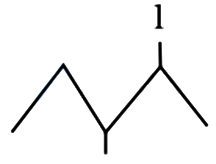
B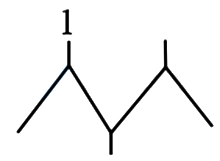
C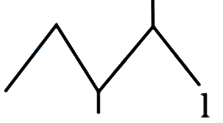
D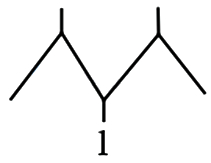
Solution
(C) The $IUPAC$ name $1-$iodo$-2,3-$dimethylpentane indicates a pentane chain ($5$ carbons) with an iodine atom at position $1$,and methyl groups at positions $2$ and $3$.
In the bond line notation,the carbon chain is represented by a zigzag line.
Starting from the end with the iodine atom (position $1$),the next carbon (position $2$) has a methyl group attached,and the third carbon (position $3$) also has a methyl group attached.
Analyzing the given options:
Option $A$ shows iodine at position $2$.
Option $B$ shows iodine at position $2$.
Option $C$ shows the iodine at the end of the chain (position $1$),with methyl groups at positions $2$ and $3$.
Option $D$ shows iodine at position $3$.
Therefore,the correct structure is represented by option $C$.
In the bond line notation,the carbon chain is represented by a zigzag line.
Starting from the end with the iodine atom (position $1$),the next carbon (position $2$) has a methyl group attached,and the third carbon (position $3$) also has a methyl group attached.
Analyzing the given options:
Option $A$ shows iodine at position $2$.
Option $B$ shows iodine at position $2$.
Option $C$ shows the iodine at the end of the chain (position $1$),with methyl groups at positions $2$ and $3$.
Option $D$ shows iodine at position $3$.
Therefore,the correct structure is represented by option $C$.
0 likesView Solution
14
ChemistryMediumMCQMHT CET · 2019
Which among the following is a set of nucleophiles?
A
$H^{+}, NH_{3}, Cl^{-}$
B
$BF_{3}, H_{2}O, NH_{3}$
C
$AlCl_{3}, BF_{3}, NH_{3}$
D
$CN^{-}, H_{2}O, ROH$
Solution
(D) nucleophile is a chemical species that donates an electron pair to form a chemical bond.
Species with at least one lone pair of electrons or a $\pi-$bond can act as nucleophiles.
In option $D$,$CN^{-}$ has a lone pair on carbon,$H_{2}O$ has two lone pairs on oxygen,and $ROH$ has two lone pairs on oxygen.
Therefore,$CN^{-}, H_{2}O, ROH$ are all nucleophiles.
Species with at least one lone pair of electrons or a $\pi-$bond can act as nucleophiles.
In option $D$,$CN^{-}$ has a lone pair on carbon,$H_{2}O$ has two lone pairs on oxygen,and $ROH$ has two lone pairs on oxygen.
Therefore,$CN^{-}, H_{2}O, ROH$ are all nucleophiles.
0 likesView Solution
15
ChemistryMediumMCQMHT CET · 2019
How many isomers are possible for an alkane having molecular formula $C_5H_{12}$?
A
$5$
B
$3$
C
$4$
D
$2$
Solution
(B) There are $3$ possible isomers for an alkane with the molecular formula $C_5H_{12}$. These are:
$1$. $n$-pentane: $CH_3CH_2CH_2CH_2CH_3$
$2$. Isopentane ($2$-methylbutane): $CH_3-CH(CH_3)-CH_2-CH_3$
$3$. Neopentane ($2,2$-dimethylpropane): $C(CH_3)_4$
$1$. $n$-pentane: $CH_3CH_2CH_2CH_2CH_3$
$2$. Isopentane ($2$-methylbutane): $CH_3-CH(CH_3)-CH_2-CH_3$
$3$. Neopentane ($2,2$-dimethylpropane): $C(CH_3)_4$
0 likesView Solution
16
ChemistryMediumMCQMHT CET · 2019
Which bond in a molecule of ethyl magnesium bromide is ionic in nature?
A
$C - C$ bond
B
$C - Mg$ bond
C
$Mg - Br$ bond
D
$C - H$ bond
Solution
(C) In a molecule of ethyl magnesium bromide $(CH_3CH_2MgBr)$,the $Mg - Br$ bond is ionic in nature.
This is because the electronegativity difference between magnesium $(Mg)$ and bromine $(Br)$ is significantly large compared to the other bonds present in the molecule.
Consequently,the $Mg - Br$ bond exhibits the highest ionic character.
This is because the electronegativity difference between magnesium $(Mg)$ and bromine $(Br)$ is significantly large compared to the other bonds present in the molecule.
Consequently,the $Mg - Br$ bond exhibits the highest ionic character.
0 likesView Solution
17
ChemistryEasyMCQMHT CET · 2019
When propene reacts with $HCl$ in the presence of peroxide,the product is
A
$1-$chloropropane
B
$1,1-$dichloropropane
C
$2-$chloropropane
D
$1,2-$dichloropropane
Solution
(C) The reaction of $HCl$ with an unsymmetrical alkene like propene follows Markovnikov's rule,even in the presence of peroxide.
Peroxide effect (Kharasch effect) is only applicable to $HBr$ and not to $HCl$ or $HI$.
According to Markovnikov's rule,the negative part of the reagent $(Cl^-)$ attaches to the carbon atom with fewer hydrogen atoms.
Thus,$CH_3-CH=CH_2 + HCl \rightarrow CH_3-CHCl-CH_3$ ($2-$chloropropane).
Peroxide effect (Kharasch effect) is only applicable to $HBr$ and not to $HCl$ or $HI$.
According to Markovnikov's rule,the negative part of the reagent $(Cl^-)$ attaches to the carbon atom with fewer hydrogen atoms.
Thus,$CH_3-CH=CH_2 + HCl \rightarrow CH_3-CHCl-CH_3$ ($2-$chloropropane).
0 likesView Solution
18
ChemistryEasyMCQMHT CET · 2019
The alkane formed on heating sodium butanoate with sodalime is
A
Methane
B
Ethane
C
Propane
D
Butane
Solution
(C) The reaction of sodium butanoate with sodalime $(NaOH + CaO)$ is a decarboxylation reaction.
In this process,the carboxyl group $(-COO^-Na^+)$ is removed as $Na_2CO_3$,and the resulting alkane contains one carbon atom less than the parent carboxylic acid salt.
Sodium butanoate $(CH_3CH_2CH_2COONa)$ has $4$ carbon atoms.
Upon decarboxylation,it yields propane $(CH_3CH_2CH_3)$,which has $3$ carbon atoms.
Reaction: $CH_3CH_2CH_2COONa + NaOH \xrightarrow[\Delta]{CaO} CH_3CH_2CH_3 + Na_2CO_3$
In this process,the carboxyl group $(-COO^-Na^+)$ is removed as $Na_2CO_3$,and the resulting alkane contains one carbon atom less than the parent carboxylic acid salt.
Sodium butanoate $(CH_3CH_2CH_2COONa)$ has $4$ carbon atoms.
Upon decarboxylation,it yields propane $(CH_3CH_2CH_3)$,which has $3$ carbon atoms.
Reaction: $CH_3CH_2CH_2COONa + NaOH \xrightarrow[\Delta]{CaO} CH_3CH_2CH_3 + Na_2CO_3$
0 likesView Solution
19
ChemistryDifficultMCQMHT CET · 2019
How many grams of sodium $(atomic \ mass = 23 \ u)$ are required to prepare one mole of ethane from methyl chloride by the Wurtz reaction?
A
$2$
B
$23$
C
$11.5$
D
$46$
Solution
(D) The Wurtz reaction between methyl chloride and sodium metal in the presence of dry ether is represented by the equation:
$2 CH_3Cl + 2 Na \xrightarrow{\text{Dry ether}} CH_3-CH_3 + 2 NaCl$
From the stoichiometry of the reaction,$2$ moles of sodium $(Na)$ are required to produce $1$ mole of ethane $(CH_3-CH_3)$.
The molar mass of sodium is $23 \ g/mol$.
Therefore,the mass of $2$ moles of sodium is $2 \times 23 \ g = 46 \ g$.
Thus,$46 \ g$ of sodium is required to prepare one mole of ethane.
$2 CH_3Cl + 2 Na \xrightarrow{\text{Dry ether}} CH_3-CH_3 + 2 NaCl$
From the stoichiometry of the reaction,$2$ moles of sodium $(Na)$ are required to produce $1$ mole of ethane $(CH_3-CH_3)$.
The molar mass of sodium is $23 \ g/mol$.
Therefore,the mass of $2$ moles of sodium is $2 \times 23 \ g = 46 \ g$.
Thus,$46 \ g$ of sodium is required to prepare one mole of ethane.
0 likesView Solution
20
ChemistryEasyMCQMHT CET · 2019
In the reaction,$2n \ R-X \xrightarrow[\text{Dry ether}]{+2n \ Na} \text{product}$. The product obtained is
A
$n \ \text{Alkene}$
B
$n \ \text{Sodium halide}$
C
$n \ \text{Alcohol}$
D
$n \ \text{Alkane}$
Solution
(D) The given reaction is the Wurtz reaction.
$2n \ R-X + 2n \ Na \xrightarrow{\text{Dry ether}} n \ R-R + 2n \ NaX$
Here,$R-R$ represents an alkane.
Thus,the product obtained is $n \ \text{alkane}$.
$2n \ R-X + 2n \ Na \xrightarrow{\text{Dry ether}} n \ R-R + 2n \ NaX$
Here,$R-R$ represents an alkane.
Thus,the product obtained is $n \ \text{alkane}$.
0 likesView Solution
21
ChemistryMediumMCQMHT CET · 2019
$1-$butylene when subjected to hydroboration-oxidation reaction,yields:
A
iso-butyl alcohol
B
sec-butyl alcohol
C
n-butyl alcohol
D
tert-butyl alcohol
Solution
(C) The hydroboration-oxidation of $1-$butylene $(CH_2=CH-CH_2-CH_3)$ follows anti-Markovnikov addition of water.
$CH_2=CH-CH_2-CH_3 + (i) B_2H_6, THF / (ii) H_2O_2, OH^- \rightarrow CH_2(OH)-CH_2-CH_2-CH_3$.
The product formed is $n-$butyl alcohol (butan-$1-$ol).
$CH_2=CH-CH_2-CH_3 + (i) B_2H_6, THF / (ii) H_2O_2, OH^- \rightarrow CH_2(OH)-CH_2-CH_2-CH_3$.
The product formed is $n-$butyl alcohol (butan-$1-$ol).
0 likesView Solution
22
ChemistryEasyMCQMHT CET · 2019
The bond angle $H-O-O$ in $H_2O_2$ in the gaseous phase is (in $^{\circ}$)
A
$90.2$
B
$111.5$
C
$101.9$
D
$94.8$
Solution
(D) The structure of $H_2O_2$ in the gaseous phase is non-planar (open book structure).
In this structure,the $H-O-O$ bond angle is $94.8^{\circ}$,and the dihedral angle is $111.5^{\circ}$.
Therefore,the correct bond angle $H-O-O$ is $94.8^{\circ}$.
In this structure,the $H-O-O$ bond angle is $94.8^{\circ}$,and the dihedral angle is $111.5^{\circ}$.
Therefore,the correct bond angle $H-O-O$ is $94.8^{\circ}$.
0 likesView Solution
23
ChemistryEasyMCQMHT CET · 2019
What is the density of water vapour at the boiling point of water?
A
$1 \times 10^{-4} \ g \ cm^{-3}$
B
$1 \ g \ cm^{-3}$
C
$6 \times 10^{-4} \ g \ cm^{-3}$
D
$4 \times 10^{-4} \ g \ cm^{-3}$
Solution
(C) The density of water vapour depends on temperature and pressure.
At the boiling point of water $(100^{\circ}C)$ and standard atmospheric pressure $(1 \ atm)$,the density of water vapour is approximately $6 \times 10^{-4} \ g \ cm^{-3}$.
At the boiling point of water $(100^{\circ}C)$ and standard atmospheric pressure $(1 \ atm)$,the density of water vapour is approximately $6 \times 10^{-4} \ g \ cm^{-3}$.
0 likesView Solution
24
ChemistryEasyMCQMHT CET · 2019
Which of the following metal halides is more covalent?
A
$SnCl_2$
B
$PbCl_2$
C
$SbCl_3$
D
$SbCl_5$
Solution
(D) According to Fajan's rules,the covalent character of an ionic bond increases with an increase in the charge on the cation.
$SbCl_5$ contains the $Sb^{5+}$ cation,which has the highest positive charge among the given options ($Sn^{2+}$,$Pb^{2+}$,$Sb^{3+}$,$Sb^{5+}$).
$A$ higher charge on the cation results in greater polarising power,which distorts the electron cloud of the anion more effectively,leading to increased covalent character.
Therefore,$SbCl_5$ is the most covalent compound among the choices.
$SbCl_5$ contains the $Sb^{5+}$ cation,which has the highest positive charge among the given options ($Sn^{2+}$,$Pb^{2+}$,$Sb^{3+}$,$Sb^{5+}$).
$A$ higher charge on the cation results in greater polarising power,which distorts the electron cloud of the anion more effectively,leading to increased covalent character.
Therefore,$SbCl_5$ is the most covalent compound among the choices.
0 likesView Solution
25
ChemistryEasyMCQMHT CET · 2019
In which among the following compounds,the oxidation number of nitrogen is $ +5 $?
A
$N_2O$
B
$N_2O_3$
C
$NO_2$
D
$HNO_3$
Solution
(D) The oxidation number of nitrogen in $HNO_3$ is calculated as follows:
Let the oxidation number of $N$ be $x$.
For $HNO_3$: $1 + x + 3(-2) = 0$
$1 + x - 6 = 0$
$x - 5 = 0$
$x = +5$
Therefore,the oxidation number of nitrogen is $ +5 $ in $HNO_3$.
Let the oxidation number of $N$ be $x$.
For $HNO_3$: $1 + x + 3(-2) = 0$
$1 + x - 6 = 0$
$x - 5 = 0$
$x = +5$
Therefore,the oxidation number of nitrogen is $ +5 $ in $HNO_3$.
0 likesView Solution
26
ChemistryEasyMCQMHT CET · 2019
Oxidation state of nitrogen in nitric oxide is
A
$+2$
B
$+3$
C
$+4$
D
$-2$
Solution
(A) The chemical formula for nitric oxide is $NO$.
Let the oxidation state of nitrogen be $x$.
The oxidation state of oxygen in oxides is generally $-2$.
For the neutral molecule $NO$,the sum of oxidation states must be zero:
$x + (-2) = 0$
$x = +2$.
Therefore,the oxidation state of nitrogen in nitric oxide is $+2$.
Let the oxidation state of nitrogen be $x$.
The oxidation state of oxygen in oxides is generally $-2$.
For the neutral molecule $NO$,the sum of oxidation states must be zero:
$x + (-2) = 0$
$x = +2$.
Therefore,the oxidation state of nitrogen in nitric oxide is $+2$.
0 likesView Solution
27
ChemistryEasyMCQMHT CET · 2019
In the ozone $(O_3)$ molecule,the formal charge on the central oxygen atom is:
A
$-1$
B
$2$
C
$0$
D
$1$
Solution
(D) The structure of the ozone $(O_3)$ molecule consists of a central oxygen atom double-bonded to one terminal oxygen atom and single-bonded to another terminal oxygen atom.
The central oxygen atom has $6$ valence electrons.
In the resonance structure,the central oxygen atom forms $3$ bonds (total $6$ bonding electrons) and has $1$ lone pair ($2$ electrons).
Using the formula: $\text{Formal charge} = V - L - \frac{1}{2}B$,where $V$ is the number of valence electrons,$L$ is the number of lone pair electrons,and $B$ is the number of bonding electrons.
For the central oxygen atom: $V = 6$,$L = 2$,$B = 6$.
$\text{Formal charge} = 6 - 2 - \frac{1}{2}(6) = 6 - 2 - 3 = +1$.
The central oxygen atom has $6$ valence electrons.
In the resonance structure,the central oxygen atom forms $3$ bonds (total $6$ bonding electrons) and has $1$ lone pair ($2$ electrons).
Using the formula: $\text{Formal charge} = V - L - \frac{1}{2}B$,where $V$ is the number of valence electrons,$L$ is the number of lone pair electrons,and $B$ is the number of bonding electrons.
For the central oxygen atom: $V = 6$,$L = 2$,$B = 6$.
$\text{Formal charge} = 6 - 2 - \frac{1}{2}(6) = 6 - 2 - 3 = +1$.
0 likesView Solution
28
ChemistryEasyMCQMHT CET · 2019
The oxidation state of sulphur in $H_2S_2O_7$ is
A
$4$
B
$6$
C
$5$
D
$7$
Solution
(B) Let the oxidation state of sulphur be $x$. The oxidation state of hydrogen is $+1$ and oxygen is $-2$. In $H_2S_2O_7$,the sum of oxidation states is $2(+1) + 2(x) + 7(-2) = 0$. Solving for $x$: $2 + 2x - 14 = 0$,$2x = 12$,$x = +6$. Thus,the oxidation state of sulphur in $H_2S_2O_7$ is $+6$.
0 likesView Solution
29
ChemistryEasyMCQMHT CET · 2019
The oxidation number of sulphur in $S_8$ molecule is
A
$6$
B
$0$
C
$2$
D
$3$
Solution
(B) The oxidation number of an element in its elemental form or in a homoatomic molecule is always $0$.
Since $S_8$ is a homoatomic molecule consisting only of sulphur atoms,the oxidation number of sulphur in $S_8$ is $0$.
Since $S_8$ is a homoatomic molecule consisting only of sulphur atoms,the oxidation number of sulphur in $S_8$ is $0$.
0 likesView Solution
30
ChemistryEasyMCQMHT CET · 2019
Which of the following oxides can act both as an oxidising agent as well as a reducing agent?
A
$N_2O$
B
$SO_2$
C
$SO_3$
D
$P_2O_5$
Solution
(B) $SO_2$ can act both as an oxidising agent and a reducing agent because the oxidation state of sulphur in $SO_2$ is $+4$,which is an intermediate oxidation state (between $-2$ and $+6$).
As a reducing agent: $SO_2$ reduces $Fe^{3+}$ to $Fe^{2+}$ and decolourises acidified $KMnO_4$ solution.
$2Fe^{3+} + SO_2 + 2H_2O \rightarrow 2Fe^{2+} + SO_4^{2-} + 4H^+$
As an oxidising agent: $SO_2$ reacts with $H_2S$ to produce sulphur and water,where the oxidation state of sulphur in $SO_2$ decreases from $+4$ to $0$.
$SO_2 + 2H_2S \rightarrow 3S + 2H_2O$
As a reducing agent: $SO_2$ reduces $Fe^{3+}$ to $Fe^{2+}$ and decolourises acidified $KMnO_4$ solution.
$2Fe^{3+} + SO_2 + 2H_2O \rightarrow 2Fe^{2+} + SO_4^{2-} + 4H^+$
As an oxidising agent: $SO_2$ reacts with $H_2S$ to produce sulphur and water,where the oxidation state of sulphur in $SO_2$ decreases from $+4$ to $0$.
$SO_2 + 2H_2S \rightarrow 3S + 2H_2O$
0 likesView Solution
31
ChemistryDifficultMCQMHT CET · 2019
In the reaction,$MnO_{4(aq)}^{-} + Br_{(aq)}^{-} \rightarrow MnO_{2(s)} + BrO_{3(aq)}^{-}$,the correct change in oxidation number of the species involved is
A
$Br^{+5}$ to $Br^{-1}$
B
$Mn^{+7}$ to $Mn^{+2}$
C
$Mn^{+7}$ to $Mn^{+3}$
D
$Br^{-1}$ to $Br^{+5}$
Solution
(D) The given reaction is $MnO_{4(aq)}^{-} + Br_{(aq)}^{-} \rightarrow MnO_{2(s)} + BrO_{3(aq)}^{-}$.
In $MnO_{4}^{-}$,the oxidation state of $Mn$ is $x + 4(-2) = -1$,so $x = +7$.
In $MnO_{2}$,the oxidation state of $Mn$ is $x + 2(-2) = 0$,so $x = +4$.
In $Br^{-}$,the oxidation state of $Br$ is $-1$.
In $BrO_{3}^{-}$,the oxidation state of $Br$ is $x + 3(-2) = -1$,so $x = +5$.
Therefore,the oxidation number of bromine changes from $Br^{-1}$ to $Br^{+5}$.
In $MnO_{4}^{-}$,the oxidation state of $Mn$ is $x + 4(-2) = -1$,so $x = +7$.
In $MnO_{2}$,the oxidation state of $Mn$ is $x + 2(-2) = 0$,so $x = +4$.
In $Br^{-}$,the oxidation state of $Br$ is $-1$.
In $BrO_{3}^{-}$,the oxidation state of $Br$ is $x + 3(-2) = -1$,so $x = +5$.
Therefore,the oxidation number of bromine changes from $Br^{-1}$ to $Br^{+5}$.
0 likesView Solution
32
ChemistryMediumMCQMHT CET · 2019
Which among the following sets of compounds is used as raw material for the preparation of sodium carbonate by the Solvay process?
A
$NaOH, HCl, CO_2$
B
$NH_4Cl, H_2O, NaCl$
C
$NaCl, NH_3, CaCO_3$
D
$NaCl, CaCO_3, H_2SO_4$
Solution
(C) The Solvay process is used for the industrial production of sodium carbonate $(Na_2CO_3)$.
The raw materials required are sodium chloride $(NaCl)$,ammonia $(NH_3)$,and limestone $(CaCO_3)$.
The chemical reactions involved are:
$2 NH_3 + H_2O + CO_2 \rightarrow (NH_4)_2CO_3$
$(NH_4)_2CO_3 + H_2O + CO_2 \rightarrow 2 NH_4HCO_3$
$NH_4HCO_3 + NaCl \rightarrow NaHCO_3 + NH_4Cl$
$2 NaHCO_3 \xrightarrow{\Delta} Na_2CO_3 + H_2O + CO_2$
Thus,the correct set of raw materials is $NaCl, NH_3, CaCO_3$.
The raw materials required are sodium chloride $(NaCl)$,ammonia $(NH_3)$,and limestone $(CaCO_3)$.
The chemical reactions involved are:
$2 NH_3 + H_2O + CO_2 \rightarrow (NH_4)_2CO_3$
$(NH_4)_2CO_3 + H_2O + CO_2 \rightarrow 2 NH_4HCO_3$
$NH_4HCO_3 + NaCl \rightarrow NaHCO_3 + NH_4Cl$
$2 NaHCO_3 \xrightarrow{\Delta} Na_2CO_3 + H_2O + CO_2$
Thus,the correct set of raw materials is $NaCl, NH_3, CaCO_3$.
0 likesView Solution
33
ChemistryEasyMCQMHT CET · 2019
The diagonal relationship between $Be$ and $Al$ is due to:
A
Similar ionization enthalpy
B
Similar metallic character
C
Similar ionic size and charge/radius ratio
D
Similar electronegativity
Solution
(C) The diagonal relationship between $Be$ and $Al$ is due to their similar ionic size and charge/radius ratio (ionic potential).
Diagonal relationships occur because the increase in ionic charge/radius ratio when moving across a period is compensated by the decrease in ionic charge/radius ratio when moving down a group.
This results in similar polarizing power,leading to similar chemical properties.
Diagonal relationships occur because the increase in ionic charge/radius ratio when moving across a period is compensated by the decrease in ionic charge/radius ratio when moving down a group.
This results in similar polarizing power,leading to similar chemical properties.
0 likesView Solution
34
ChemistryMediumMCQMHT CET · 2019
What happens when ionic hydrides of $s$-block elements in molten state are electrolysed?
A
Hydride ion migrates at cathode
B
Dihydrogen is liberated at cathode
C
Hydride ion reforms metal hydride
D
Dihydrogen is liberated at anode
Solution
(D) When an ionic hydride of $s$-block elements (e.g.,$NaH$) is electrolyzed in its molten state,the following reactions occur:
At the cathode: $Na^+ + e^- \rightarrow Na$
At the anode: $2H^- \rightarrow H_2 + 2e^-$
Thus,dihydrogen gas $(H_2)$ is liberated at the anode.
At the cathode: $Na^+ + e^- \rightarrow Na$
At the anode: $2H^- \rightarrow H_2 + 2e^-$
Thus,dihydrogen gas $(H_2)$ is liberated at the anode.
0 likesView Solution
35
ChemistryEasyMCQMHT CET · 2019
Which among the following compounds in crystalline form is used for making Nicol's prism?
A
$CaSO_4$
B
$Na_2AlF_6$
C
$CaCO_3$
D
$Al_2O_3$
Solution
(C) The Nicol prism is an optical device made from a crystal of $CaCO_3$ (calcite).
It is used to produce and analyze plane-polarized light due to its property of double refraction.
It is used to produce and analyze plane-polarized light due to its property of double refraction.
0 likesView Solution
36
ChemistryEasyMCQMHT CET · 2019
Which of the following sets of components form a homogeneous mixture?
A
$Phenol + Water$
B
$Sugar + Benzene$
C
$Silver \ chloride + Water$
D
$Ethyl \ alcohol + Water$
Solution
(D) homogeneous mixture is a mixture in which the composition is uniform throughout the mixture.
$Ethyl \ alcohol$ and $water$ are polar in nature and can form hydrogen bonds with each other,making them miscible in all proportions.
Therefore,the $(Ethyl \ alcohol + Water)$ system forms a homogeneous mixture.
$Ethyl \ alcohol$ and $water$ are polar in nature and can form hydrogen bonds with each other,making them miscible in all proportions.
Therefore,the $(Ethyl \ alcohol + Water)$ system forms a homogeneous mixture.
0 likesView Solution
37
ChemistryEasyMCQMHT CET · 2019
The combining ratios of hydrogen and oxygen in water and hydrogen peroxide are $1: 8$ and $1: 16$. Which law is illustrated in this example?
A
Law of definite proportions
B
Law of conservation of mass
C
Gay-Lussac's law of combining volumes of gases
D
Law of multiple proportions
Solution
(D) The combining ratios of hydrogen and oxygen in water $(H_2O)$ and hydrogen peroxide $(H_2O_2)$ are $1: 8$ and $1: 16$ respectively.
This is an example of the law of multiple proportions.
According to this law,if two elements combine to form more than one compound,the masses of one element that combine with a fixed mass of the other are in the ratio of small whole numbers.
Here,for a fixed mass of hydrogen $(1 \ g)$,the masses of oxygen are $8 \ g$ and $16 \ g$,which are in the ratio $8:16$ or $1:2$.
This is an example of the law of multiple proportions.
According to this law,if two elements combine to form more than one compound,the masses of one element that combine with a fixed mass of the other are in the ratio of small whole numbers.
Here,for a fixed mass of hydrogen $(1 \ g)$,the masses of oxygen are $8 \ g$ and $16 \ g$,which are in the ratio $8:16$ or $1:2$.
0 likesView Solution
38
ChemistryEasyMCQMHT CET · 2019
What is the atomicity of aluminium phosphate?
A
$8$
B
$6$
C
$5$
D
$13$
Solution
(B) The chemical formula for aluminium phosphate is $AlPO_4$.
Atomicity of a molecule is the total number of atoms present in one molecule.
In $AlPO_4$,there is $1$ atom of $Al$,$1$ atom of $P$,and $4$ atoms of $O$.
$\therefore$ Atomicity $= 1 + 1 + 4 = 6$.
Atomicity of a molecule is the total number of atoms present in one molecule.
In $AlPO_4$,there is $1$ atom of $Al$,$1$ atom of $P$,and $4$ atoms of $O$.
$\therefore$ Atomicity $= 1 + 1 + 4 = 6$.
0 likesView Solution
39
ChemistryEasyMCQMHT CET · 2019
The volume of $1$ mole of any pure gas at standard temperature and pressure $(STP)$ is always equal to (in $m^3$)
A
$0.022414$
B
$22.414$
C
$2.2414$
D
$0.22414$
Solution
(A) The molar volume of any ideal gas at standard temperature and pressure $(STP)$ is $22.414 \ L$.
Since $1 \ m^3 = 1000 \ L$,we have $1 \ L = 10^{-3} \ m^3$.
Therefore,$22.414 \ L = 22.414 \times 10^{-3} \ m^3 = 0.022414 \ m^3$.
Since $1 \ m^3 = 1000 \ L$,we have $1 \ L = 10^{-3} \ m^3$.
Therefore,$22.414 \ L = 22.414 \times 10^{-3} \ m^3 = 0.022414 \ m^3$.
0 likesView Solution
40
ChemistryMediumMCQMHT CET · 2019
What is the percentage of carbon in urea (in $\%$)? $(At. mass C = 12, H = 1, N = 14, O = 16)$
A
$20$
B
$26.6$
C
$6.67$
D
$46.0$
Solution
(A) The chemical formula of urea is $NH_2CONH_2$.
The molar mass of urea is $(2 \times 14) + (4 \times 1) + 12 + 16 = 60 \ g/mol$.
The number of carbon atoms in one molecule of urea is $1$.
The percentage of carbon by mass is calculated as: $\frac{\text{Mass of Carbon}}{\text{Molar mass of Urea}} \times 100 = \frac{12}{60} \times 100 = 20 \%$.
The molar mass of urea is $(2 \times 14) + (4 \times 1) + 12 + 16 = 60 \ g/mol$.
The number of carbon atoms in one molecule of urea is $1$.
The percentage of carbon by mass is calculated as: $\frac{\text{Mass of Carbon}}{\text{Molar mass of Urea}} \times 100 = \frac{12}{60} \times 100 = 20 \%$.
0 likesView Solution
41
ChemistryMediumMCQMHT CET · 2019
$A$ cold drink bottle contains $200 \ mL$ liquid in which $CO_2$ is $0.1 \ M$. Considering $CO_2$ as an ideal gas,the volume of the dissolved $CO_2$ at $S.T.P$ is: (in $L$)
A
$22.4$
B
$0.224$
C
$2.24$
D
$0.448$
Solution
(D) The number of moles of $CO_2$ dissolved is calculated as:
$n = M \times V(L)$
$n = 0.1 \times \frac{200}{1000} = 0.02 \ mol$
At $S.T.P$,$1 \ mol$ of an ideal gas occupies $22.4 \ L$.
Therefore,the volume of $0.02 \ mol$ of $CO_2$ at $S.T.P$ is:
$V = n \times 22.4 \ L/mol$
$V = 0.02 \times 22.4 \ L = 0.448 \ L$
$n = M \times V(L)$
$n = 0.1 \times \frac{200}{1000} = 0.02 \ mol$
At $S.T.P$,$1 \ mol$ of an ideal gas occupies $22.4 \ L$.
Therefore,the volume of $0.02 \ mol$ of $CO_2$ at $S.T.P$ is:
$V = n \times 22.4 \ L/mol$
$V = 0.02 \times 22.4 \ L = 0.448 \ L$
0 likesView Solution
42
ChemistryEasyMCQMHT CET · 2019
Based on the first law of thermodynamics,which of the following is correct?
A
For an isobaric process,$q_p = \Delta U + w$
B
For an adiabatic process,$\Delta U = -w$
C
For an isochoric process,$\Delta U = -q_v$
D
For an isothermal process,$q = +w$
Solution
(A) According to the first law of thermodynamics,$\Delta U = q + w$.
For an isobaric process (constant pressure),the heat exchanged is $q_p = \Delta H = \Delta U + P\Delta V$.
Since work done $w = -P\Delta V$,we have $P\Delta V = -w$.
Substituting this,$q_p = \Delta U - w$,which means $\Delta U = q_p + w$.
Thus,option $A$ is correct.
For an adiabatic process,$q = 0$,so $\Delta U = w$.
For an isochoric process,$\Delta V = 0$,so $w = 0$ and $\Delta U = q_v$.
For an isothermal process of an ideal gas,$\Delta U = 0$,so $q = -w$.
For an isobaric process (constant pressure),the heat exchanged is $q_p = \Delta H = \Delta U + P\Delta V$.
Since work done $w = -P\Delta V$,we have $P\Delta V = -w$.
Substituting this,$q_p = \Delta U - w$,which means $\Delta U = q_p + w$.
Thus,option $A$ is correct.
For an adiabatic process,$q = 0$,so $\Delta U = w$.
For an isochoric process,$\Delta V = 0$,so $w = 0$ and $\Delta U = q_v$.
For an isothermal process of an ideal gas,$\Delta U = 0$,so $q = -w$.
0 likesView Solution
43
ChemistryMediumMCQMHT CET · 2019
$A$ gas performs $0.320 \ kJ$ work on the surrounding and absorbs $120 \ J$ of heat from the surrounding. Hence,the change in internal energy is: (in $J$)
A
$200$
B
$120.32$
C
$-200$
D
$440$
Solution
(C) According to the first law of thermodynamics,$\Delta U = q + W$.
Since the gas performs work on the surrounding,the work done is negative: $W = -0.320 \ kJ = -320 \ J$.
The heat absorbed by the system is positive: $q = 120 \ J$.
Substituting these values into the equation: $\Delta U = 120 \ J + (-320 \ J) = -200 \ J$.
Since the gas performs work on the surrounding,the work done is negative: $W = -0.320 \ kJ = -320 \ J$.
The heat absorbed by the system is positive: $q = 120 \ J$.
Substituting these values into the equation: $\Delta U = 120 \ J + (-320 \ J) = -200 \ J$.
0 likesView Solution
44
ChemistryEasyMCQMHT CET · 2019
The temperature of $32^{\circ} C$ is equivalent to
A
$89.6^{\circ} F$
B
$89.8^{\circ} F$
C
$1.07 \times 10^{-7} \ cm$
D
$1.07 \times 10^{-8} \ cm$
Solution
(A) The temperature in $^{\circ} F$ and $^{\circ} C$ are related to each other by the following relationship:
$^{\circ} F = \frac{9}{5}(^{\circ} C) + 32$
Substituting the value of $32^{\circ} C$ into the formula:
$^{\circ} F = \frac{9 \times 32}{5} + 32 = 57.6 + 32 = 89.6^{\circ} F$
Therefore,the temperature of $32^{\circ} C$ is equivalent to $89.6^{\circ} F$.
$^{\circ} F = \frac{9}{5}(^{\circ} C) + 32$
Substituting the value of $32^{\circ} C$ into the formula:
$^{\circ} F = \frac{9 \times 32}{5} + 32 = 57.6 + 32 = 89.6^{\circ} F$
Therefore,the temperature of $32^{\circ} C$ is equivalent to $89.6^{\circ} F$.
0 likesView Solution
45
ChemistryEasyMCQMHT CET · 2019
“The mass and energy both are conserved in an isolated system”,is the statement of
A
Second law of thermodynamics
B
Third law of thermodynamics
C
Modified first law of thermodynamics
D
First law of thermodynamics
Solution
(C) The statement “The mass and energy both are conserved in an isolated system” refers to the modified first law of thermodynamics.
According to the original first law of thermodynamics,energy can neither be created nor destroyed,only transformed.
However,considering the mass-energy equivalence principle $(E = mc^2)$,the law is modified to state that the total mass and energy of an isolated system remain constant.
According to the original first law of thermodynamics,energy can neither be created nor destroyed,only transformed.
However,considering the mass-energy equivalence principle $(E = mc^2)$,the law is modified to state that the total mass and energy of an isolated system remain constant.
0 likesView Solution
46
ChemistryDifficultMCQMHT CET · 2019
Three moles of an ideal gas are expanded isothermally from a volume of $300 \ cm^3$ to $2.5 \ L$ at $300 \ K$ against a constant external pressure of $1.9 \ atm$. The work done in joules is:
A
$-423.56 \ J$
B
$+423.56 \ J$
C
$-4.18 \ J$
D
$+4.8 \ J$
Solution
(A) The work done in an irreversible isothermal expansion against a constant external pressure is given by the formula: $W = -P_{ext} \times \Delta V$.
Given: $P_{ext} = 1.9 \ atm$,$V_1 = 300 \ cm^3 = 0.3 \ L$,$V_2 = 2.5 \ L$.
Change in volume: $\Delta V = V_2 - V_1 = 2.5 \ L - 0.3 \ L = 2.2 \ L$.
Work done: $W = -1.9 \ atm \times 2.2 \ L = -4.18 \ atm \cdot L$.
Converting to Joules using the conversion factor $1 \ atm \cdot L = 101.325 \ J$:
$W = -4.18 \times 101.325 \ J = -423.56 \ J$.
Given: $P_{ext} = 1.9 \ atm$,$V_1 = 300 \ cm^3 = 0.3 \ L$,$V_2 = 2.5 \ L$.
Change in volume: $\Delta V = V_2 - V_1 = 2.5 \ L - 0.3 \ L = 2.2 \ L$.
Work done: $W = -1.9 \ atm \times 2.2 \ L = -4.18 \ atm \cdot L$.
Converting to Joules using the conversion factor $1 \ atm \cdot L = 101.325 \ J$:
$W = -4.18 \times 101.325 \ J = -423.56 \ J$.
0 likesView Solution
47
ChemistryMediumMCQMHT CET · 2019
If $C_{(s)} + O_{2(g)} \rightarrow CO_{2(g)}$,$\Delta H = -X$,and $CO_{(g)} + \frac{1}{2} O_{2(g)} \rightarrow CO_{2(g)}$,$\Delta H = -Y$,calculate $\Delta_f H$ for $CO_{(g)}$ formation.
A
$-Y - X$
B
$Y - X$
C
$X + Y$
D
$Y + X$
Solution
(B) To find the enthalpy of formation of $CO_{(g)}$,we need the reaction: $C_{(s)} + \frac{1}{2} O_{2(g)} \rightarrow CO_{(g)}$.
Given equations:
Subtracting equation $(ii)$ from equation $(i)$:
$(C_{(s)} + O_{2(g)}) - (CO_{(g)} + \frac{1}{2} O_{2(g)}) \rightarrow CO_{2(g)} - CO_{2(g)}$
$C_{(s)} + \frac{1}{2} O_{2(g)} - CO_{(g)} \rightarrow 0$
$C_{(s)} + \frac{1}{2} O_{2(g)} \rightarrow CO_{(g)}$
The enthalpy change is $\Delta_f H = (-X) - (-Y) = Y - X$.
Given equations:
| $(i) \ C_{(s)} + O_{2(g)} \rightarrow CO_{2(g)}$ | $\Delta H = -X$ |
| $(ii) \ CO_{(g)} + \frac{1}{2} O_{2(g)} \rightarrow CO_{2(g)}$ | $\Delta H = -Y$ |
Subtracting equation $(ii)$ from equation $(i)$:
$(C_{(s)} + O_{2(g)}) - (CO_{(g)} + \frac{1}{2} O_{2(g)}) \rightarrow CO_{2(g)} - CO_{2(g)}$
$C_{(s)} + \frac{1}{2} O_{2(g)} - CO_{(g)} \rightarrow 0$
$C_{(s)} + \frac{1}{2} O_{2(g)} \rightarrow CO_{(g)}$
The enthalpy change is $\Delta_f H = (-X) - (-Y) = Y - X$.
0 likesView Solution
48
ChemistryDifficultMCQMHT CET · 2019
Two moles of an ideal gas is expanded isothermally and reversibly at $300 \ K$ from $1 \ L$ to $10 \ L$. The enthalpy change in $kJ$ is
A
$11.4 \ kJ$
B
$4.8 \ kJ$
C
$-11.4 \ kJ$
D
Zero $kJ$
Solution
(D) For an ideal gas,the enthalpy $H$ is a function of temperature only,i.e.,$H = f(T)$.
Since the process is isothermal,the temperature remains constant,so $\Delta T = 0$.
The change in enthalpy is given by $\Delta H = n C_p \Delta T$.
Since $\Delta T = 0$,the enthalpy change $\Delta H$ is $0 \ kJ$.
Since the process is isothermal,the temperature remains constant,so $\Delta T = 0$.
The change in enthalpy is given by $\Delta H = n C_p \Delta T$.
Since $\Delta T = 0$,the enthalpy change $\Delta H$ is $0 \ kJ$.
0 likesView Solution
49
ChemistryMediumMCQMHT CET · 2019
Identify the equation in which the change in enthalpy is equal to the change in internal energy.
A
$2 H_2 O_{2(l)} \rightarrow 2 H_2 O_{(l)} + O_{2(g)}$
B
$C_{(s)} + O_{2(g)} \rightarrow CO_{2(g)}$
C
$PCl_{5(g)} \rightarrow PCl_{3(g)} + Cl_{2(g)}$
D
$N_{2(g)} + 3 H_{2(g)} \rightarrow 2 NH_{3(g)}$
Solution
(B) The relationship between the change in enthalpy $(\Delta H)$ and the change in internal energy $(\Delta U)$ is given by the equation: $\Delta H = \Delta U + \Delta n_g RT$.
For $\Delta H$ to be equal to $\Delta U$,the term $\Delta n_g$ must be equal to $0$.
$\Delta n_g$ is the difference between the sum of the stoichiometric coefficients of gaseous products and gaseous reactants.
For option $(B)$: $C_{(s)} + O_{2(g)} \rightarrow CO_{2(g)}$,$\Delta n_g = 1 - 1 = 0$.
Therefore,$\Delta H = \Delta U$ for this reaction.
For $\Delta H$ to be equal to $\Delta U$,the term $\Delta n_g$ must be equal to $0$.
$\Delta n_g$ is the difference between the sum of the stoichiometric coefficients of gaseous products and gaseous reactants.
For option $(B)$: $C_{(s)} + O_{2(g)} \rightarrow CO_{2(g)}$,$\Delta n_g = 1 - 1 = 0$.
Therefore,$\Delta H = \Delta U$ for this reaction.
0 likesView Solution
50
ChemistryDifficultMCQMHT CET · 2019
Calculate the difference between heat of combustion of carbon monoxide gas at constant pressure and at constant volume at $27^{\circ} C$ (in $cal$)? $(R = 2 \ cal \ K^{-1} \ mol^{-1})$
A
$54$
B
$-600$
C
$-300$
D
$27$
Solution
(C) The combustion reaction for carbon monoxide is: $CO_{(g)} + \frac{1}{2} O_{2(g)} \rightarrow CO_{2(g)}$
The change in the number of gaseous moles is calculated as: $\Delta n_{g} = n_{p(g)} - n_{r(g)} = 1 - (1 + 0.5) = 1 - 1.5 = -0.5$ or $-\frac{1}{2}$.
The relationship between enthalpy change (heat at constant pressure,$\Delta H$) and internal energy change (heat at constant volume,$\Delta E$) is given by: $\Delta H - \Delta E = \Delta n_{g} RT$.
Given $T = 27^{\circ} C = 27 + 273 = 300 \ K$ and $R = 2 \ cal \ K^{-1} \ mol^{-1}$.
Substituting the values: $\Delta H - \Delta E = -\frac{1}{2} \times 2 \times 300 = -300 \ cal$.
The change in the number of gaseous moles is calculated as: $\Delta n_{g} = n_{p(g)} - n_{r(g)} = 1 - (1 + 0.5) = 1 - 1.5 = -0.5$ or $-\frac{1}{2}$.
The relationship between enthalpy change (heat at constant pressure,$\Delta H$) and internal energy change (heat at constant volume,$\Delta E$) is given by: $\Delta H - \Delta E = \Delta n_{g} RT$.
Given $T = 27^{\circ} C = 27 + 273 = 300 \ K$ and $R = 2 \ cal \ K^{-1} \ mol^{-1}$.
Substituting the values: $\Delta H - \Delta E = -\frac{1}{2} \times 2 \times 300 = -300 \ cal$.
0 likesView Solution
51
ChemistryEasyMCQMHT CET · 2019
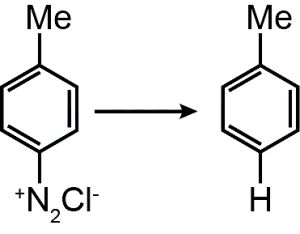
The chemical reaction shown in the image represents the reduction of a diazonium salt to an aromatic hydrocarbon. Identify the reagent typically used for this transformation.
A
Ethanol
B
Sodium borohydride
C
Lithium aluminium hydride
D
Zinc and hydrochloric acid
Solution
(A) The reaction shown is the reduction of $p$-toluenediazonium chloride to toluene. This transformation is commonly achieved using ethanol $(C_2H_5OH)$ or hypophosphorous acid $(H_3PO_2)$ in the presence of water. Ethanol acts as a reducing agent and gets oxidized to acetaldehyde,while the diazonium group is replaced by a hydrogen atom.
0 likesView Solution
52
ChemistryMediumMCQMHT CET · 2019
$Isobutylene$ on hydroboration followed by oxidation with hydrogen peroxide in presence of base yields
A
$n-$butyl alcohol
B
$sec-$butyl alcohol
C
$tert-$butyl alcohol
D
Isobutyl alcohol
Solution
(D) Hydroboration-oxidation of $Isobutylene$ $(CH_2=C(CH_3)_2)$ involves the addition of $H_2O$ across the double bond in an anti-$Markovnikov$ fashion.
In this reaction,the $OH$ group attaches to the less substituted carbon atom.
The reaction proceeds as follows:
$CH_2=C(CH_3)_2 + (H-BH_2)_2 \xrightarrow{H_2O_2, OH^-} (CH_3)_2CH-CH_2OH$
The product formed is isobutyl alcohol ($2-$methylpropan$-1-$ol).
In this reaction,the $OH$ group attaches to the less substituted carbon atom.
The reaction proceeds as follows:
$CH_2=C(CH_3)_2 + (H-BH_2)_2 \xrightarrow{H_2O_2, OH^-} (CH_3)_2CH-CH_2OH$
The product formed is isobutyl alcohol ($2-$methylpropan$-1-$ol).
0 likesView Solution
53
ChemistryMediumMCQMHT CET · 2019
Action of hydrogen iodide on anisole gives,
A
phenol and iodomethane
B
iodobenzene and methanol
C
phenol and methanol
D
iodobenzene and iodomethane
Solution
(A) The reaction of anisole $(C_6H_5OCH_3)$ with hydrogen iodide $(HI)$ involves the cleavage of the $C-O$ bond.
Since the $C_6H_5-O$ bond has partial double bond character due to resonance,the $O-CH_3$ bond is cleaved.
This results in the formation of phenol $(C_6H_5OH)$ and iodomethane $(CH_3I)$.
The reaction is: $C_6H_5OCH_3 + HI \xrightarrow{\Delta} C_6H_5OH + CH_3I$.
Since the $C_6H_5-O$ bond has partial double bond character due to resonance,the $O-CH_3$ bond is cleaved.
This results in the formation of phenol $(C_6H_5OH)$ and iodomethane $(CH_3I)$.
The reaction is: $C_6H_5OCH_3 + HI \xrightarrow{\Delta} C_6H_5OH + CH_3I$.
0 likesView Solution
54
ChemistryDifficultMCQMHT CET · 2019
Carbolic acid is oxidised by acidified sodium dichromate to give
A
Acetone
B
Ethyl methyl ketone
C
Benzoquinone
D
Anthraquinone
Solution
(C) Carbolic acid (also known as phenol) is oxidised by acidified sodium dichromate $(Na_2Cr_2O_7 / H_2SO_4)$ to give $p$-benzoquinone.
The reaction is as follows:
$C_6H_5OH + [O] \xrightarrow{Na_2Cr_2O_7 / H_2SO_4} C_6H_4O_2$ (Benzoquinone)
In the presence of air,phenols are slowly oxidised to dark-coloured mixtures containing quinones.
The reaction is as follows:
$C_6H_5OH + [O] \xrightarrow{Na_2Cr_2O_7 / H_2SO_4} C_6H_4O_2$ (Benzoquinone)
In the presence of air,phenols are slowly oxidised to dark-coloured mixtures containing quinones.
0 likesView Solution
55
ChemistryMediumMCQMHT CET · 2019
In the reaction,$C_6H_5COCH_3 \xrightarrow[Zn-Hg / \text{conc. } HCl]{[H]} X$,$X$ is
A
toluene
B
methylbenzene
C
benzyl alcohol
D
ethylbenzene
Solution
(D) The given reaction is the $Clemmensen$ reduction,which reduces a carbonyl group $(C=O)$ to a methylene group $(CH_2)$.
$C_6H_5COCH_3 + 4[H] \xrightarrow[Zn-Hg / \text{conc. } HCl] C_6H_5CH_2CH_3 + H_2O$.
The product $X$ is $C_6H_5CH_2CH_3$,which is ethylbenzene.
$C_6H_5COCH_3 + 4[H] \xrightarrow[Zn-Hg / \text{conc. } HCl] C_6H_5CH_2CH_3 + H_2O$.
The product $X$ is $C_6H_5CH_2CH_3$,which is ethylbenzene.
0 likesView Solution
56
ChemistryMediumMCQMHT CET · 2019
Which of the following does not give a yellow solid on treatment with sodium hypoiodite?
A
Acetophenone
B
Pentan-$3$-one
C
Pentan-$2$-one
D
Ethanal
Solution
(B) Pentan-$3$-one does not give a yellow solid on treatment with sodium hypoiodite because this reaction is given only by methyl ketones.
Ketones that have at least one methyl group linked to the carbonyl carbon atom (i.e.,$CH_3-CO-$ group) are oxidized by sodium hypoiodite to form iodoform $(CHI_3)$,which is a yellow solid.
This reaction is known as the iodoform reaction.
Since pentan-$3$-one $(CH_3CH_2COCH_2CH_3)$ lacks a methyl group attached to the carbonyl carbon,it does not undergo the iodoform reaction.
Ketones that have at least one methyl group linked to the carbonyl carbon atom (i.e.,$CH_3-CO-$ group) are oxidized by sodium hypoiodite to form iodoform $(CHI_3)$,which is a yellow solid.
This reaction is known as the iodoform reaction.
Since pentan-$3$-one $(CH_3CH_2COCH_2CH_3)$ lacks a methyl group attached to the carbonyl carbon,it does not undergo the iodoform reaction.
0 likesView Solution
57
ChemistryEasyMCQMHT CET · 2019
Hinsberg's reagent is
A
Benzene sulphonyl chloride
B
Benzene sulphonic acid
C
Barium tetrachlorocuprate $(III)$
D
Tetrachlorobarium copper $(II)$
Solution
(A) Hinsberg's reagent is benzene sulphonyl chloride.
Its molecular formula is $C_6H_5SO_2Cl$.
This reagent is used to distinguish primary $(1^{\circ})$,secondary $(2^{\circ})$,and tertiary $(3^{\circ})$ amines.
Its molecular formula is $C_6H_5SO_2Cl$.
This reagent is used to distinguish primary $(1^{\circ})$,secondary $(2^{\circ})$,and tertiary $(3^{\circ})$ amines.
0 likesView Solution
58
ChemistryDifficultMCQMHT CET · 2019
Identify the amine formed when $ethyltrimethyl$ ammonium iodide is treated with silver hydroxide and further heated strongly.
A
$C_2H_5N(CH_3)_2$
B
$C_2H_5NH_2$
C
$(CH_3)_3N$
D
$CH_3NH_2$
Solution
(C) The reaction of $ethyltrimethyl$ ammonium iodide with silver hydroxide $(AgOH)$ produces $ethyltrimethyl$ ammonium hydroxide.
Upon strong heating,this undergoes the $Hofmann$ elimination reaction.
Since the ethyl group has $\beta$-hydrogens,it is eliminated as ethene $(CH_2=CH_2)$,while the nitrogen retains the three methyl groups to form trimethylamine,$(CH_3)_3N$.
Upon strong heating,this undergoes the $Hofmann$ elimination reaction.
Since the ethyl group has $\beta$-hydrogens,it is eliminated as ethene $(CH_2=CH_2)$,while the nitrogen retains the three methyl groups to form trimethylamine,$(CH_3)_3N$.
0 likesView Solution
59
ChemistryDifficultMCQMHT CET · 2019
Identify $B$ in the following reaction: Acetaldoxime $\xrightarrow[\text{alcohol}]{Na} A$ $\xrightarrow[HCl]{NaNO_2} B + H_2O + N_2 \uparrow$
A
$CH_3CH_2CH_2OH$
B
$C_2H_5OH$
C
$C_2H_5Cl$
D
$C_2H_5NH_2$
Solution
(B) $1$. The reduction of acetaldoxime $(CH_3CH=NOH)$ with $Na$ in alcohol gives ethylamine $(CH_3CH_2NH_2)$ as product $A$.
$2$. The reaction of ethylamine $(CH_3CH_2NH_2)$ with nitrous acid $(NaNO_2 + HCl)$ is a diazotization reaction followed by hydrolysis,which produces ethanol $(C_2H_5OH)$ as product $B$,along with the evolution of nitrogen gas $(N_2 \uparrow)$ and water $(H_2O)$.
$2$. The reaction of ethylamine $(CH_3CH_2NH_2)$ with nitrous acid $(NaNO_2 + HCl)$ is a diazotization reaction followed by hydrolysis,which produces ethanol $(C_2H_5OH)$ as product $B$,along with the evolution of nitrogen gas $(N_2 \uparrow)$ and water $(H_2O)$.
0 likesView Solution
60
ChemistryMediumMCQMHT CET · 2019
Which among the following compounds is obtained when ethanenitrile is acid hydrolysed?
A
Formic acid
B
Acetamide
C
Formamide
D
Acetic acid
Solution
(D) Acid hydrolysis of ethanenitrile $(CH_3CN)$ involves the reaction with water in the presence of an acid catalyst $(H^+)$.
Initially,it forms acetamide,which further hydrolyzes to form acetic acid $(CH_3COOH)$ and ammonium salt $(NH_4^+)$.
The overall reaction is:
$CH_3CN + 2H_2O \xrightarrow{H^+} CH_3COOH + NH_4^+$
Initially,it forms acetamide,which further hydrolyzes to form acetic acid $(CH_3COOH)$ and ammonium salt $(NH_4^+)$.
The overall reaction is:
$CH_3CN + 2H_2O \xrightarrow{H^+} CH_3COOH + NH_4^+$
0 likesView Solution
61
ChemistryMediumMCQMHT CET · 2019
Mandelonitrile is obtained by the reaction between hydrogen cyanide and
A
Propionaldehyde
B
Benzaldehyde
C
Acetaldehyde
D
Acetone
Solution
(B) Mandelonitrile is a cyanohydrin formed by the nucleophilic addition of hydrogen cyanide $(HCN)$ to benzaldehyde $(C_6H_5CHO)$.
The reaction is as follows:
$C_6H_5CHO + HCN \rightarrow C_6H_5CH(OH)CN$ (Mandelonitrile).
The reaction is as follows:
$C_6H_5CHO + HCN \rightarrow C_6H_5CH(OH)CN$ (Mandelonitrile).
0 likesView Solution
62
ChemistryEasyMCQMHT CET · 2019
The enzyme which converts maltose to glucose is:
A
Maltase
B
Insulin
C
Lysine
D
Zymase
Solution
(A) The enzyme that converts maltose into glucose is $Maltase$.
During digestion,starch is partially transformed into maltose by pancreatic or salivary enzymes called amylases.
$Maltase$,secreted by the intestine,then converts maltose into glucose.
The glucose so produced is either utilised by the body or stored in the liver as glycogen.
During digestion,starch is partially transformed into maltose by pancreatic or salivary enzymes called amylases.
$Maltase$,secreted by the intestine,then converts maltose into glucose.
The glucose so produced is either utilised by the body or stored in the liver as glycogen.
0 likesView Solution
63
ChemistryMediumMCQMHT CET · 2019
The monomers used in the preparation of Dextron are:
A
Glycine and $\omega-amino$ caproic acid
B
$3-$hydroxy butanoic acid and $3-$hydroxy pentanoic acid
C
Glycine and lactic acid
D
Lactic acid and glycolic acid
Solution
(D) The monomers used in the preparation of Dextron are lactic acid and glycolic acid.
$n CH_3-CH(OH)-COOH + n HO-CH_2-COOH \rightarrow -[O-CH(CH_3)-CO-O-CH_2-CO]_n- + n H_2O$
Thus,Dextron is a copolymer of lactic acid and glycolic acid.
$n CH_3-CH(OH)-COOH + n HO-CH_2-COOH \rightarrow -[O-CH(CH_3)-CO-O-CH_2-CO]_n- + n H_2O$
Thus,Dextron is a copolymer of lactic acid and glycolic acid.
0 likesView Solution
64
ChemistryEasyMCQMHT CET · 2019
Which element among the following is not present in saccharin?
A
$C$
B
$N$
C
$P$
D
$S$
Solution
(C) Saccharin is an artificial sweetening agent with the chemical formula $C_7H_5NO_3S$.
It contains Carbon $(C)$,Hydrogen $(H)$,Nitrogen $(N)$,Oxygen $(O)$,and Sulfur $(S)$.
Phosphorus $(P)$ is not present in its structure.
The structure is as follows:
(Structure of Saccharin: $A$ benzene ring fused to a five-membered ring containing $CO$,$NH$,and $SO_2$ groups).
It contains Carbon $(C)$,Hydrogen $(H)$,Nitrogen $(N)$,Oxygen $(O)$,and Sulfur $(S)$.
Phosphorus $(P)$ is not present in its structure.
The structure is as follows:
(Structure of Saccharin: $A$ benzene ring fused to a five-membered ring containing $CO$,$NH$,and $SO_2$ groups).
0 likesView Solution
65
ChemistryDifficultMCQMHT CET · 2019
Which of the following molecules forms a Zwitter ion?
A
$CH_3COOCH_3$
B
$H_2NCH_2COOH$
C
$CH_3COC_2H_5$
D
$CH_3CH_2COOH$
Solution
(B) Zwitter ion is a dipolar molecule that contains both a positively charged group and a negatively charged group within the same molecule,resulting in a net charge of zero.
Amino acids,such as glycine $(H_2NCH_2COOH)$,contain both a basic amino group $(-NH_2)$ and an acidic carboxylic group $(-COOH)$.
In an aqueous solution,the proton from the $-COOH$ group is transferred to the $-NH_2$ group,forming a dipolar ion known as a Zwitter ion: $H_2NCH_2COOH \rightleftharpoons ^+H_3NCH_2COO^-$.
Among the given options,only $H_2NCH_2COOH$ is an amino acid capable of forming a Zwitter ion.
Amino acids,such as glycine $(H_2NCH_2COOH)$,contain both a basic amino group $(-NH_2)$ and an acidic carboxylic group $(-COOH)$.
In an aqueous solution,the proton from the $-COOH$ group is transferred to the $-NH_2$ group,forming a dipolar ion known as a Zwitter ion: $H_2NCH_2COOH \rightleftharpoons ^+H_3NCH_2COO^-$.
Among the given options,only $H_2NCH_2COOH$ is an amino acid capable of forming a Zwitter ion.
0 likesView Solution
66
ChemistryEasyMCQMHT CET · 2019
Which of the following is not present in $DNA$?
A
Thymine
B
Guanine
C
Adenine
D
Uracil
Solution
(D) Uracil is not present in $DNA$. It is present in $RNA$.
$DNA$ contains four bases,i.e.,adenine $(A)$,guanine $(G)$,cytosine $(C)$,and thymine $(T)$.
In $RNA$,thymine $(T)$ is replaced by uracil $(U)$.
$DNA$ contains four bases,i.e.,adenine $(A)$,guanine $(G)$,cytosine $(C)$,and thymine $(T)$.
In $RNA$,thymine $(T)$ is replaced by uracil $(U)$.
0 likesView Solution
67
ChemistryEasyMCQMHT CET · 2019
The vitamin that belongs to the aromatic series is:
A
$B$ complex
B
$K$
C
$C$
D
$A$
Solution
(B) The vitamin that belongs to the aromatic series is vitamin $K$.
Vitamin $K$ contains a naphthoquinone ring system,which is an aromatic structure.
The structure of vitamin $K$ is shown below:
Vitamin $K$ contains a naphthoquinone ring system,which is an aromatic structure.
The structure of vitamin $K$ is shown below:
0 likesView Solution
68
ChemistryEasyMCQMHT CET · 2019
$A$ flavouring agent found in oil of wintergreen is
A
$Methyl \ salicylate$
B
$Acetophenone$
C
$Vanillin$
D
$Menthol$
Solution
(A) flavouring agent found in oil of wintergreen is $Methyl \ salicylate$.
It is an organic compound with the formula $C_6H_4(OH)(CO_2CH_3)$.
It is the methyl ester of salicylic acid.
It is a colourless,viscous liquid.
The structure of $Methyl \ salicylate$ is as follows:
It is an organic compound with the formula $C_6H_4(OH)(CO_2CH_3)$.
It is the methyl ester of salicylic acid.
It is a colourless,viscous liquid.
The structure of $Methyl \ salicylate$ is as follows:
0 likesView Solution
69
ChemistryEasyMCQMHT CET · 2019
For the elementary reaction,$3 H_{2(g)} + N_{2(g)} \rightarrow 2 NH_{3(g)}$,identify the correct relation among the following relations:
A
$\frac{-3}{2} \frac{d[H_{2(g)}]}{dt} = \frac{d[NH_{3(g)}]}{dt}$
B
$\frac{-2}{3} \frac{d[H_{2(g)}]}{dt} = \frac{d[NH_{3(g)}]}{dt}$
C
$\frac{d[NH_{3(g)}]}{dt} = \frac{-1}{3} \frac{d[H_{2(g)}]}{dt}$
D
$\frac{-d[H_{2(g)}]}{dt} = \frac{d[NH_{3(g)}]}{dt}$
Solution
(B) For the elementary reaction: $3 H_{2(g)} + N_{2(g)} \rightarrow 2 NH_{3(g)}$
The rate of reaction is expressed as:
Rate $= -\frac{1}{3} \frac{d[H_{2(g)}]}{dt} = -\frac{d[N_{2(g)}]}{dt} = \frac{1}{2} \frac{d[NH_{3(g)}]}{dt}$
To find the relation between $\frac{d[H_{2(g)}]}{dt}$ and $\frac{d[NH_{3(g)}]}{dt}$,we equate their respective parts:
$-\frac{1}{3} \frac{d[H_{2(g)}]}{dt} = \frac{1}{2} \frac{d[NH_{3(g)}]}{dt}$
Multiplying both sides by $2$:
$-\frac{2}{3} \frac{d[H_{2(g)}]}{dt} = \frac{d[NH_{3(g)}]}{dt}$
Thus,option $(B)$ is correct.
The rate of reaction is expressed as:
Rate $= -\frac{1}{3} \frac{d[H_{2(g)}]}{dt} = -\frac{d[N_{2(g)}]}{dt} = \frac{1}{2} \frac{d[NH_{3(g)}]}{dt}$
To find the relation between $\frac{d[H_{2(g)}]}{dt}$ and $\frac{d[NH_{3(g)}]}{dt}$,we equate their respective parts:
$-\frac{1}{3} \frac{d[H_{2(g)}]}{dt} = \frac{1}{2} \frac{d[NH_{3(g)}]}{dt}$
Multiplying both sides by $2$:
$-\frac{2}{3} \frac{d[H_{2(g)}]}{dt} = \frac{d[NH_{3(g)}]}{dt}$
Thus,option $(B)$ is correct.
0 likesView Solution
70
ChemistryEasyMCQMHT CET · 2019
For a chemical reaction,the rate law is $\text{rate} = k[A]^2[B]$. If $[A]$ is doubled at constant $[B]$,the rate of reaction:
A
Increases by a factor of $8$
B
Increases by a factor of $4$
C
Increases by a factor of $3$
D
Increases by a factor of $2$
Solution
(B) The initial rate of the reaction is given by: $\text{Rate}_1 = k[A]^2[B]$.
When the concentration of $A$ is doubled,the new concentration is $[A]' = 2[A]$.
The new rate of the reaction is: $\text{Rate}_2 = k[2A]^2[B]$.
Simplifying the expression: $\text{Rate}_2 = k \times 4[A]^2[B] = 4 \times \text{Rate}_1$.
Therefore,the rate of reaction increases by a factor of $4$.
When the concentration of $A$ is doubled,the new concentration is $[A]' = 2[A]$.
The new rate of the reaction is: $\text{Rate}_2 = k[2A]^2[B]$.
Simplifying the expression: $\text{Rate}_2 = k \times 4[A]^2[B] = 4 \times \text{Rate}_1$.
Therefore,the rate of reaction increases by a factor of $4$.
0 likesView Solution
71
ChemistryEasyMCQMHT CET · 2019
For the elementary reaction $2 SO_{2(g)} + O_{2(g)} \rightarrow 2 SO_{3(g)}$,identify the correct relation among the following.
A
$\frac{-d[SO_{2(g)}]}{dt} = \frac{-d[O_{2(g)}]}{dt}$
B
$\frac{+1}{2} \frac{d[SO_{3(g)}]}{dt} = \frac{d[SO_{2(g)}]}{dt}$
C
$\frac{+d[SO_{3(g)}]}{dt} = \frac{-2d[O_{2(g)}]}{dt}$
D
$\frac{+d[SO_{2(g)}]}{dt} = \frac{-d[O_{2(g)}]}{dt}$
Solution
(C) The rate of reaction for $2 SO_{2(g)} + O_{2(g)} \rightarrow 2 SO_{3(g)}$ is expressed as:
$Rate = -\frac{1}{2} \frac{d[SO_2]}{dt} = -\frac{d[O_2]}{dt} = +\frac{1}{2} \frac{d[SO_3]}{dt}$
Comparing the terms for $SO_3$ and $O_2$:
$+\frac{1}{2} \frac{d[SO_3]}{dt} = -\frac{d[O_2]}{dt}$
Multiplying both sides by $2$,we get:
$+\frac{d[SO_3]}{dt} = -2 \frac{d[O_2]}{dt}$
Thus,option $C$ is correct.
$Rate = -\frac{1}{2} \frac{d[SO_2]}{dt} = -\frac{d[O_2]}{dt} = +\frac{1}{2} \frac{d[SO_3]}{dt}$
Comparing the terms for $SO_3$ and $O_2$:
$+\frac{1}{2} \frac{d[SO_3]}{dt} = -\frac{d[O_2]}{dt}$
Multiplying both sides by $2$,we get:
$+\frac{d[SO_3]}{dt} = -2 \frac{d[O_2]}{dt}$
Thus,option $C$ is correct.
0 likesView Solution
72
ChemistryDifficultMCQMHT CET · 2019
The integrated rate equation for a first-order reaction,$A \rightarrow \text{product}$,is
A
$k = \frac{1}{t} \ln \frac{[A]_0}{[A]_t}$
B
$k = \frac{2.303}{t} \log_{10} \frac{[A]_0}{[A]_t}$
C
$k = \frac{1}{t} \ln \frac{[A]_t}{[A]_0}$
D
$k = 2.303 t \log_{10} \frac{[A]_0}{[A]_t}$
Solution
(A) For a first-order reaction,$A \rightarrow \text{product}$,the rate is given by: $\text{Rate} = -\frac{d[A]}{dt} = k[A]$.
Rearranging and integrating the equation: $\int_{[A]_0}^{[A]_t} \frac{d[A]}{[A]} = -\int_0^t k dt$.
This yields: $\ln \frac{[A]_t}{[A]_0} = -kt$.
Thus,the integrated rate equation is $k = \frac{1}{t} \ln \frac{[A]_0}{[A]_t}$.
Alternatively,using base $10$ logarithms,$k = \frac{2.303}{t} \log_{10} \frac{[A]_0}{[A]_t}$.
Both options $A$ and $B$ represent the correct integrated rate equation for a first-order reaction.
Rearranging and integrating the equation: $\int_{[A]_0}^{[A]_t} \frac{d[A]}{[A]} = -\int_0^t k dt$.
This yields: $\ln \frac{[A]_t}{[A]_0} = -kt$.
Thus,the integrated rate equation is $k = \frac{1}{t} \ln \frac{[A]_0}{[A]_t}$.
Alternatively,using base $10$ logarithms,$k = \frac{2.303}{t} \log_{10} \frac{[A]_0}{[A]_t}$.
Both options $A$ and $B$ represent the correct integrated rate equation for a first-order reaction.
0 likesView Solution
73
ChemistryMediumMCQMHT CET · 2019
Which among the following reactions is an example of a zero-order reaction?
A
$C_{12}H_{22}O_{11(aq)} + H_2O_{(l)} \rightarrow C_6H_{12}O_{6(aq)} + C_6H_{12}O_{6(aq)}$
B
$2NH_{3(g)} \xrightarrow{Pt} N_{2(g)} + 3H_{2(g)}$
C
$2H_2O_{2(aq)} \rightarrow 2H_2O_{(l)} + O_{2(g)}$
D
$H_{2(g)} + I_{2(g)} \rightarrow 2HI_{(g)}$
Solution
(B) zero-order reaction is one where the rate of reaction is independent of the concentration of the reactants.
The decomposition of ammonia $(NH_3)$ on a hot platinum $(Pt)$ surface is a classic example of a zero-order reaction because the metal surface becomes saturated with ammonia molecules,making the rate independent of the concentration of $NH_3$.
The decomposition of ammonia $(NH_3)$ on a hot platinum $(Pt)$ surface is a classic example of a zero-order reaction because the metal surface becomes saturated with ammonia molecules,making the rate independent of the concentration of $NH_3$.
0 likesView Solution
74
ChemistryDifficultMCQMHT CET · 2019
The activation energy of a reaction is zero. Its rate constant at $280 \ K$ is $1.6 \times 10^{-6} \ s^{-1}$,the rate constant at $300 \ K$ is
A
$3.2 \times 10^{-6} \ s^{-1}$
B
Zero
C
$1.6 \times 10^{-6} \ s^{-1}$
D
$1.6 \times 10^{-5} \ s^{-1}$
Solution
(C) The Arrhenius equation is given by: $\log \frac{k_2}{k_1} = \frac{E_a}{2.303 \ R} \left[ \frac{1}{T_1} - \frac{1}{T_2} \right]$.
Given that the activation energy $E_a = 0$.
Substituting $E_a = 0$ into the equation:
$\log \frac{k_2}{k_1} = \frac{0}{2.303 \ R} \left[ \frac{1}{T_1} - \frac{1}{T_2} \right] = 0$.
This implies $\frac{k_2}{k_1} = 10^0 = 1$,so $k_2 = k_1$.
Given $k_1 = 1.6 \times 10^{-6} \ s^{-1}$ at $280 \ K$,the rate constant at $300 \ K$ will also be $1.6 \times 10^{-6} \ s^{-1}$.
Given that the activation energy $E_a = 0$.
Substituting $E_a = 0$ into the equation:
$\log \frac{k_2}{k_1} = \frac{0}{2.303 \ R} \left[ \frac{1}{T_1} - \frac{1}{T_2} \right] = 0$.
This implies $\frac{k_2}{k_1} = 10^0 = 1$,so $k_2 = k_1$.
Given $k_1 = 1.6 \times 10^{-6} \ s^{-1}$ at $280 \ K$,the rate constant at $300 \ K$ will also be $1.6 \times 10^{-6} \ s^{-1}$.
0 likesView Solution
75
ChemistryEasyMCQMHT CET · 2019
Which of the following is not a broad-spectrum antibiotic?
A
Penicillin
B
Amoxicillin
C
Chloramphenicol
D
Ampicillin
Solution
(A) Antibiotics are classified as broad-spectrum or narrow-spectrum based on their range of activity.
Broad-spectrum antibiotics kill or inhibit a wide range of Gram-positive and Gram-negative bacteria.
Examples of broad-spectrum antibiotics include $Chloramphenicol$,$Ampicillin$,and $Amoxicillin$.
$Penicillin$ $G$ is a narrow-spectrum antibiotic as it is primarily effective against Gram-positive bacteria.
Therefore,$Penicillin$ is not a broad-spectrum antibiotic.
Broad-spectrum antibiotics kill or inhibit a wide range of Gram-positive and Gram-negative bacteria.
Examples of broad-spectrum antibiotics include $Chloramphenicol$,$Ampicillin$,and $Amoxicillin$.
$Penicillin$ $G$ is a narrow-spectrum antibiotic as it is primarily effective against Gram-positive bacteria.
Therefore,$Penicillin$ is not a broad-spectrum antibiotic.
0 likesView Solution
76
ChemistryEasyMCQMHT CET · 2019
Veronal is used as
A
Analgesic
B
Antihistamine
C
Antibiotic
D
Tranquilizer
Solution
(D) Veronal is a trade name for a barbiturate drug. It is used as a tranquilizer. Tranquilizers are a class of chemical compounds used for the treatment of stress,anxiety,irritability,or excitement by inducing a sense of well-being. The chemical structure of Veronal is shown below:
[Image: $231626-$s]
[Image: $231626-$s]
0 likesView Solution
77
ChemistryEasyMCQMHT CET · 2019
Which of the following is $NOT$ an antiseptic compound?
A
Boric acid
B
Iodoform
C
Hydrogen peroxide
D
Potassium sulphite
Solution
(D) Antiseptics are chemical substances that prevent the growth of microorganisms or kill them and are applied to living tissues.
$Boric \ acid$ (in dilute aqueous solution) and $Iodoform$ are well-known antiseptics.
$Hydrogen \ peroxide$ $(H_2O_2)$ is also used as an antiseptic.
$Potassium \ sulphite$ $(K_2SO_3)$ is not used as an antiseptic compound.
$Boric \ acid$ (in dilute aqueous solution) and $Iodoform$ are well-known antiseptics.
$Hydrogen \ peroxide$ $(H_2O_2)$ is also used as an antiseptic.
$Potassium \ sulphite$ $(K_2SO_3)$ is not used as an antiseptic compound.
0 likesView Solution
78
ChemistryEasyMCQMHT CET · 2019
The bacteriostatic antibiotic from the following is
A
Tetracycline
B
Aminoglycosides
C
Penicillin
D
Ofloxacin
Solution
(A) Antibiotics are classified as either bactericidal or bacteriostatic based on their action on bacteria.
Bactericidal antibiotics kill the bacteria,whereas bacteriostatic antibiotics inhibit the growth of bacteria.
$Tetracycline$ is a well-known bacteriostatic antibiotic.
$Aminoglycosides$,$Penicillin$,and $Ofloxacin$ are examples of bactericidal antibiotics.
Bactericidal antibiotics kill the bacteria,whereas bacteriostatic antibiotics inhibit the growth of bacteria.
$Tetracycline$ is a well-known bacteriostatic antibiotic.
$Aminoglycosides$,$Penicillin$,and $Ofloxacin$ are examples of bactericidal antibiotics.
0 likesView Solution
79
ChemistryMediumMCQMHT CET · 2019
Soaps are the sodium or potassium salts of higher fatty acids,containing a number of carbon atoms greater than:
A
$10$
B
$6$
C
$8$
D
$12$
Solution
(D) Soaps are the sodium or potassium salts of long-chain fatty acids,typically containing more than $12$ carbon atoms,such as stearic,oleic,and palmitic acids.
These are prepared by heating fats or oils with an aqueous sodium hydroxide solution,a process known as saponification.
The reaction is as follows:
$CH_2(OCOC_{17}H_{35})CH(OCOC_{17}H_{35})CH_2(OCOC_{17}H_{35}) + 3NaOH$ $\rightarrow 3C_{17}H_{35}COONa + CH_2(OH)CH(OH)CH_2(OH)$
These are prepared by heating fats or oils with an aqueous sodium hydroxide solution,a process known as saponification.
The reaction is as follows:
$CH_2(OCOC_{17}H_{35})CH(OCOC_{17}H_{35})CH_2(OCOC_{17}H_{35}) + 3NaOH$ $\rightarrow 3C_{17}H_{35}COONa + CH_2(OH)CH(OH)CH_2(OH)$
0 likesView Solution
80
ChemistryEasyMCQMHT CET · 2019
Which among the following compounds is used as a selective weed killer?
A
Picric acid
B
$2,4-D$ichlorophenoxyacetic acid
C
$2,4,6-T$richlorophenoxyacetic acid
D
Salol
Solution
(B) $2,4-D$ichlorophenoxyacetic acid (commonly known as $2,4-D$) is a synthetic auxin used as a selective herbicide.
It mimics the plant growth hormone auxin,causing uncontrolled and disorganized growth in broadleaf weeds,which leads to their death while leaving grasses and crops relatively unaffected.
It mimics the plant growth hormone auxin,causing uncontrolled and disorganized growth in broadleaf weeds,which leads to their death while leaving grasses and crops relatively unaffected.
0 likesView Solution
81
ChemistryMediumMCQMHT CET · 2019
The highest oxidation state in plutonium (At. No. = $94$) is
A
$6$
B
$4$
C
$5$
D
$7$
Solution
(D) The highest oxidation state in plutonium (Atomic number = $94$) is $+7$.
This is because the $5f$,$6d$,and $7s$ energy levels have comparable energies,allowing for a wide range of oxidation states.
Plutonium $(Pu)$ exhibits oxidation states of $+3$,$+4$,$+5$,$+6$,and $+7$ in its various compounds.
This is because the $5f$,$6d$,and $7s$ energy levels have comparable energies,allowing for a wide range of oxidation states.
Plutonium $(Pu)$ exhibits oxidation states of $+3$,$+4$,$+5$,$+6$,and $+7$ in its various compounds.
0 likesView Solution
82
ChemistryEasyMCQMHT CET · 2019
The element which does not belong to group $15$ is
A
$As$
B
$P$
C
$Bi$
D
$Se$
Solution
(D) The correct answer is $(d)$.
$Se$ $(selenium)$ does not belong to group $15$; it belongs to group $16$ of the periodic table.
$Se$ is located in the $4^{th}$ period and $16^{th}$ group with an atomic number of $34$.
The electronic configuration of $Se$ is $[Ar] 3d^{10} 4s^2 4p^4$.
$Se$ $(selenium)$ does not belong to group $15$; it belongs to group $16$ of the periodic table.
$Se$ is located in the $4^{th}$ period and $16^{th}$ group with an atomic number of $34$.
The electronic configuration of $Se$ is $[Ar] 3d^{10} 4s^2 4p^4$.
0 likesView Solution
83
ChemistryMediumMCQMHT CET · 2019
In which oxidation state,group $15$ elements act as Lewis base?
A
$5$
B
$4$
C
$-3$
D
$3$
Solution
(C) Group $15$ elements have a valence shell configuration of $ns^2 np^3$.
In the $-3$ oxidation state,the central atom possesses a lone pair of electrons,which can be donated to an electron-deficient species.
Therefore,they act as Lewis bases in the $-3$ oxidation state.
In the $-3$ oxidation state,the central atom possesses a lone pair of electrons,which can be donated to an electron-deficient species.
Therefore,they act as Lewis bases in the $-3$ oxidation state.
0 likesView Solution
84
ChemistryDifficultMCQMHT CET · 2019
The effective atomic number of Iron $(Z = 26)$ in $[Fe(CN)_6]^{3-}$ is
A
$36$
B
$33$
C
$35$
D
$34$
Solution
(C) Key Idea: The total number of electrons which the central metal ion appears to possess in the complex,including those gained by it in bonding,is called the effective atomic number $(EAN)$ of the central metal ion.
In the given complex ion $[Fe(CN)_6]^{3-}$,the $Fe$ is in $+3$ oxidation state.
Atomic number of $Fe = 26$.
The number of electrons in $Fe^{3+} = 26 - 3 = 23$.
Each of the six $CN^-$ ligands donates a pair of electrons (total $6 \times 2 = 12$ electrons).
Therefore,$EAN = 23 + 12 = 35$.
In the given complex ion $[Fe(CN)_6]^{3-}$,the $Fe$ is in $+3$ oxidation state.
Atomic number of $Fe = 26$.
The number of electrons in $Fe^{3+} = 26 - 3 = 23$.
Each of the six $CN^-$ ligands donates a pair of electrons (total $6 \times 2 = 12$ electrons).
Therefore,$EAN = 23 + 12 = 35$.
0 likesView Solution
85
ChemistryMediumMCQMHT CET · 2019
Which among the following is a neutral complex?
A
$[Fe(H_2O)_6]Cl_3$
B
$[Ni(NH_3)_6]Cl_2$
C
$[Pt(NH_3)_2Cl_2]$
D
$K[Ag(CN)_2]$
Solution
(C) neutral complex is a coordination compound that carries no net electrical charge.
In the given options:
$(A)\ [Fe(H_2O)_6]Cl_3$ dissociates into $[Fe(H_2O)_6]^{3+}$ and $3Cl^-$,making it a cationic complex.
$(B)\ [Ni(NH_3)_6]Cl_2$ dissociates into $[Ni(NH_3)_6]^{2+}$ and $2Cl^-$,making it a cationic complex.
$(C)\ [Pt(NH_3)_2Cl_2]$ has no ionizable groups outside the coordination sphere and carries a net charge of $0$,making it a neutral complex.
$(D)\ K[Ag(CN)_2]$ dissociates into $K^+$ and $[Ag(CN)_2]^-$,making it an anionic complex.
In the given options:
$(A)\ [Fe(H_2O)_6]Cl_3$ dissociates into $[Fe(H_2O)_6]^{3+}$ and $3Cl^-$,making it a cationic complex.
$(B)\ [Ni(NH_3)_6]Cl_2$ dissociates into $[Ni(NH_3)_6]^{2+}$ and $2Cl^-$,making it a cationic complex.
$(C)\ [Pt(NH_3)_2Cl_2]$ has no ionizable groups outside the coordination sphere and carries a net charge of $0$,making it a neutral complex.
$(D)\ K[Ag(CN)_2]$ dissociates into $K^+$ and $[Ag(CN)_2]^-$,making it an anionic complex.
0 likesView Solution
86
ChemistryEasyMCQMHT CET · 2019
Which among the following is used in the treatment of cancer?
A
$cis-[Pt(en)_2Cl_2]$
B
$cis-[PtCl_2(NH_3)_2]$
C
$trans-[Pt(en)_2Cl_2]$
D
$trans-[Pt(NH_3)_2Cl_2]$
Solution
(B) $cis-[PtCl_2(NH_3)_2]$,commonly known as cisplatin,is used in the treatment of cancer.
0 likesView Solution
87
ChemistryDifficultMCQMHT CET · 2019
Which complex among the following gives a white precipitate on treatment with an aqueous solution of barium chloride?
A
$[Pt(NH_3)_4Br_2]Cl_2$
B
$[Co(NH_3)_5SO_4]NO_2$
C
$[Co(NH_3)_5NO_2]SO_4$
D
$[Pt(NH_3)_4Cl_2]Br_2$
Solution
(C) Barium chloride $(BaCl_2)$ reacts with sulfate ions $(SO_4^{2-})$ to form a white precipitate of barium sulfate $(BaSO_4)$.
For a complex to give this precipitate,the $SO_4^{2-}$ ion must be present as a counter-ion outside the coordination sphere.
In the complex $[Co(NH_3)_5NO_2]SO_4$,the sulfate ion is present as a counter-ion.
The reaction is: $SO_4^{2-} (aq) + Ba^{2+} (aq) \rightarrow BaSO_4 (s) \text{ (White precipitate)}$.
For a complex to give this precipitate,the $SO_4^{2-}$ ion must be present as a counter-ion outside the coordination sphere.
In the complex $[Co(NH_3)_5NO_2]SO_4$,the sulfate ion is present as a counter-ion.
The reaction is: $SO_4^{2-} (aq) + Ba^{2+} (aq) \rightarrow BaSO_4 (s) \text{ (White precipitate)}$.
0 likesView Solution
88
ChemistryMediumMCQMHT CET · 2019
$IUPAC$ name of the complex $Ba[CuCl_4]$ is
A
Barium tetrachlorocuprate $(II)$
B
Tetrachlorobariumcuprate $(III)$
C
Barium tetrachlorocuprate $(III)$
D
Tetrachlorobarium copper $(II)$
Solution
(A) The complex $Ba[CuCl_4]$ consists of a barium cation $Ba^{2+}$ and a complex anion $[CuCl_4]^{2-}$.
In the anion $[CuCl_4]^{2-}$,let the oxidation state of $Cu$ be $x$.
$x + 4(-1) = -2$,which gives $x = +2$.
Thus,the oxidation state of copper is $(II)$.
According to $IUPAC$ nomenclature,the cation is named first,followed by the anion.
The ligand $Cl^-$ is named as 'chloro' and since there are four,it is 'tetrachloro'.
Since the complex is an anion,the metal name ends in '-ate',so 'copper' becomes 'cuprate'.
Therefore,the $IUPAC$ name is barium tetrachlorocuprate $(II)$.
In the anion $[CuCl_4]^{2-}$,let the oxidation state of $Cu$ be $x$.
$x + 4(-1) = -2$,which gives $x = +2$.
Thus,the oxidation state of copper is $(II)$.
According to $IUPAC$ nomenclature,the cation is named first,followed by the anion.
The ligand $Cl^-$ is named as 'chloro' and since there are four,it is 'tetrachloro'.
Since the complex is an anion,the metal name ends in '-ate',so 'copper' becomes 'cuprate'.
Therefore,the $IUPAC$ name is barium tetrachlorocuprate $(II)$.
0 likesView Solution
89
ChemistryMediumMCQMHT CET · 2019
What is the shape and magnetic nature of the permanganate ion $(MnO_4^-)$?
A
Pyramidal,diamagnetic
B
Tetrahedral,diamagnetic
C
Tetrahedral,paramagnetic
D
Planar,paramagnetic
Solution
(B) The permanganate ion $(MnO_4^-)$ has a tetrahedral geometry.
In this ion,the manganese atom is in the $+7$ oxidation state,meaning it has a $d^0$ electronic configuration.
The $\pi -$ bonding occurs due to the overlap of $p-$ orbitals of oxygen with $d-$ orbitals of manganese.
Since there are no unpaired electrons in the $d^0$ configuration,the ion is diamagnetic.
The structure is shown below:
$Mn$ is at the center bonded to four oxygen atoms in a tetrahedral arrangement.
In this ion,the manganese atom is in the $+7$ oxidation state,meaning it has a $d^0$ electronic configuration.
The $\pi -$ bonding occurs due to the overlap of $p-$ orbitals of oxygen with $d-$ orbitals of manganese.
Since there are no unpaired electrons in the $d^0$ configuration,the ion is diamagnetic.
The structure is shown below:
$Mn$ is at the center bonded to four oxygen atoms in a tetrahedral arrangement.
0 likesView Solution
90
ChemistryMediumMCQMHT CET · 2019
According to Werner’s theory,the geometry of the complex is determined by:
A
Only from the primary valence in space
B
Number and position of the primary valences in space
C
Number and position of the secondary valences in space
D
Only from the position of secondary valence in space
Solution
(C) Werner’s theory was used to describe the structure and formation of complex compounds or coordination compounds.
According to this theory,the primary valency corresponds to the oxidation number,while the secondary valency corresponds to the coordination number.
The geometry of the complex is determined by the number and position of the secondary valences in space,as the ligands satisfying the secondary valencies are always directed towards fixed positions in space.
According to this theory,the primary valency corresponds to the oxidation number,while the secondary valency corresponds to the coordination number.
The geometry of the complex is determined by the number and position of the secondary valences in space,as the ligands satisfying the secondary valencies are always directed towards fixed positions in space.
0 likesView Solution
91
ChemistryDifficultMCQMHT CET · 2019
When a mixture of manganese dioxide,potassium hydroxide and potassium chlorate is fused,the product obtained is
A
$K_2SO_4$
B
$K_2MnO_3$
C
$K_2MnO_4$
D
$KMnO_4$
Solution
(C) When a mixture of manganese dioxide $(MnO_2)$,potassium hydroxide $(KOH)$,and potassium chlorate $(KClO_3)$ is fused,the potassium chlorate acts as an oxidizing agent and decomposes to provide oxygen.
The overall reaction is:
$2KClO_{3(s)} \xrightarrow{\Delta} 2KCl_{(s)} + 3O_{2(g)}$
$2MnO_2 + 4KOH + O_2 \rightarrow 2K_2MnO_4 + 2H_2O$
The final product obtained is potassium manganate $(K_2MnO_4)$.
The overall reaction is:
$2KClO_{3(s)} \xrightarrow{\Delta} 2KCl_{(s)} + 3O_{2(g)}$
$2MnO_2 + 4KOH + O_2 \rightarrow 2K_2MnO_4 + 2H_2O$
The final product obtained is potassium manganate $(K_2MnO_4)$.
0 likesView Solution
92
ChemistryEasyMCQMHT CET · 2019
The ionic charges on chromate ion and dichromate ion respectively are:
A
$-2, -2$
B
$-3, -2$
C
$-2, -4$
D
$-4, -2$
Solution
(A) The chemical formula for the chromate ion is $CrO_4^{2-}$,which carries a charge of $-2$.
The chemical formula for the dichromate ion is $Cr_2O_7^{2-}$,which also carries a charge of $-2$.
Therefore,the ionic charges are $-2$ and $-2$ respectively.
The chemical formula for the dichromate ion is $Cr_2O_7^{2-}$,which also carries a charge of $-2$.
Therefore,the ionic charges are $-2$ and $-2$ respectively.
0 likesView Solution
93
ChemistryMediumMCQMHT CET · 2019
The $SI$ unit of electrochemical equivalent is
A
$J s^{-1}$
B
$Kg C^{-1}$
C
$Kg m s^{-2}$
D
$Kg m^{-1} s^{-2}$
Solution
(B) The electrochemical equivalent $(Z)$ of a substance is defined as the mass of the substance liberated or deposited during electrolysis by the passage of $1 \ C$ of charge.
According to Faraday's laws of electrolysis,the mass $(m)$ deposited is given by $m = Z \times Q$,where $Q$ is the charge in Coulombs $(C)$.
Rearranging for $Z$,we get $Z = \frac{m}{Q}$.
Since the mass $(m)$ is measured in kilograms $(Kg)$ in the $SI$ system and charge $(Q)$ is measured in Coulombs $(C)$,the $SI$ unit of electrochemical equivalent is $Kg C^{-1}$.
According to Faraday's laws of electrolysis,the mass $(m)$ deposited is given by $m = Z \times Q$,where $Q$ is the charge in Coulombs $(C)$.
Rearranging for $Z$,we get $Z = \frac{m}{Q}$.
Since the mass $(m)$ is measured in kilograms $(Kg)$ in the $SI$ system and charge $(Q)$ is measured in Coulombs $(C)$,the $SI$ unit of electrochemical equivalent is $Kg C^{-1}$.
0 likesView Solution
94
ChemistryDifficultMCQMHT CET · 2019
Calculate the $E.M.F.$ of the following cell at $298 \ K$: $Zn_{(s)} | ZnSO_4(0.01 \ M) || CuSO_4(1.0 \ M) | Cu_{(s)}$ if $E^o_{cell} = 2.0 \ V$. (in $V$)
A
$2.0$
B
$2.0592$
C
$2.0296$
D
$1.0508$
Solution
(B) The general form of the Nernst equation is:
$E_{cell} = E^o_{cell} - \frac{0.0591}{n} \log \frac{[Product]}{[Reactant]}$
For the given cell reaction:
Oxidation: $Zn_{(s)} \rightarrow Zn^{2+}_{(aq)} (0.01 \ M) + 2e^-$
Reduction: $Cu^{2+}_{(aq)} (1.0 \ M) + 2e^- \rightarrow Cu_{(s)}$
Here,$n = 2$.
Applying the Nernst equation:
$E_{cell} = 2.0 - \frac{0.0591}{2} \log \left( \frac{[Zn^{2+}]}{[Cu^{2+}]} \right)$
$E_{cell} = 2.0 - \frac{0.0591}{2} \log \left( \frac{0.01}{1.0} \right)$
$E_{cell} = 2.0 - \frac{0.0591}{2} \log (10^{-2})$
$E_{cell} = 2.0 - \frac{0.0591}{2} \times (-2)$
$E_{cell} = 2.0 + 0.0591 = 2.0591 \ V \approx 2.0592 \ V$
$E_{cell} = E^o_{cell} - \frac{0.0591}{n} \log \frac{[Product]}{[Reactant]}$
For the given cell reaction:
Oxidation: $Zn_{(s)} \rightarrow Zn^{2+}_{(aq)} (0.01 \ M) + 2e^-$
Reduction: $Cu^{2+}_{(aq)} (1.0 \ M) + 2e^- \rightarrow Cu_{(s)}$
Here,$n = 2$.
Applying the Nernst equation:
$E_{cell} = 2.0 - \frac{0.0591}{2} \log \left( \frac{[Zn^{2+}]}{[Cu^{2+}]} \right)$
$E_{cell} = 2.0 - \frac{0.0591}{2} \log \left( \frac{0.01}{1.0} \right)$
$E_{cell} = 2.0 - \frac{0.0591}{2} \log (10^{-2})$
$E_{cell} = 2.0 - \frac{0.0591}{2} \times (-2)$
$E_{cell} = 2.0 + 0.0591 = 2.0591 \ V \approx 2.0592 \ V$
0 likesView Solution
95
ChemistryDifficultMCQMHT CET · 2019
In the electrolysis of aqueous sodium chloride with inert electrodes,the products obtained at anode and cathode respectively are:
A
$Cl_2$ and $Na$
B
$O_2$ and $Na$
C
$Cl_2$ and $H_2$
D
$Na$ and $Cl_2$
Solution
(C) In the electrolysis of aqueous sodium chloride $(NaCl)$ with inert electrodes,the solution contains $Na^{+}$,$Cl^{-}$,$H^{+}$,and $OH^{-}$ ions.
At the cathode,the reduction of water is preferred over the reduction of $Na^{+}$ ions because the standard reduction potential of water is higher:
$2H_2O(l) + 2e^{-} \rightarrow H_2(g) + 2OH^{-}(aq) ; E^{\circ} = -0.83 \ V$
$Na^{+}(aq) + e^{-} \rightarrow Na(s) ; E^{\circ} = -2.71 \ V$
Thus,$H_2$ gas is produced at the cathode.
At the anode,although the oxidation potential of water is higher,the oxidation of $Cl^{-}$ ions is preferred due to overpotential effects:
$2Cl^{-}(aq) \rightarrow Cl_2(g) + 2e^{-} ; E^{\circ} = -1.36 \ V$
$2H_2O(l) \rightarrow O_2(g) + 4H^{+}(aq) + 4e^{-} ; E^{\circ} = -1.23 \ V$
Therefore,$Cl_2$ gas is produced at the anode.
At the cathode,the reduction of water is preferred over the reduction of $Na^{+}$ ions because the standard reduction potential of water is higher:
$2H_2O(l) + 2e^{-} \rightarrow H_2(g) + 2OH^{-}(aq) ; E^{\circ} = -0.83 \ V$
$Na^{+}(aq) + e^{-} \rightarrow Na(s) ; E^{\circ} = -2.71 \ V$
Thus,$H_2$ gas is produced at the cathode.
At the anode,although the oxidation potential of water is higher,the oxidation of $Cl^{-}$ ions is preferred due to overpotential effects:
$2Cl^{-}(aq) \rightarrow Cl_2(g) + 2e^{-} ; E^{\circ} = -1.36 \ V$
$2H_2O(l) \rightarrow O_2(g) + 4H^{+}(aq) + 4e^{-} ; E^{\circ} = -1.23 \ V$
Therefore,$Cl_2$ gas is produced at the anode.
0 likesView Solution
96
ChemistryMediumMCQMHT CET · 2019
Which among the following is correct for the electrolysis of brine solution?
A
$O_2$ gas is liberated at cathode
B
Sodium metal is collected at anode
C
$H_2$ gas is liberated at cathode
D
$Cl_2$ gas is liberated at cathode
Solution
(C) In the electrolysis of brine solution ($NaCl$ aqueous),the solution contains $Na^{+}$,$Cl^{-}$,$H^{+}$,and $OH^{-}$ ions.
At the cathode,$H^{+}$ ions (from water) have a higher reduction potential than $Na^{+}$ ions,so $H_2$ gas is liberated.
Reaction at cathode: $2H_2O(l) + 2e^{-} \rightarrow H_2(g) + 2OH^{-}(aq)$.
At the anode,$Cl^{-}$ ions are oxidized to $Cl_2$ gas.
Reaction at anode: $2Cl^{-}(aq) \rightarrow Cl_2(g) + 2e^{-}$.
Therefore,$H_2$ gas is liberated at the cathode.
At the cathode,$H^{+}$ ions (from water) have a higher reduction potential than $Na^{+}$ ions,so $H_2$ gas is liberated.
Reaction at cathode: $2H_2O(l) + 2e^{-} \rightarrow H_2(g) + 2OH^{-}(aq)$.
At the anode,$Cl^{-}$ ions are oxidized to $Cl_2$ gas.
Reaction at anode: $2Cl^{-}(aq) \rightarrow Cl_2(g) + 2e^{-}$.
Therefore,$H_2$ gas is liberated at the cathode.
0 likesView Solution
97
ChemistryEasyMCQMHT CET · 2019
Standard hydrogen electrode $(SHE)$ is a
A
Primary reference electrode
B
Secondary reference electrode
C
Metal $-$ sparingly soluble salt electrode
D
Metal $-$ metal ion electrode
Solution
(A) Standard hydrogen electrode $(SHE)$ is a primary reference electrode.
$SHE$ is represented by $Pt_{(s)} | H_{2(g)} | H^{+}_{(aq)}$ and is assigned a potential of $0.00 \ V$ at all temperatures.
It serves as the fundamental standard for measuring electrode potentials of other half-cells.
The half-cell reaction is: $H^{+}_{(aq)} + e^- \rightarrow \frac{1}{2} H_{2(g)}$
$SHE$ is represented by $Pt_{(s)} | H_{2(g)} | H^{+}_{(aq)}$ and is assigned a potential of $0.00 \ V$ at all temperatures.
It serves as the fundamental standard for measuring electrode potentials of other half-cells.
The half-cell reaction is: $H^{+}_{(aq)} + e^- \rightarrow \frac{1}{2} H_{2(g)}$
0 likesView Solution
98
ChemistryDifficultMCQMHT CET · 2019
The correct representation of Nernst's equation for the half-cell reaction $Cu^{2+}_{(aq)} + e^{-} \rightarrow Cu^{+}_{(aq)}$ is:
A
$E_{Cu^{2+}/Cu^{+}} = E^{o}_{Cu^{2+}/Cu^{+}} - \frac{0.0592}{1} \log \frac{[Cu^{+}]}{[Cu^{2+}]}$
B
$E_{Cu^{2+}/Cu^{+}} = E^{o}_{Cu^{2+}/Cu^{+}} - \frac{0.0592}{1} \log \frac{[Cu^{2+}]}{[Cu^{+}]}$
C
$E_{Cu^{2+}/Cu^{+}} = E^{o}_{Cu^{2+}/Cu^{+}} + \frac{0.0592}{1} \log \frac{[Cu^{+}]}{[Cu^{2+}]}$
D
$E_{Cu^{2+}/Cu^{+}} = E^{o}_{Cu^{2+}/Cu^{+}} - \frac{0.0592}{2} \log \frac{[Cu^{+}]}{[Cu^{2+}]}$
Solution
(A) The general Nernst equation for a half-cell reaction is given by:
$E = E^{o} - \frac{0.0592}{n} \log \frac{[\text{Product}]}{[\text{Reactant}]}$
For the given half-cell reaction:
$Cu^{2+}_{(aq)} + e^{-} \rightarrow Cu^{+}_{(aq)}$
The number of electrons involved is $n = 1$.
Substituting the values into the Nernst equation:
$E_{Cu^{2+}/Cu^{+}} = E^{o}_{Cu^{2+}/Cu^{+}} - \frac{0.0592}{1} \log \frac{[Cu^{+}]}{[Cu^{2+}]}$
Thus,the correct option is $A$.
$E = E^{o} - \frac{0.0592}{n} \log \frac{[\text{Product}]}{[\text{Reactant}]}$
For the given half-cell reaction:
$Cu^{2+}_{(aq)} + e^{-} \rightarrow Cu^{+}_{(aq)}$
The number of electrons involved is $n = 1$.
Substituting the values into the Nernst equation:
$E_{Cu^{2+}/Cu^{+}} = E^{o}_{Cu^{2+}/Cu^{+}} - \frac{0.0592}{1} \log \frac{[Cu^{+}]}{[Cu^{2+}]}$
Thus,the correct option is $A$.
0 likesView Solution
99
ChemistryDifficultMCQMHT CET · 2019
Two electrolytic cells are connected in series containing $CuSO_4$ solution and molten $AlCl_3$. If in electrolysis $0.4$ moles of $Cu$ are deposited on the cathode of the first cell,the number of moles of $Al$ deposited on the cathode of the second cell is: (in $moles$)
A
$0.6$
B
$0.27$
C
$0.18$
D
$0.4$
Solution
(B) According to Faraday's second law of electrolysis,when the same quantity of electricity is passed through cells in series,the number of equivalents deposited is equal.
$n_{Cu} \times (n\text{-factor})_{Cu} = n_{Al} \times (n\text{-factor})_{Al}$
For $Cu^{2+} + 2e^- \rightarrow Cu$,the $n\text{-factor}$ is $2$.
For $Al^{3+} + 3e^- \rightarrow Al$,the $n\text{-factor}$ is $3$.
Given $n_{Cu} = 0.4$ moles.
$0.4 \times 2 = n_{Al} \times 3$
$n_{Al} = \frac{0.8}{3} \approx 0.266$ moles.
Rounding to two decimal places,we get $0.27$ moles.
$n_{Cu} \times (n\text{-factor})_{Cu} = n_{Al} \times (n\text{-factor})_{Al}$
For $Cu^{2+} + 2e^- \rightarrow Cu$,the $n\text{-factor}$ is $2$.
For $Al^{3+} + 3e^- \rightarrow Al$,the $n\text{-factor}$ is $3$.
Given $n_{Cu} = 0.4$ moles.
$0.4 \times 2 = n_{Al} \times 3$
$n_{Al} = \frac{0.8}{3} \approx 0.266$ moles.
Rounding to two decimal places,we get $0.27$ moles.
0 likesView Solution
100
ChemistryEasyMCQMHT CET · 2019
Which of the following acts as an oxidising agent in a hydrogen-oxygen fuel cell?
A
$H_2$
B
$O_2$
C
$KOH$
D
$C$
Solution
(B) hydrogen-oxygen fuel cell is an electrochemical cell that converts the chemical energy of hydrogen,which acts as a fuel,and oxygen,which acts as an oxidising agent,into electricity through a pair of redox reactions.
In this cell,the cathode reaction involves the reduction of oxygen: $O_2(g) + 2H_2O(l) + 4e^- \rightarrow 4OH^-(aq)$.
Since oxygen gains electrons,it acts as the oxidising agent.
Thus,option $B$ is correct.
In this cell,the cathode reaction involves the reduction of oxygen: $O_2(g) + 2H_2O(l) + 4e^- \rightarrow 4OH^-(aq)$.
Since oxygen gains electrons,it acts as the oxidising agent.
Thus,option $B$ is correct.
0 likesView Solution
Vedclass Products
For Students
Vedclass Test Series
Mock tests in real MHT CET style covering Chemistry with performance analysis. 5-day free trial.
Start Free TrialFor Teachers
Exam Paper Generator
Generate Set A/B/C/D Chemistry papers from 7.5L+ questions in 2 minutes. 3 chapters free.
Try FreeFor Institutes
Online Exam Module
Run live MHT CET mock exams with unlimited students, 360° analytics & white-label branding.
See DemoFrequently Asked Questions
How many Chemistry questions are in MHT CET 2019?
There are 166 Chemistry questions from the MHT CET 2019 paper on Vedclass, each with a detailed step-by-step solution in English.
Are MHT CET 2019 Chemistry solutions available in English?
Yes. All solutions on this page are in English. You can also switch to English or Hindi using the language buttons above the questions.
Can I practice MHT CET 2019 Chemistry as a timed test?
Yes. Use the Vedclass Test Series to attempt a full MHT CET mock test covering Chemistry with time limits and instant score analysis.
Can teachers create Chemistry papers from MHT CET previous year questions?
Yes. The Vedclass Exam Paper Generator lets teachers mix MHT CET Chemistry questions and generate Set A/B/C/D papers in minutes.
For Teachers & Institutes
Build a Custom Chemistry Paper
Pick MHT CET 2019 Chemistry questions, set difficulty, and generate Set A/B/C/D in 2 minutes.