
ChemistryQ1–100 of 627 questions
Page 1 of 8 · English
1
ChemistryMCQMHT CET · 2022
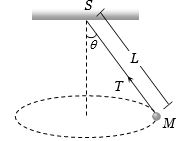
$A$ string of length $L$ is fixed at one end and carries a mass $M$ at the other end. The string makes $2/\pi$ revolutions per second around the vertical axis through the fixed end as shown in the figure,then the tension in the string is:
A
$ML$
B
$2 \,ML$
C
$4\, ML$
D
$16 \,ML$
Solution
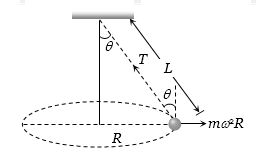
(D) For a conical pendulum,the forces acting on the mass $M$ are the tension $T$ in the string and its weight $Mg$.
Resolving the tension $T$ into horizontal and vertical components:
$T \sin \theta = M \omega^2 R$ (Centripetal force equation) ... $(i)$
$T \cos \theta = Mg$ (Vertical equilibrium) ... (ii)
From the geometry,the radius of the circular path is $R = L \sin \theta$.
Substituting $R$ into equation $(i)$:
$T \sin \theta = M \omega^2 (L \sin \theta)$
$T = M \omega^2 L$
Given the frequency $n = 2/\pi$ revolutions per second,the angular velocity is $\omega = 2 \pi n = 2 \pi (2/\pi) = 4 \text{ rad/s}$.
Substituting $\omega = 4$ into the expression for tension:
$T = M (4)^2 L = 16 ML$.
Resolving the tension $T$ into horizontal and vertical components:
$T \sin \theta = M \omega^2 R$ (Centripetal force equation) ... $(i)$
$T \cos \theta = Mg$ (Vertical equilibrium) ... (ii)
From the geometry,the radius of the circular path is $R = L \sin \theta$.
Substituting $R$ into equation $(i)$:
$T \sin \theta = M \omega^2 (L \sin \theta)$
$T = M \omega^2 L$
Given the frequency $n = 2/\pi$ revolutions per second,the angular velocity is $\omega = 2 \pi n = 2 \pi (2/\pi) = 4 \text{ rad/s}$.
Substituting $\omega = 4$ into the expression for tension:
$T = M (4)^2 L = 16 ML$.
0 likesView Solution
2
ChemistryMCQMHT CET · 2022
$A$ $4 \, kg$ mass and a $1 \, kg$ mass are moving with equal kinetic energies. The ratio of the magnitudes of their linear momenta is
A
$1:2$
B
$1:1$
C
$2:1$
D
$4:1$
Solution
(C) The relationship between linear momentum $P$,mass $m$,and kinetic energy $E$ is given by the formula $P = \sqrt{2mE}$.
Since the kinetic energies $E$ are equal for both masses,we can write the ratio of their momenta as:
$\frac{P_1}{P_2} = \frac{\sqrt{2m_1E}}{\sqrt{2m_2E}} = \sqrt{\frac{m_1}{m_2}}$.
Given $m_1 = 4 \, kg$ and $m_2 = 1 \, kg$,we substitute these values into the equation:
$\frac{P_1}{P_2} = \sqrt{\frac{4}{1}} = \sqrt{4} = 2$.
Therefore,the ratio of the magnitudes of their linear momenta is $2:1$.
Since the kinetic energies $E$ are equal for both masses,we can write the ratio of their momenta as:
$\frac{P_1}{P_2} = \frac{\sqrt{2m_1E}}{\sqrt{2m_2E}} = \sqrt{\frac{m_1}{m_2}}$.
Given $m_1 = 4 \, kg$ and $m_2 = 1 \, kg$,we substitute these values into the equation:
$\frac{P_1}{P_2} = \sqrt{\frac{4}{1}} = \sqrt{4} = 2$.
Therefore,the ratio of the magnitudes of their linear momenta is $2:1$.
0 likesView Solution
3
ChemistryMCQMHT CET · 2022
The amount of work done in blowing a soap bubble such that its diameter increases from $d$ to $D$ is ($T=$ surface tension of the solution)
A
$4\pi (D^2 - d^2)T$
B
$8\pi (D^2 - d^2)T$
C
$\pi (D^2 - d^2)T$
D
$2\pi (D^2 - d^2)T$
Solution
(D) soap bubble has two surfaces (inner and outer),so the change in surface area is $2 \times 4\pi (R_2^2 - R_1^2)$.
Given the initial diameter is $d$,the initial radius is $r_1 = d/2$. The final diameter is $D$,so the final radius is $r_2 = D/2$.
The change in surface area $\Delta A = 2 \times 4\pi (r_2^2 - r_1^2) = 8\pi \left( \frac{D^2}{4} - \frac{d^2}{4} \right)$.
Simplifying this,we get $\Delta A = 2\pi (D^2 - d^2)$.
The work done $W$ is given by $W = T \times \Delta A$.
Therefore,$W = T \times 2\pi (D^2 - d^2) = 2\pi (D^2 - d^2)T$.
Given the initial diameter is $d$,the initial radius is $r_1 = d/2$. The final diameter is $D$,so the final radius is $r_2 = D/2$.
The change in surface area $\Delta A = 2 \times 4\pi (r_2^2 - r_1^2) = 8\pi \left( \frac{D^2}{4} - \frac{d^2}{4} \right)$.
Simplifying this,we get $\Delta A = 2\pi (D^2 - d^2)$.
The work done $W$ is given by $W = T \times \Delta A$.
Therefore,$W = T \times 2\pi (D^2 - d^2) = 2\pi (D^2 - d^2)T$.
0 likesView Solution
4
ChemistryMCQMHT CET · 2022
Two sound waves of slightly different frequencies propagating in the same direction produce beats due to
A
Interference
B
Diffraction
C
Polarization
D
Refraction
Solution
(A) Beats are a phenomenon that occurs due to the superposition of two sound waves of slightly different frequencies traveling in the same direction.
When these waves overlap,they undergo the principle of superposition,which is a specific case of interference.
As the waves move in and out of phase,the resultant amplitude varies periodically,leading to the phenomenon known as beats.
When these waves overlap,they undergo the principle of superposition,which is a specific case of interference.
As the waves move in and out of phase,the resultant amplitude varies periodically,leading to the phenomenon known as beats.
0 likesView Solution
5
ChemistryMCQMHT CET · 2022
The force between the plates of a parallel plate capacitor of capacitance $C$ and distance of separation of the plates $d$ with a potential difference $V$ between the plates,is
A
$\frac{CV^2}{2d}$
B
$\frac{C^2V^2}{2d^2}$
C
$\frac{C^2V^2}{d^2}$
D
$\frac{V^2d}{C}$
Solution
(A) The total electric field between the plates of a parallel plate capacitor is given by $E = \frac{V}{d}$.
The electric field produced by one plate alone is half of the total electric field,which is $E_1 = \frac{E}{2} = \frac{V}{2d}$.
The charge on the plate is $Q = CV$.
The force $F$ exerted by one plate on the other is given by the product of the charge on one plate and the electric field due to the other plate:
$F = Q \times E_1 = (CV) \times \left( \frac{V}{2d} \right) = \frac{CV^2}{2d}$.
The electric field produced by one plate alone is half of the total electric field,which is $E_1 = \frac{E}{2} = \frac{V}{2d}$.
The charge on the plate is $Q = CV$.
The force $F$ exerted by one plate on the other is given by the product of the charge on one plate and the electric field due to the other plate:
$F = Q \times E_1 = (CV) \times \left( \frac{V}{2d} \right) = \frac{CV^2}{2d}$.
0 likesView Solution
6
ChemistryMCQMHT CET · 2022
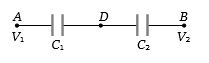
Two capacitors $C_1$ and $C_2$ in a circuit are joined as shown in the figure. The potential of point $A$ is $V_1$ and that of $B$ is $V_2$. The potential of point $D$ will be
A
$\frac{1}{2}(V_1 + V_2)$
B
$\frac{C_2V_1 + C_1V_2}{C_1 + C_2}$
C
$\frac{C_1V_1 + C_2V_2}{C_1 + C_2}$
D
$\frac{C_2V_1 - C_1V_2}{C_1 + C_2}$
Solution
(C) Since the capacitors $C_1$ and $C_2$ are connected in series,the charge $Q$ on both capacitors must be the same.
Let $V_D$ be the potential at point $D$.
The charge on capacitor $C_1$ is $Q = C_1(V_A - V_D) = C_1(V_1 - V_D)$.
The charge on capacitor $C_2$ is $Q = C_2(V_D - V_B) = C_2(V_D - V_2)$.
Equating the charges: $C_1(V_1 - V_D) = C_2(V_D - V_2)$.
Expanding the terms: $C_1V_1 - C_1V_D = C_2V_D - C_2V_2$.
Rearranging to solve for $V_D$: $C_1V_1 + C_2V_2 = V_D(C_1 + C_2)$.
Therefore,$V_D = \frac{C_1V_1 + C_2V_2}{C_1 + C_2}$.
Let $V_D$ be the potential at point $D$.
The charge on capacitor $C_1$ is $Q = C_1(V_A - V_D) = C_1(V_1 - V_D)$.
The charge on capacitor $C_2$ is $Q = C_2(V_D - V_B) = C_2(V_D - V_2)$.
Equating the charges: $C_1(V_1 - V_D) = C_2(V_D - V_2)$.
Expanding the terms: $C_1V_1 - C_1V_D = C_2V_D - C_2V_2$.
Rearranging to solve for $V_D$: $C_1V_1 + C_2V_2 = V_D(C_1 + C_2)$.
Therefore,$V_D = \frac{C_1V_1 + C_2V_2}{C_1 + C_2}$.
0 likesView Solution
7
ChemistryMCQMHT CET · 2022
The frequency for which a $5\,\mu F$ capacitor has a reactance of $\frac{1}{1000}\,\Omega$ is given by
A
$\frac{100}{\pi}\,MHz$
B
$\frac{1000}{\pi}\,Hz$
C
$\frac{1}{1000}\,Hz$
D
$1000\,Hz$
Solution
(A) The capacitive reactance $X_C$ is given by the formula $X_C = \frac{1}{2\pi \nu C}$.
Given $X_C = \frac{1}{1000}\,\Omega$ and $C = 5\,\mu F = 5 \times 10^{-6}\,F$.
Substituting the values into the formula:
$\frac{1}{1000} = \frac{1}{2\pi \times \nu \times 5 \times 10^{-6}}$
$2\pi \times \nu \times 5 \times 10^{-6} = 1000$
$10\pi \times \nu \times 10^{-6} = 10^3$
$\nu = \frac{10^3}{10\pi \times 10^{-6}} = \frac{10^2}{\pi \times 10^{-6}} = \frac{10^8}{\pi}\,Hz$.
Converting to $MHz$ $(1\,MHz = 10^6\,Hz)$:
$\nu = \frac{10^8}{\pi} \times 10^{-6}\,MHz = \frac{100}{\pi}\,MHz$.
Given $X_C = \frac{1}{1000}\,\Omega$ and $C = 5\,\mu F = 5 \times 10^{-6}\,F$.
Substituting the values into the formula:
$\frac{1}{1000} = \frac{1}{2\pi \times \nu \times 5 \times 10^{-6}}$
$2\pi \times \nu \times 5 \times 10^{-6} = 1000$
$10\pi \times \nu \times 10^{-6} = 10^3$
$\nu = \frac{10^3}{10\pi \times 10^{-6}} = \frac{10^2}{\pi \times 10^{-6}} = \frac{10^8}{\pi}\,Hz$.
Converting to $MHz$ $(1\,MHz = 10^6\,Hz)$:
$\nu = \frac{10^8}{\pi} \times 10^{-6}\,MHz = \frac{100}{\pi}\,MHz$.
0 likesView Solution
8
ChemistryMCQMHT CET · 2022
At room temperature,a $P-$ type semiconductor has
A
Large number of holes and few electrons
B
Large number of free electrons and few holes
C
Equal number of free electrons and holes
D
No electrons or holes
Solution
(A) In a $P-$ type semiconductor,the material is doped with trivalent impurity atoms.
This creates a large number of holes,which act as the majority charge carriers.
Thermal excitation at room temperature generates a small number of free electrons,which act as the minority charge carriers.
Therefore,a $P-$ type semiconductor has a large number of holes and few electrons.
This creates a large number of holes,which act as the majority charge carriers.
Thermal excitation at room temperature generates a small number of free electrons,which act as the minority charge carriers.
Therefore,a $P-$ type semiconductor has a large number of holes and few electrons.
0 likesView Solution
9
ChemistryMCQMHT CET · 2022
The minimum distance between an object and its real image formed by a convex lens is (in $f$)
A
$1.5$
B
$2$
C
$2.5$
D
$4$
Solution
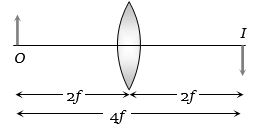
(D) Let the distance of the object from the convex lens be $u$ and the distance of the real image be $v$. Both $u$ and $v$ are positive in magnitude. The total distance $D$ between the object and the image is $D = u + v$.
From the lens formula,$\frac{1}{f} = \frac{1}{v} - \frac{1}{u}$. Using sign convention,$u$ is negative,so $\frac{1}{f} = \frac{1}{v} - \frac{1}{-u} = \frac{1}{v} + \frac{1}{u}$.
Thus,$v = \frac{uf}{u-f}$.
The total distance is $D = u + \frac{uf}{u-f} = \frac{u^2 - uf + uf}{u-f} = \frac{u^2}{u-f}$.
To find the minimum distance,we differentiate $D$ with respect to $u$ and set it to zero: $\frac{dD}{du} = \frac{(u-f)(2u) - u^2(1)}{(u-f)^2} = 0$.
$2u^2 - 2uf - u^2 = 0 \implies u^2 - 2uf = 0 \implies u = 2f$.
Substituting $u = 2f$ into the expression for $v$,we get $v = \frac{2f \cdot f}{2f - f} = 2f$.
Therefore,the minimum distance $D = u + v = 2f + 2f = 4f$.
From the lens formula,$\frac{1}{f} = \frac{1}{v} - \frac{1}{u}$. Using sign convention,$u$ is negative,so $\frac{1}{f} = \frac{1}{v} - \frac{1}{-u} = \frac{1}{v} + \frac{1}{u}$.
Thus,$v = \frac{uf}{u-f}$.
The total distance is $D = u + \frac{uf}{u-f} = \frac{u^2 - uf + uf}{u-f} = \frac{u^2}{u-f}$.
To find the minimum distance,we differentiate $D$ with respect to $u$ and set it to zero: $\frac{dD}{du} = \frac{(u-f)(2u) - u^2(1)}{(u-f)^2} = 0$.
$2u^2 - 2uf - u^2 = 0 \implies u^2 - 2uf = 0 \implies u = 2f$.
Substituting $u = 2f$ into the expression for $v$,we get $v = \frac{2f \cdot f}{2f - f} = 2f$.
Therefore,the minimum distance $D = u + v = 2f + 2f = 4f$.
0 likesView Solution
10
ChemistryMCQMHT CET · 2022
The value of $\frac{i^{592} + i^{590} + i^{588} + i^{586} + i^{584}}{i^{582} + i^{580} + i^{578} + i^{576} + i^{574}} - 1 = $
A
$-1$
B
$-2$
C
$-3$
D
$-4$
Solution
(B) Given expression: $\frac{i^{592} + i^{590} + i^{588} + i^{586} + i^{584}}{i^{582} + i^{580} + i^{578} + i^{576} + i^{574}} - 1$
Factor out $i^{584}$ from the numerator and $i^{574}$ from the denominator:
$= \frac{i^{584}(i^8 + i^6 + i^4 + i^2 + 1)}{i^{574}(i^8 + i^6 + i^4 + i^2 + 1)} - 1$
$= \frac{i^{584}}{i^{574}} - 1$
$= i^{584-574} - 1$
$= i^{10} - 1$
Since $i^2 = -1$,then $i^{10} = (i^2)^5 = (-1)^5 = -1$.
$= -1 - 1 = -2$.
Factor out $i^{584}$ from the numerator and $i^{574}$ from the denominator:
$= \frac{i^{584}(i^8 + i^6 + i^4 + i^2 + 1)}{i^{574}(i^8 + i^6 + i^4 + i^2 + 1)} - 1$
$= \frac{i^{584}}{i^{574}} - 1$
$= i^{584-574} - 1$
$= i^{10} - 1$
Since $i^2 = -1$,then $i^{10} = (i^2)^5 = (-1)^5 = -1$.
$= -1 - 1 = -2$.
0 likesView Solution
11
ChemistryMCQMHT CET · 2022
If $\alpha$ and $\beta$ are imaginary cube roots of unity,then the value of $\alpha^4 + \beta^{28} + \frac{1}{\alpha\beta}$ is:
A
$1$
B
$-1$
C
$0$
D
None of these
Solution
(C) Since $\alpha$ and $\beta$ are the imaginary cube roots of unity,we can write $\alpha = \omega$ and $\beta = \omega^2$ (or vice versa).
Given expression: $\alpha^4 + \beta^{28} + \frac{1}{\alpha\beta}$.
Substituting the values: $\omega^4 + (\omega^2)^{28} + \frac{1}{\omega \cdot \omega^2}$.
Using the properties $\omega^3 = 1$ and $1 + \omega + \omega^2 = 0$:
$\omega^4 = \omega^3 \cdot \omega = 1 \cdot \omega = \omega$.
$\beta^{28} = (\omega^2)^{28} = \omega^{56} = \omega^{54} \cdot \omega^2 = (\omega^3)^{18} \cdot \omega^2 = 1^{18} \cdot \omega^2 = \omega^2$.
$\frac{1}{\alpha\beta} = \frac{1}{\omega \cdot \omega^2} = \frac{1}{\omega^3} = \frac{1}{1} = 1$.
Therefore,$\alpha^4 + \beta^{28} + \frac{1}{\alpha\beta} = \omega + \omega^2 + 1 = 0$.
Given expression: $\alpha^4 + \beta^{28} + \frac{1}{\alpha\beta}$.
Substituting the values: $\omega^4 + (\omega^2)^{28} + \frac{1}{\omega \cdot \omega^2}$.
Using the properties $\omega^3 = 1$ and $1 + \omega + \omega^2 = 0$:
$\omega^4 = \omega^3 \cdot \omega = 1 \cdot \omega = \omega$.
$\beta^{28} = (\omega^2)^{28} = \omega^{56} = \omega^{54} \cdot \omega^2 = (\omega^3)^{18} \cdot \omega^2 = 1^{18} \cdot \omega^2 = \omega^2$.
$\frac{1}{\alpha\beta} = \frac{1}{\omega \cdot \omega^2} = \frac{1}{\omega^3} = \frac{1}{1} = 1$.
Therefore,$\alpha^4 + \beta^{28} + \frac{1}{\alpha\beta} = \omega + \omega^2 + 1 = 0$.
0 likesView Solution
12
ChemistryMCQMHT CET · 2022
If $y = \tan^{-1}(\sec x - \tan x)$,then $\frac{dy}{dx} = $
A
$2$
B
$-0.5$
C
$\frac{1}{2}$
D
$-2$
Solution
(B) Given $y = \tan^{-1}(\sec x - \tan x)$.
First,simplify the expression inside the inverse tangent function:
$\sec x - \tan x = \frac{1}{\cos x} - \frac{\sin x}{\cos x} = \frac{1 - \sin x}{\cos x}$.
Using the half-angle identities $1 - \sin x = (\cos \frac{x}{2} - \sin \frac{x}{2})^2$ and $\cos x = \cos^2 \frac{x}{2} - \sin^2 \frac{x}{2} = (\cos \frac{x}{2} - \sin \frac{x}{2})(\cos \frac{x}{2} + \sin \frac{x}{2})$:
$\frac{1 - \sin x}{\cos x} = \frac{(\cos \frac{x}{2} - \sin \frac{x}{2})^2}{(\cos \frac{x}{2} - \sin \frac{x}{2})(\cos \frac{x}{2} + \sin \frac{x}{2})} = \frac{\cos \frac{x}{2} - \sin \frac{x}{2}}{\cos \frac{x}{2} + \sin \frac{x}{2}}$.
Dividing numerator and denominator by $\cos \frac{x}{2}$,we get $\frac{1 - \tan \frac{x}{2}}{1 + \tan \frac{x}{2}} = \tan(\frac{\pi}{4} - \frac{x}{2})$.
Thus,$y = \tan^{-1}(\tan(\frac{\pi}{4} - \frac{x}{2})) = \frac{\pi}{4} - \frac{x}{2}$.
Differentiating with respect to $x$:
$\frac{dy}{dx} = \frac{d}{dx}(\frac{\pi}{4} - \frac{x}{2}) = 0 - \frac{1}{2} = -\frac{1}{2} = -0.5$.
First,simplify the expression inside the inverse tangent function:
$\sec x - \tan x = \frac{1}{\cos x} - \frac{\sin x}{\cos x} = \frac{1 - \sin x}{\cos x}$.
Using the half-angle identities $1 - \sin x = (\cos \frac{x}{2} - \sin \frac{x}{2})^2$ and $\cos x = \cos^2 \frac{x}{2} - \sin^2 \frac{x}{2} = (\cos \frac{x}{2} - \sin \frac{x}{2})(\cos \frac{x}{2} + \sin \frac{x}{2})$:
$\frac{1 - \sin x}{\cos x} = \frac{(\cos \frac{x}{2} - \sin \frac{x}{2})^2}{(\cos \frac{x}{2} - \sin \frac{x}{2})(\cos \frac{x}{2} + \sin \frac{x}{2})} = \frac{\cos \frac{x}{2} - \sin \frac{x}{2}}{\cos \frac{x}{2} + \sin \frac{x}{2}}$.
Dividing numerator and denominator by $\cos \frac{x}{2}$,we get $\frac{1 - \tan \frac{x}{2}}{1 + \tan \frac{x}{2}} = \tan(\frac{\pi}{4} - \frac{x}{2})$.
Thus,$y = \tan^{-1}(\tan(\frac{\pi}{4} - \frac{x}{2})) = \frac{\pi}{4} - \frac{x}{2}$.
Differentiating with respect to $x$:
$\frac{dy}{dx} = \frac{d}{dx}(\frac{\pi}{4} - \frac{x}{2}) = 0 - \frac{1}{2} = -\frac{1}{2} = -0.5$.
0 likesView Solution
13
ChemistryMCQMHT CET · 2022
$\int_{0}^{2\pi} (\sin x + |\sin x|) \, dx = $
A
$0$
B
$4$
C
$8$
D
$1$
Solution
(B) We evaluate the integral $I = \int_{0}^{2\pi} (\sin x + |\sin x|) \, dx$.
Since $|\sin x| = \sin x$ for $x \in [0, \pi]$ and $|\sin x| = -\sin x$ for $x \in [\pi, 2\pi]$,we split the integral:
$I = \int_{0}^{\pi} (\sin x + \sin x) \, dx + \int_{\pi}^{2\pi} (\sin x - \sin x) \, dx$
$I = \int_{0}^{\pi} 2\sin x \, dx + \int_{\pi}^{2\pi} 0 \, dx$
$I = 2 [-\cos x]_{0}^{\pi} + 0$
$I = -2 (\cos \pi - \cos 0)$
$I = -2 (-1 - 1) = -2(-2) = 4$.
Since $|\sin x| = \sin x$ for $x \in [0, \pi]$ and $|\sin x| = -\sin x$ for $x \in [\pi, 2\pi]$,we split the integral:
$I = \int_{0}^{\pi} (\sin x + \sin x) \, dx + \int_{\pi}^{2\pi} (\sin x - \sin x) \, dx$
$I = \int_{0}^{\pi} 2\sin x \, dx + \int_{\pi}^{2\pi} 0 \, dx$
$I = 2 [-\cos x]_{0}^{\pi} + 0$
$I = -2 (\cos \pi - \cos 0)$
$I = -2 (-1 - 1) = -2(-2) = 4$.
0 likesView Solution
14
ChemistryMCQMHT CET · 2022
$A$ uniform rod $AB$ of mass $m$ and length $l$ is at rest on a smooth horizontal surface. An impulse $P$ is applied to the end $B$. The time taken by the rod to turn through a right angle is
A
$2\pi \frac{ml}{P}$
B
$2\pi \frac{P}{ml}$
C
$\frac{\pi}{12} \frac{ml}{P}$
D
$\frac{\pi P}{ml}$
Solution
(C) The impulse applied is $P = F \times \Delta t$.
Angular impulse about the center of mass is given by $J_{\theta} = P \times \frac{l}{2}$.
Since angular impulse equals the change in angular momentum,we have $P \times \frac{l}{2} = I \omega$,where $I = \frac{ml^2}{12}$ is the moment of inertia about the center of mass.
Thus,$P \times \frac{l}{2} = \frac{ml^2}{12} \omega$,which simplifies to $\omega = \frac{6P}{ml}$.
The rod rotates with a constant angular velocity $\omega$ after the impulse. The time taken to turn through a right angle ($\pi/2$ radians) is $t = \frac{\theta}{\omega} = \frac{\pi/2}{\omega}$.
Substituting $\omega$,we get $t = \frac{\pi/2}{6P/ml} = \frac{\pi ml}{12P}$.
Angular impulse about the center of mass is given by $J_{\theta} = P \times \frac{l}{2}$.
Since angular impulse equals the change in angular momentum,we have $P \times \frac{l}{2} = I \omega$,where $I = \frac{ml^2}{12}$ is the moment of inertia about the center of mass.
Thus,$P \times \frac{l}{2} = \frac{ml^2}{12} \omega$,which simplifies to $\omega = \frac{6P}{ml}$.
The rod rotates with a constant angular velocity $\omega$ after the impulse. The time taken to turn through a right angle ($\pi/2$ radians) is $t = \frac{\theta}{\omega} = \frac{\pi/2}{\omega}$.
Substituting $\omega$,we get $t = \frac{\pi/2}{6P/ml} = \frac{\pi ml}{12P}$.
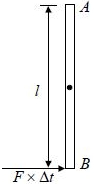
0 likesView Solution
15
ChemistryMCQMHT CET · 2022
The negation of $\sim s \vee (\sim r \wedge s)$ is equivalent to
A
$s \wedge \sim r$
B
$s \wedge (r \wedge \sim s)$
C
$s \vee (r \vee \sim s)$
D
$s \wedge r$
Solution
(D) We need to find the negation of the expression $\sim s \vee (\sim r \wedge s)$.
Using De Morgan's Law,$\sim (p \vee q) \equiv \sim p \wedge \sim q$:
$\sim (\sim s \vee (\sim r \wedge s)) \equiv \sim (\sim s) \wedge \sim (\sim r \wedge s)$
Using the Double Negation Law,$\sim (\sim s) \equiv s$:
$\equiv s \wedge \sim (\sim r \wedge s)$
Applying De Morgan's Law again,$\sim (p \wedge q) \equiv \sim p \vee \sim q$:
$\equiv s \wedge (\sim (\sim r) \vee \sim s)$
Using the Double Negation Law,$\sim (\sim r) \equiv r$:
$\equiv s \wedge (r \vee \sim s)$
Using the Distributive Law,$p \wedge (q \vee r) \equiv (p \wedge q) \vee (p \wedge r)$:
$\equiv (s \wedge r) \vee (s \wedge \sim s)$
Since $s \wedge \sim s \equiv F$ (Contradiction Law):
$\equiv (s \wedge r) \vee F$
Using the Identity Law,$p \vee F \equiv p$:
$\equiv s \wedge r$
Using De Morgan's Law,$\sim (p \vee q) \equiv \sim p \wedge \sim q$:
$\sim (\sim s \vee (\sim r \wedge s)) \equiv \sim (\sim s) \wedge \sim (\sim r \wedge s)$
Using the Double Negation Law,$\sim (\sim s) \equiv s$:
$\equiv s \wedge \sim (\sim r \wedge s)$
Applying De Morgan's Law again,$\sim (p \wedge q) \equiv \sim p \vee \sim q$:
$\equiv s \wedge (\sim (\sim r) \vee \sim s)$
Using the Double Negation Law,$\sim (\sim r) \equiv r$:
$\equiv s \wedge (r \vee \sim s)$
Using the Distributive Law,$p \wedge (q \vee r) \equiv (p \wedge q) \vee (p \wedge r)$:
$\equiv (s \wedge r) \vee (s \wedge \sim s)$
Since $s \wedge \sim s \equiv F$ (Contradiction Law):
$\equiv (s \wedge r) \vee F$
Using the Identity Law,$p \vee F \equiv p$:
$\equiv s \wedge r$
0 likesView Solution
16
ChemistryMCQMHT CET · 2022
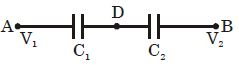
Two capacitors $C_1$ and $C_2$ in a circuit are joined as shown in the figure. The potential of point $A$ is $V_1$ and that of $B$ is $V_2$. The potential of point $D$ will be
A
$\frac{1}{2} (V_1 + V_2)$
B
$\frac{C_2 V_1 + C_1 V_2}{C_1 + C_2}$
C
$\frac{C_1 V_1 + C_2 V_2}{C_1 + C_2}$
D
$\frac{C_2 V_1 - C_1 V_2}{C_1 + C_2}$
Solution
(C) The capacitors $C_1$ and $C_2$ are connected in series between points $A$ and $B$.
Let $V_D$ be the potential at point $D$.
The charge $q$ on both capacitors must be the same because they are in series.
The potential difference across $C_1$ is $V_1 - V_D = \frac{q}{C_1}$.
The potential difference across $C_2$ is $V_D - V_2 = \frac{q}{C_2}$.
From these,we have $q = C_1(V_1 - V_D) = C_2(V_D - V_2)$.
Expanding this,$C_1 V_1 - C_1 V_D = C_2 V_D - C_2 V_2$.
Rearranging to solve for $V_D$,we get $C_1 V_1 + C_2 V_2 = V_D(C_1 + C_2)$.
Therefore,$V_D = \frac{C_1 V_1 + C_2 V_2}{C_1 + C_2}$.
Let $V_D$ be the potential at point $D$.
The charge $q$ on both capacitors must be the same because they are in series.
The potential difference across $C_1$ is $V_1 - V_D = \frac{q}{C_1}$.
The potential difference across $C_2$ is $V_D - V_2 = \frac{q}{C_2}$.
From these,we have $q = C_1(V_1 - V_D) = C_2(V_D - V_2)$.
Expanding this,$C_1 V_1 - C_1 V_D = C_2 V_D - C_2 V_2$.
Rearranging to solve for $V_D$,we get $C_1 V_1 + C_2 V_2 = V_D(C_1 + C_2)$.
Therefore,$V_D = \frac{C_1 V_1 + C_2 V_2}{C_1 + C_2}$.
0 likesView Solution
17
ChemistryMCQMHT CET · 2022
If $R$ is the universal gas constant,the amount of heat needed to raise the temperature of $2 \, mol$ of an ideal monatomic gas from $273 \, K$ to $373 \, K$ when no work is done is: (in $, R$)
A
$100$
B
$150$
C
$300$
D
$500$
Solution
(C) When no work is done,the process is isochoric (constant volume).
For an ideal monatomic gas,the molar heat capacity at constant volume is $C_V = \frac{3}{2} R$.
The amount of heat required is given by the formula $\Delta Q = n C_V \Delta T$.
Given: $n = 2 \, mol$,$\Delta T = 373 \, K - 273 \, K = 100 \, K$.
Substituting the values:
$\Delta Q = 2 \times \left( \frac{3}{2} R \right) \times 100$
$\Delta Q = 3 \times 100 \times R = 300 \, R$.
For an ideal monatomic gas,the molar heat capacity at constant volume is $C_V = \frac{3}{2} R$.
The amount of heat required is given by the formula $\Delta Q = n C_V \Delta T$.
Given: $n = 2 \, mol$,$\Delta T = 373 \, K - 273 \, K = 100 \, K$.
Substituting the values:
$\Delta Q = 2 \times \left( \frac{3}{2} R \right) \times 100$
$\Delta Q = 3 \times 100 \times R = 300 \, R$.
0 likesView Solution
18
ChemistryMCQMHT CET · 2022
An $AC$ voltage source of variable angular frequency $\omega$ and fixed amplitude $V_0$ is connected in series with a capacitance $C$ and an electric bulb of resistance $R$ (inductance zero). When $\omega$ is increased:
A
The bulb glows dimmer
B
The bulb glows brighter
C
Total impedance of the circuit is unchanged
D
Total impedance of the circuit increases
Solution
(B) The impedance $Z$ of the $RC$ series circuit is given by $Z = \sqrt{R^2 + X_C^2}$,where $X_C = \frac{1}{\omega C}$ is the capacitive reactance.
As the angular frequency $\omega$ increases,the capacitive reactance $X_C = \frac{1}{\omega C}$ decreases.
Since $Z = \sqrt{R^2 + X_C^2}$,a decrease in $X_C$ leads to a decrease in the total impedance $Z$ of the circuit.
The rms current in the circuit is given by $I_{rms} = \frac{V_{rms}}{Z}$. As $Z$ decreases,$I_{rms}$ increases.
The power dissipated by the bulb is $P = I_{rms}^2 R$. Since $I_{rms}$ increases,the power $P$ increases,which means the bulb glows brighter.
As the angular frequency $\omega$ increases,the capacitive reactance $X_C = \frac{1}{\omega C}$ decreases.
Since $Z = \sqrt{R^2 + X_C^2}$,a decrease in $X_C$ leads to a decrease in the total impedance $Z$ of the circuit.
The rms current in the circuit is given by $I_{rms} = \frac{V_{rms}}{Z}$. As $Z$ decreases,$I_{rms}$ increases.
The power dissipated by the bulb is $P = I_{rms}^2 R$. Since $I_{rms}$ increases,the power $P$ increases,which means the bulb glows brighter.
0 likesView Solution
19
ChemistryMCQMHT CET · 2022
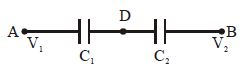
Two capacitors $C_1$ and $C_2$ in a circuit are joined as shown in the figure. The potential of point $A$ is $V_1$ and that of $B$ is $V_2$. The potential of point $D$ will be
A
$\frac{1}{2}(V_1 + V_2)$
B
$\frac{C_2V_1 + C_1V_2}{C_1 + C_2}$
C
$\frac{C_1V_1 + C_2V_2}{C_1 + C_2}$
D
$\frac{C_2V_1 - C_1V_2}{C_1 + C_2}$
Solution
(C) Since $C_1$ and $C_2$ are connected in series,the charge on $C_1$ must be equal to the charge on $C_2$ because the junction $D$ is isolated.
Let $V_D$ be the potential at point $D$.
The charge on capacitor $C_1$ is $Q_1 = C_1(V_1 - V_D)$.
The charge on capacitor $C_2$ is $Q_2 = C_2(V_D - V_2)$.
Since $Q_1 = Q_2$,we have:
$C_1(V_1 - V_D) = C_2(V_D - V_2)$
$C_1V_1 - C_1V_D = C_2V_D - C_2V_2$
$C_1V_1 + C_2V_2 = V_D(C_1 + C_2)$
$V_D = \frac{C_1V_1 + C_2V_2}{C_1 + C_2}$
Let $V_D$ be the potential at point $D$.
The charge on capacitor $C_1$ is $Q_1 = C_1(V_1 - V_D)$.
The charge on capacitor $C_2$ is $Q_2 = C_2(V_D - V_2)$.
Since $Q_1 = Q_2$,we have:
$C_1(V_1 - V_D) = C_2(V_D - V_2)$
$C_1V_1 - C_1V_D = C_2V_D - C_2V_2$
$C_1V_1 + C_2V_2 = V_D(C_1 + C_2)$
$V_D = \frac{C_1V_1 + C_2V_2}{C_1 + C_2}$
0 likesView Solution
20
ChemistryMCQMHT CET · 2022
If $R$ is the universal gas constant,the amount of heat needed to raise the temperature of $2\, mol$ of an ideal monoatomic gas from $273\, K$ to $373\, K$ when no work is done is: (in $,R$)
A
$100$
B
$150$
C
$300$
D
$500$
Solution
(C) The process is isochoric because no work is done $(W = 0)$.
For an isochoric process,the heat supplied is equal to the change in internal energy: $\Delta Q = \Delta U = n C_v \Delta T$.
For a monoatomic gas,the molar heat capacity at constant volume is $C_v = \frac{3}{2}R$.
Given: $n = 2\, mol$,$\Delta T = 373\, K - 273\, K = 100\, K$.
Substituting the values:
$\Delta Q = 2 \times \frac{3R}{2} \times 100 = 300\,R$.
For an isochoric process,the heat supplied is equal to the change in internal energy: $\Delta Q = \Delta U = n C_v \Delta T$.
For a monoatomic gas,the molar heat capacity at constant volume is $C_v = \frac{3}{2}R$.
Given: $n = 2\, mol$,$\Delta T = 373\, K - 273\, K = 100\, K$.
Substituting the values:
$\Delta Q = 2 \times \frac{3R}{2} \times 100 = 300\,R$.
0 likesView Solution
21
ChemistryMCQMHT CET · 2022
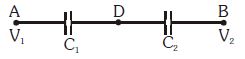
Two capacitors $C_1$ and $C_2$ in a circuit are joined as shown in the figure. The potential of point $A$ is $V_1$ and that of $B$ is $V_2$. The potential of point $D$ will be
A
$\frac{1}{2}(V_1 + V_2)$
B
$\frac{C_2 V_1 + C_1 V_2}{C_1 + C_2}$
C
$\frac{C_1 V_1 + C_2 V_2}{C_1 + C_2}$
D
$\frac{C_2 V_1 - C_1 V_2}{C_1 + C_2}$
Solution
(C) The capacitors $C_1$ and $C_2$ are connected in series between points $A$ and $B$.
Since they are in series,the charge $Q$ on both capacitors must be the same.
Let $V_D$ be the potential at point $D$.
The potential difference across $C_1$ is $(V_1 - V_D)$ and across $C_2$ is $(V_D - V_2)$.
Since $Q = C_1(V_1 - V_D) = C_2(V_D - V_2)$,
$C_1 V_1 - C_1 V_D = C_2 V_D - C_2 V_2$
$C_1 V_1 + C_2 V_2 = V_D(C_1 + C_2)$
$V_D = \frac{C_1 V_1 + C_2 V_2}{C_1 + C_2}$
Since they are in series,the charge $Q$ on both capacitors must be the same.
Let $V_D$ be the potential at point $D$.
The potential difference across $C_1$ is $(V_1 - V_D)$ and across $C_2$ is $(V_D - V_2)$.
Since $Q = C_1(V_1 - V_D) = C_2(V_D - V_2)$,
$C_1 V_1 - C_1 V_D = C_2 V_D - C_2 V_2$
$C_1 V_1 + C_2 V_2 = V_D(C_1 + C_2)$
$V_D = \frac{C_1 V_1 + C_2 V_2}{C_1 + C_2}$
0 likesView Solution
22
ChemistryMCQMHT CET · 2022
Trees and shrubs have . . . . . . in their bark for gaseous exchange.
A
plasmodesmata
B
lenticels
C
stomata
D
hydathodes
Solution
(B) Lenticels are small,raised pores found in the bark of woody stems and roots of trees and shrubs.
These structures allow for the exchange of gases between the internal tissues of the plant and the external atmosphere.
While stomata are primarily found on leaves for gaseous exchange,lenticels serve a similar function in the woody parts of the plant where the epidermis has been replaced by bark (periderm).
These structures allow for the exchange of gases between the internal tissues of the plant and the external atmosphere.
While stomata are primarily found on leaves for gaseous exchange,lenticels serve a similar function in the woody parts of the plant where the epidermis has been replaced by bark (periderm).
0 likesView Solution
23
ChemistryMCQMHT CET · 2022
Which among the following has the highest melting point?
A
$p$-Cresol
B
$p$-Nitrophenol
C
$o$-Nitrophenol
D
Phenol
Solution
(B) The melting point of a compound depends on the strength of intermolecular forces.
$p$-Nitrophenol exhibits strong intermolecular hydrogen bonding,which leads to a crystal lattice structure that is more stable and requires more energy to break.
In contrast,$o$-Nitrophenol exhibits intramolecular hydrogen bonding,which reduces the intermolecular forces.
$p$-Cresol and Phenol have weaker intermolecular forces compared to $p$-Nitrophenol.
Therefore,$p$-Nitrophenol has the highest melting point.
$p$-Nitrophenol exhibits strong intermolecular hydrogen bonding,which leads to a crystal lattice structure that is more stable and requires more energy to break.
In contrast,$o$-Nitrophenol exhibits intramolecular hydrogen bonding,which reduces the intermolecular forces.
$p$-Cresol and Phenol have weaker intermolecular forces compared to $p$-Nitrophenol.
Therefore,$p$-Nitrophenol has the highest melting point.
0 likesView Solution
24
ChemistryEasyMCQMHT CET · 2022
The compound $CH_3-CH=CH-CH_2-OH$ is also called as
A
Crotonyl alcohol
B
Benzenol
C
Ethylene glycol
D
Propylene glycol
Solution
(A) The structure $CH_3-CH=CH-CH_2-OH$ corresponds to the unsaturated alcohol derived from crotonaldehyde.
This compound is commonly known as $Crotonyl \ alcohol$.
This compound is commonly known as $Crotonyl \ alcohol$.
0 likesView Solution
25
ChemistryMCQMHT CET · 2022
Which of the following reagents is used in the Gatterman-Koch formylation of arene?
A
$CO, HCl / AlCl_3$ (anhydrous)
B
$CrO_2Cl_2, CS_2$
C
$CrO_3$
D
$Cl_2 / hv, H_3O^+$
Solution
(A) The Gatterman-Koch reaction is a chemical reaction in which benzene or its derivatives are treated with carbon monoxide $(CO)$ and hydrogen chloride $(HCl)$ in the presence of anhydrous aluminum chloride $(AlCl_3)$ or cuprous chloride $(CuCl)$ to produce benzaldehyde or substituted benzaldehydes. Therefore,the correct reagent is $CO, HCl / AlCl_3$ (anhydrous).
0 likesView Solution
26
ChemistryEasyMCQMHT CET · 2022
Identify product $P$ in the following reaction: $C_2H_5MgBr + NH_3 \rightarrow P$
A
$C_2H_5Br$
B
$HC \equiv CH$
C
$C_2H_6$
D
$H_2C=CH_2$
Solution
(C) The reaction between a Grignard reagent $(C_2H_5MgBr)$ and ammonia $(NH_3)$ is an acid-base reaction.
$NH_3$ acts as a proton donor,and the ethyl group $(C_2H_5^-)$ in the Grignard reagent acts as a base.
$C_2H_5MgBr + NH_3 \rightarrow C_2H_6 + Mg(NH_2)Br$.
Thus,the product $P$ is ethane $(C_2H_6)$.
$NH_3$ acts as a proton donor,and the ethyl group $(C_2H_5^-)$ in the Grignard reagent acts as a base.
$C_2H_5MgBr + NH_3 \rightarrow C_2H_6 + Mg(NH_2)Br$.
Thus,the product $P$ is ethane $(C_2H_6)$.
0 likesView Solution
27
ChemistryEasyMCQMHT CET · 2022
What is the number of moles of water removed from one mole of cane sugar when charred completely using conc. $H_2SO_4$?
A
$1$
B
$11$
C
$4$
D
$2$
Solution
(B) Cane sugar (sucrose) has the chemical formula $C_{12}H_{22}O_{11}$.
When treated with concentrated $H_2SO_4$,it undergoes dehydration.
The chemical reaction is: $C_{12}H_{22}O_{11} \xrightarrow{\text{conc. } H_2SO_4} 12C + 11H_2O$.
From the stoichiometry of the balanced equation,$1 \text{ mole}$ of sucrose yields $11 \text{ moles}$ of water.
When treated with concentrated $H_2SO_4$,it undergoes dehydration.
The chemical reaction is: $C_{12}H_{22}O_{11} \xrightarrow{\text{conc. } H_2SO_4} 12C + 11H_2O$.
From the stoichiometry of the balanced equation,$1 \text{ mole}$ of sucrose yields $11 \text{ moles}$ of water.
0 likesView Solution
28
ChemistryMediumMCQMHT CET · 2022
What is the total number of carbon atoms present in $n$ mole of citric acid (in $n$)?
A
$2$
B
$3$
C
$6$
D
$4$
Solution
(C) The molecular formula of citric acid is $C_6H_8O_7$.
From the structure of citric acid,we can count the number of carbon atoms per molecule.
There are $3$ carboxylic acid groups $(-COOH)$,each containing $1$ carbon atom,and a central carbon chain containing $3$ carbon atoms.
Total number of carbon atoms per molecule $= 3 + 3 = 6$.
Therefore,in $1$ mole of citric acid,there are $6$ moles of carbon atoms.
In $n$ moles of citric acid,the total number of moles of carbon atoms is $6n$.
From the structure of citric acid,we can count the number of carbon atoms per molecule.
There are $3$ carboxylic acid groups $(-COOH)$,each containing $1$ carbon atom,and a central carbon chain containing $3$ carbon atoms.
Total number of carbon atoms per molecule $= 3 + 3 = 6$.
Therefore,in $1$ mole of citric acid,there are $6$ moles of carbon atoms.
In $n$ moles of citric acid,the total number of moles of carbon atoms is $6n$.
0 likesView Solution
29
ChemistryMediumMCQMHT CET · 2022
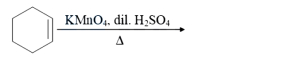
Identify the product in the following reaction.
A
Hexane$-1,6-$dicarboxylic acid with a methyl group
B
Hexane$-1,6-$dicarboxylic acid with a hydroxymethyl group
C
Cyclohexane with two methyl groups
D
Hexane$-1,6-$dioic acid (Adipic acid)
Solution
(D) The reaction of cyclohexene with hot acidic $KMnO_4$ (oxidative cleavage) leads to the breaking of the double bond.
Since the double bond is part of a ring,the ring opens to form a dicarboxylic acid.
The product formed is hexane$-1,6-$dioic acid,commonly known as adipic acid.
Since the double bond is part of a ring,the ring opens to form a dicarboxylic acid.
The product formed is hexane$-1,6-$dioic acid,commonly known as adipic acid.
0 likesView Solution
30
ChemistryEasyMCQMHT CET · 2022
Which among the following concepts is $NOT$ introduced by $V.B.$ Theory?
A
Delocalization of electron over the two nuclei.
B
Shielding effect of electrons.
C
Partial ionic character of a covalent bond.
D
Number of lone pair and bonded pair of electrons decide the shape of the molecules.
Solution
(D) $VBT$ (Valence Bond Theory) explains the formation of covalent bonds through the overlapping of half-filled atomic orbitals.
It accounts for the delocalization of electrons between two nuclei and the partial ionic character of covalent bonds due to electronegativity differences.
The concept that the number of lone pairs and bonded pairs of electrons determines the shape of molecules is introduced by $VSEPR$ (Valence Shell Electron Pair Repulsion) Theory,not $VBT$.
Shielding effect is a concept related to atomic structure and effective nuclear charge,not a primary feature of $VBT$.
It accounts for the delocalization of electrons between two nuclei and the partial ionic character of covalent bonds due to electronegativity differences.
The concept that the number of lone pairs and bonded pairs of electrons determines the shape of molecules is introduced by $VSEPR$ (Valence Shell Electron Pair Repulsion) Theory,not $VBT$.
Shielding effect is a concept related to atomic structure and effective nuclear charge,not a primary feature of $VBT$.
0 likesView Solution
31
ChemistryMediumMCQMHT CET · 2022
Identify the molecule containing a triple bond.
A
Ammonia
B
Dinitrogen
C
Water
D
Methane
Solution
(B) The molecule $N_2$ (Dinitrogen) consists of two nitrogen atoms bonded together by a triple bond. The Lewis structure is represented as $:N \equiv N:$.
0 likesView Solution
32
ChemistryEasyMCQMHT CET · 2022
Identify the molecular geometry of $XeF_4$.
A
Square planar
B
Octahedral
C
Tetrahedral
D
Trigonal planar
Solution
(A) The central atom in $XeF_4$ is Xenon $(Xe)$,which has $8$ valence electrons.
It forms $4$ single bonds with $4$ Fluorine $(F)$ atoms.
This leaves $4$ electrons on the Xenon atom,which form $2$ lone pairs.
The total number of electron pairs (steric number) is $4 \text{ (bond pairs)} + 2 \text{ (lone pairs)} = 6$.
$A$ steric number of $6$ corresponds to $sp^3d^2$ hybridization,which has an octahedral electron geometry.
Due to the presence of $2$ lone pairs,the molecular geometry is square planar.
It forms $4$ single bonds with $4$ Fluorine $(F)$ atoms.
This leaves $4$ electrons on the Xenon atom,which form $2$ lone pairs.
The total number of electron pairs (steric number) is $4 \text{ (bond pairs)} + 2 \text{ (lone pairs)} = 6$.
$A$ steric number of $6$ corresponds to $sp^3d^2$ hybridization,which has an octahedral electron geometry.
Due to the presence of $2$ lone pairs,the molecular geometry is square planar.
0 likesView Solution
33
ChemistryEasyMCQMHT CET · 2022
The $H-C-H$ bond angle in $CH_4$ molecule is
A
$120^{\circ}$
B
$109^{\circ} 28^{\prime}$
C
$107^{\circ}$
D
$104^{\circ} 28^{\prime}$
Solution
(B) $CH_4$ molecule exhibits $sp^3$ hybridization.
In $sp^3$ hybridization,the geometry is tetrahedral.
The bond angle in a regular tetrahedral geometry is $109^{\circ} 28^{\prime}$.
In $sp^3$ hybridization,the geometry is tetrahedral.
The bond angle in a regular tetrahedral geometry is $109^{\circ} 28^{\prime}$.
0 likesView Solution
34
ChemistryMediumMCQMHT CET · 2022
The decreasing order of bond angle in the following molecules is
A
$NH_3 > CH_4 > H_2O$
B
$H_2O > NH_3 > CH_4$
C
$CH_4 > H_2O > NH_3$
D
$CH_4 > NH_3 > H_2O$
Solution
(D) In $CH_4$,the central atom $C$ has $4$ bond pairs and $0$ lone pairs,resulting in a tetrahedral geometry with a bond angle of $109^{\circ} 28'$.
In $NH_3$,the central atom $N$ has $3$ bond pairs and $1$ lone pair,which causes repulsion and reduces the bond angle to $107^{\circ}$.
In $H_2O$,the central atom $O$ has $2$ bond pairs and $2$ lone pairs,leading to greater repulsion and a further reduction in the bond angle to $104.5^{\circ}$.
Therefore,the decreasing order of bond angle is $CH_4 > NH_3 > H_2O$.
In $NH_3$,the central atom $N$ has $3$ bond pairs and $1$ lone pair,which causes repulsion and reduces the bond angle to $107^{\circ}$.
In $H_2O$,the central atom $O$ has $2$ bond pairs and $2$ lone pairs,leading to greater repulsion and a further reduction in the bond angle to $104.5^{\circ}$.
Therefore,the decreasing order of bond angle is $CH_4 > NH_3 > H_2O$.
0 likesView Solution
35
ChemistryMediumMCQMHT CET · 2022
What is the bond angle $O-S-O$ in the $SO_2$ molecule (in $^{\circ}$)?
A
$180$
B
$104.5$
C
$119.5$
D
$107$
Solution
(C) The $SO_2$ molecule has a bent geometry due to the presence of one lone pair on the sulfur atom.
The sulfur atom undergoes $sp^2$ hybridization.
In an ideal $sp^2$ hybridized system,the bond angle is $120^{\circ}$.
However,due to the lone pair-bond pair repulsion,the bond angle is slightly compressed to approximately $119.5^{\circ}$.
The sulfur atom undergoes $sp^2$ hybridization.
In an ideal $sp^2$ hybridized system,the bond angle is $120^{\circ}$.
However,due to the lone pair-bond pair repulsion,the bond angle is slightly compressed to approximately $119.5^{\circ}$.
0 likesView Solution
36
ChemistryMediumMCQMHT CET · 2022
Two lone pairs of electrons and two bond pairs of electrons are present in
A
$BF_3$
B
$NH_3$
C
$H_2O$
D
$CO_2$
Solution
(C) The central oxygen atom in $H_2O$ has $6$ valence electrons.
It forms two single covalent bonds with two hydrogen atoms,resulting in two bond pairs.
The remaining $4$ electrons form two lone pairs on the oxygen atom.
Thus,$H_2O$ contains two lone pairs and two bond pairs of electrons.
It forms two single covalent bonds with two hydrogen atoms,resulting in two bond pairs.
The remaining $4$ electrons form two lone pairs on the oxygen atom.
Thus,$H_2O$ contains two lone pairs and two bond pairs of electrons.
0 likesView Solution
37
ChemistryMediumMCQMHT CET · 2022
In the acetylene molecule,the $C-H$ sigma bond is formed by the overlap of which orbitals?
A
$s - p$ overlap
B
$sp - s$ overlap
C
$p - p$ overlap
D
$sp - sp$ overlap
Solution
(B) In acetylene $(HC \equiv CH)$,each carbon atom undergoes $sp$ hybridization.
The $C-H$ sigma bond is formed by the head-on overlap of the $sp$ hybrid orbital of the carbon atom and the $1s$ orbital of the hydrogen atom.
Therefore,the bond is formed by $sp - s$ overlap.
The $C-H$ sigma bond is formed by the head-on overlap of the $sp$ hybrid orbital of the carbon atom and the $1s$ orbital of the hydrogen atom.
Therefore,the bond is formed by $sp - s$ overlap.
0 likesView Solution
38
ChemistryEasyMCQMHT CET · 2022
Which among the following is $NOT$ an odd electron molecule?
A
$CO$
B
$NO$
C
$NO_2$
D
$ClO_2$
Solution
(A) An odd electron molecule is a molecule that contains an unpaired electron in its valence shell.
$1$. $CO$: Total valence electrons = $4 + 6 = 10$ (even). It is not an odd electron molecule.
$2$. $NO$: Total valence electrons = $5 + 6 = 11$ (odd). It is an odd electron molecule.
$3$. $NO_2$: Total valence electrons = $5 + 6 + 6 = 17$ (odd). It is an odd electron molecule.
$4$. $ClO_2$: Total valence electrons = $7 + 6 + 6 = 19$ (odd). It is an odd electron molecule.
Therefore,$CO$ is the molecule that is $NOT$ an odd electron molecule.
$1$. $CO$: Total valence electrons = $4 + 6 = 10$ (even). It is not an odd electron molecule.
$2$. $NO$: Total valence electrons = $5 + 6 = 11$ (odd). It is an odd electron molecule.
$3$. $NO_2$: Total valence electrons = $5 + 6 + 6 = 17$ (odd). It is an odd electron molecule.
$4$. $ClO_2$: Total valence electrons = $7 + 6 + 6 = 19$ (odd). It is an odd electron molecule.
Therefore,$CO$ is the molecule that is $NOT$ an odd electron molecule.
0 likesView Solution
39
ChemistryEasyMCQMHT CET · 2022
Which of the following compounds is octahedral?
A
$TeF_4$
B
$SeCl_2$
C
$SF_6$
D
$SeF_4$
Solution
(C) To determine the geometry,we calculate the hybridization of the central atom:
$1$. For $SF_6$,the central atom is $S$ (Sulfur). It has $6$ valence electrons and forms $6$ bonds with $F$ atoms. The steric number is $6 + 0 = 6$,which corresponds to $sp^3d^2$ hybridization and an octahedral geometry.
$2$. $TeF_4$ has a steric number of $5$ ($4$ bond pairs + $1$ lone pair),resulting in a see-saw shape.
$3$. $SeCl_2$ has a steric number of $4$ ($2$ bond pairs + $2$ lone pairs),resulting in a bent shape.
$4$. $SeF_4$ has a steric number of $5$ ($4$ bond pairs + $1$ lone pair),resulting in a see-saw shape.
Therefore,$SF_6$ is the only octahedral molecule among the given options.
$1$. For $SF_6$,the central atom is $S$ (Sulfur). It has $6$ valence electrons and forms $6$ bonds with $F$ atoms. The steric number is $6 + 0 = 6$,which corresponds to $sp^3d^2$ hybridization and an octahedral geometry.
$2$. $TeF_4$ has a steric number of $5$ ($4$ bond pairs + $1$ lone pair),resulting in a see-saw shape.
$3$. $SeCl_2$ has a steric number of $4$ ($2$ bond pairs + $2$ lone pairs),resulting in a bent shape.
$4$. $SeF_4$ has a steric number of $5$ ($4$ bond pairs + $1$ lone pair),resulting in a see-saw shape.
Therefore,$SF_6$ is the only octahedral molecule among the given options.
0 likesView Solution
40
ChemistryEasyMCQMHT CET · 2022
Identify a molecule having a bent shape from the following.
A
$SO_2$
B
$BeBr_2$
C
$CO_2$
D
$BF_3$
Solution
(A) To determine the shape of the molecules,we look at their hybridization and the presence of lone pairs:
$1$. $SO_2$: The sulfur atom has $sp^2$ hybridization with one lone pair. Due to the lone pair-bond pair repulsion,the molecule adopts a bent (or angular) shape.
$2$. $BeBr_2$: The beryllium atom has $sp$ hybridization with no lone pairs,resulting in a linear shape.
$3$. $CO_2$: The carbon atom has $sp$ hybridization with no lone pairs,resulting in a linear shape.
$4$. $BF_3$: The boron atom has $sp^2$ hybridization with no lone pairs,resulting in a trigonal planar shape.
Therefore,$SO_2$ is the molecule with a bent shape.
$1$. $SO_2$: The sulfur atom has $sp^2$ hybridization with one lone pair. Due to the lone pair-bond pair repulsion,the molecule adopts a bent (or angular) shape.
$2$. $BeBr_2$: The beryllium atom has $sp$ hybridization with no lone pairs,resulting in a linear shape.
$3$. $CO_2$: The carbon atom has $sp$ hybridization with no lone pairs,resulting in a linear shape.
$4$. $BF_3$: The boron atom has $sp^2$ hybridization with no lone pairs,resulting in a trigonal planar shape.
Therefore,$SO_2$ is the molecule with a bent shape.
0 likesView Solution
41
ChemistryEasyMCQMHT CET · 2022
The molecule in which the central atom does $NOT$ undergo $sp^3$ hybridisation is
A
$NH_3$
B
$H_2O$
C
$CH_4$
D
$BF_3$
Solution
(D) To determine the hybridisation of the central atom,we use the formula: $\text{Steric Number} = \frac{1}{2} [V + M - C + A]$,where $V$ is the number of valence electrons,$M$ is the number of monovalent atoms,$C$ is the cationic charge,and $A$ is the anionic charge.
$A$) For $NH_3$: $\text{Steric Number} = \frac{1}{2} [5 + 3] = 4$,which corresponds to $sp^3$ hybridisation.
$B$) For $H_2O$: $\text{Steric Number} = \frac{1}{2} [6 + 2] = 4$,which corresponds to $sp^3$ hybridisation.
$C$) For $CH_4$: $\text{Steric Number} = \frac{1}{2} [4 + 4] = 4$,which corresponds to $sp^3$ hybridisation.
$D$) For $BF_3$: $\text{Steric Number} = \frac{1}{2} [3 + 3] = 3$,which corresponds to $sp^2$ hybridisation.
Thus,the central atom in $BF_3$ does not undergo $sp^3$ hybridisation.
$A$) For $NH_3$: $\text{Steric Number} = \frac{1}{2} [5 + 3] = 4$,which corresponds to $sp^3$ hybridisation.
$B$) For $H_2O$: $\text{Steric Number} = \frac{1}{2} [6 + 2] = 4$,which corresponds to $sp^3$ hybridisation.
$C$) For $CH_4$: $\text{Steric Number} = \frac{1}{2} [4 + 4] = 4$,which corresponds to $sp^3$ hybridisation.
$D$) For $BF_3$: $\text{Steric Number} = \frac{1}{2} [3 + 3] = 3$,which corresponds to $sp^2$ hybridisation.
Thus,the central atom in $BF_3$ does not undergo $sp^3$ hybridisation.
0 likesView Solution
42
ChemistryEasyMCQMHT CET · 2022
Which among the following molecules is $NOT$ linear in shape?
A
$HBr$
B
$H_2S$
C
$BeBr_2$
D
$CO_2$
Solution
(B) To determine the shape of the molecules,we look at their hybridization and the presence of lone pairs:
$1$. $HBr$: It is a diatomic molecule,so it is linear.
$2$. $H_2S$: The central sulfur atom has $6$ valence electrons. It forms $2$ bonds with hydrogen atoms and has $2$ lone pairs. According to $VSEPR$ theory,the steric number is $4$ ($2$ bond pairs + $2$ lone pairs),resulting in $sp^3$ hybridization and a bent (angular) shape.
$3$. $BeBr_2$: The central beryllium atom has $2$ valence electrons and forms $2$ bonds with bromine atoms. It has no lone pairs,resulting in $sp$ hybridization and a linear shape.
$4$. $CO_2$: The central carbon atom forms $2$ double bonds with oxygen atoms. It has no lone pairs,resulting in $sp$ hybridization and a linear shape.
Therefore,$H_2S$ is the only molecule that is not linear.
$1$. $HBr$: It is a diatomic molecule,so it is linear.
$2$. $H_2S$: The central sulfur atom has $6$ valence electrons. It forms $2$ bonds with hydrogen atoms and has $2$ lone pairs. According to $VSEPR$ theory,the steric number is $4$ ($2$ bond pairs + $2$ lone pairs),resulting in $sp^3$ hybridization and a bent (angular) shape.
$3$. $BeBr_2$: The central beryllium atom has $2$ valence electrons and forms $2$ bonds with bromine atoms. It has no lone pairs,resulting in $sp$ hybridization and a linear shape.
$4$. $CO_2$: The central carbon atom forms $2$ double bonds with oxygen atoms. It has no lone pairs,resulting in $sp$ hybridization and a linear shape.
Therefore,$H_2S$ is the only molecule that is not linear.
0 likesView Solution
43
ChemistryEasyMCQMHT CET · 2022
Identify the molecule in which the central atom undergoes $sp^3$ hybridisation.
A
$BeCl_2$
B
$BF_3$
C
$C_2H_4$
D
$H_2O$
Solution
(D) In $BeCl_2$,the central $Be$ atom undergoes $sp$ hybridisation.
In $BF_3$,the central $B$ atom undergoes $sp^2$ hybridisation.
In $C_2H_4$,each carbon atom undergoes $sp^2$ hybridisation.
In $H_2O$,the central oxygen atom has two bond pairs and two lone pairs,resulting in a steric number of $4$,which corresponds to $sp^3$ hybridisation.
In $BF_3$,the central $B$ atom undergoes $sp^2$ hybridisation.
In $C_2H_4$,each carbon atom undergoes $sp^2$ hybridisation.
In $H_2O$,the central oxygen atom has two bond pairs and two lone pairs,resulting in a steric number of $4$,which corresponds to $sp^3$ hybridisation.
0 likesView Solution
44
ChemistryEasyMCQMHT CET · 2022
What is the $\angle HOH$ bond angle in the $H_2O$ molecule?
A
$109^{\circ} 28^{\prime}$
B
$104^{\circ} 28^{\prime}$
C
$107^{\circ}$
D
$120^{\circ}$
Solution
(B) In the $H_2O$ molecule,the oxygen atom undergoes $sp^3$ hybridization.
Due to the presence of two lone pairs on the oxygen atom,the bond angle is compressed from the ideal tetrahedral angle of $109^{\circ} 28^{\prime}$ to $104^{\circ} 28^{\prime}$ according to the $VSEPR$ theory.
Due to the presence of two lone pairs on the oxygen atom,the bond angle is compressed from the ideal tetrahedral angle of $109^{\circ} 28^{\prime}$ to $104^{\circ} 28^{\prime}$ according to the $VSEPR$ theory.
0 likesView Solution
45
ChemistryMediumMCQMHT CET · 2022
Identify the correct increasing order of energies of molecular orbitals for the $F_2$ molecule.
A
$\sigma 1s < \sigma^* 1s < \sigma 2s < \sigma^* 2s$
B
$\sigma 1s < \sigma^* 1s < \sigma^* 2s < \sigma 2s$
C
$\sigma^* 1s < \sigma 1s < \sigma 2s < \sigma^* 2s$
D
$\sigma 1s < \sigma 2s < \sigma^* 1s < \sigma^* 2s$
Solution
(A) According to Molecular Orbital Theory,the energy of molecular orbitals increases as follows:
$\sigma 1s < \sigma^* 1s < \sigma 2s < \sigma^* 2s < \sigma 2p_z < (\pi 2p_x = \pi 2p_y) < (\pi^* 2p_x = \pi^* 2p_y) < \sigma^* 2p_z$.
For the $F_2$ molecule,the order of the lower energy orbitals is $\sigma 1s < \sigma^* 1s < \sigma 2s < \sigma^* 2s$.
$\sigma 1s < \sigma^* 1s < \sigma 2s < \sigma^* 2s < \sigma 2p_z < (\pi 2p_x = \pi 2p_y) < (\pi^* 2p_x = \pi^* 2p_y) < \sigma^* 2p_z$.
For the $F_2$ molecule,the order of the lower energy orbitals is $\sigma 1s < \sigma^* 1s < \sigma 2s < \sigma^* 2s$.
0 likesView Solution
46
ChemistryEasyMCQMHT CET · 2022
What is the bond order of the $O_2$ molecule?
A
$1$
B
$1.5$
C
$2.0$
D
$3.5$
Solution
(C) According to Molecular Orbital Theory,the electronic configuration of $O_2$ ($16$ electrons) is: $\sigma 1s^2, \sigma^* 1s^2, \sigma 2s^2, \sigma^* 2s^2, \sigma 2p_z^2, \pi 2p_x^2 = \pi 2p_y^2, \pi^* 2p_x^1 = \pi^* 2p_y^1$.
Bond Order = $\frac{N_b - N_a}{2} = \frac{10 - 6}{2} = \frac{4}{2} = 2.0$.
Bond Order = $\frac{N_b - N_a}{2} = \frac{10 - 6}{2} = \frac{4}{2} = 2.0$.
0 likesView Solution
47
ChemistryEasyMCQMHT CET · 2022
The bond length of $C-F$ in $CH_3F$ molecule is (in $pm$)
A
$178$
B
$139$
C
$214$
D
$193$
Solution
(B) The bond length of the $C-F$ bond in a $CH_3F$ (fluoromethane) molecule is experimentally determined to be approximately $139 \ pm$.
0 likesView Solution
48
ChemistryEasyMCQMHT CET · 2022
Match the following species with their respective number of electrons:
| Species | Number of electrons |
| :--- | :--- |
| $(a)$ $O^{2-}$ | $(i)$ $18$ |
| $(b)$ $Li^{2+}$ | (ii) $2$ |
| $(c)$ $He$ | (iii) $10$ |
| $(d)$ $Ca^{2+}$ | (iv) $1$ |
| Species | Number of electrons |
| :--- | :--- |
| $(a)$ $O^{2-}$ | $(i)$ $18$ |
| $(b)$ $Li^{2+}$ | (ii) $2$ |
| $(c)$ $He$ | (iii) $10$ |
| $(d)$ $Ca^{2+}$ | (iv) $1$ |
A
$a-iii, b-iv, c-ii, d-i$
B
$a-ii, b-iii, c-i, d-iv$
C
$a-iii, b-iv, c-i, d-ii$
D
$a-iv, b-iii, c-ii, d-i$
Solution
(A) To find the number of electrons in each species:
$(a)$ $O^{2-}$: Oxygen has atomic number $8$. $O^{2-}$ has $8 + 2 = 10$ electrons. Thus,$(a)-(iii)$.
$(b)$ $Li^{2+}$: Lithium has atomic number $3$. $Li^{2+}$ has $3 - 2 = 1$ electron. Thus,$(b)-(iv)$.
$(c)$ $He$: Helium has atomic number $2$. It has $2$ electrons. Thus,$(c)-(ii)$.
$(d)$ $Ca^{2+}$: Calcium has atomic number $20$. $Ca^{2+}$ has $20 - 2 = 18$ electrons. Thus,$(d)-(i)$.
Therefore,the correct match is $a-iii, b-iv, c-ii, d-i$.
$(a)$ $O^{2-}$: Oxygen has atomic number $8$. $O^{2-}$ has $8 + 2 = 10$ electrons. Thus,$(a)-(iii)$.
$(b)$ $Li^{2+}$: Lithium has atomic number $3$. $Li^{2+}$ has $3 - 2 = 1$ electron. Thus,$(b)-(iv)$.
$(c)$ $He$: Helium has atomic number $2$. It has $2$ electrons. Thus,$(c)-(ii)$.
$(d)$ $Ca^{2+}$: Calcium has atomic number $20$. $Ca^{2+}$ has $20 - 2 = 18$ electrons. Thus,$(d)-(i)$.
Therefore,the correct match is $a-iii, b-iv, c-ii, d-i$.
0 likesView Solution
49
ChemistryEasyMCQMHT CET · 2022
What is the carbon-carbon bond length in benzene (in $pm$)?
A
$154$
B
$120$
C
$144$
D
$139$
Solution
(D) In benzene $(C_6H_6)$, all carbon-carbon bonds are equivalent due to resonance.
The bond order is $1.5$, which results in a bond length of approximately $139 \ pm$ (or $1.39 \ \mathring{A}$), intermediate between a single bond $(154 \ pm)$ and a double bond $(134 \ pm)$.
The bond order is $1.5$, which results in a bond length of approximately $139 \ pm$ (or $1.39 \ \mathring{A}$), intermediate between a single bond $(154 \ pm)$ and a double bond $(134 \ pm)$.
0 likesView Solution
50
ChemistryEasyMCQMHT CET · 2022
Which of the following molecules has a bond order greater than $1$?
A
$F_2$
B
$H_2$
C
$Li_2$
D
$N_2$
Solution
(D) The bond order is calculated using the formula: $\text{Bond Order} = \frac{1}{2} (N_b - N_a)$.
For $F_2$ ($18$ electrons): $\text{Bond Order} = 1$.
For $H_2$ ($2$ electrons): $\text{Bond Order} = 1$.
For $Li_2$ ($6$ electrons): $\text{Bond Order} = 1$.
For $N_2$ ($14$ electrons): $\text{Bond Order} = 3$.
Since $3 > 1$,the molecule $N_2$ has a bond order greater than $1$.
For $F_2$ ($18$ electrons): $\text{Bond Order} = 1$.
For $H_2$ ($2$ electrons): $\text{Bond Order} = 1$.
For $Li_2$ ($6$ electrons): $\text{Bond Order} = 1$.
For $N_2$ ($14$ electrons): $\text{Bond Order} = 3$.
Since $3 > 1$,the molecule $N_2$ has a bond order greater than $1$.
0 likesView Solution
51
ChemistryEasyMCQMHT CET · 2022
Which among the following is not a characteristic of alcohols?
A
Alcohols are polar molecules due to the presence of the $-OH$ group.
B
The boiling point of alcohols increases with an increase in their molecular mass.
C
Lower members of alcohols are insoluble in water as well as in organic solvents.
D
Methanol is a toxic liquid.
Solution
(C) Lower members of alcohols (like methanol and ethanol) are highly soluble in water due to hydrogen bonding and are also soluble in organic solvents. Therefore,the statement that they are insoluble in water and organic solvents is incorrect. Thus,option $C$ is the correct answer.
0 likesView Solution
52
ChemistryMediumMCQMHT CET · 2022
Identify products $A$ and $B$ in the following reaction:
$R-COOR' \xrightarrow[\text{dry ether}]{LiAlH_4} A + B$
$R-COOR' \xrightarrow[\text{dry ether}]{LiAlH_4} A + B$
A
$A = R-CH_2OH, B = R'-OH$
B
$A = R-OH, B = R'-H$
C
$A = R-COOH, B = R'-OH$
D
$A = R-CH_3, B = R'-COOH$
Solution
(A) $LiAlH_4$ is a strong reducing agent.
It reduces esters $(R-COOR')$ to primary alcohols.
The ester bond is cleaved to form two alcohols: the alcohol derived from the acyl part $(R-CH_2OH)$ and the alcohol derived from the alkoxy part $(R'-OH)$.
Therefore,the reaction is: $R-COOR' \xrightarrow{LiAlH_4} R-CH_2OH + R'-OH$.
Thus,$A = R-CH_2OH$ and $B = R'-OH$.
It reduces esters $(R-COOR')$ to primary alcohols.
The ester bond is cleaved to form two alcohols: the alcohol derived from the acyl part $(R-CH_2OH)$ and the alcohol derived from the alkoxy part $(R'-OH)$.
Therefore,the reaction is: $R-COOR' \xrightarrow{LiAlH_4} R-CH_2OH + R'-OH$.
Thus,$A = R-CH_2OH$ and $B = R'-OH$.
0 likesView Solution
53
ChemistryEasyMCQMHT CET · 2022
Identify the reducing agent used for the following conversion:
$R-CHO \rightarrow R-CH_2-OH$
$R-CHO \rightarrow R-CH_2-OH$
A
$Na$ / Dry ether
B
$K_2Cr_2O_7$ / dil. $H_2SO_4$
C
$LiAlH_4$ / $H_3O^+$
D
$Sn$ / $HCl$
Solution
(C) The conversion of an aldehyde $(R-CHO)$ to a primary alcohol $(R-CH_2-OH)$ is a reduction reaction.
$LiAlH_4$ (Lithium aluminium hydride) is a strong reducing agent that effectively reduces aldehydes to primary alcohols.
The reaction is: $R-CHO \xrightarrow{LiAlH_4 / H_3O^+} R-CH_2-OH$.
$LiAlH_4$ (Lithium aluminium hydride) is a strong reducing agent that effectively reduces aldehydes to primary alcohols.
The reaction is: $R-CHO \xrightarrow{LiAlH_4 / H_3O^+} R-CH_2-OH$.
0 likesView Solution
54
ChemistryMediumMCQMHT CET · 2022
Identify the product $A$ in the following reaction: $C_2H_5Br + \text{aq. } KOH \rightarrow A + KBr$
A
Potassium ethoxide
B
Ethane
C
Ethanol
D
Ethene
Solution
(C) The reaction of an alkyl halide with aqueous $KOH$ is a nucleophilic substitution reaction.
$C_2H_5Br + \text{aq. } KOH \rightarrow C_2H_5OH + KBr$
Here,the hydroxide ion $(OH^-)$ acts as a nucleophile and replaces the bromide ion $(Br^-)$ to form ethanol $(C_2H_5OH)$.
$C_2H_5Br + \text{aq. } KOH \rightarrow C_2H_5OH + KBr$
Here,the hydroxide ion $(OH^-)$ acts as a nucleophile and replaces the bromide ion $(Br^-)$ to form ethanol $(C_2H_5OH)$.
0 likesView Solution
55
ChemistryEasyMCQMHT CET · 2022
Which among the following reagents forms alcohol when reacted with $R-COOH$?
A
$P_2O_5$
B
$NaHCO_3$
C
$NH_3$
D
$LiAlH_4$
Solution
(D) Carboxylic acids $(R-COOH)$ are reduced to primary alcohols $(R-CH_2OH)$ using strong reducing agents like lithium aluminum hydride $(LiAlH_4)$.
The reaction is: $R-COOH \xrightarrow[\text{Reduction}]{LiAlH_4} R-CH_2OH$.
The reaction is: $R-COOH \xrightarrow[\text{Reduction}]{LiAlH_4} R-CH_2OH$.
0 likesView Solution
56
ChemistryMediumMCQMHT CET · 2022
Which of the following compounds has difficulty in breaking the $C-X$ bond?
A
$o$-Nitrochlorobenzene
B
$p$-Nitrochlorobenzene
C
$m$-Nitrochlorobenzene
D
$2, 4, 6$-Trinitrochlorobenzene
Solution
(C) In aryl halides,the halogen atom is attached to an $sp^2$ hybridized carbon atom,making the $C-X$ bond shorter and stronger than in alkyl halides.
Nucleophilic substitution in aryl halides is facilitated by the presence of strong electron-withdrawing groups (like $-NO_2$) at the $ortho$ and $para$ positions due to the stabilization of the carbanion intermediate.
In $o$-nitrochlorobenzene,$p$-nitrochlorobenzene,and $2, 4, 6$-trinitrochlorobenzene,the $-NO_2$ groups are at positions that allow for resonance stabilization of the intermediate.
However,in $m$-nitrochlorobenzene,the $-NO_2$ group at the $meta$ position does not provide resonance stabilization to the carbanion intermediate formed during nucleophilic attack.
Therefore,$m$-nitrochlorobenzene has the most difficulty in breaking the $C-X$ bond compared to the other options.
Nucleophilic substitution in aryl halides is facilitated by the presence of strong electron-withdrawing groups (like $-NO_2$) at the $ortho$ and $para$ positions due to the stabilization of the carbanion intermediate.
In $o$-nitrochlorobenzene,$p$-nitrochlorobenzene,and $2, 4, 6$-trinitrochlorobenzene,the $-NO_2$ groups are at positions that allow for resonance stabilization of the intermediate.
However,in $m$-nitrochlorobenzene,the $-NO_2$ group at the $meta$ position does not provide resonance stabilization to the carbanion intermediate formed during nucleophilic attack.
Therefore,$m$-nitrochlorobenzene has the most difficulty in breaking the $C-X$ bond compared to the other options.
0 likesView Solution
57
ChemistryMediumMCQMHT CET · 2022
Identify the compound $A$ in the following reaction: $A + CH_3MgBr$ $\xrightarrow{\text{dry ether}} \text{intermediate}$ $\xrightarrow{H_3O^+} CH_3CH_2OH + Mg(Br)(OH)$
A
Acetic acid
B
Acetaldehyde
C
Formaldehyde
D
Acetone
Solution
(C) The reaction of a Grignard reagent $(CH_3MgBr)$ with formaldehyde $(HCHO)$ followed by acid hydrolysis $(H_3O^+)$ yields a primary alcohol $(CH_3CH_2OH)$.
The reaction mechanism is as follows:
$HCHO + CH_3MgBr \rightarrow CH_3CH_2OMgBr$
$CH_3CH_2OMgBr + H_2O \rightarrow CH_3CH_2OH + Mg(OH)Br$
Thus,the compound $A$ is formaldehyde $(HCHO)$.
The reaction mechanism is as follows:
$HCHO + CH_3MgBr \rightarrow CH_3CH_2OMgBr$
$CH_3CH_2OMgBr + H_2O \rightarrow CH_3CH_2OH + Mg(OH)Br$
Thus,the compound $A$ is formaldehyde $(HCHO)$.
0 likesView Solution
58
ChemistryEasyMCQMHT CET · 2022
Which among the following is not a property of alcohols?
A
These are non-polar molecules.
B
Methanol is a toxic liquid.
C
The boiling points of alcohols increase with an increase in their molecular mass.
D
Dihydric alcohols contain two $-OH$ groups in their structures.
Solution
(A) Alcohols are polar molecules due to the presence of the $-OH$ group,which creates a dipole moment. Therefore,the statement that they are non-polar molecules is incorrect. Thus,option $(A)$ is the correct answer.
0 likesView Solution
59
ChemistryDifficultMCQMHT CET · 2022
Choose the false statement from the following.
A
Good yield of alkyl halide may be obtained by heating alcohols with $NaI$ in $95 \% \ H_3PO_4$.
B
Constant boiling $HBr \ (48 \%)$ is used for the preparation of alkyl bromides from alcohols.
C
Tertiary alcohols readily react with conc. $HCl$ in the absence of zinc chloride.
D
The order of reactivity of alcohols with a given halo acid is $1^{\circ} > 2^{\circ} > 3^{\circ}$.
Solution
(D) The reactivity of alcohols with halo acids depends on the stability of the carbocation intermediate formed during the reaction.
Since the stability of carbocations follows the order $3^{\circ} > 2^{\circ} > 1^{\circ}$,the reactivity of alcohols towards halo acids also follows the order $3^{\circ} > 2^{\circ} > 1^{\circ}$.
Therefore,the statement $D$ is false.
Since the stability of carbocations follows the order $3^{\circ} > 2^{\circ} > 1^{\circ}$,the reactivity of alcohols towards halo acids also follows the order $3^{\circ} > 2^{\circ} > 1^{\circ}$.
Therefore,the statement $D$ is false.
0 likesView Solution
60
ChemistryEasyMCQMHT CET · 2022
Which among the following is a Lucas reagent?
A
$Na-Hg / H_2O$
B
$HCl / ZnCl_2$
C
$Zn-Hg / HCl$
D
$H_2 / Ni$
Solution
(B) The Lucas reagent is a solution of anhydrous zinc chloride $(ZnCl_2)$ in concentrated hydrochloric acid $(HCl)$.
It is used to classify alcohols based on their reactivity.
It is used to classify alcohols based on their reactivity.
0 likesView Solution
61
ChemistryMediumMCQMHT CET · 2022
What is the intermediate product obtained in the preparation of phenol from aniline?
A
Anilinium cation
B
Benzene diazonium chloride
C
Benzene
D
Sodium phenoxide
Solution
(B) The preparation of phenol from aniline involves two main steps:
$1$. Aniline is treated with $NaNO_2$ and $HCl$ at $0-5 \ ^\circ C$ to form benzene diazonium chloride.
$2$. Benzene diazonium chloride is then hydrolyzed by boiling with water to produce phenol.
Therefore,the intermediate product is benzene diazonium chloride.
$1$. Aniline is treated with $NaNO_2$ and $HCl$ at $0-5 \ ^\circ C$ to form benzene diazonium chloride.
$2$. Benzene diazonium chloride is then hydrolyzed by boiling with water to produce phenol.
Therefore,the intermediate product is benzene diazonium chloride.
0 likesView Solution
62
ChemistryMediumMCQMHT CET · 2022
What is the product formed when aniline is treated with $NaNO_2 + HCl$ prior to hydrolysis?
A
Benzene diazonium chloride
B
Benzene
C
Phenol $+ N_2 \uparrow$
D
Phenol
Solution
(A) When aniline $(C_6H_5NH_2)$ is treated with $NaNO_2 + HCl$ at $0-5 \ ^\circ C$,it undergoes a diazotization reaction to form benzene diazonium chloride $(C_6H_5N_2^+Cl^-)$.
This intermediate is then hydrolyzed by heating with water to produce phenol $(C_6H_5OH)$,nitrogen gas $(N_2)$,and hydrochloric acid $(HCl)$.
The question specifically asks for the product formed prior to hydrolysis,which is benzene diazonium chloride.
This intermediate is then hydrolyzed by heating with water to produce phenol $(C_6H_5OH)$,nitrogen gas $(N_2)$,and hydrochloric acid $(HCl)$.
The question specifically asks for the product formed prior to hydrolysis,which is benzene diazonium chloride.
0 likesView Solution
63
ChemistryEasyMCQMHT CET · 2022
Which among the following is not a method for the preparation of phenol?
A
Aniline $\xrightarrow[(ii) H_2O, \Delta]{(i) NaNO_2 + HCl, 273 K}$ Phenol
B
Cumene $\xrightarrow[(ii) dil. HCl, \Delta]{(i) O_2 / Co-naphthenate, 423 K}$ Phenol
C
Chlorobenzene $\xrightarrow[(ii) H_3O^+]{(i) NaOH, 623 K, 150 atm}$ Phenol
D
Benzene + conc. $H_2SO_4 \xrightarrow{\Delta}$ Phenol
Solution
(D) The preparation of phenol involves specific industrial and laboratory methods.
$A$. Aniline can be converted to phenol via benzene diazonium chloride (diazotization followed by hydrolysis). This is a standard method.
$B$. Cumene oxidation is the most common industrial method for producing phenol.
$C$. The Dow process involves the reaction of chlorobenzene with $NaOH$ at high temperature and pressure to form sodium phenoxide,which upon acidification yields phenol. This is a standard method.
$D$. Benzene reacts with concentrated $H_2SO_4$ to form benzene sulfonic acid,not phenol directly. Phenol is obtained from benzene sulfonic acid by fusion with $NaOH$ followed by acidification. Therefore,the reaction as written is incorrect.
$A$. Aniline can be converted to phenol via benzene diazonium chloride (diazotization followed by hydrolysis). This is a standard method.
$B$. Cumene oxidation is the most common industrial method for producing phenol.
$C$. The Dow process involves the reaction of chlorobenzene with $NaOH$ at high temperature and pressure to form sodium phenoxide,which upon acidification yields phenol. This is a standard method.
$D$. Benzene reacts with concentrated $H_2SO_4$ to form benzene sulfonic acid,not phenol directly. Phenol is obtained from benzene sulfonic acid by fusion with $NaOH$ followed by acidification. Therefore,the reaction as written is incorrect.
0 likesView Solution
64
ChemistryDifficultMCQMHT CET · 2022
What is the product formed when cumene is air oxidized in the presence of cobalt naphthenate and further treated with dilute acid?
A
Cumene hydroperoxide
B
Phenol $+$ Acetone
C
Acetone and Benzoic acid
D
Phenol and $CO_2$
Solution
(B) The process is known as the cumene process for the industrial production of phenol.
Step $1$: Cumene (isopropylbenzene) is oxidized by air in the presence of cobalt naphthenate to form cumene hydroperoxide.
Step $2$: Cumene hydroperoxide is then treated with dilute acid (like $dil. H_2SO_4$) to yield phenol and acetone as the final products.
The reaction is: $C_6H_5CH(CH_3)_2 + O_2$ $\xrightarrow{Co-naphthenate} C_6H_5C(CH_3)_2OOH$ $\xrightarrow{dil. H_2SO_4} C_6H_5OH + CH_3COCH_3$.
Step $1$: Cumene (isopropylbenzene) is oxidized by air in the presence of cobalt naphthenate to form cumene hydroperoxide.
Step $2$: Cumene hydroperoxide is then treated with dilute acid (like $dil. H_2SO_4$) to yield phenol and acetone as the final products.
The reaction is: $C_6H_5CH(CH_3)_2 + O_2$ $\xrightarrow{Co-naphthenate} C_6H_5C(CH_3)_2OOH$ $\xrightarrow{dil. H_2SO_4} C_6H_5OH + CH_3COCH_3$.
0 likesView Solution
65
ChemistryMediumMCQMHT CET · 2022
Cumene on air oxidation in the presence of cobalt naphthenate forms:
A
Cumene hydroperoxide
B
Acetone
C
Phenol
D
Phenol + acetone
Solution
(A) The air oxidation of cumene (isopropylbenzene) in the presence of cobalt naphthenate as a catalyst leads to the formation of cumene hydroperoxide.
This is the first step in the industrial preparation of phenol and acetone from cumene.
The reaction is:
$C_6H_5-CH(CH_3)_2 + O_2 \xrightarrow{\text{Co-naphthenate}} C_6H_5-C(CH_3)_2OOH$
Thus,the product formed is cumene hydroperoxide.
This is the first step in the industrial preparation of phenol and acetone from cumene.
The reaction is:
$C_6H_5-CH(CH_3)_2 + O_2 \xrightarrow{\text{Co-naphthenate}} C_6H_5-C(CH_3)_2OOH$
Thus,the product formed is cumene hydroperoxide.
0 likesView Solution
66
ChemistryMediumMCQMHT CET · 2022
What is the product obtained in the Reimer-Tiemann reaction?
A
Salicylaldehyde
B
Salicylic acid
C
$2, 4, 6-$trinitrophenol
D
Aniline
Solution
(A) The Reimer-Tiemann reaction involves the treatment of phenol with chloroform $(CHCl_3)$ in the presence of an aqueous base like $KOH$ or $NaOH$.
This reaction results in the introduction of a formyl group $(-CHO)$ at the ortho position of the phenol ring.
The major product formed is $2-$hydroxybenzaldehyde,commonly known as Salicylaldehyde,along with a small amount of the para-isomer.
This reaction results in the introduction of a formyl group $(-CHO)$ at the ortho position of the phenol ring.
The major product formed is $2-$hydroxybenzaldehyde,commonly known as Salicylaldehyde,along with a small amount of the para-isomer.
0 likesView Solution
67
ChemistryEasyMCQMHT CET · 2022
What is the product obtained when vapours of phenol are passed over heated zinc dust?
A
Ethene
B
Benzene
C
Benzoic acid
D
Cyclohexane
Solution
(B) When phenol $(C_6H_5OH)$ vapours are passed over heated zinc dust,it undergoes reduction to form benzene $(C_6H_6)$ and zinc oxide $(ZnO)$.
The chemical reaction is as follows:
$C_6H_5OH + Zn \rightarrow C_6H_6 + ZnO$
The chemical reaction is as follows:
$C_6H_5OH + Zn \rightarrow C_6H_6 + ZnO$
0 likesView Solution
68
ChemistryEasyMCQMHT CET · 2022
Identify the product formed in the reaction.
Phenol $+$ conc. $H_2SO_4$ $\xrightarrow{373 \ K}$ product
Phenol $+$ conc. $H_2SO_4$ $\xrightarrow{373 \ K}$ product
A
$p-$Phenol sulphonic acid
B
$o-$Phenol sulphonic acid
C
$m-$Phenol sulphonic acid
D
Benzene sulphonic acid
Solution
(A) The reaction of phenol with concentrated $H_2SO_4$ at $373 \ K$ is an electrophilic aromatic substitution reaction known as sulphonation.
At higher temperatures $(373 \ K)$,the $-SO_3H$ group is predominantly directed to the para-position due to steric hindrance at the ortho-position,resulting in the formation of $p-$phenol sulphonic acid as the major product.
At higher temperatures $(373 \ K)$,the $-SO_3H$ group is predominantly directed to the para-position due to steric hindrance at the ortho-position,resulting in the formation of $p-$phenol sulphonic acid as the major product.
0 likesView Solution
69
ChemistryEasyMCQMHT CET · 2022
Which among the following is obtained as a product when phenol is treated with $NaOH$ and $CO_2$ followed by acid hydrolysis?
A
Phthalic acid
B
Benzoic acid
C
Salicylaldehyde
D
Salicylic acid
Solution
(D) The reaction described is the $Kolbe-Schmitt$ reaction.
$1$. Phenol reacts with $NaOH$ to form sodium phenoxide.
$2$. Sodium phenoxide reacts with $CO_2$ at high pressure and temperature $(140 \ ^\circ C)$ to form sodium salicylate.
$3$. Subsequent acid hydrolysis $(H^+)$ converts the intermediate into salicylic acid.
Thus,the final product is salicylic acid.
$1$. Phenol reacts with $NaOH$ to form sodium phenoxide.
$2$. Sodium phenoxide reacts with $CO_2$ at high pressure and temperature $(140 \ ^\circ C)$ to form sodium salicylate.
$3$. Subsequent acid hydrolysis $(H^+)$ converts the intermediate into salicylic acid.
Thus,the final product is salicylic acid.
0 likesView Solution
70
ChemistryMediumMCQMHT CET · 2022
What is the temperature at which ethers can be prepared from alcohols by the action of concentrated $H_2SO_4$ (in $K$)?
A
$413$
B
$213$
C
$113$
D
$443$
Solution
(A) The preparation of ethers from alcohols by the action of concentrated $H_2SO_4$ is a dehydration reaction.
When $2 \ moles$ of alcohol are heated with concentrated $H_2SO_4$ at $413 \ K$ $(140^{\circ}C)$,an ether is formed.
The reaction is as follows:
$2R-OH \xrightarrow{Conc. H_2SO_4, 413 \ K} R-O-R + H_2O$
Therefore,the correct temperature is $413 \ K$.
When $2 \ moles$ of alcohol are heated with concentrated $H_2SO_4$ at $413 \ K$ $(140^{\circ}C)$,an ether is formed.
The reaction is as follows:
$2R-OH \xrightarrow{Conc. H_2SO_4, 413 \ K} R-O-R + H_2O$
Therefore,the correct temperature is $413 \ K$.
0 likesView Solution
71
ChemistryEasyMCQMHT CET · 2022
What is the number of hydroxyl groups present in propylene glycol?
A
$3$
B
$4$
C
$1$
D
$2$
Solution
(D) The chemical structure of propylene glycol (propane-$1,2$-diol) is $CH_3-CH(OH)-CH_2OH$.
As shown in the structure,there are two hydroxyl $(-OH)$ groups attached to the carbon chain.
Therefore,the number of hydroxyl groups present in propylene glycol is $2$.
As shown in the structure,there are two hydroxyl $(-OH)$ groups attached to the carbon chain.
Therefore,the number of hydroxyl groups present in propylene glycol is $2$.
0 likesView Solution
72
ChemistryMediumMCQMHT CET · 2022
Which of the following compounds is used as an antifreeze agent in automobile radiators?
A
$CH_3OH$
B
Phenol
C
$HO-CH_2-CH_2-OH$
D
$C_2H_5OH$
Solution
(C) Ethylene glycol $(HO-CH_2-CH_2-OH)$ is used as an antifreeze agent in automobile radiators because it lowers the freezing point of water,preventing it from freezing in cold weather.
0 likesView Solution
73
ChemistryDifficultMCQMHT CET · 2022
When an aldehyde is treated with an excess of monohydric alcohol,what is formed?
A
Hemiacetal
B
Oxime
C
Imine
D
Acetal
Solution
(D) When an aldehyde reacts with one equivalent of a monohydric alcohol in the presence of dry $HCl$ gas,it forms a hemiacetal.
However,when the aldehyde is treated with an excess of monohydric alcohol,the hemiacetal further reacts to form an acetal.
The reaction is: $R-CHO + 2R'-OH \xrightarrow{dry \ HCl} R-CH(OR')_2 + H_2O$.
Thus,the final product formed is an acetal.
However,when the aldehyde is treated with an excess of monohydric alcohol,the hemiacetal further reacts to form an acetal.
The reaction is: $R-CHO + 2R'-OH \xrightarrow{dry \ HCl} R-CH(OR')_2 + H_2O$.
Thus,the final product formed is an acetal.
0 likesView Solution
74
ChemistryMediumMCQMHT CET · 2022
Which among the following reactions does not correctly match with its reagent?
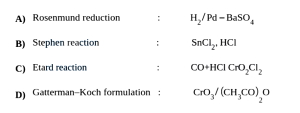
A
$A$) Rosenmund reduction : $H_2/Pd-BaSO_4$
B
$B$) Stephen reaction : $SnCl_2, HCl$
C
$C$) Etard reaction : $CrO_2Cl_2$
D
$D$) Gatterman-Koch reaction : $CO + HCl$ (anhydrous $AlCl_3$)
Solution
(D) Let us analyze the given reactions:
$A$) Rosenmund reduction uses $H_2/Pd-BaSO_4$ to reduce acid chlorides to aldehydes. This is correct.
$B$) Stephen reaction uses $SnCl_2/HCl$ to reduce nitriles to imines,which are then hydrolyzed to aldehydes. This is correct.
$C$) Etard reaction uses $CrO_2Cl_2$ to oxidize toluene to benzaldehyde. This is correct.
$D$) Gatterman-Koch reaction uses $CO + HCl$ in the presence of anhydrous $AlCl_3$ to form benzaldehyde from benzene. The reagent given in the option $(CrO_3/(CH_3CO)_2O)$ is for the Etard-like oxidation of toluene to benzaldehyde diacetate. Thus,option $D$ is incorrectly matched.
$A$) Rosenmund reduction uses $H_2/Pd-BaSO_4$ to reduce acid chlorides to aldehydes. This is correct.
$B$) Stephen reaction uses $SnCl_2/HCl$ to reduce nitriles to imines,which are then hydrolyzed to aldehydes. This is correct.
$C$) Etard reaction uses $CrO_2Cl_2$ to oxidize toluene to benzaldehyde. This is correct.
$D$) Gatterman-Koch reaction uses $CO + HCl$ in the presence of anhydrous $AlCl_3$ to form benzaldehyde from benzene. The reagent given in the option $(CrO_3/(CH_3CO)_2O)$ is for the Etard-like oxidation of toluene to benzaldehyde diacetate. Thus,option $D$ is incorrectly matched.
0 likesView Solution
75
ChemistryMediumMCQMHT CET · 2022
What is the number of different products formed when a mixture of ethanal and propanal reacts with aqueous $NaOH$ after warming?
A
$4$
B
$2$
C
$1$
D
$3$
Solution
(A) When a mixture of two different aldehydes (ethanal and propanal),both containing at least one $\alpha$-hydrogen,reacts with aqueous $NaOH$ and is warmed,it undergoes a cross-aldol condensation reaction.
Each aldehyde can undergo self-aldol condensation,and they can also undergo cross-aldol condensation with each other.
$1$. Self-aldol of ethanal: $CH_3CHO + CH_3CHO \rightarrow CH_3CH=CHCHO$ (after dehydration).
$2$. Self-aldol of propanal: $CH_3CH_2CHO + CH_3CH_2CHO \rightarrow CH_3CH_2CH=C(CH_3)CHO$ (after dehydration).
$3$. Cross-aldol (ethanal as donor,propanal as acceptor): $CH_3CHO + CH_3CH_2CHO \rightarrow CH_3CH=C(CH_3)CHO$ (after dehydration).
$4$. Cross-aldol (propanal as donor,ethanal as acceptor): $CH_3CH_2CHO + CH_3CHO \rightarrow CH_3CH_2CH=CHCHO$ (after dehydration).
Thus,a total of $4$ different aldol condensation products are formed.
Each aldehyde can undergo self-aldol condensation,and they can also undergo cross-aldol condensation with each other.
$1$. Self-aldol of ethanal: $CH_3CHO + CH_3CHO \rightarrow CH_3CH=CHCHO$ (after dehydration).
$2$. Self-aldol of propanal: $CH_3CH_2CHO + CH_3CH_2CHO \rightarrow CH_3CH_2CH=C(CH_3)CHO$ (after dehydration).
$3$. Cross-aldol (ethanal as donor,propanal as acceptor): $CH_3CHO + CH_3CH_2CHO \rightarrow CH_3CH=C(CH_3)CHO$ (after dehydration).
$4$. Cross-aldol (propanal as donor,ethanal as acceptor): $CH_3CH_2CHO + CH_3CHO \rightarrow CH_3CH_2CH=CHCHO$ (after dehydration).
Thus,a total of $4$ different aldol condensation products are formed.
0 likesView Solution
76
ChemistryMediumMCQMHT CET · 2022
Which among the following has the highest melting point?
A
Phenol
B
$p-$Nitrophenol
C
$p-$Cresol
D
$o-$Nitrophenol
Solution
(B) The melting point of a compound is significantly influenced by the nature of hydrogen bonding.
$o-$Nitrophenol exhibits intramolecular hydrogen bonding,which restricts intermolecular association,leading to a lower melting point.
In $p-$Cresol,the presence of the non-polar $-CH_3$ group does not significantly enhance intermolecular forces compared to the nitro group.
$p-$Nitrophenol exhibits strong intermolecular hydrogen bonding,which leads to the association of molecules in the solid state,resulting in a much higher melting point $(114 \ ^\circ C)$ compared to the others.
$o-$Nitrophenol exhibits intramolecular hydrogen bonding,which restricts intermolecular association,leading to a lower melting point.
In $p-$Cresol,the presence of the non-polar $-CH_3$ group does not significantly enhance intermolecular forces compared to the nitro group.
$p-$Nitrophenol exhibits strong intermolecular hydrogen bonding,which leads to the association of molecules in the solid state,resulting in a much higher melting point $(114 \ ^\circ C)$ compared to the others.
0 likesView Solution
77
ChemistryEasyMCQMHT CET · 2022
What is the name of the following reaction?
$R-CO-Cl \xrightarrow{H_2, Pd-BaSO_4} R-CHO + HCl$
$R-CO-Cl \xrightarrow{H_2, Pd-BaSO_4} R-CHO + HCl$
A
Stephen reaction
B
Aldol condensation
C
Rosenmund reduction
D
Etard reaction
Solution
(C) The given reaction is the hydrogenation of an acid chloride $(R-CO-Cl)$ to an aldehyde $(R-CHO)$ using hydrogen gas $(H_2)$ in the presence of a palladium catalyst supported on barium sulfate $(Pd-BaSO_4)$.
This specific reaction is known as the Rosenmund reduction.
This specific reaction is known as the Rosenmund reduction.
0 likesView Solution
78
ChemistryEasyMCQMHT CET · 2022
Which among the following reagents is used in the Rosenmund reduction?
A
$Zn-Hg / HCl$
B
$Na-Hg / H_2O$
C
$H_2 / Pt$ at $473 \ K$
D
$H_2 / Pd-BaSO_4$
Solution
(D) The Rosenmund reduction is a hydrogenation process used to convert acid chlorides into aldehydes.
It employs $H_2$ gas in the presence of a poisoned catalyst,specifically $Pd$ supported on $BaSO_4$ (palladium on barium sulfate).
The $BaSO_4$ acts as a poison to prevent further reduction of the aldehyde to an alcohol.
It employs $H_2$ gas in the presence of a poisoned catalyst,specifically $Pd$ supported on $BaSO_4$ (palladium on barium sulfate).
The $BaSO_4$ acts as a poison to prevent further reduction of the aldehyde to an alcohol.
0 likesView Solution
79
ChemistryEasyMCQMHT CET · 2022
Identify the product of the following reaction: $CH_3-CH=CH-CH_2-C \equiv N \xrightarrow[H_3O^{+}]{\text{DIBAL-H}} \text{Product}$
A
Pent$-3-$enoic acid
B
Pentanal
C
Pent$-3-$enal
D
Pentanoic acid
Solution
(C) The reagent $DIBAL-H$ (Diisobutylaluminium hydride) is a selective reducing agent that reduces nitriles $(-CN)$ to imines,which upon acidic hydrolysis $(H_3O^{+})$ yield aldehydes.
It does not affect the carbon-carbon double bond $(C=C)$.
The reaction is:
$CH_3-CH=CH-CH_2-C \equiv N \xrightarrow[H_3O^{+}]{\text{DIBAL-H}} CH_3-CH=CH-CH_2-CHO$
The product formed is $Pent-3-enal$.
It does not affect the carbon-carbon double bond $(C=C)$.
The reaction is:
$CH_3-CH=CH-CH_2-C \equiv N \xrightarrow[H_3O^{+}]{\text{DIBAL-H}} CH_3-CH=CH-CH_2-CHO$
The product formed is $Pent-3-enal$.
0 likesView Solution
80
ChemistryEasyMCQMHT CET · 2022
Identify the product $B$ in the following sequence of reaction: $CH_3MgBr$ $\xrightarrow{CdCl_2} A$ $\xrightarrow{CH_3COCl} B$
A
Dimethyl Cadmium
B
Butanone
C
Propanone
D
Propanol
Solution
(C) Step $1$: Reaction of methyl magnesium bromide with cadmium chloride $(CdCl_2)$ produces dimethyl cadmium $(A)$.
$2CH_3MgBr + CdCl_2 \rightarrow (CH_3)_2Cd + 2Mg(Br)Cl$
Step $2$: Dimethyl cadmium reacts with acetyl chloride $(CH_3COCl)$ to form propanone $(B)$.
$2CH_3COCl + (CH_3)_2Cd \rightarrow 2CH_3COCH_3 + CdCl_2$
Thus,the product $B$ is propanone.
$2CH_3MgBr + CdCl_2 \rightarrow (CH_3)_2Cd + 2Mg(Br)Cl$
Step $2$: Dimethyl cadmium reacts with acetyl chloride $(CH_3COCl)$ to form propanone $(B)$.
$2CH_3COCl + (CH_3)_2Cd \rightarrow 2CH_3COCH_3 + CdCl_2$
Thus,the product $B$ is propanone.
0 likesView Solution
81
ChemistryMediumMCQMHT CET · 2022
Identify the product $P$ in the following reaction:
$R-CH(OH)-R \xrightarrow{Cu, 573 \ K} P$
$R-CH(OH)-R \xrightarrow{Cu, 573 \ K} P$
A
$R-CHO$
B
$R-CO-R$
C
$R-COOH$
D
$R-CH_3$
Solution
(B) The given reaction involves the dehydrogenation of a secondary alcohol $(R-CH(OH)-R)$ in the presence of copper $(Cu)$ catalyst at $573 \ K$.
Secondary alcohols undergo dehydrogenation to form ketones as the product $P$.
The reaction is: $R-CH(OH)-R \xrightarrow{Cu, 573 \ K} R-CO-R + H_2$.
Therefore,the product $P$ is $R-CO-R$.
Secondary alcohols undergo dehydrogenation to form ketones as the product $P$.
The reaction is: $R-CH(OH)-R \xrightarrow{Cu, 573 \ K} R-CO-R + H_2$.
Therefore,the product $P$ is $R-CO-R$.
0 likesView Solution
82
ChemistryMediumMCQMHT CET · 2022
Which of the following compounds is obtained when $R-CHO$ is treated with dilute nitric acid?
A
Ketones
B
Carboxylic acids
C
Alcohols
D
Amides
Solution
(B) Aldehydes $(R-CHO)$ undergo oxidation when treated with oxidizing agents like dilute nitric acid $(HNO_3)$.
This reaction converts the aldehyde group into a carboxylic acid group.
The chemical equation is: $R-CHO \xrightarrow{\text{Dil. } HNO_3} R-COOH$ (Carboxylic acid).
This reaction converts the aldehyde group into a carboxylic acid group.
The chemical equation is: $R-CHO \xrightarrow{\text{Dil. } HNO_3} R-COOH$ (Carboxylic acid).
0 likesView Solution
83
ChemistryMediumMCQMHT CET · 2022
Identify the product $Y$ in the following reaction: $CH_3-CO-CH_3 + 3NaOI \xrightarrow{\Delta} Y + CH_3-COONa + 2NaOH$
A
$CH_4$
B
$CH_3OH$
C
$CH_3$
D
$CHI_3$
Solution
(D) The given reaction is the iodoform reaction,which is a characteristic test for methyl ketones or methyl carbinols.
In this reaction,acetone $(CH_3COCH_3)$ reacts with sodium hypoiodite $(NaOI)$ to form iodoform $(CHI_3)$ as a yellow precipitate along with sodium acetate $(CH_3COONa)$ and sodium hydroxide $(NaOH)$.
Thus,the product $Y$ is $CHI_3$ (iodoform).
In this reaction,acetone $(CH_3COCH_3)$ reacts with sodium hypoiodite $(NaOI)$ to form iodoform $(CHI_3)$ as a yellow precipitate along with sodium acetate $(CH_3COONa)$ and sodium hydroxide $(NaOH)$.
Thus,the product $Y$ is $CHI_3$ (iodoform).
0 likesView Solution
84
ChemistryMediumMCQMHT CET · 2022
Identify the compound $X$ in the following reaction.
Acetone $+ X \stackrel{\Delta}{\longrightarrow} CHI_3 \downarrow + CH_3COONa + 2 NaOH$
Acetone $+ X \stackrel{\Delta}{\longrightarrow} CHI_3 \downarrow + CH_3COONa + 2 NaOH$
A
$NaOI$
B
dil. $NaOH$
C
$K_2Cr_2O_7$
D
conc. $KOH$
Solution
(A) The given reaction is the iodoform test,which is a characteristic reaction for methyl ketones or compounds containing the $CH_3CO-$ group.
Acetone $(CH_3COCH_3)$ reacts with iodine $(I_2)$ in the presence of sodium hydroxide $(NaOH)$ to form sodium hypoiodite $(NaOI)$,which acts as the oxidizing and iodinating agent.
The balanced chemical equation for the reaction is:
$CH_3COCH_3 + 3NaOI \stackrel{\Delta}{\longrightarrow} CHI_3 \downarrow + CH_3COONa + 2NaOH$
Thus,the compound $X$ is $NaOI$ (which is generated in situ from $I_2$ and $NaOH$).
Acetone $(CH_3COCH_3)$ reacts with iodine $(I_2)$ in the presence of sodium hydroxide $(NaOH)$ to form sodium hypoiodite $(NaOI)$,which acts as the oxidizing and iodinating agent.
The balanced chemical equation for the reaction is:
$CH_3COCH_3 + 3NaOI \stackrel{\Delta}{\longrightarrow} CHI_3 \downarrow + CH_3COONa + 2NaOH$
Thus,the compound $X$ is $NaOI$ (which is generated in situ from $I_2$ and $NaOH$).
0 likesView Solution
85
ChemistryEasyMCQMHT CET · 2022
Which among the following compounds does not exhibit the iodoform test?
A
Acetaldehyde
B
sec-Butyl alcohol
C
n-Butyl alcohol
D
Acetophenone
Solution
(C) Compounds that exhibit the iodoform test must contain either a methyl ketone group $(CH_3-CO-R)$ or a methyl carbinol group $(CH_3-CH(OH)-R)$.
Acetaldehyde $(CH_3CHO)$ contains the $CH_3-CO-$ group.
sec-Butyl alcohol $(CH_3-CH(OH)-CH_2CH_3)$ contains the $CH_3-CH(OH)-$ group.
Acetophenone $(C_6H_5-CO-CH_3)$ contains the $CH_3-CO-$ group.
n-Butyl alcohol $(CH_3-CH_2-CH_2-CH_2-OH)$ does not contain either of these structural units.
Therefore,$n$-Butyl alcohol does not show the iodoform test.
Acetaldehyde $(CH_3CHO)$ contains the $CH_3-CO-$ group.
sec-Butyl alcohol $(CH_3-CH(OH)-CH_2CH_3)$ contains the $CH_3-CH(OH)-$ group.
Acetophenone $(C_6H_5-CO-CH_3)$ contains the $CH_3-CO-$ group.
n-Butyl alcohol $(CH_3-CH_2-CH_2-CH_2-OH)$ does not contain either of these structural units.
Therefore,$n$-Butyl alcohol does not show the iodoform test.
0 likesView Solution
86
ChemistryEasyMCQMHT CET · 2022
Which of the following reagents is used in Gatterman-Koch formylation of arene?
A
$CrO_3$
B
$CO, HCl / AlCl_3$ (anhydrous)
C
$CrO_2Cl_2, CS_2$
D
$Cl_2, hv, H_3O^{+}$
Solution
(B) The Gatterman-Koch formylation of an arene involves the treatment of benzene or a substituted benzene with carbon monoxide $(CO)$ and hydrogen chloride $(HCl)$ under high pressure.
This reaction yields benzaldehyde or a substituted benzaldehyde.
The reaction is catalyzed by anhydrous aluminium chloride $(AlCl_3)$ or cuprous chloride $(CuCl)$.
Therefore,the correct reagent is $CO, HCl / AlCl_3$ (anhydrous).
This reaction yields benzaldehyde or a substituted benzaldehyde.
The reaction is catalyzed by anhydrous aluminium chloride $(AlCl_3)$ or cuprous chloride $(CuCl)$.
Therefore,the correct reagent is $CO, HCl / AlCl_3$ (anhydrous).
0 likesView Solution
87
ChemistryMediumMCQMHT CET · 2022
Identify the $X$ in the reaction.
$R-NH_2 + HNO_2 \underset{273-278 \ K}{}$ ${\xrightarrow{NaNO_2 + HCl}} X$ $\xrightarrow{H_2O} R-OH + N_2 + HCl$
$R-NH_2 + HNO_2 \underset{273-278 \ K}{}$ ${\xrightarrow{NaNO_2 + HCl}} X$ $\xrightarrow{H_2O} R-OH + N_2 + HCl$
A
$R-NH-NO_2$
B
$R-N_2^+ Cl^-$
C
$R-NH-N=O$
D
$R-NO_2$
Solution
(B) The reaction of a primary aliphatic amine $(R-NH_2)$ with nitrous acid $(HNO_2)$,which is generated in situ by the reaction of $NaNO_2$ and $HCl$ at $273-278 \ K$,forms an alkyl diazonium salt $(R-N_2^+ Cl^-)$ as an intermediate $(X)$.
This alkyl diazonium salt is highly unstable and decomposes rapidly in the presence of water to form an alcohol $(R-OH)$,nitrogen gas $(N_2)$,and hydrochloric acid $(HCl)$.
Therefore,the intermediate $X$ is $R-N_2^+ Cl^-$.
This alkyl diazonium salt is highly unstable and decomposes rapidly in the presence of water to form an alcohol $(R-OH)$,nitrogen gas $(N_2)$,and hydrochloric acid $(HCl)$.
Therefore,the intermediate $X$ is $R-N_2^+ Cl^-$.
0 likesView Solution
88
ChemistryMediumMCQMHT CET · 2022
Identify compound $X$ in the following reaction.

A
$(C_2H_5)_3N$
B
$C_2H_5NH_2$
C
$(C_2H_5)_2NH$
D
$CH_3NHC_2H_5$
Solution
(C) The given reaction is the reaction of a secondary amine with benzenesulfonyl chloride (Hinsberg reagent).
In this reaction,the secondary amine $(C_2H_5)_2NH$ reacts with benzenesulfonyl chloride to form $N,N$-diethylbenzenesulfonamide.
The nitrogen atom in the secondary amine has one hydrogen atom,which is replaced by the sulfonyl group,releasing $HCl$.
Therefore,the compound $X$ is diethylamine,which is $(C_2H_5)_2NH$.
In this reaction,the secondary amine $(C_2H_5)_2NH$ reacts with benzenesulfonyl chloride to form $N,N$-diethylbenzenesulfonamide.
The nitrogen atom in the secondary amine has one hydrogen atom,which is replaced by the sulfonyl group,releasing $HCl$.
Therefore,the compound $X$ is diethylamine,which is $(C_2H_5)_2NH$.
0 likesView Solution
89
ChemistryMediumMCQMHT CET · 2022
Which of the following conversions requires the reagent $Sn / HCl$?
A
$R-CONH_2 \rightarrow R-CH_2-NH_2$
B
$R-C \equiv N \rightarrow R-CH_2-NH_2$
C
$R-NO_2 \rightarrow R-NH_2 + 2H_2O$
D
$R-CONH_2 \rightarrow R-NH_2$
Solution
(C) The reagent $Sn / HCl$ is a common reducing agent used to reduce nitro compounds $(R-NO_2)$ to primary amines $(R-NH_2)$.
The balanced chemical equation for the reduction of a nitroalkane is:
$R-NO_2 + 6[H] \xrightarrow{Sn / HCl} R-NH_2 + 2H_2O$.
The balanced chemical equation for the reduction of a nitroalkane is:
$R-NO_2 + 6[H] \xrightarrow{Sn / HCl} R-NH_2 + 2H_2O$.
0 likesView Solution
90
ChemistryMediumMCQMHT CET · 2022
Which among the following is a correct order of $pK_b$ values of amines in the aqueous phase?
A
$RNH_2 > R_2NH > R_3N > NH_3$
B
$R_3N > RNH_2 > R_2NH > NH_3$
C
$NH_3 > RNH_2 > R_3N > R_2NH$
D
$NH_3 > RNH_2 > R_2NH > R_3N$
Solution
(C) The basic strength of amines in the aqueous phase depends on the inductive effect,solvation effect,and steric hindrance.
For aliphatic amines where $R = CH_3$,the order of basicity is $(CH_3)_2NH > CH_3NH_2 > (CH_3)_3N > NH_3$.
Since $pK_b = -\log(K_b)$,a higher basic strength corresponds to a lower $pK_b$ value.
Therefore,the order of $pK_b$ values is the reverse of the basicity order: $NH_3 > (CH_3)_3N > CH_3NH_2 > (CH_3)_2NH$.
However,in general terms for alkyl amines,the order of basicity is $R_2NH > RNH_2 > R_3N > NH_3$.
Thus,the correct order of $pK_b$ values is $NH_3 > R_3N > RNH_2 > R_2NH$.
For aliphatic amines where $R = CH_3$,the order of basicity is $(CH_3)_2NH > CH_3NH_2 > (CH_3)_3N > NH_3$.
Since $pK_b = -\log(K_b)$,a higher basic strength corresponds to a lower $pK_b$ value.
Therefore,the order of $pK_b$ values is the reverse of the basicity order: $NH_3 > (CH_3)_3N > CH_3NH_2 > (CH_3)_2NH$.
However,in general terms for alkyl amines,the order of basicity is $R_2NH > RNH_2 > R_3N > NH_3$.
Thus,the correct order of $pK_b$ values is $NH_3 > R_3N > RNH_2 > R_2NH$.
0 likesView Solution
91
ChemistryMediumMCQMHT CET · 2022
How many moles of ethyl bromide are required for the formation of $1 \ mole$ of $N,N$-diethylethanamine from ethylamine?
A
$1$
B
$2$
C
$3$
D
$4$
Solution
(B) The reaction of ethylamine $(CH_3CH_2NH_2)$ with ethyl bromide $(C_2H_5Br)$ is an example of ammonolysis/alkylation of amines.
Step $1$: Ethylamine reacts with $1 \ mole$ of ethyl bromide to form diethylamine $(CH_3CH_2NHCH_2CH_3)$.
$CH_3CH_2NH_2 + C_2H_5Br \rightarrow (CH_3CH_2)_2NH + HBr$
Step $2$: Diethylamine further reacts with another $1 \ mole$ of ethyl bromide to form $N,N$-diethylethanamine (triethylamine,$(CH_3CH_2)_3N$).
$(CH_3CH_2)_2NH + C_2H_5Br \rightarrow (CH_3CH_2)_3N + HBr$
Total moles of ethyl bromide required = $1 + 1 = 2 \ moles$.
Step $1$: Ethylamine reacts with $1 \ mole$ of ethyl bromide to form diethylamine $(CH_3CH_2NHCH_2CH_3)$.
$CH_3CH_2NH_2 + C_2H_5Br \rightarrow (CH_3CH_2)_2NH + HBr$
Step $2$: Diethylamine further reacts with another $1 \ mole$ of ethyl bromide to form $N,N$-diethylethanamine (triethylamine,$(CH_3CH_2)_3N$).
$(CH_3CH_2)_2NH + C_2H_5Br \rightarrow (CH_3CH_2)_3N + HBr$
Total moles of ethyl bromide required = $1 + 1 = 2 \ moles$.
0 likesView Solution
92
ChemistryMediumMCQMHT CET · 2022
Which among the following molecules has the lowest $pK_b$ value?
A
$CH_3CH_2NH_2$
B
$(CH_3CH_2)_3N$
C
$(CH_3CH_2)_2NH$
D
$CH_3NH_2$
Solution
(C) The $pK_b$ value is inversely proportional to the basic strength of the amine. $A$ lower $pK_b$ value indicates a stronger base.
In the aqueous phase,the basicity of ethyl-substituted amines follows the order: $(C_2H_5)_2NH > C_2H_5NH_2 > (C_2H_5)_3N > NH_3$.
However,comparing the given options: $CH_3NH_2$ $(pK_b = 3.36)$,$CH_3CH_2NH_2$ $(pK_b = 3.29)$,$(CH_3CH_2)_3N$ $(pK_b = 3.25)$,and $(CH_3CH_2)_2NH$ $(pK_b = 3.00)$.
Thus,diethylamine $(CH_3CH_2)_2NH$ has the lowest $pK_b$ value,making it the strongest base among the choices.
In the aqueous phase,the basicity of ethyl-substituted amines follows the order: $(C_2H_5)_2NH > C_2H_5NH_2 > (C_2H_5)_3N > NH_3$.
However,comparing the given options: $CH_3NH_2$ $(pK_b = 3.36)$,$CH_3CH_2NH_2$ $(pK_b = 3.29)$,$(CH_3CH_2)_3N$ $(pK_b = 3.25)$,and $(CH_3CH_2)_2NH$ $(pK_b = 3.00)$.
Thus,diethylamine $(CH_3CH_2)_2NH$ has the lowest $pK_b$ value,making it the strongest base among the choices.
0 likesView Solution
93
ChemistryEasyMCQMHT CET · 2022
Identify the Gabriel phthalimide synthesis reaction from the reactants and reagents used in it.
A
$R-CN + [H] \underset{\text{ether}}{\stackrel{LiAlH_4}{\longrightarrow}} R-CH_2NH_2$
B
$R-CONH_2 + [H] \underset{\text{ether}}{\stackrel{LiAlH_4}{\longrightarrow}} R-CH_2NH_2$
C
$R-CONH_2 + Br_2 + 4 NaOH_{\text{(aq.)}} \stackrel{\Delta}{\longrightarrow} R-NH_2 + Na_2CO_3 + 2NaBr + 2H_2O$
D
Phthalimide + $KOH$ (alc.) $\rightarrow$ $N$-potassiophthalimide $\xrightarrow{R-X}$ $N$-alkylphthalimide $\xrightarrow{NaOH_{\text{(aq.)}}}$ Phthalic acid (salt) + $R-NH_2$
Solution
(D) The Gabriel phthalimide synthesis is a method used for the preparation of primary aliphatic amines. The reaction involves the following steps:
$1$. Phthalimide reacts with ethanolic $KOH$ to form potassium phthalimide.
$2$. Potassium phthalimide reacts with an alkyl halide $(R-X)$ to form $N$-alkylphthalimide.
$3$. $N$-alkylphthalimide undergoes alkaline hydrolysis (using $NaOH_{\text{(aq.)}}$) to yield the corresponding primary amine $(R-NH_2)$ and sodium phthalate.
$1$. Phthalimide reacts with ethanolic $KOH$ to form potassium phthalimide.
$2$. Potassium phthalimide reacts with an alkyl halide $(R-X)$ to form $N$-alkylphthalimide.
$3$. $N$-alkylphthalimide undergoes alkaline hydrolysis (using $NaOH_{\text{(aq.)}}$) to yield the corresponding primary amine $(R-NH_2)$ and sodium phthalate.
0 likesView Solution
94
ChemistryEasyMCQMHT CET · 2022
Identify the reagent used for the conversion of aniline to phenol from the following.
A
$NaNO_2 / HCl$
B
$LiAlH_4$
C
$\frac{H_2}{Ni}$
D
Cobalt naphthenate
Solution
(A) The conversion of aniline to phenol involves two steps:
$1$. Diazotization of aniline using $NaNO_2 / HCl$ at $0-5 \ ^{\circ}C$ to form benzene diazonium chloride.
$2$. Hydrolysis of benzene diazonium chloride by warming with water to yield phenol.
Therefore,$NaNO_2 / HCl$ is the correct reagent for the initial step of this conversion.
$1$. Diazotization of aniline using $NaNO_2 / HCl$ at $0-5 \ ^{\circ}C$ to form benzene diazonium chloride.
$2$. Hydrolysis of benzene diazonium chloride by warming with water to yield phenol.
Therefore,$NaNO_2 / HCl$ is the correct reagent for the initial step of this conversion.
0 likesView Solution
95
ChemistryEasyMCQMHT CET · 2022
Identify the amine that does not form alcohol by the action of $NaNO_2$ and $HCl$.
A
$(CH_3)_3C-NH_2$
B
$CH_3-CH_2-NH_2$
C
$CH_3-CH(NH_2)-CH_3$
D
$(CH_3)_2NH$
Solution
(D) Primary aliphatic amines $(R-NH_2)$ react with $NaNO_2$ and $HCl$ to form unstable diazonium salts,which decompose to give alcohols $(R-OH)$.
Secondary amines $(R_2NH)$ react with $NaNO_2$ and $HCl$ to form $N$-nitrosoamines,which are yellow oily compounds,not alcohols.
$(CH_3)_2NH$ is a secondary amine,therefore it does not form alcohol.
Secondary amines $(R_2NH)$ react with $NaNO_2$ and $HCl$ to form $N$-nitrosoamines,which are yellow oily compounds,not alcohols.
$(CH_3)_2NH$ is a secondary amine,therefore it does not form alcohol.
0 likesView Solution
96
ChemistryMediumMCQMHT CET · 2022
The reagent used in Hofmann elimination reaction is
A
$Na-Hg / H_2O$
B
$HNO_2$
C
Moist $Ag_2O$
D
$LiAlH_4$
Solution
(C) The Hofmann elimination reaction involves the conversion of an amine into an alkene.
First,the amine is converted into a quaternary ammonium iodide by reaction with excess methyl iodide $(CH_3I)$.
Then,the quaternary ammonium salt is treated with moist silver oxide $(Ag_2O + H_2O)$,which replaces the iodide ion with a hydroxide ion $(OH^-)$.
Finally,heating the quaternary ammonium hydroxide leads to the elimination reaction,producing an alkene,a tertiary amine,and water.
First,the amine is converted into a quaternary ammonium iodide by reaction with excess methyl iodide $(CH_3I)$.
Then,the quaternary ammonium salt is treated with moist silver oxide $(Ag_2O + H_2O)$,which replaces the iodide ion with a hydroxide ion $(OH^-)$.
Finally,heating the quaternary ammonium hydroxide leads to the elimination reaction,producing an alkene,a tertiary amine,and water.
0 likesView Solution
97
ChemistryMediumMCQMHT CET · 2022
Which among the following reagents is used to distinguish primary $(1^{\circ})$,secondary $(2^{\circ})$,and tertiary $(3^{\circ})$ amines according to their solubility in an alkaline medium?
A
Benzene sulphonyl chloride
B
Ethylene glycol
C
Iodoform
D
Acetyl chloride
Solution
(A) The reagent used to distinguish between primary,secondary,and tertiary amines is Hinsberg reagent,which is Benzenesulfonyl chloride $(C_6H_5SO_2Cl)$.
$1$. Primary $(1^{\circ})$ amines react with Benzenesulfonyl chloride to form $N$-alkylbenzenesulfonamide,which is soluble in alkali due to the presence of an acidic hydrogen atom attached to the nitrogen.
$2$. Secondary $(2^{\circ})$ amines react to form $N$,$N$-dialkylbenzenesulfonamide,which is insoluble in alkali because it lacks an acidic hydrogen atom.
$3$. Tertiary $(3^{\circ})$ amines do not react with Benzenesulfonyl chloride.
$1$. Primary $(1^{\circ})$ amines react with Benzenesulfonyl chloride to form $N$-alkylbenzenesulfonamide,which is soluble in alkali due to the presence of an acidic hydrogen atom attached to the nitrogen.
$2$. Secondary $(2^{\circ})$ amines react to form $N$,$N$-dialkylbenzenesulfonamide,which is insoluble in alkali because it lacks an acidic hydrogen atom.
$3$. Tertiary $(3^{\circ})$ amines do not react with Benzenesulfonyl chloride.
0 likesView Solution
98
ChemistryMediumMCQMHT CET · 2022
The end product in Hofmann's exhaustive methylation of amines is:
A
Primary amine
B
Secondary amine
C
Tertiary amine
D
Quaternary ammonium halide
Solution
(D) Hofmann's exhaustive methylation involves the reaction of an amine with an excess of an alkyl halide.
The reaction proceeds through successive alkylations until a quaternary ammonium salt is formed.
For example,with ethylamine and ethyl iodide:
$CH_3CH_2NH_2 + 3CH_3CH_2I \rightarrow (CH_3CH_2)_4N^{+}I^{-} + 3HI$.
Thus,the final product is a quaternary ammonium halide.
The reaction proceeds through successive alkylations until a quaternary ammonium salt is formed.
For example,with ethylamine and ethyl iodide:
$CH_3CH_2NH_2 + 3CH_3CH_2I \rightarrow (CH_3CH_2)_4N^{+}I^{-} + 3HI$.
Thus,the final product is a quaternary ammonium halide.
0 likesView Solution
99
ChemistryEasyMCQMHT CET · 2022
Identify the Hinsberg reagent from the following.
A
Benzene sulphonyl chloride
B
Benzyl chloride
C
Benzoyl chloride
D
Benzene diazonium chloride
Solution
(A) The Hinsberg reagent is $C_6H_5SO_2Cl$,which is known as benzene sulphonyl chloride.
It is used to distinguish between primary,secondary,and tertiary amines.
It is used to distinguish between primary,secondary,and tertiary amines.
0 likesView Solution
100
ChemistryMediumMCQMHT CET · 2022
Which of the following reactions does not match correctly with its name?
A
$R-NH_2 + 3 R-X \rightarrow$ Hofmann exhaustive alkylation
B
$R-CONH_2 + Br_2 + 4 KOH \rightarrow$ Hofmann degradation
C
$R-CONH_2 + 4[H] \xrightarrow{LiAlH_4} R-CH_2-NH_2$ : Mendius reduction
D
$R-CH_2-\stackrel{+}{N}(R)_3 \stackrel{-}{X} \xrightarrow[(ii) \Delta]{(i) \text{moist } Ag_2O} R-CH=CH_2$ : Hofmann elimination
Solution
(C) The correct answer is $C$.
$A$. $R-NH_2 + 3 R-X \rightarrow R-N^+(R)_3 X^-$ is known as Hofmann exhaustive alkylation.
$B$. $R-CONH_2 + Br_2 + 4 KOH \rightarrow R-NH_2 + K_2CO_3 + 2 KBr + 2 H_2O$ is known as Hofmann bromamide degradation.
$C$. The reduction of amides $(R-CONH_2)$ to amines $(R-CH_2-NH_2)$ using $LiAlH_4$ is a standard reduction of amides,not Mendius reduction. Mendius reduction specifically refers to the reduction of nitriles $(R-CN)$ to primary amines $(R-CH_2-NH_2)$ using $Na/EtOH$ or $H_2/Ni$.
$D$. The reaction of quaternary ammonium salts with moist $Ag_2O$ followed by heating is known as Hofmann elimination.
$A$. $R-NH_2 + 3 R-X \rightarrow R-N^+(R)_3 X^-$ is known as Hofmann exhaustive alkylation.
$B$. $R-CONH_2 + Br_2 + 4 KOH \rightarrow R-NH_2 + K_2CO_3 + 2 KBr + 2 H_2O$ is known as Hofmann bromamide degradation.
$C$. The reduction of amides $(R-CONH_2)$ to amines $(R-CH_2-NH_2)$ using $LiAlH_4$ is a standard reduction of amides,not Mendius reduction. Mendius reduction specifically refers to the reduction of nitriles $(R-CN)$ to primary amines $(R-CH_2-NH_2)$ using $Na/EtOH$ or $H_2/Ni$.
$D$. The reaction of quaternary ammonium salts with moist $Ag_2O$ followed by heating is known as Hofmann elimination.
0 likesView Solution
Vedclass Products
For Students
Vedclass Test Series
Mock tests in real MHT CET style covering Chemistry with performance analysis. 5-day free trial.
Start Free TrialFor Teachers
Exam Paper Generator
Generate Set A/B/C/D Chemistry papers from 7.5L+ questions in 2 minutes. 3 chapters free.
Try FreeFor Institutes
Online Exam Module
Run live MHT CET mock exams with unlimited students, 360° analytics & white-label branding.
See DemoFrequently Asked Questions
How many Chemistry questions are in MHT CET 2022?
There are 627 Chemistry questions from the MHT CET 2022 paper on Vedclass, each with a detailed step-by-step solution in English.
Are MHT CET 2022 Chemistry solutions available in English?
Yes. All solutions on this page are in English. You can also switch to English or Hindi using the language buttons above the questions.
Can I practice MHT CET 2022 Chemistry as a timed test?
Yes. Use the Vedclass Test Series to attempt a full MHT CET mock test covering Chemistry with time limits and instant score analysis.
Can teachers create Chemistry papers from MHT CET previous year questions?
Yes. The Vedclass Exam Paper Generator lets teachers mix MHT CET Chemistry questions and generate Set A/B/C/D papers in minutes.
For Teachers & Institutes
Build a Custom Chemistry Paper
Pick MHT CET 2022 Chemistry questions, set difficulty, and generate Set A/B/C/D in 2 minutes.