
ChemistryQ101–200 of 716 questions
Page 3 of 8 · English
101
ChemistryMCQMHT CET · 2023
Which among the following is $NOT$ a feature of $S_N2$ mechanism?
A
Single step mechanism
B
Backside attack of nucleophile
C
Formation of planar carbocation intermediate
D
Involves simultaneous bond breaking and bond forming
Solution
(C) The $S_N2$ mechanism is a concerted,single-step process where the nucleophile attacks from the backside of the leaving group.
It involves the simultaneous breaking of the $C-X$ bond and the formation of the $C-Nu$ bond through a pentacoordinate transition state.
It does $NOT$ involve the formation of a carbocation intermediate,which is a characteristic feature of the $S_N1$ mechanism.
Therefore,option $C$ is not a feature of the $S_N2$ mechanism.
It involves the simultaneous breaking of the $C-X$ bond and the formation of the $C-Nu$ bond through a pentacoordinate transition state.
It does $NOT$ involve the formation of a carbocation intermediate,which is a characteristic feature of the $S_N1$ mechanism.
Therefore,option $C$ is not a feature of the $S_N2$ mechanism.
0 likesView Solution
102
ChemistryMCQMHT CET · 2023
When $tert$-butyl bromide is heated with silver fluoride,the major product obtained is:
A
$1$-Fluoro-$2$-methylpropane
B
$2$-Fluoro-$2$-methylpropane
C
$1$-Fluorobutane
D
$2$-Fluorobutane
Solution
(B) The reaction of alkyl halides with metallic fluorides like $AgF$,$Hg_2F_2$,$CoF_2$,or $SbF_3$ is known as the Swarts reaction.
In this reaction,the halogen atom is replaced by a fluorine atom.
The reaction is as follows:
$(CH_3)_3C-Br + AgF \xrightarrow{\Delta} (CH_3)_3C-F + AgBr$
Thus,$tert$-butyl bromide reacts with silver fluoride to form $2$-fluoro-$2$-methylpropane.
In this reaction,the halogen atom is replaced by a fluorine atom.
The reaction is as follows:
$(CH_3)_3C-Br + AgF \xrightarrow{\Delta} (CH_3)_3C-F + AgBr$
Thus,$tert$-butyl bromide reacts with silver fluoride to form $2$-fluoro-$2$-methylpropane.
0 likesView Solution
103
ChemistryMCQMHT CET · 2023
Which among the following is a haloalkyne?
A
$CH_3-CH_2-CH=CH-X$
B
$CH_3-C=C-CH_2-X$
C
$CH \equiv C-CH_2-CH_2-X$
D
$CH_3-CH_2-C \equiv C-X$
Solution
(D) haloalkyne is an organic compound containing a carbon-carbon triple bond and a halogen atom attached to the carbon chain.
Option $D$ represents $CH_3-CH_2-C \equiv C-X$,where the halogen atom $(X)$ is directly attached to one of the carbons involved in the triple bond,making it a haloalkyne.
Option $D$ represents $CH_3-CH_2-C \equiv C-X$,where the halogen atom $(X)$ is directly attached to one of the carbons involved in the triple bond,making it a haloalkyne.
0 likesView Solution
104
ChemistryMediumMCQMHT CET · 2023
What is the number of moles of ethane obtained from $2n$ moles of bromomethane using $2n$ moles of sodium atoms in dry ether medium?
A
$4n$
B
$3n$
C
$2n$
D
$n$
Solution
(D) The Wurtz reaction is given by the equation: $2CH_3Br + 2Na \xrightarrow{\text{Dry ether}} CH_3-CH_3 + 2NaBr$.
According to the stoichiometry of the reaction,$2$ moles of bromomethane $(CH_3Br)$ react with $2$ moles of sodium $(Na)$ to produce $1$ mole of ethane $(CH_3-CH_3)$.
Given that we have $2n$ moles of bromomethane and $2n$ moles of sodium,the reaction will produce $n$ moles of ethane.
According to the stoichiometry of the reaction,$2$ moles of bromomethane $(CH_3Br)$ react with $2$ moles of sodium $(Na)$ to produce $1$ mole of ethane $(CH_3-CH_3)$.
Given that we have $2n$ moles of bromomethane and $2n$ moles of sodium,the reaction will produce $n$ moles of ethane.
0 likesView Solution
105
ChemistryEasyMCQMHT CET · 2023
The molecular formula of hexachlorobenzene is
A
$C_6H_6Cl_6$
B
$C_6Cl_6$
C
$C_6H_5Cl$
D
$C_6H_6Cl$
Solution
(B) Hexachlorobenzene is a derivative of benzene where all six hydrogen atoms of the benzene ring $(C_6H_6)$ are replaced by chlorine atoms.
Therefore,the molecular formula is $C_6Cl_6$.
Therefore,the molecular formula is $C_6Cl_6$.
0 likesView Solution
106
ChemistryMCQMHT CET · 2023
Which among the following is a benzylic halide?
A
$C_6H_5-CH_2-X$
B
$C_6H_5-X$
C
$C_6H_5-CH=CH-X$
D
$C_6H_5-CH_2-CH_2-X$
Solution
(A) In benzylic halides,the halogen atom is bonded to a $sp^3$ hybridized carbon atom,which is directly attached to an aromatic ring.
In the structure $C_6H_5-CH_2-X$,the halogen $X$ is attached to a $CH_2$ group,which is bonded to the benzene ring $(C_6H_5)$.
Therefore,$C_6H_5-CH_2-X$ is a benzylic halide.
In the structure $C_6H_5-CH_2-X$,the halogen $X$ is attached to a $CH_2$ group,which is bonded to the benzene ring $(C_6H_5)$.
Therefore,$C_6H_5-CH_2-X$ is a benzylic halide.
0 likesView Solution
107
ChemistryEasyMCQMHT CET · 2023
Which of the following is $NOT$ obtained when a mixture of methyl chloride and $n-$propyl chloride is treated with sodium metal in dry ether?
A
Ethane
B
Propane
C
Butane
D
Hexane
Solution
(B) The Wurtz reaction involves the coupling of alkyl halides in the presence of sodium metal and dry ether.
When a mixture of methyl chloride $(CH_3Cl)$ and $n-$propyl chloride $(CH_3CH_2CH_2Cl)$ is used,the following coupling reactions occur:
$1$. $CH_3Cl + CH_3Cl + 2Na \rightarrow CH_3-CH_3$ (Ethane)
$2$. $CH_3CH_2CH_2Cl + CH_3CH_2CH_2Cl + 2Na \rightarrow CH_3CH_2CH_2CH_2CH_2CH_3$ ($n-$Hexane)
$3$. $CH_3Cl + CH_3CH_2CH_2Cl + 2Na \rightarrow CH_3CH_2CH_2CH_3$ ($n-$Butane)
Propane is not formed in this reaction.
When a mixture of methyl chloride $(CH_3Cl)$ and $n-$propyl chloride $(CH_3CH_2CH_2Cl)$ is used,the following coupling reactions occur:
$1$. $CH_3Cl + CH_3Cl + 2Na \rightarrow CH_3-CH_3$ (Ethane)
$2$. $CH_3CH_2CH_2Cl + CH_3CH_2CH_2Cl + 2Na \rightarrow CH_3CH_2CH_2CH_2CH_2CH_3$ ($n-$Hexane)
$3$. $CH_3Cl + CH_3CH_2CH_2Cl + 2Na \rightarrow CH_3CH_2CH_2CH_3$ ($n-$Butane)
Propane is not formed in this reaction.
0 likesView Solution
108
ChemistryMediumMCQMHT CET · 2023
Which of the following is obtained as a product when ethylene reacts with oxygen in the presence of $Pd / Al_2O_3$?
A
Acetaldehyde
B
Acetic acid
C
Methane
D
Methyl alcohol
Solution
(A) The reaction of ethylene $(C_2H_4)$ with oxygen $(O_2)$ in the presence of a palladium catalyst supported on alumina $(Pd / Al_2O_3)$ is a catalytic oxidation process.
The chemical equation for this reaction is:
$2C_2H_4(g) + O_2(g) \xrightarrow{Pd / Al_2O_3} 2CH_3CHO(g)$
As shown in the reaction,the product formed is acetaldehyde $(CH_3CHO)$.
The chemical equation for this reaction is:
$2C_2H_4(g) + O_2(g) \xrightarrow{Pd / Al_2O_3} 2CH_3CHO(g)$
As shown in the reaction,the product formed is acetaldehyde $(CH_3CHO)$.
0 likesView Solution
109
ChemistryEasyMCQMHT CET · 2023
What is the number of moles of nascent hydrogen required to prepare $1$ mole of methane from iodomethane?
A
$4$
B
$3$
C
$2$
D
$1$
Solution
(C) The reduction of iodomethane $(CH_3I)$ to methane $(CH_4)$ using nascent hydrogen $([H])$ is represented by the following chemical equation:
$CH_3I + 2[H] \xrightarrow{Zn, HCl} CH_4 + HI$
From the stoichiometry of the reaction,$1$ mole of iodomethane reacts with $2$ moles of nascent hydrogen to produce $1$ mole of methane.
Therefore,the number of moles of nascent hydrogen required is $2$.
$CH_3I + 2[H] \xrightarrow{Zn, HCl} CH_4 + HI$
From the stoichiometry of the reaction,$1$ mole of iodomethane reacts with $2$ moles of nascent hydrogen to produce $1$ mole of methane.
Therefore,the number of moles of nascent hydrogen required is $2$.
0 likesView Solution
110
ChemistryEasyMCQMHT CET · 2023
Identify the product formed by the action of $H_{2_{(g)}}$ with $CO_{(g)}$ in the presence of $Ni$.
A
Methane and water
B
Methyl alcohol
C
Acetaldehyde
D
Ethylene oxide
Solution
(A) The reaction between carbon monoxide and hydrogen in the presence of a nickel catalyst at high temperature leads to the formation of methane and water vapor.
The chemical equation is: $CO_{(g)} + 3H_{2_{(g)}} \xrightarrow{Ni} CH_{4_{(g)}} + H_{2}O_{(g)}$
The chemical equation is: $CO_{(g)} + 3H_{2_{(g)}} \xrightarrow{Ni} CH_{4_{(g)}} + H_{2}O_{(g)}$
0 likesView Solution
111
ChemistryMediumMCQMHT CET · 2023
Which of the following is formed when propene is heated with bromine at high temperature?
A
$1, 2-$Dibromopropane
B
$1-$Bromopropane
C
$2-$Bromopropene
D
$3-$Bromopropene
Solution
(D) When alkenes are heated with $Br_2$ at high temperature,the hydrogen atom of the allylic carbon is substituted by a halogen atom,resulting in the formation of an allyl halide.
$CH_2=CH-CH_3 + Br_2 \xrightarrow{\Delta} CH_2=CH-CH_2Br + HBr$
This reaction is known as allylic substitution.
The product formed is $3-$bromopropene.
$CH_2=CH-CH_3 + Br_2 \xrightarrow{\Delta} CH_2=CH-CH_2Br + HBr$
This reaction is known as allylic substitution.
The product formed is $3-$bromopropene.
0 likesView Solution
112
ChemistryEasyMCQMHT CET · 2023
Which among the following alkenes is most stable?
A
$R_2C=CH_2$
B
$H_2C=CH_2$
C
$RCH=CHR$
D
$R_2C=CR_2$
Solution
(D) The stability of alkenes is determined by the number of alkyl groups attached to the doubly bonded carbon atoms due to the hyperconjugation effect and inductive effect.
Greater the number of alkyl groups attached to the $C=C$ bond,greater is the stability of the alkene.
The order of stability is: $R_2C=CR_2 > R_2C=CHR > RCH=CHR > R_2C=CH_2 > RCH=CH_2 > CH_2=CH_2$.
Therefore,the alkene with the maximum number of alkyl groups,$R_2C=CR_2$,is the most stable.
Greater the number of alkyl groups attached to the $C=C$ bond,greater is the stability of the alkene.
The order of stability is: $R_2C=CR_2 > R_2C=CHR > RCH=CHR > R_2C=CH_2 > RCH=CH_2 > CH_2=CH_2$.
Therefore,the alkene with the maximum number of alkyl groups,$R_2C=CR_2$,is the most stable.
0 likesView Solution
113
ChemistryEasyMCQMHT CET · 2023
Identify the major product $A$ in the following reaction.
$3-$Bromo$-2-$methylpentane $\xrightarrow{alc. KOH} A$
$3-$Bromo$-2-$methylpentane $\xrightarrow{alc. KOH} A$
A
$2-$Methylpentan$-3-$ol
B
$2-$Methylpent$-2-$ene
C
$4-$Methylpent$-3-$ene
D
$4-$Methylpentan$-3-$ol
Solution
(B) The reaction of $3-$bromo$-2-$methylpentane with alcoholic $KOH$ is a dehydrohalogenation reaction ($\beta-$elimination).
In this reaction,a hydrogen atom is removed from the $\beta-$carbon and a bromine atom is removed from the $\alpha-$carbon to form an alkene.
According to Saytzeff's rule,the major product is the more substituted alkene.
For $3-$bromo$-2-$methylpentane,elimination can occur at $C-2$ or $C-4$.
Elimination at $C-2$ gives $2-$methylpent$-2-$ene (a trisubstituted alkene),while elimination at $C-4$ gives $3-$methylpent$-2-$ene (a disubstituted alkene).
Thus,$2-$methylpent$-2-$ene is the major product.
In this reaction,a hydrogen atom is removed from the $\beta-$carbon and a bromine atom is removed from the $\alpha-$carbon to form an alkene.
According to Saytzeff's rule,the major product is the more substituted alkene.
For $3-$bromo$-2-$methylpentane,elimination can occur at $C-2$ or $C-4$.
Elimination at $C-2$ gives $2-$methylpent$-2-$ene (a trisubstituted alkene),while elimination at $C-4$ gives $3-$methylpent$-2-$ene (a disubstituted alkene).
Thus,$2-$methylpent$-2-$ene is the major product.
0 likesView Solution
114
ChemistryMediumMCQMHT CET · 2023
Identify the product $P$ obtained in the following reaction:
$\text{Benzene} + \text{Ozone (excess)}$ $\xrightarrow{CCl_4} \text{Benzene triozonide}$ $\xrightarrow{Zn/H_2O} P + H_2O_2$
$\text{Benzene} + \text{Ozone (excess)}$ $\xrightarrow{CCl_4} \text{Benzene triozonide}$ $\xrightarrow{Zn/H_2O} P + H_2O_2$
A
Benzoic acid
B
Benzaldehyde
C
Phenol
D
Glyoxal
Solution
(D) When benzene is treated with ozone $(O_3)$ in the presence of an inert solvent such as carbon tetrachloride $(CCl_4)$,benzene triozonide is formed.
This triozonide is then decomposed by zinc dust and water $(Zn/H_2O)$ to yield three molecules of glyoxal $(CHO-CHO)$.
The reaction is: $C_6H_6 + 3O_3$ $\rightarrow C_6H_6O_9$ $\xrightarrow{Zn/H_2O} 3CHO-CHO + 3H_2O_2$.
This triozonide is then decomposed by zinc dust and water $(Zn/H_2O)$ to yield three molecules of glyoxal $(CHO-CHO)$.
The reaction is: $C_6H_6 + 3O_3$ $\rightarrow C_6H_6O_9$ $\xrightarrow{Zn/H_2O} 3CHO-CHO + 3H_2O_2$.
0 likesView Solution
115
ChemistryEasyMCQMHT CET · 2023
Which of the following compounds reacts with $HBr$ to form $1$-Bromo-$1$-methylcyclohexane?
A
Methylcyclohexane
B
$1,2$-Dimethylcyclohexane
C
$1$-Methylcyclohexene
D
Toluene
Solution
(C) The reaction of $1$-methylcyclohexene with $HBr$ follows Markovnikov's rule.
In this reaction,the electrophilic $H^+$ adds to the carbon atom of the double bond that has more hydrogen atoms,and the nucleophilic $Br^-$ adds to the more substituted carbon atom,resulting in the formation of $1$-bromo-$1$-methylcyclohexane.
In this reaction,the electrophilic $H^+$ adds to the carbon atom of the double bond that has more hydrogen atoms,and the nucleophilic $Br^-$ adds to the more substituted carbon atom,resulting in the formation of $1$-bromo-$1$-methylcyclohexane.
0 likesView Solution
116
ChemistryEasyMCQMHT CET · 2023
What are $X$ and $Y$ in the following reaction?
$Pent-2-ene \xrightarrow[(ii) Zn / H_2O]{(i) O_3} X + Y$
$Pent-2-ene \xrightarrow[(ii) Zn / H_2O]{(i) O_3} X + Y$
A
| $X$ | $Y$ |
| $CH_3CHO$ | $CH_3CH_2CHO$ |
B
| $X$ | $Y$ |
| $CH_3CH_2CHO$ | $CH_3CH_2CHO$ |
C
| $X$ | $Y$ |
| $CH_3CHO$ | $(CH_3)_2CO$ |
D
| $X$ | $Y$ |
| $CH_3CHO$ | $CH_3CHO$ |
Solution
(A) The reaction of $Pent-2-ene$ $(CH_3-CH_2-CH=CH-CH_3)$ with ozone $(O_3)$ followed by reductive cleavage with $Zn/H_2O$ is known as ozonolysis.
In this reaction,the double bond is cleaved to form two carbonyl compounds.
$CH_3-CH_2-CH=CH-CH_3 \xrightarrow[(ii) Zn / H_2O]{(i) O_3} CH_3-CH_2-CHO + CH_3-CHO$
Here,$CH_3-CH_2-CHO$ is $Propanal$ and $CH_3-CHO$ is $Ethanal$.
Thus,$X$ and $Y$ are $CH_3CHO$ and $CH_3CH_2CHO$ respectively.
In this reaction,the double bond is cleaved to form two carbonyl compounds.
$CH_3-CH_2-CH=CH-CH_3 \xrightarrow[(ii) Zn / H_2O]{(i) O_3} CH_3-CH_2-CHO + CH_3-CHO$
Here,$CH_3-CH_2-CHO$ is $Propanal$ and $CH_3-CHO$ is $Ethanal$.
Thus,$X$ and $Y$ are $CH_3CHO$ and $CH_3CH_2CHO$ respectively.
0 likesView Solution
117
ChemistryMediumMCQMHT CET · 2023
Which of the following is formed when propene is heated with chlorine at high temperature?
A
$1,2-$Dichloropropane
B
$1-$Chloropropane
C
$2-$Chloropropane
D
$3-$Chloropropene
Solution
(D) When an alkene is heated with $Cl_2$ at high temperature,the hydrogen atom of the allylic carbon is substituted by a halogen atom,resulting in the formation of an allyl halide.
$CH_2=CH-CH_3 + Cl_2 \xrightarrow{\Delta} CH_2=CH-CH_2Cl + HCl$
This product is $3-$Chloropropene (also known as allyl chloride).
$CH_2=CH-CH_3 + Cl_2 \xrightarrow{\Delta} CH_2=CH-CH_2Cl + HCl$
This product is $3-$Chloropropene (also known as allyl chloride).
0 likesView Solution
118
ChemistryMediumMCQMHT CET · 2023
In the following sequence of reactions,the alkene affords the compound $B$.
$CH_3-CH=CH-CH_3$ $\xrightarrow{O_3} A$ $\xrightarrow[Zn]{H_2O} B$
The compound $B$ is:
$CH_3-CH=CH-CH_3$ $\xrightarrow{O_3} A$ $\xrightarrow[Zn]{H_2O} B$
The compound $B$ is:
A
$CH_3CH_2CHO$
B
$CH_3COCH_3$
C
$CH_3CH_2COCH_3$
D
$CH_3CHO$
Solution
(D) The reaction is an ozonolysis of but$-2-$ene.
$1$. The alkene $CH_3-CH=CH-CH_3$ reacts with $O_3$ to form an ozonide intermediate $(A)$.
$2$. The ozonide undergoes reductive cleavage with $Zn/H_2O$ to yield two molecules of acetaldehyde $(CH_3CHO)$.
Therefore,the compound $B$ is $CH_3CHO$.
$1$. The alkene $CH_3-CH=CH-CH_3$ reacts with $O_3$ to form an ozonide intermediate $(A)$.
$2$. The ozonide undergoes reductive cleavage with $Zn/H_2O$ to yield two molecules of acetaldehyde $(CH_3CHO)$.
Therefore,the compound $B$ is $CH_3CHO$.
0 likesView Solution
119
ChemistryEasyMCQMHT CET · 2023
$A$ $Lewis$ acid is a substance that:
A
gives $H^{+}$ ions in aqueous solution
B
accepts a proton
C
accepts an electron pair
D
donates a proton
Solution
(C) According to the $Lewis$ acid-base theory,a $Lewis$ acid is defined as a chemical species that can accept a lone pair of electrons to form a coordinate covalent bond.
Therefore,the correct definition is that it accepts an electron pair.
Therefore,the correct definition is that it accepts an electron pair.
0 likesView Solution
120
ChemistryMediumMCQMHT CET · 2023
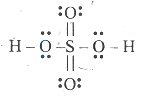
What is the formal charge on sulfur in the following Lewis structure?
A
$2$
B
$-2$
C
$0$
D
$-1$
Solution
(C) The formula for formal charge $(FC)$ is: $FC = V.E. - N.E. - \frac{1}{2}(B.E.)$
Where $V.E.$ is the number of valence electrons,$N.E.$ is the number of non-bonding electrons,and $B.E.$ is the number of bonding electrons.
For sulfur $(S)$ in the given structure:
Valence electrons $(V.E.)$ = $6$
Non-bonding electrons $(N.E.)$ = $0$
Bonding electrons $(B.E.)$ = $12$ (six bonds: two double bonds and two single bonds)
$FC = 6 - 0 - \frac{1}{2}(12) = 6 - 6 = 0$
Where $V.E.$ is the number of valence electrons,$N.E.$ is the number of non-bonding electrons,and $B.E.$ is the number of bonding electrons.
For sulfur $(S)$ in the given structure:
Valence electrons $(V.E.)$ = $6$
Non-bonding electrons $(N.E.)$ = $0$
Bonding electrons $(B.E.)$ = $12$ (six bonds: two double bonds and two single bonds)
$FC = 6 - 0 - \frac{1}{2}(12) = 6 - 6 = 0$
0 likesView Solution
121
ChemistryEasyMCQMHT CET · 2023
Which activity from the following is exhibited by a $Lewis$ base according to its definition?
A
Accept a pair of electrons
B
Donate a pair of electrons
C
Accept $H^{+}$ ions
D
Donate $OH^{-}$ ions
Solution
(B) According to the $Lewis$ acid-base theory,a $Lewis$ base is defined as a substance that can donate a lone pair of electrons to form a coordinate covalent bond.
Therefore,the correct activity is to donate a pair of electrons.
Therefore,the correct activity is to donate a pair of electrons.
0 likesView Solution
122
ChemistryMediumMCQMHT CET · 2023
Identify base $2$ for the following equation according to the $BRONSTED-LOWRY$ theory.
$HCl_{(aq)} + H_2O_{(l)} \rightleftharpoons H_3O_{(aq)}^{+} + Cl_{(aq)}^{-}$
$HCl_{(aq)} + H_2O_{(l)} \rightleftharpoons H_3O_{(aq)}^{+} + Cl_{(aq)}^{-}$
A
$H_3O_{(aq)}^{+}$
B
$H_2O_{(l)}$
C
$Cl_{(aq)}^{-}$
D
$HCl_{(aq)}$
Solution
(B) According to the $BRONSTED-LOWRY$ theory,an acid is a proton donor and a base is a proton acceptor.
In the reaction: $HCl_{(aq)} + H_2O_{(l)} \rightleftharpoons H_3O_{(aq)}^{+} + Cl_{(aq)}^{-}$
$HCl$ acts as $Acid-1$ and donates a proton to $H_2O$,which acts as $Base-2$.
After donating the proton,$HCl$ becomes $Cl^-$ $(Base-1)$ and $H_2O$ becomes $H_3O^+$ $(Acid-2)$.
Therefore,$H_2O_{(l)}$ is the base $2$.
In the reaction: $HCl_{(aq)} + H_2O_{(l)} \rightleftharpoons H_3O_{(aq)}^{+} + Cl_{(aq)}^{-}$
$HCl$ acts as $Acid-1$ and donates a proton to $H_2O$,which acts as $Base-2$.
After donating the proton,$HCl$ becomes $Cl^-$ $(Base-1)$ and $H_2O$ becomes $H_3O^+$ $(Acid-2)$.
Therefore,$H_2O_{(l)}$ is the base $2$.
0 likesView Solution
123
ChemistryMediumMCQMHT CET · 2023
What is the concentration of $OH^{-}$ ion in a solution containing $0.05 \ M \ H^{+}$ ions?
A
$2.5 \times 10^{-13} \ M$
B
$5.0 \times 10^{-2} \ M$
C
$2.0 \times 10^{-13} \ M$
D
$4.2 \times 10^{-12} \ M$
Solution
(C) Given $[H^{+}] = 0.05 \ M = 5 \times 10^{-2} \ M$.
We know that the ionic product of water at $25^\circ C$ is $K_w = [H^{+}][OH^{-}] = 10^{-14}$.
Therefore,$[OH^{-}] = \frac{K_w}{[H^{+}]} = \frac{10^{-14}}{5 \times 10^{-2}} = 0.2 \times 10^{-12} = 2.0 \times 10^{-13} \ M$.
We know that the ionic product of water at $25^\circ C$ is $K_w = [H^{+}][OH^{-}] = 10^{-14}$.
Therefore,$[OH^{-}] = \frac{K_w}{[H^{+}]} = \frac{10^{-14}}{5 \times 10^{-2}} = 0.2 \times 10^{-12} = 2.0 \times 10^{-13} \ M$.
0 likesView Solution
124
ChemistryMediumMCQMHT CET · 2023
What is the $pH$ of a solution containing $2.2 \times 10^{-6} \ M$ hydrogen ions?
A
$6.34$
B
$5.66$
C
$4.34$
D
$3.8$
Solution
(B) The $pH$ is calculated using the formula: $pH = -\log_{10}[H^{+}]$.
Given $[H^{+}] = 2.2 \times 10^{-6} \ M$.
$pH = -\log_{10}(2.2 \times 10^{-6}) = -(\log_{10}(2.2) + \log_{10}(10^{-6}))$.
$pH = -(\log_{10}(2.2) - 6) = 6 - \log_{10}(2.2)$.
Since $\log_{10}(2.2) \approx 0.34$,
$pH = 6 - 0.34 = 5.66$.
Given $[H^{+}] = 2.2 \times 10^{-6} \ M$.
$pH = -\log_{10}(2.2 \times 10^{-6}) = -(\log_{10}(2.2) + \log_{10}(10^{-6}))$.
$pH = -(\log_{10}(2.2) - 6) = 6 - \log_{10}(2.2)$.
Since $\log_{10}(2.2) \approx 0.34$,
$pH = 6 - 0.34 = 5.66$.
0 likesView Solution
125
ChemistryMediumMCQMHT CET · 2023
Calculate the concentration of $H^{+}$ ions in a solution if $pOH$ is $11$.
A
$10^{-11} \ M$
B
$10^{-8} \ M$
C
$10^{-6} \ M$
D
$10^{-3} \ M$
Solution
(D) Given $pOH = 11$.
We know that $pH + pOH = 14$.
Therefore,$pH = 14 - 11 = 3$.
Since $pH = -\log[H^{+}]$,it follows that $[H^{+}] = 10^{-pH} = 10^{-3} \ M$.
We know that $pH + pOH = 14$.
Therefore,$pH = 14 - 11 = 3$.
Since $pH = -\log[H^{+}]$,it follows that $[H^{+}] = 10^{-pH} = 10^{-3} \ M$.
0 likesView Solution
126
ChemistryMediumMCQMHT CET · 2023
Calculate the $pH$ of a buffer solution containing $0.01 \ M$ salt and $0.004 \ M$ weak acid. $(pK_{a} = 4.762)$
A
$4.36$
B
$4.76$
C
$5.16$
D
$5.36$
Solution
(C) The $pH$ of an acidic buffer is calculated using the Henderson-Hasselbalch equation:
$pH = pK_{a} + \log_{10} \frac{[\text{Salt}]}{[\text{Acid}]}$
Given: $pK_{a} = 4.762$,$[\text{Salt}] = 0.01 \ M$,$[\text{Acid}] = 0.004 \ M$
Substituting the values:
$pH = 4.762 + \log_{10} \left( \frac{0.01}{0.004} \right)$
$pH = 4.762 + \log_{10} (2.5)$
Since $\log_{10} (2.5) \approx 0.398$:
$pH = 4.762 + 0.398 = 5.16$
$pH = pK_{a} + \log_{10} \frac{[\text{Salt}]}{[\text{Acid}]}$
Given: $pK_{a} = 4.762$,$[\text{Salt}] = 0.01 \ M$,$[\text{Acid}] = 0.004 \ M$
Substituting the values:
$pH = 4.762 + \log_{10} \left( \frac{0.01}{0.004} \right)$
$pH = 4.762 + \log_{10} (2.5)$
Since $\log_{10} (2.5) \approx 0.398$:
$pH = 4.762 + 0.398 = 5.16$
0 likesView Solution
127
ChemistryMediumMCQMHT CET · 2023
Calculate the $pH$ of $1.36 \times 10^{-2} \ M$ solution of perchloric acid.
A
$1.43$
B
$1.86$
C
$2.43$
D
$2.86$
Solution
(B) Perchloric acid $(HClO_4)$ is a strong monobasic acid,so it dissociates completely in water.
$[H_3O^{+}] = [HClO_4] = 1.36 \times 10^{-2} \ M$
$pH = -\log_{10}[H_3O^{+}]$
$pH = -\log_{10}(1.36 \times 10^{-2})$
$pH = -(\log_{10} 1.36 + \log_{10} 10^{-2})$
$pH = -\log_{10} 1.36 - (-2)$
$pH = 2 - 0.1335$
$pH = 1.8665 \approx 1.87$
Given the options,the closest value is $1.86$.
$[H_3O^{+}] = [HClO_4] = 1.36 \times 10^{-2} \ M$
$pH = -\log_{10}[H_3O^{+}]$
$pH = -\log_{10}(1.36 \times 10^{-2})$
$pH = -(\log_{10} 1.36 + \log_{10} 10^{-2})$
$pH = -\log_{10} 1.36 - (-2)$
$pH = 2 - 0.1335$
$pH = 1.8665 \approx 1.87$
Given the options,the closest value is $1.86$.
0 likesView Solution
128
ChemistryMediumMCQMHT CET · 2023
What is the $pH$ of $0.005 \ M \ NaOH$ solution?
A
$2.30$
B
$12.6$
C
$11.7$
D
$3.2$
Solution
(C) $NaOH \longrightarrow Na^{+} + OH^{-}$
Since $NaOH$ is a strong base,$[OH^{-}] = [NaOH] = 0.005 \ M = 5 \times 10^{-3} \ M$.
$pOH = -\log_{10}[OH^{-}]$
$pOH = -\log_{10}(5 \times 10^{-3}) = -(\log_{10} 5 + \log_{10} 10^{-3})$
$pOH = -(0.699 - 3) = -(-2.301) = 2.301$.
We know that $pH + pOH = 14$ at $298 \ K$.
$pH = 14 - 2.301 = 11.699 \approx 11.7$.
Since $NaOH$ is a strong base,$[OH^{-}] = [NaOH] = 0.005 \ M = 5 \times 10^{-3} \ M$.
$pOH = -\log_{10}[OH^{-}]$
$pOH = -\log_{10}(5 \times 10^{-3}) = -(\log_{10} 5 + \log_{10} 10^{-3})$
$pOH = -(0.699 - 3) = -(-2.301) = 2.301$.
We know that $pH + pOH = 14$ at $298 \ K$.
$pH = 14 - 2.301 = 11.699 \approx 11.7$.
0 likesView Solution
129
ChemistryMediumMCQMHT CET · 2023
What is the $pH$ of a solution containing $50 \ mL$ each of $0.1 \ M$ sodium acetate and $0.01 \ M$ acetic acid (in $.5$)? $(pK_{a} \ CH_3COOH = 4.50)$
A
$2$
B
$3$
C
$4$
D
$5$
Solution
(D) The solution is an acidic buffer consisting of a weak acid $(CH_3COOH)$ and its salt with a strong base $(CH_3COONa)$.
Using the Henderson-Hasselbalch equation:
$pH = pK_{a} + \log_{10} \frac{[Salt]}{[Acid]}$
Given:
$pK_{a} = 4.50$
$[Salt] = 0.1 \ M$
$[Acid] = 0.01 \ M$
Substituting the values:
$pH = 4.50 + \log_{10} \frac{0.1}{0.01}$
$pH = 4.50 + \log_{10} (10)$
Since $\log_{10} (10) = 1$,
$pH = 4.50 + 1 = 5.50$
Using the Henderson-Hasselbalch equation:
$pH = pK_{a} + \log_{10} \frac{[Salt]}{[Acid]}$
Given:
$pK_{a} = 4.50$
$[Salt] = 0.1 \ M$
$[Acid] = 0.01 \ M$
Substituting the values:
$pH = 4.50 + \log_{10} \frac{0.1}{0.01}$
$pH = 4.50 + \log_{10} (10)$
Since $\log_{10} (10) = 1$,
$pH = 4.50 + 1 = 5.50$
0 likesView Solution
130
ChemistryMediumMCQMHT CET · 2023
Find $[OH^{-}]$ if a monoacidic base is $3 \%$ ionised in its $0.04 \ M$ solution.
A
$3.1 \times 10^{-2} \ mol \ L^{-1}$
B
$4.5 \times 10^{-3} \ mol \ L^{-1}$
C
$9.0 \times 10^{-2} \ mol \ L^{-1}$
D
$1.2 \times 10^{-3} \ mol \ L^{-1}$
Solution
(D) For a monoacidic base,the concentration of hydroxide ions is given by the formula: $[OH^{-}] = c \times \alpha$.
Here,$c = 0.04 \ M$ and the degree of ionisation $\alpha = 3 \% = 0.03$.
Substituting the values: $[OH^{-}] = 0.04 \times 0.03$.
$[OH^{-}] = 1.2 \times 10^{-3} \ mol \ L^{-1}$.
Here,$c = 0.04 \ M$ and the degree of ionisation $\alpha = 3 \% = 0.03$.
Substituting the values: $[OH^{-}] = 0.04 \times 0.03$.
$[OH^{-}] = 1.2 \times 10^{-3} \ mol \ L^{-1}$.
0 likesView Solution
131
ChemistryMediumMCQMHT CET · 2023
What is the $pH$ of a solution containing $4.62 \times 10^{-4} \ M \ H^{+}$ ions?
A
$8.62$
B
$4.64$
C
$5.66$
D
$3.34$
Solution
(D) $pH = -\log_{10}[H^{+}]$
$= -\log_{10}(4.62 \times 10^{-4})$
$= -(\log_{10} 4.62 + \log_{10} 10^{-4})$
$= -(0.6646 - 4)$
$= 3.3354 \approx 3.34$
$= -\log_{10}(4.62 \times 10^{-4})$
$= -(\log_{10} 4.62 + \log_{10} 10^{-4})$
$= -(0.6646 - 4)$
$= 3.3354 \approx 3.34$
0 likesView Solution
132
ChemistryEasyMCQMHT CET · 2023
Calculate the $pH$ of $0.01 \ M$ strong dibasic acid.
A
$5.5$
B
$2.5$
C
$2.0$
D
$1.7$
Solution
(D) For a strong dibasic acid,the concentration of hydronium ions is given by $[H_3O^{+}] = 2 \times c$.
$[H_3O^{+}] = 2 \times 0.01 \ M = 0.02 \ M = 2 \times 10^{-2} \ M$.
The $pH$ is calculated using the formula $pH = -\log_{10}[H_3O^{+}]$.
$pH = -\log_{10}(2 \times 10^{-2})$.
$pH = -(\log_{10} 2 + \log_{10} 10^{-2})$.
$pH = -0.3010 + 2$.
$pH = 1.699 \approx 1.7$.
$[H_3O^{+}] = 2 \times 0.01 \ M = 0.02 \ M = 2 \times 10^{-2} \ M$.
The $pH$ is calculated using the formula $pH = -\log_{10}[H_3O^{+}]$.
$pH = -\log_{10}(2 \times 10^{-2})$.
$pH = -(\log_{10} 2 + \log_{10} 10^{-2})$.
$pH = -0.3010 + 2$.
$pH = 1.699 \approx 1.7$.
0 likesView Solution
133
ChemistryEasyMCQMHT CET · 2023
Identify the salt that undergoes hydrolysis and forms an acidic solution from the following.
A
$Na_2CO_3$
B
$NH_4NO_3$
C
$NH_4CN$
D
$KCN$
Solution
(B) . $Na_2CO_3$: Salt of a weak acid $(H_2CO_3)$ and a strong base $(NaOH)$. The solution is basic.
$B$. $NH_4NO_3$: Salt of a strong acid $(HNO_3)$ and a weak base $(NH_4OH)$. The solution is acidic due to the hydrolysis of the $NH_4^+$ ion.
$C$. $NH_4CN$: Salt of a weak acid $(HCN)$ and a weak base $(NH_4OH)$. Since $K_a (HCN) < K_b (NH_4OH)$,the solution is basic.
$D$. $KCN$: Salt of a weak acid $(HCN)$ and a strong base $(KOH)$. The solution is basic.
$B$. $NH_4NO_3$: Salt of a strong acid $(HNO_3)$ and a weak base $(NH_4OH)$. The solution is acidic due to the hydrolysis of the $NH_4^+$ ion.
$C$. $NH_4CN$: Salt of a weak acid $(HCN)$ and a weak base $(NH_4OH)$. Since $K_a (HCN) < K_b (NH_4OH)$,the solution is basic.
$D$. $KCN$: Salt of a weak acid $(HCN)$ and a strong base $(KOH)$. The solution is basic.
0 likesView Solution
134
ChemistryEasyMCQMHT CET · 2023
Which among the following is $NOT$ an example of a salt of a strong acid and a weak base?
A
$NH_4Cl$
B
$NH_4NO_3$
C
$CuSO_4$
D
$Na_2SO_4$
Solution
(D) salt of a strong acid and a weak base undergoes cationic hydrolysis to form an acidic solution.
$NH_4Cl$ is formed from $NH_4OH$ (weak base) and $HCl$ (strong acid).
$NH_4NO_3$ is formed from $NH_4OH$ (weak base) and $HNO_3$ (strong acid).
$CuSO_4$ is formed from $Cu(OH)_2$ (weak base) and $H_2SO_4$ (strong acid).
$Na_2SO_4$ is formed from $NaOH$ (strong base) and $H_2SO_4$ (strong acid).
Therefore,$Na_2SO_4$ is the correct answer as it is a salt of a strong base and a strong acid.
$NH_4Cl$ is formed from $NH_4OH$ (weak base) and $HCl$ (strong acid).
$NH_4NO_3$ is formed from $NH_4OH$ (weak base) and $HNO_3$ (strong acid).
$CuSO_4$ is formed from $Cu(OH)_2$ (weak base) and $H_2SO_4$ (strong acid).
$Na_2SO_4$ is formed from $NaOH$ (strong base) and $H_2SO_4$ (strong acid).
Therefore,$Na_2SO_4$ is the correct answer as it is a salt of a strong base and a strong acid.
0 likesView Solution
135
ChemistryEasyMCQMHT CET · 2023
Which among the following salt solutions in water is acidic in nature?
A
$CuCl_2$
B
$NH_4CN$
C
$KCN$
D
$CH_3COONa$
Solution
(A) $1$. $CuCl_2$: Salt of a strong acid $(HCl)$ and a weak base $(Cu(OH)_2)$. The hydrolysis of $Cu^{2+}$ ions produces $H^+$ ions,making the solution acidic.
$2$. $NH_4CN$: Salt of a weak acid $(HCN)$ and a weak base $(NH_4OH)$. Since $K_a (HCN) < K_b (NH_4OH)$,the solution is basic.
$3$. $KCN$: Salt of a weak acid $(HCN)$ and a strong base $(KOH)$. The solution is basic due to the hydrolysis of $CN^-$ ions.
$4$. $CH_3COONa$: Salt of a weak acid $(CH_3COOH)$ and a strong base $(NaOH)$. The solution is basic due to the hydrolysis of $CH_3COO^-$ ions.
$2$. $NH_4CN$: Salt of a weak acid $(HCN)$ and a weak base $(NH_4OH)$. Since $K_a (HCN) < K_b (NH_4OH)$,the solution is basic.
$3$. $KCN$: Salt of a weak acid $(HCN)$ and a strong base $(KOH)$. The solution is basic due to the hydrolysis of $CN^-$ ions.
$4$. $CH_3COONa$: Salt of a weak acid $(CH_3COOH)$ and a strong base $(NaOH)$. The solution is basic due to the hydrolysis of $CH_3COO^-$ ions.
0 likesView Solution
136
ChemistryEasyMCQMHT CET · 2023
Which salt from the following forms an aqueous solution having $pH$ less than $7$?
A
$CH_3COONa$
B
$Na_2SO_4$
C
$CuSO_4$
D
$Na_2CO_3$
Solution
(C) salt of a strong acid and a weak base forms an aqueous solution with a $pH$ less than $7$ (i.e.,an acidic solution).
$CH_3COONa$ is a salt of a weak acid $(CH_3COOH)$ and a strong base $(NaOH)$,resulting in a basic solution $(pH > 7)$.
$Na_2SO_4$ is a salt of a strong acid $(H_2SO_4)$ and a strong base $(NaOH)$,resulting in a neutral solution $(pH = 7)$.
$CuSO_4$ is a salt of a strong acid $(H_2SO_4)$ and a weak base $(Cu(OH)_2)$,resulting in an acidic solution $(pH < 7)$.
$Na_2CO_3$ is a salt of a weak acid $(H_2CO_3)$ and a strong base $(NaOH)$,resulting in a basic solution $(pH > 7)$.
$CH_3COONa$ is a salt of a weak acid $(CH_3COOH)$ and a strong base $(NaOH)$,resulting in a basic solution $(pH > 7)$.
$Na_2SO_4$ is a salt of a strong acid $(H_2SO_4)$ and a strong base $(NaOH)$,resulting in a neutral solution $(pH = 7)$.
$CuSO_4$ is a salt of a strong acid $(H_2SO_4)$ and a weak base $(Cu(OH)_2)$,resulting in an acidic solution $(pH < 7)$.
$Na_2CO_3$ is a salt of a weak acid $(H_2CO_3)$ and a strong base $(NaOH)$,resulting in a basic solution $(pH > 7)$.
0 likesView Solution
137
ChemistryMediumMCQMHT CET · 2023
$A$ buffer solution is prepared by mixing $0.2 \ M$ sodium acetate and $0.1 \ M$ acetic acid. If $pK_{a}$ for acetic acid is $4.7$,find the $pH$.
A
$3$
B
$4$
C
$5$
D
$2$
Solution
(C) Using Henderson-Hasselbalch equation:
$pH = pK_{a} + \log_{10} \frac{[\text{Salt}]}{[\text{Acid}]}$
Given: $[\text{Salt}] = 0.2 \ M$,$[\text{Acid}] = 0.1 \ M$,$pK_{a} = 4.7$
$pH = 4.7 + \log_{10} \left( \frac{0.2}{0.1} \right)$
$pH = 4.7 + \log_{10} (2)$
Since $\log_{10} (2) \approx 0.3010$
$pH = 4.7 + 0.3010 = 5.001 \approx 5$
$pH = pK_{a} + \log_{10} \frac{[\text{Salt}]}{[\text{Acid}]}$
Given: $[\text{Salt}] = 0.2 \ M$,$[\text{Acid}] = 0.1 \ M$,$pK_{a} = 4.7$
$pH = 4.7 + \log_{10} \left( \frac{0.2}{0.1} \right)$
$pH = 4.7 + \log_{10} (2)$
Since $\log_{10} (2) \approx 0.3010$
$pH = 4.7 + 0.3010 = 5.001 \approx 5$
0 likesView Solution
138
ChemistryMediumMCQMHT CET · 2023
$A$ buffer solution is prepared by mixing $0.01 \ M$ weak acid and $0.05 \ M$ solution of a salt of weak acid and strong base. What is the $pH$ of the buffer solution? $(pK_a = 4.74)$
A
$3.34$
B
$4.80$
C
$5.44$
D
$6.93$
Solution
(C) The $pH$ of an acidic buffer is calculated using the Henderson-Hasselbalch equation:
$pH = pK_a + \log_{10} \frac{[\text{salt}]}{[\text{acid}]}$
Given: $pK_a = 4.74$,$[\text{salt}] = 0.05 \ M$,$[\text{acid}] = 0.01 \ M$
Substituting the values:
$pH = 4.74 + \log_{10} \left( \frac{0.05}{0.01} \right)$
$pH = 4.74 + \log_{10} (5)$
Since $\log_{10} (5) \approx 0.70$
$pH = 4.74 + 0.70 = 5.44$
$pH = pK_a + \log_{10} \frac{[\text{salt}]}{[\text{acid}]}$
Given: $pK_a = 4.74$,$[\text{salt}] = 0.05 \ M$,$[\text{acid}] = 0.01 \ M$
Substituting the values:
$pH = 4.74 + \log_{10} \left( \frac{0.05}{0.01} \right)$
$pH = 4.74 + \log_{10} (5)$
Since $\log_{10} (5) \approx 0.70$
$pH = 4.74 + 0.70 = 5.44$
0 likesView Solution
139
ChemistryMediumMCQMHT CET · 2023
$A$ buffer solution is prepared by mixing equimolar acetic acid and sodium acetate. If $K_{a}$ of acetic acid is $1.78 \times 10^{-5}$,find the $pH$ of the buffer solution.
A
$4.75$
B
$8.9$
C
$9.4$
D
$2.6$
Solution
(A) For an acidic buffer,the Henderson-Hasselbalch equation is given by:
$pH = pK_{a} + \log_{10} \frac{[\text{Salt}]}{[\text{Acid}]}$
Since the solution is prepared by mixing equimolar amounts,$[\text{Salt}] = [\text{Acid}]$,therefore $\frac{[\text{Salt}]}{[\text{Acid}]} = 1$.
$pH = pK_{a} + \log_{10}(1) = pK_{a} + 0 = pK_{a}$
Given $K_{a} = 1.78 \times 10^{-5}$,we calculate $pK_{a}$:
$pK_{a} = -\log_{10}(1.78 \times 10^{-5})$
$pK_{a} = -(\log_{10} 1.78 + \log_{10} 10^{-5})$
$pK_{a} = -(0.25 - 5) = 4.75$
Thus,the $pH$ of the buffer solution is $4.75$.
$pH = pK_{a} + \log_{10} \frac{[\text{Salt}]}{[\text{Acid}]}$
Since the solution is prepared by mixing equimolar amounts,$[\text{Salt}] = [\text{Acid}]$,therefore $\frac{[\text{Salt}]}{[\text{Acid}]} = 1$.
$pH = pK_{a} + \log_{10}(1) = pK_{a} + 0 = pK_{a}$
Given $K_{a} = 1.78 \times 10^{-5}$,we calculate $pK_{a}$:
$pK_{a} = -\log_{10}(1.78 \times 10^{-5})$
$pK_{a} = -(\log_{10} 1.78 + \log_{10} 10^{-5})$
$pK_{a} = -(0.25 - 5) = 4.75$
Thus,the $pH$ of the buffer solution is $4.75$.
0 likesView Solution
140
ChemistryMediumMCQMHT CET · 2023
Solubility of a salt $A_2B_3$ is $1 \times 10^{-3} \ mol \ dm^{-3}$. What is the value of its solubility product?
A
$1.08 \times 10^{-13}$
B
$8.1 \times 10^{-15}$
C
$2.7 \times 10^{-15}$
D
$2.0 \times 10^{-13}$
Solution
(A) The dissociation of the salt is given by: $A_2B_{3(s)} \rightleftharpoons 2A^{3+}_{(aq)} + 3B^{2-}_{(aq)}$
Here,the stoichiometric coefficients are $x=2$ and $y=3$.
The solubility product expression is $K_{sp} = [A^{3+}]^2 [B^{2-}]^3 = (2S)^2 (3S)^3$.
$K_{sp} = 4S^2 \times 27S^3 = 108S^5$.
Given solubility $S = 1 \times 10^{-3} \ mol \ dm^{-3}$.
$K_{sp} = 108 \times (1 \times 10^{-3})^5 = 108 \times 10^{-15} = 1.08 \times 10^{-13}$.
Here,the stoichiometric coefficients are $x=2$ and $y=3$.
The solubility product expression is $K_{sp} = [A^{3+}]^2 [B^{2-}]^3 = (2S)^2 (3S)^3$.
$K_{sp} = 4S^2 \times 27S^3 = 108S^5$.
Given solubility $S = 1 \times 10^{-3} \ mol \ dm^{-3}$.
$K_{sp} = 108 \times (1 \times 10^{-3})^5 = 108 \times 10^{-15} = 1.08 \times 10^{-13}$.
0 likesView Solution
141
ChemistryMediumMCQMHT CET · 2023
Find the solubility of $PbI_2$ if its solubility product is $7.0 \times 10^{-9}$.
A
$1.21 \times 10^{-3} \ mol \ L^{-1}$
B
$3.228 \times 10^{-3} \ mol \ L^{-1}$
C
$2.831 \times 10^{-3} \ mol \ L^{-1}$
D
$1.811 \times 10^{-3} \ mol \ L^{-1}$
Solution
(A) For $PbI_2$,the dissociation equilibrium is:
$PbI_{2(s)} \rightleftharpoons Pb^{2+}_{(aq)} + 2I^{-}_{(aq)}$
Let the solubility be $S$. Then $[Pb^{2+}] = S$ and $[I^-] = 2S$.
The solubility product expression is:
$K_{sp} = [Pb^{2+}][I^-]^2 = (S)(2S)^2 = 4S^3$
Given $K_{sp} = 7.0 \times 10^{-9}$.
$4S^3 = 7.0 \times 10^{-9}$
$S^3 = \frac{7.0 \times 10^{-9}}{4} = 1.75 \times 10^{-9}$
$S = \sqrt[3]{1.75 \times 10^{-9}} = 1.205 \times 10^{-3} \ mol \ L^{-1} \approx 1.21 \times 10^{-3} \ mol \ L^{-1}$.
$PbI_{2(s)} \rightleftharpoons Pb^{2+}_{(aq)} + 2I^{-}_{(aq)}$
Let the solubility be $S$. Then $[Pb^{2+}] = S$ and $[I^-] = 2S$.
The solubility product expression is:
$K_{sp} = [Pb^{2+}][I^-]^2 = (S)(2S)^2 = 4S^3$
Given $K_{sp} = 7.0 \times 10^{-9}$.
$4S^3 = 7.0 \times 10^{-9}$
$S^3 = \frac{7.0 \times 10^{-9}}{4} = 1.75 \times 10^{-9}$
$S = \sqrt[3]{1.75 \times 10^{-9}} = 1.205 \times 10^{-3} \ mol \ L^{-1} \approx 1.21 \times 10^{-3} \ mol \ L^{-1}$.
0 likesView Solution
142
ChemistryMediumMCQMHT CET · 2023
Find the solubility in terms of $mol \ L^{-1}$ if the solubility product of silver bromide is $6.4 \times 10^{-13}$.
A
$4.0 \times 10^{-5} \ mol \ L^{-1}$
B
$8.0 \times 10^{-7} \ mol \ L^{-1}$
C
$7.5 \times 10^{-5} \ mol \ L^{-1}$
D
$6.4 \times 10^{-4} \ mol \ L^{-1}$
Solution
(B) The dissociation of silver bromide is given by: $AgBr_{(s)} \rightleftharpoons Ag_{(aq)}^{+} + Br_{(aq)}^{-}$
For a salt of the type $AB$,the solubility product is $K_{sp} = S^2$,where $S$ is the solubility.
Given $K_{sp} = 6.4 \times 10^{-13}$.
Therefore,$S = \sqrt{K_{sp}} = \sqrt{6.4 \times 10^{-13}}$.
$S = \sqrt{64 \times 10^{-14}} = 8 \times 10^{-7} \ mol \ L^{-1}$.
For a salt of the type $AB$,the solubility product is $K_{sp} = S^2$,where $S$ is the solubility.
Given $K_{sp} = 6.4 \times 10^{-13}$.
Therefore,$S = \sqrt{K_{sp}} = \sqrt{6.4 \times 10^{-13}}$.
$S = \sqrt{64 \times 10^{-14}} = 8 \times 10^{-7} \ mol \ L^{-1}$.
0 likesView Solution
143
ChemistryEasyMCQMHT CET · 2023
What is the expression for the solubility product of silver chromate $(Ag_2CrO_4)$ if its solubility is expressed as $S \ mol \ L^{-1}$?
A
$2S^2$
B
$3S^3$
C
$4S^3$
D
$27S^4$
Solution
(C) The dissociation of silver chromate $(Ag_2CrO_4)$ in water is represented as:
$Ag_2CrO_{4(s)} \rightleftharpoons 2Ag^+{(aq)} + CrO_4^{2-}{(aq)}$
If the solubility is $S \ mol \ L^{-1}$,the concentration of ions at equilibrium will be:
$[Ag^+] = 2S \ mol \ L^{-1}$
$[CrO_4^{2-}] = S \ mol \ L^{-1}$
The solubility product $(K_{sp})$ is defined as:
$K_{sp} = [Ag^+]^2 [CrO_4^{2-}]$
Substituting the values:
$K_{sp} = (2S)^2 \times (S)$
$K_{sp} = 4S^2 \times S = 4S^3$
$Ag_2CrO_{4(s)} \rightleftharpoons 2Ag^+{(aq)} + CrO_4^{2-}{(aq)}$
If the solubility is $S \ mol \ L^{-1}$,the concentration of ions at equilibrium will be:
$[Ag^+] = 2S \ mol \ L^{-1}$
$[CrO_4^{2-}] = S \ mol \ L^{-1}$
The solubility product $(K_{sp})$ is defined as:
$K_{sp} = [Ag^+]^2 [CrO_4^{2-}]$
Substituting the values:
$K_{sp} = (2S)^2 \times (S)$
$K_{sp} = 4S^2 \times S = 4S^3$
0 likesView Solution
144
ChemistryEasyMCQMHT CET · 2023
What is the solubility of $AgCl_{(s)}$ if its solubility product is $1.6 \times 10^{-10}$?
A
$1.26 \times 10^{-5} \ M$
B
$1.00 \times 10^{-9} \ M$
C
$2.6 \times 10^{-5} \ M$
D
$1.56 \times 10^{-9} \ M$
Solution
(A) The dissociation of $AgCl$ is given by: $AgCl_{(s)} \rightleftharpoons Ag^{+}_{(aq)} + Cl^{-}_{(aq)}$
Let the solubility be $S \ M$.
Then,$[Ag^{+}] = S$ and $[Cl^{-}] = S$.
The solubility product constant is $K_{sp} = [Ag^{+}][Cl^{-}] = S \times S = S^2$.
Given $K_{sp} = 1.6 \times 10^{-10}$.
Therefore,$S^2 = 1.6 \times 10^{-10}$.
$S = \sqrt{1.6 \times 10^{-10}} = 1.26 \times 10^{-5} \ M$.
Let the solubility be $S \ M$.
Then,$[Ag^{+}] = S$ and $[Cl^{-}] = S$.
The solubility product constant is $K_{sp} = [Ag^{+}][Cl^{-}] = S \times S = S^2$.
Given $K_{sp} = 1.6 \times 10^{-10}$.
Therefore,$S^2 = 1.6 \times 10^{-10}$.
$S = \sqrt{1.6 \times 10^{-10}} = 1.26 \times 10^{-5} \ M$.
0 likesView Solution
145
ChemistryEasyMCQMHT CET · 2023
If $K_{sp}$ is the solubility product of $Al(OH)_3$,its solubility is expressed by the formula:
A
$\sqrt[3]{\frac{4}{K_{sp}}}$
B
$\sqrt[3]{\frac{K_{sp}}{4}}$
C
$\sqrt[4]{\frac{K_{sp}}{27}}$
D
$\sqrt[4]{K_{sp} \times 27}$
Solution
(C) For $Al(OH)_3$,the dissociation equation is: $Al(OH)_3 \rightleftharpoons Al^{3+} + 3OH^{-}$.
If the solubility is $s$,then $[Al^{3+}] = s$ and $[OH^{-}] = 3s$.
The solubility product $K_{sp} = [Al^{3+}][OH^{-}]^3 = (s)(3s)^3 = 27s^4$.
Solving for $s$: $s^4 = \frac{K_{sp}}{27} \implies s = \sqrt[4]{\frac{K_{sp}}{27}}$.
If the solubility is $s$,then $[Al^{3+}] = s$ and $[OH^{-}] = 3s$.
The solubility product $K_{sp} = [Al^{3+}][OH^{-}]^3 = (s)(3s)^3 = 27s^4$.
Solving for $s$: $s^4 = \frac{K_{sp}}{27} \implies s = \sqrt[4]{\frac{K_{sp}}{27}}$.
0 likesView Solution
146
ChemistryEasyMCQMHT CET · 2023
The solubility product of $Mg(OH)_2$ is $1.8 \times 10^{-11}$ at $298 \ K$. What is its solubility in $mol \ dm^{-3}$?
A
$1.650 \times 10^{-4}$
B
$2.120 \times 10^{-4}$
C
$3.184 \times 10^{-4}$
D
$4.550 \times 10^{-4}$
Solution
(A) The dissociation of $Mg(OH)_2$ is given by: $Mg(OH)_{2(s)} \rightleftharpoons Mg^{2+}_{(aq)} + 2OH^{-}_{(aq)}$
Let the solubility be $S \ mol \ dm^{-3}$.
Then,$[Mg^{2+}] = S$ and $[OH^-] = 2S$.
The solubility product expression is: $K_{sp} = [Mg^{2+}][OH^-]^2 = (S)(2S)^2 = 4S^3$.
Given $K_{sp} = 1.8 \times 10^{-11}$.
$4S^3 = 1.8 \times 10^{-11}$
$S^3 = \frac{1.8 \times 10^{-11}}{4} = 0.45 \times 10^{-11} = 4.5 \times 10^{-12}$.
$S = \sqrt[3]{4.5 \times 10^{-12}} = 1.650 \times 10^{-4} \ mol \ dm^{-3}$.
Let the solubility be $S \ mol \ dm^{-3}$.
Then,$[Mg^{2+}] = S$ and $[OH^-] = 2S$.
The solubility product expression is: $K_{sp} = [Mg^{2+}][OH^-]^2 = (S)(2S)^2 = 4S^3$.
Given $K_{sp} = 1.8 \times 10^{-11}$.
$4S^3 = 1.8 \times 10^{-11}$
$S^3 = \frac{1.8 \times 10^{-11}}{4} = 0.45 \times 10^{-11} = 4.5 \times 10^{-12}$.
$S = \sqrt[3]{4.5 \times 10^{-12}} = 1.650 \times 10^{-4} \ mol \ dm^{-3}$.
0 likesView Solution
147
ChemistryMediumMCQMHT CET · 2023
The solubility product of $PbCl_2$ at $298 \ K$ is $3.2 \times 10^{-5}$. What is its solubility in $mol \ dm^{-3}$?
A
$8 \times 10^{-6}$
B
$2 \times 10^{-2}$
C
$5.6 \times 10^{-3}$
D
$5.0 \times 10^{-2}$
Solution
(B) The solubility equilibrium for $PbCl_2$ is given by:
$PbCl_{2(s)} \rightleftharpoons Pb^{2+}_{(aq)} + 2Cl^{-}_{(aq)}$
Let the solubility be $S \ mol \ dm^{-3}$.
Then,$[Pb^{2+}] = S$ and $[Cl^-] = 2S$.
The solubility product expression is:
$K_{sp} = [Pb^{2+}][Cl^-]^2 = (S)(2S)^2 = 4S^3$
Given $K_{sp} = 3.2 \times 10^{-5}$.
$4S^3 = 3.2 \times 10^{-5}$
$S^3 = \frac{3.2 \times 10^{-5}}{4} = 0.8 \times 10^{-5} = 8 \times 10^{-6}$
$S = \sqrt[3]{8 \times 10^{-6}} = 2 \times 10^{-2} \ mol \ dm^{-3}$
$PbCl_{2(s)} \rightleftharpoons Pb^{2+}_{(aq)} + 2Cl^{-}_{(aq)}$
Let the solubility be $S \ mol \ dm^{-3}$.
Then,$[Pb^{2+}] = S$ and $[Cl^-] = 2S$.
The solubility product expression is:
$K_{sp} = [Pb^{2+}][Cl^-]^2 = (S)(2S)^2 = 4S^3$
Given $K_{sp} = 3.2 \times 10^{-5}$.
$4S^3 = 3.2 \times 10^{-5}$
$S^3 = \frac{3.2 \times 10^{-5}}{4} = 0.8 \times 10^{-5} = 8 \times 10^{-6}$
$S = \sqrt[3]{8 \times 10^{-6}} = 2 \times 10^{-2} \ mol \ dm^{-3}$
0 likesView Solution
148
ChemistryEasyMCQMHT CET · 2023
Which of the following compounds is obtained when carbon dioxide gas is bubbled through a slaked lime solution?
A
$CaCO_{3(s)}$
B
$CaCl_{2(aq)}$
C
$CaSO_{4(s)}$
D
$NaCl_{(aq)}$
Solution
(A) When carbon dioxide is bubbled through a solution of calcium hydroxide (slaked lime),a water-insoluble solid,calcium carbonate,is formed.
The chemical reaction is:
$Ca(OH)_{2(aq)} + CO_{2(g)} \rightarrow CaCO_{3(s)} + H_2O_{(l)}$
The chemical reaction is:
$Ca(OH)_{2(aq)} + CO_{2(g)} \rightarrow CaCO_{3(s)} + H_2O_{(l)}$
0 likesView Solution
149
ChemistryEasyMCQMHT CET · 2023
Identify the catalyst $(A)$ used in the following reaction:
$CO + H_2O \rightleftharpoons CO_2 + H_2$
$CO + H_2O \rightleftharpoons CO_2 + H_2$
A
Platinised asbestos
B
$MnO_2$
C
$Co-Th$ alloy
D
$Fe-Cr$
Solution
(D) The reaction $CO(g) + H_2O(g) \rightleftharpoons CO_2(g) + H_2(g)$ is known as the water-gas shift reaction.
This reaction is carried out at about $500^{\circ} C$ in the presence of an iron-chromium $(Fe-Cr)$ catalyst to produce dihydrogen from water gas.
This reaction is carried out at about $500^{\circ} C$ in the presence of an iron-chromium $(Fe-Cr)$ catalyst to produce dihydrogen from water gas.
0 likesView Solution
150
ChemistryEasyMCQMHT CET · 2023
What is the number of electrons around sulfur in $H_2SO_4$ molecule?
A
$4$
B
$6$
C
$10$
D
$12$
Solution
(D) In the $H_2SO_4$ molecule,the sulfur atom is bonded to four oxygen atoms.
There are two single bonds with two $-OH$ groups and two double bonds with two oxygen atoms.
Each single bond contributes $2$ electrons and each double bond contributes $4$ electrons to the valence shell of sulfur.
Total electrons around sulfur = $(2 \times 2) + (2 \times 4) = 4 + 8 = 12$ electrons.
There are two single bonds with two $-OH$ groups and two double bonds with two oxygen atoms.
Each single bond contributes $2$ electrons and each double bond contributes $4$ electrons to the valence shell of sulfur.
Total electrons around sulfur = $(2 \times 2) + (2 \times 4) = 4 + 8 = 12$ electrons.
0 likesView Solution
151
ChemistryMediumMCQMHT CET · 2023
For the reaction $2A + 2B \rightarrow 2C + D$,the rate law is expressed as $\text{rate} = k[A]^2[B]$. Calculate the rate constant if the rate of reaction is $0.24 \ mol \ dm^{-3} \ s^{-1}$ where $[A] = 0.5 \ M$ and $[B] = 0.2 \ M$.
A
$4.8 \ mol^{-2} \ dm^6 \ s^{-1}$
B
$9.6 \ mol^{-2} \ dm^6 \ s^{-1}$
C
$12.1 \ mol^{-2} \ dm^6 \ s^{-1}$
D
$14.4 \ mol^{-2} \ dm^6 \ s^{-1}$
Solution
(A) The given rate law is $\text{rate} = k[A]^2[B]$.
Rearranging for the rate constant $k$,we get $k = \frac{\text{rate}}{[A]^2[B]}$.
Substituting the given values: $k = \frac{0.24 \ mol \ dm^{-3} \ s^{-1}}{(0.5 \ mol \ dm^{-3})^2 \times (0.2 \ mol \ dm^{-3})}$.
$k = \frac{0.24}{0.25 \times 0.2} = \frac{0.24}{0.05} = 4.8 \ mol^{-2} \ dm^6 \ s^{-1}$.
Rearranging for the rate constant $k$,we get $k = \frac{\text{rate}}{[A]^2[B]}$.
Substituting the given values: $k = \frac{0.24 \ mol \ dm^{-3} \ s^{-1}}{(0.5 \ mol \ dm^{-3})^2 \times (0.2 \ mol \ dm^{-3})}$.
$k = \frac{0.24}{0.25 \times 0.2} = \frac{0.24}{0.05} = 4.8 \ mol^{-2} \ dm^6 \ s^{-1}$.
0 likesView Solution
152
ChemistryMediumMCQMHT CET · 2023
Which of the following statements about the rate constant is $NOT$ true?
A
It is independent of concentration.
B
It varies with temperature.
C
It is equal to the rate of reaction at unit concentration of reactants.
D
Its unit is independent of the order of reaction.
Solution
(D) The rate constant $k$ is a characteristic constant for a given reaction at a specific temperature.
$(a)$ It is independent of the concentration of reactants.
$(b)$ It varies with temperature according to the Arrhenius equation.
$(c)$ If the concentration of all reactants is unity,the rate of reaction equals the rate constant.
$(d)$ The unit of the rate constant depends on the order of the reaction $(n)$ and is given by $(mol \ L^{-1})^{1-n} \ s^{-1}$. Therefore,statement $(d)$ is $NOT$ true.
$(a)$ It is independent of the concentration of reactants.
$(b)$ It varies with temperature according to the Arrhenius equation.
$(c)$ If the concentration of all reactants is unity,the rate of reaction equals the rate constant.
$(d)$ The unit of the rate constant depends on the order of the reaction $(n)$ and is given by $(mol \ L^{-1})^{1-n} \ s^{-1}$. Therefore,statement $(d)$ is $NOT$ true.
0 likesView Solution
153
ChemistryMediumMCQMHT CET · 2023
The rate for the reaction $2 A + B \rightarrow \text{product}$ is $6 \times 10^{-4} \ mol \ dm^{-3} \ s^{-1}$. Calculate the rate constant if the reaction is first order in $A$ and zeroth order in $B$,given $[A] = [B] = 0.3 \ M$.
A
$1 \times 10^{-3} \ s^{-1}$
B
$2 \times 10^{-3} \ s^{-1}$
C
$3 \times 10^{-3} \ s^{-1}$
D
$4 \times 10^{-3} \ s^{-1}$
Solution
(B) The rate law for the reaction is given by: $Rate = k[A]^1[B]^0 = k[A]$.
Given that $Rate = 6 \times 10^{-4} \ mol \ dm^{-3} \ s^{-1}$ and $[A] = 0.3 \ M$ (or $0.3 \ mol \ dm^{-3}$).
Substituting these values into the rate law equation:
$k = \frac{Rate}{[A]} = \frac{6 \times 10^{-4} \ mol \ dm^{-3} \ s^{-1}}{0.3 \ mol \ dm^{-3}} = 2 \times 10^{-3} \ s^{-1}$.
Thus,the correct option is $B$.
Given that $Rate = 6 \times 10^{-4} \ mol \ dm^{-3} \ s^{-1}$ and $[A] = 0.3 \ M$ (or $0.3 \ mol \ dm^{-3}$).
Substituting these values into the rate law equation:
$k = \frac{Rate}{[A]} = \frac{6 \times 10^{-4} \ mol \ dm^{-3} \ s^{-1}}{0.3 \ mol \ dm^{-3}} = 2 \times 10^{-3} \ s^{-1}$.
Thus,the correct option is $B$.
0 likesView Solution
154
ChemistryMediumMCQMHT CET · 2023
Find the rate law for the reaction,$CHCl_{3(g)} + Cl_{2(g)} \rightarrow CCl_{4(g)} + HCl_{(g)}$ if the order of reaction with respect to $CHCl_{3(g)}$ is $1$ and with respect to $Cl_{2(g)}$ is $1/2$.
A
Rate $= k[CHCl_3][Cl_2]^{1/2}$
B
Rate $= k[CHCl_3]^2[Cl_2]^{1/2}$
C
Rate $= k[CHCl_3]^{3/2}[Cl_2]$
D
Rate $= k[CHCl_3]^{1/2}[Cl_2]$
Solution
(A) The rate law expression for a reaction is given by: $\text{Rate} = k[A]^x[B]^y$,where $x$ and $y$ are the orders of reaction with respect to reactants $A$ and $B$ respectively.
Given the reaction: $CHCl_{3(g)} + Cl_{2(g)} \rightarrow CCl_{4(g)} + HCl_{(g)}$.
The order with respect to $CHCl_{3(g)}$ is $1$.
The order with respect to $Cl_{2(g)}$ is $1/2$.
Substituting these values into the rate law expression,we get: $\text{Rate} = k[CHCl_3]^1[Cl_2]^{1/2}$ or $\text{Rate} = k[CHCl_3][Cl_2]^{1/2}$.
Given the reaction: $CHCl_{3(g)} + Cl_{2(g)} \rightarrow CCl_{4(g)} + HCl_{(g)}$.
The order with respect to $CHCl_{3(g)}$ is $1$.
The order with respect to $Cl_{2(g)}$ is $1/2$.
Substituting these values into the rate law expression,we get: $\text{Rate} = k[CHCl_3]^1[Cl_2]^{1/2}$ or $\text{Rate} = k[CHCl_3][Cl_2]^{1/2}$.
0 likesView Solution
155
ChemistryMediumMCQMHT CET · 2023
The rate law for the reaction $A + B \rightarrow \text{product}$ is $\text{rate} = k[A][B]$. When will the rate of reaction increase by a factor of $2$?
A
$[A]$ and $[B]$ both are doubled
B
$[A]$ is doubled and $[B]$ is kept constant
C
$[B]$ is doubled and $[A]$ is halved
D
$[A]$ is kept constant and $[B]$ is halved
Solution
(B) The initial rate is given by $\text{Rate} = k[A][B]$.
To increase the rate by a factor of $2$,the new rate $(\text{Rate})_1$ must be $2 \times \text{Rate}$.
If $[A]$ is doubled and $[B]$ is kept constant,the new rate is $(\text{Rate})_1 = k(2[A])[B] = 2k[A][B] = 2 \times \text{Rate}$.
Thus,the rate increases by a factor of $2$ when $[A]$ is doubled and $[B]$ is kept constant.
To increase the rate by a factor of $2$,the new rate $(\text{Rate})_1$ must be $2 \times \text{Rate}$.
If $[A]$ is doubled and $[B]$ is kept constant,the new rate is $(\text{Rate})_1 = k(2[A])[B] = 2k[A][B] = 2 \times \text{Rate}$.
Thus,the rate increases by a factor of $2$ when $[A]$ is doubled and $[B]$ is kept constant.
0 likesView Solution
156
ChemistryMediumMCQMHT CET · 2023
What is the value of the rate constant for a first-order reaction if the slope for the graph of rate versus concentration is $2.5 \times 10^{-3}$?
A
$2.5 \times 10^{-3} \ s^{-1}$
B
$5.0 \times 10^{-3} \ s^{-1}$
C
$7.5 \times 10^{-3} \ s^{-1}$
D
$1.25 \times 10^{-3} \ s^{-1}$
Solution
(A) For a first-order reaction,the rate law is given by: $\text{Rate} = k[\text{Reactant}]$.
Comparing this with the equation of a straight line $y = mx + c$,where $y = \text{Rate}$,$x = [\text{Concentration}]$,and $c = 0$,the slope $m$ is equal to the rate constant $k$.
Given that the slope is $2.5 \times 10^{-3}$,therefore,the rate constant $k = 2.5 \times 10^{-3} \ s^{-1}$.
Comparing this with the equation of a straight line $y = mx + c$,where $y = \text{Rate}$,$x = [\text{Concentration}]$,and $c = 0$,the slope $m$ is equal to the rate constant $k$.
Given that the slope is $2.5 \times 10^{-3}$,therefore,the rate constant $k = 2.5 \times 10^{-3} \ s^{-1}$.
0 likesView Solution
157
ChemistryMediumMCQMHT CET · 2023
Calculate the rate constant of the first order reaction if $80 \%$ of the reactant decomposes in $60 \ minutes$.
A
$2.68 \times 10^{-2} \ minute^{-1}$
B
$5.36 \times 10^{-2} \ minute^{-1}$
C
$1.34 \times 10^{-2} \ minute^{-1}$
D
$8.1 \times 10^{-2} \ minute^{-1}$
Solution
(A) For a first order reaction,the rate constant $k$ is given by:
$k = \frac{2.303}{t} \log_{10} \frac{[A]_0}{[A]_t}$
Given: $t = 60 \ minutes$,$[A]_0 = 100$,$[A]_t = 100 - 80 = 20$.
Substituting the values:
$k = \frac{2.303}{60} \log_{10} \frac{100}{20} = \frac{2.303}{60} \log_{10} 5$
$k = \frac{2.303}{60} \times 0.699 = 2.68 \times 10^{-2} \ minute^{-1}$
$k = \frac{2.303}{t} \log_{10} \frac{[A]_0}{[A]_t}$
Given: $t = 60 \ minutes$,$[A]_0 = 100$,$[A]_t = 100 - 80 = 20$.
Substituting the values:
$k = \frac{2.303}{60} \log_{10} \frac{100}{20} = \frac{2.303}{60} \log_{10} 5$
$k = \frac{2.303}{60} \times 0.699 = 2.68 \times 10^{-2} \ minute^{-1}$
0 likesView Solution
158
ChemistryMediumMCQMHT CET · 2023
The rate law for the reaction $A + B \rightarrow \text{product}$ is given by $\text{rate} = k[A][B]$. Calculate $[A]$ if the rate of reaction and rate constant are $0.25 \ mol \ dm^{-3} \ s^{-1}$ and $6.25 \ mol^{-1} \ dm^3 \ s^{-1}$ respectively,and $[B] = 0.25 \ mol \ dm^{-3}$.
A
$0.22 \ mol \ dm^{-3}$
B
$0.16 \ mol \ dm^{-3}$
C
$0.30 \ mol \ dm^{-3}$
D
$0.25 \ mol \ dm^{-3}$
Solution
(B) The rate law is given as $\text{rate} = k[A][B]$.
Rearranging the formula to solve for $[A]$,we get $[A] = \frac{\text{rate}}{k[B]}$.
Substituting the given values: $[A] = \frac{0.25 \ mol \ dm^{-3} \ s^{-1}}{6.25 \ mol^{-1} \ dm^3 \ s^{-1} \times 0.25 \ mol \ dm^{-3}}$.
$[A] = \frac{0.25}{6.25 \times 0.25} \ mol \ dm^{-3} = \frac{1}{6.25} \ mol \ dm^{-3} = 0.16 \ mol \ dm^{-3}$.
Rearranging the formula to solve for $[A]$,we get $[A] = \frac{\text{rate}}{k[B]}$.
Substituting the given values: $[A] = \frac{0.25 \ mol \ dm^{-3} \ s^{-1}}{6.25 \ mol^{-1} \ dm^3 \ s^{-1} \times 0.25 \ mol \ dm^{-3}}$.
$[A] = \frac{0.25}{6.25 \times 0.25} \ mol \ dm^{-3} = \frac{1}{6.25} \ mol \ dm^{-3} = 0.16 \ mol \ dm^{-3}$.
0 likesView Solution
159
ChemistryMediumMCQMHT CET · 2023
What is the half-life of a first-order reaction if the rate constant is $4.2 \times 10^{-2} \text{ day}^{-1}$ (in $\text{ days}$)?
A
$5.0$
B
$16.5$
C
$28.0$
D
$9.0$
Solution
(B) For a first-order reaction, the half-life is given by the formula:
$t_{1/2} = \frac{0.693}{k}$
Given the rate constant $k = 4.2 \times 10^{-2} \text{ day}^{-1}$.
Substituting the value of $k$:
$t_{1/2} = \frac{0.693}{4.2 \times 10^{-2}} = \frac{0.693}{0.042} = 16.5 \text{ days}$.
$t_{1/2} = \frac{0.693}{k}$
Given the rate constant $k = 4.2 \times 10^{-2} \text{ day}^{-1}$.
Substituting the value of $k$:
$t_{1/2} = \frac{0.693}{4.2 \times 10^{-2}} = \frac{0.693}{0.042} = 16.5 \text{ days}$.
0 likesView Solution
160
ChemistryMediumMCQMHT CET · 2023
Time required for $90 \%$ completion of a first order reaction is '$x$' minute. Calculate the time required to complete $99.9 \%$ of the reaction at the same temperature.
A
$x \ \text{minute}$
B
$2x \ \text{minute}$
C
$3x \ \text{minute}$
D
$\frac{x}{2} \ \text{minute}$
Solution
(C) For a first order reaction,the rate constant $k$ is given by $k = \frac{2.303}{t} \log_{10} \frac{[A]_0}{[A]_t}$.
For $90 \%$ completion,$[A]_t = [A]_0 - 0.90[A]_0 = 0.10[A]_0$. Thus,$x = \frac{2.303}{k} \log_{10} \frac{[A]_0}{0.10[A]_0} = \frac{2.303}{k} \log_{10} 10 = \frac{2.303}{k} \times 1$.
For $99.9 \%$ completion,$[A]_t = [A]_0 - 0.999[A]_0 = 0.001[A]_0$. Thus,$t_{99.9 \%} = \frac{2.303}{k} \log_{10} \frac{[A]_0}{0.001[A]_0} = \frac{2.303}{k} \log_{10} 1000 = \frac{2.303}{k} \times 3$.
Comparing the two expressions,$t_{99.9 \%} = 3 \times \left( \frac{2.303}{k} \right) = 3x \ \text{minute}$.
For $90 \%$ completion,$[A]_t = [A]_0 - 0.90[A]_0 = 0.10[A]_0$. Thus,$x = \frac{2.303}{k} \log_{10} \frac{[A]_0}{0.10[A]_0} = \frac{2.303}{k} \log_{10} 10 = \frac{2.303}{k} \times 1$.
For $99.9 \%$ completion,$[A]_t = [A]_0 - 0.999[A]_0 = 0.001[A]_0$. Thus,$t_{99.9 \%} = \frac{2.303}{k} \log_{10} \frac{[A]_0}{0.001[A]_0} = \frac{2.303}{k} \log_{10} 1000 = \frac{2.303}{k} \times 3$.
Comparing the two expressions,$t_{99.9 \%} = 3 \times \left( \frac{2.303}{k} \right) = 3x \ \text{minute}$.
0 likesView Solution
161
ChemistryMediumMCQMHT CET · 2023
What is the half-life time of a first-order reaction if the initial concentration of the reactant is $0.01 \ mol \ L^{-1}$ and the rate of reaction is $0.00352 \ mol \ L^{-1} \ minute^{-1}$?
A
$1.969 \ minute$
B
$7.75 \ minute$
C
$16.69 \ minute$
D
$19.69 \ minute$
Solution
(A) For a first-order reaction,the rate is given by $\text{Rate} = k[A]$.
Given $\text{Rate} = 0.00352 \ mol \ L^{-1} \ minute^{-1}$ and $[A] = 0.01 \ mol \ L^{-1}$.
Substituting these values: $0.00352 = k \times 0.01$.
Therefore,$k = \frac{0.00352}{0.01} = 0.352 \ minute^{-1}$.
The half-life period $(t_{1/2})$ for a first-order reaction is calculated as $t_{1/2} = \frac{0.693}{k}$.
$t_{1/2} = \frac{0.693}{0.352} \approx 1.969 \ minute$.
Given $\text{Rate} = 0.00352 \ mol \ L^{-1} \ minute^{-1}$ and $[A] = 0.01 \ mol \ L^{-1}$.
Substituting these values: $0.00352 = k \times 0.01$.
Therefore,$k = \frac{0.00352}{0.01} = 0.352 \ minute^{-1}$.
The half-life period $(t_{1/2})$ for a first-order reaction is calculated as $t_{1/2} = \frac{0.693}{k}$.
$t_{1/2} = \frac{0.693}{0.352} \approx 1.969 \ minute$.
0 likesView Solution
162
ChemistryEasyMCQMHT CET · 2023
Which of the following is the slope of the graph of $[A]_{t}$ versus time for a zero order reaction?
A
$-k$
B
$k$
C
$\frac{k}{2.303}$
D
$\frac{-k}{2.303}$
Solution
(A) For a zero order reaction,the integrated rate equation is given by: $[A]_{t} = -kt + [A]_{0}$.
Comparing this with the equation of a straight line,$y = mx + c$,where $y = [A]_{t}$,$x = t$,$m$ is the slope,and $c$ is the intercept.
Here,the slope $m = -k$.
Thus,the graph of $[A]_{t}$ versus time is a straight line with a slope of $-k$.
Comparing this with the equation of a straight line,$y = mx + c$,where $y = [A]_{t}$,$x = t$,$m$ is the slope,and $c$ is the intercept.
Here,the slope $m = -k$.
Thus,the graph of $[A]_{t}$ versus time is a straight line with a slope of $-k$.
0 likesView Solution
163
ChemistryMediumMCQMHT CET · 2023
Calculate the half-life of a first-order reaction if the rate constant of the reaction is $2.772 \times 10^{-3} \ s^{-1}$. (in $s$)
A
$125$
B
$250$
C
$100$
D
$150$
Solution
(B) For a first-order reaction,the half-life $(t_{1/2})$ is related to the rate constant $(k)$ by the formula:
$t_{1/2} = \frac{0.693}{k}$
Given $k = 2.772 \times 10^{-3} \ s^{-1}$,we substitute this value into the equation:
$t_{1/2} = \frac{0.693}{2.772 \times 10^{-3} \ s^{-1}}$
$t_{1/2} = \frac{693}{2.772} \ s$
$t_{1/2} = 250 \ s$
$t_{1/2} = \frac{0.693}{k}$
Given $k = 2.772 \times 10^{-3} \ s^{-1}$,we substitute this value into the equation:
$t_{1/2} = \frac{0.693}{2.772 \times 10^{-3} \ s^{-1}}$
$t_{1/2} = \frac{693}{2.772} \ s$
$t_{1/2} = 250 \ s$
0 likesView Solution
164
ChemistryMediumMCQMHT CET · 2023
Calculate the amount of reactant in percent that remains after $60 \ min$ in a first-order reaction. $(k = 0.02303 \ min^{-1})$ (in $\%$)
A
$25$
B
$50$
C
$75$
D
$12.5$
Solution
(A) For a first-order reaction,the rate constant is given by:
$k = \frac{2.303}{t} \log \left( \frac{[A]_0}{[A]} \right)$
Given $k = 0.02303 \ min^{-1}$ and $t = 60 \ min$.
Assuming initial concentration $[A]_0 = 100$,we need to find $[A]$.
$0.02303 = \frac{2.303}{60} \log \left( \frac{100}{[A]} \right)$
$0.02303 \times \frac{60}{2.303} = \log \left( \frac{100}{[A]} \right)$
$0.01 \times 60 = \log \left( \frac{100}{[A]} \right)$
$0.6 = \log \left( \frac{100}{[A]} \right)$
Since $\log(4) \approx 0.602$,we have $\frac{100}{[A]} = 4$,so $[A] = 25$.
Alternatively,using half-life:
$t_{1/2} = \frac{0.693}{k} = \frac{0.693}{0.02303} \approx 30 \ min$.
After $60 \ min$ $(2 \times t_{1/2})$,the amount remaining is $(\frac{1}{2})^2 \times 100 \% = 25 \%$.
$k = \frac{2.303}{t} \log \left( \frac{[A]_0}{[A]} \right)$
Given $k = 0.02303 \ min^{-1}$ and $t = 60 \ min$.
Assuming initial concentration $[A]_0 = 100$,we need to find $[A]$.
$0.02303 = \frac{2.303}{60} \log \left( \frac{100}{[A]} \right)$
$0.02303 \times \frac{60}{2.303} = \log \left( \frac{100}{[A]} \right)$
$0.01 \times 60 = \log \left( \frac{100}{[A]} \right)$
$0.6 = \log \left( \frac{100}{[A]} \right)$
Since $\log(4) \approx 0.602$,we have $\frac{100}{[A]} = 4$,so $[A] = 25$.
Alternatively,using half-life:
$t_{1/2} = \frac{0.693}{k} = \frac{0.693}{0.02303} \approx 30 \ min$.
After $60 \ min$ $(2 \times t_{1/2})$,the amount remaining is $(\frac{1}{2})^2 \times 100 \% = 25 \%$.
0 likesView Solution
165
ChemistryEasyMCQMHT CET · 2023
Which of the following is the slope of the graph of rate versus concentration of the reactant for a first-order reaction?
A
$-k$
B
$k$
C
$\frac{k}{2.303}$
D
$\frac{-k}{2.303}$
Solution
(B) For a first-order reaction,the rate law is given by: $\text{Rate} = k[R]^1$.
Comparing this with the equation of a straight line,$y = mx + c$,where $y = \text{Rate}$,$x = [R]$,$m = \text{slope}$,and $c = 0$.
Thus,the slope of the graph of $\text{Rate}$ versus $[R]$ is equal to the rate constant $k$.
Comparing this with the equation of a straight line,$y = mx + c$,where $y = \text{Rate}$,$x = [R]$,$m = \text{slope}$,and $c = 0$.
Thus,the slope of the graph of $\text{Rate}$ versus $[R]$ is equal to the rate constant $k$.
0 likesView Solution
166
ChemistryEasyMCQMHT CET · 2023
Slope of the graph between $\log \frac{[A]_0}{[A]_t}$ ($y$-axis) and time ($x$-axis) for a first-order reaction is equal to:
A
$\frac{k}{2.303}$
B
$k$
C
$-k$
D
$-\frac{2.303}{k}$
Solution
(A) The integrated rate law for a first-order reaction is given by:
$k = \frac{2.303}{t} \log_{10} \frac{[A]_0}{[A]_t}$
Rearranging the equation:
$\log_{10} \frac{[A]_0}{[A]_t} = \frac{k}{2.303} t$
Comparing this with the equation of a straight line $y = mx + c$,where $y = \log_{10} \frac{[A]_0}{[A]_t}$,$x = t$,$c = 0$,and $m$ is the slope:
The slope $m = \frac{k}{2.303}$.
$k = \frac{2.303}{t} \log_{10} \frac{[A]_0}{[A]_t}$
Rearranging the equation:
$\log_{10} \frac{[A]_0}{[A]_t} = \frac{k}{2.303} t$
Comparing this with the equation of a straight line $y = mx + c$,where $y = \log_{10} \frac{[A]_0}{[A]_t}$,$x = t$,$c = 0$,and $m$ is the slope:
The slope $m = \frac{k}{2.303}$.
0 likesView Solution
167
ChemistryEasyMCQMHT CET · 2023
For a reaction $A + B \rightarrow \text{product}$,if $[A]$ is doubled keeping $[B]$ constant,the rate of reaction doubles. Calculate the order of reaction with respect to $A$.
A
$0$
B
$1/2$
C
$1$
D
$2$
Solution
(C) Let the rate law be $Rate = k[A]^x[B]^y$.
Given that when $[A]$ is doubled keeping $[B]$ constant,the rate doubles.
$R_1 = k[A]^x[B]^y$ ... $(i)$
$2R_1 = k[2A]^x[B]^y$ ... $(ii)$
Dividing $(ii)$ by $(i)$:
$\frac{2R_1}{R_1} = \frac{k[2A]^x[B]^y}{k[A]^x[B]^y}$
$2 = 2^x$
$x = 1$
Therefore,the order of reaction with respect to $A$ is $1$.
Given that when $[A]$ is doubled keeping $[B]$ constant,the rate doubles.
$R_1 = k[A]^x[B]^y$ ... $(i)$
$2R_1 = k[2A]^x[B]^y$ ... $(ii)$
Dividing $(ii)$ by $(i)$:
$\frac{2R_1}{R_1} = \frac{k[2A]^x[B]^y}{k[A]^x[B]^y}$
$2 = 2^x$
$x = 1$
Therefore,the order of reaction with respect to $A$ is $1$.
0 likesView Solution
168
ChemistryEasyMCQMHT CET · 2023
Which of the following enzymes is found in saliva?
A
Amylase
B
Lipase
C
Glucose isomerase
D
Proteoses
Solution
(A) Amylase,an enzyme present in saliva,hydrolyzes starch into maltose.
0 likesView Solution
169
ChemistryEasyMCQMHT CET · 2023
Which group elements from the following are called as chalcogens?
A
group $13$
B
group $15$
C
group $16$
D
group $17$
Solution
(C) The elements of group $16$ are known as chalcogens.
These elements are oxygen $(O)$,sulfur $(S)$,selenium $(Se)$,tellurium $(Te)$,and polonium $(Po)$.
They are called chalcogens because they are primarily found in ores.
These elements are oxygen $(O)$,sulfur $(S)$,selenium $(Se)$,tellurium $(Te)$,and polonium $(Po)$.
They are called chalcogens because they are primarily found in ores.
0 likesView Solution
170
ChemistryEasyMCQMHT CET · 2023
Which of the following elements is $NOT$ radioactive?
A
$At$
B
$Po$
C
$Rn$
D
$Ar$
Solution
(D) $At$ (Astatine),$Po$ (Polonium),and $Rn$ (Radon) are radioactive elements belonging to the heavier groups of the periodic table.
$Ar$ (Argon) is a noble gas and is a stable,non-radioactive element.
$Ar$ (Argon) is a noble gas and is a stable,non-radioactive element.
0 likesView Solution
171
ChemistryEasyMCQMHT CET · 2023
Which of the following elements belongs to group $17$ of the periodic table?
A
$At$
B
$Zn$
C
$As$
D
$Te$
Solution
(A) $Group \ 17$ elements are known as halogens. Among the given options,$At$ (Astatine) belongs to $group \ 17$.
$Zn$ (Zinc) is in $group \ 12$.
$As$ (Arsenic) is in $group \ 15$.
$Te$ (Tellurium) is in $group \ 16$.
$Zn$ (Zinc) is in $group \ 12$.
$As$ (Arsenic) is in $group \ 15$.
$Te$ (Tellurium) is in $group \ 16$.
0 likesView Solution
172
ChemistryEasyMCQMHT CET · 2023
What is the number of elements present in each series of transition elements?
A
$8$
B
$10$
C
$14$
D
$24$
Solution
(B) Each series of transition elements ($d$-block elements) corresponds to the filling of the $(n-1)d$ orbitals.
Since a $d$-subshell can accommodate a maximum of $10$ electrons,each transition series contains $10$ elements.
Since a $d$-subshell can accommodate a maximum of $10$ electrons,each transition series contains $10$ elements.
0 likesView Solution
173
ChemistryEasyMCQMHT CET · 2023
Which of the following is the $CORRECT$ decreasing order of ionization enthalpies of the elements in Group $16$?
A
$S > Se > Te > Po$
B
$Te > Po > S > Se$
C
$S > Te > Po > Se$
D
$Te > Po > Se > S$
Solution
(A) Ionization enthalpy is the energy required to remove the most loosely bound electron from an isolated gaseous atom.
As we move down a group in the periodic table,the atomic size increases due to the addition of new shells.
This increase in atomic size results in a decrease in the effective nuclear attraction on the valence electrons,making it easier to remove an electron.
Therefore,the ionization enthalpy decreases down the group.
For Group $16$ elements $(O, S, Se, Te, Po)$,the decreasing order of ionization enthalpy is $S > Se > Te > Po$.
As we move down a group in the periodic table,the atomic size increases due to the addition of new shells.
This increase in atomic size results in a decrease in the effective nuclear attraction on the valence electrons,making it easier to remove an electron.
Therefore,the ionization enthalpy decreases down the group.
For Group $16$ elements $(O, S, Se, Te, Po)$,the decreasing order of ionization enthalpy is $S > Se > Te > Po$.
0 likesView Solution
174
ChemistryMediumMCQMHT CET · 2023
Identify the element having the highest density from the following.
A
$O$
B
$S$
C
$Se$
D
$Te$
Solution
(D) In group $16$,the density of elements increases as we move down the group.
The order of density for group $16$ elements is $O < S < Se < Te < Po$.
Therefore,among the given options,$Te$ (Tellurium) has the highest density.
The order of density for group $16$ elements is $O < S < Se < Te < Po$.
Therefore,among the given options,$Te$ (Tellurium) has the highest density.
0 likesView Solution
175
ChemistryEasyMCQMHT CET · 2023
Which from the following series of elements is $CORRECTLY$ arranged according to their decreasing order of ionization enthalpy $(IE_1)$?
A
$Zn > Fe > Cr > Sc$
B
$Cr > Fe > Zn > Sc$
C
$Sc > Fe > Cr > Zn$
D
$Cr > Zn > Sc > Fe$
Solution
(A) The first ionization enthalpy $(IE_1)$ of the $3d$ transition series elements generally increases from left to right across the period due to the increase in effective nuclear charge.
However,there are irregularities due to stable electronic configurations (like half-filled or fully-filled $d$-orbitals).
The electronic configurations are: $Sc ([Ar] 3d^1 4s^2)$,$Cr ([Ar] 3d^5 4s^1)$,$Fe ([Ar] 3d^6 4s^2)$,and $Zn ([Ar] 3d^{10} 4s^2)$.
Comparing their $(IE_1)$ values,the order is $Zn > Fe > Cr > Sc$.
However,there are irregularities due to stable electronic configurations (like half-filled or fully-filled $d$-orbitals).
The electronic configurations are: $Sc ([Ar] 3d^1 4s^2)$,$Cr ([Ar] 3d^5 4s^1)$,$Fe ([Ar] 3d^6 4s^2)$,and $Zn ([Ar] 3d^{10} 4s^2)$.
Comparing their $(IE_1)$ values,the order is $Zn > Fe > Cr > Sc$.
0 likesView Solution
176
ChemistryEasyMCQMHT CET · 2023
Identify the element having the highest ionization enthalpy among the given options.
A
$Ti$
B
$Sc$
C
$Zn$
D
$Ni$
Solution
(C) The electronic configuration of $Zn$ is $[Ar] 3d^{10} 4s^2$.
Due to the completely filled $3d$ and $4s$ orbitals,$Zn$ exhibits high stability.
Consequently,it requires the highest amount of energy to remove an electron compared to the other elements listed ($Ti$,$Sc$,$Ni$) in the $3d$ series.
Due to the completely filled $3d$ and $4s$ orbitals,$Zn$ exhibits high stability.
Consequently,it requires the highest amount of energy to remove an electron compared to the other elements listed ($Ti$,$Sc$,$Ni$) in the $3d$ series.
0 likesView Solution
177
ChemistryEasyMCQMHT CET · 2023
Identify the neutral ligand from the following.
A
Ammine
B
Nitrato
C
Cyano
D
Chloro
Solution
(A) neutral ligand is a ligand that carries no net electrical charge.
Among the given options:
$A$. Ammine $(NH_3)$ is a neutral molecule.
$B$. Nitrato $(NO_3^-)$ carries a $-1$ charge.
$C$. Cyano $(CN^-)$ carries a $-1$ charge.
$D$. Chloro $(Cl^-)$ carries a $-1$ charge.
Therefore,the correct answer is Ammine.
Among the given options:
$A$. Ammine $(NH_3)$ is a neutral molecule.
$B$. Nitrato $(NO_3^-)$ carries a $-1$ charge.
$C$. Cyano $(CN^-)$ carries a $-1$ charge.
$D$. Chloro $(Cl^-)$ carries a $-1$ charge.
Therefore,the correct answer is Ammine.
0 likesView Solution
178
ChemistryEasyMCQMHT CET · 2023
Which of the following coordination complexes contains both anionic and neutral ligands?
A
Potassium trioxalatoaluminate$(III)$
B
Hexacyanoferrate$(II)$
C
Pentaamminecarbonatocobalt$(III)$ chloride
D
Tetraamminecopper$(II)$ ion
Solution
(C) The complex is Pentaamminecarbonatocobalt$(III)$ chloride: $[Co(NH_3)_5(CO_3)]Cl$.
In this complex,$NH_3$ is a neutral ligand and $CO_3^{2-}$ is an anionic ligand.
In this complex,$NH_3$ is a neutral ligand and $CO_3^{2-}$ is an anionic ligand.
0 likesView Solution
179
ChemistryEasyMCQMHT CET · 2023
Identify the monodentate ligand from the following.
A
$CN^{-}$
B
$\text{Ethylenediamine}$
C
$\text{Oxalate ion}$
D
$\text{Ethylenediaminetetraacetate}$
Solution
(A) $\text{Cyanide ion}$ $(CN^{-})$ is a monodentate ligand because it coordinates to the central metal atom through only one donor atom.
$\text{Ethylenediamine}$ and $\text{Oxalate ion}$ are bidentate ligands.
$\text{Ethylenediaminetetraacetate}$ $(EDTA^{4-})$ is a hexadentate ligand.
$\text{Ethylenediamine}$ and $\text{Oxalate ion}$ are bidentate ligands.
$\text{Ethylenediaminetetraacetate}$ $(EDTA^{4-})$ is a hexadentate ligand.
0 likesView Solution
180
ChemistryEasyMCQMHT CET · 2023
Identify the heteroleptic complex from the following.
A
Tetraamminediaquacobalt $(III)$ chloride
B
Hexaamminecobalt $(III)$ bromide
C
Potassium tetrahydroxozincate $(II)$
D
Tetracarbonyl nickel $(0)$
Solution
(A) heteroleptic complex is a coordination compound in which the central metal atom or ion is bonded to more than one type of donor group (ligand).
Let us analyze the given complexes:
$A$. $[Co(NH_3)_4(H_2O)_2]Cl_3$: Here,the central metal $Co$ is bonded to two different types of ligands,$NH_3$ and $H_2O$. Thus,it is a heteroleptic complex.
$B$. $[Co(NH_3)_6]Br_3$: Here,the central metal $Co$ is bonded to only one type of ligand,$NH_3$. Thus,it is a homoleptic complex.
$C$. $K_2[Zn(OH)_4]$: Here,the central metal $Zn$ is bonded to only one type of ligand,$OH^-$. Thus,it is a homoleptic complex.
$D$. $[Ni(CO)_4]$: Here,the central metal $Ni$ is bonded to only one type of ligand,$CO$. Thus,it is a homoleptic complex.
Therefore,the correct option is $A$.
Let us analyze the given complexes:
$A$. $[Co(NH_3)_4(H_2O)_2]Cl_3$: Here,the central metal $Co$ is bonded to two different types of ligands,$NH_3$ and $H_2O$. Thus,it is a heteroleptic complex.
$B$. $[Co(NH_3)_6]Br_3$: Here,the central metal $Co$ is bonded to only one type of ligand,$NH_3$. Thus,it is a homoleptic complex.
$C$. $K_2[Zn(OH)_4]$: Here,the central metal $Zn$ is bonded to only one type of ligand,$OH^-$. Thus,it is a homoleptic complex.
$D$. $[Ni(CO)_4]$: Here,the central metal $Ni$ is bonded to only one type of ligand,$CO$. Thus,it is a homoleptic complex.
Therefore,the correct option is $A$.
0 likesView Solution
181
ChemistryMediumMCQMHT CET · 2023
What is the value of the effective atomic number $(EAN)$ of cobalt in the $[Co(NH_3)_6]^{3+}$ complex,given that the atomic number of $Co$ is $Z=27$?
A
$30$
B
$32$
C
$35$
D
$36$
Solution
(D) The formula for the effective atomic number $(EAN)$ is given by: $EAN = Z - \text{oxidation state} + \text{number of electrons donated by ligands}$.
In the complex $[Co(NH_3)_6]^{3+}$:
$1$. The atomic number $(Z)$ of $Co$ is $27$.
$2$. Let the oxidation state of $Co$ be $x$. Since $NH_3$ is a neutral ligand,$x + 6(0) = +3$,so $x = +3$.
$3$. There are $6$ $NH_3$ ligands,each donating $2$ electrons,so the total number of electrons donated is $6 \times 2 = 12$.
$4$. $EAN = 27 - 3 + 12 = 36$.
In the complex $[Co(NH_3)_6]^{3+}$:
$1$. The atomic number $(Z)$ of $Co$ is $27$.
$2$. Let the oxidation state of $Co$ be $x$. Since $NH_3$ is a neutral ligand,$x + 6(0) = +3$,so $x = +3$.
$3$. There are $6$ $NH_3$ ligands,each donating $2$ electrons,so the total number of electrons donated is $6 \times 2 = 12$.
$4$. $EAN = 27 - 3 + 12 = 36$.
0 likesView Solution
182
ChemistryEasyMCQMHT CET · 2023
Which of the following complexes is heteroleptic?
A
$K_3[Al(C_2O_4)_3]$
B
$[Co(C_2O_4)_3]^{3-}$
C
$Na_3[AlF_6]$
D
$[Co(H_2O)(NH_3)_5]I_3$
Solution
(D) Complexes in which the central metal ion is coordinated by more than one type of donor groups (ligands) are known as heteroleptic complexes.
In option $(A)$,$(B)$,and $(C)$,the metal ion is surrounded by only one type of ligand.
In option $(D)$,the central metal ion $Co^{3+}$ is coordinated by two different types of ligands: $H_2O$ and $NH_3$.
Therefore,$[Co(H_2O)(NH_3)_5]I_3$ is a heteroleptic complex.
In option $(A)$,$(B)$,and $(C)$,the metal ion is surrounded by only one type of ligand.
In option $(D)$,the central metal ion $Co^{3+}$ is coordinated by two different types of ligands: $H_2O$ and $NH_3$.
Therefore,$[Co(H_2O)(NH_3)_5]I_3$ is a heteroleptic complex.
0 likesView Solution
183
ChemistryEasyMCQMHT CET · 2023
What type of ligand is ethylenediamine?
A
Monodentate
B
Bidentate
C
Tetradentate
D
Hexadentate
Solution
(B) Ethylenediamine $(en)$ is $NH_2CH_2CH_2NH_2$.
It has two donor nitrogen atoms,each with a lone pair of electrons,which can coordinate to the central metal ion simultaneously.
Therefore,it is a bidentate ligand.
It has two donor nitrogen atoms,each with a lone pair of electrons,which can coordinate to the central metal ion simultaneously.
Therefore,it is a bidentate ligand.
0 likesView Solution
184
ChemistryEasyMCQMHT CET · 2023
Which among the following complexes is a neutral complex?
A
$\left[Co(H_2O)(NH_3)_5\right]I_3$
B
$\left[Co(NO_2)_3(NH_3)_3\right]$
C
$Na\left[Co(NO_2)_6\right]$
D
$\left[Fe(H_2O)_3(NCS)\right]Cl_2$
Solution
(B) neutral complex is one where the coordination sphere carries no net charge.
In $\left[Co(NO_2)_3(NH_3)_3\right]$,the oxidation state of $Co$ is $+3$,and the ligands are $3 \times NO_2^-$ $(-3)$ and $3 \times NH_3$ $(0)$. The total charge is $(+3) + (-3) + (0) = 0$.
Therefore,$\left[Co(NO_2)_3(NH_3)_3\right]$ is a neutral complex.
$\left[Co(H_2O)(NH_3)_5\right]I_3$ and $\left[Fe(H_2O)_3(NCS)\right]Cl_2$ are cationic complexes,while $Na\left[Co(NO_2)_6\right]$ is an anionic complex.
In $\left[Co(NO_2)_3(NH_3)_3\right]$,the oxidation state of $Co$ is $+3$,and the ligands are $3 \times NO_2^-$ $(-3)$ and $3 \times NH_3$ $(0)$. The total charge is $(+3) + (-3) + (0) = 0$.
Therefore,$\left[Co(NO_2)_3(NH_3)_3\right]$ is a neutral complex.
$\left[Co(H_2O)(NH_3)_5\right]I_3$ and $\left[Fe(H_2O)_3(NCS)\right]Cl_2$ are cationic complexes,while $Na\left[Co(NO_2)_6\right]$ is an anionic complex.
0 likesView Solution
185
ChemistryEasyMCQMHT CET · 2023
What is the total number of donor atoms in $[Co(H_2O)(NH_3)_5]I_3$?
A
$5$
B
$9$
C
$6$
D
$3$
Solution
(C) In the complex $[Co(H_2O)(NH_3)_5]I_3$,the central metal ion is $Co^{3+}$.
There are $5$ $NH_3$ ligands and $1$ $H_2O$ ligand attached to the central metal ion.
All these ligands ($NH_3$ and $H_2O$) are monodentate,meaning each ligand provides only $1$ donor atom.
Therefore,the total number of donor atoms is $5 \times 1 + 1 \times 1 = 6$.
There are $5$ $NH_3$ ligands and $1$ $H_2O$ ligand attached to the central metal ion.
All these ligands ($NH_3$ and $H_2O$) are monodentate,meaning each ligand provides only $1$ donor atom.
Therefore,the total number of donor atoms is $5 \times 1 + 1 \times 1 = 6$.
0 likesView Solution
186
ChemistryEasyMCQMHT CET · 2023
Identify the anionic complex from the following.
A
$[Co(NH_3)_5(H_2O)]I_3$
B
$[Co(NH_3)_5(CO_3)]Cl$
C
$[Ni(CN)_4]^{2-}$
D
$[Co(NH_3)_3(NO_2)_3]$
Solution
(C) An anionic complex is a coordination entity that carries a net negative charge.
In the given options,$[Ni(CN)_4]^{2-}$ is a complex ion with a charge of $-2$,making it an anionic complex.
Therefore,the correct option is $C$.
In the given options,$[Ni(CN)_4]^{2-}$ is a complex ion with a charge of $-2$,making it an anionic complex.
Therefore,the correct option is $C$.
0 likesView Solution
187
ChemistryMediumMCQMHT CET · 2023
Which of the following complexes contains only anionic ligands?
A
Tetraamminedibromoplatinum$(IV)$ bromide
B
Potassium trioxalatoaluminate$(III)$
C
Pentaaquaisothiocyanatoiron$(III)$ ion
D
Pentaammineaquacobalt$(III)$ iodide
Solution
(B) The complex $K_3[Al(C_2O_4)_3]$ is Potassium trioxalatoaluminate$(III)$.
In this complex,the ligand is the oxalate ion,$C_2O_4^{2-}$,which is an anionic ligand.
Other options contain neutral ligands like $NH_3$ (ammine) or $H_2O$ (aqua).
In this complex,the ligand is the oxalate ion,$C_2O_4^{2-}$,which is an anionic ligand.
Other options contain neutral ligands like $NH_3$ (ammine) or $H_2O$ (aqua).
0 likesView Solution
188
ChemistryEasyMCQMHT CET · 2023
Which ligand is used in the estimation of the hardness of water?
A
$EDTA$
B
$DMG$
C
Chloride
D
Bromo
Solution
(A) The hardness of water is primarily due to the presence of $Ca^{2+}$ and $Mg^{2+}$ ions.
$EDTA$ (Ethylenediaminetetraacetic acid) is a hexadentate ligand that forms stable,water-soluble complexes with these metal ions.
Due to the difference in the stability constants of their $EDTA$ complexes,$Ca^{2+}$ and $Mg^{2+}$ ions can be selectively estimated using a titration method with $EDTA$.
$EDTA$ (Ethylenediaminetetraacetic acid) is a hexadentate ligand that forms stable,water-soluble complexes with these metal ions.
Due to the difference in the stability constants of their $EDTA$ complexes,$Ca^{2+}$ and $Mg^{2+}$ ions can be selectively estimated using a titration method with $EDTA$.
0 likesView Solution
189
ChemistryEasyMCQMHT CET · 2023
Which of the following is a neutral ligand?
A
$Aqua$
B
$Sulphato$
C
$Carbonato$
D
$Bromo$
Solution
(A) $Aqua$ $(H_2O)$ is a neutral ligand because it does not carry any electrical charge.
On the other hand,$Sulphato$ $(SO_4^{2-})$,$Carbonato$ $(CO_3^{2-})$,and $Bromo$ $(Br^-)$ are anionic ligands.
On the other hand,$Sulphato$ $(SO_4^{2-})$,$Carbonato$ $(CO_3^{2-})$,and $Bromo$ $(Br^-)$ are anionic ligands.
0 likesView Solution
190
ChemistryEasyMCQMHT CET · 2023
What type of ligand is $EDTA$?
A
Monodentate
B
Bidentate
C
Tetradentate
D
Hexadentate
Solution
(D) $EDTA$ stands for Ethylenediaminetetraacetate ion.
It contains two nitrogen atoms and four oxygen atoms as donor sites.
Since it can bind to the central metal atom through six donor atoms simultaneously,it is classified as a hexadentate ligand.
It contains two nitrogen atoms and four oxygen atoms as donor sites.
Since it can bind to the central metal atom through six donor atoms simultaneously,it is classified as a hexadentate ligand.
0 likesView Solution
191
ChemistryEasyMCQMHT CET · 2023
Identify the cationic sphere complex from the following.
A
Tetraamminecopper$(II)$ ion
B
Tetracyanonickelate$(II)$ ion
C
Trioxalatocobaltate$(III)$ ion
D
Triamminetrinitrocobalt$(III)$
Solution
(A) cationic sphere complex is one where the coordination entity carries a positive charge.
$1$. Tetraamminecopper$(II)$ ion: $[Cu(NH_3)_4]^{2+}$ (Cationic)
$2$. Tetracyanonickelate$(II)$ ion: $[Ni(CN)_4]^{2-}$ (Anionic)
$3$. Trioxalatocobaltate$(III)$ ion: $[Co(C_2O_4)_3]^{3-}$ (Anionic)
$4$. Triamminetrinitrocobalt$(III)$: $[Co(NH_3)_3(NO_2)_3]$ (Neutral)
Therefore,the tetraamminecopper$(II)$ ion is a cationic sphere complex.
$1$. Tetraamminecopper$(II)$ ion: $[Cu(NH_3)_4]^{2+}$ (Cationic)
$2$. Tetracyanonickelate$(II)$ ion: $[Ni(CN)_4]^{2-}$ (Anionic)
$3$. Trioxalatocobaltate$(III)$ ion: $[Co(C_2O_4)_3]^{3-}$ (Anionic)
$4$. Triamminetrinitrocobalt$(III)$: $[Co(NH_3)_3(NO_2)_3]$ (Neutral)
Therefore,the tetraamminecopper$(II)$ ion is a cationic sphere complex.
0 likesView Solution
192
ChemistryEasyMCQMHT CET · 2023
Which of the following species is $NOT$ a monodentate ligand?
A
$CN^{-}$
B
$H_2N(CH_2)_2NH_2$
C
$OH^{-}$
D
$Cl^{-}$
Solution
(B) monodentate ligand is a ligand that binds to the central metal atom through only one donor atom.
$CN^{-}$,$OH^{-}$,and $Cl^{-}$ are all monodentate ligands as they have only one donor site.
$H_2N(CH_2)_2NH_2$ (ethylenediamine) is a bidentate ligand because it has two nitrogen donor atoms that can bind to the central metal atom simultaneously.
Therefore,$H_2N(CH_2)_2NH_2$ is not a monodentate ligand.
$CN^{-}$,$OH^{-}$,and $Cl^{-}$ are all monodentate ligands as they have only one donor site.
$H_2N(CH_2)_2NH_2$ (ethylenediamine) is a bidentate ligand because it has two nitrogen donor atoms that can bind to the central metal atom simultaneously.
Therefore,$H_2N(CH_2)_2NH_2$ is not a monodentate ligand.
0 likesView Solution
193
ChemistryEasyMCQMHT CET · 2023
Identify the homoleptic complex from the following.
A
$\left[Co(NH_3)_6\right]^{3+}$
B
$\left[Co(NH_3)_4Cl_2\right]^{+}$
C
$\left[Pt(NH_3)_2Cl_2\right]$
D
$\left[Co(NH_3)_5Cl\right]SO_4$
Solution
(A) Complexes in which the metal ion is bound to only one type of donor atom or ligand are called homoleptic complexes.
In $\left[Co(NH_3)_6\right]^{3+}$,the central metal ion $Co^{3+}$ is bonded only to $NH_3$ ligands.
Therefore,$\left[Co(NH_3)_6\right]^{3+}$ is a homoleptic complex.
In other options,the metal ion is bonded to more than one type of ligand (e.g.,$NH_3$ and $Cl^-$),making them heteroleptic complexes.
In $\left[Co(NH_3)_6\right]^{3+}$,the central metal ion $Co^{3+}$ is bonded only to $NH_3$ ligands.
Therefore,$\left[Co(NH_3)_6\right]^{3+}$ is a homoleptic complex.
In other options,the metal ion is bonded to more than one type of ligand (e.g.,$NH_3$ and $Cl^-$),making them heteroleptic complexes.
0 likesView Solution
194
ChemistryEasyMCQMHT CET · 2023
What is the coordination number of the central metal ion in $[Fe(C_2O_4)_3]^{3-}$?
A
$3$
B
$5$
C
$4$
D
$6$
Solution
(D) In $[Fe(C_2O_4)_3]^{3-}$,the ligand is oxalate ion $(C_2O_4^{2-})$,which is a bidentate ligand.
Each bidentate ligand donates two donor atoms to the central metal ion.
Since there are $3$ oxalate ligands,the total number of donor atoms attached to the central $Fe^{3+}$ ion is $3 \times 2 = 6$.
Therefore,the coordination number of the central metal ion is $6$.
Each bidentate ligand donates two donor atoms to the central metal ion.
Since there are $3$ oxalate ligands,the total number of donor atoms attached to the central $Fe^{3+}$ ion is $3 \times 2 = 6$.
Therefore,the coordination number of the central metal ion is $6$.
0 likesView Solution
195
ChemistryEasyMCQMHT CET · 2023
Which coordination complex from the following contains a neutral ligand?
A
Pentacarbonyl iron$(0)$
B
Trioxalatocobaltate$(III)$ ion
C
Sodium hexanitrocobaltate$(III)$
D
Tetracyanonickelate$(II)$ ion
Solution
(A) In the complex 'Pentacarbonyl iron$(0)$',the formula is $[Fe(CO)_5]$.
The ligand present is carbonyl $(CO)$,which is a neutral ligand.
In contrast,the other options contain anionic ligands: oxalate $(C_2O_4^{2-})$,nitro $(NO_2^-)$,and cyano $(CN^-)$.
The ligand present is carbonyl $(CO)$,which is a neutral ligand.
In contrast,the other options contain anionic ligands: oxalate $(C_2O_4^{2-})$,nitro $(NO_2^-)$,and cyano $(CN^-)$.
0 likesView Solution
196
ChemistryEasyMCQMHT CET · 2023
What is the oxidation number of $Pt$ in $[PtCl_6]^{2-}$?
A
$+2$
B
$+4$
C
$+6$
D
$-2$
Solution
(B) Let the oxidation number of $Pt$ be $x$.
In the complex ion $[PtCl_6]^{2-}$,the oxidation number of each $Cl$ atom is $-1$.
The sum of oxidation numbers of all atoms in the complex ion is equal to its charge:
$x + (6 \times -1) = -2$
$x - 6 = -2$
$x = -2 + 6$
$x = +4$
Therefore,the oxidation number of $Pt$ is $+4$.
In the complex ion $[PtCl_6]^{2-}$,the oxidation number of each $Cl$ atom is $-1$.
The sum of oxidation numbers of all atoms in the complex ion is equal to its charge:
$x + (6 \times -1) = -2$
$x - 6 = -2$
$x = -2 + 6$
$x = +4$
Therefore,the oxidation number of $Pt$ is $+4$.
0 likesView Solution
197
ChemistryEasyMCQMHT CET · 2023
Identify the anionic sphere complex from the following.
A
Hexaamminecobalt$(III)$ chloride
B
Potassium hexacyanoferrate$(II)$
C
Tetraamminedichlorocobalt$(III)$ ion
D
Pentaamminechlorocobalt$(III)$ sulphate
Solution
(B) . $[Co(NH_3)_6]Cl_3 \rightarrow$ Cationic sphere complex
$B$. $K_4[Fe(CN)_6] \rightarrow$ Anionic sphere complex (The coordination entity $[Fe(CN)_6]^{4-}$ carries a negative charge)
$C$. $[Co(NH_3)_4Cl_2]^+ \rightarrow$ Cationic sphere complex
$D$. $[Co(NH_3)_5Cl]SO_4 \rightarrow$ Cationic sphere complex
$B$. $K_4[Fe(CN)_6] \rightarrow$ Anionic sphere complex (The coordination entity $[Fe(CN)_6]^{4-}$ carries a negative charge)
$C$. $[Co(NH_3)_4Cl_2]^+ \rightarrow$ Cationic sphere complex
$D$. $[Co(NH_3)_5Cl]SO_4 \rightarrow$ Cationic sphere complex
0 likesView Solution
198
ChemistryEasyMCQMHT CET · 2023
Identify the formula of potassium trioxalatoaluminate$(III)$.
A
$K_3[Al(C_2O_4)_3]$
B
$Al[K_3(C_2O_4)_3]$
C
$K_3[Al(C_2O_4)_3]^{2-}$
D
$K_4[Al_3(C_2O_4)_3]^{2+}$
Solution
(A) The name of the coordination compound is potassium trioxalatoaluminate$(III)$.
$1$. The cation is potassium $(K^+)$.
$2$. The coordination entity is trioxalatoaluminate$(III)$.
$3$. The central metal atom is Aluminum $(Al)$ with an oxidation state of $+3$.
$4$. The ligand is oxalato $(C_2O_4^{2-})$,which is a bidentate ligand. 'Trioxalato' means there are $3$ such ligands.
$5$. The charge on the coordination sphere is calculated as: $x + 3(-2) = -3$,where $x$ is the oxidation state of $Al$ $(+3)$. So,$[Al(C_2O_4)_3]^{3-}$.
$6$. Balancing the charges with $K^+$ ions,we need $3$ potassium ions to neutralize the $3-$ charge of the complex.
$7$. The final formula is $K_3[Al(C_2O_4)_3]$.
$1$. The cation is potassium $(K^+)$.
$2$. The coordination entity is trioxalatoaluminate$(III)$.
$3$. The central metal atom is Aluminum $(Al)$ with an oxidation state of $+3$.
$4$. The ligand is oxalato $(C_2O_4^{2-})$,which is a bidentate ligand. 'Trioxalato' means there are $3$ such ligands.
$5$. The charge on the coordination sphere is calculated as: $x + 3(-2) = -3$,where $x$ is the oxidation state of $Al$ $(+3)$. So,$[Al(C_2O_4)_3]^{3-}$.
$6$. Balancing the charges with $K^+$ ions,we need $3$ potassium ions to neutralize the $3-$ charge of the complex.
$7$. The final formula is $K_3[Al(C_2O_4)_3]$.
0 likesView Solution
199
ChemistryEasyMCQMHT CET · 2023
Which of the following formulae represents the trioxalatocobaltate$(III)$ ion?
A
$[Co_3(C_2O_4)]^{3-}$
B
$[Co(C_2O_4)_3]^{3+}$
C
$[Co_3(C_2O_4)]^{3+}$
D
$[Co(C_2O_4)_3]^{3-}$
Solution
(D) The name trioxalatocobaltate$(III)$ indicates:
$1$. The central metal atom is Cobalt $(Co)$.
$2$. The suffix '-ate' indicates that the complex ion is anionic.
$3$. 'Trioxalato' means three oxalate ligands $(C_2O_4^{2-})$ are attached to the central metal.
$4$. The oxidation state of $Co$ is $+3$.
$5$. Calculation of charge: $x + 3(-2) = -3$,so $x = +3$.
Thus,the formula is $[Co(C_2O_4)_3]^{3-}$.
$1$. The central metal atom is Cobalt $(Co)$.
$2$. The suffix '-ate' indicates that the complex ion is anionic.
$3$. 'Trioxalato' means three oxalate ligands $(C_2O_4^{2-})$ are attached to the central metal.
$4$. The oxidation state of $Co$ is $+3$.
$5$. Calculation of charge: $x + 3(-2) = -3$,so $x = +3$.
Thus,the formula is $[Co(C_2O_4)_3]^{3-}$.
0 likesView Solution
200
ChemistryMediumMCQMHT CET · 2023
Which of the following formulae is for sodium hexanitrocobaltate$(III)$?
A
$Na_3[Co(NO_2)_6]$
B
$Na_2[Co(NO_2)_6]$
C
$[Co(NaNO_2)_6]$
D
$Na_3[Co(ONO)_6]$
Solution
(A) The oxidation state of the cobalt metal ion is $+3$.
Since the ligand $NO_2^-$ has a charge of $-1$,the coordination sphere $[Co(NO_2)_6]^{n-}$ must have a net charge of $3 + 6(-1) = -3$.
To balance this charge,$3$ sodium ions $(Na^+)$ are required.
Therefore,the formula is $Na_3[Co(NO_2)_6]$.
Since the ligand $NO_2^-$ has a charge of $-1$,the coordination sphere $[Co(NO_2)_6]^{n-}$ must have a net charge of $3 + 6(-1) = -3$.
To balance this charge,$3$ sodium ions $(Na^+)$ are required.
Therefore,the formula is $Na_3[Co(NO_2)_6]$.
0 likesView Solution
Vedclass Products
For Students
Vedclass Test Series
Mock tests in real MHT CET style covering Chemistry with performance analysis. 5-day free trial.
Start Free TrialFor Teachers
Exam Paper Generator
Generate Set A/B/C/D Chemistry papers from 7.5L+ questions in 2 minutes. 3 chapters free.
Try FreeFor Institutes
Online Exam Module
Run live MHT CET mock exams with unlimited students, 360° analytics & white-label branding.
See DemoFrequently Asked Questions
How many Chemistry questions are in MHT CET 2023?
There are 716 Chemistry questions from the MHT CET 2023 paper on Vedclass, each with a detailed step-by-step solution in English.
Are MHT CET 2023 Chemistry solutions available in English?
Yes. All solutions on this page are in English. You can also switch to English or Hindi using the language buttons above the questions.
Can I practice MHT CET 2023 Chemistry as a timed test?
Yes. Use the Vedclass Test Series to attempt a full MHT CET mock test covering Chemistry with time limits and instant score analysis.
Can teachers create Chemistry papers from MHT CET previous year questions?
Yes. The Vedclass Exam Paper Generator lets teachers mix MHT CET Chemistry questions and generate Set A/B/C/D papers in minutes.
For Teachers & Institutes
Build a Custom Chemistry Paper
Pick MHT CET 2023 Chemistry questions, set difficulty, and generate Set A/B/C/D in 2 minutes.