
ChemistryQ51–150 of 716 questions
Page 2 of 8 · English
51
ChemistryEasyMCQMHT CET · 2023
What is the bond order of the $F_2$ molecule?
A
$0.5$
B
$1$
C
$2$
D
$3$
Solution
(B) The total number of electrons in an $F_2$ molecule is $18$.
The molecular orbital configuration is: $(\sigma 1s)^2 (\sigma^* 1s)^2 (\sigma 2s)^2 (\sigma^* 2s)^2 (\sigma 2p_z)^2 (\pi 2p_x)^2 (\pi 2p_y)^2 (\pi^* 2p_x)^2 (\pi^* 2p_y)^2$.
Number of bonding electrons $(N_b)$ $= 10$.
Number of antibonding electrons $(N_a)$ $= 8$.
Bond order $= \frac{N_b - N_a}{2} = \frac{10 - 8}{2} = 1$.
The molecular orbital configuration is: $(\sigma 1s)^2 (\sigma^* 1s)^2 (\sigma 2s)^2 (\sigma^* 2s)^2 (\sigma 2p_z)^2 (\pi 2p_x)^2 (\pi 2p_y)^2 (\pi^* 2p_x)^2 (\pi^* 2p_y)^2$.
Number of bonding electrons $(N_b)$ $= 10$.
Number of antibonding electrons $(N_a)$ $= 8$.
Bond order $= \frac{N_b - N_a}{2} = \frac{10 - 8}{2} = 1$.
0 likesView Solution
52
ChemistryEasyMCQMHT CET · 2023
What is the bond order in $N_2^{+}$?
A
$0$
B
$1$
C
$2$
D
$2.5$
Solution
(D) The total number of electrons in $N_2^{+}$ is $13$.
The molecular orbital configuration is: $(\sigma 1s)^2 (\sigma^* 1s)^2 (\sigma 2s)^2 (\sigma^* 2s)^2 (\pi 2p_x)^2 (\pi 2p_y)^2 (\sigma 2p_z)^1$.
Number of bonding electrons $(N_b)$ $= 9$.
Number of antibonding electrons $(N_a)$ $= 4$.
Bond order $= \frac{N_b - N_a}{2} = \frac{9 - 4}{2} = \frac{5}{2} = 2.5$.
The molecular orbital configuration is: $(\sigma 1s)^2 (\sigma^* 1s)^2 (\sigma 2s)^2 (\sigma^* 2s)^2 (\pi 2p_x)^2 (\pi 2p_y)^2 (\sigma 2p_z)^1$.
Number of bonding electrons $(N_b)$ $= 9$.
Number of antibonding electrons $(N_a)$ $= 4$.
Bond order $= \frac{N_b - N_a}{2} = \frac{9 - 4}{2} = \frac{5}{2} = 2.5$.
0 likesView Solution
53
ChemistryEasyMCQMHT CET · 2023
Find the number of unpaired electrons for copper in ground state configuration.
A
$1$
B
$2$
C
$3$
D
$4$
Solution
(A) The atomic number of copper $(Cu)$ is $29$.
The ground state electronic configuration of $Cu$ is $[Ar] 3d^{10} 4s^1$.
In the $3d$ subshell,all $10$ electrons are paired.
In the $4s$ subshell,there is $1$ electron,which is unpaired.
Therefore,the number of unpaired electrons in $Cu$ is $1$.
The ground state electronic configuration of $Cu$ is $[Ar] 3d^{10} 4s^1$.
In the $3d$ subshell,all $10$ electrons are paired.
In the $4s$ subshell,there is $1$ electron,which is unpaired.
Therefore,the number of unpaired electrons in $Cu$ is $1$.
0 likesView Solution
54
ChemistryMCQMHT CET · 2023
Which of the following compounds has the highest boiling point?
A
Chloromethane
B
Fluoromethane
C
Iodomethane
D
Bromomethane
Solution
(C) The boiling point of haloalkanes depends on the magnitude of van der Waals forces,which increase with an increase in the size and mass of the halogen atom.
For the given alkyl group $(-CH_3)$,the order of boiling points is $CH_3I > CH_3Br > CH_3Cl > CH_3F$.
Therefore,$CH_3I$ (Iodomethane) has the highest boiling point.
For the given alkyl group $(-CH_3)$,the order of boiling points is $CH_3I > CH_3Br > CH_3Cl > CH_3F$.
Therefore,$CH_3I$ (Iodomethane) has the highest boiling point.
0 likesView Solution
55
ChemistryEasyMCQMHT CET · 2023
Which of the following molecules shows intramolecular hydrogen bonding?
A
Benzoic acid
B
Salicylaldehyde
C
Benzaldehyde
D
Phenol
Solution
(B) Intramolecular hydrogen bonding occurs when a stable five-membered or six-membered ring is formed within the molecule.
Benzoic acid,benzaldehyde,and phenol do not possess the necessary structural arrangement to form such rings,and thus they cannot form intramolecular hydrogen bonds.
In the case of salicylaldehyde,the hydroxyl group $(-OH)$ is ortho to the aldehyde group $(-CHO)$. This proximity allows the hydrogen atom of the hydroxyl group to form a hydrogen bond with the oxygen atom of the carbonyl group,resulting in a stable six-membered ring as shown below:
(Image: $231309-$s)
Benzoic acid,benzaldehyde,and phenol do not possess the necessary structural arrangement to form such rings,and thus they cannot form intramolecular hydrogen bonds.
In the case of salicylaldehyde,the hydroxyl group $(-OH)$ is ortho to the aldehyde group $(-CHO)$. This proximity allows the hydrogen atom of the hydroxyl group to form a hydrogen bond with the oxygen atom of the carbonyl group,resulting in a stable six-membered ring as shown below:
(Image: $231309-$s)
0 likesView Solution
56
ChemistryEasyMCQMHT CET · 2023
Which of the following compounds does $NOT$ develop intermolecular hydrogen bonding?
A
Cyclohexylamine
B
Allylamine
C
Trimethylamine
D
Diphenylamine
Solution
(C) Intermolecular hydrogen bonding requires a hydrogen atom covalently bonded to a highly electronegative atom like $N$,$O$,or $F$.
Trimethylamine,$N(CH_3)_3$,contains only $C-N$ bonds and no $N-H$ bonds.
Therefore,it cannot act as a hydrogen bond donor,and it does not develop intermolecular hydrogen bonding.
Trimethylamine,$N(CH_3)_3$,contains only $C-N$ bonds and no $N-H$ bonds.
Therefore,it cannot act as a hydrogen bond donor,and it does not develop intermolecular hydrogen bonding.
0 likesView Solution
57
ChemistryMediumMCQMHT CET · 2023
$A$ weak base is $1.42 \%$ dissociated in its $0.05 \ M$ solution. Calculate its dissociation constant.
A
$5.5 \times 10^{-5}$
B
$4.0 \times 10^{-5}$
C
$1.8 \times 10^{-5}$
D
$1.0 \times 10^{-5}$
Solution
(D) Given: Percent dissociation $= 1.42 \%$,Concentration $C = 0.05 \ M$.
Degree of dissociation $\alpha = \frac{1.42}{100} = 0.0142$.
For a weak base,the dissociation constant $K_b$ is given by the formula $K_b = \alpha^2 C$ (assuming $\alpha << 1$).
$K_b = (0.0142)^2 \times 0.05$.
$K_b = 0.00020164 \times 0.05$.
$K_b = 1.0082 \times 10^{-5} \approx 1.0 \times 10^{-5}$.
Degree of dissociation $\alpha = \frac{1.42}{100} = 0.0142$.
For a weak base,the dissociation constant $K_b$ is given by the formula $K_b = \alpha^2 C$ (assuming $\alpha << 1$).
$K_b = (0.0142)^2 \times 0.05$.
$K_b = 0.00020164 \times 0.05$.
$K_b = 1.0082 \times 10^{-5} \approx 1.0 \times 10^{-5}$.
0 likesView Solution
58
ChemistryDifficultMCQMHT CET · 2023
For a reaction $A + B \rightarrow$ products,$\Delta H = -84.2 \ kJ$ and $\Delta S = -200 \ J \ K^{-1}$. Calculate the highest value of temperature (in $K$) so that the reaction will proceed in the forward direction.
A
$421$
B
$237$
C
$168$
D
$273$
Solution
(A) For a reaction to be spontaneous,the Gibbs free energy change $\Delta G$ must be negative,i.e.,$\Delta G < 0$.
Given the equation $\Delta G = \Delta H - T\Delta S < 0$.
Convert $\Delta H$ to Joules: $\Delta H = -84.2 \ kJ = -84200 \ J$.
Substituting the values: $-84200 \ J - T(-200 \ J \ K^{-1}) < 0$.
$-84200 + 200T < 0$.
$200T < 84200$.
$T < \frac{84200}{200} \ K$.
$T < 421 \ K$.
Thus,the highest temperature at which the reaction proceeds in the forward direction is $421 \ K$.
Given the equation $\Delta G = \Delta H - T\Delta S < 0$.
Convert $\Delta H$ to Joules: $\Delta H = -84.2 \ kJ = -84200 \ J$.
Substituting the values: $-84200 \ J - T(-200 \ J \ K^{-1}) < 0$.
$-84200 + 200T < 0$.
$200T < 84200$.
$T < \frac{84200}{200} \ K$.
$T < 421 \ K$.
Thus,the highest temperature at which the reaction proceeds in the forward direction is $421 \ K$.
0 likesView Solution
59
ChemistryEasyMCQMHT CET · 2023
The reaction,$3 ClO^{-} \rightarrow ClO_3^{-} + 2 Cl^{-}$ occurs in two steps:
$i.$ $2 ClO^{-} \rightarrow ClO_2^{-} + Cl^{-}$
$ii.$ $ClO_2^{-} + ClO^{-} \rightarrow ClO_3^{-} + Cl^{-}$
The reaction intermediate is:
$i.$ $2 ClO^{-} \rightarrow ClO_2^{-} + Cl^{-}$
$ii.$ $ClO_2^{-} + ClO^{-} \rightarrow ClO_3^{-} + Cl^{-}$
The reaction intermediate is:
A
$Cl^{-}$
B
$ClO_2^{-}$
C
$ClO_3^{-}$
D
$ClO^{-}$
Solution
(B) reaction intermediate is a species that is produced in one step of a reaction mechanism and consumed in a subsequent step.
In step $(i)$,$ClO_2^{-}$ is formed.
In step $(ii)$,$ClO_2^{-}$ is consumed.
Therefore,$ClO_2^{-}$ is the reaction intermediate.
In step $(i)$,$ClO_2^{-}$ is formed.
In step $(ii)$,$ClO_2^{-}$ is consumed.
Therefore,$ClO_2^{-}$ is the reaction intermediate.
0 likesView Solution
60
ChemistryMediumMCQMHT CET · 2023
Which element from the following is used for cancer treatment?
A
$Ba$
B
$Sr$
C
$Ra$
D
$Ru$
Solution
(C) $Ra$ $(Radium)$ is a radioactive element that has been historically used in radiotherapy for the treatment of cancer.
Its isotopes emit radiation that can destroy cancerous cells.
Its isotopes emit radiation that can destroy cancerous cells.
0 likesView Solution
61
ChemistryEasyMCQMHT CET · 2023
What is the position of transition elements from $Sc$ to $Zn$ in the long form of the periodic table?
A
Group $4$ to $13$,period-$3$
B
Group $3$ to $12$,period-$4$
C
Group $5$ to $14$,period-$4$
D
Group $3$ to $12$,period-$5$
Solution
(B) The transition elements from $Sc$ $(Z=21)$ to $Zn$ $(Z=30)$ belong to the $3d$ series.
These elements are located in the $4^{th}$ period and span from Group $3$ to Group $12$ in the long form of the periodic table.
These elements are located in the $4^{th}$ period and span from Group $3$ to Group $12$ in the long form of the periodic table.
0 likesView Solution
62
ChemistryMediumMCQMHT CET · 2023
What is the position of copper in the long form of the periodic table?
A
Group-$12$,period-$3$
B
Group-$11$,period-$4$
C
Group-$8$,period-$4$
D
Group-$11$,period-$5$
Solution
(B) The atomic number of copper $(Cu)$ is $29$.
Its electronic configuration is $[Ar] 3d^{10} 4s^1$.
Since the highest principal quantum number is $n = 4$,it belongs to period-$4$.
As a $d$-block element with $11$ valence electrons ($10$ in $d$-subshell + $1$ in $s$-subshell),it belongs to group-$11$.
Its electronic configuration is $[Ar] 3d^{10} 4s^1$.
Since the highest principal quantum number is $n = 4$,it belongs to period-$4$.
As a $d$-block element with $11$ valence electrons ($10$ in $d$-subshell + $1$ in $s$-subshell),it belongs to group-$11$.
0 likesView Solution
63
ChemistryEasyMCQMHT CET · 2023
Which of the following is the $CORRECT$ decreasing order of ionisation enthalpy for the given elements?
A
$Ar > Ne > S > Cl$
B
$Ne > Ar > Cl > S$
C
$Ne > S > Cl > Ar$
D
$Cl > S > Ne > Ar$
Solution
(B) The ionisation enthalpy decreases down a group due to an increase in atomic size.
Therefore,the ionisation enthalpy of $Ne$ is greater than that of $Ar$.
Across a period,ionisation enthalpy generally increases with an increase in atomic number.
Comparing the elements in the same period ($3^{rd}$ period),the order is $S < Cl < Ar$.
Combining these trends,the correct decreasing order of ionisation enthalpy is:
$Ne > Ar > Cl > S$.
Therefore,the ionisation enthalpy of $Ne$ is greater than that of $Ar$.
Across a period,ionisation enthalpy generally increases with an increase in atomic number.
Comparing the elements in the same period ($3^{rd}$ period),the order is $S < Cl < Ar$.
Combining these trends,the correct decreasing order of ionisation enthalpy is:
$Ne > Ar > Cl > S$.
0 likesView Solution
64
ChemistryMediumMCQMHT CET · 2023
Which element from the following possesses half-filled $d$-orbitals either in expected or in observed electronic configuration?
A
$Fe$
B
$Mn$
C
$Ni$
D
$Co$
Solution
(B) The electronic configuration of $Mn$ $(Z=25)$ is $[Ar] \ 3d^5 \ 4s^2$.
In this configuration,the $d$-orbital is half-filled $(d^5)$.
Therefore,$Mn$ possesses half-filled $d$-orbitals.
In this configuration,the $d$-orbital is half-filled $(d^5)$.
Therefore,$Mn$ possesses half-filled $d$-orbitals.
0 likesView Solution
65
ChemistryMediumMCQMHT CET · 2023
What is the molar concentration of acetic acid if the value of its dissociation constant is $1.8 \times 10^{-5}$ and the degree of dissociation is $0.02$?
A
$4.6 \times 10^{-3} \ M$
B
$4.5 \times 10^{-2} \ M$
C
$4.0 \times 10^{-4} \ M$
D
$3.6 \times 10^{-2} \ M$
Solution
(B) Given: $K_{a} = 1.8 \times 10^{-5}$ and $\alpha = 0.02$.
For a weak monobasic acid,the relationship between dissociation constant $(K_{a})$,degree of dissociation $(\alpha)$,and molar concentration $(c)$ is given by the formula:
$K_{a} = \alpha^2 c$
Rearranging the formula to solve for concentration $(c)$:
$c = \frac{K_{a}}{\alpha^2}$
Substituting the given values:
$c = \frac{1.8 \times 10^{-5}}{(0.02)^2} = \frac{1.8 \times 10^{-5}}{4 \times 10^{-4}} = 0.45 \times 10^{-1} \ M = 4.5 \times 10^{-2} \ M$.
For a weak monobasic acid,the relationship between dissociation constant $(K_{a})$,degree of dissociation $(\alpha)$,and molar concentration $(c)$ is given by the formula:
$K_{a} = \alpha^2 c$
Rearranging the formula to solve for concentration $(c)$:
$c = \frac{K_{a}}{\alpha^2}$
Substituting the given values:
$c = \frac{1.8 \times 10^{-5}}{(0.02)^2} = \frac{1.8 \times 10^{-5}}{4 \times 10^{-4}} = 0.45 \times 10^{-1} \ M = 4.5 \times 10^{-2} \ M$.
0 likesView Solution
66
ChemistryMediumMCQMHT CET · 2023
Calculate the dissociation constant of a $0.001 \ M$ weak monoacidic base undergoing $2 \%$ dissociation.
A
$4 \times 10^{-7}$
B
$2 \times 10^{-6}$
C
$2 \times 10^{-7}$
D
$1 \times 10^{-7}$
Solution
(A) For a weak base,the dissociation constant $K_b$ is given by the formula $K_b = c \alpha^2$,where $c$ is the concentration and $\alpha$ is the degree of dissociation.
Given: $c = 0.001 \ M = 10^{-3} \ M$ and $\alpha = 2 \% = 0.02 = 2 \times 10^{-2}$.
Substituting the values: $K_b = (10^{-3}) \times (2 \times 10^{-2})^2$.
$K_b = 10^{-3} \times 4 \times 10^{-4} = 4 \times 10^{-7}$.
Given: $c = 0.001 \ M = 10^{-3} \ M$ and $\alpha = 2 \% = 0.02 = 2 \times 10^{-2}$.
Substituting the values: $K_b = (10^{-3}) \times (2 \times 10^{-2})^2$.
$K_b = 10^{-3} \times 4 \times 10^{-4} = 4 \times 10^{-7}$.
0 likesView Solution
67
ChemistryMediumMCQMHT CET · 2023
An organic monobasic acid has a dissociation constant of $2.25 \times 10^{-6}$. What is the percent dissociation in its $0.01 \ M$ solution (in $\%$)?
A
$1.5$
B
$15$
C
$5$
D
$0.5$
Solution
(A) Given: $K_{a} = 2.25 \times 10^{-6}$ and concentration $c = 0.01 \ M$.
For a weak monobasic acid,the degree of dissociation $\alpha$ is given by $\alpha = \sqrt{\frac{K_{a}}{c}}$.
Substituting the values: $\alpha = \sqrt{\frac{2.25 \times 10^{-6}}{0.01}} = \sqrt{2.25 \times 10^{-4}} = 0.015$.
Percent dissociation = $\alpha \times 100 = 0.015 \times 100 = 1.5 \%$.
For a weak monobasic acid,the degree of dissociation $\alpha$ is given by $\alpha = \sqrt{\frac{K_{a}}{c}}$.
Substituting the values: $\alpha = \sqrt{\frac{2.25 \times 10^{-6}}{0.01}} = \sqrt{2.25 \times 10^{-4}} = 0.015$.
Percent dissociation = $\alpha \times 100 = 0.015 \times 100 = 1.5 \%$.
0 likesView Solution
68
ChemistryEasyMCQMHT CET · 2023
Which among the following statements is $NOT$ true according to the principles of green chemistry?
A
In a chemical synthesis,the waste product should be zero or minimum.
B
Good atom economy means very few atoms of reactants are incorporated in the product.
C
Only small amounts of unwanted byproducts are formed.
D
Use of lindane is better than $DDT$.
Solution
(B) According to the principles of green chemistry,good atom economy means that most of the atoms of the reactants are incorporated into the desired product,minimizing waste. Therefore,the statement that 'good atom economy means very few atoms of reactants are incorporated in the product' is false.
0 likesView Solution
69
ChemistryDifficultMCQMHT CET · 2023
Calculate the percent atom economy when a product of formula weight $175 \ u$ is obtained in a chemical reaction using $225 \ u$ formula weight reactant. (in $\%$)
A
$70.1$
B
$77.7$
C
$90.5$
D
$95.0$
Solution
(B) $\text{Percent atom economy} = \frac{\text{Formula weight of the desired product}}{\text{Sum of formula weight of all the reactants used in the reaction}} \times 100$
$= \frac{175 \ u}{225 \ u} \times 100$
$= 77.7 \%$
$= \frac{175 \ u}{225 \ u} \times 100$
$= 77.7 \%$
0 likesView Solution
70
ChemistryMediumMCQMHT CET · 2023
What is the $IUPAC$ name of the following compound?
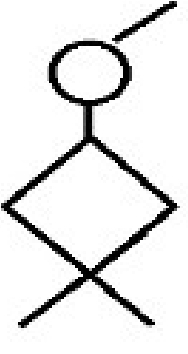
A
$1-$Methoxy$-3,3-$dimethylcyclobutane
B
$3-$Methoxy$-1,1-$dimethylcyclobutane
C
$3,3-$dimethylcyclobutoxymethane
D
$1-$methoxy$-3-$isopropyl butane
Solution
(B) $1$. Identify the principal functional group: The compound is an ether,where the methoxy group $(-OCH_3)$ is attached to a cyclobutane ring.
$2$. Number the ring: The ring is a cyclobutane. We must assign the lowest possible locants to the substituents.
$3$. If we assign position $1$ to the carbon attached to the methoxy group,the methyl groups are at position $3$. This gives the locants $1, 3, 3$.
$4$. If we assign position $1$ to the carbon attached to the methyl groups,the methoxy group is at position $3$. This gives the locants $1, 1, 3$.
$5$. Comparing the sets $(1, 3, 3)$ and $(1, 1, 3)$,the set $(1, 1, 3)$ is lower.
$6$. Therefore,the methoxy group is at position $3$ and the two methyl groups are at position $1$.
$7$. The $IUPAC$ name is $3-$methoxy$-1,1-$dimethylcyclobutane.
$2$. Number the ring: The ring is a cyclobutane. We must assign the lowest possible locants to the substituents.
$3$. If we assign position $1$ to the carbon attached to the methoxy group,the methyl groups are at position $3$. This gives the locants $1, 3, 3$.
$4$. If we assign position $1$ to the carbon attached to the methyl groups,the methoxy group is at position $3$. This gives the locants $1, 1, 3$.
$5$. Comparing the sets $(1, 3, 3)$ and $(1, 1, 3)$,the set $(1, 1, 3)$ is lower.
$6$. Therefore,the methoxy group is at position $3$ and the two methyl groups are at position $1$.
$7$. The $IUPAC$ name is $3-$methoxy$-1,1-$dimethylcyclobutane.
0 likesView Solution
71
ChemistryMediumMCQMHT CET · 2023
What is the $IUPAC$ name of the following compound?
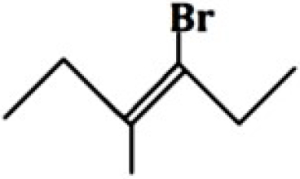
A
$3-$Bromo$-4-$ethylbut$-3-$ene
B
$3-$Bromo$-4-$methylhex$-3-$ene
C
$4-$Bromo$-3-$methylhex$-3-$ene
D
$4-$Bromo$-4-$ethyl$-3-$methylbut$-3-$ene
Solution
(C) $1$. Identify the longest carbon chain containing the double bond. The longest chain has $6$ carbons,so the parent alkane is hexane,and the alkene is hex$-3-$ene.
$2$. Number the chain from the end that gives the double bond the lowest locant. Numbering from left to right gives the double bond at position $3$.
$3$. Identify the substituents: $A$ bromine atom $(-Br)$ is at position $4$ and a methyl group $(-CH_3)$ is at position $3$.
$4$. Combine the parts alphabetically: $4-$Bromo$-3-$methylhex$-3-$ene.
$2$. Number the chain from the end that gives the double bond the lowest locant. Numbering from left to right gives the double bond at position $3$.
$3$. Identify the substituents: $A$ bromine atom $(-Br)$ is at position $4$ and a methyl group $(-CH_3)$ is at position $3$.
$4$. Combine the parts alphabetically: $4-$Bromo$-3-$methylhex$-3-$ene.
0 likesView Solution
72
ChemistryMCQMHT CET · 2023
What is the $IUPAC$ name of the following compound?
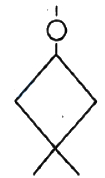
A
$1-$Methoxy$-3,3-$dimethylcyclobutane
B
$3-$Methoxy$-1,1-$dimethylcyclobutane
C
$3,3-$dimethylcyclobutoxymethane
D
$1-$Methoxy$-3-$isopropylbutane
Solution
(B) $1$. Identify the parent chain: The parent ring is a cyclobutane ring.
$2$. Identify substituents: There is a methoxy group $(-OCH_3)$ and two methyl groups $(-CH_3)$.
$3$. Numbering: Number the ring to give the lowest possible locants to the substituents. Starting from the carbon with the two methyl groups as $1$,the methoxy group is at position $3$.
$4$. Name: The compound is $3-$methoxy$-1,1-$dimethylcyclobutane.
$2$. Identify substituents: There is a methoxy group $(-OCH_3)$ and two methyl groups $(-CH_3)$.
$3$. Numbering: Number the ring to give the lowest possible locants to the substituents. Starting from the carbon with the two methyl groups as $1$,the methoxy group is at position $3$.
$4$. Name: The compound is $3-$methoxy$-1,1-$dimethylcyclobutane.
0 likesView Solution
73
ChemistryDifficultMCQMHT CET · 2023
What is the $IUPAC$ name of the following compound?
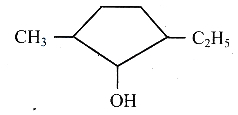
A
$2-$Ethyl$-3-$methylcyclopentanol
B
$2-$Ethyl$-5-$methylcyclopentanol
C
$2-$Methyl$-3-$ethylcyclopentanol
D
$1-$Methyl$-3-$ethylcyclopentan$-2-$ol
Solution
(B) $1$. Identify the principal functional group: The $-OH$ group is the principal functional group,so the parent chain is a cyclopentanol. The carbon attached to the $-OH$ group is assigned position $1$.
$2$. Number the ring: To give the lowest possible locants to the substituents (ethyl and methyl groups),we number the ring starting from the carbon with the $-OH$ group as $1$. Moving clockwise,the ethyl group is at position $2$ and the methyl group is at position $5$.
$3$. Alphabetical order: Substituents are listed alphabetically. Since 'ethyl' comes before 'methyl',the name is $2-$ethyl$-5-$methylcyclopentanol.
$2$. Number the ring: To give the lowest possible locants to the substituents (ethyl and methyl groups),we number the ring starting from the carbon with the $-OH$ group as $1$. Moving clockwise,the ethyl group is at position $2$ and the methyl group is at position $5$.
$3$. Alphabetical order: Substituents are listed alphabetically. Since 'ethyl' comes before 'methyl',the name is $2-$ethyl$-5-$methylcyclopentanol.
0 likesView Solution
74
ChemistryEasyMCQMHT CET · 2023
What is the $IUPAC$ name of the following compound?
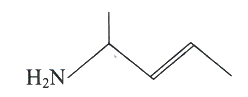
A
$1-$Methylbut$-2-$en$-1-$amine
B
Pent$-3-$en$-2-$amine
C
Pent$-2-$en$-4-$amine
D
$4-$Methylbut$-2-$en$-4-$amine
Solution
(B) $1$. Identify the longest carbon chain containing the functional group $(-NH_2)$ and the double bond. The chain has $5$ carbon atoms,so the parent alkane is pentane.
$2$. Number the chain starting from the end closer to the $-NH_2$ group to give it the lowest possible locant. Thus,the $-NH_2$ group is at position $2$.
$3$. The double bond starts at position $3$. Therefore,the suffix for the alkene is $-3-$ene and for the amine is $-2-$amine.
$4$. Combining these,the $IUPAC$ name is Pent$-3-$en$-2-$amine.
$2$. Number the chain starting from the end closer to the $-NH_2$ group to give it the lowest possible locant. Thus,the $-NH_2$ group is at position $2$.
$3$. The double bond starts at position $3$. Therefore,the suffix for the alkene is $-3-$ene and for the amine is $-2-$amine.
$4$. Combining these,the $IUPAC$ name is Pent$-3-$en$-2-$amine.
0 likesView Solution
75
ChemistryEasyMCQMHT CET · 2023
What is the $IUPAC$ name of allylamine?
A
Propan-$1$-amine
B
Prop-$2$-en-$1$-amine
C
Prop-$1$-en-$2$-amine
D
Propan-$2$-amine
Solution
(B) The structure of allylamine is $CH_2=CH-CH_2-NH_2$.
In this molecule,the principal functional group is the amine $(-NH_2)$,which is assigned the lowest possible number.
The carbon chain contains $3$ carbon atoms with a double bond starting at position $2$.
Therefore,the $IUPAC$ name is Prop-$2$-en-$1$-amine.
In this molecule,the principal functional group is the amine $(-NH_2)$,which is assigned the lowest possible number.
The carbon chain contains $3$ carbon atoms with a double bond starting at position $2$.
Therefore,the $IUPAC$ name is Prop-$2$-en-$1$-amine.
0 likesView Solution
76
ChemistryMediumMCQMHT CET · 2023
Which of the following statements is $TRUE$ about the $CH_3-CH(NH_2)-CH_2-COOH$ molecule?
A
It is an example of an amino acid.
B
Its $IUPAC$ name is $3-$carboxy$-2-$amine.
C
The amino group is located at $C-3$.
D
The $-NH_2$ group is considered the principal functional group for $IUPAC$ naming.
Solution
(C) The given molecule is $CH_3-CH(NH_2)-CH_2-COOH$.
$1$. The principal functional group is the carboxylic acid group $(-COOH)$,so the parent chain is a butanoic acid derivative.
$2$. Numbering starts from the $-COOH$ carbon as $C-1$. Thus,the amino group $(-NH_2)$ is at $C-3$.
$3$. The correct $IUPAC$ name is $3-$aminobutanoic acid.
$4$. Since the amino group is on the $\beta-$carbon relative to the carboxyl group,it is a $\beta-$amino acid.
Therefore,statement $C$ is true.
$1$. The principal functional group is the carboxylic acid group $(-COOH)$,so the parent chain is a butanoic acid derivative.
$2$. Numbering starts from the $-COOH$ carbon as $C-1$. Thus,the amino group $(-NH_2)$ is at $C-3$.
$3$. The correct $IUPAC$ name is $3-$aminobutanoic acid.
$4$. Since the amino group is on the $\beta-$carbon relative to the carboxyl group,it is a $\beta-$amino acid.
Therefore,statement $C$ is true.
0 likesView Solution
77
ChemistryEasyMCQMHT CET · 2023
What is the $IUPAC$ name of the following compound?
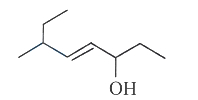
A
$2-$Ethylhept$-3-$en$-5-$ol
B
$3-$Methyloct$-4-$en$-6-$ol
C
$6-$Methyloct$-4-$en$-3-$ol
D
$6-$Ethylhept$-4-$en$-3-$ol
Solution
(C) $1$. Identify the longest carbon chain containing the principal functional group $(-OH)$ and the double bond. The chain has $8$ carbons,so the parent alkane is octane.
$2$. Number the chain from the end that gives the lowest locant to the principal functional group $(-OH)$. Numbering from right to left gives the $-OH$ group at position $3$.
$3$. The double bond starts at carbon $4$,so it is named as oct$-4-$en.
$4$. There is a methyl group at position $6$.
$5$. Combining these,the $IUPAC$ name is $6-$methyloct$-4-$en$-3-$ol.
$2$. Number the chain from the end that gives the lowest locant to the principal functional group $(-OH)$. Numbering from right to left gives the $-OH$ group at position $3$.
$3$. The double bond starts at carbon $4$,so it is named as oct$-4-$en.
$4$. There is a methyl group at position $6$.
$5$. Combining these,the $IUPAC$ name is $6-$methyloct$-4-$en$-3-$ol.
0 likesView Solution
78
ChemistryEasyMCQMHT CET · 2023
The $IUPAC$ name of the following compound is:
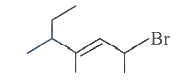
A
$2-$Bromo$-4,5-$dimethylhept$-3-$ene
B
$1-$Bromo$-1,3,4-$trimethylhex$-2-$ene
C
$2-$Bromo$-5-$ethyl$-4-$methylhex$-3-$ene
D
$1-$Bromo$-4-$ethyl$-1,3-$dimethylpent$-2-$ene
Solution
(A) $1$. Identify the longest carbon chain containing the double bond. The longest chain has $7$ carbon atoms,so the parent alkane is heptane,and with the double bond,it is hept$-3-$ene.
$2$. Number the chain from the end that gives the lowest locant to the double bond. Numbering from the right gives the double bond position $3$.
$3$. Identify the substituents: there is a bromo group at position $2$ and methyl groups at positions $4$ and $5$.
$4$. Combining these,the $IUPAC$ name is $2-$Bromo$-4,5-$dimethylhept$-3-$ene.
$2$. Number the chain from the end that gives the lowest locant to the double bond. Numbering from the right gives the double bond position $3$.
$3$. Identify the substituents: there is a bromo group at position $2$ and methyl groups at positions $4$ and $5$.
$4$. Combining these,the $IUPAC$ name is $2-$Bromo$-4,5-$dimethylhept$-3-$ene.
0 likesView Solution
79
ChemistryMediumMCQMHT CET · 2023
What is the $IUPAC$ name of the following compound?
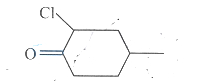
A
$2-$Chloro$-4-$methylcyclohexanone
B
$2-$Chloro$-3-$methylcyclohexanone
C
$2-$Chloro$-5-$methylcyclohexanone
D
$4-$Methyl$-2-$chlorocyclohexanone
Solution
(A) $1$. Identify the principal functional group: The compound contains a ketone group,so the suffix is $-one$ and the parent chain is a cyclohexane ring,making it a cyclohexanone.
$2$. Number the ring: The carbonyl carbon of the ketone is assigned position $1$. We number the ring to give the substituents the lowest possible locants. Moving clockwise,the chlorine atom is at position $2$ and the methyl group is at position $4$.
$3$. Assemble the name: The substituents are $2-$chloro and $4-$methyl. Alphabetical order is followed for naming substituents ($C$ before $M$).
$4$. Thus,the $IUPAC$ name is $2-$chloro$-4-$methylcyclohexanone.
$2$. Number the ring: The carbonyl carbon of the ketone is assigned position $1$. We number the ring to give the substituents the lowest possible locants. Moving clockwise,the chlorine atom is at position $2$ and the methyl group is at position $4$.
$3$. Assemble the name: The substituents are $2-$chloro and $4-$methyl. Alphabetical order is followed for naming substituents ($C$ before $M$).
$4$. Thus,the $IUPAC$ name is $2-$chloro$-4-$methylcyclohexanone.
0 likesView Solution
80
ChemistryMediumMCQMHT CET · 2023
Which of the following functional groups has the lowest priority for deciding the principal functional group in a polyfunctional compound?
A
$-COOR$
B
$-COCl$
C
$>C=O$
D
$-CONH_2$
Solution
(C) The priority order for functional groups in $IUPAC$ nomenclature is as follows:
$-COOH > -SO_3H > -COOR > -COCl > -CONH_2 > -CN > -CHO > >C=O > -OH > -NH_2 > -C=C- > -C\equiv C-$
Comparing the given options:
$1$. $-COOR$ (Ester)
$2$. $-COCl$ (Acyl chloride)
$3$. $>C=O$ (Ketone)
$4$. $-CONH_2$ (Amide)
According to the priority order,the ketone group $(>C=O)$ has the lowest priority among the given choices.
$-COOH > -SO_3H > -COOR > -COCl > -CONH_2 > -CN > -CHO > >C=O > -OH > -NH_2 > -C=C- > -C\equiv C-$
Comparing the given options:
$1$. $-COOR$ (Ester)
$2$. $-COCl$ (Acyl chloride)
$3$. $>C=O$ (Ketone)
$4$. $-CONH_2$ (Amide)
According to the priority order,the ketone group $(>C=O)$ has the lowest priority among the given choices.
0 likesView Solution
81
ChemistryMCQMHT CET · 2023
What is the common name of benzene$-1,3-$diol?
A
Catechol
B
Resorcinol
C
Quinol
D
Pyrogallol
Solution
(B) The structure of benzene$-1,3-$diol consists of a benzene ring with two hydroxyl $(-OH)$ groups attached at the $1$ and $3$ positions.
This specific isomer is commonly known as Resorcinol.
Catechol is benzene$-1,2-$diol,Quinol (or hydroquinone) is benzene$-1,4-$diol,and Pyrogallol is benzene$-1,2,3-$triol.
This specific isomer is commonly known as Resorcinol.
Catechol is benzene$-1,2-$diol,Quinol (or hydroquinone) is benzene$-1,4-$diol,and Pyrogallol is benzene$-1,2,3-$triol.
0 likesView Solution
82
ChemistryMediumMCQMHT CET · 2023
What is the $IUPAC$ name of crotonyl alcohol?
A
$but-3-en-1-ol$
B
$but-2-en-1-ol$
C
$but-1-en-2-ol$
D
$but-1-en-3-ol$
Solution
(B) The chemical structure of crotonyl alcohol is $CH_3CH=CHCH_2OH$.
In the $IUPAC$ nomenclature,the longest carbon chain containing the functional group $(-OH)$ and the double bond is selected.
The numbering starts from the carbon attached to the $-OH$ group to give it the lowest possible locant.
Thus,the chain has $4$ carbons,the double bond starts at position $2$,and the alcohol group is at position $1$.
The correct $IUPAC$ name is $but-2-en-1-ol$.
In the $IUPAC$ nomenclature,the longest carbon chain containing the functional group $(-OH)$ and the double bond is selected.
The numbering starts from the carbon attached to the $-OH$ group to give it the lowest possible locant.
Thus,the chain has $4$ carbons,the double bond starts at position $2$,and the alcohol group is at position $1$.
The correct $IUPAC$ name is $but-2-en-1-ol$.
0 likesView Solution
83
ChemistryEasyMCQMHT CET · 2023
Which of the following statements is $TRUE$ for the given molecule?
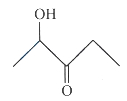
A
$-OH$ is attached to an $sp^2$ hybridized carbon.
B
$-OH$ is considered the principal functional group.
C
The molecular formula of this compound is $C_4H_9O_2$.
D
The $IUPAC$ name of this compound is $2-$hydroxypentan$-3-$one.
Solution
(D) $1$. The structure is $CH_3-CH(OH)-C(=O)-CH_2-CH_3$. The ketone group $(>C=O)$ has higher priority than the hydroxyl group $(-OH)$ according to $IUPAC$ nomenclature rules. Thus,the ketone is the principal functional group and $-OH$ is a substituent. Option $(B)$ is false.
$2$. The $-OH$ group is attached to the $C-2$ carbon,which is bonded to four single bonds,making it $sp^3$ hybridized. Option $(A)$ is false.
$3$. Counting the atoms: $5$ carbons,$10$ hydrogens,and $2$ oxygens. The molecular formula is $C_5H_{10}O_2$. Option $(C)$ is false.
$4$. The longest carbon chain containing the ketone group has $5$ carbons (pentane). Numbering from the left gives the hydroxyl group at position $2$ and the ketone at position $3$. The $IUPAC$ name is $2-$hydroxypentan$-3-$one. Option $(D)$ is true.
$2$. The $-OH$ group is attached to the $C-2$ carbon,which is bonded to four single bonds,making it $sp^3$ hybridized. Option $(A)$ is false.
$3$. Counting the atoms: $5$ carbons,$10$ hydrogens,and $2$ oxygens. The molecular formula is $C_5H_{10}O_2$. Option $(C)$ is false.
$4$. The longest carbon chain containing the ketone group has $5$ carbons (pentane). Numbering from the left gives the hydroxyl group at position $2$ and the ketone at position $3$. The $IUPAC$ name is $2-$hydroxypentan$-3-$one. Option $(D)$ is true.
0 likesView Solution
84
ChemistryMCQMHT CET · 2023
What is the $IUPAC$ name of the following compound?

A
$2-$Ethyl$-3-$methylcyclopentanol
B
$2-$Methyl$-3-$ethylcyclopentanol
C
$1-$Methyl$-3-$ethylcyclopentan$-2-$ol
D
$2-$Ethyl$-5-$methylcyclopentanol
Solution
(D) $1$. Identify the principal functional group: The $-OH$ group is the principal functional group,so the parent chain is a cyclopentanol.
$2$. Numbering the ring: The carbon atom attached to the $-OH$ group is assigned position $1$. The ring is then numbered to give the lowest possible locants to the substituents.
$3$. If we number clockwise,the substituents are at positions $2$ (ethyl) and $5$ (methyl). If we number counter-clockwise,the substituents are at positions $2$ (methyl) and $5$ (ethyl).
$4$. Applying the lowest locant rule: Comparing the sets $(2, 5)$ and $(2, 5)$,we look at alphabetical order. Ethyl comes before methyl.
$5$. Therefore,we assign the lower number to the substituent that comes first alphabetically. Thus,the ethyl group is at position $2$ and the methyl group is at position $5$.
$6$. The $IUPAC$ name is $2-$Ethyl$-5-$methylcyclopentanol.
$2$. Numbering the ring: The carbon atom attached to the $-OH$ group is assigned position $1$. The ring is then numbered to give the lowest possible locants to the substituents.
$3$. If we number clockwise,the substituents are at positions $2$ (ethyl) and $5$ (methyl). If we number counter-clockwise,the substituents are at positions $2$ (methyl) and $5$ (ethyl).
$4$. Applying the lowest locant rule: Comparing the sets $(2, 5)$ and $(2, 5)$,we look at alphabetical order. Ethyl comes before methyl.
$5$. Therefore,we assign the lower number to the substituent that comes first alphabetically. Thus,the ethyl group is at position $2$ and the methyl group is at position $5$.
$6$. The $IUPAC$ name is $2-$Ethyl$-5-$methylcyclopentanol.
0 likesView Solution
85
ChemistryMediumMCQMHT CET · 2023
What is the $IUPAC$ name of the following compound?
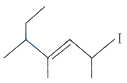
A
$1-$Iodo$-1,3,4-$trimethylhex$-2-$ene
B
$2-$Iodo$-4,5-$dimethylhept$-3-$ene
C
$2-$Iodo$-5-$ethyl$-4-$methylhex$-3-$ene
D
$1-$Iodo$-4-$ethyl$-1,3-$dimethylpent$-2-$ene
Solution
(B) $1$. Identify the longest carbon chain containing the double bond. The longest chain has $7$ carbon atoms,so the parent alkane is heptane,and with the double bond,it is hept$-3-$ene.
$2$. Number the chain from the end that gives the double bond the lowest possible locant. Numbering from the right gives the double bond position $3$.
$3$. Identify the substituents: there is an iodo group at position $2$ and methyl groups at positions $4$ and $5$.
$4$. Combine these to get the $IUPAC$ name: $2-$Iodo$-4,5-$dimethylhept$-3-$ene.
$2$. Number the chain from the end that gives the double bond the lowest possible locant. Numbering from the right gives the double bond position $3$.
$3$. Identify the substituents: there is an iodo group at position $2$ and methyl groups at positions $4$ and $5$.
$4$. Combine these to get the $IUPAC$ name: $2-$Iodo$-4,5-$dimethylhept$-3-$ene.
0 likesView Solution
86
ChemistryMediumMCQMHT CET · 2023
According to the carbinol system,what is the name of isopropyl alcohol?
A
Methyl carbinol
B
Ethyl carbinol
C
Dimethyl carbinol
D
Isopropyl carbinol
Solution
(C) In the carbinol system,alcohols are considered as derivatives of methyl alcohol $(CH_3OH)$,which is called carbinol.
Isopropyl alcohol has the structure $(CH_3)_2CHOH$.
In this structure,two hydrogen atoms of the carbinol group $(-CH_2OH)$ are replaced by two methyl groups $(-CH_3)$.
Therefore,it is named as dimethyl carbinol.
Isopropyl alcohol has the structure $(CH_3)_2CHOH$.
In this structure,two hydrogen atoms of the carbinol group $(-CH_2OH)$ are replaced by two methyl groups $(-CH_3)$.
Therefore,it is named as dimethyl carbinol.
0 likesView Solution
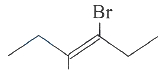
87
ChemistryMCQMHT CET · 2023
What is the $IUPAC$ name of the following compound?
A
$3-$Bromo$-4-$methylhex$-3-$ene
B
$4-$Bromo$-3-$methylhex$-3-$ene
C
$3-$Bromo$-4-$ethylbut$-3-$ene
D
$4-$Bromo$-4-$ethyl$-3-$methylbut$-3-$ene
Solution
(A) $1$. Identify the longest carbon chain containing the double bond. The longest chain has $6$ carbon atoms,so the parent alkane is hexane. Since there is a double bond at position $3$,it is hex$-3-$ene.
$2$. Number the chain from the end that gives the lowest locant to the double bond. Numbering from right to left gives the double bond at position $3$.
$3$. Identify the substituents: there is a bromo group $(-Br)$ at position $3$ and a methyl group $(-CH_3)$ at position $4$.
$4$. Combine these to get the $IUPAC$ name: $3-$Bromo$-4-$methylhex$-3-$ene.
$2$. Number the chain from the end that gives the lowest locant to the double bond. Numbering from right to left gives the double bond at position $3$.
$3$. Identify the substituents: there is a bromo group $(-Br)$ at position $3$ and a methyl group $(-CH_3)$ at position $4$.
$4$. Combine these to get the $IUPAC$ name: $3-$Bromo$-4-$methylhex$-3-$ene.
0 likesView Solution
88
ChemistryMCQMHT CET · 2023
What is the $IUPAC$ name of the following compound?
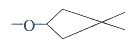
A
$1-$Methoxy$-3,3-$dimethylcyclobutane
B
$3-$Methoxy$-1,1-$dimethylcyclobutane
C
$3,3-$Dimethylcyclobutoxymethane
D
$1-$Methoxy$-3-$isopropylbutane
Solution
(B) $1$. Identify the principal functional group: The compound is an ether,where the methoxy group $(-OCH_3)$ is attached to a cyclobutane ring.
$2$. Number the ring: To give the lowest possible locants to the substituents,we start numbering from the carbon attached to the methoxy group or the dimethyl group. Following the $IUPAC$ rule of lowest locant set,we number the carbon with the two methyl groups as $1$ and the carbon with the methoxy group as $3$.
$3$. Name the substituents: There are two methyl groups at position $1$ and a methoxy group at position $3$.
$4$. Combine the parts: The name is $3-$methoxy$-1,1-$dimethylcyclobutane.
$2$. Number the ring: To give the lowest possible locants to the substituents,we start numbering from the carbon attached to the methoxy group or the dimethyl group. Following the $IUPAC$ rule of lowest locant set,we number the carbon with the two methyl groups as $1$ and the carbon with the methoxy group as $3$.
$3$. Name the substituents: There are two methyl groups at position $1$ and a methoxy group at position $3$.
$4$. Combine the parts: The name is $3-$methoxy$-1,1-$dimethylcyclobutane.
0 likesView Solution
89
ChemistryEasyMCQMHT CET · 2023
Which of the following is the $CORRECT$ bond-line formula for $HO(CH_2)_3CH(CH_3)CH(CH_3)_2$?
A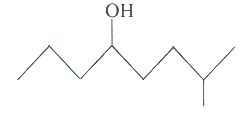
B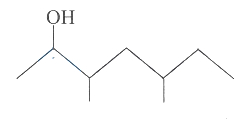
C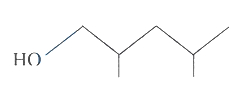
D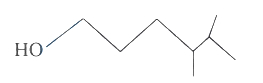
Solution
(D) The given compound is $HO-CH_2-CH_2-CH_2-CH(CH_3)-CH(CH_3)_2$.
This is a chain of $6$ carbon atoms in the main backbone with a hydroxyl group at the first carbon and methyl substituents at the $4^{th}$ and $5^{th}$ positions.
Counting from the $OH$ group:
$C_1$ is $CH_2OH$
$C_2$ is $CH_2$
$C_3$ is $CH_2$
$C_4$ is $CH(CH_3)$
$C_5$ is $CH(CH_3)_2$
Looking at the options,image $232466-$d represents a $6$-carbon chain with an $OH$ group at the end and two methyl groups at the $4^{th}$ and $5^{th}$ positions relative to the $OH$ group.
This is a chain of $6$ carbon atoms in the main backbone with a hydroxyl group at the first carbon and methyl substituents at the $4^{th}$ and $5^{th}$ positions.
Counting from the $OH$ group:
$C_1$ is $CH_2OH$
$C_2$ is $CH_2$
$C_3$ is $CH_2$
$C_4$ is $CH(CH_3)$
$C_5$ is $CH(CH_3)_2$
Looking at the options,image $232466-$d represents a $6$-carbon chain with an $OH$ group at the end and two methyl groups at the $4^{th}$ and $5^{th}$ positions relative to the $OH$ group.
0 likesView Solution
90
ChemistryEasyMCQMHT CET · 2023
Which of the following methods of structural formula representation conventionally uses a point for the front carbon and a circle around it for the rear carbon?
A
$A.$ Andiron formula
B
$B.$ Condensed formula
C
$C.$ Newman projection formula
D
$D.$ Fischer projection formula
Solution
(C) The correct answer is $C$.
In the Newman projection formula,the molecule is viewed along the $C-C$ bond axis.
The carbon atom nearer to the observer is represented by a point,and the rear carbon atom (further from the observer) is represented by a circle around that point.
In the Newman projection formula,the molecule is viewed along the $C-C$ bond axis.
The carbon atom nearer to the observer is represented by a point,and the rear carbon atom (further from the observer) is represented by a circle around that point.
0 likesView Solution
91
ChemistryMediumMCQMHT CET · 2023
What is the number of tertiary carbon atoms in a molecule of isobutane?
A
$1$
B
$2$
C
$3$
D
$4$
Solution
(A) The structure of isobutane is $CH_3-CH(CH_3)-CH_3$.
$A$ tertiary carbon atom is a carbon atom bonded to three other carbon atoms.
In isobutane,the central carbon atom is bonded to three methyl groups $(-CH_3)$.
Therefore,there is $1$ tertiary carbon atom in a molecule of isobutane.
$A$ tertiary carbon atom is a carbon atom bonded to three other carbon atoms.
In isobutane,the central carbon atom is bonded to three methyl groups $(-CH_3)$.
Therefore,there is $1$ tertiary carbon atom in a molecule of isobutane.
0 likesView Solution
92
ChemistryEasyMCQMHT CET · 2023
Identify the nonbenzenoid aromatic compound from the following.
A
Aniline
B
Tropone
C
Naphthalene
D
Phenol
Solution
(B) Aniline,naphthalene,and phenol are benzenoid aromatic compounds because they contain at least one benzene ring.
In contrast,tropone is a nonbenzenoid aromatic compound because it is aromatic but does not contain a benzene ring.
In contrast,tropone is a nonbenzenoid aromatic compound because it is aromatic but does not contain a benzene ring.
0 likesView Solution
93
ChemistryDifficultMCQMHT CET · 2023
Which among the following is $NOT$ a true statement regarding enantiomers?
A
Enantiomers have identical refractive index.
B
Enantiomers have same chemical properties.
C
Enantiomers are superimposable mirror images of each other.
D
Enantiomers have equal but opposite optical rotation.
Solution
(C) Enantiomers are non-superimposable mirror images of each other. Therefore,the statement that they are superimposable is incorrect.
0 likesView Solution
94
ChemistryMCQMHT CET · 2023
Identify the chiral molecule from the following.
A
$2-$Bromopropane
B
$2-$Bromo$-2-$methylbutane
C
$2-$Bromo$-3-$methylbutane
D
$3-$Bromopentane
Solution
(C) molecule is chiral if it contains at least one chiral carbon atom,which is a carbon atom bonded to four different groups.
$A$. $2-$Bromopropane: $CH_3-CH(Br)-CH_3$. The central carbon is bonded to two identical methyl groups. It is achiral.
$B$. $2-$Bromo$-2-$methylbutane: $CH_3-C(Br)(CH_3)-CH_2-CH_3$. The $C-2$ carbon is bonded to two identical methyl groups. It is achiral.
$C$. $2-$Bromo$-3-$methylbutane: $CH_3-CH(Br)-CH(CH_3)-CH_3$. The $C-2$ carbon is bonded to $-H$,$-Br$,$-CH_3$,and $-CH(CH_3)_2$ groups. Since all four groups are different,it is a chiral molecule.
$D$. $3-$Bromopentane: $CH_3-CH_2-CH(Br)-CH_2-CH_3$. The $C-3$ carbon is bonded to two identical ethyl groups. It is achiral.
Therefore,the correct option is $C$.
$A$. $2-$Bromopropane: $CH_3-CH(Br)-CH_3$. The central carbon is bonded to two identical methyl groups. It is achiral.
$B$. $2-$Bromo$-2-$methylbutane: $CH_3-C(Br)(CH_3)-CH_2-CH_3$. The $C-2$ carbon is bonded to two identical methyl groups. It is achiral.
$C$. $2-$Bromo$-3-$methylbutane: $CH_3-CH(Br)-CH(CH_3)-CH_3$. The $C-2$ carbon is bonded to $-H$,$-Br$,$-CH_3$,and $-CH(CH_3)_2$ groups. Since all four groups are different,it is a chiral molecule.
$D$. $3-$Bromopentane: $CH_3-CH_2-CH(Br)-CH_2-CH_3$. The $C-3$ carbon is bonded to two identical ethyl groups. It is achiral.
Therefore,the correct option is $C$.
0 likesView Solution
95
ChemistryEasyMCQMHT CET · 2023
Identify the molecular formula of an alkane that exhibits only two different structural isomers.
A
$C_2H_6$
B
$C_3H_8$
C
$C_4H_{10}$
D
$C_6H_{14}$
Solution
(C) An alkane with the molecular formula $C_4H_{10}$ (butane) exhibits exactly two structural isomers: $n$-butane (butane) and $2$-methylpropane (isobutane).
| $2$ Carbon atoms | Ethane: $0$ structural isomers |
| $3$ Carbon atoms | Propane: $0$ structural isomers |
| $4$ Carbon atoms | Butane: $2$ structural isomers ($n$-butane and $2$-methylpropane) |
| $6$ Carbon atoms | Hexane: $5$ structural isomers |
0 likesView Solution
96
ChemistryMCQMHT CET · 2023
Identify the chiral molecule from the following.
A
$2-$Iodopropane
B
$2-$Iodo$-2-$methylbutane
C
$2-$Iodo$-3-$methylbutane
D
$3-$Iodopentane
Solution
(C) molecule is chiral if it contains at least one carbon atom bonded to four different groups (a chiral center).
$A$. $2-$Iodopropane: $CH_3-CH(I)-CH_3$. The central carbon is bonded to two identical $-CH_3$ groups. Not chiral.
$B$. $2-$Iodo$-2-$methylbutane: $CH_3-C(I)(CH_3)-CH_2-CH_3$. The central carbon is bonded to two identical $-CH_3$ groups. Not chiral.
$C$. $2-$Iodo$-3-$methylbutane: $CH_3-CH(I)-CH(CH_3)_2$. The carbon at position $2$ is bonded to $-H$,$-I$,$-CH_3$,and $-CH(CH_3)_2$. Since all four groups are different,it is a chiral molecule.
$D$. $3-$Iodopentane: $CH_3-CH_2-CH(I)-CH_2-CH_3$. The central carbon is bonded to two identical $-CH_2CH_3$ groups. Not chiral.
Therefore,the correct option is $C$.
$A$. $2-$Iodopropane: $CH_3-CH(I)-CH_3$. The central carbon is bonded to two identical $-CH_3$ groups. Not chiral.
$B$. $2-$Iodo$-2-$methylbutane: $CH_3-C(I)(CH_3)-CH_2-CH_3$. The central carbon is bonded to two identical $-CH_3$ groups. Not chiral.
$C$. $2-$Iodo$-3-$methylbutane: $CH_3-CH(I)-CH(CH_3)_2$. The carbon at position $2$ is bonded to $-H$,$-I$,$-CH_3$,and $-CH(CH_3)_2$. Since all four groups are different,it is a chiral molecule.
$D$. $3-$Iodopentane: $CH_3-CH_2-CH(I)-CH_2-CH_3$. The central carbon is bonded to two identical $-CH_2CH_3$ groups. Not chiral.
Therefore,the correct option is $C$.
0 likesView Solution
97
ChemistryMediumMCQMHT CET · 2023
What is the number of moles of '$C$' atoms present in $n$ mole of an alkane molecule if it exhibits three structural isomers (in $n$)?
A
$3$
B
$4$
C
$5$
D
$6$
Solution
(C) An alkane with three structural isomers is pentane $(C_5H_{12})$.
The three isomers are:
$1$. $n$-Pentane: $CH_3-CH_2-CH_2-CH_2-CH_3$
$2$. Isopentane ($2$-methylbutane): $CH_3-CH(CH_3)-CH_2-CH_3$
$3$. Neopentane ($2$,$2$-dimethylpropane): $CH_3-C(CH_3)_2-CH_3$
In one molecule of pentane,there are $5$ carbon atoms.
Therefore,in $n$ moles of pentane,the number of moles of '$C$' atoms is $5 \times n = 5n$.
The three isomers are:
$1$. $n$-Pentane: $CH_3-CH_2-CH_2-CH_2-CH_3$
$2$. Isopentane ($2$-methylbutane): $CH_3-CH(CH_3)-CH_2-CH_3$
$3$. Neopentane ($2$,$2$-dimethylpropane): $CH_3-C(CH_3)_2-CH_3$
In one molecule of pentane,there are $5$ carbon atoms.
Therefore,in $n$ moles of pentane,the number of moles of '$C$' atoms is $5 \times n = 5n$.
0 likesView Solution
98
ChemistryMediumMCQMHT CET · 2023
What is the molecular formula of an alkane if it exhibits three structural isomers?
A
$C_3H_8$
B
$C_4H_{10}$
C
$C_5H_{12}$
D
$C_6H_{14}$
Solution
(C) The number of structural isomers for alkanes increases with the number of carbon atoms. Based on the data:
$1$. $C_3H_8$ (Propane): $0$ structural isomers.
$2$. $C_4H_{10}$ (Butane): $2$ structural isomers ($n$-butane and isobutane).
$3$. $C_5H_{12}$ (Pentane): $3$ structural isomers ($n$-pentane,isopentane,and neopentane).
$4$. $C_6H_{14}$ (Hexane): $5$ structural isomers.
Therefore,the alkane with three structural isomers is $C_5H_{12}$.
$1$. $C_3H_8$ (Propane): $0$ structural isomers.
$2$. $C_4H_{10}$ (Butane): $2$ structural isomers ($n$-butane and isobutane).
$3$. $C_5H_{12}$ (Pentane): $3$ structural isomers ($n$-pentane,isopentane,and neopentane).
$4$. $C_6H_{14}$ (Hexane): $5$ structural isomers.
Therefore,the alkane with three structural isomers is $C_5H_{12}$.
0 likesView Solution
99
ChemistryMCQMHT CET · 2023
Which among the following is $NOT$ a true statement for enantiomers?
A
Enantiomers have identical refractive index.
B
Enantiomers have same chemical properties.
C
Enantiomers are superimposable mirror images of each other.
D
Enantiomers have equal but opposite optical rotation.
Solution
(C) Enantiomers are defined as non-superimposable mirror images of each other. Therefore,the statement that they are superimposable is false.
0 likesView Solution
100
ChemistryEasyMCQMHT CET · 2023
Identify the product obtained when isopropyl bromide is reacted with metallic sodium in dry ether.
A
$2-$Methylpropane
B
$2,3-$Dimethylpentane
C
$2,3-$Dimethylbutane
D
$2,3-$Dimethylhexane
Solution
(C) The Wurtz reaction involves the coupling of two alkyl halide molecules in the presence of sodium metal and dry ether.
For isopropyl bromide $(CH_3-CH(Br)-CH_3)$,two moles react to form $2,3-$dimethylbutane:
$2CH_3-CH(Br)-CH_3 + 2Na \rightarrow CH_3-CH(CH_3)-CH(CH_3)-CH_3 + 2NaBr$.
For isopropyl bromide $(CH_3-CH(Br)-CH_3)$,two moles react to form $2,3-$dimethylbutane:
$2CH_3-CH(Br)-CH_3 + 2Na \rightarrow CH_3-CH(CH_3)-CH(CH_3)-CH_3 + 2NaBr$.
0 likesView Solution
101
ChemistryEasyMCQMHT CET · 2023
Which of the following is $NOT$ correct about fructose?
A
It is a ketohexose.
B
It is a reducing sugar.
C
It is laevorotatory.
D
Its ring structure is hemiacetal.
Solution
(D) The ring structure of fructose is a hemiketal,not a hemiacetal.
Fructose $(C_6H_{12}O_6)$ is a laevorotatory ketohexose.
It acts as a reducing sugar due to the presence of an $\alpha$-hydroxy ketone group which can tautomerize to an aldehyde in basic solution.
Fructose $(C_6H_{12}O_6)$ is a laevorotatory ketohexose.
It acts as a reducing sugar due to the presence of an $\alpha$-hydroxy ketone group which can tautomerize to an aldehyde in basic solution.
0 likesView Solution
102
ChemistryMediumMCQMHT CET · 2023
Which of the following phenomena is $NOT$ explained by the open chain structure of glucose?
A
Formation of pentaacetate of glucose with acetic anhydride.
B
Formation of oxime with hydroxylamine.
C
Formation of silver mirror with Tollen's reagent.
D
Existence of $\alpha$ and $\beta$ forms of glucose.
Solution
(D) Glucose exists in two cyclic forms,$\alpha$ and $\beta$,which are formed by intramolecular hemiacetal formation between the aldehyde group and one of the alcoholic groups at $C-5$ within the molecule.
This cyclic structure is responsible for the mutarotation and the existence of two anomers.
Thus,the open chain structure of glucose does not explain the existence of $\alpha$ and $\beta$ forms of glucose.
This cyclic structure is responsible for the mutarotation and the existence of two anomers.
Thus,the open chain structure of glucose does not explain the existence of $\alpha$ and $\beta$ forms of glucose.
0 likesView Solution
103
ChemistryEasyMCQMHT CET · 2023
What is the value of specific rotation exhibited by the fructose molecule?
A
$+52.7^{\circ}$
B
$-92.4^{\circ}$
C
$+66.5^{\circ}$
D
$-40.3^{\circ}$
Solution
(B) The specific rotation of $D$-fructose is $-92.4^{\circ}$.
Since the value is negative,it indicates that fructose is levorotatory,which is why it is commonly referred to as levulose.
Since the value is negative,it indicates that fructose is levorotatory,which is why it is commonly referred to as levulose.
0 likesView Solution
104
ChemistryMediumMCQMHT CET · 2023
In which of the following carbohydrates does the molecular mass increase by $84 \ u$ after complete acetylation?
A
Aldotriose
B
Aldotetrose
C
Ketotetrose
D
Ketopentose
Solution
(A) In an acetylation reaction,the $H$ atom of an $(-OH)$ group is replaced by an acetyl group $(-COCH_3)$.
This results in an increase in molecular mass by $[(12+16+12+3 \times 1)-1] = 42 \ u$ per $-OH$ group.
Given the total increase in molecular mass is $84 \ u$.
Therefore,the number of $-OH$ groups $= \frac{84 \ u}{42 \ u} = 2$.
Among the given options,an aldotriose (e.g.,glyceraldehyde) contains two alcoholic $-OH$ groups,which upon acetylation will increase the molecular mass by $2 \times 42 \ u = 84 \ u$.
This results in an increase in molecular mass by $[(12+16+12+3 \times 1)-1] = 42 \ u$ per $-OH$ group.
Given the total increase in molecular mass is $84 \ u$.
Therefore,the number of $-OH$ groups $= \frac{84 \ u}{42 \ u} = 2$.
Among the given options,an aldotriose (e.g.,glyceraldehyde) contains two alcoholic $-OH$ groups,which upon acetylation will increase the molecular mass by $2 \times 42 \ u = 84 \ u$.
0 likesView Solution
105
ChemistryEasyMCQMHT CET · 2023
Identify the non-reducing sugar from the following.
A
$Sucrose$
B
$Maltose$
C
$Lactose$
D
$Glucose$
Solution
(A) non-reducing sugar is a carbohydrate that does not have a free aldehyde or ketone group to act as a reducing agent.
$Sucrose$ is a disaccharide composed of $Glucose$ and $Fructose$ units linked by a glycosidic bond between their respective anomeric carbons ($C1$ of $Glucose$ and $C2$ of $Fructose$).
Since both anomeric carbons are involved in the glycosidic linkage,$Sucrose$ cannot open to form an aldehyde or ketone group,making it a non-reducing sugar.
$Maltose$,$Lactose$,and $Glucose$ all contain at least one free anomeric carbon,making them reducing sugars.
$Sucrose$ is a disaccharide composed of $Glucose$ and $Fructose$ units linked by a glycosidic bond between their respective anomeric carbons ($C1$ of $Glucose$ and $C2$ of $Fructose$).
Since both anomeric carbons are involved in the glycosidic linkage,$Sucrose$ cannot open to form an aldehyde or ketone group,making it a non-reducing sugar.
$Maltose$,$Lactose$,and $Glucose$ all contain at least one free anomeric carbon,making them reducing sugars.
0 likesView Solution
106
ChemistryMediumMCQMHT CET · 2023
Identify $A$ in the following reaction:
$C_6H_{12}O_6 \xrightarrow{\text{dil. } HNO_3} A$
$C_6H_{12}O_6 \xrightarrow{\text{dil. } HNO_3} A$
A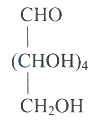
B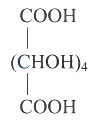
C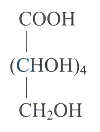
D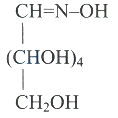
Solution
(B) When glucose $(C_6H_{12}O_6)$ is oxidized with dilute nitric acid $(HNO_3)$,both the terminal aldehyde group $(-CHO)$ and the primary alcoholic group $(-CH_2OH)$ are oxidized to carboxylic acid groups $(-COOH)$.
This results in the formation of saccharic acid (also known as glucaric acid),which is a dicarboxylic acid with the structure $COOH-(CHOH)_4-COOH$.
This results in the formation of saccharic acid (also known as glucaric acid),which is a dicarboxylic acid with the structure $COOH-(CHOH)_4-COOH$.
0 likesView Solution
107
ChemistryEasyMCQMHT CET · 2023
What type of glycosidic linkages are present in cellulose?
A
$\alpha-1,4$
B
$\beta-1,4$
C
$\alpha-1,6$
D
$\beta-1,6$
Solution
(B) Cellulose is a linear polysaccharide consisting of a long chain of $D$-glucose units joined by $\beta-1,4$-glycosidic linkages.
These linkages are formed between the $C1$ carbon of one glucose unit and the $C4$ carbon of the adjacent glucose unit in the $\beta$-configuration.
These linkages are formed between the $C1$ carbon of one glucose unit and the $C4$ carbon of the adjacent glucose unit in the $\beta$-configuration.
0 likesView Solution
108
ChemistryEasyMCQMHT CET · 2023
Identify the glycosidic linkage present in maltose.
A
$ \alpha-1,4 $
B
$ \alpha-1,6 $
C
$ \alpha-2,4 $
D
$ \beta-1,4 $
Solution
(A) Maltose is a disaccharide composed of two $ \alpha-D-glucose $ units.
These two glucose units are linked together by an $ \alpha-1,4-glycosidic $ linkage.
In this linkage,the $ C1 $ of one glucose molecule is connected to the $ C4 $ of the other glucose molecule.
These two glucose units are linked together by an $ \alpha-1,4-glycosidic $ linkage.
In this linkage,the $ C1 $ of one glucose molecule is connected to the $ C4 $ of the other glucose molecule.
0 likesView Solution
109
ChemistryEasyMCQMHT CET · 2023
Identify the trisaccharide from the following.
A
Maltose
B
Lactose
C
Raffinose
D
Stachyose
Solution
(C) $Maltose$ and $Lactose$ are disaccharides.
$Raffinose$ is a trisaccharide.
$Stachyose$ is a tetrasaccharide.
$Raffinose$ is a trisaccharide.
$Stachyose$ is a tetrasaccharide.
0 likesView Solution
110
ChemistryEasyMCQMHT CET · 2023
Identify the carbon atoms of $\alpha$-glucose and $\beta$-fructose forming the glycosidic linkage in sucrose.
A
$C-1$ of $\beta$-fructose and $C-2$ of $\alpha$-glucose
B
$C-1$ of $\alpha$-glucose and $C-2$ of $\beta$-fructose
C
$C-1$ of $\alpha$-glucose and $C-1$ of $\beta$-fructose
D
$C-2$ of $\alpha$-glucose and $C-2$ of $\beta$-fructose
Solution
(B) Sucrose is a disaccharide formed by the condensation of one molecule of $\alpha$-$D$-glucose and one molecule of $\beta$-$D$-fructose.
The glycosidic linkage is formed between the $C-1$ of $\alpha$-glucose and the $C-2$ of $\beta$-fructose.
This bond involves the anomeric carbon atoms of both monosaccharides,which is why sucrose is a non-reducing sugar.
The glycosidic linkage is formed between the $C-1$ of $\alpha$-glucose and the $C-2$ of $\beta$-fructose.
This bond involves the anomeric carbon atoms of both monosaccharides,which is why sucrose is a non-reducing sugar.
0 likesView Solution
111
ChemistryEasyMCQMHT CET · 2023
Identify the glycosidic linkage present in lactose.
A
$\beta-1,2$
B
$\alpha-1,4$
C
$\beta-1,4$
D
$\beta-1,6$
Solution
(C) Lactose is a disaccharide composed of $\beta-D-galactose$ and $\beta-D-glucose$.
The glycosidic linkage is formed between the $C-1$ of $\beta-D-galactose$ and the $C-4$ of $\beta-D-glucose$.
Therefore,the linkage is a $\beta-1,4-glycosidic$ linkage.
The glycosidic linkage is formed between the $C-1$ of $\beta-D-galactose$ and the $C-4$ of $\beta-D-glucose$.
Therefore,the linkage is a $\beta-1,4-glycosidic$ linkage.
0 likesView Solution
112
ChemistryEasyMCQMHT CET · 2023
Identify the tetrasaccharide from the following.
A
$Glycogen$
B
$Cellulose$
C
$Ribose$
D
$Stachyose$
Solution
(D) $Stachyose$ is a tetrasaccharide.
Upon hydrolysis,it yields four monosaccharide units: two units of $D-galactose$,one unit of $D-glucose$,and one unit of $D-fructose$.
$Glycogen$ and $Cellulose$ are polysaccharides,while $Ribose$ is a monosaccharide.
Upon hydrolysis,it yields four monosaccharide units: two units of $D-galactose$,one unit of $D-glucose$,and one unit of $D-fructose$.
$Glycogen$ and $Cellulose$ are polysaccharides,while $Ribose$ is a monosaccharide.
0 likesView Solution
113
ChemistryEasyMCQMHT CET · 2023
Identify the glycosidic linkage present in lactose.
A
$\beta-1,4$
B
$\alpha-1,6$
C
$\beta-1,6$
D
$\alpha-1,4$
Solution
(A) Lactose is a disaccharide composed of $\beta$-$D$-galactose and $\beta$-$D$-glucose units.
In lactose,the glycosidic linkage is formed between the $C-1$ carbon of $\beta$-$D$-galactose and the $C-4$ carbon of $\beta$-$D$-glucose.
Therefore,the linkage is a $\beta-1,4$-glycosidic linkage.
In lactose,the glycosidic linkage is formed between the $C-1$ carbon of $\beta$-$D$-galactose and the $C-4$ carbon of $\beta$-$D$-glucose.
Therefore,the linkage is a $\beta-1,4$-glycosidic linkage.
0 likesView Solution
114
ChemistryEasyMCQMHT CET · 2023
Which of the following is $NOT$ a disaccharide?
A
Sucrose
B
Maltose
C
Lactose
D
Raffinose
Solution
(D) Sucrose,maltose,and lactose are disaccharides,which consist of two monosaccharide units.
Raffinose is a trisaccharide,which consists of three monosaccharide units (galactose,glucose,and fructose).
Raffinose is a trisaccharide,which consists of three monosaccharide units (galactose,glucose,and fructose).
0 likesView Solution
115
ChemistryEasyMCQMHT CET · 2023
Which of the following is $NOT$ a basic amino acid?
A
Proline
B
Lysine
C
Arginine
D
Histidine
Solution
(A) Basic amino acids contain more than one amino group and fewer carboxyl groups.
$Lysine$,$Arginine$,and $Histidine$ are basic amino acids.
$Proline$ is an imino acid and is neutral in nature.
Therefore,$Proline$ is not a basic amino acid.
$Lysine$,$Arginine$,and $Histidine$ are basic amino acids.
$Proline$ is an imino acid and is neutral in nature.
Therefore,$Proline$ is not a basic amino acid.
0 likesView Solution
116
ChemistryEasyMCQMHT CET · 2023
Which of the following is not a globular protein?
A
Myosin
B
Insulin
C
Legumelin
D
Serum albumin
Solution
(A) Proteins are classified into two types based on their molecular shape: fibrous proteins and globular proteins.
Fibrous proteins have a thread-like structure and are generally insoluble in water,such as keratin and myosin.
Globular proteins have a spherical shape and are generally soluble in water,such as insulin,legumelin,and serum albumin.
Therefore,$Myosin$ is a fibrous protein,not a globular protein.
Fibrous proteins have a thread-like structure and are generally insoluble in water,such as keratin and myosin.
Globular proteins have a spherical shape and are generally soluble in water,such as insulin,legumelin,and serum albumin.
Therefore,$Myosin$ is a fibrous protein,not a globular protein.
0 likesView Solution
117
ChemistryEasyMCQMHT CET · 2023
Which of the following is $NOT$ a globular protein?
A
Insulin
B
Egg albumin
C
Serum albumin
D
Keratin
Solution
(D) $Insulin$,$egg \ albumin$ and $serum \ albumin$ are globular proteins,whereas $keratin$ is a fibrous protein.
0 likesView Solution
118
ChemistryEasyMCQMHT CET · 2023
What type of peptide is glycylalanine?
A
Dipeptide
B
Tripeptide
C
Tetrapeptide
D
Pentapeptide
Solution
(A) Glycylalanine is formed by the condensation of two amino acids,glycine and alanine,through a peptide bond.
Since it consists of two amino acid residues,it is classified as a dipeptide.
Since it consists of two amino acid residues,it is classified as a dipeptide.
0 likesView Solution
119
ChemistryEasyMCQMHT CET · 2023
What is the number of $-OH$ groups present in one molecule of ribose?
A
$2$
B
$3$
C
$4$
D
$5$
Solution
(C) The open-chain structure of ribose is given by the formula $CHO-(CHOH)_3-CH_2OH$.
In this structure,there are $3$ hydroxyl groups attached to the middle carbons in the $(CHOH)_3$ unit and $1$ hydroxyl group attached to the terminal $CH_2OH$ group.
Therefore,the total number of $-OH$ groups in one molecule of ribose is $3 + 1 = 4$.
In this structure,there are $3$ hydroxyl groups attached to the middle carbons in the $(CHOH)_3$ unit and $1$ hydroxyl group attached to the terminal $CH_2OH$ group.
Therefore,the total number of $-OH$ groups in one molecule of ribose is $3 + 1 = 4$.
0 likesView Solution
120
ChemistryEasyMCQMHT CET · 2023
Which among the following has the lowest boiling point?
A
Butyric acid
B
Valeric acid
C
Acetic acid
D
Formic acid
Solution
(D) The boiling point of carboxylic acids increases with an increase in molar mass due to stronger intermolecular forces (hydrogen bonding and van der Waals forces).
Among the given compounds,the molar masses are:
$1$. Formic acid $(HCOOH)$: $46 \ g/mol$
$2$. Acetic acid $(CH_3COOH)$: $60 \ g/mol$
$3$. Butyric acid $(C_3H_7COOH)$: $88 \ g/mol$
$4$. Valeric acid $(C_4H_9COOH)$: $102 \ g/mol$
Since Formic acid has the lowest molar mass,it has the lowest boiling point.
Among the given compounds,the molar masses are:
$1$. Formic acid $(HCOOH)$: $46 \ g/mol$
$2$. Acetic acid $(CH_3COOH)$: $60 \ g/mol$
$3$. Butyric acid $(C_3H_7COOH)$: $88 \ g/mol$
$4$. Valeric acid $(C_4H_9COOH)$: $102 \ g/mol$
Since Formic acid has the lowest molar mass,it has the lowest boiling point.
0 likesView Solution
121
ChemistryEasyMCQMHT CET · 2023
Identify the reagent '$A$' used in the following conversion.
$CH_3CH_2Br \xrightarrow{A} CH_3CH_2COOCH_2CH_3$
$CH_3CH_2Br \xrightarrow{A} CH_3CH_2COOCH_2CH_3$
A
Sodium propoxide
B
Ethoxy propane
C
Silver propanoate
D
Silver ethanoate
Solution
(C) The reaction of an alkyl halide with a silver salt of a carboxylic acid is a standard method for the preparation of esters. This is a nucleophilic substitution reaction ($S_N2$ mechanism).
The reaction is as follows:
$CH_3CH_2Br + CH_3CH_2COOAg \xrightarrow{\Delta} CH_3CH_2COOCH_2CH_3 + AgBr \downarrow$
Here,$CH_3CH_2COOAg$ is silver propanoate. Thus,the reagent '$A$' is silver propanoate.
The reaction is as follows:
$CH_3CH_2Br + CH_3CH_2COOAg \xrightarrow{\Delta} CH_3CH_2COOCH_2CH_3 + AgBr \downarrow$
Here,$CH_3CH_2COOAg$ is silver propanoate. Thus,the reagent '$A$' is silver propanoate.
0 likesView Solution
122
ChemistryEasyMCQMHT CET · 2023
Select the $CORRECT$ increasing order of boiling points of alcohols,amines,and carboxylic acids of comparable molar mass from the following.
A
$Amines < Alcohols < Carboxylic \ acids$
B
$Amines < Carboxylic \ acids < Alcohols$
C
$Alcohols < Amines < Carboxylic \ acids$
D
$Carboxylic \ acids < Alcohols < Amines$
Solution
(A) The boiling point depends on the strength of intermolecular forces,primarily hydrogen bonding.
$N-H$ bonds in amines are less polar than $O-H$ bonds in alcohols,leading to weaker hydrogen bonding in amines.
Carboxylic acids contain a $-COOH$ group,which allows for the formation of stable dimeric structures through strong intermolecular hydrogen bonding.
Therefore,the strength of hydrogen bonding follows the order: $Amines < Alcohols < Carboxylic \ acids$.
Consequently,the increasing order of boiling points is $Amines < Alcohols < Carboxylic \ acids$.
$N-H$ bonds in amines are less polar than $O-H$ bonds in alcohols,leading to weaker hydrogen bonding in amines.
Carboxylic acids contain a $-COOH$ group,which allows for the formation of stable dimeric structures through strong intermolecular hydrogen bonding.
Therefore,the strength of hydrogen bonding follows the order: $Amines < Alcohols < Carboxylic \ acids$.
Consequently,the increasing order of boiling points is $Amines < Alcohols < Carboxylic \ acids$.
0 likesView Solution
123
ChemistryEasyMCQMHT CET · 2023
Which among the following compounds has the highest boiling point?
A
Propanone
B
Ethanoic acid
C
Propan-$1$-ol
D
Propanal
Solution
(B) The boiling point of a compound depends on the strength of intermolecular forces.
Carboxylic acids,such as $CH_3COOH$,form stable intermolecular hydrogen-bonded dimers,which significantly increase their boiling points compared to alcohols,aldehydes,and ketones of comparable molecular mass.
Therefore,$Ethanoic \ acid$ has the highest boiling point among the given options.
Carboxylic acids,such as $CH_3COOH$,form stable intermolecular hydrogen-bonded dimers,which significantly increase their boiling points compared to alcohols,aldehydes,and ketones of comparable molecular mass.
Therefore,$Ethanoic \ acid$ has the highest boiling point among the given options.
0 likesView Solution
124
ChemistryEasyMCQMHT CET · 2023
Which among the following is a dicarboxylic acid?
A
Valeric acid
B
Caproic acid
C
Glutaric acid
D
Butyric acid
Solution
(C) dicarboxylic acid contains two carboxylic acid $(-COOH)$ functional groups.
Valeric acid $(CH_3(CH_2)_3COOH)$,Caproic acid $(CH_3(CH_2)_4COOH)$,and Butyric acid $(CH_3(CH_2)_2COOH)$ are monocarboxylic acids.
Glutaric acid has the structure $HOOC-(CH_2)_3-COOH$,which contains two $-COOH$ groups,making it a dicarboxylic acid.
Valeric acid $(CH_3(CH_2)_3COOH)$,Caproic acid $(CH_3(CH_2)_4COOH)$,and Butyric acid $(CH_3(CH_2)_2COOH)$ are monocarboxylic acids.
Glutaric acid has the structure $HOOC-(CH_2)_3-COOH$,which contains two $-COOH$ groups,making it a dicarboxylic acid.
0 likesView Solution
125
ChemistryEasyMCQMHT CET · 2023
Which among the following is $NOT$ a dicarboxylic acid?
A
Malonic acid
B
Caproic acid
C
Glutaric acid
D
Succinic acid
Solution
(B) dicarboxylic acid contains two carboxyl $(-COOH)$ groups.
Malonic acid is $HOOC-CH_2-COOH$.
Glutaric acid is $HOOC-(CH_2)_3-COOH$.
Succinic acid is $HOOC-(CH_2)_2-COOH$.
Caproic acid is a monocarboxylic acid with the formula $CH_3(CH_2)_4COOH$,containing only one $-COOH$ group.
Therefore,the correct answer is $B$.
Malonic acid is $HOOC-CH_2-COOH$.
Glutaric acid is $HOOC-(CH_2)_3-COOH$.
Succinic acid is $HOOC-(CH_2)_2-COOH$.
Caproic acid is a monocarboxylic acid with the formula $CH_3(CH_2)_4COOH$,containing only one $-COOH$ group.
Therefore,the correct answer is $B$.
0 likesView Solution
126
ChemistryEasyMCQMHT CET · 2023
Identify the reagent used in the following reaction.
Benzoic acid $\xrightarrow{\text{Reagent}}$ Benzoyl chloride $+$ Phosphorus oxychloride $+$ Hydrogen chloride
Benzoic acid $\xrightarrow{\text{Reagent}}$ Benzoyl chloride $+$ Phosphorus oxychloride $+$ Hydrogen chloride
A
$PCl_3$
B
$HCl$
C
$PCl_5$
D
$SOCl_2$
Solution
(C) The reaction of benzoic acid with phosphorus pentachloride $(PCl_5)$ is a standard method for the preparation of acid chlorides. The chemical equation is:
$C_6H_5COOH + PCl_5 \rightarrow C_6H_5COCl + POCl_3 + HCl$
Here,$C_6H_5COCl$ is benzoyl chloride,$POCl_3$ is phosphorus oxychloride,and $HCl$ is hydrogen chloride. Thus,the reagent is $PCl_5$.
$C_6H_5COOH + PCl_5 \rightarrow C_6H_5COCl + POCl_3 + HCl$
Here,$C_6H_5COCl$ is benzoyl chloride,$POCl_3$ is phosphorus oxychloride,and $HCl$ is hydrogen chloride. Thus,the reagent is $PCl_5$.
0 likesView Solution
127
ChemistryMediumMCQMHT CET · 2023
Which among the following is a pair of monocarboxylic acids?
A
Malonic acid and propionic acid
B
Valeric acid and succinic acid
C
Acetic acid and adipic acid
D
Butyric acid and caproic acid
Solution
(D) Monocarboxylic acids contain only one $-COOH$ group in their structure.
$A$. Malonic acid $(HOOC-CH_2-COOH)$ is a dicarboxylic acid,while propionic acid $(CH_3-CH_2-COOH)$ is a monocarboxylic acid.
$B$. Valeric acid $(CH_3(CH_2)_3COOH)$ is a monocarboxylic acid,while succinic acid $(HOOC-(CH_2)_2-COOH)$ is a dicarboxylic acid.
$C$. Acetic acid $(CH_3COOH)$ is a monocarboxylic acid,while adipic acid $(HOOC-(CH_2)_4-COOH)$ is a dicarboxylic acid.
$D$. Butyric acid $(CH_3(CH_2)_2COOH)$ and caproic acid $(CH_3(CH_2)_4COOH)$ both contain only one $-COOH$ group,so they are both monocarboxylic acids.
$A$. Malonic acid $(HOOC-CH_2-COOH)$ is a dicarboxylic acid,while propionic acid $(CH_3-CH_2-COOH)$ is a monocarboxylic acid.
$B$. Valeric acid $(CH_3(CH_2)_3COOH)$ is a monocarboxylic acid,while succinic acid $(HOOC-(CH_2)_2-COOH)$ is a dicarboxylic acid.
$C$. Acetic acid $(CH_3COOH)$ is a monocarboxylic acid,while adipic acid $(HOOC-(CH_2)_4-COOH)$ is a dicarboxylic acid.
$D$. Butyric acid $(CH_3(CH_2)_2COOH)$ and caproic acid $(CH_3(CH_2)_4COOH)$ both contain only one $-COOH$ group,so they are both monocarboxylic acids.
0 likesView Solution
128
ChemistryEasyMCQMHT CET · 2023
Identify $A$ in the following reaction: $A + \text{Acetic anhydride} \xrightarrow{H^{+}} \text{Aspirin} + \text{Acetic acid}$
A
Acrylic acid
B
Oxalic acid
C
Salicylic acid
D
Phthalic acid
Solution
(C) The reaction of $2-\text{hydroxybenzoic acid}$ (Salicylic acid) with acetic anhydride in the presence of an acid catalyst $(H^{+})$ is an acetylation reaction.
In this reaction,the phenolic $-OH$ group of salicylic acid is acetylated to form $2-\text{acetoxybenzoic acid}$,which is commonly known as Aspirin,along with the byproduct acetic acid.
Therefore,$A$ is Salicylic acid.
In this reaction,the phenolic $-OH$ group of salicylic acid is acetylated to form $2-\text{acetoxybenzoic acid}$,which is commonly known as Aspirin,along with the byproduct acetic acid.
Therefore,$A$ is Salicylic acid.
0 likesView Solution
129
ChemistryEasyMCQMHT CET · 2023
Identify the product obtained in the following reaction:
$(CH_3 CO)_2 O \stackrel{H_2 O}{\longrightarrow} \text{Product}$
$(CH_3 CO)_2 O \stackrel{H_2 O}{\longrightarrow} \text{Product}$
A
$CH_3 COCH_3$
B
$CH_3CHO$
C
$CH_3OH$
D
$CH_3COOH$
Solution
(D) Anhydrides undergo hydrolysis with water to yield carboxylic acids.
The reaction is as follows:
$(CH_3 CO)_2 O + H_2 O \longrightarrow 2 CH_3 COOH$
Thus,the product obtained is acetic acid $(CH_3 COOH)$.
The reaction is as follows:
$(CH_3 CO)_2 O + H_2 O \longrightarrow 2 CH_3 COOH$
Thus,the product obtained is acetic acid $(CH_3 COOH)$.
0 likesView Solution
130
ChemistryMediumMCQMHT CET · 2023
$Methyl$ propanoate on hydrolysis with dil. $NaOH$ forms a salt which on further acidification with conc. $HCl$ forms . . . . . . .
A
$CH_3-CH_2-COOH$
B
$CH_3-COOH$
C
$CH_3-CH_2-OH$
D
$HCOOH$
Solution
(A) The hydrolysis of $Methyl$ propanoate $(CH_3CH_2COOCH_3)$ with dil. $NaOH$ yields sodium propanoate $(CH_3CH_2COONa)$ and methanol $(CH_3OH)$.
Subsequent acidification of sodium propanoate with conc. $HCl$ yields propanoic acid $(CH_3CH_2COOH)$.
Subsequent acidification of sodium propanoate with conc. $HCl$ yields propanoic acid $(CH_3CH_2COOH)$.
0 likesView Solution
131
ChemistryEasyMCQMHT CET · 2023
What type of solid is ice?
A
Ionic solid
B
Covalent network solid
C
Molecular solid
D
Metallic solid
Solution
(C) Ice is the solid form of water $(H_2O)$.
In ice,water molecules are held together by hydrogen bonding,which is a type of intermolecular force.
Therefore,ice is classified as a molecular solid.
In ice,water molecules are held together by hydrogen bonding,which is a type of intermolecular force.
Therefore,ice is classified as a molecular solid.
0 likesView Solution
132
ChemistryEasyMCQMHT CET · 2023
Which of the following compounds has the highest boiling point?
A
Chloromethane
B
Fluoromethane
C
Iodomethane
D
Bromomethane
Solution
(C) The boiling point of haloalkanes depends on the magnitude of van der Waals forces,which increase with an increase in the molecular mass of the halogen atom.
Since the molecular mass of iodine is the highest among the given halogens,$CH_3I$ has the strongest intermolecular forces.
Therefore,the order of boiling points is $CH_3I > CH_3Br > CH_3Cl > CH_3F$.
Thus,$CH_3I$ (Iodomethane) has the highest boiling point.
Since the molecular mass of iodine is the highest among the given halogens,$CH_3I$ has the strongest intermolecular forces.
Therefore,the order of boiling points is $CH_3I > CH_3Br > CH_3Cl > CH_3F$.
Thus,$CH_3I$ (Iodomethane) has the highest boiling point.
0 likesView Solution
133
ChemistryEasyMCQMHT CET · 2023
Which of the following compounds has the lowest boiling point?
A
Chloromethane
B
Fluoromethane
C
Iodomethane
D
Bromomethane
Solution
(B) For a given alkyl group,the boiling point increases with the increasing atomic mass of the halogen atom.
As the size of the halogen atom increases,the magnitude of van der Waals forces increases,leading to a higher boiling point.
Therefore,the boiling point of the given alkyl halides decreases in the order: $CH_3I > CH_3Br > CH_3Cl > CH_3F$.
Thus,$CH_3F$ (Fluoromethane) has the lowest boiling point.
As the size of the halogen atom increases,the magnitude of van der Waals forces increases,leading to a higher boiling point.
Therefore,the boiling point of the given alkyl halides decreases in the order: $CH_3I > CH_3Br > CH_3Cl > CH_3F$.
Thus,$CH_3F$ (Fluoromethane) has the lowest boiling point.
0 likesView Solution
134
ChemistryEasyMCQMHT CET · 2023
Calculate the degree of dissociation of $0.01 \ M$ acetic acid at $25^{\circ} C$ given that the molar conductivity at concentration $c$ is $\Lambda_{c} = 15.0 \ \Omega^{-1} \ cm^2 \ mol^{-1}$ and the limiting molar conductivity is $\Lambda_0 = 300 \ \Omega^{-1} \ cm^2 \ mol^{-1}$.
A
$0.042$
B
$0.035$
C
$0.025$
D
$0.05$
Solution
(D) The degree of dissociation $(\alpha)$ is defined as the ratio of molar conductivity at a specific concentration $(\Lambda_c)$ to the limiting molar conductivity $(\Lambda_0)$.
$\alpha = \frac{\Lambda_c}{\Lambda_0}$
Given:
$\Lambda_c = 15.0 \ \Omega^{-1} \ cm^2 \ mol^{-1}$
$\Lambda_0 = 300 \ \Omega^{-1} \ cm^2 \ mol^{-1}$
Substituting the values:
$\alpha = \frac{15.0}{300} = 0.05$
$\alpha = \frac{\Lambda_c}{\Lambda_0}$
Given:
$\Lambda_c = 15.0 \ \Omega^{-1} \ cm^2 \ mol^{-1}$
$\Lambda_0 = 300 \ \Omega^{-1} \ cm^2 \ mol^{-1}$
Substituting the values:
$\alpha = \frac{15.0}{300} = 0.05$
0 likesView Solution
135
ChemistryMediumMCQMHT CET · 2023
For the reaction,$3 I^{-} + S_2 O_8^{2-} \rightarrow I_3^{-} + 2 SO_4^{2-}$,at a particular time $t$,$\frac{d[SO_4^{2-}]}{dt}$ is $2.2 \times 10^{-2} \ mol \ dm^{-3} \ s^{-1}$. What is the value of $-\frac{d[I^{-}]}{dt}$?
A
$1.1 \times 10^{-2} \ mol \ dm^{-3} \ s^{-1}$
B
$3.3 \times 10^{-2} \ mol \ dm^{-3} \ s^{-1}$
C
$4.4 \times 10^{-2} \ mol \ dm^{-3} \ s^{-1}$
D
$6.6 \times 10^{-2} \ mol \ dm^{-3} \ s^{-1}$
Solution
(B) The given reaction is $3 I^{-} + S_2 O_8^{2-} \rightarrow I_3^{-} + 2 SO_4^{2-}$.
According to the rate law expression,the rate of reaction is given by: $\text{Rate} = -\frac{1}{3} \frac{d[I^{-}]}{dt} = \frac{1}{2} \frac{d[SO_4^{2-}]}{dt}$.
We are given $\frac{d[SO_4^{2-}]}{dt} = 2.2 \times 10^{-2} \ mol \ dm^{-3} \ s^{-1}$.
Rearranging the expression to find $-\frac{d[I^{-}]}{dt}$: $-\frac{d[I^{-}]}{dt} = \frac{3}{2} \times \frac{d[SO_4^{2-}]}{dt}$.
Substituting the given value: $-\frac{d[I^{-}]}{dt} = \frac{3}{2} \times 2.2 \times 10^{-2} = 3.3 \times 10^{-2} \ mol \ dm^{-3} \ s^{-1}$.
According to the rate law expression,the rate of reaction is given by: $\text{Rate} = -\frac{1}{3} \frac{d[I^{-}]}{dt} = \frac{1}{2} \frac{d[SO_4^{2-}]}{dt}$.
We are given $\frac{d[SO_4^{2-}]}{dt} = 2.2 \times 10^{-2} \ mol \ dm^{-3} \ s^{-1}$.
Rearranging the expression to find $-\frac{d[I^{-}]}{dt}$: $-\frac{d[I^{-}]}{dt} = \frac{3}{2} \times \frac{d[SO_4^{2-}]}{dt}$.
Substituting the given value: $-\frac{d[I^{-}]}{dt} = \frac{3}{2} \times 2.2 \times 10^{-2} = 3.3 \times 10^{-2} \ mol \ dm^{-3} \ s^{-1}$.
0 likesView Solution
136
ChemistryMediumMCQMHT CET · 2023
Find the average rate of formation of $NO_{2_{(g)}}$ in the following reaction:
$2 N_2O_{5_{(g)}} \rightarrow 4 NO_{2_{(g)}} + O_{2_{(g)}}$
Given that $\left[ -\frac{\Delta [N_2O_5]}{\Delta t} \right] = x \ mol \ dm^{-3} \ s^{-1}$
$2 N_2O_{5_{(g)}} \rightarrow 4 NO_{2_{(g)}} + O_{2_{(g)}}$
Given that $\left[ -\frac{\Delta [N_2O_5]}{\Delta t} \right] = x \ mol \ dm^{-3} \ s^{-1}$
A
$x \ mol \ dm^{-3} \ s^{-1}$
B
$\frac{x}{2} \ mol \ dm^{-3} \ s^{-1}$
C
$2 x \ mol \ dm^{-3} \ s^{-1}$
D
$4 x \ mol \ dm^{-3} \ s^{-1}$
Solution
(C) The rate of reaction is expressed as:
$-\frac{1}{2} \frac{\Delta [N_2O_5]}{\Delta t} = \frac{1}{4} \frac{\Delta [NO_2]}{\Delta t} = \frac{\Delta [O_2]}{\Delta t}$
Given that $-\frac{\Delta [N_2O_5]}{\Delta t} = x \ mol \ dm^{-3} \ s^{-1}$.
Substituting this into the rate expression:
$\frac{1}{2} (x) = \frac{1}{4} \frac{\Delta [NO_2]}{\Delta t}$
$\frac{\Delta [NO_2]}{\Delta t} = 4 \times \frac{x}{2} = 2 x \ mol \ dm^{-3} \ s^{-1}$
Therefore,the average rate of formation of $NO_{2_{(g)}}$ is $2 x \ mol \ dm^{-3} \ s^{-1}$.
$-\frac{1}{2} \frac{\Delta [N_2O_5]}{\Delta t} = \frac{1}{4} \frac{\Delta [NO_2]}{\Delta t} = \frac{\Delta [O_2]}{\Delta t}$
Given that $-\frac{\Delta [N_2O_5]}{\Delta t} = x \ mol \ dm^{-3} \ s^{-1}$.
Substituting this into the rate expression:
$\frac{1}{2} (x) = \frac{1}{4} \frac{\Delta [NO_2]}{\Delta t}$
$\frac{\Delta [NO_2]}{\Delta t} = 4 \times \frac{x}{2} = 2 x \ mol \ dm^{-3} \ s^{-1}$
Therefore,the average rate of formation of $NO_{2_{(g)}}$ is $2 x \ mol \ dm^{-3} \ s^{-1}$.
0 likesView Solution
137
ChemistryMediumMCQMHT CET · 2023
For an elementary reaction $2A + B \longrightarrow 3C$,the rate of appearance of $C$ is $1.3 \times 10^{-4} \ mol \ L^{-1} \ s^{-1}$. The rate of disappearance of $A$ is:
A
$1.3 \times 10^{-4} \ mol \ L^{-1} \ s^{-1}$
B
$2.6 \times 10^{-4} \ mol \ L^{-1} \ s^{-1}$
C
$5.2 \times 10^{-4} \ mol \ L^{-1} \ s^{-1}$
D
$8.66 \times 10^{-5} \ mol \ L^{-1} \ s^{-1}$
Solution
(D) The rate of reaction for $2A + B \longrightarrow 3C$ is given by: $\text{Rate} = -\frac{1}{2} \frac{d[A]}{dt} = -\frac{d[B]}{dt} = \frac{1}{3} \frac{d[C]}{dt}$.
Given,the rate of appearance of $C$ is $\frac{d[C]}{dt} = 1.3 \times 10^{-4} \ mol \ L^{-1} \ s^{-1}$.
From the rate expression,$-\frac{1}{2} \frac{d[A]}{dt} = \frac{1}{3} \frac{d[C]}{dt}$.
Therefore,the rate of disappearance of $A$ is $-\frac{d[A]}{dt} = \frac{2}{3} \frac{d[C]}{dt}$.
$-\frac{d[A]}{dt} = \frac{2}{3} \times (1.3 \times 10^{-4} \ mol \ L^{-1} \ s^{-1}) = 0.866 \times 10^{-4} \ mol \ L^{-1} \ s^{-1} = 8.66 \times 10^{-5} \ mol \ L^{-1} \ s^{-1}$.
Given,the rate of appearance of $C$ is $\frac{d[C]}{dt} = 1.3 \times 10^{-4} \ mol \ L^{-1} \ s^{-1}$.
From the rate expression,$-\frac{1}{2} \frac{d[A]}{dt} = \frac{1}{3} \frac{d[C]}{dt}$.
Therefore,the rate of disappearance of $A$ is $-\frac{d[A]}{dt} = \frac{2}{3} \frac{d[C]}{dt}$.
$-\frac{d[A]}{dt} = \frac{2}{3} \times (1.3 \times 10^{-4} \ mol \ L^{-1} \ s^{-1}) = 0.866 \times 10^{-4} \ mol \ L^{-1} \ s^{-1} = 8.66 \times 10^{-5} \ mol \ L^{-1} \ s^{-1}$.
0 likesView Solution
138
ChemistryEasyMCQMHT CET · 2023
Identify the expression for average rate for the following reaction: $N_{2(g)} + 3H_{2(g)} \rightarrow 2NH_{3(g)}$
A
$-\frac{\Delta[N_2]}{\Delta t} = -\frac{1}{3} \frac{\Delta[H_2]}{\Delta t} = \frac{1}{2} \frac{\Delta[NH_3]}{\Delta t}$
B
$-\frac{1}{3} \frac{\Delta[N_2]}{\Delta t} = \frac{\Delta[H_2]}{\Delta t} = \frac{1}{2} \frac{\Delta[NH_3]}{\Delta t}$
C
$-\frac{\Delta[N_2]}{\Delta t} = -\frac{\Delta[H_2]}{\Delta t} = \frac{\Delta[NH_3]}{\Delta t}$
D
$-\frac{1}{2} \frac{\Delta[N_2]}{\Delta t} = -\frac{\Delta[H_2]}{\Delta t} = \frac{1}{3} \frac{\Delta[NH_3]}{\Delta t}$
Solution
(A) For a general reaction $aA + bB \rightarrow cC + dD$,the average rate is given by: $\text{Rate} = -\frac{1}{a} \frac{\Delta[A]}{\Delta t} = -\frac{1}{b} \frac{\Delta[B]}{\Delta t} = \frac{1}{c} \frac{\Delta[C]}{\Delta t} = \frac{1}{d} \frac{\Delta[D]}{\Delta t}$.
For the reaction $N_{2(g)} + 3H_{2(g)} \rightarrow 2NH_{3(g)}$,the stoichiometric coefficients are $1$,$3$,and $2$ respectively.
Thus,the rate expression is: $-\frac{\Delta[N_2]}{\Delta t} = -\frac{1}{3} \frac{\Delta[H_2]}{\Delta t} = \frac{1}{2} \frac{\Delta[NH_3]}{\Delta t}$.
For the reaction $N_{2(g)} + 3H_{2(g)} \rightarrow 2NH_{3(g)}$,the stoichiometric coefficients are $1$,$3$,and $2$ respectively.
Thus,the rate expression is: $-\frac{\Delta[N_2]}{\Delta t} = -\frac{1}{3} \frac{\Delta[H_2]}{\Delta t} = \frac{1}{2} \frac{\Delta[NH_3]}{\Delta t}$.
0 likesView Solution
139
ChemistryMediumMCQMHT CET · 2023
The rate law for the reaction $A + B \rightarrow C$ at $25^{\circ} C$ is given by $\text{rate} = k[A][B]^2$. Calculate the rate of reaction if the rate constant at the same temperature is $6.25 \ mol^{-2} \ dm^6 \ s^{-1}$ where $[A] = 1 \ M$ and $[B] = 0.2 \ M$.
A
$0.25 \ mol \ dm^{-3} \ s^{-1}$
B
$0.5 \ mol \ dm^{-3} \ s^{-1}$
C
$0.75 \ mol \ dm^{-3} \ s^{-1}$
D
$1.25 \ mol \ dm^{-3} \ s^{-1}$
Solution
(A) The rate law is given as $\text{rate} = k[A][B]^2$.
Given values are $k = 6.25 \ mol^{-2} \ dm^6 \ s^{-1}$,$[A] = 1 \ M$,and $[B] = 0.2 \ M$.
Substituting these values into the rate equation:
$\text{Rate} = 6.25 \times (1) \times (0.2)^2$
$\text{Rate} = 6.25 \times 1 \times 0.04$
$\text{Rate} = 0.25 \ mol \ dm^{-3} \ s^{-1}$.
Given values are $k = 6.25 \ mol^{-2} \ dm^6 \ s^{-1}$,$[A] = 1 \ M$,and $[B] = 0.2 \ M$.
Substituting these values into the rate equation:
$\text{Rate} = 6.25 \times (1) \times (0.2)^2$
$\text{Rate} = 6.25 \times 1 \times 0.04$
$\text{Rate} = 0.25 \ mol \ dm^{-3} \ s^{-1}$.
0 likesView Solution
140
ChemistryEasyMCQMHT CET · 2023
Find the rate of formation of $NO_{2(g)}$ in the following reaction.
$2 N_2 O_{5(g)} \rightarrow 4 NO_{2(g)} + O_{2(g)}$
$\left[ \frac{-d[N_2 O_5]}{dt} = 0.02 \ mol \ dm^{-3} \ s^{-1} \right]$
$2 N_2 O_{5(g)} \rightarrow 4 NO_{2(g)} + O_{2(g)}$
$\left[ \frac{-d[N_2 O_5]}{dt} = 0.02 \ mol \ dm^{-3} \ s^{-1} \right]$
A
$0.01 \ mol \ dm^{-3} \ s^{-1}$
B
$0.02 \ mol \ dm^{-3} \ s^{-1}$
C
$0.03 \ mol \ dm^{-3} \ s^{-1}$
D
$0.04 \ mol \ dm^{-3} \ s^{-1}$
Solution
(D) The rate of reaction is given by the expression:
$\text{Rate} = -\frac{1}{2} \frac{d[N_2 O_5]}{dt} = +\frac{1}{4} \frac{d[NO_2]}{dt} = \frac{d[O_2]}{dt}$
We are given that $-\frac{d[N_2 O_5]}{dt} = 0.02 \ mol \ dm^{-3} \ s^{-1}$.
To find the rate of formation of $NO_2$,we use the relation:
$\frac{1}{4} \frac{d[NO_2]}{dt} = -\frac{1}{2} \frac{d[N_2 O_5]}{dt}$
$\frac{d[NO_2]}{dt} = 2 \times \left( -\frac{d[N_2 O_5]}{dt} \right)$
$\frac{d[NO_2]}{dt} = 2 \times 0.02 \ mol \ dm^{-3} \ s^{-1} = 0.04 \ mol \ dm^{-3} \ s^{-1}$
$\text{Rate} = -\frac{1}{2} \frac{d[N_2 O_5]}{dt} = +\frac{1}{4} \frac{d[NO_2]}{dt} = \frac{d[O_2]}{dt}$
We are given that $-\frac{d[N_2 O_5]}{dt} = 0.02 \ mol \ dm^{-3} \ s^{-1}$.
To find the rate of formation of $NO_2$,we use the relation:
$\frac{1}{4} \frac{d[NO_2]}{dt} = -\frac{1}{2} \frac{d[N_2 O_5]}{dt}$
$\frac{d[NO_2]}{dt} = 2 \times \left( -\frac{d[N_2 O_5]}{dt} \right)$
$\frac{d[NO_2]}{dt} = 2 \times 0.02 \ mol \ dm^{-3} \ s^{-1} = 0.04 \ mol \ dm^{-3} \ s^{-1}$
0 likesView Solution
141
ChemistryMediumMCQMHT CET · 2023
For the reaction,$CH_3Br_{(aq)} + OH_{(aq)}^{-} \rightarrow CH_3OH_{(aq)} + Br_{(aq)}^{-}$,the rate law is $\text{rate} = k[CH_3Br][OH^{-}]$. What is the change in the rate of reaction if the concentration of both reactants is doubled?
A
Rate increases by a factor of $2$
B
Rate increases by a factor of $4$
C
Rate remains the same
D
Rate decreases by a factor of $2$
Solution
(B) The given rate law is: $\text{Rate} = k[CH_3Br][OH^{-}]$
If the concentration of both reactants is doubled,the new concentrations become $2[CH_3Br]$ and $2[OH^{-}]$.
New rate $(\text{Rate})_{1} = k \times (2[CH_3Br]) \times (2[OH^{-}])$
$(\text{Rate})_{1} = 4 \times k[CH_3Br][OH^{-}]$
$(\text{Rate})_{1} = 4 \times \text{Rate}$
Therefore,the rate of reaction increases by a factor of $4$.
If the concentration of both reactants is doubled,the new concentrations become $2[CH_3Br]$ and $2[OH^{-}]$.
New rate $(\text{Rate})_{1} = k \times (2[CH_3Br]) \times (2[OH^{-}])$
$(\text{Rate})_{1} = 4 \times k[CH_3Br][OH^{-}]$
$(\text{Rate})_{1} = 4 \times \text{Rate}$
Therefore,the rate of reaction increases by a factor of $4$.
0 likesView Solution
142
ChemistryMediumMCQMHT CET · 2023
The rate for the reaction $A + B \rightarrow \text{product}$ is $1.8 \times 10^{-2} \ mol \ dm^{-3} \ s^{-1}$. Calculate the rate constant if the reaction is second order in $A$ and first order in $B$,given $[A] = 0.2 \ M$ and $[B] = 0.1 \ M$.
A
$9.0 \ mol^{-2} \ dm^6 \ s^{-1}$
B
$18.0 \ mol^{-2} \ dm^6 \ s^{-1}$
C
$4.5 \ mol^{-2} \ dm^6 \ s^{-1}$
D
$16.0 \ mol^{-2} \ dm^6 \ s^{-1}$
Solution
(C) The rate law for the reaction is given by: $\text{Rate} = k[A]^2[B]$
Rearranging to solve for the rate constant $k$: $k = \frac{\text{Rate}}{[A]^2[B]}$
Substituting the given values: $k = \frac{1.8 \times 10^{-2} \ mol \ dm^{-3} \ s^{-1}}{(0.2 \ mol \ dm^{-3})^2 \times (0.1 \ mol \ dm^{-3})}$
$k = \frac{1.8 \times 10^{-2}}{0.04 \times 0.1} = \frac{1.8 \times 10^{-2}}{4 \times 10^{-3}} = 4.5 \ mol^{-2} \ dm^6 \ s^{-1}$
Rearranging to solve for the rate constant $k$: $k = \frac{\text{Rate}}{[A]^2[B]}$
Substituting the given values: $k = \frac{1.8 \times 10^{-2} \ mol \ dm^{-3} \ s^{-1}}{(0.2 \ mol \ dm^{-3})^2 \times (0.1 \ mol \ dm^{-3})}$
$k = \frac{1.8 \times 10^{-2}}{0.04 \times 0.1} = \frac{1.8 \times 10^{-2}}{4 \times 10^{-3}} = 4.5 \ mol^{-2} \ dm^6 \ s^{-1}$
0 likesView Solution
143
ChemistryMediumMCQMHT CET · 2023
Calculate the rate constant of a first-order reaction if the concentration of the reactant decreases by $90 \%$ in $30 \ minutes$.
A
$7.7 \times 10^{-2} \ minute^{-1}$
B
$4.2 \times 10^{-2} \ minute^{-1}$
C
$2.1 \times 10^{-2} \ minute^{-1}$
D
$3.5 \times 10^{-2} \ minute^{-1}$
Solution
(A) For a first-order reaction,the rate constant $k$ is given by the formula: $k = \frac{2.303}{t} \log_{10} \frac{[A]_0}{[A]_t}$.
Given that the concentration decreases by $90 \%$,the remaining concentration $[A]_t$ is $10 \%$ of the initial concentration $[A]_0$.
Therefore,$[A]_t = 0.1 [A]_0$ or $\frac{[A]_0}{[A]_t} = 10$.
Substituting the values $t = 30 \ minutes$ and $\frac{[A]_0}{[A]_t} = 10$ into the formula:
$k = \frac{2.303}{30} \log_{10} (10)$.
Since $\log_{10} (10) = 1$,we get $k = \frac{2.303}{30} \approx 0.07676 \ minute^{-1}$.
Rounding to two significant figures,$k = 7.7 \times 10^{-2} \ minute^{-1}$.
Given that the concentration decreases by $90 \%$,the remaining concentration $[A]_t$ is $10 \%$ of the initial concentration $[A]_0$.
Therefore,$[A]_t = 0.1 [A]_0$ or $\frac{[A]_0}{[A]_t} = 10$.
Substituting the values $t = 30 \ minutes$ and $\frac{[A]_0}{[A]_t} = 10$ into the formula:
$k = \frac{2.303}{30} \log_{10} (10)$.
Since $\log_{10} (10) = 1$,we get $k = \frac{2.303}{30} \approx 0.07676 \ minute^{-1}$.
Rounding to two significant figures,$k = 7.7 \times 10^{-2} \ minute^{-1}$.
0 likesView Solution
144
ChemistryMediumMCQMHT CET · 2023
Calculate the rate constant for the first order reaction,$A \rightarrow B$ if the rate of reaction is $5.4 \times 10^{-6} \ mol \ dm^{-3} \ s^{-1}$ and $[A]=0.3 \ M$.
A
$1.8 \times 10^{-5} \ s^{-1}$
B
$1.5 \times 10^{-5} \ s^{-1}$
C
$2.1 \times 10^{-5} \ s^{-1}$
D
$2.4 \times 10^{-5} \ s^{-1}$
Solution
(A) For the first order reaction,$A \rightarrow B$,the rate law is given by: $\text{Rate} = k[A]$.
$k = \frac{\text{Rate}}{[A]}$.
Given,$\text{Rate} = 5.4 \times 10^{-6} \ mol \ dm^{-3} \ s^{-1}$ and $[A] = 0.3 \ M$ (or $0.3 \ mol \ dm^{-3}$).
$k = \frac{5.4 \times 10^{-6}}{0.3} \ s^{-1} = 1.8 \times 10^{-5} \ s^{-1}$.
$k = \frac{\text{Rate}}{[A]}$.
Given,$\text{Rate} = 5.4 \times 10^{-6} \ mol \ dm^{-3} \ s^{-1}$ and $[A] = 0.3 \ M$ (or $0.3 \ mol \ dm^{-3}$).
$k = \frac{5.4 \times 10^{-6}}{0.3} \ s^{-1} = 1.8 \times 10^{-5} \ s^{-1}$.
0 likesView Solution
145
ChemistryMediumMCQMHT CET · 2023
Calculate the rate constant of the first order reaction if $80 \%$ of the reactant reacted in $15 \ minute$.
A
$0.11 \ minute^{-1}$
B
$0.22 \ minute^{-1}$
C
$0.34 \ minute^{-1}$
D
$0.42 \ minute^{-1}$
Solution
(A) For a first order reaction,the rate constant $k$ is given by the formula: $k = \frac{2.303}{t} \log_{10} \frac{[A]_0}{[A]_t}$.
Given that $80 \%$ of the reactant has reacted,if the initial concentration $[A]_0 = 100$,then the remaining concentration $[A]_t = 100 - 80 = 20$.
The time taken $t = 15 \ minute$.
Substituting these values into the formula:
$k = \frac{2.303}{15} \log_{10} \frac{100}{20}$
$k = \frac{2.303}{15} \log_{10}(5)$
Using $\log_{10}(5) \approx 0.699$:
$k = \frac{2.303 \times 0.699}{15}$
$k \approx 0.1073 \ minute^{-1}$
Rounding to two decimal places,$k \approx 0.11 \ minute^{-1}$.
Given that $80 \%$ of the reactant has reacted,if the initial concentration $[A]_0 = 100$,then the remaining concentration $[A]_t = 100 - 80 = 20$.
The time taken $t = 15 \ minute$.
Substituting these values into the formula:
$k = \frac{2.303}{15} \log_{10} \frac{100}{20}$
$k = \frac{2.303}{15} \log_{10}(5)$
Using $\log_{10}(5) \approx 0.699$:
$k = \frac{2.303 \times 0.699}{15}$
$k \approx 0.1073 \ minute^{-1}$
Rounding to two decimal places,$k \approx 0.11 \ minute^{-1}$.
0 likesView Solution
146
ChemistryMediumMCQMHT CET · 2023
Identify the rate law expression for the reaction $2 NO_{(g)} + Cl_{2(g)} \rightarrow 2 NOCl_{(g)}$ if the reaction is second order in $NO$ and first order in $Cl_2$.
A
Rate $= k[NO]^2 [Cl_2]$
B
Rate $= k[NO][Cl_2]$
C
Rate $= k[NO]^2$
D
Rate $= k[Cl_2]$
Solution
(A) The rate law expression is determined by the order of the reaction with respect to each reactant.
Given that the reaction is second order in $NO$ and first order in $Cl_2$,the rate law is expressed as:
Rate $= k[NO]^2 [Cl_2]^1 = k[NO]^2 [Cl_2]$
Given that the reaction is second order in $NO$ and first order in $Cl_2$,the rate law is expressed as:
Rate $= k[NO]^2 [Cl_2]^1 = k[NO]^2 [Cl_2]$
0 likesView Solution
147
ChemistryMediumMCQMHT CET · 2023
Calculate the rate constant of a first order reaction if the half-life of the reaction is $40 \ minute$.
A
$1.733 \times 10^{-2} \ minute^{-1}$
B
$1.951 \times 10^{-2} \ minute^{-1}$
C
$1.423 \times 10^{-2} \ minute^{-1}$
D
$1.256 \times 10^{-2} \ minute^{-1}$
Solution
(A) For a first order reaction,the rate constant $k$ is related to the half-life $t_{1/2}$ by the formula:
$k = \frac{0.693}{t_{1/2}}$
Given that the half-life $t_{1/2} = 40 \ minute$:
$k = \frac{0.693}{40} = 1.733 \times 10^{-2} \ minute^{-1}$
$k = \frac{0.693}{t_{1/2}}$
Given that the half-life $t_{1/2} = 40 \ minute$:
$k = \frac{0.693}{40} = 1.733 \times 10^{-2} \ minute^{-1}$
0 likesView Solution
148
ChemistryEasyMCQMHT CET · 2023
Calculate the time needed for a reactant to decompose $99.9 \%$ if the rate constant of a first-order reaction is $0.576 \ min^{-1}$.
A
$8 \ minutes$
B
$12 \ minutes$
C
$16 \ minutes$
D
$20 \ minutes$
Solution
(B) For a first-order reaction,the integrated rate equation is $t = \frac{2.303}{k} \log_{10} \frac{[A]_0}{[A]_t}$.
Given that $99.9 \%$ of the reaction is complete,if $[A]_0 = 100$,then $[A]_t = 100 - 99.9 = 0.1$.
Substituting the values: $t = \frac{2.303}{0.576} \log_{10} \frac{100}{0.1}$.
$t = \frac{2.303}{0.576} \log_{10} (1000) = \frac{2.303}{0.576} \times 3$.
$t = 11.99 \approx 12 \ minutes$.
Given that $99.9 \%$ of the reaction is complete,if $[A]_0 = 100$,then $[A]_t = 100 - 99.9 = 0.1$.
Substituting the values: $t = \frac{2.303}{0.576} \log_{10} \frac{100}{0.1}$.
$t = \frac{2.303}{0.576} \log_{10} (1000) = \frac{2.303}{0.576} \times 3$.
$t = 11.99 \approx 12 \ minutes$.
0 likesView Solution
149
ChemistryMediumMCQMHT CET · 2023
$A$ first order reaction takes $23.03 \ minutes$ for $20 \%$ decomposition. Calculate its rate constant.
A
$5.6 \times 10^{-3} \ minute^{-1}$
B
$4.5 \times 10^{-3} \ minute^{-1}$
C
$6.5 \times 10^{-3} \ minute^{-1}$
D
$9.69 \times 10^{-3} \ minute^{-1}$
Solution
(D) For a first order reaction,the rate constant $k$ is given by the formula: $k = \frac{2.303}{t} \log_{10} \frac{[A]_0}{[A]_t}$.
Given,$[A]_0 = 100 \%$,$[A]_t = 100 - 20 = 80 \%$,and $t = 23.03 \ minutes$.
Substituting these values into the equation:
$k = \frac{2.303}{23.03} \log_{10} \left( \frac{100}{80} \right)$.
$k = 0.1 \times \log_{10}(1.25)$.
Since $\log_{10}(1.25) \approx 0.0969$,we get:
$k = 0.1 \times 0.0969 = 0.00969 \ minute^{-1}$.
Therefore,$k = 9.69 \times 10^{-3} \ minute^{-1}$.
Given,$[A]_0 = 100 \%$,$[A]_t = 100 - 20 = 80 \%$,and $t = 23.03 \ minutes$.
Substituting these values into the equation:
$k = \frac{2.303}{23.03} \log_{10} \left( \frac{100}{80} \right)$.
$k = 0.1 \times \log_{10}(1.25)$.
Since $\log_{10}(1.25) \approx 0.0969$,we get:
$k = 0.1 \times 0.0969 = 0.00969 \ minute^{-1}$.
Therefore,$k = 9.69 \times 10^{-3} \ minute^{-1}$.
0 likesView Solution
150
ChemistryMediumMCQMHT CET · 2023
Calculate the rate constant of the first order reaction if $20 \%$ of the reactant decomposes in $15 \ minutes$.
A
$1.488 \times 10^{-2} \ minute^{-1}$
B
$1.881 \times 10^{-2} \ minute^{-1}$
C
$1.984 \times 10^{-2} \ minute^{-1}$
D
$1.18 \times 10^{-2} \ minute^{-1}$
Solution
(A) For a first order reaction,$20 \%$ of the reactant has decomposed.
If the initial concentration $[A]_0 = 100$,then the concentration at time $t$,$[A]_t = 100 - 20 = 80$.
The rate constant $k$ is given by the formula: $k = \frac{2.303}{t} \log_{10} \frac{[A]_0}{[A]_t}$.
Substituting the values: $k = \frac{2.303}{15} \log_{10} \frac{100}{80} = \frac{2.303}{15} \log_{10} (1.25)$.
Using $\log_{10} (1.25) \approx 0.0969$:
$k = \frac{2.303}{15} \times 0.0969 \approx 0.01488 \ minute^{-1}$.
Thus,$k = 1.488 \times 10^{-2} \ minute^{-1}$.
If the initial concentration $[A]_0 = 100$,then the concentration at time $t$,$[A]_t = 100 - 20 = 80$.
The rate constant $k$ is given by the formula: $k = \frac{2.303}{t} \log_{10} \frac{[A]_0}{[A]_t}$.
Substituting the values: $k = \frac{2.303}{15} \log_{10} \frac{100}{80} = \frac{2.303}{15} \log_{10} (1.25)$.
Using $\log_{10} (1.25) \approx 0.0969$:
$k = \frac{2.303}{15} \times 0.0969 \approx 0.01488 \ minute^{-1}$.
Thus,$k = 1.488 \times 10^{-2} \ minute^{-1}$.
0 likesView Solution
Vedclass Products
For Students
Vedclass Test Series
Mock tests in real MHT CET style covering Chemistry with performance analysis. 5-day free trial.
Start Free TrialFor Teachers
Exam Paper Generator
Generate Set A/B/C/D Chemistry papers from 7.5L+ questions in 2 minutes. 3 chapters free.
Try FreeFor Institutes
Online Exam Module
Run live MHT CET mock exams with unlimited students, 360° analytics & white-label branding.
See DemoFrequently Asked Questions
How many Chemistry questions are in MHT CET 2023?
There are 716 Chemistry questions from the MHT CET 2023 paper on Vedclass, each with a detailed step-by-step solution in English.
Are MHT CET 2023 Chemistry solutions available in English?
Yes. All solutions on this page are in English. You can also switch to English or Hindi using the language buttons above the questions.
Can I practice MHT CET 2023 Chemistry as a timed test?
Yes. Use the Vedclass Test Series to attempt a full MHT CET mock test covering Chemistry with time limits and instant score analysis.
Can teachers create Chemistry papers from MHT CET previous year questions?
Yes. The Vedclass Exam Paper Generator lets teachers mix MHT CET Chemistry questions and generate Set A/B/C/D papers in minutes.
For Teachers & Institutes
Build a Custom Chemistry Paper
Pick MHT CET 2023 Chemistry questions, set difficulty, and generate Set A/B/C/D in 2 minutes.